EP3036279B1 - Compositions de siloxane fonctionnel réactif - Google Patents
Compositions de siloxane fonctionnel réactif Download PDFInfo
- Publication number
- EP3036279B1 EP3036279B1 EP14781235.8A EP14781235A EP3036279B1 EP 3036279 B1 EP3036279 B1 EP 3036279B1 EP 14781235 A EP14781235 A EP 14781235A EP 3036279 B1 EP3036279 B1 EP 3036279B1
- Authority
- EP
- European Patent Office
- Prior art keywords
- group
- carbon atoms
- independently selected
- carbon atom
- optionally substituted
- Prior art date
- Legal status (The legal status is an assumption and is not a legal conclusion. Google has not performed a legal analysis and makes no representation as to the accuracy of the status listed.)
- Active
Links
- 0 CCC(*)(CC)O[N+](CN[N+]([O-])OC(C)NC(CC)(CC)O[N+](*[N+]([O-])OCCOC)[O-])[O-] Chemical compound CCC(*)(CC)O[N+](CN[N+]([O-])OC(C)NC(CC)(CC)O[N+](*[N+]([O-])OCCOC)[O-])[O-] 0.000 description 3
Classifications
-
- C—CHEMISTRY; METALLURGY
- C08—ORGANIC MACROMOLECULAR COMPOUNDS; THEIR PREPARATION OR CHEMICAL WORKING-UP; COMPOSITIONS BASED THEREON
- C08G—MACROMOLECULAR COMPOUNDS OBTAINED OTHERWISE THAN BY REACTIONS ONLY INVOLVING UNSATURATED CARBON-TO-CARBON BONDS
- C08G77/00—Macromolecular compounds obtained by reactions forming a linkage containing silicon with or without sulfur, nitrogen, oxygen or carbon in the main chain of the macromolecule
- C08G77/42—Block-or graft-polymers containing polysiloxane sequences
- C08G77/448—Block-or graft-polymers containing polysiloxane sequences containing polycarbonate sequences
-
- C—CHEMISTRY; METALLURGY
- C08—ORGANIC MACROMOLECULAR COMPOUNDS; THEIR PREPARATION OR CHEMICAL WORKING-UP; COMPOSITIONS BASED THEREON
- C08G—MACROMOLECULAR COMPOUNDS OBTAINED OTHERWISE THAN BY REACTIONS ONLY INVOLVING UNSATURATED CARBON-TO-CARBON BONDS
- C08G64/00—Macromolecular compounds obtained by reactions forming a carbonic ester link in the main chain of the macromolecule
- C08G64/18—Block or graft polymers
- C08G64/186—Block or graft polymers containing polysiloxane sequences
-
- C—CHEMISTRY; METALLURGY
- C08—ORGANIC MACROMOLECULAR COMPOUNDS; THEIR PREPARATION OR CHEMICAL WORKING-UP; COMPOSITIONS BASED THEREON
- C08G—MACROMOLECULAR COMPOUNDS OBTAINED OTHERWISE THAN BY REACTIONS ONLY INVOLVING UNSATURATED CARBON-TO-CARBON BONDS
- C08G77/00—Macromolecular compounds obtained by reactions forming a linkage containing silicon with or without sulfur, nitrogen, oxygen or carbon in the main chain of the macromolecule
- C08G77/04—Polysiloxanes
- C08G77/14—Polysiloxanes containing silicon bound to oxygen-containing groups
- C08G77/16—Polysiloxanes containing silicon bound to oxygen-containing groups to hydroxy groups
-
- C—CHEMISTRY; METALLURGY
- C08—ORGANIC MACROMOLECULAR COMPOUNDS; THEIR PREPARATION OR CHEMICAL WORKING-UP; COMPOSITIONS BASED THEREON
- C08K—Use of inorganic or non-macromolecular organic substances as compounding ingredients
- C08K3/00—Use of inorganic substances as compounding ingredients
- C08K3/10—Metal compounds
-
- C—CHEMISTRY; METALLURGY
- C08—ORGANIC MACROMOLECULAR COMPOUNDS; THEIR PREPARATION OR CHEMICAL WORKING-UP; COMPOSITIONS BASED THEREON
- C08K—Use of inorganic or non-macromolecular organic substances as compounding ingredients
- C08K5/00—Use of organic ingredients
- C08K5/04—Oxygen-containing compounds
- C08K5/09—Carboxylic acids; Metal salts thereof; Anhydrides thereof
-
- C—CHEMISTRY; METALLURGY
- C08—ORGANIC MACROMOLECULAR COMPOUNDS; THEIR PREPARATION OR CHEMICAL WORKING-UP; COMPOSITIONS BASED THEREON
- C08K—Use of inorganic or non-macromolecular organic substances as compounding ingredients
- C08K5/00—Use of organic ingredients
- C08K5/04—Oxygen-containing compounds
- C08K5/09—Carboxylic acids; Metal salts thereof; Anhydrides thereof
- C08K5/098—Metal salts of carboxylic acids
-
- C—CHEMISTRY; METALLURGY
- C08—ORGANIC MACROMOLECULAR COMPOUNDS; THEIR PREPARATION OR CHEMICAL WORKING-UP; COMPOSITIONS BASED THEREON
- C08L—COMPOSITIONS OF MACROMOLECULAR COMPOUNDS
- C08L83/00—Compositions of macromolecular compounds obtained by reactions forming in the main chain of the macromolecule a linkage containing silicon with or without sulfur, nitrogen, oxygen or carbon only; Compositions of derivatives of such polymers
- C08L83/10—Block- or graft-copolymers containing polysiloxane sequences
Definitions
- the present invention relates to a composition comprising linear ⁇ , ⁇ -functional polydiorganosiloxanes having enhanced reactivity.
- the present invention also relates to polydiorganosiloxane-polyorgano block copolymers made from the linear ⁇ , ⁇ -functional polydiorganosiloxanes of enhanced reactivity and the processes of making the block copolymers.
- Linear hydroxyaryl-functional polydiorganosiloxanes are useful starting materials for making polydiorganosiloxane-polyorgano block copolymers. These block copolymers are known to have many unique properties and useful applications. For example, polydimethylsiloxane-polycarbonate block copolymers exhibit good low temperature impact resistance, making them useful materials for the manufacture of helmets.
- Linear hydroxyaryl-functional polysiloxanes react with bisphenolic compounds or their polycarbonate, polyester, polyetherimide, polyether ether ketone, or polysulfone oligomers and a polycarbonate precursor under the conditions of a two-phase boundary polycondensation process.
- linear hydroxyaryl-functional polysiloxanes react with bisphenolic compounds or their polycarbonate, polyester, polyetherimide, polyether ether ketone, or polysulfone oligomers and a diorganocarbonate or an organic diester in a solventless, transesterification melt process. Both processes lead to block copolymers, wherein the polysiloxane block is bonded to the polyorgano block by either a carbonate or an ester linkage.
- the aforementioned processes that employ the two-phase boundary polycondensation process in the preparation of polysiloxane-polyorgano block copolymers have the disadvantage that this process requires the use of large amounts of organic solvents or highly toxic phosgene.
- the preferred solvents in the two-phase boundary polycondensation process are halogenated hydrocarbons or halogenated aromatics, such as dichloromethane or chlorobenzene. Handling of large amounts of these solvents is undesirable for environmental, health and safety reasons.
- the solventless melt process for the preparation of polysiloxane-polyorgano block copolymers has the advantage of requiring no solvents and fewer or no subsequent purification steps.
- the polysiloxane used in the preparation of said block copolymers by the solventless melt process be free of unwanted impurities that could be detrimental to the properties of the resulting block copolymers.
- unwanted impurities are strong bases, inorganic salts, such as in particular the salts of hydroxy or halogen ions, amines and heavy metals. Accordingly there is a need for linear hydroxyaryl-terminated polydialkylsiloxanes of controlled structure that are free of unwanted impurities.
- the solventless melt process to polysiloxane-polyorgano block copolymers is an inherently biphasic system, wherein even after formation of the block copolymers the siloxane portion builds a distinct disperse phase. It was found that highly pure hydroxyaryl-terminated polysiloxanes exhibit poor reactivity in the solventless melt process, in particular in the reaction with polycarbonate, polyester, polyetherimide, polyether ether ketone, or polysulfone oligomers, even in the presence of known transesterification catalysts, leading to excessively long reaction times and added costs. This poor reactivity is particularly undesirable in continuous melt processes, such as in an extrusion process according to U.S. Pat. No. 6506871 .
- U.S. Pat. Nos. 4,584,360 and 4,732,949 describe the reaction of bisphenolic compounds with ⁇ , ⁇ -bisacyloxypolydimethylsiloxanes to form hydroxyaryloxy-terminated polyorganosiloxanes.
- the hydroxyaryloxy-terminated polysiloxane is reacted with the excess bisphenolic compound and a carbonate precursor, such as phosgene, and stoichiometric amounts of an inorganic base, under the conditions of the two-phase boundary polycondensation process, to form block copolymers.
- the preferred inorganic bases are alkali metal and alkaline earth metal carbonates.
- U.S. Pat. Nos. 3442854 , 5319066 , 5340905 , 5399659 , 5412061 , 6506871 , 6753405 describe methods for preparing thermoplastic polycarbonate polymers by a solventless melt process, wherein the catalysts are employed.
- U.S. Pat. Nos. 5227449 , 5504177 , 5783651 , 8466249 , 8829140 describe methods for preparing polysiloxane-polycarbonate blockcopolymers by a solventless transesterification processes.
- U.S. Pat. No. 6066700 describes a process for preparation of polysiloxane-polycarbonate block copolymers by solventless melt transesterification comprising reacting an oligocarbonate and a hydroxyaryloxy-functional siloxane in the presence of a catalyst.
- compositions comprising linear functionalized polydiorganosiloxanes of controlled structure and constitution and enhanced reactivity which are particulary useful in the solventless melt process to make polysiloxane-polyorgano block copolymers.
- incorporation of certain levels of salts of organic and inorganic compounds into the linear functionalized polysiloxanes lead to drastically enhanced reactivity between the linear functionalized polysiloxanes, like e.g. hydroxyhydrocarbyl-terminated polysiloxanes, and oligomeric in particular carbonate-terminated polymers in a solventless melt process thereby achieving block copolymers as described above.
- the reaction mixture is a siloxane/organic (polymeric) two-phase system throughout.
- the salts in the siloxane phase interact with the functional groups of the polysiloxanes and thus the transport to the siloxane-to-organic phase interface is facilitated whereby the reaction rate is enhanced.
- these low levels of the salts are first incorporated into the organic (polymeric) phase, then the transport to the reactive interface is inhibited.
- the resulting polydiorganosiloxane-polyorgano block copolymers were found to exhibit extraordinarily good physical properties, such as melt stability, solvent and hydrolysis resistance.
- the present invention provides a composition comprising:
- One or more in this context and in the entire application may include for example preferably one, two or three.
- the composition according to the invention preferably consists essentially of the components (A) and (B).
- the composition according to the invention does not contain more than 10 wt-%, more preferably not more than 5 wt-% and still more preferably not more than 1 wt-% of any other compounds apart from (A) and (B), based on the total amount of the composition. More preferably the composition according to the invention consists of (A) and (B).
- composition of the invention comprising the components (A) and (B) is formed first, in particular, before the polymer to be modified with the polydiorganosiloxane (A) is added and the modification reaction (sometimes referred to herein also as “polymer formation reaction” or "preparation of polydiorganosiloxane-polyorgano block copolymers" which optionally uses a catalyst is started. That is, the composition according to the invention normally does not include the polymer to be modified with the polydiorganosiloxane (A) or any other component added to carry out the modification or polymer formation reaction, respectively, like e.g. a catalyst for the modification or polymer formation reaction.
- composition according to the invention apart from components (A) and (B) may contain however the polar organic compound or solvent respectively, or parts thereof, which polar organic compound is used to aid the incorporation of component (B) into component (A), in particular, insofar such polar organic compound does not disturb the subsequent polymer formation reaction, where it is essentially removed.
- alkyl examples include in this context and in the entire application in particular linear, branched and/or cyclic alkyl groups having up to 30, preferably up to 10 carbon atoms, like C 1 -C 10 -alkyl, for example, methyl, ethyl, n-propyl, isopropyl, n-butyl, sec-butyl, tert-butyl, n-pentyl, 1-methylbutyl, 2-methylbutyl, 3-methylbutyl, neopentyl, 1-ethylpropyl, cyclohexyl, cyclopentyl, n-hexyl, 1,1-dimethylpropyl, 1,2-dimethylpropyl, 1-methylpentyl, 2-methylpentyl, 3-methylpentyl, 4-methylpentyl, 1,1-dimethylbutyl, 1,2-dimethylbutyl, 1,3-dimethylbutyl, 2,2-dimethylbutyl,
- R 1 are aryl and alkylaryl groups having up to 30, preferably up to 20 carbon atoms.
- Aryl in this context and in the entire application shall include carbocyclic aromatic radical having up to 30 carbon atoms. The same applies to the aromatic moiety of an alkylaryl radical. Examples of “aryl” include phenyl, naphthyl, phenanthrenyl, anthracenyl or fluorenyl.
- Alkylaryl groups are alkyl-substituted aryl groups, wherein with respect to alkyl and aryl it can be referred to the above definitions.
- Preferred alkylaryl groups include o-, p-, m-tolyl, o-, p-, m-tert.-butylphenyl.
- T is independently selected from the group consisting of divalent optionally substituted hydrocarbyl residues having up to 60 carbon atoms, optionally comprising one or more heteroatoms, preferably oxygen, said group T being bond to Si and O-En via a carbon atom, and said groups T are selected from (Si shown for indicating binding direction of T): Si-(alkyl)-(aryl)- Si-(alkyl)-O-(aryl)- Si-(alkyl)-O-C(O)-(aryl)-, and Si-(alkyl)-O-(alkyl)-.
- alkyl and aryl each represent divalent moieties, having preferably up to 20 carbon atoms.
- Preferred divalent alkyl residues include -CH 2 -CH 2 -CH 2 -,-CH 2 -CH 2 -CH 2 -, and -CH 2 -CH 2 -CH 2 -CH 2 -.
- Preferred divalent aryl residues include 1,2- or 1,3- or 1,4-phenyldiyl (sometimes referred to as phenylene), optionally having an alkoxy substituent, preferably one methoxy substituent.
- Substituents of T include preferably 1 to 3 substituents selected from C1-C4-alkyl, in particular methyl and butyl, and C1-C4-alkoxy, in particular methoxy.
- Ar is independently selected from the group consisting of divalent aromatic residues having up to 60, preferably up to 40 carbon atoms which can be independently from each other substituted with a substituent selected from the group consisting of halogen, alkyl and alkoxy groups.
- Preferred divalent aromatic residues comprise any divalent substituted or unsubstituted hydrocarbyl residues which contain at least one aromatic group, preferably one or two aromatic groups, like in particular a phenyl group.
- Preferred Ar are indicated below.
- R is an organic group having up to 30 carbon atoms, preferably alkyl as defined before, aryl as defined before, arylalkyl, wherein aryl is as defined before and alkyl is in this context is a divalent alkyl group, the preferred examples of which include the same as monovalent alkyl above, except for the presence of a further free valence, cycloalkyl-alkyl, wherein cycloalkyl is as defined above and alkyl is a divalent alkyl group as just mentioned. More preferred R is methyl, phenyl, phenyl-ethyl-, and phenyl-propyl-. Most preferred are methyl and/or phenyl.
- n is an average value of from 10 to 400, preferably 10 to 100, more preferably 10 to 50 and even more preferably 12 to 50.
- m is an average value of from 1 to 10, preferably 2 to 5.
- composition according to the invention comprises (B) 0.02 to 5.0, preferably 0.04 to 3, more preferably 0.04 to 1.0 mmol/kg of the total of weight of (A) and (B) of one or more organic or inorganic salts.
- a preferred method of determining the content of the component (B) in case of alkaline and earth alkaline salts is the determination via AAS (Atomic Absorption Spectroscopy) with flame atomization.
- AAS Automatic Absorption Spectroscopy
- the content is determined via determination of nitrogen and phosphorus content in a usual manner.
- Preferred organic or inorganic salts include organic or inorganic salt of an acid having suitably a pKA value within the range of from 3 to 7 (25°C).
- Suitable acids include carboxylic acids, preferably C2-C22 carboxylic acids, such as acetic acid, propionic acid, oleic acid, stearic acid, lauric acid and benzoic acid, partial esters of polycarboxylic acids, such as mono- or diorgano phosphoric acid esters, branched aliphatic carboxylic acids, such as 2,2-dimethylpropanoic acid, 2,2-dimethylbutanoic acid and 2,2-dimethylpentanoic acid.
- Useful organic and inorganic salts are or are derived from sodium hydrogencarbonate, potassium hydrogencarbonate, lithium hydrogencarbonate, sodium carbonate, potassium carbonate, lithium carbonate, sodium acetate, potassium acetate, lithium acetate, sodium stearate, potassium stearate, lithium stearate, sodium oleate, lithium oleate, potassium oleate, sodium benzoate, potassium benzoate, lithium benzoate, disodium, dipotassium and dilithium salts of bisphenol A.
- the salts may include calcium hydrogencarbonate, barium hydrogencarbonate, magnesium hydrogencarbonate, strontium hydrogencarbonate, calcium carbonate, barium carbonate, magnesium carbonate, strontium carbonate, calcium acetate, barium acetate, magnesium acetate, strontium acetate, calcium stearate, barium stearate, magnesium stearate, strontium stearate and the respective oleates. These salts may be used singly or in combination.
- Preferred organic or inorganic salts are selected from the group consisting of alkali metal salts, (preferably sodium, potassium, cesium salts), earth alkaline metal salts, (preferably magnesium, calcium salts), quaternary ammonium salts (preferably tetra-(n-butyl)-ammonium, tetraphenylammonium, tetrabenzylammonium, cetyltrimethylammonium) and quaternary phosphonium salts ((preferably tetra-(n-butyl)-phosphonium, tetraphenylphosphonium, tetrabenzylphosphonium, cetyltrimethylphosphonium).
- alkali metal salts and quaternary phosphonium salts salts preferably in each case of carboxylic acids which preferably have up to 30 carbon atoms.
- organic or inorganic salts are selected from the group consisting of salts of weak acids having a pK A of 3 to 7, preferably 3 to 6, more preferably 3.5 to 5.5 (25 °C in water as solvent).
- Preferred weak acids include carboxylic acids, like e.g. C2-C22 carboxylic acids, like acetic acid, propionic acid, oleic acid, stearic acid, lauric acid, benzoic acid, 4-methoxybenzoic acid, 3-methylbenzoic acid, 4-tert-butylbenzoic acid, p-tolylacetic acid, 4-hydroxybenzoic acid, salicylic acid, partial esters of polycarboxylic acidslike dicarboxylic acids, such as monoesters of succinic acid, partial esters of phosphoric acid, e.g.
- carboxylic acids like e.g. C2-C22 carboxylic acids, like acetic acid, propionic acid, oleic acid, stearic acid, lauric acid, benzoic acid, 4-methoxybenzoic acid, 3-methylbenzoic acid, 4-tert-butylbenzoic acid, p-tolylacetic acid, 4-hydroxybenzoic acid, salicylic acid, partial
- mono- or diorgano phosphoric acid esters branched aliphatic carboxylic acids, like 2-ethylhexanoic acid, or 2,2-dimethylpropanoic acid, 2,2-dimethylbutanoic acid, 2,2-Dimethylpentanoic acid, commercially available e.g. as "versatic acids”.
- Preferred organic or inorganic salts are selected from the group consisting of alkali metal salts and phosphonium salts of carboxylic acids and partial esters of phosphoric acid.
- n is an average value of from 10 to 50 and the product of n times m is 15 to 200, preferably less than 150.
- Ar is represented by the following formula (III): wherein W is selected from the group consisting of a single bond, an oxygen atom, a carbonyl group, a sulphur atom, a SO 2 group, a divalent C1-C20 (preferably C1 to C3) aliphatic radical and/or a divalent C5-C20 cycloaliphatic radical (e.g. those comprising cyclohexyl moieties) and V shall represent the substituent groups at the phenyl moieties which are independently selected from the group consisting of hydrogen, C1-C20 alkyl, C1-C20 alkoxy and halogen atoms. With respect to preferred alkyl or alkoxy groups it can be referred to the examples given above.
- Ar is selected from: which groups Ar may be present in combination with residues of formula (III).
- Preferred compounds of the formula (III) are selected from the group consisting of:
- the present invention further relates to a process for preparing polydiorganosiloxane-polyorgano block copolymers, wherein the process comprises reacting a composition according to the invention with a polymer selected from the group, consisting of polyester having repeating units consisting of the group of the general formulas:
- the polyester has repeating units consisting of the group of the general formulas:
- solventless melt in the context of the present invention refers to a melt of the above mentioned polymer and the composition according to the invention, which essentially does not contain any solvent, i.e. a solvent that is added as such to the composition.
- solventless melt does not contain more than 10 wt-%, preferably does not contain more than 5 wt-%, still more preferably does not contain more than 1 wt-% solvent.
- the by-products, of in particular, transesterification reactions are not considered as solvents.
- the diorganocarbonates are preferably selected from diarylcarbonates and the organodiester is preferably selected from diaryl dicarboxylates.
- Preferred diarylcarbonates are selected from diphenyl carbonate or dicresyl carbonate, and the preferred diaryl dicarboxylates are selected from diphenyl isophthalate or diphenyl terephthalate.
- Preferred catalysts are selected from the group consisting of hydroxides, alkoxides, phenoxides, and borates of tetraorganoammonium and tetraorganophosphonium.
- composition according to the invention is first reacted with diorganocarbonates and/or organodiester to form linear carbonate-functional and/or ester-functional polydiorganosiloxanes, which are then reacted with the polymer.
- the process of the invention to form the polydiorganosiloxane-polyorgano block copolymers comprises preferably the additional step of first mixing of component (A) and component (B) and optionally one or more polar organic compounds having up to 30 preferably up to 20 carbon atoms and at least one hetero atom, preferably selected from O, N and S, then contacting this mixture with the one or more polymers and optionally bisphenolic compounds, diorganocarbonates and/or organodiesters and an optional catalyst as described above, in a solventless melt.
- a preferred polar organic compound is selected from saturated and unsaturated alcohols, preferably primary alcohols having up to 20 carbon atoms, wherein the latter is removed thereafter by distillation or as a byproduct of the melt process.
- the present invention relates to the use of the composition according to the invention for the manufacture of polysiloxane-modified polymers, in particular modified thermoplastics, often referred to as engineering plastics, and thermoplastic elastomers.
- modified thermoplastics often referred to as engineering plastics, and thermoplastic elastomers.
- inventive polysiloxane-modified polymers can also find use in adhesives, bonding compounds, insulators or as components in protective or decorative coatings.
- the present invention relates to the polysiloxane-modified polymers, obtained by reacting polymers with the composition according to the invention.
- the present invention relates to a process for the manufacture of the composition according to the invention.
- Such process usually comprises the step of mixing a component (A) with a component (B), optionally heating the mixture for example to more than 50°C and up to 300°C until the mixture becomes clear and then cooling to room temperature (e.g. 25°C).
- a polar organic compound or solvent respectively might be used optionally.
- Such polar organic compound or solvent might be removed completely or partially after forming the composition of the invention, and it might be also left in the composition if it doesn't disturb the subsequent polymer formation reaction.
- a preferred for the manufacture of the composition according to the invention comprises the steps of:
- polydiorganosiloxanes (A) are represented by the following formulas:
- the polydiorganosiloxanes preferably the hydroxyaryl-terminated polydiorganosiloxanes (A) can be prepared by processes known in the art.
- hydroxyaryl-terminated polydiorganosiloxanes (A) of the general Formula I can be prepared by the step of reacting a linear ⁇ , ⁇ -bisacyloxypolydialkylsiloxane of the general Formula (d) with at least one bisphenolic compound, or a hydroxy-functional oligomer thereof, wherein the general Formula (d) is wherein each occurrence of R and R 1 is as defined above e.g. independently a monovalent C1 to C20 alkyl, alkylaryl, or aryl group, and n is as defined above.
- the hydroxyaryl-terminated polydiorganosiloxanes (A) of the general Formula (II) can be prepared e.g. by processes known in the art, including the platinum-catalyzed reaction of a linear hydrogensiloxane of the general Formula (e) with an aliphatically unsaturated monohydridic compounds.
- Suitable aliphatically unsaturated monohydridic compounds are, for example, 4-allylphenol, 2-allylphenol, 4-allyl-2-methylphenol, 2-allyl-4,6-dimethylphenol, 4-allyl-2-methoxyphenol, 2-allyl-4-methyl-6-methoxyphenol, , 4-hydroxybenzoic acid allylether, allyl monoglycolether, allyl diglycolether, 6-hydroxyhexanoic acid allylether, and 15-hydroxypentadecanoic acid allylether.
- n has an average value of 10 to 400, specifically 10 to 100 and most specifically 12 to 50; m has an average value of greater than or equal to one, specifically between 1.0 and 10.0, the value of n times (m) is between 12 and 800, advantageously between 15 and 200; R and R 1 are as defined above, most specifically R and R 1 are either methyl or phenyl.
- the preferred component (B) i.e. an organic or inorganic salt is preferably selected from the group consisting of alkali metal, earth alkaline metal, quaternary ammonium or quaternary phosphonium salts of weak organic acids, phosphates, or borates.
- Preferred are the salts of organic carboxylates, dialkyl or diarylphosphates or tetraalkyl or tetraaryl borates.
- alkali metal and quaternary phosphonium carboxylates are especially preferred.
- the component (B) should be present in a level to accelerate the reaction of the component (A), e.g. linear hydroxyhydrocarbyl-functional polydiorganosiloxanes with the polymers (the term polymer includes also oligomers, e.g. more than one repeating unit), in particular polycarbonate, polyester, polyetherimide, polyether ether ketone, or polysulfone oligomers and optionally one or more compounds selected from the group consisting of bisphenolic compounds, diorganocarbonates and organodiesters, e.g.
- diphenylcarbonate or diaryl organodiesters to make homogeneous block copolymers, in the solventless melt process at temperatures of 160 - 400 °C, preferably at temperatures between 220 and 350 °C, optionally in the presence of a catalyst.
- the component (B) should not be present in a level to cause excessive side-reactions, such as crosslinking, or to be detrimental to the properties of the resulting block copolymer.
- compositions comprise 0.5 to 1000 ppm of component (B), more specifically 1 to 100 ppm of the component (B) based on the total of weight of (A) and (B).
- inventive compositions comprise component (B) at levels of between 0.02 and 5.0 mmol/kg, specifically comprising levels of between 0.04 and 1.0 mmol/kg, most specifically comprising levels of between 0.04 and 0.5 mmol/kg.
- composition of the invention can be used to make polysiloxanepolyorgano block copolymers.
- the present invention provides a solventless melt process, e.g. a solventless transesterification process to prepare the polysiloxane-polyorgano block copolymers.
- a solventless melt process e.g. a solventless transesterification process to prepare the polysiloxane-polyorgano block copolymers.
- the solventless transesterification, or melt processes are generally known and have been described in U.S. Patent Nos. 5,504,177 ; 5,340,905 ; 5,421,061 ; 5,783,651 ; 5,821,321 ; 6,506,871 and 6,066,700 , all of which are incorporated herein by reference in their entireties.
- the solventless transesterification melt processes of the invention include e.g.
- composition of the invention with polycarbonate, polyester, polyetherimide, polyether ether ketone or polysulfone oligomers and optional bisphenolic compounds,diarylcarbonates or diesters, in a solventless melt with removal of the transesterification by-products by distillation , whereby condensation of the terminal groups on the polysiloxanes (A) with the ester or carbonate groups of the oligomers, or the diarylcarbonates or organodiesters, leads to the formation of new linkages between the block segments, schematically shown in the following: and (wherein X corresponds here to R 1 .)
- This process may optionally include the use of monofunctional chain terminating agents, such as phenol or C6 to C12-alkylphenols, as for example described in US 4,732,949 , and catalysts known in the art.
- Suitable catalysts for the process of preparing polydiorganosiloxane-polyorgano block copolymers are quaternary ammonium or quaternary phosphonium catalysts as known in the art. It is advantageous that such catalysts be added to the polymers described above and that the inventive composition comprising an intimate mixture of component (A) and component (B) is then added and the resulting mixture is heated while applying mixing shear under vacuum to achieve formation of the block copolymer. Alternatively the catalyst is added to a mixture of the inventive composition comprising an intimate mixture of component (A) and component (B) and the polymer or polymers.
- condensation of the polydiorganosiloxanes (A) with polycarbonate oligomers can also include co-condensation with mono or diester compounds or polyester oligomers to form polysiloxane-polyester-polycarbonate triblock copolymers.
- composition of the invention comprising the polysiloxanes (A) and the organic or inorganic salt (B) is first reacted with diarylcarbonates or organodiesters to form linear carbonate-functional or ester-functional polysiloxanes, which are then reacted with polymeric oligomers like e.g. polycarbonate, polyesters having repeating units consisting of the group of the general formulas:
- the bisphenolic compounds used in the process for preparing the polydiorganosiloxanes (A) of formula (I) or the bisphenolic compounds used in the process of preparing the polydiorganosiloxane-polyorgano block copolymers of the invention include bisphenolic compounds described in U.S. Pat. Nos 4,732,949 and 5,109,076 or their oligomers, wherein the contents of the '949 and the '076 patents are incorporated herein by references in their entireties. Suitable bisphenolic compounds or the oligomers thereof are those of the following structures: or wherein V and W are as defined above.
- at least 90 % of the bisoxyaryl groups in the oligomers are derived from the preferred bisphenolic compounds described above.
- the polysiloxane-polyorgano block copolymers prepared according to the process of the present invention can be prepared at low cost and in good yields with very low levels of interfering impurities, in particular inorganic salts and strong bases.
- the polysiloxane-polyorgano block copolymers of the present invention exhibit improved control of the block domain structure in molded articles. This leads to improved and reproducible physical properties such as melt stability and low temperature impact resistance as well as hydrolysis and chemical resistance.
- the polysiloxane-polyorgano block copolymers of the invention also exhibit better surface tension properties that can lead to improved mold flow and chemical resistance properties as compared with the block copolymers prepared by the prior art processes.
- melt volume flow rate (Melt Flow/Volume Rate) is determined according to ISO 1133 (at 300 °C; 1.2 kg), unless any other conditions have been described.
- the relative solution viscosity (etarel; also referred to as eta rel) was determined in dichloromethane at a concentration of 5 g/l at 25 °C with an Ubbelohde viscometer.
- the extractable siloxane content was determined by precipitation of the copolymer in n-hexane.
- 5 g of product were dissolved in 60 ml of dichloromethane and gradually added dropwise to 750 ml of n-hexane at room temperature and while stirring. In the course of this, the copolymer precipitates out and settles out.
- the unincorporated siloxane in contrast, remains in solution (siloxane components is soluble in n-hexane).
- the precipitated polymer is filtered off and dried.
- a 1H NMR spectrum of the precipitated block copolymer and of the copolymer prior to precipitation are recorded. The decrease in the dimethylsiloxane signal at 0 ppm is evaluated compared to the signal for the isopropylidene group at 1.67 ppm.
- TPPP tetraphenylphosphonium phenolate
- the resulting copolymer had an eta rel solution viscosity of only 1.28 and had an inhomgeneous copolymer structure with individual polysiloxane domains larger than 10 microns, as indicated by atomic force microscopy. Extraction of the polymer with CH 2 Cl 2 and precipitation with n-hexane as described above found in excess of 50% unbound polysiloxane.
- the copolymer was found to have a tensile strength of 59 N/mm 2 , an elongation at break of 106 %, a Vicat temperature (B50: 50 N/50 °K/h) of 146 °C, as well as good solvent resistance and hydrolysis resistance.
- the block copolymer structure was found to be uniform according to atomic force microscopy with an average siloxane domain size of less than 1 micron.
- the block copolymer was found to have good low temperature impact resistance as indicated by an Izod notched impact test value (ISO 180/1A) of 50 kJ/m 2 (ductil, 10/10 samples) at -50 °C.
- the resulting polydiorganosiloxane-polyorgano block copolymers are colored, and can exhibit high levels of crosslinking. If the salt, the component (B) at concentration level according to the invention, is added directly into a mixture of the polymer then the resulting reaction mixture does not exhibit the inventive higher reactivity.
Landscapes
- Chemical & Material Sciences (AREA)
- Health & Medical Sciences (AREA)
- Chemical Kinetics & Catalysis (AREA)
- Medicinal Chemistry (AREA)
- Polymers & Plastics (AREA)
- Organic Chemistry (AREA)
- Other Resins Obtained By Reactions Not Involving Carbon-To-Carbon Unsaturated Bonds (AREA)
- Silicon Polymers (AREA)
- Compositions Of Macromolecular Compounds (AREA)
- Polyesters Or Polycarbonates (AREA)
Claims (15)
- Composition comprenant :(A) un ou plusieurs polydiorganosiloxane(s) choisi(s) parmi les formules (I) et (II) :

 En est indépendamment choisie dans le groupe constitué d'un atome d'hydrogène et de -C(=O)-OR1, où R1 est choisi dans le groupe constitué de groupes alkyle, alkylaryle et aryle, chaque groupe ayant jusqu'à 30 atomes de carbone,T est indépendamment choisie dans le groupe constitué de résidus hydrocarbyle divalents éventuellement substitués, ayant jusqu'à 60 atomes de carbone, comprenant éventuellement un ou plusieurs hétéroatome(s), ledit groupe T étant lié à Si et à O-En via un atome de carbone, lesquels groupes T sont choisis parmi (Si représenté pour indiquer la direction de liaison de T) :
Si-(alkyl)-(aryl)-
Si-(alkyl)-O-(aryl)-
Si-(alkyl)-O-C(O)-(aryl)-,
et
Si-(alkyl)-O-(alkyl)-,
Ar est indépendamment choisie dans le groupe constitué de résidus aromatiques divalents ayant jusqu'à 60 atomes de carbone, qui peuvent être substitués indépendamment l'un de l'autre par un substituant choisi dans le groupe constitué de groupes halogène, alkyle et alcoxy,R représente un groupe organique ayant jusqu'à 30 atomes de carbone,n est une valeur moyenne variant de 10 à 400, etm est une valeur moyenne variant de 1 à 10,et(B) 0,02 à 5,0 mmol/kg du poids total de (A) et (B) d'un ou de plusieurs sel(s) organique(s) ou inorganique(s). - Composition de la revendication 1, dans laquelle le sel organique ou inorganique est choisi dans le groupe constitué de sels de métaux alcalins, de sels de métaux alcalino-terreux, de sels d'ammonium quaternaire et de sels de phosphonium quaternaire.
- Composition de la revendication 1 ou 2, dans laquelle le sel organique ou inorganique est choisi dans le groupe constitué de sels d'acides faibles ayant un pKA compris entre 3 et 7 (25°C).
- Composition de l'une des revendications 1 à 3, dans laquelle le sel organique ou inorganique est choisi dans le groupe constitué de sels de métaux alcalins et de sels de phosphonium d'acides carboxyliques.
- Composition de l'une des revendications 1 à 4, dans laquelle R est choisi dans le groupe constitué de méthyle et de phényle.
- Composition de l'une des revendications 1 à 5, dans laquelle Ar est représenté par la formule suivante (III) :
 dans laquelle W est choisi dans le groupe constitué d'une liaison simple, d'un atome d'oxygène, d'un groupe carbonyle, d'un atome de soufre, d'un groupe SO2, d'un radical aliphatique divalent en C1 à C20 ou d'un radical cycloaliphatique divalent en C5 à C20 et V doit représenter les groupes substituants au niveau des fragments phényle qui sont indépendamment choisis dans le groupe constitué d'un atome d'hydrogène, d'un alkyle en C1 à C20, d'un alcoxy en C1 à C20 et d'atomes d'halogène, et/ouAr est sélectionné parmi :
- Procédé de préparation de copolymères à blocs de polydiorganosiloxane-polyorgano, dans lequel le procédé comprend la réaction d'une composition selon l'une des revendications 1 à 6 avec un polymère choisi dans le groupe constitué :
de polyester ayant des unités de répétition constituées du groupe des formules générales :a) -[R2-C(=O)-O-]x-, où x est au moins égal à 2, et R2 est indépendamment choisi parmi des résidus organiques divalents éventuellement substitués ayant jusqu'à 30 atomes de carbone, qui sont liés via un atome de carbone à l'atome de carbone carbonyle adjacent, etb) -[R3-O-C(=O)-R4-C(=O)-O-]x-, où x est au moins égal à 2, R3 est indépendamment choisi parmi des résidus organiques divalents éventuellement substitués ayant jusqu'à 30 atomes de carbone, et R4 est indépendamment choisi parmi des résidus organiques divalents éventuellement substitués ayant jusqu'à 30 atomes de carbone, qui sont liés via un atome de carbone à l'atome de carbone carbonyle adjacent, un polyétherimide (PEI), une polyétheréthercétone (PEEK) et une polysulfone, et éventuellement un ou plusieurs composé(s) choisi(s) dans le groupe constitué de composés bisphénoliques, de diorganocarbonates et de diesters organiques, éventuellement en présence d'un catalyseur dans une masse fondue sans solvant à une température variant de 160 à 400°C avec élimination des sous-produits par distillation. - Procédé selon la revendication 7, dans lequel la composition selon l'une des revendications 1 à 6 dans le cas où En qui est un atome d'hydrogène réagit d'abord avec des diorganocarbonates et/ou des diesters organiques pour former des polydiorganosiloxanes linéaires à fonction carbonate et/ou à fonction ester, qui réagissent ensuite avec le polymère.
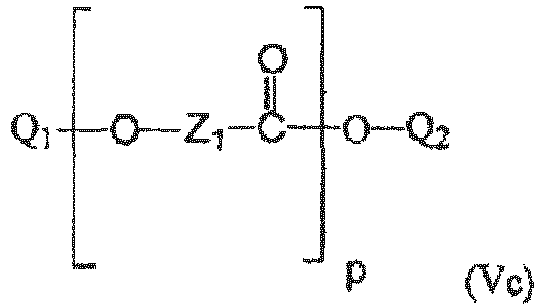
- Procédé de l'une des revendications 7 et 8, dans lequel le polymère est choisi dans le groupe d'oligomères d'un polyester ayant des unités de répétition constituées du groupe des formules générales :a) -[R2-C(=O)-O-]x-, où x est au moins égal à 2, et R2 est indépendamment choisi parmi des résidus organiques divalents éventuellement substitués ayant jusqu'à 30 atomes de carbone, qui sont liés via un atome de carbone à l'atome de carbone carbonyle adjacent, etb) -[R3-O-C(=O)-R4-C(=O)-O-]x-, où x est au moins égal à 2, R3 est indépendamment choisi parmi des résidus organiques divalents éventuellement substitués ayant jusqu'à 30 atomes de carbone, et R4 est indépendamment choisi parmi des résidus organiques divalents éventuellement substitués ayant jusqu'à 30 atomes de carbone, qui sont liés via un atome de carbone à l'atome de carbone carbonyle adjacent, une polysulfone, un polyétherimide et une polyétheréthercétone représentés par les formules (Va), (Vb), (Vc), (VI), (VII) et (VIII), respectivement :




- Procédé de l'une des revendications 7 à 9, qui comprend l'étape supplémentaire consistant à mélanger le composant (A) et le composant (B) et éventuellement un ou plusieurs composé(s) organique(s) polaire(s) ayant jusqu'à 30 atomes de carbone.
- Utilisation de la composition selon l'une des revendications 1 à 6, pour la production de polymères modifiés par un polysiloxane choisis dans le groupe constitué d'un polyester ayant des unités de répétition constituées du groupe des formules générales :a) -[R2-C(=O)-O-]x-, où x est au moins égal à 2, et R2 est indépendamment choisi parmi des résidus organiques divalents éventuellement substitués ayant jusqu'à 30 atomes de carbone, qui sont liés via un atome de carbone à l'atome de carbone carbonyle adjacent, etb) -[R3-O-C(=O)-R4-C(=O)-O-]x-, où x est au moins égal à 2, R3 est indépendamment choisi parmi des résidus organiques divalents éventuellement substitués ayant jusqu'à 30 atomes de carbone, et R4 est indépendamment choisi parmi des résidus organiques divalents éventuellement substitués ayant jusqu'à 30 atomes de carbone, qui sont liés via un atome de carbone à l'atome de carbone carbonyle adjacent, des polyétherimides (PEI), des polyétheréthercétones (PEEK) et des polysulfones.
- Utilisation de la composition selon la revendication 11, pour la production de polymères modifiés par un polysiloxane choisis dans le groupe constitué d'un polyester ayant des unités de répétition constituées du groupe des formules générales :a) -[R2-C(=O)-O-]x-, où x est au moins égal à 2, et R2 est indépendamment choisi parmi des résidus organiques divalents éventuellement substitués ayant jusqu'à 30 atomes de carbone, qui sont liés via un atome de carbone à l'atome de carbone carbonyle adjacent, etb) -[R3-O-C(=O)-R4-C(=O)-O-]x-, où x est au moins égal à 2, R3 est indépendamment choisi parmi des résidus organiques divalents éventuellement substitués ayant jusqu'à 30 atomes de carbone, et R4 est indépendamment choisi parmi des résidus organiques divalents éventuellement substitués ayant jusqu'à 30 atomes de carbone, qui sont liés via un atome de carbone à l'atome de carbone carbonyle adjacent, des polyétherimides (PEI), des polyétheréthercétones (PEEK) et des polysulfones dans un procédé de fusion sans solvant.
- Polymère modifié par un polysiloxane, obtenu par réaction d'un polymère choisi dans le groupe constitué d'un polyester ayant des unités de répétition constituées du groupe des formules générales :a) -[R2-C(=O)-O-]x-, où x est au moins égal à 2, et R2 est indépendamment choisi parmi des résidus organiques divalents éventuellement substitués ayant jusqu'à 30 atomes de carbone, qui sont liés via un atome de carbone à l'atome de carbone carbonyle adjacent, etb) -[R3-O-C(=O)-R4-C(=O)-O-]x-, où x est au moins égal à 2, R3 est indépendamment choisi parmi des résidus organiques divalents éventuellement substitués ayant jusqu'à 30 atomes de carbone, et R4 est indépendamment choisi parmi des résidus organiques divalents éventuellement substitués ayant jusqu'à 30 atomes de carbone, qui sont liés via un atome de carbone à l'atome de carbone carbonyle adjacent, des polyétherimides (PEI), des polyétheréthercétones (PEEK) et des polysulfones avec la composition selon l'une des revendications 1 à 6.
- Procédé de production de la composition selon l'une des revendications 1 à 6, qui comprend les étapes de :i) préparer un composant (A),ii) déterminer la concentration en composant (B) présent après la préparation du composant (A),iii) ajuster la concentration en composant (B), éventuellement en utilisant un composé organique polaire.
- Procédé selon la revendication 14, comprenant l'étape supplémentaire :
iv) appliquer de la chaleur et/ou une pression réduite pour obtenir un mélange intime.
Priority Applications (1)
| Application Number | Priority Date | Filing Date | Title |
|---|---|---|---|
| EP14781235.8A EP3036279B1 (fr) | 2013-10-08 | 2014-10-08 | Compositions de siloxane fonctionnel réactif |
Applications Claiming Priority (3)
| Application Number | Priority Date | Filing Date | Title |
|---|---|---|---|
| EP13187718 | 2013-10-08 | ||
| PCT/EP2014/071528 WO2015052229A1 (fr) | 2013-10-08 | 2014-10-08 | Compositions de siloxane fonctionnelles réactives |
| EP14781235.8A EP3036279B1 (fr) | 2013-10-08 | 2014-10-08 | Compositions de siloxane fonctionnel réactif |
Publications (2)
| Publication Number | Publication Date |
|---|---|
| EP3036279A1 EP3036279A1 (fr) | 2016-06-29 |
| EP3036279B1 true EP3036279B1 (fr) | 2019-05-08 |
Family
ID=49356210
Family Applications (1)
| Application Number | Title | Priority Date | Filing Date |
|---|---|---|---|
| EP14781235.8A Active EP3036279B1 (fr) | 2013-10-08 | 2014-10-08 | Compositions de siloxane fonctionnel réactif |
Country Status (5)
| Country | Link |
|---|---|
| US (1) | US9771458B2 (fr) |
| EP (1) | EP3036279B1 (fr) |
| JP (1) | JP6728038B2 (fr) |
| CN (1) | CN105814127B (fr) |
| WO (1) | WO2015052229A1 (fr) |
Families Citing this family (13)
| Publication number | Priority date | Publication date | Assignee | Title |
|---|---|---|---|---|
| CN104558615A (zh) * | 2014-12-31 | 2015-04-29 | 烟台德邦先进硅材料有限公司 | 一种酚羟基硅油的制备方法 |
| WO2017009297A1 (fr) * | 2015-07-13 | 2017-01-19 | Jotun A/S | Composition antisalissure |
| CN110072918B (zh) * | 2016-12-19 | 2021-10-22 | 科思创德国股份有限公司 | 借助相容剂制造含硅氧烷的嵌段共聚碳酸酯 |
| WO2019033295A1 (fr) * | 2017-08-16 | 2019-02-21 | Dow Silicones Corporation | Copolymère séquencé de polysiloxane-polyester, son procédé de production, et son utilisation |
| US11345783B2 (en) * | 2018-05-17 | 2022-05-31 | Evonik Operations Gmbh | Linear polydimethylsiloxane-polyoxyalkylene block copolymers of the structure type ABA |
| EP3794060A1 (fr) * | 2018-05-17 | 2021-03-24 | Evonik Operations GmbH | Copolymère séquencé de polydiméthylsiloxane et de polyoxyalkylène à structure linéaire de type aba |
| EP3581605A1 (fr) | 2018-06-14 | 2019-12-18 | Covestro Deutschland AG | Procédé de commande de fonte pour la production simultanée d'au moins deux polycarbonates différents dans une installation de production |
| JP7388831B2 (ja) * | 2019-06-20 | 2023-11-29 | 帝人株式会社 | ポリカーボネート-ポリジオルガノシロキサン共重合体、その樹脂組成物、およびその製造方法 |
| CN112791607A (zh) * | 2019-11-13 | 2021-05-14 | 上海电气集团股份有限公司 | 一种含硅氧烷的二元嵌段共聚物渗透汽化透醇膜及其制备方法 |
| TWI894358B (zh) | 2020-09-23 | 2025-08-21 | 日商三菱瓦斯化學股份有限公司 | 組成物及使用其之矽氧烷系熱塑性樹脂,及該等之製造方法 |
| JP2024527002A (ja) | 2021-07-27 | 2024-07-19 | コベストロ、ドイチュラント、アクチエンゲゼルシャフト | 少なくとも1つの特殊縮合反応器を用いてポリシロキサン-ポリカーボネートブロックコポリマーを調製する方法 |
| EP4124632A1 (fr) | 2021-07-27 | 2023-02-01 | Covestro Deutschland AG | Procédé de production d'un copolymère séquencé polysiloxane-polycarbonate |
| WO2023222443A1 (fr) | 2022-05-17 | 2023-11-23 | Covestro Deutschland Ag | Co-condensats séquencés de polysiloxane-polycarbonate formées à partir de blocs de siloxane à terminaison spécifique |
Family Cites Families (28)
| Publication number | Priority date | Publication date | Assignee | Title |
|---|---|---|---|---|
| US3189662A (en) | 1961-01-23 | 1965-06-15 | Gen Electric | Organopolysiloxane-polycarbonate block copolymers |
| DE1274578B (de) | 1965-01-21 | 1968-08-08 | Bayer Ag | Verfahren zur Herstellung von Cycloalkylaminverbindungen |
| US3328350A (en) | 1966-07-05 | 1967-06-27 | Union Carbide Corp | Stabilized organosilicon polymers |
| DE3334782A1 (de) | 1983-04-19 | 1984-10-25 | Bayer Ag, 5090 Leverkusen | Verfahren zur herstellung von polydiorganosiloxanen mit hydroxyaryloxy-endgruppen |
| DE3506472A1 (de) | 1985-02-23 | 1986-08-28 | Bayer Ag, 5090 Leverkusen | Neue polydiorganosiloxan-polycarbonat-blockcopolymere |
| EP0374635A3 (fr) | 1988-12-21 | 1991-07-24 | Bayer Ag | Polycarbonate-polysiloxane copolymères en blocs à partir de dihydroxydiphénylcycloalcanes |
| DE3929401A1 (de) | 1989-09-05 | 1991-03-07 | Bayer Ag | Thermoplastische polyestercarbonat-polysiloxan-blockcopolymere |
| US5227449A (en) | 1990-07-02 | 1993-07-13 | Xerox Corporation | Photoconductive imaging members with polycarbonate binders |
| JPH0491125A (ja) * | 1990-08-06 | 1992-03-24 | Mitsubishi Rayon Co Ltd | 熱安定性に優れた芳香族ポリエステル―ポリオルガノシロキサンブロック共重合体 |
| DE4229930C1 (fr) | 1992-09-08 | 1993-04-29 | Mercedes-Benz Aktiengesellschaft, 7000 Stuttgart, De | |
| DE4238123C2 (de) | 1992-11-12 | 2000-03-09 | Bayer Ag | Verfahren zur Herstellung von thermoplastischen Polycarbonaten |
| DE4312390A1 (de) | 1993-04-16 | 1994-10-20 | Bayer Ag | Zweistufen-Verfahren zur Herstellung von thermoplastischem Polycarbonat |
| US5319066A (en) | 1993-05-27 | 1994-06-07 | General Electric Company | Method for making polycarbonates |
| EP0633292B1 (fr) * | 1993-07-09 | 1998-12-30 | General Electric Company | Compositions de terpolymères blocs de siloxane et polyestercarbonate et polycarbonates résistants à la chaleur |
| US5412061A (en) | 1994-03-07 | 1995-05-02 | General Electric Company | Polycarbonate melt condensation synthesis using a tetraorganophosphonium carboxylate salt catalyst |
| US5504177A (en) | 1995-03-02 | 1996-04-02 | General Electric Company | Method for preparation of block copolysiloxanecarbonates |
| SI0819258T1 (en) * | 1995-04-04 | 2002-04-30 | Novartis Ag | Extended wear ophthalmic lens |
| DE19539290A1 (de) * | 1995-10-23 | 1997-04-24 | Bayer Ag | Verfahren zur Herstellung von Poly-(diorganosiloxan)-Polycarbonat-Blockcopolymeren |
| US6066700A (en) | 1997-03-12 | 2000-05-23 | Bayer Aktiengesellschaft | Process for the production of polysiloxane/polycarbonate block co-condensation products |
| US5821321A (en) * | 1997-09-16 | 1998-10-13 | Bayer Corporation | Molding composition having improved impact strength |
| US6566458B2 (en) * | 2000-12-14 | 2003-05-20 | General Electric Company | Polysulfone/polysiloxane polycarbonate block copolymers |
| DE10134480A1 (de) | 2001-07-16 | 2003-01-30 | Bayer Ag | Herstellung von Copolycarbonaten |
| US6506871B1 (en) | 2001-07-24 | 2003-01-14 | General Electric Company | Extrusion method for making polycarbonate |
| JP4620657B2 (ja) * | 2003-02-21 | 2011-01-26 | サビック・イノベーティブ・プラスチックス・アイピー・ベスローテン・フェンノートシャップ | 透明耐熱性ポリカーボネート−ポリシロキサン共重合体、そのポリカーボネートとの透明ブレンド及び製造方法 |
| US8466249B2 (en) | 2011-05-13 | 2013-06-18 | Sabic Innovative Plastics Ip Bv | Clear silicone polycarbonate elastomeric copolymers |
| CN103562274B (zh) * | 2011-05-17 | 2016-06-01 | 迈图高新材料有限责任公司 | 聚硅氧烷-聚有机嵌段共聚物 |
| US20130224462A1 (en) * | 2012-02-29 | 2013-08-29 | Sabic Innovative Plastics Ip B.V. | Thermoplastic compositions having low smoke, methods of their manufacture, and uses thereof |
| US9828463B2 (en) * | 2013-10-08 | 2017-11-28 | Covestro Deutschland Ag | Process for preparing polysiloxane-polycarbonate block cocondensates using a salt of a weak acid |
-
2014
- 2014-10-08 CN CN201480055761.5A patent/CN105814127B/zh active Active
- 2014-10-08 US US15/027,255 patent/US9771458B2/en active Active
- 2014-10-08 EP EP14781235.8A patent/EP3036279B1/fr active Active
- 2014-10-08 WO PCT/EP2014/071528 patent/WO2015052229A1/fr not_active Ceased
- 2014-10-08 JP JP2016521771A patent/JP6728038B2/ja active Active
Non-Patent Citations (1)
| Title |
|---|
| None * |
Also Published As
| Publication number | Publication date |
|---|---|
| US20160251483A1 (en) | 2016-09-01 |
| JP2016538362A (ja) | 2016-12-08 |
| JP6728038B2 (ja) | 2020-07-22 |
| WO2015052229A1 (fr) | 2015-04-16 |
| CN105814127A (zh) | 2016-07-27 |
| CN105814127B (zh) | 2019-07-26 |
| US9771458B2 (en) | 2017-09-26 |
| EP3036279A1 (fr) | 2016-06-29 |
Similar Documents
| Publication | Publication Date | Title |
|---|---|---|
| US9771458B2 (en) | Reactive functional siloxane compositions | |
| KR102080335B1 (ko) | 조절된 구조를 갖는 관능성 실록산의 제조방법 | |
| JP3701071B2 (ja) | ブロックコポリシロキサンカーボネートの製法 | |
| TWI586701B (zh) | 共聚碳酸酯及包含彼之組成物 | |
| JP6018627B2 (ja) | ポリシロキサン−ポリオルガノブロック共重合体 | |
| KR20030031882A (ko) | 실록산 코폴리카보네이트의 제조방법 | |
| US9376534B2 (en) | Phenyl-containing functional polysiloxanes and polycarbonate-polysiloxane copolymers made therefrom | |
| KR101841684B1 (ko) | 투명성 및 난연성이 향상된 폴리실록산-폴리카보네이트 공중합체 및 그 제조방법 | |
| WO2016044695A1 (fr) | Copolymères ou terpolymères de polysiloxane et polymères fabriqués à partir de ces derniers | |
| JP2017520663A (ja) | エステル官能性ポリシロキサンおよびそれから作られるコポリマー | |
| KR102258391B1 (ko) | 내충격성, 난연성 및 투명도가 우수한 폴리실록산-폴리카보네이트 공중합체 및 그 제조방법 | |
| EP1856180A1 (fr) | Procede de preparation de resine polycarbonate | |
| EP3406650B1 (fr) | Copolycarbonate et composition de résine le comprenant | |
| JP2004521177A (ja) | 溶融ポリカーボネート触媒系 | |
| WO2025129550A1 (fr) | Composition de polyorganosiloxane | |
| JPH09165505A (ja) | ポリカーボネート樹脂混合物の製造法 | |
| JPH09278876A (ja) | ポリカーボネート樹脂混合物の製造法 |
Legal Events
| Date | Code | Title | Description |
|---|---|---|---|
| PUAI | Public reference made under article 153(3) epc to a published international application that has entered the european phase |
Free format text: ORIGINAL CODE: 0009012 |
|
| 17P | Request for examination filed |
Effective date: 20160324 |
|
| AK | Designated contracting states |
Kind code of ref document: A1 Designated state(s): AL AT BE BG CH CY CZ DE DK EE ES FI FR GB GR HR HU IE IS IT LI LT LU LV MC MK MT NL NO PL PT RO RS SE SI SK SM TR |
|
| AX | Request for extension of the european patent |
Extension state: BA ME |
|
| DAX | Request for extension of the european patent (deleted) | ||
| REG | Reference to a national code |
Ref country code: DE Ref legal event code: R079 Ref document number: 602014046446 Country of ref document: DE Free format text: PREVIOUS MAIN CLASS: C08K0003100000 Ipc: C08G0064180000 |
|
| GRAP | Despatch of communication of intention to grant a patent |
Free format text: ORIGINAL CODE: EPIDOSNIGR1 |
|
| STAA | Information on the status of an ep patent application or granted ep patent |
Free format text: STATUS: GRANT OF PATENT IS INTENDED |
|
| RIC1 | Information provided on ipc code assigned before grant |
Ipc: C08G 77/16 20060101ALI20181106BHEP Ipc: C08L 83/10 20060101ALI20181106BHEP Ipc: C08K 5/09 20060101ALI20181106BHEP Ipc: C08K 5/098 20060101ALI20181106BHEP Ipc: C08G 77/448 20060101ALI20181106BHEP Ipc: C08G 64/18 20060101AFI20181106BHEP Ipc: C08K 3/10 20060101ALI20181106BHEP |
|
| INTG | Intention to grant announced |
Effective date: 20181129 |
|
| GRAS | Grant fee paid |
Free format text: ORIGINAL CODE: EPIDOSNIGR3 |
|
| GRAA | (expected) grant |
Free format text: ORIGINAL CODE: 0009210 |
|
| STAA | Information on the status of an ep patent application or granted ep patent |
Free format text: STATUS: THE PATENT HAS BEEN GRANTED |
|
| AK | Designated contracting states |
Kind code of ref document: B1 Designated state(s): AL AT BE BG CH CY CZ DE DK EE ES FI FR GB GR HR HU IE IS IT LI LT LU LV MC MK MT NL NO PL PT RO RS SE SI SK SM TR |
|
| REG | Reference to a national code |
Ref country code: GB Ref legal event code: FG4D |
|
| RIN1 | Information on inventor provided before grant (corrected) |
Inventor name: HUGGINS, JOHN Inventor name: EVERSHEIM, HUBERTUS |
|
| REG | Reference to a national code |
Ref country code: CH Ref legal event code: EP Ref country code: AT Ref legal event code: REF Ref document number: 1130036 Country of ref document: AT Kind code of ref document: T Effective date: 20190515 |
|
| REG | Reference to a national code |
Ref country code: DE Ref legal event code: R096 Ref document number: 602014046446 Country of ref document: DE Ref country code: IE Ref legal event code: FG4D |
|
| REG | Reference to a national code |
Ref country code: NL Ref legal event code: FP |
|
| REG | Reference to a national code |
Ref country code: LT Ref legal event code: MG4D |
|
| PG25 | Lapsed in a contracting state [announced via postgrant information from national office to epo] |
Ref country code: HR Free format text: LAPSE BECAUSE OF FAILURE TO SUBMIT A TRANSLATION OF THE DESCRIPTION OR TO PAY THE FEE WITHIN THE PRESCRIBED TIME-LIMIT Effective date: 20190508 Ref country code: LT Free format text: LAPSE BECAUSE OF FAILURE TO SUBMIT A TRANSLATION OF THE DESCRIPTION OR TO PAY THE FEE WITHIN THE PRESCRIBED TIME-LIMIT Effective date: 20190508 Ref country code: SE Free format text: LAPSE BECAUSE OF FAILURE TO SUBMIT A TRANSLATION OF THE DESCRIPTION OR TO PAY THE FEE WITHIN THE PRESCRIBED TIME-LIMIT Effective date: 20190508 Ref country code: FI Free format text: LAPSE BECAUSE OF FAILURE TO SUBMIT A TRANSLATION OF THE DESCRIPTION OR TO PAY THE FEE WITHIN THE PRESCRIBED TIME-LIMIT Effective date: 20190508 Ref country code: AL Free format text: LAPSE BECAUSE OF FAILURE TO SUBMIT A TRANSLATION OF THE DESCRIPTION OR TO PAY THE FEE WITHIN THE PRESCRIBED TIME-LIMIT Effective date: 20190508 Ref country code: ES Free format text: LAPSE BECAUSE OF FAILURE TO SUBMIT A TRANSLATION OF THE DESCRIPTION OR TO PAY THE FEE WITHIN THE PRESCRIBED TIME-LIMIT Effective date: 20190508 Ref country code: PT Free format text: LAPSE BECAUSE OF FAILURE TO SUBMIT A TRANSLATION OF THE DESCRIPTION OR TO PAY THE FEE WITHIN THE PRESCRIBED TIME-LIMIT Effective date: 20190908 Ref country code: NO Free format text: LAPSE BECAUSE OF FAILURE TO SUBMIT A TRANSLATION OF THE DESCRIPTION OR TO PAY THE FEE WITHIN THE PRESCRIBED TIME-LIMIT Effective date: 20190808 |
|
| PG25 | Lapsed in a contracting state [announced via postgrant information from national office to epo] |
Ref country code: BG Free format text: LAPSE BECAUSE OF FAILURE TO SUBMIT A TRANSLATION OF THE DESCRIPTION OR TO PAY THE FEE WITHIN THE PRESCRIBED TIME-LIMIT Effective date: 20190808 Ref country code: GR Free format text: LAPSE BECAUSE OF FAILURE TO SUBMIT A TRANSLATION OF THE DESCRIPTION OR TO PAY THE FEE WITHIN THE PRESCRIBED TIME-LIMIT Effective date: 20190809 Ref country code: LV Free format text: LAPSE BECAUSE OF FAILURE TO SUBMIT A TRANSLATION OF THE DESCRIPTION OR TO PAY THE FEE WITHIN THE PRESCRIBED TIME-LIMIT Effective date: 20190508 Ref country code: RS Free format text: LAPSE BECAUSE OF FAILURE TO SUBMIT A TRANSLATION OF THE DESCRIPTION OR TO PAY THE FEE WITHIN THE PRESCRIBED TIME-LIMIT Effective date: 20190508 |
|
| REG | Reference to a national code |
Ref country code: AT Ref legal event code: MK05 Ref document number: 1130036 Country of ref document: AT Kind code of ref document: T Effective date: 20190508 |
|
| PG25 | Lapsed in a contracting state [announced via postgrant information from national office to epo] |
Ref country code: EE Free format text: LAPSE BECAUSE OF FAILURE TO SUBMIT A TRANSLATION OF THE DESCRIPTION OR TO PAY THE FEE WITHIN THE PRESCRIBED TIME-LIMIT Effective date: 20190508 Ref country code: DK Free format text: LAPSE BECAUSE OF FAILURE TO SUBMIT A TRANSLATION OF THE DESCRIPTION OR TO PAY THE FEE WITHIN THE PRESCRIBED TIME-LIMIT Effective date: 20190508 Ref country code: RO Free format text: LAPSE BECAUSE OF FAILURE TO SUBMIT A TRANSLATION OF THE DESCRIPTION OR TO PAY THE FEE WITHIN THE PRESCRIBED TIME-LIMIT Effective date: 20190508 Ref country code: AT Free format text: LAPSE BECAUSE OF FAILURE TO SUBMIT A TRANSLATION OF THE DESCRIPTION OR TO PAY THE FEE WITHIN THE PRESCRIBED TIME-LIMIT Effective date: 20190508 Ref country code: CZ Free format text: LAPSE BECAUSE OF FAILURE TO SUBMIT A TRANSLATION OF THE DESCRIPTION OR TO PAY THE FEE WITHIN THE PRESCRIBED TIME-LIMIT Effective date: 20190508 Ref country code: SK Free format text: LAPSE BECAUSE OF FAILURE TO SUBMIT A TRANSLATION OF THE DESCRIPTION OR TO PAY THE FEE WITHIN THE PRESCRIBED TIME-LIMIT Effective date: 20190508 |
|
| REG | Reference to a national code |
Ref country code: DE Ref legal event code: R097 Ref document number: 602014046446 Country of ref document: DE |
|
| PG25 | Lapsed in a contracting state [announced via postgrant information from national office to epo] |
Ref country code: SM Free format text: LAPSE BECAUSE OF FAILURE TO SUBMIT A TRANSLATION OF THE DESCRIPTION OR TO PAY THE FEE WITHIN THE PRESCRIBED TIME-LIMIT Effective date: 20190508 |
|
| PLBE | No opposition filed within time limit |
Free format text: ORIGINAL CODE: 0009261 |
|
| STAA | Information on the status of an ep patent application or granted ep patent |
Free format text: STATUS: NO OPPOSITION FILED WITHIN TIME LIMIT |
|
| PG25 | Lapsed in a contracting state [announced via postgrant information from national office to epo] |
Ref country code: TR Free format text: LAPSE BECAUSE OF FAILURE TO SUBMIT A TRANSLATION OF THE DESCRIPTION OR TO PAY THE FEE WITHIN THE PRESCRIBED TIME-LIMIT Effective date: 20190508 |
|
| 26N | No opposition filed |
Effective date: 20200211 |
|
| PG25 | Lapsed in a contracting state [announced via postgrant information from national office to epo] |
Ref country code: PL Free format text: LAPSE BECAUSE OF FAILURE TO SUBMIT A TRANSLATION OF THE DESCRIPTION OR TO PAY THE FEE WITHIN THE PRESCRIBED TIME-LIMIT Effective date: 20190508 |
|
| PG25 | Lapsed in a contracting state [announced via postgrant information from national office to epo] |
Ref country code: SI Free format text: LAPSE BECAUSE OF FAILURE TO SUBMIT A TRANSLATION OF THE DESCRIPTION OR TO PAY THE FEE WITHIN THE PRESCRIBED TIME-LIMIT Effective date: 20190508 Ref country code: MC Free format text: LAPSE BECAUSE OF FAILURE TO SUBMIT A TRANSLATION OF THE DESCRIPTION OR TO PAY THE FEE WITHIN THE PRESCRIBED TIME-LIMIT Effective date: 20190508 |
|
| REG | Reference to a national code |
Ref country code: CH Ref legal event code: PL |
|
| PG25 | Lapsed in a contracting state [announced via postgrant information from national office to epo] |
Ref country code: LU Free format text: LAPSE BECAUSE OF NON-PAYMENT OF DUE FEES Effective date: 20191008 Ref country code: CH Free format text: LAPSE BECAUSE OF NON-PAYMENT OF DUE FEES Effective date: 20191031 Ref country code: LI Free format text: LAPSE BECAUSE OF NON-PAYMENT OF DUE FEES Effective date: 20191031 |
|
| REG | Reference to a national code |
Ref country code: BE Ref legal event code: MM Effective date: 20191031 |
|
| PG25 | Lapsed in a contracting state [announced via postgrant information from national office to epo] |
Ref country code: BE Free format text: LAPSE BECAUSE OF NON-PAYMENT OF DUE FEES Effective date: 20191031 |
|
| PG25 | Lapsed in a contracting state [announced via postgrant information from national office to epo] |
Ref country code: IE Free format text: LAPSE BECAUSE OF NON-PAYMENT OF DUE FEES Effective date: 20191008 |
|
| PG25 | Lapsed in a contracting state [announced via postgrant information from national office to epo] |
Ref country code: CY Free format text: LAPSE BECAUSE OF FAILURE TO SUBMIT A TRANSLATION OF THE DESCRIPTION OR TO PAY THE FEE WITHIN THE PRESCRIBED TIME-LIMIT Effective date: 20190508 |
|
| PG25 | Lapsed in a contracting state [announced via postgrant information from national office to epo] |
Ref country code: IS Free format text: LAPSE BECAUSE OF FAILURE TO SUBMIT A TRANSLATION OF THE DESCRIPTION OR TO PAY THE FEE WITHIN THE PRESCRIBED TIME-LIMIT Effective date: 20190908 |
|
| PG25 | Lapsed in a contracting state [announced via postgrant information from national office to epo] |
Ref country code: HU Free format text: LAPSE BECAUSE OF FAILURE TO SUBMIT A TRANSLATION OF THE DESCRIPTION OR TO PAY THE FEE WITHIN THE PRESCRIBED TIME-LIMIT; INVALID AB INITIO Effective date: 20141008 Ref country code: MT Free format text: LAPSE BECAUSE OF FAILURE TO SUBMIT A TRANSLATION OF THE DESCRIPTION OR TO PAY THE FEE WITHIN THE PRESCRIBED TIME-LIMIT Effective date: 20190508 |
|
| PG25 | Lapsed in a contracting state [announced via postgrant information from national office to epo] |
Ref country code: MK Free format text: LAPSE BECAUSE OF FAILURE TO SUBMIT A TRANSLATION OF THE DESCRIPTION OR TO PAY THE FEE WITHIN THE PRESCRIBED TIME-LIMIT Effective date: 20190508 |
|
| P01 | Opt-out of the competence of the unified patent court (upc) registered |
Effective date: 20230513 |
|
| PGFP | Annual fee paid to national office [announced via postgrant information from national office to epo] |
Ref country code: NL Payment date: 20251024 Year of fee payment: 12 |
|
| PGFP | Annual fee paid to national office [announced via postgrant information from national office to epo] |
Ref country code: DE Payment date: 20251028 Year of fee payment: 12 |
|
| PGFP | Annual fee paid to national office [announced via postgrant information from national office to epo] |
Ref country code: GB Payment date: 20251023 Year of fee payment: 12 |
|
| PGFP | Annual fee paid to national office [announced via postgrant information from national office to epo] |
Ref country code: IT Payment date: 20251022 Year of fee payment: 12 |
|
| PGFP | Annual fee paid to national office [announced via postgrant information from national office to epo] |
Ref country code: FR Payment date: 20251027 Year of fee payment: 12 |