EP3041945B1 - Herstellung von galaktooligosacchariden - Google Patents
Herstellung von galaktooligosacchariden Download PDFInfo
- Publication number
- EP3041945B1 EP3041945B1 EP14781316.6A EP14781316A EP3041945B1 EP 3041945 B1 EP3041945 B1 EP 3041945B1 EP 14781316 A EP14781316 A EP 14781316A EP 3041945 B1 EP3041945 B1 EP 3041945B1
- Authority
- EP
- European Patent Office
- Prior art keywords
- lactose
- galactosidase
- gos
- immobilized
- beta
- Prior art date
- Legal status (The legal status is an assumption and is not a legal conclusion. Google has not performed a legal analysis and makes no representation as to the accuracy of the status listed.)
- Active
Links
Images

Classifications
-
- C—CHEMISTRY; METALLURGY
- C12—BIOCHEMISTRY; BEER; SPIRITS; WINE; VINEGAR; MICROBIOLOGY; ENZYMOLOGY; MUTATION OR GENETIC ENGINEERING
- C12P—FERMENTATION OR ENZYME-USING PROCESSES TO SYNTHESISE A DESIRED CHEMICAL COMPOUND OR COMPOSITION OR TO SEPARATE OPTICAL ISOMERS FROM A RACEMIC MIXTURE
- C12P19/00—Preparation of compounds containing saccharide radicals
- C12P19/04—Polysaccharides, i.e. compounds containing more than five saccharide radicals attached to each other by glycosidic bonds
-
- C—CHEMISTRY; METALLURGY
- C07—ORGANIC CHEMISTRY
- C07H—SUGARS; DERIVATIVES THEREOF; NUCLEOSIDES; NUCLEOTIDES; NUCLEIC ACIDS
- C07H1/00—Processes for the preparation of sugar derivatives
-
- C—CHEMISTRY; METALLURGY
- C07—ORGANIC CHEMISTRY
- C07H—SUGARS; DERIVATIVES THEREOF; NUCLEOSIDES; NUCLEOTIDES; NUCLEIC ACIDS
- C07H3/00—Compounds containing only hydrogen atoms and saccharide radicals having only carbon, hydrogen, and oxygen atoms
- C07H3/06—Oligosaccharides, i.e. having three to five saccharide radicals attached to each other by glycosidic linkages
-
- C—CHEMISTRY; METALLURGY
- C12—BIOCHEMISTRY; BEER; SPIRITS; WINE; VINEGAR; MICROBIOLOGY; ENZYMOLOGY; MUTATION OR GENETIC ENGINEERING
- C12N—MICROORGANISMS OR ENZYMES; COMPOSITIONS THEREOF; PROPAGATING, PRESERVING, OR MAINTAINING MICROORGANISMS; MUTATION OR GENETIC ENGINEERING; CULTURE MEDIA
- C12N1/00—Microorganisms; Compositions thereof; Processes of propagating, maintaining or preserving microorganisms or compositions thereof; Processes of preparing or isolating a composition containing a microorganism; Culture media therefor
- C12N1/08—Reducing the nucleic acid content
-
- C—CHEMISTRY; METALLURGY
- C12—BIOCHEMISTRY; BEER; SPIRITS; WINE; VINEGAR; MICROBIOLOGY; ENZYMOLOGY; MUTATION OR GENETIC ENGINEERING
- C12N—MICROORGANISMS OR ENZYMES; COMPOSITIONS THEREOF; PROPAGATING, PRESERVING, OR MAINTAINING MICROORGANISMS; MUTATION OR GENETIC ENGINEERING; CULTURE MEDIA
- C12N11/00—Carrier-bound or immobilised enzymes; Carrier-bound or immobilised microbial cells; Preparation thereof
- C12N11/02—Enzymes or microbial cells immobilised on or in an organic carrier
- C12N11/08—Enzymes or microbial cells immobilised on or in an organic carrier the carrier being a synthetic polymer
- C12N11/082—Enzymes or microbial cells immobilised on or in an organic carrier the carrier being a synthetic polymer obtained by reactions only involving carbon-to-carbon unsaturated bonds
- C12N11/087—Acrylic polymers
-
- C—CHEMISTRY; METALLURGY
- C12—BIOCHEMISTRY; BEER; SPIRITS; WINE; VINEGAR; MICROBIOLOGY; ENZYMOLOGY; MUTATION OR GENETIC ENGINEERING
- C12N—MICROORGANISMS OR ENZYMES; COMPOSITIONS THEREOF; PROPAGATING, PRESERVING, OR MAINTAINING MICROORGANISMS; MUTATION OR GENETIC ENGINEERING; CULTURE MEDIA
- C12N9/00—Enzymes; Proenzymes; Compositions thereof; Processes for preparing, activating, inhibiting, separating or purifying enzymes
- C12N9/14—Hydrolases (3)
- C12N9/24—Hydrolases (3) acting on glycosyl compounds (3.2)
- C12N9/2402—Hydrolases (3) acting on glycosyl compounds (3.2) hydrolysing O- and S- glycosyl compounds (3.2.1)
- C12N9/2468—Hydrolases (3) acting on glycosyl compounds (3.2) hydrolysing O- and S- glycosyl compounds (3.2.1) acting on beta-galactose-glycoside bonds, e.g. carrageenases (3.2.1.83; 3.2.1.157); beta-agarase (3.2.1.81)
- C12N9/2471—Beta-galactosidase (3.2.1.23), i.e. exo-(1-->4)-beta-D-galactanase
-
- C—CHEMISTRY; METALLURGY
- C12—BIOCHEMISTRY; BEER; SPIRITS; WINE; VINEGAR; MICROBIOLOGY; ENZYMOLOGY; MUTATION OR GENETIC ENGINEERING
- C12P—FERMENTATION OR ENZYME-USING PROCESSES TO SYNTHESISE A DESIRED CHEMICAL COMPOUND OR COMPOSITION OR TO SEPARATE OPTICAL ISOMERS FROM A RACEMIC MIXTURE
- C12P19/00—Preparation of compounds containing saccharide radicals
-
- C—CHEMISTRY; METALLURGY
- C12—BIOCHEMISTRY; BEER; SPIRITS; WINE; VINEGAR; MICROBIOLOGY; ENZYMOLOGY; MUTATION OR GENETIC ENGINEERING
- C12P—FERMENTATION OR ENZYME-USING PROCESSES TO SYNTHESISE A DESIRED CHEMICAL COMPOUND OR COMPOSITION OR TO SEPARATE OPTICAL ISOMERS FROM A RACEMIC MIXTURE
- C12P19/00—Preparation of compounds containing saccharide radicals
- C12P19/14—Preparation of compounds containing saccharide radicals produced by the action of a carbohydrase (EC 3.2.x), e.g. by alpha-amylase, e.g. by cellulase, hemicellulase
-
- C—CHEMISTRY; METALLURGY
- C12—BIOCHEMISTRY; BEER; SPIRITS; WINE; VINEGAR; MICROBIOLOGY; ENZYMOLOGY; MUTATION OR GENETIC ENGINEERING
- C12Y—ENZYMES
- C12Y302/00—Hydrolases acting on glycosyl compounds, i.e. glycosylases (3.2)
- C12Y302/01—Glycosidases, i.e. enzymes hydrolysing O- and S-glycosyl compounds (3.2.1)
- C12Y302/01023—Beta-galactosidase (3.2.1.23), i.e. exo-(1-->4)-beta-D-galactanase
-
- C—CHEMISTRY; METALLURGY
- C13—SUGAR INDUSTRY
- C13K—SACCHARIDES OBTAINED FROM NATURAL SOURCES OR BY HYDROLYSIS OF NATURALLY OCCURRING DISACCHARIDES, OLIGOSACCHARIDES OR POLYSACCHARIDES
- C13K5/00—Lactose
Definitions
- the invention relates to methods for preparing galacto-oligosaccharides (GOS).
- GOS also known as oligogalactosyllactose, oligogalactose, oligolactose or transgalactooligosaccharides (TOS)
- TOS transgalactooligosaccharides
- GOS belongs to the group of prebiotics. Prebiotics are defined as non-digestible food ingredients that beneficially affect the host by stimulating the growth and/or activity of beneficial bacteria in the colon.
- GOS when added to infant milk formulas, to replicate the bifidogenic effect of human milk, not only in bacterial numbers, but also with respect to the metabolic activity of the colonic microbiota, has significantly increased interest in their production and application in various food and pharmaceutical processes.
- GOS occurs in commercial available products such as food for both infants and adult, ranging from infant formula to food for the critical ill.
- the GOS synthesis typically involves a number of galactosyl transfer processes catalyzed by ⁇ -galactosidase ( ⁇ -D-galactohydrolase; EC 3.2.1.23), which uses lactose as galactosyl donor and lactose or the intermediate GOS species as galactosyl acceptor.
- ⁇ -galactosidase ⁇ -D-galactohydrolase
- the GOS can be generally expressed as (Gal)m-Glc (where m varies usually between 2-9, depending on the source of the enzyme and the reaction conditions applied).
- new DP2 species such as allolactose are usually considered as the primary product of the transgalactosylation action of ⁇ -galactosidase.
- DP2 species formed by the transgalactosylation of ⁇ -galactosidase can further take part in the formation of higher DP GOS species, thus complicating the GOS product spectrum, as discussed below.
- the enzyme ⁇ -galactosidase has numerous applications in the food and dairy industries, the moderate stability of enzyme is one of the limitations that hinder general implementation of biocatalysts at an industrial scale. Studies to explore their full potential as catalyst have resulted in various suitable strategies for enzyme stabilization.
- the enzyme has been immobilized by various methods such as physical absorption, entrapment, and covalent binding method on different supports. Immobilization has also shown to have an advantageous effect on reducing production inhibition of ⁇ -galactosidase. Still further, enzyme immobilization facilitates enzyme reusability and continuous operation of the GOS synthesis process.
- the various GOS species can be used not only as acceptors for further GOS synthesis but also as substrates for hydrolysis.
- the hydrolytic reaction will dominate generally at the later stages of the reaction when the peak in GOS concentration has passed and the main substrate lactose concentration in the reaction mixture is decreased to a low value.
- production inhibition may also occur, when more and more products accumulate, resulting in either the inhibition of GOS synthesis or GOS hydrolysis.
- the higher temperatures can be beneficial in higher oligosaccharide yields.
- the higher yield at higher temperatures is an additional advantage when operating at high initial lactose concentrations and, consequently, elevated temperatures.
- immobilized beta-galactosidase for the synthesis of GOS e.g. reducing the cost contribution of the enzyme by efficient recycling, easy handling and process control and enabling a continuous process have been widely recognized.
- the industrial use of immobilized beta-galactosidase for the production of GOS has been not reported yet. In the example of the study by Urretia et al., it was shown that immobilized B.
- circulans ⁇ -galactosidase was recyclable, when performing the reaction at 60°C in a 50% (w/w) lactose solution using a high enzyme dosage ( ⁇ 18% of the lactose (w/w)) under repeated batch operation.
- GOS synthesis is generally preferred to be performed using immobilized enzyme under conditions with a high initial lactose concentration in order to achieve a high GOS yield and to reduce the hydrolytic side reaction [3,4,5].
- the present inventors found that the results obtained from optimization studies performed in a research setting do not always provide a good indicator for GOS synthesis at an industrial scale, e.g. in food industries, wherein relatively low enzyme concentrations (and/or a smaller volume of immobilized enzyme) and long (>20 hours) incubation periods are typically used for economical reasons, in order to achieve a high productivity and a high space-time yield.
- the enzyme denaturation can be retarded by the use of "pre-crystallized” lactose, without the need to dissolve lactose completely by pre-heating the crystalized lactose to a higher temperature, thus resulting in a sustainable industrial process.
- the invention provides a method for preparing galacto-oligosaccharides (GOS) from lactose, comprising contacting a lactose feed with ⁇ -galactosidase which is immobilized, preferably on a solid carrier, and allowing for GOS synthesis, wherein said lactose feed is an aqueous slurry of crystalline lactose.
- GOS galacto-oligosaccharides
- aqueous slurry refers to a watery mixture (suspension) of insoluble lactose crystals i.e. a composition wherein not all lactose is dissolved and wherein the soluble lactose concentration is equal to its solubility at a given reaction temperature.
- lactose solubility is strongly dependent on the temperature.
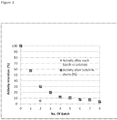
- Figure 1 shows the solubility-temperature relation for lactose in water at neutral pH.
- the aqueous lactose slurry for use in the present invention contains 17%-75% (w/w) lactose.
- a high lactose content in the slurry may result in a concentrated product in the reactor that requires less energy to further concentrate to obtain the finished GOS syrup of 75% (w/w). Therefore, both for economical reason and very good GOS yields, the lactose slurry is preferred to contain 50-70 % (w/w) lactose in total.
- the aqueous lactose slurry contains at least 53% (w/w), preferably at least 55% (w/w) lactose.
- a slurry for use in the present invention is easily prepared by adding crystalline lactose (monohydrate) to an aqueous liquid.
- the lactose solubility at 58°C was calculated to be 35.6% (w/w). Therefore, the percentage insoluble lactose crystals will be the lactose concentration subtracted by the lactose solubility at 58°C. In this way, the percentage of the insoluble lactose crystals present in reaction system is calculated to be 19.4% (55% minus 35.6%) (w/w)
- lactose typically, a suitable amount of lactose is added directly to a buffer solution at room temperature and heated to a desired reaction temperature. It is also possible to add lactose to water, followed by adjusting the pH of the lactose slurry to a working pH range of about pH3.5 - 7.5 that is within the enzyme activity range for example by adding caustic (NaOH) or a buffer solution.
- a suitable amount of lactose is added directly to a buffer solution at room temperature and heated to a desired reaction temperature. It is also possible to add lactose to water, followed by adjusting the pH of the lactose slurry to a working pH range of about pH3.5 - 7.5 that is within the enzyme activity range for example by adding caustic (NaOH) or a buffer solution.
- a method of the invention does not require extensive heating of lactose to completely dissolve the lactose. This not only reduces the energy consumption and thus operational costs that are associated with the heating step, but also avoids the undesirable color change of lactose solution to a more yellowish appearance.
- ⁇ -lactose crystallizes from supersaturated solutions at temperatures below 93.5°C to produce a variety of crystal shapes. The usual ones obtained resemble prism and tomahawk shapes, and are hard and only sparingly soluble. Above 93.5°C, ⁇ -lactose crystallises out, usually as an uneven-sided diamond. A molecule of water is associated with the crystalline ⁇ - form of lactose and so it is referred to as the monohydrate. At temperatures over 120°C and under vacuum, however, this water is lost and the highly hygroscopic ⁇ -lactose anhydride is formed.
- a method of the invention preferably comprises use of food grade or pharmaceutical grade lactose, or refined lactose that is between the food and pharmaceutical grade lactose.
- Food grade lactose is produced by concentrating whey or permeate (a co-product of whey protein concentrate production) to supersaturated solution and lactose crystalizes out, then removing and drying the lactose crystals. Special processes of crystallization, as well as grinding and fractionated sifting, produce types of lactose which differ in particle size distribution. Today, the industry offers several types of lactose ranging from superfine to extra coarse crystals for all applications.
- the lactose content is not less than 99%, with the sulfated ash content not more than 0.3%, both on a dry basis.
- the pH of a 10% solution is not less than 4.5 or more than 7.5.
- the resulting reaction mixture is incubated under conditions favoring GOS synthesis.
- the selected reaction temperature should both favor the GOS synthesis and the enzyme stability. Therefore, the optimum temperature is the temperature at which the immobilized enzyme can be recycled in economically optimal manner, for instance, disposing the immobilized enzyme when reaching the half-life of the immobilized enzyme at the individual selected immobilized beta-galactosidase.
- GOS synthesis is performed at a reaction temperature of between about 20 and about 60°C. In one embodiment, the reaction is carried out at 40-60°C, preferably 45-55°C, like at about 50°C.
- GOS synthesis according to the invention is generally allowed to proceed from 0.5-100 hours.
- industrial production of GOS generally requires a rational integration with other units of operation involved, such as purification, demineralization, decoloration and the like.
- GOS synthesis at an industrial scale is preferably performed during a reaction period of at least 6 or 10 hours, preferably 12-36 hours for practical and economical reasons.
- a method of the invention is suitably practiced using an incubation time of about 18-24 hours. This allows for flexible accommodation in an employee working day while at the same time obviating the need for high amounts of enzyme, because a large amount of immobilized enzyme in the reactor will reduce the productivity and space-time yield
- the dose of the immobilized beta-galactosidase can be used in an amount of up to 30 LU / gram initial lactose, preferably up to 25 LU/gram, more preferably in an amount of between about 10 and 20 LU/gram.
- one lactase unit is defined as the quantity of enzyme that liberates 1 ⁇ mole of glucose per minute at the early stage of the reaction at 40°C, pH 6.0.
- lactose is hydrolysed by lactase, it is converted into glucose and galactose.
- the lactase activity is determined by measuring the amount of liberated glucose.
- the slurry is placed in a separate reactor and the insoluble lactose crystals are retained by a microfilter. Then, the soluble lactose is pumped to a packed bed reactor (PBR) where the immobilized beta-galactosidase is located. The outlet of the PBR is returned back to the reactor. In this way, after certain time, the lactose will be completely dissolved and high GOS concentrations can be obtained.
- PBR packed bed reactor
- lactose crystals are gradually added to the GOS solution. Lactose is dissolved and pumped to the PBR and the dissolved lactose will be converted to GOS.
- not all the insoluble lactose crystals are added at once such that no difficulties with stirring the reaction mixture are encountered.
- lactose crystals are directly added to an existing reaction mixture to replenish the initially present lactose crystals that have been dissolved and completely converted to GOS.
- more lactose crystals can be added to continue the reaction until high, e.g. up to 75%, GOS solution can be obtained.
- beta-galactosidase from a wide variety of sources, such as microorganisms, plants and animals.
- Micro-organisms like bacteria, fungi and yeast are considered the preferred sources of beta-galactosidase for industrial applications. See ref Panesar 2010 for an overview of suitable microbial sources.
- beta-galactosidase is isolated from a micro-organism selected from the group consisting of A . oryzae, A. niger, B. circulans, S. singularis, T. aquaticus, K. lactis, K. marxianus and E. coli.
- Some of the enzymes have high specificity to synthesize oligosaccharides of specific chain length and orientation of the linkage.
- ⁇ -galactosidase sourced from B. circulans shows high specificity to ⁇ -1,4 linkages and in turn yields mainly ⁇ -1,4 linked galactosyl oligosaccharides (GOS) by transglycosylation, while ⁇ -galactosidase sourced from Aspergillus oryzae gives ⁇ -1,6 GOS mainly.
- GOS galactosyl oligosaccharides
- Very good results were obtained with B. circulans beta-galactosidase, which is available from Daiwa Kasei, Amano, Japan in the form of the commercial enzyme preparation, Biolacta®N5.
- a method of the invention is characterized by incubating a lactose slurry with immobilized beta-galactosidase.
- Various ways of enzyme immobilization are known in the art. They typically comprise a porous carrier onto which the beta-galactosidase is immobilized via covalent binding, via physical absorption (charge-charge or van der waals interaction), via gel encapsulation or a combination thereof.
- Table 2 of ref Panesar 2010 gives an overview of different sources of beta-galactosidase and methods of immobilization.
- the carrier-free immobilized enzymes such as CLEC (cross-linked enzyme crystals) or CLEAs (cross-linked enzyme aggregates) might be also applied [6,7].
- the invention is not limited to any type of enzyme immobilization. However, carriers that can promote direct covalent binding of the enzyme are preferred, regarding the ease of operation and no leakage of the enzyme molecules into the reaction mixture.
- the solid carrier is an activated acrylic polymer, preferably a functionalized polymethacrylate matrix.
- a hexamethylenamino - functionalized polymethacrylate matrix (Sepabeads) or a macroporous acrylic epoxy-activated resin, like Eupergit C 250L, can be used.
- GOS synthesis can be terminated by methods known in the art. For instance, the immobilized beta-galactosidase is physically separated from the remainder of the reaction mixture by filtration or by retaining the particles of the immobilized enzymes by a sieve installed on the bottom of the reactor.
- a method of the invention is advantageously used in a repeated batch operating system involving several consecutive batches ("cycles") of GOS synthesis. Furthermore, a method of the invention allows for the recycling of immobilized enzyme during several batches since detrimental effects of lactose crystallization during the GOS synthesis reaction are avoided by the use of a lactose slurry as lactose feed. This enables semi-continuous operation and multiple reuse of the enzyme.
- a method further comprises, following a first cycle of GOS synthesis, the steps of: (a) washing the immobilized beta-galactosidase, (b) optionally storage of the washed immobilized beta-galactosidase until further use; and (c) one or more subsequent cycles of GOS synthesis by contacting the washed immobilized beta-galactosidase of step (a) with a lactose slurry such that the enzyme is recycled.
- the tea-bag Prior to enzyme washing, it is typically physically separated from the GOS-containing reaction mixture. For example, if the enzyme used for GOS synthesis is used in a "tea-bag"-like pouch, the tea-bag can simply be taken out of the reaction mixture. Alternatively, GOS can be removed from the reactor while the immobilized enzyme remains in the reactor during washing.
- the enzyme is washed several times with demineralized water and/or the same buffer used in the GOS synthesis reaction.
- Immobilized enzyme can be sanitized e.g. to reduce the microbial count, by washing with an acetic acid solution of about pH 4.5.
- the enzyme may be stored in a buffer at a temperature below 10°C, preferably at around 4°C. Suitable buffers include those in the range of pH 5.5-7.5.
- the enzyme is stored in 0.1M K 2 HPO 4 / KH 2 P0 4 buffer, pH 6.0 - 7.0 at 4°C, prior to reuse.
- a method of the invention comprises at least 5, preferably at least 8, more preferably at least 10 cycles of GOS synthesis employing recycled immobilized beta-galactosidase.
- the invention provides a composition comprising an aqueous slurry of crystalline lactose and comprising beta-galactosidase which is immobilized on a solid carrier.
- a composition comprising an aqueous slurry of crystalline lactose and comprising beta-galactosidase which is immobilized on a solid carrier.
- Preferred lactose concentrations, enzyme sources and enzyme concentrations are disclosed herein above.
- Example 1 Synthesis of GOS with immobilized ⁇ -galactosidase from Bacillus circulans using a lactose solution (55%)
- 35 gram lactose was added to 25 gram 0,1M K 2 HPO 4 / KH 2 PO 4 buffer, pH 6.3 and was completely dissolved at 95°C then cooled down to 58°C. Afterward, 2.7 gram carrier-bound enzyme immobilized on commercial carrier (Sepabeads EC-HA) via glutaraldehyde coupling with a specific activity of 131.16 LU/gram immobilized enzyme was added to initialize the enzymatic reaction. The enzyme dosage is 10.2 LU/gram lactose.
- the GOS was filtrated and the immobilized enzyme was washed with demineralized water and stored in 0.1M K 2 HPO 4 / KH 2 PO 4 buffer, pH 6.0 - 7.0 at 4 °C, prior to reuse.
- Carbohydrates (galactose, glucose, lactose and GOS) were analyzed as previously described by Coulier et al. (J. Agric. Food Chem. 2009, 57, 8488-8495 ) and Warmerdam et al. (Appl Biochem Biotechnol (2013) 170:340-358 ).
- Example 2 Synthesis of GOS with immobilized ⁇ -galactosidase from Bacillus circulans in a lactose slurry (55% w/w) reaction system of the invention.
- Example 3 Synthesis of GOS with free ⁇ -galactosidase from Bacillus circulans using a lactose slurry (65%, w/w) reaction system.
- reaction mixture was incubated in a water batch with orbit shaker. After 24 hours reaction, the GOS content in the final reaction mixture was only 40% and there was still a lot of insoluble lactose left in the reaction mixture. This suggests that, in such a high lactose concentration slurry system, the free enzyme was less active than immobilized enzyme.
- Example 4 Synthesis of GOS with immobilised ⁇ -galactosidase from Bacillus circulans (carrier-epoxy Eupergit C 250 L) in lactose scurry (65%, w/w) reaction system
Landscapes
- Chemical & Material Sciences (AREA)
- Organic Chemistry (AREA)
- Life Sciences & Earth Sciences (AREA)
- Engineering & Computer Science (AREA)
- Health & Medical Sciences (AREA)
- Zoology (AREA)
- Wood Science & Technology (AREA)
- Genetics & Genomics (AREA)
- Biochemistry (AREA)
- General Health & Medical Sciences (AREA)
- Bioinformatics & Cheminformatics (AREA)
- Biotechnology (AREA)
- General Engineering & Computer Science (AREA)
- Microbiology (AREA)
- Molecular Biology (AREA)
- General Chemical & Material Sciences (AREA)
- Chemical Kinetics & Catalysis (AREA)
- Biomedical Technology (AREA)
- Medicinal Chemistry (AREA)
- Tropical Medicine & Parasitology (AREA)
- Virology (AREA)
- Preparation Of Compounds By Using Micro-Organisms (AREA)
- Immobilizing And Processing Of Enzymes And Microorganisms (AREA)
- Enzymes And Modification Thereof (AREA)
- Polysaccharides And Polysaccharide Derivatives (AREA)
- Saccharide Compounds (AREA)
Claims (15)
- Verfahren zur Herstellung von Galaktooligosacchariden (GOS) von Laktose, umfassend (i) Kontaktieren einer Laktosezufuhr mit immobilisierter Beta-Galaktosidase (EC 3.2.1.23) und (ii) Ermöglichen von GOS-Synthese, wobei die Laktosezufuhr eine wässrige Aufschlämmung von kristalliner Laktose ist.
- Verfahren nach Anspruch 1, wobei die wässrige Laktoseaufschlämmung 17 %-75 % (m/m), bevorzugt 50-70 % (m/m) Laktose, bevorzugt Laktose von Lebensmittelqualität oder pharmazeutischer Qualität enthält.
- Verfahren nach Anspruch 2, wobei die wässrige Laktoseaufschlämmung mindestens 53 % (m/m), bevorzugt mindestens 55 % (m/m) Laktose enthält.
- Verfahren nach einem der Ansprüche 1-3, wobei der pH der Laktoseaufschlämmung pH 3,5 - 7,5 ist.
- Verfahren nach einem der vorhergehenden Ansprüche, wobei eine Laktoseaufschlämmung hergestellt wird durch Erhitzen einer Laktosezufuhr auf eine hohe Temperatur (T1), um Laktose aufzulösen und Herunterkühlen auf die gewünschte Reaktionstemperatur (T2), um gelöste Laktose herauskristallisieren zu lassen.
- Verfahren nach einem der vorhergehenden Ansprüche, wobei GOS-Synthese bei einer Reaktionstemperatur von zwischen 40 und 60°C durchgeführt wird.
- Verfahren nach einem der vorhergehenden Ansprüche, wobei GOS-Synthese während einer Reaktionszeit von mindestens 6 Stunden, bevorzugt 12-36 Stunden, durchgeführt wird.
- Verfahren nach einem der vorhergehenden Ansprüche, wobei die immobilisierte Beta-Galaktosidase in einer Menge von bis zu 30 LU/Gramm Anfangslaktose, bevorzugt bis zu 25 LU/Gramm, bevorzugter in einer Menge von zwischen ungefähr 10 und 20 LU/Gramm, verwendet wird.
- Verfahren nach einem der vorhergehenden Ansprüche, wobei die Beta-Galaktosidase aus einem Mikroorganismus isoliert wird, ausgewählt aus der Gruppe bestehend aus A. oryzae, A. niger, B. circulans, S. singularis, T. aquaticus, K. lactis, K. marxianus und E. coli.
- Verfahren nach Anspruch 9, wobei die Beta-Galaktosidase B. circulans Beta-Galaktosidase ist.
- Verfahren nach einem der vorhergehenden Ansprüche, wobei Beta-Galaktosidase auf einem festen Träger, bevorzugt auf einem porösen Träger, über kovalente Bindung, über eine Ladung-Ladung-Interaktion oder über Gelverkapselung immobilisiert ist.
- Verfahren nach Anspruch 11, wobei die Beta-Galaktosidase auf einem aktivierten Acrylpolymerträger, bevorzugt einer funktionalisierten Polymethacrylatmatrix, bevorzugter einer hexamethylenaminofunktionalisierten Polymethacrylatmatrix oder einem makroporösen acrylepoxidaktivierten Harz immobilisiert ist.
- Verfahren nach einem der vorhergehenden Ansprüche, ferner umfassend, nach einem ersten Zyklus von GOS-Synthese, die Schritte von:(a) Waschen der immobilisierten Beta-Galaktosidase mit Wasser und/oder Puffer,(b) optional Aufbewahren der gewaschenen, immobilisierten Beta-Galaktosidase bis zur weiteren Verwendung; und(c) mindestens einen oder mehrere nachfolgende Zyklen der GOS-Synthese durch Kontaktieren der gewaschenen, immobilisierten Beta-Galaktosidase von Schritt (a) mit einer Laktoseaufschlämmung, so dass das immobilisierte Enzym zurückgeführt wird.
- Verfahren nach Anspruch 13, an dem mindestens 5, bevorzugt mindestens 8, bevorzugter mindestens 10 Zyklen GOS-Synthese unter Verwendung zurückgeführter, immobilisierter Beta-Galaktosidase beteiligt sind.
- Zusammensetzung, umfassend eine wässrige Aufschlämmung kristalliner Laktose und immobilisierter Beta-Galaktosidase.
Priority Applications (2)
| Application Number | Priority Date | Filing Date | Title |
|---|---|---|---|
| EP14781316.6A EP3041945B1 (de) | 2013-09-05 | 2014-09-04 | Herstellung von galaktooligosacchariden |
| PL14781316T PL3041945T3 (pl) | 2013-09-05 | 2014-09-04 | Wytwarzanie galakto-oligosacharydów |
Applications Claiming Priority (3)
| Application Number | Priority Date | Filing Date | Title |
|---|---|---|---|
| EP13183222 | 2013-09-05 | ||
| EP14781316.6A EP3041945B1 (de) | 2013-09-05 | 2014-09-04 | Herstellung von galaktooligosacchariden |
| PCT/NL2014/050604 WO2015034356A1 (en) | 2013-09-05 | 2014-09-04 | Production of galacto-oligosaccharides. |
Publications (2)
| Publication Number | Publication Date |
|---|---|
| EP3041945A1 EP3041945A1 (de) | 2016-07-13 |
| EP3041945B1 true EP3041945B1 (de) | 2017-08-23 |
Family
ID=49117728
Family Applications (1)
| Application Number | Title | Priority Date | Filing Date |
|---|---|---|---|
| EP14781316.6A Active EP3041945B1 (de) | 2013-09-05 | 2014-09-04 | Herstellung von galaktooligosacchariden |
Country Status (10)
| Country | Link |
|---|---|
| US (1) | US10590448B2 (de) |
| EP (1) | EP3041945B1 (de) |
| JP (2) | JP6796489B2 (de) |
| KR (1) | KR102301469B1 (de) |
| CN (1) | CN105612258B (de) |
| AU (1) | AU2014315818B2 (de) |
| DK (1) | DK3041945T3 (de) |
| ES (1) | ES2641498T3 (de) |
| PL (1) | PL3041945T3 (de) |
| WO (1) | WO2015034356A1 (de) |
Cited By (4)
| Publication number | Priority date | Publication date | Assignee | Title |
|---|---|---|---|---|
| EP4101301A1 (de) | 2021-06-08 | 2022-12-14 | DMK Deutsches Milchkontor GmbH | Verfahren zur herstellung von galactooligosacchariden |
| EP4249600A1 (de) | 2022-03-24 | 2023-09-27 | DMK Deutsches Milchkontor GmbH | Galactooligosaccharid-zubereitungen mit gelförmiger konsistenz |
| EP4385332A1 (de) | 2022-12-15 | 2024-06-19 | DMK Deutsches Milchkontor GmbH | Kalorienarme süssspeisen |
| EP4385333A1 (de) | 2022-12-15 | 2024-06-19 | DMK Deutsches Milchkontor GmbH | Kalorienarme lebensmittel |
Families Citing this family (9)
| Publication number | Priority date | Publication date | Assignee | Title |
|---|---|---|---|---|
| GB201518007D0 (en) * | 2015-10-12 | 2015-11-25 | Promovita Ingredients Ltd | Manufacture of polymeric sugars |
| CN105441365B (zh) * | 2015-12-31 | 2019-05-31 | 南通励成生物工程有限公司 | 一种产β-半乳糖苷酶的菌株 |
| EP3858368B1 (de) | 2018-09-25 | 2023-11-29 | National Cerebral and Cardiovascular Center | Antitumorwirkungsverstärker |
| US20220325307A1 (en) * | 2018-12-03 | 2022-10-13 | Dupont Nutrition Biosciences Aps | Use of lactase to provide high gos fiber level and low lactose level |
| WO2020141032A1 (en) * | 2019-01-02 | 2020-07-09 | Frieslandcampina Nederland B.V. | Method for preparing gos-preparation with beta-galactosidase from cryptococcus terrestris, gos preparations obtainable thereby and uses thereof |
| EP3960870A4 (de) * | 2019-03-29 | 2023-06-07 | Ajinomoto Co., Inc. | Verfahren zur herstellung von allolactose |
| CN111849940B (zh) * | 2020-07-28 | 2022-03-25 | 量子高科(广东)生物有限公司 | 一种β-半乳糖苷酶的制备方法及其应用 |
| CN116926147A (zh) * | 2023-07-19 | 2023-10-24 | 安徽天凯生物科技有限公司 | 一种制备乳糖和低聚半乳糖的方法和装置 |
| WO2025133954A1 (en) * | 2023-12-21 | 2025-06-26 | North Carolina State University | Method of using a b-hexosyltransferase enzyme to make an n-acetyllactosamine (lacnac)-enriched galactooligosaccharide (gos) composition |
Family Cites Families (6)
| Publication number | Priority date | Publication date | Assignee | Title |
|---|---|---|---|---|
| AU569612B2 (en) | 1984-04-16 | 1988-02-11 | Fmc Corporation | Process and apparatus to hydrolyse lactose to glucose and galactose |
| JPH03216185A (ja) | 1990-01-17 | 1991-09-24 | Unitika Ltd | ビフイドバクテリウム菌増殖促進剤の製造方法 |
| JP2970932B2 (ja) | 1990-03-16 | 1999-11-02 | サントリー株式会社 | 新規耐熱性β―ガラクトシル基転移酵素、その製造法及びその用途 |
| RU2108044C1 (ru) * | 1994-04-19 | 1998-04-10 | Всероссийский научно-исследовательский институт маслоделия и сыроделия | Способ производства сиропа гидролизованной лактозы |
| JP3856959B2 (ja) * | 1998-08-10 | 2006-12-13 | 大和化成株式会社 | 小麦粉食品製造における新規な品質改善および保存方法 |
| US7166451B1 (en) * | 2003-02-24 | 2007-01-23 | The Ohio State University | Immobilization of enzyme on a fibrous matrix |
-
2014
- 2014-09-04 WO PCT/NL2014/050604 patent/WO2015034356A1/en not_active Ceased
- 2014-09-04 PL PL14781316T patent/PL3041945T3/pl unknown
- 2014-09-04 AU AU2014315818A patent/AU2014315818B2/en not_active Ceased
- 2014-09-04 US US14/915,683 patent/US10590448B2/en active Active
- 2014-09-04 EP EP14781316.6A patent/EP3041945B1/de active Active
- 2014-09-04 CN CN201480049114.3A patent/CN105612258B/zh active Active
- 2014-09-04 ES ES14781316.6T patent/ES2641498T3/es active Active
- 2014-09-04 KR KR1020167008953A patent/KR102301469B1/ko active Active
- 2014-09-04 DK DK14781316.6T patent/DK3041945T3/en active
- 2014-09-04 JP JP2016540836A patent/JP6796489B2/ja not_active Expired - Fee Related
-
2019
- 2019-07-18 JP JP2019132948A patent/JP2019213532A/ja active Pending
Non-Patent Citations (1)
| Title |
|---|
| None * |
Cited By (7)
| Publication number | Priority date | Publication date | Assignee | Title |
|---|---|---|---|---|
| EP4101301A1 (de) | 2021-06-08 | 2022-12-14 | DMK Deutsches Milchkontor GmbH | Verfahren zur herstellung von galactooligosacchariden |
| EP4101304A1 (de) | 2021-06-08 | 2022-12-14 | DMK Deutsches Milchkontor GmbH | Galactooligosaccharide mit hohem dp und geringem monosaccharidgehalt |
| EP4101303A1 (de) | 2021-06-08 | 2022-12-14 | DMK Deutsches Milchkontor GmbH | Galactooligosaccharide mit einem dp grösser 6 |
| EP4101302A1 (de) | 2021-06-08 | 2022-12-14 | DMK Deutsches Milchkontor GmbH | Galactooligosaccharide mit verminderten anteilen an monosacchariden und lactose |
| EP4249600A1 (de) | 2022-03-24 | 2023-09-27 | DMK Deutsches Milchkontor GmbH | Galactooligosaccharid-zubereitungen mit gelförmiger konsistenz |
| EP4385332A1 (de) | 2022-12-15 | 2024-06-19 | DMK Deutsches Milchkontor GmbH | Kalorienarme süssspeisen |
| EP4385333A1 (de) | 2022-12-15 | 2024-06-19 | DMK Deutsches Milchkontor GmbH | Kalorienarme lebensmittel |
Also Published As
| Publication number | Publication date |
|---|---|
| KR102301469B1 (ko) | 2021-09-13 |
| JP6796489B2 (ja) | 2020-12-09 |
| CN105612258B (zh) | 2020-10-16 |
| NZ717489A (en) | 2021-10-29 |
| DK3041945T3 (en) | 2017-10-09 |
| EP3041945A1 (de) | 2016-07-13 |
| AU2014315818A1 (en) | 2016-03-17 |
| WO2015034356A1 (en) | 2015-03-12 |
| JP2016529912A (ja) | 2016-09-29 |
| US10590448B2 (en) | 2020-03-17 |
| KR20160082973A (ko) | 2016-07-11 |
| AU2014315818B2 (en) | 2017-10-12 |
| CN105612258A (zh) | 2016-05-25 |
| US20160194675A1 (en) | 2016-07-07 |
| PL3041945T3 (pl) | 2017-12-29 |
| ES2641498T3 (es) | 2017-11-10 |
| JP2019213532A (ja) | 2019-12-19 |
Similar Documents
| Publication | Publication Date | Title |
|---|---|---|
| EP3041945B1 (de) | Herstellung von galaktooligosacchariden | |
| AU2017247309B2 (en) | Method for producing N-acetyl-D-glucosamine and/or D-glucosamine hydrochloride by microbial fermentation | |
| Mayer et al. | Continuous production of lactulose by immobilized thermostable β-glycosidase from Pyrococcus furiosus | |
| JP2930370B2 (ja) | ガラクトオリゴ糖類含有脱脂粉乳の製造方法 | |
| KR100497749B1 (ko) | 이소말토-올리고사카라이드함유시럽의제조방법 | |
| JPH03503238A (ja) | 糖代用物質の製造に有用なオリゴデキストランの酵素による合成方法および新規なオリゴデキストラン | |
| CN105274165A (zh) | 一种高含量低聚半乳糖的简便生产方法 | |
| US6479657B1 (en) | Crystalline 1-kestose and process for preparing the same | |
| EP3182981B1 (de) | Verfahren zur herstellung von isomaltooligosacchariden | |
| US5576303A (en) | Energy-supplementing saccharide source and its uses | |
| NZ717489B2 (en) | Production of galacto-oligosaccharides. | |
| JP3365644B2 (ja) | α−D−グリコシルカスガマイシン、その製造法およびそれを含有する抗菌剤 | |
| JP3831075B2 (ja) | β−ガラクトシダーゼの改質方法 | |
| JP2001112496A (ja) | セロオリゴ糖の製造法 | |
| JPH04293494A (ja) | フラクトース含有オリゴ糖または配糖体の製造方法 | |
| JPS62289198A (ja) | ヒアルロン酸の新規製造方法 | |
| JP2860489B2 (ja) | 食品素材、ビフイズス菌増殖促進剤およびそれらの製造方法 | |
| RU2132878C1 (ru) | Способ получения солей глюконовой кислоты и лимонной кислоты | |
| WO2005103276A1 (ja) | ラクトスクロース高含有糖質とその製造方法並びに用途 | |
| KR960003643B1 (ko) | 갈락토올리고당의 제조방법 | |
| WO2025114343A2 (en) | Process for the production of human milk oligosaccharides | |
| JP3630378B2 (ja) | ガラクトシルグリセロール類の製造方法 | |
| JPS58190388A (ja) | ビフイドバクテリウム菌の増殖促進物質の製造法 | |
| PL205572B1 (pl) | Sposób enzymatyczny wytwarzania mieszanin fruktooligosacharydów przeznaczonych do celów spożywczych i farmaceutycznych | |
| CN121087119A (zh) | 一种酶解制备低聚果糖的方法及其在特医食品中的应用 |
Legal Events
| Date | Code | Title | Description |
|---|---|---|---|
| PUAI | Public reference made under article 153(3) epc to a published international application that has entered the european phase |
Free format text: ORIGINAL CODE: 0009012 |
|
| 17P | Request for examination filed |
Effective date: 20160324 |
|
| AK | Designated contracting states |
Kind code of ref document: A1 Designated state(s): AL AT BE BG CH CY CZ DE DK EE ES FI FR GB GR HR HU IE IS IT LI LT LU LV MC MK MT NL NO PL PT RO RS SE SI SK SM TR |
|
| AX | Request for extension of the european patent |
Extension state: BA ME |
|
| DAX | Request for extension of the european patent (deleted) | ||
| GRAP | Despatch of communication of intention to grant a patent |
Free format text: ORIGINAL CODE: EPIDOSNIGR1 |
|
| RIC1 | Information provided on ipc code assigned before grant |
Ipc: C12N 11/08 20060101ALI20170228BHEP Ipc: C12P 19/14 20060101AFI20170228BHEP Ipc: C07H 3/06 20060101ALI20170228BHEP Ipc: C12N 9/38 20060101ALI20170228BHEP Ipc: C12P 19/00 20060101ALI20170228BHEP Ipc: C07H 1/00 20060101ALI20170228BHEP Ipc: C12P 19/04 20060101ALI20170228BHEP Ipc: C13K 5/00 20060101ALI20170228BHEP |
|
| INTG | Intention to grant announced |
Effective date: 20170317 |
|
| GRAS | Grant fee paid |
Free format text: ORIGINAL CODE: EPIDOSNIGR3 |
|
| GRAA | (expected) grant |
Free format text: ORIGINAL CODE: 0009210 |
|
| AK | Designated contracting states |
Kind code of ref document: B1 Designated state(s): AL AT BE BG CH CY CZ DE DK EE ES FI FR GB GR HR HU IE IS IT LI LT LU LV MC MK MT NL NO PL PT RO RS SE SI SK SM TR |
|
| REG | Reference to a national code |
Ref country code: GB Ref legal event code: FG4D |
|
| REG | Reference to a national code |
Ref country code: CH Ref legal event code: EP |
|
| REG | Reference to a national code |
Ref country code: AT Ref legal event code: REF Ref document number: 921392 Country of ref document: AT Kind code of ref document: T Effective date: 20170915 |
|
| REG | Reference to a national code |
Ref country code: IE Ref legal event code: FG4D |
|
| REG | Reference to a national code |
Ref country code: FR Ref legal event code: PLFP Year of fee payment: 4 |
|
| REG | Reference to a national code |
Ref country code: DE Ref legal event code: R096 Ref document number: 602014013592 Country of ref document: DE |
|
| REG | Reference to a national code |
Ref country code: DK Ref legal event code: T3 Effective date: 20171003 |
|
| REG | Reference to a national code |
Ref country code: SE Ref legal event code: TRGR |
|
| REG | Reference to a national code |
Ref country code: NL Ref legal event code: FP |
|
| REG | Reference to a national code |
Ref country code: ES Ref legal event code: FG2A Ref document number: 2641498 Country of ref document: ES Kind code of ref document: T3 Effective date: 20171110 |
|
| REG | Reference to a national code |
Ref country code: LT Ref legal event code: MG4D |
|
| PG25 | Lapsed in a contracting state [announced via postgrant information from national office to epo] |
Ref country code: HR Free format text: LAPSE BECAUSE OF FAILURE TO SUBMIT A TRANSLATION OF THE DESCRIPTION OR TO PAY THE FEE WITHIN THE PRESCRIBED TIME-LIMIT Effective date: 20170823 Ref country code: NO Free format text: LAPSE BECAUSE OF FAILURE TO SUBMIT A TRANSLATION OF THE DESCRIPTION OR TO PAY THE FEE WITHIN THE PRESCRIBED TIME-LIMIT Effective date: 20171123 Ref country code: LT Free format text: LAPSE BECAUSE OF FAILURE TO SUBMIT A TRANSLATION OF THE DESCRIPTION OR TO PAY THE FEE WITHIN THE PRESCRIBED TIME-LIMIT Effective date: 20170823 |
|
| PG25 | Lapsed in a contracting state [announced via postgrant information from national office to epo] |
Ref country code: LV Free format text: LAPSE BECAUSE OF FAILURE TO SUBMIT A TRANSLATION OF THE DESCRIPTION OR TO PAY THE FEE WITHIN THE PRESCRIBED TIME-LIMIT Effective date: 20170823 Ref country code: GR Free format text: LAPSE BECAUSE OF FAILURE TO SUBMIT A TRANSLATION OF THE DESCRIPTION OR TO PAY THE FEE WITHIN THE PRESCRIBED TIME-LIMIT Effective date: 20171124 Ref country code: RS Free format text: LAPSE BECAUSE OF FAILURE TO SUBMIT A TRANSLATION OF THE DESCRIPTION OR TO PAY THE FEE WITHIN THE PRESCRIBED TIME-LIMIT Effective date: 20170823 Ref country code: BG Free format text: LAPSE BECAUSE OF FAILURE TO SUBMIT A TRANSLATION OF THE DESCRIPTION OR TO PAY THE FEE WITHIN THE PRESCRIBED TIME-LIMIT Effective date: 20171123 Ref country code: IS Free format text: LAPSE BECAUSE OF FAILURE TO SUBMIT A TRANSLATION OF THE DESCRIPTION OR TO PAY THE FEE WITHIN THE PRESCRIBED TIME-LIMIT Effective date: 20171223 |
|
| PG25 | Lapsed in a contracting state [announced via postgrant information from national office to epo] |
Ref country code: CZ Free format text: LAPSE BECAUSE OF FAILURE TO SUBMIT A TRANSLATION OF THE DESCRIPTION OR TO PAY THE FEE WITHIN THE PRESCRIBED TIME-LIMIT Effective date: 20170823 Ref country code: RO Free format text: LAPSE BECAUSE OF FAILURE TO SUBMIT A TRANSLATION OF THE DESCRIPTION OR TO PAY THE FEE WITHIN THE PRESCRIBED TIME-LIMIT Effective date: 20170823 |
|
| REG | Reference to a national code |
Ref country code: CH Ref legal event code: PL |
|
| REG | Reference to a national code |
Ref country code: DE Ref legal event code: R097 Ref document number: 602014013592 Country of ref document: DE |
|
| PG25 | Lapsed in a contracting state [announced via postgrant information from national office to epo] |
Ref country code: EE Free format text: LAPSE BECAUSE OF FAILURE TO SUBMIT A TRANSLATION OF THE DESCRIPTION OR TO PAY THE FEE WITHIN THE PRESCRIBED TIME-LIMIT Effective date: 20170823 Ref country code: MC Free format text: LAPSE BECAUSE OF FAILURE TO SUBMIT A TRANSLATION OF THE DESCRIPTION OR TO PAY THE FEE WITHIN THE PRESCRIBED TIME-LIMIT Effective date: 20170823 Ref country code: SM Free format text: LAPSE BECAUSE OF FAILURE TO SUBMIT A TRANSLATION OF THE DESCRIPTION OR TO PAY THE FEE WITHIN THE PRESCRIBED TIME-LIMIT Effective date: 20170823 Ref country code: SK Free format text: LAPSE BECAUSE OF FAILURE TO SUBMIT A TRANSLATION OF THE DESCRIPTION OR TO PAY THE FEE WITHIN THE PRESCRIBED TIME-LIMIT Effective date: 20170823 |
|
| REG | Reference to a national code |
Ref country code: BE Ref legal event code: MM Effective date: 20170930 |
|
| PG25 | Lapsed in a contracting state [announced via postgrant information from national office to epo] |
Ref country code: LU Free format text: LAPSE BECAUSE OF NON-PAYMENT OF DUE FEES Effective date: 20170904 |
|
| PLBE | No opposition filed within time limit |
Free format text: ORIGINAL CODE: 0009261 |
|
| STAA | Information on the status of an ep patent application or granted ep patent |
Free format text: STATUS: NO OPPOSITION FILED WITHIN TIME LIMIT |
|
| PG25 | Lapsed in a contracting state [announced via postgrant information from national office to epo] |
Ref country code: CH Free format text: LAPSE BECAUSE OF NON-PAYMENT OF DUE FEES Effective date: 20170930 Ref country code: LI Free format text: LAPSE BECAUSE OF NON-PAYMENT OF DUE FEES Effective date: 20170930 |
|
| 26N | No opposition filed |
Effective date: 20180524 |
|
| PG25 | Lapsed in a contracting state [announced via postgrant information from national office to epo] |
Ref country code: SI Free format text: LAPSE BECAUSE OF FAILURE TO SUBMIT A TRANSLATION OF THE DESCRIPTION OR TO PAY THE FEE WITHIN THE PRESCRIBED TIME-LIMIT Effective date: 20170823 Ref country code: BE Free format text: LAPSE BECAUSE OF NON-PAYMENT OF DUE FEES Effective date: 20170930 |
|
| REG | Reference to a national code |
Ref country code: FR Ref legal event code: PLFP Year of fee payment: 5 |
|
| PG25 | Lapsed in a contracting state [announced via postgrant information from national office to epo] |
Ref country code: MT Free format text: LAPSE BECAUSE OF NON-PAYMENT OF DUE FEES Effective date: 20170904 |
|
| PG25 | Lapsed in a contracting state [announced via postgrant information from national office to epo] |
Ref country code: HU Free format text: LAPSE BECAUSE OF FAILURE TO SUBMIT A TRANSLATION OF THE DESCRIPTION OR TO PAY THE FEE WITHIN THE PRESCRIBED TIME-LIMIT; INVALID AB INITIO Effective date: 20140904 |
|
| PG25 | Lapsed in a contracting state [announced via postgrant information from national office to epo] |
Ref country code: CY Free format text: LAPSE BECAUSE OF FAILURE TO SUBMIT A TRANSLATION OF THE DESCRIPTION OR TO PAY THE FEE WITHIN THE PRESCRIBED TIME-LIMIT Effective date: 20170823 |
|
| PG25 | Lapsed in a contracting state [announced via postgrant information from national office to epo] |
Ref country code: MK Free format text: LAPSE BECAUSE OF FAILURE TO SUBMIT A TRANSLATION OF THE DESCRIPTION OR TO PAY THE FEE WITHIN THE PRESCRIBED TIME-LIMIT Effective date: 20170823 |
|
| REG | Reference to a national code |
Ref country code: AT Ref legal event code: UEP Ref document number: 921392 Country of ref document: AT Kind code of ref document: T Effective date: 20170823 |
|
| PG25 | Lapsed in a contracting state [announced via postgrant information from national office to epo] |
Ref country code: PT Free format text: LAPSE BECAUSE OF FAILURE TO SUBMIT A TRANSLATION OF THE DESCRIPTION OR TO PAY THE FEE WITHIN THE PRESCRIBED TIME-LIMIT Effective date: 20170823 |
|
| PG25 | Lapsed in a contracting state [announced via postgrant information from national office to epo] |
Ref country code: AL Free format text: LAPSE BECAUSE OF FAILURE TO SUBMIT A TRANSLATION OF THE DESCRIPTION OR TO PAY THE FEE WITHIN THE PRESCRIBED TIME-LIMIT Effective date: 20170823 |
|
| PGFP | Annual fee paid to national office [announced via postgrant information from national office to epo] |
Ref country code: FI Payment date: 20210921 Year of fee payment: 8 |
|
| PGFP | Annual fee paid to national office [announced via postgrant information from national office to epo] |
Ref country code: TR Payment date: 20210902 Year of fee payment: 8 |
|
| PGFP | Annual fee paid to national office [announced via postgrant information from national office to epo] |
Ref country code: SE Payment date: 20220920 Year of fee payment: 9 Ref country code: DK Payment date: 20220922 Year of fee payment: 9 Ref country code: DE Payment date: 20220620 Year of fee payment: 9 Ref country code: AT Payment date: 20220921 Year of fee payment: 9 |
|
| PGFP | Annual fee paid to national office [announced via postgrant information from national office to epo] |
Ref country code: PL Payment date: 20220823 Year of fee payment: 9 Ref country code: FR Payment date: 20220922 Year of fee payment: 9 |
|
| PGFP | Annual fee paid to national office [announced via postgrant information from national office to epo] |
Ref country code: ES Payment date: 20221122 Year of fee payment: 9 |
|
| PG25 | Lapsed in a contracting state [announced via postgrant information from national office to epo] |
Ref country code: FI Free format text: LAPSE BECAUSE OF NON-PAYMENT OF DUE FEES Effective date: 20220904 |
|
| REG | Reference to a national code |
Ref country code: DE Ref legal event code: R119 Ref document number: 602014013592 Country of ref document: DE |
|
| REG | Reference to a national code |
Ref country code: DK Ref legal event code: EBP Effective date: 20230930 |
|
| REG | Reference to a national code |
Ref country code: SE Ref legal event code: EUG |
|
| REG | Reference to a national code |
Ref country code: AT Ref legal event code: MM01 Ref document number: 921392 Country of ref document: AT Kind code of ref document: T Effective date: 20230904 |
|
| PG25 | Lapsed in a contracting state [announced via postgrant information from national office to epo] |
Ref country code: AT Free format text: LAPSE BECAUSE OF NON-PAYMENT OF DUE FEES Effective date: 20230904 |
|
| PG25 | Lapsed in a contracting state [announced via postgrant information from national office to epo] |
Ref country code: FR Free format text: LAPSE BECAUSE OF NON-PAYMENT OF DUE FEES Effective date: 20230930 Ref country code: DE Free format text: LAPSE BECAUSE OF NON-PAYMENT OF DUE FEES Effective date: 20240403 Ref country code: AT Free format text: LAPSE BECAUSE OF NON-PAYMENT OF DUE FEES Effective date: 20230904 |
|
| PG25 | Lapsed in a contracting state [announced via postgrant information from national office to epo] |
Ref country code: SE Free format text: LAPSE BECAUSE OF NON-PAYMENT OF DUE FEES Effective date: 20230905 |
|
| PGFP | Annual fee paid to national office [announced via postgrant information from national office to epo] |
Ref country code: IE Payment date: 20240927 Year of fee payment: 11 |
|
| PG25 | Lapsed in a contracting state [announced via postgrant information from national office to epo] |
Ref country code: DK Free format text: LAPSE BECAUSE OF NON-PAYMENT OF DUE FEES Effective date: 20230930 |
|
| PGFP | Annual fee paid to national office [announced via postgrant information from national office to epo] |
Ref country code: GB Payment date: 20240919 Year of fee payment: 11 |
|
| PGFP | Annual fee paid to national office [announced via postgrant information from national office to epo] |
Ref country code: NL Payment date: 20240918 Year of fee payment: 11 |
|
| REG | Reference to a national code |
Ref country code: ES Ref legal event code: FD2A Effective date: 20241025 |
|
| PG25 | Lapsed in a contracting state [announced via postgrant information from national office to epo] |
Ref country code: DK Free format text: LAPSE BECAUSE OF NON-PAYMENT OF DUE FEES Effective date: 20230930 |
|
| PGFP | Annual fee paid to national office [announced via postgrant information from national office to epo] |
Ref country code: IT Payment date: 20240924 Year of fee payment: 11 |
|
| PG25 | Lapsed in a contracting state [announced via postgrant information from national office to epo] |
Ref country code: ES Free format text: LAPSE BECAUSE OF NON-PAYMENT OF DUE FEES Effective date: 20230905 |
|
| PG25 | Lapsed in a contracting state [announced via postgrant information from national office to epo] |
Ref country code: ES Free format text: LAPSE BECAUSE OF NON-PAYMENT OF DUE FEES Effective date: 20230905 |
|
| PG25 | Lapsed in a contracting state [announced via postgrant information from national office to epo] |
Ref country code: PL Free format text: LAPSE BECAUSE OF NON-PAYMENT OF DUE FEES Effective date: 20230904 |