EP3042648B1 - Granules directs a agent actif retarde - Google Patents
Granules directs a agent actif retarde Download PDFInfo
- Publication number
- EP3042648B1 EP3042648B1 EP15202259.6A EP15202259A EP3042648B1 EP 3042648 B1 EP3042648 B1 EP 3042648B1 EP 15202259 A EP15202259 A EP 15202259A EP 3042648 B1 EP3042648 B1 EP 3042648B1
- Authority
- EP
- European Patent Office
- Prior art keywords
- pharmaceutical composition
- release
- excipients
- ascorbic acid
- coating
- Prior art date
- Legal status (The legal status is an assumption and is not a legal conclusion. Google has not performed a legal analysis and makes no representation as to the accuracy of the status listed.)
- Active
Links
Images
Classifications
-
- A—HUMAN NECESSITIES
- A61—MEDICAL OR VETERINARY SCIENCE; HYGIENE
- A61K—PREPARATIONS FOR MEDICAL, DENTAL OR TOILETRY PURPOSES
- A61K9/00—Medicinal preparations characterised by special physical form
- A61K9/14—Particulate form, e.g. powders, Processes for size reducing of pure drugs or the resulting products, Pure drug nanoparticles
- A61K9/16—Agglomerates; Granulates; Microbeadlets ; Microspheres; Pellets; Solid products obtained by spray drying, spray freeze drying, spray congealing,(multiple) emulsion solvent evaporation or extraction
- A61K9/1605—Excipients; Inactive ingredients
- A61K9/1617—Organic compounds, e.g. phospholipids, fats
-
- A—HUMAN NECESSITIES
- A61—MEDICAL OR VETERINARY SCIENCE; HYGIENE
- A61K—PREPARATIONS FOR MEDICAL, DENTAL OR TOILETRY PURPOSES
- A61K9/00—Medicinal preparations characterised by special physical form
- A61K9/14—Particulate form, e.g. powders, Processes for size reducing of pure drugs or the resulting products, Pure drug nanoparticles
- A61K9/16—Agglomerates; Granulates; Microbeadlets ; Microspheres; Pellets; Solid products obtained by spray drying, spray freeze drying, spray congealing,(multiple) emulsion solvent evaporation or extraction
- A61K9/1682—Processes
Definitions
- the present invention relates to direct granules containing the slightly water-soluble active ingredient ascorbic acid (vitamin C) in a retarded form.
- the compositions are used inter alia as dietary supplements and / or in the therapy or prevention of vitamin C deficiency states.
- vitamin C Since humans, unlike a majority of animals, are unable to synthesize vitamin C themselves from glucose, this important vitamin generally has to be substituted by external sources in order to ensure sufficient vitamin C supply during periods of increased demand; For example, in stress, malnutrition, infections, allergies, chronic inflammatory diseases such as arthritis and / or the elderly.
- vitamin C has the problem that the body has excess vitamin C - that is, amounts that it does not use acutely or store in endogenous storage - can be excreted quickly with the urine again. This is even more relevant as the body does not have adequate storage for vitamin C.
- sustained release sustained release
- pulsatile release i.e., in multiple "pulses” over an extended period of time
- a time-delayed release for vitamin C is known; z. B. so-called long-term vitamins such as the commercial "Cetebe Vitamin C Retard 500".
- This is a capsule formulation filled with coated sucrose pellets (so-called non-pareils) which contain vitamin C and shellac in alternating layers. Since shellac does not dissolve in human gastric juice (shellac is a so-called enteric polymer), the polymer is dissolved or swollen layer by layer only in the intestine, and thus the vitamin C gradually over a period of about 6-9 h in released small portions.
- WO 00/54754 A2 Proposes the delayed release of vitamin C from ascorbic acid particles coated with hydrophobic coating materials such as beeswax, glycerol monostearate, stearic acid, cetylstearyl alcohol, or silicones of varying thickness. It is also possible to use mixtures of such particles.
- the coated ascorbic acid particles are suitably provided in a conventional gelatin capsule for oral administration.
- capsule formulations entail various disadvantages for the user.
- the capsules are often made from beef or pork gelatin, which is problematic for some religious groups, as well as for vegetarians or vegans.
- swallowing capsules always requires a sufficient amount of fluid.
- Many people also have problems swallowing capsules as they can float on liquids (eg in the mouth while drinking), easily adhere to the mucous membrane of the mouth and throat and are usually larger due to the lack of compression and trapped air Tablets with comparable dose.
- the latter problem is particularly pronounced for the easily soluble vitamin C, in which a controlled release is sought for high single doses of usually about 300 to 1000 mg.
- adjuvants are usually required to achieve controlled release; and in general, the higher the solubility of the active ingredient, the more adjuvants are required.
- the total weight of the finished formulation for a drug such as Vitamin C can rapidly range from 0.5 to 2 g; a weight that is large enough in both tablet and capsule form to cause significant discomfort in oral use.
- coated vitamin C formulations are known in the feed and food industries. Here, the coatings are used primarily to stabilize the vitamin C, z. B. to protect the vitamin C from influences of moisture, oxygen, metals, etc.
- FR 1601721 A Vitamin C particles which are coated with lipids, preferably hard fats with a melting point (M p ) between 35 ° C and 80 ° C, z. Tallow (M p 38-40 ° C), cocoa butter (M p 36-38 ° C) or hydrogenated castor oil (M p 79-80 ° C).
- M p melting point
- M p 38-40 ° C cocoa butter
- M p 79-80 ° C hydrogenated castor oil
- the obtained lipid-coated product seems only partially suitable for direct oral administration, since the proportion of coated vitamin C in edible mixtures is always chosen to be very low (for example 1% in glucose tablets, 0.2% in milk powder or 0.05 % in hens feed mix).
- JPH05221859A describes vitamin C with multiple coatings.
- the vitamin C particles (preferably pre-granulated to round particles of approximately 400-800 ⁇ m in size) are coated in a coating pan with a first melt of a lipid or lipid mixture (for example hardened soybean oil, beef tallow, mono-di- and triglycerides, but also waxes).
- a lipid or lipid mixture for example hardened soybean oil, beef tallow, mono-di- and triglycerides, but also waxes.
- the fluidized bed is followed by a powder coating step with edible materials (eg protein powder), followed by the application of a polymer layer from alcoholic solution (eg zein or shellac).
- a second lipid layer follows; reapplied in the coating pan and optionally made of the same material as the first lipid layer.
- the resulting coated vitamin C product is then added as a vitamin additive to cattle feed mixtures and has a greater stability than uncoated vitamin C.
- the four-sheathed vitamin C with a particle size of about 400 - 1000 microns a foreign body sensation produced in the mouth and thus would lead to chewing with direct oral administration.
- EP 0443743 A2 also discloses lipid-coated vitamin C, which is intended as a stabilized vitamin supplement for cattle feed or fish food (about 0.0001 - 5% vitamin C content).
- the vitamin C particles are coated with a powdery mixture of vitamin E and a lipid having a melting point of at least 40 ° C. (for example hardened rapeseed or soybean oil), the melting point being selected so as to agglomerate the coated vitamin C particles. Particles are avoided during storage at room temperature.
- the vitamin C can be pregranulated, for example with the help of sugar or protein solutions.
- the lipid-coated vitamin C particles achieve greater stability of the vitamin C in feed mixtures as well as easy / high absorbability.
- the object of the present invention is therefore to provide an alternative delayed-release composition for the slightly water-soluble vitamin C.
- the composition should be easier and more pleasant to administer than conventional tablets or capsules with retarded vitamin C, preferably without additional fluid administration. It should also ensure the stability of the vitamin C and be easy and economical to produce.
- granules are so-called aggregates which are produced by aggregation or agglomeration of powders and / or powders and thus are usually coarser and granular than powders and powders, although the limits of particle sizes, in particular of powders and granules often overlap.
- Common methods of granulation or aggregation are known in the art and described in the literature.
- oral direct granules will be understood by the person skilled in the art to be much broader. Unlike the granules in the narrow sense, it is usually of no concern in oral direct granules whether the debris was actually obtained by an aggregation of powder particles, or whether one or more components of the direct granules were otherwise processed. Oral direct granules are primarily orally administrable and mostly flowable aggregates, which are directly, ie in their granular or particulate, Form are applied. For example, they may be scattered in the mouth and / or on the tongue and then easily swallowed.
- the advantage of the direct granules according to the invention lies in the fact that it can usually be moistened or suspended without additional liquid, solely by means of the saliva in the mouth and then swallowed easily and comfortably, while at the same time ensuring the sustained release of the readily soluble vitamin C, even if this in higher doses of z. B. 500 mg is present.
- the latter usually succeeds only in the form of voluminous, difficult to swallow capsule or tablet formulations.
- This advantageous swallowability is u.a. achieved by a finely tuned selection and combination of parameters, such.
- the size of the sustained release their weight fraction in the final direct granules, the choice of coating materials and the type and amount of excipients which are added to the sustained release.
- sustained-release particle refers to those particles which contain an active ingredient and at least one excipient and which are constructed in such a way that the excipient effects a slow release of the active ingredient.
- the active ingredient may be dissolved or suspended in the adjuvant (so-called matrix systems), or an active substance particle may be present coated with an adjuvant layer (so-called reservoir systems).
- the composition of the invention contains sustained-release particles having a core of crystalline ascorbic acid and a coating of a lipid and optionally one or more further excipients.
- the lipid has a melting point of at least 50 ° C.
- at least one of the lipids has a melting point of 50 ° C.
- the melting point in the sense of the invention is to be understood as meaning the lower limit of the melting range, ie the temperature at which the lipid begins to melt during the heating.
- the lipid coating may contain one or more other adjuncts to match its processability, taste, appearance, stability or drug release properties.
- coatings with at least 80% by weight of lipid, with at least 90% by weight, or those which consist almost exclusively of lipid are used.
- the weight ratio between core and coating according to the invention is between 50:50 and 90:10.
- the lipid coating on the sustained-release particles primarily ensures the desired sustained release of the active ingredient, but also acts as taste masking for the vitamin C, since due to the retardation no or hardly any vitamin C is released on the tongue.
- lipids having a higher melting point of at least 50 ° C., preferably at least 60 ° C. are outstandingly suitable for oral direct granules.
- these lipids are sufficiently strong to stably envelop the coated drug and are not yet melted at body temperature.
- lipids with melting points below 50 ° C eg trilaurin, M p about 44-47 ° C or beef tallow M p about 40-45 ° C
- the lipids according to the invention do not leave a soapy or greasy (taste) impression in the mouth on hydrophobic wraps made of waxes or silicones.
- the lipid coatings according to the invention are subjectively perceived as less hard, less "plastic-like" in comparison with conventional polymer coatings of, for example, cellulose ethers in the oral cavity and / or on and under the tongue; thus produce less foreign body sensation. All this contributes significantly to the desired pleasant mouthfeel of the inventive oral direct granules.
- the mouthfeel is u.a. influenced by structural properties (ie tactile perceptions of the texture such as greasy, dry, hard, malleable, sticky, crumbly, etc.), as well as by geometric properties (large, small, round, edged, etc.) and the Furthermore by properties that are related to the perceived in the mouth and throat water content (creamy, juicy, dry, brittle, etc.), temperature sensations (warming, cooling) or the irritation of free nerve endings (sharp, burning, tingling) related.
- structural properties ie tactile perceptions of the texture such as greasy, dry, hard, malleable, sticky, crumbly, etc.
- geometric properties large, small, round, edged, etc.
- the direct oral granules contain at least one water-soluble adjuvant according to (b), with which the sustained-release particles are mixed.
- these are adjuvants which, according to the definition of the European Pharmacopoeia, are soluble, readily soluble or very slightly soluble and which are selected from the group of sugars, sugar alcohols and oligosaccharides.
- adjuvants according to (c) may be added to the oral direct granules which, for example, slightly increase the viscosity of the sustained-release suspension which forms in situ, stimulate the salivation, influence the taste or regulate the flowability of the granules.
- the adjuvants according to (c) may also be water-soluble (ie soluble, slightly soluble or very slightly soluble according to the definition of the European Pharmacopoeia).
- auxiliaries which are added to the sustained-release particles, can be granulated or aggregated beforehand. This can be z. B. advisable to reduce a potentially disturbing particulate matter content and / or if the particle size (s) of the excipients is well below the particle size of the sustained release and segregation of the different particle fractions are to be feared.
- the retardation should last for about 8-10 h. Prolonged retardation by the retardation particles are no longer effective, because the particles are normally in the colon after 8-10 h, where both the absorption surface and the water required for the release of vitamin C are significantly reduced.
- the release profile can be z.
- the composition of the lipid coating or by its thickness (or thickness).
- the strength in turn results from the application amount of the coating material and from the surface of the particles to be coated. Depending on the size of the vitamin C particles and the resulting surface is therefore to choose the order quantity of the coating material, with which the desired retardation is achieved.
- the release profile can be determined according to the standard pharmacopoeias with a standardized release apparatus under standardized conditions.
- the release profile is preferably determined in a blade stirrer-release apparatus (USP Dissolution Apparatus 2) in 900 ml of demineralized water at 37 ° C. at a stirring speed of 75 rpm.
- the composition exhibits a retardation for at least about 4 to 6 hours, preferably for at least about 6 to 8 hours. That is, before the end of the respective period of the active ingredient is not fully released.
- Embodiments in which the strength of the lipid coating on the sustained-release particles is selected such that the composition does not release more than 70% of the ascorbic acid contained in it within 4 hours, measured under the conditions indicated, are preferred. Also preferred are embodiments which have released between 40% and 70% of the active ingredient after 4 hours, and / or after 6 hours between 50% and 90%, and / or after 8 hours between 60% and 100%.
- the weight ratio between core and lipid coating should be between 50:50 and 90:10.
- An advantage of common grain sizes of vitamin C is also a weight ratio between 60:40 and 80:20, z. Eg 65:35, 70:30 or 75:25.
- the required amount of coating material for one and the same lipid coating may change if, for example, the particle shape and size and / or the porosity of the coating material change.
- the release profile can be controlled not only by the strength (or thickness) of the lipid coating, but also by its composition.
- the composition of the lipid coating on the sustained-release particles is selected such that the composition does not release more than 70% of the ascorbic acid contained in it within 4 hours, measured under the abovementioned conditions, are preferred.
- a lipid coating is applied to a core of crystalline ascorbic acid, the lipid having a melting point of at least 50 ° C.
- Lipids are mostly water-insoluble or hydrophobic substances with low polarity.
- the lipids include u.a. Fatty acids, triglycerides (fats and fatty oils), waxes, phospholipids, sphingolipids, lipopolysaccharides and isoprenoids.
- the lipid has a melting point of at least 60 ° C.
- the lipids in the coating of the sustained-release particles are triglycerides (also called triacylglycerols, triacylglycerides, glycerol triesters or, more rarely, also neutral fats). They are triple esters of glycerol (glycerol) as a polar, hydrophilic head group with three lipophilic fatty acid molecules. In a further preferred embodiment, these are triglycerides of natural fatty acids. Examples of such natural fatty acids include palmitic acid or stearic acid.
- the triglycerides there are both simple forms (three times the same fatty acid residues on a glycerol molecule) and mixed forms (two or three different fatty acid residues on a glycerol molecule).
- the triglycerides also contain so-called partial glycerides as accompanying substances; that is, esters of glycerol with fatty acids, with some hydroxyl groups of the glycerol being unesterified.
- the lipids in the coating are as pure as possible forms of simple triglycerides which contain at least 80% by weight and preferably at least 90% by weight of a simple triglyceride and only slightly mixed - and / or partial glycerides.
- glycerol tripalmitate Tripalmitoylglycerol
- Glyceroltristearat Tristearoylglycerol
- Glyceroltriarachidat Triarachidoylglycerol
- the triglycerides can also be mixed together.
- the lipid has a melting point of at least 60 ° C.
- glycerol tristearate with a melting point at about 70-73 ° C has been found in experiments due to its higher melting point to be particularly pleasant in the mouth; it leaves significantly less unpleasant soapy and / or greasy (taste) impressions than other triglycerides with a melting point of below 50 ° C, z.
- the sustained-release particles are provided with a coating consisting of at least 90% by weight of glycerol tripalmitate and / or glycerol tristearate; z. B. with a coating of Dynasan® 116 or 118, or mixtures thereof.
- sustained release particles with a coating consisting essentially of glycerol tripalmitate and / or glycerol tristearate, i. without further auxiliaries; in particular, a coating consisting largely of glycerol tristearate.
- coatings which comprise at least 90% by weight of glycerol tripalmitate and / or glycerol tristearate (such as Dynasan® 116 or 118) is that they are synthetically derived and are often purer than the majority of natural or partial synthetic lipids; So z. B. have less mixed triglycerides or partial glycerides, and / or more clearly defined Have melting points. This is usually advantageous in the processing, as will be explained in more detail later.
- glycerol tristearate is significantly tasteless more neutral than a variety of natural or partially synthetic lipids. It leaves, for example unlike beef tallow (M p about 40 to 45 ° C, or self-hardened beef tallow, M p about 60 ° C) no tallow-typical 'animal' or 'hearty' taste on the tongue. Hardened castor oil (M p 79-80 ° C) is also due to its 'scratchy' flavor impression rather unsuitable for oral direct granules.
- hardened oils such as hardened rapeseed oil or hydrogenated soybean oil
- hardened rapeseed oil or hydrogenated soybean oil may be perceived in direct granules as taste unpleasant or inappropriate and not harmonize with fresh and / or fruity aromas such as orange, cherry, mint, berry, tropical fruit or the like ,
- adjuvants can optionally be added to the lipid coating.
- This can z. B. water-soluble substances, substances having a lower melting temperature, swellable substances and / or wetting agents such as. Tween®.
- One objective of these lipid overlay adjuvants is to help stabilize the film and allow for more variable release profiles.
- excipients which can potentially improve the processability of lipids and lipid mixtures are emulsifiers, especially those with medium or low HLB (hydrophilic-lipophilic balance) of about 12 or less.
- Flavors, sweeteners, flavoring agents, colorants, etc. can be used to tailor the organoleptic properties of the sustained-release particles.
- the release in turn, can potentially be accelerated by the incorporation of a hydrophilic or amphiphilic excipient into the coating or further retarded by a particularly lipophilic or poorly soluble excipient.
- the sustained-release particles are provided with a coating consisting of at least 90% glycerol tripalmitate and / or glycerol tristearate, in which the weight ratio between core and coating is between 60:40 and 80:20. In an equally preferred embodiment, the sustained-release particles are provided with a coating consisting of at least 90% glycerol tristearate, in which the weight ratio between core and coating is 70:30.
- the particle size of oral direct granules should generally not exceed 600 ⁇ m in order to avoid a foreign body sensation in the mouth and to keep the kaureflex low.
- the majority of the particles passes through a sieve with a mesh size of about 600 microns, preferably at least 80% or at least 90%.
- the sustained release particles have a weight-average particle size between 100 .mu.m and 500 .mu.m, z. B. between 150 microns and 400 microns.
- the lipid-coated ascorbic acid particles hitherto known in the art are in some cases significantly above this particle size and are thus unsuitable for use in a direct oral granule; See, for example, vitamin C starter cores with particle sizes of about 400-800 ⁇ m in JP H05221859 A , Here, the particles are sufficiently large before the application of the four coating layers to produce a pronounced foreign body sensation in the mouth. This would probably lead to chewing on direct oral administration and thus compromise the sustained release of vitamin C intended in the present invention.
- the admixed auxiliaries or adjuvant particles also have a weight-average particle size of between 100 ⁇ m and 500 ⁇ m.
- the composition according to the invention contains, in addition to the sustained-release particles, at least one water-soluble excipient according to (b), optionally in powder form or in aggregated form (that is to say as granules in the narrower sense).
- these water-soluble adjuvants according to (b) are selected from the group of sugars, sugar alcohols and oligosaccharides.
- the water-soluble adjuvants according to (b) function quasi as an external phase of a swallowable suspension formed in situ, with the aid of which the sustained-release particles can be swallowed more easily. Therefore, tasty, water-soluble auxiliaries, such as sugars, sugar alcohols or water-soluble representatives of the oligosaccharides, are preferably selected. This also supports the compliance with a permanent application of direct granules.
- the direct oral granules are composed such that the sustained-release particles make up between 30 and 70% by weight of the composition.
- the proportion by weight of the sustained-release particles in the total composition is between 40 and 50%.
- This amount of excipients especially predominantly water-soluble excipients, causes a pleasant taste and a pleasant mouthfeel, and facilitates the swallowing of a unit dose of the composition.
- the salivation flow is stimulated, so that a sufficient volume of suspension medium is generated.
- the amount of excipients should preferably be chosen so that the total amount of oral granules per dose is not more than about 3 g, or not more than about 2 g or 2.5 g, since larger amounts of powder or granules in the mouth and on the tongue are just difficult to evenly moisten. Otherwise, a single dose may be taken in two or more parts (eg 2-3 sachets with no more than about 3 g of direct granules).
- the direct oral granules are also composed such that the auxiliaries according to (b) and (c) contain at least 60% by weight, preferably at least 75% by weight, of a water-soluble sugar or sugar alcohol.
- Particularly preferred embodiments are those in which the direct oral granules are composed such that these adjuvants contain at least 85% by weight of a water-soluble sugar or sugar alcohol.
- this adjuvant is a soluble sugar or sugar alcohol.
- the water-soluble sugars or sugar alcohols for. Example, be selected from sucrose, maltitol, mannitol, sorbitol, xylitol, and mixtures thereof.
- the direct oral granules are composed such that the excipients present in addition to the sustained-release particles contain at least 85% by weight of sorbitol, xylitol or a mixture of sorbitol and xylitol.
- An example of this is a direct granulate which contains approximately equal weight fractions of sustained-release particles and auxiliaries, the adjuvants consisting of more than 85% by weight of a sorbitol-xylitol mixture.
- the direct oral granules are composed such that the adjuvants contain at least 90% by weight of maltitol or at least 90% by weight of sucrose.
- High proportions by weight of the soluble sugars, sugar alcohols or oligosaccharides form a sufficient volume of liquid savory suspension medium for the sustained-release particles in the user's mouth and positively influence the swallowability and the compliance of the user.
- auxiliaries may be contained according to (c); also these optionally in powder form, in aggregated form or in mixtures of powders and aggregates.
- the composition contains an acidic excipient, e.g. B. as part of the excipients according to (c).
- acidic excipients are citric acid, tartaric acid, malic acid, succinic acid, and acid salts thereof, such as monosodium citrate.
- the inventors have found that the use of these acidic substances - especially in combination with the soluble sugars and sugar alcohols in the preferred amounts - causes an additional stimulation of the salivation, by which the retard particles are optimally dispersed and are particularly easy to swallow.
- the direct oral granules may be composed such that the excipients include citric acid, monosodium citrate and / or disodium citrate, especially citric acid in combination with monosodium citrate.
- the oral direct granules may also contain trimagnesium dicitrate (also known as magnesium dicitrate) as the non-acidic salt of citric acid.
- trimagnesium dicitrate also known as magnesium dicitrate
- the direct oral granules may be composed such that the excipients contain viscosity enhancing substances, e.g. As cellulose ethers such as carmellose sodium. Their concentration should be chosen so that on the one hand they improve the mouthfeel of the direct granules and stabilize the sustained release particle suspension resulting therefrom; on the other hand, do not make swallowing difficult.
- viscosity enhancing substances e.g. As cellulose ethers such as carmellose sodium.
- Their concentration should be chosen so that on the one hand they improve the mouthfeel of the direct granules and stabilize the sustained release particle suspension resulting therefrom; on the other hand, do not make swallowing difficult.
- the oral direct granules may be composed so that the adjuvants in addition to the soluble sugars or sugar alcohols further sweeteners or sweeteners, such as sucralose, and / or flavors (lemon, orange, tropical fruits, Contramarum, etc.). Common and tolerated sweeteners and flavors are well known to those skilled in the art, e.g. From oral pediatric formulations.
- sweeteners or sweeteners such as sucralose, and / or flavors (lemon, orange, tropical fruits, Contramarum, etc.).
- Common and tolerated sweeteners and flavors are well known to those skilled in the art, e.g. From oral pediatric formulations.
- the oral direct granules may be composed so that the adjuvants contain lubricants; z. B. the skilled person known flow regulators and lubricants such as fumed silica, magnesium stearate and / or stearic acid. Magnesium stearate is preferred here. In order to avoid a soapy, waxy or greasy impression in the mouth, these lubricants should be used only in small quantities; usually 0.5% or less, preferably 0.25% or less. These substances are used to make the oral direct granules dispersible or free-flowing or free-flowing, so that it can be easily bottled and also easily removed from packaging.
- lubricants z. B. the skilled person known flow regulators and lubricants such as fumed silica, magnesium stearate and / or stearic acid. Magnesium stearate is preferred here. In order to avoid a soapy, waxy or greasy impression in the mouth, these lubricants should be used only in small quantities
- the oral direct granules may be composed such that they also contain, in addition to the coated ascorbic acid sustained-release particles, a proportion of non-retarded, uncoated ascorbic acid which, for example, can act as an initial dose.
- the amount of unretarded, uncoated ascorbic acid is less than that of the coated ascorbic acid sustained-release particles; such as between 100 mg and 300 mg of uncoated ascorbic acid in addition to 300 mg to 700 mg of ascorbic acid sustained-release particles, e.g. B. 200 mg initial dose plus 550 mg retarded ascorbic acid.
- the two partial doses should be chosen so that they do not exceed a daily dose of about 1000 mg ascorbic acid as far as possible.
- excess vitamin C is excreted renally, the risk of the formation of calcium oxalate kidney stones increases from daily doses of 1000 mg, so that such doses are reserved for exceptional cases.
- the oral direct granules may be formulated to contain zinc compounds in addition to ascorbic acid, for example, zinc oxide, zinc gluconate, zinc orate, zinc aspartate, histidine hemizink or the like.
- zinc compounds in addition to ascorbic acid, for example, zinc oxide, zinc gluconate, zinc orate, zinc aspartate, histidine hemizink or the like.
- Such a combination of zinc with vitamin C may i.a. be beneficial if the vitamin C direct granules intended to strengthen the immune system.
- the direct oral granules are composed such that the auxiliaries according to (b) and (c) contain no more than 5% by weight of water-sparingly soluble excipients; ie, conversely, about 95% by weight or more of the excipients should be soluble. This is desirable to minimize the foreign body sensation in the mouth.
- the oral direct granules according to the invention are preferably filled into individual doses and packaged.
- the individual doses of the composition can be packaged, for example, in stick packs, sachets, glass ampoules or plastic ampoules.
- Stickpacks are particularly preferred because they can be transported easily and unbreakable and even when opening by tearing usually offer a smaller pour opening - and thus can be emptied completely completely easier in the mouth - as the comparable constructed, but usually wider-sized sachets.
- stickpacks offer an easy way of protecting the direct granules from light and oxygen and thus additionally stabilize the vitamin C contained in the sustained-release particles.
- steps (a) to (e) can be carried out in fluidized bed equipment (so-called fluid-bed coater or air-flow-bed coater) of any kind, provided that the devices allow sufficient temperature control to premature solidification of the coating material to avoid.
- the spray rate of the melt should in each case be adjusted so that a uniform Befilmung is guaranteed because larger aggregates for a good mouthfeel of direct granules are not desirable.
- crystalline ascorbic acid generally already has a weight-average particle size of between about 100 to 300 ⁇ m and is thus well suited for the oral direct granules according to the invention and for the described preparation process.
- the raw material may be screened prior to fluidizing and spraying to ensure the preferred particle size of 100 to 300 microns.
- the coated ascorbic acid crystals should cool for a sufficient time to permit complete solidification of the lipid coating before the sustained-release particles so obtained are mixed with the other excipients of the oral granules and filled, for example, in stick packs.
- the weight ratio between the fluidized crystalline ascorbic acid and the molten coating material is between 60:40 and 80:20; z. At 65:35, 70:30 or 75:25.
- the lipid has a melting point of at least 60 ° C.
- the coating material consists of at least 90% by weight of glycerol tripalmitate and / or glycerol tristearate; z. From Dynasan® 116 or 118.
- the coating on the crystalline ascorbic acid particles is Dynasan®118 and the weight ratio between the fluidized crystalline ascorbic acid and the molten Dynasan®118 is 70:30.
- the melting point of Dynasan®118 is around 70 to 73 ° C, so the temperature of the melt to be sprayed should be a few degrees above this; z. At 90 ° C.
- the process air temperature during spraying can be, for example, around 30 to 40 ° C. in order to ensure good film formation on the ascorbic acid crystals.
- the release profile may still change slightly over the course of storage time.
- Conditioning of the product at elevated temperature, but below the melting temperature of the lipid (or lipids) used in the coating material, may be advantageous in order to achieve an accelerated adjustment of the desired release profile.
- Such conditioning is particularly often needed when coatings with more variable (tri) glyceride composition and / or other melting ranges are used, such as. B. in the case of many natural lipids, but also partially synthetic lipids.
- the variability of the release is due to a transformation of the crystal structure from the ⁇ -modification to the more stable ⁇ -modification during storage.
- glycerol tripalmitate and / or glycerol tristearate such as Dynasan® 116 or 118
- they are synthetically derived and are often purer than the majority of natural or partial surfactants.
- synthetic lipids; So z. B. have less mixed triglycerides or Partialglyceride, and / or have clearly defined melting points. This can be helpful during processing since, for example, a melt to be sprayed does not have to be heated unnecessarily high in order to completely melt all constituents of the lipid.
- the vitamin C is protected during spraying against excessive temperature loads and at the same time worked energy-efficiently.
- the coatings with at least 90 wt .-% Glyceroltripalmitat and / or Glyceroltristearat (such as Dynasan®116 or 118) after processing are already in their more stable ⁇ -modification, so that the release during storage is not, or Only marginal changes.
- the retained particles thus obtained are significantly more storage-stable.
- the adjuvants present in process step (f) in addition to the sustained-release particles are usually first mixed homogeneously with one another before they are mixed with the sustained release particles.
- any or all of these adjuvants may be granulated or aggregated prior to blending with the sustained-release particles.
- a solid pharmaceutical composition in the form of a sustained-release oral direct granule prepared by the method described above.
- crystalline ascorbic acid particles particles size 100 to 300 microns
- the temperature of the melt is 78-80 ° C
- the process air temperature in the fluidized bed apparatus is 90 ° C.
- the coating level is 42.9% based on the original weight of the crystalline ascorbic acid particles or 30% by weight of the coated ascorbic acid particles.
- 100 mg of sustained-release particles contain 70 mg of ascorbic acid and 30 mg of Dynasan®118.
- Example 1 The ascorbic acid release particles obtained in Example 1 are mixed with various excipient mixtures; z. B. excipient mixtures A, B and C according to Table 1.
- the excipient mixtures are first mixed separately and then admixed with the ascorbic acid sustained-release particles obtained in Example 1.
- the weight fraction of the coated ascorbic acid sustained-release particles in the total weight of the final mixture, the final oral direct granule, is about 48% for the granules with the adjuvant mixtures A and B and about 51.0% for the adjuvant mixture C.
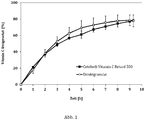
- the release behavior of vitamin C from the oral direct granule A according to the invention after storage for several months was compared with that of customary Cetebe® Vitamin C Retard 500 capsules.
- a Cetebe® capsule (corresponding to 500 mg of vitamin C and weighted or fixed in a so-called capsule-sinker) and a dose-equivalent amount of the coated ascorbic acid particles from Example 1 were in a drug-appropriate release apparatus with paddle stirrer (USP Dissolution Apparatus 2) released at 37 ° C in 900 mL deionized water. The stirring speed was 75 rpm. All experiments were repeated at least six times and averages and standard deviations were calculated.
- Example 4 Zinc-containing oral direct granules
- a zinc-containing premix is first prepared; z. B. granules of 8.3% zinc oxide, 86.4% sorbitol and 5.3% Miglyol® (triglyceride mixture of caprylic, capric and lauric acids); corresponding to a content of about 6.7% zinc based on the weight of the premix).
- Miglyol® triglyceride mixture of caprylic, capric and lauric acids
- This zinc-containing premix is then mixed with the auxiliaries listed in Table 2 and the ascorbic acid release particles obtained in Example 1, and optionally with a proportion of non-retarded, ie uncoated ascorbic acid, which acts as an initial dose.
- the direct granule formulations E and F listed in Table 2 are obtained.
Landscapes
- Health & Medical Sciences (AREA)
- Bioinformatics & Cheminformatics (AREA)
- Engineering & Computer Science (AREA)
- Life Sciences & Earth Sciences (AREA)
- Animal Behavior & Ethology (AREA)
- Veterinary Medicine (AREA)
- Epidemiology (AREA)
- Medicinal Chemistry (AREA)
- Chemical & Material Sciences (AREA)
- General Health & Medical Sciences (AREA)
- Public Health (AREA)
- Pharmacology & Pharmacy (AREA)
- Biophysics (AREA)
- Molecular Biology (AREA)
- Medicinal Preparation (AREA)
- Pharmaceuticals Containing Other Organic And Inorganic Compounds (AREA)
- Acyclic And Carbocyclic Compounds In Medicinal Compositions (AREA)
- Solid-Sorbent Or Filter-Aiding Compositions (AREA)
- Manufacturing Of Micro-Capsules (AREA)
Claims (15)
- Composition pharmaceutique solide sous la forme d'un granulat direct oral à libération retardée de l'agent actif, contenant:(a) des particules à effet retard comprenant un noyau en acide ascorbique cristallin et un revêtement en un lipide ayant un point de fusion d'au moins 50 °C et éventuellement un ou plusieurs adjuvants supplémentaires, le rapport en poids entre le noyau et le revêtement étant compris entre 50:50 et 90:10, les lipides dans le revêtement contenant au moins 80 % en poids d'un triglycéride simple, éventuellement un triglycéride simple choisi dans le groupe constitué par le tripalmitate de glycérol, le tristéarate de glycérol et le triarachidate de glycérol ; et(b) en plus des particules à effet retard, au moins un adjuvant soluble dans l'eau, avec lequel les particules à effet retard sont mélangées, le ou les adjuvants solubles dans l'eau étant choisis dans le groupe constitué par les sucres, les alcools de sucres et les oligosaccharides ; et(c) éventuellement un ou plusieurs adjuvants supplémentaires,un ou plusieurs adjuvants selon (b) ou (c) se présentant éventuellement sous forme granulée.
- Composition pharmaceutique selon la revendication 1, dans laquelle le rapport en poids entre le noyau et le revêtement est compris entre 60:40 et 80:20.
- Composition pharmaceutique selon les revendications 1 à 2, dans laquelle le revêtement est constitué par au moins 90 % en poids de tripalmitate de glycérol et/ou de tristéarate de glycérol.
- Composition pharmaceutique selon les revendications 1 à 3, dans laquelle l'épaisseur du revêtement est choisie de telle sorte que la composition ne libère pas plus de 70 % de l'acide ascorbique contenu dans celle-ci en l'espace de 4 heures, mesuré dans un appareil de libération avec agitateur à pale (USP Dissolution Apparatus 2) dans 900 mL d'eau déminéralisée à 37 °C et à une vitesse d'agitation de 75 tours/minute.
- Composition pharmaceutique selon les revendications 1 à 4, dans laquelle les particules à effet retard présentent une taille de particule moyenne en poids comprise entre 100 µm et 500 µm.
- Composition pharmaceutique selon les revendications 1 à 5, dans laquelle les particules à effet retard représentent entre 30 et 70 % en poids de la composition.
- Composition pharmaceutique selon les revendications 1 à 6, dans laquelle les adjuvants selon (b) et (c) contiennent au moins 60 % en poids, de préférence au moins 75 % en poids, d'un sucre ou d'un alcool de sucre soluble dans l'eau.
- Composition pharmaceutique selon la revendication 7, dans laquelle le sucre ou l'alcool de sucre soluble dans l'eau est choisi parmi le saccharose, le maltitol, le mannitol, le sorbitol, le xylitol et leurs mélanges.
- Composition pharmaceutique selon les revendications 1 à 8, dans laquelle les adjuvants selon (c) contiennent de l'acide citrique, du citrate de monosodium et/ou du citrate de disodium.
- Composition pharmaceutique selon les revendications 1 à 9, dans laquelle les adjuvants selon (b) et (c) ne contiennent pas plus de 5 % en poids d'adjuvants difficilement solubles dans l'eau.
- Composition pharmaceutique selon les revendications 1 à 10, dans laquelle des doses individuelles de la composition sont emballées dans des bâtons, des sachets, des ampoules en verres ou des ampoules en plastique.
- Procédé de fabrication d'une composition pharmaceutique solide selon les revendications 1 à 11, contenant les étapes suivantes:(a) la préparation d'acide ascorbique cristallin ;(b) la préparation d'un matériau de revêtement fondu contenant un lipide ayant un point de fusion d'au moins 50 °C et éventuellement un ou plusieurs adjuvants supplémentaires ;(c) la fluidisation de l'acide ascorbique cristallin ;(d) la pulvérisation de l'acide ascorbique cristallin fluidisé avec le matériau de revêtement fondu ;(e) le refroidissement de l'acide ascorbique revêtu, de telle sorte que le lipide durcisse et que des particules à effet retard soient obtenues ; et(f) le mélange des particules à effet retard ainsi obtenues avec un ou plusieurs adjuvants solubles dans l'eau et éventuellement des adjuvants supplémentaires.
- Procédé selon la revendication 12, dans lequel, à l'étape (d), le rapport en poids entre l'acide ascorbique cristallin fluidisé et le matériau de revêtement fondu est compris entre 60:40 et 80:20.
- Procédé selon les revendications 12 à 13, dans lequel le matériau de revêtement est constitué par au moins 90 % en poids de tripalmitate de glycérol et/ou de tristéarate de glycérol.
- Composition pharmaceutique solide sous la forme d'un granulat direct oral à libération retardée de l'agent actif, fabriquée par le procédé selon les revendications 12 à 14.
Priority Applications (4)
| Application Number | Priority Date | Filing Date | Title |
|---|---|---|---|
| PL15202259T PL3042648T3 (pl) | 2014-12-23 | 2015-12-23 | Granulat do podawania bezpośredniego o opóźnionym uwalnianiu substancji czynnej |
| RSP20191123 RS59176B1 (sr) | 2014-12-23 | 2015-12-23 | Direktni granulat sa aktivnim sredstvom za produženo oslobađanje |
| EP15202259.6A EP3042648B1 (fr) | 2014-12-23 | 2015-12-23 | Granules directs a agent actif retarde |
| HRP20191518 HRP20191518T1 (hr) | 2014-12-23 | 2019-08-22 | Direktan granulat s aktivnom tvari s produljenim oslobađanjem |
Applications Claiming Priority (2)
| Application Number | Priority Date | Filing Date | Title |
|---|---|---|---|
| EP14200223 | 2014-12-23 | ||
| EP15202259.6A EP3042648B1 (fr) | 2014-12-23 | 2015-12-23 | Granules directs a agent actif retarde |
Publications (2)
| Publication Number | Publication Date |
|---|---|
| EP3042648A1 EP3042648A1 (fr) | 2016-07-13 |
| EP3042648B1 true EP3042648B1 (fr) | 2019-06-05 |
Family
ID=52144587
Family Applications (1)
| Application Number | Title | Priority Date | Filing Date |
|---|---|---|---|
| EP15202259.6A Active EP3042648B1 (fr) | 2014-12-23 | 2015-12-23 | Granules directs a agent actif retarde |
Country Status (7)
| Country | Link |
|---|---|
| EP (1) | EP3042648B1 (fr) |
| ES (1) | ES2743785T3 (fr) |
| HR (1) | HRP20191518T1 (fr) |
| HU (1) | HUE045054T2 (fr) |
| PL (1) | PL3042648T3 (fr) |
| PT (1) | PT3042648T (fr) |
| RS (1) | RS59176B1 (fr) |
Cited By (1)
| Publication number | Priority date | Publication date | Assignee | Title |
|---|---|---|---|---|
| EP3922243A2 (fr) | 2021-10-04 | 2021-12-15 | HERMES PHARMA GmbH | Granulés directs avec une combinaison de magnésium à libération rapide et retardée |
Families Citing this family (1)
| Publication number | Priority date | Publication date | Assignee | Title |
|---|---|---|---|---|
| US20220249371A1 (en) * | 2021-02-08 | 2022-08-11 | Capsugel Belgium Nv | Extended Release Vitamin C and Manufacturing Thereof |
Family Cites Families (5)
| Publication number | Priority date | Publication date | Assignee | Title |
|---|---|---|---|---|
| NL296020A (fr) | 1962-08-16 | |||
| JP2650498B2 (ja) | 1990-02-20 | 1997-09-03 | 日本油脂株式会社 | 飼料用ビタミンc被覆製剤、その製造方法および用途 |
| JP3122510B2 (ja) | 1992-02-18 | 2001-01-09 | 日清製粉株式会社 | ビタミンc顆粒 |
| DE60004797T2 (de) | 1999-03-16 | 2004-06-17 | Merck Patent Gmbh | Arzneimittel mit verzögerter wirkstoffabgabe enthaltend isoquercetin und ascorbinsäure |
| AU4428000A (en) | 1999-05-14 | 2000-12-05 | Coraltis Ltd. | Pulse-delivery oral compositions |
-
2015
- 2015-12-23 RS RSP20191123 patent/RS59176B1/sr unknown
- 2015-12-23 EP EP15202259.6A patent/EP3042648B1/fr active Active
- 2015-12-23 HU HUE15202259A patent/HUE045054T2/hu unknown
- 2015-12-23 ES ES15202259T patent/ES2743785T3/es active Active
- 2015-12-23 PT PT15202259T patent/PT3042648T/pt unknown
- 2015-12-23 PL PL15202259T patent/PL3042648T3/pl unknown
-
2019
- 2019-08-22 HR HRP20191518 patent/HRP20191518T1/hr unknown
Non-Patent Citations (1)
| Title |
|---|
| None * |
Cited By (2)
| Publication number | Priority date | Publication date | Assignee | Title |
|---|---|---|---|---|
| EP3922243A2 (fr) | 2021-10-04 | 2021-12-15 | HERMES PHARMA GmbH | Granulés directs avec une combinaison de magnésium à libération rapide et retardée |
| WO2023057451A1 (fr) | 2021-10-04 | 2023-04-13 | Hermes Pharma Gmbh | Composition granulaire administrée directement ayant une combinaison de magnésium à libération retardée et à libération rapide, et leurs procédés de production |
Also Published As
| Publication number | Publication date |
|---|---|
| EP3042648A1 (fr) | 2016-07-13 |
| HRP20191518T1 (hr) | 2019-11-29 |
| PL3042648T3 (pl) | 2019-12-31 |
| ES2743785T3 (es) | 2020-02-20 |
| HUE045054T2 (hu) | 2019-12-30 |
| RS59176B1 (sr) | 2019-10-31 |
| PT3042648T (pt) | 2019-09-23 |
Similar Documents
| Publication | Publication Date | Title |
|---|---|---|
| EP0068191B1 (fr) | Formes orales du dipyridamole | |
| EP0620731B1 (fr) | Preparation pharmaceutique sous la forme d'un comprime effervescent et/ou a desagregation ou d'un granule instantane et procede pour sa fabrication | |
| DE69313865T2 (de) | Geschmacksmaskierende zusammensetzungen von ranitidin | |
| DE69420706T2 (de) | Getränke auf wasserbasis | |
| EP0232277B1 (fr) | Preparations pharmaceutiques sous forme de granules ou pilules instantanes, et procede de fabrication | |
| EP0867177B1 (fr) | Particules séchées à écoulement libre | |
| AT393794B (de) | Pharmazeutische cefuroximaxetil-zusammensetzung und verfahren zu ihrer herstellung | |
| DE60208673T2 (de) | Umhüllte pellets auf basis eines ace-hemmers | |
| DE3220263A1 (de) | Komprimierte kautablette und verfahren zu deren herstellung | |
| EP2627313A2 (fr) | Formulation contenant des agents d'agglutination du phosphate permettant une meilleure administration | |
| GB2195892A (en) | Improving palatability of pharmaceutical chewable tablets | |
| DE69712100T2 (de) | Valproinsäure enthaltende mikrosphären für orale verabreichung | |
| WO2018188902A1 (fr) | Produit de gélatine pourvu d'un composant central et procede de fabrication | |
| EP3042648B1 (fr) | Granules directs a agent actif retarde | |
| EP2386296B1 (fr) | Nouvelles formulations de cinéole | |
| DE68906461T2 (de) | Feste Arzneidosis in Form eines Tablettentriturats sowie Verfahren zu deren Herstellung. | |
| WO2020148125A1 (fr) | Procédé de fabrication de comprimés à ingestion facile contenant un extrait sec de feuilles de ginkgo biloba | |
| EP4228609A1 (fr) | Composition granulaire administrée directement ayant une combinaison de magnésium à libération retardée et à libération rapide, et leurs procédés de production | |
| AT368880B (de) | Verfahren zur herstellung eines zur weiterverarbeitung zu einer waesserigen suspension dienenden wasserunloeslichen trockeninstantpr[parates | |
| DE102008053044B4 (de) | Phosphatbinder und ihre Verwendung | |
| DE69729729T2 (de) | Arzneimittel zur anwendung im mund | |
| WO2013030119A1 (fr) | Forme galénique comprenant des particules de principe actif stabilisées | |
| EP1589944B1 (fr) | Preparations pharmaceutiques et leur procede de production | |
| DE3901216A1 (de) | Essbares produkt mit akzeptablem geschmack | |
| EP2629759B1 (fr) | Pellet pharmaceutiques de départ améliorés |
Legal Events
| Date | Code | Title | Description |
|---|---|---|---|
| PUAI | Public reference made under article 153(3) epc to a published international application that has entered the european phase |
Free format text: ORIGINAL CODE: 0009012 |
|
| AK | Designated contracting states |
Kind code of ref document: A1 Designated state(s): AL AT BE BG CH CY CZ DE DK EE ES FI FR GB GR HR HU IE IS IT LI LT LU LV MC MK MT NL NO PL PT RO RS SE SI SK SM TR |
|
| AX | Request for extension of the european patent |
Extension state: BA ME |
|
| STAA | Information on the status of an ep patent application or granted ep patent |
Free format text: STATUS: REQUEST FOR EXAMINATION WAS MADE |
|
| 17P | Request for examination filed |
Effective date: 20170111 |
|
| RBV | Designated contracting states (corrected) |
Designated state(s): AL AT BE BG CH CY CZ DE DK EE ES FI FR GB GR HR HU IE IS IT LI LT LU LV MC MK MT NL NO PL PT RO RS SE SI SK SM TR |
|
| RIN1 | Information on inventor provided before grant (corrected) |
Inventor name: DANDL, KLAUS Inventor name: HAALA, JOSEF |
|
| STAA | Information on the status of an ep patent application or granted ep patent |
Free format text: STATUS: EXAMINATION IS IN PROGRESS |
|
| 17Q | First examination report despatched |
Effective date: 20180607 |
|
| GRAP | Despatch of communication of intention to grant a patent |
Free format text: ORIGINAL CODE: EPIDOSNIGR1 |
|
| STAA | Information on the status of an ep patent application or granted ep patent |
Free format text: STATUS: GRANT OF PATENT IS INTENDED |
|
| INTG | Intention to grant announced |
Effective date: 20190121 |
|
| GRAS | Grant fee paid |
Free format text: ORIGINAL CODE: EPIDOSNIGR3 |
|
| GRAA | (expected) grant |
Free format text: ORIGINAL CODE: 0009210 |
|
| STAA | Information on the status of an ep patent application or granted ep patent |
Free format text: STATUS: THE PATENT HAS BEEN GRANTED |
|
| AK | Designated contracting states |
Kind code of ref document: B1 Designated state(s): AL AT BE BG CH CY CZ DE DK EE ES FI FR GB GR HR HU IE IS IT LI LT LU LV MC MK MT NL NO PL PT RO RS SE SI SK SM TR |
|
| REG | Reference to a national code |
Ref country code: GB Ref legal event code: FG4D Free format text: NOT ENGLISH |
|
| REG | Reference to a national code |
Ref country code: CH Ref legal event code: EP |
|
| REG | Reference to a national code |
Ref country code: AT Ref legal event code: REF Ref document number: 1139281 Country of ref document: AT Kind code of ref document: T Effective date: 20190615 |
|
| REG | Reference to a national code |
Ref country code: IE Ref legal event code: FG4D Free format text: LANGUAGE OF EP DOCUMENT: GERMAN |
|
| REG | Reference to a national code |
Ref country code: DE Ref legal event code: R096 Ref document number: 502015009220 Country of ref document: DE |
|
| REG | Reference to a national code |
Ref country code: CH Ref legal event code: NV Representative=s name: PHARMA PATENTS INTERNATIONAL AG, CH |
|
| REG | Reference to a national code |
Ref country code: HR Ref legal event code: TUEP Ref document number: P20191518T Country of ref document: HR |
|
| REG | Reference to a national code |
Ref country code: SE Ref legal event code: TRGR |
|
| REG | Reference to a national code |
Ref country code: PT Ref legal event code: SC4A Ref document number: 3042648 Country of ref document: PT Date of ref document: 20190923 Kind code of ref document: T Free format text: AVAILABILITY OF NATIONAL TRANSLATION Effective date: 20190904 |
|
| REG | Reference to a national code |
Ref country code: NL Ref legal event code: MP Effective date: 20190605 |
|
| REG | Reference to a national code |
Ref country code: LT Ref legal event code: MG4D |
|
| PG25 | Lapsed in a contracting state [announced via postgrant information from national office to epo] |
Ref country code: LT Free format text: LAPSE BECAUSE OF FAILURE TO SUBMIT A TRANSLATION OF THE DESCRIPTION OR TO PAY THE FEE WITHIN THE PRESCRIBED TIME-LIMIT Effective date: 20190605 Ref country code: NO Free format text: LAPSE BECAUSE OF FAILURE TO SUBMIT A TRANSLATION OF THE DESCRIPTION OR TO PAY THE FEE WITHIN THE PRESCRIBED TIME-LIMIT Effective date: 20190905 Ref country code: AL Free format text: LAPSE BECAUSE OF FAILURE TO SUBMIT A TRANSLATION OF THE DESCRIPTION OR TO PAY THE FEE WITHIN THE PRESCRIBED TIME-LIMIT Effective date: 20190605 Ref country code: FI Free format text: LAPSE BECAUSE OF FAILURE TO SUBMIT A TRANSLATION OF THE DESCRIPTION OR TO PAY THE FEE WITHIN THE PRESCRIBED TIME-LIMIT Effective date: 20190605 |
|
| PG25 | Lapsed in a contracting state [announced via postgrant information from national office to epo] |
Ref country code: BG Free format text: LAPSE BECAUSE OF FAILURE TO SUBMIT A TRANSLATION OF THE DESCRIPTION OR TO PAY THE FEE WITHIN THE PRESCRIBED TIME-LIMIT Effective date: 20190905 Ref country code: GR Free format text: LAPSE BECAUSE OF FAILURE TO SUBMIT A TRANSLATION OF THE DESCRIPTION OR TO PAY THE FEE WITHIN THE PRESCRIBED TIME-LIMIT Effective date: 20190906 Ref country code: LV Free format text: LAPSE BECAUSE OF FAILURE TO SUBMIT A TRANSLATION OF THE DESCRIPTION OR TO PAY THE FEE WITHIN THE PRESCRIBED TIME-LIMIT Effective date: 20190605 |
|
| REG | Reference to a national code |
Ref country code: HR Ref legal event code: T1PR Ref document number: P20191518 Country of ref document: HR |
|
| REG | Reference to a national code |
Ref country code: HR Ref legal event code: ODRP Ref document number: P20191518 Country of ref document: HR Payment date: 20191212 Year of fee payment: 5 |
|
| REG | Reference to a national code |
Ref country code: HU Ref legal event code: AG4A Ref document number: E045054 Country of ref document: HU |
|
| PG25 | Lapsed in a contracting state [announced via postgrant information from national office to epo] |
Ref country code: EE Free format text: LAPSE BECAUSE OF FAILURE TO SUBMIT A TRANSLATION OF THE DESCRIPTION OR TO PAY THE FEE WITHIN THE PRESCRIBED TIME-LIMIT Effective date: 20190605 Ref country code: NL Free format text: LAPSE BECAUSE OF FAILURE TO SUBMIT A TRANSLATION OF THE DESCRIPTION OR TO PAY THE FEE WITHIN THE PRESCRIBED TIME-LIMIT Effective date: 20190605 Ref country code: SK Free format text: LAPSE BECAUSE OF FAILURE TO SUBMIT A TRANSLATION OF THE DESCRIPTION OR TO PAY THE FEE WITHIN THE PRESCRIBED TIME-LIMIT Effective date: 20190605 Ref country code: RO Free format text: LAPSE BECAUSE OF FAILURE TO SUBMIT A TRANSLATION OF THE DESCRIPTION OR TO PAY THE FEE WITHIN THE PRESCRIBED TIME-LIMIT Effective date: 20190605 |
|
| PG25 | Lapsed in a contracting state [announced via postgrant information from national office to epo] |
Ref country code: IS Free format text: LAPSE BECAUSE OF FAILURE TO SUBMIT A TRANSLATION OF THE DESCRIPTION OR TO PAY THE FEE WITHIN THE PRESCRIBED TIME-LIMIT Effective date: 20191005 Ref country code: SM Free format text: LAPSE BECAUSE OF FAILURE TO SUBMIT A TRANSLATION OF THE DESCRIPTION OR TO PAY THE FEE WITHIN THE PRESCRIBED TIME-LIMIT Effective date: 20190605 Ref country code: IT Free format text: LAPSE BECAUSE OF FAILURE TO SUBMIT A TRANSLATION OF THE DESCRIPTION OR TO PAY THE FEE WITHIN THE PRESCRIBED TIME-LIMIT Effective date: 20190605 |
|
| REG | Reference to a national code |
Ref country code: DE Ref legal event code: R097 Ref document number: 502015009220 Country of ref document: DE |
|
| PG25 | Lapsed in a contracting state [announced via postgrant information from national office to epo] |
Ref country code: TR Free format text: LAPSE BECAUSE OF FAILURE TO SUBMIT A TRANSLATION OF THE DESCRIPTION OR TO PAY THE FEE WITHIN THE PRESCRIBED TIME-LIMIT Effective date: 20190605 |
|
| PLBE | No opposition filed within time limit |
Free format text: ORIGINAL CODE: 0009261 |
|
| STAA | Information on the status of an ep patent application or granted ep patent |
Free format text: STATUS: NO OPPOSITION FILED WITHIN TIME LIMIT |
|
| PG25 | Lapsed in a contracting state [announced via postgrant information from national office to epo] |
Ref country code: DK Free format text: LAPSE BECAUSE OF FAILURE TO SUBMIT A TRANSLATION OF THE DESCRIPTION OR TO PAY THE FEE WITHIN THE PRESCRIBED TIME-LIMIT Effective date: 20190605 |
|
| 26N | No opposition filed |
Effective date: 20200306 |
|
| PG25 | Lapsed in a contracting state [announced via postgrant information from national office to epo] |
Ref country code: SI Free format text: LAPSE BECAUSE OF FAILURE TO SUBMIT A TRANSLATION OF THE DESCRIPTION OR TO PAY THE FEE WITHIN THE PRESCRIBED TIME-LIMIT Effective date: 20190605 |
|
| REG | Reference to a national code |
Ref country code: BE Ref legal event code: MM Effective date: 20191231 |
|
| PG25 | Lapsed in a contracting state [announced via postgrant information from national office to epo] |
Ref country code: MC Free format text: LAPSE BECAUSE OF FAILURE TO SUBMIT A TRANSLATION OF THE DESCRIPTION OR TO PAY THE FEE WITHIN THE PRESCRIBED TIME-LIMIT Effective date: 20190605 |
|
| PG25 | Lapsed in a contracting state [announced via postgrant information from national office to epo] |
Ref country code: LU Free format text: LAPSE BECAUSE OF NON-PAYMENT OF DUE FEES Effective date: 20191223 Ref country code: IE Free format text: LAPSE BECAUSE OF NON-PAYMENT OF DUE FEES Effective date: 20191223 |
|
| PG25 | Lapsed in a contracting state [announced via postgrant information from national office to epo] |
Ref country code: BE Free format text: LAPSE BECAUSE OF NON-PAYMENT OF DUE FEES Effective date: 20191231 |
|
| REG | Reference to a national code |
Ref country code: HR Ref legal event code: ODRP Ref document number: P20191518 Country of ref document: HR Payment date: 20201216 Year of fee payment: 6 |
|
| PG25 | Lapsed in a contracting state [announced via postgrant information from national office to epo] |
Ref country code: CY Free format text: LAPSE BECAUSE OF FAILURE TO SUBMIT A TRANSLATION OF THE DESCRIPTION OR TO PAY THE FEE WITHIN THE PRESCRIBED TIME-LIMIT Effective date: 20190605 |
|
| PG25 | Lapsed in a contracting state [announced via postgrant information from national office to epo] |
Ref country code: MT Free format text: LAPSE BECAUSE OF FAILURE TO SUBMIT A TRANSLATION OF THE DESCRIPTION OR TO PAY THE FEE WITHIN THE PRESCRIBED TIME-LIMIT Effective date: 20190605 |
|
| REG | Reference to a national code |
Ref country code: DE Ref legal event code: R081 Ref document number: 502015009220 Country of ref document: DE Owner name: HERMES PHARMA GMBH, DE Free format text: FORMER OWNER: HERMES ARZNEIMITTEL GMBH, 82049 PULLACH, DE |
|
| REG | Reference to a national code |
Ref country code: ES Ref legal event code: PC2A Owner name: HERMES PHARMA GMBH Effective date: 20211129 |
|
| REG | Reference to a national code |
Ref country code: AT Ref legal event code: PC Ref document number: 1139281 Country of ref document: AT Kind code of ref document: T Owner name: HERMES PHARMA GMBH, DE Effective date: 20211029 |
|
| REG | Reference to a national code |
Ref country code: HR Ref legal event code: PPPP Ref document number: P20191518 Country of ref document: HR Owner name: HERMES PHARMA GMBH, DE |
|
| REG | Reference to a national code |
Ref country code: HU Ref legal event code: GB9C Owner name: HERMES PHARMA GMBH, DE Free format text: FORMER OWNER(S): HERMES ARZNEIMITTEL GMBH, DE |
|
| REG | Reference to a national code |
Ref country code: HR Ref legal event code: ODRP Ref document number: P20191518 Country of ref document: HR Payment date: 20211221 Year of fee payment: 7 |
|
| PG25 | Lapsed in a contracting state [announced via postgrant information from national office to epo] |
Ref country code: MK Free format text: LAPSE BECAUSE OF FAILURE TO SUBMIT A TRANSLATION OF THE DESCRIPTION OR TO PAY THE FEE WITHIN THE PRESCRIBED TIME-LIMIT Effective date: 20190605 |
|
| REG | Reference to a national code |
Ref country code: HR Ref legal event code: ODRP Ref document number: P20191518 Country of ref document: HR Payment date: 20221216 Year of fee payment: 8 |
|
| P01 | Opt-out of the competence of the unified patent court (upc) registered |
Effective date: 20230529 |
|
| REG | Reference to a national code |
Ref country code: HR Ref legal event code: ODRP Ref document number: P20191518 Country of ref document: HR Payment date: 20231214 Year of fee payment: 9 |
|
| REG | Reference to a national code |
Ref country code: HR Ref legal event code: ODRP Ref document number: P20191518 Country of ref document: HR Payment date: 20241212 Year of fee payment: 10 |
|
| PGFP | Annual fee paid to national office [announced via postgrant information from national office to epo] |
Ref country code: CH Payment date: 20250101 Year of fee payment: 10 |
|
| REG | Reference to a national code |
Ref country code: CH Ref legal event code: U11 Free format text: ST27 STATUS EVENT CODE: U-0-0-U10-U11 (AS PROVIDED BY THE NATIONAL OFFICE) Effective date: 20260101 |
|
| PGFP | Annual fee paid to national office [announced via postgrant information from national office to epo] |
Ref country code: DE Payment date: 20251211 Year of fee payment: 11 |
|
| PGFP | Annual fee paid to national office [announced via postgrant information from national office to epo] |
Ref country code: GB Payment date: 20251219 Year of fee payment: 11 |
|
| PGFP | Annual fee paid to national office [announced via postgrant information from national office to epo] |
Ref country code: PT Payment date: 20251211 Year of fee payment: 11 Ref country code: AT Payment date: 20251222 Year of fee payment: 11 |
|
| PGFP | Annual fee paid to national office [announced via postgrant information from national office to epo] |
Ref country code: HR Payment date: 20251212 Year of fee payment: 11 Ref country code: HU Payment date: 20251223 Year of fee payment: 11 Ref country code: FR Payment date: 20251223 Year of fee payment: 11 |
|
| REG | Reference to a national code |
Ref country code: HR Ref legal event code: ODRP Ref document number: P20191518 Country of ref document: HR Payment date: 20251212 Year of fee payment: 11 |
|
| PGFP | Annual fee paid to national office [announced via postgrant information from national office to epo] |
Ref country code: SE Payment date: 20251219 Year of fee payment: 11 |
|
| PGFP | Annual fee paid to national office [announced via postgrant information from national office to epo] |
Ref country code: CZ Payment date: 20251218 Year of fee payment: 11 |
|
| PGFP | Annual fee paid to national office [announced via postgrant information from national office to epo] |
Ref country code: PL Payment date: 20251212 Year of fee payment: 11 |
|
| PGFP | Annual fee paid to national office [announced via postgrant information from national office to epo] |
Ref country code: RS Payment date: 20251212 Year of fee payment: 11 |
|
| PGFP | Annual fee paid to national office [announced via postgrant information from national office to epo] |
Ref country code: ES Payment date: 20260130 Year of fee payment: 11 |