EP3045111A1 - Integriertes tragbares gerät und verfahren zur anwendung eines beschleunigungsmessers zur analyse der biochemischen parameter von schritten - Google Patents
Integriertes tragbares gerät und verfahren zur anwendung eines beschleunigungsmessers zur analyse der biochemischen parameter von schritten Download PDFInfo
- Publication number
- EP3045111A1 EP3045111A1 EP16157843.0A EP16157843A EP3045111A1 EP 3045111 A1 EP3045111 A1 EP 3045111A1 EP 16157843 A EP16157843 A EP 16157843A EP 3045111 A1 EP3045111 A1 EP 3045111A1
- Authority
- EP
- European Patent Office
- Prior art keywords
- runner
- stride
- accelerometer
- parameters
- center
- Prior art date
- Legal status (The legal status is an assumption and is not a legal conclusion. Google has not performed a legal analysis and makes no representation as to the accuracy of the status listed.)
- Granted
Links
Images



Classifications
-
- A—HUMAN NECESSITIES
- A61—MEDICAL OR VETERINARY SCIENCE; HYGIENE
- A61B—DIAGNOSIS; SURGERY; IDENTIFICATION
- A61B5/00—Measuring for diagnostic purposes; Identification of persons
- A61B5/103—Measuring devices for testing the shape, pattern, colour, size or movement of the body or parts thereof, for diagnostic purposes
- A61B5/11—Measuring movement of the entire body or parts thereof, e.g. head or hand tremor or mobility of a limb
- A61B5/112—Gait analysis
-
- A—HUMAN NECESSITIES
- A61—MEDICAL OR VETERINARY SCIENCE; HYGIENE
- A61B—DIAGNOSIS; SURGERY; IDENTIFICATION
- A61B5/00—Measuring for diagnostic purposes; Identification of persons
- A61B5/103—Measuring devices for testing the shape, pattern, colour, size or movement of the body or parts thereof, for diagnostic purposes
- A61B5/1036—Measuring load distribution, e.g. podologic studies
- A61B5/1038—Measuring plantar pressure during gait
-
- A—HUMAN NECESSITIES
- A61—MEDICAL OR VETERINARY SCIENCE; HYGIENE
- A61B—DIAGNOSIS; SURGERY; IDENTIFICATION
- A61B5/00—Measuring for diagnostic purposes; Identification of persons
- A61B5/103—Measuring devices for testing the shape, pattern, colour, size or movement of the body or parts thereof, for diagnostic purposes
- A61B5/11—Measuring movement of the entire body or parts thereof, e.g. head or hand tremor or mobility of a limb
- A61B5/1121—Determining geometric values, e.g. centre of rotation or angular range of movement
- A61B5/1122—Determining geometric values, e.g. centre of rotation or angular range of movement of movement trajectories
-
- A—HUMAN NECESSITIES
- A61—MEDICAL OR VETERINARY SCIENCE; HYGIENE
- A61B—DIAGNOSIS; SURGERY; IDENTIFICATION
- A61B5/00—Measuring for diagnostic purposes; Identification of persons
- A61B5/68—Arrangements of detecting, measuring or recording means, e.g. sensors, in relation to patient
- A61B5/6801—Arrangements of detecting, measuring or recording means, e.g. sensors, in relation to patient specially adapted to be attached to or worn on the body surface
- A61B5/683—Means for maintaining contact with the body
- A61B5/6831—Straps, bands or harnesses
-
- A—HUMAN NECESSITIES
- A63—SPORTS; GAMES; AMUSEMENTS
- A63B—APPARATUS FOR PHYSICAL TRAINING, GYMNASTICS, SWIMMING, CLIMBING, OR FENCING; BALL GAMES; TRAINING EQUIPMENT
- A63B24/00—Electric or electronic controls for exercising apparatus of preceding groups; Controlling or monitoring of exercises, sportive games, training or athletic performances
- A63B24/0003—Analysing the course of a movement or motion sequences during an exercise or trainings sequence, e.g. swing for golf or tennis
- A63B24/0006—Computerised comparison for qualitative assessment of motion sequences or the course of a movement
-
- G—PHYSICS
- G01—MEASURING; TESTING
- G01C—MEASURING DISTANCES, LEVELS OR BEARINGS; SURVEYING; NAVIGATION; GYROSCOPIC INSTRUMENTS; PHOTOGRAMMETRY OR VIDEOGRAMMETRY
- G01C22/00—Measuring distance traversed on the ground by vehicles, persons, animals or other moving solid bodies, e.g. using odometers, using pedometers
- G01C22/006—Pedometers
-
- G—PHYSICS
- G01—MEASURING; TESTING
- G01P—MEASURING LINEAR OR ANGULAR SPEED, ACCELERATION, DECELERATION, OR SHOCK; INDICATING PRESENCE, ABSENCE, OR DIRECTION, OF MOVEMENT
- G01P15/00—Measuring acceleration; Measuring deceleration; Measuring shock, i.e. sudden change of acceleration
- G01P15/18—Measuring acceleration; Measuring deceleration; Measuring shock, i.e. sudden change of acceleration in two or more dimensions
-
- G—PHYSICS
- G06—COMPUTING OR CALCULATING; COUNTING
- G06V—IMAGE OR VIDEO RECOGNITION OR UNDERSTANDING
- G06V40/00—Recognition of biometric, human-related or animal-related patterns in image or video data
- G06V40/20—Movements or behaviour, e.g. gesture recognition
- G06V40/23—Recognition of whole body movements, e.g. for sport training
-
- A—HUMAN NECESSITIES
- A61—MEDICAL OR VETERINARY SCIENCE; HYGIENE
- A61B—DIAGNOSIS; SURGERY; IDENTIFICATION
- A61B2562/00—Details of sensors; Constructional details of sensor housings or probes; Accessories for sensors
- A61B2562/02—Details of sensors specially adapted for in-vivo measurements
- A61B2562/0219—Inertial sensors, e.g. accelerometers, gyroscopes, tilt switches
-
- G—PHYSICS
- G06—COMPUTING OR CALCULATING; COUNTING
- G06F—ELECTRIC DIGITAL DATA PROCESSING
- G06F2218/00—Aspects of pattern recognition specially adapted for signal processing
Definitions
- the present invention relates to a method and an integrated portable device provided with an accelerometer for measuring biomechanical parameters of the stride in running.
- results of a running runner essentially depend on the cardiovascular endurance and the mechanical efficiency of the stride.
- Numerous devices and tests are known in the state of the art for measuring progress in cardiovascular performance. For example, many runners train with a heart rate monitor that tells them their heart rate at all times, while different tests can, for example, measure the maximum volume of oxygen taken from the lungs and used by muscles per unit of muscle. time (V0 2 max).
- the present invention more specifically relates to methods and devices for measuring the biomechanical efficiency of the stride.
- the runner manages to run faster or longer with a given amount of energy. It is difficult, however, even for a rider accompanied by an experienced coach, to objectively measure the effectiveness of his stride and improve it without resorting to measuring devices.
- treadmills equipped with force sensors for example, are used which make it possible to measure with a very high degree of accuracy the reaction force of the ground each time the foot is resting.
- These devices are however expensive and reserved for professional use by coaches, gyms or hospitals for example. They only measure the force when the foot touches the ground, but provide no indication of the rider's movement when the feet are in the air.
- the style of racing on a carpet differs significantly from that adopted in the field or during a long race, so that the indications provided by these devices must be interpreted.
- center of mass and “center of gravity” should be considered equivalent. They designate the center of gravity of a runner. If, because of the position of the rider, the center of mass or gravity is outside the body of the rider, the center of mass or gravity coincides with the nearest point of the center of mass or gravity and belonging to the body of the runner. In others In other words, the center of mass is almost the attachment of the device and / or the sensor, on the trunk, usually near the waist.
- US6397151 describes a bracelet for combat sports and equipped with an accelerometer capable of measuring a sequence of accelerations of the forearm during a stroke.
- DE4426302 describes another system for measuring accelerations during combat sports. These devices are unsuitable for running.
- EP1897598 describes a training aid device for different sports. He uses an accelerometer at the ankle or knees. Again, these different locations are far from the athlete's center of gravity and its plane of symmetry, so that the measurements provided are imprecise or irrelevant for the analysis of the running style.
- WO2009 / 094746 describes an accelerometer capable of determining its location on the foot, wrist and so on.
- US6148280 describes a system with accelerometers and gyros distributed throughout the body of the athlete to analyze the trajectory of the body during a movement.
- the data provided by the various sensors are transmitted to a personal computer remotely.
- This system therefore does not provide real time, immediately after a race, parameters useful for analyzing the stride.
- This system is particularly complex, expensive and fragile.
- a comparable device is also described in EP418548 .
- WO2007036611 which also allows to determine the maximum weight that a person is able to lift, suffers from the same limitations.
- US2009018794 describes a device for measuring the progress of a person in motion by means of an inertial sensor placed near the center of gravity.
- the speed and other parameters are determined according to the maximum vertical acceleration or possibly the minimum vertical acceleration using a proportionality factor k.
- This factor k which is not described in the document, however, necessarily depends on the type of displacement, the means of locomotion and the style of race; the calculated results are therefore equivocal or depend on unverifiable assumptions on the factor k.
- the purpose of this document is above all to add indications obtained with each stride in order to display for example the distance traveled, the number of steps or the speed, but not display parameters to analyze the effectiveness of each stride.
- EP1754521 describes a method for determining the effectiveness of a runner's stride by measuring the instantaneous accelerations of the runner. Speeds can only be determined at a constant rate. This device calculates and displays an overall efficiency index which is the ratio of the sum of the harmonic accelerations on the speeds. However, the user does not know what he must do to improve this overall efficiency index and the device does not provide other parameters related to his stride and allowing the rider to directly improve his racing style.
- WO2007017471 describes a method and apparatus for determining the speed of a runner using an accelerometer, counting the number and frequency of changes in direction of the vertical acceleration.
- Devices comprising an inertial sensor for the aid in the race generally determine the distance traveled by a double integration of the acceleration in the horizontal direction. This measure is however imprecise for various reasons. First of all, the very fact of integrating produces an accumulation of errors and inaccuracies of the sensor. The stroke produces significant shocks at each stride, so that the acceleration signal is very noisy, especially if the accelerometer is worn on the limbs, for example in the shoe, ankle or wrist. Moreover, it is difficult to determine the anteroposterior direction in which the runner progresses, and eliminate the components due to the vertical or transverse acceleration caused by the rocking of the body. This results in a determination of the inaccurate distance traveled, and a calculation of all the parameters based on this distance which also suffers from this inaccuracy.
- WO2005 / 074795 describes a device also intended to be linked to the body of a person to determine the level of activity over a long period, for example a day or a week.
- a comparable device is also described in WO03032826 .
- EP1992389 describes a sensor equipped with an accelerometer, a gyroscope, a GPS receiver, a magnetometer and a cardiometer to monitor the efforts of an athlete.
- the device is complex and does not provide useful indications to improve the stride during the run.
- US20080288200 relates to a device for measuring the posture and intensity of a physical activity comprising a triaxial accelerometer. This device makes it possible to calculate parameters, notably the EEp ("Potential Energy Expediture”) and the EEk (“Kinetic Energy Expediture”) which do not depend on the distance traveled by the runner nor on the time counted by a chronograph.
- EEp Peak Energy Expediture
- EEk Kinetic Energy Expediture
- EP1253404 describes a device which determines the evolution of the position of a pedestrian from its context and which makes it possible to calculate the total distance traveled by the user, his speed as well as the distance between two impacts on the ground.
- US5976083 relates to a device for monitoring, estimating and predicting the fitness level of a user.
- the device comprises a fastening system around the chest of the user, at the level of his heart.
- the device uses the user's personal data, the vertical accelerations given by an accelerometer and the real-time clock to calculate the distance traveled by the user.
- the parameters calculated during the device's fitness estimation / forecast include session duration, total calories burned, distance traveled, fitness, average heart rate, slope, and intercepts of the EA. (Energy Expenditure) compared to the heart rate. These results are given at the request of the user.
- WO2006030065 describes a device for the recognition of the movement of a human being by a motion sensor carried on the trunk, on the shoes or on the wrist of a human being.
- a measurement signal is compared to a predetermined reference signal that can be similarly measured in a known human.
- a recognition operation is performed according to the comparison between the measurement signal and the predetermined reference signal, the recognition operation resulting in recognition or non-recognition.
- This device is adapted to analyze biomechanical parameters of the stride of a runner, the purpose being the recognition of the movement of a human being, for identifications and / or verifications.
- EP1764583 relates to a device for measuring rider information such as total running time, average and maximum speed, total distance traveled and average and maximum heart rate.
- the device which comprises an accelerometer measuring only the vertical acceleration, is fixed on the trunk of the runner and communicates with another receiver device worn on the wrist of the runner, on which the information is displayed.
- WO2005091113 describes a device and method for evaluating pedestrian movement, comprising determining at least one position at least one identified part of the pedestrian, projecting the position or positions on at least one plane and calculating the movement from the position or positions projected on this plane.
- the device devoid of chronograph, allows to determine only and in a complicated way the orientation of the limbs and the orientation and the length of a step.
- This parameter is very important for a runner who travels short distances, for example 200 m, in a short period of time: in order to run as efficiently as possible, his ideal center of gravity should not move vertically. This parameter is also important for a marathon runner, who on the contrary exploits the vertical oscillation of the center of mass and thus the elastic rebound of his legs on the ground.
- An object of the present invention is to provide a method and a device free from the limitations of known methods and devices, in particular a method and a device which makes it possible to determine, in a simple and immediate manner, the biomechanical parameters of the stride of a bound rider. at its center of gravity, particularly related to the vertical displacement of its center of gravity.
- Another object of the invention is to propose a device and a method that is more precise, more economical, more compact, easier to handle and / or that provides results virtually instantaneously and in real time.
- Another object of the invention is to propose a device and a method for measuring and analyzing the kinematics of the movement (acceleration, speed and position of the center of mass of a rider) as well as in a much broader manner all the parameters. which characterize the technical qualities and physical abilities of the runner.
- Another object of the invention is to provide a device and an autonomous and portable method, to determine different parameters useful to the runner to improve the regularity and effectiveness of his stride, and reduce the risk of fatigue or injury.
- the invention notably starts from the observation that a whole set of biomechanical parameters can, among which the lowering and the elevation of the center of mass, unexpectedly, be measured and calculated with a significant precision by means of a simple accelerometer. judiciously placed. Some of these parameters had never been measured before, while others were only with much more complex and non-autonomous devices, for example by requiring a separate analysis on a laptop to extract certain parameters.
- This method offers the advantage of allowing reliable measurement and calculation of parameters, even with a simplified apparatus. Reliability is obtained in particular by fixing the accelerometer near the center of gravity of the runner, by means of a belt or a clip. The duration of the race is determined by the chronograph built into the device. The measurement of the total distance traveled does not depend either on the precision of the accelerometer, either because it is implicit and predetermined, or by the user who chooses / introduces it, or by satellite receiver of type GPS for example.
- the invention also starts from the surprising observation that several parameters useful for the training of running can be determined on the basis of acceleration measurements made with the device of the invention.
- the invention thus relates to different means and process steps for calculating a whole series of parameters in a different way from the prior art, using exclusively the acceleration measurements, and with remarkable accuracy.
- the invention thus provides a device capable of calculating and displaying a whole series of biomechanical parameters directly usable by the runner or his trainer.
- the invention thus provides a new device and a new method for calculating biomechanical parameters of the stride that were either calculated differently in the prior art, with more complex means (triaxial gyroscopes, laptop, etc.), or even parameters that were impossible to calculate or that no one had bothered to measure.
- the position of the device in the hollow of the back or on the belly can determine any asymmetry between the movements performed by each leg at each stride. It is thus possible to measure the asymmetry of the muscular and biomechanical parameters of the two legs with a single sensibly placed sensor and an adequate processing of the signals.
- the biomechanical parameters calculated include for example the distance traveled by the center of mass of the runner during the time when the foot is in contact with the ground (distance on the support). The beginning and end of the duration is determined on the basis of the acceleration measurement, for example acceleration in the vertical or anteroposterior direction, which changes abruptly when the foot leaves or reaches the ground. The measurement of this distance is obtained by the multiplication of the speed in the anteroposterior direction with the contact time. As the accelerometer is placed near the center of mass of the runner, it is also possible to accurately determine the vertical takeoff speed and the flight angle of the center of gravity.
- the calculated biomechanical parameters may also include, for example, the angle of repose of the leg on the ground as well as the angle of the leg support area, which is the angle formed by the leg between the moment when the foot touches the ground and the moment the foot leaves the ground.
- these different angles were determined on the basis of high frequency video images, and thus required complex equipment unable to provide a result in real time. It has been discovered in the context of the invention that signal processing and computation operations from acceleration data sequences provide a simpler, more economical and reliable way to measure these angles in a substantially instantaneous manner.
- the method and device also makes it possible to determine in a new way and with new means an index of regularity of the stride.
- the regularity index depends, for example, on the dispersion of the different parameters measured at each stride, for example the dispersion of the reactivity, or the dispersion of another parameter related to the stride.
- the method also makes it possible to determine in a novel way and with new means an index of effectiveness of the stride on the basis of the support distance of the leg, the contact time on the ground, and the stiffness the rider's leg, the length of the stride.
- the method makes it possible to indicate at least one muscular fatigue level indicator, that is to say an indicator whose absolute value or time evolution can be used for example to reveal abnormal fatigue.
- an accelerometer to determine the level of fatigue offers very simple possibilities for an athlete to optimize his training by avoiding the risk of performance cap in case of overtraining.
- the calculated biomechanical parameters may also include, for example, an asymmetry between at least one parameter of the left leg and at least one corresponding parameter of the right leg.
- the device can detect and display a parameter to deduce that the length of the strides traveled with one leg support is longer than with the other, or angles pose or flight different. These differences can for example correspond to differences in leg length or muscle training (especially when these differences remain for long periods or during several successive training); they can also be warning or warning signs of injury or fatigue.
- the invention therefore also relates to a new use of an accelerometer as a device for detecting the risk of injury during running.
- the method makes it possible to indicate at least one indicator of risk of injury, that is to say an indicator whose absolute value or time evolution reveals a risk of injury.
- an indicator of risk of injury that is to say an indicator whose absolute value or time evolution reveals a risk of injury.
- rapid or unusual variation in the stiffness of leg muscles is often a predictor of injury; this variation can be detected and displayed to protect the runner.
- the calculated biomechanical parameters may also include, for example, the vertical speed of the center of mass during a stride, and / or the vertical displacement of the center of mass during a stride and / or the flight angle of the center. massive.
- An effective running style generally involves moving the rider's center of mass in as horizontal a direction as possible, with a vertical speed as constant and close to zero as possible, and a horizontal speed in the anteroposterior axis as constant and high as possible.
- An acceleration data sequence according to at least the anteroposterior direction is preferably also measured by said accelerometer and processed separately from the acceleration data sequence in the vertical direction to calculate at least some of the parameters.
- the calculated biomechanical parameters may also include, for example, the rate of steps, the contact time with the ground, the flight time, the average acceleration on support, the maximum force on support, the horizontal speed of the center of mass on support, the stiffness or reactivity of muscles, for example muscles of one leg or both legs in a differentiated manner.
- a sequence of the acceleration data according to at least the lateral direction is also measured and processed separately from the sequence of the acceleration data in the vertical direction to calculate at least some of the parameters, for example the rotation and the sway of the trunk with each stride.
- This sensor can also be used to distinguish between strides performed with the left foot and those performed with the right foot.
- the vertical direction is determined for example by measuring gravity when the runner is stopped.
- the anteroposterior direction is determined or corrected advantageously during the race by determining the spatial direction in which the horizontal movement is the most important.
- a "runner-device" reference transformation is preferably carried out since the axes of the accelerometer never coincide perfectly with the horizontal and lateral vertical axes of the runner, respectively. Therefore, the triaxial accelerometer data is projected along the vertical, horizontal and / or lateral axis of the runner.
- the device provides one, two or three sequences of acceleration data which do not necessarily correspond to the axes of the accelerometer and which are processed and used independently for the calculation of the parameters.
- the device advantageously proposes a personalized training plan according to the parameters and intended to improve the technical or muscular qualities of the runner.
- the training plan can be optimized to preferably train the athlete's weak points.
- the exercises can include different exercises of the race, including jumps, muscle exercises, stretching etc.
- the device can also be used during these exercises to monitor the execution of said training plan.
- the device can also distinguish between strides made on flat, upward or downward path segments, and displays differentiated parameters and / or recommendations for these three types of segments.
- the determination of the slope can be made by the accelerometer, with a satellite receiver, a pressure sensor or on the basis of indications provided by the runner.
- the system allows, according to the typology of the rider, to advise the type of shoe ideal to improve the efficiency of the displacement and the protection of the musculotandinous system.
- This device 1 comprises a housing, for example a plastic housing with a weight less than 100 grams, preferably less than 50 grams (including the content).
- the athlete can attach this case to his hip, in the back of the back, or on the belly with a belt, by example an extensible belt closed by a Velcro tape, or a click directly attached to the clothes.
- the belt allows a stable attachment near the center of gravity of the runner, minimizing vibration and movement of the device relative to the center of mass.
- the device further comprises a display 11, for example an alphanumeric or graphic display, preferably a liquid crystal display.
- a display for example an alphanumeric or graphic display, preferably a liquid crystal display.
- This display makes it possible to display control menus, the state of the memory, the state of the battery 18 ( figure 2 ), as well as numerical and qualitative parameters determined during and after the tests.
- Control members 13 for example buttons or other tactile organs, make it possible to navigate the menus, select options, enter data and choose the results to display.
- the device has four navigation buttons arranged around a central confirmation button.
- the device preferably comprises a triaxial accelerometer 17, for example an accelerometer based on a MEMS-type component, and providing distinct accelerations sequences along these three axes.
- the orientation of the device and / or the accelerometer relative to the runner is measured at a standstill, and thus enables the calibration and the transformation of the "runner-device" reference system to measure accelerations in a frame linked to the runner.
- the triaxial data of the accelerometer are projected and stored along only one of the axes, or along two axes or along three axes.
- the accelerometer may have a preferred axis with higher accuracy, resolution, measurement range and / or acquisition frequency than the other axes.
- This preferred axis is advantageously oriented substantially vertically during normal use, to improve the quality of the measurement in the vertical direction.
- the measurement range along this preferred axis is preferably greater than ⁇ 8G, or even greater than ⁇ 10G.
- the resolution of this axis is preferably greater than 10 or even 12 bits.
- the device is advantageously devoid of a gyroscope.
- a gyroscope with one or more axes can however be considered for certain applications or to calibrate and orient more reliably the device.
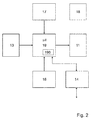
- the figure 2 is a simplified block diagram of the main components of the system.
- the device 1 is preferably electrically autonomous and includes a battery 18, for example an accumulator recharged via a USB socket or an appropriate charger.
- the battery supplies in particular a microprocessor 19 or a microcontroller provided with a RAM and / or EEPROM memory 190.
- the microprocessor executes a program in EEPROM memory, which can be updated via a USB or Bluetooth interface for example, in order to control display 11 and analyze the acceleration data provided by the accelerometer. This program thus makes it possible to control the calculation means in order to determine biomechanical parameters of the stride on the basis of the acceleration data sequences measured along one or more axes.
- the device also includes a chronograph for measuring time durations ⁇ t, for example an electronic chronograph based on a real-time clock RTC 16, and a loudspeaker or a not shown buzzer controlled by the microprocessor 19 to generate alarms or sounds.
- a UART input-output module 14 makes it possible to exchange data with external devices, for example to reprogram it and / or to transmit measurement results to a personal computer, a mobile telephone or any other data processing device. near.
- the UART module can for example be connected to a wired USB type connector, or to a wireless interface of the Bluetooth or Zigbee type, for example. It is also possible to provide a flash memory card connector for storing results or loading a new program or a training plan for example.
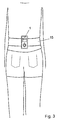
- the figure 3 schematically illustrates the placement of the device 1 in the hollow of the kidneys (hollow of the back) of a user 2, by means of a belt 15.
- This placement ensures a position very close to the center of mass of the runner during virtually the entire stride, without the device can vibrate or move relative to the center of mass.
- the device can also be placed equally advantageous on the stomach. Tests have shown that positioning the device on the limbs (for example on the wrist, on the foot or near the knee), does not allow any such measurement and analysis, and therefore excludes all applications and inventions of the prior art which describe devices placed elsewhere than near the athlete's center of gravity.
- Acc acceleration is preferably obtained according to several distinct axes.
- the device thus provides several distinct acceleration sequences, analyzed and stored independently of each other.
- the device determines an acceleration data sequence in the vertical direction.
- the device further determines acceleration in the anteroposterior direction in which the runner advances.
- the device may also provide a third sequence of acceleration data along the lateral direction, for example to determine the lateral sway of the athlete's body. These three directions may correspond to axes possibly different from the axes of the accelerometer.
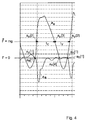
- the figure 4 illustrates two curves showing the acceleration values a v in the vertical direction and a in the anteroposterior direction during a stride.
- the anteroposterior direction corresponds to the horizontal direction in which the runner progresses, that is to say a horizontal direction perpendicular to the spine.
- the orientation of the device and / or the accelerometer relative to the runner is measured at a standstill, and thus allows the calibration and transformation of the "runner-device" reference system.
- the anteroposterior direction can be initially approximated, then corrected after a straight race section by measuring the direction in which the runner travels the greatest distance.
- the repository in which the acceleration data sequences are measured is linked to the runner, and therefore turns when the runner is around a stadium, for example.
- Repository correction is preferably performed after the calibration, and / or during exercise, if the axes of the accelerometer of the device do not coincide with the vertical and anteroposterior axes, for example in the case of incorrect or imprecise placement of the device. device.
- the contact time during the stride therefore corresponds to the interval t c between the instants a v [2] where the foot is in contact with the ground, and a v [3] where the same foot redaville.
- the flight time t v corresponds to the complementary period between a v [3] and a v [2].
- the flight time and the contact time are calculated by averaging the flight times and contact times during all strides performed during a test; the least representative strides, for example at the beginning of the test, at the end of the test, when the value deviates too far from the mean, or when the anteroposterior or lateral acceleration takes unusual values, are preferably excluded from the calculation of the average.
- Measuring the biomechanical parameters of the stride during running is advantageously carried out during and immediately following a race test on a calibrated race circuit, for example in a stadium, on a road, in the gym, or using a GPS-type satellite receiver to overcome related inaccuracies the distance traveled with an accelerometer, and shocks disturbing the accelerometer in case of race on rough terrain.
- the duration of the exercise is preferably determined using the integrated chronograph.
- the device invites the runner to run at a predetermined speed, either qualitatively ("run slowly”, “run 400 meters at your own pace”, etc.), or quantitatively by emitting for example a signal sound to prompt the user to slow down or otherwise accelerate.
- the beginning of the exercise is for example given by the device which can display or return a countdown, by the user who presses a button, or detected by the accelerometer as soon as the user starts to run after the starting the program.
- the end of the exercise can be indicated by the user, or detected by the accelerometer as soon as the user has traveled the expected distance or as soon as it decelerates sufficiently.
- the distance traveled is preferably introduced by the user into the device.
- the device may display a message inviting the user to travel a predetermined distance, for example 100 meters, 400 meters, 1000 meters or more, on the track; the biomechanical parameters of the stride are then displayed at the end of this exercise.
- the user can also enter the total distance traveled, or choose from a menu.
- the distance traveled is determined by a satellite receiver, for example a GPS receiver, integrated or connected to the device. It may be possible, but less precise, to determine this distance by a double integration of the acceleration in the anteroposterior direction.
- Other data that is preferably entered manually by the user include its weight in kilograms and its size in centimeters. Plausibility tests may be performed during the test, based on the measurement results of the accelerometer; for example, stride length must be in a plausible relationship with the size of the user.
- the device calculates a number of new biomechanical parameters, relating to the stride of the runner, on the basis of the parameters measured above by the device and / or introduced by the user. .
- the figure 6 illustrates schematically and roughly the distance D support ⁇
- the speed V deco according to the vertical component at the time of take-off of the foot is a function of the average acceleration A moy and the contact time T c :
- V deco AT Avg * T vs / 2
- the angle of take-off of the center of gravity Ang deco provides very useful information for evaluating and improving the stride. It has also been found for the first time that a camera is not indispensable for measuring this angle, which can be reliably evaluated from the accelerator sequences provided by an accelerometer as described, in particular the sequences acceleration in the vertical direction.
- the figure 5 schematically illustrates the meaning of the parameters A and E during a stride.
- the effectiveness of the stride can also be affected by asymmetry between each leg.
- each individual parameter has its own meaning, useful for the athlete and his coach, and can be determined independently of the other parameters.
- the distance traveled is automatically or manually segmented into different sections and the parameters corresponding to each section are calculated and retrieved.
- the sections may, for example, correspond to predetermined distances, for example by breaking down a distance or by setting measurements of a few seconds at regular intervals or at a specific point in the route by voluntarily pressing the button of the device. The device allows to choose the parameters and the section that must be displayed.
- the segments correspond to segments with different characteristics, for example segments of different gradient, or segments traveled at different speeds.
- Parameters can also be calculated on the basis of averages calculated during discontinuous segments and grouped automatically, by example to calculate averages of parameters on all the segments of rise or fall.
- the segmentation can also be performed automatically on the basis of the data of a satellite receiver type GPS for example.
- a measurement of biomechanical parameters can be performed as indicated during a test over a calibrated distance, for example on a lap of an athletics track. It is also possible to perform a measurement and display during normal training sessions, for example during a jog on the field, during a competition and so on. Although the measurements are disturbed by field shocks and inaccuracy as to the distance traveled, this mode of operation makes it possible to measure the same parameters under other conditions, or other parameters such as for example the evolution of the stride during a long training session, or when the athlete moves on uneven or flat ground. For example, it is possible to provide differentiated results for a flat race, ascent or descent. This inclination can be determined by a satellite receiver, by the user himself, or by interpretation of the signals produced by the accelerometer in the vertical direction and / or in another direction.
- the device displays and / or restores biomechanical parameters related to the stride immediately after the exercise, or even during the exercise.
- the rider can thus be aware during and after the race of the evolution of the parameters. For example, he may learn that he is reducing the length of the stride, or the horizontal displacement of the center of mass at each stride, or that his muscle stiffness ("stiffness") decreases, which can be a sign harbinger or indicative of muscle fatigue.
- Tests have shown that the device makes it possible to measure and evaluate the above parameters with significant precision and low dispersion values, using the formulas above. It is therefore possible to determine specific training programs aimed at improving both the technical and physical abilities of the runner, while preventing injuries and risks of fatigue and improving the efficiency of the stride.
- the device advantageously allows to generate muscle training plans based on the measured parameters and to improve the running style and the effectiveness of strides.
- the device may provide gymnastics, muscle building or relaxation exercises to reinforce certain parameters, in a personalized manner for each runner.
- the exercises and training plans proposed may also include personalized running sessions, at a pace and / or with indications provided visually and / or audibly by the device.
Landscapes
- Health & Medical Sciences (AREA)
- Life Sciences & Earth Sciences (AREA)
- Engineering & Computer Science (AREA)
- Physics & Mathematics (AREA)
- General Health & Medical Sciences (AREA)
- Animal Behavior & Ethology (AREA)
- Public Health (AREA)
- Biophysics (AREA)
- Biomedical Technology (AREA)
- Heart & Thoracic Surgery (AREA)
- Medical Informatics (AREA)
- Molecular Biology (AREA)
- Surgery (AREA)
- Pathology (AREA)
- Veterinary Medicine (AREA)
- Dentistry (AREA)
- Oral & Maxillofacial Surgery (AREA)
- General Physics & Mathematics (AREA)
- Physiology (AREA)
- Remote Sensing (AREA)
- Radar, Positioning & Navigation (AREA)
- Geometry (AREA)
- Physical Education & Sports Medicine (AREA)
- Computer Vision & Pattern Recognition (AREA)
- Theoretical Computer Science (AREA)
- Multimedia (AREA)
- Human Computer Interaction (AREA)
- Social Psychology (AREA)
- Psychiatry (AREA)
- Measurement Of The Respiration, Hearing Ability, Form, And Blood Characteristics Of Living Organisms (AREA)
- Measurement Of Distances Traversed On The Ground (AREA)
Applications Claiming Priority (3)
| Application Number | Priority Date | Filing Date | Title |
|---|---|---|---|
| CH00973/10A CH703381B1 (fr) | 2010-06-16 | 2010-06-16 | Dispositif portable intégré et procédé pour calculer des paramètres biomécaniques de la foulée. |
| PCT/EP2011/059503 WO2011157607A1 (fr) | 2010-06-16 | 2011-06-08 | Dispositif portable intégré et procédé mettant en oeuvre un accéléromètre pour analyser des paramètres biomécaniques de la foulée |
| EP11725708.9A EP2582295B1 (de) | 2010-06-16 | 2011-06-08 | Integrierte tragbare vorrichtung und verfahren mit einem beschleunigungsmesser zur analyse biomechanischer parameter eines schritts |
Related Parent Applications (2)
| Application Number | Title | Priority Date | Filing Date |
|---|---|---|---|
| EP11725708.9A Division EP2582295B1 (de) | 2010-06-16 | 2011-06-08 | Integrierte tragbare vorrichtung und verfahren mit einem beschleunigungsmesser zur analyse biomechanischer parameter eines schritts |
| EP11725708.9A Division-Into EP2582295B1 (de) | 2010-06-16 | 2011-06-08 | Integrierte tragbare vorrichtung und verfahren mit einem beschleunigungsmesser zur analyse biomechanischer parameter eines schritts |
Publications (2)
| Publication Number | Publication Date |
|---|---|
| EP3045111A1 true EP3045111A1 (de) | 2016-07-20 |
| EP3045111B1 EP3045111B1 (de) | 2023-09-06 |
Family
ID=43413684
Family Applications (4)
| Application Number | Title | Priority Date | Filing Date |
|---|---|---|---|
| EP11725708.9A Active EP2582295B1 (de) | 2010-06-16 | 2011-06-08 | Integrierte tragbare vorrichtung und verfahren mit einem beschleunigungsmesser zur analyse biomechanischer parameter eines schritts |
| EP16157853.9A Active EP3047798B1 (de) | 2010-06-16 | 2011-06-08 | Integriertes tragbares gerät und verfahren zur anwendung eines beschleunigungsmessers zur analyse der biochemischen parameter von schritten |
| EP11725061.3A Active EP2582294B1 (de) | 2010-06-16 | 2011-06-08 | Integrierte tragbare vorrichtung und verfahren mit einem beschleunigungsmesser zur detektion von asymmetrien in der bewegung eines benutzers |
| EP16157843.0A Active EP3045111B1 (de) | 2010-06-16 | 2011-06-08 | Integriertes tragbares gerät und verfahren zur anwendung eines beschleunigungsmessers zur analyse der biochemischen parameter von schritten |
Family Applications Before (3)
| Application Number | Title | Priority Date | Filing Date |
|---|---|---|---|
| EP11725708.9A Active EP2582295B1 (de) | 2010-06-16 | 2011-06-08 | Integrierte tragbare vorrichtung und verfahren mit einem beschleunigungsmesser zur analyse biomechanischer parameter eines schritts |
| EP16157853.9A Active EP3047798B1 (de) | 2010-06-16 | 2011-06-08 | Integriertes tragbares gerät und verfahren zur anwendung eines beschleunigungsmessers zur analyse der biochemischen parameter von schritten |
| EP11725061.3A Active EP2582294B1 (de) | 2010-06-16 | 2011-06-08 | Integrierte tragbare vorrichtung und verfahren mit einem beschleunigungsmesser zur detektion von asymmetrien in der bewegung eines benutzers |
Country Status (5)
| Country | Link |
|---|---|
| US (7) | US10881905B2 (de) |
| EP (4) | EP2582295B1 (de) |
| JP (2) | JP5849093B2 (de) |
| CH (1) | CH703381B1 (de) |
| WO (2) | WO2011157608A1 (de) |
Families Citing this family (97)
| Publication number | Priority date | Publication date | Assignee | Title |
|---|---|---|---|---|
| US9549585B2 (en) | 2008-06-13 | 2017-01-24 | Nike, Inc. | Footwear having sensor system |
| CN102143695A (zh) | 2008-06-13 | 2011-08-03 | 耐克国际有限公司 | 具有传感器系统的鞋 |
| US10070680B2 (en) | 2008-06-13 | 2018-09-11 | Nike, Inc. | Footwear having sensor system |
| KR101754997B1 (ko) | 2011-02-17 | 2017-07-06 | 나이키 이노베이트 씨.브이. | 센서 시스템을 가지는 신발류 |
| CA2827687C (en) | 2011-02-17 | 2016-12-20 | Nike International Ltd. | Footwear having sensor system |
| US9128521B2 (en) | 2011-07-13 | 2015-09-08 | Lumo Bodytech, Inc. | System and method of biomechanical posture detection and feedback including sensor normalization |
| US8928484B2 (en) | 2011-07-13 | 2015-01-06 | Lumo Bodytech, Inc. | System and method of biomechanical posture detection and feedback |
| US9350951B1 (en) * | 2011-11-22 | 2016-05-24 | Scott Dallas Rowe | Method for interactive training and analysis |
| US9154739B1 (en) * | 2011-11-30 | 2015-10-06 | Google Inc. | Physical training assistant system |
| US20130213146A1 (en) | 2012-02-22 | 2013-08-22 | Nike, Inc. | Footwear Having Sensor System |
| US20130213147A1 (en) | 2012-02-22 | 2013-08-22 | Nike, Inc. | Footwear Having Sensor System |
| US20130213144A1 (en) | 2012-02-22 | 2013-08-22 | Nike, Inc. | Footwear Having Sensor System |
| BR112015002620A2 (pt) | 2012-08-07 | 2018-05-22 | Dorsavi Pty Ltd | método e aparelho para medir forças de reação. |
| US20140142442A1 (en) * | 2012-11-19 | 2014-05-22 | Judy Sibille SNOW | Audio Feedback for Medical Conditions |
| US9700241B2 (en) * | 2012-12-04 | 2017-07-11 | Under Armour, Inc. | Gait analysis system and method |
| US11006690B2 (en) * | 2013-02-01 | 2021-05-18 | Nike, Inc. | System and method for analyzing athletic activity |
| US9743861B2 (en) | 2013-02-01 | 2017-08-29 | Nike, Inc. | System and method for analyzing athletic activity |
| US10926133B2 (en) | 2013-02-01 | 2021-02-23 | Nike, Inc. | System and method for analyzing athletic activity |
| US9254409B2 (en) | 2013-03-14 | 2016-02-09 | Icon Health & Fitness, Inc. | Strength training apparatus with flywheel and related methods |
| US10024740B2 (en) | 2013-03-15 | 2018-07-17 | Nike, Inc. | System and method for analyzing athletic activity |
| JP6075198B2 (ja) * | 2013-05-10 | 2017-02-08 | オムロンヘルスケア株式会社 | 歩行姿勢計およびプログラム |
| US9591996B2 (en) | 2013-06-07 | 2017-03-14 | Lumo BodyTech, Inc | System and method for detecting transitions between sitting and standing states |
| KR101501661B1 (ko) * | 2013-06-10 | 2015-03-12 | 한국과학기술연구원 | 착용형 근전도 센서 시스템 |
| US9121863B2 (en) * | 2013-09-19 | 2015-09-01 | Honeywell International Inc. | Systems and methods for a limb strike detector |
| JP6807744B2 (ja) * | 2013-10-24 | 2021-01-06 | ▲華▼▲為▼▲終▼端(深セン)有限公司 | 画像表示方法及び装置 |
| EP3623020B1 (de) | 2013-12-26 | 2024-05-01 | iFIT Inc. | Mechanismus des magnetischen widerstands in einer kabelmaschine |
| JP6795980B2 (ja) * | 2014-01-30 | 2020-12-02 | コーニンクレッカ フィリップス エヌ ヴェKoninklijke Philips N.V. | 加速度の測定値を処理して、ユーザによるステップを識別する方法及び対応するコンピュータプログラム、並びに加速度の測定値を処理して、ユーザによるステップを識別する装置及びそのような装置を備えるデバイス |
| JP6027038B2 (ja) * | 2014-02-13 | 2016-11-16 | 美津濃株式会社 | 計測システム、および計測装置 |
| WO2015138339A1 (en) | 2014-03-10 | 2015-09-17 | Icon Health & Fitness, Inc. | Pressure sensor to quantify work |
| WO2015169880A1 (en) | 2014-05-09 | 2015-11-12 | Koninklijke Philips N.V. | Method and apparatus for determining the orientation of an accelerometer |
| US9874457B2 (en) | 2014-05-30 | 2018-01-23 | Microsoft Technology Licensing, Llc | Adaptive lifestyle metric estimation |
| US20160321947A1 (en) * | 2014-06-09 | 2016-11-03 | Twd Sports Tech, Llc | System and method for treating patients having conditions that affect walking |
| US10426989B2 (en) | 2014-06-09 | 2019-10-01 | Icon Health & Fitness, Inc. | Cable system incorporated into a treadmill |
| US9288556B2 (en) * | 2014-06-18 | 2016-03-15 | Zikto | Method and apparatus for measuring body balance of wearable device |
| KR101461464B1 (ko) * | 2014-06-18 | 2014-11-18 | 김경태 | 스마트밴드 및 이의 생체 인증 방법 |
| JP2016034479A (ja) * | 2014-07-31 | 2016-03-17 | セイコーエプソン株式会社 | 走行時着地位置評価方法、走行時着地位置評価装置、検出方法、検出装置、走行運動評価方法及び走行運動評価装置 |
| WO2016024565A1 (ja) * | 2014-08-13 | 2016-02-18 | 株式会社村田製作所 | モーションキャプチャ装置、モーションキャプチャ方法、運動性能診断方法およびモーションキャプチャ用身体装着具 |
| CH710008A1 (fr) | 2014-08-21 | 2016-02-29 | Myotest Sa | Procédé et système de sélection automatique d'exercices physiques. |
| US10223931B1 (en) * | 2014-09-05 | 2019-03-05 | Fusionetics, LLC | Systems and methods for compensation analysis and targeted, corrective program generation |
| EP3194890B1 (de) | 2014-09-21 | 2020-02-26 | Athlete Architect LLC | Verfahren und vorrichtung zur festlegung des energieverbrauchs und verfahrens während einer zweibeinigen bewegung |
| JP6390303B2 (ja) * | 2014-09-22 | 2018-09-19 | カシオ計算機株式会社 | 測定装置、測定方法及び測定プログラム |
| JP6446941B2 (ja) * | 2014-09-22 | 2019-01-09 | カシオ計算機株式会社 | 運動解析装置、方法、およびプログラム |
| US9952675B2 (en) | 2014-09-23 | 2018-04-24 | Fitbit, Inc. | Methods, systems, and apparatuses to display visibility changes responsive to user gestures |
| US9687695B2 (en) * | 2014-10-22 | 2017-06-27 | Dalsu Lee | Methods and systems for training proper running of a user |
| US10342462B2 (en) * | 2014-10-26 | 2019-07-09 | David Martin | Application of gait characteristics for mobile |
| JP6134872B1 (ja) * | 2014-12-03 | 2017-05-24 | コーニンクレッカ フィリップス エヌ ヴェKoninklijke Philips N.V. | 対象の周期的な運動のサイクル数を計数するデバイス、方法及びシステム |
| GB2533430A (en) | 2014-12-19 | 2016-06-22 | Mclaren Applied Tech Ltd | Biomechanical analysis |
| US10258828B2 (en) | 2015-01-16 | 2019-04-16 | Icon Health & Fitness, Inc. | Controls for an exercise device |
| US10959649B2 (en) * | 2015-01-29 | 2021-03-30 | Beijing Shunyuan Kaihua Technology Limited | Systems and methods for stride length calibration |
| EP3305193A4 (de) * | 2015-05-29 | 2019-01-09 | Alps Electric Co., Ltd. | Vorrichtung zur haltungserkennung, brillenartige elektronische vorrichtung, haltungserkennungsverfahren und programm |
| TWI644702B (zh) | 2015-08-26 | 2018-12-21 | 美商愛康運動與健康公司 | 力量運動機械裝置 |
| US10940360B2 (en) | 2015-08-26 | 2021-03-09 | Icon Health & Fitness, Inc. | Strength exercise mechanisms |
| US10314520B2 (en) | 2015-10-02 | 2019-06-11 | Seismic Holdings, Inc. | System and method for characterizing biomechanical activity |
| EP3355763A1 (de) * | 2015-10-02 | 2018-08-08 | MAS Innovation (Private) Limited | System und verfahren zur überwachung der lauftechnik eines benutzers |
| SG11201803152YA (en) * | 2015-10-14 | 2018-05-30 | Synphne Pte Ltd | Systems and methods for facilitating mind - body - emotion state self-adjustment and functional skills development by way of biofeedback and environmental monitoring |
| US20170151463A1 (en) * | 2015-11-28 | 2017-06-01 | Shft Aps | Method and apparatus for optimizing running performance of an individual |
| US10463909B2 (en) | 2015-12-27 | 2019-11-05 | Seismic Holdings, Inc. | System and method for using performance signatures |
| US10959647B2 (en) | 2015-12-30 | 2021-03-30 | Seismic Holdings, Inc. | System and method for sensing and responding to fatigue during a physical activity |
| US10490051B2 (en) | 2016-02-05 | 2019-11-26 | Logitech Europe S.A. | Method and system for detecting fatigue in an athlete |
| DE102016102083A1 (de) * | 2016-02-05 | 2017-08-10 | Benjamin BRUDER | Verfahren zur Erfassung von biomechanischen und biometrischen Daten und Vorrichtung hierfür |
| FR3048868A1 (fr) * | 2016-03-17 | 2017-09-22 | Parrot Drones | Dispositif et procede pour la determination de parametre de foulee d'une course a pied. |
| US10293211B2 (en) | 2016-03-18 | 2019-05-21 | Icon Health & Fitness, Inc. | Coordinated weight selection |
| US10625137B2 (en) | 2016-03-18 | 2020-04-21 | Icon Health & Fitness, Inc. | Coordinated displays in an exercise device |
| US10561894B2 (en) | 2016-03-18 | 2020-02-18 | Icon Health & Fitness, Inc. | Treadmill with removable supports |
| US10441840B2 (en) | 2016-03-18 | 2019-10-15 | Icon Health & Fitness, Inc. | Collapsible strength exercise machine |
| US10272317B2 (en) | 2016-03-18 | 2019-04-30 | Icon Health & Fitness, Inc. | Lighted pace feature in a treadmill |
| US10493349B2 (en) | 2016-03-18 | 2019-12-03 | Icon Health & Fitness, Inc. | Display on exercise device |
| JP2016165477A (ja) * | 2016-04-06 | 2016-09-15 | セイコーエプソン株式会社 | 状態検出方法及び記録媒体 |
| US10252109B2 (en) | 2016-05-13 | 2019-04-09 | Icon Health & Fitness, Inc. | Weight platform treadmill |
| US10471299B2 (en) | 2016-07-01 | 2019-11-12 | Icon Health & Fitness, Inc. | Systems and methods for cooling internal exercise equipment components |
| US10441844B2 (en) | 2016-07-01 | 2019-10-15 | Icon Health & Fitness, Inc. | Cooling systems and methods for exercise equipment |
| JP6670710B2 (ja) * | 2016-09-06 | 2020-03-25 | 株式会社ジンズホールディングス | 情報処理方法、情報処理装置及びプログラム |
| US10500473B2 (en) | 2016-10-10 | 2019-12-10 | Icon Health & Fitness, Inc. | Console positioning |
| US10376736B2 (en) | 2016-10-12 | 2019-08-13 | Icon Health & Fitness, Inc. | Cooling an exercise device during a dive motor runway condition |
| US10207148B2 (en) | 2016-10-12 | 2019-02-19 | Icon Health & Fitness, Inc. | Systems and methods for reducing runaway resistance on an exercise device |
| US10661114B2 (en) | 2016-11-01 | 2020-05-26 | Icon Health & Fitness, Inc. | Body weight lift mechanism on treadmill |
| TWI646997B (zh) | 2016-11-01 | 2019-01-11 | 美商愛康運動與健康公司 | 用於控制台定位的距離感測器 |
| WO2018087654A1 (en) | 2016-11-08 | 2018-05-17 | Myotest Sa | A method and system for determining the power developed by a runner |
| TWI680782B (zh) | 2016-12-05 | 2020-01-01 | 美商愛康運動與健康公司 | 於操作期間抵銷跑步機的平台之重量 |
| CN109002189B (zh) * | 2017-06-07 | 2021-09-07 | 斑马智行网络(香港)有限公司 | 一种运动识别方法、装置、设备和计算机存储介质 |
| CN113218395B (zh) * | 2017-06-23 | 2024-06-11 | 北京方位捷讯科技有限公司 | 行人步行轨迹检测方法、装置及系统 |
| TWI722450B (zh) | 2017-08-16 | 2021-03-21 | 美商愛康運動與健康公司 | 用於抗馬達中之軸向衝擊載荷的系統 |
| WO2019043601A1 (en) | 2017-08-29 | 2019-03-07 | Myotest Sa | METHOD AND DEVICE FOR RECOVERING BIOMECHANICAL PARAMETERS OF A FOULÉE |
| CA3078459C (en) * | 2017-10-09 | 2022-07-19 | Bosu Fitness, Llc | Devices and method for increasing running performance |
| WO2019099053A1 (en) * | 2017-11-19 | 2019-05-23 | Mocini Jeffrey | Belt-mounted slope sensor system |
| US10729965B2 (en) | 2017-12-22 | 2020-08-04 | Icon Health & Fitness, Inc. | Audible belt guide in a treadmill |
| US11564439B2 (en) * | 2018-08-07 | 2023-01-31 | Under Armour, Inc. | System and method for determining foot strike pattern |
| DE102019103231A1 (de) * | 2019-02-09 | 2020-08-13 | Dt Swiss Ag | Verfahren zum Erfassen und Auswerten von Sensordaten und Zweiradkomponente |
| US12023148B2 (en) * | 2019-02-19 | 2024-07-02 | Zwift, Inc. | Physical movement tracking |
| CN113993452A (zh) * | 2019-06-19 | 2022-01-28 | 豪夫迈·罗氏有限公司 | 数字生物标志物 |
| US12059267B2 (en) | 2019-06-26 | 2024-08-13 | Stryd, Inc. | Expenditure to overcome air resistance during bipedal motion |
| US20210393166A1 (en) * | 2020-06-23 | 2021-12-23 | Apple Inc. | Monitoring user health using gait analysis |
| US20240122499A1 (en) * | 2020-12-16 | 2024-04-18 | New York University | Wearable inertial sensor system and methods |
| KR20230038121A (ko) | 2021-09-10 | 2023-03-17 | 애플 인크. | 모바일 디바이스를 사용한 추락 인지 상황 검출 |
| US20230377753A1 (en) * | 2021-09-18 | 2023-11-23 | Marco Tulio DE MELLO | Equipment and method to evaluate and measure balance, fatigue and sleepiness |
| WO2024006969A2 (en) * | 2022-06-30 | 2024-01-04 | Aikynetix Llc | Systems and methods for measurement and analysis of human biomechanics with single camera viewpoint |
| WO2026079413A1 (ja) * | 2024-10-08 | 2026-04-16 | タグル株式会社 | アスリート評価システム |
Citations (28)
| Publication number | Priority date | Publication date | Assignee | Title |
|---|---|---|---|---|
| EP0418548A1 (de) | 1989-08-28 | 1991-03-27 | Consiglio Nazionale Delle Ricerche | Methode zum automatischen Analysieren der menschlichen Bewegungsfreiheit |
| US5056783A (en) | 1989-10-18 | 1991-10-15 | Batronics, Inc. | Sports implement swing analyzer |
| US5125412A (en) * | 1990-07-23 | 1992-06-30 | Thornton William E | Musculoskeletal activity monitor |
| US5263491A (en) * | 1992-05-12 | 1993-11-23 | William Thornton | Ambulatory metabolic monitor |
| US5474083A (en) | 1986-12-08 | 1995-12-12 | Empi, Inc. | Lifting monitoring and exercise training system |
| DE4426302A1 (de) | 1994-07-25 | 1996-02-15 | Ko Eui Min | Schockkraftmesser für Kampfsportschlagtechniken |
| US5788655A (en) | 1994-09-07 | 1998-08-04 | Omron Corporation | Exercise amount measuring device capable of displaying the amount of exercise to be performed further |
| US5976083A (en) | 1997-07-30 | 1999-11-02 | Living Systems, Inc. | Portable aerobic fitness monitor for walking and running |
| US6148280A (en) | 1995-02-28 | 2000-11-14 | Virtual Technologies, Inc. | Accurate, rapid, reliable position sensing using multiple sensing technologies |
| US6397151B1 (en) | 1997-06-11 | 2002-05-28 | Casio Computer Co., Ltd. | Impulse force estimating device, impulse force estimating method, and medium storing impulse force estimation program |
| EP1253404A2 (de) | 2001-04-23 | 2002-10-30 | Quentin Ladetto | In einem Koppelnavigationsmodus funktionierende Fussgängernavigationsverfahren und -vorrichtung |
| WO2003032826A2 (en) | 2001-10-11 | 2003-04-24 | Koninklijke Philips Electronics N.V. | System and method for determining the physical activity of an object |
| WO2005074795A1 (en) | 2004-01-31 | 2005-08-18 | Nokia Corporation | Terminal and associated method and computer program product for monitoring at least one activity of a user |
| WO2005091113A2 (en) | 2004-03-12 | 2005-09-29 | Vectronix Ag | Apparatus and method of determining 3d pedestrian motion by using projection planes |
| WO2006030065A1 (en) | 2004-09-13 | 2006-03-23 | Valtion Teknillinen Tutkimuskeskus | Recognition of live object in motion |
| WO2007017471A1 (fr) | 2005-08-08 | 2007-02-15 | Csem Centre Suisse D'electronique Et De Microtechnique Sa Recherche Et Développement | Procede et dispositif de determination de la vitesse d'un coureur |
| EP1754521A1 (de) | 2005-08-16 | 2007-02-21 | CSEM Centre Suisse d'Electronique et de Microtechnique SA Recherche et Développement | Verfahren und Gerät zur Betimmung der Effizienz eines Laufstils |
| EP1764583A2 (de) | 2005-09-16 | 2007-03-21 | IDT Communication Technology Limited | System und Verfahren zur Messung von Gangartparametern |
| WO2007036611A1 (en) | 2005-09-30 | 2007-04-05 | Oulun Seudun Ammattikorkeakoulu | Evaluation method of a sports performance |
| WO2007107491A1 (fr) | 2006-03-17 | 2007-09-27 | Myotest Sa | Procédé et dispositif d'evaluation des capacités musculaires d'athlètes à l'aide de tests brefs |
| EP1862765A1 (de) | 2006-05-29 | 2007-12-05 | Polar Electro Oy | Verfahren und am Handgelenk tragbares Gerät |
| EP1897598A1 (de) | 2006-09-06 | 2008-03-12 | Nederlandse Organisatie voor toegepast- natuurwetenschappelijk onderzoek TNO | System zur Trainingsoptimierung |
| US20080190202A1 (en) * | 2006-03-03 | 2008-08-14 | Garmin Ltd. | Method and apparatus for determining the attachment position of a motion sensing apparatus |
| EP1992389A1 (de) | 2007-05-18 | 2008-11-19 | MNT Innovations Pty Ltd | Verbesserter Sportsensor |
| US20080288200A1 (en) | 2007-05-18 | 2008-11-20 | Noble Christopher R | Newtonian physical activity monitor |
| US20090018794A1 (en) | 2007-07-11 | 2009-01-15 | Vti Technologies Oy | Method and device for measuring the progress of a moving person |
| EP2027817A1 (de) | 2007-08-23 | 2009-02-25 | Myotest SA | Beschleunigungsmesser und angepasste Steuerung |
| WO2010046448A1 (fr) | 2008-10-22 | 2010-04-29 | Myotest Sa | Procede et dispositif permettant a un athlete de determiner puis de controler la vitesse de deplacement d'une masse |
Family Cites Families (49)
| Publication number | Priority date | Publication date | Assignee | Title |
|---|---|---|---|---|
| US4578769A (en) * | 1983-02-09 | 1986-03-25 | Nike, Inc. | Device for determining the speed, distance traversed, elapsed time and calories expended by a person while running |
| DE3313712A1 (de) | 1983-04-15 | 1984-10-18 | AEG-Telefunken Kabelwerke AG, Rheydt, 4050 Mönchengladbach | Schaltung zur fehlermeldung bei einem ueber eine steuerbare schalteinrichtung geschalteten stromverbraucher |
| JPH02203842A (ja) * | 1989-02-02 | 1990-08-13 | Sanyo Electric Co Ltd | ランニングフォーム判定装置 |
| US6183425B1 (en) * | 1995-10-13 | 2001-02-06 | The United States Of America As Represented By The Administrator Of The National Aeronautics And Space Administration | Method and apparatus for monitoring of daily activity in terms of ground reaction forces |
| US6018705A (en) | 1997-10-02 | 2000-01-25 | Personal Electronic Devices, Inc. | Measuring foot contact time and foot loft time of a person in locomotion |
| JP3746890B2 (ja) * | 1997-11-06 | 2006-02-15 | 株式会社アシックス | 下肢筋疲労測定装置 |
| FI108579B (fi) * | 1999-05-28 | 2002-02-15 | Polar Electro Oy | Menetelmä ja mittausjärjestely juoksijan, kävelijän tai muun liikkuvan elävän kohteen nopeuden määrittämiseen |
| FR2804596B1 (fr) * | 2000-02-04 | 2002-10-04 | Agronomique Inst Nat Rech | Procede d'analyse d'irregularites de locomotion humaine |
| US6522266B1 (en) * | 2000-05-17 | 2003-02-18 | Honeywell, Inc. | Navigation system, method and software for foot travel |
| JP4188607B2 (ja) * | 2001-06-27 | 2008-11-26 | 本田技研工業株式会社 | 二足歩行移動体の床反力推定方法及び二足歩行移動体の関節モーメント推定方法 |
| US6997882B1 (en) * | 2001-12-21 | 2006-02-14 | Barron Associates, Inc. | 6-DOF subject-monitoring device and method |
| US20040225532A1 (en) * | 2002-11-27 | 2004-11-11 | Grigorii Gadiyak | System, method, and article of manufacture for providing automated podiatry-related consultation |
| US20040143452A1 (en) * | 2003-01-15 | 2004-07-22 | Podo Technology, Inc. | System and method of dynamically assessing foot characteristics |
| US7387611B2 (en) * | 2003-04-10 | 2008-06-17 | Matsushita Electric Industrial Co., Ltd. | Physical movement analyzer and physical movement analyzing method |
| JP4504071B2 (ja) * | 2003-04-10 | 2010-07-14 | パナソニック株式会社 | 身体運動解析装置 |
| FR2860700B1 (fr) * | 2003-10-10 | 2005-12-09 | Commissariat Energie Atomique | Dispositif de controle de foulee |
| JP2005224318A (ja) * | 2004-02-10 | 2005-08-25 | Rikogaku Shinkokai | ペースメーカー |
| FI120960B (fi) * | 2004-07-01 | 2010-05-31 | Suunto Oy | Menetelmä ja laitteisto liikuntasuorituksen aikaisen suorirustason ja väsymisen mittaamiseksi |
| JP4686681B2 (ja) | 2004-10-05 | 2011-05-25 | 国立大学法人東京工業大学 | 歩行介助システム |
| US7648441B2 (en) * | 2004-11-10 | 2010-01-19 | Silk Jeffrey E | Self-contained real-time gait therapy device |
| JP4547537B2 (ja) * | 2004-11-29 | 2010-09-22 | 独立行政法人産業技術総合研究所 | 身体状態検出装置、その検出方法及び検出プログラム |
| DE102005004086A1 (de) * | 2005-01-21 | 2006-07-27 | Xybermind Gmbh | Vorrichtung und Verfahren zur Bewegungserfassung |
| GB2422790B (en) * | 2005-02-07 | 2007-08-01 | Nigel Allister Anstey | Measurement of physical fitness |
| JP4352018B2 (ja) * | 2005-03-30 | 2009-10-28 | 株式会社東芝 | 運動計測装置、運動計測方法および運動計測プログラム |
| WO2006119186A2 (en) * | 2005-05-02 | 2006-11-09 | University Of Virginia Patent Foundation | Systems, devices, and methods for interpreting movement |
| US20060293613A1 (en) * | 2005-06-27 | 2006-12-28 | Concept Development Group | Method and Apparatus for Automated Monitoring and Tracking of the Trajectory of Patients' Center of Gravity Movements |
| US20070027369A1 (en) | 2005-07-28 | 2007-02-01 | Guido Pagnacco | Apparatus and methods for assessing human physical performance |
| US7602301B1 (en) * | 2006-01-09 | 2009-10-13 | Applied Technology Holdings, Inc. | Apparatus, systems, and methods for gathering and processing biometric and biomechanical data |
| US7827000B2 (en) * | 2006-03-03 | 2010-11-02 | Garmin Switzerland Gmbh | Method and apparatus for estimating a motion parameter |
| JP5236505B2 (ja) * | 2006-03-08 | 2013-07-17 | コーニンクレッカ フィリップス エレクトロニクス エヌ ヴィ | 四肢の機能的使用をモニタリングする方法およびシステム |
| AU2007255225A1 (en) | 2006-06-09 | 2007-12-13 | Centre National De La Recherche Scientifique | Method and device for the rehabilitation and/or correction of postural symmetry in static or dynamic situations |
| US8128410B2 (en) * | 2006-09-29 | 2012-03-06 | Nike, Inc. | Multi-mode acceleration-based athleticism measurement system |
| US7753861B1 (en) * | 2007-04-04 | 2010-07-13 | Dp Technologies, Inc. | Chest strap having human activity monitoring device |
| US20080281550A1 (en) * | 2007-05-11 | 2008-11-13 | Wicab, Inc. | Systems and methods for characterizing balance function |
| WO2009018794A2 (de) | 2007-08-02 | 2009-02-12 | Luk Lamellen Und Kupplungsbau Beteiligungs Kg | Vorrichtung zur dämpfung von schwingungen, insbesondere mehrstufiger drehschwingungsdämpfer |
| US20110231101A1 (en) * | 2007-08-21 | 2011-09-22 | Niranjan Bidargaddi | Body movement analysis method and apparatus |
| JP5034012B2 (ja) * | 2007-10-22 | 2012-09-26 | アイチ・マイクロ・インテリジェント株式会社 | 運動能力検出装置 |
| JP5174425B2 (ja) * | 2007-10-26 | 2013-04-03 | パナソニック株式会社 | 歩容改善支援システム |
| US20090137933A1 (en) * | 2007-11-28 | 2009-05-28 | Ishoe | Methods and systems for sensing equilibrium |
| JP5416144B2 (ja) * | 2008-02-27 | 2014-02-12 | ナイキ インターナショナル リミテッド | 対話型運動トレーニングログ |
| US8113991B2 (en) * | 2008-06-02 | 2012-02-14 | Omek Interactive, Ltd. | Method and system for interactive fitness training program |
| CN102144248B (zh) * | 2008-09-04 | 2014-05-14 | 皇家飞利浦电子股份有限公司 | 预防跌倒系统 |
| GB2467514A (en) * | 2008-12-23 | 2010-08-04 | Univ Oxford Brookes | Gait monitor for sensing vertical displacement |
| WO2010096691A2 (en) * | 2009-02-20 | 2010-08-26 | The Regents Of The University Of Colorado, A Body Corporate | Footwear-based body weight monitor and postural allocation, physical activity classification, and energy expenditure calculator |
| US20100250179A1 (en) * | 2009-03-27 | 2010-09-30 | Thomas Mariano | Method and apparatus for measuring and estimating subject motion in variable signal reception environments |
| WO2010150260A1 (en) * | 2009-06-24 | 2010-12-29 | The Medical Research, Infrastructure, And Health Services Fund Of The Tel Aviv Medical Center | Automated near-fall detector |
| US9665873B2 (en) * | 2010-02-24 | 2017-05-30 | Performance Lab Technologies Limited | Automated physical activity classification |
| FR2959112B1 (fr) * | 2010-04-23 | 2015-05-29 | Movea | Systeme d'analyse de foulees d'un utilisateur |
| US8628485B2 (en) * | 2010-08-06 | 2014-01-14 | Covenant Ministries Of Benevolence Inc. | Gait analysis system and methods |
-
2010
- 2010-06-16 CH CH00973/10A patent/CH703381B1/fr unknown
-
2011
- 2011-06-08 WO PCT/EP2011/059504 patent/WO2011157608A1/fr not_active Ceased
- 2011-06-08 JP JP2013514642A patent/JP5849093B2/ja active Active
- 2011-06-08 EP EP11725708.9A patent/EP2582295B1/de active Active
- 2011-06-08 WO PCT/EP2011/059503 patent/WO2011157607A1/fr not_active Ceased
- 2011-06-08 JP JP2013514641A patent/JP5849092B2/ja active Active
- 2011-06-08 EP EP16157853.9A patent/EP3047798B1/de active Active
- 2011-06-08 EP EP11725061.3A patent/EP2582294B1/de active Active
- 2011-06-08 EP EP16157843.0A patent/EP3045111B1/de active Active
-
2012
- 2012-12-14 US US13/715,267 patent/US10881905B2/en active Active
- 2012-12-14 US US13/715,236 patent/US9320457B2/en active Active
-
2016
- 2016-04-04 US US15/090,254 patent/US9873018B2/en active Active
-
2017
- 2017-12-21 US US15/850,932 patent/US11833391B2/en active Active
-
2020
- 2020-12-22 US US17/130,460 patent/US12290717B2/en active Active
-
2023
- 2023-12-01 US US18/527,051 patent/US20240091589A1/en active Pending
-
2025
- 2025-05-05 US US19/198,898 patent/US20250262481A1/en active Pending
Patent Citations (29)
| Publication number | Priority date | Publication date | Assignee | Title |
|---|---|---|---|---|
| US5474083A (en) | 1986-12-08 | 1995-12-12 | Empi, Inc. | Lifting monitoring and exercise training system |
| EP0418548A1 (de) | 1989-08-28 | 1991-03-27 | Consiglio Nazionale Delle Ricerche | Methode zum automatischen Analysieren der menschlichen Bewegungsfreiheit |
| US5056783A (en) | 1989-10-18 | 1991-10-15 | Batronics, Inc. | Sports implement swing analyzer |
| US5125412A (en) * | 1990-07-23 | 1992-06-30 | Thornton William E | Musculoskeletal activity monitor |
| US5263491A (en) * | 1992-05-12 | 1993-11-23 | William Thornton | Ambulatory metabolic monitor |
| DE4426302A1 (de) | 1994-07-25 | 1996-02-15 | Ko Eui Min | Schockkraftmesser für Kampfsportschlagtechniken |
| US5788655A (en) | 1994-09-07 | 1998-08-04 | Omron Corporation | Exercise amount measuring device capable of displaying the amount of exercise to be performed further |
| US6148280A (en) | 1995-02-28 | 2000-11-14 | Virtual Technologies, Inc. | Accurate, rapid, reliable position sensing using multiple sensing technologies |
| US6397151B1 (en) | 1997-06-11 | 2002-05-28 | Casio Computer Co., Ltd. | Impulse force estimating device, impulse force estimating method, and medium storing impulse force estimation program |
| US5976083A (en) | 1997-07-30 | 1999-11-02 | Living Systems, Inc. | Portable aerobic fitness monitor for walking and running |
| EP1253404A2 (de) | 2001-04-23 | 2002-10-30 | Quentin Ladetto | In einem Koppelnavigationsmodus funktionierende Fussgängernavigationsverfahren und -vorrichtung |
| WO2003032826A2 (en) | 2001-10-11 | 2003-04-24 | Koninklijke Philips Electronics N.V. | System and method for determining the physical activity of an object |
| WO2005074795A1 (en) | 2004-01-31 | 2005-08-18 | Nokia Corporation | Terminal and associated method and computer program product for monitoring at least one activity of a user |
| WO2005091113A2 (en) | 2004-03-12 | 2005-09-29 | Vectronix Ag | Apparatus and method of determining 3d pedestrian motion by using projection planes |
| WO2006030065A1 (en) | 2004-09-13 | 2006-03-23 | Valtion Teknillinen Tutkimuskeskus | Recognition of live object in motion |
| WO2007017471A1 (fr) | 2005-08-08 | 2007-02-15 | Csem Centre Suisse D'electronique Et De Microtechnique Sa Recherche Et Développement | Procede et dispositif de determination de la vitesse d'un coureur |
| EP1754521A1 (de) | 2005-08-16 | 2007-02-21 | CSEM Centre Suisse d'Electronique et de Microtechnique SA Recherche et Développement | Verfahren und Gerät zur Betimmung der Effizienz eines Laufstils |
| EP1764583A2 (de) | 2005-09-16 | 2007-03-21 | IDT Communication Technology Limited | System und Verfahren zur Messung von Gangartparametern |
| WO2007036611A1 (en) | 2005-09-30 | 2007-04-05 | Oulun Seudun Ammattikorkeakoulu | Evaluation method of a sports performance |
| US20080190202A1 (en) * | 2006-03-03 | 2008-08-14 | Garmin Ltd. | Method and apparatus for determining the attachment position of a motion sensing apparatus |
| WO2007107491A1 (fr) | 2006-03-17 | 2007-09-27 | Myotest Sa | Procédé et dispositif d'evaluation des capacités musculaires d'athlètes à l'aide de tests brefs |
| EP1862765A1 (de) | 2006-05-29 | 2007-12-05 | Polar Electro Oy | Verfahren und am Handgelenk tragbares Gerät |
| EP1897598A1 (de) | 2006-09-06 | 2008-03-12 | Nederlandse Organisatie voor toegepast- natuurwetenschappelijk onderzoek TNO | System zur Trainingsoptimierung |
| EP1992389A1 (de) | 2007-05-18 | 2008-11-19 | MNT Innovations Pty Ltd | Verbesserter Sportsensor |
| US20080288200A1 (en) | 2007-05-18 | 2008-11-20 | Noble Christopher R | Newtonian physical activity monitor |
| US20090018794A1 (en) | 2007-07-11 | 2009-01-15 | Vti Technologies Oy | Method and device for measuring the progress of a moving person |
| EP2027817A1 (de) | 2007-08-23 | 2009-02-25 | Myotest SA | Beschleunigungsmesser und angepasste Steuerung |
| WO2009094746A1 (en) | 2008-01-28 | 2009-08-06 | Garmin Ltd. | Method and apparatus for determining the attachment position of a motion sensing apparatus |
| WO2010046448A1 (fr) | 2008-10-22 | 2010-04-29 | Myotest Sa | Procede et dispositif permettant a un athlete de determiner puis de controler la vitesse de deplacement d'une masse |
Also Published As
| Publication number | Publication date |
|---|---|
| US20240091589A1 (en) | 2024-03-21 |
| US11833391B2 (en) | 2023-12-05 |
| US20160213975A1 (en) | 2016-07-28 |
| JP5849092B2 (ja) | 2016-01-27 |
| EP3047798A1 (de) | 2016-07-27 |
| EP2582295A1 (de) | 2013-04-24 |
| WO2011157608A1 (fr) | 2011-12-22 |
| EP2582294A1 (de) | 2013-04-24 |
| EP2582295B1 (de) | 2016-06-08 |
| US20180133548A1 (en) | 2018-05-17 |
| JP2013532020A (ja) | 2013-08-15 |
| EP2582294B1 (de) | 2022-11-30 |
| WO2011157607A1 (fr) | 2011-12-22 |
| US20130190657A1 (en) | 2013-07-25 |
| EP3047798B1 (de) | 2023-09-06 |
| US10881905B2 (en) | 2021-01-05 |
| US20210106870A1 (en) | 2021-04-15 |
| JP5849093B2 (ja) | 2016-01-27 |
| JP2013537436A (ja) | 2013-10-03 |
| CH703381A1 (fr) | 2011-12-30 |
| EP3045111B1 (de) | 2023-09-06 |
| US20250262481A1 (en) | 2025-08-21 |
| US9320457B2 (en) | 2016-04-26 |
| US9873018B2 (en) | 2018-01-23 |
| US20130190658A1 (en) | 2013-07-25 |
| US12290717B2 (en) | 2025-05-06 |
| CH703381B1 (fr) | 2018-12-14 |
Similar Documents
| Publication | Publication Date | Title |
|---|---|---|
| EP2582295B1 (de) | Integrierte tragbare vorrichtung und verfahren mit einem beschleunigungsmesser zur analyse biomechanischer parameter eines schritts | |
| US20250246303A1 (en) | Flight Time | |
| EP1834583B1 (de) | Vorrichtung und Verfahren zur Auswertung der muskularischen Kapazität unter Verwendung von kurzen Tests | |
| US11134865B2 (en) | Motion analysis system, motion analysis apparatus, motion analysis program, and motion analysis method | |
| US10417932B2 (en) | Biometric data gathering | |
| JP6596945B2 (ja) | 運動解析方法、運動解析装置、運動解析システム及び運動解析プログラム | |
| US20110165998A1 (en) | Method For Monitoring Exercise, And Apparatus And System Thereof | |
| CN105311815A (zh) | 运动解析装置、运动解析系统以及运动解析方法 | |
| JP6795182B2 (ja) | 運動アドバイザシステム | |
| HK1226931A1 (en) | Integrated portable device and method using an accelerometer to analyze biomechanical parameters of the stride | |
| HK1227270A1 (en) | Integrated portable device and method using an accelerometer to analyse biomechanical parameters of the stride |
Legal Events
| Date | Code | Title | Description |
|---|---|---|---|
| PUAI | Public reference made under article 153(3) epc to a published international application that has entered the european phase |
Free format text: ORIGINAL CODE: 0009012 |
|
| AC | Divisional application: reference to earlier application |
Ref document number: 2582295 Country of ref document: EP Kind code of ref document: P |
|
| AK | Designated contracting states |
Kind code of ref document: A1 Designated state(s): AL AT BE BG CH CY CZ DE DK EE ES FI FR GB GR HR HU IE IS IT LI LT LU LV MC MK MT NL NO PL PT RO RS SE SI SK SM TR |
|
| RIN1 | Information on inventor provided before grant (corrected) |
Inventor name: QUIEVRE, JACQUES Inventor name: MORIN, JEAN-BENOIT Inventor name: FLACTION, PATRICK |
|
| STAA | Information on the status of an ep patent application or granted ep patent |
Free format text: STATUS: REQUEST FOR EXAMINATION WAS MADE |
|
| 17P | Request for examination filed |
Effective date: 20170118 |
|
| RBV | Designated contracting states (corrected) |
Designated state(s): AL AT BE BG CH CY CZ DE DK EE ES FI FR GB GR HR HU IE IS IT LI LT LU LV MC MK MT NL NO PL PT RO RS SE SI SK SM TR |
|
| REG | Reference to a national code |
Ref country code: HK Ref legal event code: DE Ref document number: 1226931 Country of ref document: HK |
|
| GRAP | Despatch of communication of intention to grant a patent |
Free format text: ORIGINAL CODE: EPIDOSNIGR1 |
|
| STAA | Information on the status of an ep patent application or granted ep patent |
Free format text: STATUS: GRANT OF PATENT IS INTENDED |
|
| INTG | Intention to grant announced |
Effective date: 20220603 |
|
| GRAS | Grant fee paid |
Free format text: ORIGINAL CODE: EPIDOSNIGR3 |
|
| GRAJ | Information related to disapproval of communication of intention to grant by the applicant or resumption of examination proceedings by the epo deleted |
Free format text: ORIGINAL CODE: EPIDOSDIGR1 |
|
| GRAL | Information related to payment of fee for publishing/printing deleted |
Free format text: ORIGINAL CODE: EPIDOSDIGR3 |
|
| STAA | Information on the status of an ep patent application or granted ep patent |
Free format text: STATUS: REQUEST FOR EXAMINATION WAS MADE |
|
| INTC | Intention to grant announced (deleted) | ||
| GRAP | Despatch of communication of intention to grant a patent |
Free format text: ORIGINAL CODE: EPIDOSNIGR1 |
|
| STAA | Information on the status of an ep patent application or granted ep patent |
Free format text: STATUS: GRANT OF PATENT IS INTENDED |
|
| RIC1 | Information provided on ipc code assigned before grant |
Ipc: G01C 22/00 20060101ALI20230328BHEP Ipc: A61B 5/11 20060101AFI20230328BHEP |
|
| INTG | Intention to grant announced |
Effective date: 20230425 |
|
| GRAS | Grant fee paid |
Free format text: ORIGINAL CODE: EPIDOSNIGR3 |
|
| GRAA | (expected) grant |
Free format text: ORIGINAL CODE: 0009210 |
|
| STAA | Information on the status of an ep patent application or granted ep patent |
Free format text: STATUS: THE PATENT HAS BEEN GRANTED |
|
| AC | Divisional application: reference to earlier application |
Ref document number: 2582295 Country of ref document: EP Kind code of ref document: P |
|
| AK | Designated contracting states |
Kind code of ref document: B1 Designated state(s): AL AT BE BG CH CY CZ DE DK EE ES FI FR GB GR HR HU IE IS IT LI LT LU LV MC MK MT NL NO PL PT RO RS SE SI SK SM TR |
|
| REG | Reference to a national code |
Ref country code: GB Ref legal event code: FG4D Free format text: NOT ENGLISH |
|
| REG | Reference to a national code |
Ref country code: CH Ref legal event code: EP |
|
| REG | Reference to a national code |
Ref country code: IE Ref legal event code: FG4D Free format text: LANGUAGE OF EP DOCUMENT: FRENCH |
|
| REG | Reference to a national code |
Ref country code: DE Ref legal event code: R096 Ref document number: 602011074238 Country of ref document: DE |
|
| P01 | Opt-out of the competence of the unified patent court (upc) registered |
Effective date: 20230915 |
|
| REG | Reference to a national code |
Ref country code: LT Ref legal event code: MG9D |
|
| REG | Reference to a national code |
Ref country code: NL Ref legal event code: MP Effective date: 20230906 |
|
| PG25 | Lapsed in a contracting state [announced via postgrant information from national office to epo] |
Ref country code: GR Free format text: LAPSE BECAUSE OF FAILURE TO SUBMIT A TRANSLATION OF THE DESCRIPTION OR TO PAY THE FEE WITHIN THE PRESCRIBED TIME-LIMIT Effective date: 20231207 |
|
| PG25 | Lapsed in a contracting state [announced via postgrant information from national office to epo] |
Ref country code: SE Free format text: LAPSE BECAUSE OF FAILURE TO SUBMIT A TRANSLATION OF THE DESCRIPTION OR TO PAY THE FEE WITHIN THE PRESCRIBED TIME-LIMIT Effective date: 20230906 Ref country code: RS Free format text: LAPSE BECAUSE OF FAILURE TO SUBMIT A TRANSLATION OF THE DESCRIPTION OR TO PAY THE FEE WITHIN THE PRESCRIBED TIME-LIMIT Effective date: 20230906 Ref country code: NO Free format text: LAPSE BECAUSE OF FAILURE TO SUBMIT A TRANSLATION OF THE DESCRIPTION OR TO PAY THE FEE WITHIN THE PRESCRIBED TIME-LIMIT Effective date: 20231206 Ref country code: LV Free format text: LAPSE BECAUSE OF FAILURE TO SUBMIT A TRANSLATION OF THE DESCRIPTION OR TO PAY THE FEE WITHIN THE PRESCRIBED TIME-LIMIT Effective date: 20230906 Ref country code: LT Free format text: LAPSE BECAUSE OF FAILURE TO SUBMIT A TRANSLATION OF THE DESCRIPTION OR TO PAY THE FEE WITHIN THE PRESCRIBED TIME-LIMIT Effective date: 20230906 Ref country code: HR Free format text: LAPSE BECAUSE OF FAILURE TO SUBMIT A TRANSLATION OF THE DESCRIPTION OR TO PAY THE FEE WITHIN THE PRESCRIBED TIME-LIMIT Effective date: 20230906 Ref country code: GR Free format text: LAPSE BECAUSE OF FAILURE TO SUBMIT A TRANSLATION OF THE DESCRIPTION OR TO PAY THE FEE WITHIN THE PRESCRIBED TIME-LIMIT Effective date: 20231207 Ref country code: FI Free format text: LAPSE BECAUSE OF FAILURE TO SUBMIT A TRANSLATION OF THE DESCRIPTION OR TO PAY THE FEE WITHIN THE PRESCRIBED TIME-LIMIT Effective date: 20230906 |
|
| REG | Reference to a national code |
Ref country code: AT Ref legal event code: MK05 Ref document number: 1607406 Country of ref document: AT Kind code of ref document: T Effective date: 20230906 |
|
| PG25 | Lapsed in a contracting state [announced via postgrant information from national office to epo] |
Ref country code: NL Free format text: LAPSE BECAUSE OF FAILURE TO SUBMIT A TRANSLATION OF THE DESCRIPTION OR TO PAY THE FEE WITHIN THE PRESCRIBED TIME-LIMIT Effective date: 20230906 |
|
| PG25 | Lapsed in a contracting state [announced via postgrant information from national office to epo] |
Ref country code: IS Free format text: LAPSE BECAUSE OF FAILURE TO SUBMIT A TRANSLATION OF THE DESCRIPTION OR TO PAY THE FEE WITHIN THE PRESCRIBED TIME-LIMIT Effective date: 20240106 |
|
| PG25 | Lapsed in a contracting state [announced via postgrant information from national office to epo] |
Ref country code: AT Free format text: LAPSE BECAUSE OF FAILURE TO SUBMIT A TRANSLATION OF THE DESCRIPTION OR TO PAY THE FEE WITHIN THE PRESCRIBED TIME-LIMIT Effective date: 20230906 |
|
| PG25 | Lapsed in a contracting state [announced via postgrant information from national office to epo] |
Ref country code: ES Free format text: LAPSE BECAUSE OF FAILURE TO SUBMIT A TRANSLATION OF THE DESCRIPTION OR TO PAY THE FEE WITHIN THE PRESCRIBED TIME-LIMIT Effective date: 20230906 |
|
| PG25 | Lapsed in a contracting state [announced via postgrant information from national office to epo] |
Ref country code: SM Free format text: LAPSE BECAUSE OF FAILURE TO SUBMIT A TRANSLATION OF THE DESCRIPTION OR TO PAY THE FEE WITHIN THE PRESCRIBED TIME-LIMIT Effective date: 20230906 Ref country code: RO Free format text: LAPSE BECAUSE OF FAILURE TO SUBMIT A TRANSLATION OF THE DESCRIPTION OR TO PAY THE FEE WITHIN THE PRESCRIBED TIME-LIMIT Effective date: 20230906 Ref country code: IS Free format text: LAPSE BECAUSE OF FAILURE TO SUBMIT A TRANSLATION OF THE DESCRIPTION OR TO PAY THE FEE WITHIN THE PRESCRIBED TIME-LIMIT Effective date: 20240106 Ref country code: ES Free format text: LAPSE BECAUSE OF FAILURE TO SUBMIT A TRANSLATION OF THE DESCRIPTION OR TO PAY THE FEE WITHIN THE PRESCRIBED TIME-LIMIT Effective date: 20230906 Ref country code: EE Free format text: LAPSE BECAUSE OF FAILURE TO SUBMIT A TRANSLATION OF THE DESCRIPTION OR TO PAY THE FEE WITHIN THE PRESCRIBED TIME-LIMIT Effective date: 20230906 Ref country code: CZ Free format text: LAPSE BECAUSE OF FAILURE TO SUBMIT A TRANSLATION OF THE DESCRIPTION OR TO PAY THE FEE WITHIN THE PRESCRIBED TIME-LIMIT Effective date: 20230906 Ref country code: AT Free format text: LAPSE BECAUSE OF FAILURE TO SUBMIT A TRANSLATION OF THE DESCRIPTION OR TO PAY THE FEE WITHIN THE PRESCRIBED TIME-LIMIT Effective date: 20230906 Ref country code: SK Free format text: LAPSE BECAUSE OF FAILURE TO SUBMIT A TRANSLATION OF THE DESCRIPTION OR TO PAY THE FEE WITHIN THE PRESCRIBED TIME-LIMIT Effective date: 20230906 Ref country code: PT Free format text: LAPSE BECAUSE OF FAILURE TO SUBMIT A TRANSLATION OF THE DESCRIPTION OR TO PAY THE FEE WITHIN THE PRESCRIBED TIME-LIMIT Effective date: 20240108 |
|
| PG25 | Lapsed in a contracting state [announced via postgrant information from national office to epo] |
Ref country code: PL Free format text: LAPSE BECAUSE OF FAILURE TO SUBMIT A TRANSLATION OF THE DESCRIPTION OR TO PAY THE FEE WITHIN THE PRESCRIBED TIME-LIMIT Effective date: 20230906 Ref country code: IT Free format text: LAPSE BECAUSE OF FAILURE TO SUBMIT A TRANSLATION OF THE DESCRIPTION OR TO PAY THE FEE WITHIN THE PRESCRIBED TIME-LIMIT Effective date: 20230906 |
|
| REG | Reference to a national code |
Ref country code: DE Ref legal event code: R097 Ref document number: 602011074238 Country of ref document: DE |
|
| PGFP | Annual fee paid to national office [announced via postgrant information from national office to epo] |
Ref country code: GB Payment date: 20240606 Year of fee payment: 14 |
|
| PGFP | Annual fee paid to national office [announced via postgrant information from national office to epo] |
Ref country code: DE Payment date: 20240612 Year of fee payment: 14 |
|
| PG25 | Lapsed in a contracting state [announced via postgrant information from national office to epo] |
Ref country code: DK Free format text: LAPSE BECAUSE OF FAILURE TO SUBMIT A TRANSLATION OF THE DESCRIPTION OR TO PAY THE FEE WITHIN THE PRESCRIBED TIME-LIMIT Effective date: 20230906 |
|
| PLBE | No opposition filed within time limit |
Free format text: ORIGINAL CODE: 0009261 |
|
| STAA | Information on the status of an ep patent application or granted ep patent |
Free format text: STATUS: NO OPPOSITION FILED WITHIN TIME LIMIT |
|
| PG25 | Lapsed in a contracting state [announced via postgrant information from national office to epo] |
Ref country code: DK Free format text: LAPSE BECAUSE OF FAILURE TO SUBMIT A TRANSLATION OF THE DESCRIPTION OR TO PAY THE FEE WITHIN THE PRESCRIBED TIME-LIMIT Effective date: 20230906 Ref country code: SI Free format text: LAPSE BECAUSE OF FAILURE TO SUBMIT A TRANSLATION OF THE DESCRIPTION OR TO PAY THE FEE WITHIN THE PRESCRIBED TIME-LIMIT Effective date: 20230906 |
|
| PGFP | Annual fee paid to national office [announced via postgrant information from national office to epo] |
Ref country code: FR Payment date: 20240611 Year of fee payment: 14 |
|
| 26N | No opposition filed |
Effective date: 20240607 |
|
| REG | Reference to a national code |
Ref country code: DE Ref legal event code: R082 Ref document number: 602011074238 Country of ref document: DE Representative=s name: MAIWALD GMBH, DE |
|
| PGFP | Annual fee paid to national office [announced via postgrant information from national office to epo] |
Ref country code: CH Payment date: 20240704 Year of fee payment: 14 |
|
| PG25 | Lapsed in a contracting state [announced via postgrant information from national office to epo] |
Ref country code: BG Free format text: LAPSE BECAUSE OF FAILURE TO SUBMIT A TRANSLATION OF THE DESCRIPTION OR TO PAY THE FEE WITHIN THE PRESCRIBED TIME-LIMIT Effective date: 20230906 |
|
| PG25 | Lapsed in a contracting state [announced via postgrant information from national office to epo] |
Ref country code: BG Free format text: LAPSE BECAUSE OF FAILURE TO SUBMIT A TRANSLATION OF THE DESCRIPTION OR TO PAY THE FEE WITHIN THE PRESCRIBED TIME-LIMIT Effective date: 20230906 |
|
| REG | Reference to a national code |
Ref country code: DE Ref legal event code: R081 Ref document number: 602011074238 Country of ref document: DE Owner name: SLYDE ANALYTICS LLC, HOUSTON, US Free format text: FORMER OWNER: MYOTEST SA, SION, CH |
|
| REG | Reference to a national code |
Ref country code: HK Ref legal event code: WD Ref document number: 1226931 Country of ref document: HK |
|
| REG | Reference to a national code |
Ref country code: GB Ref legal event code: 732E Free format text: REGISTERED BETWEEN 20241219 AND 20241224 |
|
| PG25 | Lapsed in a contracting state [announced via postgrant information from national office to epo] |
Ref country code: MC Free format text: LAPSE BECAUSE OF FAILURE TO SUBMIT A TRANSLATION OF THE DESCRIPTION OR TO PAY THE FEE WITHIN THE PRESCRIBED TIME-LIMIT Effective date: 20230906 |
|
| PG25 | Lapsed in a contracting state [announced via postgrant information from national office to epo] |
Ref country code: LU Free format text: LAPSE BECAUSE OF NON-PAYMENT OF DUE FEES Effective date: 20240608 |
|
| PG25 | Lapsed in a contracting state [announced via postgrant information from national office to epo] |
Ref country code: IE Free format text: LAPSE BECAUSE OF NON-PAYMENT OF DUE FEES Effective date: 20240608 |
|
| PG25 | Lapsed in a contracting state [announced via postgrant information from national office to epo] |
Ref country code: BE Free format text: LAPSE BECAUSE OF NON-PAYMENT OF DUE FEES Effective date: 20240630 |
|
| REG | Reference to a national code |
Ref country code: BE Ref legal event code: MM Effective date: 20240630 |
|
| PG25 | Lapsed in a contracting state [announced via postgrant information from national office to epo] |
Ref country code: CY Free format text: LAPSE BECAUSE OF FAILURE TO SUBMIT A TRANSLATION OF THE DESCRIPTION OR TO PAY THE FEE WITHIN THE PRESCRIBED TIME-LIMIT; INVALID AB INITIO Effective date: 20110608 |
|
| REG | Reference to a national code |
Ref country code: DE Ref legal event code: R119 Ref document number: 602011074238 Country of ref document: DE |
|
| REG | Reference to a national code |
Ref country code: CH Ref legal event code: H13 Free format text: ST27 STATUS EVENT CODE: U-0-0-H10-H13 (AS PROVIDED BY THE NATIONAL OFFICE) Effective date: 20260127 |
|
| GBPC | Gb: european patent ceased through non-payment of renewal fee |
Effective date: 20250608 |
|
| PG25 | Lapsed in a contracting state [announced via postgrant information from national office to epo] |
Ref country code: HU Free format text: LAPSE BECAUSE OF FAILURE TO SUBMIT A TRANSLATION OF THE DESCRIPTION OR TO PAY THE FEE WITHIN THE PRESCRIBED TIME-LIMIT; INVALID AB INITIO Effective date: 20110608 |
|
| PG25 | Lapsed in a contracting state [announced via postgrant information from national office to epo] |
Ref country code: GB Free format text: LAPSE BECAUSE OF NON-PAYMENT OF DUE FEES Effective date: 20250608 |
|
| PG25 | Lapsed in a contracting state [announced via postgrant information from national office to epo] |
Ref country code: DE Free format text: LAPSE BECAUSE OF NON-PAYMENT OF DUE FEES Effective date: 20260101 |
|
| PG25 | Lapsed in a contracting state [announced via postgrant information from national office to epo] |
Ref country code: FR Free format text: LAPSE BECAUSE OF NON-PAYMENT OF DUE FEES Effective date: 20250630 |
|
| PG25 | Lapsed in a contracting state [announced via postgrant information from national office to epo] |
Ref country code: CH Free format text: LAPSE BECAUSE OF NON-PAYMENT OF DUE FEES Effective date: 20250630 |