EP3045517A1 - Composition de nettoyage, procédé de production d'une composition de nettoyage et procédé de nettoyage d'une surface - Google Patents
Composition de nettoyage, procédé de production d'une composition de nettoyage et procédé de nettoyage d'une surface Download PDFInfo
- Publication number
- EP3045517A1 EP3045517A1 EP15151670.5A EP15151670A EP3045517A1 EP 3045517 A1 EP3045517 A1 EP 3045517A1 EP 15151670 A EP15151670 A EP 15151670A EP 3045517 A1 EP3045517 A1 EP 3045517A1
- Authority
- EP
- European Patent Office
- Prior art keywords
- component
- cleaning composition
- cleaning
- dialkyl
- composition
- Prior art date
- Legal status (The legal status is an assumption and is not a legal conclusion. Google has not performed a legal analysis and makes no representation as to the accuracy of the status listed.)
- Withdrawn
Links
- 239000000203 mixture Substances 0.000 title claims abstract description 153
- 238000004140 cleaning Methods 0.000 title claims abstract description 95
- 238000000034 method Methods 0.000 title claims abstract description 18
- 238000004519 manufacturing process Methods 0.000 title claims abstract description 5
- XLYOFNOQVPJJNP-UHFFFAOYSA-N water Substances O XLYOFNOQVPJJNP-UHFFFAOYSA-N 0.000 claims abstract description 54
- 238000010790 dilution Methods 0.000 claims abstract description 20
- 239000012895 dilution Substances 0.000 claims abstract description 20
- 239000000839 emulsion Substances 0.000 claims abstract description 14
- 150000002148 esters Chemical class 0.000 claims abstract description 14
- IBMRTYCHDPMBFN-UHFFFAOYSA-N Mono-Me ester-Pentanedioic acid Natural products COC(=O)CCCC(O)=O IBMRTYCHDPMBFN-UHFFFAOYSA-N 0.000 claims abstract description 12
- DKMROQRQHGEIOW-UHFFFAOYSA-N Diethyl succinate Chemical compound CCOC(=O)CCC(=O)OCC DKMROQRQHGEIOW-UHFFFAOYSA-N 0.000 claims abstract description 6
- ULUAUXLGCMPNKK-UHFFFAOYSA-N Sulfobutanedioic acid Chemical class OC(=O)CC(C(O)=O)S(O)(=O)=O ULUAUXLGCMPNKK-UHFFFAOYSA-N 0.000 claims abstract description 6
- WNLRTRBMVRJNCN-UHFFFAOYSA-L adipate(2-) Chemical compound [O-]C(=O)CCCCC([O-])=O WNLRTRBMVRJNCN-UHFFFAOYSA-L 0.000 claims abstract description 6
- 239000004359 castor oil Substances 0.000 claims abstract description 6
- 235000019438 castor oil Nutrition 0.000 claims abstract description 6
- JFCQEDHGNNZCLN-UHFFFAOYSA-N glutaric acid Chemical compound OC(=O)CCCC(O)=O JFCQEDHGNNZCLN-UHFFFAOYSA-N 0.000 claims abstract description 6
- ZEMPKEQAKRGZGQ-XOQCFJPHSA-N glycerol triricinoleate Natural products CCCCCC[C@@H](O)CC=CCCCCCCCC(=O)OC[C@@H](COC(=O)CCCCCCCC=CC[C@@H](O)CCCCCC)OC(=O)CCCCCCCC=CC[C@H](O)CCCCCC ZEMPKEQAKRGZGQ-XOQCFJPHSA-N 0.000 claims abstract description 6
- 239000003921 oil Substances 0.000 claims abstract description 6
- KDYFGRWQOYBRFD-UHFFFAOYSA-L succinate(2-) Chemical compound [O-]C(=O)CCC([O-])=O KDYFGRWQOYBRFD-UHFFFAOYSA-L 0.000 claims abstract description 6
- POAOYUHQDCAZBD-UHFFFAOYSA-N 2-butoxyethanol Chemical compound CCCCOCCO POAOYUHQDCAZBD-UHFFFAOYSA-N 0.000 claims description 14
- 238000011109 contamination Methods 0.000 claims description 12
- OAYXUHPQHDHDDZ-UHFFFAOYSA-N 2-(2-butoxyethoxy)ethanol Chemical compound CCCCOCCOCCO OAYXUHPQHDHDDZ-UHFFFAOYSA-N 0.000 claims description 10
- LYCAIKOWRPUZTN-UHFFFAOYSA-N ethylene glycol Natural products OCCO LYCAIKOWRPUZTN-UHFFFAOYSA-N 0.000 claims description 5
- -1 glycol ethers Chemical class 0.000 claims description 5
- WGCNASOHLSPBMP-UHFFFAOYSA-N hydroxyacetaldehyde Natural products OCC=O WGCNASOHLSPBMP-UHFFFAOYSA-N 0.000 claims description 5
- 229920005989 resin Polymers 0.000 claims description 4
- 239000011347 resin Substances 0.000 claims description 4
- 239000003822 epoxy resin Substances 0.000 claims description 3
- 229920000647 polyepoxide Polymers 0.000 claims description 3
- 229920001225 polyester resin Polymers 0.000 claims description 3
- 239000004645 polyester resin Substances 0.000 claims description 3
- 238000005507 spraying Methods 0.000 claims description 3
- 239000008399 tap water Substances 0.000 description 9
- 235000020679 tap water Nutrition 0.000 description 9
- 238000005191 phase separation Methods 0.000 description 5
- 239000002904 solvent Substances 0.000 description 4
- 239000012855 volatile organic compound Substances 0.000 description 3
- 206010065042 Immune reconstitution inflammatory syndrome Diseases 0.000 description 2
- 239000000654 additive Substances 0.000 description 2
- 230000001680 brushing effect Effects 0.000 description 2
- ZWKKRUNHAVNSFW-UHFFFAOYSA-N dimethyl 2-methylpentanedioate Chemical compound COC(=O)CCC(C)C(=O)OC ZWKKRUNHAVNSFW-UHFFFAOYSA-N 0.000 description 2
- 239000000243 solution Substances 0.000 description 2
- 235000020354 squash Nutrition 0.000 description 2
- RUPBZQFQVRMKDG-UHFFFAOYSA-M Didecyldimethylammonium chloride Chemical compound [Cl-].CCCCCCCCCC[N+](C)(C)CCCCCCCCCC RUPBZQFQVRMKDG-UHFFFAOYSA-M 0.000 description 1
- UDSFAEKRVUSQDD-UHFFFAOYSA-N Dimethyl adipate Chemical compound COC(=O)CCCCC(=O)OC UDSFAEKRVUSQDD-UHFFFAOYSA-N 0.000 description 1
- MUXOBHXGJLMRAB-UHFFFAOYSA-N Dimethyl succinate Chemical compound COC(=O)CCC(=O)OC MUXOBHXGJLMRAB-UHFFFAOYSA-N 0.000 description 1
- 239000003139 biocide Substances 0.000 description 1
- 239000006172 buffering agent Substances 0.000 description 1
- 230000000052 comparative effect Effects 0.000 description 1
- 230000003247 decreasing effect Effects 0.000 description 1
- 230000001419 dependent effect Effects 0.000 description 1
- 238000007865 diluting Methods 0.000 description 1
- XTDYIOOONNVFMA-UHFFFAOYSA-N dimethyl pentanedioate Chemical compound COC(=O)CCCC(=O)OC XTDYIOOONNVFMA-UHFFFAOYSA-N 0.000 description 1
- 238000007598 dipping method Methods 0.000 description 1
- 239000012153 distilled water Substances 0.000 description 1
- 239000004744 fabric Substances 0.000 description 1
- 239000003205 fragrance Substances 0.000 description 1
- 239000004615 ingredient Substances 0.000 description 1
- 239000007788 liquid Substances 0.000 description 1
- 239000007791 liquid phase Substances 0.000 description 1
- 239000007764 o/w emulsion Substances 0.000 description 1
- 239000003755 preservative agent Substances 0.000 description 1
- 238000003756 stirring Methods 0.000 description 1
- 230000001988 toxicity Effects 0.000 description 1
- 231100000419 toxicity Toxicity 0.000 description 1
- 239000007762 w/o emulsion Substances 0.000 description 1
Images
Classifications
-
- C—CHEMISTRY; METALLURGY
- C11—ANIMAL OR VEGETABLE OILS, FATS, FATTY SUBSTANCES OR WAXES; FATTY ACIDS THEREFROM; DETERGENTS; CANDLES
- C11D—DETERGENT COMPOSITIONS; USE OF SINGLE SUBSTANCES AS DETERGENTS; SOAP OR SOAP-MAKING; RESIN SOAPS; RECOVERY OF GLYCEROL
- C11D3/00—Other compounding ingredients of detergent compositions covered in group C11D1/00
- C11D3/16—Organic compounds
- C11D3/20—Organic compounds containing oxygen
- C11D3/2068—Ethers
-
- C—CHEMISTRY; METALLURGY
- C11—ANIMAL OR VEGETABLE OILS, FATS, FATTY SUBSTANCES OR WAXES; FATTY ACIDS THEREFROM; DETERGENTS; CANDLES
- C11D—DETERGENT COMPOSITIONS; USE OF SINGLE SUBSTANCES AS DETERGENTS; SOAP OR SOAP-MAKING; RESIN SOAPS; RECOVERY OF GLYCEROL
- C11D1/00—Detergent compositions based essentially on surface-active compounds; Use of these compounds as a detergent
- C11D1/02—Anionic compounds
- C11D1/12—Sulfonic acids or sulfuric acid esters; Salts thereof
- C11D1/123—Sulfonic acids or sulfuric acid esters; Salts thereof derived from carboxylic acids, e.g. sulfosuccinates
-
- C—CHEMISTRY; METALLURGY
- C11—ANIMAL OR VEGETABLE OILS, FATS, FATTY SUBSTANCES OR WAXES; FATTY ACIDS THEREFROM; DETERGENTS; CANDLES
- C11D—DETERGENT COMPOSITIONS; USE OF SINGLE SUBSTANCES AS DETERGENTS; SOAP OR SOAP-MAKING; RESIN SOAPS; RECOVERY OF GLYCEROL
- C11D17/00—Detergent materials or soaps characterised by their shape or physical properties
- C11D17/0008—Detergent materials or soaps characterised by their shape or physical properties aqueous liquid non soap compositions
- C11D17/0017—Multi-phase liquid compositions
-
- C—CHEMISTRY; METALLURGY
- C11—ANIMAL OR VEGETABLE OILS, FATS, FATTY SUBSTANCES OR WAXES; FATTY ACIDS THEREFROM; DETERGENTS; CANDLES
- C11D—DETERGENT COMPOSITIONS; USE OF SINGLE SUBSTANCES AS DETERGENTS; SOAP OR SOAP-MAKING; RESIN SOAPS; RECOVERY OF GLYCEROL
- C11D3/00—Other compounding ingredients of detergent compositions covered in group C11D1/00
- C11D3/16—Organic compounds
- C11D3/20—Organic compounds containing oxygen
- C11D3/2093—Esters; Carbonates
-
- C—CHEMISTRY; METALLURGY
- C11—ANIMAL OR VEGETABLE OILS, FATS, FATTY SUBSTANCES OR WAXES; FATTY ACIDS THEREFROM; DETERGENTS; CANDLES
- C11D—DETERGENT COMPOSITIONS; USE OF SINGLE SUBSTANCES AS DETERGENTS; SOAP OR SOAP-MAKING; RESIN SOAPS; RECOVERY OF GLYCEROL
- C11D3/00—Other compounding ingredients of detergent compositions covered in group C11D1/00
- C11D3/16—Organic compounds
- C11D3/37—Polymers
- C11D3/3703—Macromolecular compounds obtained otherwise than by reactions only involving carbon-to-carbon unsaturated bonds
- C11D3/3707—Polyethers, e.g. polyalkyleneoxides
-
- C—CHEMISTRY; METALLURGY
- C11—ANIMAL OR VEGETABLE OILS, FATS, FATTY SUBSTANCES OR WAXES; FATTY ACIDS THEREFROM; DETERGENTS; CANDLES
- C11D—DETERGENT COMPOSITIONS; USE OF SINGLE SUBSTANCES AS DETERGENTS; SOAP OR SOAP-MAKING; RESIN SOAPS; RECOVERY OF GLYCEROL
- C11D3/00—Other compounding ingredients of detergent compositions covered in group C11D1/00
- C11D3/43—Solvents
-
- C—CHEMISTRY; METALLURGY
- C11—ANIMAL OR VEGETABLE OILS, FATS, FATTY SUBSTANCES OR WAXES; FATTY ACIDS THEREFROM; DETERGENTS; CANDLES
- C11D—DETERGENT COMPOSITIONS; USE OF SINGLE SUBSTANCES AS DETERGENTS; SOAP OR SOAP-MAKING; RESIN SOAPS; RECOVERY OF GLYCEROL
- C11D7/00—Compositions of detergents based essentially on non-surface-active compounds
- C11D7/22—Organic compounds
- C11D7/26—Organic compounds containing oxygen
- C11D7/263—Ethers
-
- C—CHEMISTRY; METALLURGY
- C11—ANIMAL OR VEGETABLE OILS, FATS, FATTY SUBSTANCES OR WAXES; FATTY ACIDS THEREFROM; DETERGENTS; CANDLES
- C11D—DETERGENT COMPOSITIONS; USE OF SINGLE SUBSTANCES AS DETERGENTS; SOAP OR SOAP-MAKING; RESIN SOAPS; RECOVERY OF GLYCEROL
- C11D7/00—Compositions of detergents based essentially on non-surface-active compounds
- C11D7/22—Organic compounds
- C11D7/26—Organic compounds containing oxygen
- C11D7/266—Esters or carbonates
Definitions
- the invention relates to a cleaning composition, a method for producing a cleaning composition, and a method for cleaning a surface.
- Cleaning compositions are available for a wide range of applications. Most of the currently available cleaning solutions are volatile organic compounds (VOCs) which are increasingly associated with toxicity, and are therefore undesirable. In addition, their disposal is cumbersome and expensive.
- Alternative cleaning compositions used may be compositions comprising dibasic esters such as dialkyl methylglutarate, dialkyl adipate, dialkyl ethylsuccinate, dialkyl succinate, dialkyl glutarate or a combination thereof.
- Dibasic esters are however still difficult and costly to dispose in their concentrated form because they cannot be diluted with water since they become unstable and show phase separation when mixed with water. They should therefore be disposed via separate collection facilities. Dibasic esters are also relatively expensive in comparison to for instance water, whereas their possible reduction in function when significantly diluted with water is not significant enough to be relevant, especially when used with some way of mechanical force, such as brushing or pouring. It is however therefore even preferred to be able to dilute dibasic esters with water which is impossible due to the phase separation upon the addition of water which may impede its suitability and effectiveness as a cleaning composition.
- composition comprising a mixture of:
- the first, second and third component added together form a milky or opaque oil-in-oil composition, which gradually moves via a water-in-oil emulsion (which is most often opaque)towards a clear oil-in-water emulsion which is stable when significantly diluting the composition with water beyond a cloud point.
- Some compositions when not yet diluted with water may also be clear when mixed, for instance when mixed freshly, however these solutions will become milky or opaque over time.
- the presolvent may be any component that is able to distribute the second and third upon mixing of the second and third component. It may not be equal to the second or the third component or water.
- stable refers to a composition which does not show phase separation after mixing over a period preferably in the order days, more preferably in the order of weeks, even more preferably in the order of months, most preferably in the order of years.
- emulsion refers to a liquid composition with at least two liquid phases which is homogeneous, preferably on at least a microscopic level, but possibly also on a nanoscale.
- milky refers to a composition which is white and nontransparent.
- opaque refers to a composition which is at least partly transparent but not colorless.
- clear refers to a composition which is both transparent and colorless.
- the term significant dilution with water refers to a dilution beyond the cloud point, at which cloud point the composition turns into a clear and stable emulsion.
- approximately 30 percent by weight of the total composition is water.
- the composition comprises more than 60 percent water by weight of the total composition, more preferably more than 80 percent water by weight of the total composition and most preferably more than 99 percent water by weight of the total composition (near-infinite dilution).
- 99 percent water may also mean 99.9, 99.99, 99.999 or 99.9999 percent of water by weight of the total composition.
- the third component may be provided in a typical solvent. It may take more time for the composition to become stable and clear when the solvent has evaporated during the process of mixing, for instance, because of its volatility.
- VOCs Volatile ingredients which may be used when making the composition, such as solvents for the third component, may be neglected for the characteristics of the final products, since they may be substantially removed from the composition by exposure to air.
- water refers to any water, e.g. tap water or distilled water.
- the pH of the composition is preferably between 4.5 and 6.5 upon a dilution from approximately 40 to approximately 80 percent by weight of water.
- the pH may however also be adjusted according to specific needs, e.g. by the use of a buffering agent.
- additives may also be added during the method, such as for instance fragrances or preservatives, such as biocides, e.g. acticide, as well as other additives which are known for such cleaning compositions.
- the cleaning composition may be sold or provided as such, i.e. not significantly diluted with water, since it reduces the size of the container which has to be used, also reducing the costs for transporting the composition to a user.
- the cleaning composition is significantly diluted with water.
- the cleaning composition may be significantly dilute the cleaning composition as such because it allows for a preset determination of the recommended dilution, which increases the ease of use.
- the cleaning compositions without dilution with water are not clear and/or instable by itself, but become clear and stable only after significant dilution with water.
- the user will be able to also use small amounts from a container, since it may be required for the user to fully use the contents of one container in one instance when the composition is not clear or instable. This further increases the ease of use and reduces the amount of cleaning composition used.
- the cleaning composition may also be provided diluted to a certain amount, preferably an amount in which the composition is clear and stable, after which the user is instructed to dilute the composition even further before or after application.
- the first component comprises at least one presolvent selected from the group of glycol ethers.
- presolvents chosen from the group of glycol ethers are especially suitable for producing a clear and stable cleaning composition in the form of an emulsion after significant dilution with water.
- the first component may also include any mixture of glycol ethers.
- the first component comprises butyl glycol, butyl diglycol or any combination thereof.
- glycol ethers chosen from the group of butyl glycol, butyl diglycol and any combination thereof are especially suitable for producing a clear and stable cleaning composition in the form of an emulsion after significant dilution with water.
- butyl glycol and butyl diglycol are not regarded as flammable, makes them suitable for a cleaning composition.
- the third component comprises di-2-ethylhexyl sulfosuccinate.
- sulfosuccinates comprising di-2-ethylhexyl sulfosuccinate are especially suitable for producing a clear and stable cleaning composition in the form of an emulsion after significant dilution with water.
- This third component may, as mentioned, be provided in a typical solvent, e.g. as Serwet WH 170.
- the ratio between the weight of the second component and the sum of the weight of the first and the third component is equal or smaller than 1.03 : 1.00, more preferably equal or smaller than 1.026 : 1.000.
- cleaning compositions with ratios of the second component to the first and third component equal or smaller than 1.03 : 1.00, more preferably equal or smaller than 1.026 : 1.000 are especially clear and stable emulsions after significant dilution with water.
- the first component is chosen from the group of butyl glycol, butyl diglycol and any combination thereof, and when the third component comprises di-2-ethylhexyl sulfosuccinate.
- the ratio between the weight of the second component and the sum of the weight of the first and the third component is equal or larger than 1.00 : 1.00, more preferably equal or larger than 1.000 : 1.000.
- cleaning compositions with ratios of the second component to the first and third component equal or larger than 1.00 : 1.00, more preferably equal or larger than 1.000 : 1.000 are especially clear and stable emulsions when significantly diluted with water.
- the first component is chosen from the group of butyl glycol, butyl diglycol and any combination thereof, and when the third component comprises di-2-ethylhexyl sulfosuccinate.
- the ratio between the weight of the first component and the third component is equal or smaller than 1.8 : 1.0, preferably equal or smaller than 1.79 : 1.00, more preferably equal or smaller than 1.785 : 1.000.
- cleaning compositions with ratios of the first to the third component equal or smaller than 1.8 : 1.0, preferably equal or smaller than 1.79 : 1.00, more preferably equal or smaller than 1.786 : 1.000 are especially clear and stable emulsions when significantly diluted with water.
- the first component is chosen from the group of butyl glycol, butyl diglycol and any combination thereof, and when the third component comprises di-2-ethylhexyl sulfosuccinate.
- the object of the invention is further achieved with a method for producing a cleaning composition according to the invention, wherein the mixing of the first, second and third component comprising the steps of:
- the cleaning composition may be made in any way conceivable, it is especially found that a suitable composition is obtained when the first and the third component mixed, after which this mixture may then be mixed with the second component. However, it is for instance also possible to mix the first and second component followed by the mixing the composition with the third component.
- mixing is not restricted to mixing by mechanical means, such as stirring, but may also include shaking, including gently shaking, possibly by hand.
- composition comprising the first, second and third component
- the composition may for instance be diluted with water.
- the object of the invention is further achieved with a method for cleaning a surface, comprising the steps of:
- the cleaning composition is a clear and stable emulsion which can therefore be used effectively in order to clean a surface comprising a contamination.
- the dilution with water may take place before the application to the surface, but it may also be diluted wholly or partially after application.
- the application may comprise one or more of the steps of dipping the surface in the cleaning composition, brushing or application of a cloth provided with the cleaning composition.
- the application of the cleaning composition comprises the step of spraying the cleaning composition.
- the cleaning composition is a clear and stable emulsion, it may readily be applied by spraying the composition in its diluted form without loss of its effectiveness.
- the application of the cleaning composition comprises the step of dispensing a covering layer of the cleaning composition on top of the surface.
- the cleaning composition may also be dispensed on a surface in order to clean the surface. Cleaning by dispensing is especially preferred with a relatively increased level of contamination.
- the surface is provided with an edge or curvature in order to prevent the composition from leaking from the surface.
- the cleaning composition may be either prediluted (diluted with water before dispensing) or diluted on the surface. It may also be diluted by a combination of these strategies.
- the removing of the cleaning composition comprises the step of rinsing the surface with water.
- the cleaning composition according to the invention is stable when significantly diluted with water.
- the ease of removal of the cleaning composition after use is therefore reduced, since it is readily removable with water.
- the concentration of the other components is relatively low, decreasing the concentrations of the other components when disposed in the environment, thereby making the ways of disposing more flexible.
- the removing of the cleaning composition comprises the step of substantially decanting the cleaning composition from the surface.
- the cleaning composition according to the invention may be disposed in the environment, it may be possible to remove the contamination from the surface in such a way that the contamination will detach from the surface, after which it will move together with the cleaning composition. In this case, it may be preferred to remove the cleaning composition by decanting, since it may be possible to substantially isolate the contamination form the cleaning composition relatively easily.
- the contamination comprises a resin such as epoxy resin or polyester resin.
- the cleaning compositions according to the invention are especially suitable for cleaning surfaces with contaminations such as epoxy resin, polyester resin as well as other such resins, especially when these resins are soft.
- the first three entries show that the composition remains unstable over the whole range from 0 - 99.9 percent dilution with water, whereas the following eight entries show the development of the range in which the composition turns stable upon dilution with water.
- compositions have been made from
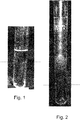
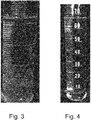
- compositions are shown in the respective Figures 1 to 4 .
- Compositions 1 and 2 show phase separation at the dashed line.
- Composition 3 is not clear, especially near the bottom.
- Composition 4 is a clear and stable emulsion.
Landscapes
- Chemical & Material Sciences (AREA)
- Life Sciences & Earth Sciences (AREA)
- Engineering & Computer Science (AREA)
- Chemical Kinetics & Catalysis (AREA)
- Oil, Petroleum & Natural Gas (AREA)
- Wood Science & Technology (AREA)
- Organic Chemistry (AREA)
- Health & Medical Sciences (AREA)
- Emergency Medicine (AREA)
- Detergent Compositions (AREA)
Priority Applications (1)
| Application Number | Priority Date | Filing Date | Title |
|---|---|---|---|
| EP15151670.5A EP3045517A1 (fr) | 2015-01-19 | 2015-01-19 | Composition de nettoyage, procédé de production d'une composition de nettoyage et procédé de nettoyage d'une surface |
Applications Claiming Priority (1)
| Application Number | Priority Date | Filing Date | Title |
|---|---|---|---|
| EP15151670.5A EP3045517A1 (fr) | 2015-01-19 | 2015-01-19 | Composition de nettoyage, procédé de production d'une composition de nettoyage et procédé de nettoyage d'une surface |
Publications (1)
| Publication Number | Publication Date |
|---|---|
| EP3045517A1 true EP3045517A1 (fr) | 2016-07-20 |
Family
ID=52345152
Family Applications (1)
| Application Number | Title | Priority Date | Filing Date |
|---|---|---|---|
| EP15151670.5A Withdrawn EP3045517A1 (fr) | 2015-01-19 | 2015-01-19 | Composition de nettoyage, procédé de production d'une composition de nettoyage et procédé de nettoyage d'une surface |
Country Status (1)
| Country | Link |
|---|---|
| EP (1) | EP3045517A1 (fr) |
Citations (6)
| Publication number | Priority date | Publication date | Assignee | Title |
|---|---|---|---|---|
| US20090281012A1 (en) * | 2008-05-09 | 2009-11-12 | Rhodia Inc. | Cleaning compositions incorporating green solvents and methods for use |
| WO2011152872A2 (fr) * | 2010-06-02 | 2011-12-08 | Rhodia Operations | Utilisation de microémulsions écologiques dans des applications de nettoyage du pétrole |
| WO2012016016A2 (fr) * | 2010-07-29 | 2012-02-02 | Homax Products, Inc. | Compositions de nettoyage liquides en microémulsion |
| US20120129756A1 (en) * | 2008-05-09 | 2012-05-24 | Rhodia Operations | Dilutable cleaning compositions and methods for use |
| US20120149626A1 (en) * | 2010-12-10 | 2012-06-14 | Rhodia Operations | Dibasic esters utilized as terpene co-solvents, substitutes and/or carriers in tar sand/bitumen/asphaltene cleaning applications |
| US20130180066A1 (en) * | 2012-01-12 | 2013-07-18 | Illinois Tool Works, Inc. | Low voc content waterless cleaner and article impregnated therewith |
-
2015
- 2015-01-19 EP EP15151670.5A patent/EP3045517A1/fr not_active Withdrawn
Patent Citations (6)
| Publication number | Priority date | Publication date | Assignee | Title |
|---|---|---|---|---|
| US20090281012A1 (en) * | 2008-05-09 | 2009-11-12 | Rhodia Inc. | Cleaning compositions incorporating green solvents and methods for use |
| US20120129756A1 (en) * | 2008-05-09 | 2012-05-24 | Rhodia Operations | Dilutable cleaning compositions and methods for use |
| WO2011152872A2 (fr) * | 2010-06-02 | 2011-12-08 | Rhodia Operations | Utilisation de microémulsions écologiques dans des applications de nettoyage du pétrole |
| WO2012016016A2 (fr) * | 2010-07-29 | 2012-02-02 | Homax Products, Inc. | Compositions de nettoyage liquides en microémulsion |
| US20120149626A1 (en) * | 2010-12-10 | 2012-06-14 | Rhodia Operations | Dibasic esters utilized as terpene co-solvents, substitutes and/or carriers in tar sand/bitumen/asphaltene cleaning applications |
| US20130180066A1 (en) * | 2012-01-12 | 2013-07-18 | Illinois Tool Works, Inc. | Low voc content waterless cleaner and article impregnated therewith |
Similar Documents
| Publication | Publication Date | Title |
|---|---|---|
| DE68918653T2 (de) | Nicht filmbildende feste Hochleistungs-Bodenreinigungsmittel. | |
| EP2828370B1 (fr) | Produit de nettoyage à base de microémulsion | |
| DE69320791T2 (de) | Trinatriumphosphat, edta oder phytinsäure und lösungsmittelgemisch enthaltendes wässriges reinigungsmittel | |
| AU2017246238B9 (en) | Release agent composition | |
| WO1994017145A1 (fr) | Solution d'elimination d'encre graphique | |
| EP0578492A1 (fr) | Composition de décapant de peinture | |
| US6797684B2 (en) | Biosolvent composition of lactate ester and D-limonene with improved cleaning and solvating properties | |
| DE69217486T2 (de) | Verfahren zur reinigung gestrichener harter oberflaechen mit reinigungsmitteln, die wenig fluechtige organische verbindungen enthalten | |
| EP3045517A1 (fr) | Composition de nettoyage, procédé de production d'une composition de nettoyage et procédé de nettoyage d'une surface | |
| US20120028875A1 (en) | Microemulsion liquid cleaning compositions | |
| DE19528394A1 (de) | Verfahren zur Dekontaminierung von mit chemischen Kampfstoffen kontaminierter Haut oder Materialien | |
| DE2932301A1 (de) | Aerosolzusammensetzung | |
| EP0544035A1 (fr) | Composition de nettoyage | |
| WO2017045659A1 (fr) | Agent de nettoyage sous forme de microémulsion | |
| US6071865A (en) | Nail polish remover | |
| CA2861079A1 (fr) | Produit de nettoyage a sec a faible teneur en cov et article qui en est impregne | |
| US20160053203A1 (en) | Synergistic mixed solvents-based compositions for removal of paint, varnish and stain coatings | |
| DE19829037A1 (de) | Konservierungsmittel für Holz | |
| US5405547A (en) | Non-chlorinated cleaner-drier | |
| JP2005120081A (ja) | 木材保存剤 | |
| EP0616016B1 (fr) | Agent de décapage | |
| US20260049263A1 (en) | Cleaning composition and associated spray and method | |
| DE69724791T2 (de) | Reiniger für farbbehälter | |
| WO2015179928A1 (fr) | Formulation de terpènes modifiés pour l'élimination d'huiles dérivées de pétrole de sols contaminés, émulsion concentrée huile dans l'eau à base de terpènes modifiés et utilisation d'une formulation à base de terpènes modifiés pour le lavage de sols contaminés | |
| EP2774961A1 (fr) | Compositions de décapage, compositions précurseurs de celles-ci, leur procédé de préparation "in situ", et leur utilisation pour décaper des peintures, des vernis et des laques |
Legal Events
| Date | Code | Title | Description |
|---|---|---|---|
| PUAI | Public reference made under article 153(3) epc to a published international application that has entered the european phase |
Free format text: ORIGINAL CODE: 0009012 |
|
| AK | Designated contracting states |
Kind code of ref document: A1 Designated state(s): AL AT BE BG CH CY CZ DE DK EE ES FI FR GB GR HR HU IE IS IT LI LT LU LV MC MK MT NL NO PL PT RO RS SE SI SK SM TR |
|
| AX | Request for extension of the european patent |
Extension state: BA ME |
|
| 17P | Request for examination filed |
Effective date: 20170110 |
|
| RBV | Designated contracting states (corrected) |
Designated state(s): AL AT BE BG CH CY CZ DE DK EE ES FI FR GB GR HR HU IE IS IT LI LT LU LV MC MK MT NL NO PL PT RO RS SE SI SK SM TR |
|
| 17Q | First examination report despatched |
Effective date: 20171212 |
|
| GRAP | Despatch of communication of intention to grant a patent |
Free format text: ORIGINAL CODE: EPIDOSNIGR1 |
|
| INTG | Intention to grant announced |
Effective date: 20180919 |
|
| GRAJ | Information related to disapproval of communication of intention to grant by the applicant or resumption of examination proceedings by the epo deleted |
Free format text: ORIGINAL CODE: EPIDOSDIGR1 |
|
| INTC | Intention to grant announced (deleted) | ||
| GRAP | Despatch of communication of intention to grant a patent |
Free format text: ORIGINAL CODE: EPIDOSNIGR1 |
|
| INTG | Intention to grant announced |
Effective date: 20190301 |
|
| STAA | Information on the status of an ep patent application or granted ep patent |
Free format text: STATUS: THE APPLICATION IS DEEMED TO BE WITHDRAWN |
|
| 18D | Application deemed to be withdrawn |
Effective date: 20190712 |