EP3045892A1 - Dispositif d'analyse de gaz et procédé d'analyse de gaz - Google Patents
Dispositif d'analyse de gaz et procédé d'analyse de gaz Download PDFInfo
- Publication number
- EP3045892A1 EP3045892A1 EP14842376.7A EP14842376A EP3045892A1 EP 3045892 A1 EP3045892 A1 EP 3045892A1 EP 14842376 A EP14842376 A EP 14842376A EP 3045892 A1 EP3045892 A1 EP 3045892A1
- Authority
- EP
- European Patent Office
- Prior art keywords
- gas
- mid
- wavelength
- analysis device
- gas analysis
- Prior art date
- Legal status (The legal status is an assumption and is not a legal conclusion. Google has not performed a legal analysis and makes no representation as to the accuracy of the status listed.)
- Withdrawn
Links
Images



Classifications
-
- A—HUMAN NECESSITIES
- A61—MEDICAL OR VETERINARY SCIENCE; HYGIENE
- A61B—DIAGNOSIS; SURGERY; IDENTIFICATION
- A61B5/00—Measuring for diagnostic purposes; Identification of persons
- A61B5/08—Measuring devices for evaluating the respiratory organs
- A61B5/082—Evaluation by breath analysis, e.g. determination of the chemical composition of exhaled breath
-
- A—HUMAN NECESSITIES
- A61—MEDICAL OR VETERINARY SCIENCE; HYGIENE
- A61B—DIAGNOSIS; SURGERY; IDENTIFICATION
- A61B5/00—Measuring for diagnostic purposes; Identification of persons
- A61B5/0059—Measuring for diagnostic purposes; Identification of persons using light, e.g. diagnosis by transillumination, diascopy, fluorescence
- A61B5/0075—Measuring for diagnostic purposes; Identification of persons using light, e.g. diagnosis by transillumination, diascopy, fluorescence by spectroscopy, i.e. measuring spectra, e.g. Raman spectroscopy, infrared absorption spectroscopy
-
- A—HUMAN NECESSITIES
- A61—MEDICAL OR VETERINARY SCIENCE; HYGIENE
- A61B—DIAGNOSIS; SURGERY; IDENTIFICATION
- A61B5/00—Measuring for diagnostic purposes; Identification of persons
- A61B5/08—Measuring devices for evaluating the respiratory organs
- A61B5/097—Devices for facilitating collection of breath or for directing breath into or through measuring devices
-
- A—HUMAN NECESSITIES
- A61—MEDICAL OR VETERINARY SCIENCE; HYGIENE
- A61B—DIAGNOSIS; SURGERY; IDENTIFICATION
- A61B5/00—Measuring for diagnostic purposes; Identification of persons
- A61B5/44—Detecting, measuring or recording for evaluating the integumentary system, e.g. skin, hair or nails
- A61B5/441—Skin evaluation, e.g. for skin disorder diagnosis
-
- A—HUMAN NECESSITIES
- A61—MEDICAL OR VETERINARY SCIENCE; HYGIENE
- A61B—DIAGNOSIS; SURGERY; IDENTIFICATION
- A61B5/00—Measuring for diagnostic purposes; Identification of persons
- A61B5/72—Signal processing specially adapted for physiological signals or for diagnostic purposes
- A61B5/7271—Specific aspects of physiological measurement analysis
- A61B5/7278—Artificial waveform generation or derivation, e.g. synthesizing signals from measured signals
-
- G—PHYSICS
- G01—MEASURING; TESTING
- G01N—INVESTIGATING OR ANALYSING MATERIALS BY DETERMINING THEIR CHEMICAL OR PHYSICAL PROPERTIES
- G01N21/00—Investigating or analysing materials by the use of optical means, i.e. using sub-millimetre waves, infrared, visible or ultraviolet light
- G01N21/17—Systems in which incident light is modified in accordance with the properties of the material investigated
- G01N21/25—Colour; Spectral properties, i.e. comparison of effect of material on the light at two or more different wavelengths or wavelength bands
- G01N21/31—Investigating relative effect of material at wavelengths characteristic of specific elements or molecules, e.g. atomic absorption spectrometry
- G01N21/35—Investigating relative effect of material at wavelengths characteristic of specific elements or molecules, e.g. atomic absorption spectrometry using infrared light
- G01N21/3504—Investigating relative effect of material at wavelengths characteristic of specific elements or molecules, e.g. atomic absorption spectrometry using infrared light for analysing gases, e.g. multi-gas analysis
-
- G—PHYSICS
- G01—MEASURING; TESTING
- G01N—INVESTIGATING OR ANALYSING MATERIALS BY DETERMINING THEIR CHEMICAL OR PHYSICAL PROPERTIES
- G01N33/00—Investigating or analysing materials by specific methods not covered by groups G01N1/00 - G01N31/00
- G01N33/0004—Gaseous mixtures, e.g. polluted air
- G01N33/0009—General constructional details of gas analysers, e.g. portable test equipment
- G01N33/0027—General constructional details of gas analysers, e.g. portable test equipment concerning the detector
- G01N33/0036—General constructional details of gas analysers, e.g. portable test equipment concerning the detector specially adapted to detect a particular component
-
- G—PHYSICS
- G01—MEASURING; TESTING
- G01N—INVESTIGATING OR ANALYSING MATERIALS BY DETERMINING THEIR CHEMICAL OR PHYSICAL PROPERTIES
- G01N33/00—Investigating or analysing materials by specific methods not covered by groups G01N1/00 - G01N31/00
- G01N33/48—Biological material, e.g. blood, urine; Haemocytometers
- G01N33/483—Physical analysis of biological material
- G01N33/497—Physical analysis of biological material of gaseous biological material, e.g. breath
-
- G—PHYSICS
- G01—MEASURING; TESTING
- G01N—INVESTIGATING OR ANALYSING MATERIALS BY DETERMINING THEIR CHEMICAL OR PHYSICAL PROPERTIES
- G01N33/00—Investigating or analysing materials by specific methods not covered by groups G01N1/00 - G01N31/00
- G01N33/48—Biological material, e.g. blood, urine; Haemocytometers
- G01N33/483—Physical analysis of biological material
- G01N33/497—Physical analysis of biological material of gaseous biological material, e.g. breath
- G01N33/4975—Physical analysis of biological material of gaseous biological material, e.g. breath other than oxygen, carbon dioxide or alcohol, e.g. organic vapours
-
- G—PHYSICS
- G01—MEASURING; TESTING
- G01N—INVESTIGATING OR ANALYSING MATERIALS BY DETERMINING THEIR CHEMICAL OR PHYSICAL PROPERTIES
- G01N21/00—Investigating or analysing materials by the use of optical means, i.e. using sub-millimetre waves, infrared, visible or ultraviolet light
- G01N21/01—Arrangements or apparatus for facilitating the optical investigation
- G01N21/03—Cuvette constructions
- G01N21/031—Multipass arrangements
-
- G—PHYSICS
- G01—MEASURING; TESTING
- G01N—INVESTIGATING OR ANALYSING MATERIALS BY DETERMINING THEIR CHEMICAL OR PHYSICAL PROPERTIES
- G01N2201/00—Features of devices classified in G01N21/00
- G01N2201/06—Illumination; Optics
- G01N2201/061—Sources
- G01N2201/06113—Coherent sources; lasers
Definitions
- the present invention relates to a gas analysis device and a gas analysis method that analyze a plurality of gaseous components contained in a gas.
- Biogenic gases such as human exhaled gases, skin gases and rectum gases (flatulence) contain several hundred sort of types of gaseous substances such as volatile organic compounds (VOCs). They include substances that have causal relationships with diseases, and such knowledge has been increasingly applied to biogenic gas diagnoses that diagnose diseases by quantitatively analyzing these substances as markers. Therefore, researches for identifying VOCs correlated with diseases, and research and development for new measurement/analysis methods have been vigorously performed.
- VOCs volatile organic compounds
- this approach determines the component concentration by absorption spectroscopic measurement by using, as a light source, a narrow band mid-IR laser whose wavelength is caused to match the absorption spectrum of the component.
- the quantity of nitrogen monoxide (NO) in a biogenic gas that enables distinction between asthma and chronic coughing can be determined by a quantum cascade laser with a wavelength of 5.27 ⁇ m (1898 cm -1 ), and a detection lower limit of approximately 1 ppb has been realized.
- acetaldehyde that is originated from lung cancer can be measured with a detection lower limit of 80 ppb by utilizing a quantum cascade laser of 5.79 ⁇ m (1727 cm -1 ).
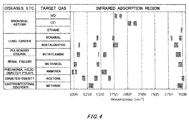
- the VOCs correlated with diseases, and their infrared absorption spectrums are shown in FIG. 4 .
- the characteristic absorption bands of functional groups such as aldehyde, ketone, carboxylic acid and amide that are important as biogenic products concentrate around 1600 to 1800 cm -1 , and a number of the characteristic absorption spectra unique to molecules are distributed in a region around 800 to 1400 cm -1 which region is also called a finger-print region of molecules.
- Patent Document 1 proposes a method in which: a multiplexed beam formed by combining a near-IR pump beam and a near-IR signal beam from a semiconductor laser for detecting a first gas medium is caused to enter PPLN crystal to generate a near-IR or mid-infrared difference frequency light for detecting a second gas medium; from the multiplexed beam formed by combining the signal beam, the difference frequency light and the pump beam that has passed a multi-pass cell enclosing a sample gas, only the signal beam and the difference frequency light are separated onto the same optical axis; then the signal beam and difference frequency light are caused to enter a MCT detector to detect them simultaneously; and concentrations of the first gas medium and the second gas medium are analyzed based on electrical signals from the MCT detector.
- Patent Document 1 Japanese Patent Application Publication No. 2006-300760
- Patent Document 1 Because the method proposed in Patent Document 1 does not take into consideration a detection lower limit that is different for each gaseous component or the like, that is, a cumulative measurement time, it is difficult to perform analysis of gases efficiently.
- An object of the present invention is to provide a device and a method that measure a plurality of types of gaseous components efficiently by using mid-IR beams with different wavelengths.
- a gas analysis device of the present invention according to Claim 1 comprises:
- the light source has: a first light source that outputs a first infrared beam; a second light source that outputs a second infrared beam with a wavelength that is different from the wavelength of the first infrared beam; and a wavelength conversion device that outputs a difference frequency between the first infrared beam and the second infrared beam.
- the first light source is a laser that outputs a laser beam with a single wavelength
- the second light source is arrayed lasers that output laser beams with different wavelengths.
- nonlinear optical crystal which is not ferroelectric crystal is used as the wavelength conversion device.
- the nonlinear optical crystal is AgGaS 2 crystal.
- the measurement target gaseous components are two or more types among nitrogen monoxide, nonanal, acetaldehyde and acetone.
- the measurement target gaseous components are two or more types among ethane, nonanal, acetaldehyde, methylamine, methanol, acetone and methane.
- the measurement target gas is an exhaled gas.
- a biogenic gas such as an exhaled gas, a skin gas or a rectum gas is the measurement target gas, and bronchial asthma, lung cancer, pulmonary disease, renal failure, pneumonia, Helicobacter pylori, diabetes, obesity or gastrointestinal disorder is identified based on the concentrations of the gaseous components detected.
- a gas analysis method of the present invention that measures a concentration of gaseous components in a measurement target gas by using intensity of a light with a wavelength in a mid-infrared region that is caused to match the absorption spectrum of the gaseous components, at least a first gaseous component and a second gaseous component are the measurement target gaseous components, a mid-IR beam with a first wavelength corresponding to the first gaseous component and a mid-IR beam with a second wavelength corresponding to the second gaseous component are used, and a cumulative measurement time during which the mid-IR beam with the first wavelength is used and a cumulative measurement time during which the mid-IR beam with the second wavelength is used are made different from each other.
- the measurement target gas is an exhaled gas.
- the present invention can realize a device and a method that measure a plurality of types of gaseous components in a measurement target gas efficiently by using mid-IR beams with a plurality of wavelengths.
- a gas analysis device has: a measurement time setting means that sets a cumulative measurement time of a mid-infrared beam with a wavelength for respective ones of measurement target gaseous components; and a control means that controls at least one of an output time of a light source and a detection time of a detector in accordance with the cumulative measurement times.
- the cumulative measurement time can be set in accordance with a detection lower limit value required for pathological diagnosis being different for each gaseous component, and the cumulative measurement time can be set by taking into consideration the absorption intensity attributable to differences among absorption regions of gaseous components; therefore, the concentration measurement of each gaseous component can be performed surely.
- the light source consists of: a first light source that outputs a first infrared beam; a second light source that outputs a second infrared beam with a wavelength that is different from the wavelength of the first infrared beam; and a wavelength conversion device that outputs a difference frequency between the first infrared beam and the second infrared beam.
- the wavelength conversion device by changing the wavelengths of the first infrared beam and the second infrared beam, the wavelength of a mid-infrared beam output from the wavelength conversion device can be changed.
- the first light source is a laser that outputs a laser beam with a single wavelength
- the second light source is arrayed lasers that output laser beams with different wavelengths.
- the wavelength of an infrared beam output from the second light source without changing the wavelength of an infrared beam output from the first light source, the wavelength of a mid-infrared beam output from the wavelength conversion device can be changed.
- the wavelength of an infrared beam can be changed only by switching internal elements.
- nonlinear optical crystal which is not ferroelectric crystal is used as the wavelength conversion device. According to the present embodiment, it becomes possible to output a mid-infrared beam having the light transmission region up to a long wavelength of 5 ⁇ m or longer.
- the nonlinear optical crystal is AgGaS 2 crystal. According to the present embodiment, because among nonlinear optical crystal which is not ferroelectric crystal, high quality AgGaS 2 crystal can be obtained, improvement of quality can be attempted.
- the measurement target gaseous components are two or more types among nitrogen monoxide, nonanal, acetaldehyde and acetone.
- the concentrations of these gaseous components can be measured at the infrared absorption region of approximately 1600 to 1800 cm -1 .
- the measurement target gaseous components are two or more types among ethane, nonanal, acetaldehyde, methylamine, methanol, acetone and methane.
- the concentrations of these gaseous components can be measured at the infrared absorption region of approximately 2800 to 3000 cm -1 .
- a measurement target gas is an exhaled gas.
- an exhaled gas analysis device that measures a plurality of gaseous components contained in an exhaled gas can be configured.
- a biogenic gas such as an exhaled gas, a skin gas or a rectum gas is a measurement target gas, and bronchial asthma, lung cancer, pulmonary disease, renal failure, pneumonia, Helicobacter pylori, diabetes, obesity or gastrointestinal disorder is identified based on the concentrations of the gaseous components detected.
- gaseous components that enable identification of the pathology of these diseases have their characteristic absorption bands in the mid-infrared absorption region, the pathology of the diseases can be identified.
- a first gaseous component and a second gaseous component are measurement target gaseous components
- a mid-infrared beam with a first wavelength corresponding to the first gaseous component and a mid-infrared beam with a second wavelength corresponding to the second gaseous component are used
- a cumulative measurement time during which the mid-infrared beam with the first wavelength is used and a cumulative measurement time during which the mid-infrared beam with the second wavelength is used are made different from each other.
- the cumulative measurement time can be set in accordance with a detection lower limit value required for pathological diagnosis being different, and the cumulative measurement time can be set by taking into consideration the absorption intensity attributable to differences among absorption regions of gaseous components; therefore, the concentration measurement of each gaseous component can be performed surely.
- a measurement target gas is an exhaled gas.
- a plurality of gaseous components contained in an exhaled gas can be measured.
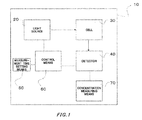
- FIG. 1 illustrates the overall gist of the gas analysis device.
- a gas analysis device 10 comprises: a light source 20 that selects a mid-infrared beam with any wavelength and outputs the mid-infrared beam; a cell 30 that contains an exhaled gas of an analysis target and receives the mid-infrared beam from the light source 20; a detector 40 that detects the mid-infrared beam having transmitted through the cell 30; a measurement time setting means 50 that sets a cumulative measurement time for the mid-infrared beam; a control means 60 that controls one of an output time of the light source 20 and a detection time of the detector 40 in accordance with the cumulative measurement time; and a concentration measuring means 70 that obtains the concentration of a gaseous component based on light intensity detected by the detector 40. It should be noted that the control means 60 may control both the output time of the light source 20 and the detection time of the detector 40 in accordance with the cumulative measurement time.
- a mid-infrared beam with a wavelength corresponding to the absorption spectrum of a measurement target gaseous component is output.
- a cumulative measurement time of mid-infrared lights with wavelengths corresponding to respective measurement target gaseous components is set.
- the control means 60 according to the set cumulative measurement time, at least one of an output time of a mid-infrared beam output from the light source 20 and a detection time of the detector 40 is made different for each wavelength.
- two or more types of gaseous components in an exhaled gas contained in the cell 30 are measurement targets, mid-infrared beams with wavelengths that are caused to match the absorption spectra of measurement target gaseous components are output from the light source 20 into the cell 30, and the concentrations of the gaseous components are obtained at the concentration measuring means 70 based on light intensity detected by the detector 40.
- FIG. 2 illustrates the configuration of the light source of the gas analysis device according to the present example.
- the light source 20 has: a first laser as a first light source 21 that outputs a first laser beam; a second laser as a second light source 22 that outputs a second laser beam with a wavelength different from the wavelength of the first laser beam; and a wavelength conversion device 23.
- the first laser beam enters the wavelength conversion device 23 via a mirror 24A and a lens 25A
- the second laser beam enters the wavelength conversion device 23 via a mirror 24B and the lens 25A.
- the two laser beams that have entered the wavelength conversion device 23 are converted into a beam that corresponds to the difference between their frequencies (difference frequency), and the mid-infrared beam generated by the conversion is output to the cell 30 via a lens 26A and a filter 27.
- continuous wave oscillating (CW operation)-type distribution feedback semiconductor lasers are used for the first light source (first laser) 21 and the second light source (second laser) 22.
- DFB lasers light sources that have a narrow spectrum in the near-infrared region of approximately 1 ⁇ m to 1.7 ⁇ m, and allow free selection of oscillating wavelengths have been developed.
- the gas analysis device 10 is allowed to have a small size so that the gas analysis device 10 can be configured as a portable one, and it becomes possible to use it by carrying it to various locations.
- pulse-operation type distribution feedback semiconductor lasers may be used for the first light source (first laser) 21 and the second light source (second laser) 22.
- DFB lasers pulse-operation type distribution feedback semiconductor lasers
- the efficiency of wavelength conversion can be improved due to their high peak power, and accordingly, the power of a mid-infrared light to be obtained becomes high, measurement at a high S/N ratio (signal/noise ratio) becomes possible.
- detecting elements of an MCT detector 41 described below can be formed into one element by utilizing time differences of each pulse.
- AgGaS 2 crystal is used for the wavelength conversion device 23.
- AgGaS 2 crystal can be excited by a DFB laser, and has a light transmission region for a long wavelength longer than 5 ⁇ m (about 13 ⁇ m) while ferroelectric crystal such as LiNbO 3 crystal is opaque for a mid-infrared region of 5 ⁇ m (2000 cm -1 ) or longer.
- the first laser 21 is a laser that outputs a single wavelength, and in the present example, outputs a laser with a wavelength of 1064 nm.
- the second laser 22 is arrayed, and is a wavelength tuning laser that is able to output lasers with a plurality of wavelengths. Accordingly, by switching elements inside the second laser 22 by signals from the control unit 60, it is possible to change the wavelength of the second laser output from the second laser 22, and to output, from the wavelength conversion device 23, mid-infrared beams with different wavelengths (converted lights).
- the second laser 22 has, within itself, four elements so that laser beams with wavelengths of 1325 nm, 1307 nm, 1308 nm and 1305 nm can be output.
- the light source 20 may not utilize generation of difference frequencies as in the present example, but for example, may be configured by using a quantum cascade laser, and may be configured by using a plurality of or a single infrared laser diode (infrared LD).
- infrared LD infrared laser diode
- FIG. 3 illustrates the configuration of the cell and detector of the gas analysis device according to the present example.
- a multi-pass cell 31 is used for the cell 30 according to the present example.
- the multi-pass cell 31 comprises an inlet port 33 for introducing an exhaled gas into the multi-pass cell 31, and an exhaust port 32 for discharging the exhaled gas from the multi-pass cell 31.
- an astigmatism Herriot multi-pass cell that can ensure a long optical path length relative to a cell capacity is preferably used for the multi-pass cell 31.
- an astigmatism Herriot multi-pass cell By employing an astigmatism Herriot multi-pass cell, a long optical path length (about 210 m) can be attained, and a sampling amount of an exhaled gas can be reduced.
- the multi-pass cell 31 is not limited to a Herriot multi-pass cell, but the multi-pass cell 31 employing another system may be used.
- the detector 40 consists of: the MCT detector 41 that is sensitive to the mid-infrared region; a mirror 42; and a beam splitter 43, and a mid-infrared light output from the wavelength conversion device 23 is split by the beam splitter 43, one mid-infrared light enters the MCT detector 41 through the multi-pass cell 31, and the other mid-infrared light enters the MCT detector 41 via the mirror 42.
- the detector 40 may be configured to measure only a specific wavelength by being provided with a wavelength selective filter.
- targets of simultaneous measurement are nitrogen monoxide (NO), nonanal, acetaldehyde and acetone among gaseous components contained in an exhaled gas is explained as an example.
- NO nitrogen monoxide
- nonanal nonanal
- acetaldehyde acetaldehyde
- acetone among gaseous components contained in an exhaled gas
- the infrared absorption regions of the above-mentioned four gaseous components are distributed around 1600 cm -1 to 1800 cm -1 .
- the concentration of each component can be measured by utilizing a mid-infrared beam of 5.40 ⁇ m (1852 cm -1 ) for nitrogen monoxide (NO), a mid-infrared beam of 5.72 ⁇ m (1748 cm -1 ) for nonanal, a mid-infrared light of 5.70 ⁇ m (1754 cm -1 ) for acetaldehyde, and a mid-infrared beam of 5.76 ⁇ m (1736 cm -1 ) for acetone.
- a mid-infrared beam of 5.40 ⁇ m (1852 cm -1 ) for nitrogen monoxide (NO) a mid-infrared beam of 5.72 ⁇ m (1748 cm -1 ) for nonanal
- a mid-infrared light 5.70 ⁇ m (1754 cm -1 ) for acetaldehyde
- the inlet port 33 of the multi-pass cell 31 is opened in a state where the exhaust port 32 is opened, and after introducing an exhaled gas to be measured into the multi-pass cell 31, the exhaust port 32 and the inlet port 33 are closed.
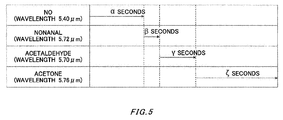
- FIG. 5 shows an output time of a mid-infrared beam corresponding to each gaseous component of the gas analysis device according to the present example, and with the measurement time setting means 50, the output time may be set at ⁇ seconds for nitrogen monoxide (NO), ⁇ seconds for nonanal, ⁇ seconds for acetaldehyde, and ⁇ seconds for acetone.
- NO nitrogen monoxide
- the angle of AgGaS 2 crystal of the wavelength conversion device 23 is adjusted to about 48.9 deg., and the first laser beam with a wavelength of 1064 nm and the second laser beam with a wavelength of 1325 nm are output from the first laser 21 and the second laser 22, respectively.
- a converted mid-infrared beam with a wavelength of 5.40 ⁇ m (1852 cm -1 ) is generated at the wavelength conversion device 23.
- the generated mid-infrared beam with a wavelength of 5.40 ⁇ m is split by the beam splitter 43, one mid-infrared beam enters the MCT detector 41 through the multi-pass cell 31 into which the exhaled gas has been introduced, and the other mid-infrared beam enters the MCT detector 41 via the mirror 42. Then, the concentration of nitrogen monoxide (NO) is obtained at the concentration measuring means 70 based on light intensity detected by the MCT detector 41.
- NO nitrogen monoxide
- the light source 20 changes the angle of AgGaS 2 crystal of the wavelength conversion device 23 to about 47. 4 deg., and switches the wavelength of the laser output from the second laser 22 to 1307 nm.
- a converted mid-infrared beam with a wavelength of 5.72 ⁇ m (1748 cm -1 ) is generated at the wavelength conversion device 23.
- the generated mid-infrared beam with a wavelength of 5.72 ⁇ m is split by the beam splitter 43, one mid-infrared beam enters the MCT detector 41 through the multi-pass cell 31 into which an exhaled gas has been introduced, and the other mid-infrared beam enters the MCT detector 41 via the mirror 42. Then, the concentration of nonanal is obtained at the concentration measuring means 70 based on light intensity detected by the MCT detector 41.
- the light source 20 changes the angle of AgGaS 2 crystal of the wavelength conversion device 23 to about 47.5 deg., and switches the wavelength of the laser output from the second laser 22 to 1308 nm. As a result, a converted mid-infrared beam with a wavelength of 5.70 ⁇ m (1754 cm -1 ) is generated at the wavelength conversion device 23.
- the generated mid-infrared beam with a wavelength of 5.70 ⁇ m is split by the beam splitter 43, one mid-infrared beam enters the MCT detector 41 through the multi-pass cell 31 into which an exhaled gas has been introduced, and the other mid-infrared beam enters the MCT detector 41 via the mirror 42. Then, the concentration of acetaldehyde is obtained at the concentration measuring means 70 based on light intensity detected by the MCT detector 41.
- the light source 20 changes the angle of AgGaS 2 crystal of the wavelength conversion device 23 to about 47.3 deg., and switches the wavelength of the laser output from the second laser 22 to 1305 nm. As a result, a converted mid-infrared beam with a wavelength of 5.76 ⁇ m (1736 cm -1 ) is generated at the wavelength conversion device 23.
- the generated mid-infrared beam with a wavelength of 5.76 ⁇ m is split by the beam splitter 43, one mid-infrared beam enters the MCT detector 41 through the multi-pass cell 31 into which an exhaled gas has been introduced, and the other mid-infrared beam enters the MCT detector 41 via the mirror 42. Then, the concentration of acetone is obtained at the concentration measuring means 70 based on light intensity detected by the MCT detector 41. When the duration of measurement reaches the cumulative measurement time of ⁇ seconds set for acetone, the light source 20 stops output of infrared lights from the first laser 21 and the second laser 22 based on an instruction from the control unit 60.
- the exhaust port 32 is opened to discharge the exhaled gas introduced into the multi-pass cell 31.
- control means 60 may perform control such that a time period during which the detector 40 does not detect a mid-infrared beam is provided after starting or finishing measurement of each gaseous component, e.g., after switching from measurement of nitrogen monoxide (NO) to measurement of nonanal or before switching from measurement of acetaldehyde to measurement of acetone.
- NO nitrogen monoxide
- the output time of a mid-infrared beam is made different for each gaseous component as in FIG. 5
- the output time of a mid-infrared beam may remain the same even when a measurement target gaseous component changes, and for example, the cumulative measurement time may be adjusted by changing detection time at the detector 40 by controlling, with a shutter, a time during which the mid-infrared beam enters the detector 40.
- targets of simultaneous measurement may be two or more types among ethane, nonanal, acetaldehyde, methylamine, methanol, acetone and methane (CH 4 ).
- NO nitrogen monoxide
- nonanal acetaldehyde
- CH 4 acetone
- the infrared absorption regions of these gaseous components are distributed around 2800 cm -1 to 3000 cm -1 , and by utilizing a mid-infrared beam with a wavelength in this range, the concentration of each component can be measured.
- FIG. 6 shows results of measurement of methane (CH 4 ) by using the gas analysis device according to the present example.
- the concentration of methane (CH 4 ) was 4.96 ppm
- the pressure within the multi-pass cell 31 was 760 Torr
- the optical path length of the multi-pass cell 31 was 76 m
- the measurement intervals were 0.014 cm -1 .
- White circles (o) indicate the measurement results
- the solid line indicates the absorption spectrum calculated based on the HITRAN 2008 database, and it can be known that both the data approximately match each other around the wavelength 3.39 m (2948 cm -1 ).
- At least a first gaseous component and a second gaseous component are measurement target gaseous components, a first wavelength corresponding to a first gaseous component and a second wavelength corresponding to a second gaseous component are used, and a cumulative measurement time during which first wavelength is used and a cumulative measurement time during which second wavelength is used are made different from each other.
- the cumulative measurement time can be set in accordance with a detection lower limit value required for pathological diagnosis being different, and the cumulative measurement time can be set by taking into consideration the absorption intensity attributable to differences among absorption regions of gaseous components; therefore, the concentration measurement of each gaseous component can be performed surely.
- gaseous components that enable identification of the pathology of bronchial asthma, lung cancer, pulmonary disease, renal failure, pneumonia, Helicobacter pylori, diabetes, obesity or gastrointestinal disorder have their characteristic absorption bands in the mid-infrared absorption region, the pathology of these diseases can be identified.
- the exhaled gas analysis device that uses an exhaled gas as a biogenic gas
- the present invention can be utilized for a gas analysis device that uses biogenic gases such as skin gases, rectum gases (flatulence), gases that are expelled through affected parts treated in surgical operations or other gases, and diagnoses of diseases, drugs, doping, virus infection or the like can be performed.
- biogenic gases such as skin gases, rectum gases (flatulence), gases that are expelled through affected parts treated in surgical operations or other gases, and diagnoses of diseases, drugs, doping, virus infection or the like can be performed.
- the present invention can be utilized in fields other than the medical field.
- the present invention in agriculture, can be utilized as an agricultural product gas analysis device that uses gases expelled from plants, in diagnosing diseases, grasping growth states, identifying the place where an agricultural product was produced, or determining whether agricultural chemicals have been used; in animal husbandry, the present invention can be utilized as an animal gas analysis device that uses gases originated from animals in diagnosing diseases; in food control, the present invention can be utilized as a food gas analysis device that uses gases originated from foods in determining the place where a food was produced or grasping the fermentation and ripeness state of a fermented food; in disaster relief, the present invention can be utilized as a victim exhaled gas analysis device that uses exhaled gases of victims as markers in discovering survivors buried in rubble or the like; in indoor environment monitoring, the present invention can be utilized as an indoor floating gas analysis device in detecting allergens; and in environmental conservation, the present invention can be utilized as an atmosphere floating gas analysis device in monitoring exhaust gases from automobiles and factories.
- the present invention can be utilized for a device and a method that measure a plurality of types of gaseous components in a measurement target gas efficiently by using mid-infrared lights with a plurality of wavelengths. Also, by monitoring gaseous components in a biogenic gas by using a device or a method according to the present invention, development as healthcare for diagnosing the health state of a human is possible, and preventive medicine and reduction of medical costs become possible.
Landscapes
- Health & Medical Sciences (AREA)
- Life Sciences & Earth Sciences (AREA)
- Physics & Mathematics (AREA)
- Engineering & Computer Science (AREA)
- General Health & Medical Sciences (AREA)
- Pathology (AREA)
- Molecular Biology (AREA)
- Biomedical Technology (AREA)
- Chemical & Material Sciences (AREA)
- Biophysics (AREA)
- Public Health (AREA)
- Animal Behavior & Ethology (AREA)
- Veterinary Medicine (AREA)
- Surgery (AREA)
- Heart & Thoracic Surgery (AREA)
- Medical Informatics (AREA)
- General Physics & Mathematics (AREA)
- Immunology (AREA)
- Spectroscopy & Molecular Physics (AREA)
- Analytical Chemistry (AREA)
- Biochemistry (AREA)
- Physiology (AREA)
- Pulmonology (AREA)
- Medicinal Chemistry (AREA)
- Food Science & Technology (AREA)
- Hematology (AREA)
- Urology & Nephrology (AREA)
- Artificial Intelligence (AREA)
- Dermatology (AREA)
- Computer Vision & Pattern Recognition (AREA)
- Psychiatry (AREA)
- Signal Processing (AREA)
- Combustion & Propulsion (AREA)
- Investigating Or Analysing Materials By Optical Means (AREA)
- Optical Measuring Cells (AREA)
Applications Claiming Priority (2)
| Application Number | Priority Date | Filing Date | Title |
|---|---|---|---|
| JP2013185804 | 2013-09-09 | ||
| PCT/JP2014/004597 WO2015033582A1 (fr) | 2013-09-09 | 2014-09-08 | Dispositif d'analyse de gaz et procédé d'analyse de gaz |
Publications (2)
| Publication Number | Publication Date |
|---|---|
| EP3045892A1 true EP3045892A1 (fr) | 2016-07-20 |
| EP3045892A4 EP3045892A4 (fr) | 2016-11-02 |
Family
ID=52628078
Family Applications (1)
| Application Number | Title | Priority Date | Filing Date |
|---|---|---|---|
| EP14842376.7A Withdrawn EP3045892A4 (fr) | 2013-09-09 | 2014-09-08 | Dispositif d'analyse de gaz et procédé d'analyse de gaz |
Country Status (4)
| Country | Link |
|---|---|
| US (1) | US9861297B2 (fr) |
| EP (1) | EP3045892A4 (fr) |
| JP (1) | JP6560983B2 (fr) |
| WO (1) | WO2015033582A1 (fr) |
Cited By (1)
| Publication number | Priority date | Publication date | Assignee | Title |
|---|---|---|---|---|
| CN108699518A (zh) * | 2015-12-29 | 2018-10-23 | 株式会社可乐丽 | 干细胞聚集体的群体的制备方法 |
Families Citing this family (17)
| Publication number | Priority date | Publication date | Assignee | Title |
|---|---|---|---|---|
| CN106153566A (zh) * | 2015-04-28 | 2016-11-23 | 上海艾梦电子科技有限公司 | 一种汽车尾气检测系统 |
| EP3143930A1 (fr) * | 2015-09-21 | 2017-03-22 | Université de Liège | Procédé pour le diagnostic du sous-type inflammatoire d'une maladie des voies respiratoires |
| US10724945B2 (en) | 2016-04-19 | 2020-07-28 | Cascade Technologies Holdings Limited | Laser detection system and method |
| US10180393B2 (en) | 2016-04-20 | 2019-01-15 | Cascade Technologies Holdings Limited | Sample cell |
| JP6547967B2 (ja) | 2016-10-06 | 2019-07-24 | パナソニックIpマネジメント株式会社 | 赤外線検出装置 |
| GB201700905D0 (en) | 2017-01-19 | 2017-03-08 | Cascade Tech Holdings Ltd | Close-Coupled Analyser |
| JP6581171B2 (ja) * | 2017-12-13 | 2019-09-25 | 学校法人昭和大学 | 微生物のスクリーニング方法及びスクリーニング装置 |
| WO2019122855A1 (fr) * | 2017-12-18 | 2019-06-27 | Stratium Limited | Système et procédé de détection de produits chimiques gazeux |
| JP7135608B2 (ja) * | 2018-09-03 | 2022-09-13 | 株式会社島津製作所 | ガス吸収分光装置、及びガス吸収分光方法 |
| US11079324B2 (en) * | 2019-07-15 | 2021-08-03 | Spectrasensors, Inc. | Spectrometer with wide-scan tunable diode laser |
| CN113358600A (zh) * | 2020-03-06 | 2021-09-07 | 山东大学 | 气体检测气室、基于人工神经网络的激光光谱气体检测系统及方法 |
| CH717400A1 (de) * | 2020-05-08 | 2021-11-15 | Stiftung Fuer Quanten Gesundheit | Vorrichtung fûr den Nachweis von Viren, Mikroorganismen und Antikörpern. |
| JP7665904B2 (ja) | 2021-02-16 | 2025-04-22 | 日本分光株式会社 | 多重反射器具および多重反射セル |
| CN113433066B (zh) * | 2021-06-28 | 2024-01-30 | 江西人民输变电有限公司 | 配电柜内部气体检测系统 |
| JPWO2023112909A1 (fr) * | 2021-12-13 | 2023-06-22 | ||
| CN114609061B (zh) * | 2022-02-28 | 2025-05-23 | 南昌大学 | 基于分立光学池组的气体分析装置及其气体分析方法 |
| US12622634B2 (en) * | 2023-04-24 | 2026-05-12 | Huimin Hao | Disease early diagnosis system based on sebum gas analysis |
Family Cites Families (7)
| Publication number | Priority date | Publication date | Assignee | Title |
|---|---|---|---|---|
| JPS5892843A (ja) * | 1981-11-26 | 1983-06-02 | Horiba Ltd | 二成分測定用非分散型赤外線分析計 |
| US5912910A (en) * | 1996-05-17 | 1999-06-15 | Sdl, Inc. | High power pumped mid-IR wavelength systems using nonlinear frequency mixing (NFM) devices |
| US6545278B1 (en) | 1999-04-23 | 2003-04-08 | Delphian Corporation | Gas discriminating gas detector system and method |
| US7606274B2 (en) * | 2001-09-20 | 2009-10-20 | The Uab Research Foundation | Mid-IR instrument for analyzing a gaseous sample and method for using the same |
| JP4588520B2 (ja) | 2005-04-21 | 2010-12-01 | 学校法人東海大学 | 多種類のガス媒質を同時に検出するガス媒質分析装置およびガス媒質分析方法 |
| JP5314301B2 (ja) * | 2008-03-14 | 2013-10-16 | 三菱重工業株式会社 | ガス濃度計測方法および装置 |
| US9651488B2 (en) * | 2010-10-14 | 2017-05-16 | Thermo Fisher Scientific (Bremen) Gmbh | High-accuracy mid-IR laser-based gas sensor |
-
2014
- 2014-09-08 JP JP2015535326A patent/JP6560983B2/ja active Active
- 2014-09-08 US US15/063,432 patent/US9861297B2/en not_active Expired - Fee Related
- 2014-09-08 EP EP14842376.7A patent/EP3045892A4/fr not_active Withdrawn
- 2014-09-08 WO PCT/JP2014/004597 patent/WO2015033582A1/fr not_active Ceased
Cited By (1)
| Publication number | Priority date | Publication date | Assignee | Title |
|---|---|---|---|---|
| CN108699518A (zh) * | 2015-12-29 | 2018-10-23 | 株式会社可乐丽 | 干细胞聚集体的群体的制备方法 |
Also Published As
| Publication number | Publication date |
|---|---|
| JP6560983B2 (ja) | 2019-08-14 |
| JPWO2015033582A1 (ja) | 2017-03-02 |
| US20160331270A1 (en) | 2016-11-17 |
| EP3045892A4 (fr) | 2016-11-02 |
| WO2015033582A1 (fr) | 2015-03-12 |
| US9861297B2 (en) | 2018-01-09 |
Similar Documents
| Publication | Publication Date | Title |
|---|---|---|
| US9861297B2 (en) | Gas analysis device and gas analysis method | |
| Blanco et al. | NIR spectroscopy: a rapid-response analytical tool | |
| Chen et al. | Comparison of combination and first overtone spectral regions for near-infrared calibration models for glucose and other biomolecules in aqueous solutions | |
| Ozaki | Near-infrared spectroscopy—Its versatility in analytical chemistry | |
| Kasemsumran et al. | Near-infrared spectroscopic determination of human serum albumin, γ-globulin, and glucose in a control serum solution with searching combination moving window partial least squares | |
| JP7061546B2 (ja) | 分析装置及び分析方法 | |
| JPWO2016063918A1 (ja) | ガス分析装置、ガス分析方法、メタボローム解析方法およびデータベース | |
| Sun et al. | Dual gas sensor with innovative signal analysis based on neural network | |
| CN108226064B (zh) | 分析装置、计算机可读存储介质和分析方法 | |
| Dong et al. | Rapid and real-time analysis of volatile compounds released from food using infrared and laser spectroscopy | |
| US8384894B2 (en) | Superior analyzer for raman spectra with high acceptance cone, resolution, transmission, and quantum efficiency, and strong background reduction | |
| EP3662261A1 (fr) | Analyseur de gaz pour mesurer les oxydes d'azote et le dioxyde de soufre dans des gaz d'échappement | |
| JP2014525587A (ja) | 生体試料分析のための核磁気共鳴および近赤外線の使用 | |
| US10677713B1 (en) | Adaptive gas analyzer | |
| Li et al. | WMS based dual-range real-time trace sensor for ethane detection in exhaled breath | |
| Suhandy et al. | Prediction of L-ascorbic acid using FTIR-ATR terahertz spectroscopy combined with interval partial least squares (iPLS) regression | |
| CN102735644A (zh) | 一种原位式激光气体分析仪的在线标定方法 | |
| Clarke | Circular dichroism in protein folding studies | |
| EP3594661B1 (fr) | Dispositif de spectrométrie | |
| Wei et al. | Impact of residual water vapor on the simultaneous measurements of trace CH4 and N2O in air with cavity ring-down spectroscopy | |
| Lin et al. | Real-time measurement of CH4 in human breath using a compact CH4/CO2 sensor | |
| EP3183571B1 (fr) | Détermination d'une propriété liée à un constituant d'un échantillon multi-constituant | |
| Pakkattil et al. | A dual-channel incoherent broadband cavity-enhanced absorption spectrometer for sensitive atmospheric NO x measurements | |
| CN113841041A (zh) | 分析装置 | |
| JP2004020539A (ja) | 赤外円二色性測定装置および赤外円二色性測定方法 |
Legal Events
| Date | Code | Title | Description |
|---|---|---|---|
| PUAI | Public reference made under article 153(3) epc to a published international application that has entered the european phase |
Free format text: ORIGINAL CODE: 0009012 |
|
| 17P | Request for examination filed |
Effective date: 20160408 |
|
| AK | Designated contracting states |
Kind code of ref document: A1 Designated state(s): AL AT BE BG CH CY CZ DE DK EE ES FI FR GB GR HR HU IE IS IT LI LT LU LV MC MK MT NL NO PL PT RO RS SE SI SK SM TR |
|
| AX | Request for extension of the european patent |
Extension state: BA ME |
|
| A4 | Supplementary search report drawn up and despatched |
Effective date: 20161005 |
|
| RIC1 | Information provided on ipc code assigned before grant |
Ipc: G01N 33/497 20060101ALI20160928BHEP Ipc: A61B 5/08 20060101ALI20160928BHEP Ipc: G01N 21/03 20060101ALN20160928BHEP Ipc: G01N 21/3504 20140101AFI20160928BHEP |
|
| DAX | Request for extension of the european patent (deleted) | ||
| STAA | Information on the status of an ep patent application or granted ep patent |
Free format text: STATUS: REQUEST FOR EXAMINATION WAS MADE |
|
| STAA | Information on the status of an ep patent application or granted ep patent |
Free format text: STATUS: THE APPLICATION IS DEEMED TO BE WITHDRAWN |
|
| 18D | Application deemed to be withdrawn |
Effective date: 20200603 |