EP3045984B1 - Verfahren und vorrichtung zur steuerung mindestens einer verdunkelungsvorrichtung für mindestens ein öffnungselement eines gebäudeteils - Google Patents
Verfahren und vorrichtung zur steuerung mindestens einer verdunkelungsvorrichtung für mindestens ein öffnungselement eines gebäudeteils Download PDFInfo
- Publication number
- EP3045984B1 EP3045984B1 EP16153675.0A EP16153675A EP3045984B1 EP 3045984 B1 EP3045984 B1 EP 3045984B1 EP 16153675 A EP16153675 A EP 16153675A EP 3045984 B1 EP3045984 B1 EP 3045984B1
- Authority
- EP
- European Patent Office
- Prior art keywords
- equal
- period
- value
- temperature
- ordinate
- Prior art date
- Legal status (The legal status is an assumption and is not a legal conclusion. Google has not performed a legal analysis and makes no representation as to the accuracy of the status listed.)
- Active
Links
Images




Classifications
-
- E—FIXED CONSTRUCTIONS
- E06—DOORS, WINDOWS, SHUTTERS, OR ROLLER BLINDS IN GENERAL; LADDERS
- E06B—FIXED OR MOVABLE CLOSURES FOR OPENINGS IN BUILDINGS, VEHICLES, FENCES OR LIKE ENCLOSURES IN GENERAL, e.g. DOORS, WINDOWS, BLINDS, GATES
- E06B9/00—Screening or protective devices for wall or similar openings, with or without operating or securing mechanisms; Closures of similar construction
- E06B9/24—Screens or other constructions affording protection against light, especially against sunshine; Similar screens for privacy or appearance; Slat blinds
- E06B9/26—Lamellar or like blinds, e.g. venetian blinds
- E06B9/28—Lamellar or like blinds, e.g. venetian blinds with horizontal lamellae, e.g. non-liftable
- E06B9/30—Lamellar or like blinds, e.g. venetian blinds with horizontal lamellae, e.g. non-liftable liftable
- E06B9/32—Operating, guiding, or securing devices therefor
-
- E—FIXED CONSTRUCTIONS
- E06—DOORS, WINDOWS, SHUTTERS, OR ROLLER BLINDS IN GENERAL; LADDERS
- E06B—FIXED OR MOVABLE CLOSURES FOR OPENINGS IN BUILDINGS, VEHICLES, FENCES OR LIKE ENCLOSURES IN GENERAL, e.g. DOORS, WINDOWS, BLINDS, GATES
- E06B9/00—Screening or protective devices for wall or similar openings, with or without operating or securing mechanisms; Closures of similar construction
- E06B9/56—Operating, guiding or securing devices or arrangements for roll-type closures; Spring drums; Tape drums; Counterweighting arrangements therefor
- E06B9/68—Operating devices or mechanisms, e.g. with electric drive
-
- G—PHYSICS
- G05—CONTROLLING; REGULATING
- G05B—CONTROL OR REGULATING SYSTEMS IN GENERAL; FUNCTIONAL ELEMENTS OF SUCH SYSTEMS; MONITORING OR TESTING ARRANGEMENTS FOR SUCH SYSTEMS OR ELEMENTS
- G05B15/00—Systems controlled by a computer
- G05B15/02—Systems controlled by a computer electric
-
- E—FIXED CONSTRUCTIONS
- E06—DOORS, WINDOWS, SHUTTERS, OR ROLLER BLINDS IN GENERAL; LADDERS
- E06B—FIXED OR MOVABLE CLOSURES FOR OPENINGS IN BUILDINGS, VEHICLES, FENCES OR LIKE ENCLOSURES IN GENERAL, e.g. DOORS, WINDOWS, BLINDS, GATES
- E06B9/00—Screening or protective devices for wall or similar openings, with or without operating or securing mechanisms; Closures of similar construction
- E06B9/56—Operating, guiding or securing devices or arrangements for roll-type closures; Spring drums; Tape drums; Counterweighting arrangements therefor
- E06B9/68—Operating devices or mechanisms, e.g. with electric drive
- E06B2009/6809—Control
- E06B2009/6818—Control using sensors
-
- G—PHYSICS
- G05—CONTROLLING; REGULATING
- G05B—CONTROL OR REGULATING SYSTEMS IN GENERAL; FUNCTIONAL ELEMENTS OF SUCH SYSTEMS; MONITORING OR TESTING ARRANGEMENTS FOR SUCH SYSTEMS OR ELEMENTS
- G05B2219/00—Program-control systems
- G05B2219/20—Pc systems
- G05B2219/25—Pc structure of the system
- G05B2219/25011—Domotique, I-O bus, home automation, building automation
-
- G—PHYSICS
- G05—CONTROLLING; REGULATING
- G05B—CONTROL OR REGULATING SYSTEMS IN GENERAL; FUNCTIONAL ELEMENTS OF SUCH SYSTEMS; MONITORING OR TESTING ARRANGEMENTS FOR SUCH SYSTEMS OR ELEMENTS
- G05B2219/00—Program-control systems
- G05B2219/20—Pc systems
- G05B2219/26—Pc applications
- G05B2219/2642—Domotique, domestic, home control, automation, smart house
-
- G—PHYSICS
- G05—CONTROLLING; REGULATING
- G05B—CONTROL OR REGULATING SYSTEMS IN GENERAL; FUNCTIONAL ELEMENTS OF SUCH SYSTEMS; MONITORING OR TESTING ARRANGEMENTS FOR SUCH SYSTEMS OR ELEMENTS
- G05B2219/00—Program-control systems
- G05B2219/30—Nc systems
- G05B2219/45—Nc applications
- G05B2219/45015—Roller blind, shutter
-
- Y—GENERAL TAGGING OF NEW TECHNOLOGICAL DEVELOPMENTS; GENERAL TAGGING OF CROSS-SECTIONAL TECHNOLOGIES SPANNING OVER SEVERAL SECTIONS OF THE IPC; TECHNICAL SUBJECTS COVERED BY FORMER USPC CROSS-REFERENCE ART COLLECTIONS [XRACs] AND DIGESTS
- Y02—TECHNOLOGIES OR APPLICATIONS FOR MITIGATION OR ADAPTATION AGAINST CLIMATE CHANGE
- Y02A—TECHNOLOGIES FOR ADAPTATION TO CLIMATE CHANGE
- Y02A30/00—Adapting or protecting infrastructure or their operation
- Y02A30/24—Structural elements or technologies for improving thermal insulation
-
- Y—GENERAL TAGGING OF NEW TECHNOLOGICAL DEVELOPMENTS; GENERAL TAGGING OF CROSS-SECTIONAL TECHNOLOGIES SPANNING OVER SEVERAL SECTIONS OF THE IPC; TECHNICAL SUBJECTS COVERED BY FORMER USPC CROSS-REFERENCE ART COLLECTIONS [XRACs] AND DIGESTS
- Y02—TECHNOLOGIES OR APPLICATIONS FOR MITIGATION OR ADAPTATION AGAINST CLIMATE CHANGE
- Y02B—CLIMATE CHANGE MITIGATION TECHNOLOGIES RELATED TO BUILDINGS, e.g. HOUSING, HOUSE APPLIANCES OR RELATED END-USER APPLICATIONS
- Y02B80/00—Architectural or constructional elements improving the thermal performance of buildings
-
- Y—GENERAL TAGGING OF NEW TECHNOLOGICAL DEVELOPMENTS; GENERAL TAGGING OF CROSS-SECTIONAL TECHNOLOGIES SPANNING OVER SEVERAL SECTIONS OF THE IPC; TECHNICAL SUBJECTS COVERED BY FORMER USPC CROSS-REFERENCE ART COLLECTIONS [XRACs] AND DIGESTS
- Y02—TECHNOLOGIES OR APPLICATIONS FOR MITIGATION OR ADAPTATION AGAINST CLIMATE CHANGE
- Y02E—REDUCTION OF GREENHOUSE GAS [GHG] EMISSIONS, RELATED TO ENERGY GENERATION, TRANSMISSION OR DISTRIBUTION
- Y02E10/00—Energy generation through renewable energy sources
- Y02E10/40—Solar thermal energy, e.g. solar towers
- Y02E10/46—Conversion of thermal power into mechanical power, e.g. Rankine, Stirling or solar thermal engines
Definitions
- the present invention relates to a method and device for controlling at least one device for concealing at least one opening in a room of a building.
- the invention lies in the field of managing the temperature of a room in a building by controlling a device for concealing at least one opening.
- the energy contribution of solar radiation is a non-negligible element in a room. This contributes to reducing the need for fossil or electric energy necessary for heating the room in the winter period but can contribute to increasing the need for fossil or electric energy necessary for cooling the room in the summer period as described in the document state of the art US-A1-2007/0156256 .
- the invention aims to optimize the energy supply from solar radiation, which is a non-negligible element in a room, so as to guarantee that the needs for fossil or electric energy necessary for heating the room are reduced.
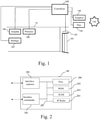
- the Fig. 1 represents a building in which the present invention is implemented.
- the building comprises at least one room 10 having at least one opening 103 oriented in a direction such that the solar radiation contributes to the heating of the room 10.
- the opening 103 can be concealed by a concealment device 101 such as for example a motorized rolling shutter 101 or a motorized blind.
- the opening 103 is, in a gable of the building for example and in a non-limiting manner, oriented to the south, to the east or to the north.
- the opening 103 can also be an opening in the roof of the building, for example and in a non-limiting way, oriented to the south, to the east or to the west.
- a control device 100 drives the roller shutter 101.
- a radiation sensor 102 of the sun's radiation 110 Connected to the controller 100 are a radiation sensor 102 of the sun's radiation 110, a temperature sensor 108 placed outside the building, a temperature sensor 106 of the room 10 or of the building, a clock 107 and optionally a temperature sensor. presence 109.
- the clock 107 is a clock capable of providing timestamp information making it possible to determine the time, the day, and the season.
- the season is determined from the temperature measured by the temperature sensor 108 at a predetermined time or if the clock is an astronomical clock at a time corresponding to sunrise or even more or less one hour.
- the predetermined time at which the temperature is measured by the temperature sensor to determine the season is for example between 4 and 6 am, preferably at 5 am.
- controller 100 the clock 107, the temperature sensor 106 can be grouped together in a single control and programming device.
- a period of strong sunshine corresponds to summer and/or the second half of spring and/or the first part of autumn a period of weak sunshine such as winter and/or the first half of spring and/or the second half of autumn.
- the dates corresponding to the periods of low sunshine and/or high sunshine can be recorded in the control device 100 during the production thereof or recorded by the installer of the control device 100 when the device is put into service. 100 or be registered by the occupant of the building 10 in which the present invention is implemented or be updated via a computer server via a telecommunications network to which the order not shown in Fig. 1 .
- the season is determined from the temperature measured by the temperature sensor 108 at a predetermined time or if the clock is an astronomical clock at a time corresponding to sunrise or even more or less one hour.
- the predetermined time at which the temperature is measured by the temperature sensor to determine the season is for example between 4 and 6 am, preferably at 5 am.
- the season is considered to be the 'winter.
- the season is considered to be spring or fall.
- the season is considered to be the 'summer.
- sunrise is determined from the radiation sensor 102.
- the measurement of the solar radiation exceeds a value between 5 to 10/Wm 2 , it is considered that it is sunrise. day.
- the season is considered to be winter.
- the season is considered to be spring or autumn.
- the season is considered to be summer.
- the Fig. 2 represents a block diagram of a device for controlling at least one device for concealing at least one opening according to the present invention.
- the controller 100 is adapted to carry out from one or more software modules the steps of the algorithms as described with reference to the Figs. 4 to 10 .
- the controller 100 comprises a communication bus 201 to which are connected a processor 200, a non-volatile memory 202, a random access memory 203, possibly a radio or infrared interface 204 allowing the reception of codes from a remote control associated with the controller 100, a control interface 206 allowing the control of the occultation device 101, and a sensor interface 208 to which the sensors 102, 108, 106 and 109 as well as the clock are connected.
- a communication bus 201 to which are connected a processor 200, a non-volatile memory 202, a random access memory 203, possibly a radio or infrared interface 204 allowing the reception of codes from a remote control associated with the controller 100, a control interface 206 allowing the control of the occultation device 101, and a sensor interface 208 to which the sensors 102, 108, 106 and 109 as well as the clock are connected.
- the non-volatile memory 202 stores the software module(s) implementing the invention, as well as the data making it possible to implement the algorithms as described with reference to the Figs. 4 to 10 .
- the programs according to the present invention are stored in a storage means.
- This storage means is readable by the microprocessor 200.
- This storage means is integrated or not in the controller 100, and can be removable.
- the software module(s) according to the present invention is or are transferred into the RAM 203 which then contains the executable code according to the present invention as well as the data necessary to the implementation of the invention.
- controller 100 can consist of one or more electronic component(s).
- the Fig. 3 represents an example of a curve of variation in solar radiation over a period of twenty-four hours as well as straight lines allowing the decision to control at least one device for obscuring at least one opening according to the present invention.
- the curve Var represents the variations of the solar radiation measured by the sensor 102 over a period of twenty-four hours.
- the straight line Dr1 is the representation of an affine function whose leading coefficient alpha1 and the ordinate at the origin SF1 are a function of the season and of a level of criticality.
- the line Dr2 is the representation of an affine function whose leading coefficient alpha2 and the ordinate at the origin SF2 are a function of the period of sunshine and the level of criticality.
- the level of criticality is representative of the difference between the temperature measured by the sensor 106 and a first and a second threshold.
- the h_ouvert parameter defines the time from which the screening device 101 will allow all or almost all of the solar radiation to pass through the opening 103 if other conditions, explained later, are met.
- the concealment device 101 When the measured solar radiation is, at a given instant, greater than the radiation value given by the curve Dr2, the concealment device 101 completely or almost completely conceals the opening 103 if other conditions, explained by the following, are met.
- Total or almost total concealment corresponds to concealment of 75 to 100% of the surface of the opening 103.
- the screening device 101 leaves pass all or almost all of the solar radiation through the opening 103 if other conditions, explained later, are met.
- the screening device 101 lets all or almost all of the solar radiation pass through the opening 103 when the screening device 101 blocks less than 10% of the surface of the opening 103.
- the screening device 101 When the measured solar radiation is, at a given instant, lower than the radiation value given by the curve Dr2 and higher than the radiation value given by the curve Dr1, the screening device 101 partially allows the solar radiation to pass through opening 103 if other conditions, explained later, are met.
- the screening device 101 allows solar radiation to partially pass through the opening 103 when the screening device 101 screens between 30 and 75% of the surface of the opening 103.
- the Fig. 4 represents a diagram illustrating the general algorithm executed by the control device of at least one device for concealing at least one opening according to the present invention.
- the present algorithm is more precisely executed by the processor 200 of the controller 100.
- the present algorithm is executed periodically, for example every ten minutes or with a periodicity comprised between two and fifteen minutes.
- the processor 200 obtains the various values measured by the sensors 102, 106, 108, 109, the timestamp supplied by the clock 107 as well as information.
- the processor 200 launches the execution of the criticality level function which will be described in detail with regard to the Fig. 5 .
- the processor 200 launches the execution of the shutter parameter function which will be described in detail with regard to the Fig. 6a or 6b .
- the processor 200 launches the execution of the decision function which will be described in detail with regard to the Fig. 7 .
- the processor 200 launches the execution of the timeout function which will be described in detail with regard to the Fig. 8a Where 8b .
- the processor 200 launches the execution of the command function which will be described in detail with regard to the Fig. 10 .
- the Fig. 5 represents a diagram illustrating the algorithm executed by the control device for the execution of the criticality function according to the present invention.
- the present algorithm is more precisely executed by the processor 200 of the controller 100.
- processor 200 obtains the value of the interior temperature T_int of room 10 measured by sensor 106.
- the processor 200 verifies whether the value of the Level_before variable is equal to two.
- the Level_before variable is initialized to the value two, then the Level before variable is the value of the level of criticality determined during the previous execution of the criticality function.
- the processor 200 checks whether the interior temperature T_int of the room 10 measured at step E500 is greater than a predetermined threshold T_threshold2.
- the predetermined threshold T_threshold2 depends on the season during which the present algorithm is executed.
- the predetermined threshold T_seuil2 is equal to 24 degrees in periods of low sunlight and is equal to 23 degrees in periods of strong sunlight.
- the value of the threshold T_threshold2 can be increased or decreased by one or more degrees by the man-machine interface of the heating control device, for example in a range between +/- 5 degrees.
- the processor 200 sets the level of criticality Level_criticality to the value three and ends the criticality function.
- the processor 200 checks whether the interior temperature T_int of the room 10 measured at step E500 is lower than a predetermined threshold T_threshold1 reduced by one.
- the predetermined threshold T_seuil1 depends on the season during which the present algorithm is executed.
- the predetermined threshold T_seuil1 is equal to 22 degrees in periods of low sunshine, i.e. winter, autumn and spring, and is equal to 23 degrees in periods of strong sunshine, that is i.e. summer.
- the value of the threshold T_threshold1 can be increased or decreased by one or more degrees by the man-machine interface of the heating control device, for example in a range between +/- 5 degrees.
- the processor 200 sets the criticality level Level_criticality to the value one and ends the criticality function.
- the processor 200 sets the level of criticality Level_criticality to the value two and ends the criticality function.
- the processor 200 verifies whether the value of the Level_before variable is equal to one.
- the processor 200 checks whether the interior temperature T_int is lower than the predetermined threshold T_threshold1.
- the processor 200 sets the level of criticality Level_criticality to the value one and ends the criticality function.
- the processor 200 sets the criticality level Level_criticality to the value two and ends the criticality function.
- the processor 200 verifies whether the interior temperature T_int is lower than the predetermined threshold T_threshold2 minus one.
- step E512 If the interior temperature T_int is lower than the predetermined threshold T_threshold2 reduced by one, the processor 200 passes to step E512. If not, processor 200 proceeds to step E513.
- the processor 200 sets the criticality level Level_criticality to the value two and ends the criticality function.
- the processor 200 sets the criticality level Level_criticality to the value three and ends the criticality function.
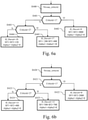
- the Fig. 6a represents a diagram illustrating the algorithm executed by the control device for the determination, in periods of strong sunlight, of the shutter parameter function allowing the decision to control at least one device for concealing at least one opening according to the present invention.
- the present algorithm is more precisely executed by the processor 200 of the controller 100.
- the processor 200 obtains the level of criticality Level_criticality determined during the execution of the algorithm of the Fig. 5 .
- the processor 200 verifies whether the level of criticality Level_criticality is equal to one.
- processor 200 If the level of criticality Level_criticality is equal to one, the processor 200 goes to step E602. If not, processor 200 proceeds to step E603.
- the processor 200 sets the parameter h_ouvert to the zero value, the director coefficient alpha1 to the zero value, the director coefficient alpha2 to the zero value, the ordinate at the origin SF1 to the value 2000, l 'intercept SF2 to the value 2000 and terminates the pane parameter function.
- the processor 200 verifies whether the level of criticality Level_criticality is equal to two.
- Level_criticality is equal to two, the processor 200 passes to step E605. If not, processor 200 proceeds to step E604.
- the processor 200 sets the parameter h_open to 6 p.m., the leading coefficient alpha1 to the zero value, the leading coefficient alpha2 to the zero value, the ordinate at the origin SF1 to the value 150, the ordered at the origin SF2 at the value 150 and terminates the pane parameter function.
- the processor 200 sets the parameter h_open to 5 p.m., the director coefficient alpha1 to the value 10, the director coefficient alpha2 to the value 10, the ordinate at the origin SF1 to the value 200, the ordinate at the origin SF2 to the value 400 and terminates the pane parameter function.
- the Fig. 6b represents a diagram illustrating the algorithm executed by the control device for the determination, in periods of low sunshine, of the shutter parameter function allowing the decision to control at least one device for concealing at least one opening according to the present invention.
- the present algorithm is more precisely executed by the processor 200 of the controller 100.
- the processor 200 obtains the level of criticality Level_criticality determined during the execution of the algorithm of the Fig. 5 .
- the processor 200 verifies whether the level of criticality Level_criticality is equal to one.
- processor 200 passes to step E622. If not, processor 200 proceeds to step E623.
- the processor 200 sets the parameter h_ouvert to the zero value, the director coefficient alpha1 to the zero value, the director coefficient alpha2 to the zero value, the ordinate at the origin SF1 to the value 2000, l 'intercept SF2 to the value 2000 and terminates the pane parameter function.
- the processor 200 verifies whether the level of criticality Level_criticality is equal to two.
- processor 200 passes to step E625. If not, processor 200 proceeds to step E624.
- the processor 200 sets the parameter h_open to 3 p.m., the director coefficient alpha 1 to the zero value, the director coefficient alpha2 to the zero value, the ordinate at the origin SF1 to the value 400, l 'intercept SF2 to value 400 and terminates the pane parameter function.
- the processor 200 sets the parameter h_open to 3 p.m., the director coefficient alpha 1 to the zero value, the director coefficient alpha2 to the zero value, the ordinate at the origin SF1 to the value 500, l 'intercept SF2 to value 700 and terminates the pane parameter function.
- pane parameter function The parameters determined by the pane parameter function are, as described with reference to the Figs. 6a and 6b , depending on when the measurements were made.
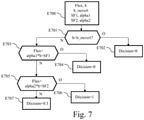
- the Fig. 7 represents a diagram illustrating the algorithm executed by the control device for determining a decision parameter for the control of at least one device for concealing at least one opening according to the present invention.
- the present algorithm is more precisely executed by the processor 200 of the controller 100.
- the processor 200 obtains the value measured by the radiation sensor 102, the time provided by the clock 107 and the values of the variables SF1, SF2, alpha1, alpha2 and h_open determined during the previous execution of the pane parameter function described with reference to the Fig. 6a or 6b .
- the processor 200 checks whether the time supplied by the clock 107 is greater than the value of the variable h_open.
- processor 200 If the time provided by the clock 107 is greater than the value of the variable h_open, the processor 200 goes to step E702. If not, processor 200 proceeds to step E703.
- the processor 200 sets the Decision variable to zero and ends the decision parameter function.
- the screening device 101 allows all or almost all of the solar radiation to pass through the opening 103 if other conditions, explained later, are fulfilled.
- the screening device 101 When the measured solar radiation is, at a given instant, lower than the radiation value given by the curve Dr1, the screening device 101 allows all or almost all of the solar radiation to pass through the opening 103 if d other conditions, explained below, are fulfilled.
- step E703 the processor 200 checks whether the Flux value of the radiation measured by the radiation sensor 102 is lower than the straight line Dr1.
- processor 200 If the value Flux measured by the radiation sensor 102 is lower than the straight line Dr1, the processor 200 goes to step E704. If not, processor 200 proceeds to step E705.
- step E704 the processor 200 sets the Decision variable to zero and ends the decision parameter function.
- step E703 the processor 200 checks whether the Flux value measured by the radiation sensor 102 is greater than the straight line Dr2.
- step E707 If the Flux value measured by the radiation sensor 102 is greater than the straight line Dr2, the processor 200 goes to step E706. If not, processor 200 proceeds to step E707.
- the processor 200 sets the Decision variable to the value one and ends the decision parameter function.
- the concealment device 101 completely or almost completely conceals the opening 103 if other conditions, explained later, are fulfilled.
- the processor 200 sets the Decision variable to the value one-half and ends the decision parameter function.
- the screening device 101 allows the solar radiation to pass partially through the opening 103.
- the Decision parameter is, as described with reference to Figs. 6a and 6b , depending on the date on which the measurement of the Radiation flux value was carried out as well as the interior temperature T_int.
- the Fig. 8a represents a diagram illustrating the algorithm executed by the control device for the management, in periods of low sunlight, of a function for controlling at least one device for concealing at least one opening according to the present invention.
- the present algorithm is more precisely executed by the processor 200 of the controller 100.
- the processor 200 obtains the value of the decision variable determined by the algorithm of the Fig. 7 , the value of the daily actuation counter of the occultation device, as well as the value of a threshold of a time delay which is for example equal to 30 minutes or between 15 and 60 minutes.
- the value of the daily actuation counter of the occultation device is incremented by one unit when the occultation device passes from an open position to the intermediate position to return to the open position.
- the value of the daily activation counter of the occultation device is incremented by one unit when the occultation device passes from an open position to the intermediate position then to the closed position to return to the intermediate position or to the position opened.
- the value of the daily counter for actuation of the occultation device is incremented by two units when the occultation device passes from an open position to the intermediate position then to the closed position to return to the intermediate position and to the closed position .
- the processor 200 verifies whether the Decision variable is equal to one.
- step E808 If the Decision variable is equal to one, the processor 200 proceeds to step E802.
- step E802 the processor 200 verifies whether the Decision variable is equal to one half.
- the processor 200 sets the Deci_filter variable to zero, sets the Tempo variable to zero and ends the timeout function.
- the screening device 101 When the variable Deci_filter is at zero value, the screening device 101 lets all the solar radiation pass through the opening 103 if other conditions, explained later, are met.
- step E804 the processor 200 verifies whether the variable Decision_before is zero.
- the Decision before variable is the value determined by the algorithm of the Fig. 7 during the previous execution of the algorithm of the Fig. 4 .
- the processor 200 verifies whether the value of the Tempo variable is greater than or equal to the threshold of a timeout.
- step E807 If the value of the Tempo variable is greater than or equal to the threshold of a timeout, the processor 200 passes to step E806. If not, processor 200 proceeds to step E807.
- the processor 200 also checks in step E805 whether the value of a daily activation counter of the occultation device is greater than the value three. If the value of a daily counter is greater than three, the processor 200 goes to step E807. If the value of the daily counter is less than or equal to three and if the value of the Tempo variable is greater than or equal to the threshold of a timeout, the processor 200 passes to step E806.
- the processor 200 sets the variable Deci_filter to the value one-half, sets the variable Tempo to the zero value and ends the timeout function.
- the screening device 101 lets some of the solar radiation pass through the opening 103 if other conditions, explained later, are met.
- the processor 200 sets the Deci_filter variable to zero, increments the Tempo variable to the value corresponding to the periodicity of execution of the algorithm of the Fig. 4 and terminates the timing function.
- step E808 the processor 200 verifies whether the variable Decision_before is equal to one.
- step E810 If the variable Decision_before is equal to one, the processor 200 proceeds to step E810. If not, processor 200 proceeds to step E809.
- the processor 200 verifies whether the value of the Tempo variable is greater than or equal to the threshold of a timeout.
- the processor 200 goes to step E810. If not, the processor 200 goes to step E811.
- the processor 200 also checks in step E809 whether the value of a daily counter for activation of the occultation device is greater than the value three. If the value of a daily counter is greater than three, the processor 200 goes to step E811. If the value of the daily counter is less than or equal to three and if the value of the Tempo variable is greater than or equal to the threshold of a timeout, the processor 200 passes to step E810.
- the processor 200 sets the variable Deci_filter to the value one, sets the variable Tempo to the zero value and ends the timeout function.
- the occultation device 101 allows part of the solar radiation to pass or does not allow the solar radiation to pass through the opening 103 if other conditions, explained later, are fulfilled.
- the processor 200 sets the Deci_filter variable to the value of the Decision_before variable, increments the Tempo variable to the value corresponding to the periodicity of execution of the algorithm of the Fig. 4 and terminates the timing function.
- the control of the shading device is canceled for a given period if the shading device is, at the previous iteration, in a position allowing a greater quantity of solar radiation to pass through the opening than that permitted by the position of the screening device whose control is cancelled.
- the Fig. 8b represents a diagram illustrating the algorithm executed by the control device for the management, in periods of strong sunlight, of a time delay for the control of at least one device for concealing at least one opening according to the present invention.
- the present algorithm is more precisely executed by the processor 200 of the controller 100.
- the processor obtains the value of the decision variable determined by the algorithm of the Fig. 7 , the value of the daily actuation counter of the occultation device, as well as the value of a threshold of a time delay which is for example equal to 30 minutes or between 15 and 60 minutes.
- the value of the daily actuation counter of the occultation device is incremented by one unit when the occultation device passes from an open position to the intermediate position to return to the open position.
- the value of the daily counter for actuation of the occultation device is incremented by one unit when the occultation device passes from an open position to the intermediate position then to the closed position to return to the intermediate position or to the position opened.
- the value of the daily counter for actuation of the occultation device is incremented by two units when the occultation device passes from an open position to the intermediate position then to the closed position to return to the intermediate position and to the closed position .
- the processor 200 verifies whether the Decision variable is zero.
- step E828 If the Decision variable is equal to zero, the processor 200 goes to step E828. If not, processor 200 proceeds to step E822.
- step E822 the processor 200 verifies whether the Decision variable is equal to one-half.
- step E82 If the Decision variable is equal to one half, the processor 200 proceeds to step E824. If not, processor 200 proceeds to step E823.
- the processor 200 sets the variable Deci_filter to the value one, sets the variable Tempo to the zero value and ends the timeout function.
- step E824 the processor 200 verifies whether the variable Decision_before is equal to one.
- processor 200 goes to step E825. If not, processor 200 proceeds to step E826.
- the processor 200 verifies whether the value of the Tempo variable is greater than or equal to the threshold of a timeout.
- step E826 If the value of the Tempo variable is greater than or equal to the threshold of a timeout, the processor 200 goes to step E826. If not, processor 200 proceeds to step E827.
- the processor 200 also checks in step E825 whether the value of a daily activation counter of the occultation device is greater than the value three. If the value of a daily counter is greater than three, the processor 200 goes to step E827. If the value of the daily counter is less than or equal to three and if the value of the Tempo variable is greater than or equal to the threshold of a timeout, the processor 200 passes to step E826.
- the processor 200 sets the filter Deci variable to the value one-half, sets the Tempo variable to the zero value and ends the timing function.
- the processor 200 sets the variable Deci filter to the value one, increments the variable Tempo to the value corresponding to the periodicity of execution of the algorithm of the Fig. 4 and terminates the timing function.
- the screening device 101 allows part of the solar radiation to pass or does not allow the solar radiation to pass through the opening 103 if other conditions, explained later, are fulfilled.
- the processor 200 verifies whether the value of the Tempo variable is greater than or equal to the threshold of a timeout.
- processor 200 goes to step E831. If not, processor 200 proceeds to step E830.
- the processor 200 also checks in step E829 whether the value of a daily counter for activation of the occultation device is greater than the value three. If the value of a daily counter is greater than three, the processor 200 goes to step E831. If the value of the daily counter is less than or equal to three and if the value of the Tempo variable is greater than or equal to the threshold of a timeout, the processor 200 passes to step E830.
- the processor 200 sets the variable Deci_filter to zero value, sets the Tempo variable to zero value and terminates the timeout function.
- the processor 200 sets the Deci_filter variable to the value of the Decision_before variable, increments the Tempo variable to the value corresponding to the periodicity of execution of the algorithm of the Fig. 4 and terminates the timing function.
- the control of the shading device is canceled for a given period if the shading device is, at the previous iteration, in a position allowing a smaller quantity of solar radiation to pass through the opening than that permitted by the position of the screening device whose control is cancelled.
- the Fig. 9 represents a diagram illustrating the algorithm executed by the control device for the determination, in periods of strong sunlight, of different positions of at least one device for obscuring at least one opening according to the present invention.
- the present algorithm is more precisely executed by the processor 200 of the controller 100 every day in periods of strong sunlight between 3:30 a.m. and 4:30 a.m. or at daybreak.
- Daybreak is for example detected by the radiation sensor 102 when the latter measures radiation greater than a value between 5 to 10 W/m 2 .
- the radiation sensor 102 when the radiation measurement exceeds the value between 5 to 10W/m2, notifies the controller 100 of sunrise or the controller 100, by periodically taking the value measured by the radiation sensor detects sunrise day when the value measured by the radiation sensor exceeds the value between 5 to 10W/m2.
- the processor 200 obtains from the sensor 108, the outside temperature T_ext.
- the processor 200 checks whether the outside temperature T_ext is greater than 17 degrees.
- step E902 If the outside temperature T_ext is greater than 17 degrees or 16 degrees according to a particular embodiment, the processor 200 goes to step E902. If not, processor 200 proceeds to step E903.
- the processor 200 instead of checking if the outside temperature T_ext is greater than 17 degrees, checks if the season determined by the temperature measurement at sunrise is summer.
- processor 200 proceeds to step E902. If not, processor 200 proceeds to step E903.
- the processor 200 sets the intermediate position variable Pos_intermediate to the value 0.75 and the low position variable Pos_bas to the value 1 and ends the algorithm of the Fig. 9 .
- the concealment device 101 completely or almost completely conceals the opening 103 if other conditions, explained later, are fulfilled.
- the concealment device 101 conceals 75% of the surface of the opening 103.
- the processor 200 sets the intermediate position variable Pos_intermediate to the value 0.4 and the low position variable Pos_bas to the value 0.75 and ends the algorithm of the Fig. 9 .
- the concealment device 101 conceals 40% of the surface of the opening 103.
- the Fig. 10 represents a diagram illustrating the algorithm executed by the control device for determining a control parameter of at least one device for concealing at least one opening according to the present invention.
- the present algorithm is more precisely executed by the processor 200 of the controller 100.
- the processor 200 obtains the value of the Deci_filter variable determined by the function described with reference to the Fig. 8a Where 8b and the values of the Pos_low, Pos_intermediate and Pos_low variables determined by the function described with reference to the Fig. 9 .
- step E1001 the processor 200 verifies whether the value of the variable Deci_filter is equal to one half.
- processor 200 If the value of the filter Deci variable is equal to one-half, the processor 200 goes to step E1002. If not, processor 200 proceeds to step 1001.
- the processor 200 sets the variable Com to the value of the variable Pos_Intermediate and commands the occultation device so that it places itself at the corresponding position and interrupts the execution of the algorithm.
- step E1003 the processor 200 verifies whether the value of the Deci_filter variable is equal to one.
- processor 200 goes to step E1004. If not, processor 200 proceeds to step 1005.
- the processor 200 sets the variable Com to the value of the variable Pos_bas and commands the concealment device so that the latter moves to the corresponding position and interrupts the execution of the algorithm.
- step E1005 the processor 200 sets the variable Com to the value of the variable Pos high and controls the screening device so that it lets all the solar radiation pass through the opening.
- the screening device 101 does not allow solar radiation through the opening.
- the present invention is described in an embodiment in which two periods of sunshine are considered.
- the present invention is also applicable when a greater number of periods is considered. For example a period corresponding to winter, a period corresponding to summer and a period corresponding to autumn and spring or a period corresponding to winter, a period corresponding to summer, a period corresponding to autumn and a period corresponding to spring.
- the invention is also applicable in a configuration according to which the control of the shutters according to the present invention will only be carried out in a single period of time, for example in winter or in winter and part of autumn and spring. , the present invention does not control the concealment device during the summer.
Landscapes
- Engineering & Computer Science (AREA)
- Structural Engineering (AREA)
- Architecture (AREA)
- Civil Engineering (AREA)
- General Physics & Mathematics (AREA)
- Automation & Control Theory (AREA)
- Physics & Mathematics (AREA)
- General Engineering & Computer Science (AREA)
- Air Conditioning Control Device (AREA)
- Blinds (AREA)
- Operating, Guiding And Securing Of Roll- Type Closing Members (AREA)
- Power-Operated Mechanisms For Wings (AREA)
- Building Environments (AREA)
Claims (10)
- Verfahren zur Steuerung mindestens eines motorisierten Rollladens (101) mindestens einer Öffnungsfläche (103) eines Raums (10) eines Gebäudes, dadurch gekennzeichnet, dass das Verfahren die folgenden Schritte aufweist:- Erhalt der Temperatur des Raums (106) des Gebäudes,- Erhalt eines Werts der Sonnenstrahlung (102, 110),- Vergleich der Temperatur des Raums des Gebäudes mit mindestens einer Temperaturgrenze, um einen Wert einer Kritikalitätsstufe zu bestimmen, wobei die Kritikalitätsstufe gleich eins, zwei oder drei sein kann,- Bestimmung mindestens einer Vergleichsgrenze der Sonnenstrahlung ausgehend vom Ergebnis des Vergleichs der Temperatur des Raums (106) mit der mindestens einen Grenze, wobei die Vergleichsgrenze der Sonnenstrahlung außerdem abhängig vom Datum (107) und von der Uhrzeit bestimmt wird, zu der die Temperatur des Raums des Gebäudes und die Sonnenstrahlung erhalten werden, wobei die mindestens eine Sonnenstrahlungsgrenze aus zwei Geraden besteht, wobei jede der Geraden eine Steigung und einen y-Achsenabschnitt hat, wobei die Steigung und der y-Achsenabschnitt vom Wert der Kritikalitätsstufe und einem Zeitraum starker oder schwacher Sonneneinstrahlung abhängen, wobei der Zeitraum starker Sonneneinstrahlung dem Sommer und/oder der zweiten Hälfte des Frühlings und/oder dem ersten Teil des Herbsts entspricht, und der Zeitraum schwacher Sonneneinstrahlung dem Winter und/oder der ersten Hälfte des Frühlings und/oder der zweiten Hälfte des Herbsts, wobei die Steigungen gleich 0 sind, wenn der Wert der Kritikalitätsstufe in einem Zeitraum starker Sonneneinstrahlung oder einem Zeitraum schwacher Sonneneinstrahlung gleich 1 oder 3 ist, wobei die Steigungen gleich 10 sind, wenn der Wert der Kritikalitätsstufe in einem Zeitraum starker Sonneneinstrahlung gleich 2 ist, der y-Achsenabschnitt der ersten affinen Geraden gleich 200 ist, wenn die Kritikalitätsstufe in einem Zeitraum starker Sonneneinstrahlung gleich 1 ist, der y-Achsenabschnitt der zweiten affinen Geraden gleich 200 ist, wenn die Kritikalitätsstufe in einem Zeitraum starker Sonneneinstrahlung gleich 1 ist, der y-Achsenabschnitt der ersten affinen Geraden gleich 200 ist, wenn die Kritikalitätsstufe in einem Zeitraum starker Sonneneinstrahlung gleich 2 ist, der y-Achsenabschnitt der zweiten affinen Geraden gleich 400 ist, wenn die Kritikalitätsstufe in einem Zeitraum starker Sonneneinstrahlung gleich 2 ist, der y-Achsenabschnitt der ersten affinen Geraden gleich 150 ist, wenn die Kritikalitätsstufe in einem Zeitraum starker Sonneneinstrahlung gleich 1 ist, der y-Achsenabschnitt der zweiten affinen Geraden gleich 150 ist, wenn die Kritikalitätsstufe in einem Zeitraum starker Sonneneinstrahlung gleich 1 ist, der y-Achsenabschnitt der ersten affinen Geraden gleich 2000 ist, wenn die Kritikalitätsstufe in einem Zeitraum schwacher Sonneneinstrahlung gleich 1 ist, der y-Achsenabschnitt der zweiten affinen Geraden gleich 2000 ist, wenn die Kritikalitätsstufe in einem Zeitraum starker Sonneneinstrahlung gleich 1 ist, der y-Achsenabschnitt der ersten affinen Geraden gleich 500 ist, wenn die Kritikalitätsstufe in einem Zeitraum schwacher Sonneneinstrahlung gleich 2 ist, der y-Achsenabschnitt der zweiten affinen Geraden gleich 700 ist, wenn die Kritikalitätsstufe in einem Zeitraum starker Sonneneinstrahlung gleich 2 ist, der y-Achsenabschnitt der ersten affinen Geraden gleich 400 ist, wenn die Kritikalitätsstufe in einem Zeitraum schwacher Sonneneinstrahlung gleich 3 ist, der y-Achsenabschnitt der zweiten affinen Geraden gleich 400 ist, wenn die Kritikalitätsstufe in einem Zeitraum starker Sonneneinstrahlung gleich 3 ist,- Vergleich des erhaltenen Werts der Sonnenstrahlung mit der mindestens einen bestimmten Vergleichsgrenze der Sonnenstrahlung,- Steuerung des motorisierten Rollladens (101) abhängig vom Vergleich der Sonnenstrahlung mit der mindestens einen bestimmten Vergleichsgrenze der Sonnenstrahlung.
- Verfahren nach Anspruch 1, dadurch gekennzeichnet, dass die Temperatur des Raums (106) des Gebäudes mit zwei Temperaturgrenzen verglichen wird, und dass die Werte der Temperaturgrenzen von dem Datum abhängen, an dem die Temperatur des Raums des Gebäudes und die Sonnenstrahlung erhalten werden.
- Verfahren nach einem der Ansprüche 1 bis 2, dadurch gekennzeichnet, dass das Verfahren außerdem die folgenden Schritte aufweist, die ausgeführt werden, wenn das Datum, an dem die Temperatur des Raums des Gebäudes und die Sonnenstrahlung erhalten werden, einem Zeitraum starker Sonneneinstrahlung entspricht:- Erhalt der Außentemperatur (108) des Gebäudes zu einer vorbestimmten Tageszeit,- Vergleich der erhaltenen Außentemperatur (108) des Gebäudes mit einer Außentemperatur-Vergleichsgrenze,und dass der motorisierte Rollladen (101) gesteuert wird, um drei Stellungen einzunehmen, von denen zwei Stellungen vom Vergleich der erhaltenen Außentemperatur des Gebäudes mit der Außentemperatur-Vergleichsgrenze abhängen.
- Verfahren nach einem der Ansprüche 1 bis 3, dadurch gekennzeichnet, dass das Verfahren iterativ ausgeführt wird, wobei der motorisierte Rollladen (101) gesteuert wird, um drei verschiedene Stellungen einzunehmen, und dass das Verfahren außerdem einen Schritt der Aufhebung der Steuerung des motorisierten Rollladens aufweist, der von der Stellung des motorisierten Rollladens bei der vorhergehenden Iteration und vom Datum des Erhalts der Temperatur des Raums des Gebäudes und dem Wert der Sonnenstrahlung abhängt.
- Verfahren nach Anspruch 4, dadurch gekennzeichnet, dass, wenn das Erhaltsdatum der Temperatur des Raums des Gebäudes und des Werts der Sonnenstrahlung in einem Zeitraum starker Sonneneinstrahlung enthalten ist, die Steuerung des motorisierten Rollladens während eines gegebenen Zeitraums aufgehoben wird, wenn der motorisierte Rollladen bei der vorhergehenden Iteration in einer Stellung ist, die es einer geringeren Menge an Sonnenstrahlung als diejenige, die durch die Stellung des motorisierten Rollladens ermöglicht wird, dessen Steuerung aufgehoben ist, ermöglicht, die Öffnungsfläche zu durchqueren.
- Verfahren nach Anspruch 5, dadurch gekennzeichnet, dass, wenn das Erhaltsdatum der Temperatur des Raums des Gebäudes und des Werts der Sonnenstrahlung in einem Zeitraum schwacher Sonneneinstrahlung enthalten ist, die Steuerung des motorisierten Rollladens während eines gegebenen Zeitraums aufgehoben wird, wenn der motorisierte Rollladen bei der vorhergehenden Iteration in einer Stellung ist, die es einer größeren Menge Sonnenstrahlung als diejenige, die durch die Stellung des motorisierten Rollladens ermöglicht wird, dessen Steuerung aufgehoben ist, ermöglicht, die Öffnungsfläche zu durchqueren.
- Verfahren nach einem der Ansprüche 1 bis 6, dadurch gekennzeichnet, dass, wenn der Modus, in dem die Vorrichtung das Heizen des mindestens einen Raums steuert, der Heizkontrollmodus ist, das Verfahren außerdem einen Schritt der Berücksichtigung der Solltemperatur des mindestens einen Raums und der Änderung mindestens einer Temperaturgrenze aufweist.
- Verfahren nach einem der Ansprüche 1 bis 7, dadurch gekennzeichnet, dass das Verfahren außerdem einen Schritt des Zählens der Anzahl von täglichen Öffnungs- oder Schließvorgängen des motorisierten Rollladens mindestens einer Öffnungsfläche eines Raums des Gebäudes und der Begrenzung der Anzahl von täglichen Öffnungs- oder Schließvorgängen des motorisierten Rollladens aufweist.
- Verfahren nach Anspruch 1, dadurch gekennzeichnet, dass die Temperatur des Raums (106) des Gebäudes mit zwei Temperaturgrenzen verglichen wird, und dass die Werte der Temperaturgrenzen von der Jahreszeit abhängen, in der die Temperatur des Raums des Gebäudes und die Sonnenstrahlung erhalten werden, und dass die Jahreszeit ausgehend von der außerhalb des Gebäudes zu einer vorbestimmten Zeit oder einer dem Sonnenaufgang entsprechenden Zeit gemessenen Temperatur bestimmt wird.
- Steuervorrichtung (100) mindestens eines motorisierten Rollladens (101) mindestens einer Öffnungsfläche (103) eines Raums (10) eines Gebäudes, dadurch gekennzeichnet, dass die Steuervorrichtung aufweist:- Einrichtungen zum Erhalt der Temperatur des Raums (106) des Gebäudes,- Einrichtungen zum Erhalt eines Werts der Sonnenstrahlung (102, 110),- Einrichtungen zum Vergleich der Temperatur des Raums des Gebäudes mit mindestens einer Temperaturgrenze, um einen Wert einer Kritikalitätsstufe zu bestimmen, wobei die Kritikalitätsstufe gleich eins, zwei oder drei sein kann,- Einrichtungen zur Bestimmung mindestens einer Vergleichsgrenze der Sonnenstrahlung ausgehend vom Ergebnis des Vergleichs der Temperatur des Raums mit der mindestens einen Grenze, wobei die Vergleichsgrenze der Sonnenstrahlung außerdem abhängig vom Datum (107) und von der Uhrzeit bestimmt wird, zu der die Temperatur des Raums des Gebäudes und die Sonnenstrahlung erhalten werden, wobei die mindestens eine Sonnenstrahlungsgrenze aus zwei Geraden besteht, wobei jede der Geraden eine Steigung und einen y-Achsenabschnitt hat, wobei die Steigung und der y-Achsenabschnitt vom Wert der Kritikalitätsstufe und von einem Zeitraum starker oder schwacher Sonneneinstrahlung abhängen, wobei der Zeitraum starker Sonneneinstrahlung dem Sommer und/oder der zweiten Hälfte des Frühlings und/oder dem ersten Teil des Herbsts entspricht, und der Zeitraum schwacher Sonneneinstrahlung dem Winter und/oder der ersten Hälfte des Frühlings und/oder der zweiten Hälfte des Herbsts entspricht, wobei die Steigungen gleich 0 sind, wenn der Wert der Kritikalitätsstufe in einem Zeitraum starker Sonneneinstrahlung oder einem Zeitraum schwacher Sonneneinstrahlung gleich 1 oder 3 ist, wobei die Steigungen gleich 10 sind, wenn der Wert der Kritikalitätsstufe in einem Zeitraum starker Sonneneinstrahlung gleich 2 ist, der y-Achsenabschnitt der ersten affinen Geraden gleich 200 ist, wenn die Kritikalitätsstufe in einem Zeitraum starker Sonneneinstrahlung gleich 1 ist, der y-Achsenabschnitt der zweiten affinen Geraden gleich 200 ist, wenn die Kritikalitätsstufe in einem Zeitraum starker Sonneneinstrahlung gleich 1 ist, der y-Achsenabschnitt der ersten affinen Geraden gleich 200 ist, wenn die Kritikalitätsstufe in einem Zeitraum starker Sonneneinstrahlung gleich 2 ist, der y-Achsenabschnitt der zweiten affinen Geraden gleich 400 ist, wenn die Kritikalitätsstufe in einem Zeitraum starker Sonneneinstrahlung gleich 2 ist, der y-Achsenabschnitt der ersten affinen Geraden gleich 150 ist, wenn die Kritikalitätsstufe in einem Zeitraum starker Sonneneinstrahlung gleich 1 ist, der y-Achsenabschnitt der zweiten affinen Geraden gleich 150 ist, wenn die Kritikalitätsstufe in einem Zeitraum starker Sonneneinstrahlung gleich 1 ist, der y-Achsenabschnitt der ersten affinen Geraden gleich 2000 ist, wenn die Kritikalitätsstufe in einem Zeitraum schwacher Sonneneinstrahlung gleich 1 ist, der y-Achsenabschnitt der zweiten affinen Geraden gleich 2000 ist, wenn die Kritikalitätsstufe in einem Zeitraum starker Sonneneinstrahlung gleich 1 ist, der y-Achsenabschnitt der ersten affinen Geraden gleich 500 ist, wenn die Kritikalitätsstufe in einem Zeitraum schwacher Sonneneinstrahlung gleich 2 ist, der y-Achsenabschnitt der zweiten affinen Geraden gleich 700 ist, wenn die Kritikalitätsstufe in einem Zeitraum starker Sonneneinstrahlung gleich 2 ist, der y-Achsenabschnitt der ersten affinen Geraden gleich 400 ist, wenn die Kritikalitätsstufe in einem Zeitraum schwacher Sonneneinstrahlung gleich 3 ist, der y-Achsenabschnitt der zweiten affinen Geraden gleich 400 ist, wenn die Kritikalitätsstufe in einem Zeitraum starker Sonneneinstrahlung gleich 3 ist,- Einrichtungen zum Vergleich des erhaltenen Werts der Sonnenstrahlung mit der mindestens einen bestimmten Vergleichsgrenze der Sonnenstrahlung,- Einrichtungen zur Steuerung des motorisierten Rollladens (101) abhängig vom Vergleich der Sonnenstrahlung mit der mindestens einen bestimmten Vergleichsgrenze der Sonnenstrahlung.
Applications Claiming Priority (2)
| Application Number | Priority Date | Filing Date | Title |
|---|---|---|---|
| FR1256500A FR2992996B1 (fr) | 2012-07-06 | 2012-07-06 | Procede et dispositif de commande d'au moins un dispositif d'occultation d'au moins une ouverture d'une piece d'un batiment |
| EP13175162.0A EP2682824B1 (de) | 2012-07-06 | 2013-07-04 | Verfahren und Vorrichtung zur Steuerung mindestens einer Verdunkelungsvorrichtung für mindestens ein Öffnungselement eines Gebäudeteils |
Related Parent Applications (2)
| Application Number | Title | Priority Date | Filing Date |
|---|---|---|---|
| EP13175162.0A Division-Into EP2682824B1 (de) | 2012-07-06 | 2013-07-04 | Verfahren und Vorrichtung zur Steuerung mindestens einer Verdunkelungsvorrichtung für mindestens ein Öffnungselement eines Gebäudeteils |
| EP13175162.0A Division EP2682824B1 (de) | 2012-07-06 | 2013-07-04 | Verfahren und Vorrichtung zur Steuerung mindestens einer Verdunkelungsvorrichtung für mindestens ein Öffnungselement eines Gebäudeteils |
Publications (2)
| Publication Number | Publication Date |
|---|---|
| EP3045984A1 EP3045984A1 (de) | 2016-07-20 |
| EP3045984B1 true EP3045984B1 (de) | 2022-03-23 |
Family
ID=47191867
Family Applications (3)
| Application Number | Title | Priority Date | Filing Date |
|---|---|---|---|
| EP13175162.0A Active EP2682824B1 (de) | 2012-07-06 | 2013-07-04 | Verfahren und Vorrichtung zur Steuerung mindestens einer Verdunkelungsvorrichtung für mindestens ein Öffnungselement eines Gebäudeteils |
| EP13175165.3A Active EP2682825B1 (de) | 2012-07-06 | 2013-07-04 | Verfahren und Vorrichtung zur Steuerung mindestens einer Verdunkelungsvorrichtung für mindestens ein Öffnungselement eines Gebäudeteils |
| EP16153675.0A Active EP3045984B1 (de) | 2012-07-06 | 2013-07-04 | Verfahren und vorrichtung zur steuerung mindestens einer verdunkelungsvorrichtung für mindestens ein öffnungselement eines gebäudeteils |
Family Applications Before (2)
| Application Number | Title | Priority Date | Filing Date |
|---|---|---|---|
| EP13175162.0A Active EP2682824B1 (de) | 2012-07-06 | 2013-07-04 | Verfahren und Vorrichtung zur Steuerung mindestens einer Verdunkelungsvorrichtung für mindestens ein Öffnungselement eines Gebäudeteils |
| EP13175165.3A Active EP2682825B1 (de) | 2012-07-06 | 2013-07-04 | Verfahren und Vorrichtung zur Steuerung mindestens einer Verdunkelungsvorrichtung für mindestens ein Öffnungselement eines Gebäudeteils |
Country Status (3)
| Country | Link |
|---|---|
| EP (3) | EP2682824B1 (de) |
| ES (3) | ES2762169T3 (de) |
| FR (1) | FR2992996B1 (de) |
Cited By (1)
| Publication number | Priority date | Publication date | Assignee | Title |
|---|---|---|---|---|
| FR3167458A1 (fr) * | 2024-10-14 | 2026-04-17 | Somfy Activites Sa | Procédé de gestion d’une intallation domotique déterminant une information de saison au moyen d’un capteur solaire |
Families Citing this family (8)
| Publication number | Priority date | Publication date | Assignee | Title |
|---|---|---|---|---|
| CN105573202A (zh) * | 2015-12-19 | 2016-05-11 | 成都克雷斯达科技有限公司 | 基于前置放大式信号过滤电路的卷帘门用自动控制系统 |
| FR3147639B1 (fr) | 2023-04-07 | 2025-12-26 | Somfy Activites Sa | Procédé de gestion d’une installation domotique |
| FR3149396B1 (fr) * | 2023-05-30 | 2025-06-06 | Somfy Activites Sa | Algorithme de détection d’une surchauffe à partir d’une mesure de température intérieure |
| FR3149635B1 (fr) * | 2023-06-08 | 2025-05-23 | Delta Dore | Procede et dispositif de commande d’au moins un dispositif d’occultation |
| FR3156927A1 (fr) * | 2023-12-18 | 2025-06-20 | Somfy Activites Sa | Algorithme de détection d’une surchauffe à partir d’une mesure de température extérieure |
| FR3158811B1 (fr) * | 2024-01-26 | 2026-01-09 | Bhg | Procédé de pilotage automatisé de la fermeture caniculaire d’un volet non solaire |
| FR3158810B1 (fr) * | 2024-01-26 | 2026-01-09 | Bhg | Procédé de pilotage automatisé de la fermeture caniculaire d’un volet solaire |
| FR3162289A1 (fr) | 2024-05-15 | 2025-11-21 | Somfy Activites Sa | Procédé de gestion d’une installation domotique |
Citations (2)
| Publication number | Priority date | Publication date | Assignee | Title |
|---|---|---|---|---|
| US6064949A (en) * | 1996-02-29 | 2000-05-16 | Zumtobel Licht Gmbh | Method and apparatus for controlling a screening device based on more than one set of factors |
| US20110066302A1 (en) * | 2009-09-16 | 2011-03-17 | Mcewan John Arthur | Intelligent energy-saving system and method |
Family Cites Families (5)
| Publication number | Priority date | Publication date | Assignee | Title |
|---|---|---|---|---|
| WO1992000557A1 (de) * | 1990-06-27 | 1992-01-09 | Presto Gebr. Vedder Gmbh | Rolladensteuerung |
| CA2327648A1 (en) * | 2000-12-15 | 2002-06-15 | Nimalasiri De Silva | Multifunction window blinds |
| DE102004005962A1 (de) * | 2004-02-06 | 2005-08-25 | Angelika Berthold | System zur Gebäudeautomatisierung |
| KR100725943B1 (ko) * | 2006-01-02 | 2007-06-11 | 삼성전자주식회사 | 설정된 환경 조건을 만족하도록 해당 전자 기기를 제어할수 있는 홈오토메이션 시스템 및 그 방법 |
| FR2927935B1 (fr) * | 2008-02-22 | 2014-07-18 | Somfy Sas | Procede de fonctionnement d'une unite de commande d'un actionneur electromecanique de manoeuvre d'un ecran mobile |
-
2012
- 2012-07-06 FR FR1256500A patent/FR2992996B1/fr not_active Expired - Fee Related
-
2013
- 2013-07-04 ES ES13175165T patent/ES2762169T3/es active Active
- 2013-07-04 EP EP13175162.0A patent/EP2682824B1/de active Active
- 2013-07-04 ES ES13175162.0T patent/ES2610828T3/es active Active
- 2013-07-04 EP EP13175165.3A patent/EP2682825B1/de active Active
- 2013-07-04 ES ES16153675T patent/ES2918379T3/es active Active
- 2013-07-04 EP EP16153675.0A patent/EP3045984B1/de active Active
Patent Citations (2)
| Publication number | Priority date | Publication date | Assignee | Title |
|---|---|---|---|---|
| US6064949A (en) * | 1996-02-29 | 2000-05-16 | Zumtobel Licht Gmbh | Method and apparatus for controlling a screening device based on more than one set of factors |
| US20110066302A1 (en) * | 2009-09-16 | 2011-03-17 | Mcewan John Arthur | Intelligent energy-saving system and method |
Cited By (1)
| Publication number | Priority date | Publication date | Assignee | Title |
|---|---|---|---|---|
| FR3167458A1 (fr) * | 2024-10-14 | 2026-04-17 | Somfy Activites Sa | Procédé de gestion d’une intallation domotique déterminant une information de saison au moyen d’un capteur solaire |
Also Published As
| Publication number | Publication date |
|---|---|
| EP2682825A3 (de) | 2015-06-24 |
| ES2610828T3 (es) | 2017-05-03 |
| EP2682824B1 (de) | 2016-10-12 |
| EP3045984A1 (de) | 2016-07-20 |
| EP2682824A3 (de) | 2015-06-10 |
| EP2682824A2 (de) | 2014-01-08 |
| ES2918379T3 (es) | 2022-07-15 |
| ES2762169T3 (es) | 2020-05-22 |
| FR2992996B1 (fr) | 2014-08-08 |
| FR2992996A1 (fr) | 2014-01-10 |
| EP2682825A2 (de) | 2014-01-08 |
| EP2682825B1 (de) | 2019-09-18 |
Similar Documents
| Publication | Publication Date | Title |
|---|---|---|
| EP3045984B1 (de) | Verfahren und vorrichtung zur steuerung mindestens einer verdunkelungsvorrichtung für mindestens ein öffnungselement eines gebäudeteils | |
| EP3942690B1 (de) | Verfahren zur bestimmung einer solarmaske für eine anlage und verfahren zur überprüfung der kompatibilität einer motorisierten antriebsvorrichtung | |
| EP2154437B1 (de) | Regulierungsoptimierung der Gebäudeheizung auf der Basis von Wettervorhersagen | |
| EP3336300B1 (de) | Verfahren und vorrichtung zum bestimmen der solarleistung, die durch eine öffnung eindringt | |
| EP1054134B1 (de) | Verfahren zur Steuerung der Tätigkeit von motorisierten Verschlussystemen eines Gebäudes | |
| EP3045983B1 (de) | Verfahren und vorrichtung zur steuerung mindestens einer verdunkelungsvorrichtung für mindestens ein öffnungselement eines gebäudeteils | |
| FR2949005A1 (fr) | Controle d'une installation en fonction de la dangerosite de son interaction avec une espece animale | |
| WO2015097393A1 (fr) | Procédé de prévision d'un paramètre de confort intérieur et terminal associé | |
| EP2936256B1 (de) | Verfahren zur steuerung eines stellantriebs für ein mobiles objekt einer anlage in einem gebäude | |
| EP4444979A1 (de) | Verfahren zur bestimmung eines parameters einer schliess-, sicht- oder sonnenschutzvorrichtung | |
| FR2771521A1 (fr) | Dispositif de commande d'un moyen de protection solaire motorise | |
| EP4474720B1 (de) | Verfahren und vorrichtung zur steuerung mindestens einer verdunkelungsvorrichtung | |
| EP2589185B1 (de) | Stromüberwachung eines raums | |
| WO2014125097A1 (fr) | Procede de fonctionnement d'un dispositif de commande d'une installation pour batiment mettant en oeuvre une etape d'ajustement d'une horloge utilisee pour piloter un equipement du batiment | |
| EP4720791A1 (de) | Verfahren zur erkennung einer vorgegebenen zeit | |
| FR3009013A1 (fr) | Procede de commande d’un actionneur pour un equipement mobile | |
| EP4484695A1 (de) | Verfahren zum lernen eines beweglichen verdunkelungselements einer glasoberfläche durch ein system zum steuern der sonneneinstrahlung | |
| EP4650889A1 (de) | Verfahren zur verwaltung einer heimautomatisierungsanlage | |
| EP4575173A1 (de) | Algorithmus zur erkennung einer überhitzung aus einer aussentemperaturmessung | |
| EP4720790A1 (de) | Algorithmus zur überhitzungserkennung auf der basis einer innenraumtemperaturmessung | |
| EP4411493A1 (de) | Verfahren zur verwaltung einer heimautomatisierungsanlage | |
| EP4446827A1 (de) | Verfahren zur verwaltung einer heimautomatisierungsanlage | |
| EP1116857B1 (de) | Vorrichtung zur Betätigung wenigstens eines Rolladens | |
| EP4592491A1 (de) | Verfahren zur automatisierten steuerung des hitzeverschlusses eines nicht solarbetriebenen fensterladens |
Legal Events
| Date | Code | Title | Description |
|---|---|---|---|
| PUAI | Public reference made under article 153(3) epc to a published international application that has entered the european phase |
Free format text: ORIGINAL CODE: 0009012 |
|
| AC | Divisional application: reference to earlier application |
Ref document number: 2682824 Country of ref document: EP Kind code of ref document: P |
|
| AK | Designated contracting states |
Kind code of ref document: A1 Designated state(s): AL AT BE BG CH CY CZ DE DK EE ES FI FR GB GR HR HU IE IS IT LI LT LU LV MC MK MT NL NO PL PT RO RS SE SI SK SM TR |
|
| AX | Request for extension of the european patent |
Extension state: BA ME |
|
| STAA | Information on the status of an ep patent application or granted ep patent |
Free format text: STATUS: REQUEST FOR EXAMINATION WAS MADE |
|
| 17P | Request for examination filed |
Effective date: 20170120 |
|
| RBV | Designated contracting states (corrected) |
Designated state(s): AL AT BE BG CH CY CZ DE DK EE ES FI FR GB GR HR HU IE IS IT LI LT LU LV MC MK MT NL NO PL PT RO RS SE SI SK SM TR |
|
| RIC1 | Information provided on ipc code assigned before grant |
Ipc: G05B 15/02 20060101AFI20180524BHEP Ipc: E06B 9/68 20060101ALI20180524BHEP Ipc: E06B 9/32 20060101ALI20180524BHEP |
|
| STAA | Information on the status of an ep patent application or granted ep patent |
Free format text: STATUS: EXAMINATION IS IN PROGRESS |
|
| STAA | Information on the status of an ep patent application or granted ep patent |
Free format text: STATUS: REQUEST FOR EXAMINATION WAS MADE |
|
| STAA | Information on the status of an ep patent application or granted ep patent |
Free format text: STATUS: EXAMINATION IS IN PROGRESS |
|
| 17Q | First examination report despatched |
Effective date: 20200409 |
|
| 17Q | First examination report despatched |
Effective date: 20200429 |
|
| GRAP | Despatch of communication of intention to grant a patent |
Free format text: ORIGINAL CODE: EPIDOSNIGR1 |
|
| STAA | Information on the status of an ep patent application or granted ep patent |
Free format text: STATUS: GRANT OF PATENT IS INTENDED |
|
| INTG | Intention to grant announced |
Effective date: 20210317 |
|
| GRAJ | Information related to disapproval of communication of intention to grant by the applicant or resumption of examination proceedings by the epo deleted |
Free format text: ORIGINAL CODE: EPIDOSDIGR1 |
|
| STAA | Information on the status of an ep patent application or granted ep patent |
Free format text: STATUS: EXAMINATION IS IN PROGRESS |
|
| INTC | Intention to grant announced (deleted) | ||
| GRAP | Despatch of communication of intention to grant a patent |
Free format text: ORIGINAL CODE: EPIDOSNIGR1 |
|
| STAA | Information on the status of an ep patent application or granted ep patent |
Free format text: STATUS: GRANT OF PATENT IS INTENDED |
|
| INTG | Intention to grant announced |
Effective date: 20210923 |
|
| GRAS | Grant fee paid |
Free format text: ORIGINAL CODE: EPIDOSNIGR3 |
|
| GRAA | (expected) grant |
Free format text: ORIGINAL CODE: 0009210 |
|
| STAA | Information on the status of an ep patent application or granted ep patent |
Free format text: STATUS: THE PATENT HAS BEEN GRANTED |
|
| AC | Divisional application: reference to earlier application |
Ref document number: 2682824 Country of ref document: EP Kind code of ref document: P |
|
| AK | Designated contracting states |
Kind code of ref document: B1 Designated state(s): AL AT BE BG CH CY CZ DE DK EE ES FI FR GB GR HR HU IE IS IT LI LT LU LV MC MK MT NL NO PL PT RO RS SE SI SK SM TR |
|
| REG | Reference to a national code |
Ref country code: GB Ref legal event code: FG4D Free format text: NOT ENGLISH |
|
| REG | Reference to a national code |
Ref country code: CH Ref legal event code: EP |
|
| REG | Reference to a national code |
Ref country code: DE Ref legal event code: R096 Ref document number: 602013081218 Country of ref document: DE |
|
| REG | Reference to a national code |
Ref country code: IE Ref legal event code: FG4D Free format text: LANGUAGE OF EP DOCUMENT: FRENCH |
|
| REG | Reference to a national code |
Ref country code: AT Ref legal event code: REF Ref document number: 1477876 Country of ref document: AT Kind code of ref document: T Effective date: 20220415 |
|
| REG | Reference to a national code |
Ref country code: LT Ref legal event code: MG9D |
|
| REG | Reference to a national code |
Ref country code: ES Ref legal event code: FG2A Ref document number: 2918379 Country of ref document: ES Kind code of ref document: T3 Effective date: 20220715 |
|
| REG | Reference to a national code |
Ref country code: NL Ref legal event code: MP Effective date: 20220323 |
|
| PG25 | Lapsed in a contracting state [announced via postgrant information from national office to epo] |
Ref country code: SE Free format text: LAPSE BECAUSE OF FAILURE TO SUBMIT A TRANSLATION OF THE DESCRIPTION OR TO PAY THE FEE WITHIN THE PRESCRIBED TIME-LIMIT Effective date: 20220323 Ref country code: RS Free format text: LAPSE BECAUSE OF FAILURE TO SUBMIT A TRANSLATION OF THE DESCRIPTION OR TO PAY THE FEE WITHIN THE PRESCRIBED TIME-LIMIT Effective date: 20220323 Ref country code: NO Free format text: LAPSE BECAUSE OF FAILURE TO SUBMIT A TRANSLATION OF THE DESCRIPTION OR TO PAY THE FEE WITHIN THE PRESCRIBED TIME-LIMIT Effective date: 20220623 Ref country code: LT Free format text: LAPSE BECAUSE OF FAILURE TO SUBMIT A TRANSLATION OF THE DESCRIPTION OR TO PAY THE FEE WITHIN THE PRESCRIBED TIME-LIMIT Effective date: 20220323 Ref country code: HR Free format text: LAPSE BECAUSE OF FAILURE TO SUBMIT A TRANSLATION OF THE DESCRIPTION OR TO PAY THE FEE WITHIN THE PRESCRIBED TIME-LIMIT Effective date: 20220323 Ref country code: BG Free format text: LAPSE BECAUSE OF FAILURE TO SUBMIT A TRANSLATION OF THE DESCRIPTION OR TO PAY THE FEE WITHIN THE PRESCRIBED TIME-LIMIT Effective date: 20220623 |
|
| REG | Reference to a national code |
Ref country code: AT Ref legal event code: MK05 Ref document number: 1477876 Country of ref document: AT Kind code of ref document: T Effective date: 20220323 |
|
| PG25 | Lapsed in a contracting state [announced via postgrant information from national office to epo] |
Ref country code: LV Free format text: LAPSE BECAUSE OF FAILURE TO SUBMIT A TRANSLATION OF THE DESCRIPTION OR TO PAY THE FEE WITHIN THE PRESCRIBED TIME-LIMIT Effective date: 20220323 Ref country code: GR Free format text: LAPSE BECAUSE OF FAILURE TO SUBMIT A TRANSLATION OF THE DESCRIPTION OR TO PAY THE FEE WITHIN THE PRESCRIBED TIME-LIMIT Effective date: 20220624 Ref country code: FI Free format text: LAPSE BECAUSE OF FAILURE TO SUBMIT A TRANSLATION OF THE DESCRIPTION OR TO PAY THE FEE WITHIN THE PRESCRIBED TIME-LIMIT Effective date: 20220323 |
|
| PG25 | Lapsed in a contracting state [announced via postgrant information from national office to epo] |
Ref country code: NL Free format text: LAPSE BECAUSE OF FAILURE TO SUBMIT A TRANSLATION OF THE DESCRIPTION OR TO PAY THE FEE WITHIN THE PRESCRIBED TIME-LIMIT Effective date: 20220323 |
|
| PG25 | Lapsed in a contracting state [announced via postgrant information from national office to epo] |
Ref country code: SM Free format text: LAPSE BECAUSE OF FAILURE TO SUBMIT A TRANSLATION OF THE DESCRIPTION OR TO PAY THE FEE WITHIN THE PRESCRIBED TIME-LIMIT Effective date: 20220323 Ref country code: SK Free format text: LAPSE BECAUSE OF FAILURE TO SUBMIT A TRANSLATION OF THE DESCRIPTION OR TO PAY THE FEE WITHIN THE PRESCRIBED TIME-LIMIT Effective date: 20220323 Ref country code: RO Free format text: LAPSE BECAUSE OF FAILURE TO SUBMIT A TRANSLATION OF THE DESCRIPTION OR TO PAY THE FEE WITHIN THE PRESCRIBED TIME-LIMIT Effective date: 20220323 Ref country code: PT Free format text: LAPSE BECAUSE OF FAILURE TO SUBMIT A TRANSLATION OF THE DESCRIPTION OR TO PAY THE FEE WITHIN THE PRESCRIBED TIME-LIMIT Effective date: 20220725 Ref country code: EE Free format text: LAPSE BECAUSE OF FAILURE TO SUBMIT A TRANSLATION OF THE DESCRIPTION OR TO PAY THE FEE WITHIN THE PRESCRIBED TIME-LIMIT Effective date: 20220323 Ref country code: CZ Free format text: LAPSE BECAUSE OF FAILURE TO SUBMIT A TRANSLATION OF THE DESCRIPTION OR TO PAY THE FEE WITHIN THE PRESCRIBED TIME-LIMIT Effective date: 20220323 Ref country code: AT Free format text: LAPSE BECAUSE OF FAILURE TO SUBMIT A TRANSLATION OF THE DESCRIPTION OR TO PAY THE FEE WITHIN THE PRESCRIBED TIME-LIMIT Effective date: 20220323 |
|
| PG25 | Lapsed in a contracting state [announced via postgrant information from national office to epo] |
Ref country code: PL Free format text: LAPSE BECAUSE OF FAILURE TO SUBMIT A TRANSLATION OF THE DESCRIPTION OR TO PAY THE FEE WITHIN THE PRESCRIBED TIME-LIMIT Effective date: 20220323 Ref country code: IS Free format text: LAPSE BECAUSE OF FAILURE TO SUBMIT A TRANSLATION OF THE DESCRIPTION OR TO PAY THE FEE WITHIN THE PRESCRIBED TIME-LIMIT Effective date: 20220723 Ref country code: AL Free format text: LAPSE BECAUSE OF FAILURE TO SUBMIT A TRANSLATION OF THE DESCRIPTION OR TO PAY THE FEE WITHIN THE PRESCRIBED TIME-LIMIT Effective date: 20220323 |
|
| PGFP | Annual fee paid to national office [announced via postgrant information from national office to epo] |
Ref country code: BE Payment date: 20220720 Year of fee payment: 10 |
|
| REG | Reference to a national code |
Ref country code: DE Ref legal event code: R097 Ref document number: 602013081218 Country of ref document: DE |
|
| PLBE | No opposition filed within time limit |
Free format text: ORIGINAL CODE: 0009261 |
|
| STAA | Information on the status of an ep patent application or granted ep patent |
Free format text: STATUS: NO OPPOSITION FILED WITHIN TIME LIMIT |
|
| PG25 | Lapsed in a contracting state [announced via postgrant information from national office to epo] |
Ref country code: DK Free format text: LAPSE BECAUSE OF FAILURE TO SUBMIT A TRANSLATION OF THE DESCRIPTION OR TO PAY THE FEE WITHIN THE PRESCRIBED TIME-LIMIT Effective date: 20220323 |
|
| PG25 | Lapsed in a contracting state [announced via postgrant information from national office to epo] |
Ref country code: MC Free format text: LAPSE BECAUSE OF FAILURE TO SUBMIT A TRANSLATION OF THE DESCRIPTION OR TO PAY THE FEE WITHIN THE PRESCRIBED TIME-LIMIT Effective date: 20220323 |
|
| REG | Reference to a national code |
Ref country code: CH Ref legal event code: PL |
|
| 26N | No opposition filed |
Effective date: 20230102 |
|
| GBPC | Gb: european patent ceased through non-payment of renewal fee |
Effective date: 20220704 |
|
| PG25 | Lapsed in a contracting state [announced via postgrant information from national office to epo] |
Ref country code: LU Free format text: LAPSE BECAUSE OF NON-PAYMENT OF DUE FEES Effective date: 20220704 Ref country code: LI Free format text: LAPSE BECAUSE OF NON-PAYMENT OF DUE FEES Effective date: 20220731 Ref country code: CH Free format text: LAPSE BECAUSE OF NON-PAYMENT OF DUE FEES Effective date: 20220731 |
|
| PG25 | Lapsed in a contracting state [announced via postgrant information from national office to epo] |
Ref country code: SI Free format text: LAPSE BECAUSE OF FAILURE TO SUBMIT A TRANSLATION OF THE DESCRIPTION OR TO PAY THE FEE WITHIN THE PRESCRIBED TIME-LIMIT Effective date: 20220323 Ref country code: GB Free format text: LAPSE BECAUSE OF NON-PAYMENT OF DUE FEES Effective date: 20220704 |
|
| P01 | Opt-out of the competence of the unified patent court (upc) registered |
Effective date: 20230530 |
|
| PG25 | Lapsed in a contracting state [announced via postgrant information from national office to epo] |
Ref country code: IE Free format text: LAPSE BECAUSE OF NON-PAYMENT OF DUE FEES Effective date: 20220704 |
|
| REG | Reference to a national code |
Ref country code: DE Ref legal event code: R082 Ref document number: 602013081218 Country of ref document: DE Representative=s name: PUSCHMANN BORCHERT KAISER KLETTNER PATENTANWAE, DE Ref country code: DE Ref legal event code: R082 Ref document number: 602013081218 Country of ref document: DE Representative=s name: PATCARE PATENTANWAELTE PARTNERSCHAFT MBB, DE |
|
| REG | Reference to a national code |
Ref country code: BE Ref legal event code: MM Effective date: 20230731 |
|
| PG25 | Lapsed in a contracting state [announced via postgrant information from national office to epo] |
Ref country code: HU Free format text: LAPSE BECAUSE OF FAILURE TO SUBMIT A TRANSLATION OF THE DESCRIPTION OR TO PAY THE FEE WITHIN THE PRESCRIBED TIME-LIMIT; INVALID AB INITIO Effective date: 20130704 |
|
| PG25 | Lapsed in a contracting state [announced via postgrant information from national office to epo] |
Ref country code: MK Free format text: LAPSE BECAUSE OF FAILURE TO SUBMIT A TRANSLATION OF THE DESCRIPTION OR TO PAY THE FEE WITHIN THE PRESCRIBED TIME-LIMIT Effective date: 20220323 Ref country code: CY Free format text: LAPSE BECAUSE OF FAILURE TO SUBMIT A TRANSLATION OF THE DESCRIPTION OR TO PAY THE FEE WITHIN THE PRESCRIBED TIME-LIMIT Effective date: 20220323 |
|
| PG25 | Lapsed in a contracting state [announced via postgrant information from national office to epo] |
Ref country code: BE Free format text: LAPSE BECAUSE OF NON-PAYMENT OF DUE FEES Effective date: 20230731 |
|
| PG25 | Lapsed in a contracting state [announced via postgrant information from national office to epo] |
Ref country code: MT Free format text: LAPSE BECAUSE OF FAILURE TO SUBMIT A TRANSLATION OF THE DESCRIPTION OR TO PAY THE FEE WITHIN THE PRESCRIBED TIME-LIMIT Effective date: 20220323 |
|
| PGFP | Annual fee paid to national office [announced via postgrant information from national office to epo] |
Ref country code: ES Payment date: 20250826 Year of fee payment: 13 |
|
| PGFP | Annual fee paid to national office [announced via postgrant information from national office to epo] |
Ref country code: DE Payment date: 20250722 Year of fee payment: 13 |
|
| PGFP | Annual fee paid to national office [announced via postgrant information from national office to epo] |
Ref country code: IT Payment date: 20250724 Year of fee payment: 13 |
|
| PGFP | Annual fee paid to national office [announced via postgrant information from national office to epo] |
Ref country code: FR Payment date: 20250725 Year of fee payment: 13 |
|
| PG25 | Lapsed in a contracting state [announced via postgrant information from national office to epo] |
Ref country code: TR Free format text: LAPSE BECAUSE OF FAILURE TO SUBMIT A TRANSLATION OF THE DESCRIPTION OR TO PAY THE FEE WITHIN THE PRESCRIBED TIME-LIMIT Effective date: 20220323 |