EP3051604B1 - Dispositif électroluminescent organique - Google Patents
Dispositif électroluminescent organique Download PDFInfo
- Publication number
- EP3051604B1 EP3051604B1 EP16153506.7A EP16153506A EP3051604B1 EP 3051604 B1 EP3051604 B1 EP 3051604B1 EP 16153506 A EP16153506 A EP 16153506A EP 3051604 B1 EP3051604 B1 EP 3051604B1
- Authority
- EP
- European Patent Office
- Prior art keywords
- group
- salt
- substituted
- fluorenyl
- alkoxy
- Prior art date
- Legal status (The legal status is an assumption and is not a legal conclusion. Google has not performed a legal analysis and makes no representation as to the accuracy of the status listed.)
- Active
Links
- 0 CC(*1)C=CC=C1N(C1C=CC=*C1)c1ccc(C2C=CC(*C(Cc3ccccc3)c3cc(C)ccc3)CC2C23c(cccc4)c4-c4c2cccc4)c3c1 Chemical compound CC(*1)C=CC=C1N(C1C=CC=*C1)c1ccc(C2C=CC(*C(Cc3ccccc3)c3cc(C)ccc3)CC2C23c(cccc4)c4-c4c2cccc4)c3c1 0.000 description 39
- DIVZFUBWFAOMCW-UHFFFAOYSA-N Cc1cccc(N(c2ccccc2)c(cc2)ccc2N(c(cc2)ccc2N(c2ccccc2)c2cc(C)ccc2)c(cc2)ccc2N(c2ccccc2)c2cc(C)ccc2)c1 Chemical compound Cc1cccc(N(c2ccccc2)c(cc2)ccc2N(c(cc2)ccc2N(c2ccccc2)c2cc(C)ccc2)c(cc2)ccc2N(c2ccccc2)c2cc(C)ccc2)c1 DIVZFUBWFAOMCW-UHFFFAOYSA-N 0.000 description 2
- MTEAUBISQMFXCE-UHFFFAOYSA-N Cc1cc2ccccc2c(N)c1 Chemical compound Cc1cc2ccccc2c(N)c1 MTEAUBISQMFXCE-UHFFFAOYSA-N 0.000 description 1
- MFUFBSLEAGDECJ-UHFFFAOYSA-N Nc(cc1ccc2ccc3)cc4c1c2c3cc4 Chemical compound Nc(cc1ccc2ccc3)cc4c1c2c3cc4 MFUFBSLEAGDECJ-UHFFFAOYSA-N 0.000 description 1
- GZIAHJXCZZNPEZ-UHFFFAOYSA-N Nc1ccccc1-c(cc1)ccc1-c(cccc1)c1[Ar] Chemical compound Nc1ccccc1-c(cc1)ccc1-c(cccc1)c1[Ar] GZIAHJXCZZNPEZ-UHFFFAOYSA-N 0.000 description 1
- KDOQMLIRFUVJNT-UHFFFAOYSA-N c(cc1)ccc1N(c(cc1)ccc1N(c(cc1)ccc1N(c1ccccc1)c1cc(cccc2)c2cc1)c(cc1)ccc1N(c1ccccc1)c1ccc(cccc2)c2c1)c1cc(cccc2)c2cc1 Chemical compound c(cc1)ccc1N(c(cc1)ccc1N(c(cc1)ccc1N(c1ccccc1)c1cc(cccc2)c2cc1)c(cc1)ccc1N(c1ccccc1)c1ccc(cccc2)c2c1)c1cc(cccc2)c2cc1 KDOQMLIRFUVJNT-UHFFFAOYSA-N 0.000 description 1
- MWPLVEDNUUSJAV-UHFFFAOYSA-N c1cc2cc(cccc3)c3cc2cc1 Chemical compound c1cc2cc(cccc3)c3cc2cc1 MWPLVEDNUUSJAV-UHFFFAOYSA-N 0.000 description 1
Images

Classifications
-
- H—ELECTRICITY
- H10—SEMICONDUCTOR DEVICES; ELECTRIC SOLID-STATE DEVICES NOT OTHERWISE PROVIDED FOR
- H10K—ORGANIC ELECTRIC SOLID-STATE DEVICES
- H10K85/00—Organic materials used in the body or electrodes of devices covered by this subclass
- H10K85/60—Organic compounds having low molecular weight
- H10K85/631—Amine compounds having at least two aryl rest on at least one amine-nitrogen atom, e.g. triphenylamine
- H10K85/636—Amine compounds having at least two aryl rest on at least one amine-nitrogen atom, e.g. triphenylamine comprising heteroaromatic hydrocarbons as substituents on the nitrogen atom
-
- C—CHEMISTRY; METALLURGY
- C09—DYES; PAINTS; POLISHES; NATURAL RESINS; ADHESIVES; COMPOSITIONS NOT OTHERWISE PROVIDED FOR; APPLICATIONS OF MATERIALS NOT OTHERWISE PROVIDED FOR
- C09K—MATERIALS FOR MISCELLANEOUS APPLICATIONS, NOT PROVIDED FOR ELSEWHERE
- C09K11/00—Luminescent materials, e.g. electroluminescent or chemiluminescent
- C09K11/06—Luminescent materials, e.g. electroluminescent or chemiluminescent containing organic luminescent materials
-
- H—ELECTRICITY
- H10—SEMICONDUCTOR DEVICES; ELECTRIC SOLID-STATE DEVICES NOT OTHERWISE PROVIDED FOR
- H10K—ORGANIC ELECTRIC SOLID-STATE DEVICES
- H10K85/00—Organic materials used in the body or electrodes of devices covered by this subclass
-
- H—ELECTRICITY
- H10—SEMICONDUCTOR DEVICES; ELECTRIC SOLID-STATE DEVICES NOT OTHERWISE PROVIDED FOR
- H10K—ORGANIC ELECTRIC SOLID-STATE DEVICES
- H10K85/00—Organic materials used in the body or electrodes of devices covered by this subclass
- H10K85/60—Organic compounds having low molecular weight
- H10K85/631—Amine compounds having at least two aryl rest on at least one amine-nitrogen atom, e.g. triphenylamine
- H10K85/633—Amine compounds having at least two aryl rest on at least one amine-nitrogen atom, e.g. triphenylamine comprising polycyclic condensed aromatic hydrocarbons as substituents on the nitrogen atom
-
- H—ELECTRICITY
- H10—SEMICONDUCTOR DEVICES; ELECTRIC SOLID-STATE DEVICES NOT OTHERWISE PROVIDED FOR
- H10K—ORGANIC ELECTRIC SOLID-STATE DEVICES
- H10K85/00—Organic materials used in the body or electrodes of devices covered by this subclass
- H10K85/60—Organic compounds having low molecular weight
- H10K85/649—Aromatic compounds comprising a hetero atom
- H10K85/654—Aromatic compounds comprising a hetero atom comprising only nitrogen as heteroatom
-
- H—ELECTRICITY
- H10—SEMICONDUCTOR DEVICES; ELECTRIC SOLID-STATE DEVICES NOT OTHERWISE PROVIDED FOR
- H10K—ORGANIC ELECTRIC SOLID-STATE DEVICES
- H10K85/00—Organic materials used in the body or electrodes of devices covered by this subclass
- H10K85/60—Organic compounds having low molecular weight
- H10K85/649—Aromatic compounds comprising a hetero atom
- H10K85/657—Polycyclic condensed heteroaromatic hydrocarbons
- H10K85/6572—Polycyclic condensed heteroaromatic hydrocarbons comprising only nitrogen in the heteroaromatic polycondensed ring system, e.g. phenanthroline or carbazole
-
- C—CHEMISTRY; METALLURGY
- C09—DYES; PAINTS; POLISHES; NATURAL RESINS; ADHESIVES; COMPOSITIONS NOT OTHERWISE PROVIDED FOR; APPLICATIONS OF MATERIALS NOT OTHERWISE PROVIDED FOR
- C09K—MATERIALS FOR MISCELLANEOUS APPLICATIONS, NOT PROVIDED FOR ELSEWHERE
- C09K2211/00—Chemical nature of organic luminescent or tenebrescent compounds
- C09K2211/10—Non-macromolecular compounds
- C09K2211/1018—Heterocyclic compounds
- C09K2211/1025—Heterocyclic compounds characterised by ligands
- C09K2211/1029—Heterocyclic compounds characterised by ligands containing one nitrogen atom as the heteroatom
-
- C—CHEMISTRY; METALLURGY
- C09—DYES; PAINTS; POLISHES; NATURAL RESINS; ADHESIVES; COMPOSITIONS NOT OTHERWISE PROVIDED FOR; APPLICATIONS OF MATERIALS NOT OTHERWISE PROVIDED FOR
- C09K—MATERIALS FOR MISCELLANEOUS APPLICATIONS, NOT PROVIDED FOR ELSEWHERE
- C09K2211/00—Chemical nature of organic luminescent or tenebrescent compounds
- C09K2211/10—Non-macromolecular compounds
- C09K2211/1018—Heterocyclic compounds
- C09K2211/1025—Heterocyclic compounds characterised by ligands
- C09K2211/1044—Heterocyclic compounds characterised by ligands containing two nitrogen atoms as heteroatoms
-
- C—CHEMISTRY; METALLURGY
- C09—DYES; PAINTS; POLISHES; NATURAL RESINS; ADHESIVES; COMPOSITIONS NOT OTHERWISE PROVIDED FOR; APPLICATIONS OF MATERIALS NOT OTHERWISE PROVIDED FOR
- C09K—MATERIALS FOR MISCELLANEOUS APPLICATIONS, NOT PROVIDED FOR ELSEWHERE
- C09K2211/00—Chemical nature of organic luminescent or tenebrescent compounds
- C09K2211/10—Non-macromolecular compounds
- C09K2211/1018—Heterocyclic compounds
- C09K2211/1025—Heterocyclic compounds characterised by ligands
- C09K2211/1074—Heterocyclic compounds characterised by ligands containing more than three nitrogen atoms as heteroatoms
-
- H—ELECTRICITY
- H10—SEMICONDUCTOR DEVICES; ELECTRIC SOLID-STATE DEVICES NOT OTHERWISE PROVIDED FOR
- H10K—ORGANIC ELECTRIC SOLID-STATE DEVICES
- H10K50/00—Organic light-emitting devices
- H10K50/10—OLEDs or polymer light-emitting diodes [PLED]
- H10K50/14—Carrier transporting layers
- H10K50/15—Hole transporting layers
-
- H—ELECTRICITY
- H10—SEMICONDUCTOR DEVICES; ELECTRIC SOLID-STATE DEVICES NOT OTHERWISE PROVIDED FOR
- H10K—ORGANIC ELECTRIC SOLID-STATE DEVICES
- H10K50/00—Organic light-emitting devices
- H10K50/10—OLEDs or polymer light-emitting diodes [PLED]
- H10K50/14—Carrier transporting layers
- H10K50/16—Electron transporting layers
-
- H—ELECTRICITY
- H10—SEMICONDUCTOR DEVICES; ELECTRIC SOLID-STATE DEVICES NOT OTHERWISE PROVIDED FOR
- H10K—ORGANIC ELECTRIC SOLID-STATE DEVICES
- H10K50/00—Organic light-emitting devices
- H10K50/10—OLEDs or polymer light-emitting diodes [PLED]
- H10K50/18—Carrier blocking layers
-
- H—ELECTRICITY
- H10—SEMICONDUCTOR DEVICES; ELECTRIC SOLID-STATE DEVICES NOT OTHERWISE PROVIDED FOR
- H10K—ORGANIC ELECTRIC SOLID-STATE DEVICES
- H10K85/00—Organic materials used in the body or electrodes of devices covered by this subclass
- H10K85/60—Organic compounds having low molecular weight
- H10K85/615—Polycyclic condensed aromatic hydrocarbons, e.g. anthracene
Definitions
- One or more aspects of the present disclosure relate to organic light-emitting devices.
- OLEDs Organic light-emitting devices
- OLEDs are self-emitting devices that have wide viewing angles, excellent contrast, quick response, high brightness, and excellent driving voltage characteristics.
- An organic light-emitting device may have a structure in which a first electrode, a hole transport region, an emission layer, an electron transport region, and a second electrode are sequentially disposed (e.g., positioned) in this order on a substrate. Holes injected from the first electrode may move to the emission layer via the hole transport region, while electrons injected from the second electrode may move to the emission layer via the electron transport region. Carriers such as the holes and electrons may then recombine in the emission layer to generate excitons. When the excitons drop from an excited state to a ground state, light is emitted.
- Patent EP2365555 discloses organic light emitting device comprising multilayered hole transport region comprising more than one triarylamines.
- One or more aspects of the present disclosure include an organic light-emitting device having low driving voltage, high efficiency, and long lifespan.
- an organic light-emitting device includes:
- FIG. 1 schematically illustrates a structure of an organic light-emitting device according to an embodiment.
- an organic light-emitting device includes: a first electrode; a second electrode disposed opposite to (e.g., positioned to face) the first electrode; an emission layer disposed between the first electrode and the second electrode; a hole transport region disposed between the first electrode and the emission layer; and an electron transport region disposed between the emission layer and the second electrode and including an electron control layer.
- the first electrode may be an anode
- the second electrode may be a cathode.
- the first electrode and the second electrode will be described later in more detail.
- the hole transport region may include at least one compound selected from a first compound represented by Formula 1 and a second compound represented by Formula 2, and the electron control layer may include a third compound represented by Formula 3.
- L 1 to L 3 , and L 11 to L 15 may be each independently selected from a substituted or unsubstituted C 3 -C 10 cycloalkylene group, a substituted or unsubstituted C 1 -C 10 heterocycloalkylene group, a substituted or unsubstituted C 3 -C 10 cycloalkenylene group, a substituted or unsubstituted C 1 -C 10 heterocycloalkenylene group, a substituted or unsubstituted C 6 -C 60 arylene group, a substituted or unsubstituted C 1 -C 60 heteroarylene group, a substituted or unsubstituted divalent non-aromatic condensed polycyclic group, and a substituted or unsubstituted divalent non-aromatic condensed heteropolycyclic group.
- L 1 to L 3 , and L 11 to L 15 may be each independently selected from a substituted or unsubstituted C 3 -C 10 cycloalkylene group, a substituted or unsubstituted C 1 -C 10 heterocycloalkylene group, a substituted or unsubstituted C 3 -C 10 cycloalkenylene group, a substituted or unsubstituted C 1 -C 10 heterocycloalkenylene group, a substituted or unsubstituted C 6 -C 35 (e.g.
- C 6 -C 32 arylene group, a substituted or unsubstituted C 1 -C 20 heteroarylene group, a substituted or unsubstituted divalent non-aromatic condensed polycyclic group, and a substituted or unsubstituted divalent non-aromatic condensed heteropolycyclic group, but embodiments of the present disclosure are not limited thereto.
- L 1 to L 3 , and L 11 to L 15 may be each independently selected from a substituted or unsubstituted C 6 -C 20 (e.g. C 6 -C 18 ) arylene group or a substituted or unsubstituted C 4 -C 12 heteroarylene group, but embodiments of the present disclosure are not limited thereto.
- L 1 to L 3 , and L 11 to L 15 may be each independently selected from:
- L 1 to L 3 , and L 11 to L 15 may be each independently selected from groups represented by Formulae 3-1 to 3-24.
- embodiments of the present disclosure are not limited thereto.
- Y 1 may be selected from oxygen (O), sulfur (S), C(Z 3 )(Z 4 ), N(Z 5 ), and Si(Z 6 )(Z 7 );
- Z 1 to Z 7 may be each independently selected from hydrogen, deuterium, -F, - Cl, -Br, -I, a hydroxyl group, a cyano group, a nitro group, an amino group, an amidino group, a hydrazine group, a hydrazone group, a carboxylic acid group or a salt thereof, a sulfonic acid group or a salt thereof, a phosphoric acid group or a salt thereof, a C 1 -C 20 alkyl group, a C 1 -C 20 alkoxy group, a phenyl group, a naphthyl group, a fluorenyl group, a spiro-fluorenyl group, a phenalenyl group, a phen
- a1 to a3, and a11 to a14 may be each independently an integer selected from 0 to 3; and a15 may be an integer selected from 1 to 10.
- a1 which indicates the number of L 1 s in Formula 1
- *-(L 1 )a 1 -*' may be a single bond.
- at least two L 1 s may be the same as or different from each other.
- a2, a3, and a11 to a15 may be each independently understood based on the foregoing description of a1 and the structures of Formulae 1 and 2.
- a1 to a3, and a11 to a14 may be each independently 0, 1, or 2.
- a15 may be an integer selected from 1 to 6, and in some embodiments, an integer selected from 2 to 6, and in some other embodiments, an integer selected from 3 to 6.
- a15 may be 1, and L 15 may be selected from groups represented by Formulae 3-3 to 3-10, Formula 3-13, and Formulae 3-15 to 3-24.
- embodiments of the present disclosure are not limited thereto.
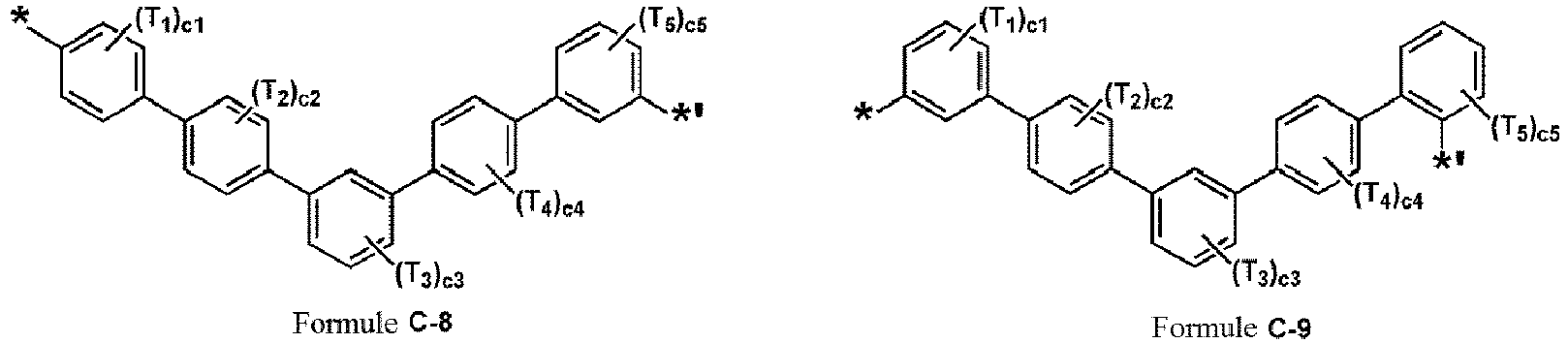
- *-(L 15 ) a15 -*' may be represented by one of Formulae A-1 to A-12, Formulae B-1 to B-20, Formulae C-1 to C-29, Formulae D-1 to D-25, and Formulae E-1 to E-4.
- embodiments of the present disclosure are not limited thereto.
- T 1 to T 6 may be each independently selected from hydrogen, deuterium, -F, - Cl, -Br, -I, a hydroxyl group, a cyano group, a nitro group, an amino group, an amidino group, a hydrazine group, a hydrazone group, a carboxylic acid group or a salt thereof, a sulfonic acid group or a salt thereof, a phosphoric acid group or a salt thereof, a C 1 -C 20 alkyl group, a C 1 -C 20 alkoxy group, a phenyl group, a naphthyl group, a fluorenyl group, a spiro-fluorenyl group, a phenalenyl group, a phenanthrenyl group, an anthrac
- R 1 to R 3 , and R 11 to R 14 may be each independently selected from a substituted or unsubstituted C 1 -C 60 alkyl group, a substituted or unsubstituted C 2 -C 60 alkenyl group, a substituted or unsubstituted C 2 -C 60 alkynyl group, a substituted or unsubstituted C 1 -C 60 alkoxy group, a substituted or unsubstituted C 3 -C 10 cycloalkyl group, a substituted or unsubstituted C 1 -C 10 heterocycloalkyl group, a substituted or unsubstituted C 3 -C 10 cycloalkenyl group, a substituted or unsubstituted C 1 -C 10 heterocycloalkenyl group, a substituted or unsubstituted C 6 -C 60 aryl group, a substituted or unsubstituted C
- R 1 to R 3 , and R 11 to R 14 may be each independently selected from a substituted or unsubstituted C 1 -C 20 alkyl group, a substituted or unsubstituted C 2 -C 20 alkenyl group, a substituted or unsubstituted C 2 -C 20 alkynyl group, a substituted or unsubstituted C 1 -C 20 alkoxy group, a substituted or unsubstituted C 3 -C 10 cycloalkyl group, a substituted or unsubstituted C 1 -C 10 heterocycloalkyl group, a substituted or unsubstituted C 3 -C 10 cycloalkenyl group, a substituted or unsubstituted C 1 -C 10 heterocycloalkenyl group, a substituted or unsubstituted C 6 -C 35 ( e.g .
- C 6 -C 32 aryl group, a substituted or unsubstituted C 6 -C 35 ( e.g. C 6 -C 32 ) aryloxy group, a substituted or unsubstituted C 6 -C 35 ( e.g.
- C 6 -C 32 arylthio group, a substituted or unsubstituted C 1 -C 20 heteroaryl group, a substituted or unsubstituted monovalent non-aromatic condensed polycyclic group, a substituted or unsubstituted monovalent non-aromatic condensed heteropolycyclic group, and - Si(Q 1 )(Q 2 )(Q 3 ), where Q 1 to Q 3 may be each independently selected from hydrogen, deuterium, -F, -Cl, -Br, -I, a hydroxyl group, a cyano group, a nitro group, an amino group, an amidino group, a hydrazine group, a hydrazone group, a carboxylic acid group or a salt thereof, a sulfonic acid group or a salt thereof, a phosphoric acid group or a salt thereof, a C 1 -C 20 alkyl group, a C 2 -C 20
- C 6 -C 32 aryl group, a C 1 -C 20 heteroaryl group, a monovalent non-aromatic condensed polycyclic group, a monovalent non-aromatic condensed heteropolycyclic group, a biphenyl group, and a terphenyl group, but embodiments of the present disclosure are not limited thereto.
- R 1 to R 3 , and R 11 to R 14 may be each independently selected from a substituted or unsubstituted C 6 -C 35 (e.g. C 6 -C 32 ) aryl group or a substituted or unsubstituted C 1 -C 20 heteroaryl group, but embodiments of the present disclosure are not limited thereto.
- a substituted or unsubstituted C 6 -C 35 e.g. C 6 -C 32
- R 11 to R 14 may be each independently selected from a substituted or unsubstituted C 1 -C 20 heteroaryl group, but embodiments of the present disclosure are not limited thereto.
- R 1 to R 3 , and R 11 to R 14 may be each independently selected from:
- R 1 to R 3 , and R 11 to R 14 may be each independently selected from:
- R 1 to R 3 , and R 11 to R 14 may be each independently selected from groups represented by Formulae 5-1 to 5-22.
- embodiments of the present disclosure are not limited thereto.
- Y 31 may be O, S, C(Z 33 )(Z 34 ), N(Z 35 ), or Si(Z 36 )(Z 37 );
- Z 31 to Z 37 may be each independently selected from hydrogen, deuterium, - F, -Cl, -Br, -I, a hydroxyl group, a cyano group, a nitro group, an amino group, an amidino group, a hydrazine group, a hydrazone group, a carboxylic acid group or a salt thereof, a sulfonic acid group or a salt thereof, a phosphoric acid group or a salt thereof, a C 1 -C 20 alkyl group, a C 1 -C 20 alkoxy group, a phenyl group, a pentalenyl group, an indenyl group, a naphthyl group, an azulenyl group, a heptalenyl group, an indacen
- b1 to b3, and b11 to b14 may be each independently an integer selected from 1 to 5.
- b1 (which indicates the number of R 1 s) is 2 or greater, at least two R 1 s may be the same as or different from each other.
- b1 to b3, and b11 to b14 may be each independently 1 or 2, and in some embodiments, may be 1. However, embodiments of the present disclosure are not limited thereto.
- the first compound may be represented by Formula 1 A.
- L 1 to L 3 may be each independently selected from groups represented by Formulae 3-1 to 3-24; a1 to a3 may be each independently 0, 1, or 2; and R 3 may be selected from groups represented by Formulae 5-1 to 5-22.
- embodiments of the present disclosure are not limited thereto.
- the first compound may be represented by Formula 1A-1.
- L 3 may be selected from groups represented by Formulae 3-1 to 3-24; a3 may be each independently 0, 1, or 2; and R 3 may be selected from groups represented by Formulae 5-1 to 5-22.
- embodiments of the present disclosure are not limited thereto.
- the first compound and the second compound may each independently not include compounds represented by the following formulae:
- R 1 to R 3 may each independently not be a substituted or unsubstituted carbazolyl group.
- R 12 and R 13 may each independently not be a phenyl group, a naphthyl group, or a phenyl group substituted with a methyl group.
- R 12 and R 13 may each independently not include (e.g., may each independently exclude) a phenyl group, a naphthyl group, and/or a phenyl group substituted with a methyl group.
- R 11 and R 13 may be each independently selected from:
- R 11 and R 14 may be each independently selected from:
- the hole transport region may include at least one selected from Compounds HT1 to HT20 and HT101 to HT125.
- embodiments of the present disclosure are not limited thereto.
- R 21 to R 24 may be each independently selected from:
- R 21 to R 24 may be each independently selected from:
- R 26 is a substituted or unsubstituted phenyl group.
- one to three of X 1 to X 5 may be nitrogen (N); and R 31 to R 35 may be each independently selected from:
- R 27 may be selected from groups represented by Formulae 3A-1 to 3A-63.
- embodiments of the present disclosure are not limited thereto.
- R 27 may be selected from groups represented by Formulae 3A-4, 3A-7, 3A-29 and 3A-35, but embodiments of the present disclosure are not limited thereto.
- R 24 , b24, and R 31 to R 35 may be defined the same as described hereinabove; * may be a binding site with the respective N in Formula 3; and R 25 and b25 may be defined the same as R 24 and b24, respectively, described above.
- R 24 and R 25 may be each independently selected from:
- the third compound may be selected from Compounds B-1 to B-4.
- embodiments of the present disclosure are not limited thereto.
- the hole transport region i) may include the first compound and may not include the second compound; ii) may include the second compound and may not include the first compound; or iii) may include both the first compound and the second compound.
- the electron control layer may include the third compound represented by Formula 3.
- the electron control layer and the emission layer may directly contact each other.
- the electron transport region may further include, in addition to the electron control layer, an electron transport layer and an electron injection layer that are disposed (e.g., positioned) between the electron control layer and the second electrode.
- an electron transport layer and an electron injection layer that are disposed (e.g., positioned) between the electron control layer and the second electrode.
- embodiments of the present disclosure are not limited thereto.
- the hole transport region of the organic light-emitting device may include at least one selected from the first compound represented by Formula 1 and the second compound represented by Formula 2, and the electron control layer in the electron transport region of the organic light-emitting device may include the third compound represented by Formula 3, so that the injection balance of holes and electrons in the emission layer may be achieved, and consequently the organic light-emitting device may have improved driving voltage, efficiency, and lifetime characteristics.
- the drawing is a schematic cross-sectional view of an organic light-emitting device 10 according to an embodiment of the present disclosure.
- the organic light-emitting device 10 may have a stack structure of a first electrode 110, a hole transport region 130, an emission layer (EML) 150, an electron transport region 170, and a second electrode 190 that are sequentially stacked upon one another in the stated order.
- the electron transport region 170 may include an electron control layer.
- the electron control layer may directly contact the EML 150.
- a substrate may be disposed (e.g., positioned) under the first electrode 110 or on the second electrode 190 in the drawing.
- the substrate may be a glass or transparent plastic substrate with good mechanical strength, thermal stability, transparency, surface smoothness, ease of handling, and/or water resistance.
- the first electrode 110 may be formed by depositing or sputtering a first electrode-forming material on the substrate.
- a material having a high work function may be used as the first electrode-forming material so as to facilitate hole injection.
- the first electrode 110 may be a reflective electrode, a semi-transmissive electrode, or a transmissive electrode.
- Transparent and conductive materials such as ITO, IZO, SnO 2 , and/or ZnO may be used to form the first electrode.
- the first electrode 110 as a semi-transmissive electrode or a reflective electrode may be formed of at least one material selected from magnesium (Mg), aluminium (Al), aluminium-lithium (Al-Li), calcium (Ca), magnesium-indium (Mg-In), and magnesium-silver (Mg-Ag).
- the first electrode 110 may have a single-layer structure or a multi-layer structure including a plurality of layers.
- the first electrode 110 may have a three-layered structure of ITO/Ag/ITO, but is not limited thereto.
- Holes injected from the first electrode 110 may move into the emission layer 150 through the hole transport region 130.
- the hole transport region 130 may have a single-layer structure or a multi-layer structure including at least two layers.
- the hole transport region 130 may include a single material or at least two different materials.
- the hole transport region 130 may have a stack structure of hole injection layer/hole transport layer, hole injection layer/hole transport layer/hole auxiliary layer, hole injection layer/hole transport layer/buffer layer/hole auxiliary layer, hole injection layer/hole auxiliary layer, hole injection layer/buffer layer/hole auxiliary layer, hole transport layer/hole auxiliary layer, or hole transport layer/buffer layer/hole auxiliary layer, wherein the layers forming each stack structure of the hole transport region 130 may be sequentially stacked on the first electrode 110 in the stated order.
- the hole transport region 130 may include only hole injection layer (HIL), or only hole transport layer (HTL).
- the HIL may be formed on the first electrode 110 by using any of a variety of suitable methods, for example, by using vacuum deposition, spin coating, casting, Langmuir-Blodgett (LB) deposition, inkjet printing, laser printing, laser induced thermal imaging (LITI), and/or the like.
- LB Langmuir-Blodgett
- LITI laser induced thermal imaging
- the deposition conditions may vary depending on the material that is used to form the HIL and the structure of the HIL.
- the deposition conditions may be selected from the following conditions: a deposition temperature of about 100°C to about 500°C, a degree of vacuum of about 10 -8 to about 10 -3 torr, and a deposition rate of about 0.01 to 100 ⁇ /sec (1 torr is 133.322 Pa; and 1 Angstrom is 0.1 nm).
- the coating conditions may vary depending on the material that is used to form the HIL and the structure of the HIL.
- the coating conditions may be selected from the following conditions: a coating rate of about 2,000 rpm to about 5,000 rpm and a heat treatment temperature of about 80 °C to about 200 °C.
- the HTL, the hole auxiliary layer, and the buffer layer may be formed in a similar manner as the HIL described above.
- the hole transport region 130 may include at least one compound selected from the first compound represented by Formula 1 and the second compound represented by Formula 2.
- the first compound of Formula 1 and the second compound of Formula 2 are the same as they are defined above.
- the hole transport region 130 may further include, in addition to the first and second compounds, at least one selected from m-MTDATA, TDATA, 2-TNATA, NPB, ⁇ -NPB, TPD, Spiro-TPD, Spiro-NPB, methylated-NPB, TAPC, HMTPD, 4,4',4"-tris(N-carbazolyl)triphenylamine (TCTA), polyaniline/dodecylbenzene sulfonic acid (Pani/DBSA), poly(3,4-ethylenedioxythiophene)/poly(4-styrenesulfonate)(PEDOT/PSS), polyaniline/camphor sulfonic acid (Pani/CSA), and polyaniline/poly(4-styrenesulfonate) (PANI/PSS).
- TCTA 4,4',4"-tris(N-carbazolyl)triphenylamine
- TCTA 4,4',4"-tris(N-
- the thickness of the hole transport region 130 may be from about 100 ⁇ to about 10000 ⁇ , for example, about 100 ⁇ to about 7000 ⁇ , about 100 ⁇ to about 5000 ⁇ or about 100 ⁇ to about 3000 ⁇ , and in some embodiments, from about 100 ⁇ to about 1000 ⁇ .
- the thickness of the HIL may be from about 100 ⁇ to about 10,000 ⁇ , for example, about 100 ⁇ to about 7000 ⁇ , about 100 ⁇ to about 5000 ⁇ or about 100 ⁇ to about 3000 ⁇ , and in some embodiments, from about 100 ⁇ to about 1,000 ⁇ (e.g.
- a thickness of the HTL may be from about 50 ⁇ to about 2,000 ⁇ , and in some embodiments, from about 100 ⁇ to about 1,500 ⁇ (e.g. about 100 ⁇ to about 1000 ⁇ , about 100 ⁇ to about 500 ⁇ or about 200 ⁇ to about 400 ⁇ , such as about 300 ⁇ ).
- the thicknesses of the hole transport region 130, the HIL, and the HTL are within any of these ranges, satisfactory hole transport characteristics may be obtained without a substantial increase in driving voltage.
- the hole transport region 130 may further include a charge-generating material to improve conductivity, in addition to the materials as described above.
- the charge-generating material may be homogeneously or unhomogeneously dispersed in the hole transport region.
- the charge-generating material may be, for example, a p-dopant.
- the p-dopant may be one selected from quinone derivatives, metal oxides, and compounds with a cyano group, but is not limited thereto.
- Non-limiting examples of the p-dopant include quinone derivatives such as tetracyanoquinonedimethane (TCNQ), Compound HT-D2, and/or the like; metal oxides such as tungsten oxide, molybdenum oxide, and/or the like; and Compound HT-D1.
- the hole transport region 130 may further include, in addition to the HIL and HTL described above, at least one selected from a buffer layer and an EBL (electron blocking layer) (herein, also referred to as " hole auxiliary layer").
- the buffer layer may compensate for an optical resonance distance of light according to a wavelength of the light emitted from the EML, and thus may improve light-emission efficiency.
- a material in the buffer layer may be any material used in the hole transport region.
- the EBL may block or reduce migration of electrons from the electron transport region into the EML.
- the hole transport region 130 may include a HIL and a HTL.
- the HIL may include at least one selected from m-MTDATA, TDATA, 2-TNATA, NPB, ⁇ -NPB, TPD, Spiro-TPD, Spiro-NPB, methylated NPB, TAPC, HMTPD, and TCTA
- the HTL may include at least one compound selected from the first compound and the second compound (for example, the first compound).
- embodiments of the present disclosure are not limited thereto.
- the HTL may directly contact the EML 150.
- embodiments of the present disclosure are not limited thereto.
- the EML 150 may be formed on the hole transport region 130 by using any of a variety of suitable methods, for example, by using vacuum deposition, spin coating, casting, Langmuir-Blodgett (LB) deposition, inkjet printing, laser printing, laser induced thermal imaging (LITI), and/or the like.
- LB Langmuir-Blodgett
- LITI laser induced thermal imaging
- the deposition and coating conditions for forming the EML 150 may be similar to the above-described deposition and coating conditions for forming the HIL, and accordingly will not be described again.
- the EML 150 may be patterned into a red emission layer, a green emission layer, and a blue emission layer to correspond to individual subpixels, respectively.
- the EML 150 may have a structure in which a red emission layer, a green emission layer and a blue emission layer are stacked upon one another, or a structure including a mixture of a red light-emitting material, a green light-emitting material, and a blue light-emitting material, and thus may emit white light.
- the EML 150 in the drawing may include a host and a dopant.
- the host may include a compound represented by Formula 301.
- Formula 301 Ar 301 -[(L 301 ) xb1 -R 301 ] xb2 .
- Ar 301 may be selected from:
- the host may include a compound represented by Formula 301A.
- L 301 , R 301 , xb1, and xb2 may be defined the same as they are described herein.
- Examples of the compound of Formula 301 may include at least one of Compounds H1 to H42, where "D" refers to deuterium. However, embodiments of the present disclosure are not limited thereto.
- the host may include at least one of Compounds H43 to H49.
- embodiments of the present disclosure are not limited thereto.
- the host may include one of the following compounds.
- embodiments of the present disclosure are not limited thereto.
- the dopant in the emission layer may include a phosphorescent dopant or a fluorescent dopant.
- the phosphorescent dopant may include an organometallic complex represented by Formula 401.
- M may be selected from iridium (Ir), platinum (Pt), osmium (Os), titanium (Ti), zirconium (Zr), hafnium (Hf), europium (Eu), terbium (Tb), and thulium (Tm);
- X 401 to X 404 may be each independently a nitrogen (N) or a carbon (C);
- rings A 401 and A 402 may be each independently selected from a substituted or unsubstituted benzene, a substituted or unsubstituted naphthalene, a substituted or unsubstituted fluorene, a substituted or unsubstituted spiro-fluorene, a substituted or unsubstituted indene, a substituted or unsubstituted pyrrole, a substituted or unsubstituted thiophene, a substituted or unsubstituted furan, a substituted or
- L 401 may be a monovalent, divalent, or trivalent organic ligand.
- L 401 in Formula 401 may be selected from a halogen ligand (for example, Cl or F), a diketone ligand (for example, acetylacetonate, 1,3-diphenyl-1,3-propanedionate, 2,2,6,6-tetramethyl-3,5-heptanedionate, and/or hexafluoroacetonate), a carboxylic acid ligand (for example, picolinate, dimethyl-3-pyrazolecarboxylate, and/or benzoate), a carbon monoxide ligand, an isonitrile ligand, a cyano ligand, and a phosphorous ligand (for example, phosphine and/or phosphite).
- a halogen ligand for example, Cl or F
- a diketone ligand for example, acetylacet
- a 401 in Formula 401 has at least two substituent groups
- the at least two substituent groups of A 401 may be linked to each other to form a saturated or unsaturated ring.
- a 402 in Formula 401 has at least two substituents groups
- the at least two substituent groups of A 402 may be linked to each other to form a saturated or unsaturated ring.
- a plurality of ligands in Formula 401 may be identical to or different from each other.
- a linking group e.g., a C 1 -C 5 alkylene group, -N(R')- (where R' is a C 1 -C 10 alkyl group or a C 6 -C 20 aryl group
- the phosphorescent dopant may include at least one of Compounds PD1 to PD76, but is not limited thereto.
- “Ph” refers to a phenyl group
- “Me” refers to a methyl group
- “Bu t” refers to a tert-butyl group.
- the fluorescent dopant may include a compound represented by Formula 501.
- Ar 501 may be selected from:
- the fluorescent host may include at least one of Compounds FD1 to FD9.
- the amount of the dopant in the EML 150 may be from about 0.01 parts to about 15 parts by weight based on 100 parts by weight of the host, but is not limited to this range.
- the thickness of the EML 150 may be from about 100 ⁇ to about 1000 ⁇ , for example, about 100 ⁇ to about 800 ⁇ , about 150 ⁇ to about 800 ⁇ , about 150 ⁇ to about 700 ⁇ or about 150 ⁇ to about 650 ⁇ , and in some embodiments, may be from about 200 ⁇ to about 600 ⁇ ( e.g . about 200 ⁇ to about 400 ⁇ , such as about 300 ⁇ ).
- the organic light-emitting device may have good light emitting ability without a substantial increase in driving voltage.
- the electron transport region 170 may be disposed (e.g., positioned) on the EML 150.
- the electron transport region 170 may include an electron control layer.
- the electron control layer may include the third compound represented by Formula 3.
- the electron control layer may directly contact the EML 150.
- the thickness of the electron control layer may be from about 10 ⁇ to about 5000 ⁇ .
- the thickness of the electron control layer may be from about 10 ⁇ to about 3000 ⁇ , about 10 ⁇ to about 1000 ⁇ , about 10 ⁇ to about 500 ⁇ , about 50 ⁇ to about 500 ⁇ , about 50 ⁇ to about 200 ⁇ , or about 50 ⁇ to about 150 ⁇ (about 100 ⁇ ).
- the organic light-emitting device may have satisfactory charge injection balance characteristics without a substantial increase in driving voltage.
- the electron transport region 170 may further include at least one selected from an electron transport layer (ETL) and an electron injection layer (EIL), in addition to the electron control layer.
- ETL electron transport layer
- EIL electron injection layer
- the electron transport region 170 may include an ETL and an EIL that may be disposed between the electron control layer and the second electrode 190.
- ETL an ETL
- EIL an EIL that may be disposed between the electron control layer and the second electrode 190.
- embodiments of the present disclosure are not limited thereto.
- the electron control layer, the ETL, and the EIL may each be formed in a similar manner as the HIL described above.
- the ETL may include at least one selected from a compound represented by Formula 601 and a compound represented by Formula 602.
- Ar 601 may be selected from:
- X 611 may be N or C-(L 611 ) xe611 -R 611 ;
- X 612 may be N or C-(L 612 ) xe612 -R 612 ;
- X 613 may be N or C-(L 613 ) xe613 -R 613 ; and at least one of X 611 to X 613 may be N;
- L 611 to L 616 may be each independently the same as L 1 described herein;
- R 611 to R 616 may be each independently selected from:
- the compound of Formula 601 and the compound of Formula 602 may be each independently selected from Compounds ET1 to ET15.
- the ETL may include at least one selected from BCP (2,9-dimethyl-4,7-diphenyl-1,10-phenanthroline), Bphen (4,7-diphenyl-1,10-phenanthroline), Alq 3 , Balq, TAZ (3-(biphenyl-4-yl)-5-(4-tert-butylphenyl)-4-phenyl-4H-1,2,4-triazole), and NTAZ.
- the thickness of the ETL may be from about 100 ⁇ to about 1,000 ⁇ , for example, about 100 ⁇ to about 700 ⁇ , about 100 ⁇ to about 600 ⁇ or about 150 ⁇ to about 600 ⁇ (e.g. about 200 ⁇ to about 400 ⁇ , such as about 300 ⁇ ) and in some embodiments, from about 150 ⁇ to about 500 ⁇ .
- the organic light-emitting device may have satisfactory electron transporting ability without a substantial increase in driving voltage.
- the ETL may further include a metal-containing material, in addition to the above-described materials.
- the metal-containing material may include a lithium (Li) complex.
- Li complex include compound ET-D1 (lithium quinolate (LiQ)), and compound ET-D2, illustrated below.
- the electron transport region 170 may include an EIL that may facilitate the injection of electrons from the second electrode 190.
- the EIL may be formed on the ETL by using any of a variety of suitable methods, for example, by using vacuum deposition, spin coating, casting, Langmuir-Blodgett (LB) deposition, inkjet printing, laser printing, laser induced thermal imaging (LITI), and/or the like.
- LB Langmuir-Blodgett
- LITI laser induced thermal imaging
- the deposition and coating conditions for forming the EIL may be similar to the above-described deposition and coating conditions for forming the HIL, and accordingly will not be described again.
- the EIL may include at least one selected from LiF, NaCl, CsF, Li 2 O, BaO, and LiQ.
- the thickness of the EIL may be from about 1 ⁇ to about 100 ⁇ , for example, about 1 ⁇ to about 95 ⁇ or about 2 ⁇ to about 95 ⁇ , and in some embodiments, from about 3 ⁇ to about 90 ⁇ (e.g. about 3 ⁇ to about 50 ⁇ , about 3 ⁇ to about 20 ⁇ , about 5 ⁇ to about 20 ⁇ or about 5 ⁇ to about 15 ⁇ , such as about 10 ⁇ ).
- the EIL may have satisfactory electron injection ability without a substantial increase in driving voltage.
- the second electrode 190 may be disposed (e.g., positioned) on the electron transport region 170 as described above.
- the second electrode 190 may be a cathode (as an electron injecting electrode).
- a material for forming the second electrode 190 may be a metal, an alloy, an electrically conductive compound, which have a low-work function, or a mixture thereof.
- Non-limiting examples of the material for forming the second electrode 190 include lithium (Li), magnesium (Mg), aluminium (Al), aluminium-lithium (Al-Li), calcium (Ca), magnesium-indium (Mg-In), and magnesium-silver (Mg-Ag).
- the material for forming the second electrode 190 may be ITO and/or IZO.
- the second electrode 190 may be a semi-transmissive electrode or a transmissive electrode.
- a C 1 -C 60 alkyl group may refer to a linear or branched aliphatic hydrocarbon monovalent group having 1 to 60 carbon atoms.
- Non-limiting examples of the C 1 -C 60 alkyl group include a methyl group, an ethyl group, a propyl group, an isobutyl group, a sec-butyl group, a tert-butyl group, a pentyl group, an isoamyl group, and a hexyl group.
- a C 1 -C 60 alkylene group may refer to a divalent group having the same structure as the C 1 -C 60 alkyl group. Corresponding definitions apply to other ranges given for the number of carbon atoms in an alkyl/alkylene group.
- a C 1 -C 60 alkoxy group may refer to a monovalent group represented by -OA 101 (where A 101 is the C 1 -C 60 alkyl group as described above).
- a 101 is the C 1 -C 60 alkyl group as described above.
- Non-limiting examples of the C 1 -C 60 alkoxy group are a methoxy group, an ethoxy group, and an isopropoxy group. Corresponding definitions apply to other ranges given for the number of carbon atoms in an alkoxy group.
- a C 2 -C 60 alkenyl group may refer to a hydrocarbon group including at least one carbon double bond at one or more positions along a hydrocarbon chain of the C 2 -C 60 alkyl group (e.g., in the middle or at either terminal end of the C 2 -C 60 alkyl group).
- Non-limiting examples of the C 2 -C 60 alkenyl group are an ethenyl group, a propenyl group, and a butenyl group.
- a C 2 -C 60 alkylene group may refer to a divalent group having the same structure as the C 2 -C 60 alkenyl group. Corresponding definitions apply to other ranges given for the number of carbon atoms in an alkenyl group.
- a C 2 -C 60 alkynyl group may refer to a hydrocarbon group including at least one carbon triple bond at one or more positions along a hydrocarbon chain of the C 2 -C 60 alkyl group (e.g., in the middle or at either terminal end of the C 2 -C 60 alkyl group).
- Non-limiting examples of the C 2 -C 60 alkynyl group are an ethynyl group and a propynyl group.
- a C 2 -C 60 alkynylene group used herein may refer to a divalent group having the same structure as the C 2 -C 60 alkynyl group. Corresponding definitions apply to other ranges given for the number of carbon atoms in an alkynyl group.
- a C 3 -C 10 cycloalkyl group may refer to a monovalent, monocyclic hydrocarbon group having 3 to 10 carbon atoms.
- Non-limiting examples of the C 3 -C 10 cycloalkyl group are a cyclopropyl group, a cyclobutyl group, a cyclopentyl group, a cyclohexyl group, and a cycloheptyl group.
- a C 3 -C 10 cycloalkylene group may refer to a divalent group having the same structure as the C 3 -C 10 cycloalkyl group.
- a C 1 -C 10 heterocycloalkyl group may refer to a monovalent monocyclic group having 1 to 10 carbon atoms in which at least one hetero atom selected from N, O, P, and S is included as a ring-forming atom.
- Non-limiting examples of the C 1 -C 10 heterocycloalkyl group are a tetrahydrofuranyl group and a tetrahydrothiophenyl group.
- a C 1 -C 10 heterocycloalkylene group may refer to a divalent group having the same structure as the C 1 -C 10 heterocycloalkyl group.
- a C 3 -C 10 cycloalkenyl group may refer to a monovalent monocyclic group having 3 to 10 carbon atoms that includes at least one double bond in the ring but does not have aromaticity.
- Non-limiting examples of the C 3 -C 10 cycloalkenyl group are a cyclopentenyl group, a cyclohexenyl group, and a cycloheptenyl group.
- a C 3 -C 10 cycloalkenylene group may refer to a divalent group having the same structure as the C 3 -C 10 cycloalkenyl group.
- a C 1 -C 10 heterocycloalkenyl group used herein may refer to a monovalent monocyclic group having 1 to 10 carbon atoms that includes at least one double bond in the ring and in which at least one hetero atom selected from N, O, Si, P, and S is included as a ring-forming atom.
- Non-limiting examples of the C 1 -C 10 heterocycloalkenyl group are a 2,3-hydrofuranyl group and a 2,3-hydrothiophenyl group.
- a C 1 -C 10 heterocycloalkenylene group used herein may refer to a divalent group having the same structure as the C 1 -C 10 heterocycloalkenyl group.
- a C 6 -C 60 aryl group may refer to a monovalent, aromatic carbocyclic group having 6 to 60 carbon atoms
- a C 6 -C 60 arylene group may refer to a divalent, aromatic carbocyclic group having 6 to 60 carbon atoms.
- Non-limiting examples of the C 6 -C 60 aryl group are a phenyl group, a naphthyl group, an anthracenyl group, a phenanthrenyl group, a pyrenyl group, and a chrysenyl group.
- the respective rings may be fused to each other.
- Corresponding definitions apply to other ranges given for the number of carbon atoms in an aryl/arylene group.
- a C 1 -C 60 heteroaryl group may refer to a monovalent, aromatic carbocyclic group having 1 to 60 carbon atoms in which at least one hetero atom selected from N, O, Si, P, and S is included as a ring-forming atom.
- a C 1 -C 60 heteroarylene group may refer to a divalent, aromatic carbocyclic group having 1 to 60 carbon atoms in which at least one hetero atom selected from N, O, P, and S is included as a ring-forming atom.
- Non-limiting examples of the C 1 -C 60 heteroaryl group are a pyridinyl group, a pyrimidinyl group, a pyrazinyl group, a pyridazinyl group, a triazinyl group, a quinolinyl group, and an isoquinolinyl group.
- the C 1 -C 60 heteroaryl and/or the C 1 -C 60 heteroarylene include at least two rings, the respective rings may be fused to each other.
- Corresponding definitions apply to other ranges given for the number of carbon atoms in a heteroaryl/ heteroarylene group.
- a C 6 -C 60 aryloxy group may refer to a monovalent group represented by -OA 102 (where A 102 is the C 6 -C 60 aryl group as described above), and a C 6 -C 60 arylthio group may refer to a monovalent group represented by -SA 103 (where A 103 is the C 6 -C 60 aryl group as described above).
- -OA 102 where A 102 is the C 6 -C 60 aryl group as described above
- a C 6 -C 60 arylthio group may refer to a monovalent group represented by -SA 103 (where A 103 is the C 6 -C 60 aryl group as described above).
- Corresponding definitions apply to other ranges given for the number of carbon atoms in aryloxy and arylthio groups.
- a monovalent non-aromatic condensed polycyclic group may refer to a monovalent group having at least two rings condensed (e.g., fused) to each other, in which only carbon atoms (for example, 8 to 60 carbon atoms) are exclusively included as ring-forming atoms and the entire molecule does not have aromaticity.
- a non-limiting example of the monovalent non-aromatic condensed polycyclic group is a fluorenyl group.
- a divalent non-aromatic condensed polycyclic group may refer to a divalent group having the same structure as the monovalent non-aromatic condensed polycyclic group.
- a monovalent non-aromatic condensed heteropolycyclic group may refer to a monovalent group having at least two rings condensed (e.g., fused) to each other, in which carbon atoms (for example, 1 to 60 carbon atoms) and at least one hetero atom selected from N, O, Si, P, and S are included as ring-forming atoms and the entire molecule does not have aromaticity.
- a non-limiting example of the monovalent non-aromatic condensed heteropolycyclic group is a carbazolyl group.
- a divalent non-aromatic condensed heteropolycyclic group may refer to a divalent group having the same structure as the monovalent non-aromatic condensed heteropolycyclic group.
- Ph used herein refers to phenyl
- Me used herein refers to methyl
- Et used herein refers to ethyl
- ter-Bu or “Bu t” used herein refers to tert-butyl.
- biphenyl group refers to a monovalent group in which two benzene moieties are linked (e.g., coupled) to each other via a single bond
- terphenyl group refers to a monovalent group in which three benzene moieties are linked (e.g., coupled) to each other via a single bond.
- a 15 ⁇ /cm 2 ITO glass substrate (having a thickness of 1200 ⁇ , available from Corning Inc.) was cut to a size of 50 mm x 50 mm x 0.7 mm and then sonicated in isopropyl alcohol and deionized water each for five minutes, and then cleaned by irradiation of ultraviolet rays for 30 minutes and exposure to ozone.
- the resulting glass substrate with an ITO anode (as the first electrode) was mounted into a vacuum deposition device.
- HIL hole injection layer
- HTL hole transport layer
- ADN as a host
- Compound FD9 as a dopant
- DS-ETA-1004 (Compound B-1) was deposited on the EML to form an electron control layer having a thickness of about 100 ⁇ , and then Compound ET1 and LiQ were co-deposited on the electron control layer to form an electron transport layer (ETL) having a thickness of about 300 ⁇ . LiF was then deposited on the ETL to form an electron injection layer (EIL) having a thickness of about 10 ⁇ , and then aluminium (Al) was vacuum-deposited on the EIL to form a second electrode (as the cathode) having a thickness of about 1000 ⁇ , thereby completing the manufacture of an organic light-emitting device.
- ETL electron transport layer
- Al aluminium
- An organic light-emitting device was manufactured in the same (or substantially the same) manner as in Example 1, except that the electron control layer was not formed.
- An organic light-emitting device was manufactured in the same (or substantially the same) manner as in Example 1, except that BCP, instead of DS-ETA-1004 (Compound B-1), was used to form the electron control layer.
- Driving voltages, efficiencies, and lifetimes (T 95 ) of the organic light-emitting devices of Example 1 and Comparative Examples 1 and 2 were evaluated using a Keithley Source-Measure Unit (SMU 236) and a PR650 (Spectroscan) Source Measurement Unit (available from Photo Research, Inc.). The results are shown in Table 1.
- the lifetime (T 95 ) was measured as the time taken until a measured initial luminance (assumed as 100%) of the organic light-emitting device is reduced to 95%.
- the efficiencies and lifetimes of the organic light-emitting devices of Example 1 and Comparative Example 2 are represented as a relative ratio with respect to those of the organic light-emitting device of Comparative Example 1.
- the organic light-emitting device of Example 1 was found to have a low driving voltage, a high efficiency, and a long lifespan, when compared to the organic light-emitting devices of Comparative Examples 1 and 2.
- an organic light-emitting device including a first compound of Formula 1 and/or a second compound of Formula 2, and a third compound of Formula 3 may have low driving voltage, high efficiency, and long lifespan.
- any numerical range recited herein is intended to include all subranges of the same numerical precision subsumed within the recited range.
- a range of "1.0 to 10.0" is intended to include all subranges between (and including) the recited minimum value of 1.0 and the recited maximum value of 10.0, that is, having a minimum value equal to or greater than 1.0 and a maximum value equal to or less than 10.0, such as, for example, 2.4 to 7.6.
- Any maximum numerical limitation recited herein is intended to include all lower numerical limitations subsumed therein and any minimum numerical limitation recited in this specification is intended to include all higher numerical limitations subsumed therein.
Landscapes
- Chemical & Material Sciences (AREA)
- Engineering & Computer Science (AREA)
- Materials Engineering (AREA)
- Physics & Mathematics (AREA)
- Spectroscopy & Molecular Physics (AREA)
- Optics & Photonics (AREA)
- Organic Chemistry (AREA)
- Electroluminescent Light Sources (AREA)
- Indole Compounds (AREA)
Claims (15)
- Dispositif électroluminescent organique, comprenant:une première électrode;une deuxième électrode face à la première électrode;une couche d'émission entre la première électrode et la deuxième électrode;une région de transport de trous entre la première électrode et la couche d'émission; etune région de transport d'électrons entre la couche d'émission et la deuxième électrode, la région de transport d'électrons comprenant une couche de contrôle d'électrons,dans lequel la région de transport de trous comprend au moins un composé sélectionné parmi un premier composé représenté par la Formule 1 et un deuxième composé représenté par la Formule 2, et la couche de contrôle d'électrons comprend un troisième composé représenté par la Formule 3:

 L1 à L3, et L11 à L15 sont sélectionnés chacun indépendamment parmi un groupe cycloalkylène C3-C10 substitué ou non substitué, un groupe hétérocycloalkylène C1-C10 substitué ou non substitué, un groupe cycloalcénylène C3-C10 substitué ou non substitué, un groupe hétérocycloalcénylène C1-C10 substitué ou non substitué, un groupe arylène C6-C60 substitué ou non substitué, un groupe hétéroarylène C1-C60 substitué ou non substitué, un groupe polycyclique condensé non aromatique divalent substitué ou non substitué, et un groupe hétéropolycyclique condensé non aromatique divalent substitué ou non substitué;a1 à a3, et a11 à a14 sont chacun indépendamment un nombre entier sélectionné parmi 0 à 3;a15 est un nombre entier sélectionné parmi 1 à 10;R1 à R3, et R11 à R14 sont sélectionnés chacun indépendamment parmi un groupe alkyle C1-C60 substitué ou non substitué, un groupe alcényle C2-C60 substitué ou non substitué, un groupe alcynyle C2-C60 substitué ou non substitué, un groupe alcoxy C1-C60 substitué ou non substitué, un groupe cycloalkyle C3-C10 substitué ou non substitué, un groupe hétérocycloalkyle C1-C10 substitué ou non substitué, un groupe cycloalcényle C3-C10 substitué ou non substitué, un groupe hétérocycloalcényle C1-C10 substitué ou non substitué, un groupe aryle C6-C60 substitué ou non substitué, un groupe aryloxy C6-C60 substitué ou non substitué, un groupe arylthio C6-C60 substitué ou non substitué, un groupe hétéroaryle C1-C60 substitué ou non substitué, un groupe polycyclique condensé non aromatique monovalent substitué ou non substitué, et un groupe hétéropolycyclique condensé non aromatique monovalent substitué ou non substitué, et -Si(Q1)(Q2)(Q3);b1 à b3, et b11 à b14 sont chacun indépendamment un nombre entier sélectionné parmi 1 à 5;R21 à R24 sont sélectionnés chacun indépendamment parmi:hydrogène, deutérium, -F, -Cl, -Br, -I, un groupe hydroxyle, un groupe cyano, un groupe nitro, un groupe amino, un groupe amidino, un groupe hydrazine, un groupe hydrazone, un groupe d'acide carboxylique ou un sel de celui-ci, un groupe d'acide sulfonique ou un sel de celui-ci, un groupe d'acide phosphorique ou un sel de celui-ci, un groupe alkyle C1-C60, et un groupe alcoxy C1-C60,un groupe alkyle C1-C60, et un groupe alcoxy C1-C60, substitués chacun par au moins un sélectionné parmi deutérium, -F, -Cl, -Br, -I, un groupe hydroxyle, un groupe cyano, un groupe nitro, un groupe amino, un groupe amidino, un groupe hydrazine, un groupe hydrazone, un groupe d'acide carboxylique ou un sel de celui-ci, un groupe d'acide sulfonique ou un sel de celui-ci, et un groupe d'acide phosphorique ou un sel de celui-ci, et-Si(Q41)(Q42)(Q43);b21 à b24 sont chacun indépendamment un nombre entier sélectionné parmi 0 à 4;R26 est sélectionné parmi:un groupe alkyle C1-C12 et un groupe alcoxy C1-C12,un groupe alkyle C1-C12 et un groupe alcoxy C1-C12, substitués chacun par au moins un sélectionné parmi deutérium, -F, -Cl, -Br, -I, un groupe hydroxyle, un groupe cyano, un groupe nitro, un groupe amino, un groupe amidino, un groupe hydrazine, un groupe hydrazone, un groupe d'acide carboxylique ou un sel de celui-ci, un groupe d'acide sulfonique ou un sel de celui-ci, et un groupe d'acide phosphorique ou un sel de celui-ci,un groupe cycloalkyle C3-C10, un groupe hétérocycloalkyle C1-C10, un groupe cycloalcényle C3-C10, un groupe hétérocycloalcényle C1-C10, un groupe aryle C6-C10, et un groupe aryloxy C6-C12,un groupe cycloalkyle C3-C10, un groupe hétérocycloalkyle C1-C10, un groupe cycloalcényle C3-C10, un groupe hétérocycloalcényle C1-C10, un groupe aryle C6-C10, et un groupe aryloxy C6-C12, substitués chacun par au moins un sélectionné parmi deutérium, -F, -Cl, -Br, -I, un groupe hydroxyle, un groupe cyano, un groupe nitro, un groupe amino, un groupe amidino, un groupe hydrazine, un groupe hydrazone, un groupe d'acide carboxylique ou un sel de celui-ci, un groupe d'acide sulfonique ou un sel de celui-ci, un groupe d'acide phosphorique ou un sel de celui-ci, un groupe alkyle C1-C60, un groupe alcoxy C1-C60, un groupe phényle, et un groupe naphtyle, et-Si(Q51)(Q52)(Q53), -N(Q54)(Q55), -B(Q56)(Q57), et -P(=O)(Q58)(Q59),R27 est un groupe représenté par la Formule 3A, où * dans la Formule 3A est un site de liaison avec un azote respectif dans la Formule 3;X1 est N ou C(R31); X2 est N ou C(R32); X3 est N ou C(R33); X4 est N ou C(R34); et X5 est N ou C(R35), où au moins un sélectionné parmi X1 à X5 est N; et R31 à R35 sont sélectionnés chacun indépendamment parmi:hydrogène, deutérium, -F, -Cl, -Br, -I, un groupe hydroxyle, un groupe cyano, un groupe nitro, un groupe amino, un groupe amidino, un groupe hydrazine, un groupe hydrazone, un groupe d'acide carboxylique ou un sel de celui-ci, un groupe d'acide sulfonique ou un sel de celui-ci, un groupe d'acide phosphorique ou un sel de celui-ci, un groupe alkyle C1-C60, et un groupe alcoxy C1-C60,un groupe alkyle C1-C60, un groupe alcoxy C1-C60, substitués chacun par au moins un sélectionné parmi deutérium, -F, -Cl, -Br, -I, un groupe hydroxyle, un groupe cyano, un groupe nitro, un groupe amino, un groupe amidino, un groupe hydrazine, un groupe hydrazone, un groupe d'acide carboxylique ou un sel de celui-ci, un groupe d'acide sulfonique ou un sel de celui-ci, et un groupe d'acide phosphorique ou un sel de celui-ci,un groupe cycloalkyle C3-C10, un groupe hétérocycloalkyle C1-C10, un groupe cycloalcényle C3-C10, un groupe hétérocycloalcényle C1-C10, un groupe aryle C6-C10 et un groupe aryloxy C6-C12,un groupe cycloalkyle C3-C10, un groupe hétérocycloalkyle C1-C10, un groupe cycloalcényle C3-C10, un groupe hétérocycloalcényle C1-C10, un groupe aryle C6-C10 et un groupe aryloxy C6-C12, substitués chacun par au moins un sélectionné parmi deutérium, - F, -Cl, -Br, -I, un groupe hydroxyle, un groupe cyano, un groupe nitro, un groupe amino, un groupe amidino, un groupe hydrazine, un groupe hydrazone, un groupe d'acide carboxylique ou un sel de celui-ci, un groupe d'acide sulfonique ou un sel de celui-ci, un groupe d'acide phosphorique ou un sel de celui-ci, un groupe alkyle C1-C60, un groupe alcoxy C1-C60, un groupe cycloalkyle C3-C10, un groupe hétérocycloalkyle C1-C10, un groupe cycloalcényle C3-C10, un groupe hétérocycloalcényle C1-C10, un groupe aryle C6-C10 et un groupe aryloxy C6-C12, et-Si(Q61)(Q62)(Q63), -N(Q64)(Q65), -B(Q66)(Q67), et -P(=O)(Q68)(Q69); etn est 2;dans lequel le premier composé et le deuxième composé chacun indépendamment ne comprennent pas de composés représentés par les formules suivantes:


 au moins un substituant du groupe cycloalkylène C3-C10 substitué, du groupe hétérocycloalkylène C1-C10 substitué, du groupe cycloalcénylène C3-C10 substitué, du groupe hétérocycloalcénylène C1-C10 substitué, du groupe arylène C6-C60 substitué, du groupe hétéroarylène C1-C60 substitué, du groupe polycyclique condensé non aromatique divalent substitué, du groupe hétéropolycyclique condensé non aromatique divalent substitué, du groupe alkyle C1-C60 substitué, du groupe alcényle C2-C60 substitué, du groupe alcynyle C2-C60 substitué, du groupe alcoxy C1-C60 substitué, du groupe cycloalkyle C3-C10 substitué, du groupe hétérocycloalkyle C1-C10 substitué, du groupe cycloalcényle C3-C10 substitué, du groupe hétérocycloalcényle C1-C10 substitué, du groupe aryle C6-C60 substitué, du groupe aryloxy C6-C60 substitué, du groupe arylthio C6-C60 substitué, du groupe hétéroaryle C1-C60 substitué, du groupe polycyclique condensé non aromatique monovalent substitué, et du groupe hétéropolycyclique condensé non aromatique monovalent substitué est sélectionné parmi:deutérium, -F, -Cl, -Br, -I, un groupe hydroxyle, un groupe cyano, un groupe nitro, un groupe amino, un groupe amidino, un groupe hydrazine, un groupe hydrazone, un groupe d'acide carboxylique ou un sel de celui-ci, un groupe d'acide sulfonique ou un sel de celui-ci, un groupe d'acide phosphorique ou un sel de celui-ci, un groupe alkyle C1-C60, un groupe alcényle C2-C60, un groupe alcynyle C2-C60, et un groupe alcoxy C1-C60,un groupe alkyle C1-C60, un groupe alcényle C2-C60, un groupe alcynyle C2-C60, un groupe alcoxy C1-C60, substitués chacun par au moins un sélectionné parmi deutérium, -F, -Cl, -Br, -I, un groupe hydroxyle, un groupe cyano, un groupe nitro, un groupe amino, un groupe amidino, un groupe hydrazine, un groupe hydrazone, un groupe d'acide carboxylique ou un sel de celui-ci, un groupe d'acide sulfonique ou un sel de celui-ci, un groupe d'acide phosphorique ou un sel de celui-ci, un groupe cycloalkyle C3-C10, un groupe hétérocycloalkyle C1-C10, un groupe cycloalcényle C3-C10, un groupe hétérocycloalcényle C1-C10, un groupe aryle C6-C60, un groupe aryloxy C6-C60, un groupe arylthio C6-C10, un groupe hétéroaryle C1-C60, un groupe polycyclique condensé non aromatique monovalent, un groupe hétéropolycyclique condensé non aromatique monovalent, -Si(Q11)(Q12)(Q13), -N(Q14)(Q15), et -B(Q16)(Q17),un groupe cycloalkyle C3-C10, un groupe hétérocycloalkyle C1-C10, un groupe cycloalcényle C3-C10, un groupe hétérocycloalcényle C1-C10, un groupe aryle C6-C60, un groupe aryloxy C6-C60, un groupe arylthio C6-C60, un groupe hétéroaryle C1-C60, un groupe polycyclique condensé non aromatique monovalent, un groupe hétéropolycyclique condensé non aromatique monovalent, un groupe biphényle et un groupe terphényle,un groupe cycloalkyle C3-C10, un groupe hétérocycloalkyle C1-C10, un groupe cycloalcényle C3-C10, un groupe hétérocycloalcényle C1-C10, un groupe aryle C6-C60, un groupe aryloxy C6-C60, un groupe arylthio C6-C60, un groupe hétéroaryle C1-C60, un groupe polycyclique condensé non aromatique monovalent, un groupe hétéropolycyclique condensé non aromatique monovalent, un groupe biphényle et un groupe terphényle, substitués chacun par au moins un sélectionné parmi deutérium, -F, -Cl, -Br, -I, un groupe hydroxyle, un groupe cyano, un groupe nitro, un groupe amino, un groupe amidino, un groupe hydrazine, un groupe hydrazone, un groupe d'acide carboxylique ou un sel de celui-ci, un groupe d'acide sulfonique ou un sel de celui-ci, un groupe d'acide phosphorique ou un sel de celui-ci, un groupe alkyle C1-C60, un groupe alcényle C2-C60, un groupe alcynyle C2-C60, un groupe alcoxy C1-C60, un groupe cycloalkyle C3-C10, un groupe hétérocycloalkyle C1-C10, un groupe cycloalcényle C3-C10, un groupe hétérocycloalcényle C1-C10, un groupe aryle C6-C60, un groupe aryloxy C6-C60, un groupe arylthio C6-C60, un groupe hétéroaryle C1-C60, un groupe polycyclique condensé non aromatique monovalent, un groupe hétéropolycyclique condensé non aromatique monovalent, -Si(Q21)(Q22)(Q23), -N(Q24)(Q25), et -B(Q26)(Q27), et-Si(Q31)(Q32)(Q33), -N(Q34)(Q35), et -B(Q36)(Q37),où Q1 à Q3, Q11 à Q17, Q21 à Q27, Q31 à Q37, Q41 à Q43, Q51 à Q59 et Q61 à Q69 sont sélectionnés chacun indépendamment parmi hydrogène, deutérium, -F, -Cl, -Br, -I, un groupe hydroxyle, un groupe cyano, un groupe nitro, un groupe amino, un groupe amidino, un groupe hydrazine, un groupe hydrazone, un groupe d'acide carboxylique ou un sel de celui-ci, un groupe d'acide sulfonique ou un sel de celui-ci, un groupe d'acide phosphorique ou un sel de celui-ci, un groupe alkyle C1-C60, un groupe alcényle C2-C60, un groupe alcynyle C2-C60, un groupe alcoxy C1-C60, un groupe cycloalkyle C3-C10, un groupe hétérocycloalkyle C1-C10, un groupe cycloalcényle C3-C10, un groupe hétérocycloalcényle C1-C10, un groupe aryle C6-C60, un groupe hétéroaryle C1-C60, un groupe polycyclique condensé non aromatique monovalent, un groupe hétéropolycyclique condensé non aromatique monovalent, un groupe biphényle et un groupe terphényle.
 - Dispositif électroluminescent organique selon la revendication 1, dans lequel L1 à L3 et L11 à L15 sont sélectionnés indépendamment chacun parmi:un groupe phénylène, un groupe pentalénylène, un groupe indénylène, un groupe naphtylène, un groupe azulénylène, un groupe heptalénylène, un groupe indacénylène, un groupe acénaphtylène, un groupe fluorénylène, un groupe spiro-fluorénylène, un groupe benzofluorénylène, un groupe dibenzofluorénylène, un groupe phénalénylène, un groupe phénanthrénylène, un groupe anthracénylène, un groupe fluoranthénylène, un groupe triphénylénylène, un groupe pyrénylène, un groupe chrysénylène, un groupe naphtacénylène, un groupe picénylène, un groupe perylénylène, un groupe pentaphénylène, un groupe hexacénylène, un groupe pentacénylène, un groupe rubicénylène, un groupe coronénylène, un groupe ovalénylène, un groupe pyrrolylène, un groupe thiophénylène, un groupe furanylène, un groupe silolylène, un groupe indolylène, un groupe isoindolylène, un groupe benzofuranlylène, un groupe benzothiophénylène, un groupe benzoisolylène, un groupe carbazolylène, un groupe dibenzofuranylène, un groupe dibenzothiophénylène, un groupe dibenzosilolylène, un groupe benzocarbazolylène, et un groupe dibenzocarbazolylène, etun groupe phénylène, un groupe pentalénylène, un groupe indénylène, un groupe naphtylène, un groupe azulénylène, un groupe heptalénylène, un groupe indacénylène, un groupe acénaphtylène, un groupe fluorénylène, un groupe spiro-fluorénylène, un groupe benzofluorénylène, un groupe dibenzofluorénylène, un groupe phénalénylène, un groupe phénanthrénylène, un groupe anthracénylène, un groupe fluoranthénylène, un groupe triphénylénylène, un groupe pyrénylène, un groupe chrysénylène, un groupe naphtacénylène, un groupe picénylène, un groupe perylénylène, un groupe pentaphénylène, un groupe hexacénylène, un groupe pentacénylène, un groupe rubicénylène, un groupe coronénylène, un groupe ovalénylène, un groupe pyrrolylène, un groupe thiophénylène, un groupe furanylène, un groupe silolylène, un groupe indolylène, un groupe isoindolylène, un groupe benzofuranylène, un groupe benzothiophénylène, un groupe benzosilolylène, un groupe carbazolylène, un groupe dibenzofuranylène, un groupe dibenzothiophénylène, un groupe dibenzosilolylène, un groupe benzocarbazolylène et un groupe dibenzocarbazolylène, substitués chacun par au moins un sélectionné parmi deutérium, -F, -Cl, -Br, -I, un groupe hydroxyle, un groupe cyano, un groupe nitro, un groupe amino, un groupe amidino, un groupe hydrazine, un groupe hydrazone, un groupe d'acide carboxylique ou un sel de celui-ci, un groupe d'acide sulfonique ou un sel de celui-ci, un groupe d'acide phosphorique ou un sel de celui-ci, un groupe alkyle C1-C20, un groupe alcoxy C1-C20, un groupe phényle, un groupe pentalényle, un groupe indényle, un groupe naphtyle, un groupe azulényle, un groupe heptalényle, un groupe indacényle, un groupe acénaphtyle, un groupe fluorényle, un groupe spiro-fluorényle, un groupe benzofluorényle, un groupe dibenzofluorényle, un groupe phénalényle, un groupe phénanthrényle, un groupe anthracényle, un groupe fluoranthényle, un groupe triphénylényle, un groupe pyrényle, un groupe chrysényle, un groupe naphtacényle, un groupe picényle, un groupe perylényle, un groupe pentaphényle, un groupe hexacényle, un groupe pentacényle, un groupe rubicényle, un groupe coronényle, un groupe ovalényle, un groupe pyrrolyle, un groupe thiophényle, un groupe furanyle, un groupe silolyle, un groupe indolyle, un groupe isoindolyle, un groupe benzofuranyle, un groupe benzothiophényle, un groupe benzosilolyle, un groupe carbazolyle, un groupe dibenzofuranyle, un groupe dibenzothiophényle, un groupe dibenzosilolyle, un groupe benzocarbazolyle, un groupe dibenzocarbazolyle, un groupe biphényle, un groupe terphényle et -Si(Q31)(Q32)(Q33),où Q31 à Q33 sont sélectionnés chacun indépendamment parmi un groupe alkyle C1-C10, un groupe alcoxy C1-C10, un groupe phényle, un groupe pentalényle, un groupe indényle, un groupe naphtyle, un groupe azulényle, un groupe heptalényle, un groupe indacényle, un groupe acénaphtyle, un groupe fluorényle, un groupe spiro-fluorényle, un groupe benzofluorényle, un groupe dibenzofluorényle, un groupe phénalényle, un groupe phénanthrényle, un groupe anthracényle, un groupe fluoranthényle, un groupe triphénylényle, un groupe pyrényle, un groupe chrysényle, un groupe naphtacényle, un groupe picényle, un groupe perylényle, un groupe pentaphényle, un groupe hexacényle, un groupe pentacényle, un groupe rubicényle, un groupe coronényle, un groupe ovalényle, un groupe pyrrolyle, un groupe thiophényle, un groupe furanyle, un groupe silolyle, un groupe indolyle, un groupe isoindolyle, un groupe benzofuranyle, un groupe benzothiophényle, un groupe benzosilolyle, un groupe carabazolyle, un groupe dibenzofuranyle, un groupe dibenzothiophényle, un groupe dibenzosilolyle, un groupe benzocarbazolyle, un groupe dibenzocarbazolyle, un groupe biphényle, et un groupe terphényle, de préférence où L1 à L3 et L11 à L15 sont sélectionnés chacun indépendamment par les groupes représentés par les Formules 3-1 à 3-24:


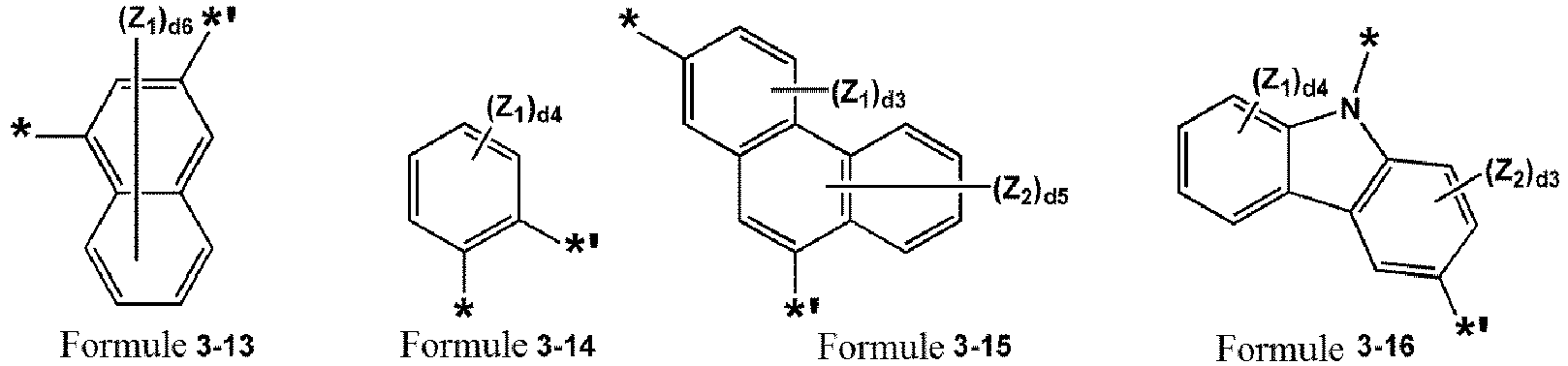

 Y1 est sélectionné parmi O, S, C(Z3)(Z4), N(Z5) et Si(Z6)(Z7);Z1 à Z7 sont sélectionnés chacun indépendamment parmi hydrogène, deutérium,-F, -Cl, -Br, -I, un groupe hydroxyle, un groupe cyano, un groupe nitro, un groupe amino, un groupe amidino, un groupe hydrazine, un groupe hydrazone, un groupe d'acide carboxylique ou un sel de celui-ci, un groupe d'acide sulfonique ou un sel de celui-ci, un groupe d'acide phosphorique ou un sel de celui-ci, un groupe alkyle C1-C20, un groupe alcoxy C1-C20, un groupe phényle, un groupe naphtyle, un groupe fluorényle, un groupe spiro-fluorényle, un groupe phénalényle, un groupe phénanthrényle, un groupe anthracényle, un groupe fluoranthényle, un groupe triphénylényle, un groupe pyrényle, un groupe chrysényle, un groupe pyrrolyle, un groupe furanyle, un groupe thiophényle, un groupe indolyle, un groupe isoindolyle, un groupe benzofuranyle, un groupe benzothiophényle, un groupe carbazolyle, un groupe dibenzofuranyle, un groupe dibenzothiophényle, un groupe benzocarbazolyle, un groupe dibenzosilolyle, un groupe biphényle, un groupe terphényle et -Si(Q31)(Q32)(Q33),où Q31 à Q33 sont sélectionnés chacun indépendamment parmi:un groupe alkyle C1-C10, un groupe alcoxy C1-C10, un groupe phényle, un groupe naphtyle, un groupe fluorényle, un groupe spiro-fluorényle, un groupe phénalényle, un groupe phénanthrényle, un groupe anthracényle, un groupe fluoranthényle, un groupe triphénylényle, un groupe pyrényle, un groupe chrysényle, un groupe pyrrolyle, un groupe furanyle, un groupe thiophényle, un groupe indolyle, un groupe isoindolyle, un groupe benzofuranyle, un groupe benzothiophényle, un groupe carbazolyle, un groupe dibenzofuranyle, un groupe dibenzothiophényle, un groupe benzocarbazolyle, un groupe dibenzosilolyle, un groupe biphényle, et un groupe terphényle;d2 est 1 ou 2;d3 est un nombre entier sélectionné parmi 1 à 3;d4 est un nombre entier sélectionné parmi 1 à 4;d5 est un nombre entier sélectionné parmi 1 à 5;d6 est un nombre entier sélectionné parmi 1 à 6;d8 est un nombre entier sélectionné parmi 1 à 8; et* et *' sont chacun un site de liaison avec un atome adjacent.
 - Dispositif électroluminescent organique selon la revendication 1 ou 2, dans lequel, dans la Formule 2, a15 est 1; et L15 est sélectionné parmi les groupe représentés par les Formules 3-3 à 3-10, la Formule 3-13, et les Formules 3-15 à 3-24.
- Dispositif électroluminescent organique selon la revendication 1 ou 2, dans lequel, dans la Formule 2, a15 est un nombre entier sélectionné parmi 2 à 6.
- Dispositif électroluminescent organique selon l'une quelconque des revendications 1 à 4, dans lequel, dans la Formule 2, *-(L15)a15-*' est représenté par une formule sélectionnée parmi les Formules A-1 à A-12, les Formules B-1 à B-20, les Formules C-1 à C-29, les Formules D-1 à D-25, et les Formules E-1 à E-4:













T1 à T6 sont sélectionnés chacun indépendamment parmi hydrogène, deutérium, - F, -Cl, -Br, -I, un groupe hydroxyle, un groupe cyano, un groupe nitro, un groupe amino, un groupe amidino, un groupe hydrazine, un groupe hydrazone, un groupe d'acide carboxylique ou un sel de celui-ci, un groupe d'acide sulfonique ou un sel de celui-ci, un groupe d'acide phosphorique ou un sel de celui-ci, un groupe alkyle C1-C20, un groupe alcoxy C1-C20, un groupe phényle, un groupe naphtyle, un groupe fluorényle, un groupe spiro-fluorényle, un groupe phénalényle, un groupe phénanthrényle, un groupe anthracényle, un groupe fluoranthényle, un groupe triphénylényle, un groupe pyrényle, un groupe chrysényle, un groupe pyrrolyle, un groupe furanyle, un groupe thiophényle, un groupe indolyle, un groupe isoindolyle, un groupe benzofuranyle, un groupe benzothiophényle, un groupe carbazolyle, un groupe dibenzofuranyle, un groupe dibenzothiophényle, un groupe benzocarbazolyle, un groupe dibenzosilolyle, un groupe pyridinyle, un groupe biphényle, un groupe terphényle et -Si(Q31)(Q32)(Q33),
où Q31 à Q33 sont sélectionnés chacun indépendamment parmi:un groupe alkyle C1-C10, un groupe alcoxy C1-C10, un groupe phényle, un groupe naphtyle, un groupe fluorényle, un groupe spiro-fluorényle, un groupe phénalényle, un groupe phénanthrényle, un groupe anthracényle, un groupe fluoranthényle, un groupe triphénylényle, un groupe pyrényle, un groupe chrysényle, un groupe pyrrolyle, un groupe furanyle, un groupe thiophényle, un groupe indolyle, un groupe isoindolyle, un groupe benzofuranyle, un groupe benzothiophényle, un groupe carbazolyle, un groupe dibenzofuranyle, un groupe dibenzothiophényle, un groupe benzocarbazolyle, un groupe dibenzosilolyle, un groupe pyridinyle, un groupe biphényle, et un groupe terphényle;c1 à c6 sont chacun indépendamment un nombre entier sélectionné parmi 0 à 4; et* et *' sont chacun un site de liaison avec un atome adjacent. - Dispositif électroluminescent organique selon l'une quelconque des revendications 1 à 5, dans lequel, dans les Formules 1 et 2, R1 à R3, et R11 à R14 sont sélectionnés chacun indépendamment parmi:un groupe phényle, un groupe pentalényle, un groupe indényle, un groupe naphtyle, un groupe azulényle, un groupe heptalényle, un groupe indacényle, un groupe acénaphtyle, un groupe fluorényle, un groupe spiro-fluorényle, un groupe benzofluorényle, un groupe dibenzofluorényle, un groupe phénalényle, un groupe phénanthrényle, un groupe anthracényle, un groupe fluoranthényle, un groupe triphénylényle, un groupe pyrényle, un groupe chrysényle, un groupe napthacényle, un groupe picényle, un groupe perylényle, un groupe pentaphényle, un groupe hexacényle, un groupe pentacényle, un groupe rubicényle, un groupe coronényle, un groupe ovalényle, un groupe pyrrolyle, un groupe thiophényle, un groupe furanyle, un groupe silolyle, un groupe imidazolyle, un groupe pyrazolyle, un groupe thiazolyle, un groupe isothiazolyle, un groupe oxazolyle, un groupe isoxazolyle, un groupe pyridinyle, un groupe pyrazinyle, un groupe pyrimidinyle, un groupe pyridazinyle, un groupe isoindolyle, un groupe indolyle, un groupe indazolyle, un groupe purinyle, un groupe quinolinyle, un groupe isoquinolinyle, un groupe benzoquinolinyle, un groupe phtalazinyle, un groupe naphtyridinyle, un groupe quinoxalinyle, un groupe quinazolinyle, un groupe cinnolinyle, un groupe carbazolyle, un groupe phénanthridinyle, un groupe acridinyle, un groupe phénanthrolinyle, un groupe phénazinyle, un groupe benzoimidazolyle, un groupe benzofuranyle, un groupe benzothiophényle, un groupe benzosilolyle, un groupe isobenzothiazolyle, un groupe benzoxazolyle, un groupe isobenzoxazolyle, un groupe triazolyle, un groupe tétrazolyle, un groupe oxadiazolyle, un groupe triazinyle, un groupe dibenzofuranyle, un groupe dibenzothiophényle, un groupe benzocarbazolyle, un groupe dibenzocarbazolyle, un groupe dibenzosilolyle, un groupe thiadiazolyle, un groupe imidazopyridinyle, et un groupe imidazopyrimidinyle, etun groupe phényle, un groupe pentalényle, un groupe indényle, un groupe naphtyle, un groupe azulényle, un groupe heptalényle, un groupe indacényle, un groupe acénaphtyle, un groupe fluorényle, un groupe spiro-fluorényle, un groupe benzofluorényle, un groupe dibenzofluorényle, un groupe phénalényle, un groupe phénanthrényle, un groupe anthracényle, un groupe fluoranthényle, un groupe triphénylényle, un groupe pyrényle, un groupe chrysényle, un groupe naphtacényle, un groupe picényle, un groupe perylényle, un groupe pentaphényle, un groupe hexacényle, un groupe pentacényle, un groupe rubicényle, un groupe coronényle, un groupe ovalényle, un groupe pyrrolyle, un groupe thiophényle, un groupe furanyle, un groupe silolyle, un groupe imidazolyle, un groupe pyrazolyle, un groupe thiazolyle, un groupe isothiazolyle, un groupe oxazolyle, un groupe isoxazolyle, un groupe pyridinyle, un groupe pyrazinyle, un groupe pyrimidinyle, un groupe pyridazinyle, un groupe isoindolyle, un groupe indolyle, un groupe indazolyle, un groupe purinyle, un groupe quinolinyle, un groupe isoquinolinyle, un groupe benzoquinolinyle, un groupe phtalazinyle, un groupe naphtyridinyle, un groupe quinoxalinyle, un groupe quinazolinyle, un groupe cinnolinyle, un groupe carbazolyle, un groupe phénanthridinyle, un groupe acridinyle, un groupe phénanthrolinyle, un groupe phénazinyle, un groupe benzoimidazolyle, un groupe benzofuranyle, un groupe benzothiophényle, un groupe benzosilolyle, un groupe isobenzothiazolyle, un groupe benzoxazolyle, un groupe isobenzoxazolyle, un groupe triazolyle, un groupe tétrazolyle, un groupe oxadiazolyle, un groupe triazinyle, un groupe dibenzofuranyle, un groupe dibenzothiophényle, un groupe benzocarbazolyle, un groupe dibenzocarbazolyle, un groupe dibenzosilolyle, un groupe thiadiazolyle, un groupe imidazopyridinyle, et un groupe imidazopyrimidinyle, substitués chacun par au moins un sélectionné parmi deutérium, -F, -Cl, -Br, -I, un groupe hydroxyle, un groupe cyano, un groupe nitro, un groupe amino, un groupe amidino, un groupe hydrazine, un groupe hydrazone, un groupe d'acide carboxylique ou un sel de celui-ci, un groupe d'acide sulfonique ou un sel de celui-ci, un groupe d'acide phosphorique ou un sel de celui-ci, un groupe alkyle C1-C20, un groupe alcoxy C1-C20, un groupe cyclopentyle, un groupe cyclohexyle, un groupe cycloheptyle, un groupe cyclopentényle, un groupe cyclohexényle, un groupe phényle, un groupe pentalényle, un groupe indényle, un groupe naphtyle, un groupe azulényle, un groupe heptalényle, un groupe indacényle, un groupe acénaphtyle, un groupe fluorényle, un groupe spiro-fluorényle, un groupe benzofluorényle, un groupe dibenzofluorényle, un groupe phénalényle, un groupe phénanthrényle, un groupe anthracényle, un groupe fluoranthényle, un groupe triphénylényle, un groupe pyrényle, un groupe chrysényle, un groupe naphtacényle, un groupe picényle, un groupe perylényle, un groupe pentaphényle, un groupe hexacényle, un groupe pentacényle, un groupe rubicényle, un groupe coronényle, un groupe ovalényle, un groupe pyrrolyle, un groupe thiophényle, un groupe furanyle, un groupe imidazolyle, un groupe pyrazolyle, un groupe thiazolyle, un groupe isothiazolyle, un groupe oxazolyle, un groupe isoxazolyle, un groupe pyridinyle, un groupe pyrazinyle, un groupe pyrimidinyle, un groupe pyridazinyle, un groupe isoindolyle, un groupe indolyle, un groupe indazolyle, un groupe purinyle, un groupe quinolinyle, un groupe isoquinolinyle, un groupe benzoquinolinyle, un groupe phtalazinyle, un groupe naphtyridininyle, un groupe quinoxalinyle, un groupe quinazolinyle, un groupe cinnolinyle, un groupe carbazolyle, un groupe phénanthridinyle, un groupe acridinyle, un groupe phénanthrolinyle, un groupe phénazinyle, un groupe benzoimidazolyle, un groupe benzofuranyle, un groupe benzothiophényle, un groupe isobenzothiazolyle, un groupe benzoxazolyle, un groupe isobenzoxazolyle, un groupe triazolyle, un groupe tétrazolyle, un groupe oxadiazolyle, un groupe triazinyle, un groupe dibenzofuranyle, un groupe dibenzothiophényle, un groupe benzocarbazolyle, un groupe dibenzocarbazolyle, un groupe thiadiazolyle, un groupe imidazopyridinyle, un groupe imidazopyrimidinyle, un groupe biphényle, un groupe terphényle, et -Si(Q31)(Q32)(Q33),où Q31 à Q33 sont sélectionnés chacun indépendamment parmi:un groupe alkyle C1-C10, un groupe alcoxy C1-C10, un groupe phényle, un groupe naphtyle, un groupe fluorényle, un groupe spiro-fluorényle, un groupe benzofluorényle, un groupe dibenzofluorényle, un groupe phénalényle, un groupe phénanthrényle, un groupe anthracényle, un groupe fluoranthényle, un groupe triphénylényle, un groupe pyrényle, un groupe chrysényle, un groupe carbazolyle, un groupe benzofuranyle, un groupe benzothiophényle, un groupe dibenzofuranyle, un groupe dibenzothiophényle, un groupe benzocarbazolyle, un groupe dibenzocarbazolyle, un groupe dibenzosilolyle, un groupe biphényle, et un groupe terphényle, de préférence où, dans les Formules 1 et 2, R1 à R3 et R11 à R14 sont sélectionnés chacun indépendamment parmi:un groupe phényle, un groupe pentalényle, un groupe indényle, un groupe naphtyle, un groupe azulényle, un groupe heptalényle, un groupe indacényle, un groupe acénaphtyle, un groupe fluorényle, un groupe spiro-fluorényle, un groupe benzofluorényle, un groupe dibenzofluorényle, un groupe phénalényle, un groupe phénanthrényle, un groupe anthracényle, un groupe fluoranthényle, un groupe triphénylényle, un groupe pyrényle, un groupe chrysényle, un groupe naphtacényle, un groupe picényle, un groupe perylényle, un groupe pentaphényle, un groupe hexacényle, un groupe pentacényle, un groupe rubicényle, un groupe coronényle, un groupe ovalényle, un groupe pyrrolyle, un groupe thiophényle, un groupe furanyle, un groupe silolyle, un groupe indolyle, un groupe isoindolyle, un groupe benzofuranyle, un groupe benzothiophényle, un groupe benzosilolyle, un groupe carbazolyle, un groupe dibenzofuranyle, un groupe dibenzothiophényle, un groupe dibenzosilolyle, un groupe benzocarbazolyle, et un groupe dibenzocarbazolyle, etun groupe phényle, un groupe pentalényle, un groupe indényle, un groupe naphtyle, un groupe azulényle, un groupe heptalényle, un groupe indacényle, un groupe acénaphtyle, un groupe fluorényle, un groupe spiro-fluorényle, un groupe benzofluorényle, un groupe dibenzofluorényle, un groupe phénalényle, un groupe phénanthrényle, un groupe anthracényle, un groupe fluoroanthényle, un groupe triphénylényle, un groupe pyrényle, un groupe chrysényle, un groupe naphthacényle, un groupe picényle, un groupe perylényle, un groupe pentaphényle, un groupe hexacényle, un groupe pentacényle, un groupe rubicényle, un groupe coronényle, un groupe ovalényle, un groupe pyrrolyle, un groupe thiophényle, un groupe furanyle, un groupe silolyle, un groupe indolyle, un groupe isoindolyle, un groupe benzofuranyle, un groupe benzothiophényle, un groupe benzosilolyle, un groupe carbazolyle, un groupe dibenzofuranyle, un groupe dibenzothiophényle, un groupe dibenzosilolyle, un groupe benzocarbazolyle, et un groupe dibenzocarbazolyle, substitués chacun par au moins un sélectionné parmi deutérium, -F, -Cl, -Br, -I, un groupe hydroxyle, un groupe cyano, un groupe nitro, un groupe amino, un groupe amidino, un groupe hydrazine, un groupe hydrazone, un groupe d'acide carboxylique ou un sel de celui-ci, un groupe d'acide sulfonique ou un sel de celui-ci, un groupe d'acide phosphorique ou un sel de celui-ci, un groupe alkyle C1-C20, un groupe alcoxy C1-C20, un groupe cyclopentyle, un groupe cyclohexyle, un groupe cycloheptyle, un groupe cyclopentényle, un groupe cyclohexényle, un groupe phényle, un groupe pentalényle, un groupe indényle, un groupe naphtyle, un groupe azulényle, un groupe heptalényle, un groupe indacényle, un groupe acénaphtyle, un groupe fluorényle, un groupe spiro-fluorényle, un groupe benzofluorényle, un groupe dibenzofluorényle, un groupe phénalényle, un groupe phénanthrényle, un groupe anthracényle, un groupe fluoranthényle, un groupe triphénylényle, un groupe pyrényle, un groupe chrysényle, un groupe naphtacényle, un groupe picényle, un groupe perylényle, un groupe pentaphényle, un groupe hexacényle, un groupe pentacényle, un groupe rubicényle, un groupe coronényle, un groupe ovalényle, un groupe pyrrolyle, un groupe thiophényle, un groupe furanyle, un groupe silolyle, un groupe indolyle, un groupe isoindolyle, un groupe benzofuranyle, un groupe benzothiophényle, un groupe benzosilolyle, un groupe carbazolyle, un groupe dibenzofuranyle, un groupe dibenzothiophényle, un groupe dibenzosilolyle, un groupe benzocarbazolyle, un groupe dibenzocarbazolyle, un groupe biphényle, un groupe terphényle, et -Si(Q31)(Q32)(Q33),où Q31 à Q33 sont sélectionnés chacun indépendamment parmi:un groupe alkyle C1-C10, un groupe alcoxy C1-C10, un groupe phényle, un groupe pentalényle, un groupe indényle, un groupe naphtyle, un groupe azulényle, un groupe heptalényle, un groupe indacényle, un groupe acénaphtyle, un groupe fluorényle, un groupe spiro-fluorényle, un groupe benzofluorényle, un groupe dibenzofluorényle, un groupe phénalényle, un groupe phénanthrényle, un groupe anthracényle, un groupe fluoranthényle, un groupe triphénylényle, un groupe pyrényle, un groupe chrysényle, un groupe naphtacényle, un groupe picényle, un groupe perylényle, un groupe pentaphényle, un groupe hexacényle, un groupe pentacényle, un groupe rubicényle, un groupe coronényle, un groupe ovalényle, un groupe pyrrolyle, un groupe thiophényle, un groupe furanyle, un groupe silolyle, un groupe indolyle, un groupe isoindolyle, un groupe benzofuranyle, un groupe benzothiophényle, un groupe benzosilolyle, un groupe carbazolyle, un groupe dibenzofuranyle, un groupe dibenzothiophényle, un groupe dibenzosilolyle, un groupe benzocarbazolyle, un groupe dibenzocarbazolyle, un groupe biphényle, et un groupe terphényle, plus préférentiellement, où, dans les Formules 1 et 2, R1 à R3 et R11 à R14 sont sélectionnés chacun indépendamment parmi les groupes représentés par les Formules 5-1 à 5-22:


 où, dans les Formules 5-1 à 5-22,Y31 est sélectionné parmi O, S, C(Z33)(Z34), N(Z35), et Si(Z36)(Z37);Z31 à Z37 sont sélectionnés chacun indépendamment parmi hydrogène, deutérium, -F, -Cl, -Br, -I, un groupe hydroxyle, un groupe cyano, un groupe nitro, un groupe amino, un groupe amidino, un groupe hydrazine, un groupe hydrazone, un groupe d'acide carboxylique ou un sel de celui-ci, un groupe d'acide sulfonique ou un sel de celui-ci, un groupe d'acide phosphorique ou un sel de celui-ci, un groupe alkyle C1-C20, un groupe alcoxy C1-C20, un groupe phényle, un groupe pentalényle, un groupe indényle, un groupe naphtyle, un groupe azulényle, un groupe heptalényle, un groupe indacényle, un groupe acénaphtyle, un groupe fluorényle, un groupe spiro-fluorényle, un groupe benzofluorényle, un groupe dibenzofluorényle, un groupe phénalényle, un groupe phénanthrényle, un groupe anthracényle, un groupe fluoroanthényle, un groupe triphénylényle, un groupe pyrényle, un groupe chrysényle, un groupe naphtacényle, un groupe picényle, un groupe perylényle, un groupe pentaphényle, un groupe hexacényle, un groupe pentacényle, un groupe rubicényle, un groupe coronényle, un groupe ovalényle, un groupe pyrrolyle, un groupe thiophényle, un groupe furanyle, un groupe silolyle, un groupe indolyle, un groupe isoindolyle, un groupe benzofuranyle, un groupe benzothiophényle, un groupe benzosilolyle, un groupe carbazolyle, un groupe dibenzofuranyle, un groupe dibenzothiophényle, un groupe dibenzosilolyle, un groupe benzocarbazolyle, un groupe dibenzocarbazolyle, un groupe biphényle, un groupe terphényle, et -Si(Q31)(Q32)(Q33),où Q31 à Q33 sont sélectionnés chacun indépendamment parmi:un groupe alkyle C1-C10, un groupe alcoxy C1-C10, un groupe phényle, un groupe pentalényle, un groupe indényle, un groupe naphtyle, un groupe azulényle, un groupe heptalényle, un groupe indacényle, un groupe acénaphtyle, un groupe fluorényle, un groupe spiro-fluorényle, un groupe benzofluorényle, un groupe dibenzofluorényle, un groupe phénalényle, un groupe phénanthrényle, un groupe anthracényle, un groupe fluoranthényle, un groupe triphénylényle, un groupe pyrényle, un groupe chrysényle, un groupe naphtacényle, un groupe picényle, un groupe perylényle, un groupe pentaphényle, un groupe hexacényle, un groupe pentacényle, un groupe rubicényle, un groupe coronényle, un groupe ovalényle, un groupe pyrrolyle, un groupe thiophényle, un groupe furanyle, un groupe silolyle, un groupe indolyle, un groupe isoindolyle, un groupe benzofuranyle, un groupe benzothiophényle, un groupe benzosilolyle, un groupe carbazolyle, un groupe dibenzofuranyle, un groupe dibenzothiophényle, un groupe dibenzosilolyle, un groupe benzocarbazolyle, un groupe dibenzocarbazolyle, un groupe biphényle, et un groupe terphényle;e3 est un nombre entier sélectionné parmi 1 à 3;e4 est un nombre entier sélectionné parmi 1 à 4;e5 est un nombre entier sélectionné parmi 1 à 5;e6 est un nombre entier sélectionné parmi 1 à 6;e7 est un nombre entier sélectionné parmi 1 à 7;e9 est un nombre entier sélectionné parmi 1 à 9; et* est un site de liaison avec un atome adjacent.
 - Dispositif électroluminescent organique selon l'une quelconque des revendications 1 à 6, dans lequel le premier composé est représenté par la Formule 1A:
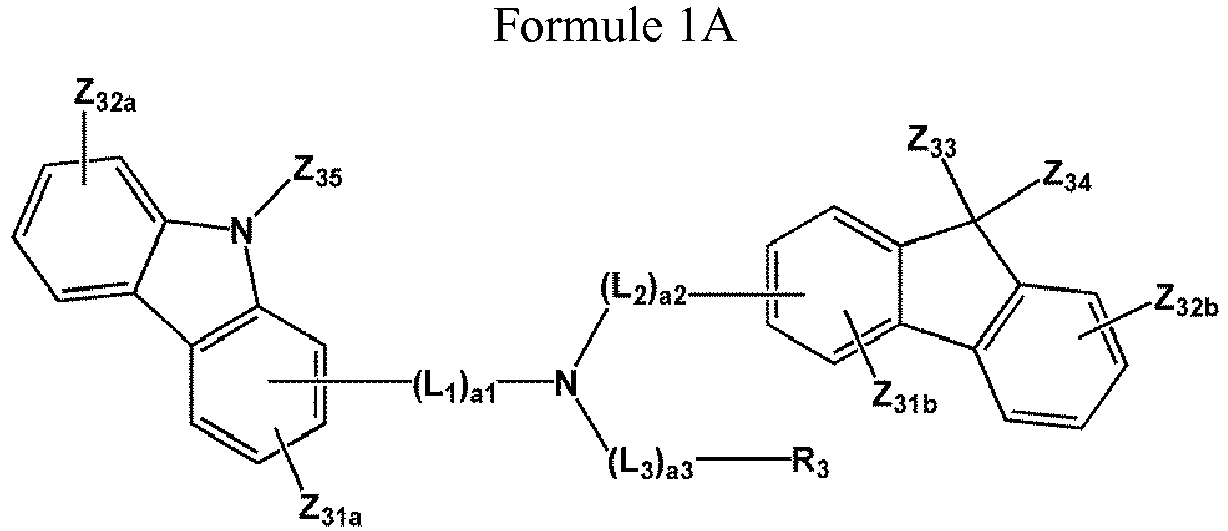
L1 à L3, a1 à a3 et R3 sont les mêmes que définis dans la Formule 1; et
Z31a, Z32a, Z31b, Z32b, et Z33 à Z35 sont sélectionnés chacun indépendamment parmi un groupe alkyle C1-C20, un groupe alcoxy C1-C20, un groupe phényle, un groupe pentalényle, un groupe indényle, un groupe naphtyle, un groupe azulényle, un groupe heptalényle, un groupe indacényle, un groupe acénaphtyle, un groupe fluorényle, un groupe spiro-fluorényle, un groupe benzofluorényle, un groupe dibenzofluorényle, un groupe phénalényle, un groupe phénanthrényle, un groupe anthracényle, un groupe fluoranthényle, un groupe triphénylényle, un groupe pyrényle, un groupe chrysényle, un groupe naphtacényle, un groupe picényle, un groupe perylényle, un groupe pentaphényle, un groupe hexacényle, un groupe pentacényle, un groupe rubicényle, un groupe coronényle, un groupe ovalényle, un groupe pyrrolyle, un groupe thiophényle, un groupe furanyle, un groupe silolyle, un groupe indolyle, un groupe isoindolyle, un groupe benzofuranyle, un groupe benzothiophényle, un groupe benzosilolyle, un groupe carbazolyle, un groupe dibenzofuranyle, un groupe dibenzothiophényle, un groupe dibenzosilolyle, un groupe benzocarbazolyle, un groupe dibenzocarbazolyle, un groupe biphényle, et un groupe terphényle, de préférence, où le premier composé est représenté par la Formule 1A-1: L3, a3 et R3 sont les mêmes que définis dans la Formule 1:Z1 est sélectionné parmi hydrogène, deutérium, -F, -Cl, -Br, -I, un groupe hydroxyle, un groupe cyano, un groupe nitro, un groupe amino, un groupe amidino, un groupe hydrazine, un groupe hydrazone, un groupe d'acide carboxylique ou un sel de celui-ci, un groupe d'acide sulfonique ou un sel de celui-ci, un groupe d'acide phosphorique ou un sel de celui-ci, un groupe alkyle C1-C20, un groupe alcoxy C1-C20, un groupe phényle, un groupe naphtyle, un groupe fluorényle, un groupe spiro-fluorényle, un groupe phénalényle, un groupe phénanthrényle, un groupe anthracényle, un groupe fluoranthényle, un groupe triphénylényle, un groupe pyrényle, un groupe chrysényle, un groupe pyrrolyle, un groupe furanyle, un groupe thiophényle, un groupe indolyle, un groupe isoindolyle, un groupe benzofuranyle, un groupe benzothiophényle, un groupe carbazolyle, un groupe dibenzofuranyle, un groupe dibenzothiophényle, un groupe benzocarbazolyle, un groupe dibenzosilolyle, un groupe biphényle, un groupe terphényle, et -Si(Q31)(Q32)(Q33),où Q31 à Q33 sont chacun sélectionnés chacun indépendamment parmi:un groupe alkyle C1-C10, un groupe alcoxy C1-C10, un groupe phényle, un groupe naphtyle, un groupe fluorényle, un groupe spiro-fluorényle, un groupe phénalényle, un groupe phénanthrényle, un groupe anthracényle, un groupe fluoranthényle, un groupe triphénylényle, un groupe pyrényle, un groupe chrysényle, un groupe pyrrolyle, un groupe furanyle, un groupe thiophényle, un groupe indolyle, un groupe isoindolyle, un groupe benzofuranyle, un groupe benzothiophényle, un groupe carbazolyle, un groupe dibenzofuranyle, un groupe dibenzothiophényle, un groupe benzocarbazolyle, un groupe dibenzosilolyle, un groupe biphényle, et un groupe terphényle; etZ31a, Z32a, Z31b, Z32b et Z33 à Z35 sont sélectionnés chacun indépendamment parmi un groupe alkyle C1-C20, un groupe alcoxy C1-C20, un groupe phényle, un groupe pentalényle, un groupe indényle, un groupe naphtyle, un groupe azulényle, un groupe heptalényle, un groupe indacényle, un groupe acénaphtyle, un groupe fluorényle, un groupe spiro-fluorényle, un groupe benzofluorényle, un groupe dibenzofluorényle, un groupe phénalényle, un groupe phénanthrényle, un groupe anthracényle, un groupe fluoroanthényle, un groupe triphénylényle, un groupe pyrényle, un groupe chrysényle, un groupe naphtacényle, un groupe picényle, un groupe perylényle, un groupe pentaphényle, un groupe hexacényle, un groupe pentacényle, un groupe rubicényle, un groupe coronényle, un groupe ovalényle, un groupe pyrrolyle, un groupe thiophényle, un groupe furanyle, un groupe silolyle, un groupe indolyle, un groupe isoindolyle, un groupe benzofuranyle, un groupe benzothiophényle, un groupe benzosilolyle, un groupe carbazolyle, un groupe dibenzofuranyle, un groupe dibenzothiophényle, un groupe dibenzosilolyle, un groupe benzocarbazolyle, un groupe dibenzocarbazolyle, un groupe biphényle, et un groupe terphényle.
 - Dispositif électroluminescent organique selon l'une quelconque des revendications 1 à 4, dans lequel, dans la Formule 1, R1 à R3 ne sont chacun indépendamment pas un groupe carbazolyle substitué ou non substitué.
- Dispositif électroluminescent organique selon l'une quelconque des revendications 1 à 8, dans lequel, dans la Formule 2: i) *-(L15)a15-*' est sélectionné parmi les groupes représentés par les formules suivantes:
 ii) a11 à a14 sont chacun 0;iii) b11 à b14 sont chacun 1; etiv) R11 et R14 sont sélectionnés chacun indépendamment parmi un groupe phényle et un groupe phényle substitué par un groupe méthyle,R12 et R13 ne sont chacun indépendamment pas un groupe phényle, un groupe naphtyle ou un groupe phényle substitué par un groupe méthyle.
 - Dispositif électroluminescent organique selon la revendication 1, dans lequel, dans la Formule 2, R11 et R13 sont sélectionnés chacun indépendamment parmi:un groupe carbazolyle, etun groupe carbazolyle substitué par au moins un sélectionné parmi deutérium, -F, -Cl, -Br, -I, un groupe hydroxyle, un groupe cyano, un groupe nitro, un groupe amino, un groupe amidino, un groupe hydrazine, un groupe hydrazone, un groupe d'acide carboxylique ou un sel de celui-ci, un groupe d'acide sulfonique ou un sel de celui-ci, un groupe d'acide phosphorique ou un sel de celui-ci, un groupe alkyle C1-C20, un groupe alcoxy C1-C20, un groupe phényle, un groupe naphtyle, un groupe fluorényle, un groupe spiro-fluorényle, un groupe phénalényle, un groupe phénanthrényle, un groupe anthracényle, un groupe fluoranthényle, un groupe triphénylényle, un groupe pyrényle, un groupe chrysényle, un groupe pyrrolyle, un groupe furanyle, un groupe thiophényle, un groupe indolyle, un groupe isoindolyle, un groupe benzofuranyle, un groupe benzothiophényle, un groupe carbazolyle, un groupe dibenzofuranyle, un groupe dibenzothiophényle, un groupe benzocarbazolyle, un groupe dibenzosilolyle, un groupe pyridinyle, un groupe biphényle, un groupe terphényle et -Si(Q31)(Q32)(Q33),où Q31 à Q33 sont sélectionnés chacun indépendamment parmi:un groupe alkyle C1-C10, un groupe alcoxy C1-C10, un groupe phényle, un groupe naphtyle, un groupe fluorényle, un groupe spiro-fluorényle, un groupe phénalényle, un groupe phénanthrényle, un groupe anthracényle, un groupe fluoranthrényle, un groupe triphénylényle, un groupe pyrényle, un groupe chrysényle, un groupe pyrrolyle, un groupe furanyle, un groupe thiophényle, un groupe indolyle, un groupe isoindolyle, un groupe benzofuranyle, un groupe benzothiophényle, un groupe carbazolyle, un groupe dibenzofuranyle, un groupe dibenzothiophényle, un groupe benzocarbazolyle, un groupe dibenzosilolyle, un groupe pyridinyle, un groupe biphényle, et un groupe terphényle.
- Dispositif électroluminescent organique selon l'une quelconque des revendications 1 à 10, dans lequel, dans la Formule 2, *-(L15)a15-* est représenté par la Formule E-1, R11 et R14 sont sélectionnés chacun indépendamment parmi:un groupe phényle, un groupe naphtyle, un groupe fluorényle, un groupe spiro-fluorényle, un groupe phénalényle, un groupe phénanthrényle, un groupe anthracényle, un groupe fluoranthényle, un groupe triphénylényle, un groupe pyrényle, un groupe chrysényle, un groupe pyrrolyle, un groupe furanyle, un groupe thiophényle, un groupe indolyle, un groupe isoindolyle, un groupe benzofuranyle, un groupe benzothiophényle, un groupe carbazolyle, un groupe dibenzofuranyle, un groupe dibenzothiophényle, un groupe benzocarbazolyle, un groupe dibenzosilolyle, un groupe pyridinyle, un groupe biphényle, et un groupe terphényle, etun groupe phényle, un groupe naphtyle, un groupe fluorényle, un groupe spiro-fluorényle, un groupe phénalényle, un groupe phénanthrényle, un groupe anthracényle, un groupe fluoranthényle, un groupe triphénylényle, un groupe pyrényle, un groupe chrysényle, un groupe pyrrolyle, un groupe furanyle, un groupe thiophényle, un groupe indolyle, un groupe isoindolyle, un groupe benzofuranyle, un groupe benzothiophényle, un groupe carbazolyle, un groupe dibenzofuranyle, un groupe dibenzothiophényle, un groupe benzocarbazolyle, un groupe dibenzosilolyle, un groupe pyridinyle, un groupe biphényle, et un groupe terphényle, substitués chacun par au moins un sélectionné parmi deutérium, -F, -Cl, -Br, -I, un groupe hydroxyle, un groupe cyano, un groupe nitro, un groupe amino, un groupe amidino, un groupe hydrazine, un groupe hydrazone, un groupe d'acide carboxylique ou un sel de celui-ci, un groupe d'acide sulfonique ou un sel de celui-ci, un groupe d'acide phosphorique ou un sel de celui-ci, un groupe alkyle C1-C20, un groupe alcoxy C1-C20, un groupe phényle, un groupe naphtyle, un groupe fluorényle, un groupe spiro-fluorényle, un groupe phénalényle, un groupe phénanthrényle, un groupe anthracényle, un groupe fluoranthényle, un groupe triphénylényle, un groupe pyrényle, un groupe chrysényle, un groupe pyrrolyle, un groupe furanyle, un groupe thiophényle, un groupe indolyle, un groupe isoindolyle, un groupe benzofuranyle, un groupe benzothiophényle, un groupe carbazolyle, un groupe dibenzofuranyle, un groupe dibenzothiophényle, un groupe benzocarbazolyle, un groupe dibenzosilolyle, un groupe pyridinyle, un groupe biphényle, un groupe terphényle, et -Si(Q31)(Q32)(Q33);R12 et R13 sont sélectionnés chacun indépendamment parmi:un groupe fluorényle, un groupe spiro-fluorényle, un groupe phénalényle, un groupe phénanthrényle, un groupe anthracényle, un groupe fluoranthényle, un groupe triphénylényle, un groupe pyrényle, un groupe chrysényle, un groupe pyrrolyle, un groupe furanyle, un groupe thiophényle, un groupe indolyle, un groupe isoindolyle, un groupe benzofuranyle, un groupe benzothiophényle, un groupe carbazolyle, un groupe dibenzofuranyle, un groupe dibenzothiophényle, un groupe benzocarbazolyle, un groupe dibenzosilolyle, un groupe pyridinyle, un groupe biphényle, et un groupe terphényle, etun groupe fluorényle, un groupe spiro-fluorényle, un groupe phénalényle, un groupe phénanthrényle, un groupe anthracényle, un groupe fluoranthényle, un groupe triphénylényle, un groupe pyrényle, un groupe chrysényle, un groupe pyrrolyle, un groupe furanyle, un groupe thiophényle, un groupe indolyle, un groupe isoindolyle, un groupe benzofuranyle, un groupe benzothiophényle, un groupe carbazolyle, un groupe dibenzofuranyle, un groupe dibenzothiophényle, un groupe benzocarbazolyle, un groupe dibenzosilolyle, un groupe pyridinyle, un groupe biphényle, un groupe terphényle, substitués chacun par au moins un sélectionné parmi deutérium, -F, -Cl, -Br, -I, un groupe hydroxyle, un groupe cyano, un groupe nitro, un groupe amino, un groupe amidino, un groupe hydrazine, un groupe hydrazone, un groupe d'acide carboxylique ou un sel de celui-ci, un groupe d'acide sulfonique ou un sel de celui-ci, un groupe d'acide phosphorique ou un sel de celui-ci, un groupe alkyle C1-C20, un groupe alcoxy C1-C20, un groupe phényle, un groupe naphtyle, un groupe fluorényle, un groupe spiro-fluorényle, un groupe phénalényle, un groupe phénanthrényle, un groupe anthracényle, un groupe fluoranthényle, un groupe triphénylényle, un groupe pyrényle, un groupe chrysényle, un groupe pyrrolyle, un groupe furanyle, un groupe thiophényle, un groupe indolyle, un groupe isoindolyle, un groupe benzofuranyle, un groupe benzothiophényle, un groupe carbazolyle, un groupe dibenzofuranyle, un groupe dibenzothiophényle, un groupe benzocarbazolyle, un groupe dibenzosilolyle, un groupe pyridinyle, un groupe biphényle, un groupe terphényle, et -Si(Q31)(Q32)(Q33),où Q31 à Q33 sont sélectionnés chacun indépendamment parmi un groupe alkyle C1-C10, un groupe alcoxy C1-C10, un groupe phényle, un groupe naphtyle, un groupe fluorényle, un groupe spiro-fluorényle, un groupe phénalényle, un groupe phénanthrényle, un groupe anthracényle, un groupe fluoranthényle, un groupe triphénylényle, un groupe pyrényle, un groupe chrysényle, un groupe pyrrolyle, un groupe furanyle, un groupe thiophényle, un groupe indolyle, un groupe isoindolyle, un groupe benzofuranyle, un groupe benzothiophényle, un groupe carbazolyle, un groupe dibenzofuranyle, un groupe dibenzothiophényle, un groupe benzocarbazolyle, un groupe dibenzosilolyle, un groupe pyridinyle, un groupe biphényle, et un groupe terphényle.
- Dispositif électroluminescent organique selon l'une quelconque des revendications 1 à 11, dans lequel la région de transport de trous comprend au moins un composé sélectionné parmi les Composés HT1 à HT20 et HT101 à HT 125:

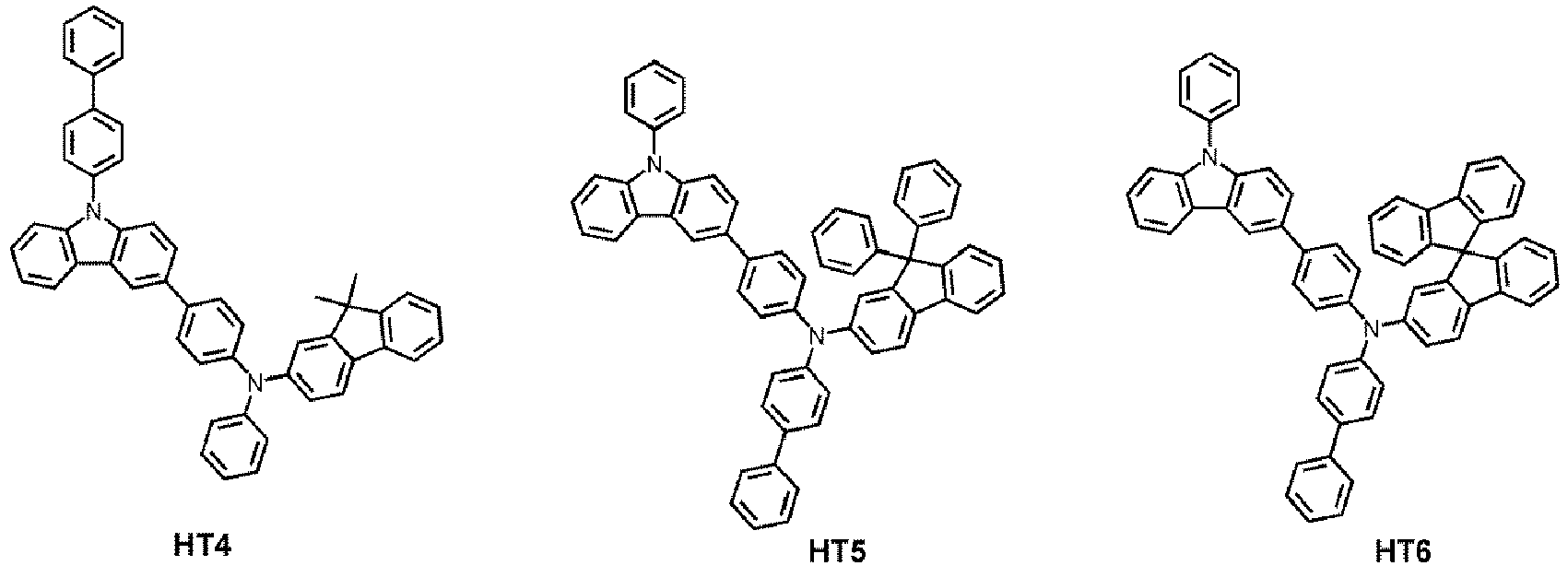


- Dispositif électroluminescent organique selon l'une quelconque des revendications 1 à 12, dans lequel, dans la Formule 3, R27 est sélectionné parmi les groupes représentés par les Formules 3A-1 à 3A-63:


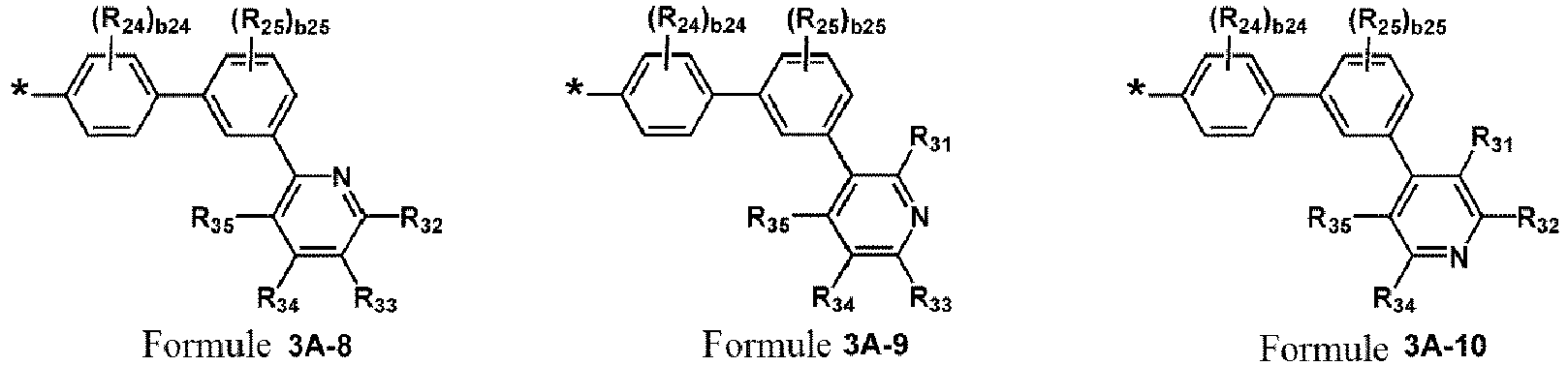


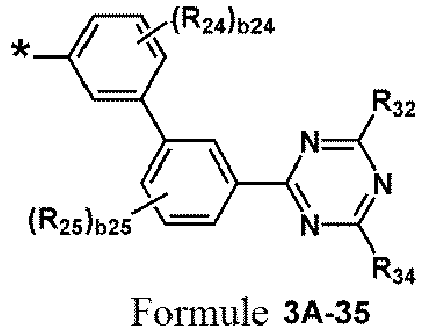


R24 et R25 sont sélectionnés chacun indépendamment parmi:hydrogène, deutérium, -F, -Cl, -Br, -I, un groupe hydroxyle, un groupe cyano, un groupe nitro, un groupe amino, un groupe amidino, un groupe hydrazine, un groupe hydrazone, un groupe d'acide carboxylique ou un sel de celui-ci, un groupe d'acide sulfonique ou un sel de celui-ci, un groupe d'acide phosphorique ou un sel de celui-ci, un groupe alkyle C1-C20, et un groupe alcoxy C1-C20,un groupe alkyle C1-C20 et un groupe alcoxy C1-C20, substitués chacun par au moins un sélectionné parmi deutérium, -F, -Cl, -Br, -I, un groupe hydroxyle, un groupe cyano, un groupe nitro, un groupe amino, un groupe amidino, un groupe hydrazine, un groupe hydrazone, un groupe d'acide carboxylique ou un sel de celui-ci, un groupe d'acide sulfonique ou un sel de celui-ci, et un groupe d'acide phosphorique ou un sel de celui-ci, et-Si(Q41)(Q42)(Q43);b24 et b25 sont chacun indépendamment 1 ou 2;R31 à R35 sont sélectionnés chacun indépendamment parmi:hydrogène, deutérium, -F, -Cl, -Br, -I, un groupe hydroxyle, un groupe cyano, un groupe nitro, un groupe amino, un groupe amidino, un groupe hydrazine, un groupe hydrazone, un groupe d'acide carboxylique ou un sel de celui-ci, un groupe d'acide sulfonique ou un sel de celui-ci, un groupe d'acide phosphorique ou un sel de celui-ci, un groupe alkyle C1-C20, et un groupe alcoxy C1-C20,un groupe alkyle C1-C20 et un groupe alcoxy C1-C20, substitués chacun par au moins un sélectionné parmi deutérium, -F, -Cl, -Br, -I, un groupe hydroxyle, un groupe cyano, un groupe nitro, un groupe amino, un groupe amidino, un groupe hydrazine, un groupe hydrazone, un groupe d'acide carboxylique ou un sel de celui-ci, un groupe d'acide sulfonique ou un sel de celui-ci, et un groupe d'acide phosphorique ou un sel de celui-ci,un groupe phényle et un groupe naphtyle,un groupe phényle et un groupe naphtyle, substitués chacun par au moins un sélectionné parmi deutérium, -F, -Cl, -Br, -I, un groupe hydroxyle, un groupe cyano, un groupe nitro, un groupe amino, un groupe amidino, un groupe hydrazine, un groupe hydrazone, un groupe d'acide carboxylique ou un sel de celui-ci, un groupe d'acide sulfonique ou un sel de celui-ci, un groupe d'acide phosphorique ou un sel de celui-ci, un groupe alkyle C1-C20, et un groupe alcoxy C1-C20, et-Si(Q61)(Q62)(Q63), -N(Q64)(Q65), -B(Q66)(Q67), et -P(=O)(Q68)(Q69),où Q41 à Q43 et Q61 à Q69 sont sélectionnés chacun indépendamment parmi un groupe alkyle C1-C10, un groupe alcoxy C1-C10, un groupe phényle, un groupe naphtyle, un groupe fluorényle, un groupe spiro-fluorényle, un groupe benzofluorényle, un groupe dibenzofluorényle, un groupe phénalényle, un groupe phénanthrényle, un groupe anthracényle, un groupe fluoranthényle, un groupe triphénylényle, un groupe pyrényle, un groupe chrysényle, un groupe carbazolyle, un groupe benzofuranyle, un groupe benzothiophényle, un groupe dibenzofuranyle, un groupe dibenzothiophényle, un groupe benzocarbazolyle, un groupe dibenzocarbazolyle, un groupe dibenzosilolyle, un groupe biphényle, et un groupe terphényle; et* est un site de liaison avec un azote respectif dans la Formule 3. - Dispositif électroluminescent organique selon l'une quelconque des revendications 1 à 13, dans lequel le troisième composé est sélectionné parmi les Composés B-1 à B-4:

- Dispositif électroluminescent organique selon l'une quelconque des revendications 1 à 14, dans lequel la couche de contrôle d'électrons et la couche d'émission sont directement en contact l'une avec l'autre, et la région de transport d'électrons comprend en outre une couche de transport d'électrons et une couche d'injection d'électrons entre la couche de contrôle d'électrons et la deuxième électrode.
Applications Claiming Priority (2)
| Application Number | Priority Date | Filing Date | Title |
|---|---|---|---|
| KR20150015578 | 2015-01-30 | ||
| KR1020150085151A KR102460641B1 (ko) | 2015-01-30 | 2015-06-16 | 유기 발광 소자 |
Publications (2)
| Publication Number | Publication Date |
|---|---|
| EP3051604A1 EP3051604A1 (fr) | 2016-08-03 |
| EP3051604B1 true EP3051604B1 (fr) | 2017-10-11 |
Family
ID=55273160
Family Applications (1)
| Application Number | Title | Priority Date | Filing Date |
|---|---|---|---|
| EP16153506.7A Active EP3051604B1 (fr) | 2015-01-30 | 2016-01-29 | Dispositif électroluminescent organique |
Country Status (3)
| Country | Link |
|---|---|
| US (1) | US10230053B2 (fr) |
| EP (1) | EP3051604B1 (fr) |
| CN (1) | CN105845831B (fr) |
Families Citing this family (11)
| Publication number | Priority date | Publication date | Assignee | Title |
|---|---|---|---|---|
| KR102349284B1 (ko) * | 2014-12-30 | 2022-01-11 | 삼성디스플레이 주식회사 | 아민계 화합물 및 이를 포함한 유기 발광 소자 |
| CN108292708B (zh) | 2015-09-25 | 2020-03-03 | 保土谷化学工业株式会社 | 有机电致发光器件 |
| KR102579752B1 (ko) | 2015-12-22 | 2023-09-19 | 삼성디스플레이 주식회사 | 유기 발광 소자 |
| KR20170075122A (ko) | 2015-12-22 | 2017-07-03 | 삼성디스플레이 주식회사 | 유기 발광 소자 |
| KR20170075114A (ko) | 2015-12-22 | 2017-07-03 | 삼성디스플레이 주식회사 | 유기 발광 소자 |
| MD3762368T2 (ro) | 2018-03-08 | 2022-07-31 | Incyte Corp | Compuși diol aminopirazină ca inhibitori ai PI3K-Y |
| WO2018101490A2 (fr) * | 2018-03-19 | 2018-06-07 | 出光興産株式会社 | Élément électroluminescent organique et dispositif électronique |
| US11046658B2 (en) | 2018-07-02 | 2021-06-29 | Incyte Corporation | Aminopyrazine derivatives as PI3K-γ inhibitors |
| CN111470984B (zh) * | 2020-04-16 | 2022-12-13 | 苏州欧谱科显示科技有限公司 | 一种空穴传输材料及其制备方法和应用 |
| CN114075115A (zh) * | 2020-08-20 | 2022-02-22 | 江苏三月科技股份有限公司 | 一种胺类化合物和包含该化合物的有机电致发光器件 |
| EP4099412A1 (fr) * | 2021-06-03 | 2022-12-07 | Novaled GmbH | Dispositif électroluminescent organique et composé pour utilisation dans celui-ci |
Family Cites Families (34)
| Publication number | Priority date | Publication date | Assignee | Title |
|---|---|---|---|---|
| KR100787423B1 (ko) | 2004-11-05 | 2007-12-26 | 삼성에스디아이 주식회사 | 유기 전계 발광 소자 |
| WO2006115232A1 (fr) | 2005-04-21 | 2006-11-02 | Semiconductor Energy Laboratory Co., Ltd. | Élément émetteur de lumière, dispositif émetteur de lumière, et dispositif électronique |
| US9051344B2 (en) | 2005-05-06 | 2015-06-09 | Universal Display Corporation | Stability OLED materials and devices |
| JP5576122B2 (ja) | 2006-12-20 | 2014-08-20 | トムソン ライセンシング | 両極性材料で作られた障壁層を有する有機発光ダイオード |
| EP2133932A4 (fr) | 2007-03-23 | 2011-06-22 | Idemitsu Kosan Co | Dispositif électroluminescent organique |
| US8034465B2 (en) | 2007-06-20 | 2011-10-11 | Global Oled Technology Llc | Phosphorescent oled having double exciton-blocking layers |
| US8476823B2 (en) | 2009-05-22 | 2013-07-02 | Idemitsu Kosan Co., Ltd. | Organic electroluminescent device |
| US9741955B2 (en) | 2009-05-29 | 2017-08-22 | Semiconductor Energy Laboratory Co., Ltd. | Light-emitting element, light-emitting device, and method for manufacturing the same |
| KR101097339B1 (ko) * | 2010-03-08 | 2011-12-23 | 삼성모바일디스플레이주식회사 | 유기 발광 소자 및 이의 제조 방법 |
| EP2371828B1 (fr) * | 2010-04-01 | 2018-01-10 | Samsung Display Co., Ltd. | Composé cyclique condensé et dispositif électroluminescent organique l'incluant |
| KR101588941B1 (ko) * | 2011-02-07 | 2016-01-26 | 이데미쓰 고산 가부시키가이샤 | 비스카바졸 유도체 및 그것을 이용한 유기 전기발광 소자 |
| KR102126087B1 (ko) | 2011-10-11 | 2020-06-23 | 가부시키가이샤 한도오따이 에네루기 켄큐쇼 | 발광 소자, 발광 장치, 전자 기기, 조명 장치, 및 피렌계 화합물 |
| KR101937259B1 (ko) | 2011-11-10 | 2019-01-11 | 삼성디스플레이 주식회사 | 스티릴계 화합물, 스티릴계 화합물-함유 조성물 및 이를 포함한 유기 발광 소자 |
| WO2013085339A2 (fr) | 2011-12-07 | 2013-06-13 | 주식회사 두산 | Composé électroluminescent organique et dispositif électroluminescent organique utilisant celui-ci |
| KR101488565B1 (ko) | 2011-12-07 | 2015-02-03 | 주식회사 두산 | 유기 발광 화합물 및 이를 이용한 유기 전계 발광 소자 |
| KR102265997B1 (ko) | 2012-08-10 | 2021-06-16 | 메르크 파텐트 게엠베하 | 유기 전계발광 소자용 물질 |
| JP2015216136A (ja) * | 2012-08-17 | 2015-12-03 | 出光興産株式会社 | 有機エレクトロルミネッセンス素子 |
| US20140131665A1 (en) * | 2012-11-12 | 2014-05-15 | Universal Display Corporation | Organic Electroluminescent Device With Delayed Fluorescence |
| CN105074948B (zh) * | 2013-02-22 | 2017-12-26 | 保土谷化学工业株式会社 | 有机电致发光器件 |
| KR101667099B1 (ko) | 2013-03-29 | 2016-10-17 | 주식회사 엘지화학 | 헤테로환 화합물 및 이를 포함하는 유기 발광 소자 |
| KR20140135525A (ko) | 2013-05-16 | 2014-11-26 | 제일모직주식회사 | 유기 광전자 소자용 발광 재료, 유기 광전자 소자 및 표시 장치 |
| KR20140135532A (ko) | 2013-05-16 | 2014-11-26 | 제일모직주식회사 | 유기 화합물, 유기 광전자 소자 및 표시 장치 |
| KR20150021861A (ko) * | 2013-08-21 | 2015-03-03 | 최돈수 | 유기 전기 발광 소자용 발광 재료, 이를 이용한 유기 전기 발광 소자 및 유기 전기 발광 소자용 재료 |
| KR101641404B1 (ko) | 2013-12-17 | 2016-07-20 | 주식회사 두산 | 유기 화합물 및 이를 포함하는 유기 전계 발광 소자 |
| WO2015099481A1 (fr) * | 2013-12-27 | 2015-07-02 | 주식회사 두산 | Dispositif électroluminescent organique |
| KR101742359B1 (ko) * | 2013-12-27 | 2017-05-31 | 주식회사 두산 | 유기 전계 발광 소자 |
| KR102221106B1 (ko) | 2014-01-17 | 2021-03-02 | 삼성디스플레이 주식회사 | 유기 발광 소자 |
| KR101998435B1 (ko) * | 2014-06-09 | 2019-07-09 | 주식회사 두산 | 유기 전계 발광 소자 |
| KR102238282B1 (ko) * | 2014-07-24 | 2021-04-08 | 솔루스첨단소재 주식회사 | 유기 화합물 및 이를 포함하는 유기 전계 발광 소자 |
| KR102360228B1 (ko) * | 2014-10-22 | 2022-02-09 | 솔루스첨단소재 주식회사 | 유기 전계 발광 소자 |
| KR101708097B1 (ko) * | 2014-10-22 | 2017-02-17 | 주식회사 두산 | 유기 전계 발광 소자 |
| KR101974233B1 (ko) * | 2014-10-30 | 2019-04-30 | 주식회사 두산 | 유기 전계 발광 소자 |
| WO2016105036A1 (fr) * | 2014-12-22 | 2016-06-30 | 주식회사 두산 | Élément électroluminescent organique |
| KR102530095B1 (ko) * | 2015-12-03 | 2023-05-09 | 솔루스첨단소재 주식회사 | 유기 발광 화합물 및 이를 이용한 유기 전계 발광 소자 |
-
2016
- 2016-01-29 EP EP16153506.7A patent/EP3051604B1/fr active Active
- 2016-01-29 CN CN201610064416.9A patent/CN105845831B/zh active Active
- 2016-01-29 US US15/011,129 patent/US10230053B2/en active Active
Non-Patent Citations (1)
| Title |
|---|
| None * |
Also Published As
| Publication number | Publication date |
|---|---|
| EP3051604A1 (fr) | 2016-08-03 |
| US10230053B2 (en) | 2019-03-12 |
| CN105845831B (zh) | 2019-07-05 |
| US20160226000A1 (en) | 2016-08-04 |
| CN105845831A (zh) | 2016-08-10 |
Similar Documents
| Publication | Publication Date | Title |
|---|---|---|
| KR102615642B1 (ko) | 유기 발광 소자 | |
| KR102659162B1 (ko) | 축합환 화합물 및 이를 포함한 유기 발광 소자 | |
| EP3051604A1 (fr) | Dispositif électroluminescent organique | |
| KR102727031B1 (ko) | 유기 발광 소자 | |
| KR102163721B1 (ko) | 축합환 화합물 및 이를 포함한 유기 발광 소자 | |
| KR20190020872A (ko) | 유기금속 화합물, 이를 포함한 유기 발광 소자 및 상기 유기 발광 소자를 포함한 발광 장치 | |
| KR102317448B1 (ko) | 축합환 화합물 및 이를 포함한 유기 발광 소자 | |
| KR20150134248A (ko) | 카바졸계 화합물 및 이를 포함한 유기 발광 소자 | |
| KR102698885B1 (ko) | 유기금속 화합물 및 이를 포함한 유기 발광 소자 | |
| KR20190107264A (ko) | 유기금속 화합물 및 이를 포함한 유기 발광 소자 | |
| KR102814718B1 (ko) | 유기 발광 소자 | |
| KR102796253B1 (ko) | 헤테로시클릭 화합물 및 이를 포함한 유기 발광 소자 | |
| KR102938606B1 (ko) | 축합환 화합물 및 이를 포함한 유기 발광 소자 | |
| KR102587060B1 (ko) | 축합환 화합물 및 이를 포함한 유기 발광 소자 | |
| KR102864638B1 (ko) | 유기금속 화합물 및 이를 포함한 유기 발광 소자 | |
| KR102460641B1 (ko) | 유기 발광 소자 | |
| KR20190118821A (ko) | 축합환 화합물 및 이를 포함한 유기 발광 소자 | |
| KR102781575B1 (ko) | 헤테로시클릭 화합물 및 이를 포함한 유기 발광 소자 | |
| KR102819939B1 (ko) | 유기금속 화합물 및 이를 포함한 유기 발광 소자 | |
| KR102748935B1 (ko) | 유기 발광 소자 | |
| KR102603866B1 (ko) | 유기 발광 소자 | |
| KR102959772B1 (ko) | 헤테로시클릭 화합물 및 이를 포함하는 유기 발광 소자 | |
| KR20190143557A (ko) | 다이아민 화합물을 포함한 유기 발광 소자 및 다이아민 화합물 | |
| KR102293729B1 (ko) | 축합환 화합물 및 이를 포함한 유기 발광 소자 | |
| KR102627398B1 (ko) | 축합환 화합물 및 이를 포함한 유기 발광 소자 |
Legal Events
| Date | Code | Title | Description |
|---|---|---|---|
| PUAI | Public reference made under article 153(3) epc to a published international application that has entered the european phase |
Free format text: ORIGINAL CODE: 0009012 |
|
| AK | Designated contracting states |
Kind code of ref document: A1 Designated state(s): AL AT BE BG CH CY CZ DE DK EE ES FI FR GB GR HR HU IE IS IT LI LT LU LV MC MK MT NL NO PL PT RO RS SE SI SK SM TR |
|
| AX | Request for extension of the european patent |
Extension state: BA ME |
|
| 17P | Request for examination filed |
Effective date: 20170201 |
|
| RBV | Designated contracting states (corrected) |
Designated state(s): AL AT BE BG CH CY CZ DE DK EE ES FI FR GB GR HR HU IE IS IT LI LT LU LV MC MK MT NL NO PL PT RO RS SE SI SK SM TR |
|
| GRAP | Despatch of communication of intention to grant a patent |
Free format text: ORIGINAL CODE: EPIDOSNIGR1 |
|
| RIC1 | Information provided on ipc code assigned before grant |
Ipc: H01L 51/54 20060101AFI20170303BHEP Ipc: C07C 211/00 20060101ALI20170303BHEP |
|
| INTG | Intention to grant announced |
Effective date: 20170411 |
|
| RAP1 | Party data changed (applicant data changed or rights of an application transferred) |
Owner name: SAMSUNG DISPLAY CO., LTD. Owner name: DOOSAN CORPORATION |
|
| GRAS | Grant fee paid |
Free format text: ORIGINAL CODE: EPIDOSNIGR3 |
|
| GRAA | (expected) grant |
Free format text: ORIGINAL CODE: 0009210 |
|
| AK | Designated contracting states |
Kind code of ref document: B1 Designated state(s): AL AT BE BG CH CY CZ DE DK EE ES FI FR GB GR HR HU IE IS IT LI LT LU LV MC MK MT NL NO PL PT RO RS SE SI SK SM TR |
|
| REG | Reference to a national code |
Ref country code: GB Ref legal event code: FG4D |
|
| REG | Reference to a national code |
Ref country code: CH Ref legal event code: EP |
|
| REG | Reference to a national code |
Ref country code: IE Ref legal event code: FG4D |
|
| REG | Reference to a national code |
Ref country code: AT Ref legal event code: REF Ref document number: 936760 Country of ref document: AT Kind code of ref document: T Effective date: 20171115 |
|
| REG | Reference to a national code |
Ref country code: DE Ref legal event code: R096 Ref document number: 602016000522 Country of ref document: DE |
|
| REG | Reference to a national code |
Ref country code: NL Ref legal event code: MP Effective date: 20171011 |
|
| REG | Reference to a national code |
Ref country code: LT Ref legal event code: MG4D |
|
| REG | Reference to a national code |
Ref country code: AT Ref legal event code: MK05 Ref document number: 936760 Country of ref document: AT Kind code of ref document: T Effective date: 20171011 |
|
| PG25 | Lapsed in a contracting state [announced via postgrant information from national office to epo] |
Ref country code: NL Free format text: LAPSE BECAUSE OF FAILURE TO SUBMIT A TRANSLATION OF THE DESCRIPTION OR TO PAY THE FEE WITHIN THE PRESCRIBED TIME-LIMIT Effective date: 20171011 |
|
| PG25 | Lapsed in a contracting state [announced via postgrant information from national office to epo] |
Ref country code: SE Free format text: LAPSE BECAUSE OF FAILURE TO SUBMIT A TRANSLATION OF THE DESCRIPTION OR TO PAY THE FEE WITHIN THE PRESCRIBED TIME-LIMIT Effective date: 20171011 Ref country code: LT Free format text: LAPSE BECAUSE OF FAILURE TO SUBMIT A TRANSLATION OF THE DESCRIPTION OR TO PAY THE FEE WITHIN THE PRESCRIBED TIME-LIMIT Effective date: 20171011 Ref country code: NO Free format text: LAPSE BECAUSE OF FAILURE TO SUBMIT A TRANSLATION OF THE DESCRIPTION OR TO PAY THE FEE WITHIN THE PRESCRIBED TIME-LIMIT Effective date: 20180111 Ref country code: FI Free format text: LAPSE BECAUSE OF FAILURE TO SUBMIT A TRANSLATION OF THE DESCRIPTION OR TO PAY THE FEE WITHIN THE PRESCRIBED TIME-LIMIT Effective date: 20171011 Ref country code: ES Free format text: LAPSE BECAUSE OF FAILURE TO SUBMIT A TRANSLATION OF THE DESCRIPTION OR TO PAY THE FEE WITHIN THE PRESCRIBED TIME-LIMIT Effective date: 20171011 |
|
| PG25 | Lapsed in a contracting state [announced via postgrant information from national office to epo] |
Ref country code: AT Free format text: LAPSE BECAUSE OF FAILURE TO SUBMIT A TRANSLATION OF THE DESCRIPTION OR TO PAY THE FEE WITHIN THE PRESCRIBED TIME-LIMIT Effective date: 20171011 Ref country code: HR Free format text: LAPSE BECAUSE OF FAILURE TO SUBMIT A TRANSLATION OF THE DESCRIPTION OR TO PAY THE FEE WITHIN THE PRESCRIBED TIME-LIMIT Effective date: 20171011 Ref country code: BG Free format text: LAPSE BECAUSE OF FAILURE TO SUBMIT A TRANSLATION OF THE DESCRIPTION OR TO PAY THE FEE WITHIN THE PRESCRIBED TIME-LIMIT Effective date: 20180111 Ref country code: LV Free format text: LAPSE BECAUSE OF FAILURE TO SUBMIT A TRANSLATION OF THE DESCRIPTION OR TO PAY THE FEE WITHIN THE PRESCRIBED TIME-LIMIT Effective date: 20171011 Ref country code: RS Free format text: LAPSE BECAUSE OF FAILURE TO SUBMIT A TRANSLATION OF THE DESCRIPTION OR TO PAY THE FEE WITHIN THE PRESCRIBED TIME-LIMIT Effective date: 20171011 Ref country code: IS Free format text: LAPSE BECAUSE OF FAILURE TO SUBMIT A TRANSLATION OF THE DESCRIPTION OR TO PAY THE FEE WITHIN THE PRESCRIBED TIME-LIMIT Effective date: 20180211 Ref country code: GR Free format text: LAPSE BECAUSE OF FAILURE TO SUBMIT A TRANSLATION OF THE DESCRIPTION OR TO PAY THE FEE WITHIN THE PRESCRIBED TIME-LIMIT Effective date: 20180112 |
|
| REG | Reference to a national code |
Ref country code: DE Ref legal event code: R097 Ref document number: 602016000522 Country of ref document: DE |
|
| PG25 | Lapsed in a contracting state [announced via postgrant information from national office to epo] |
Ref country code: EE Free format text: LAPSE BECAUSE OF FAILURE TO SUBMIT A TRANSLATION OF THE DESCRIPTION OR TO PAY THE FEE WITHIN THE PRESCRIBED TIME-LIMIT Effective date: 20171011 Ref country code: SK Free format text: LAPSE BECAUSE OF FAILURE TO SUBMIT A TRANSLATION OF THE DESCRIPTION OR TO PAY THE FEE WITHIN THE PRESCRIBED TIME-LIMIT Effective date: 20171011 Ref country code: DK Free format text: LAPSE BECAUSE OF FAILURE TO SUBMIT A TRANSLATION OF THE DESCRIPTION OR TO PAY THE FEE WITHIN THE PRESCRIBED TIME-LIMIT Effective date: 20171011 Ref country code: CZ Free format text: LAPSE BECAUSE OF FAILURE TO SUBMIT A TRANSLATION OF THE DESCRIPTION OR TO PAY THE FEE WITHIN THE PRESCRIBED TIME-LIMIT Effective date: 20171011 |
|
| PLBE | No opposition filed within time limit |
Free format text: ORIGINAL CODE: 0009261 |
|
| STAA | Information on the status of an ep patent application or granted ep patent |
Free format text: STATUS: NO OPPOSITION FILED WITHIN TIME LIMIT |
|
| PG25 | Lapsed in a contracting state [announced via postgrant information from national office to epo] |
Ref country code: PL Free format text: LAPSE BECAUSE OF FAILURE TO SUBMIT A TRANSLATION OF THE DESCRIPTION OR TO PAY THE FEE WITHIN THE PRESCRIBED TIME-LIMIT Effective date: 20171011 Ref country code: IT Free format text: LAPSE BECAUSE OF FAILURE TO SUBMIT A TRANSLATION OF THE DESCRIPTION OR TO PAY THE FEE WITHIN THE PRESCRIBED TIME-LIMIT Effective date: 20171011 Ref country code: SM Free format text: LAPSE BECAUSE OF FAILURE TO SUBMIT A TRANSLATION OF THE DESCRIPTION OR TO PAY THE FEE WITHIN THE PRESCRIBED TIME-LIMIT Effective date: 20171011 Ref country code: RO Free format text: LAPSE BECAUSE OF FAILURE TO SUBMIT A TRANSLATION OF THE DESCRIPTION OR TO PAY THE FEE WITHIN THE PRESCRIBED TIME-LIMIT Effective date: 20171011 |
|
| 26N | No opposition filed |
Effective date: 20180712 |
|
| PG25 | Lapsed in a contracting state [announced via postgrant information from national office to epo] |
Ref country code: FR Free format text: LAPSE BECAUSE OF NON-PAYMENT OF DUE FEES Effective date: 20180131 Ref country code: LU Free format text: LAPSE BECAUSE OF NON-PAYMENT OF DUE FEES Effective date: 20180129 |
|
| REG | Reference to a national code |
Ref country code: IE Ref legal event code: MM4A |
|
| REG | Reference to a national code |
Ref country code: FR Ref legal event code: ST Effective date: 20180928 |
|
| REG | Reference to a national code |
Ref country code: BE Ref legal event code: MM Effective date: 20180131 |
|
| PG25 | Lapsed in a contracting state [announced via postgrant information from national office to epo] |
Ref country code: BE Free format text: LAPSE BECAUSE OF NON-PAYMENT OF DUE FEES Effective date: 20180131 Ref country code: SI Free format text: LAPSE BECAUSE OF FAILURE TO SUBMIT A TRANSLATION OF THE DESCRIPTION OR TO PAY THE FEE WITHIN THE PRESCRIBED TIME-LIMIT Effective date: 20171011 |
|
| PG25 | Lapsed in a contracting state [announced via postgrant information from national office to epo] |
Ref country code: IE Free format text: LAPSE BECAUSE OF NON-PAYMENT OF DUE FEES Effective date: 20180129 |
|
| PG25 | Lapsed in a contracting state [announced via postgrant information from national office to epo] |
Ref country code: MC Free format text: LAPSE BECAUSE OF FAILURE TO SUBMIT A TRANSLATION OF THE DESCRIPTION OR TO PAY THE FEE WITHIN THE PRESCRIBED TIME-LIMIT Effective date: 20171011 |
|
| REG | Reference to a national code |
Ref country code: CH Ref legal event code: PL |
|
| PG25 | Lapsed in a contracting state [announced via postgrant information from national office to epo] |
Ref country code: CH Free format text: LAPSE BECAUSE OF NON-PAYMENT OF DUE FEES Effective date: 20190131 Ref country code: LI Free format text: LAPSE BECAUSE OF NON-PAYMENT OF DUE FEES Effective date: 20190131 |
|
| PG25 | Lapsed in a contracting state [announced via postgrant information from national office to epo] |
Ref country code: MT Free format text: LAPSE BECAUSE OF NON-PAYMENT OF DUE FEES Effective date: 20180129 |
|
| PG25 | Lapsed in a contracting state [announced via postgrant information from national office to epo] |
Ref country code: TR Free format text: LAPSE BECAUSE OF FAILURE TO SUBMIT A TRANSLATION OF THE DESCRIPTION OR TO PAY THE FEE WITHIN THE PRESCRIBED TIME-LIMIT Effective date: 20171011 |
|
| PG25 | Lapsed in a contracting state [announced via postgrant information from national office to epo] |
Ref country code: PT Free format text: LAPSE BECAUSE OF FAILURE TO SUBMIT A TRANSLATION OF THE DESCRIPTION OR TO PAY THE FEE WITHIN THE PRESCRIBED TIME-LIMIT Effective date: 20171011 |
|
| REG | Reference to a national code |
Ref country code: DE Ref legal event code: R082 Ref document number: 602016000522 Country of ref document: DE Representative=s name: GULDE & PARTNER PATENT- UND RECHTSANWALTSKANZL, DE Ref country code: DE Ref legal event code: R081 Ref document number: 602016000522 Country of ref document: DE Owner name: SAMSUNG DISPLAY CO., LTD., YONGIN-SI, KR Free format text: FORMER OWNERS: DOOSAN CORPORATION, SEOUL, KR; SAMSUNG DISPLAY CO., LTD., YONGIN-SI, GYEONGGI-DO, KR Ref country code: DE Ref legal event code: R081 Ref document number: 602016000522 Country of ref document: DE Owner name: DOOSAN SOLUS CO., LTD., IKSAN-SI, KR Free format text: FORMER OWNERS: DOOSAN CORPORATION, SEOUL, KR; SAMSUNG DISPLAY CO., LTD., YONGIN-SI, GYEONGGI-DO, KR Ref country code: DE Ref legal event code: R081 Ref document number: 602016000522 Country of ref document: DE Owner name: SOLUS ADVANCED MATERIALS CO., LTD., IKSAN-SI, KR Free format text: FORMER OWNERS: DOOSAN CORPORATION, SEOUL, KR; SAMSUNG DISPLAY CO., LTD., YONGIN-SI, GYEONGGI-DO, KR |
|
| REG | Reference to a national code |
Ref country code: GB Ref legal event code: 732E Free format text: REGISTERED BETWEEN 20200528 AND 20200603 |
|
| PG25 | Lapsed in a contracting state [announced via postgrant information from national office to epo] |
Ref country code: MK Free format text: LAPSE BECAUSE OF NON-PAYMENT OF DUE FEES Effective date: 20171011 Ref country code: HU Free format text: LAPSE BECAUSE OF FAILURE TO SUBMIT A TRANSLATION OF THE DESCRIPTION OR TO PAY THE FEE WITHIN THE PRESCRIBED TIME-LIMIT; INVALID AB INITIO Effective date: 20160129 Ref country code: CY Free format text: LAPSE BECAUSE OF FAILURE TO SUBMIT A TRANSLATION OF THE DESCRIPTION OR TO PAY THE FEE WITHIN THE PRESCRIBED TIME-LIMIT Effective date: 20171011 |
|
| PG25 | Lapsed in a contracting state [announced via postgrant information from national office to epo] |
Ref country code: AL Free format text: LAPSE BECAUSE OF FAILURE TO SUBMIT A TRANSLATION OF THE DESCRIPTION OR TO PAY THE FEE WITHIN THE PRESCRIBED TIME-LIMIT Effective date: 20171011 |
|
| REG | Reference to a national code |
Ref country code: DE Ref legal event code: R082 Ref document number: 602016000522 Country of ref document: DE Representative=s name: GULDE & PARTNER PATENT- UND RECHTSANWALTSKANZL, DE Ref country code: DE Ref legal event code: R081 Ref document number: 602016000522 Country of ref document: DE Owner name: SOLUS ADVANCED MATERIALS CO., LTD., IKSAN-SI, KR Free format text: FORMER OWNERS: DOOSAN SOLUS CO., LTD., IKSAN-SI, JEOLLABUK-DO, KR; SAMSUNG DISPLAY CO., LTD., YONGIN-SI, GYEONGGI-DO, KR Ref country code: DE Ref legal event code: R081 Ref document number: 602016000522 Country of ref document: DE Owner name: SAMSUNG DISPLAY CO., LTD., YONGIN-SI, KR Free format text: FORMER OWNERS: DOOSAN SOLUS CO., LTD., IKSAN-SI, JEOLLABUK-DO, KR; SAMSUNG DISPLAY CO., LTD., YONGIN-SI, GYEONGGI-DO, KR |
|
| REG | Reference to a national code |
Ref country code: DE Ref legal event code: R079 Ref document number: 602016000522 Country of ref document: DE Free format text: PREVIOUS MAIN CLASS: H01L0051540000 Ipc: H10K0085000000 |
|
| P01 | Opt-out of the competence of the unified patent court (upc) registered |
Effective date: 20230530 |
|
| PGFP | Annual fee paid to national office [announced via postgrant information from national office to epo] |
Ref country code: GB Payment date: 20251222 Year of fee payment: 11 |
|
| PGFP | Annual fee paid to national office [announced via postgrant information from national office to epo] |
Ref country code: DE Payment date: 20251222 Year of fee payment: 11 |