EP3052207B1 - Didaktischer zauberwürfel - Google Patents
Didaktischer zauberwürfel Download PDFInfo
- Publication number
- EP3052207B1 EP3052207B1 EP14766974.1A EP14766974A EP3052207B1 EP 3052207 B1 EP3052207 B1 EP 3052207B1 EP 14766974 A EP14766974 A EP 14766974A EP 3052207 B1 EP3052207 B1 EP 3052207B1
- Authority
- EP
- European Patent Office
- Prior art keywords
- cube
- magic cube
- magic
- lines
- walls
- Prior art date
- Legal status (The legal status is an assumption and is not a legal conclusion. Google has not performed a legal analysis and makes no representation as to the accuracy of the status listed.)
- Active
Links
Images
Classifications
-
- A—HUMAN NECESSITIES
- A63—SPORTS; GAMES; AMUSEMENTS
- A63F—CARD, BOARD, OR ROULETTE GAMES; INDOOR GAMES USING SMALL MOVING PLAYING BODIES; VIDEO GAMES; GAMES NOT OTHERWISE PROVIDED FOR
- A63F9/00—Games not otherwise provided for
- A63F9/06—Patience; Other games for self-amusement
- A63F9/08—Puzzles provided with elements movable in relation, i.e. movably connected, to each other
- A63F9/0826—Three-dimensional puzzles with slidable or rotatable elements or groups of elements, the main configuration remaining unchanged, e.g. Rubik's cube
- A63F9/0838—Three-dimensional puzzles with slidable or rotatable elements or groups of elements, the main configuration remaining unchanged, e.g. Rubik's cube with an element, e.g. invisible core, staying permanently in a central position having the function of central retaining spider and with groups of elements rotatable about at least three axes intersecting in one point
- A63F9/0842—Three-dimensional puzzles with slidable or rotatable elements or groups of elements, the main configuration remaining unchanged, e.g. Rubik's cube with an element, e.g. invisible core, staying permanently in a central position having the function of central retaining spider and with groups of elements rotatable about at least three axes intersecting in one point each group consisting of again a central element and a plurality of additional elements rotatable about three orthogonal axes at both ends, the additional elements being rotatable about at least two axes, e.g. Rubik's cube
-
- A—HUMAN NECESSITIES
- A63—SPORTS; GAMES; AMUSEMENTS
- A63F—CARD, BOARD, OR ROULETTE GAMES; INDOOR GAMES USING SMALL MOVING PLAYING BODIES; VIDEO GAMES; GAMES NOT OTHERWISE PROVIDED FOR
- A63F9/00—Games not otherwise provided for
- A63F9/0001—Games specially adapted for handicapped, blind or bed-ridden persons
- A63F2009/0003—Games specially adapted for blind or partially sighted people
Definitions
- the invention relates to a magic cube with rotatable magic cube planes and six magic cube walls from a total of at least 26 cubes members having rectangular, preferably square, cube limbs, wherein on a plurality of cube link edges framed cube limbs lines are arranged at least in a ground state of the magic cube a closed geometric Forming surfaces.
- the publication US 4 407 502 A describes a magic cube of the type mentioned in the beginning. With each rotation of magic cube planes new faces are created, whereby the contour lines always coincide. The faces have high geometric similarities. However, as a learning tool, this magic cube has the peculiarity that, when used, creative skills are promoted more than logical and combinatory skills.
- a magic cube of the type mentioned has the advantage that the user's creative thinking is trained by its application.
- the magic cube is particularly suitable for children whose creative thinking is always to be trained.
- the aforementioned magic cube has the disadvantage that the learning effect focuses essentially on an increase in creative skills.
- the ability to concentrate or logical skills can not be trained by the aforementioned magic cube.
- the object of the invention is to provide a learning means with the greatest possible wealth of geometric surfaces available, which increases the ability to concentrate, logical thinking structures, creativity and combinatorial skills in a didactic and educational way.
- the invention proposes a magic cube according to claim 1.
- the point-symmetrical geometric surfaces are periodic with a periodicity of two from the perspective of the cube-wall center within a full-angle rotation.
- Geometric surfaces that meet this criterion include circles, squares, octagons, and other polygons.
- the mirror-symmetric geometric surfaces include, for example, multi-pointed stars. The distinction between different symmetries and geometric surfaces in children promotes understanding and imagination for geometric shapes. In this way, especially children as users can train their understanding of different types of symmetry.
- the surfaces can be assembled in such a way that they have no symmetry, mirror symmetry or point symmetry.
- the creative thinking structure increases parallel to the logical thinking structure. These are promoted by the desired constellation of targeted geometric areas.
- the magic cube exercises as a learning tool both halves of the brain and establishes an elegant influence of didactics and pedagogy. Due to the intersecting design of the lines, the lines of the various cube links at the cube link edges are always connected to each other with a rotation of a magic cube plane. It is therefore an elegant and didactically sensible solution to achieve the aforementioned characteristics of the task. To achieve always closed geometric surfaces About the aforementioned feature of the additional cost of producing the magic cube of the invention over a common magic cube is relatively low. This makes the proposed solution particularly interesting from a financial point of view.
- a preferred embodiment of the magic cube provides that the lines have haptic palpable structures in relation to the cube walls. Such topography of the cube walls proves beneficial for the development of haptic skills in children.
- the magic cube is suitable by the aforementioned feature as a learning tool for users with limited to no vision.
- the magic cube according to the invention has the advantage that the arrangement of lines to geometric surfaces allows faster haptic perception, as the fine structures of braille.
- the lines are formed as a stamp relief. Incorporating a relief of a plunger into the lines of the magic cube widens the scope of the magic cube, which now allows a direct application of a geometric surface with color to a sheet of paper or similar media without any additional aids.
- the user can stamp a complex geometric surface as a template and, after twisting the magic cube, try to get the stamped template.
- the invention may comprise a magic cube, on which lines are arranged on cube-member walls, each of which extends through at least two cube-link edges in a side-by-side manner.
- the aforementioned bisector increases the possible range of shapes on closed geometric surfaces, because the lines in the middle of the cube-element edges have the greatest possible freedom on the cube-block wall on both sides.
- the magic cube may be made such that the cube wall and / or the lines have different colors.
- Such an embodiment of the magic cube serves color-impaired users, who can partially recognize colors, the assignment of colors to certain geometrical ones To shape.
- Another pedagogical aspect is the internalization of color theory for children.
- the geometric surfaces in the ground state of the cube are homogeneously colored.
- the rotation of a magic cube plane causes preferably lines of different colors to adjoin the cube-link edges. Depending on whether these colors have a high proportion of blue or red, more or less high contrasts between the colors become apparent. For example, an orange colored line appears much brighter next to a blue line than next to a red line. This effect is caused by the contrast between the complementary colors orange and blue.
- Complementary colors are colors that give a gray hue in additive or subtractive color mixing. Red and orange harmonize, as orange is a secondary color mixed with red and yellow. Yellow and red are referred to as primary colors, since according to the color theory they can not be mixed with pigments of other colors.
- the magic cube can be designed in such a way that the width of the lines on the cube-element edges is the same for all geometric surfaces.
- the didactic focus of the magic cube is directed to a child-friendly level.
- the child can concentrate on producing geometric shapes and is not distracted by the assistance of equal width lines at each cube edge.
- Equal line widths at the edges enhance the harmony of the figurative compositions and allow many cube combinations to create a harmonious surface.
- the magic cube can have magic cube walls on which the lines form symbols and / or pictograms.
- the scope of the magic cube is extended.
- pictograms of traffic signs logically linked to each other can be applied to the magic cube walls. In this way, the logical thinking of the child can be trained.
- the magic cube may be made of plastic. This allows the child to use the Rubik's Cube everywhere and it can be easily cleaned. Furthermore, the production the magic cube made of plastic cost-effective, fast and in large quantities possible.
- the invention may further provide that the cube links are made in one piece. This avoids the use of adhesives that could endanger a child's health as a user. Furthermore, a magic cube is provided, which is wear-resistant due to the smallest possible single-component volume. Furthermore, the risk of swallowing small items in the case of destruction of the magic cube is significantly reduced.
- the feel of the lines can be achieved by removing excess material. This can be done by laser ablation or mechanically, for example milled. It is also conceivable that the line haptics arise directly over the manufacturing form of the cube member in the production.
- the invention provides that the cube-link walls can be fastened to a conventional magic cube, in particular adhesively bonded. This makes it possible to retrofit existing magic cubes and thus represents an environmentally friendly and cost-effective option to use the advantages of the theory of invention.
- the lines can be glued or screwed onto the cube link walls.
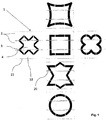
- FIG. 1 shows a possible embodiment of the magic cube 1 of six magic cube walls 3, which are framed by magic cube edges 2.
- Each magic cube wall 3 has a closed geometric surface 4.
- the geometric surfaces 4 consist of lines 20 which are arranged on cubicle member walls 12. These cube member walls 12 are framed by cube link edges 11.
- the lines 20 can be applied to square adhesive elements, which are glued to the cube member walls 12.
- the design of the closed geometric surfaces 4 is arbitrarily expandable and not on the embodiment according to FIG. 1 established.
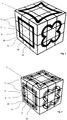
- FIGS. 2 and 3 show schematic three-dimensional views of a magic cube 1 according to the teaching of the invention.
- FIG. 2 has flat lines 20, is at FIG. 3 a stamp relief 21 is provided. This is suitable for the user to stamp on to create templates for solving with the magic cube 1.
- the stamp relief is tactile palpable and therefore suitable for visually impaired users.
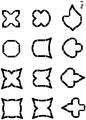
- FIG. 4 gives an overview of different, closed geometric surfaces 4, which can be created on a magic cube wall 3 of a magic cube 1 according to the teaching of the invention. It is a part of the achievable embodiments to give an impression of the versatility of the magic cube.
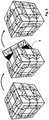
- FIG. 5 gives a schematic three-dimensional view of a magic cube 1 on rotation of a magic cube plane 5 by 90 degrees. It turns out that new closed geometric surfaces 4 always form. The contours of the closed geometric surfaces 4 is a stamp relief 21. Each rotation thus generates new closed geometric surfaces 4, which stamp and thus can be used as a template for setting the magic cube 1 again.
Landscapes
- Engineering & Computer Science (AREA)
- Multimedia (AREA)
- Toys (AREA)
Description
- Die Erfindung betrifft einen Zauberwürfel mit drehbaren Zauberwürfelebenen und mit sechs Zauberwürfelwänden aus insgesamt mindestens 26 Würfelgliedern, die rechteckig, vorzugsweise quadratische, Würfelgliedwände aufweisen, wobei auf einer Vielzahl von mit Würfelgliedkanten umrahmten Würfelgliedwänden Linien angeordnet sind, die mindestens in einem Grundzustand des Zauberwürfels eine geschlossene geometrische Flächen bilden.
- Die Druckschrift
US 4 407 502 A beschreibt einen Zauberwürfel der eingangs genannten Art. Bei jeder Drehung von Zauberwürfelebenen entstehen neue Gesichter, wobei die Konturlinien stets aufeinander fallen. Die Gesichter weisen hohe geometrische Ähnlichkeiten auf. Dieser Zauberwürfel hat als Lernmittel jedoch die Eigenart, dass bei seiner Benutzung kreative Fertigkeiten stärker gefördert werden als logische und kombinatorische Fertigkeiten. - Prinzipiell hat ein Zauberwürfel der eingangs genannten Art den Vorteil, dass durch seine Anwendung das kreative Denken des Benutzers trainiert wird. Der Zauberwürfel eignet sich insbesondere für Kinder, deren kreatives Denken stets zu schulen ist.
- Der vorgenannte Zauberwürfel hat jedoch den Nachteil, dass sich der Lerneffekt im Wesentlichen auf eine Erhöhung der kreativen Fertigkeiten fokussiert. Die Konzentrationsfähigkeit oder logische Fertigkeiten können durch den vorgenannten Zauberwürfel nicht trainiert werden.
- Aufgabe der Erfindung ist es, ein Lernmittel mit einem möglichst großen Formenschatz an geometrischen Flächen zur Verfügung zu stellen, das die Konzentrationsfähigkeit, logische Denkstrukturen, Kreativität und kombinatorische Fähigkeiten in didaktischer und pädagogischer Weise erhöht.
- Zur Lösung dieser Aufgabe schlägt die Erfindung einen Zauberwürfel gemäß Anspruch 1 vor. Vorzugsweise sind die punktsymmetrischen geometrischen Flächen aus der Sicht des Zauberwürfelwandmittelpunkts innerhalb einer Drehung um einen Vollwinkel periodisch mit einer Periodizität von zwei. Geometrische Flächen, die dieses Kriterium erfüllen, sind beispielsweise Kreise, Quadrate, Achtecke und weitere Vielecke. Zu den spiegelsymmetrischen geometrischen Flächen gehören beispielsweise mehrzackige Sterne. Die Unterscheidung zwischen verschiedenen Symmetrien sowie geometrischen Flächen fördert bei Kindern das Verständnis und das Vorstellungsvermögen für geometrische Formen. In dieser Weise können insbesondere Kinder als Benutzer ihr Verständnis von verschiedenen Symmetriearten trainieren. Die Flächen können dabei derart zusammengesetzt werden, dass sie gar keine Symmetrie, Spiegelsymmetrie oder Punktsymmetrie aufweisen. Durch die ständige Änderung der geometrischen Flächen erhöht sich die kreative Denkstruktur parallel zur logischen Denkstruktur. Diese werden durch die angestrebte Konstellation gezielter geometrischer Flächen gefördert. Mithin trainiert der Zauberwürfel als Lernmittel beide Gehirnhälften und begründet einen eleganten Einfluss von Didaktik und Pädagogik. Durch die aufeinandertreffende Auslegung der Linien sind bei einer Drehung einer Zauberwürfelebene die Linien der verschiedenen Würfelglieder an den Würfelgliedkanten immer miteinander verbunden. Es handelt sich somit um eine elegante und didaktisch sinnvolle Lösung, um die vorgenannten Merkmale der Aufgabe zu erreichen. Zum Erreichen stets geschlossener geometrischer Flächen über das vorgenannte Merkmal ist der Mehrkostenaufwand zur Herstellung des erfindungsgemäßen Zauberwürfels gegenüber einem gewöhnlichen Zauberwürfel verhältnismäßig gering. Dies macht die vorgeschlagene Lösung unter finanzieller Betrachtung besonders interessant.
- Zudem sieht eine bevorzugte Ausführungsform des Zauberwürfels vor, dass die Linien gegenüber den Würfelwänden haptisch tastbare Strukturen aufweisen. Eine derartige Topographie der Würfelwände erweist sich als vorteilhaft für die Entwicklung von haptischen Fähigkeiten bei Kindern. Außerdem eignet sich der Zauberwürfel durch das vorgenannte Merkmal als Lernmittel für Benutzer mit eingeschränktem bis garkeinem Sehvermögen. Gegenüber Blindenschrift hat der erfindungsgemäße Zauberwürfel den Vorteil, dass die Anordnung von Linien zu geometrischen Flächen eine schnellere haptische Wahrnehmung erlaubt, als die feinen Strukturen der Blindenschrift.
- In einem die Erfindung verbessernden Merkmal, sind die Linien als Stempelrelief ausgebildet. Die Einbindung eines Stempelreliefs in die Linien des Zauberwürfels erweitert den Anwendungsbereich des Zauberwürfels, mit dem nunmehr ein direkter Auftrag einer geometrischen Fläche mit Farbe auf ein Blatt Papier oder ähnliche Medien ohne weitere Hilfsmittel möglich ist. Der Benutzer kann sich eine komplexe geometrische Fläche als Vorlage stempeln und nach einer Verdrehung des Zauberwürfels versuchen, die gestempelte Vorlage zu erhalten.
- Weiterhin kann die Erfindung einen Zauberwürfel umfassen, auf dem auf Würfelgliedwänden Linien angeordnet sind, die jeweils durch mindestens zwei Würfelgliedkanten seitenhalbierend verlaufen. Der vorgenannte seitenhalbierende Linienverlauf erhöht den möglichen Formenschatz an geschlossenen geometrischen Flächen, weil die Linien in der Mitte der Würfelgliedkanten den auf der Würfelgliedwand beidseitig größtmöglichen Spielraum haben.
- Ferner kann der Zauberwürfel derart ausgeführt sein, dass die Zauberwürfelwände und/ oder die Linien unterschiedliche Farben aufweisen. Eine derartige Ausführungsform des Zauberwürfels dient farbsinngestörten Benutzern, die teilweise Farben erkennen könne, die Zuordnung von Farben zu bestimmten geometrischen Formen. Ein weiterer pädagogischer Aspekt ist das Verinnerlichen der Farblehre für Kinder. Vorzugsweise sind die geometrischen Flächen im Grundzustand des Würfels homogen koloriert. Die Drehung einer Zauberwürfelebene bewirkt, dass vorzugsweise Linien mit unterschiedlichen Farben an den Würfelgliedkanten aneinandergrenzen. Je nachdem, ob diese Farben einen hohen Blau- oder Rotanteil haben, werden mehr oder weniger hohe Kontraste zwischen den Farben deutlich. Beispielsweise erscheint eine orange kolorierte Linie neben einer blauen Linie wesentlich leuchtender als neben einer roten Linie. Dieser Effekt wird durch den Kontrast zwischen den Komplementärfarben orange und blau hervorgerufen. Komplementärfarben sind Farben, die bei der additiven oder subtraktiven Farbmischung einen grauen Farbton ergeben. Rot und orange harmonieren, da orange eine Sekundärfarbe ist, die aus rot und gelb gemischt wird. Gelb und rot bezeichnet man als Primärfarben, da sie sich gemäß der Farblehre nicht aus Pigmenten anderer Farben mischen lassen.
- Erfindungsgemäß kann der Zauberwürfel derart ausgeführt sein, dass die Breite der Linien an den Würfelgliedkanten für alle geometrischen Flächen gleich ist. In dieser Weise wird der didaktische Fokus des Zauberwürfels auf ein kindergerechtes Niveau gerichtet. Das Kind kann sich auf die Herstellung von geometrischen Formen konzentrieren und wird durch die Hilfestellung gleichbreiter Linien an jeder Würfelkante nicht abgelenkt. Gleiche Linienbreiten an den Kanten fördern die Harmonie der Figurenkompositionen und ermöglichen, dass viele Würfelkombinationen eine harmonische Fläche ergeben.
- Vorteilhafterweise kann der Zauberwürfel Zauberwürfelwände aufweisen, auf denen die Linien Symbole und/ oder Piktogramme bilden. In dieser Weise wird der Anwendungsbereich des Zauberwürfels erweitert. Beispielweise können auf die Zauberwürfelwände Piktogramme von Verkehrsschildern aufgetragen werden, die logisch miteinander verknüpft sind. In dieser Weise kann das logische Denkvermögen des Kindes geschult werden.
- Mit einem weiteren, die Erfindung verbessernden Merkmal, kann der Zauberwürfel aus Kunststoff bestehen. Dies ermöglicht, dass das Kind den Zauberwürfel überall benutzen kann und dieser leicht gereinigt werden kann. Weiterhin ist die Herstellung des Zauberwürfels aus Kunststoff kostengünstig, schnell und in großen Stückzahlen möglich.
- Die Erfindung kann weiterhin vorsehen, dass die Würfelglieder einstückig hergestellt werden. In dieser Weise wird die Verwendung von Klebstoffen vermieden, die die Gesundheit eines Kindes als Benutzer gefährden könnten. Weiterhin wird ein Zauberwürfel zur Verfügung gestellt, der aufgrund des möglichst reduzierten Einzelkomponentenaufkommens verschleißarm ist. Weiterhin ist die Gefahr des Verschluckens von kleinen Einzelteilen im Falle der Zerstörung des Zauberwürfels deutlich vermindert. Die Haptik der Linien kann dadurch erreicht werden, dass überschüssiges Material abgetragen wird. Dies kann über Laserabtrag oder mechanisch, beispielsweise gefräst, erfolgen. Ebenso ist es denkbar, dass die Linienhaptik direkt über die Fertigungsform des Würfelgliedes bei der Herstellung entsteht.
- Alternativ sieht die Erfindung vor, dass die Würfelgliedwände auf einem konventionellen Zauberwürfel befestigbar, insbesondere aufklebbar, sind. Dies ermöglicht ein Nachrüsten bereits vorhandener Zauberwürfel und stellt damit eine umweltschonende und kostengünstige Option dar, die Vorzüge der Erfindungslehre zu nutzen. Ebenso können die Linien auf die Würfelgliedwände aufgeklebt oder angeschraubt werden.
- Weitere Vorteile, Merkmale und Einzelheiten der Erfindung ergeben sich aus der nachfolgenden Beschreibung, in der unter Bezugnahme auf die Zeichnungen mehrere Ausführungsbeispiele der Erfindung im Einzelnen beschrieben sind. Dabei können die in den Ansprüchen und in der Beschreibung aufgeführten Merkmale jeweils einzeln für sich oder in beliebiger Kombination erfindungswesentlich sein. Es zeigen:
- Fig. 1:
- eine schematische Draufsicht auf alle Wände eines aufgefalteten Zauberwürfels in seinem Grundzustand mit geschlossenen geometrischen Flächen;
- Fig. 2:
- eine schematische dreidimensionale Ansicht eines Zauberwürfels;
- Fig. 3:
- eine schematische dreidimensionale Ansicht eines Zauberwürfels mit Stempelrelief;
- Fig. 4:
- eine schematische Ansicht von unterschiedlichen, geschlossenen geometrischen Flächen;
- Fig. 5:
- eine schematische dreidimensionale Ansicht eines Zauberwürfels bei Drehung einer Zauberwürfelebene um 90 Grad.
-
Figur 1 zeigt eine mögliche Ausführungsform des Zauberwürfels 1 aus sechs Zauberwürfelwänden 3, die von Zauberwürfelkanten 2 umrahmt werden. Jede Zauberwürfelwand 3 weist eine geschlossene geometrische Fläche 4 auf. Die geometrischen Flächen 4 bestehen aus Linien 20, die auf Würfelgliedwänden 12 angeordnet sind. Diese Würfelgliedwände 12 sind von Würfelgliedkanten 11 umrahmt. Die Linien 20 können auf quadratische Klebeelemente aufgetragen werden, die auf die Würfelgliedwände 12 aufgeklebt werden. Die Gestaltung der geschlossenen geometrischen Flächen 4 ist beliebig erweiterbar und nicht auf die Ausführungsform nachFigur 1 festgelegt. - Die
Figuren 2 und 3 zeigen schematische dreidimensionale Ansichten eines Zauberwürfels 1 nach Lehre der Erfindung. Zu erkennen sind drei Zauberwürfelwände 3, auf denen jeweils unterschiedliche geschlossene geometrische Flächen 4 zu erkennen sind. Ebenfalls zeigt sich die Anordnung von Würfelgliedern 10 zu einem gesamten Zauberwürfel 1. WährendFigur 2 flache Linien 20 aufweist, ist beiFigur 3 ein Stempelrelief 21 vorgesehen. Dieses eignet sich für den Benutzer zum Stempeln, um sich Vorlagen zum Lösen mit dem Zauberwürfel 1 zu schaffen. Ebenso ist das Stempelrelief haptisch tastbar und mithin für sehbehinderte Benutzer geeignet. -
Figur 4 gibt eine Übersicht über unterschiedliche, geschlossene geometrische Flächen 4, die auf einer Zauberwürfelwand 3 eines Zauberwürfels 1 nach Lehre der Erfindung geschaffen werden können. Dabei handelt es sich um einen Ausschnitt der erzielbaren Ausführungsformen, um einen Eindruck über die Vielseitigkeit des Zauberwürfels zu vermitteln. -
Figur 5 gibt eine schematische dreidimensionale Ansicht eines Zauberwürfels 1 bei Drehung einer Zauberwürfelebene 5 um 90 Grad. Es zeigt sich, dass sich stets neue geschlossene geometrische Flächen 4 bilden. Bei den Konturen der geschlossenen geometrischen Flächen 4 handelt es sich um ein Stempelrelief 21. Jede Drehung generiert mithin neue geschlossene geometrische Flächen 4, die sich stempeln und somit als Vorlage zur erneuten Einstellung des Zauberwürfels 1 bedienen lassen.
Claims (10)
- Zauberwürfel mit drehbaren Zauberwürfelebenen (5) und mit sechs Zauberwürfelwänden (3) aus insgesamt mindestens 26 Würfelgliedern (10), die rechteckig, vorzugsweise quadratische, Würfelgliedwände (12) aufweisen, wobei auf einer Vielzahl von mit Würfelgliedkanten (11) umrahmten Würfelgliedwänden (12) Linien (20) angeordnet sind, die mindestens in einem Grundzustand des Zauberwürfels (1) auf jeder Zauberwürfelwand (3) jeweils eine geschlossene geometrische Fläche bilden, dadurch gekennzeichnet, dass die Linien (20) auf einer Vielzahl von Würfelgliedwänden (12) derart durch die Würfelgliedkanten (13) aufeinander treffend angeordnet sind, dass die Linien (20) bei jeder Drehung von Zauberwürfelebenen (5) auf jeder Zauberwürfelwand (3) jeweils eine neue geschlossene geometrische Fläche erzeugen, wobei die Linien (20), die die geschlossenen geometrischen Flächen bilden, in sich geschlossene Strecken sind.
- Zauberwürfel nach Anspruch 1, dadurch gekennzeichnet, dass die Linien (20) gegenüber den Zauberwürfelwänden (3) haptisch tastbare Strukturen aufweisen.
- Zauberwürfel nach einem der vorhergehenden Ansprüche, dadurch gekennzeichnet, dass die Linien (20) als Stempelrelief (21) ausgebildet sind.
- Zauberwürfel nach einem der vorhergehenden Ansprüche, dadurch gekennzeichnet, dass auf einer Vielzahl von Würfelgliedwänden (12) Linien (20) angeordnet sind, die jeweils durch mindestens zwei Würfelgliedkanten (11) seitenhalbierend verlaufen.
- Zauberwürfel nach einem der vorhergehenden Ansprüche, dadurch gekennzeichnet, dass die Zauberwürfelwände (3) und/ oder die Würfelgliedwände (12) und/ oder die Linien (20) unterschiedliche Farben aufweisen.
- Zauberwürfel nach einem der vorhergehenden Ansprüche, dadurch gekennzeichnet, dass die Breite der Linien (20) an den Würfelgliedkanten (11) gleich ist.
- Zauberwürfel nach einem der vorhergehenden Ansprüche, dadurch gekennzeichnet, dass die Linien (20) Symbole und/oder Piktogramme bilden.
- Zauberwürfel nach einem der vorhergehenden Ansprüche, dadurch gekennzeichnet, dass die Würfelglieder (10) aus Kunststoff bestehen.
- Zauberwürfel nach einem der vorhergehenden Ansprüche, dadurch gekennzeichnet, dass die Würfelglieder (10) einstückig ausgebildet sind.
- Zauberwürfel nach einem der vorhergehenden Ansprüche, dadurch gekennzeichnet, dass die linierten Würfelgliedwände (12) auf einem konventionellen Zauberwürfel befestigbar sind.
Applications Claiming Priority (2)
| Application Number | Priority Date | Filing Date | Title |
|---|---|---|---|
| DE102013016153.3A DE102013016153B3 (de) | 2013-09-30 | 2013-09-30 | Didaktischer Zauberwürfel mit geschlossenen geometrischen Flächen auf jeder Zauberwürfelebene |
| PCT/EP2014/069629 WO2015043999A1 (de) | 2013-09-30 | 2014-09-15 | Didaktischer zauberwürfel |
Publications (2)
| Publication Number | Publication Date |
|---|---|
| EP3052207A1 EP3052207A1 (de) | 2016-08-10 |
| EP3052207B1 true EP3052207B1 (de) | 2018-02-14 |
Family
ID=51570496
Family Applications (1)
| Application Number | Title | Priority Date | Filing Date |
|---|---|---|---|
| EP14766974.1A Active EP3052207B1 (de) | 2013-09-30 | 2014-09-15 | Didaktischer zauberwürfel |
Country Status (3)
| Country | Link |
|---|---|
| EP (1) | EP3052207B1 (de) |
| DE (1) | DE102013016153B3 (de) |
| WO (1) | WO2015043999A1 (de) |
Families Citing this family (4)
| Publication number | Priority date | Publication date | Assignee | Title |
|---|---|---|---|---|
| CN106874631B (zh) * | 2017-04-01 | 2024-04-05 | 合肥学院 | 一种三阶魔方虚拟方法和虚拟系统 |
| USD943860S1 (en) * | 2018-09-18 | 2022-02-15 | Jose E. Lopez | Meditation cube |
| US20220032171A1 (en) * | 2020-07-30 | 2022-02-03 | Harshad Bhavsar | Meaningful combination generating logic cube |
| US12403389B2 (en) | 2023-01-17 | 2025-09-02 | Harshad Bhavsar | 3D puzzles with replaceable tiles |
Family Cites Families (12)
| Publication number | Priority date | Publication date | Assignee | Title |
|---|---|---|---|---|
| DE8112064U1 (de) * | 1981-11-26 | Steindel, Hans-Peter, Dr., 4500 Osnabrück | Geschicklichkeitsspiel in Form eines Würfels | |
| DE8126065U1 (de) * | 1982-06-24 | Kling, Holger, 7080 Aalen | Würfelförmiges Spielgerät | |
| US3565443A (en) * | 1969-03-14 | 1971-02-23 | Burton L Klein | Decorative cube puzzle |
| HU180387B (en) * | 1980-10-28 | 1983-02-28 | Rubik Erno | Spatial logic toy |
| US4407502A (en) * | 1981-10-02 | 1983-10-04 | Paulos John A | Matrix puzzle game |
| FR2515056A1 (fr) * | 1981-10-26 | 1983-04-29 | Aubourg Jean Philippe | Puzzle tridimensionnel a figures variees, orientees et complementaires |
| EP0247097A1 (de) * | 1985-11-29 | 1987-12-02 | LINDSAY, Graham Charles | Spiel |
| US6857632B2 (en) * | 2002-10-07 | 2005-02-22 | Terry Lee Tanner | Puzzles |
| US6974130B2 (en) * | 2004-02-25 | 2005-12-13 | Martin James Sugden | Manipulable puzzle cube |
| GB2448484A (en) * | 2007-03-10 | 2008-10-22 | Gary Spencer-Purvis | Three dimensional spherical puzzle with sliding and rotating segments |
| CN101766907B (zh) * | 2010-02-01 | 2012-09-05 | 叶青 | 一种魔方 |
| CN201613008U (zh) * | 2010-02-01 | 2010-10-27 | 叶青 | 一种魔方 |
-
2013
- 2013-09-30 DE DE102013016153.3A patent/DE102013016153B3/de not_active Expired - Fee Related
-
2014
- 2014-09-15 EP EP14766974.1A patent/EP3052207B1/de active Active
- 2014-09-15 WO PCT/EP2014/069629 patent/WO2015043999A1/de not_active Ceased
Also Published As
| Publication number | Publication date |
|---|---|
| WO2015043999A1 (de) | 2015-04-02 |
| DE102013016153B3 (de) | 2015-01-22 |
| EP3052207A1 (de) | 2016-08-10 |
Similar Documents
| Publication | Publication Date | Title |
|---|---|---|
| EP0171409B1 (de) | Kombinativer elementensatz zum auslegen von flächem mit varierbarem aussehen, insbesondere zur anwendung als spielzeug oder als flächenbedeckung | |
| DE102013016153B3 (de) | Didaktischer Zauberwürfel mit geschlossenen geometrischen Flächen auf jeder Zauberwürfelebene | |
| EP0517872B1 (de) | Verwandlungskörper | |
| DE202013008632U1 (de) | Didaktischer Zauberwürfel | |
| DE202025104631U1 (de) | Magnetspiel für Kinder | |
| DE9105957U1 (de) | In einen räumlichen Körper umwandelbares Buch | |
| DE2346555A1 (de) | Lehr- und puzzlespiel | |
| DE10154382B4 (de) | Malbuch für Kinder | |
| DE102015000362B4 (de) | Aufbau einer Seite, insbesondere zur Verwendung in einem Buch oder als Spiel für Kinder | |
| EP1255593B1 (de) | Lern-, spiel- und therapiematerial | |
| DE60116312T2 (de) | Spielzeuge | |
| WO2009100696A1 (de) | Logisches stereospielzeug | |
| DE202017104838U1 (de) | Bauspielzeugsystem | |
| DE2949635A1 (de) | Schwenkbare anordnung von bloecken oder wuerfeln, insbesondere spielzeug | |
| DE102004039077B3 (de) | Konstruktionssatz zum Bau von zusammengesetzten trennbaren 2D- und 3D-Figuren | |
| DE3320174C2 (de) | Bauelemente | |
| DE202006006227U1 (de) | Unterrichts- und/oder Unterhaltungssystem, bestimmt für Kinder, für ein textiles Erzeugnis und/oder dessen Zubehör | |
| DE19720140C2 (de) | Legespiel | |
| DE8112064U1 (de) | Geschicklichkeitsspiel in Form eines Würfels | |
| DE2209026A1 (de) | Umkleidung bzw. mehrschichtige oberflaeche fuer gegenstaende aller art | |
| DE3875724T2 (de) | Kombinierbare spielelemente mit spielbrett. | |
| DE20201475U1 (de) | Zwei- und dreidimensionales Faltobjekt | |
| DE202004017051U1 (de) | Ball | |
| DE1897188U (de) | Mittel fuer lehr-, anschauungs-, werbe- oder spielzwecke. | |
| DE9413866U1 (de) | Zusammensetzspiel |
Legal Events
| Date | Code | Title | Description |
|---|---|---|---|
| PUAI | Public reference made under article 153(3) epc to a published international application that has entered the european phase |
Free format text: ORIGINAL CODE: 0009012 |
|
| 17P | Request for examination filed |
Effective date: 20160412 |
|
| AK | Designated contracting states |
Kind code of ref document: A1 Designated state(s): AL AT BE BG CH CY CZ DE DK EE ES FI FR GB GR HR HU IE IS IT LI LT LU LV MC MK MT NL NO PL PT RO RS SE SI SK SM TR |
|
| AX | Request for extension of the european patent |
Extension state: BA ME |
|
| DAX | Request for extension of the european patent (deleted) | ||
| GRAP | Despatch of communication of intention to grant a patent |
Free format text: ORIGINAL CODE: EPIDOSNIGR1 |
|
| INTG | Intention to grant announced |
Effective date: 20170905 |
|
| GRAS | Grant fee paid |
Free format text: ORIGINAL CODE: EPIDOSNIGR3 |
|
| GRAA | (expected) grant |
Free format text: ORIGINAL CODE: 0009210 |
|
| AK | Designated contracting states |
Kind code of ref document: B1 Designated state(s): AL AT BE BG CH CY CZ DE DK EE ES FI FR GB GR HR HU IE IS IT LI LT LU LV MC MK MT NL NO PL PT RO RS SE SI SK SM TR |
|
| REG | Reference to a national code |
Ref country code: GB Ref legal event code: FG4D Free format text: NOT ENGLISH |
|
| REG | Reference to a national code |
Ref country code: CH Ref legal event code: EP |
|
| REG | Reference to a national code |
Ref country code: IE Ref legal event code: FG4D Free format text: LANGUAGE OF EP DOCUMENT: GERMAN |
|
| REG | Reference to a national code |
Ref country code: DE Ref legal event code: R096 Ref document number: 502014007266 Country of ref document: DE Ref country code: AT Ref legal event code: REF Ref document number: 969506 Country of ref document: AT Kind code of ref document: T Effective date: 20180315 |
|
| REG | Reference to a national code |
Ref country code: NL Ref legal event code: MP Effective date: 20180214 |
|
| PG25 | Lapsed in a contracting state [announced via postgrant information from national office to epo] |
Ref country code: FI Free format text: LAPSE BECAUSE OF FAILURE TO SUBMIT A TRANSLATION OF THE DESCRIPTION OR TO PAY THE FEE WITHIN THE PRESCRIBED TIME-LIMIT Effective date: 20180214 Ref country code: CY Free format text: LAPSE BECAUSE OF FAILURE TO SUBMIT A TRANSLATION OF THE DESCRIPTION OR TO PAY THE FEE WITHIN THE PRESCRIBED TIME-LIMIT Effective date: 20180214 Ref country code: NL Free format text: LAPSE BECAUSE OF FAILURE TO SUBMIT A TRANSLATION OF THE DESCRIPTION OR TO PAY THE FEE WITHIN THE PRESCRIBED TIME-LIMIT Effective date: 20180214 Ref country code: NO Free format text: LAPSE BECAUSE OF FAILURE TO SUBMIT A TRANSLATION OF THE DESCRIPTION OR TO PAY THE FEE WITHIN THE PRESCRIBED TIME-LIMIT Effective date: 20180514 Ref country code: ES Free format text: LAPSE BECAUSE OF FAILURE TO SUBMIT A TRANSLATION OF THE DESCRIPTION OR TO PAY THE FEE WITHIN THE PRESCRIBED TIME-LIMIT Effective date: 20180214 Ref country code: LT Free format text: LAPSE BECAUSE OF FAILURE TO SUBMIT A TRANSLATION OF THE DESCRIPTION OR TO PAY THE FEE WITHIN THE PRESCRIBED TIME-LIMIT Effective date: 20180214 Ref country code: HR Free format text: LAPSE BECAUSE OF FAILURE TO SUBMIT A TRANSLATION OF THE DESCRIPTION OR TO PAY THE FEE WITHIN THE PRESCRIBED TIME-LIMIT Effective date: 20180214 |
|
| PG25 | Lapsed in a contracting state [announced via postgrant information from national office to epo] |
Ref country code: BG Free format text: LAPSE BECAUSE OF FAILURE TO SUBMIT A TRANSLATION OF THE DESCRIPTION OR TO PAY THE FEE WITHIN THE PRESCRIBED TIME-LIMIT Effective date: 20180514 Ref country code: GR Free format text: LAPSE BECAUSE OF FAILURE TO SUBMIT A TRANSLATION OF THE DESCRIPTION OR TO PAY THE FEE WITHIN THE PRESCRIBED TIME-LIMIT Effective date: 20180515 Ref country code: RS Free format text: LAPSE BECAUSE OF FAILURE TO SUBMIT A TRANSLATION OF THE DESCRIPTION OR TO PAY THE FEE WITHIN THE PRESCRIBED TIME-LIMIT Effective date: 20180214 Ref country code: LV Free format text: LAPSE BECAUSE OF FAILURE TO SUBMIT A TRANSLATION OF THE DESCRIPTION OR TO PAY THE FEE WITHIN THE PRESCRIBED TIME-LIMIT Effective date: 20180214 Ref country code: SE Free format text: LAPSE BECAUSE OF FAILURE TO SUBMIT A TRANSLATION OF THE DESCRIPTION OR TO PAY THE FEE WITHIN THE PRESCRIBED TIME-LIMIT Effective date: 20180214 |
|
| PG25 | Lapsed in a contracting state [announced via postgrant information from national office to epo] |
Ref country code: MT Free format text: LAPSE BECAUSE OF FAILURE TO SUBMIT A TRANSLATION OF THE DESCRIPTION OR TO PAY THE FEE WITHIN THE PRESCRIBED TIME-LIMIT Effective date: 20180214 |
|
| PG25 | Lapsed in a contracting state [announced via postgrant information from national office to epo] |
Ref country code: EE Free format text: LAPSE BECAUSE OF FAILURE TO SUBMIT A TRANSLATION OF THE DESCRIPTION OR TO PAY THE FEE WITHIN THE PRESCRIBED TIME-LIMIT Effective date: 20180214 Ref country code: PL Free format text: LAPSE BECAUSE OF FAILURE TO SUBMIT A TRANSLATION OF THE DESCRIPTION OR TO PAY THE FEE WITHIN THE PRESCRIBED TIME-LIMIT Effective date: 20180214 Ref country code: RO Free format text: LAPSE BECAUSE OF FAILURE TO SUBMIT A TRANSLATION OF THE DESCRIPTION OR TO PAY THE FEE WITHIN THE PRESCRIBED TIME-LIMIT Effective date: 20180214 Ref country code: IT Free format text: LAPSE BECAUSE OF FAILURE TO SUBMIT A TRANSLATION OF THE DESCRIPTION OR TO PAY THE FEE WITHIN THE PRESCRIBED TIME-LIMIT Effective date: 20180214 Ref country code: AL Free format text: LAPSE BECAUSE OF FAILURE TO SUBMIT A TRANSLATION OF THE DESCRIPTION OR TO PAY THE FEE WITHIN THE PRESCRIBED TIME-LIMIT Effective date: 20180214 |
|
| REG | Reference to a national code |
Ref country code: DE Ref legal event code: R097 Ref document number: 502014007266 Country of ref document: DE |
|
| PG25 | Lapsed in a contracting state [announced via postgrant information from national office to epo] |
Ref country code: SK Free format text: LAPSE BECAUSE OF FAILURE TO SUBMIT A TRANSLATION OF THE DESCRIPTION OR TO PAY THE FEE WITHIN THE PRESCRIBED TIME-LIMIT Effective date: 20180214 Ref country code: DK Free format text: LAPSE BECAUSE OF FAILURE TO SUBMIT A TRANSLATION OF THE DESCRIPTION OR TO PAY THE FEE WITHIN THE PRESCRIBED TIME-LIMIT Effective date: 20180214 Ref country code: SM Free format text: LAPSE BECAUSE OF FAILURE TO SUBMIT A TRANSLATION OF THE DESCRIPTION OR TO PAY THE FEE WITHIN THE PRESCRIBED TIME-LIMIT Effective date: 20180214 Ref country code: CZ Free format text: LAPSE BECAUSE OF FAILURE TO SUBMIT A TRANSLATION OF THE DESCRIPTION OR TO PAY THE FEE WITHIN THE PRESCRIBED TIME-LIMIT Effective date: 20180214 |
|
| PLBE | No opposition filed within time limit |
Free format text: ORIGINAL CODE: 0009261 |
|
| STAA | Information on the status of an ep patent application or granted ep patent |
Free format text: STATUS: NO OPPOSITION FILED WITHIN TIME LIMIT |
|
| 26N | No opposition filed |
Effective date: 20181115 |
|
| PG25 | Lapsed in a contracting state [announced via postgrant information from national office to epo] |
Ref country code: SI Free format text: LAPSE BECAUSE OF FAILURE TO SUBMIT A TRANSLATION OF THE DESCRIPTION OR TO PAY THE FEE WITHIN THE PRESCRIBED TIME-LIMIT Effective date: 20180214 |
|
| PG25 | Lapsed in a contracting state [announced via postgrant information from national office to epo] |
Ref country code: MC Free format text: LAPSE BECAUSE OF FAILURE TO SUBMIT A TRANSLATION OF THE DESCRIPTION OR TO PAY THE FEE WITHIN THE PRESCRIBED TIME-LIMIT Effective date: 20180214 |
|
| PGFP | Annual fee paid to national office [announced via postgrant information from national office to epo] |
Ref country code: FR Payment date: 20190326 Year of fee payment: 5 |
|
| REG | Reference to a national code |
Ref country code: CH Ref legal event code: PL |
|
| REG | Reference to a national code |
Ref country code: BE Ref legal event code: MM Effective date: 20180930 |
|
| REG | Reference to a national code |
Ref country code: IE Ref legal event code: MM4A |
|
| PG25 | Lapsed in a contracting state [announced via postgrant information from national office to epo] |
Ref country code: LU Free format text: LAPSE BECAUSE OF NON-PAYMENT OF DUE FEES Effective date: 20180915 |
|
| PG25 | Lapsed in a contracting state [announced via postgrant information from national office to epo] |
Ref country code: IE Free format text: LAPSE BECAUSE OF NON-PAYMENT OF DUE FEES Effective date: 20180915 |
|
| PG25 | Lapsed in a contracting state [announced via postgrant information from national office to epo] |
Ref country code: BE Free format text: LAPSE BECAUSE OF NON-PAYMENT OF DUE FEES Effective date: 20180930 Ref country code: LI Free format text: LAPSE BECAUSE OF NON-PAYMENT OF DUE FEES Effective date: 20180930 Ref country code: CH Free format text: LAPSE BECAUSE OF NON-PAYMENT OF DUE FEES Effective date: 20180930 |
|
| PG25 | Lapsed in a contracting state [announced via postgrant information from national office to epo] |
Ref country code: TR Free format text: LAPSE BECAUSE OF FAILURE TO SUBMIT A TRANSLATION OF THE DESCRIPTION OR TO PAY THE FEE WITHIN THE PRESCRIBED TIME-LIMIT Effective date: 20180214 |
|
| PG25 | Lapsed in a contracting state [announced via postgrant information from national office to epo] |
Ref country code: PT Free format text: LAPSE BECAUSE OF FAILURE TO SUBMIT A TRANSLATION OF THE DESCRIPTION OR TO PAY THE FEE WITHIN THE PRESCRIBED TIME-LIMIT Effective date: 20180214 |
|
| PG25 | Lapsed in a contracting state [announced via postgrant information from national office to epo] |
Ref country code: HU Free format text: LAPSE BECAUSE OF FAILURE TO SUBMIT A TRANSLATION OF THE DESCRIPTION OR TO PAY THE FEE WITHIN THE PRESCRIBED TIME-LIMIT; INVALID AB INITIO Effective date: 20140915 Ref country code: MK Free format text: LAPSE BECAUSE OF NON-PAYMENT OF DUE FEES Effective date: 20180214 |
|
| PG25 | Lapsed in a contracting state [announced via postgrant information from national office to epo] |
Ref country code: IS Free format text: LAPSE BECAUSE OF FAILURE TO SUBMIT A TRANSLATION OF THE DESCRIPTION OR TO PAY THE FEE WITHIN THE PRESCRIBED TIME-LIMIT Effective date: 20180614 |
|
| PG25 | Lapsed in a contracting state [announced via postgrant information from national office to epo] |
Ref country code: FR Free format text: LAPSE BECAUSE OF NON-PAYMENT OF DUE FEES Effective date: 20190930 |
|
| REG | Reference to a national code |
Ref country code: AT Ref legal event code: MM01 Ref document number: 969506 Country of ref document: AT Kind code of ref document: T Effective date: 20190915 |
|
| PG25 | Lapsed in a contracting state [announced via postgrant information from national office to epo] |
Ref country code: AT Free format text: LAPSE BECAUSE OF NON-PAYMENT OF DUE FEES Effective date: 20190915 |
|
| PGFP | Annual fee paid to national office [announced via postgrant information from national office to epo] |
Ref country code: DE Payment date: 20251028 Year of fee payment: 12 |
|
| PGFP | Annual fee paid to national office [announced via postgrant information from national office to epo] |
Ref country code: GB Payment date: 20251027 Year of fee payment: 12 |