EP3063209B1 - Synthèse et utilisation de compositions de catalyseur comprenant des silsesquioxanes oligomères polyèdres métallisés - Google Patents
Synthèse et utilisation de compositions de catalyseur comprenant des silsesquioxanes oligomères polyèdres métallisés Download PDFInfo
- Publication number
- EP3063209B1 EP3063209B1 EP14749813.3A EP14749813A EP3063209B1 EP 3063209 B1 EP3063209 B1 EP 3063209B1 EP 14749813 A EP14749813 A EP 14749813A EP 3063209 B1 EP3063209 B1 EP 3063209B1
- Authority
- EP
- European Patent Office
- Prior art keywords
- isocyanate
- silsesquioxane
- reactive component
- catalyst composition
- catalyst
- Prior art date
- Legal status (The legal status is an assumption and is not a legal conclusion. Google has not performed a legal analysis and makes no representation as to the accuracy of the status listed.)
- Active
Links
Images


Classifications
-
- C—CHEMISTRY; METALLURGY
- C08—ORGANIC MACROMOLECULAR COMPOUNDS; THEIR PREPARATION OR CHEMICAL WORKING-UP; COMPOSITIONS BASED THEREON
- C08G—MACROMOLECULAR COMPOUNDS OBTAINED OTHERWISE THAN BY REACTIONS ONLY INVOLVING UNSATURATED CARBON-TO-CARBON BONDS
- C08G18/00—Polymeric products of isocyanates or isothiocyanates
- C08G18/06—Polymeric products of isocyanates or isothiocyanates with compounds having active hydrogen
- C08G18/08—Processes
- C08G18/16—Catalysts
- C08G18/22—Catalysts containing metal compounds
- C08G18/222—Catalysts containing metal compounds metal compounds not provided for in groups C08G18/225 - C08G18/26
-
- C—CHEMISTRY; METALLURGY
- C08—ORGANIC MACROMOLECULAR COMPOUNDS; THEIR PREPARATION OR CHEMICAL WORKING-UP; COMPOSITIONS BASED THEREON
- C08G—MACROMOLECULAR COMPOUNDS OBTAINED OTHERWISE THAN BY REACTIONS ONLY INVOLVING UNSATURATED CARBON-TO-CARBON BONDS
- C08G18/00—Polymeric products of isocyanates or isothiocyanates
- C08G18/06—Polymeric products of isocyanates or isothiocyanates with compounds having active hydrogen
- C08G18/08—Processes
- C08G18/16—Catalysts
- C08G18/22—Catalysts containing metal compounds
-
- C—CHEMISTRY; METALLURGY
- C08—ORGANIC MACROMOLECULAR COMPOUNDS; THEIR PREPARATION OR CHEMICAL WORKING-UP; COMPOSITIONS BASED THEREON
- C08G—MACROMOLECULAR COMPOUNDS OBTAINED OTHERWISE THAN BY REACTIONS ONLY INVOLVING UNSATURATED CARBON-TO-CARBON BONDS
- C08G18/00—Polymeric products of isocyanates or isothiocyanates
- C08G18/06—Polymeric products of isocyanates or isothiocyanates with compounds having active hydrogen
- C08G18/28—Polymeric products of isocyanates or isothiocyanates with compounds having active hydrogen characterised by the compounds used containing active hydrogen
- C08G18/40—High-molecular-weight compounds
- C08G18/61—Polysiloxanes
-
- C—CHEMISTRY; METALLURGY
- C08—ORGANIC MACROMOLECULAR COMPOUNDS; THEIR PREPARATION OR CHEMICAL WORKING-UP; COMPOSITIONS BASED THEREON
- C08G—MACROMOLECULAR COMPOUNDS OBTAINED OTHERWISE THAN BY REACTIONS ONLY INVOLVING UNSATURATED CARBON-TO-CARBON BONDS
- C08G77/00—Macromolecular compounds obtained by reactions forming a linkage containing silicon with or without sulfur, nitrogen, oxygen or carbon in the main chain of the macromolecule
- C08G77/04—Polysiloxanes
-
- C—CHEMISTRY; METALLURGY
- C08—ORGANIC MACROMOLECULAR COMPOUNDS; THEIR PREPARATION OR CHEMICAL WORKING-UP; COMPOSITIONS BASED THEREON
- C08G—MACROMOLECULAR COMPOUNDS OBTAINED OTHERWISE THAN BY REACTIONS ONLY INVOLVING UNSATURATED CARBON-TO-CARBON BONDS
- C08G77/00—Macromolecular compounds obtained by reactions forming a linkage containing silicon with or without sulfur, nitrogen, oxygen or carbon in the main chain of the macromolecule
- C08G77/48—Macromolecular compounds obtained by reactions forming a linkage containing silicon with or without sulfur, nitrogen, oxygen or carbon in the main chain of the macromolecule in which at least two but not all the silicon atoms are connected by linkages other than oxygen atoms
- C08G77/58—Metal-containing linkages
-
- B—PERFORMING OPERATIONS; TRANSPORTING
- B01—PHYSICAL OR CHEMICAL PROCESSES OR APPARATUS IN GENERAL
- B01J—CHEMICAL OR PHYSICAL PROCESSES, e.g. CATALYSIS OR COLLOID CHEMISTRY; THEIR RELEVANT APPARATUS
- B01J2231/00—Catalytic reactions performed with catalysts classified in B01J31/00
- B01J2231/10—Polymerisation reactions involving at least dual use catalysts, e.g. for both oligomerisation and polymerisation
- B01J2231/14—Other (co) polymerisation, e.g. of lactides or epoxides
-
- B—PERFORMING OPERATIONS; TRANSPORTING
- B01—PHYSICAL OR CHEMICAL PROCESSES OR APPARATUS IN GENERAL
- B01J—CHEMICAL OR PHYSICAL PROCESSES, e.g. CATALYSIS OR COLLOID CHEMISTRY; THEIR RELEVANT APPARATUS
- B01J31/00—Catalysts comprising hydrides, coordination complexes or organic compounds
- B01J31/02—Catalysts comprising hydrides, coordination complexes or organic compounds containing organic compounds or metal hydrides
- B01J31/0201—Oxygen-containing compounds
- B01J31/0211—Oxygen-containing compounds with a metal-oxygen link
- B01J31/0212—Alkoxylates
-
- B—PERFORMING OPERATIONS; TRANSPORTING
- B01—PHYSICAL OR CHEMICAL PROCESSES OR APPARATUS IN GENERAL
- B01J—CHEMICAL OR PHYSICAL PROCESSES, e.g. CATALYSIS OR COLLOID CHEMISTRY; THEIR RELEVANT APPARATUS
- B01J31/00—Catalysts comprising hydrides, coordination complexes or organic compounds
- B01J31/02—Catalysts comprising hydrides, coordination complexes or organic compounds containing organic compounds or metal hydrides
- B01J31/12—Catalysts comprising hydrides, coordination complexes or organic compounds containing organic compounds or metal hydrides containing organo-metallic compounds or metal hydrides
- B01J31/123—Organometallic polymers, e.g. comprising C-Si bonds in the main chain or in subunits grafted to the main chain
- B01J31/124—Silicones or siloxanes or comprising such units
- B01J31/125—Cyclic siloxanes
Definitions
- the present invention relates to a novel catalyst composition
- a novel catalyst composition comprising metallized polyhedral oligomeric silsesquioxanes (referred to as POMS) suitable for use as a catalyst in forming polyurethane materials.
- POMS metallized polyhedral oligomeric silsesquioxanes
- the present invention hence relates to a method to form a polyurethane material, a catalyst composition in combination with reactive compounds suitable to be used to provide a polyurethane material.
- Silsesquioxanes are known in the art and refer to compounds having the empirical chemical formula RSiO 3/2 . These compounds can be used as a support for catalysts and typically have a cage like structure [1] in which n RSiO 3/2 units are organized in a cage structure with the identity of R typically being an alkyl group. The organized cage like structure is typically referred to as polyhedral oligomeric silsesquioxanes (POSS). The precise combined structure of these RSiO 3/2 units vary depending on synthesis methods, starting materials and the catalyst used.
- silsesquioxane cage structure or in other words polyhedral oligomeric silsesquioxane structure (POSS) in which the four most common units form a cage of n RSiO 3/2 units in a designated Tn cage structure correspond to following structure [1]:
- WO200110871 discloses processes for the manufacture of polyhedral oligomeric silsesquioxanes (POSS) which utilize the action of bases that are capable of either attacking silicon or any compound that can react with a protic solvent (e.g. ROH,...) and generate hydroxide [OH], etc.
- POSS polyhedral oligomeric silsesquioxanes
- ROH protic solvent
- This process may result in a partial POSS cage structure in which the cage structure lacks complete connection of all units in the cage.
- Said partial POSS cage structures may be referred to as silsesquioxane silanols, a typical example may be Trisilanol POSS which corresponds to the following structure [2].
- These trisilanol POSS structures [2] can undergo further additional chemical manipulations to ultimately convert them into POSS-species suitable for polymerization, grafting, or other desirable chemical reactions.
- Metalized polyhedral oligomeric silsesquioxane structures are known in the art and known to be very suitable for use as catalysts.
- POMS Metalized polyhedral oligomeric silsesquioxane structures
- US20100125123 discloses metallized polyhedral oligomeric silsesquioxanes and metallized polyhedral oligomeric silicates for use as cure promoters, catalysts, and alloying agents for the reinforcement of polymer microstructures, including polymer coils, domains, chains, and segments, at the molecular level.
- WO 2007/041344 mentions metallized nanostructured chemicals as cure promoters.
- Composite materials comprising polymers (including polyurethanes) and POMS, comprising Ti as metal are mentioned.
- WO 2008/144735 discloses metallized polyhedral oligomeric silsesquioxanes, metalized using Ti or Zr, as catalyst as cure promoters for polyurethanes.
- WO 2009/065873 discloses polyhedral oligomeric stannasilsesquioxanes as catalyst for polyurethane curing.
- the polyurethane may be used in coatings, lacquers, paintings, films and polymer compositions and increases the scratch resistance of coatings.
- WO2011/076570 discloses a method to form a urethane material, the method comprises blending and reacting at least one isocyanate, at least one isocyanate reactive component and a metallized polyhedral oligomeric silsesquioxane to provide said urethane material, the metallized polyhedral oligomeric silsesquioxane is a dimeric structure containing 2 oligomeric silsesquioxane structures wherein both silsesquioxane structures have a 6-coordinated metal center and wherein both silsesquioxane structures are linked together by means of alkoxides bridging the 6-coordinated metal centers.
- titanium silsesquioxane compounds corresponding to structure [3] For use in polyurethane formation and curing, titanium silsesquioxane compounds corresponding to structure [3] have only very limited activity while titanium silsesquioxane compounds corresponding to structure [4] have moderate activity. Furthermore, titanium silsesquioxane compounds corresponding to structure [4] release VOC. This results from the reaction of the isocyanate reactive component (polyol) with the alkoxy group 2 which renders alcohol as the VOC.
- titanium silsesquioxane compounds for example those exemplified by structures [3] and [4] below, are microcrystalline solids.
- a high concentrated solution catalyst masterbatch
- a suitable polyol such that the required amount can added as such.
- titanium silsesquioxane catalytic compounds known till date have very low solubility in polyols a catalyst masterbatch cannot be made and hence the titanium silsesquioxane catalytic compounds first have to be dissolved in a suitable solvent which can be added then to the isocyanate reactive part (e.g. polyol).
- a suitable solvent which can be added then to the isocyanate reactive part (e.g. polyol).
- the problem to be solved by the current invention is to provide titanium silsesquioxane catalytic compounds with improved catalytic activity, in particular for polyurethane formation and curing.
- titanium silsesquioxane catalytic compounds which have good solubility in polyols which makes it possible to make a catalyst masterbatch in e.g. the polyols used as isocyanate reactives in polyurethane formation.
- a method is disclosed to form a polyurethane material.
- the ratio of the number of equivalents of silsesquioxane silanols, in particular silsesquioxane trisilanols over the number of equivalents of metallic alkoxides used for making the catalyst composition is in the range 1.5:1 up to 2:1.
- the catalyst composition used to form the polyurethane material is a mixture comprising following intermediate POMS structures [8], [9], [10] and [11] in a dynamic equilibrium:
- the method to form a polyurethane material comprises said metallized polyhedral oligomeric silsesquioxane is incorporated into an isocyanate reactive component before blending said at least one isocyanate, at least one isocyanate reactive component and said catalyst composition.
- the composition comprising the POMS catalyst according to the invention and at least one isocyanate reactive component which is suitable to dissolve the POMS catalyst is also referred to as "catalyst/polyol masterbatch"
- the isocyanate reactive component suitable to dissolve the POMS catalyst is selected from monools and/or polyols such as glycols, high molecular weight polyether polyols and polyester polyols, mercaptans, carboxylic acids such as polybasic acids, amines, polyamines, components comprising at least one alcohol group and at least one amine group such as polyaminepolyols, urea and amides.
- monools and/or polyols such as glycols, high molecular weight polyether polyols and polyester polyols, mercaptans, carboxylic acids such as polybasic acids, amines, polyamines, components comprising at least one alcohol group and at least one amine group such as polyaminepolyols, urea and amides.
- the isocyanate reactive component is selected from monools or polyols which have an average nominal hydroxy functionality of 1-8 and an average molecular weight of 32-8000 and mixtures of said monools and/or polyols.
- the isocyanate reactive component is selected from monools selected from methanol, ethanol, propanol, butanol, phenol, cyclohexanol and hydrocarbon monools having an average molecular weight of 200-5000 like aliphatic and polyether monools and/or polyols selected from ethylene glycol, diethylene glycol, triethylene glycol, propylene glycol, dipropylene glycol, tripropylene glycol, trimethylol propane, sorbitol, sucrose, glycerol, ethanediol, propanediol, butanediol, pentanediol, hexanediol, aromatic and/or aliphatic polyols having a molecular weight of up to 8000, preferably 200-6000 polyester polyols having an average molecular weight of 200-8000, preferably 200-6000, polyether polyester polyols having an average molecular weight of 200-
- the method to form a polyurethane material comprises the blending of said at least one isocyanate, at least one isocyanate reactive component and said catalyst composition is done at a temperature between - 10°C and 25°C.
- the method to form a polyurethane material comprises said blend of said at least one isocyanate, at least one isocyanate reactive component and said metallized polyhedral oligomeric silsesquioxane is brought to a temperature between 25°C and 200°C to initiate the reaction of said at least one isocyanate, at least one isocyanate reactive component and said catalyst composition.
- the method to form a polyurethane material comprises at least one gelling catalyst is provided to said blend of said at least one isocyanate, at least one isocyanate reactive component and said catalyst composition.
- the method to form a polyurethane material comprises at least one blowing catalyst is provided to said blend of said at least one isocyanate, at least one isocyanate reactive component and said catalyst composition.
- the method to form a polyurethane material comprises the concentration of said metallized polyhedral oligomeric silsesquioxane in said blend of said at least one isocyanate, at least one isocyanate reactive component and said catalyst composition is less than or equal to 10 mM.
- a reactive composition comprising at least one isocyanate component; at least one isocyanate reactive component and a catalyst composition according to the first aspect of the invention.
- POMS polyhedral oligomeric silsesquioxanes
- the catalyst composition according to the invention comprises metallized polyhedral oligomeric silsesquioxanes (POMS) and is a mixture comprising at least POMS compounds having a polymeric structure.
- POMS metallized polyhedral oligomeric silsesquioxanes
- the POMS composition according to the invention may be made in such a way that it is compatible with one or more of the reactive components suitable for providing a polyurethane material, said reactive components being at least one isocyanate component and at least one isocyanate reactive component (e.g. a polyetherpolyol).
- the catalyst composition may be added directly into one of said reactive components suitable for providing a polyurethane material and hence eliminates the requirement of a solvent for the catalyst composition. Dissolving the catalyst directly into one or more of the reactive components is beneficial since that will reduce the VOC's of the final polyurethane material.
- the catalyst compositions according to the invention are hydrolytically very stable and may be dissolved in the reactive components for providing a polyurethane material makes it possible to achieve a very storage stable blend.
- silsesquioxane compounds corresponding to structure [4] do react further with silsesquioxane silanols and form novel titanium silsesquioxane compositions according to the invention and which surprisingly exhibit enhanced catalytic activity (e.g. in polyurethane formation).
- silsesquioxane trisilanols enable said direct reaction.
- Said titanium silsesquioxane compositions according to the invention may be used as catalyst in polyurethane formation and have the advantage that they do no longer eliminate VOCs in the final polyurethane material.
- novel titanium silsesquioxane composition according to the invention can be in equilibrium with each other but that several of these compounds can also eliminate silsesquioxane silanols that can, again, engage in chemical equilibria with other titanium silsesquioxane species present.
- compositions of oligomeric titanium silsesquioxane derivatives blend very well with polyols. This enables the convenient production of polyol/catalyst masterbatches. Upon application as catalyst in polyurethane formation, these do not liberate VOCs. It was further found that the new titanium silsesquioxane composition according to the invention have a very high activity as polyurethane initiators.
- the catalyst composition according to the present invention hence comprises a mixture of titanium polyhedral oligomeric silsesquioxane (POMS) compounds which are reaction products of silsesquioxane silanols, in particular silsesquioxane trisilanols as illustrated in structure [2] and metallic alkoxides.
- POMS titanium polyhedral oligomeric silsesquioxane
- Said silsesquioxane silanol compounds are further in the application also referred to as silanol POSS
- said silsesquioxane trisilanols are further in the application also referred to as trisilanol POSS.
- the number of equivalents of silsesquioxane silanols, in particular silsesquioxane trisilanols must be higher than the number of equivalents of metallic alkoxides to be reacted with said silsesquioxane silanols.
- the ratio of equivalents of [silanol POSS]:[metallic alkoxides] must be higher than 1.
- the ratio of the number of equivalents of silsesquioxane silanols, in particular silsesquioxane trisilanols over the number of equivalents of metallic alkoxides is 2:1 .
- the suitable metallic alkoxides e.g. titanium tetra alkoxide, Ti(OR) 4 react with the silanol groups in the silsesquioxane silanols, in particular silsesquioxane trisilanols, in order to form the metalized polyhedral oligomeric silsesquioxanes (POMS) structures according to the present invention.
- POMS metalized polyhedral oligomeric silsesquioxanes
- one equivalent of titanium tetra alkoxide, Ti(OR) 4 may react with silanol groups being present in several silsesquioxane silanols, in particular silsesquioxane trisilanols, and may hence lead to following intermediate POMS structures [5], [6], [7].
- Said intermediate POMS structure may further react, or in other words the remaining silanol groups may further react with remaining metal equivalents and silsesquioxane silanol equivalents, in particular silsesquioxane trisilanol equivalents to form the metalized polyhedral oligomeric silsesquioxanes (POMS) structures according to the present invention.
- the metal M in the metallic alkoxide compound is titanium
- the metallic alkoxide compound is titanium tetra alkoxide, Ti(OR) 4 .
- the silsesquioxane silanols in particular silsesquioxane trisilanols correspond to the aforementioned structure [2] wherein R may be selected from an alkyl group, preferably a linear, branched or cyclic aliphatic group, preferably comprising 1 to 20 carbon atoms, also referred to as a C1 to C20 group, most preferred an i- or n-butyl group or an i- or n-octyl group. Such a group, coupled to a Si-atom in the POMS structure, is referred to as a ligand.
- the R groups being present in the silsesquioxane trisilanols may all be different, or some of them may be identical to each other, whereas not all these ligands are identical. Most preferred, all R groups are identical.
- the ratio of the total number of equivalents of silsesquioxane trisilanols over the total number of equivalents of Ti metal compounds (e.g. Ti(OR) 4 ) used to fabricate the catalytic POMS composition according to the invention is in the range of 1.5 up to 2.
- the resulting catalytic POMS composition may comprise a mixture of aforementioned structures [8], [9], [10] and [11].
- the catalytic POMS composition according to the invention corresponds to the average formula Ti(POSS) 2 wherein the total number of equivalents of silsesquioxane trisilanols used over the total number of equivalents of Ti metal compounds (e.g. Ti(OR) 4 ) used is 2.
- Said preferred catalytic POMS composition may be a mixture of aforementioned structures [8], [9], [10] and [11].
- the catalytic POMS composition according to the invention corresponds to the average formula Ti(POSS) 1.5 wherein the total number of equivalents of silsesquioxane trisilanols used over the total number of equivalents of Ti metal compounds (e.g. Ti(OR) 4 ) used is 1.5.
- Said preferred catalytic POMS composition may be a mixture of aforementioned structures [8], [9], [10] and [11].
- the resulting metalized polyhedral oligomeric silsesquioxanes (POMS) catalyst composition is a mixture of several oligomeric titanium silsesquioxane derivatives described and cited above.
- the catalytic POMS compositions according to the invention may be prepared by reaction of titanium tetra alkoxide, Ti(OR) 4 , with more than one equivalent of silsesquioxane trisilanol.
- the catalytic POMS compositions according to the invention may be prepared by adding additional silsesquioxane silanols, in particular silsesquioxane trisilanols to a state of the art catalytic composition comprising titanium silsesquioxane compounds corresponding to structure [4].
- additional silsesquioxane silanols in particular silsesquioxane trisilanols
- reactive compositions suitable for fabricating a polyurethane material comprising the POMS catalyst composition according to the present invention
- the reactive composition may be more easily transported and may be provided as a fit-for-use composition to producers of urethane materials, typically polyurethane materials.
- a reactive composition suitable for forming polyurethane materials.
- Said reactive composition suitable for fabricating a polyurethane material comprises :
- a method to form a polyurethane material comprises the steps of:
- the metalized polyhedral oligomeric silsesquioxanes (POMS) catalyst composition according to the present invention may be incorporated into an isocyanate reactive component before blending the at least one isocyanate, at least one isocyanate reactive component and the metallized polyhedral oligomeric silsesquioxane.
- the composition comprising the POMS catalyst composition and an isocyanate reactive component is also referred to as "polyol/catalyst masterbatch".
- the polyol/catalyst masterbatch according to the invention comprises at least the POMS catalyst composition according to the invention and a component suitable for dissolving the POMS catalyst and suitable as an isocyanate reactive component.
- the component suitable for dissolving the POMS catalyst and as isocyanate reactive component is selected from monools and/or polyols such as glycols or even relatively high molecular weight polyether polyols and polyester polyols, mercaptans, carboxylic acids such as polybasic acids, amines, polyamines, components comprising at least one alcohol group and at least one amine group, such as polyaminepolyols, urea and amides.
- the component suitable for dissolving the POMS catalyst and as isocyanate reactive component is selected from monools and/or polyols which have an average nominal hydroxy functionality of 1-8 and an average molecular weight of 32-8000. Mixtures of monools and/or polyols may be used as well.
- Suitable monools are methanol, ethanol, propanol, butanol, phenol, cyclohexanol and hydrocarbon monools having an average molecular weight of 200-5000 like aliphatic and polyether monools.
- polystyrene resin examples include ethylene glycol, diethylene glycol, triethylene glycol, propylene glycol, dipropylene glycol, tripropylene glycol, trimethylol propane, sorbitol, sucrose, glycerol, ethanediol, propanediol, butanediol, pentanediol, hexanediol, aromatic and/or aliphatic polyols having a molecular weight of up to 8000, polyester polyols having an average molecular weight of 200-8000, polyether polyester polyols having an average molecular weight of 200-8000 and polyether polyols having an average molecular weight of 200-8000.
- Such monools and polyols are commercially available.
- Useful examples are Daltocel® F555 and Daltocel® F442, which are all polyether triols from Huntsman, Voranol® P400 and Alcupol® R1610, which are polyether polyols from DOW and Repsol, respectively, and Priplast® 1838 and 3196 which are high molecular weight polyester polyols from Croda, and Capa® 2043 polyol, a linear polyesterdiol of average MW of about 400 from Perstorp, and K-flex® polyols 188 and A308 which are polyester polyols from King Industries having a MW of about 500 and 430 respectively, and aromatic polyester polyols like Stepanpol® PH56 and BC180 having average molecular weights of about 2000 and 600 respectively, and Neodol® 23E which is an aliphatic monool from Shell.
- Most preferred polyols are polyester and polyether polyols having an average molecular weight of 200-6000 and an average nominal functionality of 2-4.
- the blending of the at least one isocyanate, at least one isocyanate reactive component and the metalized polyhedral oligomeric silsesquioxanes (POMS) catalyst composition according to the present invention may be done at a temperature between -10°C and 25°C.
- the blend of the at least one isocyanate, at least one isocyanate reactive component and the metalized polyhedral oligomeric silsesquioxanes (POMS) catalyst composition according to the present invention may be brought to a temperature between 25°C and 200°C to initiate the reaction of the at least one isocyanate, at least one isocyanate reactive component and the metallized polyhedral oligomeric silsesquioxane.
- POMS metalized polyhedral oligomeric silsesquioxanes
- the amount of potential harmful metals such as mercury and tin and/or the amount of potential odorous organic compounds such as amines, which are commonly used as polyurethane catalyst may be partially or completely replaced by metalized polyhedral oligomeric silsesquioxanes (POMS) catalyst composition according to the present invention.
- POMS metalized polyhedral oligomeric silsesquioxanes
- the metalized polyhedral oligomeric silsesquioxanes (POMS) catalyst composition according to the present invention used in the method according to this invention are hydrolytically very stable in comparison to other organometallic complexes. This leads to a high storage stability and the catalyst can be stored for at least 12 months with very limited, or even without deterioration of the catalyst activity.
- POMS metalized polyhedral oligomeric silsesquioxanes
- the metalized polyhedral oligomeric silsesquioxanes (POMS) catalyst composition according to the present invention used in the method for forming polyurethane materials are very compatible with the isocyanate or isocyanates and/or the isocyanate reactive component. In general, they are that compatible such that the use of a solvent to bring the POMS in the isocyanate or isocyanates and/or the isocyanate reactive component can be avoided, leading to a low VOC catalyst system.
- Suitable isocyanate compounds are polyisocyanates.
- Polyisocyanate components are polyisocyanates of the type R-(NCO) x with x at least 2 and R being an aromatic or aliphatic group, such as diphenylmethane, toluene, dicyclohexylmethane, hexamethylene, or a similar polyisocyanate.
- Suitable isocyanate compounds may comprise one or more polyisocyanates, including but not limited to polyisocyanates selected from the group consisting of toluene diisocyanates (TDI), diphenylmethane diisocyanate (MDI) - type isocyanates, and prepolymers of these isocyanates.
- TDI toluene diisocyanates
- MDI diphenylmethane diisocyanate
- prepolymers of these isocyanates Preferably the polyisocyanate components may have at least two aromatic rings in its structure, and are liquid products. Polymeric isocyanates having a functionality greater than 2 may be used.
- polyisocyanates examples include tolylene diisocyanate (also known as toluene diisocyanate, and referred to as TDI), such as 2,4 TDI and 2,6 TDI in any suitable isomer mixture, hexamethylene diisocyanate (HMDI or HDI), isophorone diisocyanate (IPDI), butylene diisocyanate, trimethylhexamethylene diisocyanate, di(isocyanatocyclohexyl)methane, e.g.
- tolylene diisocyanate also known as toluene diisocyanate, and referred to as TDI
- TDI hexamethylene diisocyanate
- IPDI isophorone diisocyanate
- butylene diisocyanate trimethylhexamethylene diisocyanate
- di(isocyanatocyclohexyl)methane e.g.
- H 12 MDI 4,4'-diisocyanatodicyclohexylmethane
- TXDI isocyanatomethyl-1,8-octane diisocyanate and tetramethylxylene diisocyanate
- NDI 1,5-naphtalenediisocyanate
- PPDI p-phenylenediisocyanate
- CDI 1,4-cyclohexanediisocyanate
- TODI tolidine diisocyanate
- any suitable mixture of these polyisocyanates and any suitable mixture of one or more of these polyisocyanates with MDI in the form of its 2,4'-, 2,2'- and 4,4'-isomers and mixtures thereof (also referred to as pure MDI), the mixtures of diphenylmethane diisocyanates (MDI) and oligomers thereof (known in the art as "crude” or polymeric MDI), and reaction products of polyisocyanates (e.g.
- polyisocyanates as set out above, and preferably MDI-based polyisocyanates), with components containing isocyanate-reactive hydrogen atoms forming polymeric polyisocyanates or so-called prepolymers.
- TDI toluene diisocyanates
- MDI diphenylmethane diisocyanate
- prepolymers of these isocyanates are used.
- At least one gelling catalyst may be provided to the blend of at least one isocyanate, at least one isocyanate reactive component and the metallized polyhedral oligomeric silsesquioxane.
- the metalized polyhedral oligomeric silsesquioxanes (POMS) catalyst composition according to the present invention used in a method for forming a polyurethane material may be used in combination with one or more gelling catalysts without antagonistic effect. Any catalyst suitable to be used as gelling catalyst in the production of a polyurethane material may be used.
- At least one blowing catalyst may be provided to the blend of at least one isocyanate, at least one isocyanate reactive component and metalized polyhedral oligomeric silsesquioxanes (POMS) catalyst composition according to the present invention.
- the metalized polyhedral oligomeric silsesquioxanes (POMS) catalyst composition according to the present invention used in a method for forming a polyurethane material may be used in combination with one or more blowing catalysts without antagonistic effect. Any catalyst suitable to be used as blowing catalyst in the production of a polyurethane material may be used.
- a combination of the used metalized polyhedral oligomeric silsesquioxanes (POMS) catalyst composition according to the present invention in a method for forming a polyurethane material may be used in combination with a blowing catalyst known to those skilled in the art. It is understood that a combination of the metalized polyhedral oligomeric silsesquioxanes (POMS) catalyst composition according to the present invention used in a method for forming a polyurethane material may be combined with one or more gelling catalysts and one or more blowing catalysts.
- POMS metalized polyhedral oligomeric silsesquioxanes
- the blend of the at least one isocyanate, at least one isocyanate reactive component and metalized polyhedral oligomeric silsesquioxanes (POMS) catalyst composition according to the present invention used in a method for forming a polyurethane material may further be provided with additional components such as solvents, e.g. toluene, fire retarders, antioxidants, surfactants, physical or chemical blowing agents, fillers, pigments, or any other typical additives used in polyurethane materials.
- the concentration of the metalized polyhedral oligomeric silsesquioxanes (POMS) catalyst composition according to the present invention in the blend of the at least one isocyanate, at least one isocyanate reactive component and metalized polyhedral oligomeric silsesquioxanes (POMS) catalyst composition according to the present invention may be less than or equal to 10 mM (this concentration expressed in mM is to be understood as millimolar, being the amount of millimole of the catalyst composition per liter of the said reactive mixture).
- the concentration of the metalized polyhedral oligomeric silsesquioxanes (POMS) catalyst composition according to the present invention is less than or equal to 5 mM, even more preferred less than or equal to 1mM, even less than or equal to 0.5 mM.
- a polyurethane material is provided.
- the polyurethane material is obtainable by one of the methods according to the present invention to form a urethane material.
- the reactive composition according to present invention may be used to provide a polyurethane material having a low VOC compared to polyurethane materials made by known amine catalyst, in particular using non-reactive amine catalysts.
- the polyurethane material according to the present invention may be a rigid, semi-flexible or flexible foam.
- the polyurethane material may also be thermoplastic polyurethane material, an elastomeric polyurethane.
- the polyurethane material may also be a polyurethane coating.
- the amount of titanium isopropoxide can be varied to achieve other ratios of POSS to Ti.
- toluene or other non protic solvents can be employed.
- the amount of titanium isopropoxide can be varied to achieve other ratios of POSS to Ti.
- the solvent swap may also be conducted under reduced pressure.
- a method according to the present invention is compared with a method using a bench mark catalyst or known POMS catalyst.
- bench mark catalysts dibutyl tin dilaureate (Bu 2 SnDL), iBu 7 Si 7 O 12 Al (Al POSS), iBu 7 Si 7 O 12 Ti-OiPr (Ti POSS) and iBu 7 Si 7 O 12 Ti-OH (TiOH POSS) have been used.
- Catalyst according to the present invention are represented by [Ti(POSS)1.33], [Ti(POSS)1.5] and [Ti(POSS)2].
- the studied reaction in this case is between phenylisocyanate (PhNCO) and nBuOH in toluene at 20 °C at a molar ratio of PhNCO : nBuOH : Ti-POMS of 1000 : 1000 : 1 and a concentration of PhNCO of 0.1M.
- samples taken from these reaction mixture were analyzed by GC.
- Plots of conversion versus time show the relative reduction of PhNCO on a molar basis in the reactive composition during forming of the urethane, PhNCO being converted into a urethane, PhNHCOOnBu (See Figure 3 ). From these data, rate constants are derived for further quantification of catalyst activity for urethane formation (See Table 1).
- Table 1 catalyst activity for urethane formation entry catalyst relative rate on molar basis relative rate on weight basis 1 Al POSS 0.1 0.1 2 TiOH POSS 0.3 0.2 3 Bu 2 SnDL 1 1 4 Ti POSS 2 1.4 5 [Ti (POSS) 1.33 ] 3.6 2.0 6 [Ti (POSS) 1.5 ] 4.4 2.2 7 [Ti (POSS)] 2 4.7 1.8
- the polyol blend with together with the catalyst is prepared in polyethylene bottle and mixed well. 45g of the polyol blend is weighed off in a 400ml cup. 16.5g isocyanate (Suprasec 2021) is added and mixed with a heidolph lab mixer for 10 seconds at 2500rpm.
- thermocouple is inserted in the resin at approximately 1 cm below the surface to follow the temperature as a function of time.
- the resulting plot is show in figure 2 .
Landscapes
- Chemical & Material Sciences (AREA)
- Organic Chemistry (AREA)
- Chemical Kinetics & Catalysis (AREA)
- Health & Medical Sciences (AREA)
- Medicinal Chemistry (AREA)
- Polymers & Plastics (AREA)
- Engineering & Computer Science (AREA)
- Materials Engineering (AREA)
- Polyurethanes Or Polyureas (AREA)
Claims (14)
- Procédé de formation d'un matériau de polyuréthane, le procédé comprend les étapes de :- fourniture d'au moins un isocyanate ;- fourniture d'au moins un composant réactif à l'isocyanate ;- fourniture d'une composition de catalyseur comprenant des silsesquioxanes oligomères polyhédriques métallisés (POMS) où :- lesdits composés POMS sont des produits de réaction d'alcoolates métalliques et de silanols de silsesquioxane, en particulier des trisilanols de silsesquioxane correspondant à la structure [2], et
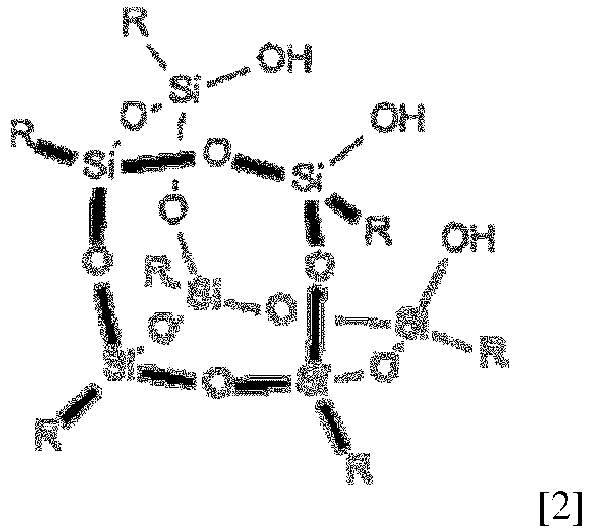 - le nombre d'équivalents des silanols de silsesquioxane utilisés est supérieur au nombre d'équivalents d'alcoolates métalliques utilisés pour réagir avec lesdits silanols de silsesquioxane,- R est choisi parmi un groupe alkyle, de préférence un groupe aliphatique linéaire, ramifié ou cyclique, de préférence comprenant 1 à 20 atomes de carbone, de préférence entre toutes un groupe iso- ou n-butyle ou un groupe iso- ou n-octyle,- le métal dans l'alcoolate métallique est le titane ;- le mélange et la réaction dudit au moins un isocyanate, d'au moins un composant réactif à l'isocyanate et de ladite composition de catalyseur pour donner ledit matériau de polyuréthane.
 - Procédé selon la revendication 1 dans lequel l'alcoolate métallique dans la composition de catalyseur est le tétra-alcoolate de titane, Ti(OR)4.
- Procédé selon l'une quelconque des revendications 1 et 2, dans lequel le rapport du nombre d'équivalents de silanols de silsesquioxane, en particulier des trisilanols de silsesquioxane sur le nombre d'équivalents d'alcoolates métalliques se situe dans la plage de 1,5:1 jusqu'à 2:1.
- Procédé selon l'une quelconque des revendications 1 à 3, dans lequel la composition de catalyseur est un mélange comprenant les structures POMS intermédiaires suivantes [8], [9], [10] et [11] dans un équilibre dynamique :


- Procédé selon l'une quelconque des revendications 1 à 4, dans lequel ledit silsesquioxane oligomère polyhédrique métallisé est incorporé dans un composant réactif à l'isocyanate avant le mélange dudit au moins un isocyanate, d'au moins un composant réactif à l'isocyanate et de ladite composition de catalyseur.
- Procédé selon l'une quelconque des revendications 1 à 5, dans lequel le composant réactif à l'isocyanate est choisi parmi les monools et/ou les polyols tels que les glycols, les polyétherpolyols et les polyesterpolyols de haut poids moléculaire, les mercaptans, les acides carboxyliques tels que les acides polybasiques, les amines, les polyamines, les composants comprenant au moins un groupe alcool et au moins un groupe amine tels que les polyaminepolyols, l'urée et les amides.
- Procédé selon l'une quelconque des revendications 1 à 6, dans lequel le composant réactif à l'isocyanate est choisi parmi les monools ou les polyols qui ont une fonctionnalité hydroxy nominale moyenne de 1 à 8 et un poids moléculaire moyen de 32 à 8000 et les mélanges desdits monols et/ou polyols.
- Procédé selon l'une quelconque des revendications 1 à 7, dans lequel le composant réactif à l'isocyanate est choisi parmi les monools choisis parmi le méthanol, l'éthanol, le propanol, le butanol, le phénol, le cyclohexanol et les monools hydrocarbonés ayant un poids moléculaire moyen de 200 à 5000 comme les monols aliphatiques et de polyéther et/ou les polyols choisis parmi l'éthylèneglycol, le diéthylèneglycol, le triéthylèneglycol, le propylèneglycol, le dipropylèneglycol, le tripropylèneglycol, le triméthylolpropane, le sorbitol, le saccharose, le glycérol, l'éthanediol, le propanediol, le butanediol, le pentanediol, l'hexanediol, les polyols aromatiques et/ou aliphatiques ayant un poids moléculaire de jusqu'à 8000 et de préférence de 200 à 6000, les polyols de polyester ayant un poids moléculaire moyen de 200 à 8000 et de préférence de 200 à 6000, les polyols de polyester polyéther ayant un poids moléculaire moyen de 200 à 8000 et de préférence de 200 à 6000 et les polyols de polyéther ayant un poids moléculaire moyen de 200 à 8000 et de préférence de 200 à 6000.
- Procédé selon l'une quelconque des revendications 1 à 8, dans lequel le mélange dudit au moins un isocyanate, d'au moins un composant réactif à l'isocyanate et de ladite composition de catalyseur est effectué à une température entre -10 et 25°C.
- Procédé selon l'une quelconque des revendications 1 à 9, dans lequel ledit mélange dudit au moins un isocyanate, d'au moins un composant réactif à l'isocyanate et dudit silsesquioxane oligomère polyhédrique métallisé est porté à une température entre 25 et 200°C pour initier la réaction dudit au moins un isocyanate, d'au moins un composant réactif à l'isocyanate et de ladite composition de catalyseur.
- Procédé selon l'une quelconque des revendications 1 à 10, dans lequel au moins un catalyseur de gélification est fourni audit mélange d'au moins un isocyanate, d'au moins un composant réactif à l'isocyanate et de ladite composition de catalyseur.
- Procédé selon l'une quelconque des revendications 1 à 11, dans lequel au moins un catalyseur de gonflement est fourni audit mélange dudit au moins un isocyanate, d'au moins un composant réactif à l'isocyanate et de ladite composition de catalyseur.
- Procédé selon l'une quelconque des revendications 1 à 12, dans lequel la concentration dudit silsesquioxane oligomère polyhédrique métallisé dans ledit mélange dudit au moins un isocyanate, d'au moins un composant réactif à l'isocyanate et de ladite composition de catalyseur est inférieure ou égale à 10 mM.
- Composition réactive, ladite composition réactive comprenant :- au moins un composé isocyanate ;- au moins un composant réactif à l'isocyanate ;- une composition de catalyseur selon l'une quelconque des revendications 1 à 4.
Priority Applications (2)
| Application Number | Priority Date | Filing Date | Title |
|---|---|---|---|
| EP14749813.3A EP3063209B1 (fr) | 2013-10-28 | 2014-08-07 | Synthèse et utilisation de compositions de catalyseur comprenant des silsesquioxanes oligomères polyèdres métallisés |
| PL14749813T PL3063209T3 (pl) | 2013-10-28 | 2014-08-07 | Synteza i zastosowanie kompozycji katalizatora zawierającej poliedryczne oligomeryczne metalosilseskwioksany |
Applications Claiming Priority (3)
| Application Number | Priority Date | Filing Date | Title |
|---|---|---|---|
| EP20130190523 EP2865704A1 (fr) | 2013-10-28 | 2013-10-28 | Synthèse et utilisation de compositions de catalyseur comprenant des silsesquioxanes oligomères polyèdres métallisés |
| EP14749813.3A EP3063209B1 (fr) | 2013-10-28 | 2014-08-07 | Synthèse et utilisation de compositions de catalyseur comprenant des silsesquioxanes oligomères polyèdres métallisés |
| PCT/EP2014/067010 WO2015062759A1 (fr) | 2013-10-28 | 2014-08-07 | Synthèse et utilisation de compositions catalysantes de silsesquioxanes oligomères polyédriques métallisés |
Publications (2)
| Publication Number | Publication Date |
|---|---|
| EP3063209A1 EP3063209A1 (fr) | 2016-09-07 |
| EP3063209B1 true EP3063209B1 (fr) | 2017-12-27 |
Family
ID=49485630
Family Applications (2)
| Application Number | Title | Priority Date | Filing Date |
|---|---|---|---|
| EP20130190523 Ceased EP2865704A1 (fr) | 2013-10-28 | 2013-10-28 | Synthèse et utilisation de compositions de catalyseur comprenant des silsesquioxanes oligomères polyèdres métallisés |
| EP14749813.3A Active EP3063209B1 (fr) | 2013-10-28 | 2014-08-07 | Synthèse et utilisation de compositions de catalyseur comprenant des silsesquioxanes oligomères polyèdres métallisés |
Family Applications Before (1)
| Application Number | Title | Priority Date | Filing Date |
|---|---|---|---|
| EP20130190523 Ceased EP2865704A1 (fr) | 2013-10-28 | 2013-10-28 | Synthèse et utilisation de compositions de catalyseur comprenant des silsesquioxanes oligomères polyèdres métallisés |
Country Status (8)
| Country | Link |
|---|---|
| US (1) | US9822210B2 (fr) |
| EP (2) | EP2865704A1 (fr) |
| CN (1) | CN105793327B (fr) |
| BR (1) | BR112016009247B1 (fr) |
| CA (1) | CA2928771C (fr) |
| PL (1) | PL3063209T3 (fr) |
| RU (1) | RU2654064C2 (fr) |
| WO (1) | WO2015062759A1 (fr) |
Cited By (1)
| Publication number | Priority date | Publication date | Assignee | Title |
|---|---|---|---|---|
| WO2020193430A1 (fr) | 2019-03-26 | 2020-10-01 | Polyu Gmbh | Composition et procédé pour produire des polymères ayant subi une silylation et utilisation correspondante |
Families Citing this family (9)
| Publication number | Priority date | Publication date | Assignee | Title |
|---|---|---|---|---|
| CN108948360B (zh) * | 2017-05-18 | 2020-09-22 | 北京化工大学 | 一种含金属的羧酸型多面体低聚倍半硅氧烷及其制备方法以及包含其的氰酸酯树脂组合物 |
| CN108948356B (zh) * | 2017-05-18 | 2020-12-11 | 北京化工大学 | 含金属的单/多臂星形多面体低聚倍半硅氧烷及其制备方法以及包含其的氰酸酯树脂组合物 |
| CN110343253B (zh) * | 2018-04-04 | 2021-02-19 | 北京化工大学 | 一种含镧系金属的单羧酸型多面体低聚倍半硅氧烷及其制备方法以及包含其的树脂组合物 |
| CN110872437B (zh) * | 2018-08-29 | 2021-02-19 | 北京化工大学 | 一种含羟基金属锡的多面体低聚倍半硅氧烷及其制备与应用 |
| US11958935B2 (en) * | 2018-09-13 | 2024-04-16 | Huntsman International Llc | Polyurethane insulation foam composition comprising a stabilizing compound |
| CN110294832B (zh) * | 2019-07-16 | 2021-05-25 | 道勤材料技术(麻城)有限公司 | 一种氨基poss修饰的聚氨酯热塑性弹性体及其制备方法 |
| CN110951081B (zh) * | 2019-11-08 | 2022-03-18 | 东华大学 | 一种基于非挥发型多功能性poss基叔胺类催化剂及其制备和应用 |
| CN114063389B (zh) | 2020-07-31 | 2026-04-07 | 华为技术有限公司 | 图案化材料和图案化薄膜 |
| CN115181256B (zh) * | 2022-08-01 | 2023-09-26 | 江西聚锐德新材料股份有限公司 | 笼状聚倍半硅氧烷钛催化剂、液态催化剂及其制法和应用 |
Family Cites Families (12)
| Publication number | Priority date | Publication date | Assignee | Title |
|---|---|---|---|---|
| RU2100384C1 (ru) * | 1995-12-09 | 1997-12-27 | Институт синтетических полимерных материалов РАН | Органосилсесквиоксаны кубического строения и способ их получения |
| PT1208105E (pt) | 1999-08-04 | 2007-01-31 | Hybrid Plastics | Processo para a formação de silsesquioxanos oligoméricos poliédricos |
| US7820761B2 (en) | 1999-08-04 | 2010-10-26 | Hybrid Plastics, Inc. | Metallized nanostructured chemicals as cure promoters |
| US9267023B2 (en) | 1999-08-04 | 2016-02-23 | Hybrid Plastics, Inc. | Method for modifying surface properties with nanostructured chemicals |
| EP1433802B1 (fr) * | 2002-12-23 | 2007-10-17 | Dow Global Technologies Inc. | Composition réactive de polyuréthane |
| US7737228B2 (en) * | 2003-12-18 | 2010-06-15 | Hybrid Plastics, Inc. | Metallized polyhedral oligomeric silsesquioxanes as catalysts for polyurethanes |
| KR101208460B1 (ko) * | 2005-03-07 | 2012-12-05 | 하이브리드 플라스틱스 인코포레이티드 | Poss 단량체의 어셈블리 방법 |
| KR20080036148A (ko) * | 2005-08-16 | 2008-04-24 | 하이브리드 플라스틱스 인코포레이티드 | 올레핀기로 작용기화된 다면체 올리고머 실세스퀴옥산실란올 및 실록사이드의 제조 |
| KR20080068033A (ko) | 2005-09-29 | 2008-07-22 | 하이브리드 플라스틱스 인코포레이티드 | 경화 촉진제로서의 금속화 나노구조화된 화학물질 |
| TW200909462A (en) | 2007-05-21 | 2009-03-01 | Hybrid Plastics Inc | Metallized polyhedral oligomeric silsesquioxanes as catalysts for polyurethanes |
| WO2009065873A2 (fr) | 2007-11-21 | 2009-05-28 | Basf Se | Stannasilsesquioxanes oligomériques polyédriques en tant que catalyseur pour le durcissement de polyuréthanes |
| CN102781994B (zh) * | 2009-12-21 | 2014-05-07 | 亨茨曼国际有限公司 | 制备聚氨基甲酸酯材料的方法 |
-
2013
- 2013-10-28 EP EP20130190523 patent/EP2865704A1/fr not_active Ceased
-
2014
- 2014-08-07 WO PCT/EP2014/067010 patent/WO2015062759A1/fr not_active Ceased
- 2014-08-07 PL PL14749813T patent/PL3063209T3/pl unknown
- 2014-08-07 EP EP14749813.3A patent/EP3063209B1/fr active Active
- 2014-08-07 RU RU2016120766A patent/RU2654064C2/ru active
- 2014-08-07 BR BR112016009247-3A patent/BR112016009247B1/pt not_active IP Right Cessation
- 2014-08-07 CA CA2928771A patent/CA2928771C/fr active Active
- 2014-08-07 CN CN201480059037.XA patent/CN105793327B/zh active Active
- 2014-08-07 US US15/032,662 patent/US9822210B2/en not_active Expired - Fee Related
Cited By (1)
| Publication number | Priority date | Publication date | Assignee | Title |
|---|---|---|---|---|
| WO2020193430A1 (fr) | 2019-03-26 | 2020-10-01 | Polyu Gmbh | Composition et procédé pour produire des polymères ayant subi une silylation et utilisation correspondante |
Also Published As
| Publication number | Publication date |
|---|---|
| CN105793327B (zh) | 2019-12-17 |
| US9822210B2 (en) | 2017-11-21 |
| US20160264708A1 (en) | 2016-09-15 |
| RU2654064C2 (ru) | 2018-05-16 |
| EP3063209A1 (fr) | 2016-09-07 |
| PL3063209T3 (pl) | 2018-05-30 |
| CN105793327A (zh) | 2016-07-20 |
| RU2016120766A (ru) | 2017-12-01 |
| CA2928771C (fr) | 2021-08-03 |
| CA2928771A1 (fr) | 2015-05-07 |
| BR112016009247B1 (pt) | 2021-03-30 |
| WO2015062759A1 (fr) | 2015-05-07 |
| EP2865704A1 (fr) | 2015-04-29 |
Similar Documents
| Publication | Publication Date | Title |
|---|---|---|
| US9822210B2 (en) | Synthesis and use of metallized polyhedral oligomeric silsesquioxane catalyst compositions | |
| US7927704B2 (en) | Two-component systems for producing flexible coatings | |
| US20040067315A1 (en) | Two-component systems for producing elastic coatings | |
| CA2857613A1 (fr) | Composition durcissable comprenant une composition de polyisocyanate | |
| CA2820786C (fr) | Composition de resine epoxy | |
| KR102859107B1 (ko) | 일액형 폴리우레탄 전구중합체 조성물 | |
| JP2011001397A (ja) | 脂肪族ポリウレア樹脂組成物及び脂肪族ポリウレア樹脂 | |
| CN101903431B (zh) | 多异氰酸酯和聚醚单胺的组合物 | |
| EP2516498B1 (fr) | Procédé pour la formation d'un matériau en polyuréthane | |
| JP2022501466A (ja) | ポリウレタンおよびポリウレタンの製造方法 | |
| JP2022501476A (ja) | ポリ(ブチレンオキシド)ポリオールをベースにしたポリウレタンキャストエラストマー、およびポリウレタンキャストエラストマーを作製するための方法 | |
| JPH0725976A (ja) | 潜在性硬化剤を含有するイソシアネート組成物の硬化方法 | |
| CA2712054C (fr) | Materiaux elastomeriques ayant une haute teneur en blocs durs et leur procede de preparation | |
| JP2012097200A (ja) | ポリウレタン樹脂組成物 | |
| MXPA05000436A (es) | Prepolimero de ipdi-ppg de monomero residual bajo. | |
| WO2025093350A1 (fr) | Catalyseur thermolatent pour la préparation de polyuréthane |
Legal Events
| Date | Code | Title | Description |
|---|---|---|---|
| PUAI | Public reference made under article 153(3) epc to a published international application that has entered the european phase |
Free format text: ORIGINAL CODE: 0009012 |
|
| 17P | Request for examination filed |
Effective date: 20160530 |
|
| AK | Designated contracting states |
Kind code of ref document: A1 Designated state(s): AL AT BE BG CH CY CZ DE DK EE ES FI FR GB GR HR HU IE IS IT LI LT LU LV MC MK MT NL NO PL PT RO RS SE SI SK SM TR |
|
| AX | Request for extension of the european patent |
Extension state: BA ME |
|
| DAX | Request for extension of the european patent (deleted) | ||
| GRAP | Despatch of communication of intention to grant a patent |
Free format text: ORIGINAL CODE: EPIDOSNIGR1 |
|
| 17Q | First examination report despatched |
Effective date: 20170824 |
|
| INTG | Intention to grant announced |
Effective date: 20170927 |
|
| GRAS | Grant fee paid |
Free format text: ORIGINAL CODE: EPIDOSNIGR3 |
|
| GRAA | (expected) grant |
Free format text: ORIGINAL CODE: 0009210 |
|
| AK | Designated contracting states |
Kind code of ref document: B1 Designated state(s): AL AT BE BG CH CY CZ DE DK EE ES FI FR GB GR HR HU IE IS IT LI LT LU LV MC MK MT NL NO PL PT RO RS SE SI SK SM TR |
|
| REG | Reference to a national code |
Ref country code: GB Ref legal event code: FG4D |
|
| REG | Reference to a national code |
Ref country code: CH Ref legal event code: EP |
|
| REG | Reference to a national code |
Ref country code: AT Ref legal event code: REF Ref document number: 958237 Country of ref document: AT Kind code of ref document: T Effective date: 20180115 |
|
| REG | Reference to a national code |
Ref country code: IE Ref legal event code: FG4D |
|
| REG | Reference to a national code |
Ref country code: DE Ref legal event code: R096 Ref document number: 602014019122 Country of ref document: DE |
|
| PG25 | Lapsed in a contracting state [announced via postgrant information from national office to epo] |
Ref country code: NO Free format text: LAPSE BECAUSE OF FAILURE TO SUBMIT A TRANSLATION OF THE DESCRIPTION OR TO PAY THE FEE WITHIN THE PRESCRIBED TIME-LIMIT Effective date: 20180327 Ref country code: LT Free format text: LAPSE BECAUSE OF FAILURE TO SUBMIT A TRANSLATION OF THE DESCRIPTION OR TO PAY THE FEE WITHIN THE PRESCRIBED TIME-LIMIT Effective date: 20171227 Ref country code: FI Free format text: LAPSE BECAUSE OF FAILURE TO SUBMIT A TRANSLATION OF THE DESCRIPTION OR TO PAY THE FEE WITHIN THE PRESCRIBED TIME-LIMIT Effective date: 20171227 |
|
| REG | Reference to a national code |
Ref country code: NL Ref legal event code: MP Effective date: 20171227 |
|
| REG | Reference to a national code |
Ref country code: LT Ref legal event code: MG4D |
|
| REG | Reference to a national code |
Ref country code: AT Ref legal event code: MK05 Ref document number: 958237 Country of ref document: AT Kind code of ref document: T Effective date: 20171227 |
|
| PG25 | Lapsed in a contracting state [announced via postgrant information from national office to epo] |
Ref country code: BG Free format text: LAPSE BECAUSE OF FAILURE TO SUBMIT A TRANSLATION OF THE DESCRIPTION OR TO PAY THE FEE WITHIN THE PRESCRIBED TIME-LIMIT Effective date: 20180327 Ref country code: GR Free format text: LAPSE BECAUSE OF FAILURE TO SUBMIT A TRANSLATION OF THE DESCRIPTION OR TO PAY THE FEE WITHIN THE PRESCRIBED TIME-LIMIT Effective date: 20180328 Ref country code: HR Free format text: LAPSE BECAUSE OF FAILURE TO SUBMIT A TRANSLATION OF THE DESCRIPTION OR TO PAY THE FEE WITHIN THE PRESCRIBED TIME-LIMIT Effective date: 20171227 Ref country code: RS Free format text: LAPSE BECAUSE OF FAILURE TO SUBMIT A TRANSLATION OF THE DESCRIPTION OR TO PAY THE FEE WITHIN THE PRESCRIBED TIME-LIMIT Effective date: 20171227 Ref country code: LV Free format text: LAPSE BECAUSE OF FAILURE TO SUBMIT A TRANSLATION OF THE DESCRIPTION OR TO PAY THE FEE WITHIN THE PRESCRIBED TIME-LIMIT Effective date: 20171227 |
|
| PG25 | Lapsed in a contracting state [announced via postgrant information from national office to epo] |
Ref country code: NL Free format text: LAPSE BECAUSE OF FAILURE TO SUBMIT A TRANSLATION OF THE DESCRIPTION OR TO PAY THE FEE WITHIN THE PRESCRIBED TIME-LIMIT Effective date: 20171227 |
|
| REG | Reference to a national code |
Ref country code: FR Ref legal event code: PLFP Year of fee payment: 5 |
|
| PG25 | Lapsed in a contracting state [announced via postgrant information from national office to epo] |
Ref country code: ES Free format text: LAPSE BECAUSE OF FAILURE TO SUBMIT A TRANSLATION OF THE DESCRIPTION OR TO PAY THE FEE WITHIN THE PRESCRIBED TIME-LIMIT Effective date: 20171227 Ref country code: CZ Free format text: LAPSE BECAUSE OF FAILURE TO SUBMIT A TRANSLATION OF THE DESCRIPTION OR TO PAY THE FEE WITHIN THE PRESCRIBED TIME-LIMIT Effective date: 20171227 Ref country code: CY Free format text: LAPSE BECAUSE OF FAILURE TO SUBMIT A TRANSLATION OF THE DESCRIPTION OR TO PAY THE FEE WITHIN THE PRESCRIBED TIME-LIMIT Effective date: 20171227 Ref country code: EE Free format text: LAPSE BECAUSE OF FAILURE TO SUBMIT A TRANSLATION OF THE DESCRIPTION OR TO PAY THE FEE WITHIN THE PRESCRIBED TIME-LIMIT Effective date: 20171227 Ref country code: SK Free format text: LAPSE BECAUSE OF FAILURE TO SUBMIT A TRANSLATION OF THE DESCRIPTION OR TO PAY THE FEE WITHIN THE PRESCRIBED TIME-LIMIT Effective date: 20171227 |
|
| PG25 | Lapsed in a contracting state [announced via postgrant information from national office to epo] |
Ref country code: IS Free format text: LAPSE BECAUSE OF FAILURE TO SUBMIT A TRANSLATION OF THE DESCRIPTION OR TO PAY THE FEE WITHIN THE PRESCRIBED TIME-LIMIT Effective date: 20180427 Ref country code: SM Free format text: LAPSE BECAUSE OF FAILURE TO SUBMIT A TRANSLATION OF THE DESCRIPTION OR TO PAY THE FEE WITHIN THE PRESCRIBED TIME-LIMIT Effective date: 20171227 Ref country code: RO Free format text: LAPSE BECAUSE OF FAILURE TO SUBMIT A TRANSLATION OF THE DESCRIPTION OR TO PAY THE FEE WITHIN THE PRESCRIBED TIME-LIMIT Effective date: 20171227 Ref country code: AT Free format text: LAPSE BECAUSE OF FAILURE TO SUBMIT A TRANSLATION OF THE DESCRIPTION OR TO PAY THE FEE WITHIN THE PRESCRIBED TIME-LIMIT Effective date: 20171227 |
|
| REG | Reference to a national code |
Ref country code: DE Ref legal event code: R097 Ref document number: 602014019122 Country of ref document: DE |
|
| PLBE | No opposition filed within time limit |
Free format text: ORIGINAL CODE: 0009261 |
|
| STAA | Information on the status of an ep patent application or granted ep patent |
Free format text: STATUS: NO OPPOSITION FILED WITHIN TIME LIMIT |
|
| PG25 | Lapsed in a contracting state [announced via postgrant information from national office to epo] |
Ref country code: DK Free format text: LAPSE BECAUSE OF FAILURE TO SUBMIT A TRANSLATION OF THE DESCRIPTION OR TO PAY THE FEE WITHIN THE PRESCRIBED TIME-LIMIT Effective date: 20171227 |
|
| 26N | No opposition filed |
Effective date: 20180928 |
|
| PG25 | Lapsed in a contracting state [announced via postgrant information from national office to epo] |
Ref country code: SI Free format text: LAPSE BECAUSE OF FAILURE TO SUBMIT A TRANSLATION OF THE DESCRIPTION OR TO PAY THE FEE WITHIN THE PRESCRIBED TIME-LIMIT Effective date: 20171227 |
|
| PG25 | Lapsed in a contracting state [announced via postgrant information from national office to epo] |
Ref country code: MC Free format text: LAPSE BECAUSE OF FAILURE TO SUBMIT A TRANSLATION OF THE DESCRIPTION OR TO PAY THE FEE WITHIN THE PRESCRIBED TIME-LIMIT Effective date: 20171227 |
|
| REG | Reference to a national code |
Ref country code: CH Ref legal event code: PL |
|
| PG25 | Lapsed in a contracting state [announced via postgrant information from national office to epo] |
Ref country code: LU Free format text: LAPSE BECAUSE OF NON-PAYMENT OF DUE FEES Effective date: 20180807 Ref country code: LI Free format text: LAPSE BECAUSE OF NON-PAYMENT OF DUE FEES Effective date: 20180831 Ref country code: CH Free format text: LAPSE BECAUSE OF NON-PAYMENT OF DUE FEES Effective date: 20180831 |
|
| REG | Reference to a national code |
Ref country code: BE Ref legal event code: MM Effective date: 20180831 |
|
| REG | Reference to a national code |
Ref country code: IE Ref legal event code: MM4A |
|
| PG25 | Lapsed in a contracting state [announced via postgrant information from national office to epo] |
Ref country code: IE Free format text: LAPSE BECAUSE OF NON-PAYMENT OF DUE FEES Effective date: 20180807 |
|
| PG25 | Lapsed in a contracting state [announced via postgrant information from national office to epo] |
Ref country code: BE Free format text: LAPSE BECAUSE OF NON-PAYMENT OF DUE FEES Effective date: 20180831 |
|
| PG25 | Lapsed in a contracting state [announced via postgrant information from national office to epo] |
Ref country code: MT Free format text: LAPSE BECAUSE OF NON-PAYMENT OF DUE FEES Effective date: 20180807 |
|
| PG25 | Lapsed in a contracting state [announced via postgrant information from national office to epo] |
Ref country code: PT Free format text: LAPSE BECAUSE OF FAILURE TO SUBMIT A TRANSLATION OF THE DESCRIPTION OR TO PAY THE FEE WITHIN THE PRESCRIBED TIME-LIMIT Effective date: 20171227 |
|
| PG25 | Lapsed in a contracting state [announced via postgrant information from national office to epo] |
Ref country code: MK Free format text: LAPSE BECAUSE OF NON-PAYMENT OF DUE FEES Effective date: 20171227 Ref country code: HU Free format text: LAPSE BECAUSE OF FAILURE TO SUBMIT A TRANSLATION OF THE DESCRIPTION OR TO PAY THE FEE WITHIN THE PRESCRIBED TIME-LIMIT; INVALID AB INITIO Effective date: 20140807 Ref country code: SE Free format text: LAPSE BECAUSE OF FAILURE TO SUBMIT A TRANSLATION OF THE DESCRIPTION OR TO PAY THE FEE WITHIN THE PRESCRIBED TIME-LIMIT Effective date: 20171227 |
|
| PG25 | Lapsed in a contracting state [announced via postgrant information from national office to epo] |
Ref country code: AL Free format text: LAPSE BECAUSE OF FAILURE TO SUBMIT A TRANSLATION OF THE DESCRIPTION OR TO PAY THE FEE WITHIN THE PRESCRIBED TIME-LIMIT Effective date: 20171227 |
|
| PGFP | Annual fee paid to national office [announced via postgrant information from national office to epo] |
Ref country code: DE Payment date: 20240828 Year of fee payment: 11 |
|
| PGFP | Annual fee paid to national office [announced via postgrant information from national office to epo] |
Ref country code: GB Payment date: 20240827 Year of fee payment: 11 |
|
| PGFP | Annual fee paid to national office [announced via postgrant information from national office to epo] |
Ref country code: FR Payment date: 20240826 Year of fee payment: 11 |
|
| PGFP | Annual fee paid to national office [announced via postgrant information from national office to epo] |
Ref country code: PL Payment date: 20240802 Year of fee payment: 11 |
|
| PGFP | Annual fee paid to national office [announced via postgrant information from national office to epo] |
Ref country code: IT Payment date: 20240826 Year of fee payment: 11 |
|
| P01 | Opt-out of the competence of the unified patent court (upc) registered |
Free format text: CASE NUMBER: APP_53372/2024 Effective date: 20240925 |
|
| PGFP | Annual fee paid to national office [announced via postgrant information from national office to epo] |
Ref country code: TR Payment date: 20240725 Year of fee payment: 11 |
|
| REG | Reference to a national code |
Ref country code: DE Ref legal event code: R119 Ref document number: 602014019122 Country of ref document: DE |
|
| GBPC | Gb: european patent ceased through non-payment of renewal fee |
Effective date: 20250807 |