EP3064687B1 - Unite d'actionnement de porte - Google Patents
Unite d'actionnement de porte Download PDFInfo
- Publication number
- EP3064687B1 EP3064687B1 EP15203028.4A EP15203028A EP3064687B1 EP 3064687 B1 EP3064687 B1 EP 3064687B1 EP 15203028 A EP15203028 A EP 15203028A EP 3064687 B1 EP3064687 B1 EP 3064687B1
- Authority
- EP
- European Patent Office
- Prior art keywords
- door
- coil
- actuating unit
- hazard detector
- arresting element
- Prior art date
- Legal status (The legal status is an assumption and is not a legal conclusion. Google has not performed a legal analysis and makes no representation as to the accuracy of the status listed.)
- Revoked
Links
- 230000005291 magnetic effect Effects 0.000 claims description 9
- 239000000779 smoke Substances 0.000 claims description 8
- 238000004146 energy storage Methods 0.000 claims 1
- 230000033001 locomotion Effects 0.000 description 8
- 238000011161 development Methods 0.000 description 3
- 230000018109 developmental process Effects 0.000 description 3
- 239000012530 fluid Substances 0.000 description 3
- 238000002485 combustion reaction Methods 0.000 description 2
- 230000001419 dependent effect Effects 0.000 description 2
- 230000004907 flux Effects 0.000 description 2
- 230000003213 activating effect Effects 0.000 description 1
- 230000004913 activation Effects 0.000 description 1
- 230000005540 biological transmission Effects 0.000 description 1
- 239000003990 capacitor Substances 0.000 description 1
- 238000013270 controlled release Methods 0.000 description 1
- 238000001514 detection method Methods 0.000 description 1
- 238000006073 displacement reaction Methods 0.000 description 1
- 230000005294 ferromagnetic effect Effects 0.000 description 1
- 239000007788 liquid Substances 0.000 description 1
- 238000004519 manufacturing process Methods 0.000 description 1
- 239000012528 membrane Substances 0.000 description 1
- 238000000034 method Methods 0.000 description 1
Images


Classifications
-
- E—FIXED CONSTRUCTIONS
- E05—LOCKS; KEYS; WINDOW OR DOOR FITTINGS; SAFES
- E05F—DEVICES FOR MOVING WINGS INTO OPEN OR CLOSED POSITION; CHECKS FOR WINGS; WING FITTINGS NOT OTHERWISE PROVIDED FOR, CONCERNED WITH THE FUNCTIONING OF THE WING
- E05F1/00—Closers or openers for wings, not otherwise provided for in this subclass
- E05F1/002—Closers or openers for wings, not otherwise provided for in this subclass controlled by automatically acting means
- E05F1/006—Closers or openers for wings, not otherwise provided for in this subclass controlled by automatically acting means by emergency conditions, e.g. fire
-
- E—FIXED CONSTRUCTIONS
- E05—LOCKS; KEYS; WINDOW OR DOOR FITTINGS; SAFES
- E05F—DEVICES FOR MOVING WINGS INTO OPEN OR CLOSED POSITION; CHECKS FOR WINGS; WING FITTINGS NOT OTHERWISE PROVIDED FOR, CONCERNED WITH THE FUNCTIONING OF THE WING
- E05F3/00—Closers or openers with braking devices, e.g. checks; Construction of pneumatic or liquid braking devices
- E05F3/22—Additional arrangements for closers, e.g. for holding the wing in opened or other position
- E05F3/223—Hydraulic power-locks, e.g. with electrically operated hydraulic valves
-
- E—FIXED CONSTRUCTIONS
- E05—LOCKS; KEYS; WINDOW OR DOOR FITTINGS; SAFES
- E05F—DEVICES FOR MOVING WINGS INTO OPEN OR CLOSED POSITION; CHECKS FOR WINGS; WING FITTINGS NOT OTHERWISE PROVIDED FOR, CONCERNED WITH THE FUNCTIONING OF THE WING
- E05F3/00—Closers or openers with braking devices, e.g. checks; Construction of pneumatic or liquid braking devices
- E05F3/22—Additional arrangements for closers, e.g. for holding the wing in opened or other position
- E05F2003/228—Arrangements where the end of the closer arm is sliding in a track
-
- E—FIXED CONSTRUCTIONS
- E05—LOCKS; KEYS; WINDOW OR DOOR FITTINGS; SAFES
- E05Y—INDEXING SCHEME ASSOCIATED WITH SUBCLASSES E05D AND E05F, RELATING TO CONSTRUCTION ELEMENTS, ELECTRIC CONTROL, POWER SUPPLY, POWER SIGNAL OR TRANSMISSION, USER INTERFACES, MOUNTING OR COUPLING, DETAILS, ACCESSORIES, AUXILIARY OPERATIONS NOT OTHERWISE PROVIDED FOR, APPLICATION THEREOF
- E05Y2400/00—Electronic control; Electrical power; Power supply; Power or signal transmission; User interfaces
- E05Y2400/61—Power supply
- E05Y2400/612—Batteries
-
- E—FIXED CONSTRUCTIONS
- E05—LOCKS; KEYS; WINDOW OR DOOR FITTINGS; SAFES
- E05Y—INDEXING SCHEME ASSOCIATED WITH SUBCLASSES E05D AND E05F, RELATING TO CONSTRUCTION ELEMENTS, ELECTRIC CONTROL, POWER SUPPLY, POWER SIGNAL OR TRANSMISSION, USER INTERFACES, MOUNTING OR COUPLING, DETAILS, ACCESSORIES, AUXILIARY OPERATIONS NOT OTHERWISE PROVIDED FOR, APPLICATION THEREOF
- E05Y2800/00—Details, accessories and auxiliary operations not otherwise provided for
- E05Y2800/25—Emergency conditions
-
- E—FIXED CONSTRUCTIONS
- E05—LOCKS; KEYS; WINDOW OR DOOR FITTINGS; SAFES
- E05Y—INDEXING SCHEME ASSOCIATED WITH SUBCLASSES E05D AND E05F, RELATING TO CONSTRUCTION ELEMENTS, ELECTRIC CONTROL, POWER SUPPLY, POWER SIGNAL OR TRANSMISSION, USER INTERFACES, MOUNTING OR COUPLING, DETAILS, ACCESSORIES, AUXILIARY OPERATIONS NOT OTHERWISE PROVIDED FOR, APPLICATION THEREOF
- E05Y2900/00—Application of doors, windows, wings or fittings thereof
- E05Y2900/10—Application of doors, windows, wings or fittings thereof for buildings or parts thereof
- E05Y2900/13—Type of wing
- E05Y2900/132—Doors
- E05Y2900/134—Fire doors
Definitions
- the present invention relates to a door operating unit for a door.
- the invention relates to a door operating unit which is designed for use with a fire door.
- Door operating units in particular for fire doors, are known from the prior art.
- Known door operating units include a fire alarm with which fires can be detected. As soon as the fire alarm detects a fire, the door operating unit releases the door so that a door closer moves the door into the closed position. This ensures that the fire door acts as an obstacle to the fire in the event of a fire.
- known door operating units for fire doors are relatively complex to assemble.
- known door operating units are not optimally suited for use with a battery-based supply.
- the door arrester has a housing which is partially designed as a cylinder for receiving a pressure medium.
- a piston which is displaceable in the axial direction of the cylinder and divides the cylinder into a first and a second chamber, is received in the cylinder.
- a connecting unit arranged between the piston and the door moves the piston in the cylinder as a function of the door movement.
- a spring compressed between the piston and the housing urges the door in the closed position.
- the sub-spaces of the cylinder located on both sides of the piston are connected to one another via three hydraulic paths.
- the first path instructs Check valve that allows flow in one direction from the spring side to the other side when the door is opened.
- a second path incorporating a pressure reducing valve or pressure relief valve, allows flow from the other side to the spring side when the door is pulled, but counteracts the pressure exerted by the spring and holds the door in any position.
- a controllable valve transmits the pressure medium pressure generated by the spring on the other side of the cylinder via a parallel line to the spring side, so that the spring force acting on the piston moves the door into the closed position with force transmission through the connecting unit.
- the document DE 44 06 938 A1 relates to an unlocking mechanism for a door closer.
- the mechanism can intervene in the locking device at a predetermined temperature in such a way that the door closer is unlocked and is able to move a previously locked door.
- a hydraulic sliding arm door closer which cooperates with an electrical retaining device.
- the slide arm door closer has a slide arm which is guided displaceably in a slide rail.
- the slide arm is freely rotatably mounted on the closer shaft and interacts with a closing lever which is fixed against rotation with the closer shaft.
- the locking lever is locked outside the range of motion of the sliding arm. In this position there is free swing operation, ie the door leaf can be operated manually without having to operate the door closer.
- the locking lever is not locked.
- the closing lever rotates under the action of the closer spring of the door closer into the closed position and takes the sliding arm and thus the leaf with it into the closed position.
- the document EP 1 698 817 A2 relates to an actuator with actuator base, coil and pole piece that has a pocket for a ferromagnetic therein Form anchors.
- the actuator contains a radial magnet and a magnetic coil.
- the solenoid is constructed and arranged to cause linear displacement of the armature upon application of a coil drive current from a control circuit.
- the actuator may include a flexible membrane that partially encloses the armature to form an armature chamber that is filled with an incompressible liquid.
- fluid flow is stopped by forcing the armature into an extended position and thereby driving the diaphragm against a valve seat.
- the flow of fluid is opened by forcing the armature and diaphragm away from the valve seat into a retracted position.
- the DE 198 36 516 A1 relates to a double-acting electromagnetic linear motor for driving a proportional valve.
- the linear motor consists of a sleeve-shaped pressure tube with an armature guided axially displaceably therein, the magnetic flux conducting tube consisting of end pieces and a middle piece which is connected to the end pieces via non magnetic flux conducting intermediate pieces.
- a housing delimits a receiving space in which a permanent magnet and an electrical coil are arranged.
- a first permanent magnetic circuit is formed over the middle piece, the armature, a first working air gap and one end piece, while a second permanent magnetic circuit is formed over the middle piece, the armature, a second working air gap and the other end piece.
- Both permanent magnet circuits are generated by a radially polarized permanent magnet arranged on the outer circumference of the center piece.
- An electrical coil is arranged at each of the axial ends of the permanent magnet.
- the locking cycle comprises a step of moving a wing of the wing system by means of a wing drive of the wing system in a predetermined, first direction into a first overrun position. As seen in the direction of movement of the wing, this first overrun position lies behind a predetermined first end position of the wing.
- a retaining element When moving the wing, a retaining element is in one with the first Direction corresponding, third direction moved in such a way that the holding element in the first overrun position has passed a locking device of the wing system in such a way that the locking device prevents the wing from moving in a fourth direction opposite to the third direction at least up to a predetermined amount.
- the holding element is operatively connected to the wing in such a way that preventing the movement of the holding element in the fourth direction also prevents the wing from moving in a second direction corresponding to the fourth, at least to a certain extent.
- a wing system according to the invention has a movably arranged wing and a wing drive with a drive motor.
- the drive motor is operatively connected to the wing to drive it in at least one direction.
- the wing system or the wing drive itself comprises a control.
- the document U.S. 3,777,423 A relates to a state-dependent door holder closer with a state detector which reacts to combustion products carrying fluid flow, with a holder-closer mechanism including electrically operated devices for locking the holder-closer mechanism in a door-open position, and devices which use the state-dependent detector the electrically operated locking device, the detection of combustion products releasing a locked holder-closer mechanism.
- the condition detector and the retainer-closer mechanism (16) can be supported by a common frame which can be mounted above a door.
- a door operating unit for operating a door leaf which comprises a door operator and a hazard detector.
- the hazard detector can in particular be a fire alarm.
- Under door operator is to be understood here in particular as a door closer, a door drive, or a servo door closer.
- the door operating unit according to the invention is characterized in that the door operator has a locking element.
- the door operating unit according to the invention is characterized in that the hazard detector and the locking element are connected to a control unit. In this way, the locking element can be controlled by the control unit on the basis of signals from the hazard detector.
- the control unit transfers the locking element into a state that releases the door operator when a predefined signal from the hazard detector is output to the control unit.
- the door operating unit is a compact separate unit which can be completely mounted on a frame of the door leaf. Because the door operator can be locked, the door leaf can be kept in an open position as long as no fire is detected. However, if the hazard detector detects a fire, the door operator is released so that it moves the door leaf into the closed position.
- the door operator and the hazard detector are arranged within the same housing.
- the door operating unit can therefore be installed very simply, quickly and inexpensively.
- the door operator can be locked electro-hydraulically.
- the locking element is a bistable solenoid valve.
- a bistable solenoid valve is understood here to mean, in particular, a solenoid valve such that it independently maintains each switching state without the supply of external energy. Energy is only supplied from the outside to switch the switching state.
- a power supply element is arranged within the housing.
- the energy supply element is set up to supply the hazard detector and / or the locking element and / or the door operator with electrical energy.
- the energy supply element is an energy store.
- the energy store is a battery and / or an accumulator and / or a capacitor.
- the locking element can preferably be transferred from a first state to a second state, the locking element locking the door operator in the first state and releasing the door operator in the second state. If the door operator is locked, it can no longer operate the door leaf. In this case, movement of the door leaf is also prevented.
- the door operating unit according to the invention can be used in particular to hold a door leaf in an open position.
- the door operating unit is particularly preferably characterized in that the locking element has a piston.
- the piston is advantageously arranged in a first position in the first state of the locking element. In the second state of the locking element in a second position.
- the locking element particularly advantageously has at least one permanent magnet.
- the locking element particularly advantageously has at least a first coil and a second coil.
- the permanent magnet holds the piston in the first position and in the second position, so that advantageously no external energy can be applied to the locking element.
- the piston By activating the first coil and / or the second coil, the piston can be moved from the first position into the second position or from the second position into the first position.
- the first coil and the second coil are advantageously designed independently of one another. Alternatively, it is provided that the first coil and the second coil form a common coil, the first coil being a first Coil area and the second coil corresponds to a second coil area. An intermediate gap is advantageously present between the first coil area and the second coil area.
- the permanent magnet is arranged between the first coil and the second coil.
- the locking element is bistable.
- the hazard detector is advantageously a smoke alarm.
- smoke in particular can be detected, which suggests a fire.
- the door operating unit has a slide rail.
- the slide rail is connected to the door operator via a linkage.
- the slide rail can be attached to a door leaf, while the door operator can be attached to a frame of the door leaf.
- the door leaf can thus be actuated by the door actuation unit.
- the door operator is an internal door operator, which can in particular be arranged inside the frame.
- the door operating unit as described above is advantageously suitable for wing door systems. It is possible to use a continuous cover for the door control unit.
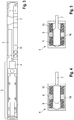
- FIGS. 1 and 2 show a door operating unit 1 according to an embodiment of the invention.
- the door operating unit 1 comprises a housing 4 in which a door operator 2, a locking element 4, a control unit 13, an energy supply element 5 and a hazard detector 3 are arranged.
- the door operating unit 1 is thus suitable for use with a wing door system, in particular for use with a fire door.
- the door operating unit 1 also comprises a slide rail 6.
- the slide rail 6 is connected to the door operator 2 via a connecting linkage, which in particular represents a lever.
- the housing 4 and all components arranged thereon are fastened to a frame 12.
- the slide rail 6 is in turn fastened to a door leaf 11.
- the door leaf 11 can thus be actuated by the door operator 2. According to the invention it is provided that the door leaf 11 can be closed via the door operator 2.
- a locking element 4 is arranged on the door operator 2.
- the locking element 4 is a bistable solenoid valve with which the door operator 2 can be locked electro-hydraulically.
- the arrangement of the door operator 2 and the locking element 4 is particularly shown in FIG Fig. 3 shown in detail.
- the locking element 4 can be controlled by the control unit 13.
- the energy supply element 5 is provided for supplying the control unit 13 and the locking element 4 with electrical energy.
- the control unit 13 is connected to the hazard detector 3, the hazard detector 3 being a smoke alarm.
- the control unit 13 is therefore enabled to detect a fire via the hazard detector 3. This is preferably done by recognizing smoke development.
- the locking element 4 can in particular be controlled via the control unit 13 in such a way that the door operator 2 is locked. Movement of the door leaf 11 is therefore not possible. In this way, the door leaf 11 is held in particular in an open position. Since the locking element 4 is bistable, no energy is required to hold the door leaf 11 in the open position. Energy has to be applied to the fixing element 4 only to transfer the door operator 2 into a released state, that is to say to release the door leaf 11. Since the door operating unit 1 according to the exemplary embodiment of the invention is preferably used in connection with a fire protection door, it is provided that the surroundings of the door operating unit 1 can be monitored by means of the hazard detector 3. If the hazard detector detects a fire, in particular through the development of smoke, this is recognized by the control unit 13.
- control unit 13 When a fire is detected, the control unit 13 is set up to control the locking element 4 in such a way that it transfers the door operator 2 to a released state. There is thus a movement of the door leaf 11 possible. Since the door operator 2 is in particular a door closer, the door operator 2 converts the door leaf 11 into a closed state.
- FIGS. 4 and 5 show the locking element 4 in a first state and in a second state.
- the locking element is shown in a first state.
- a piston 7 of the locking element 4 is in a first position, while the piston 7 is in the FIG Fig. 5 illustrated second state of the locking element 4 is arranged in a second position.
- the piston 7 is surrounded by a first coil 9 and a second coil 10, a permanent magnet 8 being arranged between the first coil 9 and the second coil 10. Both the first coil 9 and the second coil 10 and the permanent magnet 8 surround the piston 7 in an annular manner. This ensures that the piston 7 is always in contact with the permanent magnet 8. This ensures that the permanent magnet 8 always keeps the piston 7 in the first position or in the second position.
- the piston 7 is held in place by the fact that a valve housing 14 serves as a magnetic return body. Due to the fact that both the valve housing 14 and the piston 7 are in contact with the permanent magnet 8, both the piston 7 and the valve housing 14 are magnetized. Since the piston 7 is in the first position (cf. Fig. 4 ) as well as in the second position (compare Fig. 5 ) rests against a wall of the valve housing 14, there are high magnetic forces of attraction between the wall of the valve housing 14 and the piston 7. Thus, the piston 7 remains in the corresponding position until a superimposed magnetic field is generated via activation of the first coil 9 and / or the second coil 10, which moves the piston 7 into the other position.
- the door operating unit 1 has a door operator 8 (not shown) which is designed as an inner door operator and which is arranged inside the frame 12.
- a The unit comprising the smoke detector 3, the control unit 13 and the energy supply element 5 is attached to the frame 12 from the outside.
- the door operator 8 is mounted inside the frame 12 instead of from the outside on the frame 12. The relationship between the individual components within the door operating unit 1 is thus identical to that in the exemplary embodiment originally shown.
- the compact arrangement of the door operating unit 1 enables simple and time-saving assembly.
- the use of an energy supply element 5 designed as an energy store also enables energy self-sufficient operation. In this way, it is avoided in particular that a complex laying of electrical lines up to the door operating unit 1 has to be carried out. Therefore, the door operating unit 1 can be assembled flexibly and inexpensively.
Landscapes
- Business, Economics & Management (AREA)
- Emergency Management (AREA)
- Special Wing (AREA)
- Power-Operated Mechanisms For Wings (AREA)
Claims (10)
- Unité d'actionnement de porte (1) pour actionner un vantail de porte (11), comportant un actionneur de porte (2) et un détecteur de danger (3),- l'actionneur de porte (2) comprenant un élément d'arrêt (4),- le détecteur de danger (3) et l'élément d'arrêt (4) étant connectés à une unité de contrôle (13) de sorte que l'élément d'arrêt (4) est contrôlable par l'unité de contrôle (13) sur la base de signaux du détecteur de danger (3), et- l'unité de contrôle (13), par un signal prédéfini du détecteur de danger (3), étant aménagée à transférer l'élément d'arrêt (4) vers une condition relâchant l'actionneur de porte (2),- l'unité d'actionnement de porte (1) comprenant un élément d'approvisionnement en énergie (5) pour approvisionner en énergie électrique le détecteur de danger (3) et/ou l'élément d'arrêt (4) et/ou l'actionneur de porte (2),caractérisée en ce que- l'élément d'approvisionnement en énergie (5) est un réservoir d'énergie, tout particulièrement une batterie et/ou un accumulateur et/ou un condensateur,- l'actionneur de porte (2) est arrêtable électro-hydrauliquement et l'élément d'arrêt (4) est une soupape magnétique bistable contrôlable, et- l'unité actionnement de porte (1) comprend un boîtier, dans lequel sont agencés l'actionneur de porte (2), le détecteur de danger (3) et l'élément d'approvisionnement en énergie (5).
- Unité actionnement de porte (1) selon la revendication 1, caractérisée en ce que l'élément d'arrêt (4) est transférable d'une première condition à une deuxième condition, dans la première condition l'élément d'arrêt (4) arrêtant l'actionneur de porte (2) de sorte qu'un mouvement du vantail de porte (11) est empêché, et dans la deuxième condition relâche l'actionneur de porte (2).
- Unité actionnement de porte (1) selon la revendication 2, caractérisée en ce que l'élément d'arrêt (4) comprend un piston (7), dans la première condition de l'élément d'arrêt (4), le piston ayant une première position et dans la deuxième condition de l'élément d'arrêt (4), ayant une deuxième position.
- Unité actionnement de porte (1) selon la revendication 3, caractérisée en ce que l'élément d'arrêt (4) comprend au moins un aimant permanent (8) de même qu'au moins une première bobine (9) et une deuxième bobine (10), l'aimant permanent (8) maintenant le piston (7) dans la première position et dans la deuxième position, par contrôlant la première bobine (9) et/ou la deuxième bobine (10), le piston (7) étant transférable de la première position à la deuxième position ou de la deuxième position à la première position.
- Unité actionnement de porte (1) selon la revendication 4, caractérisée en ce que l'aimant permanent (8) est agencé entre la première bobine (9) et la deuxième bobine (10).
- Unité actionnement de porte (1) selon la revendication 4 ou 5, caractérisée en ce que la première bobine (9) et la deuxième bobine (10) forment une bobine commune, la première bobine (9) correspondant à une première section de bobine et la deuxième bobine (10) correspondant à une deuxième section de bobine de la bobine commune.
- Unité actionnement de porte (1) selon la revendication 4 ou 5, caractérisée en ce que la première bobine (9) et la deuxième bobine (10) étant indépendante l'une de l'autre.
- Unité actionnement de porte (1) selon l'une des revendications précédentes, caractérisée en ce que le détecteur de danger (3) est un avertisseur de fumées.
- Unité actionnement de porte (1) selon l'une des revendications précédentes, caractérisée par un rail de glissement (6), le rail de glissement (6) étant attachable sur le vantail de porte (11) et l'actionneur de porte (2) sur un encadrement (12) du vantail de porte (11), l'actionneur de porte (2) et le rail de glissement (6) étant connectés l'une à l'autre par des tringles.
- Unité actionnement de porte (1) selon l'une des revendications 1 à 8, caractérisée par un rail de glissement (6), le rail de glissement (6) étant attachable sur le vantail de porte (11), l'actionneur de porte (2) et le rail de glissement (6) étant connectés l'un à l'autre par des tringles, et l'actionneur de porte (2) étant un actionneur de porte intérieure lequel peut être agencé à l'intérieur de l'encadrement (12).
Applications Claiming Priority (1)
| Application Number | Priority Date | Filing Date | Title |
|---|---|---|---|
| DE102015102915.4A DE102015102915A1 (de) | 2015-03-02 | 2015-03-02 | Türbetätigungseinheit |
Publications (2)
| Publication Number | Publication Date |
|---|---|
| EP3064687A1 EP3064687A1 (fr) | 2016-09-07 |
| EP3064687B1 true EP3064687B1 (fr) | 2020-12-02 |
Family
ID=55027549
Family Applications (1)
| Application Number | Title | Priority Date | Filing Date |
|---|---|---|---|
| EP15203028.4A Revoked EP3064687B1 (fr) | 2015-03-02 | 2015-12-29 | Unite d'actionnement de porte |
Country Status (2)
| Country | Link |
|---|---|
| EP (1) | EP3064687B1 (fr) |
| DE (1) | DE102015102915A1 (fr) |
Cited By (1)
| Publication number | Priority date | Publication date | Assignee | Title |
|---|---|---|---|---|
| EP4446543A1 (fr) * | 2023-04-10 | 2024-10-16 | dormakaba Deutschland GmbH | Ferme-porte |
Families Citing this family (1)
| Publication number | Priority date | Publication date | Assignee | Title |
|---|---|---|---|---|
| DE102018008812A1 (de) | 2018-11-09 | 2020-05-14 | Eco Schulte Gmbh & Co. Kg | Ausfallsicherer batteriebetriebener Freilauftürschließer |
Citations (13)
| Publication number | Priority date | Publication date | Assignee | Title |
|---|---|---|---|---|
| US3777423A (en) * | 1972-01-07 | 1973-12-11 | Rixson Inc | Condition responsive door holder-closer |
| GB1417868A (en) | 1972-01-26 | 1975-12-17 | Stanley Works | Controlled release door holder |
| DE3417979A1 (de) * | 1984-05-15 | 1985-11-21 | Robert Bosch Gmbh, 7000 Stuttgart | Tuerschliessanlage |
| DE4406938A1 (de) | 1993-03-10 | 1994-09-15 | Brouwer Nicolaas Dirk | Entsperrungsmechanik für einen Türschließer |
| DE19836516A1 (de) | 1997-08-16 | 1999-02-18 | Eks Elektromagnetik Dr Scheuer | Elektromagnetischer Linearmotor |
| DE19840766A1 (de) | 1998-09-07 | 2000-03-09 | Geze Gmbh | Antrieb für einen Flügel einer Tür, eines Fensters oder dergleichen |
| GB2377534A (en) * | 2001-07-03 | 2003-01-15 | G W Ltd | Security system |
| DE10131400A1 (de) | 2001-06-28 | 2003-01-23 | Geze Gmbh | Feststellanlage mit rauch-und Branderkennungseinrichtung |
| EP1698817A2 (fr) | 2005-03-05 | 2006-09-06 | Arichell Technologies, Inc. | Appareil électromagnétique et procédé de régulation d'un fluide |
| DE102009027318A1 (de) | 2009-06-30 | 2011-01-05 | Geze Gmbh | Türschließer |
| DE102009027315A1 (de) | 2009-06-30 | 2011-01-05 | Geze Gmbh | Türschließer |
| US8225458B1 (en) | 2001-07-13 | 2012-07-24 | Hoffberg Steven M | Intelligent door restraint |
| DE102012101610A1 (de) * | 2012-02-28 | 2013-08-29 | Dorma Gmbh + Co. Kg | Verfahren zum Betreiben einer Flügelanlage und damit betriebene Flügelanlage |
-
2015
- 2015-03-02 DE DE102015102915.4A patent/DE102015102915A1/de not_active Ceased
- 2015-12-29 EP EP15203028.4A patent/EP3064687B1/fr not_active Revoked
Patent Citations (13)
| Publication number | Priority date | Publication date | Assignee | Title |
|---|---|---|---|---|
| US3777423A (en) * | 1972-01-07 | 1973-12-11 | Rixson Inc | Condition responsive door holder-closer |
| GB1417868A (en) | 1972-01-26 | 1975-12-17 | Stanley Works | Controlled release door holder |
| DE3417979A1 (de) * | 1984-05-15 | 1985-11-21 | Robert Bosch Gmbh, 7000 Stuttgart | Tuerschliessanlage |
| DE4406938A1 (de) | 1993-03-10 | 1994-09-15 | Brouwer Nicolaas Dirk | Entsperrungsmechanik für einen Türschließer |
| DE19836516A1 (de) | 1997-08-16 | 1999-02-18 | Eks Elektromagnetik Dr Scheuer | Elektromagnetischer Linearmotor |
| DE19840766A1 (de) | 1998-09-07 | 2000-03-09 | Geze Gmbh | Antrieb für einen Flügel einer Tür, eines Fensters oder dergleichen |
| DE10131400A1 (de) | 2001-06-28 | 2003-01-23 | Geze Gmbh | Feststellanlage mit rauch-und Branderkennungseinrichtung |
| GB2377534A (en) * | 2001-07-03 | 2003-01-15 | G W Ltd | Security system |
| US8225458B1 (en) | 2001-07-13 | 2012-07-24 | Hoffberg Steven M | Intelligent door restraint |
| EP1698817A2 (fr) | 2005-03-05 | 2006-09-06 | Arichell Technologies, Inc. | Appareil électromagnétique et procédé de régulation d'un fluide |
| DE102009027318A1 (de) | 2009-06-30 | 2011-01-05 | Geze Gmbh | Türschließer |
| DE102009027315A1 (de) | 2009-06-30 | 2011-01-05 | Geze Gmbh | Türschließer |
| DE102012101610A1 (de) * | 2012-02-28 | 2013-08-29 | Dorma Gmbh + Co. Kg | Verfahren zum Betreiben einer Flügelanlage und damit betriebene Flügelanlage |
Cited By (2)
| Publication number | Priority date | Publication date | Assignee | Title |
|---|---|---|---|---|
| EP4446543A1 (fr) * | 2023-04-10 | 2024-10-16 | dormakaba Deutschland GmbH | Ferme-porte |
| WO2024213498A1 (fr) * | 2023-04-10 | 2024-10-17 | Dormakaba Deutschland Gmbh | Ferme-porte |
Also Published As
| Publication number | Publication date |
|---|---|
| EP3064687A1 (fr) | 2016-09-07 |
| DE102015102915A1 (de) | 2016-09-08 |
Similar Documents
| Publication | Publication Date | Title |
|---|---|---|
| EP1251225B1 (fr) | Système de manoeuvre pour un hayon ou similaire | |
| EP2318625B1 (fr) | Mécanisme d'ouverture de porte à soupape de blocage | |
| DE102014222269A1 (de) | Kraftfahrzeug | |
| DE102015001180A1 (de) | Betätigungsvorrichtung für ein bewegliches Teil | |
| EP4386158A1 (fr) | Ouvre-porte | |
| DE2235074B2 (de) | Hydraulische Betätigungsvorrichtung für einen elektrischen Schalter | |
| EP3064687B1 (fr) | Unite d'actionnement de porte | |
| DE102007032327B3 (de) | Ventilstellvorrichtung mit Sicherheitsfunktion | |
| EP2497984B1 (fr) | Soupape d'arrêt de sécurité et procédé d'arrêt d'une conduite de gaz | |
| DE102016210986A1 (de) | Vorrichtung zum Feststellen eines Tür- oder Fensterflügels | |
| DE102009021754A1 (de) | Hilfsauslöseeinheit für einen Leistungsschalter | |
| DE102009022700A1 (de) | Antrieb | |
| DE102012021171A1 (de) | Kegelreibringgetriebe | |
| DE102010014280B4 (de) | Überstrom-Schaltvorrichtung | |
| DE102009022975A1 (de) | Ventil einer hydraulischen Türbetätigungsvorrichtung | |
| DE102016207348B4 (de) | Türentriegelungsvorrichtung für eine verschwenkbare Tür oder Klappe eines Fahrzeugs, Sicherheitssystem | |
| DE202014010437U1 (de) | Türanordnung | |
| DE102016206882A1 (de) | Magnetaktor, Ventil und Sperrvorrichtung mit einem Druckübersetzer | |
| DE102007061868B4 (de) | Druckgesteuerter Schwenkantrieb mit Sicherheitsvorrichtung | |
| DE102015105623B4 (de) | Stellantrieb für das automatische Bewegen von Verschlusselementen für Gebäudeöffnungen | |
| EP2859233A2 (fr) | Actionneur pour actionner un élément de commande | |
| EP3117130B1 (fr) | Système de vanne à commande électromagnétique et son utilisation | |
| DE102021207047A1 (de) | Türschließsystem und Türsystem | |
| EP4481249A1 (fr) | Actionneur et procédé de réglage de grandeurs de réglage | |
| DE202011103482U1 (de) | Servomodul zur Ventilansteuerung |
Legal Events
| Date | Code | Title | Description |
|---|---|---|---|
| PUAI | Public reference made under article 153(3) epc to a published international application that has entered the european phase |
Free format text: ORIGINAL CODE: 0009012 |
|
| AK | Designated contracting states |
Kind code of ref document: A1 Designated state(s): AL AT BE BG CH CY CZ DE DK EE ES FI FR GB GR HR HU IE IS IT LI LT LU LV MC MK MT NL NO PL PT RO RS SE SI SK SM TR |
|
| AX | Request for extension of the european patent |
Extension state: BA ME |
|
| STAA | Information on the status of an ep patent application or granted ep patent |
Free format text: STATUS: REQUEST FOR EXAMINATION WAS MADE |
|
| 17P | Request for examination filed |
Effective date: 20170301 |
|
| RBV | Designated contracting states (corrected) |
Designated state(s): AL AT BE BG CH CY CZ DE DK EE ES FI FR GB GR HR HU IE IS IT LI LT LU LV MC MK MT NL NO PL PT RO RS SE SI SK SM TR |
|
| RAP1 | Party data changed (applicant data changed or rights of an application transferred) |
Owner name: DORMAKABA DEUTSCHLAND GMBH |
|
| STAA | Information on the status of an ep patent application or granted ep patent |
Free format text: STATUS: EXAMINATION IS IN PROGRESS |
|
| 17Q | First examination report despatched |
Effective date: 20180220 |
|
| GRAP | Despatch of communication of intention to grant a patent |
Free format text: ORIGINAL CODE: EPIDOSNIGR1 |
|
| STAA | Information on the status of an ep patent application or granted ep patent |
Free format text: STATUS: GRANT OF PATENT IS INTENDED |
|
| INTG | Intention to grant announced |
Effective date: 20200722 |
|
| GRAS | Grant fee paid |
Free format text: ORIGINAL CODE: EPIDOSNIGR3 |
|
| GRAA | (expected) grant |
Free format text: ORIGINAL CODE: 0009210 |
|
| STAA | Information on the status of an ep patent application or granted ep patent |
Free format text: STATUS: THE PATENT HAS BEEN GRANTED |
|
| AK | Designated contracting states |
Kind code of ref document: B1 Designated state(s): AL AT BE BG CH CY CZ DE DK EE ES FI FR GB GR HR HU IE IS IT LI LT LU LV MC MK MT NL NO PL PT RO RS SE SI SK SM TR |
|
| REG | Reference to a national code |
Ref country code: GB Ref legal event code: FG4D Free format text: NOT ENGLISH |
|
| REG | Reference to a national code |
Ref country code: AT Ref legal event code: REF Ref document number: 1341124 Country of ref document: AT Kind code of ref document: T Effective date: 20201215 Ref country code: CH Ref legal event code: EP |
|
| REG | Reference to a national code |
Ref country code: DE Ref legal event code: R096 Ref document number: 502015013935 Country of ref document: DE |
|
| REG | Reference to a national code |
Ref country code: IE Ref legal event code: FG4D Free format text: LANGUAGE OF EP DOCUMENT: GERMAN |
|
| REG | Reference to a national code |
Ref country code: CH Ref legal event code: NV Representative=s name: FREI PATENTANWALTSBUERO AG, CH |
|
| REG | Reference to a national code |
Ref country code: NL Ref legal event code: FP |
|
| PG25 | Lapsed in a contracting state [announced via postgrant information from national office to epo] |
Ref country code: GR Free format text: LAPSE BECAUSE OF FAILURE TO SUBMIT A TRANSLATION OF THE DESCRIPTION OR TO PAY THE FEE WITHIN THE PRESCRIBED TIME-LIMIT Effective date: 20210303 Ref country code: FI Free format text: LAPSE BECAUSE OF FAILURE TO SUBMIT A TRANSLATION OF THE DESCRIPTION OR TO PAY THE FEE WITHIN THE PRESCRIBED TIME-LIMIT Effective date: 20201202 Ref country code: RS Free format text: LAPSE BECAUSE OF FAILURE TO SUBMIT A TRANSLATION OF THE DESCRIPTION OR TO PAY THE FEE WITHIN THE PRESCRIBED TIME-LIMIT Effective date: 20201202 Ref country code: NO Free format text: LAPSE BECAUSE OF FAILURE TO SUBMIT A TRANSLATION OF THE DESCRIPTION OR TO PAY THE FEE WITHIN THE PRESCRIBED TIME-LIMIT Effective date: 20210302 |
|
| PG25 | Lapsed in a contracting state [announced via postgrant information from national office to epo] |
Ref country code: BG Free format text: LAPSE BECAUSE OF FAILURE TO SUBMIT A TRANSLATION OF THE DESCRIPTION OR TO PAY THE FEE WITHIN THE PRESCRIBED TIME-LIMIT Effective date: 20210302 Ref country code: LV Free format text: LAPSE BECAUSE OF FAILURE TO SUBMIT A TRANSLATION OF THE DESCRIPTION OR TO PAY THE FEE WITHIN THE PRESCRIBED TIME-LIMIT Effective date: 20201202 Ref country code: PL Free format text: LAPSE BECAUSE OF FAILURE TO SUBMIT A TRANSLATION OF THE DESCRIPTION OR TO PAY THE FEE WITHIN THE PRESCRIBED TIME-LIMIT Effective date: 20201202 Ref country code: SE Free format text: LAPSE BECAUSE OF FAILURE TO SUBMIT A TRANSLATION OF THE DESCRIPTION OR TO PAY THE FEE WITHIN THE PRESCRIBED TIME-LIMIT Effective date: 20201202 |
|
| PG25 | Lapsed in a contracting state [announced via postgrant information from national office to epo] |
Ref country code: HR Free format text: LAPSE BECAUSE OF FAILURE TO SUBMIT A TRANSLATION OF THE DESCRIPTION OR TO PAY THE FEE WITHIN THE PRESCRIBED TIME-LIMIT Effective date: 20201202 |
|
| REG | Reference to a national code |
Ref country code: LT Ref legal event code: MG9D |
|
| PG25 | Lapsed in a contracting state [announced via postgrant information from national office to epo] |
Ref country code: EE Free format text: LAPSE BECAUSE OF FAILURE TO SUBMIT A TRANSLATION OF THE DESCRIPTION OR TO PAY THE FEE WITHIN THE PRESCRIBED TIME-LIMIT Effective date: 20201202 Ref country code: CZ Free format text: LAPSE BECAUSE OF FAILURE TO SUBMIT A TRANSLATION OF THE DESCRIPTION OR TO PAY THE FEE WITHIN THE PRESCRIBED TIME-LIMIT Effective date: 20201202 Ref country code: SM Free format text: LAPSE BECAUSE OF FAILURE TO SUBMIT A TRANSLATION OF THE DESCRIPTION OR TO PAY THE FEE WITHIN THE PRESCRIBED TIME-LIMIT Effective date: 20201202 Ref country code: LT Free format text: LAPSE BECAUSE OF FAILURE TO SUBMIT A TRANSLATION OF THE DESCRIPTION OR TO PAY THE FEE WITHIN THE PRESCRIBED TIME-LIMIT Effective date: 20201202 Ref country code: RO Free format text: LAPSE BECAUSE OF FAILURE TO SUBMIT A TRANSLATION OF THE DESCRIPTION OR TO PAY THE FEE WITHIN THE PRESCRIBED TIME-LIMIT Effective date: 20201202 Ref country code: SK Free format text: LAPSE BECAUSE OF FAILURE TO SUBMIT A TRANSLATION OF THE DESCRIPTION OR TO PAY THE FEE WITHIN THE PRESCRIBED TIME-LIMIT Effective date: 20201202 Ref country code: PT Free format text: LAPSE BECAUSE OF FAILURE TO SUBMIT A TRANSLATION OF THE DESCRIPTION OR TO PAY THE FEE WITHIN THE PRESCRIBED TIME-LIMIT Effective date: 20210405 |
|
| REG | Reference to a national code |
Ref country code: DE Ref legal event code: R026 Ref document number: 502015013935 Country of ref document: DE |
|
| REG | Reference to a national code |
Ref country code: BE Ref legal event code: MM Effective date: 20201231 |
|
| PLBI | Opposition filed |
Free format text: ORIGINAL CODE: 0009260 |
|
| PLAX | Notice of opposition and request to file observation + time limit sent |
Free format text: ORIGINAL CODE: EPIDOSNOBS2 |
|
| PG25 | Lapsed in a contracting state [announced via postgrant information from national office to epo] |
Ref country code: MC Free format text: LAPSE BECAUSE OF FAILURE TO SUBMIT A TRANSLATION OF THE DESCRIPTION OR TO PAY THE FEE WITHIN THE PRESCRIBED TIME-LIMIT Effective date: 20201202 Ref country code: IS Free format text: LAPSE BECAUSE OF FAILURE TO SUBMIT A TRANSLATION OF THE DESCRIPTION OR TO PAY THE FEE WITHIN THE PRESCRIBED TIME-LIMIT Effective date: 20210402 |
|
| 26 | Opposition filed |
Opponent name: GEZE GMBH Effective date: 20210902 |
|
| PG25 | Lapsed in a contracting state [announced via postgrant information from national office to epo] |
Ref country code: IE Free format text: LAPSE BECAUSE OF NON-PAYMENT OF DUE FEES Effective date: 20201229 Ref country code: IT Free format text: LAPSE BECAUSE OF FAILURE TO SUBMIT A TRANSLATION OF THE DESCRIPTION OR TO PAY THE FEE WITHIN THE PRESCRIBED TIME-LIMIT Effective date: 20201202 Ref country code: AL Free format text: LAPSE BECAUSE OF FAILURE TO SUBMIT A TRANSLATION OF THE DESCRIPTION OR TO PAY THE FEE WITHIN THE PRESCRIBED TIME-LIMIT Effective date: 20201202 Ref country code: FR Free format text: LAPSE BECAUSE OF NON-PAYMENT OF DUE FEES Effective date: 20210202 Ref country code: LU Free format text: LAPSE BECAUSE OF NON-PAYMENT OF DUE FEES Effective date: 20201229 |
|
| PG25 | Lapsed in a contracting state [announced via postgrant information from national office to epo] |
Ref country code: ES Free format text: LAPSE BECAUSE OF FAILURE TO SUBMIT A TRANSLATION OF THE DESCRIPTION OR TO PAY THE FEE WITHIN THE PRESCRIBED TIME-LIMIT Effective date: 20201202 Ref country code: DK Free format text: LAPSE BECAUSE OF FAILURE TO SUBMIT A TRANSLATION OF THE DESCRIPTION OR TO PAY THE FEE WITHIN THE PRESCRIBED TIME-LIMIT Effective date: 20201202 Ref country code: SI Free format text: LAPSE BECAUSE OF FAILURE TO SUBMIT A TRANSLATION OF THE DESCRIPTION OR TO PAY THE FEE WITHIN THE PRESCRIBED TIME-LIMIT Effective date: 20201202 |
|
| PLBB | Reply of patent proprietor to notice(s) of opposition received |
Free format text: ORIGINAL CODE: EPIDOSNOBS3 |
|
| PG25 | Lapsed in a contracting state [announced via postgrant information from national office to epo] |
Ref country code: IS Free format text: LAPSE BECAUSE OF FAILURE TO SUBMIT A TRANSLATION OF THE DESCRIPTION OR TO PAY THE FEE WITHIN THE PRESCRIBED TIME-LIMIT Effective date: 20210402 Ref country code: TR Free format text: LAPSE BECAUSE OF FAILURE TO SUBMIT A TRANSLATION OF THE DESCRIPTION OR TO PAY THE FEE WITHIN THE PRESCRIBED TIME-LIMIT Effective date: 20201202 Ref country code: MT Free format text: LAPSE BECAUSE OF FAILURE TO SUBMIT A TRANSLATION OF THE DESCRIPTION OR TO PAY THE FEE WITHIN THE PRESCRIBED TIME-LIMIT Effective date: 20201202 Ref country code: CY Free format text: LAPSE BECAUSE OF FAILURE TO SUBMIT A TRANSLATION OF THE DESCRIPTION OR TO PAY THE FEE WITHIN THE PRESCRIBED TIME-LIMIT Effective date: 20201202 |
|
| PG25 | Lapsed in a contracting state [announced via postgrant information from national office to epo] |
Ref country code: MK Free format text: LAPSE BECAUSE OF FAILURE TO SUBMIT A TRANSLATION OF THE DESCRIPTION OR TO PAY THE FEE WITHIN THE PRESCRIBED TIME-LIMIT Effective date: 20201202 |
|
| PG25 | Lapsed in a contracting state [announced via postgrant information from national office to epo] |
Ref country code: BE Free format text: LAPSE BECAUSE OF NON-PAYMENT OF DUE FEES Effective date: 20201231 |
|
| PGFP | Annual fee paid to national office [announced via postgrant information from national office to epo] |
Ref country code: NL Payment date: 20221222 Year of fee payment: 8 Ref country code: GB Payment date: 20221223 Year of fee payment: 8 Ref country code: DE Payment date: 20220620 Year of fee payment: 8 Ref country code: AT Payment date: 20221222 Year of fee payment: 8 |
|
| PGFP | Annual fee paid to national office [announced via postgrant information from national office to epo] |
Ref country code: CH Payment date: 20230103 Year of fee payment: 8 |
|
| RDAF | Communication despatched that patent is revoked |
Free format text: ORIGINAL CODE: EPIDOSNREV1 |
|
| REG | Reference to a national code |
Ref country code: DE Ref legal event code: R103 Ref document number: 502015013935 Country of ref document: DE Ref country code: DE Ref legal event code: R064 Ref document number: 502015013935 Country of ref document: DE |
|
| RDAG | Patent revoked |
Free format text: ORIGINAL CODE: 0009271 |
|
| STAA | Information on the status of an ep patent application or granted ep patent |
Free format text: STATUS: PATENT REVOKED |
|
| REG | Reference to a national code |
Ref country code: CH Ref legal event code: PL |
|
| 27W | Patent revoked |
Effective date: 20230713 |
|
| GBPR | Gb: patent revoked under art. 102 of the ep convention designating the uk as contracting state |
Effective date: 20230713 |
|
| REG | Reference to a national code |
Ref country code: AT Ref legal event code: MA03 Ref document number: 1341124 Country of ref document: AT Kind code of ref document: T Effective date: 20230713 |