EP3066060B1 - Netzmittel in form eines pulvers und dessen herstellungsverfahren - Google Patents
Netzmittel in form eines pulvers und dessen herstellungsverfahren Download PDFInfo
- Publication number
- EP3066060B1 EP3066060B1 EP14809477.4A EP14809477A EP3066060B1 EP 3066060 B1 EP3066060 B1 EP 3066060B1 EP 14809477 A EP14809477 A EP 14809477A EP 3066060 B1 EP3066060 B1 EP 3066060B1
- Authority
- EP
- European Patent Office
- Prior art keywords
- fluidizing
- mortar
- composition
- weight
- acid
- Prior art date
- Legal status (The legal status is an assumption and is not a legal conclusion. Google has not performed a legal analysis and makes no representation as to the accuracy of the status listed.)
- Active
Links
Images


Classifications
-
- C—CHEMISTRY; METALLURGY
- C04—CEMENTS; CONCRETE; ARTIFICIAL STONE; CERAMICS; REFRACTORIES
- C04B—LIME, MAGNESIA; SLAG; CEMENTS; COMPOSITIONS THEREOF, e.g. MORTARS, CONCRETE OR LIKE BUILDING MATERIALS; ARTIFICIAL STONE; CERAMICS; REFRACTORIES; TREATMENT OF NATURAL STONE
- C04B24/00—Use of organic materials as active ingredients for mortars, concrete or artificial stone, e.g. plasticisers
- C04B24/24—Macromolecular compounds
- C04B24/28—Macromolecular compounds obtained otherwise than by reactions only involving carbon-to-carbon unsaturated bonds
- C04B24/286—Polycarbonates
-
- C—CHEMISTRY; METALLURGY
- C04—CEMENTS; CONCRETE; ARTIFICIAL STONE; CERAMICS; REFRACTORIES
- C04B—LIME, MAGNESIA; SLAG; CEMENTS; COMPOSITIONS THEREOF, e.g. MORTARS, CONCRETE OR LIKE BUILDING MATERIALS; ARTIFICIAL STONE; CERAMICS; REFRACTORIES; TREATMENT OF NATURAL STONE
- C04B28/00—Compositions of mortars, concrete or artificial stone, containing inorganic binders or the reaction product of an inorganic and an organic binder, e.g. polycarboxylate cements
- C04B28/02—Compositions of mortars, concrete or artificial stone, containing inorganic binders or the reaction product of an inorganic and an organic binder, e.g. polycarboxylate cements containing hydraulic cements other than calcium sulfates
- C04B28/04—Portland cements
-
- C—CHEMISTRY; METALLURGY
- C04—CEMENTS; CONCRETE; ARTIFICIAL STONE; CERAMICS; REFRACTORIES
- C04B—LIME, MAGNESIA; SLAG; CEMENTS; COMPOSITIONS THEREOF, e.g. MORTARS, CONCRETE OR LIKE BUILDING MATERIALS; ARTIFICIAL STONE; CERAMICS; REFRACTORIES; TREATMENT OF NATURAL STONE
- C04B28/00—Compositions of mortars, concrete or artificial stone, containing inorganic binders or the reaction product of an inorganic and an organic binder, e.g. polycarboxylate cements
- C04B28/02—Compositions of mortars, concrete or artificial stone, containing inorganic binders or the reaction product of an inorganic and an organic binder, e.g. polycarboxylate cements containing hydraulic cements other than calcium sulfates
- C04B28/06—Aluminous cements
-
- C—CHEMISTRY; METALLURGY
- C04—CEMENTS; CONCRETE; ARTIFICIAL STONE; CERAMICS; REFRACTORIES
- C04B—LIME, MAGNESIA; SLAG; CEMENTS; COMPOSITIONS THEREOF, e.g. MORTARS, CONCRETE OR LIKE BUILDING MATERIALS; ARTIFICIAL STONE; CERAMICS; REFRACTORIES; TREATMENT OF NATURAL STONE
- C04B28/00—Compositions of mortars, concrete or artificial stone, containing inorganic binders or the reaction product of an inorganic and an organic binder, e.g. polycarboxylate cements
- C04B28/14—Compositions of mortars, concrete or artificial stone, containing inorganic binders or the reaction product of an inorganic and an organic binder, e.g. polycarboxylate cements containing calcium sulfate cements
-
- C—CHEMISTRY; METALLURGY
- C04—CEMENTS; CONCRETE; ARTIFICIAL STONE; CERAMICS; REFRACTORIES
- C04B—LIME, MAGNESIA; SLAG; CEMENTS; COMPOSITIONS THEREOF, e.g. MORTARS, CONCRETE OR LIKE BUILDING MATERIALS; ARTIFICIAL STONE; CERAMICS; REFRACTORIES; TREATMENT OF NATURAL STONE
- C04B40/00—Processes, in general, for influencing or modifying the properties of mortars, concrete or artificial stone compositions, e.g. their setting or hardening ability
- C04B40/0028—Aspects relating to the mixing step of the mortar preparation
- C04B40/0039—Premixtures of ingredients
-
- C—CHEMISTRY; METALLURGY
- C08—ORGANIC MACROMOLECULAR COMPOUNDS; THEIR PREPARATION OR CHEMICAL WORKING-UP; COMPOSITIONS BASED THEREON
- C08L—COMPOSITIONS OF MACROMOLECULAR COMPOUNDS
- C08L71/00—Compositions of polyethers obtained by reactions forming an ether link in the main chain; Compositions of derivatives of such polymers
-
- C—CHEMISTRY; METALLURGY
- C04—CEMENTS; CONCRETE; ARTIFICIAL STONE; CERAMICS; REFRACTORIES
- C04B—LIME, MAGNESIA; SLAG; CEMENTS; COMPOSITIONS THEREOF, e.g. MORTARS, CONCRETE OR LIKE BUILDING MATERIALS; ARTIFICIAL STONE; CERAMICS; REFRACTORIES; TREATMENT OF NATURAL STONE
- C04B2103/00—Function or property of ingredients for mortars, concrete or artificial stone
- C04B2103/30—Water reducers, plasticisers, air-entrainers, flow improvers
- C04B2103/32—Superplasticisers
-
- C—CHEMISTRY; METALLURGY
- C04—CEMENTS; CONCRETE; ARTIFICIAL STONE; CERAMICS; REFRACTORIES
- C04B—LIME, MAGNESIA; SLAG; CEMENTS; COMPOSITIONS THEREOF, e.g. MORTARS, CONCRETE OR LIKE BUILDING MATERIALS; ARTIFICIAL STONE; CERAMICS; REFRACTORIES; TREATMENT OF NATURAL STONE
- C04B2111/00—Mortars, concrete or artificial stone or mixtures to prepare them, characterised by specific function, property or use
- C04B2111/00034—Physico-chemical characteristics of the mixtures
- C04B2111/00146—Sprayable or pumpable mixtures
-
- C—CHEMISTRY; METALLURGY
- C04—CEMENTS; CONCRETE; ARTIFICIAL STONE; CERAMICS; REFRACTORIES
- C04B—LIME, MAGNESIA; SLAG; CEMENTS; COMPOSITIONS THEREOF, e.g. MORTARS, CONCRETE OR LIKE BUILDING MATERIALS; ARTIFICIAL STONE; CERAMICS; REFRACTORIES; TREATMENT OF NATURAL STONE
- C04B2111/00—Mortars, concrete or artificial stone or mixtures to prepare them, characterised by specific function, property or use
- C04B2111/60—Flooring materials
- C04B2111/62—Self-levelling compositions
Definitions
- the present invention relates to a fluidizing composition in the form of a liquid or a powder, a process for preparing said fluidizing composition, a dry mortar and a concrete incorporating said fluidizing composition, as well as coatings prepared from said dry mortar or concrete, such as as preparation coatings and flooring.
- Polycarboxylate ethers have proven to be particularly effective components as a superplasticizer.
- This new generation of copolymers is based on poly (alkylene oxide) chains grafted onto a polycarboxylic acid chain.
- Such products have an easily controllable structure and are well known for their dispersant properties. They are negatively charged by the presence of carboxylate groups, which allows them to adsorb on the particles of hydraulic binder, and to ensure electrostatic repulsion, while the poly (alkylene oxide) grafts, which do not adsorb, bring a "steric repulsion".
- These compounds can be used in concrete formulations, as well as in self-leveling coating formulations.
- the plasticizer mixture comprises a fluidizing agent based on polycarboxylates and at least one deaeration agent, such as butoxylated polyalkylene polyamines or their salts.
- the document FR 2,776,285 discloses a water-soluble dispersant for cement compositions.
- the dispersant is obtained by base-catalyzed partial esterification by reacting: at least one polycarboxylic acid and at least one polyether containing a free hydroxyl group.
- a "self-leveling coating” is a fluid mortar which makes it possible, after application or casting on a horizontal support (ground), to obtain a surface that is free of irregularities and perfectly flat without mechanical treatment of the surface (such as including sanding).
- these coatings are widely used to make up for the unevenness of the level of the raw slabs of construction or horizontal surfaces of any kind, on which are then disposed finishing coatings, such as the bonded floor, the tiles, slabs or coatings made of plastic or carpet.
- the mortar powder and water are introduced into the machine, and mixing is done by means of a worm.
- the mixing time is very short, of the order of a few seconds, and the shear energy is low, compared with a mixing performed with a fast rotating speed stirrer.
- the fresh mortar is pumped to be transported via a flexible pipe to its place of placement. It spreads easily, because of its self-leveling character, and requires only a small manual intervention with a spatula, a picking roller or other.
- Too fast a mixture of mortar / water in the machine can lead to poor quality of the paste obtained, due to poor dispersion of the mortar.
- the viscosity of the fresh mortar entering the pump will be too high and lead to an increase in pressure and an involuntary drop in flow, and therefore productivity.
- poor dispersion leads to a heterogeneous mortar with defects.
- the temptation of the applicator is to increase the water content, which leads to a decrease in performance: sedimentation phenomenon and bleeding, decreased mechanical properties.
- compositions comprising a hydraulic binder (Portland cement, aluminous cement, etc.), such as mortar compositions (self-leveling smoothing compound ) or concrete.
- a hydraulic binder Portableland cement, aluminous cement, etc.
- mortar compositions self-leveling smoothing compound
- concrete concrete
- the present invention thus aims to propose a new fluidizing composition that avoids all or part of the aforementioned drawbacks.
- the fluidizing composition comprises from 3 (not included) to 7 parts by weight of said less aromatic hydrocarbon sulphonic acid or a salt thereof chosen from alkaline salts, alkaline earth salts or a mixture thereof, per 100 parts. parts by weight (dry) of the superplasticizer.
- a fluidizing composition comprising: at least one superplasticizer of the polycarboxylate ether type and at least one aromatic hydrocarbon sulphonic acid or one of its salts, makes it possible to significantly improve the kinetics of action of said superplasticizer.
- the fluidizing compositions of the invention make it possible to obtain the expected performances by using proportions of polycarboxylate ether in a lower weight relative to the total weight of the mortar.
- the fluidizing compositions of the invention are either in the form of a liquid or in the form of a powder.
- the liquid form is suitable for preparing concrete compositions
- the powder form is generally suitable for preparing ready-to-use mortar formulations, such as self-leveling coatings.
- the fluidizing composition comprises at least one aromatic hydrocarbon sulphonic acid or a salt thereof.
- one of its salts is meant a salt selected from alkali metal salts, alkaline earth salts or a mixture thereof.
- aromatic hydrocarbon is meant an organic compound, that is to say essentially containing carbon and hydrogen atoms, of which at least one fragment satisfies Hückel's aromaticity rule.
- aromatic hydrocarbon may contain a benzene ring.
- the aromatic hydrocarbon sulphonic acid of the fluidizing composition according to the invention thus comprises an aromatic hydrocarbon substituted with at least one sulphonic group.
- It may be chosen for example from: benzene sulphonic acid, p-phenol sulphonic acid, cresol sulphonic acid, o-cresol sulphonic acid, m-cresol sulphonic acid, para-toluene acid sulphonic acid, 2,4-xylene sulphonic acid, 2,5-xylene sulphonic acid, dodecyl-benzene sulphonic acid, alkyldiphenyloxide disulphonic acids, or a salt thereof chosen for example from alkali salts and alkaline earth, or a mixture thereof.
- the sodium or potassium salts or their mixture will be chosen.
- the aromatic hydrocarbon sulphonic acid is advantageously para-toluene sulphonic acid or a salt thereof, such as its sodium salt.
- aromatic hydrocarbon sulfonic acid according to the invention makes it possible to improve the properties of the superplasticizer based on polycarboxylate ethers.
- the polycarboxylate ethers may be chosen from: random, alternating, sequential or comb-shaped copolymers comprising at least one structural unit containing an oxyalkylene glycol and at least one carboxylic acid unit.
- Preferred polyalkylene glycol polycarboxylates whose main chain contains carboxyl groups and the side chain or chains contain oxyalkylene glycol groups.
- These polymers may be present either in free acid form or in the form of their salts.
- Suitable unsaturated carboxylic acids or carboxylic acid derivatives include: acrylic acid, methacrylic acid, maleic acid anhydride, maleic acid, fumaric acid, itaconic acid, and the like. that itaconic acid anhydride.
- the polycarboxylate ethers may be linear, branched and may be in comb, star or other structures.
- the polycarboxylate ethers are chosen from: carboxylic acid and carboxylic ester copolymers of poly (alkylene glycol), copolymers of carboxylic acids and of poly (alkylene glycol) amide, copolymers of carboxylic and poly (alkylene glycol) imide acids, copolymers of poly (alkylene glycol) carboxylic acids and polyvinyl ethers, copolymers of carboxylic acids and (meth) allylic poly (alkylene glycol) ethers , copolymers of carboxylic acids and ethers isoprenol poly (alkylene glycol), neutralized or unneutralized, and or mixtures thereof.
- copolymers may also carry other chemical groups, such as amide (s), sulfonate (s), etc.
- the polycarboxylate ethers that are suitable for the present invention preferably have a degree of grafting of less than or equal to 25%, in particular less than or equal to 20%, typically less than or equal to 15% and ideally less than or equal to 10%.
- grafting rate is meant the ratio between the number of polyalkylene glycol grafts, and the sum of the total number of carboxyl and / or carboxylate groups and the number of graft polyalkylene glycols.
- the fluidizing composition comprises at least 80% and better still at least 90% by weight of superplasticizer relative to the total weight of the dry fluidizing composition.
- the fluidizing composition in powder form of the invention has a particle size of less than or equal to 315 ⁇ m.
- the fluidizing composition based on at least one superplasticizer according to the invention may further comprise one or more additives.
- additives of the fluidizing composition additives may be added to this composition other than aromatic hydrocarbon sulfonic acids or their salts.
- the fluidifying composition in powder form comprises at least one anti-caking agent.
- the anti-quenching agents may be chosen from: precipitated silicas, pyrogenic silicas, kaolin, clay, calcium carbonate, or a mixture thereof.
- additives there may be mentioned, in a non-exhaustive manner, an antifoaming agent, or a thickening agent.
- the invention also relates to a process for preparing a fluidizing composition as defined above comprising a step of mixing at least one superplasticizer chosen from a polycarboxylate ether and at least one aromatic hydrocarbon sulphonic acid or one of its salts chosen from alkaline salts, alkaline earth salts or a mixture thereof, said at least one aromatic hydrocarbon sulphonic acid or a salt thereof representing, per 100 parts by weight of said superplasticizer, 1 to 20 parts by weight; weight (dry weight), said superplasticizer representing at least 40%, by weight, relative to the total weight of said dry fluidizing composition.
- the fluidizing composition as described above is in liquid form and can be prepared by mixing at least one polycarboxylate ether and at least one aromatic hydrocarbon sulphonic acid in a solvent, such as water (method 1).
- the above mixture preferably has a pH of less than or equal to 8, in particular a pH of less than or equal to 7, typically between 5.5 and 7 (limits included). ) and ideally 6.5.
- the fluidizing composition as described above is in powder form (method 2).
- a polycarboxylate ether powder can be prepared by mixing a polycarboxylate ether powder and an aromatic hydrocarbon sulfonic acid powder or a salt thereof.
- a polycarboxylate ether already in powder form generally having a particle size of less than or equal to 315 ⁇ m
- an aromatic hydrocarbon sulphonic acid also in the form of a powder, are preferably used.
- step a) The liquid mixture of step a) is obtained according to the procedure described above (method 1).
- the drying step b) may be carried out by any techniques known to those skilled in the art, in particular by co-atomization or by placing on a support.
- the co-atomization consists in spraying the fluidizing composition in liquid form in an atomizer inside which a hot air flow makes it possible to transform the liquid fluidizing composition into powder.
- the anti-caking agent when present, may be introduced in parallel into the atomization chamber, or may be added to the dried powder by mixing.
- the amount of anti-caking agent is preferably, by weight, less than or equal to 5%, typically it is 2 to 4% relative to the total weight of the fluidizing composition in powder form.
- the support is carried out by absorption of the mixture in solution, preferably on a mineral adsorption support with a high specific surface, for example with a specific surface greater than or equal to 100 m 2 / g.
- the high surface area mineral adsorption carrier is a high surface area silica, such as precipitated silica or fumed silica.
- the support, followed by drying, is done in a chamber, under vacuum, at a temperature of about 80 ° C.
- the other optional additives may be incorporated either in the solution, before drying, or by powder / powder mixture.
- the drying step b) makes it possible to obtain a powder with a residual moisture content generally less than or equal to 3%, or even less than or equal to 2%, by weight, relative to the total weight of the composition.
- the invention also relates to a dry mortar comprising at least one hydraulic binder characterized in that it further comprises a fluidizing composition as defined above.
- the hydraulic binder preferably comprises at least one aluminous cement and / or Portland cement and / or one or more calcium sulphates.
- Aluminous cement is generally defined as a hydraulic binder whose alumina content is between 30 and 80% by weight relative to the total weight of the binder.
- aluminous cement suitable for the invention mention may be made of the Ternal® and SECAR® range of products.
- the aluminous cement may be in a crystalline mineralogical phase selected from CA, C 12 A 7 or in an amorphous phase, or in the form of a mixture of at least one of said crystallized mineral phases and an amorphous phase.
- the aluminous cement preferably has a Blaine specific surface greater than or equal to 1500 cm 2 / g, preferably between 2000 and 5000 cm 2 / g.
- Portland cement can be in particular a standardized cement according to the European standard of cement EN 197-1.
- the calcium sulphates may be in the form of anhydrite, gypsum or hemihydrate, of natural or synthetic origin.
- hydraulic binders such as hydraulic lime or sulfo-aluminous cement may also be used.
- the hydraulic binder is mainly based on calcium sulphates.
- the dry mortar comprises, by weight, relative to the total weight of said dry mortar of 15 to 50%, preferably 30 to 40% of calcium sulphates.
- the mortar comprises fillers, preferably mineral fillers. These mineral fillers represent, by weight, 25 to 80%, preferably 50 to 70% of the total weight of the dry mortar.
- the mineral fillers are preferably chosen with a particle size distribution ranging from 0 mm to 2 mm.
- the mineral fillers therefore comprise fines or fillers and sands.
- the fillers have a particle size of between 0 and 80 ⁇ m and the sand has a particle size of between 0 and 2 mm, preferably between 0 and 800 ⁇ m.
- the fillers preferably represent from 10% to 40%, better still from 20 to 35% by weight and the sand from 10% to 40%, better still from 20 to 40%, by weight, relative to the total weight of said dry mortar.
- the dry mortar according to the invention generally comprises several additives. These are setting regulating agents, rheological agents: thickeners and water retainers, antifoam agents and co-binders that are redispersible resins.
- the setting regulators include accelerators and retarders.
- accelerators mention may be made of lithium sulphate, lithium carbonate or potassium sulphate.
- retarders mention may be made of boric acid or carboxylic acids, in particular citric, tartaric and gluconic acids, and their corresponding salts.
- anti-sedimentation agents such as welan and diutan gums, xanthan gum, guars, starches or clays.
- a water-retaining agent mention may be made of cellulose ethers.
- the set of additives of the dry mortar represents, by weight, from 0 to 5% relative to the total weight of said dry mortar.
- the invention also relates to a self-leveling fluid mortar.
- the self-leveling fluid mortar is obtained by mixing with water the dry mortar as defined above.
- the water / mortar weight ratio is less than or equal to 0.5, preferably less than or equal to 0.3 and better still less than or equal to 0.25.
- the mixing step can take place in a mechanical mixer, with very short mixing times (a few seconds).
- a coating is thus obtained by application and drying of the self-leveling fluid mortar as defined above.
- the invention also relates to a concrete comprising at least one hydraulic binder, aggregates generally selected from sand and gravel, water characterized in that it further comprises a fluidizing composition as defined above.
- Concrete components include those defined for dry mortar. They also include aggregates of greater particle size than those used for mortars.
- crete means a mixture of at least one hydraulic binder, aggregates, optionally additives and optionally mineral additives, mixed with water.
- aggregates a set of mineral grains smaller than 125 mm: this includes in particular the sands as defined above, chippings and gravel as defined in EN12620 (2008).
- the concrete is preferably obtained by mixing the aforementioned dry weight concrete composition with water in proportions known to those skilled in the art.
- the concrete is prepared by mixing and / or kneading aggregates, mineral fillers, hydraulic binder, optionally additive and fluidizing composition according to the invention premixed with water.
- the present invention relates to the use of a fluidizing composition as described above as a superplasticizer in a composition comprising at least one hydraulic binder, such as a concrete or a dry or liquid mortar.
- the first fluidizing composition P1 comprises a polycarboxylate ether (PCE) in aqueous solution. It has a pH of 6.5 and a solids content of 35% by weight of PCE.
- PCE polycarboxylate ether
- the second fluidizing composition P2 according to the invention is prepared from the first fluidizing composition P1 to which is added a powder of an aromatic hydrocarbon sulfonic acid, which dissolves.
- P2 comprises the following composition: Table I components Quantities (g) Extract (% w / w) Dry matter (g) Fluidizing composition P1 96.35 35,00 33.72 Para toluenesulphonic acid monohydrate (APTS ) 1.67 90.50 1.51 50% soda 1.98 50,00 0.99 Total 100.00 35.8 35.78
- Soda was added in order to obtain a pH equivalent to the composition of P1, namely 6.5.
- the dry extract of the fluidifying liquid composition P2 is 35.8% PCE.
- the percentage of APTS with respect to the dry matter of the liquid P2 is 4.22%.
- the fluidifying compositions P1 and P2 were then dried according to two different processes, namely by atomization or by placing on a support.
- the fluidifying composition C2 in powder form is ultimately composed of: Polymer polycarboxylate ether 97.10% Aerosil® OX 50 Silica 2.9%
- a first fluidizing composition in powder form C5 according to the invention is obtained by atomization of the fluidifying liquid composition P2 (aqueous solution of the PCE-APTS mixture). After obtaining the powder, 3%, based on the weight of the fluidizing composition C5, of aerosil® OX 50 silica is incorporated.
- the fluidifying composition C5 in powder form is ultimately composed of: Polymer dry blend PCE - APTS (4.05% APTS monohydrate) 97.10% Aerosil® OX 50 Silica 2.9%
- a second fluidizing composition in powder form C6 according to the invention is obtained by placing the liquid fluidizing composition P2 on a support.
- This support is carried out using a ROTO P10® type powder mixer equipped with a vacuum drying system.
- the assembly is heated to 80 ° C, and the pressure is regulated to 380 mBar.
- the mixer is then fed with liquid fluidizing composition P2 at a controlled rate so as to ultimately target a proportion of 50% by weight of active ingredients relative to the weight of C6.
- the drying is continued until a residual moisture of less than 6% maximum on the C6 powder thus obtained.
- the initial quantities introduced into the ROTO P10® mixer are as follows: Tixosil® 38 790 g P2 2210 g
- the fluidizing composition C6 in powder form is ultimately composed of: Polymer dry blend PCE - APTS (4.22% APTS monohydrate) 49.54% Tixosil 38 49.48% Residual water 0.98%
- composition of the self-leveling mortar used to evaluate the various fluidifying compositions according to the invention and according to the prior art is specified in the following Table II: Table II Mortar components Function Description % Aluminous cement Hydraulic binder Ternal® RG 20.00 Portland cement Hydraulic binder CEM I 52.5 N 4.00 Calcium sulphate hemihydrate Hydraulic binder Prestia creation 7.00 Calcium carbonate Charge (Filler) Durcal® 2 16.52 Calcium carbonate Charge (Filler) Durcal® 40 17.37 Silky sand Load (Sand) CV 32 (SIBELCO) average particle size 280 ⁇ m 25.57 Silky sand Load (Sand) BR 36 (SIBELCO) average particle size 180 ⁇ m qs 100 Polymer vinyl acetate ethylene Additive (redispersible resin) Vinnapas 5011L 3.00 Additive (antifoaming agent) Dehydran 1933 0.10 Additive (intake regulator) Tartaric acid 0.10 Cellulose ether Additive
- Table III Mortar reference Reference of fluidifying compositions incorporated in coatings Doses of incorporation of fluidizing compositions (% on total formula) Quantity of MA * (%) M2 (0.1) C2 0.10 0.10 M5 (0,1) C5 0.10 0.10 M5 (0.07) C5 0.07 0.07 M6 (0.2) C6 0.20 0.10 M6 (0.14) C6 0.14 0.07 * MA: active ingredient
- All dry mortars are obtained by mixing raw materials in powder form using a Turbula® mixer from WAB for a period of 10 minutes.
- the self-leveling mortars are obtained by mixing with water the formulations mentioned above (M2 (0,1), M5 (0,1), M5 (0,07), M6 (0,20) or M6 (0, 14) (mixing rate of 24 parts by weight).
- the test consists in continuously measuring the evolution of the viscosity, at the first moments of the dry mortar / water mixture.
- a Lamy Rhéomat RM 260 rheometer equipped with a three-blade propeller is used. The test is carried out in a 125 mL polypropylene bottle.
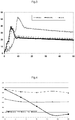
- figure 1 represents the evolution of the constraint (in arbitrary unit) as a function of time (in seconds).
- the stress levels obtained are inversely proportional to the fluidifying efficiency of the ECP.
- step 3 The higher the bearing stress (step 3), the more energy will be needed to pump the fluid mortar.
- a second protocol was put in place to measure the fluidization kinetics of the fluidizing compositions of the invention.
- the stress values used to measure the evolution of the rheology as a function of the various mixing times are those measured at 100 s-1.
- the accuracy of the measurement is +/- 30 Pa.
- the stress values observed according to this protocol are higher than those corresponding to method 1 because of a different speed gradient and different mobile geometries.
- the fluidizing compositions according to the invention are referenced C5 and C6, the fluidizing composition C5 being obtained by co-atomization and the fluidizing composition C6 being obtained by the method of placing on a support.
- the active ingredient content of C6 is about 50%.
- the fluidizing composition C5 according to the invention was tested at the same incorporation dose, in the mortar, as the fluidizing composition C2 reference, or 0.1% active ingredient (MA). It is observed that the spread value obtained for the M5 (0.1) fluid coating comprising the fluidizing composition C5 according to the invention is greater than that obtained for the fluid coating according to the prior art (M2 (0.1 )).
- the fluidizing compositions according to the invention therefore give the self-leveling mortar formulations according to the invention self-spreading values greater than those obtained with a polycarboxylate ether according to the prior art.
- the fluidizing compositions according to the invention obtained by the two drying processes also make it possible to reduce the incorporation doses while maintaining a level of fluidity of the self-leveling mortars equivalent to that obtained with a polycarboxylate ether according to the prior art.
- the figures 2 and 3 represent, for the different mortar compositions, the evolution of the constraint (in arbitrary unit) as a function of time (in seconds).
- the figure 2 compare the mortars containing the fluidizing compositions C2, C5 and C6, for a dosage of 0.1% of active material (thus 0.2% of C6).
- the mortars of the invention M5 and M6 have stress peaks at the first instants of mixing of smaller amplitude, compared to the control mortar M2, the optimum being also achieved at shorter times.
- the mortars of the invention are therefore dispersed more easily and more quickly. They will therefore require less energy to be wasted and pumped. Their viscosity is stabilized towards 10 seconds, against 15 seconds for the control mortar. This means that a coating according to the invention will reach its target fluidity in about 30% less time than a coating formulated with a fluidizing composition according to the prior art.
- the figure 3 compares the mortars containing the C5 and C6 fluidizing compositions, for a dosage of 0.07% of active material, and the control mortar containing the fluidizing composition C2, for an active ingredient dosage of 0.1%.
- the decrease in the rate of fluidizing composition according to the invention did not alter the kinetics of dispersion.
- the figure 4 defers the evolution of the shear stress to 100 s -1 , for different durations (in seconds) of mixing dry mortar with water.
- the M5 mortar formulated with the fluidizing composition according to the invention, develops a very stable shear stress, as early as 30 seconds of mixing. This stability for very short mixing times (30 seconds) is observed regardless of the rate of fluidizing C5 composition (0.1% and 0.07%)
- Achieving a stress stability of 30 seconds of mixing for M5 compared to 120 seconds for M2 reflects better fluidization kinetics provided by the fluidizing composition C5 according to the invention.
- Para toluenesulphonic acid thus makes it possible to improve the fluidization kinetics of the polycarboxylate ether.
- a pre-shear at the speed gradient 50 s -1 is performed to stabilize the dough before the measurements, which are then more reproducible.
- the M7 (0.1) coating formulated with only APTS instead of the fluidizing composition has the same rheological profile as the M8 (0) coating devoid of fluidizing composition and APTS.
- the M5 coating (0.1) obtained according to the invention has a lower viscosity than the other two coatings tested.
Landscapes
- Chemical & Material Sciences (AREA)
- Engineering & Computer Science (AREA)
- Ceramic Engineering (AREA)
- Organic Chemistry (AREA)
- Structural Engineering (AREA)
- Materials Engineering (AREA)
- Chemical Kinetics & Catalysis (AREA)
- Inorganic Chemistry (AREA)
- Polymers & Plastics (AREA)
- Medicinal Chemistry (AREA)
- Health & Medical Sciences (AREA)
- Curing Cements, Concrete, And Artificial Stone (AREA)
- Civil Engineering (AREA)
- Medicinal Preparation (AREA)
Claims (15)
- Netzmittel, umfassend mindestens einen Betonverflüssiger, ausgewählt aus Polycarboxylatetherpolymeren, dadurch gekennzeichnet, dass es 1 bis 20 Gewichtsteile, je 100 Gewichtsteile eines Betonverflüssigers, mindestens einer aromatischen Kohlenwasserstoffsulfonsäure oder eines Salzes davon, ausgewählt aus alkalischen Salzen, erdalkalischen Salzen oder einer Mischung davon, umfasst, wobei der Betonverflüssiger mehr als 40 Gew.-%, bezogen auf das Gesamtgewicht des trockenen Netzmittels, darstellt.
- Netzmittel nach Anspruch 1, dadurch gekennzeichnet, dass die Polycarboxylatether ausgewählt sind aus Copolymeren von Carbonsäuren und Poly(alkylenglycol)carbonsäureestern, Copolymeren von Carbonsäuren und Poly(alkylenglycol)amid, Copolymeren von Carbonsäuren und Poly(alkylenglycol)imid, Copolymeren von Carbonsäuren und Poly(alkylenglycol)vinylethern, Copolymeren von Carbonsäuren und Poly(alkylenglycol)(meth)allylethern, Copolymeren von Carbonsäuren und Poly(alkylenglycol)isoprenolethern, die neutralisiert oder nicht neutralisiert sind, oder einer Mischung davon.
- Netzmittel nach Anspruch 1 oder 2, dadurch gekennzeichnet, dass die aromatische Kohlenwasserstoffsulfonsäure ausgewählt ist aus Benzolsulfonsäure, p-Phenolsulfonsäure, Kresolsulfonsäure, o-Kresolsulfonsäure, m-Kresolsulfonsäure, para-Toluolsulfonsäure, 2,4-Xylolsulfonsäure, 2,5-Xylolsulfonsäure, Dodecylbenzolsulfonsäure, Alkyldiphenyloxiddisulfonsäuren und Salzen davon, aus Natrium-, Kaliumsalzen oder einer Mischung davon.
- Netzmittel nach einem der vorhergehenden Ansprüche, dadurch gekennzeichnet, dass es mindestens 80 Gew.-% und besser mindestens 90 Gew.-% Betonverflüssiger, bezogen auf das Gesamttrockengewicht des Netzmittels, umfasst.
- Verfahren zur Herstellung eines Netzmittels nach einem der Ansprüche 1 bis 4 in flüssiger Form oder in Form eines Pulvers, umfassend einen Schritt zum Mischen mindestens eines Polycarboxylatethers und mindestens einer aromatischen Kohlenwasserstoffsulfonsäure oder einem Salz davon, ausgewählt aus den alkalischen Salzen, den erdalkalischen Salzen oder einer Mischung davon, wobei die Zusammensetzung 1 bis 20 Gewichtsteile der aromatischen Kohlenwasserstoffsulfonsäure je 100 Gewichtsteile Betonverflüssiger umfasst, wobei der Betonverflüssiger mehr als 40 Gew.-%, bezogen auf das Gesamtgewicht des trockenen Netzmittels, darstellt.
- Verfahren zum Herstellen eines Netzmittels in flüssiger Form nach Anspruch 5, dadurch gekennzeichnet, dass es umfasst: einen Schritt zum Mischen des Polycarboxylatethers und der aromatischen Kohlenwasserstoffsulfonsäure oder eines Salzes davon in Lösung in einem Lösungsmittel.
- Verfahren zum Herstellen eines Netzmittels in Form eines Pulvers nach Anspruch 5, umfassend einen Schritt zum Mischen eines Pulvers des Polycarboxylatethers und eines Pulvers der aromatischen Kohlenwasserstoffsulfonsäure oder eines Salzes davon.
- Verfahren zum Herstellen eines Netzmittels in Form eines Pulvers nach Anspruch 5, dadurch gekennzeichnet, dass es umfasst:- einen Schritt zum Mischen des Polycarboxylatethers und der aromatischen Kohlenwasserstoffsulfonsäure oder eines Salzes davon in Lösung in einem Lösungsmittel, und- einen Schritt zum Trocknen, um eine Zusammensetzung in Form eines Pulvers zu erhalten.
- Trockenmörtel, umfassend mindestens ein hydraulisches Bindemittel, dadurch gekennzeichnet, dass er ein Netzmittel nach einem der Ansprüche 1 bis 4 umfasst.
- Trockenmörtel nach Anspruch 9, dadurch gekennzeichnet, dass er, in Gewichtsanteilen bezogen auf das Gesamtgewicht des Trockenmörtels, umfasst:- 15 bis 50 % hydraulisches Bindemittel,- 25 bis 80 % mineralische Füllstoffe, die eine Korngrößenverteilung zwischen 0 und 2 mm aufweisen,- 0,01 bis 2 % Netzmittel,- 0 bis 5 % Additive.
- Trockenmörtel nach Anspruch 9 oder 10, dadurch gekennzeichnet, dass das hydraulische Bindemittel mindestens einen Tonerdezement und/oder einen Portlandzement und/oder ein oder mehrere Calciumsulfate umfasst.
- Selbstnivellierender Fließmörtel, erhalten durch Anrühren des Trockenmörtels nach einem der Ansprüche 9 bis 11 mit Wasser, dadurch gekennzeichnet, dass er zum Zeitpunkt des Anrührens mit Wasser ein Gewichtsverhältnis Wasser/Trockenmörtel kleiner oder gleich 0,5 aufweist.
- Verfahren zum Herstellen und Aufbringen eines selbstnivellierenden Fließmörtels nach Anspruch 12, auf eine Beschichtung, dadurch gekennzeichnet, dass es umfasst:a) die Herstellung des Fließmörtels durch Mischen des Trockenmörtels mit Wasser,b) gegebenenfalls Pumpen des Fließmörtels,c) Auftragen des Fließmörtels auf eine Oberfläche der Beschichtung, um die Oberfläche, auf die er aufgetragen wird, zu glätten.
- Beton, umfassend mindestens ein hydraulisches Bindemittel und mindestens Zuschlagstoffe, wie beispielsweise Kiese, Splitte, Wasser, dadurch gekennzeichnet, dass er ein Netzmittel nach einem der Ansprüche 1 bis 4 umfasst.
- Verwendung eines Netzmittels nach einem der Ansprüche 1 bis 4 als Betonverflüssiger in einer Zusammensetzung, die mindestens ein hydraulisches Bindemittel umfasst.
Applications Claiming Priority (2)
| Application Number | Priority Date | Filing Date | Title |
|---|---|---|---|
| FR1360919A FR3012808B1 (fr) | 2013-11-07 | 2013-11-07 | Composition fluidifiante sous forme de poudre et son procede de preparation |
| PCT/FR2014/052865 WO2015067911A1 (fr) | 2013-11-07 | 2014-11-07 | Composition fluidifiante sous forme de poudre et son procédé de préparation |
Publications (2)
| Publication Number | Publication Date |
|---|---|
| EP3066060A1 EP3066060A1 (de) | 2016-09-14 |
| EP3066060B1 true EP3066060B1 (de) | 2018-08-08 |
Family
ID=50424374
Family Applications (1)
| Application Number | Title | Priority Date | Filing Date |
|---|---|---|---|
| EP14809477.4A Active EP3066060B1 (de) | 2013-11-07 | 2014-11-07 | Netzmittel in form eines pulvers und dessen herstellungsverfahren |
Country Status (7)
| Country | Link |
|---|---|
| US (1) | US9828291B2 (de) |
| EP (1) | EP3066060B1 (de) |
| KR (1) | KR102412318B1 (de) |
| DK (1) | DK3066060T3 (de) |
| ES (1) | ES2694005T3 (de) |
| FR (1) | FR3012808B1 (de) |
| WO (1) | WO2015067911A1 (de) |
Families Citing this family (2)
| Publication number | Priority date | Publication date | Assignee | Title |
|---|---|---|---|---|
| EP3581617A1 (de) * | 2017-12-21 | 2019-12-18 | Synthomer (UK) Ltd. | Zusammensetzungen, die ein filmbildendes polymer und eine aromatische säure oder salz davon enthalten, sowie zubereitung und verwendung davon |
| WO2020007664A1 (de) * | 2018-07-06 | 2020-01-09 | Basf Se | ZUSAMMENSETZUNG FÜR FLIEßFÄHIGE FEUERFESTE MASSEN |
Family Cites Families (12)
| Publication number | Priority date | Publication date | Assignee | Title |
|---|---|---|---|---|
| DE19543304B4 (de) * | 1995-11-21 | 2005-06-09 | Skw Bauchemie Gmbh | Zusatzmittel für wasserhaltige Baustoffmischungen und dessen Verwendung |
| FR2776285B1 (fr) * | 1998-03-19 | 2000-06-09 | Chryso | Dispersant hydrosoluble ou hydrodispersable pour compositions de ciment et suspensions aqueuses de particules minerales, et adjuvants contenant un tel dispersant |
| DE19842859A1 (de) | 1998-09-18 | 2000-03-23 | Basf Ag | Additive für Zement enthaltende mineralische Baustoffe |
| JP4822613B2 (ja) * | 2001-05-28 | 2011-11-24 | 株式会社日本触媒 | セメント混和剤及びセメント組成物 |
| FR2851937B1 (fr) * | 2003-03-03 | 2006-07-28 | Cray Valley Sa | Dispersant polymere comme agent fluidifiant de compositions de liant hydraulique et procede de preparation |
| US20060281886A1 (en) * | 2005-06-14 | 2006-12-14 | Manfred Bichler | Polyether-containing copolymer |
| ATE496875T1 (de) * | 2007-10-29 | 2011-02-15 | Sika Technology Ag | Dispergiermittel für hydraulisch abbindende systeme |
| KR101707243B1 (ko) * | 2008-05-14 | 2017-02-15 | 가부시기가이샤 닛뽕쇼꾸바이 | 폴리카르복시산계 공중합체의 제조 방법 및 시멘트 혼화제용 공중합체 조성물 |
| EP2159203A1 (de) * | 2008-08-26 | 2010-03-03 | Sika Technology AG | Zusatzmittel für hydraulisch abbindende Systeme mit verbesserter Verarbeitbarkeit und geringer Wasserreduktionsrate |
| CN107082618A (zh) * | 2010-10-11 | 2017-08-22 | 巴斯夫聚合建材有限公司 | 含分散剂的石膏浆料 |
| US9499642B2 (en) * | 2011-11-11 | 2016-11-22 | Rohm And Haas Company | Small particle size hypophosphite telomers of unsaturated carboxylic acids |
| CA2905909C (en) * | 2013-03-15 | 2017-12-19 | Hercules Incorporated | Hydraulic composition with prolonged open time |
-
2013
- 2013-11-07 FR FR1360919A patent/FR3012808B1/fr active Active
-
2014
- 2014-11-07 KR KR1020167011456A patent/KR102412318B1/ko active Active
- 2014-11-07 EP EP14809477.4A patent/EP3066060B1/de active Active
- 2014-11-07 US US15/034,237 patent/US9828291B2/en active Active
- 2014-11-07 DK DK14809477.4T patent/DK3066060T3/en active
- 2014-11-07 WO PCT/FR2014/052865 patent/WO2015067911A1/fr not_active Ceased
- 2014-11-07 ES ES14809477.4T patent/ES2694005T3/es active Active
Also Published As
| Publication number | Publication date |
|---|---|
| FR3012808A1 (fr) | 2015-05-08 |
| EP3066060A1 (de) | 2016-09-14 |
| DK3066060T3 (en) | 2018-10-29 |
| US20160280601A1 (en) | 2016-09-29 |
| KR20160082992A (ko) | 2016-07-11 |
| KR102412318B1 (ko) | 2022-06-23 |
| US9828291B2 (en) | 2017-11-28 |
| ES2694005T3 (es) | 2018-12-17 |
| WO2015067911A1 (fr) | 2015-05-14 |
| FR3012808B1 (fr) | 2017-09-01 |
Similar Documents
| Publication | Publication Date | Title |
|---|---|---|
| EP2411346B1 (de) | Verflüssiger für Gipsbasierte Bindemittel | |
| WO2012084979A1 (fr) | Polymère comportant une fonction hydrolysable utilisable comme fluidifiant | |
| FR2961806A1 (fr) | Beton permeable | |
| BE1003765A5 (fr) | Compositions de beton a prise rapide destinees au beton de revetement. | |
| FR2928915A1 (fr) | Adjuvant a base d'alcool gras pour chapes | |
| EP3066060A1 (de) | Netzmittel in form eines pulvers und dessen herstellungsverfahren | |
| EP2462072B1 (de) | Verwendung einer zusammensetzung enthaltend eine fettige komponente und ein antibackmittel als anti-filmbildende additivmischung für oberflächen von hydraulischen bindemitteln | |
| CA2844537C (fr) | Polymeres dispersants a stabilite thermique amelioree | |
| EP2895438B1 (de) | Neuartiger hydraulischer belag auf basis eines bindemittels mit verbesserter wärmeleitfähigkeit | |
| FR3065455B1 (fr) | Utilisation d’un agent entraineur d’air pour diminuer le temps de sechage d’une chape a base de sulfate de calcium | |
| WO2013128130A1 (fr) | Retardateur de prise pour ciment sulfo-alumineux | |
| EP2576474A1 (de) | Fliessmittel auf der basis von oberflächenmodifizierten mineralnanopartikeln für mörtel und beton | |
| EP4077476B1 (de) | Fluidisierende verbindungen für hydraulische zusammensetzungen | |
| FR3166631A1 (fr) | Procédé de préparation d’hémihydrate alpha de sulfate de calcium. | |
| FR2978693A1 (fr) | Composition de demoulage et procede de fabrication d'un article moule en beton | |
| EP3464213A1 (de) | Verwendung von pflaster zur herstellung einer selbstnivellierender unterlage für heisse länder | |
| FR2804424A1 (fr) | Compositions a base de derives phenoliques et leur utilisation comme adjuvants des liants mineraux | |
| FR3079514A1 (fr) | Procede de pulverisation d'une composition liquide sur une poudre sulfate de calcium |
Legal Events
| Date | Code | Title | Description |
|---|---|---|---|
| PUAI | Public reference made under article 153(3) epc to a published international application that has entered the european phase |
Free format text: ORIGINAL CODE: 0009012 |
|
| 17P | Request for examination filed |
Effective date: 20160415 |
|
| AK | Designated contracting states |
Kind code of ref document: A1 Designated state(s): AL AT BE BG CH CY CZ DE DK EE ES FI FR GB GR HR HU IE IS IT LI LT LU LV MC MK MT NL NO PL PT RO RS SE SI SK SM TR |
|
| AX | Request for extension of the european patent |
Extension state: BA ME |
|
| DAX | Request for extension of the european patent (deleted) | ||
| STAA | Information on the status of an ep patent application or granted ep patent |
Free format text: STATUS: EXAMINATION IS IN PROGRESS |
|
| 17Q | First examination report despatched |
Effective date: 20170727 |
|
| GRAP | Despatch of communication of intention to grant a patent |
Free format text: ORIGINAL CODE: EPIDOSNIGR1 |
|
| STAA | Information on the status of an ep patent application or granted ep patent |
Free format text: STATUS: GRANT OF PATENT IS INTENDED |
|
| INTG | Intention to grant announced |
Effective date: 20180328 |
|
| GRAS | Grant fee paid |
Free format text: ORIGINAL CODE: EPIDOSNIGR3 |
|
| GRAA | (expected) grant |
Free format text: ORIGINAL CODE: 0009210 |
|
| STAA | Information on the status of an ep patent application or granted ep patent |
Free format text: STATUS: THE PATENT HAS BEEN GRANTED |
|
| AK | Designated contracting states |
Kind code of ref document: B1 Designated state(s): AL AT BE BG CH CY CZ DE DK EE ES FI FR GB GR HR HU IE IS IT LI LT LU LV MC MK MT NL NO PL PT RO RS SE SI SK SM TR |
|
| REG | Reference to a national code |
Ref country code: GB Ref legal event code: FG4D Free format text: NOT ENGLISH |
|
| REG | Reference to a national code |
Ref country code: CH Ref legal event code: EP Ref country code: AT Ref legal event code: REF Ref document number: 1026772 Country of ref document: AT Kind code of ref document: T Effective date: 20180815 |
|
| REG | Reference to a national code |
Ref country code: IE Ref legal event code: FG4D Free format text: LANGUAGE OF EP DOCUMENT: FRENCH |
|
| REG | Reference to a national code |
Ref country code: DE Ref legal event code: R096 Ref document number: 602014030117 Country of ref document: DE |
|
| REG | Reference to a national code |
Ref country code: SE Ref legal event code: TRGR |
|
| REG | Reference to a national code |
Ref country code: NO Ref legal event code: T2 Effective date: 20180808 Ref country code: DK Ref legal event code: T3 Effective date: 20181016 |
|
| REG | Reference to a national code |
Ref country code: NL Ref legal event code: MP Effective date: 20180808 |
|
| REG | Reference to a national code |
Ref country code: ES Ref legal event code: FG2A Ref document number: 2694005 Country of ref document: ES Kind code of ref document: T3 Effective date: 20181217 |
|
| REG | Reference to a national code |
Ref country code: LT Ref legal event code: MG4D |
|
| REG | Reference to a national code |
Ref country code: AT Ref legal event code: MK05 Ref document number: 1026772 Country of ref document: AT Kind code of ref document: T Effective date: 20180808 |
|
| PG25 | Lapsed in a contracting state [announced via postgrant information from national office to epo] |
Ref country code: RS Free format text: LAPSE BECAUSE OF FAILURE TO SUBMIT A TRANSLATION OF THE DESCRIPTION OR TO PAY THE FEE WITHIN THE PRESCRIBED TIME-LIMIT Effective date: 20180808 Ref country code: IS Free format text: LAPSE BECAUSE OF FAILURE TO SUBMIT A TRANSLATION OF THE DESCRIPTION OR TO PAY THE FEE WITHIN THE PRESCRIBED TIME-LIMIT Effective date: 20181208 Ref country code: NL Free format text: LAPSE BECAUSE OF FAILURE TO SUBMIT A TRANSLATION OF THE DESCRIPTION OR TO PAY THE FEE WITHIN THE PRESCRIBED TIME-LIMIT Effective date: 20180808 Ref country code: AT Free format text: LAPSE BECAUSE OF FAILURE TO SUBMIT A TRANSLATION OF THE DESCRIPTION OR TO PAY THE FEE WITHIN THE PRESCRIBED TIME-LIMIT Effective date: 20180808 Ref country code: LT Free format text: LAPSE BECAUSE OF FAILURE TO SUBMIT A TRANSLATION OF THE DESCRIPTION OR TO PAY THE FEE WITHIN THE PRESCRIBED TIME-LIMIT Effective date: 20180808 Ref country code: GR Free format text: LAPSE BECAUSE OF FAILURE TO SUBMIT A TRANSLATION OF THE DESCRIPTION OR TO PAY THE FEE WITHIN THE PRESCRIBED TIME-LIMIT Effective date: 20181109 Ref country code: PL Free format text: LAPSE BECAUSE OF FAILURE TO SUBMIT A TRANSLATION OF THE DESCRIPTION OR TO PAY THE FEE WITHIN THE PRESCRIBED TIME-LIMIT Effective date: 20180808 Ref country code: BG Free format text: LAPSE BECAUSE OF FAILURE TO SUBMIT A TRANSLATION OF THE DESCRIPTION OR TO PAY THE FEE WITHIN THE PRESCRIBED TIME-LIMIT Effective date: 20181108 |
|
| PG25 | Lapsed in a contracting state [announced via postgrant information from national office to epo] |
Ref country code: AL Free format text: LAPSE BECAUSE OF FAILURE TO SUBMIT A TRANSLATION OF THE DESCRIPTION OR TO PAY THE FEE WITHIN THE PRESCRIBED TIME-LIMIT Effective date: 20180808 Ref country code: HR Free format text: LAPSE BECAUSE OF FAILURE TO SUBMIT A TRANSLATION OF THE DESCRIPTION OR TO PAY THE FEE WITHIN THE PRESCRIBED TIME-LIMIT Effective date: 20180808 Ref country code: LV Free format text: LAPSE BECAUSE OF FAILURE TO SUBMIT A TRANSLATION OF THE DESCRIPTION OR TO PAY THE FEE WITHIN THE PRESCRIBED TIME-LIMIT Effective date: 20180808 |
|
| PG25 | Lapsed in a contracting state [announced via postgrant information from national office to epo] |
Ref country code: CZ Free format text: LAPSE BECAUSE OF FAILURE TO SUBMIT A TRANSLATION OF THE DESCRIPTION OR TO PAY THE FEE WITHIN THE PRESCRIBED TIME-LIMIT Effective date: 20180808 Ref country code: RO Free format text: LAPSE BECAUSE OF FAILURE TO SUBMIT A TRANSLATION OF THE DESCRIPTION OR TO PAY THE FEE WITHIN THE PRESCRIBED TIME-LIMIT Effective date: 20180808 |
|
| REG | Reference to a national code |
Ref country code: DE Ref legal event code: R097 Ref document number: 602014030117 Country of ref document: DE |
|
| PG25 | Lapsed in a contracting state [announced via postgrant information from national office to epo] |
Ref country code: SM Free format text: LAPSE BECAUSE OF FAILURE TO SUBMIT A TRANSLATION OF THE DESCRIPTION OR TO PAY THE FEE WITHIN THE PRESCRIBED TIME-LIMIT Effective date: 20180808 Ref country code: SK Free format text: LAPSE BECAUSE OF FAILURE TO SUBMIT A TRANSLATION OF THE DESCRIPTION OR TO PAY THE FEE WITHIN THE PRESCRIBED TIME-LIMIT Effective date: 20180808 |
|
| PLBE | No opposition filed within time limit |
Free format text: ORIGINAL CODE: 0009261 |
|
| STAA | Information on the status of an ep patent application or granted ep patent |
Free format text: STATUS: NO OPPOSITION FILED WITHIN TIME LIMIT |
|
| REG | Reference to a national code |
Ref country code: CH Ref legal event code: PL |
|
| 26N | No opposition filed |
Effective date: 20190509 |
|
| PG25 | Lapsed in a contracting state [announced via postgrant information from national office to epo] |
Ref country code: MC Free format text: LAPSE BECAUSE OF FAILURE TO SUBMIT A TRANSLATION OF THE DESCRIPTION OR TO PAY THE FEE WITHIN THE PRESCRIBED TIME-LIMIT Effective date: 20180808 Ref country code: LU Free format text: LAPSE BECAUSE OF NON-PAYMENT OF DUE FEES Effective date: 20181107 |
|
| REG | Reference to a national code |
Ref country code: BE Ref legal event code: MM Effective date: 20181130 |
|
| REG | Reference to a national code |
Ref country code: IE Ref legal event code: MM4A |
|
| PG25 | Lapsed in a contracting state [announced via postgrant information from national office to epo] |
Ref country code: SI Free format text: LAPSE BECAUSE OF FAILURE TO SUBMIT A TRANSLATION OF THE DESCRIPTION OR TO PAY THE FEE WITHIN THE PRESCRIBED TIME-LIMIT Effective date: 20180808 Ref country code: CH Free format text: LAPSE BECAUSE OF NON-PAYMENT OF DUE FEES Effective date: 20181130 Ref country code: LI Free format text: LAPSE BECAUSE OF NON-PAYMENT OF DUE FEES Effective date: 20181130 Ref country code: EE Free format text: LAPSE BECAUSE OF FAILURE TO SUBMIT A TRANSLATION OF THE DESCRIPTION OR TO PAY THE FEE WITHIN THE PRESCRIBED TIME-LIMIT Effective date: 20180808 |
|
| PG25 | Lapsed in a contracting state [announced via postgrant information from national office to epo] |
Ref country code: IE Free format text: LAPSE BECAUSE OF NON-PAYMENT OF DUE FEES Effective date: 20181107 |
|
| PG25 | Lapsed in a contracting state [announced via postgrant information from national office to epo] |
Ref country code: BE Free format text: LAPSE BECAUSE OF NON-PAYMENT OF DUE FEES Effective date: 20181130 |
|
| PG25 | Lapsed in a contracting state [announced via postgrant information from national office to epo] |
Ref country code: MT Free format text: LAPSE BECAUSE OF FAILURE TO SUBMIT A TRANSLATION OF THE DESCRIPTION OR TO PAY THE FEE WITHIN THE PRESCRIBED TIME-LIMIT Effective date: 20180808 |
|
| PG25 | Lapsed in a contracting state [announced via postgrant information from national office to epo] |
Ref country code: TR Free format text: LAPSE BECAUSE OF FAILURE TO SUBMIT A TRANSLATION OF THE DESCRIPTION OR TO PAY THE FEE WITHIN THE PRESCRIBED TIME-LIMIT Effective date: 20180808 |
|
| PG25 | Lapsed in a contracting state [announced via postgrant information from national office to epo] |
Ref country code: PT Free format text: LAPSE BECAUSE OF FAILURE TO SUBMIT A TRANSLATION OF THE DESCRIPTION OR TO PAY THE FEE WITHIN THE PRESCRIBED TIME-LIMIT Effective date: 20180808 |
|
| PG25 | Lapsed in a contracting state [announced via postgrant information from national office to epo] |
Ref country code: HU Free format text: LAPSE BECAUSE OF FAILURE TO SUBMIT A TRANSLATION OF THE DESCRIPTION OR TO PAY THE FEE WITHIN THE PRESCRIBED TIME-LIMIT; INVALID AB INITIO Effective date: 20141107 Ref country code: MK Free format text: LAPSE BECAUSE OF NON-PAYMENT OF DUE FEES Effective date: 20180808 Ref country code: CY Free format text: LAPSE BECAUSE OF FAILURE TO SUBMIT A TRANSLATION OF THE DESCRIPTION OR TO PAY THE FEE WITHIN THE PRESCRIBED TIME-LIMIT Effective date: 20180808 |
|
| P01 | Opt-out of the competence of the unified patent court (upc) registered |
Effective date: 20230526 |
|
| PGFP | Annual fee paid to national office [announced via postgrant information from national office to epo] |
Ref country code: DE Payment date: 20251022 Year of fee payment: 12 |
|
| PGFP | Annual fee paid to national office [announced via postgrant information from national office to epo] |
Ref country code: GB Payment date: 20251023 Year of fee payment: 12 |
|
| PGFP | Annual fee paid to national office [announced via postgrant information from national office to epo] |
Ref country code: NO Payment date: 20251024 Year of fee payment: 12 |
|
| PGFP | Annual fee paid to national office [announced via postgrant information from national office to epo] |
Ref country code: FI Payment date: 20251022 Year of fee payment: 12 Ref country code: DK Payment date: 20251022 Year of fee payment: 12 Ref country code: IT Payment date: 20251022 Year of fee payment: 12 |
|
| PGFP | Annual fee paid to national office [announced via postgrant information from national office to epo] |
Ref country code: FR Payment date: 20251022 Year of fee payment: 12 |
|
| PGFP | Annual fee paid to national office [announced via postgrant information from national office to epo] |
Ref country code: SE Payment date: 20251022 Year of fee payment: 12 |
|
| PGFP | Annual fee paid to national office [announced via postgrant information from national office to epo] |
Ref country code: ES Payment date: 20251201 Year of fee payment: 12 |