EP3072971A1 - Capteurs pour la détection et la quantification de sécrétion de protéines microbiologique - Google Patents
Capteurs pour la détection et la quantification de sécrétion de protéines microbiologique Download PDFInfo
- Publication number
- EP3072971A1 EP3072971A1 EP15160897.3A EP15160897A EP3072971A1 EP 3072971 A1 EP3072971 A1 EP 3072971A1 EP 15160897 A EP15160897 A EP 15160897A EP 3072971 A1 EP3072971 A1 EP 3072971A1
- Authority
- EP
- European Patent Office
- Prior art keywords
- protein
- cell
- cells
- extracytosolic
- space
- Prior art date
- Legal status (The legal status is an assumption and is not a legal conclusion. Google has not performed a legal analysis and makes no representation as to the accuracy of the status listed.)
- Granted
Links
Images



Classifications
-
- C—CHEMISTRY; METALLURGY
- C12—BIOCHEMISTRY; BEER; SPIRITS; WINE; VINEGAR; MICROBIOLOGY; ENZYMOLOGY; MUTATION OR GENETIC ENGINEERING
- C12N—MICROORGANISMS OR ENZYMES; COMPOSITIONS THEREOF; PROPAGATING, PRESERVING, OR MAINTAINING MICROORGANISMS; MUTATION OR GENETIC ENGINEERING; CULTURE MEDIA
- C12N15/00—Mutation or genetic engineering; DNA or RNA concerning genetic engineering, vectors, e.g. plasmids, or their isolation, preparation or purification; Use of hosts therefor
- C12N15/09—Recombinant DNA-technology
- C12N15/63—Introduction of foreign genetic material using vectors; Vectors; Use of hosts therefor; Regulation of expression
-
- C—CHEMISTRY; METALLURGY
- C12—BIOCHEMISTRY; BEER; SPIRITS; WINE; VINEGAR; MICROBIOLOGY; ENZYMOLOGY; MUTATION OR GENETIC ENGINEERING
- C12Q—MEASURING OR TESTING PROCESSES INVOLVING ENZYMES, NUCLEIC ACIDS OR MICROORGANISMS; COMPOSITIONS OR TEST PAPERS THEREFOR; PROCESSES OF PREPARING SUCH COMPOSITIONS; CONDITION-RESPONSIVE CONTROL IN MICROBIOLOGICAL OR ENZYMOLOGICAL PROCESSES
- C12Q1/00—Measuring or testing processes involving enzymes, nucleic acids or microorganisms; Compositions therefor; Processes of preparing such compositions
- C12Q1/68—Measuring or testing processes involving enzymes, nucleic acids or microorganisms; Compositions therefor; Processes of preparing such compositions involving nucleic acids
- C12Q1/6897—Measuring or testing processes involving enzymes, nucleic acids or microorganisms; Compositions therefor; Processes of preparing such compositions involving nucleic acids involving reporter genes operably linked to promoters
-
- C—CHEMISTRY; METALLURGY
- C12—BIOCHEMISTRY; BEER; SPIRITS; WINE; VINEGAR; MICROBIOLOGY; ENZYMOLOGY; MUTATION OR GENETIC ENGINEERING
- C12N—MICROORGANISMS OR ENZYMES; COMPOSITIONS THEREOF; PROPAGATING, PRESERVING, OR MAINTAINING MICROORGANISMS; MUTATION OR GENETIC ENGINEERING; CULTURE MEDIA
- C12N15/00—Mutation or genetic engineering; DNA or RNA concerning genetic engineering, vectors, e.g. plasmids, or their isolation, preparation or purification; Use of hosts therefor
- C12N15/09—Recombinant DNA-technology
- C12N15/63—Introduction of foreign genetic material using vectors; Vectors; Use of hosts therefor; Regulation of expression
- C12N15/74—Vectors or expression systems specially adapted for prokaryotic hosts other than E. coli, e.g. Lactobacillus, Micromonospora
- C12N15/77—Vectors or expression systems specially adapted for prokaryotic hosts other than E. coli, e.g. Lactobacillus, Micromonospora for Corynebacterium; for Brevibacterium
-
- C—CHEMISTRY; METALLURGY
- C12—BIOCHEMISTRY; BEER; SPIRITS; WINE; VINEGAR; MICROBIOLOGY; ENZYMOLOGY; MUTATION OR GENETIC ENGINEERING
- C12N—MICROORGANISMS OR ENZYMES; COMPOSITIONS THEREOF; PROPAGATING, PRESERVING, OR MAINTAINING MICROORGANISMS; MUTATION OR GENETIC ENGINEERING; CULTURE MEDIA
- C12N9/00—Enzymes; Proenzymes; Compositions thereof; Processes for preparing, activating, inhibiting, separating or purifying enzymes
- C12N9/14—Hydrolases (3)
- C12N9/24—Hydrolases (3) acting on glycosyl compounds (3.2)
- C12N9/2402—Hydrolases (3) acting on glycosyl compounds (3.2) hydrolysing O- and S- glycosyl compounds (3.2.1)
- C12N9/2405—Glucanases
- C12N9/2408—Glucanases acting on alpha -1,4-glucosidic bonds
- C12N9/2411—Amylases
- C12N9/2414—Alpha-amylase (3.2.1.1.)
- C12N9/2417—Alpha-amylase (3.2.1.1.) from microbiological source
-
- C—CHEMISTRY; METALLURGY
- C12—BIOCHEMISTRY; BEER; SPIRITS; WINE; VINEGAR; MICROBIOLOGY; ENZYMOLOGY; MUTATION OR GENETIC ENGINEERING
- C12Q—MEASURING OR TESTING PROCESSES INVOLVING ENZYMES, NUCLEIC ACIDS OR MICROORGANISMS; COMPOSITIONS OR TEST PAPERS THEREFOR; PROCESSES OF PREPARING SUCH COMPOSITIONS; CONDITION-RESPONSIVE CONTROL IN MICROBIOLOGICAL OR ENZYMOLOGICAL PROCESSES
- C12Q1/00—Measuring or testing processes involving enzymes, nucleic acids or microorganisms; Compositions therefor; Processes of preparing such compositions
- C12Q1/02—Measuring or testing processes involving enzymes, nucleic acids or microorganisms; Compositions therefor; Processes of preparing such compositions involving viable microorganisms
- C12Q1/04—Determining presence or kind of microorganism; Use of selective media for testing antibiotics or bacteriocides; Compositions containing a chemical indicator therefor
-
- C—CHEMISTRY; METALLURGY
- C12—BIOCHEMISTRY; BEER; SPIRITS; WINE; VINEGAR; MICROBIOLOGY; ENZYMOLOGY; MUTATION OR GENETIC ENGINEERING
- C12Q—MEASURING OR TESTING PROCESSES INVOLVING ENZYMES, NUCLEIC ACIDS OR MICROORGANISMS; COMPOSITIONS OR TEST PAPERS THEREFOR; PROCESSES OF PREPARING SUCH COMPOSITIONS; CONDITION-RESPONSIVE CONTROL IN MICROBIOLOGICAL OR ENZYMOLOGICAL PROCESSES
- C12Q1/00—Measuring or testing processes involving enzymes, nucleic acids or microorganisms; Compositions therefor; Processes of preparing such compositions
- C12Q1/02—Measuring or testing processes involving enzymes, nucleic acids or microorganisms; Compositions therefor; Processes of preparing such compositions involving viable microorganisms
- C12Q1/18—Testing for antimicrobial activity of a material
-
- C—CHEMISTRY; METALLURGY
- C12—BIOCHEMISTRY; BEER; SPIRITS; WINE; VINEGAR; MICROBIOLOGY; ENZYMOLOGY; MUTATION OR GENETIC ENGINEERING
- C12Y—ENZYMES
- C12Y302/00—Hydrolases acting on glycosyl compounds, i.e. glycosylases (3.2)
- C12Y302/01—Glycosidases, i.e. enzymes hydrolysing O- and S-glycosyl compounds (3.2.1)
- C12Y302/01001—Alpha-amylase (3.2.1.1)
-
- G—PHYSICS
- G01—MEASURING; TESTING
- G01N—INVESTIGATING OR ANALYSING MATERIALS BY DETERMINING THEIR CHEMICAL OR PHYSICAL PROPERTIES
- G01N21/00—Investigating or analysing materials by the use of optical means, i.e. using sub-millimetre waves, infrared, visible or ultraviolet light
- G01N21/62—Systems in which the material investigated is excited whereby it emits light or causes a change in wavelength of the incident light
- G01N21/63—Systems in which the material investigated is excited whereby it emits light or causes a change in wavelength of the incident light optically excited
- G01N21/64—Fluorescence; Phosphorescence
- G01N21/6486—Measuring fluorescence of biological material, e.g. DNA, RNA, cells
Definitions
- the present invention relates to a cell which is genetically modified with respect to its wild type, a method for the identification of a cell which are characterized by an increased secretion of protein across the cytoplasmic membrane into the extracytosolic space, a method for the identification of a culture medium composition that is optimized for the recombinant production of protein, a method for the identification of culture conditions that are optimized for the recombinant production of protein, a method for the identification of a compound that is characterized by an antibiotic activity due to its property to damage the membrane of a bacterial cell or to analyse the effect of such a compound on a population of genetically different bacterial cells, a method for the production of a cell which is genetically modified with respect to its wild type with optimized secretion of protein across the cytoplasmic membrane into the extracytosolic space , a cell obtained by this method, a method for the production of proteins and a method for the preparation of a mixture.
- Enzymes are of great economic interest. Enzymes, for example, are used as biocatalysts in chemical synthesis of various compounds, in particular in enantioselective synthesis, in detergents or in human or animal food. Other proteins, such as antibodies, hormones and immune modulators, can be found in medicinal compositions.
- a preferred method for preparing such proteins is the biotechnological production using recombinant microorganisms.
- these microorganisms are cultivated such that they produce the desired protein through cellular protein synthesis.
- the natural proteins can be directly obtained and simple and inexpensive raw materials can be used.
- microorganisms for example, Bacillus subtilis, Pichia pastoris, Escherichia coli, Corynebacterium glutamicum or related bacteria are frequently used for that purpose.
- Biological and procedural parameters are crucial for the efficiency and cost-effectiveness with which proteins can be produced in biotechnological processes. These parameters, for example, comprise the host microorganism, the strain/vector-combination, the codon usage of the protein-coding gene, the signal peptides that are necessary for the transport of the protein through the cell wall (secretory signal peptides), the expression level, the induction time, the temperature, the composition of the medium, the growth rate etc.
- screening The search for genetic modifications and optimized culture parameters and culture media that lead to an increased yield, efficiency or economy of the biotechnological process for the production of the desired protein is commonly referred to as "screening".
- the problem in such a screening process has to be seen in the fact that in a cell suspension comprising a plurality of genetically different cells or in an experimental set up in which various parameters have been adjusted (or in which only one parameter has ben varied that nevertheless also effects other parameters) it is nearly impossible to clearly identify which genetic modification or which parameter was responsible for an eventually observed increase of the production of a desired protein.
- the screening methods that are necessary for such an evaluation are not only very time consuming and expensive, they are also highly specific for each individual protein and they are thus not generally applicable.
- screening methods are dependent from the availability of a practical screening assay for the desired protein as the amount of the production or secretion of the desired protein in a given experimental setup can only be determined by the detection of the catalytic activity of the protein in the culture medium or within the cells.
- the present invention was based on the object of overcoming the disadvantages arising in connection with the detection of genetically modified cells that secrete a particular protein.
- the present invention was based on the object of providing a genetically modified cell in which, after a genetic modification or after a change of a parameter relating to the cultivation conditions or after a change of the composition of the culture medium, those variants can be identified in a simple manner which are characterized by an increased secretion of a specific protein, wherein it is also possible to easily separate these cells from a plurality of different cells. Also, the identification of cells that are characterized by an increased secretion of a specific protein should not be dependent from the nature of the desired protein and should thus be applicable for all proteins that can be recombinantly produced in a fermentation process.
- the present invention was also based on the object of providing a method for identifying a cell that is characterized by an increased secretion of a specific protein within a plurality of genetically different cells in a simple, fast and cost-effective manner and to specifically separate these cells from the plurality of genetically different cells.
- the present invention was also based on the object of providing a method for identifying a cell that is - when being cultured under certain culture conditions or in a certain culture medium - characterized by an increased secretion of a specific protein, compared to the same cell that has been cultured under different culture conditions or in a different culture medium, thereby allowing the determination of optimized culture conditions and/or optimized culture media in a simple, fast and cost-effective manner.
- the present invention was also based on the object of providing a genetically modified cell with an optimized secretion of a specific protein, in which genes or mutations, in particular genes for secretion signal peptides or mutations in these genes, are selectively introduced which have been identified as suitable by means of the above mentioned screening process for increasing the secretion of the specific protein or the concentration of the specific protein on the trans -side of the cytoplasmic membrane.
- the present invention relates to a cell which is genetically modified with respect to its wild type and which comprises a gene sequence coding for a fluorescent protein, wherein the expression of the fluorescent protein depends on the amount of protein that is secreted across the cytoplasmic membrane into the extracytosolic space.
- extracytosolic space is separated from the cytosolic space (cytoplasm) by the cytoplasmic membrane.
- extracytosolic space generally encompasses any volume element in and beyond the cytoplasmic membrane (when seen from the cytosolic space), including the peptidoglycan layer as well as the periplasm and the bacterial outer membrane (in the case of gram-negative bacteria and diderm gram-positive bacteria or gram-positive bacteria that possess an outer membrane). Also encompassed by the expression "extracytosolic space” is the area that is farer away from the immediate surrounding of the cytoplasmic membrane, including the total volume of the culture supernatant.
- a wild type of a cell is preferably understood as meaning a cell of which the genome is present in a state such as has formed naturally by evolution. The term is used both for the entire cell and for individual genes. In particular, those cells or those genes of which the gene sequences have been modified at least partly by humans by means of recombinant methods therefore do not fall under the term "wild type ".
- protein as used herein has to be understood in its broadest sense as a compound comprising two or more amino acids that are connected via a peptide bond, the compound being the product of the cellular protein biosynthesis.
- the expression "protein” therefore not only encompasses proteins of higher molecular weight (i. e. proteins having a molecular weight of larger than 10,000 Da), but also dipeptides, tripeptides, tetrapeptides, pentapeptides, oligopeptides comprising up to 10 amino acids, polypeptides comprising 10 to 100 amino acids and macropeptides comprising more than 100 amino acids.
- the protein may comprise, besides the polymerized amino acids, further components such as sugar residues resulting from co- or post-translational glycosylation.
- the protein can, for example, be a hormone, a toxine, an antibody, a structural protein (such as collagen), an enzyme, a transport protein or a regulating protein.
- Suitable proteins can be selected from the group consisting of a growth hormone including human growth hormone, des-N-methionyl human growth hormone and bovine growth hormone; growth hormone releasing factor; parathyroid hormone; thyroid stimulating hormone; thyroxine; lipoproteins; ⁇ 1-antitrypsin; insulin A-chain; insulin B-chain; proinsulin; follicle stimulating hormone; calcitonin; leutinizing hormone; glucagon; clotting factors such as factor VIIIC, factor IX, tissue factor, and yon Willebrands factor; anti-clotting factors such as Protein C; atrial naturietic factor; lung surfactant; a plasminogen activator, such as urokinase or human urine or tissue-type plasminogen activator (t-PA); bombesin; thro
- Suitable enzymes include transglutaminases, dehydrogenases (such as alcohol dehydrogenases), monooxygenases, lipases, proteases, cellulases, glykosidases (such as amylases, xylanases, sucrases, maltases, arabinases, isomaltases or fructases), nukleases (such as ribonucleases, desoxyribonucleases, exonucleases, endonucleases, topoisomerases or ligases), phosphatases (such as phytases or akaline phosphatases), polymerases (such as DNA-polymerases or RNA-Polymerases) as well as lyases.
- dehydrogenases such as alcohol dehydrogenases
- monooxygenases such as lipases
- proteases such as cellulases
- glykosidases such as amylases, xy
- Cells which are particularly preferred according to the invention are those of the genera Corynebacterium , Brevibacterium , Bacillus , Lactobacillus , Lactococcus , Candida , Pichia , Kluveromyces , Saccharomyces , Escherichia , Zymomonas , Yarrowia , Mycobacterium , Methylobacterium , Ralstonia Clostridium and Pseudomonas , where Brevibacterium flavum, Brevibacterium lactofermentum , Escherichia coli, Saccharomyces cerevisiae, Kluveromyces lactis, Candida blankii, Candida rugosa , Corynebacterium glutamicum, Corynebacterium efficiens, Zymonomas mobilis , Yarrowia lipolytica , Methylobacterium extorquens , Ralstonia eutropha and Pichi
- Cells which are most preferred according to the invention are those of the genus Corynebacterium , Bacillus, Mycobacterium , Escherichia, Saccharomyces and Pichia, where Corynebacterium glutamicum, Bacillus subtilis and Escherichia coli are very particularly preferred bacterial strains.
- Particularly suitable are also cells chosen from the group consisting of Corynebacterium pneumoniaamicum ATCC13032, Corynebacterium acetoglutamicum ATCC15806, Corynebacterium acetoacidophilum ATCC13870, Corynebacterium melassecola ATCC17965, Corynebacterium thermoaminogenes FERM BP-1539, Brevibacterium flavum ATCC14067, Brevibacterium lactofermentum ATCC13869 and Brevibacterium divaricatum ATCC14020, and mutants and strains produced therefrom which secrete proteins.
- the cells according to the present invention which are genetically modified with respect to their wild type are characterized in that they comprise a gene sequence coding for a fluorescent protein, wherein the expression of the fluorescent protein depends on the amount of protein that is secreted across the cytoplasmic membrane into the extracytosolic space.
- gene sequences which code for other fluorescent proteins e.g., DsRed, HcRed, AsRed, AmCyan, ZsGreen, AcGFP, ZsYellow, such as are known from BD Biosciences, Franklin Lakes, USA, can also be used.
- gene sequences which code for fluorescent proteins such as the Flavin mononucleotide-based fluorescent protein (FbFP) which can be obtained from the evocatal GmbH, Monheim, Germany.
- FbFP Flavin mononucleotide-based fluorescent protein
- the feature according to which the expression of the fluorescent protein depends on the amount of protein that is secreted across the cytoplasmic membrane into the extracytosolic space and can therefore be controlled by the cell as a function of this protein secretion can be realized according to the invention at the transcription level. Depending on the amount of protein that is secreted across the cytoplasmic membrane into the extracytosolic space more or less mRNA which can be translated in the ribosomes to form the fluorescent proteins is consequently formed.
- control of the expression at the translation level can be effected by the gene sequence coding for the fluorescent protein being under the control of at least one heterologous promoter which, in the wild type of the cell, controls the expression of a gene of which the expression in the wild-type cell depends on the amount of protein that is secreted across the cytoplasmic membrane into the extracytosolic space.
- a DNA sequence coding for a fluorescent protein and being under the control of such a promoter is subsequently referred to as a "sensor".
- the wording "under the control of at least one heterologous promoter” indicates that the promoter in the natural manner, in particular in the source cell from which the at least one promoter has been isolated and optionally genetically modified to further increase the promoter efficiency, does not regulate the expression of a gene sequence coding for the fluorescent protein.
- the wording "which is derived from such a promoter” means that the at least one promoter which is contained in the genetically modified cell according to the present invention (i. e. the cell comprising the sensor) and which regulates the expression of the gene sequence coding for the fluorescent protein does not have to be a promoter which must be contained with an identical nucleic acid sequence in a source cell.
- this promoter sequence can have been modified, for example, by insertion, deletion or exchange of individual bases, for example by palindromization of individual nucleic acid sequences.
- the at least one promoter which regulates the expression of the gene sequence coding for the fluorescent protein also does not necessarily have to be a promoter or derived from a promoter which is contained in the genome of the genetically modified cell itself (i. e. in the genome of the cell according to the present invention that comprises the sensor).
- the at least one promoter is a promoter or is derived from a promoter which is contained in the genome of the genetically modified cell itself and in the genetically modified cell controls there the expression of a gene the expression of which depends on the amount of protein that is secreted across the cytoplasmic membrane into the extracytosolic space.
- the gene sequence coding for the fluorescent protein is under the control of at least one promoter.
- the term "under the control of at least one promoter " in this context is preferably to be understood as meaning that the gene sequence coding for the fluorescent protein is functionally linked to the at least one promoter.
- the at least one promoter and the gene sequence coding for the fluorescent protein are functionally linked if these two sequences and optionally further regulative elements, such as, for example, a terminator, are arranged sequentially such that each of the regulative elements can fulfil its function in the transgenic expression of the nucleic acid sequence. For this, a direct linking in the chemical sense is not absolutely necessary.
- Genetic control sequences can also exert their function on the target sequence from further removed positions or even from other DNA molecules.
- Arrangements in which the gene sequence coding for the fluorescent protein is positioned after the promoter sequence (i.e. at the 3' end), so that the two sequences are bonded covalently to one another, are preferred. It is also possible for the gene sequence coding for the fluorescent protein and the promoter to be linked functionally to one another such that there is still a part sequence of the homologous gene (that is to say that gene of which the expression in the wild-type cell is regulated by the promoter) between these two gene sequences.
- a fusion protein from the fluorescent protein and the amino acid sequence which is coded by the corresponding part sequence of the homologous gene is obtained.
- the lengths of such part sequences of the homologous gene are not critical as long as the functional capacity of the fluorescent protein, that is to say its property of being fluorescent when excited with light of a particular wavelength, is not noticeably impaired.
- the cell according to the present invention can also comprise a gene sequence coding for a regulator, wherein the regulator is preferably a protein which interacts in any manner directly or indirectly with a protein that is to be secreted across the cytoplasmic membrane into the extracytosolic space or with a variant of such a protein, in particular with a misfolded version of the protein.
- the regulator is preferably a protein which interacts in any manner directly or indirectly with a protein that is to be secreted across the cytoplasmic membrane into the extracytosolic space or with a variant of such a protein, in particular with a misfolded version of the protein.
- This direct or indirect interaction between the regulator and the protein which influences the bonding affinity of the promoter sequence to the RNA polymerase, is dependent from the amount of protein that is secreted across the cytoplasmic membrane into the extracytosolic space.
- the regulator can in principle be an activator or a repressor.
- possible promoters are in principle all promoters which usually control, via a functional linking, the expression of a gene of which the expression depends on the amount of protein that is secreted across the cytoplasmic membrane into the extracytosolic space.
- the protein coded by such a gene preferably belongs to the group comprising proteases, peptidases, heat-shock proteins, phage-shock proteins, sigma factors, anti-sigma factors, two-component-signal-transduction systems, three-component-signal-transduction systems, ABC-transporters, membrane associated proteins, periplasmic proteins, putative secreted proteins, regulatory proteins (that by themselves regulate further proteins), proteins involved in cell wall biogenesis, proteins involved in teichoic acid biogenesis, penicillin-binding proteins, proteins involved in outer membrane biogenesis, membrane-associated chaperones, periplasmic chaperones, proteins responsive to cell wall antibiotics (such as bacitracin, vancomycin), proteins responsive to alkaline shock, proteins responsive to detergents
- the promoters can furthermore be those promoters which in the case of an increased secretion of protein across the cytoplasmic membrane into the extracytosolic space interact with particular activators and in this way cause expression of the gene sequence coding for the fluorescent protein, or promoters which are inhibited by a repressor, the repressor diffusing away from the promoter in the case of an increased secretion of protein across the cytoplasmic membrane into the extracytosolic space, as a result of which the inhibition is eliminated and the expression of the gene sequence coding for the fluorescent protein is effected.
- the genetically modified cell may be a genetically modified Corynebacterium cell comprising a sequence encoding a fluorescent protein under the control of the cg0706-promoter (P cg0706 ) or a variant thereof, the cg0996 -promoter (P cg0996 ) or a variant thereof, the cg0998 -promoter (Pcg0998) or a variant thereof, the cg1325-promoter (P cg1325 ) or a variant thereof or combinations of these promoters or variants, in particular combinations of the cg0996 -promoter (P cg0996 ) or a variant thereof and the cg0998 -promoter (Pcg0998) or a variant thereof, in which the cg0996 -promoter (P cg0996 ) or the variant thereof is located upstream from the cg0998 -promoter (Pcg0998) or the variant thereof, which
- sequence encoding a fluorescent protein is under the control of a combination of the cg0996 -promoter (P cg0996 ) or the variant thereof and the cg0998 -promoter (Pcg0998) or the variant thereof, in which the cg0996 -promoter (P cg0996 ) or the variant thereof is located upstream from the cg0998 -promoter (Pcg0998) or the variant thereof, the sequence of the cg0998 -promoter or the variant thereof can be directly connected to the cg0996 -promoter or to the variant thereof or can be separated from the cg0996 -promoter or from the variant thereof by up to 2500 base pairs, preferably up to 1000 base pairs and more preferably by up to 200 base pairs.
- cg0706- promoter the cg0998 -promoter, the cg1325 -promoter or a variant of these promoters
- a cell can, besides the promoter and the sequence of the fluorescent protein being under the control of the promoter, further comprise a gene sequence coding for the cg0706-cg1325 -regulator or a variant of this sequence or the cg0996-cg0998- regulator or a variant of this sequence.
- the DNA sequence of the cg0706 -promoter corresponds to SEQ ID No.
- the DNA sequence of the cg0996 -promoter corresponds to SEQ ID No. 02
- the DNA sequence of the cg0998- promoter corresponds to SEQ ID No. 03
- the DNA sequence of the cg1325 -promoter corresponds to SEQ ID No. 04.
- the DNA sequence coding for the cg0706-cg1325- regulator corresponds to SEQ ID No. 05
- the DNA sequence coding for the cg0996-cg0998- regulator corresponds to SEQ ID No. 06.
- the genetically modified cell may also be a genetically modified Bacillus cell comprising a sequence encoding a fluorescent protein under the control of the htrA -promoter (P htrA ) or a variant thereof.
- P htrA htrA -promoter
- an increased secretion of protein across the cytoplasmic membrane into the extracytosolic space also leads to an expression of the fluorescent protein.
- the htrA -promoter such a cell can, besides the promoter and the sequence of the fluorescent protein being under the control the promoter, further comprise a gene sequence coding for the Css-regulator or a variant of this sequence.
- the DNA sequence of the htrA -promoter that is regulated by the Css-regulator corresponds to SEQ ID No. 07 and the DNA sequence coding for the Css-regulator corresponds to SEQ ID No. 08.
- the genetically modified cell may be a genetically modified Bacillus cell comprising a sequence encoding a fluorescent protein under the control of the liaL -promoter (P liaL ) or a variant thereof.
- P liaL liaL -promoter
- such a cell can, besides the promoter and the sequence of the fluorescent protein being under the control of the promoter, further comprise a gene sequence coding for the LiaR-regulator or a variant of this sequence, a gene sequence coding for the LiaF-protein or a variant of this sequence, a gene sequence coding for the LiaS-protein or a variant of this sequence or a combination of two or more of these sequences.
- the DNA sequence of the liaL -promoter that is regulated by the LiaR-regulator corresponds to SEQ ID No. 09
- the DNA sequence coding for the LiaR-regulator corresponds to SEQ ID No. 10
- the DNA sequence coding for the LiaF-protein corresponds to SEQ ID No. 11
- the DNA sequence coding for the LiaS-protein corresponds to SEQ ID No. 12.
- the genetically modified cell may be a genetically modified Mycobakterium cell comprising a sequence encoding a fluorescent protein under the control of the mprA -promoter (P mprA ) or a variant thereof.
- P mprA mprA -promoter
- such a cell can, besides the promoter and the sequence of the fluorescent protein being under the control of the promoter, further comprise a gene sequence coding for the MprB-regulator or a variant of this sequence, a gene sequence coding for the sigma factor ⁇ E (SigE) or a variant of this sequence or a combination of both sequences.
- the DNA sequence of the mprA -promoter that is regulated by the MprB-regulator by means of sigma factor ⁇ E (SigE) corresponds to SEQ ID No. 13
- the DNA sequence coding for the MprB-regulator corresponds to SEQ ID No. 14
- the DNA sequence coding for the sigma factor ⁇ E (SigE) corresponds to SEQ ID No. 15.
- the genetically modified cell may also be a genetically modified Escherichia cell comprising a sequence encoding a fluorescent protein under the control of the htrA -promoter or a variant thereof.
- a genetically modified Escherichia cell comprising a sequence encoding a fluorescent protein under the control of the htrA -promoter or a variant thereof.
- an increased secretion of protein across the cytoplasmic membrane into the extracytosolic space also leads to an expression of the fluorescent protein.
- the htrA- promoter such a cell can, besides the promoter and the sequence of the fluorescent protein being under the control of the promoter, further comprise a gene sequence coding for the CpxR-regulator or a variant of this sequence.
- the DNA sequence of the htrA -promoter that is regulated by the CpxR-regulator corresponds to SEQ ID No. 16 and the DNA sequence coding for the CpxR-regulator corresponds to
- variant as used above when describing a certain promotor X or the gene sequence Y coding for a certain regulator comprises
- hybridization includes " any process by which a strand of nucleic acid molecule joins with a complementary strand through base pairing" (J. Coombs (1994) Dictionary of Biotechnology, Stockton Press, New York ). Hybridization and the strength of hybridization (i.e., the strength of the association between the nucleic acid molecules) is impacted by such factors as the degree of complementarity between the nucleic acid molecules, stringency of the conditions involved, the Tm of the formed hybrid, and the G:C ratio within the nucleic acid molecules.
- Tm is used in reference to the "melting temperature".
- the melting temperature is the temperature at which a population of double-stranded nucleic acid molecules becomes half dissociated into single strands.
- stringency conditions refers to conditions, wherein 100 contigous nucleotides or more, 150 contigous nucleotides or more, 200 contigous nucleotides or more or 250 contigous nucleotides or more which are a fragment or identical to the complementary nucleic acid molecule (DNA, RNA, ssDNA or ssRNA) hybridizes under conditions equivalent to hybridization in 7% sodium dodecyl sulfate (SDS), 0.5 M NaPO4, 1 mM EDTA at 50°C with washing in 2 ⁇ SSC, 0.1% SDS at 50°C or 65°C, preferably at 65°C, with a specific nucleic acid molecule (DNA; RNA, ssDNA or ss RNA).
- SDS sodium dodecyl sulfate
- the hybridizing conditions are equivalent to hybridization in 7% sodium dodecyl sulfate (SDS), 0.5 M NaPO4, 1 mM EDTA at 50°C with washing in 1 ⁇ SSC, 0.1% SDS at 50°C or 65°C, preferably 65°C, more preferably the hybridizing conditions are equivalent to hybridization in 7% sodium dodecyl sulfate (SDS), 0.5 M NaPO4, 1 mM EDTA at 50°C with washing in 0.1 ⁇ SSC, 0.1% SDS at 50°C or 65°C, preferably 65°C.
- the complementary nucleotides hybridize with a fragment or the whole fruA nucleic acids.
- preferred hybridization conditions encompass hybridisation at 65°C in 1 ⁇ SSC or at 42°C in 1 ⁇ SSC and 50% formamide, followed by washing at 65°C in 0.3 ⁇ SSC or hy bridisation at 50°C in 4 ⁇ SSC or at 40°C in 6 ⁇ SSC and 50% formamide, followed by washing at 50°C in 2 ⁇ SSC.
- Further preferred hybridization conditions are 0.1 % SDS, 0.1 SSD and 65°C.
- a first possibility consists of, for example, starting from a cell of which the genome already comprises one of the promoters described above and preferably a gene sequence coding for the corresponding regulator, and then introducing into the genome of the cell a gene sequence coding for a fluorescent protein such that this gene sequence is under the control of the promoter.
- the nucleic acid sequence of the promoter itself can be modified, before or after the integration of the gene sequence coding for the fluorescent protein into the genome, by one or more nucleotide exchanges, nucleotide deletions or nucleotide insertions for the purpose of increasing the promoter efficiency.
- a second possibility consists, for example, of introducing into the cell one or more nucleic acid constructs comprising the promoter sequence and the gene sequence which codes for the fluorescent protein and is under the control of the promoter, it also being possible here to modify the nucleic acid sequence of the promoter itself by one or more nucleotide exchanges, nucleotide deletions or nucleotide insertions for the purpose of increasing the promoter efficiency.
- the insertion of the nucleic acid construct can take place chromosomally or extrachromosomally, for example on an extrachromosomally replicating vector. Suitable vectors are those which are replicated in the particular bacteria strains. Numerous known plasmid vectors, such as e.g.
- pZl Menkel et al., Applied and Environmental Microbiology (1989) 64: 549-554
- pEKEx1 Eikmanns et al., Gene 102: 93-98 (1991 )
- pHS2-1 Claret al., Gene 107: 69-74 (1991 )
- Other plasmid vectors such as e.g.
- the present invention also relates to a method for the identification of a cell that is characterized by an increased secretion of protein across the cytoplasmic membrane into the extracytosolic space in a cell suspension, comprising the method steps:
- step ⁇ 1) of the method according to the invention a cell suspension comprising a nutrient medium and a large number of the genetically modified cells described above is first provided.
- step ⁇ 2) of the method according to the invention one or more of the cells in the cell suspension is or are then genetically modified in order to obtain a cell suspension in which the cells differ with respect to the amount of protein that is secreted across the cytoplasmic membrane into the extracytosolic space.
- the genetic modification of the cell suspension can be carried out by targeted or non-targeted mutagenesis or by metabolic engineering, non-targeted mutagenesis being particularly preferred.
- mutations in particular genes of the cell are generated in a controlled manner. Possible mutations are transitions, transversions, insertions and deletions. Depending on the effect of the amino acid exchange on the enzyme activity, "missense mutations” or “nonsense mutations” are referred to. Insertions or deletions of at least one base pair in a gene lead to " frame shift mutations", as a consequence of which incorrect amino acid are incorporated or the translation is discontinued prematurely. Deletions of several codons typically lead to a complete loss of the enzyme activity. Instructions for generating such mutations belong to the prior art and can be found in known textbooks of genetics and molecular biology, such as e.g.
- the genetic modification in method step ⁇ 2) is carried out by non-targeted mutagenesis.
- An example of such a non-targeted mutagenesis is treatment of the cells with chemicals such as e.g. N-methyl-N-nitro-N-nitrosoguanidine or irradiation of the cells with UV light.
- the genetic modification is achieved by metabolic engineering.
- metabolic engineering refers to targeted genetic modification of genetic cellular information. This modification includes the introduction of genes into a species that do not belong to the species (i. e. heterologous genes), the duplication of native genes (i. e. homologous genes), the deletion of genes, the rearrangement of homologous or heterologous genes or the introduction of regulatory sequences such as signal sequences, attenuators, promoters or terminators.
- a cell in which the secretion of protein across the cytoplasmic membrane into the extracytosolic space is increased as a consequence of the mutation is therefore distinguished in that the fluorescent protein is formed in this cell.
- the gene for the fluorescent protein thus acts as a reporter gene for an increased secretion of protein across the cytoplasmic membrane into the extracytosolic space.
- step ⁇ 3) of the method according to the invention individual cells in the cell suspension having an increased secretion of protein across the cytoplasmic membrane into the extracytosolic space are therefore identified by detection of the intracellular fluorescence activity.
- the cell suspension is exposed to electromagnetic radiation in that frequency which excites the fluorescent proteins to emission of light.
- FACS fluorescence activated cell sorting
- HT-FACS high throughput fluorescence activated cell sorting
- the sensor according to the present invention cannot only be used to identify genetic modifications that lead to an increased secretion of protein across the cytoplasmic membrane into the extracytosolic space as described above, the sensor can also be used
- the present invention also relates to a method for the identification of a cell that is characterized by a high secretion of protein across the cytoplasmic membrane into the extracytosolic space in a cell suspension or for the identification of a cell suspension comprising cells that are characterized by a high secretion of protein across the cytoplasmic membrane into the extracytosolic space, comprising the method steps:
- cells having a high secretion of protein across the cytoplasmic membrane into the extracytosolic space refers to those cells or cell suspensions which, compared to the other cells in the cell suspension or compared to the other cell suspensions, are characterized by a particularly high amount of protein that is secreted across the cytoplasmic membrane into the extracytosolic space.
- the present invention also relates to a method for the identification of a culture medium composition that is optimized for the recombinant production of protein, comprising the method steps:
- cells having a high secretion of protein across the cytoplasmic membrane into the extracytosolic space refers to those cell suspensions which, compared to the other cell suspensions, are characterized by a particularly high amount of protein that is secreted across the cytoplasmic membrane into the extracytosolic space.
- a high amount of protein secretion across the cytoplasmic membrane into the extracytosolic space in this cell suspension therefore indicates that the culture medium used in this particular cell suspension is particularly advantageous for the cultivation of cells that are intended to secrete high amounts of protein across the cytoplasmic membrane into the extracytosolic space.
- the culture media that are provided in process step ⁇ 1) can differ from each other with respect to the kind and amount of the carbon source, the kind and amount of the nitrogen source, the kind and amount of the phosphate source, the kind and amount of trace elements, the kind and amount of salts, the kind and amount of detergents, the kind and amount of vitamins, the kind and amount of buffers etc..
- the present invention also relates to a method for the identification of culture conditions that are optimized for the recombinant production of protein, comprising the method steps:
- cells having a high secretion of protein across the cytoplasmic membrane into the extracytosolic space refers to those cell suspensions which, compared to the other cell suspensions, are characterized by a particularly high amount of protein that is secreted across the cytoplasmic membrane into the extracytosolic space.
- a high amount of protein that is secreted across the cytoplasmic membrane into the extracytosolic space in this cell suspension therefore indicates that the culture conditions that have been selected in this experimental set up are particularly advantageous for the cultivation of cells that are intended to secrete high amounts of protein across the cytoplasmic membrane into the extracytosolic space.
- the variation of the culture conditions in process step ⁇ 2) can, for example, concern the temperature, the stirring rate, the oxygen supply, the feed rate, the time point of adding an inducer, the culture period and way of performing the cell culture (batch process, continuous fermentation etc.).
- the present invention also relates to a method for the identification of a compound that is characterized by an antibiotic activity due to its property to damage the membrane of a bacterial cell or to analyse the effect of such a compound on a population of genetically different bacterial cells or genetically identical cells in different physiological states or different growths phases, comprising the method steps:
- the senor according to the present invention can also be used for the identification of a compound that is characterized by an antibiotic activity due to its property to damage the membrane of a bacterial cell. If such a compound damages the membrane of a cell that comprises the sensor according to the present invention, an increased expression of the fluorescent protein within the cells is observed.
- Cells comprising the sensor according to the present invention can therefore be used, for example, to determine whether a given compound has the ability to damage the membrane of a bacterial cell or in which concentration a given compound has the ability to damage the membrane of a bacterial cell.
- the compound is added in one or different concentrations to a suspension of cells comprising the sensor according to the present invention and the cells are incubated in the presence of this compound to determine - via detection of the intracellular fluorescence activity - if the compound damages the cell membrane and in which concentration the compound damages the cell membrane.
- Cells comprising the sensor according to the present invention can also be used, for example, to determine which cells in a cell suspension comprising a plurality of genetically different cells or genetically identical cells in different physiological states or different growths phases are susceptible to a certain compound that is known do damage the cell membrane of bacterial cells.
- the compound is added to a suspension of genetically different cells (for example cells of a different species) or genetically identical cells in different physiological states or different growths phases, each cell comprising the sensor according to the present invention, and the cells are incubated in the presence of this compound to determine - via detection of the intracellular fluorescence activity - which cells are susceptible for the compound.
- the present invention also relates to a method for the production of a cell which is genetically modified with respect to its wild type with optimized secretion of protein across the cytoplasmic membrane into the extracytosolic space, comprising the method steps:
- cells having an increased secretion of protein across the cytoplasmic membrane into the extracytosolic space are first generated by mutagenesis or by metabolic engineering and are separated off from a cell suspension.
- process steps i) to iv) reference is made to process steps i) to iv) as described above.
- those genetically modified genes G 1 to G n or those mutations M 1 to M m which are responsible for the increased secretion of protein across the cytoplasmic membrane into the extracytosolic space are then identified by means of genetic methods known to the person skilled in the art, the numerical value of n and m depending on the number of modified genes observed and, respectively of mutations observed in the cell identified and separated off.
- the procedure in this context is such that the sequence of those genes or promoter sequences in the cells which are known to stimulate the secretion of protein across the cytoplasmic membrane into the extracytosolic space is first analysed.
- a cell which is genetically modified with respect to its wild type with optimized secretion of protein across the cytoplasmic membrane into the extracytosolic space, of which the genome comprises at least one of the genes G 1 to G n and/or at least one of the mutations M 1 to M m can then be produced.
- one or more of the advantageous modified genes G and/or modified mutations M observed in method step V) are introduced into a cell in a targeted manner.
- This targeted introduction of particular mutations can be carried out, for example, by means of "gene replacement ".
- a mutation such as e.g. a deletion, insertion or base exchange, is produced in vitro in the gene of interest.
- the allele produced is in turn cloned into a vector which is non-replicative for the target host and this is then transferred into the target host by transformation or conjugation. After homologous recombination by means of a first " cross - over " event effecting integration and a suitable second “cross-over " event effecting an excision in the target gene or in the target sequence, the incorporation of the mutation or the allele is achieved.
- the present invention also relates to a cell with optimized secretion of protein across the cytoplasmic membrane into the extracytosolic space which has been obtained by the method described above.
- the present invention also relates to a process for the production of protein, comprising the method steps:
- Suitable proteins that can be prepared by this method comprise a hormone, a toxine, an antibody, a structural protein, an enzyme, a transport protein or a regulating protein. Particular suitable are those proteins that have already been mentioned in connection with the cell according to the present invention.
- the genetically modified cells according to the invention with optimized secretion of protein across the cytoplasmic membrane into the extracytosolic space which are produced in method step (a) can be cultivated in the nutrient medium in method step (b) continuously or discontinuously in the batch method (batch cultivation) or in the fed batch method (feed method) or repeated fed batch method (repetitive feed method) for the purpose of production of the protein.
- a semi-continuous method such as is described in GB-A-1009370 is also conceivable.
- a summary of known cultivation methods is described in the textbook by Chmiel ("Biorea-technik 1. Consumplete in die Biovonstechnik", Gustav Fischer Verlag, Stuttgart, 1991 ) or in the textbook by Storhas (" Bioreaktoren und periphere bamboo” , Vieweg Verlag, Braunschweig/Wiesbaden, 1994).
- the nutrient medium to be used must meet the requirements of the particular strains in a suitable manner. Descriptions of culture media of various microorganisms are contained in the handbook " Manual of Methods for General Bacteriology” of the American Society for Bacteriology (Washington D.C., USA, 1981 ).
- the nutrient medium can comprise carbohydrates, such as e.g. glucose, sucrose, lactose, fructose, maltose, molasses, starch and cellulose, oils and fats, such as e.g. soya oil, sunflower oil, groundnut oil and coconut fat, fatty acids, such as e.g. palmitic acid, stearic acid and linoleic acid, alcohols, such as e.g. glycerol and methanol, hydrocarbons, such as methane, amino acids, such as L-glutamate or L-valine, or organic acids, such as e.g. acetic acid, as a source of carbon. These substances can be used individually or as a mixture.
- carbohydrates such as e.g. glucose, sucrose, lactose, fructose, maltose, molasses, starch and cellulose
- oils and fats such as e.g. soya oil, sunflower oil, groundnut oil and coconut fat,
- the nutrient medium can comprise organic nitrogen-containing compounds, such as peptones, yeast extract, meat extract, malt extract, corn steep liquor, soya bean flour and urea, or inorganic compounds, such as ammonium sulphate, ammonium chloride, ammonium phosphate, ammonium carbonate and ammonium nitrate, as a source of nitrogen.
- organic nitrogen-containing compounds such as peptones, yeast extract, meat extract, malt extract, corn steep liquor, soya bean flour and urea
- inorganic compounds such as ammonium sulphate, ammonium chloride, ammonium phosphate, ammonium carbonate and ammonium nitrate, as a source of nitrogen.
- the sources of nitrogen can be used individually or as a mixture.
- the nutrient medium can comprise phosphoric acid, potassium dihydrogen phosphate or dipotassium hydrogen phosphate or the corresponding sodium-containing salts as a source of phosphorus.
- the nutrient medium must furthermore comprise salts of metals, such as e.g. magnesium sulphate or iron sulphate, which are necessary for growth.
- essential growth substances such as amino acids and vitamins, can be employed in addition to the abovementioned substances.
- Suitable precursors can moreover be added to the nutrient medium.
- the starting substances mentioned can be added to the culture in the form of a one-off batch or can be fed in during the cultivation in a suitable manner.
- Basic compounds such as sodium hydroxide, potassium hydroxide, ammonia or aqueous ammonia, or acidic compounds, such as phosphoric acid or sulphuric acid, are employed in a suitable manner to control the pH of the culture.
- Antifoam agents such as e.g. fatty acid polyglycol esters, can be employed to control the development of foam.
- Suitable substances having a selective action such as e.g. antibiotics, can be added to the medium to maintain the stability of plasmids.
- Oxygen or oxygen-containing gas mixtures such as e.g. air, are introduced into the culture in order to maintain aerobic conditions.
- the temperature of the culture is usually 15 °C to 45 °C, and preferably 25 °C to 40 °C.
- the present invention also relates to a method for the preparation of a mixture comprising the method steps:
- the mixture can be a foodstuff, an animal feed, a pharmaceutical composition, a composition for food production, for example a mixture comprising amylolytic enzymes and lipolytic enzymes that are used as enzymatic monoglyceride replacer to achieve crumb texture profiles in yeast-raised baked good, a gluing-composition, a textile-finishing composition or a lignocellulolytic composition.
- 0706-RBSNde_r GCGCATATGATATCTCCTTCTTCTAGCGGGTCTGCCACATTTGCTG
- the fragment was digested with the restriction enzymes Sal I and Nde I and after purification of the reaction mixture the fragment was ligated into vector pSenLys that has also been opened with Sal I and Nde I and dephosphorylated.
- the ligation mixture was used directly to transform E. coli XL1-blue, and the selection of transformants was carried out on LB plates containing 50 ⁇ g/ml kanamycin. 32 colonies which grew on these plates and were therefore resistant to kanamycin were used for colony PCR.
- the colony PCR was performed with primers SenCas-fw ( SEQ ID No. 24) and TKP-seq-rv ( SEQ ID No.
- Plasmid pEKEx3 served as a template for PCR and oligonucleotides Spc SacII-f (SEQ ID No. 22) and Spc Bgl-r ( SEQ ID No. 23) served as primers.
- Spc SacII-f GCGCCGCGGACTAATAACGTAACGTGACTGGCAAGAG
- Spc Bgl-r GCGAGATCTTCTGCCTCGTGAAGAAGGTGTTGCTGAC
- the fragment was digested with the restriction enzymes Sac II and Bgl II and after purification of the reaction mixture the fragment was ligated into vector pSen0706 that has also been digested with Sac II and Bgl II and dephosphorylated.
- the ligation mixture was used directly to transform E. coli XL1-blue, and the selection of transformants was carried out on LB plates containing 100 ⁇ g /ml spectinomycin. 4 colonies which grew on these plates and therefore were spectinomycin-resistant were used to inoculate liquid cultures (5 ml LB medium containing 100 ⁇ g/ml spectinomycin).
- plasmid DNA was prepared. 2 of these plasmid preparations were sequenced with primers SenCas-fw ( SEQ ID No. 24) and TKP-seq-rv ( SEQ ID No. 25) and the sequence of the insert showed 100 % identity with the expected sequence. The resulting plasmid was named pSen0706S.
- TKP-seq-rv CGGGAAGCTAGAGTAAGTAGTTCG
- Competent cells of the C . glutamicum strain ATCC 13032 were prepared as described by Tauch et al., 2002 (Curr Microbiol. 45(5) (2002), pages 362-7 . These cells were transformed by electroporation with pSen0706 as described by Tauch et al.. The selection of the transformants was carried out on BHIS plates with 25 ⁇ g/ml of kanamycin. Clones thus obtained were named ATCC 13032 pSen0706.
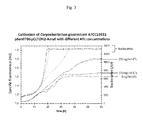
- Vancomycine or Bacitracine were added to the cultures. Vancomycine-concentrations were adjusted to 0; 1.25; 2.5; 5; 10; 15; 20 ⁇ g/ml and Bacitracin-concentrations were adjusted to 0; 1; 4 ⁇ g/ml. Every 10 minutes the cell densities of cultures and the fluorescence were measured. The fluorescence was excited with light of wavelength 485 nm, the fluorescence emission measurement of EYFP was carried out at 520/10 nm. The fluorescence of the cultures has been digitally recorded by means of the BioLection V.2.4.1.0 software. It was observed that the fluorescence emissions of cultures with different Vancomycine or Bacitracine concentrations also differs ( figures 1 and 2 ).
- Competent cells of the C. glutamicum strain ATCC 13032 pSen0706 as described above were transformed by electroporation with vector pCLTON2-AmyE as described above.
- This vector comprises a nucleic acid sequence coding for the amylolytic enzyme ⁇ -Amylase (AmyE) from Bacillus subtilis and the Sec-specific native signal peptide in order to enable the export of the protein over the Sec path of Corynebacterium glutamicum.
- pCLTON2-AmyE was prepared by amplification of the AmyE encoding sequence from chromosonal DNA of Bacillus subtilis with primers AmyE-HpaI-f ( SEQ ID No. 33) and AmyE-SacI-r ( SEQ ID No.
- AmyE-Hpa-f GCGCGTTAACCGAAGGAGATATAGATATGTTTGC
- AmyE-Sac-r CAGTGAATTCGAGCTCCTAGTG
- the fragment was digested with the restriction enzymes Sal I and Nde I and after purification of the reaction mixture the fragment was ligated into vector pSenLys that has also been digested with Sal I and Nde I and dephosphorylated.
- the ligation mixture was used directly to transform E. coli XL1-blue, and the selection of transformants was carried out on LB plates containing 50 ⁇ g/ml kanamycin. 48 colonies which grew on these plates and were therefore resistant to kanamycin were used for colony PCR.
- the colony PCR was performed with primers SenCas-fw ( SEQ ID No.
- TKP-seq-rv SEQ ID No. 25
- the analysis of colony PCR in an agarose gel showed the expected PCR product with a size of 250 bp in the samples that has been analyzed, whereupon four colonies were cultured for plasmid preparations in a larger scale. After 16 h of cultivation these cultures were collected by centrifugation and the plasmid DNA was prepared. Two of these plasmid preparations were sequenced with the primers used in the colony PCR and sequence of the inserts showed 100% identity with the expected sequence. The resulting plasmid was named pSen1325 ( SEQ ID No. 36).
- Competent cells of the C . glutamicum strain ATCC 13032 were prepared as described by Tauch et al., 2002 (Curr Microbiol. 45(5) (2002), pages 362-7 . These cells were transformed by electroporation with pSen1325 as described by Tauch et al.. The selection of the transformants was carried out on BHIS plates with 50 ⁇ g/ml of kanamycin. Clones thus obtained were named ATCC 13032 pSen1325.
- the examination of in vivo fluorescence emission was carried out by culturing the cells of strain ATCC 13032 pSen1325 with 0.8 ml CGXII medium ( Keilhauer et al, 1993, J. Bacteriol. 175: 5595-603 ) in microtiter dimension (Flowerplate ® MTP-48-B) in the BioLector system (m2p-labs GmbH, 52499 Baesweiler, Germany). 13 cultures with cells of strain ATCC 13032 pSen1325 were inoculated to an OD of 0.1 and cultured for 24 hours. After 4 hours the antibiotic substances Vancomycine or Bacitracine were added to the cultures.
- Vancomycine-concentrations were adjusted to 0; 1.25; 2.5; 5; 10; 15; 20 ⁇ g/ml and Bacitracin-concentrations were adjusted to 0; 0.25; 0.5; 1; 2; 4 ⁇ g/ml. Every 10 minutes the cell densities of cultures and the fluorescence were measured. The fluorescence was excited with light of wavelength 485 nm, the fluorescence emission measurement of EYFP was carried out at 520/10 nm. The fluorescence of the cultures has been digitally recorded by means of the BioLection V.2.4.1.0 software. It was observed that the fluorescence emissions of cultures with different Vancomycine or Bacitracine concentrations also differs.
- pSen0996_8 SEQ ID No. 37
- pSen0996_8c SEQ ID No. 38
- pSen0996_8e SEQ ID No. 39
- JPS0003 CTGAACTTGTGGCCGTTTAC
- JPS0004 TTGTTGCCGGGAAGCTAGAG
- Competent cells of the C . glutamicum strain ATCC 13032 were prepared as described by Tauch et al., 2002 (Curr Microbiol. 45(5) (2002), pages 362-7 . These cells were transformed by electroporation with either pSen0996_8 or pSen0996_8c or pSen0996_8e as described by Tauch et al..
- Competent cells of the C. glutamicum strain ATCC 13032 pSen0996_8 or ATCC 13032 pSen0996_8c or ATCC 13032 pSen0996_8e as described above were transformed by electroporation with vector pCLTON2-FsCut as described above.
- This vector comprises a nucleic acid sequence coding for the lipase enzyme Cutinase (FsCut) from Fusarium solani pisi and the Sec-specific signal peptide NprE in order to enable the export of the protein over the Sec path of Corynebacterium glutamicum.
- pCLTON2-FsCut was achieved by means of chemical synthesis of a synthetic DNA-fragment ( SEQ ID No.
- Clones thus obtained were named ATCC 13032 pSen0996_8 pCLTON2-FsCut, ATCC 13032 pSen0996_8c pCLTON2-FsCut or ATCC 13032 pSen0996_8e pCLTON2-FsCut.
Landscapes
- Health & Medical Sciences (AREA)
- Chemical & Material Sciences (AREA)
- Life Sciences & Earth Sciences (AREA)
- Organic Chemistry (AREA)
- Engineering & Computer Science (AREA)
- Genetics & Genomics (AREA)
- Zoology (AREA)
- Wood Science & Technology (AREA)
- Bioinformatics & Cheminformatics (AREA)
- Biotechnology (AREA)
- General Engineering & Computer Science (AREA)
- Molecular Biology (AREA)
- Biochemistry (AREA)
- General Health & Medical Sciences (AREA)
- Biomedical Technology (AREA)
- Proteomics, Peptides & Aminoacids (AREA)
- Microbiology (AREA)
- Physics & Mathematics (AREA)
- Biophysics (AREA)
- Immunology (AREA)
- Analytical Chemistry (AREA)
- Plant Pathology (AREA)
- Toxicology (AREA)
- Medicinal Chemistry (AREA)
- Nuclear Medicine, Radiotherapy & Molecular Imaging (AREA)
- General Physics & Mathematics (AREA)
- Pathology (AREA)
- Micro-Organisms Or Cultivation Processes Thereof (AREA)
- Preparation Of Compounds By Using Micro-Organisms (AREA)
- Measuring Or Testing Involving Enzymes Or Micro-Organisms (AREA)
Priority Applications (10)
| Application Number | Priority Date | Filing Date | Title |
|---|---|---|---|
| ES15160897T ES2758096T3 (es) | 2015-03-25 | 2015-03-25 | Sensores para la detección y cuantificación de secreción microbiológica de proteínas |
| DK15160897T DK3072971T3 (da) | 2015-03-25 | 2015-03-25 | Sensorer til påvisning og kvantificering af mikrobiologisk proteinsekretion |
| EP15160897.3A EP3072971B1 (fr) | 2015-03-25 | 2015-03-25 | Capteurs pour la détection et la quantification de sécrétion de protéines microbiologique |
| CN201680018347.6A CN107532140A (zh) | 2015-03-25 | 2016-03-23 | 用于微生物蛋白质分泌检测和定量的传感器 |
| PCT/EP2016/056464 WO2016151054A1 (fr) | 2015-03-25 | 2016-03-23 | Capteurs pour la détection et la quantification de la sécrétion de protéines microbiologiques |
| EP16713803.1A EP3274458A1 (fr) | 2015-03-25 | 2016-03-23 | Capteurs pour la détection et la quantification de la sécrétion de protéines microbiologiques |
| US15/561,502 US11236401B2 (en) | 2015-03-25 | 2016-03-23 | Sensors for detection and quantification of microbiological protein secretion |
| MYPI2017001401A MY182917A (en) | 2015-03-25 | 2016-03-23 | Sensors for detection and quantification of microbiological protein secretion |
| AU2016236175A AU2016236175A1 (en) | 2015-03-25 | 2016-03-23 | Sensors for detection and quantification of microbiological protein secretion |
| JP2018500856A JP6899815B2 (ja) | 2015-03-25 | 2016-03-23 | 微生物学的タンパク質分泌の検出および定量化のためのセンサ |
Applications Claiming Priority (1)
| Application Number | Priority Date | Filing Date | Title |
|---|---|---|---|
| EP15160897.3A EP3072971B1 (fr) | 2015-03-25 | 2015-03-25 | Capteurs pour la détection et la quantification de sécrétion de protéines microbiologique |
Publications (2)
| Publication Number | Publication Date |
|---|---|
| EP3072971A1 true EP3072971A1 (fr) | 2016-09-28 |
| EP3072971B1 EP3072971B1 (fr) | 2019-08-28 |
Family
ID=52807612
Family Applications (2)
| Application Number | Title | Priority Date | Filing Date |
|---|---|---|---|
| EP15160897.3A Active EP3072971B1 (fr) | 2015-03-25 | 2015-03-25 | Capteurs pour la détection et la quantification de sécrétion de protéines microbiologique |
| EP16713803.1A Withdrawn EP3274458A1 (fr) | 2015-03-25 | 2016-03-23 | Capteurs pour la détection et la quantification de la sécrétion de protéines microbiologiques |
Family Applications After (1)
| Application Number | Title | Priority Date | Filing Date |
|---|---|---|---|
| EP16713803.1A Withdrawn EP3274458A1 (fr) | 2015-03-25 | 2016-03-23 | Capteurs pour la détection et la quantification de la sécrétion de protéines microbiologiques |
Country Status (9)
| Country | Link |
|---|---|
| US (1) | US11236401B2 (fr) |
| EP (2) | EP3072971B1 (fr) |
| JP (1) | JP6899815B2 (fr) |
| CN (1) | CN107532140A (fr) |
| AU (1) | AU2016236175A1 (fr) |
| DK (1) | DK3072971T3 (fr) |
| ES (1) | ES2758096T3 (fr) |
| MY (1) | MY182917A (fr) |
| WO (1) | WO2016151054A1 (fr) |
Families Citing this family (3)
| Publication number | Priority date | Publication date | Assignee | Title |
|---|---|---|---|---|
| CN111999237B (zh) * | 2020-07-28 | 2021-10-15 | 厦门大学 | 一种评估温和式杀孢方法效果的方法 |
| CN119081983A (zh) * | 2024-10-15 | 2024-12-06 | 中国烟草总公司湖南省公司 | 一种基因工程菌及其在高产伊短菌素中的应用 |
| CN120230184B (zh) * | 2025-06-03 | 2025-12-23 | 东晓生物科技股份有限公司 | 一种rr突变蛋白、突变基因、重组载体、工程菌及其构建方法和应用 |
Citations (11)
| Publication number | Priority date | Publication date | Assignee | Title |
|---|---|---|---|---|
| GB1009370A (en) | 1962-12-18 | 1965-11-10 | Ajinomoto I I | A process for the production of 1-glutamic acid by fermentation |
| US4489160A (en) | 1981-08-26 | 1984-12-18 | Kyowa Hakko Kogyo Co., Ltd. | Plasmid pCG2 |
| US4601893A (en) | 1984-02-08 | 1986-07-22 | Pfizer Inc. | Laminate device for controlled and prolonged release of substances to an ambient environment and method of use |
| EP0472869A2 (fr) | 1990-08-30 | 1992-03-04 | Degussa Ag | Plasmides de corynebacterium glutamicum et vecteurs plasmidiques dérivés |
| US5158891A (en) | 1984-08-21 | 1992-10-27 | Asahi Kasei Kogyo Kabushiki Kaisha | Plasmid containing a gene for tetracycline resistance and DNA fragments derived therefrom |
| WO1996015246A1 (fr) | 1994-11-11 | 1996-05-23 | Forschungszentrum Jülich GmbH | Adn regulant l'expression genique dans des bacteries du genre corynebacterium |
| JPH10229891A (ja) | 1997-02-20 | 1998-09-02 | Mitsubishi Rayon Co Ltd | マロン酸誘導体の製造法 |
| DE10224088A1 (de) | 2002-05-31 | 2003-12-11 | Degussa | Verfahren zur Herstellung von L-Aminosäuren unter Verwendung coryneformer Bakterien die ein abgeschwächtes mez-Gen enthalten |
| US20050153402A1 (en) * | 1999-06-25 | 2005-07-14 | Basf Ag | Corynebacterium glutamicum genes encoding regulatory proteins |
| US20110129894A1 (en) * | 2008-05-29 | 2011-06-02 | Sandra Scheele | Secretion optimized microorganism |
| US20130310458A1 (en) * | 2010-05-03 | 2013-11-21 | Lothar Eggeling | Sensors For The Detection Of Intracellular Metabolites |
Family Cites Families (4)
| Publication number | Priority date | Publication date | Assignee | Title |
|---|---|---|---|---|
| WO1993003158A1 (fr) * | 1991-07-30 | 1993-02-18 | Orsan | Systeme d'expression et de secretion de proteines utilisables en particulier chez les corynebacteries |
| DK1748077T3 (da) * | 2004-04-20 | 2013-04-08 | Ajinomoto Kk | Fremgangsmåde til fremstilling af protein |
| AU2006215578B2 (en) * | 2005-02-16 | 2011-03-03 | Cilian Ag | Screening method for identifying protease secretion-deficient mutants of microorganisms |
| CA2599640A1 (fr) * | 2005-03-18 | 2006-09-21 | Dsm Ip Assets B.V. | Procede ameliore de clonage par expression dans une cellule hote |
-
2015
- 2015-03-25 ES ES15160897T patent/ES2758096T3/es active Active
- 2015-03-25 DK DK15160897T patent/DK3072971T3/da active
- 2015-03-25 EP EP15160897.3A patent/EP3072971B1/fr active Active
-
2016
- 2016-03-23 WO PCT/EP2016/056464 patent/WO2016151054A1/fr not_active Ceased
- 2016-03-23 US US15/561,502 patent/US11236401B2/en not_active Expired - Fee Related
- 2016-03-23 MY MYPI2017001401A patent/MY182917A/en unknown
- 2016-03-23 JP JP2018500856A patent/JP6899815B2/ja not_active Expired - Fee Related
- 2016-03-23 CN CN201680018347.6A patent/CN107532140A/zh active Pending
- 2016-03-23 EP EP16713803.1A patent/EP3274458A1/fr not_active Withdrawn
- 2016-03-23 AU AU2016236175A patent/AU2016236175A1/en not_active Abandoned
Patent Citations (11)
| Publication number | Priority date | Publication date | Assignee | Title |
|---|---|---|---|---|
| GB1009370A (en) | 1962-12-18 | 1965-11-10 | Ajinomoto I I | A process for the production of 1-glutamic acid by fermentation |
| US4489160A (en) | 1981-08-26 | 1984-12-18 | Kyowa Hakko Kogyo Co., Ltd. | Plasmid pCG2 |
| US4601893A (en) | 1984-02-08 | 1986-07-22 | Pfizer Inc. | Laminate device for controlled and prolonged release of substances to an ambient environment and method of use |
| US5158891A (en) | 1984-08-21 | 1992-10-27 | Asahi Kasei Kogyo Kabushiki Kaisha | Plasmid containing a gene for tetracycline resistance and DNA fragments derived therefrom |
| EP0472869A2 (fr) | 1990-08-30 | 1992-03-04 | Degussa Ag | Plasmides de corynebacterium glutamicum et vecteurs plasmidiques dérivés |
| WO1996015246A1 (fr) | 1994-11-11 | 1996-05-23 | Forschungszentrum Jülich GmbH | Adn regulant l'expression genique dans des bacteries du genre corynebacterium |
| JPH10229891A (ja) | 1997-02-20 | 1998-09-02 | Mitsubishi Rayon Co Ltd | マロン酸誘導体の製造法 |
| US20050153402A1 (en) * | 1999-06-25 | 2005-07-14 | Basf Ag | Corynebacterium glutamicum genes encoding regulatory proteins |
| DE10224088A1 (de) | 2002-05-31 | 2003-12-11 | Degussa | Verfahren zur Herstellung von L-Aminosäuren unter Verwendung coryneformer Bakterien die ein abgeschwächtes mez-Gen enthalten |
| US20110129894A1 (en) * | 2008-05-29 | 2011-06-02 | Sandra Scheele | Secretion optimized microorganism |
| US20130310458A1 (en) * | 2010-05-03 | 2013-11-21 | Lothar Eggeling | Sensors For The Detection Of Intracellular Metabolites |
Non-Patent Citations (42)
| Title |
|---|
| "Current Protocols in Molecular Biology", 1989, JOHN WILEY & SONS |
| "Manual of Methods for General Bacteriology", 1981, AMERICAN SOCIETY FOR BACTERIOLOGY |
| "Manual ofmethodsfor General Bacteriology", 1981, AMERICAN SOCIETY FOR BACTERIOLOGY |
| ANDERSON; YOUNG: "Quantitative Filter Hybridization", NUCLEIC ACID HYBRIDIZATION, 1985 |
| ANNA A TOYMENTSEVA ET AL: "The LIKE system, a novel protein expression toolbox for Bacillus subtilis based on the liaI promoter", MICROBIAL CELL FACTORIES, BIOMED CENTRAL, LONDON, NL, vol. 11, no. 1, 30 October 2012 (2012-10-30), pages 143, XP021139472, ISSN: 1475-2859, DOI: 10.1186/1475-2859-11-143 * |
| BENDTSEN ET AL.: "Improved prediction of signal peptides: SignalP 3.0", J. MOL. BIOL., vol. 340, 2004, pages 783E795 |
| BINDER ET AL.: "A high-throughput approach to identify genomic variants of bacterial metabolite producers at the single-cell level", GENOME BIOLOGY, vol. 13, no. 5, 2012, pages R40 |
| BINDER ET AL.: "A high-throughput approach to identify genomic variants of bacterial metabolite producers at the single-cell level", GENOME BIOLOGY, vol. 13, no. 5, 2012, pages R40, XP021127741 * |
| BOGUMILA C MARCINIAK ET AL: "Comparative transcriptional analysis of Bacillus subtilis cells overproducing either secreted proteins, lipoproteins or membrane proteins", MICROBIAL CELL FACTORIES, BIOMED CENTRAL, LONDON, NL, vol. 11, no. 1, 66, 24 May 2012 (2012-05-24), pages 1 - 13, XP021129016, ISSN: 1475-2859, DOI: 10.1186/1475-2859-11-66 * |
| CHMIEL: "Einjiihrung in die Bioverfahrenstechnik", 1991, GUSTAV FISCHER VERLAG, article "Bioprozess-technik 1" |
| DALBEY ET AL.: "Membrane proteases in the bacterial protein secretion and quality control pathway", MICROBIOL. MOL. BIOL. REV., vol. 76, 2012, pages 311E350 |
| EIKMANNS ET AL., GENE, vol. 102, 1991, pages 93 - 98 |
| GUERRERO ET AL., GENE, vol. 138, 1994, pages 35 - 41 |
| HAGEMANN: "Allgemeine Genetik", 1986, GUSTAV FISCHER-VERLAG |
| J. COOMBS: "Dictionary of Biotechnology", 1994, STOCKTON PRESS, article "any process by which a strand of nucleic acid molecule joins with a complementary strand through base pairing" |
| JENSEN; HAMMER, BIOTECHNOLOGY AND BIOENGINEERING, vol. 58, 1998, pages 191 - 195 |
| KEILHAUER ET AL., J. BACTERIOL., vol. 175, 1993, pages 5595 - 603 |
| KNIPPERS: "Molekulare Genetik", 1995, GEORG THIEME-VERLAG |
| LABARRE ET AL., JOURNAL OF BACTERIOLOGY, vol. 175, 1993, pages 1001 - 1007 |
| LAUSBERG F; CHATTOPADHYAY AR; HEYER A; EGGELING L; FREUDL R., PLASMID, vol. 68, no. 2, 2012, pages 142 - 7 |
| LAUSBERG F; CHATTOPADHYAY AR; HEYER A; EGGELING L; FREUDL R.: "A tetracycline inducible expression vector for Corynebacterium glutamicum allowing tightly regulable gene expression", PLASMID, vol. 68, no. 2, 2012, pages 142 - 7, XP028501570 * |
| MALUMBRES ET AL., GENE, vol. 134, 1993, pages 15 - 24 |
| MARTIN ET AL., BIO/TECHNOLOGY, vol. 5, 1987, pages 137 - 146 |
| MENKEL ET AL., APPLIED AND ENVIRONMENTAL MICROBIOLOGY, vol. 64, 1989, pages 549 - 554 |
| MILLER: "A Short Course in Bacterial Genetics, A Laboratory Manual and Handbook for Escherichia coli and Related Bacteria", 1992, COLD SPRING HARBOR LABORATORY PRESS |
| MULHARDT: "The experimenter: molecular biology / genomics", 2009, SPEKTRUM AKADEMISCHER VERLAG |
| NATALE P ET AL: "Sec- and Tat-mediated protein secretion across the bacterial cytoplasmic membrane-Distinct translocases and mechanisms", BIOCHIMICA ET BIOPHYSICA ACTA (BBA) - BIOMEMBRANES, ELSEVIER, AMSTERDAM, NL, vol. 1778, no. 9, 1 September 2008 (2008-09-01), pages 1735 - 1756, XP025408803, ISSN: 0005-2736, [retrieved on 20080901], DOI: 10.1016/J.BBAMEM.2007.07.015 * |
| NIELSEN ET AL.: "Identification of prokaryotic and eukaryotic signal peptides and prediction of their cleavage sites", PROTEIN ENG., vol. 10, 1997, pages 1 E6 |
| REMSCHEID ET AL., APPLIED AND ENVIRONMENTAL MICROBIOLOGY, vol. 60, 1994, pages 126 - 132 |
| RUSCH SHARYN L ET AL: "Interactions that drive Sec-dependent bacterial protein transport", BIOCHEMISTRY, vol. 46, no. 34, August 2007 (2007-08-01), pages 9665 - 9673, XP002742247, ISSN: 0006-2960 * |
| RUSCH; KENDALL: "Interactions that drive Sec-dependent bacterial protein transport", BIOCHEMISTRY, vol. 46, 2007, pages 9665E9673 |
| SACK U; TARNOK A: "Grundlagen, Methoden und klinische Anwendungen der Durchflusszytometrie", 2007, article "Zelluldre Diagnostik", pages: 27 - 70 |
| SCHWARZER; PÜHLER, BIO/TECHNOLOGY, vol. 9, 1991, pages 84 - 87 |
| SERWOLD-DAVIS ET AL., FEMS MICROBIOLOGY LETTERS, vol. 66, 1990, pages 119 - 124 |
| SONNEN ET AL., GENE, vol. 107, 1991, pages 69 - 74 |
| STORHAS: "Bioreaktoren und periphere Einrichtungen", 1994, VIEWEG VERLAG |
| TAUCH ET AL., CURR MICROBIOL., vol. 45, no. 5, 2002, pages 362 - 7 |
| TSUCHIYA; MORINAGA, BIO/TECHNOLOGY, vol. 6, 1988, pages 428 - 430 |
| VON HEIJNE: "Species-specific variation in signal peptide design: Implications for protein secretion in foreign hosts", FEBS LETT., vol. 244, 1989, pages 439E446 |
| VON HEIJNE; ABRAHMSEN: "The structure of signal peptides from bacterial lipoproteins", PROTEIN ENG., vol. 2, 1989, pages 531E534 |
| WINK: "Molecular Biotechnology: Concepts, Methods and Applications", 2011, WILEY -VCH VERLAG GMBH & CO. |
| WINNACKER: "Gene und Klone", 1990, VCH VERLAGSGESELLSCHAFT |
Also Published As
| Publication number | Publication date |
|---|---|
| MY182917A (en) | 2021-02-05 |
| CN107532140A (zh) | 2018-01-02 |
| US20190284645A1 (en) | 2019-09-19 |
| WO2016151054A1 (fr) | 2016-09-29 |
| JP6899815B2 (ja) | 2021-07-07 |
| JP2018509939A (ja) | 2018-04-12 |
| DK3072971T3 (da) | 2019-12-09 |
| ES2758096T3 (es) | 2020-05-04 |
| EP3274458A1 (fr) | 2018-01-31 |
| AU2016236175A1 (en) | 2017-10-19 |
| US11236401B2 (en) | 2022-02-01 |
| EP3072971B1 (fr) | 2019-08-28 |
Similar Documents
| Publication | Publication Date | Title |
|---|---|---|
| KR101823710B1 (ko) | 세포 내에 대사물질 감지용 센서 | |
| US8597907B2 (en) | Method of producing proteins | |
| JP4571304B2 (ja) | バチルス細胞内でのポリペプチドの製法 | |
| KR101739128B1 (ko) | 재조합 crm197의 고 수준 발현 | |
| WO2003095658A1 (fr) | Recombinaison homologue en bacterie pour produire des bibliotheques de polynucleotides | |
| KR102345898B1 (ko) | 글루코오스 투과 효소 라이브러리를 생성하는 방법 및 이의 용도 | |
| JP6993339B2 (ja) | タンパク質産生の強化およびその方法 | |
| US7202055B2 (en) | Process for the production of proteins and the production of arrays of proteins | |
| JP2023184699A (ja) | タンパク質の分泌生産法 | |
| EP3072971B1 (fr) | Capteurs pour la détection et la quantification de sécrétion de protéines microbiologique | |
| EP1687433A1 (fr) | Procede d'amplification genetique stable dans une cellule hote bacterienne | |
| Srivastava et al. | Gene expression systems in corynebacteria | |
| US20240002453A1 (en) | Compositions and methods using methanotrophic s-layer proteins for expression of heterologous proteins | |
| CN117642511A (zh) | 含非天然氨基酸的蛋白质的分泌生产方法 | |
| EP4077681A1 (fr) | Bioproduction continue par découplage de la croissance et de la production | |
| CN118931901A (zh) | 基因的启动子及应用 | |
| JP2021501157A (ja) | 周辺タンパク質発現のための細菌リーダー配列 | |
| KR20220098155A (ko) | 비바이러스성 전사 활성화 도메인들 및 그와 관련된 방법들 및 이용들 | |
| KR101175725B1 (ko) | 신규한 그람 양성균 박테리아 발현 시스템 | |
| US20150037842A1 (en) | Modified bacterial cell | |
| EP4599068A1 (fr) | Vecteur d'expression pour la production de protéines recombinantes dans des cellules hôtes procaryotes | |
| CN120693407A (zh) | 蛋白质的分泌生产方法 | |
| CN119768501A (zh) | 赤藓糖醇利用能力缺损的突变木霉属菌和使用其的目标物质的制造方法 | |
| Mishra | Large scale solubilization of coal and bioconversion to utilizable energy. Quarterly report, October 1, 1995--December 31, 1995 | |
| MXPA00004870A (en) | Process for the fermentative preparation of l-amino acids using coryneform bacteria |
Legal Events
| Date | Code | Title | Description |
|---|---|---|---|
| PUAI | Public reference made under article 153(3) epc to a published international application that has entered the european phase |
Free format text: ORIGINAL CODE: 0009012 |
|
| AK | Designated contracting states |
Kind code of ref document: A1 Designated state(s): AL AT BE BG CH CY CZ DE DK EE ES FI FR GB GR HR HU IE IS IT LI LT LU LV MC MK MT NL NO PL PT RO RS SE SI SK SM TR |
|
| AX | Request for extension of the european patent |
Extension state: BA ME |
|
| STAA | Information on the status of an ep patent application or granted ep patent |
Free format text: STATUS: REQUEST FOR EXAMINATION WAS MADE |
|
| 17P | Request for examination filed |
Effective date: 20170316 |
|
| RBV | Designated contracting states (corrected) |
Designated state(s): AL AT BE BG CH CY CZ DE DK EE ES FI FR GB GR HR HU IE IS IT LI LT LU LV MC MK MT NL NO PL PT RO RS SE SI SK SM TR |
|
| STAA | Information on the status of an ep patent application or granted ep patent |
Free format text: STATUS: EXAMINATION IS IN PROGRESS |
|
| RAP1 | Party data changed (applicant data changed or rights of an application transferred) |
Owner name: SENSEUP GMBH |
|
| 17Q | First examination report despatched |
Effective date: 20171020 |
|
| GRAP | Despatch of communication of intention to grant a patent |
Free format text: ORIGINAL CODE: EPIDOSNIGR1 |
|
| STAA | Information on the status of an ep patent application or granted ep patent |
Free format text: STATUS: GRANT OF PATENT IS INTENDED |
|
| INTG | Intention to grant announced |
Effective date: 20190322 |
|
| GRAS | Grant fee paid |
Free format text: ORIGINAL CODE: EPIDOSNIGR3 |
|
| GRAA | (expected) grant |
Free format text: ORIGINAL CODE: 0009210 |
|
| STAA | Information on the status of an ep patent application or granted ep patent |
Free format text: STATUS: THE PATENT HAS BEEN GRANTED |
|
| AK | Designated contracting states |
Kind code of ref document: B1 Designated state(s): AL AT BE BG CH CY CZ DE DK EE ES FI FR GB GR HR HU IE IS IT LI LT LU LV MC MK MT NL NO PL PT RO RS SE SI SK SM TR |
|
| REG | Reference to a national code |
Ref country code: GB Ref legal event code: FG4D |
|
| REG | Reference to a national code |
Ref country code: CH Ref legal event code: EP |
|
| REG | Reference to a national code |
Ref country code: DE Ref legal event code: R096 Ref document number: 602015036565 Country of ref document: DE |
|
| REG | Reference to a national code |
Ref country code: AT Ref legal event code: REF Ref document number: 1172447 Country of ref document: AT Kind code of ref document: T Effective date: 20190915 |
|
| REG | Reference to a national code |
Ref country code: IE Ref legal event code: FG4D |
|
| REG | Reference to a national code |
Ref country code: DE Ref legal event code: R082 Ref document number: 602015036565 Country of ref document: DE Representative=s name: STOLMAR & PARTNER PATENTANWAELTE PARTG MBB, DE |
|
| REG | Reference to a national code |
Ref country code: CH Ref legal event code: NV Representative=s name: STOLMAR AND PARTNER INTELLECTUAL PROPERTY S.A., CH |
|
| REG | Reference to a national code |
Ref country code: DK Ref legal event code: T3 Effective date: 20191203 |
|
| REG | Reference to a national code |
Ref country code: NL Ref legal event code: FP |
|
| REG | Reference to a national code |
Ref country code: LT Ref legal event code: MG4D |
|
| PG25 | Lapsed in a contracting state [announced via postgrant information from national office to epo] |
Ref country code: LT Free format text: LAPSE BECAUSE OF FAILURE TO SUBMIT A TRANSLATION OF THE DESCRIPTION OR TO PAY THE FEE WITHIN THE PRESCRIBED TIME-LIMIT Effective date: 20190828 Ref country code: HR Free format text: LAPSE BECAUSE OF FAILURE TO SUBMIT A TRANSLATION OF THE DESCRIPTION OR TO PAY THE FEE WITHIN THE PRESCRIBED TIME-LIMIT Effective date: 20190828 Ref country code: PT Free format text: LAPSE BECAUSE OF FAILURE TO SUBMIT A TRANSLATION OF THE DESCRIPTION OR TO PAY THE FEE WITHIN THE PRESCRIBED TIME-LIMIT Effective date: 20191230 Ref country code: SE Free format text: LAPSE BECAUSE OF FAILURE TO SUBMIT A TRANSLATION OF THE DESCRIPTION OR TO PAY THE FEE WITHIN THE PRESCRIBED TIME-LIMIT Effective date: 20190828 Ref country code: BG Free format text: LAPSE BECAUSE OF FAILURE TO SUBMIT A TRANSLATION OF THE DESCRIPTION OR TO PAY THE FEE WITHIN THE PRESCRIBED TIME-LIMIT Effective date: 20191128 Ref country code: NO Free format text: LAPSE BECAUSE OF FAILURE TO SUBMIT A TRANSLATION OF THE DESCRIPTION OR TO PAY THE FEE WITHIN THE PRESCRIBED TIME-LIMIT Effective date: 20191128 Ref country code: FI Free format text: LAPSE BECAUSE OF FAILURE TO SUBMIT A TRANSLATION OF THE DESCRIPTION OR TO PAY THE FEE WITHIN THE PRESCRIBED TIME-LIMIT Effective date: 20190828 |
|
| PG25 | Lapsed in a contracting state [announced via postgrant information from national office to epo] |
Ref country code: IS Free format text: LAPSE BECAUSE OF FAILURE TO SUBMIT A TRANSLATION OF THE DESCRIPTION OR TO PAY THE FEE WITHIN THE PRESCRIBED TIME-LIMIT Effective date: 20191228 Ref country code: RS Free format text: LAPSE BECAUSE OF FAILURE TO SUBMIT A TRANSLATION OF THE DESCRIPTION OR TO PAY THE FEE WITHIN THE PRESCRIBED TIME-LIMIT Effective date: 20190828 Ref country code: LV Free format text: LAPSE BECAUSE OF FAILURE TO SUBMIT A TRANSLATION OF THE DESCRIPTION OR TO PAY THE FEE WITHIN THE PRESCRIBED TIME-LIMIT Effective date: 20190828 Ref country code: GR Free format text: LAPSE BECAUSE OF FAILURE TO SUBMIT A TRANSLATION OF THE DESCRIPTION OR TO PAY THE FEE WITHIN THE PRESCRIBED TIME-LIMIT Effective date: 20191129 Ref country code: AL Free format text: LAPSE BECAUSE OF FAILURE TO SUBMIT A TRANSLATION OF THE DESCRIPTION OR TO PAY THE FEE WITHIN THE PRESCRIBED TIME-LIMIT Effective date: 20190828 |
|
| REG | Reference to a national code |
Ref country code: AT Ref legal event code: MK05 Ref document number: 1172447 Country of ref document: AT Kind code of ref document: T Effective date: 20190828 |
|
| PG25 | Lapsed in a contracting state [announced via postgrant information from national office to epo] |
Ref country code: TR Free format text: LAPSE BECAUSE OF FAILURE TO SUBMIT A TRANSLATION OF THE DESCRIPTION OR TO PAY THE FEE WITHIN THE PRESCRIBED TIME-LIMIT Effective date: 20190828 |
|
| PG25 | Lapsed in a contracting state [announced via postgrant information from national office to epo] |
Ref country code: AT Free format text: LAPSE BECAUSE OF FAILURE TO SUBMIT A TRANSLATION OF THE DESCRIPTION OR TO PAY THE FEE WITHIN THE PRESCRIBED TIME-LIMIT Effective date: 20190828 Ref country code: PL Free format text: LAPSE BECAUSE OF FAILURE TO SUBMIT A TRANSLATION OF THE DESCRIPTION OR TO PAY THE FEE WITHIN THE PRESCRIBED TIME-LIMIT Effective date: 20190828 Ref country code: EE Free format text: LAPSE BECAUSE OF FAILURE TO SUBMIT A TRANSLATION OF THE DESCRIPTION OR TO PAY THE FEE WITHIN THE PRESCRIBED TIME-LIMIT Effective date: 20190828 Ref country code: RO Free format text: LAPSE BECAUSE OF FAILURE TO SUBMIT A TRANSLATION OF THE DESCRIPTION OR TO PAY THE FEE WITHIN THE PRESCRIBED TIME-LIMIT Effective date: 20190828 |
|
| REG | Reference to a national code |
Ref country code: ES Ref legal event code: FG2A Ref document number: 2758096 Country of ref document: ES Kind code of ref document: T3 Effective date: 20200504 |
|
| PG25 | Lapsed in a contracting state [announced via postgrant information from national office to epo] |
Ref country code: SM Free format text: LAPSE BECAUSE OF FAILURE TO SUBMIT A TRANSLATION OF THE DESCRIPTION OR TO PAY THE FEE WITHIN THE PRESCRIBED TIME-LIMIT Effective date: 20190828 Ref country code: SK Free format text: LAPSE BECAUSE OF FAILURE TO SUBMIT A TRANSLATION OF THE DESCRIPTION OR TO PAY THE FEE WITHIN THE PRESCRIBED TIME-LIMIT Effective date: 20190828 Ref country code: IS Free format text: LAPSE BECAUSE OF FAILURE TO SUBMIT A TRANSLATION OF THE DESCRIPTION OR TO PAY THE FEE WITHIN THE PRESCRIBED TIME-LIMIT Effective date: 20200224 Ref country code: CZ Free format text: LAPSE BECAUSE OF FAILURE TO SUBMIT A TRANSLATION OF THE DESCRIPTION OR TO PAY THE FEE WITHIN THE PRESCRIBED TIME-LIMIT Effective date: 20190828 |
|
| REG | Reference to a national code |
Ref country code: DE Ref legal event code: R097 Ref document number: 602015036565 Country of ref document: DE |
|
| PLBE | No opposition filed within time limit |
Free format text: ORIGINAL CODE: 0009261 |
|
| STAA | Information on the status of an ep patent application or granted ep patent |
Free format text: STATUS: NO OPPOSITION FILED WITHIN TIME LIMIT |
|
| PG2D | Information on lapse in contracting state deleted |
Ref country code: IS |
|
| 26N | No opposition filed |
Effective date: 20200603 |
|
| PG25 | Lapsed in a contracting state [announced via postgrant information from national office to epo] |
Ref country code: SI Free format text: LAPSE BECAUSE OF FAILURE TO SUBMIT A TRANSLATION OF THE DESCRIPTION OR TO PAY THE FEE WITHIN THE PRESCRIBED TIME-LIMIT Effective date: 20190828 |
|
| PG25 | Lapsed in a contracting state [announced via postgrant information from national office to epo] |
Ref country code: MC Free format text: LAPSE BECAUSE OF FAILURE TO SUBMIT A TRANSLATION OF THE DESCRIPTION OR TO PAY THE FEE WITHIN THE PRESCRIBED TIME-LIMIT Effective date: 20190828 |
|
| REG | Reference to a national code |
Ref country code: BE Ref legal event code: MM Effective date: 20200331 |
|
| PG25 | Lapsed in a contracting state [announced via postgrant information from national office to epo] |
Ref country code: LU Free format text: LAPSE BECAUSE OF NON-PAYMENT OF DUE FEES Effective date: 20200325 |
|
| PG25 | Lapsed in a contracting state [announced via postgrant information from national office to epo] |
Ref country code: IE Free format text: LAPSE BECAUSE OF NON-PAYMENT OF DUE FEES Effective date: 20200325 |
|
| PG25 | Lapsed in a contracting state [announced via postgrant information from national office to epo] |
Ref country code: BE Free format text: LAPSE BECAUSE OF NON-PAYMENT OF DUE FEES Effective date: 20200331 |
|
| PG25 | Lapsed in a contracting state [announced via postgrant information from national office to epo] |
Ref country code: MT Free format text: LAPSE BECAUSE OF FAILURE TO SUBMIT A TRANSLATION OF THE DESCRIPTION OR TO PAY THE FEE WITHIN THE PRESCRIBED TIME-LIMIT Effective date: 20190828 Ref country code: CY Free format text: LAPSE BECAUSE OF FAILURE TO SUBMIT A TRANSLATION OF THE DESCRIPTION OR TO PAY THE FEE WITHIN THE PRESCRIBED TIME-LIMIT Effective date: 20190828 |
|
| PG25 | Lapsed in a contracting state [announced via postgrant information from national office to epo] |
Ref country code: MK Free format text: LAPSE BECAUSE OF FAILURE TO SUBMIT A TRANSLATION OF THE DESCRIPTION OR TO PAY THE FEE WITHIN THE PRESCRIBED TIME-LIMIT Effective date: 20190828 |
|
| PGFP | Annual fee paid to national office [announced via postgrant information from national office to epo] |
Ref country code: NL Payment date: 20240320 Year of fee payment: 10 |
|
| PGFP | Annual fee paid to national office [announced via postgrant information from national office to epo] |
Ref country code: DE Payment date: 20240327 Year of fee payment: 10 Ref country code: GB Payment date: 20240320 Year of fee payment: 10 |
|
| PGFP | Annual fee paid to national office [announced via postgrant information from national office to epo] |
Ref country code: IT Payment date: 20240329 Year of fee payment: 10 Ref country code: FR Payment date: 20240328 Year of fee payment: 10 Ref country code: DK Payment date: 20240326 Year of fee payment: 10 |
|
| PGFP | Annual fee paid to national office [announced via postgrant information from national office to epo] |
Ref country code: CH Payment date: 20240401 Year of fee payment: 10 |
|
| PGFP | Annual fee paid to national office [announced via postgrant information from national office to epo] |
Ref country code: ES Payment date: 20240429 Year of fee payment: 10 |
|
| REG | Reference to a national code |
Ref country code: DE Ref legal event code: R119 Ref document number: 602015036565 Country of ref document: DE |
|
| REG | Reference to a national code |
Ref country code: CH Ref legal event code: H13 Free format text: ST27 STATUS EVENT CODE: U-0-0-H10-H13 (AS PROVIDED BY THE NATIONAL OFFICE) Effective date: 20251023 |
|
| REG | Reference to a national code |
Ref country code: DK Ref legal event code: EBP Effective date: 20250331 |
|
| REG | Reference to a national code |
Ref country code: NL Ref legal event code: MM Effective date: 20250401 |
|
| GBPC | Gb: european patent ceased through non-payment of renewal fee |
Effective date: 20250325 |
|
| PG25 | Lapsed in a contracting state [announced via postgrant information from national office to epo] |
Ref country code: NL Free format text: LAPSE BECAUSE OF NON-PAYMENT OF DUE FEES Effective date: 20250401 |
|
| PG25 | Lapsed in a contracting state [announced via postgrant information from national office to epo] |
Ref country code: DE Free format text: LAPSE BECAUSE OF NON-PAYMENT OF DUE FEES Effective date: 20251001 |
|
| PG25 | Lapsed in a contracting state [announced via postgrant information from national office to epo] |
Ref country code: GB Free format text: LAPSE BECAUSE OF NON-PAYMENT OF DUE FEES Effective date: 20250325 |
|
| PG25 | Lapsed in a contracting state [announced via postgrant information from national office to epo] |
Ref country code: FR Free format text: LAPSE BECAUSE OF NON-PAYMENT OF DUE FEES Effective date: 20250331 Ref country code: IT Free format text: LAPSE BECAUSE OF NON-PAYMENT OF DUE FEES Effective date: 20250325 |
|
| PG25 | Lapsed in a contracting state [announced via postgrant information from national office to epo] |
Ref country code: CH Free format text: LAPSE BECAUSE OF NON-PAYMENT OF DUE FEES Effective date: 20250331 |
|
| PG25 | Lapsed in a contracting state [announced via postgrant information from national office to epo] |
Ref country code: DK Free format text: LAPSE BECAUSE OF NON-PAYMENT OF DUE FEES Effective date: 20250331 |
|
| REG | Reference to a national code |
Ref country code: ES Ref legal event code: FD2A Effective date: 20260504 |