EP3078764A2 - Procede de fabrication d'une couche fonctionnelle de protection ou autre sur un materiau metallique - Google Patents
Procede de fabrication d'une couche fonctionnelle de protection ou autre sur un materiau metallique Download PDFInfo
- Publication number
- EP3078764A2 EP3078764A2 EP16000777.9A EP16000777A EP3078764A2 EP 3078764 A2 EP3078764 A2 EP 3078764A2 EP 16000777 A EP16000777 A EP 16000777A EP 3078764 A2 EP3078764 A2 EP 3078764A2
- Authority
- EP
- European Patent Office
- Prior art keywords
- metallic material
- coating material
- layer
- powder
- coating
- Prior art date
- Legal status (The legal status is an assumption and is not a legal conclusion. Google has not performed a legal analysis and makes no representation as to the accuracy of the status listed.)
- Withdrawn
Links
Images
Classifications
-
- C—CHEMISTRY; METALLURGY
- C23—COATING METALLIC MATERIAL; COATING MATERIAL WITH METALLIC MATERIAL; CHEMICAL SURFACE TREATMENT; DIFFUSION TREATMENT OF METALLIC MATERIAL; COATING BY VACUUM EVAPORATION, BY SPUTTERING, BY ION IMPLANTATION OR BY CHEMICAL VAPOUR DEPOSITION, IN GENERAL; INHIBITING CORROSION OF METALLIC MATERIAL OR INCRUSTATION IN GENERAL
- C23C—COATING METALLIC MATERIAL; COATING MATERIAL WITH METALLIC MATERIAL; SURFACE TREATMENT OF METALLIC MATERIAL BY DIFFUSION INTO THE SURFACE, BY CHEMICAL CONVERSION OR SUBSTITUTION; COATING BY VACUUM EVAPORATION, BY SPUTTERING, BY ION IMPLANTATION OR BY CHEMICAL VAPOUR DEPOSITION, IN GENERAL
- C23C24/00—Coating starting from inorganic powder
- C23C24/08—Coating starting from inorganic powder by application of heat or pressure and heat
- C23C24/082—Coating starting from inorganic powder by application of heat or pressure and heat without intermediate formation of a liquid in the layer
-
- B—PERFORMING OPERATIONS; TRANSPORTING
- B21—MECHANICAL METAL-WORKING WITHOUT ESSENTIALLY REMOVING MATERIAL; PUNCHING METAL
- B21B—ROLLING OF METAL
- B21B45/00—Devices for surface or other treatment of work, specially combined with or arranged in, or specially adapted for use in connection with, metal-rolling mills
- B21B45/02—Devices for surface or other treatment of work, specially combined with or arranged in, or specially adapted for use in connection with, metal-rolling mills for lubricating, cooling, or cleaning
- B21B45/0239—Lubricating
- B21B45/0242—Lubricants
-
- C—CHEMISTRY; METALLURGY
- C21—METALLURGY OF IRON
- C21C—PROCESSING OF PIG-IRON, e.g. REFINING, MANUFACTURE OF WROUGHT-IRON OR STEEL; TREATMENT IN MOLTEN STATE OF FERROUS ALLOYS
- C21C7/00—Treating molten ferrous alloys, e.g. steel, not covered by groups C21C1/00 - C21C5/00
- C21C7/005—Treating molten ferrous alloys, e.g. steel, not covered by groups C21C1/00 - C21C5/00 using exothermic reaction compositions
-
- B—PERFORMING OPERATIONS; TRANSPORTING
- B21—MECHANICAL METAL-WORKING WITHOUT ESSENTIALLY REMOVING MATERIAL; PUNCHING METAL
- B21B—ROLLING OF METAL
- B21B21/00—Pilgrim-step tube-rolling, i.e. pilger mills
-
- B—PERFORMING OPERATIONS; TRANSPORTING
- B21—MECHANICAL METAL-WORKING WITHOUT ESSENTIALLY REMOVING MATERIAL; PUNCHING METAL
- B21B—ROLLING OF METAL
- B21B9/00—Measures for carrying out rolling operations under special conditions, e.g. in vacuum or inert atmosphere to prevent oxidation of work; Special measures for removing fumes from rolling mills
Definitions
- Oxide layers on metallic materials are formed by a chemical reaction of the metal with oxygen. Does this happen at high temperatures, such. As in the heating of the material for hot forming or in the hot forming itself, the oxide layer is often referred to as a scale layer or burn-off. Scale layers are especially with iron materials, such as. B. steel undesirable. In contrast to nobler metals, which do not or only slightly oxidize, forming a solid, dense oxide layer, the oxidation of ferrous materials from the surface progresses further and further into the interior of the material. In this case, metal ions and / or oxygen ions diffuse and iron oxides are formed.
- Oxidation (especially scale) converts the metallic material into oxide and leads to metal loss or loss of alloying elements (e.g., C). In addition, oxidation or the resulting oxide deteriorates the material properties, in particular the surface properties, of the material. In addition, parts of the oxide layer usually detach in the manufacturing process and lead to abrasive tool wear.
- alloying elements e.g., C
- oxidation or the resulting oxide deteriorates the material properties, in particular the surface properties, of the material.
- parts of the oxide layer usually detach in the manufacturing process and lead to abrasive tool wear.
- the oxidation of metallic materials is a complex process that depends on many factors. Particularly disadvantageous are high temperatures and a higher residence time of the metallic material under high temperatures. This is a particular problem in the hot forming of metallic materials, as high temperatures and long times are imperative for the production progress.
- the metallic material is also proposed in the prior art to provide the metallic material with a protective coating.
- a durable coating which is only suitable for certain applications and is destroyed especially at heating and processing temperatures of over 1000 ° C and forming processes.
- prior art temporary or permanent coatings are deposited as much as possible prior to processing at room temperature of the metal and are based on a coating technique that requires a liquid carrier medium for the coating material.
- a scale protection layer for steels that are hot worked is known.
- the application of the protective layer takes place before hot forming at room temperature.
- This is a sol-gel coating, which is preferably applied by dip coating.
- Application to hot metal surfaces is not possible with such liquid-based coating methods.
- Another disadvantage of the coating according to WO 2011/144603 is that these are not for higher residence times under higher Temperatures, in particular a reheating eliminates in multi-stage hot forming processes as an application.
- the invention has for its object to propose a method for producing a protective or other functional layer on a metallic material, the effective protection of the metallic material from oxidation and / or other functions, such as corrosion protection, allow and good can be applied.
- a coating material for such a method should be proposed.
- the invention is based on the idea that the coating material is applied to the hot metal surface without the need for a liquid carrier medium.
- a liquid carrier medium In particular, preferably no pasty carrier medium is used.
- oxide layer is meant a layer in which oxidation has occurred.
- the oxide layer may at least partially comprise the conditioning layer and / or the metallic material.
- substances of the conditioning layer and / or substances of the metallic material as well as atmospheric oxygen or other atmospheric constituents may be involved in the oxidation.
- the term “oxide layer” includes a scale layer, ie an oxide layer, which forms on hot metals.
- Oxidation is meant, in particular, a chemical reaction in which a substance combines with an oxidizing gas, more preferably oxygen. Oxidation, in a broader sense, involves electron transfer through a substance. The emitted electrons are absorbed by another substance (reduction). Oxidation and reduction are two partial reactions of the redox reaction. In a redox reaction z.
- iron oxides such as FeO (Wüstit), Fe 3 O 4 (magnetite) and Fe 2 O 3 (hematite). Wüstite, magnetite and hematite are mostly oxide skins or partial oxide layers of the scale layer in iron materials.
- Oxidation also encompasses the redox reaction and all reactions and processes which adversely affect the metallic material, in particular its surface, such as by decomposition, corrosion or the like. Oxidation can thus also refer to compounds that contain no oxygen.
- the term "substance” includes all elements and compounds, e.g. For example, molecular and ionic compounds.
- An oxidizing substance is a substance capable of oxidizing another substance.
- An oxidizable substance is a substance that is oxidized by another substance.
- oxidizing means that a substance combines with oxygen.
- Oxidizing means that a substance emits electrons or forms a compound as a result of a redox reaction or other reactions.
- the oxidation takes place at high temperatures and in particular during or after the application to the metallic material.
- the oxidisable substance is particularly preferably an oxide, ie a compound which contains oxygen.
- the coating material has at least one oxidisable substance.
- the oxidizable substance thus initially forms a portion of the coating material.
- the proportion can z. B. in weight percent (wt .-%), with a 100% share is conceivable.
- the coating material preferably comprises a plurality of oxidizable substances which together form a mixture.
- the coating material may also contain non-oxidizing or non-oxidizable substances.
- Application of the coating material to the metallic material produces the conditioning layer on the material.
- the material sinters after application or melts completely.
- the method according to the invention it is particularly preferred to carry out a conditioning of the oxide layer on a metallic material.
- “Conditioning” is to be understood as influencing the oxide layer properties.
- oxide layer properties in particular, the formation, the adhesion to the metallic material, the composition and the morphology of the oxide layer are considered.
- the aim is to reduce the oxide layer formation and to improve the removability of the metallic material.
- the conditioning of the oxide layer leads to the fact that in particular only the conditioning layer oxidizes, but not the metallic material.
- the conditioning layer may also be a layer which is diffusion-tight in particular for oxygen.
- the conditioning layer can also be used for refining or functionalizing the metallic material.
- the method according to the invention can lead to reduced surface defects of the metallic material and reduced tool wear.
- the inventive method is used at temperatures of the metallic material of at least 150 ° C.
- the metallic material has a temperature at which hot forming of the metallic material is possible.
- hot forming a transformation of a material takes place above the recrystallization temperature of the material.
- the recrystallization temperature depends on the material. As a rule of thumb (rough guideline), 0.4 x melting temperature [K] of the material can be used.
- the process for conditioning the oxide layer on metallic materials for iron materials, in particular steel preferably takes place, in particular preferably when these have a material temperature between 600 and 1300 ° C. It has been found that the invention is particularly effective in this environment.
- the carrier medium is a medium which carries the coating material and is applied to the metallic material together with the coating material to form a coating.
- the carrier medium usually has the task of uniformly distributing a particulate or gelatinous coating material and thus ensuring a uniform coating.
- the mixture of carrier medium and particles of the coating material is usually a dispersion, in particular a suspension. Such mixtures are therefore based on liquid carrier media (such as gel-sol coatings).
- a particularly disadvantageous effect of such coatings is that, when applied to hot surfaces, the carrier medium evaporates rapidly, with the coating particles being distributed very unevenly and, in particular, particle agglomerations occurring.
- the metallic material is preferably an iron material.
- the inventive method is particularly well suited for use in iron materials, since iron is very susceptible to oxidation compared to other metals, such as chromium or nickel.
- the metallic material is steel. This includes all types of steel.
- the coating material can be present in all states of aggregation before application.
- the coating material according to the invention is powdery before application and in particular preferably before and during application.
- the powder preferably has microscale, in particular preferably nanoscale particles.
- the coating material has at least one metallurgical powder, in particular powder types for submerged arc welding or casting powder.
- Metallurgical powders mostly consist of oxides, such as B 2 O 3 , SiO 2 , CaO, MgO, Al 2 O 3 , Na 2 O and Fe 2 O 3 . They are ideal for forming an oxide layer that protects the underlying material well from the effects of oxidizing gases in the atmosphere. Furthermore, the oxide layer can be removed well after cooling.
- metallurgical powders are commercially available and can be z. B. by mixing well with other substances, so that their scope can be extended appropriately.
- the addition of feldspar and borax which may act as fluxes, may influence the solubility of the powder constituents in the molten slag and the melting temperature of the coating material. This makes it possible to adapt the properties of the coating material to the conditions in the manufacturing process, in particular to the high temperatures of the metallic material. It is also possible that the powder contains fractions of a pulverized slag.
- Preferably used powders are basic powders, in particular aluminate- and fluoride-based, exothermic powders and oxidic powders (SiO 2 , CaO, MgO, Al 2 O 3 , iron oxides, Na 2 O).
- Powder types for submerged arc welding are particularly suitable for the conditioning of the oxide layer on metallic materials.
- Powder types are identified by labels and have a characteristic chemical composition.
- the aluminate-basic type has the characteristic "AB" and has the chemical composition Al 2 O 3 + CaO, + MgO, these substances constituting at least 40% by weight of the powder of aluminate-basic type.
- CaO and MgO are deoxidizing and ensure a porous and easily removable slag.
- Al 2 O 3 is refractory and well suited to form solids on the melt which prevent or reduce the diffusion of oxidizing gases.
- powder types have a basicity indicating whether the powder is basic or acidic. At a basicity value below 1, the powder is considered to be acidic, at a basicity value equal to 1 to be neutral and at a basicity value above 1 to be basic.
- Casting powder are used for example in continuous casting and have u.a. the task of preventing the adhesion of a molten steel in a mold and to protect the molten steel from oxidation by the ambient air.
- the powder type is a fluoride-based type, preferably having a basicity of 3.2, an aluminate-basic type, preferably having a basicity of 1.5, an aluminate-rutile type, preferably having a basicity of 0, 6, or used as casting powder an exothermic casting powder.
- the coating material can also be added to other substances.
- Coating materials of mixtures of different powder types were applied to hot steel having temperatures of 1000 to 1300 ° C. After cooling, a very porous and partially self-deposited oxide layer formed. Under the oxide layer partially bare metal came to light.
- the coating material is applied by an electrostatic powder coating method, e.g. the so-called corona process applied to the metallic material.
- the electrostatic powder coating is known for example from the field of color coating.
- electrically conductive workpieces are coated with powder coating, wherein the particles of the powder coating are applied electrostatically.
- An electrostatic charge can, for. B. by high voltage (corona charging) or by friction (triboelectric) done.
- the powdery coating material without liquid or gel carrier medium, such as in the sol-gel coating, or a plasma is applied to the metallic material.
- This application technique is therefore particularly suitable for use at very high material temperatures, since above all the low melting temperature and the evaporation of the carrier medium are not problematic here.
- the electrostatic powder coating is ideal for uniform application of the powder to the metallic material.
- the layer thickness can be adapted to individual product requirements and production conditions. Another advantage is the reduction of overspray, so the powder portion that could not be applied in an undesirable manner.
- a circulation coating is possible in which overspray is reused. Likewise, the emission of solvents in the workplace can be avoided.
- the electrostatic powder coating offers the further advantage in terms of anti-scaling protection that the generation of the conditioning layer by the missing carrier phase (the missing liquid carrier medium) is not bound to any upper substrate temperature (no evaporation or decomposition of the carrier medium). This can lead to the advantage of less influence on the layer structure in comparison to applied at liquid temperatures, based on liquid carrier media coating method. Furthermore, there is the advantage of easy automation and the possibility of application to the hot product, especially on the starting material or intermediates in a multi-stage forming. In addition, the electrostatic powder coating offers the possibility of preventing particle agglomeration and thus the possibility of an efficient and uniform layer structure.
- the coating material has at least one oxidizable substance having a melting temperature T 1 , which has a higher melting temperature T 2 due to oxidation.
- T 1 is smaller than the temperature of the metallic material in the application T w .T 2, however, is higher than T w .
- the increase in the melting temperature is due to oxygen uptake and oxide formation. This allows the oxidizable substance to sinter or melt after application.
- the layer formed may be diffusion-tight or anti-oxidant for oxidizing gases or oxidized by the oxidizing gases. It has been shown that in this way the oxidation of the metallic material can be effectively reduced or even avoided. Particular preference is given to nanoscale solids, since their sintering and melting points can be specifically influenced and thus form a very effective barrier against oxidizing gases.
- the melting temperature of the oxidizable substance can be adjusted in a targeted manner. This can be done, for example, by adding certain substances, such as flux, to the coating material or by selecting suitable powders, powder types or powder mixtures. You can take advantage of the fact that certain mixtures of substances depending on their composition and / or the particle size have a variable sintering or melting temperature. For example, a mixture of 67% by weight of Li 2 O (lithium oxide) and 33% by weight of SiO 2 (silicon dioxide) has a melting temperature of about 1000 ° C. If the proportion of silicon dioxide (for example, by enrichment of oxygen and oxide formation) is increased to 50% by weight, the substance mixture has a melting temperature of more than 1200 ° C.
- Li 2 O lithium oxide
- SiO 2 silicon dioxide
- the coating material comprises at least one metallic material of the metallic material, which acts as a sacrificial substance during the oxidation.
- Sacrificial material means that the metallic material of the coating material is oxidized during application and thereby a sacrificial oxide layer is formed, which prevents or at least reduces progress of the oxidation process in the direction of the metallic material.
- Wüstite (FeO) is particularly suitable as a sacrificial material for iron materials, since FeO is the iron oxide with the lowest oxygen content.
- an application is carried out in a manufacturing process with several sub-processes at least before (or after) a sub-process.
- This embodiment is particularly useful in multi-stage hot forming processes, such as open-die forging, die forging, hot strip production and vocational rolling, and master forming (e.g., strand or ingot casting) and combinatorial (strip casting, CSP).
- Partial processes include in particular forming and heating (heating) of the material.
- forging forging forgings are forged several times, with the workpiece approaching the finished shape after each forging operation.
- the forging blocks can only be reshaped until a temperature of 600 ° C is reached.
- the forging blocks must be reheated to 1250 ° C in an intermediate heat. It makes sense here several applications that take place in particular between the individual forming processes and the individual warming.
- Secondary scale arises in particular during the forming and the subsequent cooling. Secondary scale is thinner and more adherent than primary scale, which is predominantly formed when the metallic material is heated and can be removed relatively well. Furthermore, the formation of Tertiärzunder can be reduced in the cooling section.
- the inventive method is particularly advantageous for conditioning of oxide layers on metallic materials during hot rolling, open-die forging, drop forging, vocational rolling, continuous casting and other manufacturing processes with high material temperatures.
- the metallic material is processed or produced at very high temperatures.
- the metallic material is sometimes transformed in several stages, with reheating taking place between the forming stages.
- the method according to the invention makes it possible to reduce or even completely prevent oxide layers which form on the metallic material during production.
- the method of the invention is, for example, to reduce the secondary oresund Sieg during forming, to reduce Tertiärzunder when cooling or improving the Entzunder stresses by lower adhesion.
- the method according to the invention for the combined reduction of scale formation and the change in the tribological properties of the metallic material, for example in use as a lubricant.
- the method according to the invention may also be suitable for influencing the decarburization.
- alloying close to the edge for example for corrosion protection, is possible.
- the inventive method for targeted thermochemical surface treatment can be used.
- an insert for the hot transfer in the subsequent process for example, for the isolation of the materials can be successfully carried out.
- the method of the invention for conditioning of surface properties in the subsequent processing or when applying anti-scaling protection for subsequent heating in the rolling process offers.
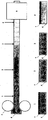
- FIG. 1 shows in the upper section the last roll stand (roll pair) 5 of the finishing train of a hot strip mill.
- the designed as a rolled hot strip metallic material 6 made of steel moves in the direction of the horizontal arrow.
- the vertical arrows point to four different positions 1 to 4 of the hot strip 6 out.
- the cross sections of the hot strip 6 at the points 1 to 4 can be seen.
- the conditioning layer 7 consists of a coating material which contains an oxidizable substance mixture which has a melting temperature of 1000 ° C.
- the temperature of the hot strip 6 is 1100 ° C here.
- the temperature of the hot strip 6 is still 1100 ° C. Meanwhile, the melting temperature of the oxidizable substance mixture has increased to 1200 ° C due to the oxidation and the formation of oxidic solids.
- the conditioning layer 7 prevents the diffusion of oxidizing gases, such as oxygen, from the environment into the hot strip. It can thus form no metal oxides.
- the hot strip 6 and the conditioning layer 7 are cooled to room temperature.
- the conditioning layer 7 is now highly porous and easily removable.
- the oxide layer which has formed here comprises only the conditioning layer, d. H. only substances of the conditioning layer are oxidized, not the hot strip.
- a post-treatment 8 z. As scale cleaning, the conditioning layer 7 or oxide layer can be easily removed. The hot strip 6 could thus be effectively protected against scaling or oxidation.
Landscapes
- Chemical & Material Sciences (AREA)
- Engineering & Computer Science (AREA)
- Chemical Kinetics & Catalysis (AREA)
- Materials Engineering (AREA)
- Metallurgy (AREA)
- Organic Chemistry (AREA)
- Mechanical Engineering (AREA)
- Other Surface Treatments For Metallic Materials (AREA)
- Application Of Or Painting With Fluid Materials (AREA)
- Catalysts (AREA)
Applications Claiming Priority (1)
| Application Number | Priority Date | Filing Date | Title |
|---|---|---|---|
| DE102015004683.7A DE102015004683A1 (de) | 2015-04-09 | 2015-04-09 | Verfahren zum Erzeugen einer Schutz- oder sonstigen Funktionsschicht auf einem metallischen Werkstoff |
Publications (2)
| Publication Number | Publication Date |
|---|---|
| EP3078764A2 true EP3078764A2 (fr) | 2016-10-12 |
| EP3078764A3 EP3078764A3 (fr) | 2016-11-02 |
Family
ID=55802148
Family Applications (1)
| Application Number | Title | Priority Date | Filing Date |
|---|---|---|---|
| EP16000777.9A Withdrawn EP3078764A3 (fr) | 2015-04-09 | 2016-04-05 | Procede de fabrication d'une couche fonctionnelle de protection ou autre sur un materiau metallique |
Country Status (2)
| Country | Link |
|---|---|
| EP (1) | EP3078764A3 (fr) |
| DE (1) | DE102015004683A1 (fr) |
Cited By (1)
| Publication number | Priority date | Publication date | Assignee | Title |
|---|---|---|---|---|
| WO2019068444A1 (fr) * | 2017-10-03 | 2019-04-11 | Primetals Technologies Austria GmbH | Procédé pour faire fonctionner une installation combinée de coulée et de laminage |
Families Citing this family (1)
| Publication number | Priority date | Publication date | Assignee | Title |
|---|---|---|---|---|
| DE102020107749A1 (de) | 2020-03-20 | 2021-09-23 | Peter Amborn | Verfahren zur Vermeidung der Oxidation der Oberfläche eines metallischen Substrats sowie metallisches Substrat hergestellt nach dem Verfahren |
Citations (1)
| Publication number | Priority date | Publication date | Assignee | Title |
|---|---|---|---|---|
| WO2011144603A1 (fr) | 2010-05-20 | 2011-11-24 | Rheinisch-Westfälische Technische Hochschule Aachen | Couche à base de nanoparticules servant à protéger des aciers contre le calaminage |
Family Cites Families (4)
| Publication number | Priority date | Publication date | Assignee | Title |
|---|---|---|---|---|
| US3058443A (en) * | 1958-06-09 | 1962-10-16 | Paton Erskine Norman | Machine for the electrostatic deposition of powders on heated surfaces |
| US3546909A (en) * | 1968-04-09 | 1970-12-15 | Kaiser Aluminium Chem Corp | Applying vitreous enamel |
| DE1920707B2 (de) * | 1969-04-23 | 1975-11-13 | Hans-Joachim Dipl.-Ing. 4330 Muelheim Eitel | Verwendung einer Legierung aus Si, Ca, Al in feingemahlener Form als Gießpulver oder GieBpulverzusatz |
| JPH03291325A (ja) * | 1990-04-09 | 1991-12-20 | Sumitomo Metal Ind Ltd | 金属材の高温酸化防止方法 |
-
2015
- 2015-04-09 DE DE102015004683.7A patent/DE102015004683A1/de not_active Withdrawn
-
2016
- 2016-04-05 EP EP16000777.9A patent/EP3078764A3/fr not_active Withdrawn
Patent Citations (1)
| Publication number | Priority date | Publication date | Assignee | Title |
|---|---|---|---|---|
| WO2011144603A1 (fr) | 2010-05-20 | 2011-11-24 | Rheinisch-Westfälische Technische Hochschule Aachen | Couche à base de nanoparticules servant à protéger des aciers contre le calaminage |
Cited By (3)
| Publication number | Priority date | Publication date | Assignee | Title |
|---|---|---|---|---|
| WO2019068444A1 (fr) * | 2017-10-03 | 2019-04-11 | Primetals Technologies Austria GmbH | Procédé pour faire fonctionner une installation combinée de coulée et de laminage |
| CN111148581A (zh) * | 2017-10-03 | 2020-05-12 | 首要金属科技奥地利有限责任公司 | 用于运行铸轧复合设备的方法和铸轧复合设备 |
| CN111148581B (zh) * | 2017-10-03 | 2022-06-28 | 首要金属科技奥地利有限责任公司 | 用于运行铸轧复合设备的方法和铸轧复合设备 |
Also Published As
| Publication number | Publication date |
|---|---|
| EP3078764A3 (fr) | 2016-11-02 |
| DE102015004683A1 (de) | 2016-10-13 |
Similar Documents
| Publication | Publication Date | Title |
|---|---|---|
| DE69706240T2 (de) | Verfahren zum Verbinden von thermisch gespritzten Schichten auf nicht-aufgerauhten Edelmetall-Oberflächen | |
| DE2115358C2 (de) | Verfahren zur Herstellung von Schichten aus in einer Metallmatrix dispergiertem fein-dispersem Füllstoff | |
| DE69701894T2 (de) | Verfahren zum auftragen verschleissfester hartmetallbeläge auf metalloberflächen | |
| DE2355532A1 (de) | Verfahren zum pulver-auftragschweissen von metallen und legierungen | |
| EP3325685B1 (fr) | Procédé pour recouvrir une surface de glissement de cylindre d'un bloc-cylindres, bloc-cylindres avec une surface de glissement de cylindre recouverte et moteur | |
| DE102008036070A1 (de) | Formkörper | |
| EP3247530B1 (fr) | Alliage pour soudure épaisse | |
| DE102015113762B4 (de) | Verfahren zur ausbildung von oxiddispersionsverfestigten (ods-)legierungen | |
| DE10039375A1 (de) | Korrosionsgeschütztes Stahlblech und Verfahren zu seiner Herstellung | |
| DE102015113826A1 (de) | Verfahren zur Ausbildung von dispersionsverfestigten Legierungen | |
| EP3006139A1 (fr) | Procede de production par couches d'une piece a usiner metallique par fabrication additive assistee par laser | |
| EP3314033B1 (fr) | Alliage ferreux destiné à la réalisation de couches protectrices anti-usure appliquées par voie thermique | |
| EP3078764A2 (fr) | Procede de fabrication d'une couche fonctionnelle de protection ou autre sur un materiau metallique | |
| EP4200450A1 (fr) | Procédé de fabrication d'un produit plat en acier ayant un revêtement résistant à la corrosion à base d'aluminium, et produit plat en acier ayant un revêtement résistant à la corrosion à base d'aluminium | |
| DE102019125810A1 (de) | Baumaterial für ein Verfahren, insbesondere ein additives Herstellungsverfahren oder ein Fügeverfahren | |
| DE2162699A1 (de) | Verfahren zur erhoehung der haftfestigkeit von durch thermisches spritzen aufgebrachten schichten | |
| EP0041940B1 (fr) | Procédé de traitement d'additifs métalliques utilisés en métallurgie, en particulier d'eponge de fer | |
| DE102008018539A1 (de) | Metallkörper mit metallischer Schutzschicht | |
| DE2725752A1 (de) | Verfahren zur oberflaechenbehandlung von metall in einem wirbelbettsystem | |
| DE102021109973A1 (de) | Verfahren zur Herstellung von schmelztauchbeschichteten Stahlflachprodukten | |
| DE2514565A1 (de) | Verfahren zur herstellung von rohrerzeugnissen | |
| WO2017059467A1 (fr) | Composant d'une machine pour la transformation des métaux | |
| DE202008017820U1 (de) | Fülldrahtelektrode | |
| DE1496513B2 (de) | Oberzugsmasse zum Schutz der Oberfläche von Metallgegenständen gegen Oxydation während einer Warmbehandlung | |
| DE3420869C2 (de) | Verfahren zur Herstellung eines metallischen Schutzüberzuges auf metallischen Werkstücken |
Legal Events
| Date | Code | Title | Description |
|---|---|---|---|
| PUAI | Public reference made under article 153(3) epc to a published international application that has entered the european phase |
Free format text: ORIGINAL CODE: 0009012 |
|
| PUAL | Search report despatched |
Free format text: ORIGINAL CODE: 0009013 |
|
| AK | Designated contracting states |
Kind code of ref document: A2 Designated state(s): AL AT BE BG CH CY CZ DE DK EE ES FI FR GB GR HR HU IE IS IT LI LT LU LV MC MK MT NL NO PL PT RO RS SE SI SK SM TR |
|
| AX | Request for extension of the european patent |
Extension state: BA ME |
|
| AK | Designated contracting states |
Kind code of ref document: A3 Designated state(s): AL AT BE BG CH CY CZ DE DK EE ES FI FR GB GR HR HU IE IS IT LI LT LU LV MC MK MT NL NO PL PT RO RS SE SI SK SM TR |
|
| AX | Request for extension of the european patent |
Extension state: BA ME |
|
| RIC1 | Information provided on ipc code assigned before grant |
Ipc: C23C 24/10 20060101AFI20160923BHEP Ipc: C21C 7/00 20060101ALI20160923BHEP Ipc: B21B 9/00 20060101ALI20160923BHEP Ipc: C23D 5/04 20060101ALI20160923BHEP Ipc: B21B 45/02 20060101ALI20160923BHEP Ipc: B22D 27/06 20060101ALI20160923BHEP |
|
| 17P | Request for examination filed |
Effective date: 20170428 |
|
| RBV | Designated contracting states (corrected) |
Designated state(s): AL AT BE BG CH CY CZ DE DK EE ES FI FR GB GR HR HU IE IS IT LI LT LU LV MC MK MT NL NO PL PT RO RS SE SI SK SM TR |
|
| 17Q | First examination report despatched |
Effective date: 20190205 |
|
| STAA | Information on the status of an ep patent application or granted ep patent |
Free format text: STATUS: THE APPLICATION HAS BEEN WITHDRAWN |
|
| 18W | Application withdrawn |
Effective date: 20201016 |