EP3082364B1 - Kommunikationsverfahren auf grundlage eines zeitmultiplex-vielfachzugriffkommunikationssystems und endgerät - Google Patents
Kommunikationsverfahren auf grundlage eines zeitmultiplex-vielfachzugriffkommunikationssystems und endgerät Download PDFInfo
- Publication number
- EP3082364B1 EP3082364B1 EP13899054.4A EP13899054A EP3082364B1 EP 3082364 B1 EP3082364 B1 EP 3082364B1 EP 13899054 A EP13899054 A EP 13899054A EP 3082364 B1 EP3082364 B1 EP 3082364B1
- Authority
- EP
- European Patent Office
- Prior art keywords
- communication terminal
- embedded
- channel
- signaling
- air interface
- Prior art date
- Legal status (The legal status is an assumption and is not a legal conclusion. Google has not performed a legal analysis and makes no representation as to the accuracy of the status listed.)
- Active
Links
Images



Classifications
-
- H—ELECTRICITY
- H04—ELECTRIC COMMUNICATION TECHNIQUE
- H04J—MULTIPLEX COMMUNICATION
- H04J3/00—Time-division multiplex systems
- H04J3/02—Details
- H04J3/06—Synchronising arrangements
- H04J3/0635—Clock or time synchronisation in a network
- H04J3/0638—Clock or time synchronisation among nodes; Internode synchronisation
- H04J3/0652—Synchronisation among time division multiple access [TDMA] nodes, e.g. time triggered protocol [TTP]
-
- H—ELECTRICITY
- H04—ELECTRIC COMMUNICATION TECHNIQUE
- H04B—TRANSMISSION
- H04B7/00—Radio transmission systems, i.e. using radiation field
- H04B7/24—Radio transmission systems, i.e. using radiation field for communication between two or more posts
- H04B7/26—Radio transmission systems, i.e. using radiation field for communication between two or more posts at least one of which is mobile
- H04B7/2643—Radio transmission systems, i.e. using radiation field for communication between two or more posts at least one of which is mobile using time-division multiple access [TDMA]
-
- H—ELECTRICITY
- H04—ELECTRIC COMMUNICATION TECHNIQUE
- H04B—TRANSMISSION
- H04B7/00—Radio transmission systems, i.e. using radiation field
- H04B7/24—Radio transmission systems, i.e. using radiation field for communication between two or more posts
- H04B7/26—Radio transmission systems, i.e. using radiation field for communication between two or more posts at least one of which is mobile
- H04B7/2643—Radio transmission systems, i.e. using radiation field for communication between two or more posts at least one of which is mobile using time-division multiple access [TDMA]
- H04B7/2656—Radio transmission systems, i.e. using radiation field for communication between two or more posts at least one of which is mobile using time-division multiple access [TDMA] for structure of frame, burst
-
- H—ELECTRICITY
- H04—ELECTRIC COMMUNICATION TECHNIQUE
- H04J—MULTIPLEX COMMUNICATION
- H04J3/00—Time-division multiplex systems
- H04J3/16—Time-division multiplex systems in which the time allocation to individual channels within a transmission cycle is variable, e.g. to accommodate varying complexity of signals, to vary number of channels transmitted
- H04J3/1694—Allocation of channels in TDM/TDMA networks, e.g. distributed multiplexers
-
- H—ELECTRICITY
- H04—ELECTRIC COMMUNICATION TECHNIQUE
- H04L—TRANSMISSION OF DIGITAL INFORMATION, e.g. TELEGRAPHIC COMMUNICATION
- H04L5/00—Arrangements affording multiple use of the transmission path
- H04L5/0001—Arrangements for dividing the transmission path
- H04L5/0003—Two-dimensional division
- H04L5/0005—Time-frequency
- H04L5/0007—Time-frequency the frequencies being orthogonal, e.g. OFDM(A) or DMT
Definitions
- the disclosure relates to the technical field of communication, and in particular to a communication method and a terminal based on a time division multiple access communication system.
- ETSI European Telecommunication Standards Institute
- DMR Digital Mobile Radio
- a DMR voice signal is transmitted using a super frame structure, where each super frame is composed of 6 bursts which are identified using letters A to F in sequence, where a burst A indicates a beginning of the super frame, a middle portion of the burst A is used to carry a sync word (SYNC), and middle portions of bursts B to F are used to carry embedded singling.
- a processing scheme for establishing a DMR voice communication includes the following steps. Firstly, a burst A is searched for, and when the burst A is found, the communication terminal synchronizes to an air interface timing.
- bursts B, C, D, E and F are received and parsed successively to acquire four embedded signalings of which link control start/stop (LCSS) indications are "beginning", “middle”, “middle” and “end”, and the four embedded signalings are decoded to acquire an Link Control (LC) signaling.
- LCSS link control start/stop
- LC Link Control
- a processing scheme for establishing a common announcement channel includes the following steps. Firstly, it has to be determined that a CACH frame carrying a short embedded signaling of which an LCSS indication is the beginning is received. Then, CACH frames carrying short embedded signalings of which LCSS indications are "middle", “middle” and “end” are received successively, and the four short embedded signalings are decoded to acquire a short LC signaling. Finally, it is determined whether a call is directed to the communication terminal in accordance with a compressed address in the short LC signaling.
- ERM Electromagnetic compatibility and Radio spectrum Matters
- DMR Digital Mobile Radio
- AI DRM Air Interface
- TECHNICAL SPECIFICATION EUROPEAN TELECOMMUNICATIONS STANDARDS INSTITUTE (ETSI)
- ETSI EUROPEAN TELECOMMUNICATIONS STANDARDS INSTITUTE
- F-06921 SOPHIA-ANTIPOLIS F-014156951 , is introduced for reference.
- a communication method and a terminal based on a time division multiple access communication system are provided according to the disclosure so as to reduce an access duration of the terminal thereby improving the access performance of the time division multiple access communication system.
- the present disclosure takes the following technical solutions.
- a communication method based on a time division multiple access communication system which includes:
- the buffering, by the communication terminal, the embedded signalings into the corresponding buffer regions in accordance with the control information may include:
- the method may further include:
- the estimating, by the communication terminal, the air interface timing of the channel to switch to in accordance with the stored air interface timing of the current channel may include:
- the method may further include:
- the method may further include:
- a communication terminal based on a time division multiple access communication system which includes:
- the buffering unit may include:
- the terminal may further include:
- the estimation unit may include:
- the terminal may further include:
- the terminal may further include:
- a communication method and a terminal based on a time division multiple access communication system are provided according to the disclosure so as to reduce an communication establishment duration thereby improving the access performance of the system.
- a communication terminal receives an embedded signaling frame, and performs embedded information parsing on the embedded signaling frame to acquire embedded signalings and control information, in order to prepare technically for the following embedded signaling buffering. After the embedded signaling is parsed, the communication terminal stores the embedded signalings to corresponding buffer regions in accordance with the control information and performs embedded signaling decoding on the embedded signalings in all of the buffer regions to acquire a control signaling when each of the buffer regions has buffered a corresponding embedded signaling.
- the communication terminal according to the disclosure does not need to wait until a synchronization frame is received to parse the subsequently received embedded signaling frame. Instead, the communication terminal directly parses the received embedded signaling frame and buffers the parsed embedded signaling thereby reducing the time period required for communication establishment and improving the access performance of the system.
- a communication establishment method based on a time division multiple access communication system is applicable for a communication system which employs a time division multiple access technique such as a Digital Mobile Radio (DMR) system, a Trans European Trunked Radio (TETRA) system and a police trunking system.
- DMR Digital Mobile Radio
- TETRA Trans European Trunked Radio
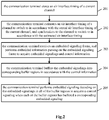
- FIG. 1 which shows a flow chart of a communication method based on a time division multiple access communication system according to a first method embodiment of the disclosure, the method includes the following steps 101 to 103.
- a communication terminal receives an embedded signaling frame, and performs embedded information parsing on the embedded signaling frame to acquire embedded signalings and control information.
- a mobile terminal receives an embedded signaling frame transmitted by a base station, and makes a further determination in accordance with embedded signalings carried by the embedded signaling frame to proceed with normal communication, where the embedded signaling frame may include a short link control signaling frame and a voice embedded signaling frame which is also referred to as a voice super frame.
- the embedded signaling frame may include a short link control signaling frame and a voice embedded signaling frame which is also referred to as a voice super frame.
- frame structures of the voice super frame and the short link control signaling frame defined by different communication standards may be different. For example, a position of a sub-frame carrying the embedded signaling, the number of sub-frames carrying the embedded signaling and the like may be different.
- an embedded signaling frame in any system includes the embedded signaling and the control information, where the control information is used for indicating a position of a corresponding embedded signaling in all of the embedded signalings.
- the voice super frame in DMR is composed of 6 bursts which are identified using letters A to F in sequence, where a burst A indicates a beginning of the super frame, a middle portion of the burst A is used to carry a sync word (SYNC), and middle portions of bursts B to F are used to transmit embedded singling and control information.
- the control information indicates link control start/stop (LCSS) indications which are identified using "beginning", "middle”, “middle” and "end” in sequence, which indicates a position of the embedded signaling carried in each burst in all of the link embedded signaling.
- LCSS link control start/stop
- step 102 the communication terminal buffers the embedded signaling into corresponding buffer regions in accordance with the control information.
- step 102 There are two implementations of step 102.
- the communication terminal buffers a current embedded signaling into a buffer region corresponding to a position indicated by current control information, and adjusts a position of the buffered current embedded signaling in accordance with the position indicated by the current control information and a position indicated by next control information.
- the communication terminal buffers the parsed embedded signaling successively, and adjusts a position of the buffered embedded signaling in accordance with a position indicated by the control information of the embedded signaling.
- the bursts B, C, D, and E carry embedded signalings 1, 2, 3, and 4 respectively, of which the control information is identified using "beginning", “middle”, “middle” and “end” respectively and correspond to buffer regions 1, 2, 3, and 4 respectively. Since it is difficult to determine which embedded signaling is to be buffered into either of the buffer region 2 and the buffer region 3, adaptive adjustment should be made in conjunction with the control information of a next embedded signaling.
- the parsed embedded signaling 3 is buffered in the buffer region 2
- the parsed embedded signaling 4 is buffered in the buffer region 4
- the embedded signaling 2 of the previously received burst B is buffered in the buffer region 3.
- the four parsed embedded signalings 1, 2, 3, 4 may be buffered successively in an order of reception. Then an overall adjustment is performed on buffer positions of the embedded signalings according to control information relationships.
- the bursts are received in the order of C, D, E, F, A, B, where the bursts C, D, E, and B carries the embedded signalings, and the embedded signaling are also buffered in the order of 2, 3, 4, 1; then buffer positions of the embedded signalings are adjusted in accordance with indications of the control information, and after the adjustment, the embedded signalings 1, 2, 3, 4 carried by bursts B, C, D, E are buffered in buffer regions 1, 2, 3, 4 respectively.
- step 103 the communication terminal performs embedded signaling decoding on the embedded signalings in all of the buffer regions to acquire a control signaling when each of the buffer regions has buffered a corresponding embedded signaling.
- the communication terminal may perform further communication processing in accordance with the control signaling.
- the communication method based on a time division multiple access communication system includes a communication terminal receiving an embedded signaling frame, performing embedded information parsing on the embedded signaling frame to acquire embedded signalings and control information, and buffering the embedded signalings into corresponding buffer regions in accordance with the control information.
- the communication terminal does not have to perform reception and parsing processing exactly in the order from the beginning to the end as indicated by indications of the embedded signalings, but parses the received embedded signaling frame to acquire the embedded signalings carried thereby, and then buffers the embedded signalings in order to avoid a condition where a signaling frame may be discarded in a case that the embedded signaling frame is not received in the order from the beginning to the end.
- the communication terminal performs embedded signaling decoding on the embedded signalings in all of the buffer regions to acquire a control signaling when each of the buffer regions has buffered a corresponding embedded signaling. Such a process can reduce a communication establishment duration thereby improving the access performance of the system.
- the communication terminal Since when performing a channel switching or a channel scanning, firstly the communication terminal needs to detect a synchronization signal and adjust its own timing to be aligned with a timing of the air channel thus the embedded signaling frame may be received properly.
- the communication terminal synchronizes to the channel by firstly searching for an air interface timing of a channel to switch to and then adjusting its own air interface timing to be aligned with the air interface timing of the channel to switch to. This process is time consuming and may affect communication quality.
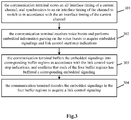
- a preferred scheme is provided according to the embodiments of the disclosure to reduce the time required for synchronization. Referring to Figure 2 , which shows a flow chart of a communication method based on a time division multiple access communication system according to a second method embodiment of the disclosure, the method may include the following steps 201 to 205.
- step 201 the communication terminal stores an air interface timing of a current channel.
- step 202 the communication terminal estimates an air interface timing of a channel to switch to in accordance with the stored air interface timing of the current channel, and synchronizes to the channel to switch to in accordance with the estimated air interface timing.
- a communication terminal switches to a channel 2 from a channel 1, it clears an air interface timing of the channel 1, detects an air interface timing of the channel 2, and synchronizes its reception timing to the detected air interface timing of the channel 2 thereby implementing synchronization between the communication terminal and the channel 2.
- a physical layer will not provide data to a link layer.
- the physical layer transmits the received data to the link layer for processing only when the synchronization is detected, that is, the communication terminal synchronizes its reception timing to the detected air interface timing of the channel 2.
- the communication terminal is able to receive the embedded signaling frame. Therefore, in order to receive the embedded signaling frame rapidly, the communication terminal needs to synchronize to the channel rapidly.
- the step 202 may include:
- step 203 the communication terminal receives an embedded signaling frame, and performs embedded information parsing on the embedded signaling frame to acquire embedded signalings and control information.
- step 204 the communication terminal buffers the embedded signalings into corresponding buffer regions in accordance with the control information.
- step 205 the communication terminal performs embedded signaling decoding on the embedded signalings in all of the buffer regions to acquire a control signaling when each of the buffer regions has buffered a corresponding embedded signaling.
- Steps 203 to 205 are the same with the above steps 101 to 103, and thus the description is omitted herein.
- the communication method based on a time division multiple access communication system not only the time required for decoding the control signaling but also the time required for the communication terminal to perform synchronization can be reduced.
- it is implemented by the communication terminal performing same-frequency scan while in a transition mode, or storing the air interface timing of the current channel and adaptively adjusting its air interface timing in accordance with the stored air interface timing in order to synchronize to the channel to switch to in a case of a channel having a same frequency and a different time slot.
- the communication terminal does not need to search for the air interface timing again thereby ensuring that the communication terminal accesses the channel as soon as possible in order to receive the embedded signaling frame rapidly.
- the communication terminal performs decoding and acquires a control signaling, and needs to perform further determinations in accordance with the control signaling. Different determinations are required to be made for different types of control signalings. In view of this technical problem, the following preferred scheme is provided according to the disclosure.
- the method may further include: the communication terminal determining whether protocol data unit information in the control signaling indicates that a voice call is directed to the communication terminal, and turning on a speaker of the communication terminal to receive the voice call in a case that the protocol data unit information indicates that the voice call is directed to the communication terminal.
- the method may further include: the communication terminal determining whether a compressed address in the link control signaling is a compressed address of the communication terminal, and scanning a next channel in a case that the compressed address is not the compressed address of the communication terminal.
- the communication terminal is able to rapidly determine whether to receive a call or be informed of a forwarding condition of a downlink channel in advance thereby improving communication quality of the system.
- a processing scheme for voice late entry in a conventional DMR system is described briefly for comparative analysis.
- the scheme includes the following steps.
- the communication terminal should find a synchronization burst A since the burst A is needed to perform voice synchronization, and bursts B, C, D, E and F are able to be received when the air interface timing is synchronized.
- the embedded signaling frame is parsed to acquire link control start/stop (LCSS) indications in embedded signaling regions, and the bursts are successively received in an order of "beginning", “middle”, “middle” and “end” as indicated by LCSS indication.
- LCSS link control start/stop
- embedded signaling decoding is performed to restore a link control header.
- the communication terminal determines whether a voice call is directed to the communication terminal in accordance with protocol data unit information in the link control header, and turns on a speaker of the communication terminal to receive the voice call in a case that the voice call is directed to the communication terminal.
- FIG. 3 is a flow chart of a communication method based on a time division multiple access communication system according to a third method embodiment of the disclosure.
- the method may include the following steps 301 to 304.
- step 301 the communication terminal stores an air interface timing of a current channel, and synchronizes to an air interface timing of the channel to switch to in accordance with the air interface timing of the current channel.
- a communication terminal switches to a channel 2 from a channel 1, it clears an air interface timing of the channel 1, detects an air interface timing of the channel 2, and synchronizes its reception timing to the detected air interface timing of the channel 2 thereby implementing synchronization between the communication terminal and the channel 2.
- a physical layer will not provide data to a link layer. The physical layer transmits the received data to the link layer for processing only when the synchronization is detected, that is, the communication terminal synchronizes its reception timing to the detected air interface timing of the channel 2. In this case, the communication terminal is able to receive voice bursts.
- the synchronization between the communication terminal and the channel to switch to may be implemented with the following steps:
- a DMR time division multiple access communication system having 2 time slots is taken as an example.
- a channel currently accessed by the communication terminal is a channel 1, and a channel to switch to is a channel 2.
- the communication terminal accesses the channel 1, the communication terminal synchronizes a reception timing to a timing of the air interface time slot 1, and receives a voice or data only in the time slot 1.
- the reception timing of the communication terminal may remain unchanged in a case that the channel 1 and the channel 2 have a same frequency and a same time slot. That is, the communication terminal may synchronizes to the channel 2 in accordance with the stored reception timing synchronized to the channel 1 thus there is no need to detect synchronization to acquire the air interface timing of the channel 2.
- the reception timing of the air interface of the channel 2 may be acquired by moving the stored reception timing of the air interface of the channel 1 rightwards by 30ms.
- air interface timing of the current channel is known, even if a voice synchronization burst A is not detected, a voice burst can still be received and embedded information parsing can be performed thereon thereby ensuring that the communication terminal may receive the call as soon as possible.
- step 302 the communication terminal receives voice bursts and performs embedded information parsing on the voice bursts to acquire embedded signalings and link control start/stop (LCSS) indications.
- LCSS link control start/stop
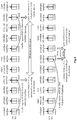
- a voice super frame is composed of 6 voice bursts which are identified using letters A, B, C, D, E and F.
- the voice is cyclically transmitted in an order of A, B, C, D, E and F.
- a burst A carrying synchronization information is referred to as a synchronization burst.
- Four of the bursts B, C, D, E and F carry embedded signalings, and each of the four voice bursts carries a link control start/stop (LCSS) indication, which is used for indicating that a position of the voice burst in an entire voice super frame is one of the beginning, the middle, and the end.
- LCSS link control start/stop
- each of the bursts B, C, D, and E carries an embedded signaling and an LCSS indication, and an embedded signaling field of the burst F is empty.
- each of the bursts B, D, E, and F carries an embedded signaling and an LCSS indication, and an embedded signaling field of the burst C is empty.
- different manufacturers employ different standards, which is not particularly limited in the embodiment.
- each of the bursts B, C, D, and E carries an embedded signaling, and an embedded signaling field of the burst F is empty.
- step 303 the communication terminal buffers the embedded signaling into corresponding buffer regions in accordance with the link control start/stop indications, and confirms that each of the four buffer regions has a buffered corresponding embedded signaling.
- step 303 may include:
- the above operation performed in accordance with step 303 may include: buffering the embedded signaling 1 into a first buffer region in a case that the LCSS indication of the first burst is the beginning; buffering the embedded signaling 2 into a second buffer region, in a case that the LCSS indication of the second burst is the middle, and the LCSS indication of a next burst is the middle; buffering the embedded signaling 3 into a third buffer region, in a case that the LCSS indication of the third burst is the middle, and the LCSS indication of a next burst is the end; and buffering the embedded signaling 4 into a fourth buffer region, in a case that the LCSS indication of the fourth burst is the end.
- the LCSS indications of two voice bursts in the voice super frame indicate the middle, the LCSS indication of a next burst is needed to make a determination and adjustment thereby accurately buffering the embedded signaling carried by each of the bursts into a corresponding buffer region.
- the burst D of which the LCSS indication is the middle
- the burst E of which the LCSS indication is the end
- the embedded signaling in the burst E is buffered into the fourth buffer region.
- the third buffer region is empty and the fourth buffer region is filled, which indicates the burst D is buffered into a wrong buffer region
- data stored in the second buffer region needs to be copied to the third buffer region and the second buffer region needs to be cleared simultaneously. That is, the buffer region of the embedded signaling needs to be adjusted in accordance with the LCSS indication of the next burst in a case that the LCSS indication is the middle.
- bursts F, A, B, and C are received successively.
- the embedded signaling carried by the burst B is buffered into the first buffer region in a case that the LCSS indication of the burst B is the beginning, and the embedded signaling carried by the burst C is buffered into the second buffer region in a case that the LCSS indication of the burst C is the middle.
- each of the four buffer regions has buffered a corresponding embedded signaling.
- step 304 the communication terminal decodes the embedded signalings in the four buffer regions to acquire a link control signaling.
- the embedded signaling buffered in each of the buffer regions has a length of 32 bits, and the embedded signalings buffered in the four buffer regions have a total length of 128 bits.
- the link control signaling having a length of 72 bits is generated by decoding the embedded signaling having a length of 128 bits.
- a burst A carrying synchronization information should be found first, then subsequent bursts are received and parsed.
- a burst B is received first, subsequent bursts should be received in an order of C, D, E, F, A, B, C, D and E; then the bursts may be parsed to acquire the embedded signalings of which the LCSS indications are "beginning", "middle”, “middle” and “end”; finally, the four embedded signalings are decoded to generate the link control signaling.
- 360 ms may be saved using the scheme according to the disclosure if the burst B is received first, and 60 ms may be saved using the scheme according to the disclosure if the burst E is received first.
- the communication terminal directly parses the received voice bursts to acquire the embedded signalings, and buffers the embedded signalings into corresponding buffer regions according to LCSS indications of the embedded signalings, and performs embedded signaling decoding to acquire the link control signaling when four buffering regions are filled.
- the timing of the air interface is known, there is no need to search for the burst A which carries the synchronization information or wait until the burst A is received to parse the received bursts which carry the embedded signalings.
- the received voice bursts are parsed directly, and the embedded signalings acquired by parsing are buffered. Therefore, according to the disclosure, the time required for communication establishment may be reduced.
- the priority retrace includes the following procedures: the communication terminal currently accesses a channel F1 and retraces a channel F2 with a higher priority when a priority retrace timer times out; if there is a call with a higher priority directed to the communication terminal in the channel F2, the communication terminal receives the call in the channel F2 and switches back to the channel F1 when the call is finished; and if there is no call with a higher priority directed to the communication terminal in the channel F2, the communication terminal switches to the channel F1 to continue to receive the voice call, and retraces the channel F2 again until a next retrace interval arrives.
- the communication quality is affected since the voice call is interrupted for a long time.
- the following preferred scheme is provided according to the disclosure for reducing the interruption duration in the voice call during the priority retrace thereby ensuring the communication quality.
- the method may include the following steps 401 to 409.
- step 401 the communication terminal stores an air interface timing of a current channel F1 and switches to a channel F2 with a higher priority to perform detection.
- the communication terminal After initiating a scan, in a case of detecting that there is a voice call directed to the communication terminal in the channel F1, the communication terminal stops scanning and turns on a speaker to receive and plays the voice. Meanwhile, the communication terminal switches its state to a scan dwelling state and starts the priority retrace timer. When the priority retrace timer times out, the communication terminal stores the air interface timing of the current channel F1 and then performs priority retrace. Then the communication terminal switches to the channel F2 with a higher priority to perform detection and switches its state to a priority retrace state simultaneously.
- step 402 the communication terminal receives voice bursts successively and performs embedded information parsing on the voice bursts to acquire embedded signalings and link control start/stop (LCSS) indications in a case of detecting that there is a voice signal in the air interface.
- LCSS link control start/stop
- step 403 the communication terminal buffers the embedded signalings into corresponding buffer regions in accordance with link control start/stop (LCSS) indications and confirms that each of the four buffer regions has buffered a corresponding embedded signaling.
- LCSS link control start/stop
- step 404 the communication terminal decodes the embedded signalings in the four buffer regions to acquire link control signaling.
- step 405 the communication terminal parses the link control signaling to acquire protocol data unit information and determines whether the voice call is directed to the communication terminal in accordance with the protocol data unit information.
- step 406 the communication terminal turns on a speaker of the communication terminal to receive the voice call and enters the scan dwelling state in a case that the voice call is directed to the communication terminal.
- step 407 the communication terminal switches back to the channel F1, restores the air interface timing of the channel F1, receives voice bursts successively and performs embedded information parsing on the voice bursts to acquire embedded signalings, link control start/stop (LCSS) indications and a voice payload, and decodes the voice payload and transmit the voice payload to the speaker, in a case that the voice call is not directed to the communication terminal.
- LCSS link control start/stop
- the communication terminal instructs to turn on the speaker and transmits the voice payload of a next voice burst to the speaker when the next voice burst is received only in a case that the protocol data unit information in the link control signaling is parsed out and it is determined that the voice call is directed to the communication terminal.
- the communication terminal receives bursts A, B, C, D, E and F; only when the protocol data unit information in the link control signaling is parsed out from the burst E and it is determined that the voice call is directed to the communication terminal, the communication terminal instructs to turn on the speaker; and only when the burst F is received, the communication terminal decodes voice information at both sides of the burst F and transmits it to the speaker.
- the communication terminal decodes the voice payload which is parsed out and transmits the voice payload to the speaker after synchronizing to the channel F1 thus the communication terminal is able to receive the voice call rapidly when switching back to the channel F1.
- step 408 the communication terminal buffers the embedded signalings into corresponding buffer regions in accordance with the link control start/stop indications, and confirms that each of the four buffer regions has buffered a corresponding embedded signaling.
- step 409 the communication terminal decodes the embedded signalings in the four buffer regions to acquire link control signaling.
- the communication terminal initiates a scan, and successively receives 4 common announcement channel (CACH) frames (each voice or data burst having a length of 30 ms carries a CACH frame) in an order of "beginning", "middle", “middle” and "end” as indicated by LCSS indication when an intermediate channel is scanned; the communication terminal performs embedded information parsing on the CACH frames to acquire the short embedded signalings; the communication terminal parses the 4 short embedded signalings which are received sequentially to acquire the short link control signaling, determines whether a compressed address carried in the short link control signaling is a compressed address of the communication terminal, and scans a next channel in a case that the voice call is not directed to the communication terminal.
- CACH common announcement channel
- the method may include the following steps 501 to 503.
- step 501 the communication terminal receives common announcement channel frames sequentially, and performs embedded information parsing on the common announcement channel frames to acquire short embedded signalings and link control start/stop (LCSS) indications.
- LCSS link control start/stop
- step 502 the communication terminal buffers the short embedded signalings into corresponding buffer regions in accordance with the link control start/stop (LCSS) indications, and confirms that each of the four buffer regions has buffered a corresponding short embedded signaling.
- LCSS link control start/stop
- Step 502 may include:
- the embedded signaling of the first received CACH frame is buffered in the second buffer region, and the embedded signaling of the second received CACH frame is buffered in the third buffer region.
- step 503 the communication terminal decodes the short embedded signaling in the four buffer regions to acquire short link control signaling.
- the method may further include: the communication terminal parsing the short link control signaling to acquire a compressed address in the short link control signaling, determining whether the compressed address is a compressed address of the communication terminal, and scanning a next channel in a case that the compressed address is not the compressed address of the communication terminal.
- a communication terminal based on a time division multiple access communication system is provided according to the embodiments of the disclosure.
- the communication terminal may include: a reception unit 701, a parsing unit 702, a buffering unit 703 and a decoding unit 704.
- a reception unit 701 receives data from the communication terminal.
- a parsing unit 702 receives data from the communication terminal.
- a buffering unit 703 receives data from the communication terminal.
- the reception unit 701 is configured to receive an embedded signaling frame.
- the parsing unit 702 is configured to perform embedded information parsing on the embedded signaling frame to acquire embedded signalings and control information.
- the buffering unit 703 is configured to buffer the embedded signalings into corresponding buffer regions in accordance with the control information.
- the decoding unit 704 is configured to perform embedded signaling decoding on the embedded signalings in all of the buffer regions to acquire a control signaling when each of the buffer regions has buffered a corresponding embedded signaling.
- the buffering unit may include:
- the buffering unit may include:
- the terminal may further include:
- the terminal may further include:
- a communication terminal receives an embedded signaling frame, performs embedded information parsing on the embedded signaling frame to acquire embedded signalings and control information, and buffers the embedded signalings into corresponding buffer regions in accordance with the control information.
- the communication terminal does not have to perform reception and parsing processing exactly in the order from the beginning to the end as indicated by indications of the embedded signaling, but parses the embedded signaling frame on reception of the embedded signaling frame to acquire the embedded signalings carried thereby, and then buffers the embedded signalings in order to avoid a condition where a signaling frame may be discarded in a case that the embedded signaling frame is not received in the order from the beginning to the end.
- the communication terminal performs embedded signaling decoding on the embedded signalings in all of the buffer regions to acquire control signaling when each of the buffer regions has buffered a corresponding embedded signaling. Such a process can reduce the time required for decoding the control signaling thereby improving the communication quality.
- the communication terminal may include: a storage unit 801, an estimation unit 802, a synchronization unit 803, a reception unit 804, a parsing unit 805, a buffering unit 806 and a decoding unit 807.
- a storage unit 801 an estimation unit 802
- a synchronization unit 803 a reception unit 804
- a parsing unit 805 a buffering unit 806
- a decoding unit 807 a decoding unit 807.
- the storage unit 801 is configured to store an air interface timing of a current channel.
- the estimation unit 802 is configured to estimate an air interface timing of a channel to switch to in accordance with the stored air interface timing of the current channel.
- the synchronization unit 803 is configured to synchronize to the channel to switch to in accordance with the estimated air interface timing.
- the reception unit 804 is configured to receive an embedded signaling frame.
- the parsing unit 805 is configured to perform embedded information parsing on the embedded signaling frame to acquire embedded signalings and control information.
- the buffering unit 806 is configured to buffer the embedded signalings into corresponding buffer regions in accordance with the control information.
- the decoding unit 807 is configured to perform embedded signaling decoding on the embedded signalings in all of the buffer regions to acquire control signaling when each of the buffer regions has buffered a corresponding embedded signaling.
- the above 804 to 807 are the same as the 701 to 704 in the above embodiment, and the detailed description thereof will be omitted.
- the estimation unit may include:
- the communication terminal is capable of reducing not only the time required for decoding the control signaling but also the time required for the communication terminal to perform channel synchronization specifically by performing same-frequency scan in a transition mode, or storing the air interface timing of the current channel and making adaptive adjustment in accordance with the stored air interface timing in order to synchronize to the channel to switch to in a case of a channel having a same frequency and a different time slot, thereby enabling the communication terminal to access to the channel rapidly, thus the access duration may be reduced.
- relational terms such as “first” and “second” are used only to distinguish one entity or operation from the other entity or operation, but not necessarily demand or imply that there is actual relation or order among those entities and operations.
- the terms “including”, “containing”, or any other variations thereof mean a non-exclusive inclusion, so that the process, apparatus, article or device that includes a series of elements includes not only these elements but also other elements that are not explicitly listed, or further includes elements inherent in the process, apparatus, article or device.
- the element defined by the wording "include(s) a " does not exclude the case that in the process, apparatus, article or device that includes the element there are other same elements.
- the program may be stored in a computer readable storage medium.
- the program may include the process in the embodiments of the above-mentioned method.
- the storage medium may be a magnetic disk, an optical disk, a read-only memory (ROM) or a random access memory (RAM) and so on.
Landscapes
- Engineering & Computer Science (AREA)
- Signal Processing (AREA)
- Computer Networks & Wireless Communication (AREA)
- Mobile Radio Communication Systems (AREA)
Claims (12)
- Kommunikationsverfahren auf der Basis eines Zeitvielfachzugriff-Kommunikationssystems, wobei das Verfahren Folgende Schritte umfasst:Empfangen eines eingebetteten Signalisierungsrahmens mit einem Kommun ikationsendgerät,und gekennzeichnet ist durch:das Durchführen, mit dem Kommunikationsendgerät, eines Parsens von eingebetteten Informationen an dem eingebetteten Signalisierungsrahmen, um eingebettete Signalisierungen und Steuerinformationen zu erfassen (101, 203), wobei die Steuerinformationen dazu verwendet werden, eine Position einer entsprechenden eingebetteten Signalisierung anzugeben;das Puffern, mit dem Kommunikationsendgerät, der eingebetteten Signalisierungen in entsprechenden Pufferbereichen entsprechend den Steuerinformationen (102, 204); unddas Durchführen, mit dem Kommunikationsendgerät, einer Dekodierung eingebetteter Signalisierungen an den eingebetteten Signalisierungen in allen Pufferbereichen, um eine Steuersignalisierung zu erfassen, wenn jeder der Pufferbereiche eine entsprechende eingebettete Signalisierung gepuffert hat (103, 205).
- Verfahren nach Anspruch 1, wobei das Puffern der eingebetteten Signalisierungen in den entsprechenden Pufferbereichen entsprechend den Steuerinformationen mit dem Kommunikationsendgerät Folgendes umfasst:Puffern, mit dem Kommunikationsendgerät, einer gegenwärtigen eingebetteten Signalisierung in einem Pufferbereich, der einer von gegenwärtigen Steuerinformationen angegebenen Position entspricht; undAnpassen, mit dem Kommunikationsendgerät, einer Position der gepufferten gegenwärtigen eingebetteten Signalisierung entsprechend der von den gegenwärtigen Steuerinformationen angegebenen Position und einer von darauffolgenden Steuerinformationen angegebenen Position.
- Verfahren nach Anspruch 1 oder 2, bei dem vor dem Empfangen des eingebetteten Signalisierungsrahmens mit dem Kommunikationsendgerät das Verfahren ferner Folgendes umfasst:Speichern, mit dem Kommunikationsendgerät, eines Luftschnittstellentakts eines gegenwärtigen Kanals (201); undSchätzen, mit dem Kommunikationsendgerät, eines Luftschnittstellentakts eines Kanals, auf den geschaltet werden soll, entsprechend dem gespeicherten Luftschnittstellentakt des gegenwärtigen Kanals; und Synchronisieren, mit dem Kommunikationsendgerät, mit dem Kanal, auf den geschaltet werden soll, entsprechend dem geschätzten Luftschnittstellentakt (202).
- Verfahren nach Anspruch 3, bei dem das Schätzen, mit dem Kommunikationsendgerät, des Luftschnittstellentakts des Kanals, auf den geschaltet werden soll, entsprechend dem gespeicherten Luftschnittstellentakt des gegenwärtigen Kanals Folgendes umfasst:Schätzen, mit dem Kommunikationsendgerät, dass der Luftschnittstellentakt des Kanals, auf den geschaltet werden soll, der gleiche ist wie der gespeicherte Luftschnittstellentakt des gegenwärtigen Kanals, wenn der gegenwärtige Kanal und der Kanal, auf den geschaltet werden soll, die gleiche Frequenz und den gleichen Zeitschlitz haben; undBestimmen, mit dem Kommunikationsendgerät, des Luftschnittstellentakts des Kanals, auf den geschaltet werden soll, entsprechend einer Zeitschlitzbeziehung zwischen dem gegenwärtigen Kanal und dem Kanal, auf den geschaltet werden soll, wenn der gegenwärtige Kanal und der Kanal, auf den geschaltet werden soll, die gleiche Frequenz und unterschiedliche Zeitschlitze haben.
- Verfahren nach Anspruch 1 oder 2, bei dem das Verfahren, wenn es sich bei dem eingebetteten Signalisierungsrahmen um einen Sprach-Überrahmen handelt, ferner Folgendes umfasst:Bestimmen, mit dem Kommunikationsendgerät, ob Informationen einer Protokolldateneinheit in der Steuersignalisierung angeben, dass ein Anruf zum Kommunikationsendgerät geleitet wird; undEinschalten, mit dem Kommunikationsendgerät, eines Lautsprechers des Kommunikationsendgeräts, um den Sprachanruf zu empfangen, wenn die Informationen der Protokolldateneinheit angeben, dass der Anruf zum Kommunikationsendgerät geleitet wird.
- Verfahren nach Anspruch 1 oder 2, bei dem das Verfahren, wenn es sich bei dem eingebetteten Signalisierungsrahmen um einen gemeinsamen Mitteilungskanalrahmen handelt, ferner Folgendes umfasst:Bestimmen, mit dem Kommunikationsendgerät, ob eine komprimierte Adresse in der Verbindungssteuersignalisierung eine komprimierte Adresse des Kommunikationsendgeräts ist; undAbtasten, mit dem Kommunikationsendgerät, eines nächsten Kanals, wenn die komprimierte Adresse nicht die komprimierte Adresse des Kommunikationsendgeräts ist.
- Kommunikationsendgerät auf der Basis eines Zeitvielfachzugriff-Kommunikationssystems, wobei das Kommunikationsendgerät Folgendes umfasst: eine Empfangseinheit (701), die dazu ausgebildet ist, einen eingebetteten Signalisierungsrahmen zu empfangen,
gekennzeichnet durch:
eine Parsing-Einheit (702), die dazu ausgebildet ist, ein Parsen von eingebetteten Informationen an dem eingebetteten Signalisierungsrahmen durchzuführen, um eingebettete Signalisierungen und Steuerinformationen zu erfassen, wobei die Steuerinformationen dazu verwendet werden, eine Position einer entsprechenden eingebetteten Signalisierung anzugeben; eine Puffereinheit (703), die dazu ausgebildet ist, die eingebetteten Signalisierungen in entsprechenden Pufferbereichen entsprechend den Steuerinformationen zu puffern; und eine Dekodiereinheit (704), die dazu ausgebildet ist, eine Dekodierung eingebetteter Signalisierungen an den eingebetteten Signalisierungen in allen Pufferbereichen durchzuführen, um eine Steuersignalisierung zu erfassen, wenn jeder der Pufferbereiche eine entsprechende eingebettete Signalisierung gepuffert hat. - Endgerät nach Anspruch 7, wobei die Puffereinheit (703) Folgendes umfasst:ein Speichermodul, das dazu ausgebildet ist, eine gegenwärtige eingebettete Signalisierung in einem Pufferbereich zu puffern, der einer von gegenwärtigen Steuerinformationen angegebenen Position entspricht; undein Anpassungsmodul, das dazu ausgebildet ist, eine Position der gepufferten gegenwärtigen eingebetteten Signalisierung entsprechend der von den gegenwärtigen Steuerinformationen angegebenen Position und einer von darauffolgenden Steuerinformationen angegebenen Position anzupassen.
- Endgerät nach Anspruch 7 oder 8, wobei das Endgerät ferner Folgendes umfasst:eine Speichereinheit, die dazu ausgebildet ist, einen Luftschnittstellentakt eines gegenwärtigen Kanals zu speichern;eine Schätzeinheit, die dazu ausgebildet ist, einen Luftschnittstellentakt eines Kanals, auf den geschaltet werden soll, entsprechend dem gespeicherten Luftschnittstellentakt des gegenwärtigen Kanals zu schätzen; undeine Synchronisationseinheit, die dazu ausgebildet ist, mit dem Kanal, auf den geschaltet werden soll, entsprechend dem geschätzten Luftschnittstellentakt zu synchronisieren.
- Endgerät nach Anspruch 9, bei dem die Schätzeinheit Folgendes umfasst:ein erstes Schätzmodul, das dazu ausgebildet ist zu schätzen, dass der Luftschnittstellentakt des Kanals, auf den geschaltet werden soll, der gleiche ist wie der gespeicherte Luftschnittstellentakt des gegenwärtigen Kanals, wenn der gegenwärtige Kanal und der Kanal, auf den geschaltet werden soll, die gleiche Frequenz und den gleichen Zeitschlitz haben; undein zweites Schätzmodul, das dazu ausgebildet ist, den Luftschnittstellentakt des Kanals, auf den geschaltet werden soll, entsprechend einer Zeitschlitzbeziehung zwischen dem gegenwärtigen Kanal und dem Kanal, auf den geschaltet werden soll, zu bestimmen, wenn der gegenwärtige Kanal und der Kanal, auf den geschaltet werden soll, die gleiche Frequenz und unterschiedliche Zeitschlitze haben.
- Endgerät nach Anspruch 7 oder 8, bei dem das Endgerät, wenn es sich bei dem eingebetteten Signalisierungsrahmen um einen Sprach-Überrahmen handelt, ferner Folgendes umfasst:eine erste Bestimmeinheit, die dazu ausgebildet ist zu bestimmen, ob Informationen einer Protokolldateneinheit in der Steuersignalisierung angeben, dass ein Anruf zum Kommunikationsendgerät geleitet wird; undeine erste Steuereinheit, die dazu ausgebildet ist, einen Lautsprecher des Kommunikationsendgeräts einzuschalten, um den Sprachanruf zu empfangen, wenn die Informationen der Protokolldateneinheit angeben, dass der Anruf zum Kommunikationsendgerät geleitet wird.
- Endgerät nach Anspruch 7 oder 8, bei dem das Endgerät, wenn es sich bei dem eingebetteten Signalisierungsrahmen um einen gemeinsamen Mitteilungskanalrahmen handelt, ferner Folgendes umfasst:eine zweite Bestimmeinheit, die dazu ausgebildet ist zu bestimmen, ob eine komprimierte Adresse in der Verbindungssteuersignalisierung eine komprimierte Adresse des Kommunikationsendgeräts ist; undeine zweite Steuereinheit, die dazu ausgebildet ist, einen nächsten Kanal abzutasten, wenn die komprimierte Adresse nicht die komprimierte Adresse des Kommunikationsendgeräts ist.
Applications Claiming Priority (1)
| Application Number | Priority Date | Filing Date | Title |
|---|---|---|---|
| PCT/CN2013/089070 WO2015085511A1 (zh) | 2013-12-11 | 2013-12-11 | 一种基于时分多址通信系统的通信方法及终端 |
Publications (3)
| Publication Number | Publication Date |
|---|---|
| EP3082364A1 EP3082364A1 (de) | 2016-10-19 |
| EP3082364A4 EP3082364A4 (de) | 2016-12-14 |
| EP3082364B1 true EP3082364B1 (de) | 2018-10-31 |
Family
ID=53370474
Family Applications (1)
| Application Number | Title | Priority Date | Filing Date |
|---|---|---|---|
| EP13899054.4A Active EP3082364B1 (de) | 2013-12-11 | 2013-12-11 | Kommunikationsverfahren auf grundlage eines zeitmultiplex-vielfachzugriffkommunikationssystems und endgerät |
Country Status (3)
| Country | Link |
|---|---|
| US (1) | US10298342B2 (de) |
| EP (1) | EP3082364B1 (de) |
| WO (1) | WO2015085511A1 (de) |
Cited By (1)
| Publication number | Priority date | Publication date | Assignee | Title |
|---|---|---|---|---|
| CN109600788A (zh) * | 2018-12-28 | 2019-04-09 | 北京交通大学 | 一种警用数字集群空口一致性测试的方法 |
Family Cites Families (18)
| Publication number | Priority date | Publication date | Assignee | Title |
|---|---|---|---|---|
| US4914650A (en) | 1988-12-06 | 1990-04-03 | American Telephone And Telegraph Company | Bandwidth allocation and congestion control scheme for an integrated voice and data network |
| EP0439630B1 (de) * | 1989-08-25 | 1996-02-07 | Nippon Telegraph And Telephone Corporation | Regelungsverfahren eines funkkanalschalters |
| JP2000358277A (ja) | 1999-06-15 | 2000-12-26 | Sharp Corp | 無線端末装置 |
| US20030031175A1 (en) * | 2001-08-01 | 2003-02-13 | Masato Hayashi | Method of multicasting |
| US7697447B2 (en) * | 2001-08-10 | 2010-04-13 | Motorola Inc. | Control of jitter buffer size and depth |
| US7406102B2 (en) | 2002-07-03 | 2008-07-29 | Freescale Semiconductor, Inc. | Multi-mode method and apparatus for performing digital modulation and demodulation |
| GB0311090D0 (en) * | 2003-05-14 | 2003-06-18 | Nokia Corp | Antenna down tilting |
| US6934299B2 (en) | 2003-06-06 | 2005-08-23 | Motorola, Inc. | Beacon packet having traffic indicator flag |
| US7626539B2 (en) * | 2003-11-07 | 2009-12-01 | Global Locate, Inc. | Method and apparatus for managing time in a satellite positioning system |
| US7327310B2 (en) * | 2003-11-07 | 2008-02-05 | Global Locate, Inc. | Method and apparatus for managing time in a satellite positioning system |
| US20090146871A1 (en) * | 2007-12-07 | 2009-06-11 | Charles Abraham | Method and apparatus for managing time in a satellite positioning system |
| US20090219916A1 (en) | 2008-02-29 | 2009-09-03 | Motorola, Inc. | Method to scan for critical transmissions while transmitting on a conventional time division multiple access channel |
| US8605650B2 (en) * | 2008-06-10 | 2013-12-10 | Motorola Solutions, Inc. | System and method for interrupting a transmitting device in a communication system |
| US8265214B2 (en) * | 2008-07-01 | 2012-09-11 | Qualcomm Incorporated | Method and apparatus for adaptive timing synchronization in a communication network |
| US8861445B2 (en) * | 2009-03-11 | 2014-10-14 | Sony Cororation | Multi-channel single radio communication in home mesh network |
| CN102869083B (zh) * | 2011-07-06 | 2015-04-29 | 华为技术有限公司 | 信道转换时参数配置的方法及基站和无线网络控制器 |
| US9185149B2 (en) * | 2012-06-25 | 2015-11-10 | Salesforce.Com, Inc. | Systems, methods, and apparatuses for implementing frame aggregation with screen sharing |
| CN102984682A (zh) | 2012-10-29 | 2013-03-20 | 苏州坤里达信息科技有限公司 | 一种移动通信系统中的信令采集仪的数据存取方法 |
-
2013
- 2013-12-11 EP EP13899054.4A patent/EP3082364B1/de active Active
- 2013-12-11 WO PCT/CN2013/089070 patent/WO2015085511A1/zh not_active Ceased
- 2013-12-11 US US15/102,421 patent/US10298342B2/en active Active
Non-Patent Citations (1)
| Title |
|---|
| None * |
Cited By (2)
| Publication number | Priority date | Publication date | Assignee | Title |
|---|---|---|---|---|
| CN109600788A (zh) * | 2018-12-28 | 2019-04-09 | 北京交通大学 | 一种警用数字集群空口一致性测试的方法 |
| CN109600788B (zh) * | 2018-12-28 | 2020-08-18 | 北京交通大学 | 一种警用数字集群空口一致性测试的方法 |
Also Published As
| Publication number | Publication date |
|---|---|
| US20160323054A1 (en) | 2016-11-03 |
| US10298342B2 (en) | 2019-05-21 |
| EP3082364A4 (de) | 2016-12-14 |
| EP3082364A1 (de) | 2016-10-19 |
| WO2015085511A1 (zh) | 2015-06-18 |
Similar Documents
| Publication | Publication Date | Title |
|---|---|---|
| EP3965338B1 (de) | Informationsübertragungsverfahren und -vorrichtung und computerlesbares speichermedium | |
| US9215679B2 (en) | Air-interface timing synchronization sharing | |
| US9572123B2 (en) | Multiple time advance for radio access networks | |
| US11089559B2 (en) | Synchronization processing method and apparatus, and device | |
| US20190182819A1 (en) | Method and apparatus for control signal transmission | |
| KR101160656B1 (ko) | 멀티미디어 브로드캐스트 멀티캐스트 서비스 전용 캐리어의 액세스 방법 및 장치 | |
| WO2012095003A1 (en) | Obtaining system frame number of target cell during handover | |
| CN103634878B (zh) | 一种基于时分多址通信系统的通信方法及终端 | |
| WO2008011798A1 (en) | Method and device for initial synchronisation between gsm system and td-scdma system | |
| CN102361517B (zh) | 一种多卡移动终端及其同步方法和装置 | |
| WO2010088816A1 (zh) | 一种实现基站间同步的方法及系统 | |
| KR20140111681A (ko) | Lte-tdd 네트워크와 wimax 네트워크를 동기화하는 방법, 기지국 및 시스템 | |
| US6298225B1 (en) | Radio telephones and method of operation | |
| CN101719788B (zh) | 双模终端td工作模式下gsm小区sch同步方法 | |
| KR101706343B1 (ko) | 업링크와 다운링크를 스위칭하는 방법 및 중계기 | |
| EP3082364B1 (de) | Kommunikationsverfahren auf grundlage eines zeitmultiplex-vielfachzugriffkommunikationssystems und endgerät | |
| CN101969671A (zh) | 一种解决数据冲突的方法及移动终端 | |
| CN103167565A (zh) | Gsm系统中提升切换时语音感知度的方法、基站及系统 | |
| CA2519587C (en) | Method for synchronizing a control channel to a working channel | |
| CN113438385B (zh) | 一种视频同步方法及无线图像传输系统 | |
| WO2014066244A1 (en) | Adaptive maintenance of uplink time alignment | |
| EP1986460A1 (de) | System zur Beschleunigung der Synchronization in einer Verbindung | |
| JP2006516857A (ja) | 電話システム | |
| JP5223409B2 (ja) | デジタル無線機、制御方法及びプログラム | |
| CN103139898B (zh) | 异网络模式数据的接收处理方法与装置、多模终端 |
Legal Events
| Date | Code | Title | Description |
|---|---|---|---|
| PUAI | Public reference made under article 153(3) epc to a published international application that has entered the european phase |
Free format text: ORIGINAL CODE: 0009012 |
|
| 17P | Request for examination filed |
Effective date: 20160706 |
|
| AK | Designated contracting states |
Kind code of ref document: A1 Designated state(s): AL AT BE BG CH CY CZ DE DK EE ES FI FR GB GR HR HU IE IS IT LI LT LU LV MC MK MT NL NO PL PT RO RS SE SI SK SM TR |
|
| AX | Request for extension of the european patent |
Extension state: BA ME |
|
| A4 | Supplementary search report drawn up and despatched |
Effective date: 20161116 |
|
| RIC1 | Information provided on ipc code assigned before grant |
Ipc: H04L 12/70 20130101ALI20161110BHEP Ipc: H04W 84/08 20090101AFI20161110BHEP |
|
| DAX | Request for extension of the european patent (deleted) | ||
| 17Q | First examination report despatched |
Effective date: 20171018 |
|
| REG | Reference to a national code |
Ref country code: DE Ref legal event code: R079 Ref document number: 602013046161 Country of ref document: DE Free format text: PREVIOUS MAIN CLASS: H04W0048080000 Ipc: H04B0007260000 |
|
| GRAP | Despatch of communication of intention to grant a patent |
Free format text: ORIGINAL CODE: EPIDOSNIGR1 |
|
| RIC1 | Information provided on ipc code assigned before grant |
Ipc: H04B 7/26 20060101AFI20180420BHEP |
|
| INTG | Intention to grant announced |
Effective date: 20180515 |
|
| GRAS | Grant fee paid |
Free format text: ORIGINAL CODE: EPIDOSNIGR3 |
|
| GRAA | (expected) grant |
Free format text: ORIGINAL CODE: 0009210 |
|
| AK | Designated contracting states |
Kind code of ref document: B1 Designated state(s): AL AT BE BG CH CY CZ DE DK EE ES FI FR GB GR HR HU IE IS IT LI LT LU LV MC MK MT NL NO PL PT RO RS SE SI SK SM TR |
|
| REG | Reference to a national code |
Ref country code: CH Ref legal event code: EP Ref country code: GB Ref legal event code: FG4D |
|
| REG | Reference to a national code |
Ref country code: AT Ref legal event code: REF Ref document number: 1060653 Country of ref document: AT Kind code of ref document: T Effective date: 20181115 |
|
| REG | Reference to a national code |
Ref country code: IE Ref legal event code: FG4D |
|
| REG | Reference to a national code |
Ref country code: DE Ref legal event code: R096 Ref document number: 602013046161 Country of ref document: DE |
|
| REG | Reference to a national code |
Ref country code: NL Ref legal event code: MP Effective date: 20181031 |
|
| REG | Reference to a national code |
Ref country code: LT Ref legal event code: MG4D |
|
| REG | Reference to a national code |
Ref country code: AT Ref legal event code: MK05 Ref document number: 1060653 Country of ref document: AT Kind code of ref document: T Effective date: 20181031 |
|
| PG25 | Lapsed in a contracting state [announced via postgrant information from national office to epo] |
Ref country code: FI Free format text: LAPSE BECAUSE OF FAILURE TO SUBMIT A TRANSLATION OF THE DESCRIPTION OR TO PAY THE FEE WITHIN THE PRESCRIBED TIME-LIMIT Effective date: 20181031 Ref country code: LV Free format text: LAPSE BECAUSE OF FAILURE TO SUBMIT A TRANSLATION OF THE DESCRIPTION OR TO PAY THE FEE WITHIN THE PRESCRIBED TIME-LIMIT Effective date: 20181031 Ref country code: HR Free format text: LAPSE BECAUSE OF FAILURE TO SUBMIT A TRANSLATION OF THE DESCRIPTION OR TO PAY THE FEE WITHIN THE PRESCRIBED TIME-LIMIT Effective date: 20181031 Ref country code: PL Free format text: LAPSE BECAUSE OF FAILURE TO SUBMIT A TRANSLATION OF THE DESCRIPTION OR TO PAY THE FEE WITHIN THE PRESCRIBED TIME-LIMIT Effective date: 20181031 Ref country code: LT Free format text: LAPSE BECAUSE OF FAILURE TO SUBMIT A TRANSLATION OF THE DESCRIPTION OR TO PAY THE FEE WITHIN THE PRESCRIBED TIME-LIMIT Effective date: 20181031 Ref country code: AT Free format text: LAPSE BECAUSE OF FAILURE TO SUBMIT A TRANSLATION OF THE DESCRIPTION OR TO PAY THE FEE WITHIN THE PRESCRIBED TIME-LIMIT Effective date: 20181031 Ref country code: BG Free format text: LAPSE BECAUSE OF FAILURE TO SUBMIT A TRANSLATION OF THE DESCRIPTION OR TO PAY THE FEE WITHIN THE PRESCRIBED TIME-LIMIT Effective date: 20190131 Ref country code: ES Free format text: LAPSE BECAUSE OF FAILURE TO SUBMIT A TRANSLATION OF THE DESCRIPTION OR TO PAY THE FEE WITHIN THE PRESCRIBED TIME-LIMIT Effective date: 20181031 Ref country code: IS Free format text: LAPSE BECAUSE OF FAILURE TO SUBMIT A TRANSLATION OF THE DESCRIPTION OR TO PAY THE FEE WITHIN THE PRESCRIBED TIME-LIMIT Effective date: 20190228 Ref country code: NO Free format text: LAPSE BECAUSE OF FAILURE TO SUBMIT A TRANSLATION OF THE DESCRIPTION OR TO PAY THE FEE WITHIN THE PRESCRIBED TIME-LIMIT Effective date: 20190131 |
|
| PG25 | Lapsed in a contracting state [announced via postgrant information from national office to epo] |
Ref country code: NL Free format text: LAPSE BECAUSE OF FAILURE TO SUBMIT A TRANSLATION OF THE DESCRIPTION OR TO PAY THE FEE WITHIN THE PRESCRIBED TIME-LIMIT Effective date: 20181031 Ref country code: PT Free format text: LAPSE BECAUSE OF FAILURE TO SUBMIT A TRANSLATION OF THE DESCRIPTION OR TO PAY THE FEE WITHIN THE PRESCRIBED TIME-LIMIT Effective date: 20190301 Ref country code: RS Free format text: LAPSE BECAUSE OF FAILURE TO SUBMIT A TRANSLATION OF THE DESCRIPTION OR TO PAY THE FEE WITHIN THE PRESCRIBED TIME-LIMIT Effective date: 20181031 Ref country code: GR Free format text: LAPSE BECAUSE OF FAILURE TO SUBMIT A TRANSLATION OF THE DESCRIPTION OR TO PAY THE FEE WITHIN THE PRESCRIBED TIME-LIMIT Effective date: 20190201 Ref country code: SE Free format text: LAPSE BECAUSE OF FAILURE TO SUBMIT A TRANSLATION OF THE DESCRIPTION OR TO PAY THE FEE WITHIN THE PRESCRIBED TIME-LIMIT Effective date: 20181031 Ref country code: AL Free format text: LAPSE BECAUSE OF FAILURE TO SUBMIT A TRANSLATION OF THE DESCRIPTION OR TO PAY THE FEE WITHIN THE PRESCRIBED TIME-LIMIT Effective date: 20181031 |
|
| PG25 | Lapsed in a contracting state [announced via postgrant information from national office to epo] |
Ref country code: IT Free format text: LAPSE BECAUSE OF FAILURE TO SUBMIT A TRANSLATION OF THE DESCRIPTION OR TO PAY THE FEE WITHIN THE PRESCRIBED TIME-LIMIT Effective date: 20181031 Ref country code: CZ Free format text: LAPSE BECAUSE OF FAILURE TO SUBMIT A TRANSLATION OF THE DESCRIPTION OR TO PAY THE FEE WITHIN THE PRESCRIBED TIME-LIMIT Effective date: 20181031 Ref country code: DK Free format text: LAPSE BECAUSE OF FAILURE TO SUBMIT A TRANSLATION OF THE DESCRIPTION OR TO PAY THE FEE WITHIN THE PRESCRIBED TIME-LIMIT Effective date: 20181031 |
|
| REG | Reference to a national code |
Ref country code: CH Ref legal event code: PL |
|
| REG | Reference to a national code |
Ref country code: DE Ref legal event code: R097 Ref document number: 602013046161 Country of ref document: DE |
|
| PG25 | Lapsed in a contracting state [announced via postgrant information from national office to epo] |
Ref country code: SM Free format text: LAPSE BECAUSE OF FAILURE TO SUBMIT A TRANSLATION OF THE DESCRIPTION OR TO PAY THE FEE WITHIN THE PRESCRIBED TIME-LIMIT Effective date: 20181031 Ref country code: EE Free format text: LAPSE BECAUSE OF FAILURE TO SUBMIT A TRANSLATION OF THE DESCRIPTION OR TO PAY THE FEE WITHIN THE PRESCRIBED TIME-LIMIT Effective date: 20181031 Ref country code: SK Free format text: LAPSE BECAUSE OF FAILURE TO SUBMIT A TRANSLATION OF THE DESCRIPTION OR TO PAY THE FEE WITHIN THE PRESCRIBED TIME-LIMIT Effective date: 20181031 Ref country code: MC Free format text: LAPSE BECAUSE OF FAILURE TO SUBMIT A TRANSLATION OF THE DESCRIPTION OR TO PAY THE FEE WITHIN THE PRESCRIBED TIME-LIMIT Effective date: 20181031 Ref country code: LU Free format text: LAPSE BECAUSE OF NON-PAYMENT OF DUE FEES Effective date: 20181211 Ref country code: RO Free format text: LAPSE BECAUSE OF FAILURE TO SUBMIT A TRANSLATION OF THE DESCRIPTION OR TO PAY THE FEE WITHIN THE PRESCRIBED TIME-LIMIT Effective date: 20181031 |
|
| PLBE | No opposition filed within time limit |
Free format text: ORIGINAL CODE: 0009261 |
|
| STAA | Information on the status of an ep patent application or granted ep patent |
Free format text: STATUS: NO OPPOSITION FILED WITHIN TIME LIMIT |
|
| REG | Reference to a national code |
Ref country code: IE Ref legal event code: MM4A |
|
| REG | Reference to a national code |
Ref country code: BE Ref legal event code: MM Effective date: 20181231 |
|
| 26N | No opposition filed |
Effective date: 20190801 |
|
| PG25 | Lapsed in a contracting state [announced via postgrant information from national office to epo] |
Ref country code: FR Free format text: LAPSE BECAUSE OF NON-PAYMENT OF DUE FEES Effective date: 20181231 Ref country code: SI Free format text: LAPSE BECAUSE OF FAILURE TO SUBMIT A TRANSLATION OF THE DESCRIPTION OR TO PAY THE FEE WITHIN THE PRESCRIBED TIME-LIMIT Effective date: 20181031 Ref country code: IE Free format text: LAPSE BECAUSE OF NON-PAYMENT OF DUE FEES Effective date: 20181211 |
|
| PG25 | Lapsed in a contracting state [announced via postgrant information from national office to epo] |
Ref country code: BE Free format text: LAPSE BECAUSE OF NON-PAYMENT OF DUE FEES Effective date: 20181231 |
|
| PG25 | Lapsed in a contracting state [announced via postgrant information from national office to epo] |
Ref country code: LI Free format text: LAPSE BECAUSE OF NON-PAYMENT OF DUE FEES Effective date: 20181231 Ref country code: CH Free format text: LAPSE BECAUSE OF NON-PAYMENT OF DUE FEES Effective date: 20181231 |
|
| PG25 | Lapsed in a contracting state [announced via postgrant information from national office to epo] |
Ref country code: MT Free format text: LAPSE BECAUSE OF NON-PAYMENT OF DUE FEES Effective date: 20181211 |
|
| PG25 | Lapsed in a contracting state [announced via postgrant information from national office to epo] |
Ref country code: TR Free format text: LAPSE BECAUSE OF FAILURE TO SUBMIT A TRANSLATION OF THE DESCRIPTION OR TO PAY THE FEE WITHIN THE PRESCRIBED TIME-LIMIT Effective date: 20181031 |
|
| PG25 | Lapsed in a contracting state [announced via postgrant information from national office to epo] |
Ref country code: MK Free format text: LAPSE BECAUSE OF NON-PAYMENT OF DUE FEES Effective date: 20181031 Ref country code: CY Free format text: LAPSE BECAUSE OF FAILURE TO SUBMIT A TRANSLATION OF THE DESCRIPTION OR TO PAY THE FEE WITHIN THE PRESCRIBED TIME-LIMIT Effective date: 20181031 Ref country code: HU Free format text: LAPSE BECAUSE OF FAILURE TO SUBMIT A TRANSLATION OF THE DESCRIPTION OR TO PAY THE FEE WITHIN THE PRESCRIBED TIME-LIMIT; INVALID AB INITIO Effective date: 20131211 |
|
| PGFP | Annual fee paid to national office [announced via postgrant information from national office to epo] |
Ref country code: GB Payment date: 20251229 Year of fee payment: 13 |
|
| PGFP | Annual fee paid to national office [announced via postgrant information from national office to epo] |
Ref country code: DE Payment date: 20251231 Year of fee payment: 13 |