EP3086812B1 - Neuartige zuckeralkoholbasierte zusammensetzungen zur freisetzung von nukleinsäurebasierten arzneimitteln in-vivo und in-vitro - Google Patents
Neuartige zuckeralkoholbasierte zusammensetzungen zur freisetzung von nukleinsäurebasierten arzneimitteln in-vivo und in-vitro Download PDFInfo
- Publication number
- EP3086812B1 EP3086812B1 EP14756158.3A EP14756158A EP3086812B1 EP 3086812 B1 EP3086812 B1 EP 3086812B1 EP 14756158 A EP14756158 A EP 14756158A EP 3086812 B1 EP3086812 B1 EP 3086812B1
- Authority
- EP
- European Patent Office
- Prior art keywords
- composition
- sugar
- nucleic acid
- rna
- sugar alcohol
- Prior art date
- Legal status (The legal status is an assumption and is not a legal conclusion. Google has not performed a legal analysis and makes no representation as to the accuracy of the status listed.)
- Active
Links
Images






Classifications
-
- A—HUMAN NECESSITIES
- A61—MEDICAL OR VETERINARY SCIENCE; HYGIENE
- A61K—PREPARATIONS FOR MEDICAL, DENTAL OR TOILETRY PURPOSES
- A61K9/00—Medicinal preparations characterised by special physical form
- A61K9/08—Solutions
-
- A—HUMAN NECESSITIES
- A61—MEDICAL OR VETERINARY SCIENCE; HYGIENE
- A61K—PREPARATIONS FOR MEDICAL, DENTAL OR TOILETRY PURPOSES
- A61K47/00—Medicinal preparations characterised by the non-active ingredients used, e.g. carriers or inert additives; Targeting or modifying agents chemically bound to the active ingredient
- A61K47/06—Organic compounds, e.g. natural or synthetic hydrocarbons, polyolefins, mineral oil, petrolatum or ozokerite
- A61K47/16—Organic compounds, e.g. natural or synthetic hydrocarbons, polyolefins, mineral oil, petrolatum or ozokerite containing nitrogen, e.g. nitro-, nitroso-, azo-compounds, nitriles, cyanates
- A61K47/18—Amines; Amides; Ureas; Quaternary ammonium compounds; Amino acids; Oligopeptides having up to five amino acids
- A61K47/183—Amino acids, e.g. glycine, EDTA or aspartame
-
- A—HUMAN NECESSITIES
- A61—MEDICAL OR VETERINARY SCIENCE; HYGIENE
- A61K—PREPARATIONS FOR MEDICAL, DENTAL OR TOILETRY PURPOSES
- A61K47/00—Medicinal preparations characterised by the non-active ingredients used, e.g. carriers or inert additives; Targeting or modifying agents chemically bound to the active ingredient
- A61K47/06—Organic compounds, e.g. natural or synthetic hydrocarbons, polyolefins, mineral oil, petrolatum or ozokerite
- A61K47/26—Carbohydrates, e.g. sugar alcohols, amino sugars, nucleic acids, mono-, di- or oligo-saccharides; Derivatives thereof, e.g. polysorbates, sorbitan fatty acid esters or glycyrrhizin
-
- C—CHEMISTRY; METALLURGY
- C12—BIOCHEMISTRY; BEER; SPIRITS; WINE; VINEGAR; MICROBIOLOGY; ENZYMOLOGY; MUTATION OR GENETIC ENGINEERING
- C12N—MICROORGANISMS OR ENZYMES; COMPOSITIONS THEREOF; PROPAGATING, PRESERVING, OR MAINTAINING MICROORGANISMS; MUTATION OR GENETIC ENGINEERING; CULTURE MEDIA
- C12N15/00—Mutation or genetic engineering; DNA or RNA concerning genetic engineering, vectors, e.g. plasmids, or their isolation, preparation or purification; Use of hosts therefor
- C12N15/09—Recombinant DNA-technology
- C12N15/11—DNA or RNA fragments; Modified forms thereof; Non-coding nucleic acids having a biological activity
- C12N15/111—General methods applicable to biologically active non-coding nucleic acids
-
- C—CHEMISTRY; METALLURGY
- C12—BIOCHEMISTRY; BEER; SPIRITS; WINE; VINEGAR; MICROBIOLOGY; ENZYMOLOGY; MUTATION OR GENETIC ENGINEERING
- C12N—MICROORGANISMS OR ENZYMES; COMPOSITIONS THEREOF; PROPAGATING, PRESERVING, OR MAINTAINING MICROORGANISMS; MUTATION OR GENETIC ENGINEERING; CULTURE MEDIA
- C12N2310/00—Structure or type of the nucleic acid
- C12N2310/10—Type of nucleic acid
- C12N2310/14—Type of nucleic acid interfering nucleic acids [NA]
-
- C—CHEMISTRY; METALLURGY
- C12—BIOCHEMISTRY; BEER; SPIRITS; WINE; VINEGAR; MICROBIOLOGY; ENZYMOLOGY; MUTATION OR GENETIC ENGINEERING
- C12N—MICROORGANISMS OR ENZYMES; COMPOSITIONS THEREOF; PROPAGATING, PRESERVING, OR MAINTAINING MICROORGANISMS; MUTATION OR GENETIC ENGINEERING; CULTURE MEDIA
- C12N2310/00—Structure or type of the nucleic acid
- C12N2310/10—Type of nucleic acid
- C12N2310/14—Type of nucleic acid interfering nucleic acids [NA]
- C12N2310/141—MicroRNAs, miRNAs
-
- C—CHEMISTRY; METALLURGY
- C12—BIOCHEMISTRY; BEER; SPIRITS; WINE; VINEGAR; MICROBIOLOGY; ENZYMOLOGY; MUTATION OR GENETIC ENGINEERING
- C12N—MICROORGANISMS OR ENZYMES; COMPOSITIONS THEREOF; PROPAGATING, PRESERVING, OR MAINTAINING MICROORGANISMS; MUTATION OR GENETIC ENGINEERING; CULTURE MEDIA
- C12N2310/00—Structure or type of the nucleic acid
- C12N2310/30—Chemical structure
- C12N2310/35—Nature of the modification
- C12N2310/351—Conjugate
- C12N2310/3517—Marker; Tag
-
- C—CHEMISTRY; METALLURGY
- C12—BIOCHEMISTRY; BEER; SPIRITS; WINE; VINEGAR; MICROBIOLOGY; ENZYMOLOGY; MUTATION OR GENETIC ENGINEERING
- C12N—MICROORGANISMS OR ENZYMES; COMPOSITIONS THEREOF; PROPAGATING, PRESERVING, OR MAINTAINING MICROORGANISMS; MUTATION OR GENETIC ENGINEERING; CULTURE MEDIA
- C12N2320/00—Applications; Uses
- C12N2320/30—Special therapeutic applications
- C12N2320/32—Special delivery means, e.g. tissue-specific
Definitions
- This invention generally relates to a novel chemical composition and its use for formulating RNA- and/or DNA-based drugs/vaccines with modified sugar alcohols and/or sugars into stable complexes for both in-vitro and in-vivo delivery.
- the invention is defined by the claims.
- the present invention teaches the key ingredients and processes necessary for formulating therapeutic and pharmaceutical nucleic acid compositions, such as microRNA (miRNA) and its precursors/mimics, small hairpin RNAs (shRNA), short interfering RNAs (siRNA), ribozymes, antisense RNAs/DNAs, RNA-DNA hybrids and DNA vectors/vaccines, with novel glycylated sugar alcohols into delivery complexes, which can then be absorbed by cells in vivo and in vitro via an active mechanism, such as endocytosis, for releasing the therapeutic effects of the nucleic acid compositions.
- miRNA microRNA
- shRNA small hairpin RNAs
- siRNA short interfering RNAs
- ribozymes antisense RNAs/DNAs
- RNA-DNA hybrids RNA-DNA hybrids
- DNA vectors/vaccines DNA vectors/vaccines
- the novelty of the present invention is to create positively charged sugar alcohol/sugar-containing compounds for interacting with negatively charged nucleic acid compositions via ionic and/or electrostatic affinity rather than covalent conjugation or hydrogen bonding, so as to preserve the structural integrity of the nucleic acid compositions for better delivery of their drug effects into cells in vivo and in vitro.
- the present invention discovered for the first time that chemical compounds like sugar alcohols and sugars can protect small functional nucleic acids, in particular miRNA, shRNA, siRNA and ribozyme molecules, from degradation in vivo as well as in vitro.
- the present invention is not only a composition and its use for delivering nucleic acid-based drugs/vaccines into cells but also a formula for preserving the structural integrity and functional efficacy of these nucleic acid-based drugs and/or vaccines in vivo and in vitro.
- RNA interference RNA interference
- RNAi RNA interference
- functional ncRNAs must be protected by a delivery agent that is able to not only preserve their structural integrity but also facilitate their uptake by cells in vivo. Yet, none of previously found liposomal or sugar-based delivery agents can fulfill both needs.
- Nucleic acid compositions like ribonucleic acids (RNA) and deoxyribonucleic acids (DNA) are negatively charged molecules and hence tend to attract positively charged materials.
- the cell membrane consists of phospholipid bilayer, which contains abundant fatty acids and thus is also negatively charged.
- naked RNA/DNA will be repelled by the cell membrane and cannot be directly delivered into cells.
- one preferred traditional delivery method is liposomal transfection using lipid-based liposomes to encapsulate DNAs/RNAs for intracellular delivery.
- liposomal transfection is achieved by fusion of liposomes to the phospholipid bilayer of the cell membrane, resulting in passive diffusion of the liposome-encapsulated RNAs/DNAs into the cells.
- liposome molecules are often modified by adding long carbon chains (i.e.
- glycolipids or positively charged chemical groups, or both, such as polyethylene glycol [PEG; H-(O-CH 2 -CH 2 ) n -OH] (Immordino et al, 2006), glycerol esters ( WO2011143237 to Meyering ), glycerol monooleate (Pereira et al, 2002; Zhen et al, 2012), and aminated/amino poly(glycerol methacrylate)s (Gao et al, 2010 and 2011).
- PEG polyethylene glycol
- H-(O-CH 2 -CH 2 ) n -OH glycerol esters
- glycerol monooleate Pereira et al, 2002; Zhen et al, 2012
- aminated/amino poly(glycerol methacrylate)s Gao et al, 2010 and 2011.
- glycerol is often used as a polymer linker to connect the long carbon chains of fatty acids and phospholipids, such as monooleate and glycerol esters. Modifications in these long carbon chains can form charged chemical groups to interact with DNA/RNA; yet, those charged carbon chains do not possess any ability ( i.e. polarity) to protect DNA/RNA from degradation.
- glycerol also can serve as a side chain in a delivery polymer, such as aminated/amino poly(glycerol methacrylate)s.
- none of these liposomal delivery systems can protect DNA and RNA from degradation.
- Sugar-based delivery is another preferred transfection method, which is designed to improve the low efficiency of liposomal delivery.
- Sugar-encapsulated DNAs/RNAs can be absorbed by cells via an active endocytosis mechanism, which increases their concentration in cells and hence their functional efficacy as well.
- compositions have been used in these sugar-based delivery systems, including sugar-based surfactants ( EP0535534 to Nair ; WO2009029046 to Kim ), poly(sugar acrylate) ploymers ( US5,618,933 to Dordick ), sugar-grafted liposomes (Banerjee et al, 1996), lipid-protein-sugar particles ( WO2002032398 to Kohane et al ), poly(glycosylated amino acid)s (Davis et al, 2002), lipoamino acid-/glycopeptide- and/or liposaccharide-conjugants (Blanchfield et al, 2004), pectin/chitosan/lecithin nanoparticles (Morris et al, 2010; Cuna et al, 2006; Graf et al, 2008), sugar-PEG-based polymers (Davis et al, 2010; Bhatia et al
- Stem cells are like a treasure box containing numerous effective ingredients useful for designing and developing pharmaceutical and therapeutic applications, such as stimulating cell/tissue/organ regeneration, repairing and/or rejuvenating damaged/aged tissues/organs, treating degenerative diseases (i.e. diabetes, osteoporosis, Parkinson's and Alzheimer's diseases etc), and preventing tumor/cancer formation, progression and metastasis.
- degenerative diseases i.e. diabetes, osteoporosis, Parkinson's and Alzheimer's diseases etc
- stem cells as a tool for novel drug screening, identification, isolation and production as well as studying the mechanism underlying how stem cells produce and preserve these identified drug ingredients ( Chen and Lin, (2013) Recent Patents on Regenerative Medicine 3, 5-16 ).
- the present invention discloses for the first time that chemical compounds containing sugar alcohol- and/or sugar-like structures can protect hairpin-like RNA molecules, in particular microRNA precursors (i.e. pri- and/or pre-miRNAs), shRNAs, siRNAs and ribozymes, from degradation in human induced pluripotent stem cells (iPSC) and iPSC-derived embryoid bodies.
- microRNA precursors i.e. pri- and/or pre-miRNAs
- shRNAs i.e. pri- and/or pre-miRNAs
- shRNAs i.e. pri- and/or pre-miRNAs
- shRNAs i.e. pri- and/or pre-miRNAs
- shRNAs i.e. pri- and/or pre-miRNAs
- siRNAs i.e. pri- and/or pre-miRNAs
- ribozymes i.e. pri- and/or pre-
- Sugar alcohols are a generic kind of polyol alcohols derived from sugars and also frequently called polyhydric alcohol, polyalcohol, or glycitol. As defined in polymer chemistry, polyols are compounds with multiple active hydroxyl groups available for organic reactions and polymeric polyols are usually in a form of polyethers or polyesters. Most alcohols are white, water-soluble natural occurring materials that are often used in the cosmetic, pharmaceutical and food industries as humectants, thickeners and sweeteners. They are represented by a general chemical formula H(HCHO) n+1 H, which is different from sugars' H(HCHO) n HCO. Also, unlike sugars which tend to form rings, sugar alcohols do not.
- sorbitol can be dehydrated to isosorbide.
- the sugar alcohols differ in chain length and have one hydroxyl (OH) group attached to each carbon (C) molecule in the chain. They are further differentiated by their relative orientation (stereochemistry) of these OH groups; for example, mannitol and sorbitol are isomers that share the same chemical formula C 6 H 8 (OH) 6 but are different in the orientation of the OH group on carbon 2 (C 2 ).
- sugar alcohols include, but not limited by, alditol, arabitol, erythritol, fucitol, galactitol, glycerol (or called glycerin), iditol, inositol, isomalt, lactitol, maltitol, mannitol, polyglycitol, sorbitol, threitol, volemitol and xylitol.
- sugars such as glucose, fructose, galactose, sucrose, and lactose can also be used; alternatively, some sugars can be used to replace sugar alcohols, such as glucose, fructose, galactose, sucrose, and lactose.
- Nucleic acid molecules like deoxyribonucleic acids (DNA) and ribonucleic acids (RNA) are negatively charged materials due to the phosphodiester linkage between consecutive nucleotides and thus they tend to interact with positively charged compounds.
- ions in the water often break down this linkage structure of DNA and particularly RNA strands through a force of hydrolysis and hence cause degradation.
- alcohol materials are known to carry strong polarity that can expel water molecules out of the strands of RNA and DNA, resulting in stabilizing the structural integrity of RNA and DNA strands.
- RNAs/DNAs for in-vitro and in-vivo delivery; however, sugar alcohols and sugars usually do not carry any charge or sometimes even carry a slightly negative charge under a low pH condition and hence do not interact well with negatively charged nucleic acids.
- iPSCs human induced pluripotent stem cells
- glycylation is one of the novel sugar/sugar alcohol modifications that promote and enhance the interactions between intracellular sugars/sugar alcohols and RNAs/DNAs, in particular hairpin-like microRNA precursors ( i.e . pri-/pre-miRNAs). Accordingly, some other similar modifications such as glycylated amino acid-mediated glycylation and glutamylation may provide the same or similar functionality.
- a totally novel chemical reaction - glycylation of sugar alcohols - is found to be required for making positively charged sugars/sugar alcohols that form stable delivery complexes with either isolated or recombinant RNAs/DNAs and/or RNA/DNA-like synthetic molecules, which are useful for developing drugs and therapies.
- glycylation occurs between amino acids but not in sugars or sugar alcohols.
- glycylation is a chemical reaction that replaces the hydroxyl (HO-) groups of a sugar alcohol or sugar with glycine's glycyl (NH 2 CH 2 COO-) groups and thus results in the formation of an ether (R-O-R) linkage between each OH-removed carbon of the sugar/sugar alcohol and the glycyl group.
- This reaction also involves a process of condensation via dehydration.
- glycylation of glycerol will generate three kinds of reactive products: one is 1-, or 2-, or 3-monoglycylglycerol (MGG), another is 1,2-, or 2,3-, or 1,3-diglycylglycerol ( FIG. 1A ; DGG), and the other is 1,2,3-triglycylglyceride ( FIG. 1B ; TGG).
- MGG 1-, or 2-, or 3-monoglycylglycerol
- DGG 1,2-, or 2,3-, or 1,3-diglycylglycerol
- TGG 1,2,3-triglycylglyceride
- glycylation can be a partial or completed reaction; for example, MGG and DGG are partially glycylated products, while TGG is a completely glycylated product.
- All MGG, DGG and TGG are positively charged molecules that interact with negatively charged materials, such as RNA, DNA and any other kind of acidic materials, via ionic/electrostatic affinity and hence useful for intracellular delivery. Due to such charge affinity, the mixture of DNA/RNA and glycylated sugars/sugar alcohols can easily and instantly form encapsulated complexes or polymers. Like natural sugars, these modified (i.e. glycylated) sugar alcohols can be absorbed by cells via receptor-mediated endocytosis. Also, sugar alcohols/sugars with higher molecular weights may form higher degree structures of glycylation; yet, the basic function and uptake mechanism of these modified sugar alcohols/sugars are likely similar.
- glycylation of sugar alcohols/sugars has never been reported before.
- the present invention herein disclosed for the first time its existence, natural function and the related utilizations thereof. Since glycylated sugar alcohols/sugars can interact with all sorts of small negatively charged materials (including organic or inorganic chemical compounds and drugs) for intracellular delivery, they are useful for developing a variety of therapeutic, pharmaceutical and cosmetic products, devices as well as applications.
- HA hydroxylapatite
- they can be used to transduce hydroxylapatite (HA or called hydroxyapatite), filling nanoparticles, hyaluronic acids/kojic acids/ascorbic acids, arbutin, and/or anti-tyrosinase miRNAs/shRNAs/siRNAs/DNAs into epidermal skin cells for cosmetic skin lightening/whitening and/or wrinkle removal.
- HA hydroxylapatite
- they can be used to encapsulate and formulate functional microRNAs (i.e. pre-miRNA/shRNA) and/or their siRNA mimics as therapeutic drugs/vaccines for treating diseases.
- functional microRNAs i.e. pre-miRNA/shRNA
- siRNA mimics as therapeutic drugs/vaccines for treating diseases.
- microRNAs such as miR-34, miR-146a, miR-142-3p and miR-302 are tumor suppressors which can be used for treating various human tumors/cancers, including but not limited, liver, lung, skin, bone, prostate, breast cancers and brain tumors as well as leukemia [ Lin et al., (2008) RNA 14:417-424 ; ( 2008) RNA 14:2115-2124 ; ( 2010) Cancer Research 70:9473-9482 ]. Furthermore, these sugar alcohols/sugars may be applied to protect and deliver vector-based DNA/RNA drugs and/or vaccines that are frequently used for gene therapy and anti-viral treatments. As a result, it is conceivable that the present invention can be used in various cosmetic, pharmaceutical and therapeutic designs, devices and applications.
- ncRNA Small non-coding RNAs
- HPLC high performance liquid chromatography
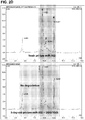
- RNA interference (RNAi)-associated gene silencing effect after comparing fresh and 3-day-old miR-302 precursor samples (Example 1) dissolved in autoclaved normal saline and then store at room temperature, we found that over 69% of pre-miR-302 (mostly 1-hairpin precursors) and pri-miR-302 (4-hairpin cluster) were quickly degraded within three days, which is too short to elicit any RNA interference (RNAi)-associated gene silencing effect.
- Pri-miR-302 the primary RNA transcript of the miR-302 familial cluster gene ( FIG. 2B ; SEQ.ID.NO.1), can be processed into one or more pre-miRNA (i.e.
- pre-miR-302 molecules by Drosha/Pasha digestion (to form exonic pre-miRNA), spliceosomal splicing/excision (to form intronic pre-miRNA), or hydrolysis.
- Pre-miR-302 is the functional form of miR-302 precursor that can be further processed by RNase III Dicer and assembled into an RNA-induced silencing complex (RISC) for eliciting its specific gene silencing effects. As shown in FIG.
- RISC RNA-induced silencing complex
- pre-miR-302 isoforms
- pre-miR-302a SEQ.ID.NO.2
- pre-miR-302b SEQ.ID.NO.3
- pre-miR-302c SEQ.ID.NO.4
- pre-miR-302d SEQ.ID.NO.5
- glycylated sugar alcohols i.e. MGG/DGG/TGG
- the final concentration of glycylated sugar alcohol solution used to dissolve RNA/DNA can be ranged from about 0.1 ⁇ M to about 10 M, most preferably about 0.05 M to 1.5 M.
- the maximal solubility of RNA/DNA in MGG/DGG/TGG solution is up to 12-15 mg/mL. As shown in FIG. 2D , we found almost no degradation in these sugar-alcohol-treated samples three days later in normal saline at room temperature.
- glycylated sugar alcohols can preserve the integrity of hairpin-like RNA structures and hence prevent the degradation of these hairpin RNAs, such as microRNA precursors (miRNA), small hairpin RNAs (shRNA), short interfering RNAs (siRNA), and ribozymes.
- miRNA microRNA precursors
- shRNA small hairpin RNAs
- siRNA short interfering RNAs
- ribozymes RNAi-associated gene silencing effects require at least a three-day period of activation time to be fully effective
- the novel sugar alcohol composition found in the present invention is surely useful for stabilizing the structures of these hairpin RNAs long enough to elicit their specific gene silencing effects.
- the present invention can be applied to preserve both the structural integrity and functional efficacy of these functional hairpin RNAs in a variety of cosmedical, pharmaceutical and therapeutic products as well as applications.
- miR-302 precursors i.e. pri- and pre-miR-302s
- competent cells transfected with the miR-302 familial cluster gene Example 1
- tried to deliver 400 ⁇ g of the isolated miR-302 precursors with 1.0 M DGG/TGG into approximately 2 ⁇ 4 million human keratinocytes grown in 2 ml cell culture medium Example 3
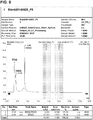
- concentrated DGG/TGG was further purified from the mixture solution of MGG/DGG/TGG using HPLC ( FIG. 8 ). As shown in FIGs.
- microarray results revealed that these isolated miR-302 precursors were successfully delivered into the target cells and further processed into mature miR-302 molecules (e.g . miR-302a, b, c, d and miR-302a*, b*, c*, d*), indicating that glycylated sugar alcohols not only can efficiently deliver these hairpin RNAs into human cells but also facilitate their assembly into RISCs for eliciting their desired functions. Also, since keratinocytes do not express any miR-302 ( FIG. 3A ), the highly abundant miR-302 molecules found in the treated keratinocytes ( FIG.
- the results of FIG. 4C clearly demonstrate the high efficiency of glycylated sugar/sugar alcohol-mediated miRNA/shRNA/siRNA delivery in vivo. Since tumor/cancer cells absorb sugar-like materials much more quickly than normal cells, the glycylated sugar/sugar alcohol-encapsulated miRNAs/shRNAs/siRNAs can be easily uptake by tumors/cancers in vivo. It is also noted that these glycylated sugars/sugar alcohols not only deliver the encapsulated RNAs but also successfully introduce the delivered RNA functions into targeted cells.
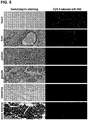
- siR-302 molecules were all labeled with infra-red fluorescent dye Cy5.5, we could detect their in-vivo tissue distribution using a bio-imaging system or directly observe their fluorescent signals in mouse tissue sections under a fluorescent microscope.
- FIG. 5 after microscopic examination of various tissue/organ sections collected from the injected mice, we found that the majority of Cy5.5-labeled siRNA molecules were delivered into heart, liver, spleen and blood vessel endothelial cells as well as sporadically detected in bone marrow and lung cells, confirming the delivery efficiency of glycylated sugar/sugar alcohol-encapsulated nucleic acid compositions in vivo.
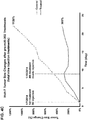
- the other 4 mice with the same sugar-alcohol-encapsulated siR-302 injection showed no adverse effect during the whole two-week experiment time ( FIG. 6 ), further revealing the in-vivo safety of this novel delivery composition and method.
- nucleic acid compositions may include, but not limited, microRNA precursors (miRNA), small hairpin RNAs (shRNA), short interfering RNAs (siRNA), ribozymes, antisense RNAs/DNAs, RNA-DNA hybrids and DNA vectors/vaccines.
- miRNA microRNA precursors
- shRNA small hairpin RNAs
- siRNA short interfering RNAs
- ribozymes antisense RNAs/DNAs
- RNA-DNA hybrids DNA vectors/vaccines.
- a composition and its use for formulating nucleic acid compositions with sugar alcohols into delivery complexes for both in-vitro and in-vivo delivery into mammalian cells comprising: (a) at least a nucleic acid composition with at least a negative charge, and (b) at least a sugar alcohol or sugar modified by glycylation; wherein (a) and (b) are mixed together under a condition to form delivery complexes.
- the nucleic acid composition can be microRNA precursors (miRNA), small hairpin RNAs (shRNA), short interfering RNAs (siRNA), ribozymes, antisense RNAs/DNAs, RNA-DNA hybrids, DNA vectors/vaccines, and a combination thereof.
- the condition required for the delivery complex formation is below pH8.0, of which the pH value is preferred to be about pH2.5 to about pH7.0.
- the present invention teaches a novel method of glycylation and its use for generating positively charged sugar alcohol and/or sugar compounds capable of interacting with negatively charged nucleic acid compositions via ionic binding and/or electrostatic affinity rather than covalent conjugation or hydrogen bonding ( FIG. 7 ).
- the attached sugars/sugar alcohols can then repel water molecules away from the RNA/DNA backbones, so as to prevent hydrolysis and thus protect the intact structures of these nucleic acid compositions for better delivery of their drug effects into cells in vivo as well as in vitro.
- the present invention discovered for the first time that chemical compounds containing sugar alcohols and/or sugars can protect the integrity of nucleic acid compositions, such as miRNA, shRNA, siRNA, ribozyme and DNA, from degradation.
- nucleic acid compositions such as miRNA, shRNA, siRNA, ribozyme and DNA
- the present invention is not only a composition and its use for delivering nucleic acid-based drugs/vaccines into cells but also a material formula for preserving the structural integrity and functional efficacy of these nucleic acid-based drugs and/or vaccines in vivo as well as in vitro. Due to these novel features, the present invention is very useful for developing and/or improving a variety of nucleic acid-based cosmetic, pharmaceutical and therapeutic applications.
- RNA ribonucleic acid
- DNA deoxyribonucleic acid
- dNTP deoxyribonucleotide triphosphate
- PBS phosphate buffered saline
- NaCl sodium chloride
- HEPES N-2-hydroxyethylpiperazine-N-2-ethanesulfonic acid
- HBS HBS buffered saline
- SDS sodium dodecylsulfate
- Tris-HCl tris-hydroxymethylaminomethane-hydrochlor
- Dicer-negative cells were acquired from Zymo Research (Irvine, CA), transduced with a pre-made miR-302 expression lentiviral vector pLenti-EF1alpha-RGFP-miR302 (Mello Biotech, Santa Fe Springs, CA), and maintained according to manufacturers' suggestions.
- MicroRNAs were isolated with a mir VanaTM miRNA isolation kit (Ambion, Austin, TX), following the manufacturer's protocol. The isolated RNAs (pri-/pre-miR-302) were dissolved in autoclaved 1x TE buffer and stored at -80°C till use.
- RNAs were re-collected with an Amicon Ultra-0.5mL 30K filter column (Millipore, Billerica, MA) and re-dissolved in autoclaved normal saline.
- synthetic miR-302 mimics were purchased from Sigma-Genosys (St. Louis, MO), containing two cyanine 5.5 (Cy5.5)-labeled RNA sequences: 5'-Cy5.5-UAAGUGCUUC CAUGUUUUAG UGU-3' (SEQ.ID.NO.6) and 5'-Cy5.5-ACACUAAAAC AUGGAAGCAC UUA-3' (SEQ.ID.NO.7).
- siR-302 was formed by the hybrids of SEQ.ID.NO.6 and SEQ.ID.NO.7.
- glycylation For activating glycylation, about a final concentration of 0.05-3.0 M glycine was added, depending on the desired concentration of final glycylated sugar alcohols/sugars, into the pre-made base solution and mixed well. Then, the glycine-added solution was kept strictly under a neutral to slightly acidic condition and incubated at a temperature over 45°C, preferably 75°C ⁇ 175°C, for >30 min, preferably about 12 ⁇ 24 hours. Optionally, after that, 0.1 M mannitol was added to absorb any excessive glycine and the solution was further incubated over 45°C for another 12 ⁇ 24 hours.
- the glycylation of sugar alcohols/sugars was completed and this final solution was ready to be used for formulating and delivering negatively charged materials.
- the formulation is simply done by mixing the glycylated sugars/sugar alcohols with desired nucleic acid compositions. After that, the electrostatic/charge affinity between the glycylated sugar alcohols/sugars and nucleic acid compositions will form encapsulated delivery complexes ( FIG. 7 ), which can then be absorbed by cells through active endocytosis.
- FIGs. 1A and 1B For demonstration, a schematic glycylation reaction using glycerol as an example was shown in FIGs. 1A and 1B .
- Human keratinocytes was purchased from Invitrogen and cultivated in EpiLife serum-free cell culture medium supplemented with human keratinocyte growth supplements (HKGS, Invitrogen, Carlsbad, CA) in the absence of antibiotics at 37°C under 5% CO 2 .
- Cells were passaged at about 50%-70% confluence by exposing the cells to trypsin/EDTA for about 1 min and then rinsing two times in HBSS containing trypsin inhibitor. The detached cells were replated at 1:5 dilution in fresh EpiLife medium with HKGS supplements.
- human liver cancer cell line HepG2 was obtained from ATCC and maintained according to manufacturer's suggestions.
- pri-/pre-miR-302 prepared from Example 1 was dissolved in 0.1 ⁇ 1.0 M of MGG/DGG/TGG solution at a desired concentration up to 5-10 mg/mL and then directly applied to cell culture medium based on the miRNA amount needed. For example, to deliver 200 ⁇ g pri-/pre-miR-302, we would need to add 40 ⁇ l of the MGG/DGG/TGG-dissolved pri-/pre-miR-302 (at 5 mg/ml) into the cell culture medium and then mix well with the cells.
- MGG/DGG/TGG is extremely safe and non-toxic, the tested cells could be cultivated in 0.1 M MGG/DGG/TGG with all necessary supplements and still not showing any adverse effect up to 48 hours.
- the maximal transfection amount of miRNA/shRNA/siRNA with 0.1 M MGG/DGG/TGG is estimated to be about 10 mg, indicating a highly efficient delivery level that none of the previously reported liposomal and sugar-based delivery agents can achieve.
- a reverse-phase HPLC method was developed for analyzing the purity and structural integrity of miR-302 and its precursors (i.e. pri-/pre-miR-302s).
- HPLC programs were run by an Ultimate 3000 HPLC machine (Thermo Scientific) with a DNA Pac PA-100 column (BioLC Semi-Prep 9x250 mm) at a flow rate of 3.6 ml/min.
- Starting buffer was 50 mM Tris-HCl (pH7.6) and mobile buffer was 50 mM Tris-HCl (pH7.6) with 500 mM sodium perchlorate.
- Signals of RNAs and DNAs were measured with an UV detector at 260 nm. The results were shown in FIGs. 2A and 2D as well as FIG. 8 .
- RNAs from each cell culture were isolated, respectively, using the mir VanaTM miRNA isolation kit (Ambion). The purity and quantity of the isolated RNAs were assessed, using 1% formaldehyde-agarose gel electrophoresis and spectrophotometer measurement (Bio-Rad), and then immediately frozen in dry ice and submitted to LC Sciences (San Diego, CA) for miRNA microarray analyses. Each microarray chip was hybridized with a single sample labeled with either Cy3 or Cy5 or a pair of samples labeled with Cy3 and Cy5, respectively. Background subtraction and normalization were performed as manufacturer's suggestions.
- FIGs. 3A and 3B which compared the RNAs extracted from non-treated blank keratinocytes (3A) to those extracted from DGG/TGG-mediated miR-302-transfected keratinocytes (3B).
Landscapes
- Health & Medical Sciences (AREA)
- Chemical & Material Sciences (AREA)
- Life Sciences & Earth Sciences (AREA)
- Epidemiology (AREA)
- Veterinary Medicine (AREA)
- Public Health (AREA)
- General Health & Medical Sciences (AREA)
- Animal Behavior & Ethology (AREA)
- Medicinal Chemistry (AREA)
- Pharmacology & Pharmacy (AREA)
- General Chemical & Material Sciences (AREA)
- Oil, Petroleum & Natural Gas (AREA)
- Chemical Kinetics & Catalysis (AREA)
- Engineering & Computer Science (AREA)
- Proteomics, Peptides & Aminoacids (AREA)
- Biochemistry (AREA)
- Molecular Biology (AREA)
- Pharmaceuticals Containing Other Organic And Inorganic Compounds (AREA)
- Medicines That Contain Protein Lipid Enzymes And Other Medicines (AREA)
- Medicinal Preparation (AREA)
Claims (16)
- Zusammensetzung zum Formulieren von Nucleinsäurezusammensetzungen mit Zucker und Zuckeralkoholen als stabile Komplexe für sowohl In-vitro- als auch In-vivo-Zuführung zu Säugetierzellen, die Folgendes umfasst:(a) wenigstens eine Nucleinsäurezusammensetzung mit wenigstens einer negativen Ladung;(b) wenigstens eine durch Glycylierung modifizierte Zucker- oder Zuckeral koholzusammensetzung;wobei der Zuckeralkohol die Formel H(HCHO)n+1H hat und der Zucker die Formel H(HCHO)nHCO hat, (a) und (b) unter einer Bedingung miteinander gemischt werden, um wenigstens einen Zuführungskomplex zu bilden.
- Zusammensetzung nach Anspruch 1, wobei die genannte Nucleinsäurezusammensetzung RNA oder DNA ist.
- Zusammensetzung nach Anspruch 2, wobei die genannte Nucleinsäurezusammensetzung ausgewählt ist aus der Gruppe bestehend aus miRNA, microRNA-Vorläufern, Small hairpin RNAs (shRNA), Short interfering RNAs (siRNA), Ribozymen, Antisense-RNAs/DNAs, RNA-DNA-Hybriden, DNA-Vektoren/Impfstoffen und einer Kombination davon.
- Zusammensetzung nach Anspruch 1, wobei die genannte Zucker- oder Zuckeralkoholzusammensetzung ausgewählt ist aus der Gruppe bestehend aus Glucose, Fructose, Galactose, Saccharose, Lactose, Alditol, Arabitol, Erythritol, Fucitol, Galactitol, Glycerol (Glycerin), Iditol, Inositol, Isomalt, Lactitol, Maltitol, Mannitol, Polyglycitol, Sorbitol, Threitol, Volemitol, Xylitol und einer Kombination davon.
- Zusammensetzung nach Anspruch 1, wobei die genannte wenigstens eine durch Glycylierung modifizierte Zucker- oder Zuckeralkoholzusammensetzung ein Gemisch aus Diglycylglycerol und Triglycylglycerid enthält.
- Zusammensetzung nach Anspruch 1, wobei die genannte durch Glycylierung modifizierte Zucker- oder Zuckeralkoholzusammensetzung positiv geladen ist.
- Zusammensetzung nach Anspruch 1, wobei die Konzentration der genannten modifizierten Zucker- oder Zuckeralkoholzusammensetzung zur Formulierung von Nucleinsäurezusammensetzungen im Bereich von 0,1 µM bis 10 M liegt.
- Zusammensetzung nach Anspruch 1, wobei eine maximale Löslichkeit der genannten Nucleinsäurezusammensetzung in der modifizierten Zucker- oder Zuckeralkoholzusammensetzung in einer Lösung bis zu 15 mg/ml beträgt.
- Zusammensetzung nach Anspruch 1, wobei die genannte modifizierte Zucker- oder Zuckeralkoholzusammensetzung die genannten Nucleinsäurezusammensetzungen vor Abbau schützt.
- Zusammensetzung nach Anspruch 1, wobei die genannte modifizierte Zucker- oder Zuckeralkoholzusammensetzung die Zuführungsleistung der genannten Nucleinsäurezusammensetzungen zu Säugerzellen in vitro sowie in vivo erhöht.
- Zusammensetzung nach Anspruch 1, wobei die genannte Bedingung ein pH-Wert unter 8,0 ist.
- Zusammensetzung nach Anspruch 11, wobei die genannte Bedingung ein pH-Wert zwischen 2,5 und 7,0 ist.
- Zusammensetzung nach Anspruch 1, wobei der genannte Zuführungskomplex durch die ionische oder elektrostatische Affinität gebildet wird, die zwischen der modifizierten Zucker- oder Zuckeralkoholzusammensetzung und der Nucleinsäurezusammensetzung auftritt.
- Zusammensetzung nach Anspruch 1, wobei die genannte Glycylierung eine chemische Reaktion ist, bei der wenigstens eine Hydroxylgruppe des Zuckers oder des Zuckeralkohols durch wenigstens eine Glycylgruppe von einem Glycin oder einer glycylierten Aminosäure ersetzt wird.
- Zusammensetzung nach einem der vorherigen Ansprüche, wobei der genannte Zuführungskomplex zur Verwendung in kosmetischen, pharmazeutischen und therapeutischen Anwendungen vorgesehen ist.
- Verfahren zum Zuführen von Nucleinsäuren zu Zellen in vitro, das Folgendes beinhaltet:Mischen eines Gemischs aus wenigstens einem Zucker oder Zuckeralkohol mit einer Hydroxylgruppe und wenigstens einer Aminosäure mit einer Struktur einer Glycylgruppe, undMischen des genannten Gemischs und wenigstens einer Nucleinsäurezusammensetzung, um eine Formulierungszusammensetzung zu bilden, wobei die genannte Formulierungszusammensetzung wenigstens einen glycylierten Zucker oder glycylierten Zuckeralkohol umfasst, der mit der genannten Nucleinsäurezusammensetzung über ionische oder elektrostatische Affinität interagiert und einen Zuführungskomplex bei einem pH-Wert unter 8,0 bildet; undAnwenden des genannten Zuführungskomplexes an den Zellen.
Applications Claiming Priority (3)
| Application Number | Priority Date | Filing Date | Title |
|---|---|---|---|
| US14/142,512 US9399773B2 (en) | 2012-08-10 | 2013-12-27 | Production and extraction of MicroRNA precursor as drug for cancer therapy |
| US201461931650P | 2014-01-26 | 2014-01-26 | |
| PCT/US2014/050114 WO2015099839A1 (en) | 2013-12-27 | 2014-08-07 | Novel sugar alcohol-based compositions for delivering nucleic acid-based drugs in vivo and in vitro |
Publications (2)
| Publication Number | Publication Date |
|---|---|
| EP3086812A1 EP3086812A1 (de) | 2016-11-02 |
| EP3086812B1 true EP3086812B1 (de) | 2019-07-03 |
Family
ID=51422144
Family Applications (1)
| Application Number | Title | Priority Date | Filing Date |
|---|---|---|---|
| EP14756158.3A Active EP3086812B1 (de) | 2013-12-27 | 2014-08-07 | Neuartige zuckeralkoholbasierte zusammensetzungen zur freisetzung von nukleinsäurebasierten arzneimitteln in-vivo und in-vitro |
Country Status (5)
| Country | Link |
|---|---|
| EP (1) | EP3086812B1 (de) |
| JP (1) | JP6521981B2 (de) |
| CN (1) | CN106102777B (de) |
| TW (1) | TWI702044B (de) |
| WO (1) | WO2015099839A1 (de) |
Families Citing this family (6)
| Publication number | Priority date | Publication date | Assignee | Title |
|---|---|---|---|---|
| US9956196B2 (en) * | 2014-01-26 | 2018-05-01 | Wjwu & Lynn Institute For Stem Cell Research And Mello Biotechnology | Use of monosaccharide-like glycylated sugar alcohol compositions for designing and developing anti-diabetic drugs |
| JP6535686B2 (ja) * | 2014-01-26 | 2019-06-26 | ダブリュジェイウー アンド リン インスティチュート フォー ステム セル リサーチWJWU & LYNN Institute for Stem Cell Research | 新規な単糖様グリシン化糖アルコール組成物の抗糖尿病薬の設計及び開発への使用方法 |
| WO2017052403A1 (ru) * | 2015-09-25 | 2017-03-30 | Анатолий Викторович ЗАЗУЛЯ | Изготовление таблетки с механизмом повышения терапевтической эффективности лекарственного средства нанодозой микрорнк |
| EP3464591A4 (de) * | 2016-05-27 | 2020-02-19 | Shi-Lung Lin | Zusammensetzung und verfahren zur verwendung von mir-302-vorläufern als mittel gegen krebs zur behandlung von lungenkrebs beim menschen |
| KR20190011213A (ko) * | 2017-07-24 | 2019-02-01 | 한양대학교 에리카산학협력단 | 줄기세포로부터 추출된 엑소좀을 유효성분으로 포함하는 골다공증 예방 또는 치료용 조성물 |
| TWI788643B (zh) * | 2019-09-29 | 2023-01-01 | 美洛生物科技股份有限公司 | 新穎三甲基甘胺醯甘油組成物及其發展抗癌症藥物及rna疫苗上的用途 |
Family Cites Families (4)
| Publication number | Priority date | Publication date | Assignee | Title |
|---|---|---|---|---|
| US6210717B1 (en) * | 1997-12-12 | 2001-04-03 | Samyang Corporation | Biodegradable mixed polymeric micelles for gene delivery |
| US6251599B1 (en) * | 1998-11-06 | 2001-06-26 | Selective Genetics, Inc. | Stabilized nucleic acid compositions and methods of preparation and use thereof |
| CN101138636B (zh) * | 2006-09-05 | 2010-05-12 | 中国科学院上海药物研究所 | 一种基因药物的输送系统及其制备方法 |
| US9394538B2 (en) * | 2008-05-07 | 2016-07-19 | Shi-Lung Lin | Development of universal cancer drugs and vaccines |
-
2014
- 2014-08-07 EP EP14756158.3A patent/EP3086812B1/de active Active
- 2014-08-07 JP JP2016543180A patent/JP6521981B2/ja active Active
- 2014-08-07 WO PCT/US2014/050114 patent/WO2015099839A1/en not_active Ceased
- 2014-08-07 CN CN201480068614.1A patent/CN106102777B/zh not_active Expired - Fee Related
-
2015
- 2015-07-28 TW TW104124441A patent/TWI702044B/zh active
Non-Patent Citations (1)
| Title |
|---|
| None * |
Also Published As
| Publication number | Publication date |
|---|---|
| TW201628629A (zh) | 2016-08-16 |
| CN106102777A (zh) | 2016-11-09 |
| JP2017502959A (ja) | 2017-01-26 |
| EP3086812A1 (de) | 2016-11-02 |
| TWI702044B (zh) | 2020-08-21 |
| WO2015099839A1 (en) | 2015-07-02 |
| CN106102777B (zh) | 2019-12-17 |
| JP6521981B2 (ja) | 2019-05-29 |
Similar Documents
| Publication | Publication Date | Title |
|---|---|---|
| US9387251B2 (en) | Sugar alcohol-based compositions for delivering nucleic acid-based drugs in vivo and in vitro | |
| Martino et al. | MicroRNA in cancer therapy: breakthroughs and challenges in early clinical applications | |
| EP3086812B1 (de) | Neuartige zuckeralkoholbasierte zusammensetzungen zur freisetzung von nukleinsäurebasierten arzneimitteln in-vivo und in-vitro | |
| Hosseinahli et al. | Treating cancer with microRNA replacement therapy: A literature review | |
| EP2796150B1 (de) | Neuartige oligonucleotidkonjugate und verwendung davon | |
| EP3018208B1 (de) | Verbesserte oligonukleotid-nanopartikel struktur mit hoher effizienz und verfahren zur herstellung davon | |
| Asakiya et al. | Current progress of miRNA-derivative nucleotide drugs: modifications, delivery systems, applications | |
| CN107988227A (zh) | 高效率的纳米颗粒型双螺旋寡rna结构体及其制备方法 | |
| Hashemi et al. | MicroRNA: Promising roles in cancer therapy | |
| CN112368382A (zh) | 用于预防和治疗纤维化相关疾病和呼吸系统疾病的双调蛋白基因特异性双链寡核苷酸和包含其的组合物 | |
| JP2023002469A (ja) | 抗ウイルス及び抗がんワクチンに用いる新規なmRNA組成物及びその製造方法 | |
| TW201842923A (zh) | 包含mir-302前驅體的組合物在製造用於肺癌治療之藥物上的用途 | |
| JP5744375B2 (ja) | イントロンrna技術を用いる組み換え型核酸組成物及び同組み換え型核酸組成物を含む化粧品 | |
| WO2021234647A1 (ko) | 이중가닥 올리고뉴클레오티드 및 이를 포함하는 코로나바이러스감염증-19(covid-19) 치료용 조성물 | |
| US11015197B2 (en) | Therapeutic agent for treating cancer comprising anti-miRNA-albumin composite | |
| EP4289952A1 (de) | Chemisch modifizierte kleine aktivierende rna | |
| US11326164B2 (en) | Trimethylglycylglycerin compositions and their use in developing anti-cancer drugs and RNA vaccines | |
| EP3115454A1 (de) | Neuartige rna-sequenz mit antitumorwirkung | |
| US9617538B2 (en) | Heptamer-type small guide nucleic acids inducing apoptosis of human leukemia cells | |
| Patil et al. | MicroRNAs As Promising Therapeutic Targets | |
| ES2764699T3 (es) | Molécula de miARN definida por su fuente y sus usos diagnósticos y terapéuticos en enfermedades o afecciones asociadas a la TEM |
Legal Events
| Date | Code | Title | Description |
|---|---|---|---|
| PUAI | Public reference made under article 153(3) epc to a published international application that has entered the european phase |
Free format text: ORIGINAL CODE: 0009012 |
|
| 17P | Request for examination filed |
Effective date: 20160615 |
|
| AK | Designated contracting states |
Kind code of ref document: A1 Designated state(s): AL AT BE BG CH CY CZ DE DK EE ES FI FR GB GR HR HU IE IS IT LI LT LU LV MC MK MT NL NO PL PT RO RS SE SI SK SM TR |
|
| AX | Request for extension of the european patent |
Extension state: BA ME |
|
| DAX | Request for extension of the european patent (deleted) | ||
| GRAP | Despatch of communication of intention to grant a patent |
Free format text: ORIGINAL CODE: EPIDOSNIGR1 |
|
| STAA | Information on the status of an ep patent application or granted ep patent |
Free format text: STATUS: GRANT OF PATENT IS INTENDED |
|
| INTG | Intention to grant announced |
Effective date: 20190114 |
|
| RAP1 | Party data changed (applicant data changed or rights of an application transferred) |
Owner name: WU, DAVID TS Owner name: LIN, SHI-LUNG |
|
| GRAS | Grant fee paid |
Free format text: ORIGINAL CODE: EPIDOSNIGR3 |
|
| GRAA | (expected) grant |
Free format text: ORIGINAL CODE: 0009210 |
|
| STAA | Information on the status of an ep patent application or granted ep patent |
Free format text: STATUS: THE PATENT HAS BEEN GRANTED |
|
| AK | Designated contracting states |
Kind code of ref document: B1 Designated state(s): AL AT BE BG CH CY CZ DE DK EE ES FI FR GB GR HR HU IE IS IT LI LT LU LV MC MK MT NL NO PL PT RO RS SE SI SK SM TR |
|
| REG | Reference to a national code |
Ref country code: GB Ref legal event code: FG4D |
|
| REG | Reference to a national code |
Ref country code: AT Ref legal event code: REF Ref document number: 1150182 Country of ref document: AT Kind code of ref document: T Effective date: 20190715 Ref country code: CH Ref legal event code: EP |
|
| REG | Reference to a national code |
Ref country code: IE Ref legal event code: FG4D |
|
| REG | Reference to a national code |
Ref country code: DE Ref legal event code: R096 Ref document number: 602014049491 Country of ref document: DE |
|
| REG | Reference to a national code |
Ref country code: NL Ref legal event code: FP |
|
| REG | Reference to a national code |
Ref country code: CH Ref legal event code: NV Representative=s name: ISLER AND PEDRAZZINI AG, CH |
|
| REG | Reference to a national code |
Ref country code: LT Ref legal event code: MG4D |
|
| REG | Reference to a national code |
Ref country code: AT Ref legal event code: MK05 Ref document number: 1150182 Country of ref document: AT Kind code of ref document: T Effective date: 20190703 |
|
| PG25 | Lapsed in a contracting state [announced via postgrant information from national office to epo] |
Ref country code: LT Free format text: LAPSE BECAUSE OF FAILURE TO SUBMIT A TRANSLATION OF THE DESCRIPTION OR TO PAY THE FEE WITHIN THE PRESCRIBED TIME-LIMIT Effective date: 20190703 Ref country code: CZ Free format text: LAPSE BECAUSE OF FAILURE TO SUBMIT A TRANSLATION OF THE DESCRIPTION OR TO PAY THE FEE WITHIN THE PRESCRIBED TIME-LIMIT Effective date: 20190703 Ref country code: PT Free format text: LAPSE BECAUSE OF FAILURE TO SUBMIT A TRANSLATION OF THE DESCRIPTION OR TO PAY THE FEE WITHIN THE PRESCRIBED TIME-LIMIT Effective date: 20191104 Ref country code: HR Free format text: LAPSE BECAUSE OF FAILURE TO SUBMIT A TRANSLATION OF THE DESCRIPTION OR TO PAY THE FEE WITHIN THE PRESCRIBED TIME-LIMIT Effective date: 20190703 Ref country code: BG Free format text: LAPSE BECAUSE OF FAILURE TO SUBMIT A TRANSLATION OF THE DESCRIPTION OR TO PAY THE FEE WITHIN THE PRESCRIBED TIME-LIMIT Effective date: 20191003 Ref country code: NO Free format text: LAPSE BECAUSE OF FAILURE TO SUBMIT A TRANSLATION OF THE DESCRIPTION OR TO PAY THE FEE WITHIN THE PRESCRIBED TIME-LIMIT Effective date: 20191003 Ref country code: AT Free format text: LAPSE BECAUSE OF FAILURE TO SUBMIT A TRANSLATION OF THE DESCRIPTION OR TO PAY THE FEE WITHIN THE PRESCRIBED TIME-LIMIT Effective date: 20190703 Ref country code: SE Free format text: LAPSE BECAUSE OF FAILURE TO SUBMIT A TRANSLATION OF THE DESCRIPTION OR TO PAY THE FEE WITHIN THE PRESCRIBED TIME-LIMIT Effective date: 20190703 Ref country code: FI Free format text: LAPSE BECAUSE OF FAILURE TO SUBMIT A TRANSLATION OF THE DESCRIPTION OR TO PAY THE FEE WITHIN THE PRESCRIBED TIME-LIMIT Effective date: 20190703 |
|
| PG25 | Lapsed in a contracting state [announced via postgrant information from national office to epo] |
Ref country code: RS Free format text: LAPSE BECAUSE OF FAILURE TO SUBMIT A TRANSLATION OF THE DESCRIPTION OR TO PAY THE FEE WITHIN THE PRESCRIBED TIME-LIMIT Effective date: 20190703 Ref country code: IS Free format text: LAPSE BECAUSE OF FAILURE TO SUBMIT A TRANSLATION OF THE DESCRIPTION OR TO PAY THE FEE WITHIN THE PRESCRIBED TIME-LIMIT Effective date: 20191103 Ref country code: ES Free format text: LAPSE BECAUSE OF FAILURE TO SUBMIT A TRANSLATION OF THE DESCRIPTION OR TO PAY THE FEE WITHIN THE PRESCRIBED TIME-LIMIT Effective date: 20190703 Ref country code: GR Free format text: LAPSE BECAUSE OF FAILURE TO SUBMIT A TRANSLATION OF THE DESCRIPTION OR TO PAY THE FEE WITHIN THE PRESCRIBED TIME-LIMIT Effective date: 20191004 Ref country code: LV Free format text: LAPSE BECAUSE OF FAILURE TO SUBMIT A TRANSLATION OF THE DESCRIPTION OR TO PAY THE FEE WITHIN THE PRESCRIBED TIME-LIMIT Effective date: 20190703 Ref country code: AL Free format text: LAPSE BECAUSE OF FAILURE TO SUBMIT A TRANSLATION OF THE DESCRIPTION OR TO PAY THE FEE WITHIN THE PRESCRIBED TIME-LIMIT Effective date: 20190703 |
|
| PG25 | Lapsed in a contracting state [announced via postgrant information from national office to epo] |
Ref country code: TR Free format text: LAPSE BECAUSE OF FAILURE TO SUBMIT A TRANSLATION OF THE DESCRIPTION OR TO PAY THE FEE WITHIN THE PRESCRIBED TIME-LIMIT Effective date: 20190703 |
|
| PG25 | Lapsed in a contracting state [announced via postgrant information from national office to epo] |
Ref country code: EE Free format text: LAPSE BECAUSE OF FAILURE TO SUBMIT A TRANSLATION OF THE DESCRIPTION OR TO PAY THE FEE WITHIN THE PRESCRIBED TIME-LIMIT Effective date: 20190703 Ref country code: IT Free format text: LAPSE BECAUSE OF FAILURE TO SUBMIT A TRANSLATION OF THE DESCRIPTION OR TO PAY THE FEE WITHIN THE PRESCRIBED TIME-LIMIT Effective date: 20190703 Ref country code: DK Free format text: LAPSE BECAUSE OF FAILURE TO SUBMIT A TRANSLATION OF THE DESCRIPTION OR TO PAY THE FEE WITHIN THE PRESCRIBED TIME-LIMIT Effective date: 20190703 Ref country code: PL Free format text: LAPSE BECAUSE OF FAILURE TO SUBMIT A TRANSLATION OF THE DESCRIPTION OR TO PAY THE FEE WITHIN THE PRESCRIBED TIME-LIMIT Effective date: 20190703 Ref country code: RO Free format text: LAPSE BECAUSE OF FAILURE TO SUBMIT A TRANSLATION OF THE DESCRIPTION OR TO PAY THE FEE WITHIN THE PRESCRIBED TIME-LIMIT Effective date: 20190703 |
|
| PG25 | Lapsed in a contracting state [announced via postgrant information from national office to epo] |
Ref country code: SK Free format text: LAPSE BECAUSE OF FAILURE TO SUBMIT A TRANSLATION OF THE DESCRIPTION OR TO PAY THE FEE WITHIN THE PRESCRIBED TIME-LIMIT Effective date: 20190703 Ref country code: MC Free format text: LAPSE BECAUSE OF FAILURE TO SUBMIT A TRANSLATION OF THE DESCRIPTION OR TO PAY THE FEE WITHIN THE PRESCRIBED TIME-LIMIT Effective date: 20190703 Ref country code: IS Free format text: LAPSE BECAUSE OF FAILURE TO SUBMIT A TRANSLATION OF THE DESCRIPTION OR TO PAY THE FEE WITHIN THE PRESCRIBED TIME-LIMIT Effective date: 20200224 Ref country code: LU Free format text: LAPSE BECAUSE OF NON-PAYMENT OF DUE FEES Effective date: 20190807 Ref country code: SM Free format text: LAPSE BECAUSE OF FAILURE TO SUBMIT A TRANSLATION OF THE DESCRIPTION OR TO PAY THE FEE WITHIN THE PRESCRIBED TIME-LIMIT Effective date: 20190703 |
|
| REG | Reference to a national code |
Ref country code: BE Ref legal event code: MM Effective date: 20190831 |
|
| REG | Reference to a national code |
Ref country code: DE Ref legal event code: R097 Ref document number: 602014049491 Country of ref document: DE |
|
| PLBE | No opposition filed within time limit |
Free format text: ORIGINAL CODE: 0009261 |
|
| STAA | Information on the status of an ep patent application or granted ep patent |
Free format text: STATUS: NO OPPOSITION FILED WITHIN TIME LIMIT |
|
| PG2D | Information on lapse in contracting state deleted |
Ref country code: IS |
|
| PG25 | Lapsed in a contracting state [announced via postgrant information from national office to epo] |
Ref country code: IE Free format text: LAPSE BECAUSE OF NON-PAYMENT OF DUE FEES Effective date: 20190807 |
|
| 26N | No opposition filed |
Effective date: 20200603 |
|
| PG25 | Lapsed in a contracting state [announced via postgrant information from national office to epo] |
Ref country code: BE Free format text: LAPSE BECAUSE OF NON-PAYMENT OF DUE FEES Effective date: 20190831 Ref country code: SI Free format text: LAPSE BECAUSE OF FAILURE TO SUBMIT A TRANSLATION OF THE DESCRIPTION OR TO PAY THE FEE WITHIN THE PRESCRIBED TIME-LIMIT Effective date: 20190703 |
|
| PG25 | Lapsed in a contracting state [announced via postgrant information from national office to epo] |
Ref country code: CY Free format text: LAPSE BECAUSE OF FAILURE TO SUBMIT A TRANSLATION OF THE DESCRIPTION OR TO PAY THE FEE WITHIN THE PRESCRIBED TIME-LIMIT Effective date: 20190703 |
|
| PG25 | Lapsed in a contracting state [announced via postgrant information from national office to epo] |
Ref country code: HU Free format text: LAPSE BECAUSE OF FAILURE TO SUBMIT A TRANSLATION OF THE DESCRIPTION OR TO PAY THE FEE WITHIN THE PRESCRIBED TIME-LIMIT; INVALID AB INITIO Effective date: 20140807 Ref country code: MT Free format text: LAPSE BECAUSE OF FAILURE TO SUBMIT A TRANSLATION OF THE DESCRIPTION OR TO PAY THE FEE WITHIN THE PRESCRIBED TIME-LIMIT Effective date: 20190703 |
|
| PG25 | Lapsed in a contracting state [announced via postgrant information from national office to epo] |
Ref country code: MK Free format text: LAPSE BECAUSE OF FAILURE TO SUBMIT A TRANSLATION OF THE DESCRIPTION OR TO PAY THE FEE WITHIN THE PRESCRIBED TIME-LIMIT Effective date: 20190703 |
|
| PGFP | Annual fee paid to national office [announced via postgrant information from national office to epo] |
Ref country code: NL Payment date: 20220830 Year of fee payment: 9 |
|
| PGFP | Annual fee paid to national office [announced via postgrant information from national office to epo] |
Ref country code: FR Payment date: 20220830 Year of fee payment: 9 |
|
| PGFP | Annual fee paid to national office [announced via postgrant information from national office to epo] |
Ref country code: CH Payment date: 20220901 Year of fee payment: 9 |
|
| REG | Reference to a national code |
Ref country code: CH Ref legal event code: PL |
|
| REG | Reference to a national code |
Ref country code: NL Ref legal event code: MM Effective date: 20230901 |
|
| PG25 | Lapsed in a contracting state [announced via postgrant information from national office to epo] |
Ref country code: CH Free format text: LAPSE BECAUSE OF NON-PAYMENT OF DUE FEES Effective date: 20230831 |
|
| PG25 | Lapsed in a contracting state [announced via postgrant information from national office to epo] |
Ref country code: NL Free format text: LAPSE BECAUSE OF NON-PAYMENT OF DUE FEES Effective date: 20230901 |
|
| PG25 | Lapsed in a contracting state [announced via postgrant information from national office to epo] |
Ref country code: NL Free format text: LAPSE BECAUSE OF NON-PAYMENT OF DUE FEES Effective date: 20230901 |
|
| PG25 | Lapsed in a contracting state [announced via postgrant information from national office to epo] |
Ref country code: FR Free format text: LAPSE BECAUSE OF NON-PAYMENT OF DUE FEES Effective date: 20230831 |
|
| PGFP | Annual fee paid to national office [announced via postgrant information from national office to epo] |
Ref country code: DE Payment date: 20250828 Year of fee payment: 12 |
|
| PGFP | Annual fee paid to national office [announced via postgrant information from national office to epo] |
Ref country code: GB Payment date: 20250826 Year of fee payment: 12 |