EP3088231A1 - Ammoniakvorläufer-nachfüllvorrichtung - Google Patents
Ammoniakvorläufer-nachfüllvorrichtung Download PDFInfo
- Publication number
- EP3088231A1 EP3088231A1 EP15305653.6A EP15305653A EP3088231A1 EP 3088231 A1 EP3088231 A1 EP 3088231A1 EP 15305653 A EP15305653 A EP 15305653A EP 3088231 A1 EP3088231 A1 EP 3088231A1
- Authority
- EP
- European Patent Office
- Prior art keywords
- ammonia precursor
- container
- opening
- volume
- refilling device
- Prior art date
- Legal status (The legal status is an assumption and is not a legal conclusion. Google has not performed a legal analysis and makes no representation as to the accuracy of the status listed.)
- Withdrawn
Links
Images
Classifications
-
- B—PERFORMING OPERATIONS; TRANSPORTING
- B67—OPENING, CLOSING OR CLEANING BOTTLES, JARS OR SIMILAR CONTAINERS; LIQUID HANDLING
- B67D—DISPENSING, DELIVERING OR TRANSFERRING LIQUIDS, NOT OTHERWISE PROVIDED FOR
- B67D7/00—Apparatus or devices for transferring liquids from bulk storage containers or reservoirs into vehicles or into portable containers, e.g. for retail sale purposes
- B67D7/02—Apparatus or devices for transferring liquids from bulk storage containers or reservoirs into vehicles or into portable containers, e.g. for retail sale purposes for transferring liquids other than fuel or lubricants
-
- B—PERFORMING OPERATIONS; TRANSPORTING
- B01—PHYSICAL OR CHEMICAL PROCESSES OR APPARATUS IN GENERAL
- B01D—SEPARATION
- B01D53/00—Separation of gases or vapours; Recovering vapours of volatile solvents from gases; Chemical or biological purification of waste gases, e.g. engine exhaust gases, smoke, fumes, flue gases, aerosols
- B01D53/34—Chemical or biological purification of waste gases
- B01D53/92—Chemical or biological purification of waste gases of engine exhaust gases
- B01D53/94—Chemical or biological purification of waste gases of engine exhaust gases by catalytic processes
- B01D53/9404—Removing only nitrogen compounds
- B01D53/9409—Nitrogen oxides
- B01D53/9431—Processes characterised by a specific device
-
- B—PERFORMING OPERATIONS; TRANSPORTING
- B60—VEHICLES IN GENERAL
- B60K—ARRANGEMENT OR MOUNTING OF PROPULSION UNITS OR OF TRANSMISSIONS IN VEHICLES; ARRANGEMENT OR MOUNTING OF PLURAL DIVERSE PRIME-MOVERS IN VEHICLES; AUXILIARY DRIVES FOR VEHICLES; INSTRUMENTATION OR DASHBOARDS FOR VEHICLES; ARRANGEMENTS IN CONNECTION WITH COOLING, AIR INTAKE, GAS EXHAUST OR FUEL SUPPLY OF PROPULSION UNITS IN VEHICLES
- B60K13/00—Arrangement in connection with combustion air intake or gas exhaust of propulsion units
- B60K13/04—Arrangement in connection with combustion air intake or gas exhaust of propulsion units concerning exhaust
-
- B—PERFORMING OPERATIONS; TRANSPORTING
- B65—CONVEYING; PACKING; STORING; HANDLING THIN OR FILAMENTARY MATERIAL
- B65D—CONTAINERS FOR STORAGE OR TRANSPORT OF ARTICLES OR MATERIALS, e.g. BAGS, BARRELS, BOTTLES, BOXES, CANS, CARTONS, CRATES, DRUMS, JARS, TANKS, HOPPERS, FORWARDING CONTAINERS; ACCESSORIES, CLOSURES, OR FITTINGS THEREFOR; PACKAGING ELEMENTS; PACKAGES
- B65D90/00—Component parts, details or accessories for large containers
-
- B—PERFORMING OPERATIONS; TRANSPORTING
- B65—CONVEYING; PACKING; STORING; HANDLING THIN OR FILAMENTARY MATERIAL
- B65D—CONTAINERS FOR STORAGE OR TRANSPORT OF ARTICLES OR MATERIALS, e.g. BAGS, BARRELS, BOTTLES, BOXES, CANS, CARTONS, CRATES, DRUMS, JARS, TANKS, HOPPERS, FORWARDING CONTAINERS; ACCESSORIES, CLOSURES, OR FITTINGS THEREFOR; PACKAGING ELEMENTS; PACKAGES
- B65D90/00—Component parts, details or accessories for large containers
- B65D90/48—Arrangements of indicating or measuring devices
-
- B—PERFORMING OPERATIONS; TRANSPORTING
- B65—CONVEYING; PACKING; STORING; HANDLING THIN OR FILAMENTARY MATERIAL
- B65D—CONTAINERS FOR STORAGE OR TRANSPORT OF ARTICLES OR MATERIALS, e.g. BAGS, BARRELS, BOTTLES, BOXES, CANS, CARTONS, CRATES, DRUMS, JARS, TANKS, HOPPERS, FORWARDING CONTAINERS; ACCESSORIES, CLOSURES, OR FITTINGS THEREFOR; PACKAGING ELEMENTS; PACKAGES
- B65D90/00—Component parts, details or accessories for large containers
- B65D90/54—Gates or closures
-
- B—PERFORMING OPERATIONS; TRANSPORTING
- B67—OPENING, CLOSING OR CLEANING BOTTLES, JARS OR SIMILAR CONTAINERS; LIQUID HANDLING
- B67D—DISPENSING, DELIVERING OR TRANSFERRING LIQUIDS, NOT OTHERWISE PROVIDED FOR
- B67D7/00—Apparatus or devices for transferring liquids from bulk storage containers or reservoirs into vehicles or into portable containers, e.g. for retail sale purposes
- B67D7/06—Details or accessories
-
- B—PERFORMING OPERATIONS; TRANSPORTING
- B67—OPENING, CLOSING OR CLEANING BOTTLES, JARS OR SIMILAR CONTAINERS; LIQUID HANDLING
- B67D—DISPENSING, DELIVERING OR TRANSFERRING LIQUIDS, NOT OTHERWISE PROVIDED FOR
- B67D7/00—Apparatus or devices for transferring liquids from bulk storage containers or reservoirs into vehicles or into portable containers, e.g. for retail sale purposes
- B67D7/06—Details or accessories
- B67D7/78—Arrangements of storage tanks, reservoirs or pipe-lines
-
- F—MECHANICAL ENGINEERING; LIGHTING; HEATING; WEAPONS; BLASTING
- F01—MACHINES OR ENGINES IN GENERAL; ENGINE PLANTS IN GENERAL; STEAM ENGINES
- F01N—GAS-FLOW SILENCERS OR EXHAUST APPARATUS FOR MACHINES OR ENGINES IN GENERAL; GAS-FLOW SILENCERS OR EXHAUST APPARATUS FOR INTERNAL-COMBUSTION ENGINES
- F01N3/00—Exhaust or silencing apparatus having means for purifying, rendering innocuous, or otherwise treating exhaust
- F01N3/08—Exhaust or silencing apparatus having means for purifying, rendering innocuous, or otherwise treating exhaust for rendering innocuous
- F01N3/10—Exhaust or silencing apparatus having means for purifying, rendering innocuous, or otherwise treating exhaust for rendering innocuous by thermal or catalytic conversion of noxious components of exhaust
- F01N3/18—Exhaust or silencing apparatus having means for purifying, rendering innocuous, or otherwise treating exhaust for rendering innocuous by thermal or catalytic conversion of noxious components of exhaust characterised by methods of operation; Control
- F01N3/20—Exhaust or silencing apparatus having means for purifying, rendering innocuous, or otherwise treating exhaust for rendering innocuous by thermal or catalytic conversion of noxious components of exhaust characterised by methods of operation; Control specially adapted for catalytic conversion
- F01N3/206—Adding periodically or continuously substances to exhaust gases for promoting purification, e.g. catalytic material in liquid form, NOx reducing agents
- F01N3/2066—Selective catalytic reduction [SCR]
-
- B—PERFORMING OPERATIONS; TRANSPORTING
- B01—PHYSICAL OR CHEMICAL PROCESSES OR APPARATUS IN GENERAL
- B01D—SEPARATION
- B01D2251/00—Reactants
- B01D2251/20—Reductants
- B01D2251/206—Ammonium compounds
- B01D2251/2062—Ammonia
-
- F—MECHANICAL ENGINEERING; LIGHTING; HEATING; WEAPONS; BLASTING
- F01—MACHINES OR ENGINES IN GENERAL; ENGINE PLANTS IN GENERAL; STEAM ENGINES
- F01N—GAS-FLOW SILENCERS OR EXHAUST APPARATUS FOR MACHINES OR ENGINES IN GENERAL; GAS-FLOW SILENCERS OR EXHAUST APPARATUS FOR INTERNAL-COMBUSTION ENGINES
- F01N2610/00—Adding substances to exhaust gases
- F01N2610/02—Adding substances to exhaust gases the substance being ammonia or urea
-
- F—MECHANICAL ENGINEERING; LIGHTING; HEATING; WEAPONS; BLASTING
- F01—MACHINES OR ENGINES IN GENERAL; ENGINE PLANTS IN GENERAL; STEAM ENGINES
- F01N—GAS-FLOW SILENCERS OR EXHAUST APPARATUS FOR MACHINES OR ENGINES IN GENERAL; GAS-FLOW SILENCERS OR EXHAUST APPARATUS FOR INTERNAL-COMBUSTION ENGINES
- F01N2610/00—Adding substances to exhaust gases
- F01N2610/12—Adding substances to exhaust gases the substance being in solid form, e.g. pellets or powder
-
- F—MECHANICAL ENGINEERING; LIGHTING; HEATING; WEAPONS; BLASTING
- F01—MACHINES OR ENGINES IN GENERAL; ENGINE PLANTS IN GENERAL; STEAM ENGINES
- F01N—GAS-FLOW SILENCERS OR EXHAUST APPARATUS FOR MACHINES OR ENGINES IN GENERAL; GAS-FLOW SILENCERS OR EXHAUST APPARATUS FOR INTERNAL-COMBUSTION ENGINES
- F01N2610/00—Adding substances to exhaust gases
- F01N2610/14—Arrangements for the supply of substances, e.g. conduits
- F01N2610/1406—Storage means for substances, e.g. tanks or reservoirs
- F01N2610/1413—Inlet and filling arrangements therefore
Definitions
- the invention relates to an ammonia precursor refill device, in particular to a urea refill device, for refilling a vehicle tank with an ammonia precursor solution, in particular an eutectic aqueous urea solution.
- a SCR (Selective Catalytic Reduction) process is used for converting nitrogen oxides of an exhaust gas coming from a vehicle engine into diatomic nitrogen and water.
- the SCR process enables the reduction of nitrogen oxides by injection of a reducing agent, generally ammonia, into the exhaust line.
- This ammonia may be obtained by using different techniques.
- One known technique is based on the use of an ammonia precursor.
- Diesel Exhaust Fluid (DEF), also called AdBlue® which is an aqueous urea solutions containing 32.5% of urea (as specified by the ISO22241 standard).
- such urea solution is stored in a container mounted on the vehicle.
- the urea solution is injected into the exhaust line, and the gaseous ammonia is derived from the pyrolytic (thermal) decomposition of the injected urea solution.
- Refill has to be done at specific refilling stations or using a canister (jerry can) containing such a solution.
- a canister or jerry can can is relatively bulky/heavy due to the presence of water: for a refill of 1000 grams of urea, the necessary amount of DEF/AdBlue® is 3077 grams and corresponds to 2,82 litre.
- DEF/AdBlue® is 3077 grams and corresponds to 2,82 litre.
- such a canister or jerry can will take up a large space, especially if the canister is kept on-board of the vehicle as a spare reserve in case of shortage.
- the shelve life of the DEF is limited to about one year due to progressive degradation of the urea in presence of water (hydrolysis and generation of ammonia), so the spare reserve has a limited life and is lost if it is not consumed in due time.
- the object of embodiments of the invention is to provide a more compact refilling device for refilling a vehicle with an ammonia precursor solution, as compared to prior art solutions, whilst maintaining an acceptable handling.
- an ammonia precursor refilling device comprising a container storing an ammonia precursor in solid form.
- the container is configured to fit within a first volume during storage and to be enlarged to a second volume which is larger than the first volume.
- the container is provided with an opening which is closed by an opening mechanism.
- the second volume is chosen for allowing the container to be filled through the opening with water in an amount sufficient to allow said ammonia precursor in solid form to be at least partially dissolved to form an ammonia precursor solution.
- an ammonia precursor in solid form e.g. powder, granules, prills, pellets, etc.
- a protective container By containing an ammonia precursor in solid form, e.g. powder, granules, prills, pellets, etc. in a protective container, a more compact and lighter first storage volume may be obtained.
- a device of the invention offers a more compact and lighter storage versus the jerry can, making it much more convenient as a device for occasional refill, especially when it is stored on-board of a vehicle.
- the storage of the urea in solid form without contact with water and the use of a protective package result in a longer shelve life.
- the container By configuring the container such that it can be enlarged, the container can be modified, e.g. extended or unfolded, to obtain a larger second volume such that a sufficient amount of water can be added. More in particular, water may be added in an appropriate quantity so as to produce an ammonia precursor solution with a suitable pre
- the opening mechanism is a removable cap, a removable seal or a valve.
- the adding of water can take place by removing the cap, breaking the seal or opening the valve and adding a predetermined amount of water though the opening that is created by removing the cap, breaking the seal or opening the valve.
- the container comprises a flexible bag in which the ammonia precursor is stored in solid form.
- a flexible bag has the advantage of being light whilst at the same time being capable of providing an adequate protective package.
- the container is provided with an indication mark indicating a filling level, said indication mark indicating to a user how much water needs to be added to the container.
- the container comprises a rigid neck configured to allow insertion of a neck of a water bottle, said neck of said water bottle having a diameter below 50 mm. In that way the device can be used in combination with most standard water bottles for adding an appropriate amount of water to the enlarged container.
- the second volume is at least 1,5 times bigger than the first volume.
- the ratio of the second volume with respect to the first volume is preferably larger than 1,7, more preferably larger than 2,0.
- the container comprises a flexible bag configured to have the first volume in a folded state and to have the second volume in an unfolded state filled with water.
- container comprising an outer housing with a bellow and a closed inner bag, and the ammonia precursor is stored in the closed inner bag.
- the outer housing is provided with the opening, and the bellow allows extending a height of the outer housing in order to be able to modify the volume of the housing from the first volume to the second volume.
- the opening mechanism comprises a cap
- the cap comprises a base plate with a pipe and a removable secondary cap closing said pipe.
- the secondary cap may be removed for venting when the container is enlarged from the first volume to the second volume.
- the pipe may facilitate the filling of the urea tank with the ammonia precursor solution in the container.
- ammonia precursor refilling device further comprises locking means configured for locking the container in a state in which the container has the second volume.
- ammonia precursor comprises solid urea or a high concentration solid urea-water solution which is solid at 20 degrees Celsius.
- the amount of solid urea stored is a multiple of between 466g and 497 g, and the second volume is such that a multiple of 1 litre of water can be added.
- Such a device will be advantageous in countries where water is readily available in 1 or 2 litre water bottles or reservoirs.
- an ammonia precursor refilling device comprising a container storing an ammonia precursor in solid form.
- the container has a first opening which is closed by a first opening mechanism.
- the first opening has an interface which is configured for being mechanically coupled with a neck of a water bottle or water container.
- the container has a second opening which is closed by a second opening mechanism; said second opening mechanism allowing filling of a vehicle tank with an ammonia precursor solution contained in the assembly of the ammonia precursor refilling device coupled to the water bottle.
- a device according to the second aspect of the invention also offers a more compact and lighter storage versus the jerry can, making it much more convenient as a device for occasional refill, especially when it is stored on-board of a vehicle.
- the storage of the urea in solid form without contact with water and the use of a protective package result in a longer shelve life.
- an assembly with a larger volume is created such that the solid ammonia precursor can be dissolved at least partially in a sufficient amount of water, so as to produce an ammonia precursor solution with a suitable predetermined concentration.
- the first opening is formed in a neck of the container, and the neck is provided with an internal thread which is couplable with an external thread of a water bottle.
- the first opening mechanism comprises a seal covering the first opening, and the seal is configured to be broken by coupling a water bottle to the interface associated with the first opening. In that way any spillage of ammonia precursor may be avoided.
- the second opening mechanism comprises a cap and/or a valve.
- the second opening mechanism may comprise a screw-on coupling interface that can be mounted on a filler neck as described in standard ISO 22241 or on a fitting as described in EP 2 490 914 in the name of the Applicant.
- the second opening mechanism is configured to allow venting of the container after having mechanically coupled the container to a water bottle.
- the ammonia precursor in solid form comprises granules having dimensions between 0.01 micron and 50 mm, more preferably between 100 micron and 5 mm, and e.g. between 500 microns and 5 mm.
- the granule is substantially ball-shaped.
- the storage compartment stores ammonia precursor granules having a coating, said coating being adapted to be dissolved, e.g. thermally dissolved, in the ammonia precursor liquid.
- the coating of the ammonia precursor granules may be made of any one or more of the following materials: polyvinylidene chloride (PVDC), linear low density polyethylene (LLDPE), certain grades of ethylene vinyl alcohol (EVOH), certain grades of polyvinyl alcohol (PVOH), bi-axially oriented polypropylene (BOPP), cyclic olefin polymer (COC), polyethylene naphthalate (PEN), liquid-crystal polymers (LCPs, a class of aromatic polyester polymers), polypropylene (PP), and polyethylene terephthalate blends (PET/PE, PET/PVDC/PE, PET/PVOH/PE, PET/EVOH/PE).
- PVDC polyvinylidene chloride
- LLDPE linear low density polyethylene
- EVOH
- coating materials can be found in the packaging industry.
- the material(s) may be chosen such that the coating is thermally dissolved or simply broken in the presence of water when the temperature is within a certain range, e.g. above 0°C so as to generate the ammonia precursor solution.
- the coating may be a single layer coating or a multi-layer coating.
- the refilling device of the invention is also compatible with booster technology as described in European patent application EP 14177713.6 in the name of the Applicant, the text of which is incorporated herein by reference: a part of the solid ammonia precursor can be protected as described in this patent application (coating of granules) while another part of the ammonia precursor may be unprotected such that it will generate an ammonia precursor solution, e.g. an eutectic urea solution.
- an ammonia precursor solution e.g. an eutectic urea solution.
- granules containing solid urea in a protective shell can be added to unprotected urea which forms an eutectic AdBlue® solution after the addition of water.
- the protected urea can be dissolved later, e.g.
- a dissolving compartment optionally heated at higher temperatures, e.g. between 40 and 90 °C, preferably just before being consumed, i.e. before being sent to the exhaust pipe for SCR applications or before being converted, for instance to ammonia or aqua ammonia for use in SCR systems or fuel cells.
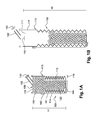
- Figures 1A and 1B illustrate a first embodiment of an ammonia precursor refilling system comprising a container 110 storing an ammonia precursor 120 in solid form.
- the container 110 is configured to fit within a first volume during storage ( figure 1A ) and to be enlarged to a second volume ( figure 1B ) which is larger than the first volume, when it is need for refilling a vehicle tank.
- the container has an opening 111, here an open top end, which is closed by an opening mechanism, here a removable cap 130.
- the second volume is chosen for allowing the container 110 to be filled through the opening 111 with water in an amount sufficient to allow the ammonia precursor in solid form to be at least partially dissolved to form an ammonia precursor solution.
- the container 110 comprises a flexible inner bag 112 in which the ammonia precursor is stored in solid form, and a more rigid outer housing 113.
- the outer housing 113 is provided with a bellow 114.
- the ammonia precursor 120 is stored in the closed inner bag 112, and the outer housing 113 is provided with the opening 111.
- the inner bag 112 may be a protective plastic bag containing e.g. solid urea granules 120.
- the bellow 114 allows extending a height of the outer housing 113 from a height h1 (storage state) to a height h2 (refilling state), see figures 1A and 1B .
- the second height h2 (and hence the second volume) is at least 1,5 times bigger than the first height (and hence the first volume), and more preferably at least 1,7 times bigger than the first height.
- the bellow 114 of the container 110 is retracted as represented on figure 1A , so as to have a compact shape.
- the container 110 is provided with an indication 115 indicating a filling level, said indication indicating to a user how much water needs to be added to the container 110 in order to obtain a suitable ammonia precursor solution.
- the container 110 comprises a rigid neck 117 configured to allow insertion of a neck of a water bottle, said neck of said water bottle having a diameter below 50 mm.
- the rigid neck may be a prolongation extending upwardly beyond the bellow 114. In that way the container 110 can be easily filled with a standard water bottle, e.g. a standard 1 litre or 2 litre plastic water bottle.
- the refilling system further comprises locking means configured for locking the outer bellow in an extended position.
- the exemplary locking means comprise a retainer 141 having first and second clipping elements 143, 145 at respective ends of the retainer 141.
- the cap 130 comprises a base plate 131, a pipe 132 arranged in the base plate 131, and a secondary cap 133 for closing the pipe 132.
- the secondary cap 133 is opened so as to allow air to come in the container 110 and the bellow 114 is extended up to full extension ( figure 1B ), at which position the locking means 141-145 lock the container 110 in the extended refill position.
- the inner bag 112 may be torn, e.g. using a device not shown, liberating the solid ammonia precursor 120 in the container 110.
- the inner bag 112 may be manually or mechanically cut or torn open.
- the locking of the container 110 in an extended position allows getting a well dimensioned suitable inner volume with a height h2.
- the main cap 130 is removed and water of appropriate quality is poured in the container 110 up to the level mark 115.
- the main cap 130 may be removed before extending the bellow 114, and the solid ammonia precursor 120 may be released after removing the main cap 130.
- the main cap 130 with secondary cap 133 may be put back in position, so as to avoid accidental spillage during further manipulation.
- the container 110 may be left at rest while the solid ammonia precursor is being dissolved in the water.
- the container 110 may also be shaken so as to speed up the dissolution.
- the bellow shape 114 of the side wall of the outer housing 113 may contribute to the mixing and the dissolution when the container 110 is shaken.
- the container 110 can also be used as a cooling element, for instance by introducing it in a (thermally insulated) conservation box.
- the cooling effect of the dissolution of urea in water is known and exploited and a temperature reduction of 10°C or more can be readily achieved.
- the solution can be poured in an ammonia precursor solution tank, typically a DEF/AdBlue® tank of the vehicle.
- the protective bag 112 can be made of any plastic offering appropriate properties. Various materials are offering good performances, in particular polyolefins such as polyethylene. Also a multilayer structure based on polyethylene or polypropylene with an EVOH barrier against diffusion of humidity, may be used.
- the outer housing 113 and the cap 130 can be made of any plastic offering appropriate properties. Polyethylene or polypropylene is well suited and light.
- the solid ammonia precursor 120 may consist of urea granules.
- the weight of urea granules may be e.g. 963 g, and the amount of water added may be 2 litres (2000 g), resulting in 2963 g of mixture containing 32.5% in weight of urea, or 2.72 litres (the specific mass of the urea solution is 1.09 kg/l).
- the outer housing 113 is cylindrical with a diameter of e.g. 100 mm, and a height h1 of 160 mm before extension and a height h2 of 390 mm after extension.
- the volume and weight of the device with the urea granules before extension and filling with water are 1.3 litre and 1020 g, respectively, i.e. much less than the volume and weight that a jerry can with a corresponding amount of urea solution would be (about 2.8 litre and 3000 g).
- the amount of solid urea stored is preferably a multiple of between 466 g and 497 g, and the second volume is such that the same multiple of 1 litre water can be added, at least in countries where standard water bottles are sold as 1 litre or 2 litre bottles.
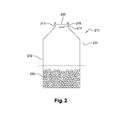
- Figure 2 illustrates a second embodiment of an ammonia precursor refilling system comprising a container 210 storing an ammonia precursor 220 in solid form.
- the container 210 is configured to fit within a first volume during storage and to be enlarged to a second volume which is larger than the first volume: this is reached by using a flexible bag 212 which can be folded, e.g. along fold lines 214, in the storage state and which can be unfolded in the refill state.
- the container 210 is provided with an opening 211 which is closed by a removable cap 230.
- the second volume is chosen for allowing the container 210 to be filled through the opening 211 with water in an amount sufficient to allow the ammonia precursor in solid form to be at least partially dissolved to form an ammonia precursor solution.
- the container 210 is provided with an indication 215 indicating a filling level, said indication indicating to a user how much water needs to be added to the container.
- the container comprises a rigid neck 217 configured to allow insertion of a neck of a water bottle.
- the second volume (in the refill state, when filled with water) is at least 1,5 times bigger than the first volume (in the storage state without water).
- the bag 212 may be a protective plastic bag containing ammonia precursor, e.g. in the form of solid urea granules or powder.
- the bag can be folded along fold lines 214 as indicated in figure 2 , so as to offer a compact shape.
- the cap 230 is opened and the bag 212 is unfolded. Water of appropriate quality is poured in the container 210 up to the level mark 215.
- the cap 230 may be put back in position so as to avoid accidental spillage during further manipulation.
- the container 210 may be left at rest while the solid ammonia precursor is being dissolved in the water.
- the container 210 may also be shaken so as to speed up the dissolution.
- the container 210 may also be used as a cooling element, for instance by introducing it in a conservation box.
- the ammonia precursor solution can be poured in an ammonia precursor solution tank, e.g. a DEF/AdBlue® tank of the vehicle.
- the protective bag 212 can be made of any flexible plastic material offering appropriate properties. Various materials are offering good performances, in particular polyethylene or a multilayer structure based on polyethylene or polypropylene with an EVOH barrier against diffusion of humidity.
- the solid ammonia precursor 120 may consist of urea granules or powder.
- the weight of solid urea may be e.g. 963 g, and the amount of water added may be 2 litres (2000 g), resulting in 2963 g of mixture containing 32.5% in weight of urea, or 2.72 litres.
- the dimensions and shape of the container of the first and second exemplary embodiments may be adapted so as to suit various capacities.
- the dimensions and shape may be adapted to the needs of the vehicle and to the size of water containers available on the market.
- a convenient dimensioning of a device similar to the one represented in the first and second exemplary embodiment is as follows: the weight of solid urea is 1820 g, the amount of water to be added is 3.78 litres, resulting in 5600 g of mixture containing 32.5% in weight of urea, or 5.14 litres of urea solution.
- the protective bag 112 may be omitted: the outer housing 113 and cap 130 can assume the protective function provided that appropriate materials are used and tightness is ensured.
- multilayer structures with polyethylene and EVOH barrier can be used for the outer housing 113 and for the various parts 131-133 of the cap 130, similar to the multilayer structure used for fuel tanks.
- the outer housing 113 and/or the cap 130 can also be fitted with known mixing devices (for instance cross placed in the chamber) to promote mixing and dissolution while the container 110 is agitated.
- Boosted solutions according to European patent application EP 14177713.6 in the name of the Applicant can also be refilled with a refilling system of the invention.
- a solution containing 32.5% of urea in solution and 22.5% of urea in solid granules can be prepared with a refilling system, e.g. according to the first and second exemplary embodiment: the bag 112, 212 may contain e.g. 722 g of urea powder and 500 g of urea in coated urea granules.
- the coating may be such that it allows a controlled release of the additional urea as described in European patent application EP 14177713.6 in the name of the Applicant.
- 1 litre of water (1000 g) is added, resulting in a total weight of 2222 g of "boosted" solution containing 55% of urea.
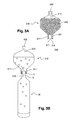
- Figures 3A and 3B illustrate a third embodiment of an ammonia precursor refilling system comprising a container 310 storing an ammonia precursor 320 in solid form.
- the container 310 is configured to fit within a first volume during storage, see figure 3A .
- the container 310 has a first opening 311 which is closed by a removable first opening mechanism, here in the form of a seal 331.
- the first opening 311 has an interface 318 which is configured for being mechanically coupled with a neck N of a water bottle W.
- the water bottle W may be a standard commercially available water bottle.
- the seal 331 is configured and arranged to be broken by coupling a water bottle W to the interface 318 associated with the first opening 311.
- the first opening 311 is formed in a neck 317 of the container, and the neck 317 is provided with an internal thread 318 which creates the interface which is couplable with an external thread T of a water bottle W.
- the container 310 further comprises a second opening 312 which is closed by a second opening mechanism, e.g. a removable cap 332.
- the second opening 312 allows filling of a vehicle tank with an ammonia precursor solution contained in the assembly which is formed by the container 310 and the water bottle W, which are coupled to each other in the assembled refill state, see figure 3B .
- the container 310 when a refill is needed, the container 310 may be coupled to s standard water bottle or container as illustrated in figure 3B , such that the container 310 together with the water bottle or water container creates an assembly having a second volume which is larger than the first volume of the container 310.
- the second cap 332 After coupling the container 310 to the water bottle of water container, the second cap 332 may be opened to allow venting of the assembly.
- the container 310 may be a flexible or a rigid container.
- the container 310 may comprises e.g. a protective bag made of a plastic offering appropriate properties. Various materials are offering good performances, in particular polyolefins such as polyethylene. Also a multilayer structure based on polyethylene or polypropylene with an EVOH barrier against diffusion of humidity, may be used.
- the container 310 may also consist of a relatively rigid container or may comprise rigid parts, e.g. made of a plastic material offering appropriate properties, such as polyethylene or polypropylene.
- the solid ammonia precursor may be a powder or granules or a combination of both.
- suitable granules are urea granules, e.g. ball-shaped urea granules. All or some urea granules may be coated.
- the size of the ammonia precursor granules is in a range from 0.01 micron to 50 mm, more preferably from 100 micron to 5 mm, and e.g. between 500 microns and 5 mm.
- a granule contains solid ammonia precursor, and has a coating adapted to be dissolved in an ammonia precursor liquid.
- the solid ammonia precursor is preferably solid urea, but ammonia precursor granules may contain other materials than urea, such as ammonium carbamate which is also a solid that can dissolve in water and generate ammonia, and more generally ammonia salts.
- the coating may be adapted to be thermally dissolved in an ammonia precursor liquid.
- the coating of the ammonia precursor granules may be made of any one or more of the following materials: polyvinylidene chloride (PVDC), linear low density polyethylene (LLDPE), certain grades of ethylene vinyl alcohol (EVOH), certain grades of polyvinyl alcohol (PVOH), biaxially oriented polypropylene (BOPP), cyclic olefin polymer (COC), polyethylene naphthalate (PEN), liquid-crystal polymers (LCPs, a class of aromatic polyester polymers), polypropylene (PP), and polyethylene terephthalate blends (PET/PE, PET/PVDC/PE, PET/PVOH/PE, PET/EVOH/PE).
- PVDC polyvinylidene chloride
- LLDPE linear low density polyethylene
- EVOH ethylene vinyl alcohol
- PVOH biaxially oriented polypropylene
- BOPP biaxially oriented polypropylene
- COC cyclic olefin polymer
- PEN poly
Landscapes
- Engineering & Computer Science (AREA)
- Mechanical Engineering (AREA)
- Chemical & Material Sciences (AREA)
- Combustion & Propulsion (AREA)
- Chemical Kinetics & Catalysis (AREA)
- Health & Medical Sciences (AREA)
- Transportation (AREA)
- Oil, Petroleum & Natural Gas (AREA)
- General Chemical & Material Sciences (AREA)
- Analytical Chemistry (AREA)
- Environmental & Geological Engineering (AREA)
- Toxicology (AREA)
- General Engineering & Computer Science (AREA)
- Biomedical Technology (AREA)
- Exhaust Gas After Treatment (AREA)
- Packages (AREA)
- Details Of Rigid Or Semi-Rigid Containers (AREA)
- Bag Frames (AREA)
Priority Applications (4)
| Application Number | Priority Date | Filing Date | Title |
|---|---|---|---|
| EP15305653.6A EP3088231A1 (de) | 2015-04-28 | 2015-04-28 | Ammoniakvorläufer-nachfüllvorrichtung |
| US15/133,612 US20160317970A1 (en) | 2015-04-28 | 2016-04-20 | Ammonia precursor refill device |
| CN201610256388.0A CN106082095B (zh) | 2015-04-28 | 2016-04-22 | 氨前驱物再充装设备 |
| EP16167407.2A EP3088232B1 (de) | 2015-04-28 | 2016-04-28 | Ammoniakvorläufer-nachfüllvorrichtung |
Applications Claiming Priority (1)
| Application Number | Priority Date | Filing Date | Title |
|---|---|---|---|
| EP15305653.6A EP3088231A1 (de) | 2015-04-28 | 2015-04-28 | Ammoniakvorläufer-nachfüllvorrichtung |
Publications (1)
| Publication Number | Publication Date |
|---|---|
| EP3088231A1 true EP3088231A1 (de) | 2016-11-02 |
Family
ID=53039835
Family Applications (2)
| Application Number | Title | Priority Date | Filing Date |
|---|---|---|---|
| EP15305653.6A Withdrawn EP3088231A1 (de) | 2015-04-28 | 2015-04-28 | Ammoniakvorläufer-nachfüllvorrichtung |
| EP16167407.2A Not-in-force EP3088232B1 (de) | 2015-04-28 | 2016-04-28 | Ammoniakvorläufer-nachfüllvorrichtung |
Family Applications After (1)
| Application Number | Title | Priority Date | Filing Date |
|---|---|---|---|
| EP16167407.2A Not-in-force EP3088232B1 (de) | 2015-04-28 | 2016-04-28 | Ammoniakvorläufer-nachfüllvorrichtung |
Country Status (3)
| Country | Link |
|---|---|
| US (1) | US20160317970A1 (de) |
| EP (2) | EP3088231A1 (de) |
| CN (1) | CN106082095B (de) |
Cited By (1)
| Publication number | Priority date | Publication date | Assignee | Title |
|---|---|---|---|---|
| US11198362B2 (en) | 2018-08-10 | 2021-12-14 | Agco International Gmbh | Variable capacity fuel tank |
Citations (5)
| Publication number | Priority date | Publication date | Assignee | Title |
|---|---|---|---|---|
| US2432025A (en) * | 1944-03-03 | 1947-12-02 | Henry W Lorenz | Collapsible gasoline tank |
| US3917117A (en) * | 1973-05-21 | 1975-11-04 | Sundstrand Corp | Positive expulsion fuel tank, and bladder dispenser therefor |
| WO2008078059A1 (en) * | 2006-12-22 | 2008-07-03 | Perkins Engines Company Ltd | Method and apparatus for selective catalytic nox reduction |
| US20110138780A1 (en) * | 2009-11-12 | 2011-06-16 | IFP Energies Nouvelles | Method of treating pollutants contained in exhaust gases, notably of an internal-combustion engine, and system using same |
| EP2490914A1 (de) | 2009-10-21 | 2012-08-29 | Inergy Automotive Systems Research (Société A.) | Verbessertes füllsystem für fahrzeugflüssigkeitsbehälter |
Family Cites Families (13)
| Publication number | Priority date | Publication date | Assignee | Title |
|---|---|---|---|---|
| FR2875748B1 (fr) * | 2004-09-27 | 2006-12-08 | Inergy Automotive Systems Res | Methode de remplissage d'un reservoir au moyen d'une cartouche-reservoir et cartouche associes |
| EP1901831B1 (de) * | 2005-06-29 | 2012-12-19 | Amminex A/S | Verfahren und vorrichtung zur sicheren und kontrollierten zufuhr von ammoniak aus einem festen ammoniakspeichermedium |
| DE102009041179A1 (de) * | 2009-09-11 | 2011-03-24 | Emitec Gesellschaft Für Emissionstechnologie Mbh | Fördervorrichtung für ein Reduktionsmittel |
| WO2011123309A1 (en) * | 2010-03-29 | 2011-10-06 | International Engine Intellectual Property Company, Llc | Ammonia dosing cartridge and method |
| US9656407B2 (en) * | 2011-01-14 | 2017-05-23 | George V. Kronen | Article and method for spreading a substance about a surface |
| EP2492128B1 (de) * | 2011-02-22 | 2013-08-07 | Inergy Automotive Systems Research (Société Anonyme) | Ammoniak-Vorläufer-Aufbewahrungssystem mit semipermeabler Membran |
| US9371240B2 (en) * | 2011-07-01 | 2016-06-21 | Alzchem Ag | Ammonia gas generator for producing ammonia in order to reduce nitrogen oxides in exhaust gases |
| EP2574599A1 (de) * | 2011-09-30 | 2013-04-03 | Inergy Automotive Systems Research (Société Anonyme) | Behälter für die Speicherung von Ammoniak durch Sorption |
| US9908645B2 (en) * | 2012-04-26 | 2018-03-06 | Harmony Biosciences, Inc. | Portable container and method of manufacturing the same |
| WO2014165167A1 (en) * | 2013-03-12 | 2014-10-09 | Kline Bret E | System and method for using adsorbent/absorbent in loading, storing, delivering, and retrieving gases, fluids, and liquids |
| EP2784282B1 (de) * | 2013-03-29 | 2017-11-01 | Inergy Automotive Systems Research (Société Anonyme) | Tank für selektive katalytische Reduktionsreinigung der Abgase eines Verbrennungsmotors eines Fahrzeugs |
| US20160083259A1 (en) * | 2013-04-22 | 2016-03-24 | International Engine Intellectual Property Company, Llc | Reductant storage |
| CN204060875U (zh) * | 2014-08-11 | 2014-12-31 | 吉林省众鑫汽车装备有限公司 | 一种固体储氨装置 |
-
2015
- 2015-04-28 EP EP15305653.6A patent/EP3088231A1/de not_active Withdrawn
-
2016
- 2016-04-20 US US15/133,612 patent/US20160317970A1/en not_active Abandoned
- 2016-04-22 CN CN201610256388.0A patent/CN106082095B/zh not_active Expired - Fee Related
- 2016-04-28 EP EP16167407.2A patent/EP3088232B1/de not_active Not-in-force
Patent Citations (5)
| Publication number | Priority date | Publication date | Assignee | Title |
|---|---|---|---|---|
| US2432025A (en) * | 1944-03-03 | 1947-12-02 | Henry W Lorenz | Collapsible gasoline tank |
| US3917117A (en) * | 1973-05-21 | 1975-11-04 | Sundstrand Corp | Positive expulsion fuel tank, and bladder dispenser therefor |
| WO2008078059A1 (en) * | 2006-12-22 | 2008-07-03 | Perkins Engines Company Ltd | Method and apparatus for selective catalytic nox reduction |
| EP2490914A1 (de) | 2009-10-21 | 2012-08-29 | Inergy Automotive Systems Research (Société A.) | Verbessertes füllsystem für fahrzeugflüssigkeitsbehälter |
| US20110138780A1 (en) * | 2009-11-12 | 2011-06-16 | IFP Energies Nouvelles | Method of treating pollutants contained in exhaust gases, notably of an internal-combustion engine, and system using same |
Cited By (1)
| Publication number | Priority date | Publication date | Assignee | Title |
|---|---|---|---|---|
| US11198362B2 (en) | 2018-08-10 | 2021-12-14 | Agco International Gmbh | Variable capacity fuel tank |
Also Published As
| Publication number | Publication date |
|---|---|
| CN106082095B (zh) | 2019-08-23 |
| EP3088232B1 (de) | 2018-04-18 |
| CN106082095A (zh) | 2016-11-09 |
| US20160317970A1 (en) | 2016-11-03 |
| EP3088232A1 (de) | 2016-11-02 |
Similar Documents
| Publication | Publication Date | Title |
|---|---|---|
| EP2975233A1 (de) | Ammoniakvorläufererzeugungssystem zur Verwendung in einem Fahrzeug | |
| JP6925348B2 (ja) | 乗物の内燃機関の排ガスを処理するscrシステムで使用する尿素水溶液を収容するポーチアセンブリと、尿素水溶液を使用して乗物の内燃機関の排ガスを処理するシステム | |
| US7866357B2 (en) | Method of filling a reservoir by means of a cartridge-reservoir and associated cartridge | |
| CN102272423B (zh) | 用于将减少有害物质的介质引入到废气中的系统 | |
| JPH11170554A (ja) | 包装容器 | |
| EP3088232B1 (de) | Ammoniakvorläufer-nachfüllvorrichtung | |
| CN102162526A (zh) | 优化的高压容器 | |
| US11072470B2 (en) | Diesel exhaust fluid tank with integrated mis-filling prevention device | |
| EP2935977B1 (de) | Tank zur lagerung eines gespeicherten gases durch sorption mit einem stossabsorbierenden mittel | |
| WO2009095477A1 (en) | Reservoir and associated method for filling the reservoir | |
| US20090126693A1 (en) | Fuel System Comprising A Fuel Reserve Container And A Retaining Trough | |
| US20060060169A1 (en) | Fuel tank for a vehicle | |
| EP3202684A1 (de) | Beutelanordnung zum enthalten einer flüssigen harnstofflösung zur verwendung in einem scr-system zur behandlung von abgasen eines verbrennungsmotors eines fahrzeugs sowie system zur behandlung von abgasen eines verbrennungsmotors eines fahrzeugs unter verwendung der flüssigen harnstofflösung | |
| EP3202685A1 (de) | Beutelanordnung zum enthalten einer flüssigen harnstofflösung zur verwendung in einem scr-system zur behandlung von abgasen eines verbrennungsmotors eines fahrzeugs sowie system zur behandlung von abgasen eines verbrennungsmotors eines fahrzeugs unter verwendung der flüssigen harnstofflösung | |
| EP3299313A1 (de) | Beutelanordnung zum enthalten einer flüssigen harnstofflösung zur verwendung in einem scr-system zur behandlung von abgasen eines verbrennungsmotors eines fahrzeugs sowie system zur behandlung von abgasen eines verbrennungsmotors eines fahrzeugs unter verwendung der flüssigen harnstofflösung | |
| JP2024070745A (ja) | ガス容器 | |
| CN103906645A (zh) | 混合动力车辆的燃料系统的压强的控制方法 |
Legal Events
| Date | Code | Title | Description |
|---|---|---|---|
| PUAI | Public reference made under article 153(3) epc to a published international application that has entered the european phase |
Free format text: ORIGINAL CODE: 0009012 |
|
| AK | Designated contracting states |
Kind code of ref document: A1 Designated state(s): AL AT BE BG CH CY CZ DE DK EE ES FI FR GB GR HR HU IE IS IT LI LT LU LV MC MK MT NL NO PL PT RO RS SE SI SK SM TR |
|
| AX | Request for extension of the european patent |
Extension state: BA ME |
|
| STAA | Information on the status of an ep patent application or granted ep patent |
Free format text: STATUS: THE APPLICATION IS DEEMED TO BE WITHDRAWN |
|
| 18D | Application deemed to be withdrawn |
Effective date: 20170503 |