EP3091865B1 - Chaussures à talons hauts pour posture correcte - Google Patents
Chaussures à talons hauts pour posture correcte Download PDFInfo
- Publication number
- EP3091865B1 EP3091865B1 EP15735528.0A EP15735528A EP3091865B1 EP 3091865 B1 EP3091865 B1 EP 3091865B1 EP 15735528 A EP15735528 A EP 15735528A EP 3091865 B1 EP3091865 B1 EP 3091865B1
- Authority
- EP
- European Patent Office
- Prior art keywords
- heel
- values
- section
- shoe
- toe
- Prior art date
- Legal status (The legal status is an assumption and is not a legal conclusion. Google has not performed a legal analysis and makes no representation as to the accuracy of the status listed.)
- Active
Links
Images


Classifications
-
- A—HUMAN NECESSITIES
- A43—FOOTWEAR
- A43B—CHARACTERISTIC FEATURES OF FOOTWEAR; PARTS OF FOOTWEAR
- A43B7/00—Footwear with health or hygienic arrangements
- A43B7/14—Footwear with health or hygienic arrangements with foot-supporting parts
- A43B7/1405—Footwear with health or hygienic arrangements with foot-supporting parts with pads or holes on one or more locations, or having an anatomical or curved form
- A43B7/141—Footwear with health or hygienic arrangements with foot-supporting parts with pads or holes on one or more locations, or having an anatomical or curved form having an anatomical or curved form
-
- A—HUMAN NECESSITIES
- A43—FOOTWEAR
- A43B—CHARACTERISTIC FEATURES OF FOOTWEAR; PARTS OF FOOTWEAR
- A43B13/00—Soles; Sole-and-heel integral units
- A43B13/38—Built-in insoles joined to uppers during the manufacturing process, e.g. structural insoles; Insoles glued to shoes during the manufacturing process
-
- A—HUMAN NECESSITIES
- A43—FOOTWEAR
- A43B—CHARACTERISTIC FEATURES OF FOOTWEAR; PARTS OF FOOTWEAR
- A43B13/00—Soles; Sole-and-heel integral units
- A43B13/38—Built-in insoles joined to uppers during the manufacturing process, e.g. structural insoles; Insoles glued to shoes during the manufacturing process
- A43B13/386—Built-in insoles joined to uppers during the manufacturing process, e.g. structural insoles; Insoles glued to shoes during the manufacturing process multilayered
-
- A—HUMAN NECESSITIES
- A43—FOOTWEAR
- A43B—CHARACTERISTIC FEATURES OF FOOTWEAR; PARTS OF FOOTWEAR
- A43B17/00—Insoles for insertion, e.g. footbeds or inlays, for attachment to the shoe after the upper has been joined
-
- A—HUMAN NECESSITIES
- A43—FOOTWEAR
- A43B—CHARACTERISTIC FEATURES OF FOOTWEAR; PARTS OF FOOTWEAR
- A43B21/00—Heels; Top-pieces or top-lifts
- A43B21/24—Heels; Top-pieces or top-lifts characterised by the constructive form
Definitions
- the present invention relates to high-heeled shoes and particularly to those which enable wearers to assume and maintain anatomically suitable postures while standing and walking.
- US 2009/193683 discloses a flexible contoured footbed insole for footwear for providing an anatomically correct foot support to a wearer of the footwear.
- the flexible contoured footbed insole comprises a heel section and a support system extending anteriorly from the heel section.
- the heel section comprises a cup shaped structure for accommodating a heel of a foot of the wearer.
- the support system comprises an inner longitudinal arch support, an outer longitudinal arch support, a transverse arch support, a metatarsal arch support, and a toe support for supporting an inner longitudinal arch, an outer longitudinal arch, a transverse arch, a metatarsal arch, and toes of the foot of the wearer respectively.
- the flexible contoured footbed insole may further comprise a flexible structure disposed within the support system.
- US 5782 015 describes a high-heel shoe design applicable to varying heel heights.
- Shoes and particularly those known as high-heeled shoes, generally exceeding 50.8 mm (2 inches), are adapted to be worn on a human foot. Though comfort is a primary consideration of footwear, it is often secondary to style, particularly with respect to the aforementioned high-heel shoes, which are most often specifically worn because of style considerations.
- the human foot is comprised of twenty six different bones, which are connected to each other by approximately thirty joints and held in their respective places by ligaments and joint capsules. Thirty tendons, in addition to the lower muscles of the leg and the tendons of the foot muscles, have a role in foot movement.
- the ankle joint is responsible for the dorsiflexion (raising the toes and standing only on the heels) and plantarflexion (lowering the toes and standing only on the toes) movements of the feet.
- tarsal bones there are five bones called tarsal bones, and these bones may become a very resistant or rigid structure, when necessary, by movement as a group, depending on the nature of the surface, which they are in contact, via the joints there between.
- the tarsal bones are the five long bones, which are located at the front part of the foot.
- knuckles which consist of phalanxes, required for normal walking.
- the toes are connected with the tarsal bones via metatarsophalangeal (MTP) joints with the most important one being the first MTP joint, belonging to the big toe.
- MTP metatarsophalangeal
- a foot structure may be divided into three recognizable parts. Starting from the rear, a first part, i.e. the heel, is comprised of talus and calcaneus. The second or middle part is comprised of the navicular bone, metatarsal bones and other bones (cuboid bone and three cuneiform bones). Five toes comprise the third or front part of the foot. The big toe has two phalanxes just like the thumb of a hand and the other toes have three phalanxes. When a load is exerted on the toes, during a time when the big toe presses the ground, the other four toes assume a grabbing movement positioning.
- the foot There are two arch systems in the foot; one is the transverse arch at the front part of the foot.
- the second or other longitudinal arch starts from the calcaneus and follows the inner part of the foot until the base joint of the big toe.
- the arch at the front part is shaped by the ligaments, which maintain the form of the arch when no load acts on the foot and the stretches as it is pressed to the ground when a load is exerted on the foot.
- the plantar aponeurosis (arch ligament) that extends from the calcaneus to the toes also stretches. The more the load is exerted on the arch, the more the ligaments stretch. Many movements of the foot and the toes are controlled by the muscles which start from the lower part of the leg and whose tendons adhere to the foot.
- Muscles control finer movements of the foot, which muscles begin and are adhered on the foot itself. Many movements of the foot are provided by the muscles at the bottom part of the leg, via ligaments. Standing, walking and running functions of the foot are made possible by contraction of these muscles. Many small muscles, apart from the above, produce a base at the sole of the foot with their positions between the bones.
- Another objective of the present invention is to provide a high-heeled shoe, which enables the body of the wearer to stand in correct balance and the foot to rest on all points.
- a further objective of the present invention is to provide a high-heeled shoe, which enables the wearer to assume and maintain anatomically suitable straight body posture with a high degree of comfort not normally obtainable with high-heeled shoe configurations particularly of the stylish type.
- the present invention comprises high-heeled shoes of heel heights in excess of 50.8 mm (two inches) configured with component elements in an interrelational angular and length of proper configuration structure, wherein foot stress and discomfort is minimized while retaining aesthetic appearance thereof.
- anatomically suitable straight body posture and concomitant comfort can be achieved in high heeled shoes by adjusting the arctangent values, as described hereinafter, with substantially exact conformity. This can be made possible only by adjusting the center of gravity such that it will be on the rear or middle part of the foot.
- straight body posture can be achieved by bringing the body to a position suitable to a healthy anatomy.
- Foot support in high-heel shoe construction and components involved therewith entails understanding and definition of the parts thereof.
- a first part, which is normally in contact with the bottom of the foot is the "Insole Board". This is a firm part of the shoe that is directly under the entire back part of the foot in most footwear. It usually starts from the back portion of the shoe (heel section) and often extends until either the toe section or until the end of the curvature of the bottom of the foot.
- the insole board usually has another layer of cushion and/or a layer of insole lining on top of it. This thickness of the lining may and often does vary.
- the "Shank” is a support (often metal such as steel, or it can be made of fiberglass or other strong materials) that is placed at some point under the insole board to support the shape of the insole board and the weight that is placed on the insole by the wearer. It has no fixed placement position; but its curve needs to match the curve of the insole board at the position that it is placed under (or sometimes over) the insole board.
- the "curvature” is normally that of the "insole board", or anything else in the shoe that is directly under the wearer's foot and which starts from the back of the foot and extends forward till it reaches the point of no further descent (i.e., essentially plateaus).
- the insole board usually has another layer of cushion and/or a layer of insole lining on top of that.
- the thickness of the lining may vary and thus affect parameters of curvature.
- the curvature as specified herein is one that is attained when the wearer places her/his weight on the shoe and the shape that remains directly under his foot after repeated wearings of the shoe ( after the cushioning has settled after some initial use, or in case of strong cushioning that retains its shape- at the first wearing) is the "curvature" as used herein.
- insole board refers specifically to the portion of the shoe and curvature thereof, which directly supports and is in contact with the wearer's foot. It also includes the same type of upper structure in a wedge type high-heeled shoe.
- the insole board of a high-heeled shoe generally follows a shape similar to an arctan (k*x) function.
- the value of k is empirically determined and as determined, varies in accordance with heel height with various values being set forth in Table 4 below (with extrapolation and variations thereof being determined for other heel heights and operable ranges for the specific heel heights).
- the k 2 factor (as used in a correction factor set forth below) denotes, for a curvature factor, a constant value of 300, obtained as a result of experimental studies in determining anatomically correct position and maximum comfort in accordance with the present invention.
- the y coordinate value denotes the length, which extends from the horizontal part of the coordinate plane to the point where the insole board is positioned.
- the x and y values given in the equations are each a value of length, with the y value varying in accordance with the change of x distance along the insole board position.
- K y " / 1 + y ′ 2 3 / 2 wherein K denotes a value that changes with respect to the first derivative of y (y') and the second derivative of y (y") given in equation 2.
- Equation 3 The form of equation 2 for the K value expressed in terms of values for x and the constant k is shown as "equation 3" which equation is used for the determined curvature.
- K ⁇ 2 k 3 x . 5 / arctan 10 k . 1 + k 2 x 2 ⁇ 2 1 + k 2 . 5 / arctan 10 k 2 . 1 + k 2 x 2 ⁇ 2 ⁇ 3 / 2
- the high-heeled shoe configuration relative to heel and platform height of a particular high-heeled shoe which enables anatomically suitable body posture and walking, and has orthopedic inclination and high heels in accordance with the present invention, comprises the elements and parameters of:
- Table 1 shows the sole alignments (x values) where the greatest "curvature” takes place by using equation 4 is as follows:
- variable x j for the heel sizes of A 1 , A 2 , A 3 , A 4 , A 5 , A 6 are given in Table 4 below, with: x j , being the variable used for changing the effect of the factor function in the formula so that the insole board is more suitable to the human foot anatomy.
- variable k 2 is the variable used for changing the effect of the factor function in the formula so that the insole board is more suitable to the human foot anatomy and which has been determined to be 300.
- the A 2 , A 3 , A 4 , A 5 , and A 6 insole boards are formed and these models are observed experimentally (as direct foot supports) and are seen to be successful in providing both anatomically correct support and increased comfort for the wearers.
- Table 2 shows that A 1 , A 2 , A 3 , A 4 , A 5 , and A 6 inboard soles can be produced in high heeled shoes without front platforms, with a height ranging from about 50.8 mm (2") to 114.3 mm (4.5") and as high heeled shoes, with appropriately sized front platforms with a height ranging from about 0 mm (0") to 76.2 mm (3.5") provided that the elevation distance between the front of the foot wearing the shoe to the heel is no more than about 114.3 mm (4.5"), i.e. with appropriate platforms ranging from 0 mm (0") to 76.2 mm (3.5") for the aforementioned heels.
- the high heeled shoes (1) toe angles ( ⁇ ) and heel angles ( ⁇ ) shown in the Figures vary relative to the insole board (2) so as to ensure a straight body posture.
- the heel angle ( ⁇ ) corresponding to the toe angle ( ⁇ ) of each high-heeled shoe (1) is given in Table 2.
- shoe heels that range from 50.8 mm (2 inches) to about 203.2 mm (8 inches) preferably have ( ⁇ ) heel angle values in the range of about 5° to 26° (with a 10% possible deviation) as shown in Figure 7 .
- the variation of heel angles is a function of one or two factors. The first one being the difference of the varying heel heights (cm/inch), and the second being the differences exhibited by the materials used in manufacturing the high heeled shoe such as the lasting process.
- the best results are obtained when the toe angle ( ⁇ ) of the high-heeled shoe (1) is at angles varying between 7° and 26°.
- the heel angle ( ⁇ ) is a function of insole board curvature calculation with the heel being the rear terminus thereof but with variations thereof, in the given range, being functionally determined by the manufacturing process.
- a typical heel section distance ranges between 35 to 50 mm from the rear of the shoe with a heel angle being measured therefrom such as with wedge shoes and may be smaller with respect to very narrow stilletto heels. Calculations of heel angles and ranges thereof as made herein are generally determined with a length of between 35 to 50mm from the rear of the shoe along the foot support.
- insole board models obtained by the aforementioned formula 1 with correction factor, as described are suitable for proper posture and comfort though there may be deviation of a few degrees for either the toe angles ( ⁇ ) and heel angles ( ⁇ ) within the aforementioned range parameters.
- Ranges of deviation with deviations in comfort levels, at their outer limits, are defined by the values for adjacent heel heights in the table.
- the degree curve value for A 1 can range from 42.96° to the 45.63° of A 2 .
- the value ranges from 42.96° of A 1 to the 49.61° of A 3 from the values of A 1 to A 3 .
- a 3 the value ranges from the 45.63° of A 2 to the 51.72° of A 4 and for A 4 the value ranges from the 49.61° of A 3 to the 56.13° of A 5 .
- the range for A 5 is from the 51.72° of A 4 to the 58.43° of A 6 .
- the value for A 6 is from the 56.13° of A 5 to the 58.43° of A 6 .
- the values for A 1 and A 6 are respective minimums and maximums with possible deviation. The range is extended similarly over the various distance points.
- heel angles a may vary in the ranges between adjacent heel heights A 1 to A 6 as given in the table for the specific heel heights with heels angles for A 1 being between 5°-16°, for A 2 being between 5°-18°, for A 3 being between 12°-20°, for A 4 being between 14°-22°, for A 5 being between 16°-26°, and for A 6 being between 18°-26° with the values for A 1 and A 6 being respective minimums and maximums (with possible deviations of up to 10%).
- the x j and k values of Table 4 are used to provide the extrapolation of range values between the adjacent A 1 to A 6 values.
- modelling can be effectively applied to many different insole boards by using the formula for intermediate heel height values, by interpolating with use of the values of the A 1 - A 6 model insole boards in the Tables 2 and 3.
- Insole boards made with the intermediate heel heights are acceptable from a proper posture comfort consideration.
- Insole boards made with the intermediate values can be used in the production of successful shoes similarly without being affected by deviations of few degrees.
- the intermediate values of the A values are provided in the below given Table 3.
- typical high-heeled shoes 1 comprise a toe section 5, a sole or platform section 4 which can provide an elevated rest for the front of the foot, as shown in Figure 1 , or may be of minimal thickness as shown in Figure 3 .
- the insole board or direct foot support section 2 extends from and is usually integrated with sole or platform section 2 and begins at the elevation point shown, for insole board 2 in Figure 2 .
- the insole board 2 rises, usually as a curved section toward the rear or heel of the shoe where a portion thereof is supported by heel 3, shown in different configurations in Figures 1 and 3 .
- the heel of a wearer of the shoe 1, shown in Figures 8A and 8B rests on and is supported by heel 3 in both the prior art shoe of Figure 8A and that of the present invention of Figure 8B .
- the heel angle ( ⁇ ) of the shoes of the present invention, shown in Figure 2 and Figure 7 are at relatively low levels of 5-26°, generally considerably below those of heel angles in high-heeled shoe of the prior art. Though toe angles can be flush with the ground, such as with the shoe of Figure 1 , for better posture and increased comfort, the front toe angle ( ⁇ ) should be slightly elevated with an angle ranging from 7° to 26° with little or no variation from this range.
- the curve of the insole board 2 of both prior art shoes and that of the present invention is defined by an x, y axis coordinate system superimposed on the insole board with a point of origin at the point of the insole board 2 where the insole board begins to rise as shown in Figure 2 .
- Each point on the insole board is defined by the interrelated x and y parameter values.
- the curvature of the insole board is determined by a function k, as shown in Figure 4 which can range from limited curvature with low k values to highly curved shapes with the various curvatures providing different degrees of support and or comfort/discomfort and proper foot and positioning and posture.
- a 1 -A 5 are made in accordance with the present invention with utilization of equation 1, as corrected with the correction factor of equation 5, for every x, y value of the curve and with a k 2 constant value being 300 and as represented by different curves.
- the A 1 -A 6 insole boards were made for heel heights of 50.8 mm (2"), 63.5 mm (2 1 ⁇ 2"), 76.2 mm (3"), 88.9 mm (3 1 ⁇ 2 "), 101.6 mm (4") and 114.3 mm (4.5") respectively.
- Figure 6 depicts in detail the curve for the A 5 insole board with a 101.6mm (4") heel.
- Figures 8A and 8B show the position and posture bearing of a wearer of a prior art shoe 1' ( Figure 8A ) and a shoe of the present invention 1 ( Figure 8B ) wherein the proper upright axis A for the prior art shoe wearer shows a front leaning deviation from a proper posture, a lack of full support and a resultant forward toe pressure engendering typical high heel shoe pain. There is also a lack of support in the arch area 9.
- the shoe 1 in Figure 8B provides full support throughout the arch and with the heel being fully support such that the wearer is erect along axis A with a more aesthetic and statuesque appearance, with the shows of Figures 8A and 8B showing very little discernible difference in stylish appearance.
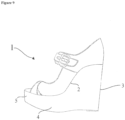
- Figure 9 shows a high-heeled shoe embodiment known as a wedge shoe wherein a fully supported sole is used in place of a steel insole board as used in the other embodiments.
- the curvature of sole 2 is substantially identical to that of the embodiments with the insole board.
Landscapes
- Health & Medical Sciences (AREA)
- Epidemiology (AREA)
- General Health & Medical Sciences (AREA)
- Public Health (AREA)
- Footwear And Its Accessory, Manufacturing Method And Apparatuses (AREA)
Claims (11)
- Chaussure à talon haut (1) pour un pied humain qui permet à un humain d'adopter et de maintenir une posture du corps anatomiquement correcte pour se tenir debout et marcher, et qui présente une inclinaison orthopédique, la chaussure à talon haut (1) comprenant une section orteil (5) et une section talon (3) séparées par et reliées avec une section semelle, la chaussure à talon haut (1) étant configurée pour le support respectif d'un orteil, d'un talon et d'une semelle d'un pied humain, dans laquelle une distance verticale entre un support de l'orteil et un support du talon se situe entre 50,8 mm et 114,3 mm (2 et 4,5 pouces) et dans laquelle la section semelle qui supporte directement une semelle humaine et un talon humain comprend une inclinaison courbée, telle que superposée sur un système de coordonnées x-y présentant un point d'origine au niveau du point au niveau duquel la section semelle commence à monter à partir d'une base de la section orteil (5), caractérisée en ce que la configuration d'inclinaison courbée est déterminée selon des valeurs x et y le long de la section semelle selon la formule :


xj A1 60 A2 50 A3 40 A4 35 A5 25 A6 20 - Chaussure à talon haut (1) selon la revendication 1, dans laquelle la section semelle et la section talon (3) sont constituées d'une semelle courbée continue.
- Chaussure à talon haut (1) selon la revendication 2, dans laquelle la section orteil comprend une inclinaison β montant à partir de la base d'une section orteil (5) selon un angle compris entre environ 7° et 26°.
- Chaussure à talon haut (1) selon la revendication 2, dans laquelle la section talon (3) comprend une inclinaison α montant à partir d'une base de la section talon (3) selon un angle compris entre environ 5° et 26°.
- Chaussure à talon haut (1) selon la revendication 1, dans laquelle la section orteil est élevée à partir d'une section de base de la chaussure à talon haut (1) avec une plate-forme allant jusqu'à environ 88,9 mm (3,5 pouces) de haut.
- Chaussure à talon haut (1) selon la revendication 1, dans laquelle la section orteil (5), la section semelle et la section talon (3) sont configurées en tant que cale solide avec une partie supérieure de la cale fournissant un support direct pour l'orteil (5), la semelle et le talon (3) du pied humain.
- Chaussure à talon haut (1) selon la revendication 1, dans laquelle le tableau suivant comprend une courbure angulaire au niveau de positions, telle que mesurée depuis un arrière de la chaussure (1), au niveau du bout du talon (3), le long de la semelle et dans laquelle des courbures angulaires pour des distances verticales autres que les incréments de 12,7 mm (demi-pouce) entre les environ 50,8 mm et 114,3 mm (deux à quatre pouces et demi) sont extrapolées à partir de ceux-ci, et dans laquelle la plage de valeurs de courbure angulaire pour chaque position A1 s'étend à partir de valeurs de A1 à A2 ; pour A2 les valeurs de courbure angulaire s'étendent à partir de valeurs de A1 à A3 ; pour A3 les valeurs de courbure angulaire s'étendent à partir de valeurs de A2 à A4 ; pour A4 les valeurs de courbure angulaire s'étendent à partir de valeurs de A3 à A5 ; et pour A5 les valeurs de courbure angulaire s'étendent à partir de valeurs de A4 à A6 ; et pour A6 les valeurs de courbure angulaire s'étendent à partir de valeurs de A5 à A6 ;
Distance le long de la semelle intérieure depuis l'arrière de la chaussure Hauteur de talon 90-100 mm 80-90 mm 70-80 mm 60-70 mm 50-60 mm 40-50 mm 30-40 mm 20-30 mm 10-20 mm 0-10 mm - A1 (2") - A2 (2,5") 42,96°-45,63° 41,97°-44,02° 38,66°-39,84° 33,89°-34,11° 28,43°-27,75° 22,83°-21,42° 17,41°-15,49° 12,36°-10,17° 7,78°-5,53° 3,75°-1,59° A2 (2,5") - A3 (3") 45,63°-49,61° 44,02°-46,92° 39,84°-41,20° 34,11°-33,86° 27,75°-26,16° 21,42°-18,93° 15,49°-12,54° 10,17°-7,10° 5,53°-2,60° 1,59°-0,27° A3 (3") - A4 (3,5") 49,61°-51,72° 46,92°-48,40° 41,20°-41,77° 33,86°-33,51° 26,16°-25,11° 18,93°-17,46° 12,54°-10,91° 7,10°-5,50° 2,60°-1,14° 0,27°-0,00° A4 51,72°- 48,40°- 41,77°- 33,51°- 25,11°- 17,46°- 10,91°- 5,50°- 1,14°- 0,00°- (3,5") - A5 (4") 56,13° 51,32° 42,52° 32,18° 22,35° 14,03° 7,38° 2,20° 0,00° 0,00° A5 (4") - A6 (4,5") 56,13°-58,43° 51,32°-52,74° 42,52°-42,63° 32,18°-31,10° 22,35°-20,60° 14,03°-12,07° 7,38°-5,48° 2,20°-0,51° 0,00° 0,00° - Chaussure à talon haut (1) selon la revendication 1, dans laquelle le tableau suivant comprend une courbure angulaire telle que mesurée à partir d'un arrière de la chaussure (1) au niveau du bout du talon (3) le long de la semelle et dans laquelle des courbures angulaires pour des distances verticales autres que les incréments de 12,7 mm (demi-pouce) entre les environ 50,8 mm et 114,3 mm (deux à quatre pouces et demi) sont extrapolées à partir de ceux-ci :
Distance le long de la semelle intérieure depuis l'arrière de la chaussure Hauteur de talon 90-100 mm 80-90 mm 70-80 mm 60-70 mm 50-60 mm 40-50 mm 30-40 mm 20-30 mm 10-20 mm 0-10 mm A1 (2") - A2 (2,5") 42,96°-45,63° 41,97°-44,02° 38,66°-39,84° 33,89°-34,11° 28,43°-27,75° 22,83°-21,42° 17,41°-15,49° 12,36°-10,17° 7,78°-5,53° 3,75°-1,59° A2 (2,5") - A3 (3") 45,63°-49,61° 44,02°-46,92° 39,84°-41,20° 34,11°-33,86° 27,75°-26,16° 21,42°-18,93° 15,49°-12,54° 10,17°-7,10° 5,53°-2,60° 1,59°-0,27° A3 (3") - A4 (3,5") 49,61°-51,72° 46,92°-48,40° 41,20°-41,77° 33,86°-33,51° 26,16°-25,11° 18,93°-17,46° 12,54°-10,91° 7,10°-5,50° 2,60°-1,14° 0,27°-0,00° A4 (3,5") - A5 (4") 51,72°-56,13° 48,40°-51,32° 41,77°-42,52° 33,51°-32,18° 25,11°-22,35° 17,46°-14,03° 10,91°-7,38° 5,50°-2,20° 1,14°-0,00° 0,00°-0,00° A5 (4") - A6 (4,5") 56,13°-58,43° 51,32°-52,74° 42,52°-42,63° 32,18°-31,10° 22,35°-20,60° 14,03°-12,07° 7,38°-5,48° 2,20°-0,51° 0,00° 0,00° - Chaussure à talon haut (1) selon la revendication 7, dans laquelle la section talon comprend une inclinaison α montant à partir d'une base de la section talon (3) et une inclinaison β montant à partir de la base de la section orteil (5) dans laquelle les plages de valeur pour α et β pour des distances verticales variées sont présentées dans le tableau suivant :
Distance le long de la semelle intérieure depuis l'arrière de la chaussure Hauteur de talon 90-100 mm 80-90 mm 70-80 mm 60-70 mm 50-60 mm 40-50 mm 30-40 mm 20-30 mm 10-20 mm 0-10 mm Angle de talon (α) Angle d'orteil (β) A1 (2") 42,96° 41,97° 38,66° 33,89° 28,43 ° 22, 83 ° 17,41° 12,36° 7,78° 3,75° 5°-9° 7°-26° A2 (2,5") 45,63° 44,02° 39,84° 34,11° 27,75° 21,42° 15,49° 10,17° 5,53° 1,59° 12°-16° 7°-26° A3 (3") 49,61° 46,92° 41 , 20° 33,86° 26,16° 18 , 93° 12,54° 7,10° 2,60° 0,27° 14°-18° 7°-26° A4 (3,5") 51,72° 48,40° 41,77° 33,51° 25,11° 17,46° 10,91° 5,50° 1,14° 0,00° 16°-20° 7°-26° A5 (4") 56,13° 51,32° 42,52° 32,18° 22,35° 14,03° 7,38° 2,20° 0,00° 0,00° 18°-22° 7°-26° A6 (4,5") 58,43° 52,74° 42,63° 31,10° 20,60° 12,07° 5,48° 0,51° 0,00° 0,00° 22°-26° 7°-26° - Chaussure à talon haut (1) selon la revendication 1, dans laquelle les valeurs de k sont données dans le tableau suivant :
k A1 1/4,5 A2 1/4,25 A3 1/3,75 A4 1/3,5 A5 1/3 A6 1/2,75 - Chaussure à talon haut (1) selon la revendication 10, dans laquelle pour des distances verticales différentes des valeurs de A1, A2, A3, A4, A5 et A6, les valeurs de k du tableau sont utilisées pour fournir l'extrapolation de valeurs de plage entre les valeurs de A1 à A6 adjacentes.
Applications Claiming Priority (2)
| Application Number | Priority Date | Filing Date | Title |
|---|---|---|---|
| US201461925748P | 2014-01-10 | 2014-01-10 | |
| PCT/US2015/011072 WO2015106229A1 (fr) | 2014-01-10 | 2015-01-12 | Chaussures à talons hauts pour posture correcte |
Publications (4)
| Publication Number | Publication Date |
|---|---|
| EP3091865A1 EP3091865A1 (fr) | 2016-11-16 |
| EP3091865A4 EP3091865A4 (fr) | 2018-01-10 |
| EP3091865B1 true EP3091865B1 (fr) | 2023-06-07 |
| EP3091865C0 EP3091865C0 (fr) | 2023-06-07 |
Family
ID=57083407
Family Applications (1)
| Application Number | Title | Priority Date | Filing Date |
|---|---|---|---|
| EP15735528.0A Active EP3091865B1 (fr) | 2014-01-10 | 2015-01-12 | Chaussures à talons hauts pour posture correcte |
Country Status (2)
| Country | Link |
|---|---|
| EP (1) | EP3091865B1 (fr) |
| CN (1) | CN106455746B (fr) |
Families Citing this family (1)
| Publication number | Priority date | Publication date | Assignee | Title |
|---|---|---|---|---|
| CN110547542A (zh) * | 2019-09-25 | 2019-12-10 | 烟台职业学院 | 智能便捷高跟鞋 |
Family Cites Families (9)
| Publication number | Priority date | Publication date | Assignee | Title |
|---|---|---|---|---|
| US4003146A (en) * | 1974-05-31 | 1977-01-18 | Ernst Meier | Method of manufacture of a shoe |
| IT7822471U1 (it) * | 1978-07-28 | 1980-01-28 | Sottolana Giulio | Soletta, particolarmente per calzature femminili |
| US5782015A (en) * | 1988-01-21 | 1998-07-21 | Dananberg; Howard J. | Comfortable high heel shoe |
| IL129277A (en) * | 1996-10-02 | 2002-12-01 | Hbn Shoe L L C | Shoe and method of manufacture |
| US20070163150A1 (en) * | 2006-01-13 | 2007-07-19 | Union Footwear Technologies Co. Ltd. | Insole board for high-heel shoe |
| US8256142B2 (en) * | 2008-02-04 | 2012-09-04 | Sashanaz Hashempour Igdari | Anatomically correct flexible contoured footbed insole |
| US20100146816A1 (en) * | 2008-12-12 | 2010-06-17 | Schering-Plough Healthcare Products, Inc | Footwear insole for high heel shoes |
| DE102010055709A1 (de) * | 2010-12-22 | 2012-06-28 | Littec Gmbh | Einlage für einen Schuh und Schuh mit einer solchen Einlage |
| CN202552375U (zh) * | 2012-03-16 | 2012-11-28 | 亚卡文投资有限公司 | 鞋垫 |
-
2015
- 2015-01-12 EP EP15735528.0A patent/EP3091865B1/fr active Active
- 2015-01-12 CN CN201580008358.1A patent/CN106455746B/zh active Active
Also Published As
| Publication number | Publication date |
|---|---|
| EP3091865A4 (fr) | 2018-01-10 |
| EP3091865A1 (fr) | 2016-11-16 |
| EP3091865C0 (fr) | 2023-06-07 |
| CN106455746A (zh) | 2017-02-22 |
| CN106455746B (zh) | 2020-03-27 |
Similar Documents
| Publication | Publication Date | Title |
|---|---|---|
| US4620376A (en) | Forefoot valgus compensated footwear | |
| US7849610B2 (en) | Orthopedic shoe appliance and method | |
| US6874258B2 (en) | Orthopedic shoe appliance and method | |
| CN109068796B (zh) | 具有渐缩鞋跟、支撑板的鞋具及其冲击点测量方法 | |
| US20100269371A1 (en) | Orthotic shoe insert for high-heeled shoes | |
| US5327664A (en) | Postural control foot orthotic with a forefoot posting shim | |
| US6938363B1 (en) | Orthopedic shoe appliance and method | |
| US8667715B2 (en) | Orthotic devices and methods for manufacturing same | |
| US7120958B2 (en) | Mass producible custom-made shoe inserts | |
| JPH05508084A (ja) | 矯正用靴中敷 | |
| HK1247052A1 (zh) | 鞋用矫正装置 | |
| US9980532B2 (en) | Proper posture high-heeled shoes | |
| EP3091865B1 (fr) | Chaussures à talons hauts pour posture correcte | |
| US11452329B2 (en) | Orthopedic shoe appliance | |
| US20200281307A1 (en) | Functional orthotic support structure for footwear | |
| JP3977771B2 (ja) | 履き物用中敷きおよび履き物 | |
| WO2017197255A1 (fr) | Insert et support pour empêcher la fatigue et la faiblesse du pied | |
| US20220312892A1 (en) | Footwear sole with a midfoot lateral extension to increase lateral stability | |
| KR102943484B1 (ko) | 체중지지구조를 포함하는 하이힐 구두 | |
| CN220255843U (zh) | 一种足部畸形的矫正鞋垫和鞋 | |
| RU229784U1 (ru) | Стелька ортопедическая | |
| US20250176660A1 (en) | Padded shoe for body balance adjustment by body type | |
| US2128402A (en) | Arch support for shoes | |
| HK1229654A1 (en) | Proper posture high-heeled shoes | |
| HK1229654B (zh) | 正确姿势高跟鞋 |
Legal Events
| Date | Code | Title | Description |
|---|---|---|---|
| PUAI | Public reference made under article 153(3) epc to a published international application that has entered the european phase |
Free format text: ORIGINAL CODE: 0009012 |
|
| 17P | Request for examination filed |
Effective date: 20160805 |
|
| AK | Designated contracting states |
Kind code of ref document: A1 Designated state(s): AL AT BE BG CH CY CZ DE DK EE ES FI FR GB GR HR HU IE IS IT LI LT LU LV MC MK MT NL NO PL PT RO RS SE SI SK SM TR |
|
| AX | Request for extension of the european patent |
Extension state: BA ME |
|
| RIN1 | Information on inventor provided before grant (corrected) |
Inventor name: KAZES, HAYIM VITALI |
|
| A4 | Supplementary search report drawn up and despatched |
Effective date: 20171208 |
|
| RIC1 | Information provided on ipc code assigned before grant |
Ipc: A43B 7/38 20060101ALI20171204BHEP Ipc: A43B 3/00 20060101AFI20171204BHEP |
|
| STAA | Information on the status of an ep patent application or granted ep patent |
Free format text: STATUS: REQUEST FOR EXAMINATION WAS MADE |
|
| STAA | Information on the status of an ep patent application or granted ep patent |
Free format text: STATUS: EXAMINATION IS IN PROGRESS |
|
| 17Q | First examination report despatched |
Effective date: 20200804 |
|
| GRAP | Despatch of communication of intention to grant a patent |
Free format text: ORIGINAL CODE: EPIDOSNIGR1 |
|
| STAA | Information on the status of an ep patent application or granted ep patent |
Free format text: STATUS: GRANT OF PATENT IS INTENDED |
|
| INTG | Intention to grant announced |
Effective date: 20220103 |
|
| GRAJ | Information related to disapproval of communication of intention to grant by the applicant or resumption of examination proceedings by the epo deleted |
Free format text: ORIGINAL CODE: EPIDOSDIGR1 |
|
| STAA | Information on the status of an ep patent application or granted ep patent |
Free format text: STATUS: EXAMINATION IS IN PROGRESS |
|
| INTC | Intention to grant announced (deleted) | ||
| GRAP | Despatch of communication of intention to grant a patent |
Free format text: ORIGINAL CODE: EPIDOSNIGR1 |
|
| STAA | Information on the status of an ep patent application or granted ep patent |
Free format text: STATUS: GRANT OF PATENT IS INTENDED |
|
| INTG | Intention to grant announced |
Effective date: 20221021 |
|
| GRAS | Grant fee paid |
Free format text: ORIGINAL CODE: EPIDOSNIGR3 |
|
| GRAA | (expected) grant |
Free format text: ORIGINAL CODE: 0009210 |
|
| STAA | Information on the status of an ep patent application or granted ep patent |
Free format text: STATUS: THE PATENT HAS BEEN GRANTED |
|
| AK | Designated contracting states |
Kind code of ref document: B1 Designated state(s): AL AT BE BG CH CY CZ DE DK EE ES FI FR GB GR HR HU IE IS IT LI LT LU LV MC MK MT NL NO PL PT RO RS SE SI SK SM TR |
|
| REG | Reference to a national code |
Ref country code: GB Ref legal event code: FG4D |
|
| REG | Reference to a national code |
Ref country code: CH Ref legal event code: EP Ref country code: AT Ref legal event code: REF Ref document number: 1572072 Country of ref document: AT Kind code of ref document: T Effective date: 20230615 |
|
| REG | Reference to a national code |
Ref country code: DE Ref legal event code: R096 Ref document number: 602015083868 Country of ref document: DE |
|
| U01 | Request for unitary effect filed |
Effective date: 20230704 |
|
| U07 | Unitary effect registered |
Designated state(s): AT BE BG DE DK EE FI FR IT LT LU LV MT NL PT SE SI Effective date: 20230711 |
|
| REG | Reference to a national code |
Ref country code: LT Ref legal event code: MG9D |
|
| PG25 | Lapsed in a contracting state [announced via postgrant information from national office to epo] |
Ref country code: NO Free format text: LAPSE BECAUSE OF FAILURE TO SUBMIT A TRANSLATION OF THE DESCRIPTION OR TO PAY THE FEE WITHIN THE PRESCRIBED TIME-LIMIT Effective date: 20230907 Ref country code: ES Free format text: LAPSE BECAUSE OF FAILURE TO SUBMIT A TRANSLATION OF THE DESCRIPTION OR TO PAY THE FEE WITHIN THE PRESCRIBED TIME-LIMIT Effective date: 20230607 |
|
| PG25 | Lapsed in a contracting state [announced via postgrant information from national office to epo] |
Ref country code: RS Free format text: LAPSE BECAUSE OF FAILURE TO SUBMIT A TRANSLATION OF THE DESCRIPTION OR TO PAY THE FEE WITHIN THE PRESCRIBED TIME-LIMIT Effective date: 20230607 Ref country code: HR Free format text: LAPSE BECAUSE OF FAILURE TO SUBMIT A TRANSLATION OF THE DESCRIPTION OR TO PAY THE FEE WITHIN THE PRESCRIBED TIME-LIMIT Effective date: 20230607 Ref country code: GR Free format text: LAPSE BECAUSE OF FAILURE TO SUBMIT A TRANSLATION OF THE DESCRIPTION OR TO PAY THE FEE WITHIN THE PRESCRIBED TIME-LIMIT Effective date: 20230908 |
|
| PG25 | Lapsed in a contracting state [announced via postgrant information from national office to epo] |
Ref country code: SK Free format text: LAPSE BECAUSE OF FAILURE TO SUBMIT A TRANSLATION OF THE DESCRIPTION OR TO PAY THE FEE WITHIN THE PRESCRIBED TIME-LIMIT Effective date: 20230607 |
|
| PG25 | Lapsed in a contracting state [announced via postgrant information from national office to epo] |
Ref country code: IS Free format text: LAPSE BECAUSE OF FAILURE TO SUBMIT A TRANSLATION OF THE DESCRIPTION OR TO PAY THE FEE WITHIN THE PRESCRIBED TIME-LIMIT Effective date: 20231007 |
|
| PG25 | Lapsed in a contracting state [announced via postgrant information from national office to epo] |
Ref country code: SM Free format text: LAPSE BECAUSE OF FAILURE TO SUBMIT A TRANSLATION OF THE DESCRIPTION OR TO PAY THE FEE WITHIN THE PRESCRIBED TIME-LIMIT Effective date: 20230607 Ref country code: SK Free format text: LAPSE BECAUSE OF FAILURE TO SUBMIT A TRANSLATION OF THE DESCRIPTION OR TO PAY THE FEE WITHIN THE PRESCRIBED TIME-LIMIT Effective date: 20230607 Ref country code: RO Free format text: LAPSE BECAUSE OF FAILURE TO SUBMIT A TRANSLATION OF THE DESCRIPTION OR TO PAY THE FEE WITHIN THE PRESCRIBED TIME-LIMIT Effective date: 20230607 Ref country code: IS Free format text: LAPSE BECAUSE OF FAILURE TO SUBMIT A TRANSLATION OF THE DESCRIPTION OR TO PAY THE FEE WITHIN THE PRESCRIBED TIME-LIMIT Effective date: 20231007 Ref country code: CZ Free format text: LAPSE BECAUSE OF FAILURE TO SUBMIT A TRANSLATION OF THE DESCRIPTION OR TO PAY THE FEE WITHIN THE PRESCRIBED TIME-LIMIT Effective date: 20230607 |
|
| U20 | Renewal fee for the european patent with unitary effect paid |
Year of fee payment: 10 Effective date: 20240125 |
|
| PG25 | Lapsed in a contracting state [announced via postgrant information from national office to epo] |
Ref country code: PL Free format text: LAPSE BECAUSE OF FAILURE TO SUBMIT A TRANSLATION OF THE DESCRIPTION OR TO PAY THE FEE WITHIN THE PRESCRIBED TIME-LIMIT Effective date: 20230607 |
|
| REG | Reference to a national code |
Ref country code: DE Ref legal event code: R097 Ref document number: 602015083868 Country of ref document: DE |
|
| PLBE | No opposition filed within time limit |
Free format text: ORIGINAL CODE: 0009261 |
|
| STAA | Information on the status of an ep patent application or granted ep patent |
Free format text: STATUS: NO OPPOSITION FILED WITHIN TIME LIMIT |
|
| 26N | No opposition filed |
Effective date: 20240308 |
|
| PG25 | Lapsed in a contracting state [announced via postgrant information from national office to epo] |
Ref country code: MC Free format text: LAPSE BECAUSE OF FAILURE TO SUBMIT A TRANSLATION OF THE DESCRIPTION OR TO PAY THE FEE WITHIN THE PRESCRIBED TIME-LIMIT Effective date: 20230607 |
|
| PG25 | Lapsed in a contracting state [announced via postgrant information from national office to epo] |
Ref country code: MC Free format text: LAPSE BECAUSE OF FAILURE TO SUBMIT A TRANSLATION OF THE DESCRIPTION OR TO PAY THE FEE WITHIN THE PRESCRIBED TIME-LIMIT Effective date: 20230607 |
|
| REG | Reference to a national code |
Ref country code: CH Ref legal event code: PL |
|
| PG25 | Lapsed in a contracting state [announced via postgrant information from national office to epo] |
Ref country code: CH Free format text: LAPSE BECAUSE OF NON-PAYMENT OF DUE FEES Effective date: 20240131 |
|
| PG25 | Lapsed in a contracting state [announced via postgrant information from national office to epo] |
Ref country code: CH Free format text: LAPSE BECAUSE OF NON-PAYMENT OF DUE FEES Effective date: 20240131 |
|
| PG25 | Lapsed in a contracting state [announced via postgrant information from national office to epo] |
Ref country code: IE Free format text: LAPSE BECAUSE OF NON-PAYMENT OF DUE FEES Effective date: 20240112 |
|
| PG25 | Lapsed in a contracting state [announced via postgrant information from national office to epo] |
Ref country code: IE Free format text: LAPSE BECAUSE OF NON-PAYMENT OF DUE FEES Effective date: 20240112 |
|
| U20 | Renewal fee for the european patent with unitary effect paid |
Year of fee payment: 11 Effective date: 20250127 |
|
| PG25 | Lapsed in a contracting state [announced via postgrant information from national office to epo] |
Ref country code: CY Free format text: LAPSE BECAUSE OF FAILURE TO SUBMIT A TRANSLATION OF THE DESCRIPTION OR TO PAY THE FEE WITHIN THE PRESCRIBED TIME-LIMIT; INVALID AB INITIO Effective date: 20150112 |
|
| PG25 | Lapsed in a contracting state [announced via postgrant information from national office to epo] |
Ref country code: HU Free format text: LAPSE BECAUSE OF FAILURE TO SUBMIT A TRANSLATION OF THE DESCRIPTION OR TO PAY THE FEE WITHIN THE PRESCRIBED TIME-LIMIT; INVALID AB INITIO Effective date: 20150112 |
|
| PG25 | Lapsed in a contracting state [announced via postgrant information from national office to epo] |
Ref country code: TR Free format text: LAPSE BECAUSE OF FAILURE TO SUBMIT A TRANSLATION OF THE DESCRIPTION OR TO PAY THE FEE WITHIN THE PRESCRIBED TIME-LIMIT Effective date: 20230607 |
|
| U20 | Renewal fee for the european patent with unitary effect paid |
Year of fee payment: 12 Effective date: 20260127 |
|
| PGFP | Annual fee paid to national office [announced via postgrant information from national office to epo] |
Ref country code: GB Payment date: 20260127 Year of fee payment: 12 |