EP3093360A1 - Élément façonné à chaud et son procédé de fabrication - Google Patents
Élément façonné à chaud et son procédé de fabrication Download PDFInfo
- Publication number
- EP3093360A1 EP3093360A1 EP14876941.7A EP14876941A EP3093360A1 EP 3093360 A1 EP3093360 A1 EP 3093360A1 EP 14876941 A EP14876941 A EP 14876941A EP 3093360 A1 EP3093360 A1 EP 3093360A1
- Authority
- EP
- European Patent Office
- Prior art keywords
- hot
- steel sheet
- ferrite
- formed member
- temperature
- Prior art date
- Legal status (The legal status is an assumption and is not a legal conclusion. Google has not performed a legal analysis and makes no representation as to the accuracy of the status listed.)
- Withdrawn
Links
Images
Classifications
-
- C—CHEMISTRY; METALLURGY
- C22—METALLURGY; FERROUS OR NON-FERROUS ALLOYS; TREATMENT OF ALLOYS OR NON-FERROUS METALS
- C22C—ALLOYS
- C22C38/00—Ferrous alloys, e.g. steel alloys
-
- B—PERFORMING OPERATIONS; TRANSPORTING
- B21—MECHANICAL METAL-WORKING WITHOUT ESSENTIALLY REMOVING MATERIAL; PUNCHING METAL
- B21D—WORKING OR PROCESSING OF SHEET METAL OR METAL TUBES, RODS OR PROFILES WITHOUT ESSENTIALLY REMOVING MATERIAL; PUNCHING METAL
- B21D37/00—Tools as parts of machines covered by this subclass
- B21D37/16—Heating or cooling
-
- B—PERFORMING OPERATIONS; TRANSPORTING
- B32—LAYERED PRODUCTS
- B32B—LAYERED PRODUCTS, i.e. PRODUCTS BUILT-UP OF STRATA OF FLAT OR NON-FLAT, e.g. CELLULAR OR HONEYCOMB, FORM
- B32B15/00—Layered products comprising a layer of metal
- B32B15/01—Layered products comprising a layer of metal all layers being exclusively metallic
- B32B15/013—Layered products comprising a layer of metal all layers being exclusively metallic one layer being formed of an iron alloy or steel, another layer being formed of a metal other than iron or aluminium
-
- C—CHEMISTRY; METALLURGY
- C21—METALLURGY OF IRON
- C21D—MODIFYING THE PHYSICAL STRUCTURE OF FERROUS METALS; GENERAL DEVICES FOR HEAT TREATMENT OF FERROUS OR NON-FERROUS METALS OR ALLOYS; MAKING METAL MALLEABLE, e.g. BY DECARBURISATION OR TEMPERING
- C21D1/00—General methods or devices for heat treatment, e.g. annealing, hardening, quenching or tempering
- C21D1/18—Hardening; Quenching with or without subsequent tempering
-
- C—CHEMISTRY; METALLURGY
- C21—METALLURGY OF IRON
- C21D—MODIFYING THE PHYSICAL STRUCTURE OF FERROUS METALS; GENERAL DEVICES FOR HEAT TREATMENT OF FERROUS OR NON-FERROUS METALS OR ALLOYS; MAKING METAL MALLEABLE, e.g. BY DECARBURISATION OR TEMPERING
- C21D8/00—Modifying the physical properties of ferrous metals or ferrous alloys by deformation combined with, or followed by, heat treatment
- C21D8/02—Modifying the physical properties of ferrous metals or ferrous alloys by deformation combined with, or followed by, heat treatment during manufacturing of plates or strips
- C21D8/0221—Modifying the physical properties of ferrous metals or ferrous alloys by deformation combined with, or followed by, heat treatment during manufacturing of plates or strips characterised by the working steps
- C21D8/0226—Hot rolling
-
- C—CHEMISTRY; METALLURGY
- C21—METALLURGY OF IRON
- C21D—MODIFYING THE PHYSICAL STRUCTURE OF FERROUS METALS; GENERAL DEVICES FOR HEAT TREATMENT OF FERROUS OR NON-FERROUS METALS OR ALLOYS; MAKING METAL MALLEABLE, e.g. BY DECARBURISATION OR TEMPERING
- C21D8/00—Modifying the physical properties of ferrous metals or ferrous alloys by deformation combined with, or followed by, heat treatment
- C21D8/02—Modifying the physical properties of ferrous metals or ferrous alloys by deformation combined with, or followed by, heat treatment during manufacturing of plates or strips
- C21D8/0221—Modifying the physical properties of ferrous metals or ferrous alloys by deformation combined with, or followed by, heat treatment during manufacturing of plates or strips characterised by the working steps
- C21D8/0236—Cold rolling
-
- C—CHEMISTRY; METALLURGY
- C21—METALLURGY OF IRON
- C21D—MODIFYING THE PHYSICAL STRUCTURE OF FERROUS METALS; GENERAL DEVICES FOR HEAT TREATMENT OF FERROUS OR NON-FERROUS METALS OR ALLOYS; MAKING METAL MALLEABLE, e.g. BY DECARBURISATION OR TEMPERING
- C21D8/00—Modifying the physical properties of ferrous metals or ferrous alloys by deformation combined with, or followed by, heat treatment
- C21D8/02—Modifying the physical properties of ferrous metals or ferrous alloys by deformation combined with, or followed by, heat treatment during manufacturing of plates or strips
- C21D8/0247—Modifying the physical properties of ferrous metals or ferrous alloys by deformation combined with, or followed by, heat treatment during manufacturing of plates or strips characterised by the heat treatment
- C21D8/0273—Final recrystallisation annealing
-
- C—CHEMISTRY; METALLURGY
- C21—METALLURGY OF IRON
- C21D—MODIFYING THE PHYSICAL STRUCTURE OF FERROUS METALS; GENERAL DEVICES FOR HEAT TREATMENT OF FERROUS OR NON-FERROUS METALS OR ALLOYS; MAKING METAL MALLEABLE, e.g. BY DECARBURISATION OR TEMPERING
- C21D9/00—Heat treatment, e.g. annealing, hardening, quenching or tempering, adapted for particular articles; Furnaces therefor
-
- C—CHEMISTRY; METALLURGY
- C21—METALLURGY OF IRON
- C21D—MODIFYING THE PHYSICAL STRUCTURE OF FERROUS METALS; GENERAL DEVICES FOR HEAT TREATMENT OF FERROUS OR NON-FERROUS METALS OR ALLOYS; MAKING METAL MALLEABLE, e.g. BY DECARBURISATION OR TEMPERING
- C21D9/00—Heat treatment, e.g. annealing, hardening, quenching or tempering, adapted for particular articles; Furnaces therefor
- C21D9/46—Heat treatment, e.g. annealing, hardening, quenching or tempering, adapted for particular articles; Furnaces therefor for sheet metals
-
- C—CHEMISTRY; METALLURGY
- C21—METALLURGY OF IRON
- C21D—MODIFYING THE PHYSICAL STRUCTURE OF FERROUS METALS; GENERAL DEVICES FOR HEAT TREATMENT OF FERROUS OR NON-FERROUS METALS OR ALLOYS; MAKING METAL MALLEABLE, e.g. BY DECARBURISATION OR TEMPERING
- C21D9/00—Heat treatment, e.g. annealing, hardening, quenching or tempering, adapted for particular articles; Furnaces therefor
- C21D9/46—Heat treatment, e.g. annealing, hardening, quenching or tempering, adapted for particular articles; Furnaces therefor for sheet metals
- C21D9/48—Heat treatment, e.g. annealing, hardening, quenching or tempering, adapted for particular articles; Furnaces therefor for sheet metals deep-drawing sheets
-
- C—CHEMISTRY; METALLURGY
- C22—METALLURGY; FERROUS OR NON-FERROUS ALLOYS; TREATMENT OF ALLOYS OR NON-FERROUS METALS
- C22C—ALLOYS
- C22C38/00—Ferrous alloys, e.g. steel alloys
- C22C38/001—Ferrous alloys, e.g. steel alloys containing N
-
- C—CHEMISTRY; METALLURGY
- C22—METALLURGY; FERROUS OR NON-FERROUS ALLOYS; TREATMENT OF ALLOYS OR NON-FERROUS METALS
- C22C—ALLOYS
- C22C38/00—Ferrous alloys, e.g. steel alloys
- C22C38/002—Ferrous alloys, e.g. steel alloys containing In, Mg, or other elements not provided for in one single group C22C38/001 - C22C38/60
-
- C—CHEMISTRY; METALLURGY
- C22—METALLURGY; FERROUS OR NON-FERROUS ALLOYS; TREATMENT OF ALLOYS OR NON-FERROUS METALS
- C22C—ALLOYS
- C22C38/00—Ferrous alloys, e.g. steel alloys
- C22C38/005—Ferrous alloys, e.g. steel alloys containing rare earths, i.e. Sc, Y, Lanthanides
-
- C—CHEMISTRY; METALLURGY
- C22—METALLURGY; FERROUS OR NON-FERROUS ALLOYS; TREATMENT OF ALLOYS OR NON-FERROUS METALS
- C22C—ALLOYS
- C22C38/00—Ferrous alloys, e.g. steel alloys
- C22C38/02—Ferrous alloys, e.g. steel alloys containing silicon
-
- C—CHEMISTRY; METALLURGY
- C22—METALLURGY; FERROUS OR NON-FERROUS ALLOYS; TREATMENT OF ALLOYS OR NON-FERROUS METALS
- C22C—ALLOYS
- C22C38/00—Ferrous alloys, e.g. steel alloys
- C22C38/04—Ferrous alloys, e.g. steel alloys containing manganese
-
- C—CHEMISTRY; METALLURGY
- C22—METALLURGY; FERROUS OR NON-FERROUS ALLOYS; TREATMENT OF ALLOYS OR NON-FERROUS METALS
- C22C—ALLOYS
- C22C38/00—Ferrous alloys, e.g. steel alloys
- C22C38/06—Ferrous alloys, e.g. steel alloys containing aluminium
-
- C—CHEMISTRY; METALLURGY
- C22—METALLURGY; FERROUS OR NON-FERROUS ALLOYS; TREATMENT OF ALLOYS OR NON-FERROUS METALS
- C22C—ALLOYS
- C22C38/00—Ferrous alloys, e.g. steel alloys
- C22C38/08—Ferrous alloys, e.g. steel alloys containing nickel
-
- C—CHEMISTRY; METALLURGY
- C22—METALLURGY; FERROUS OR NON-FERROUS ALLOYS; TREATMENT OF ALLOYS OR NON-FERROUS METALS
- C22C—ALLOYS
- C22C38/00—Ferrous alloys, e.g. steel alloys
- C22C38/12—Ferrous alloys, e.g. steel alloys containing tungsten, tantalum, molybdenum, vanadium, or niobium
-
- C—CHEMISTRY; METALLURGY
- C22—METALLURGY; FERROUS OR NON-FERROUS ALLOYS; TREATMENT OF ALLOYS OR NON-FERROUS METALS
- C22C—ALLOYS
- C22C38/00—Ferrous alloys, e.g. steel alloys
- C22C38/14—Ferrous alloys, e.g. steel alloys containing titanium or zirconium
-
- C—CHEMISTRY; METALLURGY
- C22—METALLURGY; FERROUS OR NON-FERROUS ALLOYS; TREATMENT OF ALLOYS OR NON-FERROUS METALS
- C22C—ALLOYS
- C22C38/00—Ferrous alloys, e.g. steel alloys
- C22C38/16—Ferrous alloys, e.g. steel alloys containing copper
-
- C—CHEMISTRY; METALLURGY
- C22—METALLURGY; FERROUS OR NON-FERROUS ALLOYS; TREATMENT OF ALLOYS OR NON-FERROUS METALS
- C22C—ALLOYS
- C22C38/00—Ferrous alloys, e.g. steel alloys
- C22C38/18—Ferrous alloys, e.g. steel alloys containing chromium
- C22C38/22—Ferrous alloys, e.g. steel alloys containing chromium with molybdenum or tungsten
-
- C—CHEMISTRY; METALLURGY
- C22—METALLURGY; FERROUS OR NON-FERROUS ALLOYS; TREATMENT OF ALLOYS OR NON-FERROUS METALS
- C22C—ALLOYS
- C22C38/00—Ferrous alloys, e.g. steel alloys
- C22C38/18—Ferrous alloys, e.g. steel alloys containing chromium
- C22C38/28—Ferrous alloys, e.g. steel alloys containing chromium with titanium or zirconium
-
- C—CHEMISTRY; METALLURGY
- C23—COATING METALLIC MATERIAL; COATING MATERIAL WITH METALLIC MATERIAL; CHEMICAL SURFACE TREATMENT; DIFFUSION TREATMENT OF METALLIC MATERIAL; COATING BY VACUUM EVAPORATION, BY SPUTTERING, BY ION IMPLANTATION OR BY CHEMICAL VAPOUR DEPOSITION, IN GENERAL; INHIBITING CORROSION OF METALLIC MATERIAL OR INCRUSTATION IN GENERAL
- C23C—COATING METALLIC MATERIAL; COATING MATERIAL WITH METALLIC MATERIAL; SURFACE TREATMENT OF METALLIC MATERIAL BY DIFFUSION INTO THE SURFACE, BY CHEMICAL CONVERSION OR SUBSTITUTION; COATING BY VACUUM EVAPORATION, BY SPUTTERING, BY ION IMPLANTATION OR BY CHEMICAL VAPOUR DEPOSITION, IN GENERAL
- C23C2/00—Hot-dipping or immersion processes for applying the coating material in the molten state without affecting the shape; Apparatus therefor
- C23C2/04—Hot-dipping or immersion processes for applying the coating material in the molten state without affecting the shape; Apparatus therefor characterised by the coating material
- C23C2/06—Zinc or cadmium or alloys based thereon
-
- C—CHEMISTRY; METALLURGY
- C23—COATING METALLIC MATERIAL; COATING MATERIAL WITH METALLIC MATERIAL; CHEMICAL SURFACE TREATMENT; DIFFUSION TREATMENT OF METALLIC MATERIAL; COATING BY VACUUM EVAPORATION, BY SPUTTERING, BY ION IMPLANTATION OR BY CHEMICAL VAPOUR DEPOSITION, IN GENERAL; INHIBITING CORROSION OF METALLIC MATERIAL OR INCRUSTATION IN GENERAL
- C23C—COATING METALLIC MATERIAL; COATING MATERIAL WITH METALLIC MATERIAL; SURFACE TREATMENT OF METALLIC MATERIAL BY DIFFUSION INTO THE SURFACE, BY CHEMICAL CONVERSION OR SUBSTITUTION; COATING BY VACUUM EVAPORATION, BY SPUTTERING, BY ION IMPLANTATION OR BY CHEMICAL VAPOUR DEPOSITION, IN GENERAL
- C23C2/00—Hot-dipping or immersion processes for applying the coating material in the molten state without affecting the shape; Apparatus therefor
- C23C2/26—After-treatment
- C23C2/28—Thermal after-treatment, e.g. treatment in oil bath
-
- C—CHEMISTRY; METALLURGY
- C23—COATING METALLIC MATERIAL; COATING MATERIAL WITH METALLIC MATERIAL; CHEMICAL SURFACE TREATMENT; DIFFUSION TREATMENT OF METALLIC MATERIAL; COATING BY VACUUM EVAPORATION, BY SPUTTERING, BY ION IMPLANTATION OR BY CHEMICAL VAPOUR DEPOSITION, IN GENERAL; INHIBITING CORROSION OF METALLIC MATERIAL OR INCRUSTATION IN GENERAL
- C23C—COATING METALLIC MATERIAL; COATING MATERIAL WITH METALLIC MATERIAL; SURFACE TREATMENT OF METALLIC MATERIAL BY DIFFUSION INTO THE SURFACE, BY CHEMICAL CONVERSION OR SUBSTITUTION; COATING BY VACUUM EVAPORATION, BY SPUTTERING, BY ION IMPLANTATION OR BY CHEMICAL VAPOUR DEPOSITION, IN GENERAL
- C23C2/00—Hot-dipping or immersion processes for applying the coating material in the molten state without affecting the shape; Apparatus therefor
- C23C2/26—After-treatment
- C23C2/28—Thermal after-treatment, e.g. treatment in oil bath
- C23C2/29—Cooling or quenching
-
- C—CHEMISTRY; METALLURGY
- C21—METALLURGY OF IRON
- C21D—MODIFYING THE PHYSICAL STRUCTURE OF FERROUS METALS; GENERAL DEVICES FOR HEAT TREATMENT OF FERROUS OR NON-FERROUS METALS OR ALLOYS; MAKING METAL MALLEABLE, e.g. BY DECARBURISATION OR TEMPERING
- C21D1/00—General methods or devices for heat treatment, e.g. annealing, hardening, quenching or tempering
- C21D1/62—Quenching devices
- C21D1/673—Quenching devices for die quenching
-
- C—CHEMISTRY; METALLURGY
- C21—METALLURGY OF IRON
- C21D—MODIFYING THE PHYSICAL STRUCTURE OF FERROUS METALS; GENERAL DEVICES FOR HEAT TREATMENT OF FERROUS OR NON-FERROUS METALS OR ALLOYS; MAKING METAL MALLEABLE, e.g. BY DECARBURISATION OR TEMPERING
- C21D2211/00—Microstructure comprising significant phases
- C21D2211/005—Ferrite
-
- C—CHEMISTRY; METALLURGY
- C21—METALLURGY OF IRON
- C21D—MODIFYING THE PHYSICAL STRUCTURE OF FERROUS METALS; GENERAL DEVICES FOR HEAT TREATMENT OF FERROUS OR NON-FERROUS METALS OR ALLOYS; MAKING METAL MALLEABLE, e.g. BY DECARBURISATION OR TEMPERING
- C21D2211/00—Microstructure comprising significant phases
- C21D2211/008—Martensite
Definitions
- the inventors have newly found that the impact resistance of the member can be improved by refining and uniformizing the microstructure of the steel sheet to be subjected to hot forming.
- the inventors have further found that in order to refine and uniformize the microstructure of the steel sheet to be subjected to hot forming, it is required that the hot-rolled steel sheet is cold-rolled and is annealed at a recrystallization temperature.
- the present invention is contrived based on such knowledge, and the gist thereof is as follows.
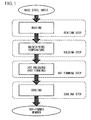
- FIG. 1 is a flowchart illustrating a manufacturing method according to the present invention.
- hot-formed member and a method of manufacturing the hot-formed member according to an embodiment of the present invention, which have been achieved based on the above-described knowledge, will be described.
- hot forming hot pressing that is a specific aspect thereof will be used as an example for description.
- forming methods other than hot pressing for example, roll forming and the like may be employed as a hot forming method.
- the tensile strength of the hot-formed member according to this embodiment is 900 MPa to 1800 MPa. In order to reduce the weights of machine structural components of automobiles and the like, the tensile strength of the material thereof is required to be set to 900 MPa or more.
- the tensile strength in order to prevent brittle fracture of a steel sheet from occurring, it is necessary to set the tensile strength to 1800 MPa or less. In this embodiment, such a tensile strength is achieved by appropriately controlling the amount of various alloy elements such as C and the manufacturing method.
- the C content is a very important element which increases hardenability of steel and has the strongest influence on the strength after hardening.
- the C content is set to 0.10% or more.
- the C content is preferably 0.11% or more.
- the C content is set to 0.40% or less.
- the C content is preferably set to 0.28% or less from the viewpoint of weldability.
- the hot-formed member according to this embodiment does not essentially contain Si. Accordingly, the lower limit of the Si content is 0%.
- Si is an element which acts to increase the strength after hardening while not deteriorating or improving ductility.
- the Si content may be set to 0.001% or more.
- the Si content is set to 0.05% or more, ductility is further improved. Accordingly, the Si content is preferably set to 0.05% or more.
- the Si content is more than 2.0%, the effects obtained by the above-described actions are saturated and economic disadvantages are caused. Moreover, surface properties significantly deteriorate. Accordingly, the Si content is set to 2.0% or less, and is preferably 1.5% or less.
- Mn is a very effective element for increasing hardenability of steel and stably securing the strength after hardening.
- the Mn content is set to 1.0% or more.
- the Mn content is 1.6% or more, a tensile strength of 980 MPa or more can be secured after hardening. Therefore, the Mn content is preferably set to 1.6% or more.
- the Mn content is more than 3.0%, the hot-formed member has a non-uniform metallographic microstructure, and impact resistance significantly deteriorates.
- the Mn content is set to 3.0% or less.
- productivity in a later hot forming process is improved.
- the Mn content is preferably set to 2.4% or less.
- P is an impurity inevitably contained in steel.
- P acts to increase the strength of the hot-formed member by solid-solution strengthening
- P may be actively contained.
- the P content is set to 0.05% or less.
- the P content is preferably set to 0.02% or less.
- the P content is preferably set to 0.003% or more.
- the lower limit of the P content is 0%.
- the S content is an impurity contained in steel.
- the S content is preferably as small as possible in order to improve weldability.
- the S content is set to 0.01% or less.
- the S content is preferably set to 0.003% or less, and more preferably 0.0015% or less. Since the S content is preferably as small as possible, it is not necessary to specify the lower limit of the S content. That is, the lower limit of the S content is 0%.
- Ti is an important element in this embodiment. Since fine precipitates that are Ti carbide, Ti nitride, and/or Ti carbonitride are formed in the hot-formed member when Ti is contained, the metallographic microstructure after hardening can be made fine, and whereby the ductility of the hot-formed member is significantly improved. When the Ti content is less than 0.050%, the metallographic microstructure after hardening is not made fine, and thus the ductility cannot be improved. Accordingly, the Ti content is set to 0.050% or more. The Ti content is preferably 0.070% or more. When the Ti content is more than 0.30%, coarse carbonitride is formed during casting and during hot rolling, and thus the impact resistance of the hot-formed member significantly deteriorates. Accordingly, the Ti content is set to 0.30% or less. The Ti content is preferably 0.25% or less, and more preferably 0.20% or less.
- All these elements are effective elements for increasing hardenability of steel and stably securing the strength of the hot-formed member after hardening. Accordingly, one or two or more of these elements may be contained in the hot-formed member.
- Nb and V are contained in an amount of more than 0.4%, respectively, it is difficult to perform hot rolling and cold rolling in the manufacturing process.
- Nb and V are contained in an amount of more than 0.4%, respectively, the hot-formed member after hardening is likely to have a non-uniform microstructure, and thus the impact resistance of the hot-formed member significantly deteriorates.
- All these elements are elements contributing to control of inclusions, particularly, fine dispersion of inclusions, and acting to increase low-temperature toughness of the hot-formed member. Accordingly, one or two or more of these elements may be contained. However, when any of these elements is contained in an amount of more than 0.01%, surface properties of the hot-formed member may deteriorate. Accordingly, in a case in which the elements are contained, the amount of each element is set as described above. In order to more securely obtain the effects caused by the above-described actions, the amount of each element to be added is preferably set to 0.0003% or more.
- B is an element acting to increase low-temperature toughness of the hot-formed member. Accordingly, B may be contained in the hot-formed member. However, when B is contained in an amount of more than 0.01%, the hot workability of a base steel sheet deteriorates, and it becomes difficult to perform hot rolling. Accordingly, in a case in which B is contained in the hot-formed member, the B content is set to 0.01% or less. In order to more securely obtain the effects caused by the above-described actions, the B content is preferably set to 0.0003% or more.
- Bi is an element uniformizing the metallographic microstructure of the hot-formed member and acting to increase impact resistance of the hot-formed member. Accordingly, Bi may be contained in the hot-formed member. However, when Bi is contained in an amount of more than 0.01%, hot workability of a base steel sheet deteriorates, and it becomes difficult to perform hot rolling. Accordingly, in the case in which Bi is contained in the hot-formed member, the Bi content is set to 0.01% or less. In order to more securely obtain the effects caused by the above-described actions, the Bi content is preferably set to 0.0003% or more.
- the configuration of the metallographic microstructure to be described below is the configuration at approximately 1/2t to 1/4t of a sheet thickness, and not in a central segregation portion.
- the central segregation portion may have a different metallographic microstructure from a representative metallographic microstructure of steel.
- the central segregation portion is a very small region with respect to the entire sheet thickness, and has little influence on the mechanical properties of the steel. That is, the metallographic microstructure of the central segregation portion does not represent the metallographic microstructure of the steel. Accordingly, the metallographic microstructure of the hot-formed member according to this embodiment is specified at approximately 1/2t to 1/4t of the sheet thickness and not in the central segregation portion.
- the "position at 1/2t” indicates a position at a depth of 1/2 of a thickness t of the member from a surface of the hot-formed member
- the "position at 1/4t” indicates a position at a depth of 1/4 of the thickness t of the member from the surface of the hot-formed member.
- unrecrystallized ferrite ferrite plastically deformed by rolling, elongated in a rolling direction, and then remaining without being recrystallized.
- ferrite ferrite other than the unrecrystallized ferrite
- normal ferrite ferrite other than the unrecrystallized ferrite
- the normal ferrite includes recrystallized ferrite generated by recrystallization and transformed ferrite generated by phase transformation and the like.
- the unrecrystallized ferrite In grains of the unrecrystallized ferrite, crystal orientation continuously changes due to the plastic deformation by rolling.
- the crystal orientation in grains of the normal ferrite is almost uniform, and crystal orientations between the normal ferrite grains adjacent to each other are different from each other. Due to such a difference, the unrecrystallized ferrite has higher hardness than the normal ferrite. Since the unrecrystallized ferrite has a shape elongated in the rolling direction, the unrecrystallized ferrite and the normal ferrite can be discriminated from each other by observing the metallographic microstructures with a microscope.
- the unrecrystallized ferrite and the normal ferrite are different in the state of the crystal orientation, the unrecrystallized ferrite and the normal ferrite can be discriminated from each other by analyzing crystal orientation measurement data of an electron back scattering pattern (EBSP) of the metallographic microstructure through a kernel average misorientation method (KAM method).
- EBSP electron back scattering pattern
- KAM method kernel average misorientation method
- ferrite with an aspect ratio of 4 or more is the unrecrystallized ferrite
- ferrite with an aspect ratio of less than 4 is normal ferrite.
- the area ratio of the ferrite is set to 10% or more.
- the area ratio of the ferrite is more than 90%, the area ratio of the martensite is less than 10%, and as will be described later, it is difficult to secure a tensile strength of 900 MPa or more after hardening. Accordingly, the area ratio of the ferrite is set to 90% or less.
- the ratio between the ferrite and the martensite is not particularly limited as long as the area ratio of the ferrite is within the above-described range. However, the ferrite is preferably 25% to 85%, and the martensite is preferably 15% to 75%.
- the area ratio of the unrecrystallized ferrite is set to 2.0% or less (including 0%).
- the average grain size of the ferrite is set to 5.0 ⁇ m or less in order to secure good ductility and impact resistance while maintaining a tensile strength to 900 MPa or more. Since the average grain size of the ferrite is preferably as small as possible, it is not necessary to specify the lower limit of the average grain size of the ferrite. However, the substantial lower limit of the average grain size of the ferrite is about 0.5 ⁇ m in consideration of a manufacturing equipment capacity.
- the hot-formed member represents a member hot-formed from a base steel sheet, and includes, for example, a steel member formed by hot pressing.
- Representative hot-formed members include components for the body structure of an automobile such as a door guard bar and a bumper reinforcement, and hot-formed steel pipes for building construction.
- the configuration of the metallographic microstructure to be described below is the configuration at about 1/2t to 1/4t of a sheet thickness, and not in a central segregation portion.
- the central segregation portion may have a different metallographic microstructure from a representative metallographic microstructure of steel.
- the central segregation portion is a very small region with respect to the entire sheet thickness, and has little influence on the mechanical properties of the steel. That is, the metallographic microstructure of the central segregation portion does not represent the metallographic microstructure of the steel. Accordingly, the metallographic microstructure of the hot-formed member according to this embodiment is specified at about 1/2t to 1/4t of the sheet thickness and not in the central segregation portion.
- the metallographic microstructure of a base steel sheet (also called “start steel sheet”) before being subjected to hot press forming is previously adjusted to a predetermined state, and hot pressing is performed under predetermined hot press forming conditions.
- the steel sheet for hot pressing prepared in this manner which is a base steel sheet having the same chemical composition as that of the above-described hot-formed member and having a metallographic microstructure in which unrecrystallized ferrite is 2.0 area% or less and the average grain size of the ferrite is 0.5 ⁇ m to 7.0 ⁇ m, is subjected to hot press forming in accordance with the following conditions. Since the area ratio of the unrecrystallized ferrite of the base steel sheet is limited to 2.0 area% or less, the metallographic microstructure of the hot-formed member does not become a non-uniform microstructure.
- the cold-rolled steel sheet and the hot-dip galvanized cold-rolled steel sheet having the above-described metallographic microstructure can be manufactured by, for example, annealing in a temperature range of (Ac 3 temperature - 20°C) or higher.
- the base steel sheet In a process of heating the base steel sheet in the hot forming process, the base steel sheet is heated to a temperature range of 720°C to lower than the Ac 3 temperature (°C). In a process of holding the base steel sheet, the temperature of the base steel sheet is maintained for 1 minute to 20 minutes in the above-described temperature range, that is, in a temperature range of 720°C to lower than the Ac 3 temperature.
- the Ac 3 temperature is a temperature specified by the following Formula (i) obtained by an experiment, and in the case in which steel is heated in a temperature range of the Ac 3 temperature or higher, the metallographic microstructure of the steel is an austenite single phase.
- the holding temperature is set to the Ac 3 temperature or higher.
- the holding temperature is set to the Ac 3 temperature + 100°C or lower.
- the hot-formed member include a door guard bar and a bumper reinforcement which are reinforcing components for an automobile.
- the hot-formed member is a bumper reinforcement
- the above-described base steel sheet which is a galvannealed steel sheet having a predetermined length is prepared, and under the above-described conditions, working such as bending may be sequentially performed in a die.
- a shot blasting treatment is generally performed on the hot-formed member for the purpose of removing scale.
- This shot blasting treatment is effective for introducing a compressive stress to a surface of a member to be treated. Accordingly, performing the shot blasting treatment on the hot-formed member has advantages in that delayed fracture is limited in the hot-formed member and the fatigue strength of the hot-formed member is improved.
- the base steel sheet is as soft as possible, and the base steel sheet has high ductility.
- the tensile strength of the base steel sheet is desirably 800 MPa or less.
- the hot forming has been described using hot pressing which is a specific aspect thereof, but the manufacturing method according to this embodiment is not limited to the hot press forming. Similarly to hot pressing, the manufacturing method according to this embodiment can be applied to all hot forming processes having a means which cools a steel sheet simultaneously or immediately after forming. Examples of the hot forming include roll forming.
- Base steel sheets (sheet thickness t: 1.2 mm) having chemical compositions shown in Table 1 and metallographic microstructures and tensile strengths shown in Table 2, respectively, were subjected to hot pressing.
- base steel sheets are steel sheets (cold-rolled steel sheets in Table 2) manufactured by subjecting slabs manufactured in a laboratory to hot rolling, cold rolling, and recrystallization annealing. Using a plating simulator, some steel sheets were subjected to a hot dip galvanizing treatment (plating adhesion amount per side: 60 g/m 2 ) and an galvannealed treatment (plating adhesion amount per side: 60 g/m 2 , Fe content in coating film: 15 mass%). These are hot-dip galvanized cold-rolled steel sheets and galvannealed steel sheets in Table 2. Steel sheets as cold-rolled, and not subjected to recrystallization annealing (full hard in Table 2), were also used as base steel sheets.
- the "cooling rate *1" in Table 3 indicates an average cooling rate from an Ac 3 temperature to 600°C in the case in which the heating temperature is the Ac 3 temperature or higher, and indicates an average cooling rate from the heating temperature to 600°C in the case in which the heating temperature is lower than the Ac 3 temperature.
- the "cooling rate *2" is an average cooling rate in a temperature range of 600°C to 150°C.
- the steel sheets obtained under the various manufacturing conditions were subjected to a tensile test, a Charpy test, and metallographic microstructure observation.
- the steel sheet members prepared in this example are not subjected to hot pressing by a die, but undergo the same thermal history as a hot-formed member. Therefore, the steel sheets have substantially the same mechanical properties as the hot-formed member having the same thermal history.
- V-notch test pieces were prepared and subjected to a Charpy impact test.
- the impact resistance was evaluated as "good” in the case in which the impact value at 0°C was 20 J/cm 2 or higher. In the case in which the impact value at 0°C does not reach 20 J/cm 2 , it was evaluated as "poor".
- Test pieces were prepared from the base steel sheets and the heat-treated steel sheets in a rolling direction of the base steel sheet and the heat-treated steel sheet and in a direction perpendicular to the rolling direction.
- metallographic microstructures of a cross-section in the rolling direction and a cross-section perpendicular to the rolling direction in the test piece were photographed by an electron microscope. Electron micrographs of regions of 800 ⁇ m x 800 ⁇ m obtained as described above were analyzed to calculate area ratios of unrecrystallized ferrite, ferrite, and martensite.
- Sample No. 18 had poor ductility since the manufacturing conditions were out of the range specified in the present invention, and thus a desired microstructure could not be obtained.
- Sample Nos. 28 and 32 could not obtain a target tensile strength since the chemical composition was out of the range specified in the present invention.
- Sample No. 34 had poor ductility since the chemical composition was out of the range specified in the present invention, and thus a desired microstructure could not be obtained.
- Sample No. 8 had poor ductility since the heating temperature was higher than the Ac 3 temperature.
- Sample No. 12 could not obtain a target tensile strength since the heating temperature was lower than 720°C.
- surface scale was generated beyond the allowable extent since the holding time was out of the range specified in the present invention.
- Sample No. 30 could not obtain target impact resistance since the holding time at 750°C or higher was out of the range specified in the present invention.
- Sample No. 24 a total area ratio of ferrite and martensite of the hot-formed member was out of the range specified in the present invention, and the tensile strength was insufficient since the cooling rate at a temperature lower than 600°C was out of the range specified in the present invention.
Landscapes
- Chemical & Material Sciences (AREA)
- Engineering & Computer Science (AREA)
- Mechanical Engineering (AREA)
- Materials Engineering (AREA)
- Metallurgy (AREA)
- Organic Chemistry (AREA)
- Physics & Mathematics (AREA)
- Thermal Sciences (AREA)
- Crystallography & Structural Chemistry (AREA)
- Chemical Kinetics & Catalysis (AREA)
- Oil, Petroleum & Natural Gas (AREA)
- Heat Treatment Of Sheet Steel (AREA)
- Heat Treatment Of Articles (AREA)
Applications Claiming Priority (1)
| Application Number | Priority Date | Filing Date | Title |
|---|---|---|---|
| PCT/JP2014/050019 WO2015102048A1 (fr) | 2014-01-06 | 2014-01-06 | Élément façonné à chaud et son procédé de fabrication |
Publications (2)
| Publication Number | Publication Date |
|---|---|
| EP3093360A1 true EP3093360A1 (fr) | 2016-11-16 |
| EP3093360A4 EP3093360A4 (fr) | 2018-03-07 |
Family
ID=53493396
Family Applications (1)
| Application Number | Title | Priority Date | Filing Date |
|---|---|---|---|
| EP14876941.7A Withdrawn EP3093360A4 (fr) | 2014-01-06 | 2014-01-06 | Élément façonné à chaud et son procédé de fabrication |
Country Status (8)
| Country | Link |
|---|---|
| US (1) | US20160326608A1 (fr) |
| EP (1) | EP3093360A4 (fr) |
| JP (1) | JP6229736B2 (fr) |
| KR (1) | KR101849031B1 (fr) |
| CN (1) | CN105899700B (fr) |
| CA (1) | CA2935638C (fr) |
| MX (1) | MX2016008808A (fr) |
| WO (1) | WO2015102048A1 (fr) |
Families Citing this family (12)
| Publication number | Priority date | Publication date | Assignee | Title |
|---|---|---|---|---|
| CN105874091A (zh) | 2014-01-06 | 2016-08-17 | 新日铁住金株式会社 | 热成形构件及其制造方法 |
| ES2745428T3 (es) | 2014-01-06 | 2020-03-02 | Nippon Steel Corp | Acero y método para fabricar el mismo |
| US10625323B2 (en) | 2016-02-19 | 2020-04-21 | Ford Global Technologies, Llc | Method for monitoring quality of hot stamped components |
| US11229935B2 (en) * | 2016-10-21 | 2022-01-25 | Ford Global Technologies, Llc | Method for monitoring quality of hot stamped components |
| MX2019010378A (es) * | 2017-03-01 | 2019-10-22 | Ak Steel Properties Inc | Acero endurecido por prensado con fuerza extremadamente alta y metodo para su produccion. |
| CN107099748B (zh) * | 2017-04-28 | 2019-03-26 | 武汉钢铁有限公司 | 高温成型用超高强锌铝镁镀层钢板及其制造方法 |
| CN107475623A (zh) * | 2017-08-15 | 2017-12-15 | 苏州普热斯勒先进成型技术有限公司 | 一种热成形高强钢及其加工方法 |
| CN110423953B (zh) * | 2019-08-21 | 2020-12-01 | 马鞍山钢铁股份有限公司 | 一种抗拉强度1800MPa级以上的冷弯性能优良的热成形构件及其制备方法 |
| WO2021123886A1 (fr) * | 2019-12-19 | 2021-06-24 | Arcelormittal | Tôle d'acier recuit laminée à chaud de haute ténacité et son procédé de fabrication |
| MX2022008074A (es) * | 2020-01-08 | 2022-07-27 | Nippon Steel Corp | Lamina de acero y metodo de fabricacion de la misma. |
| WO2024128737A1 (fr) * | 2022-12-12 | 2024-06-20 | 주식회사 포스코 | Tôle d'acier à haute résistance ayant un rapport d'élasticité élevé, et son procédé de fabrication |
| CN116445820B (zh) * | 2023-04-23 | 2024-09-27 | 常熟理工学院 | 一种铌钒钛复合微合金化汽车用热成型钢及其制备方法 |
Family Cites Families (22)
| Publication number | Priority date | Publication date | Assignee | Title |
|---|---|---|---|---|
| SE435527B (sv) | 1973-11-06 | 1984-10-01 | Plannja Ab | Forfarande for framstellning av en detalj av herdat stal |
| JP3407562B2 (ja) | 1996-09-20 | 2003-05-19 | 住友金属工業株式会社 | 高炭素薄鋼板の製造方法および部品の製造方法 |
| JP2001234282A (ja) * | 2000-02-21 | 2001-08-28 | Kawasaki Steel Corp | 温間プレス成形性に優れた高張力熱延鋼板およびその製造方法 |
| WO2008110670A1 (fr) | 2007-03-14 | 2008-09-18 | Arcelormittal France | Acier pour formage a chaud ou trempe sous outil a ductilite amelioree |
| KR101010971B1 (ko) * | 2008-03-24 | 2011-01-26 | 주식회사 포스코 | 저온 열처리 특성을 가지는 성형용 강판, 그 제조방법,이를 이용한 부품의 제조방법 및 제조된 부품 |
| CA2718304C (fr) * | 2008-03-27 | 2012-03-06 | Nippon Steel Corporation | Tole d'acier galvanisee a haute resistance, tole galvanisee a chaud alliee a haute resistance et tole d'acier laminee a froid a haute resistance qui excellent en termes d'aptitude au moulage et au soudage, et procede de fabrication de toutes ces toles |
| JP5347395B2 (ja) | 2008-09-12 | 2013-11-20 | Jfeスチール株式会社 | 延性に優れたホットプレス部材、そのホットプレス部材用鋼板、およびそのホットプレス部材の製造方法 |
| JP5347393B2 (ja) * | 2008-09-12 | 2013-11-20 | Jfeスチール株式会社 | 延性に優れたホットプレス部材、そのホットプレス部材用鋼板、およびそのホットプレス部材の製造方法 |
| JP5347392B2 (ja) | 2008-09-12 | 2013-11-20 | Jfeスチール株式会社 | 延性に優れたホットプレス部材、そのホットプレス部材用鋼板、およびそのホットプレス部材の製造方法 |
| DE102008051992B4 (de) | 2008-10-16 | 2011-03-24 | Benteler Automobiltechnik Gmbh | Verfahren zur Herstellung eines Werkstücks, Werkstück und Verwendung eines Werkstückes |
| JP5438302B2 (ja) * | 2008-10-30 | 2014-03-12 | 株式会社神戸製鋼所 | 加工性に優れた高降伏比高強度の溶融亜鉛めっき鋼板または合金化溶融亜鉛めっき鋼板とその製造方法 |
| JP5353642B2 (ja) * | 2009-11-06 | 2013-11-27 | 新日鐵住金株式会社 | 熱処理用鋼板およびその製造方法 |
| MX2012014594A (es) * | 2010-06-14 | 2013-02-21 | Nippon Steel & Sumitomo Metal Corp | Articulo moldeado y estampado en caliente, proceso para produccion de placa de acero para estampado en caliente, y proceso para produccion de un articulo moldeado y estampado en caliente. |
| JP2012082499A (ja) * | 2010-10-14 | 2012-04-26 | Sumitomo Metal Ind Ltd | 溶融めっき鋼板およびその製造方法 |
| JP5224010B2 (ja) * | 2010-10-22 | 2013-07-03 | 新日鐵住金株式会社 | 縦壁部を有するホットスタンプ成形体の製造方法及び縦壁部を有するホットスタンプ成形体 |
| KR101253885B1 (ko) * | 2010-12-27 | 2013-04-16 | 주식회사 포스코 | 연성이 우수한 성형 부재용 강판, 성형 부재 및 그 제조방법 |
| JP5756773B2 (ja) * | 2012-03-09 | 2015-07-29 | 株式会社神戸製鋼所 | 熱間プレス用鋼板およびプレス成形品、並びにプレス成形品の製造方法 |
| JP5860333B2 (ja) * | 2012-03-30 | 2016-02-16 | 株式会社神戸製鋼所 | 加工性に優れた高降伏比高強度冷延鋼板 |
| JP5835621B2 (ja) * | 2012-06-27 | 2015-12-24 | 新日鐵住金株式会社 | 熱間プレス鋼板部材およびその製造方法ならびに熱間プレス用鋼板 |
| JP5630475B2 (ja) * | 2012-07-17 | 2014-11-26 | 新日鐵住金株式会社 | 熱間成形鋼板部材およびその製造方法 |
| RU2650233C1 (ru) * | 2013-12-20 | 2018-04-13 | Ниппон Стил Энд Сумитомо Метал Корпорейшн | Горячепрессованное стальное листовое изделие, способ его изготовления и стальной лист для горячего прессования |
| CA2934597C (fr) * | 2013-12-27 | 2019-01-15 | Nippon Steel & Sumitomo Metal Corporation | Element de tole d'acier pressee a chaud, son procede de production et tole d'acier pour pressage a chaud |
-
2014
- 2014-01-06 MX MX2016008808A patent/MX2016008808A/es unknown
- 2014-01-06 US US15/109,582 patent/US20160326608A1/en not_active Abandoned
- 2014-01-06 WO PCT/JP2014/050019 patent/WO2015102048A1/fr not_active Ceased
- 2014-01-06 CN CN201480072496.1A patent/CN105899700B/zh active Active
- 2014-01-06 KR KR1020167018727A patent/KR101849031B1/ko active Active
- 2014-01-06 CA CA2935638A patent/CA2935638C/fr not_active Expired - Fee Related
- 2014-01-06 JP JP2015555854A patent/JP6229736B2/ja active Active
- 2014-01-06 EP EP14876941.7A patent/EP3093360A4/fr not_active Withdrawn
Also Published As
| Publication number | Publication date |
|---|---|
| KR20160097348A (ko) | 2016-08-17 |
| MX2016008808A (es) | 2016-09-08 |
| JP6229736B2 (ja) | 2017-11-15 |
| KR101849031B1 (ko) | 2018-04-13 |
| US20160326608A1 (en) | 2016-11-10 |
| CA2935638A1 (fr) | 2015-07-09 |
| CN105899700B (zh) | 2019-01-15 |
| EP3093360A4 (fr) | 2018-03-07 |
| WO2015102048A1 (fr) | 2015-07-09 |
| CA2935638C (fr) | 2019-08-27 |
| CN105899700A (zh) | 2016-08-24 |
| JPWO2015102048A1 (ja) | 2017-03-23 |
Similar Documents
| Publication | Publication Date | Title |
|---|---|---|
| US10711322B2 (en) | Hot-pressed steel sheet member, method of manufacturing the same, and steel sheet for hot pressing | |
| EP3093360A1 (fr) | Élément façonné à chaud et son procédé de fabrication | |
| CN108431248B (zh) | 用于制造具有改善的延展性和可成形性的高强度钢板的方法和所获得的钢板 | |
| US10273555B2 (en) | Hot-pressed steel sheet member | |
| EP3282031B1 (fr) | Élément de tôle d'acier traité thermiquement et son procédé de production | |
| KR101533164B1 (ko) | 핫스탬프 성형체의 제조 방법 및 핫스탬프 성형체 | |
| KR101831544B1 (ko) | 열간 성형 부재 및 그 제조 방법 | |
| US10344351B2 (en) | Hot-pressed steel sheet member, method of manufacturing the same, and steel sheet for hot pressing | |
| JP5630475B2 (ja) | 熱間成形鋼板部材およびその製造方法 | |
| EP3006586A1 (fr) | Matériau d'acier traité thermiquement et son procédé de production | |
| JP5835621B2 (ja) | 熱間プレス鋼板部材およびその製造方法ならびに熱間プレス用鋼板 | |
| CN112313351A (zh) | 钢板及钢板的制造方法 | |
| CN118574947A (zh) | 热冲压成形体 | |
| EP4317509A1 (fr) | Tôle d'acier à haute résistance et son procédé de production, et élément |
Legal Events
| Date | Code | Title | Description |
|---|---|---|---|
| PUAI | Public reference made under article 153(3) epc to a published international application that has entered the european phase |
Free format text: ORIGINAL CODE: 0009012 |
|
| 17P | Request for examination filed |
Effective date: 20160806 |
|
| AK | Designated contracting states |
Kind code of ref document: A1 Designated state(s): AL AT BE BG CH CY CZ DE DK EE ES FI FR GB GR HR HU IE IS IT LI LT LU LV MC MK MT NL NO PL PT RO RS SE SI SK SM TR |
|
| AX | Request for extension of the european patent |
Extension state: BA ME |
|
| DAX | Request for extension of the european patent (deleted) | ||
| RIC1 | Information provided on ipc code assigned before grant |
Ipc: C22C 38/28 20060101ALI20170719BHEP Ipc: C22C 38/22 20060101ALI20170719BHEP Ipc: C22C 38/00 20060101AFI20170719BHEP Ipc: B21D 22/20 20060101ALI20170719BHEP Ipc: C22C 38/16 20060101ALI20170719BHEP Ipc: C22C 38/12 20060101ALI20170719BHEP Ipc: C21D 1/673 20060101ALI20170719BHEP Ipc: C21D 8/02 20060101ALI20170719BHEP Ipc: C22C 38/08 20060101ALI20170719BHEP Ipc: C21D 9/46 20060101ALI20170719BHEP Ipc: C22C 38/04 20060101ALI20170719BHEP Ipc: C22C 38/14 20060101ALI20170719BHEP Ipc: C22C 38/58 20060101ALI20170719BHEP Ipc: C22C 38/02 20060101ALI20170719BHEP Ipc: C22C 38/06 20060101ALI20170719BHEP Ipc: C21D 1/18 20060101ALI20170719BHEP Ipc: C21D 9/00 20060101ALI20170719BHEP |
|
| A4 | Supplementary search report drawn up and despatched |
Effective date: 20180205 |
|
| RIC1 | Information provided on ipc code assigned before grant |
Ipc: C22C 38/16 20060101ALI20180130BHEP Ipc: C22C 38/02 20060101ALI20180130BHEP Ipc: C22C 38/12 20060101ALI20180130BHEP Ipc: C22C 38/22 20060101ALI20180130BHEP Ipc: C22C 38/58 20060101ALI20180130BHEP Ipc: C22C 38/14 20060101ALI20180130BHEP Ipc: C21D 1/673 20060101ALI20180130BHEP Ipc: C22C 38/04 20060101ALI20180130BHEP Ipc: C22C 38/28 20060101ALI20180130BHEP Ipc: C21D 9/00 20060101ALI20180130BHEP Ipc: B21D 22/20 20060101ALI20180130BHEP Ipc: C22C 38/00 20060101AFI20180130BHEP Ipc: C21D 8/02 20060101ALI20180130BHEP Ipc: C21D 1/18 20060101ALI20180130BHEP Ipc: C21D 9/46 20060101ALI20180130BHEP Ipc: C21D 9/48 20060101ALI20180130BHEP Ipc: C22C 38/08 20060101ALI20180130BHEP Ipc: C22C 38/06 20060101ALI20180130BHEP |
|
| RAP1 | Party data changed (applicant data changed or rights of an application transferred) |
Owner name: NIPPON STEEL CORPORATION |
|
| GRAP | Despatch of communication of intention to grant a patent |
Free format text: ORIGINAL CODE: EPIDOSNIGR1 |
|
| STAA | Information on the status of an ep patent application or granted ep patent |
Free format text: STATUS: GRANT OF PATENT IS INTENDED |
|
| RIC1 | Information provided on ipc code assigned before grant |
Ipc: B21D 22/20 20060101ALI20201124BHEP Ipc: C22C 38/12 20060101ALI20201124BHEP Ipc: C22C 38/28 20060101ALI20201124BHEP Ipc: C21D 8/02 20060101ALI20201124BHEP Ipc: C21D 9/46 20060101ALI20201124BHEP Ipc: C22C 38/02 20060101ALI20201124BHEP Ipc: C22C 38/00 20060101AFI20201124BHEP Ipc: B32B 15/01 20060101ALI20201124BHEP Ipc: C21D 9/00 20060101ALI20201124BHEP Ipc: C22C 38/14 20060101ALI20201124BHEP Ipc: C22C 38/06 20060101ALI20201124BHEP Ipc: C22C 38/58 20060101ALI20201124BHEP Ipc: C22C 38/08 20060101ALI20201124BHEP Ipc: C21D 1/673 20060101ALI20201124BHEP Ipc: C22C 38/22 20060101ALI20201124BHEP Ipc: C21D 1/18 20060101ALI20201124BHEP Ipc: C22C 38/04 20060101ALI20201124BHEP Ipc: C21D 9/48 20060101ALI20201124BHEP Ipc: C22C 38/16 20060101ALI20201124BHEP |
|
| INTG | Intention to grant announced |
Effective date: 20201218 |
|
| STAA | Information on the status of an ep patent application or granted ep patent |
Free format text: STATUS: THE APPLICATION IS DEEMED TO BE WITHDRAWN |
|
| 18D | Application deemed to be withdrawn |
Effective date: 20210429 |