EP3093643A1 - Examen de composants pour détecter les impuretés - Google Patents
Examen de composants pour détecter les impuretés Download PDFInfo
- Publication number
- EP3093643A1 EP3093643A1 EP15167183.1A EP15167183A EP3093643A1 EP 3093643 A1 EP3093643 A1 EP 3093643A1 EP 15167183 A EP15167183 A EP 15167183A EP 3093643 A1 EP3093643 A1 EP 3093643A1
- Authority
- EP
- European Patent Office
- Prior art keywords
- component
- contamination
- measuring
- volume
- contaminant
- Prior art date
- Legal status (The legal status is an assumption and is not a legal conclusion. Google has not performed a legal analysis and makes no representation as to the accuracy of the status listed.)
- Withdrawn
Links
- 238000011109 contamination Methods 0.000 title claims abstract description 87
- 238000005259 measurement Methods 0.000 claims abstract description 66
- 239000000356 contaminant Substances 0.000 claims abstract description 55
- 238000000034 method Methods 0.000 claims abstract description 36
- 238000010438 heat treatment Methods 0.000 claims abstract description 22
- 238000010926 purge Methods 0.000 claims abstract description 17
- 230000004913 activation Effects 0.000 claims description 30
- 238000003795 desorption Methods 0.000 claims description 20
- 239000012535 impurity Substances 0.000 claims description 13
- 239000002131 composite material Substances 0.000 claims description 10
- 239000000835 fiber Substances 0.000 claims description 10
- 238000009826 distribution Methods 0.000 claims description 9
- 239000004033 plastic Substances 0.000 claims description 6
- 229920003023 plastic Polymers 0.000 claims description 6
- 229910044991 metal oxide Inorganic materials 0.000 claims description 4
- 150000004706 metal oxides Chemical class 0.000 claims description 4
- 238000010521 absorption reaction Methods 0.000 claims description 3
- 238000004817 gas chromatography Methods 0.000 claims description 3
- 238000005496 tempering Methods 0.000 claims 1
- 238000001994 activation Methods 0.000 description 28
- 239000010410 layer Substances 0.000 description 12
- 239000000463 material Substances 0.000 description 9
- 238000011010 flushing procedure Methods 0.000 description 6
- 238000012545 processing Methods 0.000 description 6
- 238000011002 quantification Methods 0.000 description 6
- 238000009792 diffusion process Methods 0.000 description 5
- 230000008569 process Effects 0.000 description 5
- 238000001035 drying Methods 0.000 description 4
- 238000004519 manufacturing process Methods 0.000 description 4
- 239000011159 matrix material Substances 0.000 description 4
- 238000004458 analytical method Methods 0.000 description 3
- 239000004918 carbon fiber reinforced polymer Substances 0.000 description 3
- 238000001514 detection method Methods 0.000 description 3
- 239000000126 substance Substances 0.000 description 3
- 230000008901 benefit Effects 0.000 description 2
- 239000012459 cleaning agent Substances 0.000 description 2
- 238000010276 construction Methods 0.000 description 2
- 238000011161 development Methods 0.000 description 2
- 230000018109 developmental process Effects 0.000 description 2
- 238000011156 evaluation Methods 0.000 description 2
- 230000008439 repair process Effects 0.000 description 2
- 239000002344 surface layer Substances 0.000 description 2
- 238000007725 thermal activation Methods 0.000 description 2
- 230000007704 transition Effects 0.000 description 2
- XLYOFNOQVPJJNP-UHFFFAOYSA-N water Substances O XLYOFNOQVPJJNP-UHFFFAOYSA-N 0.000 description 2
- 238000004026 adhesive bonding Methods 0.000 description 1
- 230000002528 anti-freeze Effects 0.000 description 1
- 239000007798 antifreeze agent Substances 0.000 description 1
- 230000004888 barrier function Effects 0.000 description 1
- 239000004566 building material Substances 0.000 description 1
- 230000008859 change Effects 0.000 description 1
- 238000010382 chemical cross-linking Methods 0.000 description 1
- 239000003795 chemical substances by application Substances 0.000 description 1
- 238000004140 cleaning Methods 0.000 description 1
- 239000000805 composite resin Substances 0.000 description 1
- 125000004122 cyclic group Chemical group 0.000 description 1
- 239000012530 fluid Substances 0.000 description 1
- 239000004615 ingredient Substances 0.000 description 1
- 239000002650 laminated plastic Substances 0.000 description 1
- 239000000314 lubricant Substances 0.000 description 1
- 231100000252 nontoxic Toxicity 0.000 description 1
- 230000003000 nontoxic effect Effects 0.000 description 1
- 230000009965 odorless effect Effects 0.000 description 1
- 239000002245 particle Substances 0.000 description 1
- 239000011148 porous material Substances 0.000 description 1
- 238000002203 pretreatment Methods 0.000 description 1
- 230000002250 progressing effect Effects 0.000 description 1
- 230000000750 progressive effect Effects 0.000 description 1
- 230000009467 reduction Effects 0.000 description 1
- 238000004088 simulation Methods 0.000 description 1
- 239000002356 single layer Substances 0.000 description 1
- 238000007619 statistical method Methods 0.000 description 1
Images

Classifications
-
- G—PHYSICS
- G01—MEASURING; TESTING
- G01N—INVESTIGATING OR ANALYSING MATERIALS BY DETERMINING THEIR CHEMICAL OR PHYSICAL PROPERTIES
- G01N33/00—Investigating or analysing materials by specific methods not covered by groups G01N1/00 - G01N31/00
- G01N33/0004—Gaseous mixtures, e.g. polluted air
- G01N33/0009—General constructional details of gas analysers, e.g. portable test equipment
- G01N33/0027—General constructional details of gas analysers, e.g. portable test equipment concerning the detector
- G01N33/0036—General constructional details of gas analysers, e.g. portable test equipment concerning the detector specially adapted to detect a particular component
-
- G—PHYSICS
- G01—MEASURING; TESTING
- G01N—INVESTIGATING OR ANALYSING MATERIALS BY DETERMINING THEIR CHEMICAL OR PHYSICAL PROPERTIES
- G01N1/00—Sampling; Preparing specimens for investigation
-
- G—PHYSICS
- G01—MEASURING; TESTING
- G01N—INVESTIGATING OR ANALYSING MATERIALS BY DETERMINING THEIR CHEMICAL OR PHYSICAL PROPERTIES
- G01N1/00—Sampling; Preparing specimens for investigation
- G01N1/02—Devices for withdrawing samples
- G01N1/22—Devices for withdrawing samples in the gaseous state
- G01N1/2226—Sampling from a closed space, e.g. food package, head space
-
- G—PHYSICS
- G01—MEASURING; TESTING
- G01N—INVESTIGATING OR ANALYSING MATERIALS BY DETERMINING THEIR CHEMICAL OR PHYSICAL PROPERTIES
- G01N13/00—Investigating surface or boundary effects, e.g. wetting power; Investigating diffusion effects; Analysing materials by determining surface, boundary, or diffusion effects
-
- G—PHYSICS
- G01—MEASURING; TESTING
- G01N—INVESTIGATING OR ANALYSING MATERIALS BY DETERMINING THEIR CHEMICAL OR PHYSICAL PROPERTIES
- G01N25/00—Investigating or analyzing materials by the use of thermal means
- G01N25/56—Investigating or analyzing materials by the use of thermal means by investigating moisture content
-
- G—PHYSICS
- G01—MEASURING; TESTING
- G01N—INVESTIGATING OR ANALYSING MATERIALS BY DETERMINING THEIR CHEMICAL OR PHYSICAL PROPERTIES
- G01N33/00—Investigating or analysing materials by specific methods not covered by groups G01N1/00 - G01N31/00
- G01N33/0003—Composite materials
-
- G—PHYSICS
- G01—MEASURING; TESTING
- G01N—INVESTIGATING OR ANALYSING MATERIALS BY DETERMINING THEIR CHEMICAL OR PHYSICAL PROPERTIES
- G01N1/00—Sampling; Preparing specimens for investigation
- G01N1/28—Preparing specimens for investigation including physical details of (bio-)chemical methods covered elsewhere, e.g. G01N33/50, C12Q
- G01N1/44—Sample treatment involving radiation, e.g. heat
-
- G—PHYSICS
- G01—MEASURING; TESTING
- G01N—INVESTIGATING OR ANALYSING MATERIALS BY DETERMINING THEIR CHEMICAL OR PHYSICAL PROPERTIES
- G01N1/00—Sampling; Preparing specimens for investigation
- G01N1/02—Devices for withdrawing samples
- G01N1/22—Devices for withdrawing samples in the gaseous state
- G01N1/2226—Sampling from a closed space, e.g. food package, head space
- G01N2001/2241—Sampling from a closed space, e.g. food package, head space purpose-built sampling enclosure for emissions
Definitions
- the present invention relates to a method and apparatus for inspecting components for contamination.
- components made of different materials can often be considered as relatively porous material.
- Different substances that come in contact with such components may then optionally diffuse into the component.
- the rate of diffusion depends on the one hand on the properties of the material and on the other hand on parameters such as e.g. the ambient temperature, the molecular structure and the polarity of the incoming molecule.
- substances entering a component may return to the surface as contamination from the interior of the matrix and affect, for example, subsequent processing steps such as bonding with other materials, bonds or repairs.
- the object of the present invention is to provide an improved technique with which components can be examined for impurities.
- An inventive method is used to examine a component for contamination. It comprises heating a sample surface of the component under a measuring bell defining a measuring volume, measuring at least two times a contamination of the measuring volume with at least one contaminant and rinsing the measuring volume with gas.
- the measurement of the contamination is carried out according to a method of the invention thus several times, at least twice.
- at least one current value is measured, which quantifies a contamination of the measurement volume, which may have resulted from a thermal desorption of the contaminant substance activated by the heating into the measurement volume;
- the at least one contaminant may be desorbed from the sample surface and / or through the sample surface from the interior of the component.
- a device serves to examine a component for contamination and comprises a measuring bell, which is set up to form a (preferably closed) measuring volume around the component or against the component.
- a device further comprises a heating element which is adapted to heat at least one sample surface of the component, and a flushing unit, which is adapted to flush the measuring volume with gas;
- the flushing unit may comprise a preferably controllable gas connection.
- a device comprises a sensor system which is set up to measure a contamination of the measurement volume with at least one contaminant.
- the sensor system may include at least one humidity sensor, metal oxide sensor, infrared absorption sensor, ion mobility spectrometer (IMS); and / or gas chromatography sensor (which may, for example, comprise an ion mobility spectrometer as detector).
- the measuring may include determining an absolute or relative amount of the at least one contaminant in the measurement volume.
- a “component” is understood to mean an element which is suitable for further processing in a production process or which already represents a finished product.
- the term includes preformed elements that can be joined and bonded together for the manufacture of a product, for example in vehicle construction, in particular in aircraft construction.
- a component can have a multilayer structure or comprise only a single layer.
- a building material unit such as a panel of a fiber composite plastic laminate (e.g., an uncured fiber-resin composite, particularly a prepreg fiber matrix mat (a so-called "prepreg")) is included in this document by the term "component".
- the component is a composite component of an aircraft or spacecraft.
- the sample surface may each be an entire surface of the component or a local surface portion of the component; an examination of the component takes place on it. Together with the measuring bell and possibly with a further surface (for example a base), it forms a boundary of the (surrounding or adjacent) measuring volume.
- the measuring bell may be slipped in any direction on the sample surface of the component or a pad, or it may completely enclose the component.
- the prepositional term "under a bell" is not to be interpreted as pointing to a vertical orientation.
- the measurement volume can form any arbitrarily shaped geometric space (such as a sphere, a hemisphere, a cylinder, a truncated cone or a cuboid, to name just a few).
- the term "measuring bell" defining the measuring volume should not be understood as a limitation of the geometry of the measuring volume.
- the measuring bell is at least a part of a portable hand-held device.
- it may preferably have a diameter of at least 10 cm and / or a maximum of 50 cm, more preferably a maximum of 20 cm, and / or a mass of at most 5 kg, more preferably of at most 1 kg.
- the measuring bell comprises a seal which seals the measuring volume at a transition of the measuring bell to a surface when the measuring bell is placed on the surface.
- a surface can for example, may include a backing surface on which the component is located, and / or it may include the sample surface of the component.
- the heating can be done from any side.
- a used heating element can be arranged wholly or partly in the measuring volume or outside thereof. Heating by means of an energy input through an energy-permeable window of the measuring bell is particularly preferred.
- the heating element may in particular comprise an infrared radiator.
- gas in the measuring volume is exchanged.
- gas is passed into the measuring volume, which has previously known properties, in particular whose contamination with the at least one contaminant does not exceed a previously known threshold value.
- the gas is air, preferably synthetic air. This offers the advantages of being particularly cost-effective, odorless, non-toxic and non-flammable.
- contaminant is removed from the measurement volume, which may have previously been desorbed from or through the sample surface of the component into the measurement volume. Rinsing thus prevents saturation of the measurement volume with the at least one contaminant. In this way, a continued desorption of the at least one contaminant into the measurement volume is made possible and thus an accurate detection of contamination of the component is improved.
- the present invention thus offers the particular advantage that a thermally activated desorption process can be detected in its time course.
- diffusion into the interior of the component which results as compensation developments from the desorption, can be taken into account.
- contamination to be analyzed even in internal areas or layers of the component remote from the sample surface.
- it can be determined, for example, whether a contamination has a degree that is critical for certain further processing steps (such as structural bonding).
- certain supplementary measures e.g., drying of the component
- a pre-treatment for the further processing steps can be optimized, which reduces costs and labor.
- the contaminant comprises moisture. Measuring the contamination can in particular be a measurement of a relative Moisture of a gas contained in the measuring volume (eg air) include.
- the at least one contaminant may contain, for example, ingredients of one or more cleaning and / or antifreeze agents, hydraulic fluid (s), metal oxide (s), lubricants or the like. include.
- the measurement of a (current) contamination of the measurement volume by means of a sensor system.
- a sensor system may comprise at least one humidity sensor, at least one metal oxide sensor, at least one infrared absorption sensor, at least one gas chromatography ion mobility spectrograph sensor and / or at least one classical analysis unit.
- an absolute or relative amount of the at least one contaminant in the measurement volume is determined.
- the rinsing is carried out during the heating and / or the (at least twice) measuring the contamination.
- a desorption process can be activated during a continuous purging and detected by repeatedly measuring the contamination of the measurement volume; Desorbed contaminant is therefore preferably not or only to a small extent collected in the measurement volume in this case.
- the rinsing is carried out during a rinsing phase which lies temporally between a first and a second activation phase (ie after the first and before the second activation phase).
- the first and the second activation phase comprise at least one single measurement of the (then respectively current) contamination of the measurement volume with the contaminant, wherein the measurement volume is preferably completed during the first and the second activation phase.
- the heating of the sample surface is at least partially during the first and the second activation phase in which thereby - if contamination of the component is present - a desorption of the at least one contaminant can be thermally activated.
- desorbed contaminant can be temporarily collected in the measurement volume and the progressive desorption can be monitored during the individual activation phases.
- rinsing between the two activation phases can for ensure that the starting conditions are the same in both phases; In particular, a reduction in desorption due to a saturation process of the measurement volume with the desorbed contaminant can be prevented.
- Measuring the progressing contamination in the completed measuring volume enables a precise detection of the contamination, with which measured values below a detection threshold can be avoided, in particular in the case of slowly proceeding desorption processes.
- the rinsing phase can thus comprise one or more measurements of a (respectively current) contamination of the measuring volume with the contaminant during rinsing. In this way, the gas in the measuring volume can also be controlled during rinsing.
- a duration of the rinsing phase can be controlled as a function of a contamination of the gas.
- the method may include comparing a currently measured contamination with a comparison value and determining that the measured contamination is less than or equal to a comparison value.
- the purging can then be carried out in particular by closing a gas connection in the measurement volume, preferably also by closing a gas outlet of the measurement volume.
- Rinsing is preferably controlled automatically.
- a purging unit used preferably comprises a controller which automatically controls the beginning and end of purging, a quantity of gas passed through and / or a purging pressure.
- At least one measurement of the contamination of the measurement volume takes place at least once before and after a compensation phase of a predetermined duration; the predetermined duration may include, for example, several hours or even days.
- the sample surface of the component if appropriate in a section examined in each case
- the predetermined temperature which is below a desorption temperature that is, no thermal activation of a desorption of the at least one contaminant takes place.
- the temperatures can be selected or have been chosen in particular as a function of the respective contamination and / or the material.
- the balancing phase may involve incorporating the component in a heating chamber or oven at a temperature which (in the case of moisture as contamination, for example) is, for example, in a range of 20 ° -45 ° C, more preferably 35 ° -40 ° C can.
- the sample surface of the component is preferably reheated.
- One or more of the measurements after the compensation phase may preferably be interrupted by a further rinsing phase analogous to those described above.
- the measuring can take place after the balancing phase in a third and fourth activation phase, which proceed analogously to a first and second activation phase and can be separated from one another by a corresponding rinsing phase.
- the compensation phase can ensure that the differences in concentration that occur are compensated by diffusion inside the component, thus restoring a balance in terms of distribution.
- contamination particles lying further inside the component diffuse to the surface (in particular to the sample surface) and thus become accessible to desorption by the sample surface.
- a method according to the invention comprises quantifying an impurity on the basis of the (possibly for example during the activation and / or purging phases) measured contaminations of the measurement volume;
- a device according to the invention is analogously preferably designed to carry out such a quantification.
- the quantification may concern an inner region of the component (in particular an inner region, which is closed off from the sample surface to the outside) and / or the sample surface of the component and / or the entire component.
- a suitability of the component for further processing steps eg gluing
- a requirement of taking countermeasures can be determined.
- a suitability of the component for further processing steps eg gluing
- a requirement of taking countermeasures can be determined.
- at least Contains a contaminant water be determined in this way, whether a drying is required and, if appropriate, how long and / or at which temperature such a drying process should take place.
- one or more tolerance limits may be determined for the respective contamination. If the specific quantitative contaminations are below the tolerance limit / n, subsequent drying processes can be dispensed with.
- the quantification may comprise adding contaminants (ie, readings representing the respective contaminants), such as adding contaminants determined in a second activation phase (as described above) to a (eg maximum) contamination, which in a previous, first activation phase was measured.
- contaminants ie, readings representing the respective contaminants
- a second activation phase as described above
- a contamination which in a previous, first activation phase was measured.
- the quantification may include, for example, a determination and analysis of an interpolation function against the measured contaminants as a function of time; Such an analysis may include differentiating and / or integrating and / or determining extreme values, in particular maxima of the interpolation function.
- the quantifying may comprise comparing at least one measured contamination, preferably a course of a series of measurements comprising a plurality of contamination measurements, with one or more values stored in a database and / or determined by simulation.
- the quantification comprises creating a contamination profile representing an impurity distribution in a cross-section of the component.
- a preferred embodiment of a device according to the invention comprises a computer unit which is set up on the basis of measured contaminations of the device To quantify an impurity in the interior of the component and / or on a surface of the component (for example, in one of the ways indicated above) and / or to determine an impurity distribution in the interior of the component.
- the sample surface of the component is a first sample surface portion and a method according to the invention comprises heating a second sample surface portion of the component under the (repositioned) measuring bell or under a further measuring bell; in either case, the respective (i.e., the repositioned or the further) measurement bell defines a further measurement volume adjacent to the second sample surface portion of the component; It will be understood that the statements above regarding the terms “measuring bell” and “under the measuring bell” also apply to the second sample surface section.
- the method may further comprise measuring at least twice a contamination of the further measurement volume with the at least one contaminant and flushing the further measurement volume with gas.
- a measuring bell of a preferred embodiment of the present invention is analogously preferably configured to be placed successively on different sections of the component and / or of different components in order to form a (preferably closed) measuring volume with the respectively adjacent section.
- the component can thus be randomly examined on at least one further sample surface section according to one or more (possibly different) of the methods described here.
- the resulting results, optionally reflecting local contaminants, may then be quantified to determine contamination of the entire component (or a larger portion of a component comprising several sample surface portions examined), and / or impurity distribution in the component (or larger portion) ). In this way (possibly using statistical methods), even large components can be examined for contamination.
- the component contains a fiber composite plastic or the component consists of a fiber composite plastic.
- the component may comprise a laminate and / or a prepreg. It may, for example, contain a multilayered carbon fiber reinforced plastic (CFRP).
- CFRP multilayered carbon fiber reinforced plastic
- Such materials can be examined particularly well with a method according to the invention or a device according to the invention for contamination become.
- a cyclic procedure is suitable which comprises a compensation phase as described and thus takes into account a gradual diffusion of the at least one contaminant from deeper layers of the component.
- FIG. 1 is (not to scale) schematically illustrated an arrangement comprising an embodiment of a device 1 according to the invention.
- the device comprises a measuring bell 10, which forms a measuring volume 30 adjacent to a component 20.
- the measuring volume 30 is enclosed by the measuring bell and a sample surface 100, which is part of a surface of the component 20.
- the measuring bell 10 has at its edge a seal 11 which seals the measuring volume at a transition between the measuring bell 10 and the sample surface 100.
- the component 20 comprises a layered structure (eg laminate) with a plurality of layers 21a, 21b and 21c.
- the layers may each comprise, for example, a fiber-matrix composite material.
- the component further comprises in its interior in various a contaminant 22, which has penetrated into different layers of the component interior (ie, in a component depth).
- the device 1 further comprises a heating element 12 which is adapted to heat the sample surface 100.
- the heating element is arranged outside the measuring bell 10, and it heats the sample surface through an energy-transmitting window 13 located in the measuring bell 10.
- a purging unit 14a, 14b comprises a preferably controllable gas connection 14a and a gas outlet 14b and is adapted to pass a predetermined gas (for example synthetic air) through the measurement volume and to flush contaminant out of the measurement volume 30 together with the gas.
- a predetermined gas for example synthetic air
- the device 1 further comprises a sensor system 15 (with one or more sensors) that is configured to measure a contamination of the measurement volume 30 with (at least) the contaminant 22.
- the device 1 comprises a computer unit 16 which is connected to the sensor system 15 and is adapted to quantify an impurity inside the component 20 and / or on the sample surface and / or an impurity distribution in the interior of the system based on contaminants measured by the sensor system 15 Component 20 to determine.
- the sample surface 100 is now heated by means of the heating element 12, which causes a desorption of the contaminant 22 from a near-surface layer 20a in the measuring volume 30, as shown by the arrows.
- the sensor system 15 measures the resulting contamination of the measurement volume, preferably several times, and forwards the respectively measured values to the arithmetic unit 16.
- the measuring volume is flushed by means of the flushing unit 14a, 14b by passage of gas.
- the heating is preferably suspended.
- the compensation phase can be connected directly to the rinsing, without first measuring the contamination of the measuring volume again.
- portions of the contaminant 22 diffuse from a deeper (more surface distant) layer 21b of the component 20 into a nearer surface layer 20a. From there, the contaminant can desorb into the measuring volume as a result of the thermal activation after the compensation phase and be measured there.
- An evaluation of the contamination taking into account the time of the respective measurement allows a determination of an impurity distribution in the interior of the component 20.
- FIG. 2 shows a series of measurements as a result of performing a method according to the invention in an embodiment, which is shown as a function of time. Intermediate values were interpolated in the presentation.
- the contaminant may be measured, for example, water and the measured contamination as relative humidity.
- the series of measurements reflects a first to fourth activation phase A 1 , A 2 , A 3 , A 4 during which a desorption of sample surface was thermally activated.
- a 1 , A 2 , A 3 , A 4 the contamination of the measurement volume in the various activation phases increased to the respective maximum values m 1 , m 2 , m 3 and m 4 .
- the respective duration of the individual phases can be suitably selected; For example, for the first and third activation phase A 1 and A 3 may be selected in each case 3 to 5 minutes and for the second and the fourth activation phase A 2 and A 4 each 8 to 12 minutes. In one embodiment, the second and fourth activation phases each last longer than the first and third activation phases, respectively.
- rinsing phases S 1 , S 2 , S 3 and S 4 were carried out during which the measurement of the contamination was continued.
- the rinsing phases were ended in each case when the contamination in the measuring volume had dropped to a lower barrier value R as a comparison value.
- a compensation phase E 1 during which the component was heated to a predetermined temperature, which is below a desorption temperature.
- the contamination may involve moisture, the temperature may have been around 38 ° C, and the equilibrium phase E 1 may have lasted 19 hours or more; it It is understood that other contaminants, temperatures and / or durations may be provided.
- contamination material present in the interior of the component could diffuse during the compensation phase into a layer closer to the surface, in order then to desorb out of the sample surface in the third activation phase.
- the measured in the third activation phase contamination m 3 of the measurement volume in the present case is greater than the previously measured during the second activation phase A 2 contamination m 2 .
- the series of measurements shows that, in the example considered, contamination material was also present in deeper (surface-distant) layers before the start of the measurements, and the corresponding quantity can be determined from the series of measurements.
- the flushing phase S 4 may be followed by at least one further compensation phase which may have the same or a different predetermined duration as / as the first compensation phase and after which at least one further activation phase A 5 may follow.
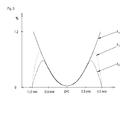
- FIG. 3 shows by way of example three moisture profiles of a 2 mm thick component after each other activation phase; the center of the component is shown here at the zero point; in the inner layers, the illustrated component has no contamination.
- the change in the moisture profile corresponds in each case to the degassed volume of the contaminant and correlates directly with the measured contaminants. If one compares the measured contaminations with the determined difference profiles, one can directly deduce the quantitative contamination and / or the contamination distribution in the thickness direction.
Landscapes
- Chemical & Material Sciences (AREA)
- Health & Medical Sciences (AREA)
- Life Sciences & Earth Sciences (AREA)
- Analytical Chemistry (AREA)
- General Health & Medical Sciences (AREA)
- Pathology (AREA)
- Immunology (AREA)
- Physics & Mathematics (AREA)
- General Physics & Mathematics (AREA)
- Biochemistry (AREA)
- Engineering & Computer Science (AREA)
- Medicinal Chemistry (AREA)
- Food Science & Technology (AREA)
- Combustion & Propulsion (AREA)
- Biomedical Technology (AREA)
- Molecular Biology (AREA)
- Sampling And Sample Adjustment (AREA)
Priority Applications (2)
| Application Number | Priority Date | Filing Date | Title |
|---|---|---|---|
| EP15167183.1A EP3093643A1 (fr) | 2015-05-11 | 2015-05-11 | Examen de composants pour détecter les impuretés |
| US15/151,795 US20160334380A1 (en) | 2015-05-11 | 2016-05-11 | Testing of components for contaminations |
Applications Claiming Priority (1)
| Application Number | Priority Date | Filing Date | Title |
|---|---|---|---|
| EP15167183.1A EP3093643A1 (fr) | 2015-05-11 | 2015-05-11 | Examen de composants pour détecter les impuretés |
Publications (1)
| Publication Number | Publication Date |
|---|---|
| EP3093643A1 true EP3093643A1 (fr) | 2016-11-16 |
Family
ID=53181082
Family Applications (1)
| Application Number | Title | Priority Date | Filing Date |
|---|---|---|---|
| EP15167183.1A Withdrawn EP3093643A1 (fr) | 2015-05-11 | 2015-05-11 | Examen de composants pour détecter les impuretés |
Country Status (2)
| Country | Link |
|---|---|
| US (1) | US20160334380A1 (fr) |
| EP (1) | EP3093643A1 (fr) |
Cited By (1)
| Publication number | Priority date | Publication date | Assignee | Title |
|---|---|---|---|---|
| US20210215599A1 (en) * | 2020-01-09 | 2021-07-15 | Government of the United States of America, as represented bythe Secretary of Commerce | Infrared thermal desorber and performing infrared thermal desorption |
Families Citing this family (3)
| Publication number | Priority date | Publication date | Assignee | Title |
|---|---|---|---|---|
| CN111735913A (zh) * | 2020-07-07 | 2020-10-02 | 北京市劳动保护科学研究所 | 一种建材污染物原位检测装置 |
| US12566132B2 (en) * | 2022-07-08 | 2026-03-03 | The Boeing Company | Real time contaminants identification during composite material manufacturing via non-contact chemical sensing |
| CN116735805B (zh) * | 2023-07-12 | 2024-01-02 | 江苏富泰净化科技股份有限公司 | 一种汽车车内空气质量检测装置 |
Citations (1)
| Publication number | Priority date | Publication date | Assignee | Title |
|---|---|---|---|---|
| DE102011102055A1 (de) | 2011-05-19 | 2012-11-22 | Eads Deutschland Gmbh | Vorrichtung zur Prüfung eines Faserverbundbauteils auf Kontaminationen |
Family Cites Families (11)
| Publication number | Priority date | Publication date | Assignee | Title |
|---|---|---|---|---|
| JP3298974B2 (ja) * | 1993-03-23 | 2002-07-08 | 電子科学株式会社 | 昇温脱離ガス分析装置 |
| US6112589A (en) * | 1997-05-14 | 2000-09-05 | The Penn State Research Foundation | Fiber tester |
| US20020148974A1 (en) * | 2001-02-26 | 2002-10-17 | Chung-Kai Hung | Wafer thermal desorption system and apparatus |
| US6797944B2 (en) * | 2002-02-01 | 2004-09-28 | Control Screening, Llc | Laser desorption and detection of explosives, narcotics, and other chemical substances |
| US6984524B2 (en) * | 2002-09-12 | 2006-01-10 | Control Screening, Llc | Chemiluminescent detection of explosives, narcotics, and other chemical substances |
| US7115869B2 (en) * | 2003-09-30 | 2006-10-03 | The Boeing Company | Method for measurement of composite heat damage with infrared spectroscopy |
| US7458283B2 (en) * | 2004-12-30 | 2008-12-02 | Smiths Detection Inc. | Article scanner |
| US8193487B2 (en) * | 2007-03-16 | 2012-06-05 | Inficon, Inc. | Portable light emitting sampling probe |
| US8365575B2 (en) * | 2008-11-06 | 2013-02-05 | Bae Systems Information And Electronic Systems Integration Inc. | Chemically modified organic CDC based rapid analysis system |
| US7807971B2 (en) * | 2008-11-19 | 2010-10-05 | The Boeing Company | Measurement of moisture in composite materials with near-IR and mid-IR spectroscopy |
| US8833140B2 (en) * | 2011-07-18 | 2014-09-16 | Bae Systems Information And Electronic Systems Integration Inc. | Optically heated analyte desorber for gas chromatography analysis |
-
2015
- 2015-05-11 EP EP15167183.1A patent/EP3093643A1/fr not_active Withdrawn
-
2016
- 2016-05-11 US US15/151,795 patent/US20160334380A1/en not_active Abandoned
Patent Citations (1)
| Publication number | Priority date | Publication date | Assignee | Title |
|---|---|---|---|---|
| DE102011102055A1 (de) | 2011-05-19 | 2012-11-22 | Eads Deutschland Gmbh | Vorrichtung zur Prüfung eines Faserverbundbauteils auf Kontaminationen |
Non-Patent Citations (2)
| Title |
|---|
| K SAITO ET AL: "Measurement system for low outgassing materials by switching between two pumping paths", VACUUM, vol. 47, no. 6-8, 1 June 1996 (1996-06-01), pages 749 - 752, XP055217892, ISSN: 0042-207X, DOI: 10.1016/0042-207X(96)00149-2 * |
| R. A. LANGLEY: "Retention of hydrogen in graphite", JOURNAL OF VACUUM SCIENCE & TECHNOLOGY A: VACUUM, SURFACES, AND FILMS, vol. 5, no. 4, 1 July 1987 (1987-07-01), pages 2205, XP055217874, ISSN: 0734-2101, DOI: 10.1116/1.574956 * |
Cited By (2)
| Publication number | Priority date | Publication date | Assignee | Title |
|---|---|---|---|---|
| US20210215599A1 (en) * | 2020-01-09 | 2021-07-15 | Government of the United States of America, as represented bythe Secretary of Commerce | Infrared thermal desorber and performing infrared thermal desorption |
| US11761888B2 (en) * | 2020-01-09 | 2023-09-19 | Government Of The United States Of America, As Represented By The Secretary Of Commerce | Infrared thermal desorber and performing infrared thermal desorption |
Also Published As
| Publication number | Publication date |
|---|---|
| US20160334380A1 (en) | 2016-11-17 |
Similar Documents
| Publication | Publication Date | Title |
|---|---|---|
| EP2733481B1 (fr) | Dispositif et procédé pour l'analyse thermique avec analyse des gaz evaporés | |
| EP3163293B1 (fr) | Procédé de détection de résidus de surface sur des composants à l'aide du rayonnement uv | |
| EP3093643A1 (fr) | Examen de composants pour détecter les impuretés | |
| DE102019002274A1 (de) | Gassensor und verfahren zum steuern eines gassensors | |
| WO2018206770A1 (fr) | Procédé de prédiction de charges de rupture de structures en matériaux composites renforcés par des fibres sur la base de données d'émission sonore | |
| EP1484165B1 (fr) | Procédé de surveillance de la fabrication d'un article renforcé par des fibres | |
| DE102020001977A1 (de) | Sensorelement und gassensor | |
| WO2015110503A1 (fr) | Dispositif de détermination de la concentration d'un ou de plusieurs gaz dans un flux de gaz échantillon par spectroscopie d'absorption d'infrarouges | |
| DE102009027807A1 (de) | Detektionsverfahren und Detektionsvorrichtung zum Detektieren von Kernschäden und Ablösungen in Sandwichstrukturen | |
| EP3163294B1 (fr) | Procédé de détection de la contamination d'une surface par analyse de fluorescence de rayons-x | |
| EP3093644B1 (fr) | Inspection de surface de composants | |
| EP3093645B1 (fr) | Dispositif et procede de recherche d'impuretes dans un materiau stratifie | |
| DE102010018980A1 (de) | Verfahren und Vorrichtung zur Messung von Verbindungseigenschaften eines Werkstoffverbundes | |
| DE102006033663B4 (de) | Verfahren zur Ermittlung eines charakteristischen Parameters einer Probe aus CFK | |
| DE102009055421A1 (de) | Sensorelement mit verbessertem Gaszutritt | |
| DE102016222035A1 (de) | Mikrofluidische Vorrichtung und Verfahren zur Analyse von Proben | |
| DE102010023655A1 (de) | Verfahren zur automatisierten Beurteilung von Korrosionsschäden nach zerstörungsfreier Prüfung mittels Impulsthermographie | |
| DE102013108568A1 (de) | Verfahren und Vorrichtung zur Ermittlung der Bauteildicke eines Faserverbundbauteils | |
| DE19960586B4 (de) | Verfahren und Einrichtung zur Messung von Kenngrössen einer Probe durch Spektralanalyse | |
| EP3282243B1 (fr) | Procede et systeme de mesure destines a determiner le taux d'humidite d'un composant en composite de fibre | |
| DE102009026418B4 (de) | Konditionierung eines Sensorelements in einem Brennerprüferstand bei mindestens 1000°C und Konditionierungsstrom | |
| DE102017210548A1 (de) | Dickenunabhängige spektroskopische Analyse von Betriebsstoffen | |
| DE102009054284A1 (de) | Vorrichtung und Verfahren zur Prozesskontrolle bei der Schaumstoffproduktion mittels Gasphasen-Analyse | |
| AT528243A1 (de) | Bestimmungsvorrichtung für eine Bestimmung wenigstens eines Abgasparameters eines Abgasstroms eines Brennstoffzellensystems | |
| DE102004057350B3 (de) | Verfahren zur Klassifikation und zur Bestimmung der Einzelkonzentrationen eines Stoffgemisches |
Legal Events
| Date | Code | Title | Description |
|---|---|---|---|
| PUAI | Public reference made under article 153(3) epc to a published international application that has entered the european phase |
Free format text: ORIGINAL CODE: 0009012 |
|
| 17P | Request for examination filed |
Effective date: 20150511 |
|
| AK | Designated contracting states |
Kind code of ref document: A1 Designated state(s): AL AT BE BG CH CY CZ DE DK EE ES FI FR GB GR HR HU IE IS IT LI LT LU LV MC MK MT NL NO PL PT RO RS SE SI SK SM TR |
|
| AX | Request for extension of the european patent |
Extension state: BA ME |
|
| RBV | Designated contracting states (corrected) |
Designated state(s): AL AT BE BG CH CY CZ DE DK EE ES FI FR GB GR HR HU IE IS IT LI LT LU LV MC MK MT NL NO PL PT RO RS SE SI SK SM TR |
|
| STAA | Information on the status of an ep patent application or granted ep patent |
Free format text: STATUS: EXAMINATION IS IN PROGRESS |
|
| 17Q | First examination report despatched |
Effective date: 20180305 |
|
| 17Q | First examination report despatched |
Effective date: 20180320 |
|
| STAA | Information on the status of an ep patent application or granted ep patent |
Free format text: STATUS: THE APPLICATION IS DEEMED TO BE WITHDRAWN |
|
| 18D | Application deemed to be withdrawn |
Effective date: 20180731 |