EP1484165B1 - Procédé de surveillance de la fabrication d'un article renforcé par des fibres - Google Patents
Procédé de surveillance de la fabrication d'un article renforcé par des fibres Download PDFInfo
- Publication number
- EP1484165B1 EP1484165B1 EP04012536A EP04012536A EP1484165B1 EP 1484165 B1 EP1484165 B1 EP 1484165B1 EP 04012536 A EP04012536 A EP 04012536A EP 04012536 A EP04012536 A EP 04012536A EP 1484165 B1 EP1484165 B1 EP 1484165B1
- Authority
- EP
- European Patent Office
- Prior art keywords
- accordance
- resin
- determined
- frequency
- test piece
- Prior art date
- Legal status (The legal status is an assumption and is not a legal conclusion. Google has not performed a legal analysis and makes no representation as to the accuracy of the status listed.)
- Expired - Lifetime
Links
Images

Classifications
-
- G—PHYSICS
- G01—MEASURING; TESTING
- G01N—INVESTIGATING OR ANALYSING MATERIALS BY DETERMINING THEIR CHEMICAL OR PHYSICAL PROPERTIES
- G01N25/00—Investigating or analyzing materials by the use of thermal means
- G01N25/18—Investigating or analyzing materials by the use of thermal means by investigating thermal conductivity
-
- B—PERFORMING OPERATIONS; TRANSPORTING
- B29—WORKING OF PLASTICS; WORKING OF SUBSTANCES IN A PLASTIC STATE IN GENERAL
- B29C—SHAPING OR JOINING OF PLASTICS; SHAPING OF MATERIAL IN A PLASTIC STATE, NOT OTHERWISE PROVIDED FOR; AFTER-TREATMENT OF THE SHAPED PRODUCTS, e.g. REPAIRING
- B29C35/00—Heating, cooling or curing, e.g. crosslinking or vulcanising; Apparatus therefor
- B29C35/02—Heating or curing, e.g. crosslinking or vulcanizing during moulding, e.g. in a mould
- B29C35/0288—Controlling heating or curing of polymers during moulding, e.g. by measuring temperatures or properties of the polymer and regulating the process
-
- B—PERFORMING OPERATIONS; TRANSPORTING
- B29—WORKING OF PLASTICS; WORKING OF SUBSTANCES IN A PLASTIC STATE IN GENERAL
- B29C—SHAPING OR JOINING OF PLASTICS; SHAPING OF MATERIAL IN A PLASTIC STATE, NOT OTHERWISE PROVIDED FOR; AFTER-TREATMENT OF THE SHAPED PRODUCTS, e.g. REPAIRING
- B29C35/00—Heating, cooling or curing, e.g. crosslinking or vulcanising; Apparatus therefor
- B29C35/02—Heating or curing, e.g. crosslinking or vulcanizing during moulding, e.g. in a mould
- B29C35/08—Heating or curing, e.g. crosslinking or vulcanizing during moulding, e.g. in a mould by wave energy or particle radiation
- B29C35/0805—Heating or curing, e.g. crosslinking or vulcanizing during moulding, e.g. in a mould by wave energy or particle radiation using electromagnetic radiation
-
- B—PERFORMING OPERATIONS; TRANSPORTING
- B29—WORKING OF PLASTICS; WORKING OF SUBSTANCES IN A PLASTIC STATE IN GENERAL
- B29C—SHAPING OR JOINING OF PLASTICS; SHAPING OF MATERIAL IN A PLASTIC STATE, NOT OTHERWISE PROVIDED FOR; AFTER-TREATMENT OF THE SHAPED PRODUCTS, e.g. REPAIRING
- B29C70/00—Shaping composites, i.e. plastics material comprising reinforcements, fillers or preformed parts, e.g. inserts
- B29C70/04—Shaping composites, i.e. plastics material comprising reinforcements, fillers or preformed parts, e.g. inserts comprising reinforcements only, e.g. self-reinforcing plastics
- B29C70/28—Shaping operations therefor
- B29C70/40—Shaping or impregnating by compression not applied
- B29C70/42—Shaping or impregnating by compression not applied for producing articles of definite length, i.e. discrete articles
- B29C70/44—Shaping or impregnating by compression not applied for producing articles of definite length, i.e. discrete articles using isostatic pressure, e.g. pressure difference-moulding, vacuum bag-moulding, autoclave-moulding or expanding rubber-moulding
- B29C70/443—Shaping or impregnating by compression not applied for producing articles of definite length, i.e. discrete articles using isostatic pressure, e.g. pressure difference-moulding, vacuum bag-moulding, autoclave-moulding or expanding rubber-moulding and impregnating by vacuum or injection
-
- B—PERFORMING OPERATIONS; TRANSPORTING
- B29—WORKING OF PLASTICS; WORKING OF SUBSTANCES IN A PLASTIC STATE IN GENERAL
- B29C—SHAPING OR JOINING OF PLASTICS; SHAPING OF MATERIAL IN A PLASTIC STATE, NOT OTHERWISE PROVIDED FOR; AFTER-TREATMENT OF THE SHAPED PRODUCTS, e.g. REPAIRING
- B29C70/00—Shaping composites, i.e. plastics material comprising reinforcements, fillers or preformed parts, e.g. inserts
- B29C70/04—Shaping composites, i.e. plastics material comprising reinforcements, fillers or preformed parts, e.g. inserts comprising reinforcements only, e.g. self-reinforcing plastics
- B29C70/28—Shaping operations therefor
- B29C70/54—Component parts, details or accessories; Auxiliary operations, e.g. feeding or storage of prepregs or SMC after impregnation or during ageing
-
- B—PERFORMING OPERATIONS; TRANSPORTING
- B29—WORKING OF PLASTICS; WORKING OF SUBSTANCES IN A PLASTIC STATE IN GENERAL
- B29C—SHAPING OR JOINING OF PLASTICS; SHAPING OF MATERIAL IN A PLASTIC STATE, NOT OTHERWISE PROVIDED FOR; AFTER-TREATMENT OF THE SHAPED PRODUCTS, e.g. REPAIRING
- B29C37/00—Component parts, details, accessories or auxiliary operations, not covered by group B29C33/00 or B29C35/00
- B29C2037/90—Measuring, controlling or regulating
- B29C2037/906—Measuring, controlling or regulating using visualisation means or linked accessories, e.g. screens, printers
Definitions
- the invention relates to a method for monitoring the production of a component made of a fiber-reinforced material.
- a method for producing a component from a fiber-reinforced material in which a semifinished fiber product by means of negative pressure liquid resin is supplied. Such a method is also referred to as a vacuum injection method.
- a vacuum injection method There are also known methods in which the resin impregnation or resin infiltration of the fiber fabric of the semifinished fiber product takes place without negative pressure.
- the invention has for its object to provide a method for monitoring the production of a component made of a fiber-reinforced material.
- the method according to the invention provides a photothermal measuring method in order to monitor the infiltration process. Due to the modulated heat waves of the specimen is thermally excited and the response signal can be used to gain information about the specimen. It has been found that this method is suitable for determining a resin fronts course during the transient, variable process of resin infiltration.
- trapping trapped air which could lead to a reduction in the quality of a finished component can be determined by determining the course of the resin fronts.
- the monitoring can be carried out non-destructively. It is also possible to observe an air inlet into the test specimen after completion of the resin infiltration in the thermographic image.
- a method is provided with which the resin front profile can be followed in depth over time and destructively in its development over time. This depth resolution is achieved in an inhomogeneous transient system with variable physical and chemical properties.
- the inventive method can be perform in a simple and inexpensive manner.
- it can be used in a multilayer structure of an arrangement for producing the corresponding component.
- the test piece can also be monitored through a vacuum film, under which the test piece for resin impregnation is arranged.
- the velocity profile of a resin front during production can be determined, for example, from the phase signature and / or amplitude signature of the response signal.
- the infiltration of resin can be better monitored by means of the determined speed profile.
- the specimen is applied areally with heat waves, so as to thermally excite the specimen over a large surface area.
- the test specimen can also be thermally excited volumetrically, for example via microwaves or induction heating.
- the response signal is determined in reflection. It is also alternatively or additionally possible that the response signal is determined in transmission.
- the distributor fabric is responsible for the resin feed to the fiber layers of the semifinished fiber product.
- the distributor fabric thus determines the resin feed to the semifinished fiber product.
- the distributor fabric is in turn responsible for the formation of resin fronts.
- the response signal is registered by a camera. Via the camera, the test signal's response signal can be recorded over a large surface, that is, signals are simultaneously registered over a large surface area.
- the camera is, in particular, an infrared camera, which registers a thermographic response signal of the test object.
- test object is optically irradiated with corresponding lamps which are intensity-modulated or pulse-modulated.
- phase-sensitive modulation thermography is used for monitoring resin impregnation processes.
- a velocity profile of a progressing resin front is determined in the phase signature and the amplitude signature. For example, a phase image and an amplitude image are determined. It can then be closed on air inclusions and the like, which express themselves in the velocity profile, and thus again a process-accompanying quality assurance can be performed.
- phase signature evaluation is carried out and, alternatively or additionally, an amplitude signature evaluation is carried out.
- a course of the resin fronts in particular with regard to the corresponding velocity profile, and in turn to obtain statements about air inclusions and the like.
- the evaluation via the phase signature has the advantage that a greater depth range can be achieved since the phase (unlike the amplitude) is largely independent of the illumination inhomogeneities and surface defects of the test object. Comparative measurements have shown that with a phase signature evaluation, an approximately twice the depth range can be achieved than with an amplitude signature evaluation.
- the amplitude signature and / or phase signature is preferably determined by Fourier transformation.
- the frequency is greater than 0.0001 Hz and in particular greater than 0.001 Hz.
- a non-stationary temperature state is measured, that is, it is not waited until a stationary temperature state sets in, just in the resin impregnation, the processes themselves are non-stationary.
- the method according to the invention can be used if the test specimen has a layer structure with semi-finished fiber layers.
- the layer structure has a distribution fabric for the resin, which is arranged on the semifinished fiber product.
- a layer structure is responsible for the formation of a wedge-shaped resin front, which can lead to air pockets in the worst case, which can adversely affect the quality of a manufactured component.
- the method according to the invention can also be used if such a distribution fabric is present and, in particular, it is possible to determine the speed profiles of the resin front caused by the distribution fabric.
- a defined Kalibri für sprüfling is prepared and at this a suitable frequency or a suitable frequency range for the modulation is determined.
- the optimized frequency or the optimized frequency range for monitoring the resin infiltration in a test object depends on the test object itself. If a defined Kalibri für sprüfling is prepared, which basically has the same structure as the test specimen (in particular with respect to the semifinished fiber) and in which a basically the same resin infiltration is performed, as in the component to be manufactured, then the optimized frequency can be determined on this calibration. For example, in the calibration specimen targeted disturbances such as film strips are installed on a lower side. The frequency is chosen so that the interference can be detected. With the thus determined frequency, the production of an actual component can then be monitored.
- the frequency of the modulation is varied.
- a component can be examined, for example, with at least two frequencies, so as to be able to examine, for example, a region near the surface and a depth region.
- a larger frequency is used to check near-surface areas and a smaller frequency is used to scan deeper areas.
- a smaller frequency is used to scan deeper areas.
- leaks in a distribution tissue can be detected; it can be done that Detecting air or it can detect outgassing.
- the resin front course can be determined.
- the velocity profile of a resin front is determined.
- the velocity profile can be determined from the phase signature and / or amplitude signature of the response signal.
- About the course of speed can be detected disturbances in the resin infiltration.
- the method according to the invention can also be used if a vacuum film is provided, since the thermal excitation can also take place through the vacuum film.
- FIG. 1 An example of an assembly designated as a whole by 10 for producing a component from a fiber-reinforced material is shown in FIG. 1 shown.
- a corresponding arrangement and a method and an apparatus for producing a workpiece made of a fiber-reinforced material by means of resin impregnation are in the EP 1 136 238 A2 described, which is hereby incorporated by reference.
- a semifinished fiber 12 which comprises a plurality of laminate layers 14 (fiber layers), is arranged on a mold 16. Outwardly, the semifinished fiber 12 is covered by a vacuum film 18.
- a distributor fabric 20 is arranged, which covers the semifinished fiber 12.
- the semi-finished fiber 12 liquid resin for resin impregnation of the semifinished fiber 12 is supplied.
- a release film 22 is arranged, which serves that after completion, the distributor fabric 20 can be easily detached from the component and the component is made with a smoother surface.
- a vacuum space 24 is formed, in which the semi-finished fiber 12 to be impregnated is positioned. Opposite the mold 16, this vacuum space 24 is sealed by a seal 26.
- the vacuum space 24 can be subjected to negative pressure in order to promote the resin infiltration of the semifinished fiber 12.
- a suction connection 28 of a pump (not shown in the drawing) opens into the vacuum space 24, via which the negative pressure in the vacuum space 24 can be generated.
- VARI method vacuum assisted resin infusion process
- the semifinished product 12 is supplied by means of negative pressure liquid resin, wherein a thermosetting resin is used as the resin and the negative pressure is controlled and / or regulated so that based on the liquid resin Boiling point curve of the resin is not exceeded.
- a method is provided with which the production of the component can be monitored by determining the resin front profile.
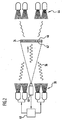
- the heat waves 36 are supplied by a lighting device 38.
- the test object 34 is thereby thermally excited and an infrared camera 40 registers the corresponding response signal of the test object 34.
- the lighting device 38 is designed so that a surface 42 of the specimen is radiantly exposed over a large area.
- the infrared camera 40 registers a response signal of the entire surface 42.
- the infrared camera 40 is in particular a high-resolution camera.
- the response signal can be measured in reflection, in which case the illumination device 38 and the camera 40 are arranged on the same side with respect to the surface 42.
- test object 34 is measured in transmission. There is then provided a lighting device 44, which is arranged with respect to the test piece 34 on the other side like the camera 40.
- the illumination device 44 then irradiates a surface 46 of the test piece 34, which is opposite to the surface 42.
- the heat waves 36 are in particular amplitude-modulated, that is to say the surface 42 or 46 is subjected to intensity-modulated radiation. It has proved to be advantageous if the frequency is in the range between 0.5 Hz and 0.001 Hz. It has been observed in this frequency range process flows for the main infiltration in the manufacture of a component made of a fiber-reinforced material. Experience has shown that for glass fiber reinforced semi-finished fiber products due to the poorer thermal conductivity, the frequencies are rather lower to choose.
- An evaluation device 48 is provided, which is coupled to the illumination device 38 (and optionally 44) and is likewise coupled to the infrared camera 40, so that the excitation signals and response signals can be set in relation to one another.
- the infrared camera 40 records the photothermal response of the device under test 34 to the heat wave excitation.
- the phase signature and / or the amplitude signature is determined via Fourier transformation, which is carried out locally pixel-by-pixel.
- the amplitude image and the phase image are determined from the response signal.
- the infrared camera 40 supplies the corresponding thermographic data to the evaluation device 48 in order to be able to carry out this evaluation.
- Such a method is also referred to as phase sensitive modulation thermography or lockin thermography.
- the depth-resolved velocity profile of the resin front 32 in the test piece 34 in the phase image and amplitude image is determined. This is in contrast to the well-known use of Lockin thermography for materials with steady state conditions, where the change in thermal diffusivity is determined.
- the speed of the progressing resin front 32 in an image plane is determined in the method according to the invention. For example, peak distances ( FIGS. 3 and 4 ) in the phase image and / or amplitude image.
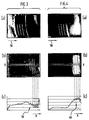
- phase images are in the FIGS. 3 (a) and (b) shown.
- amplitude images are in the FIGS. 4 (a) and (b) shown. These are the result of several measuring cycles as integration over these measuring cycles.
- phase and amplitude images were obtained in a reflectance measurement, with the device under test 34 in an arrangement as shown in FIG. 1 was shown in a direction 50 radiation was applied.
- a surface 52 of the assembly 10 which is congruent with the surface of the distribution fabric 20 corresponds to the surface 42 in the schematic arrangement of FIG FIG. 2 ,
- the image plane 54 is perpendicular to the direction 50.
- a resin infiltration direction 56 is parallel to the image plane 54.
- FIGS. 3 (a) and 4 (a) resin fronts are clearly visible. These were highlighted by the markings drawn in the figures.
- FIGS. 3 (b) and 4 (b) show the further progression of the resin fronts.
- the FIGS. 3 (b) and 4 (b) compared to the FIGS. 3 (a) and 4 (a) a recording at a later date. It can be seen from the figures, the wedge-shaped resin fronts course, as shown schematically in FIG. 1 is drawn.
- FIG. 3 (c) shows the phase curve along the line X for the phase image of FIG. 3 (b) , In the area 58 you can see again the Harzfrontenverlauf.
- FIG. 4 (c) which measures the amplitude along the direction X for the amplitude image of the FIG. 4 (b) shows.
- the resin front profile is recognized in the region 60 which coincides spatially with the region 58.
- Air pockets in the test piece 34 can lead to a deteriorated component quality. Such air inclusions can be recognized in the amplitude image and in the phase image. As a result, it can be detected without destruction in the production of the component whether the properties of the infiltrated semifinished fiber 12 change during manufacture and thus in turn can be recognized - and non-destructively - whether a component with possibly reduced quality due to air inclusions was produced.
- the production of the component can be monitored and thus perform a process-accompanying quality assurance for the manufactured component.
- This monitoring can be performed for all types of resin infusion and resin injection procedures.
- the method can also be carried out if the test specimen has a layer structure over fiber-laid layers of the semifinished fiber article 12 (laminate layers 14), release film 22, distribution fabric 20 and vacuum film 18.
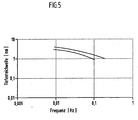
- the measured depth range is shown as a function of the frequency in double-logarithmic representation.
- a specimen was prepared, which was composed of eight layers of diaxial carbon fiber scrim. It was thereby arranged at a depth of 0 mm, 1 mm, 2 mm, 3 mm and 4 mm in each case a 10 mm wide foil strip. The depth range was determined by which tape was recognizable.
- the upper curve is the depth range determined from the phase signature and the lower curve is the one obtained from the amplitude signature. It can be seen on the one hand that the depth range is greater in the evaluation via the phase signature.
- the optimum frequency or an optimized frequency range for the modulation depends on the specific component.
- a Kalibri für sprüfling is prepared, which is basically the same structure as the component and also infiltrated in the same way with resin.
- certain excellent regions are generated, for example, via film strips.
- the frequency is determined so that a desired depth range is detected. With the frequency determined in this way, the component to be produced can then be checked during manufacture.
- the frequency can be varied when checking the production of the component. This can serve, for example, to set an optimized frequency or an optimized frequency range. If suitable frequencies for certain areas (for example, near-surface or deep areas) are already known, then by varying the frequencies during the check, a variation of the checked areas in particular with respect to their depth relative to the surface can be performed. For example, it examines alternately with a smaller and a larger frequency. As a result, it is also possible to investigate (with the greater frequency) near-surface regions and, in particular, the distribution tissue, as to whether there are leaks. In particular, it can be checked whether there are outgassing or whether air penetrates. If a lower frequency is selected, deeper areas can be examined.
- the velocity profile of the resin front is determined by, for example, determining the positions of peaks (as in FIGS. 3 (c) and 4 (c) shown). Irregularities of the resin infiltration can be detected via the ascertained speed profile.
- the infiltration process and thus the component manufacturing can be automated, since just the end of the infiltration can be determined and then automatically, for example, the main feed can be switched off.
Landscapes
- Health & Medical Sciences (AREA)
- Chemical & Material Sciences (AREA)
- Physics & Mathematics (AREA)
- Engineering & Computer Science (AREA)
- Mechanical Engineering (AREA)
- Composite Materials (AREA)
- Biochemistry (AREA)
- Oral & Maxillofacial Surgery (AREA)
- Immunology (AREA)
- Pathology (AREA)
- General Health & Medical Sciences (AREA)
- Analytical Chemistry (AREA)
- Life Sciences & Earth Sciences (AREA)
- General Physics & Mathematics (AREA)
- Thermal Sciences (AREA)
- Electromagnetism (AREA)
- Toxicology (AREA)
- Investigating Or Analyzing Materials Using Thermal Means (AREA)
- Reinforced Plastic Materials (AREA)
- Moulding By Coating Moulds (AREA)
Claims (25)
- Procédé pour la surveillance de la fabrication d'un composant à partir d'un matériau renforcé par des fibres, le composant étant fabriqué avec une résine liquide par infiltration d'un produit semi-fini fibreux, pour lequel pendant le processus d'infiltration, l'échantillon est stimulé de manière thermique avec des ondes thermiques modulées et le signal de réponse est enregistré.
- Procédé selon la revendication 1, caractérisé en ce que l'échantillon est soumis par couche à des ondes thermiques.
- Procédé selon la revendication 1 ou 2, caractérisé en ce que le signal de réponse est déterminé en réflexion.
- Procédé selon l'une quelconque des revendications précédentes, caractérisé en ce que le signal de réponse est déterminé en transmission.
- Procédé selon l'une quelconque des revendications précédentes, caractérisé en ce que l'échantillon est soumis à des ondes thermiques en direction d'une toile de répartition.
- Procédé selon l'une quelconque des revendications précdentes, caractérisé en ce que le signal de réponse est enregistré par une caméra.
- Procédé selon l'une quelconque des revendications précédentes, caractérisé en ce que l'échantillon est irradié de manière optique.
- Procédé selon l'une quelconque des revendications précédentes, caractérisé en ce que l'intensité des ondes thermiques est modulée.
- Procédé selon l'une quelconque des revendications précédentes, caractérisé en ce que le profil de vitesse du front de résine en progression est déterminé au cours de la signature de phases et de la signature d'amplitudes.
- Procédé selon l'une quelconque des revendications précédentes, caractérisé en ce qu'une évaluation de la signature d'amplitudes est exécutée.
- Procédé selon l'une quelconque des revendications précédentes, caractérisé en ce qu'une évaluation de la signature de phases est exécutée.
- Procédé selon la revendication 10 ou 11, caractérisé en ce que la signature d'amplitudes et/ou la signature de phases sont déterminées par l'intermédiaire d'une transformation de Fourier.
- Procédé selon l'une quelconque des revendications 8 à 12, caractérisé en ce que la fréquence choisie est inférieure à 1 Hz.
- Procédé selon la revendication 13, caractérisé en ce que la fréquence est inférieure à 0,5 Hz.
- Procédé selon l'une quelconque des revendications 8 à 14, caractérisé en ce que la fréquence est supérieure à 0,0001 Hz.
- Procédé selon l'une quelconque des revendications précédentes, caractérisé en ce que les mesures sont effectuées dans un état non stationnaire de la température.
- Procédé selon l'une quelconque des revendications précédentes, caractérisé en ce que l'échantillon présente une structure en couches comportant des couches de produit semi-fini fibreux.
- Procédé selon la revendication 17, caractérisé en ce qu'une toile de répartition est prévue pour la résine, laquelle est disposée sur le produit semi-fini fibreux.
- Procédé selon la revendication 17 ou 18, caractérisé en ce qu'un film sous vide est prévu.
- Procédé selon l'une quelconque des revendications précédentes, caractérisé en ce que l'échantillon est stimulé en volume thermiquement.
- Procédé selon l'une quelconque des revendications précédentes, caractérisé en ce qu'un échantillon de calibrage défini est fabriqué, et en ce qu'une fréquence appropriée ou une plage de fréquences appropriée est déterminée pour la modulation sur celui-ci.
- Procédé selon l'une quelconque des revendications précédentes, caractérisé en ce que la fréquence de la modulation varie.
- Procédé selon la revendication 22, caractérisé en ce qu'une fréquence plus grande est utilisée pour surveiller les zones en surface, et en ce qu'une fréquence plus petite est utilisée pour surveiller des zones plus profondes.
- Procédé selon l'une quelconque des revendications précédentes, caractérisé en ce qu'on détermine l'évolution de la vitesse d'un front de résine.
- Procédé selon la revendication 24, caractérisé en ce que la fabrication du composant est automatisée par l'intermédiaire de l'évolution de la vitesse déterminée,
Applications Claiming Priority (2)
| Application Number | Priority Date | Filing Date | Title |
|---|---|---|---|
| DE10326021 | 2003-06-02 | ||
| DE10326021A DE10326021A1 (de) | 2003-06-02 | 2003-06-02 | Verfahren zur Überwachung der Herstellung eines Bauteils aus einem faserverstärkten Werkstoff |
Publications (3)
| Publication Number | Publication Date |
|---|---|
| EP1484165A2 EP1484165A2 (fr) | 2004-12-08 |
| EP1484165A3 EP1484165A3 (fr) | 2007-12-26 |
| EP1484165B1 true EP1484165B1 (fr) | 2012-06-27 |
Family
ID=33154597
Family Applications (1)
| Application Number | Title | Priority Date | Filing Date |
|---|---|---|---|
| EP04012536A Expired - Lifetime EP1484165B1 (fr) | 2003-06-02 | 2004-05-27 | Procédé de surveillance de la fabrication d'un article renforcé par des fibres |
Country Status (2)
| Country | Link |
|---|---|
| EP (1) | EP1484165B1 (fr) |
| DE (1) | DE10326021A1 (fr) |
Families Citing this family (15)
| Publication number | Priority date | Publication date | Assignee | Title |
|---|---|---|---|---|
| FR2882682B1 (fr) * | 2005-03-04 | 2009-04-17 | Edouard Rodolphe Jean Philippe | Procede et dispositif de mise en oeuvre sous vide et chauffe par induction, pour la fabrication rapide de pieces en materiaux composites, notamment des bio composites |
| DE102005011977A1 (de) * | 2005-03-14 | 2006-02-16 | Daimlerchrysler Ag | Vorrichtung zur Herstellung eines faserverstärkten Bauteils mittels eines Harz-Infusionsverfahrens |
| DE102006033663B4 (de) * | 2006-07-20 | 2012-01-26 | Airbus Operations Gmbh | Verfahren zur Ermittlung eines charakteristischen Parameters einer Probe aus CFK |
| DE102007031184B4 (de) | 2007-07-04 | 2009-08-13 | Thermosensorik Gmbh | Verfahren zur automatischen Ermittlung des Startbildes einer Infrarotbildserie |
| DE102008014657B4 (de) * | 2008-03-17 | 2015-08-20 | Airbus Defence and Space GmbH | Verfahren zur Herstellung von Faserverbundbauteilen |
| DE102008030691B4 (de) * | 2008-07-01 | 2011-07-21 | edevis GmbH, 70569 | Verfahren und Vorrichtung für eine Materialprüfung mittels periodischer Wärmebestrahlung |
| DE102009052835A1 (de) | 2009-11-13 | 2011-05-19 | Dr. Ing. H.C. F. Porsche Aktiengesellschaft | Verfahren zum Herstellen eines Bauteils aus einem faserverstärkten Werkstoff |
| DE102009060699B4 (de) * | 2009-12-29 | 2014-07-03 | Airbus Operations Gmbh | Infusionsverfahren und Fließhilfe |
| DE102011051071A1 (de) * | 2011-06-15 | 2012-12-20 | Synview Gmbh | Verfahren zur Herstellung faserverstärkter Formteile |
| EP2671708B1 (fr) * | 2012-06-08 | 2017-02-01 | Airbus Operations GmbH | Procédé et système de détection de fuite dans une mise en sachet sous vide |
| EP2700492B1 (fr) | 2012-08-23 | 2017-02-01 | Airbus Operations GmbH | Procédé d'infusion et structure pour procédé d'infusion |
| DE102013203800B4 (de) | 2013-03-06 | 2023-02-23 | Deutsches Zentrum für Luft- und Raumfahrt e.V. | Verfahren zum Prüfen von Werkstücken und Computerprogramm zur Durchführung eines derartigen Verfahrens |
| DE102013102486B3 (de) * | 2013-03-12 | 2014-07-10 | Institut Für Verbundwerkstoffe Gmbh | Verfahren zur kontinuierlichen Messung des hydrodynamischen Kompaktierungsverhaltens einer Verstärkungsstruktur |
| DE102016112262A1 (de) * | 2016-07-05 | 2018-01-11 | Deutsches Zentrum für Luft- und Raumfahrt e.V. | Verfahren und Vorrichtung zur Herstellung eines Faserverbundbauteils |
| DE102019124344B4 (de) | 2019-09-11 | 2021-11-11 | Edevis Gmbh | Verfahren und Vorrichtung für eine Überprüfung der inneren Beschaffenheit eines Prüfobjektes mittels eines aufgeprägten Wärmeflusses |
Family Cites Families (3)
| Publication number | Priority date | Publication date | Assignee | Title |
|---|---|---|---|---|
| DE19912723C1 (de) * | 1999-03-20 | 2000-11-09 | Dlr Ev | Verfahren und Vorrichtung zur Bestimmung der Durchtränkung von Faserhalbzeugen |
| WO2001041993A2 (fr) * | 1999-12-07 | 2001-06-14 | The Boeing Company | Procede de diffusion sous vide a double enveloppe et systeme de fabrication de composite avance a faible cout |
| DE10013409C1 (de) * | 2000-03-17 | 2000-11-23 | Daimler Chrysler Ag | Verfahren und Vorrichtung zur Herstellung von faserverstärkten Bauteilen mittels eines Injektionsverfahrens |
-
2003
- 2003-06-02 DE DE10326021A patent/DE10326021A1/de not_active Ceased
-
2004
- 2004-05-27 EP EP04012536A patent/EP1484165B1/fr not_active Expired - Lifetime
Also Published As
| Publication number | Publication date |
|---|---|
| EP1484165A2 (fr) | 2004-12-08 |
| DE10326021A1 (de) | 2004-12-30 |
| EP1484165A3 (fr) | 2007-12-26 |
Similar Documents
| Publication | Publication Date | Title |
|---|---|---|
| EP1484165A2 (fr) | Procédé de surveillance de la fabrication d'un article renforcé par des fibres | |
| DE69203834T2 (de) | Eigenschaden-Kontrollvorrichtung und Verfahren zur Herstellung und Anwendung. | |
| EP3862833B1 (fr) | Procédé de vérification d'un système d'assurance de qualité | |
| EP3163293B1 (fr) | Procédé de détection de résidus de surface sur des composants à l'aide du rayonnement uv | |
| EP3736557B1 (fr) | Procédé et dispositif de détection tridimensionnelle d'une surface de matière fibreuse | |
| DE102011111818A1 (de) | Verfahren und Vorrichtung zur generativen Herstellung eines Bauteils | |
| EP3314036B1 (fr) | Procédé de revêtement d'une surface d'une bande métallique ainsi que dispositif de revêtement d'une bande métallique | |
| EP3736556A1 (fr) | Procédé et dispositif de détection de défauts de surface | |
| DE10013172A1 (de) | Verfahren und Vorrichtung zur photothermischen Analyse einer Materialschicht, insbesondere zur Schichtdickenmessung | |
| EP1642116B1 (fr) | Procede de caracterisation de pieces constituees de materiaux electroconducteurs | |
| DE102010031919B4 (de) | Messsonde für einen Sensor zur Analyse eines Mediums mittels Infrarotspektroskopie und Verfahren zur Herstellung der Messsonde | |
| EP1055457A2 (fr) | Porte-échantillon pour la spectroscopie à infrarouge des échantillons liquides | |
| DE102013100092B4 (de) | Verfahren und Vorrichtung zur Imprägnierungsprüfung | |
| EP1893974B1 (fr) | Procede et dispositif pour controler la qualite d'une surface | |
| EP3015851B1 (fr) | Tete d'application, dispositif d'application de fibre et procede | |
| WO2009068507A1 (fr) | Dispositif et procédé de détection des défauts de liaison | |
| EP3093643A1 (fr) | Examen de composants pour détecter les impuretés | |
| DE102007006702B4 (de) | Verfahren zur Beurteilung der Qualität von Vorformen von Bauteilen aus Faserverbundwerkstoffen | |
| DE102006033663B4 (de) | Verfahren zur Ermittlung eines charakteristischen Parameters einer Probe aus CFK | |
| EP3093645B1 (fr) | Dispositif et procede de recherche d'impuretes dans un materiau stratifie | |
| DE102016112262A1 (de) | Verfahren und Vorrichtung zur Herstellung eines Faserverbundbauteils | |
| AT504893B1 (de) | Verfahren zum bestimmen der zusammensetzung von faserstoffgemischen und/oder formteilen | |
| DE102020102800B4 (de) | Verfahren und Vorrichtung zum Ermitteln einer Applikationseigenschaft und Verfahren zur Herstellung einer Faserpreform | |
| DE102016219716A1 (de) | Verfahren und Vorrichtung zur Erkennung textiler Verstärkungen in einer Faserstruktur für ein faserverstärktes Bauteil | |
| DE102017222139B4 (de) | Verfahren und Vorrichtung zur kontinuierlichen Zuführung und Echtzeitüberwachung eines Faserverbundhalbzeugs |
Legal Events
| Date | Code | Title | Description |
|---|---|---|---|
| PUAI | Public reference made under article 153(3) epc to a published international application that has entered the european phase |
Free format text: ORIGINAL CODE: 0009012 |
|
| AK | Designated contracting states |
Kind code of ref document: A2 Designated state(s): AT BE BG CH CY CZ DE DK EE ES FI FR GB GR HU IE IT LI LU MC NL PL PT RO SE SI SK TR |
|
| AX | Request for extension of the european patent |
Extension state: AL HR LT LV MK |
|
| RAP1 | Party data changed (applicant data changed or rights of an application transferred) |
Owner name: DEUTSCHES ZENTRUM FUER LUFT- UND RAUMFAHRT E.V. |
|
| 17P | Request for examination filed |
Effective date: 20060513 |
|
| PUAL | Search report despatched |
Free format text: ORIGINAL CODE: 0009013 |
|
| AK | Designated contracting states |
Kind code of ref document: A3 Designated state(s): AT BE BG CH CY CZ DE DK EE ES FI FR GB GR HU IE IT LI LU MC NL PL PT RO SE SI SK TR |
|
| AX | Request for extension of the european patent |
Extension state: AL HR LT LV MK |
|
| 17Q | First examination report despatched |
Effective date: 20080311 |
|
| AKX | Designation fees paid |
Designated state(s): AT BE BG CH CY CZ DE DK EE ES FI FR GB GR HU IE IT LI LU MC NL PL PT RO SE SI SK TR |
|
| GRAP | Despatch of communication of intention to grant a patent |
Free format text: ORIGINAL CODE: EPIDOSNIGR1 |
|
| RIC1 | Information provided on ipc code assigned before grant |
Ipc: B29C 70/44 20060101AFI20111219BHEP Ipc: B29C 35/08 20060101ALI20111219BHEP Ipc: B29C 35/02 20060101ALI20111219BHEP Ipc: B29C 70/54 20060101ALI20111219BHEP Ipc: G01N 25/18 20060101ALI20111219BHEP |
|
| GRAS | Grant fee paid |
Free format text: ORIGINAL CODE: EPIDOSNIGR3 |
|
| GRAA | (expected) grant |
Free format text: ORIGINAL CODE: 0009210 |
|
| AK | Designated contracting states |
Kind code of ref document: B1 Designated state(s): AT BE BG CH CY CZ DE DK EE ES FI FR GB GR HU IE IT LI LU MC NL PL PT RO SE SI SK TR |
|
| REG | Reference to a national code |
Ref country code: GB Ref legal event code: FG4D Free format text: NOT ENGLISH |
|
| REG | Reference to a national code |
Ref country code: CH Ref legal event code: EP |
|
| REG | Reference to a national code |
Ref country code: AT Ref legal event code: REF Ref document number: 563917 Country of ref document: AT Kind code of ref document: T Effective date: 20120715 |
|
| REG | Reference to a national code |
Ref country code: IE Ref legal event code: FG4D Free format text: LANGUAGE OF EP DOCUMENT: GERMAN |
|
| REG | Reference to a national code |
Ref country code: DE Ref legal event code: R096 Ref document number: 502004013599 Country of ref document: DE Effective date: 20120823 |
|
| PG25 | Lapsed in a contracting state [announced via postgrant information from national office to epo] |
Ref country code: FI Free format text: LAPSE BECAUSE OF FAILURE TO SUBMIT A TRANSLATION OF THE DESCRIPTION OR TO PAY THE FEE WITHIN THE PRESCRIBED TIME-LIMIT Effective date: 20120627 Ref country code: SE Free format text: LAPSE BECAUSE OF FAILURE TO SUBMIT A TRANSLATION OF THE DESCRIPTION OR TO PAY THE FEE WITHIN THE PRESCRIBED TIME-LIMIT Effective date: 20120627 |
|
| REG | Reference to a national code |
Ref country code: NL Ref legal event code: VDEP Effective date: 20120627 |
|
| PG25 | Lapsed in a contracting state [announced via postgrant information from national office to epo] |
Ref country code: GR Free format text: LAPSE BECAUSE OF FAILURE TO SUBMIT A TRANSLATION OF THE DESCRIPTION OR TO PAY THE FEE WITHIN THE PRESCRIBED TIME-LIMIT Effective date: 20120928 Ref country code: SI Free format text: LAPSE BECAUSE OF FAILURE TO SUBMIT A TRANSLATION OF THE DESCRIPTION OR TO PAY THE FEE WITHIN THE PRESCRIBED TIME-LIMIT Effective date: 20120627 |
|
| PG25 | Lapsed in a contracting state [announced via postgrant information from national office to epo] |
Ref country code: RO Free format text: LAPSE BECAUSE OF FAILURE TO SUBMIT A TRANSLATION OF THE DESCRIPTION OR TO PAY THE FEE WITHIN THE PRESCRIBED TIME-LIMIT Effective date: 20120627 Ref country code: CZ Free format text: LAPSE BECAUSE OF FAILURE TO SUBMIT A TRANSLATION OF THE DESCRIPTION OR TO PAY THE FEE WITHIN THE PRESCRIBED TIME-LIMIT Effective date: 20120627 Ref country code: EE Free format text: LAPSE BECAUSE OF FAILURE TO SUBMIT A TRANSLATION OF THE DESCRIPTION OR TO PAY THE FEE WITHIN THE PRESCRIBED TIME-LIMIT Effective date: 20120627 Ref country code: SK Free format text: LAPSE BECAUSE OF FAILURE TO SUBMIT A TRANSLATION OF THE DESCRIPTION OR TO PAY THE FEE WITHIN THE PRESCRIBED TIME-LIMIT Effective date: 20120627 Ref country code: CY Free format text: LAPSE BECAUSE OF FAILURE TO SUBMIT A TRANSLATION OF THE DESCRIPTION OR TO PAY THE FEE WITHIN THE PRESCRIBED TIME-LIMIT Effective date: 20120627 |
|
| PG25 | Lapsed in a contracting state [announced via postgrant information from national office to epo] |
Ref country code: PL Free format text: LAPSE BECAUSE OF FAILURE TO SUBMIT A TRANSLATION OF THE DESCRIPTION OR TO PAY THE FEE WITHIN THE PRESCRIBED TIME-LIMIT Effective date: 20120627 Ref country code: PT Free format text: LAPSE BECAUSE OF FAILURE TO SUBMIT A TRANSLATION OF THE DESCRIPTION OR TO PAY THE FEE WITHIN THE PRESCRIBED TIME-LIMIT Effective date: 20121029 Ref country code: IT Free format text: LAPSE BECAUSE OF FAILURE TO SUBMIT A TRANSLATION OF THE DESCRIPTION OR TO PAY THE FEE WITHIN THE PRESCRIBED TIME-LIMIT Effective date: 20120627 |
|
| PG25 | Lapsed in a contracting state [announced via postgrant information from national office to epo] |
Ref country code: NL Free format text: LAPSE BECAUSE OF FAILURE TO SUBMIT A TRANSLATION OF THE DESCRIPTION OR TO PAY THE FEE WITHIN THE PRESCRIBED TIME-LIMIT Effective date: 20120627 |
|
| PG25 | Lapsed in a contracting state [announced via postgrant information from national office to epo] |
Ref country code: ES Free format text: LAPSE BECAUSE OF FAILURE TO SUBMIT A TRANSLATION OF THE DESCRIPTION OR TO PAY THE FEE WITHIN THE PRESCRIBED TIME-LIMIT Effective date: 20121008 Ref country code: DK Free format text: LAPSE BECAUSE OF FAILURE TO SUBMIT A TRANSLATION OF THE DESCRIPTION OR TO PAY THE FEE WITHIN THE PRESCRIBED TIME-LIMIT Effective date: 20120627 |
|
| PLBE | No opposition filed within time limit |
Free format text: ORIGINAL CODE: 0009261 |
|
| STAA | Information on the status of an ep patent application or granted ep patent |
Free format text: STATUS: NO OPPOSITION FILED WITHIN TIME LIMIT |
|
| 26N | No opposition filed |
Effective date: 20130328 |
|
| REG | Reference to a national code |
Ref country code: DE Ref legal event code: R097 Ref document number: 502004013599 Country of ref document: DE Effective date: 20130328 |
|
| PG25 | Lapsed in a contracting state [announced via postgrant information from national office to epo] |
Ref country code: BG Free format text: LAPSE BECAUSE OF FAILURE TO SUBMIT A TRANSLATION OF THE DESCRIPTION OR TO PAY THE FEE WITHIN THE PRESCRIBED TIME-LIMIT Effective date: 20120927 |
|
| BERE | Be: lapsed |
Owner name: DEUTSCHES ZENTRUM FUR LUFT- UND RAUMFAHRT E.V. Effective date: 20130531 |
|
| PG25 | Lapsed in a contracting state [announced via postgrant information from national office to epo] |
Ref country code: MC Free format text: LAPSE BECAUSE OF FAILURE TO SUBMIT A TRANSLATION OF THE DESCRIPTION OR TO PAY THE FEE WITHIN THE PRESCRIBED TIME-LIMIT Effective date: 20120627 |
|
| REG | Reference to a national code |
Ref country code: CH Ref legal event code: PL |
|
| GBPC | Gb: european patent ceased through non-payment of renewal fee |
Effective date: 20130527 |
|
| PG25 | Lapsed in a contracting state [announced via postgrant information from national office to epo] |
Ref country code: LI Free format text: LAPSE BECAUSE OF NON-PAYMENT OF DUE FEES Effective date: 20130531 Ref country code: CH Free format text: LAPSE BECAUSE OF NON-PAYMENT OF DUE FEES Effective date: 20130531 |
|
| REG | Reference to a national code |
Ref country code: IE Ref legal event code: MM4A |
|
| PG25 | Lapsed in a contracting state [announced via postgrant information from national office to epo] |
Ref country code: BE Free format text: LAPSE BECAUSE OF NON-PAYMENT OF DUE FEES Effective date: 20130531 |
|
| PG25 | Lapsed in a contracting state [announced via postgrant information from national office to epo] |
Ref country code: IE Free format text: LAPSE BECAUSE OF NON-PAYMENT OF DUE FEES Effective date: 20130527 Ref country code: GB Free format text: LAPSE BECAUSE OF NON-PAYMENT OF DUE FEES Effective date: 20130527 |
|
| REG | Reference to a national code |
Ref country code: AT Ref legal event code: MM01 Ref document number: 563917 Country of ref document: AT Kind code of ref document: T Effective date: 20130527 |
|
| PG25 | Lapsed in a contracting state [announced via postgrant information from national office to epo] |
Ref country code: AT Free format text: LAPSE BECAUSE OF NON-PAYMENT OF DUE FEES Effective date: 20130527 |
|
| PG25 | Lapsed in a contracting state [announced via postgrant information from national office to epo] |
Ref country code: TR Free format text: LAPSE BECAUSE OF FAILURE TO SUBMIT A TRANSLATION OF THE DESCRIPTION OR TO PAY THE FEE WITHIN THE PRESCRIBED TIME-LIMIT Effective date: 20120627 |
|
| REG | Reference to a national code |
Ref country code: DE Ref legal event code: R082 Ref document number: 502004013599 Country of ref document: DE Representative=s name: HOEGER, STELLRECHT & PARTNER PATENTANWAELTE MB, DE |
|
| PG25 | Lapsed in a contracting state [announced via postgrant information from national office to epo] |
Ref country code: HU Free format text: LAPSE BECAUSE OF FAILURE TO SUBMIT A TRANSLATION OF THE DESCRIPTION OR TO PAY THE FEE WITHIN THE PRESCRIBED TIME-LIMIT; INVALID AB INITIO Effective date: 20040527 Ref country code: LU Free format text: LAPSE BECAUSE OF NON-PAYMENT OF DUE FEES Effective date: 20130527 |
|
| REG | Reference to a national code |
Ref country code: FR Ref legal event code: PLFP Year of fee payment: 13 |
|
| REG | Reference to a national code |
Ref country code: FR Ref legal event code: PLFP Year of fee payment: 14 |
|
| PGFP | Annual fee paid to national office [announced via postgrant information from national office to epo] |
Ref country code: FR Payment date: 20170418 Year of fee payment: 14 |
|
| PGFP | Annual fee paid to national office [announced via postgrant information from national office to epo] |
Ref country code: DE Payment date: 20180507 Year of fee payment: 15 |
|
| PG25 | Lapsed in a contracting state [announced via postgrant information from national office to epo] |
Ref country code: FR Free format text: LAPSE BECAUSE OF NON-PAYMENT OF DUE FEES Effective date: 20180531 |
|
| REG | Reference to a national code |
Ref country code: DE Ref legal event code: R082 Ref document number: 502004013599 Country of ref document: DE Representative=s name: HOEGER, STELLRECHT & PARTNER PATENTANWAELTE MB, DE |
|
| REG | Reference to a national code |
Ref country code: DE Ref legal event code: R119 Ref document number: 502004013599 Country of ref document: DE |
|
| PG25 | Lapsed in a contracting state [announced via postgrant information from national office to epo] |
Ref country code: DE Free format text: LAPSE BECAUSE OF NON-PAYMENT OF DUE FEES Effective date: 20191203 |