EP3095529A1 - Panneau imprime directement comprenant une bi-couche - Google Patents
Panneau imprime directement comprenant une bi-couche Download PDFInfo
- Publication number
- EP3095529A1 EP3095529A1 EP16170656.9A EP16170656A EP3095529A1 EP 3095529 A1 EP3095529 A1 EP 3095529A1 EP 16170656 A EP16170656 A EP 16170656A EP 3095529 A1 EP3095529 A1 EP 3095529A1
- Authority
- EP
- European Patent Office
- Prior art keywords
- layer
- panel according
- panel
- microns
- board
- Prior art date
- Legal status (The legal status is an assumption and is not a legal conclusion. Google has not performed a legal analysis and makes no representation as to the accuracy of the status listed.)
- Granted
Links
Images

Classifications
-
- E—FIXED CONSTRUCTIONS
- E04—BUILDING
- E04C—STRUCTURAL ELEMENTS; BUILDING MATERIALS
- E04C2/00—Building elements of relatively thin form for the construction of parts of buildings, e.g. sheet materials, slabs, or panels
- E04C2/30—Building elements of relatively thin form for the construction of parts of buildings, e.g. sheet materials, slabs, or panels characterised by the shape or structure
-
- B—PERFORMING OPERATIONS; TRANSPORTING
- B05—SPRAYING OR ATOMISING IN GENERAL; APPLYING FLUENT MATERIALS TO SURFACES, IN GENERAL
- B05D—PROCESSES FOR APPLYING FLUENT MATERIALS TO SURFACES, IN GENERAL
- B05D7/00—Processes, other than flocking, specially adapted for applying liquids or other fluent materials to particular surfaces or for applying particular liquids or other fluent materials
- B05D7/50—Multilayers
- B05D7/56—Three layers or more
- B05D7/58—No clear coat specified
- B05D7/586—No clear coat specified each layer being cured, at least partially, separately
-
- B—PERFORMING OPERATIONS; TRANSPORTING
- B05—SPRAYING OR ATOMISING IN GENERAL; APPLYING FLUENT MATERIALS TO SURFACES, IN GENERAL
- B05D—PROCESSES FOR APPLYING FLUENT MATERIALS TO SURFACES, IN GENERAL
- B05D3/00—Pretreatment of surfaces to which liquids or other fluent materials are to be applied; After-treatment of applied coatings, e.g. intermediate treating of an applied coating preparatory to subsequent applications of liquids or other fluent materials
- B05D3/06—Pretreatment of surfaces to which liquids or other fluent materials are to be applied; After-treatment of applied coatings, e.g. intermediate treating of an applied coating preparatory to subsequent applications of liquids or other fluent materials by exposure to radiation
- B05D3/061—Pretreatment of surfaces to which liquids or other fluent materials are to be applied; After-treatment of applied coatings, e.g. intermediate treating of an applied coating preparatory to subsequent applications of liquids or other fluent materials by exposure to radiation using U.V.
- B05D3/065—After-treatment
- B05D3/067—Curing or cross-linking the coating
-
- B—PERFORMING OPERATIONS; TRANSPORTING
- B32—LAYERED PRODUCTS
- B32B—LAYERED PRODUCTS, i.e. PRODUCTS BUILT-UP OF STRATA OF FLAT OR NON-FLAT, e.g. CELLULAR OR HONEYCOMB, FORM
- B32B21/00—Layered products comprising a layer of wood, e.g. wood board, veneer, wood particle board
- B32B21/02—Layered products comprising a layer of wood, e.g. wood board, veneer, wood particle board the layer being formed of fibres, chips, or particles, e.g. MDF, HDF, OSB, chipboard, particle board, hardboard
-
- B—PERFORMING OPERATIONS; TRANSPORTING
- B32—LAYERED PRODUCTS
- B32B—LAYERED PRODUCTS, i.e. PRODUCTS BUILT-UP OF STRATA OF FLAT OR NON-FLAT, e.g. CELLULAR OR HONEYCOMB, FORM
- B32B21/00—Layered products comprising a layer of wood, e.g. wood board, veneer, wood particle board
- B32B21/04—Layered products comprising a layer of wood, e.g. wood board, veneer, wood particle board comprising wood as the main or only constituent of a layer, which is next to another layer of the same or of a different material
- B32B21/08—Layered products comprising a layer of wood, e.g. wood board, veneer, wood particle board comprising wood as the main or only constituent of a layer, which is next to another layer of the same or of a different material of synthetic resin
-
- B—PERFORMING OPERATIONS; TRANSPORTING
- B32—LAYERED PRODUCTS
- B32B—LAYERED PRODUCTS, i.e. PRODUCTS BUILT-UP OF STRATA OF FLAT OR NON-FLAT, e.g. CELLULAR OR HONEYCOMB, FORM
- B32B27/00—Layered products comprising a layer of synthetic resin
- B32B27/30—Layered products comprising a layer of synthetic resin comprising vinyl (co)polymers; comprising acrylic (co)polymers
- B32B27/308—Layered products comprising a layer of synthetic resin comprising vinyl (co)polymers; comprising acrylic (co)polymers comprising acrylic (co)polymers
-
- B—PERFORMING OPERATIONS; TRANSPORTING
- B44—DECORATIVE ARTS
- B44C—PRODUCING DECORATIVE EFFECTS; MOSAICS; TARSIA WORK; PAPERHANGING
- B44C1/00—Processes, not specifically provided for elsewhere, for producing decorative surface effects
-
- E—FIXED CONSTRUCTIONS
- E04—BUILDING
- E04C—STRUCTURAL ELEMENTS; BUILDING MATERIALS
- E04C2/00—Building elements of relatively thin form for the construction of parts of buildings, e.g. sheet materials, slabs, or panels
- E04C2/02—Building elements of relatively thin form for the construction of parts of buildings, e.g. sheet materials, slabs, or panels characterised by specified materials
- E04C2/10—Building elements of relatively thin form for the construction of parts of buildings, e.g. sheet materials, slabs, or panels characterised by specified materials of wood, fibres, chips, vegetable stems, or the like; of plastics; of foamed products
- E04C2/20—Building elements of relatively thin form for the construction of parts of buildings, e.g. sheet materials, slabs, or panels characterised by specified materials of wood, fibres, chips, vegetable stems, or the like; of plastics; of foamed products of plastics
-
- E—FIXED CONSTRUCTIONS
- E04—BUILDING
- E04C—STRUCTURAL ELEMENTS; BUILDING MATERIALS
- E04C2/00—Building elements of relatively thin form for the construction of parts of buildings, e.g. sheet materials, slabs, or panels
- E04C2/44—Building elements of relatively thin form for the construction of parts of buildings, e.g. sheet materials, slabs, or panels characterised by the purpose
- E04C2/46—Building elements of relatively thin form for the construction of parts of buildings, e.g. sheet materials, slabs, or panels characterised by the purpose specially adapted for making walls
-
- E—FIXED CONSTRUCTIONS
- E04—BUILDING
- E04C—STRUCTURAL ELEMENTS; BUILDING MATERIALS
- E04C2/00—Building elements of relatively thin form for the construction of parts of buildings, e.g. sheet materials, slabs, or panels
- E04C2/44—Building elements of relatively thin form for the construction of parts of buildings, e.g. sheet materials, slabs, or panels characterised by the purpose
- E04C2/50—Self-supporting slabs specially adapted for making floors ceilings, or roofs, e.g. able to be loaded
-
- E—FIXED CONSTRUCTIONS
- E04—BUILDING
- E04F—FINISHING WORK ON BUILDINGS, e.g. STAIRS, FLOORS
- E04F13/00—Coverings or linings, e.g. for walls or ceilings
- E04F13/07—Coverings or linings, e.g. for walls or ceilings composed of covering or lining elements; Sub-structures therefor; Fastening means therefor
- E04F13/08—Coverings or linings, e.g. for walls or ceilings composed of covering or lining elements; Sub-structures therefor; Fastening means therefor composed of a plurality of similar covering or lining elements
- E04F13/0889—Coverings or linings, e.g. for walls or ceilings composed of covering or lining elements; Sub-structures therefor; Fastening means therefor composed of a plurality of similar covering or lining elements characterised by the joints between neighbouring elements, e.g. with joint fillings or with tongue and groove connections
-
- E—FIXED CONSTRUCTIONS
- E04—BUILDING
- E04F—FINISHING WORK ON BUILDINGS, e.g. STAIRS, FLOORS
- E04F13/00—Coverings or linings, e.g. for walls or ceilings
- E04F13/07—Coverings or linings, e.g. for walls or ceilings composed of covering or lining elements; Sub-structures therefor; Fastening means therefor
- E04F13/08—Coverings or linings, e.g. for walls or ceilings composed of covering or lining elements; Sub-structures therefor; Fastening means therefor composed of a plurality of similar covering or lining elements
- E04F13/16—Coverings or linings, e.g. for walls or ceilings composed of covering or lining elements; Sub-structures therefor; Fastening means therefor composed of a plurality of similar covering or lining elements of fibres or chips, e.g. bonded with synthetic resins, or with an outer layer of fibres or chips
-
- E—FIXED CONSTRUCTIONS
- E04—BUILDING
- E04F—FINISHING WORK ON BUILDINGS, e.g. STAIRS, FLOORS
- E04F15/00—Flooring
- E04F15/02—Flooring or floor layers composed of a number of similar elements
- E04F15/02038—Flooring or floor layers composed of a number of similar elements characterised by tongue and groove connections between neighbouring flooring elements
-
- E—FIXED CONSTRUCTIONS
- E04—BUILDING
- E04F—FINISHING WORK ON BUILDINGS, e.g. STAIRS, FLOORS
- E04F15/00—Flooring
- E04F15/02—Flooring or floor layers composed of a number of similar elements
- E04F15/10—Flooring or floor layers composed of a number of similar elements of other materials, e.g. fibrous or chipped materials, organic plastics, magnesite tiles, hardboard, or with a top layer of other materials
- E04F15/102—Flooring or floor layers composed of a number of similar elements of other materials, e.g. fibrous or chipped materials, organic plastics, magnesite tiles, hardboard, or with a top layer of other materials of fibrous or chipped materials, e.g. bonded with synthetic resins
-
- E—FIXED CONSTRUCTIONS
- E04—BUILDING
- E04F—FINISHING WORK ON BUILDINGS, e.g. STAIRS, FLOORS
- E04F15/00—Flooring
- E04F15/02—Flooring or floor layers composed of a number of similar elements
- E04F15/10—Flooring or floor layers composed of a number of similar elements of other materials, e.g. fibrous or chipped materials, organic plastics, magnesite tiles, hardboard, or with a top layer of other materials
- E04F15/107—Flooring or floor layers composed of a number of similar elements of other materials, e.g. fibrous or chipped materials, organic plastics, magnesite tiles, hardboard, or with a top layer of other materials composed of several layers, e.g. sandwich panels
-
- B—PERFORMING OPERATIONS; TRANSPORTING
- B05—SPRAYING OR ATOMISING IN GENERAL; APPLYING FLUENT MATERIALS TO SURFACES, IN GENERAL
- B05D—PROCESSES FOR APPLYING FLUENT MATERIALS TO SURFACES, IN GENERAL
- B05D5/00—Processes for applying liquids or other fluent materials to surfaces to obtain special surface effects, finishes or structures
- B05D5/06—Processes for applying liquids or other fluent materials to surfaces to obtain special surface effects, finishes or structures to obtain multicolour or other optical effects
-
- B—PERFORMING OPERATIONS; TRANSPORTING
- B05—SPRAYING OR ATOMISING IN GENERAL; APPLYING FLUENT MATERIALS TO SURFACES, IN GENERAL
- B05D—PROCESSES FOR APPLYING FLUENT MATERIALS TO SURFACES, IN GENERAL
- B05D7/00—Processes, other than flocking, specially adapted for applying liquids or other fluent materials to particular surfaces or for applying particular liquids or other fluent materials
- B05D7/06—Processes, other than flocking, specially adapted for applying liquids or other fluent materials to particular surfaces or for applying particular liquids or other fluent materials to wood
-
- B—PERFORMING OPERATIONS; TRANSPORTING
- B05—SPRAYING OR ATOMISING IN GENERAL; APPLYING FLUENT MATERIALS TO SURFACES, IN GENERAL
- B05D—PROCESSES FOR APPLYING FLUENT MATERIALS TO SURFACES, IN GENERAL
- B05D7/00—Processes, other than flocking, specially adapted for applying liquids or other fluent materials to particular surfaces or for applying particular liquids or other fluent materials
- B05D7/06—Processes, other than flocking, specially adapted for applying liquids or other fluent materials to particular surfaces or for applying particular liquids or other fluent materials to wood
- B05D7/08—Processes, other than flocking, specially adapted for applying liquids or other fluent materials to particular surfaces or for applying particular liquids or other fluent materials to wood using synthetic lacquers or varnishes
-
- B—PERFORMING OPERATIONS; TRANSPORTING
- B32—LAYERED PRODUCTS
- B32B—LAYERED PRODUCTS, i.e. PRODUCTS BUILT-UP OF STRATA OF FLAT OR NON-FLAT, e.g. CELLULAR OR HONEYCOMB, FORM
- B32B2419/00—Buildings or parts thereof
- B32B2419/04—Tiles for floors or walls
-
- B—PERFORMING OPERATIONS; TRANSPORTING
- B32—LAYERED PRODUCTS
- B32B—LAYERED PRODUCTS, i.e. PRODUCTS BUILT-UP OF STRATA OF FLAT OR NON-FLAT, e.g. CELLULAR OR HONEYCOMB, FORM
- B32B2471/00—Floor coverings
-
- B—PERFORMING OPERATIONS; TRANSPORTING
- B32—LAYERED PRODUCTS
- B32B—LAYERED PRODUCTS, i.e. PRODUCTS BUILT-UP OF STRATA OF FLAT OR NON-FLAT, e.g. CELLULAR OR HONEYCOMB, FORM
- B32B2607/00—Walls, panels
- B32B2607/02—Wall papers, wall coverings
-
- Y—GENERAL TAGGING OF NEW TECHNOLOGICAL DEVELOPMENTS; GENERAL TAGGING OF CROSS-SECTIONAL TECHNOLOGIES SPANNING OVER SEVERAL SECTIONS OF THE IPC; TECHNICAL SUBJECTS COVERED BY FORMER USPC CROSS-REFERENCE ART COLLECTIONS [XRACs] AND DIGESTS
- Y10—TECHNICAL SUBJECTS COVERED BY FORMER USPC
- Y10T—TECHNICAL SUBJECTS COVERED BY FORMER US CLASSIFICATION
- Y10T428/00—Stock material or miscellaneous articles
- Y10T428/24—Structurally defined web or sheet [e.g., overall dimension, etc.]
- Y10T428/24802—Discontinuous or differential coating, impregnation or bond [e.g., artwork, printing, retouched photograph, etc.]
-
- Y—GENERAL TAGGING OF NEW TECHNOLOGICAL DEVELOPMENTS; GENERAL TAGGING OF CROSS-SECTIONAL TECHNOLOGIES SPANNING OVER SEVERAL SECTIONS OF THE IPC; TECHNICAL SUBJECTS COVERED BY FORMER USPC CROSS-REFERENCE ART COLLECTIONS [XRACs] AND DIGESTS
- Y10—TECHNICAL SUBJECTS COVERED BY FORMER USPC
- Y10T—TECHNICAL SUBJECTS COVERED BY FORMER US CLASSIFICATION
- Y10T428/00—Stock material or miscellaneous articles
- Y10T428/24—Structurally defined web or sheet [e.g., overall dimension, etc.]
- Y10T428/24802—Discontinuous or differential coating, impregnation or bond [e.g., artwork, printing, retouched photograph, etc.]
- Y10T428/24851—Intermediate layer is discontinuous or differential
- Y10T428/24868—Translucent outer layer
Definitions
- the present invention relates to a panel, in particular a wall, ceiling or floor panel, with an improved
- Laminate panels are relatively inexpensive and can be processed well. They are usually based on a carrier plate made of MDF or HDF material, on top of which a decorative paper impregnated with a melamine resin is applied. By pressing under the action of heat and pressure, the resins harden, resulting in a highly abrasion-resistant surface. In order to increase the abrasion resistance, abrasion-resistant particles, in particular corundum, are frequently added to the surface prior to pressing.
- LVT Luxury Vinyl Tiles
- PVC polyvinyl chloride
- a decorative paper web is glued to provide the visible surface of the PVC with a decor.
- plastic films is known, which are printed, for example, also with a decorative decor.
- Ai discloses a polyvinyl chloride floor covering which is coated with a hard-wearing lacquer layer to improve the durability of the PVC floor covering.
- the lacquer layer is based on an acrylic resin and is cured by means of radiation.
- the essence of this document is the addition of electrically conductive substances in the resin to provide the finished flooring with antistatic and / or electrically conductive properties.
- LVT panels have become established on the market, having a harder PVC plate of 4-6 mm thickness as a substrate and having a soft PVC layer applied thereto as described above.
- special profiles are milled as a coupling agent. In this way, the individual panels can be easily laid to a surface.
- directly printed panels have been developed.
- the decorative layer is printed using disperse dyes by means of a gravure printing process directly onto the surface of the support plate, which is usually subjected to a suitable pretreatment.
- a primer is applied by means of roll application prior to printing.
- After drying the decorative layer then several resin layers are applied and cured.
- the resin layers serve as a protective layer and as an abrasion-resistant surface. Again, abrasion-resistant particles, such as corundum, are often added in order to further increase the abrasion resistance.
- a method for direct coating wood-based panels in which in a single coating step, a thick protective layer of plastic material is liquid applied to the surface of a panel.
- the plastic material used is a liquid, polymerizable acrylate system which cures via polymerization.
- the prior art panels have their own advantages and disadvantages, depending on their construction, the manufacturing method used and the materials used.
- laminate panels are usually easy to lay, offer the opportunity to realize high-quality and any decors and are also very durable.
- the disadvantage is typically the acoustic properties of laminate panels, which cause annoying operating noise, especially when used as a floor covering.
- the very hard melamine layer on the laminate surface responsible for this is the very hard melamine layer on the laminate surface. This melamine surface is also perceived as cold and unpleasant.
- PVC-based coverings have excellent acoustic properties and also a pleasant feel and feel warm and relatively soft, which is desirable in many applications, such as flooring in a bathroom.
- PVC floors In order to produce optically high-quality surfaces, such PVC floors must be processed relatively expensive and are thus considerably more expensive than conventional laminate panels, at least if they are to have comparable optical quality.
- a disadvantage of PVC panels is that in the soft surface during intensive use quickly deep scratches occur that disturb the optical image.
- Another disadvantage is that PVC floors are ecologically unobjectionable. They contain harmful plasticizers and chlorine is known to be very dangerous in case of fire (eg chlorine dioxin formation).
- Directly printed panels eliminate some of the disadvantages of laminate panels and do not require melamine resin soaked decor paper, which can simplify manufacturing. However, as far as the acoustic properties are concerned, they have similar drawbacks as laminate panels, both in terms of their feel.
- the present invention has the object to provide a panel, in particular a wall, ceiling or floor panel, which has as many of the various advantages of the known panels, but the inherent disadvantages of the various panels minimized as possible.
- the task continues that such a panel can be produced inexpensively and in a relatively simple manner.
- Another object is to provide such panels which have a good durability and with which the realization of high-quality decorative patterns is possible.
- a panel such as a wall, ceiling, but especially a floor panel comprising a backing plate having a front side and a back side, wherein a layer system is provided at least at the front side.
- the term front should be understood to mean that side which, in the installed state of the panel, for example in the form of a floor, represents the useful side facing the viewer.
- the carrier plates can optionally be divided into panels.
- the panels may have coupling means, such as in particular Shape of tongue and groove elements, as they are known in the field of floor laminate panels. Particularly suitable tongue and groove elements allow a connection of several similar panels in directions parallel to the front and perpendicular to the front by positive engagement.
- the layer system has, starting from the front side, a first elastic layer which consists of a polymer and is referred to below as layer Si.
- this first polymer layer has a thickness of 20-600 ⁇ m and has a Martens hardness Msi of 0.5-120 N / mm 2 , preferably between 2 and 50 N / mm 2 , even more preferably between 2 and 40 N / mm 2 , and most preferably between 2 and 30 N / mm 2 , it is therefore soft elastic.
- a second layer S2 which has a thickness of only 10-200 ⁇ m and a Martens hardness Ms2 which is greater than the Marten hardness of the first elastic layer, ie Ms2> Msi.
- the Marten hardness Ms2, determined on the panel surface is between 5 and 300 N / mm 2 , preferably 15 and 150 N / mm 2 , more preferably between 20 and 100 N / mm 2, and most preferably between 25 and 90 N / mm 2 .
- the inventive structure of the layer system of the panel has the consequence that the surface of the thus coated panel - regardless of the material of the support plate - feels relatively soft and has a pleasantly warm to the human sensation haptic impression.
- the provision of the thick elastic layer Si has considerable acoustic advantages.
- the layer system according to the invention leads to a significant noise damping effect when walking.
- a loudness of 26 sone is determined for a laminate reference floor.
- the floor provided with an elastic layer Si and a layer S2 has an improvement of 10 - 70% to this reference bottom.
- a PVC (LVT) bottom was measured at 40% improvement compared to the reference.
- the support plate of the panel according to the invention is therefore preferably, for example, an MDF board, HDF board, PVC board, cement fiber board, wood powder composite (WPC) board, a thermoplastic recycling board, a wood board, a wood veneer board or about one Parquet plate, such as a Fertigparkettplatte.
- the support plate can advantageously have at their sides via coupling means in the form of tongue and groove elements, so that the panels according to the invention can be easily laid, for example on a floor to a covering.
- the materials for the layers Si and S2 (and S3) are preferably acylate systems or are based on acrylates.
- An acrylate system is understood here to mean a polymerizable mixture of double bond-containing mono-, di- and polyfunctional acrylic acid-based compounds. Typical representatives are, for example, dipropylene glycol diacrylate, 1,6-hexanediol diacrylate, polyurethane-acrylic acid esters, polyester-acrylic acid esters as are available on the market in the production program of BASF under the trade name Laromer TM grades.
- Layer Si is preferably a polymer based on a free-radically polymerizable oligomer and / or oligomer mixture. It is preferably based on radiation-curable acrylate oligomers (acrylate system). The oligomers are selected so that the layer has the most damping properties, characterized by the Marten hardness preferably 0.5 to 120 N / mm 2 , particularly preferably 2 to 50 N / mm 2 .
- Such an oligomer formulation consists for example of one or more unsaturated acrylates containing a polyester, polyether and / or polyurethane structure having a functionality of 1-4, preferably ⁇ 2.
- the oligomer mixture can furthermore contain low-viscosity acrylic esters having a functionality of 1 to 4, preferably having a functionality of 1 to 2.
- Commercially available examples of these are the Laromer LR 8887, Laromer DPGDA, Laromer TPGDA from BASF.
- UV radiation photoinitiators such as mono- or Bisacylphosphinoxide, Alphahydroxyketone, Benzophenonderivate, Benzildimethyketal or Phenylglyoxalate needed.
- the formulation may further contain additives such as wetting agents, defoamers, inorganic or organic fillers.
- additives for example, polyacrylates, silicones, talc, barium sulfate, chalk, silicic acid or else polyurea derivatives can be used.
- the material for the second layer S2 is preferably based on a free-radically polymerizable acrylate oligomer (acrylate system) or a free-radically polymerizable acrylate mixture consisting of one or more unsaturated acrylates (acrylate system) containing a polyester, polyether and / or polyurethane structure having a functionality of 1-8, preferably 3-6.
- acrylate system free-radically polymerizable acrylate oligomer
- acrylate mixture consisting of one or more unsaturated acrylates (acrylate system) containing a polyester, polyether and / or polyurethane structure having a functionality of 1-8, preferably 3-6.
- these are the Laromer PE 9074, Laromer 8863 or Laromer LR 8987 as coating raw materials from BASF.
- These acrylate mixtures furthermore preferably contain low-viscosity acrylic esters having a functionality of 1-6, preferably having a functionality of 2-4.
- the following raw materials from BASF with the trade names Laromer HDDA, Laromer TMPTA, Laromer PPTTA can be used.
- photoinitiators such as mono- or bisacylphosphine oxides, alphahydroxy ketones, benzophenone derivatives, benzil dimethyl ketal or phenyl glyoxylates are added.
- additives such as wetting agents, defoamers, matting agents and inorganic or organic fillers may be added, for example polyacrylates, silicones, talc, barium sulfate, chalk, Silica or polyurea derivatives.
- the oligomers are selected so that the surface hardness is in the above-mentioned ranges.
- the raw material selection is made so that the layer S2 in addition to damping properties, especially a high wear resistance brings (scratch resistance, micro scratch resistance, abrasion resistance).
- a high wear resistance brings (scratch resistance, micro scratch resistance, abrasion resistance).
- the person skilled in the art knows that these properties are achieved via the network density and modifications, for example with nanoparticles.
- the thickness of the backing plate is preferably between 3 and 20 mm, more preferably between 4 and 15 mm, even more preferably between 3 and 12 mm and most preferably between 4 and 10 mm.
- a rectangular basic shape of the support plate or the panel is advantageous, for example in a rectangular shape of i 1 ⁇ 2 - 2 m in length and 10 - 30 cm in width.
- the relevant physical properties of the surface of the panel according to the invention are essentially determined by the layer system according to the invention.
- the thick first elastic layer Si is decisive for the acoustic properties of the panel.
- preferred hardness values according to Martens for the layer Si lie, as mentioned above, at 0.5-120 N / mm 2 , more preferably between 2 and 50 N / mm 2 , even more preferably between 2 and 40 N / mm 2 , and on most preferably between 2 and 30 N / mm 2 .
- the second layer S2 must in any case have a greater hardness than the first layer and, as mentioned above, should preferably be in a range of between 5 - 300 N / mm 2 , more preferably 15 - 150 N / mm 2 , even more preferably between 20 and 100 N / mm 2, and most preferably between 25 and 90 N / mm 2 . It is clear to the person skilled in the art that even if the specified range data For the preferred hardnesses of Msi and Ms2 partially overlapping it essentially depends on Ms2 being larger than Msi.
- Martens hardness is known in principle to the person skilled in the art.
- a Taber Abraser tester 5151 from Taber Industries was used for this purpose. After every 200 revolutions with S-41 abrasive paper, the hardness and trace depth of the samples were determined.
- the determination of Martens hardness was carried out according to DIN EN ISO 14577.
- the tester used was a "Fischerscope Hioo" made by Helmut Fischer GmbH. The following test parameters were used: maximum force: 50/30 mN and measuring time: 20 seconds.
- the determination of the track depth was carried out with a mechanical stylus meter.
- the tester was a Perthometer Perthometer 53P.
- the thickness of the elastic layer Si is in a range of 20-600 ⁇ m, more preferably 40-500 ⁇ m, even more preferably 80-450 ⁇ m, and most preferably 120-240 ⁇ m.
- the second layer S2 preferably has a thickness of 10-180 ⁇ m, more preferably still, regardless of the thickness of the first layer 20-100 ⁇ m and most preferably from 30-80 ⁇ m. It is clear to those skilled in the art that the thicker the first elastic layer Si is chosen, the more elastic the properties of the surface of the thus coated panel can be.
- the layer Si is preferably applied sequentially in partial steps, in particular over a plurality of roller units with respective fishing after the roller applicators.
- fishing is meant that in the respective layer a radical polymerization is initiated by radiation, for example by means of UV, but this polymerization quickly brought to a halt so as to ensure the adhesion of the next layer.
- the partial layers are not completely cured, but only partially.
- the adhesion of the sub-layers is increased to each other.
- the layer Si can be applied in a single step.
- a decorative layer which comprises a printing ink (ink), or consists of this printing ink.
- printing ink is used generically herein and is not meant to refer to a single color but to printing ink in general: in the case of digital four-color printing, the ink consists e.g. from four different colors (cyan, magenta, yellow, black), from which the printed image is created by mixing the sprayed-on paint droplets.
- the decorative image is known to be generated by rotating impression cylinder.
- the printing cylinders are used to apply decor-specific mixed colors.
- the layers Si and S2 are substantially transparent in order to be able to serve as protection for an underlying decorative layer.
- Emulsion paints are usually used as the printing ink, in particular acrylic paints. These emulsion paints are regularly used in the usual Use coming gravure printing method used.
- Emulsion paints are printing inks, which generally consist of three main components, namely a) a solvent (usually water), b) binders in the form of plastic polymers, which collect on evaporation of the solvent and form a solid layer, and c) color pigments for production the desired coverage and the desired hue.
- the curing of these emulsion paints is thus not by a polymerization, but by a volatilization of the solvent, since the binders are already present as polymers.
- the polymers contained in the dispersion combine on evaporation of the binder in a purely physical way and form a solid, closed layer.
- the printing inks used for the present invention are therefore preferably polymerizable printing inks and in particular polymerizable acrylate systems.
- Polymerizable printing inks contain as main constituents binders, resins containing reactive double bonds; Monomers or oligomers, such as acrylate monomers and acrylate oligomers; optional photoinitiators for radiation-curable printing inks; Additives such as defoamers, leveling additives, etc .; and color pigments and fillers to achieve certain physical properties.
- the printing inks used for the present invention are further radiation-curable, in particular by UV inks curable inks. Particularly preferred is the printing ink based on a polymerizable acrylate and / or N-vinylcaprolactam.
- a third elastic layer S3 having a Marten hardness Ms 3 wherein the hardness of the third elastic layer is preferably equal to or less than the hardness of the first elastic layer Si, ie Ms 3 ms.
- the layer S3 should have a thickness of 10 - 300 tons, more preferably 30 - 150 tons and most preferably 60 - 120 tons.
- a radically polymerizable acrylate mixture is used as they are also provided for the layer Si and described above.
- This oligomer mixture is preferably mixed with pigments prior to application in order to give the layer an opaque color as a printing substrate, ie this layer S3 should preferably not be transparent in order to achieve sufficient print quality.
- the decorative layer, incl. Possibly necessary primer and Primer layers are then applied to this previously applied layer S3.
- the advantage of this third layer S3 is that the overall layer system can be made very thick without impairing the visual impression of a possibly present decorative layer, since only the first elastic layer Si and the second layer S2 lie between a viewer and the decorative layer.
- the layer system according to the invention has the further advantage that no further paper or plastic films on the front of the panel or the carrier plate are necessary, as was necessary in many applications in the prior art.
- the panels can thus be coated in one pass in a plant and must not be brought into contact with a previously produced paper or plastic film and glued.
- the decorative layer including any necessary auxiliary layers such as primers or primer layers, may be arranged between the layer Si and the wear layer S2.
- the present invention also relates to a method of manufacturing a panel, in particular a panel of the type discussed above.
- a backing plate such as an MDF or HDF backing plate
- a layer of liquid, radiation-curable acrylate is applied to this support plate and is selected so that, after curing, it has a Martens value Msi of 0.5-120 N / mm 2 .
- layer thicknesses of up to 80 tm, in exceptional cases up to 100 tm can usually be applied in one operation.
- the first elastic layer Si In order to achieve the desired layer thicknesses for the first elastic layer Si, it will therefore usually be necessary to harden each individual layer applied, preferably by means of radiation, and to apply a further layer to this partially or completely cured first layer.
- a - at least in terms of hardness - homogeneous elastic layer Si can be produced with a thickness of up to 600 ium.
- Msi different materials having different values for Msi, which however preferably should not deviate too much from one another and must in each case be in the range of 0.5 to 120 N / mm 2 according to the invention.
- a hardness as homogeneous as possible is preferred in the final layer Si (or S2), which can most easily be achieved by using the same or at least similar materials.
- a layer of another, liquid, radiation-curable acrylate is applied after it has been partially or fully cured, this layer being selected so that the layer, after curing, has a Martens hardness Ms2 which is greater is the Martens hardness of the previously applied first elastic layer.
- a primer layer is applied to the surface of the carrier plate and a decorative layer is printed thereon.
- a decorative layer is printed thereon.
- the decorative layer or the decorative pattern is also applied here preferably by means of a polymerizable printing ink, and more preferably is applied to the not yet (at least not fully) cured ink at least a first layer of the first elastic layer Si and then together with the ink cured. In this way, a particularly good connection of the layer system with the surface of the carrier plate.
- an HDF support plate with a thickness of 8 mm is provided with a primer based on a commercially available aqueous acrylate dispersion with an order of 10 g / m 2 via a roller applicator.
- the smoothing of the plate over a roll applicator by means of a putty based on a highly filled aqueous acrylate dispersion with an application rate of 25 g / m 2 is applied.
- a printing substrate (primer) based on a mixed with fillers and color pigments aqueous acrylate dispersion by casting ie, a curtain coating process
- the thus treated plates are fed to a printing press essentially consisting of a gravure roll and a rubber roller for the transfer of the printed image from the gravure cylinder to the plate.
- the printed image is generated by three downstream printing units, each inking unit applying its own dispersion printing ink comprising color pigments and an aqueous acrylate dispersion.
- each inking unit applying its own dispersion printing ink comprising color pigments and an aqueous acrylate dispersion.
- 5 g / m 2 of ink are applied.
- a commercially available UV primer is applied to the printing ink layer via a roller applicator.
- a radically polymerizable Acrylatoligofitisch (i) is applied in an amount of 80 g / m 2 .
- This oligomer mixture (i) contains 70 parts Laromer PE 9032 and 25 parts Laromer TBCH from BASF and 5 parts of other additives (Benzildimethylketal as a photoinitiator, an aliphatic urethane acrylate with a functionality of 3).
- Benzildimethylketal as a photoinitiator, an aliphatic urethane acrylate with a functionality of 3
- Another roll applicator again applies the same (or alternatively a similar) oligomer mixture (i) in an amount of 80 g / m 2 and at least partially cured.
- a layer S2 of a further double-bond-containing, photoinitiator-containing, radiation-curable oligomer (2) in an amount of 50 g / m 2 is then applied to the first elastic layer Si thus formed in a third roller applicator and polymerized by means of UV radiation.
- This oligomer (2) consists of a mixture of 75 parts Laromer PE 9074, 20 parts Laromer HDDA BASF and 5% other additives (including phenylglyoxalate as a photoinitiator) and has a higher hardness (Ms2) than the first layer Si.
- Example 2 Panels in which the printed image is produced with radiation-curing printing inks
- Example 1 An 8 mm thick HDF support plate is again used and provided with aqueous primer, spatula and printing base as described in Example 1.
- aqueous primer, spatula and printing base as described in Example 1.
- the same decorative image as in Example 1 is produced by means of a digital printer.
- no emulsion paints are used, but UV radiation-curing digital inks.
- a color amount of about 2 g / m 2 is required.
- the color is first fixed with 150 mJ / cm 2 (mercury) and then the first layer of the layer Si is applied as in the first example and at least partially cured (gelled) together with the printing ink.
- the further steps are then carried out as in Example 1.
- An HDF base plate is subjected to the manufacturing steps until after the printing machine as in Example 1.
- a commercially available aqueous UV primer On the dried up Printing ink is applied a commercially available aqueous UV primer.
- the plate is warmed up by the upstream process with a surface temperature of 50 - 60 ° C so that the water of the primer on the surface evaporates quickly and the primer is so fixed.
- the wear or cover layer (ie layer S2) of 30 g / m 2 is applied and cured by means of UV radiation via a roller applicator.
- the oligomer (2 ') for the top layer S2 consists of a mixture of 75 parts Laromer PE 9074, 20 parts Laromer HDDA BASF and 5% other additives (including phenylglyoxalate as a photoinitiator and a matting agent). The amount of added matting agent controls the desired degree of gloss of the surface.
- the further processing of the panels to floor panels is carried out as in Example 1 .
- an HDF support plate with a thickness of 8 mm is provided with a primer based on a commercially available aqueous acrylate dispersion with an order of 10 g / m 2 via a roller applicator.
- the smoothing of the plate over a roll applicator by means of a putty based on a highly filled aqueous acrylate dispersion with an application rate of 25 g / m 2 .
- a UV-radiation-curing composition in an amount of 40 g / m 2 is applied.
- This radiation-curing composition consists of 65 parts of the oligomer mixture (i) from Example 1 and 35% finely dispersed titanium dioxide. Subsequently, it is gelated by means of UV radiation. It is carried out via a downstream Walzenarguesswerk a second order of 40 g / m 2 of this mass with the following Gelling. The resulting layer corresponds to the layer S3 described above. Thereafter, the digital printing is carried out as in Example 2. In addition, a commercially available UV primer is optionally applied in a quantity of 3 g / m 2 via a roller applicator. The further coating with the oligomers (1) and (2) for producing the layers Si and S2 is carried out as described in Example 1 , as well as the production of the panels from the starting plates.
- the characteristic values were determined by disregarding the spectra with the greatest and smallest loudness (outlier correction according to IHD-W 431). The result is shown as the difference between the A-weighted total sound pressure level and the loudness of the tested variant compared to the reference floor.
- the change in the linear parameter Loudness (N) is determined in relation to the reference as a percentage as follows: Percent change: Nref - nf * 100 % / Nref
- the determined characteristic value indicates the percentage increase (negative value) or reduction (positive value) of the loudness sensation.
- Reference is a conventional laminate floor with a melamine resin coating and a plate thickness of 8 mm.
- Table 1 ⁇ / b> ⁇ i> A-weighted total sound pressure level ⁇ / i> variant Reference (middle spectrum) [dBA (A)] Sample (middle spectrum) [dBA (A)] Improvement measure [dBA (A)]
- Example 1 75.3 64.8 10.5
- Example 2 75.3 65.2 10.1
- Example 4 75.3 64.3 11.0 LVT (PVC) bottom (5 mm thickness) 75.3 64.9 10.4
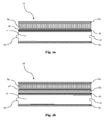
- a schematic layer structure for a panel 10 according to the invention is shown.
- the representation is purely schematic and not to scale.
- the carrier plate ii is considerably thicker than the further layers 12-18, which are in the range of a few hundred ⁇ m.
- the individual layers are shown in an exploded view for ease of understanding and, in the real case, are directly adjacent to each other.
- a support plate 11 is shown with a thickness of about 8 mm of HDF material.
- a moisture barrier 13 is glued in the form of a suitable plastic film. This moisture barrier is optional and depends on the material for the support plate ii and the desired application.
- the support plate 11 also has coupling means in the form of groove 15 and spring elements 14, which are indicated in Fig. La (and b), however, only schematically. Suitable coupling means in the form of tongue and groove elements, which allow a connection of several similar panels in directions parallel to the front and perpendicular to the front by positive engagement are familiar to those skilled in the art.
- complementary connecting means are provided on the four sides of a right-angled or quadrangular support plate for this purpose. Details of such connecting means or locking profiles are known to those skilled in the technology of laminate flooring production, such. B. from the WO 0188306 or the WO 0148332 same applicant, which are hereby incorporated by reference in their entirety.
- a second layer S2 is applied, which has a thickness of 80 um and a Martens hardness of about 25 N / mm 2 .
- FIG. 1b corresponds to the example of FIG. 1a with the difference that a further elastic layer S3 is provided here between the primer layer 16 and the decorative layer 18.
- the layer S3 preferably has a Martens hardness Ms 3 which is less than or equal to the Marten hardness of the layer Si, ie Ms 3 Msi.
- the first layer Si may be somewhat thinner than in the example of FIG. 1 a, which is schematically indicated by different thicknesses in the two figures.
- Fig. 2 schematically shows a coating system for coating carrier plates ii.
- the carrier plates are cut and profiled after coating in a separate profiling line (not shown).
- the support plates ii have for example a thickness between 3 and 20 mm, a length (in the transport direction of the plant Fig. 2 seen) of 150 - 200 cm and a width of 125 - 210 cm.
- any other plate dimensions for the carrier plates can be used, which are cut at the end of the process in the desired shape and size.
- the in the Fig. 2 schematically shows a coating system for coating carrier plates ii.
- the carrier plates are cut and profiled after coating in a separate profiling line (not shown).
- the support plates ii have for example a thickness between 3 and 20 mm, a length (in the transport direction of the plant Fig. 2 seen) of 150 - 200 cm and a width of 125 - 210 cm.
- any other plate dimensions for the carrier plates can be used, which are cut at the end of
- Stations of the system shown are not meant to be exhaustive, but are only illustrative of the explanation of the method according to the invention.
- further processing stations may be provided, such as further drying stations, stations for applying primers, stations for applying putty, control and monitoring devices, etc.
- the carrier plates n are z. B. transported by roller conveyor 20 through the coating system.
- a primer mass is applied by means of a liquid curtain 31 of coating material on the front side (main side) of the carrier plates ii.
- the liquid curtain 31 extends over the entire plate width and the Plates are transported through this curtain and coated.
- a collection container 32 into which the liquid curtain falls when no plate is passed through the curtain, such as at the gap between two successive plates.
- an aqueous acrylate dispersion is preferably used as the coating material for the primer.
- the applied primer is dried with hot air, ie the water is removed from the aqueous acrylate dispersion. After drying the primer, a decorative layer is printed on the primer by means of a digital printing system 45.
- this decorative layer can imitate a real wood, but today's commercially available digital printing systems are capable of printing virtually any desired decor or pattern on the plates.
- a printing ink which can be polymerized by means of radiation ie a printing ink which is based on a polymerisable acrylate and / or N-vinylcaprolactam, is used in the printing system 45.
- the representation of the digital printing installation 45 is only purely schematic and that such printing installations as a rule consist of several stations.
- the material is chosen so that it has a Martens hardness Msi of 0.5 - 120 N / mm 2 after curing.
- the plant 50 is a roller application system and is capable of a layer thickness of about 40 - where ium apply in one operation.
- the applied layer of liquid radiation-curable aliphatic acrylate is at least partially cured by means of UV radiation.
- a second system 50 ' for applying a second layer of the same liquid, radiation-curable acrylate, as that of the first layer.
- the station 50 ' is a roller application station, which usually layer thicknesses of 30 - where ium able to apply is.
- this second layer is at least partially cured by UV radiation.
- a third layer of the same liquid, radiation-curable acrylate is applied and at least partially cured in the third radiation station 60" by means of UV radiation.
- a third coating installation 50 " a third layer of the same liquid, radiation-curable acrylate is applied and at least partially cured in the third radiation station 60" by means of UV radiation.
- a first elastic layer Si having a thickness of about 150 ⁇ m is present at the exit of the last radiation station 60 ".A layer of liquid, radiation-curable acrylate which is selected such that after hardening, it has a Marten hardness Ms2 which is greater than the Marten hardness of the first elastic layer and is preferably 5 to 300 N / mm 2 Fig. 2
- Ms2 Marten hardness
- Fig. 2 by way of example, only one application system 70 and one station 71 for radiation curing are shown, however, several systems can also be provided for the second layer S2, depending on the desired final thickness of the layer of S2.
- a panel coated according to the invention which can be further processed as desired.
Landscapes
- Engineering & Computer Science (AREA)
- Architecture (AREA)
- Civil Engineering (AREA)
- Structural Engineering (AREA)
- Life Sciences & Earth Sciences (AREA)
- Wood Science & Technology (AREA)
- Physics & Mathematics (AREA)
- Plasma & Fusion (AREA)
- Laminated Bodies (AREA)
- Electrochromic Elements, Electrophoresis, Or Variable Reflection Or Absorption Elements (AREA)
- Floor Finish (AREA)
- Ink Jet (AREA)
Priority Applications (6)
| Application Number | Priority Date | Filing Date | Title |
|---|---|---|---|
| EP16170656.9A EP3095529B1 (fr) | 2013-06-20 | 2013-06-20 | Panneau imprime directement comprenant une bi-couche |
| PL16170656.9T PL3095529T3 (pl) | 2013-06-20 | 2013-06-20 | Bezpośrednio zadrukowany panel ze strukturą dwuwarstwową |
| HRP20230578TT HRP20230578T1 (hr) | 2013-06-20 | 2013-06-20 | Izravno tiskani panel s dvoslojnom strukturom |
| ES16170656T ES2949312T3 (es) | 2013-06-20 | 2013-06-20 | Panel directamente impreso con estructura de dos capas |
| HUE16170656A HUE062306T2 (hu) | 2013-06-20 | 2013-06-20 | Közvetlen nyomtatással ellátott kétrétegû panel |
| RS20230457A RS64318B1 (sr) | 2013-06-20 | 2013-06-20 | Direktno štampani panel sa dvoslojnom strukturom |
Applications Claiming Priority (3)
| Application Number | Priority Date | Filing Date | Title |
|---|---|---|---|
| EP16170656.9A EP3095529B1 (fr) | 2013-06-20 | 2013-06-20 | Panneau imprime directement comprenant une bi-couche |
| EP13732427.3A EP3024593B1 (fr) | 2013-06-20 | 2013-06-20 | Panneau directement imprimé pourvu d'un système de deux couches |
| PCT/EP2013/062905 WO2014202143A1 (fr) | 2013-06-20 | 2013-06-20 | Panneau directement imprimé pourvu d'un système de deux couches |
Related Parent Applications (2)
| Application Number | Title | Priority Date | Filing Date |
|---|---|---|---|
| EP13732427.3A Division-Into EP3024593B1 (fr) | 2013-06-20 | 2013-06-20 | Panneau directement imprimé pourvu d'un système de deux couches |
| EP13732427.3A Division EP3024593B1 (fr) | 2013-06-20 | 2013-06-20 | Panneau directement imprimé pourvu d'un système de deux couches |
Publications (3)
| Publication Number | Publication Date |
|---|---|
| EP3095529A1 true EP3095529A1 (fr) | 2016-11-23 |
| EP3095529C0 EP3095529C0 (fr) | 2023-06-07 |
| EP3095529B1 EP3095529B1 (fr) | 2023-06-07 |
Family
ID=48703458
Family Applications (5)
| Application Number | Title | Priority Date | Filing Date |
|---|---|---|---|
| EP16170656.9A Active EP3095529B1 (fr) | 2013-06-20 | 2013-06-20 | Panneau imprime directement comprenant une bi-couche |
| EP16170657.7A Active EP3090815B1 (fr) | 2013-06-20 | 2013-06-20 | Panneau imprimé directement comprenant une bi-couche |
| EP16170658.5A Active EP3090816B1 (fr) | 2013-06-20 | 2013-06-20 | Panneau imprime directement comprenant une bi-couche |
| EP16170652.8A Active EP3090814B1 (fr) | 2013-06-20 | 2013-06-20 | Panneau imprime directement comprenant une bi-couche |
| EP13732427.3A Active EP3024593B1 (fr) | 2013-06-20 | 2013-06-20 | Panneau directement imprimé pourvu d'un système de deux couches |
Family Applications After (4)
| Application Number | Title | Priority Date | Filing Date |
|---|---|---|---|
| EP16170657.7A Active EP3090815B1 (fr) | 2013-06-20 | 2013-06-20 | Panneau imprimé directement comprenant une bi-couche |
| EP16170658.5A Active EP3090816B1 (fr) | 2013-06-20 | 2013-06-20 | Panneau imprime directement comprenant une bi-couche |
| EP16170652.8A Active EP3090814B1 (fr) | 2013-06-20 | 2013-06-20 | Panneau imprime directement comprenant une bi-couche |
| EP13732427.3A Active EP3024593B1 (fr) | 2013-06-20 | 2013-06-20 | Panneau directement imprimé pourvu d'un système de deux couches |
Country Status (14)
| Country | Link |
|---|---|
| US (5) | US10202768B2 (fr) |
| EP (5) | EP3095529B1 (fr) |
| CN (1) | CN105377453B (fr) |
| CA (1) | CA2915134C (fr) |
| DK (1) | DK3090814T3 (fr) |
| ES (5) | ES2922936T3 (fr) |
| HR (5) | HRP20230579T1 (fr) |
| HU (5) | HUE059457T2 (fr) |
| PL (5) | PL3090814T3 (fr) |
| PT (1) | PT3090814T (fr) |
| RS (5) | RS63443B1 (fr) |
| RU (1) | RU2637559C2 (fr) |
| UA (1) | UA115095C2 (fr) |
| WO (1) | WO2014202143A1 (fr) |
Families Citing this family (24)
| Publication number | Priority date | Publication date | Assignee | Title |
|---|---|---|---|---|
| PL3010648T3 (pl) * | 2013-06-20 | 2024-06-24 | Lignum Technologies Ag | Sposób wytwarzania bezpośrednio zadrukowanego panelu |
| US9771726B2 (en) * | 2015-05-18 | 2017-09-26 | Innovative Construction Technologies, LLC | Flooring product and method of manufacturing same |
| ITUA20162438A1 (it) * | 2016-04-08 | 2017-10-08 | Oltre Design S R L | Sistema decorativo multistrato |
| CN106013720B (zh) * | 2016-05-12 | 2018-06-22 | 张波 | 一种化学合成纤维pvc地板及其制造方法 |
| US11077639B2 (en) | 2016-08-19 | 2021-08-03 | Wilsonart Llc | Surfacing materials and method of manufacture |
| US11745475B2 (en) | 2016-08-19 | 2023-09-05 | Wilsonart Llc | Surfacing materials and method of manufacture |
| PL3500535T3 (pl) | 2016-08-19 | 2020-12-14 | Xylo Technologies Ag | Powlekany panel i sposób wytwarzania powlekanego panelu |
| US11504955B2 (en) | 2016-08-19 | 2022-11-22 | Wilsonart Llc | Decorative laminate with matte finish and method of manufacture |
| US10933608B2 (en) | 2016-08-19 | 2021-03-02 | Wilsonart Llc | Surfacing materials and method of manufacture |
| US12392139B2 (en) | 2016-08-26 | 2025-08-19 | Quickstyle Industries, Inc. | Tile with imitation grout line |
| US9938726B2 (en) | 2016-08-26 | 2018-04-10 | Quickstyle Industries Inc. | Densified foam core (DFC) tile with imitation grout line |
| US10544595B2 (en) * | 2016-08-26 | 2020-01-28 | Quickstyle Industries Inc. | Tile with protected imitation grout line |
| BE1024734B1 (nl) * | 2016-11-10 | 2018-06-19 | Ivc Bvba | Vloerpaneel en werkwijze voor het vervaardigen van een vloerpaneel |
| WO2018093263A1 (fr) * | 2016-11-18 | 2018-05-24 | Aectual Holding B.V. | Produit de revêtement de surface, procédé de fabrication d'un revêtement de surface et ensemble de carrelage de revêtement de surface |
| WO2018218601A1 (fr) * | 2017-06-01 | 2018-12-06 | Decoria Materials (Jiangsu) Co., Ltd | Revêtement de surface avec un revêtement de surface durcissable aux ultraviolets (uv) |
| US11020948B2 (en) | 2017-09-28 | 2021-06-01 | Wilsonart Llc | High pressure decorative laminate having a top layer of energy cured acrylated urethane polymer |
| LU100764B1 (en) * | 2018-04-10 | 2019-10-11 | Tarkett Gdl Sa | Floor or wall covering panel with rigid composite core layer |
| US11454036B1 (en) | 2018-10-18 | 2022-09-27 | Columbia Insurance Company | Moisture resistant engineered hardwood veneer flooring |
| NL2022925B1 (en) * | 2019-04-11 | 2020-10-20 | Northann Building Solutions LLC | Decorative panel, panel covering, and method of producing such a decorative panel |
| NL2024631B1 (en) * | 2020-01-09 | 2021-09-07 | Northann Building Solutions LLC | Decorative surface covering element, surface covering element covering, and method of producing such a decorative surface covering element |
| US12584689B2 (en) * | 2020-04-21 | 2026-03-24 | Revive Electronics, LLC | Methods and apparatuses for drying electronic devices |
| US12510296B2 (en) * | 2020-04-21 | 2025-12-30 | Revive Electronics, LLC | Methods and apparatuses for drying electronic devices |
| IT202300005778A1 (it) * | 2023-03-27 | 2024-09-27 | Salis S R L | Linea di produzione per la realizzazione di pavimentazione in legno ad alta resistenza |
| US11911793B1 (en) * | 2023-09-14 | 2024-02-27 | Image Acoustics, Inc. | Deep submergence bender transduction apparatus |
Citations (7)
| Publication number | Priority date | Publication date | Assignee | Title |
|---|---|---|---|---|
| WO2001048332A1 (fr) | 1999-12-27 | 2001-07-05 | Kronospan Technical Company Ltd. | Panneau a profil de connexion |
| WO2001088306A1 (fr) | 2000-05-16 | 2001-11-22 | Kronospan Technical Company Ltd. | Panneaux comportant des moyens d'accouplement |
| WO2007042258A1 (fr) | 2005-10-10 | 2007-04-19 | Kronospan Technical Co. Ltd. | Plaques resistant a l'usure comprenant une surface decorative |
| DE102006029963A1 (de) | 2006-06-29 | 2008-01-03 | Armstrong Dlw Ag | Bodenbelag mit einer elektrisch leitfähigen und/oder antistatischen, transparenten, strahlen- oder thermisch gehärteten Lackierung auf Acrylpolymer-Basis |
| WO2008061791A1 (fr) * | 2006-11-23 | 2008-05-29 | Kronoplus Technical Ag | Plaque revêtue en matériau à base de bois |
| DE102006058655A1 (de) | 2006-12-11 | 2008-06-19 | Ulrich Windmöller Consulting GmbH | Bodenpaneel |
| WO2013149644A1 (fr) * | 2012-04-02 | 2013-10-10 | Kronoplus Technical Ag | Panneau à revêtement et à impression directe |
Family Cites Families (14)
| Publication number | Priority date | Publication date | Assignee | Title |
|---|---|---|---|---|
| US20060018698A1 (en) * | 2004-07-26 | 2006-01-26 | Multi-Color Corporation | System including apparatus and associated method for object decoration |
| JP5429129B2 (ja) * | 2004-09-28 | 2014-02-26 | 大日本印刷株式会社 | 耐衝撃性及び耐スクラッチ性に優れた床材用化粧シート |
| JP4658749B2 (ja) * | 2004-09-28 | 2011-03-23 | 大日本印刷株式会社 | 耐衝撃性及び耐スクラッチ性に優れた床材用化粧シート |
| JP4848640B2 (ja) * | 2004-09-30 | 2011-12-28 | 大日本印刷株式会社 | 化粧シート |
| DE102005006532A1 (de) | 2005-02-11 | 2006-08-24 | Kaindl Flooring Gmbh | Paneel mit dekorativer Schicht |
| ATE439193T1 (de) * | 2005-11-24 | 2009-08-15 | S D Warren Company D B A | BESCHICHTUNGSANLAGE MIT FLIEßFÄHIGEM BESCHICHTUNGSMATERIAL FÜR GLATTE ODER STRUKTURIERTE OBERFLÄCHEN |
| DE202008011589U1 (de) * | 2008-09-01 | 2008-11-27 | Akzenta Paneele + Profile Gmbh | Fußbodenpaneel aus Kunststoff mit mechanischen Verriegelungskanten |
| DE202008012001U1 (de) | 2008-09-09 | 2008-11-27 | Akzenta Paneele + Profile Gmbh | Fußbodenpaneel mit einer Trägerschicht aus Kunststoff |
| RU2465415C1 (ru) * | 2011-03-17 | 2012-10-27 | Александр Михайлович Балаев | Стеновой блок (варианты), материал для изготовления стеновых блоков, форма для изготовления стеновых блоков (варианты), способ изготовления стеновых блоков и поточная линия для изготовления стеновых блоков |
| JP5853816B2 (ja) * | 2011-03-31 | 2016-02-09 | 大日本印刷株式会社 | 床用化粧シート及び床用化粧材 |
| JP6069868B2 (ja) | 2011-03-31 | 2017-02-01 | 大日本印刷株式会社 | 床用化粧シート及び床用化粧材 |
| JP5978668B2 (ja) | 2011-09-29 | 2016-08-24 | 大日本印刷株式会社 | 床用化粧シート及び床用化粧材 |
| CN102955357A (zh) * | 2012-11-20 | 2013-03-06 | 苏州光舵微纳科技有限公司 | 纳米压印复合模板及其制备方法 |
| EP2985639A4 (fr) | 2013-04-11 | 2016-04-27 | Fujifilm Corp | Composition absorbant les rayons proche infrarouge, filtre de coupure de rayon proche infrarouge l'utilisant, procédé de fabrication de celui-ci, module de caméra, et procédé de fabrication de celui-ci |
-
2013
- 2013-06-20 HR HRP20230579TT patent/HRP20230579T1/hr unknown
- 2013-06-20 RU RU2015156135A patent/RU2637559C2/ru active
- 2013-06-20 DK DK16170652.8T patent/DK3090814T3/da active
- 2013-06-20 HU HUE16170652A patent/HUE059457T2/hu unknown
- 2013-06-20 ES ES16170652T patent/ES2922936T3/es active Active
- 2013-06-20 PL PL16170652.8T patent/PL3090814T3/pl unknown
- 2013-06-20 HR HRP20230581TT patent/HRP20230581T1/hr unknown
- 2013-06-20 US US14/900,231 patent/US10202768B2/en active Active
- 2013-06-20 HU HUE16170656A patent/HUE062306T2/hu unknown
- 2013-06-20 ES ES13732427T patent/ES2949275T3/es active Active
- 2013-06-20 CA CA2915134A patent/CA2915134C/fr active Active
- 2013-06-20 HU HUE16170657A patent/HUE062576T2/hu unknown
- 2013-06-20 EP EP16170656.9A patent/EP3095529B1/fr active Active
- 2013-06-20 PL PL16170657.7T patent/PL3090815T3/pl unknown
- 2013-06-20 ES ES16170657T patent/ES2948557T3/es active Active
- 2013-06-20 HU HUE16170658A patent/HUE062305T2/hu unknown
- 2013-06-20 ES ES16170656T patent/ES2949312T3/es active Active
- 2013-06-20 EP EP16170657.7A patent/EP3090815B1/fr active Active
- 2013-06-20 HR HRP20220857TT patent/HRP20220857T1/hr unknown
- 2013-06-20 HR HRP20230578TT patent/HRP20230578T1/hr unknown
- 2013-06-20 RS RS20220672A patent/RS63443B1/sr unknown
- 2013-06-20 PT PT161706528T patent/PT3090814T/pt unknown
- 2013-06-20 HU HUE13732427A patent/HUE062323T2/hu unknown
- 2013-06-20 EP EP16170658.5A patent/EP3090816B1/fr active Active
- 2013-06-20 RS RS20230445A patent/RS64312B1/sr unknown
- 2013-06-20 ES ES16170658T patent/ES2949283T3/es active Active
- 2013-06-20 PL PL16170658.5T patent/PL3090816T3/pl unknown
- 2013-06-20 WO PCT/EP2013/062905 patent/WO2014202143A1/fr not_active Ceased
- 2013-06-20 PL PL16170656.9T patent/PL3095529T3/pl unknown
- 2013-06-20 UA UAA201600454A patent/UA115095C2/uk unknown
- 2013-06-20 PL PL13732427.3T patent/PL3024593T3/pl unknown
- 2013-06-20 RS RS20230458A patent/RS64313B1/sr unknown
- 2013-06-20 HR HRP20230580TT patent/HRP20230580T1/hr unknown
- 2013-06-20 EP EP16170652.8A patent/EP3090814B1/fr active Active
- 2013-06-20 RS RS20230457A patent/RS64318B1/sr unknown
- 2013-06-20 RS RS20230444A patent/RS64341B1/sr unknown
- 2013-06-20 CN CN201380077618.1A patent/CN105377453B/zh active Active
- 2013-06-20 EP EP13732427.3A patent/EP3024593B1/fr active Active
-
2019
- 2019-01-02 US US16/238,154 patent/US10829933B2/en active Active
- 2019-01-02 US US16/238,062 patent/US10870989B2/en active Active
- 2019-01-02 US US16/238,116 patent/US10876292B2/en active Active
- 2019-01-02 US US16/238,089 patent/US10774532B2/en active Active
Patent Citations (8)
| Publication number | Priority date | Publication date | Assignee | Title |
|---|---|---|---|---|
| WO2001048332A1 (fr) | 1999-12-27 | 2001-07-05 | Kronospan Technical Company Ltd. | Panneau a profil de connexion |
| WO2001088306A1 (fr) | 2000-05-16 | 2001-11-22 | Kronospan Technical Company Ltd. | Panneaux comportant des moyens d'accouplement |
| WO2007042258A1 (fr) | 2005-10-10 | 2007-04-19 | Kronospan Technical Co. Ltd. | Plaques resistant a l'usure comprenant une surface decorative |
| DE102006029963A1 (de) | 2006-06-29 | 2008-01-03 | Armstrong Dlw Ag | Bodenbelag mit einer elektrisch leitfähigen und/oder antistatischen, transparenten, strahlen- oder thermisch gehärteten Lackierung auf Acrylpolymer-Basis |
| WO2008061791A1 (fr) * | 2006-11-23 | 2008-05-29 | Kronoplus Technical Ag | Plaque revêtue en matériau à base de bois |
| WO2008061765A1 (fr) * | 2006-11-23 | 2008-05-29 | S.D. Warren Company, D/B/A | Procédé d'impression directe de plaques en matériau à base de bois |
| DE102006058655A1 (de) | 2006-12-11 | 2008-06-19 | Ulrich Windmöller Consulting GmbH | Bodenpaneel |
| WO2013149644A1 (fr) * | 2012-04-02 | 2013-10-10 | Kronoplus Technical Ag | Panneau à revêtement et à impression directe |
Also Published As
Similar Documents
| Publication | Publication Date | Title |
|---|---|---|
| EP3090815B1 (fr) | Panneau imprimé directement comprenant une bi-couche | |
| EP3010648B1 (fr) | Procédé de fabrication d'un panneau directement imprimé | |
| EP2834078B1 (fr) | Panneau à revêtement et à impression directe | |
| EP1937476B1 (fr) | Plaques resistant a l'usure comprenant une surface decorative | |
| EP2094396B1 (fr) | Plaque revêtue en matériau à base de bois | |
| EP2903819B1 (fr) | Panneau de plancher pour l'extérieur | |
| EP3842207B1 (fr) | Procédé de fabrication d'une plaque extrudée | |
| EP2861432A1 (fr) | Panneau présentant une couche décorative et procédé d'impression de plaques | |
| EP3576961B1 (fr) | Panneau en matière plastique pvc | |
| DE202005015978U1 (de) | Abriebfeste Platten mit dekorativer Oberfläche | |
| DE102022112010A1 (de) | Verfahren zur Herstellung eines Profilkörpers |
Legal Events
| Date | Code | Title | Description |
|---|---|---|---|
| PUAI | Public reference made under article 153(3) epc to a published international application that has entered the european phase |
Free format text: ORIGINAL CODE: 0009012 |
|
| AC | Divisional application: reference to earlier application |
Ref document number: 3024593 Country of ref document: EP Kind code of ref document: P |
|
| AK | Designated contracting states |
Kind code of ref document: A1 Designated state(s): AL AT BE BG CH CY CZ DE DK EE ES FI FR GB GR HR HU IE IS IT LI LT LU LV MC MK MT NL NO PL PT RO RS SE SI SK SM TR |
|
| AX | Request for extension of the european patent |
Extension state: BA ME |
|
| STAA | Information on the status of an ep patent application or granted ep patent |
Free format text: STATUS: REQUEST FOR EXAMINATION WAS MADE |
|
| 17P | Request for examination filed |
Effective date: 20170511 |
|
| RBV | Designated contracting states (corrected) |
Designated state(s): AL AT BE BG CH CY CZ DE DK EE ES FI FR GB GR HR HU IE IS IT LI LT LU LV MC MK MT NL NO PL PT RO RS SE SI SK SM TR |
|
| STAA | Information on the status of an ep patent application or granted ep patent |
Free format text: STATUS: EXAMINATION IS IN PROGRESS |
|
| RAP1 | Party data changed (applicant data changed or rights of an application transferred) |
Owner name: XYLO TECHNOLOGIES AG |
|
| 17Q | First examination report despatched |
Effective date: 20181115 |
|
| GRAP | Despatch of communication of intention to grant a patent |
Free format text: ORIGINAL CODE: EPIDOSNIGR1 |
|
| STAA | Information on the status of an ep patent application or granted ep patent |
Free format text: STATUS: GRANT OF PATENT IS INTENDED |
|
| INTG | Intention to grant announced |
Effective date: 20221118 |
|
| GRAS | Grant fee paid |
Free format text: ORIGINAL CODE: EPIDOSNIGR3 |
|
| GRAA | (expected) grant |
Free format text: ORIGINAL CODE: 0009210 |
|
| STAA | Information on the status of an ep patent application or granted ep patent |
Free format text: STATUS: THE PATENT HAS BEEN GRANTED |
|
| AC | Divisional application: reference to earlier application |
Ref document number: 3024593 Country of ref document: EP Kind code of ref document: P |
|
| AK | Designated contracting states |
Kind code of ref document: B1 Designated state(s): AL AT BE BG CH CY CZ DE DK EE ES FI FR GB GR HR HU IE IS IT LI LT LU LV MC MK MT NL NO PL PT RO RS SE SI SK SM TR |
|
| REG | Reference to a national code |
Ref country code: GB Ref legal event code: FG4D Free format text: NOT ENGLISH |
|
| REG | Reference to a national code |
Ref country code: CH Ref legal event code: EP Ref country code: AT Ref legal event code: REF Ref document number: 1573390 Country of ref document: AT Kind code of ref document: T Effective date: 20230615 Ref country code: DE Ref legal event code: R096 Ref document number: 502013016403 Country of ref document: DE |
|
| REG | Reference to a national code |
Ref country code: NO Ref legal event code: T2 Effective date: 20230607 |
|
| U01 | Request for unitary effect filed |
Effective date: 20230629 |
|
| REG | Reference to a national code |
Ref country code: HR Ref legal event code: ODRP Ref document number: P20230578T Country of ref document: HR Payment date: 20230630 Year of fee payment: 11 |
|
| U07 | Unitary effect registered |
Designated state(s): AT BE BG DE DK EE FI FR IT LT LU LV MT NL PT SE SI Effective date: 20230706 |
|
| REG | Reference to a national code |
Ref country code: SK Ref legal event code: T3 Ref document number: E 41876 Country of ref document: SK |
|
| REG | Reference to a national code |
Ref country code: HR Ref legal event code: T1PR Ref document number: P20230578 Country of ref document: HR |
|
| REG | Reference to a national code |
Ref country code: LT Ref legal event code: MG9D |
|
| REG | Reference to a national code |
Ref country code: ES Ref legal event code: FG2A Ref document number: 2949312 Country of ref document: ES Kind code of ref document: T3 Effective date: 20230927 |
|
| U20 | Renewal fee for the european patent with unitary effect paid |
Year of fee payment: 11 Effective date: 20230914 |
|
| REG | Reference to a national code |
Ref country code: HU Ref legal event code: AG4A Ref document number: E062306 Country of ref document: HU |
|
| PG25 | Lapsed in a contracting state [announced via postgrant information from national office to epo] |
Ref country code: GR Free format text: LAPSE BECAUSE OF FAILURE TO SUBMIT A TRANSLATION OF THE DESCRIPTION OR TO PAY THE FEE WITHIN THE PRESCRIBED TIME-LIMIT Effective date: 20230908 |
|
| REG | Reference to a national code |
Ref country code: NO Ref legal event code: CHAD Owner name: LIGNUM TECHNOLOGIES AG, CH |
|
| PG25 | Lapsed in a contracting state [announced via postgrant information from national office to epo] |
Ref country code: IS Free format text: LAPSE BECAUSE OF FAILURE TO SUBMIT A TRANSLATION OF THE DESCRIPTION OR TO PAY THE FEE WITHIN THE PRESCRIBED TIME-LIMIT Effective date: 20231007 |
|
| PG25 | Lapsed in a contracting state [announced via postgrant information from national office to epo] |
Ref country code: SM Free format text: LAPSE BECAUSE OF FAILURE TO SUBMIT A TRANSLATION OF THE DESCRIPTION OR TO PAY THE FEE WITHIN THE PRESCRIBED TIME-LIMIT Effective date: 20230607 Ref country code: IS Free format text: LAPSE BECAUSE OF FAILURE TO SUBMIT A TRANSLATION OF THE DESCRIPTION OR TO PAY THE FEE WITHIN THE PRESCRIBED TIME-LIMIT Effective date: 20231007 |
|
| REG | Reference to a national code |
Ref country code: CH Ref legal event code: PL |
|
| REG | Reference to a national code |
Ref country code: HR Ref legal event code: PNAN Ref document number: P20230578 Country of ref document: HR Owner name: LIGNUM TECHNOLOGIES AG, CH |
|
| REG | Reference to a national code |
Ref country code: DE Ref legal event code: R097 Ref document number: 502013016403 Country of ref document: DE |
|
| PG25 | Lapsed in a contracting state [announced via postgrant information from national office to epo] |
Ref country code: MC Free format text: LAPSE BECAUSE OF FAILURE TO SUBMIT A TRANSLATION OF THE DESCRIPTION OR TO PAY THE FEE WITHIN THE PRESCRIBED TIME-LIMIT Effective date: 20230607 |
|
| REG | Reference to a national code |
Ref country code: IE Ref legal event code: MM4A Ref country code: SK Ref legal event code: TC4A Ref document number: E 41876 Country of ref document: SK Owner name: LIGNUM TECHNOLOGIES AG, NIEDERTEUFEN, CH Effective date: 20240304 |
|
| REG | Reference to a national code |
Ref country code: HU Ref legal event code: HC9C Owner name: LIGNUM TECHNOLOGIES AG, CH Free format text: FORMER OWNER(S): XYLO TECHNOLOGIES AG, CH |
|
| PG25 | Lapsed in a contracting state [announced via postgrant information from national office to epo] |
Ref country code: MC Free format text: LAPSE BECAUSE OF FAILURE TO SUBMIT A TRANSLATION OF THE DESCRIPTION OR TO PAY THE FEE WITHIN THE PRESCRIBED TIME-LIMIT Effective date: 20230607 |
|
| PLBE | No opposition filed within time limit |
Free format text: ORIGINAL CODE: 0009261 |
|
| STAA | Information on the status of an ep patent application or granted ep patent |
Free format text: STATUS: NO OPPOSITION FILED WITHIN TIME LIMIT |
|
| PG25 | Lapsed in a contracting state [announced via postgrant information from national office to epo] |
Ref country code: IE Free format text: LAPSE BECAUSE OF NON-PAYMENT OF DUE FEES Effective date: 20230620 |
|
| PG25 | Lapsed in a contracting state [announced via postgrant information from national office to epo] |
Ref country code: IE Free format text: LAPSE BECAUSE OF NON-PAYMENT OF DUE FEES Effective date: 20230620 Ref country code: CH Free format text: LAPSE BECAUSE OF NON-PAYMENT OF DUE FEES Effective date: 20230630 |
|
| 26N | No opposition filed |
Effective date: 20240308 |
|
| REG | Reference to a national code |
Ref country code: HR Ref legal event code: ODRP Ref document number: P20230578 Country of ref document: HR Payment date: 20240606 Year of fee payment: 12 |
|
| U20 | Renewal fee for the european patent with unitary effect paid |
Year of fee payment: 12 Effective date: 20240625 |
|
| REG | Reference to a national code |
Ref country code: ES Ref legal event code: PC2A Owner name: LIGNUM TECHNOLOGIES AG Effective date: 20241008 |
|
| REG | Reference to a national code |
Ref country code: HR Ref legal event code: ODRP Ref document number: P20230578 Country of ref document: HR Payment date: 20250610 Year of fee payment: 13 |
|
| PGFP | Annual fee paid to national office [announced via postgrant information from national office to epo] |
Ref country code: PL Payment date: 20250610 Year of fee payment: 13 |
|
| PGFP | Annual fee paid to national office [announced via postgrant information from national office to epo] |
Ref country code: GB Payment date: 20250620 Year of fee payment: 13 |
|
| PGFP | Annual fee paid to national office [announced via postgrant information from national office to epo] |
Ref country code: RS Payment date: 20250611 Year of fee payment: 13 Ref country code: NO Payment date: 20250617 Year of fee payment: 13 |
|
| PGFP | Annual fee paid to national office [announced via postgrant information from national office to epo] |
Ref country code: HR Payment date: 20250610 Year of fee payment: 13 |
|
| PGFP | Annual fee paid to national office [announced via postgrant information from national office to epo] |
Ref country code: RO Payment date: 20250619 Year of fee payment: 13 |
|
| PG25 | Lapsed in a contracting state [announced via postgrant information from national office to epo] |
Ref country code: CY Free format text: LAPSE BECAUSE OF FAILURE TO SUBMIT A TRANSLATION OF THE DESCRIPTION OR TO PAY THE FEE WITHIN THE PRESCRIBED TIME-LIMIT; INVALID AB INITIO Effective date: 20130620 |
|
| PGFP | Annual fee paid to national office [announced via postgrant information from national office to epo] |
Ref country code: TR Payment date: 20250617 Year of fee payment: 13 Ref country code: SK Payment date: 20250616 Year of fee payment: 13 |
|
| PGFP | Annual fee paid to national office [announced via postgrant information from national office to epo] |
Ref country code: CZ Payment date: 20250610 Year of fee payment: 13 |
|
| U20 | Renewal fee for the european patent with unitary effect paid |
Year of fee payment: 13 Effective date: 20250624 |
|
| PGFP | Annual fee paid to national office [announced via postgrant information from national office to epo] |
Ref country code: HU Payment date: 20250616 Year of fee payment: 13 |
|
| PGFP | Annual fee paid to national office [announced via postgrant information from national office to epo] |
Ref country code: ES Payment date: 20250718 Year of fee payment: 13 |