EP3098391A2 - Flansche zur verhinderung der turbinenbandakkordeonbildung - Google Patents
Flansche zur verhinderung der turbinenbandakkordeonbildung Download PDFInfo
- Publication number
- EP3098391A2 EP3098391A2 EP16168395.8A EP16168395A EP3098391A2 EP 3098391 A2 EP3098391 A2 EP 3098391A2 EP 16168395 A EP16168395 A EP 16168395A EP 3098391 A2 EP3098391 A2 EP 3098391A2
- Authority
- EP
- European Patent Office
- Prior art keywords
- arcuate
- segment
- aft
- chording
- flange
- Prior art date
- Legal status (The legal status is an assumption and is not a legal conclusion. Google has not performed a legal analysis and makes no representation as to the accuracy of the status listed.)
- Withdrawn
Links
- 238000010438 heat treatment Methods 0.000 claims abstract description 81
- 239000000463 material Substances 0.000 claims abstract description 12
- 239000003570 air Substances 0.000 description 52
- 238000001816 cooling Methods 0.000 description 18
- 239000007789 gas Substances 0.000 description 13
- 230000035882 stress Effects 0.000 description 13
- 239000000567 combustion gas Substances 0.000 description 11
- 238000005336 cracking Methods 0.000 description 2
- 239000000446 fuel Substances 0.000 description 2
- 238000012986 modification Methods 0.000 description 2
- 230000004048 modification Effects 0.000 description 2
- 230000008646 thermal stress Effects 0.000 description 2
- 238000011144 upstream manufacturing Methods 0.000 description 2
- 239000012080 ambient air Substances 0.000 description 1
- 230000000712 assembly Effects 0.000 description 1
- 238000000429 assembly Methods 0.000 description 1
- 238000005219 brazing Methods 0.000 description 1
- 238000005266 casting Methods 0.000 description 1
- 238000006073 displacement reaction Methods 0.000 description 1
- 230000014759 maintenance of location Effects 0.000 description 1
- 239000002184 metal Substances 0.000 description 1
Images



Classifications
-
- F—MECHANICAL ENGINEERING; LIGHTING; HEATING; WEAPONS; BLASTING
- F01—MACHINES OR ENGINES IN GENERAL; ENGINE PLANTS IN GENERAL; STEAM ENGINES
- F01D—NON-POSITIVE DISPLACEMENT MACHINES OR ENGINES, e.g. STEAM TURBINES
- F01D9/00—Stators
- F01D9/02—Nozzles; Nozzle boxes; Stator blades; Guide conduits, e.g. individual nozzles
-
- F—MECHANICAL ENGINEERING; LIGHTING; HEATING; WEAPONS; BLASTING
- F01—MACHINES OR ENGINES IN GENERAL; ENGINE PLANTS IN GENERAL; STEAM ENGINES
- F01D—NON-POSITIVE DISPLACEMENT MACHINES OR ENGINES, e.g. STEAM TURBINES
- F01D9/00—Stators
- F01D9/02—Nozzles; Nozzle boxes; Stator blades; Guide conduits, e.g. individual nozzles
- F01D9/04—Nozzles; Nozzle boxes; Stator blades; Guide conduits, e.g. individual nozzles forming ring or sector
- F01D9/041—Nozzles; Nozzle boxes; Stator blades; Guide conduits, e.g. individual nozzles forming ring or sector using blades
-
- F—MECHANICAL ENGINEERING; LIGHTING; HEATING; WEAPONS; BLASTING
- F01—MACHINES OR ENGINES IN GENERAL; ENGINE PLANTS IN GENERAL; STEAM ENGINES
- F01D—NON-POSITIVE DISPLACEMENT MACHINES OR ENGINES, e.g. STEAM TURBINES
- F01D25/00—Component parts, details, or accessories, not provided for in, or of interest apart from, other groups
- F01D25/005—Selecting particular materials
-
- F—MECHANICAL ENGINEERING; LIGHTING; HEATING; WEAPONS; BLASTING
- F01—MACHINES OR ENGINES IN GENERAL; ENGINE PLANTS IN GENERAL; STEAM ENGINES
- F01D—NON-POSITIVE DISPLACEMENT MACHINES OR ENGINES, e.g. STEAM TURBINES
- F01D25/00—Component parts, details, or accessories, not provided for in, or of interest apart from, other groups
- F01D25/08—Cooling; Heating; Heat-insulation
- F01D25/10—Heating, e.g. warming-up before starting
-
- F—MECHANICAL ENGINEERING; LIGHTING; HEATING; WEAPONS; BLASTING
- F01—MACHINES OR ENGINES IN GENERAL; ENGINE PLANTS IN GENERAL; STEAM ENGINES
- F01D—NON-POSITIVE DISPLACEMENT MACHINES OR ENGINES, e.g. STEAM TURBINES
- F01D25/00—Component parts, details, or accessories, not provided for in, or of interest apart from, other groups
- F01D25/24—Casings; Casing parts, e.g. diaphragms, casing fastenings
-
- F—MECHANICAL ENGINEERING; LIGHTING; HEATING; WEAPONS; BLASTING
- F01—MACHINES OR ENGINES IN GENERAL; ENGINE PLANTS IN GENERAL; STEAM ENGINES
- F01D—NON-POSITIVE DISPLACEMENT MACHINES OR ENGINES, e.g. STEAM TURBINES
- F01D25/00—Component parts, details, or accessories, not provided for in, or of interest apart from, other groups
- F01D25/24—Casings; Casing parts, e.g. diaphragms, casing fastenings
- F01D25/246—Fastening of diaphragms or stator-rings
-
- F—MECHANICAL ENGINEERING; LIGHTING; HEATING; WEAPONS; BLASTING
- F01—MACHINES OR ENGINES IN GENERAL; ENGINE PLANTS IN GENERAL; STEAM ENGINES
- F01D—NON-POSITIVE DISPLACEMENT MACHINES OR ENGINES, e.g. STEAM TURBINES
- F01D9/00—Stators
- F01D9/02—Nozzles; Nozzle boxes; Stator blades; Guide conduits, e.g. individual nozzles
- F01D9/04—Nozzles; Nozzle boxes; Stator blades; Guide conduits, e.g. individual nozzles forming ring or sector
-
- F—MECHANICAL ENGINEERING; LIGHTING; HEATING; WEAPONS; BLASTING
- F05—INDEXING SCHEMES RELATING TO ENGINES OR PUMPS IN VARIOUS SUBCLASSES OF CLASSES F01-F04
- F05D—INDEXING SCHEME FOR ASPECTS RELATING TO NON-POSITIVE-DISPLACEMENT MACHINES OR ENGINES, GAS-TURBINES OR JET-PROPULSION PLANTS
- F05D2220/00—Application
- F05D2220/30—Application in turbines
- F05D2220/32—Application in turbines in gas turbines
-
- F—MECHANICAL ENGINEERING; LIGHTING; HEATING; WEAPONS; BLASTING
- F05—INDEXING SCHEMES RELATING TO ENGINES OR PUMPS IN VARIOUS SUBCLASSES OF CLASSES F01-F04
- F05D—INDEXING SCHEME FOR ASPECTS RELATING TO NON-POSITIVE-DISPLACEMENT MACHINES OR ENGINES, GAS-TURBINES OR JET-PROPULSION PLANTS
- F05D2240/00—Components
- F05D2240/10—Stators
- F05D2240/11—Shroud seal segments
-
- F—MECHANICAL ENGINEERING; LIGHTING; HEATING; WEAPONS; BLASTING
- F05—INDEXING SCHEMES RELATING TO ENGINES OR PUMPS IN VARIOUS SUBCLASSES OF CLASSES F01-F04
- F05D—INDEXING SCHEME FOR ASPECTS RELATING TO NON-POSITIVE-DISPLACEMENT MACHINES OR ENGINES, GAS-TURBINES OR JET-PROPULSION PLANTS
- F05D2240/00—Components
- F05D2240/10—Stators
- F05D2240/12—Fluid guiding means, e.g. vanes
- F05D2240/128—Nozzles
-
- F—MECHANICAL ENGINEERING; LIGHTING; HEATING; WEAPONS; BLASTING
- F05—INDEXING SCHEMES RELATING TO ENGINES OR PUMPS IN VARIOUS SUBCLASSES OF CLASSES F01-F04
- F05D—INDEXING SCHEME FOR ASPECTS RELATING TO NON-POSITIVE-DISPLACEMENT MACHINES OR ENGINES, GAS-TURBINES OR JET-PROPULSION PLANTS
- F05D2240/00—Components
- F05D2240/90—Mounting on supporting structures or systems
- F05D2240/91—Mounting on supporting structures or systems on a stationary structure
-
- F—MECHANICAL ENGINEERING; LIGHTING; HEATING; WEAPONS; BLASTING
- F05—INDEXING SCHEMES RELATING TO ENGINES OR PUMPS IN VARIOUS SUBCLASSES OF CLASSES F01-F04
- F05D—INDEXING SCHEME FOR ASPECTS RELATING TO NON-POSITIVE-DISPLACEMENT MACHINES OR ENGINES, GAS-TURBINES OR JET-PROPULSION PLANTS
- F05D2250/00—Geometry
- F05D2250/10—Two-dimensional
- F05D2250/18—Two-dimensional patterned
- F05D2250/185—Two-dimensional patterned serpentine-like
-
- F—MECHANICAL ENGINEERING; LIGHTING; HEATING; WEAPONS; BLASTING
- F05—INDEXING SCHEMES RELATING TO ENGINES OR PUMPS IN VARIOUS SUBCLASSES OF CLASSES F01-F04
- F05D—INDEXING SCHEME FOR ASPECTS RELATING TO NON-POSITIVE-DISPLACEMENT MACHINES OR ENGINES, GAS-TURBINES OR JET-PROPULSION PLANTS
- F05D2260/00—Function
- F05D2260/20—Heat transfer, e.g. cooling
- F05D2260/221—Improvement of heat transfer
- F05D2260/2212—Improvement of heat transfer by creating turbulence
-
- F—MECHANICAL ENGINEERING; LIGHTING; HEATING; WEAPONS; BLASTING
- F05—INDEXING SCHEMES RELATING TO ENGINES OR PUMPS IN VARIOUS SUBCLASSES OF CLASSES F01-F04
- F05D—INDEXING SCHEME FOR ASPECTS RELATING TO NON-POSITIVE-DISPLACEMENT MACHINES OR ENGINES, GAS-TURBINES OR JET-PROPULSION PLANTS
- F05D2260/00—Function
- F05D2260/20—Heat transfer, e.g. cooling
- F05D2260/221—Improvement of heat transfer
- F05D2260/2214—Improvement of heat transfer by increasing the heat transfer surface
- F05D2260/22141—Improvement of heat transfer by increasing the heat transfer surface using fins or ribs
-
- F—MECHANICAL ENGINEERING; LIGHTING; HEATING; WEAPONS; BLASTING
- F05—INDEXING SCHEMES RELATING TO ENGINES OR PUMPS IN VARIOUS SUBCLASSES OF CLASSES F01-F04
- F05D—INDEXING SCHEME FOR ASPECTS RELATING TO NON-POSITIVE-DISPLACEMENT MACHINES OR ENGINES, GAS-TURBINES OR JET-PROPULSION PLANTS
- F05D2260/00—Function
- F05D2260/94—Functionality given by mechanical stress related aspects such as low cycle fatigue [LCF] of high cycle fatigue [HCF]
- F05D2260/941—Functionality given by mechanical stress related aspects such as low cycle fatigue [LCF] of high cycle fatigue [HCF] particularly aimed at mechanical or thermal stress reduction
-
- F—MECHANICAL ENGINEERING; LIGHTING; HEATING; WEAPONS; BLASTING
- F05—INDEXING SCHEMES RELATING TO ENGINES OR PUMPS IN VARIOUS SUBCLASSES OF CLASSES F01-F04
- F05D—INDEXING SCHEME FOR ASPECTS RELATING TO NON-POSITIVE-DISPLACEMENT MACHINES OR ENGINES, GAS-TURBINES OR JET-PROPULSION PLANTS
- F05D2300/00—Materials; Properties thereof
- F05D2300/50—Intrinsic material properties or characteristics
- F05D2300/502—Thermal properties
- F05D2300/5021—Expansivity
- F05D2300/50212—Expansivity dissimilar
Definitions
- the present invention relates generally to gas turbine engine turbine segments having flanges attached to bands such as nozzle segments and shroud segments and, more specifically, chording of bands in such turbine segments shrouds.
- HPT high pressure turbine
- LPT low pressure turbine
- the HPT and LPT turbine nozzles include a plurality of circumferentially spaced apart stationary nozzle vanes extending radially between outer and inner bands.
- each nozzle vane is a hollow airfoil which cooling air is passed through.
- Cooling air for each vane can be fed through a single spoolie located radially outwardly of the outer band of the nozzle.
- an impingement baffle may be inserted in each hollow airfoil to supply cooling air to the airfoil.
- the turbine rotor stage includes a plurality of circumferentially spaced apart rotor blades extending radially outwardly from a rotor disk.
- Turbine nozzles are located axially forward of a turbine rotor stage.
- the turbine shrouds are located radially outward from the tips of the turbine rotor blades so as to form a radial clearance between the rotor blades and the shrouds.
- the shrouds are held in position by shroud hangers which are supported by flanges engaging with annular casing flanges.
- the turbine nozzles, shrouds, and shroud hangers are typically formed in arcuate segments.
- Each nozzle segment typically has two or more vanes joined between an outer band segment and an inner band segment.
- Each nozzle segment and shroud hanger segment is typically supported at its radially outer end by flanges attached to an annular outer and/or inner casing.
- Each vane has a cooled airfoil disposed between radially inner and outer band panels which form the inner and outer bands.
- the airfoil, inner and outer band portions, flange portion, and intake duct are cast together such that the vane is a single casting.
- the vane airfoils are inserted in corresponding openings in the outer band and the inner band and brazed along interfaces to form the nozzle segment.
- Turbine nozzles experience high stresses at the interface of the airfoil to the bands predominantly at the trail edge. The high stress results in cracking at these locations.
- One of the highest contributors to this stress is the chording which occurs on the bands due to the high temperature at the band flowpath combating the colder temperatures on the non-flowpath sides of the bands, particularly the flanges. Chording of the bands is bowing away from the flowpath. The chording associated with the bands imparts a stress at the airfoil band interface.
- Certain two-stage turbines have a cantilevered second stage nozzle mounted and cantilevered from the outer band. There is little or no access between first and second stage rotor disks to secure the segment at the inner band.
- Typical second stage nozzle segments are configured with multiple airfoil or vane segments.
- Two vane designs, referred to as doublets are a common design.
- Three vane designs, referred to as Triplets are also used in some gas turbine engines. Doublets and Triplets offer performance advantages in reducing split-line leakage flow between vane segments. However, the longer chord length of the bands and mounting structure compromises the durability of the multiple vane nozzle segments.
- the longer chord length causes an increase of chording stresses due to the higher displacement of the longer chord length activated by the radial thermal gradient through the band.
- the increased thermal stress may reduce the durability of the turbine vane segment.
- thermal stresses are present in turbine shroud segments and shroud hangers.
- turbine arcuate segments having flanges attached to bands that reduce chording and chording associated stresses. It is desirable to have turbine engine components such as the turbine nozzle arcuate segments and shroud arcuate segments having flanges attached to bands that reduce chording and chording associated stresses. It is desirable to have turbine engine components such as the turbine nozzle arcuate segments and shroud arcuate segments having flanges attached that reduce chording.
- a gas turbine engine arcuate segment (33) includes an arcuate flange (72) extending radially away from an annular wall (38) and the flange (72) includes an anti-chording means (60) for counteracting chording.
- the anti-chording means (60) may include one or more arcuate inserts (110) in or bonded to the flange (72) and made of a different alpha material than that of the annular wall (38) wherein alpha is a coefficient of thermal expansion.
- the one or more arcuate inserts (110) may extend axially all the way through the flange (72) and may extend radially to a perimeter (OD) of the flange (72).
- the one or more arcuate inserts (110) may have a dovetail shape (114) disposed in one or more dovetail slots (117) respectively in the flange (72) circumferentially between two dovetail posts (118) of the flange (72).
- the anti-chording means (60) may include a heating means (112) for heating the arcuate flange (72).
- the heating means (112) may include a circumferentially extending heating flow passage (116) embedded in the arcuate flange (72), a hot air inlet (115) to the heating flow passage (116), and an outlet (126) from the heating flow passage (116).
- the heating means (112) may include a cold air inlet (132) to the heating flow passage (116), the hot and cold air inlets (115, 132) operable to flow heating air (120) through the heating flow passage (116), and the hot air inlet (115) and the cold air inlet (132) operable to moderate a temperature of the heating air (120) in the heating flow passage (116).
- Turbulators (160) or pins (162) may extend downwardly and upwardly from upper and lower walls (150, 152) bounding the heating flow passage (116).
- the circumferentially extending heating flow passage (116) may be a serpentine heating flow passage (138) with an undulating heating flowpath (137) and may include alternating upper and lower ribs (140, 142) extending downwardly and upwardly from upper and lower walls (150, 152) respectively bounding the serpentine heating flow passage (138).
- the gas turbine engine arcuate segment (33) may include turbine nozzle throats (122) adjacent leading and trailing airfoils (130, 128), the hot air inlet (115) located near a pressure side (121) of the trailing airfoil (128) near a first one of the turbine nozzle throats (122), and the outlet (126) located near a suction side (43) of the leading airfoil (130) near a second one of the turbine nozzle throats (122).
- a turbine nozzle segment (32) includes one or more airfoils (34) extending radially between inner and outer arcuate band segments (37, 38) of the turbine nozzle segment (32), arcuate forward and aft outer flanges (70, 72) extending radially outwardly from the outer arcuate band segment (38) at corresponding forward and aft ends (105, 107) respectively of the outer band segment (38), and each of the forward and aft outer flanges (70, 72) includes one of the anti-chording means (60).
- the turbine nozzle segment (32) may further include arcuate forward and aft inner flanges (106, 108) extending radially inwardly from the inner arcuate band segment (37) at corresponding forward and aft ends (105, 107) respectively of the inner band segment (37) and at least one of the forward and aft inner flanges (106, 108) includes a corresponding one of the anti-chording means (60).
- the gas turbine engine arcuate segment (33) may be an arcuate turbine shroud segment (40) including forward and aft shroud rail segments (80, 82) extending radially outwardly from the arcuate shroud band segment (78) wherein the forward and aft shroud rail segments (80, 82) include the flange (72), forward and aft shroud hooks (84, 86) on the forward and aft shroud rail segments (80, 82), and the anti-chording means (60) is disposed in at least one of the forward and aft shroud rail segments (80, 82).
- a turbine nozzle (20) includes a plurality of gas turbine engine arcuate turbine nozzle segments (32), each of the turbine nozzle segments (32) including an arcuate flange (72) extending radially away from an annular wall (38), the flange (72) including an anti-chording means (60) for counteracting chording, the anti-chording means (60) including a ring segment (216) extending circumferentially between circumferentially spaced apart first and second edges (62, 64) of and bonded or attached to the annular wall (38) or flange (72) of each of the turbine nozzle segments (32), and the ring segment (216) being made of a different alpha material than that of the annular wall (38) wherein alpha is a coefficient of thermal expansion.
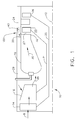
- FIG. 1 Illustrated schematically in FIG. 1 is a portion of an exemplary aircraft turbofan gas turbine engine 10 circumscribed about a longitudinal or axial centerline axis 12.
- the engine 10 includes, in serial flow communication, a fan 14, multistage axial high pressure compressor 16, annular combustor 18, high pressure turbine nozzle 20, a single stage high pressure turbine rotor 22, and one or more stages of low pressure turbine nozzles 24 and low pressure turbine rotors 26.
- the high pressure turbine rotor 22 is joined to the compressor 16 by a first shaft 21 and a low pressure turbine rotor 26 is joined to the fan 14 by a second coaxial shaft 25.
- ambient air 8 flows downstream through the fan 14, the compressor 16 from where it exits as compressed air 28 and is then flowed into the combustor 18.
- the compressed air 28 is mixed with fuel and ignited in the combustor 18 generating hot combustion gases 30 which flow downstream through turbine stages which extract energy therefrom for powering both the fan 14 and the compressor 16.
- various stator and rotor annular turbine components 200 of the turbines downstream from the combustor 18 defme a turbine flowpath 27 which channels the hot combustion gases 30 therethrough for discharge from the engine.
- Downstream of and adjacent to the high pressure turbine nozzle 20 is the high pressure turbine rotor 22.
- the rotor 22 may take any conventional form having a plurality of circumferentially spaced apart turbine blades 23 extending radially outwardly from a rotor disk for extracting energy from the gases 30 and powering the compressor 16.
- a portion of the compressed air 28 is bled from the compressor 16 to provide bleed air which can be used as cooling air 29 which is channeled to various parts of the turbines such as the high pressure nozzle 20 to provide cooling thereof.
- the cooling air 29 is channeled around and through the high pressure turbine nozzle 20 at a substantially higher pressure than that of the combustion gases 30 flowing therethrough during operation.
- Turbine stator components such as high pressure turbine nozzles 20 and shrouds 98 are often manufactured in arcuate segments 33 and then assembled together in the engine 10 forming the turbine components.
- Various joints or gaps are provided between annular assemblies of arcuate segments 33 which must be suitably sealed for preventing leakage of the high pressure cooling air 29 into the turbine flowpath 27.
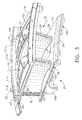
- FIGS. 2 and 3 Illustrated in FIGS. 2 and 3 is an exemplary embodiment of a turbine nozzle segment 32 of the annular high pressure turbine nozzle 20 and an exemplary embodiment of a shroud segment 40 of the annular shroud 98 or stationary shroud assembly 100 which are examples of stationary turbine arcuate segments 33.
- Circumferentially adjoining nozzle segments 32 are bolted or otherwise joined together to form the full ring annular high pressure turbine nozzle 20.
- the turbine nozzle segments 32 may be made from one, two, or more vanes or airfoils 34 and may be circumferentially joined together such as by brazing, illustrated by a braze line 31, as illustrated in FIG. 3 .
- the high pressure turbine nozzle 20 includes an annular segmented radially outer band 35 and a coaxial annular segmented radially inner band 36.
- the outer and inner bands 35, 36 bound the turbine flowpath 27 in the high pressure turbine nozzle 20.
- a plurality of circumferentially spaced apart stator airfoils 34 extend radially between and are fixedly joined to the outer and inner bands 35, 36.
- Pressure and suction sides 41, 43 extend downstream from a leading edge LE to a trailing edge TE of each of the stator airfoils 34.
- Each of the nozzle segments 32 includes one or more of the airfoils 34 extending radially between inner and outer arcuate band segments 37, 38.
- Arcuate forward and aft outer flanges 70, 72 extend radially outwardly from the outer arcuate band segment 38 at corresponding forward and aft ends 105, 107, respectively, of the outer band segment 38.
- the arcuate forward and aft outer flanges 70, 72 extend circumferentially between circumferentially spaced apart first and second edges 62, 64 of the outer arcuate band segment 38.
- Arcuate forward and aft inner flanges 106, 108 extend radially inwardly from the inner arcuate band segment 37 at corresponding forward and aft ends 105, 107, respectively, of the inner band segment 37.
- the arcuate forward and aft inner flanges 106, 108 extend circumferentially between circumferentially spaced apart first and second edges 62, 64 of the inner arcuate band segment 37.
- the radially inner and outer arcuate band segments 37, 38 of the nozzle segments 32 form the segmented annular radially outer and inner bands 35, 36, respectively.
- the inner surface 135 of the outer band 35 and the outer surface 136 of the inner band 36 define portions of flowpath boundaries for the combustion gases 30 which are channeled downstream to the turbine rotor 22.
- the cooling air 29 is channeled to the nozzle 20 and flows through the individual airfoils 39 for cooling thereof and circulates around the outer surface 136 of the outer band 35.
- the cooling air 29 is at a higher pressure compared to that of the combustion gases 30 channeled through the nozzle 20.
- the relatively cold cooling air 29 produces cold surfaces 52 along an outer side 54 of the outer band segment 38.
- the relatively hot combustion gases 30 in the turbine flowpath 27 produce a hot surface 56 along an inner side 58 of the outer band segment 38.
- the inner band segment 37 has a cold surface 52 along an inner side 58 of the inner band segment 37.
- the relatively hot combustion gases 30 in the flowpath 27 produce a hot surface 56 along an outer side 54 of the inner band segment 37.
- Chording occurs on the band segments due to a thermal gradient associated with the hot combustion gases 30 imparting high temperature on the outer band inner surface and cooling air imparting cold temperatures on the outer surfaces of the outer band.
- the temperature gradient is exacerbated by the flanges radial height resulting in a higher thermal gradient.
- the turbine nozzles 20 experience high stresses at the interface between the airfoils 39 and the band segments, particularly at trailing edges TE of the airfoils 39.
- the high stress results in cracking at these locations.
- chording which occurs on the bands due to the high temperature at the band along the turbine flowpath 27 combating the colder temperatures on the non-flowpath sides of the bands, particularly the flanges. As the band undergoes chording (bowing away from the flowpath), the airfoils are pulled on, resulting in high stresses.
- the flanges include an anti-chording means 60 for counteracting chording or flattening.
- One embodiment of the anti-chording means 60 illustrated herein is in the arcuate aft outer flange 72 at the aft end 107 of the outer band segment 38 of the nozzle segments 32 of the high pressure turbine nozzle 20 as illustrated in FIGS. 2 and 3 .
- This exemplary embodiment of the anti-chording means 60 includes materials in the flanges such as the arcuate aft outer flange 72 having a different coefficient of thermal expansion (alpha) than the rest of the nozzle segment to counteract the chording experienced by the band segments.
- Inserts 110 made of different alpha material may be inserted in or attached in another manner to the aft outer flange 72 and other flanges such as the forward and aft inner flanges 106, 108 and the forward outer flange 70.
- the insert 110 may be arcuate and made of the different higher alpha material and may have a dovetail shape 114 and be disposed in a dovetail slot 117 in one or more of the flanges.
- the arcuate insert 110 is illustrated in the aft outer flange 72 as extending axially all the way therethrough.
- the exemplary arcuate insert 110 illustrated in FIGS. 3 and 4 extend circumferentially between two dovetail posts 118 of the aft outer flange 72.
- the arcuate insert 110 extends radially through the aft outer flange 72 to a perimeter OD of the aft outer flange 72.
- a single arcuate insert 110 is illustrated herein but two or more arcuate inserts 110 may be used for each flange.
- the insert 110 may be brazed or otherwise bonded into the dovetail slot 117.
- the different alpha metal in the flanges causes the flanges to grow at similar amounts as the hot outer and inner bands 35, 36 thereby reducing band chording. As chording is reduced, the stress on the airfoil is significantly reduced as well.
- a stationary shroud assembly 100 which bounds and confines the turbine flowpath 27 radially outwardly of the turbine blades 23.
- the shroud assembly 100 is made from a plurality of circumferentially adjoining arcuate turbine shroud segments 40 supported from a plurality of circumferentially adjoining shroud hangers 42, which in turn are supported from an annular outer casing 44 using forward and aft hooks and retention clips.
- the shroud segments 40 and hangers 42 are disposed coaxially with the turbine nozzle 20 for defining a radially outer flowpath boundary around the turbine blades 23 along which the combustion gases 30 flow from the nozzle 20.
- Arcuate forward and aft shroud rail segments 80, 82 extend radially outwardly from the shroud segments 40.
- the arcuate forward and aft shroud rail segments 80, 82 extend circumferentially between circumferentially spaced apart first and second edges 62, 64 of the shroud segments 40.
- Forward and aft shroud hooks 84, 86 on the forward and aft shroud rail segments 80, 82 mount the shroud segments 40 to the shroud hangers 42.
- the individual shroud segments 40 may be directly mounted to the outer casing 44, but in the exemplary embodiment illustrated herein, the shroud segments 40 are mounted to the shroud hangers 42, which in turn are mounted to the casing 44.
- the hot combustion gases 30 in the flowpath 27 produce a hot surfaces 56 along inner sides 58 of the shroud segments 40.
- the shroud segments 40 have cold surfaces 52 along radially outer sides 54 of the shroud segments 40. Chording of the shroud segment 40 occurs due to the high radial thermal gradient along the inner sides 58 of the shroud segments 40 facing the flowpath combating the colder temperatures on the outer sides 54 or non-flowpath sides of the shroud segments 40 and the forward and aft shroud rail segments 80, 82.
- Anti-chording means 60 for counteracting chording may include one or more arcuate inserts 110 made of a different alpha material (preferably a higher alpha material) inserted in the forward and/or aft shroud rail segments 80, 82.
- Each of the inserts 110 may have a dovetail shape 114 and be disposed in a dovetail slot 117 in the forward and/or aft shroud rail segments 80, 82 as illustrated in FIG. 4 .
- the arcuate inserts 110 extends axially all the way through the forward and aft shroud rail segments 80, 82 and circumferentially between two dovetail posts 118 of each of the forward and aft shroud rail segments 80, 82.
- the arcuate inserts 110 extend radially through the forward and aft shroud rail segments 80, 82 to perimeters OD of the forward and aft shroud rail segments 80, 82.
- the arcuate inserts 110 include the forward and aft shroud hooks 84, 86.
- FIG. 4A illustrates an alternative to the inserts 110 made of a different alpha material disclosed above and illustrated in FIGS. 2-4 . Illustrated in FIG. 4A is a 360 degree segmented ring 214 including ring segments 216 made of a different alpha material and bonded or otherwise attached to the turbine nozzle segments 32 or the shroud segments 40.
- the ring segments 216 form, at least in part, the flanges and/or rail segments and provides the anti-chording means 60 for the flanges and/or rail segments.
- the arcuate ring segments 216 extend circumferentially between circumferentially spaced apart first and second edges 62, 64 of the arcuate shroud segments 40.
- the anti-chording ring segments 216 may be used with one or more of the flanges and rail segments disclosed above.
- the anti-chording ring segments 216 may be welded or otherwise bonded to the turbine nozzle segments 32 or the band segments 37, 38 or the shroud segments 40.
- FIGS. 5-11 Illustrated in FIGS. 5-11 are exemplary embodiments of the anti-chording means 60 including heating means 112 for heating the relatively colder flanges and rail segments such as the forward and aft outer flanges 70, 72, the forward and aft inner flanges 106, 108, and the forward and aft shroud rail segments 80, 82 illustrated in FIGS. 1-4 .
- Illustrated in FIGS. 5-11 are exemplary embodiments of the heating means 112 as applied to the aft outer flanges 72.
- the purpose of the heating means 112 is to better equalize the inner and outer band temperatures by heating the colder rail segments and flanges. By heating these structures, the band temperature gradients are reduced and chording is minimized. As chording is reduced, the stresses on the airfoils are significantly reduced as well.
- the heating means 112 includes a hot air inlet 115 to a circumferentially extending heating flow passage 116 embedded in the arcuate aft outer flange 72.
- the hot air inlet 115 allows a small amount of hot flowpath air 119, as illustrated in FIGS. 10 and 11 , to flow into the passage 116 to warm the flange and decrease thermal gradient.
- the hot air inlet 115 is preferably located to extract or bleed a small amount of the hot flowpath air 119 upstream from a turbine nozzle throat 122 on a pressure side 121 of a trailing airfoil 128 to flow into the heating flow passage 116 for use as heating air 120.
- An outlet 126 allows the heating air 120 to exit the heating flow passage 116 upstream of the nozzle throat 122 potentially on a suction side 43 of a leading airfoil 130.
- the outlet 126 is preferably located to expel the heating air 120 into the turbine flowpath 27 on the suction side 43 of the leading airfoil 130, preferably forward but potentially aft of the turbine nozzle throat 122. The result is a warmer flange and less chording.
- the expelled heating air 120 can be used both for airfoil cooling supply and/or film cooling.
- the heating air 120 may be tempered or its temperature lowered by using a cold air inlet 132 to the heating flow passage 116 to allow cool air 134 that is cooler than the hot flowpath air 119 to mix with the hot flowpath air 119 to form the heating air 120 in the heating flow passage 116.
- the cold air inlet 132 and the hot air inlet 115 are operable to moderate the temperature of the heating air 120 in the heating flow passage 116.
- the hot flowpath air 119 is taken through the hot air inlet 115 on the hot surface 56 along an inner side 58 of the outer band segment 38 as illustrated for a single hot air inlet 115 in FIG. 10 and a double hot air inlet 127 in FIG. 11 .
- the relatively cold cooling air 29 produces a cold surface 52 along an outer side 54 of the outer band segment 38 and provides the cool air 134 as illustrated in FIG. 11 .
- previously utilized or spent cooling air from the airfoil internal cooling circuit which has increased in temperature may be flowed into the heating flow passage 116.
- One alternate source for flowing cooler air into the flow passages is spent turbine nozzle airfoil cooling.
- a serpentine heating flow passage 138 may be used for the heating flow passage 116 as illustrated in FIG. 9 .
- the serpentine heating flow passage 138 may be an undulating heating flowpath 137 which in the exemplary embodiment illustrated herein undulates between alternating upper and lower ribs 140, 142 extending downwardly and upwardly from upper and lower walls 150, 152 respectively bounding the serpentine heating flow passage 138.
- the serpentine heating flow passage 138 provides improved heat transfer for the heating flow passage.
- Alternative embodiments of the serpentine heating flow passage 138 may include pins and alternative turbulators etc.
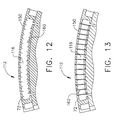
- turbulators 160 may be used in the heating flow passage 116 as illustrated in FIG. 12 .
- the turbulators 160 extend downwardly and upwardly from the upper and lower walls 150, 152 respectively bounding the heating flow passage 116.
- the turbulators 160 provide improved heat transfer for the heating flow passage 116.
- Another alternative embodiment of the heating flow passage 116 includes pins 162 extending across the heating flow passage 116 and may extend between the upper and lower walls 150, 152.
- the inner and outer arcuate band segments 37, 38 and the shroud segments 40 are annular walls.
- the forward and aft shroud rail segments 80, 82 are particular embodiments of flanges within the context of this patent.
- the forward and aft shroud rail segments 80, 82 may be generally describes or referred to as flanges extending radially outwardly from the annular walls.
- the forward and aft outer flanges 70, 72 may be generally describes or referred to as flanges extending radially outwardly from the annular walls.
- the gas turbine engine arcuate segment 33 disclosed herein may be described comprising an arcuate flange 72 extending radially away from an annular wall and anti-chording means 60 for countering chording disposed in or bonded to the flange.
Landscapes
- Engineering & Computer Science (AREA)
- Mechanical Engineering (AREA)
- General Engineering & Computer Science (AREA)
- Chemical & Material Sciences (AREA)
- Materials Engineering (AREA)
- Turbine Rotor Nozzle Sealing (AREA)
Applications Claiming Priority (1)
| Application Number | Priority Date | Filing Date | Title |
|---|---|---|---|
| US14/706,003 US10392950B2 (en) | 2015-05-07 | 2015-05-07 | Turbine band anti-chording flanges |
Publications (2)
| Publication Number | Publication Date |
|---|---|
| EP3098391A2 true EP3098391A2 (de) | 2016-11-30 |
| EP3098391A3 EP3098391A3 (de) | 2017-02-22 |
Family
ID=55913514
Family Applications (1)
| Application Number | Title | Priority Date | Filing Date |
|---|---|---|---|
| EP16168395.8A Withdrawn EP3098391A3 (de) | 2015-05-07 | 2016-05-04 | Flansche zur verhinderung der turbinenbandakkordeonbildung |
Country Status (6)
| Country | Link |
|---|---|
| US (1) | US10392950B2 (de) |
| EP (1) | EP3098391A3 (de) |
| JP (1) | JP2017020493A (de) |
| CN (1) | CN106437867B (de) |
| BR (1) | BR102016009271A2 (de) |
| CA (1) | CA2928177A1 (de) |
Cited By (3)
| Publication number | Priority date | Publication date | Assignee | Title |
|---|---|---|---|---|
| EP4202184A1 (de) * | 2021-12-24 | 2023-06-28 | ITP Next Generation Turbines, S.L. | Gasturbine mit einer erhitzten turbinenauslassleitschaufelanordnung |
| EP4332351A1 (de) * | 2022-09-05 | 2024-03-06 | General Electric Company Polska Sp. Z o.o | Aussengehäuseanordnung eines turbinenrotors |
| US12091982B2 (en) | 2022-06-10 | 2024-09-17 | Ge Infrastructure Technology Llc | Turbine component with heated structure to reduce thermal stress |
Families Citing this family (12)
| Publication number | Priority date | Publication date | Assignee | Title |
|---|---|---|---|---|
| US10677084B2 (en) | 2017-06-16 | 2020-06-09 | Honeywell International Inc. | Turbine tip shroud assembly with plural shroud segments having inter-segment seal arrangement |
| US11802486B2 (en) | 2017-11-13 | 2023-10-31 | General Electric Company | CMC component and fabrication using mechanical joints |
| US10738628B2 (en) * | 2018-05-25 | 2020-08-11 | General Electric Company | Joint for band features on turbine nozzle and fabrication |
| US20200072070A1 (en) * | 2018-09-05 | 2020-03-05 | United Technologies Corporation | Unified boas support and vane platform |
| KR102226741B1 (ko) * | 2019-06-25 | 2021-03-12 | 두산중공업 주식회사 | 링 세그먼트, 및 이를 포함하는 터빈 |
| KR102299164B1 (ko) * | 2020-03-31 | 2021-09-07 | 두산중공업 주식회사 | 터빈 블레이드의 팁 클리어런스 제어장치 및 이를 포함하는 가스 터빈 |
| US12104533B2 (en) * | 2020-04-24 | 2024-10-01 | General Electric Company | Methods and apparatus for gas turbine frame flow path hardware cooling |
| JP7284737B2 (ja) * | 2020-08-06 | 2023-05-31 | 三菱重工業株式会社 | ガスタービン静翼 |
| JP7846579B2 (ja) * | 2022-07-13 | 2026-04-15 | 本田技研工業株式会社 | ラジアルタービンノズル及びその組立方法 |
| US12366201B2 (en) | 2023-02-17 | 2025-07-22 | General Electric Company | Reverse flow gas turbine engine having electric machine |
| CN116733613B (zh) * | 2023-08-10 | 2023-10-20 | 成都中科翼能科技有限公司 | 一种燃气轮机的过渡段结构 |
| US12129771B1 (en) | 2023-08-22 | 2024-10-29 | Ge Infrastructure Technology Llc | Stator vane assembly having mechanical retention device |
Family Cites Families (27)
| Publication number | Priority date | Publication date | Assignee | Title |
|---|---|---|---|---|
| FR1084065A (fr) | 1952-11-03 | 1955-01-17 | Oerlikon Maschf | Moteur thermique |
| JPS5254809A (en) | 1975-10-31 | 1977-05-04 | Hitachi Ltd | Axial-flow fluid machine construction |
| US4187054A (en) | 1978-04-20 | 1980-02-05 | General Electric Company | Turbine band cooling system |
| US5071313A (en) * | 1990-01-16 | 1991-12-10 | General Electric Company | Rotor blade shroud segment |
| US5098257A (en) * | 1990-09-10 | 1992-03-24 | Westinghouse Electric Corp. | Apparatus and method for minimizing differential thermal expansion of gas turbine vane structures |
| DE4327376A1 (de) * | 1993-08-14 | 1995-02-16 | Abb Management Ag | Verdichter sowie Verfahren zu dessen Betrieb |
| US5423659A (en) * | 1994-04-28 | 1995-06-13 | United Technologies Corporation | Shroud segment having a cut-back retaining hook |
| KR100694370B1 (ko) | 1999-05-14 | 2007-03-12 | 제너럴 일렉트릭 캄파니 | 터빈 노즐의 내측 및 외측 밴드에서 온도 부정합을 제어하는 장치 및 내측 또는 외측 밴드의 벽과 커버 사이의 온도 차이를 감소시키는 방법 |
| FR2819010B1 (fr) | 2001-01-04 | 2004-05-28 | Snecma Moteurs | Secteur d'entretoise de support d'anneau de stator de la turbine haute pression d'une turbomachine avec rattrapage de jeux |
| US6464457B1 (en) | 2001-06-21 | 2002-10-15 | General Electric Company | Turbine leaf seal mounting with headless pins |
| JP4008212B2 (ja) | 2001-06-29 | 2007-11-14 | 三菱重工業株式会社 | フランジ付中空構造物 |
| US6769865B2 (en) | 2002-03-22 | 2004-08-03 | General Electric Company | Band cooled turbine nozzle |
| EP1413831A1 (de) | 2002-10-21 | 2004-04-28 | Siemens Aktiengesellschaft | Ringbrennkammern für eine Gasturbine und Gasturbine |
| US7172388B2 (en) * | 2004-08-24 | 2007-02-06 | Pratt & Whitney Canada Corp. | Multi-point seal |
| US7434402B2 (en) * | 2005-03-29 | 2008-10-14 | Siemens Power Generation, Inc. | System for actively controlling compressor clearances |
| US7448846B2 (en) | 2005-08-06 | 2008-11-11 | General Electric Company | Thermally compliant turbine shroud mounting |
| US7753643B2 (en) * | 2006-09-22 | 2010-07-13 | Siemens Energy, Inc. | Stacked laminate bolted ring segment |
| US7798775B2 (en) * | 2006-12-21 | 2010-09-21 | General Electric Company | Cantilevered nozzle with crowned flange to improve outer band low cycle fatigue |
| US8061977B2 (en) | 2007-07-03 | 2011-11-22 | Siemens Energy, Inc. | Ceramic matrix composite attachment apparatus and method |
| US8292573B2 (en) * | 2009-04-21 | 2012-10-23 | General Electric Company | Flange cooled turbine nozzle |
| US20100284800A1 (en) | 2009-05-11 | 2010-11-11 | General Electric Company | Turbine nozzle with sidewall cooling plenum |
| US8328511B2 (en) | 2009-06-17 | 2012-12-11 | General Electric Company | Prechorded turbine nozzle |
| JP2011208624A (ja) | 2010-03-31 | 2011-10-20 | Hitachi Ltd | 高温部材の冷却構造 |
| GB201106794D0 (en) | 2011-04-21 | 2011-06-01 | Rolls Royce Plc | A composite flange element |
| FR2993317B1 (fr) | 2012-07-16 | 2014-08-15 | Snecma | Carter de turbomachine dans un materiau composite et procede de fabrication associe |
| US8920109B2 (en) * | 2013-03-12 | 2014-12-30 | Siemens Aktiengesellschaft | Vane carrier thermal management arrangement and method for clearance control |
| US9638057B2 (en) | 2013-03-14 | 2017-05-02 | Rolls-Royce North American Technologies, Inc. | Augmented cooling system |
-
2015
- 2015-05-07 US US14/706,003 patent/US10392950B2/en active Active
-
2016
- 2016-04-26 BR BR102016009271A patent/BR102016009271A2/pt not_active IP Right Cessation
- 2016-04-27 JP JP2016088651A patent/JP2017020493A/ja active Pending
- 2016-04-28 CA CA2928177A patent/CA2928177A1/en not_active Abandoned
- 2016-05-04 EP EP16168395.8A patent/EP3098391A3/de not_active Withdrawn
- 2016-05-06 CN CN201610295389.6A patent/CN106437867B/zh active Active
Non-Patent Citations (1)
| Title |
|---|
| None |
Cited By (4)
| Publication number | Priority date | Publication date | Assignee | Title |
|---|---|---|---|---|
| EP4202184A1 (de) * | 2021-12-24 | 2023-06-28 | ITP Next Generation Turbines, S.L. | Gasturbine mit einer erhitzten turbinenauslassleitschaufelanordnung |
| US12018573B2 (en) | 2021-12-24 | 2024-06-25 | Itp Next Generation Turbines S.L. | Turbine arrangement including a turbine outlet stator vane arrangement |
| US12091982B2 (en) | 2022-06-10 | 2024-09-17 | Ge Infrastructure Technology Llc | Turbine component with heated structure to reduce thermal stress |
| EP4332351A1 (de) * | 2022-09-05 | 2024-03-06 | General Electric Company Polska Sp. Z o.o | Aussengehäuseanordnung eines turbinenrotors |
Also Published As
| Publication number | Publication date |
|---|---|
| BR102016009271A2 (pt) | 2016-11-16 |
| CN106437867B (zh) | 2018-11-02 |
| JP2017020493A (ja) | 2017-01-26 |
| CA2928177A1 (en) | 2016-11-07 |
| US20170058684A1 (en) | 2017-03-02 |
| US10392950B2 (en) | 2019-08-27 |
| CN106437867A (zh) | 2017-02-22 |
| EP3098391A3 (de) | 2017-02-22 |
Similar Documents
| Publication | Publication Date | Title |
|---|---|---|
| US10392950B2 (en) | Turbine band anti-chording flanges | |
| EP1918522B1 (de) | Bauteil für ein Gasturbinentriebwerk | |
| EP2538026B1 (de) | Kühlsystem für turbinenschaufel mit eiscremewaffelförmigen erhebungen | |
| EP2290193B1 (de) | Turbinenleitschaufel | |
| US8721285B2 (en) | Turbine blade with incremental serpentine cooling channels beneath a thermal skin | |
| EP2105580B1 (de) | Hybride, prallgekühlte Turbinendüse | |
| US20190085705A1 (en) | Component for a turbine engine with a film-hole | |
| US20180320530A1 (en) | Airfoil with tip rail cooling | |
| JP2002155701A (ja) | 時計方向にずらしたタービン翼形部の冷却 | |
| EP1944468B1 (de) | Turbinenschaufel | |
| EP4105442A1 (de) | Verbesserte kühlschemata für schaufeln von gasturbinenmotoren | |
| US10830057B2 (en) | Airfoil with tip rail cooling | |
| US20180142564A1 (en) | Combined turbine nozzle and shroud deflection limiter | |
| EP2551458A2 (de) | Schaufelkühl- und -abdichtsystem | |
| EP3415719A1 (de) | Kühlstruktur einer turbomaschinenschaufel | |
| CA2956912A1 (en) | Airfoil for a gas turbine engine | |
| EP3647544B1 (de) | Gekühltes gasturbinen leitschaufelprofil | |
| EP3054093B1 (de) | Anordnung von turbulatoren | |
| EP3650639A1 (de) | Abschirmung für eine turbinentriebwerksschaufel | |
| EP3205824A1 (de) | Beschleunigereinsatz für eine gasturbinenmotorschaufel | |
| US11781434B2 (en) | Components for gas turbine engines | |
| CN107762564A (zh) | 带有多孔肋部的用于涡轮发动机的翼型件 | |
| CN113874600A (zh) | 具有蛇形通道的涡轮叶片 | |
| EP3578759B1 (de) | Schaufelprofil und zugehöriges verfahren zur leitung eines kühlstromes | |
| EP1362982A1 (de) | Turbinenschaufel mit dreifach nach hinten gewundenen Kühlkanälen |
Legal Events
| Date | Code | Title | Description |
|---|---|---|---|
| PUAI | Public reference made under article 153(3) epc to a published international application that has entered the european phase |
Free format text: ORIGINAL CODE: 0009012 |
|
| AK | Designated contracting states |
Kind code of ref document: A2 Designated state(s): AL AT BE BG CH CY CZ DE DK EE ES FI FR GB GR HR HU IE IS IT LI LT LU LV MC MK MT NL NO PL PT RO RS SE SI SK SM TR |
|
| AX | Request for extension of the european patent |
Extension state: BA ME |
|
| PUAL | Search report despatched |
Free format text: ORIGINAL CODE: 0009013 |
|
| AK | Designated contracting states |
Kind code of ref document: A3 Designated state(s): AL AT BE BG CH CY CZ DE DK EE ES FI FR GB GR HR HU IE IS IT LI LT LU LV MC MK MT NL NO PL PT RO RS SE SI SK SM TR |
|
| AX | Request for extension of the european patent |
Extension state: BA ME |
|
| RIC1 | Information provided on ipc code assigned before grant |
Ipc: F01D 9/04 20060101AFI20170116BHEP Ipc: F01D 25/24 20060101ALI20170116BHEP |
|
| 17P | Request for examination filed |
Effective date: 20170822 |
|
| RBV | Designated contracting states (corrected) |
Designated state(s): AL AT BE BG CH CY CZ DE DK EE ES FI FR GB GR HR HU IE IS IT LI LT LU LV MC MK MT NL NO PL PT RO RS SE SI SK SM TR |
|
| STAA | Information on the status of an ep patent application or granted ep patent |
Free format text: STATUS: THE APPLICATION IS DEEMED TO BE WITHDRAWN |
|
| 18D | Application deemed to be withdrawn |
Effective date: 20170823 |