EP3100624B1 - Kleidungsstücke mit aerografiken und zonen mit unterschiedlichen fadenstärken - Google Patents
Kleidungsstücke mit aerografiken und zonen mit unterschiedlichen fadenstärken Download PDFInfo
- Publication number
- EP3100624B1 EP3100624B1 EP16175072.4A EP16175072A EP3100624B1 EP 3100624 B1 EP3100624 B1 EP 3100624B1 EP 16175072 A EP16175072 A EP 16175072A EP 3100624 B1 EP3100624 B1 EP 3100624B1
- Authority
- EP
- European Patent Office
- Prior art keywords
- fabric layer
- denier
- yarn
- garment
- dissolvable
- Prior art date
- Legal status (The legal status is an assumption and is not a legal conclusion. Google has not performed a legal analysis and makes no representation as to the accuracy of the status listed.)
- Active
Links
Images


Classifications
-
- A—HUMAN NECESSITIES
- A41—WEARING APPAREL
- A41D—OUTERWEAR; PROTECTIVE GARMENTS; ACCESSORIES
- A41D27/00—Details of garments or of their making
- A41D27/28—Means for ventilation
-
- A—HUMAN NECESSITIES
- A41—WEARING APPAREL
- A41B—SHIRTS; UNDERWEAR; BABY LINEN; HANDKERCHIEFS
- A41B1/00—Shirts
- A41B1/08—Details
-
- B—PERFORMING OPERATIONS; TRANSPORTING
- B32—LAYERED PRODUCTS
- B32B—LAYERED PRODUCTS, i.e. PRODUCTS BUILT-UP OF STRATA OF FLAT OR NON-FLAT, e.g. CELLULAR OR HONEYCOMB, FORM
- B32B5/00—Layered products characterised by the non- homogeneity or physical structure, i.e. comprising a fibrous, filamentary, particulate or foam layer; Layered products characterised by having a layer differing constitutionally or physically in different parts
- B32B5/02—Layered products characterised by the non- homogeneity or physical structure, i.e. comprising a fibrous, filamentary, particulate or foam layer; Layered products characterised by having a layer differing constitutionally or physically in different parts characterised by structural features of a fibrous or filamentary layer
- B32B5/024—Woven fabric
-
- B—PERFORMING OPERATIONS; TRANSPORTING
- B32—LAYERED PRODUCTS
- B32B—LAYERED PRODUCTS, i.e. PRODUCTS BUILT-UP OF STRATA OF FLAT OR NON-FLAT, e.g. CELLULAR OR HONEYCOMB, FORM
- B32B5/00—Layered products characterised by the non- homogeneity or physical structure, i.e. comprising a fibrous, filamentary, particulate or foam layer; Layered products characterised by having a layer differing constitutionally or physically in different parts
- B32B5/02—Layered products characterised by the non- homogeneity or physical structure, i.e. comprising a fibrous, filamentary, particulate or foam layer; Layered products characterised by having a layer differing constitutionally or physically in different parts characterised by structural features of a fibrous or filamentary layer
- B32B5/026—Knitted fabric
-
- B—PERFORMING OPERATIONS; TRANSPORTING
- B32—LAYERED PRODUCTS
- B32B—LAYERED PRODUCTS, i.e. PRODUCTS BUILT-UP OF STRATA OF FLAT OR NON-FLAT, e.g. CELLULAR OR HONEYCOMB, FORM
- B32B5/00—Layered products characterised by the non- homogeneity or physical structure, i.e. comprising a fibrous, filamentary, particulate or foam layer; Layered products characterised by having a layer differing constitutionally or physically in different parts
- B32B5/02—Layered products characterised by the non- homogeneity or physical structure, i.e. comprising a fibrous, filamentary, particulate or foam layer; Layered products characterised by having a layer differing constitutionally or physically in different parts characterised by structural features of a fibrous or filamentary layer
- B32B5/08—Layered products characterised by the non- homogeneity or physical structure, i.e. comprising a fibrous, filamentary, particulate or foam layer; Layered products characterised by having a layer differing constitutionally or physically in different parts characterised by structural features of a fibrous or filamentary layer the fibres or filaments of a layer being of different substances, e.g. conjugate fibres, mixture of different fibres
-
- B—PERFORMING OPERATIONS; TRANSPORTING
- B32—LAYERED PRODUCTS
- B32B—LAYERED PRODUCTS, i.e. PRODUCTS BUILT-UP OF STRATA OF FLAT OR NON-FLAT, e.g. CELLULAR OR HONEYCOMB, FORM
- B32B5/00—Layered products characterised by the non- homogeneity or physical structure, i.e. comprising a fibrous, filamentary, particulate or foam layer; Layered products characterised by having a layer differing constitutionally or physically in different parts
- B32B5/14—Layered products characterised by the non- homogeneity or physical structure, i.e. comprising a fibrous, filamentary, particulate or foam layer; Layered products characterised by having a layer differing constitutionally or physically in different parts characterised by a layer differing constitutionally or physically in different parts, e.g. denser near its faces
- B32B5/142—Variation across the area of the layer
-
- B—PERFORMING OPERATIONS; TRANSPORTING
- B32—LAYERED PRODUCTS
- B32B—LAYERED PRODUCTS, i.e. PRODUCTS BUILT-UP OF STRATA OF FLAT OR NON-FLAT, e.g. CELLULAR OR HONEYCOMB, FORM
- B32B5/00—Layered products characterised by the non- homogeneity or physical structure, i.e. comprising a fibrous, filamentary, particulate or foam layer; Layered products characterised by having a layer differing constitutionally or physically in different parts
- B32B5/22—Layered products characterised by the non- homogeneity or physical structure, i.e. comprising a fibrous, filamentary, particulate or foam layer; Layered products characterised by having a layer differing constitutionally or physically in different parts characterised by the presence of two or more layers which are next to each other and are fibrous, filamentary, formed of particles or foamed
- B32B5/24—Layered products characterised by the non- homogeneity or physical structure, i.e. comprising a fibrous, filamentary, particulate or foam layer; Layered products characterised by having a layer differing constitutionally or physically in different parts characterised by the presence of two or more layers which are next to each other and are fibrous, filamentary, formed of particles or foamed one layer being a fibrous or filamentary layer
- B32B5/26—Layered products characterised by the non- homogeneity or physical structure, i.e. comprising a fibrous, filamentary, particulate or foam layer; Layered products characterised by having a layer differing constitutionally or physically in different parts characterised by the presence of two or more layers which are next to each other and are fibrous, filamentary, formed of particles or foamed one layer being a fibrous or filamentary layer another layer next to it also being fibrous or filamentary
-
- B—PERFORMING OPERATIONS; TRANSPORTING
- B32—LAYERED PRODUCTS
- B32B—LAYERED PRODUCTS, i.e. PRODUCTS BUILT-UP OF STRATA OF FLAT OR NON-FLAT, e.g. CELLULAR OR HONEYCOMB, FORM
- B32B7/00—Layered products characterised by the relation between layers; Layered products characterised by the relative orientation of features between layers, or by the relative values of a measurable parameter between layers, i.e. products comprising layers having different physical, chemical or physicochemical properties; Layered products characterised by the interconnection of layers
- B32B7/02—Physical, chemical or physicochemical properties
-
- D—TEXTILES; PAPER
- D04—BRAIDING; LACE-MAKING; KNITTING; TRIMMINGS; NON-WOVEN FABRICS
- D04B—KNITTING
- D04B1/00—Weft knitting processes for the production of fabrics or articles not dependent on the use of particular machines; Fabrics or articles defined by such processes
- D04B1/10—Patterned fabrics or articles
- D04B1/12—Patterned fabrics or articles characterised by thread material
-
- D—TEXTILES; PAPER
- D04—BRAIDING; LACE-MAKING; KNITTING; TRIMMINGS; NON-WOVEN FABRICS
- D04B—KNITTING
- D04B1/00—Weft knitting processes for the production of fabrics or articles not dependent on the use of particular machines; Fabrics or articles defined by such processes
- D04B1/14—Other fabrics or articles characterised primarily by the use of particular thread materials
- D04B1/16—Other fabrics or articles characterised primarily by the use of particular thread materials synthetic threads
-
- D—TEXTILES; PAPER
- D04—BRAIDING; LACE-MAKING; KNITTING; TRIMMINGS; NON-WOVEN FABRICS
- D04B—KNITTING
- D04B1/00—Weft knitting processes for the production of fabrics or articles not dependent on the use of particular machines; Fabrics or articles defined by such processes
- D04B1/22—Weft knitting processes for the production of fabrics or articles not dependent on the use of particular machines; Fabrics or articles defined by such processes specially adapted for knitting goods of particular configuration
- D04B1/24—Weft knitting processes for the production of fabrics or articles not dependent on the use of particular machines; Fabrics or articles defined by such processes specially adapted for knitting goods of particular configuration wearing apparel
- D04B1/246—Upper torso garments, e.g. sweaters, shirts, leotards
-
- D—TEXTILES; PAPER
- D06—TREATMENT OF TEXTILES OR THE LIKE; LAUNDERING; FLEXIBLE MATERIALS NOT OTHERWISE PROVIDED FOR
- D06Q—DECORATING TEXTILES
- D06Q1/00—Decorating textiles
- D06Q1/02—Producing patterns by locally destroying or modifying the fibres of a web by chemical actions, e.g. making translucent
-
- A—HUMAN NECESSITIES
- A41—WEARING APPAREL
- A41D—OUTERWEAR; PROTECTIVE GARMENTS; ACCESSORIES
- A41D13/00—Professional, industrial or sporting protective garments, e.g. surgeons' gowns or garments protecting against blows or punches
- A41D13/0015—Sports garments other than provided for in groups A41D13/0007 - A41D13/088
-
- A—HUMAN NECESSITIES
- A41—WEARING APPAREL
- A41D—OUTERWEAR; PROTECTIVE GARMENTS; ACCESSORIES
- A41D2500/00—Materials for garments
- A41D2500/10—Knitted
-
- A—HUMAN NECESSITIES
- A41—WEARING APPAREL
- A41D—OUTERWEAR; PROTECTIVE GARMENTS; ACCESSORIES
- A41D2500/00—Materials for garments
- A41D2500/20—Woven
-
- A—HUMAN NECESSITIES
- A41—WEARING APPAREL
- A41D—OUTERWEAR; PROTECTIVE GARMENTS; ACCESSORIES
- A41D31/00—Materials specially adapted for outerwear
- A41D31/04—Materials specially adapted for outerwear characterised by special function or use
-
- A—HUMAN NECESSITIES
- A41—WEARING APPAREL
- A41D—OUTERWEAR; PROTECTIVE GARMENTS; ACCESSORIES
- A41D31/00—Materials specially adapted for outerwear
- A41D31/04—Materials specially adapted for outerwear characterised by special function or use
- A41D31/10—Impermeable to liquids, e.g. waterproof; Liquid-repellent
- A41D31/102—Waterproof and breathable
-
- B—PERFORMING OPERATIONS; TRANSPORTING
- B32—LAYERED PRODUCTS
- B32B—LAYERED PRODUCTS, i.e. PRODUCTS BUILT-UP OF STRATA OF FLAT OR NON-FLAT, e.g. CELLULAR OR HONEYCOMB, FORM
- B32B2262/00—Composition or structural features of fibres which form a fibrous or filamentary layer or are present as additives
- B32B2262/02—Synthetic macromolecular fibres
-
- B—PERFORMING OPERATIONS; TRANSPORTING
- B32—LAYERED PRODUCTS
- B32B—LAYERED PRODUCTS, i.e. PRODUCTS BUILT-UP OF STRATA OF FLAT OR NON-FLAT, e.g. CELLULAR OR HONEYCOMB, FORM
- B32B2262/00—Composition or structural features of fibres which form a fibrous or filamentary layer or are present as additives
- B32B2262/14—Mixture of at least two fibres made of different materials
-
- B—PERFORMING OPERATIONS; TRANSPORTING
- B32—LAYERED PRODUCTS
- B32B—LAYERED PRODUCTS, i.e. PRODUCTS BUILT-UP OF STRATA OF FLAT OR NON-FLAT, e.g. CELLULAR OR HONEYCOMB, FORM
- B32B2307/00—Properties of the layers or laminate
- B32B2307/70—Other properties
- B32B2307/716—Degradable
- B32B2307/7166—Water-soluble, water-dispersible
-
- B—PERFORMING OPERATIONS; TRANSPORTING
- B32—LAYERED PRODUCTS
- B32B—LAYERED PRODUCTS, i.e. PRODUCTS BUILT-UP OF STRATA OF FLAT OR NON-FLAT, e.g. CELLULAR OR HONEYCOMB, FORM
- B32B2307/00—Properties of the layers or laminate
- B32B2307/70—Other properties
- B32B2307/724—Permeability to gases, adsorption
-
- B—PERFORMING OPERATIONS; TRANSPORTING
- B32—LAYERED PRODUCTS
- B32B—LAYERED PRODUCTS, i.e. PRODUCTS BUILT-UP OF STRATA OF FLAT OR NON-FLAT, e.g. CELLULAR OR HONEYCOMB, FORM
- B32B2437/00—Clothing
-
- D—TEXTILES; PAPER
- D10—INDEXING SCHEME ASSOCIATED WITH SUBLASSES OF SECTION D, RELATING TO TEXTILES
- D10B—INDEXING SCHEME ASSOCIATED WITH SUBLASSES OF SECTION D, RELATING TO TEXTILES
- D10B2401/00—Physical properties
- D10B2401/02—Moisture-responsive characteristics
-
- Y—GENERAL TAGGING OF NEW TECHNOLOGICAL DEVELOPMENTS; GENERAL TAGGING OF CROSS-SECTIONAL TECHNOLOGIES SPANNING OVER SEVERAL SECTIONS OF THE IPC; TECHNICAL SUBJECTS COVERED BY FORMER USPC CROSS-REFERENCE ART COLLECTIONS [XRACs] AND DIGESTS
- Y10—TECHNICAL SUBJECTS COVERED BY FORMER USPC
- Y10T—TECHNICAL SUBJECTS COVERED BY FORMER US CLASSIFICATION
- Y10T428/00—Stock material or miscellaneous articles
- Y10T428/24—Structurally defined web or sheet [e.g., overall dimension, etc.]
- Y10T428/24802—Discontinuous or differential coating, impregnation or bond [e.g., artwork, printing, retouched photograph, etc.]
- Y10T428/2481—Discontinuous or differential coating, impregnation or bond [e.g., artwork, printing, retouched photograph, etc.] including layer of mechanically interengaged strands, strand-portions or strand-like strips
-
- Y—GENERAL TAGGING OF NEW TECHNOLOGICAL DEVELOPMENTS; GENERAL TAGGING OF CROSS-SECTIONAL TECHNOLOGIES SPANNING OVER SEVERAL SECTIONS OF THE IPC; TECHNICAL SUBJECTS COVERED BY FORMER USPC CROSS-REFERENCE ART COLLECTIONS [XRACs] AND DIGESTS
- Y10—TECHNICAL SUBJECTS COVERED BY FORMER USPC
- Y10T—TECHNICAL SUBJECTS COVERED BY FORMER US CLASSIFICATION
- Y10T428/00—Stock material or miscellaneous articles
- Y10T428/249921—Web or sheet containing structurally defined element or component
-
- Y—GENERAL TAGGING OF NEW TECHNOLOGICAL DEVELOPMENTS; GENERAL TAGGING OF CROSS-SECTIONAL TECHNOLOGIES SPANNING OVER SEVERAL SECTIONS OF THE IPC; TECHNICAL SUBJECTS COVERED BY FORMER USPC CROSS-REFERENCE ART COLLECTIONS [XRACs] AND DIGESTS
- Y10—TECHNICAL SUBJECTS COVERED BY FORMER USPC
- Y10T—TECHNICAL SUBJECTS COVERED BY FORMER US CLASSIFICATION
- Y10T428/00—Stock material or miscellaneous articles
- Y10T428/26—Web or sheet containing structurally defined element or component, the element or component having a specified physical dimension
-
- Y—GENERAL TAGGING OF NEW TECHNOLOGICAL DEVELOPMENTS; GENERAL TAGGING OF CROSS-SECTIONAL TECHNOLOGIES SPANNING OVER SEVERAL SECTIONS OF THE IPC; TECHNICAL SUBJECTS COVERED BY FORMER USPC CROSS-REFERENCE ART COLLECTIONS [XRACs] AND DIGESTS
- Y10—TECHNICAL SUBJECTS COVERED BY FORMER USPC
- Y10T—TECHNICAL SUBJECTS COVERED BY FORMER US CLASSIFICATION
- Y10T442/00—Fabric [woven, knitted, or nonwoven textile or cloth, etc.]
- Y10T442/30—Woven fabric [i.e., woven strand or strip material]
- Y10T442/3472—Woven fabric including an additional woven fabric layer
-
- Y—GENERAL TAGGING OF NEW TECHNOLOGICAL DEVELOPMENTS; GENERAL TAGGING OF CROSS-SECTIONAL TECHNOLOGIES SPANNING OVER SEVERAL SECTIONS OF THE IPC; TECHNICAL SUBJECTS COVERED BY FORMER USPC CROSS-REFERENCE ART COLLECTIONS [XRACs] AND DIGESTS
- Y10—TECHNICAL SUBJECTS COVERED BY FORMER USPC
- Y10T—TECHNICAL SUBJECTS COVERED BY FORMER US CLASSIFICATION
- Y10T442/00—Fabric [woven, knitted, or nonwoven textile or cloth, etc.]
- Y10T442/40—Knit fabric [i.e., knit strand or strip material]
- Y10T442/45—Knit fabric is characterized by a particular or differential knit pattern other than open knit fabric or a fabric in which the strand denier is specified
-
- Y—GENERAL TAGGING OF NEW TECHNOLOGICAL DEVELOPMENTS; GENERAL TAGGING OF CROSS-SECTIONAL TECHNOLOGIES SPANNING OVER SEVERAL SECTIONS OF THE IPC; TECHNICAL SUBJECTS COVERED BY FORMER USPC CROSS-REFERENCE ART COLLECTIONS [XRACs] AND DIGESTS
- Y10—TECHNICAL SUBJECTS COVERED BY FORMER USPC
- Y10T—TECHNICAL SUBJECTS COVERED BY FORMER US CLASSIFICATION
- Y10T442/00—Fabric [woven, knitted, or nonwoven textile or cloth, etc.]
- Y10T442/40—Knit fabric [i.e., knit strand or strip material]
- Y10T442/488—Including an additional knit fabric layer
Definitions
- the present disclosure relates to zoned moisture management apparel for wear during exertion.
- US 6,432,504 B1 discloses a composite textile fabric having moisture management a zoned moisture management garment is presented, which provides one-way moisture transport from a wearer's body and zones of different moisture management performance.
- zoned garments By incorporating dissolvable yarns, removable by a printable paste, with non-dissolvable yarns of different denier per filament, zoned garments with a denier differential mechanism can be created.
- the zoned garment optimizes evaporative cooling and wicking zones of a garment based upon a sweat profile and contact profile of the wearer.
- US 4,537,822 A discloses a three-layered fabric material composed of a nonwoven fabric of hydrophobic fibers not more than 1 denier in single-filament denier as the inner layer, a fabric of hydrophilic fibers as the intermediate layer and a fabric of hydrophobic fibers larger in denier than the fibers of the intermediate layer as the outer layer. Clothing made of said three-layered fabric material provides excellent heat retentivity and especially, excellent comfortableness when it is in wear.
- US2005/086721 A1 discloses a thermoregulating item of clothing and method for removing humidity from areas of the skin especially for wearing during sport activities such as jogging, skating, skiing or the like.
- Said article of clothing has at least one thermoregulating zone which can be formed inside the article of clothing from thermoregulating elements that are arranged as required.
- the invention also relates to a method for removing moisture from areas of the skin, especially during sport activities. To this end, a fabric comprising textile ribs is produced, said fabric guiding moisture away from the skin towards the textile surface by means of capillary action.
- EP2177119 A2 discloses a textile item of clothing comprising hydrophilic moisture transport zones (10) which extend from a lower end region of an upper clothing piece (1) to a neck opening (8) and connected to hydrophilic zones (9) to produce a chimney effect.
- the hydrophilic moisture transport zones run linearly on a front side of the upper clothing piece.
- One hydrophilic zone covers the chest region when the upper clothing piece is correctly worn.
- Body perspiration evaporates in order to cool the body of a wearer.
- a wearer's body perspires at different rates in different zones of the body and cooling via evaporation varies across the body.
- Perspiration zones also vary for men versus women.
- Optimizing apparel for moisture management may provide improved performance by tailoring the moisture management properties of different zones of the apparel.
- Zoned garments may be created by stitching together textile panels of different meshes or porosities; however, this requires introduction of bulky and uncomfortable seams and requires labor intensive stitching.
- a zoned moisture management garment is provided by incorporating a tex (denier) differential fabric with aerographic yarn compositions and zoning.
- a tex (denier) differential mechanism may utilize morphological properties of fibers and textiles, to provide moisture management properties.
- Tex (denier) differential refers to yarn of different tex (denier) or thickness on the face versus the back of a textile.
- a moisture management fabric may be engineered with two sides: a facing layer and a back layer. Surface tension and capillary forces drive the moisture from the wearer's skin to the back layer. Moisture then moves from the back layer to the facing layer due to increased surface area of the facing layer. Due to the increased surface area of the facing layer, moisture may be spread out with greater surface area to evaporate.
- Aerographics generally refers to a method of using two yarn compositions: method of using two yarn compositions: one that may be dissolvable in a given solvent and one that may not be dissolvable in the solvent. Dissolution of the dissolvable yarn may be confined to specific zones and provides a way to remove a portion of the fabric to increase air flow and porosity of the fabric.
- a dissolvable yarn into the tex (denier) differential fabric, certain areas of an exemplary garment may be selected to be more ventilating while other areas or zones of the garment may be selected to promote skin-side dryness by moving moisture away from skin.
- a zoned moisture management garment comprising a first fabric layer and a second fabric layer adjacent to the first fabric layer.
- the second fabric layer may be the inner most layer or skin-side layer of the garment when the garment is worn.
- the first fabric layer may include a first non-dissolvable yarn of a first tex (denier) per filament between about 0.056 tex (0.50 denier) and about 0.116 tex (1.04 denier) or a micro fiber and first dissolvable yarn of a second tex (denier) per filament between about 0.056 and 0.116 tex (0.50 and 1.04 denier) or a microfiber, wherein at least one zone of the first fabric layer may have the first dissolvable yarn dissolved.
- the second fabric layer may include a second non-dissolvable yarn of a third tex (denier) per filament greater than the first tex (denier) per filament, wherein the third tex (denier) per filament may be between about 0.116 (1.04) and 0.389 (3.50) or a macro fiber and a tex (denier) differential between the first tex (denier) per filament and the third tex (denier) per filament may be at least about 0.06 (0.54).
- An additional example of an exemplary zoned moisture management garment may include, in the second fabric layer, a second dissolvable yarn of a fourth tex (denier) per filament greater than the first tex (denier) per filament, wherein the fourth tex (denier) per filament may be between 0.116 and 0.389 (1.04 and 3.50 denier) or a macrofiber and a tex (denier) differential between the first tex (denier) per filament and the fourth tex (denier) per filament may be at least about 0.06 (0.54 denier) and wherein at least one zone of the second fabric layer may have the second dissolvable yarn dissolved.
- the first non-dissolvable yarn may be synthetic and the second non-dissolvable yarn may be synthetic.
- the first non-dissolvable yarn may be polyester and the second non-dissolvable yarn may be polyester.
- the first fabric layer and the second fabric layer of an exemplary zoned moisture management garment may be constructed by knitting or weaving.
- the first fabric layer and the second fabric layer of a zoned moisture management garment may be circular double knit.
- the first fabric layer and the second fabric layer may be circular, plaited single-knit.
- the first dissolvable yarn may comprise between about 10% and about 40% of the fabric of the zoned moisture management garment, such as 30% of the fabric of zoned moisture management garment.
- At least one zone of the first fabric layer where the second dissolvable yarn is dissolved may be a zone pattern, logo, or shape.
- the at least one zone may be placed on the garment according to a sweat profile of an athlete to provide desired moisture management and/or cooling properties.
- the garment may be a shirt having a shoulder area, a chest area, an upper back area, an abdomen area, an armpit area, and a lower back area
- the at least one zone may be located at the shoulder area, armpit area, abdomen area, and lower back area.
- An exemplary zoned moisture management garment may further comprise an additional fabric layer including a third non-dissolvable yarn of a fourth tex (denier) per filament.
- the additional fabric layer may include a third dissolvable yarn of a fifth tex (denier) per filament and at least one zone of the additional fabric layer may have the second dissolvable yarn dissolved.
- a zoned moisture management garment comprising a first fabric layer and a second fabric layer adjacent to the first fabric layer, wherein the second fabric layer may be the skin-side layer or the inner most layer of the garment when the garment is worn.
- the first fabric layer of the exemplary zoned moisture management garment may include a non-dissolvable microfiber, such as a first non-dissolvable yarn of a first tex (denier) per filament of between about 0.056 (0.50 denier) and about 0.116 (1.04 denier).
- the second fabric layer of the exemplary zoned moisture management garment may include a non-dissolvable macro fiber or a second non-dissolvable yarn of a second tex per filament greater than the first tex (denier) per filament and a dissolvable macrofiber such as a first dissolvable yarn of a third tex (denier) per filament greater than the first tex (denier) per filament, wherein the second tex (denier) per filament and the third tex (denier) per filament are between about 0.116 (1.04 denier) and about 0.389 (3.50 denier) and a tex (denier) differential between the first tex (denier) per filament and the second tex (denier) per filament may be at least about 0.06 (0.54 denier). Furthermore, the second fabric layer of the exemplary zoned moisture management garment may have at least one zone with the first dissolvable yarn dissolved.
- the first fabric layer of the exemplary zoned moisture management garment may include a second dissolvable microfiber, such as a second dissolvable yarn of a fourth tex (denier) per filament between about 0.056 (0.50 denier) and 0.116 (1.04 denier), wherein at least one zone of the first fabric layer may have the second dissolvable yarn dissolved.
- the exemplary zoned moisture management garment may have the at least one zone of the second fabric layer placed according to a sweat profile.
- the first non-dissolvable yarn may be synthetic yarn and the second non-dissolvable yarn may be synthetic yarn.
- the first non-dissolvable yarn may be polyester and the second non-dissolvable yarn may be polyester.
- the first fabric layer and the second fabric layer of a zoned moisture management garment may be constructed by knitting or weaving.
- the first fabric layer and the second fabric layer of a zoned moisture management garment may be circular double knit.
- the first fabric layer and the second fabric layer of an exemplary zoned moisture management garment may be circular, plaited single-knit.
- the first dissolvable yarn of the zoned moisture management garment may be between about 10% and 40 percent of the zoned moisture management garment.
- the at least one zone of the second fabric layer of an exemplary zoned moisture management garment having the first dissolvable yarn removed may be a zone pattern, logo, or shape.
- An exemplary zoned moisture management garment may also comprise at least one additional fabric layer of a third non-dissolvable yarn of a fifth tex (denier) per filament.
- the at least one additional fabric layer may also include a third dissolvable yarn of a sixth tex (denier) per filament, wherein at least one zone of the additional fabric layer may have the third dissolvable yarn dissolved.
- a zoned moisture management garment having a first fabric layer and a second fabric layer.
- the first fabric layer may have a non-dissolvable micro fiber yarn or a first non-dissolvable yarn of a first tex (denier) per filament of about 0.056 (0.50) and about 0.116 (1.04).
- the second fabric layer may be adjacent to the first fabric layer and may also be the skin-side or inner most layer of the garment when the garment is worn.
- the second fabric layer may include a non-dissolvable macro fiber or a second non-dissolvable yarn of a second tex (denier) per filament greater than the first tex (denier) per filament, wherein the second tex (denier) per filament may be between about 0.116 (1.04 denier) and about 0.389 (3.50 denier).
- a tex (denier) differential between the first tex (denier) per filament and the second tex (denier) per filament may be at least about 0.06 (0.54 denier).
- At least one of the first fabric layer, the second fabric layer, or both may have a first dissolvable yarn and at least one zone of the at least one of the first fabric layer, the second fabric layer, or both further comprising the first dissolvable yarn may have the first dissolvable yarn dissolved.
- the at least one zone of the exemplary zoned moisture management garment may be determined by a sweat profile.
- the first non-dissolvable yarn and the second non-dissolvable yarn may be a synthetic material such as polyester.
- the at least one zone having the first dissolvable yarn dissolved may be located at the shoulder area, armpit area, abdomen area, and lower back area.
- the first fabric layer and the second fabric layer of an exemplary zoned moisture management garment may be constructed by knitting or weaving.
- the first fabric layer and the second fabric layer of a zoned moisture management garment may be constructed of a circular double-knit or a circular, plaited single-knit.
- the first dissolvable yarn of an exemplary zoned moisture management garment may comprise between about 10% and 40% of the fabric of the garment, for example 30% of the fabric. At least one zone, having the first dissolvable yarn removed, may be a zone pattern, logo, or shape.
- a zoned moisture management garment may include at least one additional fabric layer of a third non-dissolvable yarn of a third tex per filament. The at least one additional fabric layer may further comprise a second dissolvable yarn, wherein at least one zone of the at least one additional fabric layer may have the second dissolvable yarn dissolved.
- An additional example of a zoned moisture management garment includes a first fabric layer and a second fabric layer.
- the first fabric layer may have a first non-dissolvable micro fiber, such as a non-dissolvable yarn of a first tex (denier) per filament between about 0.056 (0.50 denier) and about 0.116 (1.04 denier).
- the second fabric layer may be the skin-side layer or inner most layer of the garment when the garment is worn and may be adjacent to the first fabric layer.
- the second fabric layer may have a non-dissolvable macro fiber or a second non-dissolvable yarn of a second tex (denier) per filament greater than the first tex (denier) per filament, wherein the second tex (denier) per filament is between about 0.116 (1.04) and about 0.389 (3.50).
- a tex (denier) differential between the first tex (denier) per filament and the second tex (denier) per filament may be at least about 0.06 (0.54 denier).
- at least one of the first fabric layer, the second fabric layer, or both may include a first dissolvable yarn.
- At least one of the first fabric layer, the second fabric layer, or both having the first dissolvable yarn may be the first dissolvable yarn dissolved in a location of the zoned moisture management garment determined by a sweat profile of an athlete and a contact map of the zoned moisture management garment to the athlete.
- the sweat profile may include at least one area of increased sweating
- the contact map may include at least one area of increased contact and at least one area of less contact.
- the location for the at least one zone may be generally in the at least one area of less contact.
- the zoned moisture management garment fabric may include two layers, which may be woven or knit, including circular double-knit or circular, plaited single-knit or any known warp knit. Any appropriate pattern or method of weaving or knitting may be employed.
- the first fabric layer may include a first non-dissolvable yarn 102 and a first dissolvable yarn 103.
- the first non-dissolvable yarn 102 may be a microfiber and may have a tex (denier) per filament of less than or equal to about 0.116 (1.04) tex (denier) per filament, such as about 0.056 (0.50 denier) to about 0.116 (1.04) tex (denier) per filament.
- the first dissolvable yarn 103 may be a microfiber and may have a tex (denier) per filament of less than or equal to about 0.116 (1.04) tex (denier) per filament, for example about 0.056 (0.50) to about 0.116 (1.04) tex (denier) per filament.
- the first dissolvable yarn 103 and the first non-dissolvable yarn 102 may have similar or differing thickness.
- the first non-dissolvable yarn 102 may be any synthetic, including polyester, and the first dissolvable yarn 103 may be any yarn which will dissolve under conditions which will not affect the first non-dissolvable yarn 102 or the second non-dissolvable yarn 101, such as rayon, cotton, Lyocell, other cellulosic feedstock, and/or dissolvable synthetic fiber, such as dissolvable polyester. Also, the first dissolvable yarn 103 may be up to 40% of the overall weight or volume of the fabric, for example 30% of the total weight or volume of the fabric.
- the second fabric layer may include a second non-dissolvable yarn 101, which may be a macrofiber and have a second tex (denier) per filament of greater than or equal to about 0.116 (1.04) tex (denier) per filament, such as about 0.116 (1.04) to about 0.389 (3.50).
- the second non-dissolvable yarn may be any synthetic, such as polyester.
- the tex (denier) differential between the first non-dissolvable yarn 102 and the second non-dissolvable yarn 101 may be at least about 0.06 (0.54). Briefly, the tex (denier) differential is the absolute difference in tex (denier) per filament between two yarns.
- the tex (denier) differential moisture transport is described in further detail in FIGS. 6A-D .
- the exemplary zoned moisture management garment is FIG. 1A is shown such that the second fabric layer 101 is adjacent to the first fabric layer 102/103 and the second fabric layer 101 is next to the wearer 100 when the garment is worn.
- the second fabric layer may include the second non-dissolvable yarn 105 with a tex (denier) differential of about 0.06 (0.54) over the first non-dissolvable yarn 106 of the first fabric layer and may have a tex (denier) differential of about 0.06 (0.54) over the first dissolvable yarn 107 of the first fabric layer.
- a tex (denier) differential of about 0.06 (0.54) over the first dissolvable yarn 107 of the first fabric layer.
- a zone 108 is illustrated in an exemplary garment where a portion of the first dissolvable yarn 107 is removed.
- These zones may be removed for example, by printing a paste or gel which is capable of dissolving the first dissolvable yarn 107.
- the zones may be applied as logos, patterns, or other graphics.
- the first non-dissolvable yarn may be a synthetic yarn, such as polyester yarn and the first dissolvable yarn may be a distinct cellulosic yarn, such as rayon yarn.
- the garment may be screen printed with the paste which dissolves only the dissolvable yarn content leaving behind the non-dissolvable yarns which form a mesh fabric structure.
- the mesh area may have greatly increased porosity relative to the undissolved portions of the fabric, which increases the air permeability of the fabric.
- This approach may reduce the fabric weight and may avoid bulky seams resulting from traditional piecing together of fabrics of different meshes to produce a zoned garment.
- the screen printing approach also provides a route for creating patterned or graphic meshes.
- the garment may comprise a first fabric layer 202 having a first non-dissolvable yarn 202.
- the garment may also comprise a second fabric layer 203/201 having a second non-dissolvable yarn 201 and a first dissolvable yarn 203.
- Fabric layers of the garment may be circular double-knit or circular, plaited single-knit or any known warp knit. In another example, fabric layers of the garment may be woven.
- the first non-dissolvable yarn 202 be a micro fiber and may have a tex (denier) per filament of less than or equal to about -0.116 (1.04) tex (denier) per filament, such as about 0.056 (0.50) to about 0.116 (1.04) tex(denier) per filament.
- the second fabric layer may include a second non-dissolvable yarn 201, which may be a macrofiber and have a second tex (denier) per filament of greater than or equal to about 0.116 (1.04) tex (denier) per filament, such as about 0.116 (1.04) to about 0.389 (3.50), and a first dissolvable yarn 203.
- the first dissolvable yarn 203 may have a tex (denier) per filament of greater than or equal to about 0.116 (1.04) tex (denier) per filament, such as about 0.1166 (1.04) to about 0.389 (3.50).
- the first dissolvable yarn 203 and the second non-dissolvable yarn 201 may have similar or differing thickness.
- the first dissolvable yarn 203 may be up to 40% of the total weight or volume of the fabric of the garment, such as 30% or between about 10% and about 40%.
- the second non-dissolvable yarn 201 may be any synthetic, such as polyester.
- the second non-dissolvable yarn 201 may be polyester and the first dissolvable yarn 203 may be any yarn which will dissolve under conditions which will not affect the first non-dissolvable yarn 202 or the second non-dissolvable yarn 201, such as rayon, cotton, Lyocell, other cellulosic feedstock, and/or dissolvable synthetic fiber, such as dissolvable polyester.
- the tex (denier) differential between the first non-dissolvable yarn 202 and the second non-dissolvable yarn 201 may be at least about 0.06 (0.54).
- FIG. 2B An exemplary zoned moisture management garment having at least one dissolved zone 208 is shown in FIG. 2B .
- the second fabric layer may include the second non-dissolvable yarn 205 with a tex (denier) differential of about 0.06 (0.54) over the first non-dissolvable yarn 206 of the first fabric layer.
- a zone 208 is illustrated in an exemplary garment where a portion of the first dissolvable yarn 207 is removed. These zones may be removed, for example, by printing a paste or gel which is capable of dissolving the first dissolvable yarn 207. As the paste or gel may be printed, the zones may be applied as logos, patterns, or other graphics.
- the first fabric layer may comprise a first dissolvable yarn 304 and a first non-dissolvable yarn 302.
- Both yarns in the first fabric layer 304/302 may be microfibers having a tex (denier) per filament of less than or equal to about 0.116 (1.04) tex (denier) per filament, such as about 0.056 (0.50) to about 0.116 (1.04) tex (denier) per filament.
- the first dissolvable yarn 304 and the first non-dissolvable yarn 302 may have similar or differing thicknesses.
- the second fabric layer may comprise a second dissolvable yarn 303 and a second non-dissolvable yarn 301. Both yarns of the second fabric layer may be macrofibers having a tex (denier) per filament of greater than or equal to about (1.04) tex (denier) per filament, such as about 0.116 (1.04) to about 0.389 (3.50).
- the second dissolvable yarn 303 and the second non-dissolvable yarn 301 may have similar or differing thicknesses.
- the tex (denier) differential between the first non-dissolvable yarn 302 and the second non-dissolvable yarn 301 may be at least about 0.06 (0.54).
- the tex (denier) differential between the first non-dissolvable yarn 302 and the second dissolvable yarn may be at least about 0.06 (0.54).
- the tex (denier) differential between the first dissolvable yarn 304 and the second non-dissolvable yarn 301 may be at least about 0.06 (0.54).
- the tex (denier) differential between the first dissolvable yarn 304 and the second dissolvable yarn may be at least about 0.06 (0.54).
- the second fabric layer is the skin-side layer or the inner most layer next to the wearer 300 adjacent to the first fabric layer.
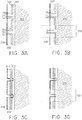
- FIG. 3B an exemplary zoned moisture management garment is illustrated with at least one zone having one or more of the dissolvable yarns dissolved.
- Zone 310 as shown in FIG. 3B illustrates both the first dissolvable yarn 309 and the second dissolvable yarn 307 as dissolved within the zone 310.
- FIG. 3C-3D illustrate additional examples of a zoned moisture management garment having a first dissolvable yarn 314, a first non-dissolvable yarn 315, a second dissolvable yarn 313, and a second non-dissolvable yarn 312.
- the exemplary garment in FIG. 3D is shown with a zone 321 having the dissolvable yarns dissolved according to the sweat profile of the wearer 316.
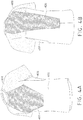
- FIGS. 4A and 4B An example of a zoned moisture management garment is shown in FIGS. 4A and 4B.
- FIG. 4A is the front of a zoned moisture management shirt that may include a shoulder area 404, a chest area 401, an abdomen area 402, and armpit area 403.
- FIG. 4B shows the back 405 of a zoned moisture management shirt that may include a shoulder area 408, an upper back area 406, an armpit area 407, and a lower back area .
- Each of these areas of the garment may comprise a zone of a garment having a first fabric layer and a second fabric layer.
- the garment may be constructed of one fabric of uniform composition or each zone may have a different proportion of the dissolvable yarns.
- the proportion of dissolvable yarn in zones may be varied: the chest area 401 may be up to about 10% removed, such as between about 0-10% removed; the abdomen area 402 may be about 90% or more removed; the shoulder area 404 may be up to about 50% removed, such as between about 30-50% removed; the upper back area 406 may be up to about 10% removed, such as between about 0-10% removed; and the lower back area may be about 90% or more removed.
- the degree of dissolution may be varied in zones to achieve the zones of different porosities or meshes.
- the garment illustrated in FIG. 4A and 4B has numerous advantages.
- a zoned garment capable of one-way moisture transport in selected areas can be made without bulky and uncomfortable seams between panels of different meshes.
- Garments may also be designed for particular evaporative cooling scenarios: for example, where evaporative cooling is more effective for the shoulder area due to air flow, the mesh of that area may be increased by dissolving the dissolvable yarn component of either the first fabric layer or the second fabric layer.
- the tex (denier) differential between the yarns of the first fabric layer and the second fabric layer provides one-way moisture transport from the wearer's skin to the outer surface of the garment.
- the garment may be made lighter by removing the dissolvable yarn altogether in the lower back and abdomen regions.
- perspiration across the wearer's skin may be determined to provide a sweat profile, including areas of greatest perspiration such as the armpits or chest area.
- the sweat profile may vary from wearer to wearer and may differ greatly between men and women.
- areas of contact between the wearer and portions of the garment may be determined. In one example, the areas of contact may be overlaid with a sweat map to determine garment zoning. This information and other data regarding sweating profile during various sports activities may be used to determine the ideal zoning for a zoned moisture management garment.
- Sweat profiles and contact areas may also vary based upon the sport or exercise that the wearer is engaging.
- a sweat profile and a contact map of the areas of contact between a garment and a wearer may provide a guide for the zone placement of the zoned moisture management fabric.
- a contact map may be created by determining what areas of a garment contact the wearer more in certain areas, such as the shoulder area, than in the other areas of the garment, such as the abdomen area.
- the garment may provide the most appropriate moisture management means using the tex (denier) differential wicking mechanism described in detail below.
- the wearer may also be perspiring. Due to the reduced contact of the garment to the wearer, ventilation may be the most appropriate means for sweat management.
- a dissolvable yarn comprising a portion of the zoned moisture management garment may be dissolved in the zones where increased porosity and ventilation are desired.
- the resultant zoned moisture management garment may provide a tex(denier) differential moisture management mechanism in contact areas and may also provide a ventilation moisture management mechanism in areas of less contact.
- the zoned moisture management fabric 501 may comprise two layers: a first fabric layer 503 and a second fabric layer 502. Additional embodiments may include additional layers adjacent first or second fabric layer or both that may provide tailored levels of moisture management and support in a composite fabric.
- Each fabric layer may include at least one non-dissolvable yarn and at least one dissolvable yarn.
- the at least one non-dissolvable yarn may be a synthetic, such as polyester, and the at least one dissolvable yarn may be rayon, cotton, Lyocell, other cellulosic feedstock, and/or dissolvable synthetic fiber, such as dissolvable polyester.
- the first fabric layer 503 and the second fabric layer 502 may be constructed separately, by weaving or knitting, and assembled to form the fabric.
- the layer 503 and the second fabric layer 502 may be constructed continuously, by weaving or knitting, to form a seamless fabric. Any appropriate pattern or method of weaving or knitting may be employed, for example plain weaving, satin weaving, circular double knit, or circular plaited single knit.
- the second fabric layer 502 is the layer adjacent to the wearer's body 500 and the first fabric layer 503 is adjacent to the second fabric layer 502.
- the wearer's body 500 perspires and moisture may be adsorbed 504 from the body 500 surface to the first fabric layer 503.
- the tex (denier) differential which is discussed in greater detail below, between the first fabric layer 503 and the second fabric layer 502, can provide a difference in porosity and surface area wherein the first fabric layer 503 may have a greater surface area and smaller pores than the second fabric layer 502. The smaller pores and greater surface area results in increased capillary force for aqueous solutions for the first fabric layer 503 than the second fabric layer 502.
- the tex (denier) differential produces wicking 505 from the second fabric layer 502 to the first fabric layer 503.
- the moisture once transported to the first fabric layer 503, may be adsorbed to and spread over the increased surface area of the first fabric layer 503.
- the increased surface area of the first fabric layer 503 can encourage moisture evaporation 506 from the first fabric layer 503.
- the moisture management fabric can thus transport moisture efficiently from the wearer 500, to the second fabric layer 502 to keep the wearer comfortable, and to the first fabric layer 503 to promote evaporation from the fabric to keep the wearer dry.
- FIGS. 5B-D illustrate examples of a zoned moisture management fabric with at least one additional fabric layer.
- FIG. 5B illustrates a third fabric layer 509 disposed between the first fabric layer 510 and the second fabric layer 508.
- Each fabric layer may include at least one non-dissolvable yarn and at least one dissolvable yarn.
- the at least one non-dissolvable yarn may be a synthetic material, such as polyester, and the at least one dissolvable yarn may be a cellulosic material, such as rayon.
- the third fabric layer 509 may be constructed by knitting or weaving a third yarn or thread.
- the first fabric layer may be constructed by knitting a first yarn and the second fabric layer may be constructed by knitting a second yarn.
- the third fabric layer may be constructed by weaving a third yarn or thread.
- the third fabric layer 509 may be constructed such that the porosity and surface area of the third fabric layer 509 is greater than the porosity and surface area of the second fabric layer 508.
- the third fabric layer 509 may be constructed by knitting third yarn of a third tex (denier) per filament, which is comparable in size to or larger than the first yarn.
- the tex (denier) per filament of the third fabric layer 509 may be greater than the tex (denier) per filament of the first fabric layer 510 and less than the tex (denier) per filament of the second fabric layer 508 such that a gradient of surface areas and porosities is provided.
- the first fabric layer and the third fabric layer may be woven separately or together or knitted separately, double-knit, or plaited single-knit.
- the second fabric layer may be woven or knitted separately.
- the third fabric layer and the second fabric layer may be knitted separately, circular double knit, or circular plaited single knit.
- the third fabric layer and the second fabric layer may be woven separately or together.
- the first fabric layer may be knitted separately or woven separately.
- FIG. 5C illustrates a zoned moisture management fabric 516 having at least a third fabric layer 514 which is an intermediate layer of the fabric disposed between the first fabric layer 515 and the second fabric layer 513.
- the third fabric layer 514 may be constructed by weaving or knitting a third yarn or thread.
- the first fabric layer 515 may be constructed by weaving or knitting a first yarn or thread; and the second fabric layer 513 may be constructed by weaving or knitting a second yarn or thread.
- Each fabric layer may include at least one non-dissolvable yarn and at least one dissolvable yarn.
- the at least one non-dissolvable yarn may be a synthetic, such as polyester, and the at least one dissolvable yarn may be rayon, other cellulosic feedstock, and/or dissolvable synthetic such as dissolvable polyester.
- the third fabric layer 514 may be constructed such that the porosity and surface area of the third fabric layer 514 is less than the porosity and surface area of the first fabric layer 515.
- the third fabric layer 514 may be constructed warp knitting a yarn or thread, which is comparable or less than in size to yarn or thread of the second fabric layer 513.
- the tex (denier) per filament of the yarns of third fabric layer 514 may be greater than the tex (denier) per filament of the yarns of first fabric layer 515 and less than the tex (denier) per filament of the yarns of second fabric layer 513 such that a gradient of surface areas and porosities is provided.
- the first fabric layer 515 and the third fabric layer 514 may be circular double-knit and/or circular plaited single-knit. Alternate means of constructing the fabric layers may also be employed.
- the second fabric layer 513 may be woven or knitted separately.
- the third fabric layer 514 and the second fabric layer 513 may be knitted separately, circular double knit, or circular plaited single knit.
- the first fabric layer 515 may be knitted or woven separately.
- FIG. 5D illustrates moisture management fabric 522 having at least a third fabric layer 520 and a fourth fabric layer 519 each of which is an intermediate layer of the fabric disposed between the first fabric layer 521 and the second fabric layer 518.
- the third fabric layer 520 may be constructed by knitting or weaving a third yarn or thread.
- the fourth fabric layer 519 may be constructed by knitting or weaving a third yarn or thread.
- the first fabric layer 521 may be constructed by warp knitting a first yarn or thread; and the second fabric layer 518 may be constructed by warp knitting a second yarn or thread.
- Each fabric layer may include at least one non-dissolvable yarn and at least one dissolvable yarn.
- the at least one non-dissolvable yarn may be polyester and the at least one dissolvable yarn may be rayon.
- the fabric 522 may be constructed such that the porosity and surface area of the third fabric layer 520 is less than the porosity and surface area of the first fabric layer 521 and the porosity and surface area of the fourth fabric layer 519 is greater than the porosity and surface area of the second fabric layer.
- he third fabric layer 520 may have a porosity and surface area between that of the fourth fabric layer 519 and the first fabric layer 521; and the fourth fabric layer 519 may have a porosity and surface area between that of the third fabric layer 520 and the second fabric layer.
- the first fabric layer 521, the second fabric layer 518, the third fabric layer 520, and the fourth fabric layer 519 may be woven or knitted separately.
- adjacent layers such as the first fabric layer 521 and the third fabric layer 520, the third fabric layer 520 and the fourth fabric layer 519, the fourth fabric layer 519 and the second fabric layer 518 may be double-knit or plaited single-knit and combined with the remaining single knit, circular double-knit, or circular plaited single-knit layers.
- a plurality of fabric layers may be used to provide a gradient of surface areas and porosities for a composite fabric.
- Fabric for garments in accordance with the present invention may also include a plurality of proportions of dissolvable yarn to non-dissolvable yarn.
- additional fabric layers adjacent to the first fabric layer and second fabric layer may have similar porosity and surface area as the contacting first fabric layer and second fabric layer.
- a plurality of fabric layers may be included to provide a zoned moisture management fabric with specific moisture management properties.
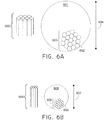
- FIGS. 6A-B illustrate examples of the yarns that may be employed in the construction of the tex (denier) differential fabric.
- the yarns depicted in FIGS. 6A-B are not to scale and furthermore not limiting to yarns or fibers used.
- FIG. 6A illustrates an exemplary second yarn 601 that may be used to construct a zoned moisture management support garment.
- the yarn may be a monofilament or multifilament yarn of a synthetic or natural fiber.
- the yarn may be a filament yarn or a spun yarn.
- the exemplary second yarn 601 may be a bundle 603 of individual filaments 602.
- the total yarn size 604 may be measured in denier, for example 9,0000 m of the exemplary yarn weighs X g has a size of X denier.
- the denier per filament is calculated by dividing the total yarn size (X denier) by the total number of filaments 602.
- an exemplary first yarn 606 may be used to construct a zoned moisture management support garment.
- the exemplary first yarn 606 may be a bundle 609 of individual filaments 608 of any synthetic or natural fiber.
- the exemplary first yarn 606 may have a size 607 represented as Y denier, for a first yarn 606 weighing Y g for 9,000 m.
- the denier per filament is calculated by dividing the total yarn size (Y denier) by the total number 605 of filaments 608.
- a yarn of less than or equal to about 0.116 (1.04) tex (denier) per filament may be a microfiber.
- the tex (denier) differential may be described as the difference in the tex (denier) per filament of the first yarn and the tex (denier) per filament of the second yarn.
- the first yarn 606 may be composed of polyester and the second yarn 601 may be composed of polyester.
- surface treatment or additional modification may be employed to impart a greater relative hydrophobicity to the macrofiber or a great relative hydrophillicity to the microfiber.
- the employment of a cellulosic fiber for the dissolvable yarn in a fabric layer may have a higher moisture regain to provide moisture management via absorptive capacity as well as tex (denier) differential in the non-dissolved portions of a moisture management garment or fabric.
- third and fourth yarns which may also be a bundle of individual filaments or a synthetic or natural fiber.
- Optional third and fourth yarns may also be measured in terms of a third and fourth tex (denier) per filament, respectively.
- the first fabric layer may be knitted or woven of a first yarn of a first tex (denier) per filament of less than or equal to about 0.116 (1.04) tex (denier) per filament or a microfiber, such as about 0.056 (0.50) to about 0.116 (1.04) tex (denier) per filament.
- the second fabric layer may be knitted or woven of a second yarn of a second tex (denier) per filament of greater than or equal to about 0.116 (1.04) tex (denier) per filament or a macrofiber, such as about 0.116 (1.04) to about 0.389 (3.50).
- the tex (denier) differential between the first yarn and the second yarn may be at least about (0.54).
- the third fabric layer may be knitted or woven of a third yarn of a third tex (denier) per filament.
- the third tex(denier) per filament is less than or equal to about 0.116 (1.04) tex (denier) per filament or a microfiber, such as about 0.056 (0.50) to about 0.116 (1.04) tex (denier) per filament.
- the third tex (denier) per filament is greater than or equal to about 0.116 (1.04) or a macrofiber, such as about 0.116 (1.04) to about 0.389 (3.50).
- the third tex (denier) per filament may be a value less than the second tex (denier) per filament but greater than the first tex (denier) per filament.
- the fourth fabric layer may be knitted or woven of a fourth yarn of a fourth tex (denier) per filament.
- the fourth tex (denier) per filament may be less than or equal to about 0.116 (1.04) tex (denier) per filament or a microfiber, such as about 0.056 (0.50) to about 0.116 (1.04) tex (denier) per filament.
- the fourth tex (denier) per filament may be greater than or equal to about 1.04 or a macrofiber, such as about 0.116 (1.04) to about 0.389 (3.50).
- the fourth tex (denier) per filament may be a value less than the second tex (denier) per filament but greater than the first tex (denier) per filament.
Landscapes
- Engineering & Computer Science (AREA)
- Textile Engineering (AREA)
- Chemical & Material Sciences (AREA)
- Chemical Kinetics & Catalysis (AREA)
- General Chemical & Material Sciences (AREA)
- Laminated Bodies (AREA)
- Knitting Of Fabric (AREA)
- Woven Fabrics (AREA)
- Yarns And Mechanical Finishing Of Yarns Or Ropes (AREA)
- Professional, Industrial, Or Sporting Protective Garments (AREA)
- Details Of Garments (AREA)
Claims (12)
- Kleidungsstück mit Feuchtigkeitsregulierungszonen, umfassend:eine erste Gewebeschicht umfassend ein erstes nicht auflösbares Garn und ein erstes auflösbares Garn, wobei die erste Gewebeschicht eine erste Zone und eine zweite Zone umfasst, worin die erste Zone der ersten Gewebeschicht das erste auflösbare Garn aufgelöst und das erste nicht auflösbare Garn umfasst, und worin die zweite Zone der ersten Gewebeschicht das erste auflösbare Garn und das erste nicht auflösbare Garn umfasst, und die Anordnung von Zonen durch ein Schwitzprofil eines Trägers bestimmt wird; undeine zweite Gewebeschicht neben der ersten Gewebeschicht umfassend ein zweites nicht auflösbares Garn, worin die zweite Gewebeschicht die innerste Schicht des Kleidungsstücks ist, wenn das Kleidungsstück getragen wird, oder worin die erste Gewebeschicht die innerste Schicht des Kleidungsstücks ist, wenn das Kleidungsstück getragen wird, und worin zwischen dem ersten nicht auflösbaren Garn und dem zweiten nicht auflösbaren Garn ein Tex- (Denier-) Unterschied von mindestens 0,06 (0,54 Denier) besteht.
- Kleidungsstück mit Feuchtigkeitsregulierungszonen nach Anspruch 1, worin die zweite Gewebeschicht ferner ein zweites auflösbares Garn umfasst und worin mindestens eine Zone der zweiten Gewebeschicht das zweite auflösbare Garn aufgelöst aufweist.
- Kleidungsstück mit Feuchtigkeitsregulierungszonen nach Anspruch 1, worin das erste nicht auflösbare Garn synthetisch ist und das zweite nicht auflösbare Garn synthetisch ist.
- Kleidungsstück mit Feuchtigkeitsregulierungszonen nach Anspruch 1, worin die erste Gewebeschicht gestrickt ist und die zweite Gewebeschicht gestrickt ist.
- Kleidungsstück mit Feuchtigkeitsregulierungszonen nach Anspruch 1, worin die erste Zone der ersten Gewebeschicht, die das erste auflösbare Garn aufgelöst aufweist, ein Muster, ein Logo oder eine Form ist.
- Kleidungsstück mit Feuchtigkeitsregulierungszonen nach Anspruch 1, ferner umfassend mindestens eine zusätzliche Gewebeschicht, worin die mindestens eine zusätzliche Gewebeschicht ferner ein drittes auflösbares Garn umfasst, und worin mindestens eine Zone der mindestens einen zusätzlichen Gewebeschicht das dritte auflösbare Garn aufgelöst aufweist.
- Kleidungsstück mit Feuchtigkeitsregulierungszonen nach Anspruch 1, worin die erste Zone gemäß einem Schwitzprofil eines Athleten platziert ist, worin das Schwitzprofil mindestens einen Bereich mit verstärktem Schwitzen umfasst.
- Kleidungsstück mit Feuchtigkeitsregulierungszonen nach Anspruch 1, worin die erste Zone und die zweite Zone der ersten Gewebeschicht nahtlos nebeneinanderliegen, um eine Maschengewebestruktur zu bilden, und worin die erste Zone durch ein Schwitzprofil bestimmt ist, und worin das Schwitzprofil mindestens einen Bereich mit verstärktem Schwitzen umfasst.
- Kleidungsstück mit Feuchtigkeitsregulierungszonen nach Anspruch 1, worin das Kleidungsstück ein Hemd mit einem Schulterbereich, einem Brustbereich, einem oberen Rückenbereich, einem Bauchbereich, einem Achselbereich und einem unteren Rückenbereich ist und sich die erste Zone in mindestens einem des Schulterbereichs, Achselbereichs, Bauchbereichs oder unteren Rückenbereichs befindet.
- Kleidungsstück mit Feuchtigkeitsregulierungszonen nach Anspruch 8, worin die erste Gewebeschicht gewebt ist und die zweite Gewebeschicht gewebt ist.
- Kleidungsstück mit Feuchtigkeitsregulierungszonen nach Anspruch 8, worin das erste auflösbare Garn zwischen 10 und 40 Prozent des Gesamtgewichts oder -volumens des Kleidungsstücks mit Feuchtigkeitsregulierungszonen umfasst.
- Kleidungsstück mit Feuchtigkeitsregulierungszonen nach Anspruch 8, worin das Kleidungsstück mit Feuchtigkeitsregulierungszonen ferner mindestens eine zusätzliche Gewebeschicht umfasst, die ferner ein zweites auflösbares Garn umfasst, und worin mindestens eine Zone der mindestens einen zusätzlichen Gewebeschicht das zweite auflösbare Garn aufgelöst aufweist.
Priority Applications (1)
| Application Number | Priority Date | Filing Date | Title |
|---|---|---|---|
| EP18187353.0A EP3415020B1 (de) | 2011-01-10 | 2012-01-10 | Aerographics- und garndifferentialzonen-kleidungsstücke |
Applications Claiming Priority (3)
| Application Number | Priority Date | Filing Date | Title |
|---|---|---|---|
| US12/987,249 US9107459B2 (en) | 2011-01-10 | 2011-01-10 | Aerographics and denier differential zoned garments |
| PCT/US2012/020724 WO2012096921A2 (en) | 2011-01-10 | 2012-01-10 | Aerographics and denier differential zoned garments |
| EP12734418.2A EP2663202B1 (de) | 2011-01-10 | 2012-01-10 | Aerographics- und garndifferentialzonen-kleidungsstücke |
Related Parent Applications (2)
| Application Number | Title | Priority Date | Filing Date |
|---|---|---|---|
| EP12734418.2A Division EP2663202B1 (de) | 2011-01-10 | 2012-01-10 | Aerographics- und garndifferentialzonen-kleidungsstücke |
| EP12734418.2A Division-Into EP2663202B1 (de) | 2011-01-10 | 2012-01-10 | Aerographics- und garndifferentialzonen-kleidungsstücke |
Related Child Applications (2)
| Application Number | Title | Priority Date | Filing Date |
|---|---|---|---|
| EP18187353.0A Division-Into EP3415020B1 (de) | 2011-01-10 | 2012-01-10 | Aerographics- und garndifferentialzonen-kleidungsstücke |
| EP18187353.0A Division EP3415020B1 (de) | 2011-01-10 | 2012-01-10 | Aerographics- und garndifferentialzonen-kleidungsstücke |
Publications (2)
| Publication Number | Publication Date |
|---|---|
| EP3100624A1 EP3100624A1 (de) | 2016-12-07 |
| EP3100624B1 true EP3100624B1 (de) | 2018-09-19 |
Family
ID=46454022
Family Applications (3)
| Application Number | Title | Priority Date | Filing Date |
|---|---|---|---|
| EP18187353.0A Active EP3415020B1 (de) | 2011-01-10 | 2012-01-10 | Aerographics- und garndifferentialzonen-kleidungsstücke |
| EP12734418.2A Active EP2663202B1 (de) | 2011-01-10 | 2012-01-10 | Aerographics- und garndifferentialzonen-kleidungsstücke |
| EP16175072.4A Active EP3100624B1 (de) | 2011-01-10 | 2012-01-10 | Kleidungsstücke mit aerografiken und zonen mit unterschiedlichen fadenstärken |
Family Applications Before (2)
| Application Number | Title | Priority Date | Filing Date |
|---|---|---|---|
| EP18187353.0A Active EP3415020B1 (de) | 2011-01-10 | 2012-01-10 | Aerographics- und garndifferentialzonen-kleidungsstücke |
| EP12734418.2A Active EP2663202B1 (de) | 2011-01-10 | 2012-01-10 | Aerographics- und garndifferentialzonen-kleidungsstücke |
Country Status (4)
| Country | Link |
|---|---|
| US (3) | US9107459B2 (de) |
| EP (3) | EP3415020B1 (de) |
| CN (2) | CN106993837B (de) |
| WO (1) | WO2012096921A2 (de) |
Families Citing this family (20)
| Publication number | Priority date | Publication date | Assignee | Title |
|---|---|---|---|---|
| US9107459B2 (en) * | 2011-01-10 | 2015-08-18 | Nike, Inc. | Aerographics and denier differential zoned garments |
| US8702469B2 (en) | 2011-01-10 | 2014-04-22 | Nike, Inc. | Moisture management support garment with a denier differential mechanism |
| US9150986B2 (en) | 2011-05-04 | 2015-10-06 | Nike, Inc. | Knit component bonding |
| CN102864566B (zh) * | 2012-09-29 | 2014-02-12 | 加宝利服装有限公司 | 织物制备方法、制备控制方法、制备控制装置和制备系统 |
| US20150218737A1 (en) * | 2014-02-03 | 2015-08-06 | Under Armour, Inc. | Article of apparel including apertures |
| USD770130S1 (en) * | 2015-03-13 | 2016-11-01 | Nike, Inc. | Upper body garment |
| EP3297592B1 (de) * | 2015-05-22 | 2021-04-21 | NIKE Innovate C.V. | Rückgewinnung einer strumpfhose mit vorkonfigurierten kompressionszonen und integrierten strukturmustern |
| CN111493381B (zh) * | 2015-05-22 | 2022-06-03 | 耐克创新有限合伙公司 | 具有预配置压缩区段和一体式结构图案的训练紧身衣 |
| DE102015010524A1 (de) * | 2015-08-13 | 2017-02-16 | Trans-Textil Gmbh | Verfahren zur Herstellung eines schwerentflammbaren Textilmaterials für Schutzbekleidung, schwerentflammbares Textilmaterial und daraus hergestellte Schutzbekleidung |
| US10861357B2 (en) | 2015-11-13 | 2020-12-08 | Nike, Inc. | Athletic bib |
| US20180352883A1 (en) * | 2015-11-16 | 2018-12-13 | W. L. Gore & Associates Gmbh | Upper body garment |
| US11297888B2 (en) * | 2016-01-15 | 2022-04-12 | Nike, Inc. | Garment with integral wipe zones |
| MX378174B (es) * | 2016-03-14 | 2025-03-10 | Puma SE | Prenda deportiva. |
| US10303210B2 (en) | 2016-08-15 | 2019-05-28 | Apple Inc. | Electronic devices with wrist straps |
| US11412796B2 (en) | 2016-11-16 | 2022-08-16 | Nike, Inc. | Garment with wipe zones |
| JP2021509937A (ja) * | 2017-12-29 | 2021-04-08 | プロ・エイト・エス.アール.エル. | 温度調節衣服及び空気交換システム |
| CN109023756B (zh) * | 2018-10-08 | 2023-09-15 | 信泰(福建)科技有限公司 | 具有立体中绣线的网布及其制作方法 |
| WO2021070179A1 (en) | 2019-10-07 | 2021-04-15 | Kornit Digital Ltd. | Preservation of moisture evaporation and body temperature regulation properties on garments post printing |
| US20220183396A1 (en) * | 2020-12-16 | 2022-06-16 | Quest Vest, Llc | Optically augmented sports apparel and methods of manufacture |
| CN113897726B (zh) * | 2021-09-07 | 2023-08-15 | 李宁体育科技(深圳)有限公司 | 加工具有渐变润湿梯度服装的方法及服装 |
Family Cites Families (47)
| Publication number | Priority date | Publication date | Assignee | Title |
|---|---|---|---|---|
| JPS59145138A (ja) * | 1983-02-08 | 1984-08-20 | 東洋紡績株式会社 | 三層構造素材 |
| US4733546A (en) | 1984-02-24 | 1988-03-29 | Toray Industries, Inc. | Knitted fabric for clothing |
| DE3409965A1 (de) * | 1984-03-19 | 1985-09-26 | Markus Dr. 5300 Bonn Hansen | Textiles flaechengebilde und verfahren zu seiner herstellung |
| US5691057A (en) | 1986-01-30 | 1997-11-25 | E. I. Du Pont De Nemours And Company | Polyester mixed yarns with fine filaments |
| US5364701A (en) | 1986-01-30 | 1994-11-15 | E. I. Du Pont De Nemours And Company | Mixed filament yarn of polyester filaments and nylon filaments |
| US4775575A (en) * | 1986-08-18 | 1988-10-04 | Tang Thomas L C | Insulative textile fabric |
| US5297296A (en) | 1991-11-12 | 1994-03-29 | Moretz Herbert L | Multi-layer moisture management elastic fabric |
| US5547733A (en) | 1995-06-02 | 1996-08-20 | Malden Mills Industries, Inc. | Plaited double-knit fabric |
| US6013368A (en) | 1995-06-30 | 2000-01-11 | E. I. Du Pont De Nemours And Company | Comfort by mixing deniers |
| EP0777978A3 (de) | 1995-12-08 | 1998-06-24 | Patrick Yeh | Zusammengesetztes Textilgewebe mit Feuchtigkeit regelnden Eigenschaften |
| US5928971A (en) * | 1996-02-01 | 1999-07-27 | Southern Mills, Inc. | Firefighter's garment |
| US5853628A (en) | 1996-09-12 | 1998-12-29 | Kimberly-Clark Worldwide, Inc. | Method of forming nonwoven fabric having a pore size gradient |
| DE19740497C2 (de) | 1996-09-16 | 2003-09-25 | Patrick Yeh | Textiles Material für Bekleidungsstücke |
| US5823012A (en) | 1996-11-20 | 1998-10-20 | Pine Hosiery Mills, Inc. | Jacquard knit patterned wristband and headband and methods of making same |
| US6432504B1 (en) | 1998-06-16 | 2002-08-13 | Patrick Yeh | Composite textile fabric having moisture management |
| US6427493B1 (en) | 1998-07-31 | 2002-08-06 | Concord Fabrics, Inc. | Synthetic knit fabric having superior wicking and moisture management properties |
| JP2000071371A (ja) * | 1998-08-28 | 2000-03-07 | Malden Mills Ind Inc | 風防及び耐水性複合布 |
| US6484325B1 (en) * | 1999-12-23 | 2002-11-26 | Liberty Fabrics, Inc. | Athletic garment and equipment system |
| US7217456B1 (en) | 2000-07-25 | 2007-05-15 | Malden Mills Industries, Inc. | Plaited double-knit fabric with moisture management and improved thermal insulation |
| US20020022433A1 (en) | 2000-08-10 | 2002-02-21 | Yeung Amy Patricia | Dual-layered seamless sports bra and camisole |
| KR100375246B1 (ko) * | 2001-04-26 | 2003-03-06 | 주식회사 코오롱 | 세탁 및 일광견뢰도가 우수한 극세사 직물 |
| US6781027B2 (en) | 2001-12-14 | 2004-08-24 | Kimberly-Clark Worldwide, Inc. | Mixed denier fluid management layers |
| CA2475537C (en) * | 2002-02-08 | 2013-04-02 | Brand Factory Swiss Gmbh | Thermoregulating article of clothing and method for removing moisture from areas of the skin |
| AU2003251382A1 (en) | 2002-05-24 | 2003-12-12 | Michel Joyce | Article of clothing with moisture absorbent portion |
| US7051557B2 (en) | 2002-07-18 | 2006-05-30 | Sara Lee Corporation | Hidden band brassiere, blank and methods of making same |
| US7611999B2 (en) | 2002-11-16 | 2009-11-03 | Mcmurray Brian | Decorative faced multi-layer weft knit spacer fabric, method, and articles made therefrom |
| WO2006002371A2 (en) | 2004-06-24 | 2006-01-05 | Malden Mills Industries, Inc. | Engineered fabric articles |
| US7306505B2 (en) | 2004-07-29 | 2007-12-11 | Under Armour, Inc. | Reversible sports bra |
| GB2416781A (en) | 2004-08-04 | 2006-02-08 | Lightex Ltd | Breathable fabric |
| US7052358B2 (en) * | 2004-08-27 | 2006-05-30 | Alessi Christine V | Undergarment for lactating women |
| US20060063453A1 (en) | 2004-09-23 | 2006-03-23 | King Christopher J | Multi-color denier gradient fabric |
| JP2008517178A (ja) * | 2004-10-22 | 2008-05-22 | ゴア エンタープライズ ホールディングス,インコーポレイティド | 布帛及びその製造方法 |
| US7395557B1 (en) | 2004-11-15 | 2008-07-08 | Cass And Crew, L.L.C. | Seamless upper body garment |
| DK200500550A (da) | 2005-04-15 | 2006-10-16 | Tytex As | Beklædningsgenstand, fortrinsvis til amning, samt fremgangsmåde til frembringelse heraf |
| EP1928640A2 (de) | 2005-08-10 | 2008-06-11 | Reliance Industries Limited | Multilobales filament, gewebe und verfahren zu deren herstellung |
| DE202006001380U1 (de) * | 2006-01-27 | 2006-06-22 | X-Technology Swiss Gmbh | Kombinationsbekleidung zur Klimaregulierung |
| US8133824B2 (en) | 2006-06-19 | 2012-03-13 | Nike, Inc. | Fabrics and articles of apparel including dimensionalized mesh and other fabrics |
| US7767599B2 (en) | 2006-10-10 | 2010-08-03 | E.I. Du Pont De Nemours And Company | Multidenier fiber cut resistant fabrics and articles |
| GB2447070A (en) * | 2007-02-27 | 2008-09-03 | Pro Fit Int Ltd | Method for controlling the size of a fabric of a garment |
| US8037545B2 (en) * | 2007-03-16 | 2011-10-18 | Branders.Com, Inc. | Article and method including a temporary decoration |
| ES2551516T3 (es) | 2007-06-20 | 2015-11-19 | Atex Technologies, Inc. | Tejido comprimible con poder de recuperación, dispositivos, y métodos |
| DE202008013486U1 (de) * | 2008-10-14 | 2008-12-18 | Hexonia Gmbh | Textiles Bekleidungsstück |
| US9107459B2 (en) | 2011-01-10 | 2015-08-18 | Nike, Inc. | Aerographics and denier differential zoned garments |
| US8702469B2 (en) | 2011-01-10 | 2014-04-22 | Nike, Inc. | Moisture management support garment with a denier differential mechanism |
| EP3488718B1 (de) * | 2011-03-03 | 2020-06-24 | NIKE Innovate C.V. | Sportbekleidung mit verbesserten sichtbarkeitseigenschaftenvêtements de sport ayant des propriétés visuelles améliorées |
| EP2755509B1 (de) | 2011-09-12 | 2016-10-26 | NIKE Innovate C.V. | Wasserdichte mehrschichtige feuchtigkeitsregelnde sportbekleidung |
| US8719962B1 (en) * | 2011-12-07 | 2014-05-13 | Brady Huff | Method of creating a three-dimensional image on a garment |
-
2011
- 2011-01-10 US US12/987,249 patent/US9107459B2/en active Active
-
2012
- 2012-01-10 WO PCT/US2012/020724 patent/WO2012096921A2/en not_active Ceased
- 2012-01-10 EP EP18187353.0A patent/EP3415020B1/de active Active
- 2012-01-10 EP EP12734418.2A patent/EP2663202B1/de active Active
- 2012-01-10 EP EP16175072.4A patent/EP3100624B1/de active Active
- 2012-01-10 CN CN201710187781.3A patent/CN106993837B/zh active Active
- 2012-01-10 CN CN201280012618.9A patent/CN104168970B/zh active Active
-
2015
- 2015-06-19 US US14/745,190 patent/US9833022B2/en active Active
-
2017
- 2017-11-07 US US15/805,846 patent/US11234466B2/en active Active
Non-Patent Citations (1)
| Title |
|---|
| None * |
Also Published As
| Publication number | Publication date |
|---|---|
| CN106993837A (zh) | 2017-08-01 |
| EP3415020B1 (de) | 2019-10-30 |
| CN106993837B (zh) | 2018-10-23 |
| US20150282531A1 (en) | 2015-10-08 |
| US20180055093A1 (en) | 2018-03-01 |
| CN104168970B (zh) | 2017-03-29 |
| EP3415020A1 (de) | 2018-12-19 |
| EP2663202A4 (de) | 2015-05-20 |
| EP3100624A1 (de) | 2016-12-07 |
| US9107459B2 (en) | 2015-08-18 |
| WO2012096921A2 (en) | 2012-07-19 |
| WO2012096921A3 (en) | 2014-04-10 |
| EP2663202A2 (de) | 2013-11-20 |
| EP2663202B1 (de) | 2016-08-03 |
| CN104168970A (zh) | 2014-11-26 |
| US9833022B2 (en) | 2017-12-05 |
| US20120174281A1 (en) | 2012-07-12 |
| US11234466B2 (en) | 2022-02-01 |
Similar Documents
| Publication | Publication Date | Title |
|---|---|---|
| EP2663202B1 (de) | Aerographics- und garndifferentialzonen-kleidungsstücke | |
| US11214898B2 (en) | Moisture management support garment with a denier differential mechanism | |
| CN100586322C (zh) | 结合压纹材料的服饰 | |
| EP4442878B1 (de) | Stoff mit feuchtigkeitsmanagementfunktion | |
| CN102355828A (zh) | 具有可变透气率的服饰物品 | |
| CN103243472B (zh) | 一种功能性衣服 | |
| CN108471825B (zh) | 具有整体擦拭区域的服装 | |
| CN112981682B (zh) | 一种具有吸湿排汗功能的变化条纹无缝内衣 | |
| CN219020253U (zh) | 一种具有吸湿排汗功能的运动t恤 | |
| CN208064519U (zh) | 一种轻量运动下可保持皮肤干爽的棉感t恤 | |
| US9803298B2 (en) | Cooling shirt and method of making same | |
| CN214983854U (zh) | 运动用透气吸汗面料 | |
| CN211721917U (zh) | 一种背心 | |
| CN121867501A (zh) | 隔热排汗面料及其制备方法、服装 | |
| WO2026015662A2 (en) | Textile configured to promote cooling |
Legal Events
| Date | Code | Title | Description |
|---|---|---|---|
| PUAI | Public reference made under article 153(3) epc to a published international application that has entered the european phase |
Free format text: ORIGINAL CODE: 0009012 |
|
| STAA | Information on the status of an ep patent application or granted ep patent |
Free format text: STATUS: THE APPLICATION HAS BEEN PUBLISHED |
|
| STAA | Information on the status of an ep patent application or granted ep patent |
Free format text: STATUS: REQUEST FOR EXAMINATION WAS MADE |
|
| AC | Divisional application: reference to earlier application |
Ref document number: 2663202 Country of ref document: EP Kind code of ref document: P |
|
| AK | Designated contracting states |
Kind code of ref document: A1 Designated state(s): AL AT BE BG CH CY CZ DE DK EE ES FI FR GB GR HR HU IE IS IT LI LT LU LV MC MK MT NL NO PL PT RO RS SE SI SK SM TR |
|
| AX | Request for extension of the european patent |
Extension state: BA ME |
|
| 17P | Request for examination filed |
Effective date: 20161128 |
|
| RBV | Designated contracting states (corrected) |
Designated state(s): AL AT BE BG CH CY CZ DE DK EE ES FI FR GB GR HR HU IE IS IT LI LT LU LV MC MK MT NL NO PL PT RO RS SE SI SK SM TR |
|
| STAA | Information on the status of an ep patent application or granted ep patent |
Free format text: STATUS: EXAMINATION IS IN PROGRESS |
|
| 17Q | First examination report despatched |
Effective date: 20171116 |
|
| GRAP | Despatch of communication of intention to grant a patent |
Free format text: ORIGINAL CODE: EPIDOSNIGR1 |
|
| STAA | Information on the status of an ep patent application or granted ep patent |
Free format text: STATUS: GRANT OF PATENT IS INTENDED |
|
| INTG | Intention to grant announced |
Effective date: 20180412 |
|
| GRAS | Grant fee paid |
Free format text: ORIGINAL CODE: EPIDOSNIGR3 |
|
| GRAA | (expected) grant |
Free format text: ORIGINAL CODE: 0009210 |
|
| STAA | Information on the status of an ep patent application or granted ep patent |
Free format text: STATUS: THE PATENT HAS BEEN GRANTED |
|
| AC | Divisional application: reference to earlier application |
Ref document number: 2663202 Country of ref document: EP Kind code of ref document: P |
|
| AK | Designated contracting states |
Kind code of ref document: B1 Designated state(s): AL AT BE BG CH CY CZ DE DK EE ES FI FR GB GR HR HU IE IS IT LI LT LU LV MC MK MT NL NO PL PT RO RS SE SI SK SM TR |
|
| REG | Reference to a national code |
Ref country code: GB Ref legal event code: FG4D |
|
| REG | Reference to a national code |
Ref country code: CH Ref legal event code: EP |
|
| REG | Reference to a national code |
Ref country code: AT Ref legal event code: REF Ref document number: 1042237 Country of ref document: AT Kind code of ref document: T Effective date: 20181015 |
|
| REG | Reference to a national code |
Ref country code: IE Ref legal event code: FG4D |
|
| REG | Reference to a national code |
Ref country code: DE Ref legal event code: R096 Ref document number: 602012051432 Country of ref document: DE |
|
| REG | Reference to a national code |
Ref country code: NL Ref legal event code: MP Effective date: 20180919 |
|
| PG25 | Lapsed in a contracting state [announced via postgrant information from national office to epo] |
Ref country code: BG Free format text: LAPSE BECAUSE OF FAILURE TO SUBMIT A TRANSLATION OF THE DESCRIPTION OR TO PAY THE FEE WITHIN THE PRESCRIBED TIME-LIMIT Effective date: 20181219 Ref country code: SE Free format text: LAPSE BECAUSE OF FAILURE TO SUBMIT A TRANSLATION OF THE DESCRIPTION OR TO PAY THE FEE WITHIN THE PRESCRIBED TIME-LIMIT Effective date: 20180919 Ref country code: RS Free format text: LAPSE BECAUSE OF FAILURE TO SUBMIT A TRANSLATION OF THE DESCRIPTION OR TO PAY THE FEE WITHIN THE PRESCRIBED TIME-LIMIT Effective date: 20180919 Ref country code: NO Free format text: LAPSE BECAUSE OF FAILURE TO SUBMIT A TRANSLATION OF THE DESCRIPTION OR TO PAY THE FEE WITHIN THE PRESCRIBED TIME-LIMIT Effective date: 20181219 Ref country code: FI Free format text: LAPSE BECAUSE OF FAILURE TO SUBMIT A TRANSLATION OF THE DESCRIPTION OR TO PAY THE FEE WITHIN THE PRESCRIBED TIME-LIMIT Effective date: 20180919 Ref country code: GR Free format text: LAPSE BECAUSE OF FAILURE TO SUBMIT A TRANSLATION OF THE DESCRIPTION OR TO PAY THE FEE WITHIN THE PRESCRIBED TIME-LIMIT Effective date: 20181220 Ref country code: LT Free format text: LAPSE BECAUSE OF FAILURE TO SUBMIT A TRANSLATION OF THE DESCRIPTION OR TO PAY THE FEE WITHIN THE PRESCRIBED TIME-LIMIT Effective date: 20180919 |
|
| REG | Reference to a national code |
Ref country code: LT Ref legal event code: MG4D |
|
| PG25 | Lapsed in a contracting state [announced via postgrant information from national office to epo] |
Ref country code: LV Free format text: LAPSE BECAUSE OF FAILURE TO SUBMIT A TRANSLATION OF THE DESCRIPTION OR TO PAY THE FEE WITHIN THE PRESCRIBED TIME-LIMIT Effective date: 20180919 Ref country code: AL Free format text: LAPSE BECAUSE OF FAILURE TO SUBMIT A TRANSLATION OF THE DESCRIPTION OR TO PAY THE FEE WITHIN THE PRESCRIBED TIME-LIMIT Effective date: 20180919 Ref country code: HR Free format text: LAPSE BECAUSE OF FAILURE TO SUBMIT A TRANSLATION OF THE DESCRIPTION OR TO PAY THE FEE WITHIN THE PRESCRIBED TIME-LIMIT Effective date: 20180919 |
|
| REG | Reference to a national code |
Ref country code: AT Ref legal event code: MK05 Ref document number: 1042237 Country of ref document: AT Kind code of ref document: T Effective date: 20180919 |
|
| PG25 | Lapsed in a contracting state [announced via postgrant information from national office to epo] |
Ref country code: NL Free format text: LAPSE BECAUSE OF FAILURE TO SUBMIT A TRANSLATION OF THE DESCRIPTION OR TO PAY THE FEE WITHIN THE PRESCRIBED TIME-LIMIT Effective date: 20180919 Ref country code: IS Free format text: LAPSE BECAUSE OF FAILURE TO SUBMIT A TRANSLATION OF THE DESCRIPTION OR TO PAY THE FEE WITHIN THE PRESCRIBED TIME-LIMIT Effective date: 20190119 Ref country code: PL Free format text: LAPSE BECAUSE OF FAILURE TO SUBMIT A TRANSLATION OF THE DESCRIPTION OR TO PAY THE FEE WITHIN THE PRESCRIBED TIME-LIMIT Effective date: 20180919 Ref country code: ES Free format text: LAPSE BECAUSE OF FAILURE TO SUBMIT A TRANSLATION OF THE DESCRIPTION OR TO PAY THE FEE WITHIN THE PRESCRIBED TIME-LIMIT Effective date: 20180919 Ref country code: CZ Free format text: LAPSE BECAUSE OF FAILURE TO SUBMIT A TRANSLATION OF THE DESCRIPTION OR TO PAY THE FEE WITHIN THE PRESCRIBED TIME-LIMIT Effective date: 20180919 Ref country code: RO Free format text: LAPSE BECAUSE OF FAILURE TO SUBMIT A TRANSLATION OF THE DESCRIPTION OR TO PAY THE FEE WITHIN THE PRESCRIBED TIME-LIMIT Effective date: 20180919 Ref country code: AT Free format text: LAPSE BECAUSE OF FAILURE TO SUBMIT A TRANSLATION OF THE DESCRIPTION OR TO PAY THE FEE WITHIN THE PRESCRIBED TIME-LIMIT Effective date: 20180919 Ref country code: EE Free format text: LAPSE BECAUSE OF FAILURE TO SUBMIT A TRANSLATION OF THE DESCRIPTION OR TO PAY THE FEE WITHIN THE PRESCRIBED TIME-LIMIT Effective date: 20180919 Ref country code: IT Free format text: LAPSE BECAUSE OF FAILURE TO SUBMIT A TRANSLATION OF THE DESCRIPTION OR TO PAY THE FEE WITHIN THE PRESCRIBED TIME-LIMIT Effective date: 20180919 |
|
| PG25 | Lapsed in a contracting state [announced via postgrant information from national office to epo] |
Ref country code: SK Free format text: LAPSE BECAUSE OF FAILURE TO SUBMIT A TRANSLATION OF THE DESCRIPTION OR TO PAY THE FEE WITHIN THE PRESCRIBED TIME-LIMIT Effective date: 20180919 Ref country code: SM Free format text: LAPSE BECAUSE OF FAILURE TO SUBMIT A TRANSLATION OF THE DESCRIPTION OR TO PAY THE FEE WITHIN THE PRESCRIBED TIME-LIMIT Effective date: 20180919 Ref country code: PT Free format text: LAPSE BECAUSE OF FAILURE TO SUBMIT A TRANSLATION OF THE DESCRIPTION OR TO PAY THE FEE WITHIN THE PRESCRIBED TIME-LIMIT Effective date: 20190119 |
|
| REG | Reference to a national code |
Ref country code: DE Ref legal event code: R097 Ref document number: 602012051432 Country of ref document: DE |
|
| PLBE | No opposition filed within time limit |
Free format text: ORIGINAL CODE: 0009261 |
|
| STAA | Information on the status of an ep patent application or granted ep patent |
Free format text: STATUS: NO OPPOSITION FILED WITHIN TIME LIMIT |
|
| PG25 | Lapsed in a contracting state [announced via postgrant information from national office to epo] |
Ref country code: DK Free format text: LAPSE BECAUSE OF FAILURE TO SUBMIT A TRANSLATION OF THE DESCRIPTION OR TO PAY THE FEE WITHIN THE PRESCRIBED TIME-LIMIT Effective date: 20180919 |
|
| 26N | No opposition filed |
Effective date: 20190620 |
|
| PG25 | Lapsed in a contracting state [announced via postgrant information from national office to epo] |
Ref country code: MC Free format text: LAPSE BECAUSE OF FAILURE TO SUBMIT A TRANSLATION OF THE DESCRIPTION OR TO PAY THE FEE WITHIN THE PRESCRIBED TIME-LIMIT Effective date: 20180919 |
|
| REG | Reference to a national code |
Ref country code: CH Ref legal event code: PL |
|
| PG25 | Lapsed in a contracting state [announced via postgrant information from national office to epo] |
Ref country code: LU Free format text: LAPSE BECAUSE OF NON-PAYMENT OF DUE FEES Effective date: 20190110 |
|
| REG | Reference to a national code |
Ref country code: BE Ref legal event code: MM Effective date: 20190131 |
|
| REG | Reference to a national code |
Ref country code: IE Ref legal event code: MM4A |
|
| PG25 | Lapsed in a contracting state [announced via postgrant information from national office to epo] |
Ref country code: SI Free format text: LAPSE BECAUSE OF FAILURE TO SUBMIT A TRANSLATION OF THE DESCRIPTION OR TO PAY THE FEE WITHIN THE PRESCRIBED TIME-LIMIT Effective date: 20180919 |
|
| PG25 | Lapsed in a contracting state [announced via postgrant information from national office to epo] |
Ref country code: BE Free format text: LAPSE BECAUSE OF NON-PAYMENT OF DUE FEES Effective date: 20190131 |
|
| PG25 | Lapsed in a contracting state [announced via postgrant information from national office to epo] |
Ref country code: LI Free format text: LAPSE BECAUSE OF NON-PAYMENT OF DUE FEES Effective date: 20190131 Ref country code: CH Free format text: LAPSE BECAUSE OF NON-PAYMENT OF DUE FEES Effective date: 20190131 |
|
| PG25 | Lapsed in a contracting state [announced via postgrant information from national office to epo] |
Ref country code: IE Free format text: LAPSE BECAUSE OF NON-PAYMENT OF DUE FEES Effective date: 20190110 |
|
| PG25 | Lapsed in a contracting state [announced via postgrant information from national office to epo] |
Ref country code: TR Free format text: LAPSE BECAUSE OF FAILURE TO SUBMIT A TRANSLATION OF THE DESCRIPTION OR TO PAY THE FEE WITHIN THE PRESCRIBED TIME-LIMIT Effective date: 20180919 |
|
| PG25 | Lapsed in a contracting state [announced via postgrant information from national office to epo] |
Ref country code: MT Free format text: LAPSE BECAUSE OF NON-PAYMENT OF DUE FEES Effective date: 20190110 |
|
| PG25 | Lapsed in a contracting state [announced via postgrant information from national office to epo] |
Ref country code: CY Free format text: LAPSE BECAUSE OF FAILURE TO SUBMIT A TRANSLATION OF THE DESCRIPTION OR TO PAY THE FEE WITHIN THE PRESCRIBED TIME-LIMIT Effective date: 20180919 |
|
| PG25 | Lapsed in a contracting state [announced via postgrant information from national office to epo] |
Ref country code: HU Free format text: LAPSE BECAUSE OF FAILURE TO SUBMIT A TRANSLATION OF THE DESCRIPTION OR TO PAY THE FEE WITHIN THE PRESCRIBED TIME-LIMIT; INVALID AB INITIO Effective date: 20120110 |
|
| PG25 | Lapsed in a contracting state [announced via postgrant information from national office to epo] |
Ref country code: MK Free format text: LAPSE BECAUSE OF FAILURE TO SUBMIT A TRANSLATION OF THE DESCRIPTION OR TO PAY THE FEE WITHIN THE PRESCRIBED TIME-LIMIT Effective date: 20180919 |
|
| P01 | Opt-out of the competence of the unified patent court (upc) registered |
Effective date: 20230515 |
|
| PGFP | Annual fee paid to national office [announced via postgrant information from national office to epo] |
Ref country code: GB Payment date: 20251120 Year of fee payment: 15 |
|
| PGFP | Annual fee paid to national office [announced via postgrant information from national office to epo] |
Ref country code: FR Payment date: 20251110 Year of fee payment: 15 |
|
| PGFP | Annual fee paid to national office [announced via postgrant information from national office to epo] |
Ref country code: DE Payment date: 20251119 Year of fee payment: 15 |