EP3101082A1 - Milieu actif pour cycle thermique, composition pour système à cycle thermique, et système à cycle thermique - Google Patents
Milieu actif pour cycle thermique, composition pour système à cycle thermique, et système à cycle thermique Download PDFInfo
- Publication number
- EP3101082A1 EP3101082A1 EP15743372.3A EP15743372A EP3101082A1 EP 3101082 A1 EP3101082 A1 EP 3101082A1 EP 15743372 A EP15743372 A EP 15743372A EP 3101082 A1 EP3101082 A1 EP 3101082A1
- Authority
- EP
- European Patent Office
- Prior art keywords
- working fluid
- relative
- hfo
- heat cycle
- sample
- Prior art date
- Legal status (The legal status is an assumption and is not a legal conclusion. Google has not performed a legal analysis and makes no representation as to the accuracy of the status listed.)
- Granted
Links
Images
Classifications
-
- C—CHEMISTRY; METALLURGY
- C09—DYES; PAINTS; POLISHES; NATURAL RESINS; ADHESIVES; COMPOSITIONS NOT OTHERWISE PROVIDED FOR; APPLICATIONS OF MATERIALS NOT OTHERWISE PROVIDED FOR
- C09K—MATERIALS FOR MISCELLANEOUS APPLICATIONS, NOT PROVIDED FOR ELSEWHERE
- C09K5/00—Heat-transfer, heat-exchange or heat-storage materials, e.g. refrigerants; Materials for the production of heat or cold by chemical reactions other than by combustion
- C09K5/02—Materials undergoing a change of physical state when used
- C09K5/04—Materials undergoing a change of physical state when used the change of state being from liquid to vapour or vice versa
- C09K5/041—Materials undergoing a change of physical state when used the change of state being from liquid to vapour or vice versa for compression-type refrigeration systems
- C09K5/044—Materials undergoing a change of physical state when used the change of state being from liquid to vapour or vice versa for compression-type refrigeration systems comprising halogenated compounds
- C09K5/045—Materials undergoing a change of physical state when used the change of state being from liquid to vapour or vice versa for compression-type refrigeration systems comprising halogenated compounds containing only fluorine as halogen
-
- C—CHEMISTRY; METALLURGY
- C09—DYES; PAINTS; POLISHES; NATURAL RESINS; ADHESIVES; COMPOSITIONS NOT OTHERWISE PROVIDED FOR; APPLICATIONS OF MATERIALS NOT OTHERWISE PROVIDED FOR
- C09K—MATERIALS FOR MISCELLANEOUS APPLICATIONS, NOT PROVIDED FOR ELSEWHERE
- C09K5/00—Heat-transfer, heat-exchange or heat-storage materials, e.g. refrigerants; Materials for the production of heat or cold by chemical reactions other than by combustion
- C09K5/02—Materials undergoing a change of physical state when used
- C09K5/04—Materials undergoing a change of physical state when used the change of state being from liquid to vapour or vice versa
- C09K5/041—Materials undergoing a change of physical state when used the change of state being from liquid to vapour or vice versa for compression-type refrigeration systems
- C09K5/044—Materials undergoing a change of physical state when used the change of state being from liquid to vapour or vice versa for compression-type refrigeration systems comprising halogenated compounds
-
- C—CHEMISTRY; METALLURGY
- C09—DYES; PAINTS; POLISHES; NATURAL RESINS; ADHESIVES; COMPOSITIONS NOT OTHERWISE PROVIDED FOR; APPLICATIONS OF MATERIALS NOT OTHERWISE PROVIDED FOR
- C09K—MATERIALS FOR MISCELLANEOUS APPLICATIONS, NOT PROVIDED FOR ELSEWHERE
- C09K2205/00—Aspects relating to compounds used in compression type refrigeration systems
- C09K2205/10—Components
- C09K2205/12—Hydrocarbons
- C09K2205/122—Halogenated hydrocarbons
-
- C—CHEMISTRY; METALLURGY
- C09—DYES; PAINTS; POLISHES; NATURAL RESINS; ADHESIVES; COMPOSITIONS NOT OTHERWISE PROVIDED FOR; APPLICATIONS OF MATERIALS NOT OTHERWISE PROVIDED FOR
- C09K—MATERIALS FOR MISCELLANEOUS APPLICATIONS, NOT PROVIDED FOR ELSEWHERE
- C09K2205/00—Aspects relating to compounds used in compression type refrigeration systems
- C09K2205/10—Components
- C09K2205/12—Hydrocarbons
- C09K2205/126—Unsaturated fluorinated hydrocarbons
-
- C—CHEMISTRY; METALLURGY
- C09—DYES; PAINTS; POLISHES; NATURAL RESINS; ADHESIVES; COMPOSITIONS NOT OTHERWISE PROVIDED FOR; APPLICATIONS OF MATERIALS NOT OTHERWISE PROVIDED FOR
- C09K—MATERIALS FOR MISCELLANEOUS APPLICATIONS, NOT PROVIDED FOR ELSEWHERE
- C09K2205/00—Aspects relating to compounds used in compression type refrigeration systems
- C09K2205/22—All components of a mixture being fluoro compounds
-
- C—CHEMISTRY; METALLURGY
- C09—DYES; PAINTS; POLISHES; NATURAL RESINS; ADHESIVES; COMPOSITIONS NOT OTHERWISE PROVIDED FOR; APPLICATIONS OF MATERIALS NOT OTHERWISE PROVIDED FOR
- C09K—MATERIALS FOR MISCELLANEOUS APPLICATIONS, NOT PROVIDED FOR ELSEWHERE
- C09K2205/00—Aspects relating to compounds used in compression type refrigeration systems
- C09K2205/40—Replacement mixtures
Definitions
- the present invention relates to a working fluid for heat cycle, a composition for a heat cycle system comprising the working fluid, and a heat cycle system employing the composition.
- abbreviated names of halogenated hydrocarbon compounds are described in brackets after the compound names, and in this specification, the abbreviated names are employed instead of the compound names as the case requires.
- a working fluid for a heat cycle system such as a refrigerant for a refrigerator, a refrigerant for an air-conditioning apparatus, a working fluid for power generation system (such as exhaust heat recovery power generation), a working fluid for a latent heat transport apparatus (such as a heat pipe) or a secondary cooling fluid
- a chlorofluorocarbon (CFC) such as chlorotrifluoromethane or dichlorodifluoromethane or a hydrochlorofluorocarbon (HCFC) such as chlorodifluoromethane
- CFC chlorofluorocarbon
- HCFC hydrochlorofluorocarbon
- HFC hydrofluorocarbon
- HFC-32 difluoromethane
- HFC-125 tetrafluoroethane
- R410A a pseudoazeotropic mixture refrigerant of HFC-32 and HFC-125 in a mass ratio of 1:1
- HFCs may cause global warming.
- R410A has been widely used for a common air-conditioning apparatus such as a so-called package air-conditioner or room air-conditioner, due to its high refrigerating capacity.
- a common air-conditioning apparatus such as a so-called package air-conditioner or room air-conditioner
- GWP global warming potential
- HFO hydrofluoroolefin
- Patent Document 1 discloses a technique relating to a working fluid using 1,1,2-trifluoroethylene (HFO-1123) which has the above properties and with which excellent cycle performance will be obtained. Patent Document 1 also discloses an attempt to obtain a working fluid comprising HFO-1123 and various HFCs or HFOs in combination for the purpose of increasing the flame retardancy, cycle performance, etc. of the working fluid. Further, similarly, Patent Document 2 discloses a technique relating to a working fluid comprising 1,2-difluoroethylene (HFO-1132).
- Patent documents 1 and 2 failed to disclose or suggest to combine HFO-1123 or HFO-1132 with a HFC or another HFO to obtain a working fluid, with a view to obtaining a working fluid which is practically useful as an alternative to R410A comprehensively considering such requirements that the cycle performance such as the capacity and the efficiency equal to or higher than that of R410A will be obtained, the load to the apparatus such as the temperature or the pressure at the time of operation will not increase, and the working fluid can be stably used continuously without any special measures.
- the present invention provides a working fluid for heat cycle, a composition for a heat cycle system and a heat cycle system of the following [1] to [10].
- a working fluid to be used for a heat cycle system which has cycle performance sufficient as an alternative to R410A while the influence over global warming is sufficiently suppressed, which does not significantly increase the load to the apparatus as compared with a case where R410A is used, and which can be stably used continuously without any special measures, and a composition for a heat cycle system comprising it.
- the heat cycle system of the present invention is a heat cycle system which employs a composition for a heat cycle system which can replace R410A without any special measures to the apparatus and which has less influence over global warming potential.
- working fluid for heat cycle of the present invention
- working fluid has the following properties (A-1) to (E-1).
- GWP is an index to the influence of the working fluid over global warming.
- GWP of a mixture is represented by a weighted average by the composition mass.
- GWP of R410A to be replaced by the working fluid according to an embodiment of the present invention is 2088, and the influence of R410A over global environment is significant.
- GWP of the working fluid according to an embodiment of the present invention is less than 300 as defined by (A-1).
- the working fluid according to an embodiment of the present invention is a working fluid which has very low GWP and has little influence over global warming as described above, while having substantially the same cycle performance as the cycle performance of R410A as described hereinafter.
- GWP of the working fluid according to an embodiment is preferably at most 250, more preferably at most 200, particularly preferably at most 150.
- the relative cycle performance is an index to the cycle performance of the working fluid in terms of relative comparison with the cycle performance of R410A to be replaced.
- the relative cycle performance is specifically represented by the product of the relative refrigerating capacity (RQ R410A ) and the relative coefficient of performance (RCOP R410A ) as described hereinafter.
- the working fluid according to an embodiment of the present invention has a relative cycle performance (relative to R410A) of at least 0.820 as defined by (B-1).
- a working fluid which satisfies both the conditions (A-1) and (B-1), can be a working fluid which has cycle performance substantially equal to or higher than R410A and which has remarkably reduced influence over global warming.
- the relative cycle performance (relative to R410A) of the working fluid according to an embodiment is preferably at least 0.900, more preferably at least 0.950, particularly preferably at least 1.000.
- the upper limit of the relative cycle performance (relative to R410A) of the working fluid according to an embodiment is not particularly limited.
- the cycle performance is performance required when the working fluid is applied to heat cycle, and is evaluated by the coefficient of performance and the capacity.
- the capacity is refrigerating capacity.
- the refrigerating capacity (hereinafter sometimes referred to as "Q" in this specification) is an output in the refrigerating cycle system.
- the coefficient of performance (hereinafter sometimes referred to as "COP" in this specification) is a value obtained by dividing the output (kW) by the power (kW) consumed to obtain the output (kW) and corresponds to the energy consumption efficiency. A higher output will be obtained with a low input when the coefficient of performance is higher.
- the relative cycle performance (relative to R410A) as the index
- a standard refrigerating cycle under the following temperature conditions (T) is employed.
- the relative refrigerating capacity of the working fluid relative to R410A under the conditions is the relative refrigerating capacity (RQ R410A ) obtained in accordance with the following formula (X).
- the relative coefficient of performance of the working fluid relative to R410A is the relative coefficient of performance (RCOP R410A ) obtained in accordance with the following formula (Y).
- the sample represents the working fluid to be subjected to relative evaluation.
- Evaporation temperature 0°C (in the case of a non-azeotropic mixture, the average temperature of the evaporation initiation temperature and the evaporation completion temperature)
- Condensing temperature 40°C (in the case of a non-azeotropic mixture, the average temperature of the condensation initiation temperature and the condensation completion temperature)
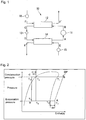
- the standard refrigerating cycle system employed for the above evaluation may, for example, a refrigerating cycle system of which the schematic construction view is shown in Fig. 1 . Now, the method for obtaining the refrigerating capacity and the coefficient of performance of a predetermined working fluid employing the refrigerating cycle system shown in Fig. 1 will be described.
- a refrigerating cycle system 10 shown in Fig. 1 is a system generally comprising a compressor 11 to compress a working fluid vapor A to form a high temperature/high pressure working fluid vapor B, a condenser 12 to cool and liquefy the working fluid vapor B discharged from the compressor 11 to form a low temperature/high pressure working fluid C, an expansion valve 13 to let the working fluid C discharged from the condenser 12 expand to form a low temperature/low pressure working fluid D, an evaporator 14 to heat the working fluid D discharged from the expansion valve 13 to form a high temperature/low pressure working fluid vapor A, a pump 15 to supply a load fluid E to the evaporator 14, and a pump 16 to supply a fluid F to the condenser 12.
- the refrigerating cycle system 10 is a cycle system comprising an adiabatic isentropic change, an isenthalpic change and an isobaric change.
- the state change of the working fluid as represented on a pressure-enthalpy chart (curve) as shown in Fig. 2 , may be represented as a trapezoid having points A, B, C and D as vertexes.
- the AB process is a process wherein adiabatic compression is carried out by the compressor 11 to change the high temperature/low pressure working fluid vapor A to a high temperature/high pressure working fluid vapor B, and is represented by the line AB in Fig. 2 .
- the working fluid vapor A is introduced to the compressor 11 in a superheated state, and the obtainable working fluid vapor B is also a superheated vapor.
- the compressor discharge gas pressure (discharge pressure) employed to calculate (C) the relative pressure (RDP R410A ) as described hereinafter is the pressure (DP) in the state B in Fig. 2 and is the maximum pressure in the refrigerating cycle.
- the temperature in the state B in Fig. 2 is the compressor discharge gas temperature (discharge temperature) and is the maximum temperature in the refrigerating cycle.
- the BC process is a process wherein isobaric cooling is carried out in the condenser 12 to change the high temperature/high pressure working fluid vapor B to a low temperature/high pressure working fluid C and is represented by the BC line in Fig.
- the CD process is a process wherein isenthalpic expansion is carried out by the expansion valve 13 to change the low temperature/high pressure working fluid C to a low temperature/low pressure working fluid D and is presented by the CD line in Fig. 2 .
- T 2 -T 3 corresponds to the supercooling degree (SC) of the working fluid in the cycle of (i) to (iv), where T 3 is the temperature of the low temperature/high pressure working fluid C.
- the DA process is a process wherein isobaric heating is carried out in the evaporator 14 to have the low temperature/low pressure working fluid D returned to a high temperature/low pressure working fluid vapor A, and is represented by the DA line in Fig. 2 .
- the pressure in this process is the evaporation pressure.
- T 6 on the high enthalpy side is the evaporation temperature.
- T 7 -T 6 corresponds to the degree of superheat (SH) of the working fluid in the cycle of (i) to (iv), where T 7 is the temperature of the working fluid vapor A.
- T 4 indicates the temperature of the working fluid D.
- Q and COP of the working fluid are obtained respectively in accordance with the following formulae (11) and (12) from enthalpies h A , h B , h C and h D in the respective states A (after evaporation, high temperature and low pressure), B (after compression, high temperature and high pressure), C (after condensation, low temperature and high pressure) and D (after expansion, low temperature and low pressure) of the working fluid.
- thermodynamic properties required for calculation of the cycle performance of the working fluid are calculated based on the generalized equation of state (Soave-Redlich-Kwong equation) based on the law of corresponding state and various thermodynamic equations. If a characteristic value is not available, it is calculated employing an estimation technique based on a group contribution method.
- Q means a capacity to freeze a load fluid
- a higher Q means that more works can be done in the same system. In other words, it means that with a working fluid having a higher Q, the desired performance can be obtained with a smaller amount, whereby the heat cycle system can be downsized.
- the relative refrigerating capacity (RQ R410A ) and the relative coefficient of performance (RCOP R410A ) of the working fluid according to an embodiment satisfy the above condition (B-1) and in addition, the relative refrigerating capacity (RQ R410A ) is preferably at least 0.820, and the relative coefficient of performance (RCOP R410A ) is preferably at least 0.960. More preferably, the relative refrigerating capacity (RQ R410A ) is at least 0.950, and the relative coefficient of performance (RCOP R410A ) is at least 0.980.
- the relative pressure (RDP R410A ) is an index to the load of the working fluid to an apparatus represented by relative comparison with the load of R410A to be replaced to an apparatus.
- the relative pressure (RDP R410A ) is represented by the ratio of the compressor discharge gas pressure (DP sample ) when the standard refrigerating cycle under the above temperature conditions (T) is operated by using the working fluid (sample) to the compressor discharge gas pressure (DP R410A ) when the cycle is operated by using R410A, as shown in the following formula (Z).
- Relative pressure RDP R 410 A Compressor discharge gas pressure of sample DP sample Compressor discharge gas pressure of R 410 A DP R 410 A
- the compressor discharge gas pressure means the maximum pressure in the standard refrigerating cycle under the above temperature conditions, and from the value, it is possible to estimate the pressure load to an apparatus when a heat cycle system such as a refrigerating apparatus or an air-conditioning apparatus is practically operated using the working fluid.
- the working fluid according to an embodiment of the present invention has a relative pressure (RDP R410A ) of at most 1.100 as shown by (C-1).
- RDP R410A relative pressure
- the pressure load to an apparatus will hardly increase when a heat cycle system is operated using such a working fluid by using a predetermined apparatus under predetermined conditions, as compared with a case where the heat cycle system is operated using R410A by using the same apparatus under the same conditions. That is, when the condition (C-1) is satisfied, the working fluid according to an embodiment can be basically used for an apparatus in which R410A has been used as the working fluid, without any particular change of design.
- the relative pressure (RDPR 410A ) of the working fluid according to an embodiment is preferably at most 1.000.
- the lower limit of the relative pressure (RDP R410A ) of the working fluid according to an embodiment is not particularly limited.
- the combustion lower limit is the lower limit of the combustion range i.e. the range of the volume concentration (%) of the working fluid based on the entire amount of the working fluid and the air, within which the working fluid mixed with the air can burn under the predetermined conditions.
- the combustion range is the combustion range measured in accordance with method A in High Pressure Gas Safety Act.
- Measured in accordance with method A in High Pressure Gas Safety Act includes measurement by method A in High Pressure Gas Safety Act and includes measurement by a measurement method other than method A, for example, by a measurement method modified to such an extent that the modification is acceptable as an alternative to the method A.
- the combustion lower limit may be literature data by the above-exemplified measurement method. Further, in a case where the working fluid is a mixture, the combustion lower limit may be actually measured by the above-exemplified measurement method, or may be calculated as a weighted average by the molar composition employing the combustion lower limits of the respective compounds constituting the working fluid.
- the working fluid according to an embodiment of the present invention has a combustion lower limit of at least 5 Vol% as represented by (D-1).
- the combustion lower limit of the working fluid according to an embodiment is at least 5 vol%, that is, it satisfies the condition (D-1)
- the working fluid is not highly flammable like a hydrocarbon refrigerant such as propane, butane or isobutane in a normal environment, and such a situation can be handled with predetermined measures.
- the combustion lower limit of the working fluid according to an embodiment is preferably at least 7%, more preferably at least 10%. Particularly, the working fluid according to an embodiment has no combustion range. In a case where the working fluid according to an embodiment has a combustion range, the upper limit is not particularly limited. However, in order that the working fluid will not be a flammable gas in High Pressure Gas Safety Act, it is preferred that the combustion lower limit is at least 10% and the difference between the upper limit and the lower limit of the combustion range is at least 20%.
- the working fluid according to an embodiment of the present invention has no self-decomposition property. That is, of the working fluid according to an embodiment, the pressure will not exceed 2.00 MPaG in a combustion test by equipment in accordance with method A for measurement of the combustion range in High Pressure Gas Safety Act under conditions of 0.98 MPaG and 250°C, as defined by (E-1). That is, the working fluid has a property such that the temperature and the pressure are not substantially changed by the combustion test.
- the working fluid according to an embodiment satisfying the condition (E-1) in a heat cycle system such as a refrigerating apparatus or an air-conditioning apparatus, the working fluid can be stably used continuously without any particularly measurements for a long period of time.
- the self-decomposition property (E) of the working fluid in the present invention is evaluated specifically as follows using equipment in accordance with method A recommended as equipment for measurement of the combustion range of a gas mixture containing halogen, by individual notifications in High Pressure Gas Safety Act.
- a sample (working fluid) is enclosed in a spherical pressure resistant reactor having an internal capacity of 650 cm 3 and having a temperature in the interior controlled at a predetermined temperature (250°C) from the outside, to a predetermined pressure (0.98 MPa by the gauge pressure), and a platinum wire placed in the interior of the reactor is fused to apply an about 30 J energy.
- the temperature and pressure changes in the pressure resistant reactor generated after application are measured to confirm whether the self-decomposition reaction occurred or not.
- the sample (working fluid) is rated as having undergone self-decomposition reaction, that is, as having self-decomposition property.
- the sample (working fluid) is rated as not having undergone self-decomposition reaction, that is, as having no self-decomposition property.
- Table 1 The above-described properties of the working fluid according to an embodiment of the present invention are summarized in the following Table 1.
- the rows represent the physical properties (A) to (E) to be evaluated, and the columns represent physical property values (1) to (4).
- the columns (1), (2), (3) and (4) respectively represent an essential requirement, a preferred range, a more preferred range and a particularly preferred range.
- the range (less than 300) of the column (1) of the row (A) GWP corresponds to the requirement of the above (A-1).
- the ranges of the column (1) of the rows (B) to (E) in Table 1 correspond to the requirements (B-1) to (E-1).
- the working fluid according to an embodiment of the present invention is required to satisfy the conditions (A)-(1), (B)-(1), (C)-(1), (D)-(1) and (E)-(1) in Table 1. So long as the above conditions are satisfied, the combination of the rows (A) to (E) and the respective levels (2) to (4) is not particularly limited. Most preferred is a working fluid which satisfies all the conditions (A)-(4), (B)-(4), (C)-(2), (D)-(4) and (E)-(1).
- a heat cycle system by heat exchangers such as a condenser and an evaporator may be used without any particularly restriction.
- the heat cycle system for example, a refrigerating cycle, has a mechanism in which a gaseous working fluid is compressed by a compressor and cooled by a condenser to form a high pressure liquid, the pressure of the liquid is lowered by an expansion valve, and the liquid is vaporized at low temperature by an evaporator so that heat is removed by the heat of vaporization.
- the composition of the working fluid for heat cycle of the present invention is not particularly limited so long as all the conditions (A-1) to (E-1) are satisfied.
- the working fluid may consist of a single compound or may be a mixture.
- no composition which satisfies all the conditions (A-1) to (E-1) by itself has been known. Accordingly, to obtain a working fluid according to an embodiment which satisfies all the conditions (A-1) to (E-1), for example, a method of selecting the combination of compounds constituting the working fluid and adjusting the contents of the selected compounds so as to satisfy the conditions (A-1) to (E-1) as follows, may be mentioned.
- HFO a HFC having a carbon-carbon double bond
- the HFO may, for example, be HFO-1123, HFO-1132(Z) which is cis-HFO-1132, HFO-1132(E) which is trans-HFO-1132, 2,3,3,3-tetrafluoropropene (HFO-1234yf), 2-fluoropropene (HFO-1261 yf), 1,1,2-trifluoropropene (HFO-1243yc), trans-1,2,3,3,3-pentafluoropropene (HFO-1225ye(E)), cis-1,2,3,3,3-pentafluoropropene (HFO-1225ye(Z)), trans-1,3,3,3-tetrafluoropropene (HFO-1234ze(E)), cis-1,3,3,3-tetrafluoropropene (HFO-1234ze(Z)) or 3,3,3-trifluoropropene (HFO-1243zf).
- a compound having a high relative cycle performance for example, a compound which satisfies the condition (B-1) or a compound which may satisfy the condition of (B-1) by combination with another compound, is selected.
- a compound may, for example, be HFO-1123, HFO-1132(Z) or HFO-1232(E).
- GWP of HFO-1123 is 0.3 as a value measured in accordance with Intergovernmental Panel on Climate Change (IPCC), Fourth assessment report.
- IPCC Intergovernmental Panel on Climate Change
- GWPs of HFO-1132(Z) and HFO-1132(E) are not disclosed in IPCC, Fourth assessment report, and can be estimated to be at most 10, from GWP of other HFOs, for example, GWP of 6 of HFO-1234ze(E) and HFO-1234ze(Z) and GWP of 4 of HFO-1234yf.
- HFO-1123, HFO-1132(Z) and HFO-1132(E) which are not satisfied as the working fluid according to an embodiment are known.
- HFO-1123, HFO-1132(Z) and HFO-1132(E) are combined with a compound so as to achieve physical properties which have not been satisfied as the working fluid according to an embodiment while physical properties which have already been satisfied are kept so as not to be out of the ranges of the working fluid according to an embodiment.
- a compound may, for example, be a HFO other than HFO-1123, HFO-1132(Z) and HFO-1132(E), and a HFC.
- the HFO to be combined with HFO-1123, HFO-1132(Z), HFO-1132(E) and the like, is preferably a HFO which has a relative cycle performance at a certain level or higher, which has a low relative pressure (RDP R410A ), and which has no self-decomposition property.
- it may, for example, be HFO-1234ze(E), HFO-1234ze(Z) or HFO-1234yf.
- the HFC is preferably properly selected with a view to keeping particularly GWP within the range (A-1) and the relative cycle performance within the range (B-1) of a mixture with the above HFO as a working fluid.
- the HFC may, for example, be HFC-32, difluoroethane, trifluoroethane, tetrafluoroethane, pentafluoroethane (HFC-125), pentafluoropropane, hexafluoropropane, heptafluoropropane, pentafluorobutane or heptafluorocyclopentane.
- HFC-32 1,1-difluoroethane (HFC-152a), 1,1,2,2-tetrafluoroethane (HFC-134) or 1,1,1,2-tetrafluoroethane (HFC-134a).
- the HFC to be combined with the above HFO-1123, HFO-1132(Z), HFO-1132(E) and the like, is preferably a HFC which has a relatively low GWP, for example, at most 1,500, which has a high relative cycle performance and/or a low relative pressure (RDP R410A ), and which has no self-decomposition property. It may, for example, be specifically HFC-32 or HFC-134a, and is particularly preferably HFC-32.
- combustion lower limit 1) represents a measured value measured in accordance with method A in High Pressure Gas Safety Act, and 2) represents a literature value measured in accordance with method A in High Pressure Gas Safety Act.
- HFO-1123, HFO-1132(Z) and HFO-1132(E) have self-decomposition property when used by themselves, the proportion of HFO-1123, HFO-1132(Z) or HFO-1132(E) based on the entire amount of the working fluid is such that the working fluid has no self-decomposition property.
- mass% represents mass% based on 100 mass% of the entire working fluid.
- mass% represents mass% based on 100 mass% of the entire working fluid.
- mass% represents mass% based on 100 mass% of the entire working fluid
- the working fluid according to an embodiment may contain, other than the HFO or the HFC, e.g. another component which is vaporized and liquefied together with the HFO or the HFC, as the case requires, so long as (A-1) to (E-1) are satisfied.
- Such a component other than the HFO or the HFC may, for example, be carbon dioxide, a hydrocarbon, a chlorofluoroolefin (CFO), or a hydrochlorofluoroolefin (HCFO).
- Such another component is preferably a component which has less influence over the ozone layer and which has less influence over global warming.
- the hydrocarbon may, for example, be propane, propylene, cyclopropane, butane, isobutane, pentane or isopentane.
- the hydrocarbon may be used alone or in combination of two or more.
- the working fluid contains a hydrocarbon
- its content is less than 10 mass%, preferably from 1 to 5 mass%, more preferably from 3 to 5 mass% per 100 mass% of the working fluid.
- the solubility of a mineral refrigerant oil in the working fluid will be favorable.
- the CFO may, for example, be chlorofluoropropene or chlorofluoroethylene.
- the CFO is preferably 1,1-dichloro-2,3,3,3-tetrafluoropropene (CFO-1214ya), 1,3-dichloro-1,2,3,3-tetrafluoropropene (CFO-1214yb) or 1,2-dichloro-1,2-difluoroethylene (CFO-1112).
- the CFO may be used alone or in combination of two or more.
- the working fluid contains the CFO
- its content is less than 10 mass%, preferably from 1 to 8 mass%, more preferably from 2 to 5 mass% per 100 mass% of the working fluid.
- the content of the CFO is at least the lower limit, the flammability of the working fluid tends to be suppressed.
- the content of the CFO is at most the upper limit, favorable cycle performance is likely to be obtained.
- the HCFO may, for example, be hydrochlorofluoropropene or hydrochlorofluoroethylene.
- the HCFO is preferably 1-chloro-2,3,3,3-tetrafluoropropene (HCFO-1224yd) or 1-chloro-1,2-difluoroethylene (HCFO-1122).
- the HCFO may be used alone or in combination of two or more.
- the content of the HCFO per 100 mass% of the working fluid is less than 10 mass%, preferably from 1 to 8 mass%, more preferably from 2 to 5 mass%.
- the content of the HCFO is at least the lower limit, the flammability of the working fluid tends to be suppressed.
- the content of the HCFO is at most the upper limit, favorable cycle performance is likely to be obtained.
- the total content of such another component in the working fluid is less than 10 mass%, preferably at most 8 mass%, more preferably at most 5 mass% per 100 mass% of the working fluid.
- the working fluid of the present invention may be used, in application to a heat cycle system, as the composition for a heat cycle system of the present invention usually as mixed with a refrigerant oil.
- the composition for a heat cycle system of the present invention comprising the working fluid of the present invention and a refrigerant oil may further contain known additives such as a stabilizer and a leak detecting substance.
- refrigerant oil a known refrigerant oil which has been used for a composition for a heat cycle system together with a working fluid comprising a halogenated hydrocarbon may be used without any particular restrictions.
- the refrigerant oil may, for example, be specifically an oxygen-containing synthetic oil (such as an ester refrigerant oil or an ether refrigerant oil), a fluorinated refrigerant oil, a mineral refrigerant oil or a hydrocarbon synthetic oil.
- the ester refrigerant oil may, for example, be a dibasic acid ester oil, a polyol ester oil, a complex ester oil or a polyol carbonate oil.
- the dibasic acid ester oil is preferably an ester of a C 5-10 dibasic acid (such as glutaric acid, adipic acid, pimelic acid, suberic acid, azelaic acid or sebacic acid) with a C 1-15 monohydric alcohol which is linear or has a branched alkyl group (such as methanol, ethanol, propanol, butanol, pentanol, hexanol, heptanol, octanol, nonanol, decanol, undecanol, dodecanol, tridecanol, tetradecanol or pentadecanol).
- a C 5-10 dibasic acid such as glutaric acid, adipic acid, pimelic acid, suberic acid, azelaic acid or sebacic acid
- a C 1-15 monohydric alcohol which is linear or has a branched alkyl group (such as methanol, ethanol
- ditridecyl glutarate di(2-ethylhexyl) adipate, diisodecyl adipate, ditridecyl adipate or di(3-ethylhexyl) sebacate may, for example, be mentioned.
- the polyol ester oil is preferably an ester of a diol (such as ethylene glycol, 1,3-propanediol, propylene glycol, 1,4-butanediol, 1,2-butandiol, 1,5-pentadiol, neopentyl glycol, 1,7-heptanediol or 1,12-dodecanediol) or a polyol having from 3 to 20 hydroxy groups (such as trimethylolethane, trimethylolpropane, trimethylolbutane, pentaerythritol, glycerin, sorbitol, sorbitan or a sorbitol/glycerin condensate) with a C 6-20 fatty acid (such as a linear or branched fatty acid such as hexanoic acid, heptanoic acid, octanoic acid, nonanoic acid, decanoic acid, unde
- the polyol ester oil may have a free hydroxy group.
- the polyol ester oil is preferably an ester (such as trimethylolpropane tripelargonate, pentaerythritol 2-ethylhexanoate or pentaerythritol tetrapelargonate) of a hindered alcohol (such as neopentyl glycol, trimethylolethane, trimethylolpropane, trimethylolbutane or pentaerythritol).
- a hindered alcohol such as neopentyl glycol, trimethylolethane, trimethylolpropane, trimethylolbutane or pentaerythritol.
- the complex ester oil is an ester of a fatty acid and a dibasic acid, with a monohydric alcohol and a polyol.
- the fatty acid, the dibasic acid, the monohydric alcohol and the polyol may be as defined above.
- the polyol carbonate oil is an ester of carbonic acid with a polyol.
- the polyol may be the above-described diol or the above-described polyol.
- the polyol carbonate oil may be a ring-opening polymer of a cyclic alkylene carbonate.
- the ether refrigerant oil may be a polyvinyl ether oil or a polyoxyalkylene oil.
- the polyvinyl ether oil may be one obtained by polymerizing a vinyl ether monomer such as an alkyl vinyl ether, or a copolymer obtained by copolymerizing a vinyl ether monomer and a hydrocarbon monomer having an olefinic double bond.
- the vinyl ether monomer may be used alone or in combination of two or more.
- the hydrocarbon monomer having an olefinic double bond may, for example, be ethylene, propylene, various forms of butene, various forms of pentene, various forms of hexene, various forms of heptene, various forms of octene, diisobutylene, triisobutylene, styrene, ⁇ -methylstyrene or alkyl-substituted styrene.
- the hydrocarbon monomer having an olefinic double bond may be used alone or in combination of two or more.
- the polyvinyl ether copolymer may be either of a block copolymer and a random copolymer.
- the polyvinyl ether oil may be used alone or in combination of two or more.
- the polyoxyalkylene oil may, for example, be a polyoxyalkylene monool, a polyoxyalkylene polyol, an alkyl ether of a polyoxyalkylene monool or a polyoxyalkylene polyol, or an ester of a polyoxyalkylene monool or a polyoxyalkylene polyol.
- the polyoxyalkylene monool or the polyoxyalkylene polyol may be one obtained by e.g. a method of subjecting a C 2-4 alkylene oxide (such as ethylene oxide or propylene oxide) to ring-opening addition polymerization to an initiator such as water or a hydroxy group-containing compound in the presence of a catalyst such as an alkali hydroxide.
- a C 2-4 alkylene oxide such as ethylene oxide or propylene oxide
- an initiator such as water or a hydroxy group-containing compound
- a catalyst such as an alkali hydroxide
- one molecule of the polyoxyalkylene chain may contain single oxyalkylene units or two or more types of oxyalkylene units. It is preferred that at least oxypropylene units are contained in one molecule.
- the initiator to be used for the reaction may, for example, be water, a monohydric alcohol such as methanol or butanol, or a polyhydric alcohol such as ethylene glycol, propylene glycol, pentaerythritol or glycerol.
- a monohydric alcohol such as methanol or butanol
- a polyhydric alcohol such as ethylene glycol, propylene glycol, pentaerythritol or glycerol.
- the polyoxyalkylene oil is preferably an alkyl ether or ester of a polyoxyalkylene monool or polyoxyalkylene polyol.
- the polyoxyalkylene polyol is preferably a polyoxyalkylene glycol.
- Particularly preferred is an alkyl ether of a polyoxyalkylene glycol having the terminal hydroxy group of the polyoxyalkylene glycol capped with an alkyl group such as a methyl group, which is called a polyglycol oil.
- the fluorinated refrigerant oil may, for example, be a compound having hydrogen atoms of a synthetic oil (such as the after-mentioned mineral oil, poly- ⁇ -olefin, alkylbenzene or alkylnaphthalene) substituted by fluorine atoms, a perfluoropolyether oil or a fluorinated silicone oil.
- a synthetic oil such as the after-mentioned mineral oil, poly- ⁇ -olefin, alkylbenzene or alkylnaphthalene
- the mineral refrigerant oil may, for example, be a naphthene mineral oil or a paraffin mineral oil obtained by purifying a refrigerant oil fraction obtained by atmospheric distillation or vacuum distillation of crude oil by a purification treatment (such as solvent deasphalting, solvent extraction, hydrocracking, solvent dewaxing, catalytic dewaxing, hydrotreating or clay treatment) optionally in combination.
- a purification treatment such as solvent deasphalting, solvent extraction, hydrocracking, solvent dewaxing, catalytic dewaxing, hydrotreating or clay treatment
- the hydrocarbon synthetic oil may, for example, be a poly- ⁇ -olefin, an alkylbenzene or an alkylnaphthalene.
- the refrigerant oil may be used alone or in combination of two or more.
- the refrigerant oil is preferably at least one member selected from a polyol ester oil, a polyvinyl ether oil and a polyglycol oil in view of compatibility with the working fluid.
- the content of the refrigerant oil in the composition for a heat cycle system is not limited within a range not to remarkably decrease the effects of the present invention, and is preferably from 10 to 100 parts by mass, more preferably from 20 to 50 parts by mass, per 100 parts by mass of the working fluid.
- the stabilizer optionally contained in the composition for a heat cycle system is a component which improves the stability of the working fluid against heat and oxidation.
- a known stabilizer which has been used for a heat cycle system together with a working fluid comprising a halogenated hydrocarbon for example, an oxidation resistance-improving agent, a heat resistance-improving agent or a metal deactivator, may be used without any particular restrictions.
- the oxidation resistance-improving agent and the heat resistance-improving agent may, for example, be N,N'-diphenylphenylenediamine, p-octyldiphenylamine, p,p'-dioctyldiphenylamine, N-phenyl-1-naphthylamine, N-phenyl-2-naphthylamine, N-(p-dodecyl)phenyl-2-naphthylamine, di-1-naphthylamine, di-2-naphthylamine, N-alkylphenothiazine, 6-(t-butyl)phenol, 2,6-di-(t-butyl)phenol, 4-methyl-2,6-di-(t-butyl)phenol or 4,4'-methylenebis(2,6-di-t-butylphenol).
- Each of the oxidation resistance-improving agent and the heat resistance-improving agent may be used
- the metal deactivator may, for example, be imidazole, benzimidazole, 2-mercaptobenzothiazole, 2,5-dimercaptothiadiazole, salicylidene-propylenediamine, pyrazole, benzotriazole, tritriazole, 2-methylbenzamidazole, 3,5-dimethylpyrazole, methylenebis-benzotriazole, an organic acid or an ester thereof, a primary, secondary or tertiary aliphatic amine, an amine salt of an organic acid or inorganic acid, a heterocyclic nitrogen-containing compound, an amine salt of an alkyl phosphate, or a derivative thereof.
- the content of the stabilizer in the composition for a heat cycle system is not limited within a range not to remarkably decrease the effects of the present invention, and is preferably at most 5 parts by mass, more preferably at most 1 part by mass per 100 parts by mass of the working fluid.
- the leak detecting substance optionally contained in the composition for a heat cycle system may, for example, be an ultraviolet fluorescent dye, an odor gas or an odor masking agent.
- the ultraviolet fluorescent dye may be known ultraviolet fluorescent dyes which have been used for a heat cycle system together with a working fluid comprising a halogenated hydrocarbon, such as dyes as disclosed in e.g. US Patent No. 4,249,412 , JP-A-10-502737 , JP-A-2007-511645 , JP-A-2008-500437 and JP-A-2008-531836 .
- the odor masking agent may be known perfumes which have been used for a heat cycle system together with a working fluid comprising a halogenated hydrocarbon, such as perfumes as disclosed in e.g. JP-A-2008-500437 and JP-A-2008-531836 .
- a solubilizing agent which improves the solubility of the leak detecting substance in the working fluid may be used.
- the solubilizing agent may be ones as disclosed in e.g. JP-A-2007-511645 , JP-A-2008-500437 and JP-A-2008-531836 .
- the content of the leak detecting substance in the composition for a heat cycle system is not particularly limited within a range not to remarkably decrease the effects of the present invention, and is preferably at most 2 parts by mass, more preferably at most 0.5 part by mass per 100 parts by mass of the working fluid.
- the heat cycle system of the present invention is a system employing the composition for a heat cycle system of the present invention.
- the heat cycle system of the present invention may be a heat pump system utilizing heat obtained by a condenser or may be a refrigerating cycle system utilizing coldness obtained by an evaporator.
- the heat cycle system of the present invention may, for example, be specifically a refrigerator, an air-conditioning apparatus, a power generation system, a heat transfer apparatus and a secondary cooling machine.
- the heat cycle system of the present invention which stably and safely exhibits heat cycle performance in a working environment at higher temperature, is preferably employed as an air-conditioning apparatus to be disposed outdoors in many cases. Further, the heat cycle system of the present invention is preferably employed also for a refrigerating apparatus.
- the air-conditioning apparatus may, for example, be specifically a room air-conditioner, a package air-conditioner (such as a store package air-conditioner, a building package air-conditioner or a plant package air-condition, a gas engine heat pump, a train air-conditioning system or an automobile air-conditioning system.
- a package air-conditioner such as a store package air-conditioner, a building package air-conditioner or a plant package air-condition, a gas engine heat pump, a train air-conditioning system or an automobile air-conditioning system.
- the refrigerator may, for example, be specifically a showcase (such as a built-in showcase or a separate showcase), an industrial fridge freezer, a vending machine or an ice making machine.
- the power generation system is preferably a power generation system by Rankine cycle system.
- the power generation system may, for example, be specifically a system wherein in an evaporator, a working fluid is heated by e.g. geothermal energy, solar heat or waste heat in a medium-to-high temperature range at a level of from 50 to 200°C, and the vaporized working fluid in a high temperature and high pressure state is adiabatically expanded by an expansion device, so that a power generator is driven by the work generated by the adiabatic expansion to carry out power generation.
- a working fluid is heated by e.g. geothermal energy, solar heat or waste heat in a medium-to-high temperature range at a level of from 50 to 200°C
- the vaporized working fluid in a high temperature and high pressure state is adiabatically expanded by an expansion device, so that a power generator is driven by the work generated by the adiabatic expansion to carry out power generation.
- the heat cycle system of the present invention may be a heat transport apparatus.
- the heat transport apparatus is preferably a latent heat transport apparatus.
- the latent heat transport apparatus may, for example, be a heat pipe conducting latent heat transport utilizing evaporation, boiling, condensation, etc. of a working fluid filled in an apparatus, and a two-phase closed thermosiphon.
- a heat pipe is applied to a relatively small-sized cooling apparatus such as a cooling apparatus of a heating portion of a semiconductor device and electronic equipment.
- a two-phase closed thermosiphon is widely used for a gas/gas heat exchanger, to accelerate snow melting and to prevent freezing of roads, since it does not require a wick and its structure is simple.
- a problem may occur particularly when the heat cycle system is used at low temperature. For example, problems such as freezing in a capillary tube, hydrolysis of the working fluid or the refrigerant oil, deterioration of materials by an acid component formed in the cycle, formation of contaminants, etc. may arise.
- the refrigerant oil is a polyglycol oil or a polyol ester oil, it has extremely high moisture absorbing properties and is likely to undergo hydrolysis, and inclusion of moisture decreases properties of the refrigerant oil and may be a great cause to impair the long term reliability of a compressor. Accordingly, in order to suppress hydrolysis of the refrigerant oil, it is necessary to control the moisture concentration in the heat cycle system.
- a method of controlling the moisture concentration in the heat cycle system a method of using a moisture-removing means such as a desiccating agent (such as silica gel, activated aluminum or zeolite) may be mentioned.
- the desiccating agent is preferably brought into contact with the composition for a heat cycle system in a liquid state, in view of the dehydration efficiency.
- the desiccating agent is located at the outlet of the condenser 12 or at the inlet of the evaporator 14 to be brought into contact with the composition for a heat cycle system.
- the desiccating agent is preferably a zeolite desiccating agent in view of chemical reactivity of the desiccating agent and the composition for a heat cycle system, and the moisture absorption capacity of the desiccating agent.
- the zeolite desiccating agent is, in a case where a refrigerant oil having a large moisture absorption as compared with a conventional mineral refrigerant oil is used, preferably a zeolite desiccating agent containing a compound represented by the following formula (3) as the main component in view of excellent moisture absorption capacity.
- M 2/n O ⁇ Al 2 O 3 ⁇ xSiO 2 ⁇ yH 2 O (3) wherein M is a group 1 element such as Na or K or a group 2 element such as Ca, n is the valence of M, and x and y are values determined by the crystal structure.
- the pore size can be adjusted by changing M.
- the pore size and the fracture strength are important.
- the working fluid is adsorbed in the desiccating agent and as a result, chemical reaction between the working fluid and the desiccating agent will occur, thus leading to undesired phenomena such as formation of non-condensing gas, a decrease in the strength of the desiccating agent, and a decrease in the adsorption capacity.
- a zeolite desiccating agent having a small pore size is particularly preferred.
- sodium/potassium type A synthetic zeolite having a pore size of at most 3.5 A is particularly preferred.
- a sodium/potassium type A synthetic zeolite having a pore size smaller than the molecular size of the working fluid it is possible to selectively adsorb and remove only moisture in the heat cycle system without adsorbing the working fluid.
- the working fluid is less likely to be adsorbed in the desiccating agent, whereby heat decomposition is less likely to occur and as a result, deterioration of materials constituting the heat cycle system and formation of contaminants can be suppressed.
- the size of the zeolite desiccating agent is preferably from about 0.5 to about 5 mm, since if it is too small, a valve or a thin portion in pipelines of the heat cycle system may be clogged, and if it is too large, the drying capacity will be decreased. Its shape is preferably granular or cylindrical.
- the zeolite desiccating agent may be formed into an optional shape by solidifying powdery zeolite by a binding agent (such as bentonite). So long as the desiccating agent is composed mainly of the zeolite desiccating agent, other desiccating agent (such as silica gel or activated alumina) may be used in combination.
- a binding agent such as bentonite
- the proportion of the zeolite desiccating agent based on the composition for a heat cycle system is not particularly limited.
- non-condensing gas If non-condensing gas is included in the heat cycle system, it has adverse effects such as heat transfer failure in the condenser or the evaporator and an increase in the working pressure, and it is necessary to suppress its inclusion as far as possible.
- oxygen which is one of non-condensing gases reacts with the working fluid or the refrigerant oil and promotes their decomposition.
- the non-condensing gas concentration is preferably at most 1.5 vol%, particularly preferably at most 0.5 vol% by the volume ratio based on the working fluid, in a gaseous phase of the working fluid.
- GWP and the combustion lower limit were obtained by calculation using values of the respective compounds by themselves respectively in accordance with the above methods.
- values in the above Tables 2 and 3 and the following Table 4 were employed.
- [Table 4] Compound GWP Combustion range Combustion lower limit (vol%) Reference source HFO-1243zf 9 4.7 Known value by method A HCFO-1122 ⁇ 10 13 Measured value by method A HCFO-1224yd ⁇ 10 No combustion range Measured value by method A Propane 3 2.1 Known value by method A Butane 8.4 1.8 Known value by method A Isobutane 8.4 1.8 Known value by method A
- a working fluid having HFO-1123 and at least one member of HFO-1234yf, HFC-32 and HFO-1234ze(E) mixed in a proportion as identified in Tables 5 to 7 was prepared, and by the above methods, (A) GWP, (B) relative cycle performance (relative to R410A), (C) relative pressure (RDP R410A ), (D) combustion lower limit and (E) self-decomposition property were measured, calculated and evaluated. The results are shown in Tables 5 to 7.
- a working fluid having HFO-1132(Z) and at least one of HFO-1234yf and HFC-32 mixed in a proportion as identified in Tables 8 and 9 was prepared, and by the above methods, (A) GWP, (B) relative cycle performance (relative to R410A), (C) relative pressure (RDP R410A ), (D) combustion lower limit and (E) self-decomposition property were measured, calculated and evaluated. The results are shown in Tables 8 and 9.
- a working fluid having HFO-1132(E) and at least one of HFO-1234yf and HFC-32 mixed in a proportion as identified in Tables 10 and 11 was prepared, and by the above methods, (A) GWP, (B) relative cycle performance (relative to R410A), (C) relative pressure (RDP R410A ), (D) combustion lower limit and (E) self-decomposition property were measured, calculated and evaluated. The results are shown in Tables 10 and 11.
- Comparative Examples 1 to 54 a working fluid having at least one HFO, and at least one of another HFO, a HFC, a hydrocarbon and a HCFO mixed in a proportion as identified in Tables 12 to 20, was prepared, and by the above methods, (A) GWP, (B) relative cycle performance (relative to R410A), (C) relative pressure (RDP R410A ), (D) combustion lower limit and (E) self-decomposition property were measured, calculated and evaluated. The results are shown in Tables 12 to 20.
- composition for a heat cycle system of the present invention and the heat cycle system using the composition are useful for a refrigerator (such as a built-in showcase, a separate showcase, an industrial fridge freezer, a vending machine or an ice making machine), an air-conditioning apparatus (such as a room air-conditioner, a store package air-conditioner, a building package air-conditioner, a plant package air-conditioner, a gas engine heat pump, a train air-conditioning system or an automobile air-conditioning system), power generation system (such as exhaust heat recovery power generation) or a heat transport apparatus (such as a heat pipe).
- a refrigerator such as a built-in showcase, a separate showcase, an industrial fridge freezer, a vending machine or an ice making machine
- an air-conditioning apparatus such as a room air-conditioner, a store package air-conditioner, a building package air-conditioner, a plant package air-conditioner, a gas engine heat pump, a train air-conditioning system or an automobile air-conditioning system
- Refrigerating cycle system 11: compressor, 12: condenser, 13: expansion valve, 14: evaporator, 15, 16: pump.
Landscapes
- Chemical & Material Sciences (AREA)
- Engineering & Computer Science (AREA)
- Physics & Mathematics (AREA)
- Chemical Kinetics & Catalysis (AREA)
- Combustion & Propulsion (AREA)
- Thermal Sciences (AREA)
- Materials Engineering (AREA)
- Organic Chemistry (AREA)
- Lubricants (AREA)
- Organic Low-Molecular-Weight Compounds And Preparation Thereof (AREA)
Priority Applications (2)
| Application Number | Priority Date | Filing Date | Title |
|---|---|---|---|
| EP20203126.6A EP3792330B1 (fr) | 2014-01-31 | 2015-01-20 | Fluide de travail pour le cycle thermique, composition pour le système du cycle thermique, et système du cycle thermique |
| EP24166950.6A EP4417667A1 (fr) | 2014-01-31 | 2015-01-20 | Fluide de travail pour cycle thermique, composition pour système à cycle thermique et système à cycle thermique |
Applications Claiming Priority (23)
| Application Number | Priority Date | Filing Date | Title |
|---|---|---|---|
| JP2014017967 | 2014-01-31 | ||
| JP2014017031 | 2014-01-31 | ||
| JP2014030857 | 2014-02-20 | ||
| JP2014030856 | 2014-02-20 | ||
| JP2014033345 | 2014-02-24 | ||
| JP2014053765 | 2014-03-17 | ||
| JP2014055603 | 2014-03-18 | ||
| JP2014118165 | 2014-06-06 | ||
| JP2014118164 | 2014-06-06 | ||
| JP2014118163 | 2014-06-06 | ||
| JP2014118166 | 2014-06-06 | ||
| JP2014118167 | 2014-06-06 | ||
| JP2014127745 | 2014-06-20 | ||
| JP2014127744 | 2014-06-20 | ||
| JP2014148348 | 2014-07-18 | ||
| JP2014148350 | 2014-07-18 | ||
| JP2014148347 | 2014-07-18 | ||
| JP2014187002 | 2014-09-12 | ||
| JP2014187003 | 2014-09-12 | ||
| JP2014187005 | 2014-09-12 | ||
| JP2014187006 | 2014-09-12 | ||
| JP2014187004 | 2014-09-12 | ||
| PCT/JP2015/051409 WO2015115252A1 (fr) | 2014-01-31 | 2015-01-20 | Milieu actif pour cycle thermique, composition pour système à cycle thermique, et système à cycle thermique |
Related Child Applications (3)
| Application Number | Title | Priority Date | Filing Date |
|---|---|---|---|
| EP20203126.6A Division EP3792330B1 (fr) | 2014-01-31 | 2015-01-20 | Fluide de travail pour le cycle thermique, composition pour le système du cycle thermique, et système du cycle thermique |
| EP20203126.6A Division-Into EP3792330B1 (fr) | 2014-01-31 | 2015-01-20 | Fluide de travail pour le cycle thermique, composition pour le système du cycle thermique, et système du cycle thermique |
| EP24166950.6A Division EP4417667A1 (fr) | 2014-01-31 | 2015-01-20 | Fluide de travail pour cycle thermique, composition pour système à cycle thermique et système à cycle thermique |
Publications (3)
| Publication Number | Publication Date |
|---|---|
| EP3101082A1 true EP3101082A1 (fr) | 2016-12-07 |
| EP3101082A4 EP3101082A4 (fr) | 2018-02-21 |
| EP3101082B1 EP3101082B1 (fr) | 2020-12-02 |
Family
ID=53756829
Family Applications (3)
| Application Number | Title | Priority Date | Filing Date |
|---|---|---|---|
| EP15743372.3A Active EP3101082B1 (fr) | 2014-01-31 | 2015-01-20 | Milieu actif pour cycle thermique, composition pour système à cycle thermique, et système à cycle thermique |
| EP20203126.6A Active EP3792330B1 (fr) | 2014-01-31 | 2015-01-20 | Fluide de travail pour le cycle thermique, composition pour le système du cycle thermique, et système du cycle thermique |
| EP24166950.6A Pending EP4417667A1 (fr) | 2014-01-31 | 2015-01-20 | Fluide de travail pour cycle thermique, composition pour système à cycle thermique et système à cycle thermique |
Family Applications After (2)
| Application Number | Title | Priority Date | Filing Date |
|---|---|---|---|
| EP20203126.6A Active EP3792330B1 (fr) | 2014-01-31 | 2015-01-20 | Fluide de travail pour le cycle thermique, composition pour le système du cycle thermique, et système du cycle thermique |
| EP24166950.6A Pending EP4417667A1 (fr) | 2014-01-31 | 2015-01-20 | Fluide de travail pour cycle thermique, composition pour système à cycle thermique et système à cycle thermique |
Country Status (5)
| Country | Link |
|---|---|
| US (2) | US10131827B2 (fr) |
| EP (3) | EP3101082B1 (fr) |
| JP (8) | JP6657957B2 (fr) |
| CN (1) | CN106029821B (fr) |
| WO (1) | WO2015115252A1 (fr) |
Cited By (28)
| Publication number | Priority date | Publication date | Assignee | Title |
|---|---|---|---|---|
| EP3109291A4 (fr) * | 2014-02-20 | 2017-10-25 | Asahi Glass Company, Limited | Composition pour systeme a cycles thermiques, et systeme a cycles thermiques |
| EP3109304A4 (fr) * | 2014-02-20 | 2017-10-25 | Asahi Glass Company, Limited | Composition pour système à cycle thermodynamique, et système à cycle thermodynamique |
| EP3109302A4 (fr) * | 2014-02-20 | 2017-11-01 | Asahi Glass Company, Limited | Composition pour système à cycle thermodynamique, et système à cycle thermodynamique |
| EP3109303A4 (fr) * | 2014-02-20 | 2017-12-27 | Asahi Glass Company, Limited | Composition pour système à cycle thermodynamique, et système à cycle thermodynamique |
| EP3109301A4 (fr) * | 2014-02-20 | 2017-12-27 | Asahi Glass Company, Limited | Composition pour systeme a cycles thermiques, et systeme a cycles thermiques |
| US11365335B2 (en) | 2017-12-18 | 2022-06-21 | Daikin Industries, Ltd. | Composition comprising refrigerant, use thereof, refrigerating machine having same, and method for operating said refrigerating machine |
| US11435118B2 (en) | 2017-12-18 | 2022-09-06 | Daikin Industries, Ltd. | Heat source unit and refrigeration cycle apparatus |
| US11441802B2 (en) | 2017-12-18 | 2022-09-13 | Daikin Industries, Ltd. | Air conditioning apparatus |
| US11441819B2 (en) | 2017-12-18 | 2022-09-13 | Daikin Industries, Ltd. | Refrigeration cycle apparatus |
| US11493244B2 (en) | 2017-12-18 | 2022-11-08 | Daikin Industries, Ltd. | Air-conditioning unit |
| US11492527B2 (en) | 2017-12-18 | 2022-11-08 | Daikin Industries, Ltd. | Composition containing refrigerant, use of said composition, refrigerator having said composition, and method for operating said refrigerator |
| US11506425B2 (en) | 2017-12-18 | 2022-11-22 | Daikin Industries, Ltd. | Refrigeration cycle apparatus |
| US11525076B2 (en) | 2019-01-30 | 2022-12-13 | Daikin Industries, Ltd. | Composition containing refrigerant, and refrigeration method using said composition, operating method for refrigeration device, and refrigeration device |
| US11535781B2 (en) | 2017-12-18 | 2022-12-27 | Daikin Industries, Ltd. | Refrigeration cycle apparatus |
| US11549695B2 (en) | 2017-12-18 | 2023-01-10 | Daikin Industries, Ltd. | Heat exchange unit |
| US11549041B2 (en) | 2017-12-18 | 2023-01-10 | Daikin Industries, Ltd. | Composition containing refrigerant, use of said composition, refrigerator having said composition, and method for operating said refrigerator |
| EP4047287A4 (fr) * | 2019-10-18 | 2023-03-08 | Mitsubishi Electric Corporation | Dispositif à cycle de réfrigération |
| WO2023034685A1 (fr) | 2021-09-01 | 2023-03-09 | Exxonmobil Chemical Patents Inc. | Profils de réacteur tubulaire à température variable et compositions de polyéthylène moyenne densité produites à partir de ceux-ci |
| US11820933B2 (en) | 2017-12-18 | 2023-11-21 | Daikin Industries, Ltd. | Refrigeration cycle apparatus |
| US11827833B2 (en) | 2019-02-06 | 2023-11-28 | Daikin Industries, Ltd. | Refrigerant-containing composition, and refrigerating method, refrigerating device operating method, and refrigerating device using said composition |
| US11834601B2 (en) | 2019-01-30 | 2023-12-05 | Daikin Industries, Ltd. | Composition containing refrigerant, refrigeration method using said composition, method for operating refrigeration device, and refrigeration device |
| US11834602B2 (en) | 2019-02-05 | 2023-12-05 | Daikin Industries, Ltd. | Refrigerant-containing composition, and refrigerating method, refrigerating device operating method, and refrigerating device using said composition |
| US11906207B2 (en) | 2017-12-18 | 2024-02-20 | Daikin Industries, Ltd. | Refrigeration apparatus |
| US11912922B2 (en) | 2018-07-17 | 2024-02-27 | Daikin Industries, Ltd. | Refrigerant cycle apparatus |
| US11920077B2 (en) | 2018-07-17 | 2024-03-05 | Daikin Industries, Ltd. | Refrigeration cycle device for vehicle |
| US11939515B2 (en) | 2018-07-17 | 2024-03-26 | Daikin Industries, Ltd. | Refrigerant-containing composition, heat transfer medium, and heat cycle system |
| US12270575B2 (en) | 2017-12-18 | 2025-04-08 | Daikin Industries, Ltd. | Warm-water generating apparatus |
| US12379140B2 (en) | 2017-12-18 | 2025-08-05 | Daikin Industries., Ltd. | Air conditioner |
Families Citing this family (60)
| Publication number | Priority date | Publication date | Assignee | Title |
|---|---|---|---|---|
| CN115160988B (zh) * | 2013-04-30 | 2024-05-14 | Agc株式会社 | 包含三氟乙烯的组合物 |
| WO2015005290A1 (fr) | 2013-07-12 | 2015-01-15 | 旭硝子株式会社 | Milieu actif pour cycle thermodynamique, composition pour système à cycle thermodynamique et système à cycle thermodynamique |
| EP3071664B1 (fr) * | 2013-11-22 | 2022-08-03 | The Chemours Company FC, LLC | Utilisation de compositions comprenant du tétrafluoropropène et du tétrafluoroéthane dans des cycles de puissance; et appareil à cycle de puissance |
| MY181760A (en) | 2014-01-31 | 2021-01-06 | Agc Inc | Working fluid for heat cycle, composition for heat cycle system, and heat cycle system |
| EP3101082B1 (fr) * | 2014-01-31 | 2020-12-02 | AGC Inc. | Milieu actif pour cycle thermique, composition pour système à cycle thermique, et système à cycle thermique |
| CN106029850B (zh) * | 2014-02-20 | 2019-12-10 | Agc株式会社 | 热循环系统用组合物以及热循环系统 |
| WO2015125878A1 (fr) | 2014-02-24 | 2015-08-27 | 旭硝子株式会社 | Composition pour un système de cycle thermique, et système de cycle thermique |
| EP3153559A1 (fr) * | 2014-06-06 | 2017-04-12 | Asahi Glass Company, Limited | Fluide de travail pour cycle thermique, composition pour système à cycle thermique et système à cycle thermique |
| JPWO2015186670A1 (ja) * | 2014-06-06 | 2017-04-20 | 旭硝子株式会社 | 熱サイクルシステム用組成物および熱サイクルシステム |
| JP6369572B2 (ja) * | 2015-01-16 | 2018-08-08 | 株式会社デンソー | 熱サイクル用作動媒体 |
| CN107250315B (zh) * | 2015-02-09 | 2021-03-02 | Agc株式会社 | 电动汽车用的空调用工作介质以及电动汽车用的空调用工作介质组合物 |
| WO2017122517A1 (fr) * | 2016-01-12 | 2017-07-20 | 旭硝子株式会社 | Dispositif à cycle de réfrigération et système à cycle de chaleur |
| WO2018013623A1 (fr) * | 2016-07-13 | 2018-01-18 | Sabic Global Technologies B.V. | Procédés de fabrication en continu de 2-aryl-3,3-bis(4-hydroxyaryl)phthalimidines, et des polymères dérivés de celui-ci |
| CN114591716B (zh) * | 2016-09-07 | 2023-09-29 | Agc株式会社 | 热循环用工作介质、热循环系统用组合物以及热循环系统 |
| CN110402361B (zh) * | 2017-03-14 | 2022-04-01 | Agc株式会社 | 热循环系统 |
| JP6979563B2 (ja) * | 2017-04-13 | 2021-12-15 | パナソニックIpマネジメント株式会社 | 冷凍サイクル装置 |
| FR3067035B1 (fr) | 2017-06-02 | 2020-10-30 | Arkema France | Compositions a base de trifluoroethylene, et leurs utilisations |
| JP6418284B1 (ja) * | 2017-06-12 | 2018-11-07 | ダイキン工業株式会社 | 冷媒を含有する組成物、その使用、それを用いた冷凍方法、及びそれを含む冷凍機 |
| WO2019123804A1 (fr) * | 2017-12-18 | 2019-06-27 | ダイキン工業株式会社 | Composition contenant un fluide frigorigène, son utilisation, machine de réfrigération en comprenant, et procédé de fonctionnement de ladite machine de réfrigération |
| PH12020550888A1 (en) * | 2017-12-18 | 2021-04-12 | Daikin Ind Ltd | Composition containing refrigerant, use of said composition, refrigerator having said composition, and method for operating said refrigerator |
| WO2019123898A1 (fr) * | 2017-12-18 | 2019-06-27 | ダイキン工業株式会社 | Huile pour appareil de réfrigération pour fluide frigorigène ou composition de fluide frigorigène, procédé d'utilisation d'huile pour appareil de réfrigération, et utilisation de l'huile pour appareil de réfrigération |
| US20220389299A1 (en) * | 2017-12-18 | 2022-12-08 | Daikin Industries, Ltd. | Refrigeration cycle apparatus |
| US20220404070A1 (en) * | 2017-12-18 | 2022-12-22 | Daikin Industries, Ltd. | Air conditioner |
| WO2019123805A1 (fr) * | 2017-12-18 | 2019-06-27 | ダイキン工業株式会社 | Composition contenant un fluide frigorigène, utilisation de ladite composition, réfrigérateur comprenant ladite composition, et procédé de fonctionnement dudit réfrigérateur |
| US20200317975A1 (en) * | 2017-12-18 | 2020-10-08 | Daikin Industries, Ltd. | Composition containing refrigerant, use of said composition, refrigerator having said composition, and method for operating said refrigerator |
| US10655039B2 (en) * | 2017-12-29 | 2020-05-19 | Trane International Inc. | Lower GWP refrigerant compositions |
| US20190203093A1 (en) | 2017-12-29 | 2019-07-04 | Trane International Inc. | Lower gwp refrigerant compositions |
| FR3081865B1 (fr) | 2018-06-05 | 2020-11-06 | Arkema France | Compositions a base de 1,1,2-trifluoroethylene et de dioxyde de carbone |
| CN116792979A (zh) * | 2018-07-17 | 2023-09-22 | 大金工业株式会社 | 制冷循环装置 |
| CN113272402B (zh) | 2018-12-21 | 2024-06-04 | 霍尼韦尔国际公司 | 1,2,2-三氟-1-三氟甲基环丁烷(tfmcb)的共沸物或类共沸物组合物及其应用 |
| EP4375098B1 (fr) | 2019-04-16 | 2025-10-01 | Daikin Industries, Ltd. | Composition comprenant un fluide frigorigène, son utilisation, réfrigérateur la comprenant et procédé de fonctionnement dudit réfrigérateur |
| JP6860033B2 (ja) * | 2019-04-19 | 2021-04-14 | ダイキン工業株式会社 | 1,2−ジフルオロエチレン(hfo−1132)の精製方法 |
| JP6773180B1 (ja) * | 2019-06-18 | 2020-10-21 | ダイキン工業株式会社 | ジフルオロエチレンを含有する作動媒体の製造方法 |
| EP3988867A4 (fr) * | 2019-06-19 | 2023-09-13 | Daikin Industries, Ltd. | Composition contenant un réfrigérant, son utilisation, congélateur comportant celle-ci, et procédé pour faire fonctionner ledit congélateur |
| WO2020256122A1 (fr) * | 2019-06-19 | 2020-12-24 | ダイキン工業株式会社 | Composition contenant un réfrigérant, application associée, machine frigorifique possédant ladite composition, et procédé de fonctionnement de ladite machine frigorifique |
| EP3988863B1 (fr) * | 2019-06-19 | 2026-04-01 | Daikin Industries, Ltd. | Composition contenant un fluide frigorigène, utilisation de celle-ci, congélateur comportant celle-ci, et procédé de fonctionnement dudit congélateur |
| JP2021001326A (ja) * | 2019-06-19 | 2021-01-07 | ダイキン工業株式会社 | 1,2−ジフルオロエチレン(hfo−1132)と酸素とを気相で共存させる方法、並びにそれらを含む保存容器及び冷凍機 |
| JP6874872B2 (ja) * | 2019-06-19 | 2021-05-19 | ダイキン工業株式会社 | 冷媒を含む組成物、その使用、並びにそれを有する冷凍機及びその冷凍機の運転方法 |
| EP3988866A4 (fr) | 2019-06-19 | 2023-09-13 | Daikin Industries, Ltd. | Composition contenant un réfrigérant, application associée, machine frigorifique possédant ladite composition, et procédé de fonctionnement de ladite machine frigorifique |
| CN113993973B (zh) * | 2019-06-19 | 2024-04-23 | 大金工业株式会社 | 含有制冷剂的组合物、其用途、具有该组合物的冷冻机、该冷冻机的运转方法以及具有冷冻机的冷冻循环装置 |
| EP3988862A4 (fr) * | 2019-06-19 | 2023-09-13 | Daikin Industries, Ltd. | Composition contenant un fluide frigorigène, son utilisation, réfrigérateur la comprenant, et procédé de fonctionnement dudit réfrigérateur |
| JP7425282B2 (ja) * | 2019-09-30 | 2024-01-31 | ダイキン工業株式会社 | 蒸発器、およびそれを備えた冷凍サイクル装置 |
| JP7492130B2 (ja) * | 2020-07-22 | 2024-05-29 | ダイキン工業株式会社 | 冷媒を含有する組成物、その組成物を用いた不均化反応を抑制する方法、その組成物を保存する方法、及び、その組成物を輸送する方法、並びに、その組成物を用いた冷凍方法、冷凍装置の運転方法、及び冷凍装置 |
| FR3100538B1 (fr) | 2020-09-10 | 2024-04-19 | Arkema France | Compositions à base de 1,1,2-trifluoroéthylene et de dioxyde de carbone |
| JP2022063162A (ja) * | 2020-10-09 | 2022-04-21 | ダイキン工業株式会社 | 組成物、冷媒を保存する方法、及び冷媒の重合を抑制する方法 |
| AU2022213724B2 (en) * | 2021-01-29 | 2025-05-08 | Daikin Industries, Ltd. | Refrigerant-containing composition, use thereof, refrigerator having said composition, and method for operating said refrigerator |
| CN116997632A (zh) | 2021-03-09 | 2023-11-03 | 大金工业株式会社 | 含有制冷剂的组合物、其用途以及具有该组合物的冷冻机和该冷冻机的运转方法 |
| WO2022264345A1 (fr) * | 2021-06-17 | 2022-12-22 | 三菱電機株式会社 | Dispositif à cycle frigorifique |
| AU2022309709A1 (en) * | 2021-07-12 | 2023-11-09 | The Chemours Company Fc, Llc | Stabilized fluoroethylene compositions and methods for their storage and usage |
| US20230243536A1 (en) * | 2021-08-31 | 2023-08-03 | Schneider Electric USA, Inc. | Monitoring hvac&r performance degradation using relative cop |
| WO2023058558A1 (fr) * | 2021-10-04 | 2023-04-13 | ダイキン工業株式会社 | Composition contenant un frigorigène, application associée, machine frigorifique possédant ladite composition, et procédé de fonctionnement de ladite machine frigorifique |
| KR102911701B1 (ko) * | 2021-10-04 | 2026-01-13 | 다이킨 고교 가부시키가이샤 | 냉매를 포함하는 조성물, 그 사용, 그리고 그것을 갖는 냉동기 및 그 냉동기의 운전 방법 |
| CN116568973A (zh) * | 2021-10-04 | 2023-08-08 | 大金工业株式会社 | 含有制冷剂的组合物、其使用、具有该组合物的冷冻机以及该冷冻机的运转方法 |
| JPWO2023100746A1 (fr) * | 2021-12-03 | 2023-06-08 | ||
| JPWO2024090386A1 (fr) * | 2022-10-27 | 2024-05-02 | ||
| JP2024095526A (ja) * | 2022-12-28 | 2024-07-10 | ダイキン工業株式会社 | 冷媒を含む組成物、その使用、それを用いる冷凍方法、並びにそれを含む冷凍装置及び冷凍機 |
| CN120457152A (zh) | 2023-01-06 | 2025-08-08 | 旭化成株式会社 | 多异氰酸酯组合物、涂料组合物和涂膜 |
| EP4596651A4 (fr) * | 2023-03-01 | 2026-02-25 | Daikin Ind Ltd | Composition contenant un fluide frigorigène, son utilisation, réfrigérateur la comprenant, et procédé pour faire fonctionner un réfrigérateur |
| JP2025007046A (ja) * | 2023-06-30 | 2025-01-17 | パナソニックIpマネジメント株式会社 | 冷凍サイクル用作動媒体および冷凍サイクルシステム |
| WO2025229942A1 (fr) * | 2024-04-30 | 2025-11-06 | Eneos株式会社 | Huile de réfrigérateur, composition de fluide de travail, réfrigérateur et procédé de production de composition de fluide de travail |
Family Cites Families (55)
| Publication number | Priority date | Publication date | Assignee | Title |
|---|---|---|---|---|
| US4249412A (en) | 1978-12-11 | 1981-02-10 | Townsend Claude A Iii | Fluorescent leak detection composition |
| US5440919A (en) | 1994-08-29 | 1995-08-15 | Spectronics Corporation | Method of introducing leak detection dye into an air conditioning or refrigeration system |
| US20050145822A1 (en) | 2003-11-13 | 2005-07-07 | Drigotas Martin D. | Refrigerant compositions comprising UV fluorescent dye and solubilizing agent |
| KR20070015594A (ko) | 2004-05-26 | 2007-02-05 | 이 아이 듀폰 디 네모아 앤드 캄파니 | 히드로플루오로카본을 포함하는1,1,1,2,2,4,5,5,5-노나플루오로-4-(트리플루오로메틸)-3-펜타논 조성물 및 이의 용도 |
| US20060243944A1 (en) | 2005-03-04 | 2006-11-02 | Minor Barbara H | Compositions comprising a fluoroolefin |
| MX2011003633A (es) * | 2008-10-10 | 2011-05-02 | Du Pont | Composiciones que comprenden 2,3,3,3-tetrafluoropropeno, 2-cloro-2,3,3,3-tetrafluoropropanol, acetato de 2-cloro-2,3,3,3-tetrafluoropropilo o (2-cloro-2,3,3,3-tetrafluorop ropoxil) cloruro de zinc. |
| US8961811B2 (en) * | 2010-04-15 | 2015-02-24 | E I Du Pont De Nemours And Company | Compositions comprising E-1,2-difluoroethylene and uses thereof |
| US8961812B2 (en) * | 2010-04-15 | 2015-02-24 | E I Du Pont De Nemours And Company | Compositions comprising Z-1,2-difluoroethylene and uses thereof |
| US8889031B2 (en) | 2010-11-30 | 2014-11-18 | Jx Nippon Oil & Energy Corporation | Working fluid composition for refrigerator machine and refrigerating machine oil |
| CN103534328B (zh) * | 2011-05-19 | 2016-02-24 | 旭硝子株式会社 | 工作介质及热循环系统 |
| EP2711407B1 (fr) | 2011-05-19 | 2018-11-07 | AGC Inc. | Fluide moteur, et système à cycle thermique |
| CN106085363A (zh) | 2011-05-19 | 2016-11-09 | 旭硝子株式会社 | 工作介质及热循环系统 |
| JP6024495B2 (ja) | 2013-02-04 | 2016-11-16 | 三菱瓦斯化学株式会社 | 酸素吸収性ptp包装体 |
| JP2014017031A (ja) | 2012-07-06 | 2014-01-30 | Sony Corp | 光情報記録媒体 |
| JP2014017967A (ja) | 2012-07-09 | 2014-01-30 | Sumitomo Wiring Syst Ltd | ワイヤハーネスの保護チューブ取付構造 |
| JP2014030857A (ja) | 2012-08-01 | 2014-02-20 | Seiko Epson Corp | ロボット及び搬送装置 |
| JP2014030856A (ja) | 2012-08-01 | 2014-02-20 | Sumitomo Electric Hardmetal Corp | 刃具交換式切削工具 |
| JP2014033345A (ja) | 2012-08-03 | 2014-02-20 | Nec Networks & System Integration Corp | 主配線盤用養生具 |
| JP6074653B2 (ja) | 2012-09-07 | 2017-02-08 | パナソニックIpマネジメント株式会社 | コモンモードノイズフィルタ |
| JP2014055603A (ja) | 2012-09-11 | 2014-03-27 | Yamaha Motor Co Ltd | クラッチ装置およびそれを備えた鞍乗型車両 |
| JP6018900B2 (ja) | 2012-12-13 | 2016-11-02 | 株式会社川島製作所 | 製袋充填包装機におけるセンターシール装置 |
| JP2014118167A (ja) | 2012-12-14 | 2014-06-30 | Murata Mfg Co Ltd | 電子部品用テープキャリア |
| JP5790633B2 (ja) | 2012-12-14 | 2015-10-07 | 株式会社村田製作所 | キャリアテープ、包装用テープおよび電子部品連 |
| JP2014118164A (ja) | 2012-12-14 | 2014-06-30 | Tanaka corp | 容器 |
| JP5774574B2 (ja) | 2012-12-14 | 2015-09-09 | 株式会社フジキカイ | 連包袋の折り重ね方法および折り重ね用ミシン目形成ナイフ |
| JP5723867B2 (ja) | 2012-12-25 | 2015-05-27 | 株式会社アドバネクス | モバイル製品用アンテナ及びモバイル製品 |
| JP2014127744A (ja) | 2012-12-25 | 2014-07-07 | Casio Comput Co Ltd | 撮像装置、撮像制御方法、及びプログラム |
| WO2014109272A1 (fr) | 2013-01-11 | 2014-07-17 | Semiconductor Energy Laboratory Co., Ltd. | Procédé de chargement d'un dispositif électronique |
| WO2014109271A1 (fr) | 2013-01-14 | 2014-07-17 | Semiconductor Energy Laboratory Co., Ltd. | Dispositif électrochimique |
| JP2014148347A (ja) | 2013-02-04 | 2014-08-21 | Toppan Printing Co Ltd | 液体用紙容器とその充填方法 |
| JP2014148348A (ja) | 2013-02-04 | 2014-08-21 | Toppan Printing Co Ltd | 紙製液体容器 |
| JP6300176B2 (ja) | 2013-02-19 | 2018-03-28 | 日本電気硝子株式会社 | ナトリウム二次電池用負極活物質 |
| JP2014187004A (ja) | 2013-02-22 | 2014-10-02 | Ngk Spark Plug Co Ltd | 絶縁体およびスパークプラグ |
| JP6294699B2 (ja) | 2013-02-22 | 2018-03-14 | 古河電気工業株式会社 | 端子、端子付き電線及び端子付き電線の製造方法 |
| WO2015005290A1 (fr) * | 2013-07-12 | 2015-01-15 | 旭硝子株式会社 | Milieu actif pour cycle thermodynamique, composition pour système à cycle thermodynamique et système à cycle thermodynamique |
| MY181760A (en) * | 2014-01-31 | 2021-01-06 | Agc Inc | Working fluid for heat cycle, composition for heat cycle system, and heat cycle system |
| EP3101082B1 (fr) * | 2014-01-31 | 2020-12-02 | AGC Inc. | Milieu actif pour cycle thermique, composition pour système à cycle thermique, et système à cycle thermique |
| WO2015115551A1 (fr) * | 2014-01-31 | 2015-08-06 | 旭硝子株式会社 | Procédé de fabrication d'un milieu actif |
| WO2015125876A1 (fr) * | 2014-02-20 | 2015-08-27 | 旭硝子株式会社 | Composition pour système à cycle thermodynamique, et système à cycle thermodynamique |
| WO2015125534A1 (fr) * | 2014-02-20 | 2015-08-27 | 旭硝子株式会社 | Composition pour systeme a cycles thermiques, et systeme a cycles thermiques |
| WO2015125874A1 (fr) * | 2014-02-20 | 2015-08-27 | 旭硝子株式会社 | Milieu actif pour cycle thermique |
| CN106029850B (zh) * | 2014-02-20 | 2019-12-10 | Agc株式会社 | 热循环系统用组合物以及热循环系统 |
| WO2015125878A1 (fr) * | 2014-02-24 | 2015-08-27 | 旭硝子株式会社 | Composition pour un système de cycle thermique, et système de cycle thermique |
| CN106029826B (zh) * | 2014-02-24 | 2020-01-14 | Agc株式会社 | 热循环系统用组合物以及热循环系统 |
| WO2015129548A1 (fr) * | 2014-02-28 | 2015-09-03 | 旭硝子株式会社 | Fluide de travail pour cycle thermique, composition pour système à cycle thermique, et système à cycle thermique |
| JP5861727B2 (ja) * | 2014-03-04 | 2016-02-16 | ダイキン工業株式会社 | トランス−1,3,3,3−テトラフルオロプロペンを含む混合冷媒の充填方法 |
| EP3121243A4 (fr) * | 2014-03-17 | 2017-11-08 | Asahi Glass Company, Limited | Fluide moteur pour cycle thermique, composition pour système de cycle thermique, et système de cycle thermique |
| BR112016020985B1 (pt) * | 2014-03-18 | 2022-09-20 | Agc Inc | Composição para sistema de ciclo de calor e sistema de ciclo de calor |
| CA2944847C (fr) * | 2014-04-17 | 2019-07-16 | Nippon Steel & Sumitomo Metal Corporation | Acier inoxydable austenitique et methode de production associee |
| EP3153559A1 (fr) * | 2014-06-06 | 2017-04-12 | Asahi Glass Company, Limited | Fluide de travail pour cycle thermique, composition pour système à cycle thermique et système à cycle thermique |
| EP3153560A4 (fr) * | 2014-06-06 | 2018-01-10 | Asahi Glass Company, Limited | Milieu actif pour cycle thermique, composition pour système à cycle thermique et système à cycle thermique |
| CN107250315B (zh) * | 2015-02-09 | 2021-03-02 | Agc株式会社 | 电动汽车用的空调用工作介质以及电动汽车用的空调用工作介质组合物 |
| JPWO2017126447A1 (ja) * | 2016-01-18 | 2018-12-06 | Agc株式会社 | トリフルオロエチレンを含む混合冷媒の充填方法 |
| JPWO2017126446A1 (ja) * | 2016-01-18 | 2018-12-06 | Agc株式会社 | トリフルオロエチレンを含む混合冷媒の充填方法 |
| CN114591716B (zh) * | 2016-09-07 | 2023-09-29 | Agc株式会社 | 热循环用工作介质、热循环系统用组合物以及热循环系统 |
-
2015
- 2015-01-20 EP EP15743372.3A patent/EP3101082B1/fr active Active
- 2015-01-20 WO PCT/JP2015/051409 patent/WO2015115252A1/fr not_active Ceased
- 2015-01-20 EP EP20203126.6A patent/EP3792330B1/fr active Active
- 2015-01-20 CN CN201580006526.3A patent/CN106029821B/zh active Active
- 2015-01-20 EP EP24166950.6A patent/EP4417667A1/fr active Pending
- 2015-01-20 JP JP2015559879A patent/JP6657957B2/ja active Active
-
2016
- 2016-07-27 US US15/220,549 patent/US10131827B2/en active Active
-
2018
- 2018-10-05 US US16/152,669 patent/US10787597B2/en active Active
-
2020
- 2020-02-06 JP JP2020019120A patent/JP6950765B2/ja active Active
-
2021
- 2021-09-24 JP JP2021156085A patent/JP7173253B2/ja active Active
-
2022
- 2022-10-25 JP JP2022170890A patent/JP7323036B2/ja active Active
-
2023
- 2023-07-13 JP JP2023115483A patent/JP7396528B2/ja active Active
- 2023-11-14 JP JP2023193720A patent/JP7435893B2/ja active Active
-
2024
- 2024-01-31 JP JP2024013471A patent/JP2024040238A/ja active Pending
-
2025
- 2025-01-07 JP JP2025002241A patent/JP2025039692A/ja active Pending
Cited By (38)
| Publication number | Priority date | Publication date | Assignee | Title |
|---|---|---|---|---|
| EP3109291A4 (fr) * | 2014-02-20 | 2017-10-25 | Asahi Glass Company, Limited | Composition pour systeme a cycles thermiques, et systeme a cycles thermiques |
| EP3109304A4 (fr) * | 2014-02-20 | 2017-10-25 | Asahi Glass Company, Limited | Composition pour système à cycle thermodynamique, et système à cycle thermodynamique |
| EP3109302A4 (fr) * | 2014-02-20 | 2017-11-01 | Asahi Glass Company, Limited | Composition pour système à cycle thermodynamique, et système à cycle thermodynamique |
| EP3109303A4 (fr) * | 2014-02-20 | 2017-12-27 | Asahi Glass Company, Limited | Composition pour système à cycle thermodynamique, et système à cycle thermodynamique |
| EP3109301A4 (fr) * | 2014-02-20 | 2017-12-27 | Asahi Glass Company, Limited | Composition pour systeme a cycles thermiques, et systeme a cycles thermiques |
| US9957430B2 (en) | 2014-02-20 | 2018-05-01 | Asahi Glass Company, Limited | Composition for heat cycle system, and heat cycle system |
| US9957429B2 (en) | 2014-02-20 | 2018-05-01 | Asahi Glass Company, Limited | Composition for heat cycle system, and heat cycle system |
| US9976067B2 (en) | 2014-02-20 | 2018-05-22 | Asahi Glass Company, Limited | Composition for heat cycle system, and heat cycle system |
| US10196552B2 (en) | 2014-02-20 | 2019-02-05 | AGC Inc. | Composition for heat cycle system, and heat cycle system |
| US10233371B2 (en) | 2014-02-20 | 2019-03-19 | AGC Inc. | Composition for heat cycle system, and heat cycle system |
| US10351746B2 (en) | 2014-02-20 | 2019-07-16 | AGC Inc. | Composition for heat cycle system, and heat cycle system |
| US10392546B2 (en) | 2014-02-20 | 2019-08-27 | AGC Inc. | Composition for heat cycle system, and heat cycle system |
| US11072734B2 (en) | 2014-02-20 | 2021-07-27 | AGC Inc. | Composition for heat cycle system, and heat cycle system |
| US11492527B2 (en) | 2017-12-18 | 2022-11-08 | Daikin Industries, Ltd. | Composition containing refrigerant, use of said composition, refrigerator having said composition, and method for operating said refrigerator |
| US12379140B2 (en) | 2017-12-18 | 2025-08-05 | Daikin Industries., Ltd. | Air conditioner |
| US11441802B2 (en) | 2017-12-18 | 2022-09-13 | Daikin Industries, Ltd. | Air conditioning apparatus |
| US11441819B2 (en) | 2017-12-18 | 2022-09-13 | Daikin Industries, Ltd. | Refrigeration cycle apparatus |
| US11493244B2 (en) | 2017-12-18 | 2022-11-08 | Daikin Industries, Ltd. | Air-conditioning unit |
| US11365335B2 (en) | 2017-12-18 | 2022-06-21 | Daikin Industries, Ltd. | Composition comprising refrigerant, use thereof, refrigerating machine having same, and method for operating said refrigerating machine |
| US11506425B2 (en) | 2017-12-18 | 2022-11-22 | Daikin Industries, Ltd. | Refrigeration cycle apparatus |
| US11906207B2 (en) | 2017-12-18 | 2024-02-20 | Daikin Industries, Ltd. | Refrigeration apparatus |
| US11535781B2 (en) | 2017-12-18 | 2022-12-27 | Daikin Industries, Ltd. | Refrigeration cycle apparatus |
| US11549695B2 (en) | 2017-12-18 | 2023-01-10 | Daikin Industries, Ltd. | Heat exchange unit |
| US11549041B2 (en) | 2017-12-18 | 2023-01-10 | Daikin Industries, Ltd. | Composition containing refrigerant, use of said composition, refrigerator having said composition, and method for operating said refrigerator |
| US12270575B2 (en) | 2017-12-18 | 2025-04-08 | Daikin Industries, Ltd. | Warm-water generating apparatus |
| US11435118B2 (en) | 2017-12-18 | 2022-09-06 | Daikin Industries, Ltd. | Heat source unit and refrigeration cycle apparatus |
| US11820933B2 (en) | 2017-12-18 | 2023-11-21 | Daikin Industries, Ltd. | Refrigeration cycle apparatus |
| US11912922B2 (en) | 2018-07-17 | 2024-02-27 | Daikin Industries, Ltd. | Refrigerant cycle apparatus |
| US11920077B2 (en) | 2018-07-17 | 2024-03-05 | Daikin Industries, Ltd. | Refrigeration cycle device for vehicle |
| US11939515B2 (en) | 2018-07-17 | 2024-03-26 | Daikin Industries, Ltd. | Refrigerant-containing composition, heat transfer medium, and heat cycle system |
| US11834601B2 (en) | 2019-01-30 | 2023-12-05 | Daikin Industries, Ltd. | Composition containing refrigerant, refrigeration method using said composition, method for operating refrigeration device, and refrigeration device |
| US11840658B2 (en) | 2019-01-30 | 2023-12-12 | Daikin Industries, Ltd. | Composition containing refrigerant, and refrigeration method using said composition, operating method for refrigeration device, and refrigeration device |
| US12221577B2 (en) | 2019-01-30 | 2025-02-11 | Daikin Industries, Ltd. | Composition containing refrigerant, and refrigeration method using said composition, operating method for refrigeration device, and refrigeration device |
| US11525076B2 (en) | 2019-01-30 | 2022-12-13 | Daikin Industries, Ltd. | Composition containing refrigerant, and refrigeration method using said composition, operating method for refrigeration device, and refrigeration device |
| US11834602B2 (en) | 2019-02-05 | 2023-12-05 | Daikin Industries, Ltd. | Refrigerant-containing composition, and refrigerating method, refrigerating device operating method, and refrigerating device using said composition |
| US11827833B2 (en) | 2019-02-06 | 2023-11-28 | Daikin Industries, Ltd. | Refrigerant-containing composition, and refrigerating method, refrigerating device operating method, and refrigerating device using said composition |
| EP4047287A4 (fr) * | 2019-10-18 | 2023-03-08 | Mitsubishi Electric Corporation | Dispositif à cycle de réfrigération |
| WO2023034685A1 (fr) | 2021-09-01 | 2023-03-09 | Exxonmobil Chemical Patents Inc. | Profils de réacteur tubulaire à température variable et compositions de polyéthylène moyenne densité produites à partir de ceux-ci |
Also Published As
| Publication number | Publication date |
|---|---|
| US10131827B2 (en) | 2018-11-20 |
| JP7396528B2 (ja) | 2023-12-12 |
| US10787597B2 (en) | 2020-09-29 |
| JP2020076108A (ja) | 2020-05-21 |
| EP3101082A4 (fr) | 2018-02-21 |
| JP2025039692A (ja) | 2025-03-21 |
| EP3792330A1 (fr) | 2021-03-17 |
| JP2024014939A (ja) | 2024-02-01 |
| JPWO2015115252A1 (ja) | 2017-03-23 |
| CN106029821B (zh) | 2020-06-02 |
| JP7435893B2 (ja) | 2024-02-21 |
| JP7173253B2 (ja) | 2022-11-16 |
| CN106029821A (zh) | 2016-10-12 |
| JP2023001167A (ja) | 2023-01-04 |
| JP2023138524A (ja) | 2023-10-02 |
| JP2024040238A (ja) | 2024-03-25 |
| EP3101082B1 (fr) | 2020-12-02 |
| JP6657957B2 (ja) | 2020-03-04 |
| JP2022000523A (ja) | 2022-01-04 |
| EP4417667A1 (fr) | 2024-08-21 |
| US20160333243A1 (en) | 2016-11-17 |
| JP6950765B2 (ja) | 2021-10-13 |
| US20190031934A1 (en) | 2019-01-31 |
| WO2015115252A1 (fr) | 2015-08-06 |
| EP3792330B1 (fr) | 2024-04-24 |
| JP7323036B2 (ja) | 2023-08-08 |
Similar Documents
| Publication | Publication Date | Title |
|---|---|---|
| US11905455B2 (en) | Working fluid for heat cycle, composition for heat cycle system, and heat cycle system | |
| US10787597B2 (en) | Working fluid for heat cycle, composition for heat cycle system, and heat cycle system | |
| US11746272B2 (en) | Working fluid for heat cycle, composition for heat cycle system, and heat cycle system | |
| EP4166624B1 (fr) | Composition pour système à cycle thermique, et système à cycle thermique | |
| EP3121242B1 (fr) | Fluide de travail pour cycle thermique, composition pour système de cycle thermique, et système de cycle thermique | |
| EP3153559A1 (fr) | Fluide de travail pour cycle thermique, composition pour système à cycle thermique et système à cycle thermique | |
| EP2955214A1 (fr) | Fluide de travail pour pompe à chaleur, et système de pompe à chaleur | |
| EP3121243A1 (fr) | Fluide moteur pour cycle thermique, composition pour système de cycle thermique, et système de cycle thermique |
Legal Events
| Date | Code | Title | Description |
|---|---|---|---|
| PUAI | Public reference made under article 153(3) epc to a published international application that has entered the european phase |
Free format text: ORIGINAL CODE: 0009012 |
|
| STAA | Information on the status of an ep patent application or granted ep patent |
Free format text: STATUS: REQUEST FOR EXAMINATION WAS MADE |
|
| 17P | Request for examination filed |
Effective date: 20160825 |
|
| AK | Designated contracting states |
Kind code of ref document: A1 Designated state(s): AL AT BE BG CH CY CZ DE DK EE ES FI FR GB GR HR HU IE IS IT LI LT LU LV MC MK MT NL NO PL PT RO RS SE SI SK SM TR |
|
| AX | Request for extension of the european patent |
Extension state: BA ME |
|
| DAX | Request for extension of the european patent (deleted) | ||
| A4 | Supplementary search report drawn up and despatched |
Effective date: 20180118 |
|
| RIC1 | Information provided on ipc code assigned before grant |
Ipc: C09K 5/04 20060101AFI20180112BHEP |
|
| RAP1 | Party data changed (applicant data changed or rights of an application transferred) |
Owner name: AGC INC. |
|
| STAA | Information on the status of an ep patent application or granted ep patent |
Free format text: STATUS: EXAMINATION IS IN PROGRESS |
|
| 17Q | First examination report despatched |
Effective date: 20190228 |
|
| GRAP | Despatch of communication of intention to grant a patent |
Free format text: ORIGINAL CODE: EPIDOSNIGR1 |
|
| STAA | Information on the status of an ep patent application or granted ep patent |
Free format text: STATUS: GRANT OF PATENT IS INTENDED |
|
| INTG | Intention to grant announced |
Effective date: 20200610 |
|
| GRAS | Grant fee paid |
Free format text: ORIGINAL CODE: EPIDOSNIGR3 |
|
| GRAA | (expected) grant |
Free format text: ORIGINAL CODE: 0009210 |
|
| STAA | Information on the status of an ep patent application or granted ep patent |
Free format text: STATUS: THE PATENT HAS BEEN GRANTED |
|
| AK | Designated contracting states |
Kind code of ref document: B1 Designated state(s): AL AT BE BG CH CY CZ DE DK EE ES FI FR GB GR HR HU IE IS IT LI LT LU LV MC MK MT NL NO PL PT RO RS SE SI SK SM TR |
|
| REG | Reference to a national code |
Ref country code: GB Ref legal event code: FG4D |
|
| REG | Reference to a national code |
Ref country code: AT Ref legal event code: REF Ref document number: 1340947 Country of ref document: AT Kind code of ref document: T Effective date: 20201215 Ref country code: CH Ref legal event code: EP |
|
| REG | Reference to a national code |
Ref country code: DE Ref legal event code: R096 Ref document number: 602015062876 Country of ref document: DE |
|
| REG | Reference to a national code |
Ref country code: IE Ref legal event code: FG4D |
|
| PG25 | Lapsed in a contracting state [announced via postgrant information from national office to epo] |
Ref country code: GR Free format text: LAPSE BECAUSE OF FAILURE TO SUBMIT A TRANSLATION OF THE DESCRIPTION OR TO PAY THE FEE WITHIN THE PRESCRIBED TIME-LIMIT Effective date: 20210303 Ref country code: RS Free format text: LAPSE BECAUSE OF FAILURE TO SUBMIT A TRANSLATION OF THE DESCRIPTION OR TO PAY THE FEE WITHIN THE PRESCRIBED TIME-LIMIT Effective date: 20201202 Ref country code: FI Free format text: LAPSE BECAUSE OF FAILURE TO SUBMIT A TRANSLATION OF THE DESCRIPTION OR TO PAY THE FEE WITHIN THE PRESCRIBED TIME-LIMIT Effective date: 20201202 Ref country code: NO Free format text: LAPSE BECAUSE OF FAILURE TO SUBMIT A TRANSLATION OF THE DESCRIPTION OR TO PAY THE FEE WITHIN THE PRESCRIBED TIME-LIMIT Effective date: 20210302 |
|
| REG | Reference to a national code |
Ref country code: NL Ref legal event code: MP Effective date: 20201202 |
|
| REG | Reference to a national code |
Ref country code: AT Ref legal event code: MK05 Ref document number: 1340947 Country of ref document: AT Kind code of ref document: T Effective date: 20201202 |
|
| PG25 | Lapsed in a contracting state [announced via postgrant information from national office to epo] |
Ref country code: LV Free format text: LAPSE BECAUSE OF FAILURE TO SUBMIT A TRANSLATION OF THE DESCRIPTION OR TO PAY THE FEE WITHIN THE PRESCRIBED TIME-LIMIT Effective date: 20201202 Ref country code: PL Free format text: LAPSE BECAUSE OF FAILURE TO SUBMIT A TRANSLATION OF THE DESCRIPTION OR TO PAY THE FEE WITHIN THE PRESCRIBED TIME-LIMIT Effective date: 20201202 Ref country code: SE Free format text: LAPSE BECAUSE OF FAILURE TO SUBMIT A TRANSLATION OF THE DESCRIPTION OR TO PAY THE FEE WITHIN THE PRESCRIBED TIME-LIMIT Effective date: 20201202 Ref country code: BG Free format text: LAPSE BECAUSE OF FAILURE TO SUBMIT A TRANSLATION OF THE DESCRIPTION OR TO PAY THE FEE WITHIN THE PRESCRIBED TIME-LIMIT Effective date: 20210302 |
|
| PG25 | Lapsed in a contracting state [announced via postgrant information from national office to epo] |
Ref country code: NL Free format text: LAPSE BECAUSE OF FAILURE TO SUBMIT A TRANSLATION OF THE DESCRIPTION OR TO PAY THE FEE WITHIN THE PRESCRIBED TIME-LIMIT Effective date: 20201202 Ref country code: HR Free format text: LAPSE BECAUSE OF FAILURE TO SUBMIT A TRANSLATION OF THE DESCRIPTION OR TO PAY THE FEE WITHIN THE PRESCRIBED TIME-LIMIT Effective date: 20201202 |
|
| REG | Reference to a national code |
Ref country code: LT Ref legal event code: MG9D |
|
| PG25 | Lapsed in a contracting state [announced via postgrant information from national office to epo] |
Ref country code: LT Free format text: LAPSE BECAUSE OF FAILURE TO SUBMIT A TRANSLATION OF THE DESCRIPTION OR TO PAY THE FEE WITHIN THE PRESCRIBED TIME-LIMIT Effective date: 20201202 Ref country code: PT Free format text: LAPSE BECAUSE OF FAILURE TO SUBMIT A TRANSLATION OF THE DESCRIPTION OR TO PAY THE FEE WITHIN THE PRESCRIBED TIME-LIMIT Effective date: 20210405 Ref country code: RO Free format text: LAPSE BECAUSE OF FAILURE TO SUBMIT A TRANSLATION OF THE DESCRIPTION OR TO PAY THE FEE WITHIN THE PRESCRIBED TIME-LIMIT Effective date: 20201202 Ref country code: SK Free format text: LAPSE BECAUSE OF FAILURE TO SUBMIT A TRANSLATION OF THE DESCRIPTION OR TO PAY THE FEE WITHIN THE PRESCRIBED TIME-LIMIT Effective date: 20201202 Ref country code: EE Free format text: LAPSE BECAUSE OF FAILURE TO SUBMIT A TRANSLATION OF THE DESCRIPTION OR TO PAY THE FEE WITHIN THE PRESCRIBED TIME-LIMIT Effective date: 20201202 Ref country code: CZ Free format text: LAPSE BECAUSE OF FAILURE TO SUBMIT A TRANSLATION OF THE DESCRIPTION OR TO PAY THE FEE WITHIN THE PRESCRIBED TIME-LIMIT Effective date: 20201202 Ref country code: SM Free format text: LAPSE BECAUSE OF FAILURE TO SUBMIT A TRANSLATION OF THE DESCRIPTION OR TO PAY THE FEE WITHIN THE PRESCRIBED TIME-LIMIT Effective date: 20201202 |
|
| PG25 | Lapsed in a contracting state [announced via postgrant information from national office to epo] |
Ref country code: AT Free format text: LAPSE BECAUSE OF FAILURE TO SUBMIT A TRANSLATION OF THE DESCRIPTION OR TO PAY THE FEE WITHIN THE PRESCRIBED TIME-LIMIT Effective date: 20201202 |
|
| REG | Reference to a national code |
Ref country code: CH Ref legal event code: PL |
|
| REG | Reference to a national code |
Ref country code: DE Ref legal event code: R097 Ref document number: 602015062876 Country of ref document: DE |
|
| PG25 | Lapsed in a contracting state [announced via postgrant information from national office to epo] |
Ref country code: LU Free format text: LAPSE BECAUSE OF NON-PAYMENT OF DUE FEES Effective date: 20210120 Ref country code: MC Free format text: LAPSE BECAUSE OF FAILURE TO SUBMIT A TRANSLATION OF THE DESCRIPTION OR TO PAY THE FEE WITHIN THE PRESCRIBED TIME-LIMIT Effective date: 20201202 Ref country code: IS Free format text: LAPSE BECAUSE OF FAILURE TO SUBMIT A TRANSLATION OF THE DESCRIPTION OR TO PAY THE FEE WITHIN THE PRESCRIBED TIME-LIMIT Effective date: 20210402 |
|
| REG | Reference to a national code |
Ref country code: BE Ref legal event code: MM Effective date: 20210131 |
|
| PLBE | No opposition filed within time limit |
Free format text: ORIGINAL CODE: 0009261 |
|
| STAA | Information on the status of an ep patent application or granted ep patent |
Free format text: STATUS: NO OPPOSITION FILED WITHIN TIME LIMIT |
|
| PG25 | Lapsed in a contracting state [announced via postgrant information from national office to epo] |
Ref country code: IT Free format text: LAPSE BECAUSE OF FAILURE TO SUBMIT A TRANSLATION OF THE DESCRIPTION OR TO PAY THE FEE WITHIN THE PRESCRIBED TIME-LIMIT Effective date: 20201202 Ref country code: AL Free format text: LAPSE BECAUSE OF FAILURE TO SUBMIT A TRANSLATION OF THE DESCRIPTION OR TO PAY THE FEE WITHIN THE PRESCRIBED TIME-LIMIT Effective date: 20201202 |
|
| 26N | No opposition filed |
Effective date: 20210903 |
|
| GBPC | Gb: european patent ceased through non-payment of renewal fee |
Effective date: 20210302 |
|
| PG25 | Lapsed in a contracting state [announced via postgrant information from national office to epo] |
Ref country code: SI Free format text: LAPSE BECAUSE OF FAILURE TO SUBMIT A TRANSLATION OF THE DESCRIPTION OR TO PAY THE FEE WITHIN THE PRESCRIBED TIME-LIMIT Effective date: 20201202 Ref country code: ES Free format text: LAPSE BECAUSE OF FAILURE TO SUBMIT A TRANSLATION OF THE DESCRIPTION OR TO PAY THE FEE WITHIN THE PRESCRIBED TIME-LIMIT Effective date: 20201202 Ref country code: DK Free format text: LAPSE BECAUSE OF FAILURE TO SUBMIT A TRANSLATION OF THE DESCRIPTION OR TO PAY THE FEE WITHIN THE PRESCRIBED TIME-LIMIT Effective date: 20201202 Ref country code: CH Free format text: LAPSE BECAUSE OF NON-PAYMENT OF DUE FEES Effective date: 20210131 Ref country code: LI Free format text: LAPSE BECAUSE OF NON-PAYMENT OF DUE FEES Effective date: 20210131 |
|
| PG25 | Lapsed in a contracting state [announced via postgrant information from national office to epo] |
Ref country code: IE Free format text: LAPSE BECAUSE OF NON-PAYMENT OF DUE FEES Effective date: 20210120 Ref country code: GB Free format text: LAPSE BECAUSE OF NON-PAYMENT OF DUE FEES Effective date: 20210302 |
|
| PG25 | Lapsed in a contracting state [announced via postgrant information from national office to epo] |
Ref country code: IS Free format text: LAPSE BECAUSE OF FAILURE TO SUBMIT A TRANSLATION OF THE DESCRIPTION OR TO PAY THE FEE WITHIN THE PRESCRIBED TIME-LIMIT Effective date: 20210402 |
|
| PG25 | Lapsed in a contracting state [announced via postgrant information from national office to epo] |
Ref country code: BE Free format text: LAPSE BECAUSE OF NON-PAYMENT OF DUE FEES Effective date: 20210131 |
|
| PG25 | Lapsed in a contracting state [announced via postgrant information from national office to epo] |
Ref country code: HU Free format text: LAPSE BECAUSE OF FAILURE TO SUBMIT A TRANSLATION OF THE DESCRIPTION OR TO PAY THE FEE WITHIN THE PRESCRIBED TIME-LIMIT; INVALID AB INITIO Effective date: 20150120 |
|
| P01 | Opt-out of the competence of the unified patent court (upc) registered |
Effective date: 20230509 |
|
| PG25 | Lapsed in a contracting state [announced via postgrant information from national office to epo] |
Ref country code: CY Free format text: LAPSE BECAUSE OF FAILURE TO SUBMIT A TRANSLATION OF THE DESCRIPTION OR TO PAY THE FEE WITHIN THE PRESCRIBED TIME-LIMIT Effective date: 20201202 |
|
| PG25 | Lapsed in a contracting state [announced via postgrant information from national office to epo] |
Ref country code: MK Free format text: LAPSE BECAUSE OF FAILURE TO SUBMIT A TRANSLATION OF THE DESCRIPTION OR TO PAY THE FEE WITHIN THE PRESCRIBED TIME-LIMIT Effective date: 20201202 |
|
| PG25 | Lapsed in a contracting state [announced via postgrant information from national office to epo] |
Ref country code: TR Free format text: LAPSE BECAUSE OF FAILURE TO SUBMIT A TRANSLATION OF THE DESCRIPTION OR TO PAY THE FEE WITHIN THE PRESCRIBED TIME-LIMIT Effective date: 20201202 |
|
| PG25 | Lapsed in a contracting state [announced via postgrant information from national office to epo] |
Ref country code: MT Free format text: LAPSE BECAUSE OF FAILURE TO SUBMIT A TRANSLATION OF THE DESCRIPTION OR TO PAY THE FEE WITHIN THE PRESCRIBED TIME-LIMIT Effective date: 20201202 |
|
| PGFP | Annual fee paid to national office [announced via postgrant information from national office to epo] |
Ref country code: DE Payment date: 20260121 Year of fee payment: 12 |
|
| PGFP | Annual fee paid to national office [announced via postgrant information from national office to epo] |
Ref country code: FR Payment date: 20260123 Year of fee payment: 12 |