EP3101167A2 - Procede de verification de linges laves ou nettoyes - Google Patents
Procede de verification de linges laves ou nettoyes Download PDFInfo
- Publication number
- EP3101167A2 EP3101167A2 EP16001008.8A EP16001008A EP3101167A2 EP 3101167 A2 EP3101167 A2 EP 3101167A2 EP 16001008 A EP16001008 A EP 16001008A EP 3101167 A2 EP3101167 A2 EP 3101167A2
- Authority
- EP
- European Patent Office
- Prior art keywords
- laundry
- item
- camera
- illuminated
- items
- Prior art date
- Legal status (The legal status is an assumption and is not a legal conclusion. Google has not performed a legal analysis and makes no representation as to the accuracy of the status listed.)
- Granted
Links
Images

Classifications
-
- D—TEXTILES; PAPER
- D06—TREATMENT OF TEXTILES OR THE LIKE; LAUNDERING; FLEXIBLE MATERIALS NOT OTHERWISE PROVIDED FOR
- D06F—LAUNDERING, DRYING, IRONING, PRESSING OR FOLDING TEXTILE ARTICLES
- D06F34/00—Details of control systems for washing machines, washer-dryers or laundry dryers
- D06F34/14—Arrangements for detecting or measuring specific parameters
- D06F34/18—Condition of the laundry, e.g. nature or weight
-
- G—PHYSICS
- G01—MEASURING; TESTING
- G01N—INVESTIGATING OR ANALYSING MATERIALS BY DETERMINING THEIR CHEMICAL OR PHYSICAL PROPERTIES
- G01N21/00—Investigating or analysing materials by the use of optical means, i.e. using sub-millimetre waves, infrared, visible or ultraviolet light
- G01N21/84—Systems specially adapted for particular applications
- G01N21/88—Investigating the presence of flaws or contamination
-
- G—PHYSICS
- G01—MEASURING; TESTING
- G01N—INVESTIGATING OR ANALYSING MATERIALS BY DETERMINING THEIR CHEMICAL OR PHYSICAL PROPERTIES
- G01N21/00—Investigating or analysing materials by the use of optical means, i.e. using sub-millimetre waves, infrared, visible or ultraviolet light
- G01N21/17—Systems in which incident light is modified in accordance with the properties of the material investigated
- G01N21/25—Colour; Spectral properties, i.e. comparison of effect of material on the light at two or more different wavelengths or wavelength bands
- G01N21/31—Investigating relative effect of material at wavelengths characteristic of specific elements or molecules, e.g. atomic absorption spectrometry
- G01N21/33—Investigating relative effect of material at wavelengths characteristic of specific elements or molecules, e.g. atomic absorption spectrometry using ultraviolet light
-
- G—PHYSICS
- G01—MEASURING; TESTING
- G01N—INVESTIGATING OR ANALYSING MATERIALS BY DETERMINING THEIR CHEMICAL OR PHYSICAL PROPERTIES
- G01N21/00—Investigating or analysing materials by the use of optical means, i.e. using sub-millimetre waves, infrared, visible or ultraviolet light
- G01N21/84—Systems specially adapted for particular applications
- G01N21/88—Investigating the presence of flaws or contamination
- G01N21/89—Investigating the presence of flaws or contamination in moving material, e.g. running paper or textiles
- G01N21/8914—Investigating the presence of flaws or contamination in moving material, e.g. running paper or textiles characterised by the material examined
-
- G—PHYSICS
- G01—MEASURING; TESTING
- G01N—INVESTIGATING OR ANALYSING MATERIALS BY DETERMINING THEIR CHEMICAL OR PHYSICAL PROPERTIES
- G01N21/00—Investigating or analysing materials by the use of optical means, i.e. using sub-millimetre waves, infrared, visible or ultraviolet light
- G01N21/84—Systems specially adapted for particular applications
- G01N21/88—Investigating the presence of flaws or contamination
- G01N21/89—Investigating the presence of flaws or contamination in moving material, e.g. running paper or textiles
- G01N21/892—Investigating the presence of flaws or contamination in moving material, e.g. running paper or textiles characterised by the flaw, defect or object feature examined
- G01N21/898—Irregularities in textured or patterned surfaces, e.g. textiles, wood
- G01N21/8983—Irregularities in textured or patterned surfaces, e.g. textiles, wood for testing textile webs, i.e. woven material
-
- G—PHYSICS
- G01—MEASURING; TESTING
- G01N—INVESTIGATING OR ANALYSING MATERIALS BY DETERMINING THEIR CHEMICAL OR PHYSICAL PROPERTIES
- G01N21/00—Investigating or analysing materials by the use of optical means, i.e. using sub-millimetre waves, infrared, visible or ultraviolet light
- G01N21/84—Systems specially adapted for particular applications
- G01N21/88—Investigating the presence of flaws or contamination
- G01N21/94—Investigating contamination, e.g. dust
-
- G—PHYSICS
- G01—MEASURING; TESTING
- G01N—INVESTIGATING OR ANALYSING MATERIALS BY DETERMINING THEIR CHEMICAL OR PHYSICAL PROPERTIES
- G01N21/00—Investigating or analysing materials by the use of optical means, i.e. using sub-millimetre waves, infrared, visible or ultraviolet light
- G01N21/84—Systems specially adapted for particular applications
- G01N21/88—Investigating the presence of flaws or contamination
- G01N21/95—Investigating the presence of flaws or contamination characterised by the material or shape of the object to be examined
- G01N21/956—Inspecting patterns on the surface of objects
-
- G—PHYSICS
- G01—MEASURING; TESTING
- G01N—INVESTIGATING OR ANALYSING MATERIALS BY DETERMINING THEIR CHEMICAL OR PHYSICAL PROPERTIES
- G01N33/00—Investigating or analysing materials by specific methods not covered by groups G01N1/00 - G01N31/00
- G01N33/36—Textiles
- G01N33/367—Fabric or woven textiles
-
- D—TEXTILES; PAPER
- D06—TREATMENT OF TEXTILES OR THE LIKE; LAUNDERING; FLEXIBLE MATERIALS NOT OTHERWISE PROVIDED FOR
- D06F—LAUNDERING, DRYING, IRONING, PRESSING OR FOLDING TEXTILE ARTICLES
- D06F2103/00—Parameters monitored or detected for the control of domestic laundry washing machines, washer-dryers or laundry dryers
- D06F2103/02—Characteristics of laundry or load
-
- D—TEXTILES; PAPER
- D06—TREATMENT OF TEXTILES OR THE LIKE; LAUNDERING; FLEXIBLE MATERIALS NOT OTHERWISE PROVIDED FOR
- D06F—LAUNDERING, DRYING, IRONING, PRESSING OR FOLDING TEXTILE ARTICLES
- D06F95/00—Laundry systems or arrangements of apparatus or machines; Mobile laundries
-
- G—PHYSICS
- G01—MEASURING; TESTING
- G01N—INVESTIGATING OR ANALYSING MATERIALS BY DETERMINING THEIR CHEMICAL OR PHYSICAL PROPERTIES
- G01N21/00—Investigating or analysing materials by the use of optical means, i.e. using sub-millimetre waves, infrared, visible or ultraviolet light
- G01N21/84—Systems specially adapted for particular applications
- G01N21/88—Investigating the presence of flaws or contamination
- G01N21/8851—Scan or image signal processing specially adapted therefor, e.g. for scan signal adjustment, for detecting different kinds of defects, for compensating for structures, markings, edges
- G01N2021/8854—Grading and classifying of flaws
- G01N2021/888—Marking defects
-
- G—PHYSICS
- G01—MEASURING; TESTING
- G01N—INVESTIGATING OR ANALYSING MATERIALS BY DETERMINING THEIR CHEMICAL OR PHYSICAL PROPERTIES
- G01N2201/00—Features of devices classified in G01N21/00
- G01N2201/06—Illumination; Optics
- G01N2201/061—Sources
-
- G—PHYSICS
- G01—MEASURING; TESTING
- G01N—INVESTIGATING OR ANALYSING MATERIALS BY DETERMINING THEIR CHEMICAL OR PHYSICAL PROPERTIES
- G01N2201/00—Features of devices classified in G01N21/00
- G01N2201/06—Illumination; Optics
- G01N2201/062—LED's
Definitions
- the invention relates to a method for testing washed or cleaned items of laundry according to the preamble of claim 1, claim 9 or claim 11.
- the invention has for its object to provide methods for testing washed or cleaned items of laundry that allow a simple way a comprehensive test.
- a method for achieving the stated object has the measures of claim 1.
- one of the at least one imaging device for example a camera or sensors, illuminates, illuminates and / or transilluminates the opposite side of the respective item of laundry. This results in a backlighting of the respective laundry item. Due to the backlighting and / or illumination of the respective side, impurities and / or adhesions of this side of the respective item of laundry appear on the opposite side, to which the at least one camera or the at least one sensor is assigned. As a result, impurities and adhesions of the other, illuminated side of the item of laundry for the at least one camera or the at least one sensor become visible on the side opposite the illuminated side of the item of laundry.
- the method according to the invention makes it possible to detect and evaluate impurities and buildup on both sides of the item of laundry from at least one camera or a sensor or other imaging device on only one side, in particular the front side, of the item of laundry.
- Such a side of the item of laundry is preferably illuminated, illuminated and / or backlit, which is the useful side, which is generally formed by the finish side of the item of laundry. This is the page later seen by users. That is why it is particularly important that this side, the finish side, is spot-free.
- the useful or finish side is located after the mangle at the back of each piece of laundry. Illuminating or illuminating the item of laundry at the side opposite the at least one sensor, scanner or the at least one camera causes impurities and / or adhesions on the back side to shine through the item of laundry, whereby impurities of the backside of the item of laundry are taken up by the at least one imaging unit can, preferably together with impurities and adhesions on the front.
- the examination takes place at lying on the payload side and / or finish side lying on at least one conveyor laundry
- the lying on the conveyor Nutz- and / or finish side is preferably illuminated from below, backlit or illuminated.
- This causes the laundry item to be illuminated, as a result of which stains or other contaminants, including adhesions on the side which is directed away from the camera or the like, preferably the rear side, can also be detected.
- stains or other contaminants including adhesions on the side which is directed away from the camera or the like, preferably the rear side
- a further advantageous embodiment of the method provides that the at least one camera or the at least one scanner opposite side, preferably the payload and / or finish side of the laundry lit uniformly and / or continuously over the entire width, preferably illuminated and / or is illuminated. This will cause any stains, foreign objects and / or damage on the opposite side of the scanner or camera made visible so that they are visible from the at least one camera or the at least one scanner and reliably detected.
- the respective item of laundry is illuminated or backlit from the side opposite the at least one camera or the at least one scanner, preferably the useful or finish side, so that the item of laundry is transilluminated.
- the examination of the item of laundry makes all stains or other contaminations, damages (holes) and also adhesions of this side on the opposite side, on which the at least one camera or the like are located, become visible. Even stains or other contaminants or buildup on the hidden back or bottom of the item of laundry, which are assigned to a camera or the like or can not be assigned, because this page is for example on a conveyor, so can be determined without turning the garment.
- Another embodiment of the method provides it to illuminate the laundry from a camera or the like side away side so and / or to backlighting, resulting in an illumination of the respective laundry item.
- at least impurities and adhesions on the backlit or illuminated side on the at least one camera facing the opposite side of the laundry visible. Stains, buildup, damage and other damage to both sides of the garment appear on the side to which the at least one camera or the like is directed.
- both sides of the respective item of laundry are illuminated.
- the two-sided lighting and / or fluoroscopy of the laundry is particularly advantageous in a multi-layer laundry. Impurities, buildup or patterns of the garment appear more rich in contrast to the camera or sensors, which makes the detection of stains, hair, patterns or the like on both sides of the respective item of laundry easier and more reliable and also makes holes more recognizable.
- the shape of the detected contaminant for example a hair or a fiber
- the shape of the detected contaminant can be identified on the basis of exceeding a specific, preferably predetermined, length and width ratio.
- a hair or a fiber can be identified on the basis of exceeding a specific, preferably predetermined, length and width ratio.
- Especially hair is found on washed and cleaned items of laundry as very unpleasant. Therefore, it is important to be able to reliably identify such hair and in the case of existing in or on the laundry hair not to deliver this to customers, but post-treatment or rinse or clean it.
- Another independent method for solving the above-mentioned object comprises the measures of claim 11.
- this method at least one side of the respective item of laundry is exposed to radiation.
- the reflected radiation conclusions about the brightness or whiteness of each garment are drawn.
- Brighter, especially whiter, laundry reflects the radiation differently.
- white laundry or light laundry reflect more radiation, so that the intensity of the reflected radiation allows conclusions about the brightness or whiteness of the laundry items.
- This method is particularly suitable for white laundry, but also for light colored laundry.
- the degree of whiteness of the items of laundry is preferably determined by comparing the reflected radiation, preferably the intensity of the reflected radiation, with reference values and / or a reference value spectrum.
- the reference values or the reference value spectrum can be stored in a controller or a computer.
- the values are staggered according to larger and smaller whiteness. Accordingly, by comparing the value determined on the respective item of laundry, the intensity of the reflected radiation with the values from the reference value spectrum can be determined which range of the reference value spectrum falls on the value currently determined on the item of laundry. A higher value, which corresponds to a larger reflection of the radiation, indicates a greater degree of whiteness than a lower value.
- the radiation may be various visible or invisible radiation, preferably light rays, ultraviolet rays, infrared rays or the like.
- UV radiation ultraviolet radiation
- the extent and intensity of reflected UV radiation is a reliable indicator of the whiteness of the laundry, making it particularly easy to reproduce and providing comparably good results, especially with reference values.
- the method according to the invention takes place between a defect 10 and a folding machine 11.
- Each mangled garment 12 shown in the figures from the side is transported to the folding machine 11 by a conveyor in the treatment direction 15 after leaving a discharge area 13 of the defect 10.
- the mangled item of laundry 12 is automatically folded.
- the conveyor 14 is formed by two successive conveyors, namely an outlet conveyor 16 behind the outlet region 13 of the defect 10 and an adjoining inlet conveyor 17 before the folding machine 11.
- the outlet conveyor 16 and the inlet conveyor 17 are equally formed as a belt conveyor with a revolving belt drive ,
- the outlet conveyor 16 and the Infeed conveyor 17 may have a continuous over the entire working width conveyor belt or more adjacent narrow conveyor belts.
- Over the upper run 18 of the outlet conveyor 16 and the inlet conveyor 17 mangled and thereby spread, preferably flat stretched, garments 12 without overlap, preferably with distance from each other, successively transported in the treatment direction 15 to the folding machine 11.
- multi-lane mode of operation and the laundry items 12 can lie in multiple tracks next to each other on the conveyor 16, 17.
- the upper run 18 may be perforated to fix the spread laundry items 12 at least partially on the outlet conveyor 16 and the inlet conveyor 17 with negative pressure.
- the outlet conveyor 16 and the inlet conveyor 17 may be provided with net-like straps.
- the laundry items 12 are then on the net or lattice-like upper run 18. As a result, an underside of each item of laundry 12 resting on the conveyor 14 is almost completely released from the conveyor belt of the conveyor 14, in particular the outlet conveyor 16 and the inlet conveyor 17.
- the laundry items 12 leave the defect 10 with the bottom finish side 19, because usually the finish side 19 of the laundry items 12 forms at the bottom resting Lackmulde. Lack of other design, for example, lack of ribbons, the laundry items 12 can leave even with overhead finish page 19. Therefore, the invention is not limited only to laundry items 12 with bottom finish side 19.
- the finish page 19 is the later useful side of the laundry items 12, namely at table linen the top. Because the finish side 19 forming the later upper side of the items of laundry 12 lies on the underside of the defect 10 and thus on the upper run 18 of the conveyor 10 following the defect 10 or outlet conveyor 16 and inlet conveyor 17, patterns, holes and impurities, in particular stains, difficult to determine at the bottom finish side 19 of the laundry 10. So far, the respective laundry item 12 had to be turned to it.
- At least one lighting device 20 is provided between the defect 10 and the folding machine 11.
- the lighting device 20 is arranged between the defect 10 and the folding machine 11 such that it illuminates or illuminates the laundry items 12 from below, preferably their underlying finish sides 19, resulting in backlighting and / or illumination of the laundry items 12.
- the luminous intensity of the lighting device 20 is such that holes, patterns, adhesions and impurities, especially stains, shine through at the bottom of each garment 12 to the upper, exposed side and there are also visible.
- the lighting device 20 illuminates a transversely to the treatment direction 15 extending transverse strip 21 of each garment 12.
- the width of the lighting device 20 corresponds to the width of the conveyor 14, in particular the outlet region 16 and the same wide inlet region 17th
- the lighting device 20 is associated with the conveyor 14 so that it is located between the outlet conveyor 16 and the inlet conveyor 17.
- the lighting device 20 bridges a gap between the outlet conveyor 16 and the inlet conveyor 17, namely located in one of the adjacent deflection or drive drums of the outlet conveyor 16 and the inlet conveyor 17 lying upper wedge region of the conveyor 14.
- the cross section of the lighting device 20 adapted so that in the embodiment shown a flat upper side 22 of a housing of the lighting device 20 is located approximately in the plane of the upper run 18 of the conveyor 14, in particular the outlet conveyor 16 and the inlet conveyor 17.
- the bulbs preferably LED bulbs
- the bulbs be housed, in such a way that outgoing from the bulbs rays are directed upward through the top 22 of the housing against the bottom of the garment 12. It is also conceivable to glue luminous strips with small LED bulbs arranged thereon to the upper side 22 of the housing. In this case, the LED lighting means are in turn oriented so that the light beams emitted by these directed against the underside of the laundry article 12 and impinge on the underside, preferably the finish side 19, of the laundry article 12.
- the side opposite the conveyor 14, in particular an upper side 23 of the item of laundry 12, is associated with an imaging device, which in the exemplary embodiment shown is designed as at least one camera 24.
- the camera 24 is positioned at a distance above the laundry item 12 in a stationary manner. This positioning of the camera 24 takes place in such a way that the camera 24 preferably images the upper side 23 of the item of laundry 12 over its full area.
- the camera 24 is designed so that it at least the same of the lighting device 20 uniformly and completely, especially seamlessly, backlit, illuminated and / or transilluminated transverse strip 21 of the laundry item 12 over the entire width of the same recorded and thereof a picture with the Impurities, holes, patterns or the like on the lower, illuminated finish side 19 and preferably also at the same time the top 23 is generated.
- At least one light source can also be provided on the side of the camera 24.
- This light source may optionally be integrated into the camera 24.
- the double-sided illumination in particular the on and illumination of the respective item of laundry 12, facilitates and improves the detection of impairments of the respective item of laundry 12, in particular stains, holes or the like.
- the two-sided illumination and fluoroscopy of the respective item of laundry 12 also allows a better and reliable recognition of patterns of the item of laundry 12 or foreign bodies on the same, for example hair, too.
- the at least one camera 24 is preferably provided with a self-focusing optics. This allows automatic focusing. As a result, for example, impairments or foreign objects on a piece of laundry 12 can be detected, which does not lie flat on the conveyor 14 in the region of the at least one camera 24, but rather is slightly arched.
- the automatic focus of the at least one camera 14 is able to make an adjustment if necessary such that, for example, spots on the camera 24 facing the top of the garment 12 and / or illuminated from below bottom of the Garment 12 translucent stains or the like appear sharp.
- the automatic adjustment of the optics of the at least one camera 24 can also be done depending on what it is currently receiving, such as a spot, a hole, a pattern, or the like.
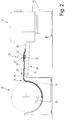
- the Fig. 2 shows an alternative embodiment with a single continuous conveyor 25 between the defect 10 and the folding machine 11. Sealing over an upper run 26 of this conveyor 25 is arranged over the entire width of the conveyor 25 transversely to the treatment direction 15 continuous light device 27.
- the upper strand 26 is led away below the lighting device 27, wherein corresponding baffles in the area of the lighting device 27 divert the laundry article 12 from the upper strand 26, in particular lift it off, so that the laundry article 12 is transported over the same in the region of the lighting device 27.
- the lighting device 27 is not covered by the upper strand 26, so that the lighting device 27 comes directly into contact with the underside, in particular finish side 19, of the item of laundry 12 and this can be illuminated from below and / or illuminated, so that spots, holes or the like or in the underside of the item of laundry 12 to the top of the same shine through and thus also from the at least one of the top of the item of laundry 12 associated camera 24 can be detected. If the upper strand 27 is passed over the lighting device 27, the upper run 26 of the conveyor 14 is either transparent or it is formed net or lattice-like and thereby almost completely transparent.
- a flat trained lighting device 27 may also be arranged between the runs of the conveyor 25, so that the top 22 of the lighting device 27 coming into contact with the underside, in particular finish side 19, of the respective item of laundry 12 (in front and behind the upper level) Lighting device 27) and thereby the lighting device 27 in contrast to the embodiment of Fig. 2 no increase above the upper strand 26 of the conveyor 25 forms.
- the lighting device 27 may be formed like the lighting device 20 described in more detail in the preceding embodiment. To avoid repetition, reference is made to the description of the lighting device 20.
- a transverse strip 21 of the item of laundry 12 with translucent lower adhesions and impurities and also upper impurities and adhesions as well as holes from the at least one camera 24 is received gradually by the at least one camera 24 or another imaging device as it passes by. In doing so, the camera 24 gradually scans the entire upper side 23 of the item of laundry over its entire surface and generates at least one image of it.
- Impurities, in particular stains, on the upper side 23 of the respective item of laundry 12 are detected directly by the camera 24.
- Impurities, in particular stains, on underside or finish side 19 of the respective item of laundry 12 facing or facing the upper run 18 of the conveyor 14 are also determined by the camera 24 from the upper side 23, by the underside, in particular finish side, of the at least one lighting device 20 19, the respective item of laundry is illuminated or illuminated.
- the item of laundry 12 is transilluminated by the finish side 19, whereby impurities, in particular stains, of the underside or finish side 19 of the respective item of laundry 12 pass through the item of laundry 12 and thereby also on the upper side 23 of the item of laundry 12 from the camera 24 can be determined, especially mappable, are.
- the at least one associated only one side of the garment 12 camera 24 or other imaging device not only holes or other damage, but also impurities both on the top 23 and on the underlying side, for example, the finish side 19, at the same time determine.
- the lighting means or light sources of the lighting device 20 are formed to generate enough light that stains or other contaminants on the underside or finish side 19 of the respective item of laundry 12 shine through it and become visible on top 23 for the at least one camera 24 or other imaging device.
- the shape of the contamination or adhesion is determined by the at least one camera 24 or another imaging device or sensors in the case of the laundry article 12 passing by it and evaluated with regard to its geometry.
- length and width dimensions of the contaminants are determined and a length-width ratio determined therefrom.
- the determined length-width ratio is compared with a predetermined length-width ratio. If this comparison shows that the impurity reaches or exceeds the specified length and width ratio, this is an indication of a particular impurity.
- hairs or fibers located on or on the respective item of laundry are determined with a relatively large length / width ratio. This large aspect ratio allows reliable conclusions on hair or fibers, if the evaluation shows that this large length-width ratio is reached or exceeded.
- the above-described determination of impurities with hair for example, based on the determination of the length and width ratio of the same can also be done on both sides of the garment 12.
- this is transilluminated and thereby made virtually transparent, so that even on the underside of the item 12 existing impurities and adhesions, such as hair, shine through the garment 12 and thereby visible on the top of the same become.
- contaminants and buildup on both sides of a respective item of laundry 12 can be detected and determined.
- the method is furthermore provided to expose at least one side of the item of laundry 12 to radiation when passing by the camera 24 and to expose the reflected radiation, for example, from the camera 24 or another sensor or sensor Detection means to capture.
- radiation for example, light rays, ultraviolet radiation and / or infrared radiation come into consideration as radiation.
- the intensity of the detected reflected radiation is an indication of the degree of whiteness of the item of laundry 12. Particularly high reflected radiation indicates a very white or bright item of laundry 12. By comparison with reference values or a reference value spectrum it can thus be ascertained how light or how white the item of laundry 12 is. If predetermined straightening or limiting values are exceeded, ie if the item of laundry is too light or too dark, influence on the washing process of subsequent items of laundry 12 takes place in that washing-active substances and / or bleaching agents are changed accordingly with regard to their dosage.
- the invention is also suitable for so-called dry laundry, which after washing without a previous mangling placed directly on the leading to the folding machine 11 inlet conveyor 17 and from there the folding machine 11 is supplied.
- the method described above then takes place in the region of the inlet conveyor 17 in front of the folding machine 11.
- the method according to the invention can also be carried out on hanging, in particular outstretched, laundry items 12. Then one side of the hanging piece of laundry 12 is associated with the at least one camera 24 and the opposite side of the lighting device 20. Impurities and / or adhesions, such as hair on the side of the lighting device 20, by illuminating the lighting device 20 then on the opposite side of the garment 12 associated with the camera 24 and then also on the side of the imaging device, such as the camera 24, visible.
- the image analysis filters out the structure of the fabric of the laundry items 12. This ensures that the fabric structure of the laundry items 12 does not affect the detection of impurities (stains) and / or adhesions (hair).
- the laundry item can be provided to simultaneously identify the laundry item from the at least one camera, sensors or the like, so that it is possible to determine which laundry item is involved. This enables a determination as to whether the same deterioration, for example, the same spot or the same hole, has been recognized on the same item of laundry several times. For example, if a same spot is detected multiple times, this indicates that this spot is not removable. Such a piece of laundry can then be sorted out and does not need to be washed repeatedly. It can also be determined how a particular spot changes during repeated washing or other treatment. If no change is detected, it indicates an impairment, such as a stain, which is not removable. If the deterioration, for example the stain, but decreases with repeated washing, can be tried at least once repeatedly washing to remove the stain more or less.
Landscapes
- Engineering & Computer Science (AREA)
- Life Sciences & Earth Sciences (AREA)
- Textile Engineering (AREA)
- Physics & Mathematics (AREA)
- Chemical & Material Sciences (AREA)
- Health & Medical Sciences (AREA)
- Biochemistry (AREA)
- Analytical Chemistry (AREA)
- General Health & Medical Sciences (AREA)
- General Physics & Mathematics (AREA)
- Immunology (AREA)
- Pathology (AREA)
- Spectroscopy & Molecular Physics (AREA)
- Wood Science & Technology (AREA)
- Food Science & Technology (AREA)
- Medicinal Chemistry (AREA)
- Treatment Of Fiber Materials (AREA)
- Investigating Materials By The Use Of Optical Means Adapted For Particular Applications (AREA)
- Detergent Compositions (AREA)
Priority Applications (2)
| Application Number | Priority Date | Filing Date | Title |
|---|---|---|---|
| EP19212233.1A EP3633354B1 (fr) | 2015-06-01 | 2016-05-04 | Procédé de vérification de linge lavé ou nettoyé |
| DK19212233.1T DK3633354T3 (da) | 2015-06-01 | 2016-05-04 | Fremgangsmåde til kontrol af vaskede eller rengjorte vasketøjsstykker |
Applications Claiming Priority (1)
| Application Number | Priority Date | Filing Date | Title |
|---|---|---|---|
| DE102015006765.6A DE102015006765A1 (de) | 2015-06-01 | 2015-06-01 | Verfahren zur Prüfung gewaschener oder gereinigter Wäschestücke |
Related Child Applications (2)
| Application Number | Title | Priority Date | Filing Date |
|---|---|---|---|
| EP19212233.1A Division EP3633354B1 (fr) | 2015-06-01 | 2016-05-04 | Procédé de vérification de linge lavé ou nettoyé |
| EP19212233.1A Division-Into EP3633354B1 (fr) | 2015-06-01 | 2016-05-04 | Procédé de vérification de linge lavé ou nettoyé |
Publications (3)
| Publication Number | Publication Date |
|---|---|
| EP3101167A2 true EP3101167A2 (fr) | 2016-12-07 |
| EP3101167A3 EP3101167A3 (fr) | 2017-01-04 |
| EP3101167B1 EP3101167B1 (fr) | 2020-01-29 |
Family
ID=55919567
Family Applications (2)
| Application Number | Title | Priority Date | Filing Date |
|---|---|---|---|
| EP16001008.8A Active EP3101167B1 (fr) | 2015-06-01 | 2016-05-04 | Procede de verification de linges laves ou nettoyes |
| EP19212233.1A Active EP3633354B1 (fr) | 2015-06-01 | 2016-05-04 | Procédé de vérification de linge lavé ou nettoyé |
Family Applications After (1)
| Application Number | Title | Priority Date | Filing Date |
|---|---|---|---|
| EP19212233.1A Active EP3633354B1 (fr) | 2015-06-01 | 2016-05-04 | Procédé de vérification de linge lavé ou nettoyé |
Country Status (7)
| Country | Link |
|---|---|
| US (1) | US20160349189A1 (fr) |
| EP (2) | EP3101167B1 (fr) |
| JP (1) | JP2016224051A (fr) |
| CN (1) | CN106198550A (fr) |
| DE (1) | DE102015006765A1 (fr) |
| DK (2) | DK3101167T3 (fr) |
| ES (1) | ES2784344T3 (fr) |
Cited By (2)
| Publication number | Priority date | Publication date | Assignee | Title |
|---|---|---|---|---|
| DE102016212976A1 (de) * | 2016-07-15 | 2018-01-18 | Henkel Ag & Co. Kgaa | Verfahren und Vorrichtung zur Ermittlung insbesondere einer Reinigungsstrategie |
| DE102017209857A1 (de) * | 2017-06-12 | 2018-12-13 | Henkel Ag & Co. Kgaa | Erkennung einer Verunreinigung und/oder einer Eigenschaft zumindest eines Teils einer Textilie |
Families Citing this family (8)
| Publication number | Priority date | Publication date | Assignee | Title |
|---|---|---|---|---|
| IT201700020724A1 (it) * | 2017-02-23 | 2018-08-23 | Adapta Spa | Sistema modulabile per l’identificazione e certificazione di capi. |
| KR102620642B1 (ko) * | 2017-06-12 | 2024-01-03 | 헨켈 아게 운트 코. 카게아아 | 불순물 조성 및 직물 특성을 이용하여 직물의 처리 매개변수를 확인하기 위한 방법 및 디바이스 |
| DE102017209862A1 (de) | 2017-06-12 | 2018-12-13 | Henkel Ag & Co. Kgaa | Bestimmen von Verunreinigungen |
| WO2020002360A1 (fr) * | 2018-06-27 | 2020-01-02 | Unilever Plc | Procédé d'évaluation pour du linge |
| DE102018222655A1 (de) * | 2018-12-20 | 2020-07-09 | Volkswagen Aktiengesellschaft | Verfahren und Vorrichtung zum Feststellen einer Verschmutzung einer Oberfläche, Reinigungsvorrichtung, Materialanordnung, Fahrzeugsitz und Fahrzeuginnenverkleidung |
| US10513674B1 (en) * | 2019-04-18 | 2019-12-24 | Caastle, Inc. | Systems and methods for spotting treatment, inspection, and tracking of articles |
| CN116930200A (zh) * | 2023-06-05 | 2023-10-24 | 宝洁公司 | 检测织物中的隐形污渍的方法 |
| DE102023118154A1 (de) * | 2023-07-10 | 2025-01-16 | Miele & Cie. Kg | Verfahren und Steuereinheit zum Betreiben eines Reinigungsgerätes |
Family Cites Families (25)
| Publication number | Priority date | Publication date | Assignee | Title |
|---|---|---|---|---|
| US3729635A (en) * | 1970-10-14 | 1973-04-24 | Lindly & Co | Yarn inspector |
| US3729619A (en) * | 1971-03-04 | 1973-04-24 | Steel Corp | Apparatus for surface inspection of moving material with defect type recognition |
| US3835332A (en) * | 1973-06-04 | 1974-09-10 | Eastman Kodak Co | Inspection apparatus for detecting defects in a web |
| US3841761A (en) * | 1973-10-24 | 1974-10-15 | Neotec Corp | Method and apparatus for detecting faults in fabric |
| US4110048A (en) * | 1974-11-05 | 1978-08-29 | Kawasaki Steel Corporation | Method of and an apparatus for inspecting a traveling sheet material |
| US4036365A (en) * | 1975-04-18 | 1977-07-19 | Burlington Industries, Inc. | Linen sorter with a conveyor mounting individual linen pickers |
| US4124300A (en) * | 1976-02-23 | 1978-11-07 | Greenwood Mills, Inc. | Method for automatic fabric inspection |
| US4249081A (en) * | 1979-11-01 | 1981-02-03 | Sparton Corporation | Defect detection system |
| DE3043849A1 (de) * | 1980-11-21 | 1982-07-08 | Koninklijke Textielfabrieken Nijverdal-Ten Gate N.V., Almelo | Verfahren zum beschauen einer reflektierenden und/oder transparenten, sich bewegenden bahn und beschaumaschine zur durchfuehrung des verfahrens |
| DE3242447C2 (de) * | 1982-11-16 | 1986-01-23 | Sophokles 8062 Markt Indersdorf Papaioannou | Photoelektrische Kontrollvorrichtung zur Qualitätskontrolle einer bewegten Materialbahn |
| US4873878A (en) * | 1987-12-29 | 1989-10-17 | Cintas Corporation | Apparatus for inspecting and hangering pants |
| US5046844A (en) * | 1988-06-10 | 1991-09-10 | Cintas Corporation | Apparatus for inspecting and hangering shirts |
| US4952062A (en) * | 1988-08-05 | 1990-08-28 | Bean Iii Vern W | Method and apparatus for detecting flaws in fabric |
| US5130559A (en) * | 1989-08-26 | 1992-07-14 | Trutzschler Gmbh & Co. Kg | Method and apparatus for recognizing particle impurities in textile fiber |
| GB9008632D0 (en) * | 1990-04-17 | 1990-06-13 | Leicester Polytechnic | Inspecting garments |
| JPH07174714A (ja) | 1993-12-20 | 1995-07-14 | Mitsubishi Heavy Ind Ltd | 布片欠陥検出装置 |
| AU8117894A (en) * | 1994-09-19 | 1996-04-09 | Robert Ernest Van Ditmar | Method and installation for detecting colour differences in a web of material |
| JP3615799B2 (ja) * | 1994-10-28 | 2005-02-02 | 三菱重工業株式会社 | 布片欠陥検出装置 |
| DE19624905A1 (de) * | 1996-06-21 | 1998-01-08 | L & P Elektroautomatisations G | Vorrichtung für die Qualitätskontrolle einer laufenden Warenbahn |
| DE20105840U1 (de) | 2001-04-03 | 2002-08-08 | Tichawa, Krisztina, Dipl.-Inf., 86316 Friedberg | Vorrichtung zur Erkennung von Verunreinigungen in bewegtem Material |
| CA2592306C (fr) * | 2004-12-23 | 2010-06-01 | G&K Services, Inc. | Traitement de vetements sous procedures de decontamination et d'inspection biologique |
| FR2916048B1 (fr) * | 2007-05-09 | 2010-05-28 | Tiama | Procede et dispositif d'inspection d'articles transparents ou translucides en vue d'optimiser le fonctionnement d'une machine de controle |
| JP2010048745A (ja) * | 2008-08-25 | 2010-03-04 | Asahi Glass Co Ltd | 欠陥検査システムおよび欠陥検査方法 |
| JP5881278B2 (ja) * | 2010-05-20 | 2016-03-09 | 株式会社プレックス | 布片検査装置および検査方法 |
| US8922641B2 (en) * | 2011-06-29 | 2014-12-30 | The Procter & Gamble Company | System and method for inspecting components of hygienic articles |
-
2015
- 2015-06-01 DE DE102015006765.6A patent/DE102015006765A1/de not_active Withdrawn
-
2016
- 2016-05-04 ES ES16001008T patent/ES2784344T3/es active Active
- 2016-05-04 EP EP16001008.8A patent/EP3101167B1/fr active Active
- 2016-05-04 DK DK16001008.8T patent/DK3101167T3/da active
- 2016-05-04 EP EP19212233.1A patent/EP3633354B1/fr active Active
- 2016-05-04 DK DK19212233.1T patent/DK3633354T3/da active
- 2016-05-19 US US15/158,934 patent/US20160349189A1/en not_active Abandoned
- 2016-05-30 JP JP2016107255A patent/JP2016224051A/ja active Pending
- 2016-06-01 CN CN201610570813.3A patent/CN106198550A/zh active Pending
Non-Patent Citations (1)
| Title |
|---|
| None |
Cited By (3)
| Publication number | Priority date | Publication date | Assignee | Title |
|---|---|---|---|---|
| DE102016212976A1 (de) * | 2016-07-15 | 2018-01-18 | Henkel Ag & Co. Kgaa | Verfahren und Vorrichtung zur Ermittlung insbesondere einer Reinigungsstrategie |
| DE102017209857A1 (de) * | 2017-06-12 | 2018-12-13 | Henkel Ag & Co. Kgaa | Erkennung einer Verunreinigung und/oder einer Eigenschaft zumindest eines Teils einer Textilie |
| US11773523B2 (en) | 2017-06-12 | 2023-10-03 | Henkel Ag & Co. Kgaa | Detecting an impurity and/or a property of at least one part of a textile |
Also Published As
| Publication number | Publication date |
|---|---|
| DE102015006765A1 (de) | 2016-12-01 |
| EP3633354B1 (fr) | 2023-03-15 |
| ES2784344T3 (es) | 2020-09-24 |
| EP3101167B1 (fr) | 2020-01-29 |
| EP3101167A3 (fr) | 2017-01-04 |
| EP3633354A1 (fr) | 2020-04-08 |
| JP2016224051A (ja) | 2016-12-28 |
| CN106198550A (zh) | 2016-12-07 |
| DK3101167T3 (da) | 2020-04-20 |
| US20160349189A1 (en) | 2016-12-01 |
| DK3633354T3 (da) | 2023-06-06 |
Similar Documents
| Publication | Publication Date | Title |
|---|---|---|
| EP3633354B1 (fr) | Procédé de vérification de linge lavé ou nettoyé | |
| DE19904732B4 (de) | Behälterprüfmaschine | |
| EP2390656B1 (fr) | Dispositif et procédé de vérification optique | |
| EP3679356B1 (fr) | Dispositif d'inspection comprenant un éclairage de couleur | |
| DE69731651T2 (de) | Sortiervorrichtung | |
| DE10017126C1 (de) | Verfahren und Vorrichtung zum optischen Überprüfen transparenter Behälter | |
| DE68926830T2 (de) | Verfahren und Vorrichtung zur Prüfung der Seitenwand einer Flasche | |
| DE102008028120B4 (de) | Verfahren und Vorrichtung zum Sortieren von Textilien | |
| EP3463696B1 (fr) | Dispositif et procédé d'inspection du matériau en vrac | |
| DE102012208201A1 (de) | Verfahren zur Erfassung von Verschmutzung einer Papiermaschinenbespannung | |
| DE102010037676B4 (de) | Verfahren zur Verfolgung der Farbhomogenität der Garnoberfläche und Vorrichtung zu dessen Durchführung | |
| WO2020244817A1 (fr) | Procédé et dispositif d'inspection optique de contenants | |
| EP1410002B1 (fr) | Procede pour identifier des corps etrangers dans un materiau textile | |
| DE4340165A1 (de) | Verfahren zum schnellen Erkennen und Ausschleusen von andersfarbigen Fremdteilen in Faserverarbeitungslinien | |
| DE4216469A1 (de) | Einrichtung zum Klassifizieren von Fehlern in Häuten | |
| DE19946520B4 (de) | Vorrichtung und Verfahren zur Oberflächeninspektion eines kontinuierlich zulaufenden Bandmaterials | |
| DE4128346C2 (de) | Maschine mit einer Prüfvorrichtung zur Qualitätskontrolle von Maschenware, insbesondere von Feinstrick- und Strickstrumpfhosen, -kniestrümpfen, -socken sowie Verfahren zur Sichtkontrolle von Maschenware | |
| DE69819034T2 (de) | Laufende faserbandüberwachung | |
| EP2656326A1 (fr) | Test d'encrassement de la fenêtre d'un dispositif de mesure destiné à analyser une feuille | |
| EP4356116A1 (fr) | Procédé et appareil pour inspection de contenants pleins | |
| EP4033225A1 (fr) | Procede d'inspection optique de defauts dans des articles en ceramique | |
| EP3371351B1 (fr) | Dispositif de détection d'impurtés utilisé lors du traitement préliminaire des fibres | |
| DE10121594A1 (de) | Verfahren und Vorrichtung zur Ermittlung von Beschädigungen, insbesondere textiler Flächengebilde | |
| CH617769A5 (en) | Method and device for identifying bodies containing or carrying a luminous material | |
| DE202025107414U1 (de) | Vorrichtung zur rechnergestützten Analyse von Füllmaterialien |
Legal Events
| Date | Code | Title | Description |
|---|---|---|---|
| PUAI | Public reference made under article 153(3) epc to a published international application that has entered the european phase |
Free format text: ORIGINAL CODE: 0009012 |
|
| STAA | Information on the status of an ep patent application or granted ep patent |
Free format text: STATUS: THE APPLICATION HAS BEEN PUBLISHED |
|
| PUAL | Search report despatched |
Free format text: ORIGINAL CODE: 0009013 |
|
| AK | Designated contracting states |
Kind code of ref document: A2 Designated state(s): AL AT BE BG CH CY CZ DE DK EE ES FI FR GB GR HR HU IE IS IT LI LT LU LV MC MK MT NL NO PL PT RO RS SE SI SK SM TR |
|
| AX | Request for extension of the european patent |
Extension state: BA ME |
|
| AK | Designated contracting states |
Kind code of ref document: A3 Designated state(s): AL AT BE BG CH CY CZ DE DK EE ES FI FR GB GR HR HU IE IS IT LI LT LU LV MC MK MT NL NO PL PT RO RS SE SI SK SM TR |
|
| AX | Request for extension of the european patent |
Extension state: BA ME |
|
| RIC1 | Information provided on ipc code assigned before grant |
Ipc: D06F 39/00 20060101AFI20161129BHEP Ipc: D06F 95/00 20060101ALN20161129BHEP |
|
| STAA | Information on the status of an ep patent application or granted ep patent |
Free format text: STATUS: REQUEST FOR EXAMINATION WAS MADE |
|
| 17P | Request for examination filed |
Effective date: 20170622 |
|
| RBV | Designated contracting states (corrected) |
Designated state(s): AL AT BE BG CH CY CZ DE DK EE ES FI FR GB GR HR HU IE IS IT LI LT LU LV MC MK MT NL NO PL PT RO RS SE SI SK SM TR |
|
| STAA | Information on the status of an ep patent application or granted ep patent |
Free format text: STATUS: EXAMINATION IS IN PROGRESS |
|
| 17Q | First examination report despatched |
Effective date: 20181213 |
|
| RIC1 | Information provided on ipc code assigned before grant |
Ipc: G01N 21/94 20060101ALI20190716BHEP Ipc: D06F 39/00 20060101AFI20190716BHEP Ipc: G01N 21/898 20060101ALI20190716BHEP Ipc: D06F 95/00 20060101ALN20190716BHEP |
|
| GRAP | Despatch of communication of intention to grant a patent |
Free format text: ORIGINAL CODE: EPIDOSNIGR1 |
|
| STAA | Information on the status of an ep patent application or granted ep patent |
Free format text: STATUS: GRANT OF PATENT IS INTENDED |
|
| INTG | Intention to grant announced |
Effective date: 20190829 |
|
| GRAS | Grant fee paid |
Free format text: ORIGINAL CODE: EPIDOSNIGR3 |
|
| GRAA | (expected) grant |
Free format text: ORIGINAL CODE: 0009210 |
|
| STAA | Information on the status of an ep patent application or granted ep patent |
Free format text: STATUS: THE PATENT HAS BEEN GRANTED |
|
| AK | Designated contracting states |
Kind code of ref document: B1 Designated state(s): AL AT BE BG CH CY CZ DE DK EE ES FI FR GB GR HR HU IE IS IT LI LT LU LV MC MK MT NL NO PL PT RO RS SE SI SK SM TR |
|
| REG | Reference to a national code |
Ref country code: GB Ref legal event code: FG4D Free format text: NOT ENGLISH |
|
| REG | Reference to a national code |
Ref country code: CH Ref legal event code: EP |
|
| REG | Reference to a national code |
Ref country code: AT Ref legal event code: REF Ref document number: 1228559 Country of ref document: AT Kind code of ref document: T Effective date: 20200215 |
|
| REG | Reference to a national code |
Ref country code: IE Ref legal event code: FG4D Free format text: LANGUAGE OF EP DOCUMENT: GERMAN |
|
| REG | Reference to a national code |
Ref country code: DE Ref legal event code: R096 Ref document number: 502016008490 Country of ref document: DE |
|
| REG | Reference to a national code |
Ref country code: DK Ref legal event code: T3 Effective date: 20200417 |
|
| REG | Reference to a national code |
Ref country code: NL Ref legal event code: FP |
|
| PG25 | Lapsed in a contracting state [announced via postgrant information from national office to epo] |
Ref country code: RS Free format text: LAPSE BECAUSE OF FAILURE TO SUBMIT A TRANSLATION OF THE DESCRIPTION OR TO PAY THE FEE WITHIN THE PRESCRIBED TIME-LIMIT Effective date: 20200129 Ref country code: PT Free format text: LAPSE BECAUSE OF FAILURE TO SUBMIT A TRANSLATION OF THE DESCRIPTION OR TO PAY THE FEE WITHIN THE PRESCRIBED TIME-LIMIT Effective date: 20200621 Ref country code: NO Free format text: LAPSE BECAUSE OF FAILURE TO SUBMIT A TRANSLATION OF THE DESCRIPTION OR TO PAY THE FEE WITHIN THE PRESCRIBED TIME-LIMIT Effective date: 20200429 Ref country code: FI Free format text: LAPSE BECAUSE OF FAILURE TO SUBMIT A TRANSLATION OF THE DESCRIPTION OR TO PAY THE FEE WITHIN THE PRESCRIBED TIME-LIMIT Effective date: 20200129 |
|
| REG | Reference to a national code |
Ref country code: LT Ref legal event code: MG4D |
|
| PG25 | Lapsed in a contracting state [announced via postgrant information from national office to epo] |
Ref country code: GR Free format text: LAPSE BECAUSE OF FAILURE TO SUBMIT A TRANSLATION OF THE DESCRIPTION OR TO PAY THE FEE WITHIN THE PRESCRIBED TIME-LIMIT Effective date: 20200430 Ref country code: HR Free format text: LAPSE BECAUSE OF FAILURE TO SUBMIT A TRANSLATION OF THE DESCRIPTION OR TO PAY THE FEE WITHIN THE PRESCRIBED TIME-LIMIT Effective date: 20200129 Ref country code: LV Free format text: LAPSE BECAUSE OF FAILURE TO SUBMIT A TRANSLATION OF THE DESCRIPTION OR TO PAY THE FEE WITHIN THE PRESCRIBED TIME-LIMIT Effective date: 20200129 Ref country code: SE Free format text: LAPSE BECAUSE OF FAILURE TO SUBMIT A TRANSLATION OF THE DESCRIPTION OR TO PAY THE FEE WITHIN THE PRESCRIBED TIME-LIMIT Effective date: 20200129 Ref country code: IS Free format text: LAPSE BECAUSE OF FAILURE TO SUBMIT A TRANSLATION OF THE DESCRIPTION OR TO PAY THE FEE WITHIN THE PRESCRIBED TIME-LIMIT Effective date: 20200529 Ref country code: BG Free format text: LAPSE BECAUSE OF FAILURE TO SUBMIT A TRANSLATION OF THE DESCRIPTION OR TO PAY THE FEE WITHIN THE PRESCRIBED TIME-LIMIT Effective date: 20200429 |
|
| REG | Reference to a national code |
Ref country code: ES Ref legal event code: FG2A Ref document number: 2784344 Country of ref document: ES Kind code of ref document: T3 Effective date: 20200924 |
|
| PG25 | Lapsed in a contracting state [announced via postgrant information from national office to epo] |
Ref country code: SM Free format text: LAPSE BECAUSE OF FAILURE TO SUBMIT A TRANSLATION OF THE DESCRIPTION OR TO PAY THE FEE WITHIN THE PRESCRIBED TIME-LIMIT Effective date: 20200129 Ref country code: EE Free format text: LAPSE BECAUSE OF FAILURE TO SUBMIT A TRANSLATION OF THE DESCRIPTION OR TO PAY THE FEE WITHIN THE PRESCRIBED TIME-LIMIT Effective date: 20200129 Ref country code: RO Free format text: LAPSE BECAUSE OF FAILURE TO SUBMIT A TRANSLATION OF THE DESCRIPTION OR TO PAY THE FEE WITHIN THE PRESCRIBED TIME-LIMIT Effective date: 20200129 Ref country code: SK Free format text: LAPSE BECAUSE OF FAILURE TO SUBMIT A TRANSLATION OF THE DESCRIPTION OR TO PAY THE FEE WITHIN THE PRESCRIBED TIME-LIMIT Effective date: 20200129 Ref country code: CZ Free format text: LAPSE BECAUSE OF FAILURE TO SUBMIT A TRANSLATION OF THE DESCRIPTION OR TO PAY THE FEE WITHIN THE PRESCRIBED TIME-LIMIT Effective date: 20200129 Ref country code: LT Free format text: LAPSE BECAUSE OF FAILURE TO SUBMIT A TRANSLATION OF THE DESCRIPTION OR TO PAY THE FEE WITHIN THE PRESCRIBED TIME-LIMIT Effective date: 20200129 |
|
| REG | Reference to a national code |
Ref country code: DE Ref legal event code: R097 Ref document number: 502016008490 Country of ref document: DE |
|
| PLBE | No opposition filed within time limit |
Free format text: ORIGINAL CODE: 0009261 |
|
| STAA | Information on the status of an ep patent application or granted ep patent |
Free format text: STATUS: NO OPPOSITION FILED WITHIN TIME LIMIT |
|
| 26N | No opposition filed |
Effective date: 20201030 |
|
| PG25 | Lapsed in a contracting state [announced via postgrant information from national office to epo] |
Ref country code: MC Free format text: LAPSE BECAUSE OF FAILURE TO SUBMIT A TRANSLATION OF THE DESCRIPTION OR TO PAY THE FEE WITHIN THE PRESCRIBED TIME-LIMIT Effective date: 20200129 Ref country code: LI Free format text: LAPSE BECAUSE OF NON-PAYMENT OF DUE FEES Effective date: 20200531 Ref country code: CH Free format text: LAPSE BECAUSE OF NON-PAYMENT OF DUE FEES Effective date: 20200531 |
|
| PG25 | Lapsed in a contracting state [announced via postgrant information from national office to epo] |
Ref country code: SI Free format text: LAPSE BECAUSE OF FAILURE TO SUBMIT A TRANSLATION OF THE DESCRIPTION OR TO PAY THE FEE WITHIN THE PRESCRIBED TIME-LIMIT Effective date: 20200129 Ref country code: PL Free format text: LAPSE BECAUSE OF FAILURE TO SUBMIT A TRANSLATION OF THE DESCRIPTION OR TO PAY THE FEE WITHIN THE PRESCRIBED TIME-LIMIT Effective date: 20200129 |
|
| PG25 | Lapsed in a contracting state [announced via postgrant information from national office to epo] |
Ref country code: LU Free format text: LAPSE BECAUSE OF NON-PAYMENT OF DUE FEES Effective date: 20200504 |
|
| PG25 | Lapsed in a contracting state [announced via postgrant information from national office to epo] |
Ref country code: IE Free format text: LAPSE BECAUSE OF NON-PAYMENT OF DUE FEES Effective date: 20200504 |
|
| PG25 | Lapsed in a contracting state [announced via postgrant information from national office to epo] |
Ref country code: TR Free format text: LAPSE BECAUSE OF FAILURE TO SUBMIT A TRANSLATION OF THE DESCRIPTION OR TO PAY THE FEE WITHIN THE PRESCRIBED TIME-LIMIT Effective date: 20200129 Ref country code: MT Free format text: LAPSE BECAUSE OF FAILURE TO SUBMIT A TRANSLATION OF THE DESCRIPTION OR TO PAY THE FEE WITHIN THE PRESCRIBED TIME-LIMIT Effective date: 20200129 Ref country code: CY Free format text: LAPSE BECAUSE OF FAILURE TO SUBMIT A TRANSLATION OF THE DESCRIPTION OR TO PAY THE FEE WITHIN THE PRESCRIBED TIME-LIMIT Effective date: 20200129 |
|
| PG25 | Lapsed in a contracting state [announced via postgrant information from national office to epo] |
Ref country code: MK Free format text: LAPSE BECAUSE OF FAILURE TO SUBMIT A TRANSLATION OF THE DESCRIPTION OR TO PAY THE FEE WITHIN THE PRESCRIBED TIME-LIMIT Effective date: 20200129 Ref country code: AL Free format text: LAPSE BECAUSE OF FAILURE TO SUBMIT A TRANSLATION OF THE DESCRIPTION OR TO PAY THE FEE WITHIN THE PRESCRIBED TIME-LIMIT Effective date: 20200129 |
|
| REG | Reference to a national code |
Ref country code: AT Ref legal event code: MM01 Ref document number: 1228559 Country of ref document: AT Kind code of ref document: T Effective date: 20210504 |
|
| PG25 | Lapsed in a contracting state [announced via postgrant information from national office to epo] |
Ref country code: AT Free format text: LAPSE BECAUSE OF NON-PAYMENT OF DUE FEES Effective date: 20210504 |
|
| P01 | Opt-out of the competence of the unified patent court (upc) registered |
Effective date: 20230529 |
|
| PGFP | Annual fee paid to national office [announced via postgrant information from national office to epo] |
Ref country code: NL Payment date: 20250522 Year of fee payment: 10 |
|
| PGFP | Annual fee paid to national office [announced via postgrant information from national office to epo] |
Ref country code: DE Payment date: 20250526 Year of fee payment: 10 |
|
| PGFP | Annual fee paid to national office [announced via postgrant information from national office to epo] |
Ref country code: ES Payment date: 20250616 Year of fee payment: 10 Ref country code: GB Payment date: 20250522 Year of fee payment: 10 Ref country code: DK Payment date: 20250521 Year of fee payment: 10 |
|
| PGFP | Annual fee paid to national office [announced via postgrant information from national office to epo] |
Ref country code: BE Payment date: 20250520 Year of fee payment: 10 Ref country code: IT Payment date: 20250530 Year of fee payment: 10 |
|
| PGFP | Annual fee paid to national office [announced via postgrant information from national office to epo] |
Ref country code: FR Payment date: 20250526 Year of fee payment: 10 |