EP3103630A1 - Koinjizierter sportschuh - Google Patents
Koinjizierter sportschuh Download PDFInfo
- Publication number
- EP3103630A1 EP3103630A1 EP15425042.7A EP15425042A EP3103630A1 EP 3103630 A1 EP3103630 A1 EP 3103630A1 EP 15425042 A EP15425042 A EP 15425042A EP 3103630 A1 EP3103630 A1 EP 3103630A1
- Authority
- EP
- European Patent Office
- Prior art keywords
- injection
- sports shoe
- zone
- element according
- materials
- Prior art date
- Legal status (The legal status is an assumption and is not a legal conclusion. Google has not performed a legal analysis and makes no representation as to the accuracy of the status listed.)
- Granted
Links
Images


Classifications
-
- A—HUMAN NECESSITIES
- A43—FOOTWEAR
- A43B—CHARACTERISTIC FEATURES OF FOOTWEAR; PARTS OF FOOTWEAR
- A43B5/00—Footwear for sporting purposes
- A43B5/04—Ski or like boots
- A43B5/0427—Ski or like boots characterised by type or construction details
- A43B5/0482—Ski or like boots characterised by type or construction details made from materials with different rigidities
-
- A—HUMAN NECESSITIES
- A43—FOOTWEAR
- A43B—CHARACTERISTIC FEATURES OF FOOTWEAR; PARTS OF FOOTWEAR
- A43B1/00—Footwear characterised by the material
- A43B1/0072—Footwear characterised by the material made at least partially of transparent or translucent materials
-
- A—HUMAN NECESSITIES
- A43—FOOTWEAR
- A43B—CHARACTERISTIC FEATURES OF FOOTWEAR; PARTS OF FOOTWEAR
- A43B5/00—Footwear for sporting purposes
- A43B5/04—Ski or like boots
- A43B5/0411—Ski or like boots for cross-country
-
- A—HUMAN NECESSITIES
- A43—FOOTWEAR
- A43B—CHARACTERISTIC FEATURES OF FOOTWEAR; PARTS OF FOOTWEAR
- A43B5/00—Footwear for sporting purposes
- A43B5/04—Ski or like boots
- A43B5/0486—Ski or like boots characterized by the material
-
- A—HUMAN NECESSITIES
- A43—FOOTWEAR
- A43B—CHARACTERISTIC FEATURES OF FOOTWEAR; PARTS OF FOOTWEAR
- A43B5/00—Footwear for sporting purposes
- A43B5/04—Ski or like boots
- A43B5/0496—Ski or like boots boots for touring or hiking skis
-
- B—PERFORMING OPERATIONS; TRANSPORTING
- B29—WORKING OF PLASTICS; WORKING OF SUBSTANCES IN A PLASTIC STATE IN GENERAL
- B29C—SHAPING OR JOINING OF PLASTICS; SHAPING OF MATERIAL IN A PLASTIC STATE, NOT OTHERWISE PROVIDED FOR; AFTER-TREATMENT OF THE SHAPED PRODUCTS, e.g. REPAIRING
- B29C45/00—Injection moulding, i.e. forcing the required volume of moulding material through a nozzle into a closed mould; Apparatus therefor
- B29C45/16—Making multilayered or multicoloured articles
- B29C45/1642—Making multilayered or multicoloured articles having a "sandwich" structure
-
- B—PERFORMING OPERATIONS; TRANSPORTING
- B29—WORKING OF PLASTICS; WORKING OF SUBSTANCES IN A PLASTIC STATE IN GENERAL
- B29C—SHAPING OR JOINING OF PLASTICS; SHAPING OF MATERIAL IN A PLASTIC STATE, NOT OTHERWISE PROVIDED FOR; AFTER-TREATMENT OF THE SHAPED PRODUCTS, e.g. REPAIRING
- B29C45/00—Injection moulding, i.e. forcing the required volume of moulding material through a nozzle into a closed mould; Apparatus therefor
- B29C45/16—Making multilayered or multicoloured articles
- B29C45/1676—Making multilayered or multicoloured articles using a soft material and a rigid material, e.g. making articles with a sealing part
-
- B—PERFORMING OPERATIONS; TRANSPORTING
- B29—WORKING OF PLASTICS; WORKING OF SUBSTANCES IN A PLASTIC STATE IN GENERAL
- B29C—SHAPING OR JOINING OF PLASTICS; SHAPING OF MATERIAL IN A PLASTIC STATE, NOT OTHERWISE PROVIDED FOR; AFTER-TREATMENT OF THE SHAPED PRODUCTS, e.g. REPAIRING
- B29C45/00—Injection moulding, i.e. forcing the required volume of moulding material through a nozzle into a closed mould; Apparatus therefor
- B29C45/17—Component parts, details or accessories; Auxiliary operations
- B29C45/20—Injection nozzles
- B29C45/22—Multiple nozzle systems
-
- B—PERFORMING OPERATIONS; TRANSPORTING
- B29—WORKING OF PLASTICS; WORKING OF SUBSTANCES IN A PLASTIC STATE IN GENERAL
- B29D—PRODUCING PARTICULAR ARTICLES FROM PLASTICS OR FROM SUBSTANCES IN A PLASTIC STATE
- B29D35/00—Producing footwear
- B29D35/0009—Producing footwear by injection moulding; Apparatus therefor
- B29D35/0018—Moulds
-
- B—PERFORMING OPERATIONS; TRANSPORTING
- B29—WORKING OF PLASTICS; WORKING OF SUBSTANCES IN A PLASTIC STATE IN GENERAL
- B29D—PRODUCING PARTICULAR ARTICLES FROM PLASTICS OR FROM SUBSTANCES IN A PLASTIC STATE
- B29D35/00—Producing footwear
- B29D35/02—Producing footwear made in one piece using a moulding technique, e.g. by injection moulding or casting
- B29D35/04—Producing footwear made in one piece using a moulding technique, e.g. by injection moulding or casting having multilayered parts
-
- B—PERFORMING OPERATIONS; TRANSPORTING
- B29—WORKING OF PLASTICS; WORKING OF SUBSTANCES IN A PLASTIC STATE IN GENERAL
- B29D—PRODUCING PARTICULAR ARTICLES FROM PLASTICS OR FROM SUBSTANCES IN A PLASTIC STATE
- B29D35/00—Producing footwear
- B29D35/12—Producing parts thereof, e.g. soles, heels, uppers, by a moulding technique
- B29D35/14—Multilayered parts
- B29D35/142—Soles
-
- B—PERFORMING OPERATIONS; TRANSPORTING
- B29—WORKING OF PLASTICS; WORKING OF SUBSTANCES IN A PLASTIC STATE IN GENERAL
- B29D—PRODUCING PARTICULAR ARTICLES FROM PLASTICS OR FROM SUBSTANCES IN A PLASTIC STATE
- B29D35/00—Producing footwear
- B29D35/12—Producing parts thereof, e.g. soles, heels, uppers, by a moulding technique
- B29D35/14—Multilayered parts
- B29D35/146—Uppers
-
- B—PERFORMING OPERATIONS; TRANSPORTING
- B29—WORKING OF PLASTICS; WORKING OF SUBSTANCES IN A PLASTIC STATE IN GENERAL
- B29D—PRODUCING PARTICULAR ARTICLES FROM PLASTICS OR FROM SUBSTANCES IN A PLASTIC STATE
- B29D35/00—Producing footwear
- B29D35/12—Producing parts thereof, e.g. soles, heels, uppers, by a moulding technique
- B29D35/14—Multilayered parts
- B29D35/148—Moulds or apparatus therefor
-
- B—PERFORMING OPERATIONS; TRANSPORTING
- B29—WORKING OF PLASTICS; WORKING OF SUBSTANCES IN A PLASTIC STATE IN GENERAL
- B29C—SHAPING OR JOINING OF PLASTICS; SHAPING OF MATERIAL IN A PLASTIC STATE, NOT OTHERWISE PROVIDED FOR; AFTER-TREATMENT OF THE SHAPED PRODUCTS, e.g. REPAIRING
- B29C45/00—Injection moulding, i.e. forcing the required volume of moulding material through a nozzle into a closed mould; Apparatus therefor
- B29C45/16—Making multilayered or multicoloured articles
- B29C2045/167—Making multilayered or multicoloured articles injecting the second layer through the first layer
-
- B—PERFORMING OPERATIONS; TRANSPORTING
- B29—WORKING OF PLASTICS; WORKING OF SUBSTANCES IN A PLASTIC STATE IN GENERAL
- B29C—SHAPING OR JOINING OF PLASTICS; SHAPING OF MATERIAL IN A PLASTIC STATE, NOT OTHERWISE PROVIDED FOR; AFTER-TREATMENT OF THE SHAPED PRODUCTS, e.g. REPAIRING
- B29C45/00—Injection moulding, i.e. forcing the required volume of moulding material through a nozzle into a closed mould; Apparatus therefor
- B29C45/16—Making multilayered or multicoloured articles
- B29C2045/1692—Making multilayered or multicoloured articles one layer comprising fibres
-
- B—PERFORMING OPERATIONS; TRANSPORTING
- B29—WORKING OF PLASTICS; WORKING OF SUBSTANCES IN A PLASTIC STATE IN GENERAL
- B29C—SHAPING OR JOINING OF PLASTICS; SHAPING OF MATERIAL IN A PLASTIC STATE, NOT OTHERWISE PROVIDED FOR; AFTER-TREATMENT OF THE SHAPED PRODUCTS, e.g. REPAIRING
- B29C45/00—Injection moulding, i.e. forcing the required volume of moulding material through a nozzle into a closed mould; Apparatus therefor
- B29C45/17—Component parts, details or accessories; Auxiliary operations
- B29C45/26—Moulds
- B29C45/27—Sprue channels ; Runner channels or runner nozzles
- B29C45/2701—Details not specific to hot or cold runner channels
- B29C45/2708—Gates
-
- B—PERFORMING OPERATIONS; TRANSPORTING
- B29—WORKING OF PLASTICS; WORKING OF SUBSTANCES IN A PLASTIC STATE IN GENERAL
- B29K—INDEXING SCHEME ASSOCIATED WITH SUBCLASSES B29B, B29C OR B29D, RELATING TO MOULDING MATERIALS OR TO MATERIALS FOR MOULDS, REINFORCEMENTS, FILLERS OR PREFORMED PARTS, e.g. INSERTS
- B29K2105/00—Condition, form or state of moulded material or of the material to be shaped
- B29K2105/0058—Liquid or visquous
-
- B—PERFORMING OPERATIONS; TRANSPORTING
- B29—WORKING OF PLASTICS; WORKING OF SUBSTANCES IN A PLASTIC STATE IN GENERAL
- B29K—INDEXING SCHEME ASSOCIATED WITH SUBCLASSES B29B, B29C OR B29D, RELATING TO MOULDING MATERIALS OR TO MATERIALS FOR MOULDS, REINFORCEMENTS, FILLERS OR PREFORMED PARTS, e.g. INSERTS
- B29K2105/00—Condition, form or state of moulded material or of the material to be shaped
- B29K2105/06—Condition, form or state of moulded material or of the material to be shaped containing reinforcements, fillers or inserts
-
- B—PERFORMING OPERATIONS; TRANSPORTING
- B29—WORKING OF PLASTICS; WORKING OF SUBSTANCES IN A PLASTIC STATE IN GENERAL
- B29K—INDEXING SCHEME ASSOCIATED WITH SUBCLASSES B29B, B29C OR B29D, RELATING TO MOULDING MATERIALS OR TO MATERIALS FOR MOULDS, REINFORCEMENTS, FILLERS OR PREFORMED PARTS, e.g. INSERTS
- B29K2307/00—Use of elements other than metals as reinforcement
- B29K2307/04—Carbon
-
- B—PERFORMING OPERATIONS; TRANSPORTING
- B29—WORKING OF PLASTICS; WORKING OF SUBSTANCES IN A PLASTIC STATE IN GENERAL
- B29K—INDEXING SCHEME ASSOCIATED WITH SUBCLASSES B29B, B29C OR B29D, RELATING TO MOULDING MATERIALS OR TO MATERIALS FOR MOULDS, REINFORCEMENTS, FILLERS OR PREFORMED PARTS, e.g. INSERTS
- B29K2309/00—Use of inorganic materials not provided for in groups B29K2303/00 - B29K2307/00, as reinforcement
- B29K2309/08—Glass
-
- B—PERFORMING OPERATIONS; TRANSPORTING
- B29—WORKING OF PLASTICS; WORKING OF SUBSTANCES IN A PLASTIC STATE IN GENERAL
- B29K—INDEXING SCHEME ASSOCIATED WITH SUBCLASSES B29B, B29C OR B29D, RELATING TO MOULDING MATERIALS OR TO MATERIALS FOR MOULDS, REINFORCEMENTS, FILLERS OR PREFORMED PARTS, e.g. INSERTS
- B29K2995/00—Properties of moulding materials, reinforcements, fillers, preformed parts or moulds
- B29K2995/0018—Properties of moulding materials, reinforcements, fillers, preformed parts or moulds having particular optical properties, e.g. fluorescent or phosphorescent
- B29K2995/002—Coloured
- B29K2995/0021—Multi-coloured
-
- B—PERFORMING OPERATIONS; TRANSPORTING
- B29—WORKING OF PLASTICS; WORKING OF SUBSTANCES IN A PLASTIC STATE IN GENERAL
- B29K—INDEXING SCHEME ASSOCIATED WITH SUBCLASSES B29B, B29C OR B29D, RELATING TO MOULDING MATERIALS OR TO MATERIALS FOR MOULDS, REINFORCEMENTS, FILLERS OR PREFORMED PARTS, e.g. INSERTS
- B29K2995/00—Properties of moulding materials, reinforcements, fillers, preformed parts or moulds
- B29K2995/0037—Other properties
- B29K2995/007—Hardness
-
- B—PERFORMING OPERATIONS; TRANSPORTING
- B29—WORKING OF PLASTICS; WORKING OF SUBSTANCES IN A PLASTIC STATE IN GENERAL
- B29L—INDEXING SCHEME ASSOCIATED WITH SUBCLASS B29C, RELATING TO PARTICULAR ARTICLES
- B29L2031/00—Other particular articles
- B29L2031/48—Wearing apparel
- B29L2031/50—Footwear, e.g. shoes or parts thereof
- B29L2031/501—Boots
Definitions
- the invention relates to an element of a sports shoe, such as all or part of a shell, a shell bottom or a collar, or a tongue, in particular an alpine ski boot or a ski boot. background, and a sports shoe as such comprising such an element. It particularly concerns all or part of a ski boot. It also relates to a method of manufacturing such a sports shoe element.
- a ski boot requires on the one hand a rigidity and a significant resistance and on the other hand a high level of comfort. Indeed, such a shoe undergoes many efforts during its use and must therefore be endowed with good resistance. Strong rigidity is also necessary to achieve a good performance of the shoe which, as an intermediary between the skier and the ski, transmits the efforts of the skier to the ski to guide the latter. However, its comfort constraints are also high. In particular, the boot must have sufficient flexibility to allow the skier to open it for putting on and off, allow him to bend his knees forward to ski, and provide him with sufficient comfort despite his use in extreme conditions. of temperature and in a humid and aggressive environment.
- shoe elements comprising one or more plastic materials.
- the shoes have rigid plastic areas located outside, which partially or completely cover a slipper or shank softer comfort ensuring comfort.
- a first method of manufacturing a sports shoe element or a sports shoe of the state of the art consists in separately manufacturing different plastic sub-elements by injection, and then assembling them mechanically.
- the disadvantage of such a method is that it requires a high manufacturing time and is expensive, since it requires a specific mold for each sub-element, a storage of the different sub-elements manufactured separately and a step of assembly mechanics of these sub-elements.
- Another method of manufacturing sports shoes of the state of the art is to use the technique of bi-injection, which consists of the manufacture of a shoe wall by injecting a first layer of a first plastic material and overinjection, directly on the first layer always disposed on the inner part of its mold, after cooling and hardening and after changing the outer portion of the mold, a second layer in the same material or in a plastic material said to be "compatible" with that of the first layer, in order to obtain a natural weld of the two plastic materials at their superimposed surfaces.
- this technique sufficient time is provided before the second injection, so that the first plastic material has time to harden before the second injection: the two injected layers thus remain distinct, do not mix, are juxtaposed and / or superimposed .
- a first object of the present invention is a sports shoe that allows easy donning and removal, to achieve acceptable comfort while providing good rigidity distributed in the appropriate areas to obtain a performance shoe according to its use.
- a second object of the present invention is to provide a sports shoe whose manufacturing process remains simple and inexpensive.
- a third object of the invention is to provide a sports shoe whose aesthetics is attractive.
- the vertical direction designates the direction from bottom to top, that is to say from the sole of the shoe to the top of the shoe.
- the horizontal direction designates the direction perpendicular to the vertical direction, parallel to a plane on which the sole of the shoe rests.
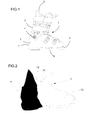
- the figure 1 illustrates an alpine ski boot 1 according to one embodiment of the invention, which comprises a rigid outer shell formed of several injected plastics materials as will be detailed below, including two elements, a collar 2 articulated on a bottom of shell 3 around a connecting pin 4.
- the bottom shell 3 extends from the running sole 6 to the level of the hinge axis 4 and connection with the collar 2 in the vertical direction.
- a comfort slipper 5 is inserted into the rigid shell.
- the sole 6 is extended towards both its front and rear ends by sidewalks 7 of a format adapted for cooperation with the jaws of a ski boot binding device.
- the walking surface of the outsole 6, in contact with the ground when walking, can be made directly monobloc on the bottom of the hull, or reported, for example by using heelpeters reported at the front and / or in back.
- Embodiments of the invention that will be described are based on a method of manufacturing a shoe element, such as for example a shell bottom 3 or a collar 2 of a ski boot, which comprises at least two steps Injection using a principle co-injection, respectively of two different plastic materials.
- Different materials will be understood to mean having different mechanical characteristics, such as, for example, different Young's modules, and / or different hardnesses. Alternatively or complement, this difference can be apparent, the two materials then having different colors.
- the method used here is a co-injection method, in which at least two plastic materials are injected into the same mold, by at least one injection point which sees the passage of at least two different materials successively.
- These two materials are in particular plastic materials, possibly loaded with fibers, for example fiberglass, carbon fiber, etc.
- the co-injection is based on at least two successive stages of injection of plastic materials into a single mold, these two stages being sufficiently close together to induce interlocking of the second material injected through the first injected material.
- the first material 15 is injected into the mold. It remains sufficiently fluid at the time of injection of the second material 16 through the first material in the same mold, in particular at its internal surface which remains hot longer than its external surfaces, which cool more quickly in contact with the walls injection mold.
- the nesting mentioned is manifested in two ways. First, the second injected material partially penetrates into the layer formed by the first material injected by the first injection.
- the second material penetrates through the internal surface of this layer mentioned under the effect of the significant energy during its injection and comes s' extend in the thickness of the first layer, eventually forming a so-called "sandwich" wall zone in which the second injected material is enclosed between two layers of the first injected material. Then, the second injected material transports a portion of the first material of the first injection, beyond its position reached during the first injection, to a border zone where the two materials are substantially mixed and alternated, before the second material continues to move only beyond that frontier zone. This creates a border zone or intermediate zone between the two materials that does not have a net or linear limit.
- the first material being irregularly driven it can form "flame" type shapes, of direction defined by the direction of injection of the second material, at the level of the border beyond which the first injected material disappears. .
- the second material may occasionally reach the outer walls of the element alternately possible with the first material.
- the first material could occasionally penetrate partially into the central part of the second material.
- the positioning of the frontier zone can fluctuate by about one centimeter.
- the figure 2 illustrates a bottom of the ski boot shell 3 obtained according to one embodiment of the invention, similar to the second embodiment described below in relation to the Figures 7 to 10 .
- the two materials used are represented in the figures by two different colors, respectively dark and white, and are both visible on the outer face of the shell bottom. These two materials constitute the wall of the shell bottom 3 but are distributed in a particular way on the outer and inner faces of the shell bottom, as well as in the thickness of the wall.
- On a first rear zone 11 of the shell bottom 3 the first material occupies the outer face of the shell bottom, while on a second zone 13 before, the second material occupies the outer face of the shell bottom.
- the boundary 14 between the two zones 11, 13 is not clear, has discontinuities and / or a shape or a line with strong oscillations or irregularities, not smooth, thus delimiting a surface of part and of other not completely convex or concave.
- the intermediate zone 12 at the border 14 comprises a mixture of the two materials, which is reflected by an intermediate and fluctuating rigidity zone or by a degraded color and / or a random alternation between the two colors.
- the zones 11, 12, 13 could occupy any other surface of the shell bottom.
- the first zone 11 consists of a "sandwich" wall, which comprises the second material (shown in white) interposed between two layers of the first material (shown in dark color).
- This first material constitutes the two outer and inner faces of the bottom shell wall 3, which respectively form the outer face of the shell and the inner face of the shell located opposite the foot.
- the second material is therefore invisible from the outside and from the inside of the shell bottom in the first zone 11, as contained between two layers formed by the first injected material.
- the second zone 13 comprises only the second material throughout the thickness of the wall of the shell bottom, and thus becomes visible both from the outside and from the inside of this area of the shell bottom 3.
- the temperature of the injection mold is raised between 50 and 60 ° C during the injections.
- the time between the two injections is between 3 and 6 seconds, preferably 4 or 5 seconds. This time can be lengthened if the temperature of the mold increases, or conversely shortened if it decreases.
- the two successive injections must be performed at the same place in the mold, from the same injection point.
- a traditional injection machine with two injection nozzles is used.
- the other injection points can receive either the injection of only one of the two materials, or the two successive injections, according to the co-injection technique.
- the first material is injected at the same time via the two injection points, then the second material is injected in turn via the same two points of injection. injection, through the first injected material.
- the embodiment represented in figure 2 can be obtained by two injection points positioned on two different heights in the rear area of the shell bottom, each receiving the two successive injections according to the co-injection explained above.
- the second material therefore extends continuously from the rear end of the first zone 11 to the front end of the second zone 13, but is visible on the shell bottom 3 only in the second zone 13 .
- the two materials used in the manufacturing process are different. This difference can become apparent because of different colors, to obtain the visual effect explained above in relation to the figure 2 .
- color in the broad sense, that is to say any particular aspect, including a transparent or translucent aspect.
- two materials of different rigidity are used, to obtain a wall whose rigidity varies according to the zones of the shoe element, to achieve a compromise chosen according to the performance and comfort requirements previously recalled of the shoe element. .
- these two materials of different rigidity may be different color or not.
- the first material is more rigid than the second, and is preferably positioned in the areas of the shoe element requiring more rigidity: these areas will be detailed on the examples described below.
- the second material is more flexible, and will be alone in areas requiring more flexibility.
- the difference in rigidity between the two materials is greater than or equal to 5 ShD.
- the first material may be polyurethane of hardness between 50 and 70 ShD inclusive, preferably between 55 and 60 ShD inclusive, or any other plastic material of equivalent hardness
- the second material may be polyurethane hardness of between 40 and 60 ShD inclusive, preferably between 45 and 50 ShD inclusive, or any other plastic material of equivalent hardness.
- the two materials may be identical but preferably of different hardness, or different.
- the first material may be polyurethane and the second polyamide or polyether block-amide.
- the plastic material used may be different, such as a polyolefin.
- the amount used for each of the two materials is not arbitrary. Indeed, the injected quantity of the first material must be less than the quantity for which the first material would occupy the entire surface of the mold, or almost the entire surface, in which case the second material injected could not reach the outer faces of the wall in the second zone, and in which case the first material would impose a relatively constant stiffness of the wall of the shoe or in any case vary over a much lower range than that sought by the invention.
- the amount of the first material injected is such that it does not extend over the entire surface of the injected element, and preferably less than 75% or even less than 50% of the surface of the element. injected.
- an advantageous embodiment consists in injecting a quantity of first material representing by weight 50% or less of the total weight of the shoe element after its finalization, or even 40% or less, or 30% or less. of this total weight.
- the second injection of the second material can then form all the remaining weight, even a portion only if more than two injected materials are provided.
- the first injected material is dark in color and is stiffer and harder than the second.
- the first and second materials may be chosen in the same color or in different colors.
- the first and second areas can be realized in different parts of the shoe.
- the border 14 is represented by a smoothed line for a reason of simplification, which does not correspond precisely to the reality according to the preceding explanations.
- the Figures 3 to 16 illustrate several embodiments of a ski boot shell bottom, and the Figures 17 to 29 represent several embodiments of a ski boot collar.
- the Figures 3 to 6 illustrate a first embodiment of a ski boot shell bottom 3.
- the first zone 11 comprising the "sandwich" type wall, particularly visible on the sections of Figures 4 and 5 on which we can distinguish the two materials 15, 16, extends in the rear portion of the shell bottom.
- the second material 16 is present in the central part of the sandwich, the first material forming the two outer layers of the sandwich, the two inner and outer faces of the shell bottom wall. It makes it possible to form a rigid wall, because of the presence of the first injected material 15, which guarantees a good maintenance of the skier's foot and gives the shoe sufficient rigidity in its rear part.
- the front part in particular at the level of the instep, is obtained by two flaps 9 of softer material, since only formed by the second material 16 injected as shown in FIG. figure 4 .
- two injection points 17, 18 disposed on two different heights of the rear portion of the shell bottom are used. These two injection points receive the two materials successively.
- a fourth zone 23 in the shoe wall comprising only the first injected material may exist as illustrated in FIG. figure 5 .
- This zone is located at the upper end of the shell bottom, very thin. This is obtained because the mold is the first injected material cools quickly in contact with the walls of the mold, and thus prevents the penetration of the second material within the first material.
- sole the lower part of the bottom of the shell, forming at least a portion of the future running sole of the ski boot. In general, this sole will be complemented by the addition of complementary components to form the final structure of the foot sole of the shoe
- FIGS 7 to 10 illustrate a second embodiment in which the first material extends to the lower part of the shell bottom and also forms the rear sidewalk of the shoe. It is obtained with two injection points 17, 18 always located in the rear part of the bottom of the shell, as well as possibly with an injection point 19 located under the sole of the shell bottom near the heel, and a quantity of first material superior to that used in the previous embodiment.
- the Figures 11 to 13 illustrate a third embodiment in which the first material 15 present in the first zone 11 extends in the lower part of the shell bottom, and includes in particular the entire bottom of the shell.
- this first material 15 is more rigid and forms the sidewalks 7.
- the stiffness of the materials will be chosen to reach a hardness of the sidewalks 7 of the outsole 6 greater than 45 ShD for children and greater than 50 ShD for children. adults.
- the sole is obtained with four injection points 19, 20, 21, 22 located under the sole, or even by five injection points.
- the entire upper part of the shell bottom located above the first zone 11 forms the second zone 13 and consists of a monomatized wall formed by the second material 16.
- the Figures 14 to 16 illustrate a fourth embodiment which corresponds to the combination of the first or second realization with the third.
- the first material present in the first zone 11 extends in the lower and rear portions of the shell bottom.
- This shell bottom is obtained with two injection points 17, 18 located in the rear part of the shell bottom and four injection points 19, 20, 21, 22 located under the sole of the bottom shell.
- the softer portion formed in the second zone 13 by the second material 16 is located only in the area of the flaps 9 to facilitate the boot of the shoe.
- FIGS 17 to 20 and 30 illustrate a first embodiment of a ski boot collar intended to surround and tighten the lower leg of the user.
- This collar consists of a rear portion extended on the front by two flaps 25 intended to be superimposed and to fall back on the front of the leg of the skier.
- This collar consists of variable areas of rigidity.
- This collar has a rear surface, visible on the figure 18 , on which extends the first zone 11 which is formed by a sandwich-type wall composed of a compound multilayer, from the outside towards the inside of the wall, from the rigid material 15, from the flexible material 16, and from This first zone is extended by the two lateral flaps.
- the front part of these flaps 25 is more flexible, and includes only the second material 16.
- the first rigid zone 11 also extends at the hinge axes 4 of the collar.
- This collar is obtained with three injection points 26, 27, 28 located at the rear of the collar.
- FIG. 21 to 24 illustrate a second embodiment of a ski boot collar.
- This second embodiment always includes the first zone 11 at the rear of the collar, but which does not extend to the bottom of the collar.
- This collar is obtained with an injection point 26 located at the back of the necklace.
- a sectional view of the upper part of this second embodiment of a collar is that illustrated in FIG. figure 21 .
- the Figures 25 to 29 illustrate a third embodiment of a ski boot collar.
- This third embodiment always comprises the first zone 11 in the rear part of the collar, but which extends only in the lower part of the collar, not up to the top of the collar.
- the first rigid zone 11 also extends at the hinge axes 4 of the collar.
- This collar is obtained with an injection point 28 located in the rear part of the collar.
- the invention advantageously makes it possible to obtain a collar which has two distinct zones of different stiffnesses to optimize a flexible part located in the zone of the flaps 25 favoring footwear and comfort, and a more rigid rear zone ensuring the maintaining the leg and avoiding the deformations of the collar towards the back during the evolution in ski.
- the various injection points envisaged receive two successive injections according to the co-injection principle.
- the first material is injected simultaneously through the different injection points, then after a very short time, the second material is injected simultaneously through the same injection points, to achieve co-injection.
- the co-injection can be used on at least one injection point, the other injection points then receiving only one injected material, or allow to use any other known injection technique of the injection. prior art.
- the invention also relates to an element or a shoe whose wall comprises at least two different plastic materials, including a first zone 11 comprising the two different plastic materials in its thickness, the first plastic material occupying the outer face of the wall, visible from outside the shoe member and the second plastic material being sandwiched between two layers of the first plastic material, and a second area 13 comprising only the second plastic material.
- the first zone 11 therefore comprises the first plastic material forming two layers of the wall, constituting the inner and outer faces of said wall, and the second plastic material 16 is interposed between the two layers of the first plastic material.
- the second material 16 extends continuously from the first zone 11 to the second zone 13, within the wall of the element, even if it is not visible at the level of the first zoned.
- the shoe element comprises a third intermediate zone in which the two materials are mixed, appearing alternately and irregularly, or in a mixed manner, on the visible outer surface of the wall of the element.
- This third intermediate zone is located between the first zone consisting of a sandwich structure and the second zone consisting solely of the second material.
- the element may comprise a fourth zone on which the wall comprises only the first material, located in particular on the thin edges of the element.
- the shoe element may comprise more than two injected plastics materials, a third material being, for example, surinjected on the co-injected assembly described above.
- three materials could be co-injected to form a zone composed of a sandwich formed of five layers, then an area composed of a sandwich formed of three layers, followed by a monomaterial zone, this monomatiere zone forming the central part of each of the sandwiches. Achievements to N materials could be considered on the same principle.
- the concept of the invention can of course be implemented for any shoe element, bottom shell type or collar as described, but also sole, strap or buckle, tongue for a shell or a comfort boot, reinforcement heel of a cross-country ski boot, or other plastic parts requiring in places high stiffness or good flexibility.
- a tongue preferably the flexible part would be positioned in the lower part of the tongue, in the area of the instep, and then formed by the second material, while the upper part more rigid in the zone of the tibia would be formed by the sandwich composed of the first and second materials.
- the invention also relates to any sports shoe incorporating such an element. This sports shoe can be any sports shoe glide, such as a ski boot, a skate, etc.
- the method according to the invention advantageously makes it possible to manufacture a series of sports shoes of different aspects, making it possible to visualize in particular the zones of different stiffness of the shoe.
- the invention has been described with the use of a first material more rigid than the second material, but the opposite may be considered to create new elements.
- the method according to the invention advantageously makes it possible to manufacture a series of sports shoes with a different level of performance in using the same mold, since it is sufficient to slightly modify the co-injection parameters and in particular the quantities of material of the first and second material, and / or the materials chosen to obtain a multitude of different results from the point of view of rigidity.
- the mold can be heated locally to keep the injected materials in a fluid state and better control their distribution in the element. Conversely, it is possible to cool the mold locally.
- the invention then makes it possible to increase the rigidity of certain zones which require a high rigidity, while maintaining a good level of flexibility in other zones. Shoe elements are thus obtained with the best compromise between rigidity and flexibility.
Landscapes
- Engineering & Computer Science (AREA)
- Mechanical Engineering (AREA)
- Health & Medical Sciences (AREA)
- General Health & Medical Sciences (AREA)
- Physical Education & Sports Medicine (AREA)
- Manufacturing & Machinery (AREA)
- Chemical & Material Sciences (AREA)
- Materials Engineering (AREA)
- Footwear And Its Accessory, Manufacturing Method And Apparatuses (AREA)
Priority Applications (2)
| Application Number | Priority Date | Filing Date | Title |
|---|---|---|---|
| EP15425042.7A EP3103630B2 (de) | 2015-06-11 | 2015-06-11 | Koinjizierter sportschuh |
| US15/178,662 US11219269B2 (en) | 2015-06-11 | 2016-06-10 | Co-injection moulded sports boot |
Applications Claiming Priority (1)
| Application Number | Priority Date | Filing Date | Title |
|---|---|---|---|
| EP15425042.7A EP3103630B2 (de) | 2015-06-11 | 2015-06-11 | Koinjizierter sportschuh |
Publications (3)
| Publication Number | Publication Date |
|---|---|
| EP3103630A1 true EP3103630A1 (de) | 2016-12-14 |
| EP3103630B1 EP3103630B1 (de) | 2020-12-09 |
| EP3103630B2 EP3103630B2 (de) | 2025-11-19 |
Family
ID=53794180
Family Applications (1)
| Application Number | Title | Priority Date | Filing Date |
|---|---|---|---|
| EP15425042.7A Active EP3103630B2 (de) | 2015-06-11 | 2015-06-11 | Koinjizierter sportschuh |
Country Status (2)
| Country | Link |
|---|---|
| US (1) | US11219269B2 (de) |
| EP (1) | EP3103630B2 (de) |
Cited By (1)
| Publication number | Priority date | Publication date | Assignee | Title |
|---|---|---|---|---|
| EP3673761A1 (de) * | 2018-12-27 | 2020-07-01 | Rossignol Lange S.R.L. | Element eines langlauf-skischuhs, das durch koinjektion hergestellt wird |
Families Citing this family (7)
| Publication number | Priority date | Publication date | Assignee | Title |
|---|---|---|---|---|
| CN113573606A (zh) | 2019-03-13 | 2021-10-29 | 伊科斯克有限公司 | 制造用于鞋类的直接注射生产的基于模具的设备的系统和制造鞋类的方法 |
| EP3938195B1 (de) | 2019-03-13 | 2024-12-18 | Ecco Sko A/S | Ein formsystem für die herstellung von schuhwerk im direktspritzverfahren |
| CN118269396A (zh) * | 2019-03-13 | 2024-07-02 | 伊科斯克有限公司 | 鞋类注射模具 |
| WO2021032260A1 (en) | 2019-08-19 | 2021-02-25 | Ecco Sko A/S | A footwear injection mould |
| IT202300025617A1 (it) * | 2023-11-30 | 2025-05-30 | Plastimedia S R L | Metodo di stampaggio simultaneo e relativo prodotto stampato |
| US12501967B2 (en) * | 2024-04-19 | 2025-12-23 | Skechers U.S.A., Inc. Ii | Hands-free molded shoe |
| CA3273287A1 (en) * | 2024-05-16 | 2025-11-29 | Vh Footwear Ulc | Skate boot with stiffening cuff insert |
Citations (5)
| Publication number | Priority date | Publication date | Assignee | Title |
|---|---|---|---|---|
| JPH02126801A (ja) * | 1988-11-05 | 1990-05-15 | Moon Star Co | 多重底を有する射出成形靴及びその製造方法 |
| US5667737A (en) * | 1991-01-28 | 1997-09-16 | Koflach Sport Gesellschaft M.B.H. & Co. Kg | Method of manufacturing an injection molded shoe |
| EP0823323A1 (de) * | 1996-08-08 | 1998-02-11 | Benetton Sportsystem S.p.A. | Koinjektionsverfahren zur Herstellung von Kunststofferzeugnissen, insbesondere für Schuhe |
| CA2374148A1 (en) * | 1999-06-02 | 2000-12-07 | Vans, Inc. | Sports shoe interface |
| WO2014136051A1 (en) * | 2013-03-04 | 2014-09-12 | Bazzani Andrea | Shell for ski boots |
Family Cites Families (13)
| Publication number | Priority date | Publication date | Assignee | Title |
|---|---|---|---|---|
| US3950483A (en) * | 1972-03-02 | 1976-04-13 | I Martin Spier | Injection molding process |
| US4245410A (en) * | 1979-05-14 | 1981-01-20 | Questor Corporation | Foamed ski boot |
| AT399985B (de) * | 1987-01-23 | 1995-08-25 | Tyrolia Freizeitgeraete | Langlaufskischuh |
| IT232699Y1 (it) | 1994-01-21 | 2000-01-19 | Lange Int Sa | Scarpone da sci in materia plastica, almeno una parte del quale e' costituita da due materie plastiche differenti |
| JPH0976291A (ja) | 1995-09-20 | 1997-03-25 | Japan Steel Works Ltd:The | 異種材料からなる成形品の成形方法および成形用金型 |
| JP3497301B2 (ja) | 1995-11-08 | 2004-02-16 | 本田技研工業株式会社 | 合成樹脂成形体の製造方法 |
| US5595799A (en) | 1995-12-14 | 1997-01-21 | Dtl Technology Limited Partnership | Coinjection molding of decorative preforms and containers produced from such preforms |
| CH691339A5 (fr) * | 1997-09-09 | 2001-07-13 | Lange Int Sa | Chaussure de sport. |
| ITMI20020593A1 (it) | 2002-03-20 | 2003-09-22 | Enrico Scarabelli | Procedimento per lo stampaggio ad iniezione di prodotti in almeno duemateriali distinti |
| US20050081408A1 (en) * | 2002-04-26 | 2005-04-21 | Salomon S.A. | Boot having a flexible outer wall |
| EP1642706B1 (de) * | 2004-09-29 | 2006-11-15 | Lange International S.A. | Sportschuh aus sehr hartem Material |
| DE102005034081A1 (de) | 2005-07-21 | 2007-01-25 | Uvex Arbeitsschutz Gmbh | Verfahren zur Herstellung eines Brillenbügels |
| EP2554353B1 (de) | 2011-08-05 | 2017-06-07 | Trisa Holding AG | Verfahren zur Herstellung einer Zahnbürste und Zahnbürste |
-
2015
- 2015-06-11 EP EP15425042.7A patent/EP3103630B2/de active Active
-
2016
- 2016-06-10 US US15/178,662 patent/US11219269B2/en active Active
Patent Citations (5)
| Publication number | Priority date | Publication date | Assignee | Title |
|---|---|---|---|---|
| JPH02126801A (ja) * | 1988-11-05 | 1990-05-15 | Moon Star Co | 多重底を有する射出成形靴及びその製造方法 |
| US5667737A (en) * | 1991-01-28 | 1997-09-16 | Koflach Sport Gesellschaft M.B.H. & Co. Kg | Method of manufacturing an injection molded shoe |
| EP0823323A1 (de) * | 1996-08-08 | 1998-02-11 | Benetton Sportsystem S.p.A. | Koinjektionsverfahren zur Herstellung von Kunststofferzeugnissen, insbesondere für Schuhe |
| CA2374148A1 (en) * | 1999-06-02 | 2000-12-07 | Vans, Inc. | Sports shoe interface |
| WO2014136051A1 (en) * | 2013-03-04 | 2014-09-12 | Bazzani Andrea | Shell for ski boots |
Cited By (1)
| Publication number | Priority date | Publication date | Assignee | Title |
|---|---|---|---|---|
| EP3673761A1 (de) * | 2018-12-27 | 2020-07-01 | Rossignol Lange S.R.L. | Element eines langlauf-skischuhs, das durch koinjektion hergestellt wird |
Also Published As
| Publication number | Publication date |
|---|---|
| EP3103630B2 (de) | 2025-11-19 |
| EP3103630B1 (de) | 2020-12-09 |
| US20160360823A1 (en) | 2016-12-15 |
| US11219269B2 (en) | 2022-01-11 |
Similar Documents
| Publication | Publication Date | Title |
|---|---|---|
| EP3103630B1 (de) | Koinjizierter sportschuh | |
| FR2681515A1 (fr) | Semelage a protuberances pour chaussures de sport. | |
| FR2595552A1 (fr) | Semelle interne de chaussure | |
| FR2561080A1 (fr) | Chaussure d'athletisme et paire de telles chaussures | |
| EP0548475A1 (de) | Mehrschichtige Sportschuhsohle | |
| EP2132998A1 (de) | Innenschuh für Sportschuh | |
| EP3195748A1 (de) | Sohle eines langlauf-skischuhs | |
| EP3673761B1 (de) | Element eines langlauf-skischuhs, das durch koinjektion hergestellt wird | |
| FR2682011A1 (fr) | Chaussure de sport notamment de ski de fond comportant des moyens de rigidification en torsion et d'assouplissement en flexion. | |
| FR2849994A1 (fr) | Semelle interne | |
| EP1559452B1 (de) | Gleitbrett für Kinder und dessen Herstellungsverfahren | |
| EP2042050A1 (de) | Sportschuhe mit Reliefschaum | |
| EP0756832B1 (de) | Schuh für Gleitsportarten | |
| CH690017A5 (fr) | Chausson de confort pour chaussure de ski. | |
| EP3123884B1 (de) | Sohle eines gleitsportschuhs | |
| EP3415022B1 (de) | Skischuhelement | |
| EP2620067A1 (de) | Sportschuh mit Teilen aus sehr steifem Material | |
| EP1695640B1 (de) | Sportschuh mir einer Wand mit zwei unterschiedlichen, in zwei Stufen spritzgegossenen Schichten | |
| FR3108243A1 (fr) | Elément amortisseur pour une chaussure de sport | |
| EP1872677B1 (de) | Sportschuh für Gleitbrett | |
| EP1872931B1 (de) | Sportschuhwerk mit einer dekorativen Oberflächenstruktur | |
| FR2628300A1 (fr) | Procede de fabrication d'un article chaussant de type mocassin, dont la semelle evidee comporte un insert | |
| FR3043894B1 (fr) | Bas de coque pour chaussure de ski et chaussure de ski incluant un tel bas de coque | |
| EP0774216A1 (de) | Schuhwerk und Verfahren zu deren Herstellung | |
| WO2026087356A1 (fr) | Procédé de fabrication d'un article chaussant, et article chaussant correspondant |
Legal Events
| Date | Code | Title | Description |
|---|---|---|---|
| PUAI | Public reference made under article 153(3) epc to a published international application that has entered the european phase |
Free format text: ORIGINAL CODE: 0009012 |
|
| STAA | Information on the status of an ep patent application or granted ep patent |
Free format text: STATUS: THE APPLICATION HAS BEEN PUBLISHED |
|
| AK | Designated contracting states |
Kind code of ref document: A1 Designated state(s): AL AT BE BG CH CY CZ DE DK EE ES FI FR GB GR HR HU IE IS IT LI LT LU LV MC MK MT NL NO PL PT RO RS SE SI SK SM TR |
|
| AX | Request for extension of the european patent |
Extension state: BA ME |
|
| STAA | Information on the status of an ep patent application or granted ep patent |
Free format text: STATUS: REQUEST FOR EXAMINATION WAS MADE |
|
| 17P | Request for examination filed |
Effective date: 20170612 |
|
| RBV | Designated contracting states (corrected) |
Designated state(s): AL AT BE BG CH CY CZ DE DK EE ES FI FR GB GR HR HU IE IS IT LI LT LU LV MC MK MT NL NO PL PT RO RS SE SI SK SM TR |
|
| STAA | Information on the status of an ep patent application or granted ep patent |
Free format text: STATUS: EXAMINATION IS IN PROGRESS |
|
| 17Q | First examination report despatched |
Effective date: 20191031 |
|
| GRAP | Despatch of communication of intention to grant a patent |
Free format text: ORIGINAL CODE: EPIDOSNIGR1 |
|
| STAA | Information on the status of an ep patent application or granted ep patent |
Free format text: STATUS: GRANT OF PATENT IS INTENDED |
|
| INTG | Intention to grant announced |
Effective date: 20200625 |
|
| GRAS | Grant fee paid |
Free format text: ORIGINAL CODE: EPIDOSNIGR3 |
|
| GRAA | (expected) grant |
Free format text: ORIGINAL CODE: 0009210 |
|
| STAA | Information on the status of an ep patent application or granted ep patent |
Free format text: STATUS: THE PATENT HAS BEEN GRANTED |
|
| AK | Designated contracting states |
Kind code of ref document: B1 Designated state(s): AL AT BE BG CH CY CZ DE DK EE ES FI FR GB GR HR HU IE IS IT LI LT LU LV MC MK MT NL NO PL PT RO RS SE SI SK SM TR |
|
| REG | Reference to a national code |
Ref country code: GB Ref legal event code: FG4D Free format text: NOT ENGLISH |
|
| REG | Reference to a national code |
Ref country code: AT Ref legal event code: REF Ref document number: 1342979 Country of ref document: AT Kind code of ref document: T Effective date: 20201215 Ref country code: CH Ref legal event code: EP |
|
| REG | Reference to a national code |
Ref country code: DE Ref legal event code: R096 Ref document number: 602015063162 Country of ref document: DE |
|
| REG | Reference to a national code |
Ref country code: IE Ref legal event code: FG4D Free format text: LANGUAGE OF EP DOCUMENT: FRENCH |
|
| PG25 | Lapsed in a contracting state [announced via postgrant information from national office to epo] |
Ref country code: FI Free format text: LAPSE BECAUSE OF FAILURE TO SUBMIT A TRANSLATION OF THE DESCRIPTION OR TO PAY THE FEE WITHIN THE PRESCRIBED TIME-LIMIT Effective date: 20201209 Ref country code: RS Free format text: LAPSE BECAUSE OF FAILURE TO SUBMIT A TRANSLATION OF THE DESCRIPTION OR TO PAY THE FEE WITHIN THE PRESCRIBED TIME-LIMIT Effective date: 20201209 Ref country code: NO Free format text: LAPSE BECAUSE OF FAILURE TO SUBMIT A TRANSLATION OF THE DESCRIPTION OR TO PAY THE FEE WITHIN THE PRESCRIBED TIME-LIMIT Effective date: 20210309 Ref country code: GR Free format text: LAPSE BECAUSE OF FAILURE TO SUBMIT A TRANSLATION OF THE DESCRIPTION OR TO PAY THE FEE WITHIN THE PRESCRIBED TIME-LIMIT Effective date: 20210310 |
|
| REG | Reference to a national code |
Ref country code: AT Ref legal event code: MK05 Ref document number: 1342979 Country of ref document: AT Kind code of ref document: T Effective date: 20201209 |
|
| PG25 | Lapsed in a contracting state [announced via postgrant information from national office to epo] |
Ref country code: LV Free format text: LAPSE BECAUSE OF FAILURE TO SUBMIT A TRANSLATION OF THE DESCRIPTION OR TO PAY THE FEE WITHIN THE PRESCRIBED TIME-LIMIT Effective date: 20201209 Ref country code: SE Free format text: LAPSE BECAUSE OF FAILURE TO SUBMIT A TRANSLATION OF THE DESCRIPTION OR TO PAY THE FEE WITHIN THE PRESCRIBED TIME-LIMIT Effective date: 20201209 Ref country code: BG Free format text: LAPSE BECAUSE OF FAILURE TO SUBMIT A TRANSLATION OF THE DESCRIPTION OR TO PAY THE FEE WITHIN THE PRESCRIBED TIME-LIMIT Effective date: 20210309 |
|
| REG | Reference to a national code |
Ref country code: NL Ref legal event code: MP Effective date: 20201209 |
|
| PG25 | Lapsed in a contracting state [announced via postgrant information from national office to epo] |
Ref country code: NL Free format text: LAPSE BECAUSE OF FAILURE TO SUBMIT A TRANSLATION OF THE DESCRIPTION OR TO PAY THE FEE WITHIN THE PRESCRIBED TIME-LIMIT Effective date: 20201209 Ref country code: HR Free format text: LAPSE BECAUSE OF FAILURE TO SUBMIT A TRANSLATION OF THE DESCRIPTION OR TO PAY THE FEE WITHIN THE PRESCRIBED TIME-LIMIT Effective date: 20201209 |
|
| REG | Reference to a national code |
Ref country code: LT Ref legal event code: MG9D |
|
| PG25 | Lapsed in a contracting state [announced via postgrant information from national office to epo] |
Ref country code: RO Free format text: LAPSE BECAUSE OF FAILURE TO SUBMIT A TRANSLATION OF THE DESCRIPTION OR TO PAY THE FEE WITHIN THE PRESCRIBED TIME-LIMIT Effective date: 20201209 Ref country code: SK Free format text: LAPSE BECAUSE OF FAILURE TO SUBMIT A TRANSLATION OF THE DESCRIPTION OR TO PAY THE FEE WITHIN THE PRESCRIBED TIME-LIMIT Effective date: 20201209 Ref country code: PT Free format text: LAPSE BECAUSE OF FAILURE TO SUBMIT A TRANSLATION OF THE DESCRIPTION OR TO PAY THE FEE WITHIN THE PRESCRIBED TIME-LIMIT Effective date: 20210409 Ref country code: LT Free format text: LAPSE BECAUSE OF FAILURE TO SUBMIT A TRANSLATION OF THE DESCRIPTION OR TO PAY THE FEE WITHIN THE PRESCRIBED TIME-LIMIT Effective date: 20201209 Ref country code: CZ Free format text: LAPSE BECAUSE OF FAILURE TO SUBMIT A TRANSLATION OF THE DESCRIPTION OR TO PAY THE FEE WITHIN THE PRESCRIBED TIME-LIMIT Effective date: 20201209 Ref country code: EE Free format text: LAPSE BECAUSE OF FAILURE TO SUBMIT A TRANSLATION OF THE DESCRIPTION OR TO PAY THE FEE WITHIN THE PRESCRIBED TIME-LIMIT Effective date: 20201209 Ref country code: SM Free format text: LAPSE BECAUSE OF FAILURE TO SUBMIT A TRANSLATION OF THE DESCRIPTION OR TO PAY THE FEE WITHIN THE PRESCRIBED TIME-LIMIT Effective date: 20201209 |
|
| PG25 | Lapsed in a contracting state [announced via postgrant information from national office to epo] |
Ref country code: PL Free format text: LAPSE BECAUSE OF FAILURE TO SUBMIT A TRANSLATION OF THE DESCRIPTION OR TO PAY THE FEE WITHIN THE PRESCRIBED TIME-LIMIT Effective date: 20201209 Ref country code: AT Free format text: LAPSE BECAUSE OF FAILURE TO SUBMIT A TRANSLATION OF THE DESCRIPTION OR TO PAY THE FEE WITHIN THE PRESCRIBED TIME-LIMIT Effective date: 20201209 |
|
| REG | Reference to a national code |
Ref country code: DE Ref legal event code: R026 Ref document number: 602015063162 Country of ref document: DE |
|
| PLBI | Opposition filed |
Free format text: ORIGINAL CODE: 0009260 |
|
| PG25 | Lapsed in a contracting state [announced via postgrant information from national office to epo] |
Ref country code: IS Free format text: LAPSE BECAUSE OF FAILURE TO SUBMIT A TRANSLATION OF THE DESCRIPTION OR TO PAY THE FEE WITHIN THE PRESCRIBED TIME-LIMIT Effective date: 20210409 |
|
| 26 | Opposition filed |
Opponent name: TECNICA GROUP S.P.A. Effective date: 20210909 |
|
| PG25 | Lapsed in a contracting state [announced via postgrant information from national office to epo] |
Ref country code: AL Free format text: LAPSE BECAUSE OF FAILURE TO SUBMIT A TRANSLATION OF THE DESCRIPTION OR TO PAY THE FEE WITHIN THE PRESCRIBED TIME-LIMIT Effective date: 20201209 |
|
| PLAX | Notice of opposition and request to file observation + time limit sent |
Free format text: ORIGINAL CODE: EPIDOSNOBS2 |
|
| PG25 | Lapsed in a contracting state [announced via postgrant information from national office to epo] |
Ref country code: SI Free format text: LAPSE BECAUSE OF FAILURE TO SUBMIT A TRANSLATION OF THE DESCRIPTION OR TO PAY THE FEE WITHIN THE PRESCRIBED TIME-LIMIT Effective date: 20201209 Ref country code: ES Free format text: LAPSE BECAUSE OF FAILURE TO SUBMIT A TRANSLATION OF THE DESCRIPTION OR TO PAY THE FEE WITHIN THE PRESCRIBED TIME-LIMIT Effective date: 20201209 Ref country code: DK Free format text: LAPSE BECAUSE OF FAILURE TO SUBMIT A TRANSLATION OF THE DESCRIPTION OR TO PAY THE FEE WITHIN THE PRESCRIBED TIME-LIMIT Effective date: 20201209 |
|
| PG25 | Lapsed in a contracting state [announced via postgrant information from national office to epo] |
Ref country code: MC Free format text: LAPSE BECAUSE OF FAILURE TO SUBMIT A TRANSLATION OF THE DESCRIPTION OR TO PAY THE FEE WITHIN THE PRESCRIBED TIME-LIMIT Effective date: 20201209 |
|
| REG | Reference to a national code |
Ref country code: CH Ref legal event code: PL |
|
| GBPC | Gb: european patent ceased through non-payment of renewal fee |
Effective date: 20210611 |
|
| REG | Reference to a national code |
Ref country code: BE Ref legal event code: MM Effective date: 20210630 |
|
| PLBB | Reply of patent proprietor to notice(s) of opposition received |
Free format text: ORIGINAL CODE: EPIDOSNOBS3 |
|
| PG25 | Lapsed in a contracting state [announced via postgrant information from national office to epo] |
Ref country code: LU Free format text: LAPSE BECAUSE OF NON-PAYMENT OF DUE FEES Effective date: 20210611 |
|
| PG25 | Lapsed in a contracting state [announced via postgrant information from national office to epo] |
Ref country code: LI Free format text: LAPSE BECAUSE OF NON-PAYMENT OF DUE FEES Effective date: 20210630 Ref country code: IE Free format text: LAPSE BECAUSE OF NON-PAYMENT OF DUE FEES Effective date: 20210611 Ref country code: GB Free format text: LAPSE BECAUSE OF NON-PAYMENT OF DUE FEES Effective date: 20210611 Ref country code: CH Free format text: LAPSE BECAUSE OF NON-PAYMENT OF DUE FEES Effective date: 20210630 |
|
| PG25 | Lapsed in a contracting state [announced via postgrant information from national office to epo] |
Ref country code: IS Free format text: LAPSE BECAUSE OF FAILURE TO SUBMIT A TRANSLATION OF THE DESCRIPTION OR TO PAY THE FEE WITHIN THE PRESCRIBED TIME-LIMIT Effective date: 20210409 |
|
| PG25 | Lapsed in a contracting state [announced via postgrant information from national office to epo] |
Ref country code: BE Free format text: LAPSE BECAUSE OF NON-PAYMENT OF DUE FEES Effective date: 20210630 |
|
| PG25 | Lapsed in a contracting state [announced via postgrant information from national office to epo] |
Ref country code: HU Free format text: LAPSE BECAUSE OF FAILURE TO SUBMIT A TRANSLATION OF THE DESCRIPTION OR TO PAY THE FEE WITHIN THE PRESCRIBED TIME-LIMIT; INVALID AB INITIO Effective date: 20150611 |
|
| PG25 | Lapsed in a contracting state [announced via postgrant information from national office to epo] |
Ref country code: CY Free format text: LAPSE BECAUSE OF FAILURE TO SUBMIT A TRANSLATION OF THE DESCRIPTION OR TO PAY THE FEE WITHIN THE PRESCRIBED TIME-LIMIT Effective date: 20201209 |
|
| PG25 | Lapsed in a contracting state [announced via postgrant information from national office to epo] |
Ref country code: MK Free format text: LAPSE BECAUSE OF FAILURE TO SUBMIT A TRANSLATION OF THE DESCRIPTION OR TO PAY THE FEE WITHIN THE PRESCRIBED TIME-LIMIT Effective date: 20201209 |
|
| PG25 | Lapsed in a contracting state [announced via postgrant information from national office to epo] |
Ref country code: TR Free format text: LAPSE BECAUSE OF FAILURE TO SUBMIT A TRANSLATION OF THE DESCRIPTION OR TO PAY THE FEE WITHIN THE PRESCRIBED TIME-LIMIT Effective date: 20201209 |
|
| PG25 | Lapsed in a contracting state [announced via postgrant information from national office to epo] |
Ref country code: MT Free format text: LAPSE BECAUSE OF FAILURE TO SUBMIT A TRANSLATION OF THE DESCRIPTION OR TO PAY THE FEE WITHIN THE PRESCRIBED TIME-LIMIT Effective date: 20201209 |
|
| APBP | Date of receipt of notice of appeal recorded |
Free format text: ORIGINAL CODE: EPIDOSNNOA2O |
|
| APAH | Appeal reference modified |
Free format text: ORIGINAL CODE: EPIDOSCREFNO |
|
| APAW | Appeal reference deleted |
Free format text: ORIGINAL CODE: EPIDOSDREFNO |
|
| APBU | Appeal procedure closed |
Free format text: ORIGINAL CODE: EPIDOSNNOA9O |
|
| PGFP | Annual fee paid to national office [announced via postgrant information from national office to epo] |
Ref country code: DE Payment date: 20250617 Year of fee payment: 11 |
|
| PGFP | Annual fee paid to national office [announced via postgrant information from national office to epo] |
Ref country code: FR Payment date: 20250630 Year of fee payment: 11 |
|
| PGFP | Annual fee paid to national office [announced via postgrant information from national office to epo] |
Ref country code: IT Payment date: 20250609 Year of fee payment: 11 |
|
| PUAH | Patent maintained in amended form |
Free format text: ORIGINAL CODE: 0009272 |
|
| STAA | Information on the status of an ep patent application or granted ep patent |
Free format text: STATUS: PATENT MAINTAINED AS AMENDED |
|
| REG | Reference to a national code |
Ref country code: CH Ref legal event code: M12 Free format text: ST27 STATUS EVENT CODE: U-0-0-M10-M12 (AS PROVIDED BY THE NATIONAL OFFICE) Effective date: 20251022 |
|
| 27A | Patent maintained in amended form |
Effective date: 20251119 |
|
| AK | Designated contracting states |
Kind code of ref document: B2 Designated state(s): AL AT BE BG CH CY CZ DE DK EE ES FI FR GB GR HR HU IE IS IT LI LT LU LV MC MK MT NL NO PL PT RO RS SE SI SK SM TR |
|
| REG | Reference to a national code |
Ref country code: DE Ref legal event code: R102 Ref document number: 602015063162 Country of ref document: DE |