EP3105143B1 - Isolierverpackung zur wärmedämmung oder schockabsorption aus stroh oder heu und verfahren zu ihrer herstellung - Google Patents
Isolierverpackung zur wärmedämmung oder schockabsorption aus stroh oder heu und verfahren zu ihrer herstellung Download PDFInfo
- Publication number
- EP3105143B1 EP3105143B1 EP15704755.6A EP15704755A EP3105143B1 EP 3105143 B1 EP3105143 B1 EP 3105143B1 EP 15704755 A EP15704755 A EP 15704755A EP 3105143 B1 EP3105143 B1 EP 3105143B1
- Authority
- EP
- European Patent Office
- Prior art keywords
- straw
- hay
- insulation
- insulation core
- sheathing
- Prior art date
- Legal status (The legal status is an assumption and is not a legal conclusion. Google has not performed a legal analysis and makes no representation as to the accuracy of the status listed.)
- Active
Links
Images
Classifications
-
- B—PERFORMING OPERATIONS; TRANSPORTING
- B65—CONVEYING; PACKING; STORING; HANDLING THIN OR FILAMENTARY MATERIAL
- B65D—CONTAINERS FOR STORAGE OR TRANSPORT OF ARTICLES OR MATERIALS, e.g. BAGS, BARRELS, BOTTLES, BOXES, CANS, CARTONS, CRATES, DRUMS, JARS, TANKS, HOPPERS, FORWARDING CONTAINERS; ACCESSORIES, CLOSURES, OR FITTINGS THEREFOR; PACKAGING ELEMENTS; PACKAGES
- B65D81/00—Containers, packaging elements, or packages, for contents presenting particular transport or storage problems, or adapted to be used for non-packaging purposes after removal of contents
- B65D81/38—Containers, packaging elements, or packages, for contents presenting particular transport or storage problems, or adapted to be used for non-packaging purposes after removal of contents with thermal insulation
- B65D81/3848—Containers, packaging elements, or packages, for contents presenting particular transport or storage problems, or adapted to be used for non-packaging purposes after removal of contents with thermal insulation semi-rigid container folded up from one or more blanks
-
- B—PERFORMING OPERATIONS; TRANSPORTING
- B65—CONVEYING; PACKING; STORING; HANDLING THIN OR FILAMENTARY MATERIAL
- B65D—CONTAINERS FOR STORAGE OR TRANSPORT OF ARTICLES OR MATERIALS, e.g. BAGS, BARRELS, BOTTLES, BOXES, CANS, CARTONS, CRATES, DRUMS, JARS, TANKS, HOPPERS, FORWARDING CONTAINERS; ACCESSORIES, CLOSURES, OR FITTINGS THEREFOR; PACKAGING ELEMENTS; PACKAGES
- B65D5/00—Rigid or semi-rigid containers of polygonal cross-section, e.g. boxes, cartons or trays, formed by folding or erecting one or more blanks made of paper
- B65D5/42—Details of containers or of foldable or erectable container blanks
- B65D5/44—Integral, inserted or attached portions forming internal or external fittings
- B65D5/50—Internal supporting or protecting elements for contents
- B65D5/5028—Elements formed separately from the container body
-
- B—PERFORMING OPERATIONS; TRANSPORTING
- B65—CONVEYING; PACKING; STORING; HANDLING THIN OR FILAMENTARY MATERIAL
- B65D—CONTAINERS FOR STORAGE OR TRANSPORT OF ARTICLES OR MATERIALS, e.g. BAGS, BARRELS, BOTTLES, BOXES, CANS, CARTONS, CRATES, DRUMS, JARS, TANKS, HOPPERS, FORWARDING CONTAINERS; ACCESSORIES, CLOSURES, OR FITTINGS THEREFOR; PACKAGING ELEMENTS; PACKAGES
- B65D65/00—Wrappers or flexible covers; Packaging materials of special type or form
- B65D65/38—Packaging materials of special type or form
- B65D65/46—Applications of disintegrable, dissolvable or edible materials
- B65D65/466—Bio- or photodegradable packaging materials
-
- B—PERFORMING OPERATIONS; TRANSPORTING
- B65—CONVEYING; PACKING; STORING; HANDLING THIN OR FILAMENTARY MATERIAL
- B65D—CONTAINERS FOR STORAGE OR TRANSPORT OF ARTICLES OR MATERIALS, e.g. BAGS, BARRELS, BOTTLES, BOXES, CANS, CARTONS, CRATES, DRUMS, JARS, TANKS, HOPPERS, FORWARDING CONTAINERS; ACCESSORIES, CLOSURES, OR FITTINGS THEREFOR; PACKAGING ELEMENTS; PACKAGES
- B65D81/00—Containers, packaging elements, or packages, for contents presenting particular transport or storage problems, or adapted to be used for non-packaging purposes after removal of contents
- B65D81/02—Containers, packaging elements, or packages, for contents presenting particular transport or storage problems, or adapted to be used for non-packaging purposes after removal of contents specially adapted to protect contents from mechanical damage
- B65D81/03—Wrappers or envelopes with shock-absorbing properties, e.g. bubble films
-
- B—PERFORMING OPERATIONS; TRANSPORTING
- B65—CONVEYING; PACKING; STORING; HANDLING THIN OR FILAMENTARY MATERIAL
- B65D—CONTAINERS FOR STORAGE OR TRANSPORT OF ARTICLES OR MATERIALS, e.g. BAGS, BARRELS, BOTTLES, BOXES, CANS, CARTONS, CRATES, DRUMS, JARS, TANKS, HOPPERS, FORWARDING CONTAINERS; ACCESSORIES, CLOSURES, OR FITTINGS THEREFOR; PACKAGING ELEMENTS; PACKAGES
- B65D81/00—Containers, packaging elements, or packages, for contents presenting particular transport or storage problems, or adapted to be used for non-packaging purposes after removal of contents
- B65D81/02—Containers, packaging elements, or packages, for contents presenting particular transport or storage problems, or adapted to be used for non-packaging purposes after removal of contents specially adapted to protect contents from mechanical damage
- B65D81/05—Containers, packaging elements, or packages, for contents presenting particular transport or storage problems, or adapted to be used for non-packaging purposes after removal of contents specially adapted to protect contents from mechanical damage maintaining contents at spaced relation from package walls, or from other contents
- B65D81/107—Containers, packaging elements, or packages, for contents presenting particular transport or storage problems, or adapted to be used for non-packaging purposes after removal of contents specially adapted to protect contents from mechanical damage maintaining contents at spaced relation from package walls, or from other contents using blocks of shock-absorbing material
- B65D81/113—Containers, packaging elements, or packages, for contents presenting particular transport or storage problems, or adapted to be used for non-packaging purposes after removal of contents specially adapted to protect contents from mechanical damage maintaining contents at spaced relation from package walls, or from other contents using blocks of shock-absorbing material of a shape specially adapted to accommodate contents
-
- B—PERFORMING OPERATIONS; TRANSPORTING
- B65—CONVEYING; PACKING; STORING; HANDLING THIN OR FILAMENTARY MATERIAL
- B65D—CONTAINERS FOR STORAGE OR TRANSPORT OF ARTICLES OR MATERIALS, e.g. BAGS, BARRELS, BOTTLES, BOXES, CANS, CARTONS, CRATES, DRUMS, JARS, TANKS, HOPPERS, FORWARDING CONTAINERS; ACCESSORIES, CLOSURES, OR FITTINGS THEREFOR; PACKAGING ELEMENTS; PACKAGES
- B65D81/00—Containers, packaging elements, or packages, for contents presenting particular transport or storage problems, or adapted to be used for non-packaging purposes after removal of contents
- B65D81/02—Containers, packaging elements, or packages, for contents presenting particular transport or storage problems, or adapted to be used for non-packaging purposes after removal of contents specially adapted to protect contents from mechanical damage
- B65D81/05—Containers, packaging elements, or packages, for contents presenting particular transport or storage problems, or adapted to be used for non-packaging purposes after removal of contents specially adapted to protect contents from mechanical damage maintaining contents at spaced relation from package walls, or from other contents
- B65D81/127—Containers, packaging elements, or packages, for contents presenting particular transport or storage problems, or adapted to be used for non-packaging purposes after removal of contents specially adapted to protect contents from mechanical damage maintaining contents at spaced relation from package walls, or from other contents using rigid or semi-rigid sheets of shock-absorbing material
-
- B—PERFORMING OPERATIONS; TRANSPORTING
- B65—CONVEYING; PACKING; STORING; HANDLING THIN OR FILAMENTARY MATERIAL
- B65D—CONTAINERS FOR STORAGE OR TRANSPORT OF ARTICLES OR MATERIALS, e.g. BAGS, BARRELS, BOTTLES, BOXES, CANS, CARTONS, CRATES, DRUMS, JARS, TANKS, HOPPERS, FORWARDING CONTAINERS; ACCESSORIES, CLOSURES, OR FITTINGS THEREFOR; PACKAGING ELEMENTS; PACKAGES
- B65D81/00—Containers, packaging elements, or packages, for contents presenting particular transport or storage problems, or adapted to be used for non-packaging purposes after removal of contents
- B65D81/38—Containers, packaging elements, or packages, for contents presenting particular transport or storage problems, or adapted to be used for non-packaging purposes after removal of contents with thermal insulation
- B65D81/3888—Containers, packaging elements, or packages, for contents presenting particular transport or storage problems, or adapted to be used for non-packaging purposes after removal of contents with thermal insulation wrappers or flexible containers, e.g. pouches, bags
- B65D81/3897—Containers, packaging elements, or packages, for contents presenting particular transport or storage problems, or adapted to be used for non-packaging purposes after removal of contents with thermal insulation wrappers or flexible containers, e.g. pouches, bags formed of different materials, e.g. laminated or foam filling between walls
-
- B—PERFORMING OPERATIONS; TRANSPORTING
- B65—CONVEYING; PACKING; STORING; HANDLING THIN OR FILAMENTARY MATERIAL
- B65D—CONTAINERS FOR STORAGE OR TRANSPORT OF ARTICLES OR MATERIALS, e.g. BAGS, BARRELS, BOTTLES, BOXES, CANS, CARTONS, CRATES, DRUMS, JARS, TANKS, HOPPERS, FORWARDING CONTAINERS; ACCESSORIES, CLOSURES, OR FITTINGS THEREFOR; PACKAGING ELEMENTS; PACKAGES
- B65D81/00—Containers, packaging elements, or packages, for contents presenting particular transport or storage problems, or adapted to be used for non-packaging purposes after removal of contents
- B65D81/38—Containers, packaging elements, or packages, for contents presenting particular transport or storage problems, or adapted to be used for non-packaging purposes after removal of contents with thermal insulation
Definitions
- insulating packaging For the storage and shipping of temperature-sensitive goods, insulating packaging is required, which ensures that a predefined temperature inside the packaging is not exceeded or not reached.
- Such packaging is mainly used for pharmaceutical products, medical products and food. Failure to comply with these mostly legally regulated temperature limits represents a high liability risk for the shipper and a health risk for the recipient.
- insulating packaging is usually voluminous, hollow body made up of a large number of air chambers.
- the disposal of this voluminous insulating packaging is a major problem, especially for end consumers, when there is a regular movement of goods, and it is also ecologically problematic with increasing online trade.
- the insulating packaging used on the market is mainly made of expanded polystyrene (EPS). These offer a good insulating effect, the possibility of free shaping and are available inexpensively due to the large number of pieces.
- EPS expanded polystyrene
- the environmental compatibility of disposal is controversial due to the harmful substances it contains (flame retardants, styrene, plasticizers, pentane).
- the humidity in a styrofoam box reaches 80% - 90% when using ice packs. Moisture-sensitive products such as baked goods can be damaged.
- Insulating packaging based on starch foam is known from the literature. For example, in EP0656830B1 a layered composite material based on starch foam was disclosed. The production of insulating packaging from starch foam is energy-consuming and therefore expensive. Due to the sensitivity to moisture, an absolutely water and vapor-tight barrier is required. As with the Styrofoam box, there is no moisture regulation here either. For the reasons mentioned, no products based on starch foam have so far been able to establish themselves on the market.
- Fibers obtained from plants are processed into nonwovens and nonwovens using mechanical, chemical and thermal processes.
- the plant fibers are often elaborately extracted from hemp, flax or linen.
- the process corresponds to that of textile fiber production.
- nonwovens are generally understood to be flat structures made of fibers, continuous filaments or cut yarns in accordance with DIN EN ISO 9092: 2012-01. Only around 20-30% of the plant can be used as fiber.
- the thin fibers cannot absorb compressive forces, only tensile forces.
- For mechanical stabilization they must therefore be compacted, glued and / or felted to form mats.
- the fleeces are then usually quilted, riveted or glued with additional layers for additional mechanical stabilization.
- nonwovens and nonwovens as insulating packaging is therefore complex and costly.
- the fleeces are difficult to separate again. The disposal must therefore take place as a whole. A free design is not possible.
- the fleeces are always processed into large flat panels or mats.
- EP0644044A1 a packaging material with a flat, cushioning inner layer made of natural fiber fleece and two cover layers covering both sides is disclosed, characterized in that the cover layers consist of biodegradable film.
- DE19846704C2 an insulation mat made of hemp with a two-sided lamination for the construction industry is disclosed, which is characterized in that the filling is formed from unroasted hemp fiber products from a mixture of long fibers, short fibers and shives. To put the To prevent the insulation mat, quilting seams, rivets or a mesh built into the filling are necessary.
- EP1840043 B1 a three-dimensional packaging part based on natural fibers with a reduced proportion of binding agents is disclosed.
- the product is intended to replace packaging parts that were previously made from pulp using a wet process.
- the packaging part is produced by hot pressing a nonwoven fabric with high pressure.
- the nonwoven consists of fine natural fibers which, when water is added, form hydrogen bonds with one another.
- Added binders and / or support fibers bond the composite during hot pressing.
- the amount of binder can be reduced if the natural fibers still contain lignin, which escapes during hot pressing and sticks the fibers together. Hot pressing at high pressure creates a smooth surface.
- a sandwich composite is also described in which a layer made of plastic, for example, is applied to the top and bottom of a packaging part.
- Hot-pressed packaging parts are used, for example, as egg boxes or other molded parts. Due to the finely broken fibers, high pressures and / or binders have to be applied to ensure dimensional stability.
- the two-sided lamination described also serves as a functional surface.
- the products manufactured in this way have a thin wall thickness (a few millimeters), average high density and therefore cannot be used as insulating packaging.
- Plant constituents such as leaves, stems, and stalks, which are largely in raw form, are usually bonded with binding agents to produce insulation boards.
- an insulation board made of straw for the construction industry is disclosed.
- the insulation board consists of a homogeneous mixture of shredded straw and 10% - 30% binding agent.
- a grid-like coating is glued on both sides.
- the insulation boards bonded with binders are complex to manufacture and are difficult to separate manually.
- the smooth surfaces of the straw require special chemical or mechanical treatment for bonding.
- An ecologically beneficial composting process is problematic due to the plastic binders usually used.
- EP1958762B1 describes a natural fiber fleece made of straw and other natural fibers and a matrix made of PLA. When exposed to temperature, the PLA fibers melt and thus form a natural fiber composite. By compression molding under the influence of heat, a layer of the hybrid nonwoven is then produced, which is surrounded, for example, with a PLA film. The PLA film can be pressed in the compression molding machine. The molded parts created in this way can be used as packaging material or in several layers as wall elements.
- the natural fiber fleece consists of around 35% of the expensive bioplastic PLA and is therefore not competitive with Styrofoam.
- EP0570018B1 a packaging part made of compressed straw or hay is disclosed, characterized in that no binding agent or adhesive is added.
- the strong compression of softened or prepared straw or hay is intended to produce a smooth part of the packaging, for example a box or a container.
- the surface is smooth and printable due to the strong compression.
- the utility model DE8536156U1 suggested a loose Composite of disordered and unglued straws to be laminated with paper on both sides and then quilted with threads at short intervals for mechanical fixation.
- the stepping has the disadvantage that the straw insulation board can only be separated with difficulty manually. It must therefore be disposed of as a whole.
- only larger panels can be produced in this way. Free shaping is not possible. Since the insulation board is not closed on all sides, unfixed pieces of straw and dust can easily be detached from the bond. Insulation panels that are constructed in this way are therefore not suitable as insulating packaging, as they would contaminate, damage or contaminate the objects to be protected.
- an insulating mat made of biomass such as straw for the construction industry is disclosed.
- the biomass is preferably quilted, glued or needled and made fire-retardant.
- a packaging material is also mentioned which consists of untreated biomass loosely filled in nets.
- Such nets stuffed with biomass are not dimensionally stable without reinforcement such as quilting or rivets, have only an uneven density distribution and are therefore not suitable for effective insulation due to the large cavities that occur. At most they can be used as filler material.
- JPH10287370 discloses a cushioning material made of straw for shock absorption. The shaping takes place by quilting the straw as well as by gluing it with a cover.
- Plant-based insulating packaging has so far not been able to establish itself on the market.
- the insulating materials developed for the construction industry from plant components or plant fibers for the insulation of buildings are not suitable as insulating packaging, as the underlying requirements are fundamentally different.
- the insulation used as building materials is fire-retardant, pest-resistant and mechanically designed so that it achieves a perfect insulation effect even after decades.
- the so-called setting i.e. the reduction of the original material volume, must be implemented
- the effects of gravity can be prevented for decades.
- the production of such insulating materials is correspondingly complex and expensive and cannot be used as insulating packaging.
- insulation materials produced in this way can only be shredded and disposed of with great difficulty.
- the object of the invention claimed here is therefore to produce an insulating packaging for temperature-sensitive and / or shock-sensitive products which, in addition to an excellent insulating and damping effect, an improved ecological balance, simplified disposal and free shaping, also has economic advantages over the established EPS packaging .
- the insulating packaging must also take into account the strict hygienic requirements as a food contact item. It should also be suitable as one-way packaging. Furthermore, a method for producing such an insulating packaging is to be created.
- the raw material used is hay or straw, which can be used as a single variety, in a mixture or in components. A mixture of different types of hay or straw as well as a mixture of hay and straw is possible. Straw is used here as a collective term for dried out stalks, stems and leaves of cereal plants, oil plants, fiber plants and legumes. Hay is used here as a collective term for dried forage plants such as herbs, grasses or legumes.
- stalks are hollow and do not contain pulp.
- the diameter of the stalks is ideally between 1 mm and 10 mm. In this way, the stalks form small air chambers inside them, which prevent convection within the stalks.
- Cereal straw made from barley is particularly advantageous because it is inexpensive, has a low tendency to fungal attack and has excellent insulation properties. Cereal straw occurs in large quantities as an agricultural by-product and 1/3 can be removed from the field without any ecological disadvantages. However, depending on regional availability, the use of other types of straw or hay may be more advantageous.
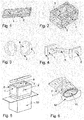
- Fig 1 shows a simple embodiment of the invention in the form of an insulating packaging consisting of an insulating core (1) and an envelope (2).
- the insulation core (1) has the task of reducing the convection and heat conduction as far as possible.
- Air is used as the insulating medium due to its low thermal conductivity of 0.0267 W / mK.
- air is subject to a temperature-dependent density, so that heat is transferred by convection. To prevent this, the air in your movement must be restricted as much as possible.
- cereal straw has a density of around 20 kg / m 3 .
- the stalks of the straw sometimes form cavities several centimeters in size, so that the insulating effect is considerably reduced by free convection.
- the insulation core according to claim 1 has an adjustable density of 40 kg / m 3 to 250 kg / m 3 .
- the cavities in such an insulation core are smaller than 0.5x0.5x0.5 cm 3 , which largely excludes convection.
- the density must be adapted to the requirements of the goods to be packaged.
- An optimal insulating effect, taking into account the material consumption, is achieved at a density of around 60 kg / m 3 to 80 kg / m 3 .
- a thermal conductivity of 0.043 W / mK comparable to that of Styrofoam is achieved.
- a density of up to about 250 kg / m 3 is useful for shock absorption when transporting heavy objects.
- a density of 40 kg / m 3 is preferred for shock absorption when transporting light, fragile objects.
- the thickness of the insulation core is not limited, but a thickness of 1 cm to 15 cm has proven to be advantageous for the applications listed here.
- the insulation core (1) consists of an arrangement of hay and / or straw, the stalks of the straw or hay having a length of 0.5 cm to 50 cm. It has proven advantageous to use a mixture of different lengths.
- the short stalks are arranged in such a way that an even distribution of density occurs within the insulation core. In this way, a uniform insulation effect is achieved without thermal bridges due to convection.
- stalks with a length of 1 cm to 25 cm have proven to be particularly advantageous. Undamaged hay and straws can be used.
- the structure of the insulation core is so pronounced that using the natural buckling strength (absorption of forces in the longitudinal direction) of the straw or hay any shape with holes, convex and concave surfaces, undercuts, sharp edges etc. is possible ( Fig. 1, Fig. 3, Fig. 4 ).
- This is absolutely necessary in order to adapt common packaging forms such as shell elements, boxes, boxes or trays to the requirements of the goods to be packaged.
- the dimensional stability of the insulation core can be maintained without binding agents supplied from the outside or detached from the plants. The stalks and stalks therefore do not have to be materially connected to one another in any way. No additional mechanical connecting elements are required for dimensional stability.
- the straw or hay used is also not broken down into its structural components such as fibers and shives. This is the only way to maintain the natural rigidity of the plants, which is required for the dimensional stability of the insulation core. Plant fibers used in the prior art can no longer absorb pressure forces and can therefore only have mechanical pressure stability in the compressed or glued fleece.
- Binding agents are understood here to mean all additives which, through their mechanical, physical or chemical interactions with the straw and / or hay of the insulation core, would influence the dimensional stability of the insulation core or the insulation packaging (e.g. tensile strength, compressive strength, resilience).
- Polymer fibers, adhesives (for example starch, alkali silicates, latex, resins), bicomp fibers, thermosetting resins or thickeners are typically used as binders in the prior art. Binding agents are also understood here as additives that would change the properties of the straw and / or hay in such a way that the plant components themselves would function as binding agents.
- binders can be added to insulation materials for a variety of reasons. Starch or its derivatives are used in the prior art, for example, as binders but also as agents for hydrophobing.
- Mechanical connecting elements are understood to mean macroscopic elements which can act on the dimensional stability of the insulation core or on the dimensional stability of the insulation core together with the casing through a force fit and / or form fit. These include, for example, quilting, riveting, lamination or the introduction of fleeces or nets. Mechanical fasteners can also be added to insulating materials for other reasons, for example for purely visual reasons.
- no binders or mechanical connecting elements are necessary for the dimensional stability of the insulation core with or without a cover.
- the form and force fit between the individual straws and / or hay stalks as well as between the cover and the insulation core is sufficient.
- the dimensional stability of the insulation core and the insulation core including the covering is understood here to mean the ability of these to withstand external loads (forces, temperature, air humidity, etc.) to the extent that handling during the production steps and use as intended is possible.
- Pressure loads on the insulation core according to the invention can be absorbed very well without a permanent change in shape.
- the springback is, for example, when using barley straw and a density of the insulation core of 60 kg / m 3 95% with a pressure of 10 N / cm 2 applied for 1 minute. After the external pressure has been removed, the insulation core returns to its original shape without any significant settling.
- the insulation core is surrounded by a flexible covering. It is sufficient to simply connect the sheath to the insulation core by means of a form fit. No mechanical connecting elements such as threads or rivets and no binding agents are required to connect the casing to the insulation core. Thus, the envelope can be easily separated from the insulation core and disposed of separately if necessary.
- the cover also provides important functional properties on the surface.
- the cover can be made of plastic, paper, cardboard, bio-plastic (e.g. PLA), non-woven material of natural or artificial origin, starch (foamed and non-foamed), or the like.
- a thickness of 10 ⁇ m to 500 ⁇ m has proven useful.
- a layer thickness of 30 ⁇ m to 5 mm is suitable. The level of the layer thickness depends on the expected external load, since the insulation core does not exert any forces on the envelope from the inside.
- a coating made of starch or starch foam can also be used for complete biodegradability.
- the envelope is designed to be vapor-permeable in order to regulate the moisture inside the packaging. This can be done by selecting a suitable material or by perforating the envelope.
- the humidity inside the box increases to over 80%.
- moisture-sensitive products can be damaged in this way.
- the straw and / or hay of the insulation core is able to bind water from the air in the amount of 10% of its own weight when the air humidity rises from 50% to 80% and thus buffer the air humidity accordingly. With an insulation core weighing 1 kg, this corresponds to an absorption capacity of 100 ml of water.
- the casing can also be made of food-safe material, so that the casing can be used for direct contact with food.
- the cover is chosen to be transparent, the insulation core made of straw or hay becomes visible. This can be perceived as a visual advantage, especially in the food sector.
- the envelope can also be designed to be odor-inhibiting or antibacterial if the requirements are met.
- the casing partially or completely from materials with a low degree of emission, preferably aluminum.
- the cover absorbs less heat through thermal radiation and at the same time emits less thermal radiation.
- the aluminum can be vapor-deposited over the entire surface or in part or laminated in the form of foils or composite foils.
- the aluminum layer thickness should be at least 40 nanometers for effective shielding.
- a major advantage of the invention is the use of all available disposal options. If no binding agent is used, or a biodegradable binding agent, the insulation core can be disposed of with the company's own compost or the regional organic waste bin. It can also be used in the garden or as bedding. If the cover is made of non-biodegradable material, the cover can easily be separated from the insulation core and disposed of separately. Due to the high calorific value of straw with 3.8 kWh / kg and the pollutant-free, climate-neutral combustion, an energetic recovery is also sensible. The legal framework conditions in waste management vary greatly from region to region. The end user has access to all disposal routes from which he can choose the most convenient for himself. A cumbersome disposal via the recycling center can be avoided. Due to the use of inexpensive raw materials and the simple disposal option the insulating packaging according to the invention is ideally suited for single-use use.
- the insulating packaging consists of a one-piece insulating core (1) with a cover (2) made of cellophane, which form a cuboid cavity (3) for receiving goods to be transported.
- insulating packaging consists of two hollow shells.
- the outside is convex, the inside (4) forms a concave cavity.
- the two insulation cores (1) are each enclosed by an envelope (2) made of opaque paper.
- FIG. 4 Another exemplary embodiment is shown in which an insulating packaging consisting of two wrapped insulating cores (1) with an internal hollow structure (6) is used to store a sensitive object (5) in such a way that it is protected from vibrations.
- the insulation cores have a density of 130 kg / m 3 .
- the wrappings (2) consist of 200 ⁇ m thick kraft paper.
- the insulating packaging consists of six plate-shaped insulating cores (1) with a density of 80 kg / m 3 , which form a cuboidal cavity (7) .
- the insulation cores are each enclosed in a food-safe casing (2) made of plastic (PET / PE / PET) with a thickness of 15 ⁇ m.
- the casings have perforations (8) so that moist air from inside the box can pass into the insulation cores.
- the outward-facing surfaces of the insulating packaging are coated with a 50 nanometer thick aluminum layer (9) to reflect thermal radiation.
- the insulation packaging is used for shipping in a standard box (10) .
- insulating packaging has an elliptical, pocket-like shape, which has only one open side (11) into which the objects to be cooled can be introduced.
- the envelope (2) consists of biodegradable plastic, preferably PLA, with a thickness of 20 ⁇ m.
- the insulation core (1) has a density of 60 kg / m 3 .
- a self-adhesive flap (12) enables the insulating packaging to be closed.
- the straw used is usually in the form of pressed square or round bales.
- Uncut straw and / or hay is advantageously obtained as the starting raw material in order to be able to adapt the structural properties of the straw and / or hay to the requirements.
- the length of the straw is between 20 cm and 100 cm, depending on the variety. A length / diameter ratio of less than 300/1 and greater than 5/1 is advantageous.
- the thickness of the stalks can be between 0.1 mm and 15 mm. Straws with a thickness of 0.1 mm to 5 mm are particularly advantageous mm. Due to the mechanical, agricultural processing there are also shorter fragments up to dust in the bales.
- the straw and / or hay bales are mechanically loosened and sent for mechanical cleaning.
- the mechanical cleaning takes place, for example, by a separator, which is designed as a centrifugal separator, gravity separator, magnetic separator, sieve, zigzag separator, filter or a combination of these.
- Mechanical cleaning can be done either dry or wet. Mechanical cleaning is intended to remove dust, stones, lumps and other unwanted components, among other things.
- Chemical treatment can be carried out for the purpose of further cleaning and the introduction of pesticides, fungicides, preservatives, disinfectants or other auxiliary substances.
- pesticides fungicides, preservatives, disinfectants or other auxiliary substances.
- degreasing, digesting, dissolving, adsorbing, absorbing, drying, etching, bleaching or coating can be mentioned as chemical processing.
- Other auxiliaries can be, for example, glues, resins, paraffins, waxes, fillers, dyes, fibers or other binders.
- Mechanical connecting elements such as particles, fibers, nets etc. can also be incorporated.
- ECA electrochemically activated water
- a concentration of 0.1% to 2% ECA dissolved in water is particularly advantageous. It is advantageous to dose the solution produced in this way with 0.1% - 20% based on the straw and / or hay weight. A dosage of the solution of 0.5% - 12% ECA based on the straw and / or hay weight is particularly advantageous.
- the ECA pre-sterilizes the straw and / or hay. In addition, all parts of the production plant that come into contact with the treated straw and / or hay are disinfected. The risk of cross-contamination can be reduced and the cleaning intervals for the system can be extended.
- an aqueous ECA solution with a concentration of 5% is generated.
- the ECA solution is continuously misted into a mass flow of hay and / or straw, so that the ratio of the mass flows of ECA solution and hay and / or straw is 3/100.
- a commercially available antibacterial and fungus-inhibiting active ingredient is sprayed into the straw or hay, which increases the durability of the insulation core under unfavorable storage conditions.
- the chemical removal of the wax layer on the straw and / or hay to improve the adsorption of water can also be advantageous. Together with the water-vapor-permeable envelope, the moisture-regulating effect of the insulating packaging according to the invention can be increased.
- a natural antibacterial effect can be produced in the event that the straw and / or hay becomes damp during later use.
- the effectiveness of a later disinfection can be increased. It is advantageous to lower the pH value when moist (at 20% moisture level) to a value of 5.5 or lower, which prevents numerous bacteria from growing. It is advantageous, for example, to enrich the straw and / or hay with 0.5% -3% lactic acid based on the raw mass weight of the straw and / or hay.
- the visual appearance can be improved by lightening the straw and / or hay and removing color contamination from black fungi.
- the odor of the straw and / or hay can be eliminated by applying odor inhibitors such as baking soda.
- odor inhibitors such as baking soda.
- the packaging can also run fragrant.
- components of mint, lavender or roses can be added to the hay and / or straw. This can also be done for purely visual reasons.
- the chemical treatment can take place at any point in the process, depending on the requirements and treatment method.
- Straw and hay are natural products, which can be subject to certain fluctuations in type, quality and properties. This depends on the climatic conditions during growth and harvest, the soil, the type of machinery used, the plant varieties used and the storage conditions. In order to still be able to produce an insulation core of constant quality and properties, or to bring about an improvement in existing properties, it may be necessary to process or treat the straw or hay mechanically, chemically or biologically.
- longitudinal cutting, cross cutting, squeezing, upsetting, grinding or rubbing can be used as mechanical processing.
- uncut barley straw with a straw length of 50 cm is made with a knife cutter for a first batch shortened to 25 cm length and for a second batch to 5 cm by cross cutting. Both batches are mixed in a weight ratio of 50/50 and blown into a silo for further processing. If it is determined in the production process that the insulation core has too low a mechanical tensile strength, the weight proportion of the 25 cm long stalks can be increased to 65%, for example. The long stalks make the insulation core more cohesive. At the same time, however, the risk of imperfections in the insulation core increases, since the rather stiff barley straws displace neighboring stalks, especially in the area of bent stalks.
- Defects in the insulation core are areas in which there is no straw and / or hay within a radius of 2.5 mm. Heat can be transported by convection in flaws, which impairs the insulating effect of the insulation core. The risk of defects increases as the density of the insulation cores decreases. Densities of 40 kg / m 3 to 65 kg / m 3 are particularly prone to defects.
- uncut barley straw with a straw length of 45 cm is shortened with a knife cutter to 15 cm length by cross cutting and soft, uncut oat straw with a length of 40 cm in a weight ratio of 30/70 is added.
- the soft oat straw adapts itself optimally to the external shape in the later pressing process and ensures good tensile strength thanks to the large straw length, while the stiffer barley straw increases the flexural rigidity of the insulation core. If larger insulation cores are produced, the bending stiffness of the insulation cores can be increased by increasing the proportion of barley straw to a weight ratio of 50/50.
- uncut wheat straw with a straw length of 60 cm is fed to a splicing device. This divides the straws lengthways. This is followed by a cut in a knife mechanism to a length of 15 cm. This makes the very rigid straw softer and can be further processed in a mixture or in its pure form. Also other, very rigid straw and / or In this way, hay types can be adapted to the requirements in terms of their specific flexural strength.
- cut barley straw with a straw length of 30 cm is continuously squeezed by a profiled pair of rollers at a variable distance. At the pinch points, the flexural strength of the stalks is greatly reduced locally without affecting the tensile strength of the insulation core produced from it.
- Volume measurement or weight measurement can be used to dose the straw and / or hay. Since the volume of straw and / or hay depends heavily on the type and mechanical processing, weight measurement is preferred. A volume measurement is advantageous if the straw and / or hay is to be carried out on a continuous conveyor belt, since this can be implemented with less effort. When measuring the volume, it is advantageous if the insulation core produced is weighed and has an influence on the target volume. Dosing can take place at any point in time before molding. It is advantageous to carry out the dosing at the earliest after the mechanical cleaning, since considerable amounts of straw and / or hay are separated out here.
- straw As a natural raw material, straw is heavily colonized with microorganisms.
- the total number of straw and hay in the delivery condition is usually 5 ⁇ 10 6 nucleating units per gram (CFU / g), mainly bacteria and fungi.
- CFU / g nucleating units per gram
- the number of germs should be reduced by several orders of magnitude; pathogenic germs should not be detectable.
- all common methods are suitable for disinfecting straw or hay. Irradiation, fumigation, the use of liquid disinfectants or heat treatment are possible. The use has proven particularly advantageous proved by moist heat.
- the straw and / or hay is treated with superheated steam, saturated steam or wet steam under ambient pressure or increased pressure. Steam temperatures of 90 ° C. to 150 ° C.
- Straw and hay mainly consist of cellulose, lignin and hemicellulose.
- the individual plant components such as the cell wall or central lamella mainly consist of these building materials in different structural compositions.
- the lignocellulose which forms the cell wall of lignified plants, is a structural composite in which the cellulose and hemicellulose form a framework in which lignin is stored. While the cellulose and hemicellulose absorb the tensile forces, the lignin stabilizes against compressive stress. The composite is therefore comparable to a reinforced concrete structure.
- lignin can be plasticized by heat. With an increase in humidity, the glass transition temperature of lignin decreases. The lignin hardens again by cooling below the glass transition temperature. The process is largely reversible. In the dry state (8% moisture level) the glass transition temperature is 130 ° C - 180 ° C; when wet at about 80 ° C - 90 ° C.
- the glass transition temperature of hemicellulose and cellulose is also strongly dependent on moisture. In the moist state, the glass transition temperature even drops to room temperature.
- the straw and / or hay is plasticized by the action of moist or dry heat.
- the biopolymers lignin, cellulose and hemicellulose are heated above their glass transition temperature.
- the action of moist heat is particularly advantageous, since the glass transition temperature of lignin can be lowered.
- the straw and / or hay is heated to at least 80 ° C.
- a moisture content of 5% - 25% should be aimed for, depending on the type of straw or hay. For barley straw, the optimal moisture content is 8% - 20%.
- Moisture can be introduced into the straw and / or hay prior to heating or it can be introduced at the same time as the heating. So there are two alternatives to use moist straw and / or hay or dry straw and / or hay.
- steaming with steam is particularly advantageous.
- the hot steam causes, on the one hand, an increase in the temperature of the straw and / or hay and, on the other hand, humidification through adsorption.
- Water vapor has a significantly higher internal energy (enthalpy) than air at the same temperature. This makes the heating particularly effective.
- the thermal conductivity is drastically increased by the moisture introduced so that particularly rapid heating is possible.
- the temperature of the water vapor should be in the range from 90 ° C to 150 ° C.
- steaming must be carried out under pressure in order to maintain the saturated steam conditions or wet steam conditions.
- a pressure of 3 bar is required.
- An increased pressure accelerates the adsorption of the water into the straw and / or hay considerably.
- the process time can be reduced significantly with higher pressure.
- the barley straw absorbs about 18 grams of water. The moisture content increases from 8% to 14.7%.
- steam wet steam or saturated steam
- heating with hot air flowing through, with microwave radiation, by contact heating, by superheated steam or a combination of these is suitable.
- the use of superheated steam is particularly advantageous, since this has a very high internal energy and high thermal conductivity, and thus the process time can be carried out very quickly and also allows uniform heating.
- a temperature of the superheated steam of 101 ° C to 150 ° C at ambient pressure is suitable for this.
- Superheated steam at a temperature of 102 ° C to 130 ° C is particularly advantageous.
- the heating of the moist straw and / or hay can also be accompanied by simultaneous drying if water vapor is transported away from the straw and / or hay.
- the shaping of the straw and / or hay should, however, take place before plasticizing.
- the moisture in the straw and / or hay prevents the straw and / or hay stalks from breaking when compressed.
- the straw and / or hay are shaped.
- Moist or dry straw and / or hay have very good springback at room temperature and cannot be shaped without the use of binding agents. Straw and / or hay can only be formed into firm compacts through very high pressures with the associated high temperatures. The very good insulating effect of straw and hay is largely lost in such processing.
- step 7 of this invention the springback is almost completely eliminated, so that even a small force of 0.1-10 N / cm 2 on the straw and / or hay for a Shaping suffice.
- a force of 0.1 N / cm 2 to 2 N / cm 2 is particularly advantageous.
- the shaping can take place before or after the plasticizing of the straw and / or hay.
- the shape is divided into the inner and outer shape:
- the outer shape is understood here to mean the temporary or permanent fixation of the straw and / or hay in an at least partially deterministically defined shape. It determines, at least in part areas, the outer contour of the straw and / or hay after shaping.
- the external shaping takes place according to the invention by at least partial molding of geometrically defined objects, by subtractive or additive shaping processes such as cutting, punching, etc., or by the action of fluids or gases.
- the inner shape is understood here as a temporary or permanent fixation of the straw and / or hay in a stochastically defined shape, with the emphasis on influencing the physical properties of the composite of straw and / or hay. It determines, for example, the stochastic distribution of the straw and / or hay within the outer shape or the type, frequency and quality of form and frictional engagement between the hay and / or straw parts.
- the inner shape can be influenced by the type of outer shape, by the action of fluids, gases and geometrically defined or geometrically undefined objects.
- the external shape can shape the straw and / or hay into plates, discs, free-form bodies, each with or without recesses.
- the inner shape can be the straw and / or hay For example, distribute them evenly, pile them up locally, hook, layer or arrange the straws and / or haystocks.
- barley straw 25 cm long is pneumatically blown into a rectangular chamber measuring 30 ⁇ 30 ⁇ 30 cm 3 .
- the barley straw is distributed so that the weight per unit area is 2.4 kg / m 2 in the edge area and decreases to 1.2 kg / m 2 towards the center.
- the height of the straw in the chamber is 12 cm at the edge and drops to 6 cm towards the center.
- the stalks are aligned in a preferred orientation parallel to the chamber floor. Nevertheless, the stalks of the straw and / or hay are three-dimensionally interlocked with one another.
- the volume of the chamber is reduced to 30x30x2 cm 3 using a rectangular plunger.
- the density of the straw and / or hay in the edge area of the chamber increases to 120 kg / m 3 , in the middle to 60 kg / m 3 . Due to the even distribution, no cavities larger than 0.5x0.5x0.5 cm 3 are formed .
- the insulation core is now defined in its inner and outer shape, but is not yet mechanically stable due to the ongoing plasticization of the straw and / or hay.
- the defined inner shape must be stabilized. It is sufficient for the lignin contained in the straw and / or hay to fall below the glass transition temperature.
- the cellulose and the hemicellulose do not necessarily have to be brought below their glass transition temperature in order to stabilize them sufficiently for further processing. This allows, for example, a particularly advantageous embodiment of the invention, in which the resulting insulation core is still moist but dimensionally stable and can be dried in a separate second step.
- the glass transition temperature of the lignin can be fallen below by cooling or by drying or by a combination of cooling and drying. With the inner shape, the outer shape is also automatically stabilized.
- cooling can take place by common methods using cold gases such as air or nitrogen, by evaporative cooling or by contact cooling with cold solids.
- the drying can be carried out by all common methods such as hot air drying, vacuum drying, hot steam drying (with superheated steam), microwave drying or a combination of these methods.
- Drying with superheated steam at 101 ° C to 150 ° C at a pressure of 0-5 bar above ambient pressure has proven to be advantageous, since the heat transfer is particularly effective and the process time can thus be reduced.
- Drying with superheated steam at 102.degree. C.-120.degree. C. at a pressure of 0-1 bar above ambient pressure has proven particularly advantageous.
- the insulation core maintains its dimensional stability to a sufficient degree through a form fit and / or a force fit between the straws and / or haystocks. Cohesive connections by binding agents or further form-fitting and / or force-locking connections by additional mechanical connecting elements are not required for the dimensional stability of the insulation core. An admixture of binders can be advantageous for other reasons, for example for The insulation core is hydrophobic.
- straw and / or hay is plasticized with saturated steam under moist heat and brought to a moisture level of 20% and a temperature of 95 ° C.
- the resulting insulation core has a residual moisture level of 15% after cooling and is dimensionally stable.
- straw and / or hay is plasticized with saturated steam under moist heat and brought to a moisture level of 20% and a temperature of 95 ° C. Then superheated steam (120 ° C, ambient pressure) with an admixture of 20% air and a flow rate of 1 m / s is blown through the moist and hot straw and / or hay until the degree of moisture of the straw is 8%.
- the resulting insulation core has a temperature of 97 ° C and is dimensionally stable.
- the insulation core produced by method steps 1-10 can be further processed using further mechanical methods. For example, cutting, punching, bending, pressing, stacking or joining is possible, or a new insulation core can be produced by combining several insulation cores.
- one or more of the insulation cores produced according to method steps 1-11 are provided with one or more sheaths on all sides. It is particularly advantageous to use only the form fit of the cover in order to connect it to the insulation core and to dispense with mechanical connecting elements such as stitching, riveting and binders for connecting the cover to the insulation core. As a result, the envelope can be separated from the insulation core if necessary and easily disposed of.
- the use of Mechanical connecting elements and / or binding agents for fixing the envelope to the insulation core can be useful, for example for optical reasons or for the targeted influencing of mechanical properties.
- the envelope can be made of plastic, paper, cardboard, bio-plastic (e.g.
- the envelope can be in a solid, liquid or pasty state when it is applied to the insulation core. Treatment methods such as drying, vulcanizing, crosslinking, gluing, welding, flanging, shrinking, wrapping or the like can be used to adapt the shape of the envelope to the outer shape of the insulation core. A tight-fitting covering on all sides is particularly advantageous, as this protects and stabilizes the insulation core particularly well.
- the envelope can also be printed or coated in various ways, as well as composed of the individual components mentioned above.
- the insulation core is first welded into PLA film, and the PLA film is subjected to shrinkage by means of a heat treatment so that the PLA film adapts to the external shape of the insulation core.
- Several such insulation cores are then arranged in a carton in such a way that all the inner sides of the carton are completely and overlappingly covered with the insulation cores.
- the insulation core is pushed into a cross-bottom bag of the same shape made of Kraft paper and the cross-bottom bag is closed by a self-adhesive flap.
- straw and / or hay can be welded into a cover made of reinforced cellulose fleece and in the Subsequently, the process of plasticizing (step 7) and subsequent shaping (step 8) are subjected.
- the described method for producing an insulating packaging can be implemented continuously, discontinuously or in a mixed form. Two exemplary embodiments for a production plant are given below:
- the straw is mechanically loosened in a bale opener.
- the straw is cut to a length of 15 cm in a cross cutter. Dust is removed from the straw via a suction device.
- the straw is fed to a gravity separator via a conveyor fan and transported on to a silo.
- the straw is misted with a 1 percent aqueous solution of ECA, the solution being metered in at 1% based on the weight of the straw.
- Straw is discharged from the silo onto a belt scale with the help of rollers until a target weight of 260 grams is reached for the portion.
- the portion of straw is conveyed into a bowl-shaped mold by a conveyor fan and is evenly distributed there so that 80% of the straws are aligned largely parallel to the base of the mold.
- the straw is treated with saturated steam inside the mold for 2 minutes at 98 ° C.
- the straw is sterilized and plasticized at the same time.
- the straw experiences an increase in moisture level from 8% to 17%.
- the density of the straw is then compressed from 30 kg / m 3 to 80 kg / m 3 by a bowl-shaped punch. For this purpose, a low pressure of 0.1 N / cm 2 is applied.
- the slightly compressed straw is flowed through with superheated steam at 120 ° C under ambient pressure until a moisture level of 8% has set in the straw. This process takes about 30 seconds.
- the now finished insulation core is then removed from the mold.
- the insulation core is dimensionally stable to a limited extent. Sharp edges, radii and large areas can also be precisely shaped.
- the insulation core is welded into a 20 ⁇ m thick PLA film and the PLA film is subjected to heat shrinkage.
- the shrink film wraps itself around the insulation core in a form-fitting manner.
- the insulating packaging is now complete.
- the straw is mechanically loosened in a bale opener.
- the straw is cut to a length of 15 cm in a cross cutter and transported to silo 1.
- the hay is loosened in a bale opener.
- the hay remains at its original length of around 30 cm and is transported to silo 2.
- a suction device is used to remove dust from the straw and hay at the silos.
- the straw and hay are discharged from the silos on belt scales and mixed pneumatically in a ratio of 50%.
- the straw / hay mixture is fed into a third silo with a conveyor fan.
- the straw / hay mixture is discharged from the silo at a uniform height of 25 cm onto a continuously running conveyor belt.
- saturated steam (100 ° C, ambient pressure) flows through the straw / hay mixture in a steam tunnel for 3 minutes and in the process is sterilized and plasticized.
- a moisture content of 18% is established in the straw / hay mixture.
- the straw / hay mixture is then compressed by a belt press running inwards, the belts of the belt press being equipped with a three-dimensional diamond profile so that areas with higher density and areas with lower density are created.
- Cold air flows actively through the belts of the belt press (20 ° C, ambient pressure).
- the straw / hay mixture cools down to 45 ° C and hardens.
- the straw / hay mixture produced in this way is mechanically stable to a limited extent and has a moisture content of 15%.
- the straw / hay mixture is then fed to a belt dryer, which reduces the moisture content from 15% to 8% in the run. To do this, warm air (75 ° C) flows through the straw / hay mixture. From the insulation core produced in this way, plates are cut out by longitudinal and transverse cutting, which are inserted into a cover made of Kraft paper with a positive fit.
Landscapes
- Engineering & Computer Science (AREA)
- Mechanical Engineering (AREA)
- Life Sciences & Earth Sciences (AREA)
- Biodiversity & Conservation Biology (AREA)
- Wrappers (AREA)
- Nonwoven Fabrics (AREA)
- Packages (AREA)
- Dry Formation Of Fiberboard And The Like (AREA)
Description
- Für die Aufbewahrung und den Versand von temperaturempfindlichen Waren werden Isolierverpackungen benötigt, welche dafür sorgen, dass eine vordefinierte Temperatur im Inneren der Verpackung nicht über- oder unterschritten wird. Solche Verpackungen werden hauptsächlich für pharmazeutische Produkte, medizinische Produkte und Lebensmittel eingesetzt. Die Nichteinhaltung dieser meist gesetzlich geregelten Temperaturgrenzen stellt ein mitunter hohes Haftungsrisiko für Warenversender und ein Gesundheitsrisiko für Warenempfänger dar.
- Zum Aufbau einer Isolierwirkung bei einer Isolierverpackung müssen die drei Wärmetransportphänomene Konvektion, Wärmeleitung und Wärmestrahlung minimiert werden. Luft eignet sich aufgrund der geringen Wärmeleitung und einfachen Verfügbarkeit ideal als Isoliermedium. Durch den Dichteunterschied von Luft bei verschiedenen Temperaturen entsteht eine Luftbewegung (Konvektion), welche verringert werden kann, wenn die Luft in ihrer Bewegung eingeschränkt wird. Die Wärmestrahlung kann durch die Auswahl und Anordnung geeigneter Materialien verringert werden.
- Aus den genannten physikalischen Gründen der Wärmetransportphänomene sind Isolierverpackungen in aller Regel voluminöse, Hohlkörper aus einer Vielzahl von Luftkammern. Die Entsorgung dieser voluminösen Isolierverpackungen stellt bei regelmäßigem Warenverkehr vor allem für Endverbraucher ein großes Problem dar und ist bei zunehmendem Onlinehandel auch ökologisch problematisch.
- Für den derzeit wirtschaftlich aufstrebenden Online-Lebensmittelhandel beispielsweise ist eine einfach zu entsorgende, ökologisch vorteilhafte Isolierverpackung, welche auch eine schockabsorbierende Funktion bietet, der Schlüsselfaktor für die benötigte Kundenakzeptanz.
- Die am Markt eingesetzten Isolierverpackungen sind überwiegend aus expandiertem Polystyrol (EPS) gefertigt. Diese bieten eine gute Isolierwirkung, die Möglichkeit der freien Formgebung und sind durch die hohen Stückzahlen kostengünstig erhältlich. Die Herstellung von Isolierverpackungen aus EPS ist allerdings sehr energieaufwendig. Die Umweltverträglichkeit bei der Entsorgung ist durch die enthaltenen Schadstoffe (Flammschutzmittel, Styrol, Weichmacher, Pentan) umstritten. Die Luftfeuchtigkeit in einer Styroporbox erreicht bei Verwendung von Kühlakkus 80 % - 90 %. Feuchtigkeitsempfindliche Produkte wie Backwaren können hierbei Schaden nehmen.
- Alternative Isolierverpackungen wurden entwickelt, um dem Bedarf nach ökologisch vorteilhafteren und einfacher zu entsorgenden Isolierverpackungen gerecht zu werden.
- Aus der Literatur sind Isolierverpackungen auf Basis von Stärkeschaum bekannt. Beispielsweise ist in
EP0656830B1 ein Schichtverbundmaterial auf Basis von Stärkeschaum offen gelegt. Die Herstellung von Isolierverpackungen aus Stärkeschaum ist energieaufwendig und daher kostspielig. Aufgrund der Empfindlichkeit gegenüber Feuchtigkeit ist eine absolut wasser- und dampfdichte Barriere erforderlich. Wie bei der Styroporbox findet deshalb auch hier keine Feuchtigkeitsregulierung statt. Aus den genannten Gründen konnten sich deshalb bisher keine Produkte auf Basis von Stärkeschaum am Markt etablieren. - Daneben existieren Isolierverpackungen aus mehrschichtigen aufblasbaren Luftkissen wie beispielsweise in
US005533888A offen gelegt. Diese aus einer Vielzahl von in Schichten verbundenen aluminiumbedampften Kunststofffolien hergestellten Isolierverpackungen bieten eine ausreichende Isolierleistung. Sie sind allerdings anfällig gegenüber mechanischen Beschädigungen, wodurch ein Totalausfall der Isolationswirkung entsteht, und sind durch den komplizierten Herstellungsprozess deutlich teurer als eine vergleichbare Styroporbox. Zudem bestehen sie aus konventionellem Kunststoff und müssen über den Restmüll entsorgt werden. Wie bei der Styroporbox findet auch hier keine Feuchtigkeitsregulierung statt. - Die Verwendung von Pflanzen und Pflanzenbestandteilen (Hanffaser, Stroh, Heu, etc.) zur Herstellung von Dämmplatten ist in der Bauindustrie seit jeher bekannt und hat sich in letzter Zeit zur Isolation von Gebäuden als Nische etabliert. Dabei kommen zwei unterschiedliche Ausgangsstoffe zur Verwendung: aus Pflanzen gewonnene Fasern sowie weitgehend in Rohform vorliegende ganze Pflanzen oder deren Bestandteile wie Blätter, Stengel oder Halme.
- Aus Pflanzen gewonnene Fasern werden durch mechanische, chemische und thermische Verfahren zu Vliesen und Vliesstoffen weiterverarbeitet. Die Pflanzenfasern werden häufig aus Hanf, Flachs oder Leinen aufwändig gewonnen. Der Prozess entspricht dabei dem der Textilfaserherstellung. Als Vliesstoffe werden nach aktueller Auffassung entsprechend DIN EN ISO 9092:2012-01 im Allgemeinen Flächengebilde aus Faser, Endlosfilamenten oder geschnittenen Garnen verstanden. Nur etwa 20-30 % der Pflanze können als Faser genutzt werden. Die dünnen Fasern können keine Druckkräfte, sondern lediglich Zugkräfte aufnehmen. Zur mechanischen Stabilisierung müssen sie daher zu Matten verdichtet, verklebt und/oder verfilzt werden. Anschließend werden die Vliese meist zur zusätzlichen mechanischen Stabilisierung mit weiteren Schichten versteppt, vernietet oder verklebt. Die Verwendung von Vliesen und Vliesstoffen als Isolierverpackung ist daher aufwändig und kostspielig. Zudem lassen sich die Vliese nur schwer wieder auftrennen. Die Entsorgung muss also als Ganzes erfolgen. Eine freie Formgestaltung ist nicht möglich. Die Vliese werden stets zu großen flächigen Platten oder Matten verarbeitet. Beispielsweise wird in
EP0644044A1 ein Verpackungsmaterial mit einer flächigen, polsternden Innenschicht aus Naturfaservlies und zwei beidseitig abdeckenden Abdecklagen offengelegt, dadurch gekennzeichnet dass die Abdecklagen aus biologisch abbaubarer Folie bestehen. InDE19846704C2 wird eine Dämmstoffmatte aus Hanf mit einer zweiseitigen Kaschierung für die Bauindustrie offen gelegt, welche dadurch gekennzeichnet ist, dass die Füllung aus ungerösteten Hanffaserprodukten aus einem Gemisch von Langfaser, Kurzfaser und Schäben ausgebildet ist. Um ein Setzen der Dämmstoffmatte zu verhindern, sind Steppnähte, Nieten oder ein in die Füllung eingearbeitetes Netz notwendig. - In
EP1840043 B1 wird ein dreidimensionales Verpackungsteil auf Basis von Naturfasern mit reduziertem Anteil von Bindemitteln offen gelegt. Das Produkt soll Verpackungsteile ersetzen, welche bisher im Nassverfahren aus Pulpe (Faserbrei) hergestellt werden. Das Verpackungsteil wird durch Heißpressen eines Vliesstoffes mit hohem Druck erzeugt. Der Vliesstoff besteht aus feinen Naturfasern, welche durch den Zusatz von Wasser untereinander Wasserstoff-Brückenbindungen eingehen. Zugesetzte Bindemittel und/oder Stützfasern verkleben den Verbund beim Heißpressen. Die Menge an Bindemittel kann reduziert werden, wenn die Naturfasern noch Lignin enthalten, welches beim Heißpressen austritt und die Fasern verklebt. Durch das Heißpressen bei hohem Druck entsteht eine glatte Oberfläche. Es wird auch ein Sandwich-Verbund beschrieben, bei dem auf der Oberseite und Unterseite eines Verpackungsteils eine Schicht beispielsweise aus Kunststoff aufgebracht ist. Heißgepresste Verpackungsteile werden beispielsweise als Eierschachteln oder andere Formteile verwendet. Durch die fein aufgeschlossenen Fasern müssen hohe Drücke und/oder Bindemittel zugeführt werden, um die Formbeständigkeit zu gewährleisten. Die beschriebene zweiseitige Laminierung dient auch als Funktionsfläche. Typischerweise sind die so hergestellten Produkte von dünner Wandstärke (wenige Millimeter), durchschnittlich hoher Dichte und damit nicht als Isolierverpackung zu gebrauchen. - Weitgehend in Rohform vorliegende Bestandteile von Pflanzen wie Blätter, Stengel, Halme werden zur Herstellung von Dämmplatten meist mit Bindemittel verklebt. In
DE19810862C2 wird beispielsweise eine Dämmplatte aus Stroh für die Bauindustrie offen gelegt. Die Dämmplatte besteht aus einem homogenen Gemisch aus zerkleinertem Stroh und 10% - 30% Bindemittel. Zweiseitig ist eine gitterartige Beschichtung aufgeklebt. Die durch Bindemittel verklebten Dämmplatten sind in der Herstellung aufwendig und lassen sich manuell nur schwer auftrennen. Die glatten Oberflächen des Strohs erfordern zur Verklebung eine spezielle chemische oder mechanische Behandlung. Eine ökologisch vorteilhafte Kompostierung ist durch die in der Regel verwendeten Bindemittel aus Kunststoff problematisch. - In
EP1958762B1 wird ein Naturfaservlies aus Stroh- und weiteren Naturfasern und einer Matrix aus PLA beschrieben. Durch Temperatureinwirkung schmelzen die PLA-Fasern und bilden damit einen Naturfaserverbundwerkstoff. Durch Formpressen unter Wärmeeinfluss wird anschließend eine Lage des Hybridvliesstoffes erzeugt, welcher beispielsweise mit einer PLA-Folie umgeben ist. Die PLA-Folie kann in der Formpresse mitverpresst werden. Die so entstandenen Formteile können als Verpackungsmaterial oder in mehreren Schichten als Wandelemente genutzt werden. Das Naturfaservlies besteht zu etwa 35% aus dem teuren Biokunststoff PLA und ist damit nicht wettbewerbsfähig zu Styropor. - In
EP0570018B1 wird ein Verpackungsteil aus verpresstem Stroh oder Heu offen gelegt, dadurch gekennzeichnet, dass keine Beimischung von Bindemittel oder Klebstoff erfolgt. Durch das starke Verpressen von aufgeweichtem oder aufbereitetem Stroh oder Heu soll ein glattes Verpackungsteil, beispielsweise eine Schachtel oder ein Behälter, entstehen. Die Oberfläche ist durch die starke Verpressung glatt und bedruckbar. - Die Herstellung von solchen Verpackungsteilen aus Pflanzen ohne Bindemittel erfolgt wie beispielsweise aus
EP1377418B1 oderDE202009013015U1 bekannt durch Verpressen bei hohen Drücken und hohen Temperaturen. Ziel ist es, dabei pflanzliche Bindemittel wie das Biopolymer Lignin aus den Pflanzen zu lösen und als Klebstoff freizusetzen. Anstelle der Verwendung eines von außen zugeführten Klebstoffs wird der in den Pflanzen enthaltene Klebstoff verwendet. Vorteilhaft ist die weitgehende Gestaltungsfreiheit solcher Bauteile. Aufgrund der hohen Drücke befinden sich in einem solchen Verpackungsteil allerdings kaum noch isolierende Hohlräume, wodurch die Verwendung als Isolierverpackung nicht mehr gewährleistet ist. Es entsteht ein fester, verklebter Presskörper, welcher nicht mehr aufgetrennt werden kann. Eine schockabsorbierende Wirkung ist nicht gewährleistet. - Um die Kosten für verklebte Dämmplatten für die Bauindustrie zu senken, wird in dem Gebrauchsmuster
DE8536156U1 vorgeschlagen, einen losen Verbund aus ungeordnet liegenden und unverklebten Strohs zweiseitig mit Papier zu kaschieren und anschließend mit Fäden in geringen Abständen zur mechanische Fixierung zu versteppen. Die Versteppung hat den Nachteil, dass die Strohdämmplatte manuell nur schwer aufgetrennt werden kann. Sie muss deshalb als Ganzes entsorgt werden. Zudem können auf diese Weise lediglich größere Platten hergestellt werden. Eine freie Formgebung ist nicht möglich. Da die Dämmplatte nicht allseitig geschlossen ist, können unfixierte Strohteile und Staub leicht aus dem Verbund gelöst werden. Dämmplatten, welche auf diese Art aufgebaut sind, sind damit als Isolierverpackung nicht geeignet, da sie die zu schützenden Gegenstände verunreinigen, beschädigen oder kontaminieren würden. - In
DE4333758A1 undDE4317239A1 wird eine Isoliermatte aus Biomasse wie beispielsweise Stroh für die Bauindustrie offen gelegt. Die Biomasse wird vorzugsweise versteppt, verklebt oder vernadelt und feuerhemmend ausgerüstet. Es wird zudem ein Verpackungsmaterial erwähnt, welches aus lose in Netzen gefüllter, unbehandelter Biomasse besteht. Solche mit Biomasse ausgestopften Netze sind ohne Verstärkung wie Versteppung oder Nieten nicht formbeständig, weisen eine nur ungleichmäßige Dichteverteilung auf und sind somit aufgrund der vorkommenden großen Hohlräume für eine leistungsfähige Isolierung nicht geeignet. Sie können höchstens als Füllmaterial verwendet werden. - In JPH10287370 (A) wird ein Polstermaterial aus Stroh zur Stoßdämpfung offen gelegt. Die Formgebung erfolgt durch Versteppen des Strohs sowie durch Verkleben mit einer Umhüllung.
- Isolierverpackungen auf pflanzlicher Basis konnten sich bisher auf dem Markt nicht durchsetzen. Die für die Bauindustrie entwickelten Dämmstoffe aus Pflanzenbestandteilen oder Pflanzenfasern zur Isolierung von Gebäuden sind nicht als Isolierverpackung geeignet, da die zugrunde liegenden Anforderungen sich grundlegend unterscheiden. Die als Baustoffe verwendeten Isolierungen sind feuerhemmend, schädlingsresistent und mechanisch so ausgelegt, dass sie auch nach Jahrzehnten eine einwandfreie Isolierwirkung erzielen. Beispielsweise muss das sogenannte Setzen, also die Verringerung des ursprünglichen Materialvolumens durch Schwerkrafteinwirkung, über Jahrzehnte verhindert werden. Die Herstellung solcher Dämmstoffe ist entsprechend aufwendig und teuer und nicht als Isolierverpackung zu gebrauchen. Zudem lassen sich so hergestellte Dämmmaterialien nur schwer wieder zerkleinern und entsorgen. Die schmalen Seitenflächen der Dämmplatten für die Bauindustrie sind in der Regel nicht kaschiert, da hier keine Funktionsfläche vorliegt, sondern die Platten zwischen die Balken eingeklemmt werden. Bestandteile des Dämmstoffes können sich somit lösen und die Ware kontaminieren oder beschädigen. Zur Herstellung moderner Isolierverpackungen ist es zudem erforderlich eine weitgehend freie Formgebung zu ermöglichen, um den unterschiedlichsten Anforderungen des Verpackungsmarktes gerecht zu werden. Existierende wärmeisolierende Dämmmaterialien aus Pflanzen und ohne Bindemittel sind nur als Platten bekannt. Eine freie Formgebung ist nicht möglich.
- Aufgrund der oben genannten Nachteile der im Stand der Technik aufgeführten Dämmpatten und Isolierverpackungen konnte sich bisher keine ökologische Alternative zu den EPS-Isolierverpackungen am Markt etablieren.
- Aufgabe der hier beanspruchten Erfindung ist es daher, eine Isolierverpackung für temperaturempfindliche und/oder schockempfindliche Produkte herzustellen, welche neben einer hervorragenden Isolier- und Dämpfungswirkung, einer verbesserten Ökobilanz, einer vereinfachten Entsorgung und einer freien Formgebung auch wirtschaftliche Vorteile gegenüber den etablierten EPS-Verpackungen besitzt. Die Isolierverpackung muss zudem den strengen hygienischen Erfordernissen als Lebensmittelbedarfsgegenstand Rechnung tragen. Sie soll auch als Einwegverpackung geeignet sein. Ferner soll ein Verfahren zur Herstellung einer derartigen Isolierverpackung geschaffen werden.
- Diese Aufgabe wird erfindungsgemäß mit einer Isolierverpackung nach Anspruch 1 und einem Verfahren zur Herstellung der Isolierverpackung nach Anspruch 10 gelöst. Vorteilhafte Weiterentwicklungen sind in den Unteransprüchen beschrieben.
- Als Ausgangsmaterial wird Heu oder Stroh verwendet, welches sortenrein, in Mischung oder in Bestandteilen verwendet werden kann. Dabei ist sowohl eine Mischung verschiedener Heu- oder Strohsorten, als auch eine Mischung von Heu und Stroh möglich. Stroh wird hier als Sammelbegriff für ausgetrocknete Halme, Stengel und Blätter von Getreidepflanzen, Ölpflanzen, Faserpflanzen und Hülsenfrüchten verwendet. Heu wird hier als Sammelbegriff für getrocknete Futterpflanzen wie beispielsweise Kräuter, Gräser oder Hülsenfrüchte verwendet.
- Vorteilhafterweise wird Stroh oder Heu von Süßgräsern verwendet, da die Halme hohl sind und kein Mark beinhalten. Der Durchmesser der Halme beträgt idealerweise zwischen 1 mm und 10 mm. Auf diese Weise formen die Halme in ihrem Inneren kleine Luftkammern, welche eine Konvektion innerhalb der Halme verhindern.
- Besonders vorteilhaft ist Getreidestroh aus Gerste, da es preiswert verfügbar ist, eine geringe Neigung zu Pilzbefall aufweist und hervorragende Isolationseigenschaften besitzt. Getreidestroh fällt als landwirtschaftliches Nebenprodukt in großen Mengen an und kann ohne ökologische Nachteile zu 1/3 vom Acker entfernt werden. Je nach regionaler Verfügbarkeit kann aber die Verwendung anderer Stroh- oder Heuarten vorteilhafter sein.
-
Fig 1 . zeigt ein einfaches Ausführungsbeispiel der Erfindung in Form einer Isolierverpackung bestehend aus einem Isolationskern (1) und einer Umhüllung (2). - Der Isolationskern (1) hat die Aufgabe die Konvektion und Wärmeleitung weitestgehend zu reduzieren. Als Isoliermedium dient Luft aufgrund des geringen Wärmeleitwertes von 0,0267 W/mK. Luft unterliegt allerdings einer temperaturabhängigen Dichte, sodass eine Wärmeübertragung durch Konvektion stattfindet. Um diese zu unterbinden, muss die Luft in Ihrer Bewegung möglichst eingeschränkt werden. Im ursprünglichen Zustand besitzt Getreidestroh eine Dichte von etwa 20 kg/m3. Dabei bilden die Halme des Strohs mitunter mehrere Zentimeter große Hohlräume, so dass die Isolierwirkung durch freie Konvektion erheblich reduziert wird. Der Isolationskern nach Anspruch 1 besitzt eine einstellbare Dichte von 40 kg/m3 bis 250 kg/m3. Die Hohlräume in einem solchen Isolationskern sind kleiner als 0,5x0,5x0,5 cm3, wodurch Konvektion weitgehend ausgeschlossen wird. Die Dichte ist dabei auf die Erfordernisse der zu verpackenden Ware anzupassen. Eine optimale Isolierwirkung unter Berücksichtigung des Materialverbrauches wird bei einer Dichte etwa 60 kg/m3 bis 80 kg/m3 erreicht. Ein mit Styropor vergleichbarer Wärmeleitwert von 0,043 W/mK wird damit erzielt. Für die Schockabsorption beim Transport schwerer Gegenstände ist eine Dichte von bis etwa 250 kg/m3 sinnvoll. Für die Schockabsorption beim Transport leichter, zerbrechlicher Gegenstände ist eine Dichte von 40 kg/m3 zu bevorzugen. Theoretisch ist die Dicke des Isolationskernes nicht begrenzt, allerdings hat sich für die hier aufgeführten Anwendungsfälle eine Dicke von 1 cm bis 15 cm als vorteilhaft erwiesen.
- Der Isolationskern (1) besteht aus einer Anordnung von Heu- und/oder Stroh, wobei die Halme des Strohs oder Heus eine Länge von 0,5 cm bis 50 cm aufweisen. Es hat sich als vorteilhaft erwiesen, eine Mischung verschiedener Längen zu verwenden. Die kurzen Halme sind so angeordnet, dass eine gleichmäßige Dichteverteilung innerhalb des Isolationskernes auftritt. So wird eine gleichmäßige Isolierwirkung ohne Wärmebrücken durch Konvektion erreicht. Für Gersten- und Weizenstroh haben sich beispielsweise Halme mit einer Länge von 1 cm bis 25 cm als besonders vorteilhaft erwiesen. Es können unbeschädigte Heu- und Strohhalme verwendet werden. Durch den Einsatz gängiger Erntemaschinen findet aber immer eine gewisse Schädigung der Halmstrukturen statt, welche aber nicht zwingend benötigt wird.
- Es hat sich als besonders vorteilhaft erwiesen, wenn die Stroh- und Heuhalme überwiegend (>80 %) senkrecht zum Wärmestrom des Isolationskernes ausgerichtet sind. Der Wärmestrom von einer warmen Seite zu einer kalten Seite des Isolationskerns ist deutlich geringer, wenn die Stroh- und Heuhalme von der Längsseite durchquert werden.
- Die Struktur des Isolationskernes ist so ausgeprägt, dass unter Ausnützung der natürlichen Knickfestigkeit (Aufnahme von Kräften in Längsrichtung) des Strohs oder Heus eine beliebige Formgebung mit Löchern, konvexen und konkaven Flächen, Hinterschneidungen, scharfen Kanten etc. ermöglicht wird (
Fig. 1, Fig. 3, Fig. 4 ). Dies ist zwingend erforderlich, um gängige Verpackungsformen wie Schalenelemente, Kisten, Boxen oder Trays an die Erfordernisse des Verpackungsgutes anzupassen. Die Formbeständigkeit des Isolationskernes kann ohne von außen zugeführter oder aus den Pflanzen herausgelöster Bindemittel aufrechterhalten werden. Die Stengel und Halme müssen somit in keiner Weise stoffschlüssig miteinander verbunden sein. Für die Formbeständigkeit werden auch keine zusätzlichen mechanischen Verbindungselemente benötigt. Das verwendete Stroh oder Heu ist des Weiteren nicht in seine strukturellen Bestandteile wie Fasern und Schäben aufgeschlossen. Nur so bleibt die natürliche Knicksteifigkeit der Pflanzen erhalten, welche für die Formbeständigkeit des Isolationskernes benötigt wird. Im Stand der Technik verwendete Pflanzenfasern können keine Druckkräfte mehr aufnehmen und können somit nur im verdichteten oder verklebten Vlies mechanische Druckstabilität aufweisen. - Als Bindemittel werden hier alle Zusatzstoffe verstanden, welche durch ihre mechanischen, physikalischen oder chemischen Wechselwirkungen mit dem Stroh und/oder Heu des Isolationskerns die Formbeständigkeit des Isolationskerns oder der Isolierverpackung beeinflussen würden (beispielsweise Zugfestigkeit, Druckfestigkeit, Rückstellverhalten). Als Bindemittel werden im Stand der Technik typischerweise Polymerfasern, Klebstoffe (z.B. Stärke, Alkalisilikate, Latex, Harze), Bicomp-Fasern, Thermosetting-Harze oder Verdickungsmittel eingesetzt. Als Bindemittel werden hier auch Zusatzstoffe verstanden, die die Eigenschaften des Strohs und/oder Heus so verändern würden, dass die Pflanzenbestandteile selbst als Bindemittel fungieren würden. Beispielsweise kann durch chemische Zusatzstoffe das Lignin der Pflanzen so modifiziert werden, dass es ohne Einwirkung von äußerem Druck verklebt. Bindemittel können aus unterschiedlichen Gründen zu Dämmstoffen hinzugefügt werden. Stärke oder deren Derivate werden im Stand der Technik beispielsweise als Bindemittel aber auch als Mittel zur Hydrophobierung eingesetzt.
- Unter mechanische Verbindungselemente werden makroskopische Elemente verstanden, welche durch Kraftschluss und/oder Formschluss auf die Formbeständigkeit des Isolationskerns oder auf die Formbeständigkeit des Isolationskerns mitsamt Umhüllung einwirken können. Dazu gehören beispielsweise Versteppung, Vernietung, Kaschierung oder das Einbringen von Vliesen oder Netzen. Mechanische Verbindungselemente können auch anderen Gründen zu Dämmstoffen hinzugefügt werden, beispielsweise aus rein optischen Gründen.
- Erfindungsgemäß sind für die Formbeständigkeit des Isolationskernes mit oder ohne Umhüllung keine Bindemittel oder mechanische Verbindungselemente nötig. Der Form- und Kraftschluss zwischen den einzelnen Stroh- und/oder Heuhalmen sowie zwischen der Umhüllung und dem Isolationskern reicht aus. Dennoch kann es aus verschiedenen Gründen sinnvoll sein Bindemittel oder mechanische Verbindungselemente hinzuzufügen, selbst wenn diese nicht zwingend notwendig sind. Dies kann beispielsweise aus optischen Gründen, kommerziellen Gründen, zur Hydrophobierung oder Glättung von Oberflächen, zur Verbesserung der Bedruckbarkeit oder zur gezielten Beeinflussung mechanischer Eigenschaften sinnvoll sein.
- Unter der Formbeständigkeit des Isolationskernes und des Isolationskernes samt Umhüllung wird hier die Fähigkeit dieser verstanden, äußere Belastungen (Kräfte, Temperatur, Luftfeuchte, etc.) insoweit Stand zu halten, dass eine Handhabung während der Produktionsschritte sowie ein bestimmungsgemäßer Gebrauch möglich sind.
- Druckbelastungen auf den erfindungsgemäßen Isolationskern können ohne bleibende Formänderung sehr gut aufgenommen werden. Die Rückfederung beträgt beispielsweise bei Verwendung von Gerstenstroh und einer Dichte des Isolationskerns von 60 kg/m3 95 % bei einem für 1 Minute aufgebrachten Druck von 10 N/cm2. Nach Entfernen des äußeren Drucks kehrt der Isolationskern wieder in die ursprüngliche Ausgangsform zurück, ohne dass nennenswertes Setzen eintritt.
- Da das Stroh und/oder Heu des Isolationskernes nicht zwingend verklebt wird, können vereinzelt Staubpartikel und Pflanzenreste austreten. Aus diesem Grund ist der Isolationskern von einer flexiblen Umhüllung umgeben. Es genügt die Umhüllung lediglich durch Formschluss mit dem Isolationskern zu verbinden. Es werden keine mechanischen Verbindungselemente wie Fäden oder Nieten sowie keine Bindemittel zur Verbindung der Umhüllung mit dem Isolationskern benötigt. Somit kann die Umhüllung einfach vom Isolationskern getrennt und bei Bedarf separat entsorgt werden. Die Umhüllung stellt zudem wichtige funktionale Eigenschaften an der Oberfläche bereit.
- Die Umhüllung kann beispielsweise aus Kunststoff, Papier, Pappe, BioKunststoff (z.B. PLA), Vliesstoff natürlichen oder künstlichen Ursprungs, Stärke (geschäumt und ungeschäumt), oder dergleichen hergestellt sein. Bei Umhüllungen aus Kunststofffolie hat sich eine Dicke von 10 µm bis 500 µm bewährt. Bei einer Umhüllung aus Papier, Pappe oder Cellulose ist eine Schichtdicke von 30 µm bis 5 mm geeignet. Die Höhe der Schichtdicke richtet sich nach der erwarteten äußeren Belastung, da der Isolationskern von Innen keine Kräfte auf die Umhüllung ausübt. Für eine vollständige biologische Abbaubarkeit kann auch eine Umhüllung aus Stärke oder Stärkeschaum Anwendung finden.
- Besonders vorteilhaft ist es, daß die Umhüllung dampfdurchlässig ausgeführt ist, um die Feuchtigkeit innerhalb der Verpackung zu regulieren. Dies kann durch geeignete Materialauswahl oder durch Perforation der Umhüllung erfolgen. Beim Einsatz von Isolierboxen aus EPS-Schaum steigt die Luftfeuchtigkeit im Inneren der Box auf über 80 %. Gerade feuchtigkeitsempfindliche Produkte können so geschädigt werden. Das Stroh und /oder Heu des Isolationskernes ist hingegen in der Lage, bei einem Anstieg der Luftfeuchtigkeit von 50 % auf 80 %, Wasser aus der Luft in Höhe von 10 % des Eigengewichtes zu binden und damit die Luftfeuchtigkeit entsprechend zu puffern. Bei einem Isolationskern von 1 kg Masse entspricht dies einem Aufnahmevermögen von 100 ml Wasser.
- Die Umhüllung kann auch aus lebensmittelechtem Material gefertigt sein, womit die Umhüllung für direkten Kontakt mit Lebensmitteln verwendet werden kann.
- Wird die Umhüllung transparent gewählt, so wird der Isolationskern aus Stroh oder Heu sichtbar. Dies kann vor allem im Lebensmittelbereich als optischer Vorteil wahrgenommen werden.
- Die Umhüllung kann bei entsprechenden Anforderungen auch geruchshemmend oder antibakteriell ausgeführt sein.
- Zur weiteren Erhöhung des Isolationsgrades ist es vorteilhaft, die Umhüllung teilweise oder vollständig aus Materialien mit geringem Emmisionsgrad, vorzugsweise Aluminium, zu fertigen. Dadurch nimmt die Umhüllung weniger Wärme durch Wärmestrahlung auf und gibt gleichzeitig weniger Wärmestrahlung ab. Das Aluminium kann vollflächig oder partiell aufgedampft sein oder in Form von Folien oder Verbundfolien aufkaschiert werden. Die Aluminiumschichtdicke sollte für eine effektive Abschirmung mindestens 40 Nanometer betragen.
- Ein wesentlicher Vorteil der Erfindung ist die Nutzung aller verfügbaren Entsorgungsmöglichkeiten. Wird kein Bindemittel verwendet, oder ein biologisch abbaubares Bindemittel, so kann der Isolationskern über den hauseigenen Kompost oder über die regionale Biomülltonne entsorgt werden. Er kann auch im Garten oder als Einstreu verwendet werden. Ist die Umhüllung aus nicht biologisch abbaubarem Material gewählt, so lässt sich die Umhüllung leicht vom Isolationskern trennen und separat entsorgen. Aufgrund des hohen Heizwertes von Stroh mit 3,8 kWh/kg und der schadstofffreien, klimaneutralen Verbrennung ist aber auch eine energetische Verwertung sinnvoll. Die rechtlichen Rahmenbedingungen sind in der Abfallwirtschaft regional stark unterschiedlich. Dem Endverbraucher stehen somit sämtliche Entsorgungswege offen, aus denen er die für sich am komfortabelsten wählen kann. Eine umständliche Entsorgung über den Wertstoffhof kann vermieden werden. Aufgrund der Verwendung kostengünstiger Ausgangsstoffe und der einfachen Entsorgungsmöglichkeit ist die erfindungsgemäße Isolierverpackung ideal für den Einweggebrauch geeignet.
- Im Folgenden werden fünf weitere Ausführungsbeispiele beschrieben.
- In
Fig. 2 ist ein Ausführungsbeispiel dargestellt, bei dem die Isolierverpackung aus einem einteiligen Isolierkern (1) mit einer Umhüllung (2) aus Cellophan besteht, welche einen quaderförmigen Hohlraum (3) zur Aufnahme von Transportgut bilden. - In
Fig. 3 ist ein Ausführungsbeispiel dargestellt, bei dem die Isolierverpackung aus zwei hohlen Schalen besteht. Die Außenseite ist konvex geformt, die Innenseite (4) bildet einen konkaven Hohlraum. Die beiden Isolationskerne (1) sind von jeweils einer Umhüllung (2) aus undurchsichtigem Papier umschlossen. - In
Fig. 4 ist ein weiteres Ausführungsbeispiel dargestellt, bei dem eine Isolierverpackung, bestehend aus zwei umhüllten Isolationskernen (1) mit innenliegender Hohlstruktur (6) verwendet wird, um einen empfindlichen Gegenstand (5) so zu lagern, dass er vor Erschütterungen geschützt ist. Die Isolationskerne besitzen eine Dichte von 130 kg/m3. Die Umhüllungen (2) bestehen aus 200 µm starkem Kraftpapier. - In
Fig. 5 ist ein weiteres Ausführungsbeispiel dargestellt, bei dem die Isolierverpackung aus sechs plattenförmigen Isolationskernen (1) mit einer Dichte von 80 kg/m3 besteht, welche einen quaderförmigen Hohlraum (7) bilden. Die Isolationskerne sind jeweils von einer lebensmittelechten Umhüllung (2) aus Kunststoff (PET/PE/PET) mit 15 µm Stärke umschlossen. Die Umhüllungen weisen Perforationen (8) auf, sodass feuchte Luft aus dem Inneren der Box in die Isolationskerne übergehen kann. Die nach außen zeigenden Flächen der Isolierverpackung sind mit einer 50 Nanometer dicken Aluminiumschicht (9) bedampft, um Wärmestrahlung zu reflektieren. Die Isolationsverpackung wird für den Versand in einen handelsüblichen Karton (10) eingesetzt. - In
Fig. 6 ist ein weiteres Ausführungsbeispiel dargestellt, bei dem die Isolierverpackung eine elliptische, taschenartige Form besitzt, welche lediglich eine offene Seite (11) besitzt, in die die zu kühlenden Gegenstände eingebracht werden können. Die Umhüllung (2) besteht aus biologisch abbaubarem Kunststoff, vorzugsweise PLA, mit einer Stärke von 20 µm. Der Isolationskern (1) besitzt eine Dichte von 60 kg/m3. Eine selbstklebende Lasche (12) ermöglicht das Verschließen der Isolierverpackung. - Die Herstellung der Isolierplatte gemäß dem beschriebenen Ausführungsbeispiel erfolgt durch folgende Schritte:
- 1. Reinigen des Strohs und/oder Heus;
- 2. Chemische Behandlung des Strohs und/oder Heus;
- 3. Mechanische Behandlung des Strohs und/oder Heus;
- 4. Mischen unterschiedlicher Stroh- und/oder Heuchargen;
- 5. Entkeimen des Strohs und/oder Heus;
- 6. Dosieren des Strohs und/oder Heus;
- 7. Plastifizieren des Strohs und/oder Heus;
- 8. Formgebung des Strohs und/oder Heus;
- 9. Abkühlen des Strohs und/oder Heus unter Beibehaltung der Formgebung;
- 10. Trocknen des Strohs und/oder Heus;
- 11. Produktspezifische mechanische Weiterverarbeitung;
- 12. Versehen des Strohs und/oder Heus mit einer Umhüllung.
- Im Folgenden werden die einzelnen Schritte erläutert und dabei auch mögliche Modifikationen beschrieben. Weitergehende Modifikationen sind möglich, bei denen die Reihenfolge der Schritte abgeändert wird, wobei unter bestimmten Umständen auf einzelne Schritte sogar verzichtet werden kann.
- Das verwendete Stroh liegt üblicherweise in Form von gepressten Quaderballen oder Rundballen vor. Vorteilhaft wird ungeschnittenes Stroh und/oder Heu als Ausgangsrohstoff bezogen, um die Struktureigenschaften des Strohs und/oder Heus den Erfordernissen anpassen zu können. Die Halmlänge beträgt dabei je nach Sorte zwischen 20 cm und 100 cm. Vorteilhaft ist ein Verhältnis von Länge/Durchmesser kleiner als 300/1 und größer als 5/1. Die Dicke der Halme kann zwischen 0,1 mm und 15 mm liegen. Besonders vorteilhaft sind Halme mit einer Dicke von 0,1 mm bis 5 mm. Durch die mechanische, landwirtschaftliche Verarbeitung liegen aber auch kürzere Bruchstücke bis hin zu Staub in den Ballen vor.
- Die Stroh- und/oder Heuballen werden mechanisch aufgelockert und einer mechanischen Reinigung zugeführt. Die mechanische Reinigung erfolgt beispielsweise durch einen Abscheider, der als Zentrifugalabscheider, Schwerkraftabscheider, Magnetabscheider, Sieb, Zick-Zack-Sichter, Filter oder einer Kombination dieser ausgeführt ist. Die mechanische Reinigung kann sowohl trocken als auch nass erfolgen. Die mechanische Reinigung soll unter anderem Staub, Steine, Klumpen und andere unerwünschte Komponenten entfernen.
- Eine chemische Behandlung kann zum Zweck einer weitergehenden Reinigung sowie einem Einbringen von Pestiziden, Fungiziden, Konservierungsmitteln, Desinfektionsmitteln oder weiteren Hilfsstoffen durchgeführt werden. Als chemische Bearbeitung können beispielsweise Entfetten, Aufschließen, Lösen, Adsorbieren, Absorbieren, Trocknen, Ätzen, Bleichen, oder Beschichten genannt werden. Weitere Hilfsstoffe können beispielsweise Leime, Harze, Paraffine, Wachse, Füllstoffe, Farbstoffe, Fasern oder andere Bindemittel sein. Auch mechanische Verbindungselemente wie Partikel, Fasern, Netze etc. können eingebracht werden.
- Vorteilhaft ist beispielsweise die Einbringung von elektrochemisch aktiviertem Wasser (ECA) in einer Konzentration von 0,1 bis 20% in wässriger Lösung. Besonders vorteilhaft ist eine Konzentration von 0,1% bis 2 % ECA gelöst in Wasser. Vorteilhaft ist es, die so hergestellte Lösung mit 0,1% - 20% bezogen auf das Stroh und/oder Heugewicht zu dosieren. Besonders vorteilhaft ist eine Dosierung der Lösung von 0,5% - 12% ECA bezogen auf das Stroh und/oder Heugewicht. Durch das ECA findet eine Vorentkeimung des Strohs und/oder Heus statt. Zudem werden alle Teile der Produktionsanlage, welche mit dem behandelten Stroh und/oder Heu in Kontakt kommen, desinfiziert. Die Gefahr einer Querkontamination kann verringert, die Reinigungsintervalle der Anlage können verlängert werden. In einem Ausführungsbeispiel wird eine wässrige ECA Lösung mit einer Konzentration von 5% erzeugt. Mit Hilfe eines Zerstäubers wird die ECA Lösung kontinuierlich in einen Massestrom von Heu und/oder Stroh eingenebelt, so dass das Verhältnis der Masseströme von ECA-Lösung und Heu und/oder Stroh 3/100 besträgt. In einem weiteren Ausführungsbeispiel wird ein handelsüblicher antibakterieller und pilzhemmender Wirkstoff in das Stroh oder Heu eingesprüht, der die Haltbarkeit des Isolationskernes bei ungünstigen Lagerbedingungen erhöht.
- Vorteilhaft kann auch die chemische Entfernung der Wachsschicht auf dem Stroh und/oder Heu zur Verbesserung der Adsorption von Wasser sein. Gemeinsam mit der wasserdampfdurchlässigen Umhüllung kann die feuchtigkeitsregulierende Wirkung der erfindungsgemäßen Isolierverpackung gesteigert werden.
- Durch eine Behandlung des Strohs und/oder Heus mit einer Substanz zur Reduktion des pH-Wertes einer wässrigen Lösung kann eine natürliche antibakterielle Wirkung erzeugt werden, für den Fall, dass das Stroh und/oder Heu im späteren Gebrauch feucht wird. Zudem kann die Wirksamkeit einer späteren Entkeimung erhöht werden. Vorteilhaft ist eine Senkung des pH-Wertes im feuchten Zustand (bei 20% Feuchtegrad) auf einen Wert von 5,5 oder niedriger, wodurch zahlreiche Bakterien am Wachstum gehindert werden. Vorteilhaft ist beispielsweise eine Anreicherung des Strohs und/oder Heus mit 0,5% - 3% Milchsäure bezogen auf das Rohmassegewicht des Strohs und/oder Heus.
- Durch Bleichen kann beispielsweise das optische Erscheinungsbild verbessert werden indem das Stroh und/oder Heu aufgehellt und von farblichen Verunreinigungen durch Schwärzepilze befreit wird.
- Durch Aufbringen von Geruchshemmern wie beispielsweise Natron kann der Eigengeruch des Strohs und/oder Heus eliminiert werden. Durch Einbringen von Duftstoffen oder duftende Pflanzenteile kann die Verpackung auch duftend ausgeführt werden. Beispielsweise können dem Heu und/oder Stroh Bestandteile von Minze, Lavendel oder Rosen beigefügt werden. Dies kann auch aus rein optischen Gründen erfolgen.
- Die chemische Behandlung kann zu einem beliebigen Zeitpunkt im Prozess erfolgen, je nach Erfordernis und Behandlungsmethode.
- Stroh und Heu sind Naturprodukte, welche gewissen Schwankungen in Art, Qualität und Eigenschaften unterworfen sein können. Dies hängt ab von den klimatischen Bedingungen beim Wachstum und bei der Ernte, den Böden, der Art der eingesetzten Maschinen, den verwendeten Pflanzensorten und den Lagerbedingungen. Um dennoch einen Isolationskern gleichbleibender Qualität und Eigenschaften produzieren zu können, oder um eine Verbesserung bestehender Eigenschaften zu bewirken, kann es erforderlich sein, das Stroh oder Heu mechanisch, chemisch oder biologisch zu bearbeiten oder zu behandeln.
- Zudem kann es sinnvoll sein, verschiedene Stroh- und/oder Heusorten, welche unter Umständen auch unterschiedliche Bearbeitung erfahren haben, zu mischen.
- Als mechanische Bearbeitung können beispielsweise Längsschneiden, Querschneiden, Quetschen, Stauchen, Schleifen oder Reiben eingesetzt werden.
- Die mechanische Bearbeitung hat wesentlichen Einfluss auf, unter anderem, folgende Parameter:
- Dichte
- Isolationsleistung
- Wasseradsorption
- Formfülleigenschaften
- Fließverhalten
- Elastizitätsmodul für Zug- und Biegesteifigkeit
- Zugfestigkeit
- Reibungskoeffizient
- In einem Ausführungsbeispiel wird ungeschnittenes Gerstenstroh mit einer Halmlänge von 50 cm mit einem Messerschneidwerk für eine erste Charge auf 25 cm Länge und für eine zweite Charge auf 5 cm durch Querschneiden gekürzt. Beide Chargen werden im Gewichtsverhältnis von 50/50 gemischt und in einen Silo zur Weiterverarbeitung geblasen. Wird im Produktionsprozess festgestellt, dass der Isolationskern eine zu geringe mechanische Zugfestigkeit aufweist, so kann der Gewichtsanteil der 25 cm langen Halme auf beispielsweise 65% erhöht werden. Die langen Halme bewirken einen stärkeren Zusammenhalt des Isolationskerns. Gleichzeitig erhöht sich allerdings die Gefahr für Fehlstellen im Isolationskern, da die recht steifen Gersten-Strohhalme gerade im Bereich von abgeknickten Halmen benachbarte Halme verdrängen. Fehlstellen im Isolationskern sind Bereiche, in denen in einem Radius von 2,5 mm kein Stroh- und/oder Heu vorliegt. In Fehlstellen kann ein Wärmetransport durch Konvektion stattfinden, der die Isolierwirkung des Isolationskerns beeinträchtigt. Die Gefahr von Fehlstellen erhöht sich mit sinkender Dichte der Isolationskerne. Dichten von 40 kg/m3 bis 65 kg/m3 sind besonders anfällig für Fehlstellen. In einem weiteren Ausführungsbeispiel wird ungeschnittenes Gerstenstroh mit einer Halmlänge von 45 cm mit einem Messerschneidwerk auf 15 cm Länge durch Querschneiden gekürzt und weiches ungeschnittenes Haferstroh mit 40 cm Länge im Gewichtsverhältnis 30/70 beigemischt. Das weiche Haferstroh passt sich der äußeren Formgebung im späteren Pressprozess optimal an und sorgt durch die große Halmlänge für eine gute Zugfestigkeit, während das steifere Gerstenstroh die Biegesteifigkeit des Isolationskerns erhöht. Werden größere Isolationskerne produziert, so kann eine Erhöhung der Biegesteifigkeit der Isolationskerne durch Erhöhung des Anteils an Gerstenstroh auf ein Gewichtsverhältnis von 50/50 realisiert werden.
- In einem weiteren Ausführungsbeispiel wird ungeschnittenes Weizenstroh mit einer Halmlänge von 60 cm einer Spleissvorrichtung zugeführt. Diese zerteilt die Strohhalme in Längsrichtung. Anschließend findet eine Kürzung in einem Messerwerk auf 15 cm Halmlänge statt. Das sehr biegestarre Stroh wird dadurch biegeweicher und kann in Mischung oder in Reinform weiterverarbeitet werden. Auch andere, sehr biegesteife Stroh- und/oder Heuarten können so in Ihrer spezifischen Biegesteifigkeit den Erfordernissen angepasst werden.
- In einem weiteren Ausführungsbeispiel wird geschnittenes Gerstenstroh mit einer Halmlänge von 30 cm durch ein profiliertes Walzenpaar in variablem Abstand kontinuierlich gequetscht. An den Quetschstellen wird die Biegefestigkeit der Halme lokal stark reduziert, ohne die Zugfestigkeit des daraus erzeugten Isolationskernes zu beeinträchtigen.
- Zur Dosierung des Strohs und/oder Heus kann eine Volumenmessung oder Gewichtsmessung Verwendung finden. Da das Volumen der Strohs und/oder Heus stark von der Sorte und mechanischer Verarbeitung abhängt, ist eine Gewichtsmessung zu bevorzugen. Eine Volumenmessung ist vorteilhaft, wenn das Stroh und/oder Heu auf ein kontinuierliches Förderband ausgetragen werden soll, da diese mit geringerem Aufwand umgesetzt werden kann. Bei der Volumenmessung ist es vorteilhaft, wenn der produzierte Isolationskern gewogen wird und auf das Sollvolumen Einfluss hat. Die Dosierung kann zu einem beliebigen Zeitpunkt vor der Formgebung stattfinden. Vorteilhaft ist es, die Dosierung frühestens nach der mechanischen Reinigung durchzuführen, da hierbei noch erhebliche Mengen an Stroh und/oder Heu ausgesondert werden.
- Als natürlicher Rohstoff ist Stroh stark mit Mikroorganismen besiedelt. Üblicherweise beträgt die Gesamtzahl von Stroh und Heu im Lieferzustand 5·106 Keimbildende Einheiten je Gramm (KBE/g), vorwiegend Bakterien und Pilze. Für die Eignung als Verpackungsmaterial sollte die Keimzahl um mehrere Größenordnungen verringert werden, pathogene Keime sollten nicht nachweisbar sein. Für die Entkeimung des Strohs oder Heus sind prinzipiell alle gängigen Verfahren geeignet. So ist eine Bestrahlung, Begasung, Verwendung von flüssigen Desinfektionsmitteln oder eine Wärmebehandlung möglich. Besonders vorteilhaft hat sich die Verwendung von feuchter Hitze erwiesen. Das Stroh und/oder Heu wird mit überhitztem Dampf, Sattdampf oder Nassdampf unter Umgebungsdruck oder erhöhtem Druck behandelt. Vorteilhaft haben sich Dampftemperaturen von 90 °C bis 150°C unter Sattdampfbedingungen bzw. Nassdampfbedingungen erwiesen. Besonders vorteilhaft sind Temperaturen von 95°C bis 130°C unter Sattdampfbedingungen bzw. Nassdampfbedingungen. Die Dauer der Behandlung richtet sich nach der gewünschten Reduktion der Keimzahl und ist stark abhängig von der gewählten Dampftemperatur. Bei Sattdampf von 100°C hat sich eine Behandlungszeit von 3 Minuten als besonders geeignet gezeigt. Bei erhöhtem Druck von 3 bar und 130 °C Dampftemperatur genügen hingegen wenige Sekunden für eine ausreichende Entkeimung.
- Stroh und Heu bestehen vorwiegend aus Cellulose, Lignin und Hemicellulose. Die einzelnen Pflanzenbestandteile wie Zellwand oder Mittellamelle bestehen vorwiegend aus diesen Baustoffen in unterschiedlicher struktureller Zusammensetzung. Die Lignocellulose, welche die Zellwand verholzter Pflanzen bildet, ist ein Strukturverbund, bei dem die Cellulose und die Hemicellulose ein Gerüst bilden, in das Lignin eingelagert ist. Während die Cellulose und die Hemizellulose die Zugkräfte aufnehmen, stabilisiert das Lignin gegenüber Druckbeanspruchung. Der Verbund ist also mit einer Stahlbeton-Konstruktion vergleichbar.
- Es ist allgemein bekannt, dass Lignin durch Wärme plastifiziert werden kann. Mit einer Erhöhung der Feuchtigkeit sinkt die Glasübergangstemperatur von Lignin. Durch Abkühlen unterhalb der Glasübergangstemperatur verhärtet das Lignin wieder. Der Vorgang ist weitgehend reversibel. Im trockenen Zustand (8% Feuchtegrad) liegt die Glasübergangstemperatur bei 130°C - 180 °C; im feuchten Zustand bei etwa 80 °C - 90°C.
- Die Glasübergangstemperatur von Hemicellulose und Cellulose ist ebenfalls stark feuchtigkeitsabhängig. Im feuchten Zustand sinkt die Glasübergangstemperatur sogar bis auf Raumtemperatur ab.
- Das Stroh und/oder Heu wird durch die Einwirkung von feuchter oder trockener Hitze plastifiziert. Die Biopolymere Lignin, Cellulose und Hemicellulose werden dazu über deren Glasübergangstemperatur erhitzt. Besonders Vorteilhaft ist die Einwirkung von feuchter Hitze, da die Glasübergangstemperatur von Lignin gesenkt werden kann. Das Stroh und/oder Heu wird dabei auf mindestens 80°C erhitzt. Ein Feuchtegehalt von 5% - 25% ist anzustreben, je nach Stroh- oder Heusorte. Für Gerstenstroh liegt der optimale Feuchtegehalt bei 8% - 20%.
- Feuchtigkeit kann vor der Erhitzung in das Stroh und/oder Heu eingebracht werden oder zeitgleich mit der Erhitzung eingebracht werden. Es bestehen also die beiden Alternativen feuchtes Stroh und/oder Heu zu verwenden oder trockenes Stroh und/oder Heu.
- Wenn trockenes Heu und/oder Stroh mit feuchter Hitze plastifiziert werden soll, ist das Bedampfen mit Wasserdampf (Sattdampf oder Nassdampf) besonders vorteilhaft. Der heiße Dampf bewirkt zum einen eine Temperaturerhöhung des Strohs und/oder Heus und zum anderen eine Befeuchtung durch Adsorption. Wasserdampf besitzt eine wesentlich höhere innere Energie (Enthalpie) als Luft gleicher Temperatur. Die Erhitzung ist dadurch besonders effektiv. Zugleich wird die Wärmeleitfähigkeit durch die eingebrachte Feuchtigkeit drastisch erhöht, sodass eine besonders schnelle Erhitzung ermöglicht wird. Die Temperatur des Wasserdampfes sollte im Bereich von 90°C bis 150°C liegen. Für Dampftemperaturen über 100 °C ist die Bedampfung unter Druck vorzunehmen, um die Sattdampfbedingungen bzw. Nassdampfbedingungen einzuhalten. Für eine Dampftemperatur von 130°C ist beispielsweise ein Druck von 3 Bar erforderlich. Ein erhöhter Druck beschleunigt die Adsorption des Wassers in das Stroh und/oder Heu erheblich. Die Prozesszeit kann mit höherem Druck damit deutlich verringert werden.
- Beispielhaft ergibt sich zum Plastifizieren von 0,25 kg Gerstenstroh bei 98 °C, sowie Umgebungsdruck und einer Heizleistung zur Dampferzeugung von 8 KW eine Prozesszeit von 5 Sekunden. Das Gerstenstroh nimmt dabei etwa 18 Gramm Wasser auf. Der Feuchtegehalt steigt von 8% auf 14,7 %. Wenn feuchtes Stroh und/oder Heu mit feuchter Hitze plastifiziert werden soll kann ebenfalls Wasserdampf (Nassdampf oder Sattdampf) im Temperaturbereich von 90°C bis 150°C zum Erhitzen verwendet werden. Es ist allerdings besonders vorteilhaft für diesen Fall das im Stroh und/oder Heu bereits enthaltene Wasser lediglich aufzuheizen, ohne den Feuchtegehalt des Strohs und/oder Heus weiter zu erhöhen. Prinzipiell geeignet ist eine Erwärmung mit durchströmender Heißluft, mit Mikrowellenstrahlung, durch Kontakterwärmung, durch überhitzten Wasserdampf oder eine Kombination von diesen. Besonders vorteilhaft ist die Verwendung von überhitztem Wasserdampf, da dieser eine sehr hohe innere Energie und eine hohe Wärmeleitfähigkeit besitzt, und damit die Prozesszeit sehr kurz ausgeführt werden kann und zudem eine gleichmäßige Erhitzung erlaubt. Eine Temperatur des überhitzten Dampfes von 101°C bis 150°C bei Umgebungsdruck eignet sich dafür. Besonders vorteilhaft ist überhitzter Dampf mit einer Temperatur von 102°C bis 130°C.
- Die Erhitzung des feuchten Strohs und/oder Heus kann auch mit einer gleichzeitigen Trocknung einhergehen, wenn aus dem Stroh und/oder Heu Wasserdampf abtransportiert wird. Die Formgebung des Strohs und/oder Heus sollte allerdings dann bereits vor dem Plastifizieren stattfinden. Die Feuchtigkeit im Stroh und/oder Heu verhindert bei geringer Kompression ein Brechen der Stroh- und/oder Heuhalme.
- Nach der Plastifizierung durch Schritt 7 findet die Formgebung des Strohs und/oder Heus statt.
- Feuchtes oder trockenes Stroh und/oder Heu besitzen bei Raumtemperatur eine sehr gute Rückfederung und lassen sich ohne Einsatz von Bindemitteln nicht formen. Erst durch sehr hohe Drücke mit einhergehenden hohen Temperaturen lässt sich Stroh und/oder Heu zu festen Presskörpern formen. Die sehr gute Isolierwirkung von Stroh und Heu geht bei einer solchen Verarbeitung weitgehend verloren.
- Im Gegensatz dazu ist nach dem Plastifizieren des Strohs und/oder Heus, beschrieben in Schritt 7 dieser Erfindung, die Rückfederung fast vollständig aufgehoben, sodass bereits geringe Krafteinwirkung von 0,1 - 10 N/cm2 auf das Stroh und/oder Heu für eine Formgebung genügen. Besonders vorteilhaft ist eine Krafteinwirkung von 0,1 N/cm2 bis 2 N/cm2. Die Formgebung kann, je nach Prozessausgestaltung, vor oder nach dem Plastifizieren des Strohs und/oder Heus stattfinden.
- Die Formgebung unterteilt sich in die innere und äußere Formgebung: Unter äußerer Formgebung wird hier die vorübergehende oder dauerhafte Fixierung des Strohs und/oder Heus in eine zumindest teilweise deterministisch definierte Gestalt verstanden. Sie bestimmt zumindest in Teilflächen die äußere Kontur des Strohs und/oder Heus nach der Formgebung. Die äußere Formgebung erfolgt erfindungsgemäß durch zumindest teilweises Abformen geometrisch definierter Gegenstände, durch subtraktive oder additive Formgebungsverfahren wie Schneiden, Stanzen etc. oder durch das Einwirken von Fluiden oder Gasen.
- Die innere Formgebung wird hier als vorübergehende oder dauerhafte Fixierung des Strohs und/oder Heus in stochastisch definierte Gestalt verstanden, wobei die Beeinflussung physikalischer Eigenschaften des Verbundes aus Stroh und/oder Heu im Vordergrund steht. Sie bestimmt beispielsweise die stochastische Verteilung des Strohs und/oder Heus innerhalb der äußeren Gestalt oder die Art, Häufigkeit und Qualität von Form- und Reibschluss zwischen den Heu- und/oder Strohteilen. Die innere Formgebung kann beeinflusst werden durch die Art der äußeren Formgebung, durch Einwirken von Fluiden, von Gasen sowie durch geometrisch definierte oder geometrisch undefinierte Gegenstände.
- Beispielsweise kann die äußere Formgebung das Stroh und/oder Heu zu Platten, Ronden, Freiformkörpern jeweils mit oder ohne Aussparungen formen. Die innere Formgebung kann das Stroh und/oder Heu beispielsweise gleichmäßig verteilen, lokal häufen, die Stroh- und/oder Heuhalme verhaken, schichten oder anordnen.
- In einem Ausführungsbeispiel wird Gerstenstroh von 25 cm Länge pneumatisch in eine rechteckige Kammer mit den Maßen 30x30x30 cm3 geblasen. Das Gerstenstroh wird dabei so verteilt, dass das Flächengewicht im Randbereich 2,4 kg/m2 beträgt und zur Mitte hin auf 1,2 kg/m2 abnimmt. Die Höhe des Strohs in der Kammer liegt dabei im Randbereich bei 12 cm und sinkt zur Mitte hin auf 6 cm ab. Des Weiteren werden die Halme in einer Vorzugsorientierung parallel zum Kammerboden ausgerichtet. Dennoch sind die Halme des Strohs und/oder Heus dreidimensional untereinander verhakt. Das Volumen der Kammer wird durch einen rechteckigen Stößel auf 30x30x2 cm3 reduziert. Die Dichte des Strohs und/oder Heus im Randbereich der Kammer erhöht sich auf 120 kg/m3, in der Mitte auf 60 kg/m3. Es bilden sich durch die gleichmäßige Verteilung keine Hohlräume größer als 0,5x0,5x0,5 cm3. Der Isolationskern ist nun in seiner inneren und äußeren Formgebung definiert, ist aber aufgrund der anhaltenden Plastifizerung des Strohs und/oder Heus noch nicht mechanisch stabil.
- Nach der Formgebung muss die definierte innere Form stabilisiert werden. Dazu genügt die Unterschreitung der Glasübergangstemperatur des enthaltenen Lignins im verwendeten Stroh und/oder Heu. Die Cellulose und die Hemicellulose müssen für eine zur Weiterverarbeitung ausreichende Stabilisierung nicht zwingend unterhalb ihrer Glasübergangstemperatur gebracht werden. Dies erlaubt beispielsweise eine besonders vorteilhafte Ausführung der Erfindung, bei der der entstandene Isolationskern noch feucht aber formbeständig ausgeprägt ist, und in einem separaten zweiten Schritt getrocknet werden kann.
- Die Glasübergangstemperatur des Lignins kann durch Kühlen oder durch Trocknen oder durch eine Kombination von Kühlen und Trocknen unterschritten werden. Mit der inneren Form wird automatisch auch die äußere Form stabilisiert.
- Beispielsweise kann eine Kühlung durch gängige Verfahren unter Verwendung von kalten Gasen wie Luft oder Stickstoff erfolgen, durch Verdunstungskühlung oder durch Kontaktkühlung mit kalten Feststoffen. Das Trocknen kann durch alle gängigen Verfahren wie beispielsweise Heißlufttrocknen, Vakkuumtrocknen, Heißdampftrocknen (mit überhitzter Dampf), Mikrowellentrocknen oder einer Kombination dieser Verfahren durchgeführt werden.
- Als vorteilhaft hat sich die Trocknung mit überhitztem Dampf mit 101°C bis 150°C bei einem Druck von 0 - 5 bar über Umgebungsdruck erwiesen, da der Wärmeübergang besonders effektiv ist und die Prozesszeit damit reduziert werden kann. Zur Effizienzsteigerung besteht die Möglichkeit, den Wasserdampf nach der Durchleitung durch das Stroh und/oder Heu in einem Kreislaufsystem wieder zurückzuführen, zu überhitzen und erneut durch das Stroh zu blasen.
- Besonders Vorteilhaft hat sich die Trocknung mit überhitztem Dampf mit 102°C - 120°C bei einem Druck von 0 - 1 bar über Umgebungsdruck erwiesen.
- Vorteilhaft ist des Weiteren eine Luftbeimischung von 1% - 50% zum überhitzten Dampf, da dabei die Trocknung nochmals beschleunigt wird. Besonders Vorteilhaft hat sich eine Luftbeimischung von 1% - 20% erwiesen.
- Der Isolationskern erhält seine Formbeständigkeit in ausreichendem Maße durch Formschluss und/oder Kraftschluss zwischen den Stroh- und/oder Heuhalmen. Stoffschlüssige Verbindungen durch Bindemittel oder weitere form- und/oder kraftschlüssige Verbindungen durch zusätzliche mechanische Verbindungselemente sind für die Formbeständigkeit des Isolationskernes nicht erforderlich. Eine Beimengung von Bindemitteln kann aber aus anderen Gründen vorteilhaft sein, beispielsweise zur Hydrophobierung des Isolationskernes. In einem Ausführungsbeispiel wird entsprechend Schritt 7 Stroh und/oder Heu unter feuchter Hitze mit Sattdampf plastifiziert und dabei auf einen Feuchtegrad von 20% und eine Temperatur von 95°C gebracht. Unter Beibehaltung der Formgebung wird Umgebungsluft mit einer Strömungsgeschwindigkeit von 1 m/s durch das feuchte und heiße Stroh und/oder Heu geblasen bis die Temperatur 50°C beträgt. Der entstandene Isolationskern hat nach der Abkühlung einen Restfeuchtegrad von 15% und ist formbeständig.
- In einem weiteren Ausführungsbeispiel wird entsprechend Schritt 7 Stroh und/oder Heu unter feuchter Hitze mit Sattdampf plastifiziert und dabei auf einen Feuchtegrad von 20% und eine Temperatur von 95°C gebracht. Anschließend wird überhitzter Dampf (120°C, Umgebungsdruck) mit Beimischung von 20% Luft und einer Strömungsgeschwindigkeit von 1 m/s durch das feuchte und heiße Stroh und/oder Heu geblasen, bis der Feuchtegrad des Strohs 8% beträgt. Der entstandene Isolationskern hat eine Temperatur von 97°C und ist formbeständig.
- Der durch die Verfahrensschritte 1 - 10 hergestellte Isolationskern kann durch weitere mechanische Verfahren weiterverarbeitet werden. Beispielsweise ist ein Zerschneiden, Stanzen, Biegen, Pressen, Stapeln oder Fügen möglich oder es kann ein neuer Isolationskern durch Kombinieren mehrerer Isolationskerne hergestellt werden.
- Einer oder mehrere von den nach Verfahrensschritten 1 - 11 entstandenen Isolationskernen werden im letzten Schritt mit einer oder mehreren allseitigen Umhüllung versehen. Besonders vorteilhaft ist es nur den Formschluss der Umhüllung zu verwenden, um diese mit dem Isolationskern zu verbinden und auf mechanische Verbindungselemente wie Versteppung, Vernietung sowie auf Bindemittel zur Verbindung der Umhüllung mit dem Isolationskern zu verzichten. Dadurch lässt sich die Umhüllung vom Isolationskern bei Bedarf trennen und einfach entsorgen. Der Einsatz von mechanischen Verbindungselementen und/oder von Bindemitteln zur Fixierung der Umhüllung mit dem Isolationskern kann sinnvoll sein beispielsweise aus optischen Gründen oder zur gezielten Beeinflussung mechanischer Eigenschaften.
Die Umhüllung kann beispielsweise aus Kunststoff, Papier, Pappe, BioKunststoff (z. B. PLA), Vliesstoff natürlichen oder künstlichen Ursprungs, Stärke (geschäumt und ungeschäumt) oder dergleichen hergestellt werden. Die Umhüllung kann beim Aufbringen auf den Isolationskern in einem festen, flüssigen oder pastösen Zustand sein. Durch Behandlungsmethoden wie beispielsweise Trocknen, Vulkanisieren, Vernetzen, Kleben, Schweissen, Bördeln, Schrumpfen, Einwickeln oder dergleichen kann die Form der Umhüllung der äußeren Form des Isolationskernes angepasst werden. Besonders vorteilhaft ist eine allseitig enganliegende Umhüllung, da diese den Isolationskern besonders gut schützt und stabilisiert. Die Umhüllung kann zudem in verschiedener Weise bedruckt oder beschichtet, sowie aus Einzelnen zuvor genannten Komponenten zusammengesetzt sein. - In einem Ausführungsbeispiel wird der Isolationskern zunächst in PLA-Folie eingeschweißt, und die PLA-Folie durch eine Wärmebehandlung einer Schrumpfung unterzogen, sodass die PLA-Folie sich an die äußere Form des Isolationskernes anpasst. Mehrere solcher Isolationskerne werden anschließend in einem Karton so angeordnet, dass sämtliche Innenseiten des Kartons vollständig und überlappend mit den Isolationskernen bedeckt sind.
- In einem weiteren Ausführungsbeispiel wird der Isolationskern in einen formgleichen Kreuzbodenbeutel aus Kraftpapier eingeschoben und der Kreuzbodenbeutel durch eine selbstklebende Lasche verschlossen.
Unter Umständen kann es von Vorteil sein das Stroh und/oder Heu zeitlich bereits vor oder während der Formgebung des Isolationskernes (Schritt 8) mit der Umhüllung zu versehen und die Formgebung gemeinsam mit der Umhüllung durchzuführen. Beispielsweise kann Stroh und/oder Heu in eine Umhüllung aus verstärktem Cellulosevlies eingeschweißt werden und im Anschluss dem Prozess der Plastifizierung (Schritt 7) und anschließender Formgebung (Schritt 8) unterzogen werden.
Das beschriebene Verfahren zur Herstellung einer Isolierverpackung kann sowohl kontinuierlich, diskontinuierlich oder in einer Mischform anlagentechnisch implementiert werden. Im Folgenden sind zwei Ausführungsbeispiele für eine Produktionsanlage gegeben: - Zunächst erfolgt das mechanische Auflockern von Stroh in einem Ballenöffner. Das Stroh wird in einem Querschneider auf 15 cm Länge abgeschnitten. Über eine Absaugvorrichtung findet dabei eine Entstaubung des Strohs statt. Über ein Fördergebläse wird das Stroh einem Schwerkraftabscheider zugeführt und weiter in ein Silo befördert. Das Stroh wird dort mit einer 1-prozentigen, wässrigen Lösung von ECA benebelt, wobei eine Dosierung der Lösung von 1% bezogen auf das Strohgewicht vorgenommen wird. Vom Silo wird Stroh solange auf eine Bandwaage mit Hilfe von Walzen ausgetragen, bis ein Sollgewicht der Portion von 260 Gramm erreicht ist. Die Portion Stroh wird über ein Fördergebläse in eine schalenförmige Form befördert und dort gleichmäßig verteilt, sodass 80% der Strohhalme weitgehend parallel zur Grundfläche der Form ausgerichtet sind. Das Stroh wird innerhalb der Form für 2 Minuten bei 98°C mit Sattdampf behandelt. Dabei wird das Stroh entkeimt und gleichzeitig plastifiziert. Das Stroh erfährt dabei eine Erhöhung des Feuchtegrades von 8% auf 17%. Anschließend wird das Stroh von einem schalenförmigen Stempel in seiner Dichte von 30 kg/m3 auf 80 kg/m3 komprimiert. Dazu wird ein geringer Pressdruck von 0,1 N/cm2 aufgebracht. Anschließend wird das leicht komprimierte Stroh mit überhitztem Dampf von 120°C unter Umgebungsdruck durchströmt, bis sich ein Feuchtegrad von 8% im Stroh eingestellt hat. Dieser Vorgang dauert etwa 30 Sekunden. Anschließend wird der nun fertige Isolationskern entformt. In dem so erzeugten Zustand ist der Isolationskern begrenzt formbeständig. Es können auch scharfe Kanten, Radien und große Flächen präzise abgeformt werden. Der Isolationskern wird nach einer kurzen Abkühlung in eine 20µm dicke PLA-Folie eingeschweißt und die PLA-Folie durch Wärme einer Schrumpfung unterzogen. Die Schrumpffolie legt sich dabei formschlüssig um den Isolationskern. Die Isolierverpackung ist damit fertiggestellt.
- Zunächst erfolgt das mechanische Auflockern von Stroh in einem Ballenöffner. Das Stroh wird in einem Querschneider auf 15 cm Länge abgeschnitten und in Silo 1 befördert. In einem zweiten Schritt erfolgt das Auflockern von Heu in einem Ballenöffner. Das Heu bleibt in der ursprünglichen Länge von etwa 30 cm und wird in Silo 2 befördert. Über eine Absaugvorrichtung findet an den Silos eine Entstaubung des Strohs und Heus statt. Das Stroh und Heu wird aus den Silos über Bandwaagen ausgetragen und in einem Verhältnis von 50% pneumatisch gemischt. Anschließend wird das Stroh/Heu-Gemisch mit einem Fördergebläse in einen dritten Silo zugeführt. Aus dem Silo wird das Stroh/Heu-Gemisch in einer gleichmäßigen Höhe von 25 cm auf ein kontinuierlich laufendes Förderband ausgetragen. Anschließend wird das Stroh/Heu-Gemisch in einem Dampftunnel für 3 Minuten mit Sattdampf (100°C, Umgebungsdruck) durchströmt und dabei entkeimt sowie plastifiziert. Im Stroh/Heu-Gemisch stellt sich ein Feuchtegehalt von 18% ein. Anschließend erfolgt eine Komprimierung des Stroh/Heu-Gemisches durch eine zulaufende Bandpresse, wobei die Bänder der Bandpresse mit einem dreidimensionalen Rautenprofil ausgestattet sind, sodass Bereiche mit höherer Dichte und Bereiche mit niedrigerer Dichte entstehen. Die Bänder der Bandpresse werden von kalter Luft aktiv durchströmt (20°C, Umgebungsdruck). Dabei kühlt das Stroh/Heu-Gemisch auf 45°C ab und härtet aus. Das so erzeugte Stroh/Heu-Gemisch ist begrenzt mechanisch stabil und besitzt einen Feuchtegehalt von 15%. Anschließend wird das Stroh/Heu-Gemisch einem Bandtrockner zugeführt, der den Feuchtegehalt von 15% auf 8% im Durchlauf reduziert. Dazu wird das Stroh/Heu-Gemisch mit Warmluft (75°C) durchströmt. Aus dem so erzeugten Isolationskern werden durch Längs- und Querschneiden Platten herausgeschnitten, welche in eine Umhüllung aus Kraftpapier formschlüssig eingesetzt werden.
Claims (17)
- Isolierverpackung zur Wärmeisolierung und/oder Schockabsorption bestehend aus einem oder mehreren Isolationskernen (1) aus gepresstem Stroh und/oder Heu und mindestens einer Umhüllung (2),
dadurch gekennzeichnet,
dass der Isolationskern (1) ohne stoffschlüssige Verbindung zwischen den einzelnen Heu- und/oder Strohhalmen formstabil und formgebend ausgebildet ist,
wobei die Halme des Heus und/oder Strohs eine Länge von 0,5 cm bis 50 cm aufweisen und als Mischung verschiedener Längen ohne Aufschluss der im Heu und/oder Stroh enthaltenen Fasern vorliegen,
der Isolationskern (1) von einer dampfdurchlässigen Umhüllung (2) vollständig umgeben ist, welche lediglich durch Formschluss ohne zusätzliche Verbindungselemente mit dem Isolationskern (1) verbunden ist,
und die Dichte der Isolierverpackung zwischen 40 kg/m3 und 250 kg/m3 beträgt. - Isolierverpackung nach Anspruch 1, dadurch gekennzeichnet, dass der Isolationskern (1) eine Dicke von 1 cm bis 15 cm aufweist.
- Isolierverpackung nach Anspruch 1 oder 2, dadurch gekennzeichnet, dass die Stroh- und/oder Heuhalme des Isolierkerns zu mindestens 80 % senkrecht zum Wärmestrom der Isolierverpackung ausgerichtet sind.
- Isolierverpackung nach einem der Ansprüche 1 bis 3, dadurch gekennzeichnet, dass zumindest zwei Isolierkerne (1) vorgesehen sind, die die Form zweier hohler Schalen aufweist, die Ausnehmungen zur Aufnahme eines Gegenstands (5) aufweisen können.
- Isolierverpackung nach einem der Ansprüche 1 bis 4, dadurch gekennzeichnet, dass zumindest zwei, bevorzugt sechs Isolierkerne (1) vorgesehen sind, die einen abgeschlossenen Hohlraum bilden und bevorzugt plattenförmig ausgebildet sind.
- Isolierverpackung nach einem der Ansprüche 1 bis 3, dadurch gekennzeichnet, dass der Isolierkern (1) eine taschenartige Form aufweist und lediglich über eine offene Seite (11) verfügt.
- Isolierverpackung nach einem der Ansprüche 1 bis 6, dadurch gekennzeichnet, dass das Material der Umhüllung (2) eine definierte Dampfdurchlässigkeit aufweist oder diese durch eine Perforation realisiert ist, wobei
die Umhüllung (2) aus einer flexiblen Kunststofffolie oder einem Kunststoffvlies bestehen kann, bevorzugt aus einer Biokunststofffolie wie PLA oder Cellophan, welche eine Dicke von 10 µm bis 500 µm besitzt. - Isolierverpackung nach einem der Ansprüche 1 bis 6, dadurch gekennzeichnet, dass die Umhüllung (2) aus einem Papier oder Pappe besteht, welches eine Dicke von 30 µm bis 5 mm aufweist oder die Umhüllung (2) aus Cellulose oder aus Stärke besteht, wobei
die Umhüllung (2) teilweise oder vollständig eine Metallschicht, vorzugsweise aus Aluminium, aufweisen kann und/oder lebensmittelecht und/oder transparent ausgeführt sein kann. - Isolierverpackung nach einem der Ansprüche 1 bis 8, dadurch gekennzeichnet, dass die Umhüllung (2) aus Cellulose oder aus Stärke besteht, und die Umhüllung (2) teilweise oder vollständig eine Metallschicht, vorzugsweise aus Aluminium, aufweisen kann und/oder die Umhüllung (2) lebensmittelecht und/oder transparent ausgeführt sein kann.
- Verfahren zur Herstellung einer Isolierverpackung zur Wärmeisolierung und/oder Schockabsorption bestehend aus einem oder mehreren Isolationskernen (1) aus gepresstem Stroh und/oder Heu und mindestens einer Umhüllung (2), wobei
die äußere Form des Isolationskerns (1) geometrisch definiert und formbeständig ist,die Formbeständigkeit des Isolationskernes maßgeblich durch eine innere Formgebung durch eine stochastische Verteilung und Gestalt der einzelnen Stroh- und /oder Heuhalme gegeben ist und die Fasern der Stroh und/oder Heustängel ungelöst in der natürlichen Struktur der Halme eingebettet bleiben,der Isolationskern (1) von einer Umhüllung (2) allseitig umgeben ist, welche maßgeblich durch Formschluss mit dem Isolationskern (1) verbunden ist,und die Dichte der Isolierverpackung zwischen 40 kg/m3 und 250 kg/m3 beträgt, gekennzeichnet durch folgende Schritte:- Stroh oder Heu oder eine Mischung von beiden wird plastifiziert,- das plastifizierte Stroh und/oder Heu wird einer Formgebung unterzogen,- unter Beibehaltung der Formgebung wird die Plastifizierung aufgehoben und das Stroh und/oder Heu ohne signifikanten Stoffschluss zwischen den einzelnen Stroh- und/oder Heuhalmen gehärtet,- das Stroh und/oder Heu wird allseitig mit einer Umhüllung versehen. - Verfahren nach Anspruch 10, dadurch gekennzeichnet, dass das Stroh und/oder Heu in ungeschnittener Form verarbeitet wird und/oder mechanisch gereinigt wird und das Stroh und/oder Heu mit Pestiziden, Fungiziden, Konservierungsmitteln, Desinfektionsmitteln oder Reinigungsmitteln behandelt werden kann und/oder mit einer wässrigen Lösung elektrochemisch aktiviertem Wasser (ECA) in einer Konzentration von 0,1% bis 20% behandelt werden kann, wobei die Lösung mit 0,1% - 20% bezogen auf das Stroh- und/oder Heugewicht dosiert wird.
- Verfahren nach Anspruch 10 oder 11, dadurch gekennzeichnet, dass das Stroh und/oder Heu vollständig oder teilweise entwachst wird und/oder
der pH-Wert des Strohs und/oder Heus gesenkt wird und/oder das Stroh und/oder Heu gebleicht wird und/oder das Stroh und/oder Heu mit geruchshemmenden oder geruchsbildenden Stoffen behandelt wird und/oder Stroh und/oder Heu mechanisch bearbeitet wird und/oder die Gesamtkeimzahl von Stroh und/oder Heu reduziert wird. - Verfahren nach Anspruch 10 bis 12, dadurch gekennzeichnet, dass das Stroh und/oder Heu welches auf unterschiedliche Art und Weise chemisch und/oder mechanisch bearbeitet wurde, in Mischung verwendet wird.
- Verfahren nach Anspruch 10 bis 13, dadurch gekennzeichnet, dass das Stroh und/oder Heu durch feuchte Hitze und/oder durch einen Trocknungsprozess plastifiziert wird, wobei bevorzugt eine Trocknung mit überhitztem Dampf als Trocknungsmedium erfolgt.
- Verfahren nach Anspruch 10 bis 14, dadurch gekennzeichnet, dass das Stroh bei der Formgebung ungleichmäßig verdichtet wird.
- Verfahren nach Anspruch 10 bis 15, dadurch gekennzeichnet, dass der Isolationskern (1) im feuchten Zustand entformt wird.
- Verfahren nach einem der Ansprüche 10 bis 16, dadurch gekennzeichnet, dass das Stroh und/oder Heu vor der Formgebung oder während der Formgebung, oder vor der Plastifizierung oder während der Plastifizierung mit einer Umhüllung versehen wird.
Priority Applications (4)
| Application Number | Priority Date | Filing Date | Title |
|---|---|---|---|
| SI201531516T SI3105143T1 (sl) | 2014-02-11 | 2015-02-06 | Izolirna embalaža iz slame ali sena za toplotno izolacijo ali blažitev udarcev ter postopek za njeno izdelavo |
| RS20210350A RS61619B1 (sr) | 2014-02-11 | 2015-02-06 | Izolaciona ambalaža za toplotnu izolaciju ili apsorpciju udara od slame ili sena i postupak za njenu proizvodnju |
| HRP20210527TT HRP20210527T1 (hr) | 2014-02-11 | 2015-02-06 | Izolacijska ambalaža za toplinsku izolaciju ili apsorpciju udara od slame ili sijena i postupak za njenu proizvodnju |
| PL15704755T PL3105143T3 (pl) | 2014-02-11 | 2015-02-06 | Wypełnienie izolacyjne do izolacji termicznej lub amortyzacji wstrząsów ze słomy lub siana i sposób jego wytwarzania |
Applications Claiming Priority (2)
| Application Number | Priority Date | Filing Date | Title |
|---|---|---|---|
| DE202014001280.6U DE202014001280U1 (de) | 2014-02-11 | 2014-02-11 | Isolierverpackung zur Wärmedämmung oder Schockabsorption aus Stroh oder Heu |
| PCT/EP2015/052507 WO2015121167A1 (de) | 2014-02-11 | 2015-02-06 | Isolierverpackung zur wärmedämmung oder schockabsorption aus stroh oder heu |
Publications (2)
| Publication Number | Publication Date |
|---|---|
| EP3105143A1 EP3105143A1 (de) | 2016-12-21 |
| EP3105143B1 true EP3105143B1 (de) | 2021-01-06 |
Family
ID=50556321
Family Applications (1)
| Application Number | Title | Priority Date | Filing Date |
|---|---|---|---|
| EP15704755.6A Active EP3105143B1 (de) | 2014-02-11 | 2015-02-06 | Isolierverpackung zur wärmedämmung oder schockabsorption aus stroh oder heu und verfahren zu ihrer herstellung |
Country Status (13)
| Country | Link |
|---|---|
| US (2) | US11124353B2 (de) |
| EP (1) | EP3105143B1 (de) |
| DE (1) | DE202014001280U1 (de) |
| DK (1) | DK3105143T3 (de) |
| ES (1) | ES2860602T3 (de) |
| HR (1) | HRP20210527T1 (de) |
| HU (1) | HUE054027T2 (de) |
| LT (1) | LT3105143T (de) |
| PL (1) | PL3105143T3 (de) |
| PT (1) | PT3105143T (de) |
| RS (1) | RS61619B1 (de) |
| SI (1) | SI3105143T1 (de) |
| WO (1) | WO2015121167A1 (de) |
Families Citing this family (19)
| Publication number | Priority date | Publication date | Assignee | Title |
|---|---|---|---|---|
| GB201205243D0 (en) | 2012-03-26 | 2012-05-09 | Kraft Foods R & D Inc | Packaging and method of opening |
| GB2511559B (en) | 2013-03-07 | 2018-11-14 | Mondelez Uk R&D Ltd | Improved Packaging and Method of Forming Packaging |
| GB2511560B (en) | 2013-03-07 | 2018-11-14 | Mondelez Uk R&D Ltd | Improved Packaging and Method of Forming Packaging |
| US11731826B2 (en) | 2021-10-22 | 2023-08-22 | Packaging Technology Group, Llc | Recyclable, thermally insulated shipping container with packed, loose-fill organic insulation |
| US11953262B2 (en) | 2013-05-10 | 2024-04-09 | Packaging Technology Group, Llc | Recyclable, thermally insulated shipping container with packed, loose-fill organic insulation and PCM bladder insert |
| NL2016317B1 (en) * | 2016-02-25 | 2017-09-11 | Generation Of Change B V | Foldable and Biodegradable Cushioning Sheet. |
| WO2017146577A1 (en) * | 2016-02-25 | 2017-08-31 | Generation Of Change B.V. | Foldable and biodegradable cushioning sheet |
| DE102017111720B4 (de) * | 2017-05-30 | 2023-08-31 | Erik Hahn | Verpackung zum wärmeisolierten Transport von Waren |
| AU2019295781A1 (en) | 2018-06-28 | 2021-02-18 | Illuminate Consulting, Llc | Biotic material apparatus for thermally protecting and/or transporting temperature sensitive products |
| CN109335254B (zh) * | 2018-10-10 | 2019-12-20 | 江苏云之尚节能科技有限公司 | 一种全降解的保温环保速运包装袋 |
| US12274384B2 (en) * | 2019-07-18 | 2025-04-15 | James G. Gatto | Reusable straw and case with integrated cleaning, drying and sanitizing member |
| DE102020117291A1 (de) * | 2020-07-01 | 2022-01-05 | Naturhof Schröder GmbH | Trägerloses Futterhaus und Verfahren zur Herstellung desselben |
| WO2022009129A1 (en) * | 2020-07-09 | 2022-01-13 | Stora Enso Oyj | 3d shaped packaging product from an air-laid blank |
| CN112027360A (zh) * | 2020-08-27 | 2020-12-04 | 徐州山河青生态环境技术研究院有限公司 | 一种土壤样品保存箱 |
| US11712590B2 (en) * | 2021-02-24 | 2023-08-01 | Wade Atteberry | Hemp insulation fire retardant applicator and method |
| US12304168B2 (en) | 2021-10-22 | 2025-05-20 | Packaging Technology Group, Llc | Method of filling an insulated shipping container with loose-fill organic insulation |
| JP7445237B1 (ja) | 2022-09-30 | 2024-03-07 | fabula株式会社 | 複合成形体、構造体、および複合成形体の製造方法 |
| US20240359896A1 (en) * | 2023-04-28 | 2024-10-31 | Apple Inc. | Variably compressed fiber packaging and dry molding fiber process |
| DE102024114481A1 (de) | 2024-05-23 | 2025-08-14 | Ecocool Gmbh | Thermohaube zur thermischen Isolierung eines Packguts |
Family Cites Families (35)
| Publication number | Priority date | Publication date | Assignee | Title |
|---|---|---|---|---|
| US1604097A (en) * | 1926-02-16 | 1926-10-19 | Stockade Building System Inc | Wall structure |
| US1633702A (en) * | 1926-10-08 | 1927-06-28 | Stockade Building System Inc | Building structure |
| US2960444A (en) * | 1955-07-28 | 1960-11-15 | Malise Graham Mackeurtan | Process for the treatment of cellulosic materials |
| US3264165A (en) * | 1964-11-25 | 1966-08-02 | Gen Motors Corp | Insulating means |
| US3664076A (en) * | 1970-03-02 | 1972-05-23 | Wagner John E | Random honeycomb structure |
| US3867244A (en) * | 1971-12-22 | 1975-02-18 | Boeing Co | Insulation and condensation control blanket |
| US4956140A (en) * | 1985-12-09 | 1990-09-11 | Aluminum Company Of America Alcoa Laboratories | Methods of and apparatus for producing biaxially oriented polymer product |
| DE8536156U1 (de) | 1985-12-21 | 1986-02-20 | Moll, Lothar, 6830 Schwetzingen | Strohdämmplatte |
| DE8811376U1 (de) | 1988-09-08 | 1988-10-27 | Kakuk, Stefan, 6839 Oberhausen | Verpackungsteil |
| US5533888A (en) | 1990-08-21 | 1996-07-09 | Belarde; John F. | Apparatus for forming concrete barriers |
| US20020113340A1 (en) * | 1991-03-29 | 2002-08-22 | Reetz William R. | Method of forming a thermoactive binder composite |
| EP0656830B1 (de) | 1992-08-28 | 1996-04-24 | BIOTEC BIOLOGISCHE NATURVERPACKUNGEN GMBH & CO. FORSCHUNGS- UND ENTWICKLUNGS KG | Biologisch abbaubares schichtverbundmaterial auf der basis von gehärtetem stärkeschaum und verfahren zu seiner herstellung |
| DE4317239A1 (de) | 1993-05-24 | 1994-12-01 | Suleiman Rateb | Absorber-, Filter- und Wärmeisoliermatten aus Biofasern und Biomasse |
| DE4332081A1 (de) | 1993-09-21 | 1995-03-30 | Pelz Ernst Empe Werke | Verpackungsmaterial sowie Verfahren zu dessen Herstellung |
| DE4333758A1 (de) | 1993-10-04 | 1995-04-06 | Rateb Suleiman | Absorber-, Filter- und Wärmeisoliermatten aus Biofasern und Biomasse und Verfahren zu deren Herstellung |
| EP0755775B1 (de) * | 1995-07-27 | 2001-06-13 | Zodiac International | Wahrnehmbar steifes, thermisch isolierendes Paneel, sowie Verfahren zu seiner Herstellung |
| JPH10287370A (ja) * | 1997-04-15 | 1998-10-27 | Kaichi Ishizawa | 緩衝部材 |
| US5893309A (en) * | 1997-10-08 | 1999-04-13 | Ast; Don R. | Method for cutting blocks of fibrous material for recompression |
| DE19810862C2 (de) | 1998-03-13 | 2002-07-18 | Alsen Ag | Dämmplatte aus Stroh und Verfahren zur Herstellung |
| DE19846704C2 (de) | 1998-10-09 | 2003-01-30 | Treu Hanf Ag | Dämmstoffmatte aus Naturprodukten |
| US6209284B1 (en) * | 1999-03-01 | 2001-04-03 | William H. Porter | Asymmetric structural insulated panels for use in 2X stick construction |
| IT1308431B1 (it) * | 1999-03-15 | 2001-12-17 | Novamont Spa | Elementi per imballaggio |
| ES2368122T3 (es) | 2001-04-03 | 2011-11-14 | Alberta Innovates - Technology Futures | Método de procesamiento de fibras de paja. |
| US20060174798A1 (en) * | 2001-05-04 | 2006-08-10 | Greencor Composites, Llc | Fire-resistant wall and method of manufacture |
| US6634077B2 (en) * | 2001-07-20 | 2003-10-21 | Affordable Building Systems | Combined connecting and alignment method for composite fiber building panels |
| US7032356B2 (en) * | 2003-08-19 | 2006-04-25 | Layfield Derek J | Interior wall and partition construction |
| US20050223671A1 (en) * | 2004-03-24 | 2005-10-13 | Oryzatech, Inc. | Culm block and method for forming the same |
| US7887672B2 (en) * | 2005-01-28 | 2011-02-15 | University Of Nebraska-Lincoln | Method for making natural cellulosic fiber bundles from cellulosic sources |
| US7708214B2 (en) * | 2005-08-24 | 2010-05-04 | Xyleco, Inc. | Fibrous materials and composites |
| DE102007024045A1 (de) | 2007-02-01 | 2008-08-07 | Wk Naturfaser Technologie Gmbh & Co. Kg | Biologisch abbaubarer Naturfaserverbundwerkstoff |
| CN101809237A (zh) * | 2007-09-21 | 2010-08-18 | 奥力科技有限公司 | 改进的建筑砌块、建筑砌块模具以及形成建筑砌块的方法 |
| US8052842B2 (en) * | 2008-01-24 | 2011-11-08 | Agriboard Industries | Method for making a compressed structural fiberboard |
| DE202009013015U1 (de) | 2009-09-28 | 2010-03-25 | Bachmann, Eberhard | Formkörper |
| US20140021651A1 (en) * | 2012-07-20 | 2014-01-23 | Agostinho Martins | Method For Making A Biodegradable And Compostable Component For Cosmetic Packaging |
| US8966845B1 (en) * | 2014-03-28 | 2015-03-03 | Romeo Ilarian Ciuperca | Insulated reinforced foam sheathing, reinforced vapor permeable air barrier foam panel and method of making and using same |
-
2014
- 2014-02-11 DE DE202014001280.6U patent/DE202014001280U1/de not_active Expired - Lifetime
-
2015
- 2015-02-06 EP EP15704755.6A patent/EP3105143B1/de active Active
- 2015-02-06 PT PT157047556T patent/PT3105143T/pt unknown
- 2015-02-06 HR HRP20210527TT patent/HRP20210527T1/hr unknown
- 2015-02-06 HU HUE15704755A patent/HUE054027T2/hu unknown
- 2015-02-06 ES ES15704755T patent/ES2860602T3/es active Active
- 2015-02-06 PL PL15704755T patent/PL3105143T3/pl unknown
- 2015-02-06 SI SI201531516T patent/SI3105143T1/sl unknown
- 2015-02-06 LT LTEP15704755.6T patent/LT3105143T/lt unknown
- 2015-02-06 US US15/117,942 patent/US11124353B2/en active Active
- 2015-02-06 RS RS20210350A patent/RS61619B1/sr unknown
- 2015-02-06 WO PCT/EP2015/052507 patent/WO2015121167A1/de not_active Ceased
- 2015-02-06 DK DK15704755.6T patent/DK3105143T3/da active
-
2021
- 2021-09-06 US US17/467,404 patent/US11975911B2/en active Active
Non-Patent Citations (1)
| Title |
|---|
| None * |
Also Published As
| Publication number | Publication date |
|---|---|
| US11975911B2 (en) | 2024-05-07 |
| HUE054027T2 (hu) | 2021-08-30 |
| US20160355320A1 (en) | 2016-12-08 |
| RS61619B1 (sr) | 2021-04-29 |
| DK3105143T3 (da) | 2021-03-08 |
| WO2015121167A1 (de) | 2015-08-20 |
| EP3105143A1 (de) | 2016-12-21 |
| SI3105143T1 (sl) | 2021-04-30 |
| ES2860602T3 (es) | 2021-10-05 |
| LT3105143T (lt) | 2021-04-26 |
| US20210394994A1 (en) | 2021-12-23 |
| DE202014001280U1 (de) | 2014-04-04 |
| US11124353B2 (en) | 2021-09-21 |
| HRP20210527T1 (hr) | 2021-05-14 |
| PT3105143T (pt) | 2021-02-16 |
| PL3105143T3 (pl) | 2021-06-14 |
Similar Documents
| Publication | Publication Date | Title |
|---|---|---|
| EP3105143B1 (de) | Isolierverpackung zur wärmedämmung oder schockabsorption aus stroh oder heu und verfahren zu ihrer herstellung | |
| DE69920051T2 (de) | Absorbierende struktur mit dünnem kalendriertem luftgelegtem verbundmaterial und herstellungsverfahren | |
| EP2609984B1 (de) | Feuchtigkeitsregulierendes element zur verwendung in verpackungen | |
| DE102016004570B3 (de) | Plattenwerkstoffe, Verbundwerkstoffe und Verbundmaterialien auf der Bais von separierter Gülle oder von Holz und separierter Gülle | |
| WO2018090087A1 (en) | A compostable tableware | |
| US20110232578A1 (en) | Absorbent Pad Containing Corrugate | |
| DE202019001700U1 (de) | Thermisch isolierende Verpackungseinheit | |
| JPH04307203A (ja) | 竹の加工方法、同方法を実施するための竹加工装置、同方法により加工された竹素材及び同竹素材を用いた成形品 | |
| KR101558048B1 (ko) | 가스 흡착능이 뛰어난 포장지 및 이의 제조방법 | |
| DE102023108551A1 (de) | Verpackungsfunktionskörper | |
| DE102021120900B4 (de) | Thermobehältnis | |
| EP3865422B1 (de) | Verpackungsformteil, verfahren zu dessen herstellung und verpackungsgebinde | |
| EP0953085B1 (de) | Verfahren zur behandlung natürlicher rohstoffe für die herstellung von dämmstoffen | |
| EP4129598A1 (de) | Verfahren und vorrichtung zum verarbeiten von cellulosehaltigen einzelfasern sowie vliesstoff, transportbehälter und formteil | |
| DE202023003026U1 (de) | Isolierverpackung, Anlage zur Herstellung einer Isolierverpackung, Verpackungsbox | |
| EP0881162B1 (de) | Verfahren zum Verschliessen einer aus natürlichen Fasern und/oder Stärke zusammengesetzten Schale mit einer siegelbaren Folie, dergestalt verschlossene Schale und damit gebildete Verpackungseinheit | |
| EP4186817B1 (de) | Beutelvorrichtung | |
| WO2000055050A2 (en) | Packaging elements | |
| DE202009005971U1 (de) | Einlage für Lebensmittelverpackungen | |
| DE102022111909A1 (de) | Verfahren und Vorrichtung zum Verarbeiten von cellulosehaltigen Einzelfasern sowie Vliesstoff, Transportbehälter und Formteil | |
| JP6372993B2 (ja) | 食品用段ボール箱の製造方法 | |
| AT405195B (de) | Verfahren zur behandlung natürlicher rohstoffe für die herstellung von dämmstoffen | |
| DE202018107140U1 (de) | Einlage für Lebensmittelverpackungen | |
| DE202021102676U1 (de) | Kompostierbare, Feuchtigkeit bindende und geruchshemmende Vorrichtung | |
| JP2013063989A (ja) | 抗菌性部材 |
Legal Events
| Date | Code | Title | Description |
|---|---|---|---|
| PUAI | Public reference made under article 153(3) epc to a published international application that has entered the european phase |
Free format text: ORIGINAL CODE: 0009012 |
|
| STAA | Information on the status of an ep patent application or granted ep patent |
Free format text: STATUS: REQUEST FOR EXAMINATION WAS MADE |
|
| 17P | Request for examination filed |
Effective date: 20160810 |
|
| AK | Designated contracting states |
Kind code of ref document: A1 Designated state(s): AL AT BE BG CH CY CZ DE DK EE ES FI FR GB GR HR HU IE IS IT LI LT LU LV MC MK MT NL NO PL PT RO RS SE SI SK SM TR |
|
| AX | Request for extension of the european patent |
Extension state: BA ME |
|
| DAX | Request for extension of the european patent (deleted) | ||
| STAA | Information on the status of an ep patent application or granted ep patent |
Free format text: STATUS: EXAMINATION IS IN PROGRESS |
|
| 17Q | First examination report despatched |
Effective date: 20170912 |
|
| RIC1 | Information provided on ipc code assigned before grant |
Ipc: B65D 81/113 20060101ALI20180705BHEP Ipc: B65D 81/127 20060101ALI20180705BHEP Ipc: B65D 81/38 20060101ALI20180705BHEP Ipc: B65D 81/03 20060101AFI20180705BHEP Ipc: B65D 5/50 20060101ALI20180705BHEP Ipc: B65D 65/46 20060101ALI20180705BHEP |
|
| GRAP | Despatch of communication of intention to grant a patent |
Free format text: ORIGINAL CODE: EPIDOSNIGR1 |
|
| STAA | Information on the status of an ep patent application or granted ep patent |
Free format text: STATUS: GRANT OF PATENT IS INTENDED |
|
| INTG | Intention to grant announced |
Effective date: 20181127 |
|
| GRAJ | Information related to disapproval of communication of intention to grant by the applicant or resumption of examination proceedings by the epo deleted |
Free format text: ORIGINAL CODE: EPIDOSDIGR1 |
|
| GRAJ | Information related to disapproval of communication of intention to grant by the applicant or resumption of examination proceedings by the epo deleted |
Free format text: ORIGINAL CODE: EPIDOSDIGR1 |
|
| STAA | Information on the status of an ep patent application or granted ep patent |
Free format text: STATUS: EXAMINATION IS IN PROGRESS |
|
| INTC | Intention to grant announced (deleted) | ||
| GRAP | Despatch of communication of intention to grant a patent |
Free format text: ORIGINAL CODE: EPIDOSNIGR1 |
|
| STAA | Information on the status of an ep patent application or granted ep patent |
Free format text: STATUS: GRANT OF PATENT IS INTENDED |
|
| INTG | Intention to grant announced |
Effective date: 20200716 |
|
| GRAS | Grant fee paid |
Free format text: ORIGINAL CODE: EPIDOSNIGR3 |
|
| GRAA | (expected) grant |
Free format text: ORIGINAL CODE: 0009210 |
|
| STAA | Information on the status of an ep patent application or granted ep patent |
Free format text: STATUS: THE PATENT HAS BEEN GRANTED |
|
| AK | Designated contracting states |
Kind code of ref document: B1 Designated state(s): AL AT BE BG CH CY CZ DE DK EE ES FI FR GB GR HR HU IE IS IT LI LT LU LV MC MK MT NL NO PL PT RO RS SE SI SK SM TR |
|
| REG | Reference to a national code |
Ref country code: GB Ref legal event code: FG4D Free format text: NOT ENGLISH |
|
| REG | Reference to a national code |
Ref country code: AT Ref legal event code: REF Ref document number: 1352118 Country of ref document: AT Kind code of ref document: T Effective date: 20210115 Ref country code: CH Ref legal event code: EP |
|
| REG | Reference to a national code |
Ref country code: DE Ref legal event code: R096 Ref document number: 502015014110 Country of ref document: DE |
|
| REG | Reference to a national code |
Ref country code: IE Ref legal event code: FG4D Free format text: LANGUAGE OF EP DOCUMENT: GERMAN |
|
| REG | Reference to a national code |
Ref country code: DE Ref legal event code: R082 Ref document number: 502015014110 Country of ref document: DE Representative=s name: TBK, DE |
|
| REG | Reference to a national code |
Ref country code: PT Ref legal event code: SC4A Ref document number: 3105143 Country of ref document: PT Date of ref document: 20210216 Kind code of ref document: T Free format text: AVAILABILITY OF NATIONAL TRANSLATION Effective date: 20210210 |
|
| REG | Reference to a national code |
Ref country code: FI Ref legal event code: FGE |
|
| REG | Reference to a national code |
Ref country code: DK Ref legal event code: T3 Effective date: 20210304 |
|
| REG | Reference to a national code |
Ref country code: RO Ref legal event code: EPE |
|
| REG | Reference to a national code |
Ref country code: CH Ref legal event code: NV Representative=s name: NOVAGRAAF INTERNATIONAL SA, CH |
|
| REG | Reference to a national code |
Ref country code: SE Ref legal event code: TRGR |
|
| REG | Reference to a national code |
Ref country code: HR Ref legal event code: TUEP Ref document number: P20210527T Country of ref document: HR Ref country code: NL Ref legal event code: FP |
|
| REG | Reference to a national code |
Ref country code: GR Ref legal event code: EP Ref document number: 20210400755 Country of ref document: GR Effective date: 20210416 |
|
| REG | Reference to a national code |
Ref country code: SK Ref legal event code: T3 Ref document number: E 36761 Country of ref document: SK |
|
| REG | Reference to a national code |
Ref country code: HR Ref legal event code: ODRP Ref document number: P20210527T Country of ref document: HR Payment date: 20210331 Year of fee payment: 7 |
|
| REG | Reference to a national code |
Ref country code: HR Ref legal event code: T1PR Ref document number: P20210527 Country of ref document: HR |
|
| REG | Reference to a national code |
Ref country code: EE Ref legal event code: FG4A Ref document number: E020566 Country of ref document: EE Effective date: 20210309 |
|
| REG | Reference to a national code |
Ref country code: NO Ref legal event code: T2 Effective date: 20210106 |
|
| REG | Reference to a national code |
Ref country code: HU Ref legal event code: AG4A Ref document number: E054027 Country of ref document: HU |
|
| PG25 | Lapsed in a contracting state [announced via postgrant information from national office to epo] |
Ref country code: IS Free format text: LAPSE BECAUSE OF FAILURE TO SUBMIT A TRANSLATION OF THE DESCRIPTION OR TO PAY THE FEE WITHIN THE PRESCRIBED TIME-LIMIT Effective date: 20210506 |
|
| REG | Reference to a national code |
Ref country code: DE Ref legal event code: R097 Ref document number: 502015014110 Country of ref document: DE |
|
| PG25 | Lapsed in a contracting state [announced via postgrant information from national office to epo] |
Ref country code: SM Free format text: LAPSE BECAUSE OF FAILURE TO SUBMIT A TRANSLATION OF THE DESCRIPTION OR TO PAY THE FEE WITHIN THE PRESCRIBED TIME-LIMIT Effective date: 20210106 Ref country code: MC Free format text: LAPSE BECAUSE OF FAILURE TO SUBMIT A TRANSLATION OF THE DESCRIPTION OR TO PAY THE FEE WITHIN THE PRESCRIBED TIME-LIMIT Effective date: 20210106 |
|
| PLBE | No opposition filed within time limit |
Free format text: ORIGINAL CODE: 0009261 |
|
| STAA | Information on the status of an ep patent application or granted ep patent |
Free format text: STATUS: NO OPPOSITION FILED WITHIN TIME LIMIT |
|
| 26N | No opposition filed |
Effective date: 20211007 |
|
| REG | Reference to a national code |
Ref country code: HR Ref legal event code: ODRP Ref document number: P20210527 Country of ref document: HR Payment date: 20220128 Year of fee payment: 8 |
|
| PG25 | Lapsed in a contracting state [announced via postgrant information from national office to epo] |
Ref country code: IS Free format text: LAPSE BECAUSE OF FAILURE TO SUBMIT A TRANSLATION OF THE DESCRIPTION OR TO PAY THE FEE WITHIN THE PRESCRIBED TIME-LIMIT Effective date: 20210506 |
|
| REG | Reference to a national code |
Ref country code: HR Ref legal event code: ODRP Ref document number: P20210527 Country of ref document: HR Payment date: 20230127 Year of fee payment: 9 |
|
| PG25 | Lapsed in a contracting state [announced via postgrant information from national office to epo] |
Ref country code: CY Free format text: LAPSE BECAUSE OF FAILURE TO SUBMIT A TRANSLATION OF THE DESCRIPTION OR TO PAY THE FEE WITHIN THE PRESCRIBED TIME-LIMIT Effective date: 20210106 |
|
| REG | Reference to a national code |
Ref country code: HR Ref legal event code: ODRP Ref document number: P20210527 Country of ref document: HR Payment date: 20240130 Year of fee payment: 10 |
|
| PGRI | Patent reinstated in contracting state [announced from national office to epo] |
Ref country code: AL Effective date: 20210223 |
|
| PG25 | Lapsed in a contracting state [announced via postgrant information from national office to epo] |
Ref country code: MT Free format text: LAPSE BECAUSE OF FAILURE TO SUBMIT A TRANSLATION OF THE DESCRIPTION OR TO PAY THE FEE WITHIN THE PRESCRIBED TIME-LIMIT Effective date: 20210106 |
|
| REG | Reference to a national code |
Ref country code: HR Ref legal event code: ODRP Ref document number: P20210527 Country of ref document: HR Payment date: 20250131 Year of fee payment: 11 |
|
| PGFP | Annual fee paid to national office [announced via postgrant information from national office to epo] |
Ref country code: BG Payment date: 20250214 Year of fee payment: 11 |
|
| PGFP | Annual fee paid to national office [announced via postgrant information from national office to epo] |
Ref country code: SI Payment date: 20250124 Year of fee payment: 11 |
|
| PGFP | Annual fee paid to national office [announced via postgrant information from national office to epo] |
Ref country code: AL Payment date: 20250214 Year of fee payment: 11 |
|
| PGFP | Annual fee paid to national office [announced via postgrant information from national office to epo] |
Ref country code: MK Payment date: 20250124 Year of fee payment: 11 |
|
| REG | Reference to a national code |
Ref country code: HR Ref legal event code: ODRP Ref document number: P20210527 Country of ref document: HR Payment date: 20260129 Year of fee payment: 12 |
|
| REG | Reference to a national code |
Ref country code: CH Ref legal event code: U11 Free format text: ST27 STATUS EVENT CODE: U-0-0-U10-U11 (AS PROVIDED BY THE NATIONAL OFFICE) Effective date: 20260301 |
|
| PGFP | Annual fee paid to national office [announced via postgrant information from national office to epo] |
Ref country code: LU Payment date: 20260217 Year of fee payment: 12 Ref country code: NL Payment date: 20260218 Year of fee payment: 12 |
|
| PGFP | Annual fee paid to national office [announced via postgrant information from national office to epo] |
Ref country code: HU Payment date: 20260203 Year of fee payment: 12 |
|
| PGFP | Annual fee paid to national office [announced via postgrant information from national office to epo] |
Ref country code: SE Payment date: 20260218 Year of fee payment: 12 |
|
| PGFP | Annual fee paid to national office [announced via postgrant information from national office to epo] |
Ref country code: GB Payment date: 20260219 Year of fee payment: 12 Ref country code: LT Payment date: 20260123 Year of fee payment: 12 |
|
| PGFP | Annual fee paid to national office [announced via postgrant information from national office to epo] |
Ref country code: ES Payment date: 20260319 Year of fee payment: 12 |
|
| PGFP | Annual fee paid to national office [announced via postgrant information from national office to epo] |
Ref country code: DE Payment date: 20260226 Year of fee payment: 12 Ref country code: NO Payment date: 20260217 Year of fee payment: 12 Ref country code: DK Payment date: 20260217 Year of fee payment: 12 Ref country code: IE Payment date: 20260218 Year of fee payment: 12 |
|
| PGFP | Annual fee paid to national office [announced via postgrant information from national office to epo] |
Ref country code: HR Payment date: 20260129 Year of fee payment: 12 Ref country code: AT Payment date: 20260216 Year of fee payment: 12 |
|
| PGFP | Annual fee paid to national office [announced via postgrant information from national office to epo] |
Ref country code: FI Payment date: 20260217 Year of fee payment: 12 Ref country code: RO Payment date: 20260204 Year of fee payment: 12 Ref country code: BE Payment date: 20260218 Year of fee payment: 12 Ref country code: IT Payment date: 20260227 Year of fee payment: 12 |
|
| PGFP | Annual fee paid to national office [announced via postgrant information from national office to epo] |
Ref country code: RS Payment date: 20260128 Year of fee payment: 12 |
|
| PGFP | Annual fee paid to national office [announced via postgrant information from national office to epo] |
Ref country code: FR Payment date: 20260223 Year of fee payment: 12 |
|
| PGFP | Annual fee paid to national office [announced via postgrant information from national office to epo] |
Ref country code: TR Payment date: 20260205 Year of fee payment: 12 |
|
| PGFP | Annual fee paid to national office [announced via postgrant information from national office to epo] |
Ref country code: CH Payment date: 20260301 Year of fee payment: 12 Ref country code: PT Payment date: 20260129 Year of fee payment: 12 Ref country code: CZ Payment date: 20260126 Year of fee payment: 12 |
|
| PGFP | Annual fee paid to national office [announced via postgrant information from national office to epo] |
Ref country code: GR Payment date: 20260216 Year of fee payment: 12 Ref country code: PL Payment date: 20260201 Year of fee payment: 12 |
|
| PGFP | Annual fee paid to national office [announced via postgrant information from national office to epo] |
Ref country code: EE Payment date: 20260219 Year of fee payment: 12 Ref country code: LV Payment date: 20260217 Year of fee payment: 12 Ref country code: SK Payment date: 20260129 Year of fee payment: 12 |