EP3105143B1 - Emballage isolant en paille ou en foin pour l'isolation thermique ou l'absorption de chocs et son procede de fabrication - Google Patents
Emballage isolant en paille ou en foin pour l'isolation thermique ou l'absorption de chocs et son procede de fabrication Download PDFInfo
- Publication number
- EP3105143B1 EP3105143B1 EP15704755.6A EP15704755A EP3105143B1 EP 3105143 B1 EP3105143 B1 EP 3105143B1 EP 15704755 A EP15704755 A EP 15704755A EP 3105143 B1 EP3105143 B1 EP 3105143B1
- Authority
- EP
- European Patent Office
- Prior art keywords
- straw
- hay
- insulation
- insulation core
- sheathing
- Prior art date
- Legal status (The legal status is an assumption and is not a legal conclusion. Google has not performed a legal analysis and makes no representation as to the accuracy of the status listed.)
- Active
Links
Images
Classifications
-
- B—PERFORMING OPERATIONS; TRANSPORTING
- B65—CONVEYING; PACKING; STORING; HANDLING THIN OR FILAMENTARY MATERIAL
- B65D—CONTAINERS FOR STORAGE OR TRANSPORT OF ARTICLES OR MATERIALS, e.g. BAGS, BARRELS, BOTTLES, BOXES, CANS, CARTONS, CRATES, DRUMS, JARS, TANKS, HOPPERS, FORWARDING CONTAINERS; ACCESSORIES, CLOSURES, OR FITTINGS THEREFOR; PACKAGING ELEMENTS; PACKAGES
- B65D81/00—Containers, packaging elements, or packages, for contents presenting particular transport or storage problems, or adapted to be used for non-packaging purposes after removal of contents
- B65D81/38—Containers, packaging elements, or packages, for contents presenting particular transport or storage problems, or adapted to be used for non-packaging purposes after removal of contents with thermal insulation
- B65D81/3848—Containers, packaging elements, or packages, for contents presenting particular transport or storage problems, or adapted to be used for non-packaging purposes after removal of contents with thermal insulation semi-rigid container folded up from one or more blanks
-
- B—PERFORMING OPERATIONS; TRANSPORTING
- B65—CONVEYING; PACKING; STORING; HANDLING THIN OR FILAMENTARY MATERIAL
- B65D—CONTAINERS FOR STORAGE OR TRANSPORT OF ARTICLES OR MATERIALS, e.g. BAGS, BARRELS, BOTTLES, BOXES, CANS, CARTONS, CRATES, DRUMS, JARS, TANKS, HOPPERS, FORWARDING CONTAINERS; ACCESSORIES, CLOSURES, OR FITTINGS THEREFOR; PACKAGING ELEMENTS; PACKAGES
- B65D5/00—Rigid or semi-rigid containers of polygonal cross-section, e.g. boxes, cartons or trays, formed by folding or erecting one or more blanks made of paper
- B65D5/42—Details of containers or of foldable or erectable container blanks
- B65D5/44—Integral, inserted or attached portions forming internal or external fittings
- B65D5/50—Internal supporting or protecting elements for contents
- B65D5/5028—Elements formed separately from the container body
-
- B—PERFORMING OPERATIONS; TRANSPORTING
- B65—CONVEYING; PACKING; STORING; HANDLING THIN OR FILAMENTARY MATERIAL
- B65D—CONTAINERS FOR STORAGE OR TRANSPORT OF ARTICLES OR MATERIALS, e.g. BAGS, BARRELS, BOTTLES, BOXES, CANS, CARTONS, CRATES, DRUMS, JARS, TANKS, HOPPERS, FORWARDING CONTAINERS; ACCESSORIES, CLOSURES, OR FITTINGS THEREFOR; PACKAGING ELEMENTS; PACKAGES
- B65D65/00—Wrappers or flexible covers; Packaging materials of special type or form
- B65D65/38—Packaging materials of special type or form
- B65D65/46—Applications of disintegrable, dissolvable or edible materials
- B65D65/466—Bio- or photodegradable packaging materials
-
- B—PERFORMING OPERATIONS; TRANSPORTING
- B65—CONVEYING; PACKING; STORING; HANDLING THIN OR FILAMENTARY MATERIAL
- B65D—CONTAINERS FOR STORAGE OR TRANSPORT OF ARTICLES OR MATERIALS, e.g. BAGS, BARRELS, BOTTLES, BOXES, CANS, CARTONS, CRATES, DRUMS, JARS, TANKS, HOPPERS, FORWARDING CONTAINERS; ACCESSORIES, CLOSURES, OR FITTINGS THEREFOR; PACKAGING ELEMENTS; PACKAGES
- B65D81/00—Containers, packaging elements, or packages, for contents presenting particular transport or storage problems, or adapted to be used for non-packaging purposes after removal of contents
- B65D81/02—Containers, packaging elements, or packages, for contents presenting particular transport or storage problems, or adapted to be used for non-packaging purposes after removal of contents specially adapted to protect contents from mechanical damage
- B65D81/03—Wrappers or envelopes with shock-absorbing properties, e.g. bubble films
-
- B—PERFORMING OPERATIONS; TRANSPORTING
- B65—CONVEYING; PACKING; STORING; HANDLING THIN OR FILAMENTARY MATERIAL
- B65D—CONTAINERS FOR STORAGE OR TRANSPORT OF ARTICLES OR MATERIALS, e.g. BAGS, BARRELS, BOTTLES, BOXES, CANS, CARTONS, CRATES, DRUMS, JARS, TANKS, HOPPERS, FORWARDING CONTAINERS; ACCESSORIES, CLOSURES, OR FITTINGS THEREFOR; PACKAGING ELEMENTS; PACKAGES
- B65D81/00—Containers, packaging elements, or packages, for contents presenting particular transport or storage problems, or adapted to be used for non-packaging purposes after removal of contents
- B65D81/02—Containers, packaging elements, or packages, for contents presenting particular transport or storage problems, or adapted to be used for non-packaging purposes after removal of contents specially adapted to protect contents from mechanical damage
- B65D81/05—Containers, packaging elements, or packages, for contents presenting particular transport or storage problems, or adapted to be used for non-packaging purposes after removal of contents specially adapted to protect contents from mechanical damage maintaining contents at spaced relation from package walls, or from other contents
- B65D81/107—Containers, packaging elements, or packages, for contents presenting particular transport or storage problems, or adapted to be used for non-packaging purposes after removal of contents specially adapted to protect contents from mechanical damage maintaining contents at spaced relation from package walls, or from other contents using blocks of shock-absorbing material
- B65D81/113—Containers, packaging elements, or packages, for contents presenting particular transport or storage problems, or adapted to be used for non-packaging purposes after removal of contents specially adapted to protect contents from mechanical damage maintaining contents at spaced relation from package walls, or from other contents using blocks of shock-absorbing material of a shape specially adapted to accommodate contents
-
- B—PERFORMING OPERATIONS; TRANSPORTING
- B65—CONVEYING; PACKING; STORING; HANDLING THIN OR FILAMENTARY MATERIAL
- B65D—CONTAINERS FOR STORAGE OR TRANSPORT OF ARTICLES OR MATERIALS, e.g. BAGS, BARRELS, BOTTLES, BOXES, CANS, CARTONS, CRATES, DRUMS, JARS, TANKS, HOPPERS, FORWARDING CONTAINERS; ACCESSORIES, CLOSURES, OR FITTINGS THEREFOR; PACKAGING ELEMENTS; PACKAGES
- B65D81/00—Containers, packaging elements, or packages, for contents presenting particular transport or storage problems, or adapted to be used for non-packaging purposes after removal of contents
- B65D81/02—Containers, packaging elements, or packages, for contents presenting particular transport or storage problems, or adapted to be used for non-packaging purposes after removal of contents specially adapted to protect contents from mechanical damage
- B65D81/05—Containers, packaging elements, or packages, for contents presenting particular transport or storage problems, or adapted to be used for non-packaging purposes after removal of contents specially adapted to protect contents from mechanical damage maintaining contents at spaced relation from package walls, or from other contents
- B65D81/127—Containers, packaging elements, or packages, for contents presenting particular transport or storage problems, or adapted to be used for non-packaging purposes after removal of contents specially adapted to protect contents from mechanical damage maintaining contents at spaced relation from package walls, or from other contents using rigid or semi-rigid sheets of shock-absorbing material
-
- B—PERFORMING OPERATIONS; TRANSPORTING
- B65—CONVEYING; PACKING; STORING; HANDLING THIN OR FILAMENTARY MATERIAL
- B65D—CONTAINERS FOR STORAGE OR TRANSPORT OF ARTICLES OR MATERIALS, e.g. BAGS, BARRELS, BOTTLES, BOXES, CANS, CARTONS, CRATES, DRUMS, JARS, TANKS, HOPPERS, FORWARDING CONTAINERS; ACCESSORIES, CLOSURES, OR FITTINGS THEREFOR; PACKAGING ELEMENTS; PACKAGES
- B65D81/00—Containers, packaging elements, or packages, for contents presenting particular transport or storage problems, or adapted to be used for non-packaging purposes after removal of contents
- B65D81/38—Containers, packaging elements, or packages, for contents presenting particular transport or storage problems, or adapted to be used for non-packaging purposes after removal of contents with thermal insulation
- B65D81/3888—Containers, packaging elements, or packages, for contents presenting particular transport or storage problems, or adapted to be used for non-packaging purposes after removal of contents with thermal insulation wrappers or flexible containers, e.g. pouches, bags
- B65D81/3897—Containers, packaging elements, or packages, for contents presenting particular transport or storage problems, or adapted to be used for non-packaging purposes after removal of contents with thermal insulation wrappers or flexible containers, e.g. pouches, bags formed of different materials, e.g. laminated or foam filling between walls
-
- B—PERFORMING OPERATIONS; TRANSPORTING
- B65—CONVEYING; PACKING; STORING; HANDLING THIN OR FILAMENTARY MATERIAL
- B65D—CONTAINERS FOR STORAGE OR TRANSPORT OF ARTICLES OR MATERIALS, e.g. BAGS, BARRELS, BOTTLES, BOXES, CANS, CARTONS, CRATES, DRUMS, JARS, TANKS, HOPPERS, FORWARDING CONTAINERS; ACCESSORIES, CLOSURES, OR FITTINGS THEREFOR; PACKAGING ELEMENTS; PACKAGES
- B65D81/00—Containers, packaging elements, or packages, for contents presenting particular transport or storage problems, or adapted to be used for non-packaging purposes after removal of contents
- B65D81/38—Containers, packaging elements, or packages, for contents presenting particular transport or storage problems, or adapted to be used for non-packaging purposes after removal of contents with thermal insulation
Definitions
- insulating packaging For the storage and shipping of temperature-sensitive goods, insulating packaging is required, which ensures that a predefined temperature inside the packaging is not exceeded or not reached.
- Such packaging is mainly used for pharmaceutical products, medical products and food. Failure to comply with these mostly legally regulated temperature limits represents a high liability risk for the shipper and a health risk for the recipient.
- insulating packaging is usually voluminous, hollow body made up of a large number of air chambers.
- the disposal of this voluminous insulating packaging is a major problem, especially for end consumers, when there is a regular movement of goods, and it is also ecologically problematic with increasing online trade.
- the insulating packaging used on the market is mainly made of expanded polystyrene (EPS). These offer a good insulating effect, the possibility of free shaping and are available inexpensively due to the large number of pieces.
- EPS expanded polystyrene
- the environmental compatibility of disposal is controversial due to the harmful substances it contains (flame retardants, styrene, plasticizers, pentane).
- the humidity in a styrofoam box reaches 80% - 90% when using ice packs. Moisture-sensitive products such as baked goods can be damaged.
- Insulating packaging based on starch foam is known from the literature. For example, in EP0656830B1 a layered composite material based on starch foam was disclosed. The production of insulating packaging from starch foam is energy-consuming and therefore expensive. Due to the sensitivity to moisture, an absolutely water and vapor-tight barrier is required. As with the Styrofoam box, there is no moisture regulation here either. For the reasons mentioned, no products based on starch foam have so far been able to establish themselves on the market.
- Fibers obtained from plants are processed into nonwovens and nonwovens using mechanical, chemical and thermal processes.
- the plant fibers are often elaborately extracted from hemp, flax or linen.
- the process corresponds to that of textile fiber production.
- nonwovens are generally understood to be flat structures made of fibers, continuous filaments or cut yarns in accordance with DIN EN ISO 9092: 2012-01. Only around 20-30% of the plant can be used as fiber.
- the thin fibers cannot absorb compressive forces, only tensile forces.
- For mechanical stabilization they must therefore be compacted, glued and / or felted to form mats.
- the fleeces are then usually quilted, riveted or glued with additional layers for additional mechanical stabilization.
- nonwovens and nonwovens as insulating packaging is therefore complex and costly.
- the fleeces are difficult to separate again. The disposal must therefore take place as a whole. A free design is not possible.
- the fleeces are always processed into large flat panels or mats.
- EP0644044A1 a packaging material with a flat, cushioning inner layer made of natural fiber fleece and two cover layers covering both sides is disclosed, characterized in that the cover layers consist of biodegradable film.
- DE19846704C2 an insulation mat made of hemp with a two-sided lamination for the construction industry is disclosed, which is characterized in that the filling is formed from unroasted hemp fiber products from a mixture of long fibers, short fibers and shives. To put the To prevent the insulation mat, quilting seams, rivets or a mesh built into the filling are necessary.
- EP1840043 B1 a three-dimensional packaging part based on natural fibers with a reduced proportion of binding agents is disclosed.
- the product is intended to replace packaging parts that were previously made from pulp using a wet process.
- the packaging part is produced by hot pressing a nonwoven fabric with high pressure.
- the nonwoven consists of fine natural fibers which, when water is added, form hydrogen bonds with one another.
- Added binders and / or support fibers bond the composite during hot pressing.
- the amount of binder can be reduced if the natural fibers still contain lignin, which escapes during hot pressing and sticks the fibers together. Hot pressing at high pressure creates a smooth surface.
- a sandwich composite is also described in which a layer made of plastic, for example, is applied to the top and bottom of a packaging part.
- Hot-pressed packaging parts are used, for example, as egg boxes or other molded parts. Due to the finely broken fibers, high pressures and / or binders have to be applied to ensure dimensional stability.
- the two-sided lamination described also serves as a functional surface.
- the products manufactured in this way have a thin wall thickness (a few millimeters), average high density and therefore cannot be used as insulating packaging.
- Plant constituents such as leaves, stems, and stalks, which are largely in raw form, are usually bonded with binding agents to produce insulation boards.
- an insulation board made of straw for the construction industry is disclosed.
- the insulation board consists of a homogeneous mixture of shredded straw and 10% - 30% binding agent.
- a grid-like coating is glued on both sides.
- the insulation boards bonded with binders are complex to manufacture and are difficult to separate manually.
- the smooth surfaces of the straw require special chemical or mechanical treatment for bonding.
- An ecologically beneficial composting process is problematic due to the plastic binders usually used.
- EP1958762B1 describes a natural fiber fleece made of straw and other natural fibers and a matrix made of PLA. When exposed to temperature, the PLA fibers melt and thus form a natural fiber composite. By compression molding under the influence of heat, a layer of the hybrid nonwoven is then produced, which is surrounded, for example, with a PLA film. The PLA film can be pressed in the compression molding machine. The molded parts created in this way can be used as packaging material or in several layers as wall elements.
- the natural fiber fleece consists of around 35% of the expensive bioplastic PLA and is therefore not competitive with Styrofoam.
- EP0570018B1 a packaging part made of compressed straw or hay is disclosed, characterized in that no binding agent or adhesive is added.
- the strong compression of softened or prepared straw or hay is intended to produce a smooth part of the packaging, for example a box or a container.
- the surface is smooth and printable due to the strong compression.
- the utility model DE8536156U1 suggested a loose Composite of disordered and unglued straws to be laminated with paper on both sides and then quilted with threads at short intervals for mechanical fixation.
- the stepping has the disadvantage that the straw insulation board can only be separated with difficulty manually. It must therefore be disposed of as a whole.
- only larger panels can be produced in this way. Free shaping is not possible. Since the insulation board is not closed on all sides, unfixed pieces of straw and dust can easily be detached from the bond. Insulation panels that are constructed in this way are therefore not suitable as insulating packaging, as they would contaminate, damage or contaminate the objects to be protected.
- an insulating mat made of biomass such as straw for the construction industry is disclosed.
- the biomass is preferably quilted, glued or needled and made fire-retardant.
- a packaging material is also mentioned which consists of untreated biomass loosely filled in nets.
- Such nets stuffed with biomass are not dimensionally stable without reinforcement such as quilting or rivets, have only an uneven density distribution and are therefore not suitable for effective insulation due to the large cavities that occur. At most they can be used as filler material.
- JPH10287370 discloses a cushioning material made of straw for shock absorption. The shaping takes place by quilting the straw as well as by gluing it with a cover.
- Plant-based insulating packaging has so far not been able to establish itself on the market.
- the insulating materials developed for the construction industry from plant components or plant fibers for the insulation of buildings are not suitable as insulating packaging, as the underlying requirements are fundamentally different.
- the insulation used as building materials is fire-retardant, pest-resistant and mechanically designed so that it achieves a perfect insulation effect even after decades.
- the so-called setting i.e. the reduction of the original material volume, must be implemented
- the effects of gravity can be prevented for decades.
- the production of such insulating materials is correspondingly complex and expensive and cannot be used as insulating packaging.
- insulation materials produced in this way can only be shredded and disposed of with great difficulty.
- the object of the invention claimed here is therefore to produce an insulating packaging for temperature-sensitive and / or shock-sensitive products which, in addition to an excellent insulating and damping effect, an improved ecological balance, simplified disposal and free shaping, also has economic advantages over the established EPS packaging .
- the insulating packaging must also take into account the strict hygienic requirements as a food contact item. It should also be suitable as one-way packaging. Furthermore, a method for producing such an insulating packaging is to be created.
- the raw material used is hay or straw, which can be used as a single variety, in a mixture or in components. A mixture of different types of hay or straw as well as a mixture of hay and straw is possible. Straw is used here as a collective term for dried out stalks, stems and leaves of cereal plants, oil plants, fiber plants and legumes. Hay is used here as a collective term for dried forage plants such as herbs, grasses or legumes.
- stalks are hollow and do not contain pulp.
- the diameter of the stalks is ideally between 1 mm and 10 mm. In this way, the stalks form small air chambers inside them, which prevent convection within the stalks.
- Cereal straw made from barley is particularly advantageous because it is inexpensive, has a low tendency to fungal attack and has excellent insulation properties. Cereal straw occurs in large quantities as an agricultural by-product and 1/3 can be removed from the field without any ecological disadvantages. However, depending on regional availability, the use of other types of straw or hay may be more advantageous.
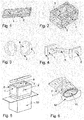
- Fig 1 shows a simple embodiment of the invention in the form of an insulating packaging consisting of an insulating core (1) and an envelope (2).
- the insulation core (1) has the task of reducing the convection and heat conduction as far as possible.
- Air is used as the insulating medium due to its low thermal conductivity of 0.0267 W / mK.
- air is subject to a temperature-dependent density, so that heat is transferred by convection. To prevent this, the air in your movement must be restricted as much as possible.
- cereal straw has a density of around 20 kg / m 3 .
- the stalks of the straw sometimes form cavities several centimeters in size, so that the insulating effect is considerably reduced by free convection.
- the insulation core according to claim 1 has an adjustable density of 40 kg / m 3 to 250 kg / m 3 .
- the cavities in such an insulation core are smaller than 0.5x0.5x0.5 cm 3 , which largely excludes convection.
- the density must be adapted to the requirements of the goods to be packaged.
- An optimal insulating effect, taking into account the material consumption, is achieved at a density of around 60 kg / m 3 to 80 kg / m 3 .
- a thermal conductivity of 0.043 W / mK comparable to that of Styrofoam is achieved.
- a density of up to about 250 kg / m 3 is useful for shock absorption when transporting heavy objects.
- a density of 40 kg / m 3 is preferred for shock absorption when transporting light, fragile objects.
- the thickness of the insulation core is not limited, but a thickness of 1 cm to 15 cm has proven to be advantageous for the applications listed here.
- the insulation core (1) consists of an arrangement of hay and / or straw, the stalks of the straw or hay having a length of 0.5 cm to 50 cm. It has proven advantageous to use a mixture of different lengths.
- the short stalks are arranged in such a way that an even distribution of density occurs within the insulation core. In this way, a uniform insulation effect is achieved without thermal bridges due to convection.
- stalks with a length of 1 cm to 25 cm have proven to be particularly advantageous. Undamaged hay and straws can be used.
- the structure of the insulation core is so pronounced that using the natural buckling strength (absorption of forces in the longitudinal direction) of the straw or hay any shape with holes, convex and concave surfaces, undercuts, sharp edges etc. is possible ( Fig. 1, Fig. 3, Fig. 4 ).
- This is absolutely necessary in order to adapt common packaging forms such as shell elements, boxes, boxes or trays to the requirements of the goods to be packaged.
- the dimensional stability of the insulation core can be maintained without binding agents supplied from the outside or detached from the plants. The stalks and stalks therefore do not have to be materially connected to one another in any way. No additional mechanical connecting elements are required for dimensional stability.
- the straw or hay used is also not broken down into its structural components such as fibers and shives. This is the only way to maintain the natural rigidity of the plants, which is required for the dimensional stability of the insulation core. Plant fibers used in the prior art can no longer absorb pressure forces and can therefore only have mechanical pressure stability in the compressed or glued fleece.
- Binding agents are understood here to mean all additives which, through their mechanical, physical or chemical interactions with the straw and / or hay of the insulation core, would influence the dimensional stability of the insulation core or the insulation packaging (e.g. tensile strength, compressive strength, resilience).
- Polymer fibers, adhesives (for example starch, alkali silicates, latex, resins), bicomp fibers, thermosetting resins or thickeners are typically used as binders in the prior art. Binding agents are also understood here as additives that would change the properties of the straw and / or hay in such a way that the plant components themselves would function as binding agents.
- binders can be added to insulation materials for a variety of reasons. Starch or its derivatives are used in the prior art, for example, as binders but also as agents for hydrophobing.
- Mechanical connecting elements are understood to mean macroscopic elements which can act on the dimensional stability of the insulation core or on the dimensional stability of the insulation core together with the casing through a force fit and / or form fit. These include, for example, quilting, riveting, lamination or the introduction of fleeces or nets. Mechanical fasteners can also be added to insulating materials for other reasons, for example for purely visual reasons.
- no binders or mechanical connecting elements are necessary for the dimensional stability of the insulation core with or without a cover.
- the form and force fit between the individual straws and / or hay stalks as well as between the cover and the insulation core is sufficient.
- the dimensional stability of the insulation core and the insulation core including the covering is understood here to mean the ability of these to withstand external loads (forces, temperature, air humidity, etc.) to the extent that handling during the production steps and use as intended is possible.
- Pressure loads on the insulation core according to the invention can be absorbed very well without a permanent change in shape.
- the springback is, for example, when using barley straw and a density of the insulation core of 60 kg / m 3 95% with a pressure of 10 N / cm 2 applied for 1 minute. After the external pressure has been removed, the insulation core returns to its original shape without any significant settling.
- the insulation core is surrounded by a flexible covering. It is sufficient to simply connect the sheath to the insulation core by means of a form fit. No mechanical connecting elements such as threads or rivets and no binding agents are required to connect the casing to the insulation core. Thus, the envelope can be easily separated from the insulation core and disposed of separately if necessary.
- the cover also provides important functional properties on the surface.
- the cover can be made of plastic, paper, cardboard, bio-plastic (e.g. PLA), non-woven material of natural or artificial origin, starch (foamed and non-foamed), or the like.
- a thickness of 10 ⁇ m to 500 ⁇ m has proven useful.
- a layer thickness of 30 ⁇ m to 5 mm is suitable. The level of the layer thickness depends on the expected external load, since the insulation core does not exert any forces on the envelope from the inside.
- a coating made of starch or starch foam can also be used for complete biodegradability.
- the envelope is designed to be vapor-permeable in order to regulate the moisture inside the packaging. This can be done by selecting a suitable material or by perforating the envelope.
- the humidity inside the box increases to over 80%.
- moisture-sensitive products can be damaged in this way.
- the straw and / or hay of the insulation core is able to bind water from the air in the amount of 10% of its own weight when the air humidity rises from 50% to 80% and thus buffer the air humidity accordingly. With an insulation core weighing 1 kg, this corresponds to an absorption capacity of 100 ml of water.
- the casing can also be made of food-safe material, so that the casing can be used for direct contact with food.
- the cover is chosen to be transparent, the insulation core made of straw or hay becomes visible. This can be perceived as a visual advantage, especially in the food sector.
- the envelope can also be designed to be odor-inhibiting or antibacterial if the requirements are met.
- the casing partially or completely from materials with a low degree of emission, preferably aluminum.
- the cover absorbs less heat through thermal radiation and at the same time emits less thermal radiation.
- the aluminum can be vapor-deposited over the entire surface or in part or laminated in the form of foils or composite foils.
- the aluminum layer thickness should be at least 40 nanometers for effective shielding.
- a major advantage of the invention is the use of all available disposal options. If no binding agent is used, or a biodegradable binding agent, the insulation core can be disposed of with the company's own compost or the regional organic waste bin. It can also be used in the garden or as bedding. If the cover is made of non-biodegradable material, the cover can easily be separated from the insulation core and disposed of separately. Due to the high calorific value of straw with 3.8 kWh / kg and the pollutant-free, climate-neutral combustion, an energetic recovery is also sensible. The legal framework conditions in waste management vary greatly from region to region. The end user has access to all disposal routes from which he can choose the most convenient for himself. A cumbersome disposal via the recycling center can be avoided. Due to the use of inexpensive raw materials and the simple disposal option the insulating packaging according to the invention is ideally suited for single-use use.
- the insulating packaging consists of a one-piece insulating core (1) with a cover (2) made of cellophane, which form a cuboid cavity (3) for receiving goods to be transported.
- insulating packaging consists of two hollow shells.
- the outside is convex, the inside (4) forms a concave cavity.
- the two insulation cores (1) are each enclosed by an envelope (2) made of opaque paper.
- FIG. 4 Another exemplary embodiment is shown in which an insulating packaging consisting of two wrapped insulating cores (1) with an internal hollow structure (6) is used to store a sensitive object (5) in such a way that it is protected from vibrations.
- the insulation cores have a density of 130 kg / m 3 .
- the wrappings (2) consist of 200 ⁇ m thick kraft paper.
- the insulating packaging consists of six plate-shaped insulating cores (1) with a density of 80 kg / m 3 , which form a cuboidal cavity (7) .
- the insulation cores are each enclosed in a food-safe casing (2) made of plastic (PET / PE / PET) with a thickness of 15 ⁇ m.
- the casings have perforations (8) so that moist air from inside the box can pass into the insulation cores.
- the outward-facing surfaces of the insulating packaging are coated with a 50 nanometer thick aluminum layer (9) to reflect thermal radiation.
- the insulation packaging is used for shipping in a standard box (10) .
- insulating packaging has an elliptical, pocket-like shape, which has only one open side (11) into which the objects to be cooled can be introduced.
- the envelope (2) consists of biodegradable plastic, preferably PLA, with a thickness of 20 ⁇ m.
- the insulation core (1) has a density of 60 kg / m 3 .
- a self-adhesive flap (12) enables the insulating packaging to be closed.
- the straw used is usually in the form of pressed square or round bales.
- Uncut straw and / or hay is advantageously obtained as the starting raw material in order to be able to adapt the structural properties of the straw and / or hay to the requirements.
- the length of the straw is between 20 cm and 100 cm, depending on the variety. A length / diameter ratio of less than 300/1 and greater than 5/1 is advantageous.
- the thickness of the stalks can be between 0.1 mm and 15 mm. Straws with a thickness of 0.1 mm to 5 mm are particularly advantageous mm. Due to the mechanical, agricultural processing there are also shorter fragments up to dust in the bales.
- the straw and / or hay bales are mechanically loosened and sent for mechanical cleaning.
- the mechanical cleaning takes place, for example, by a separator, which is designed as a centrifugal separator, gravity separator, magnetic separator, sieve, zigzag separator, filter or a combination of these.
- Mechanical cleaning can be done either dry or wet. Mechanical cleaning is intended to remove dust, stones, lumps and other unwanted components, among other things.
- Chemical treatment can be carried out for the purpose of further cleaning and the introduction of pesticides, fungicides, preservatives, disinfectants or other auxiliary substances.
- pesticides fungicides, preservatives, disinfectants or other auxiliary substances.
- degreasing, digesting, dissolving, adsorbing, absorbing, drying, etching, bleaching or coating can be mentioned as chemical processing.
- Other auxiliaries can be, for example, glues, resins, paraffins, waxes, fillers, dyes, fibers or other binders.
- Mechanical connecting elements such as particles, fibers, nets etc. can also be incorporated.
- ECA electrochemically activated water
- a concentration of 0.1% to 2% ECA dissolved in water is particularly advantageous. It is advantageous to dose the solution produced in this way with 0.1% - 20% based on the straw and / or hay weight. A dosage of the solution of 0.5% - 12% ECA based on the straw and / or hay weight is particularly advantageous.
- the ECA pre-sterilizes the straw and / or hay. In addition, all parts of the production plant that come into contact with the treated straw and / or hay are disinfected. The risk of cross-contamination can be reduced and the cleaning intervals for the system can be extended.
- an aqueous ECA solution with a concentration of 5% is generated.
- the ECA solution is continuously misted into a mass flow of hay and / or straw, so that the ratio of the mass flows of ECA solution and hay and / or straw is 3/100.
- a commercially available antibacterial and fungus-inhibiting active ingredient is sprayed into the straw or hay, which increases the durability of the insulation core under unfavorable storage conditions.
- the chemical removal of the wax layer on the straw and / or hay to improve the adsorption of water can also be advantageous. Together with the water-vapor-permeable envelope, the moisture-regulating effect of the insulating packaging according to the invention can be increased.
- a natural antibacterial effect can be produced in the event that the straw and / or hay becomes damp during later use.
- the effectiveness of a later disinfection can be increased. It is advantageous to lower the pH value when moist (at 20% moisture level) to a value of 5.5 or lower, which prevents numerous bacteria from growing. It is advantageous, for example, to enrich the straw and / or hay with 0.5% -3% lactic acid based on the raw mass weight of the straw and / or hay.
- the visual appearance can be improved by lightening the straw and / or hay and removing color contamination from black fungi.
- the odor of the straw and / or hay can be eliminated by applying odor inhibitors such as baking soda.
- odor inhibitors such as baking soda.
- the packaging can also run fragrant.
- components of mint, lavender or roses can be added to the hay and / or straw. This can also be done for purely visual reasons.
- the chemical treatment can take place at any point in the process, depending on the requirements and treatment method.
- Straw and hay are natural products, which can be subject to certain fluctuations in type, quality and properties. This depends on the climatic conditions during growth and harvest, the soil, the type of machinery used, the plant varieties used and the storage conditions. In order to still be able to produce an insulation core of constant quality and properties, or to bring about an improvement in existing properties, it may be necessary to process or treat the straw or hay mechanically, chemically or biologically.
- longitudinal cutting, cross cutting, squeezing, upsetting, grinding or rubbing can be used as mechanical processing.
- uncut barley straw with a straw length of 50 cm is made with a knife cutter for a first batch shortened to 25 cm length and for a second batch to 5 cm by cross cutting. Both batches are mixed in a weight ratio of 50/50 and blown into a silo for further processing. If it is determined in the production process that the insulation core has too low a mechanical tensile strength, the weight proportion of the 25 cm long stalks can be increased to 65%, for example. The long stalks make the insulation core more cohesive. At the same time, however, the risk of imperfections in the insulation core increases, since the rather stiff barley straws displace neighboring stalks, especially in the area of bent stalks.
- Defects in the insulation core are areas in which there is no straw and / or hay within a radius of 2.5 mm. Heat can be transported by convection in flaws, which impairs the insulating effect of the insulation core. The risk of defects increases as the density of the insulation cores decreases. Densities of 40 kg / m 3 to 65 kg / m 3 are particularly prone to defects.
- uncut barley straw with a straw length of 45 cm is shortened with a knife cutter to 15 cm length by cross cutting and soft, uncut oat straw with a length of 40 cm in a weight ratio of 30/70 is added.
- the soft oat straw adapts itself optimally to the external shape in the later pressing process and ensures good tensile strength thanks to the large straw length, while the stiffer barley straw increases the flexural rigidity of the insulation core. If larger insulation cores are produced, the bending stiffness of the insulation cores can be increased by increasing the proportion of barley straw to a weight ratio of 50/50.
- uncut wheat straw with a straw length of 60 cm is fed to a splicing device. This divides the straws lengthways. This is followed by a cut in a knife mechanism to a length of 15 cm. This makes the very rigid straw softer and can be further processed in a mixture or in its pure form. Also other, very rigid straw and / or In this way, hay types can be adapted to the requirements in terms of their specific flexural strength.
- cut barley straw with a straw length of 30 cm is continuously squeezed by a profiled pair of rollers at a variable distance. At the pinch points, the flexural strength of the stalks is greatly reduced locally without affecting the tensile strength of the insulation core produced from it.
- Volume measurement or weight measurement can be used to dose the straw and / or hay. Since the volume of straw and / or hay depends heavily on the type and mechanical processing, weight measurement is preferred. A volume measurement is advantageous if the straw and / or hay is to be carried out on a continuous conveyor belt, since this can be implemented with less effort. When measuring the volume, it is advantageous if the insulation core produced is weighed and has an influence on the target volume. Dosing can take place at any point in time before molding. It is advantageous to carry out the dosing at the earliest after the mechanical cleaning, since considerable amounts of straw and / or hay are separated out here.
- straw As a natural raw material, straw is heavily colonized with microorganisms.
- the total number of straw and hay in the delivery condition is usually 5 ⁇ 10 6 nucleating units per gram (CFU / g), mainly bacteria and fungi.
- CFU / g nucleating units per gram
- the number of germs should be reduced by several orders of magnitude; pathogenic germs should not be detectable.
- all common methods are suitable for disinfecting straw or hay. Irradiation, fumigation, the use of liquid disinfectants or heat treatment are possible. The use has proven particularly advantageous proved by moist heat.
- the straw and / or hay is treated with superheated steam, saturated steam or wet steam under ambient pressure or increased pressure. Steam temperatures of 90 ° C. to 150 ° C.
- Straw and hay mainly consist of cellulose, lignin and hemicellulose.
- the individual plant components such as the cell wall or central lamella mainly consist of these building materials in different structural compositions.
- the lignocellulose which forms the cell wall of lignified plants, is a structural composite in which the cellulose and hemicellulose form a framework in which lignin is stored. While the cellulose and hemicellulose absorb the tensile forces, the lignin stabilizes against compressive stress. The composite is therefore comparable to a reinforced concrete structure.
- lignin can be plasticized by heat. With an increase in humidity, the glass transition temperature of lignin decreases. The lignin hardens again by cooling below the glass transition temperature. The process is largely reversible. In the dry state (8% moisture level) the glass transition temperature is 130 ° C - 180 ° C; when wet at about 80 ° C - 90 ° C.
- the glass transition temperature of hemicellulose and cellulose is also strongly dependent on moisture. In the moist state, the glass transition temperature even drops to room temperature.
- the straw and / or hay is plasticized by the action of moist or dry heat.
- the biopolymers lignin, cellulose and hemicellulose are heated above their glass transition temperature.
- the action of moist heat is particularly advantageous, since the glass transition temperature of lignin can be lowered.
- the straw and / or hay is heated to at least 80 ° C.
- a moisture content of 5% - 25% should be aimed for, depending on the type of straw or hay. For barley straw, the optimal moisture content is 8% - 20%.
- Moisture can be introduced into the straw and / or hay prior to heating or it can be introduced at the same time as the heating. So there are two alternatives to use moist straw and / or hay or dry straw and / or hay.
- steaming with steam is particularly advantageous.
- the hot steam causes, on the one hand, an increase in the temperature of the straw and / or hay and, on the other hand, humidification through adsorption.
- Water vapor has a significantly higher internal energy (enthalpy) than air at the same temperature. This makes the heating particularly effective.
- the thermal conductivity is drastically increased by the moisture introduced so that particularly rapid heating is possible.
- the temperature of the water vapor should be in the range from 90 ° C to 150 ° C.
- steaming must be carried out under pressure in order to maintain the saturated steam conditions or wet steam conditions.
- a pressure of 3 bar is required.
- An increased pressure accelerates the adsorption of the water into the straw and / or hay considerably.
- the process time can be reduced significantly with higher pressure.
- the barley straw absorbs about 18 grams of water. The moisture content increases from 8% to 14.7%.
- steam wet steam or saturated steam
- heating with hot air flowing through, with microwave radiation, by contact heating, by superheated steam or a combination of these is suitable.
- the use of superheated steam is particularly advantageous, since this has a very high internal energy and high thermal conductivity, and thus the process time can be carried out very quickly and also allows uniform heating.
- a temperature of the superheated steam of 101 ° C to 150 ° C at ambient pressure is suitable for this.
- Superheated steam at a temperature of 102 ° C to 130 ° C is particularly advantageous.
- the heating of the moist straw and / or hay can also be accompanied by simultaneous drying if water vapor is transported away from the straw and / or hay.
- the shaping of the straw and / or hay should, however, take place before plasticizing.
- the moisture in the straw and / or hay prevents the straw and / or hay stalks from breaking when compressed.
- the straw and / or hay are shaped.
- Moist or dry straw and / or hay have very good springback at room temperature and cannot be shaped without the use of binding agents. Straw and / or hay can only be formed into firm compacts through very high pressures with the associated high temperatures. The very good insulating effect of straw and hay is largely lost in such processing.
- step 7 of this invention the springback is almost completely eliminated, so that even a small force of 0.1-10 N / cm 2 on the straw and / or hay for a Shaping suffice.
- a force of 0.1 N / cm 2 to 2 N / cm 2 is particularly advantageous.
- the shaping can take place before or after the plasticizing of the straw and / or hay.
- the shape is divided into the inner and outer shape:
- the outer shape is understood here to mean the temporary or permanent fixation of the straw and / or hay in an at least partially deterministically defined shape. It determines, at least in part areas, the outer contour of the straw and / or hay after shaping.
- the external shaping takes place according to the invention by at least partial molding of geometrically defined objects, by subtractive or additive shaping processes such as cutting, punching, etc., or by the action of fluids or gases.
- the inner shape is understood here as a temporary or permanent fixation of the straw and / or hay in a stochastically defined shape, with the emphasis on influencing the physical properties of the composite of straw and / or hay. It determines, for example, the stochastic distribution of the straw and / or hay within the outer shape or the type, frequency and quality of form and frictional engagement between the hay and / or straw parts.
- the inner shape can be influenced by the type of outer shape, by the action of fluids, gases and geometrically defined or geometrically undefined objects.
- the external shape can shape the straw and / or hay into plates, discs, free-form bodies, each with or without recesses.
- the inner shape can be the straw and / or hay For example, distribute them evenly, pile them up locally, hook, layer or arrange the straws and / or haystocks.
- barley straw 25 cm long is pneumatically blown into a rectangular chamber measuring 30 ⁇ 30 ⁇ 30 cm 3 .
- the barley straw is distributed so that the weight per unit area is 2.4 kg / m 2 in the edge area and decreases to 1.2 kg / m 2 towards the center.
- the height of the straw in the chamber is 12 cm at the edge and drops to 6 cm towards the center.
- the stalks are aligned in a preferred orientation parallel to the chamber floor. Nevertheless, the stalks of the straw and / or hay are three-dimensionally interlocked with one another.
- the volume of the chamber is reduced to 30x30x2 cm 3 using a rectangular plunger.
- the density of the straw and / or hay in the edge area of the chamber increases to 120 kg / m 3 , in the middle to 60 kg / m 3 . Due to the even distribution, no cavities larger than 0.5x0.5x0.5 cm 3 are formed .
- the insulation core is now defined in its inner and outer shape, but is not yet mechanically stable due to the ongoing plasticization of the straw and / or hay.
- the defined inner shape must be stabilized. It is sufficient for the lignin contained in the straw and / or hay to fall below the glass transition temperature.
- the cellulose and the hemicellulose do not necessarily have to be brought below their glass transition temperature in order to stabilize them sufficiently for further processing. This allows, for example, a particularly advantageous embodiment of the invention, in which the resulting insulation core is still moist but dimensionally stable and can be dried in a separate second step.
- the glass transition temperature of the lignin can be fallen below by cooling or by drying or by a combination of cooling and drying. With the inner shape, the outer shape is also automatically stabilized.
- cooling can take place by common methods using cold gases such as air or nitrogen, by evaporative cooling or by contact cooling with cold solids.
- the drying can be carried out by all common methods such as hot air drying, vacuum drying, hot steam drying (with superheated steam), microwave drying or a combination of these methods.
- Drying with superheated steam at 101 ° C to 150 ° C at a pressure of 0-5 bar above ambient pressure has proven to be advantageous, since the heat transfer is particularly effective and the process time can thus be reduced.
- Drying with superheated steam at 102.degree. C.-120.degree. C. at a pressure of 0-1 bar above ambient pressure has proven particularly advantageous.
- the insulation core maintains its dimensional stability to a sufficient degree through a form fit and / or a force fit between the straws and / or haystocks. Cohesive connections by binding agents or further form-fitting and / or force-locking connections by additional mechanical connecting elements are not required for the dimensional stability of the insulation core. An admixture of binders can be advantageous for other reasons, for example for The insulation core is hydrophobic.
- straw and / or hay is plasticized with saturated steam under moist heat and brought to a moisture level of 20% and a temperature of 95 ° C.
- the resulting insulation core has a residual moisture level of 15% after cooling and is dimensionally stable.
- straw and / or hay is plasticized with saturated steam under moist heat and brought to a moisture level of 20% and a temperature of 95 ° C. Then superheated steam (120 ° C, ambient pressure) with an admixture of 20% air and a flow rate of 1 m / s is blown through the moist and hot straw and / or hay until the degree of moisture of the straw is 8%.
- the resulting insulation core has a temperature of 97 ° C and is dimensionally stable.
- the insulation core produced by method steps 1-10 can be further processed using further mechanical methods. For example, cutting, punching, bending, pressing, stacking or joining is possible, or a new insulation core can be produced by combining several insulation cores.
- one or more of the insulation cores produced according to method steps 1-11 are provided with one or more sheaths on all sides. It is particularly advantageous to use only the form fit of the cover in order to connect it to the insulation core and to dispense with mechanical connecting elements such as stitching, riveting and binders for connecting the cover to the insulation core. As a result, the envelope can be separated from the insulation core if necessary and easily disposed of.
- the use of Mechanical connecting elements and / or binding agents for fixing the envelope to the insulation core can be useful, for example for optical reasons or for the targeted influencing of mechanical properties.
- the envelope can be made of plastic, paper, cardboard, bio-plastic (e.g.
- the envelope can be in a solid, liquid or pasty state when it is applied to the insulation core. Treatment methods such as drying, vulcanizing, crosslinking, gluing, welding, flanging, shrinking, wrapping or the like can be used to adapt the shape of the envelope to the outer shape of the insulation core. A tight-fitting covering on all sides is particularly advantageous, as this protects and stabilizes the insulation core particularly well.
- the envelope can also be printed or coated in various ways, as well as composed of the individual components mentioned above.
- the insulation core is first welded into PLA film, and the PLA film is subjected to shrinkage by means of a heat treatment so that the PLA film adapts to the external shape of the insulation core.
- Several such insulation cores are then arranged in a carton in such a way that all the inner sides of the carton are completely and overlappingly covered with the insulation cores.
- the insulation core is pushed into a cross-bottom bag of the same shape made of Kraft paper and the cross-bottom bag is closed by a self-adhesive flap.
- straw and / or hay can be welded into a cover made of reinforced cellulose fleece and in the Subsequently, the process of plasticizing (step 7) and subsequent shaping (step 8) are subjected.
- the described method for producing an insulating packaging can be implemented continuously, discontinuously or in a mixed form. Two exemplary embodiments for a production plant are given below:
- the straw is mechanically loosened in a bale opener.
- the straw is cut to a length of 15 cm in a cross cutter. Dust is removed from the straw via a suction device.
- the straw is fed to a gravity separator via a conveyor fan and transported on to a silo.
- the straw is misted with a 1 percent aqueous solution of ECA, the solution being metered in at 1% based on the weight of the straw.
- Straw is discharged from the silo onto a belt scale with the help of rollers until a target weight of 260 grams is reached for the portion.
- the portion of straw is conveyed into a bowl-shaped mold by a conveyor fan and is evenly distributed there so that 80% of the straws are aligned largely parallel to the base of the mold.
- the straw is treated with saturated steam inside the mold for 2 minutes at 98 ° C.
- the straw is sterilized and plasticized at the same time.
- the straw experiences an increase in moisture level from 8% to 17%.
- the density of the straw is then compressed from 30 kg / m 3 to 80 kg / m 3 by a bowl-shaped punch. For this purpose, a low pressure of 0.1 N / cm 2 is applied.
- the slightly compressed straw is flowed through with superheated steam at 120 ° C under ambient pressure until a moisture level of 8% has set in the straw. This process takes about 30 seconds.
- the now finished insulation core is then removed from the mold.
- the insulation core is dimensionally stable to a limited extent. Sharp edges, radii and large areas can also be precisely shaped.
- the insulation core is welded into a 20 ⁇ m thick PLA film and the PLA film is subjected to heat shrinkage.
- the shrink film wraps itself around the insulation core in a form-fitting manner.
- the insulating packaging is now complete.
- the straw is mechanically loosened in a bale opener.
- the straw is cut to a length of 15 cm in a cross cutter and transported to silo 1.
- the hay is loosened in a bale opener.
- the hay remains at its original length of around 30 cm and is transported to silo 2.
- a suction device is used to remove dust from the straw and hay at the silos.
- the straw and hay are discharged from the silos on belt scales and mixed pneumatically in a ratio of 50%.
- the straw / hay mixture is fed into a third silo with a conveyor fan.
- the straw / hay mixture is discharged from the silo at a uniform height of 25 cm onto a continuously running conveyor belt.
- saturated steam (100 ° C, ambient pressure) flows through the straw / hay mixture in a steam tunnel for 3 minutes and in the process is sterilized and plasticized.
- a moisture content of 18% is established in the straw / hay mixture.
- the straw / hay mixture is then compressed by a belt press running inwards, the belts of the belt press being equipped with a three-dimensional diamond profile so that areas with higher density and areas with lower density are created.
- Cold air flows actively through the belts of the belt press (20 ° C, ambient pressure).
- the straw / hay mixture cools down to 45 ° C and hardens.
- the straw / hay mixture produced in this way is mechanically stable to a limited extent and has a moisture content of 15%.
- the straw / hay mixture is then fed to a belt dryer, which reduces the moisture content from 15% to 8% in the run. To do this, warm air (75 ° C) flows through the straw / hay mixture. From the insulation core produced in this way, plates are cut out by longitudinal and transverse cutting, which are inserted into a cover made of Kraft paper with a positive fit.
Landscapes
- Engineering & Computer Science (AREA)
- Mechanical Engineering (AREA)
- Life Sciences & Earth Sciences (AREA)
- Biodiversity & Conservation Biology (AREA)
- Wrappers (AREA)
- Nonwoven Fabrics (AREA)
- Packages (AREA)
- Dry Formation Of Fiberboard And The Like (AREA)
Claims (17)
- Emballage isolant destiné à l'isolation thermique et/ou à l'absorption de chocs, constitué par un ou plusieurs noyaux isolants (1) en paille et/ou foin compressé et au moins une enveloppe (2),
caractérisé en ce que
le noyau isolant (1) est configuré sous forme dimensionnellement stable et façonnée sans liaison par accouplement de matière entre les brins de foin et/ou de paille individuels,
les brins du foin et/ou de la paille présentant une longueur de 0,5 cm à 50 cm et se présentant sous la forme d'un mélange de diverses longueurs sans décomposition des fibres contenues dans le foin et/ou dans la paille,
le noyau isolant (1) est complètement entouré par une enveloppe perméable à la vapeur d'eau (2), qui est reliée au noyau isolant (1) uniquement par accouplement de forme, sans éléments de liaison supplémentaires,
et la densité de l'emballage isolant est comprise entre 40 kg/m3 et 250 kg/m3. - Emballage isolant selon la revendication 1, caractérisé en ce que le noyau isolant (1) présente une épaisseur de 1 cm à 15 cm.
- Emballage isolant selon la revendication 1 ou 2, caractérisé en ce que les brins de paille et/ou de foin du noyau isolant sont orientés à hauteur d'au moins 80 % perpendiculairement au courant de chaleur de l'emballage isolant.
- Emballage isolant selon l'une quelconque des revendications 1 à 3, caractérisé en ce qu'au moins deux noyaux isolants (1) sont prévus, qui présentent la forme de deux coques creuses, qui peuvent comprendre des logements pour loger un objet (5).
- Emballage isolant selon l'une quelconque des revendications 1 à 4, caractérisé en ce qu'au moins deux, de préférence six, noyaux isolants (1) sont prévus, qui forment une cavité fermée et sont de préférence configurés en forme de plaque.
- Emballage isolant selon l'une quelconque des revendications 1 à 3, caractérisé en ce que le noyau isolant (1) présente une forme de poche et dispose uniquement d'un côté ouvert (11).
- Emballage isolant selon l'une quelconque des revendications 1 à 6, caractérisé en ce que le matériau de l'enveloppe (2) présente une perméabilité à la vapeur d'eau définie ou celle-ci est réalisée par une perforation,
l'enveloppe (2) pouvant être constituée par une feuille en matière plastique flexible ou un non-tissé en matière plastique, de préférence par une feuille en matière plastique biologique telle que du PLA ou de la cellophane, qui présente une épaisseur de 10 µm à 500 µm. - Emballage isolant selon l'une quelconque des revendications 1 à 6, caractérisé en ce que l'enveloppe (2) est constituée par un papier ou carton, qui présente une épaisseur de 30 µm à 5 mm, ou l'enveloppe (2) est constituée par de la cellulose ou de l'amidon, l'enveloppe (2) pouvant comprendre en partie ou en totalité une couche métallique, de préférence en aluminium, et/ou pouvant être réalisée sous forme appropriée pour les denrées alimentaires et/ou transparente.
- Emballage isolant selon l'une quelconque des revendications 1 à 8, caractérisé en ce que l'enveloppe (2) est constituée par de la cellulose ou de l'amidon, et l'enveloppe (2) peut comprendre en partie ou en totalité une couche métallique, de préférence en aluminium, et/ou l'enveloppe (2) peut être réalisée sous forme appropriée pour les denrées alimentaires et/ou transparente.
- Procédé de fabrication d'un emballage isolant destiné à l'isolation thermique et/ou à l'absorption de chocs, constitué par un ou plusieurs noyaux isolants (1) en paille et/ou foin compressé et au moins une enveloppe (2),
la forme extérieure du noyau isolant (1) étant définie géométriquement et dimensionnellement stable,
la stabilité dimensionnelle du noyau isolant découlant principalement d'un façonnage intérieur par une distribution et configuration stochastique des brins de paille et/ou de foin individuels, et les fibres de la paille et/ou les tiges du foin restant incorporés sous forme non déliée dans la structure naturelle des brins, le noyau isolant (1) étant entouré de tous les côtés par une enveloppe (2), qui est principalement reliée par accouplement de forme avec le noyau isolant (1),
et la densité de l'emballage isolant étant comprise entre 40 kg/m3 et 250 kg/m3, caractérisé par les étapes suivantes :- de la paille ou du foin ou un mélange des deux est plastifié,- la paille et/ou le foin plastifiés sont soumis à un façonnage,- avec maintien du façonnage, la plastification est augmentée et la paille et/ou le foin sont durcis sans accouplement de matière significatif entre les brins de paille et/ou de foin individuels,- la paille et/ou le foin sont munis de tous les côtés d'une enveloppe. - Procédé selon la revendication 10, caractérisé en ce que la paille et/ou le foin sont usinés sous forme non coupée, et/ou nettoyés mécaniquement, et la paille et/ou le foin peuvent être traités avec des pesticides, des fongicides, des conservateurs, des désinfectants ou des détergents, et/ou peuvent être traités avec une solution aqueuse d'eau électrochimiquement activée (ECA) en une concentration de 0,1 % à 20 %, la solution étant dosée à hauteur de 0,1 % à 20 % par rapport au poids de la paille et/ou du foin.
- Procédé selon la revendication 10 ou 11, caractérisé en ce que la paille et/ou le foin sont décirés en totalité ou en partie, et/ou
le pH de la paille et/ou du foin est abaissé, et/ou la paille et/ou le foin sont blanchis, et/ou la paille et/ou le foin sont traités avec des matières anti-odeur ou odorantes, et/ou la paille et/ou le foin sont travaillés mécaniquement, et/ou le nombre total de germes de la paille et/ou du foin est réduit. - Procédé selon les revendications 10 à 12, caractérisé en ce que de la paille et/ou du foin qui ont été travaillés chimiquement et/ou mécaniquement de différentes manières sont utilisés en mélange.
- Procédé selon les revendications 10 à 13, caractérisé en ce que la paille et/ou le foin sont plastifiés par de la chaleur humide et/ou par un processus de séchage, un séchage avec de la vapeur d'eau surchauffée en tant que milieu de séchage ayant de préférence lieu.
- Procédé selon les revendications 10 à 14, caractérisé en ce que la paille est compactée de manière non uniforme lors du façonnage.
- Procédé selon les revendications 10 à 15, caractérisé en ce que le noyau isolant (1) est déformé à l'état humide.
- Procédé selon les revendications 10 à 16, caractérisé en ce que la paille et/ou le foin sont munis d'une enveloppe avant le façonnage ou pendant le façonnage, ou avant la plastification ou pendant la plastification.
Priority Applications (4)
| Application Number | Priority Date | Filing Date | Title |
|---|---|---|---|
| SI201531516T SI3105143T1 (sl) | 2014-02-11 | 2015-02-06 | Izolirna embalaža iz slame ali sena za toplotno izolacijo ali blažitev udarcev ter postopek za njeno izdelavo |
| RS20210350A RS61619B1 (sr) | 2014-02-11 | 2015-02-06 | Izolaciona ambalaža za toplotnu izolaciju ili apsorpciju udara od slame ili sena i postupak za njenu proizvodnju |
| HRP20210527TT HRP20210527T1 (hr) | 2014-02-11 | 2015-02-06 | Izolacijska ambalaža za toplinsku izolaciju ili apsorpciju udara od slame ili sijena i postupak za njenu proizvodnju |
| PL15704755T PL3105143T3 (pl) | 2014-02-11 | 2015-02-06 | Wypełnienie izolacyjne do izolacji termicznej lub amortyzacji wstrząsów ze słomy lub siana i sposób jego wytwarzania |
Applications Claiming Priority (2)
| Application Number | Priority Date | Filing Date | Title |
|---|---|---|---|
| DE202014001280.6U DE202014001280U1 (de) | 2014-02-11 | 2014-02-11 | Isolierverpackung zur Wärmedämmung oder Schockabsorption aus Stroh oder Heu |
| PCT/EP2015/052507 WO2015121167A1 (fr) | 2014-02-11 | 2015-02-06 | Emballage isolant en paille ou en foin pour l'isolation thermique ou l'absorption de chocs |
Publications (2)
| Publication Number | Publication Date |
|---|---|
| EP3105143A1 EP3105143A1 (fr) | 2016-12-21 |
| EP3105143B1 true EP3105143B1 (fr) | 2021-01-06 |
Family
ID=50556321
Family Applications (1)
| Application Number | Title | Priority Date | Filing Date |
|---|---|---|---|
| EP15704755.6A Active EP3105143B1 (fr) | 2014-02-11 | 2015-02-06 | Emballage isolant en paille ou en foin pour l'isolation thermique ou l'absorption de chocs et son procede de fabrication |
Country Status (13)
| Country | Link |
|---|---|
| US (2) | US11124353B2 (fr) |
| EP (1) | EP3105143B1 (fr) |
| DE (1) | DE202014001280U1 (fr) |
| DK (1) | DK3105143T3 (fr) |
| ES (1) | ES2860602T3 (fr) |
| HR (1) | HRP20210527T1 (fr) |
| HU (1) | HUE054027T2 (fr) |
| LT (1) | LT3105143T (fr) |
| PL (1) | PL3105143T3 (fr) |
| PT (1) | PT3105143T (fr) |
| RS (1) | RS61619B1 (fr) |
| SI (1) | SI3105143T1 (fr) |
| WO (1) | WO2015121167A1 (fr) |
Families Citing this family (19)
| Publication number | Priority date | Publication date | Assignee | Title |
|---|---|---|---|---|
| GB201205243D0 (en) | 2012-03-26 | 2012-05-09 | Kraft Foods R & D Inc | Packaging and method of opening |
| GB2511559B (en) | 2013-03-07 | 2018-11-14 | Mondelez Uk R&D Ltd | Improved Packaging and Method of Forming Packaging |
| GB2511560B (en) | 2013-03-07 | 2018-11-14 | Mondelez Uk R&D Ltd | Improved Packaging and Method of Forming Packaging |
| US11731826B2 (en) | 2021-10-22 | 2023-08-22 | Packaging Technology Group, Llc | Recyclable, thermally insulated shipping container with packed, loose-fill organic insulation |
| US11953262B2 (en) | 2013-05-10 | 2024-04-09 | Packaging Technology Group, Llc | Recyclable, thermally insulated shipping container with packed, loose-fill organic insulation and PCM bladder insert |
| NL2016317B1 (en) * | 2016-02-25 | 2017-09-11 | Generation Of Change B V | Foldable and Biodegradable Cushioning Sheet. |
| WO2017146577A1 (fr) * | 2016-02-25 | 2017-08-31 | Generation Of Change B.V. | Feuille de rembourrage pliable et biodégradable |
| DE102017111720B4 (de) * | 2017-05-30 | 2023-08-31 | Erik Hahn | Verpackung zum wärmeisolierten Transport von Waren |
| AU2019295781A1 (en) | 2018-06-28 | 2021-02-18 | Illuminate Consulting, Llc | Biotic material apparatus for thermally protecting and/or transporting temperature sensitive products |
| CN109335254B (zh) * | 2018-10-10 | 2019-12-20 | 江苏云之尚节能科技有限公司 | 一种全降解的保温环保速运包装袋 |
| US12274384B2 (en) * | 2019-07-18 | 2025-04-15 | James G. Gatto | Reusable straw and case with integrated cleaning, drying and sanitizing member |
| DE102020117291A1 (de) * | 2020-07-01 | 2022-01-05 | Naturhof Schröder GmbH | Trägerloses Futterhaus und Verfahren zur Herstellung desselben |
| WO2022009129A1 (fr) * | 2020-07-09 | 2022-01-13 | Stora Enso Oyj | Produit d'emballage de forme 3d à partir d'une découpe de feuille formée par voie pneumatique |
| CN112027360A (zh) * | 2020-08-27 | 2020-12-04 | 徐州山河青生态环境技术研究院有限公司 | 一种土壤样品保存箱 |
| US11712590B2 (en) * | 2021-02-24 | 2023-08-01 | Wade Atteberry | Hemp insulation fire retardant applicator and method |
| US12304168B2 (en) | 2021-10-22 | 2025-05-20 | Packaging Technology Group, Llc | Method of filling an insulated shipping container with loose-fill organic insulation |
| JP7445237B1 (ja) | 2022-09-30 | 2024-03-07 | fabula株式会社 | 複合成形体、構造体、および複合成形体の製造方法 |
| US20240359896A1 (en) * | 2023-04-28 | 2024-10-31 | Apple Inc. | Variably compressed fiber packaging and dry molding fiber process |
| DE102024114481A1 (de) | 2024-05-23 | 2025-08-14 | Ecocool Gmbh | Thermohaube zur thermischen Isolierung eines Packguts |
Family Cites Families (35)
| Publication number | Priority date | Publication date | Assignee | Title |
|---|---|---|---|---|
| US1604097A (en) * | 1926-02-16 | 1926-10-19 | Stockade Building System Inc | Wall structure |
| US1633702A (en) * | 1926-10-08 | 1927-06-28 | Stockade Building System Inc | Building structure |
| US2960444A (en) * | 1955-07-28 | 1960-11-15 | Malise Graham Mackeurtan | Process for the treatment of cellulosic materials |
| US3264165A (en) * | 1964-11-25 | 1966-08-02 | Gen Motors Corp | Insulating means |
| US3664076A (en) * | 1970-03-02 | 1972-05-23 | Wagner John E | Random honeycomb structure |
| US3867244A (en) * | 1971-12-22 | 1975-02-18 | Boeing Co | Insulation and condensation control blanket |
| US4956140A (en) * | 1985-12-09 | 1990-09-11 | Aluminum Company Of America Alcoa Laboratories | Methods of and apparatus for producing biaxially oriented polymer product |
| DE8536156U1 (de) | 1985-12-21 | 1986-02-20 | Moll, Lothar, 6830 Schwetzingen | Strohdämmplatte |
| DE8811376U1 (de) | 1988-09-08 | 1988-10-27 | Kakuk, Stefan, 6839 Oberhausen | Verpackungsteil |
| US5533888A (en) | 1990-08-21 | 1996-07-09 | Belarde; John F. | Apparatus for forming concrete barriers |
| US20020113340A1 (en) * | 1991-03-29 | 2002-08-22 | Reetz William R. | Method of forming a thermoactive binder composite |
| EP0656830B1 (fr) | 1992-08-28 | 1996-04-24 | BIOTEC BIOLOGISCHE NATURVERPACKUNGEN GMBH & CO. FORSCHUNGS- UND ENTWICKLUNGS KG | Materiau composite stratifie biodegradable a base de mousse durcie d'amidon et son procede de preparation |
| DE4317239A1 (de) | 1993-05-24 | 1994-12-01 | Suleiman Rateb | Absorber-, Filter- und Wärmeisoliermatten aus Biofasern und Biomasse |
| DE4332081A1 (de) | 1993-09-21 | 1995-03-30 | Pelz Ernst Empe Werke | Verpackungsmaterial sowie Verfahren zu dessen Herstellung |
| DE4333758A1 (de) | 1993-10-04 | 1995-04-06 | Rateb Suleiman | Absorber-, Filter- und Wärmeisoliermatten aus Biofasern und Biomasse und Verfahren zu deren Herstellung |
| EP0755775B1 (fr) * | 1995-07-27 | 2001-06-13 | Zodiac International | Panneau sensiblement rigide thermiquement isolant et procédé pour sa fabrication |
| JPH10287370A (ja) * | 1997-04-15 | 1998-10-27 | Kaichi Ishizawa | 緩衝部材 |
| US5893309A (en) * | 1997-10-08 | 1999-04-13 | Ast; Don R. | Method for cutting blocks of fibrous material for recompression |
| DE19810862C2 (de) | 1998-03-13 | 2002-07-18 | Alsen Ag | Dämmplatte aus Stroh und Verfahren zur Herstellung |
| DE19846704C2 (de) | 1998-10-09 | 2003-01-30 | Treu Hanf Ag | Dämmstoffmatte aus Naturprodukten |
| US6209284B1 (en) * | 1999-03-01 | 2001-04-03 | William H. Porter | Asymmetric structural insulated panels for use in 2X stick construction |
| IT1308431B1 (it) * | 1999-03-15 | 2001-12-17 | Novamont Spa | Elementi per imballaggio |
| ES2368122T3 (es) | 2001-04-03 | 2011-11-14 | Alberta Innovates - Technology Futures | Método de procesamiento de fibras de paja. |
| US20060174798A1 (en) * | 2001-05-04 | 2006-08-10 | Greencor Composites, Llc | Fire-resistant wall and method of manufacture |
| US6634077B2 (en) * | 2001-07-20 | 2003-10-21 | Affordable Building Systems | Combined connecting and alignment method for composite fiber building panels |
| US7032356B2 (en) * | 2003-08-19 | 2006-04-25 | Layfield Derek J | Interior wall and partition construction |
| US20050223671A1 (en) * | 2004-03-24 | 2005-10-13 | Oryzatech, Inc. | Culm block and method for forming the same |
| US7887672B2 (en) * | 2005-01-28 | 2011-02-15 | University Of Nebraska-Lincoln | Method for making natural cellulosic fiber bundles from cellulosic sources |
| US7708214B2 (en) * | 2005-08-24 | 2010-05-04 | Xyleco, Inc. | Fibrous materials and composites |
| DE102007024045A1 (de) | 2007-02-01 | 2008-08-07 | Wk Naturfaser Technologie Gmbh & Co. Kg | Biologisch abbaubarer Naturfaserverbundwerkstoff |
| CN101809237A (zh) * | 2007-09-21 | 2010-08-18 | 奥力科技有限公司 | 改进的建筑砌块、建筑砌块模具以及形成建筑砌块的方法 |
| US8052842B2 (en) * | 2008-01-24 | 2011-11-08 | Agriboard Industries | Method for making a compressed structural fiberboard |
| DE202009013015U1 (de) | 2009-09-28 | 2010-03-25 | Bachmann, Eberhard | Formkörper |
| US20140021651A1 (en) * | 2012-07-20 | 2014-01-23 | Agostinho Martins | Method For Making A Biodegradable And Compostable Component For Cosmetic Packaging |
| US8966845B1 (en) * | 2014-03-28 | 2015-03-03 | Romeo Ilarian Ciuperca | Insulated reinforced foam sheathing, reinforced vapor permeable air barrier foam panel and method of making and using same |
-
2014
- 2014-02-11 DE DE202014001280.6U patent/DE202014001280U1/de not_active Expired - Lifetime
-
2015
- 2015-02-06 EP EP15704755.6A patent/EP3105143B1/fr active Active
- 2015-02-06 PT PT157047556T patent/PT3105143T/pt unknown
- 2015-02-06 HR HRP20210527TT patent/HRP20210527T1/hr unknown
- 2015-02-06 HU HUE15704755A patent/HUE054027T2/hu unknown
- 2015-02-06 ES ES15704755T patent/ES2860602T3/es active Active
- 2015-02-06 PL PL15704755T patent/PL3105143T3/pl unknown
- 2015-02-06 SI SI201531516T patent/SI3105143T1/sl unknown
- 2015-02-06 LT LTEP15704755.6T patent/LT3105143T/lt unknown
- 2015-02-06 US US15/117,942 patent/US11124353B2/en active Active
- 2015-02-06 RS RS20210350A patent/RS61619B1/sr unknown
- 2015-02-06 WO PCT/EP2015/052507 patent/WO2015121167A1/fr not_active Ceased
- 2015-02-06 DK DK15704755.6T patent/DK3105143T3/da active
-
2021
- 2021-09-06 US US17/467,404 patent/US11975911B2/en active Active
Non-Patent Citations (1)
| Title |
|---|
| None * |
Also Published As
| Publication number | Publication date |
|---|---|
| US11975911B2 (en) | 2024-05-07 |
| HUE054027T2 (hu) | 2021-08-30 |
| US20160355320A1 (en) | 2016-12-08 |
| RS61619B1 (sr) | 2021-04-29 |
| DK3105143T3 (da) | 2021-03-08 |
| WO2015121167A1 (fr) | 2015-08-20 |
| EP3105143A1 (fr) | 2016-12-21 |
| SI3105143T1 (sl) | 2021-04-30 |
| ES2860602T3 (es) | 2021-10-05 |
| LT3105143T (lt) | 2021-04-26 |
| US20210394994A1 (en) | 2021-12-23 |
| DE202014001280U1 (de) | 2014-04-04 |
| US11124353B2 (en) | 2021-09-21 |
| HRP20210527T1 (hr) | 2021-05-14 |
| PT3105143T (pt) | 2021-02-16 |
| PL3105143T3 (pl) | 2021-06-14 |
Similar Documents
| Publication | Publication Date | Title |
|---|---|---|
| EP3105143B1 (fr) | Emballage isolant en paille ou en foin pour l'isolation thermique ou l'absorption de chocs et son procede de fabrication | |
| DE69920051T2 (de) | Absorbierende struktur mit dünnem kalendriertem luftgelegtem verbundmaterial und herstellungsverfahren | |
| EP2609984B1 (fr) | Élément de régulation d'humidité destiné à être utilisé dans des emballages | |
| DE102016004570B3 (de) | Plattenwerkstoffe, Verbundwerkstoffe und Verbundmaterialien auf der Bais von separierter Gülle oder von Holz und separierter Gülle | |
| WO2018090087A1 (fr) | Article de table compostable | |
| US20110232578A1 (en) | Absorbent Pad Containing Corrugate | |
| DE202019001700U1 (de) | Thermisch isolierende Verpackungseinheit | |
| JPH04307203A (ja) | 竹の加工方法、同方法を実施するための竹加工装置、同方法により加工された竹素材及び同竹素材を用いた成形品 | |
| KR101558048B1 (ko) | 가스 흡착능이 뛰어난 포장지 및 이의 제조방법 | |
| DE102023108551A1 (de) | Verpackungsfunktionskörper | |
| DE102021120900B4 (de) | Thermobehältnis | |
| EP3865422B1 (fr) | Pièce moulée d'emballage, son procédé de fabrication et récipient d'emballage | |
| EP0953085B1 (fr) | Procede pour traiter des matieres premieres naturelles afin de produire des matieres calorifuges | |
| EP4129598A1 (fr) | Procédé et dispositif de traitement des fibres individuelles contenant de la cellulose, ainsi que tissu non tissé, récipient de transport et pièce moulée | |
| DE202023003026U1 (de) | Isolierverpackung, Anlage zur Herstellung einer Isolierverpackung, Verpackungsbox | |
| EP0881162B1 (fr) | Procédé pour fermer une barquette réalisée en fibres naturelles et/ou amidon avec un opercule scellable, barquette fermée de la sorte et unité d'emballage ainsi formée | |
| EP4186817B1 (fr) | Dispositif de sacs | |
| WO2000055050A2 (fr) | Elements d'emballage | |
| DE202009005971U1 (de) | Einlage für Lebensmittelverpackungen | |
| DE102022111909A1 (de) | Verfahren und Vorrichtung zum Verarbeiten von cellulosehaltigen Einzelfasern sowie Vliesstoff, Transportbehälter und Formteil | |
| JP6372993B2 (ja) | 食品用段ボール箱の製造方法 | |
| AT405195B (de) | Verfahren zur behandlung natürlicher rohstoffe für die herstellung von dämmstoffen | |
| DE202018107140U1 (de) | Einlage für Lebensmittelverpackungen | |
| DE202021102676U1 (de) | Kompostierbare, Feuchtigkeit bindende und geruchshemmende Vorrichtung | |
| JP2013063989A (ja) | 抗菌性部材 |
Legal Events
| Date | Code | Title | Description |
|---|---|---|---|
| PUAI | Public reference made under article 153(3) epc to a published international application that has entered the european phase |
Free format text: ORIGINAL CODE: 0009012 |
|
| STAA | Information on the status of an ep patent application or granted ep patent |
Free format text: STATUS: REQUEST FOR EXAMINATION WAS MADE |
|
| 17P | Request for examination filed |
Effective date: 20160810 |
|
| AK | Designated contracting states |
Kind code of ref document: A1 Designated state(s): AL AT BE BG CH CY CZ DE DK EE ES FI FR GB GR HR HU IE IS IT LI LT LU LV MC MK MT NL NO PL PT RO RS SE SI SK SM TR |
|
| AX | Request for extension of the european patent |
Extension state: BA ME |
|
| DAX | Request for extension of the european patent (deleted) | ||
| STAA | Information on the status of an ep patent application or granted ep patent |
Free format text: STATUS: EXAMINATION IS IN PROGRESS |
|
| 17Q | First examination report despatched |
Effective date: 20170912 |
|
| RIC1 | Information provided on ipc code assigned before grant |
Ipc: B65D 81/113 20060101ALI20180705BHEP Ipc: B65D 81/127 20060101ALI20180705BHEP Ipc: B65D 81/38 20060101ALI20180705BHEP Ipc: B65D 81/03 20060101AFI20180705BHEP Ipc: B65D 5/50 20060101ALI20180705BHEP Ipc: B65D 65/46 20060101ALI20180705BHEP |
|
| GRAP | Despatch of communication of intention to grant a patent |
Free format text: ORIGINAL CODE: EPIDOSNIGR1 |
|
| STAA | Information on the status of an ep patent application or granted ep patent |
Free format text: STATUS: GRANT OF PATENT IS INTENDED |
|
| INTG | Intention to grant announced |
Effective date: 20181127 |
|
| GRAJ | Information related to disapproval of communication of intention to grant by the applicant or resumption of examination proceedings by the epo deleted |
Free format text: ORIGINAL CODE: EPIDOSDIGR1 |
|
| GRAJ | Information related to disapproval of communication of intention to grant by the applicant or resumption of examination proceedings by the epo deleted |
Free format text: ORIGINAL CODE: EPIDOSDIGR1 |
|
| STAA | Information on the status of an ep patent application or granted ep patent |
Free format text: STATUS: EXAMINATION IS IN PROGRESS |
|
| INTC | Intention to grant announced (deleted) | ||
| GRAP | Despatch of communication of intention to grant a patent |
Free format text: ORIGINAL CODE: EPIDOSNIGR1 |
|
| STAA | Information on the status of an ep patent application or granted ep patent |
Free format text: STATUS: GRANT OF PATENT IS INTENDED |
|
| INTG | Intention to grant announced |
Effective date: 20200716 |
|
| GRAS | Grant fee paid |
Free format text: ORIGINAL CODE: EPIDOSNIGR3 |
|
| GRAA | (expected) grant |
Free format text: ORIGINAL CODE: 0009210 |
|
| STAA | Information on the status of an ep patent application or granted ep patent |
Free format text: STATUS: THE PATENT HAS BEEN GRANTED |
|
| AK | Designated contracting states |
Kind code of ref document: B1 Designated state(s): AL AT BE BG CH CY CZ DE DK EE ES FI FR GB GR HR HU IE IS IT LI LT LU LV MC MK MT NL NO PL PT RO RS SE SI SK SM TR |
|
| REG | Reference to a national code |
Ref country code: GB Ref legal event code: FG4D Free format text: NOT ENGLISH |
|
| REG | Reference to a national code |
Ref country code: AT Ref legal event code: REF Ref document number: 1352118 Country of ref document: AT Kind code of ref document: T Effective date: 20210115 Ref country code: CH Ref legal event code: EP |
|
| REG | Reference to a national code |
Ref country code: DE Ref legal event code: R096 Ref document number: 502015014110 Country of ref document: DE |
|
| REG | Reference to a national code |
Ref country code: IE Ref legal event code: FG4D Free format text: LANGUAGE OF EP DOCUMENT: GERMAN |
|
| REG | Reference to a national code |
Ref country code: DE Ref legal event code: R082 Ref document number: 502015014110 Country of ref document: DE Representative=s name: TBK, DE |
|
| REG | Reference to a national code |
Ref country code: PT Ref legal event code: SC4A Ref document number: 3105143 Country of ref document: PT Date of ref document: 20210216 Kind code of ref document: T Free format text: AVAILABILITY OF NATIONAL TRANSLATION Effective date: 20210210 |
|
| REG | Reference to a national code |
Ref country code: FI Ref legal event code: FGE |
|
| REG | Reference to a national code |
Ref country code: DK Ref legal event code: T3 Effective date: 20210304 |
|
| REG | Reference to a national code |
Ref country code: RO Ref legal event code: EPE |
|
| REG | Reference to a national code |
Ref country code: CH Ref legal event code: NV Representative=s name: NOVAGRAAF INTERNATIONAL SA, CH |
|
| REG | Reference to a national code |
Ref country code: SE Ref legal event code: TRGR |
|
| REG | Reference to a national code |
Ref country code: HR Ref legal event code: TUEP Ref document number: P20210527T Country of ref document: HR Ref country code: NL Ref legal event code: FP |
|
| REG | Reference to a national code |
Ref country code: GR Ref legal event code: EP Ref document number: 20210400755 Country of ref document: GR Effective date: 20210416 |
|
| REG | Reference to a national code |
Ref country code: SK Ref legal event code: T3 Ref document number: E 36761 Country of ref document: SK |
|
| REG | Reference to a national code |
Ref country code: HR Ref legal event code: ODRP Ref document number: P20210527T Country of ref document: HR Payment date: 20210331 Year of fee payment: 7 |
|
| REG | Reference to a national code |
Ref country code: HR Ref legal event code: T1PR Ref document number: P20210527 Country of ref document: HR |
|
| REG | Reference to a national code |
Ref country code: EE Ref legal event code: FG4A Ref document number: E020566 Country of ref document: EE Effective date: 20210309 |
|
| REG | Reference to a national code |
Ref country code: NO Ref legal event code: T2 Effective date: 20210106 |
|
| REG | Reference to a national code |
Ref country code: HU Ref legal event code: AG4A Ref document number: E054027 Country of ref document: HU |
|
| PG25 | Lapsed in a contracting state [announced via postgrant information from national office to epo] |
Ref country code: IS Free format text: LAPSE BECAUSE OF FAILURE TO SUBMIT A TRANSLATION OF THE DESCRIPTION OR TO PAY THE FEE WITHIN THE PRESCRIBED TIME-LIMIT Effective date: 20210506 |
|
| REG | Reference to a national code |
Ref country code: DE Ref legal event code: R097 Ref document number: 502015014110 Country of ref document: DE |
|
| PG25 | Lapsed in a contracting state [announced via postgrant information from national office to epo] |
Ref country code: SM Free format text: LAPSE BECAUSE OF FAILURE TO SUBMIT A TRANSLATION OF THE DESCRIPTION OR TO PAY THE FEE WITHIN THE PRESCRIBED TIME-LIMIT Effective date: 20210106 Ref country code: MC Free format text: LAPSE BECAUSE OF FAILURE TO SUBMIT A TRANSLATION OF THE DESCRIPTION OR TO PAY THE FEE WITHIN THE PRESCRIBED TIME-LIMIT Effective date: 20210106 |
|
| PLBE | No opposition filed within time limit |
Free format text: ORIGINAL CODE: 0009261 |
|
| STAA | Information on the status of an ep patent application or granted ep patent |
Free format text: STATUS: NO OPPOSITION FILED WITHIN TIME LIMIT |
|
| 26N | No opposition filed |
Effective date: 20211007 |
|
| REG | Reference to a national code |
Ref country code: HR Ref legal event code: ODRP Ref document number: P20210527 Country of ref document: HR Payment date: 20220128 Year of fee payment: 8 |
|
| PG25 | Lapsed in a contracting state [announced via postgrant information from national office to epo] |
Ref country code: IS Free format text: LAPSE BECAUSE OF FAILURE TO SUBMIT A TRANSLATION OF THE DESCRIPTION OR TO PAY THE FEE WITHIN THE PRESCRIBED TIME-LIMIT Effective date: 20210506 |
|
| REG | Reference to a national code |
Ref country code: HR Ref legal event code: ODRP Ref document number: P20210527 Country of ref document: HR Payment date: 20230127 Year of fee payment: 9 |
|
| PG25 | Lapsed in a contracting state [announced via postgrant information from national office to epo] |
Ref country code: CY Free format text: LAPSE BECAUSE OF FAILURE TO SUBMIT A TRANSLATION OF THE DESCRIPTION OR TO PAY THE FEE WITHIN THE PRESCRIBED TIME-LIMIT Effective date: 20210106 |
|
| REG | Reference to a national code |
Ref country code: HR Ref legal event code: ODRP Ref document number: P20210527 Country of ref document: HR Payment date: 20240130 Year of fee payment: 10 |
|
| PGRI | Patent reinstated in contracting state [announced from national office to epo] |
Ref country code: AL Effective date: 20210223 |
|
| PG25 | Lapsed in a contracting state [announced via postgrant information from national office to epo] |
Ref country code: MT Free format text: LAPSE BECAUSE OF FAILURE TO SUBMIT A TRANSLATION OF THE DESCRIPTION OR TO PAY THE FEE WITHIN THE PRESCRIBED TIME-LIMIT Effective date: 20210106 |
|
| REG | Reference to a national code |
Ref country code: HR Ref legal event code: ODRP Ref document number: P20210527 Country of ref document: HR Payment date: 20250131 Year of fee payment: 11 |
|
| PGFP | Annual fee paid to national office [announced via postgrant information from national office to epo] |
Ref country code: BG Payment date: 20250214 Year of fee payment: 11 |
|
| PGFP | Annual fee paid to national office [announced via postgrant information from national office to epo] |
Ref country code: SI Payment date: 20250124 Year of fee payment: 11 |
|
| PGFP | Annual fee paid to national office [announced via postgrant information from national office to epo] |
Ref country code: AL Payment date: 20250214 Year of fee payment: 11 |
|
| PGFP | Annual fee paid to national office [announced via postgrant information from national office to epo] |
Ref country code: MK Payment date: 20250124 Year of fee payment: 11 |
|
| REG | Reference to a national code |
Ref country code: HR Ref legal event code: ODRP Ref document number: P20210527 Country of ref document: HR Payment date: 20260129 Year of fee payment: 12 |
|
| REG | Reference to a national code |
Ref country code: CH Ref legal event code: U11 Free format text: ST27 STATUS EVENT CODE: U-0-0-U10-U11 (AS PROVIDED BY THE NATIONAL OFFICE) Effective date: 20260301 |
|
| PGFP | Annual fee paid to national office [announced via postgrant information from national office to epo] |
Ref country code: LU Payment date: 20260217 Year of fee payment: 12 Ref country code: NL Payment date: 20260218 Year of fee payment: 12 |
|
| PGFP | Annual fee paid to national office [announced via postgrant information from national office to epo] |
Ref country code: HU Payment date: 20260203 Year of fee payment: 12 |
|
| PGFP | Annual fee paid to national office [announced via postgrant information from national office to epo] |
Ref country code: SE Payment date: 20260218 Year of fee payment: 12 |
|
| PGFP | Annual fee paid to national office [announced via postgrant information from national office to epo] |
Ref country code: GB Payment date: 20260219 Year of fee payment: 12 Ref country code: LT Payment date: 20260123 Year of fee payment: 12 |
|
| PGFP | Annual fee paid to national office [announced via postgrant information from national office to epo] |
Ref country code: ES Payment date: 20260319 Year of fee payment: 12 |
|
| PGFP | Annual fee paid to national office [announced via postgrant information from national office to epo] |
Ref country code: DE Payment date: 20260226 Year of fee payment: 12 Ref country code: NO Payment date: 20260217 Year of fee payment: 12 Ref country code: DK Payment date: 20260217 Year of fee payment: 12 Ref country code: IE Payment date: 20260218 Year of fee payment: 12 |
|
| PGFP | Annual fee paid to national office [announced via postgrant information from national office to epo] |
Ref country code: HR Payment date: 20260129 Year of fee payment: 12 Ref country code: AT Payment date: 20260216 Year of fee payment: 12 |
|
| PGFP | Annual fee paid to national office [announced via postgrant information from national office to epo] |
Ref country code: FI Payment date: 20260217 Year of fee payment: 12 Ref country code: RO Payment date: 20260204 Year of fee payment: 12 Ref country code: BE Payment date: 20260218 Year of fee payment: 12 Ref country code: IT Payment date: 20260227 Year of fee payment: 12 |
|
| PGFP | Annual fee paid to national office [announced via postgrant information from national office to epo] |
Ref country code: RS Payment date: 20260128 Year of fee payment: 12 |
|
| PGFP | Annual fee paid to national office [announced via postgrant information from national office to epo] |
Ref country code: FR Payment date: 20260223 Year of fee payment: 12 |
|
| PGFP | Annual fee paid to national office [announced via postgrant information from national office to epo] |
Ref country code: TR Payment date: 20260205 Year of fee payment: 12 |
|
| PGFP | Annual fee paid to national office [announced via postgrant information from national office to epo] |
Ref country code: CH Payment date: 20260301 Year of fee payment: 12 Ref country code: PT Payment date: 20260129 Year of fee payment: 12 Ref country code: CZ Payment date: 20260126 Year of fee payment: 12 |
|
| PGFP | Annual fee paid to national office [announced via postgrant information from national office to epo] |
Ref country code: GR Payment date: 20260216 Year of fee payment: 12 Ref country code: PL Payment date: 20260201 Year of fee payment: 12 |
|
| PGFP | Annual fee paid to national office [announced via postgrant information from national office to epo] |
Ref country code: EE Payment date: 20260219 Year of fee payment: 12 Ref country code: LV Payment date: 20260217 Year of fee payment: 12 Ref country code: SK Payment date: 20260129 Year of fee payment: 12 |