EP3106586A2 - Dispositif de nivellement du sol - Google Patents
Dispositif de nivellement du sol Download PDFInfo
- Publication number
- EP3106586A2 EP3106586A2 EP15190475.2A EP15190475A EP3106586A2 EP 3106586 A2 EP3106586 A2 EP 3106586A2 EP 15190475 A EP15190475 A EP 15190475A EP 3106586 A2 EP3106586 A2 EP 3106586A2
- Authority
- EP
- European Patent Office
- Prior art keywords
- cap
- stem
- plate
- leveling device
- tiles
- Prior art date
- Legal status (The legal status is an assumption and is not a legal conclusion. Google has not performed a legal analysis and makes no representation as to the accuracy of the status listed.)
- Withdrawn
Links
- 230000007423 decrease Effects 0.000 claims description 3
- 239000011440 grout Substances 0.000 description 16
- 239000000463 material Substances 0.000 description 3
- 239000004033 plastic Substances 0.000 description 3
- 229920003023 plastic Polymers 0.000 description 3
- 239000004677 Nylon Substances 0.000 description 1
- 239000004698 Polyethylene Substances 0.000 description 1
- 239000000853 adhesive Substances 0.000 description 1
- 230000001070 adhesive effect Effects 0.000 description 1
- 238000010276 construction Methods 0.000 description 1
- 238000002347 injection Methods 0.000 description 1
- 239000007924 injection Substances 0.000 description 1
- 239000002184 metal Substances 0.000 description 1
- 238000000034 method Methods 0.000 description 1
- 239000002991 molded plastic Substances 0.000 description 1
- 229920001778 nylon Polymers 0.000 description 1
- -1 polyethylene Polymers 0.000 description 1
- 229920000573 polyethylene Polymers 0.000 description 1
- 229920000915 polyvinyl chloride Polymers 0.000 description 1
- 239000004800 polyvinyl chloride Substances 0.000 description 1
- 238000009987 spinning Methods 0.000 description 1
- 239000002023 wood Substances 0.000 description 1
Images

Classifications
-
- E—FIXED CONSTRUCTIONS
- E04—BUILDING
- E04F—FINISHING WORK ON BUILDINGS, e.g. STAIRS, FLOORS
- E04F21/00—Implements for finishing work on buildings
- E04F21/20—Implements for finishing work on buildings for laying flooring
- E04F21/22—Implements for finishing work on buildings for laying flooring of single elements, e.g. flooring cramps ; flexible webs
-
- E—FIXED CONSTRUCTIONS
- E04—BUILDING
- E04F—FINISHING WORK ON BUILDINGS, e.g. STAIRS, FLOORS
- E04F15/00—Flooring
- E04F15/02—Flooring or floor layers composed of a number of similar elements
- E04F15/08—Flooring or floor layers composed of a number of similar elements only of stone or stone-like material, e.g. ceramics, concrete; of glass or with a top layer of stone or stone-like material, e.g. ceramics, concrete or glass
-
- E—FIXED CONSTRUCTIONS
- E04—BUILDING
- E04F—FINISHING WORK ON BUILDINGS, e.g. STAIRS, FLOORS
- E04F21/00—Implements for finishing work on buildings
- E04F21/0092—Separate provisional spacers used between adjacent floor or wall tiles
Definitions
- the present invention relates to leveling devices, such as devices for leveling floor tiles.
- Some prior art devices have been used to facilitate leveling tiles.
- One example of such a device includes a knob that threads onto a shaft positioned between two tiles. With this device, however, grout has a tendency to get between the device and the underside of the tiles, resulting in improper seating.
- grout may squeeze out between the tiles and accumulate in the area under the knob without the user's knowledge. The grout then needs to be chipped off of the tiles after the knob is removed.
- the knob may not seat properly on top of the tiles if a granular piece of grout becomes trapped between the tiles and the knob.
- the invention provides a floor leveling device for leveling tiles.
- the floor leveling device includes a base having a plate and a stem.
- the plate has a planar upper surface configured to engage the tiles and an angled lower surface opposite the planar upper surface.
- the stem extends generally perpendicularly from the planar upper surface.
- the floor leveling device also includes a cap coupled to the stem for movement along the stem.
- the invention provides a floor leveling device for leveling tiles.
- the floor leveling device includes a base having a plate and a stem extending generally perpendicularly from the plate.
- the stem has a threaded portion.
- the floor leveling device also includes a cap threadably coupled to the threaded portion of the stem for movement along the stem.
- the cap includes an aperture for viewing portions of the tiles beneath the cap.
- the invention provides a floor leveling device for leveling tiles.
- the floor leveling device includes a base having a plate with a planar upper surface configured to engage the tiles, a first angled lower surface opposite the planar upper surface and adjacent a first edge of the plate, a second angled lower surface opposite the planar upper surface and adjacent a second edge of the plate, a first notch formed through the planar upper surface and the first angled lower surface at the first edge, and a second notch formed through the planar upper surface and the second angled lower surface at the second edge.
- the base also has a stem extending generally perpendicularly from the planar upper surface of the plate.
- the stem includes a threaded portion and a flattened portion positioned between the plate and the threaded portion.
- the floor leveling device also includes a cap threadably coupled to the threaded portion of the stem for movement along the stem.
- the cap includes a plurality of flanges extending radially outward from the cap, a plurality of apertures positioned between the plurality of flanges for viewing portions of the tiles beneath the cap, and a ridge formed on a bottom surface of the cap and configured to engage the tiles.
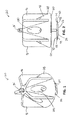
- Figs. 1-2 illustrate a floor leveling device 20 including a base 24 and a cap 28.
- the floor leveling device 20 is usable to help level, for example, tiles on a floor, wall, or other surface.
- a portion of the base 24 is positioned beneath the tiles (e.g., between the tiles and the floor), and the cap 28 is moved along another portion of the base 24 to engage the tiles.
- the base 24 and the cap 28 capture portions of the tiles therebetween to help level and space the tiles relative to each other.
- Grout, calk, and/or other bonding or adhesive materials introduced underneath and between the tiles to secure the tiles together.
- the illustrated base 24 includes a plate 32 and a stem 36.
- the plate 32 is the portion of the base 24 configured to be positioned beneath the tiles.
- the plate 32 includes a planar upper surface 40 that is configured to engage the tiles.
- the illustrated upper surface 40 is planar, or flat, throughout and does not include any bumps or protrusions extending upwardly from the surface 40.
- the plate 32 also includes two angled lower surfaces 44, 48 and a central planar section 52 that are opposite the planar upper surface 40.
- the angled surfaces 44, 48 extend in opposite directions from the central planar section 52.
- the first angled surface 44 extends from the central planar section 52 to a first edge 56 of the plate 32
- the second angled surface 48 extends from the central planar section 52 to a second edge 60 of the plate 32.
- the surfaces 44, 48 are angled (i.e., non-parallel) relative to the planar upper surface 40 of the plate 32.
- the angled surfaces 44, 48 are oriented so that the plate 32 decreases in thickness, or tapers, toward the first edge 56 and toward the second edge 60. This arrangement provides a wedge-shaped profile toward the first edge 56 and the second edge 60.
- the plate 32 also includes two notches 64, 68.
- the first notch 64 is formed through the planar upper surface 40 and the first angled lower surface 44 at the first edge 56.
- the second notch 68 is formed through the planar upper surface 40 and the second angled lower surface 48 at the second edge 60.
- the notches 64, 68 are generally V-shaped. In other embodiments, the notches 64, 68 may be other suitable shapes (e.g., U-shaped, rectangular, etc.).
- the plate 32 may include fewer or more notches at each edge 56, 60. As shown in Fig. 5 , sides 72 of the plate 32 are also angled toward the notches 64, 68 so that the overall width of the plate 32 decreases toward the first and second edges 56, 60.
- the stem 36 extends generally perpendicularly from the planar upper surface 40 of the plate 32.
- the illustrated stem 36 includes a threaded portion 76 and a flattened portion 80.
- the threaded portion 76 is formed at a distal or free end of the stem 36.
- the threaded portion 76 includes threads that threadably engage to the cap 28.
- the threaded portion 76 allows the cap 28 to move along the stem 36 toward and away from the plate 32.
- the threaded portion 76 may be replaced with a toothed portion that engages the cap 28 via a ratchet-type mechanism.
- the threaded portion 76 accounts for a majority (i.e., over 50 percent) of the overall length of the stem 36. In some embodiments, the threaded portion 76 may extend the entire length of the stem 36, and the flattened portion 80 may be omitted.
- the flattened portion 80 is positioned between the plate 32 and the threaded portion 76.
- the flattened portion 80 is shaped and sized to create and maintain a desired spacing between adjacent tiles.
- the illustrated flattened portion 80 includes two vertically-extending, planar surfaces 84 that are configured to engage and space apart edges of two tiles.
- the planar surfaces 84 provide the flattened portion 80 with a generally rectangular cross-section to fit between the tiles.
- the flattened portion 80 may have an X- or cross-shaped cross-section to fit between and space apart four tiles at their corners.
- the illustrated base 24 also includes perforations 88 formed between the plate 32 and the stem 36.
- the perforations 88 are formed between the upper surface 40 of the plate 32 and the flattened portion 80 of the stem 36.
- the perforations 88 may be, for example, notches or score lines to remove material between the plate 32 and the stem 36.
- the perforations 88 facilitate separating (e.g., snapping apart) the stem 36 from the plate 32.
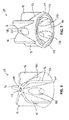
- Figs. 6 and 7 illustrate the cap 28 of the floor leveling device 20.
- the cap 28 couples to the stem 36 to capture portions of tiles between the cap 28 and the plate 32.
- the cap 28 is threadably coupled to the threaded portion 76 of the stem 36. This threaded connection allows the cap 28 to move along the stem 36 toward and away from the plate 32.
- the illustrated cap 28 includes a body 92, a plurality of flanges 96, and a plurality of apertures 100.
- the body 92 is a frustoconically-shaped body having a larger diameter end 104 near the plate 32 of the base 24, and a smaller diameter end 108 opposite from the plate 32 of the base 24.
- the body 92 includes a threaded bore 112 ( Fig. 6 ) at the smaller diameter end 108.
- the threaded bore 112 receives and engages the threaded portion 76 of the stem 36.
- the body 92 also includes an inner bore 116 ( Fig. 7 ) extending from the larger diameter end 104 to the threaded bore 112.
- the inner bore 116 is sized to at least partially receive the flattened portion 80 of the stem 36 when the cap 28 is threaded onto the stem 36.
- the inner bore 116 thereby provides clearance in the cap 28 for the cap 28 to fit over the flattened portion 80 and move closer to the plate 32.
- the flanges 96 extend radially outward from the body 92.
- the cap 28 includes five flanges 96 that are circumferentially spaced around the body 92.
- Each flange 96 provides a handle or grip to facilitate turning the cap 28 on the stem 36 of the base 24.
- the cap 28 may include fewer or more flanges.
- the flanges 96 may be spaced in different arrangements around the cap 28.
- the flanges 96 may be omitted so that a user directly grasps the body 92 of the cap 28 to turn the cap 28.
- the apertures 100 are formed through the body 92.
- the cap 28 includes five apertures 100 that are circumferentially spaced around the body 92 of the cap 28.
- the illustrated apertures 100 are equally spaced apart such that each aperture 100 is positioned between two adjacent flanges 96.
- the cap 100 may include fewer or more apertures. Additionally or alternatively, the apertures 100 may be spaced in different arrangements around the cap 28.
- the illustrated apertures 100 extend in a direction generally parallel to an axis of rotation of the cap 28 (and, thereby, a longitudinal axis of the stem 36). Orienting the apertures 100 in this manner provides a view through the cap 28 so that a user can see areas beneath the cap. More specifically, the apertures 100 allow a user to view portions of the tiles beneath the cap 28 to see, for example, if grout is squeezing out between the tiles underneath the cap 28.
- the cap 28 also includes a ridge 120 formed on a bottom surface 124 of the body 92 (i.e., the surface of the body 92 at the larger diameter end 104 and facing the plate 32).
- the ridge 120 extends downwardly from the body 92 toward the plate 32 of the base 24.
- the ridge 120 is a continuous, annular rib formed on the bottom surface 124 of the cap 28.
- the ridge 120 may include a series of discrete bumps or ribs formed on the bottom surface 124 of the cap 28.
- the ridge 120 is configured to engage upper surfaces of the tiles when the cap 28 is threaded onto the stem 36 of the base 24 to reduce the chance of grout getting caught between the cap 28 and the tiles.
- the ridge 120 also reduces friction between the cap 28 and the tiles when spinning the cap 28 onto the base 24. Furthermore, the ridge 120 reduces the possibility of marring the tiles as the cap 28 is spun onto the base 24.
- the base 24 and the cap 28 are composed of plastic (e.g., polyethylene, polyvinyl chloride, nylon, etc.). More particularly, the base 24 and the cap 28 are made of molded or injection molded plastic. In other embodiments, the base 24 and the cap 28 may be made of other or differing materials. For example, the base 24 may be made of plastic, and the cap 28 may be made of metal or wood. Alternatively, the base 24 and the cap 28 may be made of different types of plastics.
- plastic e.g., polyethylene, polyvinyl chloride, nylon, etc.
- the base 24 and the cap 28 are made of molded or injection molded plastic.
- the base 24 and the cap 28 may be made of other or differing materials.
- the base 24 may be made of plastic
- the cap 28 may be made of metal or wood.
- the base 24 and the cap 28 may be made of different types of plastics.
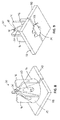
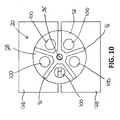
- Figs. 8-10 illustrate the floor leveling device 20 in use.
- the plate 32 of the base 24 is positioned between two adjacent tiles 128. This may occur by, for example, positioning one tile 128 on a floor (which is coated with grout), sliding approximately half of the plate 32 under the tile 128 so that the flattened portion 80 of the stem 36 abuts the edge of the tile 128, and positioning the other tile 128 on top of the other half of plate 32 so that the flattened portion 80 of stem 36 abuts the edge of the other tile 128.
- the planar upper surface 40 of the plate 32 scrapes grout off of the underside of the tile 128, creating a relatively clean interface between the plate 32 and the tile 128.
- the notches 64, 68 and the angled lower surfaces 44, 48 of the plate 32 also reduce the amount of space taken up by the plate 32 so that excess grout may accumulate within the notches 64, 68 or under the angled lower surfaces 44, 48 without being displaced unfavorably elsewhere.
- the cap 28 is coupled to the stem 36.
- the cap 28 is threaded (e.g., spun or rotated) onto the threaded portion 76 of the stem 36.
- a user can see if any grout is squeezed out from between the tiles 120 using the apertures 100 (as viewed in Fig. 10 ). The user can then clean/remove the grout before the grout hardens on the upper surfaces of the tiles 128.
- the cap 28 is threaded onto the stem 36 until the ridge 120 on the bottom surface 124 engages the tiles 128. Once the ridge 120 engages the tiles 128, further tightening of the cap 28 can shift the tiles 128 vertically to help level the tiles 128 relative to each other. This process can be performed on all of the tiles 128 on a floor or other surface.
- the cap 28 is removed (e.g., unthreaded) from the stem 36 of the base 24. Then, the stem 36 is separated from the plate 32 by, for example, snapping the stem 36 apart from the plate 32 along the perforations 88 ( Fig. 4 ). Once the cap 28 and the stem 36 are removed, gaps between the tiles 128 can be filled with grout. The plates 32 are left beneath the tiles 128 and covered by the grout.
Landscapes
- Engineering & Computer Science (AREA)
- Architecture (AREA)
- Civil Engineering (AREA)
- Structural Engineering (AREA)
- Chemical & Material Sciences (AREA)
- Ceramic Engineering (AREA)
- Floor Finish (AREA)
- Soil Working Implements (AREA)
Applications Claiming Priority (1)
| Application Number | Priority Date | Filing Date | Title |
|---|---|---|---|
| US14/742,229 US20160369518A1 (en) | 2015-06-17 | 2015-06-17 | Floor Leveling Device |
Publications (2)
| Publication Number | Publication Date |
|---|---|
| EP3106586A2 true EP3106586A2 (fr) | 2016-12-21 |
| EP3106586A3 EP3106586A3 (fr) | 2017-05-10 |
Family
ID=54337637
Family Applications (1)
| Application Number | Title | Priority Date | Filing Date |
|---|---|---|---|
| EP15190475.2A Withdrawn EP3106586A3 (fr) | 2015-06-17 | 2015-10-19 | Dispositif de nivellement du sol |
Country Status (3)
| Country | Link |
|---|---|
| US (1) | US20160369518A1 (fr) |
| EP (1) | EP3106586A3 (fr) |
| CA (2) | CA2909720C (fr) |
Cited By (3)
| Publication number | Priority date | Publication date | Assignee | Title |
|---|---|---|---|---|
| EP3511484A1 (fr) * | 2018-01-12 | 2019-07-17 | Progress Profiles SPA | Bouton d'entretoise de mise à niveau pour la pose de carreaux muraux, de carreaux de pavage et similaires |
| WO2020231377A1 (fr) * | 2019-05-16 | 2020-11-19 | Sevinc Murat | Appareil de mise à niveau et de support |
| WO2021071456A1 (fr) * | 2019-10-08 | 2021-04-15 | Sevinc Murat | Outil de mise à niveau pour matériaux de revêtement de construction |
Families Citing this family (26)
| Publication number | Priority date | Publication date | Assignee | Title |
|---|---|---|---|---|
| USRE49567E1 (en) | 2015-05-21 | 2023-07-04 | Russo Trading Company, Inc. | Tile lippage post |
| USD856111S1 (en) | 2015-05-21 | 2019-08-13 | Russo Trading Company, Inc. | Tile lippage threaded post |
| US20190093372A1 (en) * | 2015-05-21 | 2019-03-28 | William P. Russo | Tile Lippage Threaded Post |
| USD862204S1 (en) | 2015-05-21 | 2019-10-08 | Russo Trading Company, Inc. | Lippage cap |
| USD834922S1 (en) | 2015-05-21 | 2018-12-04 | Russo Trading Company, Inc. | Threaded lippage cap |
| WO2016189423A1 (fr) * | 2015-05-22 | 2016-12-01 | Raimondi S.P.A. | Entretoise de mise à niveau pour la pose de produits en dalle |
| WO2016201502A1 (fr) * | 2015-06-15 | 2016-12-22 | Atr Plastics Pty Ltd | Dispositif de réglage de bord de carrelage et son procédé de fonctionnement |
| AU2017220375B2 (en) * | 2016-02-17 | 2022-08-04 | Clik Tile System NZ Limited | Tile levelling clip and system |
| USD830161S1 (en) | 2016-11-04 | 2018-10-09 | Russo Trading Company, Inc. | Orientation washer |
| AU2017200815B2 (en) * | 2017-02-06 | 2021-06-24 | Russo Trading Company, Inc. | Tile Lippage Removal System |
| USD832723S1 (en) * | 2017-02-16 | 2018-11-06 | Tti (Macao Commercial Offshore) Limited | Tile spacer |
| USD866297S1 (en) * | 2017-09-15 | 2019-11-12 | Raimondi S.P.A. | Fastening device |
| US10577813B2 (en) * | 2018-02-08 | 2020-03-03 | Tti (Macao Commercial Offshore) Limited | Tile leveling device |
| IT201800003176A1 (it) * | 2018-03-01 | 2019-09-01 | Ghelfi S R L | Una manopola accoppiabile con un distanziatore livellatore di piastrelle per la posa di queste ultime su superfici piane |
| IT201800003175A1 (it) * | 2018-03-01 | 2019-09-01 | Ghelfi S R L | Manopola accoppiabile ad un distanziatore livellatore di piastrelle per la relativa posa di queste ultime su superfici piane |
| IT201800005212A1 (it) * | 2018-05-09 | 2019-11-09 | Dispositivo distanziatore livellante | |
| USD907991S1 (en) * | 2018-10-16 | 2021-01-19 | Mafi Ab | Fastening device |
| USD911821S1 (en) | 2020-03-02 | 2021-03-02 | Southland Tile Tools & Accessories, Inc | Tile leveler |
| CA3159900A1 (fr) | 2020-08-03 | 2022-02-10 | Germans Boada, S.A. | Dispositif niveleur de carrelages |
| CN112185266A (zh) * | 2020-10-23 | 2021-01-05 | 惠州市科伦特智能科技有限公司 | 调平机构以及拼接屏 |
| US11428019B2 (en) * | 2020-11-16 | 2022-08-30 | Raimondi S.P.A. | Levelling spacer device |
| US11697942B2 (en) * | 2021-03-22 | 2023-07-11 | Walter Pytlewski | Tile lippage control and tile spacing system and method therefore |
| US12065843B2 (en) * | 2021-09-21 | 2024-08-20 | Vincenzo Caruso | Systems for leveling tiles |
| USD1063573S1 (en) * | 2023-06-21 | 2025-02-25 | Germans Boada, S,.A | Ceramic tile levelling device |
| USD1122080S1 (en) | 2023-09-19 | 2026-04-14 | Acufloor, L.L.C. | Vertically traversing engagement cap for a tile leveling device |
| CN119754523B (zh) * | 2025-03-07 | 2025-05-16 | 山西建筑工程集团有限公司 | 一种建筑墙面瓷砖铺贴定位装置 |
Family Cites Families (4)
| Publication number | Priority date | Publication date | Assignee | Title |
|---|---|---|---|---|
| ES1070518Y (es) * | 2009-04-17 | 2009-12-21 | Boada Germans Sa | Dispositivo nivelador para la colocacion de piezas de recubrimiento |
| ITPD20110295A1 (it) * | 2011-09-20 | 2013-03-21 | Progress Profiles Spa | Distanziatore livellante per la posa di piastrelle, mattonelle e simili con interposizione di fughe |
| JP5546051B2 (ja) * | 2012-03-28 | 2014-07-09 | 株式会社川島織物セルコン | タイル施工治具 |
| CN203783094U (zh) * | 2014-03-31 | 2014-08-20 | 蔡志强 | 磁砖整平辅助器 |
-
2015
- 2015-06-17 US US14/742,229 patent/US20160369518A1/en not_active Abandoned
- 2015-10-19 EP EP15190475.2A patent/EP3106586A3/fr not_active Withdrawn
- 2015-10-21 CA CA2909720A patent/CA2909720C/fr active Active
- 2015-10-21 CA CA3107837A patent/CA3107837C/fr active Active
Non-Patent Citations (1)
| Title |
|---|
| None |
Cited By (4)
| Publication number | Priority date | Publication date | Assignee | Title |
|---|---|---|---|---|
| EP3511484A1 (fr) * | 2018-01-12 | 2019-07-17 | Progress Profiles SPA | Bouton d'entretoise de mise à niveau pour la pose de carreaux muraux, de carreaux de pavage et similaires |
| US10760284B2 (en) | 2018-01-12 | 2020-09-01 | Progress Profiles Spa | Knob for leveling spacer for laying wall tiles, floor tiles and the like |
| WO2020231377A1 (fr) * | 2019-05-16 | 2020-11-19 | Sevinc Murat | Appareil de mise à niveau et de support |
| WO2021071456A1 (fr) * | 2019-10-08 | 2021-04-15 | Sevinc Murat | Outil de mise à niveau pour matériaux de revêtement de construction |
Also Published As
| Publication number | Publication date |
|---|---|
| CA2909720C (fr) | 2021-03-16 |
| EP3106586A3 (fr) | 2017-05-10 |
| CA3107837C (fr) | 2023-10-24 |
| CA2909720A1 (fr) | 2016-12-17 |
| CA3107837A1 (fr) | 2016-12-17 |
| US20160369518A1 (en) | 2016-12-22 |
Similar Documents
| Publication | Publication Date | Title |
|---|---|---|
| EP3106586A2 (fr) | Dispositif de nivellement du sol | |
| US10577813B2 (en) | Tile leveling device | |
| EP3567183B1 (fr) | Dispositif d'alignement et de nivellement | |
| US9562365B2 (en) | Device for installing tiles | |
| US9689167B2 (en) | Tile leveler | |
| US20070217887A1 (en) | Screw | |
| US20140033641A1 (en) | Auxiliary device for the installation of plate-shaped products for covering floors and/or walls | |
| NL8401730A (nl) | Bevestigingsorgaan voor het fixeren van dakbanen op zacht isolatiemateriaal aan een vaste onderlaag. | |
| AU2007270036A1 (en) | Joint compound container | |
| KR20190119570A (ko) | 시공성과 공간 활용성을 증대시킨 천장 구조체 및 그 시공방법 | |
| US20190368207A1 (en) | Tile alignment and leveling device and method for using same | |
| US5988574A (en) | Furniture glide | |
| WO2012009819A1 (fr) | Saladier | |
| CN106133346A (zh) | 用于部件的具有自攻螺纹和安全螺纹的塑料制固定元件 | |
| DE102014104945B4 (de) | Fußmatte mit Flüssigkeitsspeicher | |
| US9719266B2 (en) | Surface finishing tool | |
| US20080011428A1 (en) | Adhesive trowel | |
| AT517826B1 (de) | Vorrichtung zum Andrücken einer Sockelleiste an eine Wand | |
| DE202010011671U1 (de) | Injektage-Unterlegscheibe für Schrauben, Dübel, Anker | |
| US20180235385A1 (en) | Holding device for adhesive fastening to a surface, having an allocated fastening element | |
| US9475085B2 (en) | Forming apparatus | |
| AT504276B1 (de) | Stütze für hohlraumböden | |
| AU2012211345A1 (en) | Auxiliary device for the installation of plate-shaped products for covering floors and/or walls | |
| DE202019102012U1 (de) | Küchenmaschine mit Verschiebehilfe und Verschiebehilfe | |
| CA2983483A1 (fr) | Dispositif d'installation de carreaux |
Legal Events
| Date | Code | Title | Description |
|---|---|---|---|
| PUAI | Public reference made under article 153(3) epc to a published international application that has entered the european phase |
Free format text: ORIGINAL CODE: 0009012 |
|
| AK | Designated contracting states |
Kind code of ref document: A2 Designated state(s): AL AT BE BG CH CY CZ DE DK EE ES FI FR GB GR HR HU IE IS IT LI LT LU LV MC MK MT NL NO PL PT RO RS SE SI SK SM TR |
|
| AX | Request for extension of the european patent |
Extension state: BA ME |
|
| PUAL | Search report despatched |
Free format text: ORIGINAL CODE: 0009013 |
|
| AK | Designated contracting states |
Kind code of ref document: A3 Designated state(s): AL AT BE BG CH CY CZ DE DK EE ES FI FR GB GR HR HU IE IS IT LI LT LU LV MC MK MT NL NO PL PT RO RS SE SI SK SM TR |
|
| AX | Request for extension of the european patent |
Extension state: BA ME |
|
| RIC1 | Information provided on ipc code assigned before grant |
Ipc: E04F 15/08 20060101AFI20170406BHEP Ipc: E04F 21/00 20060101ALI20170406BHEP |
|
| STAA | Information on the status of an ep patent application or granted ep patent |
Free format text: STATUS: THE APPLICATION IS DEEMED TO BE WITHDRAWN |
|
| 18D | Application deemed to be withdrawn |
Effective date: 20171111 |