EP3107894B1 - Fluortenside - Google Patents
Fluortenside Download PDFInfo
- Publication number
- EP3107894B1 EP3107894B1 EP15705911.4A EP15705911A EP3107894B1 EP 3107894 B1 EP3107894 B1 EP 3107894B1 EP 15705911 A EP15705911 A EP 15705911A EP 3107894 B1 EP3107894 B1 EP 3107894B1
- Authority
- EP
- European Patent Office
- Prior art keywords
- chf
- alkyl
- stands
- compounds
- oder
- Prior art date
- Legal status (The legal status is an assumption and is not a legal conclusion. Google has not performed a legal analysis and makes no representation as to the accuracy of the status listed.)
- Active
Links
- 0 CC*OC*(C)C(C(C(*)=O)N=O)C(C)=O Chemical compound CC*OC*(C)C(C(C(*)=O)N=O)C(C)=O 0.000 description 3
- WCFYAXLORPPZQB-UHFFFAOYSA-N CC(C)(CC(C)(C)O)CN(C)CC(C)(C)CO Chemical compound CC(C)(CC(C)(C)O)CN(C)CC(C)(C)CO WCFYAXLORPPZQB-UHFFFAOYSA-N 0.000 description 1
- HAASNFCISJKMFF-UHFFFAOYSA-N CC(C)(CC(C)(C)O)CNC Chemical compound CC(C)(CC(C)(C)O)CNC HAASNFCISJKMFF-UHFFFAOYSA-N 0.000 description 1
- ZHBBDSUHZMFAAB-UHFFFAOYSA-N NCC(CN)N=O Chemical compound NCC(CN)N=O ZHBBDSUHZMFAAB-UHFFFAOYSA-N 0.000 description 1
Images

Classifications
-
- C—CHEMISTRY; METALLURGY
- C07—ORGANIC CHEMISTRY
- C07C—ACYCLIC OR CARBOCYCLIC COMPOUNDS
- C07C309/00—Sulfonic acids; Halides, esters, or anhydrides thereof
- C07C309/01—Sulfonic acids
- C07C309/02—Sulfonic acids having sulfo groups bound to acyclic carbon atoms
- C07C309/03—Sulfonic acids having sulfo groups bound to acyclic carbon atoms of an acyclic saturated carbon skeleton
- C07C309/17—Sulfonic acids having sulfo groups bound to acyclic carbon atoms of an acyclic saturated carbon skeleton containing carboxyl groups bound to the carbon skeleton
-
- C—CHEMISTRY; METALLURGY
- C07—ORGANIC CHEMISTRY
- C07C—ACYCLIC OR CARBOCYCLIC COMPOUNDS
- C07C19/00—Acyclic saturated compounds containing halogen atoms
- C07C19/08—Acyclic saturated compounds containing halogen atoms containing fluorine
-
- C—CHEMISTRY; METALLURGY
- C07—ORGANIC CHEMISTRY
- C07C—ACYCLIC OR CARBOCYCLIC COMPOUNDS
- C07C43/00—Ethers; Compounds having groups, groups or groups
- C07C43/02—Ethers
- C07C43/03—Ethers having all ether-oxygen atoms bound to acyclic carbon atoms
- C07C43/04—Saturated ethers
-
- C—CHEMISTRY; METALLURGY
- C07—ORGANIC CHEMISTRY
- C07C—ACYCLIC OR CARBOCYCLIC COMPOUNDS
- C07C49/00—Ketones; Ketenes; Dimeric ketenes; Ketonic chelates
- C07C49/04—Saturated compounds containing keto groups bound to acyclic carbon atoms
- C07C49/16—Saturated compounds containing keto groups bound to acyclic carbon atoms containing halogen
- C07C49/167—Saturated compounds containing keto groups bound to acyclic carbon atoms containing halogen containing only fluorine as halogen
Definitions
- the present invention relates to new compounds with fluorinated end groups, their use as surface-active substances and agents containing these compounds.
- Fluorine-containing surfactants have unique application properties due to their special surface activity. Fluorosurfactants, whose static surface tension is very low (16-20 mN / m), can be used in a wide variety of applications and carry e.g. to improve the wetting of surfaces. So they will e.g. used as an interface mediator or emulsifier or viscosity reducer in paints, varnishes or adhesives.
- fluorosurfactants are made up of long-chain, perfluorinated alkyl chains (C6-C8) and are potentially considered to be bioaccumulative and toxic. As a rule, however, fluorosurfactants contain perfluoroalkyl substituents which are broken down in the environment by biological and other oxidation processes to give perfluoroalkane carboxylic acids and sulfonic acids. These are considered persistent and are e.g. T. suspected of causing health damage ( GL Kennedy, Jr., JL Butenhoff, GW Olsen, JC O'Connor, AM Seacat, RG Perkins, LB Biegel, SR Murphy, DG Farrar, Critical Reviews in Toxicology 2004, 34, 351-384 ). Longer-chain perfluoroalkane carboxylic acids and sulfonic acids also accumulate in the food chain. Shorter-chain fluorine building blocks have a more favorable ecotoxicological profile, but often show poorer properties in their areas of application.
- WO 03/010128 describes perfluoroalkyl-substituted amines, acids, amino acids and thioether acids which have a C 3-20 perfluoroalkyl group.
- Out JP-A-2001/133984 surface-active compounds with perfluoroalkoxy chains are known which are suitable for use in anti-reflective coatings.
- Out JP-A-09/111286 the use of perfluoropolyether surfactants in emulsions is known.
- WO 2006/072401 and WO 2010/003567 surface-active compounds with trifluoromethoxy groups are described.
- Compounds with special fluoroalkyl groups are in US 7,635,789 . US 2008/0093582 .
- JP 2004-18394 and WO 2010/002623 described.
- Partially fluorinated compounds are in US 7,737,307 .
- EP 1 522 536 and WO 2010/002622 described.
- the hydrocarbon units of the spacer of the compounds of the formulas (I) and (I ') can be aliphatic or aromatic units which are optionally provided with heteroatoms.
- the group Z in the surface-active compounds is preferably attached to a saturated, branched or unbranched hydrocarbon unit, preferably to a saturated, branched or unbranched alkylene group, one or more non-adjacent C atoms being replaced by O or N, preferably O. can, bound.
- a preferred hydrocarbon unit containing heteroatoms is a polyethylene or polypropylene glycol unit.
- group Z occurs several times in the surface-active compound, preferably twice or three times. In another variant of the invention, group Z occurs only once in the surface-active compound. In one variant of the invention, compounds of the formulas (I) and (I ') can contain different Z groups.
- m is preferably 1.
- Rf is equal to: CF 3 - or CF 3 -CF 2 - or CF 3 -CF 2 -CF 2 -.
- X is an anionic, cationic, nonionic or amphoteric hydrophilic group selected from the groups according to claim 1.
- An anionic group X is selected from -COO - , -SO 3 - , -OSO 3 - , -PO 3 2- , -OPO 3 2- , - (OCH 2 CH 2 ) s -O- (CH 2 ) t - COO - , - (OCH 2 CH 2 ) s -O- (CH 2 ) t -SO 3 - , - (OCH 2 CH 2 ) s -O- (CH 2 ) t -OSO 3 - , - (OCH 2 CH 2 ) s -O- (CH 2 ) t -PO 3 2- , - (OCH 2 CH 2 ) s -O- (CH 2 ) t -OPO 3 2- or from the formulas A to C, or where s stands for an integer from the range from 1 to 1000, t stands for an integer selected from 1, 2, 3 or 4 and w stands for an integer selected from 1, 2 or 3.
- the preferred anionic groups include in particular -COO - , -SO 3 - , -OSO 3 - , -PO 3 2- , -OPO 3 2- , the partial formula A, and - (OCH 2 CH 2 ) s -O- (CH 2 ) t -COO - , - (OCH 2 CH 2 ) s -O- (CH 2 ) t -SO 3 - and - (OCH 2 CH 2 ) s -O- (CH 2 ) t -OSO 3 - , with each of these groups individually being preferred.
- the very particularly preferred anionic groups include -SO 3 - , -OSO 3 - , -PO 3 2- , or OPO 3 2- .
- a sulfonate group -SO 3 - is preferred.
- Na + , K + , Li + and NH 4 + are particularly preferred, particularly preferably Na + .
- the preferred cationic groups include in particular -NR 1 R 2 R 3+ Z - and each of these groups may be preferred individually.
- the preferred nonionic groups include in particular linear or branched alkyl, one or more nonadjacent C atoms being replaced by O, S and / or N, -OH and -O- (glycoside) o ' .
- Particularly preferred compounds according to the invention are those which contain, as the hydrophilic group X, one of the preferred anionic groups, the preferred nonionic groups or the preferred zwitterionic groups.
- Preferred counterions are Na + , K + and NH 4 + , in particular Na + .
- -SO 3 - polyethylene or polypropylene glycols, sulfobetaines, the group -CH (OH) -CH 2 -NH-Sach and the group -Y- (CH 2 -CH 2 -O) v -R 4 .
- Compounds are preferred which, as X, represent the groups -SO 3 - , -OSO 3 - , -PO 3 2- or OPO 3 2- , polyethylene or polypropylene glycols, -CH (OH) -CH 2 -NH-Sach, - Y- (CH 2 -CH 2 -O) v -R 4 , betaines, or sulfobetaines contain.
- Preferred counterions are Na + , K + and NH 4 + , in particular Na + .
- -SO 3 - polyethylene or polypropylene glycols, sulfobetaines, the group -CH (OH) -CH 2 -NH-Sach and the group -Y- (CH 2 -CH 2 -O) v -R 4 .
- Compounds are preferred which, as X, represent the groups -SO 3 - , -OSO 3 - , -PO 3 2- or OPO 3 2- , polyethylene or polypropylene glycols, -CH (OH) -CH 2 -NH-Sach, - Y- (CH 2 -CH 2 -O) v -R 4 , Contain betaines or sulfobetaines.
- Preferred counterions are Na + , K + and NH 4 + , in particular Na + .
- -SO 3 - polyethylene or polypropylene glycols, sulfobetaines, the group -CH (OH) -CH 2 -NH-Sach and the group -Y- (CH 2 -CH 2 -O) v -R 4 .
- the compounds according to the invention can be prepared by processes known to those skilled in the art.
- the compounds of the formula (II) according to the invention can preferably by esterification of maleic acid and aconitic acid or their anhydrides or acid chlorides with one or more alcohols of the formula (XII), where Y has the meanings described above, in particular the preferred meanings YH (XII) and subsequent addition to the double bond to introduce the grouping X.
- the invention accordingly furthermore relates to the corresponding maleic acid and aconitic acid esters of the formulas (XIII) and (XIV):
- the compounds according to the invention can also preferably be prepared by esterifying hydroxysuccinic acid and citric acid with one or more alcohols of the formula (XII) and then functionalizing the hydroxyl groups to introduce the group X.
- the succinates or tricarballylates according to the invention are preferably synthesized as in WO 2014/012661 described in a two-stage synthesis via the corresponding maleates or hydroxysuccinates or the corresponding aconite or citric acid esters.
- Further compounds of the formula (II) according to the invention can be prepared analogously to the exemplary reactions shown above.
- Further compounds of the formula (II) according to the invention can also be prepared by other methods known to the person skilled in the art from the literature. In particular, other esterification catalysts can be used. These syntheses are in WO 2010/149262 . WO 2011/082770 and WO 2012/084118 described. The disclosures in the cited references are hereby expressly included in the disclosure content of the present application.
- Further compounds according to the invention can be prepared analogously to the exemplary reactions shown above or by other methods known to the person skilled in the art from the literature.
- the compounds according to the invention can preferably have a particular surface activity.
- the compounds of the formula (I) according to the invention in particular the compounds of the formula (II), preferably of the formulas (II-a) (II-b), (II-c) and (II-d), can be compared to the fluorosurfactants of the prior art technology have significantly improved environmental properties because they neither chemically nor biologically break down into long-chain PFCAs or PFASs.
- the compounds according to the invention can preferably be completely converted into mineralizable / regenerable compounds by appropriate environmental influences.
- the compounds according to the invention can preferably be broken down by two mechanisms.
- the carbon structure can be degraded by biological activity to the extent that (partially) fluorinated compounds are formed which are non-toxic and have a high vapor pressure (Sdp ⁇ 140 ° C). Due to the high volatility, these compounds can get into the atmosphere and in the stratosphere can be decomposed into low molecular weight compounds (HF, COF 2 etc.) by the intense UV radiation prevailing there. These decomposition products can then be washed out of the atmosphere with the rain, transferred to the soil and mineralized there.
- the end products are not perfluorinated during the biological decomposition and that no (stable) salts can arise.
- the alkyl substitution on the ⁇ -carbon can lead to the fact that these secondary or tertiary alcohols primarily biodegradable not too difficult to volatile compounds such.
- B. carboxylic acids are oxidized.
- the non-fluorinated part of the compounds according to the invention is easily degradable via biological mechanisms.
- the molecules Meta 1 or Meta 2 remain as biologically unusable residues, which have a sufficiently high vapor pressure to get out of the water or Soil can get into the atmosphere.
- Meta 2 is rapidly decomposed by UV radiation in the stratosphere (see “ Atmospheric Fate of various fluorocarbons, Master Thesis Yi Tang, Massachusetts Institute of Technology, 1993 ).
- no fluorine-containing salts are formed in step a).
- no perfluorinated compounds are formed in step a).
- Fluorine-containing surfactants are preferably subjected to the degradation process described, in particular those surfactants which are based on partially fluorinated and / or ⁇ -alkylated alcohols.
- a second subject of the present invention is the use of the compounds according to the invention and the preferred embodiments described above as surface-active agents, for example for improving the flow behavior and the wetting ability of coating formulations.
- Fluorosurfactants of the formulas (II) to (XI) are preferably used, in particular the particularly preferred compounds mentioned, preferably compounds of the formulas (II-a) (II-b), (II-c) and (II-d).
- the mixtures according to the invention can also contain solvents, additives , Auxiliaries and fillers as well as non-fluorinated surfactants.
- solvents include silicone particles, plasticizers and surface-modified pigments.
- fluorosurfactants according to the invention preferably those of the formula (II), in particular of the formulas (II-a) (II-b), (II-c) and (II-d), as additives in preparations for surface coating , such as paints, varnishes, protective coatings, special coatings in electronic or semiconductor applications (e.g. photoresists, top antireflective coatings, bottom antireflective coatings) or in optical applications (e.g.
- the compounds which can be used according to the invention as surfactants are suitable for washing and cleaning applications, and for use as additives / surfactants in cosmetic products such as, for example, B. hair and body care products (e.g. shampoos, conditioners and conditioners), foam baths, creams or lotions with one or more of the following functions: emulsifiers, wetting agents, foaming agents, lubricants, antistatic agents, increased resistance to skin oils.
- B. hair and body care products e.g. shampoos, conditioners and conditioners
- foam baths e.g., wetting agents, foaming agents, lubricants, antistatic agents, increased resistance to skin oils.
- the fluorosurfactants according to the invention are usually introduced for use in appropriately designed preparations. Usual concentrations are from 0.01 to 1.0% by weight of the surfactants according to the invention, based on the overall preparation.
- Corresponding agents containing the fluorosurfactants according to the invention are also the subject of the present invention. Such agents preferably contain a carrier suitable for the respective intended use, and optionally further active substances and / or optionally auxiliaries.
- Preferred agents are paint and varnish preparations, fire extinguishing agents, lubricants, detergents and cleaning agents and deicers or developer solutions, rinsing solutions, immersion oils and photoresists for photolithographic processes, in particular for immersion photolithography processes and in particular for the production of printed circuits, agrochemicals, floor polishes, cosmetic products, cosmetic products or water repellents for textile finishing or glass treatment.
- Preferred agents are color and lacquer preparations and printing inks.
- the present invention also relates to water-based coating formulations which contain the fluorosurfactants according to the invention, alone or in a mixture with additives.
- Lacquer formulations based on the following synthetic film formers are preferably used: polycondensation resins such as alkyd resins, saturated / unsaturated polyesters, polyamides / imides, silicone resins; Phenol resins; Urea resins and melamine resins, polyaddition resins such as polyurethanes and epoxy resins, polymerization resins such as polyolefins, polyvinyl compounds and polyacrylates.
- fluorosurfactants according to the invention are also suitable for use in paints based on natural substances and modified natural substances. Lacquers based on oils, polysaccharides such as starch and cellulose as well as based on natural resins such as cyclic oligoterpenes, polyterpenes and / or shellac are preferred.
- the fluorosurfactants according to the invention can be used both in physically curing (thermoplastics) and in crosslinking (elastomers and duromers) aqueous coating systems.
- the fluorosurfactants according to the invention preferably improve the flow and wetting properties of the coating systems.
- fluorosurfactants to be used according to the invention mentioned here are the subject of the present invention.
- the particular use of fluorosurfactants for the stated purposes is known to the person skilled in the art, so that the use of the fluorosurfactants to be used according to the invention presents no problems.
- the reaction mixture is mixed with 40 mL deionized water and the phases are separated.
- aqueous phase is then extracted with 3 x 25 mL MTBE, the combined organic phases are washed with 1 x 30 mL water and 1 x 30 mL saturated NaCl solution and dried over sodium sulfate. After distilling off the solvent, a yield of 3.90 g is obtained
- the static surface tension ⁇ stat . is determined according to the specified method and is 17.69 mN / m for a solution with 0.1% by weight of the compound and 16.78 mN / m for a solution with 1% by weight of the compound.
- the dynamic surface tension is in illustration 1 played.
- the plate consists of roughened platinum and is therefore optimally wetted so that the contact angle ⁇ is close to 0 °.
- the term cos ⁇ therefore approximately reaches the value 1, so that only the measured force and the length of the plate have to be taken into account.
Landscapes
- Chemical & Material Sciences (AREA)
- Organic Chemistry (AREA)
- Organic Low-Molecular-Weight Compounds And Preparation Thereof (AREA)
- Paints Or Removers (AREA)
- Inks, Pencil-Leads, Or Crayons (AREA)
- Cosmetics (AREA)
- Detergent Compositions (AREA)
- Lubricants (AREA)
Description
- Gegenstand der vorliegenden Erfindung sind neue Verbindungen mit fluorierten Endgruppen, deren Verwendung als oberflächenaktive Substanzen und Mittel enthaltend diese Verbindungen.
- Fluorhaltige Tenside besitzen aufgrund ihrer speziellen Oberflächenaktivität einzigartige Anwendungseigenschaften. Fluortenside, deren statische Oberflächenspannung sehr niedrig ist (16-20 mN/m), sind in verschiedensten Anwendungen einsetzbar und tragen z.B. zur verbesserten Benetzung von Oberflächen bei. So werden sie z.B. als Grenzflächenvermittler bzw. Emulgator oder Viskositätsminderer in Farben, Lacken oder Klebstoffen verwendet.
- Klassische Fluortenside sind aus langkettigen, perfluorierten Alkylketten (C6-C8) aufgebaut und gelten potentiell als bioakkumulativ und toxisch. In der Regel enthalten Fluortenside jedoch Perfluoralkylsubstituenten, die in der Umwelt durch biologische und andere Oxidationsprozesse zu Perfluoralkancarbonsäuren und -sulfonsäuren abgebaut werden. Diese gelten als persistent und stehen z. T. im Verdacht gesundheitliche Schäden zu verursachen (G. L. Kennedy, Jr., J. L. Butenhoff, G. W. Olsen, J. C. O'Connor, A. M. Seacat, R. G. Perkins, L. B. Biegel, S. R. Murphy, D. G. Farrar, Critical Reviews in Toxicology 2004, 34, 351-384). Längerkettige Perfluoralkancarbonsäuren und -sulfonsäuren reichern sich zudem in der Nahrungskette an. Kürzerkettige Fluorbausteine sind von ihrem ökotoxikologischen Profil günstiger, zeigen jedoch in ihren Anwendungsbereichen oft schlechtere Eigenschaften.
- In
WO 03/010128 JP-A-2001/133984 JP-A-09/111286 WO 2006/072401 undWO 2010/003567 werden oberflächenaktive Verbindungen mit Trifluormethoxygruppen beschrieben. Verbindungen mit speziellen Fluoralkylgruppen sind inUS 7,635,789 ,US 2008/0093582 ,JP 2004-18394 WO 2010/002623 beschrieben. Teilfluorierte Verbindungen sind inUS 7,737,307 ,EP 1 522 536 undWO 2010/002622 beschrieben. - Spezielle Anwendungen von Sulfosuccinaten und/oder Sulfotricarballylaten mit verschiedenen fluorierten Seitenketten sind in
US 4,968,599 undUS 4,988,610 sowieUS 6, 890, 608 beschrieben und in A.R. Pitt et al., Colloids and Surfaces A: Physicochemical and Engineering Aspects, 1996, 114, 321-335; A.R. Pitt, Progr. Colloid Polym. Sci, 1997, 103, 307-317 und Z.-T. Liu et al., Ind. Eng. Chem. Res. 2007, 46, 22-28. Weitere Fluortenside, insbesondere Succinate und Tricarballylate mit fluorierten Alkylgruppen, sind inWO 2009/149807 ,WO 2010/003567 ,WO 2010/149262 ,WO 2011/082770 undWO 2012/084118 beschrieben. - Weiterhin besteht Bedarf nach alternativen oberflächenaktiven Substanzen, die vorzugsweise beim Abbau nicht zu langkettigen persistenten Verbindungen abbauen.
- Es wurden nun neue Verbindungen gefunden, die als oberflächenaktive Substanzen geeignet sind und bevorzugt einen oder mehrere der o.g. Nachteile nicht aufweisen.
- Ein erster Gegenstand der vorliegenden Erfindung sind Verbindungen der Formel (I) oder (I') gemäß Anspruch 1
ZnCcDdSpacermXx (I)
(ZnCcDd)nSpacermXx (I')
wobei - Z = Rf-O-CHF-CF2-CR1R2-O- oder
- Rf-O-(CF2)1-4-CHF-CF2-CR1R2-O- oder
- Rf-O-(CF2)1-4-O-CHF-CF2-CR1R2-O- oder
- Rf-O-(CF(CF3)-CF2)1-4-CHF-CF2-CR1R2-O- oder
- Rf-O-(CF(CF3)-CF2)1-4-O-CHF-CF2-CR1R2-O- oder
- Rf-O-(CF2-O)1-4-CHF-CF2-CR1R2-O- oder
- Rf-O-(CF2-CF2-O)1-4-CHF-CF2-CR1R2-O- oder
- Rf-O-(CF2-O)1-4-(CF2-CF2-O)1-4-CHF-CF2-CR1R2-O-
- n und n' = 1, 2, 3,4, 5 oder 6, bevorzugt 2-4, insbesondere 2-3,
- Rf = fluoriertes Alkyl, linear oder verzweigt, bevorzugt fluoriertes C1-C6-Alkyl, besonders bevorzugt perfluoriertes C1-C4-Alkyl, , insbesondere perfluoriertes C1-C3-Alkyl,
- R1 = H oder Alkyl, bevorzugt C1-C4, insbesondere -CH3 oder -CH2-CH3
- R2 = H oder Alkyl, bevorzugt C1-C4, insbesondere -CH3,
- C = -CR'2-CR"2-O-,
- c = 0 oder eine ganze Zahl aus dem Bereich von 1 bis 100,
- R' und R" = unabhängig voneinander H oder Alkyl, insbesondere H oder -CH3 oder -CH2-CH3
- D = -CO-
- d = 0 oder 1,
- Spacer = eine gesättigte oder ungesättigte, verzweigte oder unverzweigte, ggf. Heteroatome enthaltende, Kohlenwasserstoffeinheit,
- m = 0 oder 1,
- X eine anionische, kationische, nicht-ionische oder amphotere hydrophile Gruppe gemäß Anspruch 1 ist,
- und x = 1, 2, 3 oder 4, bevorzugt 1 ist
- Bevorzugt entsprechen erfindungsgemäße Verbindungen der Formel (I')
(ZCcDd)nSpacermXx (I)
wobei alle Variablen die genannten Bedeutungen. - Bei den Kohlenwasserstoff-Einheiten des Spacers der Verbindungen der Formeln (I) und (I') kann es sich um aliphatische oder aromatische, gegebenenfalls mit Heteroatomen versehene Einheiten handeln. Vorzugsweise ist die Gruppe Z in den oberflächenaktiven Verbindungen dabei an eine gesättigte, verzweigte oder unverzweigte Kohlenwasserstoff-Einheit, bevorzugt an eine gesättigte, verzweigte oder unverzweigte Alkylengruppe, wobei ein oder mehrere nicht benachbarte C-Atome durch O oder N, bevorzugt O, ersetzt sein können, gebunden. In einer Erfindungsvariante wird als bevorzugte Heteroatome enthaltende Kohlenwasserstoffeinheit eine Polyethylen- oder Polypropylenglykoleinheit verwendet.
- In einer Erfindungsvariante kommt die Gruppe Z in der oberflächenaktiven Verbindung mehrfach vor, bevorzugt zweimal oder dreimal. In einer anderen Erfindungsvariante kommt die Gruppe Z in der oberflächenaktiven Verbindung nur einmal vor. In einer Erfindungsvariante können Verbindungen der Formeln (I) und (I') verschiedene Gruppe Z enthalten.
- Bevorzugt sind Verbindungen der Formeln (I) und (I'), in denen n = 2-3 und x = 1 ist.
- In einer Erfindungsvariante ist m bevorzugt 1.
- In den Verbindungen der Formeln (I) und (I') ist Z gleich:
- Rf-O-CHF-CF2-CR1R2-O- oder
- Rf-O-(CF2)1-4-CHF-CF2-CR1R2-O- oder
- Rf-O-(CF2)1-4-O-CHF-CF2-CR1R2-O- oder
- Rf-O-(CF(CF3)-CF2)1-4-CHF-CF2-CR1R2-O- oder
- Rf-O-(CF(CF3)-CF2)1-4-O-CHF-CF2-CR1R2-O- oder
- Rf-O-(CF2-O)1-4-CHF-CF2-CR1R2-O- oder
- Rf-O-(CF2-CF2-O)1-4-CHF-CF2-CR1R2-O- oder
- Rf-O-(CF2-O)1-4-(CF2-CF2-O)1-4-CHF-CF2-CR1R2-O- ist.
- Besonders bevorzugt sind Verbindungen der Formeln (I) und (I') in denen Z gleich:
- Rf-O-CHF-CF2-CR1R2-O- oder
- Rf-O-(CF2)1-4-CHF-CF2-CR1R2-O- oder
- Rf-O-(CF2)1-4-O-CHF-CF2-CR1R2-O- oder
- Rf-O-(CF(CF3)-CF2)1-4-CHF-CF2-CR1R2-O- oder
- Rf-O-(CF(CF3)-CF2)1-4-O-CHF-CF2-CR1R2-O- oder
- Rf-O-(CF2-O)1-4-CHF-CF2-CR1R2-O- oder
- Rf-O-(CF2-CF2-O)1-4-CHF-CF2-CR1R2-O- oder
- Rf-O-(CF2-O)1-4-(CF2-CF2-O)1-4-CHF-CF2-CR1R2-O- ist,
- insbesondere = Rf-O-CHF-CF2-CR1R2-O- oder
- Rf-O-(CF2)1-4-CHF-CF2-CR1R2-O-, mit R1 und R2 unabhängig voneinander = H, -CH3 oder -CH2-CH3. Bevorzugt sind hierbei Verbindungen, in denen R1 und R2 = H und solche Verbindungen, in denen R1 oder R2 = H.
- Bevorzugt sind Verbindungen der Formeln (I) und (I'), in denen Rfgleich: CF3- oder CF3-CF2- oder CF3-CF2-CF2- ist.
- Im Besonderen sind Verbindungen der Formeln (I) und (I') bevorzugt, in denen n = 2-3, x = 1, Rf gleich CF3-, CF3-CF2- oder CF3-CF2-CF2- ist und Z gleich:
- Rf-O-CHF-CF2-CR1R2-O- oder
- Rf-O-(CF2)1-4-CHF-CF2-CR1R2-O- oder
- Rf-O-(CF2)1-4-O-CHF-CF2-CR1R2-O- oder
- Rf-O-(CF(CF3)-CF2)1-4-CHF-CF2-CR1R2-O- oder
- Rf-O-(CF(CF3)-CF2)1-4-O-CHF-CF2-CR1R2-O- oder
- Rf-O-(CF2-O)1-4-CHF-CF2-CR1R2-O- oder
- Rf-O-(CF2-CF2-O)1-4-CHF-CF2-CR1R2-O- oder
- Rf-O-(CF2-O)1-4-(CF2-CF2-O)1-4-CHF-CF2-CR1R2-O- ist.
- Hierbei ist Z insbesondere = Rf-O-CHF-CF2-CR1R2-O- oder Rf-O-(CF2)1-4-CHF-CF2-CR1R2-O-, mit R1 und R2 unabhängig voneinander = H, -CH3 oder -CH2-CH3. Bevorzugt sind hierbei Verbindungen, in denen R1 und R2 = H und solche Verbindungen, in denen R1 oder R2 = H.
- Hierbei sind Verbindungen bevorzugt, in denen der Spacer eine gesättigte, verzweigte oder unverzweigte Kohlenwasserstoff-Einheit ist und m = 1.
- Bevorzugt ist C = -CH2-CHR"-O- oder -CHR'-CH2-O-,, mit c = 0 oder eine ganze Zahl aus dem Bereich von 1 bis 100, bevorzugt = 1-100, und R' und R" = H oder Alkyl, insbesondere H oder -CH3 oder -CH2-CH3.
- Besonders bevorzugt sind Verbindungen in denen die genannten Variablen die bevorzugten Bedeutungen haben, insbesondere solche, in denen alle Variablen die bevorzugten Bedeutungen haben.
- In den erfindungsgemäßen Verbindungen ist X eine anionische, kationische, nicht-ionische oder amphotere hydrophile Gruppe ausgewählt aus den Gruppen gemäß Anspruch 1.
- Eine anionische Gruppe X ist ausgewählt aus -COO-, -SO3 -, -OSO3 -, -PO3 2-, -OPO3 2-, -(OCH2CH2)s-O-(CH2)t-COO-, -(OCH2CH2)s-O-(CH2)t-SO3 -,-(OCH2CH2)s-O-(CH2)t-OSO3 -, -(OCH2CH2)s-O-(CH2)t-PO3 2-, -(OCH2CH2)s-O-(CH2)t-OPO3 2- oder aus den Formeln A bis C,


- Zu den bevorzugten anionischen Gruppen gehören dabei insbesondere -COO-, -SO3 -, -OSO3 -, -PO3 2-, -OPO3 2-, die Teilformel A, sowie -(OCH2CH2)s-O-(CH2)t-COO-, -(OCH2CH2)s-O-(CH2)t-SO3 - und -(OCH2CH2)s-O-(CH2)t-OSO3 -, wobei jede einzelne dieser Gruppen für sich genommen bevorzugt sein kann.
- Zu den ganz besonders bevorzugten anionischen Gruppen gehören dabei -SO3 -, -OSO3 -, -PO3 2-, oder OPO3 2-. Insbesondere eine Sulfonatgruppe -SO3 - ist bevorzugt.
- Bevorzugtes Gegenion für anionische Gruppen X ist ein einwertiges Kation, insbesondere H+, ein Alkalimetall-Kation oder NR4 +, wobei R = H oder C1 - C6-Alkyl ist und alle R gleich oder verschieden sein können. Insbesondere bevorzugt sind Na+, K+, Li+ und NH4 +, besonders bevorzugt Na+.
- Eine kationische Gruppe X ist ausgewählt aus -NR1R2R3+ Z-, -PR1R2R3+ Z-,

- wobei R steht für H oder C1-4-Alkyl in beliebiger Position,
- Z- steht für Cl-, Br-, I-, CH3SO3 -, CF3SO3 -, CH3PhSO3 -, PhSO3 -
- R1, R2 und R3 jeweils unabhängig voneinander stehen für H, C1-30-Alkyl, Ar oder -CH2Ar und
- Ar steht für einen unsubstituierten oder ein- oder mehrfach substituierten aromatischen Ring oder kondensierte Ringsysteme mit 6 bis 18 C-Atomen, worin auch ein oder zwei CH-Gruppen durch N ersetzt sein können.
- Zu den bevorzugten kationischen Gruppen gehören dabei insbesondere -NR1R2R3+ Z- und

- Eine nicht-ionische Gruppe ist ausgewählt aus: lineares oder verzweigtes Alkyl, wobei ein oder mehrere nicht benachbarte C-Atome durch O, S, und/oder N ersetzt
sind, -OH, -SH, -O-(Glycosid)o', -S-(Glycosid)o', -OCH2-CHOH-CH2-OH, -O CH2Ar(-NCO)p', -OAr(-NCO)p', Aminoxid,

- u steht für eine ganze Zahl aus dem Bereich von 1 bis 6, bevorzugt 1 bis 4
- o' steht für eine ganze Zahl aus dem Bereich von 1 bis 10,
- p' steht für 1 oder 2,
- Ar steht für einen unsubstituierten, ein- oder mehrfach substituierten aromatischen Ring oder kondensierte Ringsysteme mit 6 bis 18 C-Atomen, worin auch ein oder zwei CH-Gruppen durch C=O ersetzt sein können und, Glycosid steht für ein verethertes Kohlenhydrat, vorzugsweise für ein mono- di-, tri- oder oligo-Glucosid.
- Zu den bevorzugten nicht-ionischen Gruppen gehören dabei insbesondere lineares oder verzweigtes Alkyl, wobei ein oder mehrere nicht benachbarte C-Atome durch O, S und/oder N ersetzt sind, -OH und -O-(Glycosid)o'.
- Wenn X = Alkyl, wobei ein oder mehrere nicht benachbarte C-Atome durch O, S, und/oder N ersetzt sind, dann ist es bevorzugt gleich R4-(B-A)m"- mit R4 = H oder C1-4-Alkyl, insbesondere H oder CH3, A = lineares oder verzweigtes Alkylen, bevorzugt mit 1 bis 10 Kohlenstoffatomen, insbesondere mit 1 bis 4 Kohlenstoffatomen, B = O oder S, bevorzugt O, und m" = eine ganze Zahl bevorzugt aus dem Bereich von 1 bis 100, besonders bevorzugt 1 bis 30.
- Insbesondere bevorzugt als nicht-ionische Gruppe X ist die Gruppe R4-(O-CH2CHR5)m"- mit m" = eine ganze Zahl aus dem Bereich von 1 bis 100, bevorzugt 1 bis 30, insbesondere 1-15, und R4 und R5 = H oder C1-4-Alkyl, insbesondere H oder CH3. Insbesondere bevorzugt ist R4-(B-A)m"-eine Polyethylen- oder Polypropylenglykoleinheit.
- Insbesondere bevorzugt als nicht-ionische Gruppe X ist die Gruppe -CH(OH)-CH2-NH-Sach mit Sach = verschiedene Zucker und die Gruppe -Y-(CH2-CH2-O)v-R4 mit Y = S, O oder NH, bevorzugt O, R4 = H oder Alkyl, bevorzugt H oder CH3, und v = 1-100, bevorzugt 1-20, insbesondere 1-15.
- Eine amphotere Gruppe ist ausgewählt aus den funktionellen Gruppen der Acetyldiamine, der N-Alkylaminosäuren, der N-Alkylaminosulfonsäuren, der Betaine, der Sulfobetaine, insbesondere ausgewählt aus, wobei M steht für H oder ein Alkalimetall-Ion, vorzugsweise Li+, Na+ oder K+:


-NH-CH2-COOM; -NH-CH2-CH2-COOM 
-[(C(=O)-NH-(CH2)(1-8)](0 oder 1)-N+R1 R2-CH2-COO-, wobei R1 und R2 jeweils unabhängig voneinander stehen für einen C1-8-Alkylrest, vorzugsweise Methyl oder Ethyl -C(=O)-NH-(CH2)1-3-N+R1R2-CH2-CH(OH)-CH2-(O)(0 oder 1)-(S oder P)O3 -, wobei R1 und R2 jeweils unabhängig voneinander stehen für einen C1-8-Alkylrest, vorzugsweise Methyl oder Ethyl - Besonders bevorzugte erfindungsgemäße Verbindungen sind solche, die als hydrophile Gruppe X eine der bevorzugten anionische Gruppen, der bevorzugten nicht-ionischen Gruppen oder der bevorzugten zwitterionischen Gruppen enthalten.
- Insbesondere bevorzugt sind Verbindungen, die die Gruppen -SO3 -, -OSO3 -, -PO3 2- oder OPO3 2-, Polyethylen- oder Polypropylenglykole, -CH(OH)-CH2-NH-Sach, -Y-(CH2-CH2-O)v-R4, Betaine, oder Sulfobetaine enthalten. Bevorzugte Gegenionen sind hierbei Na+, K+ und NH4 +, insbesondere Na+. Insbesondere bevorzugt sind: -SO3 -, Polyethylen- oder Polypropylenglykole, Sulfobetaine, die Gruppe -CH(OH)-CH2-NH-Sach und die Gruppe -Y-(CH2-CH2-O)v-R4. Hierbei ist Sach = verschiedene Zucker und Y = S, O oder NH, bevorzugt O, R4 = H oder Alkyl, bevorzugt H oder CH3, und v = 1-100, bevorzugt 1-20, insbesondere 1-15. Besonders vorteilhaft sind Verbindungen mit X = -SO3 -.
- Besonders vorteilhaft sind Verbindungen der Formeln (I) und (I'), in denen eine oder mehrere der Variablen die bevorzugten Bedeutungen haben. Besonders vorteilhaft sind Verbindungen der Formeln (I) und (I'), in denen alle genannten Variablen die bevorzugten Bedeutungen haben.
- Insbesondere bevorzugt sind Verbindungen der Formeln (II) bis (XI),
- mit Y = -(OCH2-CHR'2)0/1-Z
- X = Na+, K+, Li+, NH4+, N(CH3)4+,
- Q = Cl, Br, I
- R' und R" = unabhängig voneinander H oder C1-C4 Alkyl,
- bevorzugt ist Y = -(OCH2-CHR'2)0/1-Z, mit R' = H oder C1-C2 Alkyl,
- Insbesondere bevorzugt sind Verbindungen der Formeln (II) bis (XI) in denen eine oder mehrere der Variablen die bevorzugten Bedeutungen haben. Besonders die Varianten der Formeln (II) bis (XI) sind bevorzugt, in denen alle Variablen die bevorzugten Bedeutungen haben, vor Allem die besonders bevorzugten Bedeutungen. Besonders vorteilhaft sind Verbindungen der Formel (II), in denen alle genannten Variablen die bevorzugten Bedeutungen haben. Die in den Formeln (II) bis (XI) angegebenen bevorzugten hydrophilen Gruppen können auch durch andere hydrophile Gruppen ersetzt sein.
- Besonders bevorzugte Verbindungen der Formeln (II) bis (XI) sind Verbindungen, in denen Rf gleich CF3-, CF3-CF2- oder CF3-CF2-CF2- ist und Z gleich:
- Rf-O-CHF-CF2-CR1R2-O- oder
- Rf-O-(CF2)1-4-CHF-CF2-CR1R2-O- oder
- Rf-O-(CF2)1-4-O-CHF-CF2-CR1R2-O- oder
- Rf-O-(CF(CF3)-CF2)1-4-CHF-CF2-CR1R2-O- oder
- Rf-O-(CF(CF3)-CF2)1-4-O-CHF-CF2-CR1R2-O- oder
- Rf-O-(CF2-O)1-4-CHF-CF2-CR1R2-O- oder
- Rf-O-(CF2-CF2-O)1-4-CHF-CF2-CR1R2-O- oder
- Rf-O-(CF2-O)1-4-(CF2-CF2-O)1-4-CHF-CF2-CR1R2-O- ist.
- Hierbei ist Z insbesondere = Rf-O-CHF-CF2-CR1R2-O- oder Rf-O-(CF2)1-4-CHF-CF2-CR1R2-O-, mit R1 und R2 unabhängig voneinander = H, -CH3 oder -CH2-CH3. Bevorzugt sind hierbei Verbindungen, in denen R1 und R2 = H und solche Verbindungen, in denen R1 oder R2 = H.
- Hierbei sind Verbindungen bevorzugt, die als X die Gruppen -SO3 -, -OSO3 -, -PO3 2- oder OPO3 2-, Polyethylen- oder Polypropylenglykole, -CH(OH)-CH2-NH-Sach, -Y-(CH2-CH2-O)v-R4, Betaine, oder Sulfobetaine enthalten. Bevorzugte Gegenionen sind hierbei Na+, K+ und NH4 +, insbesondere Na+. Insbesondere bevorzugt sind: -SO3 -, Polyethylen- oder Polypropylenglykole, Sulfobetaine, die Gruppe -CH(OH)-CH2-NH-Sach und die Gruppe -Y-(CH2-CH2-O)v-R4. Hierbei ist Sach = verschiedene Zucker und Y = S, O oder NH, bevorzugt O, R4 = H oder Alkyl, bevorzugt H oder CH3, und v = 1-100, bevorzugt 1-20, insbesondere 1-15. Besonders vorteilhaft sind Verbindungen mit X = -SO3 -.
- Bevorzugt sind vor allem Verbindungen der Formel (II) und auch Verbindungen der Formeln (II-a) (II-b), (II-c) und (II-d) in denen die Variablen die für die Formeln (I), (I') bzw. (II) angegebenen Bedeutungen haben, insbesondere die bevorzugten Bedeutungen.


- Beispiele besonders vorteilhafter Verbindungen sind Succinate und Tricarballylate, in denen Y, Z und X die vorstehend beschriebene Bedeutung, insbesondere die bevorzugten Bedeutungen, haben.
- Besonders bevorzugte Verbindungen der Formeln (II) und (IIa) bis (IId) sind Verbindungen, in denen Rf gleich CF3-, CF3-CF2- oder CF3-CF2-CF2- ist und Z gleich:
- Rf-O-CHF-CF2-CR1R2-O- oder
- Rf-O-(CF2)1-4-CHF-CF2-CR1R2-O- oder
- Rf-O-(CF2)1-4-O-CHF-CF2-CR1R2-O- oder
- Rf-O-(CF(CF3)-CF2)1-4-CHF-CF2-CR1R2-O- oder
- Rf-O-(CF(CF3)-CF2)1-4-O-CHF-CF2-CR1R2-O- oder
- Rf-O-(CF2-O)1-4-CHF-CF2-CR1R2-O- oder
- Rf-O-(CF2-CF2-O)1-4-CHF-CF2-CR1R2-O- oder
- Rf-O-(CF2-O)1-4-(CF2-CF2-O)1-4-CHF-CF2-CR1R2-O- ist.
- Hierbei ist Z insbesondere = Rf-O-CHF-CF2-CR1R2-O- oder Rf-O-(CF2)1-4-CHF-CF2-CR1R2-O-, mit R1 und R2 unabhängig voneinander = H, -CH3 oder -CH2-CH3. Bevorzugt sind hierbei Verbindungen, in denen R1 und R2 = H und solche Verbindungen, in denen R1 oder R2 = H.
- Hierbei sind Verbindungen bevorzugt, die als X die Gruppen -SO3 -, -OSO3 -, -PO3 2- oder OPO3 2-, Polyethylen- oder Polypropylenglykole, -CH(OH)-CH2-NH-Sach, -Y-(CH2-CH2-O)v-R4, Betaine, oder Sulfobetaine enthalten. Bevorzugte Gegenionen sind hierbei Na+, K+ und NH4 +, insbesondere Na+. Insbesondere bevorzugt sind: -SO3 -, Polyethylen- oder Polypropylenglykole, Sulfobetaine, die Gruppe -CH(OH)-CH2-NH-Sach und die Gruppe -Y-(CH2-CH2-O)v-R4. Hierbei ist Sach = verschiedene Zucker und Y = S, O oder NH, bevorzugt O, R4 = H oder Alkyl, bevorzugt H oder CH3, und v = 1-100, bevorzugt 1-20, insbesondere 1-15. Besonders vorteilhaft sind Verbindungen mit X = -SO3 -.
- Die erfindungsgemäßen Verbindungen sind nach dem Fachmann bekannten Verfahren herstellbar.
- Die erfindungsgemäßen Verbindungen der Formel (II) können bevorzugt durch Veresterung von Maleinsäure und Aconitsäure bzw. deren Anhydriden oder Säurechloriden mit einem oder mehreren Alkoholen der Formel (XII), wobei Y die vorstehend beschriebenen Bedeutungen insbesondere die bevorzugten Bedeutungen hat
Y-H (XII)
und anschließender Addition an die Doppelbindung zur Einführung der Gruppierung X hergestellt werden. - Ein weiterer Gegenstand der Erfindung sind somit die entsprechenden Maleinsäure- und Aconitsäureester der Formeln (XIII) bzw. (XIV):


- Die Variablen haben in den Formeln (XIII) und (XIV) die vorstehend beschriebenen Bedeutungen, insbesondere auch die bevorzugten Bedeutungen. Die Formel (XIV) gibt das Vorliegen von Z/E-Doppelbindungs-Isomeren wieder.
- Die erfindungsgemäßen Verbindungen können auch bevorzugt durch Veresterung von Hydroxybernsteinsäure und Zitronensäure mit einem oder mehreren Alkoholen der Formel (XII) und anschließende Funktionalisierung der Hydroxygruppen zur Einführung der Gruppierung X hergestellt werden.
- Die verwendeten Alkohole sind kommerziell erhältlich und/oder ihre Herstellung ausgehend von kommerziell erhältlichen Edukten ist dem Fachmann geläufig oder sie können in Analogie zu bekannten Syntheseverfahren hergestellt werden, z. B. radikalisch Addition siehe: A. A. II'in et al., Russian Journal of Applied Chemistry, 2007, Vol. 80, No. 3, pp. 405-418.
- Die Synthese erfindungsgemäßer Succinate bzw. Tricarballylate erfolgt bevorzugt wie in
WO 2014/012661 beschrieben in einer zweistufigen Synthese über die entsprechenden Maleate oder Hydroxysuccinate bzw. die entsprechenden Aconit- oder Zitronensäureester. Die Herstellung weiterer erfindungsgemäßer Verbindungen der Formel (II) kann analog zu den oben gezeigten beispielhaften Reaktionen erfolgen. Die Herstellung weiterer erfindungsgemäßer Verbindungen der Formel (II) kann auch nach anderen dem Fachmann an sich aus der Literatur bekannten Methoden erfolgen. Insbesondere andere Veresterungkatalysatoren können verwendet werden. Diese genannten Synthesen sind inWO 2010/149262 ,WO 2011/082770 undWO 2012/084118 beschrieben. Die Offenbarungen in den zitierten Literaturstellen gehören hiermit ausdrücklich auch zum Offenbarungsgehalt der vorliegenden Anmeldung. Die Herstellung weiterer erfindungsgemäßer Verbindungen kann analog zu den oben gezeigten beispielhaften Reaktionen erfolgen oder nach anderen dem Fachmann an sich aus der Literatur bekannten Methoden erfolgen. - Vorteile der erfindungsgemäßen Verbindungen, bevorzugt der Formel (II), insbesondere der Formeln (IIa) bis (IId), können insbesondere sein:
- eine Oberflächenaktivität, die der konventioneller Kohlenwasserstoff-Tenside hinsichtlich Effizienz und/oder Effektivität gleich oder überlegen ist,
- biologische und/oder abiotische Abbaubarkeit der Substanzen ohne Bildung persistenter perfluorierter Abbauprodukte wie PFOA (Perfluoroctansäure) oder PFOS (Perfluoroctansulfonat),
- nach einfachen Verfahren herstellbar,
- schwache Schaumwirkung und/oder geringe Schaumstabilisierung,
- gute Verarbeitbarkeit in Formulierungen und/oder
- Lagerstabilität.
- Bevorzugt können die erfindungsgemäßen Verbindungen eine besondere Oberflächenaktivität aufweisen. Die erfindungsgemäßen Verbindungen der Formel (I), insbesondere die Verbindungen der Formel (II), bevorzugt der Formeln (II-a) (II-b), (II-c) und (II-d), können gegenüber den Fluortensiden des Standes der Technik deutlich verbesserte Umwelteigenschaften aufweisen, da sie weder chemisch noch biologisch zu langkettigen PFCAs oder PFASs abbauen.
- Bevorzugt können die erfindungsgemäßen Verbindungen durch entsprechende Umwelteinflüsse vollständig in mineralisierbare/regenerierbare Verbindungen überführt werden.
- Der Abbau der erfindungsgemäßen Verbindungen kann bevorzugt nach zwei Mechanismen erfolgen. Im ersten Schritt kann durch biologische Aktivität das Kohlenstoffgerüst soweit abgebaut werden, dass (teil)fluorierte Verbindungen entstehen, die nicht toxisch sind und einen hohen Dampfdruck besitzen (Sdp <140°C). Aufgrund der hohen Flüchtigkeit, gelangen können diese Verbindungen in die Atmosphäre gelangen und in der Stratosphäre durch die dort vorherrschende intensive UV-Strahlung zu niedermolekularen Verbindungen (HF, COF2 etc.) zersetzt werden. Diese Zersetzungsprodukte können dann mit dem Regen aus der Atmosphäre ausgewaschen, in den Boden überführt und dort mineralisiert werden.
- Um diesen Zyklus durchlaufen zu können ist es bevorzugt, dass die Endprodukte bei der biologischen Zersetzung nicht perfluoriert sind und keine (stabilen) Salze entstehen können.
- Bevorzugt kann die Alkylsubstitution am α-Kohlenstoff dazu führen, dass diese sekundären bzw. tertiären Alkohole beim biologischen Abbau vorrangig nicht zu schwer flüchtigen Verbindungen, wie z. B. Carbonsäuren, oxidiert werden.

- Der nicht fluorierte Teil der erfindungsgemäßen Verbindungen ist über biologische Mechanismen leicht abbaubar. In allen Fällen verbleiben als biologisch nicht verwertbare Reste die Moleküle Meta 1 oder Meta 2, die einen hinreichend hohen Dampfdruck besitzen um aus dem Wasser oder Boden in die Atmosphäre gelangen zu können. Literaturangaben zufolge wird Meta 2 innerhalb kurzer Zeit in der Stratosphäre durch UV-Strahlung zersetzt (siehe "Atmospheric Fate of various fluorocarbons, Master Thesis Yi Tang, Massachusetts Institute of Technology, 1993).
- Ein weiterer Gegenstand der Erfindung ist ein Verfahren zum Abbau von fluorhaltigen Verbindungen umfassend die folgenden Schritte:
- a) biologische und/oder abiotischer Abbau des Kohlenstoffgerüsts der fluorhaltigen Verbindungen unter Bildung von, vorzugsweise nicht toxischen, fluorhaltigen Verbindungen mit einem ausreichend hohen Dampfdruck,
- b) Überführen der in Schritt a) gebildeten fluorhaltigen Verbindungen mit hohem Dampfdruck in eine Gasphase,
- c) Abbau der in Schritt a) gebildeten fluorhaltigen Verbindungen mit hohem Dampfdruck zu niedermolekularen Verbindungen durch UV-Bestrahlung in der Gasphase,
- d) Überführen der in Schritt c) gebildeten niedermolekularen Verbindungen aus der Gasphase in eine flüssige und/oder feste Phase,
- e) Mineralisierung der Schritt c) gebildeten niedermolekularen Verbindungen der flüssigen und/oder festen Phase.
- Bevorzugt werden in Schritt a) keine fluorhaltigen, Salze gebildet. Insbesondere werden in Schritt a) keine perfluorierten Verbindungen gebildet.
- Bevorzugt werden fluorhaltige Tenside dem beschriebenen Abbauverfahren unterzogen, insbesondere solche Tenside, die auf teilfluorierten und/oder α-alkylierten Alkoholen beruhen.
- In dem genannten Abbauverfahren werden bevorzugt Verbindungen der Formel (I) eingesetzt, insbesondere solche der Formel (II), bevorzugt solche der Formeln (II-a) (II-b), (II-c) und (II-d).
- Bevorzugt können in dem Abbauverfahren in Schritt a) Verbindungen der Formel (XV) und/oder der Formel (XVI) gebildet werden:

- Ein zweiter Gegenstand der vorliegenden Erfindung ist die Verwendung der erfindungsgemäßen Verbindungen und den vorstehend beschriebenen bevorzugten Ausführungsformen als oberflächenaktive Mittel, beispielsweise zur Verbesserung des Verlaufsverhaltens und des Benetzungsvermögens von Coatingformulierungen. Fluortenside der Formeln (II) bis (XI) werden bevorzugt verwendet, insbesondere die genannten besonders bevorzugten Verbindungen, bevorzugt Verbindungen der Formeln (II-a) (II-b), (II-c) und (II-d).
- Neben den Verbindungen der Formel (I), bevorzugt der Formel (II), insbesondere der Formeln (II-a) (II-b), (II-c) und (II-d), können die erfindungsgemäßen Mischungen auch Lösemittel, Additive, Hilfs- und Füllstoffe sowie nicht fluorierte Tenside enthalten. Beispielhaft seien genannt Silikonpartikel, Weichmacher und oberflächenmodifizierte Pigmente.
- Bevorzugte Einsatzgebiete sind beispielsweise die Verwendung der erfindungsgemäßen Fluortenside, bevorzugt solche der Formel (II), insbesondere der Formeln (II-a) (II-b), (II-c) und (II-d), als Additive in Zubereitungen zur Oberflächenbeschichtung, wie Farben, Lacken, Schutzanstrichen, Spezialcoatings in elektronischen oder Halbleiter-Anwendungen (z.B. Photolacken, Top Antireflective Coatings, Bottom Antireflective Coatings) oder in optischen Anwendungen (z.B. photographischen Beschichtungen, Beschichtungen optischer Elemente), in Agrochemikalien, in Poliermitteln und Wachsen, z.B. für Mobiliar, Fußböden und Automobile, insbesondere in Bodenpolituren, in Feuerlöschmitteln, Schmierstoffen, in photolithographischen Verfahren, insbesondere in Immersionsphotolithographie-Verfahren, z.B. in Entwicklerlösungen, Spüllösungen, Immersionsölen und/oder in den Photoresists selbst, vor allem zur Herstellung von gedruckten Schaltungen oder in Additivzubereitungen zur Additivierung entsprechender Zubereitungen.
- Darüber hinaus eignen sich die erfindungsgemäß als Tensid verwendbaren Verbindungen für Wasch- und Reinigungsanwendungen, sowie für eine Verwendung als Additive/Tenside in kosmetischen Produkten wie z. B. Haar- und Körperpflegeprodukten (z.B. Shampoos, Haarspülungen und Haarkonditionierern), Schaumbädern, Cremes oder Lotionen mit einer oder mehreren der folgenden Funktionen: Emulgatoren, Netzmittel, Schaummittel, Gleitmittel, Antistatikum, Erhöher der Resistenz gegen Hautfette.
- Dabei werden die erfindungsgemäßen Fluortenside für die Anwendung üblicherweise in entsprechend ausgelegten Zubereitungen eingebracht. Übliche Einsatzkonzentrationen sind 0.01 - 1.0 Gew.-% der erfindungsgemäßen Tenside bezogen auf die Gesamtzubereitung. Entsprechende Mittel, enthaltend die erfindungsgemäßen Fluortensiden, sind ebenfalls Gegenstand der vorliegenden Erfindung. Bevorzugt enthalten solche Mittel einen für den jeweiligen Verwendungszweck geeigneten Träger, sowie gegebenenfalls weitere Aktivstoffe und/oder gegebenenfalls Hilfsstoffe. Bevorzugte Mittel sind Farb- und Lackzubereitungen, Feuerlöschmittel, Schmierstoffe, Wasch- und Reinigungsmittel und Enteiser oder Entwicklerlösungen, Spüllösungen, Immersionsöle und Photoresists für photolithograqphische Verfahren, insbesondere für Immersionsphotolithographie-Verfahren und insbesondere zur Herstellung gedruckter Schaltungen, Agrochemikalien, Bodenpolituren, kosmetische Produkte, kosmetische Produkte oder Hydrophobiermittel zur Textilausrüstung oder Glasbehandlung. Bei bevorzugten Mitteln handelt es sich dabei um Farb- und Lackzubereitungen und Druckfarben.
- Außerdem sind auch wasserbasierte Lackformulierungen, die die erfindungsgemäßen Fluortenside allein oder im Gemische mit Additiven enthalten, Gegenstand der vorliegenden Erfindung. Bevorzugt werden Lackformulierungen auf Basis der folgenden synthetischen Filmbildner verwendet: Polykondensationsharze wie Alkydharze, gesättigt/ungesättigte Polyester, Polyamide/imide, Silikonharze; Phenolharze; Harnstoffharze und Melaminharze, Polyadditionsharze wie Polyurethane und Epoxidharze, Polymerisationsharze wie Polyolefine, Polyvinylverbindungen und Polyacrylate.
- Außerdem sind die erfindungsgemäßen Fluortenside auch zum Einsatz in Lacken auf Basis von Naturstoffen und modifizierten Naturstoffen geeignet. Bevorzugt sind Lacke auf Basis von Ölen, Polysacchariden wie Stärke und Cellulose als auch auf Basis von Naturharzen wie cyclischen Oligoterpenen, Polyterpenen und/oder Schellack.
- Die erfindungsgemäßen Fluortenside können sowohl in physikalisch härtenden (Thermoplaste) als auch in vernetzenden (Elastomere und Duromere) wässrigen Lacksystemen verwendet werden. Bevorzugt verbessern die erfindungsgemäßen Fluortenside die Verlaufs- und Benetzungseigenschaften der Lacksysteme.
- Alle hier genannten Verwendungen erfindungsgemäß einzusetzender Fluortenside sind Gegenstand der vorliegenden Erfindung. Die jeweilige Anwendung von Fluortenside zu den genannten Zwecken ist dem Fachmann bekannt, so dass der Einsatz der erfindungsgemäß einzusetzenden Fluortenside keine Probleme bereitet.
- Die vollständigen Offenbarungen aller aufgeführten Anmeldungen und Veröffentlichungen sind durch Bezugnahme in diese Anmeldung eingeführt. Für die vorliegende Erfindung bedeutet sowohl die Pluralform eines Begriffs als auch die Singularform eines Begriffs auch die jeweils andere Form, soweit nicht ausdrücklich anderes angegeben ist. Alle Merkmale der vorliegenden Erfindung können in jeder Art miteinander kombiniert werden, es sei denn dass sich bestimmte Merkmale ausschließen. Dies gilt vor allem für bevorzugte und besonders bevorzugte Merkmale. Weitere Merkmale, Vorteile und Varianten der Erfindung ergeben sich auch aus den Ansprüchen und Beispielen. Die folgenden Beispiele erläutern die vorliegende Erfindung näher, ohne den Schutzbereich zu beschränken.
-
- MTBE
- tert-Butylmethylether
- Sdp.
- Siedepunkt
- VE
- vollentsalzt
-

- 20,20 g 2,2,3-Trifluoro-3-heptafluoropropyloxy-propan-1-ol, 6,56 g Ethylencarbonat und 0,95 g Kaliumcarbonat werden 75 Stunden bei 130°C zur Reaktion gebracht. Das Reaktionsgemisch wird mit 50 mL halbkonzentrierter HCl versetzte und mit 3x 25 ml MTBE ausgeschüttelt, die vereinigten organischen Phasen werden über Natriumsulfat getrocknet und das Lösemittel abdestilliert. Rohausbeute: 21,75 g
- Nach destillativer Aufarbeitung erhält mal 12,9 g 96% Produkt (Sdp 78°C/ 10 mbar).
- GC -MS und NMR Untersuchungen bestätigen die Struktur
- 12,65 g des Alkohols, 1,72 g Maleinsäureanhydrid und 0,3g p-Toluolsulfonsäure (Katalysator) in 60 ml Toluol werde unter Rückfluss 96 Stunden gekocht. Das bei der Reaktion freiwerdende Wasser wird mit Hilfe des Wasserabscheiders entfernt. Das Reaktionsgemisch wird mit 30 mL VE-Wasser versetzt und die Phasen getrennt. Anschließend wird die wässrige Phase mit 3 x 25 mL MTBE extrahiert, die vereinigten organischen Phasen mit 1 x 30 mL Wasser und 1 x 30 mL ges. NaCl-Lösung gewaschen und über Natriumsulfat getrocknet, abfiltriert und das Lösungsmittel abdestilliert.
- Nach Destillation im Hochvakuum erhält man 8,22 g des entsprechenden Esters in 96 %iger Reinheit (Sdp. 180°/ 6,7∗10-2 mbar).
- 6,6 g Diesters werden in 12 ml 2-Propanol gelöst und bei 50°C mit 5,57g 39% wässriger Natriumhydrogensulfitlösung versetzt .Der pH wird mit 32%ige Natronlauge auf 5-6 eingestellt und 41 h bei 100 °C gerührt.
- Das Reaktionsgemisch wird mit 40 mL VE-Wasser versetzt und die Phasen getrennt.
- Anschließend wird die wässrige Phase mit 3 x 25 mL MTBE extrahiert, die vereinigten organischen Phasen mit 1 x 30 mL Wasser und 1 x 30 mL gesättigter NaCI-Lösung gewaschen und über Natriumsulfat getrocknet. Nach Abdestillation des Lösungsmittel erhält man 3,90 g Ausbeute
- Die statische Oberflächenspannung γstat. wird nach der angegebenen Methode bestimmt und beträgt 17,69 mN/m für eine Lösung mit 0.1 Gew.-% der Verbindung und 16,78 mN/m für eine Lösung mit 1 Gew.-% der Verbindung.
- Die dynamische Oberflächenspannung ist in
Abbildung 1 wiedergegeben. - Es werden die statischen Oberflächenspannungen γ von wässrigen Tensidlösungen mit verschiedenen Konzentrationen c (Gramm pro Liter) bestimmt.
- Gerät: Tensiometer der Firma Dataphysics (Modell DCAT 11)
- Temperatur der Messlösungen: 20°±0,2°C
- Eingesetzte Messmethode: Messung der Oberflächenspannung mit der Wilhelmy Plattenmethode nach DIN EN 14370.
- Platte: Platin, Länge= 19,9mm
- Bei der Plattenmethode wird die Oberflächen- bzw. Grenzflächenspannung der Tensidlösung aus der auf die benetzte Länge einer Platte wirkenden Kraft nach folgender Formel berechnet.

- γ= Grenz- oder Oberflächenspannung; F= auf die Waage wirkende Kraft;
- L= benetzte Länge (19,9 mm); θ= Kontaktwinkel)
- Die Platte besteht aus angerautem Platin und wird also optimal benetzt, so dass der Kontaktwinkel θ nahe bei 0° liegt. Der Term cos θ erreicht daher annähernd den Wert 1, so dass nur noch die gemessene Kraft und die Länge der Platte berücksichtigt werden müssen.
- Es wird die dynamische Oberflächenspannung γ einer 0.1%igen (Gewichtsprozent) wässrigen Lösung der zu untersuchenden Verbindung bestimmt.
- Eingesetzte Messmethode: Messung der Oberflächenspannung mit der Blasendruckmethode
- Gerät: Tensiometer der Firma SITA (Modell t 60)
- Temperatur der Messlösungen: 20°C ± 0,2°C
- Bei der Messung der dynamischen Oberflächenspannung werden Luftblasen mit verschiedenen Geschwindigkeiten durch eine Kapillare in die Tensidlösung gedrückt. Aus der dabei auftretenden Druckänderung kann die Oberflächenspannung in Abhängigkeit von der Blasenlebensdauer mit folgender Gleichung bestimmt werden:


Claims (14)
- Verbindungen der Formel (I) oder (I')
ZnCcDdSpacermXx (I)
(ZCcDd)n'SpacermXx (I')
wobeiZ = Rf-O-CHF-CF2-CR1R2-O- oderRf-O-(CF2)1-4-CHF-CF2-CR1R2-O- oderRf-O-(CF2)1-4-O-CHF-CF2-CR1R2-O- oderRf-O-(CF(CF3)-CF2)1-4-CHF-CF2-CR1R2-O- oderRf-O-(CF(CF3)-CF2)1-4-O-CHF-CF2-CR1R2-O- oderRf-O-(CF2-O)1-4-CHF-CF2-CR1R2-O- oderRf-O-(CF2-CF2-O)1-4-CHF-CF2-CR1R2-O- oderRf-O-(CF2-O)1-4-(CF2-CF2-O)1-4-CHF-CF2-CR1R2-O-n und n' = 1, 2, 3,4, 5 oder 6,Rf = fluoriertes Alkyl, linear oder verzweigt,R1 = H oder Alkyl, bevorzugt C1-C4, insbesondere -CH3 oder -CH2-CH3R2 = H oder Alkyl, bevorzugt C1-C4, insbesondere -CH3,C = -CR'2-CR"2-O-,c = 0 oder eine ganze Zahl aus dem Bereich von 1 bis 100,R' und R" = unabhängig voneinander H oder Alkyl,D = -CO-d = 0 oder 1,Spacer = eine gesättigte oder ungesättigte, verzweigte oder unverzweigte, ggf. Heteroatome enthaltende,Kohlenwasserstoffeinheit,m = 0 oder 1,X eine anionische, kationische, nicht-ionische oder amphotere hydrophile Gruppe ist ausgewählt aus den Gruppen -COO-, -SO3 -, -OSO3 -, -PO3 2-, -OPO3 2-, -(OCH2CH2)s-O-(CH2)t-COO-, -(OCH2CH2)s-O-(CH2)t-SO3 -, -(OCH2CH2)s-O-(CH2)t-OSO3 -, -(OCH2CH2)s-O-(CH2)t-PO3 2-, -(OCH2CH2)s-O-(CH2)t-OPO3 2-, den Formeln A bis C,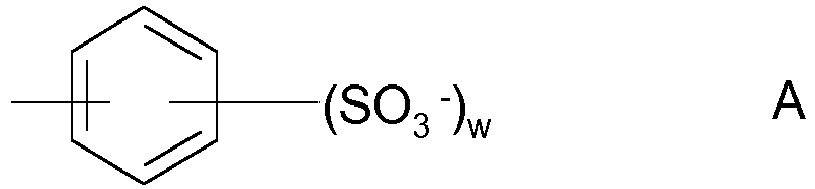

 wobei s steht für eine ganze Zahl aus dem Bereich von 1 bis 1000, t steht für eine ganze Zahl ausgewählt aus 1, 2, 3 oder 4 und w steht für eine ganze Zahl ausgewählt aus 1, 2 oder 3,
oder-NR1R2R3+ Z-, -PR1R2R3+ Z-, wobei R steht für H oder C1-4-Alkyl in beliebiger Position,Z- steht für Cl-, Br-, I-, CH3SO3 -, CF3SO3 -, CH3PhSO3 -, PhSO3 -R1, R2 und R3 jeweils unabhängig voneinander stehen für H, C1-30-Alkyl, Ar oder -CH2Ar undAr steht für einen unsubstituierten oder ein- oder mehrfach substituierten aromatischen Ring oder kondensierte Ringsysteme mit 6 bis 18 C-Atomen, worin auch ein oder zwei CH-Gruppen durch N ersetzt sein können,
oderlineares oder verzweigtes Alkyl, wobei ein oder mehrere nicht benachbarte C-Atome durch O, S und/oder N ersetzt sind, -OH, -SH, -O-(Glycosid)o', -S-(Glycosid)o', -OCH2-CHOH-CH2-O H, -OCH2Ar(-NCO)p', -OAr(-NCO)p', Aminoxid,
 u steht für eine ganze Zahl aus dem Bereich von 1 bis 6, bevorzugt 1 bis 4,o' steht für eine ganze Zahl aus dem Bereich von 1 bis 10,p' steht für 1 oder 2,Ar steht für einen unsubstituierten, ein- oder mehrfach substituierten aromatischen Ring oder kondensierte Ringsysteme mit 6 bis 18 C-Atomen, worin auch ein oder zwei CH-Gruppen durch C=O ersetzt sein können und,Glycosid steht für ein verethertes Kohlenhydrat, vorzugsweise für ein mono-, di-, tri- oder oligo-Glucosid,
oderAcetyldiamine, N-Alkylaminosäuren, N-Alkylaminosulfonsäuren, Betaine, Sulfobetaine,und x = 1, 2, 3 oder 4 ist. - Verbindungen gemäß Anspruch 1, dadurch gekennzeichnet, dass sie der Formel (I') entsprechen.
- Verbindungen gemäß einem oder mehreren der Ansprüche 1 bis 2, dadurch gekennzeichnet, dass n gleich 2-3 ist.
- Verbindungen gemäß einem oder mehreren der Ansprüche 1 bis 3, dadurch gekennzeichnet, dass Rf = fluoriertes C1-C6-Alkyl, insbesondere fluoriertes C1-C3-Alkyl, ist.
- Verbindungen gemäß einem oder mehreren der Ansprüche 1 bis 4, dadurch gekennzeichnet, dass x = 1.
- Verbindungen gemäß einem oder mehreren der Ansprüche 1 bis 5, dadurch gekennzeichnet, dass Z gleich:
Rf-O-CHF-CF2-CR1R2-O- oder Rf-O-(CF2)1-4-CHF-CF2-CR1R2-O- ist mit R1 und R2 unabhängig voneinander = H, -CH3 oder -CH2-CH3. - Verbindungen einem oder mehreren der Ansprüche 1 bis 6, dadurch gekennzeichnet, dass Rf = CF3- oder CF3-CF2- oder CF3-CF2-CF2-ist.
- Verbindungen gemäß einem oder mehreren der Ansprüche 1 bis 7, dadurch gekennzeichnet, dass sie den Formeln (II) bis (XI) entsprechen mit
Y = -(OCR"2-CR'2)0/1-Z,
X = Na+, K+, Li+, NH4+, N(CH3)4+,
Q = Cl, Br, I
und R' und R" = unabhängig voneinander H oder C1-C4 Alkyl


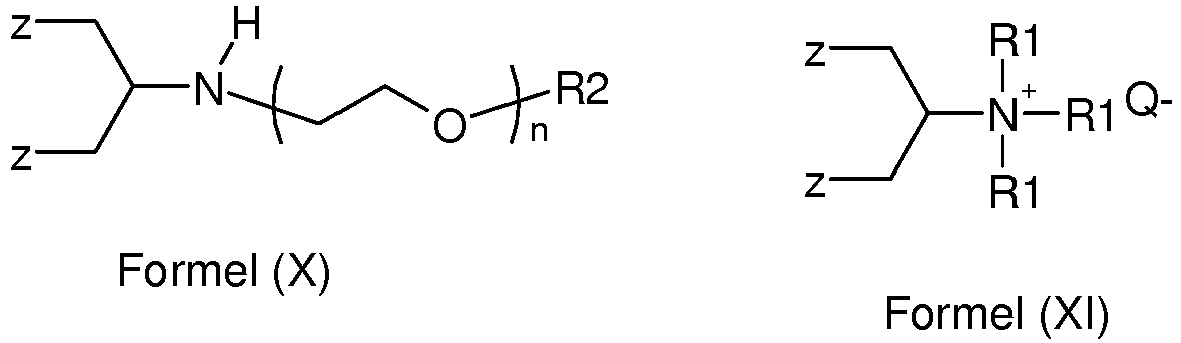
- Verbindungen einem oder mehreren der Ansprüche 1 bis 8, dadurch gekennzeichnet, dass Y = -(OCH2-CHR'2)0/1-Z, mit R' = H oder C1-C2 Alkyl.
- Verbindungen gemäß einem oder mehreren der Ansprüche 1 bis 9, dadurch gekennzeichnet, dass sie den Formeln (II-a), (II-b), (II-c) oder (II-d) entsprechen:


- Verbindungen gemäß einem oder mehreren der Ansprüche 1 bis 10, dadurch gekennzeichnet, dass Rf = CF3-, CF3-CF2- oder CF3-CF2-CF2-, Z = Rf-O-CHF-CF2-CR1R2-O- oder Rf-O-(CF2)1-4-CHF-CF2-CR1R2-O-, mit R1 und R2 unabhängig voneinander = H, -CH3 oder-CH2-CH3 und X eine der Gruppen -SO3 -, -OSO3 -, -PO3 2- oder OPO3 2-, Polyethylen- oder Polypropylenglykole, -CH(OH)-CH2-NH-Sach,-Y-(CH2-CH2-O)v-R4, Betaine oder Sulfobetaine ist, mit Sach = verschiedene Zucker, Y = S, O oder NH, R4 = H oder Alkyl und v = 1-100.
- Verwendung von Verbindungen gemäß einem oder mehreren der Ansprüche 1 bis 11 als Additive in Farben, Lacken, Druckfarben, Schutzanstrichen, Spezialcoatings in elektronischen oder optischen Anwendungen, Photolacken, Top Antireflective Coatings oder Bottom Antireflective Coatings, Entwicklerlösungen und Waschlösungen und Photoresists für photolithograqphische Verfahren, kosmetischen Produkten, Agrochemikalien, Bodenpolituren, photographischen Beschichtungen oder Beschichtungen optischer Elemente.
- Mittel enthaltend eine Verbindung gemäß einem oder mehreren der Ansprüche 1 bis 11 und einen für den jeweiligen Verwendungszweck geeigneten Träger sowie ggf. weitere spezifische Aktivstoffe.
- Mittel nach Anspruch 13, dadurch gekennzeichnet, dass es sich bei dem Mittel um Farb- und Lackzubereitungen, Feuerlöschmittel, Schmierstoffe, Wasch- und Reinigungsmittel, Enteiser, Entwicklerlösungen und Waschlösungen und Photoresists für photolithograqphische Verfahren, kosmetische Produkte, Agrochemikalien, Bodenpolituren oder Hydrophobiermittel zur Textilausrüstung oder Glasbehandlung handelt.
Applications Claiming Priority (2)
| Application Number | Priority Date | Filing Date | Title |
|---|---|---|---|
| EP14000617 | 2014-02-21 | ||
| PCT/EP2015/000351 WO2015124289A1 (de) | 2014-02-21 | 2015-02-18 | Fluortenside |
Publications (2)
| Publication Number | Publication Date |
|---|---|
| EP3107894A1 EP3107894A1 (de) | 2016-12-28 |
| EP3107894B1 true EP3107894B1 (de) | 2020-02-12 |
Family
ID=50241059
Family Applications (1)
| Application Number | Title | Priority Date | Filing Date |
|---|---|---|---|
| EP15705911.4A Active EP3107894B1 (de) | 2014-02-21 | 2015-02-18 | Fluortenside |
Country Status (5)
| Country | Link |
|---|---|
| US (1) | US10315989B2 (de) |
| EP (1) | EP3107894B1 (de) |
| JP (1) | JP6669661B2 (de) |
| CN (2) | CN106103408A (de) |
| WO (1) | WO2015124289A1 (de) |
Families Citing this family (1)
| Publication number | Priority date | Publication date | Assignee | Title |
|---|---|---|---|---|
| JP7844402B2 (ja) * | 2023-08-17 | 2026-04-13 | 株式会社ネオス | フッ素系界面活性剤 |
Citations (2)
| Publication number | Priority date | Publication date | Assignee | Title |
|---|---|---|---|---|
| US20070051916A1 (en) * | 2005-09-08 | 2007-03-08 | 3M Innovative Properties Company | Hydrofluoroether compounds and processes for their preparation and use |
| US20090326083A1 (en) * | 2008-06-30 | 2009-12-31 | 3M Innovative Properties Company | Hydrofluoroacetal compounds and processes for their preparation and use |
Family Cites Families (33)
| Publication number | Priority date | Publication date | Assignee | Title |
|---|---|---|---|---|
| US3927072A (en) | 1974-02-04 | 1975-12-16 | Pennwalt Corp | Fluorinated {62 -(alkoxy)-propionates |
| US4140709A (en) | 1975-03-21 | 1979-02-20 | Diamond Shamrock Corporation | Anionic fluorochemical surfactants |
| US4049668A (en) | 1975-03-21 | 1977-09-20 | Diamond Shamrock Corporation | Cationic fluorochemical surfactants |
| US3980715A (en) | 1975-03-21 | 1976-09-14 | Diamond Shamrock Corporation | Nonionic fluorochemical surfactants |
| GB8707032D0 (en) | 1987-03-24 | 1987-04-29 | Kodak Ltd | Photographic material |
| US5162405A (en) | 1987-12-24 | 1992-11-10 | Elf Atochem North America, Inc. | Single-functional and mixtures of multi-functional oligomeric performance additive compositions and their uses |
| US5013777A (en) | 1987-12-24 | 1991-05-07 | Atochem North America, Inc. | Novel single-functional and mixtures of multi-functional oligomeric performance additive compositions and their uses |
| GB8817811D0 (en) | 1988-07-26 | 1988-09-01 | Kodak Ltd | Hydrophilic colloid compositions for photographic materials |
| US5300394A (en) * | 1992-12-16 | 1994-04-05 | Eastman Kodak Company | Dispersions for imaging systems |
| JPH09111286A (ja) | 1995-10-13 | 1997-04-28 | Nikko Chemical Co Ltd | エマルション組成物及び洗浄剤組成物並びに洗浄方法 |
| JP3801398B2 (ja) | 1999-11-01 | 2006-07-26 | 信越化学工業株式会社 | 反射防止膜材料及びパターン形成方法 |
| US6809216B2 (en) | 2001-06-18 | 2004-10-26 | Honeywell International Inc. | Fluorine-containing compounds and polymers derived therefrom |
| KR20040029380A (ko) | 2001-07-25 | 2004-04-06 | 시바 스페셜티 케미칼스 홀딩 인크. | 퍼플루오로알킬 치환된 아민, 산, 아미노산 및 티오에테르산 |
| JP4015841B2 (ja) * | 2001-08-02 | 2007-11-28 | 富士フイルム株式会社 | フッ素化合物、界面活性剤およびそれを含む水性塗布組成物ならびにハロゲン化銀写真感光材料 |
| US6890608B2 (en) | 2002-03-29 | 2005-05-10 | Fuji Photo Film Co., Ltd. | Optical compensatory sheet, liquid-crystal display and elliptical polarizing plate employing same |
| JP2004018394A (ja) | 2002-06-12 | 2004-01-22 | Daikin Ind Ltd | 含フッ素両親媒性化合物 |
| US7002044B2 (en) | 2002-08-15 | 2006-02-21 | The University Of Connecticut | Catalysis by water-soluble organometallic complexes in water-in-densified fluid microemulsions |
| EP1762566B1 (de) | 2004-05-20 | 2011-03-23 | Daikin Industries, Ltd. | Verzweigtes tensid mit fluoralkylgruppe und kohlenwasserstoffgruppe |
| DE102005000858A1 (de) | 2005-01-05 | 2006-07-20 | Merck Patent Gmbh | Fluortenside |
| US7635789B2 (en) | 2007-08-06 | 2009-12-22 | E.I. Du Pont De Nemours And Company | Fluoroalkyl acid amide surfactants |
| JP2009155289A (ja) | 2007-12-27 | 2009-07-16 | Kaneka Corp | イオン液体およびその製造方法 |
| DE102008027930A1 (de) | 2008-06-12 | 2009-12-17 | Merck Patent Gmbh | Fluortenside |
| US8263800B2 (en) | 2008-07-01 | 2012-09-11 | E. I. Du Pont De Nemours And Company | Partially fluorinated sulfonated surfactants |
| DE102008031599A1 (de) | 2008-07-07 | 2010-01-14 | Merck Patent Gmbh | Fluortenside |
| BRPI0915955A2 (pt) * | 2008-07-18 | 2019-02-26 | 3M Innovative Proferties Company | compostos fluorados de éter e métodos para uso dos mesmos |
| DE102009030846A1 (de) | 2009-06-26 | 2010-12-30 | Merck Patent Gmbh | Fluortenside |
| GB0918616D0 (en) * | 2009-10-23 | 2009-12-09 | 3M Innovative Properties Co | Method of preparing highly fluorinated carboxylic acids and their salts |
| EP2521709A2 (de) | 2010-01-07 | 2012-11-14 | Merck Patent GmbH | Fluortenside |
| CN103270021A (zh) * | 2010-12-21 | 2013-08-28 | 默克专利有限公司 | 作为表面活性剂的全氟烷氧基磺基琥珀酸酯衍生物 |
| CN102306833A (zh) * | 2011-08-17 | 2012-01-04 | 深圳新宙邦科技股份有限公司 | 一种阻燃型非水电解液及其电池 |
| EP2874737B1 (de) | 2012-07-18 | 2018-11-07 | Merck Patent GmbH | Fluortenside |
| US10150820B2 (en) * | 2012-12-28 | 2018-12-11 | Daikin Industries, Ltd. | Production method for polyvinylidene fluoride aqueous dispersion liquid, and polyvinylidene fluoride aqueous dispersion liquid |
| CN103333314B (zh) | 2013-06-09 | 2015-12-23 | 广东工业大学 | 一种阳离子光固化含氟聚氨酯树脂及其制备方法 |
-
2015
- 2015-02-18 CN CN201580009156.9A patent/CN106103408A/zh active Pending
- 2015-02-18 US US15/120,696 patent/US10315989B2/en active Active
- 2015-02-18 EP EP15705911.4A patent/EP3107894B1/de active Active
- 2015-02-18 WO PCT/EP2015/000351 patent/WO2015124289A1/de not_active Ceased
- 2015-02-18 JP JP2016553555A patent/JP6669661B2/ja active Active
- 2015-02-18 CN CN202011483106.3A patent/CN113321601A/zh active Pending
Patent Citations (2)
| Publication number | Priority date | Publication date | Assignee | Title |
|---|---|---|---|---|
| US20070051916A1 (en) * | 2005-09-08 | 2007-03-08 | 3M Innovative Properties Company | Hydrofluoroether compounds and processes for their preparation and use |
| US20090326083A1 (en) * | 2008-06-30 | 2009-12-31 | 3M Innovative Properties Company | Hydrofluoroacetal compounds and processes for their preparation and use |
Also Published As
| Publication number | Publication date |
|---|---|
| EP3107894A1 (de) | 2016-12-28 |
| JP6669661B2 (ja) | 2020-03-18 |
| CN113321601A (zh) | 2021-08-31 |
| JP2017512199A (ja) | 2017-05-18 |
| CN106103408A (zh) | 2016-11-09 |
| US20170008836A1 (en) | 2017-01-12 |
| WO2015124289A1 (de) | 2015-08-27 |
| US10315989B2 (en) | 2019-06-11 |
Similar Documents
| Publication | Publication Date | Title |
|---|---|---|
| EP3107893B1 (de) | Fluortenside | |
| EP2874737B1 (de) | Fluortenside | |
| EP2445871B1 (de) | Fluortenside | |
| EP2655324A1 (de) | Derivate von perfluoroalkoxy-sulfosuccinaten als oberflächenaktive tenside | |
| EP1833786B1 (de) | Fluortenside | |
| EP2521709A2 (de) | Fluortenside | |
| WO2010003567A2 (de) | Fluortenside | |
| EP2282988A1 (de) | Fluortenside | |
| WO2008003444A1 (de) | Fluortenside | |
| EP3687983B1 (de) | Fluorverbindungen | |
| EP3535241B1 (de) | Fluortenside | |
| EP2879782B1 (de) | Tensidmischungen | |
| EP3107894B1 (de) | Fluortenside | |
| EP3687966B1 (de) | Verfahren zur herstellung von fluorierten verbindungen | |
| DE102011114651A1 (de) | Oberflächenaktive Substanzen mit terminaler Pentafluorsulfoxy-Gruppe |
Legal Events
| Date | Code | Title | Description |
|---|---|---|---|
| PUAI | Public reference made under article 153(3) epc to a published international application that has entered the european phase |
Free format text: ORIGINAL CODE: 0009012 |
|
| STAA | Information on the status of an ep patent application or granted ep patent |
Free format text: STATUS: REQUEST FOR EXAMINATION WAS MADE |
|
| 17P | Request for examination filed |
Effective date: 20160623 |
|
| AK | Designated contracting states |
Kind code of ref document: A1 Designated state(s): AL AT BE BG CH CY CZ DE DK EE ES FI FR GB GR HR HU IE IS IT LI LT LU LV MC MK MT NL NO PL PT RO RS SE SI SK SM TR |
|
| AX | Request for extension of the european patent |
Extension state: BA ME |
|
| DAX | Request for extension of the european patent (deleted) | ||
| STAA | Information on the status of an ep patent application or granted ep patent |
Free format text: STATUS: EXAMINATION IS IN PROGRESS |
|
| 17Q | First examination report despatched |
Effective date: 20180131 |
|
| GRAP | Despatch of communication of intention to grant a patent |
Free format text: ORIGINAL CODE: EPIDOSNIGR1 |
|
| STAA | Information on the status of an ep patent application or granted ep patent |
Free format text: STATUS: GRANT OF PATENT IS INTENDED |
|
| INTG | Intention to grant announced |
Effective date: 20190902 |
|
| GRAJ | Information related to disapproval of communication of intention to grant by the applicant or resumption of examination proceedings by the epo deleted |
Free format text: ORIGINAL CODE: EPIDOSDIGR1 |
|
| STAA | Information on the status of an ep patent application or granted ep patent |
Free format text: STATUS: EXAMINATION IS IN PROGRESS |
|
| GRAR | Information related to intention to grant a patent recorded |
Free format text: ORIGINAL CODE: EPIDOSNIGR71 |
|
| GRAS | Grant fee paid |
Free format text: ORIGINAL CODE: EPIDOSNIGR3 |
|
| STAA | Information on the status of an ep patent application or granted ep patent |
Free format text: STATUS: GRANT OF PATENT IS INTENDED |
|
| INTC | Intention to grant announced (deleted) | ||
| GRAA | (expected) grant |
Free format text: ORIGINAL CODE: 0009210 |
|
| STAA | Information on the status of an ep patent application or granted ep patent |
Free format text: STATUS: THE PATENT HAS BEEN GRANTED |
|
| AK | Designated contracting states |
Kind code of ref document: B1 Designated state(s): AL AT BE BG CH CY CZ DE DK EE ES FI FR GB GR HR HU IE IS IT LI LT LU LV MC MK MT NL NO PL PT RO RS SE SI SK SM TR |
|
| INTG | Intention to grant announced |
Effective date: 20200106 |
|
| REG | Reference to a national code |
Ref country code: GB Ref legal event code: FG4D Free format text: NOT ENGLISH |
|
| REG | Reference to a national code |
Ref country code: CH Ref legal event code: EP |
|
| REG | Reference to a national code |
Ref country code: AT Ref legal event code: REF Ref document number: 1231932 Country of ref document: AT Kind code of ref document: T Effective date: 20200215 |
|
| REG | Reference to a national code |
Ref country code: IE Ref legal event code: FG4D Free format text: LANGUAGE OF EP DOCUMENT: GERMAN |
|
| REG | Reference to a national code |
Ref country code: DE Ref legal event code: R096 Ref document number: 502015011687 Country of ref document: DE |
|
| PG25 | Lapsed in a contracting state [announced via postgrant information from national office to epo] |
Ref country code: FI Free format text: LAPSE BECAUSE OF FAILURE TO SUBMIT A TRANSLATION OF THE DESCRIPTION OR TO PAY THE FEE WITHIN THE PRESCRIBED TIME-LIMIT Effective date: 20200212 Ref country code: RS Free format text: LAPSE BECAUSE OF FAILURE TO SUBMIT A TRANSLATION OF THE DESCRIPTION OR TO PAY THE FEE WITHIN THE PRESCRIBED TIME-LIMIT Effective date: 20200212 Ref country code: NO Free format text: LAPSE BECAUSE OF FAILURE TO SUBMIT A TRANSLATION OF THE DESCRIPTION OR TO PAY THE FEE WITHIN THE PRESCRIBED TIME-LIMIT Effective date: 20200512 |
|
| REG | Reference to a national code |
Ref country code: LT Ref legal event code: MG4D |
|
| REG | Reference to a national code |
Ref country code: NL Ref legal event code: MP Effective date: 20200212 |
|
| PG25 | Lapsed in a contracting state [announced via postgrant information from national office to epo] |
Ref country code: IS Free format text: LAPSE BECAUSE OF FAILURE TO SUBMIT A TRANSLATION OF THE DESCRIPTION OR TO PAY THE FEE WITHIN THE PRESCRIBED TIME-LIMIT Effective date: 20200612 Ref country code: BG Free format text: LAPSE BECAUSE OF FAILURE TO SUBMIT A TRANSLATION OF THE DESCRIPTION OR TO PAY THE FEE WITHIN THE PRESCRIBED TIME-LIMIT Effective date: 20200512 Ref country code: HR Free format text: LAPSE BECAUSE OF FAILURE TO SUBMIT A TRANSLATION OF THE DESCRIPTION OR TO PAY THE FEE WITHIN THE PRESCRIBED TIME-LIMIT Effective date: 20200212 Ref country code: LV Free format text: LAPSE BECAUSE OF FAILURE TO SUBMIT A TRANSLATION OF THE DESCRIPTION OR TO PAY THE FEE WITHIN THE PRESCRIBED TIME-LIMIT Effective date: 20200212 Ref country code: SE Free format text: LAPSE BECAUSE OF FAILURE TO SUBMIT A TRANSLATION OF THE DESCRIPTION OR TO PAY THE FEE WITHIN THE PRESCRIBED TIME-LIMIT Effective date: 20200212 Ref country code: GR Free format text: LAPSE BECAUSE OF FAILURE TO SUBMIT A TRANSLATION OF THE DESCRIPTION OR TO PAY THE FEE WITHIN THE PRESCRIBED TIME-LIMIT Effective date: 20200513 |
|
| PG25 | Lapsed in a contracting state [announced via postgrant information from national office to epo] |
Ref country code: NL Free format text: LAPSE BECAUSE OF FAILURE TO SUBMIT A TRANSLATION OF THE DESCRIPTION OR TO PAY THE FEE WITHIN THE PRESCRIBED TIME-LIMIT Effective date: 20200212 |
|
| REG | Reference to a national code |
Ref country code: CH Ref legal event code: PL |
|
| REG | Reference to a national code |
Ref country code: BE Ref legal event code: MM Effective date: 20200229 |
|
| PG25 | Lapsed in a contracting state [announced via postgrant information from national office to epo] |
Ref country code: DK Free format text: LAPSE BECAUSE OF FAILURE TO SUBMIT A TRANSLATION OF THE DESCRIPTION OR TO PAY THE FEE WITHIN THE PRESCRIBED TIME-LIMIT Effective date: 20200212 Ref country code: PT Free format text: LAPSE BECAUSE OF FAILURE TO SUBMIT A TRANSLATION OF THE DESCRIPTION OR TO PAY THE FEE WITHIN THE PRESCRIBED TIME-LIMIT Effective date: 20200705 Ref country code: LT Free format text: LAPSE BECAUSE OF FAILURE TO SUBMIT A TRANSLATION OF THE DESCRIPTION OR TO PAY THE FEE WITHIN THE PRESCRIBED TIME-LIMIT Effective date: 20200212 Ref country code: EE Free format text: LAPSE BECAUSE OF FAILURE TO SUBMIT A TRANSLATION OF THE DESCRIPTION OR TO PAY THE FEE WITHIN THE PRESCRIBED TIME-LIMIT Effective date: 20200212 Ref country code: SM Free format text: LAPSE BECAUSE OF FAILURE TO SUBMIT A TRANSLATION OF THE DESCRIPTION OR TO PAY THE FEE WITHIN THE PRESCRIBED TIME-LIMIT Effective date: 20200212 Ref country code: SK Free format text: LAPSE BECAUSE OF FAILURE TO SUBMIT A TRANSLATION OF THE DESCRIPTION OR TO PAY THE FEE WITHIN THE PRESCRIBED TIME-LIMIT Effective date: 20200212 Ref country code: CZ Free format text: LAPSE BECAUSE OF FAILURE TO SUBMIT A TRANSLATION OF THE DESCRIPTION OR TO PAY THE FEE WITHIN THE PRESCRIBED TIME-LIMIT Effective date: 20200212 Ref country code: ES Free format text: LAPSE BECAUSE OF FAILURE TO SUBMIT A TRANSLATION OF THE DESCRIPTION OR TO PAY THE FEE WITHIN THE PRESCRIBED TIME-LIMIT Effective date: 20200212 Ref country code: LU Free format text: LAPSE BECAUSE OF NON-PAYMENT OF DUE FEES Effective date: 20200218 Ref country code: RO Free format text: LAPSE BECAUSE OF FAILURE TO SUBMIT A TRANSLATION OF THE DESCRIPTION OR TO PAY THE FEE WITHIN THE PRESCRIBED TIME-LIMIT Effective date: 20200212 |
|
| REG | Reference to a national code |
Ref country code: DE Ref legal event code: R097 Ref document number: 502015011687 Country of ref document: DE |
|
| PG25 | Lapsed in a contracting state [announced via postgrant information from national office to epo] |
Ref country code: LI Free format text: LAPSE BECAUSE OF NON-PAYMENT OF DUE FEES Effective date: 20200229 Ref country code: CH Free format text: LAPSE BECAUSE OF NON-PAYMENT OF DUE FEES Effective date: 20200229 Ref country code: MC Free format text: LAPSE BECAUSE OF FAILURE TO SUBMIT A TRANSLATION OF THE DESCRIPTION OR TO PAY THE FEE WITHIN THE PRESCRIBED TIME-LIMIT Effective date: 20200212 |
|
| PLBE | No opposition filed within time limit |
Free format text: ORIGINAL CODE: 0009261 |
|
| STAA | Information on the status of an ep patent application or granted ep patent |
Free format text: STATUS: NO OPPOSITION FILED WITHIN TIME LIMIT |
|
| 26N | No opposition filed |
Effective date: 20201113 |
|
| PG25 | Lapsed in a contracting state [announced via postgrant information from national office to epo] |
Ref country code: IT Free format text: LAPSE BECAUSE OF FAILURE TO SUBMIT A TRANSLATION OF THE DESCRIPTION OR TO PAY THE FEE WITHIN THE PRESCRIBED TIME-LIMIT Effective date: 20200212 Ref country code: IE Free format text: LAPSE BECAUSE OF NON-PAYMENT OF DUE FEES Effective date: 20200218 |
|
| PG25 | Lapsed in a contracting state [announced via postgrant information from national office to epo] |
Ref country code: SI Free format text: LAPSE BECAUSE OF FAILURE TO SUBMIT A TRANSLATION OF THE DESCRIPTION OR TO PAY THE FEE WITHIN THE PRESCRIBED TIME-LIMIT Effective date: 20200212 Ref country code: PL Free format text: LAPSE BECAUSE OF FAILURE TO SUBMIT A TRANSLATION OF THE DESCRIPTION OR TO PAY THE FEE WITHIN THE PRESCRIBED TIME-LIMIT Effective date: 20200212 Ref country code: BE Free format text: LAPSE BECAUSE OF NON-PAYMENT OF DUE FEES Effective date: 20200229 |
|
| REG | Reference to a national code |
Ref country code: AT Ref legal event code: MM01 Ref document number: 1231932 Country of ref document: AT Kind code of ref document: T Effective date: 20200218 |
|
| PG25 | Lapsed in a contracting state [announced via postgrant information from national office to epo] |
Ref country code: AT Free format text: LAPSE BECAUSE OF NON-PAYMENT OF DUE FEES Effective date: 20200218 |
|
| PG25 | Lapsed in a contracting state [announced via postgrant information from national office to epo] |
Ref country code: TR Free format text: LAPSE BECAUSE OF FAILURE TO SUBMIT A TRANSLATION OF THE DESCRIPTION OR TO PAY THE FEE WITHIN THE PRESCRIBED TIME-LIMIT Effective date: 20200212 Ref country code: MT Free format text: LAPSE BECAUSE OF FAILURE TO SUBMIT A TRANSLATION OF THE DESCRIPTION OR TO PAY THE FEE WITHIN THE PRESCRIBED TIME-LIMIT Effective date: 20200212 Ref country code: CY Free format text: LAPSE BECAUSE OF FAILURE TO SUBMIT A TRANSLATION OF THE DESCRIPTION OR TO PAY THE FEE WITHIN THE PRESCRIBED TIME-LIMIT Effective date: 20200212 |
|
| PG25 | Lapsed in a contracting state [announced via postgrant information from national office to epo] |
Ref country code: MK Free format text: LAPSE BECAUSE OF FAILURE TO SUBMIT A TRANSLATION OF THE DESCRIPTION OR TO PAY THE FEE WITHIN THE PRESCRIBED TIME-LIMIT Effective date: 20200212 Ref country code: AL Free format text: LAPSE BECAUSE OF FAILURE TO SUBMIT A TRANSLATION OF THE DESCRIPTION OR TO PAY THE FEE WITHIN THE PRESCRIBED TIME-LIMIT Effective date: 20200212 |
|
| P01 | Opt-out of the competence of the unified patent court (upc) registered |
Effective date: 20230518 |
|
| REG | Reference to a national code |
Ref country code: DE Ref legal event code: R081 Ref document number: 502015011687 Country of ref document: DE Owner name: SUSONITY COMMERCIAL GMBH, DE Free format text: FORMER OWNER: MERCK PATENT GMBH, 64293 DARMSTADT, DE |
|
| REG | Reference to a national code |
Ref country code: GB Ref legal event code: 732E Free format text: REGISTERED BETWEEN 20250925 AND 20251001 |
|
| PGFP | Annual fee paid to national office [announced via postgrant information from national office to epo] |
Ref country code: GB Payment date: 20260219 Year of fee payment: 12 |
|
| PGFP | Annual fee paid to national office [announced via postgrant information from national office to epo] |
Ref country code: DE Payment date: 20260228 Year of fee payment: 12 |
|
| PGFP | Annual fee paid to national office [announced via postgrant information from national office to epo] |
Ref country code: FR Payment date: 20260218 Year of fee payment: 12 |