EP3107977B1 - Matières pour dispositifs électroluminescents organiques - Google Patents
Matières pour dispositifs électroluminescents organiques Download PDFInfo
- Publication number
- EP3107977B1 EP3107977B1 EP15702630.3A EP15702630A EP3107977B1 EP 3107977 B1 EP3107977 B1 EP 3107977B1 EP 15702630 A EP15702630 A EP 15702630A EP 3107977 B1 EP3107977 B1 EP 3107977B1
- Authority
- EP
- European Patent Office
- Prior art keywords
- group
- atoms
- radicals
- aromatic
- occurrence
- Prior art date
- Legal status (The legal status is an assumption and is not a legal conclusion. Google has not performed a legal analysis and makes no representation as to the accuracy of the status listed.)
- Active
Links
- 0 C*c(c(N)c(*)c(-c(c(C)c(c(*)c1-c2c(*)c(*)c(*)c(C)c2*)-c(c(*)c2*)c(*)c(*)c2OC)c1N)c1*)c1N Chemical compound C*c(c(N)c(*)c(-c(c(C)c(c(*)c1-c2c(*)c(*)c(*)c(C)c2*)-c(c(*)c2*)c(*)c(*)c2OC)c1N)c1*)c1N 0.000 description 46
- OJFNTJSYOQLZKY-UHFFFAOYSA-N Brc(cccc12)c1-c1ccccc1C21c(c2c(cc3)c4ccccc4[n]2-c(cc2)ccc2-[n]2c4ccccc4c4c2cccc4)c3-c2ccccc12 Chemical compound Brc(cccc12)c1-c1ccccc1C21c(c2c(cc3)c4ccccc4[n]2-c(cc2)ccc2-[n]2c4ccccc4c4c2cccc4)c3-c2ccccc12 OJFNTJSYOQLZKY-UHFFFAOYSA-N 0.000 description 2
- MQPJZULVPURFIC-UHFFFAOYSA-N O=C1c(c(Nc(cc(cc2)-c3ccccc3)c2Cl)ccc2)c2-c2ccccc12 Chemical compound O=C1c(c(Nc(cc(cc2)-c3ccccc3)c2Cl)ccc2)c2-c2ccccc12 MQPJZULVPURFIC-UHFFFAOYSA-N 0.000 description 2
- LVFMVEUUAFPTIY-UHFFFAOYSA-N CC(C)(C)c(cc1)cc(c(cc2)c3c4c2-c2ccccc2C42c4ccccc4-c4ccccc24)c1[n]3-c1ccc(c2ccccc2[n]2-c3ccccc3)c2c1 Chemical compound CC(C)(C)c(cc1)cc(c(cc2)c3c4c2-c2ccccc2C42c4ccccc4-c4ccccc24)c1[n]3-c1ccc(c2ccccc2[n]2-c3ccccc3)c2c1 LVFMVEUUAFPTIY-UHFFFAOYSA-N 0.000 description 1
- BDHABNXFQUVVLS-UHFFFAOYSA-N CC(C)(C)c(cc1)cc2c1[nH]c1c2ccc(-c2c3cccc2)c1C3=O Chemical compound CC(C)(C)c(cc1)cc2c1[nH]c1c2ccc(-c2c3cccc2)c1C3=O BDHABNXFQUVVLS-UHFFFAOYSA-N 0.000 description 1
- IPWKHHSGDUIRAH-UHFFFAOYSA-N CC1(C)OB(B2OC(C)(C)C(C)(C)O2)OC1(C)C Chemical compound CC1(C)OB(B2OC(C)(C)C(C)(C)O2)OC1(C)C IPWKHHSGDUIRAH-UHFFFAOYSA-N 0.000 description 1
- VUGFFCSCOMQVRH-UHFFFAOYSA-N CC1(C)OB(c(cc2c3ccc4-c5c6cccc5)ccc2[nH]c3c4C6=O)OC1(C)C Chemical compound CC1(C)OB(c(cc2c3ccc4-c5c6cccc5)ccc2[nH]c3c4C6=O)OC1(C)C VUGFFCSCOMQVRH-UHFFFAOYSA-N 0.000 description 1
- DKHNGUNXLDCATP-UHFFFAOYSA-N N#Cc(nc1c(nc2C#N)c3nc2C#N)c(C#N)nc1c(nc1C#N)c3nc1C#N Chemical compound N#Cc(nc1c(nc2C#N)c3nc2C#N)c(C#N)nc1c(nc1C#N)c3nc1C#N DKHNGUNXLDCATP-UHFFFAOYSA-N 0.000 description 1
- YYLYBPJQUOYBQN-UHFFFAOYSA-N Nc(c(Cl)c1)ccc1-c1ccccc1 Chemical compound Nc(c(Cl)c1)ccc1-c1ccccc1 YYLYBPJQUOYBQN-UHFFFAOYSA-N 0.000 description 1
- AKCRQHGQIJBRMN-UHFFFAOYSA-N Nc(cccc1)c1Cl Chemical compound Nc(cccc1)c1Cl AKCRQHGQIJBRMN-UHFFFAOYSA-N 0.000 description 1
- NTXIJLROXXJLOQ-UHFFFAOYSA-N O=C(c(cccc1)c1-c1ccc2c3c4)c1c2[nH]c3ccc4Br Chemical compound O=C(c(cccc1)c1-c1ccc2c3c4)c1c2[nH]c3ccc4Br NTXIJLROXXJLOQ-UHFFFAOYSA-N 0.000 description 1
- NEKUHNQKXLPSRH-UHFFFAOYSA-N O=C(c(cccc1)c1-c1ccc2c3c4cccc3)c1c2[n]4-c(cc1)ccc1-[n]1c(cccc2)c2c2ccccc12 Chemical compound O=C(c(cccc1)c1-c1ccc2c3c4cccc3)c1c2[n]4-c(cc1)ccc1-[n]1c(cccc2)c2c2ccccc12 NEKUHNQKXLPSRH-UHFFFAOYSA-N 0.000 description 1
- ICFFVLPELHZTGO-UHFFFAOYSA-N O=C(c(cccc1)c1-c1ccc2c3cc(-c4cccc5c4[o]c4ccccc54)ccc33)c1c2[n]3-c1ccccc1 Chemical compound O=C(c(cccc1)c1-c1ccc2c3cc(-c4cccc5c4[o]c4ccccc54)ccc33)c1c2[n]3-c1ccccc1 ICFFVLPELHZTGO-UHFFFAOYSA-N 0.000 description 1
- SLLRYLUYUIJSDD-UHFFFAOYSA-N O=C1c(c(Nc(c(Cl)c2)ccc2-c2ccccc2)ccc2)c2-c2c1cccc2 Chemical compound O=C1c(c(Nc(c(Cl)c2)ccc2-c2ccccc2)ccc2)c2-c2c1cccc2 SLLRYLUYUIJSDD-UHFFFAOYSA-N 0.000 description 1
- RLCQYJDBEJJBLZ-UHFFFAOYSA-N c(cc1)ccc1-[n]1c(c2c(cc3)-c4ccccc4C2(c(cccc2)c2-c2ccc4c5c6cccc5)c2c4[n]6-c2ccccc2)c3c2ccccc12 Chemical compound c(cc1)ccc1-[n]1c(c2c(cc3)-c4ccccc4C2(c(cccc2)c2-c2ccc4c5c6cccc5)c2c4[n]6-c2ccccc2)c3c2ccccc12 RLCQYJDBEJJBLZ-UHFFFAOYSA-N 0.000 description 1
- KPOWPHUOCMTREI-UHFFFAOYSA-N c(cc1)ccc1-[n]1c2c(C3(c4ccccc4-c4ccccc34)c3c-4cccc3)c-4ccc2c2c1cccc2 Chemical compound c(cc1)ccc1-[n]1c2c(C3(c4ccccc4-c4ccccc34)c3c-4cccc3)c-4ccc2c2c1cccc2 KPOWPHUOCMTREI-UHFFFAOYSA-N 0.000 description 1
- ZZDHFBRSKUTVBO-UHFFFAOYSA-N c(cc1)ccc1-c(cc1)ccc1-[n]1c2c(C3(c4ccccc4-4)c5ccc(c(cccc6)c6[nH]6)c6c5-c5ccccc35)c-4ccc2c2c1cccc2 Chemical compound c(cc1)ccc1-c(cc1)ccc1-[n]1c2c(C3(c4ccccc4-4)c5ccc(c(cccc6)c6[nH]6)c6c5-c5ccccc35)c-4ccc2c2c1cccc2 ZZDHFBRSKUTVBO-UHFFFAOYSA-N 0.000 description 1
Classifications
-
- C—CHEMISTRY; METALLURGY
- C07—ORGANIC CHEMISTRY
- C07D—HETEROCYCLIC COMPOUNDS
- C07D209/00—Heterocyclic compounds containing five-membered rings, condensed with other rings, with one nitrogen atom as the only ring hetero atom
- C07D209/56—Ring systems containing three or more rings
- C07D209/96—Spiro-condensed ring systems
-
- C—CHEMISTRY; METALLURGY
- C07—ORGANIC CHEMISTRY
- C07D—HETEROCYCLIC COMPOUNDS
- C07D209/00—Heterocyclic compounds containing five-membered rings, condensed with other rings, with one nitrogen atom as the only ring hetero atom
- C07D209/56—Ring systems containing three or more rings
- C07D209/80—[b, c]- or [b, d]-condensed
- C07D209/94—[b, c]- or [b, d]-condensed containing carbocyclic rings other than six-membered
-
- C—CHEMISTRY; METALLURGY
- C07—ORGANIC CHEMISTRY
- C07D—HETEROCYCLIC COMPOUNDS
- C07D401/00—Heterocyclic compounds containing two or more hetero rings, having nitrogen atoms as the only ring hetero atoms, at least one ring being a six-membered ring with only one nitrogen atom
- C07D401/02—Heterocyclic compounds containing two or more hetero rings, having nitrogen atoms as the only ring hetero atoms, at least one ring being a six-membered ring with only one nitrogen atom containing two hetero rings
- C07D401/04—Heterocyclic compounds containing two or more hetero rings, having nitrogen atoms as the only ring hetero atoms, at least one ring being a six-membered ring with only one nitrogen atom containing two hetero rings directly linked by a ring-member-to-ring-member bond
-
- C—CHEMISTRY; METALLURGY
- C07—ORGANIC CHEMISTRY
- C07D—HETEROCYCLIC COMPOUNDS
- C07D405/00—Heterocyclic compounds containing both one or more hetero rings having oxygen atoms as the only ring hetero atoms, and one or more rings having nitrogen as the only ring hetero atom
- C07D405/02—Heterocyclic compounds containing both one or more hetero rings having oxygen atoms as the only ring hetero atoms, and one or more rings having nitrogen as the only ring hetero atom containing two hetero rings
- C07D405/04—Heterocyclic compounds containing both one or more hetero rings having oxygen atoms as the only ring hetero atoms, and one or more rings having nitrogen as the only ring hetero atom containing two hetero rings directly linked by a ring-member-to-ring-member bond
-
- C—CHEMISTRY; METALLURGY
- C07—ORGANIC CHEMISTRY
- C07D—HETEROCYCLIC COMPOUNDS
- C07D405/00—Heterocyclic compounds containing both one or more hetero rings having oxygen atoms as the only ring hetero atoms, and one or more rings having nitrogen as the only ring hetero atom
- C07D405/02—Heterocyclic compounds containing both one or more hetero rings having oxygen atoms as the only ring hetero atoms, and one or more rings having nitrogen as the only ring hetero atom containing two hetero rings
- C07D405/10—Heterocyclic compounds containing both one or more hetero rings having oxygen atoms as the only ring hetero atoms, and one or more rings having nitrogen as the only ring hetero atom containing two hetero rings linked by a carbon chain containing aromatic rings
-
- C—CHEMISTRY; METALLURGY
- C07—ORGANIC CHEMISTRY
- C07D—HETEROCYCLIC COMPOUNDS
- C07D409/00—Heterocyclic compounds containing two or more hetero rings, at least one ring having sulfur atoms as the only ring hetero atoms
- C07D409/02—Heterocyclic compounds containing two or more hetero rings, at least one ring having sulfur atoms as the only ring hetero atoms containing two hetero rings
- C07D409/04—Heterocyclic compounds containing two or more hetero rings, at least one ring having sulfur atoms as the only ring hetero atoms containing two hetero rings directly linked by a ring-member-to-ring-member bond
-
- C—CHEMISTRY; METALLURGY
- C07—ORGANIC CHEMISTRY
- C07D—HETEROCYCLIC COMPOUNDS
- C07D413/00—Heterocyclic compounds containing two or more hetero rings, at least one ring having nitrogen and oxygen atoms as the only ring hetero atoms
- C07D413/02—Heterocyclic compounds containing two or more hetero rings, at least one ring having nitrogen and oxygen atoms as the only ring hetero atoms containing two hetero rings
- C07D413/04—Heterocyclic compounds containing two or more hetero rings, at least one ring having nitrogen and oxygen atoms as the only ring hetero atoms containing two hetero rings directly linked by a ring-member-to-ring-member bond
-
- C—CHEMISTRY; METALLURGY
- C07—ORGANIC CHEMISTRY
- C07D—HETEROCYCLIC COMPOUNDS
- C07D413/00—Heterocyclic compounds containing two or more hetero rings, at least one ring having nitrogen and oxygen atoms as the only ring hetero atoms
- C07D413/02—Heterocyclic compounds containing two or more hetero rings, at least one ring having nitrogen and oxygen atoms as the only ring hetero atoms containing two hetero rings
- C07D413/10—Heterocyclic compounds containing two or more hetero rings, at least one ring having nitrogen and oxygen atoms as the only ring hetero atoms containing two hetero rings linked by a carbon chain containing aromatic rings
-
- C—CHEMISTRY; METALLURGY
- C07—ORGANIC CHEMISTRY
- C07D—HETEROCYCLIC COMPOUNDS
- C07D417/00—Heterocyclic compounds containing two or more hetero rings, at least one ring having nitrogen and sulfur atoms as the only ring hetero atoms, not provided for by group C07D415/00
- C07D417/02—Heterocyclic compounds containing two or more hetero rings, at least one ring having nitrogen and sulfur atoms as the only ring hetero atoms, not provided for by group C07D415/00 containing two hetero rings
- C07D417/10—Heterocyclic compounds containing two or more hetero rings, at least one ring having nitrogen and sulfur atoms as the only ring hetero atoms, not provided for by group C07D415/00 containing two hetero rings linked by a carbon chain containing aromatic rings
-
- C—CHEMISTRY; METALLURGY
- C07—ORGANIC CHEMISTRY
- C07D—HETEROCYCLIC COMPOUNDS
- C07D487/00—Heterocyclic compounds containing nitrogen atoms as the only ring hetero atoms in the condensed system, not provided for by groups C07D451/00 - C07D477/00
- C07D487/02—Heterocyclic compounds containing nitrogen atoms as the only ring hetero atoms in the condensed system, not provided for by groups C07D451/00 - C07D477/00 in which the condensed system contains two hetero rings
- C07D487/10—Spiro-condensed systems
-
- C—CHEMISTRY; METALLURGY
- C07—ORGANIC CHEMISTRY
- C07D—HETEROCYCLIC COMPOUNDS
- C07D491/00—Heterocyclic compounds containing in the condensed ring system both one or more rings having oxygen atoms as the only ring hetero atoms and one or more rings having nitrogen atoms as the only ring hetero atoms, not provided for by groups C07D451/00 - C07D459/00, C07D463/00, C07D477/00 or C07D489/00
- C07D491/02—Heterocyclic compounds containing in the condensed ring system both one or more rings having oxygen atoms as the only ring hetero atoms and one or more rings having nitrogen atoms as the only ring hetero atoms, not provided for by groups C07D451/00 - C07D459/00, C07D463/00, C07D477/00 or C07D489/00 in which the condensed system contains two hetero rings
- C07D491/10—Spiro-condensed systems
- C07D491/107—Spiro-condensed systems with only one oxygen atom as ring hetero atom in the oxygen-containing ring
-
- C—CHEMISTRY; METALLURGY
- C07—ORGANIC CHEMISTRY
- C07D—HETEROCYCLIC COMPOUNDS
- C07D491/00—Heterocyclic compounds containing in the condensed ring system both one or more rings having oxygen atoms as the only ring hetero atoms and one or more rings having nitrogen atoms as the only ring hetero atoms, not provided for by groups C07D451/00 - C07D459/00, C07D463/00, C07D477/00 or C07D489/00
- C07D491/12—Heterocyclic compounds containing in the condensed ring system both one or more rings having oxygen atoms as the only ring hetero atoms and one or more rings having nitrogen atoms as the only ring hetero atoms, not provided for by groups C07D451/00 - C07D459/00, C07D463/00, C07D477/00 or C07D489/00 in which the condensed system contains three hetero rings
- C07D491/20—Spiro-condensed systems
-
- C—CHEMISTRY; METALLURGY
- C07—ORGANIC CHEMISTRY
- C07D—HETEROCYCLIC COMPOUNDS
- C07D491/00—Heterocyclic compounds containing in the condensed ring system both one or more rings having oxygen atoms as the only ring hetero atoms and one or more rings having nitrogen atoms as the only ring hetero atoms, not provided for by groups C07D451/00 - C07D459/00, C07D463/00, C07D477/00 or C07D489/00
- C07D491/22—Heterocyclic compounds containing in the condensed ring system both one or more rings having oxygen atoms as the only ring hetero atoms and one or more rings having nitrogen atoms as the only ring hetero atoms, not provided for by groups C07D451/00 - C07D459/00, C07D463/00, C07D477/00 or C07D489/00 in which the condensed system contains four or more hetero rings
-
- C—CHEMISTRY; METALLURGY
- C09—DYES; PAINTS; POLISHES; NATURAL RESINS; ADHESIVES; COMPOSITIONS NOT OTHERWISE PROVIDED FOR; APPLICATIONS OF MATERIALS NOT OTHERWISE PROVIDED FOR
- C09B—ORGANIC DYES OR CLOSELY-RELATED COMPOUNDS FOR PRODUCING DYES, e.g. PIGMENTS; MORDANTS; LAKES
- C09B11/00—Diaryl- or thriarylmethane dyes
-
- C—CHEMISTRY; METALLURGY
- C09—DYES; PAINTS; POLISHES; NATURAL RESINS; ADHESIVES; COMPOSITIONS NOT OTHERWISE PROVIDED FOR; APPLICATIONS OF MATERIALS NOT OTHERWISE PROVIDED FOR
- C09B—ORGANIC DYES OR CLOSELY-RELATED COMPOUNDS FOR PRODUCING DYES, e.g. PIGMENTS; MORDANTS; LAKES
- C09B21/00—Thiazine dyes
-
- C—CHEMISTRY; METALLURGY
- C09—DYES; PAINTS; POLISHES; NATURAL RESINS; ADHESIVES; COMPOSITIONS NOT OTHERWISE PROVIDED FOR; APPLICATIONS OF MATERIALS NOT OTHERWISE PROVIDED FOR
- C09B—ORGANIC DYES OR CLOSELY-RELATED COMPOUNDS FOR PRODUCING DYES, e.g. PIGMENTS; MORDANTS; LAKES
- C09B57/00—Other synthetic dyes of known constitution
-
- C—CHEMISTRY; METALLURGY
- C09—DYES; PAINTS; POLISHES; NATURAL RESINS; ADHESIVES; COMPOSITIONS NOT OTHERWISE PROVIDED FOR; APPLICATIONS OF MATERIALS NOT OTHERWISE PROVIDED FOR
- C09B—ORGANIC DYES OR CLOSELY-RELATED COMPOUNDS FOR PRODUCING DYES, e.g. PIGMENTS; MORDANTS; LAKES
- C09B57/00—Other synthetic dyes of known constitution
- C09B57/008—Triarylamine dyes containing no other chromophores
-
- C—CHEMISTRY; METALLURGY
- C09—DYES; PAINTS; POLISHES; NATURAL RESINS; ADHESIVES; COMPOSITIONS NOT OTHERWISE PROVIDED FOR; APPLICATIONS OF MATERIALS NOT OTHERWISE PROVIDED FOR
- C09K—MATERIALS FOR MISCELLANEOUS APPLICATIONS, NOT PROVIDED FOR ELSEWHERE
- C09K11/00—Luminescent materials, e.g. electroluminescent or chemiluminescent
- C09K11/06—Luminescent materials, e.g. electroluminescent or chemiluminescent containing organic luminescent materials
-
- H—ELECTRICITY
- H05—ELECTRIC TECHNIQUES NOT OTHERWISE PROVIDED FOR
- H05B—ELECTRIC HEATING; ELECTRIC LIGHT SOURCES NOT OTHERWISE PROVIDED FOR; CIRCUIT ARRANGEMENTS FOR ELECTRIC LIGHT SOURCES, IN GENERAL
- H05B33/00—Electroluminescent light sources
- H05B33/12—Light sources with substantially two-dimensional [2D] radiating surfaces
- H05B33/20—Light sources with substantially two-dimensional [2D] radiating surfaces characterised by the chemical or physical composition or the arrangement of the material in which the electroluminescent material is embedded
-
- H—ELECTRICITY
- H10—SEMICONDUCTOR DEVICES; ELECTRIC SOLID-STATE DEVICES NOT OTHERWISE PROVIDED FOR
- H10K—ORGANIC ELECTRIC SOLID-STATE DEVICES
- H10K50/00—Organic light-emitting devices
- H10K50/10—OLEDs or polymer light-emitting diodes [PLED]
- H10K50/11—OLEDs or polymer light-emitting diodes [PLED] characterised by the electroluminescent [EL] layers
-
- H—ELECTRICITY
- H10—SEMICONDUCTOR DEVICES; ELECTRIC SOLID-STATE DEVICES NOT OTHERWISE PROVIDED FOR
- H10K—ORGANIC ELECTRIC SOLID-STATE DEVICES
- H10K85/00—Organic materials used in the body or electrodes of devices covered by this subclass
- H10K85/60—Organic compounds having low molecular weight
- H10K85/615—Polycyclic condensed aromatic hydrocarbons, e.g. anthracene
-
- H—ELECTRICITY
- H10—SEMICONDUCTOR DEVICES; ELECTRIC SOLID-STATE DEVICES NOT OTHERWISE PROVIDED FOR
- H10K—ORGANIC ELECTRIC SOLID-STATE DEVICES
- H10K85/00—Organic materials used in the body or electrodes of devices covered by this subclass
- H10K85/60—Organic compounds having low molecular weight
- H10K85/631—Amine compounds having at least two aryl rest on at least one amine-nitrogen atom, e.g. triphenylamine
-
- H—ELECTRICITY
- H10—SEMICONDUCTOR DEVICES; ELECTRIC SOLID-STATE DEVICES NOT OTHERWISE PROVIDED FOR
- H10K—ORGANIC ELECTRIC SOLID-STATE DEVICES
- H10K85/00—Organic materials used in the body or electrodes of devices covered by this subclass
- H10K85/60—Organic compounds having low molecular weight
- H10K85/631—Amine compounds having at least two aryl rest on at least one amine-nitrogen atom, e.g. triphenylamine
- H10K85/636—Amine compounds having at least two aryl rest on at least one amine-nitrogen atom, e.g. triphenylamine comprising heteroaromatic hydrocarbons as substituents on the nitrogen atom
-
- H—ELECTRICITY
- H10—SEMICONDUCTOR DEVICES; ELECTRIC SOLID-STATE DEVICES NOT OTHERWISE PROVIDED FOR
- H10K—ORGANIC ELECTRIC SOLID-STATE DEVICES
- H10K85/00—Organic materials used in the body or electrodes of devices covered by this subclass
- H10K85/60—Organic compounds having low molecular weight
- H10K85/649—Aromatic compounds comprising a hetero atom
- H10K85/657—Polycyclic condensed heteroaromatic hydrocarbons
-
- H—ELECTRICITY
- H10—SEMICONDUCTOR DEVICES; ELECTRIC SOLID-STATE DEVICES NOT OTHERWISE PROVIDED FOR
- H10K—ORGANIC ELECTRIC SOLID-STATE DEVICES
- H10K85/00—Organic materials used in the body or electrodes of devices covered by this subclass
- H10K85/60—Organic compounds having low molecular weight
- H10K85/649—Aromatic compounds comprising a hetero atom
- H10K85/657—Polycyclic condensed heteroaromatic hydrocarbons
- H10K85/6572—Polycyclic condensed heteroaromatic hydrocarbons comprising only nitrogen in the heteroaromatic polycondensed ring system, e.g. phenanthroline or carbazole
-
- H—ELECTRICITY
- H10—SEMICONDUCTOR DEVICES; ELECTRIC SOLID-STATE DEVICES NOT OTHERWISE PROVIDED FOR
- H10K—ORGANIC ELECTRIC SOLID-STATE DEVICES
- H10K85/00—Organic materials used in the body or electrodes of devices covered by this subclass
- H10K85/60—Organic compounds having low molecular weight
- H10K85/649—Aromatic compounds comprising a hetero atom
- H10K85/657—Polycyclic condensed heteroaromatic hydrocarbons
- H10K85/6574—Polycyclic condensed heteroaromatic hydrocarbons comprising only oxygen in the heteroaromatic polycondensed ring system, e.g. cumarine dyes
-
- H—ELECTRICITY
- H10—SEMICONDUCTOR DEVICES; ELECTRIC SOLID-STATE DEVICES NOT OTHERWISE PROVIDED FOR
- H10K—ORGANIC ELECTRIC SOLID-STATE DEVICES
- H10K85/00—Organic materials used in the body or electrodes of devices covered by this subclass
- H10K85/60—Organic compounds having low molecular weight
- H10K85/649—Aromatic compounds comprising a hetero atom
- H10K85/657—Polycyclic condensed heteroaromatic hydrocarbons
- H10K85/6576—Polycyclic condensed heteroaromatic hydrocarbons comprising only sulfur in the heteroaromatic polycondensed ring system, e.g. benzothiophene
-
- C—CHEMISTRY; METALLURGY
- C09—DYES; PAINTS; POLISHES; NATURAL RESINS; ADHESIVES; COMPOSITIONS NOT OTHERWISE PROVIDED FOR; APPLICATIONS OF MATERIALS NOT OTHERWISE PROVIDED FOR
- C09K—MATERIALS FOR MISCELLANEOUS APPLICATIONS, NOT PROVIDED FOR ELSEWHERE
- C09K2211/00—Chemical nature of organic luminescent or tenebrescent compounds
- C09K2211/18—Metal complexes
- C09K2211/185—Metal complexes of the platinum group, i.e. Os, Ir, Pt, Ru, Rh or Pd
-
- H—ELECTRICITY
- H10—SEMICONDUCTOR DEVICES; ELECTRIC SOLID-STATE DEVICES NOT OTHERWISE PROVIDED FOR
- H10K—ORGANIC ELECTRIC SOLID-STATE DEVICES
- H10K2101/00—Properties of the organic materials covered by group H10K85/00
- H10K2101/10—Triplet emission
-
- Y—GENERAL TAGGING OF NEW TECHNOLOGICAL DEVELOPMENTS; GENERAL TAGGING OF CROSS-SECTIONAL TECHNOLOGIES SPANNING OVER SEVERAL SECTIONS OF THE IPC; TECHNICAL SUBJECTS COVERED BY FORMER USPC CROSS-REFERENCE ART COLLECTIONS [XRACs] AND DIGESTS
- Y02—TECHNOLOGIES OR APPLICATIONS FOR MITIGATION OR ADAPTATION AGAINST CLIMATE CHANGE
- Y02E—REDUCTION OF GREENHOUSE GAS [GHG] EMISSIONS, RELATED TO ENERGY GENERATION, TRANSMISSION OR DISTRIBUTION
- Y02E10/00—Energy generation through renewable energy sources
- Y02E10/50—Photovoltaic [PV] energy
- Y02E10/549—Organic PV cells
Definitions
- the present invention relates to materials for use in electronic devices, in particular in organic electroluminescent devices, as well as electronic devices, in particular organic electroluminescent devices containing these materials.
- organic electroluminescent devices OLEDs
- organometallic complexes which exhibit phosphorescence instead of fluorescence are frequently used as emitting materials, since in this way a significantly higher energy and power efficiency is possible than with fluorescent emitters.
- the properties of phosphorescent OLEDs are not only determined by the triplet emitters used.
- the other materials used such as matrix materials, hole blocking materials, electron transport materials, hole transport materials and electron or exciton blocking materials are of particular importance. Improvements to these materials can thus also lead to significant improvements in the OLED properties.
- OLEDs in particular OLEDs, show triplet emission (phosphorescence) but still need to be improved, for example with regard to efficiency, operating voltage and service life.
- indenocarbazole derivatives for. B. according to WO 2010/136109 .
- WO 2011/000455 or KR 20120081539 or fluorene or spirobifluorene derivatives, eg. B. according to WO 2012/074210 , or WO2014010910 A1 used as matrix materials for phosphorescent emitters in organic electroluminescent devices.
- further improvements are desirable, especially with regard to the efficiency, lifetime and thermal stability of the materials.
- the object of the present invention is to provide compounds which are suitable for use in an OLED, in particular as a matrix material for phosphorescent emitters, but also as a hole transport and / or electron blocking material or optionally as a hole blocking material and / or electron transport material.
- Another object of the present invention is to provide other organic semiconductors to provide for organic electroluminescent devices, so as to allow the skilled person a greater choice of materials for the production of OLEDs.
- An aryl group in the sense of this invention contains 6 to 60 C atoms; a heteroaryl group in the context of this invention contains 2 to 60 carbon atoms and at least one heteroatom, with the proviso that the sum of C atoms and heteroatoms gives at least 5.
- the heteroatoms are preferably selected from N, O and / or S.
- aryl group or heteroaryl either a simple aromatic cycle, ie benzene, or a simple heteroaromatic cycle, for example pyridine, pyrimidine, thiophene, etc., or a fused (fused) aryl or heteroaryl group, for example naphthalene, anthracene, phenanthrene, quinoline, isoquinoline, etc., understood.
- aromatics linked to one another by single bond such as, for example, biphenyl, are not designated as aryl or heteroaryl group but as aromatic ring system.
- An electron-deficient heteroaryl group in the context of the present invention is a heteroaryl group having 5 aromatic ring atoms which has at least two heteroatoms, or a heteroaryl group having 6 aromatic ring atoms which has at least one heteroatom, and fused heteroaryl groups containing a five-membered ring having at least two heteroatoms and / or one Six-membered ring with at least one heteroatom.
- a fused heteroaryl group is a heteroaryl group in which at least one heteroaryl group and at least one further aryl or heteroaryl group are fused directly to one another via a common edge.
- imidazole, oxazole, benzimidazole, pyridine, pyrimidine, triazine, quinoline, quinoxaline, phenanthroline, etc. are considered to be electron-deficient heteroaryl groups
- pyrrole, furan, thiophene, indole, benzofuran, benzothiophene, carbazole, dibenzofuran or dibenzothiophene are not considered to be electron-deficient Heteroaryl groups are to be regarded in the context of the present invention, since they contain neither heteroaromatic five-membered rings with two or more heteroatoms nor heteroaromatic six-membered rings with at least one heteroatom.
- An aromatic ring system in the sense of this invention contains 6 to 60 carbon atoms in the ring system.
- a heteroaromatic ring system in the sense of this invention contains 2 to 60 C atoms and at least one heteroatom in the ring system, with the proviso that the sum of C atoms and heteroatoms gives at least 5.
- the heteroatoms are preferably selected from N, O and / or S.
- An aromatic or heteroaromatic ring system in the sense of this invention is to be understood as meaning a system which does not necessarily contain only aryl or heteroaryl groups, but in which also several aryl or heteroaryl groups by a non-aromatic unit , such as As a C, N or O atom can be connected.
- systems such as fluorene, 9,9'-spirobifluorene, 9,9-diarylfluorene, triarylamine, diaryl ether, stilbene, etc. are to be understood as aromatic ring systems in the context of this invention, and also systems in which two or more aryl groups, for example are linked by a short alkyl group.
- an aliphatic hydrocarbon radical or an alkyl group or an alkenyl or alkynyl group which may contain 1 to 40 C atoms, and in which also individual H atoms or CH 2 groups, may be represented by the abovementioned groups
- the radicals are methyl, ethyl, n-propyl, i-propyl, n-butyl, i-butyl, s-butyl, t-butyl, 2-methylbutyl, n-pentyl, s-pentyl, neo-pentyl , Cyclopentyl, n-hexyl, neo -hexyl, cyclohexyl, n-heptyl, cycloheptyl, n-octyl, cyclooctyl, 2-ethylhexyl, trifluoromethyl, pentafluoroeth radical or n-propyl,
- alkoxy group having 1 to 40 carbon atoms methoxy, trifluoromethoxy, ethoxy, n-propoxy, i-propoxy, n-butoxy, i-butoxy, s-butoxy, t-butoxy, n-pentoxy, s-pentoxy, 2-methylbutoxy, n-hexoxy, cyclohexyloxy, n-heptoxy, cycloheptyloxy, n-octyloxy, cyclooctyloxy, 2-ethylhexyloxy, pentafluoroethoxy and 2,2,2-trifluoroethoxy understood.
- alkyl, alkoxy or thioalkyl groups according to the present invention may be straight-chained, branched or cyclic, wherein one or more non-adjacent CH 2 groups may be replaced by the above-mentioned groups;
- one or more H atoms can also be replaced by D, F, Cl, Br, I, CN or NO 2 , preferably F, Cl or CN, more preferably F or CN, particularly preferably CN.
- aromatic or heteroaromatic ring system having 5-60 aromatic ring atoms, which may be substituted in each case with the abovementioned radicals R 2 or a hydrocarbon radical and which may be linked via any position on the aromatic or heteroaromatic, are understood in particular groups derived are benzene, naphthalene, anthracene, benzanthracene, phenanthrene, pyrene, chrysene, perylene, fluoranthene, naphthacene, pentacene, benzpyrene, biphenyl, biphenylene, terphenyl, triphenylene, fluorene, spirobifluorene, dihydrophenanthrene, dihydropyrene, tetrahydropyrene, cis- or trans-indenofluorene , cis or trans indenocarbazole, cis or trans indolocarbazole, Truxen, isotruxene
- adjacent radicals or adjacent substituents are understood to mean substituents which are bonded to carbon atoms, which in turn are bonded directly to one another.
- X is the same or different at each occurrence as CR 1 or N, with at most one group X per cycle being N; or two adjacent groups X represent a group of the formula (4) wherein Z is the same or different at each occurrence of CR 1 and V is the same or different each occurrence of NR 1 , C (R 1 ) 2 , O or S. , Most preferably, X is the same or different at each occurrence for CR 1 .
- adjacent groups X are a group of formula (4), it is preferred that the remaining groups X in this cycle be CR 1 .
- p is the same or different at each occurrence 0, 1 or 2, more preferably 0 or 1 and most preferably equal to 0.
- q is the same or different at each occurrence 0 or 1, particularly preferably equal to 0.
- Particularly preferred embodiments of the structures of the formulas (7) to (15) are the structures of the formulas (7a) to (15a) wherein the symbols and indices used have the meanings given above.
- R is the same or different at each occurrence selected from the group consisting of H, F, CN, N (Ar 1 ) 2 , a straight-chain alkyl group having 1 to 10 C atoms or a branched or cyclic alkyl group 3 to 10 carbon atoms or an aromatic ring system having 6 to 30 aromatic ring atoms, which may be substituted with one or more non-aromatic radicals R 3 .
- R is the same or different at each occurrence from the group consisting of H, a straight-chain alkyl group having 1 to 4 C atoms or a branched or cyclic alkyl group having 3 to 8 C atoms, most preferably equal to H.
- the compounds of the formula (1) and (3) or the preferred embodiments in the substituents Ar, R 1 and R 2 contain a total of at least 12 aromatic ring atoms and the compounds of the formula (2) or the preferred embodiments in the substituents Ar, R 1 and R 2 contain a total of at least 24 aromatic ring atoms.
- Ar or Ar together with the substituent R 2 which is bonded to Ar, represents an aromatic or heteroaromatic ring system having at least 12 aromatic ring atoms.
- all groups R 1 may be H or unequal to an aromatic or heteroaromatic ring system.
- At least one radical R 1 represents an aromatic or heteroaromatic ring system having at least 6 aromatic ring atoms or a group N (Ar 1 ) 2 .
- the group Ar may also preferably be a phenyl group, since then the substituents Ar, R 1 and R 2 in the compound according to the invention contain a total of 12 or more aromatic ring atoms.
- Ar is identical or different at each occurrence for an aromatic or heteroaromatic ring system having 12 to 30 aromatic ring atoms, each of which may be substituted by one or more R 2 radicals.
- the heteroaromatic ring system contains no electron-poor heteroaryl groups.
- Particularly preferred aromatic or heteroaromatic ring systems contain 12 to 24 aromatic ring atoms and may be substituted by one or more radicals R 2 .
- the aromatic or heteroaromatic ring systems preferably contain no condensed aryl or heteroaryl groups in which more than two aromatic six-membered rings are directly fused to one another, except, if appropriate, triphenylene groups.
- Ar has, for example, no naphthyl groups or higher condensed aryl groups and likewise no quinoline groups, acridine groups, etc.
- Ar it is possible for Ar to have, for example, carbazole groups, dibenzofuran groups, fluorene groups, etc., because in these structures no 6 Ring aromatics or heteroaromatics are condensed directly to each other, so have no common edge.
- Preferred groups Ar are the same or different at each occurrence selected from the group consisting of phenyl, ortho-, meta- or para-biphenyl, ortho, meta, para or branched terphenyl, ortho, meta, para or branched Quaterphenyl, 1-, 2-, 3- or 4-fluorenyl, 1-, 2-, 3- or 4-spirobifluorenyl, 1- or 2-naphthyl, pyrrole, furan, thiophene, indole, benzofuran, benzothiophene, 1-, 2- or 3-carbazole, 1-, 2- or 3-dibenzofuran, 1-, 2- or 3-dibenzothiophene, indenocarbazole, indolocarbazole or combinations of two or three of these groups, each of which is substituted with one or more R 2 radicals can.
- Ar are anthracene, phenanthrene, Triphenylene, pyrene or Benzanthracene, which may each be substituted by one or more radicals R 2 , or combinations of two or three of these groups with each other and / or with the abovementioned groups. These groups are particularly useful when the triplet energy of the compound of the invention is not important.
- At least one group Y is C (R 2 ) 2 or NR 2 .
- the substituent R 2 which is bonded to the nitrogen atom is preferably an aromatic or heteroaromatic ring system having 5 to 24 aromatic ring atoms, which may also be substituted by one or more radicals R 3 .
- this substituent R 2 is identical or different at each occurrence for an aromatic or heteroaromatic ring system having 6 to 24 aromatic ring atoms, which has no fused aryl groups and which does not have fused heteroaryl groups in which two or more aromatic or heteroaromatic Ring groups are fused directly to each other, and which in each case by one or more radicals R 3 may be substituted.
- Particularly preferred are phenyl, biphenyl, terphenyl and quaterphenyl having linking patterns as listed above for Ar-1 to Ar-11, which structures are preferably unsubstituted.
- R 2 is preferably the same or different each occurrence of a linear alkyl group having 1 to 10 C atoms or a branched or cyclic alkyl group having 3 to 10 C atoms or an aromatic or heteroaromatic ring system having 5 to 24 aromatic ring atoms, which may also be substituted by one or more radicals R 3 .
- R 2 is a methyl group or a phenyl group.
- the radicals R 2 can also form a ring system with one another, which leads to a spiro system.
- Ar 2 is ortho, meta or para-phenylene or a biphenyl group, each by one or more radicals R 2 may be substituted, but are preferably unsubstituted.
- the groups Ar-1 to Ar-57 do not bind directly to the nitrogen atom in formula (1) or formula (2) or formula (3), but via a bridging group.
- Preferred bridging groups are ortho, meta or para-phenylene or a biphenyl group, each of which may be substituted by one or more radicals R 2 , but are preferably unsubstituted.
- R 2 is selected from the group consisting of H, D or an alkyl group having 1 to 10 C atoms, preferably 1 to 4 C atoms. More preferably, R 2 is H.
- Ar is a triarylamine group which may be substituted by one or more radicals R 1 .
- R 1 is preferably selected from the structures of the following formula Ar-58, wherein the dashed bond indicates the linkage with the nitrogen atom, Ar 2 has the abovementioned meaning and Ar 3 is identical or different at each occurrence for an aromatic or heteroaromatic ring system, preferably having 6 to 18 aromatic ring atoms, which contains no electron-poor heteroaryl groups and which may each be substituted by one or more R 2 radicals.
- R 1 is the same or different at each occurrence selected from the group consisting of H, D, N (Ar 1 ) 2 , a straight-chain alkyl group having 1 to 10 C atoms or a branched or cyclic alkyl group with 3 to 10 C atoms, each of which may be substituted by one or more R 3 radicals, where one or more H atoms may be replaced by D or F, or an aromatic or heteroaromatic ring system having 5 to 30 aromatic ring atoms, each of which may be substituted by one or more R 3 radicals.
- R 1 is identical or different at each occurrence selected from the group consisting of H, N (Ar 1 ) 2 , a straight-chain alkyl group having 1 to 4 C atoms or a branched or cyclic alkyl group having 3 or 4 C atoms, each of which may be substituted with one or more R 3 radicals, or an aromatic or heteroaromatic ring system having from 5 to 18 aromatic ring atoms, each of which may be substituted with one or more R 3 radicals.
- the groups Ar and R 2 together have fewer than 12 aromatic ring atoms, if at least one group R 1 , preferably exactly one group R 1 stands for a group N (Ar 1 ) 2 or for an aromatic or heteroaromatic ring system ,
- exactly one of the substituents R 1 is a group N (Ar 1 ) 2 or an aromatic or heteroaromatic ring system having 5 to 24 aromatic ring atoms, each with one or more
- R 2 is substituted, and the other substituents R 1 for a group N (Ar 1 ) 2 or for an aromatic or heteroaromatic ring system having 5 to 24 aromatic ring atoms, each with one or more Radicals R 2 may be substituted, and the other substituents R 1 are H.
- radicals R 1 are H or D or alkyl
- group Ar is an aromatic or heteroaromatic ring system having at least 12 aromatic ring atoms.
- per cycle refers to each individual ring contained in the compound, ie to each individual 5 or 5-membered ring. 6-membered ring.
- R 1 -1 to R 1 -42 there is at most one symbol A per cycle for N. More preferably, the symbol A is the same or different at each occurrence as CR 3 , in particular CH.
- the groups of the formulas R 1 -1 to R 1 -42 have several groups Y, then all combinations from the definition of Y are suitable for this purpose. Preference is given to groups in which one group Y is NR 3 and the other group Y is C (R 3 ) 2 or in which both groups Y are NR 3 or in which both groups Y are O.
- the substituent R 3 which is bonded to the nitrogen atom is preferably an aromatic or heteroaromatic ring system having 5 to 24 aromatic ring atoms.
- this substituent R 3 is identical or different at each occurrence for an aromatic or heteroaromatic ring system having 6 to 24 aromatic ring atoms, which has no condensed aryl groups and which does not have fused heteroaryl groups in which two or more aromatic or heteroaromatic Ring groups are condensed directly to each other, has.
- Particularly preferred are phenyl, biphenyl, terphenyl and quaterphenyl having linking patterns as listed above for Ar-1 to Ar-11, which structures are preferably unsubstituted.
- R 3 is preferably the same or different each occurrence of a linear alkyl group having 1 to 10 carbon atoms or a branched or cyclic one Alkyl group having 3 to 10 carbon atoms or for an aromatic or heteroaromatic ring system having 5 to 24 aromatic ring atoms. Most preferably, R 3 is a methyl group or a phenyl group.
- the radicals R 3 can also form a ring system with one another, which leads to a spiro system.
- the groups R 1 -1 to R 1 -42 do not bind directly to the nitrogen atom in formula (1) or formula (2) or formula (3), but via a bridging group.
- Preferred bridging groups are ortho, meta or para-phenylene or a biphenyl group, each of which may be substituted by one or more radicals R 3 , but are preferably unsubstituted.
- R 1 is a triarylamine group which may be substituted by one or more radicals R 1 .
- R 1 is preferably selected from the structures of the following formula R 1 -43, wherein the dashed bond indicates linkage with the carbon atom of the backbone, and Ar 2 and Ar 3 represent an aromatic or heteroaromatic ring system having from 5 to 14 aromatic ring atoms, each of which may be substituted with one or more R 3 radicals.
- the alkyl groups preferably have not more than five carbon atoms, more preferably not more than 4 carbon atoms, most preferably not more than 1 carbon atom.
- compounds which are substituted by alkyl groups, in particular branched alkyl groups, having up to 10 carbon atoms or which are oligoarylene, for example ortho, meta, para or branched Terphenyl- or Quaterphenyl groups are substituted.
- the compounds of the formula (1) or formula (2) or formula (3) or the preferred embodiments are used as a matrix material for a phosphorescent emitter or in a layer directly adjacent to a phosphorescent layer, it is still used is preferred if the compound does not contain condensed aryl or heteroaryl groups in which more than two six-membered rings are directly fused together.
- the radicals R, R 1 , R 2 and Ar do not contain a fused aryl or heteroaryl group in which two or more six-membered rings are directly fused to one another.
- the synthesis can be carried out starting from an optionally substituted 1-halofluorenone, wherein the halogen is preferably Br or I. This is reacted with an optionally substituted ortho-haloaminobenzene in a CN coupling reaction, for example under Pd or Cu catalysis, the halogen preferably being Cl, Br or I.
- a fluorene, Dibenzofuran-, dibenzothiophene or naphthalene derivative can be used, which leads to compounds which groups of Formula (4) or (5) included.
- the ring closure to the corresponding carbazole derivative takes place by an intramolecular Pd-catalyzed coupling reaction.
- This carbazole derivative can be substituted by a Buchwald or Ullmann coupling reaction on nitrogen by the group Ar.
- the ring closure reaction to the spiro bifluorene derivative then takes place by reaction with a lithiated biphenyl derivative, followed by acidic cyclization.
- the compounds according to the invention described above in particular compounds which are substituted with reactive leaving groups, such as bromine, iodine, chlorine, boronic acid or boronic acid esters, or with reactive, polymerizable groups, such as olefins, styrenes, acrylates or oxetanes, can be used as monomers for producing corresponding Oligomers, dendrimers or polymers find use.
- the oligomerization or polymerization is preferably carried out via the halogen functionality or the boronic acid functionality or via the polymerizable group. It is also possible to crosslink the polymers via such groups.
- the compounds of the invention and polymers can be used as a crosslinked or uncrosslinked layer.
- the invention therefore further oligomers, polymers or dendrimers containing one or more of the compounds of the invention listed above, wherein one or more bonds of the inventive compound to the polymer, oligomer or dendrimer are present at one or more positions instead of substituents.
- this forms a side chain of the oligomer or polymer or is linked in the main chain or forms the core of a dendrimer.
- the polymers, oligomers or dendrimers may be conjugated, partially conjugated or non-conjugated.
- the oligomers or polymers may be linear, branched or dendritic.
- the repeat units of the compounds according to the invention in oligomers, dendrimers and polymers have the same preferences as described above.
- the monomers according to the invention are homopolymerized or copolymerized with further monomers. Preference is given to homopolymers or copolymers in which the units of the formula (1) or (2) or (3) or the preferred embodiments described above are from 0.01 to 99.9 mol%, preferably from 5 to 90 mol%, particularly preferably from 20 to 80 mol% are present.
- Suitable and preferred comonomers which form the polymer backbone are selected from fluorene (e.g. EP 842208 or WO 2000/22026 ), Spirobifluorenes (eg according to EP 707020 . EP 894107 or WO 2006/061181 ), Para-phenylenes (e.g.
- WO 92/18552 Carbazoles (eg according to WO 2004/070772 or WO 2004/113468 ), Thiophenes (eg according to EP 1028136 ), Dihydrophenanthrenes (e.g. WO 2005/014689 ), cis and trans indenofluorenes (eg according to WO 2004/041901 or WO 2004/113412 ), Ketones (eg according to WO 2005/040302 ), Phenanthrenes (eg according to WO 2005/104264 or WO 2007/017066 ) or several of these units.
- Carbazoles eg according to WO 2004/070772 or WO 2004/113468
- Thiophenes eg according to EP 1028136
- Dihydrophenanthrenes e.g. WO 2005/014689
- cis and trans indenofluorenes eg according to WO 2004/041901 or WO 2004/113412
- Ketones
- the polymers, oligomers and dendrimers may also contain other units, for example hole transport units, in particular those based on triarylamines, and / or electron transport units.
- the polymers can either be polymerized in or mixed in as a blend containing TriplettEmitter. Especially the combination of the oligomers, polymers or dendrimers according to the invention with triplet emitters leads to particularly good results.
- formulations of the compounds according to the invention are required. These formulations may be, for example, solutions, dispersions or emulsions. It may be preferable to use mixtures of two or more solvents for this purpose.
- Suitable and preferred solvents are, for example, toluene, anisole, o-, m- or p-xylene, methyl benzoate, mesitylene, tetralin, veratrol, THF, methyl THF, THP, chlorobenzene, dioxane, phenoxytoluene, in particular 3-phenoxytoluene, (-) -Fenchone, 1,2,3,5-tetramethylbenzene, 1,2,4,5-tetramethylbenzene, 1-methylnaphthalene, 2-methylbenzothiazole, 2-phenoxyethanol, 2-pyrrolidinone, 3-methylanisole, 4-methylanisole, 3,4 Dimethylanisole, 3,5-dimethylanisole, acetophenone, ⁇ -terpineol, benzothiazole, butylbenzoate, cumene, cyclohexanol, cyclohexanone, cyclohexylbenzene, decalin, dodec
- a further subject of the present invention is therefore a formulation containing a compound according to the invention and at least one further compound.
- the further compound may be for example a solvent, in particular one of the abovementioned solvents or a mixture of these solvents.
- the further compound can also be at least one further organic or inorganic compound which is likewise used in the electronic device, for example an emitting compound and / or a further matrix material. Suitable emissive compounds and other matrix materials are listed in the background in the context of the organic electroluminescent device.
- This further compound may also be polymeric.
- the compounds according to the invention are suitable for use in an electronic device, in particular in an organic electroluminescent device.
- Another object of the present invention is therefore the use of a compound of the invention in an electronic device, in particular in an organic electroluminescent device.
- Yet another object of the present invention is an electronic device containing at least one compound of the invention.
- An electronic device in the sense of the present invention is a device which contains at least one layer which contains at least one organic compound.
- the component may also contain inorganic materials or layers which are completely composed of inorganic materials.
- the electronic device is preferably selected from the group consisting of organic electroluminescent devices (OLEDs), organic integrated circuits (O-ICs), organic field-effect transistors (O-FETs), organic thin-film transistors (O-TFTs), organic light-emitting transistors (O-LETs), organic solar cells (O-SCs), dye-sensitized organic solar cells ( DSSCs), organic optical detectors, organic photoreceptors, organic field quench devices (O-FQDs), light-emitting electrochemical cells (LECs), organic laser diodes (O-lasers) and organic plasmon-emitting devices, but preferably organic electroluminescent devices (OLEDs ), particularly preferably phosphorescent OLEDs.
- OLEDs organic electroluminescent devices
- O-ICs organic integrated circuits
- O-FETs organic field-effect transistors
- OF-TFTs organic thin-film transistors
- O-LETs organic light-emitting transistors
- O-SCs organic
- the organic electroluminescent device includes cathode, anode and at least one emitting layer. In addition to these layers, they may also contain further layers, for example one or more hole injection layers, hole transport layers, hole blocking layers, electron transport layers, electron injection layers, exciton blocking layers, electron blocking layers and / or charge generation layers. Likewise, interlayer may be introduced between two emitting layers which, for example, have an exciton-blocking function. It should be noted, however, that not necessarily each of these layers must be present. In this case, the organic electroluminescent device may contain an emitting layer, or it may contain a plurality of emitting layers.
- emission layers are present, they preferably have a total of a plurality of emission maxima between 380 nm and 750 nm, so that overall white emission results, ie in the emitting layers different emitting compounds are used, which can fluoresce or phosphoresce. Particular preference is given to systems having three emitting layers, the three layers exhibiting blue, green and orange or red emission (for the basic structure see, for example, FIG. WO 2005/011013 ).
- the organic electroluminescent device according to the invention may also be a tandem OLED, in particular also for white-emitting OLEDs.
- the compound of the invention according to the embodiments listed above can be used in different layers, depending on the exact structure.
- Preference is given to an organic electroluminescent device comprising a compound according to formula (1) or formula (2) or formula (3) or the preferred embodiments described above as matrix material for phosphorescent or fluorescent emitters, in particular for phosphorescent emitters, and / or an electron-blocking or exciton-blocking layer and / or in a hole transport layer and / or in a hole blocking layer and / or in a hole-blocking or electron-transporting layer, depending on the exact substitution.
- the compound according to the invention is used as matrix material for a phosphorescent compound in an emitting layer.
- the organic electroluminescent device may contain an emitting layer, or it may contain a plurality of emitting layers, wherein at least one emitting layer contains at least one compound according to the invention as matrix material.
- the compound according to the invention is used as the matrix material for a phosphorescent compound in an emitting layer, it is preferably used in combination with one or more phosphorescent materials (triplet emitters).
- phosphorescence is understood as meaning the luminescence from an excited state with a higher spin multiplicity, ie a spin state> 1, in particular from an excited triplet state.
- all luminescent complexes with transition metals or lanthanides, in particular all iridium, platinum and copper complexes are to be regarded as phosphorescent compounds.
- the mixture of the compound according to the invention and the emitting compound contains between 99 and 1% by volume, preferably between 98 and 10% by volume, more preferably between 97 and 60% by volume, in particular between 95 and 80% by volume the compound of the invention based on the total mixture of emitter and matrix material. Accordingly, the mixture contains between 1 and 99% by volume, preferably between 2 and 90% by volume, more preferably between 3 and 40% by volume, in particular between 5 and 20% by volume of the emitter, based on the total mixture Emitter and matrix material.
- a further preferred embodiment of the present invention is the use of the compound according to the invention as a matrix material for a phosphorescent emitter in combination with a further matrix material.
- Particularly suitable matrix materials which can be used in combination with the compounds according to the invention are aromatic ketones, aromatic phosphine oxides or aromatic sulfoxides or sulfones, eg. B. according to WO 2004/013080 . WO 2004/093207 . WO 2006/005627 or WO 2010/006680 , Triarylamines, carbazole derivatives, e.g. B. CBP (N, N-Biscarbazolylbiphenyl) or in WO 2005/039246 . US 2005/0069729 .
- JP 2004/288381 EP 1205527 . WO 2008/086851 or WO 2013/041176 , Indolocarbazole derivatives, e.g. B. according to WO 2007/063754 or WO 2008/056746 , Indenocarbazole derivatives, e.g. B. according to WO 2010/136109 . WO 2011/000455 . WO 2013/041176 or WO 2013/056776 , Azacarbazolderivate, z. B. according to EP 1617710 . EP 1617711 . EP 1731584 . JP 2005/347160 , bipolar matrix materials, e.g. B. according to WO 2007/137725 , Silane, z. B.
- a further phosphorescent emitter which emits shorter wavelength than the actual emitter, may be present as a co-host in the mixture or a compound which does not participate or not to a significant extent in the charge transport, such as in WO 2010/108579 described.
- Suitable phosphorescent compounds are, in particular, compounds which emit light, preferably in the visible range, with suitable excitation and also contain at least one atom of atomic number greater than 20, preferably greater than 38 and less than 84, particularly preferably greater than 56 and less than 80, in particular a metal with this atomic number.
- Preferred phosphorescence emitters used are compounds containing copper, molybdenum, tungsten, rhenium, ruthenium, osmium, rhodium, iridium, palladium, platinum, silver, gold or europium, in particular compounds containing iridium or platinum.
- Examples of the emitters described above can be found in the applications WO 00/70655 . WO 2001/41512 . WO 2002/02714 . WO 2002/15645 . EP 1191613 . EP 1191612 . EP 1191614 . WO 2005/033244 . WO 2005/019373 . US 2005/0258742 . WO 2010/086089 . WO 2011/157339 . WO 2012/007086 . WO 2012/163471 . WO 2013/000531 and WO 2013/020631 . WO 2014/008982 and WO 2014/023377 be removed.
- all phosphorescent complexes used in the prior art for phosphorescent OLEDs and as known to those skilled in the art of organic electroluminescence are suitable, and those skilled in the art may use other phosphorescent complexes without inventive step.
- the compounds of the invention are also particularly suitable as matrix materials for phosphorescent emitters in organic electroluminescent devices, as z.
- matrix materials for phosphorescent emitters in organic electroluminescent devices as z.
- US 2011/0248247 and US 2012/0223633 are described.
- an additional blue emission layer is vapor-deposited over all pixels, even those with a different color from blue. It has surprisingly been found that the compounds according to the invention, when used as matrix materials for the red and / or green pixels, together with the deposited blue emission layer, continue to lead to very good emission.
- the organic electroluminescent device according to the invention does not contain a separate hole injection layer and / or hole transport layer and / or hole blocking layer and / or electron transport layer, ie the emitting layer directly adjoins the hole injection layer or the anode, and / or the emitting layer directly adjoins the electron transport layer or the electron injection layer or the cathode, such as in WO 2005/053051 described.
- a metal complex which is the same or similar to the metal complex in the emitting layer, directly adjacent to the emitting layer as a hole-transporting or hole-injection material, such as. In WO 2009/030981 described.
- the compound according to the invention is used in a hole transport layer or in an electron blocking layer or exciton blocking layer.
- the compound of the invention is used as an electron transport material in an electron transport or electron injection layer.
- the emitting layer may be fluorescent or phosphorescent.
- the compound when used as an electron transport material, it may be preferred if it is doped, for example, with alkali metal complexes, such as. B. LiQ (Lithiumhydroxychinolinat).
- the compound of the invention is used in a hole blocking layer.
- a hole blocking layer is understood as meaning a layer which directly adjoins an emitting layer on the cathode side.
- an organic electroluminescent device characterized in that one or more layers are coated with a sublimation process.
- the materials are vapor-deposited in vacuum sublimation systems at an initial pressure of less than 10 -5 mbar, preferably less than 10 -6 mbar. But it is also possible that the initial pressure is even lower, for example less than 10 -7 mbar.
- an organic electroluminescent device characterized in that one or more layers are coated with the OVPD (Organic Vapor Phase Deposition) method or with the aid of a carrier gas sublimation.
- the materials are applied at a pressure between 10 -5 mbar and 1 bar.
- OVJP Organic Vapor Jet Printing
- the materials are applied directly through a nozzle and thus structured (eg. MS Arnold et al., Appl. Phys. Lett. 2008, 92, 053301 ).
- an organic electroluminescent device characterized in that one or more layers of solution, such. B. by spin coating, or with any printing process, such.
- any printing process such as screen printing, flexographic printing, offset printing, LITI (Light Induced Thermal Imaging, thermal transfer printing), ink-jet printing (ink jet printing) or Nozzle Printing, are produced.
- soluble compounds are necessary, which are obtained for example by suitable substitution.
- hybrid processes are possible in which, for example, one or more layers are applied from solution and one or more further layers are vapor-deposited.
- Example 1a 1- (2-chlorophenylamine) -fluoren-9-one
- the organic phase is washed once with 300 ml of water and twice with 200 ml of 3M HCl solution.
- the organic phase is filtered through Al 2 O 3 . After removal of the solvents under reduced pressure, the product is obtained as an orange solid.
- the yield is 48.0 g (157 mmol, corresponding to 95%).
- Starting material 1 Starting material 2 product yield 1b 83% 7285-66-7 1c 78% 858426-71-8 1d 67% 133617-97-7 1e 53% 838-82-9 1f 73% 42265-67-8 1g 68% 57013-94-2 1h 70% from example 7q 95-51-2 1i 72% from example 7p 95-51-2
- Example 7a 12'-biphenyl-4-yl-spiro [9H-fluoren-9,11 (12H) -indeno [2,1a] -carbazole] '
- the OLEDs have the following layer structure: substrate / hole transport layer (HTL) / optional interlayer (IL) / electron blocking layer (EBL) / emission layer (EML) / optional hole blocking layer (HBL) / electron transport layer (ETL) / optional electron injection layer (EIL) and finally a cathode ,
- the cathode is formed by a 100 nm thick aluminum layer.
- Table 1 A designation such as "7a” means the compound of Example 7a.
- the other materials used to make the OLEDs are shown in Table 3.
- the emission layer always consists of at least one matrix material (host material, host material) and an emitting dopant (dopant, emitter), which is admixed to the matrix material or the matrix materials by co-evaporation in a specific volume fraction.
- the electron transport layer may consist of a mixture of two materials.
- the OLEDs are characterized by default.
- the electroluminescence spectra are determined at a luminance of 1000 cd / m 2 and from this the CIE 1931 x and y color coordinates are calculated.
- the indication U1000 in Table 2 indicates the voltage required for a luminance of 1000 cd / m 2 .
- SE1000 and LE1000 indicate the power efficiency achieved at 1000 cd / m 2 .
- EQE1000 refers to external quantum efficiency at an operating luminance of 1000 cd / m 2 .
- Example V1 is a comparative example according to the prior art, examples E1-E16 show data of inventive OLEDs.
- the materials according to the invention show improvements in the power efficiency over the prior art.
- the compound 7a according to the invention in combination with the green-emitting dopant TEG1 and the matrix ST1, it is possible to observe an increase in the power efficiency of about 15% compared with the prior art 7o (Examples V1, E1).
Landscapes
- Chemical & Material Sciences (AREA)
- Organic Chemistry (AREA)
- Engineering & Computer Science (AREA)
- Materials Engineering (AREA)
- Physics & Mathematics (AREA)
- Spectroscopy & Molecular Physics (AREA)
- Optics & Photonics (AREA)
- Electroluminescent Light Sources (AREA)
- Nitrogen Condensed Heterocyclic Rings (AREA)
- Plural Heterocyclic Compounds (AREA)
- Indole Compounds (AREA)
Claims (15)
- Composé de la formule (1), de la formule (2) ou de la formule (3) :

 X est pour chaque occurrence, de manière identique ou différente, CR1 ou N ; ou deux X adjacents représentent un groupe de la formule (4), de la formule (5) ou de la formule (6) qui suivent :
 V est pour chaque occurrence, de manière identique ou différente, C(R1)2, NR1, O, S, BR1, Si(R1)2 ou C=O ;Z est pour chaque occurrence, de manière identique ou différente, CR1 ou N;Ar est pour chaque occurrence, de manière identique ou différente, un système de cycle aromatique qui comporte 6 à 40 atomes de cycle aromatique, lequel peut être substitué par un radical ou par plusieurs radicaux R2, ou un système de cycle hétéroaromatique qui comporte 5 à 40 atomes de cycle aromatique, lequel ne contient pas de groupes hétéroaryle déficients en électrons et lequel peut être substitué par un radical ou par plusieurs radicaux R2;R, R1 sont sélectionnés pour chaque occurrence, de manière identique ou différente, parmi le groupe qui est constitué par H, D, F, Cl, Br, I, CN, NO2, N(Ar1)2, N(R3)2, C(=O)Ar1, C(=O)R3, P(=O)(Ar1)2, P(Ar1)2, B(Ar1)2, Si(Ar1)3, Si(R3)3, un groupe alkyle, alcoxy ou thioalkyle en chaîne droite qui comporte 1 à 20 atome(s) de C ou un groupe alkyle, alcoxy ou thioalkyle ramifié ou cyclique qui comporte 3 à 20 atomes de C ou un groupe alkényle qui comporte 2 à 20 atomes de C, lequel peut dans chaque cas être substitué par un radical ou par plusieurs radicaux R3, où un ou plusieurs groupe(s) CH2 non adjacents peut/peuvent être remplacé(s) par R3C=CR3, Si(R3)2, C=O, C=S, C=NR3, P(=O)(R3), SO, SO2, NR3, O, S ou CONR3 et où un ou plusieurs atome(s) de H peut/ peuvent être remplacé(s) par D, F, Cl, Br, I, CN ou NO2, un système de cycle aromatique ou hétéroaromatique qui comporte 5 à 40 atomes de cycle aromatique, lequel peut dans chaque cas être substitué par un radical ou par plusieurs radicaux R3, un groupe aryloxy ou hétéroaryloxy qui comporte 5 à 40 atomes de cycle aromatique, lequel peut être substitué par un radical ou par plusieurs radicaux R3, ou un groupe aralkyle ou hétéroaralkyle qui comporte 5 à 40 atomes de cycle aromatique, lequel peut être substitué par un radical ou par plusieurs radicaux R3; deux substituants R1 qui sont liés ici au même atome de carbone peuvent former un système de cycle, aliphatique, aromatique ou hétéroaromatique monocyclique ou polycyclique, lequel peut être substitué par un radical ou par plusieurs radicaux R3;R2 est sélectionné pour chaque occurrence, de manière identique ou différente, parmi le groupe qui est constitué par H, D, F, Cl, Br, I, CN, NO2, N(Ar1)2, N(R3)2, C(=O)Ar1, C(=O)R3, P(=O)(Ar1)2, P(Ar1)2, B(Ar1)2, Si(Ar1)3, Si(R3)3, un groupe alkyle, alcoxy ou thioalkyle en chaîne droite qui comporte 1 à 20 atome(s) de C ou un groupe alkyle, alcoxy ou thioalkyle ramifié ou cyclique qui comporte 3 à 20 atomes de C ou un groupe alkényle qui comporte 2 à 20 atomes de C, lequel peut dans chaque cas être substitué par un radical ou par plusieurs radicaux R3, où un ou plusieurs groupe(s) CH2 non adjacents peut/peuvent être remplacé(s) par R3C=CR3, Si(R3)2, C=O, C=S, C=NR3, P(=O)(R3), SO, SO2, NR3, O, S ou CONR3 et où un ou plusieurs atome(s) de H peut/peuvent être remplacé(s) par D, F, Cl, Br, I, CN ou NO2, un système de cycle aromatique ou hétéroaromatique qui comporte 5 à 40 atomes de cycle aromatique, lequel ne contient pas de groupes hétéroaryle déficients en électrons et lequel peut dans chaque cas être substitué par un radical ou par plusieurs radicaux R3, un groupe aryloxy ou hétéroaryloxy qui comporte 5 à 40 atomes de cycle aromatique, lequel ne contient pas de groupes hétéroaryle déficients en électrons et lequel peut être substitué par un radical ou par plusieurs radicaux R3, ou un groupe aralkyle ou hétéroaralkyle qui comporte 5 à 40 atomes de cycle aromatique, lequel ne contient pas de groupes hétéroaryle déficients en électrons et lequel peut être substitué par un radical ou par plusieurs radicaux R3; deux substituants R3 adjacents ou plus peuvent ici former un système de cycle aliphatique monocyclique ou polycyclique l'un avec l'autre ou les uns avec les autres ;Ar1 est pour chaque occurrence, de manière identique ou différente, un système de cycle aromatique ou hétéroaromatique qui comporte 5 à 30 atomes de cycle aromatique, lequel peut être substitué par un radical ou par plusieurs radicaux R3 non aromatique(s) ; deux radicaux Ar1 qui sont ici liés au même atome de N, au même atome de P ou au même atome de B peuvent également être pontés l'un à l'autre au moyen d'une liaison simple ou d'un pont sélectionné parmi N(R3), C(R3)2, O ou S ;R3 est sélectionné pour chaque occurrence, de manière identique ou différente, parmi le groupe qui est constitué par H, D, F, CN, un radical hydrocarbone aliphatique qui comporte 1 à 20 atome(s) de C ou un système de cycle aromatique ou hétéroaromatique qui comporte 5 à 30 atomes de cycle aromatique, où un ou plusieurs atome(s) de H peut/peuvent être remplacé(s) par D, F, Cl, Br, I ou CN, où deux substituants R3 adjacents ou plus peuvent former un système de cycle aliphatique monocyclique ou polycyclique l'un avec l'autre ou les uns avec les autres ;p est pour chaque occurrence, de manière identique ou différente, 0, 1, 2, 3 ou 4;q est 0, 1 ou 2 ;les composés qui suivent sont exclus de l'invention :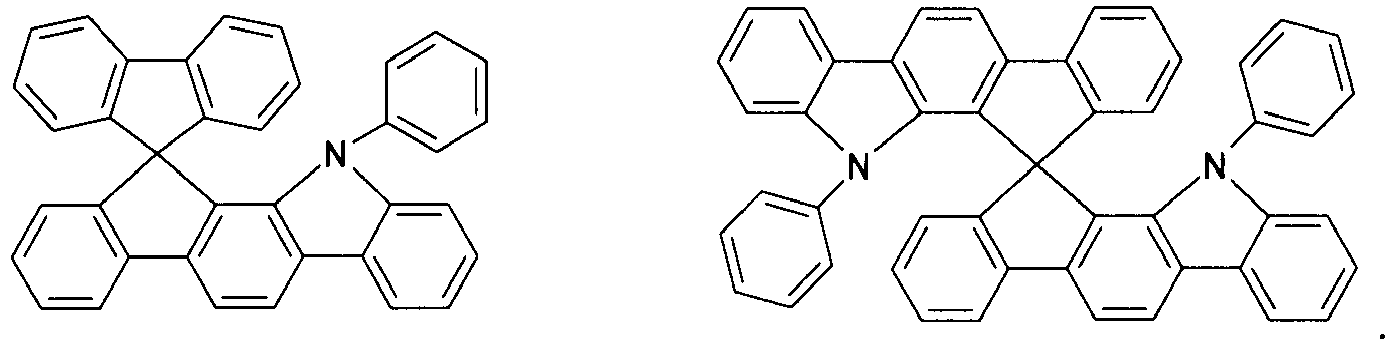
- Composé selon la revendication 1, caractérisé en ce que X représente, de manière identique ou différente pour chaque occurrence, CR1 ou N, où un maximum d'un groupe X par cycle représente N, ou représente, au niveau de deux groupes X adjacents, un groupe de la formule (4), où Z représente, de manière identique ou différente pour chaque occurrence, CR1 et V représente, de manière identique ou différente pour chaque occurrence, NR1, C(R1)2, O ou S, et les groupes X restants dans le cycle représentent CR1.
- Composé selon la revendication 1 ou 2, sélectionné parmi les composés des formules (7) à (15) :


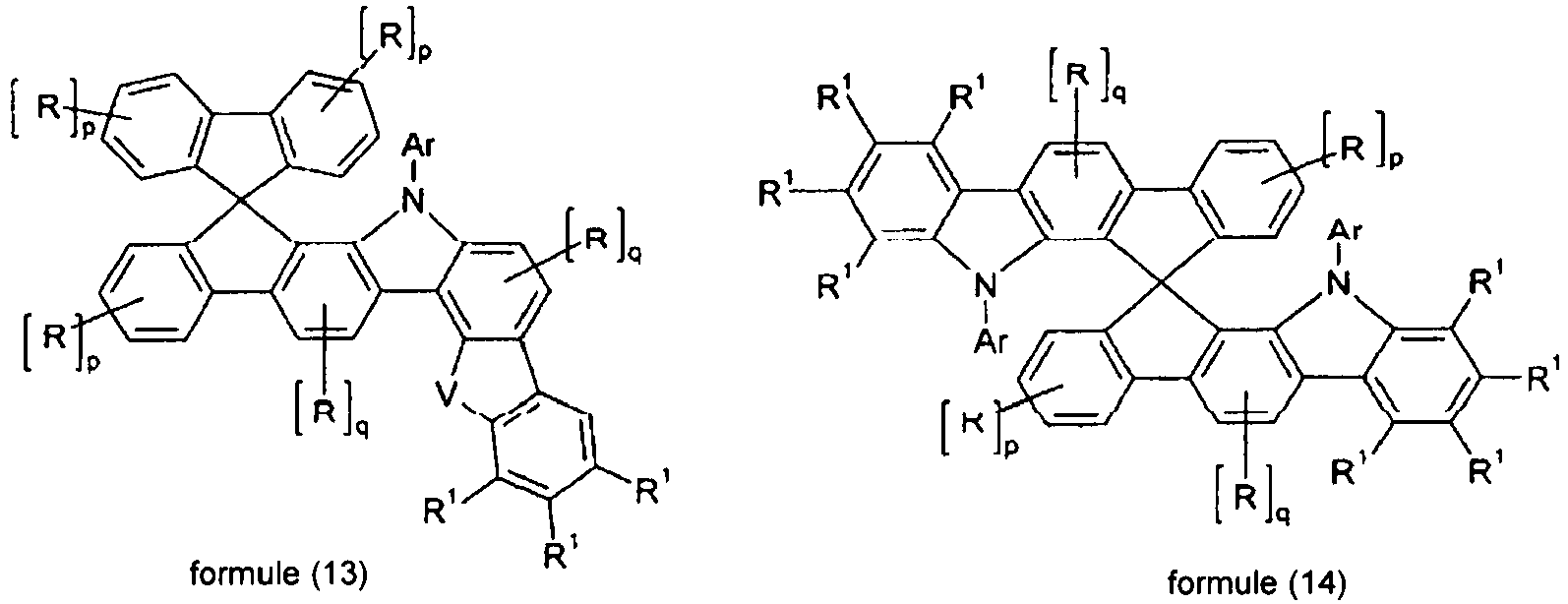

- Composé selon une ou plusieurs des revendications 1 à 3, sélectionné parmi les composés des formules (7a) à (15a) :


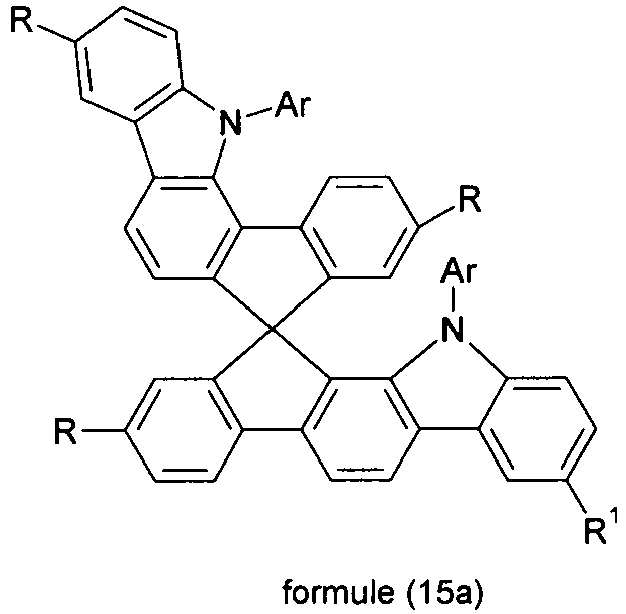
- Composé selon une ou plusieurs des revendications 1 à 4, caractérisé en ce que R est sélectionné, de manière identique ou différente pour chaque occurrence, parmi le groupe qui est constitué par H, F, CN, N(Ar1)2, un groupe alkyle en chaîne droite qui comporte 1 à 10 atome(s) de C ou un groupe alkyle ramifié ou cyclique qui comporte 3 à 10 atomes de C ou un système de cycle aromatique qui comporte 6 à 30 atomes de cycle aromatique, lequel peut être substitué par un radical ou par plusieurs radicaux R3 non aromatiques.
- Composé selon une ou plusieurs des revendications 1 à 5, sélectionné parmi les composés des formules (7b) à (15b) :


- Composé selon une ou plusieurs des revendications 1 à 6, caractérisé en ce que les composés des formules (1) et (3) contiennent au total au moins 12 atomes de cycle aromatique dans les substituants Ar, R1 et R2 et en ce que les composés de la formule (2) contiennent au total au moins 24 atomes de cycle aromatique dans les substituants Ar, R1 et R2.
- Composé selon une ou plusieurs des revendications 1 à 7, caractérisé en ce que Ar est sélectionné parmi les groupes des formules Ar-1 à Ar-58 :

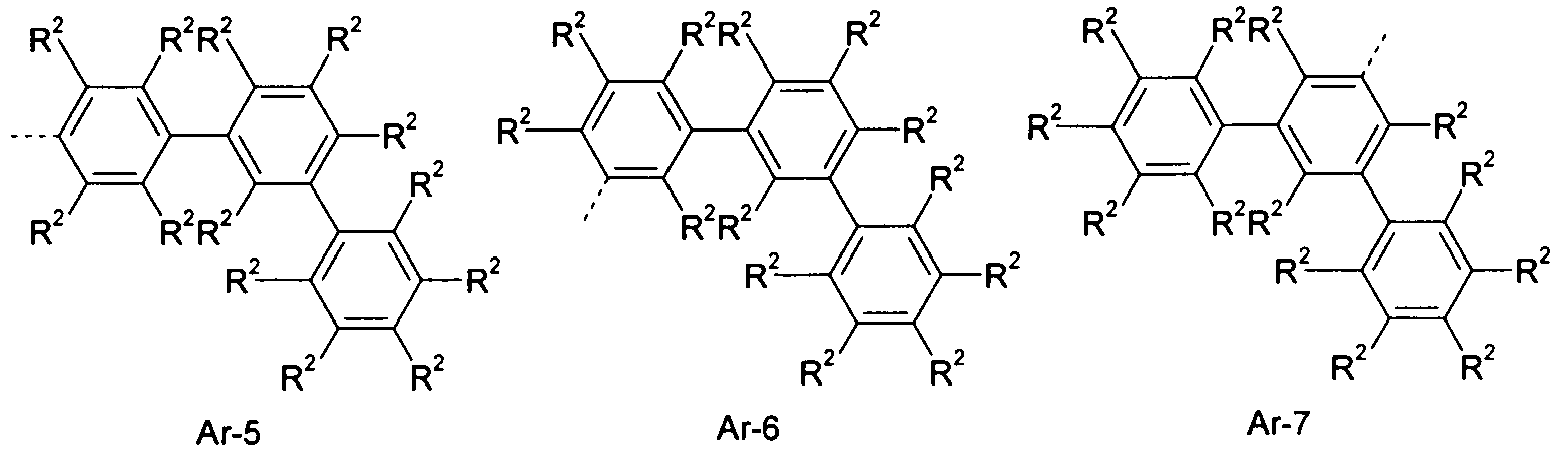


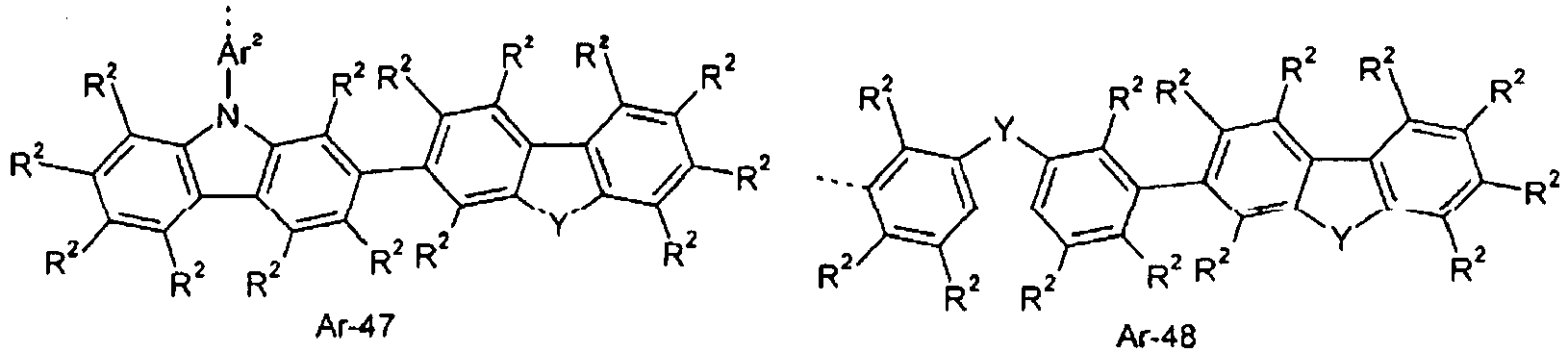


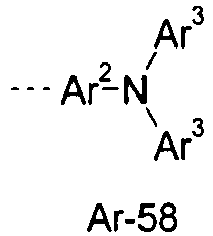 Ar2 est pour chaque occurrence, de manière identique ou différente, un système de cycle aromatique ou hétéroaromatique divalent qui comporte 6 à 18 atomes de cycle aromatique, lequel ne contient pas de groupes hétéroaryle déficients en électrons et lequel peut dans chaque cas être substitué par un radical ou par plusieurs radicaux R2 ;Ar3 est, de manière identique ou différente pour chaque occurrence, un système de cycle aromatique ou hétéroaromatique qui comporte 6 à 18 atomes de cycle aromatique, lequel ne contient pas de groupes hétéroaryle déficients en électrons et lequel peut dans chaque cas être substitué par un radical ou par plusieurs radicaux R2;Y est pour chaque occurrence, de manière identique ou différente, C(R2)2, NR2, O ou S ;n est 0 ou 1, où n égal à 0 signifie qu'aucun groupe Y n'est lié au niveau de cette position et qu'en lieu et place, des radicaux R2 sont liés aux atomes de carbone correspondants ;où les groupes Ar-1 à Ar-57 peuvent également être liés à l'atome d'azote dans la formule (1) ou dans la formule (2) ou dans la formule (3) via un groupe de pontage.
 - Composé selon une ou plusieurs des revendications 1 à 8, caractérisé en ce que R1 est sélectionné, de manière identique ou différente pour chaque occurrence, parmi le groupe qui est constitué par H, D, N(Ar1)2, un groupe alkyle en chaîne droite qui comporte 1 à 10 atome(s) de C ou un groupe alkyle ramifié ou cyclique qui comporte 3 à 10 atomes de C, lequel peut dans chaque cas être substitué par un radical ou par plusieurs radicaux R3, où un ou plusieurs atome(s) de H peut/peuvent être remplacé(s) par D ou F, ou un système de cycle aromatique ou hétéroaromatique qui comporte 5 à 30 atomes de cycle aromatique, lequel peut dans chaque cas être substitué par un radical ou par plusieurs radicaux R3.
- Composé selon une ou plusieurs des revendications 1 à 9, caractérisé en ce que R1, s'il représente un système de cycle aromatique ou hétéroaromatique, est sélectionné parmi les groupes R1-1 à R1-43 :


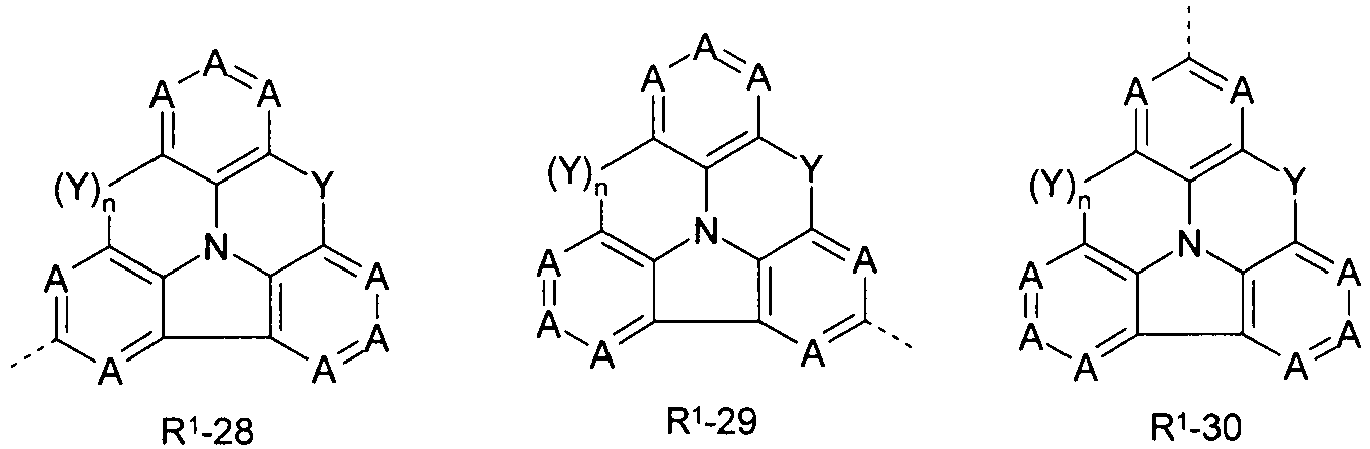


 A est pour chaque occurrence, de manière identique ou différente, CR3 ou N, où un maximum de 3 symboles X par cycle représentent N ;Y est pour chaque occurrence, de manière identique ou différente, C(R3)2, NR3, O ou S ;Ar2, Ar3 sont, de manière identique ou différente pour chaque occurrence, un système de cycle aromatique ou hétéroaromatique qui comporte 5 à 18 atomes de cycle aromatique, lequel peut dans chaque cas être substitué par un radical ou par plusieurs radicaux R3;n est 0 ou 1, où n égal à 0 signifie qu'aucun groupe Y n'est lié au niveau de cette position et qu'en lieu et place, des radicaux R3 sont liés aux atomes de carbone correspondants ;où les groupes R1-1 à R1-42 peuvent également être liés à l'atome d'azote dans la formule (1) ou dans la formule (2) ou dans la formule (3) via un groupe de pontage.
 - Oligomère, polymère ou dendrimère contenant un ou plusieurs composé(s) selon une ou plusieurs des revendications 1 à 10, où une ou plusieurs liaison(s) depuis le composé sur le polymère, l'oligomère ou le dendrimère est/sont présente(s) au niveau d'une ou de plusieurs position(s) en lieu et place de substituants.
- Formulation comprenant au moins un composé selon une ou plusieurs des revendications 1 à 10 et/ou au moins un oligomère, un polymère ou un dendrimère selon la revendication 11 et au moins un autre composé, en particulier un solvant.
- Utilisation d'un composé selon une ou plusieurs des revendications 1 à 10 et/ou d'un oligomère, d'un polymère ou d'un dendrimère selon la revendication 11 dans un dispositif électronique.
- Dispositif électronique contenant au moins un composé selon une ou plusieurs des revendications 1 à 10 et/ou au moins un oligomère, un polymère ou un dendrimère selon la revendication 11, de préférence sélectionné parmi le groupe qui est constitué par les dispositifs électroluminescents organiques, les circuits intégrés organiques, les transistors à effet de champ organiques, les transistors à film mince organiques, les transistors à émission de lumière organiques, les cellules solaires organiques, les cellules solaires organiques sensibilisées par colorant(s), les détecteurs optiques organiques, les photorécepteurs organiques, les dispositifs à extinction de champ organiques, les cellules électrochimiques à émission de lumière, les diodes laser organiques et les dispositifs à émission de plasmons organiques.
- Dispositif électronique selon la revendication 14, lequel est un dispositif électroluminescent organique, caractérisé en ce que le composé selon une ou plusieurs des revendications 1 à 12 est employé en tant que matériau de matrice pour un émetteur phosphorescent ou fluorescent et/ou dans une couche de blocage d'électrons ou de blocage d'excitons et/ou dans une couche de transport de trous et/ou dans une couche de blocage de trous et/ou dans une couche de blocage de trous ou de transport d'électrons.
Applications Claiming Priority (2)
| Application Number | Priority Date | Filing Date | Title |
|---|---|---|---|
| EP14000624 | 2014-02-21 | ||
| PCT/EP2015/000146 WO2015124255A1 (fr) | 2014-02-21 | 2015-01-27 | Matières pour dispositifs électroluminescents organiques |
Publications (2)
| Publication Number | Publication Date |
|---|---|
| EP3107977A1 EP3107977A1 (fr) | 2016-12-28 |
| EP3107977B1 true EP3107977B1 (fr) | 2018-01-24 |
Family
ID=50159014
Family Applications (1)
| Application Number | Title | Priority Date | Filing Date |
|---|---|---|---|
| EP15702630.3A Active EP3107977B1 (fr) | 2014-02-21 | 2015-01-27 | Matières pour dispositifs électroluminescents organiques |
Country Status (6)
| Country | Link |
|---|---|
| US (2) | US20170062732A1 (fr) |
| EP (1) | EP3107977B1 (fr) |
| JP (1) | JP6498685B2 (fr) |
| KR (1) | KR102362339B1 (fr) |
| CN (1) | CN106029830B (fr) |
| WO (1) | WO2015124255A1 (fr) |
Families Citing this family (13)
| Publication number | Priority date | Publication date | Assignee | Title |
|---|---|---|---|---|
| KR102030354B1 (ko) | 2014-05-13 | 2019-10-10 | 에스에프씨주식회사 | 방향족 아민기를 포함하는 헤테로고리 화합물 및 이를 포함하는 유기 발광 소자 |
| CN106488917B (zh) | 2014-06-18 | 2020-05-05 | 默克专利有限公司 | 用于有机电致发光器件的材料 |
| KR102030377B1 (ko) * | 2014-07-28 | 2019-10-10 | 에스에프씨주식회사 | 헤테로고리를 포함하는 축합 플루오렌 유도체 |
| WO2016124304A1 (fr) | 2015-02-03 | 2016-08-11 | Merck Patent Gmbh | Complexes métalliques |
| KR101974860B1 (ko) * | 2015-02-04 | 2019-09-05 | 에스에프씨주식회사 | 저전압구동이 가능하며 장수명을 갖는 유기 발광 소자 |
| KR102054397B1 (ko) * | 2016-10-24 | 2019-12-10 | 주식회사 엘지화학 | 헤테로 고리 화합물 및 이를 포함하는 유기 발광 소자 |
| WO2018080126A1 (fr) * | 2016-10-24 | 2018-05-03 | 주식회사 엘지화학 | Composé hétérocyclique et dispositif électroluminescent organique le comprenant |
| US11345687B2 (en) | 2016-11-09 | 2022-05-31 | Merck Patent Gmbh | Materials for organic electroluminescent devices |
| CN106749289B (zh) * | 2016-11-24 | 2019-06-18 | 上海道亦化工科技有限公司 | 一种具有螺结构的有机电致发光化合物及其发光器件 |
| WO2018154501A1 (fr) | 2017-02-24 | 2018-08-30 | Idemitsu Kosan Co., Ltd. | Composés de type échelle spécifiques pour dispositifs électroluminescents organiques |
| CN107163066A (zh) * | 2017-06-26 | 2017-09-15 | 上海道亦化工科技有限公司 | 一种螺唑类有机电致发光化合物及其有机电致发光器件 |
| CN107344946A (zh) * | 2017-06-26 | 2017-11-14 | 上海道亦化工科技有限公司 | 一种螺咔唑类有机电致发光化合物及其有机电致发光器件 |
| CN107311955A (zh) * | 2017-06-26 | 2017-11-03 | 上海道亦化工科技有限公司 | 一种螺芴类有机电致发光化合物及其有机电致发光器件 |
Family Cites Families (16)
| Publication number | Priority date | Publication date | Assignee | Title |
|---|---|---|---|---|
| US7457978B2 (en) * | 2005-05-09 | 2008-11-25 | Micron Technology, Inc. | Adjustable byte lane offset for memory module to reduce skew |
| WO2010115982A1 (fr) * | 2009-04-09 | 2010-10-14 | Abb Technology Ag | Préforme de soudage |
| DE102009031021A1 (de) * | 2009-06-30 | 2011-01-05 | Merck Patent Gmbh | Materialien für organische Elektrolumineszenzvorrichtungen |
| KR101408515B1 (ko) * | 2009-07-01 | 2014-06-17 | 주식회사 엘지화학 | 신규한 화합물 및 이를 이용한 유기 전자 소자 |
| DE102009053645A1 (de) * | 2009-11-17 | 2011-05-19 | Merck Patent Gmbh | Materialien für organische Elektrolumineszenzvorrichtung |
| KR20130130757A (ko) * | 2010-11-24 | 2013-12-02 | 메르크 파텐트 게엠베하 | 유기 전계발광 소자용 재료 |
| KR101531612B1 (ko) * | 2010-12-02 | 2015-06-25 | 제일모직 주식회사 | 유기광전소자용 화합물 및 이를 포함하는 유기광전소자 |
| KR20120081539A (ko) * | 2011-01-11 | 2012-07-19 | (주)씨에스엘쏠라 | 유기발광화합물 및 이를 이용한 유기 광소자 |
| CN107814820B (zh) | 2011-07-29 | 2020-08-11 | 默克专利有限公司 | 用于电子器件的化合物 |
| CA2849087A1 (fr) * | 2011-09-21 | 2013-03-28 | Merck Patent Gmbh | Derives de carbazole pour des dispositifs electroluminescents organiques |
| US9515266B2 (en) | 2011-10-20 | 2016-12-06 | Merck Patent Gmbh | Materials for organic electroluminescent devices |
| KR20130084093A (ko) * | 2012-01-16 | 2013-07-24 | 롬엔드하스전자재료코리아유한회사 | 신규한 유기 발광 화합물 및 이를 채용하고 있는 유기 전계 발광 소자 |
| KR20130112342A (ko) * | 2012-04-03 | 2013-10-14 | 롬엔드하스전자재료코리아유한회사 | 신규한 카바졸 화합물 및 이를 포함하는 유기 전계 발광 소자 |
| KR20130118059A (ko) * | 2012-04-19 | 2013-10-29 | 롬엔드하스전자재료코리아유한회사 | 신규한 유기 전계 발광 화합물 및 이를 사용하는 유기 전계 발광 소자 |
| KR101552135B1 (ko) * | 2012-07-13 | 2015-09-10 | 덕산네오룩스 주식회사 | 화합물, 이를 이용한 유기전기소자 및 그 전자 장치 |
| KR101556822B1 (ko) | 2013-02-25 | 2015-10-01 | 주식회사 두산 | 유기 전계 발광 소자 |
-
2015
- 2015-01-27 US US15/120,336 patent/US20170062732A1/en not_active Abandoned
- 2015-01-27 KR KR1020167026082A patent/KR102362339B1/ko active Active
- 2015-01-27 EP EP15702630.3A patent/EP3107977B1/fr active Active
- 2015-01-27 JP JP2016553610A patent/JP6498685B2/ja active Active
- 2015-01-27 WO PCT/EP2015/000146 patent/WO2015124255A1/fr not_active Ceased
- 2015-01-27 CN CN201580009489.1A patent/CN106029830B/zh active Active
-
2019
- 2019-04-22 US US16/390,675 patent/US11245079B2/en active Active
Also Published As
| Publication number | Publication date |
|---|---|
| JP6498685B2 (ja) | 2019-04-10 |
| WO2015124255A1 (fr) | 2015-08-27 |
| EP3107977A1 (fr) | 2016-12-28 |
| US20190280217A1 (en) | 2019-09-12 |
| CN106029830A (zh) | 2016-10-12 |
| US20170062732A1 (en) | 2017-03-02 |
| KR102362339B1 (ko) | 2022-02-11 |
| US11245079B2 (en) | 2022-02-08 |
| JP2017508740A (ja) | 2017-03-30 |
| CN106029830B (zh) | 2019-09-20 |
| KR20160118366A (ko) | 2016-10-11 |
Similar Documents
| Publication | Publication Date | Title |
|---|---|---|
| EP3744155B1 (fr) | Matériaux pour dispositifs électroluminescents organiques | |
| EP3180411B1 (fr) | Matériaux pour dispositifs électroluminescents organiques | |
| EP2883422B1 (fr) | Matériaux pour dispositifs organiques à électroluminescence | |
| EP2935276B1 (fr) | Matériaux pour dispositifs organiques électroluminescents | |
| EP3174954B1 (fr) | Matériaux pour dispositifs électroluminescents organiques | |
| DE112011103904B4 (de) | Materialien für organische Elektrolumineszenzvorrichtungen | |
| EP2768808B1 (fr) | Matériaux destinés à des dispositifs électroluminescents organiques | |
| EP2758372B1 (fr) | Dérivés de carbazole pour des dispositifs électroluminescents organiques | |
| EP2714841B1 (fr) | Dispositif électroluminescent organique | |
| EP2828266B1 (fr) | Dérivés de 9,9'-spiro-bixanthene pour dispositifs électroluminescents | |
| EP3016952B1 (fr) | Composés de lactame spirocondensés pour des dispositifs électroluminescents organiques | |
| EP3160954B1 (fr) | Matériaux pour dispositifs électroluminescents organiques | |
| EP3110796B1 (fr) | Matières pour dispositifs électroluminescents organiques | |
| EP3227269A1 (fr) | Matières pour dispositifs électroluminescents organiques | |
| EP3080229A1 (fr) | Matériaux pour dispositifs électroniques | |
| DE102009053836A1 (de) | Materialien für organische Elektrolumineszenzvorrichtungen | |
| EP3094703B1 (fr) | Materiaux pour dispositifs électroluminescents organiques | |
| EP3335254A1 (fr) | Matériaux pour dispositifs électroluminescents organiques | |
| EP2794619B1 (fr) | Composés destinés à des dispositifs électroluminescents organiques | |
| EP3347354B1 (fr) | Matières pour dispositifs électroluminescents organiques | |
| EP3107977A1 (fr) | Matières pour dispositifs électroluminescents organiques | |
| EP2931698A1 (fr) | Matériaux pour dispositifs électroniques | |
| WO2016074755A1 (fr) | Matériaux pour dispositifs électroluminescents organiques | |
| WO2026082615A1 (fr) | Nouveaux matériaux pour dispositifs électroluminescents organiques | |
| WO2025140947A1 (fr) | Nouveaux matériaux pour dispositifs électroluminescents organiques |
Legal Events
| Date | Code | Title | Description |
|---|---|---|---|
| PUAI | Public reference made under article 153(3) epc to a published international application that has entered the european phase |
Free format text: ORIGINAL CODE: 0009012 |
|
| 17P | Request for examination filed |
Effective date: 20160705 |
|
| AK | Designated contracting states |
Kind code of ref document: A1 Designated state(s): AL AT BE BG CH CY CZ DE DK EE ES FI FR GB GR HR HU IE IS IT LI LT LU LV MC MK MT NL NO PL PT RO RS SE SI SK SM TR |
|
| AX | Request for extension of the european patent |
Extension state: BA ME |
|
| RIN1 | Information on inventor provided before grant (corrected) |
Inventor name: JATSCH, ANJA Inventor name: STOESSEL, PHILIPP Inventor name: EBERLE, THOMAS Inventor name: MONTENEGRO, ELVIRA Inventor name: LINGE, ROUVEN Inventor name: KROEBER, JONAS VALENTIN Inventor name: PFLUMM, CHRISTOF Inventor name: GROSSMANN, TOBIAS Inventor name: PARHAM, AMIR HOSSAIN |
|
| DAX | Request for extension of the european patent (deleted) | ||
| RIC1 | Information provided on ipc code assigned before grant |
Ipc: C07D 401/04 20060101ALI20170613BHEP Ipc: C09B 11/00 20060101ALI20170613BHEP Ipc: C07D 209/94 20060101ALI20170613BHEP Ipc: C07D 405/04 20060101ALI20170613BHEP Ipc: C07D 413/10 20060101ALI20170613BHEP Ipc: H01L 31/00 20060101ALI20170613BHEP Ipc: C09B 57/00 20060101ALI20170613BHEP Ipc: H05B 33/20 20060101ALI20170613BHEP Ipc: H01L 51/50 20060101ALI20170613BHEP Ipc: H01L 33/00 20100101ALI20170613BHEP Ipc: C07D 209/00 20060101ALI20170613BHEP Ipc: H01L 51/00 20060101ALI20170613BHEP Ipc: C07D 413/04 20060101ALI20170613BHEP Ipc: C07D 409/04 20060101ALI20170613BHEP Ipc: C07D 405/10 20060101ALI20170613BHEP Ipc: C09K 11/06 20060101AFI20170613BHEP Ipc: C09B 21/00 20060101ALI20170613BHEP Ipc: C07D 209/96 20060101ALI20170613BHEP |
|
| GRAP | Despatch of communication of intention to grant a patent |
Free format text: ORIGINAL CODE: EPIDOSNIGR1 |
|
| INTG | Intention to grant announced |
Effective date: 20170724 |
|
| GRAJ | Information related to disapproval of communication of intention to grant by the applicant or resumption of examination proceedings by the epo deleted |
Free format text: ORIGINAL CODE: EPIDOSDIGR1 |
|
| GRAL | Information related to payment of fee for publishing/printing deleted |
Free format text: ORIGINAL CODE: EPIDOSDIGR3 |
|
| GRAS | Grant fee paid |
Free format text: ORIGINAL CODE: EPIDOSNIGR3 |
|
| GRAP | Despatch of communication of intention to grant a patent |
Free format text: ORIGINAL CODE: EPIDOSNIGR1 |
|
| INTC | Intention to grant announced (deleted) | ||
| INTG | Intention to grant announced |
Effective date: 20171109 |
|
| GRAA | (expected) grant |
Free format text: ORIGINAL CODE: 0009210 |
|
| AK | Designated contracting states |
Kind code of ref document: B1 Designated state(s): AL AT BE BG CH CY CZ DE DK EE ES FI FR GB GR HR HU IE IS IT LI LT LU LV MC MK MT NL NO PL PT RO RS SE SI SK SM TR |
|
| REG | Reference to a national code |
Ref country code: GB Ref legal event code: FG4D Free format text: NOT ENGLISH |
|
| REG | Reference to a national code |
Ref country code: CH Ref legal event code: EP |
|
| REG | Reference to a national code |
Ref country code: AT Ref legal event code: REF Ref document number: 965775 Country of ref document: AT Kind code of ref document: T Effective date: 20180215 |
|
| REG | Reference to a national code |
Ref country code: IE Ref legal event code: FG4D Free format text: LANGUAGE OF EP DOCUMENT: GERMAN |
|
| REG | Reference to a national code |
Ref country code: DE Ref legal event code: R096 Ref document number: 502015002883 Country of ref document: DE |
|
| REG | Reference to a national code |
Ref country code: NL Ref legal event code: MP Effective date: 20180124 |
|
| REG | Reference to a national code |
Ref country code: LT Ref legal event code: MG4D |
|
| PG25 | Lapsed in a contracting state [announced via postgrant information from national office to epo] |
Ref country code: NL Free format text: LAPSE BECAUSE OF FAILURE TO SUBMIT A TRANSLATION OF THE DESCRIPTION OR TO PAY THE FEE WITHIN THE PRESCRIBED TIME-LIMIT Effective date: 20180124 |
|
| PG25 | Lapsed in a contracting state [announced via postgrant information from national office to epo] |
Ref country code: FI Free format text: LAPSE BECAUSE OF FAILURE TO SUBMIT A TRANSLATION OF THE DESCRIPTION OR TO PAY THE FEE WITHIN THE PRESCRIBED TIME-LIMIT Effective date: 20180124 Ref country code: HR Free format text: LAPSE BECAUSE OF FAILURE TO SUBMIT A TRANSLATION OF THE DESCRIPTION OR TO PAY THE FEE WITHIN THE PRESCRIBED TIME-LIMIT Effective date: 20180124 Ref country code: LT Free format text: LAPSE BECAUSE OF FAILURE TO SUBMIT A TRANSLATION OF THE DESCRIPTION OR TO PAY THE FEE WITHIN THE PRESCRIBED TIME-LIMIT Effective date: 20180124 Ref country code: CY Free format text: LAPSE BECAUSE OF FAILURE TO SUBMIT A TRANSLATION OF THE DESCRIPTION OR TO PAY THE FEE WITHIN THE PRESCRIBED TIME-LIMIT Effective date: 20180124 Ref country code: ES Free format text: LAPSE BECAUSE OF FAILURE TO SUBMIT A TRANSLATION OF THE DESCRIPTION OR TO PAY THE FEE WITHIN THE PRESCRIBED TIME-LIMIT Effective date: 20180124 Ref country code: NO Free format text: LAPSE BECAUSE OF FAILURE TO SUBMIT A TRANSLATION OF THE DESCRIPTION OR TO PAY THE FEE WITHIN THE PRESCRIBED TIME-LIMIT Effective date: 20180424 |
|
| PG25 | Lapsed in a contracting state [announced via postgrant information from national office to epo] |
Ref country code: IS Free format text: LAPSE BECAUSE OF FAILURE TO SUBMIT A TRANSLATION OF THE DESCRIPTION OR TO PAY THE FEE WITHIN THE PRESCRIBED TIME-LIMIT Effective date: 20180524 Ref country code: RS Free format text: LAPSE BECAUSE OF FAILURE TO SUBMIT A TRANSLATION OF THE DESCRIPTION OR TO PAY THE FEE WITHIN THE PRESCRIBED TIME-LIMIT Effective date: 20180124 Ref country code: BG Free format text: LAPSE BECAUSE OF FAILURE TO SUBMIT A TRANSLATION OF THE DESCRIPTION OR TO PAY THE FEE WITHIN THE PRESCRIBED TIME-LIMIT Effective date: 20180424 Ref country code: SE Free format text: LAPSE BECAUSE OF FAILURE TO SUBMIT A TRANSLATION OF THE DESCRIPTION OR TO PAY THE FEE WITHIN THE PRESCRIBED TIME-LIMIT Effective date: 20180124 Ref country code: LV Free format text: LAPSE BECAUSE OF FAILURE TO SUBMIT A TRANSLATION OF THE DESCRIPTION OR TO PAY THE FEE WITHIN THE PRESCRIBED TIME-LIMIT Effective date: 20180124 Ref country code: GR Free format text: LAPSE BECAUSE OF FAILURE TO SUBMIT A TRANSLATION OF THE DESCRIPTION OR TO PAY THE FEE WITHIN THE PRESCRIBED TIME-LIMIT Effective date: 20180425 Ref country code: PL Free format text: LAPSE BECAUSE OF FAILURE TO SUBMIT A TRANSLATION OF THE DESCRIPTION OR TO PAY THE FEE WITHIN THE PRESCRIBED TIME-LIMIT Effective date: 20180124 |
|
| REG | Reference to a national code |
Ref country code: CH Ref legal event code: PL |
|
| PG25 | Lapsed in a contracting state [announced via postgrant information from national office to epo] |
Ref country code: MT Free format text: LAPSE BECAUSE OF FAILURE TO SUBMIT A TRANSLATION OF THE DESCRIPTION OR TO PAY THE FEE WITHIN THE PRESCRIBED TIME-LIMIT Effective date: 20180124 |
|
| REG | Reference to a national code |
Ref country code: DE Ref legal event code: R097 Ref document number: 502015002883 Country of ref document: DE |
|
| PG25 | Lapsed in a contracting state [announced via postgrant information from national office to epo] |
Ref country code: LU Free format text: LAPSE BECAUSE OF NON-PAYMENT OF DUE FEES Effective date: 20180127 Ref country code: EE Free format text: LAPSE BECAUSE OF FAILURE TO SUBMIT A TRANSLATION OF THE DESCRIPTION OR TO PAY THE FEE WITHIN THE PRESCRIBED TIME-LIMIT Effective date: 20180124 Ref country code: IT Free format text: LAPSE BECAUSE OF FAILURE TO SUBMIT A TRANSLATION OF THE DESCRIPTION OR TO PAY THE FEE WITHIN THE PRESCRIBED TIME-LIMIT Effective date: 20180124 Ref country code: RO Free format text: LAPSE BECAUSE OF FAILURE TO SUBMIT A TRANSLATION OF THE DESCRIPTION OR TO PAY THE FEE WITHIN THE PRESCRIBED TIME-LIMIT Effective date: 20180124 Ref country code: MC Free format text: LAPSE BECAUSE OF FAILURE TO SUBMIT A TRANSLATION OF THE DESCRIPTION OR TO PAY THE FEE WITHIN THE PRESCRIBED TIME-LIMIT Effective date: 20180124 Ref country code: AL Free format text: LAPSE BECAUSE OF FAILURE TO SUBMIT A TRANSLATION OF THE DESCRIPTION OR TO PAY THE FEE WITHIN THE PRESCRIBED TIME-LIMIT Effective date: 20180124 |
|
| REG | Reference to a national code |
Ref country code: IE Ref legal event code: MM4A |
|
| REG | Reference to a national code |
Ref country code: BE Ref legal event code: MM Effective date: 20180131 |
|
| PG25 | Lapsed in a contracting state [announced via postgrant information from national office to epo] |
Ref country code: DK Free format text: LAPSE BECAUSE OF FAILURE TO SUBMIT A TRANSLATION OF THE DESCRIPTION OR TO PAY THE FEE WITHIN THE PRESCRIBED TIME-LIMIT Effective date: 20180124 Ref country code: CH Free format text: LAPSE BECAUSE OF NON-PAYMENT OF DUE FEES Effective date: 20180131 Ref country code: SK Free format text: LAPSE BECAUSE OF FAILURE TO SUBMIT A TRANSLATION OF THE DESCRIPTION OR TO PAY THE FEE WITHIN THE PRESCRIBED TIME-LIMIT Effective date: 20180124 Ref country code: LI Free format text: LAPSE BECAUSE OF NON-PAYMENT OF DUE FEES Effective date: 20180131 Ref country code: SM Free format text: LAPSE BECAUSE OF FAILURE TO SUBMIT A TRANSLATION OF THE DESCRIPTION OR TO PAY THE FEE WITHIN THE PRESCRIBED TIME-LIMIT Effective date: 20180124 Ref country code: BE Free format text: LAPSE BECAUSE OF NON-PAYMENT OF DUE FEES Effective date: 20180131 Ref country code: CZ Free format text: LAPSE BECAUSE OF FAILURE TO SUBMIT A TRANSLATION OF THE DESCRIPTION OR TO PAY THE FEE WITHIN THE PRESCRIBED TIME-LIMIT Effective date: 20180124 |
|
| PLBE | No opposition filed within time limit |
Free format text: ORIGINAL CODE: 0009261 |
|
| STAA | Information on the status of an ep patent application or granted ep patent |
Free format text: STATUS: NO OPPOSITION FILED WITHIN TIME LIMIT |
|
| 26N | No opposition filed |
Effective date: 20181025 |
|
| PG25 | Lapsed in a contracting state [announced via postgrant information from national office to epo] |
Ref country code: IE Free format text: LAPSE BECAUSE OF NON-PAYMENT OF DUE FEES Effective date: 20180127 |
|
| PG25 | Lapsed in a contracting state [announced via postgrant information from national office to epo] |
Ref country code: SI Free format text: LAPSE BECAUSE OF FAILURE TO SUBMIT A TRANSLATION OF THE DESCRIPTION OR TO PAY THE FEE WITHIN THE PRESCRIBED TIME-LIMIT Effective date: 20180124 |
|
| PG25 | Lapsed in a contracting state [announced via postgrant information from national office to epo] |
Ref country code: FR Free format text: LAPSE BECAUSE OF NON-PAYMENT OF DUE FEES Effective date: 20180324 |
|
| GBPC | Gb: european patent ceased through non-payment of renewal fee |
Effective date: 20190127 |
|
| PG25 | Lapsed in a contracting state [announced via postgrant information from national office to epo] |
Ref country code: GB Free format text: LAPSE BECAUSE OF NON-PAYMENT OF DUE FEES Effective date: 20190127 |
|
| PG25 | Lapsed in a contracting state [announced via postgrant information from national office to epo] |
Ref country code: TR Free format text: LAPSE BECAUSE OF FAILURE TO SUBMIT A TRANSLATION OF THE DESCRIPTION OR TO PAY THE FEE WITHIN THE PRESCRIBED TIME-LIMIT Effective date: 20180124 |
|
| PG25 | Lapsed in a contracting state [announced via postgrant information from national office to epo] |
Ref country code: PT Free format text: LAPSE BECAUSE OF FAILURE TO SUBMIT A TRANSLATION OF THE DESCRIPTION OR TO PAY THE FEE WITHIN THE PRESCRIBED TIME-LIMIT Effective date: 20180124 |
|
| PG25 | Lapsed in a contracting state [announced via postgrant information from national office to epo] |
Ref country code: MK Free format text: LAPSE BECAUSE OF NON-PAYMENT OF DUE FEES Effective date: 20180124 Ref country code: HU Free format text: LAPSE BECAUSE OF FAILURE TO SUBMIT A TRANSLATION OF THE DESCRIPTION OR TO PAY THE FEE WITHIN THE PRESCRIBED TIME-LIMIT; INVALID AB INITIO Effective date: 20150127 |
|
| REG | Reference to a national code |
Ref country code: AT Ref legal event code: MM01 Ref document number: 965775 Country of ref document: AT Kind code of ref document: T Effective date: 20200127 |
|
| PG25 | Lapsed in a contracting state [announced via postgrant information from national office to epo] |
Ref country code: AT Free format text: LAPSE BECAUSE OF NON-PAYMENT OF DUE FEES Effective date: 20200127 |
|
| P01 | Opt-out of the competence of the unified patent court (upc) registered |
Effective date: 20230518 |
|
| PGFP | Annual fee paid to national office [announced via postgrant information from national office to epo] |
Ref country code: DE Payment date: 20251217 Year of fee payment: 12 |