EP3744155B1 - Matériaux pour dispositifs électroluminescents organiques - Google Patents
Matériaux pour dispositifs électroluminescents organiques Download PDFInfo
- Publication number
- EP3744155B1 EP3744155B1 EP19701350.1A EP19701350A EP3744155B1 EP 3744155 B1 EP3744155 B1 EP 3744155B1 EP 19701350 A EP19701350 A EP 19701350A EP 3744155 B1 EP3744155 B1 EP 3744155B1
- Authority
- EP
- European Patent Office
- Prior art keywords
- hetar
- group
- aromatic
- radicals
- substituted
- Prior art date
- Legal status (The legal status is an assumption and is not a legal conclusion. Google has not performed a legal analysis and makes no representation as to the accuracy of the status listed.)
- Active
Links
Classifications
-
- C—CHEMISTRY; METALLURGY
- C07—ORGANIC CHEMISTRY
- C07D—HETEROCYCLIC COMPOUNDS
- C07D209/00—Heterocyclic compounds containing five-membered rings, condensed with other rings, with one nitrogen atom as the only ring hetero atom
- C07D209/56—Ring systems containing three or more rings
- C07D209/80—[b, c]- or [b, d]-condensed
-
- C—CHEMISTRY; METALLURGY
- C07—ORGANIC CHEMISTRY
- C07D—HETEROCYCLIC COMPOUNDS
- C07D401/00—Heterocyclic compounds containing two or more hetero rings, having nitrogen atoms as the only ring hetero atoms, at least one ring being a six-membered ring with only one nitrogen atom
- C07D401/14—Heterocyclic compounds containing two or more hetero rings, having nitrogen atoms as the only ring hetero atoms, at least one ring being a six-membered ring with only one nitrogen atom containing three or more hetero rings
-
- C—CHEMISTRY; METALLURGY
- C07—ORGANIC CHEMISTRY
- C07D—HETEROCYCLIC COMPOUNDS
- C07D403/00—Heterocyclic compounds containing two or more hetero rings, having nitrogen atoms as the only ring hetero atoms, not provided for by group C07D401/00
- C07D403/02—Heterocyclic compounds containing two or more hetero rings, having nitrogen atoms as the only ring hetero atoms, not provided for by group C07D401/00 containing two hetero rings
- C07D403/10—Heterocyclic compounds containing two or more hetero rings, having nitrogen atoms as the only ring hetero atoms, not provided for by group C07D401/00 containing two hetero rings linked by a carbon chain containing aromatic rings
-
- C—CHEMISTRY; METALLURGY
- C07—ORGANIC CHEMISTRY
- C07D—HETEROCYCLIC COMPOUNDS
- C07D403/00—Heterocyclic compounds containing two or more hetero rings, having nitrogen atoms as the only ring hetero atoms, not provided for by group C07D401/00
- C07D403/14—Heterocyclic compounds containing two or more hetero rings, having nitrogen atoms as the only ring hetero atoms, not provided for by group C07D401/00 containing three or more hetero rings
-
- C—CHEMISTRY; METALLURGY
- C07—ORGANIC CHEMISTRY
- C07D—HETEROCYCLIC COMPOUNDS
- C07D405/00—Heterocyclic compounds containing both one or more hetero rings having oxygen atoms as the only ring hetero atoms, and one or more rings having nitrogen as the only ring hetero atom
- C07D405/14—Heterocyclic compounds containing both one or more hetero rings having oxygen atoms as the only ring hetero atoms, and one or more rings having nitrogen as the only ring hetero atom containing three or more hetero rings
-
- C—CHEMISTRY; METALLURGY
- C07—ORGANIC CHEMISTRY
- C07D—HETEROCYCLIC COMPOUNDS
- C07D409/00—Heterocyclic compounds containing two or more hetero rings, at least one ring having sulfur atoms as the only ring hetero atoms
- C07D409/14—Heterocyclic compounds containing two or more hetero rings, at least one ring having sulfur atoms as the only ring hetero atoms containing three or more hetero rings
-
- C—CHEMISTRY; METALLURGY
- C07—ORGANIC CHEMISTRY
- C07D—HETEROCYCLIC COMPOUNDS
- C07D471/00—Heterocyclic compounds containing nitrogen atoms as the only ring hetero atoms in the condensed system, at least one ring being a six-membered ring with one nitrogen atom, not provided for by groups C07D451/00 - C07D463/00
- C07D471/02—Heterocyclic compounds containing nitrogen atoms as the only ring hetero atoms in the condensed system, at least one ring being a six-membered ring with one nitrogen atom, not provided for by groups C07D451/00 - C07D463/00 in which the condensed system contains two hetero rings
- C07D471/04—Ortho-condensed systems
-
- C—CHEMISTRY; METALLURGY
- C07—ORGANIC CHEMISTRY
- C07D—HETEROCYCLIC COMPOUNDS
- C07D487/00—Heterocyclic compounds containing nitrogen atoms as the only ring hetero atoms in the condensed system, not provided for by groups C07D451/00 - C07D477/00
- C07D487/12—Heterocyclic compounds containing nitrogen atoms as the only ring hetero atoms in the condensed system, not provided for by groups C07D451/00 - C07D477/00 in which the condensed system contains three hetero rings
- C07D487/14—Ortho-condensed systems
-
- C—CHEMISTRY; METALLURGY
- C07—ORGANIC CHEMISTRY
- C07D—HETEROCYCLIC COMPOUNDS
- C07D487/00—Heterocyclic compounds containing nitrogen atoms as the only ring hetero atoms in the condensed system, not provided for by groups C07D451/00 - C07D477/00
- C07D487/22—Heterocyclic compounds containing nitrogen atoms as the only ring hetero atoms in the condensed system, not provided for by groups C07D451/00 - C07D477/00 in which the condensed system contains four or more hetero rings
-
- C—CHEMISTRY; METALLURGY
- C07—ORGANIC CHEMISTRY
- C07D—HETEROCYCLIC COMPOUNDS
- C07D491/00—Heterocyclic compounds containing in the condensed ring system both one or more rings having oxygen atoms as the only ring hetero atoms and one or more rings having nitrogen atoms as the only ring hetero atoms, not provided for by groups C07D451/00 - C07D459/00, C07D463/00, C07D477/00 or C07D489/00
- C07D491/02—Heterocyclic compounds containing in the condensed ring system both one or more rings having oxygen atoms as the only ring hetero atoms and one or more rings having nitrogen atoms as the only ring hetero atoms, not provided for by groups C07D451/00 - C07D459/00, C07D463/00, C07D477/00 or C07D489/00 in which the condensed system contains two hetero rings
- C07D491/04—Ortho-condensed systems
- C07D491/044—Ortho-condensed systems with only one oxygen atom as ring hetero atom in the oxygen-containing ring
- C07D491/048—Ortho-condensed systems with only one oxygen atom as ring hetero atom in the oxygen-containing ring the oxygen-containing ring being five-membered
-
- C—CHEMISTRY; METALLURGY
- C07—ORGANIC CHEMISTRY
- C07D—HETEROCYCLIC COMPOUNDS
- C07D495/00—Heterocyclic compounds containing in the condensed system at least one hetero ring having sulfur atoms as the only ring hetero atoms
- C07D495/02—Heterocyclic compounds containing in the condensed system at least one hetero ring having sulfur atoms as the only ring hetero atoms in which the condensed system contains two hetero rings
- C07D495/04—Ortho-condensed systems
-
- C—CHEMISTRY; METALLURGY
- C09—DYES; PAINTS; POLISHES; NATURAL RESINS; ADHESIVES; COMPOSITIONS NOT OTHERWISE PROVIDED FOR; APPLICATIONS OF MATERIALS NOT OTHERWISE PROVIDED FOR
- C09K—MATERIALS FOR MISCELLANEOUS APPLICATIONS, NOT PROVIDED FOR ELSEWHERE
- C09K11/00—Luminescent materials, e.g. electroluminescent or chemiluminescent
- C09K11/02—Use of particular materials as binders, particle coatings or suspension media therefor
- C09K11/025—Use of particular materials as binders, particle coatings or suspension media therefor non-luminescent particle coatings or suspension media
-
- H—ELECTRICITY
- H05—ELECTRIC TECHNIQUES NOT OTHERWISE PROVIDED FOR
- H05B—ELECTRIC HEATING; ELECTRIC LIGHT SOURCES NOT OTHERWISE PROVIDED FOR; CIRCUIT ARRANGEMENTS FOR ELECTRIC LIGHT SOURCES, IN GENERAL
- H05B33/00—Electroluminescent light sources
- H05B33/12—Light sources with substantially two-dimensional [2D] radiating surfaces
- H05B33/20—Light sources with substantially two-dimensional [2D] radiating surfaces characterised by the chemical or physical composition or the arrangement of the material in which the electroluminescent material is embedded
-
- H—ELECTRICITY
- H10—SEMICONDUCTOR DEVICES; ELECTRIC SOLID-STATE DEVICES NOT OTHERWISE PROVIDED FOR
- H10K—ORGANIC ELECTRIC SOLID-STATE DEVICES
- H10K50/00—Organic light-emitting devices
- H10K50/10—OLEDs or polymer light-emitting diodes [PLED]
- H10K50/11—OLEDs or polymer light-emitting diodes [PLED] characterised by the electroluminescent [EL] layers
-
- H—ELECTRICITY
- H10—SEMICONDUCTOR DEVICES; ELECTRIC SOLID-STATE DEVICES NOT OTHERWISE PROVIDED FOR
- H10K—ORGANIC ELECTRIC SOLID-STATE DEVICES
- H10K85/00—Organic materials used in the body or electrodes of devices covered by this subclass
- H10K85/60—Organic compounds having low molecular weight
- H10K85/649—Aromatic compounds comprising a hetero atom
- H10K85/654—Aromatic compounds comprising a hetero atom comprising only nitrogen as heteroatom
-
- H—ELECTRICITY
- H10—SEMICONDUCTOR DEVICES; ELECTRIC SOLID-STATE DEVICES NOT OTHERWISE PROVIDED FOR
- H10K—ORGANIC ELECTRIC SOLID-STATE DEVICES
- H10K85/00—Organic materials used in the body or electrodes of devices covered by this subclass
- H10K85/60—Organic compounds having low molecular weight
- H10K85/649—Aromatic compounds comprising a hetero atom
- H10K85/657—Polycyclic condensed heteroaromatic hydrocarbons
-
- H—ELECTRICITY
- H10—SEMICONDUCTOR DEVICES; ELECTRIC SOLID-STATE DEVICES NOT OTHERWISE PROVIDED FOR
- H10K—ORGANIC ELECTRIC SOLID-STATE DEVICES
- H10K85/00—Organic materials used in the body or electrodes of devices covered by this subclass
- H10K85/60—Organic compounds having low molecular weight
- H10K85/649—Aromatic compounds comprising a hetero atom
- H10K85/657—Polycyclic condensed heteroaromatic hydrocarbons
- H10K85/6572—Polycyclic condensed heteroaromatic hydrocarbons comprising only nitrogen in the heteroaromatic polycondensed ring system, e.g. phenanthroline or carbazole
-
- H—ELECTRICITY
- H10—SEMICONDUCTOR DEVICES; ELECTRIC SOLID-STATE DEVICES NOT OTHERWISE PROVIDED FOR
- H10K—ORGANIC ELECTRIC SOLID-STATE DEVICES
- H10K85/00—Organic materials used in the body or electrodes of devices covered by this subclass
- H10K85/60—Organic compounds having low molecular weight
- H10K85/649—Aromatic compounds comprising a hetero atom
- H10K85/657—Polycyclic condensed heteroaromatic hydrocarbons
- H10K85/6574—Polycyclic condensed heteroaromatic hydrocarbons comprising only oxygen in the heteroaromatic polycondensed ring system, e.g. cumarine dyes
-
- H—ELECTRICITY
- H10—SEMICONDUCTOR DEVICES; ELECTRIC SOLID-STATE DEVICES NOT OTHERWISE PROVIDED FOR
- H10K—ORGANIC ELECTRIC SOLID-STATE DEVICES
- H10K2101/00—Properties of the organic materials covered by group H10K85/00
- H10K2101/10—Triplet emission
-
- H—ELECTRICITY
- H10—SEMICONDUCTOR DEVICES; ELECTRIC SOLID-STATE DEVICES NOT OTHERWISE PROVIDED FOR
- H10K—ORGANIC ELECTRIC SOLID-STATE DEVICES
- H10K2101/00—Properties of the organic materials covered by group H10K85/00
- H10K2101/90—Multiple hosts in the emissive layer
-
- H—ELECTRICITY
- H10—SEMICONDUCTOR DEVICES; ELECTRIC SOLID-STATE DEVICES NOT OTHERWISE PROVIDED FOR
- H10K—ORGANIC ELECTRIC SOLID-STATE DEVICES
- H10K50/00—Organic light-emitting devices
- H10K50/10—OLEDs or polymer light-emitting diodes [PLED]
- H10K50/14—Carrier transporting layers
- H10K50/16—Electron transporting layers
-
- H—ELECTRICITY
- H10—SEMICONDUCTOR DEVICES; ELECTRIC SOLID-STATE DEVICES NOT OTHERWISE PROVIDED FOR
- H10K—ORGANIC ELECTRIC SOLID-STATE DEVICES
- H10K50/00—Organic light-emitting devices
- H10K50/10—OLEDs or polymer light-emitting diodes [PLED]
- H10K50/18—Carrier blocking layers
Definitions
- the present invention relates to materials for use in electronic devices, in particular organic electroluminescent devices, and electronic devices, in particular organic electroluminescent devices, containing these materials.
- OLEDs organic electroluminescent devices
- organometallic complexes are frequently used as emitting materials. For quantum mechanical reasons, up to four times the energy and power efficiency is possible when using organometallic compounds as phosphorescence emitters.
- OLEDs organic electroluminescent devices
- the properties of phosphorescent OLEDs are not only determined by the triplet emitters used.
- the other materials used, such as matrix materials, are also of particular importance here. Improvements in these materials can therefore also lead to significant improvements in the OLED properties.
- the object of the present invention is to provide compounds which are suitable for use in an OLED, in particular as a matrix material for phosphorescent emitters, and lead to improved properties there, in particular to an improved service life.
- Indenocarbazole derivatives are known as matrix materials for phosphorescent emitters. Compounds according to the present invention are not disclosed.
- An aryl group within the meaning of this invention contains 6 to 40 carbon atoms; a heteroaryl group within the meaning of this invention contains 2 to 40 carbon atoms and at least one heteroatom, with the proviso that the sum of carbon atoms and heteroatoms is at least 5.
- the heteroatoms are preferably selected from N, O and/or S.
- An aryl group or heteroaryl group is either a simple aromatic cycle, ie benzene, or a simple heteroaromatic cycle, for example pyridine, pyrimidine, thiophene, etc., or one fused (fused) aryl or heteroaryl group, for example naphthalene, anthracene, phenanthrene, quinoline, isoquinoline, etc. understood.
- aromatics linked to one another by a single bond, such as biphenyl are not referred to as aryl or heteroaryl groups, but as aromatic ring systems.
- An electron-deficient heteroaryl group within the meaning of the present invention is a heteroaryl group which has at least one heteroaromatic Having a six-membered ring with at least one nitrogen atom. Further aromatic or heteroaromatic five-membered rings or six-membered rings can be fused onto this six-membered ring. Examples of electron-deficient heteroaryl groups are pyridine, pyrimidine, pyrazine, pyridazine, triazine, quinoline, quinazoline or quinoxaline.
- An aromatic ring system within the meaning of this invention contains 6 to 60 carbon atoms in the ring system.
- a heteroaromatic ring system within the meaning of this invention contains 2 to 60 carbon atoms and at least one heteroatom in the ring system, with the proviso that the sum of carbon atoms and heteroatoms is at least 5.
- the heteroatoms are preferably selected from N, O and/or S.
- An aromatic or heteroaromatic ring system in the context of this invention is to be understood as meaning a system which does not necessarily only contain aryl or heteroaryl groups, but also in which several aryl or heteroaryl groups a non-aromatic moiety such as B. a C, N or O atom may be connected.
- systems such as fluorene, 9,9'-spirobifluorene, 9,9-diarylfluorene, triarylamine, diaryl ether, stilbene, etc. should also be understood as aromatic ring systems for the purposes of this invention, and also systems in which two or more aryl groups, for example connected by a short alkyl group.
- the aromatic ring system is preferably selected from fluorene, 9,9'-spirobifluorene, 9,9-diarylamine or groups in which two or more aryl and/or heteroaryl groups are linked to one another by single bonds.
- an aliphatic hydrocarbon radical or an alkyl group or an alkenyl or alkynyl group which can contain 1 to 20 carbon atoms, and which also contains individual H atoms or CH 2 groups, are represented by the groups mentioned above can be substituted, preferably the radicals methyl, ethyl, n-propyl, i-propyl, n-butyl, i-butyl, s-butyl, t-butyl, 2-methylbutyl, n-pentyl, s-pentyl, neo-pentyl , cyclopentyl, n-hexyl, neo-hexyl, cyclohexyl, n-heptyl, cycloheptyl, n-octyl, cyclooctyl, 2-ethylhexyl, trifluoromethyl, pentafluoroethyl
- An alkoxy group having 1 to 40 carbon atoms is preferably methoxy, trifluoromethoxy, ethoxy, n-propoxy, i-propoxy, n-butoxy, i-butoxy, s-butoxy, t-butoxy, n-pentoxy, s-pentoxy, 2-methylbutoxy, n-hexoxy, cyclohexyloxy, n-heptoxy, cycloheptyloxy, n-octyloxy, cyclooctyloxy, 2-ethylhexyloxy, pentafluoroethoxy and 2,2,2-trifluoroethoxy.
- a thioalkyl group having 1 to 40 carbon atoms is, in particular, methylthio, ethylthio, n-propylthio, i-propylthio, n-butylthio, i-butylthio, s-butylthio, t-butylthio, n-pentylthio, s-pentylthio, n- Hexylthio, Cyclohexylthio, n-Heptylthio, Cycloheptylthio, n-Octylthio, Cyclooctylthio, 2-Ethylhexylthio, Trifluoromethylthio, Pentafluoroethylthio, 2,2,2-Trifluoroethylthio, Ethenylthio, Propenylthio, Butenylthio, Pentenylthio, Cyclopentenylthio, Hexen
- alkyl, alkoxy or thioalkyl groups according to the present invention can be straight-chain, branched or cyclic, it being possible for one or more non-adjacent CH 2 groups to be replaced by the groups mentioned above; furthermore, one or more H atoms can also be replaced by D, F, Cl, Br, I, CN or NO 2 , preferably F, Cl or CN, more preferably F or CN, particularly preferably CN.
- An aromatic or heteroaromatic ring system with 5-60 or 5 to 40 aromatic ring atoms, which can be substituted with the abovementioned radicals and which can be linked via any position on the aromatic or heteroaromatic is understood to mean, in particular, groups derived from are of benzene, naphthalene, anthracene, benzanthracene, phenanthrene, pyrene, chrysene, perylene, fluoranthene, naphthacene, pentacene, benzopyrene, biphenyl, biphenylene, terphenyl, triphenylene, fluorene, spirobifluorene, dihydrophenanthrene, dihydropyrene, tetrahydropyrene, cis or trans indenofluorene , cis or trans indenocarbazole, cis or trans indolocarbazole, truxene, isotruxene,
- radicals R or R' or R 1 together form a ring system, this can be mono- or polycyclic.
- the radicals which form a ring system with one another are preferably adjacent, ie these radicals are bonded to the same carbon atom or to carbon atoms which are bonded directly to one another.
- the invention includes the compounds of the following formulas (3), (4) and (5), where the symbols and indices used have the meanings given above.
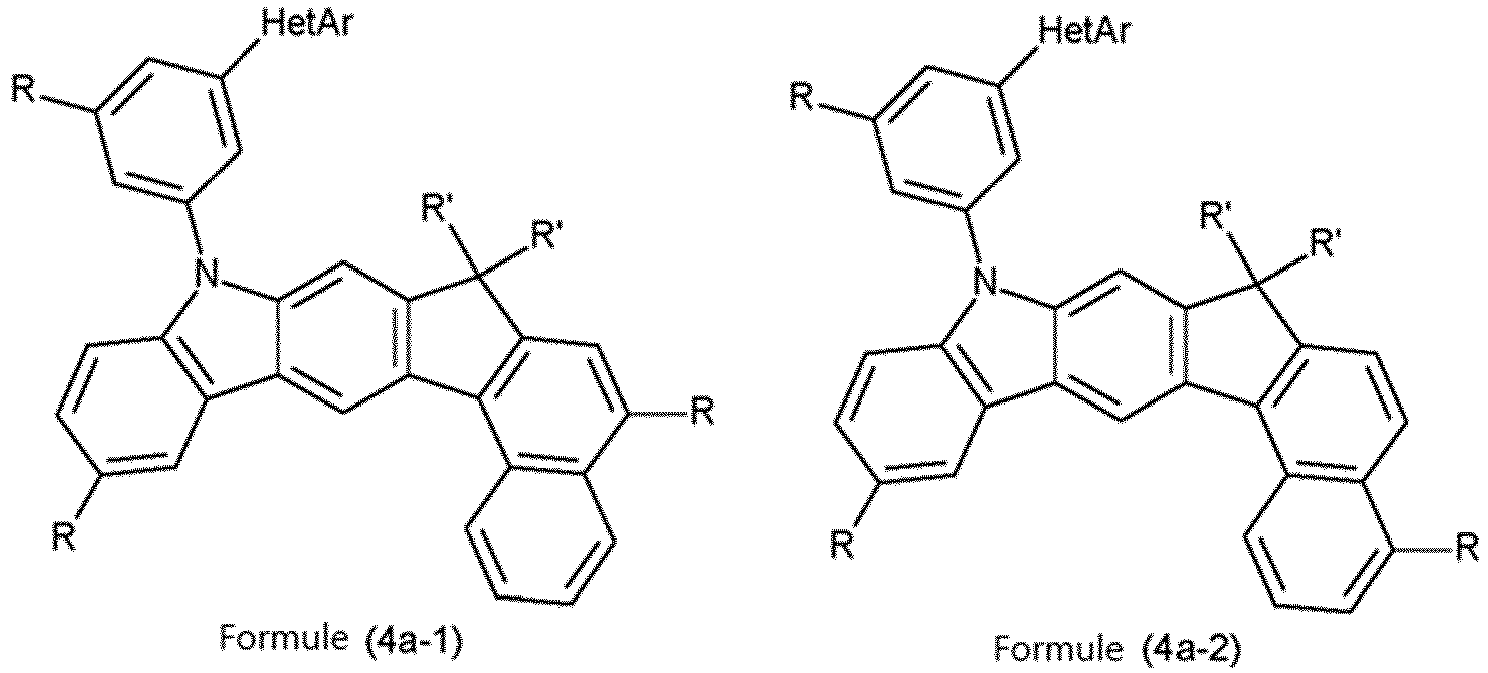
- the compounds of the formulas (3), (4) and (5) are selected from the compounds of the following formulas (3a-1), (3a-2), (4a-1), (4a- 2), (5a-1) and (5a-2), where HetAr, R and R' have the meanings given above.
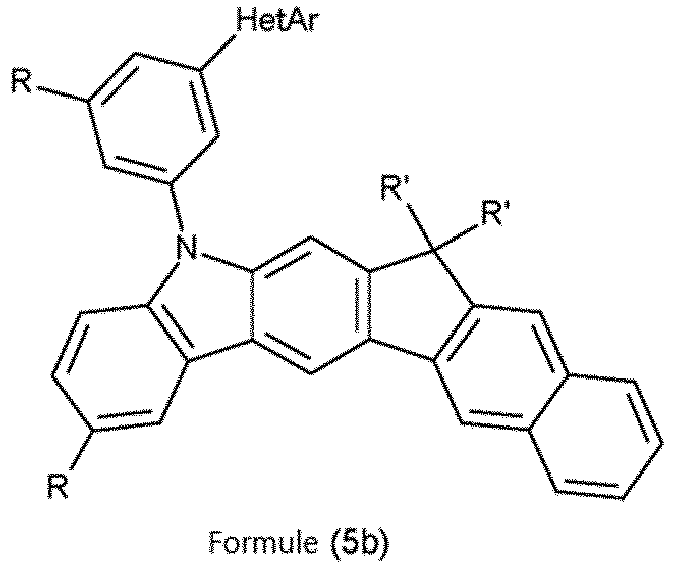
- the compounds of the formulas (3), (4) and (5) are particularly preferably selected from the compounds of the following formulas (3b), (4b) and (5b), where HetAr, R and R' have the meanings given above.
- HetAr is a group according to any one of the formulas (HetAr-1) and (HetAr-3) through (HetAr-5).
- a maximum of two N atoms are preferably bonded directly to one another. Particularly preferably, no N atoms are bonded directly to one another.
- the groups (HetAr-1) and (HetAr-3) to (HetAr-5) have two or three N atoms. It is preferred for formula (HetAr-1) if this represents a pyrimidine group or a 1,3,5-triazine group. It is preferred for the formulas (HetAr-3) and (HetAr-4) if they have two N atoms. More preferably, the formula (HetAr-4) represents a quinazoline group.
- the groups of the formulas (HetAr-1) and (HetAr-3) are preferred, the group of the formula (HetAr-1) being particularly preferred.
- Preferred embodiments of the group (HetAr-1) are the groups of the formulas (HetAr-1a) to (HetAr-1d)
- preferred embodiments of the group (HetAr-3) are the groups of the formula (HetAr-3a)
- preferred embodiments of the group (HetAr-4) are the groups of formula (HetAr-4a)
- preferred embodiments of the group (HetAr-5) are the groups of formula (HetAr-5a) and (HetAr-5b), where Ar is identical or different on each occurrence and is an aromatic or heteroaromatic ring system having 5 to 40 aromatic ring atoms, which can be substituted by one or more R 1 radicals, and the other symbols have the meanings given above.
- Preferred aromatic or heteroaromatic ring systems Ar are selected from phenyl, biphenyl, in particular ortho-, meta- or para-biphenyl, terphenyl, in particular ortho-, meta-, para- or branched terphenyl, quaterphenyl, in particular ortho-, meta-, para- - or branched quaterphenyl, fluorene which can be linked via the 1-, 2-, 3- or 4-position, spirobifluorene which can be linked via the 1-, 2-, 3- or 4-position, naphthalene, in particular 1- or 2-linked naphthalene, indole, benzofuran, benzothiophene, carbazole, which can be linked via the 1-, 2-, 3- or 4-position, dibenzofuran, which can be linked via the 1-, 2-, 3- or 4- -position may be linked, dibenzothiophene which may be linked via the 1-, 2-, 3- or 4-position, indenocarbazole, indoloc
- the substituent R 1 which is bonded to the nitrogen atom is preferably an aromatic or heteroaromatic ring system having 5 to 24 aromatic ring atoms, which can also be substituted by one or more R 2 radicals.
- this substituent R 1 is identical or different on each occurrence for an aromatic or heteroaromatic ring system having 6 to 24 aromatic ring atoms, in particular having 6 to 18 aromatic ring atoms, which has no fused aryl groups and which has no fused heteroaryl groups in which two or more aromatic or heteroaromatic 6-ring groups are fused directly to one another, and which in each case can also be substituted by one or more radicals R 2 .
- phenyl, biphenyl, terphenyl and quaterphenyl with linkage patterns as listed above for Ar-1 to Ar-11 it being possible for these structures to be substituted by one or more R 2 radicals instead of R 1 , but they are preferably unsubstituted.
- Triazine, pyrimidine and quinazoline are also preferred, as listed above for Ar-47 to Ar-50, Ar-57 and Ar-58, it being possible for these structures to be substituted by one or more R 2 radicals instead of by R 1 .
- the substituents R 1 which are bonded to this carbon atom are preferably identical or different on each occurrence for a linear alkyl group having 1 to 10 carbon atoms or for a branched or cyclic alkyl group 3 to 10 carbon atoms or an aromatic or heteroaromatic ring system having 5 to 24 aromatic ring atoms, which can also be substituted by one or more R 2 radicals.
- R 1 very particularly preferably represents a methyl group or a phenyl group.
- the radicals R 1 can also form a ring system with one another, which leads to a spiro system.
- R is the same or different on each occurrence selected from the group consisting of H, D, an aromatic or heteroaromatic ring system with 6 to 30 aromatic ring atoms, which can be substituted by one or more radicals R 1 , or a group N(Ar') 2 .
- R is particularly preferably the same or different on each occurrence selected from the group consisting of H or an aromatic or heteroaromatic ring system having 6 to 24 aromatic ring atoms, preferably having 6 to 18 aromatic ring atoms, particularly preferably having 6 to 13 aromatic ring atoms, each with one or more radicals R 1 may be substituted.
- Preferred aromatic or heteroaromatic ring systems R or Ar' are selected from phenyl, biphenyl, in particular ortho-, meta- or para-biphenyl, terphenyl, in particular ortho-, meta-, para- or branched terphenyl, quaterphenyl, in particular ortho-, meta-, para- or branched quaterphenyl, fluorene which can be linked via the 1-, 2-, 3- or 4-position, spirobifluorene which can be linked via the 1-, 2-, 3- or 4-position , naphthalene, in particular 1- or 2-linked naphthalene, indole, benzofuran, benzothiophene, carbazole, which can be linked via the 1-, 2-, 3- or 4-position, dibenzofuran, which can be linked via the 1-, 2-, may be linked at the 3- or 4-position, dibenzothiophene which may be linked at the 1-, 2-, 3- or 4-position, indenocarbazole, ind
- R are groups of the formula -Ar 4 -N(Ar 2 )(Ar 3 ), where Ar 2 , Ar 3 and Ar 4 are identical or different on each occurrence and represent an aromatic or heteroaromatic ring system having 5 to 24 aromatic ring atoms , each of which may be substituted by one or more R 1 radicals.
- the total number of aromatic ring atoms of Ar 2 , Ar 3 and Ar 4 is at most 60 and preferably at most 40.
- Ar 4 and Ar 2 can be connected to one another and/or Ar 2 and Ar 3 can also be connected to one another via a group selected from C(R 1 ) 2 , NR 1 , O or S be.
- Ar 4 and Ar 2 are preferably linked to one another or Ar 2 and Ar 3 to one another in each case ortho to the position of the linkage to the nitrogen atom.
- none of the groups Ar 2 , Ar 3 or Ar 4 are connected to one another.
- Ar 4 is preferably an aromatic or heteroaromatic ring system having 6 to 24 aromatic ring atoms, preferably having 6 to 12 aromatic ring atoms, which can each be substituted by one or more R 1 radicals.
- Ar 4 is particularly preferably selected from the group consisting of ortho-, meta- or para-phenylene or ortho-, meta- or para-biphenyl, which can each be substituted by one or more radicals R 1 , but are preferably unsubstituted. Most preferably Ar 4 is an unsubstituted phenylene group.
- Ar 2 and Ar 3 are preferably identical or different on each occurrence and are an aromatic or heteroaromatic ring system having 6 to 24 aromatic ring atoms, which can each be substituted by one or more R 1 radicals.
- Particularly preferred Ar 2 and Ar 3 groups are identical or different on each occurrence and are selected from the group consisting of benzene, ortho-, meta- or para-biphenyl, ortho-, meta-, para- or branched terphenyl, ortho-, meta -, para- or branched quaterphenyl, 1-, 2-, 3- or 4-fluorenyl, 1-, 2-, 3- or 4-spirobifluorenyl, 1- or 2-naphthyl, indole, benzofuran, benzothiophene, 1-, 2-, 3- or 4-carbazole, 1-, 2-, 3- or 4-dibenzofuran, 1-, 2-, 3- or 4-dibenzothiophene, indenocarbazole, indolocarbazole, 2-,
- Ar 2 and Ar 3 are very particularly preferably the same or different on each occurrence selected from the group consisting of benzene, biphenyl, in particular ortho-, meta- or para-biphenyl, terphenyl, in particular ortho-, meta-, para- or branched terphenyl , quaterphenyl, in particular ortho-, meta-, para- or branched quaterphenyl, fluorene, in particular 1-, 2-, 3- or 4-fluorene, or spirobifluorene, in particular 1-, 2-, 3- or 4-spirobifluorene.
- R' is selected identically or differently on each occurrence from the group consisting of a straight-chain alkyl group having 1 to 6 carbon atoms or a cyclic alkyl group having 3 to 6 carbon atoms, the alkyl group in each case having one or several radicals R 1 can be substituted, or an aromatic or heteroaromatic ring system with 6 to 24 aromatic ring atoms, which can each be substituted by one or more radicals R 1 ; two radicals R' can also form a ring system with one another.
- R' is particularly preferably selected identically or differently on each occurrence from the group consisting of a straight-chain alkyl group having 1, 2, 3 or 4 carbon atoms or a branched or cyclic alkyl group having 3 to 6 carbon atoms, the alkyl group in each case having one or more radicals R 1 can be substituted, but is preferably unsubstituted, or an aromatic ring system having 6 to 12 aromatic ring atoms, in particular with 6 aromatic ring atoms, which can each be substituted by one or more, preferably non-aromatic radicals R 1 , but preferably unsubstituted; two radicals R' can form a ring system with one another.
- R' is selected identically or differently on each occurrence from the group consisting of a straight-chain alkyl group having 1, 2, 3 or 4 carbon atoms, or a branched alkyl group having 3 to 6 carbon atoms.
- R 1 is the same or different on each occurrence selected from the group consisting of H, D, F, CN, a straight-chain alkyl group having 1 to 10 carbon atoms or a branched or cyclic alkyl group having 3 to 10 C atoms, in which case the alkyl group can be substituted by one or more R 2 radicals, or an aromatic or heteroaromatic ring system having 6 to 24 aromatic ring atoms, which can each be substituted by one or more R 2 radicals.
- R 1 is identical or different on each occurrence selected from the group consisting of H, a straight-chain alkyl group having 1 to 6 carbon atoms, in particular having 1, 2, 3 or 4 carbon atoms, or one branched or cyclic alkyl group having 3 to 6 carbon atoms, wherein the alkyl group with one or several radicals R 2 may be substituted, but is preferably unsubstituted, or an aromatic or heteroaromatic ring system having 6 to 13 aromatic ring atoms, which may be substituted by one or more radicals R 2 , but is preferably unsubstituted.
- R 2 is identical or different on each occurrence and is H, an alkyl group having 1 to 4 carbon atoms or an aryl group having 6 to 10 carbon atoms which is substituted with an alkyl group having 1 to 4 carbon atoms may be, but is preferably unsubstituted.
- the alkyl groups preferably have no more than five carbon atoms, particularly preferably no more than 4 carbon atoms, very particularly preferably no more than 1 carbon atom.
- the alkyl groups are also compounds that are substituted with alkyl groups, especially branched alkyl groups, having up to 10 carbon atoms or with oligoarylene groups, such as ortho-, meta-, para- or branched terphenyl or quaterphenyl groups are substituted.
- the compounds of the formula (1) or the preferred embodiments are used as matrix material for a phosphorescent emitter or in a layer directly adjacent to a phosphorescent layer, it is also preferred if the compound has no fused aryl or heteroaryl groups contains in which more than two six-membered rings are fused directly to one another.
- An exception to this are phenanthrene and triphenylene, which can be preferred due to their high triplet energy despite the presence of fused aromatic six-membered rings.
- the basic structure of the compounds according to the invention can be represented according to the routes outlined in the following schemes.
- the individual synthesis steps such as CC coupling reactions according to Suzuki, CN coupling reactions according to Hartwig-Buchwald or cyclization reactions, are known in principle to those skilled in the art. Further information on the synthesis of the compounds according to the invention can be found in the synthesis examples.
- the synthesis of the basic structure is shown in Scheme 1. This can be done by coupling a benzofluorene substituted with a reactive leaving group, e.g. bromine, with an optionally substituted 2-nitrobenzeneboronic acid, followed by a ring closure reaction.
- the coupling can be carried out with the amino group of an optionally substituted 2-aminochlorobenzene, followed by a ring closure reaction.
- Schemes 2 and 3 show various ways of introducing the m-phenylene-HetAr group on the nitrogen atom of the basic structure, where HetAr stands for a group according to one of the formulas (HetAr-1) or (HetAr-3) to (HetAr-5) stands.
- a group m-phenylene-HetAr substituted with a suitable leaving group, for example bromine, can be used in a nucleophilic aromatic substitution or a palladium-catalyzed one Coupling reaction are introduced as shown in Scheme 2.
- the m-phenylene group which still carries a suitable leaving group, for example bromine, can be introduced on the basic skeleton and in a further coupling reaction, optionally after conversion into a boronic acid derivative, the group (HetAr-1) or (HetAr-3) to (HetAr-5) can be introduced as shown in Scheme 3 on a heteroaromatic group not forming part of the invention.
- a suitable leaving group for example bromine
- a further subject matter of the present invention is therefore a process for preparing a compound according to the invention, in which the basic structure which does not yet contain the group meta-phenylene-HetAr is first synthesized, where HetAr stands for a group according to one of the formulas (HetAr-1) or (HetAr-3) to (HetAr-5) and wherein the meta-phenylene-HetAr group is introduced by a nucleophilic aromatic substitution reaction or a coupling reaction.
- Formulations of the compounds according to the invention are required for the processing of the compounds according to the invention from the liquid phase, for example by spin coating or by printing processes. These formulations can be, for example, solutions, dispersions or emulsions. It may be preferable to use mixtures of two or more solvents for this.
- Suitable and preferred solvents are, for example, toluene, anisole, o-, m- or p-xylene, methyl benzoate, mesitylene, tetralin, veratrol, THF, methyl-THF, THP, chlorobenzene, dioxane, phenoxytoluene, in particular 3-phenoxytoluene, (-) -fenchone, 1,2,3,5-tetramethylbenzene, 1,2,4,5-tetramethylbenzene, 1-methylnaphthalene, 2-methylbenzothiazole, 2-phenoxyethanol, 2-pyrrolidinone, 3-methylanisole, 4-methylanisole, 3,4 -dimethylanisole, 3,5-dimethylanisole, acetophenone, ⁇ -terpineol, benzothiazole, butyl benzoate, cumene, cyclohexanol, cyclohexanone, cyclohexylbenzene, decalin
- a further object of the present invention is therefore a formulation or a composition containing at least one compound according to the invention and at least one further compound.
- the further compound can be a solvent, for example, in particular one of the abovementioned solvents or a mixture of these solvents.
- the further compound can also be at least one further organic or inorganic compound which is also used in the electronic device, for example an emitting compound and/or a further matrix material. Suitable emitting compounds and other matrix materials are listed below in connection with the organic electroluminescent device.
- the further connection can also be polymeric.
- Another object of the present invention is the use of a compound according to the invention in an electronic device, in particular in an organic electroluminescent device.
- An electronic device containing at least one connection according to the invention.
- An electronic device within the meaning of the present invention is a device which contains at least one layer which contains at least one organic compound.
- the component can also contain inorganic materials or also layers which are made up entirely of inorganic materials.
- the electronic device is preferably selected from the group consisting of organic electroluminescent devices (OLEDs), organic integrated circuits (O-ICs), organic field effect transistors (O-FETs), organic thin-film transistors (O-TFTs), organic light-emitting transistors ( O-LETs), organic solar cells (O-SCs), dye-sensitized organic solar cells (DSSCs), organic optical detectors, organic photoreceptors, organic field quench devices (O-FQDs), light-emitting electrochemical cells (LECs), organic laser diodes (O -Laser) and "organic plasmon emitting devices", but preferably organic electroluminescent devices (OLEDs), particularly preferably phosphorescent OLEDs.
- OLEDs organic electroluminescent devices
- O-ICs organic integrated circuits
- O-FETs organic field effect transistors
- OF-TFTs organic thin-film transistors
- O-LETs organic light-emitting transistors
- O-SCs organic solar cells
- the organic electroluminescent device contains cathode, anode and at least one emitting layer. In addition to these layers, it can also contain further layers, for example one or more hole-injection layers, hole-transport layers, hole-blocking layers, electron-transport layers, electron-injection layers, exciton-blocking layers, electron-blocking layers and/or charge-generation layers. Likewise, interlayers can be introduced between two emitting layers, which have an exciton-blocking function, for example. However, it should be pointed out that each of these layers does not necessarily have to be present. In this case, the organic electroluminescence device can contain an emitting layer, or it can contain a plurality of emitting layers.
- a plurality of emission layers are present, these preferably have a total of a plurality of emission maxima between 380 nm and 750 nm, resulting in white emission overall, ie different emitting compounds which can fluoresce or phosphorescence are used in the emitting layers.
- Systems with three emitting layers are particularly preferred, with the three layers showing blue, green and orange or red emission.
- the organic electroluminescence device according to the invention can also be a tandem OLED, in particular for white-emitting OLEDs.
- connection according to the invention can be used in different layers, depending on the exact structure. Preference is given to an organic electroluminescence device containing a compound of the formula (1) or the preferred embodiments outlined above in an emitting layer as matrix material for phosphorescent emitters or for emitters which exhibit TADF (thermally activated delayed fluorescence), in particular for phosphorescent emitters. Furthermore, the compound according to the invention can also be used in an electron transport layer and/or in a hole transport layer and/or in an exciton blocking layer and/or in a hole blocking layer. The compound according to the invention is particularly preferably used as a matrix material for red, orange or yellow phosphorescent emitters, in particular for red phosphorescent emitters, in an emitting layer or as an electron transport or hole blocking material in an electron transport or hole blocking layer.
- the compound according to the invention is used as a matrix material for a phosphorescent compound in an emitting layer, it is preferably used in combination with one or more phosphorescent materials (triplet emitters).
- Phosphorescence within the meaning of this invention is understood as meaning luminescence from an excited state with a higher spin multiplicity, ie a spin state >1, in particular from an excited triplet state.
- all luminescent complexes with transition metals or lanthanides, in particular all iridium, platinum and copper complexes are to be regarded as phosphorescent compounds.
- the mixture of the compound according to the invention and the emitting compound contains between 99 and 1% by volume, preferably between 98 and 10% by volume, particularly preferably between 97 and 60% by volume, in particular between 95 and 80% by volume of the compound according to the invention based on the total mixture of emitter and matrix material.
- the mixture contains between 1 and 99% by volume, preferably between 2 and 90% by volume, particularly preferably between 3 and 40% by volume, in particular between 5 and 20% by volume, of the emitter, based on the total mixture emitter and matrix material.
- the compound according to the invention is used as the sole matrix material (“single host”) for the phosphorescent emitter.
- a further embodiment of the present invention is the use of the compound according to the invention as a matrix material for a phosphorescent emitter in combination with a further matrix material.
- Suitable matrix materials which can be used in combination with the compounds according to the invention are aromatic ketones, aromatic phosphine oxides or aromatic sulfoxides or sulfones, e.g. B. according to WO 2004/013080 , WO 2004/093207 , WO 2006/005627 or WO 2010/006680 , triarylamines, carbazole derivatives, e.g. B.
- CBP N,N-biscarbazolylbiphenyl
- WO 2005/039246 US2005/0069729 , JP 2004/288381 , EP1205527 , WO 2008/086851 or WO 2013/041176
- indolocarbazole derivatives e.g. B. according to WO 2007/063754 or WO 2008/056746
- indenocarbazole derivatives e.g. B. according to WO 2010/136109 , WO 2011/000455 , WO 2013/041176 or WO 2013/056776
- azacarbazole derivatives e.g. B.
- bipolar matrix materials e.g. B. according to WO 2007/137725 , silanes, e.g. B. according to WO 2005/111172 , azaboroles or boron esters, e.g. B. according to WO 2006/117052 , triazine derivatives, e.g. B. according to WO 2007/063754 , WO 2008/056746 , WO 2010/015306 , WO 2011/057706 , WO 2011/060859 or WO 2011/060877 , zinc complexes, e.g. B.
- diazasilol or tetraazasilol derivatives e.g. B. according to WO 2010/054729
- diazaphosphole derivatives e.g. B. according to WO 2010/054730
- bridged carbazole derivatives e.g. B. according to WO 2011/042107 , WO 2011/060867 , WO 2011/088877 and WO 2012/143080
- triphenylene derivatives e.g. B. according to WO 2012/048781
- dibenzofuran derivatives e.g. B.
- a further phosphorescent emitter which emits at a shorter wavelength than the actual emitter, can also be present in the mixture as a co-host. Particularly good results are obtained when Emitter a red phosphorescent emitter is used and a yellow phosphorescent emitter is used as a co-host in combination with the compound of the invention.
- connection can be used as a co-host that does not participate or does not participate to a significant extent in charge transport, such as in WO 2010/108579 described.
- suitable co-matrix material are compounds which have a large band gap and do not themselves participate, or at least not to a significant extent, in the charge transport of the emitting layer.
- Such materials are preferably pure hydrocarbons. Examples of such materials can be found, for example, in WO 2009/124627 or in the WO 2010/006680 .
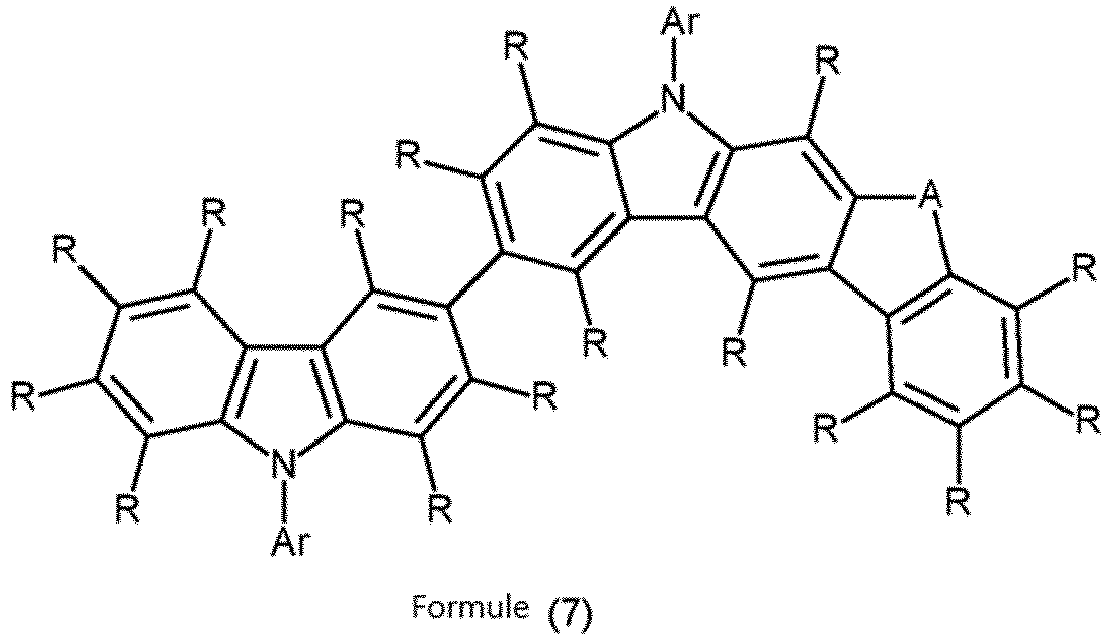
- A is C(R') 2 .
- Preferred embodiments of the compounds of the formulas (6) or (7) are the compounds of the following formulas (6a) or (7a), where the symbols used have the meanings given above.
- Particularly suitable phosphorescent compounds are compounds which, when suitably excited, emit light, preferably in the visible range, and also contain at least one atom with an atomic number greater than 20, preferably greater than 38 and less than 84, particularly preferably greater than 56 and less than 80. in particular a metal with this atomic number.
- Compounds containing copper, molybdenum, tungsten, rhenium, ruthenium, osmium, rhodium, iridium, palladium, platinum, silver, gold or europium are preferably used as phosphorescence emitters, in particular compounds containing iridium or platinum.
- Examples of the emitters described above can be found in the applications WO 00/70655 , WO 2001/41512 , WO 2002/02714 , WO 2002/15645 , EP1191613 , EP1191612 , EP1191614 , WO 05/033244 , WO 05/019373 , US2005/0258742 , WO 2009/146770 , WO 2010/015307 , WO 2010/031485 , WO 2010/054731 , WO 2010/054728 , WO 2010/086089 , WO 2010/099852 , WO 2010/102709 , WO 2011/032626 , WO 2011/066898 , WO 2011/157339 , WO 2012/007086 , WO 2014/008982 , WO 2014/023377 , WO 2014/094961 , WO 2014/094960 , WO 2015/036074 , WO 2015/104045 , WO
- Examples of phosphorescent dopants are listed in the table below.
- the compounds according to the invention are also particularly suitable as matrix materials for phosphorescent emitters in organic electroluminescent devices, such as are used, for.
- Am WO 98/24271 , US2011/0248247 and US2012/0223633 are described.
- an additional blue emission layer is vapor deposited over the entire surface of all pixels, including those that are non-blue in color.
- the organic electroluminescent device according to the invention contains no separate hole injection layer and/or hole transport layer and/or hole blocking layer and/or electron transport layer, ie the emitting layer is directly adjacent to the hole injection layer or the anode, and/or the emitting layer is directly adjacent the electron transport layer or the electron injecting layer or the cathode, such as in WO 2005/053051 described.
- a metal complex which is the same or similar to the metal complex in the emitting layer, directly adjacent to the emitting layer as hole transport or hole injection material, such as e.g. Am WO 2009/030981 described.
- an organic electroluminescence device characterized in that one or more layers are coated using a sublimation process.
- the materials are vapour-deposited in vacuum sublimation systems at an initial pressure of less than 10 -5 mbar, preferably less than 10 -6 mbar. However, it is also possible for the initial pressure to be even lower, for example less than 10 -7 mbar.
- An organic electroluminescent device is also preferred, characterized in that one or more layers are coated using the OVPD (organic vapor phase deposition) method or with the aid of carrier gas sublimation.
- the materials are applied at a pressure between 10 -5 mbar and 1 bar.
- OVPD organic vapor phase deposition
- a special case of this process is the OVJP (Organic Vapor Jet Printing) process, in which the materials are applied directly through a nozzle and thus structured.
- an organic electroluminescent device characterized in that one or more layers of solution, such as. B. by spin coating, or with any printing method, such as. B. screen printing, flexographic printing, offset printing, LITI (Light Induced Thermal Imaging, thermal transfer printing), ink-jet printing (ink jet printing) or nozzle printing.
- any printing method such as. B. screen printing, flexographic printing, offset printing, LITI (Light Induced Thermal Imaging, thermal transfer printing), ink-jet printing (ink jet printing) or nozzle printing.
- Hybrid processes are also possible, in which, for example, one or more layers are applied from solution and one or more further layers are vapor-deposited.
- the compounds according to the invention and the organic electroluminescent devices according to the invention are distinguished in particular by an improved service life compared to the prior art. This applies above all to similar compounds which have an indenocarbazole skeleton instead of the benzindenocarbazole skeleton.
- the other electronic properties of the OLED, such as efficiency or operating voltage, remain at least as good.
- Educt 1 Educt 2 product yield 1a 79% [1804905-31-4 ] 2a 77% [1800333-59-8 ] 3a 78% [1263204-40-5 ] 4a 79% [1198396-39-2 ] 5a 74% 6a 81% [1198396-29-0 ] 7a 78% [1198396-35-8 ] 8a 77% [1674335-13-7 ]
- the solid which precipitates out is filtered after warming to room temperature and washed with ethanol and heptane.
- the residue is extracted hot with toluene, recrystallized from toluene/n-heptane and finally sublimed under high vacuum.
- the purity is 99.9%.
- the yield is 34 g (53 mmol); 66% of Th..
- Educt 1 Educt 2 product yield 1e 61% [213765-59-7] [2120350-09-4] 2e 62% [2102515-67-1] [2097261-60-2] 3e 58% [2102515-67-1] [1040010-77-0] 4e 65% [213765-59-7] [1824702-22-8] 5e 63% [213765-59-7] [1891018-83-9] 6e 63% [213765-59-7] [307929-32-4] 7e 72% [2102515-67-1] [2098802-13-0] 8e 62% [213765-59-7] [2129160-65-0] 9e 62% [2102515-67-1] [2136352-17-3] 10e 61% [2102515-67-1] [2137919-54-9] 11e 67% [213765-59-7] [2097261-60-2] 12e 60% [213765-59-7] [213652-15-1] 13e
- the solid formed After cooling to room temperature, the solid formed is filtered off with suction, dried in vacuo and then hot-extracted twice with about 500 mL toluene over aluminum oxide (basic, activity level 1). The solid formed is boiled out with about 350 mL heptane. The residue is extracted hot with toluene, recrystallized from toluene/n-heptane and finally sublimed under high vacuum. The purity is 99.9%. Yield: 60 g (94 mmol); 55% of Th..
- Pretreatment for Examples E1-E3 Glass flakes coated with structured ITO (indium tin oxide) with a thickness of 50 nm are treated with an oxygen plasma before coating, followed by a Argon plasma treated. These plasma-treated glass flakes form the substrates on which the OLEDs are applied.
- structured ITO indium tin oxide
- the OLEDs have the following layer structure: substrate / hole injection layer (HIL) / hole transport layer (HTL) / electron blocking layer (EBL) / emission layer (EML) / optional hole blocking layer (HBL) / electron transport layer (ETL) / optional electron injection layer (EIL) and finally a cathode.
- the cathode is formed by a 100 nm thick aluminum layer.
- Table 1 The precise structure of the OLEDs can be found in Table 1.
- the materials required to produce the OLEDs are shown in Table 2.
- the data of the OLEDs are listed in Table 3.
- the emission layer always consists of at least one matrix material (host material, host material) and an emitting dopant (dopant, emitter), which is added to the matrix material or matrix materials by co-evaporation in a certain proportion by volume.
- a specification such as IC1: IC2:TER5 (55%:35%: 10%) means that the material IC1 accounts for 55% by volume, IC2 for 35% and TER5 for 10% in the layer present.
- the emission layer can also consist of at least one matrix material and a plurality of emitting dopants, which are admixed to the matrix material or matrix materials in a certain proportion by volume by co-evaporation. Not all emitters used have to contribute to the emission.
- the electron transport layer can also consist of a mixture of two materials.
- the OLEDs are characterized by default.
- the electroluminescence spectra, the current efficiency (SE, measured in cd/A) and the external quantum efficiency (EQE, measured in %) are determined as a function of the luminance, calculated from current-voltage-luminance characteristics assuming a Lambertian radiation characteristic, and the lifetime .
- the electroluminescence spectra are determined at a luminance of 1000 cd/m 2 and from this the CIE 1931 x and y Color coordinates calculated.
- the service life LD is defined as the time after which the luminance falls from the initial luminance to a certain proportion L1 during operation with a constant current density j 0 .
- the compound EG1 according to the invention is used in Examples E1 to E3 as matrix material in the emission layer of phosphorescent red OLEDs. Both as a single material (Example E1) and in a mixture with a hole-conducting matrix material (Example E2) and in combination with a second phosphorescent yellow emitter (Example E3), significant improvements in service life compared to the prior art are achieved (V1 to V3). otherwise almost unchanged parameters. As prior art, a compound according to WO 2010/136109 deployed.
- Table 1 Structure of the OLEDs E.g HIL thickness HTL thickness EBL thickness EML thickness HBL thickness ETL thickness EIL thickness V1 HATCN 5nm SpMA1 125nm SpMA3 10nm IC1:TER5 (97%:3%) 40nm --- ST2:LiQ (50%:50%) 35nm --- v2 HATCN 5nm SpMA1 125nm SpMA3 10nm IC1:IC2:TER5 (32%:65%:3%) 40nm --- ST2:LiQ (50%:50%) 35nm --- V3 HATCN 5nm SpMA4 135nm --- IC1 :TEY1 :TER6 (80%:15%:5%) 40nm --- ST2:LiQ (50%:50%) 35nm --- E1 HATCN 5nm SpMA1 125nm SpMA3 10nm EG1:TER5 (97%:3%) 40nm --- ST2:LiQ (50%:50%) 35nm
Landscapes
- Chemical & Material Sciences (AREA)
- Organic Chemistry (AREA)
- Physics & Mathematics (AREA)
- Engineering & Computer Science (AREA)
- Materials Engineering (AREA)
- Spectroscopy & Molecular Physics (AREA)
- Optics & Photonics (AREA)
- Electroluminescent Light Sources (AREA)
- Plural Heterocyclic Compounds (AREA)
- Nitrogen Condensed Heterocyclic Rings (AREA)
- Heterocyclic Carbon Compounds Containing A Hetero Ring Having Oxygen Or Sulfur (AREA)
- Semiconductor Lasers (AREA)
Claims (13)
- Composé selon la formule (1)
 X deux X adjacents représentent un groupe de la formule (2) suivante et les deux autres X représentent CR,
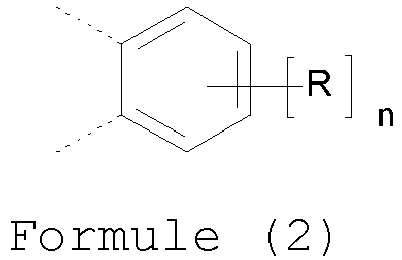 HetAr représente un groupe selon l'une des formules (HetAr-1), (HetAr-3), (HetAr-4) ou (HetAr-5),
 Y représente, en chaque occurrence, de manière identique ou différente, CR ou N, sous réserve qu'au moins un symbole Y représente N et qu'au maximum trois symboles Y représentent N ;A représente C(R1)2, NR1, O ou S ;R représente, en chaque occurrence, de manière identique ou différente, H, D, F, Cl, Br, I, N(R1)2, N(Ar')2, CN, NO2, OR1, SR1, COOR1, C(=O)N(R1)2, Si(R1)3, B(OR1) 2, C(=O)R1, P(=O)(R1)2, S(=O)R1, S(=O)2R1, OSO2R1, un groupe alkyle linéaire comprenant 1 à 20 atomes de carbone ou un groupe alcényle ou alcynyle comprenant 2 à 20 atomes de carbone ou un groupe alkyle ramifié ou cyclique comprenant 3 à 20 atomes de carbone, le groupe alkyle, alcényle ou alcynyle pouvant à chaque fois être substitué par un ou plusieurs radicaux R1 et un ou plusieurs groupes CH2 non adjacents pouvant être remplacés par Si(R1)2, C=O, NR1, O, S ou CONR1, ou un système cyclique aromatique ou hétéroaromatique comprenant 5 à 60 atomes de cycle aromatique, de préférence 5 à 40 atomes de cycle aromatique, qui peut à chaque fois être substitué par un ou plusieurs radicaux R1 ; deux radicaux R pouvant également former ensemble un système cyclique aliphatique ou hétéroaliphatique ;R' représente, en chaque occurrence, de manière identique ou différente, un groupe alkyle linéaire comprenant 1 à 20 atomes de carbone ou un groupe alkyle ramifié ou cyclique comprenant 3 à 20 atomes de carbone, le groupe alkyle linéaire, ramifié ou cyclique pouvant à chaque fois être substitué par un ou plusieurs radicaux R1 et un ou plusieurs groupes CH2 non adjacents pouvant être remplacés par O, ou un système cyclique aromatique ou hétéroaromatique comprenant 5 à 40 atomes de cycle aromatique, qui peut à chaque fois être substitué par un ou plusieurs radicaux R1 ; deux radicaux R' pouvant également former ensemble un système cyclique aromatique, hétéroaromatique, aliphatique ou hétéroaliphatique ;Ar' représente, en chaque occurrence, de manière identique ou différente, un système cyclique aromatique ou hétéroaromatique comprenant 5 à 40 atomes de cycle aromatique, qui peut être substitué par un ou plusieurs radicaux R1 ;R1 représente, en chaque occurrence, de manière identique ou différente, H, D, F, Cl, Br, I, N(R2)2, CN, NO2, OR2, SR2, Si(R2)3, B(OR2)2, C(=O)R2, P(=O)(R2)2, S(=O)R2, S(=O)2R2, OSO2R2, un groupe alkyle linéaire comprenant 1 à 20 atomes de carbone ou un groupe alcényle ou alcynyle comprenant 2 à 20 atomes de carbone ou un groupe alkyle ramifié ou cyclique comprenant 3 à 20 atomes de carbone, le groupe alkyle, alcényle ou alcynyle pouvant à chaque fois être substitué par un ou plusieurs radicaux R2, un ou plusieurs groupes CH2 non adjacents pouvant être remplacés par Si(R2)2, C=O, NR2, O, S ou CONR2, ou un système cyclique aromatique ou hétéroaromatique comprenant 5 à 40 atomes de cycle aromatique, qui peut à chaque fois être substitué par un ou plusieurs radicaux R2 ; deux radicaux R1 ou plus pouvant former ensemble un système cyclique ;R2 représente, en chaque occurrence, de manière identique ou différente, H, D, F ou un radical organique, en particulier un radical hydrocarboné, aliphatique, aromatique ou hétéroaromatique, comprenant 1 à 20 atomes de carbone, dans lequel un ou plusieurs atomes H peuvent également être remplacés par F ;m vaut 0, 1 ou 2 ;n représente, en chaque occurrence, de manière identique ou différente, 0, 1, 2, 3 ou 4.
 - Composé selon la revendication 1, choisi parmi les composés des formules (3a-1), (3a-2), (4a-1), (4a-2), (5a-1) et (5a-2),


- Composé selon la revendication 1 ou 2, choisi parmi les composés des formules (3b), (4b) et (5b),

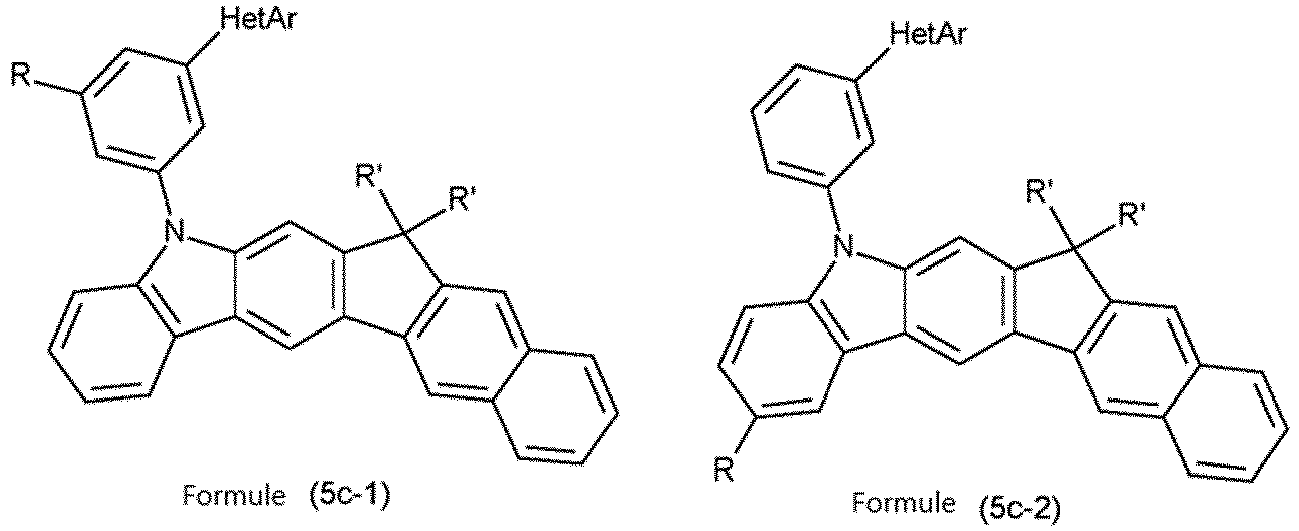
- Composé selon l'une ou plusieurs des revendications 1 à 3, choisi parmi les composés des formules (3c-1), (3c-2), (4c-1), (4c-2), (5c-1) et (5c-2),


- Composé selon l'une ou plusieurs des revendications 1 à 4, caractérisé en ce que HetAr est choisi parmi les groupes des formules (HetAr-1a) à (HetAr-1d), (HetAr-3a), (HetAr-4a), (HetAr-5a) et (HetAr-5b),


- Composé selon la revendication 5, caractérisé en ce que Ar est choisi, en chaque occurrence, de manière identique ou différente, parmi phényle, biphényle, terphényle, quaterphényle, fluorène, spirobifluorène, naphtalène, indole, benzofuranne, benzothiophène, carbazole, dibenzofuranne, dibenzothiophène, indénocarbazole, indolocarbazole, pyridine, pyrimidine, pyrazine, pyridazine, triazine, quinoléine, isoquinoléine, quinazoline, quinoxaline, phénanthrène ou triphénylène, qui peuvent à chaque fois être substitués par un ou plusieurs radicaux R1.
- Composé selon l'une ou plusieurs des revendications 1 à 6, caractérisé en ce que R est choisi, en chaque occurrence, de manière identique ou différente, dans le groupe constitué par H, D, un système cyclique aromatique ou hétéroaromatique comprenant 6 à 30 atomes de cycle aromatique, qui peut être substitué par un ou plusieurs radicaux R1, ou un groupe N(Ar')2.
- Procédé pour la préparation d'un composé selon l'une ou plusieurs des revendications 1 à 7, caractérisé en ce que la structure de base, qui ne contient pas encore le groupe méta-phénylène-HetAr, est synthétisée et en ce que le groupe méta-phénylène-HetAr est introduit au moyen d'une réaction de substitution aromatique nucléophile ou d'une réaction de couplage.
- Formulation, contenant au moins un composé selon l'une ou plusieurs des revendications 1 à 7 et au moins un autre composé, l'autre composé étant de préférence choisi parmi un ou plusieurs solvants, un composé émetteur et/ou un autre matériau de matrice.
- Utilisation d'un composé selon l'une ou plusieurs des revendications 1 à 7 dans un dispositif électronique.
- Dispositif électronique contenant au moins un composé selon l'une ou plusieurs des revendications 1 à 7.
- Dispositif électronique selon la revendication 11, le dispositif étant un dispositif organique électroluminescent, caractérisé en ce que le composé selon l'une ou plusieurs des revendications 1 à 7 est utilisé comme matériau de matrice dans une couche émettrice et/ou dans une couche de transport d'électrons et/ou dans une couche de blocage de trous.
- Dispositif électronique selon la revendication 12, caractérisé en ce que le composé selon la revendication 1 à 7 est utilisé comme matériau de matrice pour des émetteurs phosphorescents en combinaison avec un autre matériau de matrice qui est choisi parmi les composés selon l'une des formules (6) ou (7),

Applications Claiming Priority (2)
| Application Number | Priority Date | Filing Date | Title |
|---|---|---|---|
| EP18153359 | 2018-01-25 | ||
| PCT/EP2019/051549 WO2019145316A1 (fr) | 2018-01-25 | 2019-01-23 | Matières pour dispositifs électroluminescents organiques |
Publications (2)
| Publication Number | Publication Date |
|---|---|
| EP3744155A1 EP3744155A1 (fr) | 2020-12-02 |
| EP3744155B1 true EP3744155B1 (fr) | 2022-11-02 |
Family
ID=61027520
Family Applications (1)
| Application Number | Title | Priority Date | Filing Date |
|---|---|---|---|
| EP19701350.1A Active EP3744155B1 (fr) | 2018-01-25 | 2019-01-23 | Matériaux pour dispositifs électroluminescents organiques |
Country Status (7)
| Country | Link |
|---|---|
| US (1) | US20210111351A1 (fr) |
| EP (1) | EP3744155B1 (fr) |
| JP (1) | JP2021511377A (fr) |
| KR (1) | KR102651211B1 (fr) |
| CN (1) | CN111557122B (fr) |
| TW (1) | TWI811290B (fr) |
| WO (1) | WO2019145316A1 (fr) |
Families Citing this family (22)
| Publication number | Priority date | Publication date | Assignee | Title |
|---|---|---|---|---|
| KR102388877B1 (ko) * | 2019-05-21 | 2022-04-21 | 주식회사 엘지화학 | 화합물 및 이를 포함하는 유기 발광 소자 |
| EP4046208A1 (fr) * | 2019-10-16 | 2022-08-24 | Merck Patent GmbH | Dispositifs électroniques |
| CN112521327A (zh) * | 2020-12-17 | 2021-03-19 | 北京燕化集联光电技术有限公司 | 一种有机化合物及其应用 |
| KR102791287B1 (ko) * | 2020-12-21 | 2025-04-08 | 엘티소재주식회사 | 헤테로고리 화합물, 이를 포함하는 유기 발광 소자, 이의 제조 방법 및 유기물층용 조성물 |
| EP4631325A1 (fr) | 2022-12-08 | 2025-10-15 | Merck Patent GmbH | Dispositif électronique organique et matériaux spéciaux pour dispositifs électroniques organiques |
| CN120380877A (zh) | 2022-12-19 | 2025-07-25 | 默克专利有限公司 | 用于电子器件的材料 |
| EP4683925A1 (fr) | 2023-03-20 | 2026-01-28 | Merck Patent GmbH | Matériaux pour dispositifs électroluminescents organiques |
| WO2025045816A1 (fr) | 2023-08-29 | 2025-03-06 | Merck Patent Gmbh | Matériaux pour dispositifs électroluminescents organiques |
| CN121753522A (zh) | 2023-08-30 | 2026-03-27 | 默克专利有限公司 | 用于有机发光器件的材料 |
| WO2025045851A1 (fr) | 2023-08-30 | 2025-03-06 | Merck Patent Gmbh | Matériaux pour dispositifs électroluminescents organiques |
| WO2025045843A1 (fr) | 2023-08-30 | 2025-03-06 | Merck Patent Gmbh | Matériaux pour dispositifs électroluminescents organiques |
| WO2025073675A1 (fr) | 2023-10-04 | 2025-04-10 | Merck Patent Gmbh | Matériaux pour dispositifs électroluminescents organiques |
| WO2025104058A1 (fr) | 2023-11-16 | 2025-05-22 | Merck Patent Gmbh | Matériaux pour dispositifs électroniques organiques |
| WO2025119821A1 (fr) | 2023-12-05 | 2025-06-12 | Merck Patent Gmbh | Composition de matériau pour dispositifs électroluminescents organiques |
| WO2025168515A1 (fr) | 2024-02-06 | 2025-08-14 | Merck Patent Gmbh | Matériaux pour dispositifs électroniques organiques |
| WO2025195961A1 (fr) | 2024-03-19 | 2025-09-25 | Merck Patent Gmbh | Dispositifs électroluminescents organiques |
| WO2025228800A1 (fr) | 2024-04-30 | 2025-11-06 | Merck Patent Gmbh | Matériaux pour dispositifs électroniques organiques |
| WO2026017611A1 (fr) | 2024-07-15 | 2026-01-22 | Merck Patent Gmbh | Dispositif électroluminescent organique |
| WO2026017612A1 (fr) | 2024-07-15 | 2026-01-22 | Merck Patent Gmbh | Dispositif électroluminescent organique |
| WO2026017607A1 (fr) | 2024-07-15 | 2026-01-22 | Merck Patent Gmbh | Dispositif électroluminescent organique |
| WO2026017608A1 (fr) | 2024-07-15 | 2026-01-22 | Merck Patent Gmbh | Matériaux pour dispositifs électroluminescents organiques |
| CN119684308B (zh) * | 2025-02-25 | 2025-07-18 | 西安瑞联新材料股份有限公司 | 一种用于有机发光材料的化合物及其应用 |
Family Cites Families (105)
| Publication number | Priority date | Publication date | Assignee | Title |
|---|---|---|---|---|
| JPH07133483A (ja) | 1993-11-09 | 1995-05-23 | Shinko Electric Ind Co Ltd | El素子用有機発光材料及びel素子 |
| JP3139321B2 (ja) | 1994-03-31 | 2001-02-26 | 東レ株式会社 | 発光素子 |
| JP3899566B2 (ja) | 1996-11-25 | 2007-03-28 | セイコーエプソン株式会社 | 有機el表示装置の製造方法 |
| CN101312235B (zh) | 1999-05-13 | 2010-06-09 | 普林斯顿大学理事会 | 基于电致磷光的极高效有机发光器件 |
| JP4357781B2 (ja) | 1999-12-01 | 2009-11-04 | ザ、トラスティーズ オブ プリンストン ユニバーシティ | 有機led用燐光性ドーパントとしての式l2mxの錯体 |
| US6660410B2 (en) | 2000-03-27 | 2003-12-09 | Idemitsu Kosan Co., Ltd. | Organic electroluminescence element |
| US20020121638A1 (en) | 2000-06-30 | 2002-09-05 | Vladimir Grushin | Electroluminescent iridium compounds with fluorinated phenylpyridines, phenylpyrimidines, and phenylquinolines and devices made with such compounds |
| JP5241053B2 (ja) | 2000-08-11 | 2013-07-17 | ザ、トラスティーズ オブ プリンストン ユニバーシティ | 有機金属化合物及び放射移行有機電気燐光体 |
| JP4154139B2 (ja) | 2000-09-26 | 2008-09-24 | キヤノン株式会社 | 発光素子 |
| JP4154138B2 (ja) | 2000-09-26 | 2008-09-24 | キヤノン株式会社 | 発光素子、表示装置及び金属配位化合物 |
| JP4154140B2 (ja) | 2000-09-26 | 2008-09-24 | キヤノン株式会社 | 金属配位化合物 |
| US6689494B1 (en) * | 2001-09-11 | 2004-02-10 | Bhalchandra M. Karandikar | Light emissive materials for organic light emitting devices (OLED) and OLED based thereupon |
| ITRM20020411A1 (it) | 2002-08-01 | 2004-02-02 | Univ Roma La Sapienza | Derivati dello spirobifluorene, loro preparazione e loro uso. |
| JP4411851B2 (ja) | 2003-03-19 | 2010-02-10 | コニカミノルタホールディングス株式会社 | 有機エレクトロルミネッセンス素子 |
| EP1717291A3 (fr) | 2003-04-15 | 2007-03-21 | Merck Patent GmbH | Mélanges de semi-conducteurs organiques aptes à l'émission et de matières matricielles, leur utilisation et composants électroniques contenant ces mélanges |
| EP1617711B1 (fr) | 2003-04-23 | 2016-08-17 | Konica Minolta Holdings, Inc. | Dispositif organique électroluminescent et affichage |
| DE10338550A1 (de) | 2003-08-19 | 2005-03-31 | Basf Ag | Übergangsmetallkomplexe mit Carbenliganden als Emitter für organische Licht-emittierende Dioden (OLEDs) |
| DE10345572A1 (de) | 2003-09-29 | 2005-05-19 | Covion Organic Semiconductors Gmbh | Metallkomplexe |
| US7795801B2 (en) | 2003-09-30 | 2010-09-14 | Konica Minolta Holdings, Inc. | Organic electroluminescent element, illuminator, display and compound |
| CN100536190C (zh) | 2003-11-25 | 2009-09-02 | 默克专利有限公司 | 有机电致发光元件 |
| US7790890B2 (en) | 2004-03-31 | 2010-09-07 | Konica Minolta Holdings, Inc. | Organic electroluminescence element material, organic electroluminescence element, display device and illumination device |
| DE102004023277A1 (de) | 2004-05-11 | 2005-12-01 | Covion Organic Semiconductors Gmbh | Neue Materialmischungen für die Elektrolumineszenz |
| US7598388B2 (en) | 2004-05-18 | 2009-10-06 | The University Of Southern California | Carbene containing metal complexes as OLEDs |
| JP4862248B2 (ja) | 2004-06-04 | 2012-01-25 | コニカミノルタホールディングス株式会社 | 有機エレクトロルミネッセンス素子、照明装置及び表示装置 |
| ITRM20040352A1 (it) | 2004-07-15 | 2004-10-15 | Univ Roma La Sapienza | Derivati oligomerici dello spirobifluorene, loro preparazione e loro uso. |
| EP1888706B1 (fr) | 2005-05-03 | 2017-03-01 | Merck Patent GmbH | Dispositif electroluminescent organique, et derives d'acide boronique et d'acide borinique utilises pour produire ce dispositif electroluminescent organique |
| EP1956022B1 (fr) | 2005-12-01 | 2012-07-25 | Nippon Steel Chemical Co., Ltd. | Compose pour element electroluminescent organique et element electroluminescent organique |
| DE102006025777A1 (de) | 2006-05-31 | 2007-12-06 | Merck Patent Gmbh | Neue Materialien für organische Elektrolumineszenzvorrichtungen |
| EP2080762B1 (fr) | 2006-11-09 | 2016-09-14 | Nippon Steel & Sumikin Chemical Co., Ltd. | Composé pour un dispositif électroluminescent organique et dispositif électroluminescent organique |
| WO2009030981A2 (fr) | 2006-12-28 | 2009-03-12 | Universal Display Corporation | Structures de dispositifs électroluminescents organiques (oled) phosphorescents à longue durée de vie utile |
| DE102007002714A1 (de) | 2007-01-18 | 2008-07-31 | Merck Patent Gmbh | Neue Materialien für organische Elektrolumineszenzvorrichtungen |
| DE102007053771A1 (de) | 2007-11-12 | 2009-05-14 | Merck Patent Gmbh | Organische Elektrolumineszenzvorrichtungen |
| DE102008017591A1 (de) | 2008-04-07 | 2009-10-08 | Merck Patent Gmbh | Neue Materialien für organische Elektrolumineszenzvorrichtungen |
| DE102008027005A1 (de) | 2008-06-05 | 2009-12-10 | Merck Patent Gmbh | Organische elektronische Vorrichtung enthaltend Metallkomplexe |
| DE102008033943A1 (de) | 2008-07-18 | 2010-01-21 | Merck Patent Gmbh | Neue Materialien für organische Elektrolumineszenzvorrichtungen |
| DE102008036247A1 (de) | 2008-08-04 | 2010-02-11 | Merck Patent Gmbh | Elektronische Vorrichtungen enthaltend Metallkomplexe |
| DE102008036982A1 (de) | 2008-08-08 | 2010-02-11 | Merck Patent Gmbh | Organische Elektrolumineszenzvorrichtung |
| DE102008048336A1 (de) | 2008-09-22 | 2010-03-25 | Merck Patent Gmbh | Einkernige neutrale Kupfer(I)-Komplexe und deren Verwendung zur Herstellung von optoelektronischen Bauelementen |
| JP5701766B2 (ja) | 2008-11-11 | 2015-04-15 | メルク パテント ゲーエムベーハー | 有機エレクトロルミネセント素子 |
| DE102008056688A1 (de) | 2008-11-11 | 2010-05-12 | Merck Patent Gmbh | Materialien für organische Elektrolumineszenzvorrichtungen |
| DE102008057050B4 (de) | 2008-11-13 | 2021-06-02 | Merck Patent Gmbh | Materialien für organische Elektrolumineszenzvorrichtungen |
| DE102008057051B4 (de) | 2008-11-13 | 2021-06-17 | Merck Patent Gmbh | Materialien für organische Elektrolumineszenzvorrichtungen |
| DE102009005288A1 (de) * | 2009-01-20 | 2010-07-22 | Merck Patent Gmbh | Materialien für organische Elektrolumineszenzvorrichtungen |
| DE102009007038A1 (de) | 2009-02-02 | 2010-08-05 | Merck Patent Gmbh | Metallkomplexe |
| DE102009011223A1 (de) | 2009-03-02 | 2010-09-23 | Merck Patent Gmbh | Metallkomplexe |
| DE102009013041A1 (de) | 2009-03-13 | 2010-09-16 | Merck Patent Gmbh | Materialien für organische Elektrolumineszenzvorrichtungen |
| DE102009014513A1 (de) | 2009-03-23 | 2010-09-30 | Merck Patent Gmbh | Organische Elektrolumineszenzvorrichtung |
| DE102009023155A1 (de) * | 2009-05-29 | 2010-12-02 | Merck Patent Gmbh | Materialien für organische Elektrolumineszenzvorrichtungen |
| DE102009031021A1 (de) | 2009-06-30 | 2011-01-05 | Merck Patent Gmbh | Materialien für organische Elektrolumineszenzvorrichtungen |
| DE102009041414A1 (de) | 2009-09-16 | 2011-03-17 | Merck Patent Gmbh | Metallkomplexe |
| DE102009053645A1 (de) | 2009-11-17 | 2011-05-19 | Merck Patent Gmbh | Materialien für organische Elektrolumineszenzvorrichtung |
| DE102009053644B4 (de) | 2009-11-17 | 2019-07-04 | Merck Patent Gmbh | Materialien für organische Elektrolumineszenzvorrichtungen |
| DE102009048791A1 (de) | 2009-10-08 | 2011-04-14 | Merck Patent Gmbh | Materialien für organische Elektrolumineszenzvorrichtungen |
| DE102009053382A1 (de) | 2009-11-14 | 2011-05-19 | Merck Patent Gmbh | Materialien für elektronische Vorrichtungen |
| DE102009053836A1 (de) | 2009-11-18 | 2011-05-26 | Merck Patent Gmbh | Materialien für organische Elektrolumineszenzvorrichtungen |
| DE102009057167A1 (de) | 2009-12-05 | 2011-06-09 | Merck Patent Gmbh | Elektronische Vorrichtung enthaltend Metallkomplexe |
| DE102010005697A1 (de) | 2010-01-25 | 2011-07-28 | Merck Patent GmbH, 64293 | Verbindungen für elektronische Vorrichtungen |
| JP5678487B2 (ja) | 2010-04-09 | 2015-03-04 | ソニー株式会社 | 有機el表示装置 |
| WO2011157339A1 (fr) | 2010-06-15 | 2011-12-22 | Merck Patent Gmbh | Complexes métalliques |
| DE102010027317A1 (de) | 2010-07-16 | 2012-01-19 | Merck Patent Gmbh | Metallkomplexe |
| KR20120042633A (ko) * | 2010-08-27 | 2012-05-03 | 롬엔드하스전자재료코리아유한회사 | 신규한 유기 발광 화합물 및 이를 포함하는 유기 전계 발광 소자 |
| DE102010048608A1 (de) | 2010-10-15 | 2012-04-19 | Merck Patent Gmbh | Materialien für organische Elektrolumineszenzvorrichtungen |
| WO2012069121A1 (fr) * | 2010-11-24 | 2012-05-31 | Merck Patent Gmbh | Matériaux pour dispositifs d'électroluminescence organiques |
| EP2663567B1 (fr) * | 2011-01-13 | 2016-06-01 | Merck Patent GmbH | Composés pour des dispositifs électroluminescents organiques |
| JP5778950B2 (ja) | 2011-03-04 | 2015-09-16 | 株式会社Joled | 有機el表示装置およびその製造方法 |
| JP6215192B2 (ja) | 2011-04-18 | 2017-10-18 | メルク パテント ゲーエムベーハー | 有機エレクトロルミネッセンス素子用材料 |
| KR20120136618A (ko) * | 2011-06-09 | 2012-12-20 | 롬엔드하스전자재료코리아유한회사 | 신규한 유기 전자재료용 화합물 및 이를 포함하는 유기 전계 발광 소자 |
| WO2013020631A1 (fr) * | 2011-08-10 | 2013-02-14 | Merck Patent Gmbh | Complexes métalliques |
| IN2014KN00846A (fr) * | 2011-09-21 | 2015-10-02 | Merck Patent Gmbh | |
| WO2013056776A1 (fr) | 2011-10-20 | 2013-04-25 | Merck Patent Gmbh | Matériaux destinés à des dispositifs électroluminescents organiques |
| WO2013120577A1 (fr) * | 2012-02-14 | 2013-08-22 | Merck Patent Gmbh | Composés de spirobifluorène pour dispositifs organiques électroluminescents |
| US9837622B2 (en) | 2012-07-13 | 2017-12-05 | Merck Patent Gmbh | Metal complexes |
| KR101552135B1 (ko) * | 2012-07-13 | 2015-09-10 | 덕산네오룩스 주식회사 | 화합물, 이를 이용한 유기전기소자 및 그 전자 장치 |
| WO2014023377A2 (fr) | 2012-08-07 | 2014-02-13 | Merck Patent Gmbh | Complexes métalliques |
| JP6407883B2 (ja) * | 2012-12-14 | 2018-10-17 | メルク パテント ゲーエムベーハー | 電子素子のための材料 |
| US20150349277A1 (en) | 2012-12-21 | 2015-12-03 | Merck Patent Gmbh | Metal complexes |
| WO2014094961A1 (fr) | 2012-12-21 | 2014-06-26 | Merck Patent Gmbh | Complexes métalliques |
| JP6567499B2 (ja) * | 2013-04-08 | 2019-08-28 | メルク パテント ゲーエムベーハー | 有機エレクトロルミネッセント素子 |
| KR102304715B1 (ko) * | 2013-06-14 | 2021-09-27 | 삼성디스플레이 주식회사 | 유기 발광 소자 |
| CN105531347B (zh) | 2013-09-11 | 2018-09-11 | 默克专利有限公司 | 金属络合物 |
| KR102251474B1 (ko) * | 2013-09-16 | 2021-05-17 | 롬엔드하스전자재료코리아유한회사 | 신규한 유기 전계 발광 화합물 및 이를 포함하는 유기 전계 발광 소자 |
| JP2015106661A (ja) * | 2013-11-29 | 2015-06-08 | 出光興産株式会社 | 有機エレクトロルミネッセンス素子および電子機器 |
| KR102214622B1 (ko) * | 2013-12-27 | 2021-02-15 | 롬엔드하스전자재료코리아유한회사 | 신규한 유기 전계 발광 화합물 및 이를 포함하는 유기 전계 발광 소자 |
| CN105916868B (zh) | 2014-01-13 | 2020-06-23 | 默克专利有限公司 | 金属络合物 |
| CN105980519B (zh) | 2014-02-05 | 2019-06-14 | 默克专利有限公司 | 金属络合物 |
| JP6890975B2 (ja) | 2014-05-05 | 2021-06-18 | メルク パテント ゲーエムベーハー | 有機エレクトロルミネッセンス素子のための材料 |
| KR20150141147A (ko) * | 2014-06-09 | 2015-12-17 | 롬엔드하스전자재료코리아유한회사 | 유기 전계 발광 화합물 및 이를 포함하는 유기 전계 발광 소자 |
| EP3174890B1 (fr) | 2014-07-28 | 2019-03-13 | Merck Patent GmbH | Complexes métalliques |
| KR102474330B1 (ko) | 2014-07-29 | 2022-12-05 | 메르크 파텐트 게엠베하 | 유기 전계발광 소자용 재료 |
| KR102433463B1 (ko) | 2014-08-13 | 2022-08-18 | 메르크 파텐트 게엠베하 | 유기 전계발광 소자용 재료 |
| KR102291492B1 (ko) * | 2015-01-16 | 2021-08-20 | 삼성디스플레이 주식회사 | 유기 발광 소자 |
| JP6772188B2 (ja) | 2015-02-03 | 2020-10-21 | メルク、パテント、ゲゼルシャフト、ミット、ベシュレンクテル、ハフツングMerck Patent GmbH | 金属錯体 |
| US10103339B2 (en) * | 2015-02-11 | 2018-10-16 | Feng-wen Yen | Iridium complexes and organic electroluminescence device using the same |
| KR101953175B1 (ko) * | 2015-04-24 | 2019-02-28 | 주식회사 엘지화학 | 함질소 다환 화합물 및 이를 이용하는 유기 발광 소자 |
| KR101835187B1 (ko) * | 2015-06-15 | 2018-03-06 | 주식회사 엘지화학 | 다환 화합물 및 이를 포함하는 유기 발광 소자 |
| US11031562B2 (en) | 2015-08-25 | 2021-06-08 | Merck Patent Gmbh | Metal complexes |
| US20180370981A1 (en) * | 2015-12-21 | 2018-12-27 | Idemitsu Kosan Co., Ltd. | Hetero-condensed phenylquinazolines and their use in electronic devices |
| US11075343B2 (en) * | 2016-01-18 | 2021-07-27 | Sfc Co., Ltd. | Organic light emitting compounds and organic light emitting devices including the same |
| KR102750558B1 (ko) | 2016-03-03 | 2025-01-07 | 메르크 파텐트 게엠베하 | 유기 전계발광 소자용 재료 |
| KR102642199B1 (ko) * | 2016-04-07 | 2024-03-05 | 삼성디스플레이 주식회사 | 유기 발광 소자 |
| KR102110983B1 (ko) * | 2016-04-14 | 2020-05-14 | 덕산네오룩스 주식회사 | 유기전기소자용 화합물, 이를 이용한 유기전기소자 및 그 전자 장치 |
| KR102211337B1 (ko) * | 2016-05-19 | 2021-02-03 | 덕산네오룩스 주식회사 | 유기전기소자용 화합물, 이를 이용한 유기전기소자 및 그 전자 장치 |
| KR102432968B1 (ko) | 2016-07-14 | 2022-08-16 | 메르크 파텐트 게엠베하 | 금속 착물 |
| CN106892903B (zh) * | 2017-03-13 | 2019-12-17 | 上海道亦化工科技有限公司 | 基于酚嗪和咔唑的有机电致发光化合物及其发光器件 |
| CN107586299A (zh) * | 2017-09-29 | 2018-01-16 | 江苏三月光电科技有限公司 | 一种以氮杂苯为核心的有机化合物及其应用 |
-
2019
- 2019-01-22 TW TW108102389A patent/TWI811290B/zh active
- 2019-01-23 EP EP19701350.1A patent/EP3744155B1/fr active Active
- 2019-01-23 KR KR1020207023507A patent/KR102651211B1/ko active Active
- 2019-01-23 CN CN201980007219.5A patent/CN111557122B/zh active Active
- 2019-01-23 US US16/965,029 patent/US20210111351A1/en not_active Abandoned
- 2019-01-23 WO PCT/EP2019/051549 patent/WO2019145316A1/fr not_active Ceased
- 2019-01-23 JP JP2020560567A patent/JP2021511377A/ja active Pending
Also Published As
| Publication number | Publication date |
|---|---|
| CN111557122B (zh) | 2024-10-29 |
| JP2021511377A (ja) | 2021-05-06 |
| KR20200113220A (ko) | 2020-10-06 |
| EP3744155A1 (fr) | 2020-12-02 |
| TW201940478A (zh) | 2019-10-16 |
| WO2019145316A1 (fr) | 2019-08-01 |
| CN111557122A (zh) | 2020-08-18 |
| KR102651211B1 (ko) | 2024-03-26 |
| TWI811290B (zh) | 2023-08-11 |
| US20210111351A1 (en) | 2021-04-15 |
Similar Documents
| Publication | Publication Date | Title |
|---|---|---|
| EP3744155B1 (fr) | Matériaux pour dispositifs électroluminescents organiques | |
| EP3573985B1 (fr) | Matériaux pour dispositifs électroluminescents organiques | |
| EP3180411B1 (fr) | Matériaux pour dispositifs électroluminescents organiques | |
| EP2699571B1 (fr) | Matériaux pour dispositifs électroluminescents organiques | |
| EP3160954B1 (fr) | Matériaux pour dispositifs électroluminescents organiques | |
| EP2714841B1 (fr) | Dispositif électroluminescent organique | |
| EP3596066B1 (fr) | Matériaux pour dispositifs électroluminescents organiques | |
| EP3110796B1 (fr) | Matières pour dispositifs électroluminescents organiques | |
| EP3681890B1 (fr) | Matériaux pour dispositifs électroluminescents organiques | |
| EP3347354B1 (fr) | Matières pour dispositifs électroluminescents organiques | |
| EP3700909B1 (fr) | Matériaux pour dispositifs électroluminescents organiques | |
| EP3803998B1 (fr) | Dispositifs electroluminescents organiques | |
| WO2021198213A1 (fr) | Matériaux pour dispositifs électroluminescents organiques | |
| EP3880682B1 (fr) | Matériaux pour dispositifs électroluminescents organiques | |
| EP3565816B1 (fr) | Matériaux pour dispositifs électroluminescents organiques | |
| EP4281455A1 (fr) | Composés azotés pour dispositifs électroluminescents organiques | |
| EP3583104B1 (fr) | Matériaux pour dispositifs électroluminescents organiques | |
| EP3820966B1 (fr) | Matériaux pour dispositifs électroluminescents organiques | |
| WO2021043755A1 (fr) | Matériaux pour dispositifs électroluminescents organiques | |
| EP3877373B1 (fr) | Dérivés de 5,6-diphenyl-5,6-dihydro-dibenz[c,e][1,2]azaphosphorine et de 6-phényl-6h-dibenzo[c,e][1,2]thiazine-5,5-dioxide et composés similaires en tant que matériaux électroluminescents pour oleds | |
| EP3941920B1 (fr) | Matériaux pour dispositifs électroluminescents organiques | |
| WO2018104194A1 (fr) | Matériaux pour dispositifs électroluminescents organiques | |
| EP3548485A1 (fr) | Matériaux pour dispositifs électroluminescents organiques | |
| EP4259628A2 (fr) | Matériaux pour dispositifs électroluminescents organiques | |
| WO2022148717A1 (fr) | Matériaux pour dispositifs électroluminescents organiques |
Legal Events
| Date | Code | Title | Description |
|---|---|---|---|
| STAA | Information on the status of an ep patent application or granted ep patent |
Free format text: STATUS: UNKNOWN |
|
| STAA | Information on the status of an ep patent application or granted ep patent |
Free format text: STATUS: THE INTERNATIONAL PUBLICATION HAS BEEN MADE |
|
| PUAI | Public reference made under article 153(3) epc to a published international application that has entered the european phase |
Free format text: ORIGINAL CODE: 0009012 |
|
| STAA | Information on the status of an ep patent application or granted ep patent |
Free format text: STATUS: REQUEST FOR EXAMINATION WAS MADE |
|
| 17P | Request for examination filed |
Effective date: 20200715 |
|
| AK | Designated contracting states |
Kind code of ref document: A1 Designated state(s): AL AT BE BG CH CY CZ DE DK EE ES FI FR GB GR HR HU IE IS IT LI LT LU LV MC MK MT NL NO PL PT RO RS SE SI SK SM TR |
|
| AX | Request for extension of the european patent |
Extension state: BA ME |
|
| DAV | Request for validation of the european patent (deleted) | ||
| DAX | Request for extension of the european patent (deleted) | ||
| STAA | Information on the status of an ep patent application or granted ep patent |
Free format text: STATUS: EXAMINATION IS IN PROGRESS |
|
| 17Q | First examination report despatched |
Effective date: 20210819 |
|
| GRAP | Despatch of communication of intention to grant a patent |
Free format text: ORIGINAL CODE: EPIDOSNIGR1 |
|
| STAA | Information on the status of an ep patent application or granted ep patent |
Free format text: STATUS: GRANT OF PATENT IS INTENDED |
|
| INTG | Intention to grant announced |
Effective date: 20220502 |
|
| GRAJ | Information related to disapproval of communication of intention to grant by the applicant or resumption of examination proceedings by the epo deleted |
Free format text: ORIGINAL CODE: EPIDOSDIGR1 |
|
| STAA | Information on the status of an ep patent application or granted ep patent |
Free format text: STATUS: EXAMINATION IS IN PROGRESS |
|
| GRAP | Despatch of communication of intention to grant a patent |
Free format text: ORIGINAL CODE: EPIDOSNIGR1 |
|
| STAA | Information on the status of an ep patent application or granted ep patent |
Free format text: STATUS: GRANT OF PATENT IS INTENDED |
|
| INTC | Intention to grant announced (deleted) | ||
| INTG | Intention to grant announced |
Effective date: 20220816 |
|
| GRAS | Grant fee paid |
Free format text: ORIGINAL CODE: EPIDOSNIGR3 |
|
| GRAA | (expected) grant |
Free format text: ORIGINAL CODE: 0009210 |
|
| STAA | Information on the status of an ep patent application or granted ep patent |
Free format text: STATUS: THE PATENT HAS BEEN GRANTED |
|
| AK | Designated contracting states |
Kind code of ref document: B1 Designated state(s): AL AT BE BG CH CY CZ DE DK EE ES FI FR GB GR HR HU IE IS IT LI LT LU LV MC MK MT NL NO PL PT RO RS SE SI SK SM TR |
|
| REG | Reference to a national code |
Ref country code: GB Ref legal event code: FG4D Free format text: NOT ENGLISH |
|
| REG | Reference to a national code |
Ref country code: CH Ref legal event code: EP Ref country code: AT Ref legal event code: REF Ref document number: 1529732 Country of ref document: AT Kind code of ref document: T Effective date: 20221115 |
|
| REG | Reference to a national code |
Ref country code: DE Ref legal event code: R096 Ref document number: 502019006122 Country of ref document: DE |
|
| REG | Reference to a national code |
Ref country code: IE Ref legal event code: FG4D Free format text: LANGUAGE OF EP DOCUMENT: GERMAN |
|
| REG | Reference to a national code |
Ref country code: LT Ref legal event code: MG9D |
|
| REG | Reference to a national code |
Ref country code: NL Ref legal event code: MP Effective date: 20221102 |
|
| PG25 | Lapsed in a contracting state [announced via postgrant information from national office to epo] |
Ref country code: SE Free format text: LAPSE BECAUSE OF FAILURE TO SUBMIT A TRANSLATION OF THE DESCRIPTION OR TO PAY THE FEE WITHIN THE PRESCRIBED TIME-LIMIT Effective date: 20221102 Ref country code: PT Free format text: LAPSE BECAUSE OF FAILURE TO SUBMIT A TRANSLATION OF THE DESCRIPTION OR TO PAY THE FEE WITHIN THE PRESCRIBED TIME-LIMIT Effective date: 20230302 Ref country code: NO Free format text: LAPSE BECAUSE OF FAILURE TO SUBMIT A TRANSLATION OF THE DESCRIPTION OR TO PAY THE FEE WITHIN THE PRESCRIBED TIME-LIMIT Effective date: 20230202 Ref country code: LT Free format text: LAPSE BECAUSE OF FAILURE TO SUBMIT A TRANSLATION OF THE DESCRIPTION OR TO PAY THE FEE WITHIN THE PRESCRIBED TIME-LIMIT Effective date: 20221102 Ref country code: FI Free format text: LAPSE BECAUSE OF FAILURE TO SUBMIT A TRANSLATION OF THE DESCRIPTION OR TO PAY THE FEE WITHIN THE PRESCRIBED TIME-LIMIT Effective date: 20221102 Ref country code: ES Free format text: LAPSE BECAUSE OF FAILURE TO SUBMIT A TRANSLATION OF THE DESCRIPTION OR TO PAY THE FEE WITHIN THE PRESCRIBED TIME-LIMIT Effective date: 20221102 |
|
| PG25 | Lapsed in a contracting state [announced via postgrant information from national office to epo] |
Ref country code: RS Free format text: LAPSE BECAUSE OF FAILURE TO SUBMIT A TRANSLATION OF THE DESCRIPTION OR TO PAY THE FEE WITHIN THE PRESCRIBED TIME-LIMIT Effective date: 20221102 Ref country code: PL Free format text: LAPSE BECAUSE OF FAILURE TO SUBMIT A TRANSLATION OF THE DESCRIPTION OR TO PAY THE FEE WITHIN THE PRESCRIBED TIME-LIMIT Effective date: 20221102 Ref country code: LV Free format text: LAPSE BECAUSE OF FAILURE TO SUBMIT A TRANSLATION OF THE DESCRIPTION OR TO PAY THE FEE WITHIN THE PRESCRIBED TIME-LIMIT Effective date: 20221102 Ref country code: IS Free format text: LAPSE BECAUSE OF FAILURE TO SUBMIT A TRANSLATION OF THE DESCRIPTION OR TO PAY THE FEE WITHIN THE PRESCRIBED TIME-LIMIT Effective date: 20230302 Ref country code: HR Free format text: LAPSE BECAUSE OF FAILURE TO SUBMIT A TRANSLATION OF THE DESCRIPTION OR TO PAY THE FEE WITHIN THE PRESCRIBED TIME-LIMIT Effective date: 20221102 Ref country code: GR Free format text: LAPSE BECAUSE OF FAILURE TO SUBMIT A TRANSLATION OF THE DESCRIPTION OR TO PAY THE FEE WITHIN THE PRESCRIBED TIME-LIMIT Effective date: 20230203 |
|
| P01 | Opt-out of the competence of the unified patent court (upc) registered |
Effective date: 20230519 |
|
| PG25 | Lapsed in a contracting state [announced via postgrant information from national office to epo] |
Ref country code: NL Free format text: LAPSE BECAUSE OF FAILURE TO SUBMIT A TRANSLATION OF THE DESCRIPTION OR TO PAY THE FEE WITHIN THE PRESCRIBED TIME-LIMIT Effective date: 20221102 |
|
| PG25 | Lapsed in a contracting state [announced via postgrant information from national office to epo] |
Ref country code: SM Free format text: LAPSE BECAUSE OF FAILURE TO SUBMIT A TRANSLATION OF THE DESCRIPTION OR TO PAY THE FEE WITHIN THE PRESCRIBED TIME-LIMIT Effective date: 20221102 Ref country code: RO Free format text: LAPSE BECAUSE OF FAILURE TO SUBMIT A TRANSLATION OF THE DESCRIPTION OR TO PAY THE FEE WITHIN THE PRESCRIBED TIME-LIMIT Effective date: 20221102 Ref country code: EE Free format text: LAPSE BECAUSE OF FAILURE TO SUBMIT A TRANSLATION OF THE DESCRIPTION OR TO PAY THE FEE WITHIN THE PRESCRIBED TIME-LIMIT Effective date: 20221102 Ref country code: DK Free format text: LAPSE BECAUSE OF FAILURE TO SUBMIT A TRANSLATION OF THE DESCRIPTION OR TO PAY THE FEE WITHIN THE PRESCRIBED TIME-LIMIT Effective date: 20221102 Ref country code: CZ Free format text: LAPSE BECAUSE OF FAILURE TO SUBMIT A TRANSLATION OF THE DESCRIPTION OR TO PAY THE FEE WITHIN THE PRESCRIBED TIME-LIMIT Effective date: 20221102 |
|
| REG | Reference to a national code |
Ref country code: DE Ref legal event code: R097 Ref document number: 502019006122 Country of ref document: DE |
|
| PG25 | Lapsed in a contracting state [announced via postgrant information from national office to epo] |
Ref country code: SK Free format text: LAPSE BECAUSE OF FAILURE TO SUBMIT A TRANSLATION OF THE DESCRIPTION OR TO PAY THE FEE WITHIN THE PRESCRIBED TIME-LIMIT Effective date: 20221102 Ref country code: AL Free format text: LAPSE BECAUSE OF FAILURE TO SUBMIT A TRANSLATION OF THE DESCRIPTION OR TO PAY THE FEE WITHIN THE PRESCRIBED TIME-LIMIT Effective date: 20221102 |
|
| REG | Reference to a national code |
Ref country code: CH Ref legal event code: PL |
|
| PLBE | No opposition filed within time limit |
Free format text: ORIGINAL CODE: 0009261 |
|
| STAA | Information on the status of an ep patent application or granted ep patent |
Free format text: STATUS: NO OPPOSITION FILED WITHIN TIME LIMIT |
|
| PG25 | Lapsed in a contracting state [announced via postgrant information from national office to epo] |
Ref country code: LU Free format text: LAPSE BECAUSE OF NON-PAYMENT OF DUE FEES Effective date: 20230123 |
|
| REG | Reference to a national code |
Ref country code: BE Ref legal event code: MM Effective date: 20230131 |
|
| 26N | No opposition filed |
Effective date: 20230803 |
|
| GBPC | Gb: european patent ceased through non-payment of renewal fee |
Effective date: 20230202 |
|
| PG25 | Lapsed in a contracting state [announced via postgrant information from national office to epo] |
Ref country code: LI Free format text: LAPSE BECAUSE OF NON-PAYMENT OF DUE FEES Effective date: 20230131 Ref country code: CH Free format text: LAPSE BECAUSE OF NON-PAYMENT OF DUE FEES Effective date: 20230131 |
|
| PG25 | Lapsed in a contracting state [announced via postgrant information from national office to epo] |
Ref country code: SI Free format text: LAPSE BECAUSE OF FAILURE TO SUBMIT A TRANSLATION OF THE DESCRIPTION OR TO PAY THE FEE WITHIN THE PRESCRIBED TIME-LIMIT Effective date: 20221102 Ref country code: FR Free format text: LAPSE BECAUSE OF NON-PAYMENT OF DUE FEES Effective date: 20230131 Ref country code: BE Free format text: LAPSE BECAUSE OF NON-PAYMENT OF DUE FEES Effective date: 20230131 |
|
| PG25 | Lapsed in a contracting state [announced via postgrant information from national office to epo] |
Ref country code: GB Free format text: LAPSE BECAUSE OF NON-PAYMENT OF DUE FEES Effective date: 20230202 |
|
| PG25 | Lapsed in a contracting state [announced via postgrant information from national office to epo] |
Ref country code: IE Free format text: LAPSE BECAUSE OF NON-PAYMENT OF DUE FEES Effective date: 20230123 Ref country code: GB Free format text: LAPSE BECAUSE OF NON-PAYMENT OF DUE FEES Effective date: 20230202 |
|
| PG25 | Lapsed in a contracting state [announced via postgrant information from national office to epo] |
Ref country code: IT Free format text: LAPSE BECAUSE OF FAILURE TO SUBMIT A TRANSLATION OF THE DESCRIPTION OR TO PAY THE FEE WITHIN THE PRESCRIBED TIME-LIMIT Effective date: 20221102 |
|
| PG25 | Lapsed in a contracting state [announced via postgrant information from national office to epo] |
Ref country code: MC Free format text: LAPSE BECAUSE OF FAILURE TO SUBMIT A TRANSLATION OF THE DESCRIPTION OR TO PAY THE FEE WITHIN THE PRESCRIBED TIME-LIMIT Effective date: 20221102 |
|
| PG25 | Lapsed in a contracting state [announced via postgrant information from national office to epo] |
Ref country code: MC Free format text: LAPSE BECAUSE OF FAILURE TO SUBMIT A TRANSLATION OF THE DESCRIPTION OR TO PAY THE FEE WITHIN THE PRESCRIBED TIME-LIMIT Effective date: 20221102 |
|
| PG25 | Lapsed in a contracting state [announced via postgrant information from national office to epo] |
Ref country code: BG Free format text: LAPSE BECAUSE OF FAILURE TO SUBMIT A TRANSLATION OF THE DESCRIPTION OR TO PAY THE FEE WITHIN THE PRESCRIBED TIME-LIMIT Effective date: 20221102 |
|
| PG25 | Lapsed in a contracting state [announced via postgrant information from national office to epo] |
Ref country code: BG Free format text: LAPSE BECAUSE OF FAILURE TO SUBMIT A TRANSLATION OF THE DESCRIPTION OR TO PAY THE FEE WITHIN THE PRESCRIBED TIME-LIMIT Effective date: 20221102 |
|
| REG | Reference to a national code |
Ref country code: AT Ref legal event code: MM01 Ref document number: 1529732 Country of ref document: AT Kind code of ref document: T Effective date: 20240123 |
|
| PG25 | Lapsed in a contracting state [announced via postgrant information from national office to epo] |
Ref country code: AT Free format text: LAPSE BECAUSE OF NON-PAYMENT OF DUE FEES Effective date: 20240123 |
|
| PG25 | Lapsed in a contracting state [announced via postgrant information from national office to epo] |
Ref country code: CY Free format text: LAPSE BECAUSE OF FAILURE TO SUBMIT A TRANSLATION OF THE DESCRIPTION OR TO PAY THE FEE WITHIN THE PRESCRIBED TIME-LIMIT; INVALID AB INITIO Effective date: 20190123 |
|
| PG25 | Lapsed in a contracting state [announced via postgrant information from national office to epo] |
Ref country code: HU Free format text: LAPSE BECAUSE OF FAILURE TO SUBMIT A TRANSLATION OF THE DESCRIPTION OR TO PAY THE FEE WITHIN THE PRESCRIBED TIME-LIMIT; INVALID AB INITIO Effective date: 20190123 |
|
| PG25 | Lapsed in a contracting state [announced via postgrant information from national office to epo] |
Ref country code: TR Free format text: LAPSE BECAUSE OF FAILURE TO SUBMIT A TRANSLATION OF THE DESCRIPTION OR TO PAY THE FEE WITHIN THE PRESCRIBED TIME-LIMIT Effective date: 20221102 |
|
| PGFP | Annual fee paid to national office [announced via postgrant information from national office to epo] |
Ref country code: DE Payment date: 20251217 Year of fee payment: 8 |
|
| PGFP | Annual fee paid to national office [announced via postgrant information from national office to epo] |
Ref country code: AT Payment date: 20260410 Year of fee payment: 5 |