EP3108455B1 - Transparenzbestimmung zur überlagerung von bildern auf einer elektronischen anzeige - Google Patents
Transparenzbestimmung zur überlagerung von bildern auf einer elektronischen anzeige Download PDFInfo
- Publication number
- EP3108455B1 EP3108455B1 EP14708953.6A EP14708953A EP3108455B1 EP 3108455 B1 EP3108455 B1 EP 3108455B1 EP 14708953 A EP14708953 A EP 14708953A EP 3108455 B1 EP3108455 B1 EP 3108455B1
- Authority
- EP
- European Patent Office
- Prior art keywords
- image
- feature points
- overlay area
- overlaid
- transparency
- Prior art date
- Legal status (The legal status is an assumption and is not a legal conclusion. Google has not performed a legal analysis and makes no representation as to the accuracy of the status listed.)
- Active
Links
Images


Classifications
-
- G—PHYSICS
- G06—COMPUTING OR CALCULATING; COUNTING
- G06T—IMAGE DATA PROCESSING OR GENERATION, IN GENERAL
- G06T19/00—Manipulating three-dimensional [3D] models or images for computer graphics
- G06T19/006—Mixed reality
-
- G—PHYSICS
- G06—COMPUTING OR CALCULATING; COUNTING
- G06T—IMAGE DATA PROCESSING OR GENERATION, IN GENERAL
- G06T11/00—Two-dimensional [2D] image generation
-
- G—PHYSICS
- G06—COMPUTING OR CALCULATING; COUNTING
- G06T—IMAGE DATA PROCESSING OR GENERATION, IN GENERAL
- G06T11/00—Two-dimensional [2D] image generation
- G06T11/60—Creating or editing images; Combining images with text
-
- G—PHYSICS
- G06—COMPUTING OR CALCULATING; COUNTING
- G06T—IMAGE DATA PROCESSING OR GENERATION, IN GENERAL
- G06T7/00—Image analysis
- G06T7/90—Determination of colour characteristics
-
- G—PHYSICS
- G06—COMPUTING OR CALCULATING; COUNTING
- G06V—IMAGE OR VIDEO RECOGNITION OR UNDERSTANDING
- G06V20/00—Scenes; Scene-specific elements
- G06V20/20—Scenes; Scene-specific elements in augmented reality scenes
-
- G—PHYSICS
- G09—EDUCATION; CRYPTOGRAPHY; DISPLAY; ADVERTISING; SEALS
- G09G—ARRANGEMENTS OR CIRCUITS FOR CONTROL OF INDICATING DEVICES USING STATIC MEANS TO PRESENT VARIABLE INFORMATION
- G09G5/00—Control arrangements or circuits for visual indicators common to cathode-ray tube indicators and other visual indicators
- G09G5/36—Control arrangements or circuits for visual indicators common to cathode-ray tube indicators and other visual indicators characterised by the display of a graphic pattern, e.g. using an all-points-addressable [APA] memory
- G09G5/37—Details of the operation on graphic patterns
- G09G5/377—Details of the operation on graphic patterns for mixing or overlaying two or more graphic patterns
-
- G—PHYSICS
- G06—COMPUTING OR CALCULATING; COUNTING
- G06T—IMAGE DATA PROCESSING OR GENERATION, IN GENERAL
- G06T2207/00—Indexing scheme for image analysis or image enhancement
- G06T2207/20—Special algorithmic details
- G06T2207/20212—Image combination
-
- G—PHYSICS
- G06—COMPUTING OR CALCULATING; COUNTING
- G06T—IMAGE DATA PROCESSING OR GENERATION, IN GENERAL
- G06T2210/00—Indexing scheme for image generation or computer graphics
- G06T2210/62—Semi-transparency
-
- G—PHYSICS
- G06—COMPUTING OR CALCULATING; COUNTING
- G06V—IMAGE OR VIDEO RECOGNITION OR UNDERSTANDING
- G06V10/00—Arrangements for image or video recognition or understanding
- G06V10/40—Extraction of image or video features
- G06V10/46—Descriptors for shape, contour or point-related descriptors, e.g. scale invariant feature transform [SIFT] or bags of words [BoW]; Salient regional features
- G06V10/462—Salient features, e.g. scale invariant feature transforms [SIFT]
-
- G—PHYSICS
- G09—EDUCATION; CRYPTOGRAPHY; DISPLAY; ADVERTISING; SEALS
- G09G—ARRANGEMENTS OR CIRCUITS FOR CONTROL OF INDICATING DEVICES USING STATIC MEANS TO PRESENT VARIABLE INFORMATION
- G09G2340/00—Aspects of display data processing
- G09G2340/12—Overlay of images, i.e. displayed pixel being the result of switching between the corresponding input pixels
Definitions
- the present disclosure relates to overlaying images, and more particularly relates to determining a transparency value to use when overlaying an overlaid image on top of a base image.
- Augmented reality refers to supplementing a live view of a real-world environment with computer-generated sensory input such as sound, video, graphics, or Global Positioning System (GPS) data.
- AR applications are becoming more and more popular. Some AR applications display a base image (e.g., from a live camera feed of a smartphone) and overlay the base image with an overlaid image to provide additional information for a user.
- a base image e.g., from a live camera feed of a smartphone
- overlay the base image with an overlaid image to provide additional information for a user.
- One such application is the "Street Museum" smartphone application which permits smartphone users in London to point their smartphone camera in the direction of a given part of London, view a camera feed from their camera on a display of their smartphone, and to overlay historic pictures of London on the camera feed images.
- a similar feature is provided by some non-augmented reality applications that do not provide a live view.
- the website "What Was There” (www.whatwasthere.com) permits users to upload a historic photo, and to view the photo overlaid on top of recent picture of the same geographic area from GOOGLE "street view.”
- These applications use a default transparency value for overlaid images which does not take into account the content of the overlaid images and the base images.
- a computer-implemented method of overlaying two images on an electronic display is disclosed.
- An overlay area between a base image and an overlaid image is determined.
- a number of feature points in the overlay area of the base image is determined, and a number of feature points in the overlay area of the overlaid image is also determined.
- a comparison is performed of the number of feature points in the overlay area of each of the base image and the overlaid image.
- a transparency value is determined for the overlaid image based on the comparison.
- the base image and overlaid image are displayed on an electronic display, such that the overlaid image is overlaid on the base image, with a transparency of the overlaid image being based on the determined transparency value.
- a computing device operative to overlay two images on an electronic display.
- the computing device includes an electronic display and one or more processing circuits.
- the one or more processing circuits are configured to determine an overlay area between a base image and an overlaid image, determine a number of feature points in the overlay area of the base image, and determine a number of feature points in the overlay area of the overlaid image.
- the one or more processing circuits are configured to compare the number of feature points in the overlay area of each of the base image and the overlaid image, and to determine a transparency value for the overlaid image based on the comparison.
- the base image and overlaid image are displayed on the electronic display, such that the overlaid image is overlaid on the base image, with a transparency of the overlaid image being based on the determined transparency value.
- Some example algorithms that may be used to determine a number of feature points include a Scale-Invariant Feature Transform (SIFT) algorithm, a Speeded Up Robust Features (SURF) algorithm, a Fast Retina Keypoint (FREAK) algorithm, and a Binary Robust Invariant Scalable Keypoints (BRISK) algorithm.
- SIFT Scale-Invariant Feature Transform
- SURF Speeded Up Robust Features
- FREAK Fast Retina Keypoint
- BRISK Binary Robust Invariant Scalable Keypoints
- the transparency value is based on a ratio of the number of feature points in the overlay area of the base image to the number of feature points in the overlay area in the overlaid image.
- the transparency value approaches a maximum permitted transparency as the ratio increases, and approaches a minimum permitted transparency as the ratio decreases.
- the base image is obtained from a live camera feed
- the overlaid image comprises an augmented reality image to be overlaid on the base image
- the present disclosure describes a method and apparatus for determining a transparency value to use when overlaying an overlaid image on top of a base image (e.g., in an augmented reality application).
- the transparency value is determined based on a quantity of feature points in the base image and a quantity of feature points in the overlaid image.
- the quantity of feature points in each image can be calculated using known algorithms, such as the Scale-Invariant Feature Transform (SIFT) algorithm, the Speeded Up Robust Features (SURF) algorithm, the Fast Retina Keypoint (FREAK) algorithm, and/or the Binary Robust Invariant Scalable Keypoints (BRISK) algorithm, for example.
- SIFT Scale-Invariant Feature Transform
- SURF Speeded Up Robust Features
- FREAK Fast Retina Keypoint
- BRISK Binary Robust Invariant Scalable Keypoints
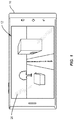
- a mobile computing device 10 which includes an electronic display 12 upon which an image 20 is shown.
- the displayed image 20 is from a camera embedded into the computing device 10 (e.g., a photograph or an image from a live camera feed).
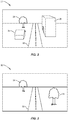
- Fig. 2 shows the image 20 of Fig. 1 .
- the main compositional elements of the image are a road 22, a tree 24, and two buildings 26, 28.
- the image 20 is a "base image" upon which an overlaid image is to be superimposed.
- Fig. 3 illustrates another example image 30 of the same scene that is shown in the first image 20, but which shows different compositional elements.
- the main compositional elements in the image 30 are the road 22, the tree 24, and another tree 30. Neither building 26, 28 is shown in the image 30.
- Fig. 3 was taken at a different period of time than the image 20 (e.g., months or years apart).
- the image 30 of Fig. 3 will be used as an "overlaid image" to be overlaid on top of the image 20 (e.g., in an augmented reality application).
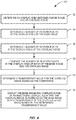
- Fig. 4 illustrates an example computer-implemented method 100 of overlaying two images on an electronic display (e.g., display 12 of mobile computing device 10).
- An overlay area is determined between a base image 20 and an overlaid image 30 (block 102).
- both the base image 20 and overlaid image 30 are the same size, and are taken from the same vantage point, so the overlay area can be the entire area of each image 20, 30.
- block 102 involves alignment of the images 20, 30, and/or resizing one of the images 20, 30 so that the images are properly sized with respect to one another.
- the overlay area may be smaller than one or both of the images 20, 30.
- FIG. 5 illustrates a number of feature points identified in the image 20 of Fig. 2 according to one example.
- the image 20 and its feature points 32 are shown as image 20'.
- Fig. 6 illustrates a number of feature points 32 identified in the image 30 of Fig. 3 according to one example (shown as 30').
- a circle indicates an identified feature point 32.
- the base image 20 is identified as having 24 feature points
- the overlaid image 30 is identified as having 12 feature points.
- the number of feature points in the base and overlaid images may be determined using a variety of algorithms that are well known to those of ordinary skill in the art, such as the Scale-Invariant Feature Transform (SIFT) algorithm, the Speeded Up Robust Features (SURF) algorithm, the Fast Retina Keypoint (FREAK) algorithm, or the Binary Robust Invariant Scalable Keypoints (BRISK) algorithm.
- SIFT Scale-Invariant Feature Transform
- SURF Speeded Up Robust Features
- FREAK Fast Retina Keypoint
- BRISK Binary Robust Invariant Scalable Keypoints
- the number of feature points in the overlay area of each of the base image 20 and the overlaid image 30 are compared (block 108). In the example above, this would include comparing the 24 feature points of the base image 20 to the 12 feature points of the overlaid image 30. A transparency value for the overlaid image 30 is determined based on the comparison (block 110). The base image 20 and overlaid image 30 are then displayed on an electronic display (bock 112), such that the overlaid image 30 is overlaid on the base image 20, with a transparency of the overlaid image 30 being based on the determined transparency value.
- Transparency_OI refers to a transparency of the overlaid image
- FP_BI refers to a quantity of feature points in the overlay area of the base image 20
- FP_OI refers to a quantity of feature points in the overlay area of the overlaid image 30.
- Equation (1) assumes that 20% is a minimum permissible transparency value (which emphasizes the overlaid image 30), and assume that 80% is a maximum permissible transparency value (which emphasizes the base image 20). Thus, in this equation the transparency values are clamped at 20% and 80%.
- the transparency value approaches a maximum permitted transparency (80%) as a ratio of the number of feature points in the overlay area of the base image 20 to the number of feature points in the overlay area in the overlaid image 30 increases. Also, the transparency value approaches a minimum permitted transparency (20%) as the ratio of the number of feature points in the overlay area of the base image 20 to the number of feature points in the overlay area of the overlaid image 30 decreases.
- using equation (1) to determine the transparency value (block 110) comprises determining a transparency value within a range of permissible transparency values (e.g., a range of 20% - 80%), each of which provides for partial, but not complete, transparency of the overlaid image.
- equation (1) yields a transparency value of 67% for the overlaid image 30.
- standard rounding e.g., .5 rounds up and less than .5 rounds down.
- the overlaying would emphasize the base image 20.
- An example overlaying according to the determined transparency value of 67 is shown in Fig. 7 , where tree 30 (which is only included in the overlaid image 30) is displayed based on a transparency value of 67%.
- Transparency_BI 1 ⁇ Transparency _ OI
- Transparency_BI 1 ⁇ Transparency _ OI
- Fig. 8 illustrates an example of such an overlaying, in which buildings 26, 28 (which in this case would only be present in the base image) are shown based on a transparency value of 33%.
- the identified feature points are considered to be the most interesting and salient features of a given image.
- the image that has the most features gets more visibility in a proportional fashion using equation (1).
- the basic logic behind this is that a user would wish to have greater emphasis placed on the image which has a higher feature point count, and therefore presumably more interesting details.
- the determined transparency value serves as a default transparency, such that after the images 20, 30 are displayed (block 112), a viewing user can manually adjust the default transparency to something they may find more desirable. In such embodiments, users can override the default transparency to select whichever transparency they find most desirable.
- the base image 20 is from a live camera feed, it is possible that images may be recorded and displayed at a rapid rate (e.g., 30 frames per second "FPS"). If this is the case, some processing time may be needed before a transparency value can be determined for a frame (e.g., perhaps a 1 frame delay is needed).
- the determining of an overlay area between the base image 20 and the overlaid image 30 (block 102) could be performed based on a previous version of the base image 20 (e.g., use feature points in frame 1 for displaying a frame 3 image). This assumes that a user would hold the camera of their computing device relatively still. Updated transparency values could then be recalculated (e.g., periodically at a predetermined time period).
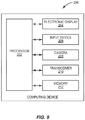
- Fig. 9 illustrates an example computing device 200 that may be used as the computing mobile computing device 10 of Fig. 1 .
- the computing device 200 is configured to overlay two images on an electronic display 204.
- the computing device 200 includes one or more processing circuits (shown as processor 202), including, for example, one or more microprocessors, microcontrollers, Application Specific Integrated Circuits (ASICs), or the like configured with appropriate software and/or firmware to carry out one or more of the techniques discussed above.
- the processor 202 is configured to determine an overlay area between a base image 20 and an overlaid image 30, determine a number of feature points in the overlay area of the base image 20, and determine a number of feature points in the overlay area of the overlaid image 30.
- the processor 202 is configured to compare the number of feature points in the overlay area of each of the base image 20 and the overlaid image 30, and determine a transparency value for the overlaid image 30 based on the comparison.
- the processor 202 is further configured to display the base image 20 and overlaid image 30 on the electronic display 204, such that the overlaid image 30 is overlaid on the base image 20, with a transparency of the overlaid image 30 being based on the determined transparency value.
- the computing device 200 also includes an input device 206 for initiating the overlaying of the images 20, 30 (e.g., one or more buttons).
- the computing device 200 also includes a camera 208 for recording images (e.g., as background images), and includes a transceiver for receiving overlaid images (e.g., receiving augmented reality images via a packet data network, such as the Internet).
- the computing device 200 also includes a non-transitory computer-readable storage medium (shown as memory 212) for storing the images 20, 30, and for storing instructions that configure the processor 202 as discussed above (e.g., a computer program product that configures the processor 202 to implement one or more of the techniques described above).
- the computing device shown in Fig. 1 is a mobile computing device 10 (e.g., a smartphone or tablet computer), it is understood that these are non-limiting examples, and that the computing device 200 could instead be a desktop or laptop computer, for example.
- the electronic display 204 may be external to the computing device 200 and not included in the computing device 200 as shown in Fig. 9 .
- the base image 20 is obtained from a live camera feed
- the overlaid image 30 comprises an augmented reality image to be overlaid on the base image 20.
- augmented reality applications such as the "Street Museum” smartphone application described above.
- the techniques discussed herein are not limited to use in augmented reality, and could be used for non-augmented reality applications (e.g., the website "What Was There” discussed above).
- equations (1) and (2) and the permissible range of transparency values of 20% - 80) are only non-limiting examples, and it is understood that other equations and other maximum and minimum permitted transparency values could be used. It is also understood that the base image 20 and overlaid image 30 discussed above are also non-limiting examples.
Landscapes
- Engineering & Computer Science (AREA)
- Physics & Mathematics (AREA)
- General Physics & Mathematics (AREA)
- Theoretical Computer Science (AREA)
- Computer Hardware Design (AREA)
- General Engineering & Computer Science (AREA)
- Computer Graphics (AREA)
- Software Systems (AREA)
- Computer Vision & Pattern Recognition (AREA)
- Multimedia (AREA)
- Processing Or Creating Images (AREA)
- User Interface Of Digital Computer (AREA)
- Image Processing (AREA)
Claims (15)
- Computerimplementiertes Verfahren (100) eines Überlagerns von zwei Bildern auf einer elektronischen Anzeige (12, 204),
Bestimmen eines Überlagerungsbereichs zwischen einem Basisbild (20) und einem überlagerten Bild (30);
Bestimmen einer Anzahl von Merkmalspunkten (32) in dem Überlagerungsbereich des Basisbildes (20);
Bestimmen einer Anzahl von Merkmalspunkten (32) in dem Überlagerungsbereich des überlagerten Bildes (30); gekennzeichnet durch:
Vergleichen der Anzahl von Merkmalspunkten (32) in dem Überlagerungsbereich von jedem von dem Basisbild (20) und dem überlagerten Bild (30);
Bestimmen eines Transparenzwertes für das überlagerte Bild (30) basierend auf dem Vergleich; und
Anzeigen des Basisbildes (20) und überlagerten Bildes (30) auf einer elektronischen Anzeige (12, 204),
derart, dass das überlagerte Bild (30) dem Basisbild (20) überlagert ist, wobei eine Transparenz des überlagerten Bildes (30) auf dem bestimmten Transparenzwert basiert. - Computerimplementiertes Verfahren (100) nach Anspruch 1, wobei das Bestimmen des Transparenzwertes ein Bestimmen eines Transparenzwertes innerhalb eines Bereiches von möglichen Transparenzwerten umfasst, wobei jeder davon eine partielle, aber nicht vollständige, Transparenz des überlagerten Bildes (30) bereitstellt.
- Computerimplementiertes Verfahren (100) nach Anspruch 1 oder Anspruch 2, wobei das Bestimmen der Anzahl der Merkmalspunkte (32) in dem Überlagerungsbereich des Basisbildes (20) und das Bestimmen der Anzahl von Merkmalspunkten (32) in dem Überlagerungsbereich des überlagerten Bildes (30) unter Verwendung eines Algorithmus mit skalierungsinvarianter Merkmalstransformation (Scale-Invariant Feature Transform, SIFT) ausgeführt werden.
- Computerimplementiertes Verfahren (100) nach Anspruch 1 oder Anspruch 2, wobei das Bestimmen der Anzahl von Merkmalspunkten (32) in dem Überlagerungsbereich des Basisbildes (20) und das Bestimmen der Anzahl von Merkmalspunkten (32) in dem Überlagerungsbereich des überlagerten Bildes (30) unter Verwendung eines Algorithmus mit beschleunigten robusten Merkmalen (Speeded Up Robust Features, SURF) ausgeführt werden.
- Computerimplementiertes Verfahren (100) nach Anspruch 1 oder Anspruch 2, wobei das Bestimmen der Anzahl von Merkmalspunkten (32) in dem Überlagerungsbereich des Basisbildes (20) und das Bestimmen der Anzahl von Merkmalspunkten (32) in dem Überlagerungsbereich des überlagerten Bildes (30) unter Verwendung eines Algorithmus mit schnellem Retina Schlüsselpunkt (Fast Retina Keypoint, FREAK) ausgeführt werden.
- Computerimplementiertes Verfahren (100) nach Anspruch 1 oder Anspruch 2, wobei das Bestimmen der Anzahl von Merkmalspunkten (32) in dem Überlagerungsbereich des Basisbildes (20) und das Bestimmen der Anzahl von Merkmalspunkten (32) in dem Überlagerungsbereich des überlagerten Bildes (30) unter Verwendung eines Algorithmus mit binären robusten invarianten skalierbaren Schlüsselpunkten (Binary Robust Invariant Scaleable Keypoints, BRISK) ausgeführt werden.
- Computerimplementiertes Verfahren (100) nach einem der Ansprüche 1-6,
wobei das Basisbild (20) von einer Live-Kamerazuführung erhalten wird; und
wobei das überlagerte Bild (30) ein Bild einer erweiterten Realität umfasst, welches auf das Basisbild (20) zu überlagern ist. - Computerimplementiertes Verfahren (100) nach einem der Ansprüche 1-7,
wobei sich der Transparenzwert einer maximal erlaubten Transparenz annähert, während sich ein Verhältnis von der Anzahl von Merkmalspunkten (32) in dem Überlagerungsbereich des Basisbildes (20) zu der Anzahl von Merkmalspunkten (32) in dem Überlagerungsbereich des überlagerten Bildes (30) erhöht; und
wobei sich der Transparenzwert einer minimalen erlaubten Transparenz annähert, während sich ein Verhältnis der Anzahl von Merkmalspunkten (32) in dem Überlagerungsbereich des Basisbildes (20) zu der Anzahl von Merkmalspunkten (32) in dem Überlagerungsbereich des überlagerten Bildes (30) verringert. - Rechenvorrichtung (200), welche ausgestaltet ist, zwei Bilder auf einer elektronischen Anzeige (12, 204) zu überlagern,
eine elektronische Anzeige (12, 204); und
einen oder mehrere Verarbeitungsschaltkreise (202), welche ausgestaltet sind:einen Überlagerungsbereich zwischen einem Basisbild (20) und einem überlagerten Bild (30) zu bestimmen;eine Anzahl von Merkmalspunkten (32) in dem Überlagerungsbereich des Basisbildes (20) zu bestimmen;eine Anzahl von Merkmalspunkten (32) in dem Überlagerungsbereich des überlagerten Bildes (30) zu bestimmen;gekennzeichnet durch:die Anzahl von Merkmalspunkten (32) in dem Überlagerungsbereich von jedem von dem Basisbild (20) und dem überlagerten Bild (30) zu vergleichen;einen Transparenzwert für das überlagerte Bild (30) basierend auf dem Vergleich zu bestimmen; unddas Basisbild (20) und überlagerte Bild (30) auf der elektronischen Anzeige (12, 204) anzuzeigen, sodass das überlagerte Bild (30) dem Basisbild (20) überlagert ist, wobei eine Transparenz des überlagerten Bildes (30) auf dem bestimmten Transparenzwert basiert. - Rechenvorrichtung (200) nach Anspruch 9, wobei, um den Transparenzwert zu bestimmen, der eine oder die mehreren Verarbeitungsschaltkreise (202) ausgestaltet sind, einen Transparenzwert innerhalb eines Bereichs von erlaubten Transparenzwerten zu bestimmen, wobei jeder davon eine partielle, aber nicht vollständige, Transparenz des überlagerten Bildes (30) bereitstellt.
- Rechenvorrichtung (200) nach Anspruch 9 oder Anspruch 10, wobei, um die Anzahl von Merkmalspunkten (32) in dem Überlagerungsbereich des Basisbildes (20) zu bestimmen und um die Anzahl von Merkmalspunkten (32) in dem Überlagerungsbereich des überlagerten Bildes (30) zu bestimmen, der eine oder die mehreren Verarbeitungsschaltkreise (202) ausgestaltet sind, einen Algorithmus mit skalierungsinvarianter Merkmalstransformationn (Scale-Invariant Feature Transform, SIFT) zu verwenden.
- Rechenvorrichtung (200) nach Anspruch 9 oder Anspruch 10, wobei, um die Anzahl von Merkmalspunkten (32) in dem Überlagerungsbereich des Basisbildes (20) zu bestimmen und um die Anzahl von Merkmalspunkten (32) in dem Überlagerungsbereich des überlagerten Bildes (30) zu bestimmen, der eine oder die mehreren Verarbeitungsschaltkreise (202) ausgestaltet sind, einen Algorithmus mit beschleunigten robusten Merkmalen (Speeded up Robust Features, SURF) zu verwenden.
- Rechenvorrichtung (200) nach Anspruch 9 oder Anspruch 10, wobei, um die Anzahl von Merkmalspunkten (32) in dem Überlagerungsbereich des Basisbildes (20) zu bestimmen und um die Anzahl von Merkmalspunkten (32) in dem Überlagerungsbereich des überlagerten Bildes zu bestimmen, der eine oder die mehreren Schaltkreise (202) ausgestaltet sind, einen Algorithmus mit schnellem Retina Schlüsselpunkt (Fast Retina Keypoint, FREAK) zu verwenden.
- Rechenvorrichtung (200) nach Anspruch 9 oder Anspruch 10, wobei, um die Anzahl von Merkmalspunkten (32) in dem Überlagerungsbereich des Basisbildes (20) zu bestimmen und um die Anzahl von Merkmalspunkten (32) in dem Überlagerungsbereich des überlagerten Bildes (30) zu bestimmen, der eine oder die mehreren Schaltkreise (202) ausgestaltet sind, einen Algorithmus mit binären robusten invarianten skalierbaren Schlüsselpunkten (Binary Robust Invariant Scaleable Keypoints, BRISK) zu verwenden.
- Rechenvorrichtung (200) nach einem der Ansprüche 9-14, wobei sich der Transparenzwert einer maximal erlaubten Transparenz annähert, während sich ein Verhältnis von der Anzahl von Merkmalspunkten (32) in dem Überlagerungsbereich des Basisbildes (20) zu der Anzahl von Merkmalspunkten (32) in dem Überlagerungsbereich des überlagerten Bildes (30) erhöht; und
wobei sich der Transparenzwert einer minimalen erlaubten Transparenz annähert, während sich das Verhältnis der Anzahl von Merkmalspunkten (32) in dem Überlagerungsbereich des Basisbildes (20) zu der Anzahl von Merkmalspunkten (32) in dem Überlagerungsbereich des überlagerten Bildes (30) verringert.
Applications Claiming Priority (1)
| Application Number | Priority Date | Filing Date | Title |
|---|---|---|---|
| PCT/IB2014/059078 WO2015124962A1 (en) | 2014-02-18 | 2014-02-18 | Transparency determination for overlaying images on an electronic display |
Publications (2)
| Publication Number | Publication Date |
|---|---|
| EP3108455A1 EP3108455A1 (de) | 2016-12-28 |
| EP3108455B1 true EP3108455B1 (de) | 2017-12-20 |
Family
ID=50239705
Family Applications (1)
| Application Number | Title | Priority Date | Filing Date |
|---|---|---|---|
| EP14708953.6A Active EP3108455B1 (de) | 2014-02-18 | 2014-02-18 | Transparenzbestimmung zur überlagerung von bildern auf einer elektronischen anzeige |
Country Status (4)
| Country | Link |
|---|---|
| US (1) | US20150235630A1 (de) |
| EP (1) | EP3108455B1 (de) |
| CN (1) | CN106030664B (de) |
| WO (1) | WO2015124962A1 (de) |
Families Citing this family (9)
| Publication number | Priority date | Publication date | Assignee | Title |
|---|---|---|---|---|
| CN104967790B (zh) * | 2014-08-06 | 2018-09-11 | 腾讯科技(北京)有限公司 | 照片拍摄方法、装置及移动终端 |
| US10055873B2 (en) * | 2014-09-08 | 2018-08-21 | The University Of Tokyo | Image processing device and image processing method |
| JP6501501B2 (ja) * | 2014-11-12 | 2019-04-17 | キヤノン株式会社 | 情報処理装置、情報処理方法、情報処理システム及びプログラム |
| WO2016154121A1 (en) * | 2015-03-20 | 2016-09-29 | University Of Maryland | Systems, devices, and methods for generating a social street view |
| WO2019133860A1 (en) * | 2017-12-29 | 2019-07-04 | Reginald Bowser | Systems and methods for generating and distributing content |
| CN108491069A (zh) * | 2018-03-01 | 2018-09-04 | 湖南西冲智能家居有限公司 | 一种增强现实ar透明显示互动系统 |
| CN108898551B (zh) * | 2018-06-14 | 2020-07-31 | 北京微播视界科技有限公司 | 图像合并的方法和装置 |
| US11528297B1 (en) | 2019-12-12 | 2022-12-13 | Zimperium, Inc. | Mobile device security application for malicious website detection based on representative image |
| GB2634757A (en) * | 2023-10-19 | 2025-04-23 | Sony Interactive Entertainment Inc | Data processing method and system |
Family Cites Families (4)
| Publication number | Priority date | Publication date | Assignee | Title |
|---|---|---|---|---|
| US7064771B1 (en) * | 1999-04-28 | 2006-06-20 | Compaq Information Technologies Group, L.P. | Method and apparatus for compositing colors of images using pixel fragments with Z and Z gradient parameters |
| US7890155B2 (en) * | 2007-01-04 | 2011-02-15 | Siemens Medical Solutions Usa, Inc. | Feature emphasis and contextual cutaways for image visualization |
| KR20130056529A (ko) * | 2011-11-22 | 2013-05-30 | 삼성전자주식회사 | 휴대용 단말기에서 증강현실 서비스를 제공하기 위한 장치 및 방법 |
| CN103530594B (zh) * | 2013-11-05 | 2017-06-16 | 深圳市幻实科技有限公司 | 一种提供增强现实的方法、系统及终端 |
-
2014
- 2014-02-18 CN CN201480075768.3A patent/CN106030664B/zh active Active
- 2014-02-18 WO PCT/IB2014/059078 patent/WO2015124962A1/en not_active Ceased
- 2014-02-18 EP EP14708953.6A patent/EP3108455B1/de active Active
- 2014-02-18 US US14/366,816 patent/US20150235630A1/en not_active Abandoned
Also Published As
| Publication number | Publication date |
|---|---|
| US20150235630A1 (en) | 2015-08-20 |
| CN106030664B (zh) | 2020-01-07 |
| WO2015124962A1 (en) | 2015-08-27 |
| CN106030664A (zh) | 2016-10-12 |
| EP3108455A1 (de) | 2016-12-28 |
Similar Documents
| Publication | Publication Date | Title |
|---|---|---|
| US20150235630A1 (en) | Transparency Determination for Overlaying Images on an Electronic Display | |
| EP3907657A1 (de) | Digitaler medienrahmen und verfahren zur konfiguration eines sichtfeldes eines digitalen medienrahmens | |
| CN110933296B (zh) | 用于提供内容感知照片滤镜的装置和方法 | |
| CN109064390B (zh) | 一种图像处理方法、图像处理装置及移动终端 | |
| US10573041B2 (en) | Rear image candidate determination device, rear image candidate determination method, and rear image candidate determination program | |
| US9491366B2 (en) | Electronic device and image composition method thereof | |
| US10026160B2 (en) | Systems and techniques for automatic image haze removal across multiple video frames | |
| CN107077826B (zh) | 基于周围光的图像调整 | |
| CN104699842A (zh) | 图片展示方法和装置 | |
| US20170061677A1 (en) | Disparate scaling based image processing device, method of image processing, and electronic system including the same | |
| WO2018119406A4 (en) | Image processing to determine center of balance in a digital image | |
| WO2014146561A1 (zh) | 缩略图生成方法及系统 | |
| US20170195560A1 (en) | Method and apparatus for generating a panoramic view with regions of different dimensionality | |
| JP2018537748A (ja) | 可変の計算量を用いた画像のライトフィールドレンダリング | |
| US9445073B2 (en) | Image processing methods and systems in accordance with depth information | |
| WO2023169283A1 (zh) | 双目立体全景图像的生成方法、装置、设备、存储介质和产品 | |
| US20160098863A1 (en) | Combining a digital image with a virtual entity | |
| JP2022500792A (ja) | 画像処理方法及び装置、電子機器並びに記憶媒体 | |
| CN113989404B (zh) | 图片处理方法、装置、设备、存储介质和程序产品 | |
| CN110177216A (zh) | 图像处理方法、装置、移动终端以及存储介质 | |
| US20210352206A1 (en) | Digital media frame and method for configuring a field of view of a digital media frame | |
| US11902502B2 (en) | Display apparatus and control method thereof | |
| CN108268138A (zh) | 增强现实的处理方法、装置及电子设备 | |
| WO2018000299A1 (en) | Method for assisting acquisition of picture by device | |
| US20160093109A1 (en) | Image processing device, image processing method, and program |
Legal Events
| Date | Code | Title | Description |
|---|---|---|---|
| PUAI | Public reference made under article 153(3) epc to a published international application that has entered the european phase |
Free format text: ORIGINAL CODE: 0009012 |
|
| 17P | Request for examination filed |
Effective date: 20160817 |
|
| AK | Designated contracting states |
Kind code of ref document: A1 Designated state(s): AL AT BE BG CH CY CZ DE DK EE ES FI FR GB GR HR HU IE IS IT LI LT LU LV MC MK MT NL NO PL PT RO RS SE SI SK SM TR |
|
| AX | Request for extension of the european patent |
Extension state: BA ME |
|
| DAX | Request for extension of the european patent (deleted) | ||
| GRAP | Despatch of communication of intention to grant a patent |
Free format text: ORIGINAL CODE: EPIDOSNIGR1 |
|
| INTG | Intention to grant announced |
Effective date: 20170629 |
|
| GRAS | Grant fee paid |
Free format text: ORIGINAL CODE: EPIDOSNIGR3 |
|
| GRAA | (expected) grant |
Free format text: ORIGINAL CODE: 0009210 |
|
| RAP1 | Party data changed (applicant data changed or rights of an application transferred) |
Owner name: SONY MOBILE COMMUNICATIONS INC. |
|
| AK | Designated contracting states |
Kind code of ref document: B1 Designated state(s): AL AT BE BG CH CY CZ DE DK EE ES FI FR GB GR HR HU IE IS IT LI LT LU LV MC MK MT NL NO PL PT RO RS SE SI SK SM TR |
|
| REG | Reference to a national code |
Ref country code: GB Ref legal event code: FG4D |
|
| REG | Reference to a national code |
Ref country code: CH Ref legal event code: EP |
|
| REG | Reference to a national code |
Ref country code: IE Ref legal event code: FG4D |
|
| REG | Reference to a national code |
Ref country code: AT Ref legal event code: REF Ref document number: 957014 Country of ref document: AT Kind code of ref document: T Effective date: 20180115 |
|
| REG | Reference to a national code |
Ref country code: DE Ref legal event code: R096 Ref document number: 602014018716 Country of ref document: DE |
|
| REG | Reference to a national code |
Ref country code: NL Ref legal event code: FP |
|
| PG25 | Lapsed in a contracting state [announced via postgrant information from national office to epo] |
Ref country code: NO Free format text: LAPSE BECAUSE OF FAILURE TO SUBMIT A TRANSLATION OF THE DESCRIPTION OR TO PAY THE FEE WITHIN THE PRESCRIBED TIME-LIMIT Effective date: 20180320 Ref country code: FI Free format text: LAPSE BECAUSE OF FAILURE TO SUBMIT A TRANSLATION OF THE DESCRIPTION OR TO PAY THE FEE WITHIN THE PRESCRIBED TIME-LIMIT Effective date: 20171220 Ref country code: LT Free format text: LAPSE BECAUSE OF FAILURE TO SUBMIT A TRANSLATION OF THE DESCRIPTION OR TO PAY THE FEE WITHIN THE PRESCRIBED TIME-LIMIT Effective date: 20171220 Ref country code: SE Free format text: LAPSE BECAUSE OF FAILURE TO SUBMIT A TRANSLATION OF THE DESCRIPTION OR TO PAY THE FEE WITHIN THE PRESCRIBED TIME-LIMIT Effective date: 20171220 |
|
| REG | Reference to a national code |
Ref country code: LT Ref legal event code: MG4D |
|
| REG | Reference to a national code |
Ref country code: AT Ref legal event code: MK05 Ref document number: 957014 Country of ref document: AT Kind code of ref document: T Effective date: 20171220 |
|
| PG25 | Lapsed in a contracting state [announced via postgrant information from national office to epo] |
Ref country code: BG Free format text: LAPSE BECAUSE OF FAILURE TO SUBMIT A TRANSLATION OF THE DESCRIPTION OR TO PAY THE FEE WITHIN THE PRESCRIBED TIME-LIMIT Effective date: 20180320 Ref country code: LV Free format text: LAPSE BECAUSE OF FAILURE TO SUBMIT A TRANSLATION OF THE DESCRIPTION OR TO PAY THE FEE WITHIN THE PRESCRIBED TIME-LIMIT Effective date: 20171220 Ref country code: GR Free format text: LAPSE BECAUSE OF FAILURE TO SUBMIT A TRANSLATION OF THE DESCRIPTION OR TO PAY THE FEE WITHIN THE PRESCRIBED TIME-LIMIT Effective date: 20180321 Ref country code: RS Free format text: LAPSE BECAUSE OF FAILURE TO SUBMIT A TRANSLATION OF THE DESCRIPTION OR TO PAY THE FEE WITHIN THE PRESCRIBED TIME-LIMIT Effective date: 20171220 Ref country code: HR Free format text: LAPSE BECAUSE OF FAILURE TO SUBMIT A TRANSLATION OF THE DESCRIPTION OR TO PAY THE FEE WITHIN THE PRESCRIBED TIME-LIMIT Effective date: 20171220 |
|
| PG25 | Lapsed in a contracting state [announced via postgrant information from national office to epo] |
Ref country code: CY Free format text: LAPSE BECAUSE OF FAILURE TO SUBMIT A TRANSLATION OF THE DESCRIPTION OR TO PAY THE FEE WITHIN THE PRESCRIBED TIME-LIMIT Effective date: 20171220 Ref country code: SK Free format text: LAPSE BECAUSE OF FAILURE TO SUBMIT A TRANSLATION OF THE DESCRIPTION OR TO PAY THE FEE WITHIN THE PRESCRIBED TIME-LIMIT Effective date: 20171220 Ref country code: CZ Free format text: LAPSE BECAUSE OF FAILURE TO SUBMIT A TRANSLATION OF THE DESCRIPTION OR TO PAY THE FEE WITHIN THE PRESCRIBED TIME-LIMIT Effective date: 20171220 Ref country code: ES Free format text: LAPSE BECAUSE OF FAILURE TO SUBMIT A TRANSLATION OF THE DESCRIPTION OR TO PAY THE FEE WITHIN THE PRESCRIBED TIME-LIMIT Effective date: 20171220 Ref country code: EE Free format text: LAPSE BECAUSE OF FAILURE TO SUBMIT A TRANSLATION OF THE DESCRIPTION OR TO PAY THE FEE WITHIN THE PRESCRIBED TIME-LIMIT Effective date: 20171220 |
|
| PG25 | Lapsed in a contracting state [announced via postgrant information from national office to epo] |
Ref country code: SM Free format text: LAPSE BECAUSE OF FAILURE TO SUBMIT A TRANSLATION OF THE DESCRIPTION OR TO PAY THE FEE WITHIN THE PRESCRIBED TIME-LIMIT Effective date: 20171220 Ref country code: IS Free format text: LAPSE BECAUSE OF FAILURE TO SUBMIT A TRANSLATION OF THE DESCRIPTION OR TO PAY THE FEE WITHIN THE PRESCRIBED TIME-LIMIT Effective date: 20180420 Ref country code: PL Free format text: LAPSE BECAUSE OF FAILURE TO SUBMIT A TRANSLATION OF THE DESCRIPTION OR TO PAY THE FEE WITHIN THE PRESCRIBED TIME-LIMIT Effective date: 20171220 Ref country code: RO Free format text: LAPSE BECAUSE OF FAILURE TO SUBMIT A TRANSLATION OF THE DESCRIPTION OR TO PAY THE FEE WITHIN THE PRESCRIBED TIME-LIMIT Effective date: 20171220 Ref country code: AT Free format text: LAPSE BECAUSE OF FAILURE TO SUBMIT A TRANSLATION OF THE DESCRIPTION OR TO PAY THE FEE WITHIN THE PRESCRIBED TIME-LIMIT Effective date: 20171220 Ref country code: IT Free format text: LAPSE BECAUSE OF FAILURE TO SUBMIT A TRANSLATION OF THE DESCRIPTION OR TO PAY THE FEE WITHIN THE PRESCRIBED TIME-LIMIT Effective date: 20171220 |
|
| REG | Reference to a national code |
Ref country code: CH Ref legal event code: PL |
|
| REG | Reference to a national code |
Ref country code: DE Ref legal event code: R097 Ref document number: 602014018716 Country of ref document: DE |
|
| PG25 | Lapsed in a contracting state [announced via postgrant information from national office to epo] |
Ref country code: MC Free format text: LAPSE BECAUSE OF FAILURE TO SUBMIT A TRANSLATION OF THE DESCRIPTION OR TO PAY THE FEE WITHIN THE PRESCRIBED TIME-LIMIT Effective date: 20171220 |
|
| PLBE | No opposition filed within time limit |
Free format text: ORIGINAL CODE: 0009261 |
|
| STAA | Information on the status of an ep patent application or granted ep patent |
Free format text: STATUS: NO OPPOSITION FILED WITHIN TIME LIMIT |
|
| GBPC | Gb: european patent ceased through non-payment of renewal fee |
Effective date: 20180320 |
|
| 26N | No opposition filed |
Effective date: 20180921 |
|
| REG | Reference to a national code |
Ref country code: IE Ref legal event code: MM4A |
|
| REG | Reference to a national code |
Ref country code: BE Ref legal event code: MM Effective date: 20180228 |
|
| PG25 | Lapsed in a contracting state [announced via postgrant information from national office to epo] |
Ref country code: LU Free format text: LAPSE BECAUSE OF NON-PAYMENT OF DUE FEES Effective date: 20180218 Ref country code: DK Free format text: LAPSE BECAUSE OF FAILURE TO SUBMIT A TRANSLATION OF THE DESCRIPTION OR TO PAY THE FEE WITHIN THE PRESCRIBED TIME-LIMIT Effective date: 20171220 Ref country code: CH Free format text: LAPSE BECAUSE OF NON-PAYMENT OF DUE FEES Effective date: 20180228 Ref country code: LI Free format text: LAPSE BECAUSE OF NON-PAYMENT OF DUE FEES Effective date: 20180228 |
|
| REG | Reference to a national code |
Ref country code: FR Ref legal event code: ST Effective date: 20181031 |
|
| PG25 | Lapsed in a contracting state [announced via postgrant information from national office to epo] |
Ref country code: IE Free format text: LAPSE BECAUSE OF NON-PAYMENT OF DUE FEES Effective date: 20180218 |
|
| PG25 | Lapsed in a contracting state [announced via postgrant information from national office to epo] |
Ref country code: GB Free format text: LAPSE BECAUSE OF NON-PAYMENT OF DUE FEES Effective date: 20180320 Ref country code: BE Free format text: LAPSE BECAUSE OF NON-PAYMENT OF DUE FEES Effective date: 20180228 Ref country code: FR Free format text: LAPSE BECAUSE OF NON-PAYMENT OF DUE FEES Effective date: 20180228 Ref country code: SI Free format text: LAPSE BECAUSE OF FAILURE TO SUBMIT A TRANSLATION OF THE DESCRIPTION OR TO PAY THE FEE WITHIN THE PRESCRIBED TIME-LIMIT Effective date: 20171220 |
|
| PG25 | Lapsed in a contracting state [announced via postgrant information from national office to epo] |
Ref country code: MT Free format text: LAPSE BECAUSE OF NON-PAYMENT OF DUE FEES Effective date: 20180218 |
|
| PG25 | Lapsed in a contracting state [announced via postgrant information from national office to epo] |
Ref country code: TR Free format text: LAPSE BECAUSE OF FAILURE TO SUBMIT A TRANSLATION OF THE DESCRIPTION OR TO PAY THE FEE WITHIN THE PRESCRIBED TIME-LIMIT Effective date: 20171220 |
|
| PG25 | Lapsed in a contracting state [announced via postgrant information from national office to epo] |
Ref country code: PT Free format text: LAPSE BECAUSE OF FAILURE TO SUBMIT A TRANSLATION OF THE DESCRIPTION OR TO PAY THE FEE WITHIN THE PRESCRIBED TIME-LIMIT Effective date: 20171220 |
|
| PG25 | Lapsed in a contracting state [announced via postgrant information from national office to epo] |
Ref country code: MK Free format text: LAPSE BECAUSE OF NON-PAYMENT OF DUE FEES Effective date: 20171220 Ref country code: HU Free format text: LAPSE BECAUSE OF FAILURE TO SUBMIT A TRANSLATION OF THE DESCRIPTION OR TO PAY THE FEE WITHIN THE PRESCRIBED TIME-LIMIT; INVALID AB INITIO Effective date: 20140218 |
|
| PG25 | Lapsed in a contracting state [announced via postgrant information from national office to epo] |
Ref country code: AL Free format text: LAPSE BECAUSE OF FAILURE TO SUBMIT A TRANSLATION OF THE DESCRIPTION OR TO PAY THE FEE WITHIN THE PRESCRIBED TIME-LIMIT Effective date: 20171220 |
|
| PGFP | Annual fee paid to national office [announced via postgrant information from national office to epo] |
Ref country code: NL Payment date: 20230119 Year of fee payment: 10 |
|
| P01 | Opt-out of the competence of the unified patent court (upc) registered |
Effective date: 20230527 |
|
| REG | Reference to a national code |
Ref country code: NL Ref legal event code: MM Effective date: 20240301 |
|
| PG25 | Lapsed in a contracting state [announced via postgrant information from national office to epo] |
Ref country code: NL Free format text: LAPSE BECAUSE OF NON-PAYMENT OF DUE FEES Effective date: 20240301 |
|
| PG25 | Lapsed in a contracting state [announced via postgrant information from national office to epo] |
Ref country code: NL Free format text: LAPSE BECAUSE OF NON-PAYMENT OF DUE FEES Effective date: 20240301 |
|
| PGFP | Annual fee paid to national office [announced via postgrant information from national office to epo] |
Ref country code: DE Payment date: 20250122 Year of fee payment: 12 |