EP3110870B2 - Furan-basierte amine als härter für epoxidharze in anwendungen mit geringem voc-gehalt - Google Patents
Furan-basierte amine als härter für epoxidharze in anwendungen mit geringem voc-gehalt Download PDFInfo
- Publication number
- EP3110870B2 EP3110870B2 EP15707085.5A EP15707085A EP3110870B2 EP 3110870 B2 EP3110870 B2 EP 3110870B2 EP 15707085 A EP15707085 A EP 15707085A EP 3110870 B2 EP3110870 B2 EP 3110870B2
- Authority
- EP
- European Patent Office
- Prior art keywords
- epoxy
- formulation
- compound
- amine
- formula
- Prior art date
- Legal status (The legal status is an assumption and is not a legal conclusion. Google has not performed a legal analysis and makes no representation as to the accuracy of the status listed.)
- Active
Links
Classifications
-
- C—CHEMISTRY; METALLURGY
- C08—ORGANIC MACROMOLECULAR COMPOUNDS; THEIR PREPARATION OR CHEMICAL WORKING-UP; COMPOSITIONS BASED THEREON
- C08G—MACROMOLECULAR COMPOUNDS OBTAINED OTHERWISE THAN BY REACTIONS ONLY INVOLVING UNSATURATED CARBON-TO-CARBON BONDS
- C08G59/00—Polycondensates containing more than one epoxy group per molecule; Macromolecules obtained by polymerising compounds containing more than one epoxy group per molecule using curing agents or catalysts which react with the epoxy groups
- C08G59/18—Macromolecules obtained by polymerising compounds containing more than one epoxy group per molecule using curing agents or catalysts which react with the epoxy groups ; e.g. general methods of curing
- C08G59/40—Macromolecules obtained by polymerising compounds containing more than one epoxy group per molecule using curing agents or catalysts which react with the epoxy groups ; e.g. general methods of curing characterised by the curing agents used
- C08G59/50—Amines
- C08G59/5046—Amines heterocyclic
-
- C—CHEMISTRY; METALLURGY
- C08—ORGANIC MACROMOLECULAR COMPOUNDS; THEIR PREPARATION OR CHEMICAL WORKING-UP; COMPOSITIONS BASED THEREON
- C08G—MACROMOLECULAR COMPOUNDS OBTAINED OTHERWISE THAN BY REACTIONS ONLY INVOLVING UNSATURATED CARBON-TO-CARBON BONDS
- C08G59/00—Polycondensates containing more than one epoxy group per molecule; Macromolecules obtained by polymerising compounds containing more than one epoxy group per molecule using curing agents or catalysts which react with the epoxy groups
- C08G59/18—Macromolecules obtained by polymerising compounds containing more than one epoxy group per molecule using curing agents or catalysts which react with the epoxy groups ; e.g. general methods of curing
- C08G59/182—Macromolecules obtained by polymerising compounds containing more than one epoxy group per molecule using curing agents or catalysts which react with the epoxy groups ; e.g. general methods of curing using pre-adducts of epoxy compounds with curing agents
- C08G59/184—Macromolecules obtained by polymerising compounds containing more than one epoxy group per molecule using curing agents or catalysts which react with the epoxy groups ; e.g. general methods of curing using pre-adducts of epoxy compounds with curing agents with amines
-
- C—CHEMISTRY; METALLURGY
- C08—ORGANIC MACROMOLECULAR COMPOUNDS; THEIR PREPARATION OR CHEMICAL WORKING-UP; COMPOSITIONS BASED THEREON
- C08G—MACROMOLECULAR COMPOUNDS OBTAINED OTHERWISE THAN BY REACTIONS ONLY INVOLVING UNSATURATED CARBON-TO-CARBON BONDS
- C08G59/00—Polycondensates containing more than one epoxy group per molecule; Macromolecules obtained by polymerising compounds containing more than one epoxy group per molecule using curing agents or catalysts which react with the epoxy groups
- C08G59/18—Macromolecules obtained by polymerising compounds containing more than one epoxy group per molecule using curing agents or catalysts which react with the epoxy groups ; e.g. general methods of curing
- C08G59/20—Macromolecules obtained by polymerising compounds containing more than one epoxy group per molecule using curing agents or catalysts which react with the epoxy groups ; e.g. general methods of curing characterised by the epoxy compounds used
- C08G59/22—Di-epoxy compounds
- C08G59/223—Di-epoxy compounds together with monoepoxy compounds
-
- C—CHEMISTRY; METALLURGY
- C09—DYES; PAINTS; POLISHES; NATURAL RESINS; ADHESIVES; COMPOSITIONS NOT OTHERWISE PROVIDED FOR; APPLICATIONS OF MATERIALS NOT OTHERWISE PROVIDED FOR
- C09D—COATING COMPOSITIONS, e.g. PAINTS, VARNISHES OR LACQUERS; FILLING PASTES; CHEMICAL PAINT OR INK REMOVERS; INKS; CORRECTING FLUIDS; WOODSTAINS; PASTES OR SOLIDS FOR COLOURING OR PRINTING; USE OF MATERIALS THEREFOR
- C09D163/00—Coating compositions based on epoxy resins; Coating compositions based on derivatives of epoxy resins
-
- C—CHEMISTRY; METALLURGY
- C09—DYES; PAINTS; POLISHES; NATURAL RESINS; ADHESIVES; COMPOSITIONS NOT OTHERWISE PROVIDED FOR; APPLICATIONS OF MATERIALS NOT OTHERWISE PROVIDED FOR
- C09J—ADHESIVES; NON-MECHANICAL ASPECTS OF ADHESIVE PROCESSES IN GENERAL; ADHESIVE PROCESSES NOT PROVIDED FOR ELSEWHERE; USE OF MATERIALS AS ADHESIVES
- C09J163/00—Adhesives based on epoxy resins; Adhesives based on derivatives of epoxy resins
Definitions
- the invention relates to curable epoxy formulations comprising furan-based curing agents, the use of the furan-based curing agents, methods for preparing cured articles based on the epoxy formulations and products obtainable therefrom.
- amines are used as curing agents for epoxy resins. Most of these amine curing agents contain primary amino groups. These amines are prone to react with carbon dioxide from the air forming carbamates (carbamatization) which represents an undesirable side reaction in such epoxy formulations. As a result, the cured epoxy formulation may have an aesthetically unsatisfactory surface often characterized by a waxy or oily surface layer, a white surface layer or spots of salt deposits occasionally accompanied by tackiness and incomplete surface curing. In some instances the marks are not visible but occur on contact with high humidity or water. These effects are generally known as "amine blushing" or "water spotting".
- Polyamines having secondary amine groups could be used as curing agent since secondary amines are as much not subject to carbamatization but these polyamines are difficult to obtain and often very expensive.
- Another option is to use epoxy-amine adducts as curing agent, however these adducts usually have a high viscosity so that a dilution by solvents or benzyl alcohol is necessary to achieve an appropriate workability.
- accelerators or diluents for instance alcohols such as benzyl alcohol, are often added to the epoxy formulation comprising amine curing agents in order to avoid or reduce amine blushing.
- benzyl alcohol which is often used as a co-solvent in epoxy resins formulations in order to improve physical properties and appearance, in particular for low temperature curing applications.
- benzyl alcohol has its own disadvantages, since benzyl alcohol is a volatile organic compound (VOC) so that high VOC formulations are obtained, and large amounts of benzyl alcohol may have a negative impact on the mechanical properties of the cured epoxy resin.
- VOC volatile organic compound
- low VOC epoxy formulations are advantageous so that it would be desirable to reduce or avoid benzyl alcohol in such formulations.
- ingredients such as curing agents for use in epoxy formulations which can be derived from renewable resources.
- Furan-based amines are such compounds derived from natural feedstock and have been previously described in the literature, e.g. A. Gandini, "Furans as offspring of sugars and polysaccharides and progenitors of a family of remarkable polymers: a review of recent progress", Polym. Chem., 2010, 1, 245-251 ; and A. Gandini et al., Furans in Polymer Chemistry, Progr. Polym. Sci., 1997, 22, 1203 .
- WO 2013090136 A2 discloses epoxy compounds that are bisanhydrohexitol derivatives having two terminal oxirane groups as well as curable compositions that include these epoxy compounds.
- the cured compositions can be used as a structural adhesive or as a coating.
- the object of the invention was to provide low VOC epoxy formulations or VOC-free formulations which have a suitable curing speed so that room temperature curing and even low temperature curing is possible and amine blushing is avoided or significantly reduced.
- This aim should be preferably achieved with benzyl alcohol free epoxy formulations.
- the epoxy formulation should be more environmentally friendly in that ingredients derivable from renewable resources are used and it can be formulated as a low VOC or VOC-free epoxy formulation.
- furan-based curing agents and/or adducts thereof work particular well in benzyl alcohol-free or low VOC epoxy formulations and exhibit good curing speed and good surface properties of the cured product, even when cured at low temperatures (e.g. 8°C).
- This is a distinct advantage and a property not usually seen in primary diamine curing agents, irrespective of whether they are based on a petrochemical feedstock or a natural feedstock.
- the present invention is related to a room temperature or low temperature curable epoxy formulation comprising
- the compounds of formula (I) are derivable from natural resources. It was surprising that these compounds, even though they were primary diamines, and adducts thereof provided without using benzyl alcohol surfaces with good appearance and with very little or no carbamatization in combination with a good curing speed, even at low temperatures. Films with glossy and defect-free surfaces were obtained. Thus, it is possible to provide a low VOC epoxy or VOC-free formulation which is curable at ambient temperature or even at low temperatures. This is advantageous for applications in cold places where heating is not possible or desirable.
- the invention also relates to the use of the compounds according to claim 1 or the adducts thereof as room temperature or low temperature curing agent in epoxy formulations, in particular low VOC or VOC-free epoxy formulations, methods of preparing cured articles by coating or adhering or by forming composites with these epoxy formulations according to claim 9, and products derived therefrom according to claim 10.
- Preferred embodiments are given in the dependent claims and the following description where the invention is described in detail.
- poly is a compound having at least two epoxy groups
- polyol is a compound having at least two hydroxyl groups.
- Primary amino group means an NH 2 group bonded to an organic radical
- secondary amino group means an NH group bonded to two organic radicals, which may be combined to form a ring. Accordingly, a primary amine is a compound having a primary amino group, a primary diamine is a compound having two primary amino groups.
- a heteroatom is used in organic chemistry to refer to an atom which is different from carbon and hydrogen.
- Preferred examples of heteroatoms according to the present invention are oxygen, nitrogen, sulfur, phosphorus, and chlorine, in particular oxygen and nitrogen.
- a hydrocarbon group is a group including carbon atoms and hydrogen atoms.
- a divalent hydrocarbon group may be aliphatic, cycloaliphatic or aromatic or a combination thereof.
- Examples of hydrocarbon groups are linear or branched alkyl, alkenyl, alkynyl, cycloalkyl and aromatic groups such as phenyl or combinations thereof for monovalent hydrocarbon groups and the corresponding divalent hydrocarbon groups.
- a room temperature curable epoxy formulation refers to an epoxy formulation which is suitable for curing at room temperature or ambient temperature, for instance at a temperature of less than 50°C, preferably less than 40°C, more preferably less than 30°C.
- a low temperature curable epoxy formulation refers to an epoxy formulation which is suitable for curing at low temperatures, which means at a temperature of less than 15°C, preferably less than 10°C. Accordingly, room temperature curing agents or low temperature curing agents are curing agents which can be used in room temperature curable formulations or low temperature curable formulations, respectively.
- VOC volatile organic compound
- volatile organic compounds include compounds within the retention range of C 6 to C 16 , which are considered both as individual substances and in calculating a sum parameter following the TVOC concept (TVOC: Total Volatile Organic Compounds; defined as the sum of the concentration of all individual substances with concentrations equal to or greater than 5 ⁇ g/m 3 within the retention range C 6 - C 16 ).
- VOC content refers to TVOC 3 as determined according to the AgBB evaluation scheme of 2010 (AgBB-Beêtsschema von 2010) which definition is in accordance with ISO 16000 /6, which is available e.g. from http://www.umweltbundetics.de/sites/default/files/medien/377/matie/agbb-evaluation-scheme2010.pdf.
- Active amine hydrogen or amine hydrogen refers to a hydrogen of a -NH group of a compound.
- a primary amine group has two active hydrogens.
- the amine hydrogen to epoxy equivalent ratio as used herein refers to the ratio of amine hydrogen equivalents and the epoxy equivalents of the chemicals of respective functionality involved.
- the epoxy formulations of the invention are usually provided as a multicomponent formulation, in particular a two component formulation, comprising an epoxy component containing the at least one epoxy resin, and a hardener component comprising the at least one curing agent, as is known to the skilled persons.
- the two components are stored separately.
- the epoxy component and the hardener component are mixed in a suitable proportion which initiates the curing process.
- the mixture is then applied on a desired location in a desired shape within the pot life of the mixture, and the applied epoxy formulation will then cure at the ambient temperature to obtain the cured product.
- the room temperature or low temperature curable epoxy formulation of the invention comprises an epoxy component comprising at least one epoxy resin.
- the formulation may comprise one epoxy resin or a mixture of two or more epoxy resins.
- epoxy resins are commercially available.
- Epoxy resins conventionally used in epoxy chemistry are suitable as the epoxy resin. These are obtained by methods known in the art, for example from oxidation of the corresponding olefins or from reaction of epichlorohydrin with the corresponding polyols, polyphenols, or amines.
- the epoxy resin is a curable epoxy resin comprising two or more epoxy groups.
- the epoxy resins are polyepoxides.
- the epoxy resin used is preferably a liquid epoxy resin.
- the epoxy resin may be selected from aromatic epoxy resins, alicyclic epoxy resins, aliphatic epoxy resins and combinations thereof.
- the epoxy resins are often used in combination with an optional epoxyfunctional reactive diluent which may be monofunctional as described below.
- aromatic epoxy resins include, but are not limited to, polyglycidyl ether compounds of polyphenols, such as hydroquinone, resorcinol, bisphenol A, bisphenol F, 4,4'-dihydroxybiphenyl, novolac, tetrabromobisphenol A, 2,2-bis(4-hydroxyphenyl)-1,1,1,3,3,3-hexafluoropropane, and 1,6-dihydroxynaphthalene.
- polyglycidyl ether compounds of polyphenols such as hydroquinone, resorcinol, bisphenol A, bisphenol F, 4,4'-dihydroxybiphenyl, novolac, tetrabromobisphenol A, 2,2-bis(4-hydroxyphenyl)-1,1,1,3,3,3-hexafluoropropane, and 1,6-dihydroxynaphthalene.
- alicyclic epoxy resins include, but are not limited to, polyglycidyl ethers of polyols having at least one alicyclic ring, or compounds obtained by epoxidizing compounds including a cyclohexene ring, cyclopentene ring with an oxidizer.
- Some specific examples include, but are not limited to hydrogenated bisphenol A diglycidyl ether; hydrogenated bisphenol F diglycidyl ether; cyclohexane dimethanol diglycidyl ether; 3,4-epoxycyclohexylmethyl-3,4-epoxycyclohexyl carboxylate; 3,4-epoxy-1-methylcyclohexyl-3,4-epoxy-1-methylhexane carboxylate; 6-methyl-3,4-epoxycyclohexylmethyl-6-methyl-3,4-epoxycyclohexane carboxylate; 3,4-epoxy-3- methylcyclohexylmethyl-3,4-epoxy-3-methylcyclohexane carboxylate; 3,4-epoxy-5-methylcyclohexylmethyl-3,4-epoxy-5-methylcyclohexane carboxylate; bis(3,4-epoxycyclohexylmethyl)adipate; methylene-bis(3,4-
- aliphatic epoxy resins include, but are not limited to, polyglycidyl ethers of aliphatic polyols or alkylene-oxide adducts thereof, polyglycidyl esters of aliphatic long-chain polybasic acids, homopolymers synthesized by vinyl-polymerizing glycidyl acrylate or glycidyl methacrylate, and copolymers synthesized by vinyl-polymerizing glycidyl acrylate or glycidyl methacrylate and other vinyl monomers.
- Some specific examples include, but are not limited to glycidyl ethers of polyols, such as 1,4-butanediol diglycidyl ether; neopentyl glycol diglycidyl ether; 1,6-hexanediol diglycidyl ether; a triglycidyl ether of glycerin; a triglycidyl ether of trimethylol propane; a tetraglycidyl ether of sorbitol; a hexaglycidyl ether of dipentaerythritol; a diglycidyl ether of polyethylene glycol; and a diglycidyl ether of polypropylene glycol; polyglycidyl ethers of polyether polyols obtained by adding one type, or two or more types, of alkylene oxide to aliphatic polyols such as propylene glycol, trimethylol propane, and glycer
- the epoxy resin is an aromatic epoxy resin.
- epoxy resins of formula (III) wherein R' and R" independently from each other represent hydrogen, C 1 -C 4 alkyl such as methyl and ethyl, trifluoromethyl or aryl such as phenyl, and s is on average from 0 to 2, preferably from 0 to 1 and in particular from 0 to 0.2, or mixture of two or more resins of formula (III).
- These epoxy resins usually represents liquid epoxy resins.
- diglycidyl ether of bisphenol A and bisphenol F and mixtures thereof are particularly preferred.
- Epoxy resins of formula (III) are commercially obtainable, e.g. under the trade names Araldite ® from Huntsman, D.E.R. ® from Dow, Epikote ® from Momentive, Epalloy ® from CVC, Chem Res ® from Cognis (BASF) or Beckopox ® from Allnex.
- Such epoxy resins are usually solid epoxy resins.
- the use of liquid epoxy resins is more preferable.
- the epoxy component may further include a reactive diluent.
- Reactive diluents are compounds that participate in a chemical reaction with the hardener component during the curing process and become incorporated into the cured composition. Reactive diluents can also be used to vary the viscosity and/or cure properties of the curable compositions for various applications. For some applications reactive diluents can impart a lower viscosity to influence flow properties, extend pot life and/or improve adhesion properties of the curable compositions. If present, the reactive diluent may be contained, for instance in an amount of less than 70 percent by weight, based on the total weight of the epoxy component, e.g. from 0 to 70 % by weight, preferably from 0 to 30 % by weight.
- Suitable reactive diluents are mono- and polyepoxides such as, for example, glycidyl ethers of monohydric or polyhydric phenols and aliphatic or cycloaliphatic alcohols, such as in particular glycidyl ethers of monools, diols or polyols, as well as also in particular phenyl glycidyl ether, cresyl glycidyl ether, p-n-butyl phenyl glycidyl ether, p-tert butyl phenyl glycidyl ether, nonylphenyl glycidyl ether, allyl glycidyl ether, butyl glycidyl ether, hexyl glycidyl ether, 2-ethylhexyl glycidyl ether, glycidyl ester of a synthetic saturated monocarboxylic acid of
- glycidyl ethers of natural alcohols such as, for example, C 8 to C 10 alkyl glycidyl ethers or C 12 to C 14 alkyl glycidyl ethers; 1,4-butanediol diglycidylether, 1,6-hexanediol diglycidylether, cyclohexane dimethanol diglycidylether, neopentylglykol diglycidether, polypropylene glycol diglycidylether; glycerol triglycidylether, trimethylolpropane triglycidylether, polyoxypropylene glycol triglycidylether, triglycidyl ether of castor oil, polyglycerol triglycidylether; pentaerythritol tetraglycidether.
- the epoxy component may comprise further additives. Examples thereof will be described below.
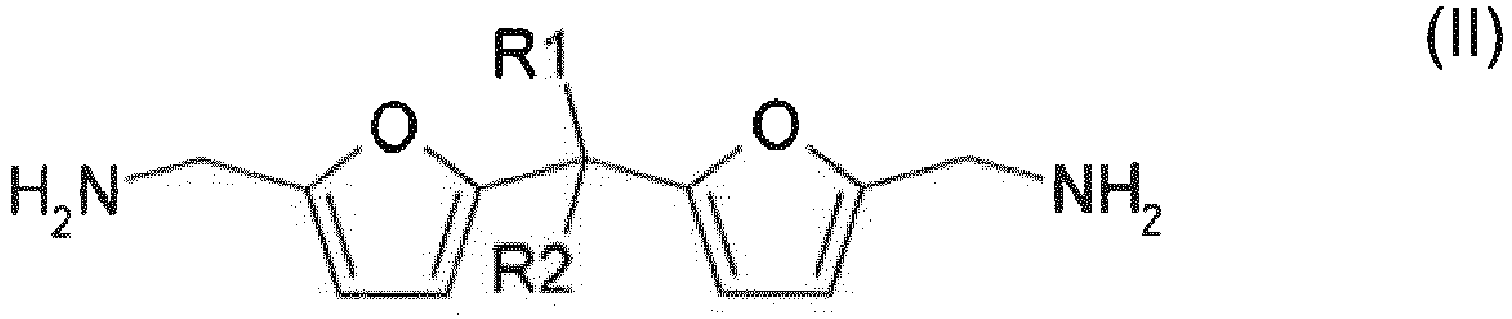
- the room temperature or low temperature curable epoxy formulation of the invention further comprises a hardener component comprising at least one compound of formula (II) wherein R 1 and R 2 are both methyl, and/or at least one epoxy-amine adduct, which is a reaction product of a compound of formula (II) wherein R 1 and R 2 are both methyl and an epoxy compound selected from at least one of a monoepoxide and/or a polyepoxide, as a curing agent.
- the present invention is also related to an epoxy-amine adduct, which is a reaction product of a compound of formula (I) and an epoxy compound selected from at least one of a monoepoxide and a polyepoxide,
- the divalent hydrocarbon group, which optionally contains one or more heteroatoms, of formula (I) is preferably a divalent hydrocarbon group having 1 to 21, preferably 1 to 7, more preferably 1 to 4 carbon atoms, which optionally contains one or more heteroatoms.
- Examples of the optional one or more heteroatoms which may be the same or different are oxygen, nitrogen, sulfur, phosphorus, and chlorine, in particular oxygen and nitrogen.
- the heteroatoms may be contained in the hydrocarbon group in form of functional groups or units such as ether, ester or primary, secondary or tertiary amines groups or units, respectively.
- the group X is preferably a linear or branched alkylene group, which may include one, two or more ether linkages (-O-), one, two or more ester linkages (-OC(O)-) and/or one or more substituents such as alkyl, e.g. C 1 -C 6 -alkyl, cycloalkyl, e.g.
- group X may be an aliphatic or aromatic residue, an ester or diester chain or a monoether or polyether chain.
- the compound of formula (I) is a compound of formula (IV) designated 2,5-Bis(aminomethyl)furan or formula (II) wherein R 1 and R 2 are the same or different and selected from the group consisting of hydrogen, an alkyl group, preferably having from 1 to 7 C-atoms, preferably 1 to 3 C-atoms, which may be substituted, a cycloalkyl group, which may be substituted, a heterocyclic group, which may be substituted, such as furanmethanamine, and an aryl group, preferably phenyl, which may be substituted.
- substituents with which the alkyl group may be substituted are cycloalkyl and aryl such as phenyl.
- substituents with which the cycloalkyl or the aryl group, such as phenyl, may be substituted are C 1 -C 4 -alkyl, NO 2 , CN, Cl or Br. In one embodiment, R 1 and R 2 are not both hydrogen.
- R 1 and R 2 in formula (II) which may be the same or different are hydrogen, methyl, ethyl, n-propyl, isopropyl, n-butyl, isobutyl, pentyl, hexyl, benzyl, or phenyl, which may be substituted. In one embodiment R 1 and R 2 may not be both hydrogen.
- R 1 and R 2 are as follows: R 1 R 2 H H (IIa) H CH 3 (IIb) H C 5 H 6 (IIc) CH 3 CH 3 (IId) CH 3 C 2 H 5 (IIe) CH 3 CH 2 CH(CH 3 ) 2 (IIf)
- the most preferred compound is the compound of formula (II), wherein R 1 and R 2 are both methyl (compound of formula (IId), designated isopropylidene-5,5'-bis(furfurylamine) (IPFA).
- the hardener component of the room temperature or low temperature curable epoxy formulation according to claim 1 contains said isopropylidene-5,5'-bis(furfurylamine) (IPFA) and/or at least one epoxy-amine adduct which is a reaction product of isopropylidene-5,5'-bis(furfurylamine) and an epoxy compound selected from at least one of a monoepoxide and/or a polyepoxide, as a curing agent.
- the compounds of formula (I) and (II), respectively, are obtainable from renewable resources and can be prepared according to known procedures, see e.g. the literature of Gandini cited above and references cited therein.
- the compounds of formula (II), in particular (IIa) to (IIf) can be prepared by coupling furfurylamine with the corresponding aldehydes or ketones, wherein amine protecting groups may be used.
- the epoxy-amine adduct is a reaction product of the compound of formula (II) or (IV) and an epoxy resin, wherein it is particularly preferred that the compound of formula (II) is isopropylidene-5,5'-bis(furfurylamine).
- the epoxy compound for the preparation of the epoxy-amine adduct is selected from at least one of a monoepoxide and a polyepoxide.
- Suitable examples for the monoepoxide and polyepoxide are the monoepoxides and polyepoxide described above for the reactive diluent as well as the epoxy resins described above for the epoxy component so that reference can be made thereto, including the preferred epoxy resins and reactive diluents.
- the epoxy compound is a mono- or diepoxide.
- suitable mono- and diepoxides are described above.
- Preferred epoxy compounds for the preparation of the epoxy-amine adduct are p-tert butyl phenyl glycidyl ether, 2-ethylhexyl glycidyl ether, phenyl glycidyl ether, cresyl glycidyl ether, glycidyl ester of a synthetic saturated monocarboxylic acid of highly branched C 10 isomers (commercially available e.g. as Cardura TM E10 from Momentive) as monoepoxides, and bisphenol A diglycidyl ether, bisphenol F diglycidyl ether and novolac as di- or polyepoxides.
- the reaction product of the compound of formula (I) and an epoxy compound can be easily obtained e.g. by mixing the compound of formula (I) and the epoxy compound in a suitable ratio and reacting the starting materials.
- the reaction can be carried out at room temperature but is preferably carried out at an elevated temperature, e.g. more than 40°C or more than 50°C, preferably more than 60°C, in order to accelerate reaction speed.
- the temperature for the reaction is generally not more than 200°C, preferably not more than 120 °C.
- the time for completion of reaction may vary in wide ranges depending on type of starting materials and the reaction temperature, but may e.g. range from 1 to 48 hours.
- the reaction product obtained can be used as it is.
- the compound of formula (I) and the epoxy compound are reacted in such a ratio that the amine hydrogen to epoxy equivalent ratio in the mixture is, depending on the functionality of the epoxide used, i.e. in the range of 0.5 - 2.4 for monoepoxides, and more than 4, preferably more than 6 for polyepoxides, in particular diepoxides.
- the mixture may also serve for dilution effects so that the upper limit may vary to a large extent depending on the desired dilution.
- the hardener component may comprise at least one compound of formula (II) wherein R 1 and R 2 are both methyl.
- the hardener component may optionally comprise also furan-based amines with an amine functionality of less than 2.
- furan-based amines with an amine functionality of less than 2 is furfurylamine.
- the hardener component may optionally comprise in addition at least one further amine curing agent or other epoxy curing agents such as thiol-based curing agents.
- This further amine curing agent may be selected from the usual amine curing agents for curing of epoxy formulations known by the skilled person.
- polyamines in particular diamines or triamines such as, e.g., aliphatic, cycloaliphatic or arylaliphatic diamines, ether group containing aliphatic diamines, aliphatic, cycloaliphatic or arylaliphatic triamines, polyoxyalkylen-di- and triamines, secondary and primary amino groups containing polyamines, secondary amino groups containing polyamines, tertiary amino groups containing polyamines, polyamidoamines, and/or epoxy-amine adducts of these polyamines or mixtures thereof.
- diamines or triamines such as, e.g., aliphatic, cycloaliphatic or arylaliphatic diamines, ether group containing aliphatic diamines, aliphatic, cycloaliphatic or arylaliphatic triamines, polyoxyalkylen-di- and triamines, secondary and primary amino groups containing polyamines
- the epoxy-amine adduct is as described above for the compound of formula (I) the reaction product of the respective polyamine, preferably diamine, with an epoxy compound selected from a polyepoxide, in particular a diepoxide, and a monoepoxide as described above.
- a suitable further amine curing agent is a Mannich-base.
- a Mannich base is an adduct type hardener formed by the condensation of amines, in particular aliphatic amines, phenol or phenol derivatives and formaldehyde. The phenolic hydroxyl group present in these types of molecules has an accelerating effect on the epoxy-amine reaction rate, so that Mannich-bases can also be used as accelerators.
- the hardener component further comprises a further polyamine, preferably a diamine, and/or an epoxy-amine adduct thereof, and/or an accelerator.
- a further polyamine preferably a diamine, and/or an epoxy-amine adduct thereof
- accelerators are a Mannich-base, salicylic acid, p-toluene sulfonic acid or a tertiary amine. Examples thereof and further examples for accelerators are given below for other optional additives (accelerators e)).
- Examples for the further polyamine, preferably a diamine, or further epoxy-amine adduct have been described above.
- This further polyamine and/or epoxy-amine adduct and/or accelerator may be suitable to improve the curing speed of the hardener component, in particular if it comprises the epoxy-amine adduct of the invention.
- the further polyamine is preferably a diamine or a mixture thereof, such as aliphatic, cycloaliphatic or arylaliphatic diamines or ether group containing aliphatic diamines, wherein the diamine has preferably a low amine hydrogen equivalent weight, e.g. of less than 550 Dalton/NH equivalent.
- the accelerator accelerates the curing of the epoxy formulation. Such accelerators also discussed above are known to the skilled person.
- the accelerator is preferably a Mannich-base, salicylic acid or a tertiary amine. Other examples of possible accelerators are described below.
- the epoxy component and/or the hardener component can optionally contain other additives depending on the intended purpose which are common additives for such epoxy formulations.
- additives which may be included in the epoxy formulation are:
- the room temperature or low temperature curable epoxy formulation is a low VOC epoxy formulation, wherein the epoxy formulation preferably has a TVOC content after 3 days (TVOC 3 ) of less than 50 mg/m 3 , more preferably less than 10 mg/m 3 , still more preferably less than 5 mg/m 3 or still more preferably less than 1 mg/m 3 or even less than 0.1 mg/m 3 or less than 0.01 mg/m 3 , when measured as defined in the AgBB evaluation scheme of 2010.
- Epoxy formulations having a TVOC 3 of less than 0.5 mg/m 3 can be considered as a VOC-free epoxy formulations.
- the epoxy formulation contains only small amounts of benzyl alcohol or is free of benzyl alcohol.
- the epoxy formulation preferably contains less than 5 wt. %, more preferably less than 2 wt. %, even more preferably less than 1 wt.%, benzyl alcohol, based on the total weight of the epoxy formulation. It is particularly preferred that the epoxy formulation is benzyl alcohol-free.
- the amine hydrogen to epoxy equivalent ratio is preferably 0.8 to 1.2, more preferably 0.95 to 1.05.
- the amine hydrogen groups (NH) and epoxy groups of all ingredients contained in the epoxy formulation such as e.g. the epoxy resin, the optional reactive diluent, and the compound of formula (I) and/or the amine-epoxide adduct thereof, the optional furan-based amines having a functionality of less than 2 and the optional further amine curing agents are considered.
- the optional furan-based amines having a functionality of less than 2 may be included with an amine hydrogen to epoxy equivalent ratio of e.g. 0 to 0.3 with respect to all epoxy containing compounds in the epoxy formulation.
- the room temperature or low temperature curable epoxy formulation is preferably an epoxy coating composition, an epoxy flooring material, an epoxy adhesive, an epoxy grout or potting material, an epoxy sealant, a waterproofing coating composition or an epoxy composite material, wherein the epoxy formulation is more preferably an epoxy flooring or coating material.
- the invention also relates to the use of a compound of formula (II) wherein R 1 and R 2 are both methyl, and/or an epoxy-amine adduct, which is a reaction product of a compound of formula (II) wherein R 1 and R 2 are both methyl and an epoxy compound selected from at least one of a monoepoxide and/or a polyepoxide , as a room temperature or low temperature epoxy curing agent for an epoxy resin formulation, preferably a benzyl alcohol-free epoxy resin formulation.
- the before mentioned compound and/or the epoxy-amine adduct as described above can be also used as a amine blushing prevention agent.
- the invention also relates to a method for coating or adhering substrates or for preparing composites using a room temperature or low temperature curable epoxy formulation according to claim 1, wherein the method comprises the following steps
- the substrate may be of any suitable material. If two or more substrates are used, they may be of the same or a different material.
- the substrate or the surface of the substrate, on which the epoxy formulation is to be applied may be, e.g., made of metal, preferably steel, plastic, wood, glass, ceramic, cement, concrete, mortar, gypsum, magnesia, asphalt or another coating, e.g. another epoxy coating.
- Curing of the epoxy formulation is preferably carried out at temperature of not more than 50°C, preferably not more than 40°C, more preferably not more than 30°C. It is an advantage of the present invention, that curing can also be carried out at low temperatures, e.g. at a temperature of less than 15°C or even less than 10°C.
- the epoxy formulation is preferably cured at a temperature in the range of 50 °C to 0 °C more preferably 50 °C to 5 °C.
- the epoxy formulations exhibit good curing speed and good surface properties of the cured product, even when curing at low temperatures, e.g. 8°C (very little or no amine blushing). This is also achieved when the epoxy formulation is formulated as a low VOC or even VOC-free epoxy formulation and/or as a low benzyl alcohol or even benzyl alcohol-free epoxy formulation.
- the epoxy formulation is therefore particular suitable for the manufacture of coatings and floorings.
- Viscosities were determined using a Physica MCR 300 plate-plate rheometer. Operating conditions were shear rates of 10 s -1 and 100 s -1 at 23 °C.
- amine blushing For the determination of the degree of water spotting (amine blushing), a freshly coated surface was cured under defined conditions (usually 23 °C, 50% r.h. or 8 °C, 80% r.h., r.h.: relative humidity) for a specified time. Then a wet sponge was put on the surface and covered. After 24 h the sponge was removed and placed on another spot on the surface. The degree of amine blushing was rated according to a relative scale.
- the rating was as follows Rating Appearance 0 No blushing 1 Individual white spots visible 2 Surface partly covered with very thin white layer 3 Surface mostly covered with thin white layer with large number of spots without layer 4 Surface covered thin white layer with large number of spots without layer 5 Surface with medium white layer with several spots without layer 6 Surface with thick white layer with individual spots without layer 7 Entire surface covered with white layer
- Shore hardness was determined in accordance with DIN 53 505.
- Pendulum hardness (König hardness) was determined on the cured test specimens at 23 °C/50 % r.h. in accordance with DIN 53 157.
- IPFA isopropylidene-5,5'-bis(furfurylamine)
- epoxy-amine adducts m-xylylenediamine (MXDA), 1,3-bisaminomethyl cyclohexane (1,3-BAC), Jeffamine ® RFD-270 and 5,5-isopropylidenedifurfurylamine (IPFA, as prepared above).
- MXDA m-xylylenediamine
- 1,3-bisaminomethyl cyclohexane 1,3-BAC
- Jeffamine ® RFD-270 1,5-isopropylidenedifurfurylamine
- IPFA 5,5-isopropylidenedifurfurylamine
- Epoxy components A and hardener components B were prepared by mixing the ingredients in the amounts as shown in Table 1. The amounts are given in parts by weight. For the application of 2-component samples components A and B were mixed in a Speed Mixer. Films were applied on glass plates with a doctor blade using a clearance of 500 ⁇ m. Films were cured for a minimum of 7 days at 23 °C/50 % r.h. or 8 °C, 80% r.h., respectively. König hardness was determined after 1d, 2d, 3d, 7d and 28d of curing. Water spotting was determined after 1d, 2d and 7d of curing. The results are also given in Table 1.
- Epoxy components A and hardener components B were prepared by mixing the ingredients in the amounts as shown in Table 2. The amounts are given in parts by weight.
- 2-component samples the components A and B were mixed in a Speed Mixer. Films were applied on glass plates with a doctor blade using a clearance of 500 ⁇ m. Films were cured for a minimum of 7 days at 23 °C/50 % r.h. or 8 °C, 80% r.h., respectively. König hardness and water spotting were determined as in Examples 1 to 9. The results are also given in Table 2.
- the adduct prepared from bisphenol-A diglycidylether and IPFA according to the invention has much less tendency to water spotting, (Example 16) compared to adducts of conventional amines curing agents. Especially at 8 °C the water spotting resistance of this adduct is superior to adducts prepared from conventional amines (Examples 10, 12, 14); also curing speed and hardness are improved.
- Epoxy components A and hardener components B were prepared by mixing the ingredients in the amounts as shown in Table 4.
- the components A and B were mixed in a Speed Mixer for 1 min. Films were applied on glass panel with a doctor blade using a clearance of 500 ⁇ m. Films were cured for a minimum of 7 days at 23 °C/50 % r.h. König hardness and water spotting were determined as in Examples 1 to 9. The results are also given in Table 4.
- the water spotting resistance (carbamatization resistance) of the HMF-diamine-based films (Ex. 21, 23 and 25) at 23 °C was better than the water spotting resistance of the corresponding IPD-based films (Ex. 22, 24 and 26).
Landscapes
- Chemical & Material Sciences (AREA)
- Organic Chemistry (AREA)
- Health & Medical Sciences (AREA)
- Chemical Kinetics & Catalysis (AREA)
- Medicinal Chemistry (AREA)
- Polymers & Plastics (AREA)
- Life Sciences & Earth Sciences (AREA)
- Engineering & Computer Science (AREA)
- Materials Engineering (AREA)
- Wood Science & Technology (AREA)
- Epoxy Resins (AREA)
Claims (11)
- Bei Raumtemperatur oder niedriger Temperatur härtbare Epoxidformulierung, umfassenda) eine Epoxidkomponente, die mindestens ein Epoxidharz umfasst, undb) eine Härterkomponente, die mindestens eine Verbindung der Formel (II)

 wobei R1 und R2 beide für Methyl stehen, und einer Epoxidverbindung handelt, die ausgewählt ist aus mindestens einem von einem Monoepoxid und/oder einem Polyepoxid, als Härtungsmittel,wobei sich die niedrige Temperatur auf eine Temperatur von weniger als 15 °C bezieht.
 - Bei Raumtemperatur oder niedriger Temperatur härtbare Epoxidformulierung nach Anspruch 1, wobei die Epoxidformulierung einen Benzylalkoholgehalt von weniger als 5 Gew.-% aufweist und vorzugsweise frei von Benzylalkohol ist.
- Bei Raumtemperatur oder niedriger Temperatur härtbare Epoxidformulierung nach einem der Ansprüche 1 bis 2, wobei das Aminwasserstoff-Epoxid-Äquivalentverhältnis bei 0,8 bis 1,2 liegt.
- Bei Raumtemperatur oder niedriger Temperatur härtbare Epoxidformulierung nach einem der Ansprüche 1 bis 3, wobei die Härterkomponente ferner mindestens ein weiteres Polyamin, vorzugsweise ein Diamin, und/oder mindestens ein Epoxid-Amin-Addukt davon und/oder mindestens einen Beschleuniger umfasst, wobei der Beschleuniger vorzugsweise ausgewählt ist aus einer Mannich-Base, Salicylsäure, p-Toluolsulfonsäure und einem tertiären Amin.
- Bei Raumtemperatur oder niedriger Temperatur härtbare Epoxidformulierung nach einem der Ansprüche 1 bis 4, wobei es sich bei der Epoxidformulierung um eine Epoxidbeschichtungszusammensetzung, ein Epoxidbodenbeschichtungsmaterial, einen Epoxidklebstoff, ein Epoxidfugen- oder -vergussmaterial, ein Epoxiddichtmittel, eine wasserundurchlässige Beschichtungszusammensetzung oder ein Epoxidverbundmaterial handelt.
- Verwendung einer Verbindung der Formel (II)

- Verwendung nach Anspruch 6, wobei die Epoxidformulierung einen Benzylalkoholgehalt von weniger als 5 Gew.-% aufweist und vorzugsweise frei von Benzylalkohol ist.
- Verwendung nach Anspruch 6 oder Anspruch 7 zum Vermeiden eines Amin-Anlaufens, wobei es sich bei der Epoxidharzformulierung vorzugsweise um eine Beschichtungszusammensetzung oder ein Bodenbeschichtungsmaterial handelt.
- Verfahren zum Beschichten oder Kleben von Substraten oder zum Herstellen von Verbundstoffen unter Verwendung einer bei Raumtemperatur oder niedriger Temperatur härtbaren Epoxidformulierung nach einem der Ansprüche 1 bis 5, wobei das Verfahren Folgendes umfasst:a) Mischen der Epoxidkomponente und der Härterkomponente der bei Raumtemperatur oder niedriger Temperatur härtbaren Epoxidformulierung,b) b1) Aufbringen der gemischten Epoxidformulierung auf ein Substrat; b2) Aufbringen der gemischten Epoxidformulierung auf eine Oberfläche eines ersten Substrats und Inkontaktbringen der beschichteten Oberfläche mit einem zweiten Substrat, um eine Klebebindung zu erhalten; oder b3) Laminieren eines oder mehrerer Substrate mit der gemischten Epoxidformulierung oder Einbetten eines oder mehrerer Substrate in die gemischte Epoxidformulierung, und anschließendc) Härten der Epoxidformulierung bei einer Temperatur von höchstens 50 °C.
- Gehärteter Artikel, der entsprechend dem Verfahren nach Anspruch 9 erhältlich ist.
- Epoxid-Amin-Addukt, bei dem es sich um ein Reaktionsprodukt von einer Verbindung der Formel (I) und einer Epoxidverbindung handelt, die ausgewählt ist aus mindestens einem von einem Monoepoxid und einem Polyepoxid,
 wobei X für eine zweiwertige Kohlenwasserstoffgruppe steht, die gegebenenfalls ein oder mehrere Heteroatome enthält, und n 0, 1 oder 2 ist, vorzugsweise 0 oder 1, undwobei die Verbindung der Formel (I) und die Epoxidverbindung in einem solchen Verhältnis umgesetzt werden, dass das Aminwasserstoff-Epoxid-Äquivalentverhältnis in dem Gemisch, je nach Funktionalität des verwendeten Epoxids, für Monoepoxide im Bereich von 0,5-2,4 liegt und für Polyepoxide, insbesondere Diepoxide, bei mehr als 4, vorzugsweise mehr als 6.
Applications Claiming Priority (2)
| Application Number | Priority Date | Filing Date | Title |
|---|---|---|---|
| EP14156398 | 2014-02-24 | ||
| PCT/EP2015/053803 WO2015124792A1 (en) | 2014-02-24 | 2015-02-24 | Furan-based amines as curing agents for epoxy resins in low voc applications |
Publications (3)
| Publication Number | Publication Date |
|---|---|
| EP3110870A1 EP3110870A1 (de) | 2017-01-04 |
| EP3110870B1 EP3110870B1 (de) | 2020-07-29 |
| EP3110870B2 true EP3110870B2 (de) | 2023-08-09 |
Family
ID=50156631
Family Applications (1)
| Application Number | Title | Priority Date | Filing Date |
|---|---|---|---|
| EP15707085.5A Active EP3110870B2 (de) | 2014-02-24 | 2015-02-24 | Furan-basierte amine als härter für epoxidharze in anwendungen mit geringem voc-gehalt |
Country Status (5)
| Country | Link |
|---|---|
| US (1) | US10287389B2 (de) |
| EP (1) | EP3110870B2 (de) |
| CN (1) | CN106164125B (de) |
| CA (1) | CA2940327A1 (de) |
| WO (1) | WO2015124792A1 (de) |
Families Citing this family (11)
| Publication number | Priority date | Publication date | Assignee | Title |
|---|---|---|---|---|
| EP2837645A1 (de) * | 2013-08-12 | 2015-02-18 | Basf Se | Verwendung von 2,5-bisaminomethylfuran als härter für epoxidharze |
| EP3974461A1 (de) | 2016-05-30 | 2022-03-30 | Sika Technology AG | Tetrahydrofuran-diamin |
| WO2019040409A1 (en) * | 2017-08-21 | 2019-02-28 | Palmese Giuseppe R | FURANE RENEWABLE POLYIMIDE FOR COMPOSITE APPLICATIONS |
| US11629220B2 (en) * | 2017-08-21 | 2023-04-18 | Drexel Unversity | Renewable furan based amine curing agents for epoxy thermoset |
| EP3725820B1 (de) * | 2019-04-16 | 2022-04-06 | Henkel AG & Co. KGaA | Verwendung von funktionalisierten alpha-angelica-lactonen |
| WO2022127640A1 (en) * | 2020-12-16 | 2022-06-23 | Covestro Deutschland Ag | Process for synthesis of furan-based diamines |
| EP4119592A1 (de) * | 2021-07-12 | 2023-01-18 | Sika Technology AG | Beschleuniger für epoxidharze |
| EP4124631A1 (de) | 2021-07-28 | 2023-02-01 | Sika Technology AG | Aminhärter mit hohem erneuerbarem kohlenstoffanteil |
| CN113527118B (zh) * | 2021-08-05 | 2024-03-19 | 福建省三棵树新材料有限公司 | 一种常温水性环氧固化剂及其制备方法和应用 |
| CN113637441B (zh) * | 2021-08-12 | 2022-05-17 | 长春艾德斯新材料有限公司 | 一种室温快速固化环氧树脂胶黏剂及其制备方法 |
| US20240360271A1 (en) * | 2021-10-29 | 2024-10-31 | Sika Technology Ag | Bio-based amine curing agent for curable compositions |
Citations (2)
| Publication number | Priority date | Publication date | Assignee | Title |
|---|---|---|---|---|
| US4605765A (en) † | 1982-03-08 | 1986-08-12 | Mitsubishi Gas Chemical Company, Inc. | Novel polyamine |
| WO2015001061A1 (en) † | 2013-07-03 | 2015-01-08 | Rhodia Operations | Curable composition and process for the manufacture of an epoxy thermoset |
Family Cites Families (27)
| Publication number | Priority date | Publication date | Assignee | Title |
|---|---|---|---|---|
| US2750395A (en) * | 1954-01-05 | 1956-06-12 | Union Carbide & Carbon Corp | Diepoxides |
| US2890194A (en) * | 1956-05-24 | 1959-06-09 | Union Carbide Corp | Compositions of epoxides and polycarboxylic acid compounds |
| US3018262A (en) * | 1957-05-01 | 1962-01-23 | Shell Oil Co | Curing polyepoxides with certain metal salts of inorganic acids |
| BE569870A (de) * | 1957-08-09 | |||
| NL106571C (de) * | 1957-08-09 | |||
| BE578410A (fr) | 1958-05-16 | 1959-11-05 | Merck & Co Inc | Furanes substitutés. |
| US5208317A (en) * | 1990-02-06 | 1993-05-04 | The Dow Chemical Company | Composition comprising epoxy resin and cationic amine phosphonium catalyst |
| US4981926A (en) * | 1990-02-06 | 1991-01-01 | The Dow Chemical Company | Composition of epoxy resin, amino group-containing phosphonium catalyst and curing agent |
| US5135993A (en) * | 1990-09-11 | 1992-08-04 | Dow Corning Corporation | High modulus silicones as toughening agents for epoxy resins |
| GB9411367D0 (en) * | 1994-06-07 | 1994-07-27 | Ici Composites Inc | Curable Composites |
| US6153719A (en) * | 1998-02-04 | 2000-11-28 | Lord Corporation | Thiol-cured epoxy composition |
| US6632893B2 (en) * | 1999-05-28 | 2003-10-14 | Henkel Loctite Corporation | Composition of epoxy resin, cyanate ester, imidazole and polysulfide tougheners |
| US6572971B2 (en) * | 2001-02-26 | 2003-06-03 | Ashland Chemical | Structural modified epoxy adhesive compositions |
| US6632860B1 (en) * | 2001-08-24 | 2003-10-14 | Texas Research International, Inc. | Coating with primer and topcoat both containing polysulfide, epoxy resin and rubber toughener |
| GB0212062D0 (en) * | 2002-05-24 | 2002-07-03 | Vantico Ag | Jetable compositions |
| US7163973B2 (en) * | 2002-08-08 | 2007-01-16 | Henkel Corporation | Composition of bulk filler and epoxy-clay nanocomposite |
| EP1431325A1 (de) * | 2002-12-17 | 2004-06-23 | Sika Technology AG | Hitze-härtbare Epoxidharzzusammensetzung mit verbesserter Tieftemperatur-Schlagzähigkeit |
| US7108806B2 (en) * | 2003-02-28 | 2006-09-19 | National Starch And Chemical Investment Holding Corporation | Conductive materials with electrical stability and good impact resistance for use in electronics devices |
| US8048819B2 (en) * | 2005-06-23 | 2011-11-01 | Momentive Performance Materials Inc. | Cure catalyst, composition, electronic device and associated method |
| EP1760129A1 (de) * | 2005-09-02 | 2007-03-07 | Sika Technology AG | Wässrige Haftreinigerzusammensetzung zur Erhöhung der Haftung von Klebstoffen und Dichtstoffen auf Lacken |
| US20090018300A1 (en) * | 2007-07-11 | 2009-01-15 | Archer-Daniels-Midland Company | Monomers and polymers from bioderived carbon |
| US20140005302A1 (en) * | 2010-10-14 | 2014-01-02 | Tnemec Company, Inc. | Geopolymer and epoxy simultaneous interpenetrating polymer network composition, and methods for the same |
| US9193666B2 (en) * | 2011-03-08 | 2015-11-24 | Basf Se | Process for preparing alkanolamines by homogeneously catalyzed alcohol amination |
| BR112014014480A2 (pt) * | 2011-12-16 | 2017-06-13 | 3M Innovative Properties Co | derivados de bisanidro-hexitol que contêm oxirano e usos dos mesmos |
| ES2531144T3 (es) | 2012-09-07 | 2015-03-11 | Evonik Industries Ag | Composiciones curables a base de resinas epoxídicas sin alcohol bencílico |
| EP2837645A1 (de) | 2013-08-12 | 2015-02-18 | Basf Se | Verwendung von 2,5-bisaminomethylfuran als härter für epoxidharze |
| US10376156B2 (en) * | 2014-07-17 | 2019-08-13 | Cardimetrix Llc | Device for monitoring for effectiveness of heart failure therapy |
-
2015
- 2015-02-24 US US15/121,155 patent/US10287389B2/en active Active
- 2015-02-24 CN CN201580016955.9A patent/CN106164125B/zh active Active
- 2015-02-24 WO PCT/EP2015/053803 patent/WO2015124792A1/en not_active Ceased
- 2015-02-24 EP EP15707085.5A patent/EP3110870B2/de active Active
- 2015-02-24 CA CA2940327A patent/CA2940327A1/en not_active Abandoned
Patent Citations (2)
| Publication number | Priority date | Publication date | Assignee | Title |
|---|---|---|---|---|
| US4605765A (en) † | 1982-03-08 | 1986-08-12 | Mitsubishi Gas Chemical Company, Inc. | Novel polyamine |
| WO2015001061A1 (en) † | 2013-07-03 | 2015-01-08 | Rhodia Operations | Curable composition and process for the manufacture of an epoxy thermoset |
Non-Patent Citations (1)
| Title |
|---|
| "Chemistry and Technology of Epoxy Resins. Kap 2.2", 1 January 1993, SPRINGER, article ELLIS B., W.R. ASHCROFT: "Curing agents for epoxy resins - nitrogen-containing curing agents", pages: 38 - 60 † |
Also Published As
| Publication number | Publication date |
|---|---|
| CN106164125B (zh) | 2020-08-07 |
| EP3110870B1 (de) | 2020-07-29 |
| US20170009005A1 (en) | 2017-01-12 |
| CN106164125A (zh) | 2016-11-23 |
| WO2015124792A1 (en) | 2015-08-27 |
| CA2940327A1 (en) | 2015-08-27 |
| US10287389B2 (en) | 2019-05-14 |
| EP3110870A1 (de) | 2017-01-04 |
Similar Documents
| Publication | Publication Date | Title |
|---|---|---|
| EP3110870B2 (de) | Furan-basierte amine als härter für epoxidharze in anwendungen mit geringem voc-gehalt | |
| AU2015303289B2 (en) | Amine for low-emission epoxy resin compositions | |
| EP2094759B1 (de) | Epoxidharze mit härtungsmittel mit cycloalphatischem diamin | |
| JP5823978B2 (ja) | 低白化の低粘性エポキシ樹脂組成物 | |
| EP1980542B1 (de) | Polyalkyleneamin-Addukte als Härtemittel für Dickschicht-Epoxidsysteme auf Wasserbasis | |
| US20220356298A1 (en) | Room temperature ionic liquid curing agent | |
| AU2015215175B2 (en) | Amine for low-emission epoxy resin products | |
| EP3774984B1 (de) | Phenalkamin-epoxidhärter und epoxidharzzusammensetzungen damit | |
| US10472460B2 (en) | Use of substituted benzyl alcohols in reactive epoxy systems | |
| AU2016315246A1 (en) | Low-emission epoxy resin composition | |
| KR20200140348A (ko) | 페날카민을 제조하는 방법 | |
| US10287388B2 (en) | Amine for low-emission epoxy resin compositions | |
| JPS59131620A (ja) | エポキシ樹脂用硬化剤 | |
| US8063157B2 (en) | Curing agents for epoxy resins | |
| KR102943620B1 (ko) | 에폭시-아민 부가물 | |
| EP4269464A1 (de) | Epoxidharzmodifizierte zusammensetzung, die zum beschichten oder versiegeln verwendet wird | |
| WO2025181188A1 (en) | Benzylated polyalkylene polyamines composition with enhanced epoxy coatings performance | |
| EP4372025A1 (de) | Wässrige mehrzweck-epoxydbodenbelagzusammensetzung | |
| JP2024538688A (ja) | ナフトールおよびナフトール誘導体を組み込んだエポキシ硬化剤組成物 | |
| JPH0362823A (ja) | 樹脂組成物 |
Legal Events
| Date | Code | Title | Description |
|---|---|---|---|
| PUAI | Public reference made under article 153(3) epc to a published international application that has entered the european phase |
Free format text: ORIGINAL CODE: 0009012 |
|
| STAA | Information on the status of an ep patent application or granted ep patent |
Free format text: STATUS: REQUEST FOR EXAMINATION WAS MADE |
|
| 17P | Request for examination filed |
Effective date: 20160926 |
|
| AK | Designated contracting states |
Kind code of ref document: A1 Designated state(s): AL AT BE BG CH CY CZ DE DK EE ES FI FR GB GR HR HU IE IS IT LI LT LU LV MC MK MT NL NO PL PT RO RS SE SI SK SM TR |
|
| AX | Request for extension of the european patent |
Extension state: BA ME |
|
| DAX | Request for extension of the european patent (deleted) | ||
| STAA | Information on the status of an ep patent application or granted ep patent |
Free format text: STATUS: EXAMINATION IS IN PROGRESS |
|
| 17Q | First examination report despatched |
Effective date: 20180226 |
|
| GRAP | Despatch of communication of intention to grant a patent |
Free format text: ORIGINAL CODE: EPIDOSNIGR1 |
|
| STAA | Information on the status of an ep patent application or granted ep patent |
Free format text: STATUS: GRANT OF PATENT IS INTENDED |
|
| INTG | Intention to grant announced |
Effective date: 20200212 |
|
| GRAS | Grant fee paid |
Free format text: ORIGINAL CODE: EPIDOSNIGR3 |
|
| GRAA | (expected) grant |
Free format text: ORIGINAL CODE: 0009210 |
|
| STAA | Information on the status of an ep patent application or granted ep patent |
Free format text: STATUS: THE PATENT HAS BEEN GRANTED |
|
| AK | Designated contracting states |
Kind code of ref document: B1 Designated state(s): AL AT BE BG CH CY CZ DE DK EE ES FI FR GB GR HR HU IE IS IT LI LT LU LV MC MK MT NL NO PL PT RO RS SE SI SK SM TR |
|
| REG | Reference to a national code |
Ref country code: CH Ref legal event code: EP |
|
| REG | Reference to a national code |
Ref country code: AT Ref legal event code: REF Ref document number: 1295713 Country of ref document: AT Kind code of ref document: T Effective date: 20200815 |
|
| REG | Reference to a national code |
Ref country code: IE Ref legal event code: FG4D |
|
| REG | Reference to a national code |
Ref country code: DE Ref legal event code: R096 Ref document number: 602015056458 Country of ref document: DE |
|
| REG | Reference to a national code |
Ref country code: LT Ref legal event code: MG4D |
|
| REG | Reference to a national code |
Ref country code: NL Ref legal event code: MP Effective date: 20200729 |
|
| REG | Reference to a national code |
Ref country code: AT Ref legal event code: MK05 Ref document number: 1295713 Country of ref document: AT Kind code of ref document: T Effective date: 20200729 |
|
| PG25 | Lapsed in a contracting state [announced via postgrant information from national office to epo] |
Ref country code: PT Free format text: LAPSE BECAUSE OF FAILURE TO SUBMIT A TRANSLATION OF THE DESCRIPTION OR TO PAY THE FEE WITHIN THE PRESCRIBED TIME-LIMIT Effective date: 20201130 Ref country code: SE Free format text: LAPSE BECAUSE OF FAILURE TO SUBMIT A TRANSLATION OF THE DESCRIPTION OR TO PAY THE FEE WITHIN THE PRESCRIBED TIME-LIMIT Effective date: 20200729 Ref country code: FI Free format text: LAPSE BECAUSE OF FAILURE TO SUBMIT A TRANSLATION OF THE DESCRIPTION OR TO PAY THE FEE WITHIN THE PRESCRIBED TIME-LIMIT Effective date: 20200729 Ref country code: NO Free format text: LAPSE BECAUSE OF FAILURE TO SUBMIT A TRANSLATION OF THE DESCRIPTION OR TO PAY THE FEE WITHIN THE PRESCRIBED TIME-LIMIT Effective date: 20201029 Ref country code: AT Free format text: LAPSE BECAUSE OF FAILURE TO SUBMIT A TRANSLATION OF THE DESCRIPTION OR TO PAY THE FEE WITHIN THE PRESCRIBED TIME-LIMIT Effective date: 20200729 Ref country code: LT Free format text: LAPSE BECAUSE OF FAILURE TO SUBMIT A TRANSLATION OF THE DESCRIPTION OR TO PAY THE FEE WITHIN THE PRESCRIBED TIME-LIMIT Effective date: 20200729 Ref country code: HR Free format text: LAPSE BECAUSE OF FAILURE TO SUBMIT A TRANSLATION OF THE DESCRIPTION OR TO PAY THE FEE WITHIN THE PRESCRIBED TIME-LIMIT Effective date: 20200729 Ref country code: BG Free format text: LAPSE BECAUSE OF FAILURE TO SUBMIT A TRANSLATION OF THE DESCRIPTION OR TO PAY THE FEE WITHIN THE PRESCRIBED TIME-LIMIT Effective date: 20201029 Ref country code: ES Free format text: LAPSE BECAUSE OF FAILURE TO SUBMIT A TRANSLATION OF THE DESCRIPTION OR TO PAY THE FEE WITHIN THE PRESCRIBED TIME-LIMIT Effective date: 20200729 Ref country code: GR Free format text: LAPSE BECAUSE OF FAILURE TO SUBMIT A TRANSLATION OF THE DESCRIPTION OR TO PAY THE FEE WITHIN THE PRESCRIBED TIME-LIMIT Effective date: 20201030 |
|
| PG25 | Lapsed in a contracting state [announced via postgrant information from national office to epo] |
Ref country code: IS Free format text: LAPSE BECAUSE OF FAILURE TO SUBMIT A TRANSLATION OF THE DESCRIPTION OR TO PAY THE FEE WITHIN THE PRESCRIBED TIME-LIMIT Effective date: 20201129 Ref country code: PL Free format text: LAPSE BECAUSE OF FAILURE TO SUBMIT A TRANSLATION OF THE DESCRIPTION OR TO PAY THE FEE WITHIN THE PRESCRIBED TIME-LIMIT Effective date: 20200729 Ref country code: LV Free format text: LAPSE BECAUSE OF FAILURE TO SUBMIT A TRANSLATION OF THE DESCRIPTION OR TO PAY THE FEE WITHIN THE PRESCRIBED TIME-LIMIT Effective date: 20200729 Ref country code: RS Free format text: LAPSE BECAUSE OF FAILURE TO SUBMIT A TRANSLATION OF THE DESCRIPTION OR TO PAY THE FEE WITHIN THE PRESCRIBED TIME-LIMIT Effective date: 20200729 |
|
| PG25 | Lapsed in a contracting state [announced via postgrant information from national office to epo] |
Ref country code: NL Free format text: LAPSE BECAUSE OF FAILURE TO SUBMIT A TRANSLATION OF THE DESCRIPTION OR TO PAY THE FEE WITHIN THE PRESCRIBED TIME-LIMIT Effective date: 20200729 |
|
| REG | Reference to a national code |
Ref country code: DE Ref legal event code: R026 Ref document number: 602015056458 Country of ref document: DE |
|
| PG25 | Lapsed in a contracting state [announced via postgrant information from national office to epo] |
Ref country code: EE Free format text: LAPSE BECAUSE OF FAILURE TO SUBMIT A TRANSLATION OF THE DESCRIPTION OR TO PAY THE FEE WITHIN THE PRESCRIBED TIME-LIMIT Effective date: 20200729 Ref country code: SM Free format text: LAPSE BECAUSE OF FAILURE TO SUBMIT A TRANSLATION OF THE DESCRIPTION OR TO PAY THE FEE WITHIN THE PRESCRIBED TIME-LIMIT Effective date: 20200729 Ref country code: RO Free format text: LAPSE BECAUSE OF FAILURE TO SUBMIT A TRANSLATION OF THE DESCRIPTION OR TO PAY THE FEE WITHIN THE PRESCRIBED TIME-LIMIT Effective date: 20200729 Ref country code: CZ Free format text: LAPSE BECAUSE OF FAILURE TO SUBMIT A TRANSLATION OF THE DESCRIPTION OR TO PAY THE FEE WITHIN THE PRESCRIBED TIME-LIMIT Effective date: 20200729 Ref country code: DK Free format text: LAPSE BECAUSE OF FAILURE TO SUBMIT A TRANSLATION OF THE DESCRIPTION OR TO PAY THE FEE WITHIN THE PRESCRIBED TIME-LIMIT Effective date: 20200729 Ref country code: IT Free format text: LAPSE BECAUSE OF FAILURE TO SUBMIT A TRANSLATION OF THE DESCRIPTION OR TO PAY THE FEE WITHIN THE PRESCRIBED TIME-LIMIT Effective date: 20200729 |
|
| PLBI | Opposition filed |
Free format text: ORIGINAL CODE: 0009260 |
|
| PLAB | Opposition data, opponent's data or that of the opponent's representative modified |
Free format text: ORIGINAL CODE: 0009299OPPO |
|
| PLAX | Notice of opposition and request to file observation + time limit sent |
Free format text: ORIGINAL CODE: EPIDOSNOBS2 |
|
| PG25 | Lapsed in a contracting state [announced via postgrant information from national office to epo] |
Ref country code: AL Free format text: LAPSE BECAUSE OF FAILURE TO SUBMIT A TRANSLATION OF THE DESCRIPTION OR TO PAY THE FEE WITHIN THE PRESCRIBED TIME-LIMIT Effective date: 20200729 |
|
| 26 | Opposition filed |
Opponent name: BASF SE Effective date: 20210428 |
|
| R26 | Opposition filed (corrected) |
Opponent name: BASF SE Effective date: 20210428 |
|
| PG25 | Lapsed in a contracting state [announced via postgrant information from national office to epo] |
Ref country code: SK Free format text: LAPSE BECAUSE OF FAILURE TO SUBMIT A TRANSLATION OF THE DESCRIPTION OR TO PAY THE FEE WITHIN THE PRESCRIBED TIME-LIMIT Effective date: 20200729 |
|
| PG25 | Lapsed in a contracting state [announced via postgrant information from national office to epo] |
Ref country code: SI Free format text: LAPSE BECAUSE OF FAILURE TO SUBMIT A TRANSLATION OF THE DESCRIPTION OR TO PAY THE FEE WITHIN THE PRESCRIBED TIME-LIMIT Effective date: 20200729 |
|
| PLBB | Reply of patent proprietor to notice(s) of opposition received |
Free format text: ORIGINAL CODE: EPIDOSNOBS3 |
|
| PG25 | Lapsed in a contracting state [announced via postgrant information from national office to epo] |
Ref country code: MC Free format text: LAPSE BECAUSE OF FAILURE TO SUBMIT A TRANSLATION OF THE DESCRIPTION OR TO PAY THE FEE WITHIN THE PRESCRIBED TIME-LIMIT Effective date: 20200729 |
|
| GBPC | Gb: european patent ceased through non-payment of renewal fee |
Effective date: 20210224 |
|
| REG | Reference to a national code |
Ref country code: BE Ref legal event code: MM Effective date: 20210228 |
|
| PG25 | Lapsed in a contracting state [announced via postgrant information from national office to epo] |
Ref country code: LU Free format text: LAPSE BECAUSE OF NON-PAYMENT OF DUE FEES Effective date: 20210224 Ref country code: LI Free format text: LAPSE BECAUSE OF NON-PAYMENT OF DUE FEES Effective date: 20210228 Ref country code: CH Free format text: LAPSE BECAUSE OF NON-PAYMENT OF DUE FEES Effective date: 20210228 |
|
| PG25 | Lapsed in a contracting state [announced via postgrant information from national office to epo] |
Ref country code: IE Free format text: LAPSE BECAUSE OF NON-PAYMENT OF DUE FEES Effective date: 20210224 Ref country code: GB Free format text: LAPSE BECAUSE OF NON-PAYMENT OF DUE FEES Effective date: 20210224 |
|
| PG25 | Lapsed in a contracting state [announced via postgrant information from national office to epo] |
Ref country code: BE Free format text: LAPSE BECAUSE OF NON-PAYMENT OF DUE FEES Effective date: 20210228 |
|
| PG25 | Lapsed in a contracting state [announced via postgrant information from national office to epo] |
Ref country code: HU Free format text: LAPSE BECAUSE OF FAILURE TO SUBMIT A TRANSLATION OF THE DESCRIPTION OR TO PAY THE FEE WITHIN THE PRESCRIBED TIME-LIMIT; INVALID AB INITIO Effective date: 20150224 |
|
| PG25 | Lapsed in a contracting state [announced via postgrant information from national office to epo] |
Ref country code: CY Free format text: LAPSE BECAUSE OF FAILURE TO SUBMIT A TRANSLATION OF THE DESCRIPTION OR TO PAY THE FEE WITHIN THE PRESCRIBED TIME-LIMIT Effective date: 20200729 |
|
| PUAH | Patent maintained in amended form |
Free format text: ORIGINAL CODE: 0009272 |
|
| STAA | Information on the status of an ep patent application or granted ep patent |
Free format text: STATUS: PATENT MAINTAINED AS AMENDED |
|
| 27A | Patent maintained in amended form |
Effective date: 20230809 |
|
| AK | Designated contracting states |
Kind code of ref document: B2 Designated state(s): AL AT BE BG CH CY CZ DE DK EE ES FI FR GB GR HR HU IE IS IT LI LT LU LV MC MK MT NL NO PL PT RO RS SE SI SK SM TR |
|
| REG | Reference to a national code |
Ref country code: DE Ref legal event code: R102 Ref document number: 602015056458 Country of ref document: DE |
|
| PG25 | Lapsed in a contracting state [announced via postgrant information from national office to epo] |
Ref country code: MK Free format text: LAPSE BECAUSE OF FAILURE TO SUBMIT A TRANSLATION OF THE DESCRIPTION OR TO PAY THE FEE WITHIN THE PRESCRIBED TIME-LIMIT Effective date: 20200729 |
|
| PG25 | Lapsed in a contracting state [announced via postgrant information from national office to epo] |
Ref country code: MT Free format text: LAPSE BECAUSE OF FAILURE TO SUBMIT A TRANSLATION OF THE DESCRIPTION OR TO PAY THE FEE WITHIN THE PRESCRIBED TIME-LIMIT Effective date: 20200729 |
|
| PG25 | Lapsed in a contracting state [announced via postgrant information from national office to epo] |
Ref country code: TR Free format text: LAPSE BECAUSE OF FAILURE TO SUBMIT A TRANSLATION OF THE DESCRIPTION OR TO PAY THE FEE WITHIN THE PRESCRIBED TIME-LIMIT Effective date: 20200729 |
|
| PGFP | Annual fee paid to national office [announced via postgrant information from national office to epo] |
Ref country code: DE Payment date: 20260121 Year of fee payment: 12 |
|
| PGFP | Annual fee paid to national office [announced via postgrant information from national office to epo] |
Ref country code: FR Payment date: 20260121 Year of fee payment: 12 |