EP3112499A1 - Procédé de métallisation de surface de substrat diélectrique et substrat diélectrique pourvu d'un film métallique - Google Patents
Procédé de métallisation de surface de substrat diélectrique et substrat diélectrique pourvu d'un film métallique Download PDFInfo
- Publication number
- EP3112499A1 EP3112499A1 EP15754572.4A EP15754572A EP3112499A1 EP 3112499 A1 EP3112499 A1 EP 3112499A1 EP 15754572 A EP15754572 A EP 15754572A EP 3112499 A1 EP3112499 A1 EP 3112499A1
- Authority
- EP
- European Patent Office
- Prior art keywords
- silver
- dielectric substrate
- integer
- compound
- substrate surface
- Prior art date
- Legal status (The legal status is an assumption and is not a legal conclusion. Google has not performed a legal analysis and makes no representation as to the accuracy of the status listed.)
- Pending
Links
Images
Classifications
-
- C—CHEMISTRY; METALLURGY
- C23—COATING METALLIC MATERIAL; COATING MATERIAL WITH METALLIC MATERIAL; CHEMICAL SURFACE TREATMENT; DIFFUSION TREATMENT OF METALLIC MATERIAL; COATING BY VACUUM EVAPORATION, BY SPUTTERING, BY ION IMPLANTATION OR BY CHEMICAL VAPOUR DEPOSITION, IN GENERAL; INHIBITING CORROSION OF METALLIC MATERIAL OR INCRUSTATION IN GENERAL
- C23C—COATING METALLIC MATERIAL; COATING MATERIAL WITH METALLIC MATERIAL; SURFACE TREATMENT OF METALLIC MATERIAL BY DIFFUSION INTO THE SURFACE, BY CHEMICAL CONVERSION OR SUBSTITUTION; COATING BY VACUUM EVAPORATION, BY SPUTTERING, BY ION IMPLANTATION OR BY CHEMICAL VAPOUR DEPOSITION, IN GENERAL
- C23C18/00—Chemical coating by decomposition of either liquid compounds or solutions of the coating forming compounds, without leaving reaction products of surface material in the coating; Contact plating
- C23C18/02—Chemical coating by decomposition of either liquid compounds or solutions of the coating forming compounds, without leaving reaction products of surface material in the coating; Contact plating by thermal decomposition
- C23C18/04—Pretreatment of the material to be coated
-
- C—CHEMISTRY; METALLURGY
- C08—ORGANIC MACROMOLECULAR COMPOUNDS; THEIR PREPARATION OR CHEMICAL WORKING-UP; COMPOSITIONS BASED THEREON
- C08J—WORKING-UP; GENERAL PROCESSES OF COMPOUNDING; AFTER-TREATMENT NOT COVERED BY SUBCLASSES C08B, C08C, C08F, C08G or C08H
- C08J7/00—Chemical treatment or coating of shaped articles made of macromolecular substances
- C08J7/04—Coating
- C08J7/042—Coating with two or more layers, where at least one layer of a composition contains a polymer binder
- C08J7/0423—Coating with two or more layers, where at least one layer of a composition contains a polymer binder with at least one layer of inorganic material and at least one layer of a composition containing a polymer binder
-
- C—CHEMISTRY; METALLURGY
- C08—ORGANIC MACROMOLECULAR COMPOUNDS; THEIR PREPARATION OR CHEMICAL WORKING-UP; COMPOSITIONS BASED THEREON
- C08J—WORKING-UP; GENERAL PROCESSES OF COMPOUNDING; AFTER-TREATMENT NOT COVERED BY SUBCLASSES C08B, C08C, C08F, C08G or C08H
- C08J7/00—Chemical treatment or coating of shaped articles made of macromolecular substances
- C08J7/04—Coating
- C08J7/043—Improving the adhesiveness of the coatings per se, e.g. forming primers
-
- C—CHEMISTRY; METALLURGY
- C08—ORGANIC MACROMOLECULAR COMPOUNDS; THEIR PREPARATION OR CHEMICAL WORKING-UP; COMPOSITIONS BASED THEREON
- C08J—WORKING-UP; GENERAL PROCESSES OF COMPOUNDING; AFTER-TREATMENT NOT COVERED BY SUBCLASSES C08B, C08C, C08F, C08G or C08H
- C08J7/00—Chemical treatment or coating of shaped articles made of macromolecular substances
- C08J7/12—Chemical modification
- C08J7/123—Treatment by wave energy or particle radiation
-
- C—CHEMISTRY; METALLURGY
- C09—DYES; PAINTS; POLISHES; NATURAL RESINS; ADHESIVES; COMPOSITIONS NOT OTHERWISE PROVIDED FOR; APPLICATIONS OF MATERIALS NOT OTHERWISE PROVIDED FOR
- C09D—COATING COMPOSITIONS, e.g. PAINTS, VARNISHES OR LACQUERS; FILLING PASTES; CHEMICAL PAINT OR INK REMOVERS; INKS; CORRECTING FLUIDS; WOODSTAINS; PASTES OR SOLIDS FOR COLOURING OR PRINTING; USE OF MATERIALS THEREFOR
- C09D11/00—Inks
- C09D11/52—Electrically conductive inks
-
- C—CHEMISTRY; METALLURGY
- C09—DYES; PAINTS; POLISHES; NATURAL RESINS; ADHESIVES; COMPOSITIONS NOT OTHERWISE PROVIDED FOR; APPLICATIONS OF MATERIALS NOT OTHERWISE PROVIDED FOR
- C09D—COATING COMPOSITIONS, e.g. PAINTS, VARNISHES OR LACQUERS; FILLING PASTES; CHEMICAL PAINT OR INK REMOVERS; INKS; CORRECTING FLUIDS; WOODSTAINS; PASTES OR SOLIDS FOR COLOURING OR PRINTING; USE OF MATERIALS THEREFOR
- C09D151/00—Coating compositions based on graft polymers in which the grafted component is obtained by reactions only involving carbon-to-carbon unsaturated bonds; Coating compositions based on derivatives of such polymers
- C09D151/003—Coating compositions based on graft polymers in which the grafted component is obtained by reactions only involving carbon-to-carbon unsaturated bonds; Coating compositions based on derivatives of such polymers grafted on to macromolecular compounds obtained by reactions only involving unsaturated carbon-to-carbon bonds
-
- C—CHEMISTRY; METALLURGY
- C09—DYES; PAINTS; POLISHES; NATURAL RESINS; ADHESIVES; COMPOSITIONS NOT OTHERWISE PROVIDED FOR; APPLICATIONS OF MATERIALS NOT OTHERWISE PROVIDED FOR
- C09D—COATING COMPOSITIONS, e.g. PAINTS, VARNISHES OR LACQUERS; FILLING PASTES; CHEMICAL PAINT OR INK REMOVERS; INKS; CORRECTING FLUIDS; WOODSTAINS; PASTES OR SOLIDS FOR COLOURING OR PRINTING; USE OF MATERIALS THEREFOR
- C09D151/00—Coating compositions based on graft polymers in which the grafted component is obtained by reactions only involving carbon-to-carbon unsaturated bonds; Coating compositions based on derivatives of such polymers
- C09D151/08—Coating compositions based on graft polymers in which the grafted component is obtained by reactions only involving carbon-to-carbon unsaturated bonds; Coating compositions based on derivatives of such polymers grafted on to macromolecular compounds obtained otherwise than by reactions only involving carbon-to-carbon unsaturated bonds
-
- C—CHEMISTRY; METALLURGY
- C09—DYES; PAINTS; POLISHES; NATURAL RESINS; ADHESIVES; COMPOSITIONS NOT OTHERWISE PROVIDED FOR; APPLICATIONS OF MATERIALS NOT OTHERWISE PROVIDED FOR
- C09D—COATING COMPOSITIONS, e.g. PAINTS, VARNISHES OR LACQUERS; FILLING PASTES; CHEMICAL PAINT OR INK REMOVERS; INKS; CORRECTING FLUIDS; WOODSTAINS; PASTES OR SOLIDS FOR COLOURING OR PRINTING; USE OF MATERIALS THEREFOR
- C09D7/00—Features of coating compositions, not provided for in group C09D5/00; Processes for incorporating ingredients in coating compositions
- C09D7/40—Additives
- C09D7/60—Additives non-macromolecular
- C09D7/63—Additives non-macromolecular organic
-
- C—CHEMISTRY; METALLURGY
- C09—DYES; PAINTS; POLISHES; NATURAL RESINS; ADHESIVES; COMPOSITIONS NOT OTHERWISE PROVIDED FOR; APPLICATIONS OF MATERIALS NOT OTHERWISE PROVIDED FOR
- C09J—ADHESIVES; NON-MECHANICAL ASPECTS OF ADHESIVE PROCESSES IN GENERAL; ADHESIVE PROCESSES NOT PROVIDED FOR ELSEWHERE; USE OF MATERIALS AS ADHESIVES
- C09J11/00—Features of adhesives not provided for in group C09J9/00, e.g. additives
- C09J11/02—Non-macromolecular additives
- C09J11/06—Non-macromolecular additives organic
-
- C—CHEMISTRY; METALLURGY
- C09—DYES; PAINTS; POLISHES; NATURAL RESINS; ADHESIVES; COMPOSITIONS NOT OTHERWISE PROVIDED FOR; APPLICATIONS OF MATERIALS NOT OTHERWISE PROVIDED FOR
- C09J—ADHESIVES; NON-MECHANICAL ASPECTS OF ADHESIVE PROCESSES IN GENERAL; ADHESIVE PROCESSES NOT PROVIDED FOR ELSEWHERE; USE OF MATERIALS AS ADHESIVES
- C09J151/00—Adhesives based on graft polymers in which the grafted component is obtained by reactions only involving carbon-to-carbon unsaturated bonds; Adhesives based on derivatives of such polymers
- C09J151/003—Adhesives based on graft polymers in which the grafted component is obtained by reactions only involving carbon-to-carbon unsaturated bonds; Adhesives based on derivatives of such polymers grafted on to macromolecular compounds obtained by reactions only involving unsaturated carbon-to-carbon bonds
-
- C—CHEMISTRY; METALLURGY
- C09—DYES; PAINTS; POLISHES; NATURAL RESINS; ADHESIVES; COMPOSITIONS NOT OTHERWISE PROVIDED FOR; APPLICATIONS OF MATERIALS NOT OTHERWISE PROVIDED FOR
- C09J—ADHESIVES; NON-MECHANICAL ASPECTS OF ADHESIVE PROCESSES IN GENERAL; ADHESIVE PROCESSES NOT PROVIDED FOR ELSEWHERE; USE OF MATERIALS AS ADHESIVES
- C09J151/00—Adhesives based on graft polymers in which the grafted component is obtained by reactions only involving carbon-to-carbon unsaturated bonds; Adhesives based on derivatives of such polymers
- C09J151/08—Adhesives based on graft polymers in which the grafted component is obtained by reactions only involving carbon-to-carbon unsaturated bonds; Adhesives based on derivatives of such polymers grafted on to macromolecular compounds obtained otherwise than by reactions only involving carbon-to-carbon unsaturated bonds
-
- C—CHEMISTRY; METALLURGY
- C09—DYES; PAINTS; POLISHES; NATURAL RESINS; ADHESIVES; COMPOSITIONS NOT OTHERWISE PROVIDED FOR; APPLICATIONS OF MATERIALS NOT OTHERWISE PROVIDED FOR
- C09J—ADHESIVES; NON-MECHANICAL ASPECTS OF ADHESIVE PROCESSES IN GENERAL; ADHESIVE PROCESSES NOT PROVIDED FOR ELSEWHERE; USE OF MATERIALS AS ADHESIVES
- C09J5/00—Adhesive processes in general; Adhesive processes not provided for elsewhere, e.g. relating to primers
-
- C—CHEMISTRY; METALLURGY
- C09—DYES; PAINTS; POLISHES; NATURAL RESINS; ADHESIVES; COMPOSITIONS NOT OTHERWISE PROVIDED FOR; APPLICATIONS OF MATERIALS NOT OTHERWISE PROVIDED FOR
- C09J—ADHESIVES; NON-MECHANICAL ASPECTS OF ADHESIVE PROCESSES IN GENERAL; ADHESIVE PROCESSES NOT PROVIDED FOR ELSEWHERE; USE OF MATERIALS AS ADHESIVES
- C09J9/00—Adhesives characterised by their physical nature or the effects produced, e.g. glue sticks
- C09J9/02—Electrically-conducting adhesives
-
- C—CHEMISTRY; METALLURGY
- C23—COATING METALLIC MATERIAL; COATING MATERIAL WITH METALLIC MATERIAL; CHEMICAL SURFACE TREATMENT; DIFFUSION TREATMENT OF METALLIC MATERIAL; COATING BY VACUUM EVAPORATION, BY SPUTTERING, BY ION IMPLANTATION OR BY CHEMICAL VAPOUR DEPOSITION, IN GENERAL; INHIBITING CORROSION OF METALLIC MATERIAL OR INCRUSTATION IN GENERAL
- C23C—COATING METALLIC MATERIAL; COATING MATERIAL WITH METALLIC MATERIAL; SURFACE TREATMENT OF METALLIC MATERIAL BY DIFFUSION INTO THE SURFACE, BY CHEMICAL CONVERSION OR SUBSTITUTION; COATING BY VACUUM EVAPORATION, BY SPUTTERING, BY ION IMPLANTATION OR BY CHEMICAL VAPOUR DEPOSITION, IN GENERAL
- C23C18/00—Chemical coating by decomposition of either liquid compounds or solutions of the coating forming compounds, without leaving reaction products of surface material in the coating; Contact plating
- C23C18/02—Chemical coating by decomposition of either liquid compounds or solutions of the coating forming compounds, without leaving reaction products of surface material in the coating; Contact plating by thermal decomposition
- C23C18/08—Chemical coating by decomposition of either liquid compounds or solutions of the coating forming compounds, without leaving reaction products of surface material in the coating; Contact plating by thermal decomposition characterised by the deposition of metallic material
-
- H—ELECTRICITY
- H01—ELECTRIC ELEMENTS
- H01J—ELECTRIC DISCHARGE TUBES OR DISCHARGE LAMPS
- H01J37/00—Discharge tubes with provision for introducing objects or material to be exposed to the discharge, e.g. for the purpose of examination or processing thereof
- H01J37/32—Gas-filled discharge tubes
- H01J37/32009—Arrangements for generation of plasma specially adapted for examination or treatment of objects, e.g. plasma sources
- H01J37/32055—Arc discharge
-
- C—CHEMISTRY; METALLURGY
- C08—ORGANIC MACROMOLECULAR COMPOUNDS; THEIR PREPARATION OR CHEMICAL WORKING-UP; COMPOSITIONS BASED THEREON
- C08J—WORKING-UP; GENERAL PROCESSES OF COMPOUNDING; AFTER-TREATMENT NOT COVERED BY SUBCLASSES C08B, C08C, C08F, C08G or C08H
- C08J2327/00—Characterised by the use of homopolymers or copolymers of compounds having one or more unsaturated aliphatic radicals, each having only one carbon-to-carbon double bond, and at least one being terminated by a halogen; Derivatives of such polymers
- C08J2327/02—Characterised by the use of homopolymers or copolymers of compounds having one or more unsaturated aliphatic radicals, each having only one carbon-to-carbon double bond, and at least one being terminated by a halogen; Derivatives of such polymers not modified by chemical after-treatment
- C08J2327/12—Characterised by the use of homopolymers or copolymers of compounds having one or more unsaturated aliphatic radicals, each having only one carbon-to-carbon double bond, and at least one being terminated by a halogen; Derivatives of such polymers not modified by chemical after-treatment containing fluorine atoms
- C08J2327/18—Homopolymers or copolymers of tetrafluoroethylene
-
- C—CHEMISTRY; METALLURGY
- C08—ORGANIC MACROMOLECULAR COMPOUNDS; THEIR PREPARATION OR CHEMICAL WORKING-UP; COMPOSITIONS BASED THEREON
- C08J—WORKING-UP; GENERAL PROCESSES OF COMPOUNDING; AFTER-TREATMENT NOT COVERED BY SUBCLASSES C08B, C08C, C08F, C08G or C08H
- C08J2345/00—Characterised by the use of homopolymers or copolymers of compounds having no unsaturated aliphatic radicals in side chain, and having one or more carbon-to-carbon double bonds in a carbocyclic or in a heterocyclic ring system; Derivatives of such polymers
-
- C—CHEMISTRY; METALLURGY
- C08—ORGANIC MACROMOLECULAR COMPOUNDS; THEIR PREPARATION OR CHEMICAL WORKING-UP; COMPOSITIONS BASED THEREON
- C08J—WORKING-UP; GENERAL PROCESSES OF COMPOUNDING; AFTER-TREATMENT NOT COVERED BY SUBCLASSES C08B, C08C, C08F, C08G or C08H
- C08J2379/00—Characterised by the use of macromolecular compounds obtained by reactions forming in the main chain of the macromolecule a linkage containing nitrogen with or without oxygen, or carbon only, not provided for in groups C08J2361/00 - C08J2377/00
- C08J2379/04—Polycondensates having nitrogen-containing heterocyclic rings in the main chain; Polyhydrazides; Polyamide acids or similar polyimide precursors
- C08J2379/08—Polyimides; Polyester-imides; Polyamide-imides; Polyamide acids or similar polyimide precursors
-
- C—CHEMISTRY; METALLURGY
- C08—ORGANIC MACROMOLECULAR COMPOUNDS; THEIR PREPARATION OR CHEMICAL WORKING-UP; COMPOSITIONS BASED THEREON
- C08J—WORKING-UP; GENERAL PROCESSES OF COMPOUNDING; AFTER-TREATMENT NOT COVERED BY SUBCLASSES C08B, C08C, C08F, C08G or C08H
- C08J2433/00—Characterised by the use of homopolymers or copolymers of compounds having one or more unsaturated aliphatic radicals, each having only one carbon-to-carbon double bond, and only one being terminated by only one carboxyl radical, or of salts, anhydrides, esters, amides, imides, or nitriles thereof; Derivatives of such polymers
- C08J2433/04—Characterised by the use of homopolymers or copolymers of compounds having one or more unsaturated aliphatic radicals, each having only one carbon-to-carbon double bond, and only one being terminated by only one carboxyl radical, or of salts, anhydrides, esters, amides, imides, or nitriles thereof; Derivatives of such polymers esters
- C08J2433/14—Characterised by the use of homopolymers or copolymers of compounds having one or more unsaturated aliphatic radicals, each having only one carbon-to-carbon double bond, and only one being terminated by only one carboxyl radical, or of salts, anhydrides, esters, amides, imides, or nitriles thereof; Derivatives of such polymers esters of esters containing halogen, nitrogen, sulfur, or oxygen atoms in addition to the carboxy oxygen
-
- C—CHEMISTRY; METALLURGY
- C09—DYES; PAINTS; POLISHES; NATURAL RESINS; ADHESIVES; COMPOSITIONS NOT OTHERWISE PROVIDED FOR; APPLICATIONS OF MATERIALS NOT OTHERWISE PROVIDED FOR
- C09J—ADHESIVES; NON-MECHANICAL ASPECTS OF ADHESIVE PROCESSES IN GENERAL; ADHESIVE PROCESSES NOT PROVIDED FOR ELSEWHERE; USE OF MATERIALS AS ADHESIVES
- C09J2427/00—Presence of halogenated polymer
- C09J2427/006—Presence of halogenated polymer in the substrate
-
- C—CHEMISTRY; METALLURGY
- C09—DYES; PAINTS; POLISHES; NATURAL RESINS; ADHESIVES; COMPOSITIONS NOT OTHERWISE PROVIDED FOR; APPLICATIONS OF MATERIALS NOT OTHERWISE PROVIDED FOR
- C09J—ADHESIVES; NON-MECHANICAL ASPECTS OF ADHESIVE PROCESSES IN GENERAL; ADHESIVE PROCESSES NOT PROVIDED FOR ELSEWHERE; USE OF MATERIALS AS ADHESIVES
- C09J2479/00—Presence of polyamine or polyimide
- C09J2479/08—Presence of polyamine or polyimide polyimide
- C09J2479/086—Presence of polyamine or polyimide polyimide in the substrate
-
- H—ELECTRICITY
- H01—ELECTRIC ELEMENTS
- H01J—ELECTRIC DISCHARGE TUBES OR DISCHARGE LAMPS
- H01J2237/00—Discharge tubes exposing object to beam, e.g. for analysis treatment, etching, imaging
- H01J2237/32—Processing objects by plasma generation
- H01J2237/33—Processing objects by plasma generation characterised by the type of processing
- H01J2237/332—Coating
- H01J2237/3322—Problems associated with coating
- H01J2237/3328—Problems associated with coating adhesion, stress, lift-off of deposited films
Definitions
- the present invention relates to a method for metallizing a dielectric substrate surface that serves as a dielectric substrate provided with a metal film used as a high-frequency device for cell phones, communication circuits, and the like, and to a dielectric substrate provided with a metal film produced by the method.
- Patent Document 1 A method for metallizing a dielectric substrate surface is disclosed in Patent Document 1, for example.
- a silver-containing composition that contains a particular silver compound (A) and an amine compound (B) is applied onto a substrate composed of glass, silicon, a polyimide, a polyester, a polycarbonate, or the like, and the substrate is heated to form a metallic silver film or a silver film used for a silver wiring or the like.
- a metallic silver film can be rapidly obtained in the absence of a catalyst at a low temperature of less than 150°C.
- a metallic silver film can be thus formed on a resin substrate having low heat resistance in a short time, for example.
- a metallic silver film can also be formed, in a short time. Accordingly, the productivity can be likely improved by the method.
- a metallic silver film obtained by the method has high flatness and adhesiveness to a substrate. Therefore, metallic silver films obtained by heating the aforementioned composition after a coating/printing process are likely to be used for various materials, such as wiring materials and reflection materials.
- High-frequency devices used in cell phones, communication circuits, and the like have been developed to achieve the speeding-up of these devices by increasing an operating frequency and the reduction of power consumption.
- increase in speed of these devices unfortunately causes technical problems relating to wiring capacitance, such as a signal delay and an increase of the power consumption.
- materials having lower dielectric constants than those of conventionally widely used polyimide insulating materials (a relative dielectric constant of 3.2 to 3.5) are required, and fluorine resins represented by polytetrafluoroethylene (hereinafter also abbreviated as PTFE) having a relative dielectric constant of 2.1 have been focused.
- PTFE polytetrafluoroethylene
- the fluorine resin has extremely excellent chemical resistance, heat resistance, and electrical characteristics, in addition to excellent dielectric characteristics even in GHz bands, and thus can be applied, in place of polyimides, to high-frequency print substrates, receiving antennas for satellite broadcasting, and the like.
- the fluorine resin has a low surface energy due to its high chemical stability and thus adhesion to other substance groups is extremely difficult for the fluorine resin.
- the silver-containing composition disclosed in Patent Document 1 has sufficient adhesiveness to substrates composed of glass, silicon, a polyimide, a polyester, a polycarbonate, or the like, but does not always have sufficient adhesiveness to such fluorine resins represented by PTFE, for which adhesion is extremely difficult to other substance groups because of its high chemical stability, as mentioned above. The adhesiveness is thus required to be improved.
- Patent Document 2 discloses a catalyst-free metallization method.
- the method includes a step of generating a hydrophilic functional group on a dielectric substrate surface by treating the dielectric substrate surface with atmospheric pressure plasma treatment using a rare gas; a step of applying a complexing polymer that has been polymerized and has a defined primary structure and a precursor containing the same metal species as that in an intended plated layer, to the surface of the dielectric substrate by a liquid phase method to form an ultrathin film; a step of grafting the complexing polymer at a high density by spontaneous formation of covalent bonds of the complexing polymer from the hydrophilic functional group as a reaction site, concurrently connecting the precursor to the complexing polymer through a coordinate bond, and then conducting atmospheric pressure plasma treatment on the complexing polymer film containing the metal ions, using a rare gas to reduce the metal ions into an atomic metal;
- the catalyst-free metallization method by treatment with non-equilibrium plasma generated by low electric power applied under atmospheric pressure and subsequent graft polymerization of a complexing polymer in a self-organized manner, a new uneven structure on the molecular level is formed on the fluorine resin substrate surface, and the grafted complexing polymer is directly connected to the precursor of a plating metal through coordinate bonds. Then, the precursor is reduced by atmospheric pressure plasma into an atomic metal, and the formed metal cluster functions as a catalyst in an electroless plating step. This allows autocatalytic reaction to proceed from the metal nanocluster as the starting point, forming a metal layer on the resin surface. Accordingly, the fluorine resin is connected to the complexing polymer and the complexing polymer is connected to the metal layer by strong multisite interaction through covalent bonds. The method therefore can achieve strong adhesive strength with the fluorine resin such as PTFE.
- a complexing polymer is grafted at a high density by spontaneous formation of covalent bonds of the complexing polymer from a hydrophilic functional group as a reaction site, and then a precursor containing the same metal species as that in a plated layer is applied to the surface of a dielectric substrate by a liquid phase method.
- the method further includes, before the step of connecting the precursor to the complexing polymer through coordinate bonds, a step of previously washing and removing an unreacted complexing polymer that is not directly bonded to the dielectric substrate (see Patent Document 3).
- Patent Documents 2 and 3 a metal film having excellent adhesiveness can be formed on the surface of a dielectric substrate composed of the fluorine resin for which adhesion is extremely difficult to other substance groups due to its high chemical stability.
- these methods require many steps.
- the methods include the steps of subjecting the surface of a dielectric substrate to atmospheric pressure plasma treatment using a rare gas to introduce a hydrophilic functional group to the surface, applying a complexing polymer, grafting the complexing polymer at a high density by spontaneous formation of covalent bonds of the complexing polymer from the hydrophilic functional group as a reaction site, applying a precursor containing the same metal species as that in an intended plated layer, to the surface of the dielectric substrate by a liquid phase method, connecting the precursor to the complexing polymer through coordinate bonds, subjecting the complexing polymer film containing the metal ion introduced from the precursor, to atmospheric pressure plasma treatment using a rare gas again to reduce the metal ion into an atomic metal, and concurrently allowing the formed atomic metal to aggregate in a self-organized manner to form a nanosized cluster or to grow into metal nanoparticles.
- the methods further include a step of immersing the dielectric substrate having the surface on which the nanocluster or the metal nanoparticles are formed, in an electroless plating bath to form a metal layer using the metal nanoparticles as a catalyst. Therefore, the steps have been required to be simplified.
- a metallic silver film having high adhesiveness to the surface of a dielectric substrate composed of a fluorine resin such as PTFE, which intrinsically has low adhesiveness can be formed by generating a peroxide radical on a dielectric substrate surface by treating the dielectric substrate surface with plasma; fixing a functional group forming a coordinate bond with a silver ion by reacting a grafting agent; and applying a silver-containing composition to the substrate surface, followed by curing the silver-containing composition, and have completed the present invention.
- a method for metallizing a dielectric substrate surface of the present invention includes: generating a peroxide radical on a dielectric substrate surface by treating the dielectric substrate surface with atmospheric pressure plasma using a rare gas; fixing a functional group forming a coordinate bond with a silver ion by reacting a grafting agent on the substrate surface having the peroxide radical; and applying a silver-containing composition to the substrate surface on which the functional group forming a coordinate bond with the silver ion is fixed, followed by heating and curing the silver-containing composition, to thereby form a silver thin film layer, the silver-containing composition containing a silver compound (A) represented by Formula (1) and an amine compound (B) represented by Formula (2), the silver compound (A) being contained in an amount of 10 to 50% by mass, the amine compound (B) being contained in an amount of 50 to 90% by mass, relative to a total amount of 100% by mass of the silver compound (A) and the amine compound (B)
- R 1 is a hydrogen atom, -(CY 2 )a-CH 3 , or -((CH 2 )b-O-CHZ)c-CH 3 ;
- R 2 is -(CY 2 )d-CH 3 or -((CH 2 )e-O-CHZ)f-CH 3 ;
- Y is a hydrogen atom or -(CH 2 ) g -CH 3 ;
- Z is a hydrogen atom or -(CH 2 )h-CH 3 ;
- a is an integer of 0 to 8;
- b is an integer of 1 to 4;
- c is an integer of 1 to 3;
- d is an integer of 1 to 8;
- e is an integer of 1 to 4;
- f is an integer of 1 to 3;
- g is an integer of 1 to 3; and
- h is an integer of 1 or 2
- the silver-containing composition contains the silver compound (A) and the amine compound (B) in an amount of 20 to 80% by mass and a solvent in an amount of 20 to 80% by mass.
- the dielectric substrate is a fluorine-containing polymer resin, a polymer alloy or a copolymer of a fluorine-containing polymer resin with a liquid crystalline polymer represented by a polyester, or, a polymer alloy or a copolymer of a fluorine-containing polymer resin with a polyimide dielectric.
- the dielectric substrate is polytetrafluoroethylene.
- the grafting agent is composed of a complexing compound and/or a complexing polymer containing a functional group that includes an atomic group containing at least one selected from the group consisting of N, P, and S and forms a coordinate bond with a silver ion.
- the complexing compound is at least one compound selected from the group consisting of vinylamines, acrylamide, acrylonitrile, vinylanilines, vinylisocyanates, vinylpyrroles, vinylpyrrolidones, vinyltriazines, vinylphosphonic acids, vinylphosphonic acids, vinylthiols, vinylthiophenes, and vinylsulfonic acids
- the complexing polymer is at least one polymer compound including polymers of the complexing compounds.
- the grafting agent and the silver-containing composition are applied by any liquid phase method of spin coating, spraying, inkjet printing, offset printing, gravure offset printing, immersing, and doctor blade coating.
- the present invention also relates to a dielectric substrate with a metal film, in which a silver thin film layer is formed on the dielectric substrate by the method for metallizing a dielectric substrate surface.
- atmospheric pressure plasma is used to form peroxide radicals on a substrate surface, and the peroxide radical groups formed on the surface of a fluorine resin substrate by atmospheric pressure plasma are used as the starting point to fix a functional group forming coordinate bonds with a silver ion in a silver-containing composition by a grafting agent.
- the silver-containing composition used contains the silver compound (A) and the amine compound (B) at a particular ratio.
- concentration of silver in the composition can be increased, and a metallic silver film can be rapidly produced in the absence of a catalyst at a low temperature of less than 150°C.
- the metallic silver film can be formed at a low temperature, and thus the metallic silver film can be formed in a short time. At a high temperature of 150°C or more, the metallic silver film can be formed in a shorter time. Therefore, the productivity can be likely improved by the method.
- This enables the formation of a dielectric substrate provided with a metal film in which a metal film composed of a silver thin film having high adhesiveness is formed on the surface of a dielectric substrate composed of the fluorine resin such as PTFE, which provides high signal propagation speed and comparatively low power consumption, in a simpler manner at lower cost as compared with conventional methods.
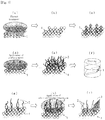
- Figs. 1 are schematic diagrams showing steps and procedures of a method for metallizing a dielectric substrate surface of the present invention.
- the resin substrate used as the base of a dielectric substrate of the present invention is exemplified by olefinic resins such as fluorine resins, epoxy resins, polyethylene resins, polypropylene resins, and cycloolefin resins; styrenic resins such as polystyrene resins and syndiotactic polystyrene resins; aromatic polyether ketone resins such as polyether ether ketone resins and polyphenylene ether resins; polyacetal resins; polyphenylene sulfide resins; and bismaleimide triazine resins.
- olefinic resins such as fluorine resins, epoxy resins, polyethylene resins, polypropylene resins, and cycloolefin resins
- styrenic resins such as polystyrene resins and syndiotactic polystyrene resins
- aromatic polyether ketone resins such as polyether
- the present embodiment describes an example in which a fluorine resin substrate is used as the dielectric substrate to give a printed board.
- the fluorine resin substrate used as the base a fluorine-containing polymer resin, a polymer alloy or a copolymer of a fluorine-containing polymer resin with a liquid crystalline polymer represented by a polyester, or, a polymer alloy or a copolymer of a fluorine-containing polymer resin with a polyimide dielectric.
- the film thickness of the dielectric substrate composed of such a polymer film and the like is not limited to particular values.
- the polymer film may contain an inorganic substance such as glass cloth.
- the fluorine resin is polytetrafluoroethylene (PTFE) unless otherwise specified.
- Figs. 1 are schematic diagrams showing the method for metallizing a dielectric substrate surface of the present invention.
- Fig. 1(a) is a diagram showing a step of atmospheric pressure plasma treatment of a fluorine resin substrate 1 as a dielectric substrate.
- the fluorine resin substrate 1 to be a printed board is placed between two electrodes facing each other and is subjected to atmospheric pressure plasma treatment using a rare gas as the main component. Radicals, electrons, ions, and the like contained in the plasma eliminate fluorine atoms on the surface of the fluorine resin to induce the formation of dangling bonds (see Fig. 1(b) ).
- the plasma treatment and the plasma treatment apparatus may be a common method and a common apparatus, and the plasma treatment apparatus may be any of a substitution type and an atmosphere open type.
- a grafting agent is applied by a liquid phase method such as spin coating to form an ultrathin film (see Fig. 1(d) ).
- the peroxide radical group formed on the fluorine resin surface functions as the reaction site and spontaneously forms covalent bonds with the grafting agent 2, and the grafting agent is grafted at high density from the fluorine resin surface (see Fig. 1(e) ).
- the method for applying the grafting agent include, in addition to the spin coating, spraying, inkjet printing, offset printing, gravure offset printing, immersing, and doctor blade coating, but are not necessarily limited to them.
- a compound or a polymer having such a functional group as to form coordinate bonds with metal ions including a carbonyl group, a lower amino group (primary amino group), a higher amino group (secondary or higher amino group), an amido group, a pyridyl group, a pyrrolyl group, an imidazole group, an isocyanate group, a hydroxy group, an ether group, an ester group, a phosphoric acid group, a urea group, a thiol group, a thiophene group, and a thiourea group.
- Specific examples of the preferred complexing compound include, but are not necessarily limited to, vinylamines (for example, acrylic amine), acrylamide, acrylonitrile, vinylanilines, vinylisocyanates, vinylpyrroles, vinylpyrrolidones, vinyltriazines, vinylphosphonic acids, vinylphosphoric acids, vinylthiols, vinylthiophenes, and vinylsulfonic acids.
- the complexing polymer include, but are not necessarily limited to, polymers of the above complexing compounds, such as polyvinylamines (for example, polyacrylamines), polyacrylamides, polyacrylonitriles, polyvinylanilines, polyvinylisocyanates, polyvinylpyrroles, polyvinylpyrrolidones, polyvinyltriazines, polyvinylphosphonic acids, polyvinylphosphoric acids, polyvinylthiols, polyvinylthiophenes, and polyvinylsulfonic acids.
- polyacrylamine include, but are not necessarily limited to, primary amino group-containing acrylic polymers (for example, aminoethylated acrylic polymers).
- an unreacted grafting agent that is not directly bonded to the surface of the fluorine resin substrate 1 be washed and removed (see Fig. 1(f) ) to improve the adhesiveness of a metal film (silver thin film layer) 3 to be finally formed (see Fig. 1(g) ).
- This washing step may not be performed.
- a silver-containing composition is applied by a liquid phase method such as spin coating, yielding an ultrathin film ( Fig. 1(h) ).
- the thin film of the silver-containing composition applied is heated to be cured, yielding a silver thin film layer 3 (see Fig. 1(i) ).
- the silver-containing composition used in the present invention contains a silver compound (A) represented by Formula (1) and an amine compound (B) represented by Formula (2) at a particular ratio.
- the silver compound (A) is silver acetonedicarboxylate and is typically in powder form.
- the silver compound (A) has a larger viscosity when diluted in a solvent and is a substance difficult to perform patterning such as printing.
- a composition having a high silver content can be set to have a low viscosity.
- the silver compound (A) alone has a high decomposition temperature, and it takes a long period of time to generate metallic silver by burning at 150°C or lower. If the amine compound (B) is used in combination, metallic silver can be generated by burning at a low temperature of 150°C or less in a short time.
- the silver compound (A) and the amine compound (B) provide a synergistic effect and extremely improve the storage stability (determined by the formation of the precipitate of silver particles) as compared with when other silver carboxylates are used.
- the content of the silver compound (A) is 10 to 50% by mass, and the content of the amine compound (B) is 50 to 90% by mass, relative to the total amount of 100% by mass of the silver compound (A) and the amine compound (B).
- the content of the silver compound (A) is preferably 20 to 40% by mass, and the content of the amine compound (B) is preferably 60 to 80% by mass. If the content of the amine compound (B) is less than 50% by mass, the solubility of the silver compound (A) may be greatly reduced.
- the silver compound (A) as silver acetonedicarboxylate used in the present invention may be produced by any method, which is exemplified by methods described in known literature, including a method in " Journal fur Praktician Chemie. Band 312 (1970) pp. 240 to 244 ".
- an organic base is desirably used in order to prevent contamination of metal ions.
- the amine compound (B) used in the present invention is a compound represented by Formula (2), where R 1 is a hydrogen atom, -(CY 2 )a-CH 3 , or -((CH 2 )b-OCHZ)c-CH 3 , and R 2 is a phenyl group, -(CY 2 )d-CH 3 , or -((CH 2 )e-O-CHZ)f-CH 3 .
- Y is a hydrogen atom or -(CH 2 )g-CH 3
- Z is a hydrogen atom or -(CH 2 )h-CH 3 .
- the amine compound (B) is exemplified by ethylamine, 1-propylamine, 1-butylamine, 1-pentylamine, 1-hexylamine, 1-heptylamine, 1-octylamine, 2-ethylhexylamine, isopropylamine, isobutylamine, isopentylamine, sec-butylamine, tert-butylamine, tert-amylamine, benzylamine, 3-methoxypropylamine, 2-ethoxypropylamine, 3-isopropoxypropylamine, diisopropylamine, dibutylamine, and 2-ethoxyethylamine.
- R 1 in the amine compound (B) is preferably a hydrogen atom, -(CY 2 )a-CH 3 , or -((CH 2 )b-O-CHZ)c-CH 3
- Y and Z are each particularly preferably a hydrogen atom or a methyl group
- a is particularly preferably an integer of 2 to 6
- b is particularly preferably an integer of 1 to 3
- c is particularly preferably 1 or 2.
- R 2 is desirably -(CY 2 )d-CH 3 or -((CH 2 )e-O-CHZ)f-CH 3
- Y and Z are each desirably a hydrogen atom
- d is desirably an integer of 1 to 6
- e is desirably an integer of 1 to 3
- f is desirably an integer of 1 or 2.
- an amine compound (B) having a boiling point of less than 130°C is more preferably used.
- Examples of the amine compound (B) satisfying such conditions preferably include 1-propylamine, 1-butylamine, 1-pentylamine, 1-hexylamine, 1-heptylamine, 1-octylamine, isopropylamine, isobutylamine, isopentylamine, 3-methoxypropylamine, 2-ethoxypropylamine, 2-ethoxyethylamine, 3-isopropoxypropylamine, diisopropylamine, dibutylamine, and 2-ethylhexylamine. These compounds may be used singly or in combination of two or more of them.
- a solvent can be appropriately added in addition to the silver compound (A) and the amine compound (B) in order to improve the coatability on a substrate or to adjust the viscosity.
- the amount of the solvent is preferably 20 to 80% by mass where the total amount of the silver compound (A) and the amine compound (B) is 20 to 80% by mass.
- the amount of the solvent is more preferably 40 to 60% by mass where the total amount of the silver compound (A) and the amine compound (B) is 40 to 60% by mass. If the amount of the solvent is more than 80% by mass, the silver content is reduced, causing a possibility in which a uniform silver film cannot be obtained to occur.
- Types of the solvent are not particularly limited, but is preferably such a solvent as to be easily removed when a silver film is produced.
- Examples of the type of the solvent include alcohols such as methanol, ethanol, 1-propanol, 2-propanol, 1-butanol, 2-butanol, tert-butanol, 1-pentanol, 2-pentanol, 3-pentanol, 1-hexanol (n-hexyl alcohol), tert-amyl alcohol, ethylene glycol, butoxyethanol, methoxyethanol, ethoxyethanol, propylene glycol, propylene glycol monomethyl ether, propylene glycol monopropyl ether, propylene glycol monobutyl ether, and dipropylene glycol monomethyl ether; ethers such as acetoxymethoxypropane, phenyl glycidyl ether, and ethylene glycol glycidyl ether : ketones such as acetone,
- preferred solvents are ethanol, 1-propanol, 2-propanol, 1-butanol, 2-butanol, 1-pentanol, tert-amyl alcohol, ethylene glycol, butoxyethanol, methoxyethanol, ethoxyethanol, propylene glycol, propylene glycol monomethyl ether, propylene glycol monopropyl ether, propylene glycol monobutyl ether, dipropylene glycol monomethyl ether, methyl ethyl ketone, methyl isobutyl ketone, acetonitrile, propionitrile, butyronitrile, and isobutyronitrile.
- solvents may be used singly or as a mixture of two or more of them.
- a solvent can be added to a mixture of the silver compound (A) and the amine compound (B).
- the silver compound (A) can be added to a mixture of the amine compound (B) and a solvent, or the amine compound (B) can be added to a mixture of the silver compound (A) and a solvent.
- the silver-containing composition used in the present invention may contain an additional component such as hydrocarbons, acetylene alcohols, and silicone oil for adjusting leveling properties on a substrate, a coupling agent such as a silane coupling agent for adjusting the adhesiveness to a substrate, an additive such as a resin and a plasticizer for adjusting viscosity properties, additional electric conductor powders, glass powders, surfactants, metal salts, and other additives commonly used in similar liquid compositions, as necessary.
- an additional component such as hydrocarbons, acetylene alcohols, and silicone oil for adjusting leveling properties on a substrate
- a coupling agent such as a silane coupling agent for adjusting the adhesiveness to a substrate
- an additive such as a resin and a plasticizer for adjusting viscosity properties
- additional electric conductor powders glass powders, surfactants, metal salts, and other additives commonly used in similar liquid compositions, as necessary.
- the silver-containing composition used in the present invention may be warmed in advance or may be reacted with a commonly known reducing agent to form silver clusters and nanoparticles, and a resulting silver colloidal dispersion liquid can be used.
- a borohydride compound, a tertiary amine, a thiol compound, a phosphorus compound, ascorbic acid, a quinone, a phenol, or a similar compound can be added as the reducing agent in such an amount as not to impair electric conductivity or flatness.
- the silver-containing composition of the present invention can be applied to a substrate by spin coating or printing, for example.
- the coating method include, but are not necessarily limited to, spraying, inkjet printing, offset printing, gravure offset printing, immersing, and doctor blade coating.
- the heating temperature upon heating a substrate coated with the silver-containing composition may be any temperature that is equal to or higher than room temperature. In consideration of productivity, heating at 80°C or higher is preferred for burning in a short time.
- the burning is preferably performed at a temperature of not less than 80°C and less than 150°C.
- the burning is preferably performed at a temperature of not less than 120°C and less than 170°C from the viewpoint of productivity.
- the obtained silver acetonedicarboxylate was subjected to TGA analysis with a thermogravimetric analyzer (manufactured by SII NanoTechnology Inc.).
- the temperature increase rate was 10°C/min, and the measurement atmosphere was in air.
- the thermal decomposition temperature was 175°C.
- the residue after the thermogravimetric analysis was 59.7%, which was in agreement with the theoretical residual ratio (59.4%).
- a silver-containing ink solution 200 mg of the silver acetonedicarboxylate prepared in Synthesis Example was dissolved in 800 mg of hexylamine (HA) to give a silver-containing composition.
- 800 mg of the obtained silver acetonedicarboxylate-containing amine solution was added to 200 mg of isopropyl alcohol (IPA) to yield a silver-containing ink solution 1.
- IPA isopropyl alcohol
- a PTFE dielectric substrate having a surface on which a metal film composed of a silver thin film was formed was produced.
- the resin substrate used was a PTFE sheet shaved into a thickness of 0.2 mm, manufactured by Nitto Denko Corporation.
- the grafting agent used was an aminoethylated acrylic polymer having an amino group.
- the plasma treatment apparatus used was a normal pressure plasma surface treatment apparatus (AP-T05-L150) manufactured by Sekisui Chemical Co., Ltd.
- a silver thin film was formed on the surface of a PTFE sheet in the same manner as in Example 1 except that the steps of 5) to 9) in Example 1 were not performed to eliminate (II) the plasma treatment and (III) the grafting, giving a dielectric substrate provided with a metal film.
- the adhesive strength between the silver thin film and the PTFE sheet in the obtained PTFE sheet with a metal film was determined in the same manner as in Example 1, resulting in an adhesive strength of 0.0 N/mm. The silver thin film was easily released from the PTFE sheet.
- the surface of a PTFE sheet was subjected to plasma treatment to form a silver thin film in the same manner as in Example 1 except that the steps of 7) to 9) in Example 1 were not performed to eliminate (III) the grafting, giving a dielectric substrate provided with a metal film.
- the adhesive strength between the silver thin film and the PTFE sheet in the obtained PTFE sheet with a metal film was determined in the same manner as in Example 1, resulting in an adhesive strength of 0.32 N/mm.
- Example 1 and Comparative Examples 1 and 2 revealed that the adhesive strength between a silver thin film and a PTFE sheet was markedly improved by subjecting the surface of a PTFE sheet as a dielectric substrate to plasma treatment and grafting, then applying a silver-containing composition, and heating and curing the composition.
- a dielectric substrate having a surface on which a metal film composed of a silver thin film was formed was produced in the same procedure as in Example 1 except that a polyimide (PI) sheet was used as the resin substrate in place of the PTFE sheet in Example 1, and the adhesive test of the metal film was performed.
- the PI resin substrate used was "Kapton (registered trademark) H300, manufactured by DU PONT-TORAY Co., Ltd.”.
- the grafting agent used was the same aminoethylated acrylic polymer having an amino group as in Example 1.
- the PI resin substrate was broken, and it was ascertained that the adhesion force between the metal film and the resin substrate was higher than the breaking strength of the resin substrate itself.
- the breaking strength of the PI resin substrate itself was determined to be 17.2 N/mm.
- a dielectric substrate having a surface on which a metal film composed of a silver thin film was formed was produced in the same procedure as in Example 1 except that a cycloolefin polymer (COP) sheet was used as the resin substrate in place of the PTFE sheet in Example 1, and the adhesive test of the metal film was performed.
- the COP sheet used was "ZEONORFILM (registered trademark) ZF-16-100, manufactured by Zeon Corporation".
- the grafting agent used was the same aminoethylated acrylic polymer having an amino group as in Example 1.
- the COP resin substrate was broken, and it was ascertained that the adhesion force between the metal film and the resin substrate was higher than the breaking strength of the resin substrate itself.
- the breaking strength of the COP resin substrate itself was determined to be 6.0 N/mm.
Landscapes
- Chemical & Material Sciences (AREA)
- Organic Chemistry (AREA)
- Chemical Kinetics & Catalysis (AREA)
- Engineering & Computer Science (AREA)
- Materials Engineering (AREA)
- Physics & Mathematics (AREA)
- General Chemical & Material Sciences (AREA)
- Wood Science & Technology (AREA)
- Life Sciences & Earth Sciences (AREA)
- Thermal Sciences (AREA)
- Metallurgy (AREA)
- Mechanical Engineering (AREA)
- Polymers & Plastics (AREA)
- Medicinal Chemistry (AREA)
- Health & Medical Sciences (AREA)
- Analytical Chemistry (AREA)
- Plasma & Fusion (AREA)
- Inorganic Chemistry (AREA)
- Chemically Coating (AREA)
- Manufacturing Of Printed Wiring (AREA)
- Laminated Bodies (AREA)
Applications Claiming Priority (2)
| Application Number | Priority Date | Filing Date | Title |
|---|---|---|---|
| JP2014038876 | 2014-02-28 | ||
| PCT/JP2015/055186 WO2015129675A1 (fr) | 2014-02-28 | 2015-02-24 | Procédé de métallisation de surface de substrat diélectrique et substrat diélectrique pourvu d'un film métallique |
Publications (2)
| Publication Number | Publication Date |
|---|---|
| EP3112499A1 true EP3112499A1 (fr) | 2017-01-04 |
| EP3112499A4 EP3112499A4 (fr) | 2017-10-04 |
Family
ID=54008993
Family Applications (1)
| Application Number | Title | Priority Date | Filing Date |
|---|---|---|---|
| EP15754572.4A Pending EP3112499A4 (fr) | 2014-02-28 | 2015-02-24 | Procédé de métallisation de surface de substrat diélectrique et substrat diélectrique pourvu d'un film métallique |
Country Status (7)
| Country | Link |
|---|---|
| US (1) | US20160362791A1 (fr) |
| EP (1) | EP3112499A4 (fr) |
| JP (1) | JP6551391B2 (fr) |
| KR (1) | KR102373554B1 (fr) |
| CN (1) | CN106460175B (fr) |
| TW (1) | TWI669413B (fr) |
| WO (1) | WO2015129675A1 (fr) |
Families Citing this family (3)
| Publication number | Priority date | Publication date | Assignee | Title |
|---|---|---|---|---|
| KR102318044B1 (ko) * | 2016-02-29 | 2021-10-28 | 한국전자통신연구원 | 전극체 및 전극체 제조 방법 |
| JP6740686B2 (ja) * | 2016-04-13 | 2020-08-19 | 大日本印刷株式会社 | 積層体の製造方法および積層体、ならびに物品 |
| WO2019230862A1 (fr) | 2018-05-31 | 2019-12-05 | 国立大学法人大阪大学 | Corps assemblé et son procédé de fabrication |
Family Cites Families (11)
| Publication number | Priority date | Publication date | Assignee | Title |
|---|---|---|---|---|
| GB9717368D0 (en) * | 1997-08-18 | 1997-10-22 | Crowther Jonathan | Cold plasma metallization |
| EP1905756B1 (fr) * | 2005-07-04 | 2013-02-27 | Osaka University | Derives de type beta-cetocarboxylate d'argent, et leur utilisation pour la production de metal argent |
| EP1793013B1 (fr) * | 2005-12-05 | 2017-07-19 | Rohm and Haas Electronic Materials LLC | Métallisation de diélectriques |
| JP4903528B2 (ja) * | 2006-10-23 | 2012-03-28 | 富士フイルム株式会社 | 金属膜付基板の作製方法、金属膜付基板、金属パターン材料の作製方法、金属パターン材料 |
| EP2087942A1 (fr) * | 2006-10-23 | 2009-08-12 | FUJIFILM Corporation | Procédé de production d'un substrat revêtu d'un film métallique, substrat revêtu d'un film métallique, procédé de production d'un matériau à motif métallique, et matériau à motif métallique |
| JP5360963B2 (ja) * | 2008-12-27 | 2013-12-04 | 国立大学法人大阪大学 | 誘電体基材表面の触媒フリー金属化方法及び金属膜付き誘電体基材 |
| KR101487342B1 (ko) * | 2010-07-30 | 2015-01-30 | 주식회사 잉크테크 | 투명 도전막의 제조방법 및 이에 의해 제조된 투명 도전막 |
| JP5721254B2 (ja) * | 2010-09-17 | 2015-05-20 | 国立大学法人大阪大学 | 誘電体基材表面の触媒フリー金属化方法及び金属膜付き誘電体基材 |
| JP5712635B2 (ja) * | 2011-01-25 | 2015-05-07 | 日油株式会社 | 銀含有組成物 |
| JP6008676B2 (ja) * | 2012-05-29 | 2016-10-19 | トッパン・フォームズ株式会社 | 積層体、積層体の製造方法及び通信機器 |
| JP6191606B2 (ja) * | 2012-07-19 | 2017-09-06 | 日油株式会社 | 銀ナノ微粒子、その製造方法、銀ナノ微粒子分散液及び銀要素形成基材 |
-
2015
- 2015-02-24 WO PCT/JP2015/055186 patent/WO2015129675A1/fr not_active Ceased
- 2015-02-24 KR KR1020167023115A patent/KR102373554B1/ko active Active
- 2015-02-24 US US15/121,524 patent/US20160362791A1/en not_active Abandoned
- 2015-02-24 EP EP15754572.4A patent/EP3112499A4/fr active Pending
- 2015-02-24 CN CN201580010759.0A patent/CN106460175B/zh active Active
- 2015-02-24 JP JP2016505224A patent/JP6551391B2/ja active Active
- 2015-02-26 TW TW104106262A patent/TWI669413B/zh active
Also Published As
| Publication number | Publication date |
|---|---|
| US20160362791A1 (en) | 2016-12-15 |
| CN106460175A (zh) | 2017-02-22 |
| KR102373554B1 (ko) | 2022-03-10 |
| JPWO2015129675A1 (ja) | 2017-03-30 |
| JP6551391B2 (ja) | 2019-07-31 |
| KR20160144963A (ko) | 2016-12-19 |
| TWI669413B (zh) | 2019-08-21 |
| CN106460175B (zh) | 2019-03-05 |
| TW201602405A (zh) | 2016-01-16 |
| EP3112499A4 (fr) | 2017-10-04 |
| WO2015129675A1 (fr) | 2015-09-03 |
Similar Documents
| Publication | Publication Date | Title |
|---|---|---|
| EP0456972B1 (fr) | Modification d'une surface en polyimide | |
| CN100338259C (zh) | 用银催化剂和无电金属组合物金属化非导电表面 | |
| CN110670050B (zh) | 化学镀铜活化液及其制备方法 | |
| CN109983157B (zh) | 印刷电路板的制备方法 | |
| US12410524B2 (en) | Method for manufacturing laminate | |
| JP7780257B2 (ja) | 表面処理方法、表面処理剤、結合体の製造方法、導体被覆を有する物質の製造方法、塗膜が形成された物質の製造方法、及び化合物 | |
| JP2005002471A (ja) | 基材上の銅層の析出 | |
| EP3112499A1 (fr) | Procédé de métallisation de surface de substrat diélectrique et substrat diélectrique pourvu d'un film métallique | |
| EP2001045A1 (fr) | Appareil cvd a plasma, procede de formation de film mince et dispositif a semi-conducteurs | |
| KR102698135B1 (ko) | 이미드기 함유 화합물, 이미드기 함유 경화제, 및 에폭시 수지 경화물 및 그것을 이용한 전기절연성 재료 | |
| TW202007240A (zh) | 印刷配線板之製造方法 | |
| JP6564282B2 (ja) | 金属含有膜付き誘電体基材の製造方法 | |
| KR102498131B1 (ko) | 은 피복 실리콘 고무 입자 및 이 입자를 함유하는 도전성 페이스트 그리고 이 도전성 페이스트를 사용한 도전막의 제조 방법 | |
| JP2000349417A (ja) | 配線基板の製造方法 | |
| KR100791557B1 (ko) | 플라스틱-금속박막 필름 및 그 제조방법 | |
| KR20060060083A (ko) | 실란계 커플링제를 이용한 폴리이미드 필름의표면개질방법, 그를 이용한 동박 적층 필름의 제조방법 및그로 제조된 2층 구조의 동박 적층필름 | |
| EP1496061A2 (fr) | Composé de cuivre et une méthode de production d'une couche mince de cuivre de ce composé | |
| US6296897B1 (en) | Process for reducing extraneous metal plating | |
| WO2011065568A1 (fr) | Résine isolante, composition pour la formation d'une couche de résine isolante, stratifié, procédé de fabrication d'un matériau de film métallique de surface, procédé de fabrication d'un matériau de motif métallique, procédé de fabrication d'un tableau de connexions, composant électrique et dispositif semi-conducteur | |
| JP2011111602A (ja) | 絶縁性樹脂、絶縁性樹脂層形成用組成物、積層体、表面金属膜材料の作製方法、金属パターン材料の作製方法、配線基板の作製方法、電子部品、及び、半導体素子 | |
| JP5642378B2 (ja) | 絶縁性樹脂、絶縁性樹脂層形成用組成物、積層体、表面金属膜材料の作製方法、金属パターン材料の作製方法、配線基板の作製方法、電子部品、半導体素子 | |
| Foote | Overcoming the challenges presented with automated selective conformal coating of advanced electronic assemblies by employing plasma treatment technology | |
| JP2000096210A (ja) | 樹脂基材表面への金属膜形成方法 |
Legal Events
| Date | Code | Title | Description |
|---|---|---|---|
| STAA | Information on the status of an ep patent application or granted ep patent |
Free format text: STATUS: THE INTERNATIONAL PUBLICATION HAS BEEN MADE |
|
| PUAI | Public reference made under article 153(3) epc to a published international application that has entered the european phase |
Free format text: ORIGINAL CODE: 0009012 |
|
| STAA | Information on the status of an ep patent application or granted ep patent |
Free format text: STATUS: REQUEST FOR EXAMINATION WAS MADE |
|
| 17P | Request for examination filed |
Effective date: 20160928 |
|
| AK | Designated contracting states |
Kind code of ref document: A1 Designated state(s): AL AT BE BG CH CY CZ DE DK EE ES FI FR GB GR HR HU IE IS IT LI LT LU LV MC MK MT NL NO PL PT RO RS SE SI SK SM TR |
|
| AX | Request for extension of the european patent |
Extension state: BA ME |
|
| DAX | Request for extension of the european patent (deleted) | ||
| A4 | Supplementary search report drawn up and despatched |
Effective date: 20170906 |
|
| RIC1 | Information provided on ipc code assigned before grant |
Ipc: C23C 18/04 20060101ALI20170830BHEP Ipc: C23C 18/08 20060101AFI20170830BHEP |
|
| STAA | Information on the status of an ep patent application or granted ep patent |
Free format text: STATUS: EXAMINATION IS IN PROGRESS |
|
| 17Q | First examination report despatched |
Effective date: 20190405 |