EP3120467B1 - Vorrichtung und verfahren zur effizienten übergabe für leo-satellitensysteme - Google Patents
Vorrichtung und verfahren zur effizienten übergabe für leo-satellitensysteme Download PDFInfo
- Publication number
- EP3120467B1 EP3120467B1 EP15805999.8A EP15805999A EP3120467B1 EP 3120467 B1 EP3120467 B1 EP 3120467B1 EP 15805999 A EP15805999 A EP 15805999A EP 3120467 B1 EP3120467 B1 EP 3120467B1
- Authority
- EP
- European Patent Office
- Prior art keywords
- path
- communications
- handover
- paths
- satellite
- Prior art date
- Legal status (The legal status is an assumption and is not a legal conclusion. Google has not performed a legal analysis and makes no representation as to the accuracy of the status listed.)
- Active
Links
Images




Classifications
-
- H—ELECTRICITY
- H04—ELECTRIC COMMUNICATION TECHNIQUE
- H04B—TRANSMISSION
- H04B7/00—Radio transmission systems, i.e. using radiation field
- H04B7/14—Relay systems
- H04B7/15—Active relay systems
- H04B7/185—Space-based or airborne stations; Stations for satellite systems
- H04B7/1851—Systems using a satellite or space-based relay
- H04B7/18517—Transmission equipment in earth stations
-
- H—ELECTRICITY
- H04—ELECTRIC COMMUNICATION TECHNIQUE
- H04B—TRANSMISSION
- H04B7/00—Radio transmission systems, i.e. using radiation field
- H04B7/14—Relay systems
- H04B7/15—Active relay systems
- H04B7/185—Space-based or airborne stations; Stations for satellite systems
- H04B7/1853—Satellite systems for providing telephony service to a mobile station, i.e. mobile satellite service
- H04B7/18539—Arrangements for managing radio, resources, i.e. for establishing or releasing a connection
- H04B7/18541—Arrangements for managing radio, resources, i.e. for establishing or releasing a connection for handover of resources
-
- H—ELECTRICITY
- H04—ELECTRIC COMMUNICATION TECHNIQUE
- H04B—TRANSMISSION
- H04B7/00—Radio transmission systems, i.e. using radiation field
- H04B7/14—Relay systems
- H04B7/15—Active relay systems
- H04B7/185—Space-based or airborne stations; Stations for satellite systems
- H04B7/195—Non-synchronous stations
-
- H—ELECTRICITY
- H04—ELECTRIC COMMUNICATION TECHNIQUE
- H04W—WIRELESS COMMUNICATION NETWORKS
- H04W36/00—Hand-off or reselection arrangements
- H04W36/14—Reselecting a network or an air interface
-
- H—ELECTRICITY
- H04—ELECTRIC COMMUNICATION TECHNIQUE
- H04W—WIRELESS COMMUNICATION NETWORKS
- H04W36/00—Hand-off or reselection arrangements
- H04W36/0005—Control or signalling for completing the hand-off
- H04W36/0083—Determination of parameters used for hand-off, e.g. generation or modification of neighbour cell lists
-
- H—ELECTRICITY
- H04—ELECTRIC COMMUNICATION TECHNIQUE
- H04W—WIRELESS COMMUNICATION NETWORKS
- H04W36/00—Hand-off or reselection arrangements
- H04W36/10—Reselecting an access point controller
-
- H—ELECTRICITY
- H04—ELECTRIC COMMUNICATION TECHNIQUE
- H04W—WIRELESS COMMUNICATION NETWORKS
- H04W84/00—Network topologies
- H04W84/02—Hierarchically pre-organised networks, e.g. paging networks, cellular networks, WLAN [Wireless Local Area Network] or WLL [Wireless Local Loop]
- H04W84/04—Large scale networks; Deep hierarchical networks
- H04W84/06—Airborne or Satellite Networks
Definitions
- a handover or handoff of a user terminal (UT) or handset is a process of transferring an ongoing call or data session from one channel connected to the core network to another channel (e.g., from one cell serviced by one cell tower to another cell serviced by another cell tower).
- handover is the reassignment or the reconfiguration of radio links between the UT and a satellite, a satellite beam and carrier or triplet frequency set. The criteria to perform handover may vary from system to system, but in general handovers are triggered to select paths with better channel conditions.
- satellites orbiting at different levels above the Earth may be employed, such as low Earth orbit (LEO) satellites, medium Earth orbit (MEO) satellites and geosynchronous Earth orbit (GEO) satellites.
- LEO low Earth orbit
- MEO medium Earth orbit
- GEO geosynchronous Earth orbit
- a GEO satellite orbits the Earth in a flying in a geosynchronous earth orbit, with an orbital period the same as the Earth's rotation period.
- a geosynchronous orbit is at an altitude of about 35,786 km (22,236 miles) above the Earth, and typically is directly above the Equator.
- a LEO satellite typically flies in an orbit around the Earth at an altitude between 160 kilometers or 99 miles (with an orbital period of about 88 minutes) and 2,000 kilometers or 1,200 miles (with an orbital period of about 127 minutes).
- the beam footprint on the Earth is generally fixed based on the satellite antenna configuration.
- a LEO satellite constellation provides a unique mode of operation and associated challenges, where the footprint of each satellite beam on the Earth is constantly moving. Accordingly, mobile satellite systems employing LEO satellites require frequent handovers due to the beam movement across the Earth (even when there is no terminal movement and the channel condition is constant). In addition line of sight between the terminal and the satellite may change due to satellite movement.
- Document US5574968 discloses a handoff method in a satellite system wherein a UE chooses a candidate cell to HO to, based on a dynamic candidate list provided by the satellite. The said list is prioritized based on the length of time the cell is available for HO. The UE determines whether to perform a HO by comparing the signal strength of the current cell with one of the candidate list or when it detects that it is approaching the current cell's edge.
- Document US6104911 discloses the selection of a candidate satellite that should provide service to a UE based on one or a combination of strategies.
- one strategy identifies the highest satellite in the sky to provide the service link.
- Other strategies can be developed to simplify HO, assist in load balancing or improve quality of service.
- the determination is either performed by the UE or in cooperation with a network controller.
- Document US6108538 deals with a HO determination algorithm for satellite networks based on evaluation of the signal strength of the current and candidate beams. Furthermore, depending on the location and velocity of the candidate beam, a dynamic HO threshold is set. This threshold is then used to evaluate the difference between the signal strength of the current and candidate beams.
- the present invention relates to a method and a system as set forth in claims 1 and 6.
- the present invention advantageously addresses the foregoing requirements and needs, as well as others, by providing approaches for efficient, dynamic and continuous handover processes, which encompass selection of an optimal path (consisting of a satellite, a satellite beam and carrier frequency set) over which a user terminal (UT) communicates with the radio access network in a mobile satellite communications system.
- the satellite, satellite beam and carrier frequency set for forward and return link directions need not be the same and no symmetry is assumed in forward and return link direction beam patterns.
- the provided approaches employ a set of metrics to select an optimal path, balancing multiple parameters, such as signal to noise ratio, expected duration of beam coverage, and other parameters, described in further detail below.
- the approach further provides for seamless handover from current paths to alternate paths deemed as more optimal, wherein no transmission data loss is experienced unless a handover involves a carrier frequency handover.
- a method for evaluating whether to perform a handover of a UT from a first communications path to a second communications path of a mobile satellite communications system.
- a set of path factors are determined regarding each of a plurality of communications paths for the UT.
- a path selection metric (PSM) for each communications path is determined, wherein the PSM for each communications path is determined via a weighted calculation based on the respective set of path factors for the communications path.
- PSM path selection metric
- a decision is made as to whether to perform a handover of the UT from a first of the communications paths to a second of the communications paths, wherein the determination is based on an evaluation performed based at least in part on the PSM.
- a combined path metric is determined for each of a set of candidate communications paths to which the UT may be handed-over, wherein the CPM for each set of candidate communications paths is determined based at least in part on the PSM for each communications path in the set. Further, each CPM is computed to serve as an indicator reflecting a quality of path diversity regarding the set of communications paths.
- the set of path factors regarding each of the communications paths comprises two or more aspects of the communications path, wherein the aspects comprise one or more indicators each reflecting a quality of the communications path, an expected lifespan of the communications path, a handover bias, and a capacity factor.
- the one or more indicators each reflecting a quality of the communications path comprise(s) a relative pilot strength for the path
- the expected lifespan of the communications path comprises an expected lifespan of a sub-beam of the communications path
- the handover bias relates to timing of the handover
- the capacity factor reflects a transmission capacity potential of the communications path.
- the weighted calculation for determining the PSM for each of the communications paths is computed based on a different respective weighting factor applied to each path factor for the communications path, and each different weighting is set to adjust an effect level of the respective path factor on the PSM to address tradeoffs between system operational characteristics.
- a module or component may be composed of software component(s), which are stored in a memory or other computer-readable storage medium, and executed by one or more processors or CPUs of the respective devices.
- a module may alternatively be composed of hardware component(s) or firmware component(s), or a combination of hardware, firmware and/or software components.
- various forms of computer-readable media may be involved in providing instructions to a processor for execution.
- the instructions for carrying out at least part of the present invention may initially be borne on a magnetic disk of a remote computer.
- the remote computer loads the instructions into main memory and sends the instructions over a telephone line using a modem.
- a modem of a local computer system receives the data on the telephone line and uses an infrared transmitter to convert the data to an infrared signal and transmit the infrared signal to a portable computing device, such as a personal digital assistance (PDA) and a laptop.
- PDA personal digital assistance
- An infrared detector on the portable computing device receives the information and instructions borne by the infrared signal and places the data on a bus.
- the bus conveys the data to main memory, from which a processor retrieves and executes the instructions.
- the instructions received by main memory may optionally be stored on storage device either before or after execution by processor.
- FIG. 1 illustrates a diagram of a communications system capable of providing approaches for dynamic and efficient terminal handover in a wireless communications system, in accordance with example embodiments of the present invention.
- the terrestrial radio access network (RAN) 113 generally controls all handovers.
- the RAN is the element in a mobile communications network that implements the radio access technology of the underlying physical connection methods for a radio based communications network.
- the RAN generally provides connection between the user terminal (UT) 111/114 (e.g., a mobile phone) and the core network (CN) 101.
- UT user terminal
- CN core network
- the CN comprises the central part of a telecommunications network, which generally provides services (e.g., routing calls across a public service telephony network (PSTN) 105 to end users utilizing the telecommunications network via an access network 103).
- PSTN public service telephony network
- Example embodiments further provide approaches for the approximation of handover factors to evaluate available paths and make handover decisions, when the radio access network (RAN) cannot acquire full information necessary to evaluate all the factors.
- RAN radio access network
- forward link and return link handovers are evaluated independently, and no symmetry is assumed between the forward and return path beam patterns and path metrics evaluation.
- the system 100 enables handover procedures between terrestrial base-station and the SBSS 107 to be executed via a core network 101 with standard procedures defined in terrestrial systems.
- the UT 111/114 has the capability to communicate over a satellite link (via the satellite 109 and satellite base station subsystem (SBSS) or satellite gateway (GW) 107) to the wireless core network (CN) 101, or communicate over a terrestrial wireless cell station or tower 110 with a terrestrial radio access network (RAN) 113 to the wireless core network (CN) 101.
- the RAN comprises a radio network controller (RNC) 125, which is responsible for the radio resource management functions and certain mobility management functions of the network.
- RNC radio network controller
- the data network 103 is configured as an IP/IMS (IP Multimedia Subsystem) with multiple application servers 115 supplying multimedia content.
- IP/IMS IP Multimedia Subsystem
- the data network 103 couples to the PSTN 105 via a media gateway 117; the PSTN can serve one or more voice terminals 119.
- a radio access bearer is associated with Packet Data Protocol (PDP) context maintained between the user terminal (UT) 111/114 and the core network (CN) 101.
- PDP Packet Data Protocol
- PDP Packet Data Protocol
- SIP Session Initiation Protocol
- Another RAB is established on demand for the transport of the voice media while a call is in session.
- the satellite radio access network establishes and maintains Radio Bearers (RBs) between the UT and the SBSS 107 necessary to satisfy, for example, Quality of Service (QoS) requirements of the SIP call signaling and Voice over IP (VoIP) user plane RABs.
- the signaling radio bearer supports signaling connectivity between the UT and the satellite radio access network.
- a SIP protocol is typically used for establishing the initiation, and the management, of a session.
- a SIP message mainly contains three sections detailing the session, timing and media descriptions.
- a Packet Data Protocol (PDP) context is created for each session initiated, which contains the desired characteristics of the specific session, including the PDP type and the demanded QoS among other parameters.
- PDP context can be viewed as a set of information maintained by UT, GGSN and SGSN. It contains a PDP type that identifies the type of Packet Data Network (PDN), the PDP address, QoS information and other session information.
- PDN Packet Data Network
- Activating a PDP context refers to creating the PDP context at the UT, SGSN and GGSN so that UT can communicate with an entity in PDN using the PDP address maintained in the PDP context. Further, a secondary PDP context activation allows the subscriber to establish a PDP context with a different QoS profile to the same PDN.
- the Core Network (CN) 101 may include a Proxy-Call Session Control Function (P-CSCF), a Serving-Call Session Control Function (S-CSCF), an Interrogating-Call Session Control Function (I-CSCF), a Media Resource Function Controller (MRFC), a Media Resource Function Processor (MRFP), a Media Gateway (MGW), a Media Gateway Controller Function (MGCF) and a Signaling Gateway (SGW).
- P-CSCF Proxy-Call Session Control Function
- S-CSCF Serving-Call Session Control Function
- I-CSCF Interrogating-Call Session Control Function
- MRFC Media Resource Function Controller
- MRFP Media Resource Function Processor
- MGW Media Gateway Controller Function
- SGW Signaling Gateway
- approaches are provided for performing a terminal handover, taking into account a multitude of factors for the selection of the best available set of paths.
- a set of a satellite, a satellite beam and frequency for forward and return link directions need not be the same and no symmetry is assumed in forward and return link direction beam patterns.
- Example algorithms may combine a set of metrics to select an optimal path, balancing multiple parameters, such as signal to noise ratio, expected duration of beam coverage, and other parameters, described in further detail below.
- the approaches further provide for seamless handover from current paths to alternate paths deemed as more optimal, wherein no transmission data loss is experienced unless a handover involves a frequency handover.
- handover comprises the reassignment or the reconfiguration of radio links between a terminal and a satellite, a satellite beam and carrier frequency triplet or set.
- the criteria for performing handover varies from system to system, but in general handovers are triggered to select paths with better channel conditions, and thus typically consider only the channel conditions on both the current paths and potential available paths as the factors for making a handover decision.
- a "path" comprises a satellite, a satellite beam and carrier frequency triplet, and a "sub-beam” refers to a satellite beam and carrier sub-band pair.
- such approaches provide for the consideration of an expanded set of factors to achieve a more efficient and improved handover process.
- Such expanded factors are largely driven by the system characteristics (e.g., in a LEO system, the orbit in speed of the satellites, current and available transmission power levels, and available frequencies).
- multiple paths can be selected to provide processing gain and/or diversity gain.
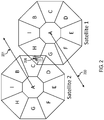
- FIG. 2 illustrates a diagram depicting example beam patterns of two respective satellites, Satellite 1 (SAT-1) and Satellite 2 (SAT-2), moving in different directions, as reflected by the trajectory lines 201, 203.
- Each beam is label by an alphabet letter, and each beam may comprise multiple carrier frequencies.
- a user terminal (UT) 205 is shown, located in an overlapping section of the two beam patterns.
- the UT is located at the overlapping area of the satellite beams Satellite1, Beam H and Satellite 2, Beam C, and, for example, can be serviced using multiple (e.g., two) paths to provide path diversity and processing gain, however, the beams must have the same operating carrier frequency.
- adjacent beams of one satellite may overlap, and a terminal within the overlapping portion of two beams can be serviced by both beams simultaneously.
- the UT may require handover due to its mobility, change of its channel conditions and sub-beam coverage.
- a forward link handover may be initiated by the RAN, whereby it commands the UT to switch one or more of its downlink receive paths (forward link paths), and reconfigures the associated downlink transmit paths accordingly.
- one type of forward link handover consists of a mobile-assisted handover.
- the RAN may use forward path measurement reporting procedures to obtain feedback on the quality of the target forward links.
- Mobile-assisted handovers are always intra-frequency (handovers involving common carrier frequency paths), but may involve inter-beam or inter-satellite path handover.
- a mobile-assisted handover may comprise ether a "soft" handover - where a change of one or more active paths is performed while at least one active path remains constant (when path diversity is in effect), or a "hard” handover, involving a reconfiguration of all active paths at the same time.
- another type of forward link handover consists of a blind handover. In a blind handover, no path measurements are used. Blind handovers may be performed in situations when measurements are unavailable or impossible to obtain (e.g., in inter-frequency handovers). Blind handovers are usually (if not always) hard handovers.
- a return link handover may be initiated by the RAN, whereby it selects a different set of uplink receive paths (return link paths).
- one type of return link handover consists of an intra-frequency handover (a handover involving common carrier frequency paths).
- Intra-frequency return link handovers are transparent to the UT, and require no message exchange between the RAN and the terminal.
- Intra-frequency return link handovers can be soft or hard.
- another type of return link handover consists of an inter-frequency handover (a handover involving change in carrier frequency paths). In an inter-frequency return link handover, the RAN commands the UT to switch its respective uplink frequency.
- path metrics are utilized to evaluate path options for different handover scenarios.
- a Path Selection Metric (PSM) is a metric for a one path
- a Combined Path Metric (CPM) is a metric for a set of paths.
- PSM Path Selection Metric
- CPM Combined Path Metric
- PSM Path Selection Metric
- the Path Selection Metric is used in selecting the best candidate path, and seeks to combine various factors for evaluating one sub-beam over others.
- one type of PSM consists of a normalized relative pilot strength/quality metric (S).
- S pilot strength/quality metric
- the relative pilot strength/quality metric utilizes the measurement of a pilot signal-to-interference ratio (SIR) or signal-to-noise ratio (S/N), plus a correction for differences in actual pilot transmit power between the forward link beams being measured.
- SIR pilot signal-to-interference ratio
- S/N signal-to-noise ratio
- the pilot is a reference signal transmitted by the RAN, which is always on and being transmitted at a consistent transmit power.
- relative pilot strength/quality consists of the measured pilot SIR (w/o the correction), normalized.
- the RAN performs such measurements directly based on return link transmissions received from the UT. Such measurements may be performed with respect to the active return link paths of the UT and/or other paths of the same frequency within beams (either from the same satellite or from a different satellite) covering the current UT position. While the RAN may not be decoding such other inactive paths, the RAN can receive the transmissions of the UT, and if a handover is initiated, then one or more of such inactive paths may become active.
- the available measurements for the different sub-beam may be used as an approximation for the desired sub-beam measurements.
- the available sub-beam measurements may be used as an approximation for the desired sub-beam measurements.
- the available sub-beam measurements may again be used as an approximation for the desired sub-beam measurements (e.g., after adding a path and beam gain offset due to the different distances between the UT and the two satellites, and (for example) a configurable handicap - See, e.g., FIG.
- SI R beam , B , approx SI R beam , A , meas + G beam , B ⁇ G beam , A + G path , B ⁇ G path , A + P pilot , beam , B ⁇ P pilot , beam , A + S adj
- SI R beam , B , approx SI R beam , A , meas + G beam , B ⁇ G beam , A + G path , B ⁇ G paht , A + S adj
- the configurable handicap comprises a flexible variable that provides additional control over the initiation of handovers (e.g., the handicap can be manipulated based on past experience, simulation results and desired system and operational goals with respect to handovers, such as frequency of handovers versus signal quality and resulting QoS).
- anothertype of PSM consists of a sub-beam lifetime metric (L).
- L sub-beam lifetime metric
- L low and L high may be chosen to reflect beam coverage duration based on the particular satellite system (e.g., for a LEO system, 10 and 30 seconds, respectively).
- L low and L high can be estimated, and, further, such estimations can be tailored to affect handover frequency (e.g., pushing the estimations more towards the system limits will reduce handover frequency, while more conservative estimates will result in a higher handover frequency).
- L low and L high normalize the anticipated beam coverage time across the system.
- H another type of PSM consists of a handover bias metric (H).
- another type of PSM consists of a metric reflecting an available capacity factor (or inverse load factor) for the sub-beam (A).
- an available capacity factor (or inverse load factor) for the return link sub-beam may be where A is based on the ratio of existing flows/uplink allocation to the maximum permissible channels, wherein more uplink flows or transmissions increases interference.
- the weights may each be set according to a weight to be attributed to the respective metric to address the various system tradeoffs (such as, the weighting of the pilot measurements versus the sub-beam lifetime).
- a higher weight applied to relative pilot strength/quality (S) may lead to a higher frequency of handovers (e.g., a better quality path may then trigger a handover even though there remains a relatively long lifetime for the sub-beam), whereas a higher weight applied to sub-beam lifetime (e.g., a better quality path may not then trigger a handover when there remains a relatively long lifetime for the sub-beam).
- embodiments of the present invention provide a generic approach that can easily be tailored to accomplish different design and system goals and efficiencies (e.g., based on various system operational tradeoffs - such as minimizing handovers at the sacrifice of signal quality at the fringes versus maximizing signal quality on a consistent basis at the sacrifice of overhead associated with a higher frequency of handovers).
- the Combined Path Metric is used in selecting a set of candidate paths that provides good path diversity.
- a set of paths whose CPM is higher than that of another set is considered as a better choice for a set of diversity paths.
- a path diversity parameter D (1,..., n ) for the set of paths 1,..., n is selected based on the level of diversity of each path (e.g., where the diversity parameters favor a higher degree of path diversity - e.g., four satellites is better than 3, 2 or 1, for example, because of the increased line of sight options).
- the path diversity parameters may be selected as follows:
- the following algorithm may be used to select the best set of paths from a candidate set of sub-beams using CPM, given a target number of diversity paths NP and satellites NS.
- the target frequency TF may be supplied.
- candidate set C ( NS ) Call this candidate set C ( NS ) and compute CPM( C ( NS )) - if NS satellites are not found, candidate set C ( NS ) will thus be empty and will not be considered; (2) Decrement NS and repeat (1) until candidate sets C ( NS ), C ( NS - 1), ..., C (1) have been generated; and (3) Select the optimal candidate set as the set C ( i ) with the highest CPM value.
- the RAN periodically reevaluates the set of forward path candidates and active paths.
- the RAN may reevaluate the set of forward path candidates and active paths based on a predetermined periodicity (e.g., where the periodicity reflects another flexible factor utilized to achieve desired system operation and performance - e.g., every 10 seconds).
- the RAN may reevaluate the set of forward path candidates and active paths when certain events occur that may trigger a handover (e.g., such events include UT position updates, measurement reports, and certain resource management events - such as a resource management action that will render a beam no longer available to a particular UT).
- special criteria may apply when certain path handovers are being considered.
- one such criteria may be that the selected carrier frequency must be the same as the other paths in the diversity set that are not being handed off. In case of an inter-frequency handover, all the diversity paths are handed off together.
- another such criteria for an inter-frequency handover may be that (if reasonably possible) the target path must be on the same satellite as the existing path, which would allow the UT to use approximations based on current measurements to acquire the target pilots.
- a further such criteria for an inter-satellite handover may be that the target carrier frequency must be the same as the current one if at all possible. This allows the UT to perform measurements of the target pilots before the handover.
- the forward path handover process is as follows:
- the RAN at handover time, generally has measurements of multiple candidate paths provided by pilot searches during the course of the respective active call or data session. Further, with an active call or data session, an active traffic channel frequency has been established, so the RAN attempts to keep the UT on the same return frequency during handovers.
- the RAN uses the following algorithm to choose the return paths at handover:
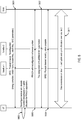
- FIG. 3 illustrates a signal timing diagram depicting a process for physical channel reconfiguration of forward paths or frequencies, for a user terminal (UT) handover situation in a CDMA wireless communications system, in accordance with example embodiments of the present invention.
- the RAN provides certain information to instruct the UT to perform the handover (S301), including identification of the satellite, beam and carrier frequency, the Walsh codes, and the switchover time (e.g., specification of the forward frame number at which the RAN and terminal switch to the new paths).
- the satellite and beam information provide the proper mapping to a pseudorandom noise (PN) code to be used by the terminal.
- PN pseudorandom noise
- the reconfiguration can include information of multiple paths.
- the frequency is generally the same for all paths.
- a soft handover involves the reconfiguration of some paths while maintaining at least one active path, whereas hard handover involves the reconfiguration of all active paths.
- the RAN continues to transmit data on the old paths up to the target switchover frame (S303).
- the UT the reconfigures the receiver (S305), and the RAN reconfigures the transmitter (S307).
- the RAN may pause downlink traffic for a short while during the transition to allow the UT reconfiguration to be activated.
- the UT activates the new configuration (S309) and the RAN activates the new configuration (S311).
- the UT then sends a message to the RAN indicating that the physical channel reconfiguration has been completed (S313), and the RAN continues to send the data (after the switchover frame) based on the new configuration (S315).
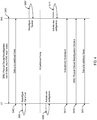
- FIG. 4 illustrates a signal timing diagram depicting a process for physical channel reconfiguration of return paths or frequencies, for a user terminal (UT) handover situation in a CDMA wireless communications system, in accordance with example embodiments of the present invention.
- the RAN provides information to instruct the UT to perform the handover (S401).
- the UT transmissions on the assigned return frequency are received by the RAN via diverse paths (satellites and beams).
- the active RAN receivers and path diversity are transparent to the user.
- the Walsh codes to be used on return physical channels may be included in the PCR/RBR message, if they are to be changed. Normally, there is no need to change return channel Walsh code assignments because they are independent of the return sub-beam.
- the UT continues to transmit data on the old paths up to the target frame (S403).
- the UT the reconfigures the transmitter and (S405), and the RAN reconfigures the receiver (S407).
- the UT activates the new configuration (S409) and the RAN activates the new configuration (S411).
- the UT then sends an initial pilot only transmission (S413), and then sends a message to the RAN indicating that the physical channel reconfiguration has been completed (S315).
- the UT then continues to send the data (after the switchover frame) based on the new configuration (S417).
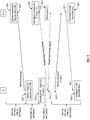
- FIG. 5 illustrates a signal timing diagram depicting a process for physical channel reconfiguration of forward and return paths or frequencies, for a user terminal (UT) handover situation in a TDMA wireless communications system, in accordance with example embodiments of the present invention.
- each forward sub-beam has a corresponding uplink sub-beam and thus the handover applies to the forward and return frequencies simultaneously.
- the RAN provides certain information to the UT via the Radio Bearer (RB) Reconfiguration message (S503), including forward carrier frequency, return carrier frequency and switchover time (e.g., specification of the forward link frame number at which the RAN and UT switch to the new paths).
- RB Radio Bearer
- the target downlink frame number N is chosen such that sufficient time is allowed for the RAN to retransmit the RB Reconfiguration message, and the uplink activation frame is based on the satellite hop delay.
- the RAN continues to transmit and receive voice packets on the old channels until the downlink (DL) frame N is reached, but (S501) the RAN stops transmitting and receiving data traffic for all the other flows that rely on sequence number and segmentation information to reconstruct upper layer packet data units (PDUs).
- PDUs upper layer packet data units
- the last successfully received sequence numbers that resulted in a full upper layer packet assembly are also sent to the UT in the reconfiguration message in order to keep the RAN and UT segmentation/reassembly states in synch.
- the UT When the UT receives the RB reconfiguration command, it validates the configuration and stops all data traffic flows until DL frame N (except voice flow, if present) (S505). When the DL frame N is reached at the RAN, it reconfigures the downlink physical channel according to the new configuration and starts transmitting bursts on the new DL channel (S507). At this point, the RAN can begin transmitting voice packets on the new downlink channel (S509), space and reconfigures the uplink channel (S511). Similarly at DL frame N, the UT reconfigures both the downlink and uplink physical channels and starts transmitting on the new uplink physical channel (S513).
- the UT continues transmission of voice packets (if present) on the new uplink channel (S515).
- the UT then transmits an RB reconfiguration complete message to the RAN, using the new uplink channel (S517).
- the RAN acknowledges the message (S519) and reestablishes all the other data traffic flows (S521).
- the UT reestablishes all other data traffic flows (S523).
- FIG. 6 illustrates a timing diagram of uplink allocation to transmissions in relation to nominal positions, for a user terminal (UT) handover situation in a TDMA wireless communications system, in accordance with example embodiments of the present invention.
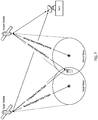
- FIG. 7 illustrates a diagram depicting transmission propagation delays, for a user terminal (UT) handover situation in a TDMA wireless communications system, in accordance with example embodiments of the present invention.
- Both AllocationToTxDelay and ( T UTProp - T Nominalprop ) are usually provided by the RAN to the UT during initial system access using RACH procedure, where ( T UTProp - T NominalProp ) is calculated either using the UT location sent in RACH, or using the RACH arrival time and comparing with the expected RACH arrival time from the nominal location.
- the synchronization at the UT needs to be updated to reflect the UT to the target satellite propagation delay, the target satellite nominal point on earth and its AllocationToTxDelay value.
- the AllocationToTxDelay parameter is usually different for each beams/satellite set.
- the RAN uses a UT position and the satellite ephemeris data to calculate the following parameters, which are sent in a handover message along with the new forward and return frequencies:
- FIG. 8 illustrates a signal timing diagram for an inter-satellite handover process, for a user terminal (UT) handover situation in a TDMA wireless communications system, in accordance with example embodiments of the present invention.
- the flow reflects a handover between two satellites (handover from satellite 1 to satellite 2).
- the UT reconfigures its receiver (switching to the new frequencies), and decodes the downlink traffic channel on the new frequency (S803).
- the UT uses the newly adjusted timing correction (e.g., AllocationToTxDelay )
- the UT transmits an uplink PRACH to access the system using the traffic channel S805).
- PRACH allocations are signaled in the downlink transmission similar to the allocation of uplink data transmission.
- Initial access with PRACH allows the RAN to instruct the UT to make additional timing adjustment to correct for residual timing errors.
- the PRACH also carries a handover message instruction reference number to help the RAN locate the UT context.
- the UT After the UT receives the flow assignment from the RAN (S807), the UT sends a Physical Channel Complete message and reactivates all the flows that were handed over (S809).
- the use of PRACH has a less stringent timing and synchronization requirement than the use of traffic channel.
- the RAN deems that the timing accuracy is sufficient for the UT to use the traffic channel immediately, then the RAN will instruct the UT not to send PRACH first, and to immediately use the traffic channel and listen to uplink allocation to transmit Physical Channel Complete message. Then, data transmissions continue on the downlink and uplink over satellite 2 (S811).
- RNC Radio Network Controller
- a handover with RNC relocation process is used to perform seamless handover of a UT and the UT active sessions from one radio network controller (RNC) to another.
- FIG. 9 illustrates a signal timing diagram depicting an inter-RNC handover process, for a user terminal (UT) handover situation in a wireless communications system, in accordance with example embodiments of the present invention.
- the RNC is a governing element in a Universal Mobile Telecommunications System (UMTS) radio access network, and is generally responsible for controlling the connected for servicing the respective UTs.
- the RNC generally performs radio resource management functions, some mobility management functions and is the encryption point for user data traffic.
- the inter-RNC handover is triggered by position knowledge of fixed UT or by position updates or neighbor beam measurements sent by the UT from which the RAN determines that the UT has crossed into the target beam.
- the process is performed as follows:
- the target RNC When the DL frame N is reached at the target RNC, it reconfigures the downlink physical channel according to the new configuration and starts transmitting voice traffic on the new downlink channel to the UT. At this point, voice packets are transmitted on the new DL channel (S915). Similarly at DL frame N , the UT reconfigures both the downlink and uplink physical channels and starts transmitting on the new uplink physical channel (S917). At this point, the UT continues transmission of voice packets, if present, on the new uplink channel to the target RNC. Based on the downlink activation frame and the uplink activation time at the UT, the target RNC configures the new uplink physical channel and begins to acquire the UT uplink voice packets transmission.
- the UT then transmits an RB Reconfiguration Complete message to the target RNC, using the new uplink channel (S919).
- the RB Reconfiguration Complete message is received at the target RNC, it acknowledges the message and reestablishes all active data traffic flows on the downlink (S921).
- the target RNC receives the RB Reconfiguration Complete message from the UT, it acknowledges it and reestablishes all the other data traffic flows on the DL.
- the target RNC sends the Relocation Detect (S923) and Relocation Complete messages (S925) to the SGSN, and the SGSN then switches the user data plane GTP traffic to the target RNC.
- the UT receives the layer 2 acknowledgement for the RB Reconfiguration Complete message, the UT reestablishes all the other data traffic flows on the uplink.
- RNC Radio Network Controller
- an inter-satellite handover with RNC relocation process is used for handover of a UT from a current satellite (source satellite) to a new satellite (target satellite), and handover of the UT and the UT active sessions from a current RNC (source RNC) to another RNS (target RNC).
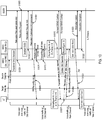
- FIG. 10 illustrates a signal timing diagram depicting an inter-RNC and inter-satellite handover process, for a user terminal (UT) handover situation in a wireless communications system, in accordance with example embodiments of the present invention. The figure shows the interaction between the various entities and over which satellite the messages are exchanged.
- This handover process operates virtually the same as the process detailed above for a handover with radio network controller (RNC) relocation, with respect to FIG. 9 , except that certain message and data transmissions are relayed either over the source satellite or the target satellite, which satellite relays are reflected by the signal arrows in FIG. 10 (i.e., where a message or data transmission signal arrow points to a one of the satellites, and then continues on to the destination, that message or data transmission signal is being relayed over the respective satellite).
- RNC radio network controller
- the process is performed as follows:
- the DL frame N When the DL frame N is reached at the target RNC, it reconfigures the downlink physical channel according to the new configuration and starts transmitting voice traffic on the new downlink channel to the UT. At this point, voice packets are transmitted on the new DL channel (S1015) - which is relayed over the target satellite. Similarly at DL frame N, the UT reconfigures both the downlink and uplink physical channels and starts transmitting on the new uplink physical channel (S1017) - which is relayed over the target satellite. At this point, the UT continues transmission of voice packets, if present, on the new uplink channel to the target RNC.
- the target RNC Based on the downlink activation frame and the uplink activation time at the UT, the target RNC configures the new uplink physical channel and begins to acquire the UT uplink voice packets transmission.
- the UT then transmits an RB Reconfiguration Complete message to the target RNC, using the new uplink channel (S1019), relayed over the target satellite.
- the RB Reconfiguration Complete message When the RB Reconfiguration Complete message is received at the target RNC, it acknowledges the message and reestablishes all active data traffic flows on the downlink (S1021) - which is relayed over the target satellite.
- the target RNC receives the RB Reconfiguration Complete message from the UT, it acknowledges it and reestablishes all the other data traffic flows on the DL.
- the target RNC sends the Relocation Detect (S1023) and Relocation Complete messages (S1025) to the SGSN, and the SGSN then switches the user data plane GTP traffic to the target RNC.
- the UT receives the layer 2 acknowledgement for the RB Reconfiguration Complete message, the UT reestablishes all the other data traffic flows on the uplink.
Landscapes
- Engineering & Computer Science (AREA)
- Computer Networks & Wireless Communication (AREA)
- Signal Processing (AREA)
- Physics & Mathematics (AREA)
- Astronomy & Astrophysics (AREA)
- Aviation & Aerospace Engineering (AREA)
- General Physics & Mathematics (AREA)
- Mobile Radio Communication Systems (AREA)
- Radio Relay Systems (AREA)
Claims (10)
- Verfahren, mit den Schritten:Bestimmen eines Satzes von Pfadfaktoren hinsichtlich einer Vielzahl von Kommunikationspfaden mit einem Satelliten (109), einem Satellitenstrahl und einer Trägerfrequenz für ein mobiles Benutzerendgerät (111, 114) in einem mobilen Satellitenkommunikationssystem durch eine Funknetzsteuerung (125);Bestimmen einer Pfadauswahlmetrik für jeden Kommunikationspfad durch die Funknetzsteuerung (125), wobei die Pfadauswahlmetrik für jeden Kommunikationspfad über eine gewichtete Berechnung auf der Basis des entsprechenden Satzes von Pfadfaktoren für den Kommunikationspfad bestimmt wird; undBestimmen, ob eine Übergabe des Benutzerendgerätes (111, 114) von einem aktuellen Pfad der Kommunikationspfade an einen alternativen Pfad aus der Vielzahl von Kommunikationspfaden durch die Funknetzsteuerung (125) durchzuführen ist, wobei die Bestimmung auf einer Auswertung beruht, die zumindest teilweise auf der Basis der für jeden aus der Vielzahl von Kommunikationspfaden bestimmten Pfadauswahlmetriken durchgeführt wird,wobei Vorwärtsverbindungs- und Rückverbindungsübergaben unabhängig voneinander ausgewertet werden, undwobei der Satz von Pfadfaktoren hinsichtlich des jeweiligen Kommunikationspfades zwei oder mehr Aspekte des Kommunikationspfades aufweist.
- Verfahren nach Anspruch 1,
wobei die Aspekte des Kommunikationspfades einen oder mehrere Hinweise, die jeweils eine Eigenschaft des Kommunikationspfades widerspiegeln, eine voraussichtliche Lebensdauer des Kommunikationspfades, eine Übergabevorspannung und einen Leistungsfaktor aufweisen. - Verfahren nach Anspruch 2,
wobei der eine oder die mehreren Hinweise, die jeweils eine Eigenschaft des Kommunikationspfades widerspiegeln, eine relative Pilotstärke für den Pfad aufweist/aufweisen, die voraussichtliche Lebensdauer des Kommunikationspfades eine voraussichtliche Lebensdauer eines Teilstrahls des Kommunikationspfades aufweist, die Übergabevorspannung das Timing der Übergabe betrifft, und der Leistungsfaktor ein Übertragungsleistungspotential des Kommunikationspfades widerspiegelt. - Verfahren nach Anspruch 1,
wobei die gewichtete Berechnung zur Bestimmung der Pfadauswahlmetrik für den jeweiligen Kommunikationspfad auf der Basis eines unterschiedlichen entsprechenden Gewichtungsfaktors berechnet wird, der an jeden Pfadfaktor für den Kommunikationspfad angelegt wird, und die unterschiedliche Gewichtung jeweils auf der Basis von Systemeigenschaften und Systemkonstruktionszielen eingestellt wird. - Verfahren nach Anspruch 1, ferner mit dem Schritt:Bestimmen einer kombinierten Pfadmetrik für jeden eines Satzes von Kommunikationspfaden, wobei der Satz von Kommunikationspfaden Kommunikationspfade aus der Vielzahl von Kommunikationspfaden aufweist, an welche das Benutzerendgerät (111, 114) übergeben werden kann, wobei die kombinierte Pfadmetrik zumindest teilweise auf der Basis der Pfadauswahlmetrik für jeden Kommunikationspfad des Satzes von Kommunikationspfaden bestimmt wird undwobei jede kombinierte Pfadmetrik so berechnet ist, dass sie als ein Hinweis dient, der eine Eigenschaft von Pfad-Diversity hinsichtlich des Satzes von Kommunikationspfaden widerspiegelt, an welchen das Benutzerendgerät übergeben werden kann.
- Funkzugangsnetzwerk (113) in einem mobilen drahtlosen Kommunikationsnetzwerk, wobei das Funkzugangsnetzwerk (113) Folgendes aufweist:eine Empfangsschnittstelle, die dazu konfiguriert ist, Datenkommunikation von einem mobilen Endgerät (111, 114) über eine Vielzahl von Kommunikationspfaden des Netzwerks zu empfangen;eine Übertragungsschnittstelle, die dazu konfiguriert ist, Datenkommunikation zur Übertragung an das mobile Endgerät über eine Vielzahl von Kommunikationspfaden des Netzwerks bereitzustellen; undeine Funknetzsteuerung (125), die dazu konfiguriert ist, (i) einen Satz von Pfadfaktoren hinsichtlich jedes aus der Vielzahl von Kommunikationspfaden zu bestimmen, (ii) eine Pfadauswahlmetrik für jeden Kommunikationspfad zu bestimmen, wobei die Pfadauswahlmetrik für jeden Kommunikationspfad über eine gewichtete Berechnung auf der Basis des entsprechenden Satzes von Pfadfaktoren für den Kommunikationspfad bestimmt wird, und (iii) zu bestimmen, ob eine Übergabe des mobilen Endgerätes von einem aktuellen Pfad der Kommunikationspfade an einen alternativen Pfad aus der Vielzahl von Kommunikationspfaden durchzuführen ist,
wobei die Bestimmung zumindest teilweise auf den Pfadauswahlmetriken basiert, die für jeden aus der Vielzahl von Kommunikationspfaden bestimmt sind,wobei Vorwärtsverbindungs- und Rückverbindungsübergaben unabhängig voneinander ausgewertet werden,wobei jeder aus der Vielzahl von Kommunikationspfaden einen Satelliten (109), einen Satellitenstrahl und eine Trägerfrequenz aufweist, undwobei der Satz von Pfadfaktoren hinsichtlich jedes der Kommunikationspfade zwei oder mehr Aspekte des Kommunikationspfades aufweist. - Funkzugangsnetzwerk nach Anspruch 6,
wobei die Aspekte des Kommunikationspfades einen oder mehrere Hinweise aufweisen, die jeweils eine Eigenschaft des Kommunikationspfades, eine voraussichtliche Lebensdauer des Kommunikationspfades, eine Übergabevorspannung und einen Leistungsfaktor widerspiegeln. - Funkzugangsnetzwerk nach Anspruch 6 oder 7,
wobei der eine oder die mehreren Hinweise, die jeweils eine Eigenschaft des Kommunikationspfades widerspiegeln, eine relative Pilotstärke für den Pfad aufweist/aufweisen, die voraussichtliche Lebensdauer des Kommunikationspfades eine voraussichtliche Lebensdauer eines Teilstrahls des Kommunikationspfades aufweist, die Übergabevorspannung das Timing der Übergabe betrifft und der Leistungsfaktor ein Übertragungsleistungspotential des Kommunikationspfades widerspiegelt. - Funkzugangsnetzwerk nach einem der Ansprüche 6 bis 8,
wobei die gewichtete Berechnung zur Bestimmung der Pfadauswahlmetrik für jeden der Kommunikationspfade auf der Basis eines unterschiedlichen entsprechenden Gewichtungsfaktors berechnet wird, der an jeden Pfadfaktor für den Kommunikationspfad angelegt wird, und jede unterschiedliche Gewichtung auf der Basis von Systemeigenschaften und Systemkonstruktionszielen eingestellt wird. - Funkzugangsnetzwerk nach einem der Ansprüche 6 bis 9,
wobei die Funknetzsteuerung ferner dazu konfiguriert ist:eine kombinierte Pfadmetrik für jeden eines Satzes von Kommunikationspfaden zu bestimmen, wobei der Satz von Kommunikationspfaden Kommunikationspfade aus der Vielzahl von Kommunikationspfaden aufweist, an welche das Benutzerendgerät (111, 114) übergeben werden kann, wobei die kombinierte Pfadmetrik zumindest teilweise auf der Basis der Pfadauswahlmetrik für jeden Kommunikationspfad des Satzes von Kommunikationspfaden bestimmt wird; undwobei jede kombinierte Pfadmetrik so berechnet wird, dass sie als ein Hinweis, der eine Eigenschaft von Pfad-Diversity hinsichtlich des Satzes von Kommunikationspfaden widerspiegelt, an welchen das Benutzerendgerät übergeben werden kann.
Applications Claiming Priority (2)
| Application Number | Priority Date | Filing Date | Title |
|---|---|---|---|
| US201461955558P | 2014-03-19 | 2014-03-19 | |
| PCT/US2015/021377 WO2015191138A2 (en) | 2014-03-19 | 2015-03-19 | Apparatus and method for efficient handover for low earth orbit (leo) satellite systems |
Publications (3)
| Publication Number | Publication Date |
|---|---|
| EP3120467A2 EP3120467A2 (de) | 2017-01-25 |
| EP3120467A4 EP3120467A4 (de) | 2017-11-29 |
| EP3120467B1 true EP3120467B1 (de) | 2019-02-20 |
Family
ID=54143422
Family Applications (1)
| Application Number | Title | Priority Date | Filing Date |
|---|---|---|---|
| EP15805999.8A Active EP3120467B1 (de) | 2014-03-19 | 2015-03-19 | Vorrichtung und verfahren zur effizienten übergabe für leo-satellitensysteme |
Country Status (5)
| Country | Link |
|---|---|
| US (4) | US9479993B2 (de) |
| EP (1) | EP3120467B1 (de) |
| CA (1) | CA2970920C (de) |
| MX (1) | MX354513B (de) |
| WO (1) | WO2015191138A2 (de) |
Cited By (2)
| Publication number | Priority date | Publication date | Assignee | Title |
|---|---|---|---|---|
| EP3741156A4 (de) * | 2018-01-19 | 2021-11-24 | Hughes Network Systems, LLC | Benutzerendgeräte-weiterreichungsvorhersage in drahtlosen kommunikationssystemen mit nichtstationären kommunikationsplattformen |
| US11509388B2 (en) | 2018-02-13 | 2022-11-22 | Satixfy Israel Ltd. | Method and an apparatus for use in a satellite communications network |
Families Citing this family (72)
| Publication number | Priority date | Publication date | Assignee | Title |
|---|---|---|---|---|
| EP3120467B1 (de) | 2014-03-19 | 2019-02-20 | Hughes Network Systems, LLC | Vorrichtung und verfahren zur effizienten übergabe für leo-satellitensysteme |
| US9888426B2 (en) * | 2015-05-01 | 2018-02-06 | Qualcomm Incorporated | Handoff for satellite communication |
| US10009093B2 (en) | 2015-05-01 | 2018-06-26 | Qualcomm Incorporated | Handoff for satellite communication |
| WO2017023621A1 (en) * | 2015-07-31 | 2017-02-09 | Viasat, Inc. | Flexible capacity satellite constellation |
| US10097316B2 (en) * | 2015-10-05 | 2018-10-09 | Qualcomm Incorporated | HARQ handling at inter-beam handover |
| US10244453B2 (en) | 2015-10-13 | 2019-03-26 | Qualcomm Incorporated | Method and apparatus for inter-satellite handovers in low-earth orbit (LEO) satellite systems |
| US9961008B2 (en) * | 2015-11-19 | 2018-05-01 | Ayecka Communication Systems | Method and system of handling over routing of communication protocol data between two satellite communication transponders |
| US10135521B2 (en) | 2015-12-16 | 2018-11-20 | Hughes Network Systems, Llc | System and method of predictive satellite spot beam selection |
| US10425865B2 (en) * | 2016-02-11 | 2019-09-24 | Qualcomm Incorporated | Channel quality feedback in satellite communication systems |
| SG11201808071QA (en) * | 2016-03-24 | 2018-10-30 | Worldvu Satellites Ltd | Admission control system for satellite-based internet access and transport |
| KR102397164B1 (ko) * | 2016-09-13 | 2022-05-11 | 퀄컴 인코포레이티드 | 위성 통신 시스템에서 이웃 셀 리스트 |
| US10263691B2 (en) | 2016-09-21 | 2019-04-16 | Qualcomm Incorporated | Dynamic reverse link retransmission timelines in satellite communication systems |
| US10433208B2 (en) | 2016-10-05 | 2019-10-01 | Hughes Network Systems, Llc | Multi-modem user terminal and policy-based management for satellite transport resiliency |
| US10321375B2 (en) * | 2016-12-30 | 2019-06-11 | Hughes Network Systems, Llc | Delayed satellite handover |
| EP3567748B1 (de) * | 2017-02-06 | 2021-03-24 | Mitsubishi Electric Corporation | Planungsvorrichtung und planungsverfahren |
| US10200922B2 (en) * | 2017-06-09 | 2019-02-05 | Space Systems/Loral, Llc | Satellite network switching |
| CN107330589B (zh) * | 2017-06-19 | 2020-07-07 | 中国科学院空天信息创新研究院 | 卫星网络协调风险的定量化评估方法及系统 |
| US10667188B2 (en) * | 2017-06-21 | 2020-05-26 | Qualcomm Incoporated | Method and apparatus for multiplexing hybrid satellite constellations |
| CN108366400B (zh) * | 2018-01-24 | 2020-04-10 | 北京邮电大学 | 一种基于时间演进图的空天网络切换实时预测方法 |
| EP3756316B1 (de) * | 2018-02-20 | 2024-10-09 | Hughes Network Systems, LLC | Satelliten- und terrestrischer lastausgleich |
| GB2572336B (en) * | 2018-03-26 | 2022-02-02 | Samsung Electronics Co Ltd | Improvements in and relating to random access in a telecommunication network |
| CN108901082B (zh) * | 2018-06-20 | 2020-11-20 | 新华三技术有限公司 | 一种接入方法及装置 |
| CN112314017A (zh) * | 2018-06-21 | 2021-02-02 | 诺基亚技术有限公司 | 用于支持基于精度定时协议(ptp)的时间敏感网络(tsn)应用的时间同步无线电承载 |
| KR102879490B1 (ko) | 2018-09-06 | 2025-10-31 | 링크 글로벌, 인크. | 스페이스에서 셀룰러 코어 네트워크 및 라디오 액세스 네트워크 기반시설 및 관리 |
| EP3857736B1 (de) * | 2018-09-27 | 2022-03-23 | Telefonaktiebolaget Lm Ericsson (Publ) | Detektion von benachbarten satelliten in drahtlosen kommunikationssystemen |
| WO2020076220A1 (en) * | 2018-10-08 | 2020-04-16 | Telefonaktiebolaget Lm Ericsson (Publ) | User equipment, network node and methods therein for handling a moving radio access network |
| US10727949B2 (en) | 2018-10-12 | 2020-07-28 | Hughes Network Systems, LLC. | Systems and methods for high-altitude radio/optical hybrid platform |
| US11121765B2 (en) * | 2018-11-13 | 2021-09-14 | Electronics And Telecommunications Research Institute | Method and apparatus for signal configuration for mobile base station |
| US11082903B2 (en) * | 2018-12-03 | 2021-08-03 | Electronics And Telecommunications Research Institute | Method for handover in non-terrestrial network, and apparatus for the same |
| EP3925318B1 (de) * | 2019-02-11 | 2025-08-20 | Nokia Technologies Oy | Vorrichtung, verfahren und computerprogramm zur steuerung der auswahl von benutzergerätezellen in nichtterrestrischen netzwerken |
| CN111565428B (zh) * | 2019-02-14 | 2022-10-25 | 华为技术有限公司 | 小区重选方法以及装置 |
| US11903051B2 (en) * | 2019-02-14 | 2024-02-13 | Telefonaktiebolaget Lm Ericsson (Publ) | Network nodes and methods therein for enabling a switch between feeder links for an airbourne or orbital communication node in a non-terrestrial communications network |
| US20220141730A1 (en) * | 2019-02-20 | 2022-05-05 | Telefonaktiebolaget Lm Ericsson (Publ) | Mobility between Cells in a Wireless Network |
| CN114268387B (zh) * | 2019-03-26 | 2024-06-11 | 华为技术有限公司 | 卫星通信中的切换方法和装置 |
| CN111836315A (zh) * | 2019-04-22 | 2020-10-27 | 华为技术有限公司 | 联合切换方法、装置、设备和存储介质 |
| US11115115B2 (en) | 2019-06-14 | 2021-09-07 | Ofinno, Llc | Non-access stratum connection handling |
| CN110582094B (zh) * | 2019-07-25 | 2022-08-16 | 成都天奥集团有限公司 | 一种基于星历和用户位置计算的定时触发切换方法 |
| WO2021037327A1 (en) * | 2019-08-23 | 2021-03-04 | Nokia Technologies Oy | Configuration in satellite system |
| CN110572200A (zh) * | 2019-09-10 | 2019-12-13 | 北京航空航天大学 | 中继卫星移动切换方法和装置 |
| CN110572203B (zh) * | 2019-10-14 | 2020-12-29 | 中国科学院计算技术研究所 | 一种卫星通信中的用户切换方法 |
| CN110661887B (zh) * | 2019-10-29 | 2020-12-11 | 中国人民解放军32039部队 | 通信链路的建立方法、装置、通信系统及服务器 |
| BR112022009791A2 (pt) * | 2019-11-20 | 2022-08-09 | Hughes Network Systems Llc | Método e sistema para melhoria de desempenho de link para um terminal do usuário em uma rede de satélites |
| CN113131983B (zh) * | 2019-12-30 | 2022-08-19 | 大唐移动通信设备有限公司 | 一种指示方法及设备 |
| US11696189B2 (en) | 2020-02-07 | 2023-07-04 | Qualcomm Incorporated | Handover mechanism for non-terrestrial network (NTN) system in 5G new radio (NR) |
| US11228953B2 (en) | 2020-02-13 | 2022-01-18 | Qualcomm Incorporated | System information design for neighboring cells in a non-terrestrial network |
| US11974171B2 (en) * | 2020-02-14 | 2024-04-30 | Panasonic Avionics Corporation | Antenna blockage detection and mitigation |
| US11616568B2 (en) * | 2020-02-28 | 2023-03-28 | Nokia Technologies Oy | Dynamic cell-specific delay for timing scaling in a non-terrestrial network (NTN) |
| CN111510971B (zh) * | 2020-04-09 | 2022-09-09 | 中电科航空电子有限公司 | 一种机载低轨卫信通信终端辅助控制链路切换方法及系统 |
| US20230155669A1 (en) * | 2020-04-10 | 2023-05-18 | Telefonaktiebolaget Lm Ericsson (Publ) | Beam Reconfiguration in a Wireless Communication Network |
| CN112104411B (zh) * | 2020-11-10 | 2021-04-06 | 四川九洲电器集团有限责任公司 | 一种面向低轨卫星通信的接入卫星选择装置及方法 |
| CN112558474B (zh) * | 2020-11-30 | 2022-06-03 | 重庆邮电大学 | 基于多目标遗传算法的低轨卫星通信线路切换控制方法 |
| CN112583453A (zh) * | 2020-12-15 | 2021-03-30 | 天地信息网络研究院(安徽)有限公司 | 多波束leo卫星通信系统下行noma功率分配方法 |
| CN114679244B (zh) * | 2020-12-25 | 2025-01-21 | 展讯半导体(南京)有限公司 | 跨载波数据传输方法与装置、终端和网络设备 |
| CN113115394B (zh) * | 2021-04-07 | 2022-02-01 | 广州爱浦路网络技术有限公司 | 基于地面移动网络和卫星移动网络切换的通信方法和核心网 |
| CN113133078B (zh) * | 2021-04-19 | 2022-04-08 | 西安电子科技大学 | 一种巨型低轨卫星网络轻量级的星间切换装置及方法 |
| CN115515194B (zh) * | 2021-06-22 | 2024-12-31 | 中国移动通信有限公司研究院 | 一种切换方法、装置及设备 |
| KR20230027991A (ko) * | 2021-08-20 | 2023-02-28 | 삼성전자주식회사 | 비 지상 망에서 동기화 방법 및 장치 |
| CN116095764B (zh) * | 2021-11-05 | 2026-03-17 | 展讯通信(上海)有限公司 | 通信方法、装置及计算机可读存储介质 |
| TWI791338B (zh) | 2021-11-26 | 2023-02-01 | 財團法人工業技術研究院 | 低軌道衛星系統和低軌道衛星換手方法 |
| CN114531191B (zh) * | 2021-12-10 | 2022-09-13 | 广州爱浦路网络技术有限公司 | 一种低轨卫星切换方法、系统、装置与存储介质 |
| WO2023129138A1 (en) * | 2021-12-28 | 2023-07-06 | Hughes Network Systems, Llc | Handover reduction in satellite communication systems |
| US11764866B2 (en) * | 2021-12-29 | 2023-09-19 | Hughes Network Systems, Llc | Systems and methods to minimize handover interruption time |
| CN114221693B (zh) * | 2021-12-30 | 2022-10-11 | 广州爱浦路网络技术有限公司 | 卫星接入控制方法、系统、装置及存储介质 |
| US12445928B2 (en) * | 2022-04-22 | 2025-10-14 | Lynk Global, Inc. | Orbital or other non-terrestrial base station preemption and/or replacement upon terrestrial base station incapacity or failure |
| CN119096482A (zh) | 2022-04-26 | 2024-12-06 | 诺基亚技术有限公司 | 针对ntn的基于天线增益的切换过程 |
| CN115103360B (zh) * | 2022-06-21 | 2023-06-06 | 广州爱浦路网络技术有限公司 | 卫星通信中的用户终端鉴权方法、卫星通信系统、计算机装置及存储介质 |
| US12574750B2 (en) * | 2023-02-17 | 2026-03-10 | Verizon Patent And Licensing Inc. | Method and system for spectrum sharing between terrestrial and non-terrestrial networks |
| US20240405851A1 (en) * | 2023-05-31 | 2024-12-05 | T-Mobile Innovations Llc | Terrestrial system and method for mitigating interference through dynamic physical resource block blanking techniques |
| US20250071581A1 (en) * | 2023-08-25 | 2025-02-27 | Apple Inc. | Segmented Communication Over Wireless Networks |
| US20250088263A1 (en) * | 2023-09-12 | 2025-03-13 | WildStar, LLC | Dynamic and secure reconfigurtion of satellites of a constellation of satellites |
| US20250133533A1 (en) * | 2023-10-24 | 2025-04-24 | Dish Wireless L.L.C. | Inter-satellite-link for o-ran based non-terrestrial network acting at the gnodeb |
| CN117917127B (zh) * | 2023-11-21 | 2024-11-19 | 上海移远通信技术股份有限公司 | 用于无线通信的方法、终端设备及网络设备 |
Citations (2)
| Publication number | Priority date | Publication date | Assignee | Title |
|---|---|---|---|---|
| US6108538A (en) * | 1997-12-01 | 2000-08-22 | Motorola, Inc. | Method and apparatus for dynamically controlling hand-off thresholds in a satellite cellular communication system |
| US6463279B1 (en) * | 1999-11-17 | 2002-10-08 | Globalstar L.P. | Channel frequency allocation for multiple-satellite communication network |
Family Cites Families (39)
| Publication number | Priority date | Publication date | Assignee | Title |
|---|---|---|---|---|
| US5483664A (en) * | 1993-07-26 | 1996-01-09 | Motorola, Inc. | Cellular communications with scheduled handoffs |
| US5574968A (en) * | 1994-06-01 | 1996-11-12 | Motorola, Inc. | Satellite cellular communication methods for performing cell-to-cell handoff |
| FR2760155B1 (fr) * | 1997-02-26 | 1999-03-26 | France Telecom | Transfert d'une communication dans une constellation de satellites non-geostationnaires |
| US6104911A (en) * | 1997-11-14 | 2000-08-15 | Motorola, Inc. | Communication system with satellite diversity and method of operation thereof |
| EP0920143A1 (de) * | 1997-12-01 | 1999-06-02 | ICO Services Ltd. | Messung und Übertragung der Eigenschaften von Signalen durch ein mobiles Satelliten Endgerät unter Verwendung eines Kommunikationsburst eines TDMA Rahmens |
| US6609002B1 (en) * | 1999-09-15 | 2003-08-19 | Hrl Laboratories, Llc | Method and apparatus for predictive QoS routing for broad band low earth satellite networks |
| US9052374B2 (en) * | 2001-07-18 | 2015-06-09 | Fast Location.Net, Llc | Method and system for processing positioning signals based on predetermined message data segment |
| GB0220660D0 (en) | 2002-09-05 | 2002-10-16 | Nokia Corp | Signal propogation delay routing |
| US20050053026A1 (en) * | 2003-09-10 | 2005-03-10 | Arinc, Incorporated | Mobile airborne high-speed broadband communications systems and methods |
| US7643848B2 (en) * | 2004-04-13 | 2010-01-05 | Qualcomm, Incorporated | Multi-antenna transceiver system |
| US8159954B2 (en) * | 2005-03-08 | 2012-04-17 | Telefonaktiebolaget Lm Ericsson (Publ) | Method and arragement for advanced routing metrics in multihop networks |
| EP1764933B1 (de) * | 2005-09-17 | 2008-08-13 | Deutsches Zentrum für Luft- und Raumfahrt e.V. | Aeronautisches Kommunikationssystem |
| WO2007059560A1 (en) * | 2005-11-22 | 2007-05-31 | The University Of Sydney | Aeronautical ad-hoc networks |
| US8326217B2 (en) * | 2006-01-18 | 2012-12-04 | Overhorizon (Cyprus) Plc | Systems and methods for satellite communications with mobile terrestrial terminals |
| US8169955B2 (en) * | 2006-06-19 | 2012-05-01 | Atc Technologies, Llc | Systems and methods for orthogonal frequency division multiple access (OFDMA) communications over satellite links |
| GB2440983A (en) * | 2006-08-18 | 2008-02-20 | Fujitsu Ltd | Wireless multi-hop communication system |
| US8103287B2 (en) * | 2008-09-30 | 2012-01-24 | Apple Inc. | Methods and apparatus for resolving wireless signal components |
| US8750199B2 (en) * | 2008-11-28 | 2014-06-10 | Via Telecom Co., Ltd. | Cell selection handoff for CDMA2000 1X advance |
| US8743722B2 (en) * | 2009-03-26 | 2014-06-03 | Kyocera Corporation | Radio terminal, radio communication system, and radio base station |
| US8798034B2 (en) | 2009-03-31 | 2014-08-05 | Motorola Solutions, Inc. | System and method for selecting a route based on link metrics incorporating channel bandwidth, spatial streams and/or guard interval in a multiple-input multiple-output (MIMO) network |
| US8498267B2 (en) * | 2009-05-01 | 2013-07-30 | At&T Mobility Ii Llc | Access control for macrocell to femtocell handover |
| EP2254266A1 (de) * | 2009-05-20 | 2010-11-24 | Astrium Limited | Inhaltsrundfunk |
| US8879602B2 (en) * | 2009-07-24 | 2014-11-04 | At&T Mobility Ii Llc | Asymmetrical receivers for wireless communication |
| US8559957B2 (en) * | 2010-01-28 | 2013-10-15 | Qualcomm Incorporated | Method and apparatus for biasing a handoff decision based on a blackhaul link |
| US9456422B2 (en) * | 2011-04-21 | 2016-09-27 | Qualcomm Incorporated | Method and apparatus for calibrating transmit power of a FEMTO node |
| US8885569B2 (en) * | 2011-12-19 | 2014-11-11 | Ofinno Technologies, Llc | Beamforming signaling in a wireless network |
| US9215638B2 (en) * | 2012-02-24 | 2015-12-15 | Qualcomm Incorporated | Method and system for regulating frequent cell reselections by idle-mode mobile devices |
| US10397803B2 (en) * | 2012-05-10 | 2019-08-27 | Idac Holdings, Inc. | Systems and methods for directional mesh networks with joint backhaul and access link design |
| US8923861B2 (en) * | 2012-09-26 | 2014-12-30 | Apple Inc. | Facilitating reselection by a wireless communication device to a first network from a second network after termination of a circuit switched fallback voice call |
| US9900872B2 (en) * | 2013-04-17 | 2018-02-20 | Futurewei Technologies, Inc. | Systems and methods for adaptive transmissions in wireless network |
| KR20150025628A (ko) * | 2013-08-29 | 2015-03-11 | 한국전자통신연구원 | 통신시스템에서 빔을 설계하고 통신하는 방법 |
| JP6243181B2 (ja) * | 2013-10-09 | 2017-12-06 | 株式会社Nttドコモ | 無線通信システム、無線移動局、及び無線基地局 |
| US9326209B2 (en) * | 2013-11-07 | 2016-04-26 | Transpacific Ip Management Group Ltd. | Cell selection or handover in wireless networks |
| US9859972B2 (en) * | 2014-02-17 | 2018-01-02 | Ubiqomm Llc | Broadband access to mobile platforms using drone/UAV background |
| US20170064583A1 (en) * | 2014-03-05 | 2017-03-02 | Interdigital Patent Holdings, Inc. | Pcp handover in a mesh network after a change of role of a station associated with a first node receiving from another node an indication of association |
| US10470198B2 (en) * | 2014-03-14 | 2019-11-05 | Interdigital Patent Holdings, Inc. | Method and apparatus for dual-band mesh operations |
| EP3120467B1 (de) | 2014-03-19 | 2019-02-20 | Hughes Network Systems, LLC | Vorrichtung und verfahren zur effizienten übergabe für leo-satellitensysteme |
| US10154493B2 (en) * | 2015-06-03 | 2018-12-11 | At&T Intellectual Property I, L.P. | Network termination and methods for use therewith |
| US9681337B2 (en) * | 2015-08-05 | 2017-06-13 | Qualcomm Incorporated | Satellite-to-satellite handoff in satellite communications system |
-
2015
- 2015-03-19 EP EP15805999.8A patent/EP3120467B1/de active Active
- 2015-03-19 MX MX2016012139A patent/MX354513B/es active IP Right Grant
- 2015-03-19 US US14/662,299 patent/US9479993B2/en active Active
- 2015-03-19 CA CA2970920A patent/CA2970920C/en active Active
- 2015-03-19 WO PCT/US2015/021377 patent/WO2015191138A2/en not_active Ceased
-
2016
- 2016-10-25 US US15/333,979 patent/US9749928B2/en active Active
-
2017
- 2017-08-28 US US15/687,858 patent/US10104594B2/en active Active
-
2018
- 2018-10-16 US US16/161,936 patent/US10512018B2/en active Active
Patent Citations (2)
| Publication number | Priority date | Publication date | Assignee | Title |
|---|---|---|---|---|
| US6108538A (en) * | 1997-12-01 | 2000-08-22 | Motorola, Inc. | Method and apparatus for dynamically controlling hand-off thresholds in a satellite cellular communication system |
| US6463279B1 (en) * | 1999-11-17 | 2002-10-08 | Globalstar L.P. | Channel frequency allocation for multiple-satellite communication network |
Cited By (2)
| Publication number | Priority date | Publication date | Assignee | Title |
|---|---|---|---|---|
| EP3741156A4 (de) * | 2018-01-19 | 2021-11-24 | Hughes Network Systems, LLC | Benutzerendgeräte-weiterreichungsvorhersage in drahtlosen kommunikationssystemen mit nichtstationären kommunikationsplattformen |
| US11509388B2 (en) | 2018-02-13 | 2022-11-22 | Satixfy Israel Ltd. | Method and an apparatus for use in a satellite communications network |
Also Published As
| Publication number | Publication date |
|---|---|
| US20170374596A1 (en) | 2017-12-28 |
| US10104594B2 (en) | 2018-10-16 |
| US9749928B2 (en) | 2017-08-29 |
| US10512018B2 (en) | 2019-12-17 |
| BR112016021568A2 (pt) | 2018-07-03 |
| WO2015191138A3 (en) | 2016-02-04 |
| US20190053119A1 (en) | 2019-02-14 |
| US20150271730A1 (en) | 2015-09-24 |
| MX2016012139A (es) | 2017-04-13 |
| MX354513B (es) | 2018-03-07 |
| EP3120467A4 (de) | 2017-11-29 |
| EP3120467A2 (de) | 2017-01-25 |
| WO2015191138A2 (en) | 2015-12-17 |
| CA2970920A1 (en) | 2015-12-17 |
| US9479993B2 (en) | 2016-10-25 |
| US20170041850A1 (en) | 2017-02-09 |
| CA2970920C (en) | 2021-01-12 |
Similar Documents
| Publication | Publication Date | Title |
|---|---|---|
| EP3120467B1 (de) | Vorrichtung und verfahren zur effizienten übergabe für leo-satellitensysteme | |
| EP3864893B1 (de) | Handhabung eines sich bewegenden funkzugangsnetzwerks | |
| KR101911197B1 (ko) | 위성 통신을 위한 핸드오프 | |
| US8688120B2 (en) | Method for handover in multi-carrier system | |
| US8477737B2 (en) | System and method to improve uplink coverage in multi-carrier systems | |
| CN113615245A (zh) | 切换控制方法、装置、设备及存储介质 | |
| CN111819804A (zh) | 用于非地面网络的承载配置 | |
| US12058578B2 (en) | Methods, apparatus, and systems for supporting a handover | |
| US20210195557A1 (en) | Wireless telecommunications apparatus and methods | |
| CN114095073A (zh) | 一种5g卫星融合场景中的无缝切换方法 | |
| CN115442746A (zh) | 一种波束跟踪方法、设备、装置及存储介质 | |
| US20250385731A1 (en) | Methods, communications devices, and non-terrestrial infrastructure equipment | |
| EP2782392B1 (de) | Verfahren und quellenbasisstation für die weiterreichung eines mobilen endgerätes | |
| CN119094008A (zh) | 一种低轨卫星低延迟波束切换方法 | |
| Kim et al. | Blockage-aware flow control in E-UTRA-NR dual connectivity for QoS enhancement | |
| CN119450616A (zh) | 减轻网络中的切换拥塞 | |
| WO2024171342A1 (ja) | 無線通信システム、ハンドオーバ制御装置、無線通信方法、およびハンドオーバ制御用プログラム | |
| WO2023104618A1 (en) | Communications device, infrastructure equipment and methods | |
| BR112016021568B1 (pt) | Método para mudança automática eficaz para sistemas de satélite de órbita terrestre baixa (leo) e nó de acesso em uma rede de comunicações sem fio móvel | |
| US20260075494A1 (en) | Systems and methods for providing conditional triggered mobility for a user equipment | |
| JP4395499B2 (ja) | 移動局、基地局、通信システム及び通信方法 | |
| JP4523424B2 (ja) | セル別レート制御方法、基地局および端末 | |
| CN105025540A (zh) | 一种gsm软切换的方法及装置 | |
| KR20170030904A (ko) | 셀제어장치 및 셀 제어 방법 |
Legal Events
| Date | Code | Title | Description |
|---|---|---|---|
| STAA | Information on the status of an ep patent application or granted ep patent |
Free format text: STATUS: THE INTERNATIONAL PUBLICATION HAS BEEN MADE |
|
| PUAI | Public reference made under article 153(3) epc to a published international application that has entered the european phase |
Free format text: ORIGINAL CODE: 0009012 |
|
| STAA | Information on the status of an ep patent application or granted ep patent |
Free format text: STATUS: REQUEST FOR EXAMINATION WAS MADE |
|
| 17P | Request for examination filed |
Effective date: 20161019 |
|
| AK | Designated contracting states |
Kind code of ref document: A2 Designated state(s): AL AT BE BG CH CY CZ DE DK EE ES FI FR GB GR HR HU IE IS IT LI LT LU LV MC MK MT NL NO PL PT RO RS SE SI SK SM TR |
|
| AX | Request for extension of the european patent |
Extension state: BA ME |
|
| RIN1 | Information on inventor provided before grant (corrected) |
Inventor name: BENAMMAR, NASSIR Inventor name: ARUR, DEEPAK Inventor name: VASAVADA, YASH Inventor name: RAVISHANKAR, CHANNASANDRA |
|
| DAV | Request for validation of the european patent (deleted) | ||
| DAX | Request for extension of the european patent (deleted) | ||
| A4 | Supplementary search report drawn up and despatched |
Effective date: 20171026 |
|
| RIC1 | Information provided on ipc code assigned before grant |
Ipc: H04W 36/30 20090101ALN20171020BHEP Ipc: H04W 36/00 20090101AFI20171020BHEP Ipc: H04B 7/185 20060101ALN20171020BHEP Ipc: H04W 84/06 20090101ALN20171020BHEP |
|
| STAA | Information on the status of an ep patent application or granted ep patent |
Free format text: STATUS: EXAMINATION IS IN PROGRESS |
|
| 17Q | First examination report despatched |
Effective date: 20180524 |
|
| REG | Reference to a national code |
Ref country code: DE Ref legal event code: R079 Ref document number: 602015025005 Country of ref document: DE Free format text: PREVIOUS MAIN CLASS: H04B0007185000 Ipc: H04W0036000000 |
|
| GRAP | Despatch of communication of intention to grant a patent |
Free format text: ORIGINAL CODE: EPIDOSNIGR1 |
|
| STAA | Information on the status of an ep patent application or granted ep patent |
Free format text: STATUS: GRANT OF PATENT IS INTENDED |
|
| RIC1 | Information provided on ipc code assigned before grant |
Ipc: H04W 36/00 20090101AFI20180903BHEP Ipc: H04W 84/06 20090101ALN20180903BHEP Ipc: H04B 7/185 20060101ALN20180903BHEP Ipc: H04W 36/30 20090101ALN20180903BHEP |
|
| INTG | Intention to grant announced |
Effective date: 20181002 |
|
| GRAS | Grant fee paid |
Free format text: ORIGINAL CODE: EPIDOSNIGR3 |
|
| GRAA | (expected) grant |
Free format text: ORIGINAL CODE: 0009210 |
|
| STAA | Information on the status of an ep patent application or granted ep patent |
Free format text: STATUS: THE PATENT HAS BEEN GRANTED |
|
| AK | Designated contracting states |
Kind code of ref document: B1 Designated state(s): AL AT BE BG CH CY CZ DE DK EE ES FI FR GB GR HR HU IE IS IT LI LT LU LV MC MK MT NL NO PL PT RO RS SE SI SK SM TR |
|
| REG | Reference to a national code |
Ref country code: GB Ref legal event code: FG4D |
|
| REG | Reference to a national code |
Ref country code: CH Ref legal event code: EP |
|
| REG | Reference to a national code |
Ref country code: DE Ref legal event code: R096 Ref document number: 602015025005 Country of ref document: DE |
|
| REG | Reference to a national code |
Ref country code: AT Ref legal event code: REF Ref document number: 1099872 Country of ref document: AT Kind code of ref document: T Effective date: 20190315 |
|
| REG | Reference to a national code |
Ref country code: IE Ref legal event code: FG4D |
|
| REG | Reference to a national code |
Ref country code: LT Ref legal event code: MG4D |
|
| REG | Reference to a national code |
Ref country code: NL Ref legal event code: MP Effective date: 20190220 |
|
| PG25 | Lapsed in a contracting state [announced via postgrant information from national office to epo] |
Ref country code: LT Free format text: LAPSE BECAUSE OF FAILURE TO SUBMIT A TRANSLATION OF THE DESCRIPTION OR TO PAY THE FEE WITHIN THE PRESCRIBED TIME-LIMIT Effective date: 20190220 Ref country code: NO Free format text: LAPSE BECAUSE OF FAILURE TO SUBMIT A TRANSLATION OF THE DESCRIPTION OR TO PAY THE FEE WITHIN THE PRESCRIBED TIME-LIMIT Effective date: 20190520 Ref country code: SE Free format text: LAPSE BECAUSE OF FAILURE TO SUBMIT A TRANSLATION OF THE DESCRIPTION OR TO PAY THE FEE WITHIN THE PRESCRIBED TIME-LIMIT Effective date: 20190220 Ref country code: FI Free format text: LAPSE BECAUSE OF FAILURE TO SUBMIT A TRANSLATION OF THE DESCRIPTION OR TO PAY THE FEE WITHIN THE PRESCRIBED TIME-LIMIT Effective date: 20190220 Ref country code: PT Free format text: LAPSE BECAUSE OF FAILURE TO SUBMIT A TRANSLATION OF THE DESCRIPTION OR TO PAY THE FEE WITHIN THE PRESCRIBED TIME-LIMIT Effective date: 20190620 |
|
| PG25 | Lapsed in a contracting state [announced via postgrant information from national office to epo] |
Ref country code: IS Free format text: LAPSE BECAUSE OF FAILURE TO SUBMIT A TRANSLATION OF THE DESCRIPTION OR TO PAY THE FEE WITHIN THE PRESCRIBED TIME-LIMIT Effective date: 20190620 Ref country code: LV Free format text: LAPSE BECAUSE OF FAILURE TO SUBMIT A TRANSLATION OF THE DESCRIPTION OR TO PAY THE FEE WITHIN THE PRESCRIBED TIME-LIMIT Effective date: 20190220 Ref country code: HR Free format text: LAPSE BECAUSE OF FAILURE TO SUBMIT A TRANSLATION OF THE DESCRIPTION OR TO PAY THE FEE WITHIN THE PRESCRIBED TIME-LIMIT Effective date: 20190220 Ref country code: GR Free format text: LAPSE BECAUSE OF FAILURE TO SUBMIT A TRANSLATION OF THE DESCRIPTION OR TO PAY THE FEE WITHIN THE PRESCRIBED TIME-LIMIT Effective date: 20190521 Ref country code: NL Free format text: LAPSE BECAUSE OF FAILURE TO SUBMIT A TRANSLATION OF THE DESCRIPTION OR TO PAY THE FEE WITHIN THE PRESCRIBED TIME-LIMIT Effective date: 20190220 Ref country code: RS Free format text: LAPSE BECAUSE OF FAILURE TO SUBMIT A TRANSLATION OF THE DESCRIPTION OR TO PAY THE FEE WITHIN THE PRESCRIBED TIME-LIMIT Effective date: 20190220 Ref country code: BG Free format text: LAPSE BECAUSE OF FAILURE TO SUBMIT A TRANSLATION OF THE DESCRIPTION OR TO PAY THE FEE WITHIN THE PRESCRIBED TIME-LIMIT Effective date: 20190520 |
|
| REG | Reference to a national code |
Ref country code: AT Ref legal event code: MK05 Ref document number: 1099872 Country of ref document: AT Kind code of ref document: T Effective date: 20190220 |
|
| PG25 | Lapsed in a contracting state [announced via postgrant information from national office to epo] |
Ref country code: ES Free format text: LAPSE BECAUSE OF FAILURE TO SUBMIT A TRANSLATION OF THE DESCRIPTION OR TO PAY THE FEE WITHIN THE PRESCRIBED TIME-LIMIT Effective date: 20190220 Ref country code: CZ Free format text: LAPSE BECAUSE OF FAILURE TO SUBMIT A TRANSLATION OF THE DESCRIPTION OR TO PAY THE FEE WITHIN THE PRESCRIBED TIME-LIMIT Effective date: 20190220 Ref country code: RO Free format text: LAPSE BECAUSE OF FAILURE TO SUBMIT A TRANSLATION OF THE DESCRIPTION OR TO PAY THE FEE WITHIN THE PRESCRIBED TIME-LIMIT Effective date: 20190220 Ref country code: EE Free format text: LAPSE BECAUSE OF FAILURE TO SUBMIT A TRANSLATION OF THE DESCRIPTION OR TO PAY THE FEE WITHIN THE PRESCRIBED TIME-LIMIT Effective date: 20190220 Ref country code: IT Free format text: LAPSE BECAUSE OF FAILURE TO SUBMIT A TRANSLATION OF THE DESCRIPTION OR TO PAY THE FEE WITHIN THE PRESCRIBED TIME-LIMIT Effective date: 20190220 Ref country code: DK Free format text: LAPSE BECAUSE OF FAILURE TO SUBMIT A TRANSLATION OF THE DESCRIPTION OR TO PAY THE FEE WITHIN THE PRESCRIBED TIME-LIMIT Effective date: 20190220 Ref country code: AL Free format text: LAPSE BECAUSE OF FAILURE TO SUBMIT A TRANSLATION OF THE DESCRIPTION OR TO PAY THE FEE WITHIN THE PRESCRIBED TIME-LIMIT Effective date: 20190220 Ref country code: SK Free format text: LAPSE BECAUSE OF FAILURE TO SUBMIT A TRANSLATION OF THE DESCRIPTION OR TO PAY THE FEE WITHIN THE PRESCRIBED TIME-LIMIT Effective date: 20190220 |
|
| REG | Reference to a national code |
Ref country code: CH Ref legal event code: PL |
|
| REG | Reference to a national code |
Ref country code: DE Ref legal event code: R097 Ref document number: 602015025005 Country of ref document: DE |
|
| PG25 | Lapsed in a contracting state [announced via postgrant information from national office to epo] |
Ref country code: PL Free format text: LAPSE BECAUSE OF FAILURE TO SUBMIT A TRANSLATION OF THE DESCRIPTION OR TO PAY THE FEE WITHIN THE PRESCRIBED TIME-LIMIT Effective date: 20190220 Ref country code: LU Free format text: LAPSE BECAUSE OF NON-PAYMENT OF DUE FEES Effective date: 20190319 Ref country code: SM Free format text: LAPSE BECAUSE OF FAILURE TO SUBMIT A TRANSLATION OF THE DESCRIPTION OR TO PAY THE FEE WITHIN THE PRESCRIBED TIME-LIMIT Effective date: 20190220 |
|
| REG | Reference to a national code |
Ref country code: BE Ref legal event code: MM Effective date: 20190331 |
|
| PLBE | No opposition filed within time limit |
Free format text: ORIGINAL CODE: 0009261 |
|
| STAA | Information on the status of an ep patent application or granted ep patent |
Free format text: STATUS: NO OPPOSITION FILED WITHIN TIME LIMIT |
|
| PG25 | Lapsed in a contracting state [announced via postgrant information from national office to epo] |
Ref country code: AT Free format text: LAPSE BECAUSE OF FAILURE TO SUBMIT A TRANSLATION OF THE DESCRIPTION OR TO PAY THE FEE WITHIN THE PRESCRIBED TIME-LIMIT Effective date: 20190220 Ref country code: MC Free format text: LAPSE BECAUSE OF FAILURE TO SUBMIT A TRANSLATION OF THE DESCRIPTION OR TO PAY THE FEE WITHIN THE PRESCRIBED TIME-LIMIT Effective date: 20190220 |
|
| 26N | No opposition filed |
Effective date: 20191121 |
|
| PG25 | Lapsed in a contracting state [announced via postgrant information from national office to epo] |
Ref country code: IE Free format text: LAPSE BECAUSE OF NON-PAYMENT OF DUE FEES Effective date: 20190319 Ref country code: LI Free format text: LAPSE BECAUSE OF NON-PAYMENT OF DUE FEES Effective date: 20190331 Ref country code: CH Free format text: LAPSE BECAUSE OF NON-PAYMENT OF DUE FEES Effective date: 20190331 |
|
| PG25 | Lapsed in a contracting state [announced via postgrant information from national office to epo] |
Ref country code: FR Free format text: LAPSE BECAUSE OF NON-PAYMENT OF DUE FEES Effective date: 20190420 Ref country code: SI Free format text: LAPSE BECAUSE OF FAILURE TO SUBMIT A TRANSLATION OF THE DESCRIPTION OR TO PAY THE FEE WITHIN THE PRESCRIBED TIME-LIMIT Effective date: 20190220 Ref country code: BE Free format text: LAPSE BECAUSE OF NON-PAYMENT OF DUE FEES Effective date: 20190331 |
|
| PG25 | Lapsed in a contracting state [announced via postgrant information from national office to epo] |
Ref country code: TR Free format text: LAPSE BECAUSE OF FAILURE TO SUBMIT A TRANSLATION OF THE DESCRIPTION OR TO PAY THE FEE WITHIN THE PRESCRIBED TIME-LIMIT Effective date: 20190220 |
|
| PG25 | Lapsed in a contracting state [announced via postgrant information from national office to epo] |
Ref country code: MT Free format text: LAPSE BECAUSE OF NON-PAYMENT OF DUE FEES Effective date: 20190319 |
|
| PG25 | Lapsed in a contracting state [announced via postgrant information from national office to epo] |
Ref country code: CY Free format text: LAPSE BECAUSE OF FAILURE TO SUBMIT A TRANSLATION OF THE DESCRIPTION OR TO PAY THE FEE WITHIN THE PRESCRIBED TIME-LIMIT Effective date: 20190220 |
|
| PG25 | Lapsed in a contracting state [announced via postgrant information from national office to epo] |
Ref country code: HU Free format text: LAPSE BECAUSE OF FAILURE TO SUBMIT A TRANSLATION OF THE DESCRIPTION OR TO PAY THE FEE WITHIN THE PRESCRIBED TIME-LIMIT; INVALID AB INITIO Effective date: 20150319 |
|
| PG25 | Lapsed in a contracting state [announced via postgrant information from national office to epo] |
Ref country code: MK Free format text: LAPSE BECAUSE OF FAILURE TO SUBMIT A TRANSLATION OF THE DESCRIPTION OR TO PAY THE FEE WITHIN THE PRESCRIBED TIME-LIMIT Effective date: 20190220 |
|
| PGFP | Annual fee paid to national office [announced via postgrant information from national office to epo] |
Ref country code: GB Payment date: 20260106 Year of fee payment: 12 |
|
| PGFP | Annual fee paid to national office [announced via postgrant information from national office to epo] |
Ref country code: DE Payment date: 20260102 Year of fee payment: 12 |