EP3121882B1 - Oxyde de métal de transition au lithium à gradient de composition métallique - Google Patents
Oxyde de métal de transition au lithium à gradient de composition métallique Download PDFInfo
- Publication number
- EP3121882B1 EP3121882B1 EP16183989.9A EP16183989A EP3121882B1 EP 3121882 B1 EP3121882 B1 EP 3121882B1 EP 16183989 A EP16183989 A EP 16183989A EP 3121882 B1 EP3121882 B1 EP 3121882B1
- Authority
- EP
- European Patent Office
- Prior art keywords
- transition metal
- bulk
- composition
- lithium
- average
- Prior art date
- Legal status (The legal status is an assumption and is not a legal conclusion. Google has not performed a legal analysis and makes no representation as to the accuracy of the status listed.)
- Expired - Lifetime
Links
- 239000000203 mixture Substances 0.000 title claims description 124
- 229910052751 metal Inorganic materials 0.000 title claims description 30
- 239000002184 metal Substances 0.000 title claims description 30
- 229910021437 lithium-transition metal oxide Inorganic materials 0.000 title claims description 27
- 239000002245 particle Substances 0.000 claims description 154
- 229910052723 transition metal Inorganic materials 0.000 claims description 147
- 150000003624 transition metals Chemical class 0.000 claims description 141
- PXHVJJICTQNCMI-UHFFFAOYSA-N Nickel Chemical compound [Ni] PXHVJJICTQNCMI-UHFFFAOYSA-N 0.000 claims description 116
- 239000011572 manganese Substances 0.000 claims description 78
- 238000006243 chemical reaction Methods 0.000 claims description 65
- 229910017052 cobalt Inorganic materials 0.000 claims description 62
- 239000010941 cobalt Substances 0.000 claims description 62
- GUTLYIVDDKVIGB-UHFFFAOYSA-N cobalt atom Chemical compound [Co] GUTLYIVDDKVIGB-UHFFFAOYSA-N 0.000 claims description 62
- 238000001556 precipitation Methods 0.000 claims description 59
- 229910052744 lithium Inorganic materials 0.000 claims description 37
- 229910052759 nickel Inorganic materials 0.000 claims description 37
- 230000008859 change Effects 0.000 claims description 31
- 239000002244 precipitate Substances 0.000 claims description 31
- 229910052748 manganese Inorganic materials 0.000 claims description 30
- PWHULOQIROXLJO-UHFFFAOYSA-N Manganese Chemical compound [Mn] PWHULOQIROXLJO-UHFFFAOYSA-N 0.000 claims description 29
- WHXSMMKQMYFTQS-UHFFFAOYSA-N Lithium Chemical compound [Li] WHXSMMKQMYFTQS-UHFFFAOYSA-N 0.000 claims description 27
- 238000000034 method Methods 0.000 claims description 26
- 239000013078 crystal Substances 0.000 claims description 24
- 239000000843 powder Substances 0.000 claims description 24
- -1 transition metal salt Chemical class 0.000 claims description 23
- XLYOFNOQVPJJNP-UHFFFAOYSA-M hydroxide Chemical compound [OH-] XLYOFNOQVPJJNP-UHFFFAOYSA-M 0.000 claims description 19
- 239000007787 solid Substances 0.000 claims description 19
- 238000003746 solid phase reaction Methods 0.000 claims description 19
- 238000010671 solid-state reaction Methods 0.000 claims description 19
- 150000001450 anions Chemical class 0.000 claims description 18
- 150000001768 cations Chemical class 0.000 claims description 16
- 238000010438 heat treatment Methods 0.000 claims description 15
- 150000003623 transition metal compounds Chemical class 0.000 claims description 14
- 238000005342 ion exchange Methods 0.000 claims description 11
- 229910021450 lithium metal oxide Inorganic materials 0.000 claims description 10
- WPBNNNQJVZRUHP-UHFFFAOYSA-L manganese(2+);methyl n-[[2-(methoxycarbonylcarbamothioylamino)phenyl]carbamothioyl]carbamate;n-[2-(sulfidocarbothioylamino)ethyl]carbamodithioate Chemical compound [Mn+2].[S-]C(=S)NCCNC([S-])=S.COC(=O)NC(=S)NC1=CC=CC=C1NC(=S)NC(=O)OC WPBNNNQJVZRUHP-UHFFFAOYSA-L 0.000 claims description 9
- QVGXLLKOCUKJST-UHFFFAOYSA-N atomic oxygen Chemical compound [O] QVGXLLKOCUKJST-UHFFFAOYSA-N 0.000 claims description 4
- 229910052760 oxygen Inorganic materials 0.000 claims description 4
- 239000001301 oxygen Substances 0.000 claims description 4
- 150000005323 carbonate salts Chemical class 0.000 claims description 3
- 238000005406 washing Methods 0.000 claims description 3
- 150000002736 metal compounds Chemical class 0.000 claims 3
- 239000000463 material Substances 0.000 description 120
- 229910032387 LiCoO2 Inorganic materials 0.000 description 55
- 239000002243 precursor Substances 0.000 description 46
- 239000010410 layer Substances 0.000 description 34
- 238000005245 sintering Methods 0.000 description 29
- 229910016489 Mn1/2Ni1/2 Inorganic materials 0.000 description 28
- 239000010406 cathode material Substances 0.000 description 25
- 239000000243 solution Substances 0.000 description 23
- 238000009792 diffusion process Methods 0.000 description 20
- 239000011248 coating agent Substances 0.000 description 19
- 238000000576 coating method Methods 0.000 description 19
- HEMHJVSKTPXQMS-UHFFFAOYSA-M Sodium hydroxide Chemical compound [OH-].[Na+] HEMHJVSKTPXQMS-UHFFFAOYSA-M 0.000 description 15
- QAOWNCQODCNURD-UHFFFAOYSA-L Sulfate Chemical compound [O-]S([O-])(=O)=O QAOWNCQODCNURD-UHFFFAOYSA-L 0.000 description 15
- 238000000349 field-emission scanning electron micrograph Methods 0.000 description 15
- 235000002639 sodium chloride Nutrition 0.000 description 15
- WMFOQBRAJBCJND-UHFFFAOYSA-M Lithium hydroxide Chemical compound [Li+].[OH-] WMFOQBRAJBCJND-UHFFFAOYSA-M 0.000 description 14
- 229910015853 MSO4 Inorganic materials 0.000 description 13
- 239000011734 sodium Substances 0.000 description 13
- 229910052596 spinel Inorganic materials 0.000 description 13
- 239000011029 spinel Substances 0.000 description 13
- 229910013191 LiMO2 Inorganic materials 0.000 description 12
- 230000008719 thickening Effects 0.000 description 12
- 238000011835 investigation Methods 0.000 description 11
- 150000003839 salts Chemical class 0.000 description 11
- 239000002002 slurry Substances 0.000 description 11
- 229910052708 sodium Inorganic materials 0.000 description 11
- DGAQECJNVWCQMB-PUAWFVPOSA-M Ilexoside XXIX Chemical compound C[C@@H]1CC[C@@]2(CC[C@@]3(C(=CC[C@H]4[C@]3(CC[C@@H]5[C@@]4(CC[C@@H](C5(C)C)OS(=O)(=O)[O-])C)C)[C@@H]2[C@]1(C)O)C)C(=O)O[C@H]6[C@@H]([C@H]([C@@H]([C@H](O6)CO)O)O)O.[Na+] DGAQECJNVWCQMB-PUAWFVPOSA-M 0.000 description 10
- 230000001351 cycling effect Effects 0.000 description 10
- 150000002500 ions Chemical class 0.000 description 10
- 229910013724 M(OH)2 Inorganic materials 0.000 description 9
- 150000004649 carbonic acid derivatives Chemical class 0.000 description 9
- 239000003792 electrolyte Substances 0.000 description 9
- 238000000445 field-emission scanning electron microscopy Methods 0.000 description 9
- 239000012535 impurity Substances 0.000 description 9
- 229910014411 LiNi1/2Mn1/2O2 Inorganic materials 0.000 description 8
- 238000013459 approach Methods 0.000 description 8
- INHCSSUBVCNVSK-UHFFFAOYSA-L lithium sulfate Chemical compound [Li+].[Li+].[O-]S([O-])(=O)=O INHCSSUBVCNVSK-UHFFFAOYSA-L 0.000 description 8
- 238000002360 preparation method Methods 0.000 description 8
- BVKZGUZCCUSVTD-UHFFFAOYSA-L Carbonate Chemical compound [O-]C([O-])=O BVKZGUZCCUSVTD-UHFFFAOYSA-L 0.000 description 7
- 238000001035 drying Methods 0.000 description 7
- 239000012071 phase Substances 0.000 description 7
- 229910015152 Ni1/2Mn1/2 Inorganic materials 0.000 description 6
- CDBYLPFSWZWCQE-UHFFFAOYSA-L Sodium Carbonate Chemical compound [Na+].[Na+].[O-]C([O-])=O CDBYLPFSWZWCQE-UHFFFAOYSA-L 0.000 description 6
- 150000004679 hydroxides Chemical class 0.000 description 6
- 230000008569 process Effects 0.000 description 6
- 229910052782 aluminium Inorganic materials 0.000 description 5
- 238000000975 co-precipitation Methods 0.000 description 5
- 238000000280 densification Methods 0.000 description 5
- 239000011164 primary particle Substances 0.000 description 5
- 238000012545 processing Methods 0.000 description 5
- 229910000314 transition metal oxide Inorganic materials 0.000 description 5
- 239000007832 Na2SO4 Substances 0.000 description 4
- PMZURENOXWZQFD-UHFFFAOYSA-L Sodium Sulfate Chemical compound [Na+].[Na+].[O-]S([O-])(=O)=O PMZURENOXWZQFD-UHFFFAOYSA-L 0.000 description 4
- 239000000654 additive Substances 0.000 description 4
- 239000003795 chemical substances by application Substances 0.000 description 4
- 239000011247 coating layer Substances 0.000 description 4
- 238000009826 distribution Methods 0.000 description 4
- 238000000921 elemental analysis Methods 0.000 description 4
- 229910001416 lithium ion Inorganic materials 0.000 description 4
- 208000020960 lithium transport Diseases 0.000 description 4
- 230000003647 oxidation Effects 0.000 description 4
- 238000007254 oxidation reaction Methods 0.000 description 4
- 229910052700 potassium Inorganic materials 0.000 description 4
- 229910052938 sodium sulfate Inorganic materials 0.000 description 4
- 229910000299 transition metal carbonate Inorganic materials 0.000 description 4
- XLYOFNOQVPJJNP-UHFFFAOYSA-N water Substances O XLYOFNOQVPJJNP-UHFFFAOYSA-N 0.000 description 4
- VEXZGXHMUGYJMC-UHFFFAOYSA-M Chloride anion Chemical compound [Cl-] VEXZGXHMUGYJMC-UHFFFAOYSA-M 0.000 description 3
- 229910003005 LiNiO2 Inorganic materials 0.000 description 3
- 229910015530 LixMO2 Inorganic materials 0.000 description 3
- ZLMJMSJWJFRBEC-UHFFFAOYSA-N Potassium Chemical compound [K] ZLMJMSJWJFRBEC-UHFFFAOYSA-N 0.000 description 3
- 238000002441 X-ray diffraction Methods 0.000 description 3
- 230000008901 benefit Effects 0.000 description 3
- WUKWITHWXAAZEY-UHFFFAOYSA-L calcium difluoride Chemical compound [F-].[F-].[Ca+2] WUKWITHWXAAZEY-UHFFFAOYSA-L 0.000 description 3
- 238000001914 filtration Methods 0.000 description 3
- 239000010436 fluorite Substances 0.000 description 3
- 239000007788 liquid Substances 0.000 description 3
- 229910052749 magnesium Inorganic materials 0.000 description 3
- 239000011591 potassium Substances 0.000 description 3
- 239000011163 secondary particle Substances 0.000 description 3
- 229910000029 sodium carbonate Inorganic materials 0.000 description 3
- 229910052718 tin Inorganic materials 0.000 description 3
- 229910021503 Cobalt(II) hydroxide Inorganic materials 0.000 description 2
- 229910006235 Li1+xM1-xO2 Inorganic materials 0.000 description 2
- 229910006255 Li1+xM1−xO2 Inorganic materials 0.000 description 2
- 229910011386 LiCoxNi1-xO2 Inorganic materials 0.000 description 2
- 229910011384 LiCoxNi1−xO2 Inorganic materials 0.000 description 2
- 229910014422 LiNi1/3Mn1/3Co1/3O2 Inorganic materials 0.000 description 2
- 241000219094 Vitaceae Species 0.000 description 2
- KLARSDUHONHPRF-UHFFFAOYSA-N [Li].[Mn] Chemical compound [Li].[Mn] KLARSDUHONHPRF-UHFFFAOYSA-N 0.000 description 2
- BFNBIHQBYMNNAN-UHFFFAOYSA-N ammonium sulfate Chemical compound N.N.OS(O)(=O)=O BFNBIHQBYMNNAN-UHFFFAOYSA-N 0.000 description 2
- 229910052921 ammonium sulfate Inorganic materials 0.000 description 2
- 235000011130 ammonium sulphate Nutrition 0.000 description 2
- 229910052791 calcium Inorganic materials 0.000 description 2
- 239000003990 capacitor Substances 0.000 description 2
- JYYOBHFYCIDXHH-UHFFFAOYSA-N carbonic acid;hydrate Chemical class O.OC(O)=O JYYOBHFYCIDXHH-UHFFFAOYSA-N 0.000 description 2
- 239000003054 catalyst Substances 0.000 description 2
- 229910052801 chlorine Inorganic materials 0.000 description 2
- KTVIXTQDYHMGHF-UHFFFAOYSA-L cobalt(2+) sulfate Chemical group [Co+2].[O-]S([O-])(=O)=O KTVIXTQDYHMGHF-UHFFFAOYSA-L 0.000 description 2
- 239000011365 complex material Substances 0.000 description 2
- 239000002482 conductive additive Substances 0.000 description 2
- 239000007772 electrode material Substances 0.000 description 2
- 235000021021 grapes Nutrition 0.000 description 2
- 239000007791 liquid phase Substances 0.000 description 2
- 229910044991 metal oxide Inorganic materials 0.000 description 2
- 150000004706 metal oxides Chemical class 0.000 description 2
- 238000005457 optimization Methods 0.000 description 2
- 239000011148 porous material Substances 0.000 description 2
- 230000009467 reduction Effects 0.000 description 2
- 238000001878 scanning electron micrograph Methods 0.000 description 2
- 238000003756 stirring Methods 0.000 description 2
- 239000010936 titanium Substances 0.000 description 2
- 229910052719 titanium Inorganic materials 0.000 description 2
- 230000007704 transition Effects 0.000 description 2
- 238000012935 Averaging Methods 0.000 description 1
- OKTJSMMVPCPJKN-UHFFFAOYSA-N Carbon Chemical compound [C] OKTJSMMVPCPJKN-UHFFFAOYSA-N 0.000 description 1
- 229910020632 Co Mn Inorganic materials 0.000 description 1
- 229910020630 Co Ni Inorganic materials 0.000 description 1
- 229910019415 CoxO2 Inorganic materials 0.000 description 1
- 229910002440 Co–Ni Inorganic materials 0.000 description 1
- 229910008088 Li-Mn Inorganic materials 0.000 description 1
- 229910002983 Li2MnO3 Inorganic materials 0.000 description 1
- 229910007848 Li2TiO3 Inorganic materials 0.000 description 1
- 229910012665 LiCo1-x Inorganic materials 0.000 description 1
- 229910014073 LiMn1/2Ni1/2O2 Inorganic materials 0.000 description 1
- 229910016104 LiNi1 Inorganic materials 0.000 description 1
- 229910014063 LiNi1-xCoxO2 Inorganic materials 0.000 description 1
- 229910014402 LiNi1—xCoxO2 Inorganic materials 0.000 description 1
- 229910006327 Li—Mn Inorganic materials 0.000 description 1
- 229910017682 MgTi Inorganic materials 0.000 description 1
- 229910016485 Mn1/3Ni1/3Co1/3 Inorganic materials 0.000 description 1
- 229910018651 Mn—Ni Inorganic materials 0.000 description 1
- 229910017709 Ni Co Inorganic materials 0.000 description 1
- 229910003267 Ni-Co Inorganic materials 0.000 description 1
- 229910016486 Ni0.4Mn0.4Co0.2 Inorganic materials 0.000 description 1
- 229910015228 Ni1/3Mn1/3CO1/3 Inorganic materials 0.000 description 1
- 229910003262 Ni‐Co Inorganic materials 0.000 description 1
- 238000003991 Rietveld refinement Methods 0.000 description 1
- 229910006130 SO4 Inorganic materials 0.000 description 1
- FAPWRFPIFSIZLT-UHFFFAOYSA-M Sodium chloride Chemical compound [Na+].[Cl-] FAPWRFPIFSIZLT-UHFFFAOYSA-M 0.000 description 1
- 229910009667 Ti1/2Mg1/2 Inorganic materials 0.000 description 1
- RTAQQCXQSZGOHL-UHFFFAOYSA-N Titanium Chemical compound [Ti] RTAQQCXQSZGOHL-UHFFFAOYSA-N 0.000 description 1
- 239000011149 active material Substances 0.000 description 1
- 230000000996 additive effect Effects 0.000 description 1
- 238000005054 agglomeration Methods 0.000 description 1
- 230000002776 aggregation Effects 0.000 description 1
- 150000001447 alkali salts Chemical class 0.000 description 1
- 125000000129 anionic group Chemical group 0.000 description 1
- 239000002585 base Substances 0.000 description 1
- 230000015572 biosynthetic process Effects 0.000 description 1
- 239000011575 calcium Substances 0.000 description 1
- 229910052799 carbon Inorganic materials 0.000 description 1
- 239000006229 carbon black Substances 0.000 description 1
- 239000006182 cathode active material Substances 0.000 description 1
- 125000002091 cationic group Chemical group 0.000 description 1
- ASKVAEGIVYSGNY-UHFFFAOYSA-L cobalt(ii) hydroxide Chemical compound [OH-].[OH-].[Co+2] ASKVAEGIVYSGNY-UHFFFAOYSA-L 0.000 description 1
- 239000002131 composite material Substances 0.000 description 1
- 150000001875 compounds Chemical class 0.000 description 1
- 238000000354 decomposition reaction Methods 0.000 description 1
- 230000003247 decreasing effect Effects 0.000 description 1
- 238000013461 design Methods 0.000 description 1
- 230000008034 disappearance Effects 0.000 description 1
- 238000004090 dissolution Methods 0.000 description 1
- 230000000694 effects Effects 0.000 description 1
- 238000011067 equilibration Methods 0.000 description 1
- 229910052731 fluorine Inorganic materials 0.000 description 1
- 230000006872 improvement Effects 0.000 description 1
- 238000011065 in-situ storage Methods 0.000 description 1
- 229910002102 lithium manganese oxide Inorganic materials 0.000 description 1
- VLXXBCXTUVRROQ-UHFFFAOYSA-N lithium;oxido-oxo-(oxomanganiooxy)manganese Chemical compound [Li+].[O-][Mn](=O)O[Mn]=O VLXXBCXTUVRROQ-UHFFFAOYSA-N 0.000 description 1
- SGDQMWNLOSTDSU-UHFFFAOYSA-L lithium;sodium;sulfate Chemical compound [Li+].[Na+].[O-]S([O-])(=O)=O SGDQMWNLOSTDSU-UHFFFAOYSA-L 0.000 description 1
- 238000011068 loading method Methods 0.000 description 1
- 239000011777 magnesium Substances 0.000 description 1
- 238000002844 melting Methods 0.000 description 1
- 230000008018 melting Effects 0.000 description 1
- 150000002739 metals Chemical class 0.000 description 1
- 239000011259 mixed solution Substances 0.000 description 1
- 238000012986 modification Methods 0.000 description 1
- 230000004048 modification Effects 0.000 description 1
- 229910021508 nickel(II) hydroxide Inorganic materials 0.000 description 1
- 238000012856 packing Methods 0.000 description 1
- 230000010287 polarization Effects 0.000 description 1
- 230000001376 precipitating effect Effects 0.000 description 1
- 239000000047 product Substances 0.000 description 1
- 229910002059 quaternary alloy Inorganic materials 0.000 description 1
- 239000012266 salt solution Substances 0.000 description 1
- 238000007086 side reaction Methods 0.000 description 1
- 239000011780 sodium chloride Substances 0.000 description 1
- 239000007790 solid phase Substances 0.000 description 1
- 238000012916 structural analysis Methods 0.000 description 1
- 239000002344 surface layer Substances 0.000 description 1
- 230000003746 surface roughness Effects 0.000 description 1
- 238000012360 testing method Methods 0.000 description 1
- 239000011135 tin Substances 0.000 description 1
- 230000001131 transforming effect Effects 0.000 description 1
- 229910052726 zirconium Inorganic materials 0.000 description 1
Images






Classifications
-
- C—CHEMISTRY; METALLURGY
- C01—INORGANIC CHEMISTRY
- C01G—COMPOUNDS CONTAINING METALS NOT COVERED BY SUBCLASSES C01D OR C01F
- C01G53/00—Compounds of nickel
- C01G53/40—Complex oxides containing nickel and at least one other metal element
- C01G53/42—Complex oxides containing nickel and at least one other metal element containing alkali metals, e.g. LiNiO2
- C01G53/44—Complex oxides containing nickel and at least one other metal element containing alkali metals, e.g. LiNiO2 containing manganese
- C01G53/50—Complex oxides containing nickel and at least one other metal element containing alkali metals, e.g. LiNiO2 containing manganese of the type (MnO2)n-, e.g. Li(NixMn1-x)O2 or Li(MyNixMn1-x-y)O2
-
- C—CHEMISTRY; METALLURGY
- C01—INORGANIC CHEMISTRY
- C01G—COMPOUNDS CONTAINING METALS NOT COVERED BY SUBCLASSES C01D OR C01F
- C01G45/00—Compounds of manganese
- C01G45/12—Complex oxides containing manganese and at least one other metal element
- C01G45/1221—Manganates or manganites with trivalent manganese, tetravalent manganese or mixtures thereof
- C01G45/1228—Manganates or manganites with trivalent manganese, tetravalent manganese or mixtures thereof of the type (MnO2)-, e.g. LiMnO2 or Li(MxMn1-x)O2
-
- C—CHEMISTRY; METALLURGY
- C01—INORGANIC CHEMISTRY
- C01G—COMPOUNDS CONTAINING METALS NOT COVERED BY SUBCLASSES C01D OR C01F
- C01G51/00—Compounds of cobalt
- C01G51/40—Complex oxides containing cobalt and at least one other metal element
- C01G51/42—Complex oxides containing cobalt and at least one other metal element containing alkali metals, e.g. LiCoO2
- C01G51/44—Complex oxides containing cobalt and at least one other metal element containing alkali metals, e.g. LiCoO2 containing manganese
- C01G51/50—Complex oxides containing cobalt and at least one other metal element containing alkali metals, e.g. LiCoO2 containing manganese of the type (MnO2)n-, e.g. Li(CoxMn1-x)O2 or Li(MyCoxMn1-x-y)O2
-
- H—ELECTRICITY
- H01—ELECTRIC ELEMENTS
- H01M—PROCESSES OR MEANS, e.g. BATTERIES, FOR THE DIRECT CONVERSION OF CHEMICAL ENERGY INTO ELECTRICAL ENERGY
- H01M4/00—Electrodes
- H01M4/02—Electrodes composed of, or comprising, active material
- H01M4/13—Electrodes for accumulators with non-aqueous electrolyte, e.g. for lithium-accumulators; Processes of manufacture thereof
- H01M4/131—Electrodes based on mixed oxides or hydroxides, or on mixtures of oxides or hydroxides, e.g. LiCoOx
-
- H—ELECTRICITY
- H01—ELECTRIC ELEMENTS
- H01M—PROCESSES OR MEANS, e.g. BATTERIES, FOR THE DIRECT CONVERSION OF CHEMICAL ENERGY INTO ELECTRICAL ENERGY
- H01M4/00—Electrodes
- H01M4/02—Electrodes composed of, or comprising, active material
- H01M4/13—Electrodes for accumulators with non-aqueous electrolyte, e.g. for lithium-accumulators; Processes of manufacture thereof
- H01M4/131—Electrodes based on mixed oxides or hydroxides, or on mixtures of oxides or hydroxides, e.g. LiCoOx
- H01M4/1315—Electrodes based on mixed oxides or hydroxides, or on mixtures of oxides or hydroxides, e.g. LiCoOx containing halogen atoms, e.g. LiCoOxFy
-
- H—ELECTRICITY
- H01—ELECTRIC ELEMENTS
- H01M—PROCESSES OR MEANS, e.g. BATTERIES, FOR THE DIRECT CONVERSION OF CHEMICAL ENERGY INTO ELECTRICAL ENERGY
- H01M4/00—Electrodes
- H01M4/02—Electrodes composed of, or comprising, active material
- H01M4/13—Electrodes for accumulators with non-aqueous electrolyte, e.g. for lithium-accumulators; Processes of manufacture thereof
- H01M4/139—Processes of manufacture
- H01M4/1391—Processes of manufacture of electrodes based on mixed oxides or hydroxides, or on mixtures of oxides or hydroxides, e.g. LiCoOx
-
- H—ELECTRICITY
- H01—ELECTRIC ELEMENTS
- H01M—PROCESSES OR MEANS, e.g. BATTERIES, FOR THE DIRECT CONVERSION OF CHEMICAL ENERGY INTO ELECTRICAL ENERGY
- H01M4/00—Electrodes
- H01M4/02—Electrodes composed of, or comprising, active material
- H01M4/13—Electrodes for accumulators with non-aqueous electrolyte, e.g. for lithium-accumulators; Processes of manufacture thereof
- H01M4/139—Processes of manufacture
- H01M4/1391—Processes of manufacture of electrodes based on mixed oxides or hydroxides, or on mixtures of oxides or hydroxides, e.g. LiCoOx
- H01M4/13915—Processes of manufacture of electrodes based on mixed oxides or hydroxides, or on mixtures of oxides or hydroxides, e.g. LiCoOx containing halogen atoms, e.g. LiCoOxFy
-
- H—ELECTRICITY
- H01—ELECTRIC ELEMENTS
- H01M—PROCESSES OR MEANS, e.g. BATTERIES, FOR THE DIRECT CONVERSION OF CHEMICAL ENERGY INTO ELECTRICAL ENERGY
- H01M4/00—Electrodes
- H01M4/02—Electrodes composed of, or comprising, active material
- H01M4/36—Selection of substances as active materials, active masses, active liquids
- H01M4/48—Selection of substances as active materials, active masses, active liquids of inorganic oxides or hydroxides
- H01M4/50—Selection of substances as active materials, active masses, active liquids of inorganic oxides or hydroxides of manganese
- H01M4/505—Selection of substances as active materials, active masses, active liquids of inorganic oxides or hydroxides of manganese of mixed oxides or hydroxides containing manganese for inserting or intercalating light metals, e.g. LiMn2O4 or LiMn2OxFy
-
- H—ELECTRICITY
- H01—ELECTRIC ELEMENTS
- H01M—PROCESSES OR MEANS, e.g. BATTERIES, FOR THE DIRECT CONVERSION OF CHEMICAL ENERGY INTO ELECTRICAL ENERGY
- H01M4/00—Electrodes
- H01M4/02—Electrodes composed of, or comprising, active material
- H01M4/36—Selection of substances as active materials, active masses, active liquids
- H01M4/48—Selection of substances as active materials, active masses, active liquids of inorganic oxides or hydroxides
- H01M4/52—Selection of substances as active materials, active masses, active liquids of inorganic oxides or hydroxides of nickel, cobalt or iron
- H01M4/525—Selection of substances as active materials, active masses, active liquids of inorganic oxides or hydroxides of nickel, cobalt or iron of mixed oxides or hydroxides containing iron, cobalt or nickel for inserting or intercalating light metals, e.g. LiNiO2, LiCoO2 or LiCoOxFy
-
- C—CHEMISTRY; METALLURGY
- C01—INORGANIC CHEMISTRY
- C01P—INDEXING SCHEME RELATING TO STRUCTURAL AND PHYSICAL ASPECTS OF SOLID INORGANIC COMPOUNDS
- C01P2002/00—Crystal-structural characteristics
- C01P2002/70—Crystal-structural characteristics defined by measured X-ray, neutron or electron diffraction data
- C01P2002/76—Crystal-structural characteristics defined by measured X-ray, neutron or electron diffraction data by a space-group or by other symmetry indications
-
- C—CHEMISTRY; METALLURGY
- C01—INORGANIC CHEMISTRY
- C01P—INDEXING SCHEME RELATING TO STRUCTURAL AND PHYSICAL ASPECTS OF SOLID INORGANIC COMPOUNDS
- C01P2004/00—Particle morphology
- C01P2004/01—Particle morphology depicted by an image
- C01P2004/03—Particle morphology depicted by an image obtained by SEM
-
- C—CHEMISTRY; METALLURGY
- C01—INORGANIC CHEMISTRY
- C01P—INDEXING SCHEME RELATING TO STRUCTURAL AND PHYSICAL ASPECTS OF SOLID INORGANIC COMPOUNDS
- C01P2004/00—Particle morphology
- C01P2004/80—Particles consisting of a mixture of two or more inorganic phases
- C01P2004/82—Particles consisting of a mixture of two or more inorganic phases two phases having the same anion, e.g. both oxidic phases
- C01P2004/84—Particles consisting of a mixture of two or more inorganic phases two phases having the same anion, e.g. both oxidic phases one phase coated with the other
-
- C—CHEMISTRY; METALLURGY
- C01—INORGANIC CHEMISTRY
- C01P—INDEXING SCHEME RELATING TO STRUCTURAL AND PHYSICAL ASPECTS OF SOLID INORGANIC COMPOUNDS
- C01P2006/00—Physical properties of inorganic compounds
- C01P2006/40—Electric properties
-
- H—ELECTRICITY
- H01—ELECTRIC ELEMENTS
- H01M—PROCESSES OR MEANS, e.g. BATTERIES, FOR THE DIRECT CONVERSION OF CHEMICAL ENERGY INTO ELECTRICAL ENERGY
- H01M10/00—Secondary cells; Manufacture thereof
- H01M10/05—Accumulators with non-aqueous electrolyte
- H01M10/052—Li-accumulators
- H01M10/0525—Rocking-chair batteries, i.e. batteries with lithium insertion or intercalation in both electrodes; Lithium-ion batteries
-
- H—ELECTRICITY
- H01—ELECTRIC ELEMENTS
- H01M—PROCESSES OR MEANS, e.g. BATTERIES, FOR THE DIRECT CONVERSION OF CHEMICAL ENERGY INTO ELECTRICAL ENERGY
- H01M10/00—Secondary cells; Manufacture thereof
- H01M10/24—Alkaline accumulators
-
- H—ELECTRICITY
- H01—ELECTRIC ELEMENTS
- H01M—PROCESSES OR MEANS, e.g. BATTERIES, FOR THE DIRECT CONVERSION OF CHEMICAL ENERGY INTO ELECTRICAL ENERGY
- H01M4/00—Electrodes
- H01M4/02—Electrodes composed of, or comprising, active material
-
- Y—GENERAL TAGGING OF NEW TECHNOLOGICAL DEVELOPMENTS; GENERAL TAGGING OF CROSS-SECTIONAL TECHNOLOGIES SPANNING OVER SEVERAL SECTIONS OF THE IPC; TECHNICAL SUBJECTS COVERED BY FORMER USPC CROSS-REFERENCE ART COLLECTIONS [XRACs] AND DIGESTS
- Y02—TECHNOLOGIES OR APPLICATIONS FOR MITIGATION OR ADAPTATION AGAINST CLIMATE CHANGE
- Y02E—REDUCTION OF GREENHOUSE GAS [GHG] EMISSIONS, RELATED TO ENERGY GENERATION, TRANSMISSION OR DISTRIBUTION
- Y02E60/00—Enabling technologies; Technologies with a potential or indirect contribution to GHG emissions mitigation
- Y02E60/10—Energy storage using batteries
-
- Y—GENERAL TAGGING OF NEW TECHNOLOGICAL DEVELOPMENTS; GENERAL TAGGING OF CROSS-SECTIONAL TECHNOLOGIES SPANNING OVER SEVERAL SECTIONS OF THE IPC; TECHNICAL SUBJECTS COVERED BY FORMER USPC CROSS-REFERENCE ART COLLECTIONS [XRACs] AND DIGESTS
- Y10—TECHNICAL SUBJECTS COVERED BY FORMER USPC
- Y10T—TECHNICAL SUBJECTS COVERED BY FORMER US CLASSIFICATION
- Y10T428/00—Stock material or miscellaneous articles
- Y10T428/29—Coated or structually defined flake, particle, cell, strand, strand portion, rod, filament, macroscopic fiber or mass thereof
-
- Y—GENERAL TAGGING OF NEW TECHNOLOGICAL DEVELOPMENTS; GENERAL TAGGING OF CROSS-SECTIONAL TECHNOLOGIES SPANNING OVER SEVERAL SECTIONS OF THE IPC; TECHNICAL SUBJECTS COVERED BY FORMER USPC CROSS-REFERENCE ART COLLECTIONS [XRACs] AND DIGESTS
- Y10—TECHNICAL SUBJECTS COVERED BY FORMER USPC
- Y10T—TECHNICAL SUBJECTS COVERED BY FORMER US CLASSIFICATION
- Y10T428/00—Stock material or miscellaneous articles
- Y10T428/29—Coated or structually defined flake, particle, cell, strand, strand portion, rod, filament, macroscopic fiber or mass thereof
- Y10T428/2982—Particulate matter [e.g., sphere, flake, etc.]
-
- Y—GENERAL TAGGING OF NEW TECHNOLOGICAL DEVELOPMENTS; GENERAL TAGGING OF CROSS-SECTIONAL TECHNOLOGIES SPANNING OVER SEVERAL SECTIONS OF THE IPC; TECHNICAL SUBJECTS COVERED BY FORMER USPC CROSS-REFERENCE ART COLLECTIONS [XRACs] AND DIGESTS
- Y10—TECHNICAL SUBJECTS COVERED BY FORMER USPC
- Y10T—TECHNICAL SUBJECTS COVERED BY FORMER US CLASSIFICATION
- Y10T428/00—Stock material or miscellaneous articles
- Y10T428/29—Coated or structually defined flake, particle, cell, strand, strand portion, rod, filament, macroscopic fiber or mass thereof
- Y10T428/2982—Particulate matter [e.g., sphere, flake, etc.]
- Y10T428/2991—Coated
Definitions
- This invention relates to non-uniform, powderous materials, to the process to prepare such materials, and to electrochemical cells, containing such materials.
- the objective of the invention are to provide powderous materials, comprising at least 85% w/w of transition metal and oxide, like transition metal oxides, lithium transition metal oxides, transition metal hydroxides, oxohydroxides, carbonates etc, characterized by having a significantly different transition metal composition at the outer bulk and the inner bulk.
- a typical application of the non-uniform lithium transition metal oxide is an active cathode material in a rechargeable lithium battery. It allows for improved electrochemical properties like high rate performance and energy density and improved safety properties at low cost.
- the non-uniform transition metal hydroxides, carbonates, oxohydroxides etc. are typically applied as primary materials or as precursor materials to prepare the non-uniform lithium transition metal oxide.
- the process to prepare the primary materials is a coprecipitation reaction, where the precipitate covers the surface of seed particles, and the transition metal composition of the precipitate differs significantly from the composition of the seed particles.
- the materials of this invention are lithium metal oxides, metal oxides, metal oxohydroxides, metal carbonates etc. where the metal dominantly, to at least 90-95%, is a solid state mixed solution of transition metal, for example comprising manganese, nickel and cobalt.
- the transition metal composition of a typical single particle is non-uniform. It has significantly different transition metal stoichiometries in the inner bulk (near to the center of the particle) and in the outer bulk (near to the surface). The stoichiometry of manganese as well as nickel as well as cobalt changes significantly by at least 10%, preferable 15%.
- Non-uniform powderous material are lithium transition metal oxides, in a preferred implementation the lithium transition metal oxides have a layered ordered rocksalt type crystal structure. They are applied as cathodes in rechargeable lithium batteries. Non-uniform Lithium transition metal oxides are better performance optimized by paying respect to different requirements for inner bulk, outer bulk and surface. Preferable, the spatial transition metal stoichiometry changes smoothly between surface and inner bulk.
- a second implementation of non-uniform powderous materials are precursor materials like transition metal carbonates, oxides or oxohydroxides.
- the non-uniform performance optimized lithium transition metal oxide is prepared from such precursor material by solid state reaction with a source of lithium.
- the precursor material has a significantly different manganese, as well as nickel a s well as cobalt stoichiometry at the outer and inner bulk.
- the precursor material may contain further ions like sulfate, chloride, fluorite, sodium or potassium. During the reaction the ions can transform to form sintering aids.
- a third implementation are primary materials like transition metal hydroxides or carbonates.
- the primary material additionally may contain further anions or cations.
- the precursor materials are prepared from primary materials by drying or heating or alternatively, by drying or heating after an appropriate ion exchange process to modify or remove anions.
- the primary materials have the same non-uniform transition metal composition as the precursor materials.
- the primary materials are prepared by a precipitation reaction, during which a transition metal containing precipitate is precipitated onto the surface of particles, which act as seeds.
- the transition metal composition of manganese, nickel and cobalt of the seed particles and of the precipitate differs significantly by at least 10%, preferable by at least 15%.
- the process delivers a slurry, containing the powderous primary material.
- PCT - WO141238 A1 (Paul Scherrer Institute, Swizterland) with priority Dec. 3. 1999 describes complex materials basing on doped LiNi 1/2 Mn 1/2 O 2 , prepared from precipitated precursors.
- USP6040090 (Sanyo ) describes materials having a certain X-ray diffraction feature.
- the patent covers a very wide selection of doped LiNiO 2 , where dopands are Mn, Co, Al etc.
- the patent claims also include complex materials, with composition Li x MO 2 , where M is (Ni 1/2 Mn 1/2 ) 1-x Co x .
- the optimum of all uniform compositions is a compromise between many different requirements, like cost, processing and performance/properties. These requirements cannot be met simultaneously. This is because the requirements for the inner bulk, the outer bulk and the surface of the particle are different. Consequently, conventional materials with a uniform stoichiometry do not represent the optimum regarding cost, processing and properties, and as a general conclusion, materials with uniform composition are not fully optimized.
- Case 1 A very thin layer around the particle has a significantly different stoichiometry than the bulk of the particle.
- Case 2 An extended region at the outside of the particle has a small change of stoichiometry.
- a cathode material, usually with layered crystal structure (preferred LiCoO 2 ) was coated by a gel, containing another metal, followed by a mild heat treatment.
- Metals of choice were Al, Sn, Zr, Mg, Mn, Co.
- no solid state solution between LiCoO 2 and the metal exist, so that the surface is partially or completely coated by a localized second phase, showing phase boundaries, and a steep change of stoichiometry across the boundary.
- the composition of inner bulk and outer bulk is the same.
- a solid state solution between the Li x MO 2 cathode and the coating metal exist. In this case a gradient of composition of the coated metal is achieved.
- composition M1, M2 in the inner bulk and the outer bulk differ significantly only for the coating metal composition, but not significantly ( ⁇ 10%) for the bulk transition metal.
- Typical coated cathode particles are covered by a very thin, often incomplete surface of a metal oxide phase with a sharp phase boundary. It is discussed in the literature, that the coating prevents the contact of electrolyte with cathode, thus hindering unwanted side reactions.
- a cathode like LiCoO 2 expands and contracts. It is speculated that a "hard” surface could mechanically prevent the exapansion-contraction, thus limiting the strain within the bulk, and causing better cycling stability.
- a thin coating layer with relatively sharp interface between bulk and coating layer will experience significant local strain. A thin surface cannot accompany this strain, resulting in cracks, or loss of mechanical contact, thus making the coating layer less efficient.
- the coating material might be electrochemically inert, not contributing to the charge capacity of the cathode material.
- the surface layer of coated cathode powders is typically formed by a separated "wet" sol-gel step, followed by a mild heating. Sol gel technology is expensive, thus increasing the cost.
- coated cathode materials are not fully optimized. It is not sufficient to distinguish between different requirements for bulk and surface properties only, for a full optimization it is also required to optimize the cathode for different requirements for the properties in the inner bulk, the outer bulk and at the surface.
- the actual invention is instead focusing on materials with significantly different transition metal stoichimetry in the inner bulk, outer bulk and surface.
- the transition metal stoichimetry changes smoothly over an extended region of the particle.
- the outer bulk expands or contracts in a similar way as the inner bulk. Therefore mechanical integrity is guaranteed.
- the modified layer is electrochemically active, therefore no capacity of the cathode is lost.
- USP6,555,269 (J. Cho et all., submitted by Samsung) describes LiCoO 2 coated by metal selected from Al, Mg, Sn, Ca, Ti, Mn.
- the coating is made by sol-gel technique, followed by a mild heat treatment at 150-500°C.
- the maximum amount of metal per Co is 6%.
- the final cathode does not contain nickel.
- Ca and Sn (and probably Mg) do not form solid state solutions with LiCoO 2 .
- Manganese and titanium only form solid state solutions if fully lithiated to Li 2 TiO 3 and Li 2 MnO 3 .
- figure 1 shows different types of particles and indicates that a significant fraction of the particles are agglomerates of spinel without LiCoO 2 core.
- cathode materials with non-uniform composition. Improved electrochemical properties are for example reported for mixtures of LiNi 1-x Co x O 2 and lithium manganese spinel. These cathodes are however uniform (i.e. not non-uniform) in the sense of the actual invention because particles have the same composition in the outer and inner bulk.
- the present invention is directed to a lithium transition metal oxide with gradient of metal composition that substantially obviates one or more problems due to the limitations and disadvantages of the prior art.
- a powderous transition metal compound comprising at least 85 %w/w of transition metal and oxygen, wherein the powder consists of particles which have a significant spatial change of transition metal stoichiometry, where the average transition metal compositions in the outer bulk differ by at least 10% from the average transition metal compositions of the inner bulk, the inner bulk being specified as a region around the center of the particle containing about 50% of the total number of transition metal atoms of the particle.
- a method for preparing powderous transition metal compounds comprising at least one precipitation reaction, wherein at least one solution of dissolved transition metal salt and at least one solution of dissolved hydroxide of carbonate salts are added to particles acting as seeds; dissolved transition metal cations and dissolved hydroxide or carbonate anions form a solid precipitate; and the precipitate forms a layer covering the seed particles, the precipitate having a transition metal composition M2, which differs from the composition M1 of the seed particles by at least 10%.
- a method for preparing powderous lithium transition metal compounds comprising steps of at least one precipitation reaction according any one of the claims 9 to 14, a heat treatment between 110-350°C to modify the precipitate, and a solid state reaction of the modified precipitate with a source of lithium.
- the present invention supplies a cathode material which solves the before mentioned limitations.
- the cathode material is better optimized because it is taken care for different requirements for surface, outer bulk (near to the surface) and inner bulk (in the inside of the particle).
- cathodes can be achieved which are better optimized in respect to cost, power density, energy density, cycling stability and safety.
- LiCoO 2 is a good cathode material in terms of rate performance and powder density. It has a high solid state Li-ion diffusion constant. The Li-ion diffusion constant determines the maximum size of dense primary particles. If these are too large, the diffusion path increases, as does the typical time of diffusion. LiCoO 2 has a large diffusion constant, and a sufficient electronic conductivity. Therefore larger dense primary particles are possible, still allowing for a sufficient rate performance. Larger dense primary particles allow to achieve powders with high packing density, allowing a high electrode density which is required to achieve a high energy density. LiCoO 2 however, shows poor cycling stability if charged to high voltage.
- cathode materials like Li[(Ni 1/2 Mn 1/2 ) 1-x Co x ]O 2 , especially if the Co content is low, tend to have a lower kinetics of the lithium transport by diffusion in the solid phase, and lower electronic conductivity.
- LiCoO 2 with a low BET surface area still support high rates, whereas LiNi 1/2 Mn 1/2 O 2 based materials with low surface area do not, apparently this phenomena is related to the lower lithium-diffusion kinetics.
- the conventional approach to optimize LiNi 1/2 Mn 1/2 O 2 based materials is to allow a larger BET surface area, resulting in shorter diffusion lengths and a better rate performance.
- An optimized cathode material with low Co content has a transition metal gradient, with increasing cobalt composition towards the outside of the particle, as will be discussed in the following.
- Such a material has different transition metal compositions M1, M2 and M3 at the surface, in the outer bulk and in the inner bulk, respectively.
- the cobalt as well as manganese as well as nickel stoichiometry in outer bulk and inner bulk change by at least 10%, preferable 15%.
- LiNi 1/2 Mn 1/2 O 2 based materials have a lower electronic conductivity than LiCoO 2 .
- a good electronic conductivity across the electrode in a battery is required to support high rates and keep the polarization low.
- the electrode conductivity is improved by adding conductive additives like carbon black to the electrode.
- the amount of carbon additive is chosen as low as possible. Because of the lower conductivity LiNi 1/2 Mn 1/2 O 2 based materials generally tend to require larger loadings of conductive additive and they will be more sensitive to non-optimized electrode processing.
- the electronic conductivity can be improved by increasing the cobalt stoichiometry.
- outer bulk of particles has a good electronic conductivity.
- a lower electronic conductivity in the inner bulk can be tolerated.
- Such a particle is an optimum compromise between a low averaged cobalt stoichiometry and the requirement of high effective electronic conductivity.
- An optimum cathode powder consists of isotropic secondary particles. This simplifies the processing of the powders in the coating step, and isotropic particles deliver electrodes with high density and straight porosity with low turtoisity, which is desired to enable a fast transport of lithium in the liquid phase across the electrode. (The transport kinetics of lithium in the electrolyte is much faster than in the solid.)
- Low cobalt cathode materials preferably have particles with some open porosity to allow for the fast transport of lithium into the inner of the particle. Otherwise, a large porosity is undesired since it lowers the volumetric energy density.
- porous secondary particles consisting of sintered agglomerates of smaller dense primary particles it is desirable if the porosity has a gradient, being larger in the outer bulk and smaller in the inner bulk. Open porosity allows for fast diffusion of lithium within in liquid filled pores into the particle. Because the rate of lithium transport reduces from the outside to the inside, a maximum porosity at the outside and a minimum porosity at the inside are desired. Surprisingly it was observed that the co-precipitation of mixed Ni 1/2 Mn 1/2 hydroxide delivers hydroxide particles with low porosity whereas cobalt containing mixed (Ni 1/2 Mn 1/2 ) 1-x Co x hydroxide, delivers particles with higher porosity.
- the lithium mobility, the electronic conductivity and the porosity do not dramatically depend on the transition metal composition. Therefore only a significant change of stoichiometry by at least 10%, preferable at least 15% of manganese as well as nickel as well as cobalt between inner bulk and outer bulk allows to obtain fully optimized cathodes.
- LiCoO 2 has the advantage that it has a large lithium ionic mobility. Powders comprised of larger and dense particles still supply a sufficient rate performance, but allow for high powder density. LiCoO 2 however, shows poor safety, and poor cycling stability at higher voltage versus Li/Li + whereas LiMn 1/2 Ni 1/2 O 2 materials are safer. Safety is a complex issue, involving different exothermic reactions. In a severe event, a chain of exothermic reactions causes thermal runaway, and the cell might explode. One important exothermic reaction is the electrolyte oxidation. It occurs at the surface of the cathode particle at slightly elevated temperature. Another important exothermic reaction is the collapse of the delithated cathode occurring at higher temperature.
- a performance optimized, cobalt rich cathode material has a gradient of cobalt stoichiometry.
- the composition in the bulk can be 100% LiCoO 2 , or doped LiCoO 2 (like LiCo 0.9 Mn 0.05 Ni 0.05 ). Doped LiCoO 2 is preferred if better stability against the collapse reaction is desired.
- the cobalt composition is lower, which promises better stability against electrolyte oxidation, and improved safety. After igniting the electrolyte oxidation, the propagation of exothermic reaction into the bulk of the particle is slowed down due to the better stability of the outer bulk against collapse.
- the surface of the particle can be modified as described in the coating literature by introducing additional dopands like Al, Cr 3+ , MgTi, Mn etc. into the surface near region. In this way a lower catalytically activity in respect to electrolyte oxidation can be achieved, further improving safety and cycling stability.
- impedance layers can be formed by electrolyte decomposition products. These impedance layers are more severe if the surface area is low. As a result, it might be preferable to modify the morphology near to the surface to achieve a higher surface, without introducing porosity in the inner bulk.
- a preferred typical particle could have a dense inner bulk, with composition near to LiCoO 2 .
- the outer bulk has a cobalt gradient, and the outer region of the outer bulk has a low cobalt stoichiometry, and in addition it has a significant surface roughness.
- a particle consist of bulk and surface. Surface is the outermost region of a compact particle, with maximum thickness of 10-20 nanometer.
- he bulk is divided in to an inner and an outer bulk.
- the inner bulk is an inner region of a typical particle, and the outer bulk is the layer surrounding the inner bulk, extending out towards the surface. It is useful to define that the inner bulk contains 50% of the total number of cobalt, manganese and nickel cations of the bulk, and the outer bulk contains the remaining 50% of the manganese, cobalt and nickel cations.
- Change of stoichiometry is in this invention specified that the average stoichiometry for manganese as well as nickel as well as cobalt in the outer bulk and inner bulk differs. More precisely, a significant spatial change is present, if the difference of averaged stoichiometry for any of cobalt, manganese and nickel in outer and inner bulk, divided by the averaged stoichiometry in the whole bulk exceed 10%, preferable exceeds 15%.
- the stoichiometry vary significantly.
- the dividing of the bulk into inner and outer bulk can similar, but strictly be defined as follows:
- the inner bulk as well as the outer bulk each contain 1/2 of the total number of transition metal cations (manganese, nickel and cobalt).
- the inner bulk has the same shape as the particle. In the case of a porous particle, the shape of the particle is obtained by a suitable averaging of the surface. Additionally, the center of mass of the inner bulk and of the particle coincides.
- N i is the difference of averaged local concentrations C i in the inner and outer bulk for each component i.
- a i is the concentration of the component i averaged over the whole bulk.
- a precipitation reaction delivers a slurry containing the primary materials with significant spatial change of transition metal stoichiometry. These materials are used as precursors in a second reaction, involving drying after an eventual ion exchange reaction to deliver precursor materials having a similar spatial change stoichiometry.
- the third reaction is a solid state reaction of the precursor material with a source of lithium, followed by sintering.
- the final lithium transition metal oxide preferable has a smooth change of transition metal stoichiometry.
- Precursor materials don't need to have a smooth radial change of transition metal stoichiometry. It is sufficient that a solid state solutions between the transition metal composition at outer and inner bulk exist. By a suitable choice of sintering temperature the transition metal stoichiometry will relax, so that the desired significant and smooth change of stoichiometry is obtained.
- Suitable precursors are mixed hydroxides, mixed oxohydroxides, mixed carbonates, mixed carbonate-hydroxides, or mixed transition metal oxides. They are characterized that the transition metal composition of manganese, as well as nickel as well as cobalt in the inner bulk differs significantly from the transition metal composition in the outer bulk.
- Particles of the primary materials which is used to prepare the precursor materials have an identical or almost identical spatially change of transition stoichiometry as the precursor material.
- Primary materials are mixed hydroxides, oxohydroxides, carbonates, or carbonate hydroxides. They can also be composite materials, for example being a mixed oxide in the center of the particle, surrounded by a thick layer of mixed hydroxide or mixed carbonate. They are characterized that the transition metal composition of nickel as well as manganese as well as cobalt in the inner bulk differs significantly from the composition in the outer bulk.
- the primary materials can contain further ions like sulfate, chloride, fluorite, sodium or potassium.
- the primary material is prepared by a precipitation reaction. It is not recommended to apply sol-gel routes as described in the coating literature. The cost is higher.
- the concentration of transition metal in the gel is lower than in precipitated hydroxide or carbonate.
- a thick compact hydroxide or carbonate layer allows achieving a significant spatial variation of transition metal stoichiometry. With a gel layer of the same thickness less transition metal is coated, and the change of average stoichiometry of inner bulk and outer bulk is less than 10-15% for the transition metal of the original particle. Otherwise, it is difficult to obtain mechanically stable gel layers with sufficient thickness.
- the coprecipitation reaction yields the primary material having a spatial significant different transition metal stoichiometry.
- Typical primary materials consist of particles with narrow or broad distributions with size in the range 3-30 ⁇ m.
- the composition and morphology can be altered by an exact control of precipitation conditions, like pH, temperature, flow rate, concentration, composition, complex forming additives, ionic additives, reduction additives, thickening, reactor volume, reactor design etc.
- At least one flow containing a dissolved transition metal salt (like metal sulfate) with transition metal composition M2 and a flow, containing dissolved anion (like OH - or CO 3 2- ) are fed to a reactor.
- the reactor contains a slurry of particles with average transition metal composition M1.
- the degree of super saturation is not to high.
- Existing particles with composition M1 act as seeds and grow continuously. Practically no new particles are formed.
- the particles are covered by a layer of precipitate with transition metal composition M2. A thick coating layer, and avoiding the formation of undesired new seeds, can only be achieved if the precipitation reaction is slow, typical times being at least about 10 minutes.
- the reactor can be one reaction vessel, or more than one reaction vessel, suitable connected with each other.
- the precipitation reaction can be made at ambient temperature ( ⁇ 30°C), at slightly elevated temperature (30-60°C) or at high temperature (>60°C). At lower temperature typically primary material with higher content of ions like SO 4 , Cl, F, Na or K are achieved.
- the precipitation reaction can be made in one step, or in several steps. It might be preferable to perform several precipitation steps, interrupted by "thickening" (removing of "clear” alkali salt solution for example by filtering). Alternatively the precipitation can be performed semi-continuously, or continuously during simultaneous thickening of the solution.
- the precipitation reaction it is usually desirable to modify the content or composition of further anions, eventually present in the primary material.
- This is preferable achieved by an ion exchange reaction.
- some or all SO 4 2- anions can be replaced by Cl - or F- anions, or CO 3 2- ions, or by OH - anions.
- After separating the primary material from the solution it is preferable washed and dried. The drying can be combined with a heat treatment. As a result, the primary material has transformed to the precursor material.
- Typical precursor materials are transition metal oxohydroxides, carbonates, oxocarbonates, or oxides. They might contain additional ions like sulfate, chloride, fluorite, sodium or potassium.
- the precursor material has essentially the same morphology and the same gradient of transition metal composition as the primary material.
- the lithium transition metal oxide is prepared by reacting a source of lithium with the precursor material, followed by a sintering to densify the cathode.
- a sintering to densify the cathode.
- the sintering temperature has to be low enough to preserve the spatial change of transition metal stoichiometry. If the temperature is too high, and the sintering time too long, then the gradient of transition metal stoichiometry disappears.
- Densification by sintering is essential to obtain cathode powders with high press density. If the density is not sufficient, then the battery will suffer from less volumetric energy density. Densification occurs by a diffusive transport of cations and anions driven by differences in surface tension. Lithium (and probably oxygen) diffuses fast, the diffusion of cations like transition metal and of other dopands like Al or Mg is slow. Also the diffusion, which relaxes the gradient of metal stoichiometry is slow. The latter requires a diffusion with a typical diffusion length in the order of the radius of the secondary particle. Contrary, the processes causing a densification of the particle, have a typical length of diffusion in the order of the distance of pores.
- molten salts as sintering agents (preferably formed in-situ) can further reduce the relaxation of the gradient during sintering.
- Sintering aids preferable soluble salts
- Sintering aids are effective to supply a faster diffusion parallel and near the interface of molten salt and solid, which causes the densification but it does not increase the kinetics of the bulk diffusion, thus preserving the stoichiometry gradient. They allow a lowering of the sintering temperature, thus reducing cost.
- Soluble salts acting as sintering agents, can be achieved by adding additional salt(s) before the reaction step.
- the salt should have a high thermodynamically stability to coexist in contact with the final lithium transition metal oxide.
- the composition and concentration of the soluble salts can be modified by ions present in the precursor material.
- Anionic or cationic impurities like sulfate or sodium
- thermodynamically stable salts which act as sintering aids.
- Sintering occurs at a temperature above or about the melting point of the salt.
- the preferred application of the final material is a performance optimized lithium transition metal oxide, used as cathode material in rechargeable lithium batteries.
- possible applications are not limited to this.
- Possible further applications include mixed hydroxides, used as cathodes in rechargeable alkaline batteries, mixed oxides or carbonates, applied as electrodes in super capacitors, catalysts, etc..
- Rechargeable alkaline batteries apply Ni(OH) 2 based cathodes.
- Manganese is cheap, and in principle, Mn-Ni based hydroxides could work well, however, the manganese tends to dissolve at high pH into the electrolyte.
- Super capacitors and catalysts require electrodes with a large surface area.
- Porous transition metal oxides with very large surface area can be prepared from mixed hydroxides or carbonates by a mild heating. Similar as in Li-battery cathodes, the requirements for porosity and electronic conductivity for super cap electrode material particles in the inner bulk, the outer bulk and the surface are different.
- a performance optimized cathode electrode material could be a mixed oxide or lithium metal oxide with very fine open porosity, having a surface area in the range of 50-100 m 2 /g, and having significantly different transition metal compositions in the inner and outer bulk.
- the invention is in the following in more detail described by examples.
- a precipitation reaction is performed.
- the obtained slurry can be used as seed in further precipitation reactions. Alternatively, it can be filtered, dried, and modified, resulting in a MOOH, MO x or LiMO 2 which can be used as seed in further precipitation reactions.
- Figure 1 shows a FESEM micrograph of the obtained seed.
- the particles are compact, and have some porosity.
- a precipitation reaction is performed.
- the obtained slurry can be used as seed in further precipitation reactions. Alternatively, it can be filtered, dried, and modified, resulting in a MC03, MO x or LiMO 2 which can be used as seed in further precipitation reactions
- Figure 2 shows a SEM micrograph of the obtained seed.
- the particles are compact and have a low porosity.
- a commercial LiCoO 2 sample was obtained.
- the samples consist of dense single particles, not of aggregates of primary particles.
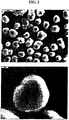
- Figure 3 shows a FESEM micrograph of the commercial powder.
- the pH is 10.8, measured after immersing 2 g sample into 40 ml H 2 O.
- Li(Co 0.8 Mn 0.1 Ni 0.1 )O 2 and Li[Co 2/3 (Mn 1/2 Ni 1/2 ) 1/3 ]O 2 is prepared by precipitating a mixed hydroxide as described in example 0.1, followed by an equilibration in a LiOH solution. After washing and drying, the hydroxide powder was mixed with Li 2 CO 3 and a solid state reaction was performed.
- the temperature was 60°C.
- the LiCoO 2 of example 0.3 was used as seed in a precipitation reaction, similar as that described in example 0.2.
- the temperature was 80°C.
- the LiCoO 2 of example 0.3 was used as seed in a precipitation reaction, similar as that described in example 0.1.
- the temperature was 95°C.
- the total stoichiometric amount of precipitated MCO 3 is 11% of the LiCoO 2 used as seeds.
- the LiMO 2 of example 0.4 was used as seed in a precipitation reaction as described in example 0.1 with the exception, that the pH was about 11, the temperature was about 60°C and the transition metal flow was CoSO 4 . Additionally, 1 mol ammonium sulfate was added for 1 mol precipitated M(OH) 2 .
- the LiMO 2 of example 0.4 was used as seed in a precipitation reaction as described in example 0.1 with the exception, that the transition metal flow was Co 2/3 Mn 1/6 Ni 1/6 SO 4 . No ammonium sulfate was added.
- the composition of the primary material can be modified.
- the SO 4 content can be increased.
- the primary material of example 1.1 is modified by ion exchange.
- the sulfate impurity is removed by ion exchanging in a NaOH solution.
- the ion exchange reaction was made for 3 h at 50°C with a 10 : 1 ratio of NaOH : SO 4 . After ion exchange the primary material is washed, filtered and dried at 180°C.
- the primary material of example 1.2 is washed, filtered and dried at 180°C.
- a mixed transition metal carbonate based precursor material is achieved where the transition metal composition changes significantly between inner and outer bulk.
- the primary material of example 1.3.1 was ion exchanged in a solution of LiOH to remove the sulfate impurity. Then it was washed, filtered and dried at 180°C.
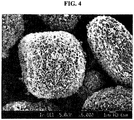
- Figure 4 shows a FESEM micrograph of a typical particle.
- the primary material of example 1.3.2 was ion exchanged in a solution of LiOH to remove the sulfate impurity. Then it was washed, filtered and dried at 180°C.
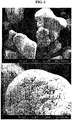
- Figure 5 shows a FESEM micrograph of a typical particle.
- Figure 6 shows a typical FESEM micrograph.
- the primary material of example 1.3.2 was ion exchanged in a solution of LiOH to remove an eventual sulfate impurity. Then it was washed, filtered and dried at 180°C.
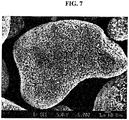
- Figure 7 shows a FESEM micrograph of a typical particle.
- the primary material of example 1.4.1 is washed, filtered and dried at 180°C.
- the primary material of example 1.4.2 is washed, filtered and dried at 180°C.
- the primary material of example 1.3.1 was ion exchanged in a solution of LiOH to remove the sulfate impurity. Then it was washed, filtered and dried at 180°C.
- the precursor material of example 2.2 is mixed with Li 2 CO 3 (Li : M 1.05 : 1) additionally, 0.6 mol Li 2 SO 4 were added per 1 mol Na impurity.
- a solid state reaction was performed at 900°C for 12 hours, followed by a wash and a second heating at 800°C.
- Li 2 SO 4 reacts with the sodium impurity.
- the salt acts as sintering agent and it is removed by the wash.
- lithium transition metal oxide having a layered crystal structure, being very crystalline, and having a spatially varying transition metal stoichiometry is achieved.
- the precursor material of example 2.3.1 is mixed with Li 2 CO 3 (2.7 g Li 2 CO 3 per 50 g precursor). A solid state reaction was made for 12 hours, the sintering temperature was 900°C (sample 3.3.1A) respectively 850°C (sample 3.3.1B).
- the inner bulk is dominantly a pure LiCoO 2 phase.
- the precursor material of example 2.3.2 is mixed with Li 2 CO 3 (2.35 g Li 2 CO 3 per 33.3 g precursor). A solid state reaction was made for 12 hours, the sintering temperature was 950°C for sample 3.3.2A and 850°C for sample 3.3.2B
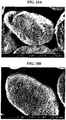
- FIG. 10A and 10B show FESEM micrographs of typical particles. At 950°C compact particles are achieved, at 850°C the outer bulk shows exhibits some porosity.
- the precursor material of example 2.3.3 is mixed with Li 2 CO 3 and Li 2 SO 4 (3.88 g Li 2 CO 3 and 0.37 g Li 2 SO 4 per 50 g precursor).
- a solid state reaction was made for 10 hours, the sintering temperature was 850°C.
- X-ray investigation indicated thesence of Li-Na-SO 4 , acting as sintering agents.
- the sample was washed to remove the sodium and sulfate impurities. Then a second heat treatment, at 850°C for 3 hours followed.
- Figure 11 shows a FESEM micrograph of typical particles. Typical particles are compact, the powder density is high.
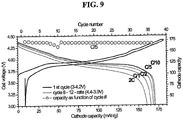
- Figure 12 shows results of electrochemical testing. EDS quantitative elemental analysis was performed. The results confirm that the outer bulk has a significant different transition metal composition than the inner bulk.
- the precursor material of example 2.3.4 is mixed with Li 2 CO 3 . 5.2 g Li 2 CO 3 were added to 10 g precursor. A solid state reaction was made for 10 hours, the sintering temperature was 900°C.
- the precursor material of example 2.4.1 is mixed with Li 2 CO 3 (0.53 mol Li 2 CO 3 per 1 mol precipitated Co). A solid state reaction is made for 12 hours, the sintering temperature was 900°C. As a result a lithium transition metal oxide, having a layered crystal structure, and a spatially significantly varying transition metal stoichiometry is achieved.
- the precursor material of example 2.4.2 is mixed with Li 2 CO 3 (0.53 mol Li 2 CO 3 per 1 mol precipitated Co). A solid state reaction is made for 12 hours, the sintering temperature is 900°C. As a result a lithium transition metal oxide, having a layered crystal structure, and a spatially significantly varying transition metal stoichiometry is achieved.
- the precursor materials of example 2.5 is mixed with Li 2 CO 3 (2.0 g Li 2 CO 3 per 33.3 g precursor). A solid state reaction is made for 12 hours, the sintering temperature is 900°C.
Landscapes
- Chemical & Material Sciences (AREA)
- Engineering & Computer Science (AREA)
- Chemical Kinetics & Catalysis (AREA)
- Electrochemistry (AREA)
- General Chemical & Material Sciences (AREA)
- Organic Chemistry (AREA)
- Inorganic Chemistry (AREA)
- Materials Engineering (AREA)
- Manufacturing & Machinery (AREA)
- Battery Electrode And Active Subsutance (AREA)
- Inorganic Compounds Of Heavy Metals (AREA)
- Secondary Cells (AREA)
Claims (17)
- Composé de métal de transition pulvérulent comprenant au moins 85 % M/M de métal de transition et d'oxygène,
dans lequel la poudre consiste en des particules qui ont un changement spatial significatif de stoechiométrie de métal de transition,
où les compositions de métal de transition moyennes dans le volume extérieur diffèrent d'au moins 10 % par rapport aux compositions de métal de transition moyennes du volume intérieur,
le volume intérieur étant spécifié comme une région autour du centre de la particule contenant environ 50 % du nombre total d'atomes de métal de transition de la particule, et
dans lequel le métal de transition comprend du manganèse, du nickel et du cobalt. - Composé de métal de transition pulvérulent selon la revendication 1, ayant une composition de métal de transition moyenne M = (Mn1-uNiu)1-y-zCoy où 0,2 < u < 0,7 et 0,1 < y < 0,9,
dans lequel les compositions de métal de transition moyennes de cobalt aussi bien que de manganèse aussi bien que de nickel dans le volume extérieur diffèrent d'au moins 10 % par rapport aux compositions de métal de transition moyennes du volume intérieur,
le volume intérieur étant spécifié comme une région autour du centre de la particule contenant environ 50 % du nombre total d'atomes de cobalt, de nickel et de manganèse de la particule. - Composé de métal de transition pulvérulent selon la revendication 2, ayant une composition de métal de transition moyenne M = (Mn1-uNiu)1-yCoy où 0,4 < u < 0,65 et 0,2 < y < 0,9,
dans lequel les compositions de métal de transition moyennes de cobalt aussi bien que de manganèse aussi bien que de nickel dans le volume extérieur diffèrent d'au moins 15 % par rapport aux compositions de métal de transition moyennes du volume intérieur. - Composé de métal de transition pulvérulent selon la revendication 2, ayant une composition de métal de transition moyenne M = (Mn1-uNiu)1-yCoy où 0,4 < u < 0,65 et 0,2 < y < 0,9,
dans lequel la poudre consiste en des particules qui ont la même structure cristalline partout dans le volume de la particule. - Composé de métal de transition pulvérulent selon la revendication 2, ayant une composition de métal de transition moyenne M = (Mn1-uNiu)1-yCoy où 0,4 < u < 0,65 et 0,2 < y < 0,9,
dans lequel un volume intérieur est un oxyde de métal de transition de lithium avec une structure cristalline stratifiée avec un groupe spatial r-3m. - Composé de métal de lithium pulvérulent selon l'une quelconque des revendications 1 à 5, dans lequel au moins 90 % du métal est un métal de transition avec une composition moyenne M = (Mn1-uNiu)1-yCoy où 0,4 < u < 0,65 et 0,2 < y < 0,9,
la poudre consistant en des particules qui ont- la même structure cristalline stratifiée avec un groupe spatial r-3m partout dans le volume de particules classiques- un changement spatial significatif de stoechiométrie de métal de transition, où les compositions de métal de transition moyennes de cobalt aussi bien que de manganèse aussi bien que de nickel dans le volume extérieur diffèrent d'au moins 10 % par rapport aux compositions de métal de transition moyennes du volume intérieur,- le volume intérieur étant spécifié comme une région autour du centre de la particule contenant environ 50 % du nombre total d'atomes de cobalt, de nickel et de manganèse de la particule. - Composé de métal de lithium pulvérulent selon la revendication 6, dans lequel au moins 95 % du métal est un métal de transition avec une composition moyenne M = (Mn1-uNiu)1-yCoy où 0,4 < u < 0,65 et 0,25 < y < 0,45 ou 0,65 < y < 0,85,
la poudre consistant en des particules qui ont un changement spatial continu de stoechiométrie de métal de transition. - Composé de métal de lithium pulvérulent selon la revendication 7, ayant une composition moyenne M = (Mn1-uNiu)1-yCoy où 0,4 < u < 0,65 et 0,65 < y < 0,85,
dans lequel le volume intérieur a une composition moyenne M = (Mn1-uNiu)1-yCoy où 0 ≤ u ≤ 1 et 0,75 ≤ y ≤1. - Procédé pour préparer des composés de métal de transition pulvérulents selon l'une quelconque des revendications 1 à 8, comprenant au moins une réaction de précipitation,
dans lequel au moins une solution de sel de métal de transition dissous et au moins une solution d'hydroxyde de sels de carbonate dissous sont ajoutées à des particules agissant comme des semences; des cations de métal de transition dissous et des anions d'hydroxyde ou de carbonate dissous forment un précipité solide ; et le précipité forme une couche couvrant les particules semences,
le précipité ayant une composition de métal de transition M2, qui diffère de la composition M1 des particules semences d'au moins 10 %, et
dans lequel le sel de métal de transition comprend du manganèse, du nickel et du cobalt. - Procédé selon la revendication 9, dans lequel le précipité a une composition de métal de transition M2 = Mn1-a-bNiaCob, qui diffère de manière significative de la composition M1 = Mn1-a'-b'Nia'COb' des particules semences, étant défini de manière significative que la valeur absolue |Ni| > 0,1 pour tous les nombres Na = (a'-a)/a', Nb = (b'-b)/b' et Nc = (c'-c)/c'.
- Procédé selon la revendication 10, dans lequel les particules semences sont un oxyde de métal de lithium, où au moins 95 % du métal est un métal de transition avec une composition moyenne M = (Mn1-uNiu)1-yCoy où 0,4 ≤ u ≤ 0,65 et 0 ≤ y ≤ 1,0 ayant une structure cristalline stratifiée avec un groupe spatial r-3m.
- Procédé selon la revendication 11, où les particules semences sont un oxyde de métal de lithium, où au moins 95 % du métal sont un métal de transition avec une composition moyenne M = (Mn1-uNiu)1-yCoy où 0,4 ≤ u ≤ 0,65 et 0,75 ≤ y ≤ 1,0 ayant une structure cristalline stratifiée avec un groupe spatial r-3m.
- Procédé selon l'une quelconque des revendications 9 à 12, dans lequel le précipité contient des anions supplémentaires choisis parmi SO4 2-, Cl-, F- et/ou des cations supplémentaires choisis parmi Na+, K+, Li+, et la concentration totale de ces anions et cations dépasse 0,01 mole pour 1 mole de métal de transition du précipité.
- Procédé selon la revendication 13, dans lequel la teneur en anions et/ou cations supplémentaires dans le précipité est modifiée par une réaction d'échange d'ions, après la réaction de précipitation.
- Procédé pour préparer des composés de métal de transition de lithium pulvérulents selon l'une quelconque des revendications 1 à 8, comprenant les étapes suivantes
au moins une réaction de précipitation selon l'une quelconque des revendications 9 à 14 ;
un traitement thermique entre 110 et 350 °C pour modifier le précipité ; et
une réaction à l'état solide du précipité modifié avec une source de lithium. - Procédé selon la revendication 15 pour préparer des composés de métal de transition de lithium pulvérulents, décrits dans l'une quelconque des revendications 6 à 8,
le composé de métal de transition de lithium étant essentiellement exempt d'anions et de cations supplémentaires incluant Cl-, SO4 2-, Na+ et/ou K+, en enlevant ces anions et/ou cations soit par une réaction d'échange d'ions après la réaction de précipitation, soit par un lavage après la réaction à l'état solide. - Batterie au lithium rechargeable contenant un oxyde de métal de transition de lithium pulvérulent selon l'une quelconque des revendications 6 à 8.
Applications Claiming Priority (2)
| Application Number | Priority Date | Filing Date | Title |
|---|---|---|---|
| NZ520452A NZ520452A (en) | 2002-10-31 | 2002-10-31 | Anion containing mixed hydroxide and lithium transition metal oxide with gradient of metal composition |
| EP03759034.6A EP1556915B1 (fr) | 2002-10-31 | 2003-10-30 | Oxyde de metal de transition de lithium presentant un gradient de composition metallique |
Related Parent Applications (2)
| Application Number | Title | Priority Date | Filing Date |
|---|---|---|---|
| EP03759034.6A Division EP1556915B1 (fr) | 2002-10-31 | 2003-10-30 | Oxyde de metal de transition de lithium presentant un gradient de composition metallique |
| EP03759034.6A Division-Into EP1556915B1 (fr) | 2002-10-31 | 2003-10-30 | Oxyde de metal de transition de lithium presentant un gradient de composition metallique |
Publications (2)
| Publication Number | Publication Date |
|---|---|
| EP3121882A1 EP3121882A1 (fr) | 2017-01-25 |
| EP3121882B1 true EP3121882B1 (fr) | 2017-09-13 |
Family
ID=32227915
Family Applications (2)
| Application Number | Title | Priority Date | Filing Date |
|---|---|---|---|
| EP16183989.9A Expired - Lifetime EP3121882B1 (fr) | 2002-10-31 | 2003-10-30 | Oxyde de métal de transition au lithium à gradient de composition métallique |
| EP03759034.6A Expired - Lifetime EP1556915B1 (fr) | 2002-10-31 | 2003-10-30 | Oxyde de metal de transition de lithium presentant un gradient de composition metallique |
Family Applications After (1)
| Application Number | Title | Priority Date | Filing Date |
|---|---|---|---|
| EP03759034.6A Expired - Lifetime EP1556915B1 (fr) | 2002-10-31 | 2003-10-30 | Oxyde de metal de transition de lithium presentant un gradient de composition metallique |
Country Status (7)
| Country | Link |
|---|---|
| US (1) | US7695649B2 (fr) |
| EP (2) | EP3121882B1 (fr) |
| JP (1) | JP4954476B2 (fr) |
| CN (1) | CN100593253C (fr) |
| AU (1) | AU2003274784A1 (fr) |
| NZ (1) | NZ520452A (fr) |
| WO (1) | WO2004040677A1 (fr) |
Families Citing this family (99)
| Publication number | Priority date | Publication date | Assignee | Title |
|---|---|---|---|---|
| US7709149B2 (en) * | 2004-09-24 | 2010-05-04 | Lg Chem, Ltd. | Composite precursor for aluminum-containing lithium transition metal oxide and process for preparation of the same |
| WO2006070977A1 (fr) * | 2004-12-31 | 2006-07-06 | Iucf-Hyu (Industry-University Cooperation Foundation Hanyang University) | Materiaux actifs de cathode a double couche pour batterie auxiliaire au lithium, procede d'obtention des materiaux actifs et batterie auxiliaire au lithium utilisant lesdits materiaux actifs |
| JP5206914B2 (ja) * | 2005-05-27 | 2013-06-12 | ソニー株式会社 | リチウムイオン二次電池用正極活物質、リチウムイオン二次電池用正極およびリチウムイオン二次電池 |
| JP4992200B2 (ja) * | 2005-05-27 | 2012-08-08 | ソニー株式会社 | リチウムイオン二次電池用正極活物質およびリチウムイオン二次電池 |
| US8445129B2 (en) * | 2005-05-27 | 2013-05-21 | Sony Corporation | Cathode active material, method of manufacturing it, cathode, and battery |
| JP4984436B2 (ja) * | 2005-05-27 | 2012-07-25 | ソニー株式会社 | リチウムイオン二次電池用正極活物質およびその製造方法、並びにリチウムイオン二次電池用正極およびリチウムイオン二次電池 |
| JP5082204B2 (ja) * | 2005-05-27 | 2012-11-28 | ソニー株式会社 | リチウム二次電池用正極活物質の製造方法およびリチウム二次電池 |
| JP5040075B2 (ja) * | 2005-07-05 | 2012-10-03 | ソニー株式会社 | リチウムイオン二次電池用正極活物質およびその製造方法、並びにリチウムイオン二次電池 |
| JP5040074B2 (ja) * | 2005-07-05 | 2012-10-03 | ソニー株式会社 | リチウムイオン二次電池用正極活物質の製造方法およびリチウムイオン二次電池 |
| JP5040073B2 (ja) * | 2005-07-05 | 2012-10-03 | ソニー株式会社 | リチウムイオン二次電池用正極活物質およびその製造方法、並びにリチウムイオン二次電池 |
| JP5040076B2 (ja) * | 2005-07-06 | 2012-10-03 | ソニー株式会社 | リチウムイオン二次電池用正極活物質およびその製造方法、並びにリチウムイオン二次電池 |
| JP5040078B2 (ja) * | 2005-07-19 | 2012-10-03 | ソニー株式会社 | リチウムイオン二次電池用正極活物質およびその製造方法、並びにリチウムイオン二次電池 |
| CA2618780C (fr) | 2005-08-12 | 2015-10-20 | Toda Kogyo Europe Gmbh | Hydroxydes de metal mixtes partiellement oxydes |
| JP4821217B2 (ja) * | 2005-08-31 | 2011-11-24 | ソニー株式会社 | 正極活物質、正極および電池 |
| JP5142544B2 (ja) * | 2006-03-20 | 2013-02-13 | 三洋電機株式会社 | 非水電解質二次電池 |
| KR100932256B1 (ko) * | 2006-03-20 | 2009-12-16 | 주식회사 엘지화학 | 성능이 우수한 리튬 이차전지용 양극 재료 |
| JP5629460B2 (ja) * | 2006-03-20 | 2014-11-19 | エルジー・ケム・リミテッド | 化学量論的リチウムコバルト酸化物及びそれを調製する方法 |
| KR100822012B1 (ko) * | 2006-03-30 | 2008-04-14 | 한양대학교 산학협력단 | 리튬 전지용 양극 활물질, 그 제조 방법 및 그를 포함하는리튬 이차 전지 |
| JP2007335169A (ja) * | 2006-06-13 | 2007-12-27 | Sony Corp | 正極活物質および正極、並びに非水電解質二次電池 |
| JP5168829B2 (ja) * | 2006-06-28 | 2013-03-27 | ソニー株式会社 | 正極活物質および非水電解質電池 |
| US8911903B2 (en) | 2006-07-03 | 2014-12-16 | Sony Corporation | Cathode active material, its manufacturing method, and non-aqueous electrolyte secondary battery |
| JP5092292B2 (ja) * | 2006-07-03 | 2012-12-05 | ソニー株式会社 | 正極活物質およびその製造方法、並びに非水電解質二次電池 |
| JP5082307B2 (ja) * | 2006-07-03 | 2012-11-28 | ソニー株式会社 | 正極活物質およびその製造方法、並びに非水電解質二次電池 |
| JP5034366B2 (ja) * | 2006-08-09 | 2012-09-26 | ソニー株式会社 | 非水電解質二次電池用正極活物質およびその製造方法、ならびに非水電解質二次電池 |
| JP2008016243A (ja) * | 2006-07-04 | 2008-01-24 | Sony Corp | 正極活物質およびその製造方法、並びに非水電解質二次電池 |
| JP5028886B2 (ja) * | 2006-07-04 | 2012-09-19 | ソニー株式会社 | 正極活物質およびその製造方法、並びに非水電解質二次電池 |
| JP2008071623A (ja) * | 2006-09-14 | 2008-03-27 | Sony Corp | 非水電解質二次電池用正極活物質およびその製造方法 |
| JP2008071622A (ja) * | 2006-09-14 | 2008-03-27 | Sony Corp | 非水電解質二次電池用正極活物質およびその製造方法 |
| EP2128096B1 (fr) * | 2007-01-26 | 2015-04-22 | Mitsui Mining & Smelting Co., Ltd | Oxyde de lithium et de métal de transition ayant une structure en couches |
| US9177689B2 (en) | 2007-01-29 | 2015-11-03 | Umicore | High density and high voltage stable cathode materials for secondary batteries |
| US9608266B2 (en) | 2007-01-29 | 2017-03-28 | Umicore | Cathode material for lithium-ion rechargeable batteries |
| US9614220B2 (en) | 2007-01-29 | 2017-04-04 | Umicore | Doped and island-covered lithium cobaltite oxides |
| US8785042B2 (en) | 2007-01-29 | 2014-07-22 | Umicore | Island-covered lithium cobaltite oxides |
| JP5321788B2 (ja) * | 2007-05-23 | 2013-10-23 | ソニー株式会社 | 二次電池用集電体、二次電池用負極、二次電池および電子機器 |
| KR101271852B1 (ko) | 2007-08-10 | 2013-06-07 | 유미코르 | 황을 함유하는 도핑된 리튬 전이금속 산화물 |
| WO2009045756A2 (fr) * | 2007-09-28 | 2009-04-09 | 3M Innovative Properties Company | Compositions de cathode frittée |
| EP2214234B1 (fr) * | 2007-11-12 | 2014-01-08 | Toda Kogyo Corporation | Poudre de particules d'oxyde d'un composite à base de li-ni pour pile rechargeable à électrolyte non aqueux, procédé de production de la poudre et pile rechargeable à électrolyte non aqueux |
| JP2009217981A (ja) * | 2008-03-07 | 2009-09-24 | Sanyo Electric Co Ltd | 非水電解質二次電池 |
| CN102119128A (zh) * | 2008-08-04 | 2011-07-06 | 尤米科尔公司 | 高度结晶性的锂过渡金属氧化物 |
| US20100273055A1 (en) * | 2009-04-28 | 2010-10-28 | 3M Innovative Properties Company | Lithium-ion electrochemical cell |
| US20110183209A1 (en) * | 2010-01-27 | 2011-07-28 | 3M Innovative Properties Company | High capacity lithium-ion electrochemical cells |
| JP2010265177A (ja) * | 2010-06-21 | 2010-11-25 | Ngk Insulators Ltd | スピネル型マンガン酸リチウムの製造方法 |
| US9236601B2 (en) * | 2010-06-23 | 2016-01-12 | Ngk Insulators, Ltd. | Plate-like particle of cathode active material for lithium secondary battery, cathode of the lithium secondary battery and lithium secondary battery |
| JP5646088B1 (ja) * | 2010-06-29 | 2014-12-24 | ユミコア ソシエテ アノニムUmicore S.A. | 二次電池のための高密度および高電圧安定性のカソード材料 |
| HRP20160974T1 (hr) * | 2010-09-22 | 2016-10-07 | Freeport Cobalt Oy | Mješavina oksidiranog hidroksid metala i postupak za proizvodnju |
| US8591774B2 (en) * | 2010-09-30 | 2013-11-26 | Uchicago Argonne, Llc | Methods for preparing materials for lithium ion batteries |
| CN102092798A (zh) * | 2010-12-01 | 2011-06-15 | 兰州金川新材料科技股份有限公司 | 一种锂离子电池正极材料前驱体的连续合成方法 |
| KR101292756B1 (ko) | 2011-01-05 | 2013-08-02 | 한양대학교 산학협력단 | 입자 전체 농도 구배 리튬이차전지용 양극활물질, 이의 제조 방법, 및 이를 포함하는 리튬이차전지 |
| KR101946011B1 (ko) * | 2011-09-22 | 2019-02-11 | 삼성전자주식회사 | 리튬 이차 전지용 전해질 및 이를 채용한 리튬 전지 |
| WO2013052494A1 (fr) * | 2011-10-03 | 2013-04-11 | A123 Systems, Inc. | Matières de cathode comprenant un composé d'absorption d'oxygène et un composé de stockage d'ions |
| CN102580717B (zh) * | 2011-12-30 | 2014-02-05 | 济南大学 | 梯度结构金属氧化物及其制备方法 |
| JP5871187B2 (ja) * | 2012-03-01 | 2016-03-01 | 株式会社Gsユアサ | 非水電解質二次電池用活物質、その活物質の製造方法、非水電解質二次電池用電極及び非水電解質二次電池 |
| JP5871186B2 (ja) * | 2012-03-01 | 2016-03-01 | 株式会社Gsユアサ | 非水電解質二次電池用活物質、その活物質の製造方法、非水電解質二次電池用電極及び非水電解質二次電池 |
| CN103367704B (zh) * | 2012-04-06 | 2016-05-11 | 协鑫动力新材料(盐城)有限公司 | 梯度分布的复合多元材料前驱体及其制备方法和应用 |
| EP2841623B1 (fr) * | 2012-04-23 | 2020-10-28 | Nemaska Lithium Inc. | Procédés de préparation d'hydroxyde de lithium |
| RS57299B1 (sr) | 2012-05-30 | 2018-08-31 | Nemaska Lithium Inc | Postupci za dobijanje litijum karbonata |
| KR20130138073A (ko) | 2012-06-08 | 2013-12-18 | 한양대학교 산학협력단 | 리튬 이차 전지용 양극활물질 전구체, 이를 이용하여 제조된 양극활물질 및 이를 포함하는 리튬 이차 전지 |
| KR101744091B1 (ko) | 2012-09-04 | 2017-06-07 | 삼성에스디아이 주식회사 | 리튬 이차 전지용 양극 활물질, 이의 제조 방법 및 이를 포함하는 리튬 이차 전지 |
| EP2975680B1 (fr) * | 2013-03-15 | 2018-10-10 | Nissan Motor Co., Ltd | Électrode positive et batterie rechargeable à électrolyte non aqueux |
| HRP20210506T1 (hr) | 2013-03-15 | 2021-06-11 | Nemaska Lithium Inc. | Postupak za pripremu litijevog hidroksida |
| EP3060522B1 (fr) | 2013-10-23 | 2019-06-12 | Nemaska Lithium Inc. | Procédés de préparation de carbonate de lithium |
| CA3275949A1 (en) | 2014-02-24 | 2025-10-31 | Nemaska Lithium Inc. | Methods for treating lithium-containing materials |
| JP6603058B2 (ja) * | 2014-08-20 | 2019-11-06 | 住友化学株式会社 | リチウム含有複合酸化物の製造方法およびリチウム含有複合酸化物 |
| US10411258B2 (en) | 2014-10-08 | 2019-09-10 | Umicore | Impurity containing cathode material with preferred morphology and method to prepare from impurity containing metal carbonate |
| PL3204972T3 (pl) * | 2014-10-08 | 2021-10-25 | Umicore | Prekursory węglanowe do wytwarzania materiału katodowego z litowo-niklowo-manganowego tlenku kobaltu i sposób ich wytwarzania |
| EP3215462A1 (fr) | 2014-11-07 | 2017-09-13 | Basf Se | Oxyde mixte de métaux de transition pour batteries à ions lithium |
| TWI562443B (en) * | 2015-01-12 | 2016-12-11 | Univ Fu Jen Catholic | Metal gradient-doped cathode material for lithium ion batteries |
| US10833321B2 (en) | 2015-03-06 | 2020-11-10 | Uchicago Argonne, Llc | Cathode materials for lithium ion batteries |
| CN104766969B (zh) * | 2015-04-23 | 2017-05-10 | 华南师范大学 | 一种锂离子电池阴极材料的制备方法 |
| JP6390915B2 (ja) * | 2015-07-29 | 2018-09-19 | トヨタ自動車株式会社 | 非水電解質二次電池用正極活物質 |
| CN105140517A (zh) * | 2015-09-14 | 2015-12-09 | 天津大学 | 一种非水溶性过渡金属二硫化物纳米片的制备方法 |
| KR102460961B1 (ko) | 2015-11-06 | 2022-10-31 | 삼성에스디아이 주식회사 | 리튬이차전지용 양극 활물질, 그 제조방법 및 이를 포함한 양극을 구비한 리튬이차전지 |
| KR102580235B1 (ko) * | 2015-12-22 | 2023-09-19 | 삼성에스디아이 주식회사 | 양극 활물질, 이를 채용한 리튬 전지, 및 상기 양극 활물질의 제조방법 |
| JP6699402B2 (ja) * | 2016-06-30 | 2020-05-27 | 東ソー株式会社 | ニッケル−マンガン複合オキシ水酸化物の多段階製造方法 |
| CN109415225A (zh) * | 2016-07-20 | 2019-03-01 | 托普索公司 | 用于在不使用螯合剂下沉淀金属碳酸盐材料颗粒的方法 |
| CN106058239B (zh) * | 2016-07-25 | 2019-06-11 | 上海电力学院 | 一种纳米线状富锂锰基正极材料的制备方法 |
| JP6848249B2 (ja) * | 2016-07-29 | 2021-03-24 | 住友金属鉱山株式会社 | 非水系電解質二次電池用正極活物質とその製造方法、及び非水系電解質二次電池 |
| EP3279978B1 (fr) * | 2016-08-02 | 2020-08-19 | Ecopro Bm Co., Ltd. | Oxyde complexe de lithium pour batterie secondaire au lithium, matériau actif positif et son procédé de préparation |
| US10903490B2 (en) * | 2016-08-02 | 2021-01-26 | Ecopro Bm Co., Ltd. | Lithium complex oxide for lithium secondary battery positive active material and method of preparing the same |
| CA2940509A1 (fr) | 2016-08-26 | 2018-02-26 | Nemaska Lithium Inc. | Procede de traitement de compositions aqueuses comprenant du sulfate de lithium et de l'acide sulfurique |
| DE102016220675A1 (de) * | 2016-10-21 | 2018-04-26 | Robert Bosch Gmbh | Herstellung eines strukturierten Aktivmaterials für eine elektrochemische Zelle und/oder Batterie |
| KR102322728B1 (ko) | 2017-03-14 | 2021-11-05 | 유미코아 | 개선된 이차 전지 성능을 갖는 캐소드 물질을 위한 전구체 및 그 전구체의 제조 방법 |
| KR101967979B1 (ko) | 2017-05-29 | 2019-04-10 | 주식회사 포스코 | 반응 장치 및 방법 |
| US10782272B2 (en) | 2017-07-15 | 2020-09-22 | Microvast Power Systems Co., Ltd. | Analytical method for precipitated particles during co-precipitation reaction |
| FI3652754T3 (fi) * | 2017-07-15 | 2023-05-04 | Microvast Power Systems Co Ltd | Menetelmä katodihiukkasten valmistamiseksi |
| US11621416B2 (en) * | 2017-10-09 | 2023-04-04 | Csir Campus | Cathode material |
| KR20240075840A (ko) | 2017-11-22 | 2024-05-29 | 네마스카 리튬 인코포레이션 | 다양한 금속의 하이드록사이드와 옥사이드 및 이들의 유도체를 제조하는 방법 |
| HUE056745T2 (hu) * | 2017-12-22 | 2022-03-28 | Umicore Nv | Pozitív elektródaanyag újratölthetõ lítiumion-akkumulátorokhoz |
| JP6988502B2 (ja) * | 2018-01-17 | 2022-01-05 | トヨタ自動車株式会社 | 全固体電池用正極合剤、全固体電池用正極、全固体電池及びこれらの製造方法 |
| CN112204775A (zh) | 2018-05-21 | 2021-01-08 | 微宏动力系统(湖州)有限公司 | 制备颗粒前体和阴极活性颗粒的方法及其制备的颗粒前体 |
| CN108878869B (zh) * | 2018-07-31 | 2021-07-13 | 桑顿新能源科技(长沙)有限公司 | 锂离子电池用梯度结构的ncm三元正极材料及制法与应用 |
| CA3141478A1 (fr) | 2019-05-22 | 2020-11-26 | Nemaska Lithium Inc. | Procedes de preparation d'hydroxydes et d'oxydes de divers metaux et de leurs derives |
| FI4077217T3 (fi) * | 2019-12-18 | 2023-11-09 | Umicore Nv | Jauhemainen litiumkobolttipohjainen oksidikatodiaktiivimateriaalijauhe uudelleenladattavia litiumioniakkuja varten ja menetelmä sen valmistamiseksi |
| CN111082029B (zh) | 2019-12-31 | 2021-08-03 | 北京当升材料科技股份有限公司 | 一种富锂锰基材料及其制备方法和应用 |
| CA3177378A1 (fr) | 2020-03-27 | 2021-09-30 | Board Of Regents, The University Of Texas System | Materiaux de cathode a haute energie a faible teneur en cobalt ou exempts de cobalt pour batteries au lithium |
| KR102624905B1 (ko) * | 2020-11-25 | 2024-01-12 | (주)포스코퓨처엠 | 배향성 구조를 갖는 리튬전지용 양극활물질 및 이의 제조방법 |
| CN113353995B (zh) * | 2021-07-07 | 2023-06-16 | 远景动力技术(江苏)有限公司 | 一种具有低钴含量的正极材料及其制备方法和应用 |
| CN116534910B (zh) * | 2023-05-30 | 2025-08-19 | 湖南中伟新能源科技有限公司 | 一种四氧化三钴、碳酸钴及制备方法、正极材料、锂离子电池 |
| CN118724085A (zh) * | 2024-08-30 | 2024-10-01 | 宁波富理电池材料科技有限公司 | 一种镍钴锰前驱体和正极材料的制备方法及其应用 |
Family Cites Families (35)
| Publication number | Priority date | Publication date | Assignee | Title |
|---|---|---|---|---|
| US5264201A (en) * | 1990-07-23 | 1993-11-23 | Her Majesty The Queen In Right Of The Province Of British Columbia | Lithiated nickel dioxide and secondary cells prepared therefrom |
| JP2989230B2 (ja) * | 1990-07-27 | 1999-12-13 | 三洋電機株式会社 | 非水系電池 |
| US5340670A (en) * | 1992-06-01 | 1994-08-23 | Kabushiki Kaisha Toshiba | Lithium secondary battery and method of manufacturing carbonaceous material for negative electrode of the battery |
| JP3111791B2 (ja) * | 1994-02-21 | 2000-11-27 | 松下電器産業株式会社 | 非水電解液二次電池 |
| JPH08162114A (ja) | 1994-12-02 | 1996-06-21 | Kaageo P-Shingu Res Lab:Kk | リチウム二次電池 |
| EP0720247B1 (fr) | 1994-12-16 | 1998-05-27 | Matsushita Electric Industrial Co., Ltd. | Procédé de fabrication des matières positives actives pour batteries secondaires au lithium et batteries secondaires au lithium les contenant |
| JP3543437B2 (ja) * | 1995-07-24 | 2004-07-14 | ソニー株式会社 | 正極活物質及びこの正極活物質を用いた非水電解質二次電池 |
| JPH0950810A (ja) | 1995-08-08 | 1997-02-18 | Mitsui Toatsu Chem Inc | 非水電解液電池の電極活物質及びその製造方法 |
| US5718989A (en) * | 1995-12-29 | 1998-02-17 | Japan Storage Battery Co., Ltd. | Positive electrode active material for lithium secondary battery |
| JP4161382B2 (ja) * | 1997-02-25 | 2008-10-08 | 堺化学工業株式会社 | 2層構造粒子状組成物の製造方法 |
| CA2234874C (fr) | 1997-04-15 | 2009-06-30 | Sanyo Electric Co., Ltd. | Materiau de fabrication de cathode a utiliser dans une batterie activee par electrolytes non aqueux, processus de preparation et batterie activee par electrolytes non aqueux |
| JP2945377B2 (ja) * | 1997-06-24 | 1999-09-06 | 花王株式会社 | 二次電池用正極活物質の製造方法 |
| US6458487B1 (en) * | 1997-07-25 | 2002-10-01 | Kabushiki Kaisha Toshiba | Positive active material and non-aqueous secondary cell made by using the same |
| JPH1192119A (ja) * | 1997-09-16 | 1999-04-06 | Toyota Central Res & Dev Lab Inc | 酸化物粉末 |
| DE19849343A1 (de) * | 1997-10-30 | 1999-06-02 | Samsung Display Devices Co Ltd | Lithiumcompositoxid, dessen Herstellung und sekundäre Lithiumionzelle mit Lithiumcompositoxid als aktives Material der positiven Elektrode |
| JP4122710B2 (ja) * | 1998-02-09 | 2008-07-23 | トダ・コウギョウ・ヨーロッパ・ゲゼルシャフト・ミット・ベシュレンクテル・ハフツング | リチウム−遷移金属混合物の調製法 |
| JPH11238508A (ja) * | 1998-02-23 | 1999-08-31 | Matsushita Electric Ind Co Ltd | アルカリ蓄電池用ニッケル正極および製造方法 |
| US6416903B1 (en) * | 1998-08-17 | 2002-07-09 | Ovonic Battery Company, Inc. | Nickel hydroxide electrode material and method for making the same |
| JP2000164214A (ja) | 1998-11-25 | 2000-06-16 | Japan Storage Battery Co Ltd | 非水電解質二次電池 |
| KR100315227B1 (ko) | 1999-11-17 | 2001-11-26 | 김순택 | 리튬 이차 전지용 양극 활물질 및 그의 제조 방법 |
| US6998069B1 (en) | 1999-12-03 | 2006-02-14 | Ferro Gmbh | Electrode material for positive electrodes of rechargeable lithium batteries |
| US6350543B2 (en) * | 1999-12-29 | 2002-02-26 | Kimberly-Clark Worldwide, Inc. | Manganese-rich quaternary metal oxide materials as cathodes for lithium-ion and lithium-ion polymer batteries |
| KR100326460B1 (ko) | 2000-02-10 | 2002-02-28 | 김순택 | 리튬 이차 전지용 양극 활물질 및 그의 제조 방법 |
| JP3611188B2 (ja) * | 2000-03-03 | 2005-01-19 | 日産自動車株式会社 | 非水電解質二次電池用正極活物質および非水電解質二次電池 |
| JP2001348224A (ja) * | 2000-04-07 | 2001-12-18 | Ishihara Sangyo Kaisha Ltd | リチウム・マンガン複合酸化物及びその製造方法並びにそれを用いてなるリチウム電池 |
| KR100369445B1 (ko) | 2000-04-17 | 2003-01-24 | 한국과학기술원 | 리튬이차전지의 양극전극용 리튬망간계 산화물의 코팅재및 그의 코팅방법 |
| CN1137523C (zh) * | 2000-05-08 | 2004-02-04 | 许开华 | 锂离子电池正极材料的制备方法和设备 |
| US6660432B2 (en) | 2000-09-14 | 2003-12-09 | Ilion Technology Corporation | Lithiated oxide materials and methods of manufacture |
| US7138209B2 (en) * | 2000-10-09 | 2006-11-21 | Samsung Sdi Co., Ltd. | Positive active material for rechargeable lithium battery and method of preparing same |
| JP2002145623A (ja) * | 2000-11-06 | 2002-05-22 | Seimi Chem Co Ltd | リチウム含有遷移金属複合酸化物およびその製造方法 |
| JP2002170563A (ja) * | 2000-11-30 | 2002-06-14 | Nikko Materials Co Ltd | サイクル特性に優れたMn系正極材料及び同正極材料を用いたリチウム二次電池 |
| JP2002175808A (ja) * | 2000-12-08 | 2002-06-21 | Toyota Central Res & Dev Lab Inc | リチウム二次電池正極活物質用リチウム遷移金属複合酸化物およびその製造方法 |
| US6964828B2 (en) * | 2001-04-27 | 2005-11-15 | 3M Innovative Properties Company | Cathode compositions for lithium-ion batteries |
| US6921609B2 (en) * | 2001-06-15 | 2005-07-26 | Kureha Chemical Industry Co., Ltd. | Gradient cathode material for lithium rechargeable batteries |
| US20030108793A1 (en) | 2001-08-07 | 2003-06-12 | 3M Innovative Properties Company | Cathode compositions for lithium ion batteries |
-
2002
- 2002-10-31 NZ NZ520452A patent/NZ520452A/en not_active IP Right Cessation
-
2003
- 2003-10-30 CN CN200380102607A patent/CN100593253C/zh not_active Expired - Lifetime
- 2003-10-30 WO PCT/KR2003/002304 patent/WO2004040677A1/fr not_active Ceased
- 2003-10-30 AU AU2003274784A patent/AU2003274784A1/en not_active Abandoned
- 2003-10-30 EP EP16183989.9A patent/EP3121882B1/fr not_active Expired - Lifetime
- 2003-10-30 JP JP2004548141A patent/JP4954476B2/ja not_active Expired - Lifetime
- 2003-10-30 US US10/533,496 patent/US7695649B2/en active Active
- 2003-10-30 EP EP03759034.6A patent/EP1556915B1/fr not_active Expired - Lifetime
Non-Patent Citations (1)
| Title |
|---|
| None * |
Also Published As
| Publication number | Publication date |
|---|---|
| US20060105239A1 (en) | 2006-05-18 |
| WO2004040677A1 (fr) | 2004-05-13 |
| AU2003274784A1 (en) | 2004-05-25 |
| EP1556915A1 (fr) | 2005-07-27 |
| EP3121882A1 (fr) | 2017-01-25 |
| EP1556915A4 (fr) | 2006-11-29 |
| CN1708867A (zh) | 2005-12-14 |
| CN100593253C (zh) | 2010-03-03 |
| JP2006503789A (ja) | 2006-02-02 |
| JP4954476B2 (ja) | 2012-06-13 |
| US7695649B2 (en) | 2010-04-13 |
| NZ520452A (en) | 2005-03-24 |
| EP1556915B1 (fr) | 2017-03-15 |
Similar Documents
| Publication | Publication Date | Title |
|---|---|---|
| EP3121882B1 (fr) | Oxyde de métal de transition au lithium à gradient de composition métallique | |
| KR100809847B1 (ko) | 금속성분의 조성에 구배를 갖는 리튬 전이금속 산화물 | |
| US8216676B2 (en) | Composite precursor for aluminum-containing lithium transition metal oxide and process for preparation of the same | |
| EP2102927B1 (fr) | Procédé de préparation des matériaux actifs pour cathode en spinelle coeur-écorce utilisée dans des batteries secondaires au lithium | |
| EP2606015B1 (fr) | Précurseurs de matériau de cathode à enrobage à sec d'alumine | |
| EP1716609B1 (fr) | Poudre de matiere active pour electrodes contenant une composition dependante de la taille et procede permettant de preparer ladite matiere | |
| EP2606524B1 (fr) | Précurseurs de matériaux cathodiques revêtus par voie sèche et traités thermiquement | |
| EP4266407A1 (fr) | Matériau actif positif pour batterie au lithium rechargeable, son procédé de préparation et batterie au lithium rechargeable le comprenant | |
| CN100508255C (zh) | 用于锂二次电池组的层状芯-壳阴极活性材料,其制造方法和使用其的锂二次电池组 | |
| KR100738192B1 (ko) | 코아·쉘 다층구조를 갖는 리튬이차전지용 양극 활물질과이를 사용한 리튬이차전지 및 그 제조 방법 | |
| EP4318665A1 (fr) | Matériau actif d'électrode positive pour accumulateur au lithium et accumulateur au lithium le comprenant | |
| US20240150196A1 (en) | Beta-nickel hydroxide doped with aluminum | |
| EP4333122A1 (fr) | Matériau actif positif, son procédé de préparation et batterie rechargeable au lithium | |
| WO2023013494A1 (fr) | Matériau actif d'électrode positive pour batterie secondaire au lithium, électrode positive pour batterie secondaire au lithium, et batterie secondaire au lithium | |
| EP4647401A1 (fr) | Précurseur d'électrode positive dopée à éléments multiples et son procédé de préparation, matériau d'électrode positive, batterie et dispositif électrique | |
| US11929502B2 (en) | Stabilized lithium metal oxide electrode material and method of preparation | |
| EP4546464A1 (fr) | Matière active d'électrode positive pour une batterie secondaire au lithium et son procédé de préparation |
Legal Events
| Date | Code | Title | Description |
|---|---|---|---|
| PUAI | Public reference made under article 153(3) epc to a published international application that has entered the european phase |
Free format text: ORIGINAL CODE: 0009012 |
|
| 17P | Request for examination filed |
Effective date: 20160812 |
|
| AC | Divisional application: reference to earlier application |
Ref document number: 1556915 Country of ref document: EP Kind code of ref document: P |
|
| AK | Designated contracting states |
Kind code of ref document: A1 Designated state(s): AT BE BG CH CY CZ DE DK EE ES FI FR GB GR HU IE IT LI LU MC NL PT RO SE SI SK TR |
|
| GRAP | Despatch of communication of intention to grant a patent |
Free format text: ORIGINAL CODE: EPIDOSNIGR1 |
|
| INTG | Intention to grant announced |
Effective date: 20170424 |
|
| GRAS | Grant fee paid |
Free format text: ORIGINAL CODE: EPIDOSNIGR3 |
|
| GRAA | (expected) grant |
Free format text: ORIGINAL CODE: 0009210 |
|
| AC | Divisional application: reference to earlier application |
Ref document number: 1556915 Country of ref document: EP Kind code of ref document: P |
|
| AK | Designated contracting states |
Kind code of ref document: B1 Designated state(s): AT BE BG CH CY CZ DE DK EE ES FI FR GB GR HU IE IT LI LU MC NL PT RO SE SI SK TR |
|
| REG | Reference to a national code |
Ref country code: GB Ref legal event code: FG4D |
|
| REG | Reference to a national code |
Ref country code: CH Ref legal event code: EP |
|
| REG | Reference to a national code |
Ref country code: FR Ref legal event code: PLFP Year of fee payment: 15 |
|
| REG | Reference to a national code |
Ref country code: IE Ref legal event code: FG4D |
|
| REG | Reference to a national code |
Ref country code: AT Ref legal event code: REF Ref document number: 928959 Country of ref document: AT Kind code of ref document: T Effective date: 20171015 |
|
| REG | Reference to a national code |
Ref country code: DE Ref legal event code: R096 Ref document number: 60350615 Country of ref document: DE |
|
| REG | Reference to a national code |
Ref country code: NL Ref legal event code: MP Effective date: 20170913 |
|
| PG25 | Lapsed in a contracting state [announced via postgrant information from national office to epo] |
Ref country code: FI Free format text: LAPSE BECAUSE OF FAILURE TO SUBMIT A TRANSLATION OF THE DESCRIPTION OR TO PAY THE FEE WITHIN THE PRESCRIBED TIME-LIMIT Effective date: 20170913 Ref country code: SE Free format text: LAPSE BECAUSE OF FAILURE TO SUBMIT A TRANSLATION OF THE DESCRIPTION OR TO PAY THE FEE WITHIN THE PRESCRIBED TIME-LIMIT Effective date: 20170913 |
|
| REG | Reference to a national code |
Ref country code: AT Ref legal event code: MK05 Ref document number: 928959 Country of ref document: AT Kind code of ref document: T Effective date: 20170913 |
|
| PG25 | Lapsed in a contracting state [announced via postgrant information from national office to epo] |
Ref country code: GR Free format text: LAPSE BECAUSE OF FAILURE TO SUBMIT A TRANSLATION OF THE DESCRIPTION OR TO PAY THE FEE WITHIN THE PRESCRIBED TIME-LIMIT Effective date: 20171214 Ref country code: BG Free format text: LAPSE BECAUSE OF FAILURE TO SUBMIT A TRANSLATION OF THE DESCRIPTION OR TO PAY THE FEE WITHIN THE PRESCRIBED TIME-LIMIT Effective date: 20171213 Ref country code: ES Free format text: LAPSE BECAUSE OF FAILURE TO SUBMIT A TRANSLATION OF THE DESCRIPTION OR TO PAY THE FEE WITHIN THE PRESCRIBED TIME-LIMIT Effective date: 20170913 |
|
| PG25 | Lapsed in a contracting state [announced via postgrant information from national office to epo] |
Ref country code: NL Free format text: LAPSE BECAUSE OF FAILURE TO SUBMIT A TRANSLATION OF THE DESCRIPTION OR TO PAY THE FEE WITHIN THE PRESCRIBED TIME-LIMIT Effective date: 20170913 |
|
| PG25 | Lapsed in a contracting state [announced via postgrant information from national office to epo] |
Ref country code: CZ Free format text: LAPSE BECAUSE OF FAILURE TO SUBMIT A TRANSLATION OF THE DESCRIPTION OR TO PAY THE FEE WITHIN THE PRESCRIBED TIME-LIMIT Effective date: 20170913 |
|
| PG25 | Lapsed in a contracting state [announced via postgrant information from national office to epo] |
Ref country code: IT Free format text: LAPSE BECAUSE OF FAILURE TO SUBMIT A TRANSLATION OF THE DESCRIPTION OR TO PAY THE FEE WITHIN THE PRESCRIBED TIME-LIMIT Effective date: 20170913 Ref country code: AT Free format text: LAPSE BECAUSE OF FAILURE TO SUBMIT A TRANSLATION OF THE DESCRIPTION OR TO PAY THE FEE WITHIN THE PRESCRIBED TIME-LIMIT Effective date: 20170913 Ref country code: EE Free format text: LAPSE BECAUSE OF FAILURE TO SUBMIT A TRANSLATION OF THE DESCRIPTION OR TO PAY THE FEE WITHIN THE PRESCRIBED TIME-LIMIT Effective date: 20170913 Ref country code: SK Free format text: LAPSE BECAUSE OF FAILURE TO SUBMIT A TRANSLATION OF THE DESCRIPTION OR TO PAY THE FEE WITHIN THE PRESCRIBED TIME-LIMIT Effective date: 20170913 |
|
| REG | Reference to a national code |
Ref country code: CH Ref legal event code: PL |
|
| REG | Reference to a national code |
Ref country code: DE Ref legal event code: R097 Ref document number: 60350615 Country of ref document: DE |
|
| PG25 | Lapsed in a contracting state [announced via postgrant information from national office to epo] |
Ref country code: MC Free format text: LAPSE BECAUSE OF FAILURE TO SUBMIT A TRANSLATION OF THE DESCRIPTION OR TO PAY THE FEE WITHIN THE PRESCRIBED TIME-LIMIT Effective date: 20170913 |
|
| PLBE | No opposition filed within time limit |
Free format text: ORIGINAL CODE: 0009261 |
|
| STAA | Information on the status of an ep patent application or granted ep patent |
Free format text: STATUS: NO OPPOSITION FILED WITHIN TIME LIMIT |
|
| REG | Reference to a national code |
Ref country code: IE Ref legal event code: MM4A |
|
| PG25 | Lapsed in a contracting state [announced via postgrant information from national office to epo] |
Ref country code: LU Free format text: LAPSE BECAUSE OF NON-PAYMENT OF DUE FEES Effective date: 20171030 Ref country code: LI Free format text: LAPSE BECAUSE OF NON-PAYMENT OF DUE FEES Effective date: 20171031 Ref country code: DK Free format text: LAPSE BECAUSE OF FAILURE TO SUBMIT A TRANSLATION OF THE DESCRIPTION OR TO PAY THE FEE WITHIN THE PRESCRIBED TIME-LIMIT Effective date: 20170913 Ref country code: CH Free format text: LAPSE BECAUSE OF NON-PAYMENT OF DUE FEES Effective date: 20171031 |
|
| 26N | No opposition filed |
Effective date: 20180614 |
|
| REG | Reference to a national code |
Ref country code: BE Ref legal event code: MM Effective date: 20171031 |
|
| PG25 | Lapsed in a contracting state [announced via postgrant information from national office to epo] |
Ref country code: BE Free format text: LAPSE BECAUSE OF NON-PAYMENT OF DUE FEES Effective date: 20171031 |
|
| REG | Reference to a national code |
Ref country code: FR Ref legal event code: PLFP Year of fee payment: 16 |
|
| PG25 | Lapsed in a contracting state [announced via postgrant information from national office to epo] |
Ref country code: IE Free format text: LAPSE BECAUSE OF NON-PAYMENT OF DUE FEES Effective date: 20171030 |
|
| PG25 | Lapsed in a contracting state [announced via postgrant information from national office to epo] |
Ref country code: HU Free format text: LAPSE BECAUSE OF FAILURE TO SUBMIT A TRANSLATION OF THE DESCRIPTION OR TO PAY THE FEE WITHIN THE PRESCRIBED TIME-LIMIT; INVALID AB INITIO Effective date: 20031030 |
|
| PG25 | Lapsed in a contracting state [announced via postgrant information from national office to epo] |
Ref country code: RO Free format text: LAPSE BECAUSE OF FAILURE TO SUBMIT A TRANSLATION OF THE DESCRIPTION OR TO PAY THE FEE WITHIN THE PRESCRIBED TIME-LIMIT Effective date: 20170913 |
|
| PG25 | Lapsed in a contracting state [announced via postgrant information from national office to epo] |
Ref country code: SI Free format text: LAPSE BECAUSE OF FAILURE TO SUBMIT A TRANSLATION OF THE DESCRIPTION OR TO PAY THE FEE WITHIN THE PRESCRIBED TIME-LIMIT Effective date: 20170913 |
|
| PG25 | Lapsed in a contracting state [announced via postgrant information from national office to epo] |
Ref country code: CY Free format text: LAPSE BECAUSE OF FAILURE TO SUBMIT A TRANSLATION OF THE DESCRIPTION OR TO PAY THE FEE WITHIN THE PRESCRIBED TIME-LIMIT Effective date: 20170913 |
|
| PG25 | Lapsed in a contracting state [announced via postgrant information from national office to epo] |
Ref country code: TR Free format text: LAPSE BECAUSE OF FAILURE TO SUBMIT A TRANSLATION OF THE DESCRIPTION OR TO PAY THE FEE WITHIN THE PRESCRIBED TIME-LIMIT Effective date: 20170913 |
|
| PG25 | Lapsed in a contracting state [announced via postgrant information from national office to epo] |
Ref country code: PT Free format text: LAPSE BECAUSE OF FAILURE TO SUBMIT A TRANSLATION OF THE DESCRIPTION OR TO PAY THE FEE WITHIN THE PRESCRIBED TIME-LIMIT Effective date: 20170913 |
|
| PGFP | Annual fee paid to national office [announced via postgrant information from national office to epo] |
Ref country code: GB Payment date: 20220920 Year of fee payment: 20 |
|
| PGFP | Annual fee paid to national office [announced via postgrant information from national office to epo] |
Ref country code: FR Payment date: 20220920 Year of fee payment: 20 |
|
| PGFP | Annual fee paid to national office [announced via postgrant information from national office to epo] |
Ref country code: DE Payment date: 20220617 Year of fee payment: 20 |
|
| REG | Reference to a national code |
Ref country code: DE Ref legal event code: R081 Ref document number: 60350615 Country of ref document: DE Owner name: LG ENERGY SOLUTION LTD., KR Free format text: FORMER OWNER: LG CHEM, LTD., SEOUL, KR Ref country code: DE Ref legal event code: R081 Ref document number: 60350615 Country of ref document: DE Owner name: LG ENERGY SOLUTION, LTD., KR Free format text: FORMER OWNER: LG CHEM, LTD., SEOUL, KR |
|
| P01 | Opt-out of the competence of the unified patent court (upc) registered |
Effective date: 20230408 |
|
| REG | Reference to a national code |
Ref country code: GB Ref legal event code: 732E Free format text: REGISTERED BETWEEN 20230824 AND 20230831 |
|
| REG | Reference to a national code |
Ref country code: DE Ref legal event code: R071 Ref document number: 60350615 Country of ref document: DE |
|
| REG | Reference to a national code |
Ref country code: GB Ref legal event code: PE20 Expiry date: 20231029 |
|
| REG | Reference to a national code |
Ref country code: DE Ref legal event code: R081 Ref document number: 60350615 Country of ref document: DE Owner name: LG ENERGY SOLUTION, LTD., KR Free format text: FORMER OWNER: LG ENERGY SOLUTION LTD., SEOUL, KR |
|
| PG25 | Lapsed in a contracting state [announced via postgrant information from national office to epo] |
Ref country code: GB Free format text: LAPSE BECAUSE OF EXPIRATION OF PROTECTION Effective date: 20231029 |
|
| PG25 | Lapsed in a contracting state [announced via postgrant information from national office to epo] |
Ref country code: GB Free format text: LAPSE BECAUSE OF EXPIRATION OF PROTECTION Effective date: 20231029 |