EP3122543B1 - Pièce en matériau composite renforcé par des fibres et son procédé de fabrication - Google Patents
Pièce en matériau composite renforcé par des fibres et son procédé de fabrication Download PDFInfo
- Publication number
- EP3122543B1 EP3122543B1 EP15712113.8A EP15712113A EP3122543B1 EP 3122543 B1 EP3122543 B1 EP 3122543B1 EP 15712113 A EP15712113 A EP 15712113A EP 3122543 B1 EP3122543 B1 EP 3122543B1
- Authority
- EP
- European Patent Office
- Prior art keywords
- fiber
- consolidation
- region
- degree
- composite fiber
- Prior art date
- Legal status (The legal status is an assumption and is not a legal conclusion. Google has not performed a legal analysis and makes no representation as to the accuracy of the status listed.)
- Active
Links
Images

Classifications
-
- B—PERFORMING OPERATIONS; TRANSPORTING
- B29—WORKING OF PLASTICS; WORKING OF SUBSTANCES IN A PLASTIC STATE IN GENERAL
- B29C—SHAPING OR JOINING OF PLASTICS; SHAPING OF MATERIAL IN A PLASTIC STATE, NOT OTHERWISE PROVIDED FOR; AFTER-TREATMENT OF THE SHAPED PRODUCTS, e.g. REPAIRING
- B29C70/00—Shaping composites, i.e. plastics material comprising reinforcements, fillers or preformed parts, e.g. inserts
- B29C70/04—Shaping composites, i.e. plastics material comprising reinforcements, fillers or preformed parts, e.g. inserts comprising reinforcements only, e.g. self-reinforcing plastics
- B29C70/28—Shaping operations therefor
- B29C70/40—Shaping or impregnating by compression not applied
- B29C70/42—Shaping or impregnating by compression not applied for producing articles of definite length, i.e. discrete articles
- B29C70/46—Shaping or impregnating by compression not applied for producing articles of definite length, i.e. discrete articles using matched moulds, e.g. for deforming sheet moulding compounds [SMC] or prepregs
-
- B—PERFORMING OPERATIONS; TRANSPORTING
- B29—WORKING OF PLASTICS; WORKING OF SUBSTANCES IN A PLASTIC STATE IN GENERAL
- B29C—SHAPING OR JOINING OF PLASTICS; SHAPING OF MATERIAL IN A PLASTIC STATE, NOT OTHERWISE PROVIDED FOR; AFTER-TREATMENT OF THE SHAPED PRODUCTS, e.g. REPAIRING
- B29C35/00—Heating, cooling or curing, e.g. crosslinking or vulcanising; Apparatus therefor
- B29C35/02—Heating or curing, e.g. crosslinking or vulcanizing during moulding, e.g. in a mould
- B29C35/0266—Local curing
-
- B—PERFORMING OPERATIONS; TRANSPORTING
- B29—WORKING OF PLASTICS; WORKING OF SUBSTANCES IN A PLASTIC STATE IN GENERAL
- B29C—SHAPING OR JOINING OF PLASTICS; SHAPING OF MATERIAL IN A PLASTIC STATE, NOT OTHERWISE PROVIDED FOR; AFTER-TREATMENT OF THE SHAPED PRODUCTS, e.g. REPAIRING
- B29C70/00—Shaping composites, i.e. plastics material comprising reinforcements, fillers or preformed parts, e.g. inserts
- B29C70/04—Shaping composites, i.e. plastics material comprising reinforcements, fillers or preformed parts, e.g. inserts comprising reinforcements only, e.g. self-reinforcing plastics
- B29C70/28—Shaping operations therefor
- B29C70/40—Shaping or impregnating by compression not applied
- B29C70/42—Shaping or impregnating by compression not applied for producing articles of definite length, i.e. discrete articles
- B29C70/46—Shaping or impregnating by compression not applied for producing articles of definite length, i.e. discrete articles using matched moulds, e.g. for deforming sheet moulding compounds [SMC] or prepregs
- B29C70/48—Shaping or impregnating by compression not applied for producing articles of definite length, i.e. discrete articles using matched moulds, e.g. for deforming sheet moulding compounds [SMC] or prepregs and impregnating the reinforcements in the closed mould, e.g. resin transfer moulding [RTM], e.g. by vacuum
-
- B—PERFORMING OPERATIONS; TRANSPORTING
- B29—WORKING OF PLASTICS; WORKING OF SUBSTANCES IN A PLASTIC STATE IN GENERAL
- B29C—SHAPING OR JOINING OF PLASTICS; SHAPING OF MATERIAL IN A PLASTIC STATE, NOT OTHERWISE PROVIDED FOR; AFTER-TREATMENT OF THE SHAPED PRODUCTS, e.g. REPAIRING
- B29C70/00—Shaping composites, i.e. plastics material comprising reinforcements, fillers or preformed parts, e.g. inserts
- B29C70/04—Shaping composites, i.e. plastics material comprising reinforcements, fillers or preformed parts, e.g. inserts comprising reinforcements only, e.g. self-reinforcing plastics
- B29C70/28—Shaping operations therefor
- B29C70/40—Shaping or impregnating by compression not applied
- B29C70/50—Shaping or impregnating by compression not applied for producing articles of indefinite length, e.g. prepregs, sheet moulding compounds [SMC] or cross moulding compounds [XMC]
-
- C—CHEMISTRY; METALLURGY
- C08—ORGANIC MACROMOLECULAR COMPOUNDS; THEIR PREPARATION OR CHEMICAL WORKING-UP; COMPOSITIONS BASED THEREON
- C08J—WORKING-UP; GENERAL PROCESSES OF COMPOUNDING; AFTER-TREATMENT NOT COVERED BY SUBCLASSES C08B, C08C, C08F, C08G or C08H
- C08J5/00—Manufacture of articles or shaped materials containing macromolecular substances
- C08J5/04—Reinforcing macromolecular compounds with loose or coherent fibrous material
-
- B—PERFORMING OPERATIONS; TRANSPORTING
- B29—WORKING OF PLASTICS; WORKING OF SUBSTANCES IN A PLASTIC STATE IN GENERAL
- B29L—INDEXING SCHEME ASSOCIATED WITH SUBCLASS B29C, RELATING TO PARTICULAR ARTICLES
- B29L2031/00—Other particular articles
- B29L2031/22—Hinges, pivots
Definitions
- the invention relates to a fiber composite component, in particular a fiber-reinforced thermoplastic component assembly, such as an organic sheet component, and a method for producing such a fiber composite component, for example a fiber-reinforced thermoplastic component assembly.
- thermoplastic component assembly such as an organic sheet component assembly
- Fiber-reinforced thermoplastics are composite materials that consist of reinforcing fibers to absorb loads and a matrix material to ensure fiber orientation and dimensional stability.
- FVT Fiber-reinforced thermoplastics
- fiberglass, aramid fiber, carbon fiber, etc., as well as natural-based fibers such as sisal, coconut, hemp, flax, etc. can be used as fiber materials.
- Endless reinforcing fibers are generally processed as fiber strands, so-called rovings, knitted fabrics, woven fabrics or braids.
- a thermoplastic material is used as the matrix material.
- the winding technology, the pultrusion process or the interval hot-pressing technology can be used to manufacture endless, fiber-reinforced thermoplastic components in profile form.
- Flat components are now manufactured using the thermoforming process with additional back injection or extrusion, for example in an injection molding process.
- semi-finished products are usually used, which are offered in the form of partially or fully preconsolidated panels and are referred to as organic sheets or thermoplastic prepregs.
- Textile structures made of hybrid yarn, in which the reinforcing fiber and the matrix are also present in fiber form, can also be used as semi-finished products.
- the pamphlet WO 2012/032189 A2 discloses a method for producing a seat back wall for a seat back using at least one organic sheet.
- the pamphlet DE 10 2012 104 044 A1 discloses a method for at least regionally consolidating a thermoplastic preform in a molding tool.
- the pamphlet DE 10 2011 056 686 A1 discloses a method for producing a fiber composite component.
- the DE 195 31 406 A1 discloses a semi-finished product for compression molded parts.
- the EP 1 603 735 A1 describes a method for producing a connection between composite parts.
- a fiber composite component comprises at least one layer of a fiber material and a thermoplastic matrix which impregnates the fiber material, the fiber composite component having at least one first area in which the local degree of consolidation of the fiber composite component is above a first consolidation threshold value, and wherein the The fiber composite component has at least one second region, which is adjacent to the first region and in which the local degree of consolidation of the fiber composite component is below a second consolidation threshold value, the second consolidation threshold value being smaller than the first consolidation threshold value.
- the second area forms a film hinge.
- the fiber composite component comprises at least one organic sheet or a preconsolidated sheet, for example a Twintex® sheet.
- a preconsolidated sheet for example a Twintex® sheet.
- Such sheets have the advantage that the reinforcing fibers are already partially impregnated and consolidated and therefore only a short processing time and a relatively low pressure are required for forming.
- a method for producing a fiber composite component comprises consolidating a first area of a fiber-reinforced semi-finished product with at least one layer of a fiber material and a thermoplastic matrix which impregnates the fiber material up to a first degree of consolidation, and consolidating one to the first Adjacent second area of the fiber-reinforced semi-finished product up to a second degree of consolidation different from the first degree of consolidation, the second degree of consolidation being smaller than the first degree of consolidation, and the second area forming a film hinge, and / or wherein the fiber composite component (1) at least comprises an organic sheet or a preconsolidated sheet.
- An essential idea of the invention is not to influence differences in stiffness between different sections of a fiber composite component or not only via a component geometry to be introduced or the choice of fiber material, but rather to make a targeted local variation of the degree of consolidation or the degree of compaction of the fiber composite component in certain sections.
- degree of consolidation for example by setting different compaction pressures or compaction temperatures during the solidification and / or impregnation of the fiber material with a thermoplastic matrix, the local rigidity and the local impact strength of the fiber composite component can be adjusted.
- the second consolidation threshold value can be between 10% and 80% of the first consolidation threshold value.
- the specific setting of different degrees of consolidation can favorably influence the acoustic behavior, the vibration damping behavior and the impact strength of the fiber composite component.
- the fiber composite component can furthermore have a force introduction region, the second region forming a circular or elliptical region around the force introduction region.
- the force introduction area can form an adhesive point, a rivet point, a weld point, a screw connection point or a screw dome.
- a more uniform and efficient introduction of force into the fiber composite component is advantageously possible.
- the first region can have a first number of fiber layers
- the second region can have a second number of fiber layers which is higher than the first number of fiber layers. Stiffness jumps that result from the introduction of local reinforcing fiber layers can in this way be attenuated in a particularly advantageous manner through the targeted formation of transition areas of incomplete consolidation
- the fiber composite component can furthermore have a third area which has layers with fiber material not impregnated by the thermoplastic matrix, the second area being arranged between the first area and the third area.
- a transition area can be formed between the completely consolidated area soaked with matrix material and the area of unimpregnated fibers, which makes the introduction of force into the fibers more advantageous Way can improve.
- the fiber material can be formed from a fiber arrangement of glass fibers, aramid fibers, carbon fibers, sisal, hemp, coconut fibers, cotton fibers and / or flax, and the fiber arrangement can be a fabric, a Form fiber strand, a knitted fabric, a braid, a scrim, a mat and / or a fleece.
- other natural-based fibers can also be used. Short, long and / or continuous fibers can be used for the fibers.
- the second degree of consolidation can be between 10% and 80% of the first degree of consolidation.
- consolidating the first area can include applying a first consolidation pressure to the fiber-reinforced semifinished product
- consolidating the second area can include applying a second consolidation pressure, which is lower than the first consolidation pressure, to the fiber-reinforced semifinished product.
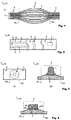
- Fig. 1 shows a schematic illustration of a sectional view through a fiber composite component 1.
- the fiber composite component 1 can in particular be a fiber-reinforced thermoplastic component.
- the term fiber composite component is used synonymously for a fiber-reinforced thermoplastic component in the following.
- the fiber composite component 1 can comprise a fiber-reinforced semi-finished product, for example an organic sheet, which comprises a fiber arrangement of one or more layers of a fiber material that are embedded in a thermoplastic matrix material, for example a plastic matrix material, or soaked by the same.
- the thermoplastic Matrix material the fiber composite component 1 is thermally deformable.
- the fiber material can comprise, for example, a fiber arrangement in the form of a woven fabric, a fiber strand, a knitted fabric, a braid, a scrim, a mat and / or a fleece.
- the scrims can be multiaxial scrims or unidirectional scrims.
- the fibers of the fiber material can be short, long and / or continuous fibers.
- the fiber composite component 1 can comprise Twintex®, for example. Reinforcing fibers, such as glass fibers, are processed into rovings with thermoplastic synthetic fibers, for example made of polypropylene, these are woven and then heated and formed into a semi-finished product under pressure.
- the fiber material of the fibers used in the fiber composite component 1 can be, for example, glass fiber, aramid fiber, carbon fiber, sisal, hemp, coconut fiber, cotton fiber and / or flax.
- the fibers can run at right angles to one another, depending on the desired mechanical properties of the fiber composite component 1 with regard to rigidity, strength and thermal expansion.
- the embodiments of the fiber composite components disclosed herein are not limited to the fiber materials mentioned and the fiber processing forms mentioned, such as woven fabric, fleece, knitted fabric or the like.
- the fiber composite component 1 can be provided in its initial form as a flat semi-finished product or as a shaped structural component.
- the fiber composite component 1 in Fig. 1 comprises at least one layer 2 of a fiber material which is impregnated by a thermoplastic matrix 3.
- the thermoplastic matrix 3 can for example thermoplastics such as acrylonitrile butadiene styrene (ABS), polyamide (PA), polyetherimide (PEI), polylactate (PLA), polymethyl methacrylate (PMMA), polycarbonate (PC), polyethylene terephthalate (PET), polyethylene (PE), Polypropylene (PP), polystyrene (PS), polyetheretherketone (PEEK), polypropylene sulfide (PPS), or polyvinylchloride (PVC).
- ABS acrylonitrile butadiene styrene
- PA polyamide
- PEI polyetherimide
- PLA polylactate
- PMMA polymethyl methacrylate
- PC polycarbonate
- PET polyethylene terephthalate
- PET polyethylene
- PE Polypropylene
- PP polysty
- the fiber composite component 1 has two areas 4 and 5 which are adjacent to one another, that is to say are either spaced apart from one another or run adjacent to one another. Areas 4 and 5 differ essentially in terms of their local degree of consolidation, that is to say the degree of compaction and solidification that the component achieves in this component zone after being subjected to pressure and heat.
- the fiber material 2 is impregnated with the matrix material 3 and compacted.
- the compression can remove air or gas inclusions from the fiber composite.
- the boundaries between the first and second areas are illustrated with B1 and B2 and dash-dotted lines. It should be clear, however, that the boundary lines between the first and second areas are not necessarily clearly sharp and that there can be intermediate areas between the first and second areas with an essentially constantly changing degree of consolidation.
- the local degree of consolidation of the fiber composite component 1 is above a first consolidation threshold value, while the local consolidation degree of the fiber composite component 1 in the second region 5 is below a second consolidation threshold value.
- the second consolidation threshold is in particular smaller than that is the first consolidation threshold value, so that one can speak of a complete or almost complete consolidation in the first area 4 and of an incomplete or partial consolidation in the second area 5.
- the second consolidation threshold value can be set to between approximately 10% and 80% of the first consolidation threshold value.
- the fiber composite component 1 of the Fig. 1 is used to form a film hinge in the second area 5.
- Film hinges or film joints are band hinges which are designed as flexible and thin-walled joint grooves between two sections of a fiber composite component to be connected.
- the proportion of matrix material in the second region 5 can be reduced in order to simplify deformation steps in the second region 5, for example kinking or bending the fiber composite component 1 in the second region 5.
- Fig. 2 shows a schematic illustration of a plan view of a fiber composite component 1 in order to explain the geometric design options for the second areas 5 by way of example.
- a fiber composite component 1 can only have one or some of the in Fig. 2 have exemplarily illustrated second areas 5.
- the number of the second areas 5 and the possible combinations of different area geometries for the second areas 5 are basically not restricted and can be selected in accordance with the desired stiffness ratios in the fiber composite component 1.
- strip-shaped second areas 5 are shown, which are interrupted by first areas 4 of a higher degree of consolidation.
- first areas 4 of a higher degree of consolidation.
- the acoustic behavior of the fiber composite component 1 due to elastic deformations can be improved.
- the vibration and damping behavior can be improved by such second regions 5.
- Meander or local areas 5 are reduced in their degree of consolidation, for example in the case of plastic deformations of the fiber composite component 1 to produce areas with increased impact strength and to be able to better absorb deformation energy in the component.
- Fig. 3 shows a schematic illustration of a plan view (A) of a fiber composite component 1 with a force introduction area 6, which lies within a second area 5 with a reduced degree of consolidation.
- the second area 4 forms a circular or elliptical area around the force introduction area 6.
- a screw dome 7 is formed on the force introduction area 6, which enables a gentler introduction of force into the fiber composite component 1 due to the reduced degree of consolidation in the second area 5.
- the screw dome 7 is better secured against overload as a result.
- Fig. 4 shows a sectional view of a fiber composite component 1 with a force introduction area 6, which lies within a second area 5 with a reduced degree of consolidation.
- the force application area 6 of the Fig. 4 is an adhesive point 8, at which an adhesive partner 8b is attached to the fiber composite component 1 via an adhesive medium 8a.
- the surface of the fiber composite component 1 is enlarged by the second region 5 with a reduced degree of consolidation, so that the adhesive medium 8a has an improved reaction surface.
- the reduced degree of consolidation in the second area 5 enables a gentler introduction of force into the fiber composite component 1 in the area of the adhesive point 8.
- Fig. 5 shows a sectional view of a fiber composite component 1 with a force introduction area 6, which lies within a second area 5 with a reduced degree of consolidation.
- the force application area 6 of the Fig. 5 is a screw connection point 9 at which a screw connection is introduced into the fiber composite component 1.
- the second area 5 with a reduced degree of consolidation the available component thickness of the fiber composite component 1 is increased locally, so that better force transmission in the area of the screw connection point 9 is possible.
- the reduced degree of consolidation in the second area 5 enables a gentler introduction of force into the fiber composite component 1 in the area of the screw connection point 9.
- rivets or welds can also be formed.
- welds there is also the advantage that in the not completely consolidated areas 5, continuous fibers can be shifted into the weld zone in a targeted manner.
- Fig. 6 shows a schematic representation of a fiber composite component 1 which has a different number of fiber layers 2 along a direction of extent. From right to left, for example, the number of layers increases in order to be able to produce local reinforcement layers. In each zone in which a new reinforcement layer begins, the rigidity of the entire fiber composite component 1 increases locally by leaps and bounds. In order to reduce the height of the jump in rigidity, a first region 4 can be formed in a zone with a first number of fiber layers 2a. This first area 4 directly adjoins a second area 5 which has a second number of fiber layers 2b that is higher than the first number of fiber layers 2a.
- the second area 5 now has a locally reduced degree of consolidation compared to the first area, the rigidity of the fiber composite component 1 increases only gradually, as a result of which the increase in rigidity over the entire fiber composite component 1 is gentler.
- the notch factor or the notch effect between the individual layer transitions is reduced.
- Fig. 7 shows a schematic illustration of a plan view of a fiber composite component 1, which in a third region 5a, for example an end section of the fiber composite component 1, has no matrix material 3, that is to say bare, unimpregnated or unwetted fibers.
- This third area 5a can adjoin a second area 5 with a reduced degree of consolidation, the second area 5 being arranged between the first area 4 and the third area 5a.
- Such third areas 5a are used, for example, at joining points of fiber composite components which are bonded to other joining partners in the area of the bare fibers.
- the fiber composite components shown can be produced, for example, by means of an injection mold of an injection molding tool for injecting thermoplastic material.
- an organic sheet or a pre-consolidated sheet for example a Twintex® sheet, or a stack of layers of such sheets can be used, which are heated as a semi-finished product or preformed component to the processing temperature of the plastic matrix and placed in the injection mold of the injection molding tool.
- the heating can also take place in the injection molding tool.
- the semi-finished product or preformed component received in the injection mold is heated to a corresponding processing temperature so that suitably heated liquid thermoplastic matrix material can also be injected into the injection mold.
- the injected matrix material can be, for example, the same material as the matrix material 3 of an organic sheet used.
- another thermoplastic material can also be injected, which can bond with the thermoplastic matrix material 3 of the semi-finished product or preformed component.
- an extrusion tool or another suitable tool can also be used.
- the invention is not limited to injection molding and extrusion.
- Fig. 8 shows a block diagram of a method M for producing a fiber composite component, for example one in one of the Figures 1 to 7 fiber composite components shown 1.
- the method M can be used in the context of an injection molding or extrusion process.
- a first area 4 of a fiber-reinforced semi-finished product for example an organic sheet or an organic sheet stack, is consolidated with at least one layer 2 of a fiber material and a thermoplastic matrix 3 which soaks the fiber material.
- This consolidation takes place up to a first degree of consolidation.
- step S2 a consolidation of a second region 5 of the fiber-reinforced semifinished product that is adjacent to the first region 4, i.e.
- the second degree of consolidation is in particular smaller than the first degree of consolidation, so that the second area 5 is not fully consolidated in relation to the first area 4, that is, it is not consolidated and compacted to the same extent as the first area 4.
- the degree of consolidation should be between 10% and 80% of the first degree of consolidation.
- steps S1 and S2 can be achieved, for example, by applying a first consolidation pressure to the fiber-reinforced semi-finished product in the first area 4, which is higher than a second consolidation pressure which is applied to the fiber-reinforced semi-finished product in the second area 5 .
- a first consolidation pressure to the fiber-reinforced semi-finished product in the first area 4
- a second consolidation pressure which is applied to the fiber-reinforced semi-finished product in the second area 5 .
- the period of time during that a consolidation pressure is exerted on the second area 5 can be reduced compared to the period of time during which a consolidation pressure is exerted on the first area 5, in order to achieve the various degrees of consolidation.
Landscapes
- Chemical & Material Sciences (AREA)
- Engineering & Computer Science (AREA)
- Composite Materials (AREA)
- Mechanical Engineering (AREA)
- Health & Medical Sciences (AREA)
- Oral & Maxillofacial Surgery (AREA)
- Physics & Mathematics (AREA)
- Thermal Sciences (AREA)
- Medicinal Chemistry (AREA)
- Polymers & Plastics (AREA)
- Organic Chemistry (AREA)
- Chemical Kinetics & Catalysis (AREA)
- Materials Engineering (AREA)
- Manufacturing & Machinery (AREA)
- Reinforced Plastic Materials (AREA)
- Moulding By Coating Moulds (AREA)
- Casting Or Compression Moulding Of Plastics Or The Like (AREA)
- Laminated Bodies (AREA)
Claims (7)
- Une pièce en matériau composite fibreux (1), comprenant:au moins une couche (2) d'un matériau fibreux; etune matrice thermoplastique (3) qui imprègne le matériau fibreux,dans lequel le composant composite fibreux (1) ayant au moins une première région (4) comprenant un premier nombre de couches fibreuses (2a) et dans laquelle le degré local de consolidation de la pièce en matériau fibreux (1) est supérieur à un premier seuil de consolidation ; etdans lequel la pièce en matériau fibreux (1) comporte au moins une seconde région (5) adjacente à la première région (4) comprenant un second nombre de couches fibreuses (2b) qui est supérieur au premier nombre de couches fibreuses (2a), dans lequel le degré local consolidation de la pièce en matériau fibreux composite (1) est inférieure à un second seuil de consolidation valeur,dans lequel la deuxième valeur de seuil de consolidation est inférieure à la première valeur de seuil de consolidation, et dans lequel la seconde région (5) forme une articulation filmique et/ou dans lequel la pièce en matériau composite fibreux (1) comporte au moins une feuille organique ou une feuille préconsolidée.
- La pièce en matériau composite fibreux (1) selon la revendication 1, dans laquelle la deuxième valeur de seuil de consolidation est comprise entre 10% et 80% de la première valeur de seuil de consolidation.
- La pièce en matériau composite fibreux (1) selon l'une des revendications 1 et 2, comprenant en outre une troisième région (5a) comprenant des couches (2) de matériaux fibreux non imprégnées par la matrice thermoplastique (3), dans laquelle la seconde région (5) est située entre la première région (4) et la troisième région - (5a).
- La pièce en matériau composite fibreux(1) selon l'une des revendications 1 à 3, dans laquelle le matériau fibreux est formé à partir d'une disposition fibreuse de fibres de verre, de fibres aramides, de fibres de carbone, de sisal, de chanvre, de fibres de noix de coco, de fibres de coton et/ou de lin, et dans laquelle la disposition fibreuse forme une tissu, un brin de fibres, un tricot, une tresse, un canevas, un tapis et/ou un matériau non-tissé.
- La pièce en matériau composite fibreux (1) selon l'une quelconque des revendications 1 à 4, dans lequel le composant composite fibreux (1) est un composant composite fibreux continu (1) renforcé.
- Un procédé (M)de fabrication d'une pièce en matériau composite fibreux (1), comprenant:la consolidation (S1) d'une première zone (4) d'un produit semi-fini renforcé de fibres avec au moins une couche (2) d'un matériau fibreux et un matrice thermoplastique (3) imprégnant le matériau fibreux à un premier degré de consolidation ; etla consolidation (S2) d'une deuxième région (5), adjacente à la première région (4), du produit fibreux semi-fini renforcé jusqu'à un deuxième degré de consolidation différent du premier degré de consolidation, dans lequel la deuxième région (5) comporte un second nombre de couches fibreuses (2b) qui est supérieur au premier nombre de couches fibreuses (2a), et dans lequel le second degré de consolidation est plus petit que le premier degré de consolidation, et dans lequel la seconde région (5) forme une articulation filmique et/ou dans lequel la pièce en matériaux composite fibreux (1) comporte au moins une feuille organique ou une feuille pré-consolidée.
- Le procédé (M) selon la revendication 6, dans lequel le deuxième degré de consolidation est compris entre 10% et 80% du premier degré de consolidation.
Priority Applications (1)
| Application Number | Priority Date | Filing Date | Title |
|---|---|---|---|
| PL15712113T PL3122543T3 (pl) | 2014-03-28 | 2015-03-23 | Element konstrukcyjny z kompozytu włóknistego i sposób wytwarzania elementu konstrukcyjnego z kompozytu włóknistego |
Applications Claiming Priority (2)
| Application Number | Priority Date | Filing Date | Title |
|---|---|---|---|
| DE102014205861.9A DE102014205861A1 (de) | 2014-03-28 | 2014-03-28 | Faserverbundbauteil und Verfahren zum Herstellen eines Faserverbundbauteils |
| PCT/EP2015/056045 WO2015144612A2 (fr) | 2014-03-28 | 2015-03-23 | Pièce en matériau composite renforcé par des fibres et son procédé de fabrication |
Publications (2)
| Publication Number | Publication Date |
|---|---|
| EP3122543A2 EP3122543A2 (fr) | 2017-02-01 |
| EP3122543B1 true EP3122543B1 (fr) | 2021-06-23 |
Family
ID=52737095
Family Applications (1)
| Application Number | Title | Priority Date | Filing Date |
|---|---|---|---|
| EP15712113.8A Active EP3122543B1 (fr) | 2014-03-28 | 2015-03-23 | Pièce en matériau composite renforcé par des fibres et son procédé de fabrication |
Country Status (7)
| Country | Link |
|---|---|
| US (1) | US20170174850A1 (fr) |
| EP (1) | EP3122543B1 (fr) |
| KR (2) | KR102047752B1 (fr) |
| CN (1) | CN106573420B (fr) |
| DE (1) | DE102014205861A1 (fr) |
| PL (1) | PL3122543T3 (fr) |
| WO (1) | WO2015144612A2 (fr) |
Families Citing this family (2)
| Publication number | Priority date | Publication date | Assignee | Title |
|---|---|---|---|---|
| DE102021107363A1 (de) | 2021-03-24 | 2022-09-29 | Delcotex Delius Techtex Gmbh & Co. Kg | Textiles Flächengebilde und dessen Verwendung sowie Verfahren zu dessen Herstellung |
| US11766840B2 (en) * | 2021-08-30 | 2023-09-26 | The Boeing Company | Apparatus and method to enable in-plane bending of high contour composite structures in post-forming operations |
Family Cites Families (16)
| Publication number | Priority date | Publication date | Assignee | Title |
|---|---|---|---|---|
| JPS6224039A (ja) * | 1985-07-24 | 1987-02-02 | Nhk Spring Co Ltd | 繊維強化樹脂製板ばね |
| GB8527023D0 (en) * | 1985-11-01 | 1985-12-04 | Wiggins Teape Group Ltd | Moulded fibre reinforced plastic articles |
| DE19531406A1 (de) * | 1995-08-26 | 1997-02-27 | Borgers Johann Gmbh Co Kg | Halbzeug für Preßformteile |
| FR2768076B1 (fr) * | 1997-09-10 | 2000-08-04 | Peguform France | Procede de realisation d'une zone rigidifiee formant insert dans un panneau composite du type sandwich, et panneau comprenant une telle zone |
| JP2002240566A (ja) * | 2001-02-21 | 2002-08-28 | Nissan Motor Co Ltd | 車輌用樹脂パネル及び車輌用樹脂パネルの製造方法 |
| GB0108331D0 (en) * | 2001-04-03 | 2001-05-23 | Structural Polymer Systems Ltd | Bonding material |
| DE10356185A1 (de) * | 2002-12-10 | 2004-06-24 | Sumitomo Chemical Co., Ltd. | Faser/Harz-Komposit und daraus hergestellter Formkörper |
| PT1603735E (pt) * | 2003-03-06 | 2007-06-15 | Vestas Wind Sys As | Conexão entre compostos com propriedades incompatíveis e método para a sua preparação |
| DE102010013713A1 (de) * | 2010-04-02 | 2011-10-06 | Airbus Operations Gmbh | Verfahren und Vorrichtung zur Herstellung eines faserverstärkten thermoplastischen Verbundbauteils |
| US9327434B2 (en) * | 2010-09-10 | 2016-05-03 | Johnson Controls Gmbh | Method for producing a rear wall of a seat back |
| DE102010050065B4 (de) * | 2010-10-29 | 2015-10-01 | Ifc Composite Gmbh | Blattfeder aus einem Faserverbundwerkstoff mit unterschiedlich langen Faserlagen sowie Verfahren zu deren Herstellung |
| CN102408685B (zh) * | 2011-08-31 | 2013-06-26 | 上海锦湖日丽塑料有限公司 | 高耐候玻纤增强pbt树脂及其制备方法 |
| DE102011056686B4 (de) | 2011-12-20 | 2017-11-23 | Markus Brzeski | Verfahren zur Herstellung eines Faserverbundwerkstoffes, ein nach dem Verfahren hergestellter Faserverbundwerkstoff sowie eine Vorrichtung zur Durchführung des Verfahrens |
| DE102012006034A1 (de) * | 2012-03-27 | 2013-10-02 | Mbb Fertigungstechnik Gmbh | Verfahren zur Herstellung eines im Wesentlichen schalenförmigen, faserverstärkten Kunststoffteils |
| DE102012104044A1 (de) | 2012-05-09 | 2013-11-14 | Rehau Ag + Co | Verfahren zum wenigstens bereichsweisen Konsolidieren eines Vorformlings zur Herstellung eines Formteils in einem Formwerkzeug |
| DE102012104316A1 (de) * | 2012-05-18 | 2013-11-21 | Institut Für Verbundwerkstoffe Gmbh | Verfahren zur Fertigung eines Bauteils |
-
2014
- 2014-03-28 DE DE102014205861.9A patent/DE102014205861A1/de not_active Ceased
-
2015
- 2015-03-23 WO PCT/EP2015/056045 patent/WO2015144612A2/fr not_active Ceased
- 2015-03-23 KR KR1020197004713A patent/KR102047752B1/ko active Active
- 2015-03-23 EP EP15712113.8A patent/EP3122543B1/fr active Active
- 2015-03-23 US US15/129,700 patent/US20170174850A1/en not_active Abandoned
- 2015-03-23 CN CN201580028037.8A patent/CN106573420B/zh active Active
- 2015-03-23 PL PL15712113T patent/PL3122543T3/pl unknown
- 2015-03-23 KR KR1020167030171A patent/KR101995848B1/ko active Active
Non-Patent Citations (1)
| Title |
|---|
| None * |
Also Published As
| Publication number | Publication date |
|---|---|
| CN106573420B (zh) | 2019-12-20 |
| EP3122543A2 (fr) | 2017-02-01 |
| DE102014205861A1 (de) | 2015-10-01 |
| KR20160145632A (ko) | 2016-12-20 |
| CN106573420A (zh) | 2017-04-19 |
| KR20190018769A (ko) | 2019-02-25 |
| KR101995848B1 (ko) | 2019-07-03 |
| US20170174850A1 (en) | 2017-06-22 |
| PL3122543T3 (pl) | 2021-09-27 |
| KR102047752B1 (ko) | 2019-11-22 |
| WO2015144612A2 (fr) | 2015-10-01 |
| WO2015144612A3 (fr) | 2015-12-23 |
Similar Documents
| Publication | Publication Date | Title |
|---|---|---|
| EP3037601A1 (fr) | Structure alvéolaire | |
| EP1077127B1 (fr) | Matériau composite avec une couche intermédiaire contenant au moins une nappe en fibres naturelles régénérables | |
| EP3052306B1 (fr) | Élément en matériau composite renforcé par fibres et procédé de fabrication d'un élément en matériau composite renforcé par fibres | |
| EP3150363B1 (fr) | Procédé de fabrication en sandwich d'une pièce pour éolienne | |
| DE102008063545A1 (de) | Multiaxialgelege | |
| DE102011121321A1 (de) | Sandwichbauteil und Verfahren zum Herstellen des Sandwichbauteils | |
| DE102011105858A1 (de) | Faserverbundkunststoff-Pultrusionsprofil und Herstellungsverfahren | |
| EP1567385B1 (fr) | Tableau de bord et procede de realisation | |
| EP2897788B1 (fr) | Élément composite renforcé par des fibres optimisé fonctionnellement, et procédé de fabrication dudit élément composite | |
| DE102009010589A1 (de) | Hybrides Verbundprofil | |
| EP4454853A1 (fr) | Composant structurel | |
| EP3057779B1 (fr) | Procédé de production d'un élément structural composite renforcé par des fibres | |
| EP3122543B1 (fr) | Pièce en matériau composite renforcé par des fibres et son procédé de fabrication | |
| EP2626218B1 (fr) | Procédé de fabrication d'une jante à base de matière première composite en fibres et jante pour un véhicule automobile | |
| EP3188885B1 (fr) | Procédé de fabrication d'une pièce multi-couche de matière composite avec une structure renforcée intégrée | |
| EP3263321B1 (fr) | Procede de production d'un panneau sandwich comprenant des noyaux en mousse renforcee | |
| EP4272936A1 (fr) | Composant composite renforcé par des fibres conçu sous la forme de composant en carbone apparent, surface textile et utilisation de la surface textile pour un composant composite conçu sous la forme de composant en carbone apparent, ainsi que procédé de fabrication d'un tel composant composite | |
| DE102015221967A1 (de) | Verfahren zur Herstellung eines naturfaserverstärkten Innenverkleidungsteils | |
| DE102011003747A1 (de) | Faserverstärktes Bauteil und Verfahren zur Herstellung eines faserverstärkten Bauteils | |
| DE102006035361A1 (de) | Geformter Artikel, Vliesstoff sowie deren Herstellung und Verwendung | |
| DE102007042287B4 (de) | Verfahren zur Herstellung eines Faserverbundbauteils | |
| DE102011109700A1 (de) | Faserverstärktes Kunststoffverbundbauteil, Faser-Matrix-Halbzeug und Herstellungsverfahren | |
| EP3165431B1 (fr) | Structure de liaison comprenant au moins un composant en corps creux à double paroi, procédé de fabrication et carrosserie de véhicule | |
| EP2038113B1 (fr) | Panneau en matériau composite pourvu d'une couche métallique | |
| EP2873518B1 (fr) | Procédé de fabrication d'un composant en composite renforcé en fibres |
Legal Events
| Date | Code | Title | Description |
|---|---|---|---|
| STAA | Information on the status of an ep patent application or granted ep patent |
Free format text: STATUS: THE INTERNATIONAL PUBLICATION HAS BEEN MADE |
|
| PUAI | Public reference made under article 153(3) epc to a published international application that has entered the european phase |
Free format text: ORIGINAL CODE: 0009012 |
|
| STAA | Information on the status of an ep patent application or granted ep patent |
Free format text: STATUS: REQUEST FOR EXAMINATION WAS MADE |
|
| 17P | Request for examination filed |
Effective date: 20160916 |
|
| AK | Designated contracting states |
Kind code of ref document: A2 Designated state(s): AL AT BE BG CH CY CZ DE DK EE ES FI FR GB GR HR HU IE IS IT LI LT LU LV MC MK MT NL NO PL PT RO RS SE SI SK SM TR |
|
| AX | Request for extension of the european patent |
Extension state: BA ME |
|
| DAV | Request for validation of the european patent (deleted) | ||
| DAX | Request for extension of the european patent (deleted) | ||
| STAA | Information on the status of an ep patent application or granted ep patent |
Free format text: STATUS: EXAMINATION IS IN PROGRESS |
|
| 17Q | First examination report despatched |
Effective date: 20190704 |
|
| RAP1 | Party data changed (applicant data changed or rights of an application transferred) |
Owner name: BROSE FAHRZEUGTEILE SE & CO. KOMMANDITGESELLSCHAFT, COBURG |
|
| GRAP | Despatch of communication of intention to grant a patent |
Free format text: ORIGINAL CODE: EPIDOSNIGR1 |
|
| STAA | Information on the status of an ep patent application or granted ep patent |
Free format text: STATUS: GRANT OF PATENT IS INTENDED |
|
| INTG | Intention to grant announced |
Effective date: 20210212 |
|
| GRAS | Grant fee paid |
Free format text: ORIGINAL CODE: EPIDOSNIGR3 |
|
| GRAA | (expected) grant |
Free format text: ORIGINAL CODE: 0009210 |
|
| STAA | Information on the status of an ep patent application or granted ep patent |
Free format text: STATUS: THE PATENT HAS BEEN GRANTED |
|
| AK | Designated contracting states |
Kind code of ref document: B1 Designated state(s): AL AT BE BG CH CY CZ DE DK EE ES FI FR GB GR HR HU IE IS IT LI LT LU LV MC MK MT NL NO PL PT RO RS SE SI SK SM TR |
|
| REG | Reference to a national code |
Ref country code: GB Ref legal event code: FG4D Free format text: NOT ENGLISH |
|
| REG | Reference to a national code |
Ref country code: CH Ref legal event code: EP |
|
| REG | Reference to a national code |
Ref country code: DE Ref legal event code: R096 Ref document number: 502015014851 Country of ref document: DE Ref country code: AT Ref legal event code: REF Ref document number: 1403938 Country of ref document: AT Kind code of ref document: T Effective date: 20210715 |
|
| REG | Reference to a national code |
Ref country code: IE Ref legal event code: FG4D Free format text: LANGUAGE OF EP DOCUMENT: GERMAN |
|
| REG | Reference to a national code |
Ref country code: LT Ref legal event code: MG9D |
|
| PG25 | Lapsed in a contracting state [announced via postgrant information from national office to epo] |
Ref country code: HR Free format text: LAPSE BECAUSE OF FAILURE TO SUBMIT A TRANSLATION OF THE DESCRIPTION OR TO PAY THE FEE WITHIN THE PRESCRIBED TIME-LIMIT Effective date: 20210623 Ref country code: BG Free format text: LAPSE BECAUSE OF FAILURE TO SUBMIT A TRANSLATION OF THE DESCRIPTION OR TO PAY THE FEE WITHIN THE PRESCRIBED TIME-LIMIT Effective date: 20210923 Ref country code: FI Free format text: LAPSE BECAUSE OF FAILURE TO SUBMIT A TRANSLATION OF THE DESCRIPTION OR TO PAY THE FEE WITHIN THE PRESCRIBED TIME-LIMIT Effective date: 20210623 Ref country code: LT Free format text: LAPSE BECAUSE OF FAILURE TO SUBMIT A TRANSLATION OF THE DESCRIPTION OR TO PAY THE FEE WITHIN THE PRESCRIBED TIME-LIMIT Effective date: 20210623 |
|
| PG25 | Lapsed in a contracting state [announced via postgrant information from national office to epo] |
Ref country code: NO Free format text: LAPSE BECAUSE OF FAILURE TO SUBMIT A TRANSLATION OF THE DESCRIPTION OR TO PAY THE FEE WITHIN THE PRESCRIBED TIME-LIMIT Effective date: 20210923 Ref country code: SE Free format text: LAPSE BECAUSE OF FAILURE TO SUBMIT A TRANSLATION OF THE DESCRIPTION OR TO PAY THE FEE WITHIN THE PRESCRIBED TIME-LIMIT Effective date: 20210623 Ref country code: RS Free format text: LAPSE BECAUSE OF FAILURE TO SUBMIT A TRANSLATION OF THE DESCRIPTION OR TO PAY THE FEE WITHIN THE PRESCRIBED TIME-LIMIT Effective date: 20210623 Ref country code: LV Free format text: LAPSE BECAUSE OF FAILURE TO SUBMIT A TRANSLATION OF THE DESCRIPTION OR TO PAY THE FEE WITHIN THE PRESCRIBED TIME-LIMIT Effective date: 20210623 Ref country code: GR Free format text: LAPSE BECAUSE OF FAILURE TO SUBMIT A TRANSLATION OF THE DESCRIPTION OR TO PAY THE FEE WITHIN THE PRESCRIBED TIME-LIMIT Effective date: 20210924 |
|
| REG | Reference to a national code |
Ref country code: NL Ref legal event code: MP Effective date: 20210623 |
|
| PG25 | Lapsed in a contracting state [announced via postgrant information from national office to epo] |
Ref country code: EE Free format text: LAPSE BECAUSE OF FAILURE TO SUBMIT A TRANSLATION OF THE DESCRIPTION OR TO PAY THE FEE WITHIN THE PRESCRIBED TIME-LIMIT Effective date: 20210623 Ref country code: SK Free format text: LAPSE BECAUSE OF FAILURE TO SUBMIT A TRANSLATION OF THE DESCRIPTION OR TO PAY THE FEE WITHIN THE PRESCRIBED TIME-LIMIT Effective date: 20210623 Ref country code: SM Free format text: LAPSE BECAUSE OF FAILURE TO SUBMIT A TRANSLATION OF THE DESCRIPTION OR TO PAY THE FEE WITHIN THE PRESCRIBED TIME-LIMIT Effective date: 20210623 Ref country code: PT Free format text: LAPSE BECAUSE OF FAILURE TO SUBMIT A TRANSLATION OF THE DESCRIPTION OR TO PAY THE FEE WITHIN THE PRESCRIBED TIME-LIMIT Effective date: 20211025 Ref country code: RO Free format text: LAPSE BECAUSE OF FAILURE TO SUBMIT A TRANSLATION OF THE DESCRIPTION OR TO PAY THE FEE WITHIN THE PRESCRIBED TIME-LIMIT Effective date: 20210623 Ref country code: NL Free format text: LAPSE BECAUSE OF FAILURE TO SUBMIT A TRANSLATION OF THE DESCRIPTION OR TO PAY THE FEE WITHIN THE PRESCRIBED TIME-LIMIT Effective date: 20210623 Ref country code: ES Free format text: LAPSE BECAUSE OF FAILURE TO SUBMIT A TRANSLATION OF THE DESCRIPTION OR TO PAY THE FEE WITHIN THE PRESCRIBED TIME-LIMIT Effective date: 20210623 |
|
| REG | Reference to a national code |
Ref country code: DE Ref legal event code: R097 Ref document number: 502015014851 Country of ref document: DE |
|
| PG25 | Lapsed in a contracting state [announced via postgrant information from national office to epo] |
Ref country code: DK Free format text: LAPSE BECAUSE OF FAILURE TO SUBMIT A TRANSLATION OF THE DESCRIPTION OR TO PAY THE FEE WITHIN THE PRESCRIBED TIME-LIMIT Effective date: 20210623 |
|
| PLBE | No opposition filed within time limit |
Free format text: ORIGINAL CODE: 0009261 |
|
| STAA | Information on the status of an ep patent application or granted ep patent |
Free format text: STATUS: NO OPPOSITION FILED WITHIN TIME LIMIT |
|
| 26N | No opposition filed |
Effective date: 20220324 |
|
| PG25 | Lapsed in a contracting state [announced via postgrant information from national office to epo] |
Ref country code: AL Free format text: LAPSE BECAUSE OF FAILURE TO SUBMIT A TRANSLATION OF THE DESCRIPTION OR TO PAY THE FEE WITHIN THE PRESCRIBED TIME-LIMIT Effective date: 20210623 |
|
| PG25 | Lapsed in a contracting state [announced via postgrant information from national office to epo] |
Ref country code: IT Free format text: LAPSE BECAUSE OF FAILURE TO SUBMIT A TRANSLATION OF THE DESCRIPTION OR TO PAY THE FEE WITHIN THE PRESCRIBED TIME-LIMIT Effective date: 20210623 |
|
| PG25 | Lapsed in a contracting state [announced via postgrant information from national office to epo] |
Ref country code: MC Free format text: LAPSE BECAUSE OF FAILURE TO SUBMIT A TRANSLATION OF THE DESCRIPTION OR TO PAY THE FEE WITHIN THE PRESCRIBED TIME-LIMIT Effective date: 20210623 |
|
| REG | Reference to a national code |
Ref country code: CH Ref legal event code: PL |
|
| GBPC | Gb: european patent ceased through non-payment of renewal fee |
Effective date: 20220323 |
|
| REG | Reference to a national code |
Ref country code: BE Ref legal event code: MM Effective date: 20220331 |
|
| PG25 | Lapsed in a contracting state [announced via postgrant information from national office to epo] |
Ref country code: LU Free format text: LAPSE BECAUSE OF NON-PAYMENT OF DUE FEES Effective date: 20220323 Ref country code: LI Free format text: LAPSE BECAUSE OF NON-PAYMENT OF DUE FEES Effective date: 20220331 Ref country code: IE Free format text: LAPSE BECAUSE OF NON-PAYMENT OF DUE FEES Effective date: 20220323 Ref country code: GB Free format text: LAPSE BECAUSE OF NON-PAYMENT OF DUE FEES Effective date: 20220323 Ref country code: FR Free format text: LAPSE BECAUSE OF NON-PAYMENT OF DUE FEES Effective date: 20220331 Ref country code: CH Free format text: LAPSE BECAUSE OF NON-PAYMENT OF DUE FEES Effective date: 20220331 |
|
| PG25 | Lapsed in a contracting state [announced via postgrant information from national office to epo] |
Ref country code: BE Free format text: LAPSE BECAUSE OF NON-PAYMENT OF DUE FEES Effective date: 20220331 |
|
| REG | Reference to a national code |
Ref country code: AT Ref legal event code: MM01 Ref document number: 1403938 Country of ref document: AT Kind code of ref document: T Effective date: 20220323 |
|
| PG25 | Lapsed in a contracting state [announced via postgrant information from national office to epo] |
Ref country code: AT Free format text: LAPSE BECAUSE OF NON-PAYMENT OF DUE FEES Effective date: 20220323 |
|
| PG25 | Lapsed in a contracting state [announced via postgrant information from national office to epo] |
Ref country code: HU Free format text: LAPSE BECAUSE OF FAILURE TO SUBMIT A TRANSLATION OF THE DESCRIPTION OR TO PAY THE FEE WITHIN THE PRESCRIBED TIME-LIMIT; INVALID AB INITIO Effective date: 20150323 |
|
| PG25 | Lapsed in a contracting state [announced via postgrant information from national office to epo] |
Ref country code: MK Free format text: LAPSE BECAUSE OF FAILURE TO SUBMIT A TRANSLATION OF THE DESCRIPTION OR TO PAY THE FEE WITHIN THE PRESCRIBED TIME-LIMIT Effective date: 20210623 Ref country code: CY Free format text: LAPSE BECAUSE OF FAILURE TO SUBMIT A TRANSLATION OF THE DESCRIPTION OR TO PAY THE FEE WITHIN THE PRESCRIBED TIME-LIMIT Effective date: 20210623 |
|
| PGFP | Annual fee paid to national office [announced via postgrant information from national office to epo] |
Ref country code: CZ Payment date: 20240228 Year of fee payment: 10 |
|
| PGFP | Annual fee paid to national office [announced via postgrant information from national office to epo] |
Ref country code: PL Payment date: 20240214 Year of fee payment: 10 |
|
| PG25 | Lapsed in a contracting state [announced via postgrant information from national office to epo] |
Ref country code: TR Free format text: LAPSE BECAUSE OF FAILURE TO SUBMIT A TRANSLATION OF THE DESCRIPTION OR TO PAY THE FEE WITHIN THE PRESCRIBED TIME-LIMIT Effective date: 20210623 |
|
| PG25 | Lapsed in a contracting state [announced via postgrant information from national office to epo] |
Ref country code: MT Free format text: LAPSE BECAUSE OF FAILURE TO SUBMIT A TRANSLATION OF THE DESCRIPTION OR TO PAY THE FEE WITHIN THE PRESCRIBED TIME-LIMIT Effective date: 20210623 |
|
| PGFP | Annual fee paid to national office [announced via postgrant information from national office to epo] |
Ref country code: DE Payment date: 20250331 Year of fee payment: 11 |
|
| PG25 | Lapsed in a contracting state [announced via postgrant information from national office to epo] |
Ref country code: CZ Free format text: LAPSE BECAUSE OF NON-PAYMENT OF DUE FEES Effective date: 20250323 |