EP3124004A1 - Gerät zur behandlung des menschlichen oder tierischen körpers mit mechanischen stössen - Google Patents
Gerät zur behandlung des menschlichen oder tierischen körpers mit mechanischen stössen Download PDFInfo
- Publication number
- EP3124004A1 EP3124004A1 EP15178506.0A EP15178506A EP3124004A1 EP 3124004 A1 EP3124004 A1 EP 3124004A1 EP 15178506 A EP15178506 A EP 15178506A EP 3124004 A1 EP3124004 A1 EP 3124004A1
- Authority
- EP
- European Patent Office
- Prior art keywords
- applicator
- rotation
- rotatable
- axis
- impact
- Prior art date
- Legal status (The legal status is an assumption and is not a legal conclusion. Google has not performed a legal analysis and makes no representation as to the accuracy of the status listed.)
- Granted
Links
Images

Classifications
-
- A—HUMAN NECESSITIES
- A61—MEDICAL OR VETERINARY SCIENCE; HYGIENE
- A61H—PHYSICAL THERAPY APPARATUS, e.g. DEVICES FOR LOCATING OR STIMULATING REFLEX POINTS IN THE BODY; ARTIFICIAL RESPIRATION; MASSAGE; BATHING DEVICES FOR SPECIAL THERAPEUTIC OR HYGIENIC PURPOSES OR SPECIFIC PARTS OF THE BODY
- A61H23/00—Percussion or vibration massage, e.g. using supersonic vibration; Suction-vibration massage; Massage with moving diaphragms
- A61H23/008—Percussion or vibration massage, e.g. using supersonic vibration; Suction-vibration massage; Massage with moving diaphragms using shock waves
-
- A—HUMAN NECESSITIES
- A61—MEDICAL OR VETERINARY SCIENCE; HYGIENE
- A61H—PHYSICAL THERAPY APPARATUS, e.g. DEVICES FOR LOCATING OR STIMULATING REFLEX POINTS IN THE BODY; ARTIFICIAL RESPIRATION; MASSAGE; BATHING DEVICES FOR SPECIAL THERAPEUTIC OR HYGIENIC PURPOSES OR SPECIFIC PARTS OF THE BODY
- A61H15/00—Massage by means of rollers, balls, e.g. inflatable, chains, or roller chains
- A61H15/0078—Massage by means of rollers, balls, e.g. inflatable, chains, or roller chains power-driven
- A61H15/0085—Massage by means of rollers, balls, e.g. inflatable, chains, or roller chains power-driven hand-held
-
- A—HUMAN NECESSITIES
- A61—MEDICAL OR VETERINARY SCIENCE; HYGIENE
- A61H—PHYSICAL THERAPY APPARATUS, e.g. DEVICES FOR LOCATING OR STIMULATING REFLEX POINTS IN THE BODY; ARTIFICIAL RESPIRATION; MASSAGE; BATHING DEVICES FOR SPECIAL THERAPEUTIC OR HYGIENIC PURPOSES OR SPECIFIC PARTS OF THE BODY
- A61H23/00—Percussion or vibration massage, e.g. using supersonic vibration; Suction-vibration massage; Massage with moving diaphragms
- A61H23/04—Percussion or vibration massage, e.g. using supersonic vibration; Suction-vibration massage; Massage with moving diaphragms with hydraulic or pneumatic drive
-
- A—HUMAN NECESSITIES
- A61—MEDICAL OR VETERINARY SCIENCE; HYGIENE
- A61B—DIAGNOSIS; SURGERY; IDENTIFICATION
- A61B17/00—Surgical instruments, devices or methods
- A61B17/22—Implements for squeezing-off ulcers or the like on inner organs of the body; Implements for scraping-out cavities of body organs, e.g. bones; for invasive removal or destruction of calculus using mechanical vibrations; for removing obstructions in blood vessels, not otherwise provided for
- A61B17/225—Implements for squeezing-off ulcers or the like on inner organs of the body; Implements for scraping-out cavities of body organs, e.g. bones; for invasive removal or destruction of calculus using mechanical vibrations; for removing obstructions in blood vessels, not otherwise provided for for extracorporeal shock wave lithotripsy [ESWL], e.g. by using ultrasonic waves
- A61B17/2251—Implements for squeezing-off ulcers or the like on inner organs of the body; Implements for scraping-out cavities of body organs, e.g. bones; for invasive removal or destruction of calculus using mechanical vibrations; for removing obstructions in blood vessels, not otherwise provided for for extracorporeal shock wave lithotripsy [ESWL], e.g. by using ultrasonic waves characterised by coupling elements between the apparatus, e.g. shock wave apparatus or locating means, and the patient, e.g. details of bags, pressure control of bag on patient
-
- A—HUMAN NECESSITIES
- A61—MEDICAL OR VETERINARY SCIENCE; HYGIENE
- A61B—DIAGNOSIS; SURGERY; IDENTIFICATION
- A61B17/00—Surgical instruments, devices or methods
- A61B2017/00535—Surgical instruments, devices or methods pneumatically or hydraulically operated
- A61B2017/00544—Surgical instruments, devices or methods pneumatically or hydraulically operated pneumatically
-
- A—HUMAN NECESSITIES
- A61—MEDICAL OR VETERINARY SCIENCE; HYGIENE
- A61H—PHYSICAL THERAPY APPARATUS, e.g. DEVICES FOR LOCATING OR STIMULATING REFLEX POINTS IN THE BODY; ARTIFICIAL RESPIRATION; MASSAGE; BATHING DEVICES FOR SPECIAL THERAPEUTIC OR HYGIENIC PURPOSES OR SPECIFIC PARTS OF THE BODY
- A61H15/00—Massage by means of rollers, balls, e.g. inflatable, chains, or roller chains
- A61H2015/0007—Massage by means of rollers, balls, e.g. inflatable, chains, or roller chains with balls or rollers rotating about their own axis
- A61H2015/0014—Massage by means of rollers, balls, e.g. inflatable, chains, or roller chains with balls or rollers rotating about their own axis cylinder-like, i.e. rollers
-
- A—HUMAN NECESSITIES
- A61—MEDICAL OR VETERINARY SCIENCE; HYGIENE
- A61H—PHYSICAL THERAPY APPARATUS, e.g. DEVICES FOR LOCATING OR STIMULATING REFLEX POINTS IN THE BODY; ARTIFICIAL RESPIRATION; MASSAGE; BATHING DEVICES FOR SPECIAL THERAPEUTIC OR HYGIENIC PURPOSES OR SPECIFIC PARTS OF THE BODY
- A61H15/00—Massage by means of rollers, balls, e.g. inflatable, chains, or roller chains
- A61H2015/0007—Massage by means of rollers, balls, e.g. inflatable, chains, or roller chains with balls or rollers rotating about their own axis
- A61H2015/0028—Massage by means of rollers, balls, e.g. inflatable, chains, or roller chains with balls or rollers rotating about their own axis disc-like, i.e. diameter substantially greater than width
-
- A—HUMAN NECESSITIES
- A61—MEDICAL OR VETERINARY SCIENCE; HYGIENE
- A61H—PHYSICAL THERAPY APPARATUS, e.g. DEVICES FOR LOCATING OR STIMULATING REFLEX POINTS IN THE BODY; ARTIFICIAL RESPIRATION; MASSAGE; BATHING DEVICES FOR SPECIAL THERAPEUTIC OR HYGIENIC PURPOSES OR SPECIFIC PARTS OF THE BODY
- A61H23/00—Percussion or vibration massage, e.g. using supersonic vibration; Suction-vibration massage; Massage with moving diaphragms
- A61H2023/002—Percussion or vibration massage, e.g. using supersonic vibration; Suction-vibration massage; Massage with moving diaphragms having a percussion element combined with a passive spacer element for bearing against the skin
-
- A—HUMAN NECESSITIES
- A61—MEDICAL OR VETERINARY SCIENCE; HYGIENE
- A61H—PHYSICAL THERAPY APPARATUS, e.g. DEVICES FOR LOCATING OR STIMULATING REFLEX POINTS IN THE BODY; ARTIFICIAL RESPIRATION; MASSAGE; BATHING DEVICES FOR SPECIAL THERAPEUTIC OR HYGIENIC PURPOSES OR SPECIFIC PARTS OF THE BODY
- A61H2201/00—Characteristics of apparatus not provided for in the preceding codes
- A61H2201/01—Constructive details
- A61H2201/0119—Support for the device
- A61H2201/0153—Support for the device hand-held
-
- A—HUMAN NECESSITIES
- A61—MEDICAL OR VETERINARY SCIENCE; HYGIENE
- A61H—PHYSICAL THERAPY APPARATUS, e.g. DEVICES FOR LOCATING OR STIMULATING REFLEX POINTS IN THE BODY; ARTIFICIAL RESPIRATION; MASSAGE; BATHING DEVICES FOR SPECIAL THERAPEUTIC OR HYGIENIC PURPOSES OR SPECIFIC PARTS OF THE BODY
- A61H2201/00—Characteristics of apparatus not provided for in the preceding codes
- A61H2201/16—Physical interface with patient
- A61H2201/1657—Movement of interface, i.e. force application means
- A61H2201/1671—Movement of interface, i.e. force application means rotational
-
- A—HUMAN NECESSITIES
- A61—MEDICAL OR VETERINARY SCIENCE; HYGIENE
- A61H—PHYSICAL THERAPY APPARATUS, e.g. DEVICES FOR LOCATING OR STIMULATING REFLEX POINTS IN THE BODY; ARTIFICIAL RESPIRATION; MASSAGE; BATHING DEVICES FOR SPECIAL THERAPEUTIC OR HYGIENIC PURPOSES OR SPECIFIC PARTS OF THE BODY
- A61H2201/00—Characteristics of apparatus not provided for in the preceding codes
- A61H2201/16—Physical interface with patient
- A61H2201/1683—Surface of interface
- A61H2201/1685—Surface of interface interchangeable
Definitions
- the present invention relates to an apparatus for treating the human or animal body by exerting impacts on the body surface.
- the following is spoken of the body of a patient, who is preferably human.
- the DE 197 25 477 C describes, for example, such a device in which a pressure wave is triggered by the collision of a pneumatically accelerated striker or projectile with an initially stationary baffle or applicator, which can be coupled into the body of the patient that an applicator front surface at the time of the collision on the Patient body is hung up.
- This type of device is derived in its history from Lithotripsie fürn from where such pressure waves z. B. on a long rod-shaped probe on the front surface of the applicator on a kidney stone or the like can be transferred to disintegrate it.
- the focus in the presentation is in any case on the pressure wave generated by the collision, which should more or less resemble an actual shock wave, as they are classic, usually focusing lithotripsy devices z. B. with piezoelectric or electromagnetic actuators and focus on a stone.
- Such pressure waves may have leading edges with a width in the range of a few ⁇ s and an amplitude in the low two-digit MPa range (eg 2 ⁇ s and 15 MPa measured 1 cm in front of the front surface).
- the physically inherently unavoidable macroscopic center of gravity movement of the applicator should be kept as small as possible, because it is regarded as disturbing.
- the DE 20 2004 011 323 U and, with very similar content, the US 2011/0054367 A1 directed.
- a similar device with respect to the technical structure is described in which, however, inter alia, the elastic suspension of the applicator in the housing is designed for larger center-of-gravity movements of the applicator ("strokes").
- strokes center-of-gravity movements of the applicator
- the therapeutic effect can also be seen, or predominantly in the actual macroscopic shocks (ie as a result of the stroke), which also depends on the indication.
- the present invention is generally directed to devices of this type of construction, both in terms of the application of pressure waves and the application of "macroscopic shocks" of the applicator to the body surface.
- the invention has the object to further develop such a device with regard to further applications on the patient's body surface.
- a rotatable applicator is provided. So there is a pivot bearing, so in particular a shaft bearing with a shaft pin but z. As well as a ball bearing (ball out in pan) or a complex warehouse such. B. a gimbal.
- the rotatable applicator is rotatable relative to the rest of the device about at least one axis of rotation, said axis of rotation is not parallel, ie angled, to the direction of the executed by the device shocks.
- the axis of rotation is perpendicular to the direction of impact.
- the applicator can roll when pressed onto the body surface to be treated. Accordingly, the rotatable applicator should be accessible in such a way that the device can be placed in the appropriate manner on the body. In other words, the rotatable applicator part should be exposed.
- Preferred is an arrangement at the distal end of a corresponding handpiece, which is supplied at the other (proximal) end via a line from a base unit.
- the inventors have found that it may be convenient to use the applicator z. B. seated obliquely with respect to the impact direction on the patient's body surface and then move on the body surface.
- tissue sections under the skin can be massaged in parallel and / or pushed to a certain extent in front of the device, whereby they are acted on simultaneously with the shocks and (in a different case by case measure) pressure waves.
- the conventionally known devices with fixed and more or less flat front surfaces of the applicators are relatively poorly suited because they can be kept on the skin surface only at more or less vertical position of the device relative to the body surface and can be moved bad in this attitude.
- the device according to the invention can roll over the surface and thus move easily and gently, even if a certain contact pressure is exerted.
- the mechanism for generating the shocks of the applicator is in this context conceivable in a wide variety of embodiments, in particular by direct application of the applicator by means of an electromagnetic mechanism or a pressure fluid pulse.
- an accelerated projectile for collision with the applicator which is already known from the cited documents is preferred, whereby relatively fast and (in the sense of the applicator speed) rapid impacts can be realized and also the simultaneous or even main use of pressure waves is possible.
- the projectile in turn, can also be accelerated in different ways, in particular also electromagnetically, in which case a pneumatic application of the projectile according to the cited documents is also preferred.
- the term "applicator” is not necessarily an integral part except for the rotation. It is conceivable and application-dependent also preferred that the projectile z. B. strikes a first part that transmits the shock and / or the pressure wave to a second applicator, which in turn is in contact with the skin of the patient. The prior art also occasionally mentions an intermediate piece between the applicator and the projectile; Here is then spoken of a multi-part applicator, wherein the two Applikatormaschine can be firmly connected, but need not be.
- the device is preferably designed so that strokes over 1 mm can be achieved, as already in the US 2011/0054367 A1 executed.
- the rotatable applicator part is preferably rotationally symmetrical with respect to the axis of rotation as the axis of symmetry in order to roll off particularly well.
- This rotational symmetry relates to the rough shape, that is to say an envelope, and does not preclude superficial structures, such as grooves for massaging purposes.
- the rotatable applicator part is also preferably mirror-symmetrical, with respect to a plane of symmetry perpendicular to the axis of rotation. This usually facilitates the application and, with suitable positioning of the rotatable applicator part relative to the rest of the device or handpiece, also permits a corresponding use "from two sides".
- the rotatable mounting is preferably on both sides, in particular with a continuous bearing pin. Such a construction is simple and at the same time stable.
- edges are preferred, and to the extent that there are possibilities of contact with the body surface to be treated, ie on the outside. Not affected are z. B. edges at the transition to a central bore for the bearing pin.
- a preferred shape is a barrel shape, that is to say a substantially cylindrical shape with, however, a thickened central region, that is to say a convex outer profile relative to a sectional plane containing the axis of rotation.
- a barrel shape that is to say a substantially cylindrical shape with, however, a thickened central region, that is to say a convex outer profile relative to a sectional plane containing the axis of rotation.
- large-area treatments can be achieved with such a mold, but on the other hand, a somewhat higher contact pressure and thus a concentrated effect can be achieved with respect to the central axis of rotation.
- Another preferred form has at least two radially projecting regions with respect to the axis of rotation, which are each designed to make contact with the body surface.
- Such a form can, for. B. be convenient to drive on both sides next to a not to be treated or gentle area along, for example. Right and left of the spine of a patient.
- Previously known applicators were usually made of stainless steel.
- metals including stainless steel, into consideration.
- aluminum and titanium are to be mentioned as metallic materials, both of which have a relatively low mass density and thus enable relatively light applicators. This can have the advantage of allowing for a given geometry, a greater acceleration and thus larger stroke deflection of the applicator, which may be desired in the present case.
- Titanium is also characterized by a particularly high mechanical strength, so it is particularly suitable for applications with comparatively high projectile speeds and / or projectile masses. Since titanium also has a particularly good physiological compatibility, it can also be advantageous as an applicator material regardless of the load-bearing capacity.
- the rotatable applicator part furthermore ceramics, cf. Application number 08 003 840.9 / EP 2 095 843 , and plastics.
- these also have the advantage of low mass density on. They also have a lower thermal conductivity than metals, so that the patient feels the applicator subjectively as a warmer.
- plastics again especially for the rotatable part.
- Plastics are also particularly suitable when the coupling of a pressure wave lesser value is placed, because, at least with a greater thickness of the plastic, in comparison to the aforementioned materials slightly larger waveguide losses are to be expected. Same arguments apply to wood.
- the applicator is held in a releasable coupling, so that at least one distal applicator part (with the rotatable applicator part) can be pulled out of the device to the front.
- proximal and distal are used herein from the perspective of a user of the device; in other words, “distal” means a position facing the patient and “proximal” an opposing position. In the same sense, the distal direction is referred to as "forward”, ie towards the patient.
- the inventors have found that the optimization of the applicator properties with regard to certain treatments, for example the change between an applicator according to the invention and a conventional or between different applicators with rotatable applicator parts, advantageously with otherwise unchanged device can be made from case to case.
- An applicator in this sense can be constructed in several parts, the removability primarily affecting a distal part. This distal part of the applicator can then be exchanged for other corresponding distal applicator parts, for example because the applicator part has a limited life, because it is to be cleaned or sterilized, or because another type of distal applicator part (or applicator) is to be used , In particular, it is possible to use in its distal part differently shaped rotatable applicator parts, possibly also made of different materials.
- the replacement is very simple and fast, preferably completely without tools and also preferably without dismantling of another device part, such as a screw-on in conventional devices of this type.
- the applicator was usually one-piece and somewhat thicker (perpendicular to the direction of impact) within the device housing than a front opening. An expansion was therefore possible, but only after partial disassembly of the housing, namely unscrewing a screw cap and not by loosening a provided for the Applikator Touch coupling.
- a preferred embodiment provides an anti-rotation of the applicator in the device before (not necessarily in the coupling).
- the coupling itself can produce a security against rotation or by inserting a correspondingly shaped area of the applicator into a corresponding receptacle, a security against rotation can be produced, particularly preferably by a polygonal pin on the applicator side and a matching receptacle on the device side, for example by a hexagonal positive connection ,
- the anti-rotation device preferably also concerns at least one independent of the (the movement in the direction of impact) clutch self-recording in order to improve the possibilities for absorbing power.
- the exemplary embodiment For the sake of illustration, reference is made to the exemplary embodiment.
- the coupling can preferably also work with a form-fitting, which does not necessarily have to match the positive locking for the rotation.
- a clamping sleeve can be provided, which is displaceable (preferably in the impact direction) and thereby pushes at least one positive-locking element into a corresponding receptacle on the applicator or releases it upon release.
- a housing part of the device can be displaceable against a spring force while the clamping sleeve have or move with it.
- a positive connection element is a ball into consideration, preferably at least two balls are provided. The balls or other positive locking elements can be acted upon by an inclined surface on an inner side of the clamping sleeve.
- FIG. 1 shows a longitudinal section through a front housing part of a device according to the invention with an applicator coupling.
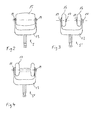
- FIGS. 2-4 show variants of the applicator according to the invention.
- the embodiment of the underlying type of pneumatically operated pressure wave device is well known, for which reference may be made to the cited prior art. It has a base station with a pneumatic supply, one outgoing supply line and at the end of the supply line to a mobile and hand-handleable handpiece, which is referred to here as the device.
- the pneumatic supply is connected via the line and a corresponding switching valve to an acceleration tube, which is shown in the figure left figure in the figure and numbered 1.
- the pneumatic connection is located at the right end of the same tube 1, not shown, and in the tube 1 is not shown and the cross-section of the tube filling projectile movable, which can impact the right end face of a proximal applicator 2 at the end of its movement.
- This proximal applicator part 2 has a largely conventional shape compared to the prior art and is supported with a radially enlarged flange and its distal shoulder side on an elastomeric tube piece 3, which is deformable in the collisions and a movement of the proximal applicator 2 in the range over a millimeter can allow. It is also responsible for the reset and decouples the blows from the device housing.
- On the distal side of this proximal applicator part 2 runs in a cylindrical pin, which passes through a guide sleeve 4 and projects slightly beyond the distal side.
- this pin would be the contact surface of the applicator to the patient and the guide sleeve 4 realized in a (or as) unscrewable cap. So you would have to remove the cap and thus make a partial dissection, before you can remove the applicator (in this case, the proximal applicator 2).
- the figure also shows that the left end face of the proximal applicator part 2 is in contact with the right end face of a distal applicator part 5.
- this distal applicator 5 is based on the Figures 2-4 discussed in more detail. It is guided in a receiving piece 6, specifically positive, z. B hexagonal, and thus secured against rotation with respect to this receiving piece 6.
- the receiving piece 6 in turn must be held in the rest of the housing according to fixed against rotation, for which corresponding in the figure to the right-facing end faces or outwardly facing lateral surfaces may be coated in friction-enhancing form or surface-structured.
- corresponding material pairings can be used, for example stainless steel on the applicator side and bronze, high-strength plastic (for example PEEK) or ceramic on the receiving side.
- the figure also shows that in the receiving piece 6 (in the figure above and below) openings are provided for positive-locking balls 7, which engage inwardly into corresponding outer-side grooves on the distal applicator 5.
- These grooves are longer in the figure to the right than necessary, so that the entire applicator 5 and 6 can move to the left on a push.
- the positive connection between the balls 7 and the associated grooves prevents the distal applicator part from falling out or shooting out of the housing. Rather, the distal applicator part can be pushed back into its drawn original position, for example, simply by pressing on the patient after an impact.
- a clamping sleeve 8 Radially outside the balls 7 can be seen a clamping sleeve 8, which has at its left end an inner inclined surface.
- the balls 7 can yield radially outwards and the distal applicator 5 can be pulled out of the housing to the left.
- the clamping sleeve 8 ensures a manual (to the right) pushing in an externally accessible housing part 9, wherein a coil spring 10 presses against or provides for the return movement and this sliding housing part 9 in a further part 11 of the housing slidably and by an O. Ring is inhibited.
- This part 11 surrounds and also holds the already mentioned receiving piece. 6
- the balls 7 are not subjected to force in the radial direction per se, but are displaced when the user pulls out the distal applicator part 5. Since they are only two (or in other cases, for example, three, four or six) balls, each for their own grooves are provided, they also contribute to the rotation; essential for the rotation but is the described polygonal form-fitting design of the parts 5a outside and 6 inside.
- the distal applicator 5 If the distal applicator 5 is to be changed, the user pushes the sliding housing part 9 to the right and thus the clamping sleeve 4 also, so that the balls 7 can pass radially outward. Incidentally, the openings in the receiving piece 6 for the balls 7 are radially too narrow inside, so that the balls can not fall out.
- the housing part 9 When re-inserting another corresponding distal applicator part, the housing part 9 must again be pushed to the right in order to be able to displace the balls to the outside. When the distal applicator part 5 is completely inserted, the housing part 9 can be released and locks the coupling.
- the Figures 2-4 show the configuration of the applicator or concrete of the distal applicator 5 in more detail.
- This rod leads to a fork-like widening 13, which in all three variants of Figures 2-4 is identical and at their in thrust direction (in the Figures 2-4 up and in FIG. 1 pointing to the left) pointing ends or forks receptacles for bearing pins.
- FIG. 2 is a continuous and the dash-dot rotation axis defining bearing pin provided, the larger flattened ends 14 can be seen;
- FIG. 4 In FIG. 3 there are two bearing pins with also flattened ends 14, one bearing pin per fork arm.
- On the bearing pins are rotatable applicator, namely a continuous convex-barrel-shaped rotatable applicator 15 in FIG. 2 , two wheel-like and convex outer surface rotatable applicator 16 in FIG. 3 and a dumbbell-type rotatable applicator part 17 in FIG FIG. 4 , the similar to the two Applikator too 16 FIG. 3 , but designed with a radially much smaller connection.
- the impacts are transmitted via the hexagonal pins and the forks 13 and the bearing pins to the rotatable applicator parts 15-17 and can be coupled by these into a patient's body.
- FIG. 1 On the right hand side of the drawn area of the device (in another embodiment according to the cited prior art) so held by hand that the rotatable applicator 15-17 rest on the body surface.
- the rotatable applicator 15-17 z.
- the rotation reduces the burden on the skin and facilitates the activity of the therapist.
- an oblique position of the handpiece to the body surface (eg, inclined to the respective axis of rotation, so that when rotating the rotatable applicator in front of the handpiece rolls), such as with rotation angle between 30% and 60%.
- a therapist can search in this form along the body surface for so-called trigger points and perform treatments with the combined effect of the described pressure waves, the actual shocks of the device and the massage effect.
- the front applicator according to the Figures 2-4 interchange with each other, z. B. with the examples of the FIGS. 3 and 4 to work along the spine so that the projecting portions of the rotatable applicator members 16 and 17 roll on both sides of the spine.
- the parts can be moved according to the Figures 2-4 be replaced with conventional or other shaped applicator parts.
- the fork and the hexagonal receiving pin made of metal, z.
- stainless steel or aluminum which also applies to the bearing pins.
- the rotatable applicator parts 15-17 may consist of the materials mentioned otherwise, for example also of plastic.
Landscapes
- Health & Medical Sciences (AREA)
- Epidemiology (AREA)
- Pain & Pain Management (AREA)
- Physical Education & Sports Medicine (AREA)
- Rehabilitation Therapy (AREA)
- Life Sciences & Earth Sciences (AREA)
- Animal Behavior & Ethology (AREA)
- General Health & Medical Sciences (AREA)
- Public Health (AREA)
- Veterinary Medicine (AREA)
- Percussion Or Vibration Massage (AREA)
- Surgical Instruments (AREA)
Abstract

Description
- Die vorliegende Erfindung bezieht sich auf ein Gerät zur Behandlung des menschlichen oder tierischen Körpers durch Ausüben von Stößen auf die Körperoberfläche. Im Folgenden wird zur Vereinfachung vom Körper eines Patienten gesprochen, der bevorzugt menschlich ist.
- Im Stand der Technik sind verschiedene Geräte des beschriebenen Grundtyps bekannt. Die
DE 197 25 477 C beschreibt bspw. ein solches Gerät, bei dem durch die Kollision eines pneumatisch beschleunigten Schlagteils oder Projektils mit einem zunächst ruhenden Prallkörper oder Applikator eine Druckwelle ausgelöst wird, die dadurch in den Körper des Patienten eingekoppelt werden kann, dass eine Applikatorfrontfläche zum Zeitpunkt der Kollision auf den Patientenkörper aufgelegt wird. Dieser Gerätetyp leitet sich in seiner Entstehungsgeschichte von Lithotripsiegeräten ab, bei denen solche Druckwellen z. B. über eine lange stabförmige Sonde an der Frontfläche des Applikators auf einen Nierenstein oder Ähnliches übertragen werden können, um diesen zu desintegrieren. - Der Schwerpunkt bei der Darstellung liegt in jedem Fall auf der durch die Kollision erzeugten Druckwelle, die mehr oder weniger einer eigentlichen Stoßwelle ähneln soll, wie sie klassische, in der Regel fokussierende Lithotripsiegeräte z. B. mit piezoelektrischen oder elektromagnetischen Aktuatoren und Fokussierung auf einen Stein erzeugen. Solche Druckwellen können Anstiegsflanken mit einer Breite im Bereich weniger µs und einer Amplitude im niedrigen zweistelligen MPa-Bereich haben (z. B. 2 µs und 15 MPa gemessen 1 cm vor der Frontfläche). In dem zitierten Dokument wird hingegen betont, dass die physikalisch an sich unvermeidliche makroskopische Schwerpunktbewegung des Applikators möglichst klein gehalten werden soll, weil sie als störend angesehen wird.
- Als zweites Beispiel wird auf die
DE 20 2004 011 323 U und, mit sehr ähnlichem Inhalt, dieUS 2011/0054367 A1 verwiesen. Dort wird ein hinsichtlich des technischen Aufbaus ähnliches Gerät beschrieben, bei dem allerdings u. a. die elastische Aufhängung des Applikators im Gehäuse auf größere Schwerpunktsbewegungen des Applikators ("Hübe") ausgelegt ist. Dort wird betont, dass die therapeutische Wirkung durchaus auch, oder vorwiegend in den eigentlichen makroskopischen Stößen (also infolge des Hubes) gesehen werden kann, was auch von der Indikation abhängt. - Die vorliegende Erfindung richtet sich allgemein auf Geräte dieses Bautyps, und zwar sowohl hinsichtlich der Anwendung von Druckwellen als auch hinsichtlich der Anwendung "makroskopischer Stöße" des Applikator auf die Körperoberfläche.
- Dabei liegt der Erfindung die Aufgabe zugrunde, ein solches Gerät hinsichtlich weitergehender Anwendungsmöglichkeiten auf der Patientenkörperoberfläche weiterzubilden.
- Die Aufgabe wird gelöst durch ein Gerät nach Anspruch 1. Erfindungsgemäß ist dabei ein drehbares Applikatorteil vorgesehen. Es gibt also ein Drehlager, also insbesondere ein Wellenlager mit einem Achsstift aber z. B. auch ein Kugellager (Kugel geführt in Pfanne) oder ein komplexeres Lager wie z. B. ein Kardanlager. Über dieses Lager ist das drehbare Applikatorteil relativ zu dem restlichen Gerät um zumindest eine Drehachse drehbar, wobei diese Drehachse nicht parallel, also gewinkelt, zu der Richtung der von dem Gerät auszuführenden Stöße liegt. Vorzugsweise liegt die Drehachse senkrecht zur Stoßrichtung.
- Damit kann das Applikatorteil beim Aufdrücken auf die zu behandelnde Körperoberfläche abrollen. Dementsprechend soll das drehbare Applikatorteil in solcher Weise zugänglich liegen, dass das Gerät in der entsprechenden Weise auf den Körper aufgesetzt werden kann. In anderen Worten soll das drehbare Applikatorteil exponiert liegen. Bevorzugt ist eine Anordnung an dem distalen Ende eines entsprechenden Handstücks, das am anderen (proximalen) Ende über eine Leitung von einem Basisgerät versorgt ist.
- Die Erfinder haben nämlich festgestellt, dass es praktisch sein kann, den Applikator z. B. in Bezug auf die Stoßrichtung schräg auf die Patientenkörperoberfläche aufzusetzen und dann auf der Körperoberfläche zu bewegen. Insbesondere können dabei Gewebepartien unter der Haut parallel massiert und/oder gewissermaßen vor dem Gerät hergeschoben werden, wobei sie gleichzeitig mit den Stößen und (in einem von Fall zu Fall unterschiedlichen Maß) Druckwellen beaufschlagt werden. Die konventionell bekannten Geräte mit feststehenden und mehr oder weniger flachen Frontflächen der Applikatoren sind dazu relativ schlecht geeignet, weil sie auf der Hautoberfläche nur bei mehr oder weniger senkrechter Stellung des Geräts relativ zur Körperoberfläche gehalten werden können und in dieser Haltung schlecht verschoben werden können.
- Im Unterschied dazu lässt sich das erfindungsgemäße Gerät über die Oberfläche rollen und damit leicht und schonend bewegen, auch wenn ein gewisser Anpressdruck ausgeübt wird.
- Der Mechanismus zum Erzeugen der Stöße des Applikators ist in diesem Zusammenhang in unterschiedlichster Ausführung denkbar, insbesondere auch durch eine direkte Beaufschlagung des Applikators mittels eines elektromagnetischen Mechanismus oder auch eines Druckfluidpulses. Bevorzugt ist aber die aus den zitierten Dokumenten bereits bekannte Verwendung eines beschleunigten Projektils zur Kollision mit dem Applikator, womit relativ heftige und (im Sinn der Applikatorgeschwindigkeit) schnelle Stöße realisiert werden können und auch die gleichzeitige oder sogar schwerpunktmäßige Verwendung von Druckwellen möglich ist. Das Projektil wiederum lässt sich ebenfalls in unterschiedlicher Weise beschleunigen, insbesondere auch elektromagnetisch, wobei auch hier eine pneumatische Beaufschlagung des Projektils gemäß den zitierten Schriften bevorzugt ist.
- Der Begriff "Applikator" bezeichnet hier übrigens auch abgesehen von der Drehbarkeit nicht zwingend ein einstückiges Teil. Es ist denkbar und anwendungsabhängig auch bevorzugt, dass das Projektil z. B. auf ein erstes Teil schlägt, das den Stoß und/oder die Druckwelle auf ein zweites Applikatorteil überträgt, das seinerseits mit der Haut des Patienten in Kontakt steht. Im Stand der Technik ist auch gelegentlich von einem Zwischenstück zwischen Applikator und Projektil die Rede; hier wird dann von einem mehrteiligen Applikator gesprochen, wobei die beiden Applikatorteile fest verbunden sein können, aber nicht sein müssen.
- Wie eingangs bereits erwähnt, kann ein relativ großer Hub des Applikators durchaus gewünscht sein, wobei im vorliegenden Zusammenhang das Gerät vorzugsweise so ausgelegt ist, dass Hübe über 1 mm erreichbar sind, wie schon in der
US 2011/0054367 A1 ausgeführt. - Das drehbare Applikatorteil ist vorzugsweise rotationssymmetrisch in Bezug auf die Drehachse als Symmetrieachse, um sich besonders gut abrollen zu lassen. Diese Rotationssymmetrie betrifft dabei die grobe Gestalt, also sozusagen eine Einhüllende, und steht oberflächlichen Strukturen, etwa Rillen zu Massagezwecken, nicht entgegen. Das drehbare Applikatorteil ist ferner vorzugsweise spiegelsymmetrisch, und zwar in Bezug auf eine Symmetrieebene senkrecht zur Drehachse. Das erleichtert im Regelfall die Anwendung und erlaubt bei geeigneter Positionierung des drehbaren Applikatorteils relativ zu dem restlichen Gerät oder Handstück auch eine entsprechende Benutzung "von zwei Seiten".
- Die drehbare Lagerung erfolgt vorzugsweise beidseits, insbesondere mit einem durchgehenden Lagerstift. Eine solche Konstruktion ist einfach und gleichzeitig stabil.
- Ferner sind abgerundete Kanten bevorzugt, und zwar soweit Berührungsmöglichkeiten mit der zu behandelnden Körperoberfläche bestehen, also außenseitig. Nicht betroffen sind also z. B. Kanten am Übergang zu einer zentrischen Bohrung für den Lagerstift.
- Eine bevorzugte Form ist eine Tonnenform, also eine im Wesentlichen zylindrische Form mit allerdings verdicktem Mittenbereich, also einem konvexen Außenprofil bezogen auf eine die Drehachse enthaltende Schnittebene. Hierzu wird auf das erste Ausführungsbeispiel verwiesen. Mit einer solchen Form lassen sich einerseits großflächige Behandlungen erreichen, kann aber andererseits im bezüglich der Drehachse mittleren Bereich ein etwas höherer Anpressdruck und damit eine konzentrierte Wirkung erzielt werden.
- Eine andere bevorzugt Form weist mindestens zwei in Bezug auf die Drehachse radial vorstehende Bereiche auf, die jeweils zum Kontakt mit der Körperoberfläche ausgelegt sind. Hierzu wird auf das zweite Ausführungsbeispiel verwiesen. Eine solche Form kann z. B. günstig sein, um beidseits neben einem nicht zu behandelnden oder zu schonenden Bereich entlang fahren zu können, bspw. rechts und links neben der Wirbelsäule eines Patienten.
- Vorbekannte Applikatoren bestanden im Regelfall aus rostfreiem Stahl. Im vorliegenden Fall kommen grundsätzlich auch Metalle, so auch rostfreier Stahl, in Betracht. Daneben sind als metallische Materialien Aluminium und Titan zu nennen, wobei beide eine relativ geringe Massendichte haben und damit relativ leichte Applikatoren ermöglichen. Das kann den Vorteil haben, bei gegebener Geometrie eine stärkere Beschleunigung und damit auch größere Hubauslenkung des Applikators zu ermöglichen, was im vorliegenden Fall gewünscht sein kann. Titan zeichnet sich zudem durch eine besonders hohe mechanische Belastbarkeit aus, eignet sich also besonders für Anwendungen mit vergleichsweise hohen Projektilgeschwindigkeiten und/oder Projektilmassen. Da Titan außerdem eine besonders gute physiologische Verträglichkeit auszeichnet, kann es als Applikatormaterial auch unabhängig von der Belastbarkeit von Vorteil sein.
- In Betracht kommen, insbesondere für das drehbare Applikatorteil, ferner Keramiken, vgl. Anmeldenummer 08 003 840.9 /
EP 2 095 843 , und Kunststoffe. Im Vergleich zu rostfreiem Stahl weisen auch diese den Vorteil geringer Massendichte auf. Sie haben ferner eine geringere Wärmeleitfähigkeit als Metalle, sodass der Patient den Applikator subjektiv als wärmer empfindet. Das gilt vor allem für Kunststoffe, wieder insbesondere für das drehbaren Teil. Kunststoffe kommen insbesondere auch dann in Betracht, wenn auf die Einkopplung einer Druckwelle geringerer Wert gelegt wird, weil, jedenfalls bei einer größeren Stärke des Kunststoffs, im Vergleich zu den vorgenannten Materialien etwas größere Wellenleitungsverluste zu erwarten sind. Gleiche Argumente gelten für Holz. - Nach einer weiteren Ausgestaltung ist der Applikator in einer lösbaren Kupplung gehalten, sodass zumindest ein distales Applikatorteil (mit dem drehbaren Applikatorteil) aus dem Gerät nach vorn herausgezogen werden kann. Zur Klarstellung: Die Begriffe "proximal" und "distal" werden hier aus der Perspektive eines Benutzers des Geräts gebraucht; in anderen Worten bedeutet "distal" eine dem Patienten zugewandte Position und "proximal" eine dazu entgegengesetzte. Im gleichen Sinn wird als "vorn" die distale Richtung bezeichnet, also auf den Patienten zu.
- Die Erfinder haben festgestellt, dass die Optimierung der Applikatoreigenschaften im Hinblick auf bestimmte Behandlungen, bspw. der Wechsel zwischen einem erfindungsgemäßen Applikator und einem konventionellen oder zwischen verschiedenen Applikatoren mit drehbaren Applikatorteilen, vorteilhafterweise mit im Übrigen unverändertem Gerät von Fall zu Fall vorgenommen werden kann.
- Ein Applikator in diesem Sinn kann mehrteilig aufgebaut sein, wobei die Entnehmbarkeit primär einen distalen Teil betrifft. Dieser distale Teil des Applikators kann dann gegen andere entsprechende distale Applikatorteile getauscht werden, zum Beispiel weil das Applikatorteil nur eine begrenzte Lebensdauer hat, weil es gereinigt oder sterilisiert werden soll oder weil ein anderer Typ dieses distalen Applikatorteils (oder des gesamten Applikators) verwendet werden soll. Insbesondere ist es möglich, in ihrem distalen Teil unterschiedlich geformte drehbare Applikatorteile, möglicherweise auch aus verschiedenen Materialien, einzusetzen.
- Der Austausch erfolgt dabei sehr einfach und schnell, vorzugsweise völlig werkzeuglos und ebenfalls vorzugsweise ohne Abbauen eines weiteren Geräteteils, etwa eine Aufschraubkappe bei konventionellen Geräten dieses Typs. Bei diesen konventionellen Geräten war der Applikator in der Regel einteilig und innerhalb des Gerätegehäuses etwas dicker (senkrecht zur Stoßrichtung) als eine vordere Öffnung. Ein Ausbau war daher möglich, aber nur nach Teilzerlegung des Gehäuses, nämlich Abschrauben einer Schraubkappe und nicht durch Lösen einer für den Applikatorwechsel vorgesehenen Kupplung.
- Eine bevorzugte Ausführungsform sieht eine Verdrehsicherung des Applikators in dem Gerät vor (nicht zwingend in der Kupplung). Dementsprechend kann zum Beispiel die Kupplung selbst eine Verdrehsicherheit herstellen oder durch Einschieben eines entsprechend gestalteten Bereichs des Applikators in eine entsprechende Aufnahme eine Verdrehsicherheit hergestellt werden, besonders bevorzugterweise durch einen Mehrkantstift auf der Applikatorseite und eine dazu passende Aufnahme auf der Geräteseite, etwa durch einen hexagonalen Formschluss. Dies beinhaltet Varianten, bei denen die Verdrehsicherung erst durch einen axial gerichteten Druck entsteht und ohne diesen Andruck eine Drehbarkeit gegeben ist. Die Verdrehsicherung betrifft dabei bevorzugt zumindest auch eine von der (die Bewegung in Stoßrichtung betreffende) Kupplung selbst unabhängige Aufnahme, um die Möglichkeiten zur Kraftaufnahme zu verbessern. Zur Veranschaulichung wird auf das Ausführungsbeispiel verwiesen.
- Die Kupplung kann vorzugsweise ebenfalls mit einem Formschluss arbeiten, der nicht zwingend mit dem Formschluss für die Verdrehsicherung übereinstimmen muss. Insbesondere kann eine Klemmhülse vorgesehen sein, die (vorzugsweise in Stoßrichtung) verschiebbar ist und dabei zumindest ein Formschlusselement in eine entsprechende Aufnahme an dem Applikator hereindrückt bzw. beim Lösen freigibt. Insbesondere kann ein Gehäuseteil des Geräts gegen eine Federkraft verschiebbar sein und dabei die Klemmhülse aufweisen oder mitverschieben. Als Formschlusselement kommt eine Kugel in Betracht, wobei vorzugsweise mindestens zwei Kugeln vorgesehen sind. Die Kugeln oder andere Formschlusselemente können durch eine schräge Fläche an einer Innenseite der Klemmhülse beaufschlagt werden.
- Im Folgenden wird die Erfindung anhand eines Ausführungsbeispiels beschrieben, wobei die Offenbarung im Ausführungsbeispiel und auch im vorstehenden Text nicht auf die jeweils dargestellten Merkmalskombinationen beschränkt sein soll, sondern einzelne Merkmale auch in anderem Zusammenhang oder für sich wichtig sein können.
-
Figur 1 zeigt einen Längsschnitt durch einen vorderen Gehäuseteil eines erfindungsgemäßen Geräts mit einer Applikatorkupplung. - Die
Figuren 2-4 zeigen erfindungsgemäße Varianten des Applikators. - Der dem Ausführungsbeispiel zugrunde liegende Typ eines pneumatisch betriebenen Druckwellengeräts ist hinlänglich bekannt, wozu auf den eingangs zitierten Stand der Technik verwiesen werden kann. Er weist eine Basisstation mit einer Pneumatikversorgung, eine davon ausgehende Versorgungsleitung und am Ende der Versorgungsleitung ein mobiles und mit der Hand handhabbares Handstück auf, das hier als das Gerät bezeichnet wird. Die Pneumatikversorgung ist über die Leitung und ein entsprechendes Schaltventil an ein Beschleunigungsrohr angeschlossen, dessen in der Darstellung der Figur linkes Ende in der Figur eingezeichnet und mit 1 beziffert ist. Der Pneumatikanschluss findet sich am nicht dargestellten rechten Ende desselben Rohres 1 und in dem Rohr 1 ist ein nicht dargestelltes und den Querschnitt des Rohres ausfüllendes Projektil bewegbar, das am Ende seiner Bewegungsstrecke auf die rechte Stirnfläche eines proximalen Applikatorteils 2 aufprallen kann.
- Dieses proximale Applikatorteil 2 hat eine im Vergleich zum Stand der Technik weitgehend konventionelle Form und stützt sich mit einem radial vergrößerten Flansch und dessen distaler Schulterseite an einem Elastomerschlauchstück 3 ab, das bei den Kollisionen verformbar ist und eine Bewegung des proximalen Applikatorteils 2 im Bereich über einem Millimeter zulassen kann. Es ist ferner für die Rückstellung verantwortlich und entkoppelt die Schläge vom Gerätegehäuse. An der distalen Seite läuft dieses proximale Applikatorteil 2 in einem zylindrischen Stift aus, der eine Führungsmanschette 4 durchsetzt und zur distalen Seite etwas darüber hinausragt. Bei konventionellen Geräten wäre die distale Stirnfläche dieses Stifts die Kontaktfläche des Applikators zum Patienten und die Führungsmanschette 4 in einer (oder als) abschraubbaren Kappe realisiert. Man müsste also die Kappe abnehmen und damit eine Teilzerlegung vornehmen, bevor man den Applikator (in diesem Fall das proximale Applikatorteil 2) entnehmen kann.
- Die Figur zeigt ferner, dass sich die linke Stirnfläche des proximalen Applikatorteils 2 in Kontakt mit der rechten Stirnfläche eines distalen Applikatorteils 5 befindet. Auf dieses distale Applikatorteil 5 wird anhand der
Figuren 2-4 näher eingegangen. Es ist in einem Aufnahmestück 6 geführt, und zwar formschlüssig, z. B hexagonal, und damit gegenüber diesem Aufnahmestück 6 gegen Verdrehung gesichert. Das Aufnahmestück 6 seinerseits muss entsprechend fest verdrehgesichert im übrigen Gehäuse gehalten sein, wozu entsprechende in der Figur nach rechts weisende Stirnflächen oder nach außen weisende Mantelflächen in reibungssteigernder Form beschichtet oder oberflächenstrukturiert sein können. Das kann auch so geschehen, dass ohne axialen Andruck noch eine Verdrehbarkeit gewährleistet ist, etwa um den Applikator nach Wunsch auszurichten, und nach Auflegen und Andrücken auf den Patientenkörper, also mit axialem Andruck, ein ausreichender Reibungsschluss zur Verdrehsicherung hergestellt wird. Um ein Fressen zwischen dem distalen Applikatorteil 5 und dem Aufnahmestück 6 zu verhindern, können entsprechende Materialpaarungen verwendet werden, zum Beispiel applikatorseitig rostfreier Edelstahl und aufnahmeseitig Bronze, hochfester Kunststoff (zum Beispiel PEEK) oder Keramik. - Die Figur zeigt ferner, dass in dem Aufnahmestück 6 (in der Figur oben und unten) Öffnungen für Formschlusskugeln 7 vorgesehen sind, die nach innen in entsprechende außenseitige Nuten an dem distalen Applikatorteil 5 eingreifen. Diese Nuten sind in der Figur nach rechts länger als nötig, sodass sich der gesamte Applikator 5 und 6 bei einem Stoß nach links bewegen kann. Andererseits verhindert der Formschluss zwischen den Kugeln 7 und den dazugehörenden Nuten ein Herausfallen oder -schießen des distalen Applikatorteils aus dem Gehäuse. Das distale Applikatorteil kann vielmehr zum Beispiel einfach durch Aufdrücken auf dem Patienten nach einem Stoß wieder in seine gezeichnete Ursprungslage zurückgeschoben werden.
- Radial außerhalb der Kugeln 7 erkennt man eine Klemmhülse 8, die ersichtlich an ihrem linken Ende eine innere Schrägfläche aufweist. Wenn diese Klemmhülse 8 aus der gezeichneten Position heraus nach rechts verschoben wird, können die Kugeln 7 radial nach außen weichen und kann das distale Applikatorteil 5 insgesamt einfach nach links aus dem Gehäuse herausgezogen werden. Für dieses Verschieben der Klemmhülse 8 sorgt ein händisches (nach rechts) Hineindrücken eines von außen zugänglichen Gehäuseteils 9, wobei eine Schraubenfeder 10 dagegen drückt bzw. für die Rückführbewegung sorgt und dieses verschiebbare Gehäuseteil 9 in einem weiteren Teil 11 des Gehäuses verschiebbar und durch einen O-Ring gehemmt geführt ist. Dieses Teil 11 umgreift und hält auch das bereits erwähnte Aufnahmestück 6.
- Die Kugeln 7 sind übrigens in radialer Richtung nicht kraftbeaufschlagt an sich, sondern werden verdrängt, wenn der Benutzer das distale Applikatorteil 5 herauszieht. Da es sich nur um zwei (oder in anderen Fällen um zum Beispiel drei, vier oder sechs) Kugeln handelt, für die jeweils eigene Nuten vorgesehen sind, tragen sie auch zur Verdrehsicherung bei; wesentlich für die Verdrehsicherung ist aber die beschriebene Mehrkant-Formschluss-Ausführung der Teile 5a außen und 6 innen.
- In der Figur links von dem verschiebbaren und zur Betätigung der Kupplung dienenden Gehäuseteil 9 findet sich noch eine Sicherungsmutter 12, die auf dem Aufnahmeteil 6 aufgeschraubt und gegenüber diesem über einen O-Ring und gegenüber dem Teil 5 über einen Elastomerflachring abgedichtet ist. Dabei ist die Anlage zwischen dem Elastomerflachring (an dessen Innenrand) und dem hier hexagonalen ersten Stück des distalen Applikatorteils 5 gleitfähig.
- Insgesamt erkennt man, dass ein Projektilstoß den gesamten Applikator nach links versetzt und dabei eine entsprechende Stoßbewegung des nicht gezeichneten distalsten Endes des Applikators (ganz links) gegen den Patientenkörper zur Folge hat, wobei die Einkopplung einer eigentlichen Druckwelle parallel auftreten wird, aber in vielen Fällen gar nicht wesentlich ist. Die Druckwelle wird dabei übrigens in dem proximalen Applikatorteil 2 erzeugt und über dieses und das distale Applikatorteil 5 in den Körper übertragen. Nach dem Stoß kehrt das proximale Applikatorteil 2 infolge der Kraftbeaufschlagung durch das Elastomerschlauchstück 3 selbsttätig nach rechts zurück; für das distale Applikatorteil 5 folgt dies aus der Druckauflage auf den Patientenkörper.
- Wenn das distale Applikatorteil 5 gewechselt werden soll, schiebt der Benutzer das verschiebbare Gehäuseteil 9 nach rechts und damit die Klemmhülse 4 ebenfalls, sodass die Kugeln 7 radial nach außen gelangen können. Dabei sind übrigens die Öffnungen in dem Aufnahmestück 6 für die Kugeln 7 radial innen zu eng, sodass die Kugeln nicht herausfallen können. Beim Wiedereinsetzen eines anderen entsprechenden distalen Applikatorteils muss wieder das Gehäuseteil 9 nach rechts geschoben werden, um die Kugeln nach außen verdrängen zu können. Wenn das distale Applikatorteil 5 vollständig eingesetzt ist, kann man das Gehäuseteil 9 loslassen und verriegelt die Kupplung.
- Die
Figuren 2-4 zeigen die Ausgestaltung des Applikators bzw. konkret des distalen Applikatorteils 5 in weiteren Einzelheiten. Zunächst erkennt man in allen Figuren nach unten weisend den jeweiligen, hier hexagonalen Stab zur Aufnahme in dem Aufnahmestück 6 mit den außenseitigen Nuten für die Formschlusskugeln 7. Dieser Stab führt zu einer gabelartigen Verbreiterung 13, die in allen drei Varianten derFiguren 2-4 identisch ist und an ihren in Stoßrichtung (in denFiguren 2-4 nach oben und inFigur 1 nach links) weisenden Enden bzw. Gabelzinken Aufnahmen für Lagerstifte trägt. - Bei der Variante aus
Figur 2 ist ein durchgängiger und die strichpunktierte Drehachse definierender Lagerstift vorgesehen, dessen größere abgeflachte Enden 14 erkennbar sind; das Gleiche gilt fürFigur 4 . InFigur 3 sind es zwei Lagerstifte mit ebenfalls abgeflachten Enden 14, und zwar jeweils ein Lagerstift pro Gabelarm. An den Lagerstiften gehalten sind drehbare Applikatorteile, und zwar ein durchgehendes konvex-tonnenförmiges drehbares Applikatorteil 15 inFigur 2 , zwei jeweils radartig und mit konvexer Außenfläche versehene drehbare Applikatorteile 16 inFigur 3 und ein hantelartiges drehbares Applikatorteil 17 inFigur 4 , das ähnlich den beiden Applikatorteilen 16 ausFigur 3 , aber mit einer radial viel kleineren Verbindung ausgestaltet ist. - Nach dem Einsetzen in die Aufnahmekupplung aus
Figur 1 übertragen sich die Stöße infolge der beschriebenen Kollisionen über die hexagonalen Stifte und die Gabeln 13 sowie die Lagerstifte auf die drehbaren Applikatorteile 15-17 und können von diesen in einen Patientenkörper eingekoppelt werden. Dazu wird das sich inFigur 1 rechts an den gezeichneten Bereich anschließende Handstück des Geräts (in einer weiteren Ausgestaltung gemäß dem eingangs zitierten Stand der Technik) so mit der Hand gehalten, dass die drehbaren Applikatorteile 15-17 auf der Körperoberfläche aufliegen. Dazu können die drehbaren Applikatorteile 15-17, z. B. zur Behandlung von Faszien, entlang der Haut geschoben werden und die darunterliegenden Faszien quasi vor sich herschieben, wobei die Drehbarkeit die Belastung für die Haut reduziert und die Tätigkeit des Therapeuten erleichtert. Dabei ist auch (aber nicht zwingend) eine schräge Haltung des Handstücks zur Körperoberfläche möglich (z. B. um die jeweilige Drehachse geneigt, sodass beim Schieben das drehbare Applikatorteil vor dem Handstück rollt), etwa mit Drehwinkel zwischen 30 % und 60 %. Ein Therapeut kann in dieser Form entlang der Körperoberfläche nach sogenannten Triggerpunkten suchen und Behandlungen mit der kombinierten Wirkung der beschriebenen Druckwellen, der eigentlichen Stöße des Geräts und der Massagewirkung ausführen. - Für verschiedene Anwirkungen lassen sich die vorderen Applikatorteile gemäß den
Figuren 2-4 untereinander vertauschen, z. B. um mit den Beispielen aus denFiguren 3 und 4 entlang der Wirbelsäule so zu arbeiten, dass die vorstehenden Bereiche der drehbaren Applikatorteile 16 und 17 beidseits der Wirbelsäule abrollen. Mit Hilfe der verschiedenen Aufnahmekupplungen können die Teile gemäß denFiguren 2-4 auch gegen konventionelle oder anders geformte Applikatorteile ausgetauscht werden. - Bei den Ausführungsbeispielen bestehen die Gabel und der hexagonale Aufnahmestift aus Metall, z. B. rostfreiem Stahl oder Aluminium, was auch für die Lagerstifte gilt. Die drehbaren Applikatorteile 15-17 können aus den im Übrigen erwähnten Materialien, bspw. auch aus Kunststoff, bestehen.
Claims (15)
- Gerät zur Behandlung des menschlichen oder tierischen Körpers mit- einem Applikator (2, 5, 5', 5") zum Auflegen auf den Körper von außen,- einem Gehäuse (9, 11, 12), in dem der Applikator (2, 5, 5', 5") gehalten ist, und- einem Mechanismus zum Erzeugen von Stößen des Applikators (2, 5, 5', 5") relativ zu dem Gehäuse (9, 11, 12) in einer Stoßrichtung, sodass die Stöße bei dem Auflegen in den Körper eingekoppelt werden können,
dadurch gekennzeichnet, dass der Applikator (2, 5, 5', 5") ein Drehlager (14) aufweist, welches ein auf dem zu behandelnden Körper anzuordnendes Applikatorteil (15, 16, 17) drehbar hält,
wobei eine Drehung des drehbaren Applikatorteils um eine zu der Stoßrichtung gewinkelte Drehachse möglich ist. - Gerät nach Anspruch 1, bei dem die Drehachse senkrecht zu der Stoßrichtung liegt.
- Gerät nach Anspruch 1 oder 2, bei dem das drehbare Applikatorteil (15, 16, 17) in Bezug auf die Drehachse rotationssymmetrisch ist.
- Gerät nach einem der vorstehenden Ansprüche, bei dem das drehbare Applikatorteil (15, 16, 17) in Bezug auf eine zu der Drehachse senkrechte Ebene spiegelsymmetrisch ist.
- Gerät nach einem der vorstehenden Ansprüche, bei dem das drehbare Applikatorteil (15, 17) an zwei entgegengesetzten Seiten drehbar gehalten ist, insbesondere von einer die Drehachse definierenden Achsstange durchsetzt ist.
- Gerät nach einem der vorstehenden Ansprüche, bei dem das drehbare Applikatorteil (15, 16, 17) außenseitig abgerundete Kanten mit einem Krümmungsradius von mindestens 1 mm aufweist.
- Gerät nach Anspruch 3, auch in Verbindung mit einem der Ansprüche 4-6, bei dem das drehbare Applikatorteil (15) eine zylindrische Tonnenform mit einem konvexen Außenprofil in einer die Drehachse enthaltenden Schnittebene aufweist.
- Gerät nach einem der Ansprüche 1-6, bei dem das drehbare Applikatorteil (17) mindestens zwei in Bezug auf die Drehachse radial vorstehende und zum Kontakt mit dem zu behandelnden Körper ausgelegte Bereiche aufweist.
- Gerät einem der vorstehenden Ansprüche, bei dem der Mechanismus zum Erzeugen der Stöße ein Projektil und eine Einrichtung zum Beschleunigen des Projektils in solcher Weise aufweist, dass das Projektil auf den Applikator (2, 5, 5', 5") schlägt und dadurch den Stoß erzeugt, vorzugsweise eine pneumatische Einrichtung zur Beschleunigung des Projektils.
- Gerät nach einem der vorstehenden Ansprüche, bei dem der Applikator (2, 5, 5', 5") in seinem zum Auflegen ausgelegten drehbaren Teil (15, 16, 17) besteht aus Metall, insbesondere Aluminium oder Titan, Kunststoff, Keramik oder Holz.
- Gerät nach einem der vorstehenden Ansprüche, das ausgelegt ist für einen Hub des Stoßes in der Stoßrichtung relativ zu dem Gehäuse (9, 11, 12) von mindestens 1 mm.
- Gerät nach einem der vorstehenden Ansprüche, bei dem der Applikator (2, 5, 5', 5") in dem Gehäuse (9, 11, 12) in einer Kupplung (7, 8, 9, 10) gehalten ist, wobei zumindest ein distales Applikatorteil (5) mit dem drehbaren Applikatorteil (15, 16, 17) nach Lösen der Kupplung (7, 8, 9, 10) in distaler Richtung aus dem Gehäuse (9, 11, 12) herausziehbar ist.
- Gerät nach einem der vorstehenden Ansprüche, bei dem der Applikator (2, 5, 5', 5") in dem Gerät durch einen Formschluss verdrehsicher gehalten werden kann, und zwar bezüglich Rotationen um eine zur Stoßrichtung parallele.
- Gerät nach einem der vorstehenden Ansprüche, bei dem der Applikator (2, 5, 5', 5") zumindest zweiteilig ist, wobei ein distales Applikatorteil (5, 5', 5") nach Lösen der Kupplung (7, 8, 9, 10) herausziehbar ist und ein proximales Applikatorteil (2) in dem Gehäuse verbleibt und wobei das proximale Applikatorteil (2) den Stoß auf das distale Applikatorteil (5, 5', 5") überträgt.
- Applikator für ein Gerät nach einem der vorstehenden Ansprüche, welcher ein Drehlager (14) aufweist, welches ein auf dem zu behandelnden Körper anzuordnendes Applikatorteil (15, 16, 17) drehbar hält, wobei eine Drehung des drehbaren Applikatorteils um eine zu der Stoßrichtung gewinkelte Drehachse möglich ist.
Priority Applications (1)
| Application Number | Priority Date | Filing Date | Title |
|---|---|---|---|
| EP15178506.0A EP3124004B1 (de) | 2015-07-27 | 2015-07-27 | Gerät zur behandlung des menschlichen oder tierischen körpers mit mechanischen stössen |
Applications Claiming Priority (1)
| Application Number | Priority Date | Filing Date | Title |
|---|---|---|---|
| EP15178506.0A EP3124004B1 (de) | 2015-07-27 | 2015-07-27 | Gerät zur behandlung des menschlichen oder tierischen körpers mit mechanischen stössen |
Publications (2)
| Publication Number | Publication Date |
|---|---|
| EP3124004A1 true EP3124004A1 (de) | 2017-02-01 |
| EP3124004B1 EP3124004B1 (de) | 2020-03-18 |
Family
ID=53762014
Family Applications (1)
| Application Number | Title | Priority Date | Filing Date |
|---|---|---|---|
| EP15178506.0A Active EP3124004B1 (de) | 2015-07-27 | 2015-07-27 | Gerät zur behandlung des menschlichen oder tierischen körpers mit mechanischen stössen |
Country Status (1)
| Country | Link |
|---|---|
| EP (1) | EP3124004B1 (de) |
Cited By (3)
| Publication number | Priority date | Publication date | Assignee | Title |
|---|---|---|---|---|
| CN110740698A (zh) * | 2017-04-12 | 2020-01-31 | 施托尔茨医疗股份公司 | 冲击波设备 |
| US11484724B2 (en) | 2015-09-30 | 2022-11-01 | Btl Medical Solutions A.S. | Methods and devices for tissue treatment using mechanical stimulation and electromagnetic field |
| US12220380B2 (en) | 2015-09-30 | 2025-02-11 | Btl Medical Solutions A.S. | Methods and devices for tissue treatment using mechanical stimulation and electromagnetic field |
Citations (10)
| Publication number | Priority date | Publication date | Assignee | Title |
|---|---|---|---|---|
| DE589285C (de) * | 1930-03-22 | 1934-03-24 | Max Schneidinger | Vibrations- und Rollmassageapparat |
| DE29512015U1 (de) * | 1995-07-25 | 1995-09-14 | Dr. Frenkel GmbH Geräte mit natürlicher Wirkweise, 72514 Inzigkofen | Massageroller als Zusatzteil für ein Handmassagegerät |
| DE19725477C2 (de) | 1997-06-17 | 1999-10-21 | Ferton Holding | Medizinisches Instrument zur Behandlung von biologischem Gewebe |
| US20020107459A1 (en) * | 2001-02-05 | 2002-08-08 | Chang Horng Jiun | Massage device having eccentric vibrating mechanism |
| US20020177795A1 (en) * | 2001-05-25 | 2002-11-28 | Frye Bruce A. | Pneumatic spinal and extremity manipulator |
| US20030009116A1 (en) * | 2001-07-03 | 2003-01-09 | Luettgen Harold A. | Vibrating personal massager |
| DE202004011323U1 (de) | 2004-07-09 | 2005-09-22 | Storz Medical Ag | Instrument zum Applizieren von Vibrationen auf dem menschlichen Körper |
| EP2095843A1 (de) | 2008-02-29 | 2009-09-02 | Storz Medical Ag | Vorrichtung zur Behandlung biologischer Körpersubstanzen mit mechanischen Druckwellen |
| US20110054367A1 (en) | 2004-07-09 | 2011-03-03 | Manfred Schulz | Instrument For Applying Vibrations To The Human Body |
| WO2013107898A1 (fr) * | 2012-01-20 | 2013-07-25 | M.D. Concept | Appareil pour le traitement extracorporel par ondes de choc |
Family Cites Families (2)
| Publication number | Priority date | Publication date | Assignee | Title |
|---|---|---|---|---|
| ES2394197T3 (es) * | 2008-10-31 | 2013-01-23 | Ferton Holding Sa | Instrumento para generar ondas de presión a modo de ondas de choque para el tratamiento de tejido biológico |
| DE202010007860U1 (de) * | 2010-06-11 | 2011-09-27 | Storz Medical Ag | Druckwellengerät mit pneumatischem Antrieb |
-
2015
- 2015-07-27 EP EP15178506.0A patent/EP3124004B1/de active Active
Patent Citations (10)
| Publication number | Priority date | Publication date | Assignee | Title |
|---|---|---|---|---|
| DE589285C (de) * | 1930-03-22 | 1934-03-24 | Max Schneidinger | Vibrations- und Rollmassageapparat |
| DE29512015U1 (de) * | 1995-07-25 | 1995-09-14 | Dr. Frenkel GmbH Geräte mit natürlicher Wirkweise, 72514 Inzigkofen | Massageroller als Zusatzteil für ein Handmassagegerät |
| DE19725477C2 (de) | 1997-06-17 | 1999-10-21 | Ferton Holding | Medizinisches Instrument zur Behandlung von biologischem Gewebe |
| US20020107459A1 (en) * | 2001-02-05 | 2002-08-08 | Chang Horng Jiun | Massage device having eccentric vibrating mechanism |
| US20020177795A1 (en) * | 2001-05-25 | 2002-11-28 | Frye Bruce A. | Pneumatic spinal and extremity manipulator |
| US20030009116A1 (en) * | 2001-07-03 | 2003-01-09 | Luettgen Harold A. | Vibrating personal massager |
| DE202004011323U1 (de) | 2004-07-09 | 2005-09-22 | Storz Medical Ag | Instrument zum Applizieren von Vibrationen auf dem menschlichen Körper |
| US20110054367A1 (en) | 2004-07-09 | 2011-03-03 | Manfred Schulz | Instrument For Applying Vibrations To The Human Body |
| EP2095843A1 (de) | 2008-02-29 | 2009-09-02 | Storz Medical Ag | Vorrichtung zur Behandlung biologischer Körpersubstanzen mit mechanischen Druckwellen |
| WO2013107898A1 (fr) * | 2012-01-20 | 2013-07-25 | M.D. Concept | Appareil pour le traitement extracorporel par ondes de choc |
Cited By (4)
| Publication number | Priority date | Publication date | Assignee | Title |
|---|---|---|---|---|
| US11484724B2 (en) | 2015-09-30 | 2022-11-01 | Btl Medical Solutions A.S. | Methods and devices for tissue treatment using mechanical stimulation and electromagnetic field |
| US12220380B2 (en) | 2015-09-30 | 2025-02-11 | Btl Medical Solutions A.S. | Methods and devices for tissue treatment using mechanical stimulation and electromagnetic field |
| CN110740698A (zh) * | 2017-04-12 | 2020-01-31 | 施托尔茨医疗股份公司 | 冲击波设备 |
| JP2020512926A (ja) * | 2017-04-12 | 2020-04-30 | ストルツ メディカル アクチエンゲゼルシャフトStorz Medical Ag | 衝撃波装置 |
Also Published As
| Publication number | Publication date |
|---|---|
| EP3124004B1 (de) | 2020-03-18 |
Similar Documents
| Publication | Publication Date | Title |
|---|---|---|
| DE202015005257U1 (de) | Gerät zur Behandlung des menschlichen oder tierischen Körpers mit mechanischen Stößen | |
| EP3388003B1 (de) | Druckwellengerät | |
| EP2756825B1 (de) | Ausschlagwerkzeug für minimalinvasive Prothesenrevision | |
| EP2497432B1 (de) | Medizinisches Einstechwerkzeug | |
| EP2996585B1 (de) | Chirurgisches instrument | |
| EP2846951B1 (de) | Schnellspann-kupplung | |
| EP3000420B1 (de) | Gerät zur behandlung des menschlichen oder tierischen körpers mit mechanischen stössen | |
| DE202004015990U1 (de) | Chirurgisches Stanzinstrument | |
| DE102012106336A1 (de) | Knochenschraube und Knochenfixierungssystem | |
| AT518780B1 (de) | Handgerät zum Tätowieren | |
| WO2007031132A1 (de) | Schraubendreher für knochenschrauben | |
| EP3124004B1 (de) | Gerät zur behandlung des menschlichen oder tierischen körpers mit mechanischen stössen | |
| EP2086429B1 (de) | Medizinisches handgerät | |
| EP0928602A2 (de) | Scherwerkzeug für Implantate | |
| EP1488749A1 (de) | Medizinisches Instrument | |
| EP3000418B1 (de) | Gerät zur Behandlung des menschlichen oder tierischen Körpers mit mechanischen Stößen | |
| EP1099900B1 (de) | Gelenkstativ | |
| DE4115937A1 (de) | Chirurgisches schneideinstrument | |
| DE102014113634A1 (de) | Modulares chirurgisches Instrument der Ein-Wege-Bauart | |
| EP3250133B1 (de) | Schaftinstrument für chirurgische zwecke | |
| EP1954203B1 (de) | Chirurgisches führungsinstrument | |
| EP3494912A1 (de) | Vorrichtung zum lösen von, insbesondere kaltverschweissten, schrauben in der orthopädie sowie werkzeugeinsatz | |
| DE202014007692U1 (de) | Gerät zur Behandlung des menschlichen oder tierischen Körpers mit mechanischen Stößen | |
| DE19949385C2 (de) | Vorrichtung zum Knochenverdichten für zahnärztlichimplantologische Zwecke | |
| DE202017001951U1 (de) | Druckwellengerät |
Legal Events
| Date | Code | Title | Description |
|---|---|---|---|
| PUAI | Public reference made under article 153(3) epc to a published international application that has entered the european phase |
Free format text: ORIGINAL CODE: 0009012 |
|
| STAA | Information on the status of an ep patent application or granted ep patent |
Free format text: STATUS: REQUEST FOR EXAMINATION WAS MADE |
|
| 17P | Request for examination filed |
Effective date: 20160415 |
|
| AK | Designated contracting states |
Kind code of ref document: A1 Designated state(s): AL AT BE BG CH CY CZ DE DK EE ES FI FR GB GR HR HU IE IS IT LI LT LU LV MC MK MT NL NO PL PT RO RS SE SI SK SM TR |
|
| AX | Request for extension of the european patent |
Extension state: BA ME |
|
| RBV | Designated contracting states (corrected) |
Designated state(s): AL AT BE BG CH CY CZ DE DK EE ES FI FR GB GR HR HU IE IS IT LI LT LU LV MC MK MT NL NO PL PT RO RS SE SI SK SM TR |
|
| STAA | Information on the status of an ep patent application or granted ep patent |
Free format text: STATUS: EXAMINATION IS IN PROGRESS |
|
| 17Q | First examination report despatched |
Effective date: 20171129 |
|
| GRAP | Despatch of communication of intention to grant a patent |
Free format text: ORIGINAL CODE: EPIDOSNIGR1 |
|
| STAA | Information on the status of an ep patent application or granted ep patent |
Free format text: STATUS: GRANT OF PATENT IS INTENDED |
|
| INTG | Intention to grant announced |
Effective date: 20191024 |
|
| GRAS | Grant fee paid |
Free format text: ORIGINAL CODE: EPIDOSNIGR3 |
|
| GRAA | (expected) grant |
Free format text: ORIGINAL CODE: 0009210 |
|
| STAA | Information on the status of an ep patent application or granted ep patent |
Free format text: STATUS: THE PATENT HAS BEEN GRANTED |
|
| AK | Designated contracting states |
Kind code of ref document: B1 Designated state(s): AL AT BE BG CH CY CZ DE DK EE ES FI FR GB GR HR HU IE IS IT LI LT LU LV MC MK MT NL NO PL PT RO RS SE SI SK SM TR |
|
| REG | Reference to a national code |
Ref country code: GB Ref legal event code: FG4D Free format text: NOT ENGLISH |
|
| REG | Reference to a national code |
Ref country code: DE Ref legal event code: R096 Ref document number: 502015012023 Country of ref document: DE |
|
| REG | Reference to a national code |
Ref country code: AT Ref legal event code: REF Ref document number: 1245075 Country of ref document: AT Kind code of ref document: T Effective date: 20200415 Ref country code: IE Ref legal event code: FG4D Free format text: LANGUAGE OF EP DOCUMENT: GERMAN |
|
| REG | Reference to a national code |
Ref country code: CH Ref legal event code: NV Representative=s name: TR-IP CONSULTING LLC, CH |
|
| PG25 | Lapsed in a contracting state [announced via postgrant information from national office to epo] |
Ref country code: NO Free format text: LAPSE BECAUSE OF FAILURE TO SUBMIT A TRANSLATION OF THE DESCRIPTION OR TO PAY THE FEE WITHIN THE PRESCRIBED TIME-LIMIT Effective date: 20200618 Ref country code: FI Free format text: LAPSE BECAUSE OF FAILURE TO SUBMIT A TRANSLATION OF THE DESCRIPTION OR TO PAY THE FEE WITHIN THE PRESCRIBED TIME-LIMIT Effective date: 20200318 Ref country code: RS Free format text: LAPSE BECAUSE OF FAILURE TO SUBMIT A TRANSLATION OF THE DESCRIPTION OR TO PAY THE FEE WITHIN THE PRESCRIBED TIME-LIMIT Effective date: 20200318 |
|
| REG | Reference to a national code |
Ref country code: NL Ref legal event code: MP Effective date: 20200318 |
|
| PG25 | Lapsed in a contracting state [announced via postgrant information from national office to epo] |
Ref country code: HR Free format text: LAPSE BECAUSE OF FAILURE TO SUBMIT A TRANSLATION OF THE DESCRIPTION OR TO PAY THE FEE WITHIN THE PRESCRIBED TIME-LIMIT Effective date: 20200318 Ref country code: GR Free format text: LAPSE BECAUSE OF FAILURE TO SUBMIT A TRANSLATION OF THE DESCRIPTION OR TO PAY THE FEE WITHIN THE PRESCRIBED TIME-LIMIT Effective date: 20200619 Ref country code: BG Free format text: LAPSE BECAUSE OF FAILURE TO SUBMIT A TRANSLATION OF THE DESCRIPTION OR TO PAY THE FEE WITHIN THE PRESCRIBED TIME-LIMIT Effective date: 20200618 Ref country code: LV Free format text: LAPSE BECAUSE OF FAILURE TO SUBMIT A TRANSLATION OF THE DESCRIPTION OR TO PAY THE FEE WITHIN THE PRESCRIBED TIME-LIMIT Effective date: 20200318 Ref country code: SE Free format text: LAPSE BECAUSE OF FAILURE TO SUBMIT A TRANSLATION OF THE DESCRIPTION OR TO PAY THE FEE WITHIN THE PRESCRIBED TIME-LIMIT Effective date: 20200318 |
|
| REG | Reference to a national code |
Ref country code: LT Ref legal event code: MG4D |
|
| PG25 | Lapsed in a contracting state [announced via postgrant information from national office to epo] |
Ref country code: NL Free format text: LAPSE BECAUSE OF FAILURE TO SUBMIT A TRANSLATION OF THE DESCRIPTION OR TO PAY THE FEE WITHIN THE PRESCRIBED TIME-LIMIT Effective date: 20200318 |
|
| PG25 | Lapsed in a contracting state [announced via postgrant information from national office to epo] |
Ref country code: PT Free format text: LAPSE BECAUSE OF FAILURE TO SUBMIT A TRANSLATION OF THE DESCRIPTION OR TO PAY THE FEE WITHIN THE PRESCRIBED TIME-LIMIT Effective date: 20200812 Ref country code: LT Free format text: LAPSE BECAUSE OF FAILURE TO SUBMIT A TRANSLATION OF THE DESCRIPTION OR TO PAY THE FEE WITHIN THE PRESCRIBED TIME-LIMIT Effective date: 20200318 Ref country code: EE Free format text: LAPSE BECAUSE OF FAILURE TO SUBMIT A TRANSLATION OF THE DESCRIPTION OR TO PAY THE FEE WITHIN THE PRESCRIBED TIME-LIMIT Effective date: 20200318 Ref country code: SM Free format text: LAPSE BECAUSE OF FAILURE TO SUBMIT A TRANSLATION OF THE DESCRIPTION OR TO PAY THE FEE WITHIN THE PRESCRIBED TIME-LIMIT Effective date: 20200318 Ref country code: RO Free format text: LAPSE BECAUSE OF FAILURE TO SUBMIT A TRANSLATION OF THE DESCRIPTION OR TO PAY THE FEE WITHIN THE PRESCRIBED TIME-LIMIT Effective date: 20200318 Ref country code: CZ Free format text: LAPSE BECAUSE OF FAILURE TO SUBMIT A TRANSLATION OF THE DESCRIPTION OR TO PAY THE FEE WITHIN THE PRESCRIBED TIME-LIMIT Effective date: 20200318 Ref country code: SK Free format text: LAPSE BECAUSE OF FAILURE TO SUBMIT A TRANSLATION OF THE DESCRIPTION OR TO PAY THE FEE WITHIN THE PRESCRIBED TIME-LIMIT Effective date: 20200318 Ref country code: IS Free format text: LAPSE BECAUSE OF FAILURE TO SUBMIT A TRANSLATION OF THE DESCRIPTION OR TO PAY THE FEE WITHIN THE PRESCRIBED TIME-LIMIT Effective date: 20200718 |
|
| PGFP | Annual fee paid to national office [announced via postgrant information from national office to epo] |
Ref country code: GB Payment date: 20200728 Year of fee payment: 6 Ref country code: DE Payment date: 20200723 Year of fee payment: 6 Ref country code: FR Payment date: 20200722 Year of fee payment: 6 |
|
| PGFP | Annual fee paid to national office [announced via postgrant information from national office to epo] |
Ref country code: IT Payment date: 20200731 Year of fee payment: 6 Ref country code: CH Payment date: 20200728 Year of fee payment: 6 |
|
| REG | Reference to a national code |
Ref country code: DE Ref legal event code: R097 Ref document number: 502015012023 Country of ref document: DE |
|
| PLBE | No opposition filed within time limit |
Free format text: ORIGINAL CODE: 0009261 |
|
| STAA | Information on the status of an ep patent application or granted ep patent |
Free format text: STATUS: NO OPPOSITION FILED WITHIN TIME LIMIT |
|
| PG25 | Lapsed in a contracting state [announced via postgrant information from national office to epo] |
Ref country code: ES Free format text: LAPSE BECAUSE OF FAILURE TO SUBMIT A TRANSLATION OF THE DESCRIPTION OR TO PAY THE FEE WITHIN THE PRESCRIBED TIME-LIMIT Effective date: 20200318 Ref country code: DK Free format text: LAPSE BECAUSE OF FAILURE TO SUBMIT A TRANSLATION OF THE DESCRIPTION OR TO PAY THE FEE WITHIN THE PRESCRIBED TIME-LIMIT Effective date: 20200318 |
|
| 26N | No opposition filed |
Effective date: 20201221 |
|
| PG25 | Lapsed in a contracting state [announced via postgrant information from national office to epo] |
Ref country code: MC Free format text: LAPSE BECAUSE OF FAILURE TO SUBMIT A TRANSLATION OF THE DESCRIPTION OR TO PAY THE FEE WITHIN THE PRESCRIBED TIME-LIMIT Effective date: 20200318 Ref country code: PL Free format text: LAPSE BECAUSE OF FAILURE TO SUBMIT A TRANSLATION OF THE DESCRIPTION OR TO PAY THE FEE WITHIN THE PRESCRIBED TIME-LIMIT Effective date: 20200318 |
|
| REG | Reference to a national code |
Ref country code: BE Ref legal event code: MM Effective date: 20200731 |
|
| PG25 | Lapsed in a contracting state [announced via postgrant information from national office to epo] |
Ref country code: LU Free format text: LAPSE BECAUSE OF NON-PAYMENT OF DUE FEES Effective date: 20200727 |
|
| PG25 | Lapsed in a contracting state [announced via postgrant information from national office to epo] |
Ref country code: BE Free format text: LAPSE BECAUSE OF NON-PAYMENT OF DUE FEES Effective date: 20200731 Ref country code: SI Free format text: LAPSE BECAUSE OF FAILURE TO SUBMIT A TRANSLATION OF THE DESCRIPTION OR TO PAY THE FEE WITHIN THE PRESCRIBED TIME-LIMIT Effective date: 20200318 |
|
| PG25 | Lapsed in a contracting state [announced via postgrant information from national office to epo] |
Ref country code: IE Free format text: LAPSE BECAUSE OF NON-PAYMENT OF DUE FEES Effective date: 20200727 |
|
| REG | Reference to a national code |
Ref country code: AT Ref legal event code: MM01 Ref document number: 1245075 Country of ref document: AT Kind code of ref document: T Effective date: 20200727 |
|
| PG25 | Lapsed in a contracting state [announced via postgrant information from national office to epo] |
Ref country code: AT Free format text: LAPSE BECAUSE OF NON-PAYMENT OF DUE FEES Effective date: 20200727 |
|
| REG | Reference to a national code |
Ref country code: DE Ref legal event code: R119 Ref document number: 502015012023 Country of ref document: DE |
|
| REG | Reference to a national code |
Ref country code: CH Ref legal event code: PL |
|
| GBPC | Gb: european patent ceased through non-payment of renewal fee |
Effective date: 20210727 |
|
| PG25 | Lapsed in a contracting state [announced via postgrant information from national office to epo] |
Ref country code: LI Free format text: LAPSE BECAUSE OF NON-PAYMENT OF DUE FEES Effective date: 20210731 Ref country code: GB Free format text: LAPSE BECAUSE OF NON-PAYMENT OF DUE FEES Effective date: 20210727 Ref country code: DE Free format text: LAPSE BECAUSE OF NON-PAYMENT OF DUE FEES Effective date: 20220201 Ref country code: CH Free format text: LAPSE BECAUSE OF NON-PAYMENT OF DUE FEES Effective date: 20210731 |
|
| PG25 | Lapsed in a contracting state [announced via postgrant information from national office to epo] |
Ref country code: TR Free format text: LAPSE BECAUSE OF FAILURE TO SUBMIT A TRANSLATION OF THE DESCRIPTION OR TO PAY THE FEE WITHIN THE PRESCRIBED TIME-LIMIT Effective date: 20200318 Ref country code: MT Free format text: LAPSE BECAUSE OF FAILURE TO SUBMIT A TRANSLATION OF THE DESCRIPTION OR TO PAY THE FEE WITHIN THE PRESCRIBED TIME-LIMIT Effective date: 20200318 Ref country code: FR Free format text: LAPSE BECAUSE OF NON-PAYMENT OF DUE FEES Effective date: 20210731 Ref country code: CY Free format text: LAPSE BECAUSE OF FAILURE TO SUBMIT A TRANSLATION OF THE DESCRIPTION OR TO PAY THE FEE WITHIN THE PRESCRIBED TIME-LIMIT Effective date: 20200318 |
|
| PG25 | Lapsed in a contracting state [announced via postgrant information from national office to epo] |
Ref country code: MK Free format text: LAPSE BECAUSE OF FAILURE TO SUBMIT A TRANSLATION OF THE DESCRIPTION OR TO PAY THE FEE WITHIN THE PRESCRIBED TIME-LIMIT Effective date: 20200318 Ref country code: AL Free format text: LAPSE BECAUSE OF FAILURE TO SUBMIT A TRANSLATION OF THE DESCRIPTION OR TO PAY THE FEE WITHIN THE PRESCRIBED TIME-LIMIT Effective date: 20200318 |
|
| PG25 | Lapsed in a contracting state [announced via postgrant information from national office to epo] |
Ref country code: IT Free format text: LAPSE BECAUSE OF NON-PAYMENT OF DUE FEES Effective date: 20210727 |
|
| REG | Reference to a national code |
Ref country code: CH Ref legal event code: R17 Free format text: ST27 STATUS EVENT CODE: U-0-0-R10-R17 (AS PROVIDED BY THE NATIONAL OFFICE) Effective date: 20251022 |