EP3124643A1 - Tôle d'acier plaquée contenant un quasicristal - Google Patents
Tôle d'acier plaquée contenant un quasicristal Download PDFInfo
- Publication number
- EP3124643A1 EP3124643A1 EP14887561.0A EP14887561A EP3124643A1 EP 3124643 A1 EP3124643 A1 EP 3124643A1 EP 14887561 A EP14887561 A EP 14887561A EP 3124643 A1 EP3124643 A1 EP 3124643A1
- Authority
- EP
- European Patent Office
- Prior art keywords
- plated
- layer
- metal
- phase
- steel sheet
- Prior art date
- Legal status (The legal status is an assumption and is not a legal conclusion. Google has not performed a legal analysis and makes no representation as to the accuracy of the status listed.)
- Withdrawn
Links
Images


Classifications
-
- C—CHEMISTRY; METALLURGY
- C23—COATING METALLIC MATERIAL; COATING MATERIAL WITH METALLIC MATERIAL; CHEMICAL SURFACE TREATMENT; DIFFUSION TREATMENT OF METALLIC MATERIAL; COATING BY VACUUM EVAPORATION, BY SPUTTERING, BY ION IMPLANTATION OR BY CHEMICAL VAPOUR DEPOSITION, IN GENERAL; INHIBITING CORROSION OF METALLIC MATERIAL OR INCRUSTATION IN GENERAL
- C23C—COATING METALLIC MATERIAL; COATING MATERIAL WITH METALLIC MATERIAL; SURFACE TREATMENT OF METALLIC MATERIAL BY DIFFUSION INTO THE SURFACE, BY CHEMICAL CONVERSION OR SUBSTITUTION; COATING BY VACUUM EVAPORATION, BY SPUTTERING, BY ION IMPLANTATION OR BY CHEMICAL VAPOUR DEPOSITION, IN GENERAL
- C23C2/00—Hot-dipping or immersion processes for applying the coating material in the molten state without affecting the shape; Apparatus therefor
- C23C2/04—Hot-dipping or immersion processes for applying the coating material in the molten state without affecting the shape; Apparatus therefor characterised by the coating material
- C23C2/06—Zinc or cadmium or alloys based thereon
-
- B—PERFORMING OPERATIONS; TRANSPORTING
- B32—LAYERED PRODUCTS
- B32B—LAYERED PRODUCTS, i.e. PRODUCTS BUILT-UP OF STRATA OF FLAT OR NON-FLAT, e.g. CELLULAR OR HONEYCOMB, FORM
- B32B15/00—Layered products comprising a layer of metal
- B32B15/01—Layered products comprising a layer of metal all layers being exclusively metallic
- B32B15/013—Layered products comprising a layer of metal all layers being exclusively metallic one layer being formed of an iron alloy or steel, another layer being formed of a metal other than iron or aluminium
-
- C—CHEMISTRY; METALLURGY
- C22—METALLURGY; FERROUS OR NON-FERROUS ALLOYS; TREATMENT OF ALLOYS OR NON-FERROUS METALS
- C22C—ALLOYS
- C22C18/00—Alloys based on zinc
-
- C—CHEMISTRY; METALLURGY
- C22—METALLURGY; FERROUS OR NON-FERROUS ALLOYS; TREATMENT OF ALLOYS OR NON-FERROUS METALS
- C22C—ALLOYS
- C22C23/00—Alloys based on magnesium
- C22C23/04—Alloys based on magnesium with zinc or cadmium as the next major constituent
-
- C—CHEMISTRY; METALLURGY
- C23—COATING METALLIC MATERIAL; COATING MATERIAL WITH METALLIC MATERIAL; CHEMICAL SURFACE TREATMENT; DIFFUSION TREATMENT OF METALLIC MATERIAL; COATING BY VACUUM EVAPORATION, BY SPUTTERING, BY ION IMPLANTATION OR BY CHEMICAL VAPOUR DEPOSITION, IN GENERAL; INHIBITING CORROSION OF METALLIC MATERIAL OR INCRUSTATION IN GENERAL
- C23C—COATING METALLIC MATERIAL; COATING MATERIAL WITH METALLIC MATERIAL; SURFACE TREATMENT OF METALLIC MATERIAL BY DIFFUSION INTO THE SURFACE, BY CHEMICAL CONVERSION OR SUBSTITUTION; COATING BY VACUUM EVAPORATION, BY SPUTTERING, BY ION IMPLANTATION OR BY CHEMICAL VAPOUR DEPOSITION, IN GENERAL
- C23C2/00—Hot-dipping or immersion processes for applying the coating material in the molten state without affecting the shape; Apparatus therefor
- C23C2/04—Hot-dipping or immersion processes for applying the coating material in the molten state without affecting the shape; Apparatus therefor characterised by the coating material
-
- C—CHEMISTRY; METALLURGY
- C23—COATING METALLIC MATERIAL; COATING MATERIAL WITH METALLIC MATERIAL; CHEMICAL SURFACE TREATMENT; DIFFUSION TREATMENT OF METALLIC MATERIAL; COATING BY VACUUM EVAPORATION, BY SPUTTERING, BY ION IMPLANTATION OR BY CHEMICAL VAPOUR DEPOSITION, IN GENERAL; INHIBITING CORROSION OF METALLIC MATERIAL OR INCRUSTATION IN GENERAL
- C23C—COATING METALLIC MATERIAL; COATING MATERIAL WITH METALLIC MATERIAL; SURFACE TREATMENT OF METALLIC MATERIAL BY DIFFUSION INTO THE SURFACE, BY CHEMICAL CONVERSION OR SUBSTITUTION; COATING BY VACUUM EVAPORATION, BY SPUTTERING, BY ION IMPLANTATION OR BY CHEMICAL VAPOUR DEPOSITION, IN GENERAL
- C23C2/00—Hot-dipping or immersion processes for applying the coating material in the molten state without affecting the shape; Apparatus therefor
- C23C2/26—After-treatment
- C23C2/261—After-treatment in a gas atmosphere, e.g. inert or reducing atmosphere
-
- C—CHEMISTRY; METALLURGY
- C23—COATING METALLIC MATERIAL; COATING MATERIAL WITH METALLIC MATERIAL; CHEMICAL SURFACE TREATMENT; DIFFUSION TREATMENT OF METALLIC MATERIAL; COATING BY VACUUM EVAPORATION, BY SPUTTERING, BY ION IMPLANTATION OR BY CHEMICAL VAPOUR DEPOSITION, IN GENERAL; INHIBITING CORROSION OF METALLIC MATERIAL OR INCRUSTATION IN GENERAL
- C23C—COATING METALLIC MATERIAL; COATING MATERIAL WITH METALLIC MATERIAL; SURFACE TREATMENT OF METALLIC MATERIAL BY DIFFUSION INTO THE SURFACE, BY CHEMICAL CONVERSION OR SUBSTITUTION; COATING BY VACUUM EVAPORATION, BY SPUTTERING, BY ION IMPLANTATION OR BY CHEMICAL VAPOUR DEPOSITION, IN GENERAL
- C23C2/00—Hot-dipping or immersion processes for applying the coating material in the molten state without affecting the shape; Apparatus therefor
- C23C2/26—After-treatment
- C23C2/28—Thermal after-treatment, e.g. treatment in oil bath
- C23C2/29—Cooling or quenching
-
- C—CHEMISTRY; METALLURGY
- C23—COATING METALLIC MATERIAL; COATING MATERIAL WITH METALLIC MATERIAL; CHEMICAL SURFACE TREATMENT; DIFFUSION TREATMENT OF METALLIC MATERIAL; COATING BY VACUUM EVAPORATION, BY SPUTTERING, BY ION IMPLANTATION OR BY CHEMICAL VAPOUR DEPOSITION, IN GENERAL; INHIBITING CORROSION OF METALLIC MATERIAL OR INCRUSTATION IN GENERAL
- C23C—COATING METALLIC MATERIAL; COATING MATERIAL WITH METALLIC MATERIAL; SURFACE TREATMENT OF METALLIC MATERIAL BY DIFFUSION INTO THE SURFACE, BY CHEMICAL CONVERSION OR SUBSTITUTION; COATING BY VACUUM EVAPORATION, BY SPUTTERING, BY ION IMPLANTATION OR BY CHEMICAL VAPOUR DEPOSITION, IN GENERAL
- C23C2/00—Hot-dipping or immersion processes for applying the coating material in the molten state without affecting the shape; Apparatus therefor
- C23C2/325—Processes or devices for cleaning the bath
-
- C—CHEMISTRY; METALLURGY
- C23—COATING METALLIC MATERIAL; COATING MATERIAL WITH METALLIC MATERIAL; CHEMICAL SURFACE TREATMENT; DIFFUSION TREATMENT OF METALLIC MATERIAL; COATING BY VACUUM EVAPORATION, BY SPUTTERING, BY ION IMPLANTATION OR BY CHEMICAL VAPOUR DEPOSITION, IN GENERAL; INHIBITING CORROSION OF METALLIC MATERIAL OR INCRUSTATION IN GENERAL
- C23C—COATING METALLIC MATERIAL; COATING MATERIAL WITH METALLIC MATERIAL; SURFACE TREATMENT OF METALLIC MATERIAL BY DIFFUSION INTO THE SURFACE, BY CHEMICAL CONVERSION OR SUBSTITUTION; COATING BY VACUUM EVAPORATION, BY SPUTTERING, BY ION IMPLANTATION OR BY CHEMICAL VAPOUR DEPOSITION, IN GENERAL
- C23C2/00—Hot-dipping or immersion processes for applying the coating material in the molten state without affecting the shape; Apparatus therefor
- C23C2/34—Hot-dipping or immersion processes for applying the coating material in the molten state without affecting the shape; Apparatus therefor characterised by the shape of the material to be treated
- C23C2/36—Elongated material
- C23C2/40—Plates; Strips
-
- C—CHEMISTRY; METALLURGY
- C23—COATING METALLIC MATERIAL; COATING MATERIAL WITH METALLIC MATERIAL; CHEMICAL SURFACE TREATMENT; DIFFUSION TREATMENT OF METALLIC MATERIAL; COATING BY VACUUM EVAPORATION, BY SPUTTERING, BY ION IMPLANTATION OR BY CHEMICAL VAPOUR DEPOSITION, IN GENERAL; INHIBITING CORROSION OF METALLIC MATERIAL OR INCRUSTATION IN GENERAL
- C23C—COATING METALLIC MATERIAL; COATING MATERIAL WITH METALLIC MATERIAL; SURFACE TREATMENT OF METALLIC MATERIAL BY DIFFUSION INTO THE SURFACE, BY CHEMICAL CONVERSION OR SUBSTITUTION; COATING BY VACUUM EVAPORATION, BY SPUTTERING, BY ION IMPLANTATION OR BY CHEMICAL VAPOUR DEPOSITION, IN GENERAL
- C23C2/00—Hot-dipping or immersion processes for applying the coating material in the molten state without affecting the shape; Apparatus therefor
- C23C2/50—Controlling or regulating the coating processes
- C23C2/52—Controlling or regulating the coating processes with means for measuring or sensing
Definitions
- the present invention relates to a surface-treated steel sheet which is excellent in corrosion resistance.
- the present invention relates to a plated steel sheet containing a quasicrystal.
- the quasicrystal is the crystal structure which was firstly discovered in 1982 by Dr. Daniel Shechtman, and has an atomic arrangement with a polyhedron with 20 faces (icosahedron).
- the quasicrystal is known as the crystal structure which has unique rotational symmetry not to be obtained by general metals and alloys, is a non-periodic crystal structure having fivefold symmetry for example, and is equivalent to a non-periodic structure represented by a three-dimensional Penrose Pattern.
- the quasicrystal having the quasi-periodic structure and having the unique rotational symmetry has received a lot of attention.
- the quasicrystal has been generally obtained by a liquid quenching method in the past, although it is found that the quasicrystal can be obtained by a crystal growth method in recent years.
- the shape thereof has been restricted to powder, foil, and chip, and thus, it has been very rare to apply the quasicrystal to a product.
- Patent documents 1 and 2 disclose high strength Mg based alloys and producing methods thereof.
- the Mg based alloys have a metallographic structure in which the hard quasicrystal phase having a grain size of tens to hundreds of nm is dispersedly precipitated, and thus, the Mg based alloys are excellent in strength and elongation.
- the patent documents 1 and 2 utilize the properties such that the quasicrystal is hard.
- Patent document 3 discloses a thermoelectric material using Al based quasicrystal.
- the patent document 3 utilizes the properties such that the quasicrystal is excellent in thermoelectric property.
- Patent document 4 discloses a heat-resistant catalyst whose precursor is a quasicrystalline Al alloy (Al based quasicrystal) and a producing method thereof.
- the patent document 4 utilizes the properties such that the quasicrystal without a periodic crystal structure is brittle and fracturable. As described above, in the prior inventions, the fine particles of the quasicrystal may be dispersed or consolidated.
- patent document 8 discloses a metallic coating for cookware containing the quasicrystal.
- the coating excellent in wear resistance and corrosion resistance to salt is applied to the cookware by plasma-spraying the alloy powder containing the quasicrystal which consists of Al, Fe, and Cr and which is excellent in corrosion resistance.
- the Mg based quasicrystal is utilized as the materials excellent in strength, and the Al based quasicrystal is utilized as members which is excellent in strength, thermoelectric materials, coatings for cookwares.
- the utilization is limited, and the quasicrystal is not always utilized in many fields.
- the quasicrystal has excellent characteristics derived from the unique crystal structure. However, the characteristics thereof are only partially investigated, and the quasicrystal is not widely applied to industrial fields at the moment.
- the present inventors have tried to improve the corrosion resistance by applying the quasicrystal which is hardly utilized in the industrial field to a plated-metal-layer of a surface-treated steel sheet.
- the steel sheet is subjected to surface treatment such as metallic plating, paint coating, conversion coating, or organic film laminating in order to ensure an anticorrosive function to a certain extent.
- metallic plating is mainly applied.
- the plated-metal-layer provides, at a low cost, both barrier protection in which a base metal (steel substrate) is shielded from outside environment and sacrificial protection in which the layer is preferentially corroded as compared with the base metal.
- the plated-metal-layer There are various methods to industrially form the plated-metal-layer. In order to make the plated-metal-layer thick, spraying, hot-dip plating or the like is preferable. In order to uniformly form the plated-metal-layer, sputtering, ion plating, evaporating, electro plating or the like is preferable. Among these methods, the hot-dip plating is widely applied, because it is possible to massively and economically produce the steel materials with the plated-metal-layer.
- deposited metals are limited, and thus, the elements included in the plated-metal-layer are limited in general.
- the methods such as the spraying and the evaporating in which the plated-metal-layer is formed by using reactions such as melting, evaporation, deposition, and solidification of metals it is possible to form the plated-metal-layer as with that formed by the hot-dip plating in theory.
- each metal has specific melting point and boiling point, and thus, the difference between chemical compositions of the used alloy and the formed plated-metal-layer tends to occur in the spraying and the evaporating.
- the hot-dip plating Since it is possible for the hot-dip plating to form the plated-metal-layer whose chemical composition is about the same as that of the used alloy for the hot-dip bath, the hot-dip plating is well suitable for forming the plated-metal-layer which has predetermined chemical composition as compared with other forming methods.
- conventional surface-treated steel sheets which are industrially available are mainly those with the plated-metal-layer of Zn-based alloy or Al-based alloy.
- the plated-metal-layer of Zn-based alloy includes Zn as main element and a small amount of A1, Mg, or the like, and the metallographic structure thereof includes Zn phase, Al phase, Mg 2 Zn phase, or the like.
- the plated-metal-layer of Al-based alloy includes Al as main element and a small amount of Si, Fe, or the like, and the metallographic structure thereof includes Al phase, Si phase, Fe 2 Al 5 phase, or the like.
- the present inventors disclosed the steel sheets with the plated layer containing Mg-based alloy in patent documents 5 to 7. Based on the above plated steel materials, the present inventors have tried to further improve the corrosion resistance by focusing the quasicrystal which has hardly been considered for the improvement of the corrosion resistance of the plated layer (plated-metal-layer).
- An object of the present invention is to provide the plated steel sheet which is further excellent in the corrosion resistance requested for applying building materials, automobiles, consumer electronics or the like.
- an object of the present invention is to provide the plated steel sheet having both excellent corrosion resistance and excellent sacrificial protection by focusing the quasicrystal which has hardly been considered for the improvement of the corrosion resistance of the plated layer and by clarifying the morphology of the metallographic structure which maximally improve the corrosion resistance.
- the corrosion resistance and the sacrificial protection of the plated steel sheet is to be improved by clarifying the preferable morphology of the quasicrystal in plated-metal-layer (the plated layer) which has hardly been considered but which is expected to improve the corrosion resistance and by clarifying the processes to preferably form the quasicrystal in the plated-metal-layer.
- An aspect of the present invention employs the following.
- the plated steel sheet which is further excellent in the corrosion resistance requested for applying building materials, automobiles, consumer electronics or the like. Therefore, it is possible to prolong the useful life of the materials as compared with the conventional surface-treated steel sheets.
- the plated steel sheet according to the embodiment includes a steel sheet (base metal) and a plated-metal-layer (plated layer) arranged on a surface of the steel sheet.
- the plated-metal-layer whose shape is thin film is the alloy which has adhesion to the base metal, equips the steel sheet with a function such as anticorrosion, and does not harm the properties of the base metal such as strength or rigidity.
- the plated steel sheet according to the embodiment is the composite material in which two types of metal-alloy- materials that are the steel sheet and the plated-metal-layer are layered.
- an interface alloy layer Fe-Al containing alloy layer
- a diffused area formed by mutual diffusion of metal atoms may exist as a result of the composition, and thereby, the interface adherence may be increased due to atomic bonding of metal.
- the plated-metal-layer of the plated steel sheet is required to be excellent in anticorrosion performance.
- the anticorrosion performance is classified into the corrosion resistance and the sacrificial protection.
- the corrosion resistance of the plated-metal-layer corresponds to the corrosive resistivity of the plated-metal-layer itself, and is usually evaluated by the corrosion loss of the plated-metal-layer after a predetermined time in various corrosion tests.
- the corrosion loss is small, the plated-metal-layer remains for a long time as a protective layer of the steel sheet (base metal), and thus, the corrosion resistance is excellent.
- the corrosion resistance of Zn tends to be better than that of Mg, and the corrosion resistance of Al tends to be better than that of Zn in general.
- the sacrificial protection of the plated-metal-layer corresponds to the protective function for the steel sheet in which the plated-metal-layer is preferentially corroded instead of the steel sheet when the steel sheet is accidentally exposed in corrosive environment.
- the metal which is electrochemically less-noble and which tends to be corroded is excellent in the sacrificial protection.
- the sacrificial protection of Zn tends to be better than that of Al
- the sacrificial protection of Mg tends to be better than that of Zn in general.
- the steel sheet plated the Zn-Mg alloy according to the embodiment includes a large amount of Mg in the plated-metal-layer, and thus, is excellent in the sacrificial protection.
- the point to be improved is to reduce the corrosion loss of the plated-metal-layer, which is to improve the corrosion resistance of the plated-metal-layer.
- the present inventors have investigated the constituent phase of the metallographic structure of the plated-metal-layer in order to preferably reduce the corrosion loss of the plated-metal-layer in the steel sheet plated the Zn-Mg alloy. As a result, it is found that the corrosion resistance is drastically improved by including the quasicrystal phase in the plated-metal-layer.
- the metallographic structure of the plated-metal-layer is the main characteristic of the plated steel sheet according to the embodiment.
- a quasicrystal phase is formed in the plated-metal-layer, and corrosion resistance can be significantly improved.
- an average equivalent circle diameter (diameter) of the quasicrystal phase formed in the plated-metal-layer is larger than 1 ⁇ m and equal to or smaller than 200 ⁇ m.
- the plated-metal-layer of the plated steel sheet according to the embodiment contains the aforementioned quasicrystal phase. Therefore, the corrosion resistance thereof is further improved compared to the corrosion resistance of a plated-metal-layer not containing a quasicrystal phase. Furthermore, the plated-metal-layer of the plated steel sheet according to the embodiment contains a large amount of Mg. Therefore, the plated-metal-layer also exhibits excellent sacrificial protection with respect to the steel sheet. That is, the plated steel sheet according to the embodiment includes an ideal plated-metal-layer excellent in both of the corrosion resistance and the sacrificial protection.
- the chemical composition of the plated-metal-layer, the metallographic structure of the plated-metal-layer, and the production conditions will be specifically described in this order.
- the plated-metal-layer of the plated steel sheet according to the embodiment contains Zn and Al as basic components, optional components as necessary, and Mg and impurities as a balance.
- the plated-metal-layer In order to obtain a quasicrystal phase as a metallographic structure of the plated-metal-layer, the plated-metal-layer must contain Zn within the above range. Therefore, a Zn content in the plated-metal-layer needs to be 20% to 60%. In a case where the Zn content is less than 20%, the quasicrystal phase cannot be formed in the plated-metal-layer. Likewise, in a case where the Zn content is greater than 60%, the quasicrystal phase cannot be formed in the plated-metal-layer.
- the lower limit and the upper limit of the Zn content may be set to be 25% and 52% respectively. More preferably, the lower limit and the upper limit of the Zn content may be set to be 30% and 45% respectively.
- the Zn content is preferably set to be equal to or greater than 33%. If the Zn content is equal to or greater than 33%, a compositional range is established in which the quasicrystal phase easily grows as a primary phase, and a Mg phase does not easily grow. That is, an amount (area fraction) of the quasicrystal phase in the plated-metal-layer can be increased, and an amount of the Mg phase deteriorating corrosion resistance can be reduced as much as possible. More preferably, the Zn content is set to be equal to or greater than 35%. Generally, if the plated steel sheet is produced within the above compositional range by the production method according to the embodiment, the Mg phase practically does not exist.
- Al is an element improving the corrosion resistance of a planar portion of the plated-metal-layer. Furthermore, Al is an element accelerating the formation of the quasicrystal phase.
- an Al content in the plated-metal-layer is set to be equal to or greater than 0.3%.
- the Al content in the plated-metal-layer may be set to be equal to or greater than 5%. When the Al content is equal to or greater than 5%, the average equivalent circle diameter of the quasicrystal phase easily becomes larger than 1 ⁇ m, and when the Al content is equal to or greater than 10%, the average equivalent circle diameter of the quasicrystal phase easily becomes larger than 2 ⁇ m.
- the corrosion resistance of the planar portion is further improved.
- the Zn content is smaller than the values within the above range
- the Zn content and the Al content, expressed in atomic%, in the chemical composition of the plated-metal-layer preferably satisfy 25% ⁇ Zn + Al, and more preferably satisfy 28.5% ⁇ Zn + Al.
- the upper limit of Zn + Al is not particularly limited and is preferably 50%.
- the upper limit of the Al content in the plated-metal-layer needs to be set to be 15%.
- the element Al is contained in the plated-metal-layer by forming a Fe-Al interface alloy layer which will be described later.
- the Zn content and the Al content in order to more preferably form the quasicrystal phase in the plated-metal-layer, it is preferable to control the Zn content and the Al content as below. That is, the Zn content and the Al content, expressed in atomic%, in the chemical composition of the plated-metal-layer preferably satisfy 30% ⁇ Zn + Al ⁇ 50% and 3 ⁇ Zn/Al ⁇ 12. When the Zn content and the Al content satisfy the above conditions, the quasicrystal phase is formed in the plated-metal-layer at a preferred area fraction.
- the Zn content and the Al content satisfy the above conditions, because then the quasicrystal phase is formed in the plated-metal-layer at an area fraction of about 30% to 80% with respect to the total area of the plated-metal-layer.
- the technical reason is unclear.
- the formation of the quasicrystal phase at the aforementioned area fraction is considered to be related to the facts that the quasicrystal phase in the embodiment has a crystal structure mainly composed of Zn and Mg, the formation of the quasicrystal phase is accelerated by the substitution of Al with Zn, and there is an optimal value of the amount of Al substituted.
- the quasicrystal phase is preferably formed in the plated-metal-layer, the corrosion resistance is improved particularly in a processed portion, and it takes a long time until red rust starts to occur in a base metal. Presumably, these effects result from a fact that the quasicrystal phase is preferably dispersed in the plated-metal-layer because the contents of Zn and Al are precisely controlled.
- Mg (magnesium) is a main element which constitutes the plated-metal-layer similarly to Zn and Al and improves the sacrificial protection. Furthermore, Mg is an important element accelerating the formation of the quasicrystal phase.
- a content of Mg in the plated-metal-layer does not need to be particularly specified and is equal to the aforementioned balance minus a content of impurities. That is, the Mg content may be greater than 25% and less than 79.7%. However, the Mg content in the balance is preferably equal to or greater than 50%, and more preferably equal to or greater than 55%.
- the plated-metal-layer must contain Mg, in order to improve the corrosion resistance, it is preferable to inhibit Mg contained in the plated-metal-layer from being precipitated as a Mg phase in the plated-metal-layer. That is, because the Mg phase deteriorates the corrosion resistance, it is preferable that Mg is contained in the plated-metal-layer is in the form of a quasicrystal phase or a constituent of other intermetallic compounds.
- the plated-metal-layer of the plated steel sheet according to the embodiment contains impurities in addition to the aforementioned basic components.
- the impurities mean elements such as C, N, O, P, S, and Cd that are mixed in from raw materials of steel and plated alloys, the production environment, or the like when the plated steel sheet is industrially produced. Even if these elements are contained as impurities in an amount of about 0.1% respectively, the aforementioned effects are not impaired.
- the plated-metal-layer of the plated steel sheet according to the embodiment may further contain, instead of a portion of Mg described above as a balance, at least one or more optional components selected from Ca, Y, La, Ce, Si, Ti, Cr, Fe, Co, Ni, V, Nb, Cu, Sn, Mn, Sr, Sb, and Pb.
- the plated-metal-layer may contain these optional components according to the purpose. Therefore, the lower limit of the content of these optional components does not need to be limited and may be 0%. Even if these optional components are contained as impurities, the aforementioned effects are not impaired.
- Ca, Y, La, and Ce may be contained in the plated-metal-layer as necessary.
- a highly oxidative hot-dip Mg alloy is held in the atmosphere as a plating bath. Therefore, it is preferable to take a certain measure to prevent the oxidation of Mg.
- Ca, Y, La, and Ce are more easily oxidized compared to Mg and prevent the oxidation of Mg in the bath by forming a stable oxide layer on the surface of the plating bath in a molten state.
- a Ca content may be set to be 0% to 3.5%
- a Y content may be set to be 0% to 3.5%
- a La content may be set to be 0% to 3.5%
- a Ce content may be set to be 0% to 3.5%. More preferably, the lower limit and the upper limit of each of the Ca content, the Y content, the La content, and the Ce content may be set to be 0.3% and 2.0% respectively.
- the plated-metal-layer contain at least one element selected from Ca, Y, La, and Ce in an amount of equal to or greater than 0.3% in total, because then the plating bath with a high Mg content can be held in the atmosphere without being oxidized.
- Ca, Y, La, and Ce are easily oxidized and negatively affect the corrosion resistance in some cases. Therefore, the upper limit of the total content of Ca, Y, La, and Ce is preferably set to be 3.5%. That is, it is preferable that the Ca content, the Y content, the La content, and the Ce content, expressed in atomic%, in the chemical composition of the plated-metal-layer satisfy 0.3% ⁇ Ca + Y + La + Ce ⁇ 3.5%.
- the total content of Ca, Y, La, and Ce is set to be equal to or greater than 0.3% and equal to or less than 2.0%.
- these elements are considered to be substituted with Mg constituting the quasicrystal phase, in a case where the plated-metal-layer contains a large amount of these elements, the formation of the quasicrystal phase is hindered in some cases. If the plated-metal-layer contains these elements in an appropriate amount, the effect of suppressing red rust of the quasicrystal phase is improved. Presumably, this effect may result from a fact that the elution timing of the quasicrystal phase affects retentivity of white rust.
- the aforementioned elements may be incorporated into the formed white rust, and accordingly, the rustproofness of white rust is improved, and it takes a long time until red rust occurs due to the corrosion of the base metal.
- Y is presumed not to be easily incorporated into the quasicrystal.
- Ca, La, and Ce tend to be detected from the quasicrystal phase at a high concentration compared to the concentration thereof contained in the plated-metal-layer. That is, the plated-metal-layer does not necessarily contain Y. In a case where the plated-metal-layer does not contain Y, 0.3% ⁇ Ca + La + Ce ⁇ 3.5% or 0.3% ⁇ Ca + La + Ce ⁇ 2.0% may be satisfied.
- the total content of Al, Ca, La, Y, and Ce is preferably controlled as below. That is, the Al content, the Ca content, the La content, the Y content, and the Ce content, expressed in atomic%, in the chemical composition of the plated-metal-layer preferably satisfy 6% ⁇ Al + Ca + La + Y + Ce ⁇ 18.5%, and more preferably satisfy 6.5% ⁇ Al + Ca + La + Y + Ce ⁇ 18.5%. If the total content of Al, Ca, La, Y, and Ce satisfies the aforementioned conditions, a quasicrystal phase having a preferred average equivalent circle diameter is formed in the plated-metal-layer.
- the average equivalent circle diameter of the quasicrystal phase can be controlled and become equal to or greater than 3 ⁇ m. Furthermore, it is possible to secure a certain degree of corrosion resistance due to the quasicrystal phase and to further improve powdering properties (peeling resistance against a compressive stress) of the plated layer to a certain degree.
- Ca, La, Y, Ce, and the like added in a trace amount in addition to Al may be precipitated in the grain boundary of the quasicrystal phase, and hence the grain boundary may be strengthened.
- the total content of Al, Ca, La, Y, and Ce is greater than 18.5%, the powdering properties tend to deteriorate.
- the plated-metal-layer may contain Si, Ti, and Cr, as necessary, such that the quasicrystal phase is preferably formed. If the plated-metal-layer contains Si, Ti, and Cr in a trace amount, the quasicrystal phase is easily formed or the structure of the quasicrystal phase is stabilized. It is considered that Si may become an origin (nuclear) of the formation of the quasicrystal phase by means of forming fine Mg 2 Si by being bonded to Mg, and Ti and Cr, which exhibit poor reactivity with respect to Mg, may become the origin of the formation of the quasicrystal phase by means of forming a fine metallic phase. Furthermore, generally, the formation of the quasicrystal phase is affected by a cooling rate at the time of production.
- a Si content may be set to be 0% to 0.5%
- a Ti content may be set to be 0% to 0.5%
- a Cr content may be set to be 0% to 0.5%. More preferably, the lower limit and the upper limit of each of the Si content, the Ti content, and the Cr content may be set to be 0.005% and 0.1% respectively.
- the plated-metal-layer contains at least one element selected from Si, Ti, and Cr in an amount of 0.005% to 0.5% in total, because then the structure of the quasicrystal is further stabilized. That is, the Si content, the Ti content, and the Cr content, expressed in atomic%, in the chemical composition of the plated-metal-layer preferably satisfy 0.005% ⁇ Si + Ti + Cr ⁇ 0.5%. Furthermore, if these elements are contained in an appropriate amount, the quasicrystal is preferably formed in a large amount, and the corrosion resistance of the surface of the plated-metal-layer is improved. In addition, the corrosion resistance in a humid environment is improved, and the occurrence of white rust is inhibited.
- Co, Ni, V, and Nb have the same effects as those of Si, Ti, and Cr described above.
- a Co content may be set to be 0% to 0.5%
- a Ni content may be set to be 0% to 0.5%
- a V content may be set to be 0% to 0.5%
- a Nb content may be set to be 0% to 0.5%.
- the lower limit and the upper limit of each of the Co content, the Ni content, the V content, and the Nb content may be set to be 0.05% and 0.1% respectively.
- the corrosion resistance improving effects of these elements are weaker than that of Si, Ti, and Cr.
- the elements constituting a steel sheet, which is a base metal are mixed into the plated-metal-layer from the steel sheet.
- the plated-metal-layer contains a certain amount of Fe (iron) in some cases.
- Fe is contained in an amount of around 2% in the entire chemical composition of the plated-metal-layer in some cases.
- Fe diffused to the plated-metal-layer frequently forms an intermetallic compound by reacting with Al and Zn in the vicinity of the interface between the steel sheet and the plated-metal-layer. Therefore, Fe is less likely to affect the corrosion resistance of the plated-metal-layer. Consequently, an Fe content in the plated-metal-layer may be set to be 0% to 2%.
- the elements constituting the steel sheet that have been diffused to the plated-metal-layer are less likely to affect the corrosion resistance of the plated-metal-layer.
- the steel sheet having not yet been subjected to a hot-dip plating process is preliminarily plated with Ni, Cu, Sn, or the like in some cases.
- the plated-metal-layer contains the aforementioned elements approximately in an amount of up to 0.5% in some cases.
- Ni, Cu, and Sn, Cu and Sn do not have the aforementioned effects that Ni has.
- a Cu content may be set to be 0% to 0.5%
- a Sn content may be set to be 0% to 0.5%. More preferably, the lower limit and the upper limit of each of the Cu content and the Sn content may be set to be 0.005% and 0.4% respectively.
- a steel sheet which is a base metal of a plated steel sheet high tensile strength steel (high strength steel) has been used.
- high tensile strength steel high strength steel
- the elements such as Si and Mn contained in the high tensile strength steel are diffused in the plated-metal-layer in some cases.
- Mn does not have the aforementioned effects that Si has.
- a Mn content in the plated-metal-layer may be set to be 0% to 0.2%. More preferably, the lower limit and the upper limit of the Mn content may be set to be 0.005% and 0.1% respectively.
- Sr, Sb, and Pb are elements improving the appearance of plating and effective for improving antiglare properties.
- a Sr content may be set to be 0% to 0.5%
- a Sb content may be set to be 0% to 0.5%
- a Pb content may be set to be 0% to 0.5%.
- the elements practically do not affect the corrosion resistance. More preferably, the lower limit and the upper limit of each of the Sr content, the Sb content, and the Pb content may be set to be 0.005% and 0.4% respectively.
- the aforementioned chemical composition of the plated-metal-layer is measured using Inductively Coupled Plasma Atomic Emission Spectrometry (ICP-AES), Inductively Coupled Plasma Mass Spectrometry (ICP-MS), or the like.
- ICP-AES Inductively Coupled Plasma Atomic Emission Spectrometry
- ICP-MS Inductively Coupled Plasma Mass Spectrometry
- the plated steel sheet is dipped in 10% hydrochloric acid, to which an inhibitor added, for about 1 minute such that the plated-metal-layer portion is peeled off, thereby preparing a solution in which the plated-metal-layer is dissolved.
- ICP-AES Inductively Coupled Plasma Atomic Emission Spectrometry
- ICP-MS Inductively Coupled Plasma Mass Spectrometry
- the chemical composition of the plating bath may be measured, and the measured value may be adopted as the chemical composition of the plated-metal-layer. From the plating bath, a small ingot is collected, drill dust is then collected, and a solution obtained by dissolving the drill dust in an acid is prepared. By analyzing the solution through ICP or the like, the chemical composition of the plating bath is obtained. The measured value of the chemical composition of the plating bath may be used as the chemical composition of the plated-metal-layer.
- the plated-metal-layer of the plated steel sheet according to the embodiment contains a quasicrystal phase as a metallographic structure.
- the quasicrystal phase is defined as a quasicrystal phase in which the contents of Mg, Zn, and Al, expressed in atomic%, contained in the quasicrystal phase satisfy 0.5 ⁇ Mg /(Zn + Al) ⁇ 0.83. That is, the quasicrystal phase is defined as a quasicrystal phase in which Mg:(Zn +Al), a ratio of the number of Mg atoms to the total number of Zn atoms and Al atoms, is 3:6 to 5:6.
- the ratio of Mg:(Zn +Al) is considered to be 4:6.
- the chemical composition of the quasicrystal phase is preferably calculated by quantitative analysis based on Transmission Electron Microscope-Energy Dispersive X-ray Spectroscopy (TEM-EDX) or by quantitative analysis based on Electron Probe Micro-Analyzer (EPMA) mapping. It is not easy to define the quasicrystal by using an accurate chemical formula just as an intermetallic compound. This is because a repeating lattice unit of the quasicrystal phase cannot be defined unlike a unit lattice of a crystal, and it is difficult to identify the atomic position of Zn and Mg.
- an average equivalent circle diameter of the quasicrystal phase contained in the plated-metal-layer is larger than 1 ⁇ m and equal to or smaller than 200 ⁇ m.
- the lower limit of the average equivalent circle diameter of the quasicrystal phase is not particularly limited, but in view of the constitution of the metallographic structure of the plated-metal-layer that will be described later, the lower limit of the average equivalent circle diameter of the quasicrystal phase is preferably larger than 1 ⁇ m.
- the lower limit of the average equivalent circle diameter of the quasicrystal phase is preferably set to be 1.5 ⁇ m, more preferably set to be larger than 2.0 ⁇ m, and most preferably set to be larger than 5 ⁇ m. It is not easy to form a quasicrystal phase having an average equivalent circle diameter of larger than 200 ⁇ m. Therefore, the upper limit of the average equivalent circle diameter of the quasicrystal phase is set to be 200 ⁇ m. As the quasicrystal phase, it is possible to identify a quasicrystal phase having an average equivalent circle diameter of about up to 0.01 ⁇ m by using an electron micrograph and an electron diffraction pattern obtained by TEM.
- the metallographic structure of the plated-metal-layer is a bimodal structure which consists of a coarse domain composed of a grain having an equivalent circle diameter of larger than 1 ⁇ m and a fine domain composed of a grain having an equivalent circle diameter 1 ⁇ m or smaller. Furthermore, it is preferable that the coarse domain includes the quasicrystal phase, and the fine domain includes at least one or more kinds of phase selected from a Mg 51 Zn 20 phase, a Mg 32 (Zn, Al) 49 phase, a MgZn phase, a MgZn 2 phase, and a Zn phase.
- the corrosion resistance is preferably improved.
- the upper limit of the equivalent circle diameter of the grain included in the coarse domain and the lower limit of the equivalent circle diameter of the grain included in the fine domain are not particularly limited.
- the upper limit may be set to be 500 ⁇ m, 300 ⁇ m, or 200 ⁇ m, and the lower limit may be set to be larger than 0 ⁇ m or 0.01 ⁇ m or larger as necessaryy.
- a biomodal structure means a structure in which a frequency distribution of the equivalent circle diameter of the grain included in the metallographic structure becomes double-peak distribution.
- the frequency distribution of the equivalent circle diameter of the grain included in the metallographic structure of the plated-metal-layer is a double-peak distribution.
- the frequency distribution is not necessarily a double-peak distribution, and the aforementioned effects are obtained even if the frequency distribution is a broad distribution.
- the biomodal structure means that the frequency distribution of the equivalent circle diameter of the grain included in the metallographic structure of the plated-metal-layer is not a normal distribution, and the metallographic structure of the plated-metal-layer consists of the fine domain composed of a grain having an equivalent circle diameter of 1 ⁇ m or smaller and the coarse domain composed of a grain having an equivalent circle diameter of larger than 1 ⁇ m.
- the average equivalent circle diameter of the quasicrystal phase contained in the metallographic structure of the plated-metal-layer of the plated steel sheet according to the embodiment is larger than 1 ⁇ m and equal to or smaller than 200 ⁇ m.That is, in a case where each grain of the quasicrystal phase is separately considered, a quasicrystal phase having an equivalent circle diameter of larger than 1 ⁇ m and a quasicrystal phase having an equivalent circle diameter of 1 ⁇ m or smaller are contained in the metallographic structure of the plated-metal-layer.
- the average equivalent circle diameter of the quasicrystal phase is larger than 1 ⁇ m and equal to or smaller than 200 ⁇ m, the quasicrystal phase is mainly included in the coarse domain of the plated-metal-layer.
- the average equivalent circle diameter of the Mg 51 Zn 20 phase, the Mg 32 (Zn, Al) 49 phase, the MgZn phase, the MgZn 2 phase, and the Zn phase other than the quasicrystal phase is preferably set to be 0.01 ⁇ m to 1 ⁇ m.
- the metallographic structure of the plated-metal-layer contains grains of the aforementioned phases having an equivalent circle diameter of 1 ⁇ m or smaller and grains of the aforementioned phases having an equivalent circle diameter of larger than 1 ⁇ m.
- the average equivalent circle diameter of these phases is preferably 0.01 1 ⁇ m to 1 ⁇ m
- the Mg 51 Zn 20 phase, the Mg 32 (Zn, Al) 49 phase, the MgZn phase, the MgZn 2 phase, and the Zn phase are mainly included in the fine domain. That is, in the metallographic structure of the plated-metal-layer of the plated steel sheet according to the embodiment, it is preferable that the quasicrystal phase is mainly included in the coarse domain, at least one or more kinds of phase among the Mg 51 Zn 20 phase, the Mg 32 (Zn, Al) 49 phase, the MgZn phase, the MgZn 2 phase, and the Zn phase are mainly included in the fine domain.
- FIG 1 is an electron micrograph of a plated steel sheet according to the embodiment, which is a metallographic micrograph obtained by observing a cross section whose cutting direction is parallel to a thickness direction of the plated steel sheet.
- This cross-sectional image is a backscattered electron compositional image (COMPO image) obtained by observation using a Scanning Electron Microscope (SEM).
- SEM Scanning Electron Microscope
- 1 indicates a steel sheet
- 2 indicates a plated-metal-layer.
- 2a indicates a coarse domain
- 2b indicates a fine domain.
- the quasicrystal phase is included in the coarse domain 2a, and at least one or more kinds of phase among the Mg 51 Zn 20 phase, the Mg 32 (Zn, Al) 49 phase, the MgZn phase, the MgZn 2 phase, and the Zn phase are included in the fine domain 2b.
- FIG. 1 shows that the metallographic structure of the plated-metal-layer is a biomodal structure.
- fine intermetallic compounds or metal phases having an equivalent circle diameter of 1 ⁇ m or smaller are diffused in the coarse domain 2a in some cases.
- fine grains present in the coarse domain 2a are not regarded as being the fine domain 2b.
- the fine domain 2b refers to a domain in which a plurality of fine grains having an equivalent circle diameter 1 ⁇ m or smaller is continuously piled up and which is found to be an equivalent area when being observed at an SEM level.
- FIG. 2 is an electron micrograph of the plated-metal-layer of the plated steel sheet according to the same embodiment, which is a metallographic micrograph obtained by observing the cross section whose cutting direction is parallel to the thickness direction of the plated steel sheet. This cross-sectional image is obtained by observation using TEM and is a bright field image.
- 2a indicates a coarse domain
- 2b indicates a fine domain.
- FIG. 2 shows that the metallographic structure of the plated-metal-layer is a biomodal structure.
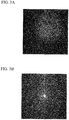
- FIG. 3A is an electron diffraction pattern obtained from a local area 2a1 in the coarse domain 2a shown in FIG. 2 .
- FIG. 3B is an electron diffraction pattern obtained from a local area 2b1 in the fine domain 2b shown in FIG 2 .
- FIG. 3A shows an electron diffraction pattern of a radial regular decagon resulting from an icosahedron structure. The electron diffraction pattern shown in FIG. 3A is obtained from only a quasicrystal and cannot be obtained from any other crystal structures. From the electron diffraction pattern shown in FIG. 3A , it can be confirmed that the quasicrystal phase is included in the coarse domain 2a.
- FIG 3B shows an electron diffraction pattern resulting from the Mg 51 Zn 20 phase. From the electron diffraction pattern shown in FIG 3B , it can be confirmed that the Mg 51 Zn 20 phase is included in the fine domain 2b. Furthermore, it was confirmed that the Mg 32 (Zn, Al) 49 phase, the MgZn phase, the MgZn 2 phase, and the Zn phase are included in the fine domain 2b in some cases, although such cases are not shown in the drawing.
- Mg 51 Zn 20 is observed in a case where the Mg content is high, and a large amount of Mg 32 (Zn, Al) 49 phase is observed in a case where the Mg content is low.
- the presence of intermetallic compounds or metal phases such as the Mg 51 Zn 20 phase, the Mg 32 (Zn, Al) 49 phase, the MgZn phase, the MgZn 2 phase, and the Zn phase can be confirmed using an electron diffraction pattern obtained by TEM as descried above or confirmed using an X-Ray Diffractometer (XRD).
- the Mg 51 Zn 20 phase is defined as a constituent phase which can be identified by a JCPDS card: PDF#00-008-0269, #00-065-4290, or a non-patent document "Journal of solid state chemistry 36, 225-233 (1981), Yamato et al.” Furthermore, the Mg 32 (Zn, Al) 49 phase is defined as a constituent phase which can be identified by JCPDS card: PDF#00-019-0029 or #00-039-0951.
- the chemical composition of the aforementioned intermetallic compounds or metallic phases can be quantitatively analyzed in a simple manner through TEM-EDX or EPMA. From the result of the quantitative analysis, whether each grain in a constituent phase is one of the quasicrystal phase, the Mg 51 Zn 20 phase, the Mg 32 (Zn, Al) 49 phase, the Mg 4 Zn 7 phase, the MgZn 2 phase, the Mg phase, and the Zn phase or other phases can be identified in a simple manner.
- Mg 51 Zn 20 has a unit lattice close to a cubical crystal and has an atomic structure in which an icosahedron is formed in the unit lattice.
- the unit lattice of Mg 51 Zn 20 is different from the icosahedron structure of the quasicrystal, and accordingly, in a strict sense, Mg 51 Zn 20 is a phase different from the quasicrystal.
- the Mg 51 Zn 20 phase may affect the formation of the quasicrystal phase.
- Mg 32 (Zn, Al) 49 is also called a Frank-Kasper phase and has a complicated atomic configuration (rhombic triacontahedron).
- the Mg 32 (Zn, Al) 49 phase may also be closely related to the formation of the quasicrystal phase similarly to the Mg 51 Zn 20 phase.
- the MgZn phase, the MgZn 2 phase, and the Zn phase included in the fine domain 2b in some cases have a chemical composition and a crystal structure that are greatly different from those of the quasicrystal phase. It is possible to make a conclusion that the MgZn phase, the MgZn 2 phase, and the Zn phase sufficiently cause elemental diffusion at a high temperature at the time of producing the plated steel sheet and hence stable phases are formed. From the viewpoint of improving corrosion resistance, it is preferable that a fraction of these stable phases is low.
- the area fraction of the quasicrystal phase is the highest among all of the constituent phases included in the metallographic structure of the plated-metal-layer.
- the quasicrystal phase is a main phase in the metallographic structure of the plated-metal-layer of the plated steel sheet according to the embodiment.
- the corrosion resistance further deteriorates than in a case where a single phase exists in the plated-metal-layer.
- portions that are noble and less noble in terms of electric energy formed in the plated-metal-layer, and hence a coupling cell reaction occurs. The less noble portions corrode first, and hence the corrosion resistance deteriorates.
- the deterioration of corrosion resistance resulting from the formation of the coupling cell is practically not observed and negligible, and rather, the corrosion resistance is markedly improved because the plated-metal-layer contains the quasicrystal.
- an intermetallic compound has poor plastic deformation properties. If a fraction of a coarse intermetallic compound having poor plastic workability is reduced, only fine cracks occur in the plated-metal-layer at the time of processing the plated steel sheet. Accordingly, an exposed area of the steel sheet (base metal) is reduced, and the corrosion resistance is preferably improved. Furthermore, because the peeling of the plated-metal-layer is inhibited, it takes a long time until red rust occurs in the processed portion, and hence the corrosion resistance is preferably improved.
- the quasicrystal phase is a non-equilibrium phase and thermally unstable. Therefore, if exposed to a high temperature environment with a temperature of around 250°C to 330°C for a long period of time, the quasicrystal phase undergoes phase decomposition, and hence the Mg phase having poor corrosion resistance is formed in addition to the Mg 51 Zn 20 phase in some cases. Consequently, the corrosion resistance as the overall plated steel sheet is likely to deteriorate. Care is required in a case where the plated steel sheet is used in a high temperature environment.
- an area fraction of the coarse domain in the metallographic structure of the entirety of the plated-metal-layer is preferably 5% to 80%, and an area fraction of the fine domain in the metallographic structure of the entirety of the plated-metal-layer (area of fine domain/area of plated-metal-layer) is preferably 20% to 95%. If the above conditions are satisfied, the corrosion resistance of the plated-metal-layer is further improved.
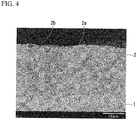
- FIG. 4 is a SEM micrograph of the plated steel sheet according to the embodiment, which is a metallographic micrograph obtained by observing the cross section whose cutting direction is parallel to the thickness direction of the plated steel sheet.
- FIG. 4 shows a plated-metal-layer in which an area fraction of the coarse domain is 63% and an area fraction of the fine domain is 37%. In was confirmed that the corrosion resistance of the plated-metal-layer is further improved in the plated steel sheet.
- the lower limit of the area fraction of the coarse domain may be set to be 10%, 15%, or 25%
- the upper limit of the area fraction of the fine domain may be set to be 90%, 85%, or 75%.
- the upper limit of the area fraction of the coarse domain may be set to be 50%, 35%, or 25%
- the lower limit of the area fraction of the fine domain may be set to be 50%, 65%, or 75%.
- an area fraction of the quasicrystal phase included in the coarse domain is preferably 80% to less than 100% as compared with the coarse domain (area of quasicrystal phase in coarse domain/area of coarse domain), and an area fraction in total of the Mg 51 Zn 20 phase, the Mg 32 (Zn, Al) 49 phase, the MgZn phase, the MgZn 2 phase, and the Zn phase included in the fine domain is preferably 80% to less than 100% as compared with the fine domain (total area of respective constituent phases in fine domain/area of fine domain).
- the corrosion resistance of the plated-metal-layer is further improved.
- the fraction of the quasicrystal phase or the size of the coarse domain in the plating structure (plated-metal-layer) may be a certain correlation between the fraction of the quasicrystal phase or the size of the coarse domain in the plating structure (plated-metal-layer) and the electrochemical properties.
- a corrosion potential of the plated-metal-layer shifts to a noble potential (-1.0 V to -0.8 V vs. Ag/AgCl reference electrode) from a less noble potential (-1.3 V to -1.1 V vs. Ag/AgCl reference electrode), a cathode current value and an anode current value at the corrosion potential decrease, and hence a corrosion current density decreases.
- this is because the quasicrystal phase has a unique potential or properties close to those of a passive state.
- the corrosion resistance of the plated-metal-layer is improved.
- the balance of the coarse domain and the balance of the fine domain include an intermetallic compound or a metallic phase other than the above in some cases, but even in these cases, the effects of the embodiment are not impaired.
- the potential of the coarse domain can be measured using, for example, a scanning Kelvin probe method, and the mapping of the structure can be measured. Generally, as the fraction of the quasicrystal and Mg 32 (Zn, Al) 49 increases, the potential is closer to a value of around -0.8 V which is noble. In contrast, Mg 51 Zn 20 has a potential of about -1.1 V.
- the potential or the corrosion current density varies with the amount of these phases and is generally within a range of -1.3 V to -0.8 V. Usually, the closer the potential to -0.8 V, the further the corrosion current density tends to be reduced.
- the metallographic structure of the plated-metal-layer in the plated steel sheet according to the embodiment does not contain the Mg phase.
- the Mg phase contained in the plated-metal-layer deteriorates the corrosion resistance in both the coarse domain and the fine domain. Therefore, it is preferable to suppress the precipitation of the Mg phase as much as possible. Whether or not the Mg phase exists may be determined and confirmed through TEM-EDX, SEM-EDX, XRD, or the like.
- the metallographic structure of the plated-metal-layer does not contain the Mg phase.
- a number fraction of grains of the Mg phase is equal to or less than 3% when 100 or more grains are randomly sampled in a TEM diffraction pattern
- the number fraction of grains of the Mg phase is more preferably less than 2%, and most preferably less than 1%.
- the Mg phase is easily formed as a primary phase at a temperature immediately below the melting point. Whether the Mg phase will be formed as a primary phase generally depends on the chemical composition of the plated-metal-layer and the production conditions. In a case where the Mg content is higher than in a eutectic composition (Mg 72%-Zn 28%) of an equilibrium state diagram of a binary Mg-Zn system, the Mg phase is likely to be crystallized as a primary phase. In contrast, in a case where the Mg content is lower than the above, in principle, the Mg phase is less likely to be crystallized as a primary phase.
- the production process according to the embodiment is a process for forming a quasicrystal as a primary phase. Therefore, if the Mg content is higher than in the eutectic composition, it is extremely difficult for the Mg phase to be formed, and even if the formation of the Mg phase could be confirmed, the Mg phase is less likely to present as a main phase.
- the grain of the Mg phase is present at a number fraction of about up to 3%. The present inventors confirmed that when the Zn content is 28.5% or greater, a proportion of the grain of the Mg phase in grains contained in the metallographic structure of the plated-metal-layer tends to be less than 2% in terms of a number fraction.
- a proportion of the grain of the Mg phase in the grains contained in the metallographic structure of the plated-metal-layer tends to be less than 1% in terms of a number fraction.
- the surface of the plated-metal-layer turns black with the passage of time particularly in a humid environment, and hence the appearance of the plating becomes defective in some cases.
- an area fraction of the quasicrystal phase include in the coarse domain is preferably 80% to less than 100% as compared with the coarse domain (area of quasicrystal phase in coarse domain/area of coarse domain), and an area fraction of the Mg 51 Zn 20 phase included in the fine domain is preferably 80% to less than 100% as compared with the fine domain (area of Mg 51 Zn 20 phase in fine domain/area of fine domain).
- an area fraction of the Mg 51 Zn 20 phase having excellent corrosion resistance is increased, and hence the corrosion resistance of the plated-metal-layer is further improved.
- an area from a surface of the plated-metal-layer toward the steel sheet in the thickness direction to 0.3 x D is regarded as a surface area of the plated-metal-layer
- an area from an interface between the steel sheet and the plated-metal-layer toward the plated-metal-layer in the thickness direction to 0.3 x D is regarded as a deep area of the plated-metal-layer
- an area fraction of the coarse domain in the surface area of the plated-metal-layer (area of coarse domain in surface area of plated-metal-layer/area of surface area of plated-metal-layer) is preferably 10% to less than 100% and an area fraction of the coarse domain in the deep area of
- an area fraction of the fine domain in the center area of the plated-metal-layer (area of fine domain in center area of plated-metal-layer/area of center area of plated-metal-layer) is preferably 50% to less than 100%. If the above conditions are satisfied, the constituent phases contained in the plated-metal-layer are preferably arranged, and hence the corrosion resistance of the plated-metal-layer is further improved. In addition, the adherence of the plated-metal-layer tends to be improved.
- the aforementioned area fraction may be calculated using the area of the grains included in the surface area or deep area of the plated-metal-layer.
- the aforementioned area fraction may be calculated using the area of grains included in the center area of the plated-metal-layer.
- the plated steel sheet according to the embodiment preferably further has a Fe-Al containing alloy layer.
- the Fe-Al containing alloy layer is preferably arranged between the steel sheet and the plated-metal-layer and preferably contains at least one or more kinds of compound between Fe 5 Al 2 and Al 3.2 Fe, and a thickness of the Fe-Al containing alloy layer in a thickness direction thereof is preferably 10 nm to 1,000 nm. If the Fe-Al containing alloy layer satisfying the above conditions is arranged in an interface between the steel sheet and the plated-metal-layer, peeling of the plated-metal-layer is preferably inhibited. Furthermore, if the Fe-Al containing alloy layer is formed, the adherence of the plated-metal-layer tends to be improved.
- the thickness D of the plated-metal-layer of the plated steel sheet according to the embodiment is not particularly limited, and may be controlled as necessary. Generally, the thickness D is set to be 35 ⁇ m smaller in many cases.
- the metallographic structure of the plated-metal-layer is observed as below.
- a sample is collected by cutting the plated steel sheet such that the cross section whose cutting direction is parallel to the thickness direction of the plated steel sheet is observed.
- the cross section is polished or processed by using a Cross Section Polisher (CP). In a case where the cross section is polished, the cross section is etched with nital.
- the cross section is then observed using an optical microscope or SEM, and a metallographic micrograph thereof is captured. If the cross section observed with SEM is a COMPO image as shown in FIG. 1 , due to a difference in a chemical composition between the coarse domain and the fine domain, a sharp contrast is made, and hence the boundary between the coarse domain and the fine domain can be easily discerned.
- the chemical composition of the constituent phases can be measured by analysis based on EDX or EPMA. From the result of the chemical analysis, the constituent phases can be simply identified.
- the metallographic micrograph is binarized through, for example, image analysis; an area ratio of a white portion or black portion of the plated-metal-layer is measured; and in this way, area fractions of the constituent phases can be measured. Furthermore, from the determined area of each coarse domain, an average equivalent circle diameter can be determined by calculation.
- EBSD Electron Back Scattering Diffraction Pattern
- the metallographic structure of the plated-metal-layer is observed as below.
- a thin sample is collected by cutting the plated steel sheet such that the cross section whose cutting direction is parallel to the thickness direction of the plated steel sheet is observed.
- the thin sample is subjected to ion milling.
- a thin sample is collected by processing the plated steel sheet with a Focused Ion Beam (FIB) such that the cross section whose cutting direction is parallel to the thickness direction of the plated steel sheet is observed.
- FIB Focused Ion Beam
- These thin samples are observed with TEM, and the metallographic micrograph thereof is captured.
- the constituent phases can be accurately identified using an electron diffraction pattern. By performing image analysis on the metallographic micrograph, the area fractions and the average equivalent circle diameters of the constituent phases can be determined.
- the steel sheet as a base metal of the plated steel sheet according to the embodiment is not particularly limited.
- As the steel sheet it is possible to use Al killed steel, ultra low carbon steel, high carbon steel, various high tensile strength steel, steel containing Ni or Cr, and the like.
- the method of producing a plated steel sheet according to the embodiment includes a hot-dip-plating process of dipping the steel sheet into a hot-dip-plating bath having an adjusted composition in order to form a plated-metal-layer on a surface of the steel sheet; a first cooling process of cooling the steel sheet after the hot-dip-plating process under conditions such that an average cooling rate of the plated-metal-layer is 15 °C/sec to 50 °C/sec in a temperature range where a temperature of the plated-metal-layer is from T melt to T solid-liquid in a unit of °C, when T melt is regarded as a liquidus temperature of the plated-metal-layer and when T solid-liquid is a temperature range where the plated-metal-layer is in a coexistence state of a solid phase and a liquid phase and where a volume ratio of the solid phase to the plated-metal-layer (volume of solid phase/volume of plated-metal-layer) is 0.3 to 0.8; and
- a value of T melt which is a liquidus temperature of the plated-metal-layer can be determined using, for example, liquidus temperatures (liquidus surface temperatures) disclosed in a non-patent document ( Liang, P., Tarfa, T., Robinson, J. A., Wagner, S., Ochin, P., Harmelin, M. G., Seifert, H. J., Lukas, H. L., Aldinger, F., "Experimental Investigation and Thermodynamic Calculation of the Al-Mg-Zn system", Thermochim. Acta, 314, 87-110 (1998 )) written by Liang et al, as shown in FIG. 5 .
- a value of T melt substantially can be estimated by using the fraction of Zn, Al, and Mg contained in the plated-metal-layer.
- a value of T solid-liquid can be accurately determined from an alloy phase diagram. Specifically, by using the chemical composition of the plated-metal-layer and the corresponding alloy phase diagram, a volume ratio (volume fraction) between a plurality of coexisting phases can be determined based on lever rule. That is, by using the alloy phase diagram, a temperature at which a volume ratio of a solid phase becomes 0.3 and a temperature at which a volume ratio of the solid phase becomes 0.8 may be determined. In the method of producing a plated steel sheet according to the embodiment, the value of T solid-liquid may be determined using the alloy phase diagram. At this time, as the alloy phase diagram, a calculated phase diagram based on a thermodynamic calculation system may be used.
- the alloy phase diagram merely shows an equilibrium phase
- the ratio between the constituent phases determined from the alloy phase diagram does not necessarily totally agree with an actual ratio between the constituent phases in the plated-metal-layer which is being cooled.
- T solid - liquid as a temperature range where the plated-metal-layer that is being cooled is in a coexistence state of a solid phase and a liquid phase and a volume ratio of the solid phase to the plated-metal-layer is 0.3 to 0.8
- the inventors of the present invention conducted intensive investigation.
- T solid-liquid can be empirically determined. Therefore, in the method of producing a plated steel sheet according to the embodiment, a value of T solid-liquid may be determined by the above expression.
- the chemical composition of the plating bath is adjusted such that the chemical composition, by atomic%, of the plated-metal-layer formed on the surface of the steel sheet contains Zn: 20% to 60%, Al: 0.3% to 15%, Ca: 0% to 3.5%, Y: 0% to 3.5%, La: 0% to 3.5%, Ce: 0% to 3.5%, Si: 0% to 0.5%, Ti: 0% to 0.5%, Cr: 0% to 0.5%,Fe: 0% to 2%, Co: 0% to 0.5%, Ni: 0% to 0.5%, V: 0% to 0.5%, Nb: 0% to 0.5%, Cu: 0% to 0.5%, Sn: 0% to 0.5%, Mn: 0% to 0.2%, Sr: 0% to 0.5%, Sb: 0% to0.5% and Pb: 0% to 0.5%, the balance consists of Mg and impurities, and a Zn content and an Al content expressed in atomic% in the chemical composition of the plated-metal-layer
- the hot-dip-plating process is selected for example.
- the method of forming the plated-metal-layer on the surface of the steel sheet is not limited as long as the plated-metal-layer having the aforementioned chemical composition can be formed on the surface of the steel sheet.
- spraying, sputtering, ion plating, evaporating, or electroplating may be applied.
- the plated-metal-layer formed on the surface of the steel sheet by the hot-dip-plating process is in a molten state (liquid phase).
- the plated-metal-layer can be controlled to have the aforementioned metallographic structure containing a quasicrystal,
- the plated-metal-layer can be controlled to have the aforementioned metallographic structure containing a quasicrystal.
- a melting point of the plated-metal-layer containing Mg and Zn as main components is totally different from a melting point of the steel sheet as a base metal. Therefore, those skilled in the related art can easily determine an optimized temperature at which only the plated-metal-layer is melted and an optimized melting time.
- the plated-metal-layer is completely melted while the steel sheet as a base metal is not melted.
- rapid heating in a high-temperature atmosphere is preferable because the plated-metal-layer of the plated steel sheet contacting the atmosphere is preferentially heated.
- an amount of an oxide in the plating bath is preferably 0 g/l to 1 g/l; an oxygen concentration of the atmosphere at the time of dipping the steel sheet is preferably 0 ppm to 100 ppm in a volume ratio; a plating tub holding the plating bath is preferably a steel tub; a dross in the plating bath is preferably removed by a metal pump; T bath which is a temperature of the plating bath is preferably 10°C to 100°C higher than T melt ; and a time to dip the steel sheet into the plating bath is preferably 1 sec to 10 sec.
- a quasicrystal is preferably formed in the metallographic structure of the plated-metal-layer.
- the amount of the oxide in the plating bath is more preferably 0.1 g/l or less.
- oxygen concentration is 100 ppm or less in a volume ratio, oxidation of the plating bath can be preferably inhibited.
- the oxygen concentration is more preferably 50 ppm or less in a volume ratio.
- the plating tube is a steel tub
- wearing of the inner walls of the plating tub can be further inhibited than in a case where the plating bath is a ceramic bath.
- the amount of inclusions in the plating bath is reduced, and hence a quasicrystal is preferably formed in the metallographic structure of the plated-metal-layer.
- T bath which is a temperature of the plating bath is 10°C to 100°C higher than T melt
- the plated-metal-layer is preferably formed on the surface of the steel sheet, and a Fe-Al containing alloy layer is formed between the steel sheet and the plated-metal-layer.
- T bath which is a temperature of the plating bath is more preferably 30°C to 50°C higher than T melt .
- the time to dip the steel sheet into the plating bath is 1 sec to 10 sec
- the plated-metal-layer is preferably formed on the surface of the steel sheet, and a Fe-Al containing alloy layer is formed between the steel sheet and the plated-metal-layer.
- the time to dip the steel sheet into the plating bath is more preferably 2 sec to 4 sec.
- the steel sheet on which the plated-metal-layer is formed is cooled by controlling the average cooling rate within a range of 15°C/sec to 50°C/sec.
- the crystallization of a quasicrystal is crystallized as a primary phase in the plated-metal-layer that is in a molten state (liquid phase) before the beginning of cooling. It is preferable that the crystallized quasicrystal slowly grows at a cooling rate that is within a controlled range and finally becomes a quasicrystal phase having an average equivalent circle diameter of larger than 1 ⁇ m included in the coarse domain.
- the average cooling rate in the first cooling process is less than 15°C/sec, a quasicrystal is not easily formed because the average cooling rate does not reach a cooling rate of a quasicrystal phase that is originally formed as a non-equilibrium phase.
- the average cooling rate in the first cooling process is higher than 50°C/sec, a quasicrystal phase having an average equivalent circle diameter of less than 1 ⁇ m are formed too much, and hence the average equivalent circle diameter of the quasicrystal phase does not become larger than 1 ⁇ m.
- the coarse domain mainly including the quasicrystal phase is not formed, and the aforementioned biomodal structure is not established.
- the upper limit of the average cooling rate in the first cooling process is set to be 50°C/sec.
- the primary phase crystallized in the plated-metal-layer cannot become a quasicrystal phase.
- An Al phase, a Zn phase, a Mg phase, and the like that are constituent phases other than a quasicrystal may be crystallized as a primary phase, or an incomplete quasicrystal that does not grow into a predetermined size may be crystallized.
- the area fraction of the coarse domain cannot be preferably controlled.
- the average equivalent circle diameter and the area fraction of the quasicrystal phase cannot be preferably controlled.
- the metallographic structure cannot be controlled to become a biomodal structure consisting of the coarse domain and the fine domain described above. Particularly, in some cases, a specific phase grows within the fine domain, and hence the aforementioned biomodal structure is not established.
- the average equivalent circle diameter and the area fraction of the quasicrystal phase cannot be preferably controlled.
- the metallographic structure cannot be controlled to become a biomodal structure consisting of the coarse domain and the fine domain described above. As described so far, in order for the crystallized quasicrystal to stably grow without disappearing, the specific cooling conditions described above are required.
- the second cooling process it is important to control the average cooling rate of the plated-metal-layer at the time when the temperature of the plated-metal-layer reaches 250°C from a temperature at a point in time when the first cooling process ends, that is, from a temperature at finishing the first cooling process that is within T solid-liquid .
- the steel sheet having undergone the first cooling process is cooled by controlling the average cooling rate to become 100°C/sec to 3,000°C/sec.
- the lower limit of the temperature range is preferably 200°C, more preferably 150°C, and most preferably 100°C.
- the cooling in the second cooling process in the plated-metal-layer in which a quasicrystal is crystallized as a primary phase and a solid phase and a liquid phase is in a coexistence state, at least one kind of phase among a Mg 51 Zn 20 phase, a Mg 32 (Zn, Al) 49 phase, a MgZn phase, a MgZn 2 phase, and a Zn phase is crystallized. It is preferable that the crystallized Mg 51 Zn 20 phase, Mg 32 (Zn, Al) 49 phase, MgZn phase, MgZn 2 phase, and Zn phase finally become constituent phases included in the fine domain.
- the average equivalent circle diameter and the area fraction of the quasicrystal phase cannot be preferably controlled.
- the metallographic structure cannot be controlled to become a biomodal structure consisting of the coarse domain and the fine domain described above.
- the control of the average cooling rate to satisfy the aforementioned conditions is stopped at a temperature higher than 250°C, the quasicrystal phase as a non-equilibrium phase, the Mg 51 Zn 20 phase, and the Mg 32 (Zn, Al) 49 phase undergo phase decomposition in some cases.
- the metallographic structure cannot be controlled to become a biomodal structure consisting of the coarse domain and the fine domain described above.
- the average cooling rate in the second cooling process is less than 100°C/sec
- the Mg 51 Zn 20 phase, the Mg 32 (Zn, Al) 49 phase, the MgZn phase, the MgZn 2 phase, or the Zn phase is not formed, or a metallographic structure containing an extremely large amount of Mg phase is established.
- the Mg 51 Zn 20 phase, the Mg 32 (Zn, Al) 49 phase, the MgZn phase, the MgZn 2 phase, or the Zn phase does not becomes the fine domain in some cases.
- the average cooling rate in the second cooling process is greater than 3,000°C/sec
- a constituent phase such as an amorphous phase is formed, and hence the metallographic structure cannot be controlled to become the aforementioned biomodal structure in some cases.
- T melt as a liquidus temperature of the plated-metal-layer may be determined from a liquidus surface phase diagram of a ternary Zn-Al-Mg system.
- T solid-liquid as a temperature range in which a volume ratio of a solid phase to the plated-metal-layer becomes 0.3 to 0.8 may be determined from the following expression, ⁇ 345 + 0.35 x (T melt - 345) ⁇ - 5 ⁇ T solid-liquid ⁇ ⁇ 345 + 0.35 x (T melt - 345 ⁇ + 5. Because the amount of solid phase explosively increases around the temperature range in which the volume ratio of a solid phase to the plated-metal-layer becomes 0.3 to 0.8, the cooling of the first cooling process is finished in the temperature range.
- the average equivalent circle diameter and the area fraction of the quasicrystal phase can be preferably controlled. In this way, in order to form the aforementioned plated-metal-layer, the temperature needs to be accurately controlled.
- a contact-type thermocouple K-type
- K-type a contact-type thermocouple
- an average temperature of the whole plated-metal-layer can be monitored all the time. If a pull-up rate and a thickness are mechanically controlled, and a preheating temperature of the steel sheet, a temperature of the hot-dip plating bath, and the like are standardized, it is possible to substantially accurately monitor a temperature of the whole plated-metal-layer at the point in time under the production conditions. Consequently, the cooling in the first cooling process and the second cooling process can be accurately controlled.
- a surface temperature of the plated-metal-layer may be measured using a noncontact-type radiation thermometer, although the noncontact-type thermometer is not as accurate as a contact-type.
- a relationship between a surface temperature of the plated-metal-layer and an average temperature of the whole plated-metal-layer may be determined by cooling simulation for analyzing thermal conductivity. Specifically, based on each of the production conditions such as a preheating temperature of the steel sheet, a temperature of the hot-dip plating bath, a rate at which the steel sheet is pulled up out of the plating bath, a thickness of the steel sheet, a thickness of the plated-metal-layer, an amount of heat exchanged between the plated-metal-layer and the production facilities, and an amount of heat radiated from the plated-metal-layer, a surface temperature of the plated-metal-layer and an average temperature of the whole plated-metal-layer may be determined, and a relationship between the surface temperature of the plated-metal-layer and the average temperature of the whole plated-metal-layer may be determined.
- the average temperature of the whole plated-metal-layer at the point in time under the production conditions can be inferred. Consequently, the cooling in the first cooling process and the second cooling process can be accurately controlled.
- the cooling method in the first cooling process and the second cooling process is not particularly limited.
- cooling using a rectified high-pressure gas, mist cooling, or submersion cooling may be performed.
- all of the known plating methods such as a sendzimir method, a pre-plating method, a two-step plating method, and a flux method can be used.
- pre-plating displacement plating, electroplating, evaporating, and the like can be used.
- steel used as a base metal of the plated steel sheet is not particularly limited.
- the aforementioned effects are not affected by the chemical composition of steel, and Al killed steel, ultra low carbon steel, high carbon steel, various high tensile strength steel, steel containing Ni or Cr, and the like can be used.
- each of the processes such as a steel making process, a hot rolling process, a pickling process, and a cold rolling process that precede the hot-dip plating process is not particularly limited. That is, the production conditions of the steel sheet supplied in the hot-dip plating process or the material of the steel sheet is not particularly limited.
- the steel sheet supplied in the hot-dip plating process preferably has a temperature difference between a surface temperature and an internal temperature. Specifically, it is preferable that a surface temperature of the steel sheet immediately before being dipped into the plating bath is higher than an internal temperature thereof.
- a surface temperature of the steel sheet immediately before being dipped into the plating bath is preferably 10°C to 50°C higher than a temperature of the center of the steel sheet in the thickness direction thereof.
- the plated-metal-layer immediately after being pulled up out of the plating bath, the plated-metal-layer undergoes heat extraction due to the steel sheet, and accordingly, the plated-metal-layer can be preferably controlled to have the aforementioned metallographic structure containing a quasicrystal.
- a method for making a temperature difference between the surface temperature and the internal temperature in the steel sheet immediately before being dipped into the plating bath is not particularly limited.
- the steel sheet immediately before being dipped into the plating bath may be rapidly heated in a high-temperature atmosphere such that only the surface temperature of the steel sheet is controlled to become a temperature preferable for performing hot-dip plating.
- the steel sheet can be dipped into the plating bath in a state of having a temperature difference between the surface temperature and the internal temperature.
- an exposure test is most preferable which makes it possible to evaluate the corrosion resistance of the plated-metal-layer in a real environment.
- evaluating a corrosion loss of the plated-metal-layer for a predetermined period of time whether the corrosion resistance is excellent or poor can be evaluated.
- plated-metal-layers having high corrosion resistance are compared with each other in terms of corrosion resistance, it is preferable to perform a long-term corrosion resistance test.
- the corrosion resistance is evaluated based on the time taken for red rust to occur. Furthermore, at the time of evaluating the corrosion resistance, it is important to consider a time period during which the steel sheet is under protection.
- a combined cycle corrosion test or an accelarated corrosion test such as a salt spray test.
- a corrosion loss or a period of time during which the red rust resistance lasts By evaluating a corrosion loss or a period of time during which the red rust resistance lasts, whether the corrosion resistance is excellent or poor can be determined.
- the plated-metal-layer may also be subjected to conversion coating using an organic or inorganic material.
- the plated-metal-layer according to the embodiment contains Zn in an amount of equal to or greater than a certain level. Therefore, the plated-metal-layer according to the embodiment can be subjected to the same conversion coating as performed on a Zn group-plated steel sheet. The same will be applied to painting performed on a film having undergone conversion coating.
- the plated-metal-layer according to the embodiment can also be used as a base sheet of a laminated steel sheet.
- the plated steel sheet according to the embodiment can be used particularly in places in a severely corrosive environment.
- the plated steel sheet according to the embodiment can be used as a substitute for various plated steel sheets used in the fields of building materials, automobiles, consumer electronics, energy, and the like.
- a plated steel sheet containing a quasicrystal was produced.
- a plating bath was obtained by dissolving a predetermined amount of pure metal ingot.
- the plating bath was covered with a sealing box and then purged with an Ar gas such that an oxygen concentration thereof was controlled to reach a predetermined level.
- a hot rolled steel sheet having a thickness of 0.8 mm (carbon content: 0.2% by mass) was used as a base sheet for plating.
- the steel sheet was cut in 100 mm x 200 mm.
- a batch-type hot-dip plating tester was used for hot-dip plating. During production, a temperature of a center area of the plated steel sheet was monitored.
- the surface of the steel sheet heated to 800°C was reduced using a N 2 -5% H 2 gas in a furnace in which an oxygen concentration was controlled.
- the steel sheet was air-cooled using a N 2 gas until a surface temperature of the steel sheet reached a temperature which is 20°C higher than a temperature of the plating bath, and the steel sheet was dipped into the plating bath for a predetermined time. After being dipped into the plating bath, the steel sheet was pulled up at a pull-up rate of 100 mm/sec.
- the metallographic structures of three random samples out of the ten samples were observed with an optical microscope (1,000 x magnification), and a Vickers indentation was left at a target site. Base on the Vickers indentation, a 8 mm x 8 mm sample was cut off. From each sample, a sample for TEM observation was prepared by cryo-ion milling.
- the constituent phase (a quasicrystal, Mg 51 Zn 20 , Mg 32 (Zn, Al) 49 , MgZn, Zn, or the like) contained in the metallographic structure was identified. Furthermore, an equivalent circle diameter or an area fraction of each constituent phase was determined through image analysis, and a chemical composition of each constituent phase was measured through analysis using EDX as necessary,. Whether or not the Mg phase exists was determined and checked by XRD. In a case where diffraction intensity of the Mg phase in the XRD diffraction pattern was smaller than a prescribed value, it was determined that the metallographic structure of the plated-metal-layer does not contain the Mg phase.
- the corrosion resistance, sacrificial protection, antiglare effect, and appearance of the plated steel sheet and the adherence of the plated-metal-layer were evaluated.
- As corrosion resistance, a corrosion loss, the occurrence of red rust, the occurrence of white rust, and the occurrence of red rust in a processed portion were evaluated.
- the corrosion lost was evaluated by a Combined cycle Corrosion Test (CCT) based on a JASO (M609-91) cycle. Specifically, for evaluating the corrosion loss, a 50 mm (C direction) x 100 mm (L direction) sample was cut off from the prepared plated steel sheet and subjected to the combined cycle corrosion test. The combined cycle corrosion test (CCT) was performed using a 0.5% aqueous NaCl solution, and a corrosion loss after 150 cycles was evaluated.
- CCT Combined cycle Corrosion Test
- a plated steel sheet resulting in a corrosion loss of less than 20 g/m 2 was determined as being “Excellent”
- a plated steel sheet resulting in a corrosion loss of equal to or greater than 20 g/m 2 and less than 30 g/m 2 was determined as being “Good”
- a plated steel sheet resulting in a corrosion loss of equal to or greater than 30 g/m 2 was determined as being “Poor”.
- "Excellent” shows that the plated steel sheet is the best in the corrosion loss evaluation.
- the occurrence of red rust was evaluated by the aforementioned combined cycle corrosion test (CCT). Specifically, the produced plated steel sheet was subjected to the combined cycle corrosion test (CCT) by using a 5% aqueous NaCl solution, and the number of test cycles in which red rust occurred in an area of greater than 5% of a planar portion of the plated steel sheet was investigated.
- CCT combined cycle corrosion test
- the occurrence of white rust was evaluated by a Salt Spray Test (SST) based on JIS Z2371: 2000. Specifically, the produced plated steel sheet was subjected to the salt spray test (SST) by using a 5% aqueous NaCl solution, and a time taken for white rust to occur in an area of greater than 5% of a planar portion of the plated steel sheet during the test was investigated.
- SST Salt Spray Test
- the occurrence of red rust in a processed portion was evaluated by performing the aforementioned salt spray test (SST) on the plated steel sheet having undergone bulging. Specifically, the produced plated steel sheet was subjected to bulging based on JIS Z2247: 2006 under the condition of an indentation depth (movement distance of a punch) of 7 mm. The plated steel sheet was subjected to the salt spray test (SST) by using a 5% aqueous NaCl solution, and a time taken for red rust to occur in an area of greater than 5% of a top area (45 mm x 45 mm region in which the top is regarded as being the center of a diagonal line of a square) after bulging during the test was investigated.
- SST salt spray test
- the sacrificial protection was evaluated by an electrochemical technique. Specifically, The produced plated steel sheet was dipped into a 0.5% aqueous NaCl solution, and a corrosion potential of the produced plated steel sheet was measured using a Ag/AgCl reference electrode. In this case, a corrosion potential of Fe is about -0.62 V.
- a plated steel sheet in which a corrosion potential was -0.9 V to -0.62 V with respect to the Ag/AgCl reference electrode was determined as being “Excellent”
- a plated steel sheet in which a corrosion potential was equal to or greater than -1.0 V and less than 0.9 V was determined as being "Very Good”
- a plated steel sheet in which a corrosion potential was equal to or greater than -1.3 V and less than - 1.0 V was determined as being “Good”
- a plated steel sheet in which a corrosion potential was -1.3 V to -0.62 V was determined as being "Poor”.
- “Excellent” shows that a difference in a potential between the plated steel sheet and Fe is small, and an excellent sacrificial protection performance is appropriately demonstrated.
- the antiglare effect was evaluated by a spectro-colorimetric method. Usually, it is preferable to visually evaluate the antiglare effect. In this example, it was confirmed in advance that there is a correlation between the result of visual observation and an L* value obtained by a colorimeter, and then the antiglare effect was evaluated by a specular component inclusion (SCI) method by using a spectral colorimeter (D65 light source, 10° visual field). Specifically, an L* value of the produced plated steel sheet was investigated by using a spectral colorimeter CM2500d manufactured by Konica Minolta, Inc under the conditions of a measurement diameter of 8 ⁇ , 10° visual field, and a D65 light source.
- SCI specular component inclusion
- the appearance of the plated steel sheet was evaluated by a test in which the plated steel sheet is stored in a thermohygrostat tank. Specifically, the produced plated steel sheet was stored for 72 hours in a thermohygrostat tank with a temperature of 40°C and a humidity of 95%, and an area (%) of a portion, which turned black, in a planar portion of the plated steel sheet after storage was investigated.
- the adherence of the plated-metal-layer was evaluated by a 4T bending test (180° bending test). Specifically, a 20 mm x 80 mm sample was cut off from the produced plated steel sheet and subjected to a 4T bending test (180° bending test). T means a thickness of the plated steel sheet, which is about 0.8 mm. The bending direction is the C direction of the steel sheet. A tape peeling test was performed on the inside of the bend of the sample having undergone the bending test, and the peeling state of the plated-metal-layer was investigated.
- the plated steel sheet from which the plated-metal-layer was not peeled off was determined as being "Excellent”
- a plated steel sheet from which the plated-metal-layer was peeled off in an area of less than 5 mm 2 was determined as being "Very Good”
- a plated steel sheet from which the plated-metal-layer was peeled off in an area of equal to or greater than 5 mm 2 and less than 10 mm 2 was determined as being "Good”
- a plated steel sheet from which the plated-metal-layer was peeled off in an area of equal to or greater than 10 mm 2 was determined as being "Poor”.
- "Excellent” shows that the plated steel sheet is the best in the adherence evaluation.
- the post-powdering corrosion resistance of the plated steel sheet was evaluated by a test performed under the following conditions. Specifically, from the produced plated steel sheet (thickness: 0.8 mm, plating thickness: 10 ⁇ m), a sample having a size of 300 mm x 600 mm was cut off. The center area of the sample was subjected to bending such that a portion bent at 90° was formed. The sample having undergone bending was subjected to a salt spray test (SST) by using a 5% aqueous NaCl solution, and the state where red rust occurred in the inner surface of the bent portion was investigated. At the time of performing the salt spray test, a tape was attached to the periphery of the sample having undergone bending, and the sample was made stand at a height of 300 mm.
- SST salt spray test
- Hot-dip-plating process First cooling process Second cooling process Oxide in plating bath g/l Atmospheric oxygen concentration ppm Material of plating tub Whether or not dross is removed by a metal pump Temperature of plating bath T bath °C Time to dip steel sheet Sec Temperature dependent on chemical composition of plated-metal-layer Temperature actually measured at the beginning of cooling in first cooling process °C Temperature actually measured at the end of cooling in first cooling process °C Average cooling rate of plated-met al-layer °C/sec Temperature actually measured at the end of cooling in second cooling process °C Average cooling rate of planted-met al-layer °C/sec Liquidus temperature T melt °C Temperature range in which volume ratio of solid phase becomes 0.3 to 0.8 T solid-liquid Upper limit °C Lower limit °C Comparative Example 1 0 20 Steel Removed 410 3 360 355 345 365 350 25 25 1.000 Comparative Example 2 0 20 Steel Removed 480 3 450 387 377 455 380 25 25 250
- Hot-dip-plating process First cooling process Second cooling process Oxide in plating bath g/l Atmospheric oxygen concentration ppm Material of plating tub Whether or not dross is removed by a metal pump Temperature of plating bath T bath °C Time to dip steel sheet Sec Temperature dependent on chemical composition of plated-metal-layer Temperature actually measured at the beginning of cooling in first cooling process °C Temperature actually measured at the end of cooling in first cooling process °C Average cooling rate of plated-met al-layer °C/sec Temperature actually measured at the end of cooling in second cooling process °C Average cooling rate of plated-met al-layer °C/sec Liquidus temperature T melt °C Temperature range in which volume ratio of solid phase becomes 0.3 to 0.8 T solid-liquid Upper limit °C Lower limit °C Example 13 0 20 Steel Removed 480 3 430 380 370 435 375 30 25 325 Example 14 0 20 Steel Removed 470 3 415 375 365 420 370 25 25 275
- Hot-dip-plating process First cooling process Second cooling process Oxide in plating bath g/l Atmospheric oxygen concentration ppm Material of plating tub Whether or not dross is removed by a metal pump Temperature of plating bath T bath °C Time to dip steel sheet Sec Temperature dependent on chemical composition of plated-metal-layer Temperature actually measured at the beginning of cooling in first cooling process °C Temperature actually measured at the end of cooling in first cooling process °C Average cooling rate of plated-met al-layer °C/sec Temperature actually measured at the end of cooling in second cooling process °C Average cooling rate of plated-met al-layer °C/sec Liquidus temperature T melt °C Temperature range in which volume ratio of solid phase becomes 0.3 to 0.8 T solid-liquid Upper limit °C Lower limit °C Example 27 0 20 Steel Removed 460 3 415 375 365 420 370 25 25 250 Comparative Example 9 0 20 Steel Removed 510 3 470 394 384 475 390 14 25 1,000
- the present invention it is possible to provide the plated steel sheet which is further excellent in the corrosion resistance requested for applying building materials, automobiles, consumer electronics or the like. Therefore, it is possible to prolong the useful life of the materials as compared with the conventional surface-treated steel sheets. Accordingly, the present invention has significant industrial applicability
Landscapes
- Chemical & Material Sciences (AREA)
- Engineering & Computer Science (AREA)
- Materials Engineering (AREA)
- Mechanical Engineering (AREA)
- Metallurgy (AREA)
- Organic Chemistry (AREA)
- Chemical Kinetics & Catalysis (AREA)
- Physics & Mathematics (AREA)
- Oil, Petroleum & Natural Gas (AREA)
- Thermal Sciences (AREA)
- Coating With Molten Metal (AREA)
- Other Surface Treatments For Metallic Materials (AREA)
Applications Claiming Priority (1)
| Application Number | Priority Date | Filing Date | Title |
|---|---|---|---|
| PCT/JP2014/059103 WO2015145721A1 (fr) | 2014-03-28 | 2014-03-28 | Tôle d'acier plaquée contenant un quasicristal |
Publications (2)
| Publication Number | Publication Date |
|---|---|
| EP3124643A1 true EP3124643A1 (fr) | 2017-02-01 |
| EP3124643A4 EP3124643A4 (fr) | 2017-10-25 |
Family
ID=54194310
Family Applications (1)
| Application Number | Title | Priority Date | Filing Date |
|---|---|---|---|
| EP14887561.0A Withdrawn EP3124643A4 (fr) | 2014-03-28 | 2014-03-28 | Tôle d'acier plaquée contenant un quasicristal |
Country Status (10)
| Country | Link |
|---|---|
| US (1) | US10232590B2 (fr) |
| EP (1) | EP3124643A4 (fr) |
| JP (1) | JP5785336B1 (fr) |
| KR (1) | KR101823286B1 (fr) |
| CN (1) | CN106103784B (fr) |
| AU (1) | AU2014388691B2 (fr) |
| CA (1) | CA2943104C (fr) |
| MX (1) | MX2016012502A (fr) |
| MY (1) | MY182932A (fr) |
| WO (1) | WO2015145721A1 (fr) |
Cited By (2)
| Publication number | Priority date | Publication date | Assignee | Title |
|---|---|---|---|---|
| JP2017066457A (ja) * | 2015-09-29 | 2017-04-06 | 新日鐵住金株式会社 | 加工性と耐食性に優れるMg含有合金めっき鋼材 |
| EP3190203A4 (fr) * | 2014-09-05 | 2018-04-18 | Nippon Steel & Sumitomo Metal Corporation | Tôle d'acier plaquée contenant des quasi-cristaux et procédé de production de tôle d'acier plaquée contenant des quasi-cristaux |
Families Citing this family (10)
| Publication number | Priority date | Publication date | Assignee | Title |
|---|---|---|---|---|
| CN108138308B (zh) * | 2015-09-29 | 2020-01-17 | 日本制铁株式会社 | 镀覆钢材 |
| US10392686B2 (en) | 2015-09-29 | 2019-08-27 | Nippon Steel Corporation | Mg-containing Zn alloy coated steel |
| JP6787002B2 (ja) * | 2015-09-29 | 2020-11-18 | 日本製鉄株式会社 | Al−Mg系溶融めっき鋼材 |
| JP6528627B2 (ja) * | 2015-09-29 | 2019-06-12 | 日本製鉄株式会社 | めっき鋼材 |
| MX2019008300A (es) * | 2017-01-16 | 2019-09-11 | Nippon Steel Corp | Producto de acero recubierto. |
| PL3575434T3 (pl) * | 2017-01-27 | 2023-02-27 | Nippon Steel Corporation | Wyrób stalowy z powłoką metaliczną |
| JP6880238B2 (ja) * | 2017-12-20 | 2021-06-02 | 日本製鉄株式会社 | 溶融めっき鋼線およびその製造方法 |
| US11168379B2 (en) * | 2018-02-12 | 2021-11-09 | Ford Motor Company | Pre-conditioned AlSiFe coating of boron steel used in hot stamping |
| JP7140624B2 (ja) * | 2018-10-05 | 2022-09-21 | 株式会社エフ.イー.シーチェーン | めっき部材 |
| TWI825475B (zh) * | 2021-09-07 | 2023-12-11 | 日商日本製鐵股份有限公司 | 熔融鍍敷鋼材 |
Family Cites Families (18)
| Publication number | Priority date | Publication date | Assignee | Title |
|---|---|---|---|---|
| FR2685349B1 (fr) * | 1991-12-20 | 1994-03-25 | Centre Nal Recherc Scientifique | Element de protection thermique constitue par un alliage d'aluminium quasi-cristallin. |
| EP0750050A4 (fr) | 1993-12-22 | 1997-09-24 | Toshiba Kk | Alliage absorbant l'hydrogene et accumulateur alcalin comprenant cet alliage |
| JP3235386B2 (ja) | 1994-12-28 | 2001-12-04 | ヤマハ株式会社 | 熱電材料及びその製造方法 |
| JP4454239B2 (ja) | 2003-03-06 | 2010-04-21 | 独立行政法人科学技術振興機構 | 準結晶Al合金を前駆体とした耐熱触媒の製造方法 |
| WO2004092450A1 (fr) * | 2003-04-11 | 2004-10-28 | Lynntech, Inc. | Compositions et revetements comprenant des quasicristaux |
| JP2005113235A (ja) | 2003-10-09 | 2005-04-28 | Toyota Motor Corp | 高強度マグネシウム合金およびその製造方法 |
| FR2866350B1 (fr) | 2004-02-16 | 2007-06-22 | Centre Nat Rech Scient | Revetement en alliage d'aluminium, pour ustensile de cuisson |
| CN101405421B (zh) * | 2006-03-20 | 2012-04-04 | 新日本制铁株式会社 | 高耐蚀性热浸镀锌系钢材 |
| JP4849402B2 (ja) | 2006-09-15 | 2012-01-11 | トヨタ自動車株式会社 | 高強度マグネシウム合金およびその製造方法 |
| JP6031219B2 (ja) * | 2007-03-15 | 2016-11-24 | 新日鐵住金株式会社 | 溶融Mg−Zn系合金めっき鋼材及びその製造方法 |
| JP2008248279A (ja) * | 2007-03-29 | 2008-10-16 | Honda Motor Co Ltd | 準結晶粒子分散合金積層材の製造方法、準結晶粒子分散合金バルク材の製造方法、準結晶粒子分散合金積層材および準結晶粒子分散合金バルク材 |
| JP2009191327A (ja) | 2008-02-15 | 2009-08-27 | Honda Motor Co Ltd | アルミニウム合金基材の強化方法 |
| JP5586027B2 (ja) * | 2009-01-19 | 2014-09-10 | 独立行政法人物質・材料研究機構 | Mg基合金 |
| JP5332848B2 (ja) | 2009-04-10 | 2013-11-06 | 新日鐵住金株式会社 | 有機複合Mg系めっき鋼板 |
| JP5343701B2 (ja) * | 2009-05-19 | 2013-11-13 | 新日鐵住金株式会社 | 耐食性に優れたMg合金めっき鋼材およびその製造方法 |
| CN101713042B (zh) | 2009-11-13 | 2011-12-14 | 大连交通大学 | 一种准晶增强镁合金及其半固态制备方法 |
| WO2011114931A1 (fr) | 2010-03-17 | 2011-09-22 | 独立行政法人物質・材料研究機構 | Alliage de magnésium |
| JP5505053B2 (ja) | 2010-04-09 | 2014-05-28 | 新日鐵住金株式会社 | 有機複合Mg系めっき鋼板 |
-
2014
- 2014-03-28 AU AU2014388691A patent/AU2014388691B2/en active Active
- 2014-03-28 US US15/128,009 patent/US10232590B2/en active Active
- 2014-03-28 CN CN201480077516.4A patent/CN106103784B/zh active Active
- 2014-03-28 JP JP2014543035A patent/JP5785336B1/ja active Active
- 2014-03-28 MY MYPI2016703478A patent/MY182932A/en unknown
- 2014-03-28 EP EP14887561.0A patent/EP3124643A4/fr not_active Withdrawn
- 2014-03-28 KR KR1020167027036A patent/KR101823286B1/ko active Active
- 2014-03-28 MX MX2016012502A patent/MX2016012502A/es unknown
- 2014-03-28 CA CA2943104A patent/CA2943104C/fr not_active Expired - Fee Related
- 2014-03-28 WO PCT/JP2014/059103 patent/WO2015145721A1/fr not_active Ceased
Cited By (3)
| Publication number | Priority date | Publication date | Assignee | Title |
|---|---|---|---|---|
| EP3190203A4 (fr) * | 2014-09-05 | 2018-04-18 | Nippon Steel & Sumitomo Metal Corporation | Tôle d'acier plaquée contenant des quasi-cristaux et procédé de production de tôle d'acier plaquée contenant des quasi-cristaux |
| US10508330B2 (en) | 2014-09-05 | 2019-12-17 | Nippon Steel Corporation | Quasicrystal-containing plated steel sheet and method for producing quasicrystal-containing plated steel sheet |
| JP2017066457A (ja) * | 2015-09-29 | 2017-04-06 | 新日鐵住金株式会社 | 加工性と耐食性に優れるMg含有合金めっき鋼材 |
Also Published As
| Publication number | Publication date |
|---|---|
| EP3124643A4 (fr) | 2017-10-25 |
| MY182932A (en) | 2021-02-05 |
| JPWO2015145721A1 (ja) | 2017-04-13 |
| KR101823286B1 (ko) | 2018-01-29 |
| CA2943104A1 (fr) | 2015-10-01 |
| US20170100915A1 (en) | 2017-04-13 |
| CN106103784B (zh) | 2019-01-11 |
| JP5785336B1 (ja) | 2015-09-30 |
| CA2943104C (fr) | 2017-12-19 |
| KR20160129043A (ko) | 2016-11-08 |
| MX2016012502A (es) | 2017-01-05 |
| US10232590B2 (en) | 2019-03-19 |
| CN106103784A (zh) | 2016-11-09 |
| AU2014388691A1 (en) | 2016-10-06 |
| WO2015145721A1 (fr) | 2015-10-01 |
| AU2014388691B2 (en) | 2017-08-03 |
Similar Documents
| Publication | Publication Date | Title |
|---|---|---|
| US10232590B2 (en) | Plated steel sheet with quasicrystal | |
| EP3124642B1 (fr) | Tôle d'acier revetue avec des quasi-cristaux | |
| JP4874328B2 (ja) | 高耐食性溶融Zn系めっき鋼材 | |
| CN101636517B (zh) | 镀Mg基合金的钢材 | |
| US10508330B2 (en) | Quasicrystal-containing plated steel sheet and method for producing quasicrystal-containing plated steel sheet | |
| JP6528627B2 (ja) | めっき鋼材 | |
| WO2000056945A1 (fr) | Produit en acier traite en surface, prepare par placage a base d'etain ou d'aluminium | |
| CN110191973A (zh) | 镀覆钢材 | |
| US20240002991A1 (en) | HOT-DIP Zn-BASED PLATED STEEL SHEET | |
| KR20180039107A (ko) | Mg 함유 Zn 합금 피복 강재 | |
| JP6075513B1 (ja) | 準結晶含有めっき鋼板及び準結晶含有めっき鋼板の製造方法 | |
| KR101168730B1 (ko) | Mg기 합금 도금 강재 | |
| TWI504754B (zh) | 含準晶體之鍍敷鋼板 | |
| TWI896367B (zh) | 熔融鍍敷鋼材 | |
| TWI512140B (zh) | 含準晶體之鍍敷鋼板 | |
| JP7832144B2 (ja) | 溶融Al-Zn系めっき鋼板及びその製造方法 |
Legal Events
| Date | Code | Title | Description |
|---|---|---|---|
| STAA | Information on the status of an ep patent application or granted ep patent |
Free format text: STATUS: THE INTERNATIONAL PUBLICATION HAS BEEN MADE |
|
| PUAI | Public reference made under article 153(3) epc to a published international application that has entered the european phase |
Free format text: ORIGINAL CODE: 0009012 |
|
| STAA | Information on the status of an ep patent application or granted ep patent |
Free format text: STATUS: REQUEST FOR EXAMINATION WAS MADE |
|
| 17P | Request for examination filed |
Effective date: 20161026 |
|
| AK | Designated contracting states |
Kind code of ref document: A1 Designated state(s): AL AT BE BG CH CY CZ DE DK EE ES FI FR GB GR HR HU IE IS IT LI LT LU LV MC MK MT NL NO PL PT RO RS SE SI SK SM TR |
|
| AX | Request for extension of the european patent |
Extension state: BA ME |
|
| DAX | Request for extension of the european patent (deleted) | ||
| A4 | Supplementary search report drawn up and despatched |
Effective date: 20170925 |
|
| RIC1 | Information provided on ipc code assigned before grant |
Ipc: C23C 22/02 20060101ALI20170919BHEP Ipc: C23C 2/28 20060101ALI20170919BHEP Ipc: B32B 15/01 20060101ALI20170919BHEP Ipc: C23C 2/04 20060101ALI20170919BHEP Ipc: C22C 18/00 20060101ALI20170919BHEP Ipc: C22C 23/04 20060101ALI20170919BHEP Ipc: C23C 2/26 20060101ALI20170919BHEP Ipc: C22C 18/04 20060101ALI20170919BHEP Ipc: C23C 2/06 20060101AFI20170919BHEP |
|
| STAA | Information on the status of an ep patent application or granted ep patent |
Free format text: STATUS: EXAMINATION IS IN PROGRESS |
|
| 17Q | First examination report despatched |
Effective date: 20190327 |
|
| RAP1 | Party data changed (applicant data changed or rights of an application transferred) |
Owner name: NIPPON STEEL CORPORATION |
|
| RIC1 | Information provided on ipc code assigned before grant |
Ipc: B32B 15/01 20060101ALI20201202BHEP Ipc: C23C 22/02 20060101ALI20201202BHEP Ipc: C22C 23/04 20060101ALI20201202BHEP Ipc: C22C 18/00 20060101ALI20201202BHEP Ipc: C23C 2/26 20060101ALI20201202BHEP Ipc: C23C 2/06 20060101ALI20201202BHEP Ipc: C23C 2/04 20060101AFI20201202BHEP Ipc: C22C 18/04 20060101ALI20201202BHEP Ipc: C23C 2/28 20060101ALI20201202BHEP |
|
| GRAP | Despatch of communication of intention to grant a patent |
Free format text: ORIGINAL CODE: EPIDOSNIGR1 |
|
| STAA | Information on the status of an ep patent application or granted ep patent |
Free format text: STATUS: GRANT OF PATENT IS INTENDED |
|
| INTG | Intention to grant announced |
Effective date: 20210303 |
|
| STAA | Information on the status of an ep patent application or granted ep patent |
Free format text: STATUS: THE APPLICATION IS DEEMED TO BE WITHDRAWN |
|
| 18D | Application deemed to be withdrawn |
Effective date: 20210714 |