EP3128100A1 - Procédé de commande d'une installation de store motorisée - Google Patents
Procédé de commande d'une installation de store motorisée Download PDFInfo
- Publication number
- EP3128100A1 EP3128100A1 EP16182407.3A EP16182407A EP3128100A1 EP 3128100 A1 EP3128100 A1 EP 3128100A1 EP 16182407 A EP16182407 A EP 16182407A EP 3128100 A1 EP3128100 A1 EP 3128100A1
- Authority
- EP
- European Patent Office
- Prior art keywords
- blind
- fabric
- deployment
- motor
- arms
- Prior art date
- Legal status (The legal status is an assumption and is not a legal conclusion. Google has not performed a legal analysis and makes no representation as to the accuracy of the status listed.)
- Granted
Links
Images

Classifications
-
- E—FIXED CONSTRUCTIONS
- E04—BUILDING
- E04F—FINISHING WORK ON BUILDINGS, e.g. STAIRS, FLOORS
- E04F10/00—Sunshades, e.g. Florentine blinds or jalousies; Outside screens; Awnings or baldachins
- E04F10/02—Sunshades, e.g. Florentine blinds or jalousies; Outside screens; Awnings or baldachins of flexible canopy materials, e.g. canvas ; Baldachins
- E04F10/06—Sunshades, e.g. Florentine blinds or jalousies; Outside screens; Awnings or baldachins of flexible canopy materials, e.g. canvas ; Baldachins comprising a roller-blind with means for holding the end away from a building
- E04F10/0644—Sunshades, e.g. Florentine blinds or jalousies; Outside screens; Awnings or baldachins of flexible canopy materials, e.g. canvas ; Baldachins comprising a roller-blind with means for holding the end away from a building with mechanisms for unrolling or balancing the blind
- E04F10/0648—Sunshades, e.g. Florentine blinds or jalousies; Outside screens; Awnings or baldachins of flexible canopy materials, e.g. canvas ; Baldachins comprising a roller-blind with means for holding the end away from a building with mechanisms for unrolling or balancing the blind acting on the roller tube
-
- E—FIXED CONSTRUCTIONS
- E04—BUILDING
- E04F—FINISHING WORK ON BUILDINGS, e.g. STAIRS, FLOORS
- E04F10/00—Sunshades, e.g. Florentine blinds or jalousies; Outside screens; Awnings or baldachins
- E04F10/02—Sunshades, e.g. Florentine blinds or jalousies; Outside screens; Awnings or baldachins of flexible canopy materials, e.g. canvas ; Baldachins
- E04F10/06—Sunshades, e.g. Florentine blinds or jalousies; Outside screens; Awnings or baldachins of flexible canopy materials, e.g. canvas ; Baldachins comprising a roller-blind with means for holding the end away from a building
- E04F10/0611—Sunshades, e.g. Florentine blinds or jalousies; Outside screens; Awnings or baldachins of flexible canopy materials, e.g. canvas ; Baldachins comprising a roller-blind with means for holding the end away from a building with articulated arms supporting the movable end of the blind for deployment of the blind
- E04F10/0618—Sunshades, e.g. Florentine blinds or jalousies; Outside screens; Awnings or baldachins of flexible canopy materials, e.g. canvas ; Baldachins comprising a roller-blind with means for holding the end away from a building with articulated arms supporting the movable end of the blind for deployment of the blind whereby the pivot axis of the articulation is perpendicular to the roller
-
- E—FIXED CONSTRUCTIONS
- E04—BUILDING
- E04F—FINISHING WORK ON BUILDINGS, e.g. STAIRS, FLOORS
- E04F10/00—Sunshades, e.g. Florentine blinds or jalousies; Outside screens; Awnings or baldachins
- E04F10/02—Sunshades, e.g. Florentine blinds or jalousies; Outside screens; Awnings or baldachins of flexible canopy materials, e.g. canvas ; Baldachins
- E04F10/06—Sunshades, e.g. Florentine blinds or jalousies; Outside screens; Awnings or baldachins of flexible canopy materials, e.g. canvas ; Baldachins comprising a roller-blind with means for holding the end away from a building
- E04F10/0644—Sunshades, e.g. Florentine blinds or jalousies; Outside screens; Awnings or baldachins of flexible canopy materials, e.g. canvas ; Baldachins comprising a roller-blind with means for holding the end away from a building with mechanisms for unrolling or balancing the blind
- E04F10/0659—Control systems therefor
-
- E—FIXED CONSTRUCTIONS
- E06—DOORS, WINDOWS, SHUTTERS, OR ROLLER BLINDS IN GENERAL; LADDERS
- E06B—FIXED OR MOVABLE CLOSURES FOR OPENINGS IN BUILDINGS, VEHICLES, FENCES OR LIKE ENCLOSURES IN GENERAL, e.g. DOORS, WINDOWS, BLINDS, GATES
- E06B9/00—Screening or protective devices for wall or similar openings, with or without operating or securing mechanisms; Closures of similar construction
- E06B9/56—Operating, guiding or securing devices or arrangements for roll-type closures; Spring drums; Tape drums; Counterweighting arrangements therefor
- E06B9/80—Safety measures against dropping or unauthorised opening; Braking or immobilising devices; Devices for limiting unrolling
- E06B9/82—Safety measures against dropping or unauthorised opening; Braking or immobilising devices; Devices for limiting unrolling automatic
- E06B9/88—Safety measures against dropping or unauthorised opening; Braking or immobilising devices; Devices for limiting unrolling automatic for limiting unrolling
Definitions
- the present invention relates to the field of motorized mobile screens, including sun protection, store-type awning and especially awning, or equivalent, intended to equip the bays of a building.
- It relates more particularly to a control method of a motorized blind system, the installation comprising a frame supporting a winding tube adapted to be rotated by an actuator comprising a tubular motor allowing a shade cloth to be wound or unrolled around the tube by a first end, the blind fabric being fixed by a second end to a load bar disposed substantially parallel to the winding tube and mounted movably relative to the frame between end positions respectively rolled up and unrolled from the fabric by means of foldable arms, the method comprising, during the unfolding of the fabric, a step of controlling the actuator capable of bringing the fabric into a stretched stretched end position.
- the motor drives the winding tube in rotation and the guide arms unfold gradually to a locked position of the arms, corresponding to the end position of the unwinding of the fabric, in which it is tensioned .
- the tubular actuator rotating the winding tube in order to place the blind in respectively unwound or wound end-of-travel positions is associated with an end-of-stroke device for stopping the winding.
- actuator when the blind is fully unwound or rolled up.
- Such a device generally comprises a device for counting the winding turns of the fabric around the winding tube to allow determination of the end positions.
- the counting device associated with the actuator makes it possible to know at any time the current position of the load bar and, during a setting phase, the two wound end positions are recorded wound up and unwound. To do this, the user operates the blind in small steps in both directions of rotation until reaching the ideal end positions desired and memorizes them.
- the actuator is controlled to automatically stop at the end positions thus stored.
- a particular constraint weighs on the determination of the unwound end position of the blind, which must be precisely adjusted in order to guarantee an optimal unwound fabric tension. Indeed, it is necessary in this fully deployed position of the awning that the fabric is well tensioned, both for aesthetic and technical reasons (absence of water accumulation in case of rain, maintaining more rigid and therefore wind resistance , etc.). However, it appears that such precision is difficult to obtain given the variations in length of the fabric observed over time. Thus, during the use of the awning, the fabric may lengthen slightly, which will have the effect of causing a relaxed canvas effect in the unwinding end position.
- the document FR 2,899,923 discloses a method of controlling a blind installation based on a detection of the web tension drop when the foldable guide arms of the fabric are in a fully unfolded position, followed by a slight winding movement of the fabric.
- canvas on the tube in response to the detection of this voltage drop of the fabric, this winding step being stopped automatically before a noticeable withdrawal of the arms.
- the fact of triggering the winding step as soon as the tension of the fabric drops thus makes it possible to automatically tighten the fabric, without it being necessary to resort to counting devices to control the stopping of the deployment of the fabric.
- this control mode blind to bring the canvas in a stretched stretched end position is relatively complex to implement, since it requires a slight folding movement of the blind to tighten the fabric.
- the document FR 2 816 465 discloses a method of controlling a blind based on the determination of a maximum torque value exerted on the motor at the end of the unwinding course of the blind, this value corresponding to a unwinding threshold value for which the blind occupies a stretched end position and then detects the torque exerted on the motor during deployment and, if the unwinding threshold value is exceeded, the motor is stopped unwinding and it is commanded in winding until the detected torque value again exceeds the value of unwinding threshold.
- This control mode therefore also involves a folding movement of the fabric after stopping the motor to ensure that the blind occupies a stretched position stretched at the end of the unwound race.
- an object of the invention is to provide a control method of a motorized blind system for placing, in a simple and reproducible manner, the fabric in a stretched position at the end of unwinding run.
- the adjustment phase is reiterated periodically.
- the adjustment phase excluding the continuous folding step of the blind to the wound end position is repeated periodically or each cycle of operation.
- the monitoring of the rotational speed of the motor or of the engine torque consists in continuously measuring the rotational speed of the engine or the engine torque and in evaluating a speed of variation of the speed of rotation of the engine. motor or motor torque, the automatic stopping of the deployment of the blind in response to the detection of the increase in the rotational speed of the motor or the engine torque being triggered when said speed of variation increases in a given time interval.
- the invention also relates to a motorized blind system
- a motorized blind system comprising a frame supporting a winding tube adapted to be rotated by an actuator comprising a tubular drive motor allowing a blind fabric to be wound or unrolled around the tube by a first end, the blind fabric being fixed by a second end to a load bar disposed substantially parallel to the winding tube and mounted movably relative to the frame between end positions respectively wound and unwound of the fabric by by means of foldable arms, said installation being characterized in that it comprises a speed or torque sensor for measuring the rotational speed of the motor or the engine torque and a control unit adapted to control the actuator and for implement the control method according to the invention.
- a motorized blind system 1 is a type of installation "awning", typically used as solar protection of the terraces.
- awning typically used as solar protection of the terraces.
- a winding tube 3 on which is intended to come to wind a fabric 4 by one of its ends.
- the other end of the fabric 4 is attached to a load bar 5, held in the frame 2 by at least two folding arms 6, 7 for guiding the load bar 5 and ensuring the tension of the fabric 4, during operations unwinding and winding the canvas.
- the arms 6, 7 are fixed on the one hand to the chassis and, on the other hand, to the load bar and have at least one articulated elbow allowing them to fold or unfold to accompany a folding movement or deployment of the canvas.
- the arms are provided, generally at the elbow of a spring (not shown) biased during the winding of the fabric.
- An actuator comprising a tubular motor 8 is mounted inside the winding tube 3.
- This actuator is able to drive the tube 3 in rotation in a first direction and, alternately, in a second opposite direction, so as to allow 4.
- the actuator also comprises a speed sensor capable of measuring the speed of rotation of the motor.
- a speed sensor capable of measuring the speed of rotation of the motor.
- this magnitude will control the installation 1 during an adjustment phase of the latter to determine the end position of the unwinding of the fabric.
- the engine being driven as a result of the force exerted by the arms, it will be possible to use an equivalent measurement of the torque perceived by the engine during the deployment phase.
- a sensor for measuring the engine torque during deployment can be used while remaining within the scope of the invention.
- control unit capable of executing the control method which will be described with reference to FIG. figure 3 .
- This control unit typically consists of a programmable computer associated with an information recording medium containing instructions for the execution of the method.
- the tubular motor 8 drives the tube 3 in rotation so as to unroll the fabric 4.
- the arms 6, 7 then unfold gradually to their maximum length corresponding to a locking position of the arms, in which the arms are braced, allowing a good maintenance of the tension of canvas.
- this position also corresponds to the unwinding end position, ie to the fully deployed position, also known as the "low end position”.
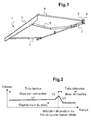
- the Figure 2 illustrates the variation of the motor rotation speed measured by the sensor, as a function of time, at different phases of the deployment of the blind.
- a progressive unfolding phase of the arms allows unrolling the awning with the stretched canvas thanks to the action of the springs integrated in each arm.
- V1 on the figure 2 where the arms are being opened and unlocked, the rotational speed of the measured motor is almost constant.
- the fabric remains taut and detected by means of the sensor a significant increase in the speed of rotation of the engine until the arrival of arm in their locking position.
- This phase of deployment referenced V2 on the figure 2 where the speed of rotation of the motor is in acceleration is brought about by kinematics of the arms during deployment. Indeed, at the end of deployment, when the fabric reaches its fully deployed position, for a short period of time, the force exerted by the arms just before reaching their locking position is much greater, which causes an increase significant speed of rotation of the engine. Then, when the arms reach their locking position, intervenes a third phase referenced V3 to the figure 2 , in which the motor is no longer driven, so that it slows down by loosening the relaxed fabric slightly, which results in a speed of rotation of the engine measured in deceleration, since the fabric no longer exerts stress on the winding tube and thus on the actuator. Thus, the fabric remains stretched to the locking position of the arms and is then relaxed if the motor continues to drive the tube in rotation.
- the position in which an increase in the speed of rotation of the motor is detected, following an unfolding movement of the arms at the end of the deployment preceding the arrival of the arms in their locking position corresponds to the ideal position of end of race unrolled stretched.
- the determination of this stretched stretched end position is therefore based on the detection of the acceleration of the rotational speed of the motor during the deployment of the blind. It controls the automatic shutdown of the motor and therefore the locking of the winding tube as soon as the increase in the rotational speed of the motor is detected, so that the installation is stopped preventing the actuator from continuing the unwinding of the fabric, which therefore remains advantageously taut in its low end position.
- the determination of the stretched stretched end position is performed during an adjustment phase E0 of the installation.
- This adjustment phase is activated for example by the installer during a first adjustment phase, by means of the transmission of a command appropriate to the actuator, for example from a wired or wireless control point.
- the switchover in the adjustment phase triggers a step E01 of deployment of the blind from the wound end position (high limit switch) in which the rotation speed of the motor measured continuously by the sensor during the deployment is monitored.
- the arms arrive at the end of opening but are not blocked, that is to say that they have not yet reached their locking position.
- the actuator control unit detects an increase in the rotational speed of the motor measured by the sensor. To do this, the control unit evaluates the rate of change of the rotational speed of the motor during deployment, and detects when the rate of variation increases in a given period of time, relatively short.
- the control unit in a step E03, immediately commands the stopping of the motor, the blind then being considered to be, in accordance with the invention, in a position corresponding to the ideal position stretched stretched end position.
- the control unit stores the position of the blind when the deployment is stopped, for example via the position supplied by the counting device, the position thus stored corresponding to the end position Tensioned Stroke that will be used in subsequent cycles.
- the adjustment phase ends with a step E05 in which the control unit triggers the continuous folding of the blind (without stopping) to the wound end position.
- the control unit triggers the continuous folding of the blind (without stopping) to the wound end position.
- control unit in a step E11 controls the deployment of the blind, then, in a step E12, when the latter reaches the previously stored position in the adjustment phase, the control unit, in a step E13, controls the automatic stopping of the deployment in this memorized position, corresponding to the stretched stretched end position.
- the fabric may lengthen slightly, which may have the effect of creating a relaxed canvas effect in the end position of the fabric. unrolled race.
- the control unit is then provided to be able to automatically readjust the end of travel position unwound periodically or at each operating cycle by performing again the steps E01 to E04 of the adjustment phase, in a manner transparent to the user.
- the phase of adjustment can be performed again, but then excluding step E05 continuous folding of the blind to the wound limit position.
- the awning must deploy, detect the end of travel position unwound according to the principles described in steps E01 and E02, automatically stop the engine at this position and memorize this new position to replace the previous one.
- the blind must not then fold automatically according to step E05 of the adjustment phase, because it is not, in this case, the wish of the user.
Landscapes
- Engineering & Computer Science (AREA)
- Architecture (AREA)
- Civil Engineering (AREA)
- Structural Engineering (AREA)
- Building Awnings And Sunshades (AREA)
- Operating, Guiding And Securing Of Roll- Type Closing Members (AREA)
- Controlling Rewinding, Feeding, Winding, Or Abnormalities Of Webs (AREA)
- Moulding By Coating Moulds (AREA)
Abstract
Description
- La présente invention concerne le domaine des écrans mobiles motorisés, notamment de protection solaire, de type store et notamment store banne, ou équivalent, destinés à équiper des baies d'un bâtiment.
- Elle concerne plus particulièrement un procédé de commande d'une installation de store motorisée, l'installation comprenant un châssis supportant un tube d'enroulement apte à être entraîné en rotation par un actionneur comprenant un moteur tubulaire permettant à une toile de store d'être enroulée ou déroulée autour du tube par une première extrémité, la toile de store étant fixée par une seconde extrémité à une barre de charge disposée sensiblement parallèlement au tube d'enroulement et montée mobile par rapport au châssis entre des positions de fin de course respectivement enroulée et déroulée de la toile par l'intermédiaire de bras dépliables, le procédé comprenant, lors du déroulement de la toile, une étape de commande de l'actionneur propre à amener la toile dans une position de fin de course déroulée tendue.
- Lorsque le store est replié, toute la toile est enroulée, les bras sont repliés et la barre de charge vient en contact avec le châssis du store. Lors du déploiement, le moteur entraîne le tube d'enroulement en rotation et les bras de guidage se déplient progressivement jusqu'à une position de verrouillage des bras, correspondant à la position de fin de course déroulée de la toile, dans laquelle elle est tendue.
- D'une manière classique, l'actionneur tubulaire entraînant en rotation le tube d'enroulement afin de placer le store dans des positions de fin de course respectivement déroulée ou enroulée, est associé à un dispositif de fin de course permettant d'arrêter l'actionneur lorsque le store se trouve complètement déroulé ou enroulé. Un tel dispositif comporte généralement un dispositif de comptage des tours d'enroulement de la toile autour du tube d'enroulement pour permettre de déterminer les positions de fin de course. Ainsi, le dispositif de comptage associé à l'actionneur permet de connaître à tout moment la position courante de la barre de charge et, au cours d'une phase de réglage, on mémorise les deux positions de fin course enroulée et déroulée. Pour ce faire, l'utilisateur manoeuvre le store par petit pas dans les deux sens de rotation jusqu'à atteindre les positions de fin de course idéales souhaitées et les mémorise. Aux cycles de fonctionnement suivant, l'actionneur est commandé pour s'arrêter automatiquement sur les positions de fin de course ainsi mémorisées. Une contrainte particulière pèse sur la détermination de la position de fin de course déroulée du store, qui doit être réglée précisément afin de garantir une tension de toile déroulée optimale. En effet, il est nécessaire dans cette position complètement déployée du store que la toile soit bien tendue, à la fois pour des raisons esthétiques et techniques (absence d'accumulation d'eau en cas de pluie, maintien plus rigide et donc résistance au vent, etc.). Or, il apparaît qu'une telle précision est difficile à obtenir compte tenu des variations de longueur de la toile constatées dans le temps. Ainsi, au cours de l'utilisation du store, la toile peut s'allonger légèrement, ce qui aura pour effet de provoquer un effet de toile détendue en position de fin de course déroulée.
- On connaît déjà des dispositifs de commande d'installation de store motorisée permettant de placer de façon sûre le store dans une position toile tendue en fin de course de déroulement.
- Ainsi, le document
FR 2 899 923 - Le document
FR 2 816 465 - Aussi, un but de l'invention est de fournir un procédé de commande d'une installation de store motorisée permettant de placer, de manière simple et reproductible, la toile dans une position tendue en fin de course de déroulement.
- A cette fin, l'invention concerne un procédé de commande d'une installation de store motorisée, l'installation comprenant un châssis supportant un tube d'enroulement apte à être entraîné en rotation par un actionneur comprenant un moteur d'entraînement tubulaire permettant à une toile de store d'être enroulée ou déroulée autour du tube par une première extrémité, la toile de store étant fixée par une seconde extrémité à une barre de charge disposée sensiblement parallèlement au tube d'enroulement et montée mobile par rapport au châssis entre des positions de fin de course respectivement enroulée et déroulée de la toile par l'intermédiaire de bras dépliables, le procédé comprenant, lors du déploiement de la toile, une étape de commande de l'actionneur propre à amener la toile dans une position de fin de course déroulée tendue, le procédé étant caractérisé en ce qu'il comprend une phase de réglage comprenant :
- lors du déploiement de la toile, une étape de surveillance de la vitesse de rotation du moteur ou du couple moteur,
- une étape de détection d'une augmentation de la vitesse de rotation du moteur ou du couple moteur, consécutive à un mouvement de dépliement des bras en fin de déploiement précédant l'arrivée des bras dans une position de verrouillage des bras, l'arrêt du déploiement étant déclenché automatiquement en réponse à la détection de l'augmentation de vitesse de rotation du moteur ou du couple moteur ;
- une étape de mémorisation de la position du store lors de l'arrêt du déploiement, la position mémorisée correspondant à la position de fin de course déroulée tendue ;
- une étape de repliement continu du store jusqu'à la position de fin de course enroulée ;
- lors du déploiement de la toile, une étape d'arrêt automatique du déploiement à la position mémorisée lors de la phase de réglage.
- Avantageusement, la phase de réglage est réitérée périodiquement.
- De préférence, la phase de réglage, excluant l'étape de repliement continu du store jusqu'à la position de fin de course enroulée, est réitérée périodiquement ou à chaque cycle de fonctionnement.
- Avantageusement, lors de la phase de réglage, la surveillance de la vitesse de rotation du moteur ou du couple moteur consiste à mesurer en continu la vitesse de rotation du moteur ou le couple moteur et à évaluer une vitesse de variation de la vitesse de rotation du moteur ou du couple moteur, l'arrêt automatique du déploiement du store en réponse à la détection de l'augmentation de vitesse de rotation du moteur ou du couple moteur étant déclenché lorsque ladite vitesse de variation croît dans un intervalle de temps donné.
- L'invention concerne également une installation de store motorisée comprenant un châssis supportant un tube d'enroulement apte à être entraîné en rotation par un actionneur comprenant un moteur d'entraînement tubulaire permettant à une toile de store d'être enroulée ou déroulée autour du tube par une première extrémité, la toile de store étant fixée par une seconde extrémité à une barre de charge disposée sensiblement parallèlement au tube d'enroulement et montée mobile par rapport au châssis entre des positions de fin de course respectivement enroulée et déroulée de la toile par l'intermédiaire de bras dépliables, ladite installation étant caractérisée en ce qu'elle comprend un capteur de vitesse ou de couple destiné à mesurer la vitesse de rotation du moteur ou le couple moteur et une unité de commande adaptée pour commander l'actionneur et pour mettre en oeuvre le procédé de commande selon l'invention.
- D'autres caractéristiques et avantages de l'invention ressortiront clairement de la description qui en est faite ci-après, à titre indicatif et nullement limitatif, en référence aux dessins annexés, dans lesquels:
- la
Figure 1 est une illustration schématique d'une installation de store motorisée ; - la
Figure 2 est un chronogramme représentant, en fonction du temps, l'évolution de la vitesse de rotation du moteur de lafigure 1 lors d'un déploiement total de la toile de store, suivant différentes phase du déploiement ; - la
Figure 3 est un organigramme d'un mode d'exécution du procédé de commande selon l'invention. - En référence à la
figure 1 , une installation de store motorisée 1 conforme à l'invention est une installation de type « store banne », utilisé typiquement comme protection solaire des terrasses. Sur un châssis 2, destiné à être fixé sur une structure telle qu'une façade d'un bâtiment, est fixé un tube d'enroulement 3 sur lequel est destiné à venir s'enrouler une toile 4 par une de ses extrémités. L'autre extrémité de la toile 4 est fixée à une barre de charge 5, retenue au châssis 2 par au moins deux bras dépliables 6, 7 permettant de guider la barre de charge 5 et assurant la tension de la toile 4, lors des opérations de déroulement et d'enroulement de la toile. Les bras 6, 7 sont fixés d'une part, au châssis et, d'autre part, à la barre de charge et présentent au moins un coude articulée leur permettant de se plier ou de se déplier pour accompagner un mouvement de repli ou de déploiement de la toile. Les bras sont munis, généralement au niveau du coude d'un ressort (non représenté) sollicité lors de l'enroulement de la toile. - Un actionneur comprenant un moteur tubulaire 8 est monté à l'intérieur du tube d'enroulement 3. Cet actionneur est apte à entraîner le tube 3 en rotation dans un premier sens et, en alternance, dans un deuxième sens opposé, de manière à permettre d'enrouler ou de dérouler la toile 4. Conformément à l'invention, l'actionneur comprend également un capteur de vitesse apte à mesure la vitesse de rotation du moteur. Comme on le verra plus en détail par la suite, se sont les variations de cette grandeur qui permettront de commander l'installation 1 lors d'une phase de réglage de cette dernière visant à déterminer la position de fin de course déroulée de la toile. Toutefois, le moteur étant entraîné en conséquence de l'effort exercé par les bras, on pourra utiliser de manière équivalente une mesure du couple perçu par le moteur pendant la phase de déploiement. Aussi, un capteur permettant de mesurer le couple moteur pendant le déploiement pourra être utilisé tout en restant dans le cadre de l'invention.
- Enfin, l'actionneur est piloté par l'intermédiaire d'une unité de commande apte à exécuter le procédé de commande qui sera décrit en référence à la
figure 3 . Cette unité de commande est typiquement constituée d'un calculateur programmable associé à un support d'enregistrement d'informations contenant des instructions pour l'exécution du procédé. - Lorsque le store est replié, toute la toile 4 est enroulée autour du tube d'enroulement 3, les bras 6, 7 sont repliés et la barre de charge 5 vient en contact avec le coffre ou le support de store (non représenté).
- Classiquement, lors du déploiement, le moteur tubulaire 8 entraîne le tube 3 en rotation de manière à dérouler la toile 4. Les bras 6, 7 se déplient alors progressivement jusqu'à leur longueur maximum correspondant à une position de verrouillage des bras, dans laquelle les bras sont arc-boutés, permettant un bon maintien de la tension de toile. Dans les installations existantes, cette position correspond également à la position de fin de course déroulée, soit à la position complètement déployée, également connue sous les termes de « position de fin de course basse ».
- La
Figure 2 illustre la variation de la vitesse de rotation du moteur mesurée par le capteur, en fonction du temps, à différentes phases du déploiement du store. Ainsi, lors du déploiement du store, depuis la position de fin de course enroulée, une phase de dépliement progressif des bras permet de dérouler le store avec la toile tendue grâce à l'action des ressorts intégrés dans chaque bras. Dans cette phase, référencée V1 sur lafigure 2 , où les bras sont en cours d'ouverture et non verrouillés, la vitesse de rotation du moteur mesurée est quasiment constante. Puis, lorsque les bras arrivent en fin de dépliement mais avant d'atteindre leur position de verrouillage, la toile reste tendue et on détecte par l'intermédiaire du capteur une augmentation significative de la vitesse de rotation du moteur jusqu'à l'arrivée des bras dans leur position de verrouillage. Cette phase du déploiement référencée V2 sur lafigure 2 où la vitesse de rotation du moteur est en accélération est provoquée par la cinématique des bras lors du déploiement. En effet, en fin de déploiement, lorsque la toile atteint sa position complètement déployée, pendant un court intervalle de temps, l'effort exercé par les bras juste avant d'atteindre leur position de verrouillage est beaucoup plus important, ce qui entraîne une augmentation significative de la vitesse de rotation du moteur. Puis, lorsque les bras atteignent leur position de verrouillage, intervient une troisième phase référencée V3 à lafigure 2 , dans laquelle le moteur n'est plus entraîné, de sorte qu'il ralentit en déroulant légèrement la toile détendue, ce qui se traduit par une vitesse de rotation du moteur mesurée en décélération, dans la mesure où la toile n'exerce plus de contrainte sur le tube d'enroulement et donc sur l'actionneur. Ainsi, la toile reste tendue jusqu'à la position de verrouillage des bras et elle est ensuite détendue si le moteur continue d'entraîner le tube en rotation. - Aussi, conformément à l'invention, la position dans laquelle on détecte une augmentation de la vitesse de rotation du moteur, consécutive à un mouvement de dépliement des bras en fin de déploiement précédant l'arrivée des bras dans leur position de verrouillage, correspond à la position idéale de fin de course déroulée tendue. La détermination de cette position de fin de course déroulée tendue (fin de course basse) est donc basée sur la détection de l'accélération de la vitesse de rotation du moteur lors du déploiement du store. On commande l'arrêt automatique du moteur et donc le blocage du tube d'enroulement dès que l'augmentation de la vitesse de rotation du moteur est détectée, de sorte que l'installation est à l'arrêt empêchant que l'actionneur ne poursuive le déroulement de la toile, qui reste donc avantageusement tendue dans sa position de fin de course basse.
- Partant de ce principe, un mode d'exécution du procédé va maintenant être décrit en référence à l'organigramme de la
figure 3 . La détermination de la position de fin de course déroulée tendue est effectuée lors d'une phase de réglage E0 de l'installation. Cette phase de réglage est activée par exemple par l'installateur lors d'une première phase de réglage, au moyen de la transmission d'une commande appropriée à l'actionneur, par exemple à partir d'un point de commande filaire ou sans fil. Lorsque l'entrée dans la phase de réglage est activée, les étapes suivantes sont mises en oeuvre. Le basculement dans la phase de réglage déclenche une étape E01 de déploiement du store depuis la position de fin de course enroulée (fin de course haute) dans laquelle on surveille la vitesse de rotation du moteur mesurée en continu par le capteur lors du déploiement. - Lors d'une étape E02, les bras arrivent en fin d'ouverture mais ne sont pas bloqués, c'est-à-dire qu'ils n'ont pas encore atteint leur position de verrouillage. Peu avant l'arrivée des bras dans leur position de verrouillage, l'unité de commande de l'actionneur détecte une augmentation de la vitesse de rotation du moteur mesurée par le capteur. Pour ce faire, l'unité de commande évalue la vitesse de variation de la vitesse de rotation du moteur au cours du déploiement, et détecte lorsque la vitesse de variation croît dans un intervalle de temps donné, relativement court.
- En réponse à la détection de l'augmentation de la vitesse de rotation du moteur en fin de déploiement, l'unité de commande, dans une étape E03, commande immédiatement l'arrêt du moteur, le store étant alors considéré être, conformément à l'invention, dans une position correspondant à la position idéale de fin de course déroulée tendue. Suite à cet arrêt, dans une étape E04, l'unité de commande mémorise la position du store lors de l'arrêt du déploiement, par exemple via la position fournie par le dispositif de comptage, la position ainsi mémorisée correspondant à la position de fin de course déroulée tendue qui sera utilisée lors des cycles de fonctionnement suivants.
- Puis, la phase de réglage se termine par une étape E05 dans laquelle l'unité de commande déclenche le repliement continu du store (sans arrêt) jusqu'à la position de fin de course enroulée. On sort de la phase de réglage et le store est alors opérationnel pour les cycles de fonctionnement suivants, dans lesquels les étapes E1 à E13 sont exécutées.
- Ainsi, lorsqu'on bascule dans un cycle de fonctionnement normal du store (étape E1), l'unité de commande, dans une étape E11 commande le déploiement du store, puis, dans une étape E12, lorsque ce dernier atteint la position mémorisée précédemment dans la phase de réglage, l'unité de commande, dans une étape E13, commande l'arrêt automatique du déploiement dans cette position mémorisée, correspondant à la position de fin de course déroulée tendue.
- Au cours de l'utilisation du store, la toile peut s'allonger légèrement, ce qui peut avoir pour effet de créer un effet de toile détendue en position de fin de course déroulée. L'unité de commande est alors prévue pour pourvoir réajuster automatiquement la position de fin de course déroulée périodiquement ou à chaque cycle de fonctionnement en exécutant à nouveau les étapes E01 à E04 de la phase de réglage, de façon transparente pour l'utilisateur. Autrement dit, dans les cas où la détection de position de fin de course déroulée a lieu périodiquement ou à chaque cycle de fonctionnement, c'est-à-dire lors d'une commande de déploiement du store par l'utilisateur, la phase de réglage peut être exécutée à nouveau, mais en excluant alors l'étape E05 de repliement continu du store jusqu'à la position de fin de course enroulée. En effet, le store doit se déployer, détecter la position de fin de course déroulée suivant les principes décrits aux étapes E01 et E02, arrêter automatiquement le moteur à cette position et mémoriser cette nouvelle position en remplacement de la précédente. Le store ne doit pas alors se replier automatiquement suivant l'étape E05 de la phase réglage, car ce n'est pas, dans ce cas de figure, le souhait de l'utilisateur.
Claims (5)
- Procédé de commande d'une installation de store motorisée (1), l'installation comprenant un châssis (2) supportant un tube d'enroulement (3) apte à être entraîné en rotation par un actionneur comprenant un moteur d'entraînement tubulaire (8) permettant à une toile de store (4) d'être enroulée ou déroulée autour du tube par une première extrémité, la toile de store (4) étant fixée par une seconde extrémité à une barre de charge (5) disposée sensiblement parallèlement au tube d'enroulement (3) et montée mobile par rapport au châssis (2) entre des positions de fin de course respectivement enroulée et déroulée de la toile par l'intermédiaire de bras dépliables (6, 7), le procédé comprenant, lors du déploiement de la toile, une étape de commande de l'actionneur propre à amener la toile dans une position de fin de course déroulée tendue, le procédé étant caractérisé en ce qu'il comprend une phase de réglage (E0) comprenant :- lors du déploiement de la toile, une étape (E01) de surveillance de la vitesse de rotation du moteur ou du couple moteur,- une étape (E02) de détection d'une augmentation de la vitesse de rotation du moteur ou du couple moteur, consécutive à un mouvement de dépliement des bras en fin de déploiement précédant l'arrivée des bras dans une position de verrouillage des bras, l'arrêt du déploiement étant déclenché automatiquement (E03) en réponse à la détection de l'augmentation de vitesse de rotation du moteur ou du couple moteur ;- une étape (E04) de mémorisation de la position du store lors de l'arrêt du déploiement, la position mémorisée correspondant à la position de fin de course déroulée tendue ;- une étape (E05) de repliement continu du store jusqu'à la position de fin de course enroulée ;le procédé comprenant lors de cycle de fonctionnement suivants :- lors du déploiement de la toile, une étape (E13) d'arrêt automatique du déploiement à la position mémorisée lors de la phase de réglage.
- Procédé selon la revendication 1, caractérisé en ce que la phase de réglage (E0) est réitérée périodiquement.
- Procédé selon la revendication 1 ou 2, caractérisé en ce que la phase de réglage (E0), excluant l'étape (E05) de repliement continu du store jusqu'à la position de fin de course enroulée, est réitérée périodiquement ou à chaque cycle de fonctionnement.
- Procédé selon l'une quelconque des revendications précédentes, caractérisé en ce que lors de la phase de réglage, la surveillance de la vitesse de rotation du moteur ou du couple moteur consiste à mesurer en continu la vitesse de rotation du moteur ou le couple moteur et à évaluer une vitesse de variation de la vitesse de rotation du moteur ou du couple moteur, l'arrêt automatique du déploiement du store en réponse à la détection de l'augmentation de vitesse de rotation du moteur ou du couple moteur étant déclenché lorsque ladite vitesse de variation croît dans un intervalle de temps donné.
- installation de store motorisée (1) comprenant un châssis (2) supportant un tube d'enroulement (3) apte à être entraîné en rotation par un actionneur comprenant un moteur d'entraînement tubulaire (8) permettant à une toile de store (4) d'être enroulée ou déroulée autour du tube par une première extrémité, la toile de store étant fixée par une seconde extrémité à une barre de charge (5) disposée sensiblement parallèlement au tube d'enroulement et montée mobile par rapport au châssis entre des positions de fin de course respectivement enroulée et déroulée de la toile par l'intermédiaire de bras dépliables (6, 7), ladite installation étant caractérisée en ce qu'elle comprend un capteur de vitesse ou de couple destiné à mesurer la vitesse de rotation du moteur ou le couple moteur et une unité de commande adaptée pour commander l'actionneur et pour mettre en oeuvre le procédé de commande selon l'une quelconque des revendications précédentes.
Applications Claiming Priority (1)
| Application Number | Priority Date | Filing Date | Title |
|---|---|---|---|
| FR1557548A FR3039846B1 (fr) | 2015-08-05 | 2015-08-05 | Procede de commande d'une installation de store motorisee |
Publications (2)
| Publication Number | Publication Date |
|---|---|
| EP3128100A1 true EP3128100A1 (fr) | 2017-02-08 |
| EP3128100B1 EP3128100B1 (fr) | 2020-06-24 |
Family
ID=54608731
Family Applications (1)
| Application Number | Title | Priority Date | Filing Date |
|---|---|---|---|
| EP16182407.3A Active EP3128100B1 (fr) | 2015-08-05 | 2016-08-02 | Procédé de commande d'une installation de store motorisée |
Country Status (2)
| Country | Link |
|---|---|
| EP (1) | EP3128100B1 (fr) |
| FR (1) | FR3039846B1 (fr) |
Cited By (1)
| Publication number | Priority date | Publication date | Assignee | Title |
|---|---|---|---|---|
| CN109006060A (zh) * | 2018-10-10 | 2018-12-18 | 云南涵乾农业科技有限公司 | 一种滴灌施肥智能控制光伏大棚 |
Families Citing this family (1)
| Publication number | Priority date | Publication date | Assignee | Title |
|---|---|---|---|---|
| FR3169931A1 (fr) * | 2024-12-18 | 2026-06-19 | Somfy Activites Sa | Procédé de commande en fonctionnement d’un actionneur électromécanique pour un dispositif d’occultation, actionneur électromécanique et dispositif d’occultation associés |
Citations (4)
| Publication number | Priority date | Publication date | Assignee | Title |
|---|---|---|---|---|
| EP0770757A2 (fr) * | 1995-10-28 | 1997-05-02 | Elero Antriebs- und Sonnenschutztechnik GmbH | Méthode pour actionner des vélums ou des choses pareilles par moteur électrique |
| FR2816465A1 (fr) | 2000-11-06 | 2002-05-10 | Fial | Dispositif pour arreter un moteur d'entrainement d'un tube d'enroulement d'un store, en fonction d'une mesure du couple exerce sur ledit moteur |
| FR2899923A1 (fr) | 2006-04-14 | 2007-10-19 | Somfy Sas | Procede de commande et installation de store commandee par ce procede |
| EP2186989A2 (fr) * | 2008-11-18 | 2010-05-19 | GERHARD GEIGER GMBH & CO. | Commande de moteur |
-
2015
- 2015-08-05 FR FR1557548A patent/FR3039846B1/fr active Active
-
2016
- 2016-08-02 EP EP16182407.3A patent/EP3128100B1/fr active Active
Patent Citations (4)
| Publication number | Priority date | Publication date | Assignee | Title |
|---|---|---|---|---|
| EP0770757A2 (fr) * | 1995-10-28 | 1997-05-02 | Elero Antriebs- und Sonnenschutztechnik GmbH | Méthode pour actionner des vélums ou des choses pareilles par moteur électrique |
| FR2816465A1 (fr) | 2000-11-06 | 2002-05-10 | Fial | Dispositif pour arreter un moteur d'entrainement d'un tube d'enroulement d'un store, en fonction d'une mesure du couple exerce sur ledit moteur |
| FR2899923A1 (fr) | 2006-04-14 | 2007-10-19 | Somfy Sas | Procede de commande et installation de store commandee par ce procede |
| EP2186989A2 (fr) * | 2008-11-18 | 2010-05-19 | GERHARD GEIGER GMBH & CO. | Commande de moteur |
Cited By (1)
| Publication number | Priority date | Publication date | Assignee | Title |
|---|---|---|---|---|
| CN109006060A (zh) * | 2018-10-10 | 2018-12-18 | 云南涵乾农业科技有限公司 | 一种滴灌施肥智能控制光伏大棚 |
Also Published As
| Publication number | Publication date |
|---|---|
| FR3039846B1 (fr) | 2025-10-31 |
| FR3039846A1 (fr) | 2017-02-10 |
| EP3128100B1 (fr) | 2020-06-24 |
Similar Documents
| Publication | Publication Date | Title |
|---|---|---|
| EP2075401B1 (fr) | Procédé de réglage d'une installation de protection solaire motorisée ne comprenant pas de butée franche | |
| EP3433446B1 (fr) | Procédés de configuration et de commande en fonctionnement d'un dispositif d'entraînement motorisé d'une installation domotique, dispositif d'entraînement motorisé et installation associés | |
| EP1845217B1 (fr) | Procédé de commande et installation de store commandée par ce procédé | |
| FR3024177A1 (fr) | Procede de commande en fonctionnement d'un dispositif d'entrainement motorise d'une installation domotique de fermeture ou de protection solaire et dispositif associe | |
| EP1650625A1 (fr) | Procédé de fonctionnement d'un écran motorisé et écran motorisé pour sa mise en oeuvre | |
| WO2016177736A1 (fr) | Procédés de configuration et de commande en fonctionnement d'un dispositif d'entraînement motorisé d'une installation domotique, dispositif d'entraînement motorisé et installation associés | |
| EP3128100B1 (fr) | Procédé de commande d'une installation de store motorisée | |
| FR2946812A3 (fr) | Procede de fonctionnement d'un systeme de commande d'un moteur electrique d'un actionneur de store | |
| EP3470616B1 (fr) | Procede de reglage d'une installation de volet roulant munie d'un verrou et installation de volet roulant | |
| EP3303752B1 (fr) | Procédé de configuration d'un dispositif d'entraînement motorisé d'une installation domotique, dispositif d'entraînement motorisé et installation associés | |
| EP4367357B1 (fr) | Procede de reglage d'une installation d'element enroulable motorise et installation d'element enroulable motorise mettant en oeuvre ledit procede | |
| FR2923508A1 (fr) | Procede de fonctionnement d'un actionneur electromecanique pour store a bras | |
| EP2808479B1 (fr) | Procédé et dispositif d'actionnement d'un élément mobile de fermeture, d'occultation, de protection solaire ou d'écran | |
| EP3470617B1 (fr) | Procede de commande automatisee d'une installation de volet roulant et installation d'ecran motorise | |
| EP1530284B1 (fr) | Procédé et dispositif de régulation de la vitesse de rotation d'un moteur de volet roulant | |
| BE1009697A3 (fr) | Dispositif comprenant un element enroulable mobile entre deux positions extremes pour l'une au moins desquelles une fin de course provoque l'arret d'un moteur, application aux stores. | |
| FR3035234B1 (fr) | Procede de commande en fonctionnement d'une installation domotique de fermeture ou de protection solaire et installation domotique associee | |
| EP2166192B1 (fr) | Procédé d'actionnement d'un dispositif de fermeture et d'ouverture d'un ouvrant | |
| FR2898994A1 (fr) | Procede de commande d'un volet roulant evitant l'application d'un effort trop important sur un obstacle | |
| FR3019851A1 (fr) | Brise-soleil a lames orientables a blocage automatique en deploiement | |
| FR3072410A1 (fr) | Procede de reglage automatise d'une installation de volet roulant munie d'un mecanisme de blocage | |
| EP2005270A2 (fr) | Procede d'initialisation d'un volet roulant motorise |
Legal Events
| Date | Code | Title | Description |
|---|---|---|---|
| PUAI | Public reference made under article 153(3) epc to a published international application that has entered the european phase |
Free format text: ORIGINAL CODE: 0009012 |
|
| STAA | Information on the status of an ep patent application or granted ep patent |
Free format text: STATUS: THE APPLICATION HAS BEEN PUBLISHED |
|
| AK | Designated contracting states |
Kind code of ref document: A1 Designated state(s): AL AT BE BG CH CY CZ DE DK EE ES FI FR GB GR HR HU IE IS IT LI LT LU LV MC MK MT NL NO PL PT RO RS SE SI SK SM TR |
|
| AX | Request for extension of the european patent |
Extension state: BA ME |
|
| STAA | Information on the status of an ep patent application or granted ep patent |
Free format text: STATUS: REQUEST FOR EXAMINATION WAS MADE |
|
| 17P | Request for examination filed |
Effective date: 20170808 |
|
| RBV | Designated contracting states (corrected) |
Designated state(s): AL AT BE BG CH CY CZ DE DK EE ES FI FR GB GR HR HU IE IS IT LI LT LU LV MC MK MT NL NO PL PT RO RS SE SI SK SM TR |
|
| GRAP | Despatch of communication of intention to grant a patent |
Free format text: ORIGINAL CODE: EPIDOSNIGR1 |
|
| STAA | Information on the status of an ep patent application or granted ep patent |
Free format text: STATUS: GRANT OF PATENT IS INTENDED |
|
| INTG | Intention to grant announced |
Effective date: 20200120 |
|
| GRAS | Grant fee paid |
Free format text: ORIGINAL CODE: EPIDOSNIGR3 |
|
| GRAA | (expected) grant |
Free format text: ORIGINAL CODE: 0009210 |
|
| STAA | Information on the status of an ep patent application or granted ep patent |
Free format text: STATUS: THE PATENT HAS BEEN GRANTED |
|
| AK | Designated contracting states |
Kind code of ref document: B1 Designated state(s): AL AT BE BG CH CY CZ DE DK EE ES FI FR GB GR HR HU IE IS IT LI LT LU LV MC MK MT NL NO PL PT RO RS SE SI SK SM TR |
|
| REG | Reference to a national code |
Ref country code: GB Ref legal event code: FG4D Free format text: NOT ENGLISH |
|
| REG | Reference to a national code |
Ref country code: CH Ref legal event code: EP |
|
| REG | Reference to a national code |
Ref country code: DE Ref legal event code: R096 Ref document number: 602016038592 Country of ref document: DE |
|
| REG | Reference to a national code |
Ref country code: AT Ref legal event code: REF Ref document number: 1284039 Country of ref document: AT Kind code of ref document: T Effective date: 20200715 |
|
| REG | Reference to a national code |
Ref country code: IE Ref legal event code: FG4D Free format text: LANGUAGE OF EP DOCUMENT: FRENCH |
|
| PG25 | Lapsed in a contracting state [announced via postgrant information from national office to epo] |
Ref country code: SE Free format text: LAPSE BECAUSE OF FAILURE TO SUBMIT A TRANSLATION OF THE DESCRIPTION OR TO PAY THE FEE WITHIN THE PRESCRIBED TIME-LIMIT Effective date: 20200624 Ref country code: NO Free format text: LAPSE BECAUSE OF FAILURE TO SUBMIT A TRANSLATION OF THE DESCRIPTION OR TO PAY THE FEE WITHIN THE PRESCRIBED TIME-LIMIT Effective date: 20200924 Ref country code: LT Free format text: LAPSE BECAUSE OF FAILURE TO SUBMIT A TRANSLATION OF THE DESCRIPTION OR TO PAY THE FEE WITHIN THE PRESCRIBED TIME-LIMIT Effective date: 20200624 Ref country code: GR Free format text: LAPSE BECAUSE OF FAILURE TO SUBMIT A TRANSLATION OF THE DESCRIPTION OR TO PAY THE FEE WITHIN THE PRESCRIBED TIME-LIMIT Effective date: 20200925 Ref country code: FI Free format text: LAPSE BECAUSE OF FAILURE TO SUBMIT A TRANSLATION OF THE DESCRIPTION OR TO PAY THE FEE WITHIN THE PRESCRIBED TIME-LIMIT Effective date: 20200624 |
|
| REG | Reference to a national code |
Ref country code: LT Ref legal event code: MG4D |
|
| PG25 | Lapsed in a contracting state [announced via postgrant information from national office to epo] |
Ref country code: BG Free format text: LAPSE BECAUSE OF FAILURE TO SUBMIT A TRANSLATION OF THE DESCRIPTION OR TO PAY THE FEE WITHIN THE PRESCRIBED TIME-LIMIT Effective date: 20200924 Ref country code: LV Free format text: LAPSE BECAUSE OF FAILURE TO SUBMIT A TRANSLATION OF THE DESCRIPTION OR TO PAY THE FEE WITHIN THE PRESCRIBED TIME-LIMIT Effective date: 20200624 Ref country code: HR Free format text: LAPSE BECAUSE OF FAILURE TO SUBMIT A TRANSLATION OF THE DESCRIPTION OR TO PAY THE FEE WITHIN THE PRESCRIBED TIME-LIMIT Effective date: 20200624 Ref country code: RS Free format text: LAPSE BECAUSE OF FAILURE TO SUBMIT A TRANSLATION OF THE DESCRIPTION OR TO PAY THE FEE WITHIN THE PRESCRIBED TIME-LIMIT Effective date: 20200624 |
|
| REG | Reference to a national code |
Ref country code: NL Ref legal event code: MP Effective date: 20200624 |
|
| REG | Reference to a national code |
Ref country code: AT Ref legal event code: MK05 Ref document number: 1284039 Country of ref document: AT Kind code of ref document: T Effective date: 20200624 |
|
| PG25 | Lapsed in a contracting state [announced via postgrant information from national office to epo] |
Ref country code: NL Free format text: LAPSE BECAUSE OF FAILURE TO SUBMIT A TRANSLATION OF THE DESCRIPTION OR TO PAY THE FEE WITHIN THE PRESCRIBED TIME-LIMIT Effective date: 20200624 Ref country code: AL Free format text: LAPSE BECAUSE OF FAILURE TO SUBMIT A TRANSLATION OF THE DESCRIPTION OR TO PAY THE FEE WITHIN THE PRESCRIBED TIME-LIMIT Effective date: 20200624 |
|
| PG25 | Lapsed in a contracting state [announced via postgrant information from national office to epo] |
Ref country code: SM Free format text: LAPSE BECAUSE OF FAILURE TO SUBMIT A TRANSLATION OF THE DESCRIPTION OR TO PAY THE FEE WITHIN THE PRESCRIBED TIME-LIMIT Effective date: 20200624 Ref country code: EE Free format text: LAPSE BECAUSE OF FAILURE TO SUBMIT A TRANSLATION OF THE DESCRIPTION OR TO PAY THE FEE WITHIN THE PRESCRIBED TIME-LIMIT Effective date: 20200624 Ref country code: IT Free format text: LAPSE BECAUSE OF FAILURE TO SUBMIT A TRANSLATION OF THE DESCRIPTION OR TO PAY THE FEE WITHIN THE PRESCRIBED TIME-LIMIT Effective date: 20200624 Ref country code: PT Free format text: LAPSE BECAUSE OF FAILURE TO SUBMIT A TRANSLATION OF THE DESCRIPTION OR TO PAY THE FEE WITHIN THE PRESCRIBED TIME-LIMIT Effective date: 20201026 Ref country code: RO Free format text: LAPSE BECAUSE OF FAILURE TO SUBMIT A TRANSLATION OF THE DESCRIPTION OR TO PAY THE FEE WITHIN THE PRESCRIBED TIME-LIMIT Effective date: 20200624 Ref country code: AT Free format text: LAPSE BECAUSE OF FAILURE TO SUBMIT A TRANSLATION OF THE DESCRIPTION OR TO PAY THE FEE WITHIN THE PRESCRIBED TIME-LIMIT Effective date: 20200624 Ref country code: ES Free format text: LAPSE BECAUSE OF FAILURE TO SUBMIT A TRANSLATION OF THE DESCRIPTION OR TO PAY THE FEE WITHIN THE PRESCRIBED TIME-LIMIT Effective date: 20200624 Ref country code: CZ Free format text: LAPSE BECAUSE OF FAILURE TO SUBMIT A TRANSLATION OF THE DESCRIPTION OR TO PAY THE FEE WITHIN THE PRESCRIBED TIME-LIMIT Effective date: 20200624 |
|
| PG25 | Lapsed in a contracting state [announced via postgrant information from national office to epo] |
Ref country code: PL Free format text: LAPSE BECAUSE OF FAILURE TO SUBMIT A TRANSLATION OF THE DESCRIPTION OR TO PAY THE FEE WITHIN THE PRESCRIBED TIME-LIMIT Effective date: 20200624 Ref country code: SK Free format text: LAPSE BECAUSE OF FAILURE TO SUBMIT A TRANSLATION OF THE DESCRIPTION OR TO PAY THE FEE WITHIN THE PRESCRIBED TIME-LIMIT Effective date: 20200624 Ref country code: IS Free format text: LAPSE BECAUSE OF FAILURE TO SUBMIT A TRANSLATION OF THE DESCRIPTION OR TO PAY THE FEE WITHIN THE PRESCRIBED TIME-LIMIT Effective date: 20201024 |
|
| REG | Reference to a national code |
Ref country code: DE Ref legal event code: R119 Ref document number: 602016038592 Country of ref document: DE |
|
| PG25 | Lapsed in a contracting state [announced via postgrant information from national office to epo] |
Ref country code: MC Free format text: LAPSE BECAUSE OF FAILURE TO SUBMIT A TRANSLATION OF THE DESCRIPTION OR TO PAY THE FEE WITHIN THE PRESCRIBED TIME-LIMIT Effective date: 20200624 |
|
| REG | Reference to a national code |
Ref country code: CH Ref legal event code: PL |
|
| PG25 | Lapsed in a contracting state [announced via postgrant information from national office to epo] |
Ref country code: CH Free format text: LAPSE BECAUSE OF NON-PAYMENT OF DUE FEES Effective date: 20200831 Ref country code: DK Free format text: LAPSE BECAUSE OF FAILURE TO SUBMIT A TRANSLATION OF THE DESCRIPTION OR TO PAY THE FEE WITHIN THE PRESCRIBED TIME-LIMIT Effective date: 20200624 Ref country code: LI Free format text: LAPSE BECAUSE OF NON-PAYMENT OF DUE FEES Effective date: 20200831 Ref country code: LU Free format text: LAPSE BECAUSE OF NON-PAYMENT OF DUE FEES Effective date: 20200802 |
|
| PLBE | No opposition filed within time limit |
Free format text: ORIGINAL CODE: 0009261 |
|
| STAA | Information on the status of an ep patent application or granted ep patent |
Free format text: STATUS: NO OPPOSITION FILED WITHIN TIME LIMIT |
|
| GBPC | Gb: european patent ceased through non-payment of renewal fee |
Effective date: 20200924 |
|
| REG | Reference to a national code |
Ref country code: BE Ref legal event code: MM Effective date: 20200831 |
|
| 26N | No opposition filed |
Effective date: 20210325 |
|
| PG25 | Lapsed in a contracting state [announced via postgrant information from national office to epo] |
Ref country code: DE Free format text: LAPSE BECAUSE OF NON-PAYMENT OF DUE FEES Effective date: 20210302 |
|
| PG25 | Lapsed in a contracting state [announced via postgrant information from national office to epo] |
Ref country code: SI Free format text: LAPSE BECAUSE OF FAILURE TO SUBMIT A TRANSLATION OF THE DESCRIPTION OR TO PAY THE FEE WITHIN THE PRESCRIBED TIME-LIMIT Effective date: 20200624 Ref country code: IE Free format text: LAPSE BECAUSE OF NON-PAYMENT OF DUE FEES Effective date: 20200802 Ref country code: GB Free format text: LAPSE BECAUSE OF NON-PAYMENT OF DUE FEES Effective date: 20200924 Ref country code: BE Free format text: LAPSE BECAUSE OF NON-PAYMENT OF DUE FEES Effective date: 20200831 |
|
| PG25 | Lapsed in a contracting state [announced via postgrant information from national office to epo] |
Ref country code: TR Free format text: LAPSE BECAUSE OF FAILURE TO SUBMIT A TRANSLATION OF THE DESCRIPTION OR TO PAY THE FEE WITHIN THE PRESCRIBED TIME-LIMIT Effective date: 20200624 Ref country code: MT Free format text: LAPSE BECAUSE OF FAILURE TO SUBMIT A TRANSLATION OF THE DESCRIPTION OR TO PAY THE FEE WITHIN THE PRESCRIBED TIME-LIMIT Effective date: 20200624 Ref country code: CY Free format text: LAPSE BECAUSE OF FAILURE TO SUBMIT A TRANSLATION OF THE DESCRIPTION OR TO PAY THE FEE WITHIN THE PRESCRIBED TIME-LIMIT Effective date: 20200624 |
|
| PG25 | Lapsed in a contracting state [announced via postgrant information from national office to epo] |
Ref country code: MK Free format text: LAPSE BECAUSE OF FAILURE TO SUBMIT A TRANSLATION OF THE DESCRIPTION OR TO PAY THE FEE WITHIN THE PRESCRIBED TIME-LIMIT Effective date: 20200624 |
|
| PGFP | Annual fee paid to national office [announced via postgrant information from national office to epo] |
Ref country code: FR Payment date: 20250729 Year of fee payment: 10 |