EP3130587B1 - Hydrophiles polymerderivat mit cyclischem benzyliden-acetal-linker - Google Patents
Hydrophiles polymerderivat mit cyclischem benzyliden-acetal-linker Download PDFInfo
- Publication number
- EP3130587B1 EP3130587B1 EP15772451.9A EP15772451A EP3130587B1 EP 3130587 B1 EP3130587 B1 EP 3130587B1 EP 15772451 A EP15772451 A EP 15772451A EP 3130587 B1 EP3130587 B1 EP 3130587B1
- Authority
- EP
- European Patent Office
- Prior art keywords
- group
- formula
- bond
- hydrophilic polymer
- atom
- Prior art date
- Legal status (The legal status is an assumption and is not a legal conclusion. Google has not performed a legal analysis and makes no representation as to the accuracy of the status listed.)
- Active
Links
- 0 **C1(*)*OC(*)(c2c(*)cccc2*)O*1 Chemical compound **C1(*)*OC(*)(c2c(*)cccc2*)O*1 0.000 description 9
- DTACWEXJFYOAKS-UHFFFAOYSA-N CC1OC(c(cc2)ccc2OC)OC1 Chemical compound CC1OC(c(cc2)ccc2OC)OC1 DTACWEXJFYOAKS-UHFFFAOYSA-N 0.000 description 1
- ZXLYYQUMYFHCLQ-UHFFFAOYSA-N CN(C(c1c2cccc1)=O)C2=O Chemical compound CN(C(c1c2cccc1)=O)C2=O ZXLYYQUMYFHCLQ-UHFFFAOYSA-N 0.000 description 1
Images


Classifications
-
- C—CHEMISTRY; METALLURGY
- C08—ORGANIC MACROMOLECULAR COMPOUNDS; THEIR PREPARATION OR CHEMICAL WORKING-UP; COMPOSITIONS BASED THEREON
- C08G—MACROMOLECULAR COMPOUNDS OBTAINED OTHERWISE THAN BY REACTIONS ONLY INVOLVING UNSATURATED CARBON-TO-CARBON BONDS
- C08G65/00—Macromolecular compounds obtained by reactions forming an ether link in the main chain of the macromolecule
- C08G65/02—Macromolecular compounds obtained by reactions forming an ether link in the main chain of the macromolecule from cyclic ethers by opening of the heterocyclic ring
- C08G65/32—Polymers modified by chemical after-treatment
- C08G65/329—Polymers modified by chemical after-treatment with organic compounds
- C08G65/333—Polymers modified by chemical after-treatment with organic compounds containing nitrogen
- C08G65/33396—Polymers modified by chemical after-treatment with organic compounds containing nitrogen having oxygen in addition to nitrogen
-
- C—CHEMISTRY; METALLURGY
- C07—ORGANIC CHEMISTRY
- C07D—HETEROCYCLIC COMPOUNDS
- C07D405/00—Heterocyclic compounds containing both one or more hetero rings having oxygen atoms as the only ring hetero atoms, and one or more rings having nitrogen as the only ring hetero atom
- C07D405/02—Heterocyclic compounds containing both one or more hetero rings having oxygen atoms as the only ring hetero atoms, and one or more rings having nitrogen as the only ring hetero atom containing two hetero rings
- C07D405/06—Heterocyclic compounds containing both one or more hetero rings having oxygen atoms as the only ring hetero atoms, and one or more rings having nitrogen as the only ring hetero atom containing two hetero rings linked by a carbon chain containing only aliphatic carbon atoms
-
- C—CHEMISTRY; METALLURGY
- C07—ORGANIC CHEMISTRY
- C07D—HETEROCYCLIC COMPOUNDS
- C07D317/00—Heterocyclic compounds containing five-membered rings having two oxygen atoms as the only ring hetero atoms
- C07D317/08—Heterocyclic compounds containing five-membered rings having two oxygen atoms as the only ring hetero atoms having the hetero atoms in positions 1 and 3
- C07D317/10—Heterocyclic compounds containing five-membered rings having two oxygen atoms as the only ring hetero atoms having the hetero atoms in positions 1 and 3 not condensed with other rings
- C07D317/14—Heterocyclic compounds containing five-membered rings having two oxygen atoms as the only ring hetero atoms having the hetero atoms in positions 1 and 3 not condensed with other rings with substituted hydrocarbon radicals attached to ring carbon atoms
- C07D317/18—Radicals substituted by singly bound oxygen or sulfur atoms
- C07D317/20—Free hydroxyl or mercaptan
-
- C—CHEMISTRY; METALLURGY
- C07—ORGANIC CHEMISTRY
- C07D—HETEROCYCLIC COMPOUNDS
- C07D317/00—Heterocyclic compounds containing five-membered rings having two oxygen atoms as the only ring hetero atoms
- C07D317/08—Heterocyclic compounds containing five-membered rings having two oxygen atoms as the only ring hetero atoms having the hetero atoms in positions 1 and 3
- C07D317/10—Heterocyclic compounds containing five-membered rings having two oxygen atoms as the only ring hetero atoms having the hetero atoms in positions 1 and 3 not condensed with other rings
- C07D317/14—Heterocyclic compounds containing five-membered rings having two oxygen atoms as the only ring hetero atoms having the hetero atoms in positions 1 and 3 not condensed with other rings with substituted hydrocarbon radicals attached to ring carbon atoms
- C07D317/18—Radicals substituted by singly bound oxygen or sulfur atoms
- C07D317/22—Radicals substituted by singly bound oxygen or sulfur atoms etherified
-
- C—CHEMISTRY; METALLURGY
- C07—ORGANIC CHEMISTRY
- C07D—HETEROCYCLIC COMPOUNDS
- C07D317/00—Heterocyclic compounds containing five-membered rings having two oxygen atoms as the only ring hetero atoms
- C07D317/08—Heterocyclic compounds containing five-membered rings having two oxygen atoms as the only ring hetero atoms having the hetero atoms in positions 1 and 3
- C07D317/10—Heterocyclic compounds containing five-membered rings having two oxygen atoms as the only ring hetero atoms having the hetero atoms in positions 1 and 3 not condensed with other rings
- C07D317/14—Heterocyclic compounds containing five-membered rings having two oxygen atoms as the only ring hetero atoms having the hetero atoms in positions 1 and 3 not condensed with other rings with substituted hydrocarbon radicals attached to ring carbon atoms
- C07D317/18—Radicals substituted by singly bound oxygen or sulfur atoms
- C07D317/24—Radicals substituted by singly bound oxygen or sulfur atoms esterified
-
- C—CHEMISTRY; METALLURGY
- C07—ORGANIC CHEMISTRY
- C07D—HETEROCYCLIC COMPOUNDS
- C07D317/00—Heterocyclic compounds containing five-membered rings having two oxygen atoms as the only ring hetero atoms
- C07D317/08—Heterocyclic compounds containing five-membered rings having two oxygen atoms as the only ring hetero atoms having the hetero atoms in positions 1 and 3
- C07D317/10—Heterocyclic compounds containing five-membered rings having two oxygen atoms as the only ring hetero atoms having the hetero atoms in positions 1 and 3 not condensed with other rings
- C07D317/14—Heterocyclic compounds containing five-membered rings having two oxygen atoms as the only ring hetero atoms having the hetero atoms in positions 1 and 3 not condensed with other rings with substituted hydrocarbon radicals attached to ring carbon atoms
- C07D317/28—Radicals substituted by nitrogen atoms
-
- C—CHEMISTRY; METALLURGY
- C08—ORGANIC MACROMOLECULAR COMPOUNDS; THEIR PREPARATION OR CHEMICAL WORKING-UP; COMPOSITIONS BASED THEREON
- C08G—MACROMOLECULAR COMPOUNDS OBTAINED OTHERWISE THAN BY REACTIONS ONLY INVOLVING UNSATURATED CARBON-TO-CARBON BONDS
- C08G65/00—Macromolecular compounds obtained by reactions forming an ether link in the main chain of the macromolecule
- C08G65/02—Macromolecular compounds obtained by reactions forming an ether link in the main chain of the macromolecule from cyclic ethers by opening of the heterocyclic ring
- C08G65/32—Polymers modified by chemical after-treatment
- C08G65/329—Polymers modified by chemical after-treatment with organic compounds
-
- C—CHEMISTRY; METALLURGY
- C08—ORGANIC MACROMOLECULAR COMPOUNDS; THEIR PREPARATION OR CHEMICAL WORKING-UP; COMPOSITIONS BASED THEREON
- C08G—MACROMOLECULAR COMPOUNDS OBTAINED OTHERWISE THAN BY REACTIONS ONLY INVOLVING UNSATURATED CARBON-TO-CARBON BONDS
- C08G65/00—Macromolecular compounds obtained by reactions forming an ether link in the main chain of the macromolecule
- C08G65/02—Macromolecular compounds obtained by reactions forming an ether link in the main chain of the macromolecule from cyclic ethers by opening of the heterocyclic ring
- C08G65/32—Polymers modified by chemical after-treatment
- C08G65/329—Polymers modified by chemical after-treatment with organic compounds
- C08G65/331—Polymers modified by chemical after-treatment with organic compounds containing oxygen
- C08G65/3311—Polymers modified by chemical after-treatment with organic compounds containing oxygen containing a hydroxy group
- C08G65/3314—Polymers modified by chemical after-treatment with organic compounds containing oxygen containing a hydroxy group cyclic
- C08G65/3315—Polymers modified by chemical after-treatment with organic compounds containing oxygen containing a hydroxy group cyclic aromatic
- C08G65/3317—Polymers modified by chemical after-treatment with organic compounds containing oxygen containing a hydroxy group cyclic aromatic phenolic
-
- C—CHEMISTRY; METALLURGY
- C08—ORGANIC MACROMOLECULAR COMPOUNDS; THEIR PREPARATION OR CHEMICAL WORKING-UP; COMPOSITIONS BASED THEREON
- C08G—MACROMOLECULAR COMPOUNDS OBTAINED OTHERWISE THAN BY REACTIONS ONLY INVOLVING UNSATURATED CARBON-TO-CARBON BONDS
- C08G65/00—Macromolecular compounds obtained by reactions forming an ether link in the main chain of the macromolecule
- C08G65/02—Macromolecular compounds obtained by reactions forming an ether link in the main chain of the macromolecule from cyclic ethers by opening of the heterocyclic ring
- C08G65/32—Polymers modified by chemical after-treatment
- C08G65/329—Polymers modified by chemical after-treatment with organic compounds
- C08G65/333—Polymers modified by chemical after-treatment with organic compounds containing nitrogen
-
- C—CHEMISTRY; METALLURGY
- C08—ORGANIC MACROMOLECULAR COMPOUNDS; THEIR PREPARATION OR CHEMICAL WORKING-UP; COMPOSITIONS BASED THEREON
- C08G—MACROMOLECULAR COMPOUNDS OBTAINED OTHERWISE THAN BY REACTIONS ONLY INVOLVING UNSATURATED CARBON-TO-CARBON BONDS
- C08G65/00—Macromolecular compounds obtained by reactions forming an ether link in the main chain of the macromolecule
- C08G65/02—Macromolecular compounds obtained by reactions forming an ether link in the main chain of the macromolecule from cyclic ethers by opening of the heterocyclic ring
- C08G65/32—Polymers modified by chemical after-treatment
- C08G65/329—Polymers modified by chemical after-treatment with organic compounds
- C08G65/333—Polymers modified by chemical after-treatment with organic compounds containing nitrogen
- C08G65/3332—Polymers modified by chemical after-treatment with organic compounds containing nitrogen containing carboxamide group
- C08G65/33324—Polymers modified by chemical after-treatment with organic compounds containing nitrogen containing carboxamide group acyclic
-
- C—CHEMISTRY; METALLURGY
- C08—ORGANIC MACROMOLECULAR COMPOUNDS; THEIR PREPARATION OR CHEMICAL WORKING-UP; COMPOSITIONS BASED THEREON
- C08G—MACROMOLECULAR COMPOUNDS OBTAINED OTHERWISE THAN BY REACTIONS ONLY INVOLVING UNSATURATED CARBON-TO-CARBON BONDS
- C08G65/00—Macromolecular compounds obtained by reactions forming an ether link in the main chain of the macromolecule
- C08G65/02—Macromolecular compounds obtained by reactions forming an ether link in the main chain of the macromolecule from cyclic ethers by opening of the heterocyclic ring
- C08G65/32—Polymers modified by chemical after-treatment
- C08G65/329—Polymers modified by chemical after-treatment with organic compounds
- C08G65/333—Polymers modified by chemical after-treatment with organic compounds containing nitrogen
- C08G65/33331—Polymers modified by chemical after-treatment with organic compounds containing nitrogen containing imide group
- C08G65/33337—Polymers modified by chemical after-treatment with organic compounds containing nitrogen containing imide group cyclic
-
- C—CHEMISTRY; METALLURGY
- C08—ORGANIC MACROMOLECULAR COMPOUNDS; THEIR PREPARATION OR CHEMICAL WORKING-UP; COMPOSITIONS BASED THEREON
- C08G—MACROMOLECULAR COMPOUNDS OBTAINED OTHERWISE THAN BY REACTIONS ONLY INVOLVING UNSATURATED CARBON-TO-CARBON BONDS
- C08G65/00—Macromolecular compounds obtained by reactions forming an ether link in the main chain of the macromolecule
- C08G65/02—Macromolecular compounds obtained by reactions forming an ether link in the main chain of the macromolecule from cyclic ethers by opening of the heterocyclic ring
- C08G65/32—Polymers modified by chemical after-treatment
- C08G65/329—Polymers modified by chemical after-treatment with organic compounds
- C08G65/333—Polymers modified by chemical after-treatment with organic compounds containing nitrogen
- C08G65/33331—Polymers modified by chemical after-treatment with organic compounds containing nitrogen containing imide group
- C08G65/33337—Polymers modified by chemical after-treatment with organic compounds containing nitrogen containing imide group cyclic
- C08G65/33341—Polymers modified by chemical after-treatment with organic compounds containing nitrogen containing imide group cyclic aromatic
-
- C—CHEMISTRY; METALLURGY
- C08—ORGANIC MACROMOLECULAR COMPOUNDS; THEIR PREPARATION OR CHEMICAL WORKING-UP; COMPOSITIONS BASED THEREON
- C08G—MACROMOLECULAR COMPOUNDS OBTAINED OTHERWISE THAN BY REACTIONS ONLY INVOLVING UNSATURATED CARBON-TO-CARBON BONDS
- C08G65/00—Macromolecular compounds obtained by reactions forming an ether link in the main chain of the macromolecule
- C08G65/02—Macromolecular compounds obtained by reactions forming an ether link in the main chain of the macromolecule from cyclic ethers by opening of the heterocyclic ring
- C08G65/32—Polymers modified by chemical after-treatment
- C08G65/329—Polymers modified by chemical after-treatment with organic compounds
- C08G65/334—Polymers modified by chemical after-treatment with organic compounds containing sulfur
- C08G65/3344—Polymers modified by chemical after-treatment with organic compounds containing sulfur containing oxygen in addition to sulfur
- C08G65/3346—Polymers modified by chemical after-treatment with organic compounds containing sulfur containing oxygen in addition to sulfur having sulfur bound to carbon and oxygen
-
- C—CHEMISTRY; METALLURGY
- C08—ORGANIC MACROMOLECULAR COMPOUNDS; THEIR PREPARATION OR CHEMICAL WORKING-UP; COMPOSITIONS BASED THEREON
- C08G—MACROMOLECULAR COMPOUNDS OBTAINED OTHERWISE THAN BY REACTIONS ONLY INVOLVING UNSATURATED CARBON-TO-CARBON BONDS
- C08G65/00—Macromolecular compounds obtained by reactions forming an ether link in the main chain of the macromolecule
- C08G65/02—Macromolecular compounds obtained by reactions forming an ether link in the main chain of the macromolecule from cyclic ethers by opening of the heterocyclic ring
- C08G65/32—Polymers modified by chemical after-treatment
- C08G65/329—Polymers modified by chemical after-treatment with organic compounds
- C08G65/337—Polymers modified by chemical after-treatment with organic compounds containing other elements
Definitions
- the present invention relates to a hydrophilic polymer derivative which has an acid-hydrolysable acetal linker and is used for chemical modification of a biofunctional molecule, for example, a physiologically active protein, a peptide, an antibody, a nucleic acid or a low molecular weight drug, or a drug carrier, for example, a liposome or a polymer micelle.
- a biofunctional molecule for example, a physiologically active protein, a peptide, an antibody, a nucleic acid or a low molecular weight drug, or a drug carrier, for example, a liposome or a polymer micelle.
- the chemical modification of biofunctional molecule or drug carrier with a hydrophilic polymer having low antigenicity is an effective technique for increasing water solubility and bioavailability of the drug or the like and for prolonging circulation time in blood.
- the formation of a hydrated layer by the hydrophilic polymer after the drug or the like connected to the hydrophilic polymer is transported to the tissue or site as a target decreases interaction with a cell membrane and inhibits in vivo/intracellular kinetics, for example, uptake into the cell or endosome escape.
- an approach to overcome the problem by detaching the hydrophilic polymer chain from the drug and the like at a suitable timing has been performed.
- Patent Document 1 a branched polyethylene glycol derivative in which two chains of polyethylene glycol which is a hydrophilic polymer having low antigenicity are connected through an acetal group derived from various aldehydes or ketones, and a synthetic method thereof are disclosed, but evaluation data of hydrolyzability is not described. Also, the synthetic method described therein is a method for obtaining a polyethylene glycol derivative having an acetal linker by reacting an excess amount of polyethylene glycol with various aldehydes or ketones, so that a large amount of the unreacted polyethylene glycol remains after the reaction.
- an impurity in which the terminal of the unreacted polyethylene glycol has also been activated is by-produced.
- the activated polyethylene glycol containing such an impurity is used for drug modification, a drug modified with the polyethylene glycol containing no acetal linker is formed as a result, so that a large influence is exerted on the in vivo kinetics and physical properties of the drug. Therefore, it is necessary to remove the polyethylene glycol impurity before the reaction with the drug, but in the case of the production in an industrial scale, there is a possibility that the separation and removal of the polymer impurity causes a severe adverse effect from a technical and cost standpoint.
- Non-Patent Document 1 polyethylene glycol derivatives having various functional groups connected through ethylidene acetal linkers are synthesized by reacting vinyl ethers having various functional groups with polyethylene glycol.
- evaluation data of hydrolyzability is not shown.
- Non-Patent Document 1 since the vinyl ether which is a low-molecular weight compound is used in an excess amount to polyethylene glycol, a large amount of unreacted polyethylene glycol does not remain.
- the acetal group to be introduced by the synthetic method contains an ethylidene acetal structure, the kind of the acetal group which can be introduced is limited.
- a ketal structure is inevitably formed, and since the ketal structure is sensitive to an acid, a dimer impurity in which two chains of polyethylene glycol are connected through a ketal group is by-produced in a large amount by a ketal exchange reaction in the synthetic method. Therefore, the synthetic method described in Non-Patent Document 1 is difficult to apply to the synthesis of a polyethylene glycol derivative having a benzylidene acetal linker.
- Non-Patent Document 2 several kinds of polyethylene glycol derivatives in which a low-molecular weight model drug is connected through an aliphatic or benzylidene acetal linker are synthesized by synthesizing a unit having an acetal group formed by utilizing a hydroxyl group of the low-molecular weight model drug, and condensing the unit with a separately synthesized activated polyethylene glycol derivative.
- the method is a method of forming an acetal group by utilizing the hydroxyl group of the low-molecular model drug, it is difficult to use the method in the chemical modification of substance other than the low-molecular weight drug, for example, protein or a drug carrier.
- hydrophilic polymer derivatives each having an acetal linker introduced into the structure for the purpose of detaching the hydrophilic polymer chain under an acidic environment in the living body
- hydrolysis rate of the acetal linker that is, the detaching rate of the hydrophilic polymer chain is accurately controlled at an arbitrary pH.
- Patent Document 1 WO2005/108463
- the deviation of pH at each portion of the living body is very small and, for example, although the periphery of a tumor tissue is an acidic environment in comparison with pH 7.4 in normal tissue, the pH thereof is weakly acidic and approximately 6.0. Also, an endosomal interior shows pH 5.5 to 6.0 and is weakly acidic, and the endosomal interior is gradually acidified and approaches pH 4.5 to 5.0 which is the pH of a lysosome. Since an endosome is finally fused with a lysosome, it is required that the drug or the like taken up in the endosome should escape from the endosome at around pH 5.5, in order to avoid degradation thereof by a lysosomal enzyme.
- An object of the present invention is to provide a hydrophilic polymer derivative having an acetal linker whose hydrolysis rate at pH of a weakly acidic environment in the living body can be accurately controlled, and which does not liberate a low molecular weight substance other than the hydrophilic polymer chain and the drug or the like connected, more specifically, a low molecular weight aldehyde, at the time of hydrolysis.
- the inventors have developed a hydrophilic polymer derivative having a cyclic benzylidene acetal linker whose hydrolysis rate at pH of a weakly acidic environment in the living body can be accurately controlled, and which does not liberate a low molecular weight substance other than the hydrophilic polymer chain and the drug or the like connected, more specifically, a low molecular weight aromatic aldehyde, at the time of hydrolysis.
- the feature of the invention resides in that a chemically reactive functional group and a hydrophilic polymer are connected through a cyclic benzylidene acetal linker having substituent(s).
- a chemically reactive functional group and a hydrophilic polymer are connected through a cyclic benzylidene acetal linker having substituent(s).
- Another feature of the invention resides in that the hydrophilic polymer and a benzene ring of the cyclic benzylidene acetal linker are connected through a bond which is stable in the living body. Based on the feature, the invention has an advantage in that liberation of a low molecular weight substance other than the hydrophilic polymer chain and the drug or the like connected, more specifically, a low molecular weight aromatic aldehyde can be avoided at the time of hydrolysis.
- the hydrophilic polymer derivative of the invention can be synthesized by performing a coupling reaction between a linker compound, into which a cyclic benzylidene acetal group having substituent(s) is introduced, and a hydrophilic polymer intermediate. Therefore, it is not necessary to use such an excess amount of the hydrophilic polymer for forming the acetal group as in Patent Document 1 and the removal of the unreacted hydrophilic polymer impurity is not required, so that it is easy to perform the production on an industrial scale. Moreover, there is no limitation on the kind of the acetal group which can be introduced and a benzylidene acetal group which cannot be introduced by the synthetic method of Non-Patent Document 1 can also be introduced. Furthermore, unlike Non-Patent Document 2, in the hydrophilic polymer derivative of the invention, since various functional groups can be introduced into the terminal of the acetal linker, it is possible to form a covalent bond with various biofunctional molecules and drug carriers.
- the invention includes the following items.
- the hydrolysis rate of the cyclic benzylidene acetal linker can be controlled according to the pH of a weakly acidic environment in the living body and it is possible to selectively detach the hydrophilic polymer chain from the drug or the like connected to the hydrophilic polymer derivative at the pH of the target portion.
- the hydrophilic polymer derivative since in the hydrophilic polymer derivative, the hydrophilic polymer and a benzene ring of the cyclic benzylidene acetal linker are connected through a bond which is stable in the living body, liberation of a low molecular weight substance other than the hydrophilic polymer chain and the drug or the like connected, more specifically, a low molecular weight aromatic aldehyde is avoided at the time of hydrolysis so that the influence due to the low molecular weight substance can be eliminated.
- acetal as used in the specification means both of an acetal structure derived from an aldehyde and an acetal structure derived from a ketone, that is, a ketal structure.
- cyclic acetal as used in the invention means both of a 1,3-dioxolane structure of a 5-membered ring which is s is 1 and t is 0 in formula (1) and a 1,3-dioxane structure of a 6-membered ring which is s is 1 and t is 1 or s is 2 and t is 0 in formula (1)
- Each of R 1 and R 6 in formula (1) of the invention is a hydrogen atom or a hydrocarbon group, a number of carbon atoms of the hydrocarbon group is preferably 10 or less, and specific examples of the hydrocarbon group include a methyl group, an ethyl group, a propyl group, an isopropyl group, a tert-butyl group, a phenyl group and a benzyl group.
- a preferred embodiment of R 1 is a hydrogen atom or a methyl group, and a hydrogen atom is more preferred.
- the benzene ring in formula (1) of the invention may have a plurality of substituents.
- substituents By appropriately selecting the kind, the position and the degree of electron-donating property and electron-withdrawing property of the substituents on the benzene ring, it is possible to adjust the degrees of electron density and steric hindrance around the acetal group which affects the hydrolysis rate of the cyclic acetal linker. This makes it possible to impart a desired hydrolysis rate to the cyclic acetal linker.
- the substituent(s) on the benzene ring in formula (1) is described using the "substituent constant ( ⁇ )" which means the substituent constant in the Hammett's rule which quantifies the effect of the substituent on the reaction rate or equilibrium of benzene derivative.
- the Hammett's rule is applied only to a para-substituted or meta-substituted benzene derivative and cannot be applied to an ortho-substituted benzene derivative which is affected by steric hindrance. Therefore, in the case of ortho-substituted benzene derivative, the substituent constant means the substituent constant in the Taft's equation which extends the Hammett's rule described above.
- the Hammett's rule is represented by the following formula (7).
- log k / k 0 ⁇ wherein k is a rate constant or equilibrium constant in an arbitrary reaction of para-substituted or meta-substituted benzene derivative, k 0 is a rate constant or equilibrium constant in the case where the benzene derivative does not have a substituent, that is, the substituent is a hydrogen atom, p is a reaction constant, and ⁇ is a substituent constant.
- the reaction constant ( ⁇ ) in formula (7) described above is a constant which is determined depending on reaction conditions, for example, the kind of reaction, temperature or solvent, and can be calculated from the slope of Hammett plots.
- the substituent constant ( ⁇ ) in formula (7) described above is a constant which is determined only depending on the kind and position of the substituent, regardless of the kind of reaction. In the case where no substituent is present, that is, the substituent is a hydrogen atom, the constant is "0".
- the term "electron-withdrawing” as used in the specification means the case where ⁇ is a positive value and the term “electron-donating” means the case where ⁇ is a negative value.
- the Hammett's rule is applied only to para-substituted or meta-substituted benzene derivative and cannot be applied to the case of ortho-substituted benzene derivative which is affected by steric hindrance. Therefore, it is the Taft's equation that the effect of such steric hindrance is introduced as a factor of the position, that is, a position constant (Es) of the substituent, to extend the Hammett's rule so that it can also be applied to the case of the ortho-substituted benzene derivative.
- the Taft's equation is represented by the following formula (8).
- k is a rate constant or equilibrium constant in an arbitrary reaction of para-substituted or meta-substituted benzene derivative
- k 0 is a rate constant or equilibrium constant in the case where the benzene derivative does not have a substituent, that is, the substituent is a hydrogen atom
- ⁇ * is a reaction constant
- ⁇ * is a substituent constant
- Es is a position constant of the substituent.
- reaction constant ( ⁇ ) of para-substituted or meta-substituted benzene derivative and the reaction constant ( ⁇ *) of ortho-substituted benzene derivative are approximately equal, it is defined in the specification that ⁇ and ⁇ * are the same. Since the substituent constant ( ⁇ *) in the ortho position is similar to the substituent constant in the para position as described, for example, in “ Charton, M. Can. J. Chem. 1960, 38, 2493-2499 ", to the substituent constant in the ortho position in the specification is applied a corresponding substituent constant in the para position.
- the substituent constant ( ⁇ ) in the para position or the meta position is described in "Hansch, C.; Leo, A.; Taft, R. W. Chem. Rev. 1991, 91, 165-195 ", and with respect to a substituent in which the substituent constant ( ⁇ ) is unknown the constant can be measured and determined by the method described in " Hammett, L. P. Chem. Rev. 1935, 17(1), 125-136 ".
- the position constant (Es) is described in " Unger, S. H.; Hansch, C. Prog. Phys. Org. Chem. 1976, 12, 91-118 ".
- Es as used in the specification, a hydrogen atom is defined as "0".
- Z 1 is connected to the benzene ring of the cyclic benzylidene acetal and P-Z 1 is also a substituent of the benzene ring.
- the substituent constant of P-Z 1 can be determined by separately measuring the composition and polymerization degree of P and combination thereof with Z 1 , but, since the substituent constant of P-Z 1 is substantially affected largely by the structure in the vicinity of the connecting portion to the benzene ring, the effect of the other portions is so small as to be ignored. Therefore, it is possible to use a known substituent constant of a structure similar to the structure in the vicinity of the connecting portion to the benzene ring in place of separately measuring the substituent constant as to P-Z 1 .
- the substituent constant of P-Z 1 in the specification can be substituted with a substituent constant of a structure in which atom(s) other than the second atom connected to the third atom counted from the atom connected to the benzene ring the backbone atoms of the main chain of P-Z 1 are substituted with hydrogen atom(s).
- the substituent constant of P-Z 1 can be substituted with a substituent constant of a structure in which the atom is substituted with a methyl group in place of a hydrogen atom.
- hydrolysis half-life (t 1/2 ) in a buffer at pH 5.5 and 37°C is preferably in the range from 1 hour to 6 months, more preferably in the range from 1 hour to 1 month, and still more preferably in the range from 1 hour to 24 hours.
- t 1/2 hydrolysis half-life in a buffer at pH 5.5 and 37°C
- R 2 and R 5 in formula (1) are hydrogen atoms, and when log(k'/k 0 ) is calculated by taking the rate constant at the time when t 1/2 is 24 hours as k' using equation (9) and equation (7) above, the following equation (10) is obtained.
- the substituent which can be used in the invention is a substituent which does not inhibit the acetalization reaction of the cyclic benzylidene acetal linker compound, the coupling reaction of the cyclic benzylidene acetal linker compound with the hydrophilic polymer intermediate and the terminal functional group conversion reaction of the hydrophilic polymer derivative in the synthesis process of the hydrophilic polymer derivative, and further the bond-forming reaction between the hydrophilic polymer derivative and the drug or the like.
- the substituent may be any of electron-withdrawing substituent and electron-donating substituent as far as it satisfies the conditions described above, and the substituents may be used individually or in combination.
- the electron-withdrawing substituent includes an acyl group having from 2 to 5 carbon atoms, an alkoxycarbonyl group having from 2 to 5 carbon atoms, a carbamoyl group having from 2 to 5 carbon atoms, an acyloxy group having from 2 to 5 carbon atoms, an acylamino group having from 2 to 5 carbon atoms, an alkoxycarbonylamino group having from 2 to 5 carbon atoms, a fluorine atom, a chlorine atom, a bromine atom, an iodine atom, an alkylsulfanyl group having from 1 to 4 carbon atoms, an alkylsulfonyl group having from 1 to 4 carbon atoms, an arylsulfonyl group having from 6 to 10 carbon atoms,
- the electron-donating substituent includes an alkyl group having from 1 to 4 carbon atoms, and preferred examples thereof include a methyl group, an ethyl group, a propyl group, an isopropyl group and a tert-butyl group.
- the substituent which is an electron-withdrawing group in the meta-position and an electron-donating group in the para-position and ortho-position includes an alkoxy group having from 1 to 4 carbon atoms, an aryl group having from 6 to 10 carbon atom and an aryloxy group having from 6 to 10 carbon atoms, and preferred examples thereof include a methoxy group, an ethoxy group, a propoxy group, an isopropoxy group, a tert-butoxy group, a phenyl group and a phenoxy group.
- formula (1) includes a 1,3-dioxolane structure and R 2 and R 5 are hydrogen atoms
- R 2 and R 5 are hydrogen atoms
- a preferred embodiment which satisfies -0.30 ⁇ ⁇ ⁇ 0.21 at the time of 1 hour ⁇ t 1/2 ⁇ 24 hours is described below.
- the substituents shown herein means R 3 and R 4 and the structure used in place of P-Z 1 according to the definition described above.
- one of the meta-positions in formula (1) is a methoxy group, an ethoxy group or an acetamide group, and more preferably an ethoxy group or an acetamide group.
- the para-position in formula (1) is a methoxy group or an ethoxy group and one of the meta-positions is a substituent independently selected from the group consisting of a fluorine atom, a chlorine atom, a bromine atom and an iodine atom, and more preferably the para-position is an ethoxy group and one of the meta-positions is a fluorine atom or a chlorine atom.
- one of the para-position and the meta-position in formula (1) is a methoxy group, an ethoxy group or an acetamide group, and more preferably a methoxy group or an ethoxy group.
- the kind and position of the substituent(s) suitable for imparting the desired hydrolyzability to the hydrophilic polymer derivative having a cyclic benzylidene acetal linker of the invention can be reasonably set by performing the calculation described above using equation (7) and equation (8).
- X 1 in formula (1) of the invention is not particularly limited as long as it is a functional group which forms a covalent bond upon a reaction with a functional group present in a biofunctional molecule, for example, a physiologically active protein, peptide, an antibody, a nucleic acid or a low molecular drug, or a drug carrier, for example, a liposome or a polymer micelle, which is the object of chemical modification.
- a functional group include those described in " Harris, J. M. Poly(Ethylene Glycol) Chemistry; Plenum Press: New York, 1992 ", " Hermanson, G. T.
- Preferred examples of X 1 include an active ester group, an active carbonate group, an aldehyde group, an isocyanate group, an isothiocyanate group, an epoxy group, a maleimide group, a vinyl sulfone group, an acryl group, a sulfonyloxy group, a carboxy group, a thiol group, a dithiopyridyl group, an ⁇ -haloacetyl group, an alkynyl group, an allyl group, a vinyl group, an amino group, an oxyamino group, a hydrazide group and an azide group.
- the functional group capable of forming a covalent bond upon a reaction with an amino group of the biofunctional molecule is an active ester group, an active carbonate group, an aldehyde group, an isocyanate group, an isothiocyanate group, an epoxy group, a maleimide group, a vinyl sulfone group, an acryl group, a sulfonyloxy group or a carboxy group
- the functional group capable of forming a covalent bond upon a reaction with a thiol group of the biofunctional molecule is an active ester group, an active carbonate group, an aldehyde group, an isocyanate group, an isothiocyanate group, an epoxy group, a maleimide group, a vinyl sulfone group, an acryl group, a sulfonyloxy group, a carboxy group, a thiol group, a dithiopyridyl group, an ⁇ -haloacetyl group, an al
- the leaving group represented by L includes a succinimidyloxy group, a phthalimidyloxy group, a 4-nitrophenoxy group, a 1-imidazolyl group, a pentafluorophenoxy group, a benzotriazol-1-yloxy group, a 7-azabenzotriazol-1-yloxy group and the like.
- X 1 is a group represented by group (I), group (II), group (III), group (IV) or group (V).
- R 7 is a hydrogen atom or a sulfo group, specific examples of the sulfo group include sodium sulfonate and potassium sulfonate, and R 7 is preferably a hydrogen atom.
- R 8 and R 11 are each a hydrogen atom or a hydrocarbon group having from 1 to 5 carbon atoms, and specific examples of the hydrocarbon group include a methyl group, an ethyl group, a propyl group, an isopropyl group, a butyl group, a tert-butyl group and a pentyl group.
- R 9 is a hydrocarbon group having from 1 to 10 carbon atoms which may contain a halogen atom, specific examples of the hydrocarbon group include a methyl group, an ethyl group, a propyl group, an isopropyl group, a butyl group, a tert-butyl group, a pentyl group, an isopentyl group, a hexyl group, a benzyl group, a 4-methylphenyl group, a trifluoromethyl group, a 2,2,2-trifluoroethyl group, a 4-(trifluoromethoxy)phenyl group, a vinyl group, a chloroethyl group, a bromoethyl group and an iodoethyl group, and R 9 is preferably a methyl group, a vinyl group, a 4-methylphenyl group or a 2,2,2-trifluoroethyl group.
- R 10 is a halogen
- Z 1 in formula (1) of the invention is a divalent spacer between the benzene ring of the cyclic benzylidene acetal group and the hydrophilic polymer chain
- Z 2 is a divalent spacer between the functional group X 1 and the cyclic benzylidene acetal group.
- These are composed of covalent bonds, are not particularly limited as long as they are more stable to acid hydrolysis than the cyclic benzylidene acetal group, and are preferably an ether bond, an ester bond, a carbonate bond, a urethane bond, an amide bond, a secondary amino group, an alkylene group containing any of these bonds and group, a single bond or an alkylene group.
- the number of carbon atoms of the alkylene group is preferably from 1 to 24.
- preferred examples of the alkylene group include structures such as (z1).
- Preferred examples of the alkylene group having an ether bond include structures such as (z2) or (z3).
- Preferred examples of the alkylene group having an ester bond include structures such as (z4).
- Preferred examples of the alkylene group having a carbonate bond include structures such as (z5).
- Preferred examples of the alkylene group having a urethane bond include structures such as (z6).
- Preferred examples of the alkylene group having an amide bond include structures such as (z7).
- Preferred examples of the alkylene group having a secondary amino group include structures such as (z8).
- p and q are each independently an integer of 1 to 12.
- p and q are preferably large, and in the case where it is intended to connect it in a hydrophilic environment, p and q are preferably small.
- Z 1 and Z 2 is an ether bond, an ester bond, a carbonate bond, a urethane bond, an amide bond, a secondary amino group or an alkylene group containing any of these bonds and group and a plurality of identical structural units are connected, a number of the structural units described above is 2 or less.
- P in formula (1) of the invention is a hydrophilic polymer and specific examples thereof include polyalkylene glycol, polyoxazoline, polycarbonate, polyurethane, polyvinyl alcohol, polyacrylate, polymethacrylate, polyacrylamide, polyvinylpyrrolidone, polylactic acid, polyglycolic acid, polyamino acid and copolymers derived from the polymers described above, and P is preferably polyalkylene glycol, and more preferably polyethylene glycol.
- polyethylene glycol as used in the specification means both of polyethylene glycol having a molecular weight distribution obtained by polymerization of ethylene oxide and a monodispersed polyethylene glycol obtained by connecting of an oligoethylene glycol having a single molecular weight by a coupling reaction.
- P in formula (1) is a linear polyethylene glycol.
- P in formula (1) is represented by formula (2).
- n is the number of repeating units per polyethylene glycol chain, and in the polyethylene glycol having a molecular weight distribution, it is defined that n is calculated by various theoretical calculations based on a number average molecular weight (Mn) of the compound.
- Y is a hydrocarbon group having from 1 to 24 carbon atoms, specific examples thereof include a methyl group, an ethyl group, a propyl group, an isopropyl group, a butyl group, a tert-butyl group, a pentyl group, an isopentyl group, a hexyl group, a heptyl group, a 2-ethylhexyl group, an octyl group, a nonyl group, a decyl group, an undecyl group, a dodecyl group, a tridecyl group, a tetradecyl group, a pentadecyl group, a hexadecyl group, a heptadecyl group, an octadecyl group, a nonadecyl group, an eicosyl group, a heneicosyl group,
- P in formula (1) is represented by formula (3).
- X 2 is a chemically reactive functional group different from X 1
- Z 3 is a divalent spacer between the functional group X 2 and the polyethylene glycol chain. Since the polyethylene glycol derivative has two different chemically reactive functional groups X 1 and X 2 , it is possible to provide a polyethylene glycol-drug conjugate having a target-directing property, for example, by connecting a drug to X 1 and connecting a target-directing molecule to X 2 .
- Preferred examples of X 2 include an active ester group, an active carbonate group, an aldehyde group, an isocyanate group, an isothiocyanate group, an epoxy group, a maleimide group, a vinyl sulfone group, an acryl group, a sulfonyloxy group, a carboxy group, a thiol group, a dithiopyridyl group, an ⁇ -haloacetyl group, an alkynyl group, an allyl group, a vinyl group, an amino group, an oxyamino group, a hydrazide group and an azide group.
- the functional group capable of forming a covalent bond upon a reaction with an amino group of the biofunctional molecule is an active ester group, an active carbonate group, an aldehyde group, an isocyanate group, an isothiocyanate group, an epoxy group, a maleimide group, a vinyl sulfone group, an acryl group, a sulfonyloxy group or a carboxy group
- the functional group capable of forming a covalent bond upon a reaction with a thiol group of the biofunctional molecule is an active ester group, an active carbonate group, an aldehyde group, an isocyanate group, an isothiocyanate group, an epoxy group, a maleimide group, a vinyl sulfone group, an acryl group, a sulfonyloxy group, a carboxy group, a thiol group, a dithiopyridyl group, an ⁇ -haloacetyl group, an al
- X 2 is a group represented by group (I), group (II), group (III), group (IV) or group (V).
- R 7 is a hydrogen atom or a sulfo group, specific examples of the sulfo group include sodium sulfonate and potassium sulfonate, and R 7 is preferably a hydrogen atom.
- R 8 and R 11 are each a hydrogen atom or a hydrocarbon group having from 1 to 5 carbon atoms, and specific examples of the hydrocarbon group include a methyl group, an ethyl group, a propyl group, an isopropyl group, a butyl group, a tert-butyl group and a pentyl group.
- R 9 is a hydrocarbon group having from 1 to 10 carbon atoms which may contain a halogen atom, specific examples of the hydrocarbon group include a methyl group, an ethyl group, a propyl group, an isopropyl group, a butyl group, a tert-butyl group, a pentyl group, an isopentyl group, a hexyl group, a benzyl group, a 4-methylphenyl group, a trifluoromethyl group, a 2,2,2-trifluoroethyl group, a 4-(trifluoromethoxy)phenyl group, a vinyl group, a chloroethyl group, a bromoethyl group and an iodoethyl group, and R 9 is preferably a methyl group, a vinyl group, a 4-methylphenyl group or a 2,2,2-trifluoroethyl group.
- R 10 is a halogen
- X 2 is different from X 1 .
- X 1 is an active ester group or an active carbonate group
- X 2 is a group selected from a maleimide group, a vinyl sulfone group, an ⁇ -haloacetyl group, an alkynyl group and an azide group
- X 1 is an aldehyde group
- X 2 is a group selected from a maleimide group, a vinyl sulfone group, an alkynyl group and an azide group
- X 1 is a maleimide group, a vinyl sulfone group or an ⁇ -haloacetyl group
- X 2 is a group selected from an active ester group, an active carbonate group, an alkynyl group and an azide group
- X 1 is an alkynyl group or an azide group
- X 2 is a group selected from a maleimide group,
- X 1 is an active ester group or an active carbonate group
- X 2 is a group selected from a maleimide group, an ⁇ -haloacetyl group, an alkynyl group and an azide group
- X 1 is an aldehyde group
- X 2 is a group selected from a maleimide group, an ⁇ -haloacetyl group, an alkynyl group and an azide group
- X 1 is a maleimide group or an ⁇ -haloacetyl group
- X 2 is a group selected from an active ester group, an active carbonate group, an alkynyl group and an azide group
- X 1 is an alkynyl group or an azide group
- X 2 is a group selected from a maleimide group, an ⁇ -haloacetyl group, an active ester group, an active carbonate group, an amino group and an oxyamino group
- X 1 is an amino group or an amino
- Z 3 is composed of covalent bonds, is not particularly limited as long as it is more stable to acid hydrolysis than the cyclic benzylidene acetal group, and is preferably an ether bond, an ester bond, a carbonate bond, a urethane bond, an amide bond, a secondary amino group, an alkylene group containing any of these bonds and group, a single bond or an alkylene group.
- the number of carbon atoms of the alkylene group is preferably from 1 to 24.
- preferred examples of the alkylene group include structures such as (z1).
- Preferred examples of the alkylene group having an ether bond include structures such as (z2) or (z3).
- Preferred examples of the alkylene group having an ester bond include structures such as (z4).
- Preferred examples of the alkylene group having a carbonate bond include structures such as (z5).
- Preferred examples of the alkylene group having a urethane bond include structures such as (z6).
- Preferred examples of the alkylene group having an amide bond include structures such as (z7).
- Preferred examples of the alkylene group having a secondary amino group include structures such as (z8).
- p and q are each independently an integer of 1 to 12.
- p and q are preferably large, and in the case where it is intended to connect it in a hydrophilic environment, p and q are preferably small.
- Z 3 is an ether bond, an ester bond, a carbonate bond, a urethane bond, an amide bond, a secondary amino group or an alkylene group containing any of these bonds and group and a plurality of identical structural units are connected, a number of the structural units described above is 2 or less.
- P in formula (1) is a branched polyethylene glycol.
- P in formula (1) is represented by formula (4).
- Y is a hydrocarbon group having from 1 to 24 carbon atoms as described above, and v is 0 or 2.
- v In the case where v is 0, two polyethylene glycol chains are present and, in the case where v is 2, four polyethylene glycol chains are present.
- the active sites of the bio-related substance are destroyed to reduce its function so that an attempt to increase the effect by increasing a molecular weight of the polyethylene glycol has been performed.
- the viscosity increases with the increase in the molecular weight and hence, for example, handling as an aqueous solution preparation, for example, an injection preparation becomes difficult.
- the polyethylene glycol derivative has a branched structure, it shows low viscosity in comparison with a linear polyethylene glycol derivative having the same molecular weight, and thus it is useful in application, for example, the aqueous solution preparation.
- P in formula (1) is represented by formula (5).
- X 2 is a chemically reactive functional group different from X 1 as described above
- Z 3 is a divalent spacer as described above
- v is 0 or 2.
- the polyethylene glycol derivative has one X 1 and two or four X 2 and, for example, when a drug is connected to X 1 and a target-directing molecule is connected to X 2 , high target-directing performance can be obtained.
- P in formula (1) is represented by formula (6).
- X 2 is a chemically reactive functional group different from X 1 as described above
- Z 3 is a divalent spacer as described above
- v is 0 or 2.
- the polyethylene glycol derivative has two or four X 1 and one X 2 , and, for example, when an anticancer agent is connected to X 1 and an antibody is connected to X 2 in ADC targeting cancer, it is possible to improve the transportation efficiency of the anticancer agent without increasing the connecting points to the antibody.
- P in formula (1) is polyethylene glycol having the number of terminals of 2 to 8, all the terminals of the polyethylene glycol constituting P are each connected to Z 1 , and w is equal to the number of terminals of the polyethylene glycol.
- P in formula (1) is selected from the group consisting of formula (r), formula (s), formula (t), formula (u) and formula (v).
- w is 2 in the case where P is represented by formula (r), w is 3 in the case where P is represented by formula (s), w is 4 in the case where P is represented by formula (t), w is 4 in the case where P is represented by formula (u), and w is 8 in the case where P is represented by formula (v).
- a preferred range of n in formula (2) and formula (3) of the invention is from 3 to 2,000, more preferably from 20 to 1,500, still more preferably from 40 to 1,000, and most preferably from 60 to 500. Further, a preferred range of n in formula (4), formula (5) and formula (6) is from 3 to 1,000, preferably from 10 to 800, more preferably from 20 to 500, and most preferably from 30 to 300.
- a cyclic benzylidene acetal linker compound represented by formula (55) is provided.
- Each of R 1 and R 6 in formula (55) of the invention is a hydrogen atom or a hydrocarbon group, a number of carbon atoms of the hydrocarbon group is preferably 10 or less and specific examples of the hydrocarbon group include a methyl group, an ethyl group, a propyl group, an isopropyl group, a tert-butyl group, a phenyl group and a benzyl group.
- a preferred embodiment of R 1 is a hydrogen atom or a methyl group, and a hydrogen atom is more preferred.
- the benzene ring in formula (55) of the invention may have a plurality of substituents.
- By appropriately selecting the kind, the position and the degree of electron-donating property and electron-withdrawing property of the substituents on the benzene ring it is possible to adjust the degrees of electron density and steric hindrance around the acetal group which affects the hydrolysis rate of the cyclic acetal linker. This makes it possible to impart a desired hydrolysis rate to the cyclic acetal linker.
- the substituent(s) on the benzene ring in formula (55) is described using the "substituent constant ( ⁇ )" which means the substituent constant in the Hammett's rule which quantifies the effect of the substituent on the reaction rate or equilibrium of benzene derivative.
- the Hammett's rule is applied only to a para-substituted or meta-substituted benzene derivative and cannot be applied to an ortho-substituted benzene derivative which is affected by steric hindrance. Therefore, in the case of ortho-substituted benzene derivative, the substituent constant means the substituent constant in the Taft's equation which extends the Hammett's rule described above.
- reaction constant ( ⁇ ) of para-substituted or meta-substituted benzene derivative in the Hammett's rule and the reaction constant ( ⁇ *) of ortho-substituted benzene derivative in the Taft's equation are approximately equal, it is defined in the specification that p and ⁇ * are the same. Since the substituent constant ( ⁇ *) in the ortho position in the Taft's equation is similar to the substituent constant in the para position as described, for example, in “ Charton, M. Can. J. Chem. 1960, 38, 2493-2499 ", to the substituent constant in the ortho position in the specification is applied a corresponding substituent constant in the para position.
- the substituent constant ( ⁇ ) in the para position or the meta position is described in " Hansch, C.; Leo, A.; Taft, R. W. Chem. Rev. 1991, 91, 165-195 ", and with respect to a substituent in which the substituent constant ( ⁇ ) is unknown the constant can be measured and determined by the method described in " Hammett, L. P. Chem. Rev. 1935, 17(1), 125-136 ".
- the position constant (Es) in the Taft's equation is described in " Unger, S. H.; Hansch, C. Prog. Phys. Org. Chem. 1976, 12, 91-118 ".
- Es as used in the specification, a hydrogen atom is defined as "0".
- Z 1 is connected to the benzene ring of the cyclic benzylidene acetal and X 3 -Z 1 is also a substituent of the benzene ring.
- the substituent constant of X 3 -Z 1 can be determined by separately measuring the combination of X 3 and Z 1 , but, since the substituent constant of X 3 -Z 1 is substantially affected largely by the structure in the vicinity of the connecting portion to the benzene ring, the effect of the other portions is so small as to be ignored. Therefore, it is possible to use a known substituent constant of a structure similar to the structure in the vicinity of the connecting portion to the benzene ring in place of separately measuring the substituent constant as to X 3 -Z 1 .
- the substituent constant of X 3 -Z 1 in the specification can be substituted with a substituent constant of a structure in which atom(s) connected to the third atom counted from the atom connected to the benzene atom of the backbone atoms of the main chain of X 3 -Z 1 , excepting the second atom are substituted with hydrogen atom(s).
- the substituent constant of X 3 -Z 1 can be substituted with a substituent constant of a structure in which the atom is substituted with a methyl group in place of a hydrogen atom.
- the substituent which can be used in the aspect is a substituent which does not inhibit the acetalization reaction and the terminal functional group conversion reaction in the synthesis process of the cyclic benzylidene acetal linker compound, and in a preferred embodiment of the invention it is a substituent which does not inhibit the coupling reaction of the linker compound with the hydrophilic polymer intermediate, the terminal functional group conversion reaction of the hydrophilic polymer derivative obtained and the bond-forming reaction between the hydrophilic polymer derivative and the drug or the like, in addition to the reactions described above.
- the substituent may be any of electron-withdrawing substituent and electron-donating substituent as far as it satisfies the conditions described above, and the substituents may be used individually or in combination.
- the electron-withdrawing substituent includes an acyl group having from 2 to 5 carbon atoms, an alkoxycarbonyl group having from 2 to 5 carbon atoms, a carbamoyl group having from 2 to 5 carbon atoms, an acyloxy group having from 2 to 5 carbon atoms, an acylamino group having from 2 to 5 carbon atoms, an alkoxycarbonylamino group having from 2 to 5 carbon atoms, a fluorine atom, a chlorine atom, a bromine atom, an iodine atom, an alkylsulfanyl group having from 1 to 4 carbon atoms, an alkylsulfonyl group having from 1 to 4 carbon atoms, an arylsulfonyl group having from 6 to 10 carbon atoms,
- the electron-donating substituent includes an alkyl group having from 1 to 4 carbon atoms, and preferred examples thereof include a methyl group, an ethyl group, a propyl group, an isopropyl group and a tert-butyl group.
- the substituent which is an electron-withdrawing group in the meta-position and an electron-donating group in the para-position and ortho-position includes an alkoxy group having from 1 to 4 carbon atoms, an aryl group having from 6 to 10 carbon atom and an aryloxy group having from 6 to 10 carbon atoms, and preferred examples thereof include a methoxy group, an ethoxy group, a propoxy group, an isopropoxy group, a tert-butoxy group, a phenyl group and a phenoxy group.
- hydrolysis half-life (t 1/2 ) in a buffer at pH 5.5 and 37°C is preferably in the range from 1 hour to 6 months, more preferably in the range from 1 hour to 1 month, and still more preferably in the range from 1 hour to 24 hours.
- formula (55) includes a 1,3-dioxolane structure and R 2 and R 5 are hydrogen atoms
- a preferred range of sum ( ⁇ ) of substituent constants satisfies -0.30 ⁇ ⁇ ⁇ 0.21 at the time of 1 hour ⁇ t 1/2 ⁇ 24 hours, -0.30 ⁇ ⁇ ⁇ 0.76 at the time of 1 hour ⁇ t 1/2 ⁇ 1 month and -0.30 ⁇ ⁇ ⁇ 1.05 at the time of 1 hour ⁇ t 1/2 ⁇ 6 months.
- one of the meta-positions in formula (55) is a methoxy group, an ethoxy group or an acetamide group, and more preferably an ethoxy group or an acetamide group.
- the para-position in formula (55) is a methoxy group or an ethoxy group and one of the meta-positions is a substituent selected from the group consisting of a fluorine atom, a chlorine atom, a bromine atom and an iodine atom, and more preferably the para-position is an ethoxy group and one of the meta-positions is a fluorine atom or a chlorine atom.
- one of the para-position and the meta-position in formula (55) is a methoxy group, an ethoxy group or an acetamide group, and more preferably a methoxy group or an ethoxy group.
- X 3 and X 4 in formula (55) are each independently a chemically reactive functional group, and although it is not intended to limit the application of the linker compound, in a preferred embodiment of the invention, the hydrophilic polymer derivative having a cyclic benzylidene acetal linker of formula (1) can be synthesized by a coupling reaction between X 3 and a chemically reactive functional group of a hydrophilic polymer intermediate.
- X 3 and X 4 in formula (55) are selected from an active ester group, an active carbonate group, an aldehyde group, an isocyanate group, an isothiocyanate group, an epoxy group, a maleimide group, a vinyl sulfone group, an acryl group, a sulfonyloxy group, a carboxy group, a thiol group, a dithiopyridyl group, an ⁇ -haloacetyl group, an alkynyl group, an allyl group, a vinyl group, an amino group, an oxyamino group, a hydrazide group, an azide group and a hydroxy group.
- the functional group capable of forming a covalent bond upon a reaction with an amino group of the reaction partner is an active ester group, an active carbonate group, an aldehyde group, an isocyanate group, an isothiocyanate group, an epoxy group, a maleimide group, a vinyl sulfone group, an acryl group, a sulfonyloxy group or a carboxy group;
- the functional group capable of forming a covalent bond upon a reaction with a thiol group of the reaction partner is an active ester group, an active carbonate group, an aldehyde group, an isocyanate group, an isothiocyanate group, an epoxy group, a maleimide group, a vinyl sulfone group, an acryl group, a sulfonyloxy group, a carboxy group, a thiol group, a dithiopyridyl group, an ⁇ -haloacetyl group, an
- X 3 and X 4 are each a group represented by group (I), group (II), group (III), group (IV), group (V) or group (VI).
- R 7 is a hydrogen atom or a sulfo group, specific examples of the sulfo group include sodium sulfonate and potassium sulfonate, and R 7 is preferably a hydrogen atom.
- R 8 and R 11 are each a hydrogen atom or a hydrocarbon group having from 1 to 5 carbon atoms, and specific examples of the hydrocarbon group include a methyl group, an ethyl group, a propyl group, an isopropyl group, a butyl group, a tert-butyl group and a pentyl group.
- R 9 is a hydrocarbon group having from 1 to 10 carbon atoms which may contain a halogen atom, specific examples of the hydrocarbon group include a methyl group, an ethyl group, a propyl group, an isopropyl group, a butyl group, a tert-butyl group, a pentyl group, an isopentyl group, a hexyl group, a benzyl group, a 4-methylphenyl group, a trifluoromethyl group, a 2,2,2-trifluoroethyl group, a 4-(trifluoromethoxy)phenyl group, a vinyl group, a chloroethyl group, a bromoethyl group and an iodoethyl group, and R 9 is preferably a methyl group, a vinyl group, a 4-methylphenyl group or a 2,2,2-trifluoroethyl group.
- R 10 is a halogen
- X 3 and X 4 may be the same or different from each other.
- X 4 when X 3 is an active ester group or an active carbonate group, X 4 is a group selected from a maleimide group, a vinyl sulfone group, an ⁇ -haloacetyl group, an alkynyl group and an azide group; when X 3 is an aldehyde group, X 4 is a group selected from a maleimide group, a vinyl sulfone group, an alkynyl group and an azide group; when X 3 is a maleimide group, a vinyl sulfone group or an ⁇ -haloacetyl group, X 4 is a group selected from an active ester group, an active carbonate group, an alkynyl group and an azide group; when X 3 is an alkynyl group or an azide group, X 4 is a group selected from
- X 4 when X 3 is an active ester or an active carbonate group, X 4 is a group selected from a maleimide group, an ⁇ -haloacetyl group, an alkynyl group and an azide group; when X 3 is an aldehyde group, X 4 is a group selected from a maleimide group, an ⁇ -haloacetyl group, an alkynyl group and an azide group; when X 3 is a maleimide group or an ⁇ -haloacetyl group, X 4 is a group selected from an active ester group, an active carbonate group, an alkynyl group and an azide group; when X 3 is an alkynyl group or an azide group, X 4 is a group selected from a maleimide group, an ⁇ -haloacetyl group, an active ester group, an active carbonate group, an amino group, an oxyamino group and a hydroxy group; when X 3 is an
- Z 1 in formula (55) of the aspect is a divalent spacer between the benzene ring of the cyclic benzylidene acetal group and the functional group X 3
- Z 2 is a divalent spacer between the functional group X 4 and the cyclic benzylidene acetal group.
- These are composed of covalent bonds, are not particularly limited as long as they are more stable to acid hydrolysis than the cyclic benzylidene acetal group, and are preferably an ether bond, an ester bond, a carbonate bond, a urethane bond, an amide bond, a secondary amino group, an alkylene group containing any of these bonds and group, a single bond or an alkylene group.
- the number of carbon atoms of the alkylene group is preferably from 1 to 24.
- preferred examples of the alkylene group include structures such as (z1).
- Preferred examples of the alkylene group having an ether bond include structures such as (z2) or (z3).
- Preferred examples of the alkylene group having an ester bond include structures such as (z4).
- Preferred examples of the alkylene group having a carbonate bond include structures such as (z5).
- Preferred examples of the alkylene group having a urethane bond include structures such as (z6).
- Preferred examples of the alkylene group having an amide bond include structures such as (z7).
- Preferred examples of the alkylene group having a secondary amino group include structures such as (z8).
- p and q are each independently an integer of 1 to 12.
- a number of the structural units described above is 2 or less.
- the hydrophilic polymer derivative having a cyclic benzylidene acetal linker of the invention can be synthesized by performing a coupling reaction between a cyclic benzylidene acetal linker compound having a substituent and a hydrophilic polymer intermediate.
- the bond generated by the coupling reaction is determined by a combination of the functional groups used in the reaction, and is the ether bond, the ester bond, the carbonate bond, the urethane bond, the amide bond, the secondary amino group, the alkylene group containing any of these bonds and group, the single bond or the alkylene group contained in the divalent spacer Z 1 described above.
- the terminal functional group is chemically converted, if desired.
- reaction used for the functional group conversion a conventionally known method can be used, but it is necessary to appropriately select conditions which do not decompose the cyclic benzylidene acetal group of formula (1) and the bonds contained in the divalent spacers Z 1 and Z 2 described above.
- R 1 is a hydrogen atom or a hydrocarbon group
- R 2 , R 3 , R 4 and R 5 are each independently an electron-withdrawing or electron-donating substituent or a hydrogen atom.
- a carbonyl compound of formula (14) having a hydroxy group which is a chemically reactive functional group is allowed to react with a 1,2-diol derivative of formula (15) having a phthalimide group in which an amino group is protected with a phthaloyl group in an aprotic solvent, for example, toluene, benzene, xylene, acetonitrile, ethyl acetate, diethyl ether, tert-butyl methyl ether, tetrahydrofuran, chloroform, dichloromethane, dimethyl sulfoxide, dimethylformamide or dimethylacetamide or with no solvent in the presence of an acid catalyst to obtain a compound of the following formula (16) having a cyclic benzylidene acetal group.
- a aprotic solvent for example, toluene, benzene, xylene, acetonitrile, ethyl acetate, diethyl ether
- the resulting compound may be purified by extraction, recrystallization, adsorbent treatment, column chromatography or the like.
- a corresponding acetal derivative of a lower alcohol is preferably an alcohol having from 1 to 5 carbon atoms, and more preferably methanol or ethanol.
- the acid catalyst may be either an organic acid or an inorganic acid and is not particularly limited, and specific examples thereof include p-toluenesulfonic acid, pyridinium p-toluenesulfonate, methanesulfonic acid, 10-camphorsulfonic acid, hydrogen chloride, iodine, ammonium chloride, oxalic acid, boron trifluoride-diethyl ether complex and the like.
- the "protective group” as referred to herein is a component which prevents or blocks a reaction of a specific chemically reactive functional group in a molecule under certain reaction conditions.
- the protective group varies depending on the kind of the chemically reactive functional group to be protected, the conditions to be used and the presence of the other functional group or protective group in the molecule. Specific examples of the protective group can be found in many general books and are described, for example, in “ Wuts, P. G. M.; Greene, T. W., Protective Groups in Organic Synthesis, 4th ed.; Wiley-Interscience: New York, 2007 ".
- the functional group protected by the protective group can be reproduce the original functional group by deprotection using reaction conditions suitable for each of the protective groups, that is, causing a chemical reaction. Therefore, in the specification, a functional group which is protected by a protective group and is capable of being deprotected by various reactions is included in the "chemically reactive functional group".
- the typical deprotection conditions of the protective group are described in the literature described above.
- a functional group other than the hydroxy group can also be used. Specific examples thereof include a hydroxyalkyl group, an amino group, an aminoalkyl group, a carboxy group and a carboxyalkyl group.
- the functional group described above may be protected by a protective group which is stable in the acidic conditions of the acetalization reaction and can be deprotected under reaction conditions other than catalytic reduction by which the cyclic benzylidene acetal group is decomposed.
- the functional group to be protected when the functional group to be protected is a hydroxy group or a hydroxyalkyl group, for example, a silyl protective group and an acyl protective group are exemplified, and specific examples thereof include a tert-butyldiphenylsilyl group, a tert-butyldimethylsilyl group, a triisopropylsilyl group, an acetyl group and a pivaloyl group.
- the functional group to be protected is an amino group or an aminoalkyl group
- an acyl protective group and a carbamate protective group are exemplified, and specific examples thereof include a trifluoroacetyl group, a 9-fluorenylmethyloxycarbonyl group and a 2-(trimethylsilyl)ethyloxycarbonyl group.
- the functional group to be protected is a carboxy group or a carboxyalkyl group
- an alkyl ester protective group and a silyl ester protective group are exemplified, and specific examples thereof include a methyl group, a 9-fluorenylmethyl group and a tert-butyldimethylsilyl group.
- the kinds and the typical deprotection conditions of the specific protective groups are described in the literature described above, and the reaction conditions suitable for each of the protective groups are selected and the deprotection can be performed before the reaction with the hydrophilic polymer intermediate.
- the chemically reactive functional group excepting the 1,2-diol moiety in the compound of formula (15) a functional group other than the phthalimide group can also be used.
- the chemically reactive functional group is a functional group which is protected by a protective group, it is necessary that the protective group is stable in the acidic conditions of the acetalization reaction and can be deprotected under reaction conditions other than catalytic reduction by which the benzylidene acetal group is decomposed.
- the functional group to be protected when the functional group to be protected is an amino group, for example, an acyl protective group and a carbamate protective group are exemplified, and specific examples thereof include a trifluoroacetyl group, a 9-fluorenylmethyloxycarbonyl group and a 2-(trimethylsilyl)ethyloxycarbonyl group.
- the functional group to be protected is a hydroxy group
- a silyl protective group and an acyl protective group are exemplified, and specific examples thereof include a tert-butyldiphenylsilyl group, a tert-butyldimethylsilyl group, a triisopropylsilyl group, an acetyl group and a pivaloyl group.
- the functional group to be protected is a carboxy group
- an alkyl ester protective group and a silyl ester protective group are exemplified, and specific examples thereof include a methyl group, a 9-fluorenylmethyl group and a tert-butyldimethylsilyl group.
- the functional group to be protected is a sulfanyl group
- a thioether protective group, a thiocarbonate protective group and a disulfide protective group are exemplified, and specific examples thereof include an S-2,4-dinotrophenyl group, an S-9-fluorenylmethyloxycarbonyl group and an S-tert-butyldisulfide group.
- the typical deprotection conditions of the protective group are described in the literature described above, and the reaction conditions suitable for each of the protective groups are selected.
- the chemically reactive functional group is a functional group which does not inhibit the acetalization reaction even when it is not protected by a protective group, it is not necessary to use a protective group.
- Ethylene oxide is polymerized in an amount of 3 to 2,000 molar equivalents to methanol, which is an initiator, in toluene or with no solvent under alkaline conditions, for example, metallic sodium, metallic potassium, sodium hydride or potassium hydride to obtain polyethylene glycol of formula (17).
- the initiator is preferably an alcohol having a hydrocarbon group having from 1 to 24 carbon atoms, and specifically includes methanol, ethanol, propanol, isopropanol, butanol, tert-butanol, phenol and benzyl alcohol.
- the polyethylene glycol has a hydroxy group which is a chemically reactive functional group, it can be used as it is in a coupling reaction with a cyclic benzylidene acetal linker compound.
- the polyethylene glycol of formula (17) is allowed to react with methanesulfonyl chloride in an aprotic solvent, for example, toluene, benzene, xylene, acetonitrile, ethyl acetate, diethyl ether, tert-butyl methyl ether, tetrahydrofuran, chloroform, dichloromethane, dimethyl sulfoxide, dimethylformamide or dimethylacetamide or with no solvent in the presence of an organic base, for example, triethylamine, N-methylmorpholine, pyridine or 4-dimethylaminopyridine or an inorganic base, for example, sodium carbonate, sodium hydrogen carbonate, sodium acetate or potassium carbonate to obtain a polyethylene glycol intermediate of formula (18).
- an organic base for example, triethylamine, N-methylmorpholine, pyridine or 4-dimethylaminopyridine or an inorganic base, for example, sodium carbonate
- the organic base and inorganic base may not be used.
- the use ratio of the organic base or the inorganic base is not particularly limited, and is preferably equimolar or more to the hydroxyl group of the polyethylene glycol of formula (17).
- the compound obtained may be purified by a purification means, for example, extraction, recrystallization, adsorbent treatment, reprecipitation, column chromatography or supercritical extraction.
- the chemically reactive functional group in the polyethylene glycol intermediate of formula (18) other functional groups can be also used.
- Preferred examples of the chemically reactive functional group are functional groups wherein the bond generated by the coupling reaction of the polyethylene glycol intermediate with the cyclic benzylidene acetal linker compound described above becomes the ether bond, the ester bond, the carbonate bond, the urethane bond, the amide bond, the secondary amino group, the alkylene group containing any of these bonds and group, the single bond or the alkylene group contained in the divalent spacer Z 1 of formula (1), and specifically include, for example, a halogen atom, an active ester, an active carbonate, an aldehyde group, an amino group, a hydroxy group and a carboxy group.
- the benzylidene acetal linker compound of formula (16) and the polyethylene glycol intermediate of formula (18) are subjected to a coupling reaction in an aprotic solvent, for example, toluene, benzene, xylene, acetonitrile, ethyl acetate, diethyl ether, tert-butyl methyl ether, tetrahydrofuran, chloroform, dichloromethane, dimethyl sulfoxide, dimethylformamide or dimethylacetamide or with no solvent in the presence of an organic base, for example, triethylamine, N-methylmorpholine, potassium tert-butoxide or sodium hexamethyldisilazane or an inorganic base, for example, potassium carbonate, potassium hydroxide or sodium hydride to obtain a compound of formula (19).
- an organic base for example, triethylamine, N-methylmorpholine, potassium tert-butoxide or sodium hex
- the use ratio of the organic base or the inorganic base is not particularly limited, and is preferably equimolar or more to the chemically reactive functional group of the polyethylene glycol intermediate of formula (18). Also, it is possible to use the organic base as a solvent.
- the compound obtained may be purified by the purification means described above.
- the chemically reactive functional group of the cyclic benzylidene acetal linker compound may be subjected to functional group conversion before the coupling reaction with the polyethylene glycol intermediate.
- the reaction conditions for the coupling reaction are determined depending on the combination of the chemically reactive functional group of the cyclic benzylidene acetal linker compound and the chemically reactive functional group of the polyethylene glycol intermediate and a conventionally known method can be used. However, it is necessary to appropriately select conditions which do not decompose the bonds contained in the cyclic benzylidene acetal group and the divalent spacers Z 1 and Z 2 described above of formula (1)
- the compound of formula (19) is treated by using a basic organic compound, for example, ethylenediamine, methyl hydrazine or methylamine or a basic inorganic compound, for example, hydrazine, hydroxylamine or sodium hydroxide in a protic solvent, for example, water, methanol or ethanol, in an aprotic solvent, for example, acetonitrile, tetrahydrofuran, dimethyl sulfoxide, dimethylformamide or dimethylacetamide or with no solvent to obtain a compound of formula (20) in which the phthalimide group is deprotected and converted into an amino group.
- a basic organic compound for example, ethylenediamine, methyl hydrazine or methylamine or a basic inorganic compound, for example, hydrazine, hydroxylamine or sodium hydroxide
- a protic solvent for example, water, methanol or ethanol
- an aprotic solvent for example, acetonitrile, tetra
- the use ratio of the basic compound is not particularly limited, and is preferably equimolar or more to the chemically reactive functional group of the compound of formula (19). Also, it is possible to use the basic compound as a solvent.
- the compound obtained may be purified by the purification means described above.
- the compound of formula (20) is allowed to react with N-succinimidyl 3-maleimidopropionate in an aprotic solvent, for example, toluene, benzene, xylene, acetonitrile, ethyl acetate, diethyl ether, tert-butyl methyl ether, tetrahydrofuran, chloroform, dichloromethane, dimethyl sulfoxide, dimethylformamide or dimethylacetamide or with no solvent in the presence of an organic base, for example, triethylamine, N-methylmorpholine, pyridine or 4-dimethylaminopyridine or an inorganic base, for example, sodium carbonate, sodium hydrogen carbonate, sodium acetate or potassium carbonate to obtain a compound of formula (21) in which a maleimide group is introduced into the terminal.
- an organic base for example, triethylamine, N-methylmorpholine, pyridine or 4-dimethylaminopyridine
- the organic base and inorganic base may not be used.
- the use ratio of the organic base or the inorganic base is not particularly limited, and is preferably equimolar or more to the chemically reactive functional group of the compound of formula (20). Also, it is possible to use the organic base as a solvent.
- the compound obtained may be purified by the purification means described above.
- JNM-ECP400 or JNM-ECA600 produced by JEOL DATUM Ltd. was used.
- a tube of 5 mm ⁇ was used, and tetramethylsilane (TMS) was used as an internal standard substance in the case where a deuterated solvent was CDCl 3 , CD 3 CN or CD 3 OD, or HDO was used as a standard in the case of D 2 O.
- TMS tetramethylsilane
- the calibration curves prepared by using ethylene glycol, diethylene glycol and triethylene glycol produced by Kanto Chemical Co., Ltd. and Polymer Standards for GPC of polyethylene glycol or polyethylene oxide having a molecular weight of 600 to 70,000 produced by Polymer Laboratory Co., Ltd.
- BORWIN GPC calculation program was used for analysis of data.
- Mn represents a number average molecular weight
- Mw represents a weight average molecular weight
- a molecular weight distribution is indicated as a calculated value of Mw/Mn.
- a deuterated water buffer of MES (2-morpholinoethanesulfonic acid) having pD of 5.5 and a deuterated water buffer of HEPES (2-[4-(Hydroxyethyl)-1-piperazinyl]ethanesulfonic acid) having pD of 7.4 for use in hydrolysis test were prepared by adding a 0.1M sodium hydroxide deuterated water solution to a 0.1M MES deuterated water solution and a 0.1M HEPES deuterated water solution, respectively, based on the relational equation shown below described in " Glasoe, P. K.; Long, F. A., J. Phys. Chem. 1960,64,188-190 ".
- a hydrolysis ratio was evaluated by 1 H-NMR and calculated according to the calculation equation shown below by taking an integrated value of the hydrogen of the acetal group and an integral value of the hydrogen of the aldehyde group to be formed by hydrolysis as I 1 and I 2 , respectively.
- Hydrolysis ratio % I 2 / I 1 + I 2 ⁇ 100
- Triethylamine (0.453 g, 4.48 mmol) was added thereto and the mixture was stirred for a while, diluted with ethyl acetate, and washed with an aqueous 20% by weight sodium chloride solution. The organic layer was dried over anhydrous sodium sulfate, and after filtration, the solvent was distilled off under a reduced pressure. The residue was purified by silica gel chromatography to obtain a compound of formula (22).
- Triethylamine (199 mg, 1.97 mmol) was added thereto and after stirring for a while, the solvent was distilled off under a reduced pressure. The residue was dissolved in chloroform, the solution was washed in order with an aqueous 20% by weight sodium chloride solution and ion-exchanged water, and the organic layer was dried over anhydrous sodium sulfate. After filtration, the solvent was distilled off under a reduced pressure to obtain a compound of formula (26).
- a compound of formula (32) was obtained in the same manner as in Examples 1 to 8 using 3-fluoro-4-hydroxybenzaldehyde.
- a compound of formula (33) was obtained in the same manner as in Examples 1 to 8 using 2-bromo-5-hydroxybenzaldehyde.
- a compound of formula (34) was synthesized in a manner similar to Examples 1 to 4, and a compound of formula (35) was obtained in the same manner as in Examples 5 to 8 using 3-fluoro-4-hydroxybenzaldehyde.
- a compound of formula (36) was obtained in the same manner as in Examples 5 to 8 using the compound of formula (34) and 2-bromo-5-hydroxybenzaldehyde.
- a compound of formula (38) was obtained by removing the tert-butyl group using hydrochloric acid from the compound of formula (37) synthesized according to the method described in JP-A-2010-248504 .
- a compound of formula (39) was obtained by allowing to react the compound of formula (38) with 5-azidopentanoic anhydride.
- a compound of formula (40) was obtained by allowing to react the compound of formula (39) with methanesulfonyl chloride in toluene in the presence of triethylamine in a manner similar to Example 7.
- a compound of formula (41) was obtained using 3-fluoro-4-hydroxybenzaldehyde and the compound of formula (40) in the same manner as in Examples 1 to 5 and 8.
- a compound of formula (42) was obtained by deprotection of the phthalimide group from the compound of formula (41) in the same manner as in Example 9, followed by allowing to react with iodoacetic anhydride.
- a compound of formula (44) was obtained by allowing to react the compound of formula (43) synthesized according to the method described in JP-A-2004-197077 with methanesulfonyl chloride in the same manner as in Example 7.
- a compound of formula (45) was obtained using 3-fluoro-4-hydroxybenzaldehyde and the compound of formula (44) in the same manner as in Examples 1 to 5 and 8.
- a compound of formula (47) was obtained by allowing to react the compound of formula (46) synthesized according to the method described in JP-A-2004-197077 with acetic anhydride in the presence of triethylamine and 4-dimethylaminopyridine.
- a compound of formula (48) was obtained by removing the benzyl group from the compound of formula (47) according to the method described in JP-A-2004-197077 , followed by allowing to react with methanesulfonyl chloride in a manner similar to Example 7.
- a compound of formula (49) was obtained using 3-fluoro-4-hydroxybenzaldehyde and the compound of formula (48) in the same manner as in Examples 1 to 5 and 8.
- a compound of formula (50) was obtained by deprotection of the phthalimide group using ethylene diamine monohydrate and the removal of the acetyl group using an aqueous sodium hydroxide solution from the compound of formula (49), followed by allowing to react with N-succinimidyl 3-maleimidopropionate in the same manner as in Example 10.
- a compound of formula (51) was obtained by allowing to react the compound of formula (50) with N,N'-disuccinimidyl carbonate in dichloromethane in the presence of triethylamine.
- a compound of formula (53) was obtained by allowing to react a compound of formula (52) synthesized by polymerizing ethylene oxide to pentaerythritol with methanesulfonyl chloride in the same manner as in Example 7.
- a compound of formula (54) was obtained using 3-fluoro-4-hydroxybenzaldehyde and the compound of formula (53) in the same manner as in Examples 1 to 5 and 8.
- 1 H-NMR (CDCl 3 , internal standard TMS); ⁇ (ppm): 1.38-1.80 (24H, m, >CHC H 2 C H 2 C H 2 -), 3.52-4.23 (1828H, m, -(OC H 2 C H 2 ) n -OC H 2 -, -OC H 2 C H ⁇ , -C H 2 -phthalimide), 5.70 (2.4H, s, >CH-), 5.82 (1.6H, s, >CH-), 6.95-7.21 (12H, m, arom.
- the hydrolysis rate half-lives (t 1/2 ) of the compounds of formula (29), formula (32), formula (33), formula (35) and formula (36) at pD 5.5 and 37°C were 2 hours, 12 hours, 30 days, 24 hours and 6 months, respectively.
- the hydrolysis rate half-lives (t 1/2 ) of the compounds of formula (29) and formula (32) were 65 hours and 18 days, respectively, the hydrolysis of approximately 17% was observed for 18 days for the compound of formula (35), and no hydrolysis was observed even after 18 days for the compounds of formula (33) and the formula (36).
- a compound of formula (59) was obtained by allowing to react the compound of formula (58) synthesized according to the method described in JP-A-2010-138388 with methanesulfonyl chloride in the same manner as in Example 7, followed by removing the tert-butyl group using hydrochloric acid.
- the residue was dissolved in methanol (2.5 g), and a 1M aqueous potassium carbonate solution (5 g) was added thereto, and the reaction was performed at 25°C for 3 hours.
- the mixture was diluted with an aqueous 20% by weight sodium chloride solution, extracted with dichloromethane, and the solvent was distilled off under a reduced pressure.
- the residue was dissolved in ethyl acetate (50 g), dried over anhydrous sodium sulfate, filtered, and crystallized by adding hexane (50 g). After filtration, the crystals were dried under a reduced pressure to obtain a compound of formula (61).
- Triethylamine (20.2 mg, 0.200 mmol) was added thereto and after stirring for a while, the mixture was washed with an aqueous 10% by weight sodium chloride solution, and the organic layer was dried over anhydrous sodium sulfate. After filtration, the solvent was distilled off under a reduced pressure to obtain a compound of formula (62).
- a compound of formula (64) was obtained by allowing to react the compound of formula (63) with N,N'-disuccinimidyl carbonate in dichloromethane in the presence of triethylamine.
Landscapes
- Chemical & Material Sciences (AREA)
- Organic Chemistry (AREA)
- General Chemical & Material Sciences (AREA)
- Health & Medical Sciences (AREA)
- Chemical Kinetics & Catalysis (AREA)
- Medicinal Chemistry (AREA)
- Polymers & Plastics (AREA)
- Polyethers (AREA)
- Plural Heterocyclic Compounds (AREA)
- Medicinal Preparation (AREA)
- Addition Polymer Or Copolymer, Post-Treatments, Or Chemical Modifications (AREA)
Claims (19)
- Hydrophiles Polymerderivat mit einem cyclischen Benzylidenacetallinker, dargestellt durch die Formel (1) oder durch die Formel (1'):


worin in der Formel (1') R1 und R6 jeweils unabhängig ein Wasserstoffatom oder eine Kohlenwasserstoffgruppe sind, R2, R3, R4 und R5 jeweils unabhängig ein elektronenziehender oder elektronengebender Substituent oder ein Wasserstoffatom sind, worin zumindest eines von R2 und R5 ein elektronenziehender oder elektronengebender Substituent ist, X1 eine chemisch reaktive funktionelle Grupp ist, P ein hydrophiles Polymer ist, s 1, t 0, w eine ganze Zahl von 1 bis 8 sind und Z1 und Z2 jeweils unabhängig ein ausgewählter divalenter Spacer sind und worin eine Summe (∑σ) von Substituentenkonstanten (σ) in R3, R4 und
P-Z1 -1,71 ≤ ∑σ ≤ 0,88 erfüllt. - Hydrophiles Polymerderivat gemäß Anspruch 1, worin X1 ausgewählt ist aus der Gruppe, bestehend aus einer aktiven Estergruppe, aktiven Carbonatgruppe, Aldehydgruppe, Isocyanatgruppe, Isothiocyanatgruppe, Epoxygruppe, Maleimidgruppe, Vinylsulfongruppe, Acrylgruppe, Sulfonyloxygruppe, Carboxygruppe, Thiolgruppe, Dithiopyridylgruppe, α-Haloacetylgruppe, Alkinylgruppe, Allylgruppe, Vinylgruppe, Aminogruppe, Oxyaminogruppe, Hydrazidgruppe und Azidgruppe.
- Hydrophiles Polymerderivat gemäß Anspruch 1 oder 2, worin X1 ausgewählt ist aus der Gruppe, bestehend aus der Formel (a), Formel (b), Formel (c), Formel (d), Formel (e), Formel (f), Formel (g), Formel (h), Formel (i), Formel (j), Formel (k), Formel (l), Formel (m) und Formel (n)





- Hydrophiles Polymerderivat gemäß einem der Ansprüche 1 bis 3, worin Z1 und Z2 jeweils unabhängig eine Etherbindung, Esterbindung, Carbonatbindung, Urethanbindung, Amidbindung, sekundäre Aminogruppe, Alkylengruppe mit irgendeiner dieser Bindungen und Gruppe, Einfachbindung oder Alkylengruppe sind, und wenn zumindest eines von Z1 und Z2 eine Etherbindung, Esterbindung, Carbonatbindung, Urethanbindung, Amidbindung, sekundäre Aminogruppe oder Alkylengruppe mit einer dieser Bindungen und Gruppe ist und eine Vielzahl von identischen strukturellen Einheiten verbunden ist, eine Zahl von strukturellen Einheiten 2 oder weniger ist.
- Hydrophiles Polymerderivat gemäß einem der Ansprüche 1 bis 4, worin P ein lineares Polyethylenglykol mit einer Kohlenwasserstoffgruppe oder einer chemisch reaktiven funktionellen Gruppe am Ende ist.
- Hydrophiles Polymerderivat gemäß Anspruch 5, worin w 1 ist und P durch die Formel (2) oder die Formel (3) dargestellt ist:
Y-(OCH2CH2)n- (2)
worin Y eine Kohlenwasserstoffgruppe mit 1 bis 24 Kohlenstoffatomen und n eine ganze Zahl von 3 bis 2.000 ist,
X2-Z3-(OCH2CH2)n- (3)
worin X eine chemisch reaktive funktionelle Gruppe ist, die von X1 verschieden ist, Z3 ein divalenter Spacer ist und n eine ganze Zahl von 3 bis 2.000 ist. - Hydrophiles Polymerderivat gemäß einem der Ansprüche 1 bis 6, worin P ein verzweigtes Polyethylenglykol mit einer Kohlenwasserstoffgruppe oder einer chemisch reaktiven funktionellen Gruppe, die von X1 verschieden ist, am Ende ist.
- Hydrophiles Polymerderivat gemäß Anspruch 7, worin w 1 ist und P durch die Formel (4) oder die Formel (5) dargestellt ist:


- Hydrophiles Polymerderivat gemäß Anspruch 7, worin w v + 2 ist und P durch die Formel (6) dargestellt ist:

- Hydrophiles Polymerderivat gemäß einem der Ansprüche 6, 8 und 9, worin X2 ausgewählt ist aus der Gruppe, bestehend aus einer aktiven Estergruppe, aktiven Carbonatgruppe, Aldehydgruppe, Isocyanatgruppe, Isothiocyanatgruppe, Epoxygruppe, Maleimidgruppe, Vinylsulfongruppe, Acrylgruppe, Sulfonyloxygruppe, Carboxygruppe, Thiolgruppe, Dithiopyridylgruppe, α-Haloacetylgruppe, Alkinylgruppe, Allylgruppe, Vinylgruppe, Aminogruppe, Oxyaminogruppe, Hydrazidgruppe und Azidgruppe.
- Hydrophiles Polymerderivat gemäß einem der Ansprüche 6, 8 und 9, worin X2 ausgewählt ist aus der Gruppe, bestehend aus der Formel (a), Formel (b), Formel (c), Formel (d), Formel (e), Formel (f), Formel (g), Formel (h), Formel (i), Formel (j), Formel (k), Formel (l), Formel (m) und Formel (n):




- Hydrophiles Polymerderivat gemäß einem der Ansprüche 6, 8 und 9, worin Z3 eine Etherbindung, Esterbindung, Carbonatbindung, Urethanbindung, Amidbindung, sekundäre Aminogruppe, Alkylengruppe mit irgendeiner dieser Bindungen und Gruppe, Einfachbindung oder Alkylengruppe ist, und wenn Z3 eine Etherbindung, Esterbindung, Carbonatbindung, Urethanbindung, Amidbindung, sekundäre Aminogruppe oder Alkylengruppe mit einer dieser Bindungen und Gruppe ist und eine Vielzahl von identischen strukturellen Einheiten verbunden ist, eine Zahl von strukturellen Einheiten 2 oder weniger ist.
- Hydrophiles Polymerderivat gemäß einem der Ansprüche 1 bis 4, worin P Polyethylenglykol mit einer Zahl von Enden von 2 bis 8 ist, wobei alle Enden des Polyethylenglykols, die P konstituieren, jeweils an Z1 gebunden sind, und w gleich der Zahl von Enden des Polyethylenglykols ist.
- Hydrophiles Polymerderivat gemäß Anspruch 13, worin P ausgewählt ist aus der Gruppe, bestehend aus der Formel (r), Formel (s), Formel (t), Formel (u) und Formel (v):

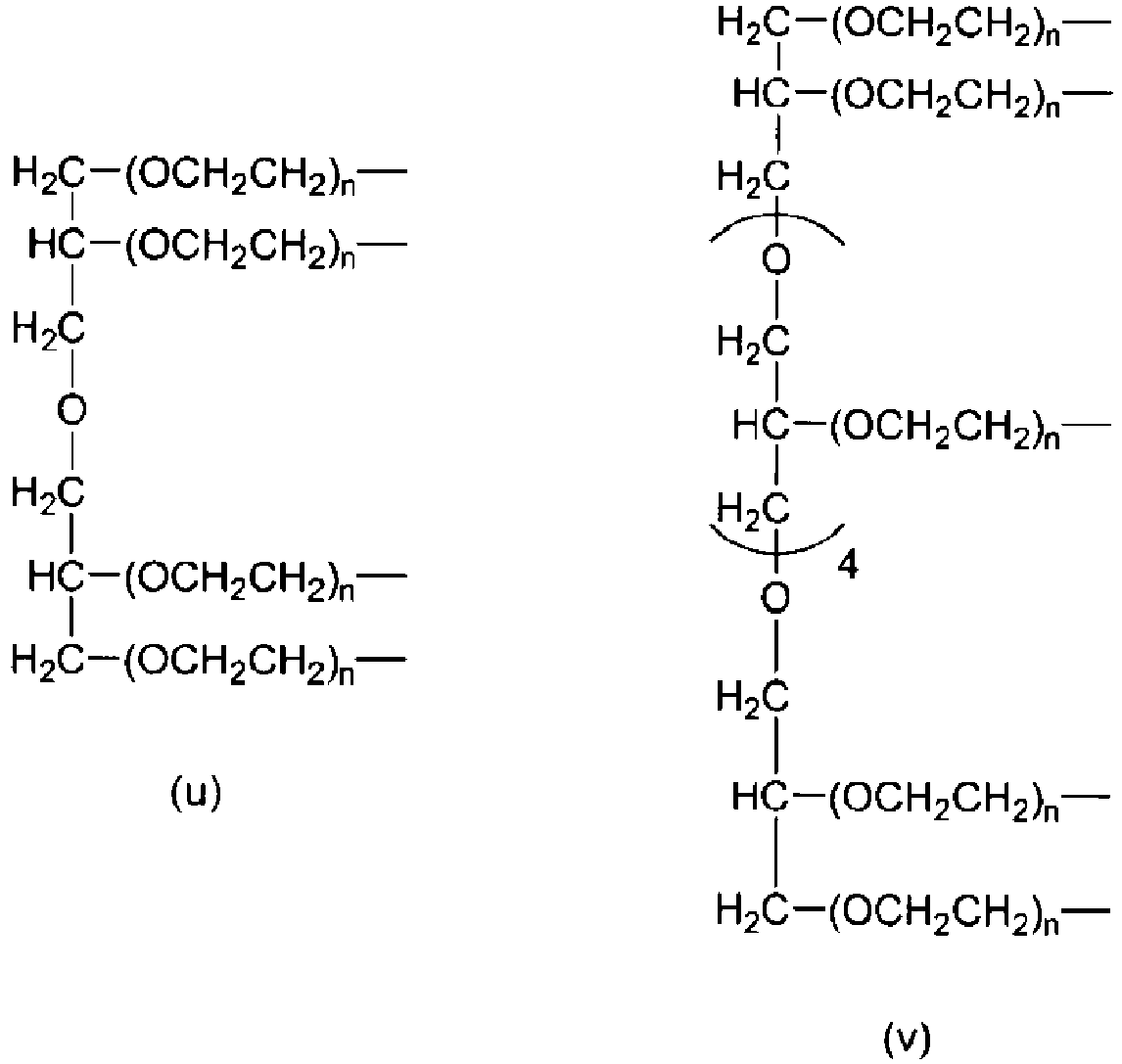
- Cyclische Benzylidenacetallinkerverbindung, dargestellt durch die Formel (55):
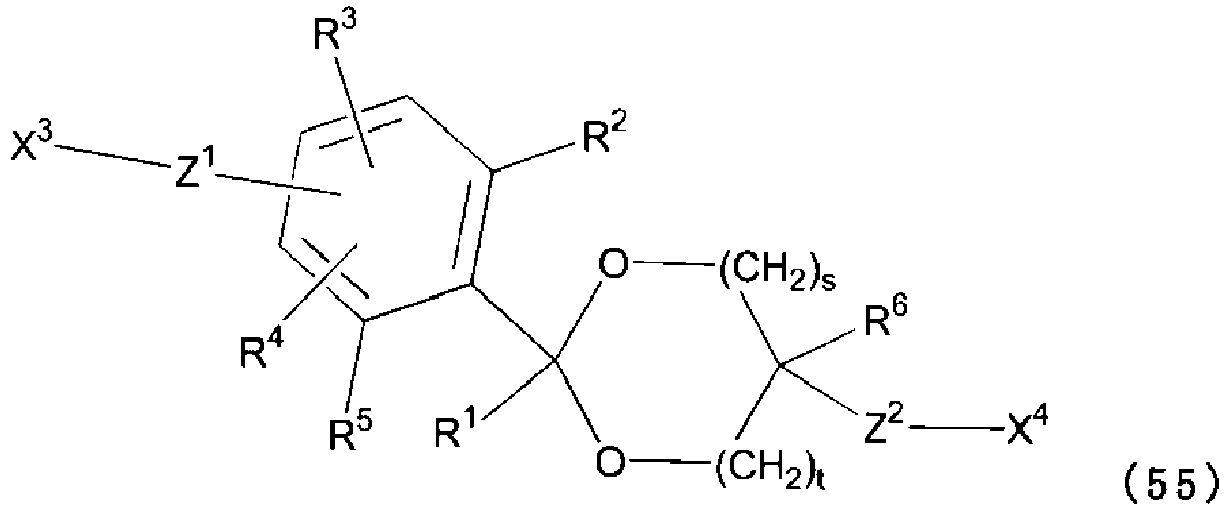
- Cyclische Benzylidenacetallinkerverbindung gemäß Anspruch 15, worin S 1 und t 0 ist, R2 und R5 jeweils ein Wasserstoffatom sind und eine Summe (∑σ) von Substituentenkonstanten (σ) in R3, R4 und
X3-Z1 -0,30 ≤ ∑σ ≤ 1,05 erfüllt oder worin s 1 und t 0 sind, zumindest eines von R2 und R5 der Substituent sind und eine Summe (∑σ) von Substituentenkonstanten (σ) in R3, R4 und X3-Z1 -1,71 ≤ ∑σ ≤ 0,88 erfüllt. - Cyclische Benzylidenacetallinkerverbindung gemäß einem der Ansprüche 15 bis 16, worin X3 und X4 jeweils ausgewählt sind aus der Gruppe, bestehend aus der Formel (a), Formel (b), Formel (c), Formel (d), Formel (e), Formel (f), Formel (g), Formel (h), Formel (i), Formel (j), Formel (k), Formel (l), Formel (m), Formel (n) und Formel (o):


-OH (o)
worin R7 ein Wasserstoffatom oder eine Sulfogruppe ist, R8 und R11 jeweils unabhängig ein Wasserstoffatom oder eine Kohlenwasserstoffgruppe mit 1 bis 5 Kohlenstoffatomen sind, R9 eine Kohlenwasserstoffgruppe mit 1 bis 10 Kohlenstoffatomen ist, die ein Halogenatom enthalten kann, und R10 ein Halogenatom ist, ausgewählt aus seinem Chloratom, Bromatom und Iodatom. - Cyclische Benzylidenacetallinkerverbindung gemäß einem der Ansprüche 15 bis 17, worin Z1 und Z2 jeweils unabhängig eine Etherbindung, Esterbindung, Carbonatbindung, Urethanbindung, Amidbindung, sekundäre Aminogruppe, Alkylengruppe mit irgendeiner dieser Bindungen und Gruppe, Einzelbindung oder Alkylengruppe sind, und wenn zumindest eines von Z1 und Z2 eine Etherbindung, Esterbindung, Carbonatbindung, Urethanbindung, Amidbindung, sekundäre Aminogruppe oder Alkylengruppe mit irgendeiner dieser Bindungen und Gruppe ist und eine Vielzahl von identischen strukturellen Einheiten verbunden ist, eine Zahl der strukturellen Einheiten 2 oder weniger ist.
- Cyclische Benzylidenacetallinkerverbindung gemäß einem der Ansprüche 15 bis 18, worin die funktionelle Gruppe, die eines von X3 und X4 konstituiert, eine Schutzgruppe enthält.
Applications Claiming Priority (3)
| Application Number | Priority Date | Filing Date | Title |
|---|---|---|---|
| JP2014072356 | 2014-03-31 | ||
| JP2014193039 | 2014-09-22 | ||
| PCT/JP2015/060013 WO2015152182A1 (ja) | 2014-03-31 | 2015-03-30 | 環状ベンジリデンアセタールリンカーを有する親水性ポリマー誘導体 |
Publications (3)
| Publication Number | Publication Date |
|---|---|
| EP3130587A1 EP3130587A1 (de) | 2017-02-15 |
| EP3130587A4 EP3130587A4 (de) | 2017-11-01 |
| EP3130587B1 true EP3130587B1 (de) | 2021-06-16 |
Family
ID=54240504
Family Applications (1)
| Application Number | Title | Priority Date | Filing Date |
|---|---|---|---|
| EP15772451.9A Active EP3130587B1 (de) | 2014-03-31 | 2015-03-30 | Hydrophiles polymerderivat mit cyclischem benzyliden-acetal-linker |
Country Status (5)
| Country | Link |
|---|---|
| US (2) | US20170107325A1 (de) |
| EP (1) | EP3130587B1 (de) |
| JP (1) | JP6631827B2 (de) |
| CN (1) | CN106164063B (de) |
| WO (1) | WO2015152182A1 (de) |
Families Citing this family (8)
| Publication number | Priority date | Publication date | Assignee | Title |
|---|---|---|---|---|
| JP6723509B2 (ja) | 2014-10-24 | 2020-07-15 | 日油株式会社 | 環状ベンジリデンアセタールリンカーを有する抗体―薬物複合体 |
| JP6784932B2 (ja) | 2015-03-31 | 2020-11-18 | 日油株式会社 | 生体機能性分子または薬物キャリアの化学修飾用生分解性ポリエチレングリコール誘導体 |
| EP3357514B1 (de) * | 2015-09-30 | 2021-04-14 | NOF Corporation | Lipidderivat mit über zyklischem benzyliden-acetal-linker gebundenen hydrophilen polymer |
| JP6925579B2 (ja) * | 2016-03-31 | 2021-08-25 | 日油株式会社 | 環状ベンジリデンアセタール構造を有する生分解性ヒドロゲル |
| KR102580547B1 (ko) | 2018-03-27 | 2023-09-20 | 니치유 가부시키가이샤 | 멀티 암형 폴리에틸렌 글리콜 유도체의 제조 방법 |
| JP2021521202A (ja) | 2018-04-13 | 2021-08-26 | ハイデルベルク ファルマ リサーチ ゲゼルシャフト ミット ベシュレンクテル ハフツング | 固形腫瘍の治療のための標的化されたアマトキシン複合体 |
| KR20220011640A (ko) | 2019-05-23 | 2022-01-28 | 하이델베르크 파마 리서치 게엠베하 | 절단 가능한 링커를 가진 항체 약물 접합체 |
| EP4015004A1 (de) | 2020-12-18 | 2022-06-22 | Phi Pharma SA | Proteoglykanspezifische verzweigte peptide |
Family Cites Families (12)
| Publication number | Priority date | Publication date | Assignee | Title |
|---|---|---|---|---|
| GB1199110A (en) * | 1967-09-05 | 1970-07-15 | Cutter Lab | Dioxolan Substituted Compounds |
| FR2577552B1 (fr) | 1985-02-20 | 1987-09-04 | Sori Soc Rech Ind | Esters heterocycliques dissymetriques d'acides 1,4-dihydropyridine-3,5-dicarboxyliques, procede de preparation et utilisation en therapeutique |
| EP1081123B1 (de) | 1999-08-31 | 2004-03-03 | Chisso Corporation | 2,3-Difluorphenylderivat mit negativer, dielektrischer Anisotropie, Flüssigkristallzusammensetzung und Flüssigkristallanzeigevorrichtung |
| JP4742207B2 (ja) * | 1999-08-31 | 2011-08-10 | Jnc株式会社 | 負の誘電率異方性を有する2,3−ジフルオロフェニル誘導体、液晶組成物および液晶表示素子 |
| MXPA02003176A (es) | 1999-10-04 | 2002-09-30 | Shearwater Corp | Neuropeptidos estabilizados por polimero. |
| JP2002020344A (ja) * | 2000-07-07 | 2002-01-23 | Chisso Corp | ジフルオロビニル化合物、液晶組成物および液晶表示素子 |
| ATE469164T1 (de) | 2001-10-26 | 2010-06-15 | Noxxon Pharma Ag | Modifizierte l-nukleinsäure |
| WO2005108463A2 (en) * | 2004-05-03 | 2005-11-17 | Nektar Therapeutics Al, Corporation | Branched polyethylen glycol derivates comprising an acetal or ketal branching point |
| WO2012027717A2 (en) * | 2010-08-27 | 2012-03-01 | The Texas A&M University System | Flourescence labeling reagents and uses thereof |
| US9320803B2 (en) | 2011-02-24 | 2016-04-26 | Ktb Tumorforschungsgesellschaft Mbh | Bisphosphonate-prodrugs |
| EP3524258B1 (de) * | 2011-06-22 | 2025-10-01 | Apellis Pharmaceuticals, Inc. | Verfahren zur behandlung chronischer erkrankungen mit komplementinhibitoren |
| JP6051998B2 (ja) | 2012-03-30 | 2016-12-27 | 日油株式会社 | マルチアーム型ポリエチレングリコール誘導体、その中間体及び製造方法 |
-
2015
- 2015-03-30 EP EP15772451.9A patent/EP3130587B1/de active Active
- 2015-03-30 JP JP2015068326A patent/JP6631827B2/ja active Active
- 2015-03-30 CN CN201580018321.7A patent/CN106164063B/zh active Active
- 2015-03-30 US US15/300,699 patent/US20170107325A1/en not_active Abandoned
- 2015-03-30 WO PCT/JP2015/060013 patent/WO2015152182A1/ja not_active Ceased
-
2020
- 2020-05-29 US US16/887,081 patent/US11530295B2/en active Active
Non-Patent Citations (1)
| Title |
|---|
| None * |
Also Published As
| Publication number | Publication date |
|---|---|
| EP3130587A1 (de) | 2017-02-15 |
| JP2016065202A (ja) | 2016-04-28 |
| CN106164063B (zh) | 2021-10-22 |
| EP3130587A4 (de) | 2017-11-01 |
| US20200291178A1 (en) | 2020-09-17 |
| JP6631827B2 (ja) | 2020-01-15 |
| US11530295B2 (en) | 2022-12-20 |
| WO2015152182A1 (ja) | 2015-10-08 |
| CN106164063A (zh) | 2016-11-23 |
| US20170107325A1 (en) | 2017-04-20 |
Similar Documents
| Publication | Publication Date | Title |
|---|---|---|
| EP3130587B1 (de) | Hydrophiles polymerderivat mit cyclischem benzyliden-acetal-linker | |
| US11529423B2 (en) | Biodegradable polyethylene glycol derivative having cyclic benzylidene acetal linker | |
| US10633489B2 (en) | Hydrophilic polymer derivative having benzylidene acetal linker | |
| EP3524631B1 (de) | Verzweigtes heteroartiges monodispergiertes polyethylenglykol, verfahren zur herstellung davon und konjugate davon | |
| EP3318591B1 (de) | Monodispergiertes heteropolyethylenglykol, zwischenprodukt zur herstellung eines monodispergierten heteropolyethylenglykols, verfahren zur herstellung davon und monodispergiertes heteropolyethylenglykolkonjugat | |
| EP3604383B1 (de) | Herstellungsverfahren eines polyoxyethylenderivats mit mehreren hydroxylgruppen am ende | |
| EP3357514B1 (de) | Lipidderivat mit über zyklischem benzyliden-acetal-linker gebundenen hydrophilen polymer | |
| EP3770143A1 (de) | Verzweigtes monodisperses polyethylenglykol, zwischenprodukt und verfahren zu seiner herstellung | |
| EP3438155B1 (de) | Biologisch abbaubares hydrogel mit cyclischer benzylidenacetalstruktur | |
| EP3604386A1 (de) | Abbaubares polyethylenglykolderivat mit disulfid-linker |
Legal Events
| Date | Code | Title | Description |
|---|---|---|---|
| STAA | Information on the status of an ep patent application or granted ep patent |
Free format text: STATUS: THE INTERNATIONAL PUBLICATION HAS BEEN MADE |
|
| PUAI | Public reference made under article 153(3) epc to a published international application that has entered the european phase |
Free format text: ORIGINAL CODE: 0009012 |
|
| STAA | Information on the status of an ep patent application or granted ep patent |
Free format text: STATUS: REQUEST FOR EXAMINATION WAS MADE |
|
| 17P | Request for examination filed |
Effective date: 20160930 |
|
| AK | Designated contracting states |
Kind code of ref document: A1 Designated state(s): AL AT BE BG CH CY CZ DE DK EE ES FI FR GB GR HR HU IE IS IT LI LT LU LV MC MK MT NL NO PL PT RO RS SE SI SK SM TR |
|
| AX | Request for extension of the european patent |
Extension state: BA ME |
|
| DAV | Request for validation of the european patent (deleted) | ||
| DAX | Request for extension of the european patent (deleted) | ||
| A4 | Supplementary search report drawn up and despatched |
Effective date: 20170928 |
|
| RIC1 | Information provided on ipc code assigned before grant |
Ipc: C08G 65/334 20060101ALI20170922BHEP Ipc: C08G 65/331 20060101ALI20170922BHEP Ipc: C08G 65/333 20060101ALI20170922BHEP Ipc: C08G 65/337 20060101ALI20170922BHEP Ipc: C08G 65/329 20060101ALI20170922BHEP Ipc: C07D 317/28 20060101ALI20170922BHEP Ipc: C07D 317/18 20060101AFI20170922BHEP Ipc: C07D 317/22 20060101ALI20170922BHEP Ipc: C07D 317/24 20060101ALI20170922BHEP Ipc: C07D 405/06 20060101ALI20170922BHEP Ipc: C07D 317/20 20060101ALI20170922BHEP |
|
| STAA | Information on the status of an ep patent application or granted ep patent |
Free format text: STATUS: EXAMINATION IS IN PROGRESS |
|
| 17Q | First examination report despatched |
Effective date: 20190612 |
|
| GRAP | Despatch of communication of intention to grant a patent |
Free format text: ORIGINAL CODE: EPIDOSNIGR1 |
|
| STAA | Information on the status of an ep patent application or granted ep patent |
Free format text: STATUS: GRANT OF PATENT IS INTENDED |
|
| INTG | Intention to grant announced |
Effective date: 20210310 |
|
| GRAS | Grant fee paid |
Free format text: ORIGINAL CODE: EPIDOSNIGR3 |
|
| GRAA | (expected) grant |
Free format text: ORIGINAL CODE: 0009210 |
|
| STAA | Information on the status of an ep patent application or granted ep patent |
Free format text: STATUS: THE PATENT HAS BEEN GRANTED |
|
| AK | Designated contracting states |
Kind code of ref document: B1 Designated state(s): AL AT BE BG CH CY CZ DE DK EE ES FI FR GB GR HR HU IE IS IT LI LT LU LV MC MK MT NL NO PL PT RO RS SE SI SK SM TR |
|
| REG | Reference to a national code |
Ref country code: GB Ref legal event code: FG4D |
|
| REG | Reference to a national code |
Ref country code: CH Ref legal event code: EP |
|
| REG | Reference to a national code |
Ref country code: DE Ref legal event code: R096 Ref document number: 602015070456 Country of ref document: DE |
|
| REG | Reference to a national code |
Ref country code: AT Ref legal event code: REF Ref document number: 1402255 Country of ref document: AT Kind code of ref document: T Effective date: 20210715 |
|
| REG | Reference to a national code |
Ref country code: IE Ref legal event code: FG4D |
|
| REG | Reference to a national code |
Ref country code: LT Ref legal event code: MG9D |
|
| PG25 | Lapsed in a contracting state [announced via postgrant information from national office to epo] |
Ref country code: FI Free format text: LAPSE BECAUSE OF FAILURE TO SUBMIT A TRANSLATION OF THE DESCRIPTION OR TO PAY THE FEE WITHIN THE PRESCRIBED TIME-LIMIT Effective date: 20210616 Ref country code: LT Free format text: LAPSE BECAUSE OF FAILURE TO SUBMIT A TRANSLATION OF THE DESCRIPTION OR TO PAY THE FEE WITHIN THE PRESCRIBED TIME-LIMIT Effective date: 20210616 Ref country code: BG Free format text: LAPSE BECAUSE OF FAILURE TO SUBMIT A TRANSLATION OF THE DESCRIPTION OR TO PAY THE FEE WITHIN THE PRESCRIBED TIME-LIMIT Effective date: 20210916 Ref country code: HR Free format text: LAPSE BECAUSE OF FAILURE TO SUBMIT A TRANSLATION OF THE DESCRIPTION OR TO PAY THE FEE WITHIN THE PRESCRIBED TIME-LIMIT Effective date: 20210616 |
|
| REG | Reference to a national code |
Ref country code: AT Ref legal event code: MK05 Ref document number: 1402255 Country of ref document: AT Kind code of ref document: T Effective date: 20210616 |
|
| REG | Reference to a national code |
Ref country code: NL Ref legal event code: MP Effective date: 20210616 |
|
| PG25 | Lapsed in a contracting state [announced via postgrant information from national office to epo] |
Ref country code: NO Free format text: LAPSE BECAUSE OF FAILURE TO SUBMIT A TRANSLATION OF THE DESCRIPTION OR TO PAY THE FEE WITHIN THE PRESCRIBED TIME-LIMIT Effective date: 20210916 Ref country code: SE Free format text: LAPSE BECAUSE OF FAILURE TO SUBMIT A TRANSLATION OF THE DESCRIPTION OR TO PAY THE FEE WITHIN THE PRESCRIBED TIME-LIMIT Effective date: 20210616 Ref country code: RS Free format text: LAPSE BECAUSE OF FAILURE TO SUBMIT A TRANSLATION OF THE DESCRIPTION OR TO PAY THE FEE WITHIN THE PRESCRIBED TIME-LIMIT Effective date: 20210616 Ref country code: GR Free format text: LAPSE BECAUSE OF FAILURE TO SUBMIT A TRANSLATION OF THE DESCRIPTION OR TO PAY THE FEE WITHIN THE PRESCRIBED TIME-LIMIT Effective date: 20210917 Ref country code: LV Free format text: LAPSE BECAUSE OF FAILURE TO SUBMIT A TRANSLATION OF THE DESCRIPTION OR TO PAY THE FEE WITHIN THE PRESCRIBED TIME-LIMIT Effective date: 20210616 |
|
| PG25 | Lapsed in a contracting state [announced via postgrant information from national office to epo] |
Ref country code: AT Free format text: LAPSE BECAUSE OF FAILURE TO SUBMIT A TRANSLATION OF THE DESCRIPTION OR TO PAY THE FEE WITHIN THE PRESCRIBED TIME-LIMIT Effective date: 20210616 Ref country code: ES Free format text: LAPSE BECAUSE OF FAILURE TO SUBMIT A TRANSLATION OF THE DESCRIPTION OR TO PAY THE FEE WITHIN THE PRESCRIBED TIME-LIMIT Effective date: 20210616 Ref country code: RO Free format text: LAPSE BECAUSE OF FAILURE TO SUBMIT A TRANSLATION OF THE DESCRIPTION OR TO PAY THE FEE WITHIN THE PRESCRIBED TIME-LIMIT Effective date: 20210616 Ref country code: NL Free format text: LAPSE BECAUSE OF FAILURE TO SUBMIT A TRANSLATION OF THE DESCRIPTION OR TO PAY THE FEE WITHIN THE PRESCRIBED TIME-LIMIT Effective date: 20210616 Ref country code: PT Free format text: LAPSE BECAUSE OF FAILURE TO SUBMIT A TRANSLATION OF THE DESCRIPTION OR TO PAY THE FEE WITHIN THE PRESCRIBED TIME-LIMIT Effective date: 20211018 Ref country code: CZ Free format text: LAPSE BECAUSE OF FAILURE TO SUBMIT A TRANSLATION OF THE DESCRIPTION OR TO PAY THE FEE WITHIN THE PRESCRIBED TIME-LIMIT Effective date: 20210616 Ref country code: EE Free format text: LAPSE BECAUSE OF FAILURE TO SUBMIT A TRANSLATION OF THE DESCRIPTION OR TO PAY THE FEE WITHIN THE PRESCRIBED TIME-LIMIT Effective date: 20210616 Ref country code: SM Free format text: LAPSE BECAUSE OF FAILURE TO SUBMIT A TRANSLATION OF THE DESCRIPTION OR TO PAY THE FEE WITHIN THE PRESCRIBED TIME-LIMIT Effective date: 20210616 Ref country code: SK Free format text: LAPSE BECAUSE OF FAILURE TO SUBMIT A TRANSLATION OF THE DESCRIPTION OR TO PAY THE FEE WITHIN THE PRESCRIBED TIME-LIMIT Effective date: 20210616 |
|
| PG25 | Lapsed in a contracting state [announced via postgrant information from national office to epo] |
Ref country code: PL Free format text: LAPSE BECAUSE OF FAILURE TO SUBMIT A TRANSLATION OF THE DESCRIPTION OR TO PAY THE FEE WITHIN THE PRESCRIBED TIME-LIMIT Effective date: 20210616 |
|
| REG | Reference to a national code |
Ref country code: DE Ref legal event code: R097 Ref document number: 602015070456 Country of ref document: DE |
|
| PLBE | No opposition filed within time limit |
Free format text: ORIGINAL CODE: 0009261 |
|
| STAA | Information on the status of an ep patent application or granted ep patent |
Free format text: STATUS: NO OPPOSITION FILED WITHIN TIME LIMIT |
|
| PG25 | Lapsed in a contracting state [announced via postgrant information from national office to epo] |
Ref country code: DK Free format text: LAPSE BECAUSE OF FAILURE TO SUBMIT A TRANSLATION OF THE DESCRIPTION OR TO PAY THE FEE WITHIN THE PRESCRIBED TIME-LIMIT Effective date: 20210616 |
|
| 26N | No opposition filed |
Effective date: 20220317 |
|
| PG25 | Lapsed in a contracting state [announced via postgrant information from national office to epo] |
Ref country code: AL Free format text: LAPSE BECAUSE OF FAILURE TO SUBMIT A TRANSLATION OF THE DESCRIPTION OR TO PAY THE FEE WITHIN THE PRESCRIBED TIME-LIMIT Effective date: 20210616 |
|
| PG25 | Lapsed in a contracting state [announced via postgrant information from national office to epo] |
Ref country code: IT Free format text: LAPSE BECAUSE OF FAILURE TO SUBMIT A TRANSLATION OF THE DESCRIPTION OR TO PAY THE FEE WITHIN THE PRESCRIBED TIME-LIMIT Effective date: 20210616 |
|
| PG25 | Lapsed in a contracting state [announced via postgrant information from national office to epo] |
Ref country code: MC Free format text: LAPSE BECAUSE OF FAILURE TO SUBMIT A TRANSLATION OF THE DESCRIPTION OR TO PAY THE FEE WITHIN THE PRESCRIBED TIME-LIMIT Effective date: 20210616 |
|
| REG | Reference to a national code |
Ref country code: BE Ref legal event code: MM Effective date: 20220331 |
|
| PG25 | Lapsed in a contracting state [announced via postgrant information from national office to epo] |
Ref country code: LU Free format text: LAPSE BECAUSE OF NON-PAYMENT OF DUE FEES Effective date: 20220330 Ref country code: IE Free format text: LAPSE BECAUSE OF NON-PAYMENT OF DUE FEES Effective date: 20220330 |
|
| PG25 | Lapsed in a contracting state [announced via postgrant information from national office to epo] |
Ref country code: BE Free format text: LAPSE BECAUSE OF NON-PAYMENT OF DUE FEES Effective date: 20220331 |
|
| P01 | Opt-out of the competence of the unified patent court (upc) registered |
Effective date: 20230410 |
|
| PG25 | Lapsed in a contracting state [announced via postgrant information from national office to epo] |
Ref country code: HU Free format text: LAPSE BECAUSE OF FAILURE TO SUBMIT A TRANSLATION OF THE DESCRIPTION OR TO PAY THE FEE WITHIN THE PRESCRIBED TIME-LIMIT; INVALID AB INITIO Effective date: 20150330 |
|
| PG25 | Lapsed in a contracting state [announced via postgrant information from national office to epo] |
Ref country code: MK Free format text: LAPSE BECAUSE OF FAILURE TO SUBMIT A TRANSLATION OF THE DESCRIPTION OR TO PAY THE FEE WITHIN THE PRESCRIBED TIME-LIMIT Effective date: 20210616 Ref country code: CY Free format text: LAPSE BECAUSE OF FAILURE TO SUBMIT A TRANSLATION OF THE DESCRIPTION OR TO PAY THE FEE WITHIN THE PRESCRIBED TIME-LIMIT Effective date: 20210616 |
|
| PG25 | Lapsed in a contracting state [announced via postgrant information from national office to epo] |
Ref country code: TR Free format text: LAPSE BECAUSE OF FAILURE TO SUBMIT A TRANSLATION OF THE DESCRIPTION OR TO PAY THE FEE WITHIN THE PRESCRIBED TIME-LIMIT Effective date: 20210616 |
|
| PG25 | Lapsed in a contracting state [announced via postgrant information from national office to epo] |
Ref country code: MT Free format text: LAPSE BECAUSE OF FAILURE TO SUBMIT A TRANSLATION OF THE DESCRIPTION OR TO PAY THE FEE WITHIN THE PRESCRIBED TIME-LIMIT Effective date: 20210616 |
|
| PGFP | Annual fee paid to national office [announced via postgrant information from national office to epo] |
Ref country code: CH Payment date: 20250401 Year of fee payment: 11 |
|
| REG | Reference to a national code |
Ref country code: CH Ref legal event code: U11 Free format text: ST27 STATUS EVENT CODE: U-0-0-U10-U11 (AS PROVIDED BY THE NATIONAL OFFICE) Effective date: 20260401 |
|
| PGFP | Annual fee paid to national office [announced via postgrant information from national office to epo] |
Ref country code: GB Payment date: 20260324 Year of fee payment: 12 |
|
| PGFP | Annual fee paid to national office [announced via postgrant information from national office to epo] |
Ref country code: DE Payment date: 20260319 Year of fee payment: 12 |
|
| PGFP | Annual fee paid to national office [announced via postgrant information from national office to epo] |
Ref country code: FR Payment date: 20260320 Year of fee payment: 12 |