EP3130862B1 - Climatiseur et procédé de fonctionnement correspondant - Google Patents
Climatiseur et procédé de fonctionnement correspondant Download PDFInfo
- Publication number
- EP3130862B1 EP3130862B1 EP16183563.2A EP16183563A EP3130862B1 EP 3130862 B1 EP3130862 B1 EP 3130862B1 EP 16183563 A EP16183563 A EP 16183563A EP 3130862 B1 EP3130862 B1 EP 3130862B1
- Authority
- EP
- European Patent Office
- Prior art keywords
- noise
- outdoor unit
- level
- ambient
- compressor
- Prior art date
- Legal status (The legal status is an assumption and is not a legal conclusion. Google has not performed a legal analysis and makes no representation as to the accuracy of the status listed.)
- Active
Links
Images



Classifications
-
- F—MECHANICAL ENGINEERING; LIGHTING; HEATING; WEAPONS; BLASTING
- F24—HEATING; RANGES; VENTILATING
- F24F—AIR-CONDITIONING; AIR-HUMIDIFICATION; VENTILATION; USE OF AIR CURRENTS FOR SCREENING
- F24F13/00—Details common to, or for air-conditioning, air-humidification, ventilation or use of air currents for screening
- F24F13/24—Means for preventing or suppressing noise
-
- F—MECHANICAL ENGINEERING; LIGHTING; HEATING; WEAPONS; BLASTING
- F24—HEATING; RANGES; VENTILATING
- F24F—AIR-CONDITIONING; AIR-HUMIDIFICATION; VENTILATION; USE OF AIR CURRENTS FOR SCREENING
- F24F1/00—Room units for air-conditioning, e.g. separate or self-contained units or units receiving primary air from a central station
- F24F1/06—Separate outdoor units, e.g. outdoor unit to be linked to a separate room comprising a compressor and a heat exchanger
- F24F1/08—Compressors specially adapted for separate outdoor units
- F24F1/12—Vibration or noise prevention thereof
-
- F—MECHANICAL ENGINEERING; LIGHTING; HEATING; WEAPONS; BLASTING
- F24—HEATING; RANGES; VENTILATING
- F24F—AIR-CONDITIONING; AIR-HUMIDIFICATION; VENTILATION; USE OF AIR CURRENTS FOR SCREENING
- F24F1/00—Room units for air-conditioning, e.g. separate or self-contained units or units receiving primary air from a central station
- F24F1/06—Separate outdoor units, e.g. outdoor unit to be linked to a separate room comprising a compressor and a heat exchanger
- F24F1/40—Vibration or noise prevention at outdoor units
-
- F—MECHANICAL ENGINEERING; LIGHTING; HEATING; WEAPONS; BLASTING
- F24—HEATING; RANGES; VENTILATING
- F24F—AIR-CONDITIONING; AIR-HUMIDIFICATION; VENTILATION; USE OF AIR CURRENTS FOR SCREENING
- F24F11/00—Control or safety arrangements
- F24F11/30—Control or safety arrangements for purposes related to the operation of the system, e.g. for safety or monitoring
-
- F—MECHANICAL ENGINEERING; LIGHTING; HEATING; WEAPONS; BLASTING
- F24—HEATING; RANGES; VENTILATING
- F24F—AIR-CONDITIONING; AIR-HUMIDIFICATION; VENTILATION; USE OF AIR CURRENTS FOR SCREENING
- F24F11/00—Control or safety arrangements
- F24F11/30—Control or safety arrangements for purposes related to the operation of the system, e.g. for safety or monitoring
- F24F11/32—Responding to malfunctions or emergencies
- F24F11/38—Failure diagnosis
-
- F—MECHANICAL ENGINEERING; LIGHTING; HEATING; WEAPONS; BLASTING
- F24—HEATING; RANGES; VENTILATING
- F24F—AIR-CONDITIONING; AIR-HUMIDIFICATION; VENTILATION; USE OF AIR CURRENTS FOR SCREENING
- F24F11/00—Control or safety arrangements
- F24F11/50—Control or safety arrangements characterised by user interfaces or communication
- F24F11/52—Indication arrangements, e.g. displays
- F24F11/526—Indication arrangements, e.g. displays giving audible indications
-
- F—MECHANICAL ENGINEERING; LIGHTING; HEATING; WEAPONS; BLASTING
- F24—HEATING; RANGES; VENTILATING
- F24F—AIR-CONDITIONING; AIR-HUMIDIFICATION; VENTILATION; USE OF AIR CURRENTS FOR SCREENING
- F24F11/00—Control or safety arrangements
- F24F11/50—Control or safety arrangements characterised by user interfaces or communication
- F24F11/56—Remote control
-
- F—MECHANICAL ENGINEERING; LIGHTING; HEATING; WEAPONS; BLASTING
- F24—HEATING; RANGES; VENTILATING
- F24F—AIR-CONDITIONING; AIR-HUMIDIFICATION; VENTILATION; USE OF AIR CURRENTS FOR SCREENING
- F24F11/00—Control or safety arrangements
- F24F11/70—Control systems characterised by their outputs; Constructional details thereof
- F24F11/72—Control systems characterised by their outputs; Constructional details thereof for controlling the supply of treated air, e.g. its pressure
- F24F11/74—Control systems characterised by their outputs; Constructional details thereof for controlling the supply of treated air, e.g. its pressure for controlling air flow rate or air velocity
- F24F11/77—Control systems characterised by their outputs; Constructional details thereof for controlling the supply of treated air, e.g. its pressure for controlling air flow rate or air velocity by controlling the speed of ventilators
-
- F—MECHANICAL ENGINEERING; LIGHTING; HEATING; WEAPONS; BLASTING
- F24—HEATING; RANGES; VENTILATING
- F24F—AIR-CONDITIONING; AIR-HUMIDIFICATION; VENTILATION; USE OF AIR CURRENTS FOR SCREENING
- F24F11/00—Control or safety arrangements
- F24F11/70—Control systems characterised by their outputs; Constructional details thereof
- F24F11/80—Control systems characterised by their outputs; Constructional details thereof for controlling the temperature of the supplied air
- F24F11/83—Control systems characterised by their outputs; Constructional details thereof for controlling the temperature of the supplied air by controlling the supply of heat-exchange fluids to heat-exchangers
- F24F11/84—Control systems characterised by their outputs; Constructional details thereof for controlling the temperature of the supplied air by controlling the supply of heat-exchange fluids to heat-exchangers using valves
-
- F—MECHANICAL ENGINEERING; LIGHTING; HEATING; WEAPONS; BLASTING
- F24—HEATING; RANGES; VENTILATING
- F24F—AIR-CONDITIONING; AIR-HUMIDIFICATION; VENTILATION; USE OF AIR CURRENTS FOR SCREENING
- F24F11/00—Control or safety arrangements
- F24F11/70—Control systems characterised by their outputs; Constructional details thereof
- F24F11/80—Control systems characterised by their outputs; Constructional details thereof for controlling the temperature of the supplied air
- F24F11/86—Control systems characterised by their outputs; Constructional details thereof for controlling the temperature of the supplied air by controlling compressors within refrigeration or heat pump circuits
-
- F—MECHANICAL ENGINEERING; LIGHTING; HEATING; WEAPONS; BLASTING
- F24—HEATING; RANGES; VENTILATING
- F24F—AIR-CONDITIONING; AIR-HUMIDIFICATION; VENTILATION; USE OF AIR CURRENTS FOR SCREENING
- F24F11/00—Control or safety arrangements
- F24F11/70—Control systems characterised by their outputs; Constructional details thereof
- F24F11/80—Control systems characterised by their outputs; Constructional details thereof for controlling the temperature of the supplied air
- F24F11/87—Control systems characterised by their outputs; Constructional details thereof for controlling the temperature of the supplied air by controlling absorption or discharge of heat in outdoor units
- F24F11/871—Control systems characterised by their outputs; Constructional details thereof for controlling the temperature of the supplied air by controlling absorption or discharge of heat in outdoor units by controlling outdoor fans
-
- F—MECHANICAL ENGINEERING; LIGHTING; HEATING; WEAPONS; BLASTING
- F25—REFRIGERATION OR COOLING; COMBINED HEATING AND REFRIGERATION SYSTEMS; HEAT PUMP SYSTEMS; MANUFACTURE OR STORAGE OF ICE; LIQUEFACTION SOLIDIFICATION OF GASES
- F25B—REFRIGERATION MACHINES, PLANTS OR SYSTEMS; COMBINED HEATING AND REFRIGERATION SYSTEMS; HEAT PUMP SYSTEMS
- F25B49/00—Arrangement or mounting of control or safety devices
- F25B49/02—Arrangement or mounting of control or safety devices for compression type machines, plants or systems
- F25B49/022—Compressor control arrangements
-
- G—PHYSICS
- G05—CONTROLLING; REGULATING
- G05B—CONTROL OR REGULATING SYSTEMS IN GENERAL; FUNCTIONAL ELEMENTS OF SUCH SYSTEMS; MONITORING OR TESTING ARRANGEMENTS FOR SUCH SYSTEMS OR ELEMENTS
- G05B19/00—Program-control systems
- G05B19/02—Program-control systems electric
- G05B19/04—Program control other than numerical control, i.e. in sequence controllers or logic controllers
- G05B19/042—Program control other than numerical control, i.e. in sequence controllers or logic controllers using digital processors
-
- F—MECHANICAL ENGINEERING; LIGHTING; HEATING; WEAPONS; BLASTING
- F24—HEATING; RANGES; VENTILATING
- F24F—AIR-CONDITIONING; AIR-HUMIDIFICATION; VENTILATION; USE OF AIR CURRENTS FOR SCREENING
- F24F11/00—Control or safety arrangements
- F24F11/70—Control systems characterised by their outputs; Constructional details thereof
- F24F11/80—Control systems characterised by their outputs; Constructional details thereof for controlling the temperature of the supplied air
- F24F11/83—Control systems characterised by their outputs; Constructional details thereof for controlling the temperature of the supplied air by controlling the supply of heat-exchange fluids to heat-exchangers
- F24F11/85—Control systems characterised by their outputs; Constructional details thereof for controlling the temperature of the supplied air by controlling the supply of heat-exchange fluids to heat-exchangers using variable-flow pumps
-
- F—MECHANICAL ENGINEERING; LIGHTING; HEATING; WEAPONS; BLASTING
- F24—HEATING; RANGES; VENTILATING
- F24F—AIR-CONDITIONING; AIR-HUMIDIFICATION; VENTILATION; USE OF AIR CURRENTS FOR SCREENING
- F24F13/00—Details common to, or for air-conditioning, air-humidification, ventilation or use of air currents for screening
- F24F13/24—Means for preventing or suppressing noise
- F24F2013/247—Active noise-suppression
-
- F—MECHANICAL ENGINEERING; LIGHTING; HEATING; WEAPONS; BLASTING
- F24—HEATING; RANGES; VENTILATING
- F24F—AIR-CONDITIONING; AIR-HUMIDIFICATION; VENTILATION; USE OF AIR CURRENTS FOR SCREENING
- F24F2110/00—Control inputs relating to air properties
- F24F2110/10—Temperature
-
- F—MECHANICAL ENGINEERING; LIGHTING; HEATING; WEAPONS; BLASTING
- F24—HEATING; RANGES; VENTILATING
- F24F—AIR-CONDITIONING; AIR-HUMIDIFICATION; VENTILATION; USE OF AIR CURRENTS FOR SCREENING
- F24F2120/00—Control inputs relating to users or occupants
-
- F—MECHANICAL ENGINEERING; LIGHTING; HEATING; WEAPONS; BLASTING
- F24—HEATING; RANGES; VENTILATING
- F24F—AIR-CONDITIONING; AIR-HUMIDIFICATION; VENTILATION; USE OF AIR CURRENTS FOR SCREENING
- F24F2130/00—Control inputs relating to environmental factors not covered by group F24F2110/00
- F24F2130/40—Noise
-
- F—MECHANICAL ENGINEERING; LIGHTING; HEATING; WEAPONS; BLASTING
- F25—REFRIGERATION OR COOLING; COMBINED HEATING AND REFRIGERATION SYSTEMS; HEAT PUMP SYSTEMS; MANUFACTURE OR STORAGE OF ICE; LIQUEFACTION SOLIDIFICATION OF GASES
- F25B—REFRIGERATION MACHINES, PLANTS OR SYSTEMS; COMBINED HEATING AND REFRIGERATION SYSTEMS; HEAT PUMP SYSTEMS
- F25B2313/00—Compression machines, plants or systems with reversible cycle not otherwise provided for
- F25B2313/029—Control issues
- F25B2313/0294—Control issues related to the outdoor fan, e.g. controlling speed
-
- F—MECHANICAL ENGINEERING; LIGHTING; HEATING; WEAPONS; BLASTING
- F25—REFRIGERATION OR COOLING; COMBINED HEATING AND REFRIGERATION SYSTEMS; HEAT PUMP SYSTEMS; MANUFACTURE OR STORAGE OF ICE; LIQUEFACTION SOLIDIFICATION OF GASES
- F25B—REFRIGERATION MACHINES, PLANTS OR SYSTEMS; COMBINED HEATING AND REFRIGERATION SYSTEMS; HEAT PUMP SYSTEMS
- F25B2500/00—Problems to be solved
- F25B2500/12—Sound
-
- G—PHYSICS
- G05—CONTROLLING; REGULATING
- G05B—CONTROL OR REGULATING SYSTEMS IN GENERAL; FUNCTIONAL ELEMENTS OF SUCH SYSTEMS; MONITORING OR TESTING ARRANGEMENTS FOR SUCH SYSTEMS OR ELEMENTS
- G05B2219/00—Program-control systems
- G05B2219/20—Pc systems
- G05B2219/26—Pc applications
- G05B2219/2614—HVAC, heating, ventillation, climate control
-
- Y—GENERAL TAGGING OF NEW TECHNOLOGICAL DEVELOPMENTS; GENERAL TAGGING OF CROSS-SECTIONAL TECHNOLOGIES SPANNING OVER SEVERAL SECTIONS OF THE IPC; TECHNICAL SUBJECTS COVERED BY FORMER USPC CROSS-REFERENCE ART COLLECTIONS [XRACs] AND DIGESTS
- Y02—TECHNOLOGIES OR APPLICATIONS FOR MITIGATION OR ADAPTATION AGAINST CLIMATE CHANGE
- Y02B—CLIMATE CHANGE MITIGATION TECHNOLOGIES RELATED TO BUILDINGS, e.g. HOUSING, HOUSE APPLIANCES OR RELATED END-USER APPLICATIONS
- Y02B30/00—Energy efficient heating, ventilation or air conditioning [HVAC]
- Y02B30/70—Efficient control or regulation technologies, e.g. for control of refrigerant flow, motor or heating
Definitions
- the present invention relates to an air conditioner and method of operating the same, and more particularly, to an air conditioner that controls operation according to ambient noise and a method of operating the same.
- Air conditioners are installed to regulate the indoor temperature and purify the indoor air by blowing cold or warm air to a room, with the aim of providing its occupants with a more comfortable environment.
- an air conditioner includes an indoor unit consisting of a heat exchanger and installed in a room, and an outdoor unit consisting of a compressor and a heat exchanger and supplying refrigerant to the indoor unit.
- This air conditioner is controlled separately for the indoor unit consisting of the heat exchanger and the outdoor unit consisting of the compressor and the heat exchanger, and operates by controlling the power supply to the compressor or to the heat exchanger. Also, at least one indoor unit may be connected to the outdoor unit, and refrigerant is supplied to the indoor unit to run the air conditioner in cooling mode or heating mode depending on the type of operation the use wants to run.
- the outdoor unit and the indoor unit are connected to a refrigerant pipe, and refrigerant compressed by the compressor of the outdoor unit is supplied to the heat exchanger of the indoor unit, heat-exchanged in the heat exchanger of the indoor unit, and then drawn into the compressor of the outdoor unit via the refrigerant pipe. Accordingly, cold and warm air is blown into the room by heat transfer using refrigerant.
- the air conditioner makes much noise from running the outdoor unit fan as well as the compressor. This causes a noise issue, especially at night.
- night-time low noise operation is performed after a certain period of time after the temperature peak, with the aim of reducing noise by decreasing the rotation speed of the outdoor unit fan.
- the nighttime low noise operation has little noise reduction effect since it only adjusts the speed of the outdoor unit fan.
- the outdoor unit fan runs regardless of the surroundings since the operational settings are based only on the peak temperature, and it can be adapted for cooling operation only, but not for heating operation.
- GB 2 236 200 A relates to a splittype air conditioning apparatus including a refrigerating circuit unit (external unit) installed outside a house and an air conditioning unit (internal unit) arranged inside the house.
- An aspect of the present invention is to provide an air conditioner which performs operation by reducing noise regardless of time or operation mode, and which performs low noise operation efficiently by controlling operation according to the surroundings, and a method of operating the same. This object is achieved with an air conditioner according to the claims.
- An exemplary embodiment of the present invention provides an air conditioner as claimed in claim 1.
- the control part controls the operation to ensure that a value obtained by subtracting a noise reduction depending on the placement distance of the outdoor unit from the measured noise level does not exceed the environmental noise regulatory value.
- the control part detects noise measured by the noise sensor as ambient noise while the compressor is stopped.
- the control part sets the target noise level to a value obtained by adding a predetermined value to the ambient noise level, based on the placement distance of the outdoor unit and a set low noise level.
- Another exemplary embodiment of the present invention provides a method of operating an air conditioner as claimed in claim 8.
- the thus-constructed air conditioner and the method of operating the same according to the present invention can reduce noise generated from the air conditioner by controlling the operating frequency of the compressor or the rotation speed of the outdoor unit fan in performing low noise operation, allow for more efficient low noise operation by detecting ambient noise around the air conditioner and controlling the operation of the air conditioner according to the ambient noise level, and offer a more pleasant environment by eliminating the user's discomfort from noise.
- FIG. 1 is a view schematically illustrating the configuration of an air conditioner according to the present invention.
- FIG. 2 is a view illustrating an example of the configuration of an outdoor unit and indoor units and of the placement distance, in an air conditioner according to the present invention.
- an air conditioner includes indoor units 21 and 22 and an outdoor unit 10.
- the air conditioner may further include a remote control (not shown) that communicates with the indoor units 21 and 22 in a wired or wireless manner, transmits input data to the indoor units, and displays the operating status of the air conditioner, and a remote controller (not shown) that is connected to the indoor units and the outdoor unit 10 and monitors and controls their operations.
- a remote control (not shown) that communicates with the indoor units 21 and 22 in a wired or wireless manner, transmits input data to the indoor units, and displays the operating status of the air conditioner
- a remote controller not shown
- the air conditioner may be categorized as a ceiling-mounted, floor-standing, or wall-mounted air conditioner, depending on the installation position, and the numbers of indoor units and outdoor units are not limited to those in the drawings. Also, the air conditioner may further include other units, such as a ventilation unit, an air freshener unit, a humidifying unit, dehumidification unit, and a heater, in addition to the outdoor unit and the indoor units, but description of them will be omitted below.
- the indoor units 21 and 22 and the outdoor unit 10 are connected to a refrigerant pipe L1. Refrigerant blown out from the outdoor unit 10 is supplied to the indoor units 21 and 22 via the refrigerant pipe LI, and then drawn into the outdoor unit 10 from the indoor units 21 and 22.
- the indoor units 21 and 22 and the outdoor unit 10 communicate with one another according to a predetermined communication method.
- a plurality of units may be connected by a communication line, or communicate with one another using power lines or via the refrigerant pipe.
- the indoor units 21 and 22 each include an expansion valve (not shown) for expanding the refrigerant supplied from the outdoor unit 10, an indoor heat exchanger (not shown) for exchanging heat with the refrigerant, an indoor unit fan (not shown) for letting indoor air into the indoor heat exchanger and exposing the heat-exchanged air to the room, a plurality of sensors (not shown), and a control means (not shown) for controlling the operation of the indoor units.
- the indoor unit 20 includes an exhaust opening (not shown) for exhausting the heat-exchanged air, and the exhaust opening is provided with an air direction control means (not shown) for opening or closing the exhaust opening and controlling the direction of the exhausted air.
- the indoor unit controls intake air and exhausted air by controlling the rotation speed of the indoor unit fan, and also controls the amount of air.
- the indoor unit may further include a human body sensing means for detecting a human presence in an indoor space.
- the indoor units 21 and 22 each may further include an output part for displaying the operating condition and settings of the indoor unit 20, and an input part for inputting settings data.
- the outdoor unit 10 runs in cooling mode or heating mode, in response to a request from the indoor units 21 and 22 connected to it or a control command from the remote controller (not shown), and supplies refrigerant to the connected indoor units.
- the outdoor unit 10 includes at least one compressor (not shown) for compressing refrigerant and discharging high-pressure gaseous refrigerant, an accumulator (not shown) for separating gaseous refrigerant and liquid refrigerant from each other to prevent unevaporated liquid refrigerant from entering the compressor, an oil separator (not shown) for recovering oil from the refrigerant discharged from the compressor, an outdoor heat exchanger (not shown) for condensing or evaporating refrigerant by heat exchange with outside air, an outdoor unit fan (not shown) for drawing air into the outdoor heat exchanger and blowing out the heat-exchanged air, in order to facilitate the heat exchange by the outdoor heat exchanger, a four-way valve (not shown) for changing the flow passage of refrigerant depending on the operation mode of the outdoor unit, at least one pressure sensor (not shown) for measuring pressure, at least one temperature sensor (not shown) for measuring temperature, and control parts for controlling the operation of the outdoor unit and communicating with other units.
- the outdoor unit 10 further includes
- the outdoor unit 10 includes a noise sensor 12 in it.
- the outdoor unit 10 detects the level of ambient noise based on noise data measured by the noise sensor 12, and controls operation according to it.
- the outdoor unit 10 distinguishes between noise made by the outdoor unit itself and ambient noise, based on the noise measured by the noise sensor 12 when the outdoor unit is not running, i.e., on standby, and the noise measured during operation of the outdoor unit, and performs low noise operation according to the noise measurements.
- the most common causes of noise made by the air conditioner include the compressor and outdoor unit fan of the outdoor unit 10, and the level of noise perceived in the room varies with the distance D between the outdoor unit 10 and the indoor space.
- the outdoor unit 10 controls operation by taking into account the perceived noise level which goes up or down depending on the placement distance.
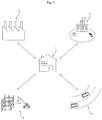
- FIG. 3 is a view illustrating an example of the surroundings where an air conditioner according to the present invention is installed.
- FIG. 3 illustrates an example of the surroundings where a person may perceive noise, in measuring ambient noise around a building 1 where the air conditioner is installed.
- ambient noise may be generated.
- Noise may be generated, particularly at lunchtime and school start and end times in the case of the school 5, during the hours of operation of the plant 2, during the construction at the construction site 4, and 24 hours in the case of the road 3, especially during commuting hours when many cars are on the road.
- the outdoor unit 10 measures ambient noise from the surroundings, as well as noise made by itself, by the noise sensor 12. In this case, the level of noise perceived in the building 1 varies with the distance from the building 1 to the plant 2, construction site 4, road 3, or school 5.
- the noise level requirement differs according to the surroundings even if the air conditioner performs low noise operation.
- the air conditioner controls operation according to ambient noise.
- FIG. 4 is a graph illustrating a noise measurement graph for an air conditioner according to the present invention.
- the air conditioner controls operation in such a way that the target level of noise from the outdoor unit varies according to ambient noise.
- FIG. 4 is a graph illustrating the outdoor unit noise level S1, noise level S2 in general during control of the outdoor unit, ambient noise level S3, target noise level S4, and environmental noise regulatory value S5, which vary with time.
- the outdoor unit noise level S1 is in the range from 60 dB to 73 dB. Since the outdoor unit 10 is installed outdoors a predetermined distance D away, as explained above, the noise level S2 during control of the outdoor unit is actually lower than the outdoor unit noise level S1. That is, the noise level S2 during control of the outdoor unit is dependent on the placement distance.
- the noise level S2 during control of the outdoor unit was higher than the environment noise regulatory value S5 during the daytime and evening hours.
- the user may perceive the noise as loud.
- the air conditioner needs to perform low noise operation during the daytime and evening hours to ensure that the environmental noise regulatory value requirement is met S5.
- the air conditioner When the air conditioner performs low noise operation, ambient noise needs to be taken into account. As explained above, the noise level requirement in an environment with much ambient noise is relatively low - that is, the user may feel less discomfort from noise from the outdoor unit in a loud environment. Thus, the operation of the air conditioner may be controlled by taking this into account.
- the outdoor unit 10 measures ambient noise in real time by using the noise sensor 12, and controls operation by taking the level of ambient noise and the placement distance D into account.
- the target noise level S4 is set according to ambient noise by adding a predetermined value to the measured ambient noise level S3, and when the outdoor unit 10 is running based on the target noise level, it may operate at a level lower than the environmental noise regulatory value S5. The added value may be changed depending on the level of ambient noise.
- the outdoor unit 10 performs low noise operation to reach the target noise level S4 that is set according to the measured ambient noise.
- the outdoor unit 10 makes less noise while maintaining the same capacity and the same performance, as compared to using a single large-capacity compressor. Accordingly, the outdoor unit 10 can operate with less noise by controlling a plurality of compressors, while meeting the target capacity, thereby achieving low noise operation.
- FIG. 5 is a view illustrating the control configuration of an air conditioner according to the present invention.
- the outdoor unit 10 includes an input part 140, an output part 150, a noise sensor 120, a data part 130, a compressor driving part 160, a fan driving part 170, a valve control part 180, a compressor 161, an outdoor unit fan 171, a valve 181, and a control part 110 that controls the overall operation.
- the outdoor unit 10 further includes a plurality of sensors such as a pressure sensor and a temperature sensor, a communication part, etc., in addition to the noise sensor, as control means for operation control, but description of them will be omitted below.
- sensors such as a pressure sensor and a temperature sensor, a communication part, etc., in addition to the noise sensor, as control means for operation control, but description of them will be omitted below.
- the input part 140 includes an input means such as a button or switch.
- the input part 140 applies data such as power input, an operation start command, a test operation command, an address setting command, etc. to the control part 110.
- the output part 150 outputs the operating status of the outdoor unit.
- the output part 150 includes a display, a speaker, a buzzer, a lamp, etc., and may indicate whether the outdoor unit is running, produce a warning sound when something goes wrong, and show the operating status by the color or blinking of the lamp.
- the noise sensor 120 is installed inside or outside the outdoor unit 10, and measures noise and provides the measurement to the control part 110.
- the noise sensor 120 operates in response to a control command from the control part 110, measures both noise generated while the outdoor unit 10 is stopped and noise generated during the operation of the outdoor unit 10 and provides the measurements to the control part 110.
- the control part 110 saves the noise data provided by the noise sensor 120 in the data part 130, and accumulates it over time.
- the noise sensor 120 measures noise in real time while the outdoor unit 10 is powered on, and provides the measurement to the control part 110.
- the noise sensor 120 includes a noise detection part 12 and a signal processing part 122.
- the noise detection part 121 collects ambient sounds and provides them to the signal processing part 122, and the signal processing part 122 converts them to data and provide it to the control part 110.
- the compressor 161 compresses incoming refrigerant to a high temperature, high-pressure and discharges it.
- the compressed refrigerant is circulated through the outdoor heat exchanger and the indoor heat exchanger and returns to the compressor.
- the indoor heat exchanger operates as an evaporator in cooling operation and as a condenser in heating operation.
- the outdoor heat exchanger operates as an evaporator if the indoor heat exchanger of the indoor unit operates as a condenser, and operates as a condenser if the indoor heat exchanger operates as an evaporator.
- the compressor 161 may have a plurality of compressors - first and second compressors.
- the compressor driving part 160 is a motor that is provided to the compressor by a switching operation, which causes the compressor to operate by supplying operating power for operation control.
- the compressor driving part 160 includes an inverter (not shown) to make the compressor operate at a predetermined operating frequency.
- the outdoor unit fan 171 is equipped in the outdoor heat exchanger to blow out the air heat-exchanged by the outdoor heat exchanger.
- the outdoor unit fan 11 is rotated by the fan driving part 170, and a plurality of outdoor unit fans 11 may be provided depending on the capacities of the compressor and outdoor heat exchanger.
- the valve controller 180 changes the refrigerant's flow channel by opening or closing a four-way valve or expansion valve in response to a control command from the control part 110.
- the data part 130 saves control data for operation of the outdoor unit and control of the components, data detected during the outdoor unit operation, and input/output data.
- the data part 130 saves noise measurement data 133 measured by the noise sensor 120, ambient noise data 132 measured by the noise sensor 120, and reference noise data 131 used for determining the level of noise.
- the noise data saved in the data part 130 is accumulated and saved for a given period of time, and may be reset in response to a control command from the control part 110.
- the control part 110 configures the operational settings in response to a request from the indoor units 21 and 22 or the remote controller and performs a heating or cooling operation, and checks the operating status based on data input from a plurality of sensors and performs control during the operation.
- the control part 110 receives noise data from the noise sensor 120, and saves it as noise measurement data 133 in the data part 130.
- the control part 110 may save noise data according to time, on the basis of a time module (not shown).
- the control part 110 performs low noise operation based on noise data input from the noise sensor 120. As explained above, the control part 110 controls operation according to ambient noise to ensure that the noise from the air conditioner in the daytime does not exceed the environmental noise regulatory value. Also, the control part 110 may detect abnormal noise from the noise data input from the noise sensor 120 and identify it as an error.
- control part 110 distinguishes between noise made by the outdoor unit and ambient noise and saves the ambient noise as ambient noise data 132, based on differences in noise data input from the noise sensor 120 between while the outdoor unit is running and while the outdoor unit is stopped.
- the control part 110 may save the outdoor unit noise level separately, which depends on the operational settings of the outdoor unit, and detect changes in ambient noise by subtracting the outdoor unit noise level dependent on the operational settings from the measured noise level.
- the control part 110 may continuously measure ambient noise by the noise sensor 120 and accumulate and save ambient noise data. In some cases, the control part 110 may measure ambient noise separately for a given period of time or longer, and accumulate and save it. If the compressor keeps operating for a long period of time, the operation of the compressor may be stopped at predetermined time intervals to measure ambient noise.
- the control part 110 may extract and save a pattern of changes in noise over time based on accumulated and saved noise data.
- the control part 110 analyzes the noise pattern at regular time intervals to create a noise history and controls operation based on the noise history.
- the control part 110 may analyze the noise pattern, especially for ambient noise.
- a time-dependent noise pattern for early morning, morning, afternoon, evening, and night is analyzed. If there is a school 5 nearby, a noise pattern for school start and end times and lunchtime may be extracted. Also, if noise comes from a plant 4 in the daytime throughout the spring-to-fall season but not in the winter, this may be extracted as a pattern.
- the control part 110 may control operation according to ambient noise by accumulating and saving noise data, and also may extract a noise pattern to create a noise history and use it for operation.
- control part 110 controls the compressor driving part 160 to reduce noise in such a way that a plurality of compressors operate at a low operating frequency, rather than that a single compressor operates at a high operating frequency according to load.
- FIG. 6 is a graph illustrating the compressors' operating frequencies, fan's rotation speed, and changes in noise according to the operation mode of an air conditioner according to the present invention.
- the noise level S11 measured by the noise sensor is as in the first line of the graph and the perceived noise level S12 is as in the second line of the graph.
- the perceived noise is a noise perceived in the room.
- the third line in the graph S13 shows the rotation speed of the fan during operation.
- the noise levels are equivalent noise levels, measured in dBA.
- the noise level S11 measured by the noise sensor 120 is 88.5 dBA
- the perceived noise level S12 dependent on the placement distance is 73.9 dBA.
- the outdoor unit 10 When the outdoor unit 10 performs low noise operation, it may run in Noise 1 mode, Noise 2 mode, and Noise 3 mode according to the level of low noise.
- a plurality of compressors i.e., first and second compressors, operate at 35 Hz and 30 Hz, respectively, and the outdoor unit fan runs at 900 rpm.
- the noise level S11 measured by the noise sensor 120 is 81.8 dBA
- the perceived noise level S12 is 70.7 dBA. Accordingly, if the outdoor unit 10 is running in Noise 1 mode, this achieves a noise reduction of 3.2 dB compared to Normal mode.
- the first and second compressors operate at 35 Hz and 30 Hz, respectively, (S23) and (S33), and the outdoor unit fan slows down and runs at about 800 rpm.
- the noise level S11 measured by the noise sensor 120 is 77.3 dBA
- the perceived noise level S12 is 67.6 dBA. Accordingly, if the outdoor unit 10 is running in Noise 2 mode, this achieves a noise reduction of 6.3 dB compared to Normal mode.
- the first and second compressors operate at 35 Hz and 30 Hz, respectively, (S24) and (S34), and the outdoor unit fan slows down and runs at about 700 rpm.
- the noise level S11 measured by the noise sensor 120 is 74.3 dBA
- the perceived noise level S12 is 64.4 dBA. Accordingly, if the outdoor unit 10 is running in Noise 3 mode, this achieves a noise reduction of 9.5 dB compared to Normal mode.
- the operating frequencies of the compressors were kept the same, and the rotation speed of the outdoor unit fan was controlled. Further noise reduction can be achieved if the operating frequencies of the compressors are controlled.
- the outdoor unit 10 can operate with less noise but with similar performance, compared to Normal mode, by performing low noise operation with a plurality of compressors.
- the operating frequencies of the compressors and the rotation speed of the outdoor unit fan are controlled within a range that the discharge temperature of the indoor units meets a target value. That is, in low noise operation, the control part 110 controls the operating frequencies of the compressors and the rotation speed of the outdoor unit fan within a range that does not significantly lower performance.
- the discharge temperature of the indoor units may be used as a criterion for performance assessment. If the inside temperature is higher than a target temperature when low noise operation is performed during cooling operation, the control part 110 may increase the operating frequencies of the compressors to further enhance performance.
- FIG. 7 is a view illustrating an example of abnormal noise from an air conditioner according to the present invention.
- the outdoor unit 10 may sense an abnormal noise from noise measurements input from the noise sensor 120.
- Noise measured by the noise sensor 120 may fluctuate depending on the operating status of the outdoor unit and ambient noise. Nevertheless, if an excessive noise level is measured as indicated at the first point PI of FIG. 7 , the control part 110 may identify it as abnormal noise.
- control part 110 may check the operating status of the outdoor unit 10 and analyze the cause of this problem, and then output an error regarding the abnormal noise.
- control part 110 may identify errors by changing the operating conditions of the compressor, fan, and valve.
- control part 110 may identify it as an abnormal noise generated from the valve or a noise caused by variation in the flow rate of refrigerant.
- FIG. 8 is a flowchart illustrating a method of low noise operation for an air conditioner according to the present invention. As illustrated in FIG. 8 , the control part 110 sets the operation mode of the outdoor unit 10 to a low noise mode according to the operational settings (S310).
- the noise sensor 120 measures noise (S320) and provides it to the control part 110. If the power of the outdoor unit 10 is ON, the noise sensor 120 keeps operating to measure noise. The control part 110 saves noise data input from the noise sensor 120 in the data part 130 (S330).
- the control part 110 sets the noise level according to the measured noise (S340), and configures the operational settings based on the noise level (S350).
- control part 110 determines the noise level according to the measured noise by taking ambient noise into account, and configures the operational settings such that the noise level is lower than the environmental noise regulatory value. For example, when a noise reduction of about 9 dB is needed, operation is performed in Noise 2 mode, and when a noise reduction of about 3 dB is needed, operation is performed in Noise 1 mode.
- control part 110 may set the target noise level to a value obtained by adding 5 dB, 10 dB, 20 dB, or 30 dB to the ambient noise level and control operation to ensure that the target noise level is met.
- control part 110 configures the operational settings by changing the rotation speed of the outdoor unit fan and the operating frequencies of the compressors according to the level of ambient noise.
- the rotation speed of the outdoor unit fan may be set to 500 rpm and the operating frequencies of the compressors may be set to 40 Hz.
- the rotation speed of the outdoor unit fan may be set to 800 rpm and the operating frequencies of the compressors may be set to 70 Hz. It is needless to say that the first and second compressors may operate at 35 Hz and 35 Hz, respectively.
- the control part 110 controls the compressor driving part 160, the fan driving part 170, and the valve control part 180 according to the operational settings.
- the compressor driving part 160 sets the operating frequencies of the compressors to run the compressors 161 (S360), the fan driving part 170 causes the outdoor unit fan 171 to rotate, and the valve control part 180 adjusts the opening degree of the four-way valve or electronic expansion valve.
- the noise sensor 120 continuously measures noise (S370), and the control part 110 determines whether the noise measured during operation of the outdoor unit is at a low level lower than an environmental noise regulatory value (S380).
- control part 110 determines whether the discharge temperature of the indoor units meets a set value (S390).
- control part 110 changes the operational settings (S400).
- control part 110 controls the compressors 161 or the rotation speed of the outdoor unit fan 171 so as to further reduce the noise measured by the noise sensor 120.
- the control part 110 keeps the outdoor unit at the low level but increases the operating frequencies of the compressors or the rotation speed of the outdoor unit fan to ensure that the discharge temperature of the indoor units meets the set value.
- the control part 110 changes the operational settings by adjusting the operating frequencies of the compressors in increments or decrements of 2 Hz up to a maximum of 10 Hz.
- control part 110 makes the compressors and the outdoor unit fan to run according to the changed settings, measures noise, determines whether the measured noise is at a low level, and determines whether the discharge temperature of the indoor units meets the set value (S360 through S400).
- the current operational settings are maintained (S410).
- control part 110 maintains the operation, but if the above requirements are not met because of a change in measured noise, the control part 110 changes the operational settings to ensure that both the low noise-level requirement and the indoor unit discharge temperature requirement are met.
- FIG. 9 is a flowchart illustrating a method of operating an air conditioner according to ambient noise according to the present invention.
- the control part 110 measures noise by the noise sensor 120 according to whether the compressors 161 are in stopped state (S460) or not (S510).
- the noise sensor 120 continuously measures noise while the outdoor unit 10 is powered ON.
- the control part 110 measures noise while the compressors are stopped, in order to measure noise made by the outdoor unit itself based on which the level of ambient noise can be detected.
- the outdoor unit fan is also stopped.
- the noise sensor 120 measures noise (S470), and the control part 110 saves the measured noise input from the noise sensor as ambient noise data in the data part 130.
- the control part 110 calculates the level of ambient noise based on the ambient noise data (S490), and changes the operational settings based on the noise level (S500). As explained previously, if ambient noise is equal to or above a set value, the demand for low noise decreases, and therefore the operational settings are configured by taking the level of ambient noise into account.
- the control part 110 may accumulate and save ambient noise data and analyze an ambient noise pattern based on the accumulated data to create a history of changes in ambient noise.
- the control part 110 performs low noise operation after changing the operational settings based on the ambient noise pattern.
- control part 110 may temporarily stop the compressors from running in order to check for noise from the outdoor unit or ambient noise.
- the noise sensor 120 measures noise even while the compressors are running (S510).
- the control part 110 saves noise data input from the noise sensor as noise measurement data 133 in the data part 130 (S520).
- the control part 110 calculates the level of measured noise (S530), and changes the operational settings by taking into account ambient noise, noise from the outdoor unit, and the placement distance, in order to ensure that the noise generated during operation of the outdoor unit does not exceed the environmental noise regulatory value (S540).
- the control part 110 may control operation in such a way that a 20 dB reduction depending on the distance and a further 5 dB reduction depending on the ambient noise level - that is, a total of 25 dB reduction in the measured noise level from the outdoor unit - can be achieved.
- control part 110 may set the target noise level based on the measured ambient noise level and control operation in such a way that noise from the outdoor unit varies according to a value obtained by adding 5 dB, 10 dB, 20 dB, or 30 dB to the ambient noise level.
- the control part 110 upon detecting an abnormal noise from noise measurements (S550), the control part 110 outputs a warning (S560), and changes the operational settings and analyzes the cause of the abnormal noise to resolve the noise problem. Alternatively, if abnormal noise occurs repeatedly, the control part 110 may output a warning for inspection.
- control part 110 continuously changes the operational settings according to the measured noise level and maintains low noise operation to ensure that the noise from the outdoor unit does not exceed the environmental noise regulatory value.
- the present invention enables low noise operation to ensure that the noise from the air conditioner does not exceed a regulatory value by continuously measuring noise and controlling the operation based on the noise level, especially, the relative noise level according to ambient noise. Moreover, the present invention allows for dynamic operation control according to changes in noise by analyzing data on ambient noise.
Landscapes
- Engineering & Computer Science (AREA)
- Mechanical Engineering (AREA)
- General Engineering & Computer Science (AREA)
- Chemical & Material Sciences (AREA)
- Combustion & Propulsion (AREA)
- Physics & Mathematics (AREA)
- Thermal Sciences (AREA)
- Human Computer Interaction (AREA)
- Fluid Mechanics (AREA)
- Health & Medical Sciences (AREA)
- Biomedical Technology (AREA)
- General Physics & Mathematics (AREA)
- Automation & Control Theory (AREA)
- Air Conditioning Control Device (AREA)
Claims (13)
- Climatiseur, comprenant:un compresseur (161) destiné à comprimer un réfrigérant ;un ventilateur d'unité extérieure (171) prévu pour souffler l'air soumis à échange de chaleur par un échangeur de chaleur extérieur ;un capteur de bruit (120) pour la mesure de bruit ;une partie de données (130) prévue pour mémoriser les données de bruit mesurées par le capteur de bruit (120) ; etune partie de commande (110) prévue pour commander un fonctionnement à faible bruit en distinguant entre le bruit ambiant et le bruit produit par le climatiseur sur la base de mesures de bruit du capteur de bruit (120), et pour modifier les réglages fonctionnels du compresseur (161) et du ventilateur d'unité extérieure (171) sur la base du niveau de bruit, la partie de commande (110) étant en outre prévue pour régler un niveau de bruit de consigne en fonction du bruit ambiant, pour modifier les réglages fonctionnels du compresseur (161) et du ventilateur d'unité extérieure (171), et pour commander un fonctionnement afin d'assurer que le bruit du climatiseur ne dépasse pas une valeur de régulation de bruit ambiant,où le capteur de bruit (120) mesure le bruit et transmet des données de bruit de manière continue,où la partie de commande (110) est en outre prévue pour détecter le bruit mesuré par le capteur de bruit en tant que bruit ambiant quand le compresseur (161) est arrêté, pour stocker et mémoriser le bruit ambiant en tant que données de bruit ambiant dans la partie de données, pour extraire un motif de bruit pour le bruit ambiant par analyse des données de bruit ambiant, et pour commander un fonctionnement sur la base du motif de bruit pour le bruit ambiant.
- Climatiseur selon la revendication 1, où la partie de commande (110) est en outre prévue pour commander un fonctionnement afin d'assurer qu'une valeur obtenue en soustrayant une diminution de bruit en fonction de la distance de positionnement d'une unité extérieure (10) du niveau de bruit mesuré ne dépasse pas la valeur de régulation de bruit ambiant.
- Climatiseur selon la revendication 1 ou la revendication 2, où la partie de commande (110) est en outre prévue pour régler le niveau de bruit de consigne à une valeur obtenue par ajout d'une valeur prédéfinie au niveau de bruit ambiant, sur la base de la distance de positionnement d'une unité extérieure (10) et d'un faible niveau de bruit réglé.
- Climatiseur selon la revendication 3, où, dans un mode à faible bruit, la partie de commande (110) règle le niveau de bruit de consigne à une valeur obtenue en ajoutant 5 dB, 10 dB, 20 dB ou 30 dB au niveau de bruit ambiant.
- Climatiseur selon l'une des revendications 1 à 4, où, si le bruit mesuré n'est pas à un faible niveau, inférieur à la valeur de régulation de bruit ambiant, ou si le bruit mesuré est à un faible niveau mais que la température de refoulement d'une unité intérieure ne correspond pas au niveau de bruit de consigne, la partie de commande (110) est en outre prévue pour modifier les réglages fonctionnels du compresseur (161) et du ventilateur d'unité extérieure (171).
- Climatiseur selon l'une des revendications 1 à 5, où la partie de commande (110) est en outre prévue pour détecter un bruit anormal à partir des mesures de bruit et, si un bruit anormal survient, pour transmettre une erreur et modifier les réglages fonctionnels du compresseur (161) et/ou du ventilateur d'unité extérieure (171) et/ou d'une vanne (181), et pour analyser la cause du bruit anormal.
- Climatiseur selon l'une des revendications 1 à 6, où la partie de commande (110) est en outre prévue pour commuter le mode de fonctionnement d'un mode normal où un seul compresseur fonctionne à une fréquence de fonctionnement élevée, à un mode à faible bruit où une pluralité de compresseurs fonctionne à une basse fréquence de fonctionnement afin de réduire le bruit mesuré.
- Procédé de fonctionnement d'un climatiseur, ledit procédé comprenant :la mesure du bruit par un capteur de bruit (120) après réglage du mode de fonctionnement sur un mode à faible bruit ;la détection du bruit ambiant à partir de mesures de bruit du capteur de bruit (120) et le réglage d'un niveau de bruit de consigne en fonction du bruit ambiant ;la configuration des réglages fonctionnels d'un compresseur (161) ou d'un ventilateur d'unité extérieure (171) sur la base du niveau de bruit de consigne et le démarrage du fonctionnement ;la mesure du bruit par le capteur de bruit (120) pendant le fonctionnement ;la détermination si le bruit mesuré est à un faible niveau si le bruit d'une unité extérieure (10) est à un faible niveau ;la détermination si la température de refoulement d'une unité intérieure (20) correspond à une valeur réglée ; et,si le bruit de l'unité extérieure (10) n'est pas à un faible niveau ou si la température de refoulement de l'unité intérieure (20) ne correspond pas à la valeur réglée, la modification des réglages fonctionnels ;la mesure continue du bruit par le capteur de bruit ;la détection du bruit mesuré par le capteur de bruit en tant bruit ambiant quand le compresseur (161) est arrêté ;le stockage et la mémorisation du bruit ambiant en tant que données de bruit ambiant dans une partie de données, pour extraire un motif de bruit pour le bruit ambiant par analyse des données de bruit ambiant ; etla configuration des réglages fonctionnels d'un compresseur (161) ou d'un ventilateur d'unité extérieure en fonction du motif de bruit.
- Procédé selon la revendication 8, où, si le bruit de l'unité extérieure (10) est en dessous d'une valeur de régulation de bruit ambiant, le bruit est détecté en tant que bruit de faible niveau, et le bruit de l'unité extérieure (10) a une valeur obtenue en soustrayant une diminution de bruit en fonction de la distance du niveau de bruit mesuré.
- Procédé selon la revendication 8 ou la revendication 9, où le bruit mesuré par le capteur de bruit est détecté en tant que bruit ambiant quand le compresseur (161) est arrêté, puis mémorisé en tant que données de bruit ambiant.
- Procédé selon la revendication 8, la revendication 9 ou la revendication 10, comprenant en outre, si le compresseur (161) fonctionne pendant au moins une durée donnée, l'arrêt du compresseur (161) puis la mesure du bruit ambiant par le capteur de bruit (120).
- Procédé selon l'une des revendications 8 à 11, où, dans le mode à faible bruit, le niveau de bruit de consigne est réglé à une valeur obtenue en ajoutant 5 dB, 10 dB, 20 dB ou 30 dB au niveau de bruit ambiant.
- Procédé selon l'une des revendications 8 à 12, comprenant en outre, si le niveau de bruit mesuré est égal ou supérieur à une certaine valeur, la détection du bruit mesuré en tant que bruit anormal et la transmission d'une erreur, et
la modification des réglages du compresseur (161), du ventilateur d'unité extérieure (171) ou d'une vanne (181) et l'analyse de la cause du bruit anormal.
Applications Claiming Priority (1)
| Application Number | Priority Date | Filing Date | Title |
|---|---|---|---|
| KR1020150113423A KR20170019254A (ko) | 2015-08-11 | 2015-08-11 | 공기조화기 및 그 동작방법 |
Publications (2)
| Publication Number | Publication Date |
|---|---|
| EP3130862A1 EP3130862A1 (fr) | 2017-02-15 |
| EP3130862B1 true EP3130862B1 (fr) | 2020-09-30 |
Family
ID=56618075
Family Applications (1)
| Application Number | Title | Priority Date | Filing Date |
|---|---|---|---|
| EP16183563.2A Active EP3130862B1 (fr) | 2015-08-11 | 2016-08-10 | Climatiseur et procédé de fonctionnement correspondant |
Country Status (3)
| Country | Link |
|---|---|
| US (1) | US10060648B2 (fr) |
| EP (1) | EP3130862B1 (fr) |
| KR (1) | KR20170019254A (fr) |
Families Citing this family (53)
| Publication number | Priority date | Publication date | Assignee | Title |
|---|---|---|---|---|
| US12228299B2 (en) * | 2016-02-12 | 2025-02-18 | Goodman Manufacturing Company LP | System for controlling target air temperature in a target time in a building |
| US10531236B2 (en) * | 2016-11-03 | 2020-01-07 | International Business Machines Corporation | Universal mute for internet of things enabled devices |
| CN107120795B (zh) * | 2017-05-16 | 2019-05-24 | 珠海格力电器股份有限公司 | 空调控制方法、系统及装置 |
| CN107676919B (zh) * | 2017-07-31 | 2021-07-27 | 青岛海尔空调电子有限公司 | 一种空调机组降噪控制方法 |
| US10921000B2 (en) * | 2018-01-12 | 2021-02-16 | Trane International Inc. | Limiting operation of a HVAC system for low-noise municipalities |
| CN108518797A (zh) * | 2018-02-23 | 2018-09-11 | 珠海格力电器股份有限公司 | 空调的控制方法、装置和系统 |
| KR102071963B1 (ko) * | 2018-03-09 | 2020-01-31 | 엘지전자 주식회사 | 냉매소음 저감형 공기조화기 실내기 및 그 제어 방법 |
| KR102078720B1 (ko) * | 2018-03-09 | 2020-02-18 | 엘지전자 주식회사 | 공기조화기 실내기 및 그 제어 방법 |
| US10747279B2 (en) * | 2018-04-05 | 2020-08-18 | Motorola Mobility Llc | Managing noise levels of active cooling devices |
| DE102018111566A1 (de) * | 2018-05-15 | 2019-11-21 | Vaillant Gmbh | Verfahren zum Betrieb einer Luft-Wasser-Wärmepumpe |
| CN108844234A (zh) * | 2018-06-25 | 2018-11-20 | 珠海格力电器股份有限公司 | 变频热泵热水器的加热方法、装置及变频热泵热水器 |
| CN109028492B (zh) * | 2018-08-14 | 2019-10-11 | 宁波奥克斯电气股份有限公司 | 膨胀阀控制方法、装置及空调器 |
| CN109458719A (zh) * | 2018-10-22 | 2019-03-12 | 四川虹美智能科技有限公司 | 一种空调的控制器、一种空调的控制方法及一种空调 |
| CN111207824B (zh) * | 2018-11-21 | 2022-01-25 | 奥克斯空调股份有限公司 | 一种外机噪音测试装置及方法 |
| CN109827306B (zh) * | 2019-01-03 | 2020-06-05 | 珠海格力电器股份有限公司 | 一种机组运行的智能控制方法及机组 |
| CN110220279A (zh) * | 2019-05-13 | 2019-09-10 | 青岛海尔空调电子有限公司 | 空调器室外机的控制方法 |
| CN112013522A (zh) * | 2019-05-28 | 2020-12-01 | 日立江森自控空调有限公司 | 一种空调异音处理方法和空调系统 |
| CN110410967B (zh) * | 2019-07-03 | 2021-08-24 | 宁波奥克斯电气股份有限公司 | 多联机空调系统管路噪音的控制方法和多联机空调系统 |
| CN110360756B (zh) * | 2019-07-15 | 2020-08-14 | 珠海格力电器股份有限公司 | 热水器的智能化控制方法、装置及热水器 |
| CN111023324B (zh) * | 2019-12-27 | 2021-05-14 | 宁波奥克斯电气股份有限公司 | 共振噪音的控制方法、装置和空调器 |
| DE102020203447A1 (de) | 2020-03-18 | 2021-09-23 | Robert Bosch Gesellschaft mit beschränkter Haftung | Verfahren zum Betrieb einer Kompressionswärmepumpenvorrichtung |
| US11300321B2 (en) | 2020-03-31 | 2022-04-12 | Johnson Controls Tyco IP Holdings LLP | Systems and methods to operate an HVAC system based on sound level |
| CN111623487B (zh) * | 2020-05-27 | 2021-08-27 | 海信(山东)空调有限公司 | 空调器的风机转速控制方法 |
| CN112556087B (zh) * | 2020-11-20 | 2021-12-10 | 珠海格力电器股份有限公司 | 一种机组故障诊断方法、装置和一种控制器 |
| CN112524706B (zh) * | 2020-12-08 | 2021-12-03 | 四川斯普信信息技术有限公司 | 用于风冷空调外机降噪及预冷的控制系统、方法及应用 |
| CN112648765B (zh) * | 2020-12-15 | 2022-04-12 | 美的威灵电机技术(上海)有限公司 | 制冷设备 |
| KR102422007B1 (ko) * | 2021-01-11 | 2022-07-15 | 엘지전자 주식회사 | 공기조화기 시스템 및 그 동작 방법 |
| CN112984720A (zh) * | 2021-02-01 | 2021-06-18 | 青岛海尔空调器有限总公司 | 用于空调的控制方法及装置、空调 |
| CN115388523B (zh) * | 2021-05-19 | 2025-04-22 | 广州华凌制冷设备有限公司 | 空调器及其控制方法、计算机可读存储介质 |
| CN113432248A (zh) * | 2021-05-24 | 2021-09-24 | 海信(山东)空调有限公司 | 一种空调及空调风扇的转速调节方法 |
| CN113531662A (zh) * | 2021-06-02 | 2021-10-22 | 海信(山东)空调有限公司 | 一种空调器和室内风扇转速的控制方法 |
| CN113606726B (zh) * | 2021-06-29 | 2022-12-27 | 青岛海尔空调电子有限公司 | 空调器噪音控制方法、控制装置及空调器 |
| CN113446703A (zh) * | 2021-07-01 | 2021-09-28 | 宁波奥克斯电气股份有限公司 | 空调器噪音分析方法、装置、服务器及存储介质 |
| CN113531676B (zh) * | 2021-07-28 | 2022-07-26 | 珠海格力电器股份有限公司 | 一种空调器降噪控制方法及空调器 |
| CN113701326B (zh) * | 2021-08-30 | 2023-01-10 | 广东智科电子股份有限公司 | 一种热泵用室外风机调速控制装置及系统 |
| CN113790506B (zh) * | 2021-09-16 | 2022-07-19 | 珠海格力电器股份有限公司 | 一种解决空调外机噪音的方法 |
| CN115854510B (zh) * | 2021-09-27 | 2025-07-25 | 广东美的制冷设备有限公司 | 空调器控制方法、装置、空调器及存储介质 |
| CN114151308B (zh) * | 2021-11-26 | 2023-10-24 | 广东美芝制冷设备有限公司 | 高频噪音的消除方法、装置和矢量控制系统 |
| CN114322191A (zh) * | 2021-12-13 | 2022-04-12 | 青岛海尔空调器有限总公司 | 空调器的降噪控制方法、装置、空调器以及存储介质 |
| CN114279059B (zh) * | 2021-12-31 | 2023-05-30 | 小米科技(武汉)有限公司 | 新风空调室内机的控制方法、空调室内机及存储介质 |
| CN114608127B (zh) * | 2022-01-26 | 2023-10-20 | 宁波奥克斯电气股份有限公司 | 改善室内机噪音的控制方法、装置及空调器 |
| CN114440395B (zh) * | 2022-02-24 | 2023-10-27 | 海信空调有限公司 | 空调降噪控制方法、装置、空调及存储介质 |
| CN114659262A (zh) * | 2022-04-07 | 2022-06-24 | 青岛海尔空调器有限总公司 | 用于降低空调器噪音的方法及装置、空调器、存储介质 |
| CN117006618B (zh) * | 2022-04-27 | 2025-09-16 | 青岛海尔空调器有限总公司 | 除湿机降噪控制方法、装置、电子设备及存储介质 |
| CN114877614A (zh) * | 2022-06-07 | 2022-08-09 | 四川虹美智能科技有限公司 | 一种智能降噪冰箱的控制系统及方法 |
| CN115486662A (zh) * | 2022-09-23 | 2022-12-20 | 慕思健康睡眠股份有限公司 | 硬度可调垫体的噪声控制方法、装置、垫体及介质 |
| CN115962541B (zh) * | 2022-12-29 | 2024-12-03 | 小米科技(武汉)有限公司 | 空调制冷剂不足的判断方法、装置和存储介质 |
| CN117053295A (zh) * | 2023-07-05 | 2023-11-14 | 浙江中广电器集团股份有限公司 | 一种热泵空调器及其室外机噪声优化控制方法 |
| CN119594524B (zh) * | 2023-09-08 | 2025-12-19 | 青岛海尔空调器有限总公司 | 智能降噪控制方法、装置、设备和计算机存储介质 |
| CN117249548A (zh) * | 2023-09-27 | 2023-12-19 | 珠海格力电器股份有限公司 | 一种空调控制方法及空调 |
| WO2025093730A1 (fr) * | 2023-11-01 | 2025-05-08 | Motor Competence Center Holding Flensburg Gmbh | Procédé de fonctionnement et de surveillance d'un moteur |
| CN118242744A (zh) * | 2024-04-22 | 2024-06-25 | 青岛海尔空调器有限总公司 | 多房间送风场景的送风控制方法、送风控制装置和智能空调 |
| CN121025601B (zh) * | 2025-10-31 | 2025-12-30 | 广州瑞姆节能设备有限公司 | 一种数字变频机组协同调控方法及系统 |
Family Cites Families (11)
| Publication number | Priority date | Publication date | Assignee | Title |
|---|---|---|---|---|
| US4784319A (en) * | 1986-06-16 | 1988-11-15 | Kaiser Martin L | Delayed response air conditioning/heating control system |
| JPH0359339A (ja) | 1989-07-26 | 1991-03-14 | Toshiba Corp | 空気調和機の室外ユニット騒音制御装置 |
| US5010739A (en) * | 1989-06-30 | 1991-04-30 | Kabushiki Kaisha Toshiba | Air conditioning apparatus having audible sound level control function |
| JPH0336448A (ja) | 1989-06-30 | 1991-02-18 | Toshiba Corp | 空気調和機 |
| JP2600538B2 (ja) | 1991-10-08 | 1997-04-16 | ダイキン工業株式会社 | 空気調和機における騒音診断装置 |
| DE10017278A1 (de) * | 2000-04-06 | 2001-10-11 | Bosch Gmbh Robert | Verfahren zum Kalibrieren eines abhängig von einem Sensor arbeitenden Systems in einem Kraftfahrzeug |
| KR100860717B1 (ko) | 2004-04-12 | 2008-09-29 | 요크 인터내셔널 코포레이션 | 냉각장치의 소음감소 조절장치 및 조절방법 |
| JP4049188B2 (ja) | 2006-03-31 | 2008-02-20 | ダイキン工業株式会社 | 空気調和機の制御装置及び制御方法 |
| US8155326B2 (en) * | 2007-10-09 | 2012-04-10 | Schweitzer Engineering Laboratories, Inc. | System, method, and apparatus for using the sound signature of a device to determine its operability |
| KR102080857B1 (ko) | 2013-01-22 | 2020-02-24 | 엘지전자 주식회사 | 공기조화기 및 그 제어 방법 |
| DE102013109025A1 (de) | 2013-08-21 | 2015-02-26 | Mag Ias Gmbh | Gleitfläche |
-
2015
- 2015-08-11 KR KR1020150113423A patent/KR20170019254A/ko not_active Ceased
-
2016
- 2016-08-09 US US15/232,571 patent/US10060648B2/en active Active
- 2016-08-10 EP EP16183563.2A patent/EP3130862B1/fr active Active
Non-Patent Citations (1)
| Title |
|---|
| None * |
Also Published As
| Publication number | Publication date |
|---|---|
| US10060648B2 (en) | 2018-08-28 |
| KR20170019254A (ko) | 2017-02-21 |
| EP3130862A1 (fr) | 2017-02-15 |
| US20170045261A1 (en) | 2017-02-16 |
Similar Documents
| Publication | Publication Date | Title |
|---|---|---|
| EP3130862B1 (fr) | Climatiseur et procédé de fonctionnement correspondant | |
| EP3073201B1 (fr) | Climatisation et procédé de commande correspondant | |
| US12392515B2 (en) | Refrigerant leak management systems | |
| EP2239518B1 (fr) | Appareil de climatisation | |
| KR102262245B1 (ko) | 공기조화기 및 그 제어방법 | |
| US10948213B2 (en) | Systems and methods for operating a thermostat based on building configuration data | |
| KR102089362B1 (ko) | 공기조화기 및 그 제어 방법 | |
| KR20110001667A (ko) | 공기조화기 및 그 동작방법 | |
| EP3054229B1 (fr) | Climatiseur | |
| US10648718B2 (en) | Air conditioning apparatus with compressor discharge pressure sensing | |
| KR20170090837A (ko) | 공기조화기 및 그 제어방법 | |
| KR101151321B1 (ko) | 멀티형 공기조화기 및 그 운전방법 | |
| KR20150105839A (ko) | 공기조화기 및 그 제어방법 | |
| KR102104448B1 (ko) | 공기조화기 및 그 제어방법 | |
| KR20190083038A (ko) | 공기조화기 및 그 제어방법 | |
| KR102767728B1 (ko) | 공기조화기 | |
| KR20150106751A (ko) | 공기조화기 및 그 제어방법 | |
| KR101679576B1 (ko) | 공기조화기 및 그 제어방법 | |
| KR102470369B1 (ko) | 공기조화기 및 그 동작방법 | |
| KR20160112490A (ko) | 공기조화기 및 그 제어방법 | |
| JP4736970B2 (ja) | 空気調和装置 | |
| WO2016063437A1 (fr) | Appareil de climatisation | |
| KR20100048548A (ko) | 공기조화기 및 그 제어방법 | |
| KR101784404B1 (ko) | 공기조화기 및 그 제어방법 |
Legal Events
| Date | Code | Title | Description |
|---|---|---|---|
| PUAI | Public reference made under article 153(3) epc to a published international application that has entered the european phase |
Free format text: ORIGINAL CODE: 0009012 |
|
| STAA | Information on the status of an ep patent application or granted ep patent |
Free format text: STATUS: REQUEST FOR EXAMINATION WAS MADE |
|
| 17P | Request for examination filed |
Effective date: 20160910 |
|
| AK | Designated contracting states |
Kind code of ref document: A1 Designated state(s): AL AT BE BG CH CY CZ DE DK EE ES FI FR GB GR HR HU IE IS IT LI LT LU LV MC MK MT NL NO PL PT RO RS SE SI SK SM TR |
|
| AX | Request for extension of the european patent |
Extension state: BA ME |
|
| RBV | Designated contracting states (corrected) |
Designated state(s): AL AT BE BG CH CY CZ DE DK EE ES FI FR GB GR HR HU IE IS IT LI LT LU LV MC MK MT NL NO PL PT RO RS SE SI SK SM TR |
|
| GRAP | Despatch of communication of intention to grant a patent |
Free format text: ORIGINAL CODE: EPIDOSNIGR1 |
|
| STAA | Information on the status of an ep patent application or granted ep patent |
Free format text: STATUS: GRANT OF PATENT IS INTENDED |
|
| INTG | Intention to grant announced |
Effective date: 20200316 |
|
| GRAS | Grant fee paid |
Free format text: ORIGINAL CODE: EPIDOSNIGR3 |
|
| GRAA | (expected) grant |
Free format text: ORIGINAL CODE: 0009210 |
|
| STAA | Information on the status of an ep patent application or granted ep patent |
Free format text: STATUS: THE PATENT HAS BEEN GRANTED |
|
| AK | Designated contracting states |
Kind code of ref document: B1 Designated state(s): AL AT BE BG CH CY CZ DE DK EE ES FI FR GB GR HR HU IE IS IT LI LT LU LV MC MK MT NL NO PL PT RO RS SE SI SK SM TR |
|
| REG | Reference to a national code |
Ref country code: CH Ref legal event code: EP Ref country code: GB Ref legal event code: FG4D |
|
| REG | Reference to a national code |
Ref country code: AT Ref legal event code: REF Ref document number: 1319184 Country of ref document: AT Kind code of ref document: T Effective date: 20201015 |
|
| REG | Reference to a national code |
Ref country code: DE Ref legal event code: R096 Ref document number: 602016044846 Country of ref document: DE |
|
| REG | Reference to a national code |
Ref country code: IE Ref legal event code: FG4D |
|
| PG25 | Lapsed in a contracting state [announced via postgrant information from national office to epo] |
Ref country code: HR Free format text: LAPSE BECAUSE OF FAILURE TO SUBMIT A TRANSLATION OF THE DESCRIPTION OR TO PAY THE FEE WITHIN THE PRESCRIBED TIME-LIMIT Effective date: 20200930 Ref country code: BG Free format text: LAPSE BECAUSE OF FAILURE TO SUBMIT A TRANSLATION OF THE DESCRIPTION OR TO PAY THE FEE WITHIN THE PRESCRIBED TIME-LIMIT Effective date: 20201230 Ref country code: NO Free format text: LAPSE BECAUSE OF FAILURE TO SUBMIT A TRANSLATION OF THE DESCRIPTION OR TO PAY THE FEE WITHIN THE PRESCRIBED TIME-LIMIT Effective date: 20201230 Ref country code: GR Free format text: LAPSE BECAUSE OF FAILURE TO SUBMIT A TRANSLATION OF THE DESCRIPTION OR TO PAY THE FEE WITHIN THE PRESCRIBED TIME-LIMIT Effective date: 20201231 Ref country code: SE Free format text: LAPSE BECAUSE OF FAILURE TO SUBMIT A TRANSLATION OF THE DESCRIPTION OR TO PAY THE FEE WITHIN THE PRESCRIBED TIME-LIMIT Effective date: 20200930 Ref country code: FI Free format text: LAPSE BECAUSE OF FAILURE TO SUBMIT A TRANSLATION OF THE DESCRIPTION OR TO PAY THE FEE WITHIN THE PRESCRIBED TIME-LIMIT Effective date: 20200930 |
|
| REG | Reference to a national code |
Ref country code: AT Ref legal event code: MK05 Ref document number: 1319184 Country of ref document: AT Kind code of ref document: T Effective date: 20200930 |
|
| PG25 | Lapsed in a contracting state [announced via postgrant information from national office to epo] |
Ref country code: LV Free format text: LAPSE BECAUSE OF FAILURE TO SUBMIT A TRANSLATION OF THE DESCRIPTION OR TO PAY THE FEE WITHIN THE PRESCRIBED TIME-LIMIT Effective date: 20200930 Ref country code: RS Free format text: LAPSE BECAUSE OF FAILURE TO SUBMIT A TRANSLATION OF THE DESCRIPTION OR TO PAY THE FEE WITHIN THE PRESCRIBED TIME-LIMIT Effective date: 20200930 |
|
| REG | Reference to a national code |
Ref country code: NL Ref legal event code: MP Effective date: 20200930 |
|
| REG | Reference to a national code |
Ref country code: LT Ref legal event code: MG4D |
|
| PG25 | Lapsed in a contracting state [announced via postgrant information from national office to epo] |
Ref country code: NL Free format text: LAPSE BECAUSE OF FAILURE TO SUBMIT A TRANSLATION OF THE DESCRIPTION OR TO PAY THE FEE WITHIN THE PRESCRIBED TIME-LIMIT Effective date: 20200930 Ref country code: LT Free format text: LAPSE BECAUSE OF FAILURE TO SUBMIT A TRANSLATION OF THE DESCRIPTION OR TO PAY THE FEE WITHIN THE PRESCRIBED TIME-LIMIT Effective date: 20200930 Ref country code: CZ Free format text: LAPSE BECAUSE OF FAILURE TO SUBMIT A TRANSLATION OF THE DESCRIPTION OR TO PAY THE FEE WITHIN THE PRESCRIBED TIME-LIMIT Effective date: 20200930 Ref country code: RO Free format text: LAPSE BECAUSE OF FAILURE TO SUBMIT A TRANSLATION OF THE DESCRIPTION OR TO PAY THE FEE WITHIN THE PRESCRIBED TIME-LIMIT Effective date: 20200930 Ref country code: PT Free format text: LAPSE BECAUSE OF FAILURE TO SUBMIT A TRANSLATION OF THE DESCRIPTION OR TO PAY THE FEE WITHIN THE PRESCRIBED TIME-LIMIT Effective date: 20210201 Ref country code: SM Free format text: LAPSE BECAUSE OF FAILURE TO SUBMIT A TRANSLATION OF THE DESCRIPTION OR TO PAY THE FEE WITHIN THE PRESCRIBED TIME-LIMIT Effective date: 20200930 Ref country code: EE Free format text: LAPSE BECAUSE OF FAILURE TO SUBMIT A TRANSLATION OF THE DESCRIPTION OR TO PAY THE FEE WITHIN THE PRESCRIBED TIME-LIMIT Effective date: 20200930 |
|
| PG25 | Lapsed in a contracting state [announced via postgrant information from national office to epo] |
Ref country code: ES Free format text: LAPSE BECAUSE OF FAILURE TO SUBMIT A TRANSLATION OF THE DESCRIPTION OR TO PAY THE FEE WITHIN THE PRESCRIBED TIME-LIMIT Effective date: 20200930 Ref country code: AT Free format text: LAPSE BECAUSE OF FAILURE TO SUBMIT A TRANSLATION OF THE DESCRIPTION OR TO PAY THE FEE WITHIN THE PRESCRIBED TIME-LIMIT Effective date: 20200930 Ref country code: AL Free format text: LAPSE BECAUSE OF FAILURE TO SUBMIT A TRANSLATION OF THE DESCRIPTION OR TO PAY THE FEE WITHIN THE PRESCRIBED TIME-LIMIT Effective date: 20200930 Ref country code: IS Free format text: LAPSE BECAUSE OF FAILURE TO SUBMIT A TRANSLATION OF THE DESCRIPTION OR TO PAY THE FEE WITHIN THE PRESCRIBED TIME-LIMIT Effective date: 20210130 Ref country code: PL Free format text: LAPSE BECAUSE OF FAILURE TO SUBMIT A TRANSLATION OF THE DESCRIPTION OR TO PAY THE FEE WITHIN THE PRESCRIBED TIME-LIMIT Effective date: 20200930 |
|
| PG25 | Lapsed in a contracting state [announced via postgrant information from national office to epo] |
Ref country code: SK Free format text: LAPSE BECAUSE OF FAILURE TO SUBMIT A TRANSLATION OF THE DESCRIPTION OR TO PAY THE FEE WITHIN THE PRESCRIBED TIME-LIMIT Effective date: 20200930 |
|
| REG | Reference to a national code |
Ref country code: DE Ref legal event code: R097 Ref document number: 602016044846 Country of ref document: DE |
|
| PLBE | No opposition filed within time limit |
Free format text: ORIGINAL CODE: 0009261 |
|
| STAA | Information on the status of an ep patent application or granted ep patent |
Free format text: STATUS: NO OPPOSITION FILED WITHIN TIME LIMIT |
|
| PG25 | Lapsed in a contracting state [announced via postgrant information from national office to epo] |
Ref country code: DK Free format text: LAPSE BECAUSE OF FAILURE TO SUBMIT A TRANSLATION OF THE DESCRIPTION OR TO PAY THE FEE WITHIN THE PRESCRIBED TIME-LIMIT Effective date: 20200930 |
|
| 26N | No opposition filed |
Effective date: 20210701 |
|
| PG25 | Lapsed in a contracting state [announced via postgrant information from national office to epo] |
Ref country code: IT Free format text: LAPSE BECAUSE OF FAILURE TO SUBMIT A TRANSLATION OF THE DESCRIPTION OR TO PAY THE FEE WITHIN THE PRESCRIBED TIME-LIMIT Effective date: 20200930 |
|
| PG25 | Lapsed in a contracting state [announced via postgrant information from national office to epo] |
Ref country code: SI Free format text: LAPSE BECAUSE OF FAILURE TO SUBMIT A TRANSLATION OF THE DESCRIPTION OR TO PAY THE FEE WITHIN THE PRESCRIBED TIME-LIMIT Effective date: 20200930 |
|
| REG | Reference to a national code |
Ref country code: CH Ref legal event code: PL |
|
| PG25 | Lapsed in a contracting state [announced via postgrant information from national office to epo] |
Ref country code: MC Free format text: LAPSE BECAUSE OF FAILURE TO SUBMIT A TRANSLATION OF THE DESCRIPTION OR TO PAY THE FEE WITHIN THE PRESCRIBED TIME-LIMIT Effective date: 20200930 |
|
| REG | Reference to a national code |
Ref country code: BE Ref legal event code: MM Effective date: 20210831 |
|
| GBPC | Gb: european patent ceased through non-payment of renewal fee |
Effective date: 20210810 |
|
| PG25 | Lapsed in a contracting state [announced via postgrant information from national office to epo] |
Ref country code: LI Free format text: LAPSE BECAUSE OF NON-PAYMENT OF DUE FEES Effective date: 20210831 Ref country code: CH Free format text: LAPSE BECAUSE OF NON-PAYMENT OF DUE FEES Effective date: 20210831 |
|
| PG25 | Lapsed in a contracting state [announced via postgrant information from national office to epo] |
Ref country code: IS Free format text: LAPSE BECAUSE OF FAILURE TO SUBMIT A TRANSLATION OF THE DESCRIPTION OR TO PAY THE FEE WITHIN THE PRESCRIBED TIME-LIMIT Effective date: 20210130 Ref country code: LU Free format text: LAPSE BECAUSE OF NON-PAYMENT OF DUE FEES Effective date: 20210810 |
|
| PG25 | Lapsed in a contracting state [announced via postgrant information from national office to epo] |
Ref country code: IE Free format text: LAPSE BECAUSE OF NON-PAYMENT OF DUE FEES Effective date: 20210810 Ref country code: GB Free format text: LAPSE BECAUSE OF NON-PAYMENT OF DUE FEES Effective date: 20210810 Ref country code: FR Free format text: LAPSE BECAUSE OF NON-PAYMENT OF DUE FEES Effective date: 20210831 Ref country code: BE Free format text: LAPSE BECAUSE OF NON-PAYMENT OF DUE FEES Effective date: 20210831 |
|
| PG25 | Lapsed in a contracting state [announced via postgrant information from national office to epo] |
Ref country code: HU Free format text: LAPSE BECAUSE OF FAILURE TO SUBMIT A TRANSLATION OF THE DESCRIPTION OR TO PAY THE FEE WITHIN THE PRESCRIBED TIME-LIMIT; INVALID AB INITIO Effective date: 20160810 |
|
| PG25 | Lapsed in a contracting state [announced via postgrant information from national office to epo] |
Ref country code: CY Free format text: LAPSE BECAUSE OF FAILURE TO SUBMIT A TRANSLATION OF THE DESCRIPTION OR TO PAY THE FEE WITHIN THE PRESCRIBED TIME-LIMIT Effective date: 20200930 |
|
| PG25 | Lapsed in a contracting state [announced via postgrant information from national office to epo] |
Ref country code: MK Free format text: LAPSE BECAUSE OF FAILURE TO SUBMIT A TRANSLATION OF THE DESCRIPTION OR TO PAY THE FEE WITHIN THE PRESCRIBED TIME-LIMIT Effective date: 20200930 |
|
| PG25 | Lapsed in a contracting state [announced via postgrant information from national office to epo] |
Ref country code: TR Free format text: LAPSE BECAUSE OF FAILURE TO SUBMIT A TRANSLATION OF THE DESCRIPTION OR TO PAY THE FEE WITHIN THE PRESCRIBED TIME-LIMIT Effective date: 20200930 |
|
| PG25 | Lapsed in a contracting state [announced via postgrant information from national office to epo] |
Ref country code: MT Free format text: LAPSE BECAUSE OF FAILURE TO SUBMIT A TRANSLATION OF THE DESCRIPTION OR TO PAY THE FEE WITHIN THE PRESCRIBED TIME-LIMIT Effective date: 20200930 |
|
| PGFP | Annual fee paid to national office [announced via postgrant information from national office to epo] |
Ref country code: DE Payment date: 20250707 Year of fee payment: 10 |