EP3133097B1 - Herstellung von polyurethanweichschäumen mit verbesserter härte - Google Patents
Herstellung von polyurethanweichschäumen mit verbesserter härte Download PDFInfo
- Publication number
- EP3133097B1 EP3133097B1 EP15181218.7A EP15181218A EP3133097B1 EP 3133097 B1 EP3133097 B1 EP 3133097B1 EP 15181218 A EP15181218 A EP 15181218A EP 3133097 B1 EP3133097 B1 EP 3133097B1
- Authority
- EP
- European Patent Office
- Prior art keywords
- foam
- additive
- polyols
- kpa
- foams
- Prior art date
- Legal status (The legal status is an assumption and is not a legal conclusion. Google has not performed a legal analysis and makes no representation as to the accuracy of the status listed.)
- Active
Links
Classifications
-
- C—CHEMISTRY; METALLURGY
- C08—ORGANIC MACROMOLECULAR COMPOUNDS; THEIR PREPARATION OR CHEMICAL WORKING-UP; COMPOSITIONS BASED THEREON
- C08G—MACROMOLECULAR COMPOUNDS OBTAINED OTHERWISE THAN BY REACTIONS ONLY INVOLVING UNSATURATED CARBON-TO-CARBON BONDS
- C08G18/00—Polymeric products of isocyanates or isothiocyanates
- C08G18/06—Polymeric products of isocyanates or isothiocyanates with compounds having active hydrogen
- C08G18/28—Polymeric products of isocyanates or isothiocyanates with compounds having active hydrogen characterised by the compounds used containing active hydrogen
- C08G18/40—High-molecular-weight compounds
- C08G18/48—Polyethers
- C08G18/4833—Polyethers containing oxyethylene units
- C08G18/4837—Polyethers containing oxyethylene units and other oxyalkylene units
- C08G18/4841—Polyethers containing oxyethylene units and other oxyalkylene units containing oxyethylene end groups
-
- C—CHEMISTRY; METALLURGY
- C08—ORGANIC MACROMOLECULAR COMPOUNDS; THEIR PREPARATION OR CHEMICAL WORKING-UP; COMPOSITIONS BASED THEREON
- C08G—MACROMOLECULAR COMPOUNDS OBTAINED OTHERWISE THAN BY REACTIONS ONLY INVOLVING UNSATURATED CARBON-TO-CARBON BONDS
- C08G18/00—Polymeric products of isocyanates or isothiocyanates
- C08G18/06—Polymeric products of isocyanates or isothiocyanates with compounds having active hydrogen
- C08G18/08—Processes
- C08G18/16—Catalysts
- C08G18/18—Catalysts containing secondary or tertiary amines or salts thereof
-
- C—CHEMISTRY; METALLURGY
- C08—ORGANIC MACROMOLECULAR COMPOUNDS; THEIR PREPARATION OR CHEMICAL WORKING-UP; COMPOSITIONS BASED THEREON
- C08G—MACROMOLECULAR COMPOUNDS OBTAINED OTHERWISE THAN BY REACTIONS ONLY INVOLVING UNSATURATED CARBON-TO-CARBON BONDS
- C08G18/00—Polymeric products of isocyanates or isothiocyanates
- C08G18/06—Polymeric products of isocyanates or isothiocyanates with compounds having active hydrogen
- C08G18/08—Processes
- C08G18/16—Catalysts
- C08G18/22—Catalysts containing metal compounds
- C08G18/24—Catalysts containing metal compounds of tin
- C08G18/244—Catalysts containing metal compounds of tin tin salts of carboxylic acids
-
- C—CHEMISTRY; METALLURGY
- C08—ORGANIC MACROMOLECULAR COMPOUNDS; THEIR PREPARATION OR CHEMICAL WORKING-UP; COMPOSITIONS BASED THEREON
- C08G—MACROMOLECULAR COMPOUNDS OBTAINED OTHERWISE THAN BY REACTIONS ONLY INVOLVING UNSATURATED CARBON-TO-CARBON BONDS
- C08G18/00—Polymeric products of isocyanates or isothiocyanates
- C08G18/06—Polymeric products of isocyanates or isothiocyanates with compounds having active hydrogen
- C08G18/28—Polymeric products of isocyanates or isothiocyanates with compounds having active hydrogen characterised by the compounds used containing active hydrogen
- C08G18/40—High-molecular-weight compounds
- C08G18/48—Polyethers
- C08G18/4804—Two or more polyethers of different physical or chemical nature
- C08G18/4816—Two or more polyethers of different physical or chemical nature mixtures of two or more polyetherpolyols having at least three hydroxy groups
-
- C—CHEMISTRY; METALLURGY
- C08—ORGANIC MACROMOLECULAR COMPOUNDS; THEIR PREPARATION OR CHEMICAL WORKING-UP; COMPOSITIONS BASED THEREON
- C08G—MACROMOLECULAR COMPOUNDS OBTAINED OTHERWISE THAN BY REACTIONS ONLY INVOLVING UNSATURATED CARBON-TO-CARBON BONDS
- C08G18/00—Polymeric products of isocyanates or isothiocyanates
- C08G18/06—Polymeric products of isocyanates or isothiocyanates with compounds having active hydrogen
- C08G18/28—Polymeric products of isocyanates or isothiocyanates with compounds having active hydrogen characterised by the compounds used containing active hydrogen
- C08G18/40—High-molecular-weight compounds
- C08G18/48—Polyethers
- C08G18/4833—Polyethers containing oxyethylene units
- C08G18/4837—Polyethers containing oxyethylene units and other oxyalkylene units
-
- C—CHEMISTRY; METALLURGY
- C08—ORGANIC MACROMOLECULAR COMPOUNDS; THEIR PREPARATION OR CHEMICAL WORKING-UP; COMPOSITIONS BASED THEREON
- C08G—MACROMOLECULAR COMPOUNDS OBTAINED OTHERWISE THAN BY REACTIONS ONLY INVOLVING UNSATURATED CARBON-TO-CARBON BONDS
- C08G18/00—Polymeric products of isocyanates or isothiocyanates
- C08G18/06—Polymeric products of isocyanates or isothiocyanates with compounds having active hydrogen
- C08G18/70—Polymeric products of isocyanates or isothiocyanates with compounds having active hydrogen characterised by the isocyanates or isothiocyanates used
- C08G18/72—Polyisocyanates or polyisothiocyanates
- C08G18/74—Polyisocyanates or polyisothiocyanates cyclic
- C08G18/76—Polyisocyanates or polyisothiocyanates cyclic aromatic
- C08G18/7614—Polyisocyanates or polyisothiocyanates cyclic aromatic containing only one aromatic ring
- C08G18/7621—Polyisocyanates or polyisothiocyanates cyclic aromatic containing only one aromatic ring being toluene diisocyanate including isomer mixtures
-
- C—CHEMISTRY; METALLURGY
- C08—ORGANIC MACROMOLECULAR COMPOUNDS; THEIR PREPARATION OR CHEMICAL WORKING-UP; COMPOSITIONS BASED THEREON
- C08J—WORKING-UP; GENERAL PROCESSES OF COMPOUNDING; AFTER-TREATMENT NOT COVERED BY SUBCLASSES C08B, C08C, C08F, C08G or C08H
- C08J9/00—Working-up of macromolecular substances to porous or cellular articles or materials; After-treatment thereof
- C08J9/0014—Use of organic additives
- C08J9/0023—Use of organic additives containing oxygen
-
- C—CHEMISTRY; METALLURGY
- C08—ORGANIC MACROMOLECULAR COMPOUNDS; THEIR PREPARATION OR CHEMICAL WORKING-UP; COMPOSITIONS BASED THEREON
- C08J—WORKING-UP; GENERAL PROCESSES OF COMPOUNDING; AFTER-TREATMENT NOT COVERED BY SUBCLASSES C08B, C08C, C08F, C08G or C08H
- C08J9/00—Working-up of macromolecular substances to porous or cellular articles or materials; After-treatment thereof
- C08J9/04—Working-up of macromolecular substances to porous or cellular articles or materials; After-treatment thereof using blowing gases generated by a previously added blowing agent
- C08J9/12—Working-up of macromolecular substances to porous or cellular articles or materials; After-treatment thereof using blowing gases generated by a previously added blowing agent by a physical blowing agent
- C08J9/122—Hydrogen, oxygen, CO2, nitrogen or noble gases
-
- C—CHEMISTRY; METALLURGY
- C08—ORGANIC MACROMOLECULAR COMPOUNDS; THEIR PREPARATION OR CHEMICAL WORKING-UP; COMPOSITIONS BASED THEREON
- C08J—WORKING-UP; GENERAL PROCESSES OF COMPOUNDING; AFTER-TREATMENT NOT COVERED BY SUBCLASSES C08B, C08C, C08F, C08G or C08H
- C08J9/00—Working-up of macromolecular substances to porous or cellular articles or materials; After-treatment thereof
- C08J9/04—Working-up of macromolecular substances to porous or cellular articles or materials; After-treatment thereof using blowing gases generated by a previously added blowing agent
- C08J9/12—Working-up of macromolecular substances to porous or cellular articles or materials; After-treatment thereof using blowing gases generated by a previously added blowing agent by a physical blowing agent
- C08J9/14—Working-up of macromolecular substances to porous or cellular articles or materials; After-treatment thereof using blowing gases generated by a previously added blowing agent by a physical blowing agent organic
- C08J9/143—Halogen containing compounds
- C08J9/144—Halogen containing compounds containing carbon, halogen and hydrogen only
- C08J9/145—Halogen containing compounds containing carbon, halogen and hydrogen only only chlorine as halogen atoms
-
- C—CHEMISTRY; METALLURGY
- C08—ORGANIC MACROMOLECULAR COMPOUNDS; THEIR PREPARATION OR CHEMICAL WORKING-UP; COMPOSITIONS BASED THEREON
- C08G—MACROMOLECULAR COMPOUNDS OBTAINED OTHERWISE THAN BY REACTIONS ONLY INVOLVING UNSATURATED CARBON-TO-CARBON BONDS
- C08G2110/00—Foam properties
- C08G2110/0008—Foam properties flexible
-
- C—CHEMISTRY; METALLURGY
- C08—ORGANIC MACROMOLECULAR COMPOUNDS; THEIR PREPARATION OR CHEMICAL WORKING-UP; COMPOSITIONS BASED THEREON
- C08G—MACROMOLECULAR COMPOUNDS OBTAINED OTHERWISE THAN BY REACTIONS ONLY INVOLVING UNSATURATED CARBON-TO-CARBON BONDS
- C08G2110/00—Foam properties
- C08G2110/0083—Foam properties prepared using water as the sole blowing agent
Definitions
- the present invention is in the field of polyurethanes. It relates in particular to flexible polyurethane systems and a process for producing such polyurethane systems using certain crosslinkers to increase hardness.
- Polyurethanes of different types are usually made by the polymerization of diisocyanates, such as. B. 4,4'-methylenebis(phenyl isocyanate), MDI for short, or 2,4-tolylene diisocyanate, TDI for short, with polyether polyols or polyester polyols.
- diisocyanates such as. B. 4,4'-methylenebis(phenyl isocyanate), MDI for short, or 2,4-tolylene diisocyanate, TDI for short
- polyether polyols can be made by alkoxylating polyhydroxy-functional starters. Common starters are z. B. glycols, glycerol, trimethylolpropane, pentaerythritol, sorbitol or sucrose.
- blowing agents such as pentane, methylene chloride, acetone or carbon dioxide are usually used.
- Water is usually used as the chemical blowing agent, which reacts with isocyanate to form a polyurea with the elimination of carbon dioxide.
- Surface-active substances in particular silicone surfactants, are usually used to stabilize the polyurethane foam.
- Polyurethane foams or foams are used in a wide variety of areas because of their excellent mechanical and physical properties.
- a particularly important market for various types of PUR foams such as conventional flexible foams based on ether and ester polyols, cold foams (often also referred to as HR foams), rigid foams, integral foams and microcellular foams, as well as foams whose properties lie between these classifications, e.g . B. semi-rigid systems, represents the automotive and furniture industry.
- B. cold and flexible foams for seating systems and mattresses are used.
- polyurethane systems are e.g. B. polyurethane coatings, polyurethane adhesives, polyurethane sealants or polyurethane elastomers.
- the hardness can be determined either as the so-called compression hardness according to DIN EN ISO 3386-1:1997+A1:2010 or as the indentation hardness according to DIN EN ISO 2439:2008.
- a square test piece is pressed between two plates and the force required to compress this test piece to a specific amount of its original height (e.g. 25%, 40% or 65%) is measured. This value is then related to the tested area and the result is the compression hardness or the compression resistance of the foam in kPa.
- an increase in the index can have several serious disadvantages.
- an increase in the degree of crosslinking generally leads to reduced air permeability or increased closed-cell density in the foams.
- an increased amount of isocyanate has the disadvantage that the exothermicity of the foaming process increases and a higher core temperature is thus achieved in the foam. This can lead to core discoloration (so-called "scorch") or, in extreme cases, to spontaneous self-ignition of the foam block.
- a larger amount of isocyanate always means additional financial expense for the foamer.
- An undesirably increased closed cell content is also obtained if the amount of tin catalyst is increased for better crosslinking and thus for increasing hardness.
- crosslinkers are additives, which are mostly highly functional isocyanate-reactive compounds.
- experience has shown that the use of crosslinkers always leads to increased closed-cell character, which is undesirable. In many cases, this is achieved through the (at least partial) use of TDI-65 (e.g. in UK 3630225 described) or through the additional use of cell opener additives (e.g. in EP 0 637 605 or WO 2014/120191 described) balanced.
- TDI-65 is a mixture of 65% 2,4-toluene diisocyanate and 35% 2,6-toluene diisocyanate. It is used as a less reactive isocyanate mixture (compared to ordinary TDI-80, which consists of 80% 2,4-toluene diisocyanate and 20% 2,6-toluene diisocyanate) to open the cells in closed flexible polyurethane foam formulations.
- TDI-65 both when using TDI-65 and when using cell opener additives, additional raw material lines must be used or installed by the foamer, since both components cannot easily be processed in raw material containers of the usual starting materials. This in turn leads to a considerable additional financial outlay for the foam-producing industry.
- the materials are not breathable, if the material is not moisture-wicking and/or vapor-permeable, the sleeping comfort drops to an unacceptable extent.
- Another serious disadvantage of too high a closed-cell content is a shorter expected service life of the chair or mattress.
- the cells of the flexible polyurethane foam are broken open under the influence of human weight (so-called "crushing"). As a result, the foam loses hardness and the deformation after pressure (the so-called compression set) increases. This leads to unwanted pits. Hollows are indentations that only return to their original state after some time or not at all, since the required restoring force has been lost.
- foams with an increased closed-cell content have reduced elasticity, which in turn can have a negative effect on the comfort of a piece of seating furniture.
- EP0263280A1 describes a process for producing elastic, open-cell flexible polyurethane foams with increased compressive strength, the polyol mixture used being a mixture consisting of 95 to 75% by weight of a polyether polyol having terminal OH groups and having a functionality of 2-4 and an OH number of 25 - 60, and 5 to 25 wt. has been modified is used.
- WO2008002435A1 describes a process for preparing viscoelastic foam with low resilience using an isocyanate-reactive component comprising 5 to 100% by weight of at least one polyether polyol containing 2 to 4 reactive hydroxyl groups per molecule with an equivalent weight of 280 to 2000 wherein the polyether polyol is the alkoxylation product of one or more organic compounds containing at least two aromatic rings per compound, having an average of 2 to 4 Zerewitinoff active hydrogen atoms and an average equivalent weight of 100 to 575.
- the specific problem to be solved by the present invention was to provide additives which allow easy access to polyurethane systems, preferably polyurethane foams, in particular freely increased flexible polyurethane block foams or molded foams with improved hardness and sufficient open cells.
- Sufficient open cell count means in particular that the gas permeability of the polyurethane foam according to the invention is preferably from 1 to 300 mm water column, preferably 3 to 250 mm water column, based on DIN EN ISO 4638:1993-07.
- the additive can also include other components, such as in particular one or more inorganic or organic solvents, preferably selected from water, alcohols, in particular polyether monools or polyols, preferably consisting of H-functional starter substances, to which alkylene oxides (epoxides) with 2 -24 carbon atoms, preferably ethylene oxide and/or propylene oxide, have been added and which have a molecular weight of preferably 200-8000 g/mol, preferably 300-5000 g/mol, particularly preferably 500-1000 g/mol, and a PO content of preferably 10-100% by weight, preferably 50-100% by weight, and polyester monols or polyols with a molecular weight preferably in the range from 200 to 4500 g/mol, glycols, alkoxylates, carbonates, ethers, esters, branched or linear aliphatic or aromatic hydrocarbons and/or oils of synthetic and/or natural origin.
- inorganic or organic solvents preferably selected from water, alcohols
- the object according to the invention enables the surprisingly simple provision of polyurethane foam with improved, preferably particularly high, hardness and sufficient open cells.
- the improvement in hardness relates to the comparison with polyurethane foams which were produced without the additive according to the invention but otherwise in an analogous manner.
- the provision of particularly high-quality foams with a good, stable and homogeneous foam structure is made possible.
- the resulting foams show favorable, ie fire-retardant or flame-retardant, fire properties in the event of a fire and have improved aging properties.
- a method based on ISO 3385-1975 was developed and carried out to examine the aging properties.
- the foam obtainable according to the invention is advantageously distinguished by an application-adequate gas permeability (A), density (B), pore structure (C), compressive stress or compression hardness (D) and cell structure (E).
- A application-adequate gas permeability
- B density
- C pore structure
- D compressive stress or compression hardness
- E cell structure
- preferred flexible polyurethane foams obtainable by using the additive according to the invention, preferably have a gas permeability (A) of 1 to 300 mm water column, preferably 3 to 250 mm water column, based on DIN ISO 4638:1993-07, measured by measuring the Pressure difference when flowing through a foam sample.
- A gas permeability
- a 5 cm thick foam disk is placed on a smooth surface.
- a plate weighing 800 g (10 cm x 10 cm) with a central hole (diameter 2 cm) and a hose connection is placed on the foam sample.
- a constant air flow of 8 l/min is directed into the foam sample via the central hole.
- the pressure difference that occurs is determined using a water column in a graduated pressure gauge. The more closed the foam is, the more pressure is built up and the more the level of the water column is pushed down and the greater the values measured.
- the pore structure (C) (i.e. in the context of this invention the average number of cells per 1 cm) of flexible polyurethane foams which are preferred according to the invention and can be obtained by using the additive according to the invention is preferably from 5 to 25 cells/cm and is determined optically on a cut surface, measured according to DIN EN15702.
- Flexible polyurethane foams preferred according to the invention obtainable by using the additive according to the invention, advantageously have a compressive stress or compressive strength (D) of 0.1 kPa to 15 kPa, preferably 0.5 to 13 kPa, in particular 2 to 11 kPa, at 40% compression determined according to DIN EN ISO 3386-1:1997 + A1:2010.
- D compressive stress or compressive strength
- the cell structure (E) of the flexible polyurethane foams preferred according to the invention is preferably more than 80% open-cell (measured according to DIN ISO 4590).
- particularly preferred flexible polyurethane foams obtainable by using the additive according to the invention, have a gas permeability (A) of 1 to 300 mm water column, preferably 3 to 250 mm water column, a density (B) of 5 to 150 kg/m 3 , preferably from 10 to 130 kg/m 3 and more preferably from 15 to 100 kg/m 3 , a pore structure (C) with 5 to 25 cells/cm, a compressive stress or compressive strength (D) from 0.1 kPa to 15 kPa 0.5 to 13 kPa, in particular 2 to 11 kPa and more than 80% open-cell cell structure (E), (A) to (E) measured as indicated above.
- A gas permeability
- B density
- B of 5 to 150 kg/m 3
- C preferably from 10 to 130 kg/m 3 and more preferably from 15 to 100 kg/m 3
- a pore structure (C) with 5 to 25 cells/cm a compressive stress or compressive strength (D) from 0.1
- the compound (V) has a functionality of 3-10, preferably 3-8. If several compounds (V) are used, functionalities that deviate from whole numbers can occur, which then relate to the mixture used, such as a functionality of 3.1-10, for example 3.5 or 4.5.
- functionality means the presence of an isocyanate-reactive functional group, for example a hydroxyl or amine group.
- a functionality of 3 thus describes a compound which has three groups which are reactive towards isocyanates.
- the compound (V) has predominantly, i.e. at least 50%, particularly preferably at least 70%, primary OH groups.
- the determination is carried out as described below with an NMR spectrometer with a computer unit and autosampler with a 5 mm probe head from Bruker, type 400 MHz, 10 mm QNP using 5 mm sample tubes and plastic caps for the proton NMR measurements and 10 mm plastic sample tubes and caps for the 13C measurements, both from the Norell Inc. Sampling is carried out using Pasteur pipettes from Brand.
- the reagents used are: deuterochloroform (CDCl 3 ) from Deutro, degree of deuteration 99.8%), molecular sieve A3 from Merck (to remove residual water from the solvent).
- the ethylene oxide bound in the compound (V) is at least ⁇ 90%, in particular 100%, preferably in the form of blocks, terminally bound, % based on the total ethylene oxide bound in the molecule.
- ethylene oxide bound in the compound (V) is at least ⁇ 90%, in particular 100%, preferably in the form of blocks, terminally bound, % based on the total ethylene oxide bound in the molecule.
- terminal bonded means that polymer chains which are built up by alkoxylation are terminated by a pure ethylene oxide end block and the polymer chains thus have primary OH groups.
- the molar mass of the compounds used was determined by gel permeation chromatography (GPC) based on DIN 55672-1:2007-8, the calibration being carried out against a polypropylene glycol standard (76-6000 g/mol).
- the structure of the compounds used was determined by NMR methods, in particular by 13 C and 1 H NMR.
- the hydroxyl numbers can be determined titrimetrically according to DIN 53240-1:2013-06. If chemical (sum) formulas are used in the present invention, the indices given can represent both absolute numbers and mean values. In the case of polymeric compounds, the indices preferably represent mean values. If measured values are given below, these measurements were carried out under standard conditions (25° C. and 1013 mbar) unless otherwise stated.
- the order of the monomer building blocks in the individual polymer chains 1 to n is arbitrary.
- the n-polymer chains of the additive can be composed independently of one another. Furthermore, it can be the case that not all or only one of the n-polymer chains grows by means of alkoxylation during the addition.
- alkylene oxide molecules i.e. the presence of alkylene oxide blocks or a strict alternation of alkylene oxides used, can also be determined using NMR methods. The exact procedure is familiar to the person skilled in the art.
- H-functional starter substances compounds having H atoms that are active for the alkoxylation can be used as suitable H-functional starter substances.
- Groups with active H atoms which are active for the alkoxylation are, for example, -OH, -NH 2 (primary amines), -NH- (secondary amines), -SH and -CO 2 H; -OH and -NH 2 are particularly preferred is -OH.
- Polyhydric alcohols suitable as H-functional starter substances are, for example, trihydric alcohols (such as, for example, trimethylolpropane, glycerol, trishydroxyethyl isocyanurate, castor oil); tetrahydric alcohols (such as pentaerythritol or diglycerol); Polyalcohols (such as sorbitol, other hexitols or pentitols, sucrose or other mono-, oligo- or polysaccharides such as starch, starch hydrolysates, cellulose or cellulose hydrolysates, hydroxy-functionalized fats and oils, especially castor oil), and all modification products of these aforementioned alcohols in varying amounts to ⁇ -caprolactone.
- trihydric alcohols such as, for example, trimethylolpropane, glycerol, trishydroxyethyl isocyanurate, castor oil
- tetrahydric alcohols such as pentaeryth
- the H-functional starter substances can also be selected from the substance class of the polyether polyols, in particular those with a molecular weight Mn in the range from 100 to 4000 g/mol. Preference is given to polyether polyols which are built up from repeating ethylene oxide and propylene oxide units, preferably with a proportion of 35 to 100% propylene oxide units, particularly preferably with a proportion of 50 to 100% propylene oxide units. These can be random copolymers, gradient copolymers, alternating or block copolymers of ethylene oxide and propylene oxide.
- the H-functional starter substances can also be selected from the substance class of polyester polyols, in particular those with a molecular weight Mn in the range from 200 to 4500 g/mol. At least trifunctional polyesters can be used as polyester polyols. Polyester polyols preferably consist of alternating acid and alcohol units. as Acid components are z. B. succinic acid, maleic acid, maleic anhydride, adipic acid, phthalic anhydride, phthalic acid, isophthalic acid, terephthalic acid, tetrahydrophthalic acid, tetrahydrophthalic anhydride, hexahydrophthalic anhydride, citric acid or mixtures of the acids and / or anhydrides mentioned. As alcohol components z.
- Preferred H-functional starter substances are alcohols such as glycerol, trimethylolpropane, pentaerythritol, sorbitol, sucrose, reaction products of alcohols with ⁇ -caprolactone, e.g. reaction products of trimethylolpropane with ⁇ -caprolactone, reaction products of glycerol with ⁇ -caprolactone, reaction products of pentaerythritol with ⁇ -caprolactone , reaction products of sorbitol with ⁇ -caprolactone, and reaction products of sucrose with ⁇ -caprolactone.
- alcohols such as glycerol, trimethylolpropane, pentaerythritol, sorbitol, sucrose, reaction products of alcohols with ⁇ -caprolactone, e.g. reaction products of trimethylolpropane with ⁇ -caprolactone, reaction products of glycerol with ⁇ -caprolactone, reaction products of penta
- Compounds (V) which are preferred according to the invention have a functionality of at least 3, preferably from 3 to 10 and very particularly preferably from 3 to 8. If several compounds (V) are used, functionalities other than whole numbers can occur, which then relate to the mixture used, such as a functionality of 3.1-10, e.g. 3.5 or 4.5.
- Compounds (V) which are preferred according to the invention have a number-average molecular weight of from 600 to 6000, preferably from 650 to 5000, particularly preferably from 670 to 4500. This corresponds to a preferred embodiment of the invention.
- the number-average molecular weights listed above are number-average molecular weights determined by gel permeation chromatography (GPC) based on DIN 55672-1:2007-8, the calibration being carried out against a polypropylene glycol standard (76-6000 g/mol).
- the compounds (V) according to the invention preferably contain 60 to 85% by weight of ethylene oxide and 15 to 40% by weight of propylene oxide, % by weight based on the total alkylene oxide content of the compound (V) of the formula (I).
- the PU system in particular the PU foam, is preferably produced by producing a mixture containing at least one urethane and/or isocyanurate catalyst, at least one blowing agent and/or water, at least one isocyanate component and a polyol mixture in the presence of the additive according to the invention is foamed.
- surfactants that are used in the production of flexible polyurethane foams, z. B. be selected from the group consisting of nonionic surfactants and / or amphoteric surfactants.
- polymeric emulsifiers such as polyalkylpolyoxyalkylpolyacrylates, polyvinylpyrrolidones or polyvinyl acetates can also be used as surfactants.
- prepolymers which are obtained by reacting small amounts of isocyanates with polyols (so-called oligourethanes) and which are preferably present dissolved in polyols can be used as surfactants/emulsifiers.
- Foam stabilizers which can preferably be used are those which are known from the prior art and which are also usually used for polyurethane foam stabilization. These can be Si-containing and non-Si-containing, in particular Si-containing and non-Si-containing, organic stabilizers and surfactants. The Si-containing stabilizers are further differentiated according to whether the polyoxyalkylene block is linked to the polysiloxane block by a hydrolytically stable C-Si bond (such as in EP 2 182 020 ) or the hydrolytically less stable CO-Si bond.
- the SiC-polysiloxane-polyoxyalkylene block copolymers that can be used for polyurethane foam stabilization can be prepared, for example, by noble metal-catalyzed hydrosilylation of unsaturated polyoxyalkylenes with SiH-functional siloxanes, so-called hydrogensiloxanes, such as, for example, in EP1520870 described to be produced.
- the hydrosilylation can be batchwise or continuously, such as in the DE19859759C1 described, carried out.
- EP 0493836 A1 U.S.5565194 or EP1350804 each disclose specially composed polysiloxane-polyoxyalkylene block copolymers to meet specific requirement profiles for foam stabilizers in various polyurethane foam formulations.
- biocides such as chlorophene, benzisothiazolinone, hexahydro-1,3,5-tris(hydroxyethyl-s-triazine), chloromethylisothiazolinone, methylisothiazolinone or 1,6-dihydroxy-2,5-dioxohexane known under the trade names BIT 10, Nipacide BCP, Acticide MBS, Nipacide BK, Nipacide Cl, Nipacide FC.
- BIT 10 Nipacide BCP
- Acticide MBS Nipacide BK
- Nipacide Cl Nipacide FC.
- Suitable flame retardants for the purposes of this invention are all substances which are considered suitable for this purpose in the prior art.
- preferred flame retardants are liquid organic phosphorus compounds, such as halogen-free organic phosphates, for example triethyl phosphate (TEP), halogenated phosphates, for example tris(1-chloro-2-propyl) phosphate (TCPP), tris(1,3-dichloro-2- propyl) phosphate (TDCPP) and tris(2-chloroethyl) phosphate (TCEP) and organic phosphonates, eg dimethyl methane phosphonate (DMMP), dimethyl propane phosphonate (DMPP), or solids such as ammonium polyphosphate (APP) and red phosphorus.
- TEP triethyl phosphate
- TCPP tris(1-chloro-2-propyl) phosphate
- TDCPP tris(1,3-dichloro-2- propyl) phosphat
- Halogenated compounds for example halogenated polyols, and solids such as expandable graphite and melamine are also suitable as flame retardants. All of these flame retardants and combinations thereof can be used advantageously for the purposes of this invention, including all commercially available flame retardants from Great Lakes Solutions (Chemtura) (eg: DP-54 TM , Firemaster ® BZ-54 HP, Firemaster ® 550, Firemaster ® 552, Firemaster ® 600, Firemaster ® 602, Reofos ® 50, Reofos ® 65, Reofos ® 95, Kronitex ® CDP), ICL Industrial Products (eg: FR-513, FR-1210, FR-1410, Fyrol TM FR- 2, Fyrol TM 38, Fyrol TM HF-5, Fyrol TM A300TB, Fyrol TM PCF, Fyrol TM PNX, Fyrol TM PNX-LE), Clariant (eg: Exolit ® OP
- ketones such as acetone and/or Methyl ethyl ketone
- hydrocarbons such as n-, iso- or cyclopentane, n- or iso-butane and propane
- cyclohexane ethers such as dimethyl ether and diethyl ether
- halogenated hydrocarbons such as methylene chloride, tetrafluoroethane, pentafluoropropane, heptafluoropropane, pentafluorobutane, hexafluorobutane and/or dichloromonofluoroethane , trichlorofluoromethane, dichlorotetrafluoroethane and 1,1,2-trichloro-1,2,2-trifluoroethane.
- carbon dioxide can also be used.
- Mixtures of these low-boiling liquids with one another and/or with other substituted or unsubstituted hydrocarbons can also be used.
- the foaming can take place both under normal pressure and under reduced pressure (VPF technology).
- the amount of the physical blowing agent is preferably in the range from 1 to 30 parts by weight, in particular 1 to 15 parts by weight, and the amount of water is preferably in the range from 0.5 to 10 parts by weight, in particular 1 to 5 parts by weight.
- Carbon dioxide is preferred of the physical blowing agents, which is preferably used in combination with water as the chemical blowing agent.
- the activator solution can also contain all the usual additives known in the prior art for activator solutions.
- the additives can be selected from the group consisting of flame retardants, antioxidants, UV stabilizers, dyes, biocides, pigments, cell openers, crosslinkers and the like.
- a mixture (mixture) of polyol, di- or polyfunctional isocyanate, additive according to the invention, amine catalyst, potassium, zinc and/or tin-organic compound or other metal-containing catalysts, stabilizer, blowing agent, preferably water, is preferably used Formation of CO 2 and, if necessary, addition of physical blowing agents, optionally with the addition of flame retardants, antioxidants, UV stabilizers, color pastes, biocides, fillers, crosslinking agents or other customary processing aids.
- a mixture is also an object of the invention.
- a mixture comprising the additive to be used according to the invention and the polyol is also an object of the invention.
- Organic isocyanate compounds containing at least two isocyanate groups can be used as isocyanates.
- the known aliphatic, cycloaliphatic, araliphatic and preferably aromatic polyfunctional isocyanates are suitable.
- Isocyanates are particularly preferably used in a range from 60 to 140 mol % relative to the sum of the isocyanate-consuming components.
- Alkylene diisocyanates having 4 to 12 carbon atoms in the alkylene radical such as 1,12-dodecane diisocyanate, 2-ethyltetramethylene 1,4-diisocyanate, 2-methylpentamethylene 1,5-diisocyanate, tetramethylene 1,4-diisocyanate and preferably hexamethylene 1,6-diisocyanate , cycloaliphatic diisocyanates such as cyclohexane-1,3- and -1,4-diisocyanate and any mixtures of these isomers, 1-isocyanato-3,3,5-trimethyl-5-isocyanatomethylcyclohexane (IPDI), 2,4- and 2, 6-hexahydrotoluylene diisocyanate and the corresponding isomer mixtures, 4,4'-, 2,2'- and 2,4'-dicyclohexylmethane diisocyanate and the corresponding isomer mixtures
- modified isocyanates modified by the incorporation of urethane, uretdione, isocyanurate, allophanate and other groups, so-called modified isocyanates.
- Organic polyisocyanates have proven to be particularly useful and are therefore preferably used: Tolylene diisocyanate, mixtures of diphenylmethane diisocyanate isomers, mixtures of diphenylmethane diisocyanate and polyphenylpolymethyl polyisocyanate or tolylene diisocyanate with diphenylmethane diisocyanate and/or polyphenylpolymethyl polyisocyanate or so-called prepolymers.
- a particularly preferred embodiment is when TDI-80 is used as the isocyanate component.
- polyfunctional compounds that are reactive toward isocyanates are referred to as crosslinkers.
- polyfunctional, in particular di- and trifunctional, compounds with molecular weights of 62 to 1000 g/mol, preferably 62 to 600 g/mol are suitable.
- di- and trialkanolamines such as diethanolamine and triethanolamine, aliphatic and aromatic diamines, such as e.g.
- sugar alcohols for example sucrose, glucose or sorbitol and alkoxylated compounds of all the above examples.
- the additives according to the invention can be used in particular in block foaming. All processes known to the person skilled in the art for producing free-rising flexible polyurethane foams can be used. For example, the foaming process can take place both horizontally and vertically in discontinuous or continuous systems.
- the additive compositions that can be used according to the invention can also be used for CO 2 technology. It can be used in low-pressure and high-pressure machines, in which case the formulations according to the invention can either be metered directly into the mixing chamber or else be admixed before the mixing chamber to one of the components subsequently entering the mixing chamber. The admixing can also take place in the raw material tank.
- polyols suitable as polyol components are all organic substances having a plurality of groups which are reactive toward isocyanates, preferably OH groups, and preparations thereof.
- Preferred polyols are all the polyether polyols and polyester polyols customarily used for the production of polyurethane systems, in particular polyurethane foams.
- Example be polyether or polyester polyols, which typically carry 2 to 8 OH groups per molecule and can also contain heteroatoms such as nitrogen, phosphorus or halogens in addition to carbon, hydrogen and oxygen; polyether polyols are preferably used.
- Such polyols can be prepared by known processes, for example by anionic polymerization of alkylene oxides in the presence of alkali metal hydroxides or alkali metal alkoxides as catalysts and with the addition of at least one starter molecule which preferably contains 2 or 3 reactive hydrogen atoms, or by cationic polymerization of alkylene oxides in the presence of Lewis acids like for example antimony pentachloride or boron fluoride etherate or by double metal cyanide catalysis.
- Suitable alkylene oxides contain 2 to 4 carbon atoms in the alkylene radical.
- Examples are tetrahydrofuran, 1,2-propylene oxide, 1,2- or 2,3-butylene oxide; ethylene oxide and/or 1,2-propylene oxide are preferably used.
- the alkylene oxides can be used individually, alternately one after the other, or as mixtures.
- polyfunctional alcohols and/or amines are used as H-functional starter substances.
- Alcohols preferably used are dihydric alcohols, for example ethylene glycol, propylene glycol or butanediols, trihydric alcohols, for example glycerol, trimethylolpropane or castor oil or pentaerythritol, and higher alcohols such as sugar alcohols, for example sucrose, glucose or sorbitol.
- Amines used with preference are aliphatic amines having up to 10 carbon atoms, for example ethylenediamine, diethylenetriamine, propylenediamine, aromatic amines, for example toluenediamine or diaminodiphenylmethane, and amino alcohols, such as ethanolamine or diethanolamine.
- Polyester polyols can be prepared by polycondensation reaction or by ring-opening polymerization.
- acid components z. B. succinic acid, maleic acid, maleic anhydride, adipic acid, phthalic anhydride, phthalic acid, isophthalic acid, terephthalic acid, tetrahydrophthalic acid, tetrahydrophthalic anhydride, hexahydrophthalic anhydride or mixtures of the acids and / or anhydrides mentioned.
- polyester ether polyols are obtained which can also serve as starter substances for the production of the polyether polycarbonate polyols.
- polyether polyols typically have a functionality of 2 to 8 and number average molecular weights preferably in the range of 500 to 8000, preferably 800 to 4500.
- Other polyols are known to those skilled in the art and can, for example, EP-A-0 380 993 or US-A-3 346557 be taken, to which reference is made in full.
- difunctional and/or trifunctional polyether alcohols which preferably have more than 50 mol % primary hydroxyl groups, based on the sum of the hydroxyl groups, especially those with an ethylene oxide block at the chain end or those based only on ethylene oxide.
- difunctional and/or trifunctional polyether alcohols which have secondary hydroxyl groups, preferably more than 80 mol %, in particular those with a propylene oxide block or random propylene and ethylene oxide block at the end of the chain or those which are based only on propylene oxide blocks.
- a further class of polyols are those which are obtained as prepolymers by reacting polyol with isocyanate in a molar ratio of 100:1 to 5:1, preferably 50:1 to 10:1. Such prepolymers are preferably used dissolved in polyol, the polyol preferably corresponding to the polyol used to produce the prepolymers.
- the so-called packed polyols represent yet another class of polyols. These are characterized in that they contain solid organic fillers up to a solids content of 40% by weight or more in disperse distribution.
- SAN polyols These are highly reactive polyols containing a dispersed styrene/acrylonitrile (SAN)-based copolymer.
- PHD Polyols These are highly reactive polyols which also contain polyurea in dispersed form.
- PIPA Polyols These are highly reactive polyols containing a polyurethane in dispersed form, for example formed by the in situ reaction of an isocyanate with an alkanolamine in a conventional polyol.
- formulations with polyols containing solids are significantly less inherently stable and therefore require physical stabilization in addition to chemical stabilization through the crosslinking reaction.
- polystyrene resin Depending on the solids content of the polyols, they are used alone or in a mixture with the unfilled polyols mentioned above.
- polyols that can be used are the so-called autocatalytic polyols, in particular autocatalytic polyether polyols.
- Such polyols are based, for example, on polyether blocks, preferably on ethylene oxide and/or propylene oxide blocks, and also contain catalytically active functional groups, such as nitrogen-containing functional groups, in particular amino groups, preferably tertiary amine functions, urea groups and/or heterocycles containing nitrogen atoms.
- catalytically active functional groups such as nitrogen-containing functional groups, in particular amino groups, preferably tertiary amine functions, urea groups and/or heterocycles containing nitrogen atoms.
- Suitable polyols are, for example, in WO0158976 (A1 ), WO2005063841 (A1 ), WO0222702 (A1 ), WO2006055396 (A1 ), WO03029320 (A1 ), WO0158976 (A1 ), US6924321 (B2 ), US6762274 (B2 ), EP2104696 (B1), WO2004060956 (A1 ) or WO2013102053 (A1 ) and can be obtained, for example, under the trade names Voractiv TM and/or SpecFlex TM Activ from Dow.
- the water can be added to the mixture directly or as a secondary component of one of the starting materials, such as. B. the polyol component, are added to the mixture with this.
- any catalysts for the isocyanate-polyol reactions (urethane formation) and/or isocyanate-water (amine and carbon dioxide formation) and/or isocyanate dimerization (uretdione formation) isocyanate trimerization ( isocyanurate formation), isocyanate-isocyanate with elimination of CO 2 (carbodiimide formation) and/or isocyanate-amine (urea formation) and/or "secondary" crosslinking reactions such as isocyanate-urethane (allophanate formation) and/or isocyanate Urea (biuret formation) and/or isocyanate carbodiimide (uretimide formation) are used.
- Suitable catalysts for the purposes of the present invention are, for example, substances that catalyze one of the aforementioned reactions, in particular the gel reaction (isocyanate-polyol), the blowing reaction (isocyanate-water) and/or the dimerization or trimerization of the isocyanate.
- Such catalysts are preferably nitrogen-containing compounds, in particular amines and ammonium salts, and/or metal-containing compounds.
- Suitable nitrogen-containing compounds as catalysts are all prior-art nitrogen-containing compounds which catalyze one of the abovementioned isocyanate reactions and/or are used for the production of polyurethanes, in particular polyurethane foams can become.
- suitable nitrogen-containing compounds as catalysts in the context of the present invention are preferably amines, in particular tertiary amines or compounds containing one or more tertiary amine groups, such as the amines triethylamine, N,N-dimethylcyclohexylamine, N,N-dicyclohexylmethylamine, N ,N-dimethylaminoethylamine, N,N,N',N'-tetramethylethylene-1,2-diamine, N,N,N',N'-tetramethylpropylene-1,3-diamine, N,N,N',N' -Tetramethyl-1,4-butanediamine, N,N,N',N'-Tetramethyl-1,6-hexanediamine, N,N,N',N",N"-pentamethyldiethylenetriamine, N,N,N'-Trimethylaminoethylethanolamine , N,N-dimethylamin
- quaternized and/or protonated nitrogen-containing catalysts in particular quaternized and/or protonated tertiary amines, in the production of polyurethane foams according to the invention.
- quaternization reagents can be used for the possible quaternization of nitrogen-containing catalysts.
- Preferred quaternizing agents are alkylating agents, such as e.g. B. dimethyl sulfate, methyl chloride or benzyl chloride, preferably methylating agents such as dimethyl sulfate used in particular. It is also possible to quaternize with alkylene oxides such as, for example, ethylene oxide, propylene oxide or butylene oxide, preferably with subsequent neutralization with inorganic or organic acids.
- nitrogen-containing catalysts can be quaternized once or several times.
- the nitrogen-containing catalysts are preferably quaternized only once.
- the nitrogen-containing catalysts are preferably quaternized on a tertiary nitrogen atom.
- Nitrogen-containing catalysts can be converted into the corresponding protonated compounds by reaction with organic or inorganic acids. These protonated compounds may be preferred, for example, if, for example, a slowed polyurethane reaction is to be achieved or if the reaction mixture is to have improved flow behavior in use.
- Organic acids which can be used are, for example, all of the organic acids mentioned below, for example carboxylic acids having 1 to 36 carbon atoms (aromatic or aliphatic, linear or branched), for example formic acid, lactic acid, 2-ethylhexanoic acid, salicylic acid and neodecanoic acid, or else polymeric acids such as polyacrylic acid, for example. or polymethacrylic acids can be used.
- the inorganic acid for example, phosphorus-based acid, sulfur-based acid or boron-based acid can be used.
- Suitable metal-containing compounds as catalysts are all metal-containing compounds according to the prior art which catalyze one of the abovementioned isocyanate reactions and/or are used for the production of polyurethanes, in particular polyurethane foams can become. They can be selected, for example, from the group of organometallic or organometallic compounds, organometallic or organometallic salts, organic metal salts, inorganic metal salts and from the group of charged or uncharged metal-containing coordination compounds, in particular metal chelate complexes.
- organometallic or organometallic compounds includes, in particular, the use of metal-containing compounds that have a direct carbon-metal bond, here also as organometallic compounds (e.g. organotin compounds) or organometallic or organometallic compounds (e.g. organotin compounds). ) designated.
- organometallic or organometallic salts includes in particular the use of organometallic or organometallic compounds with a salt character, i.e. ionic compounds in which either the anion or cation is of an organometallic nature (e.g. organotin oxides, organotin chlorides or organotin -carboxylates).
- organic metal salts includes in particular the use of metal-containing compounds that do not have a direct carbon-metal bond and are at the same time metal salts in which either the anion or the cation is an organic compound (e.g. tin(II )-carboxylates).
- organic metal salts includes in particular the use of metal-containing compounds or metal salts in which neither anion nor cation is an organic compound, e.g. metal chlorides (e.g. tin(II) chloride), pure or mixed, i.e. metal oxides (e.g.
- coordination compound includes in particular the use of metal-containing compounds which are composed of one or more central particles and one or more ligands, the central particles being charged or uncharged metals (e.g. metal or tin-amine complexes ).
- metal chelate complexes includes in particular the use of metal-containing coordination compounds which have ligands with at least two coordination or bonding sites to the metal center (e.g. metal or tin-polyamine or metal or tin- polyether complexes).
- Suitable metal-containing compounds in particular as defined above, as catalysts in the context of the present invention can be selected, for example, from all metal-containing compounds containing lithium, sodium, potassium, magnesium, calcium, scandium, yttrium, titanium, zirconium, vanadium, niobium, chromium, molybdenum, tungsten, manganese, cobalt, nickel, copper, zinc, mercury, aluminum, gallium, indium, germanium, tin, lead, and/or bismuth, especially sodium, Potassium, magnesium, calcium, titanium, zirconium, molybdenum, tungsten, zinc, aluminum, tin and/or bismuth, particularly preferably tin, bismuth, zinc and/or potassium.
- Suitable organometallic salts and organic metal salts, as defined above, as catalysts for the purposes of the present invention are, for example, organotin, tin, zinc, bismuth and potassium salts, in particular corresponding metal carboxylates, alcoholates, thiolates and mercaptoacetates , such as dibutyltin diacetate, dimethyltin dilaurate, dibutyltin dilaurate (DBTDL), dioctyltin dilaurate (DOTDL), dimethyltin dineodecanoate, dibutyltin dineodecanoate, dioctyltin dineodecanoate, dibutyltin dioleate, dibutyltin-bis-n-laurylmercaptide, dimethyltin-bis-n-laurylmercaptide, dimethyltin-bis-n-laurylmercaptide-ethylhexmercaptide-methyl-2methyl
- organometallic salts such as dibutyltin dilaurate.
- Suitable metal-containing catalysts are generally preferably selected such that they do not have any objectionable inherent odor, are essentially toxicologically harmless and that the resulting polyurethane systems, in particular polyurethane foams, have the lowest possible catalyst-related emissions.
- Such catalysts can be selected, for example, from the group of metal-containing compounds, preferably from the group of tin, zinc, bismuth and / or potassium-containing compounds, in particular from the group of metal carboxylates of the aforementioned metals such as Tin, zinc, bismuth and/or potassium salts of isononanoic acid, neodecanoic acid, ricinoleic acid and/or oleic acid, and/or from the group of nitrogen-containing compounds, in particular from the group of low-emission amines and/or low-emission compounds containing one or more tertiary amine groups, for example described by the amines dimethylaminoethanol, N,N-dimethyl-N',N'-di(2-hydroxypropyl )-1,3-diaminopropane, N,
- alkylaminooxamides such as bis-(N-(N',N'-dimethylaminopropyl))oxamide, bis-(N-(N',N'-dimethylaminoethyl))oxamide, bis-(N-( N',N'-imidazolidinylpropyl)oxamide, bis(N-(N',N'-diethylaminoethyl))oxamide, bis(N-(N',N'-diethylaminopropyl)oxamide, bis(N-( N',N'-diethylaminoethyl)oxamide, bis(N-(N',N'-diethylimino-1-methylpropyl)oxamide, bis(N-(3-morpholinopropylyl)oxamide and their reaction products with alkylene oxides, preferably with a molar weight in the range between 160 and 500 g
- Such catalysts and/or mixtures are sold, for example, under the names Jeffcat® ZF-10, Lupragen® DMEA , Lupragen® API, Toyocat® RX 20 and Toyocat® RX 21, DABCO® RP 202, DABCO® RP 204, DABCO® NE 300, DABCO ® NE 310, DABCO ® NE 400, DABCO ® NE 500, DABCO ® NE 600, DABCO ® NE 1060 and DABCO ® NE 2039, Niax ® EF 860, Niax ® EF 890, Niax ® EF 700, Niax® EF 705, Niax® EF 708, Niax® EF 600, Niax® EF 602, Kosmos® 54, Kosmos® EF, and Tegoamin® ZE 1 are commercially available.
- the catalysts can be used in any desired mixtures with one another.
- the catalysts can be used individually during foaming, for example in the sense of pre-metering in the mixing head, and/or as a premixed catalyst combination.
- catalyst combination includes, in the context of this invention, in particular ready-made mixtures of metal-containing catalysts and / or nitrogen-containing catalysts and / or corresponding protonated and / or quaternized nitrogen-containing catalysts and optionally other ingredients or additives such as for example water, organic solvents, acids to block the amines, emulsifiers, surfactants, blowing agents, antioxidants, flame retardants, stabilizers and/or siloxanes, preferably polyethersiloxanes, which are already present as such before foaming and do not have to be added as individual components during the foaming process .
- ingredients or additives such as for example water, organic solvents, acids to block the amines, emulsifiers, surfactants, blowing agents, antioxidants, flame retardants, stabilizers and/or siloxanes, preferably polyethersiloxanes, which are already present as such before foaming and do not have to be added as individual components during the foaming process .
- the sum of all nitrogen-containing catalysts used is a molar ratio of 1:0.05 to 0.05 to the sum of the metal-containing catalysts, in particular potassium, zinc and/or tin catalysts :1, preferably 1:0.07 to 0.07:1 and more preferably 1:0.1 to 0.1:1.
- the process makes it possible to provide polyurethane foams with increased hardness and sufficient open cells, as well as improved aging resistance.
- the compound (V) is also a polyol component.
- polyol components includes such polyol other than compound (V).
- polyurethane foam articles are accessible which contain or consist of this polyurethane system, in particular polyurethane foam.
- articles represent a further object of this invention.
- Such articles are in particular furniture upholstery or mattresses.
- a further object of this invention is also a polyurethane foam containing the reaction products of one or more polyol components with one or more isocyanate components, with at least one compound (V) of the formula (I), as described in detail above, functioning as a crosslinking agent, in particular a polyurethane foam obtainable by the process according to the invention as described above.
- Another object of the invention is the use of the polyurethane foam according to the invention as packaging foam, mattress, furniture upholstery, material in motor vehicle interiors, automotive seat cushions, headrests, automotive interior trim, sound absorption material, shoe soles, carpet backing foam, filter foam, or for Manufacture of corresponding products, in particular as a material in motor vehicle interiors.
- a preferred composition according to the invention for producing a polyurethane system, in particular polyurethane foam can contain polyol in amounts of 25 to 80% by weight, water in amounts of 1 to 5% by weight, catalyst in amounts of 0.05 to 1% by weight. %, physical blowing agent in amounts from 0 to 25% by weight (e.g. 0.1 to 25% by weight), stabilizers (e.g. Si-containing and non-Si-containing, in particular Si-containing and non-Si containing -containing organic stabilizers and surfactants) in amounts of 0.1 to 5% by weight, isocyanate in amounts of 20 to 50% by weight and compounds (V) according to the invention in amounts of 0.001 to 10% by weight, preferably 0, 1 to 5% by weight.
- polyol in amounts of 25 to 80% by weight
- water in amounts of 1 to 5% by weight
- catalyst in amounts of 0.05 to 1% by weight. %
- physical blowing agent in amounts from 0 to 25% by weight (e.g. 0.1 to 25% by weight
- a further object of the invention is the use of an additive according to the invention to improve the hardness of flexible polyurethane foam and/or to improve the aging properties of flexible polyurethane foam in the course of foam production.
- the hardness of flexible polyurethane foam can be improved with sufficient open cells.
- Sufficient open cell count means in particular that the gas permeability of the polyurethane foam according to the invention is preferably from 1 to 300 mm water column, preferably 3 to 250 mm water column, based on DIN EN ISO 4638:1993-07.
- the use of the additive according to the invention makes it possible to improve the hardness insofar as the hardness of the foam is higher than that of foam which was provided without the additive according to the invention but in an otherwise analogous manner.
- the improvement in the aging properties of flexible polyurethane foam relates in particular to the mechanical stress on the foam.
- a method based on ISO 3385-1975 can be carried out in which a foam sample is compressed 80,000 times to 70% of its original height and the loss determined by thickness and hardness.
- the use of the additive according to the invention makes it possible to improve the aging properties in that the loss of thickness and hardness of the foam is less than that of a foam which was provided in an otherwise analogous manner without the additive according to the invention.
- the product thus obtained had a hydroxyl number of 202.1 mg KOH/g, a primary hydroxyl group content of 36% of the total hydroxyl groups and a residual water content of 0.01% by weight, based on the total weight of the product.
- the ethylene oxide content in the molecule was 53% by weight, based on the total alkylene oxide content.
- the product thus obtained had a hydroxyl value of 214.5 mgKOH/g, a primary hydroxyl group content of 0% of the total hydroxyl group and a residual water content of 0.02% by weight based on the total weight of the product.
- the ethylene oxide content in the molecule was 0% by weight, based on the total alkylene oxide content.
- Toluylene diisocyanate T 80 (80% 2,4-isomer, 20% 2,6-isomer) from Bayer MaterialScience, 3 mPa s, 48% NCO, functionality 2. 3)
- the amount of TDI must be adjusted depending on the OH number of the foam hardener additive used. However, the TDI index is always ⁇ 110> when using Formulation I.
- amine catalyst from Evonik Industries AG.
- Tin catalyst available from Evonik Industries AG: tin(II) salt of 2-ethylhexanoic acid.
- Polyether-modified polysiloxane available from Evonik Industries AG.
- TDI TDI index
- amine catalyst from Evonik Industries AG.
- Tin catalyst available from Evonik Industries AG: tin(II) salt of 2-ethylhexanoic acid.
- Polyether-modified polysiloxane available from Evonik Industries AG.
- the additive according to the invention described in example 1, the additive described in example 2 and the additive described in example 3 which is not according to the invention are used as foam hardeners.
- Polyurethane foams in this study were either manufactured as hand foams in the laboratory or in batch box foamers. The foams were produced according to the following information at 22 °C and 753 mm Hg air pressure. Foams produced according to formulations I and II were produced by hand foaming in the laboratory. 400 g of polyol were used to produce the polyurethane foams according to formulation I, and 200 g of polyol were used to produce the polyurethane foams according to formulation II. Polyurethane foams obtained according to formulation III were produced by discontinuous box foaming on a Cofama machine based on 9 kg of polyol (volume of the foaming box 1 m 3 ).
- Foams obtained according to formulation IV were produced by discontinuous box foaming on a Hennecke high-pressure machine with NovaFlex® technology.
- 500 g of polyol were used in each case; the other formulation components were converted accordingly.
- 1.0 part (1.0 pphp) of a component means 1 g of this substance per 100 g of polyol.
- the tin catalyst tin(II) 2-ethylhexanoate, the polyols, the water, the amine catalysts and the respective additive were placed in a paper cup and stirred for 60 s with a disc stirrer at 1000 rpm mixed.
- the isocyanate was then added and incorporated with the same stirrer for 7 s at 2500 rpm.
- the mixture in the cup began to foam. Therefore, it was poured into a paper-lined foaming box immediately after the agitation was finished. This has a base area of 30 x 30 cm and a height of 30 cm. After pouring, the foam rose in the foaming box. Ideally, the foam blew off when the maximum rise height was reached and then sagged back slightly.
- the cell membranes of the foam bubbles opened up and an open-pored cell structure of the foam was obtained.
- the polyols, the water, the amine catalysts and the respective additive were initially taken and mixed for 60 s using a dissolver disk at 500 rpm.
- the tin catalyst tin(II) 2-ethylhexanoate was then added and the mixture was stirred with the same stirrer for 20 s at 500 rpm.
- the isocyanate was then also incorporated using the same stirrer for 5 s at 500 rpm.
- the reaction mixture was transferred to the foaming box via a conical outlet. This has a base area of 1 mx 1 m and a height of 1 m. After pouring, the foam rose in the foaming box. In the ideal case, the foam blew off when the maximum rise height was reached and then sagged back slightly.
- the cell membranes of the foam bubbles opened up and an open-pored cell structure of the foam was obtained.
- foams were compared which were produced according to formulation III using 9 kg of polyol in a discontinuous box foaming process.
- foams were compared which contained either the additive according to the invention (shown according to example 1), the additive according to example 2, the additive not according to the invention (shown according to example 3) or, as a reference, no foam hardener additive at all.
- the foams should all be produced with the same index (TDI index ⁇ 115>) and a comparable indentation hardness (determinable according to DIN EN ISO 2439:2008) and a comparable air permeability (determined according to DIN EN ISO 4638:1993-07 by a Dynamic pressure measurement) have.
- the amount of tin catalyst in the individual foams was varied.
- the reference foam without foam hardener additive was treated with 0.28 pphp KOSMOS ® 29 (tin catalyst, available from Evonik Industries AG: tin(II) salt of 2-ethylhexanoic acid) were prepared, whereas the foams containing 3 pphp of the foam hardener additive according to example 1 according to the invention or 3 pphp of the additive according to example 2 were prepared with an amount of 0.22 pphp of KOSMOS® 29.
- a method based on ISO 3385-1975 was developed and carried out to examine the aging properties. For this purpose, a foam sample measuring 380 mm ⁇ 380 mm ⁇ 50 mm was compressed 80,000 times at a frequency of 70 cycles per minute to 70% of its original height and relaxed again. The loss in foam thickness and the loss in indentation hardness were then determined.
- the additive according to the invention from Example 1, the additive from Example 2 and the additive described in Example 3 which is not according to the invention were tested in formulations I-IV.
- the foams shown in formulations I, II and IV were produced with 3 pphp and 5 pphp of the foam hardener additive and compared with reference foams which did not contain any foam hardener additive.
- the foams made according to Formulation III for testing aging properties contained only 3 pphp of the foam hardener additive and were compared to a reference foam containing no foam hardener additive.
- the results of the performance tests for the various formulations and additives used are shown in Tables 1 to 4. ⁇ u>Table 6: ⁇ /u> Foaming results when using different foam hardening additives according to formulation I No.
- a foam was obtained with formulation I (density 25 kg/m 3 ) without foam hardener additive, which had a compressive strength at 40% compression of 3.5 kPa (reference foam, entry 1, Table 6). With an air permeability of 13 mm water column, a very open cell structure was also obtained.
- a foam was obtained which had a compressive strength at 40% compression of 4.4 kPa (entry 2, table 6). This corresponds to an increase in hardness of 25%. With the addition of 5 pphp of the additive according to example 1, an increase in hardness of 34% could be achieved (4.7 kPa, entry 3, table 6).
- Table 7 shows that foams produced according to formulation II (density 16 kg/m 3 ) without foam hardener additive have a compressive strength at 40% compression of 2.5 kPa (reference foam, entry 8, table 7) . With an air permeability of 23 mm water column, a very open cell structure was also obtained. After adding 3 pphp of the additive according to the invention produced analogously to Example 1, a foam was obtained which had a compressive strength at 40% compression of 3.1 kPa (entry 9, table 7). This corresponds to an increase in hardness of 24%. With the addition of 5 pphp of the additive according to example 1, an increase in hardness of 36% could be achieved (3.4 kPa, entry 10, table 7).
- open-cell pore structures were also obtained (30 mm H 2 O, entry 9 and 74 mm H 2 O, entry 10).
- 3 pphp of the additive prepared according to Example 2 an open-cell flexible block foam (35 mm H 2 O) with a compression hardness of 3.1 kPa was obtained (entry 11, Table 7), which corresponds to a hardness increase of 24% compared to that Reference foam without foam hardener additive.
- an increase in hardness of 40% could be achieved (3.5 kPa, porosity 75 mm H 2 O, entry 12, table 7).
- Table 8 shows that foams which were produced with the additive according to the invention (shown analogously to Example 1) according to formulation III (entry 16, table 8) have better aging properties than the reference foam without foam hardener additive (entry 15, table 8 ) or the foam which was produced with 3 parts of the additive according to example 3 (entry 18, table 8).
- all foams tested should have comparable compressive strength as well as comparable air permeability. To achieve this, the amount of tin catalyst in the individual foams was varied.
- the reference foam without foam hardener additive was produced with 0.28 pphp KOSMOS ® 29 (tin catalyst, available from Evonik Industries AG: tin(II) salt of 2-ethylhexanoic acid) (indentation hardness (ILD 40%) 110 N, air permeability 49 mm H 2 O, entry 15, Table 8), whereas the foams containing 3 pphp of the foam hardener additive according to Example 1 according to the invention were produced with an amount of 0.22 pphp KOSMOS ® 29 (indentation hardness (ILD 40%) 113 N, air permeability 43 mm H 2 O, entry 16, table 8).
- the foam which was produced with 3 parts of the non-inventive additive according to example 3, contained only 0.18 pphp of KOSMOS® 29 (indentation hardness (ILD 40%) 115 N, air permeability 48 mm H 2 O, entry 18, table 8).
- the foams obtained were then subjected to an aging test based on ISO 3385-1975 to investigate the aging properties.
- a foam sample measuring 380 mm ⁇ 380 mm ⁇ 50 mm was compressed 80,000 times at a frequency of 70 cycles per minute to 70% of its original height and relaxed again.
- the loss in foam thickness and the loss in indentation hardness were then determined.
- the improved aging properties of the foams which were produced with the additives according to the invention are reflected in particular in the lower loss of hardness after 80,000 compressions.
- a loss of indentation hardness after 40% compression of 16.2% was determined in the case of the additive according to the invention (entry 16, table 8), whereas the reference showed a loss in indentation hardness of 24.6% (entry 15, table 8 ).
- the foam obtained with 3 parts of the additive not according to the invention synthesized according to example 3 showed a loss in indentation hardness of 25.6% after 80,000 compressions to 40% of the original height (entry 18, table 8).
- Table 9 shows that a significant increase in hardness can also be achieved with carbon dioxide as the physical blowing agent (formulation IV, density 18 kg/m 3 ) by using the additive according to the invention, with the air permeability of the resulting foams being only marginally impaired.
- Foams produced without foam hardener additive had a compression hardness at 40% compression of 2.0 kPa (reference foam, entry 19, Table 9). With an air permeability of 11 mm water column, a very open cell structure was also obtained.
- a foam was obtained which had a compressive strength at 40% compression of 2.4 kPa (entry 20, table 9). This corresponds to an increase in hardness of 20%.
- additive Amount used [pphp] Indentation hardness (ILD 40%, 24 h) [N] porosity [mm] Loss of indentation hardness [%] Loss of foam thickness [%] additive polyol COSMOS ® 29 15 reference 0 100 0.28 110 49 24.6 2.0 16
- Example 1 a) 3 97 0.22 113 43 16.2 2.0 17
- Example 2 a1) 3 97 0.22 113 44 15.8 1.8 18
- Example 3 b) 3 97 0.18 115 48 25.9 2.4 a) additive according to the invention, prepared according to Example 1 a1) Additive, shown according to example 2 b) additive not according to the invention, prepared according to Example 3 No.
Landscapes
- Chemical & Material Sciences (AREA)
- Health & Medical Sciences (AREA)
- Chemical Kinetics & Catalysis (AREA)
- Medicinal Chemistry (AREA)
- Polymers & Plastics (AREA)
- Organic Chemistry (AREA)
- Engineering & Computer Science (AREA)
- Materials Engineering (AREA)
- Emergency Medicine (AREA)
- Polyurethanes Or Polyureas (AREA)
Description
- Die vorliegende Erfindung liegt auf dem Gebiet der Polyurethane. Sie betrifft insbesondere flexible Polyurethansysteme und ein Verfahren zur Herstellung solcher Polyurethansysteme unter Einsatz bestimmter Vernetzer zur Härtesteigerung.
- Polyurethane unterschiedlicher Art werden üblicherweise durch die Polymerisation von Diisocyanaten, wie z. B. 4,4'-Methylenbis(phenylisocyanat), kurz MDI, oder 2,4-Toluylendiisocyanat, kurz TDI, mit Polyether-Polyolen oder Polyester-Polyolen hergestellt. Polyether-Polyole können z.B. durch Alkoxylierung von polyhydroxyfunktionellen Startern gefertigt werden. Geläufige Starter sind z. B. Glykole, Glycerin, Trimethylolpropan, Pentaerythrit, Sorbit oder Saccharose. Bei der Herstellung von Polyurethanschäumen, einem der besonders wichtigen Polyurethansysteme, kommen üblicherweise zusätzliche Treibmittel zum Einsatz, wie z.B. Pentan, Methylenchlorid, Aceton oder Kohlenstoffdioxid. Als chemisches Treibmittel wird meist Wasser eingesetzt, welches unter Abspaltung von Kohlendioxid mit Isocyanat zu einem Polyharnstoff reagiert. Üblicherweise werden zur Stabilisierung des Polyurethanschaums oberflächenaktive Substanzen, insbesondere Silikontenside eingesetzt.
- Polyurethanschaumstoffe bzw. -schäume finden aufgrund ihrer hervorragenden mechanischen und physikalischen Eigenschaften in den verschiedensten Bereichen Verwendung. Einen besonders wichtigen Markt für verschiedenste Typen von PUR-Schäumen, wie konventionelle Weichschäume auf Ether- und Esterpolyolbasis, Kaltschäume (häufig auch als HR-Schäume bezeichnet), Hartschäume, Integralschäume und mikrozellulare Schäume, sowie Schäume deren Eigenschaften zwischen diesen Klassifizierungen liegen, wie z. B. halbharte Systeme, stellt die Automobil- und die Möbelindustrie dar. Es werden z. B. Kalt- und Weichschäume für Sitzsysteme und Matratzen verwendet.
- Andere relevante Polyurethansysteme sind z. B. Polyurethanbeschichtungen, Polyurethanadhäsive, Polyurethandichtmittel oder Polyurethanelastomere.
- In vielen Teilen der Welt verlangt der Markt nach Möglichkeiten zur Härtesteigerung von Polyurethanweichschäumen. So gilt z.B. in Afrika und Südostasien eine Matratze oder ein Sitzmöbel als umso komfortabler je härter dieses ist. Jedoch ist eine Härtesteigerung generell nicht ohne weiteres möglich, zumindest nicht ohne eine meist unerwünschte Veränderung anderer physikalischer Eigenschaften der Matratze oder des Sitzmöbels in Kauf zu nehmen.
- Zur Steigerung der Härte in Polyurethan-Weichschaumstoffen sind im Stand der Technik verschiedene Möglichkeiten bekannt. Die Härte kann im Sinne der vorliegenden Erfindung entweder als sogenannte Stauchhärte nach DIN EN ISO 3386-1:1997 + A1:2010 oder als Eindruckhärte nach DIN EN ISO 2439:2008 bestimmt werden. Zur Ermittlung der Stauchhärte wird ein quadratischer Prüfkörper zwischen zwei Platten zusammengedrückt und die Kraft gemessen, die notwendig ist, diesen Prüfkörper auf einen bestimmten Betrag seiner ursprünglichen Höhe (z.B. 25%, 40% oder 65%) zusammenzudrücken. Dieser Wert wird anschließend auf die geprüfte Fläche bezogen und es ergibt sich die Stauchhärte oder der Kompressionswiderstand des Schaumstoffs in kPa. Im Gegensatz zur Stauchhärte, bei der die Druckplatten größer als der Prüfkörper sind, wird die Eindruckhärte oder der Stauchwiderstand mit kleineren Druckplatten, die zur Vermeidung einer zu großen Scherung abgerundet sind, ermittelt. In diesem Fall wird der Schaum um 25%, 40% und 65 % der Ausgangsdicke gestaucht und anschließend wird die Eindruckhärte oder der Stauchwiderstand in N angegeben.
- Allgemein ist zu beobachten, dass Polyurethanweichschäume erhöhter Dichte auch eine erhöhte Stauchhärte aufweisen. Nachteilig hieran ist jedoch, dass zur Produktion von Schaumstoffen eines gesteigerten Raumgewichts eine größere Menge an Rohstoffen benötigt wird, was die Herstellung der Schäume weniger wirtschaftlich macht. Der Einsatz von Polymerpolyol wie beispielsweise SAN-, PHD- oder PIPA-Polyolen führt ebenfalls zu einer deutlichen Härtesteigerung der Schaumstoffe. Dabei wird das zur Produktion des Weichschaums benötigte Polyetherpolyol teilweise durch Polymerpolyol ersetzt. Eine geringere Einsatzmenge des Polymerpolyols führt hierbei auch nur zu einer geringeren Härtesteigerung. Ein Einsatz von unter 10 Gew.-% führt so zu einer vernachlässigbaren Härtesteigerung, sodass je nach Polymeranteil im Polymerpolyol und gewünschtem Härtegrad des Polyurethanschaums für gewöhnlich zwischen 10 und 100 Gew.-% des für die Produktion des Schaums benötigten Polyetherpolyols durch Polymerpolyol ersetzt werden. Da der Preis des benötigten Polymerpolyols für gewöhnlich den Preis des standardmäßig verwendeten Polyetherpolyols sehr deutlich übertrifft, hat dieses Verfahren den Nachteil, dass es sehr teuer ist.
- Polyurethanweichschäume mit verbesserter Härte können so nur mit erheblichem finanziellem Mehraufwand dargestellt werden. Außerdem weisen Polyurethanschäume, dargestellt mit Styrol/Acrylnitril (SAN) Copolymerpolyol, in der Regel ein schlechtes Emissionsverhalten auf, beispielsweise ermittelt entsprechend dem Prüfkammerverfahren in Anlehnung an die DIN-Norm DIN EN ISO 16000-9:2008-04, 24 Stunden nach Prüfkammerbeladung. Weitere Nachteile der oben beschriebenen Methode sind außerdem die durch den Polymeranteil im Polyol induzierte Dichtesteigerung des Polyurethanschaums und die schlechte Verfügbarkeit von Polymerpolyol in bestimmten Regionen der Welt.
- Eine Möglichkeit zur Härtesteigerung eines Polyurethanweichschaums bei konstantem Raumgewicht besteht darin, den Grad der Vernetzung im Schaumnetzwerk zu erhöhen. Dies kann wiederum durch verschiedene Maßnahmen erreicht werden. Zunächst ist es möglich den Isocyanat-Index zu erhöhen. Der Isocyanat-Index ist eine auf dem Gebiet der Polyurethane fest etablierte Kennzahl und beschreibt das Verhältnis von tatsächlich eingesetztem Isocyanat zu (für eine stöchiometrische Umsetzung mit Polyol, Wasser und anderen gegenüber Isocyanaten reaktiven Verbindungen) berechnetem Isocyanat, multipliziert mit 100. Ein Index von 100 steht für ein molares Verhältnis der reaktiven Gruppen von 1 zu 1. Die Kennzahl für die Produktion von Weichblockschaum liegt normalerweise zwischen 95 und 115, handelt es sich um viskoelastische Schäume auch darunter. Eine Erhöhung des Indexes kann aber neben der gewünschten Härtesteigerung mehrere schwerwiegende Nachteile haben. So führt eine Erhöhung des Vernetzungsgrads im Allgemeinen zu einer geringeren Luftdurchlässigkeit oder erhöhten Geschlossenzelligkeit der Schaumstoffe. Außerdem hat eine erhöhte Isocyanatmenge den Nachteil, dass die Exothermie des Verschäumungsprozesses erhöht und so eine höhere Kerntemperatur im Schaum erreicht wird. Dies kann zu Kernverfärbungen (sog. "Scorch") oder im Extremfall zu spontaner Selbstentzündung des Schaumblocks führen. Eine größere Menge an Isocyanat bedeutet auch immer einen finanziellen Mehraufwand für den Verschäumer. Eine unerwünscht erhöhte Geschlossenzelligkeit wird auch erhalten, wenn zur besseren Vernetzung und somit zur Härtesteigerung die Menge an Zinnkatalysator erhöht wird. Eine weitere Möglichkeit die Vernetzung zu erhöhen und somit die Härte des Weichschaums zu steigern liegt im Einsatz von Vernetzungsmitteln (sog. "Crosslinker"). Crosslinker sind Additive, welche meist hochfunktionelle isocyanatreaktive Verbindungen darstellen. Erfahrungsgemäß führt jedoch ein Einsatz von Vernetzern immer auch zu erhöhter Geschlossenzelligkeit, was unerwünscht ist. Dies wird in vielen Fällen durch den (zumindest anteiligen) Einsatz von TDI-65 (wie z.B. in
DE 3630225 beschrieben) oder durch den zusätzlichen Einsatz von Zellöffneradditiven (wie z.B. inEP 0 637 605 oderWO 2014/120191 beschrieben) ausgeglichen. TDI-65 ist ein Gemisch aus 65% 2,4-Toluoldiisocyanat und 35% 2,6-Toluoldiisocyanat. Es wird als weniger reaktives IsocyanatGemisch (im Vergleich zum gewöhnlichen TDI-80, welches aus 80% 2,4-Toluoldiisocyanat und 20% 2,6-Toluoldiisocyanat besteht) zum Öffnen der Zellen in geschlossenen Polyurethanweichschaumformulierungen verwendet. In beiden Fällen, sowohl beim Einsatz von TDI-65 als auch beim Einsatz von Zellöffneradditiven, müssen vom Verschäumer zusätzliche Rohstofflinien verwendet bzw. installiert werden, da sich beide Komponenten nicht ohne weiteres in Rohstoffbehältnissen der gewöhnlichen Edukte verarbeiten lassen. Dies führt wiederum zu einem erheblichen finanziellen Mehraufwand für die schaumproduzierende Industrie. - Eine hohe Geschlossenzelligkeit ist bei Matratzen und Polstermöbeln aus mehreren Gründen nicht wünschenswert. Durch einen hohen Anteil an geschlossenen Zellen verliert eine Matratze einen Großteil der Atmungsaktivität, d. h. Wasser kann von der Matratze nicht aufgenommen und somit auch nicht abtransportiert werden. In der Nacht gibt der menschliche Körper Feuchtigkeit in Form von Schweiß und/oder Schweißdampf an dessen Umgebung ab (zumindest ca. 0,7 L Wasser pro Nacht je nach klimatischer Umgebung). Um ein Schwitzen zu verhindern, ist es deshalb sehr wichtig, dass die Materialien der Matratze die Flüssigkeit und/oder Verdunstungen diffundieren lassen bzw. ableiten können und damit vom Körper wegführen. Auf diese Weise entsteht ein trockenes und angenehmes Bettklima. Sind die Materialien dagegen nicht atmungsaktiv, ist das Material nicht feuchtigkeitsableitend und/oder dampfdurchlässig, so sinkt der Schlafkomfort in inakzeptabler Weise. Ein weiterer schwerwiegender Nachteil von zu hoher Geschlossenzelligkeit ist eine geringere zu erwartende Lebensdauer des Sitzmöbels oder der Matratze. Durch das häufige Benutzen, werden die Zellen des Polyurethanweichschaums unter der Einwirkung des menschlichen Gewichts aufgebrochen (sog. "crushen"). Dadurch verliert der Schaum an Härte und die Verformung nach Druckeinwirkung (das sog. Compression Set) nimmt zu. Das führt zu unerwünschten Kuhlen. Kuhlen sind Vertiefungen, die sich allenfalls erst nach einiger Zeit oder aber überhaupt nicht mehr in den Ausgangszustand zurückformen, da die erforderliche Rückstellkraft abhandengekommen ist.
- Außerdem weisen Schaumstoffe mit erhöhter Geschlossenzelligkeit eine verringerte Elastizität auf, was sich wiederum negativ auf den Komfort eines Sitzmöbels auswirken kann.
-
EP0263280A1 beschreibt ein Verfahren zur Herstellung von elastischen, offenzelligen Polyurethan-Weichschaumstoffen mit erhöhter Stauchhärte, wobei als Polyolgemisch ein Gemisch, bestehend aus 95 bis 75 Gew.-% eines endständig OH-Gruppen aufweisenden Polyetherpolyols der Funktionalität 2 - 4 und einer OH-Zahl von 25 - 60, und 5 bis 25 Gew.-% eines mindestens hexa-funktionellen Polyetherpolyols mit einer OH-Zahl von 150 - 200, das nach Umsetzung eines Alkohols einer Funktionalität von mindestens 6 mit Propylenoxid endständig mit 5 - 50 Gew.-% Ethylenoxid , modifiziert worden ist, verwendet wird. -
WO2008002435A1 beschreibt ein Verfahren zur Herstellung von viskoelastischem Schaum mit geringer Elastizität unter Einsatz einer Isocyanat-reaktiven Komponente, die 5 bis 100 Gew.-%, mindestens eines Polyetherpolyols umfasst, das 2 bis 4 reaktive Hydroxylgruppen pro Molekül enthält, mit einem Äquivalentgewicht von 280 bis 2000, wobei das Polyetherpolyol das Alkoxylierungsprodukt einer oder mehrerer organischer Verbindungen ist, enthaltend mindestens zwei aromatische Ringe pro Verbindung , durchschnittlich 2 bis 4 aktive Zerewitinoff-Wasserstoffatome und ein durchschnittliches Äquivalentgewicht von 100 bis 575 aufweist. -
US20130225706A1 beschreibt ein Reaktionssystem zur Herstellung eines viskoelastischen Polyurethanschaums, umfassend eine isocyanatreaktive Komponente, welche beinhaltet - (i) zu 10 bis 50 Gew.-% ein oder mehrere propylenoxidreiche Polyole mit niedrigem Äquivalentgewicht, die ein kombiniertes Äquivalentgewicht im Zahlenmittel von 200 bis 500 aufweisen;
- (ii) zu 45 bis 80 Gew.-% eine oder mehrere ethylenoxidreiche Polyole, die ein kombiniertes Äquivalentgewicht im Zahlenmittel von 200 bis 800 und einen Ethylenoxidgehalt von 30 Gew.-% bis 75 Gew.-% aufweisen,
und mindestens eines von Folgendem: - (iii) zu 10 bis 30 Gew.-% eine oder mehrere propylenoxidreichen Polyole mit hohem Äquivalentgewicht, die ein Äquivalentgewicht im Zahlenmittel von 800 bis 2000 aufweisen; und
- (iv) zu 10 bis 40 Gew.-% eine oder mehrere Styrol-Acrylnitril enthaltende Propylenoxid-Copolymerpolyole.
- Die konkrete zu lösende Aufgabe der vorliegenden Erfindung war es vor diesem Hintergrund, Additive bereitzustellen, die einen einfachen Zugang zu Polyurethansystemen, vorzugsweise Polyurethanschäumen, insbesondere frei gestiegenen Polyurethan-Weichblockschäumen oder Formschäumen mit verbesserter Härte bei hinreichender Offenzelligkeit ermöglichen. Unter hinreichender Offenzelligkeit wird insbesondere verstanden, dass die Gasdurchlässigkeit des erfindungsgemäßen Polyurethanschaums vorzugsweise von 1 bis 300 mm Wassersäule, bevorzugt 3 bis 250 mm Wassersäule in Anlehnung an DIN EN ISO 4638:1993-07 beträgt.
- Überraschenderweise wurde nun gefunden, dass diese Aufgabe durch den Gegenstand dieser Erfindung gelöst werden kann, nämlich einem Additiv, geeignet zur Steigerung der Härte von Polyurethanweichschäumen, welches mindestens eine Verbindung (V) enthält,
- (i) die mindestens drei gegenüber Isocyanaten reaktive Wasserstoffatome enthält,
- (ii) eine durchschnittliche Hydroxylzahl, bestimmt nach DIN 53240-1:2013-06, von 80-280 mg KOH/g, bevorzugt von 100 - 250 mg KOH/g, aufweist und
- (iii) > 50 Gew.-%, z.B. ≥ 51 Gew.-%, im Molekül gebundenes Ethylenoxid enthält, Gew.-% bezogen auf den Gesamtalkylenoxidgehalt der Verbindung,
- R1
- = Startersubstanzrest ohne für die Alkoxylierung aktiven H-Atome, wie vorzugsweise Molekülreste von mehrwertigen Alkoholen, mehrwertigen Aminen, mehrwertigen Thiolen, Carbonsäuren, Aminoalkoholen, Aminocarbonsäuren, Thioalkoholen, Hydroxyestern, Polyetherpolyolen, Polyesterpolyolen, Polyesteretherpolyolen, Polycarbonatpolyolen, Polyethyleniminen, Polyetheraminen, Polyetherthiolen, Polyacrylatpolyolen, Ricinusöl, von Mono-, Di oder Triglyceriden der Ricinolsäure, chemisch modifizierten Mono-, Di- und/oder Triglyceriden von Fettsäuren und/oder C1-C24 Alkyl-Fettsäureestern, die im Mittel mindestens 3 OH-Gruppen pro Molekül enthalten,
- R2
- CH2-CH(CH3),
- R3
- CH2-CH2,
- R4
- CH2-CH(R5), CH(R6)-CH(R6), CH2-C(R6)2, C(R6)2-C(R6)2,

- R5
- C2 bis C24-Alkylrest, Alkenrest, der linear oder verzweigt sein kann,
- R6
- C2 bis C24-Alkylrest, Alkenrest, der linear oder verzweigt sein kann,
- R7
- C3 bis C6 Alkylrest, der linear angeordnet ist,
- R8
- OH, Cl, OCH3, OCH2-CH3, O-CH2-CH=CH2, O-CH=CH2
- ui ≥ 1,
- vi ≥ 1,
- wi ganze Zahlen von 0 - 400; insbesondere wi = 0
- n
- ganze Zahl von 3 bis 25, bevorzugt von 3 bis 10, insbesondere 3 bis 8.
- i
- ganze Zahl mit i = 1 bis n,
- wobei die Reihenfolge der Monomerbausteine in den einzelnen Polymerketten 1 bis n beliebig ist, und wobei die n-Polymerketten voneinander unabhängig zusammengesetzt sein können,
- wobei das im Molekül gebundene Ethylenoxid zumindest zu 90% endständig ist, % bezogen auf das gesamte im Molekül gebundene Ethylenoxid,
- und wobei die enthaltenen Verbindungen (V) 55 bis 99 Gew.-%, Ethylenoxid und 1 bis 45 Gew.-% Propylenoxid, enthalten, Gew.-% bezogen auf den Gesamtalkylenoxidgehalt der Verbindung (V) gemäß Formel (I).
- Der Begriff "Additiv" umfasst im Sinne dieser Erfindung eine Additivzusammensetzung, die zumindest eine Verbindung (V), wie zuvor beschrieben, enthalten kann. Dabei kann das gesamte Additiv genau eine solcher Verbindungen umfassen, das gesamte Additiv kann genau aus einer solcher Verbindungen bestehen, das gesamte Additiv kann mehrere, unterschiedliche solcher Verbindungen (V) umfassen, das gesamte Additiv kann aus mehreren, unterschiedlichen solcher Verbindungen (V) bestehen. Außerdem kann das Additiv noch weitere Komponenten umfassen, wie insbesondere ein oder mehrere anorganische oder organische Lösungsmittel, vorzugsweise ausgewählt aus Wasser, Alkoholen, insbesondere Polyethermonoolen oder -polyolen, vorzugsweise bestehend aus H-funktionellen Startersubstanzen, an welche mittels Alkoxylierung Alkylenoxide (Epoxide) mit 2-24 Kohlenstoffatomen, vorzugsweise Ethylenoxid und/oder Propylenoxid, angelagert wurden und die ein Molekulargewicht von vorzugsweise 200 - 8000 g/mol, bevorzugt von 300 - 5000 g/mol, besonders bevorzugt von 500 - 1000 g/mol, und einen PO-Gehalt von vorzugsweise 10 -100 Gew.%, bevorzugt von 50 -100 Gew.% aufweisen sowie Polyestermonolen oder-polyolen mit einem Molekulargewicht vorzugsweise im Bereich von 200 bis 4500 g/mol, Glykolen, Alkoxylaten, Carbonaten, Ether, Ester, verzweigten oder linearen aliphatischen oder aromatischen Kohlenwasserstoffen und/oder Ölen synthetischer und/oder natürlicher Herkunft.
- Der erfindungsgemäße Gegenstand ermöglicht die überraschend einfache Bereitstellung von Polyurethanschaum mit verbesserter, vorzugsweise besonders hoher Härte und hinreichender Offenzelligkeit. Die Verbesserung der Härte bezieht sich auf den Vergleich mit Polyurethanschäumen, die ohne erfindungsgemäßes Additiv, aber ansonsten auf analoge Weise hergestellt wurden. Die Bereitstellung besonders hochwertiger Schäume mit guter, stabiler und homogener Schaumstruktur wird ermöglicht. Die resultierenden Schäume zeigen als weiteren Vorteil günstige, also brand- bzw. flammhindernde, Brandeigenschaften im Brandfall und weisen verbesserte Alterungseigenschaften auf. Zur Untersuchung der Alterungseigenschaften wurde ein Verfahren in Anlehnung an ISO 3385-1975 entwickelt und durchgeführt. Hierzu wurde ein Schaummuster 80000 mal bis auf 70% seiner Ursprungshöhe zusammengedrückt und der Verlust an Dicke und Härte ermittelt (detaillierte Beschreibung im Beispielteil). Ebenfalls vorteilhaft ist, dass bei der Bereitstellung des Polyurethanschaums auf die gewohnten Produktionsanlagen zurückgegriffen werden kann. Noch weitere Vorteile der Erfindung liegen darin, dass die erfindungsgemäßen Additive leicht handzuhaben sind, insbesondere eine geringe Viskosität aufweisen und vorteilhafterweise hydrolysestabil, emissionsarm und nahezu geruchsneutral sind. Sie verfügen über ein breites Verarbeitungsspiel und sind nach Standardverfahren reproduzierbar herstellbar. Der erfindungsgemäße Einsatz des Additivs führt zu keinen nachteiligen Effekten bei den physikalischen Eigenschaften des Schaumstoffs. Insbesondere werden Zugfestigkeit, Druckverformung, Ausdehnung des Schaumstoffs nicht beeinträchtigt.
- Dies betrifft insbesondere die Bereitstellung von Polyurethan-Weichblockschäumen, aber auch bei PU-Formschäumen (sog. molded PU-Schäume) werden sehr gute Ergebnisse im Sinne der Erfindung erzielt.
- Der erfindungsgemäß erhältliche Schaum zeichnet sich vorteilhafterweise durch eine anwendungsadäquate Gasdurchlässigkeit (A), Dichte (B), Porenstruktur (C), Druckspannung oder Stauchhärte (D) sowie Zellstruktur (E) aus.
- Im Sinne dieser Erfindung bevorzugte Polyurethanweichschaumstoffe, erhältlich durch Einsatz des erfindungsgemäßen Additivs, weisen vorzugsweise eine Gasdurchlässigkeit (A) von 1 bis 300 mm Wassersäule, bevorzugt 3 bis 250 mm Wassersäule in Anlehnung an DIN ISO 4638:1993-07 aufweisen, gemessen durch Messung der Druckdifferenz bei der Durchströmung einer Schaumprobe. Hierfür wird eine 5 cm dicke Schaumscheibe auf eine glatte Unterlage gelegt. Eine 800 g schwere Platte (10 cm x 10 cm) mit zentraler Bohrung (Durchmesser 2 cm) und einem Schlauchanschluss wird auf der Schaumprobe platziert. Über die zentrale Bohrung wird ein konstanter Luftstrom von 8 I/min in die Schaumprobe geleitet. Die auftretende Druckdifferenz (relativ zu ungehindertem Ausströmen) wird mittels einer Wassersäule in einem graduierten Druckmesser ermittelt. Je geschlossener der Schaum ist, desto mehr Druck wird aufgebaut und desto mehr wird der Spiegel der Wassersäule nach unten gedrückt und desto größere Werte werden gemessen.
- Die Dichte (B) erfindungsgemäß bevorzugter Polyurethanweichschaumstoffe, erhältlich durch Einsatz des erfindungsgemäßen Additivs, liegt vorzugsweise bei 5 bis 150 kg/m3, bevorzugt bei 10 bis 130 kg/m3 und besonders bevorzugt bei 15 bis 100 kg/m3, gemessen nach DIN EN ISO 845:2009-10.
- Die Porenstruktur (C) (d.h. im Sinne dieser Erfindung die mittlere Zahl der Zellen pro 1 cm) erfindungsgemäß bevorzugter Polyurethanweichschaumstoffe erhältlich durch Einsatz des erfindungsgemäßen Additivs, beträgt vorzugsweise von 5 bis 25 Zellen/cm und wird auf einer Schnittfläche optisch bestimmt, gemessen gemäß DIN EN 15702.
- Erfindungsgemäß bevorzugte Polyurethanweichschaumstoffe, erhältlich durch Einsatz des erfindungsgemäßen Additivs, weisen bei einer 40 %-igen Kompression vorteilhafterweise eine Druckspannung oder Stauchhärte (D) von 0,1 kPa bis 15 kPa, bevorzugt 0,5 bis 13 kPa, insbesondere von 2 bis 11 kPa bestimmt gemäß DIN EN ISO 3386-1:1997 + A1:2010 auf.
- Die Zellstruktur (E) der erfindungsgemäß bevorzugten Polyurethanweichschaumstoffe, erhältlich durch Einsatz des erfindungsgemäßen Additivs, ist vorzugsweise zu mehr als 80 % offenzellig (gemessen gemäß DIN ISO 4590).
- Im Sinne dieser Erfindung besonders bevorzugte Polyurethanweichschaumstoffe, erhältlich durch Einsatz des erfindungsgemäßen Additivs, weisen eine Gasdurchlässigkeit (A) von 1 bis 300 mm Wassersäule, bevorzugt 3 bis 250 mm Wassersäule, eine Dichte (B) von 5 bis 150 kg/m3, bevorzugt von 10 bis 130 kg/m3 und besonders bevorzugt von 15 bis 100 kg/m3, eine Porenstruktur (C) mit 5 bis 25 Zellen/cm, eine Druckspannung oder Stauchhärte (D) von 0,1 kPa bis 15 kPa, bevorzugt 0,5 bis 13 kPa, insbesondere 2 bis 11 kPa sowie eine zu mehr als 80 % offenzellige Zellstruktur (E) auf, (A) bis (E) gemessen wie jeweils zuvor angegeben.
- Gemäß einer bevorzugten Ausführungsform der Erfindung weist die Verbindung (V) eine Funktionalität von 3-10, bevorzugt 3-8 auf. Im Falle des Einsatzes mehrerer Verbindungen (V) können von ganzen Zahlen abweichende Funktionalitäten auftreten, die sich dann auf die eingesetzte Mischung beziehen, wie zum Beispiel eine Funktionalität von 3,1-10, z.B. 3,5 oder 4,5.
- Funktionalität bedeutet im Sinne dieser Erfindung das Vorhandensein einer gegenüber Isocyanaten reaktiven funktionellen Gruppe, beispielsweise einer Hydroxy- oder Amin-Gruppe. Eine Funktionalität von 3 beschreibt also eine Verbindung, die drei gegenüber Isocyanten reaktive Gruppen aufweist.
- Gemäß einer bevorzugten Ausführungsform der Erfindung weist die Verbindung (V) überwiegend, d.h. mindestens 50%, besonders bevorzugt mindestens 70% primäre OH-Gruppen auf.
- Das Verhältnis von primären zu sekundären und tertiären OH-Endgruppen kann mittels NMR-Methoden bestimmt werden. Hierzu können die 13C-NMR spektroskopischen Messungen zur Bestimmung des Verhältnisses von primären zu sekundären OH-Gruppen gemäß der Standard Test Methode D4273-05 von ASTM International durchgeführt werden. Die Zuordnung der einzelnen Signale ist dem Fachmann geläufig und kann über die Aufnahme eines 13C-APT-NMR Spektrums bestätigt werden oder kann gegebenenfalls durch Vergleich mit den Signalen geeigneter Beispielsubstanzen erfolgen. Vorzugsweise erfolgt die Bestimmung wie nachfolgend beschrieben mit einem NMR-Spektrometer mit Rechnereinheit und Autosampler mit 5 mm Probenkopf der Firma Bruker, Typ 400 MHz, 10 mm QNP unter Verwendung von 5 mm Probenröhrchen und Verschlusskappen aus Plastik für die Protonen-NMR-Messungen sowie 10 mm Probenröhrchen und Verschlusskappen aus Plastik für die 13C-Messungen, beides von der Firma Norell Inc. Die Probennahme erfolgt mittels Pasteur-Pipetten der Firma Brand. Als Reagenzien werden eingesetzt: Deuterochloroform (CDCl3) der Firma Deutro, Deuterierungsgrad 99,8 %), Molsieb A3 der Firma Merck (zur Entfernung von Wasserresten aus dem Lösemittel). Die Messungen werden unter Verwendung der in Tabelle 1 angegebenen Messparameter durchgeführt:
Tabelle 1: Messparameter für NMR-Messung 1H NMR 13C NMR Probenmenge Ca. 20 mg Ca. 1 g Volumen CDCl3 Ca. 1,25 mL Ca. 5 mL Senderfrequenz 399,94 MHz 100,624 MHz Relaxationszeit 0 sec. 10 sec. Transmitter Offset 1350,0 Hz 11000 Hz Anzahl der Scans 16 512 Linienbreite 0,3 Hz 1 Hz - Dazu wird die angegebene Probenmenge in ein sauberes NMR-Röhrchen eingefüllt und mit dem angegebenen Volumen an CDCl3 versetzt. Das Probenröhrchen wird mit der Plastikkappe verschlossen und die Probe durch Schütteln homogenisiert. Nachdem sie entgast wurde, z.B. unter Nutzung eines Ultraschallbades für 1-5 Sekunden, wird die Probe im NMR-Spektrometer vermessen.
- Gemäß einer besonders bevorzugten Ausführungsform der Erfindung ist das in der Verbindung (V) gebundene Ethylenoxid zumindest zu ≥ 90 %, insbesondere zu 100%, bevorzugt in Form von Blöcken endständig gebunden, % bezogen auf das gesamte im Molekül gebundene Ethylenoxid. Um einen endständigen Ethylenoxid-Endblock zu erhalten, wird, wie in Beispiel 1 beschrieben, nach Abreagieren des in einem vorgeschalteten Dosierblock verwendeten Alkylenoxids oder Alkylenoxidgemischs und anschließendem Entfernen der überschüssigen, nicht umgesetzten Restmonomere unter vermindertem Druck in einem nachgeschalteten Dosierblock ausschließlich Ethylenoxid zugesetzt.
- "Endständig gebunden" bedeutet im Sinne dieser Erfindung, dass Polymerketten, welche durch Alkoxylierung aufgebaut werden, durch einen reinen Ethylenoxid-Endblock abgeschlossen werden und die Polymerketten somit primäre OH-Gruppen aufweisen.
- Es entspricht einer weiteren bevorzugten Ausführungsform der Erfindung, wenn es sich bei dem erfindungsgemäßen Additiv, insbesondere der Verbindung (V), bei Raumtemperatur (T=20°C) und Atmosphärendruck um eine Flüssigkeit handelt.
- Das erfindungsgemäße Verfahren, die erfindungsgemäßen Additive sowie deren Verwendung werden nachfolgend anhand von vorteilhaften Ausführungsformen genauer beschrieben. Sind nachfolgend Bereiche, allgemeine Formeln oder Verbindungsklassen angegeben, so sollen diese nicht nur die entsprechenden Bereiche oder Gruppen von Verbindungen umfassen, die explizit erwähnt sind, sondern auch alle Teilbereiche und Teilgruppen von Verbindungen, die durch Herausnahme von einzelnen Werten (Bereichen) oder Verbindungen erhalten werden können. Werden im Rahmen der vorliegenden Beschreibung Dokumente zitiert, so soll deren Inhalt vollständig zum Offenbarungsgehalt der vorliegenden Erfindung gehören. Bei Prozentangaben handelt es sich, wenn nicht anders angegeben, um Angaben in Gewichtsprozent. Werden nachfolgend Mittelwerte angegeben, so handelt es sich, wenn nicht anderes angegeben, um Gewichtsmittel. Wenn nicht anders angegeben wurde die Molmasse der eingesetzten Verbindungen in Anlehnung an DIN 55672-1:2007-8 durch Gelpermeationschromatographie (GPC) bestimmt, wobei die Kalibrierung gegen einen Polypropylenglycolstandard (76 - 6000 g/mol) erfolgte. Die Struktur der eingesetzten Verbindungen wurde durch NMR-Methoden, insbesondere durch 13C- und 1H-NMR bestimmt. Die Hydroxylzahlen können titrimetrisch nach DIN 53240-1:2013-06 bestimmt werden. Werden in der vorliegenden Erfindung chemische (Summen-)Formeln verwendet, so können die angegebenen Indizes sowohl absolute Zahlen als auch Mittelwerte darstellen. Bei polymeren Verbindungen stellen die Indizes vorzugsweise Mittelwerte dar. Sind nachfolgend Messwerte angegeben, so sind diese Messungen, wenn nicht anders angegeben bei Normalbedingungen (25 °C und 1013 mbar) durchgeführt worden.
- Die erfindungsgemäße Verbindung (V) ist ausgewählt aus Verbindungen der Formel (I).

- R1
- Startersubstanzrest ohne für die Alkoxylierung aktiven H-Atome, wie beispielsweise Molekülreste von mehrwertigen Alkoholen, mehrwertigen Aminen, mehrwertigen Thiolen, Carbonsäuren, Aminoalkoholen, Aminocarbonsäuren, Thioalkoholen, Hydroxyestern, Polyetherpolyolen, Polyesterpolyolen, Polyesteretherpolyolen, Polycarbonatpolyolen, Polyethyleniminen, Polyetheraminen (z. B. sogenannte Jeffamine® von Huntsman, wie z. B. T-403, T-3000, T-5000 oder entsprechende Produkte der BASF, wie z . B . Polyetheramin T403, T5000), Polyetherthiolen, Polyacrylatpolyolen, Ricinusöl, von Mono -, Di- oder Triglyceriden der Ricinolsäure, chemisch modifizierten Mono-, Di- und/oder Triglyceriden von Fettsäuren und/oder C1-C24 Alkyl-Fettsäureestern, die im Mittel mindestens 3 OH-Gruppen pro Molekül enthalten.
- R2
- CH2-CH(CH3)
- R3
- CH2-CH2
- R4
- CH2-CH(R5), CH(R6)-CH(R6), CH2-C(R6)2, C(R6)2-C(R6)2,

- R5
- C2 bis C24-Alkylrest, Alkenrest, der linear oder verzweigt sein kann
- R6
- C2 bis C24-Alkylrest, Alkenrest, der linear oder verzweigt sein kann
- R7
- C3 bis C6 Alkylrest, der linear angeordnet ist
- R8
- OH, Cl, OCH3, OCH2-CH3, O-CH2-CH=CH2, O-CH=CH2
- ui ≥ 1,
- vi ≥ 1,
- wi ganze Zahlen von 0 - 400; insbesondere wi = 0.
- n
- beschreibt die Funktionalität und kann ganze Zahlen von 3 bis 25, bevorzugt von 3 bis 10, insbesondere 3 bis 8 annehmen.
- i
- weist ganze Zahlen von i = 1 bis n auf.
- Die Reihenfolge der Monomerbausteine in den einzelnen Polymerketten 1 bis n ist - abgesehen von einem bevorzugten Ethylenoxid-Endblock- beliebig. Zusätzlich gilt, dass die n-Polymerketten des Additivs voneinander unabhängig zusammengesetzt sein können. Weiterhin kann gelten, dass während der Anlagerung nicht alle oder nur eine der n-Polymerketten mittels Alkoxylierung wächst.
- Werden Gemische von Startersubstanzen eingesetzt, so können unterschiedliche Strukturen von Additiven der allgemeinen Formel (I) nebeneinander vorliegen.
- Gilt in der Formel (I) ui, vi, wi, ≠ 0, oder ui, vi ≠ 0 und gleichzeitig wi = 0, so können die einzelnen Bausteine (R2-O), (R3-O) und (R4-O) oder (R2-O) und (R3-O) - abgesehen von einem bevorzugten Ethylenoxid-Endblock - entweder in Form von Blöcken, streng alternierend oder in Form von Gradienten aneinander gebunden sein.
- Die chemische Umgebung einzelner Alkylenoxidmoleküle, d.h. das Vorhandensein von Alkylenoxid-Blöcken oder eine strenge Alternation verwendeter Alkylenoxide kann ebenfalls mittels NMR-Methoden bestimmt werden. Das genaue Vorgehen ist dem Fachmann geläufig.
- Verbindungen der Formel (I) können nach bekannten Verfahren hergestellt werden, beispielsweise durch anionische Polymerisation von Alkylenoxiden in Gegenwart von Alkalihydroxiden oder Alkalialkoholaten als Katalysatoren und unter Zusatz mindestens eines Startermoleküls, das bevorzugt 3 oder mehr reaktive Wasserstoffatome gebunden enthält oder durch kationische Polymerisation von Alkylenoxiden in Gegenwart von Lewis-Säuren wie beispielsweise Antimonpentachlorid oder Borfluorid-Etherat oder durch Doppelmetallcyanidkatalyse.
- Allgemein können zur Herstellung der erfindungsgemäßen Additive z.B. Alkylenoxide (Epoxide) mit vorzugsweise 2-24 Kohlenstoffatomen eingesetzt werden. Bei den Alkylenoxiden mit 2-24 Kohlenstoffatomen handelt es sich beispielsweise um eine oder mehrere Verbindungen ausgewählt aus der Gruppe bestehend aus Ethylenoxid, Propylenoxid, 1-Butenoxid, 2,3-Butenoxid, 2-Methyl-1,2-propenoxid (Isobutenoxid), 1-Pentenoxid, 2,3-Pentenoxid, 2-Methyl-1,2-butenoxid, 3-Methyl-1,2-butenoxid, 1-Hexenoxid, 2,3-Hexenoxid, 3,4-Hexenoxid, 2-Methyl-1,2-pentenoxid, 4-Methyl-1,2-pentenoxid, 2-Ethyl-1,2-butenoxid, 1-Heptenoxid, 1-Octenoxid, 1-Nonenoxid. 1-Decenoxid, 1-Undecenoxid, 1-Dodecenoxid, 4-Methyl-1,2-pentenoxid, Butadienmonoxid, Isoprenmonoxid, Cyclopentenoxid, Cyclohexenoxid, Cycloheptenoxid, Cyclooctenoxid, Styroloxid, Methylstyroloxid, Pinenoxid, ein- oder mehrfach epoxidierte Fette als Mono-, Di- und Triglyceride, epoxidierte Fettsäuren, C1-C24-Ester von epoxidierten Fettsäuren, Epichlorhydrin, Glycidol, und Derivate des Glycidols wie beispielsweise Methylglycidylether, Ethylglycidylether, 2-Ethylhexylglycidylether, Allylglycidylether, Glycidylmethacrylat sowie epoxidfunktionelle Alkyloxysilane wie beispielsweise 3-Glycidyloxypropyltrimethoxysilan, 3-Glycidyloxypropyltriethoxysilan, 3-Glycidyloxypropyltripropoxysilan, 3-Glycidyloxypropylmethyldimethoxysilan, 3-Glycidyloxypropylethyldiethoxysilan, 3-Glycidyloxypropyltriisopropoxysilan. Insbesondere werden als Alkylenoxide Ethylenoxid und Propylenoxid eingesetzt werden.
- Als geeignete H-funktionelle Startersubstanz können insbesondere Verbindungen mit für die Alkoxylierung aktiven H-Atomen eingesetzt werden. Für die Alkoxylierung aktive Gruppen mit aktiven H-Atomen sind beispielsweise -OH, -NH2 (primäre Amine), -NH- (sekundäre Amine), -SH und -CO2H, bevorzugt sind -OH und -NH2, besonders bevorzugt ist -OH. Als H-funktionelle Startersubstanz wird beispielsweise eine oder mehrere Verbindungen ausgewählt aus der Gruppe bestehend aus mehrwertige Alkohole, mehrwertige Amine, mehrwertige Thiole, Carbonsäuren, Aminoalkohole, Aminocarbonsäuren, Thioalkohole, Hydroxyester, Polyetherpolyole, Polyesterpolyole, Polyesteretherpolyole, Polyetherpolycarbonatpolyole, Polyethylenimine, Polyetheramine (z. B. sogenannte Jeffamine® von Huntsman, wie z. B. T-403, T-3000, T-5000 oder entsprechende Produkte der BASF, wie z. B. Polyetheramin T403, T5000), Polyetherthiole, Polyacrylatpolyole, Ricinusöl, Mono-, Di oder Triglyceride von Ricinolsäure, chemisch modifizierte Mono-, Di- und/oder Triglyceride von Fettsäuren, und C1-C24 Alkyl-Fettsäureester, die im Mittel mindestens 3 OH-Gruppen pro Molekül enthalten, eingesetzt.
- Als H-funktionelle Startersubstanzen geeignete mehrwertige Alkohole sind beispielweise dreiwertige Alkohole (wie beispielweise Trimethylolpropan, Glycerin, Trishydroxyethylisocyanurat, Rizinusöl); vierwertige Alkohole (wie beispielsweise Pentaerythrit oder Diglycerin); Polyalkohole (wie beispielweise Sorbit, andere Hexite oder Pentite, Saccharose oder andere Mono-, Oligo- oder Polysaccharide wie z.B. Stärke, Stärkehydrolysate, Cellulose oder Cellulosehydrolysate, hydroxyfunktionalisierte Fette und Öle, insbesondere Rizinusöl), sowie alle Modifizierungsprodukte dieser zuvor genannten Alkohole mit unterschiedlichen Mengen an ε-Caprolacton.
- Die H-funktionellen Startersubstanzen können auch aus der Substanzklasse der Polyetherpolyole ausgewählt sein, insbesondere solchen mit einem Molekulargewicht Mn im Bereich von 100 bis 4000 g/mol. Bevorzugt sind Polyetherpolyole, die aus sich wiederholenden Ethylenoxid- und Propylenoxideinheiten aufgebaut sind, bevorzugt mit einem Anteil von 35 bis 100% Propylenoxideinheiten, besonders bevorzugt mit einem Anteil von 50 bis 100% Propylenoxideinheiten. Hierbei kann es sich um statistische Copolymere, Gradienten-Copolymere, alternierende oder Blockcopolymere aus Ethylenoxid und Propylenoxid handeln. Geeignete Polyetherpolyole, aufgebaut aus sich wiederholenden Propylenoxid- und/oder Ethylenoxideinheiten sind beispielsweise die Desmophen®-, Arcol®-Polyether-Polyole der Firma Bayer MaterialScience oder die Voranol™-Polyether-Polyole der Firma Dow Chemical.
- Die H-funktionellen Startersubstanzen können auch aus der Substanzklasse der Polyesterpolyole ausgewählt sein, insbesondere solchen mit einem Molekulargewicht Mn im Bereich von 200 bis 4500 g/mol. Als Polyesterpolyole können mindestens trifunktionelle Polyester eingesetzt werden. Bevorzugt bestehen Polyesterpolyole aus alternierenden Säure- und Alkoholeinheiten. Als Säurekomponenten werden z. B. Bernsteinsäure, Maleinsäure, Maleinsäureanhydrid, Adipinsäure, Phthalsäureanhydrid, Phthalsäure, Isophthalsäure, Terephthalsäure, Tetrahydrophtalsäure, Tetrahydrophthalsäureanhydrid, Hexahydrophthalsäureanhydrid, Zitronensäure oder Gemische aus den genannten Säuren und/oder Anhydriden eingesetzt. Als Alkoholkomponenten werden z. B. Ethandiol, 1,2-Propandiol, 1,3-Propandiol, 1,4-Butandiol. 1,5-Pentandiol, Neopentylglykol, 1,6-Hexandiol, 1,4-Bis(hydroxymethyl)cyclohexan, Diethylenglykol, Dipropylenglykol, Trimethylolpropan, Glycerin, Pentaerythrit oder Gemische aus den genannten Alkoholen verwendet. Werden als Alkoholkomponente mehrwertige Polyetherpolyole eingesetzt, so erhält man Polyesteretherpolyole die ebenfalls als Startersubstanzen zur Herstellung der Additive (I) dienen können. Bevorzugt werden Polyetherpolyole mit Mn = 150 bis 2000 g/mol zur Herstellung der Polyesteretherpolyole eingesetzt.
- Die H-funktionellen Startersubstanzen weisen im Allgemeinen eine Funktionalität (d.h. Anzahl an für die Polymerisation aktiven H -Atome pro Molekül) von 3 bis 10, bevorzugt von 3 bis 8 auf. Die H-funktionelle Startersubstanzen werden entweder einzeln oder als Gemisch aus mindestens zwei H-funktionellen Startersubstanzen eingesetzt.
- Bevorzugte H-funktionelle Startersubstanzen sind Alkohole wie Glycerin, Trimethylolpropan, Pentaerythrit, Sorbitol, Saccharose, Umsetzungsprodukte der Alkohole mit ε-Caprolacton, z.B. Umsetzungsprodukte von Trimethylolpropan mit ε-Caprolacton, Umsetzungsprodukte von Glycerin mit ε-Caprolacton, Umsetzungsprodukte von Pentaerythrit mit ε-Caprolacton, Umsetzungsprodukte von Sorbitol mit ε-Caprolacton, sowie Umsetzungsprodukte von Saccharose mit ε-Caprolacton.
- Erfindungsgemäß bevorzugte Verbindungen (V) weisen eine Funktionalität von mindestens 3, bevorzugt von 3 bis 10 und ganz besonders bevorzugt von 3 bis 8 auf. Im Falle des Einsatzes mehrere Verbindungen (V) können von ganzen Zahlen abweichende Funktionalitäten auftreten, die sich dann auf die eingesetzte Mischung beziehen, wie zum Beispiel eine Funktionalität von 3,1-10, z.B. 3,5 oder 4,5.
- Erfindungsgemäß bevorzugte Verbindungen (V) weisen ein zahlenmittleres Molekulargewicht von 600 bis 6000, vorzugsweise 650 bis 5000, besonders bevorzugt 670 bis 4500 auf. Dies entspricht einer bevorzugten Ausführungsform der Erfindung. Die zuvor angeführten zahlenmittleren Molekulargewichte sind in Anlehnung an DIN 55672-1:2007-8 durch Gel-Permeations-Chromatographie (GPC) bestimmte zahlenmittlere Molekulargewichte, wobei die Kalibrierung gegen einen Polypropylenglycolstandard (76 - 6000 g/mol) erfolgte. Vorzugsweise enthalten die erfindungsgemäßen Verbindungen (V) 60 bis 85 Gew.-% Ethylenoxid und 15 bis 40 Gew.-% Propylenoxid, Gew.-% bezogen auf den Gesamtalkylenoxidgehalt der Verbindung (V) gemäß Formel (I).
- Die Menge an Additivzusammensetzung wird vorzugsweise so gewählt, dass 0,1 bis 10 Gew.-Teile, insbesondere 0,5 bis 8 Gew.-Teile an Verbindungen (V) pro 100 Teilen des insgesamt eingesetzten Polyol eingesetzt werden. Im Sinne der vorliegenden Erfindung wird unterschieden zwischen der Verbindung (V) und anderen Polyolen. Auch die Verbindung (V) ist ein Polyol. In der vorgenannten Mengenbeziehung bezieht sich der Ausdruck des insgesamt eingesetzten Polyol auf dasjenige Polyol, das ungleich der Verbindung (V) ist.
- Vorzugsweise wird das PU-System, insbesondere der PU-Schaum, dadurch erzeugt, dass eine Mischung enthaltend zumindest einen Urethan- und/oder Isocyanurat-Katalysator, zumindest ein Treibmittel und/oder Wasser, zumindest eine Isocyanatkomponente und eine Polyolmischung in Gegenwart des erfindungsgemäßen Additivs verschäumt wird.
- Neben den bereits genannten Komponenten kann die Mischung weitere übliche Bestandteile aufweisen, wie z. B. optional (weitere) Treibmittel, optional Präpolymere, optional Flammschutzmittel und optional weitere Additive (die von den in der erfindungsgemäßen Additivzusammensetzung genannten verschieden sind), wie z. B. Füllstoffe, Emulgatoren, die vorzugsweise auf der Umsetzung von hydroxyfunktionellen Verbindungen mit Isocyanat beruhen, Stabilisatoren, wie z. B. Si-haltige und nicht Si-haltige, insbesondere Si-haltige und nicht Si-haltige organische Stabilisatoren und Tenside, Viskositätssenker, Farbstoffe, Vernetzer, Antioxidantien, UV-Stabilisatoren, Biozide oder Antistatika. Es versteht sich von selbst, dass der Fachmann zur Herstellung der unterschiedlichen Polyurethanweichschaumstoff-Typen, d.h. Heiß-, Kalt- oder Ester-Polyurethanweichschaumstoffe, die hierfür jeweils notwendigen Substanzen, wie z. B. Isocyanat, Polyol, Präpolymer, Stabilisatoren, etc. entsprechend auswählt, um den jeweils gewünschten Polyurethanweichschaumstoff-Typ zu erhalten.
- Nachstehend sind eine Reihe von Schutzrechten angegeben, die geeignete Komponenten und Verfahren zur Herstellung der unterschiedlichen Polyurethanweichschaumstoff-Typen, d.h. Heiß-, Kalt- sowie Ester-Polyurethanweichschaumstoffe beschreiben, auf die im vollen Umfang Bezug genommen wird:
EP 0152878 A1 ,EP 0409035 A2 ,DE 102005050473 A1 ,DE 19629161 A1 ,DE 3508292 A1 ,DE 4444898 A1 ,EP 1061095 A1 ,EP 0532939 B1 ,EP 0867464 B1 ,EP 1683831 A1 undDE 102007046860 A1 . - Weitere Angaben zu verwendbaren Ausgangsstoffen, Katalysatoren sowie Hilfs- und Zusatzstoffen finden sich beispielsweise im Kunststoff-Handbuch, Band 7, Polyurethane, Carl-Hanser-Verlag München, 1. Auflage 1966, 2. Auflage, 1983 und 3. Auflage, 1993.
- Die nachstehenden Verbindungen, Komponenten und Additive sind lediglich beispielhaft genannt und können durch andere dem Fachmann bekannte Stoffe ersetzt werden.
- Weitere Tenside, die bei der Herstellung von Polyurethanweichschaumstoffen eingesetzt werden, können z. B. ausgewählt sein aus der Gruppe umfassend nichtionische Tenside und/oder amphotere Tenside.
- Als Tenside können erfindungsgemäß beispielsweise auch polymere Emulgatoren, wie Polyalkylpolyoxyalkylpolyacrylate, Polyvinylpyrrolidone oder Polyvinylacetate verwendet werden. Ebenso können als Tenside/Emulgatoren Präpolymere, die durch Umsetzung von geringen Mengen von Isocyanaten mit Polyolen erhalten werden (sog. Oligourethane), und die vorzugsweise gelöst in Polyolen vorliegen, eingesetzt werden.
- Als Schaumstabilisatoren können vorzugsweise jene eingesetzt werden, die aus dem Stand der Technik bekannt sind und auf die auch üblicherweise zur Polyurethanschaumstabilisierung zurückgegriffen wird. Hierbei kann es sich sowohl um Si-haltige und nicht Si-haltige, insbesondere Si-haltige und nicht Si-haltige organische Stabilisatoren und Tenside handeln. Die Si-haltigen Stabilisatoren werden weiterhin darin unterschieden, ob der Polyoxyalkylenblock mit dem Polysiloxanblock durch eine hydrolytisch stabile C-Si-Bindung (wie beispielsweise in
EP 2 182 020 ) oder die hydrolytisch weniger stabile C-O-Si-Bindung verknüpft ist. Die zur Polyurethanschaumstabilisierung verwendbaren SiC-Polysiloxan-Polyoxyalkylen-Blockmischpolymerisate können z.B. durch edelmetallkatalysierte Hydrosilylierung von ungesättigten Polyoxyalkylenen mit SiH-funktionellen Siloxanen, sogenannten Wasserstoffsiloxanen, wie beispielsweise in derEP 1520870 beschrieben, hergestellt werden. Die Hydrosilylierung kann batchweise oder kontinuierlich, wie beispielsweise in derDE 19859759 C1 beschrieben, durchgeführt werden. - Eine Vielzahl weiterer Schriften, wie beispielsweise die
EP 0493836 A1 ,US 5565194 oderEP 1350804 offenbaren jeweils speziell zusammengesetzte Polysiloxan-Polyoxyalkylen-Blockmischpolymerisate zur Erfüllung spezifischer Anforderungsprofile für Schaumstabilisatoren in diversen Polyurethanschaumformulierungen. - Als Biozide können handelsübliche Produkte verwendet werden, wie Chlorophen, Benzisothiazolinon, Hexahydro-1,3,5-tris(hydroxyethyl-s-triazin), Chlormethylisothiazolinon, Methylisothiazolinon oder 1,6-Dihydroxy-2,5-dioxohexan, die unter den Handelsnamen BIT 10, Nipacide BCP, Acticide MBS, Nipacide BK, Nipacide Cl, Nipacide FC bekannt sind.
- Geeignete Flammschutzmittel im Sinne dieser Erfindung sind alle Substanzen, die im Stand der Technik als dafür geeignet betrachten werden. Bevorzugte Flammschutzmittel sind beispielsweise flüssige organische Phosphor-Verbindungen, wie halogenfreie organische Phosphate, z.B. Triethylphosphat (TEP), halogenierte Phosphate, z.B. Tris(1-chlor-2-propyl)phosphat (TCPP), Tris(1,3-dichlor-2-propyl)phosphat (TDCPP) und Tris(2-chlorethyl)phosphat (TCEP) und organische Phosphonate, z.B. Dimethylmethanphosphonat (DMMP), Dimethylpropanphosphonat (DMPP), oder Feststoffe wie Ammoniumpolyphosphat (APP) und roter Phosphor. Des Weiteren sind als Flammschutzmittel halogenierte Verbindungen, beispielsweise halogenierte Polyole, sowie Feststoffe wie Blähgraphit und Melamin geeignet. Alle diese Flammschutzmittel und Kombinationen daraus können im Sinne dieser Erfindung vorteilhafterweise benutzt werden, darin enthalten auch alle kommerziell erhältlichen Flammschutzmittel der Firmen Great Lakes Solutions (Chemtura) (z.B.: DP-54™, Firemaster® BZ-54 HP, Firemaster® 550, Firemaster® 552, Firemaster® 600, Firemaster® 602, Reofos® 50, Reofos® 65, Reofos® 95, Kronitex® CDP), ICL Industrial Products (z.B.: FR-513, FR-1210, FR-1410, Fyrol™ FR-2, Fyrol™ 38, Fyrol™ HF-5, Fyrol™ A300TB, Fyrol™ PCF, Fyrol™ PNX, Fyrol™ PNX-LE), Clariant (z.B.: Exolit® OP 550 oder Exolit® OP 560).
- Oftmals werden alle Komponenten außer den Polyolen und Isocyanaten vor dem Verschäumen zu einer Aktivatorlösung vermischt. Diese enthält dann vorzugsweise u.a. das erfindungsgemäß verwendbare Additiv, Stabilisatoren, Katalysatoren bzw. Katalysatorkombination, das Treibmittel, beispielsweise Wasser, sowie eventuell weitere Additive, wie Flammschutz, Farbe, Biozide etc., je nach Rezeptur des Polyurethanweichschaumstoffs. Auch eine solche Aktivatorlösung kann eine erfindungsgemäße Zusammensetzung sein.
- Bei den Treibmitteln unterscheidet man zwischen chemischen und physikalischen Treibmitteln. Zu den chemischen Treibmitteln gehört z. B. Wasser, dessen Reaktion mit den Isocyanatgruppen zur Bildung von CO2 führt. Die Rohdichte des Schaumstoffes lässt sich durch die zugegebene Wassermenge steuern, wobei die bevorzugten Einsatzmengen an Wasser zwischen 0,5 und 10 Teilen, bevorzugt zwischen 1 und 7 Teilen, besonders bevorzugt zwischen 1 und 5 Teilen, bezogen auf 100,0 Teile Polyol, liegen. Darüber hinaus können alternativ und/oder auch zusätzlich, physikalische Treibmittel, eingesetzt werden. Dabei handelt es sich um Flüssigkeiten, welche gegenüber den Rezepturbestandteilen inert sind und Siedepunkte unter 100 °C, vorzugsweise unter 50 °C, insbesondere zwischen -50 °C und 30 °C bei Atmosphärendruck aufweisen, so dass sie unter dem Einfluss der exothermen Polyadditionsreaktion verdampfen. Beispiele derartiger, vorzugsweise verwendbarer Flüssigkeiten sind Ketone wie Aceton und/oder Methylethylketon, Kohlenwasserstoffe, wie n-, iso- oder Cyclopentan, n- oder iso-Butan und Propan, Cyclohexan, Ether, wie Dimethylether und Diethylether, halogenierte Kohlenwasserstoffe, wie Methylenchlorid, Tetrafluorethan, Pentafluorpropan, Heptafluorpropan, Pentafluorbutan, Hexafluorbutan und/oder Dichlormonofluorethan, Trichlorfluormethan, Dichlortetrafluorethan und 1,1,2-Trichlor-1,2,2-trifluorethan. Des Weiteren kann auch Kohlendioxid eingesetzt werden. Auch Gemische dieser niedrigsiedenden Flüssigkeiten untereinander und/oder mit anderen substituierten oder unsubstituierten Kohlenwasserstoffen können verwendet werden. Die Verschäumung kann sowohl unter Normaldruck, als auch unter vermindertem Druck ablaufen (VPF-Technologie).
- Die Menge des physikalischen Treibmittels liegt dabei vorzugsweise im Bereich zwischen 1 bis 30 Gew.-Teilen, insbesondere 1 bis 15 Gew.-Teilen, die Menge an Wasser vorzugsweise im Bereich zwischen 0,5 bis 10 Gew.-Teilen, insbesondere 1 bis 5 Gew.-Teilen. Kohlendioxid wird von den physikalischen Treibmitteln bevorzugt, welches bevorzugt in Kombination mit Wasser als chemischem Treibmittel verwendet wird.
- Die Aktivatorlösung kann zusätzlich alle üblichen im Stand der Technik für Aktivatorlösungen bekannten Zusätze enthalten. Die Zusätze können ausgewählt sein aus der Gruppe umfassend Flammschutzmittel, Antioxidantien, UV-Stabilisatoren, Farbstoffe, Biozide, Pigmente, Zellöffner, Vernetzer und dergleichen.
- Zur Herstellung eines Polyurethanweichschaumstoffs wird vorzugsweise ein Gemisch (Mischung) aus Polyol, di- oder polyfunktionellem Isocyanat, erfindungsgemäßem Additiv, Aminkatalysator, Kalium-, Zink- und/oder Zinn-organischer-Verbindung oder andere metallhaltige Katalysatoren, Stabilisator, Treibmittel, vorzugsweise Wasser zur Bildung von CO2 und, falls nötig, Zusatz von physikalischen Treibmitteln, gegebenenfalls unter Zugabe von Flammschutzmitteln, Antioxidantien, UV-Stabilisatoren, Farbpasten, Bioziden, Füllstoffen, Vernetzern oder sonstigen üblichen Verarbeitungshilfsmitteln, umgesetzt. Ein solches Gemisch stellt ebenfalls einen Gegenstand der Erfindung dar. Ein Gemisch, umfassend das erfindungsgemäß einzusetzende Additiv und Polyol stellt ebenfalls einen Gegenstand der Erfindung dar sein.
- Als Isocyanate können organische Isocyanatverbindungen verwendet werden, die mindestens zwei Isocyanat-Gruppen enthalten. Generell kommen die an sich bekannten aliphatischen, cycloaliphatischen, araliphatischen und vorzugsweise aromatischen mehrwertigen Isocyanate in Frage. Besonders bevorzugt werden Isocyanate in einem Bereich von 60 bis 140 mol % relativ zu der Summe der isocyanatverbrauchenden Komponenten eingesetzt.
- Im Einzelnen seien beispielhaft genannt: Alkylendiisocyanate mit 4 bis 12 Kohlenstoffatomen im Alkylenrest, wie 1,12-Dodecandiisocyanat, 2-Ethyltetramethylendiisocyanat-1,4, 2-Methylpentamethylendiisocyanat-1,5, Tetramethylendiisocyanat-1,4 und vorzugsweise Hexamethylendiisocyanat-1,6, cycloaliphatische Diisocyanate, wie Cyclohexan-1,3- und -1,4-diisocyanat sowie beliebige Gemische dieser Isomeren, 1-lsocyanato-3,3,5-trimethyl-5-isocyanatomethylcyclohexan (IPDI), 2,4- und 2,6-Hexahydrotoluylendiisocyanat sowie die entsprechenden Isomerengemische, 4,4'-, 2,2'- und 2,4'-Dicyclohexylmethandiisocyanat sowie die entsprechenden Isomerengemische, und vorzugsweise aromatische Di- und Polyisocyanate, wie beispielsweise 2,4- und 2,6-Toluylendiisocyanat und die entsprechenden Isomerengemische, 4,4'-, 2,4'- und 2,2'-Diphenylmethandiisocyanat und die entsprechenden Isomerengemische, Mischungen aus 4,4'- und 2,2'-Diphenylmethandiisocyanaten, Polyphenylpolymethylenpolyisocyanate, Mischungen aus 4,4'-, 2,4'- und 2,2'-Diphenylmethandiisocyanaten und Polyphenylpolymethylenpolyisocyanaten (Roh-MDI) und Mischungen aus Roh-MDI und Toluylendiisocyanaten. Die organischen Di- und Polyisocyanate können einzeln oder in Form ihrer Mischungen eingesetzt werden.
- Es ist auch möglich, Isocyanate einzusetzen, die durch den Einbau von Urethan-, Uretdion-, Isocyanurat-, Allophanat und anderen Gruppen modifiziert wurden, sogenannte modifizierte Isocyanate.
- Besonders bewährt haben sich als organische Polyisocyanate und kommen daher vorzugsweise zur Anwendung:
Toluylendiisocyanat, Gemische aus Diphenylmethandiisocyanat-Isomeren, Gemische aus Diphenylmethandiisocyanat und Polyphenylpolymethylpolyisocyanat oder Toluylendiisocyanat mit Diphenylmethandiisocyanat und/oder Polyphenylpolymethylpolyisocyanat oder so genannte Präpolymere. - Es können sowohl TDI (2,4- und 2,6-Toluylendiisocyanat-lsomerengemisch) als auch MDI (4,4'-Diphenylmethandiisocyanat) verwendet werden. Das sogenannte "crude MDI" oder "polymere MDI" enthält neben dem 4,4'- auch die 2,4'- und 2,2'-Isomeren sowie höherkernige Produkte. Als "pure MDI" bezeichnet man zweikernige Produkte aus überwiegend 2,4'- und 4,4'-Isomerengemischen bzw. deren Präpolymere. Weitere geeignete Isocyanate sind in der Patentschrift
EP 1095968 aufgeführt, auf die hier im vollen Umfang Bezug genommen wird. - Eine besonders bevorzugte Ausführungsform liegt vor, wenn als Isocyanat-Komponente TDI-80 verwendet wird.
- Als Vernetzer werden niedermolekulare, gegenüber Isocyanaten reaktive mehrfunktionelle Verbindungen bezeichnet. Geeignet sind z.B. polyfunktionelle, insbesondere di- und trifunktionelle Verbindungen mit Molekulargewichten von 62 bis 1000 g/mol, vorzugsweise 62 bis 600 g/mol. Verwendung finden beispielsweise Di- und Trialkanolamine, wie Diethanolamin und Triethanolamin, aliphatische und aromatische Diamine, wie z. B. Ethylendiamin, Butylendiamin, Butylendiamin-1,4, Hexamethylendiamin-1,6, 4,4'-Diaminodiphenylmethan, 3,3'-dialkylsubstituierte 4,4'-Diaminodiphenylmethane, 2,4- und 2,6- Toluylendiamin und vorzugsweise aliphatische Diole und Triole mit 2 bis 6 Kohlenstoffatomen, wie Ethylenglykol, Propylenglykol, 1,4-Butylenglykol, 1,6-Hexamethylenglykol, 2-Methyl-1,3-propanediol Glycerin und Trimethylolpropan oder Ricinusöl oder Pentaerythrit, sowie höherwertige Alkohole, wie Zuckeralkohole, beispielsweise Saccharose, Glucose oder Sorbit und alkoxylierte Verbindungen aller zuvor genannten Beispiele.
- Die erfindungsgemäßen Additive können insbesondere in der Blockverschäumung eingesetzt werden. Es können alle dem Fachmann bekannten Verfahren zur Herstellung von frei gestiegenen Polyurethanweichschaumstoffen verwendet werden. So kann zum Beispiel der Schäumungsprozess sowohl in horizontaler als auch in vertikaler Richtung in diskontinuierlichen oder kontinuierlichen Anlagen erfolgen. Ebenso können die erfindungsgemäß einsetzbaren Additivzusammensetzungen für die CO2-Technologie benutzt werden. Die Verwendung in Niederdruck- und Hochdruckmaschinen ist möglich, wobei die erfindungsgemäßen Formulierungen sowohl direkt in die Mischkammer dosiert werden können oder auch schon vor der Mischkammer einer der danach in die Mischkammer gelangenden Komponenten zugemischt werden. Die Zumischung kann auch im Rohstofftank erfolgen.
- Als Polyolkomponente geeignete Polyole im Sinne der vorliegenden Erfindung sind alle organischen Substanzen mit mehreren gegenüber Isocyanaten reaktiven Gruppen, vorzugsweise OH-Gruppen, sowie deren Zubereitungen. Bevorzugte Polyole sind alle zur Herstellung von Polyurethansystemen, insbesondere Polyurethanschaumstoffen üblicherweise verwendeten Polyetherpolyole und Polyesterpolyole.
- Es kann sich hierbei z. B. um Polyether- oder Polyesterpolyole handeln, die typischerweise 2 bis 8 OH-Gruppen pro Molekül tragen und neben Kohlenstoff, Wasserstoff und Sauerstoff auch Heteroatome wie Stickstoff, Phosphor oder Halogene enthalten können; vorzugsweise werden Polyetherpolyole eingesetzt. Solche Polyole können nach bekannten Verfahren hergestellt werden, beispielsweise durch anionische Polymerisation von Alkylenoxiden in Gegenwart von Alkalihydroxiden oder Alkalialkoholaten als Katalysatoren und unter Zusatz mindestens eines Startermoleküls, das bevorzugt 2 oder 3 reaktive Wasserstoffatome gebunden enthält oder durch kationische Polymerisation von Alkylenoxiden in Gegenwart von Lewis-Säuren wie beispielsweise Antimonpentachlorid oder Borfluorid-Etherat oder durch Doppelmetallcyanidkatalyse. Geeignete Alkylenoxide enthalten 2 bis 4 Kohlenstoffatome im Alkylenrest. Beispiele sind Tetrahydrofuran, 1,2-Propylenoxid, 1,2- bzw. 2,3-Butylenoxid; vorzugsweise werden Ethylenoxid und/oder 1,2-Propylenoxid eingesetzt. Die Alkylenoxide können einzeln, alternierend nacheinander oder als Mischungen verwendet werden. Als H-funktionelle Startsubstanzen kommen insbesondere mehrfunktionelle Alkohole und/oder Amine zum Einsatz. Bevorzugt eingesetzte Alkohole sind zweiwertige Alkohole, beispielsweise Ethylenglykol, Propylenglykol, oder Butandiole, dreiwertige Alkohole, beispielsweise Glycerin, Trimethylolpropan oder Ricinusöl oder Pentaerythrit, sowie höherwertige Alkohole, wie Zuckeralkohole, beispielsweise Saccharose, Glucose oder Sorbit. Bevorzugt eingesetzte Amine sind aliphatische Amine mit bis zu 10 Kohlenstoffatomen, beispielsweise Ethylendiamin, Diethylentriamin, Propylendiamin, aromatische Amine, beispielsweise Toluylendiamin oder Diaminodiphenylmethan, sowie Aminoalkohole, wie Ethanolamin oder Diethanolamin.
- Polyesterpolyole können durch Polykondensationsreaktion oder durch ringöffnende Polymerisation dargestellt werden. Als Säurekomponenten werden z. B. Bernsteinsäure, Maleinsäure, Maleinsäureanhydrid, Adipinsäure, Phthalsäureanhydrid, Phthalsäure, Isophthalsäure, Terephthalsäure, Tetrahydrophtalsäure, Tetrahydrophthalsäureanhydrid, Hexahydrophthalsäureanhydrid oder Gemische aus den genannten Säuren und/oder Anhydriden eingesetzt. Als Alkoholkomponenten werden z. B. Ethandiol, 1,2-Propandiol, 1,3-Propandiol, 1,4-Butandiol. 1,5-Pentandiol, Neopentylglykol, 1,6-Hexandiol, 1,4-Bis(hydroxymethyl)cyclohexan, Diethylenglykol, Dipropylenglykol, Trimethylolpropan, Glycerin, Pentaerythrit oder Gemische aus den genannten Alkoholen verwendet. Werden als Alkoholkomponente zweiwertige oder mehrwertige Polyetherpolyole eingesetzt, so erhält man Polyesteretherpolyole die ebenfalls als Startersubstanzen zur Herstellung der Polyetherpolycarbonatpolyole dienen können. Bevorzugt werden Polyetherpolyole mit Mn = 150 bis 2000 g/mol zur Herstellung der Polyesteretherpolyole eingesetzt.
- Die Polyetherpolyole, vorzugsweise Polyoxypropylenpolyoxyethylenpolyole besitzen typischerweise eine Funktionalität von 2 bis 8 und zahlengemittelte Molekulargewichte vorzugsweise im Bereich von 500 bis 8000, vorzugsweise 800 bis 4500. Weitere Polyole sind dem Fachmann bekannt und können zum Beispiel der
EP-A-0 380 993 oderUS-A-3 346557 entnommen werden, auf die im vollen Umfang Bezug genommen wird. - Bevorzugt werden zur Herstellung von hochelastischen Polyurethan-Weichschaumstoffen (Kaltschaum) zwei- und/oder dreifunktionelle Polyetheralkohole eingesetzt, die bevorzugt über 50 mol-% primäre Hydroxylgruppen bezogen auf die Summe der Hydroxylgruppen aufweisen, insbesondere solche mit einem Ethylenoxidblock am Kettenende oder solche, die nur auf Ethylenoxid basieren.
- Bevorzugt werden zur Herstellung von Blockweichschaumstoffen zwei- und/oder dreifunktionelle Polyetheralkohole eingesetzt, die sekundäre Hydroxylgruppen, bevorzugt über 80 mol-%, aufweisen, insbesondere solche mit einem Propylenoxidblock oder statistischen Propylen- und Ethylenoxidblock am Kettenende oder solche, die nur auf Propylenoxidblöcken basieren.
- Eine weitere Klasse von Polyolen sind solche, die als Präpolymere durch Umsetzung von Polyol mit Isocyanat in einem Molverhältnis von 100 zu 1 bis 5 zu 1, bevorzugt 50 zu 1 bis 10 zu 1 erhalten werden. Solche Präpolymere werden vorzugsweise gelöst in Polyol eingesetzt, wobei das Polyol bevorzugt dem zur Herstellung der Präpolymeren eingesetzten Polyol entspricht. Noch eine weitere Klasse von Polyolen stellen die sogenannten Füllkörperpolyole (Polymerpolyole) dar. Diese zeichnen sich dadurch aus, dass sie feste organische Füllstoffe bis zu einem Feststoffgehalt von 40 Gew.-% oder mehr in disperser Verteilung enthalten. Man verwendet unter anderem:
SAN-Polyole: Dies sind hochreaktive Polyole, welche ein Copolymer auf der Basis Styrol/Acrylnitril (SAN) dispergiert enthalten. - PHD-Polyole: Dies sind hochreaktive Polyole, welche Polyharnstoff ebenfalls in dispergierter Form enthalten.
- PIPA-Polyole: Dies sind hochreaktive Polyole, welche ein Polyurethan, beispielsweise durch in situ-Reaktion eines Isocyanats mit einem Alkanolamin in einem konventionellen Polyol gebildet, in dispergierter Form enthalten.
- Der Festkörperanteil, der je nach Anwendung bevorzugt zwischen 5 und 40 Gew.-%, bezogen auf das Polyol liegt, ist für eine verbesserte Zellöffnung verantwortlich, so dass das Polyol insbesondere mit TDI kontrolliert verschäumbar wird und kein Schrumpfen der Schäume auftritt. Der Festkörper wirkt damit als wesentliche Prozesshilfe. Eine weitere Funktion besteht darin, über den Feststoffanteil die Härte zu kontrollieren, denn höhere Festkörperanteile bewirken eine höhere Härte des Schaums.
- Die Formulierungen mit feststoffhaltigen Polyolen sind deutlich weniger eigenstabil und bedürfen daher neben der chemischen Stabilisierung durch die Vernetzungsreaktion eher auch zusätzlich einer physikalischen Stabilisierung.
- Je nach Feststoffgehalt der Polyole werden diese alleine oder in Abmischung mit den oben genannten ungefüllten Polyolen eingesetzt.
- Eine weitere Klasse von einsetzbaren Polyolen stellen die sogenannten autokatalytischen Polyole, insbesondere autokatalytische Polyetherpolyole, dar. Solche Polyole basieren zum Beispiel auf Polyether-Blöcken, vorzugsweise auf Ethylenoxid- und/oder Propylenoxid-Blöcken, und beinhalten zudem katalytisch aktive funktionelle Gruppen, wie zum Beispiel stickstoffhaltige funktionelle Gruppen, insbesondere Amino-Gruppen, vorzugsweise tertiäre Amin-Funktionen, Harnstoff-Gruppen und/oder Heterocyclen enthaltend Stickstoff-Atome. Durch die Verwendung solcher autokatalytsichen Polyole bei der Herstellung von Polyurethansystemen, insbesondere von Polyurethanschaumstoffen, bevorzugt von Polyurethanweichschaumstoffen, kann die benötigte Menge an ggf. zusätzlich verwendeten Katalysatoren je nach Anwendung gegebenenfalls reduziert und/oder auf spezielle gewünschte Schaumeigenschaften angepasst werden. Geeignete Polyole sind zum Beispiel in
WO0158976 (A1 WO2005063841 (A1 ),WO0222702 (A1 WO2006055396 (A1 ),WO03029320 (A1 WO0158976 (A1 US6924321 (B2 ),US6762274 (B2 ),EP2104696 (B1),WO2004060956 (A1 ) oderWO2013102053 (A1 ) beschrieben und können zum Beispiel unter den Handelsnamen Voractiv™ und/oder SpecFlex™ Activ bei der Firma Dow bezogen werden. - Als Treibmittel können die bekannten Treibmittel eingesetzt werden. Vorzugsweise werden bei der Herstellung des Polyurethanschaums Wasser, Methylenchlorid, Pentan, Alkane, halogenierte Alkane, Aceton und/oder Kohlendioxid als Treibmittel eingesetzt.
- Das Wasser kann der Mischung direkt zugegeben werden oder aber als Nebenkomponente eines der Edukte, wie z. B. der Polyolkomponente, mit dieser der Mischung zugegeben werden.
- Neben physikalischen Treibmitteln und ggf. Wasser können auch andere chemische Treibmittel eingesetzt werden, die mit Isocyanaten unter Gasentwicklung reagieren, wie beispielsweise Ameisensäure.
- Als Katalysatoren können im Rahmen dieser Erfindung zum Beispiel jegliche Katalysatoren für die Reaktionen Isocyanat-Polyol (Urethan-Bildung) und/oder Isocyanat-Wasser (Amin- und Kohlenstoffdioxid-Bildung) und/oder die Isocyanat-Dimerisierung (Uretdion-Bildung) IsocyanatTrimerisierung (Isocyanurat-Bildung), Isocyanat-Isocyanat mit CO2-Abspaltung (Carbodiimid-Bildung) und/oder Isocyanat-Amin (Harnstoff-Bildung) und/oder "sekundäre" Vernetzungsreaktionen wie Isocyanat-Urethan (Allophanat-Bildung) und/oder Isocyanat-Harnstoff (Biuret-Bildung) und/oder Isocyanat-Carbodiimid (Uretimid-Bildung) eingesetzt werden. Geeignete Katalysatoren im Sinne der vorliegenden Erfindung sind beispielsweise Substanzen, die eine der vorgenannten Umsetzungen, insbesondere die Gelreaktion (Isocyanat-Polyol), die Treibreaktion (Isocyanat-Wasser) und/oder die Di- bzw. Trimerisierung des Isocyanats katalysieren. Solche Katalysatoren sind vorzugsweise stickstoffhaltige Verbindungen, insbesondere Amine und Ammonium-Salze, und/oder metallhaltige Verbindungen.
- Geeignete stickstoffhaltige Verbindungen als Katalysatoren, im Folgenden auch als stickstoffhaltige Katalysatoren bezeichnet, im Sinne der vorliegenden Erfindung sind alle stickstoffhaltigen Verbindungen nach dem Stand der Technik, die eine der oben genannten Isocyanat-Reaktionen katalysieren und/oder zur Herstellung von Polyurethanen, insbesondere von Polyurethanschaumstoffen eingesetzt werden können.
- Beispiele für geeignete stickstoffhaltige Verbindungen als Katalysatoren im Sinne der vorliegenden Erfindung sind bevorzugt Amine, insbesondere tertiäre Amine oder Verbindungen enthaltend eine oder mehrere tertiäre Amin-Gruppen, wie unter anderem die Amine Triethylamin, N,N-Dimethylcyclohexylamin, N,N-Dicyclohexylmethylamin, N,N-Dimethylaminoethylamin, N,N,N',N'-Tetramethylethylen-1,2-diamin, N,N,N',N'-Tetramethylpropylen-1,3-diamin, N,N,N',N'-Tetramethyl-1,4-butandiamin, N,N,N',N'-Tetramethyl-1,6-hexandiamin, N,N,N',N",N"-Pentamethyldiethylentriamin, N,N,N'-Trimethylaminoethylethanolamin, N,N-Dimethylaminopropylamin, N,N-Diethylaminopropylamin, N,N-Dimethylaminopropyl-N',N'-dipropan-2-olamin, 2-[[3-(dimethylamino)propyl]methylamino]ethanol, 3-(2-Dimethylamino)ethoxy)-propylamin, N,N-Bis[3-(dimethylamino)propyl]-amin, N,N,N',N",N"-Pentamethyldipropylen-triamin, 1-[Bis[3-(dimethylamino)propyl]amino]-2-propanol, N,N-Bis[3-(dimethylamino)propyl]-N',N'-dimethylpropan-1,3-diamin, Triethylendiamin, 1,4-Diazabicyclo[2.2.2]octane-2-methanol, N,N'-Dimethylpiperazin, 1,2-Dimethylimidazol, N-(2-Hydroxypropyl)imidazol, 1-lsobutyl-2-methylimidazol, N-(3-Aminopropyl)imidazol, N-Methylimidazol, N-Ethylmorpholin, N-Methylmorpholin, 2,2,4-Trimethyl-2-silamorpholin, N-Ethyl-2,2-dimethyl-2-silamorpholin, N-(2-Aminoethyl)morpholin, N-(2-Hydroxyethyl)morpholin, 2,2'-Dimorpholinodiethylether, N,N'-Dimethylpiperazin, N-(2-Hydroxyethyl)piperazin, N-(2-Aminoethyl)piperazin, N,N-Dimethylbenzylamin, N,N-Dimethylaminoethanol, N,N-Diethylaminoethanol, 3-Dimethylamino-1-propanol, N,N-Dimethylaminoethoxyethanol, N,N-Diethylaminoethoxyethanol, Bis(2-Dimethylaminoethylether), N,N,N'-Trimethyl-N'-(2-hydroxyethyl)bis(2-aminoethyl)ether, N,N,N'-Trimethyl-N-3'-aminopropyl(bisaminoethyl)ether, Tris(dimethylaminopropyl)hexahydro-1,3,5-triazin, 1,8-Diazabicyclo[5.4.0]undec-7-en, 1,5-Diazabicyclo[4.3.0]non-5-en, 1,5,7-triazabicyclo-[4.4.0]dec-5-en, N-Methyl-1,5,7-triazabicyclo[4.4.0]dec-5-en, 1,4,6-triazabicyclo[3.3.0]oct-4-en, 1,1,3,3-Tetramethylguanidin, tert-Butyl-1,1,3,3-Tetramethylguanidin, Guanidin, 3-Dimethylaminopropylharnstoff, 1,3-Bis[3-(dimethylamino)propyl]harnstoff, Bis-N,N-(dimethylaminoethoxy-ethyl)isophorondicarbamat, 3-Dimethylamino-N,N-dimethylpropionamid und 2,4,6-Tris(dimethylaminomethyl)phenol. Geeignete stickstoffhaltige Katalysatoren, nach dem Stand der Technik, können zum Beispiel von der Firma Evonik unter dem Handelsnamen TEGOAMIN® bezogen werden.
- Je nach Anwendung kann es bevorzugt sein, dass bei der erfindungsgemäßen Herstellung von Polyurethanschaumstoffen, quaternisierte und/oder protonierte stickstoffhaltige Katalysatoren, insbesondere quaternisierte und/oder protonierte tertiäre Amine, eingesetzt werden.
- Zur möglichen Quaternisierung stickstoffhaltiger Katalysatoren können alle als Quaternisierungsreagenz bekannten Reagenzien eingesetzt werden. Vorzugsweise werden als Quaternisierungsmittel Alkylierungsmittel, wie z. B. Dimethylsulfat, Methylchlorid oder Benzylchlorid, bevorzugt Methylierungsmittel wie insbesondere Dimethylsulfat verwendet. Ebenso kann mit Alkylenoxiden wie zum Beispiel Ethylenoxid, Propylenoxid oder Butylenoxid, vorzugsweise mit anschließender Neutralisation mit anorganischen oder organischen Säuren, quaternisiert werden.
- Stickstoffhaltige Katalysatoren können, sofern quaternisiert, einfach oder mehrfach quaternisiert sein. Vorzugsweise sind die stickstoffhaltigen Katalysatoren nur einfach quaternisiert. Bei einfacher Quaternisierung sind die stickstoffhaltigen Katalysatoren vorzugsweise an einem tertiären Stickstoffatom quaternisiert.
- Stickstoffhaltige Katalysatoren können durch Umsetzung mit organischen oder anorganischen Säuren in die entsprechenden protonierten Verbindungen überführt werden. Diese protonierten Verbindungen können z.B. bevorzugt sein, wenn z.B. eine verlangsamte Polyurethan-Reaktion erzielt werden soll oder wenn das Reaktionsgemisch bei der Anwendung ein verbessertes Fließverhalten haben soll.
- Als organische Säuren können zum Beispiel alle nachfolgend genannten organischen Säuren, beispielsweise Carbonsäuren mit 1 bis 36 Kohlenstoffatomen (aromatisch oder aliphatisch, linear oder verzweigt), beispielsweise Ameisensäure, Milchsäure, 2-Ethylhexansäure, Salicylsäure und Neodecansäure, oder auch polymere Säuren wie z.B. Polyacryl- oder Polymethacrylsäuren eingesetzt werden. Als anorganische Säuren können z.B. Phosphor-basierende Säuren, Schwefel-basierende Säuren oder Bor-basierende Säuren eingesetzt werden.
- Der Einsatz stickstoffhaltigen Katalysatoren, die nicht quaternisiert oder protoniert sind, ist im Sinne dieser Erfindung allerdings besonders bevorzugt.
- Geeignete metallhaltige Verbindungen als Katalysatoren, im Folgenden auch als metallhaltige Katalysatoren bezeichnet, im Sinne der vorliegenden Erfindung sind alle metallhaltigen Verbindungen nach dem Stand der Technik, die eine der oben genannten Isocyanat-Reaktionen katalysieren und/oder zur Herstellung von Polyurethanen, insbesondere von Polyurethanschaumstoffen eingesetzt werden können. Sie können zum Beispiel ausgewählt werden aus der Gruppe der metallorganischen oder organometallischen Verbindungen, metallorganischen oder organometallischen Salze, organischen Metallsalze, anorganischen Metallsalze sowie aus der Gruppe der geladenen oder ungeladenen metallhaltigen Koordinationsverbindungen, insbesondere der Metall-Chelat-Komplexe.
- Der Ausdruck "metallorganische oder organometallische Verbindungen" umfasst im Sinne dieser Erfindung insbesondere den Einsatz metallhaltiger Verbindungen, die über eine direkte Kohlenstoff-Metall-Bindung verfügen, hier auch als Metallorganyle (z.B. Zinnorganyle) oder organometallische bzw. Organometall-Verbindungen (z.B. Organozinn-Verbindungen) bezeichnet. Der Ausdruck "organometallische oder metallorganische Salze" umfasst im Sinne dieser Erfindung insbesondere den Einsatz von metallorganischen oder organometallischen Verbindungen mit Salzcharakter, das heißt lonenverbindungen, bei denen entweder das Anion oder Kation von metallorganischer Natur ist (z.B. Organozinn-Oxide, Organozinn-Chloride oder Organozinn-Carboxylate). Der Ausdruck "organische Metallsalze" umfasst im Sinne dieser Erfindung insbesondere den Einsatz von metallhaltigen Verbindungen, die über keine direkte Kohlenstoff-Metall-Bindung verfügen und gleichzeitig Metallsalze sind, bei denen entweder das Anion oder das Kation eine organische Verbindung ist (z.B. Zinn(II)-Carboxylate). Der Ausdruck "anorganische Metallsalze" umfasst im Sinne dieser Erfindung insbesondere den Einsatz von metallhaltigen Verbindungen oder von Metallsalzen, bei denen weder Anion noch Kation eine organische Verbindung ist, z.B. Metall-Chloride (z.B. Zinn(II)-Chlorid), reine oder gemischte, also mehrere Metalle enthaltende, Metall-Oxide (z.B. Zinn-Oxide) und/oder Metall-Silicate oder - Alumosilicate. Der Ausdruck "Koordinationsverbindung" umfasst im Sinne dieser Erfindung insbesondere den Einsatz von metallhaltigen Verbindungen, die aus einem oder mehreren Zentralteilchen und einem oder mehreren Liganden aufgebaut sind, wobei die Zentralteilchen geladene oder ungeladene Metalle sind (z.B. Metall- bzw. Zinn-Amin-Komplexe). Der Ausdruck "Metall-Chelat-Komplexe" umfasst im Sinne dieser Erfindung insbesondere den Einsatz von metallhaltigen Koordinationsverbindungen, die Liganden mit mindestens zwei Koordinations- oder Bindungsstellen zum Metallzentrum aufweisen (z.B. Metall- bzw. Zinn-Polyamin- oder Metall- bzw. Zinn-Polyether-Komplexe).
- Geeignete metallhaltige Verbindungen, insbesondere wie oben definiert, als Katalysatoren im Sinne der vorliegenden Erfindung können zum Beispiel ausgewählt werden aus allen metallhaltigen Verbindungen enthaltend Lithium, Natrium, Kalium, Magnesium, Calcium, Scandium, Yttrium, Titan, Zirconium, Vanadium, Niob, Chrom, Molybdän, Wolfram, Mangan, Cobalt, Nickel, Kupfer, Zink, Quecksilber, Aluminium, Gallium, Indium, Germanium, Zinn, Blei, und/oder Bismuth, insbesondere Natrium, Kalium, Magnesium, Calcium, Titan, Zirconium, Molybdän, Wolfram, Zink, Aluminium, Zinn und/oder Bismuth, besonders bevorzugt Zinn, Bismuth, Zink und/oder Kalium.
- Geeignete metallorganische Salze und organische Metallsalze, wie oben definiert, als Katalysatoren im Sinne der vorliegenden Erfindung sind zum Beispiel Organozinn-, Zinn-, Zink-, Bismuth und Kalium-Salze, insbesondere entsprechende Metall-Carboxylate, -Alkoholate, - Thiolate und -Mercaptoacetate, wie zum Beispiel Dibutylzinndiacetat, Dimethylzinndilaurat, Dibutylzinndilaurat (DBTDL), Dioctylzinndilaurat (DOTDL), Dimethylzinndineodecanoat, Dibutylzinndineodecanoat, Dioctylzinndineodecanoat, Dibutylzinndioleat, Dibutylzinn-bis-n-laurylmercaptid, Dimethylzinn-bis-n-laurylmercaptid, Monomethylzinn-tris-2-ethylhexylmercapto-acetat, Dimethylzinn-bis-2-ethylhexylmercaptoacetat, Dibutylzinn-bis-2-ethylhexylmercapto-acetat, Dioctylzinn-bis-isooctylmercaptoacetat, Zinn(II)-acetat, Zinn(II)-2-ethylhexanoat (Zinn(II)-octoat), Zinn(II)-isononanoat (Zinn(II)-3,5,5-trimethylhexanoat), Zinn(II)-neodecanoat, Zinn(II)-ricinoleat, Zinn(II)-oleat, Zink(II)-acetat, Zink(II)-2-ethylhexanoat (Zink(II)-octoat), Zink(II)-isononanoat (Zink(II)-3,5,5-trimethylhexanoat), Zink(II)-neodecanoat, Zink(II)-ricinoleat, Bismuthacetat, Bismuth-2-ethylhexanoat, Bismuthoctoat, Bismuthisononanoat, Bismuthneodecanoat, Kaliumformiat, Kaliumacetat, Kalium-2-ethylhexanoat (Kaliumoctoat), Kalium-isononanoat, Kalium-neodecanoat und/oder Kaliumricinoleat.
- Bei der erfindungsgemäßen Herstellung von Polyurethanschaumstoffen, kann es bevorzugt sein, die Verwendung von metallorganischen Salzen wie zum Beispiel von Dibutylzinndilaurat auszuschließen.
- Geeignete metallhaltige Katalysatoren werden in der Regel vorzugsweise so ausgewählt, dass sie keinen störenden Eigengeruch aufweisen, toxikologisch im Wesentlichen unbedenklich sind und dass die resultierenden Polyurethansysteme, insbesondere Polyurethanschäume möglichst geringe Katalysator-bedingte Emissionen aufweisen.
- Bei der erfindungsgemäßen Herstellung von Polyurethanschaumstoffen, kann es je nach Art der Anwendung, bevorzugt sein, einbaubare/reaktive oder hochmolekulare Katalysatoren zu verwenden. Solche Katalysatoren können zum Beispiel ausgewählt werden aus der Gruppe der metallhaltigen Verbindungen, vorzugsweise aus der Gruppe der Zinn-, Zink-, Bismuth- und/oder Kalium-haltigen Verbindungen, insbesondere aus der Gruppe der Metall-Carboxylate der vorgenannten Metalle wie zum Beispiel die Zinn-, Zink-, Bismuth- und/oder Kaliumsalze der Isononansäure, Neodecansäure, Ricinolsäure und/oder Ölsäure, und/oder aus der Gruppe der stickstoffhaltigen Verbindungen, insbesondere aus der Gruppe der emissionsarmen Amine und/oder der emissionsarmen Verbindungen enthaltend tertiäre eine oder mehrere tertäre Amine-Gruppen, beispielsweise beschrieben durch die Amine Dimethylaminoethanol, N,N-Dimethyl-N',N'-di(2-hydroxypropyl)-1,3-diaminopropan, N,N-Dimethylaminopropylamin, N,N,N'-Trimethyl-N'-hydroxyethylbis(aminoethyl)ether, 6-Dimethylaminoethyl-1-hexanol, N-(2-Hydroxypropyl)-imidazol, N-(3-Amino-propyl)imidazol, Aminopropyl-2-methylimidazol, N,N,N'-Trimethyl-aminoethanolamin, 2-(2-(N,N-Dimethylaminoethoxy)ethanol, N-(Dimethyl-3-aminopropyl)-harnstoff-derivate und Alkylaminooxamide, wie Bis-(N-(N',N'-dimethylaminopropyl))oxamid, Bis-(N-(N',N'-dimethylaminoethyl))-oxamid, Bis-(N-(N',N'-Imidazolidinylpropyl)oxamid, Bis-(N-(N',N'-diethylaminoethyl))-oxamid, Bis-(N-(N',N'-diethylaminopropyl)oxamid, Bis-(N-(N',N'-diethylaminoethyl)oxamid, Bis-(N-(N',N'-diethylimino-1-methylpropyl)oxamid, Bis-(N-(3-Morpholinopropylyl)-oxamid und deren Umsetzungsprodukte mit Alkylenoxiden, vorzugsweise mit einem Molgewicht im Bereich zwischen 160 und 500 g/mol, sowie Verbindungen der allgemeine Formel:

- Mit
- R8, R9 = -CaH2a+i mit a = 1 - 4 für acylische Gruppen
- R8, R9 = -CbHcNd- mit b = 3 - 7, c = 6 - 14, d = 0 - 2 für cyclische Gruppen
- R10 = CeHfO9 mit e = 0-4, f = 0 - 8, g = 0 - 2
- R11 = -H, -CH3, -C2H5
- k, m = gleich oder verschieden 1-5.
- Derartige Katalysatoren und/oder Mischungen werden beispielsweise unter dem Namen Jeffcat® ZF-10, Lupragen® DMEA, Lupragen® API, Toyocat® RX 20 und Toyocat® RX 21 , DABCO® RP 202, DABCO® RP 204, DABCO® NE 300, DABCO® NE 310, DABCO® NE 400, DABCO® NE 500, DABCO® NE 600, DABCO® NE 1060 und DABCO® NE 2039, Niax® EF 860, Niax® EF 890, Niax® EF 700, Niax® EF 705, Niax® EF 708, Niax® EF 600, Niax® EF 602, Kosmos® 54, Kosmos® EF, und Tegoamin® ZE 1 im Handel angeboten.
- Geeignete Einsatzmengen an Katalysatoren richten sich nach dem Typ des Katalysators und liegen vorzugsweise im Bereich von 0,005 bis 10,0 pphp, besonders bevorzugt im Bereich von 0,01 bis 5,00 pphp (= Gewichtsteile bezogen auf 100 Gewichtsteile Polyol) bzw. 0,10 bis 10,0 pphp für Kaliumsalze.
- Je nach Anwendung kann es bevorzugt sein, dass bei der erfindungsgemäßen Herstellung von Polyurethanschaumstoffen, ein oder mehrere stickstoffhaltige und/oder metallhaltige Katalysatoren eingesetzt werden. Wenn mehr als ein Katalysator eingesetzt wird, können die Katalysatoren in beliebigen Gemischen untereinander eingesetzt werden. Hierbei können die Katalysatoren einzeln während der Verschäumung, zum Beispiel im Sinne einer Vordosierung im Mischkopf, und/oder als vorgemischte Katalysatorkombination eingesetzt werden.
- Der Ausdruck "vorgemischte Katalysatorkombination", im Folgenden auch als Katalysatorkombination bezeichnet, umfasst im Sinne dieser Erfindung insbesondere fertige Mischungen von metallhaltigen Katalysatoren und/oder stickstoffhaltigen Katalysatoren und/oder entsprechenden protonierten und/oder quaternisierten stickstoffhaltigen Katalysatoren sowie optional noch weiterer Inhalts- oder Zusatzstoffen wie zum Beispiel Wasser, organischen Lösungsmittelen, Säuren zur Blockierung der Amine, Emulgatoren, Tenside, Treibmitteln, Antioxidantien, Flammschutzmittel, Stabilisatoren und/oder Siloxanen, vorzugsweise Polyethersiloxanen, die bereits vor der Verschäumung als solche vorliegen und während der Verschäumungsvorgangs nicht als Einzelkomponenten zugegeben werden müssen.
- Je nach Anwendung kann es bevorzugt sein, wenn aus der Summe aller eingesetzten stickstoffhaltigen Katalysatoren, gegenüber der Summe der metallhaltigen Katalysatoren, insbesondere Kalium-, Zink- und/oder Zinn-Katalysatoren, ein molares Mengenverhältnis von 1:0,05 bis 0,05:1, vorzugsweise 1:0,07 bis 0,07:1 und besonders bevorzugt 1:0,1 bis 0,1:1 resultiert.
- Um eine Reaktion der Komponenten untereinander zu vermeiden, insbesondere Reaktion von stickstoffhaltigen Katalysatoren mit metallhaltigen Katalysatoren, insbesondere Kalium-, Zink- und/oder Zinn-Katalysatoren, kann es bevorzugt sein, diese Komponenten getrennt voneinander zu lagern und dann der Isocyanat- und Polyol-Reaktionsmischung gleichzeitig oder nacheinander zuzuführen.
- Ebenfalls Gegenstand der vorliegenden Erfindung ist ein Verfahren zur Herstellung von Polyurethanschäumen durch Umsetzung
- (a) einer oder mehrerer Polyolkomponenten mit
- (b) einer oder mehrerer Isocyanatkomponenten,
in Gegenwart - (c) des erfindungsgemäßen Additivs, wie zuvor beschrieben,
- (d) von Katalysatoren,
- (e) von Wasser und gegebenenfalls organischen Treibmitteln,
- (g) von Stabilisatoren und gegebenenfalls Emulgatoren und
- (f) gegebenenfalls von sonstigen Zusatzstoffen.
- Das Verfahren ermöglicht die Bereitstellung von Polyurethanschäumen mit erhöhter Härte und hinreichender Offenzelligkeit sowie verbesserter Alterungsbeständigkeit.
- Im Sinne der vorliegenden Erfindung wird unterschieden zwischen der Verbindung (V) und anderen Polyolkomponenten. Auch die Verbindung (V) ist eine Polyolkomponente. In dem vorgenannten Verfahren umfasst der Begriff "Polyolkomponenten" solches Polyol ungleich der Verbindung (V).
- Mit dem erfindungsgemäßen Polyurethansystem, insbesondere Polyurethanschaum, sind Artikel zugänglich, die dieses Polyurethansystem, insbesondere Polyurethanschaum, enthalten oder aus ihm bestehen. Diese Artikel stellen einen weiteren Gegenstand dieser Erfindung dar. Solche Artikel sind insbesondere Möbelpolster oder Matratzen.
- Ein weiterer Gegenstand dieser Erfindung ist außerdem ein Polyurethanschaum, enthaltend die Umsetzungsprodukte einer oder mehrerer Polyolkomponenten, mit einer oder mehrerer Isocyanatkomponenten, wobei als Vernetzer zumindest eine Verbindung (V) der Formel (I), wie oben genau beschrieben, fungierte, insbesondere ein Polyurethanschaum, erhältlich nach dem erfindungsgemäßen Verfahren wie zuvor beschrieben.
- Ein weiterer Gegenstand der Erfindung ist die Verwendung des erfindungsgemäßen Polyurethanschaums als Verpackungsschaum, Matratze, Möbelpolster, Werkstoff in Kraftfahrzeuginnenräumen, Automobil-Sitzpolster, Kopfstütze, Automobil-Innenverkleidung, Schallabsorptionsmaterial, Schuhsole, Teppichrückseitenschaum, Filterschaum, oder zur Herstellung entsprechender Produkte, insbesondere als Werkstoff in Kraftfahrzeuginnenräumen. Besonders bevorzugt ist die Verwendung als Matratze, Möbelpolster, Werkstoff in Kraftfahrzeuginnenräumen, Automobil-Sitzpolster, Kopfstütze, Schallabsorptionsmaterial, oder zur Herstellung entsprechender Produkte, insbesondere als Werkstoff in Kraftfahrzeuginnenräumen.
- Eine bevorzugte erfindungsgemäße Zusammensetzung zur Herstellung eines Polyurethansystems, insbesondere von Polyurethanschaum, kann Polyol in Mengen von 25 bis 80 Gew.-%, Wasser in Mengen von 1 bis 5 Gew.-%, Katalysator in Mengen von 0,05 bis 1 Gew.-%, physikalisches Treibmittel in Mengen von 0 bis 25 Gew.-% (z.B. 0,1 bis 25 Gew.-%), Stabilisatoren (wie z. B. Si-haltige und nicht Si-haltige, insbesondere Si-haltige und nicht Si-haltige organische Stabilisatoren und Tenside) in Mengen von 0,1 bis 5 Gew.-%, Isocyanat in Mengen von 20 bis 50 Gew.% und erfindungsgemäße Verbindungen (V) in Mengen von 0,001 bis 10 Gew.-%, vorzugsweise 0,1 bis 5 Gew-%, enthalten.
- Bezüglich bevorzugter Ausführungsformen dieser vorgenannten Zusammensetzungen wird ausdrücklich auf die vorangegangene Beschreibung verwiesen.
- Ein weiterer Gegenstand der Erfindung ist die Verwendung eines erfindungsgemäßen Additivs zur Verbesserung der Härte von Polyurethanweichschaum und/oder zur Verbesserung der Alterungseigenschaften von Polyurethanweichschaum im Zuge der Schaumherstellung. Dabei gelingt die Verbesserung der Härte von Polyurethanweichschaum bei hinreichender Offenzelligkeit. Unter hinreichender Offenzelligkeit wird insbesondere verstanden, dass die Gasdurchlässigkeit des erfindungsgemäßen Polyurethanschaums vorzugsweise von 1 bis 300 mm Wassersäule, bevorzugt 3 bis 250 mm Wassersäule in Anlehnung an DIN EN ISO 4638:1993-07 beträgt. Der Einsatz des erfindungsgemäßen Additivs ermöglicht insofern eine Verbesserung der Härte als dass die Härte des Schaumstoffs höher ist als diejenige von solchem Schaumstoff, der ohne das erfindungsgemäße Additiv aber in ansonsten analoger Weise bereitgestellt wurde. Die Verbesserung der Alterungseigenschaften von Polyurethanweichschaum bezieht sich insbesondere auf die mechanische Beanspruchung des Schaumstoffs und zwar kann zur Untersuchung der Alterungseigenschaften ein Verfahren in Anlehnung an ISO 3385-1975 durchgeführt werden, bei dem ein Schaummuster 80000 mal bis auf 70% seiner Ursprungshöhe zusammengedrückt und der Verlust an Dicke und Härte ermittelt. Der Einsatz des erfindungsgemäßen Additivs ermöglicht insofern eine Verbesserung der Alterungseigenschaften als dass der Verlust an Dicke und Härte des Schaumstoffs geringer ist als von solchem Schaumstoff, der ohne das erfindungsgemäße Additiv in ansonsten analoger Weise bereitgestellt wurde.
- Der Gegenstand der vorliegenden Erfindung wird nachfolgend an Hand von Beispielen näher erläutert, ohne dass der Gegenstand der Erfindung auf diese beispielhaften Ausführungsformen beschränkt sein soll.
- In einem 10 I Rührautoklaven wurden 500 g Pentaerythrit und 110 g wässrige Kaliumhydroxidlösung (47 %) vorgelegt und bei 90°C und vermindertem Druck (25 mbar) während 1 Stunde das Alkoholat gebildet. Der Druck wurde mit Stickstoff ausgeglichen und die Reaktionstemperatur auf 120°C erhöht und mit konstanter Geschwindigkeit während 4 Stunden 1705 g Propylenoxid zudosiert. Nach einer Nachreaktionszeit von 2 Stunden wurden die Restmonomere unter reduziertem Druck entfernt (1 mbar, 30 Minuten, 110°C). Nachdem zur Inertisierung 2,8 bar Stickstoff aufgepresst wurden, wurden in einem zweiten Dosierblock 5173 g Ethylenoxid während 4 Stunden bei 120°C zudosiert. Nach einer zweiten Nachreaktionszeit von 2 Stunden und erneutem Entfernen der Restmonomere unter vermindertem Druck (1 mbar, 30 Minuten, 110°C) wurde das Rohprodukt hydrolysiert, mit Phosphorsäure neutralisiert und anschließend vakuumdestilliert und filtriert. Das so erhaltene Produkt besaß eine Hydroxyl-Zahl von 209,4 mg KOH/g, einen Gehalt an primären Hydroxyl-Gruppen von 92 % der gesamten Hydroxylgruppen und einen Restwassergehalt von 0,02 Gew.-%, bezogen auf das Gesamtgewicht des Produkts. Der Ethylenoxidanteil im Molekül betrug 75 Gew.-% bezogen auf den Gesamtalkylenoxidgehalt.
- In einem 10 I Rührautoklaven wurden 500 g Sorbitol und 30 g wässrige Kaliumhydroxidlösung (47 %) vorgelegt und bei 90°C und vermindertem Druck (25 mbar) während 1 Stunde das Alkoholat gebildet. Der Druck wurde mit Stickstoff ausgeglichen und die Reaktionstemperatur auf 120°C erhöht und mit konstanter Geschwindigkeit während 5 Stunden ein Gemisch aus 1910 g Propylenoxid und 2173 g Ethylenoxid zudosiert. Nach einer Nachreaktionszeit von 3 Stunden wurden die Restmonomere unter reduziertem Druck entfernt (1 mbar, 60 Minuten, 110°C). Anschließend wurde das Rohprodukt hydrolysiert, mit Phosphorsäure neutralisiert und darauffolgend vakuumdestilliert und filtriert. Das so erhaltene Produkt besaß eine Hydroxyl-Zahl von 202,1 mg KOH/g, einen Gehalt an primären Hydroxyl-Gruppen von 36 % der gesamten Hydroxylgruppen und einen Restwassergehalt von 0,01 Gew.-%, bezogen auf das Gesamtgewicht des Produkts. Der Ethylenoxidanteil im Molekül betrug 53 Gew.-% bezogen auf den Gesamtalkylenoxidgehalt.
- In einem 10 I Rührautoklaven wurden 500 g Sorbitol und 30 g wässrige Kaliumhydroxidlösung (47 %) vorgelegt und bei 90°C und vermindertem Druck (25 mbar) während 1 Stunde das Alkoholat gebildet. Der Druck wurde mit Stickstoff ausgeglichen und die Reaktionstemperatur auf 120°C erhöht und mit konstanter Geschwindigkeit während 5 Stunden 3820 g Propylenoxid zudosiert. Nach einer Nachreaktionszeit von 2 Stunden wurden die Restmonomere unter reduziertem Druck entfernt (1 mbar, 30 Minuten, 110°C). Anschließend wurde das Rohprodukt hydrolysiert, mit Phosphorsäure neutralisiert und darauffolgend vakuumdestilliert und filtriert. Das so erhaltene Produkt besaß eine Hydroxyl-Zahl von 214,5 mg KOH/g, einen Gehalt an primären Hydroxyl-Gruppen von 0 % der gesamten Hydroxylgruppen und einen Restwassergehalt von 0,02 Gew.-%, bezogen auf das Gesamtgewicht des Produkts. Der Ethylenoxidanteil im Molekül betrug 0 Gew.-% bezogen auf den Gesamtalkylenoxidgehalt.
- Bei den anwendungstechnischen Tests wurden vier typische Formulierungen für Polyurethanschäume, die sich wie folgt zusammensetzen, verwendet:
Tabelle 2: Formulierung I für TDI80-Weichblockschaum-Anwendungen (25 kg/m3) Formulierung I Massenteile (pphp) Arcol® 11041) 100-X Desmodur®T 802) Index <110> variabel3) Wasser 3,8 TEGOAMIN® B754) 0,15 KOSMOS® 295) 0,18 TEGOSTAB®B 81586) 0,8 Schaumhärter-Additiv7) X 1) Erhältlich bei der Firma Bayer MaterialScience, hierbei handelt es sich um ein glycerin-basiertes Polyetherpolyol mit einer OH-Zahl von 56 mg KOH/g.
2) Toluylendiisocyanat T 80 (80 % 2,4-Isomer, 20 % 2,6-Isomer) der Firma Bayer MaterialScience, 3 mPa·s, 48 % NCO, Funktionalität 2.
3) Die TDI-Menge muss je nach OH-Zahl des verwendeten Schaumhärter-Additivs angepasst werden. Der TDI-Index beträgt jedoch bei Verwendung der Formulierung I immer <110>.
4) Amin-Katalysator der Firma Evonik Industries AG.
5) Zinnkatalysator, erhältlich bei der Firma Evonik Industries AG: Zinn(II)-Salz der 2-Ethylhexansäure.
6) Polyethermodifiziertes Polysiloxan, erhältlich bei der Firma Evonik Industries AG.
7) Als Schaumhärter werden das in Beispiel 1 beschriebene, erfindungsgemäße Additiv, das in Beispiel 2 beschriebene Additiv und das in Beispiel 3 beschriebene, nicht erfindungsgemäße Additiv verwendet.Tabelle 3: Formulierung II für TDI80-Weichblockschaum-Anwendungen (16 kg/m3) Formulierung II Massenteile (pphp) Voranol® CP 33228) 100-X Desmodur® T 802) Index <110> variabel3) Wasser 5,2 TEGOAMIN® 334) 0,15 Methylenchlorid 7,5 KOSMOS® 295) 0,25 TEGOSTAB® B 81586) 1,3 Schaumhärter-Additiv7) X 2) Toluylendiisocyanat T 80 (80 % 2,4-Isomer, 20 % 2,6-Isomer) der Firma Bayer MaterialScience, 3 mPa·s, 48 % NCO, Funktionalität 2.
3) Die TDI-Menge muss je nach OH-Zahl des verwendeten Schaumhärter-Additivs angepasst werden. Der TDI-Index beträgt jedoch bei Verwendung der Formulierung II immer <110>.
4) Amin-Katalysator der Firma Evonik Industries AG.
5) Zinnkatalysator, erhältlich bei der Firma Evonik Industries AG: Zinn(II)-Salz der 2-Ethylhexansäure.
6) Polyethermodifiziertes Polysiloxan, erhältlich bei der Firma Evonik Industries AG.
7) Als Schaumhärter werden das in Beispiel 1 beschriebene, erfindungsgemäße Additiv, das in Beispiel 2 beschriebene Additiv und das in Beispiel 3 beschriebene, nicht erfindungsgemäße Additiv verwendet.
8) Erhältlich bei der Firma Dow Chemical, hierbei handelt es sich um ein glycerin-basiertes Polyetherpolyol mit einer OH-Zahl von 48 mg KOH/g.Tabelle 4: Formulierung III für TDI-Weichblockschaum-Anwendungen zur Untersuchung der Alterung der Schaumstoffe (16 kg/m3) Formulierung III Massenteile (pphp) Arcol® 11041) 100-X Desmodur® T 802) Index <115> variabel3) Wasser 5 TEGOAMIN® 334) 0,13 Methylenchlorid 7,84 KOSMOS® 295) variabel9) TEGOSTAB® B 82286) 1,68 Schaumhärter-Additiv 7) X 1) Erhältlich bei der Firma Bayer MaterialScience, hierbei handelt es sich um ein glycerin-basiertes Polyetherpolyol mit einer OH-Zahl von 56 mg KOH/g.
2) Toluylendiisocyanat T 80 (80 % 2,4-Isomer, 20 % 2,6-Isomer) der Firma Bayer MaterialScience, 3 mPa·s, 48 % NCO, Funktionalität 2.
3) Die TDI-Menge muss je nach OH-Zahl des verwendeten Schaumhärter-Additivs angepasst werden. Der TDI-Index beträgt jedoch bei Verwendung der Formulierung III immer <115>.
4) Amin-Katalysator der Firma Evonik Industries AG.
5) Zinnkatalysator, erhältlich bei der Firma Evonik Industries AG: Zinn(II)-Salz der 2-Ethylhexansäure.
6) Polyethermodifiziertes Polysiloxan, erhältlich bei der Firma Evonik Industries AG.
7) Als Schaumhärter werden das in Beispiel 1 beschriebene, erfindungsgemäße Additiv, das in Beispiel 2 beschriebene Additiv und das in Beispiel 3 beschriebene, nicht erfindungsgemäße Additiv verwendet.
9) Für Vergleichszwecke sollten Schäume mit vergleichbarer Härte und Porosität hergestellt werden. Um diese mit identischem Index herstellen zu können, wurde die Menge an Zinnkatalysator in den einzelnen Verschäumungen variiert.Tabelle 5: Formulierung IV für CO2 getriebene TDI80-Weichblockschaum-Anwendungen (18 kg/m3) Formulierung IV Massenteile (pphp) Voranol® CP 33228) 100 Desmodur® T 802) Index <108> variabel3) Wasser 5 TEGOAMIN® B 754) 0,11 KOSMOS® 295) 0,24 Kohlenstoffdioxid 2,04 TEGOSTAB® B 82556) 1,1 Schaumhärter-Additiv 7) X 2) Toluylendiisocyanat T 80 (80 % 2,4-Isomer, 20 % 2,6-Isomer) der Firma Bayer MaterialScience, 3 mPa·s, 48 % NCO, Funktionalität 2.
3) Die TDI-Menge muss je nach OH-Zahl des verwendeten Schaumhärter-Additivs angepasst werden. Der TDI-Index beträgt jedoch bei Verwendung der Formulierung IV immer <108>.
4) Amin-Katalysator der Firma Evonik Industries AG.
5) Zinnkatalysator, erhältlich bei der Firma Evonik Industries AG: Zinn(II)-Salz der 2-Ethylhexansäure.
6) Polyethermodifiziertes Polysiloxan, erhältlich bei der Firma Evonik Industries AG.
7) Als Schaumhärter werden das in Beispiel 1 beschriebene, erfindungsgemäße Additiv, das in Beispiel 2 beschriebene Additiv und das in Beispiel 3 beschriebene, nicht erfindungsgemäße Additiv verwendet.
8) Erhältlich bei der Firma Dow Chemical, hierbei handelt es sich um ein glycerin-basiertes Polyetherpolyol mit einer OH-Zahl von 48 mg KOH/g. - Polyurethanschäume in dieser Studie wurden entweder als Handschäume im Labor hergestellt oder in diskontinuierlichen Box-Verschäumungsanlagen. Die Herstellung der Schäume erfolgte nach folgenden Angaben bei 22 °C und 753 mm Hg Luftdruck. Schaumstoffe hergestellt nach Formulierungen I und II wurden durch Handverschäumungen im Labor hergestellt. Zur Herstellung der Polyurethanschäume nach Formulierung I wurden jeweils 400 g Polyol, zur Herstellung der Polyurethanschäume nach Formulierung II wurden jeweils 200 g Polyol eingesetzt. Polyurethanschäume erhalten nach Formulierung III wurden durch diskontinuierliche Boxverschäumung auf einer Cofama Maschine hergestellt basierend auf 9 kg Polyol (Vol. der Verschäumungsbox 1 m3). Schäume erhalten nach Formulierung IV wurden durch diskontinuierliche Boxverschäumung auf einer Hennecke Hochdruckmaschine mit NovaFlex® Technologie hergestellt. Zur Herstellung der Polyurethanschäume nach Formulierung IV wurden jeweils 500 g Polyol eingesetzt; die anderen Formulierungsbestandteile wurden entsprechend umgerechnet. Dabei bedeutete beispielsweise 1,0 Teil (1,0 pphp) einer Komponente 1 g dieser Substanz je 100 g Polyol.
- Für die im Labor als Handschäume hergestellten Schaumstoffe nach Formulierung I und II wurden in einem Pappbecher der Zinnkatalysator Zinn(II)-2-ethylhexanoat, die Polyole, das Wasser, die Aminkatalysatoren und das jeweilige Additiv vorgelegt und für 60 s mit einem Scheibenrührer bei 1000 U/min vermischt. Anschließend wurde das Isocyanat zugegeben und mit dem gleichen Rührer für 7 s bei 2500 U/min eingearbeitet. Dabei begann die Mischung im Becher aufzuschäumen. Deshalb wurde sie direkt nach dem Ende des Rührens in eine mit Papier ausgekleidete Verschäumungsbox gegossen. Diese hat eine Grundfläche von 30 x 30 cm und eine Höhe von 30 cm. Der Schaum stieg nach dem Eingießen in der Verschäumungsbox auf. Im Idealfall blies der Schaum bei Erreichen der maximalen Steighöhe ab und sackte dann leicht zurück. Dabei öffneten sich die Zellmembrane der Schaumbläschen und eine offenporige Zellstruktur des Schaumstoffs wurde erhalten.
- Für die auf der Cofama Maschine hergestellten Schaumstoffe nach Formulierung III wurden die Polyole, das Wasser, die Aminkatalysatoren und das jeweilige Additiv vorgelegt und für 60 s mit einer Dissolverscheibe bei 500 U/min vermischt. Anschließend wurde der der Zinnkatalysator Zinn(II)-2-ethylhexanoat zugegeben und das Gemisch mit demselben Rührer für 20 s bei 500 U/min gerührt. Das Isocyanat wurde anschließend ebenfalls mit dem gleichen Rührer für 5 s bei 500 U/min eingearbeitet. Über einen konischen Auslauf wurde die Reaktionsmischung in die Verschäumungsbox überführt. Diese hat eine Grundfläche von 1 m x 1 m und eine Höhe von 1 m. Der Schaum stieg nach dem Eingießen in der Verschäumungsbox auf. Im Idealfall blies der Schaum bei Erreichen der maximalen Steighöhe ab und sackt dann leicht zurück. Dabei öffneten sich die Zellmembrane der Schaumbläschen und eine offenporige Zellstruktur des Schaumstoffs wurde erhalten.
- Für die auf der Hennecke Novaflex Maschine hergestellten Schaumstoffe nach Formulierung IV wurden folgende Parameter gewählt:
Austoß 4500 g/min Durchmesser Creamer 40 mm Stickstoff 20 NI/min Mischkammerdruck 6 bar Siebpaket Offenheit [%] Lochgröße [µ] Vorsieb 16 85 Arbeitssieb 1 3,5 100 Arbeitssieb 2 2 100 Abschlusssieb 23 100 - Die hergestellten Schäume wurden anhand folgender physikalischer Eigenschaften bewertet:
- a) Rücksacken des Schaumstoffes nach dem Ende der Steigphase (=Rückfall).
Der Rückfall, bzw. das Nachsteigen ergibt sich aus der Differenz der Schaumhöhe nach direktem Abblasen und nach 3 min. nach Abblasen des Schaums. Die Schaumhöhe wird dabei durch eine an einem Zentimetermaß befestigte Nadel auf dem Maximum in der Mitte der Schaumkuppe gemessen. Ein negativer Wert beschreibt hierbei das Rücksacken des Schaumes nach dem Abblasen, ein positiver Wert beschreibt entsprechend das Nachsteigen des Schaumes. - b) Schaumhöhe ist die Höhe des gebildeten, frei gestiegenen Schaums nach 3 Minuten. Die Schaumhöhe wird in Zentimeter (cm) angegeben.
- c) Steigzeit
Die Zeitspanne zwischen dem Ende des Mischens der Reaktionskomponenten und dem Abblasen des Polyurethanschaums. - d) Raumgewicht
Die Bestimmung erfolgt, wie in DIN EN ISO 845:2009-10 beschrieben, durch Messung der Rohdichte. Das Raumgewicht wird in kg/m3 angegeben. - e) Porosität
- Die Luftdurchlässigkeit des Schaums wurde in Anlehnung an DIN EN ISO 4638:1993-07 durch eine Staudruckmessung am Schaumstoff ermittelt. Der gemessene Staudruck wurde in mm Wassersäule angegeben, wobei dann die niedrigeren Staudruckwerte den offeneren Schaum charakterisieren. Die Werte wurden im Bereich von 0 bis 300 mm gemessen.
- Die Messung des Staudrucks erfolgte mittels einer Apparatur umfassend eine Stickstoffquelle, Reduzierventil mit Manometer, Durchflussregelschraube, Waschflasche, Durchflussmessgerät, T-Stück, Auflagedüse und einem skaliertem Glasrohr, in welches Wasser gefüllt ist. Die Auflagedüse weist eine Kantenlänge von 100 x 100 mm, ein Gewicht von 800 g, eine lichte Weite der Austrittsöffnung von 5 mm, eine lichte Weite des unteren Auflageringes von 20 mm und einen Außendurchmesser des unteren Auflageringes von 30 mm auf.
- Die Messung erfolgt durch Einstellung des Stickstoffvordrucks per Reduzierventil auf 1 bar und Einregeln der Durchflussmenge auf 480 I/h. Die Wassermenge wird im skalierten Glasrohr so eingestellt, dass keine Druckdifferenz aufgebaut und ablesbar ist. Für die Vermessung des Prüfkörpers mit einer Dimension von 250 x 250 x 50 mm wird die Auflagedüse an den Ecken des Prüfkörpers kantenkongruent aufgelegt sowie einmal an der (geschätzten) Mitte des Prüfkörpers (jeweils auf der Seite mit der größten Oberfläche) aufgelegt. Abgelesen wird, wenn sich ein konstanter Staudruck eingestellt hat.
- Die Auswertung erfolgt durch Mittelwertbildung über die fünf erhaltenen Messwerte.
- f) Zahl der Zellen pro cm (Zellzahl): Diese wird auf einer Schnittfläche optisch bestimmt (gemessen gemäß DIN EN 15702).
- g) Härte
- 1) Als Stauchhärte CLD 40 % nach DIN EN ISO 3386-1:1997 + A1:2010. Die Angabe der Messwerte erfolgt in Kilopascal (kPa).
- 2) Als Eindruckhärte nach DIN EN ISO 2439:2008. Die Angabe der Messwerte erfolgt in Newton (N).
- h) Zugfestigkeit und Bruchdehnung nach DIN EN ISO 1798:2008. Die Angabe der Messwerte der Zugfestigkeit erfolgt in Kilopascal (kPa), die der Bruchdehnung in Prozent (%).
- i) Rückprallelastizität nach DIN EN ISO 8307:2007. Die Angabe der Messwerte der erfolgt in Prozent (%).
- Um die Alterungseigenschaften der erhaltenen Schaumstoffe zu untersuchen, wurden Polyurethanschäume verglichen, welche nach Formulierung III unter Einsatz von 9 kg Polyol in einem diskontinuierlichen Boxverschäumungsprozess gefertigt wurden. Hierbei wurden Schaumstoffe verglichen, welche entweder das erfindungsgemäße Additiv (dargestellt nach Beispielen 1), das Additiv nach Beispiel 2, das nicht erfindungsgemäße Additiv (dargestellt nach Beispiel 3) oder als Referenz gar kein Schaumhärter-Additiv enthielten. Die Schäume sollten alle bei gleichem Index (TDI-Index <115>) hergestellt werden und eine vergleichbare Eindruckhärte (bestimmbar nach DIN EN ISO 2439:2008) und eine vergleichbare Luftdurchlässigkeit (ermittelt in Anlehnung an DIN EN ISO 4638:1993-07 durch eine Staudruckmessung) aufweisen. Um dies zu erreichen wurde die Menge an Zinnkatalysator in den einzelnen Verschäumungen variiert. Der Referenzschaum ohne Schaumhärter-Additiv wurde mit 0,28 pphp KOSMOS® 29 (Zinnkatalysator, erhältlich bei der Firma Evonik Industries AG: Zinn(II)-Salz der 2-Ethylhexansäure) hergestellt, wohingegen die Schäume, welche 3 pphp des erfindungsgemäßen Schaumhärter-Additivs nach Beispiel 1 oder aber 3 pphp des Additivs nach Beispiel 2 enthielten, mit einer Menge von 0,22 pphp KOSMOS® 29 hergestellt wurden. Der Schaum, welcher mit 3 Teilen des nicht erfindungsgemäßen Additivs nach Beispiel 3 hergestellt wurde, enthielt lediglich 0,18 pphp KOSMOS® 29.
- Zur Untersuchung der Alterungseigenschaften wurde ein Verfahren in Anlehnung an ISO 3385-1975 entwickelt und durchgeführt. Hierzu wurde ein 380 mm x 380 mm x 50 mm großes Schaummuster 80000 mal bei einer Frequenz von 70 Zyklen pro Minute bis auf 70 % seiner Ursprungshöhe zusammengedrückt und wieder entspannt. Anschließend wurde der Verlust der Schaumdicke und der Verlust an Eindruckhärte ermittelt.
- Das erfindungsgemäße Additiv des Beispiels 1, das Additiv des Beispiels 2 sowie das in Beispiel 3 beschriebene, nicht erfindungsgemäße Additiv wurden in den Formulierungen I - IV ausgeprüft. Die in den Formulierungen I, II und IV dargestellten Schäume wurden jeweils mit 3 pphp und mit 5 pphp des Schaumhärter-Additivs produziert und mit Referenzschäumen verglichen, welche kein Schaumhärter-Additiv enthielten. Die Schäume, welche nach Formulierung III zur Ausprüfung der Alterungseigenschaften hergestellt wurden, enthielten lediglich 3 pphp des Schaumhärter-Additivs und wurden mit einem Referenzschaum verglichen, der kein Schaumhärter-Additiv enthielt. Die Ergebnisse der anwendungstechnischen Tests für die verschiedenen Formulierungen und verwendeten Additive sind in Tabellen 1 bis 4 wiedergegeben.
Tabelle 6: Verschäumungsergebnisse bei Verwendung verschiedener Schaumhärter-Additive nach Formulierung I Nr. Additiv Einsatzmenge [pphp] Steigzeit [s] Steighöhe [cm] Rückfall [cm] Zellzahl [cm-1] Dichte [kg/m3] Zugfestigkeit [kPa] Ballrebound [%] Stauchhärte (CLD 40 %) [kPa] Steigerung Stauchhärte [%] Porosität [mm] Additiv Polyol 1 Referenz 0 100 107 32,5 0,5 12 24,3 84,0 33 3,5 - 13 2 Bsp. 1 a) 3 97 107 32,4 0,5 12 24,4 87,5 31 4,4 25 19 3 Bsp. 1 a) 5 95 105 32,4 0,4 12 24,6 85,3 25 4,7 34 33 4 Bsp. 2 a1) 3 97 108 32,4 0,3 12 24,6 86,4 34 4,5 28 24 5 Bsp. 2 a1) 5 95 110 32,6 0,4 12 24,5 84,7 30 4,8 37 42 6 Bsp. 3 b) 3 97 129 32,7 0,2 12 24,1 85,9 28 4,5 28 > 300 7 Bsp. 3 b) 5 95 153c) n.b. n.b. n.b. n.b. n.b. n.b. n.b. n.b. n.b. a) erfindungsgemäßes Additiv, dargestellt nach Beispiel 1
a1) Additiv, dargestellt nach Beispiel 2
b) nicht erfindungsgemäßes Additiv, dargestellt nach Beispiel 3
c) Der Schaum steigt auf und bläst nicht ab. Stattdessen steigt der Schaum lange nach (> 2,5 min). Beim nachfolgenden Abkühlen schrumpft der Schaum stark. Eine Messung der physikalischen Eigenschaften konnte aufgrund des Schrumpfes nicht durchgeführt werden.Tabelle 7: Verschäumungsergebnisse bei Verwendung verschiedener Schaumhärter-Additive nach Formulierung II Nr. Additiv Einsatzmenge [pphp] Steigzeit [s] Steighöhe [cm] Rückfall [cm] Zellzahl [cm-1] Dichte [kg/m3] Zugfestigkeit [kPa] Ballrebound [%] Stauchhärte (CLD 40 %) [kPa] Steigerung Stauchhärte [%] Porosität [mm] Additiv Polyol 8 Referenz 0 100 85 24,6 0,2 12 15,9 74,6 30 2,5 - 23 9 Bsp. 1 a) 3 97 99 24,4 0,3 12 16,0 80,3 29 3,1 24 30 10 Bsp. 1 a) 5 95 107 24,3 0,3 12 16,0 80,0 24 3,4 36 74 11 Bsp. 2 a1) 3 97 100 24,3 0,3 12 15,9 75,6 30 3,1 24 35 12 Bsp. 2 a1) 5 95 103 24,4 0,2 12 15,9 80,3 28 3,5 40 75 13 Bsp. 3 b) 3 97 122 24,6 0,1 12 15,7 80,1 25 3,1 24 >300 14 Bsp. 3 b) 5 95 130 24,7 0,1 12 15,6 81,2 25 3,5 40 >300 a) erfindungsgemäßes Additiv, dargestellt nach Beispiel 1
a1) Additiv, dargestellt nach Beispiel 2
b) nicht erfindungsgemäßes Additiv, dargestellt nach Beispiel 3 - Wie in Tabelle 6 dargestellt wurde mit Formulierung I (Dichte 25 kg/m3) ohne Schaumhärter-Additiv ein Schaumstoff erhalten, welcher eine Stauchhärte bei 40 %iger Kompression von 3,5 kPa aufwies (Referenzschaum, Eintrag 1, Tabelle 6). Mit einer Luftdurchlässigkeit von 13 mm Wassersäule wurde außerdem eine sehr offenzellige Zellstruktur erhalten. Nach Zusatz von 3 pphp des analog Beispiel 1 hergestellten erfindungsgemäßen Additivs wurde ein Schaumstoff erhalten, welcher eine Stauchhärte bei 40 %iger Kompression von 4,4 kPa aufwies (Eintrag 2, Tabelle 6). Dies entspricht einer Härtesteigerung von 25 %. Bei Zusatz von 5 pphp des Additivs nach Beispiel 1 konnte eine Härtesteigerung von 34 % erreicht werden (4,7 kPa, Eintrag 3, Tabelle 6). In beiden Fällen wurden ebenfalls sehr offenzellige Porenstrukturen erhalten (19 mm H2O, Eintrag 2 und 33 mm H2O, Eintrag 3). Beim Einsatz von 3 pphp des Additivs dargestellt nach Beispiel 2 wurde ein offenzelliger Weichblockschaum (24 mm H2O) mit einer Stauchhärte von 4,5 kPa erhalten (Eintrag 4, Tabelle 6), was einer Härtesteigerung von 28 % entspricht, verglichen mit dem Referenzschaum ohne Schaumhärter-Additiv. Mit 5 pphp des Additivs nach Beispiel 2 konnte eine Härtesteigerung von 37 % erreicht werden (4,8 kPa, Porosität 42 mm H2O, Eintrag 5, Tabelle 6). Beim Einsatz von 3 pphp des nicht erfindungsgemäßen Schaumhärter-Additivs, welches nach Beispiel 3 synthetisiert wurde, zeigte sich zwar auch eine Härtesteigerung verglichen mit dem Referenzschaum (4,5 kPa, 28 % Steigerung, Eintrag 6, Tabelle 6), jedoch wurde eine nicht offenzellige Schaumstruktur erhalten (Porosität > 300 mm Wassersäule). Nach Einsatz von 5 pphp war der erhaltene Schaum sogar so geschlossen, dass nach Abkühlung nur noch ein Schrumpf erhalten wurde. Deshalb war eine Auswertung der anderen physikalischen Daten nicht möglich.
- Aus Tabelle 7 geht hervor, dass Schaumstoffe, welche nach Formulierung II (Dichte 16 kg/m3) ohne Schaumhärter-Additiv hergestellt wurden, eine Stauchhärte bei 40 %iger Kompression von 2,5 kPa aufweisen (Referenzschaum, Eintrag 8, Tabelle 7). Mit einer Luftdurchlässigkeit von 23 mm Wassersäule wurde außerdem eine sehr offenzellige Zellstruktur erhalten. Nach Zusatz von 3 pphp des analog Beispiel 1 hergestellten erfindungsgemäßen Additivs wurde ein Schaumstoff erhalten, welcher eine Stauchhärte bei 40 %iger Kompression von 3,1 kPa aufwies (Eintrag 9, Tabelle 7). Dies entspricht einer Härtesteigerung von 24 %. Bei Zusatz von 5 pphp des Additivs nach Beispiel 1 konnte eine Härtesteigerung von 36 % erreicht werden (3,4 kPa, Eintrag 10, Tabelle 7). In beiden Fällen wurden außerdem ebenfalls offenzellige Porenstrukturen erhalten (30 mm H2O, Eintrag 9 und 74 mm H2O, Eintrag 10). Beim Einsatz von 3 pphp des Additivs dargestellt nach Beispiel 2 wurde ein offenzelliger Weichblockschaum (35 mm H2O) mit einer Stauchhärte von 3,1 kPa erhalten (Eintrag 11, Tabelle 7), was einer Härtesteigerung von 24 % entspricht, verglichen mit dem Referenzschaum ohne Schaumhärter-Additiv. Mit 5 pphp des Additivs nach Beispiel 2 konnte eine Härtesteigerung von 40 % erreicht werden (3,5 kPa, Porosität 75 mm H2O, Eintrag 12, Tabelle 7). Beim Einsatz von 3 pphp bzw. 5 pphp des nicht erfindungsgemäßen Schaumhärter-Additivs, welches nach Beispiel 3 synthetisiert wurde, zeigte sich zwar auch eine Härtesteigerung verglichen mit dem Referenzschaum (3,1 kPa, 24 % Steigerung, Eintrag 13, Tabelle 7 bzw. 3,5 kPa, 40 % Steigerung, Eintrag 14, Tabelle 7), jedoch wurde eine nicht offenzellige Schaumstruktur erhalten (Porosität jeweils > 300 mm Wassersäule).
- So konnte gezeigt werden, dass mit dem erfindungsgemäßen Additiv, dargestellt nach Beispiel 1, in den Formulierung I und II eine signifikante Härtesteigerung im Vergleich zum Referenzschaum ohne Schaumhärter-Additiv erzielt werden konnte. In allen Fällen konnten außerdem hinreichend offene Zellstrukturen erhalten werden. Mit dem nicht erfindungsgemäßen Additiv, welches nach Beispiel 3 hergestellt wurde, konnte zwar ebenfalls eine Härtesteigerung im Vergleich zur Referenz erzielt werden, jedoch stellte sich heraus, dass in allen Fällen eine sehr geschlossene Porenstruktur erhalten wurde.
- Aus Tabelle 8 wird ersichtlich, dass Schaumstoffe, welche mit dem erfindungsgemäßen Additiv (dargestellt analog dem Beispielen 1) nach Formulierung III hergestellt wurden (Eintrag 16, Tabelle 8), bessere Alterungseigenschaften aufweisen als der Referenzschaum ohne Schaumhärter-Additiv (Eintrag 15, Tabelle 8) oder der Schaumstoff, welcher mit 3 Teilen des nicht erfindungsgemäßen Additivs nach Beispiel 3 produziert wurde (Eintrag 18, Tabelle 8). Um eine gute Vergleichbarkeit zu erzielen, sollten alle getesteten Schäume sowohl eine vergleichbare Stauchhärte als auch eine vergleichbare Luftdurchlässigkeit aufweisen. Um dies zu erreichen wurde die Menge an Zinnkatalysator in den einzelnen Verschäumungen variiert. Der Referenzschaum ohne Schaumhärter-Additiv wurde mit 0,28 pphp KOSMOS® 29 (Zinnkatalysator, erhältlich bei der Firma Evonik Industries AG: Zinn(II)-Salz der 2-Ethylhexansäure) hergestellt (Eindruckhärte (ILD 40 %) 110 N, Luftdurchlässigkeit 49 mm H2O, Eintrag 15, Tabelle 8), wohingegen die Schäume, welche 3 pphp des erfindungsgemäßen Schaumhärter-Additivs nach Beispiel 1 enthielten, mit einer Menge von 0,22 pphp KOSMOS®29 hergestellt wurden (Eindruckhärte (ILD 40 %) 113 N, Luftdurchlässigkeit 43 mm H2O, Eintrag 16, Tabelle 8). Der Schaum, welcher mit 3 Teilen des nicht erfindungsgemäßen Additivs nach Beispiel 3 hergestellt wurde, enthielt lediglich 0,18 pphp KOSMOS® 29 (Eindruckhärte (ILD 40 %) 115 N, Luftdurchlässigkeit 48 mm H2O, Eintrag 18, Tabelle 8).
- Anschließend wurden die erhaltenen Schäume zur Untersuchung der Alterungseigenschaften einem Alterungstest in Anlehnung an ISO 3385-1975 unterzogen. Hierzu wurde ein 380 mm x 380 mm x 50 mm großes Schaummuster 80000 mal bei einer Frequenz von 70 Zyklen pro Minute bis auf 70 % seiner Ursprungshöhe zusammengedrückt und wieder entspannt. Anschließend wurde der Verlust der Schaumdicke und der Verlust an Eindruckhärte ermittelt. Die verbesserten Alterungseigenschaften der Schaumstoffe, welche mit den erfindungsgemäßen Additiven hergestellt wurden, zeigte sich insbesondere in dem geringeren Härteverlust nach 80000-facher Kompression. So konnte ein Verlust an Eindruckhärte nach 40 %iger Stauchung von 16,2 % im Falle des erfindungsgemäßen Additivs ermittelt werden (Eintrag 16, Tabelle 8), wohingegen die Referenz einen Verlust an Eindruckhärte von 24,6 % aufwies (Eintrag 15, Tabelle 8). Der Schaumstoff, der mit 3 Teilen des nach Beispiel 3 synthetisierten nicht erfindungsgemäßen Additivs erhalten wurde, wies nach 80000 Stauchungen auf 40% der Ursprungshöhe einen Verlust an Eindruckhärte von 25,6 % auf (Eintrag 18, Tabelle 8).
- Tabelle 9 zeigt, dass auch mit Kohlenstoffdioxid als physikalischem Treibmittel (Formulierung IV, Dichte 18 kg/m3) durch Einsatz des erfindungsgemäßen Additivs eine signifikante Härtesteigerung erzielt werden kann, wobei die Luftdurchlässigkeit der erhaltenen Schaumstoffe nur marginal beeinträchtigt wird. Schaumstoffe, die ohne Schaumhärter-Additiv hergestellt wurden, wiesen eine Stauchhärte bei 40 %iger Kompression von 2,0 kPa auf (Referenzschaum, Eintrag 19, Tabelle 9). Mit einer Luftdurchlässigkeit von 11 mm Wassersäule wurde außerdem eine sehr offenzellige Zellstruktur erhalten. Nach Zusatz von 3 pphp des analog Beispiel 1 hergestellten erfindungsgemäßen Additivs wurde ein Schaumstoff erhalten, welcher eine Stauchhärte bei 40 %iger Kompression von 2,4 kPa aufwies (Eintrag 20, Tabelle 9). Dies entspricht einer Härtesteigerung von 20 %. Bei Zusatz von 5 pphp des Additivs nach Beispiel 1 konnte eine Härtesteigerung von 30 % erreicht werden (2,6 kPa, Eintrag 21, Tabelle 9). In beiden Fällen wurden außerdem ebenfalls offenzellige Porenstrukturen erhalten (23 mm H2O, Eintrag 20 und 45 mm H2O, Eintrag 21). Beim Einsatz von 3 pphp des Additivs dargestellt nach Beispiel 2 wurde ein offenzelliger Weichblockschaum (30 mm H2O) mit einer Stauchhärte von 2,5 kPa erhalten (Eintrag 22, Tabelle 9), was einer Härtesteigerung von 25 % entspricht, verglichen mit dem Referenzschaum ohne Schaumhärter-Additiv. Mit 5 pphp des Additivs nach Beispiel 2 konnte eine Härtesteigerung von 30 % erreicht werden (2,6 kPa, Porosität 49 mm H2O, Eintrag 23, Tabelle 9). Beim Einsatz von 3 pphp bzw. 5 pphp des nicht erfindungsgemäßen Schaumhärter-Additivs, welches nach Beispiel 3 synthetisiert wurde, zeigte sich zwar auch eine Härtesteigerung verglichen mit dem Referenzschaum (2,4 kPa, 20 % Steigerung, Eintrag 24, Tabelle 9 bzw. 2,6 kPa, 30 % Steigerung, Eintrag 25, Tabelle 9), jedoch wurde eine nicht offenzellige Schaumstruktur erhalten (Porosität jeweils > 300 mm Wassersäule).
Tabelle 8: Verschäumungsergebnisse nach bei Verwendung verschiedener Schaumhärter-Additive nach Formulierung III und Ergebnisse der Untersuchung der Alterungseigenschaften in Anlehnung an ISO 3385-1975 (E). Nr. Additiv Einsatzmenge [pphp] Eindruckhärte (ILD 40 %, 24 h) [N] Porosität [mm] Verlust an Eindruckhärte [%] Verlust an Schaumdicke [%] Additiv Polyol KOSMOS® 29 15 Referenz 0 100 0,28 110 49 24,6 2,0 16 Bsp. 1 a) 3 97 0,22 113 43 16,2 2,0 17 Bsp. 2 a1) 3 97 0,22 113 44 15,8 1,8 18 Bsp. 3 b) 3 97 0,18 115 48 25,9 2,4 a) erfindungsgemäßes Additiv, dargestellt nach Beispiel 1
a1) Additiv, dargestellt nach Beispiel 2
b) nicht erfindungsgemäßes Additiv, dargestellt nach Beispiel 3Tabelle 9: Verschäumungsergebnisse bei Verwendung verschiedener Schaumhärter-Additive nach Formulierung IV Nr. Additiv Einsatzmenge [pphp] Steigzeit [s] Rückfall [cm] Zellzahl [cm-1] Dichte [kg/m3] Stauchhärte (CLD 40 %) [kPa] Steigerung Stauchhärte [%] Porosität [mm] Additiv Polyol 19 Referenz 0 100 100 0,2 11 17,5 2,0 - 11 20 Bsp. 1 a) 3 100 99 0,3 11 17,7 2,4 20 23 21 Bsp. 1 a) 5 100 100 0,3 11 17,8 2,6 30 45 22 Bsp. 2 a1) 3 100 102 0,2 11 17,8 2,5 25 30 23 Bsp. 2 a1) 5 100 101 0,2 11 17,7 2,6 30 49 24 Bsp. 3 b) 3 100 122 0,1 11 17,5 2,4 20 >300 25 Bsp. 3 b) 5 100 128 0,0 11 17,3 2,6 30 >300 a) erfindungsgemäßes Additiv, dargestellt nach Beispiel 1
a1) Additiv, dargestellt nach Beispiel 2
b) nicht erfindungsgemäßes Additiv, dargestellt nach Beispiel 3

Claims (14)
- Additiv, geeignet zur Steigerung der Härte bei der Herstellung von Polyurethanweichschaum, welches mindestens eine Verbindung (V) enthält,(i) die mindestens drei gegenüber Isocyanaten reaktive Wasserstoffatome enthält,(ii) eine durchschnittliche Hydroxylzahl, bestimmt nach DIN 53240-1:2013-06, von 80 - 280 mg KOH/g, bevorzugt von 100 - 250 mg KOH/g, aufweist und(iii) > 50 Gew.-% im Molekül gebundenes Ethylenoxid enthält, Gew.-% bezogen auf den Gesamtalkylenoxidgehalt der Verbindung (V),wobei die erfindungsgemäße Verbindung (V) mindestens 50% primäre OH-Gruppen aufweist und ausgewählt ist aus Verbindungen der Formel (I)
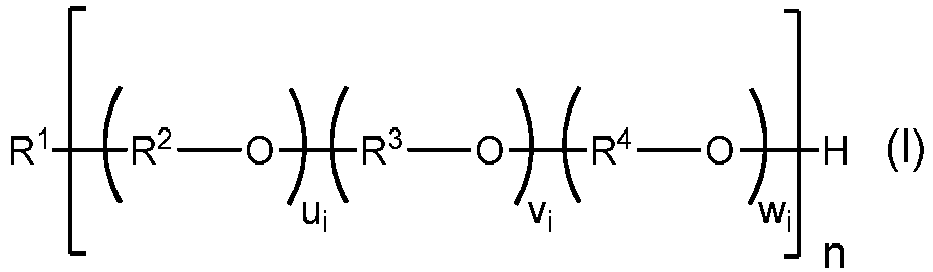 R1 = Startersubstanzrest ohne für die Alkoxylierung aktiven H-Atome, wie vorzugsweise Molekülreste von mehrwertigen Alkoholen, mehrwertigen Aminen, mehrwertigen Thiolen, Carbonsäuren, Aminoalkoholen, Aminocarbonsäuren, Thioalkoholen, Hydroxyestern, Polyetherpolyolen, Polyesterpolyolen, Polyesteretherpolyolen, Polycarbonatpolyolen, Polyethyleniminen, Polyetheraminen, Polyetherthiolen, Polyacrylatpolyolen, Ricinusöl, von Mono-, Di oder Triglyceriden der Ricinolsäure, chemisch modifizierten Mono-, Di- und/oder Triglyceriden von Fettsäuren und/oder C1-C24 Alkyl-Fettsäureestern, die im Mittel mindestens 3 OH-Gruppen pro Molekül enthalten,R2 CH2-CH(CH3),R3 CH2-CH2,R4 CH2-CH(R5), CH(R6)-CH(R6), CH2-C(R6)2, C(R6)2-C(R6)2,
 R5 C2 bis C24-Alkylrest, Alkenrest, der linear oder verzweigt sein kann,R6 C2 bis C24-Alkylrest, Alkenrest, der linear oder verzweigt sein kann,R7 C3 bis C6 Alkylrest, der linear angeordnet ist,R8 OH, Cl, OCH3, OCH2-CH3, O-CH2-CH=CH2, O-CH=CH2und wobei giltui ≥ 1,vi ≥ 1,wi ganze Zahlen von 0 - 400; insbesondere wi = 0n ganze Zahl von 3 bis 25, bevorzugt von 3 bis 10, insbesondere 3 bis 8.i ganze Zahl mit i = 1 bis n,wobeidie Reihenfolge der Monomerbausteine in den einzelnen Polymerketten 1 bis n beliebig ist, und wobei die n-Polymerketten voneinander unabhängig zusammengesetzt sein können,wobeidas im Molekül gebundene Ethylenoxid zumindest zu 90% endständig ist, % bezogen auf das gesamte im Molekül gebundene Ethylenoxid,und wobeidie enthaltenen Verbindungen (V) 55 bis 99 Gew.-%, Ethylenoxid und 1 bis 45 Gew.-% Propylenoxid, enthalten, Gew.-% bezogen auf den Gesamtalkylenoxidgehalt der Verbindung (V) gemäß Formel (I).
 - Additiv nach Anspruch 1, dadurch gekennzeichnet, dass die Verbindung (V) eine Funktionalität von 3 - 10, bevorzugt 3-8 aufweist.
- Additiv nach Anspruch 1 oder 2, dadurch gekennzeichnet, dass das im Molekül gebundene Ethylenoxid zu 100%, bevorzugt in Form von Blöcken, endständig ist, % bezogen auf das gesamte im Molekül gebundene Ethylenoxid.
- Additiv nach zumindest einem der Ansprüche 1 bis 3, dadurch gekennzeichnet, dass es sich bei Raumtemperatur und Atmosphärendruck um eine Flüssigkeit handelt.
- Additiv nach zumindest einem der Ansprüche 1 bis 4, dadurch gekennzeichnet, dass die enthaltenen Verbindungen (V) 60 bis 85 Gew.-% Ethylenoxid und 15 bis 40 Gew.-% Propylenoxid, enthalten, Gew.-% bezogen auf den Gesamtalkylenoxidgehalt der Verbindung (V) gemäß Formel (I).
- Verfahren zur Herstellung von Polyurethanschäumen, vorzugsweise PU-Weichschäumen, durch Umsetzung(a) einer oder mehrerer Polyolkomponenten mit(b) einer oder mehrerer Isocyanatkomponenten,
in Gegenwart(c) eines Additivs,(d) von Katalysatoren,(e) von Wasser und gegebenenfalls organischen Treibmitteln, vorzugsweise Kohlenstoffdioxid und/oder Methylenchlorid(g) von Stabilisatoren und gegebenenfalls Emulgatoren und(f) gegebenenfalls von sonstigen Zusatzstoffen,dadurch gekennzeichnet, dass als Additiv eine Additivzusammensetzung gemäß einem der Ansprüche 1 bis 5, welches mindestens eine Verbindung (V) enthält, eingesetzt wird. - Verfahren nach Anspruch 6, dadurch gekennzeichnet, dass 0,1 bis 10 Gew.-Teile, insbesondere 0,5 bis 8 Gew.-Teile an Verbindungen (V) pro 100 Teilen des insgesamt eingesetzten Polyol eingesetzt werden.
- Verfahren nach einem der Ansprüche 6 oder 7 zur Herstellung von Polyurethanweichschaumstoffen, aufweisend- eine Gasdurchlässigkeit (A) von 1 bis 300 mm Wassersäule, bevorzugt 3 bis 250 mm Wassersäule,- eine Dichte (B) vorzugsweise von 5 bis 150 kg/m3, bevorzugt von 10 bis 130 kg/m3 und besonders bevorzugt von 15 bis 100 kg/m3,- eine Porenstruktur (C) vorzugsweise mit 5 bis 25 Zellen/cm,- eine Druckspannung (D) von 0,1 kPa bis 15 kPa, bevorzugt 0,5 bis 13 kPa, insbesondere bevorzugt 2 bis 11 kPa sowie- vorzugsweise eine zu mehr als 80 % offenzellige Zellstruktur (E),(A) bis (E) gemessen wie jeweils in der Beschreibung angegeben.
- Verfahren nach zumindest einem der Ansprüche 6 bis 8, dadurch gekennzeichnet, dass als Isocyanat Toluol-2,4-diisocyanat als Isomerengemisch eingesetzt wird, insbesondere als Gemisch aus 80 % Toluol-2,4-diisocyanat und 20 % Toluol-2,6-diisocyanat.
- Polyurethanschaum, erhältlich nach einem Verfahren der Ansprüche 6 bis 9, wobei es sich vorzugsweise um einen Polyurethanweichschaum, einen Polyurethanformschaum oder einen frei gestiegenen Polyurethan-Weichblockschaum handelt.
- Polyurethanschaum, nach Anspruch 10, aufweisend- eine Gasdurchlässigkeit (A) von 1 bis 300 mm Wassersäule, bevorzugt 3 bis 250 mm Wassersäule,- eine Dichte (B) vorzugsweise von 5 bis 150 kg/m3, bevorzugt von 10 bis 130 kg/m3 und besonders bevorzugt von 15 bis 100 kg/m3,- eine Porenstruktur (C) vorzugsweise mit 5 bis 25 Zellen/cm,- eine Druckspannung (D) von 0,1 kPa bis 15 kPa, bevorzugt 0,5 bis 13 kPa, insbesondere bevorzugt 2 bis 11 kPa sowie- vorzugsweise eine zu mehr als 80 % offenzellige Zellstruktur (E),(A) bis (E) gemessen wie jeweils in der Beschreibung angegeben.
- Verwendung des Polyurethanschaums nach einem der Ansprüche 10 oder 11 als Verpackungsschaum, Matratze, Möbelpolster, Werkstoff in Kraftfahrzeuginnenräumen, Automobil-Sitzpolster, Kopfstütze, Automobil-Innenverkleidung, Schallabsorptionsmaterial, Schuhsole, Schaumstoff für Büstenhalter, Teppichrückseitenschaum, Filterschaum, oder zur Herstellung entsprechender Produkte, insbesondere als Werkstoff in Kraftfahrzeuginnenräumen.
- Verwendung eines Additivs gemäß einem der Ansprüche 1 bis 5 zur Verbesserung der Härte von Polyurethanweichschaum unter Erhalt einer hinreichenden Offenzelligkeit, insbesondere unter Vermeidung einer Reduktion des TDI-Indexes oder der Katalysatormengen, und/oder zur Verbesserung der Alterungseigenschaften von Polyurethanweichschaum jeweils im Zuge der Schaumherstellung.
- Aktivatorlösung, geeignet zur Herstellung von Polyurethanweichschaum, umfassend Additiv gemäß einem der Ansprüche 1 bis 5 sowie Stabilisatoren, Katalysatoren, Treibmittel, wie insbesondere Wasser, sowie optional weitere Additive, wie insbesondere Flammschutzmittel, Antioxidantien, UV-Stabilisatoren, Farbstoffe, Biozide, Pigmente, Zellöffner und/oder Vernetzer, wobei die Aktivatorlösung frei ist von Isocyanaten und Polyolen ungleich der Verbindung (V).
Priority Applications (15)
| Application Number | Priority Date | Filing Date | Title |
|---|---|---|---|
| PL15181218.7T PL3133097T3 (pl) | 2015-08-17 | 2015-08-17 | Wytwarzanie miękkich pianek poliuretanowych o ulepszonej twardości |
| HUE15181218A HUE060823T2 (hu) | 2015-08-17 | 2015-08-17 | Poliuretán rugalmas habok javított keménységgel |
| EP15181218.7A EP3133097B1 (de) | 2015-08-17 | 2015-08-17 | Herstellung von polyurethanweichschäumen mit verbesserter härte |
| DK15181218.7T DK3133097T3 (da) | 2015-08-17 | 2015-08-17 | Fremstilling af blødt polyurethanskum med forbedret hårdhed |
| ES15181218T ES2931312T3 (es) | 2015-08-17 | 2015-08-17 | Producción de espumas blandas de poliuretano con dureza mejorada |
| LTEP15181218.7T LT3133097T (lt) | 2015-08-17 | 2015-08-17 | Elastingi poliuretano putplasčiai, pasižymintys padidintu kietumu |
| PT151812187T PT3133097T (pt) | 2015-08-17 | 2015-08-17 | Produção de espumas flexíveis de poliuretano com dureza melhorada |
| PL16741018.2T PL3337838T3 (pl) | 2015-08-17 | 2016-07-20 | Wytwarzanie miękkich pianek poliuretanowych o ulepszonej twardości |
| KR1020187004158A KR20180041666A (ko) | 2015-08-17 | 2016-07-20 | 개선된 경도를 갖는 폴리우레탄 연질 발포체의 제조 |
| PT167410182T PT3337838T (pt) | 2015-08-17 | 2016-07-20 | Produção de espumas de poliuretano flexíveis com dureza melhorada |
| US15/745,797 US20180208707A1 (en) | 2015-08-17 | 2016-07-20 | Production of polyurethane soft foams with improved hardness |
| PCT/EP2016/067241 WO2017029054A1 (de) | 2015-08-17 | 2016-07-20 | Herstellung von polyurethanweichschäumen mit verbesserter härte |
| JP2018507686A JP2018523739A (ja) | 2015-08-17 | 2016-07-20 | 向上させた硬度を有するポリウレタン軟質フォームの製造 |
| CN201680060694.5A CN108137776B (zh) | 2015-08-17 | 2016-07-20 | 具有改进的硬度的聚氨酯软质泡沫的生产 |
| EP16741018.2A EP3337838B1 (de) | 2015-08-17 | 2016-07-20 | Herstellung von polyurethanweichschäumen mit verbesserter härte |
Applications Claiming Priority (1)
| Application Number | Priority Date | Filing Date | Title |
|---|---|---|---|
| EP15181218.7A EP3133097B1 (de) | 2015-08-17 | 2015-08-17 | Herstellung von polyurethanweichschäumen mit verbesserter härte |
Publications (2)
| Publication Number | Publication Date |
|---|---|
| EP3133097A1 EP3133097A1 (de) | 2017-02-22 |
| EP3133097B1 true EP3133097B1 (de) | 2022-10-05 |
Family
ID=54010866
Family Applications (2)
| Application Number | Title | Priority Date | Filing Date |
|---|---|---|---|
| EP15181218.7A Active EP3133097B1 (de) | 2015-08-17 | 2015-08-17 | Herstellung von polyurethanweichschäumen mit verbesserter härte |
| EP16741018.2A Active EP3337838B1 (de) | 2015-08-17 | 2016-07-20 | Herstellung von polyurethanweichschäumen mit verbesserter härte |
Family Applications After (1)
| Application Number | Title | Priority Date | Filing Date |
|---|---|---|---|
| EP16741018.2A Active EP3337838B1 (de) | 2015-08-17 | 2016-07-20 | Herstellung von polyurethanweichschäumen mit verbesserter härte |
Country Status (12)
| Country | Link |
|---|---|
| US (1) | US20180208707A1 (de) |
| EP (2) | EP3133097B1 (de) |
| JP (1) | JP2018523739A (de) |
| KR (1) | KR20180041666A (de) |
| CN (1) | CN108137776B (de) |
| DK (1) | DK3133097T3 (de) |
| ES (1) | ES2931312T3 (de) |
| HU (1) | HUE060823T2 (de) |
| LT (1) | LT3133097T (de) |
| PL (2) | PL3133097T3 (de) |
| PT (2) | PT3133097T (de) |
| WO (1) | WO2017029054A1 (de) |
Cited By (1)
| Publication number | Priority date | Publication date | Assignee | Title |
|---|---|---|---|---|
| US12612503B2 (en) | 2020-08-24 | 2026-04-28 | Evonik Operations Gmbh | Depolymerization method for polyurethanes |
Families Citing this family (16)
| Publication number | Priority date | Publication date | Assignee | Title |
|---|---|---|---|---|
| EP3611214A1 (de) | 2018-08-15 | 2020-02-19 | Evonik Operations GmbH | Sioc-verknüpfte, lineare polydimethylsiloxan-polyoxyalkylen-blockcopolymere |
| CN109171092B (zh) * | 2018-08-20 | 2021-02-26 | 中国科学院化学研究所 | 一种弹性体鞋及其制鞋工艺 |
| KR102321736B1 (ko) * | 2018-10-02 | 2021-11-04 | (주)엘엑스하우시스 | 발포체 및 이를 포함하는 바닥재 |
| EP3744745A1 (de) | 2019-05-28 | 2020-12-02 | Evonik Operations GmbH | Herstellung von pu-schaumstoffen |
| CN113966355A (zh) * | 2019-06-05 | 2022-01-21 | 巴斯夫欧洲公司 | 用于聚氨酯泡沫的反应性组合物及其在汽车零部件中的用途 |
| CN110358018A (zh) * | 2019-06-24 | 2019-10-22 | 湖北大学 | 一种耐水型梳形含氟水性聚氨酯及其制备方法和应用 |
| EP3865527A1 (de) | 2020-02-14 | 2021-08-18 | Evonik Operations GmbH | Herstellung von pu-schaumstoffen |
| JP7469495B2 (ja) * | 2020-03-03 | 2024-04-16 | モメンティブ パフォーマンス マテリアルズ インコーポレイテッド | ポリウレタン用触媒組成物 |
| KR102575776B1 (ko) * | 2021-04-16 | 2023-09-08 | 인하대학교 산학협력단 | 자동차 엔진 인캡슐레이션용 흡음성 단열재 |
| EP4363478A1 (de) | 2021-07-02 | 2024-05-08 | Evonik Operations GmbH | Herstellung von pu-schaumstoffen unter einsatz von recycling-polyolen |
| MX2024000124A (es) | 2021-07-02 | 2024-01-22 | Evonik Operations Gmbh | Produccion de espumas de pu que utilizan polioles reciclados. |
| EP4363479A1 (de) | 2021-07-02 | 2024-05-08 | Evonik Operations GmbH | Gewinnung von di- und/oder polyisocyanaten aus pu-depolymerisationsprozessen |
| CA3224454A1 (en) | 2021-07-02 | 2023-01-05 | Roland Hubel | Production of pu foams using recycled polyols |
| WO2023275031A1 (de) | 2021-07-02 | 2023-01-05 | Evonik Operations Gmbh | Herstellung von pu-schaumstoffen unter einsatz von recycling-polyolen |
| MX2024010160A (es) * | 2022-02-22 | 2024-08-26 | Evonik Operations Gmbh | Uso de poliol reciclado a partir de un procedimiento de hidrolisis a base de amina para producir espuma de pu. |
| CN117186344B (zh) * | 2023-11-08 | 2024-03-08 | 山东一诺威聚氨酯股份有限公司 | 生物基环保透气鞋垫及其制备方法 |
Family Cites Families (62)
| Publication number | Priority date | Publication date | Assignee | Title |
|---|---|---|---|---|
| US3346557A (en) | 1965-06-04 | 1967-10-10 | Wyandotte Chemicals Corp | Process for oxyalkylating solid polyols |
| DE2263205C2 (de) * | 1972-12-23 | 1983-09-29 | Bayer Ag, 5090 Leverkusen | Verfahren zur Herstellung von kalthärtenden Polyetherurethanschaumstoffen |
| US4110270A (en) * | 1977-05-05 | 1978-08-29 | Basf Wyandotte Corporation | Process for the preparation of foams characterized by isocyanurate and urethane linkages |
| LU81024A1 (fr) * | 1979-03-09 | 1980-09-24 | Prb Sa | Procede pour la preparation de polyurethanne a peau integrale et polyurethanne obtenu |
| DE3323872A1 (de) * | 1983-07-02 | 1985-01-03 | Bayer Ag, 5090 Leverkusen | Verfahren zur herstellung von elastischen, offenzelligen polyurethan-weichschaumstoffen mit raumgewichten von hoechstens 24 kg/m hoch 3 |
| DE3406188C1 (de) | 1984-02-21 | 1985-01-10 | Th. Goldschmidt Ag, 4300 Essen | Verfahren zur Herstellung von flexiblen Polyesterurethanschaeumen |
| DE3508292C1 (de) | 1985-03-08 | 1986-06-19 | Th. Goldschmidt Ag, 4300 Essen | Verfahren zur Herstellung von Polyurethanweichschaeumen |
| DE3630225A1 (de) | 1986-09-05 | 1988-03-10 | Bayer Ag | Verfahren zur herstellung von elastischen, offenzelligen polyurethan-weichschaumstoffen mit erhoehter stauchhaerte |
| US5011908A (en) * | 1988-07-12 | 1991-04-30 | Arco Chemical Technology, Inc. | Polymer polyol compositions and their use in the preparation of polyurethane foams |
| US5656677A (en) * | 1989-01-20 | 1997-08-12 | Recticel | Method for preparing and applying a sprayable, light stable polyurethane |
| DE3903100A1 (de) | 1989-02-02 | 1990-08-23 | Bayer Ag | Verfahren zur herstellung von elastischen und offenzelligen polyurethan-weichformschaumstoffen |
| DE3924082C1 (de) | 1989-07-20 | 1990-09-27 | Th. Goldschmidt Ag, 4300 Essen, De | |
| US5145879A (en) | 1990-12-31 | 1992-09-08 | Union Carbide Chemicals & Plastics Technology Corporation | Surfactants for manufacture of urethane foams |
| DE4129583C1 (de) | 1991-09-06 | 1992-06-04 | Th. Goldschmidt Ag, 4300 Essen, De | |
| ZA945718B (en) | 1993-08-03 | 1995-03-09 | Osi Specialties Inc | Process for forming polyurethane foam using mechanical cooling and an additive |
| US5565194A (en) | 1994-03-04 | 1996-10-15 | Th. Goldschmidt Ag. | Polysiloxane-polyoxyalkylene block copolymers and their use as additives for hair cosmetics |
| DE4444898C1 (de) | 1994-12-16 | 1996-10-10 | Goldschmidt Ag Th | Verfahren zur Herstellung von Polyurethankaltschäumen |
| DE19629161A1 (de) | 1996-07-19 | 1998-01-22 | Basf Ag | Verfahren zur Herstellung thermostabiler Polyurethanweichschaumstoffe |
| DE19649829A1 (de) * | 1996-12-02 | 1998-06-04 | Bayer Ag | Weichelastische Polyurethanschaumstoffe und ein Verfahren zu deren Herstellung |
| US5990187A (en) | 1997-03-26 | 1999-11-23 | Th. Goldschmidt Ag | Method of preparing polyurethane foam utilizing organofunctionally modified polysiloxanes |
| CZ20001408A3 (cs) * | 1997-10-22 | 2000-07-12 | Shell Internationale Research Maatschappij B. V. | Polyolové prostředky a způsob přípravy polyuretanových pěn za použití takových prostředků |
| US5821275A (en) * | 1997-11-10 | 1998-10-13 | Bayer Corporation | Flexible foams and flexible molded foams based on liquid isocyanate-terminated allophanate-modified MDI prepolymer blends and processes for the production of these foams |
| US6063309A (en) * | 1998-07-13 | 2000-05-16 | Arco Chemical Technology L.P. | Dispersion polyols for hypersoft polyurethane foam |
| DE19859759C1 (de) | 1998-12-23 | 2000-06-29 | Goldschmidt Ag Th | Verfahren und Vorrichtung zur Durchführung kontinuierlicher Hydrosilylierungsreaktionen |
| DE19927548C2 (de) | 1999-06-16 | 2002-12-12 | Clariant Gmbh | Verfahren zur Herstellung von flammwidrigen Polyurethanweichschäumen |
| US6239186B1 (en) | 1999-10-28 | 2001-05-29 | Air Products And Chemicals, Inc. | Silicone surfactants for the production of open cell polyurethane flexible foams |
| US6762274B2 (en) | 2000-02-10 | 2004-07-13 | Dow Global Technologies Inc. | Low emission polyurethane polymers made with autocatalytic polyols |
| EP1268598B1 (de) | 2000-02-10 | 2008-06-11 | Dow Global Technologies Inc. | Polyurethan-weichschaum mit niedriger emission, hergestellt mit autokatalytisch wirkenden polyolen |
| KR100663682B1 (ko) * | 2000-04-14 | 2007-01-02 | 아사히 가라스 가부시키가이샤 | 연질 폴리우레탄 폼의 제조방법 |
| PT1319034E (pt) | 2000-09-13 | 2011-12-21 | Dow Global Technologies Llc | Polióis com características autocatalíticas e produtos de poliuretano produzidos a partir deles |
| US6924321B2 (en) | 2001-08-16 | 2005-08-02 | Dow Global Technologies Inc. | Polyols with autocatalytic characteristics and polyurethane products made therefrom |
| CN1633454A (zh) | 2001-10-01 | 2005-06-29 | 陶氏环球技术公司 | 具有凝胶化特性的自催化多元醇及由其制备的聚氨酯产物 |
| EP1312630B1 (de) * | 2001-10-31 | 2012-12-12 | Tosoh Corporation | Verfahren zur Herstellung von Polyurethan-Weichschaumstoffen |
| DE50200338D1 (de) | 2002-03-26 | 2004-05-13 | Goldschmidt Ag Th | Verwendung organofunktionell modifizierter Polysiloxane zur Herstellung von Polyurethanweichschäumen |
| JP4504809B2 (ja) * | 2002-08-02 | 2010-07-14 | ハンツマン・インターナショナル・エルエルシー | 軟質フォームを製造するためのプレポリマー、ポリオール組成物および方法 |
| WO2004060956A1 (en) | 2002-12-17 | 2004-07-22 | Dow Global Technologies Inc. | Amine-epoxy autocatalytic polymers and polyurethane products made therefrom |
| EP1520870B1 (de) | 2003-10-04 | 2006-01-25 | Goldschmidt GmbH | Verfahren zur Herstellung von organischen Siliciumverbindungen |
| KR20060111599A (ko) | 2003-12-23 | 2006-10-27 | 다우 글로벌 테크놀로지스 인크. | 3차 아민 캡핑된 폴리에테르 폴리올을 사용하는 폴리우레탄생성물의 자체 촉매적 제조 방법 |
| JP2008520808A (ja) | 2004-11-17 | 2008-06-19 | ダウ グローバル テクノロジーズ インコーポレイティド | 酸でブロックされた、アミンベースの自己触媒性ポリオールおよびこれらから作製されるポリウレタンフォーム |
| DE102005003299A1 (de) | 2005-01-24 | 2006-07-27 | Goldschmidt Gmbh | Nanopartikel für die Herstellung von Polyurethanschaum |
| WO2007018129A1 (ja) * | 2005-08-05 | 2007-02-15 | Asahi Glass Company, Limited | 軟質ポリウレタンフォーム、その製造方法および自動車用シート |
| DE102005050473A1 (de) | 2005-10-21 | 2007-04-26 | Goldschmidt Gmbh | Verfahren zur Herstellung von Polyurethan-Kaltschäumen |
| US20070299153A1 (en) * | 2006-06-23 | 2007-12-27 | Hager Stanley L | Viscoelastic foams with slower recovery and improved tear |
| JP5239864B2 (ja) * | 2006-09-27 | 2013-07-17 | 旭硝子株式会社 | 軟質ポリウレタンフォームの製造方法 |
| WO2008079614A1 (en) | 2006-12-21 | 2008-07-03 | Dow Global Technologies Inc. | Polyurethane catalysis based on the combination of autocatalytic polyol and urea |
| DE102007046860A1 (de) | 2007-09-28 | 2009-04-09 | Evonik Goldschmidt Gmbh | Aminkatalysatoren geeignet zur Herstellung emissionsarmer, rekatalysestabiler Polyurethanweichschaumstoffe |
| DE102008043343A1 (de) | 2008-10-31 | 2010-05-06 | Evonik Goldschmidt Gmbh | Silikonpolyetherblock-Copolymere mit definierter Polydispersität im Polyoxyalkylenteil und deren Verwendung als Stabilisatoren zur Herstellung von Polyurethanschäumen |
| CN101412798B (zh) * | 2008-11-21 | 2011-08-10 | 优洁(亚洲)有限公司 | 软质聚氨酯低回弹泡沫及其制备方法 |
| PL2563834T3 (pl) * | 2010-04-29 | 2019-07-31 | Dow Global Technologies Llc | Hybrydowe poliestropolieteropoliole |
| JP5941468B2 (ja) * | 2010-09-07 | 2016-06-29 | ダウ グローバル テクノロジーズ エルエルシー | 低圧縮歪および高気流量mdi粘弾性ポリウレタン発泡体の製造方法 |
| US20130345330A1 (en) * | 2010-11-22 | 2013-12-26 | Bayer Intellectual Property Gmbh | Method for producing flexible polyurethane foams |
| US9228047B2 (en) * | 2011-02-14 | 2016-01-05 | Dow Global Technologies Llc | Low density polyurethane foams |
| CN102504175B (zh) * | 2011-11-04 | 2013-11-06 | 北京科聚化工新材料有限公司 | 低密度粘弹性聚氨酯泡沫的制备方法 |
| EP2599810A1 (de) * | 2011-12-02 | 2013-06-05 | Basf Se | Waschbare, viskoelastische Polyurethanweichschaumstoffe |
| WO2013102053A1 (en) | 2011-12-29 | 2013-07-04 | Dow Global Technologies Llc | Amine polyether polyols and polyurethane foam compositions made from cyclic amine compounds |
| TR201802484T4 (tr) * | 2012-03-15 | 2018-03-21 | Dow Global Technologies Llc | Düşük yoğunluklu tam su üflemeli poliüretan sert köpük. |
| ITRM20120259A1 (it) * | 2012-06-06 | 2013-12-07 | Bayer Internat Sa | Procedimento per la produzione di schiume poliuretaniche viscoelastiche. |
| WO2014120191A1 (en) | 2013-01-31 | 2014-08-07 | Johnson Controls Technology Company | System and method for increasing foam hardness |
| JP6231186B2 (ja) * | 2013-03-25 | 2017-11-15 | コベストロ、ドイチュラント、アクチエンゲゼルシャフトCovestro Deutschland Ag | 音響吸収性が高い硬質ポリウレタンフォーム |
| ES2552330T3 (es) * | 2013-03-25 | 2015-11-27 | Covestro Deutschland Ag | Espumas duras de poliuretano con distribución de tamaño de célula uniforme y proporción de células abiertas homogénea |
| JP6484622B2 (ja) * | 2014-06-12 | 2019-03-13 | 株式会社ブリヂストン | 軟質ポリウレタンフォーム、及びシート用パッド |
| EP3067376A1 (de) * | 2015-03-11 | 2016-09-14 | Evonik Degussa GmbH | Herstellung von Polyurethansystemen unter Einsatz von Polyetherpolycarbonatpolyolen |
-
2015
- 2015-08-17 DK DK15181218.7T patent/DK3133097T3/da active
- 2015-08-17 PL PL15181218.7T patent/PL3133097T3/pl unknown
- 2015-08-17 PT PT151812187T patent/PT3133097T/pt unknown
- 2015-08-17 ES ES15181218T patent/ES2931312T3/es active Active
- 2015-08-17 LT LTEP15181218.7T patent/LT3133097T/lt unknown
- 2015-08-17 HU HUE15181218A patent/HUE060823T2/hu unknown
- 2015-08-17 EP EP15181218.7A patent/EP3133097B1/de active Active
-
2016
- 2016-07-20 KR KR1020187004158A patent/KR20180041666A/ko not_active Withdrawn
- 2016-07-20 PL PL16741018.2T patent/PL3337838T3/pl unknown
- 2016-07-20 WO PCT/EP2016/067241 patent/WO2017029054A1/de not_active Ceased
- 2016-07-20 US US15/745,797 patent/US20180208707A1/en not_active Abandoned
- 2016-07-20 CN CN201680060694.5A patent/CN108137776B/zh active Active
- 2016-07-20 EP EP16741018.2A patent/EP3337838B1/de active Active
- 2016-07-20 PT PT167410182T patent/PT3337838T/pt unknown
- 2016-07-20 JP JP2018507686A patent/JP2018523739A/ja not_active Withdrawn
Cited By (1)
| Publication number | Priority date | Publication date | Assignee | Title |
|---|---|---|---|---|
| US12612503B2 (en) | 2020-08-24 | 2026-04-28 | Evonik Operations Gmbh | Depolymerization method for polyurethanes |
Also Published As
| Publication number | Publication date |
|---|---|
| CN108137776B (zh) | 2022-09-23 |
| KR20180041666A (ko) | 2018-04-24 |
| WO2017029054A1 (de) | 2017-02-23 |
| JP2018523739A (ja) | 2018-08-23 |
| LT3133097T (lt) | 2022-12-12 |
| PT3337838T (pt) | 2023-09-11 |
| PT3133097T (pt) | 2022-12-02 |
| PL3337838T3 (pl) | 2023-10-30 |
| DK3133097T3 (da) | 2022-12-19 |
| EP3133097A1 (de) | 2017-02-22 |
| EP3337838A1 (de) | 2018-06-27 |
| US20180208707A1 (en) | 2018-07-26 |
| HUE060823T2 (hu) | 2023-04-28 |
| EP3337838B1 (de) | 2023-06-21 |
| CN108137776A (zh) | 2018-06-08 |
| ES2931312T3 (es) | 2022-12-28 |
| PL3133097T3 (pl) | 2023-01-09 |
Similar Documents
| Publication | Publication Date | Title |
|---|---|---|
| EP3337838B1 (de) | Herstellung von polyurethanweichschäumen mit verbesserter härte | |
| EP2998333B1 (de) | Herstellung von viskoelastischen polyurethansystemen unter einsatz von blockpolymeren mit verknüpften siloxanblöcken als zellöffner | |
| EP3219738B1 (de) | Herstellung von viskoelastischen polyurethansystemen unter einsatz von blockpolymeren mit verknüpften siloxanblöcken als zellöffner | |
| EP3205680B1 (de) | Alterungsbeständige und emissionsarme matratzen und/oder kissen | |
| EP3067376A1 (de) | Herstellung von Polyurethansystemen unter Einsatz von Polyetherpolycarbonatpolyolen | |
| EP3067343B1 (de) | Antioxidantien zur Herstellung emissionsarmer PUR-Systeme | |
| EP2601244B1 (de) | Silikoncopolymere mit seitenständigen über allylglycidylether und verwandte verbindungen angebundenen alkylresten und ihre verwendung als stabilisatoren zur herstellung von polyurethanweichschäumen | |
| EP2976371B1 (de) | Herstellung von polyurethanschäumen, die polyole auf polyolefinbasis enthalten | |
| DE102007046860A1 (de) | Aminkatalysatoren geeignet zur Herstellung emissionsarmer, rekatalysestabiler Polyurethanweichschaumstoffe | |
| EP2953989B1 (de) | Amine, geeignet zur verwendung bei der herstellung von polyurethanen | |
| EP3177658A1 (de) | Stickstoffhaltige verbindungen, geeignet zur verwendung bei der herstellung von polyurethanen | |
| DE102012203639A1 (de) | Additiv zur Einstellung der Glasübergangstemperatur von viskoelastischen Polyurethanweichschaumstoffen | |
| EP2986661B1 (de) | Pur-schaum mit vergröberter zellstruktur | |
| EP2551287A2 (de) | Additivzusammensetzung, einsetzbar zur Steuerung der Schaumeigenschaften bei der Herstellung von Polyurethanweichschäumen, die Polyole auf Basis nachwachsender Rohstoffe enthalten | |
| EP4363476A1 (de) | Herstellung von pu-schaumstoffen unter einsatz von recycling-polyolen | |
| EP3940012A1 (de) | Stickstofffreie und stickstoffarme vernetzende additive für kaltblockweichschaum mit verbesserten kompressions- und alterungseigenschaften | |
| DE102012212077A1 (de) | Verfahren zur Herstellung emissionsarmer Polyurethanweichschaumstoffe | |
| EP3571238B1 (de) | Zur herstellung von viskoelastischem schaum nützliche polyolmischungen | |
| EP3969493B1 (de) | Polyurethanschaumstoffe mit erniedrigtem cold-flow-effekt und verfahren zu deren herstellung |
Legal Events
| Date | Code | Title | Description |
|---|---|---|---|
| PUAI | Public reference made under article 153(3) epc to a published international application that has entered the european phase |
Free format text: ORIGINAL CODE: 0009012 |
|
| STAA | Information on the status of an ep patent application or granted ep patent |
Free format text: STATUS: REQUEST FOR EXAMINATION WAS MADE |
|
| 17P | Request for examination filed |
Effective date: 20150817 |
|
| AK | Designated contracting states |
Kind code of ref document: A1 Designated state(s): AL AT BE BG CH CY CZ DE DK EE ES FI FR GB GR HR HU IE IS IT LI LT LU LV MC MK MT NL NO PL PT RO RS SE SI SK SM TR |
|
| AX | Request for extension of the european patent |
Extension state: BA ME |
|
| STAA | Information on the status of an ep patent application or granted ep patent |
Free format text: STATUS: EXAMINATION IS IN PROGRESS |
|
| 17Q | First examination report despatched |
Effective date: 20181114 |
|
| RAP1 | Party data changed (applicant data changed or rights of an application transferred) |
Owner name: EVONIK OPERATIONS GMBH |
|
| GRAP | Despatch of communication of intention to grant a patent |
Free format text: ORIGINAL CODE: EPIDOSNIGR1 |
|
| STAA | Information on the status of an ep patent application or granted ep patent |
Free format text: STATUS: GRANT OF PATENT IS INTENDED |
|
| INTG | Intention to grant announced |
Effective date: 20220314 |
|
| GRAJ | Information related to disapproval of communication of intention to grant by the applicant or resumption of examination proceedings by the epo deleted |
Free format text: ORIGINAL CODE: EPIDOSDIGR1 |
|
| STAA | Information on the status of an ep patent application or granted ep patent |
Free format text: STATUS: EXAMINATION IS IN PROGRESS |
|
| GRAP | Despatch of communication of intention to grant a patent |
Free format text: ORIGINAL CODE: EPIDOSNIGR1 |
|
| STAA | Information on the status of an ep patent application or granted ep patent |
Free format text: STATUS: GRANT OF PATENT IS INTENDED |
|
| INTC | Intention to grant announced (deleted) | ||
| INTG | Intention to grant announced |
Effective date: 20220520 |
|
| GRAS | Grant fee paid |
Free format text: ORIGINAL CODE: EPIDOSNIGR3 |
|
| GRAA | (expected) grant |
Free format text: ORIGINAL CODE: 0009210 |
|
| STAA | Information on the status of an ep patent application or granted ep patent |
Free format text: STATUS: THE PATENT HAS BEEN GRANTED |
|
| AK | Designated contracting states |
Kind code of ref document: B1 Designated state(s): AL AT BE BG CH CY CZ DE DK EE ES FI FR GB GR HR HU IE IS IT LI LT LU LV MC MK MT NL NO PL PT RO RS SE SI SK SM TR |
|
| REG | Reference to a national code |
Ref country code: GB Ref legal event code: FG4D Free format text: NOT ENGLISH |
|
| REG | Reference to a national code |
Ref country code: CH Ref legal event code: EP |
|
| REG | Reference to a national code |
Ref country code: AT Ref legal event code: REF Ref document number: 1522710 Country of ref document: AT Kind code of ref document: T Effective date: 20221015 |
|
| REG | Reference to a national code |
Ref country code: IE Ref legal event code: FG4D Free format text: LANGUAGE OF EP DOCUMENT: GERMAN |
|
| REG | Reference to a national code |
Ref country code: DE Ref legal event code: R096 Ref document number: 502015016092 Country of ref document: DE |
|
| REG | Reference to a national code |
Ref country code: PT Ref legal event code: SC4A Ref document number: 3133097 Country of ref document: PT Date of ref document: 20221202 Kind code of ref document: T Free format text: AVAILABILITY OF NATIONAL TRANSLATION Effective date: 20221125 |
|
| REG | Reference to a national code |
Ref country code: DK Ref legal event code: T3 Effective date: 20221216 |
|
| REG | Reference to a national code |
Ref country code: NL Ref legal event code: FP Ref country code: ES Ref legal event code: FG2A Ref document number: 2931312 Country of ref document: ES Kind code of ref document: T3 Effective date: 20221228 |
|
| PG25 | Lapsed in a contracting state [announced via postgrant information from national office to epo] |
Ref country code: SE Free format text: LAPSE BECAUSE OF FAILURE TO SUBMIT A TRANSLATION OF THE DESCRIPTION OR TO PAY THE FEE WITHIN THE PRESCRIBED TIME-LIMIT Effective date: 20221005 Ref country code: NO Free format text: LAPSE BECAUSE OF FAILURE TO SUBMIT A TRANSLATION OF THE DESCRIPTION OR TO PAY THE FEE WITHIN THE PRESCRIBED TIME-LIMIT Effective date: 20230105 Ref country code: FI Free format text: LAPSE BECAUSE OF FAILURE TO SUBMIT A TRANSLATION OF THE DESCRIPTION OR TO PAY THE FEE WITHIN THE PRESCRIBED TIME-LIMIT Effective date: 20221005 |
|
| REG | Reference to a national code |
Ref country code: HU Ref legal event code: AG4A Ref document number: E060823 Country of ref document: HU |
|
| PG25 | Lapsed in a contracting state [announced via postgrant information from national office to epo] |
Ref country code: RS Free format text: LAPSE BECAUSE OF FAILURE TO SUBMIT A TRANSLATION OF THE DESCRIPTION OR TO PAY THE FEE WITHIN THE PRESCRIBED TIME-LIMIT Effective date: 20221005 Ref country code: LV Free format text: LAPSE BECAUSE OF FAILURE TO SUBMIT A TRANSLATION OF THE DESCRIPTION OR TO PAY THE FEE WITHIN THE PRESCRIBED TIME-LIMIT Effective date: 20221005 Ref country code: IS Free format text: LAPSE BECAUSE OF FAILURE TO SUBMIT A TRANSLATION OF THE DESCRIPTION OR TO PAY THE FEE WITHIN THE PRESCRIBED TIME-LIMIT Effective date: 20230205 Ref country code: HR Free format text: LAPSE BECAUSE OF FAILURE TO SUBMIT A TRANSLATION OF THE DESCRIPTION OR TO PAY THE FEE WITHIN THE PRESCRIBED TIME-LIMIT Effective date: 20221005 Ref country code: GR Free format text: LAPSE BECAUSE OF FAILURE TO SUBMIT A TRANSLATION OF THE DESCRIPTION OR TO PAY THE FEE WITHIN THE PRESCRIBED TIME-LIMIT Effective date: 20230106 |
|
| P01 | Opt-out of the competence of the unified patent court (upc) registered |
Effective date: 20230524 |
|
| REG | Reference to a national code |
Ref country code: DE Ref legal event code: R097 Ref document number: 502015016092 Country of ref document: DE |
|
| PG25 | Lapsed in a contracting state [announced via postgrant information from national office to epo] |
Ref country code: SM Free format text: LAPSE BECAUSE OF FAILURE TO SUBMIT A TRANSLATION OF THE DESCRIPTION OR TO PAY THE FEE WITHIN THE PRESCRIBED TIME-LIMIT Effective date: 20221005 Ref country code: EE Free format text: LAPSE BECAUSE OF FAILURE TO SUBMIT A TRANSLATION OF THE DESCRIPTION OR TO PAY THE FEE WITHIN THE PRESCRIBED TIME-LIMIT Effective date: 20221005 Ref country code: CZ Free format text: LAPSE BECAUSE OF FAILURE TO SUBMIT A TRANSLATION OF THE DESCRIPTION OR TO PAY THE FEE WITHIN THE PRESCRIBED TIME-LIMIT Effective date: 20221005 |
|
| PLBE | No opposition filed within time limit |
Free format text: ORIGINAL CODE: 0009261 |
|
| STAA | Information on the status of an ep patent application or granted ep patent |
Free format text: STATUS: NO OPPOSITION FILED WITHIN TIME LIMIT |
|
| PG25 | Lapsed in a contracting state [announced via postgrant information from national office to epo] |
Ref country code: SK Free format text: LAPSE BECAUSE OF FAILURE TO SUBMIT A TRANSLATION OF THE DESCRIPTION OR TO PAY THE FEE WITHIN THE PRESCRIBED TIME-LIMIT Effective date: 20221005 Ref country code: AL Free format text: LAPSE BECAUSE OF FAILURE TO SUBMIT A TRANSLATION OF THE DESCRIPTION OR TO PAY THE FEE WITHIN THE PRESCRIBED TIME-LIMIT Effective date: 20221005 |
|
| 26N | No opposition filed |
Effective date: 20230706 |
|
| PG25 | Lapsed in a contracting state [announced via postgrant information from national office to epo] |
Ref country code: SI Free format text: LAPSE BECAUSE OF FAILURE TO SUBMIT A TRANSLATION OF THE DESCRIPTION OR TO PAY THE FEE WITHIN THE PRESCRIBED TIME-LIMIT Effective date: 20221005 |
|
| PG25 | Lapsed in a contracting state [announced via postgrant information from national office to epo] |
Ref country code: MC Free format text: LAPSE BECAUSE OF FAILURE TO SUBMIT A TRANSLATION OF THE DESCRIPTION OR TO PAY THE FEE WITHIN THE PRESCRIBED TIME-LIMIT Effective date: 20221005 |
|
| PG25 | Lapsed in a contracting state [announced via postgrant information from national office to epo] |
Ref country code: MC Free format text: LAPSE BECAUSE OF FAILURE TO SUBMIT A TRANSLATION OF THE DESCRIPTION OR TO PAY THE FEE WITHIN THE PRESCRIBED TIME-LIMIT Effective date: 20221005 |
|
| PG25 | Lapsed in a contracting state [announced via postgrant information from national office to epo] |
Ref country code: LU Free format text: LAPSE BECAUSE OF NON-PAYMENT OF DUE FEES Effective date: 20230817 |
|
| PG25 | Lapsed in a contracting state [announced via postgrant information from national office to epo] |
Ref country code: LU Free format text: LAPSE BECAUSE OF NON-PAYMENT OF DUE FEES Effective date: 20230817 |
|
| REG | Reference to a national code |
Ref country code: IE Ref legal event code: MM4A |
|
| PG25 | Lapsed in a contracting state [announced via postgrant information from national office to epo] |
Ref country code: IE Free format text: LAPSE BECAUSE OF NON-PAYMENT OF DUE FEES Effective date: 20230817 |
|
| PG25 | Lapsed in a contracting state [announced via postgrant information from national office to epo] |
Ref country code: IE Free format text: LAPSE BECAUSE OF NON-PAYMENT OF DUE FEES Effective date: 20230817 Ref country code: FR Free format text: LAPSE BECAUSE OF NON-PAYMENT OF DUE FEES Effective date: 20230831 |
|
| PG25 | Lapsed in a contracting state [announced via postgrant information from national office to epo] |
Ref country code: BG Free format text: LAPSE BECAUSE OF FAILURE TO SUBMIT A TRANSLATION OF THE DESCRIPTION OR TO PAY THE FEE WITHIN THE PRESCRIBED TIME-LIMIT Effective date: 20221005 |
|
| PG25 | Lapsed in a contracting state [announced via postgrant information from national office to epo] |
Ref country code: BG Free format text: LAPSE BECAUSE OF FAILURE TO SUBMIT A TRANSLATION OF THE DESCRIPTION OR TO PAY THE FEE WITHIN THE PRESCRIBED TIME-LIMIT Effective date: 20221005 |
|
| PG25 | Lapsed in a contracting state [announced via postgrant information from national office to epo] |
Ref country code: CY Free format text: LAPSE BECAUSE OF FAILURE TO SUBMIT A TRANSLATION OF THE DESCRIPTION OR TO PAY THE FEE WITHIN THE PRESCRIBED TIME-LIMIT; INVALID AB INITIO Effective date: 20150817 |
|
| PGFP | Annual fee paid to national office [announced via postgrant information from national office to epo] |
Ref country code: NL Payment date: 20250821 Year of fee payment: 11 |
|
| PGFP | Annual fee paid to national office [announced via postgrant information from national office to epo] |
Ref country code: HU Payment date: 20250825 Year of fee payment: 11 |
|
| PGFP | Annual fee paid to national office [announced via postgrant information from national office to epo] |
Ref country code: ES Payment date: 20250926 Year of fee payment: 11 Ref country code: PT Payment date: 20250807 Year of fee payment: 11 |
|
| PGFP | Annual fee paid to national office [announced via postgrant information from national office to epo] |
Ref country code: LT Payment date: 20250723 Year of fee payment: 11 Ref country code: DK Payment date: 20250825 Year of fee payment: 11 Ref country code: DE Payment date: 20250820 Year of fee payment: 11 |
|
| PGFP | Annual fee paid to national office [announced via postgrant information from national office to epo] |
Ref country code: TR Payment date: 20250812 Year of fee payment: 11 Ref country code: PL Payment date: 20250807 Year of fee payment: 11 Ref country code: IT Payment date: 20250825 Year of fee payment: 11 |
|
| PGFP | Annual fee paid to national office [announced via postgrant information from national office to epo] |
Ref country code: BE Payment date: 20250820 Year of fee payment: 11 Ref country code: GB Payment date: 20250820 Year of fee payment: 11 |
|
| PGFP | Annual fee paid to national office [announced via postgrant information from national office to epo] |
Ref country code: AT Payment date: 20250821 Year of fee payment: 11 |
|
| PGFP | Annual fee paid to national office [announced via postgrant information from national office to epo] |
Ref country code: CH Payment date: 20250901 Year of fee payment: 11 |
|
| PGFP | Annual fee paid to national office [announced via postgrant information from national office to epo] |
Ref country code: RO Payment date: 20250813 Year of fee payment: 11 |