EP3136964B1 - Enregistrement amélioré pour une réalité augmentée pour véhicules faisant appel à une auto-harmonisation - Google Patents
Enregistrement amélioré pour une réalité augmentée pour véhicules faisant appel à une auto-harmonisation Download PDFInfo
- Publication number
- EP3136964B1 EP3136964B1 EP15785887.9A EP15785887A EP3136964B1 EP 3136964 B1 EP3136964 B1 EP 3136964B1 EP 15785887 A EP15785887 A EP 15785887A EP 3136964 B1 EP3136964 B1 EP 3136964B1
- Authority
- EP
- European Patent Office
- Prior art keywords
- platform
- measurement
- orientation
- frame
- ins
- Prior art date
- Legal status (The legal status is an assumption and is not a legal conclusion. Google has not performed a legal analysis and makes no representation as to the accuracy of the status listed.)
- Active
Links
Images





Classifications
-
- G—PHYSICS
- G01—MEASURING; TESTING
- G01C—MEASURING DISTANCES, LEVELS OR BEARINGS; SURVEYING; NAVIGATION; GYROSCOPIC INSTRUMENTS; PHOTOGRAMMETRY OR VIDEOGRAMMETRY
- G01C21/00—Navigation; Navigational instruments not provided for in groups G01C1/00 - G01C19/00
- G01C21/10—Navigation; Navigational instruments not provided for in groups G01C1/00 - G01C19/00 by using measurements of speed or acceleration
- G01C21/12—Navigation; Navigational instruments not provided for in groups G01C1/00 - G01C19/00 by using measurements of speed or acceleration executed aboard the object being navigated; Dead reckoning
- G01C21/16—Navigation; Navigational instruments not provided for in groups G01C1/00 - G01C19/00 by using measurements of speed or acceleration executed aboard the object being navigated; Dead reckoning by integrating acceleration or speed, i.e. inertial navigation
- G01C21/165—Navigation; Navigational instruments not provided for in groups G01C1/00 - G01C19/00 by using measurements of speed or acceleration executed aboard the object being navigated; Dead reckoning by integrating acceleration or speed, i.e. inertial navigation combined with non-inertial navigation instruments
- G01C21/1656—Navigation; Navigational instruments not provided for in groups G01C1/00 - G01C19/00 by using measurements of speed or acceleration executed aboard the object being navigated; Dead reckoning by integrating acceleration or speed, i.e. inertial navigation combined with non-inertial navigation instruments with passive imaging devices, e.g. cameras
-
- G—PHYSICS
- G02—OPTICS
- G02B—OPTICAL ELEMENTS, SYSTEMS OR APPARATUS
- G02B27/00—Optical systems or apparatus not provided for by any of the groups G02B1/00 - G02B26/00, G02B30/00
- G02B27/0093—Optical systems or apparatus not provided for by any of the groups G02B1/00 - G02B26/00, G02B30/00 with means for monitoring data relating to the user, e.g. head-tracking, eye-tracking
-
- G—PHYSICS
- G02—OPTICS
- G02B—OPTICAL ELEMENTS, SYSTEMS OR APPARATUS
- G02B27/00—Optical systems or apparatus not provided for by any of the groups G02B1/00 - G02B26/00, G02B30/00
- G02B27/01—Head-up displays
- G02B27/017—Head mounted
- G02B27/0172—Head mounted characterised by optical features
-
- G—PHYSICS
- G02—OPTICS
- G02B—OPTICAL ELEMENTS, SYSTEMS OR APPARATUS
- G02B27/00—Optical systems or apparatus not provided for by any of the groups G02B1/00 - G02B26/00, G02B30/00
- G02B27/02—Viewing or reading apparatus
- G02B27/06—Viewing or reading apparatus with moving picture effect
-
- G—PHYSICS
- G06—COMPUTING OR CALCULATING; COUNTING
- G06T—IMAGE DATA PROCESSING OR GENERATION, IN GENERAL
- G06T19/00—Manipulating three-dimensional [3D] models or images for computer graphics
- G06T19/006—Mixed reality
-
- G—PHYSICS
- G02—OPTICS
- G02B—OPTICAL ELEMENTS, SYSTEMS OR APPARATUS
- G02B27/00—Optical systems or apparatus not provided for by any of the groups G02B1/00 - G02B26/00, G02B30/00
- G02B27/01—Head-up displays
- G02B27/0179—Display position adjusting means not related to the information to be displayed
- G02B2027/0187—Display position adjusting means not related to the information to be displayed slaved to motion of at least a part of the body of the user, e.g. head, eye
Definitions
- the present disclosure relates generally to motion tracking, and more particularly, to a method, system, and computer program product for motion tracking in connection with augmented reality systems, e.g., including a head mounted display (HMD).
- HMD head mounted display
- AR augmented reality
- HMDs This renewed interest in HMDs still faces challenges including optical technologies to produce small comfortable HMDs with sufficient field of view (FOV), and head-tracking that can produce convincing spatio-temporal registration of augmentations to their corresponding physical objects in unprepared real-world environments. Additional details can be found in Azuma, R., and Bishop, G., "Improving Static and Dynamic Registration in a See- Through HMD", Proceedings of SIGGRAPH 37 '94. In Computer Graphics, Annual Conference Series, Orlando, FL., pp. 197-204, 1994 ; Krevelen, D.W.F., & Poelman, R. A Survey of Augmented Reality Technologies, Applications and Limitations.
- US 2002/0194914 A1 discloses a motion tracking system for a moving platform that computes motion of a inertial measurement unit (IMU) on a head-mounted display relative to a reference IMU that is rigidly attached to the platform.
- IMU inertial measurement unit
- US 7,640,106 B1 discloses a hybrid tracker in which an inertial measurements used to optimize an electromagnetic measurement of the object's orientation in the moving reference frame.
- aspects of the design, development and testing of an augmented reality (AR) system are presented herein. These aspects may be used, e.g., for aerospace and ground vehicles in order to meet stringent accuracy and robustness requirements.
- a system is presented that achieves an unprecedented spatio-temporal registration for a see-through HMD. Additional aspects include a system architecture, motion-tracking algorithms, and harmonization techniques for implementing a precision AR system in a moving vehicle
- aspects not covered by the invention may include a system using an optical see-through HMD, which requires extremely low latency, high tracking accuracy and precision alignment, and calibration of all subsystems in order to avoid mis-registration and "swim".
- aspects not covered by the invention include an optical/inertial hybrid tracking system and novel solutions to the challenges associated with the optics, algorithms, synchronization, and alignment between a moving vehicle and such HMD systems.
- a system accuracy analysis is presented with simulation results to predict the registration accuracy.
- processors include microprocessors, microcontrollers, digital signal processors (DSPs), field programmable gate arrays (FPGAs), programmable logic devices (PLDs), state machines, gated logic, discrete hardware circuits, and other suitable hardware configured to perform the various functionality described throughout this disclosure.
- DSPs digital signal processors
- FPGAs field programmable gate arrays
- PLDs programmable logic devices
- state machines gated logic, discrete hardware circuits, and other suitable hardware configured to perform the various functionality described throughout this disclosure.
- One or more processors in the processing system may execute software.
- Software shall be construed broadly to mean instructions, instruction sets, code, code segments, program code, programs, subprograms, software modules, applications, software applications, software packages, routines, subroutines, objects, executables, threads of execution, procedures, functions, etc., whether referred to as software, firmware, middleware, microcode, hardware description language, or otherwise.
- the functions described may be implemented in hardware, software, firmware, or any combination thereof. If implemented in software, the functions may be stored on or encoded as one or more instructions or code on a computer-readable medium.
- Computer-readable media includes computer storage media. Storage media may be any available media that can be accessed by a computer.
- such computer-readable media can comprise a random-access memory (RAM), a read-only memory (ROM), an electrically erasable programmable ROM (EEPROM), compact disk ROM (CD-ROM) or other optical disk storage, magnetic disk storage or other magnetic storage devices, or any other medium that can be used to carry or store desired program code in the form of instructions or data structures and that can be accessed by a computer.
- Disk and disc includes CD, laser disc, optical disc, digital versatile disc (DVD), and floppy disk where disks usually reproduce data magnetically, while discs reproduce data optically with lasers. Combinations of the above should also be included within the scope of computer-readable media.
- FlightTracker A Novel Optical/Inertial Tracker for Cockpit Enhanced Vision. IEEE/ACM International Symposium on Mixed and Augmented Reality (Washington, D.C., ISMAR 2004), Nov. 2-5, 2004 ; Foxlin, E. & Naimark, L. (2003). VIS-Tracker: A Wearable Vision-Inertial Self-Tracker. IEEE Conference on Virtual Reality (Los Angeles, CA, 2003 ); and Atac, R. & Foxlin, E. Scorpion hybrid optical-based inertial tracker (HObIT). Proc. SPIE 8735, Head- and Helmet-Mounted Displays XVIII: Design and Applications, 873502, May 16, 2013 .
- a display system in accordance with aspects of the present invention may implement only the generic head-tracking, rendering and display functions that are common to all vehicular AR systems, and none of the mission-specific functions such as targeting, cueing, enhanced vision or synthetic vision.
- the interface to the MC allows the MC to define and download an arbitrary set of "symbols" including any 2D or 3D shapes involving line segments of any color or thickness and/or bitmaps. Each symbol may be specified by the MC to be ground-stabilized or head-stabilized or vehicle-stabilized.
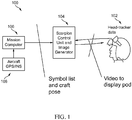
- FIG. 1 is an overall system diagram of an example AR system 100 for use in accordance with aspects of the present invention.
- the example system of FIG. 1 includes a HMD 102 that includes a tracking component and a display.
- a control unit and image generator 104 receives tracking data relating to the HMD and communicates a generated image to the HMD.
- Control unit 104 also receives input from a vehicle's mission computer 106, including, e.g., symbol data and data from an aircraft GPS/INS 108.
- aspects presented herein and not covered by the invention may include replacing a magnetic tracker so that the system involves no cockpit-installed active devices (such as a magnetic source or optical cameras). Instead, all the inertial and optical sensors may be provided in a self-contained sensor mounted, e.g., on the helmet.
- the sensor may communicate with a control unit, such as a cockpit mounted control unit, through a Helmet-Vehicle Interface (HVI).
- HVI Helmet-Vehicle Interface
- the sensor may communicate with the control unit, e.g., using the same HVI cable as the display pod.
- Fiducial stickers may be placed on the canopy over the pilot or driver's head to assist in the motion tracking.
- Optics for aircraft applications may require a very wide field fisheye lens, e.g., because the camera is only about 5-10 cm from the aircraft canopy. Good clear imaging may be required at close range, e.g., throughout a 140 FOV. Because the camera faces in the direction of the aircraft canopy, the sun can be directly in the FOV of the camera, which makes for some very difficult dynamic range problems.
- fiducials may be used that get brighter proportionally when backlit by the sun. In order to use such fiducials at night an illuminator may be added.
- retro-reflective stickers may be used for the fiducials on the canopy in order to overcome the inverse square loss from diffuse fiducials and return as much of the illumination to the lens as possible.
- the fiducials can be illuminated with NVG-compatible wavelengths in order to obtain a high read rate throughout most of the 140 degree FOV.
- FIG. 2 illustrates an example image 200 of fiducials having the sun directly behind them, for use in accordance with aspects of the present invention.
- FIG. 3 illustrates example tracking components including a tracker 302 that may be mounted to a helmet, fiducial markers 304, and an inertial measurement unit (IMU) 306 that may be included in the tracker 302, in accordance with aspects of the present invention.
- IMU inertial measurement unit
- FIG. 4 illustrates an example image 400 captured through an HMD camera that shows a clean separation of retro-reflector fiducials from background and high fiducial read rate, in accordance with aspects of the present invention.
- the intrinsic distortion parameters of a fisheye lens used in the motion tracking system may be calibrated, e.g., by taking about 40 images of a 3-walled fiducial-clad calibration fixture shown in Figure 4 .
- the calibration may be adapted to fit an appropriate set of distortion parameters to model the lens with improved accuracy.
- an optical pose associated with each calibration frame may be associated with a simultaneous pitch and roll measurement computed from the IMU's sensors with an altitude heading reference system (AHRS) algorithm.
- An optimization algorithm may be used to seek the extrinsic parameters that cause all the gravity vectors from the AHRS to align with the downward direction of the calibration stand when they are transformed from the body axes of the IMU to the camera axes by the extrinsic rotation then transformed to world frame by the camera pose rotation.
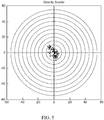
- FIG. 5 illustrates a scatter plot of the world-frame gravity vectors after extrinsic parameter optimization. Each circle in FIG. 5 is 5 mrad, in accordance with aspects of the present invention.
- FIG. 6 illustrates screenshots 602, 604 from an automapping tool.
- the right image 604 shows an example of the way that normal vectors can be automatically computed by finding the locations of the three "eyes" in each fiducial and calculating the cross product in accordance with aspects of the present invention.
- a very robust photogrammetric 3D mapping tool may accurately map a group of fiducials in a few minutes by simply scanning the sensor over the fiducial field.
- the algorithm may use Nister's 5-point algorithm to create an initial reconstruction from 5 fiducials found in common between two views. Additional details regarding Nister's 5-point algorithm may be found in Nister, D, An Efficient Solution to the Five-Point Relative Pose, PAMI 2004, the entire contents of which are incorporated herein by reference.
- the mapping tool may then alternate between triangulation to localize additional points, pose recovery to add additional camera poses, and bundle adjustment to refine the motion and structure parameters and discard outliers. Mixed fiducial sizes may be used.
- the automapper may automatically scale the map when the user enters the diameter of the largest fiducial in the map. After scaling, the reported point tightness values may be, e.g., around 30-70 microns for a 30 cm grid.
- INS inertial navigation system
- HUD heads-up-display
- sensor pods or targeting pods and weapons.
- Various aspects may be used to align the fiducial constellation with the aircraft axes, or more specifically with the platform INS axes since the INS is the reference frame from which symbol generators are driven.
- HUD head-up-display
- sensor pods or targeting pods and weapons.
- Various aspects may be used to align the fiducial constellation with the aircraft axes, or more specifically with the platform INS axes since the INS is the reference frame from which symbol generators are driven.
- HUD When the aircraft contains an HUD, it may be assumed that the HUD is already aligned with the p-frame of the INS.
- a tool containing a collimated optical scope with a sensor aligned on top may be used.
- the scope By pointing the scope at the watermark in the HUD it can be aligned with the platform x-axis, and at the same time the sensor may be directed up at the fiducials in order to determine the pose of the scope relative to an n-frame, from which the rotation of the n-frame may be solved with respect to (w.r.t.) the p-frame.
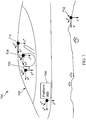
- FIG. 7 illustrates an example 700 of a fighter jet cockpit 702 with coordinate axes associated with the platform INS 704 (p), the display (d), the sensor body (b), the fiducial constellation 710 (n) and the ground 712 (i) in accordance with aspects of the present invention.
- Table 1 lists the five associated coordinate frames.
- TABLE 1 i-frame The i-frame is an inertial reference frame, which for our purposes is a local-level North-East-Down (NED) frame on the ground below the aircraft that rotates sufficiently slowly to be considered an inertial frame.
- p-frame The aircraft "platform INS" frame.
- the “platform INS” is the inertial navigation system that supplies pose data to the mission computer (MC) and in turn to the display system.
- n-frame The reference frame of the tracking system.
- the n-frame has its origin in and axes nominally aligned with the source coil assembly.
- the n-frame may have its origin at one of the fiducials and its axes may be roughly aligned to the aircraft axes during ground harmonization procedures.
- b-frame The body frame of the tracker sensor.
- the b-frame may be defined by the NavChip inside the sensor assembly, which is mounted upside-down, backwards and tilted relative to the helmet.
- d-frame Display frame defined by the lightguide optical element (LOE) or "paddle" on the display pod.
- LOE lightguide optical element
- Vectors are denoted by lowercase bold letters and matrices by uppercase bold. If a vector is expressed in a particular coordinate system it is denoted with a superscript designating one of the above five frames.
- a rotation matrix has a subscript and a superscript and transforms a vector from the subscript frame to the superscript frame.
- a hat above a quantity refers to an estimated value
- a tilde above means a measured value
- the unadorned symbol represents the true value.
- EKF Extended Kalman Filter
- Systems using a rolling-shutter image sensor may have to process each individual fiducial measurement separately at a different point in time, using a highly nonlinear bearings-only measurement model which was a function of position as well as orientation.
- ARM Cortex A8 at 1GHz the sensor presented herein may be able to simultaneously capture and decode up to 20 fiducials at frame rate. For every frame, it solves for pose using a modified version of the OpenCV pose recovery algorithm, which results in a direct measurement of the rotation that can be used to correct gyro drift.
- FIG. 8 illustrates an algorithm 800 for tracking relative to i-frame, then converting output to p-frame for legacy tracker compatibility in accordance with aspects of the present invention.
- the angular rates may be integrated to estimate head orientation with reference to the ground, C ⁇ b i , and the complementary filter may be used to directly correct the errors of this ground-referenced orientation as well as the gyro biases.
- the result may be pre-multiplied by the inverse of the aircraft attitude supplied from the platform INS in order to provide the head-tracker orientation w.r.t. the aircraft platform axes. This may be required, e.g., by legacy mission computers that were designed for non-inertial trackers.
- C p i is the attitude of the vehicle returned from the platform INS
- C ⁇ b n is the measurement of the sensor pose relative to the fiducial constellation frame
- C n p is the alignment rotation relating the constellation reference frame to the platform INS frame, which was determined during the harmonization process described above.
- the CKF 802 is simply a linear Kalman Filter that estimates the small errors that accumulate in the attitude update algorithm, together with the gyro biases that are partly responsible for creating those errors.
- the measurement for the CKF may be defined not as the quantity C ⁇ b i calculated in (1), but as a residual calculated from it as follows: z ⁇ S ⁇ 1 C ⁇ b i C ⁇ b i T ⁇ I
- an inverse skew-symmetric matrix operator that extracts the corresponding vector elements from a skew-symmetric matrix.
- the input matrix will be very close to skew symmetric because the measurement C ⁇ b i is derived from a very accurate optical pose recovery combined with a very accurate (sub-milliradian) aircraft attitude from an INS, and a harmonization matrix that may be determined accurately in advance.
- the Kalman filter may be augmented with three additional states to estimate the harmonization error angles ⁇ , which are defined analogously to the tracker error angles in (2):
- C ⁇ n p I + ⁇ ⁇ C n p
- These states are constant, so the time propagation equation remains basically the same with the added states:
- ⁇ ⁇ ⁇ k + 1 I ⁇ ⁇ t C b i 0 0 I 0 0 0 I ⁇ ⁇ ⁇ k + w k
- the measurement updates in the Kalman filter would receive measurement errors significantly larger than the tuned measurement noise matrix resulting in suboptimal performance. Rather than retune the filter to expect vastly more measurement noise, given the slow dynamics of an aircraft, it is possible to remove most of the error by forward predicting the aircraft attitude for a known amount of latency for which to compensate. In order to try to automatically estimate and adapt to the data latency, one additional state may be added to the CKF to estimate the error of the prediction interval currently in effect for compensating the measurement data latency.
- a block may be added to perform forward prediction of the platform INS attitude C p i by a rotation angle of ⁇ ip p ⁇ t where platform angular velocity ⁇ ip p is estimated from the last two samples of platform attitude, and ⁇ t is initialized to 50 ms with an uncertainty of 100 ms.
- AR guidance for operators of earth-moving equipment and other heavy construction machinery in order to help them more efficiently and exactly achieve the desired results planned in a CAD model.
- AR headsets would also be valuable to provide situational awareness to first responders while they drive to the scene, and after they dismount from the vehicles at the scene.
- FIG. 9 illustrates an example method 900 for tracking an object moving relative to a moving platform, the moving platform moving relative to an external frame of reference, in accordance with aspects of the present invention.
- an inertial orientation estimate of the object relative to the external frame of reference is updated using at least one angular rate sensor comprised in a sensor unit fixed to the object.
- the external frame of reference may be, e.g., a world frame that does not rotate with said moving object.
- object may be, e.g., a HMD that moves relative to a moving vehicle, such as an airplane.
- the airplane moves relative to an external frame of reference, such as a world frame of reference.
- the angular rate sensors may be, e.g., gyroscopes.
- measurements are obtained from a platform-mounted INS of the orientation of a platform coordinate frame with respect to said external frame of reference.
- the measurements may be obtained from the platform-mounted INS at a lower rate than the sensor unit fixed to the object.
- 906, 908, and 910 are performed at certain measurement times.
- measurements are obtained from a non-inertial sensor of the orientation of the sensor unit relative to a measurement reference coordinate frame fixed with respect to the platform.
- said platform-referenced non-inertial orientation measurements are combined with the INS measurement, e.g., the most recent INS measurement, of platform orientation to form an indirect measurement of the orientation of said object with respect to said external frame of reference.
- FIG. 10 illustrates an example in which this combining at 908 may comprise forward-predicting said INS measurement through a prediction interval tau to the effective time of the platform-referenced non-inertial orientation measurement at 1002.
- Optional aspects are illustrated with a dashed line.
- the prediction interval tau may be an estimate of the effective time of the platform-referenced non-inertial orientation measurement minus the effective time of the INS platform orientation measurement.
- the estimation of tau may include timestamping the arrival of the INS measurements and the platform-referenced non-inertial orientation measurement at 1004, calculating the difference of arrival times for the INS measurements and the platform-referenced non-inertial orientation measurement at 1006, subtracting an estimate of an age of the non-inertial measurement when it arrived at 1008, and adding an estimate of an age of the INS measurement when it arrived at 1010.
- the estimate of the age of the INS measurement at arrival may be formed using an algorithm operating on the data during run time.
- the algorithm may include a Kalman filter with an added state for at least one of the prediction interval, a portion of the prediction interval, and the prediction interval error.
- the indirect measurement is fused with said inertial orientation estimate of the object to form an improved estimate of object orientation relative to said external frame of reference.
- the fusion of the indirect measurement with said inertial orientation estimate may be performed, e.g., using a Kalman filter.
- a state vector of such a Kalman filter may include three states representing orientation errors and a measurement model may include a measurement residual with a linear relationship to those states.
- the measurement residual may be of the form z ⁇ S ⁇ 1 C ⁇ b i C ⁇ b i T ⁇ I .
- a Jacobian of the measurement residual with respect to the three orientation error states may comprise an identity matrix.
- the improved estimate of object orientation relative to said external frame of reference is combined with said INS measurement of platform orientation relative to said external frame of reference to form an estimate of relative orientation of said object with respect to said moving platform.
- At least one aspect of the misalignment of the measurement reference coordinate frame relative to said platform coordinate frame may not be perfectly known prior to commencement of tracking operation.
- An algorithm may be used to estimate the unknown aspect of the coordinate frame misalignment concurrently during tracking.
- Such an algorithm may include comparing the inertial angular rates from said sensor unit, converted into the measurement reference frame, with the angular rates of the platform frame from the platform INS.
- the algorithm may include comparing the orientation from integration of inertial angular rates from said sensor unit, converted into the measurement reference frame, with the platform orientation from the platform INS.
- Such tracking may include using a Kalman filter whose state includes one of at least one aspect of the object orientation relative to said external frame of reference and at least one aspect of the error in said object orientation relative to said external frame of reference.
- the Kalman filter's state vector may further include at least one of said unknown aspect and aspects of said coordinate frame misalignment.
- FIG. 11 presents an example system diagram of various hardware components and other features, for use in accordance with aspects presented herein.
- the aspects may be implemented using hardware, software, or a combination thereof and may be implemented in one or more computer systems or other processing systems.
- the aspects may include one or more computer systems capable of carrying out the functionality described herein, e.g., in connection with FIGs. 9 and 10 .
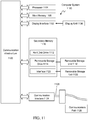
- An example of such a computer system 1100 is shown in FIG. 11 .
- Computer system 1100 includes one or more processors, such as processor 1104.
- the processor 1104 is connected to a communication infrastructure 1106 (e.g., a communications bus, cross-over bar, or network).
- a communication infrastructure 1106 e.g., a communications bus, cross-over bar, or network.
- Computer system 1100 can include a display interface 1102 that forwards graphics, text, and other data from the communication infrastructure 1106 (or from a frame buffer not shown) for display on a display unit 1130.
- Computer system 1100 also includes a main memory 1108, preferably random access memory (RAM), and may also include a secondary memory 1110.
- the secondary memory 1110 may include, for example, a hard disk drive 1112 and/or a removable storage drive 1114, representing a floppy disk drive, a magnetic tape drive, an optical disk drive, etc.
- the removable storage drive 1114 reads from and/or writes to a removable storage unit 1118 in a well-known manner.
- Removable storage unit 1118 represents a floppy disk, magnetic tape, optical disk, etc., which is read by and written to removable storage drive 1114.
- the removable storage unit 1118 includes a computer usable storage medium having stored therein computer software and/or data.
- secondary memory 1110 may include other similar devices for allowing computer programs or other instructions to be loaded into computer system 1100.
- Such devices may include, for example, a removable storage unit 1122 and an interface 1120. Examples of such may include a program cartridge and cartridge interface (such as that found in video game devices), a removable memory chip (such as an erasable programmable read only memory (EPROM), or programmable read only memory (PROM)) and associated socket, and other removable storage units 1122 and interfaces 1120, which allow software and data to be transferred from the removable storage unit 1122 to computer system 1100.
- a program cartridge and cartridge interface such as that found in video game devices
- EPROM erasable programmable read only memory
- PROM programmable read only memory
- Computer system 1100 may also include a communications interface 1124.
- Communications interface 1124 allows software and data to be transferred between computer system 1100 and external devices. Examples of communications interface 1124 may include a modem, a network interface (such as an Ethernet card), a communications port, a Personal Computer Memory Card International Association (PCMCIA) slot and card, etc.
- Software and data transferred via communications interface 1124 are in the form of signals 1128, which may be electronic, electromagnetic, optical or other signals capable of being received by communications interface 1124. These signals 1128 are provided to communications interface 1124 via a communications path (e.g., channel) 1126.
- This path 1126 carries signals 1128 and may be implemented using wire or cable, fiber optics, a telephone line, a cellular link, a radio frequency (RF) link and/or other communications channels.
- RF radio frequency
- the terms "computer program medium” and “computer usable medium” are used to refer generally to media such as a removable storage drive 1180, a hard disk installed in hard disk drive 1170, and signals 1128. These computer program products provide software to the computer system 1100. Aspects presented herein may include such computer program products.
- Computer programs are stored in main memory 1108 and/or secondary memory 1110. Computer programs may also be received via communications interface 1124. Such computer programs, when executed, enable the computer system 1100 to perform the features presented herein, as discussed herein. In particular, the computer programs, when executed, enable the processor 1110 to perform the features presented herein. Accordingly, such computer programs represent controllers of the computer system 1100.
- the software may be stored in a computer program product and loaded into computer system 1100 using removable storage drive 1114, hard drive 1112, or communications interface 1120.
- the control logic when executed by the processor 1104, causes the processor 1104 to perform the functions as described herein.
- aspects may be implemented primarily in hardware using, for example, hardware components, such as application specific integrated circuits (ASICs). Implementation of the hardware state machine so as to perform the functions described herein will be apparent to persons skilled in the relevant art(s).
- aspects presented herein may be implemented using a combination of both hardware and software.
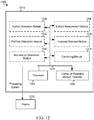
- FIG. 12 is a diagram illustrating an example of a hardware implementation for an apparatus 1200 employing a processing system 1214.
- the processing system 1214 may be implemented with an architecture that links together various circuits including one or more processors and/or modules, represented by the processor 1204, the modules 1230, 1232, 1234, 1236, 1238, and 1240, and the computer-readable medium / memory 1206.
- the processing system 1214 may be coupled to a display, such as HMD 102 in FIG. 1 .
- the processing system may also be coupled to various sensors, such as tracking sensor 302, INS 108, mission computer 106, control unit and image generator 104, etc.
- Inertial Orientation module 1230 may be configured to update an inertial orientation estimate of the object relative to the external frame of reference using at least one angular rate sensor comprised in a sensor unit fixed to the object.
- Platform orientation module 1232 may be configured to obtain measurements from a platform-mounted INS of the orientation of a platform coordinate frame with respect to said external frame of reference.
- Non-inertial Orientation module 1234 may be configured to obtain measurements from a non-inertial sensor of the orientation of the sensor unit relative to a measurement reference coordinate frame fixed with respect to the platform.
- Improved estimate module 1238 may be configured to combine said platform-referenced non-inertial orientation measurements with the most recent INS measurement of platform orientation to form an indirect measurement of the orientation of said object with respect to said external frame of reference and to fuse said indirect measurement with said inertial orientation estimate of the object to form an improved estimate of object orientation relative to said external frame of reference.
- apparatus 1200 may include a combining module configured to combine the improved estimate of object orientation relative to said external frame of reference with said INS measurement of platform orientation relative to said external frame of reference to form an estimate of relative orientation of said object with respect to said moving platform.
- the processing system 1214 includes a processor 1204 coupled to a computer-readable medium / memory 1206.
- the processor 1204 is responsible for general processing, including the execution of software stored on the computer-readable medium / memory 1206.
- the software when executed by the processor 1204, causes the processing system 1214 to perform the various functions described supra for any particular apparatus.
- the computer-readable medium / memory 1206 may also be used for storing data that is manipulated by the processor 1204 when executing software.
- the processing system further includes at least one of the modules 1230, 1232, 1234, 1236, 1238, and 1240.
- the modules may be software modules running in the processor 1204, resident/stored in the computer readable medium / memory 1206, one or more hardware modules coupled to the processor 1204, or some combination thereof.
- the processing system 1214 may be a component of a vehicular augmented reality system, as illustrated in FIG. 1 .
- the apparatus 1200 for tracking an object moving relative to a moving platform includes means for updating an inertial orientation estimate of the object relative to the external frame of reference using at least one angular rate sensor comprised in a sensor unit fixed to the object and means for obtaining measurements from a platform-mounted inertial navigation system (INS) of the orientation of a platform coordinate frame with respect to said external frame of reference.
- INS platform-mounted inertial navigation system
- the apparatus may further include means for obtaining measurements from a non-inertial sensor of the orientation of the sensor unit relative to a measurement reference coordinate frame fixed with respect to the platform, combining said platform-referenced non-inertial orientation measurements with the most recent INS measurement of platform orientation to form an indirect measurement of the orientation of said object with respect to said external frame of reference, and fusing said indirect measurement with said inertial orientation estimate of the object to form an improved estimate of object orientation relative to said external frame of reference.
- the aforementioned means may be one or more of the aforementioned modules of the apparatus 1200 and/or the processing system 1214 of the apparatus 1200 configured to perform the functions recited by the aforementioned means.
- aspects may include an apparatus for tracking an object moving relative to a moving platform, the moving platform moving relative to an external frame of reference and including a memory and at least one processor coupled to the memory and configured to perform the aspects described, e.g., in connection with FIGs. 9 and 10 .
- the apparatus may include additional modules that perform each of the blocks of the algorithm in the aforementioned flowcharts of FIGs. 9 and 10 .
- each block in the aforementioned flowcharts of FIGs. 9 and 10 may be performed by a module and the apparatus may include one or more of those modules.
- the modules may be one or more hardware components specifically configured to carry out the stated processes/algorithm, implemented by a processor configured to perform the stated processes/algorithm, stored within a computer-readable medium for implementation by a processor, or some combination thereof.
- aspects may include a computer program product for tracking an object moving relative to a moving platform, the moving platform moving relative to an external frame of reference, the computer program product comprising a computer usable medium having control logic stored therein for causing a computer to perform the aspects described in connection with, e.g., FIGs. 9 and 10 .
Landscapes
- Physics & Mathematics (AREA)
- Engineering & Computer Science (AREA)
- Radar, Positioning & Navigation (AREA)
- Remote Sensing (AREA)
- General Physics & Mathematics (AREA)
- Optics & Photonics (AREA)
- Automation & Control Theory (AREA)
- Computer Hardware Design (AREA)
- Computer Graphics (AREA)
- General Engineering & Computer Science (AREA)
- Software Systems (AREA)
- Theoretical Computer Science (AREA)
- Navigation (AREA)
- Gyroscopes (AREA)
- Length Measuring Devices With Unspecified Measuring Means (AREA)
- Processing Or Creating Images (AREA)
Claims (15)
- Procédé (900) de suivi d'un objet se déplaçant par rapport à une plateforme mobile, la plateforme mobile se déplaçant par rapport à un cadre de référence externe, le procédé comprenant les étapes ci-dessous consistant à :mettre à jour (902) une estimation d'orientation inertielle de l'objet par rapport au cadre de référence externe, en utilisant au moins un capteur de vitesse angulaire compris dans une unité de capteur fixée à l'objet ;obtenir (904) des mesures, à partir d'un système de navigation inertiel (INS) monté sur plateforme, de l'orientation d'une plateforme par rapport audit cadre de référence externe ;à des instants de mesure donnés, obtenir (906) des mesures, à partir d'un capteur non inertiel, de l'orientation de l'unité de capteur par rapport à un cadre de coordonnées de référence de mesure fixe par rapport à la plateforme ; etcaractérisé par les étapes ci-dessous consistant à :combiner (908) lesdites mesures d'orientation non inertielles référencées par plateforme avec la mesure de système INS de l'orientation de plateforme, en vue de former une mesure indirecte de l'orientation dudit objet par rapport audit cadre de référence externe, et fusionner (910) ladite mesure indirecte avec ladite estimation d'orientation inertielle de l'objet en vue de former une estimation améliorée d'orientation d'objet par rapport audit cadre de référence externe ; etcombiner (912) ladite estimation améliorée d'orientation d'objet par rapport audit cadre de référence externe avec ladite mesure de système INS de l'orientation de plateforme, par rapport audit cadre de référence externe, en vue de former une estimation d'orientation relative dudit objet par rapport à ladite plateforme mobile.
- Procédé selon la revendication 1, dans lequel le cadre de référence externe est un cadre d'environnement externe qui ne tourne pas avec ladite plateforme mobile.
- Procédé selon la revendication 1, dans lequel les mesures sont obtenues à partir du système INS monté sur plateforme à un taux inférieur à celui de l'unité de capteur fixée à l'objet.
- Procédé selon la revendication 1, dans lequel ladite fusion de ladite mesure indirecte avec ladite estimation d'orientation inertielle est mise en œuvre en utilisant un filtre de Kalman.
- Procédé selon la revendication 4, dans lequel un vecteur d'état dudit filtre de Kalman inclut trois états représentant des erreurs d'orientation, et dans lequel un modèle de mesure inclut un résidu de mesure présentant une relation linéaire avec ces états.
- Procédé selon la revendication 5, dans lequel le résidu de mesure est de la forme

- Procédé selon la revendication 1, dans lequel l'étape de combinaison desdites mesures d'orientation non inertielles référencées par plateforme avec la plus récente mesure de système INS de l'orientation de plateforme comprend en outre l'étape ci-dessous consistant à :
mettre en œuvre une prédiction anticipée (1002) de ladite mesure de système INS à travers un intervalle de prédiction, tau, jusqu'au temps effectif de la mesure d'orientation non inertielle référencée par plateforme. - Procédé selon la revendication 7, dans lequel l'intervalle de prédiction, tau, est une estimation du temps effectif de la mesure d'orientation non inertielle référencée par plateforme moins le temps effectif de la mesure d'orientation de plateforme de système INS.
- Procédé selon la revendication 8, dans lequel l'estimation de tau inclut les étapes ci-dessous consistant à :horodater (1004) l'arrivée des mesures de système INS et de la mesure d'orientation non inertielle référencée par plateforme ;calculer (1006) la différence de temps d'arrivée pour les mesures de système INS et la mesure d'orientation non inertielle référencée par plateforme ;soustraire (1008) une estimation d'un âge de la mesure non inertielle à son arrivée ; etajouter (1010) une estimation d'un âge de la mesure de système INS à son arrivée.
- Procédé selon la revendication 9, dans lequel l'estimation de l'âge de la mesure de système INS à l'arrivée est formée en utilisant un algorithme opérant sur les données pendant le temps d'exécution, dans lequel ledit algorithme inclut un filtre de Kalman avec un état ajouté pour au moins l'un des éléments parmi l'intervalle de prédiction, une partie de l'intervalle de prédiction, et l'erreur d'intervalle de prédiction.
- Procédé selon la revendication 1, dans lequel au moins un aspect d'un désalignement dudit cadre de coordonnées de référence de mesure par rapport audit cadre de coordonnées de plateforme n'est pas parfaitement connu avant le début de l'opération de suivi, et dans lequel le procédé comprend en outre les étapes ci-dessous consistant à :
utiliser un algorithme pour estimer ledit aspect inconnu du désalignement de cadre de coordonnées, simultanément, pendant le suivi, ledit algorithme comprenant les étapes ci-dessous consistant à :comparer les vitesses angulaires inertielles provenant de ladite unité de capteur, converties dans le cadre de référence de mesure, aux vitesses angulaires du cadre de plateforme provenant du système INS de plateforme ; oucomparer l'orientation à partir d'une intégration de vitesses angulaires inertielles provenant de ladite unité de capteur, converties dans le cadre de référence de mesure, à l'orientation de plateforme provenant du système INS de plateforme. - Procédé selon la revendication 11, dans lequel ladite étape de suivi comprend l'étape consistant à utiliser un filtre de Kalman dont les états incluent l'un des éléments parmi :au moins un aspect de l'orientation d'objet par rapport audit cadre de référence externe ; etau moins un aspect de l'erreur dans ladite orientation d'objet par rapport audit cadre de référence externe.
- Procédé selon la revendication 12, dans lequel le vecteur d'état dudit filtre de Kalman inclut en outre au moins l'un parmi ledit aspect inconnu et des aspects dudit désalignement de cadre de coordonnées.
- Appareil (1200) destiné à suivre un objet se déplaçant par rapport à une plateforme mobile, la plateforme mobile se déplaçant par rapport à un cadre de référence externe, l'appareil comprenant :une mémoire (1206) ; etau moins un processeur (1204) couplé à la mémoire et configuré de manière à mettre en œuvre un procédé selon l'une quelconque des revendications 1 à 13.
- Produit-programme informatique pour suivre un objet se déplaçant par rapport à une plateforme mobile, la plateforme mobile se déplaçant par rapport à un cadre de référence externe, le produit-programme informatique comprenant un support utilisable par ordinateur dans lequel est stockée une logique de commande pour amener un ordinateur à mettre en œuvre un procédé selon l'une quelconque des revendications 1 à 13.
Priority Applications (2)
| Application Number | Priority Date | Filing Date | Title |
|---|---|---|---|
| EP21175633.3A EP3892196B1 (fr) | 2014-05-02 | 2015-05-04 | Enregistrement amélioré pour une réalité augmentée pour véhicules faisant appel à une auto-harmonisation |
| EP22188144.4A EP4104760B1 (fr) | 2014-05-02 | 2015-05-04 | Enregistrement amélioré pour une réalité augmentée pour véhicules faisant appel à une auto-harmonisation |
Applications Claiming Priority (3)
| Application Number | Priority Date | Filing Date | Title |
|---|---|---|---|
| US201461988106P | 2014-05-02 | 2014-05-02 | |
| US14/702,402 US9766075B2 (en) | 2014-05-02 | 2015-05-01 | Registration for vehicular augmented reality using auto-harmonization |
| PCT/US2015/029016 WO2015168675A1 (fr) | 2014-05-02 | 2015-05-04 | Enregistrement amélioré pour une réalité augmentée pour véhicules faisant appel à une auto-harmonisation |
Related Child Applications (3)
| Application Number | Title | Priority Date | Filing Date |
|---|---|---|---|
| EP21175633.3A Division-Into EP3892196B1 (fr) | 2014-05-02 | 2015-05-04 | Enregistrement amélioré pour une réalité augmentée pour véhicules faisant appel à une auto-harmonisation |
| EP21175633.3A Division EP3892196B1 (fr) | 2014-05-02 | 2015-05-04 | Enregistrement amélioré pour une réalité augmentée pour véhicules faisant appel à une auto-harmonisation |
| EP22188144.4A Division EP4104760B1 (fr) | 2014-05-02 | 2015-05-04 | Enregistrement amélioré pour une réalité augmentée pour véhicules faisant appel à une auto-harmonisation |
Publications (3)
| Publication Number | Publication Date |
|---|---|
| EP3136964A1 EP3136964A1 (fr) | 2017-03-08 |
| EP3136964A4 EP3136964A4 (fr) | 2018-01-10 |
| EP3136964B1 true EP3136964B1 (fr) | 2021-06-30 |
Family
ID=54355617
Family Applications (3)
| Application Number | Title | Priority Date | Filing Date |
|---|---|---|---|
| EP15785887.9A Active EP3136964B1 (fr) | 2014-05-02 | 2015-05-04 | Enregistrement amélioré pour une réalité augmentée pour véhicules faisant appel à une auto-harmonisation |
| EP21175633.3A Active EP3892196B1 (fr) | 2014-05-02 | 2015-05-04 | Enregistrement amélioré pour une réalité augmentée pour véhicules faisant appel à une auto-harmonisation |
| EP22188144.4A Active EP4104760B1 (fr) | 2014-05-02 | 2015-05-04 | Enregistrement amélioré pour une réalité augmentée pour véhicules faisant appel à une auto-harmonisation |
Family Applications After (2)
| Application Number | Title | Priority Date | Filing Date |
|---|---|---|---|
| EP21175633.3A Active EP3892196B1 (fr) | 2014-05-02 | 2015-05-04 | Enregistrement amélioré pour une réalité augmentée pour véhicules faisant appel à une auto-harmonisation |
| EP22188144.4A Active EP4104760B1 (fr) | 2014-05-02 | 2015-05-04 | Enregistrement amélioré pour une réalité augmentée pour véhicules faisant appel à une auto-harmonisation |
Country Status (7)
| Country | Link |
|---|---|
| US (1) | US9766075B2 (fr) |
| EP (3) | EP3136964B1 (fr) |
| KR (2) | KR20220059560A (fr) |
| DK (2) | DK4104760T3 (fr) |
| ES (3) | ES2926177T3 (fr) |
| IL (1) | IL248584B (fr) |
| WO (1) | WO2015168675A1 (fr) |
Families Citing this family (47)
| Publication number | Priority date | Publication date | Assignee | Title |
|---|---|---|---|---|
| GB2527503A (en) * | 2014-06-17 | 2015-12-30 | Next Logic Pty Ltd | Generating a sequence of stereoscopic images for a head-mounted display |
| US20150369593A1 (en) * | 2014-06-19 | 2015-12-24 | Kari MYLLYKOSKI | Orthographic image capture system |
| KR20160024168A (ko) * | 2014-08-25 | 2016-03-04 | 삼성전자주식회사 | 전자 장치의 디스플레이 제어 방법 및 전자 장치 |
| US10212355B2 (en) | 2015-03-13 | 2019-02-19 | Thales Defense & Security, Inc. | Dual-mode illuminator for imaging under different lighting conditions |
| US9541763B1 (en) * | 2015-07-29 | 2017-01-10 | Rockwell Collins, Inc. | Active HUD alignment |
| GB201516122D0 (en) * | 2015-09-11 | 2015-10-28 | Bae Systems Plc | Inertial sensor data correction |
| GB201516120D0 (en) | 2015-09-11 | 2015-10-28 | Bae Systems Plc | Helmet tracker |
| US9874931B1 (en) * | 2016-02-22 | 2018-01-23 | Rockwell Collins, Inc. | Head-tracking system and method |
| US10482668B2 (en) | 2016-06-02 | 2019-11-19 | Thales Visionix, Inc. | Miniature vision-inertial navigation system with extended dynamic range |
| EP3943888A1 (fr) | 2016-08-04 | 2022-01-26 | Reification Inc. | Procédés de localisation et cartographie simultanés (slam) et appareil et systèmes associés |
| US9891705B1 (en) * | 2016-08-25 | 2018-02-13 | Rockwell Collins, Inc. | Automatic boresighting of head-worn display |
| US10580386B2 (en) | 2017-04-21 | 2020-03-03 | Ford Global Technologies, Llc | In-vehicle projected reality motion correction |
| US10216265B1 (en) * | 2017-08-07 | 2019-02-26 | Rockwell Collins, Inc. | System and method for hybrid optical/inertial headtracking via numerically stable Kalman filter |
| US10304254B2 (en) | 2017-08-08 | 2019-05-28 | Smart Picture Technologies, Inc. | Method for measuring and modeling spaces using markerless augmented reality |
| DE102017217027A1 (de) * | 2017-09-26 | 2019-03-28 | Audi Ag | Verfahren zum Betreiben einer am Kopf tragbaren elektronischen Anzeigeeinrichtung und Anzeigesystem zum Anzeigen eines virtuellen Inhalts |
| FR3075985B1 (fr) * | 2017-12-21 | 2019-11-15 | Thales | Procede et systeme d'harmonisation duale d'un systeme d'affichage tete haute porte pour rendre conforme l'affichage d'informations de pilotage d'un aeronef avec le monde reel exterieur |
| CN108225373B (zh) * | 2017-12-22 | 2020-04-24 | 东南大学 | 一种基于改进的5阶容积卡尔曼的大失准角对准方法 |
| JP7075252B2 (ja) * | 2018-03-23 | 2022-05-25 | キヤノン株式会社 | 情報処理装置およびその制御方法、プログラム |
| US10885721B2 (en) | 2018-09-28 | 2021-01-05 | Jido Inc. | Method for detecting objects and localizing a mobile computing device within an augmented reality experience |
| CN110780445A (zh) * | 2018-11-12 | 2020-02-11 | 芋头科技(杭州)有限公司 | 用于装配光学成像系统的主动校准的方法及系统 |
| US11487132B2 (en) * | 2018-11-12 | 2022-11-01 | Yutou Technology (Hangzhou) Co., Ltd. | Active alignment for assembling optical devices |
| US10390581B1 (en) * | 2019-01-29 | 2019-08-27 | Rockwell Collins, Inc. | Radio frequency head tracker |
| US10767997B1 (en) | 2019-02-25 | 2020-09-08 | Qualcomm Incorporated | Systems and methods for providing immersive extended reality experiences on moving platforms |
| US10559135B1 (en) * | 2019-03-15 | 2020-02-11 | Microsoft Technology Licensing, Llc | Fixed holograms in mobile environments |
| US10816813B1 (en) * | 2019-04-05 | 2020-10-27 | Disney Enterprises, Inc. | Systems and methods for enhancing accuracy of spatial location and rotational orientation determination of wearable head-mounted display device |
| CN110007601B (zh) * | 2019-05-06 | 2022-03-25 | 广东工业大学 | 一种双边遥操作系统的控制装置和设备 |
| EP3966789A4 (fr) | 2019-05-10 | 2022-06-29 | Smart Picture Technologies, Inc. | Procédés et systèmes de mesure et de modélisation d'espaces en utilisant un processus de réalité augmentée basé sur la photo sans marqueur |
| US11487124B2 (en) * | 2019-08-14 | 2022-11-01 | Thales Defense & Security, Inc. | Methods and systems for auto-alignment of displays |
| WO2021070813A1 (fr) * | 2019-10-08 | 2021-04-15 | 株式会社デンソー | Dispositif d'estimation d'erreur, procédé d'estimation d'erreur, programme d'estimation d'erreur |
| US10996480B1 (en) * | 2019-10-11 | 2021-05-04 | GM Global Technology Operations LLC | Head-up display calibration |
| EP3990302B1 (fr) * | 2019-10-29 | 2023-01-11 | holoride GmbH | Procédé et dispositif de commande pour le fonctionnement d'un casque de réalité virtuelle dans un véhicule |
| US11320650B1 (en) | 2020-06-02 | 2022-05-03 | Rockwell Collins, Inc. | High assurance head tracking system incorporating ground truth fiducials |
| US11360552B1 (en) | 2020-06-02 | 2022-06-14 | Rockwell Collins, Inc. | High assurance headtracking via structured light projection for head worn display (HWD) |
| US12039674B2 (en) | 2020-09-18 | 2024-07-16 | Apple Inc. | Inertial data management for extended reality for moving platforms |
| US12406442B2 (en) | 2020-09-18 | 2025-09-02 | Apple Inc. | Extended reality for moving platforms |
| WO2023281488A1 (fr) | 2021-07-04 | 2023-01-12 | Elbit Systems Ltd. | Système d'affichage conforme et son procédé |
| US12198380B2 (en) | 2022-01-11 | 2025-01-14 | Rockwell Collins, Inc. | Vision-based navigation system incorporating high-confidence error overbounding of multiple optical poses |
| US12347139B2 (en) | 2022-01-11 | 2025-07-01 | Rockwell Collins, Inc. | High-confidence optical head pose correspondence mapping with multiple lower-density markers for high-integrity headtracking on a headworn display (HWD) |
| US12136234B2 (en) | 2022-01-11 | 2024-11-05 | Rockwell Collins, Inc. | Vision-based navigation system incorporating model-based correspondence determination with high-confidence ambiguity identification |
| US11995228B2 (en) | 2022-01-11 | 2024-05-28 | Rockwell Collins, Inc. | Head tracking system with extended kalman filter combining absolute and relative navigation |
| US11586286B1 (en) | 2022-05-18 | 2023-02-21 | Bank Of America Corporation | System and method for navigating on an augmented reality display |
| US11720380B1 (en) | 2022-05-18 | 2023-08-08 | Bank Of America Corporation | System and method for updating augmented reality navigation instructions based on a detected error |
| US11768374B1 (en) * | 2022-06-24 | 2023-09-26 | Rockwell Collins, Inc. | Vehicle including head wearable display device and imperceptible reference fiducials and method therefor |
| CN117891063A (zh) * | 2022-10-08 | 2024-04-16 | 北京字跳网络技术有限公司 | 光学跟踪器的定位方法、装置及系统 |
| CN115793261B (zh) * | 2023-01-31 | 2023-05-02 | 北京东方瑞丰航空技术有限公司 | 一种vr眼镜的视觉补偿方法、系统和设备 |
| CN118052963B (zh) * | 2024-04-16 | 2024-06-25 | 山东金东数字创意股份有限公司 | 一种降低xr长时间误差积累的方法、介质及系统 |
| IL314161B2 (en) * | 2024-07-04 | 2026-01-01 | Elbit Systems Ltd | Transfer alignment systems and methods |
Family Cites Families (8)
| Publication number | Priority date | Publication date | Assignee | Title |
|---|---|---|---|---|
| US6474159B1 (en) * | 2000-04-21 | 2002-11-05 | Intersense, Inc. | Motion-tracking |
| WO2005052718A2 (fr) * | 2003-11-26 | 2005-06-09 | Rafael - Armament Development Authority Ltd. | Systeme de casque pour des systemes d'informations ou des systemes d'armes |
| US7289906B2 (en) * | 2004-04-05 | 2007-10-30 | Oregon Health & Science University | Navigation system applications of sigma-point Kalman filters for nonlinear estimation and sensor fusion |
| IL167648A (en) * | 2005-03-24 | 2011-01-31 | Elbit Systems Ltd | Hybrid tracker |
| US8224024B2 (en) * | 2005-10-04 | 2012-07-17 | InterSense, LLC | Tracking objects with markers |
| EP2064568B1 (fr) * | 2007-05-29 | 2012-11-14 | Deimos Engenharia S.a. | Système de navigation gps, galileo et par inertie hautement intégré |
| US8295547B1 (en) * | 2010-05-26 | 2012-10-23 | Exelis, Inc | Model-based feature tracking in 3-D and 2-D imagery |
| US9626802B2 (en) * | 2014-05-01 | 2017-04-18 | Microsoft Technology Licensing, Llc | Determining coordinate frames in a dynamic environment |
-
2015
- 2015-05-01 US US14/702,402 patent/US9766075B2/en active Active
- 2015-05-04 KR KR1020227013886A patent/KR20220059560A/ko not_active Ceased
- 2015-05-04 EP EP15785887.9A patent/EP3136964B1/fr active Active
- 2015-05-04 DK DK22188144.4T patent/DK4104760T3/da active
- 2015-05-04 WO PCT/US2015/029016 patent/WO2015168675A1/fr not_active Ceased
- 2015-05-04 EP EP21175633.3A patent/EP3892196B1/fr active Active
- 2015-05-04 KR KR1020167033964A patent/KR102391993B1/ko active Active
- 2015-05-04 DK DK15785887.9T patent/DK3136964T3/da active
- 2015-05-04 EP EP22188144.4A patent/EP4104760B1/fr active Active
- 2015-05-04 ES ES21175633T patent/ES2926177T3/es active Active
- 2015-05-04 ES ES22188144T patent/ES2965027T3/es active Active
- 2015-05-04 ES ES15785887T patent/ES2880229T3/es active Active
-
2016
- 2016-10-27 IL IL248584A patent/IL248584B/en active IP Right Grant
Non-Patent Citations (1)
| Title |
|---|
| None * |
Also Published As
| Publication number | Publication date |
|---|---|
| KR102391993B1 (ko) | 2022-04-28 |
| IL248584B (en) | 2020-07-30 |
| EP4104760B1 (fr) | 2023-08-09 |
| IL248584A0 (en) | 2016-12-29 |
| DK3136964T3 (da) | 2021-08-30 |
| KR20220059560A (ko) | 2022-05-10 |
| EP3136964A4 (fr) | 2018-01-10 |
| KR20170032226A (ko) | 2017-03-22 |
| DK4104760T3 (da) | 2023-11-13 |
| ES2965027T3 (es) | 2024-04-10 |
| US9766075B2 (en) | 2017-09-19 |
| US20150317838A1 (en) | 2015-11-05 |
| ES2880229T3 (es) | 2021-11-24 |
| EP3892196A1 (fr) | 2021-10-13 |
| EP3892196B1 (fr) | 2022-08-03 |
| WO2015168675A1 (fr) | 2015-11-05 |
| EP3136964A1 (fr) | 2017-03-08 |
| EP4104760A1 (fr) | 2022-12-21 |
| ES2926177T3 (es) | 2022-10-24 |
Similar Documents
| Publication | Publication Date | Title |
|---|---|---|
| EP3136964B1 (fr) | Enregistrement amélioré pour une réalité augmentée pour véhicules faisant appel à une auto-harmonisation | |
| EP3374737B1 (fr) | Suivi visuel-inertiel robuste de piéton avec auto-alignement de cap | |
| Foxlin et al. | Flighttracker: A novel optical/inertial tracker for cockpit enhanced vision | |
| EP2933707B1 (fr) | Réglage de présentation d'affichage pour visiocasque | |
| CN111829532B (zh) | 一种飞行器重定位系统和重定位方法 | |
| Foxlin et al. | Improved registration for vehicular AR using auto-harmonization | |
| Atac et al. | Scorpion hybrid optical-based inertial tracker (HObIT) | |
| Foxlin et al. | Design and error analysis of a vehicular AR system with auto-harmonization | |
| US20250053232A1 (en) | Conformal display system and a method thereof | |
| Calloway | Adaptive Three-Tier Sensor Fusion Model with Application to See-Through Augmented Reality in Urban Environments | |
| US10802276B2 (en) | Display system, related display method and computer program | |
| Link et al. | Hybrid enhanced and synthetic vision system architecture for rotorcraft operations | |
| Tomasicchio et al. | Sensor Fusion and PVT Techniques for Autonomous Lunar Rover Navigation | |
| Shoemaker et al. | Trajectory reconstruction of Hayabusa's atmospheric reentry | |
| Tawada et al. | In-flight evaluation of an optical head motion tracker III | |
| Brandstaetter et al. | Eyeball: An inertial helmet mounted cueing system |
Legal Events
| Date | Code | Title | Description |
|---|---|---|---|
| STAA | Information on the status of an ep patent application or granted ep patent |
Free format text: STATUS: THE INTERNATIONAL PUBLICATION HAS BEEN MADE |
|
| PUAI | Public reference made under article 153(3) epc to a published international application that has entered the european phase |
Free format text: ORIGINAL CODE: 0009012 |
|
| STAA | Information on the status of an ep patent application or granted ep patent |
Free format text: STATUS: REQUEST FOR EXAMINATION WAS MADE |
|
| 17P | Request for examination filed |
Effective date: 20161101 |
|
| AK | Designated contracting states |
Kind code of ref document: A1 Designated state(s): AL AT BE BG CH CY CZ DE DK EE ES FI FR GB GR HR HU IE IS IT LI LT LU LV MC MK MT NL NO PL PT RO RS SE SI SK SM TR |
|
| AX | Request for extension of the european patent |
Extension state: BA ME |
|
| DAV | Request for validation of the european patent (deleted) | ||
| DAX | Request for extension of the european patent (deleted) | ||
| A4 | Supplementary search report drawn up and despatched |
Effective date: 20171208 |
|
| RIC1 | Information provided on ipc code assigned before grant |
Ipc: A61B 5/11 20060101AFI20171204BHEP |
|
| RAP1 | Party data changed (applicant data changed or rights of an application transferred) |
Owner name: THALES DEFENSE & SECURITY, INC. |
|
| REG | Reference to a national code |
Ref country code: DE Ref legal event code: R079 Ref document number: 602015070886 Country of ref document: DE Free format text: PREVIOUS MAIN CLASS: A61B0005110000 Ipc: G01C0021160000 |
|
| RIC1 | Information provided on ipc code assigned before grant |
Ipc: G01C 21/16 20060101AFI20201109BHEP |
|
| GRAP | Despatch of communication of intention to grant a patent |
Free format text: ORIGINAL CODE: EPIDOSNIGR1 |
|
| STAA | Information on the status of an ep patent application or granted ep patent |
Free format text: STATUS: GRANT OF PATENT IS INTENDED |
|
| RIN1 | Information on inventor provided before grant (corrected) |
Inventor name: FOXLIN, ERIC |
|
| INTG | Intention to grant announced |
Effective date: 20210113 |
|
| GRAS | Grant fee paid |
Free format text: ORIGINAL CODE: EPIDOSNIGR3 |
|
| GRAA | (expected) grant |
Free format text: ORIGINAL CODE: 0009210 |
|
| STAA | Information on the status of an ep patent application or granted ep patent |
Free format text: STATUS: THE PATENT HAS BEEN GRANTED |
|
| AK | Designated contracting states |
Kind code of ref document: B1 Designated state(s): AL AT BE BG CH CY CZ DE DK EE ES FI FR GB GR HR HU IE IS IT LI LT LU LV MC MK MT NL NO PL PT RO RS SE SI SK SM TR |
|
| REG | Reference to a national code |
Ref country code: CH Ref legal event code: EP |
|
| REG | Reference to a national code |
Ref country code: DE Ref legal event code: R096 Ref document number: 602015070886 Country of ref document: DE Ref country code: AT Ref legal event code: REF Ref document number: 1406737 Country of ref document: AT Kind code of ref document: T Effective date: 20210715 |
|
| REG | Reference to a national code |
Ref country code: IE Ref legal event code: FG4D |
|
| REG | Reference to a national code |
Ref country code: DK Ref legal event code: T3 Effective date: 20210823 |
|
| REG | Reference to a national code |
Ref country code: NL Ref legal event code: FP |
|
| REG | Reference to a national code |
Ref country code: SE Ref legal event code: TRGR |
|
| REG | Reference to a national code |
Ref country code: LT Ref legal event code: MG9D |
|
| PG25 | Lapsed in a contracting state [announced via postgrant information from national office to epo] |
Ref country code: FI Free format text: LAPSE BECAUSE OF FAILURE TO SUBMIT A TRANSLATION OF THE DESCRIPTION OR TO PAY THE FEE WITHIN THE PRESCRIBED TIME-LIMIT Effective date: 20210630 Ref country code: BG Free format text: LAPSE BECAUSE OF FAILURE TO SUBMIT A TRANSLATION OF THE DESCRIPTION OR TO PAY THE FEE WITHIN THE PRESCRIBED TIME-LIMIT Effective date: 20210930 Ref country code: HR Free format text: LAPSE BECAUSE OF FAILURE TO SUBMIT A TRANSLATION OF THE DESCRIPTION OR TO PAY THE FEE WITHIN THE PRESCRIBED TIME-LIMIT Effective date: 20210630 |
|
| REG | Reference to a national code |
Ref country code: NO Ref legal event code: T2 Effective date: 20210630 |
|
| REG | Reference to a national code |
Ref country code: GR Ref legal event code: EP Ref document number: 20210402493 Country of ref document: GR Effective date: 20211013 |
|
| REG | Reference to a national code |
Ref country code: ES Ref legal event code: FG2A Ref document number: 2880229 Country of ref document: ES Kind code of ref document: T3 Effective date: 20211124 |
|
| PG25 | Lapsed in a contracting state [announced via postgrant information from national office to epo] |
Ref country code: LV Free format text: LAPSE BECAUSE OF FAILURE TO SUBMIT A TRANSLATION OF THE DESCRIPTION OR TO PAY THE FEE WITHIN THE PRESCRIBED TIME-LIMIT Effective date: 20210630 Ref country code: RS Free format text: LAPSE BECAUSE OF FAILURE TO SUBMIT A TRANSLATION OF THE DESCRIPTION OR TO PAY THE FEE WITHIN THE PRESCRIBED TIME-LIMIT Effective date: 20210630 |
|
| PG25 | Lapsed in a contracting state [announced via postgrant information from national office to epo] |
Ref country code: RO Free format text: LAPSE BECAUSE OF FAILURE TO SUBMIT A TRANSLATION OF THE DESCRIPTION OR TO PAY THE FEE WITHIN THE PRESCRIBED TIME-LIMIT Effective date: 20210630 Ref country code: PT Free format text: LAPSE BECAUSE OF FAILURE TO SUBMIT A TRANSLATION OF THE DESCRIPTION OR TO PAY THE FEE WITHIN THE PRESCRIBED TIME-LIMIT Effective date: 20211102 Ref country code: CZ Free format text: LAPSE BECAUSE OF FAILURE TO SUBMIT A TRANSLATION OF THE DESCRIPTION OR TO PAY THE FEE WITHIN THE PRESCRIBED TIME-LIMIT Effective date: 20210630 Ref country code: EE Free format text: LAPSE BECAUSE OF FAILURE TO SUBMIT A TRANSLATION OF THE DESCRIPTION OR TO PAY THE FEE WITHIN THE PRESCRIBED TIME-LIMIT Effective date: 20210630 Ref country code: SM Free format text: LAPSE BECAUSE OF FAILURE TO SUBMIT A TRANSLATION OF THE DESCRIPTION OR TO PAY THE FEE WITHIN THE PRESCRIBED TIME-LIMIT Effective date: 20210630 Ref country code: SK Free format text: LAPSE BECAUSE OF FAILURE TO SUBMIT A TRANSLATION OF THE DESCRIPTION OR TO PAY THE FEE WITHIN THE PRESCRIBED TIME-LIMIT Effective date: 20210630 |
|
| PG25 | Lapsed in a contracting state [announced via postgrant information from national office to epo] |
Ref country code: PL Free format text: LAPSE BECAUSE OF FAILURE TO SUBMIT A TRANSLATION OF THE DESCRIPTION OR TO PAY THE FEE WITHIN THE PRESCRIBED TIME-LIMIT Effective date: 20210630 |
|
| REG | Reference to a national code |
Ref country code: AT Ref legal event code: UEP Ref document number: 1406737 Country of ref document: AT Kind code of ref document: T Effective date: 20210630 |
|
| REG | Reference to a national code |
Ref country code: DE Ref legal event code: R097 Ref document number: 602015070886 Country of ref document: DE |
|
| PLBE | No opposition filed within time limit |
Free format text: ORIGINAL CODE: 0009261 |
|
| STAA | Information on the status of an ep patent application or granted ep patent |
Free format text: STATUS: NO OPPOSITION FILED WITHIN TIME LIMIT |
|
| PG25 | Lapsed in a contracting state [announced via postgrant information from national office to epo] |
Ref country code: AL Free format text: LAPSE BECAUSE OF FAILURE TO SUBMIT A TRANSLATION OF THE DESCRIPTION OR TO PAY THE FEE WITHIN THE PRESCRIBED TIME-LIMIT Effective date: 20210630 |
|
| 26N | No opposition filed |
Effective date: 20220331 |
|
| PG25 | Lapsed in a contracting state [announced via postgrant information from national office to epo] |
Ref country code: MC Free format text: LAPSE BECAUSE OF FAILURE TO SUBMIT A TRANSLATION OF THE DESCRIPTION OR TO PAY THE FEE WITHIN THE PRESCRIBED TIME-LIMIT Effective date: 20210630 Ref country code: LU Free format text: LAPSE BECAUSE OF NON-PAYMENT OF DUE FEES Effective date: 20220504 |
|
| PG25 | Lapsed in a contracting state [announced via postgrant information from national office to epo] |
Ref country code: LT Free format text: LAPSE BECAUSE OF FAILURE TO SUBMIT A TRANSLATION OF THE DESCRIPTION OR TO PAY THE FEE WITHIN THE PRESCRIBED TIME-LIMIT Effective date: 20210630 Ref country code: IE Free format text: LAPSE BECAUSE OF NON-PAYMENT OF DUE FEES Effective date: 20220504 |
|
| P01 | Opt-out of the competence of the unified patent court (upc) registered |
Effective date: 20230526 |
|
| PG25 | Lapsed in a contracting state [announced via postgrant information from national office to epo] |
Ref country code: HU Free format text: LAPSE BECAUSE OF FAILURE TO SUBMIT A TRANSLATION OF THE DESCRIPTION OR TO PAY THE FEE WITHIN THE PRESCRIBED TIME-LIMIT; INVALID AB INITIO Effective date: 20150504 |
|
| PG25 | Lapsed in a contracting state [announced via postgrant information from national office to epo] |
Ref country code: MK Free format text: LAPSE BECAUSE OF FAILURE TO SUBMIT A TRANSLATION OF THE DESCRIPTION OR TO PAY THE FEE WITHIN THE PRESCRIBED TIME-LIMIT Effective date: 20210630 Ref country code: CY Free format text: LAPSE BECAUSE OF FAILURE TO SUBMIT A TRANSLATION OF THE DESCRIPTION OR TO PAY THE FEE WITHIN THE PRESCRIBED TIME-LIMIT Effective date: 20210630 |
|
| PG25 | Lapsed in a contracting state [announced via postgrant information from national office to epo] |
Ref country code: MT Free format text: LAPSE BECAUSE OF FAILURE TO SUBMIT A TRANSLATION OF THE DESCRIPTION OR TO PAY THE FEE WITHIN THE PRESCRIBED TIME-LIMIT Effective date: 20210630 |
|
| PGFP | Annual fee paid to national office [announced via postgrant information from national office to epo] |
Ref country code: DE Payment date: 20250311 Year of fee payment: 11 |
|
| PGFP | Annual fee paid to national office [announced via postgrant information from national office to epo] |
Ref country code: ES Payment date: 20250606 Year of fee payment: 11 Ref country code: DK Payment date: 20250516 Year of fee payment: 11 |
|
| PGFP | Annual fee paid to national office [announced via postgrant information from national office to epo] |
Ref country code: NO Payment date: 20250509 Year of fee payment: 11 |
|
| PGFP | Annual fee paid to national office [announced via postgrant information from national office to epo] |
Ref country code: BE Payment date: 20250410 Year of fee payment: 11 Ref country code: IT Payment date: 20250422 Year of fee payment: 11 |
|
| PGFP | Annual fee paid to national office [announced via postgrant information from national office to epo] |
Ref country code: GR Payment date: 20250416 Year of fee payment: 11 |
|
| PGFP | Annual fee paid to national office [announced via postgrant information from national office to epo] |
Ref country code: CH Payment date: 20250601 Year of fee payment: 11 |
|
| PGFP | Annual fee paid to national office [announced via postgrant information from national office to epo] |
Ref country code: AT Payment date: 20250425 Year of fee payment: 11 |
|
| PGFP | Annual fee paid to national office [announced via postgrant information from national office to epo] |
Ref country code: TR Payment date: 20250425 Year of fee payment: 11 |
|
| PGFP | Annual fee paid to national office [announced via postgrant information from national office to epo] |
Ref country code: SE Payment date: 20260312 Year of fee payment: 12 |
|
| PGFP | Annual fee paid to national office [announced via postgrant information from national office to epo] |
Ref country code: GB Payment date: 20260313 Year of fee payment: 12 |
|
| PGFP | Annual fee paid to national office [announced via postgrant information from national office to epo] |
Ref country code: NL Payment date: 20260317 Year of fee payment: 12 |
|
| PGFP | Annual fee paid to national office [announced via postgrant information from national office to epo] |
Ref country code: FR Payment date: 20260309 Year of fee payment: 12 |