EP3137536B1 - Technologie verte pour la réticulation de molécules protéiques à diverses fins - Google Patents
Technologie verte pour la réticulation de molécules protéiques à diverses fins Download PDFInfo
- Publication number
- EP3137536B1 EP3137536B1 EP15785561.0A EP15785561A EP3137536B1 EP 3137536 B1 EP3137536 B1 EP 3137536B1 EP 15785561 A EP15785561 A EP 15785561A EP 3137536 B1 EP3137536 B1 EP 3137536B1
- Authority
- EP
- European Patent Office
- Prior art keywords
- fibers
- oxidized
- less
- protein fibers
- crosslinking
- Prior art date
- Legal status (The legal status is an assumption and is not a legal conclusion. Google has not performed a legal analysis and makes no representation as to the accuracy of the status listed.)
- Active
Links
Images








Classifications
-
- A—HUMAN NECESSITIES
- A45—HAND OR TRAVELLING ARTICLES
- A45D—HAIRDRESSING OR SHAVING EQUIPMENT; EQUIPMENT FOR COSMETICS OR COSMETIC TREATMENTS, e.g. FOR MANICURING OR PEDICURING
- A45D7/00—Processes of waving, straightening or curling hair
- A45D7/06—Processes of waving, straightening or curling hair combined chemical and thermal
-
- C—CHEMISTRY; METALLURGY
- C08—ORGANIC MACROMOLECULAR COMPOUNDS; THEIR PREPARATION OR CHEMICAL WORKING-UP; COMPOSITIONS BASED THEREON
- C08H—DERIVATIVES OF NATURAL MACROMOLECULAR COMPOUNDS
- C08H1/00—Macromolecular products derived from proteins
- C08H1/02—Protein-aldehyde condensates
-
- A—HUMAN NECESSITIES
- A45—HAND OR TRAVELLING ARTICLES
- A45D—HAIRDRESSING OR SHAVING EQUIPMENT; EQUIPMENT FOR COSMETICS OR COSMETIC TREATMENTS, e.g. FOR MANICURING OR PEDICURING
- A45D2/00—Hair-curling or hair-waving appliances ; Appliances for hair dressing treatment not otherwise provided for
- A45D2/001—Hair straightening appliances
-
- C—CHEMISTRY; METALLURGY
- C08—ORGANIC MACROMOLECULAR COMPOUNDS; THEIR PREPARATION OR CHEMICAL WORKING-UP; COMPOSITIONS BASED THEREON
- C08H—DERIVATIVES OF NATURAL MACROMOLECULAR COMPOUNDS
- C08H1/00—Macromolecular products derived from proteins
- C08H1/06—Macromolecular products derived from proteins derived from horn, hoofs, hair, skin or leather
-
- D—TEXTILES; PAPER
- D06—TREATMENT OF TEXTILES OR THE LIKE; LAUNDERING; FLEXIBLE MATERIALS NOT OTHERWISE PROVIDED FOR
- D06M—TREATMENT, NOT PROVIDED FOR ELSEWHERE IN CLASS D06, OF FIBRES, THREADS, YARNS, FABRICS, FEATHERS OR FIBROUS GOODS MADE FROM SUCH MATERIALS
- D06M10/00—Physical treatment of fibres, threads, yarns, fabrics or fibrous goods made from such materials, e.g. by ultrasonic waves, corona discharge, irradiation, electric currents or magnetic fields; Physical treatment combined with treatment with chemical compounds or elements
- D06M10/04—Physical treatment combined with treatment with chemical compounds or elements
- D06M10/08—Organic compounds
-
- D—TEXTILES; PAPER
- D06—TREATMENT OF TEXTILES OR THE LIKE; LAUNDERING; FLEXIBLE MATERIALS NOT OTHERWISE PROVIDED FOR
- D06M—TREATMENT, NOT PROVIDED FOR ELSEWHERE IN CLASS D06, OF FIBRES, THREADS, YARNS, FABRICS, FEATHERS OR FIBROUS GOODS MADE FROM SUCH MATERIALS
- D06M13/00—Treating fibres, threads, yarns, fabrics or fibrous goods made from such materials, with non-macromolecular organic compounds; Such treatment combined with mechanical treatment
- D06M13/10—Treating fibres, threads, yarns, fabrics or fibrous goods made from such materials, with non-macromolecular organic compounds; Such treatment combined with mechanical treatment with compounds containing oxygen
- D06M13/165—Ethers
Definitions
- the present disclosure relates to, inter alia, a green technology for crosslinking protein molecules for various uses, where the protein molecules can be contained in protein fibers such as human hair, animal fibers, and mixtures thereof.
- changing the state of the hair from curly and kinky to straight or from straight to curly is one of the most common hair treatments for all human beings, particularly for the women.
- There are many ways to obtain the desired state of hair e.g., straight, curly, kinky, etc.).
- using a flat-iron for hair straightening and using rolls and curling irons for obtaining hair curls are two the most common methods practiced.
- both of these treatments are temporary and must use higher temperatures for obtaining the best results.
- the straightness or curliness can be easily lost. Undesired loss of straightness or curliness may also occur when the hair is exposed to humid environment.
- the use of chemicals is common.
- the hair is saturated with a solution containing a chemical compound that breaks the bonds that give each strand its shape. Thereafter, the hair is then rinsed, blow-dried, and meticulously flat-ironed to reach the desired shape. Once a 'neutralizer' is applied, the hair is locked into this new, straight configuration.
- the process can take up to eight hours the first time (depending on length and thickness), while touch-ups require three to four hours.
- the treated hair should not be wetted or manipulated in such a way that would induce kink (e.g., like wearing a ponytail). While the hair will now be sleek and shiny (even after airdrying), bone-straight may be the only styling option. Even curling irons or hot rollers will not restore the volume or wave. Therefore, there is a need for more permanent solutions to hair treatment processes that are also not dependent on harsh chemical or high temperatures that could harm the hair.
- WO 2014/089578 A1 discloses a method of making a crosslinked thermoset resin.
- One method comprises: (i) separating a plant-derived flour mixture into a protein fraction comprising proteins and a carbohydrate fraction comprising carbohydrates; (ii) subjecting the carbohydrate fraction to an oxidizing agent to yield oxidized carbohydrates comprising aldehyde functional groups or both aldehyde functional groups and carboxyl functional groups; and (iii) reacting the oxidized carbohydrates with the protein fraction under conditions effective to crosslink the proteins, thereby yielding a crosslinked thermoset resin.
- WO 2014/089578 A1 also relates to a crosslinked thermoset resin and composites, nanofiber membranes, and adhesives comprising the crosslinked thermoset resin.
- the present invention is directed to overcoming these and other deficiencies in the art.
- the present invention relates to, inter alia, green technology for crosslinking protein fibers, including, without limitation, fibers such as woolen, hair, and other protein fibers for various uses.
- the present invention relates to a green technology for crosslinking of hair (including human hair or non-human hair), and other protein fibers, to obtain stiffness, long lasting straightness, curliness or frizz, or other desired three dimensional structures.
- the present invention relates to a green technology for crosslinking of woolen and other protein fiber based fabrics to increase their crease retention and stiffness.
- the present disclosure provides a method of crosslinking protein fibers.
- the method involves: (i) providing a crosslinking agent comprising an oxidized sugar having at least two aldehyde groups; and (ii) infiltrating a plurality of non-crosslinked protein fibers with the crosslinking agent under conditions effective to cause protein molecules contained in the non-crosslinked protein fibers to become crosslinked, thereby yielding a population of crosslinked protein fibers.
- the protein molecules of the non-crosslinked protein fibers comprise amine groups that react with the aldehyde groups of the oxidized sugar to achieve the crosslinking of the protein molecules to yield the crosslinked protein fibers.
- the crosslinking agent is an aqueous solution having at least 1-60 weight percent of the oxidized sugar.
- the protein fibers are keratin-containing fibers, wherein the keratin-containing fibers comprise human hair, animal fibers, or a mixture thereof.
- the present disclosure provides a formulation for crosslinking protein fibers.
- the formulation includes a crosslinking agent comprising a plurality of oxidized sugars having at least two aldehyde groups, where the crosslinking agent is formulated so that the aldehyde groups of the oxidized sugars are effective to react with amine groups of protein molecules contained in the non-crosslinked protein fibers to yield a population of crosslinked protein fibers.
- the formulation is in a form of a paste or in a form of an aqueous solution, wherein the aqueous solution comprises at least 40 weight percent of water.
- the protein fibers are keratin-containing fibers, wherein the keratin-containing fibers comprise human hair, animal fibers, or a mixture thereof.
- the present disclosure provides a method of treating human hair to maintain a desired three dimensional structure.
- This method involves: (i) providing a formulation as described herein; and (ii) treating a population of human hair with the formulation so as to maintain the desired three dimensional (3D) structure of the population of human hair, where the human hair comprises non-crosslinked protein fibers having protein molecules having amine groups that react with the aldehyde groups of the oxidized sugar of the formulation.
- the present disclosure provides a method of treating animal fibers to maintain a desired three dimensional structure.
- This method involves: (i) providing a formulation as described herein; and (ii) treating a population of animal fibers with the formulation so as maintain the desired three dimensional (3D) structure of the population of the animal fiber, where the animal fiber comprises non-crosslinked protein fibers having protein molecules having amine groups that react with the aldehyde groups of the oxidized sugar of the formulation.
- the present disclosure provides a fabric comprising the treated animal fibers produced according to the corresponding method as described herein.
- the present disclosure provides a method of making a formulation for crosslinking protein fibers.
- This method involves: (i) providing a mixture of non-oxidized sugar molecules; and (ii) reacting the non-oxidized sugar molecules with a benign oxidizing agent to cause oxidation of the non-oxidized sugar molecules to yield a formulation comprising a mixture of oxidized sugar molecules having at least two aldehyde groups, where the mixture of oxidized sugar molecules are crosslinking agents effective to react with amine groups of protein molecules contained in non-crosslinked protein fibers to yield a population of crosslinked protein fibers.
- the protein fibers are keratin-containing fibers, wherein the keratin-containing fibers comprise human hair, animal fibers, or a mixture thereof.
- the present disclosure provide a formulation produced according to the corresponding method as described herein.
- the present disclosure provides a method of preparing a crosslinking agent.
- This method involves: (i) providing a mixture of non-oxidized sugar molecules; and (ii) reacting the non-oxidized sugar molecules with a benign oxidizing agent to cause oxidation of the non-oxidized sugar molecules to yield a mixture of oxidized sugar molecules having at least two aldehyde groups, said oxidized sugar molecules corresponding a crosslinking agent effective to infiltrate non-crosslinked protein fibers to yield a population of crosslinked protein fibers.
- the protein fibers are keratin-containing fibers, wherein the keratin-containing fibers comprise human hair, animal fibers, or a mixture thereof.
- the present disclosure provides a crosslinking agent produced according to the corresponding method as described herein.
- the present disclosure relates to, inter alia, a green technology for crosslinking protein molecules for various uses, where the protein molecules can be contained in protein fibers such as human hair, animal fibers, and mixtures thereof.
- the green technology of the present disclosure provides crosslinking agents, formulations, and methods of making and using such crosslinking agents and formulations.
- the presently disclosed green technology does not require the use of harsh chemicals or harmfully high temperatures to achieve permanent or substantially improved permanance of the desired structural changes from the hair or animal fiber treatments. Provided below is a more detailed description of the various aspects of the green technology of the present disclosure.
- protein fibers refers to any fiber material that includes protein as a component of the fiber.
- Protein fibers of the present disclosure include, without limitation, any fibers that contain protein molecules, and particularly protein molecules that have amino acids with functional groups (e.g., amine groups) that can react with an aldehyde group (e.g., to form a bond or link).
- amino acids with such suitable functional groups include amino acids such as arginine and lysine.
- suitable functional groups include amino acids such as arginine and lysine.
- particular types of protein fibers of the present disclosure are keratin-containing fibers.
- keratin-containing fibers can include, without limitation, human hair, animal fibers, or a mixture thereof.
- the human hair can be any type of hair, regardless of the color, three dimensional structure, age, texture, fineness, etc.
- the animal fibers can include, without limitation, wool, alpaca, angora, fur, cashmere, mohair, qiviut, or mixtures and variations thereof.
- Non-limiting examples of animals that can provide the animal fibers of the present disclosure include animals such as sheep, vicuna, alpaca, llama, muskox, goats, bison, camel, yak, horse, chinchilla, rabbit, or related species thereof.
- the animal fibers can have various forms, including, without limitation, forms such as raw fibers, yarns, felts, woven or knitted fabrics, and the like.
- 3D structure refers to the structural shape of the hair, animal fiber, or animal fabric.
- Non-limiting examples of 3D structures of human hair can include straight hair, wavy hair, curly hair, kinky hair, or variations thereof.
- Non-limiting examples of 3D structures of animal fibers or animal fabrics can include forms such as creased fabrics, non-creased fabrics, pleated fabrics, flat fabrics, roughened surface fabrics, wrinkled fabrics, and variations thereof.
- the green technology of the present disclosure involves the use of a crosslinking agent.
- crosslinking agent refers to an agent that includes an oxidized sugar, and particularly an oxidized sugar that includes at least two aldehyde groups.
- the sugar of the oxidized sugar can include or be based on monosaccharides, disaccharides, trisaccharides, tetrasaccharides, and oligosaccharides.
- Non-limiting examples of particular types of sugars in accordance with the present disclosure include galactose, sucrose, maltose, lactose, raffinose, stachyose, and mixtures thereof.
- FIG. 1 illustrates one scheme for the oxidation of sugar to yield oxidized sugar products that can be used as crosslinking agents of the present disclosure.
- the scheme of FIG. 1 shows the oxidation of sucrose, which scheme is further described in Dastidar et al., Green Chemistry, 15:3243-3251 (2013 ), which is hereby incorporated by reference herein in its entirety.
- FIG. 2 and FIG. 3 are also schemes for the oxidation of sugars, particularly sucrose, where hydrogen peroxide (H 2 O 2 ) is used as the benign oxidizing agent.
- FIG. 4 illustrates a scheme of the crosslinking of hair using oxidized sugar produced by the scheme of FIG. 3 .
- FIG. 5 is a scheme showing the chemistry of neutralization of oxidized sucrose, where hydrogen peroxide (H 2 O 2 ) is used as the benign oxiding agent.
- the present disclosure provides a method of crosslinking protein fibers.
- the method involves: (i) providing a crosslinking agent comprising an oxidized sugar having at least two aldehyde groups; and (ii) infiltrating a plurality of non-crosslinked protein fibers with the crosslinking agent under conditions effective to cause protein molecules contained in the non-crosslinked protein fibers to become crosslinked, thereby yielding a population of crosslinked protein fibers.
- the protein molecules of the non-crosslinked protein fibers comprise amine groups that react with the aldehyde groups of the oxidized sugar to achieve the crosslinking of the protein molecules to yield the crosslinked protein fibers.
- the crosslinking agent is an aqueous solution having at least 1-60 weight percent of the oxidized sugar.
- the protein fibers are keratin-containing fibers, wherein the keratin-containing fibers comprise human hair, animal fibers, or a mixture thereof.
- the term “infiltrating” generally refers to a process by which a crosslinking agent infiltrates protein fibers so as to allow the crosslinking agent to react with the protein molecules contained in the protein fibers. Once the crosslinking agent reacts with the protein molecules, the protein molecules can then be crosslinked, thereby resulting in protein fibers that are then considered crosslinked.
- the term “diffusion” can also be used to describe this infiltrating or infiltration of the crosslinking agent into the protein fibers.
- the crosslinking agent is an aqueous solution having at least 1-60 weight percent of the oxidized sugar.
- the infiltrating step is carried out at a temperature selected from the group consisting of less than 100°C, less than 90°C, less than 80°C, less than 70°C, less than 60°C, less than 50°C, less than 40°C, less than 30°C, and less than 20°C, and for a length of time sufficient to yield the population of crosslinked protein fibers at said temperature used for carrying out the infiltrating step.
- a temperature selected from the group consisting of less than 100°C, less than 90°C, less than 80°C, less than 70°C, less than 60°C, less than 50°C, less than 40°C, less than 30°C, and less than 20°C, and for a length of time sufficient to yield the population of crosslinked protein fibers at said temperature used for carrying out the infiltrating step.
- suitable infiltration times can range from seconds to hours, including, for example, a range of less than a minute to less than 10 minutes, as well as a range of about 10 minutes to 4 hours or more
- the infiltrating step is carried out at a pH of between about 7 and about 12, or more particularly at a pH of between about 10 and about 12.
- a higher pH is preferred as it relaxes hair and wool and increases infiltration/diffusion of the crosslinking agent of the present disclosure (i.e., the oxidized sugar).
- this method can further comprise heating the population of crosslinked protein fibers at a temperature of between about 100°C and about 220°C for a period of time of between about 3 seconds and about 120 seconds to substantially complete the crosslinking.
- the temperature of the heating step can range from about 120°C to about 220°C, and more particularly from about 140°C to about 160°C. Temperatures below 220°C and even below 160°C are preferred in certain embodiments where there is a concern about extensive damage to the protein fibers, particularly to human hair.
- protein fibers such as animal fibers (like wool) can withstand temperatures at the higher end of the range of temperatures.
- the heating step is carried out by applying a source of heat to the population of crosslinked protein fibers.
- a source of heat As used herein, the concept of "heating" the protein fibers is meant to refer to the process of subjecting the protein fibers to a particular raised temperature. Therefore, when describing the temperature of the heating step, reference is made to the "ambient temperature” and not the temperature of the protein fibers themselves (e.g., human hair or animal fibers).
- Non-limiting examples of the source of heat is for the heating step include sources such as a flat iron, hot rollers, a hot plate, a curling iron, a hair dryer, an iron, a clothes dryer, an oven, etc.
- this method further comprises washing the population of crosslinked protein fibers to remove residual crosslinking agent or to remove crosslinking agent adhering to the protein fibers, thereby substantially removing the crosslinking agent.
- the washing is carried out using water or soap water.
- the soap water can include, without limitation, detergents, shampoo, and any other solution containing an agent effective to remove the residual crosslinking agent from the protein fiber mixture or to remove crosslinking agent adhering to the protein fibers.
- the crosslinking agent is prepared according to a method comprising the steps of (i) providing a mixture of non-oxidized sugar molecules; and (ii) reacting the non-oxidized sugar molecules with a benign oxidizing agent to cause oxidation of the non-oxidized sugar molecules to yield a reaction mixture comprising oxidized sugar molecules having at least two aldehyde groups, said oxidized sugar molecules corresponding to the crosslinking agent.
- the oxidation is carried out at a temperature selected from the group consisting of less than 100°C, less than 90°C, less than 80°C, less than 70°C, less than 60°C, less than 50°C, less than 40°C, and less than 30°C.
- the oxidation is carried out at a pH of between about 2 and about 4.
- a suitable benign oxidizing agent can include any agent effective to oxidize sugar so that the oxidized sugar includes at least two aldehyde groups, where the agent is considered "green" as opposed to being more of a harsh or toxic chemical agent.
- a non-limiting example of a benign oxidizing agent is hydrogen peroxide (H 2 O 2 ).
- the hydrogen peroxide (H 2 O 2 ) is acidified.
- the method further comprises introducing an enzyme to the reaction mixture to inhibit further oxidation of aldehyde groups of the oxidized sugar molecules to carboxyl groups.
- Suitable enzymes can include any enzyme that is effective to inhibit the oxidation of the sugar molecules.
- the benign oxidizing agent is hydrogen peroxide (H 2 O 2 )
- the enzyme can be any enzyme effective to catalyze decomposition of the hydrogen peroxide into oxygen (O) and water (H 2 O).
- suitable enzymes for this purpose include any catalase (e.g., GC 118 enzyme by DUPONT ® ) and any peroxidase.
- the enzyme is introduced at a point in the oxidation reaction so as to yield a mixture of oxidized sugar molecules having a greater concentration of aldehyde groups as compared to carboxyl group.
- this method further comprises removing residual amounts of the benign oxidizing agent after introducing the enzyme.
- the method of crosslinking protein fibers of the present disclosure can involve maintaining as well as changing the three dimensional structure of a population of crosslinked protein fibers.
- the population of crosslinked protein fibers has an initial three dimensional (3D) structure.
- the population of crosslinked protein fibers is further treated to form the population of crosslinked protein fibers into a second 3D structure that is different from its initial 3D structure.
- the initial 3D structure and the second 3D structure are selected from the group consisting of a creased fabric, a non-creased fabric, a pleated fabric, wrinkled, wrinkle-free, straight hair, wavy hair, curly hair, kinky hair, and variations thereof, as well as any other 3D structures described elsewhere herein or known in the art.
- the present disclosure provides a formulation for crosslinking protein fibers.
- the formulation includes a crosslinking agent comprising a plurality of oxidized sugars having at least two aldehyde groups, where the crosslinking agent is formulated so that the aldehyde groups of the oxidized sugars are effective to react with amine groups of protein molecules contained in the non-crosslinked protein fibers to yield a population of crosslinked protein fibers.
- the formulation is in a form of a paste or in a form of an aqueous solution, wherein the aqueous solution comprises at least 40 weight percent of water.
- the protein fibers are keratin-containing fibers, wherein the keratin-containing fibers comprise human hair, animal fibers, or a mixture thereof
- the formulation is in a form of a paste. In another embodiment, the formulation is in a form of an aqueous solution. According to the invention, the aqueous solution comprises at least 40 weight percent of water. In an embodiment, the aqueous solution comprises at least 1-60 weight percent of the oxidized sugar. In a further embodiment, the formulation has a stable concentration of aldehyde groups. In a particular embodiment, the stable concentration of aldehyde groups is between about 20 and about 32 percent.
- the formulation is substantially free of an oxidizing agent so that the stable concentration of aldehyde groups is maintained prior to reaction of the aldehyde groups with the amine groups of the protein molecules contained in the non-crosslinked protein fibers.
- the present disclosure provides a method of treating human hair to maintain a desired three dimensional structure.
- This method involves: (i) providing a formulation as described herein; and (ii) treating a population of human hair with the formulation so as to maintain the desired three dimensional (3D) structure of the population of human hair, where the human hair comprises non-crosslinked protein fibers having protein molecules having amine groups that react with the aldehyde groups of the oxidized sugar of the formulation.
- the desired 3D structure of the human hair is selected from the group consisting of straight hair, wavy hair, curly hair, kinky hair, or variations thereof.
- the treating step comprises infiltrating the non-crosslinked protein fibers with the crosslinking agent of the formulation to yield a population of crosslinked protein fibers having the desired 3D structure.
- the infiltrating step is carried out at a temperature selected from the group consisting of less than 100°C, less than 90°C, less than 80°C, less than 70°C, less than 60°C, less than 50°C, less than 40°C, less than 30°C, and less than 20°C, and for a length of time sufficient to yield the population of crosslinked protein fibers at said temperature used for carrying out the infiltrating step.
- this step can be done when starting with curly hair, where curly hair is also the desired 3D structure.
- the treating step comprises infiltrating the non-crosslinked protein fibers with the crosslinking agent of the formulation to yield an initial population of crosslinked protein fibers having an initial 3D structure that is not the desired 3D structure to be maintained.
- the method can also include manipulating the initial population of crosslinked protein fibers having the initial 3D structure so as to form into a final population of crosslinked protein fibers having the desired 3D structure.
- the manipulating step comprises heating the initial population of crosslinked protein fibers at a temperature of between about 100°C and about 220°C for a period of time of between about 3 seconds and about 120 seconds to substantially complete the crosslinking, where said heating is performed before, during, or after the forming of the initial population of crosslinked protein fibers into the final population of crosslinked protein fibers having the desired 3D structure.
- the heating is carried out by applying a source of heat to the population of crosslinked protein fibers.
- the source of heat can be, without limitation, selected from the group consisting of a flat iron, hot rollers, a hot plate, a curling iron, a hair dryer, an iron, a clothes dryer, an oven, etc.
- the method can further comprise washing the population of crosslinked protein fibers to remove residual crosslinking agent or to remove crosslinking agent adhering to the protein fibers, thereby substantially removing the crosslinking agent.
- This method also can be such that the washing is carried out using water or soap water.
- the infiltrating step can be carried out at a pH of between about 7 and about 12.
- the present disclosure provides a method of treating animal fibers to maintain a desired three dimensional structure.
- This method involves: (i) providing a formulation as described herein; and (ii) treating a population of animal fibers with the formulation so as maintain the desired three dimensional (3D) structure of the population of the animal fiber, where the animal fiber comprises non-crosslinked protein fibers having protein molecules having amine groups that react with the aldehyde groups of the oxidized sugar of the formulation.
- the desired 3D structure of the animal fiber is in a form of a fabric selected from the group consisting of a creased fabric, a non-creased fabric, a pleated fabric, a flat fabric, a roughened surface fabric, and variations thereof.
- treating step comprises infiltrating the non-crosslinked protein fibers with the crosslinking agent of the formulation to yield a population of crosslinked protein fibers having the desired 3D structure.
- the infiltrating step is carried out at a temperature selected from the group consisting of less than 200°C, less than 150°C, less than 100°C, less than 90°C, less than 80°C, less than 70°C, less than 60°C, less than 50°C, less than 40°C, less than 30°C, and less than 20°C, and for a length of time sufficient to yield the population of crosslinked protein fibers at said temperature used for carrying out the infiltrating step.
- treating step comprises infiltrating the non-crosslinked protein fibers with the crosslinking agent of the formulation to yield an initial population of crosslinked protein fibers having an initial 3D structure that is not the desired 3D structure to be maintained.
- the method further comprises manipulating the initial population of crosslinked protein fibers having the initial 3D structure so as to form into a final population of crosslinked protein fibers having the desired 3D structure.
- the manipulating step comprises heating the initial population of crosslinked protein fibers at a temperature of between about 100°C and about 220°C for a period of time of between about 3 seconds and about 120 seconds to substantially complete the crosslinking, where said heating is performed before, during, or after the forming the initial population of crosslinked protein fibers into the final population of crosslinked protein fibers having the desired 3D structure.
- the heating is carried out by applying a source of heat to the population of crosslinked protein fibers.
- the source of heat is selected from the group consisting of a flat iron, an iron, a clothes dryer, an oven, etc.
- the method further comprises washing the population of crosslinked protein fibers to remove residual crosslinking agent or to remove crosslinking agent adhering to the protein fibers, thereby substantially removing the crosslinking agent.
- the washing is carried out using water or soap water.
- the infiltrating step is carried out at a pH of between about 7 and about 12.
- the animal fibers are selected from the group consisting of wool, alpaca, angora, fur, cashmere, mohair, and qiviut. In accordance with one embodiment, the animal fibers are from animals selected from the group consisting of sheep, vicuna, alpaca, llama, muskox, goats, bison, camel, yak, horse, chinchilla, and rabbit. In accordance with one embodiment, the animal fibers have a form selected from the group consisting of raw fibers, yarns, felts, and woven or knitted fabrics.
- the sugar is selected from the group consisting of galactose, sucrose, maltose, lactose, raffinose, and stachyose.
- the present disclosure provides a fabric comprising the treated animal fibers produced according to the corresponding method as described herein.
- the present disclosure provides a method of making a formulation for crosslinking protein fibers.
- This method involves: (i) providing a mixture of non-oxidized sugar molecules; and (ii) reacting the non-oxidized sugar molecules with a benign oxidizing agent to cause oxidation of the non-oxidized sugar molecules to yield a formulation comprising a mixture of oxidized sugar molecules having at least two aldehyde groups, where the mixture of oxidized sugar molecules are crosslinking agents effective to react with amine groups of protein molecules contained in non-crosslinked protein fibers to yield a population of crosslinked protein fibers.
- the protein fibers are keratin-containing fibers, wherein the keratin-containing fibers comprise human hair, animal fibers, or a mixture thereof.
- the method further comprises adding one or more of a preservative, a stabilizer, a filler, a coloring agent, a scent agent, a cosmetically acceptable carrier, an emulsifier, or mixtures thereof to the oxidized sugar molecules.
- this method further comprises packaging the crosslinking agent under cosmetically suitable conditions to provide cosmetically acceptable shelf-life.
- Suitable packaging materials, designs, and packaging methods include any such materials, designs, or methods suitable for use in the relevant art.
- the present disclosure provide a formulation produced according to the corresponding method as described herein.
- the present disclosure provides a method of preparing a crosslinking agent.
- This method involves: (i) providing a mixture of non-oxidized sugar molecules; and (ii) reacting the non-oxidized sugar molecules with a benign oxidizing agent to cause oxidation of the non-oxidized sugar molecules to yield a mixture of oxidized sugar molecules having at least two aldehyde groups, said oxidized sugar molecules corresponding a crosslinking agent effective to infiltrate non-crosslinked protein fibers to yield a population of crosslinked protein fibers.
- the method further comprises adding one or more of a preservative, a stabilizer, a filler, a coloring agent, a scent agent, a cosmetically acceptable carrier, an emulsifier, or mixtures thereof to the oxidized sugar molecules.
- this method further comprises packaging the crosslinking agent under cosmetically suitable conditions to provide cosmetically acceptable shelf-life.
- Suitable packaging materials, designs, and packaging methods include any such materials, designs, or methods suitable for use in the relevant art.
- the present disclosure provides a 'green' technology (e.g., methods, crosslinking agents, formulations) that involves crosslinking of hair (human, non-human), wool, or other protein or keratin fibers using green and sustainable chemicals that can retain the curliness or straightness, once crosslinked.
- a 'green' technology e.g., methods, crosslinking agents, formulations
- the new green technology is also very inexpensive since the raw materials such as sugars used are inexpensive.
- the sugars such as sucrose are oxidized using benign oxidizing agent such as hydrogen peroxide (H 2 O 2 ) to obtain aldehyde groups, see Ghosh-Dastidar, Green Chemistry, 15(11):3243-3251 (2013 ) and published International Patent Application No. PCT/US2013/073956 (December 9, 2013 ), the disclosures of which are incorporated by reference herein.
- benign oxidizing agent such as hydrogen peroxide (H 2 O 2 )
- Many sugars (5 carbon, 6 carbon), dimers, trimers, tetramers, etc., including stachyose, raffinose, and many others can also be oxidized and used as crosslinker as long as at least two aldehyde groups can be obtained on a single molecule.
- the aldehyde groups can react with the amine groups in keratin (human hair, wool, etc.) in amino acids such as lysine, arginine and possibly histidine, crosslinking the molecules.
- Sugar oxidation can also create carboxyl (COOH) groups which may also react with hydroxyl (OH) or amine (NH 2 ) groups.
- COOH carboxyl
- aldehyde groups are preferred as they react very fast with the amine groups and in many cases, at room temperature. Once crosslinked, the hair can retain their existing shape.
- the crosslinking reaction can be completed to the fullest extent possible due to its high temperature and the resultant hair will be much straight and if hot rollers are used, curly hair can be obtained. Since the crosslinking is chemical covalent bonding, and hence permanent, hair straightness or curliness or fizz can be expected to be retained for a long time. If high degree of crosslinking is obtained, hair may be washed without changing their straight or curly state.
- sucrose Twenty (20) g sucrose was added into 150 mL distilled water in a 500-mL flask, stirred for 5 min to completely dissolve the sucrose, then 50 mL of hydrogen peroxide (30%) was added into solution, which made the final hydrogen peroxide concentration to be 7.5%.
- the oxidation reaction was performed at 60°C for 12 hrs. These conditions maybe varied depending on the needs.
- the oxidized sucrose was dried in oven at 50°C for at least 2 days to obtain highly viscous liquid. In order to remove any residual hydrogen peroxide, oxidized sucrose can be re-dissolved and dried one or more times.
- the chemistry of sucrose oxidation is shown in Figure 2 .
- sugars can also be obtained from natural sources such as defatted soy flour which contains up to 35% carbohydrates, mostly in the form of higher sugars. These can be obtained by simple filtration process where the protein can be insolubilized at their isoelectric point (around 4.5 pH) while dissolving the sugars which can be easily filtered. Oligomeric (small molecular weight) species of starches may also be oxidized. Particularly water soluble species could be useful in this process.
- hydroxylamine reagent was prepared by first dissolving 30 g hydroxylamine hydrochloride in 100 mL of 5 N NaOH before the final volume was adjusted to 500 mL with distilled water.
- Table 1 presents the sucrose oxidation conditions used and their corresponding aldehyde contents obtained for three different processing conditions used. Different aldehyde content can be expected, when different conditions are applied, e.g. amount of sucrose, hydrogen peroxide concentration, reaction time and reaction temperature. Table 1. Sucrose oxidation conditions and their corresponding aldehyde contents. Treatment Conditions Aldehyde Content (%) A 20 g sucrose in 200 mL 7.5% hydrogen peroxide, room temp, 12 hrs 10.56 B 20 g sucrose in 200 mL 7.5% hydrogen peroxide, 60°C, 12 hrs 7.7 C 20 g sucrose in 200 mL 15% hydrogen peroxide, room temp, 12 hrs 9.45
- oxidized sucrose Human hair specimens cut to a length of 10 cm were used in this test. The hair pieces were washed with Tide detergent solution (0.36% concentration) and rinsed with continuous water for 3 min. Eight (8) g of oxidized sucrose was added to 125 mL beaker containing 50 mL of water. Different oxidized sucrose concentrations can be used as long as oxidized sucrose can be well diffused from solution into inner structure of the hair. Higher the amount of oxidized sucrose diffused inside hair, more the crosslinking achieved. This can lead to higher straightness of the hair (when treated with flat-iron) as well as increased retention in humid air.
- Concentrated sodium hydroxide solution was used to adjust pH to 11, soap washed hair specimens were immersed and stirred at 50°C with stir speed of 70 rpm for 15 min, 30 min and 1 hr, separately, in 3 trials.
- Treated specimens were placed on a flat surface and straightened by hand (due to the adhesiveness of oxidized sucrose). Specimens maintained their straightness during drying process.
- Final curing was carried out at a higher temperature of 85°C in an air circulating oven for 1 hr after which the specimens were washed in continuous water (tap water) and dried at RT in air.
- Specimens were conditioned by hanging vertically at 65% humidity and 21°C (ASTM conditions).
- Curly index is defined as ratio of stretched length of hair to its length at rest (in the curly state). See Loussouarn et al., Int'l J. Dermatology, 46(s1):2-6 (2007 ), the disclosure of which is incorporated by reference herein.
- Curly index stretched length of hair relaxed length of hair
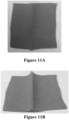
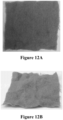
- Crosslinking of the fibers can retain their form and, hence, the fabric crease and enhance the wrinkle resistance.
- Crosslinking of the wool fibers can also make them slightly stiffer and as a result, the fabric stiffness may increase. This, however, can be taken as one of the confirming evidences of the crosslinking reactions.
- oxidized sucrose Three and a half (3.5) g was added into 200 mL distilled water and the previously washed woolen fabric was immersed into the solution.
- the pH of the solution was adjusted to 7 using 0.5 N NaOH solution to neutralized carboxylic groups in the oxidized sucrose. Different concentration, as desired, may also be used. Higher concentration will result in higher crosslinking of the wool fibers.
- the chemistry of neutralization of oxidized sucrose is shown in Figure 5 .
- the purpose of neutralization is to avoid hydrolysis of peptide bond induced by acid environment, in other words, to retain the physical property of woolen fabric. However, mild acids do not affect the wool fibers.
- the mixture neutralized oxidized sucrose solution + woolen fabric
- the fabric was heated at 80°C for 1 hr. After that the fabric was taken out of the solution. The fabric was hung vertically until there was no more dripping. The take up of the solution can be adjusted, as desired, through the solution concentration or pad and dry method. The fabric was then dried at 80°C for 20 min and followed by 120°C for 3 min. The unreacted residual solution was removed by washing the fabric in 300 ml water for 5 min. This washing process was repeated for 4 times.
- Stiffness of woolen fabric was measured by fabric stiffness tester. A typical apparatus is can be used. The test procedures are described by ASTM D1388. The woolen fabric was conditioned in ASTM standard environment of 21°C and 65% relative humidity for 12 hrs before cutting the test specimens of 25 mm x 200 mm dimensions. The specimen was placed on the stationary table and moved by hand in a smooth manner at approximately 120 mm/min (4.75 in/min) until the edge of the specimen touches the knife edge. The overhang length from the linear scale to the nearest 0.1 cm was recorded. Several readings were recorded to confirm the reproducibility.
- Woolen fabric was immersed in 300 mL 0.36% Tide ® detergent solution and temperature was raised to 60°C and kept stirring for 15 min. Then the fabric was taken out of the solution and washed in 300 mL of water for 5 min. The washing process was repeated 4 times. The washed fabric was dried at 60°C in an air circulating oven for one day.
- Oxidized sucrose treated human hairs (Brazilian curly hair) were conditioned, and the curly index was used to evaluate the durability of treatment.
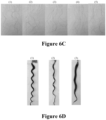
- Figures 6A-6D show pictures of curly hair before and after treatments.
- FIG. 6A Picture 1 - 'as received'; picture 2 - soap water washed and air dried; picture 3 - soap water washed, treated with oxidized sucrose solution for 10 min, oven cured at 85°C for 1 hr, washed with continuous water and air dried; picture 4 - soap water washed, treated with oxidized sucrose solution for 30 min, oven cured at 85°C for 1 hr, washed with continuous water and air dried; picture 5 - soap water washed, treated with oxidized sucrose solution for 1 hr, oven cured at 85°C for 1 hr, washed with continuous water and air dried.
- FIG. 6B Picture 1 - ⁇ as received' and conditioned for 4 days; picture 2 - soap water washed, air dried and conditioned for 4 days; picture 3 - soap water washed, treated with oxidized sucrose solution for 10 min, oven cured at 85°C for 1 hr, washed with continuous water and air dried and conditioned for 4 days; picture 4 - soap water washed, treated with oxidized sucrose solution for 30 min, oven cured at 85°C for 1 hr, washed with continuous water and air dried and conditioned for 4 days; picture 5 - soap water washed, treated with oxidized sucrose solution for 1 hr, oven cured at 85°C for 1 hr, washed with continuous water and air dried and conditioned for 4 days.
- FIG. 6C Picture 1 - 'as received' and conditioned for 8 days; picture 2 - soap water washed, air dried and conditioned for 8 days; picture 3 - soap water washed, treated with oxidized sucrose solution for 10 min, oven cured at 85°C for 1 hr, washed with continuous water and air dried and conditioned for 8 days; picture 4 - soap water washed, treated with oxidized sucrose solution for 30 min, oven cured at 85°C for 1 hr, washed with continuous water and air dried and conditioned for 8 days; picture 5 - soap water washed, treated with oxidized sucrose solution for 1 hr, oven cured at 85°C for 1 hr, washed with continuous water and air dried and conditioned for 8 days.
- FIG. 6D Picture 1 - ⁇ as received'; picture 2 - soap water washed and air dried; picture 3 - soap water washed, treated with oxidized sucrose solution for 30 min, flat-ironed, washed with continuous water and air dried
- curly index of number 4 After 4 days of conditioning, curly index of number 4, 5 hairs are close to those before conditioning, however, number 1,2,3 hairs undergo larger curly index increase, which indicates high humidity environment causes hair to become more curly.
- curly index of number 1 hairs increase to 1.29, however number 2 hairs retain same hair curliness.
- Oxidized sucrose solution was used to crosslinking bundle of hairs as well.
- Hair specimens were treated with oxidized sucrose solution (prepared 40 days before test) for 30min, flat-ironed 10 times, washed with sufficient amount of tap water and air dried. Curly index decreased from 1.21 ("as-received") to 1.09 (oxidized sucrose solution treated hairs), which indicates that the oxidized sucrose solution treated hairs can be further crosslinked using commercial flat-iron. Similar results were observed when hairs were cured by oven and flat-iron.
- Table 3 presents the stiffness of the control and the treated (crosslinked) woolen fabrics before and after up to 4 separate washings.
- Figure 7 presents the crosslinked woolen fabric stiffness as a function of number of washes. Table 3.
- the specimen B is the woolen fabric crosslinked by oxidized sucrose 'B' (as described in Table 1)
- the specimen C is the wool fabric crosslinked by oxidized sucrose 'C'.
- control (untreated) fabric stiffness has also been shown. There was no change in the stiffness of the untreated fabric after up to 4 washings. It is clear that the fabric stiffness corresponded with the aldehyde content in the oxidized sucrose. Fabric treated with oxidized sucrose' C' showed significantly higher stiffness than the fabric treated with oxidized sucrose 'B'. After the first washing the stiffness reduced for both treated fabrics. However, after 4 washings the stiffness of both treated fabrics was much higher with treatment with 'C' much higher than treatment with 'B'.
- sucrose 40 g was dissolved in 50 ml DI water. Then 50 ml of 30% hydrogen peroxide was added to the sucrose solution. Thus, the final concentration of the hydrogen peroxide used was 15%.
- This solution was kept in a bath at 60°C with constant magnetic stirring at 200 rpm to carry out the oxidation of sucrose to get aldehyde groups. At the end of 6 hours, the solution was cooled down to room temperature. The pH of this mixture at this point was found to be 2 ⁇ 0.1. It was then adjusted to pH 6 using NaOH and heated to 50°C.
- FIG. 3 illustrates the scheme of oxidation of sucrose. A variety of catalases and peroxidases can be used.
Landscapes
- Chemical & Material Sciences (AREA)
- Engineering & Computer Science (AREA)
- Medicinal Chemistry (AREA)
- Polymers & Plastics (AREA)
- Biochemistry (AREA)
- Materials Engineering (AREA)
- Health & Medical Sciences (AREA)
- Chemical Kinetics & Catalysis (AREA)
- Organic Chemistry (AREA)
- Life Sciences & Earth Sciences (AREA)
- Textile Engineering (AREA)
- Physics & Mathematics (AREA)
- Thermal Sciences (AREA)
- Treatments For Attaching Organic Compounds To Fibrous Goods (AREA)
- Chemical Or Physical Treatment Of Fibers (AREA)
- Cosmetics (AREA)
- Artificial Filaments (AREA)
Claims (15)
- Procédé de réticulation de fibres protéiques, ledit procédé comprenant :la fourniture d'un agent de réticulation comprenant un sucre oxydé ayant au moins deux groupes aldéhyde ; etl'infiltration d'une pluralité de fibres protéiques non réticulées avec l'agent de réticulation dans des conditions efficaces pour amener des molécules protéiques contenues dans les fibres protéiques non réticulées à se réticuler, donnant ainsi une population de fibres protéiques réticulées,dans lequel les molécules protéiques des fibres protéiques non réticulées comprennent des groupes amine qui réagissent avec les groupes aldéhyde du sucre oxydé pour réaliser la réticulation des molécules protéiques pour donner les fibres protéiques réticulées, dans lequel l'agent de réticulation est une solution aqueuse ayant au moins 1 à 60 pour cent en poids du sucre oxydé,dans lequel les fibres protéiques sont des fibres contenant de la kératine, dans lequel les fibres contenant de la kératine comprennent des cheveux humains, des fibres animales, ou un mélange de ceux-ci.
- Procédé selon la revendication 1, dans lequel ladite étape d'infiltration est effectuée à une température choisie dans le groupe constitué par moins de 100 °C, moins de 90 °C, moins de 80 °C, moins de 70 °C, moins de 60 °C, moins de 50 °C, moins de 40 °C, moins de 30 °C, et moins de 20 °C, et pendant une durée suffisante pour donner la population de fibres protéiques réticulées à ladite température utilisée pour effectuer l'étape d'infiltration et/ou dans lequel ladite étape d'infiltration est effectuée à un pH compris entre environ 7 et environ 12.
- Procédé selon la revendication 1 ou 2 comprenant en outre :
le chauffage de la population de fibres protéiques réticulées à une température comprise entre environ 100 °C et environ 220 °C pendant une durée comprise entre environ 3 secondes et environ 120 secondes pour terminer sensiblement la réticulation, dans lequel le chauffage est effectué en appliquant une source de chaleur à la population de fibres protéiques réticulées, dans lequel la source de chaleur est choisie dans le groupe constitué par un fer plat, des rouleaux chauds, une plaque chauffante, un fer à boucler, un sèche-cheveux, un fer à repasser, un sèche-linge, et un four. - Procédé selon les revendications 1 à 3 comprenant en outre :
le lavage de la population de fibres protéiques réticulées pour éliminer l'agent de réticulation résiduel ou pour éliminer l'agent de réticulation adhérant aux fibres protéiques, permettant ainsi d'éliminer sensiblement l'agent de réticulation. - Procédé selon la revendication 1, dans lequel les fibres animales sont choisies dans le groupe constitué par la laine, l'alpaga, l'angora, la fourrure, le cachemire, le mohair et le qiviut ou dans lequel les fibres animales proviennent d'animaux choisis dans le groupe constitué par le mouton, la vigogne, l'alpaga, le lama, le boeuf musqué, les chèvres, le bison, le chameau, le yak, le cheval, le chinchilla et le lapin ou dans lequel les fibres animales ont une forme choisie dans le groupe constitué par les fibres brutes, les fils, les feutres, et les tissus tissés ou tricotés.
- Procédé selon les revendications 1 à 5, dans lequel le sucre est choisi dans le groupe constitué par les monosaccharides, les disaccharides, les trisaccharides, les tétrasaccharides, et les oligosaccharides ou, dans lequel le sucre est choisi dans le groupe constitué par le galactose, le saccharose, le maltose, le lactose, le raffinose, et le stachyose.
- Procédé selon les revendications 1 à 6, dans lequel l'agent de réticulation est préparé selon un procédé comprenant les étapes de :fourniture d'un mélange de molécules de sucre non oxydées ; etréaction des molécules de sucre non oxydées avec un agent oxydant bénin pour provoquer l'oxydation des molécules de sucre non oxydées pour donner un mélange réactionnel comprenant des molécules de sucre oxydées ayant au moins deux groupes aldéhyde, lesdites molécules de sucres oxydées correspondant à l'agent de réticulation.
- Procédé selon la revendication 7, dans lequel l'oxydation est effectuée à une température choisie dans le groupe constitué par moins de 100 °C, moins de 90 °C, moins de 80 °C, moins de 70 °C, moins de 60 °C, moins de 50 °C, moins de 40 °C, et moins de 30 °C ou dans lequel l'oxydation est effectuée à un pH compris entre environ 2 et environ 4 ou dans lequel l'agent oxydant bénin est le peroxyde d'hydrogène (H2O2), dans lequel le peroxyde d'hydrogène (H2O2) est acidifié.
- Procédé selon les revendications 7 ou 8 comprenant en outre :l'introduction d'une enzyme au mélange réactionnel pour inhiber davantage l'oxydation de groupes aldéhyde des molécules de sucre oxydées en groupes carboxyle,dans lequel l'agent oxydant bénin est le peroxyde d'hydrogène (H2O2) et l'enzyme est efficace pour catalyser la décomposition du peroxyde d'hydrogène en oxygène (O) et en eau (H2O), dans lequel l'enzyme est choisie dans le groupe constitué par la catalase et la peroxydase.
- Formulation pour la réticulation de fibres protéiques, ladite formulation comprenant :un agent de réticulation comprenant une pluralité de sucres oxydés ayant au moins deux groupes aldéhyde,dans laquelle ledit agent de réticulation est formulé de telle sorte que les groupes aldéhyde des sucres oxydés sont efficaces pour réagir avec des groupes amine de molécules protéiques contenues dans les fibres protéiques non réticulées pour donner une population de fibres protéiques réticulées, dans laquelle la formulation se trouve sous forme d'une pâte ou sous forme d'une solution aqueuse, dans laquelle la solution aqueuse comprend au moins 40 pour cent en poids d'eau, dans laquelle les fibres protéiques sont des fibres contenant de la kératine, dans laquelle les fibres contenant de la kératine comprennent des cheveux humains, des fibres animales, ou un mélange de ceux-ci.
- Formulation selon la revendication 10, dans laquelle la solution aqueuse comprend au moins 1 à 60 pour cent en poids du sucre oxydé ou dans laquelle la formulation a une concentration stable en groupes aldéhyde, dans laquelle la concentration stable en groupes aldéhyde est comprise entre environ 20 et environ 32 pour cent et/ou dans laquelle la formulation est sensiblement exempte d'agent oxydant de telle sorte que la concentration stable en groupes aldéhyde est maintenue avant la réaction des groupes aldéhyde avec les groupes amine des molécules protéiques contenues dans les fibres protéiques non réticulées.
- Procédé de traitement de fibres animales ou humaines pour maintenir une structure tridimensionnelle souhaitée, ledit procédé comprenant les étapes de :fourniture d'une formulation selon la revendication 10 ; ettraitement d'une population de fibres animales avec la formulation de façon à maintenir la structure tridimensionnelle (3D) souhaitée de la population de la fibre animale, dans lequel la fibre animale comprend des fibres protéiques non réticulées ayant des molécules protéiques ayant des groupes amine qui réagissent avec les groupes aldéhyde du sucre oxydé de la formulation.
- Tissu comprenant les fibres animales traitées produites selon le procédé de la revendication 12.
- Procédé de fabrication d'une formulation pour réticuler des fibres protéiques ou un agent de réticulation, ledit procédé comprenant les étapes de :fourniture d'un mélange de molécules de sucre non oxydées ; etréaction des molécules de sucre non oxydées avec un agent oxydant bénin pour provoquer l'oxydation des molécules de sucre non oxydées pour donner une formulation comprenant un mélange de molécules de sucre oxydées ayant au moins deux groupes aldéhyde,dans lequel ledit mélange de molécules de sucre oxydées ont des agents de réticulation efficaces pour réagir avec des groupes amine de molécules protéiques contenues dans des fibres protéiques non réticulées pour donner une population de fibres protéiques réticulées,dans lequel les fibres protéiques sont des fibres contenant de la kératine, dans lequel les fibres contenant de la kératine comprennent des cheveux humains, des fibres animales, ou un mélange de ceux-ci.
- Procédé selon la revendication 14 comprenant en outre :l'ajout d'un ou plusieurs parmi un conservateur, un stabilisant, une charge, un agent colorant, un agent de parfum, un support cosmétiquement acceptable, un émulsifiant, ou des mélanges de ceux-ci, aux molécules de sucre oxydées et/oule conditionnement de l'agent de réticulation dans des conditions cosmétiquement appropriées pour fournir une durée de conservation cosmétiquement acceptable.
Applications Claiming Priority (2)
| Application Number | Priority Date | Filing Date | Title |
|---|---|---|---|
| US201461987328P | 2014-05-01 | 2014-05-01 | |
| PCT/US2015/028959 WO2015168662A1 (fr) | 2014-05-01 | 2015-05-01 | Technologie verte pour la réticulation de molécules protéiques à diverses fins |
Publications (3)
| Publication Number | Publication Date |
|---|---|
| EP3137536A1 EP3137536A1 (fr) | 2017-03-08 |
| EP3137536A4 EP3137536A4 (fr) | 2018-01-24 |
| EP3137536B1 true EP3137536B1 (fr) | 2023-08-16 |
Family
ID=54359413
Family Applications (1)
| Application Number | Title | Priority Date | Filing Date |
|---|---|---|---|
| EP15785561.0A Active EP3137536B1 (fr) | 2014-05-01 | 2015-05-01 | Technologie verte pour la réticulation de molécules protéiques à diverses fins |
Country Status (4)
| Country | Link |
|---|---|
| US (2) | US11019902B2 (fr) |
| EP (1) | EP3137536B1 (fr) |
| BR (1) | BR112016025439B1 (fr) |
| WO (1) | WO2015168662A1 (fr) |
Families Citing this family (3)
| Publication number | Priority date | Publication date | Assignee | Title |
|---|---|---|---|---|
| WO2016161360A1 (fr) | 2015-04-03 | 2016-10-06 | Nutech Ventures | Compositions et procédés de coiffure efficaces |
| WO2019190513A1 (fr) * | 2018-03-29 | 2019-10-03 | Kimberly-Clark Worldwide, Inc. | Fibres cellulosiques réticulées |
| US12364658B2 (en) * | 2019-09-26 | 2025-07-22 | Cornell University | Methods and formulations for crosslinking hair or other keratin fibers using oxidized sugars as crosslinking agents |
Family Cites Families (36)
| Publication number | Priority date | Publication date | Assignee | Title |
|---|---|---|---|---|
| US3051544A (en) | 1959-02-12 | 1962-08-28 | Stevens & Co Inc J P | Lustered wool product and method of making the same |
| US4272470A (en) * | 1978-12-20 | 1981-06-09 | The United States Of America As Represented By The Administrator Of The National Aeronautics And Space Administration | Cross-linked polyvinyl alcohol and method of making same |
| US5308641A (en) * | 1993-01-19 | 1994-05-03 | Medtronic, Inc. | Biocompatibility of solid surfaces |
| US5866165A (en) * | 1997-01-15 | 1999-02-02 | Orquest, Inc. | Collagen-polysaccharide matrix for bone and cartilage repair |
| EP1096060A1 (fr) | 1999-10-27 | 2001-05-02 | The Procter & Gamble Company | Composition résistante à la froissure |
| GB9930437D0 (en) | 1999-12-22 | 2000-02-16 | Unilever Plc | Fabric softening compositions and compounds |
| GB2366304A (en) | 2000-09-01 | 2002-03-06 | Unilever Plc | Fabric care composition |
| US7138035B2 (en) * | 2001-05-08 | 2006-11-21 | National Starch And Chemical Investment Holding Corporation | Process for the selective modification of carbohydrates by peroxidase catalyzed oxidation |
| DE602005007188D1 (de) | 2004-03-08 | 2008-07-10 | Unilever Nv | Zuckerlacton enthaltende zusammensetzung zur haarbehandlung |
| US8217154B2 (en) | 2005-02-23 | 2012-07-10 | Lipoxen Technologies Limited | Activated sialic acid derivatives for protein derivatisation and conjugation |
| WO2006132872A1 (fr) | 2005-06-03 | 2006-12-14 | The Procter & Gamble Company | Compositions d'entretien pour tissu |
| EP1880708A1 (fr) | 2006-07-21 | 2008-01-23 | Wella Aktiengesellschaft | Méthode et agent pour la déformation permanente de cheveux |
| EP2120857B1 (fr) | 2007-03-14 | 2010-10-20 | Unilever Plc, A Company Registered In England And Wales under company no. 41424 of Unilever House | Procédé de traitement capillaire à base d'une composition sucrée |
| PL2139446T3 (pl) | 2007-04-30 | 2014-08-29 | Unilever Nv | Sposób traktowania włosów |
| EA018109B1 (ru) | 2007-07-03 | 2013-05-30 | Унилевер Н.В. | Композиция для укладки волос |
| BRPI0817029B1 (pt) | 2007-10-10 | 2020-04-07 | Unilever Nv | método para modelagem de cabelos e uso de oligossacarídeo |
| MX2010010726A (es) | 2008-03-28 | 2010-10-25 | Unilever Nv | Composicion de estilizado de cabello. |
| EA024696B9 (ru) | 2009-04-24 | 2017-02-28 | Унилевер Н.В. | Способ обработки волос |
| CN101544705B (zh) | 2009-05-04 | 2011-09-14 | 西南大学 | 蔗糖缩水甘油醚交联剂、抗皱整理剂及其合成方法 |
| EA201291208A1 (ru) | 2010-06-10 | 2013-04-30 | Унилевер Н.В. | Композиция для ухода за волосами |
| EA201291210A1 (ru) | 2010-06-10 | 2013-04-30 | Унилевер Н.В. | Композиция для ухода за волосами |
| JP5894591B2 (ja) | 2010-06-11 | 2016-03-30 | ユニリーバー・ナームローゼ・ベンノートシヤープ | 毛髪スタイリング組成物 |
| SG189870A1 (en) * | 2010-10-15 | 2013-06-28 | Maneworx Inc | Compositions and methods for treating keratin based fibers |
| PH12013501623B1 (en) | 2011-02-09 | 2019-02-20 | Unilever Ip Holdings B V | Hair treatment compositions |
| WO2012107367A1 (fr) | 2011-02-09 | 2012-08-16 | Unilever Plc | Composition de traitement capillaire |
| WO2012107366A1 (fr) | 2011-02-09 | 2012-08-16 | Unilever Plc | Composition de coiffage |
| WO2013064597A2 (fr) | 2011-11-04 | 2013-05-10 | Unilever Plc | Composition de coiffage |
| WO2013076061A2 (fr) | 2011-11-21 | 2013-05-30 | Unilever Plc | Procédé de défrisage des cheveux |
| KR101989065B1 (ko) | 2011-11-30 | 2019-06-14 | (주)아모레퍼시픽 | 환원당을 함유하는 헤어 트리트먼트 조성물 |
| WO2014089578A1 (fr) | 2012-12-07 | 2014-06-12 | Cornell University | Résines thermodurcissables réticulées et leurs procédés |
| US20160008243A1 (en) | 2013-03-04 | 2016-01-14 | Conopco, Inc., D/B/A Unilever | Method of treating hair |
| EP2857004B1 (fr) | 2013-10-07 | 2018-07-04 | The Procter and Gamble Company | Procédé de défrisage des cheveux impliquant des sucres réducteurs |
| WO2015094760A1 (fr) | 2013-12-19 | 2015-06-25 | The Procter & Gamble Company | Mise en forme de fibres de kératine à l'aide d'ester carbonate |
| US9918921B2 (en) | 2013-12-19 | 2018-03-20 | The Procter & Gamble Company | Methods for shaping fibrous material and treatment compositions therefor |
| MX361100B (es) | 2013-12-19 | 2018-11-27 | Procter & Gamble | Modelado de fibras de queratina mediante el uso de un azucar. |
| EP3082750A1 (fr) | 2013-12-19 | 2016-10-26 | The Procter & Gamble Company | Mise en forme de fibres de kératine au moyen d'une composition réductrice et d'une composition de fixation |
-
2015
- 2015-05-01 EP EP15785561.0A patent/EP3137536B1/fr active Active
- 2015-05-01 WO PCT/US2015/028959 patent/WO2015168662A1/fr not_active Ceased
- 2015-05-01 BR BR112016025439-2A patent/BR112016025439B1/pt active IP Right Grant
- 2015-05-01 US US15/307,828 patent/US11019902B2/en active Active
-
2021
- 2021-05-28 US US17/334,673 patent/US11963605B2/en active Active
Also Published As
| Publication number | Publication date |
|---|---|
| EP3137536A1 (fr) | 2017-03-08 |
| EP3137536A4 (fr) | 2018-01-24 |
| US20170065049A1 (en) | 2017-03-09 |
| US11019902B2 (en) | 2021-06-01 |
| BR112016025439B1 (pt) | 2022-08-09 |
| US11963605B2 (en) | 2024-04-23 |
| BR112016025439A2 (pt) | 2017-08-15 |
| US20210289906A1 (en) | 2021-09-23 |
| WO2015168662A1 (fr) | 2015-11-05 |
Similar Documents
| Publication | Publication Date | Title |
|---|---|---|
| US11963605B2 (en) | Green technology for crosslinking protein molecules for various uses | |
| KR102072992B1 (ko) | 아미노실리콘을 이용한 손상 모발 트리트먼트 방법 | |
| AU2002219515B2 (en) | Process for producing regenerated collagen fiber and process for setting the same | |
| JP2013514265A (ja) | ケラチン繊維を処理する方法 | |
| US11530300B2 (en) | Residual soy flour sugars as crosslinkers for enhancing mechanical performance of protein fibers | |
| JP2013514271A (ja) | ケラチン繊維を処理する方法 | |
| EP1497356A1 (fr) | Silicones | |
| US12364658B2 (en) | Methods and formulations for crosslinking hair or other keratin fibers using oxidized sugars as crosslinking agents | |
| WO2003088937A1 (fr) | Melange pour traitement de fibres | |
| CN111455657B (zh) | 一种假发用牛毛纤维及其制备方法 | |
| EP2286017B1 (fr) | Composition et procédé permettant d'obtenir des vêtements en lainage exempts de plis | |
| JP2017014175A (ja) | 毛髪前処理方法及び毛髪前処理剤 | |
| JP4319568B2 (ja) | 吸湿発熱性獣毛繊維製品及びその製造方法 | |
| JP3265329B2 (ja) | 蛋白繊維製品の加工方法 | |
| CN105200778A (zh) | 一种无甲醛的亚麻织物抗皱整理液 | |
| CN110512425A (zh) | 一种功能性纺织品及其制备方法 | |
| KR19980079813A (ko) | 모 혼방 직물, 특히 모 혼방 의류의 처리방법 | |
| JP2009174111A (ja) | 分枝状タンパク質繊維及びその製造方法、並びに綿状体、分枝状タンパク質繊維紡績糸、分枝状タンパク質繊維含有紡績糸、布帛、不織布 | |
| JP3272598B2 (ja) | 蛋白質繊維構造物のセット加工品及びその製造方法 | |
| Hu | Application of dyeing method in preparation of collagen modified cotton | |
| KR100508433B1 (ko) | 셀룰로오스 섬유의 세리신 가공 방법 | |
| JPS5926575A (ja) | 長毛を有する長繊維織物の製造方法 | |
| JPH0559664A (ja) | 繊維製品の樹脂加工方法 | |
| CN108085974B (zh) | 一种高弯曲蚕丝、制备方法及其应用 | |
| JPH0518957B2 (fr) |
Legal Events
| Date | Code | Title | Description |
|---|---|---|---|
| STAA | Information on the status of an ep patent application or granted ep patent |
Free format text: STATUS: THE INTERNATIONAL PUBLICATION HAS BEEN MADE |
|
| PUAI | Public reference made under article 153(3) epc to a published international application that has entered the european phase |
Free format text: ORIGINAL CODE: 0009012 |
|
| STAA | Information on the status of an ep patent application or granted ep patent |
Free format text: STATUS: REQUEST FOR EXAMINATION WAS MADE |
|
| 17P | Request for examination filed |
Effective date: 20161201 |
|
| AK | Designated contracting states |
Kind code of ref document: A1 Designated state(s): AL AT BE BG CH CY CZ DE DK EE ES FI FR GB GR HR HU IE IS IT LI LT LU LV MC MK MT NL NO PL PT RO RS SE SI SK SM TR |
|
| AX | Request for extension of the european patent |
Extension state: BA ME |
|
| DAV | Request for validation of the european patent (deleted) | ||
| DAX | Request for extension of the european patent (deleted) | ||
| A4 | Supplementary search report drawn up and despatched |
Effective date: 20180102 |
|
| RIC1 | Information provided on ipc code assigned before grant |
Ipc: C08H 1/02 20060101AFI20171219BHEP |
|
| STAA | Information on the status of an ep patent application or granted ep patent |
Free format text: STATUS: EXAMINATION IS IN PROGRESS |
|
| 17Q | First examination report despatched |
Effective date: 20210719 |
|
| GRAP | Despatch of communication of intention to grant a patent |
Free format text: ORIGINAL CODE: EPIDOSNIGR1 |
|
| STAA | Information on the status of an ep patent application or granted ep patent |
Free format text: STATUS: GRANT OF PATENT IS INTENDED |
|
| INTG | Intention to grant announced |
Effective date: 20230314 |
|
| P01 | Opt-out of the competence of the unified patent court (upc) registered |
Effective date: 20230523 |
|
| GRAS | Grant fee paid |
Free format text: ORIGINAL CODE: EPIDOSNIGR3 |
|
| GRAA | (expected) grant |
Free format text: ORIGINAL CODE: 0009210 |
|
| STAA | Information on the status of an ep patent application or granted ep patent |
Free format text: STATUS: THE PATENT HAS BEEN GRANTED |
|
| AK | Designated contracting states |
Kind code of ref document: B1 Designated state(s): AL AT BE BG CH CY CZ DE DK EE ES FI FR GB GR HR HU IE IS IT LI LT LU LV MC MK MT NL NO PL PT RO RS SE SI SK SM TR |
|
| REG | Reference to a national code |
Ref country code: GB Ref legal event code: FG4D |
|
| REG | Reference to a national code |
Ref country code: CH Ref legal event code: EP Ref country code: DE Ref legal event code: R096 Ref document number: 602015085172 Country of ref document: DE |
|
| REG | Reference to a national code |
Ref country code: IE Ref legal event code: FG4D |
|
| REG | Reference to a national code |
Ref country code: LT Ref legal event code: MG9D |
|
| REG | Reference to a national code |
Ref country code: NL Ref legal event code: MP Effective date: 20230816 |
|
| REG | Reference to a national code |
Ref country code: AT Ref legal event code: MK05 Ref document number: 1600022 Country of ref document: AT Kind code of ref document: T Effective date: 20230816 |
|
| PG25 | Lapsed in a contracting state [announced via postgrant information from national office to epo] |
Ref country code: GR Free format text: LAPSE BECAUSE OF FAILURE TO SUBMIT A TRANSLATION OF THE DESCRIPTION OR TO PAY THE FEE WITHIN THE PRESCRIBED TIME-LIMIT Effective date: 20231117 |
|
| PG25 | Lapsed in a contracting state [announced via postgrant information from national office to epo] |
Ref country code: IS Free format text: LAPSE BECAUSE OF FAILURE TO SUBMIT A TRANSLATION OF THE DESCRIPTION OR TO PAY THE FEE WITHIN THE PRESCRIBED TIME-LIMIT Effective date: 20231216 |
|
| PG25 | Lapsed in a contracting state [announced via postgrant information from national office to epo] |
Ref country code: SE Free format text: LAPSE BECAUSE OF FAILURE TO SUBMIT A TRANSLATION OF THE DESCRIPTION OR TO PAY THE FEE WITHIN THE PRESCRIBED TIME-LIMIT Effective date: 20230816 Ref country code: RS Free format text: LAPSE BECAUSE OF FAILURE TO SUBMIT A TRANSLATION OF THE DESCRIPTION OR TO PAY THE FEE WITHIN THE PRESCRIBED TIME-LIMIT Effective date: 20230816 Ref country code: PT Free format text: LAPSE BECAUSE OF FAILURE TO SUBMIT A TRANSLATION OF THE DESCRIPTION OR TO PAY THE FEE WITHIN THE PRESCRIBED TIME-LIMIT Effective date: 20231218 Ref country code: NO Free format text: LAPSE BECAUSE OF FAILURE TO SUBMIT A TRANSLATION OF THE DESCRIPTION OR TO PAY THE FEE WITHIN THE PRESCRIBED TIME-LIMIT Effective date: 20231116 Ref country code: NL Free format text: LAPSE BECAUSE OF FAILURE TO SUBMIT A TRANSLATION OF THE DESCRIPTION OR TO PAY THE FEE WITHIN THE PRESCRIBED TIME-LIMIT Effective date: 20230816 Ref country code: LV Free format text: LAPSE BECAUSE OF FAILURE TO SUBMIT A TRANSLATION OF THE DESCRIPTION OR TO PAY THE FEE WITHIN THE PRESCRIBED TIME-LIMIT Effective date: 20230816 Ref country code: LT Free format text: LAPSE BECAUSE OF FAILURE TO SUBMIT A TRANSLATION OF THE DESCRIPTION OR TO PAY THE FEE WITHIN THE PRESCRIBED TIME-LIMIT Effective date: 20230816 Ref country code: IS Free format text: LAPSE BECAUSE OF FAILURE TO SUBMIT A TRANSLATION OF THE DESCRIPTION OR TO PAY THE FEE WITHIN THE PRESCRIBED TIME-LIMIT Effective date: 20231216 Ref country code: HR Free format text: LAPSE BECAUSE OF FAILURE TO SUBMIT A TRANSLATION OF THE DESCRIPTION OR TO PAY THE FEE WITHIN THE PRESCRIBED TIME-LIMIT Effective date: 20230816 Ref country code: GR Free format text: LAPSE BECAUSE OF FAILURE TO SUBMIT A TRANSLATION OF THE DESCRIPTION OR TO PAY THE FEE WITHIN THE PRESCRIBED TIME-LIMIT Effective date: 20231117 Ref country code: FI Free format text: LAPSE BECAUSE OF FAILURE TO SUBMIT A TRANSLATION OF THE DESCRIPTION OR TO PAY THE FEE WITHIN THE PRESCRIBED TIME-LIMIT Effective date: 20230816 Ref country code: AT Free format text: LAPSE BECAUSE OF FAILURE TO SUBMIT A TRANSLATION OF THE DESCRIPTION OR TO PAY THE FEE WITHIN THE PRESCRIBED TIME-LIMIT Effective date: 20230816 |
|
| PG25 | Lapsed in a contracting state [announced via postgrant information from national office to epo] |
Ref country code: PL Free format text: LAPSE BECAUSE OF FAILURE TO SUBMIT A TRANSLATION OF THE DESCRIPTION OR TO PAY THE FEE WITHIN THE PRESCRIBED TIME-LIMIT Effective date: 20230816 |
|
| PG25 | Lapsed in a contracting state [announced via postgrant information from national office to epo] |
Ref country code: ES Free format text: LAPSE BECAUSE OF FAILURE TO SUBMIT A TRANSLATION OF THE DESCRIPTION OR TO PAY THE FEE WITHIN THE PRESCRIBED TIME-LIMIT Effective date: 20230816 |
|
| PG25 | Lapsed in a contracting state [announced via postgrant information from national office to epo] |
Ref country code: SM Free format text: LAPSE BECAUSE OF FAILURE TO SUBMIT A TRANSLATION OF THE DESCRIPTION OR TO PAY THE FEE WITHIN THE PRESCRIBED TIME-LIMIT Effective date: 20230816 Ref country code: RO Free format text: LAPSE BECAUSE OF FAILURE TO SUBMIT A TRANSLATION OF THE DESCRIPTION OR TO PAY THE FEE WITHIN THE PRESCRIBED TIME-LIMIT Effective date: 20230816 Ref country code: ES Free format text: LAPSE BECAUSE OF FAILURE TO SUBMIT A TRANSLATION OF THE DESCRIPTION OR TO PAY THE FEE WITHIN THE PRESCRIBED TIME-LIMIT Effective date: 20230816 Ref country code: EE Free format text: LAPSE BECAUSE OF FAILURE TO SUBMIT A TRANSLATION OF THE DESCRIPTION OR TO PAY THE FEE WITHIN THE PRESCRIBED TIME-LIMIT Effective date: 20230816 Ref country code: DK Free format text: LAPSE BECAUSE OF FAILURE TO SUBMIT A TRANSLATION OF THE DESCRIPTION OR TO PAY THE FEE WITHIN THE PRESCRIBED TIME-LIMIT Effective date: 20230816 Ref country code: CZ Free format text: LAPSE BECAUSE OF FAILURE TO SUBMIT A TRANSLATION OF THE DESCRIPTION OR TO PAY THE FEE WITHIN THE PRESCRIBED TIME-LIMIT Effective date: 20230816 Ref country code: SK Free format text: LAPSE BECAUSE OF FAILURE TO SUBMIT A TRANSLATION OF THE DESCRIPTION OR TO PAY THE FEE WITHIN THE PRESCRIBED TIME-LIMIT Effective date: 20230816 |
|
| REG | Reference to a national code |
Ref country code: DE Ref legal event code: R097 Ref document number: 602015085172 Country of ref document: DE |
|
| PLBE | No opposition filed within time limit |
Free format text: ORIGINAL CODE: 0009261 |
|
| STAA | Information on the status of an ep patent application or granted ep patent |
Free format text: STATUS: NO OPPOSITION FILED WITHIN TIME LIMIT |
|
| 26N | No opposition filed |
Effective date: 20240517 |
|
| PG25 | Lapsed in a contracting state [announced via postgrant information from national office to epo] |
Ref country code: IT Free format text: LAPSE BECAUSE OF FAILURE TO SUBMIT A TRANSLATION OF THE DESCRIPTION OR TO PAY THE FEE WITHIN THE PRESCRIBED TIME-LIMIT Effective date: 20230816 Ref country code: SI Free format text: LAPSE BECAUSE OF FAILURE TO SUBMIT A TRANSLATION OF THE DESCRIPTION OR TO PAY THE FEE WITHIN THE PRESCRIBED TIME-LIMIT Effective date: 20230816 |
|
| PG25 | Lapsed in a contracting state [announced via postgrant information from national office to epo] |
Ref country code: BG Free format text: LAPSE BECAUSE OF FAILURE TO SUBMIT A TRANSLATION OF THE DESCRIPTION OR TO PAY THE FEE WITHIN THE PRESCRIBED TIME-LIMIT Effective date: 20230816 |
|
| PG25 | Lapsed in a contracting state [announced via postgrant information from national office to epo] |
Ref country code: BG Free format text: LAPSE BECAUSE OF FAILURE TO SUBMIT A TRANSLATION OF THE DESCRIPTION OR TO PAY THE FEE WITHIN THE PRESCRIBED TIME-LIMIT Effective date: 20230816 |
|
| REG | Reference to a national code |
Ref country code: CH Ref legal event code: PL |
|
| PG25 | Lapsed in a contracting state [announced via postgrant information from national office to epo] |
Ref country code: MC Free format text: LAPSE BECAUSE OF FAILURE TO SUBMIT A TRANSLATION OF THE DESCRIPTION OR TO PAY THE FEE WITHIN THE PRESCRIBED TIME-LIMIT Effective date: 20230816 |
|
| PG25 | Lapsed in a contracting state [announced via postgrant information from national office to epo] |
Ref country code: LU Free format text: LAPSE BECAUSE OF NON-PAYMENT OF DUE FEES Effective date: 20240501 |
|
| PG25 | Lapsed in a contracting state [announced via postgrant information from national office to epo] |
Ref country code: MC Free format text: LAPSE BECAUSE OF FAILURE TO SUBMIT A TRANSLATION OF THE DESCRIPTION OR TO PAY THE FEE WITHIN THE PRESCRIBED TIME-LIMIT Effective date: 20230816 Ref country code: LU Free format text: LAPSE BECAUSE OF NON-PAYMENT OF DUE FEES Effective date: 20240501 Ref country code: CH Free format text: LAPSE BECAUSE OF NON-PAYMENT OF DUE FEES Effective date: 20240531 |
|
| REG | Reference to a national code |
Ref country code: BE Ref legal event code: MM Effective date: 20240531 |
|
| PG25 | Lapsed in a contracting state [announced via postgrant information from national office to epo] |
Ref country code: IE Free format text: LAPSE BECAUSE OF NON-PAYMENT OF DUE FEES Effective date: 20240501 |
|
| PG25 | Lapsed in a contracting state [announced via postgrant information from national office to epo] |
Ref country code: BE Free format text: LAPSE BECAUSE OF NON-PAYMENT OF DUE FEES Effective date: 20240531 |
|
| PGFP | Annual fee paid to national office [announced via postgrant information from national office to epo] |
Ref country code: DE Payment date: 20250529 Year of fee payment: 11 |
|
| PGFP | Annual fee paid to national office [announced via postgrant information from national office to epo] |
Ref country code: GB Payment date: 20250527 Year of fee payment: 11 |
|
| PGFP | Annual fee paid to national office [announced via postgrant information from national office to epo] |
Ref country code: FR Payment date: 20250526 Year of fee payment: 11 |
|
| PG25 | Lapsed in a contracting state [announced via postgrant information from national office to epo] |
Ref country code: CY Free format text: LAPSE BECAUSE OF FAILURE TO SUBMIT A TRANSLATION OF THE DESCRIPTION OR TO PAY THE FEE WITHIN THE PRESCRIBED TIME-LIMIT; INVALID AB INITIO Effective date: 20150501 |
|
| PG25 | Lapsed in a contracting state [announced via postgrant information from national office to epo] |
Ref country code: HU Free format text: LAPSE BECAUSE OF FAILURE TO SUBMIT A TRANSLATION OF THE DESCRIPTION OR TO PAY THE FEE WITHIN THE PRESCRIBED TIME-LIMIT; INVALID AB INITIO Effective date: 20150501 |