EP3140054B1 - Procédé de solidification de résine, de solides et de boues, stabilisation et réduction d'un volume de rejet - Google Patents
Procédé de solidification de résine, de solides et de boues, stabilisation et réduction d'un volume de rejet Download PDFInfo
- Publication number
- EP3140054B1 EP3140054B1 EP15723811.4A EP15723811A EP3140054B1 EP 3140054 B1 EP3140054 B1 EP 3140054B1 EP 15723811 A EP15723811 A EP 15723811A EP 3140054 B1 EP3140054 B1 EP 3140054B1
- Authority
- EP
- European Patent Office
- Prior art keywords
- waste
- polymer
- waste material
- volume
- mixer
- Prior art date
- Legal status (The legal status is an assumption and is not a legal conclusion. Google has not performed a legal analysis and makes no representation as to the accuracy of the status listed.)
- Active
Links
Images



Classifications
-
- C—CHEMISTRY; METALLURGY
- C02—TREATMENT OF WATER, WASTE WATER, SEWAGE, OR SLUDGE
- C02F—TREATMENT OF WATER, WASTE WATER, SEWAGE, OR SLUDGE
- C02F11/00—Treatment of sludge; Devices therefor
- C02F11/008—Sludge treatment by fixation or solidification
-
- B—PERFORMING OPERATIONS; TRANSPORTING
- B09—DISPOSAL OF SOLID WASTE; RECLAMATION OF CONTAMINATED SOIL
- B09B—DISPOSAL OF SOLID WASTE NOT OTHERWISE PROVIDED FOR
- B09B3/00—Destroying solid waste or transforming solid waste into something useful or harmless
- B09B3/20—Agglomeration, binding or encapsulation of solid waste
- B09B3/21—Agglomeration, binding or encapsulation of solid waste using organic binders or matrix
- B09B3/24—Binders with plastic
-
- B—PERFORMING OPERATIONS; TRANSPORTING
- B09—DISPOSAL OF SOLID WASTE; RECLAMATION OF CONTAMINATED SOIL
- B09B—DISPOSAL OF SOLID WASTE NOT OTHERWISE PROVIDED FOR
- B09B3/00—Destroying solid waste or transforming solid waste into something useful or harmless
- B09B3/50—Destroying solid waste or transforming solid waste into something useful or harmless involving radiation, e.g. electro-magnetic waves
-
- C—CHEMISTRY; METALLURGY
- C02—TREATMENT OF WATER, WASTE WATER, SEWAGE, OR SLUDGE
- C02F—TREATMENT OF WATER, WASTE WATER, SEWAGE, OR SLUDGE
- C02F2303/00—Specific treatment goals
- C02F2303/06—Sludge reduction, e.g. by lysis
Definitions
- the present invention relates to a method for resin and sludge solidification, stabilization, and waste volume reduction, where particulate solid waste contained therein and being treated by the process are hazardous or radioactive.
- cement was the original choice for resin and sludge solidification, but the resulting product was usually three to six times the original waste volume. Cement was often not a very strong product due to its incompatibility with subject wastes, with the cement often crumbling as rehydration of the solidified resin and other sludge components occurred. Often, other chemicals present in the resin or sludge were also not compatible with the cement matrix resulting in the same loss in strength problem.
- the ion exchange resin when solidified with cement, resulted in dehydration of the ion exchange resin as the water was drawn from the resin into the cement matrix. Later, as additional water entered the cement matrix from the environment, the resin rehydrated, resulting in swelling that could then cause the cement to crumble.
- Bitumen is another product used in the past for solidification of resin, sludge, and liquids.
- the bitumen was melted at an elevated temperature and the waste matter was added, causing the water to flash off as steam.
- the bitumen was flammable at the elevated temperatures, and this resulted in fires and the need for an extensive fire suppression system.
- the waste also had to be added slowly to prevent steam eruptions through the exhaust system, which were known to occur.
- the bitumen provided higher loading of waste per unit volume of waste, the volume increase for resin and sludge was typically about twice the starting original waste volume.
- DTS Diversified Technologies Services, Inc.
- DTS later developed an advanced polymer that was much less sensitive to chemical interactions.
- the polymer formulation did not involve the use of catalysts or promoters. It was thus easier to control gelation, and polymerization time could be extended to many hours or even days. The longer and slower cures resulted in much lower exothermic reaction temperatures, and thus cracking was virtually eliminated. This also decreased the leachability of the matrix. The slower polymerization reaction permitted much longer times to pull the polymer through the resin before gelation of the polymer was subject to occur. Further, the exotherm temperature was normally well below the boiling temperature of water, thus assuring that no steam vents would occur.
- the French used the same type of polymer but utilized a propeller type mixing process similar to that used in the original vinyl ester styrene process.
- the mixing required a larger amount of polymer because the mixing caused the resin to separate from its normally compact configuration to maintain enough fluidity to permit mixing, thus increasing the final waste volume to 1.4 times the original waste volume.
- the mixing required that drums also be utilized rather than larger containers.
- US-A-5962630 discloses a further known prior art.
- objects of the present invention include, without limitation, the improvement of waste loading per unit volume of waste being processed; the minimization of the use of polymer per unit volume of waste; the ability to use essentially any size and shape of container for loading the waste; the ability to decrease the leachability of the waste being processed; and the ability to minimize any personnel exposure to radiation or chemicals characteristic of such treated wastes by making the process automated.
- a further object of the present invention is to substantially dewater the sluice volume of the subject waste being treated, when needed, to minimize the amount of water in the waste to be dried and evaporated.
- Yet another object of the present invention is to have the ability to utilize various kinds of equipment to perform drying, when needed.
- Another object of the present invention is to provide storage and metering as a part of the present invention's method and process, such that the storage bin provides a buffer area so the batch size of the mixer can be sized according to the waste container size, and the metering aspect of the bin facilitates the feed rate of the dried solids, matching the polymer feed rate to both minimize the polymer usage and assure that the polymer matrix is continuous.
- a further object of the present invention is to provide polymer metering such that needed components of the polymer chosen for use in the invention can be supplied in required proportions to assure proper solidification and viscosity.
- a further object of the present invention is to employ high shear force in mixing the polymer and the waste, such as that provided by a continuous mixer, to minimize the waste volume so that the polymer/waste mixture resembles a paste being extruded from the mixer.
- Another object of the present invention is to provide more consistent curing of the polymer and waste so that the exothermic temperatures associated with the polymer and waste are lower.
- Another object of the present invention is to provide automated closure and transfer to provide protection to working personnel from radiation or toxic chemicals.
- Yet another object of the present invention is to change the chemical structure of the ion exchange media in such a way that rehydration is not permitted, to further reduce the volume of the waste media such that total volume reduction of about 70% from the original volume is achieved, and to prevent expansion of volume upon later exposure of this waste material to water because the waste material achieves and maintains a hydrophobic condition.
- the present invention recognizes and addresses disadvantages of prior art constructions and methods.
- the present invention is defined by independent claim 1.
- the Method 10 includes removing excess water from the waste material, mixing at least one polymer with the waste material to provide a polymer-waste mixture, and curing the polymer in the polymer-waste mixture to provide a solidified monolith waste form having a continuous polymer matrix encapsulating the waste material.
- the Method 10 encompasses the following steps and/or sub-systems: dewatering the waste material to remove excess water, drying the waste material, storing and metering the waste material to a mixer, metering a polymer to the mixer, mixing the polymer and the waste material in the mixer to provide a polymer-waste mixture, distributing the polymer-waste mixture among a plurality of waste containers, and curing the polymer in the polymer-waste mixture to provide a solidified monolith waste form having a continuous polymer matrix encapsulating the waste material.
- the resin, filter solids, particulates, or sludges processed by the present Method 10 are preferably transferred by a water sluicing process from the storage area, tank, or bin 14 to the Dewatering equipment 12A or Dewatering/Drying combination sub-system, equipment, or means 12B.
- the initial concentration of solids is often less than 30%; thus, removal of excess water is important in this preferred embodiment to both minimize the final waste volume and ensure that all the waste is micro-encapsulated for purposes of the invention.
- the Dewatering step 12 comprises gross dewatering of the sluice volume from about 50 to about 95%.
- the Dewatering step 12 comprises gross dewatering of the sluice volume from about 75 to about 90%. Depending on the final moisture content desired in a given job, this can be accomplished using dewatering screens or filters as part and parcel of the Dewater/Dryer Combination 12B, as represented schematically or diagrammatically in FIG. 3C , for removal of most of this water.
- a centrifuge is preferred as equipment to be utilized in dewatering, although other types of equipment can be utilized in the present Method 10.
- microwave heating is preferable, but other heating or drying equipment can be used, such as a paddle or ribbon dryer, hollow-flight, filter, conveyor, or a reactor-type dryer.
- a vacuum or air operated diaphragm pump is used to suck out the interstitial water. The process is terminated when the proper level of solids is measured in the dryer. Pumping or vacuuming of the water from the dryer is terminated when the amount of water being removed is considered acceptable. In the case of at least one embodiment, air is drawn through the media being dried to remove additional moisture. The screens are then withdrawn from the dryer prior to starting the paddles.
- the resin and coarser particulate form a pre-coat on the screens, and the sedentary nature of the resin around the screens and at the bottom of the Dryer 12B will cause it to retain most of the very fine particulate.
- the sluice water is returned to the solids tank or bin 14 for reuse during the next sluice or discharge to a water treatment area.
- any fine particulate initially passing the screens is returned to the Dryer 12B during the next sluice.
- Other approaches within preferred embodiments, include rotary vacuum or belt filters, Rotamat ® compactor, and similar types of dewatering equipment 12A or as embodied in unit 12B.
- the advantage of using drying in a preferred embodiment of the present Method 10 is that the resin and some of the other filter or sludge materials will have a significant loss of volume, thus decreasing the waste volume by approximately the same percentage.
- One preferred means or type of equipment for use in the drying step or sub-system of the present Method 10 is microwave heating.
- drying equipment can be utilized in preferred embodiments of the present Method 10, as units 12A or in a combination unit 12B. These can include, by example and without limitation, the utilization of steam, hot oil, infrared, hot air, vacuum, and other similar or related equipment or means.
- the waste can be cooled to a lower temperature to slow polymerization if desired and selected.
- cooling technologies such as chilled water, cooling water, refrigerants, and/or like means can be employed to bring about cooling in the drying equipment or a separate piece of equipment being used such as a conveyor, storage area, or other equipment positionally associated with drying equipment.
- the waste can be permitted to sit and cool off and, for example, be processed the next day.
- the polymer may be adjusted to permit a higher feed temperature.
- the vacuum also provides an easy mechanism within the present invention to transfer the moisture out of the system.
- the paddles, ribbons, or screws (as so employed) continually mix the waste, thus bringing new waste into contact with the hot surface and moving hot waste to lower temperature areas.
- the present Method 10 involves heating the resin material containing the waste to a temperature at which the functional groups decompose to nonfunctional daughter products of which some may leave the waste matrix, thus further decreasing the volume of the matrix. It has been found in the present invention that this decomposition occurs at temperatures typically greater than 150°C and, in many cases, less than 250°C.
- step or subsystem 16H involves heating the waste material to a temperature of from about 150°C to a temperature of about 250°C.
- this heating at step or subsystem 16H should not proceed for an extended period of time; instead, extended standard drying should be maintained at less than about 150°C.
- the preferred method will involve only removal of water which will decrease the volume by about 50%. In other embodiments, the method may comprise water volume reduction from about 30 to about 70%.
- High Heating Dryer or High Heating means 17H is employed in certain embodiments, and High Heating means 17H can be utilized either with or without the Dryer 17.
- Examples of such equipment are: hot oil and/or high pressure steam, electrical resistance heating, and microwave heating means. It has been found that this sub-system often involves a color change, which may be indicative of the chemical change. This chemical change involves the generation of sulfur oxide that is then captured in a scrubber to prevent entry into the atmosphere. In this case the secondary waste may be sodium sulfate volume, as the associated water is returned as sluice water.
- step 16H The volume reduction which occurs in step 16H has two major cost advantages in the waste processing economics: 1) The resin volume is reduced to an amount which can range up to about 75-80%; and 2) the amount of polymer required to solidify this waste is decreased by about 75-80%, depending upon the type of solidification process being utilized. Additionally, a great advantage is achieved in that the step 16H, involving this drying chemical conversion subprocess, can also be utilized with other types of solidification processes such as cement, ceramic grout, other thermosetting polymers, and simple burial as a dry solid disposed as dirt like material, in bulk containers, or as filler material where burial is combined with bulk scrap or equipment.
- step 16H the chemical structure of the ion exchange media is changed in such a way that rehydration is not permitted, and the waste material volume is further reduced such that total volume reduction may be from about 0 to about 80% from the original volume. In further embodiments, the waste material volume is reduced such that the total volume reduction may be from about 50 to about 75%. Thus, later exposure of this waste material to water results in no expansion of volume because the waste material achieves and maintains a hydrophobic condition.
- the bin or area 22 is important in the present process 10, where the mixer requires a known amount of dried waste prior to starting the polymer mixer operation, as many driers are often continuous in processing.
- the bin 22 provides a buffer area so the batch size of the mixer can be sized according to the size of the waste container 50 containing solidified waste selected for use in the present process.
- the metering aspect and monitoring flow of particulate solids in the bin 22 is also important, as the feed rate of the dried solids must match the polymer feed rate for the purpose of both minimizing the polymer usage and assuring that the polymer matrix established as a part of the present process 10 is continuous in its makeup, i.e., such that there are no voids in the alignment of the solids.
- the metering can be done by either volumetric or gravimetric means. Volumetric means is a preferred choice in the invention, as it is more accurate. However, gravimetric means is often useful within the scope of the invention as confirmation that there is not a blockage or bridging in the feed bin 22 that might restrict flow to the feeder of the mixer 30.
- the goal of the present invention in this regard is to process the selected polymer to form a monolith where the polymer is in continuous phase and impermeable with the waste capsule surrounded by polymer.
- the polymers selected for use in the present Method 10 should be reasonably subject to being monitored such that the flow or positional alignment of particulate solids within the polymer has substantially no voids.
- thermosetting polymers also known as thermosets
- thermosets are preferred for use in the present Method 10.
- epoxies have low viscosity and, generally, a cure time of about less than one hour to about forty-eight hours. Longer cure times are possible but are not always advantageous.
- Epoxies selected for use in the present Method 10 can maintain a cure temperature that increases temperature of the polymer during thermosetting by less than 50°C and thus a temperature below a point which avoids fracture and which is consistent with the temperature limits of an immediate container being utilized.
- a cure temperature that increases temperature of the polymer during thermosetting by less than 50°C and thus a temperature below a point which avoids fracture and which is consistent with the temperature limits of an immediate container being utilized.
- the mixing temperature to be too high, in that it might cause full polymerization within the mixing container itself rather than in the Solidified Waste Container 50, discussed in more detail below.
- Current formulations have been developed that permit the polymerization of resin entering at a temperature of 100°C, although higher temperatures may be available with other formulations. In monitoring the exotherm temperature, this proves to be indicative of sufficient exotherm of this polymer example and other examples discussed herein.
- thermosets for use in the present Method 10 include vinyl ester networks or resins having variable styrene contents (e.g., vinyl ester-styrene), polyester resins systems, or fiberglass resin systems.
- vinyl ester networks or resins having variable styrene contents e.g., vinyl ester-styrene
- polyester resins systems e.g., polyester resins systems
- fiberglass resin systems e.g., fiberglass resinstyrene resins, or fiberglass resin systems.
- Other such resins, polymers, systems or polymer networks can be used in keeping with the objectives, goals and preferred limitations set forth herein.
- a temperature equal to about 65°C (about 150 degrees F.) can be employed when an option is selected in the mixing step to employ a cover polymer.
- the metering pumps 20A are electronically slaved or functionally tied together in a preferred embodimentto assure each operates at the proper flow rate that is proportional to the other or others so tied or linked together.
- the polymer can either be stored in their shipping containers or transferred into tanks where temperature can be more easily maintained.
- a dual system of measuring continuous feed of the polymer may be used as a crosscheck in a preferred embodiment but is not required.
- a flow switch or meter is utilized in each line feeding the mixer 19, and continuous level monitoring of the component feed tanks used assures a continuous decrease during pump operation as well as a determination as to whether sufficient component polymer is present for each planned batch.
- the tolerances are increased to permit larger particles to pass and to prevent destroying the resin beads that may contain water within the bead so as not to express the water from the bead but still provide high shear to minimize the polymer required to effect a complete encapsulation of the bead maintaining the polymer as the continuous matrix.
- the destruction of the bead or other granules may decrease overall volume by eliminating air from the porous media.
- the tolerances of the mixer are decreased, causing rupture of the beads.
- the polymer-waste mixture should resemble a paste being extruded from the mixer.
- An important aspect of the mixer is the ability to extrude or extract most, if not all, of the polymer waste mixture from the mixer without the addition of any secondary materials.
- the amount of polymer remaining must be small enough that the driving motors are powerful enough to break adhesion of the polymer and discharge the destroyed polymer as chips to be encapsulated into the next batch of polymer waste.
- Relatively close tolerances that force the polymer forward through the mixer have a self-clearing/cleaning action.
- Mixers utilized that do not have this principle will gradually build up a coating resulting in both loss of efficiency and waste buildup, thus potentially increasing the dose or amount of hazardous material remaining.
- Another disclosure comprises using a layer of polymer without waste to both clear the mixer of waste and also form a thin layer of macro-encapsulation of the waste on the top source of the matrix to eliminate any chance of waste particles contacting the outer surface of the monolith, which would potentially provide a source for leaching by entry of water into the monolith.
- loading of polymer into the resin beads under vacuum conditions can be utilized to remove most of the retained air in the voids of the resin beads; thus, when the polymer is added and the vacuum removed, the polymer will fill these void spaces, preventing the entry of moisture that would swell the beads.
- This permits the drying of the ion exchange resin to a point that does not produce acid fumes and yet can obtain a solidified monolith waste form having a volume that is from about 50 to about 98% less than an original volume of the waste material.
- the solidified monolith waste form may have a volume that is from about 75 to about 95% less than the original volume of the waste material.
- a leveling mechanism for the waste container 50 can increase the loading in the waste container 50 by 10-20% by permitting the container 50 to be filled to the maximum level possible without overflowing, which would contaminate to the exterior of the container.
- a leveling mechanism for the waste container 50 can increase the loading in the waste container 50 by 10-20% by permitting the container 50 to be filled to the maximum level possible without overflowing, which would contaminate to the exterior of the container.
- a non-contact mechanism is the most advantageous, as this mechanism does not become contaminated and have to be replaced periodically.
- the use of mechanisms, such as shakers, vibrators, or ultrasonic inducers, provides the easiest or most expedient means of creating a relatively level surface.
- the preferred embodiment is to utilize methods that do not contact the waste but only the container. Other methods may include submersion probes that may either require a disposable sock, a cleaning device to remove the waste from the surface, or discharging the probe into the waste.
- Another approach is an indexing table that may move the waste container 50 around to assure an even fill of this container.
- Another approach is to place a thin sheet or film of plastic over a platen or flat plate that may press on the surface to level the polymer waste leaving the film behind providing an extra barrier at the surface, as discussed above.
- Another approach within the teachings of the present invention is the employment of a leveling device that may periodically shed its skin to leave the residue behind.
- a preferred waste container may be lined with a compatible polymer with a sufficient thickness to create an additional macro-encapsulation of the matrix to prevent any possible waste particles from contacting exterior surfaces of the monolith, thus preventing possible sites for leaching or intrusion of water.
- a compatible polymer with a sufficient thickness to create an additional macro-encapsulation of the matrix to prevent any possible waste particles from contacting exterior surfaces of the monolith, thus preventing possible sites for leaching or intrusion of water.
- the use of a similar polymer is advantageous so that the polymer coating will adhere better to the monolith rather than the container. As such, if shrinkage of the monolith should occur, the liner of the waste container will remain as part of the monolith.
- a conveyor or rail system can provide the transfer mechanism or means within the scope and teachings of the present invention to move the waste container 50 into place for the initial fill, move the container 50 by shaking, vibration, or ultrasonic movement during the initial fill or to apply a leveling mechanism, move the container to a polymerization monitoring station, remotely apply the lid which will lock onto the waste container, and then move the container to the area where a crane or automated forklift device can load the container 50 into a storage area or onto a railcar for shipment to the burial site or for other purposes.
- step or sub-system 52 can be done by programmable logic controllers (PLC) and/or associated, automated means to protect working personnel from exposure to toxic or radioactive matter, and to maximize loading.
- PLC programmable logic controllers
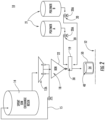
- FIG. 1 diagrammatically illustrates a preferred embodiment of the present Method 10.
- the waste is loaded or otherwise provided to the Storage or solids tank or area 14, which will contain particulate solids and spent ion exchange resin or those recycled back to the tank 14, as shown generally in FIG. 1 .
- the Recycle Line 15 extends from the Dewater/Dryer combination 12 to the Storage or solids bin or tank 14 and from the Dewatering sub-system or means 12A, shown schematically in FIG. 2 , to the Storage tank 14.
- a water sluicing sub-system or means is provided as a vehicle for conveying or moving particulate solids and the spent resin from the storage tank 14 to the Dewater/Dryer combination 12B.
- the particulate solids in the sluice line 15 are dewatered and dried or evaporated so that the volume of the solids is substantially reduced.
- These treated solids are then passed or communicated into and through the sluice bin 22.
- the bin 22 communicates between the Dewater/Dryer 12B and the Mixer 19.
- the polymer is metered in Step 20 in or proximate to one or more polymer container(s) or supply area(s) 24.
- Such metering 20 is facilitated by the metering pump or pumps 20A at a given rate.
- the Pump 20A characteristically has a metering valve and screw conveyor, among other components.
- the Mixer 19 is provided as a Continuous Mixer such as that, for example, provided by Readco Kurimoto, LLC, 460 Grim Lane, York, PA 17406 USA. Such an example, without limitation, is illustrated in FIG. 9 .
- the temperature of the mixing step 30 is monitored so that, in preferred embodiments of the Method 10, the temperature is not permitted, or substantially not permitted, to rise above a temperature where the curing temperature may generate excess stress in the matrix resulting in cracking of the matrix, such that full polymerization and curing of the polymer and solids does not take place in the Mixer 19.
- the contents of the mixed polymer and solids should come from the Mixer 19 as a paste-like substance, which is then transferred or communicated to the Waste container or containers 50.
- the Monolith 54 is a cured form of the combined polymer and solids which forms, or substantially forms, in the Waste container 50 and where steps 40 and 52 take place.
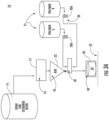
- Figure 2 illustrates a schematic and representational view of a method in accordance with another preferred embodiment of the present invention where a specific volume reduction step is not employed, but a Dewater step 12 is employed.
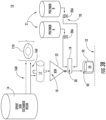
- Figure 3A illustrates a schematic and representational view of a method in accordance with the present invention where a Dryer or dryer means 17, without dewatering, is employed.
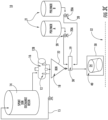
- Figure 3B illustrates a schematic and representational view of a method in accordance with the present invention where a High heating dryer or high heating means 16H, without dewatering, is employed, to raise the temperature to release the water of hydration of a solid or particulate solid waste.
- Figure 3C illustrates a schematic and representational view of a method in accordance with the present invention where a Dewater unit, means, or sub-system 12A and a dryer unit means or sub-system 17 are employed together in a combined means 12B to accomplish dewatering and drying or evaporation.
- Figure 4 illustrates details of a waste container in which the polymer waste mixture can be loaded and stored for transport and related purposes according to an embodiment of the present invention.
- Figure 5 illustrates details of a waste container in which the polymer waste mixture can be loaded and stored for transport and related purposes.
- Figure 6 illustrates details of a waste container in which the polymer waste mixture can be loaded and stored for transport and related purposes.
- Figure 7 illustrates details of a waste container in which the polymer waste mixture can be loaded and stored for transport and related purposes.
- Figure 8 illustrates details of a waste container in which the polymer waste mixture can be loaded and stored for transport and related purposes.
Landscapes
- Engineering & Computer Science (AREA)
- Environmental & Geological Engineering (AREA)
- Health & Medical Sciences (AREA)
- General Health & Medical Sciences (AREA)
- Toxicology (AREA)
- Hydrology & Water Resources (AREA)
- Life Sciences & Earth Sciences (AREA)
- Water Supply & Treatment (AREA)
- Chemical & Material Sciences (AREA)
- Organic Chemistry (AREA)
- Processing Of Solid Wastes (AREA)
- Separation, Recovery Or Treatment Of Waste Materials Containing Plastics (AREA)
- Treatment Of Sludge (AREA)
Claims (15)
- Procédé (10) pour la solidification d'un matériau de déchet, comprenant :l'obtention d'un matériau de déchet ayant un premier volume ;l'égouttage (12) du matériau de déchet ;le séchage (16) du matériau de déchet égoutté ;le stockage et le dosage du matériau de déchet dans un mélangeur ;le dosage (20) d'un polymère (21) dans le mélangeur (19) ;le mélange du polymère avec le matériau de déchet pour former un mélange polymère-déchet ;le durcissement du polymère dans le mélange polymère-déchet pour former une forme de déchet monolithique solidifiée (54) ayant une matrice polymère continue encapsulant le matériau de déchet ; etdans lequel le matériau de déchet égoutté a un volume réduit d'environ 50 % à environ 95 % du volume de pertuis original du matériau de déchet.
- Procédé (10) selon la revendication 1, dans lequel le matériau de déchet égoutté a un volume réduit d'environ 75 % à environ 90 % du volume original du matériau de déchet.
- Procédé (10) selon la revendication 1, comprenant en outre la décomposition au moins partielle du matériau de déchet.
- Procédé (10) selon la revendication 3, dans lequel la décomposition du matériau de déchet comprend le chauffage (16H) du matériau de déchet à une température d'environ 150°C à environ 250°C, dans lequel le matériau de déchet comprend d'environ 0 % à environ 80 % de réduction de volume en réponse au chauffage.
- Procédé (10) selon la revendication 4, dans lequel le moyen de chauffage élevé (17H) est au moins l'un choisi parmi un chauffage par huile, vapeur haute pression, résistance électrique, un chauffage par micro-ondes, ou l'une quelconque de leurs combinaisons.
- Procédé (10) selon la revendication 1, comprenant en outre le refroidissement du matériau de déchet après le séchage (16).
- Procédé (10) selon la revendication 1, dans lequel le stockage et le dosage (18) du matériau de déchet dans le mélangeur comprend un dosage volumétrique ou un dosage gravimétrique.
- Procédé (10) selon la revendication 1, dans lequel l'au moins un polymère (21) comprend un polymère thermodurcissable, éventuellement dans lequel le polymère thermodurcissable comprend au moins l'un parmi un époxy, une résine ou un réseau d'ester vinylique, un système de résine de polyester, un système de résine à fibres de verre, ou l'une quelconque de leurs combinaisons.
- Procédé (10) selon la revendication 1, comprenant en outre la distribution du mélange polymère-déchet parmi une pluralité de conteneurs à déchet (50), éventuellement comprenant en outre la fermeture et le transfert de la pluralité de conteneurs à déchet.
- Procédé (10) selon la revendication 9, dans lequel chacun parmi la pluralité de conteneurs à déchet (50) est tapissé d'au moins un polymère (21), et/ou comprend un mécanisme de nivellement.
- Procédé (10) selon la revendication 10, dans lequel le mécanisme de nivellement comprend au moins l'un parmi un agitateur, un vibrateur, un inducteur d'ultrasons, une table indexable, ou l'une quelconque de leurs combinaisons.
- Procédé (10) selon la revendication 1, dans lequel le matériau de déchet comprend au moins l'un parmi un déchet radioactif et un déchet dangereux.
- Procédé (10) selon la revendication 1, dans lequel le matériau de déchet égoutté et éventuellement séché a un premier débit d'alimentation qui est proportionnel à un deuxième débit d'alimentation du polymère dosé (20, 21).
- Procédé (10) selon la revendication 1, comprenant en outre l'extrusion ou l'extraction du mélange polymère-déchet hors du mélangeur sans l'addition de quelconques matériaux secondaires.
- Procédé (10) selon la revendication 1, dans lequel le mélangeur (19) est un mélangeur autonettoyant.
Applications Claiming Priority (3)
| Application Number | Priority Date | Filing Date | Title |
|---|---|---|---|
| US201461990513P | 2014-05-08 | 2014-05-08 | |
| US14/706,309 US20150321936A1 (en) | 2014-05-08 | 2015-05-07 | Method for resin, solids, and sludge solidification, stabilization, and reduction of disposal volume |
| PCT/US2015/029835 WO2015171987A1 (fr) | 2014-05-08 | 2015-05-08 | Procédé de solidification de résine, de solides et de boues, stabilisation et réduction d'un volume de rejet |
Publications (2)
| Publication Number | Publication Date |
|---|---|
| EP3140054A1 EP3140054A1 (fr) | 2017-03-15 |
| EP3140054B1 true EP3140054B1 (fr) | 2023-09-13 |
Family
ID=54367212
Family Applications (1)
| Application Number | Title | Priority Date | Filing Date |
|---|---|---|---|
| EP15723811.4A Active EP3140054B1 (fr) | 2014-05-08 | 2015-05-08 | Procédé de solidification de résine, de solides et de boues, stabilisation et réduction d'un volume de rejet |
Country Status (6)
| Country | Link |
|---|---|
| US (1) | US20150321936A1 (fr) |
| EP (1) | EP3140054B1 (fr) |
| JP (1) | JP2017514684A (fr) |
| CN (1) | CN106457324A (fr) |
| EA (1) | EA201692256A1 (fr) |
| WO (1) | WO2015171987A1 (fr) |
Families Citing this family (3)
| Publication number | Priority date | Publication date | Assignee | Title |
|---|---|---|---|---|
| CN108687106A (zh) * | 2018-05-02 | 2018-10-23 | 中国恩菲工程技术有限公司 | 飞灰和污泥的协同处理方法 |
| NL2023250B1 (en) * | 2019-06-03 | 2020-12-11 | Delta R&D B V | Method for preparing a coated particulate waste material and a coated waste particle |
| CN114283957B (zh) * | 2021-12-28 | 2025-03-25 | 清华大学 | 一种放射性废离子交换树脂的处理方法 |
Family Cites Families (7)
| Publication number | Priority date | Publication date | Assignee | Title |
|---|---|---|---|---|
| JPS5481500A (en) * | 1977-12-09 | 1979-06-28 | Nippon Atom Ind Group Co Ltd | Solidifying treatment into plastic of radioactive waste |
| US5401452A (en) * | 1993-07-26 | 1995-03-28 | Environmental Protection Polymers, Inc. | Methods for encapsulating waste and products thereof |
| US5962630A (en) * | 1997-12-03 | 1999-10-05 | The United States Of America As Represented By The United States Department Of Energy | Process and material that encapsulates solid hazardous waste |
| EP1220876B1 (fr) * | 1999-10-07 | 2005-04-20 | Hitachi Chemical Company, Ltd. | Procede de traitement d'un produit durci a base de resine epoxyde |
| DE10329170A1 (de) * | 2003-06-27 | 2005-01-13 | Polybern Gmbh | Verbessertes Verfahren zum Einschluss von Sonderabfall |
| US8114004B2 (en) * | 2006-12-30 | 2012-02-14 | Brunsell Dennis A | Method and device for evaporate/reverse osmosis concentrate and other liquid solidification |
| KR20120109378A (ko) * | 2011-03-25 | 2012-10-08 | (주)에이피더블유 | 함수 폐기물의 고형화 방법, 이에 의해 제조된 고형재, 이를 이용한 산업재 및 고형연료 |
-
2015
- 2015-05-07 US US14/706,309 patent/US20150321936A1/en not_active Abandoned
- 2015-05-08 CN CN201580035300.6A patent/CN106457324A/zh active Pending
- 2015-05-08 WO PCT/US2015/029835 patent/WO2015171987A1/fr not_active Ceased
- 2015-05-08 EA EA201692256A patent/EA201692256A1/ru unknown
- 2015-05-08 EP EP15723811.4A patent/EP3140054B1/fr active Active
- 2015-05-08 JP JP2016567010A patent/JP2017514684A/ja active Pending
Also Published As
| Publication number | Publication date |
|---|---|
| EP3140054A1 (fr) | 2017-03-15 |
| EA201692256A1 (ru) | 2017-04-28 |
| WO2015171987A1 (fr) | 2015-11-12 |
| JP2017514684A (ja) | 2017-06-08 |
| CN106457324A (zh) | 2017-02-22 |
| US20150321936A1 (en) | 2015-11-12 |
Similar Documents
| Publication | Publication Date | Title |
|---|---|---|
| EP3140054B1 (fr) | Procédé de solidification de résine, de solides et de boues, stabilisation et réduction d'un volume de rejet | |
| RU2133235C1 (ru) | Материал для цементации и способ формования | |
| JP2017067679A (ja) | 放射性廃棄物の処理方法および処理設備 | |
| AU2023202069B2 (en) | Process for treating fluid wastes | |
| KR101315814B1 (ko) | 방사성 폐기물 감용화장치 및 감용화방법 | |
| JP4872910B2 (ja) | ベントナイトの含水比調整方法 | |
| JP3231200U (ja) | ホウ酸塩廃液処理システム | |
| US4268409A (en) | Process for treating radioactive wastes | |
| JPS6335000B2 (fr) | ||
| JPS645678B2 (fr) | ||
| JP4580326B2 (ja) | 廃イオン交換樹脂集合固化体の製造方法 | |
| WO2015049521A1 (fr) | Encapsulation de déchets | |
| JPS63167296A (ja) | トリウム含有水を最終貯蔵するための適当なセメント含有固体物質の製法 | |
| JP2009121940A (ja) | 放射性廃棄物の固型化方法 | |
| JP2000263539A (ja) | 廃スラリーの再利用方法 | |
| JP2008241587A (ja) | 放射性廃棄物の固化処理方法及び固化処理装置 | |
| JPH04132997A (ja) | 放射性廃棄物の固化処理方法 | |
| JPS6017080B2 (ja) | 放射性廃棄物のプラスチツク固化処理方法 | |
| JPS62267699A (ja) | 放射性廃棄物の固化処理方法 | |
| Brunner et al. | 23 MOWA—the mobile waste conditioning plant | |
| JPS61205899A (ja) | 使用済イオン交換樹脂の処理方法 | |
| JP2007309816A (ja) | 放射性廃棄物の固型化方法 | |
| JPS6045840B2 (ja) | 放射性廃棄物の処理方法 | |
| Fletcher et al. | Direct Encapsulation of Spent Ion-exchange Resins at the Dukovany Nuclear Power Plant, Czech Republic-12367 | |
| JPS62133397A (ja) | 放射性廃棄物のプラスチツク固形化処理方法 |
Legal Events
| Date | Code | Title | Description |
|---|---|---|---|
| STAA | Information on the status of an ep patent application or granted ep patent |
Free format text: STATUS: THE INTERNATIONAL PUBLICATION HAS BEEN MADE |
|
| PUAI | Public reference made under article 153(3) epc to a published international application that has entered the european phase |
Free format text: ORIGINAL CODE: 0009012 |
|
| STAA | Information on the status of an ep patent application or granted ep patent |
Free format text: STATUS: REQUEST FOR EXAMINATION WAS MADE |
|
| 17P | Request for examination filed |
Effective date: 20161206 |
|
| AK | Designated contracting states |
Kind code of ref document: A1 Designated state(s): AL AT BE BG CH CY CZ DE DK EE ES FI FR GB GR HR HU IE IS IT LI LT LU LV MC MK MT NL NO PL PT RO RS SE SI SK SM TR |
|
| AX | Request for extension of the european patent |
Extension state: BA ME |
|
| DAV | Request for validation of the european patent (deleted) | ||
| DAX | Request for extension of the european patent (deleted) | ||
| STAA | Information on the status of an ep patent application or granted ep patent |
Free format text: STATUS: EXAMINATION IS IN PROGRESS |
|
| 17Q | First examination report despatched |
Effective date: 20180206 |
|
| RAP1 | Party data changed (applicant data changed or rights of an application transferred) |
Owner name: AVANTECH, LLC. |
|
| RAP1 | Party data changed (applicant data changed or rights of an application transferred) |
Owner name: AVANTECH, LLC. |
|
| GRAP | Despatch of communication of intention to grant a patent |
Free format text: ORIGINAL CODE: EPIDOSNIGR1 |
|
| STAA | Information on the status of an ep patent application or granted ep patent |
Free format text: STATUS: GRANT OF PATENT IS INTENDED |
|
| INTG | Intention to grant announced |
Effective date: 20230413 |
|
| P01 | Opt-out of the competence of the unified patent court (upc) registered |
Effective date: 20230529 |
|
| GRAS | Grant fee paid |
Free format text: ORIGINAL CODE: EPIDOSNIGR3 |
|
| GRAA | (expected) grant |
Free format text: ORIGINAL CODE: 0009210 |
|
| STAA | Information on the status of an ep patent application or granted ep patent |
Free format text: STATUS: THE PATENT HAS BEEN GRANTED |
|
| AK | Designated contracting states |
Kind code of ref document: B1 Designated state(s): AL AT BE BG CH CY CZ DE DK EE ES FI FR GB GR HR HU IE IS IT LI LT LU LV MC MK MT NL NO PL PT RO RS SE SI SK SM TR |
|
| REG | Reference to a national code |
Ref country code: GB Ref legal event code: FG4D |
|
| REG | Reference to a national code |
Ref country code: CH Ref legal event code: EP |
|
| REG | Reference to a national code |
Ref country code: DE Ref legal event code: R096 Ref document number: 602015085678 Country of ref document: DE |
|
| REG | Reference to a national code |
Ref country code: IE Ref legal event code: FG4D |
|
| REG | Reference to a national code |
Ref country code: LT Ref legal event code: MG9D |
|
| REG | Reference to a national code |
Ref country code: NL Ref legal event code: MP Effective date: 20230913 |
|
| PG25 | Lapsed in a contracting state [announced via postgrant information from national office to epo] |
Ref country code: GR Free format text: LAPSE BECAUSE OF FAILURE TO SUBMIT A TRANSLATION OF THE DESCRIPTION OR TO PAY THE FEE WITHIN THE PRESCRIBED TIME-LIMIT Effective date: 20231214 |
|
| PG25 | Lapsed in a contracting state [announced via postgrant information from national office to epo] |
Ref country code: SE Free format text: LAPSE BECAUSE OF FAILURE TO SUBMIT A TRANSLATION OF THE DESCRIPTION OR TO PAY THE FEE WITHIN THE PRESCRIBED TIME-LIMIT Effective date: 20230913 Ref country code: RS Free format text: LAPSE BECAUSE OF FAILURE TO SUBMIT A TRANSLATION OF THE DESCRIPTION OR TO PAY THE FEE WITHIN THE PRESCRIBED TIME-LIMIT Effective date: 20230913 Ref country code: NO Free format text: LAPSE BECAUSE OF FAILURE TO SUBMIT A TRANSLATION OF THE DESCRIPTION OR TO PAY THE FEE WITHIN THE PRESCRIBED TIME-LIMIT Effective date: 20231213 Ref country code: LV Free format text: LAPSE BECAUSE OF FAILURE TO SUBMIT A TRANSLATION OF THE DESCRIPTION OR TO PAY THE FEE WITHIN THE PRESCRIBED TIME-LIMIT Effective date: 20230913 Ref country code: LT Free format text: LAPSE BECAUSE OF FAILURE TO SUBMIT A TRANSLATION OF THE DESCRIPTION OR TO PAY THE FEE WITHIN THE PRESCRIBED TIME-LIMIT Effective date: 20230913 Ref country code: HR Free format text: LAPSE BECAUSE OF FAILURE TO SUBMIT A TRANSLATION OF THE DESCRIPTION OR TO PAY THE FEE WITHIN THE PRESCRIBED TIME-LIMIT Effective date: 20230913 Ref country code: GR Free format text: LAPSE BECAUSE OF FAILURE TO SUBMIT A TRANSLATION OF THE DESCRIPTION OR TO PAY THE FEE WITHIN THE PRESCRIBED TIME-LIMIT Effective date: 20231214 Ref country code: FI Free format text: LAPSE BECAUSE OF FAILURE TO SUBMIT A TRANSLATION OF THE DESCRIPTION OR TO PAY THE FEE WITHIN THE PRESCRIBED TIME-LIMIT Effective date: 20230913 |
|
| REG | Reference to a national code |
Ref country code: AT Ref legal event code: MK05 Ref document number: 1610743 Country of ref document: AT Kind code of ref document: T Effective date: 20230913 |
|
| PG25 | Lapsed in a contracting state [announced via postgrant information from national office to epo] |
Ref country code: NL Free format text: LAPSE BECAUSE OF FAILURE TO SUBMIT A TRANSLATION OF THE DESCRIPTION OR TO PAY THE FEE WITHIN THE PRESCRIBED TIME-LIMIT Effective date: 20230913 |
|
| PG25 | Lapsed in a contracting state [announced via postgrant information from national office to epo] |
Ref country code: IS Free format text: LAPSE BECAUSE OF FAILURE TO SUBMIT A TRANSLATION OF THE DESCRIPTION OR TO PAY THE FEE WITHIN THE PRESCRIBED TIME-LIMIT Effective date: 20240113 |
|
| PG25 | Lapsed in a contracting state [announced via postgrant information from national office to epo] |
Ref country code: AT Free format text: LAPSE BECAUSE OF FAILURE TO SUBMIT A TRANSLATION OF THE DESCRIPTION OR TO PAY THE FEE WITHIN THE PRESCRIBED TIME-LIMIT Effective date: 20230913 |
|
| PG25 | Lapsed in a contracting state [announced via postgrant information from national office to epo] |
Ref country code: ES Free format text: LAPSE BECAUSE OF FAILURE TO SUBMIT A TRANSLATION OF THE DESCRIPTION OR TO PAY THE FEE WITHIN THE PRESCRIBED TIME-LIMIT Effective date: 20230913 |
|
| PG25 | Lapsed in a contracting state [announced via postgrant information from national office to epo] |
Ref country code: SM Free format text: LAPSE BECAUSE OF FAILURE TO SUBMIT A TRANSLATION OF THE DESCRIPTION OR TO PAY THE FEE WITHIN THE PRESCRIBED TIME-LIMIT Effective date: 20230913 Ref country code: RO Free format text: LAPSE BECAUSE OF FAILURE TO SUBMIT A TRANSLATION OF THE DESCRIPTION OR TO PAY THE FEE WITHIN THE PRESCRIBED TIME-LIMIT Effective date: 20230913 Ref country code: IS Free format text: LAPSE BECAUSE OF FAILURE TO SUBMIT A TRANSLATION OF THE DESCRIPTION OR TO PAY THE FEE WITHIN THE PRESCRIBED TIME-LIMIT Effective date: 20240113 Ref country code: ES Free format text: LAPSE BECAUSE OF FAILURE TO SUBMIT A TRANSLATION OF THE DESCRIPTION OR TO PAY THE FEE WITHIN THE PRESCRIBED TIME-LIMIT Effective date: 20230913 Ref country code: EE Free format text: LAPSE BECAUSE OF FAILURE TO SUBMIT A TRANSLATION OF THE DESCRIPTION OR TO PAY THE FEE WITHIN THE PRESCRIBED TIME-LIMIT Effective date: 20230913 Ref country code: CZ Free format text: LAPSE BECAUSE OF FAILURE TO SUBMIT A TRANSLATION OF THE DESCRIPTION OR TO PAY THE FEE WITHIN THE PRESCRIBED TIME-LIMIT Effective date: 20230913 Ref country code: AT Free format text: LAPSE BECAUSE OF FAILURE TO SUBMIT A TRANSLATION OF THE DESCRIPTION OR TO PAY THE FEE WITHIN THE PRESCRIBED TIME-LIMIT Effective date: 20230913 Ref country code: PT Free format text: LAPSE BECAUSE OF FAILURE TO SUBMIT A TRANSLATION OF THE DESCRIPTION OR TO PAY THE FEE WITHIN THE PRESCRIBED TIME-LIMIT Effective date: 20240115 Ref country code: SK Free format text: LAPSE BECAUSE OF FAILURE TO SUBMIT A TRANSLATION OF THE DESCRIPTION OR TO PAY THE FEE WITHIN THE PRESCRIBED TIME-LIMIT Effective date: 20230913 |
|
| PG25 | Lapsed in a contracting state [announced via postgrant information from national office to epo] |
Ref country code: PL Free format text: LAPSE BECAUSE OF FAILURE TO SUBMIT A TRANSLATION OF THE DESCRIPTION OR TO PAY THE FEE WITHIN THE PRESCRIBED TIME-LIMIT Effective date: 20230913 Ref country code: IT Free format text: LAPSE BECAUSE OF FAILURE TO SUBMIT A TRANSLATION OF THE DESCRIPTION OR TO PAY THE FEE WITHIN THE PRESCRIBED TIME-LIMIT Effective date: 20230913 |
|
| REG | Reference to a national code |
Ref country code: DE Ref legal event code: R097 Ref document number: 602015085678 Country of ref document: DE |
|
| PGFP | Annual fee paid to national office [announced via postgrant information from national office to epo] |
Ref country code: DE Payment date: 20240530 Year of fee payment: 10 |
|
| PG25 | Lapsed in a contracting state [announced via postgrant information from national office to epo] |
Ref country code: DK Free format text: LAPSE BECAUSE OF FAILURE TO SUBMIT A TRANSLATION OF THE DESCRIPTION OR TO PAY THE FEE WITHIN THE PRESCRIBED TIME-LIMIT Effective date: 20230913 |
|
| PLBE | No opposition filed within time limit |
Free format text: ORIGINAL CODE: 0009261 |
|
| STAA | Information on the status of an ep patent application or granted ep patent |
Free format text: STATUS: NO OPPOSITION FILED WITHIN TIME LIMIT |
|
| PG25 | Lapsed in a contracting state [announced via postgrant information from national office to epo] |
Ref country code: DK Free format text: LAPSE BECAUSE OF FAILURE TO SUBMIT A TRANSLATION OF THE DESCRIPTION OR TO PAY THE FEE WITHIN THE PRESCRIBED TIME-LIMIT Effective date: 20230913 |
|
| PGFP | Annual fee paid to national office [announced via postgrant information from national office to epo] |
Ref country code: FR Payment date: 20240527 Year of fee payment: 10 |
|
| 26N | No opposition filed |
Effective date: 20240614 |
|
| PG25 | Lapsed in a contracting state [announced via postgrant information from national office to epo] |
Ref country code: SI Free format text: LAPSE BECAUSE OF FAILURE TO SUBMIT A TRANSLATION OF THE DESCRIPTION OR TO PAY THE FEE WITHIN THE PRESCRIBED TIME-LIMIT Effective date: 20230913 |
|
| PG25 | Lapsed in a contracting state [announced via postgrant information from national office to epo] |
Ref country code: SI Free format text: LAPSE BECAUSE OF FAILURE TO SUBMIT A TRANSLATION OF THE DESCRIPTION OR TO PAY THE FEE WITHIN THE PRESCRIBED TIME-LIMIT Effective date: 20230913 |
|
| PG25 | Lapsed in a contracting state [announced via postgrant information from national office to epo] |
Ref country code: BG Free format text: LAPSE BECAUSE OF FAILURE TO SUBMIT A TRANSLATION OF THE DESCRIPTION OR TO PAY THE FEE WITHIN THE PRESCRIBED TIME-LIMIT Effective date: 20230913 |
|
| PG25 | Lapsed in a contracting state [announced via postgrant information from national office to epo] |
Ref country code: BG Free format text: LAPSE BECAUSE OF FAILURE TO SUBMIT A TRANSLATION OF THE DESCRIPTION OR TO PAY THE FEE WITHIN THE PRESCRIBED TIME-LIMIT Effective date: 20230913 |
|
| REG | Reference to a national code |
Ref country code: CH Ref legal event code: PL |
|
| PG25 | Lapsed in a contracting state [announced via postgrant information from national office to epo] |
Ref country code: MC Free format text: LAPSE BECAUSE OF FAILURE TO SUBMIT A TRANSLATION OF THE DESCRIPTION OR TO PAY THE FEE WITHIN THE PRESCRIBED TIME-LIMIT Effective date: 20230913 |
|
| PG25 | Lapsed in a contracting state [announced via postgrant information from national office to epo] |
Ref country code: LU Free format text: LAPSE BECAUSE OF NON-PAYMENT OF DUE FEES Effective date: 20240508 |
|
| PG25 | Lapsed in a contracting state [announced via postgrant information from national office to epo] |
Ref country code: MC Free format text: LAPSE BECAUSE OF FAILURE TO SUBMIT A TRANSLATION OF THE DESCRIPTION OR TO PAY THE FEE WITHIN THE PRESCRIBED TIME-LIMIT Effective date: 20230913 Ref country code: LU Free format text: LAPSE BECAUSE OF NON-PAYMENT OF DUE FEES Effective date: 20240508 Ref country code: CH Free format text: LAPSE BECAUSE OF NON-PAYMENT OF DUE FEES Effective date: 20240531 |
|
| REG | Reference to a national code |
Ref country code: BE Ref legal event code: MM Effective date: 20240531 |
|
| PG25 | Lapsed in a contracting state [announced via postgrant information from national office to epo] |
Ref country code: IE Free format text: LAPSE BECAUSE OF NON-PAYMENT OF DUE FEES Effective date: 20240508 |
|
| PG25 | Lapsed in a contracting state [announced via postgrant information from national office to epo] |
Ref country code: BE Free format text: LAPSE BECAUSE OF NON-PAYMENT OF DUE FEES Effective date: 20240531 |
|
| PG25 | Lapsed in a contracting state [announced via postgrant information from national office to epo] |
Ref country code: CY Free format text: LAPSE BECAUSE OF FAILURE TO SUBMIT A TRANSLATION OF THE DESCRIPTION OR TO PAY THE FEE WITHIN THE PRESCRIBED TIME-LIMIT; INVALID AB INITIO Effective date: 20150508 |
|
| PG25 | Lapsed in a contracting state [announced via postgrant information from national office to epo] |
Ref country code: HU Free format text: LAPSE BECAUSE OF FAILURE TO SUBMIT A TRANSLATION OF THE DESCRIPTION OR TO PAY THE FEE WITHIN THE PRESCRIBED TIME-LIMIT; INVALID AB INITIO Effective date: 20150508 |
|
| PGFP | Annual fee paid to national office [announced via postgrant information from national office to epo] |
Ref country code: GB Payment date: 20250818 Year of fee payment: 11 |
|
| REG | Reference to a national code |
Ref country code: DE Ref legal event code: R119 Ref document number: 602015085678 Country of ref document: DE |
|
| PG25 | Lapsed in a contracting state [announced via postgrant information from national office to epo] |
Ref country code: DE Free format text: LAPSE BECAUSE OF NON-PAYMENT OF DUE FEES Effective date: 20251202 |
|
| PG25 | Lapsed in a contracting state [announced via postgrant information from national office to epo] |
Ref country code: FR Free format text: LAPSE BECAUSE OF NON-PAYMENT OF DUE FEES Effective date: 20250531 |