EP3141221A1 - Implant et procédé de fabrication d'un tel implant - Google Patents
Implant et procédé de fabrication d'un tel implant Download PDFInfo
- Publication number
- EP3141221A1 EP3141221A1 EP16175197.9A EP16175197A EP3141221A1 EP 3141221 A1 EP3141221 A1 EP 3141221A1 EP 16175197 A EP16175197 A EP 16175197A EP 3141221 A1 EP3141221 A1 EP 3141221A1
- Authority
- EP
- European Patent Office
- Prior art keywords
- implant
- layer
- middle layer
- inner layer
- bone
- Prior art date
- Legal status (The legal status is an assumption and is not a legal conclusion. Google has not performed a legal analysis and makes no representation as to the accuracy of the status listed.)
- Withdrawn
Links
- 239000007943 implant Substances 0.000 title claims abstract description 122
- 238000000034 method Methods 0.000 title claims description 30
- 239000011148 porous material Substances 0.000 claims abstract description 34
- 210000000988 bone and bone Anatomy 0.000 claims description 56
- RTAQQCXQSZGOHL-UHFFFAOYSA-N Titanium Chemical compound [Ti] RTAQQCXQSZGOHL-UHFFFAOYSA-N 0.000 claims description 19
- 239000007787 solid Substances 0.000 claims description 19
- 239000010936 titanium Substances 0.000 claims description 19
- 229910052719 titanium Inorganic materials 0.000 claims description 19
- 238000004519 manufacturing process Methods 0.000 claims description 10
- 229910052751 metal Inorganic materials 0.000 claims description 10
- 239000002184 metal Substances 0.000 claims description 10
- 238000005245 sintering Methods 0.000 claims description 9
- 239000000654 additive Substances 0.000 claims description 8
- 230000000996 additive effect Effects 0.000 claims description 8
- 210000000878 metatarsophalangeal joint Anatomy 0.000 claims description 6
- 230000003746 surface roughness Effects 0.000 claims description 5
- 238000000110 selective laser sintering Methods 0.000 claims description 3
- 210000001872 metatarsal bone Anatomy 0.000 description 14
- 230000004927 fusion Effects 0.000 description 13
- 239000000463 material Substances 0.000 description 10
- 229910001069 Ti alloy Inorganic materials 0.000 description 8
- 210000002683 foot Anatomy 0.000 description 7
- 238000001356 surgical procedure Methods 0.000 description 7
- 230000000399 orthopedic effect Effects 0.000 description 6
- 210000003371 toe Anatomy 0.000 description 6
- 210000004872 soft tissue Anatomy 0.000 description 5
- -1 for example Substances 0.000 description 4
- 210000001503 joint Anatomy 0.000 description 4
- 230000008468 bone growth Effects 0.000 description 3
- 239000004927 clay Substances 0.000 description 3
- 238000011960 computer-aided design Methods 0.000 description 3
- 230000001054 cortical effect Effects 0.000 description 3
- 239000002245 particle Substances 0.000 description 3
- 239000010935 stainless steel Substances 0.000 description 3
- 229910001220 stainless steel Inorganic materials 0.000 description 3
- 206010061159 Foot deformity Diseases 0.000 description 2
- 238000013461 design Methods 0.000 description 2
- 238000010586 diagram Methods 0.000 description 2
- 238000005516 engineering process Methods 0.000 description 2
- 150000002739 metals Chemical class 0.000 description 2
- 239000000203 mixture Substances 0.000 description 2
- 210000003429 pore cell Anatomy 0.000 description 2
- 210000001519 tissue Anatomy 0.000 description 2
- 208000006327 Hallux Rigidus Diseases 0.000 description 1
- 208000001963 Hallux Valgus Diseases 0.000 description 1
- 241000282412 Homo Species 0.000 description 1
- 206010048873 Traumatic arthritis Diseases 0.000 description 1
- WAIPAZQMEIHHTJ-UHFFFAOYSA-N [Cr].[Co] Chemical class [Cr].[Co] WAIPAZQMEIHHTJ-UHFFFAOYSA-N 0.000 description 1
- 238000013459 approach Methods 0.000 description 1
- 238000000149 argon plasma sintering Methods 0.000 description 1
- 210000001188 articular cartilage Anatomy 0.000 description 1
- 210000001142 back Anatomy 0.000 description 1
- 230000000740 bleeding effect Effects 0.000 description 1
- 239000002639 bone cement Substances 0.000 description 1
- 238000004140 cleaning Methods 0.000 description 1
- 210000004439 collateral ligament Anatomy 0.000 description 1
- 230000006835 compression Effects 0.000 description 1
- 238000007906 compression Methods 0.000 description 1
- 230000008878 coupling Effects 0.000 description 1
- 238000010168 coupling process Methods 0.000 description 1
- 238000005859 coupling reaction Methods 0.000 description 1
- 210000003275 diaphysis Anatomy 0.000 description 1
- 239000012467 final product Substances 0.000 description 1
- 230000005021 gait Effects 0.000 description 1
- 239000007789 gas Substances 0.000 description 1
- 230000012010 growth Effects 0.000 description 1
- 210000001255 hallux Anatomy 0.000 description 1
- 238000003384 imaging method Methods 0.000 description 1
- 238000003780 insertion Methods 0.000 description 1
- 230000037431 insertion Effects 0.000 description 1
- 238000002955 isolation Methods 0.000 description 1
- 210000000281 joint capsule Anatomy 0.000 description 1
- 238000003754 machining Methods 0.000 description 1
- 239000000843 powder Substances 0.000 description 1
- 238000002360 preparation method Methods 0.000 description 1
- 238000007639 printing Methods 0.000 description 1
- 238000004904 shortening Methods 0.000 description 1
- 239000002210 silicon-based material Substances 0.000 description 1
- 239000011343 solid material Substances 0.000 description 1
- 210000005065 subchondral bone plate Anatomy 0.000 description 1
- 239000000126 substance Substances 0.000 description 1
- 210000002435 tendon Anatomy 0.000 description 1
- 238000012360 testing method Methods 0.000 description 1
Images






Classifications
-
- A—HUMAN NECESSITIES
- A61—MEDICAL OR VETERINARY SCIENCE; HYGIENE
- A61F—FILTERS IMPLANTABLE INTO BLOOD VESSELS; PROSTHESES; DEVICES PROVIDING PATENCY TO, OR PREVENTING COLLAPSING OF, TUBULAR STRUCTURES OF THE BODY, e.g. STENTS; ORTHOPAEDIC, NURSING OR CONTRACEPTIVE DEVICES; FOMENTATION; TREATMENT OR PROTECTION OF EYES OR EARS; BANDAGES, DRESSINGS OR ABSORBENT PADS; FIRST-AID KITS
- A61F2/00—Filters implantable into blood vessels; Prostheses, i.e. artificial substitutes or replacements for parts of the body; Appliances for connecting them with the body; Devices providing patency to, or preventing collapsing of, tubular structures of the body, e.g. stents
- A61F2/02—Prostheses implantable into the body
- A61F2/30—Joints
- A61F2/42—Joints for wrists or ankles; for hands, e.g. fingers; for feet, e.g. toes
- A61F2/4225—Joints for wrists or ankles; for hands, e.g. fingers; for feet, e.g. toes for feet, e.g. toes
-
- A—HUMAN NECESSITIES
- A61—MEDICAL OR VETERINARY SCIENCE; HYGIENE
- A61F—FILTERS IMPLANTABLE INTO BLOOD VESSELS; PROSTHESES; DEVICES PROVIDING PATENCY TO, OR PREVENTING COLLAPSING OF, TUBULAR STRUCTURES OF THE BODY, e.g. STENTS; ORTHOPAEDIC, NURSING OR CONTRACEPTIVE DEVICES; FOMENTATION; TREATMENT OR PROTECTION OF EYES OR EARS; BANDAGES, DRESSINGS OR ABSORBENT PADS; FIRST-AID KITS
- A61F2/00—Filters implantable into blood vessels; Prostheses, i.e. artificial substitutes or replacements for parts of the body; Appliances for connecting them with the body; Devices providing patency to, or preventing collapsing of, tubular structures of the body, e.g. stents
- A61F2/02—Prostheses implantable into the body
- A61F2/30—Joints
- A61F2/3094—Designing or manufacturing processes
-
- A—HUMAN NECESSITIES
- A61—MEDICAL OR VETERINARY SCIENCE; HYGIENE
- A61F—FILTERS IMPLANTABLE INTO BLOOD VESSELS; PROSTHESES; DEVICES PROVIDING PATENCY TO, OR PREVENTING COLLAPSING OF, TUBULAR STRUCTURES OF THE BODY, e.g. STENTS; ORTHOPAEDIC, NURSING OR CONTRACEPTIVE DEVICES; FOMENTATION; TREATMENT OR PROTECTION OF EYES OR EARS; BANDAGES, DRESSINGS OR ABSORBENT PADS; FIRST-AID KITS
- A61F2/00—Filters implantable into blood vessels; Prostheses, i.e. artificial substitutes or replacements for parts of the body; Appliances for connecting them with the body; Devices providing patency to, or preventing collapsing of, tubular structures of the body, e.g. stents
- A61F2/02—Prostheses implantable into the body
- A61F2/30—Joints
- A61F2/3094—Designing or manufacturing processes
- A61F2/30942—Designing or manufacturing processes for designing or making customized prostheses, e.g. using templates, CT or NMR scans, finite-element analysis or CAD-CAM techniques
-
- A—HUMAN NECESSITIES
- A61—MEDICAL OR VETERINARY SCIENCE; HYGIENE
- A61F—FILTERS IMPLANTABLE INTO BLOOD VESSELS; PROSTHESES; DEVICES PROVIDING PATENCY TO, OR PREVENTING COLLAPSING OF, TUBULAR STRUCTURES OF THE BODY, e.g. STENTS; ORTHOPAEDIC, NURSING OR CONTRACEPTIVE DEVICES; FOMENTATION; TREATMENT OR PROTECTION OF EYES OR EARS; BANDAGES, DRESSINGS OR ABSORBENT PADS; FIRST-AID KITS
- A61F2/00—Filters implantable into blood vessels; Prostheses, i.e. artificial substitutes or replacements for parts of the body; Appliances for connecting them with the body; Devices providing patency to, or preventing collapsing of, tubular structures of the body, e.g. stents
- A61F2/02—Prostheses implantable into the body
- A61F2/30—Joints
- A61F2/42—Joints for wrists or ankles; for hands, e.g. fingers; for feet, e.g. toes
-
- B—PERFORMING OPERATIONS; TRANSPORTING
- B23—MACHINE TOOLS; METAL-WORKING NOT OTHERWISE PROVIDED FOR
- B23K—SOLDERING OR UNSOLDERING; WELDING; CLADDING OR PLATING BY SOLDERING OR WELDING; CUTTING BY APPLYING HEAT LOCALLY, e.g. FLAME CUTTING; WORKING BY LASER BEAM
- B23K26/00—Working by laser beam, e.g. welding, cutting or boring
- B23K26/34—Laser welding for purposes other than joining
- B23K26/342—Build-up welding
-
- A—HUMAN NECESSITIES
- A61—MEDICAL OR VETERINARY SCIENCE; HYGIENE
- A61F—FILTERS IMPLANTABLE INTO BLOOD VESSELS; PROSTHESES; DEVICES PROVIDING PATENCY TO, OR PREVENTING COLLAPSING OF, TUBULAR STRUCTURES OF THE BODY, e.g. STENTS; ORTHOPAEDIC, NURSING OR CONTRACEPTIVE DEVICES; FOMENTATION; TREATMENT OR PROTECTION OF EYES OR EARS; BANDAGES, DRESSINGS OR ABSORBENT PADS; FIRST-AID KITS
- A61F2/00—Filters implantable into blood vessels; Prostheses, i.e. artificial substitutes or replacements for parts of the body; Appliances for connecting them with the body; Devices providing patency to, or preventing collapsing of, tubular structures of the body, e.g. stents
- A61F2/02—Prostheses implantable into the body
- A61F2/30—Joints
- A61F2002/30001—Additional features of subject-matter classified in A61F2/28, A61F2/30 and subgroups thereof
- A61F2002/30003—Material related properties of the prosthesis or of a coating on the prosthesis
- A61F2002/30004—Material related properties of the prosthesis or of a coating on the prosthesis the prosthesis being made from materials having different values of a given property at different locations within the same prosthesis
- A61F2002/30011—Material related properties of the prosthesis or of a coating on the prosthesis the prosthesis being made from materials having different values of a given property at different locations within the same prosthesis differing in porosity
-
- A—HUMAN NECESSITIES
- A61—MEDICAL OR VETERINARY SCIENCE; HYGIENE
- A61F—FILTERS IMPLANTABLE INTO BLOOD VESSELS; PROSTHESES; DEVICES PROVIDING PATENCY TO, OR PREVENTING COLLAPSING OF, TUBULAR STRUCTURES OF THE BODY, e.g. STENTS; ORTHOPAEDIC, NURSING OR CONTRACEPTIVE DEVICES; FOMENTATION; TREATMENT OR PROTECTION OF EYES OR EARS; BANDAGES, DRESSINGS OR ABSORBENT PADS; FIRST-AID KITS
- A61F2/00—Filters implantable into blood vessels; Prostheses, i.e. artificial substitutes or replacements for parts of the body; Appliances for connecting them with the body; Devices providing patency to, or preventing collapsing of, tubular structures of the body, e.g. stents
- A61F2/02—Prostheses implantable into the body
- A61F2/30—Joints
- A61F2002/30001—Additional features of subject-matter classified in A61F2/28, A61F2/30 and subgroups thereof
- A61F2002/30003—Material related properties of the prosthesis or of a coating on the prosthesis
- A61F2002/30004—Material related properties of the prosthesis or of a coating on the prosthesis the prosthesis being made from materials having different values of a given property at different locations within the same prosthesis
- A61F2002/30028—Material related properties of the prosthesis or of a coating on the prosthesis the prosthesis being made from materials having different values of a given property at different locations within the same prosthesis differing in tissue ingrowth capacity, e.g. made from both ingrowth-promoting and ingrowth-preventing parts
-
- A—HUMAN NECESSITIES
- A61—MEDICAL OR VETERINARY SCIENCE; HYGIENE
- A61F—FILTERS IMPLANTABLE INTO BLOOD VESSELS; PROSTHESES; DEVICES PROVIDING PATENCY TO, OR PREVENTING COLLAPSING OF, TUBULAR STRUCTURES OF THE BODY, e.g. STENTS; ORTHOPAEDIC, NURSING OR CONTRACEPTIVE DEVICES; FOMENTATION; TREATMENT OR PROTECTION OF EYES OR EARS; BANDAGES, DRESSINGS OR ABSORBENT PADS; FIRST-AID KITS
- A61F2/00—Filters implantable into blood vessels; Prostheses, i.e. artificial substitutes or replacements for parts of the body; Appliances for connecting them with the body; Devices providing patency to, or preventing collapsing of, tubular structures of the body, e.g. stents
- A61F2/02—Prostheses implantable into the body
- A61F2/30—Joints
- A61F2002/30001—Additional features of subject-matter classified in A61F2/28, A61F2/30 and subgroups thereof
- A61F2002/30003—Material related properties of the prosthesis or of a coating on the prosthesis
- A61F2002/3006—Properties of materials and coating materials
- A61F2002/30069—Properties of materials and coating materials elastomeric
-
- A—HUMAN NECESSITIES
- A61—MEDICAL OR VETERINARY SCIENCE; HYGIENE
- A61F—FILTERS IMPLANTABLE INTO BLOOD VESSELS; PROSTHESES; DEVICES PROVIDING PATENCY TO, OR PREVENTING COLLAPSING OF, TUBULAR STRUCTURES OF THE BODY, e.g. STENTS; ORTHOPAEDIC, NURSING OR CONTRACEPTIVE DEVICES; FOMENTATION; TREATMENT OR PROTECTION OF EYES OR EARS; BANDAGES, DRESSINGS OR ABSORBENT PADS; FIRST-AID KITS
- A61F2/00—Filters implantable into blood vessels; Prostheses, i.e. artificial substitutes or replacements for parts of the body; Appliances for connecting them with the body; Devices providing patency to, or preventing collapsing of, tubular structures of the body, e.g. stents
- A61F2/02—Prostheses implantable into the body
- A61F2/30—Joints
- A61F2002/30001—Additional features of subject-matter classified in A61F2/28, A61F2/30 and subgroups thereof
- A61F2002/30108—Shapes
- A61F2002/30199—Three-dimensional shapes
- A61F2002/30224—Three-dimensional shapes cylindrical
- A61F2002/30233—Stepped cylinders, i.e. having discrete diameter changes
-
- A—HUMAN NECESSITIES
- A61—MEDICAL OR VETERINARY SCIENCE; HYGIENE
- A61F—FILTERS IMPLANTABLE INTO BLOOD VESSELS; PROSTHESES; DEVICES PROVIDING PATENCY TO, OR PREVENTING COLLAPSING OF, TUBULAR STRUCTURES OF THE BODY, e.g. STENTS; ORTHOPAEDIC, NURSING OR CONTRACEPTIVE DEVICES; FOMENTATION; TREATMENT OR PROTECTION OF EYES OR EARS; BANDAGES, DRESSINGS OR ABSORBENT PADS; FIRST-AID KITS
- A61F2/00—Filters implantable into blood vessels; Prostheses, i.e. artificial substitutes or replacements for parts of the body; Appliances for connecting them with the body; Devices providing patency to, or preventing collapsing of, tubular structures of the body, e.g. stents
- A61F2/02—Prostheses implantable into the body
- A61F2/30—Joints
- A61F2002/30001—Additional features of subject-matter classified in A61F2/28, A61F2/30 and subgroups thereof
- A61F2002/30108—Shapes
- A61F2002/30199—Three-dimensional shapes
- A61F2002/30242—Three-dimensional shapes spherical
-
- A—HUMAN NECESSITIES
- A61—MEDICAL OR VETERINARY SCIENCE; HYGIENE
- A61F—FILTERS IMPLANTABLE INTO BLOOD VESSELS; PROSTHESES; DEVICES PROVIDING PATENCY TO, OR PREVENTING COLLAPSING OF, TUBULAR STRUCTURES OF THE BODY, e.g. STENTS; ORTHOPAEDIC, NURSING OR CONTRACEPTIVE DEVICES; FOMENTATION; TREATMENT OR PROTECTION OF EYES OR EARS; BANDAGES, DRESSINGS OR ABSORBENT PADS; FIRST-AID KITS
- A61F2/00—Filters implantable into blood vessels; Prostheses, i.e. artificial substitutes or replacements for parts of the body; Appliances for connecting them with the body; Devices providing patency to, or preventing collapsing of, tubular structures of the body, e.g. stents
- A61F2/02—Prostheses implantable into the body
- A61F2/30—Joints
- A61F2002/30001—Additional features of subject-matter classified in A61F2/28, A61F2/30 and subgroups thereof
- A61F2002/30316—The prosthesis having different structural features at different locations within the same prosthesis; Connections between prosthetic parts; Special structural features of bone or joint prostheses not otherwise provided for
- A61F2002/30317—The prosthesis having different structural features at different locations within the same prosthesis
- A61F2002/30321—The prosthesis having different structural features at different locations within the same prosthesis differing in roughness
-
- A—HUMAN NECESSITIES
- A61—MEDICAL OR VETERINARY SCIENCE; HYGIENE
- A61F—FILTERS IMPLANTABLE INTO BLOOD VESSELS; PROSTHESES; DEVICES PROVIDING PATENCY TO, OR PREVENTING COLLAPSING OF, TUBULAR STRUCTURES OF THE BODY, e.g. STENTS; ORTHOPAEDIC, NURSING OR CONTRACEPTIVE DEVICES; FOMENTATION; TREATMENT OR PROTECTION OF EYES OR EARS; BANDAGES, DRESSINGS OR ABSORBENT PADS; FIRST-AID KITS
- A61F2/00—Filters implantable into blood vessels; Prostheses, i.e. artificial substitutes or replacements for parts of the body; Appliances for connecting them with the body; Devices providing patency to, or preventing collapsing of, tubular structures of the body, e.g. stents
- A61F2/02—Prostheses implantable into the body
- A61F2/30—Joints
- A61F2002/30001—Additional features of subject-matter classified in A61F2/28, A61F2/30 and subgroups thereof
- A61F2002/30621—Features concerning the anatomical functioning or articulation of the prosthetic joint
- A61F2002/30622—Implant for fusing a joint or bone material
-
- A—HUMAN NECESSITIES
- A61—MEDICAL OR VETERINARY SCIENCE; HYGIENE
- A61F—FILTERS IMPLANTABLE INTO BLOOD VESSELS; PROSTHESES; DEVICES PROVIDING PATENCY TO, OR PREVENTING COLLAPSING OF, TUBULAR STRUCTURES OF THE BODY, e.g. STENTS; ORTHOPAEDIC, NURSING OR CONTRACEPTIVE DEVICES; FOMENTATION; TREATMENT OR PROTECTION OF EYES OR EARS; BANDAGES, DRESSINGS OR ABSORBENT PADS; FIRST-AID KITS
- A61F2/00—Filters implantable into blood vessels; Prostheses, i.e. artificial substitutes or replacements for parts of the body; Appliances for connecting them with the body; Devices providing patency to, or preventing collapsing of, tubular structures of the body, e.g. stents
- A61F2/02—Prostheses implantable into the body
- A61F2/30—Joints
- A61F2/30767—Special external or bone-contacting surface, e.g. coating for improving bone ingrowth
- A61F2/30771—Special external or bone-contacting surface, e.g. coating for improving bone ingrowth applied in original prostheses, e.g. holes or grooves
- A61F2002/30836—Special external or bone-contacting surface, e.g. coating for improving bone ingrowth applied in original prostheses, e.g. holes or grooves knurled
-
- A—HUMAN NECESSITIES
- A61—MEDICAL OR VETERINARY SCIENCE; HYGIENE
- A61F—FILTERS IMPLANTABLE INTO BLOOD VESSELS; PROSTHESES; DEVICES PROVIDING PATENCY TO, OR PREVENTING COLLAPSING OF, TUBULAR STRUCTURES OF THE BODY, e.g. STENTS; ORTHOPAEDIC, NURSING OR CONTRACEPTIVE DEVICES; FOMENTATION; TREATMENT OR PROTECTION OF EYES OR EARS; BANDAGES, DRESSINGS OR ABSORBENT PADS; FIRST-AID KITS
- A61F2/00—Filters implantable into blood vessels; Prostheses, i.e. artificial substitutes or replacements for parts of the body; Appliances for connecting them with the body; Devices providing patency to, or preventing collapsing of, tubular structures of the body, e.g. stents
- A61F2/02—Prostheses implantable into the body
- A61F2/30—Joints
- A61F2/30767—Special external or bone-contacting surface, e.g. coating for improving bone ingrowth
- A61F2/30771—Special external or bone-contacting surface, e.g. coating for improving bone ingrowth applied in original prostheses, e.g. holes or grooves
- A61F2002/30878—Special external or bone-contacting surface, e.g. coating for improving bone ingrowth applied in original prostheses, e.g. holes or grooves with non-sharp protrusions, for instance contacting the bone for anchoring, e.g. keels, pegs, pins, posts, shanks, stems, struts
-
- A—HUMAN NECESSITIES
- A61—MEDICAL OR VETERINARY SCIENCE; HYGIENE
- A61F—FILTERS IMPLANTABLE INTO BLOOD VESSELS; PROSTHESES; DEVICES PROVIDING PATENCY TO, OR PREVENTING COLLAPSING OF, TUBULAR STRUCTURES OF THE BODY, e.g. STENTS; ORTHOPAEDIC, NURSING OR CONTRACEPTIVE DEVICES; FOMENTATION; TREATMENT OR PROTECTION OF EYES OR EARS; BANDAGES, DRESSINGS OR ABSORBENT PADS; FIRST-AID KITS
- A61F2/00—Filters implantable into blood vessels; Prostheses, i.e. artificial substitutes or replacements for parts of the body; Appliances for connecting them with the body; Devices providing patency to, or preventing collapsing of, tubular structures of the body, e.g. stents
- A61F2/02—Prostheses implantable into the body
- A61F2/30—Joints
- A61F2/30767—Special external or bone-contacting surface, e.g. coating for improving bone ingrowth
- A61F2002/3093—Special external or bone-contacting surface, e.g. coating for improving bone ingrowth for promoting ingrowth of bone tissue
-
- A—HUMAN NECESSITIES
- A61—MEDICAL OR VETERINARY SCIENCE; HYGIENE
- A61F—FILTERS IMPLANTABLE INTO BLOOD VESSELS; PROSTHESES; DEVICES PROVIDING PATENCY TO, OR PREVENTING COLLAPSING OF, TUBULAR STRUCTURES OF THE BODY, e.g. STENTS; ORTHOPAEDIC, NURSING OR CONTRACEPTIVE DEVICES; FOMENTATION; TREATMENT OR PROTECTION OF EYES OR EARS; BANDAGES, DRESSINGS OR ABSORBENT PADS; FIRST-AID KITS
- A61F2/00—Filters implantable into blood vessels; Prostheses, i.e. artificial substitutes or replacements for parts of the body; Appliances for connecting them with the body; Devices providing patency to, or preventing collapsing of, tubular structures of the body, e.g. stents
- A61F2/02—Prostheses implantable into the body
- A61F2/30—Joints
- A61F2/3094—Designing or manufacturing processes
- A61F2002/30968—Sintering
-
- A—HUMAN NECESSITIES
- A61—MEDICAL OR VETERINARY SCIENCE; HYGIENE
- A61F—FILTERS IMPLANTABLE INTO BLOOD VESSELS; PROSTHESES; DEVICES PROVIDING PATENCY TO, OR PREVENTING COLLAPSING OF, TUBULAR STRUCTURES OF THE BODY, e.g. STENTS; ORTHOPAEDIC, NURSING OR CONTRACEPTIVE DEVICES; FOMENTATION; TREATMENT OR PROTECTION OF EYES OR EARS; BANDAGES, DRESSINGS OR ABSORBENT PADS; FIRST-AID KITS
- A61F2/00—Filters implantable into blood vessels; Prostheses, i.e. artificial substitutes or replacements for parts of the body; Appliances for connecting them with the body; Devices providing patency to, or preventing collapsing of, tubular structures of the body, e.g. stents
- A61F2/02—Prostheses implantable into the body
- A61F2/30—Joints
- A61F2/3094—Designing or manufacturing processes
- A61F2002/3097—Designing or manufacturing processes using laser
-
- A—HUMAN NECESSITIES
- A61—MEDICAL OR VETERINARY SCIENCE; HYGIENE
- A61F—FILTERS IMPLANTABLE INTO BLOOD VESSELS; PROSTHESES; DEVICES PROVIDING PATENCY TO, OR PREVENTING COLLAPSING OF, TUBULAR STRUCTURES OF THE BODY, e.g. STENTS; ORTHOPAEDIC, NURSING OR CONTRACEPTIVE DEVICES; FOMENTATION; TREATMENT OR PROTECTION OF EYES OR EARS; BANDAGES, DRESSINGS OR ABSORBENT PADS; FIRST-AID KITS
- A61F2/00—Filters implantable into blood vessels; Prostheses, i.e. artificial substitutes or replacements for parts of the body; Appliances for connecting them with the body; Devices providing patency to, or preventing collapsing of, tubular structures of the body, e.g. stents
- A61F2/02—Prostheses implantable into the body
- A61F2/30—Joints
- A61F2/3094—Designing or manufacturing processes
- A61F2002/30985—Designing or manufacturing processes using three dimensional printing [3DP]
-
- A—HUMAN NECESSITIES
- A61—MEDICAL OR VETERINARY SCIENCE; HYGIENE
- A61F—FILTERS IMPLANTABLE INTO BLOOD VESSELS; PROSTHESES; DEVICES PROVIDING PATENCY TO, OR PREVENTING COLLAPSING OF, TUBULAR STRUCTURES OF THE BODY, e.g. STENTS; ORTHOPAEDIC, NURSING OR CONTRACEPTIVE DEVICES; FOMENTATION; TREATMENT OR PROTECTION OF EYES OR EARS; BANDAGES, DRESSINGS OR ABSORBENT PADS; FIRST-AID KITS
- A61F2/00—Filters implantable into blood vessels; Prostheses, i.e. artificial substitutes or replacements for parts of the body; Appliances for connecting them with the body; Devices providing patency to, or preventing collapsing of, tubular structures of the body, e.g. stents
- A61F2/02—Prostheses implantable into the body
- A61F2/30—Joints
- A61F2/42—Joints for wrists or ankles; for hands, e.g. fingers; for feet, e.g. toes
- A61F2/4225—Joints for wrists or ankles; for hands, e.g. fingers; for feet, e.g. toes for feet, e.g. toes
- A61F2002/4228—Joints for wrists or ankles; for hands, e.g. fingers; for feet, e.g. toes for feet, e.g. toes for interphalangeal joints, i.e. IP joints
-
- A—HUMAN NECESSITIES
- A61—MEDICAL OR VETERINARY SCIENCE; HYGIENE
- A61F—FILTERS IMPLANTABLE INTO BLOOD VESSELS; PROSTHESES; DEVICES PROVIDING PATENCY TO, OR PREVENTING COLLAPSING OF, TUBULAR STRUCTURES OF THE BODY, e.g. STENTS; ORTHOPAEDIC, NURSING OR CONTRACEPTIVE DEVICES; FOMENTATION; TREATMENT OR PROTECTION OF EYES OR EARS; BANDAGES, DRESSINGS OR ABSORBENT PADS; FIRST-AID KITS
- A61F2/00—Filters implantable into blood vessels; Prostheses, i.e. artificial substitutes or replacements for parts of the body; Appliances for connecting them with the body; Devices providing patency to, or preventing collapsing of, tubular structures of the body, e.g. stents
- A61F2/02—Prostheses implantable into the body
- A61F2/30—Joints
- A61F2/42—Joints for wrists or ankles; for hands, e.g. fingers; for feet, e.g. toes
- A61F2/4225—Joints for wrists or ankles; for hands, e.g. fingers; for feet, e.g. toes for feet, e.g. toes
- A61F2002/4233—Joints for wrists or ankles; for hands, e.g. fingers; for feet, e.g. toes for feet, e.g. toes for metatarso-phalangeal joints, i.e. MTP joints
-
- A—HUMAN NECESSITIES
- A61—MEDICAL OR VETERINARY SCIENCE; HYGIENE
- A61F—FILTERS IMPLANTABLE INTO BLOOD VESSELS; PROSTHESES; DEVICES PROVIDING PATENCY TO, OR PREVENTING COLLAPSING OF, TUBULAR STRUCTURES OF THE BODY, e.g. STENTS; ORTHOPAEDIC, NURSING OR CONTRACEPTIVE DEVICES; FOMENTATION; TREATMENT OR PROTECTION OF EYES OR EARS; BANDAGES, DRESSINGS OR ABSORBENT PADS; FIRST-AID KITS
- A61F2310/00—Prostheses classified in A61F2/28 or A61F2/30 - A61F2/44 being constructed from or coated with a particular material
- A61F2310/00005—The prosthesis being constructed from a particular material
- A61F2310/00011—Metals or alloys
- A61F2310/00023—Titanium or titanium-based alloys, e.g. Ti-Ni alloys
Definitions
- the present invention relates to an implant and a method for making such an implant.
- the present disclosure relates generally to orthopedic medical implant devices for surgical joint fusion. More particularly, the disclosed subject matter relates to a joint fusion implant for the bones of the human foot, especially the metatarsophalangeal joints.
- Orthopedic implant devices have been utilized to fully or partially replace existing skeletal joints in humans. There are many joints in the human foot, and the metatarsophalangeal (MTP) joint is one joint causing frequent problems.
- MTP metatarsophalangeal
- the MTP joint is the joint between the head of a metatarsal bone and the base of a proximal phalange in a foot.
- a number of efforts have been made to partially or fully replace this joint.
- a metatarsophalangeal (MTP) implant is used for replacing a metatarsophalangeal joint.
- the efforts include partial or full replacement of the joint using silicone based materials or metal implant devices.
- the present disclosure provides an orthopedic implant device for surgical joint fusion. More particularly, the present disclosure provides an implant such as a metatarsophalangeal (MTP) implant, and a method for making the implant. The present disclosure also provides a method of using the implant including surgical procedure for implanting the implant, for example, in a foot of a patient. These include, but are not limited to, the following aspects and embodiments.
- MTP metatarsophalangeal
- an orthopedic implant device (or an implant) is provided.
- An exemplary implant is described in details in FIGS. 1-3 .
- the implant comprises a body having a cylindrical portion extending from a first end to a second end, a first nub extending from the first end of the cylindrical portion, and a second cylindrical portion of smaller diameter extending from the second end of the cylindrical portion.
- the body includes three concentric portions or layers.
- the inner layer has a first length extending from a tip of the first nub to a tip of the second nub, and has a first central axis that is collinear with a central longitudinal axis of the implant.
- the outer layer has a second length extending from the first end to the second end of the cylindrical portion, and has a second central axis that is collinear with the central longitudinal axis of the implant.
- the outer layer provides an outer surface of the implant.
- the middle layer comprises a porous material, and is disposed between the inner layer and the outer layer. The inner layer and at least one portion of the middle layer provide the two nubs.
- the inner layer and the outer layer have a solid or substantially solid structure, or closed nonporous structure to prevent soft tissue ingrowth.
- Each of the inner layer and the outer layer comprises a metal, for example, titanium, titanium alloy, or stainless steel. In some embodiments, such a metal is titanium, or titanium alloy.
- the middle layer comprises two portions: the at least one portion of the middle layer providing the two nubs, and a portion (“middle portion” or “sandwiched portion"), which extends from the first end to the second end of the cylindrical portion, and is sandwiched between the inner layer and the outer layer. At least one portion of the middle layer providing the two nubs is porous.
- the "middle portion" (or “sandwiched portion") can be porous or solid.
- the two portions of the middle layer are one unitary layer comprising a porous material in some embodiments.
- the middle layer may comprise porous titanium or titanium alloy.
- the porous material in the middle layer may have pores of any suitable size.
- the pore size may be in the range of from about 1 micron to about 2000 microns in diameter. In some embodiments, the pore size is higher than 5 microns, for example, from about 5 microns to about 100 microns in diameter, or from about 50 microns to about 1000 microns in diameter, or from about 400 microns to about 600 microns in diameter.
- the middle layer has at least one exposed surface having a predetermined surface roughness and configured to promote bone fixation through friction and bone ingrowth.
- the middle layer may have a region with a smooth surface adjacent to the tip of the nubs or the end surfaces of the inner layer.
- Examples of the implant provided in the present disclosure include but are not limited to a metatarsophalangeal (MTP) implant configured to fuse, fix or partially replace a metatarsophalangeal joint of a patient.
- MTP metatarsophalangeal
- Such an implant may be any other suitable implant configured to fuse, fix or partially replace a joint between two bones.
- a method for making the implant described above comprises the following steps: forming an article for the implant using the technique of additive manufacturing, and optionally sintering the article at an elevated temperature to provide the implant.
- the method may comprises selective laser sintering, in which at least one portion of the article is sintered.
- the method comprises a step of cleaning the article to remove excessive particles before an optional step of sintering the article at the elevated temperature.
- the present disclosure also provides a method of using an implant, for example, the implant as described above, to fuse, fix or partially replace a joint of a patient between a first bone having a head and a second bone having a base.
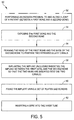
- an exemplary method is described in FIGS. 5-13 . The method comprising the following steps: performing an incision proximal to and along the joint of the patient, exposing the head of the first bone and the base of the second bone, reaming the head of the first bone and the base of the second bone to prepare two intramedullary canals including a first canal in the first bone and the second canal in the second bone.
- the method further comprises a step of implanting an implant between the head of the first bone and the base of the second bone.
- the implant comprises a body having a cylindrical portion extending from a first end to a second end, a first nub extending from the first end of the cylindrical portion, and a second nub extending from the second end of the cylindrical portion.
- the implant is inserted between the first bone and the second bone so that the two nubs of the implant are inserted into the two intramedullary canals, and two surfaces of the cylindrical portion on the first and the second ends are disposed on cortical rims of the first bone and the second bone.
- the method further comprises fixing the implant using a set of plates and screws during or after the step of implanting the implant.
- a wire for example, k-wire
- the implant is configured to fuse a metatarsophalangeal joint.
- the first bone may be a metatarsal bone.
- the second bone may be a proximal phalange in the same toe of the patient.
- the implant provided in the present disclosure provides optimal shape and size, and excellent alignment with bones, and also provides excellent biocompatibility.
- the implant allows bone growth from one end of the implant and the other end without interference of any soft tissue.
- the porous structure and/or rough surface described above promote bone ingrowth and fixation while the solid structure and smooth surface described above prevent tissue ingrowth.
- orthopedic implant devices For brevity, "orthopedic implant devices,” “implant” and the like are used interchangeably in the present disclosure. References to “prosthetic implant devices,” or “implant” made in the present disclosure will be understood to encompass any suitable device configured to fuse, fix or partially replace a joint between two bones, including but not limited to a MTP implant.
- references to “solid” or “substantially solid” are made relative to references to “porous” and “substantially porous.” Unless expressly indicated otherwise, references to “solid” or “substantially solid” made below will be understood to describe a material or structure having 0-5% by volume (e.g., 0-2% by volume) of porosity. A small amount of pores, particularly closed pores, may be embedded inside a solid or substantially solid material.
- porous or substantially porous may have pores, particularly open pores on the surface.
- the porosity on or adjacent to the surface may be higher than 5% by volume in some embodiments.
- the porosity may be in the range from 20-95% (e.g., 50-80%) by volume.
- Simagis image analysis software (Smart Imaging Technology, Houston, TX) was used to determine the percent porosity, strut diameter, interconnecting pore diameter and pore cell diameter.
- the pore size (or interconnecting pore size) was defined as the approximately circular pore opening that connects larger pore cells.
- an exemplary implant 10 comprises a body 11 (i.e. combinations of 12, 14, and 16) having a cylindrical portion 12 extending from a first end 12-1 to a second end 12-2, a first nub 14 extending from the first end 12-1 of cylindrical portion 12, and a second nub 16 extending from the second end 12-2 of cylindrical portion 12.
- Body 11 in of implant 10 may be a unitary body in some embodiments. References to “nub” are understood to describe a small part sticking out from one end of implant 10. A nub can be also referred as a "knob,” or “nugget.”
- body 11 includes an inner layer 18, an outer layer 22, and a middle layer 20.
- Inner layer 18, outer layer 22, and middle layer 20 may be made of the same material having the same chemical composition but different physical structures in some embodiments.
- Inner layer 18 has a first length (L1) extending from a tip 14-1 of the first nub 14 to a tip 16-1 of the second nub 16, and has a first central axis (C1) that is collinear with a central longitudinal axis (CL) of implant 10.
- Outer layer 22 provides an outer surface 22-1 of implant 10. As shown in FIG. 2 , inner layer 18 has an outer radius (a first radius) r1, while the outer layer 22 has an outer radius (a second radius) r2.
- the first radius r1 is smaller than the second radius r2 in some embodiments.
- outer layer 22 has a second length (L2) extending from the first end 12-1 to the second end 12-2 of cylindrical portion 12, and has a second central axis (C2) that is collinear with the central longitudinal axis (CL) of implant 10.
- the first length (L1) for inner layer 18 is longer than the second length (L2) for outer layer 22 in some embodiments.
- Inner layer 18 is cylindrical and hollow as it defines a hole 19 in the middle along the first central axis (C1) in some embodiments.
- Middle layer 20 is disposed between inner layer 18 and outer layer 22.
- Middle layer 20 comprises a porous material in some embodiments.
- the inner layer 18 and at least part of middle layer 20 collectively provide the two nubs 14, 16.
- middle layer 20 has portions protruding from the first end 12-1 and the second end 12-2 of cylindrical portion 10 to provide nubs 14, 16.
- inner layer 18 and outer layer 22 have a solid or substantially solid structure.
- inner layer 18 and outer layer 22 can be made of a material having no porosity or a porosity of less than 5% by volume (e.g., 0-2%).
- Outer layer 22 has an outer circumferential surface 22-1 that is substantially smooth, for example, having a roughness parameter smaller than 5 microns.
- Inner layer 18 has an inner circumferential surface 18-1 and two end surfaces 18-2 substantially smooth, for example, having a roughness parameter smaller than 5 microns.
- Each of inner layer 18 and outer layer 22 comprises a metal such as, for example, titanium, titanium alloy, or stainless steel to list only a few possible metals. In some embodiments, such a metal is titanium, or titanium alloy.
- each of inner layer 18 and outer layer 22 is made of pure and solid titanium, or solid titanium alloy.
- outer layer 22 has two end surfaces being rough. The end surfaces of outer layer 22 may be knurled, matted or patterned in some embodiments. The end surfaces of outer layer 22 may have some small protuberances.
- middle layer 20 comprises two portions. As best seen in FIG. 2 , the first portion 20-1 is a portion ("middle portion” or “sandwiched portion") 20-1, which extends from the first end 12-1 to the second end 12-2 of cylindrical portion 12, and is sandwiched between inner layer 18 and outer layer 22.
- the second portion is the at least one portion 20-2 of middle layer 20 providing the two nubs 14, 16.
- the at least one portion 20-2 of middle layer 20 providing nubs 14, 16 is porous.
- the outer surfaces of the at least one portion 20-2 of middle layer 20 may be rough, knurled, matted or patterned in some embodiments.
- the outer surfaces of the at least one portion 20-2 of middle layer 20 may have some small protuberances.
- the middle portion or sandwiched portion 20-1 can be porous or solid.
- the middle layer 20 is one unitary layer comprising a porous material.
- the middle layer 20 may comprise porous titanium or titanium alloy.
- the porous material of the middle layer 20 may have pores of any suitable size or ranges.
- the pore size may be in the range of from about 1 micron to about 2000 microns in diameter, for example, from about 50 microns to about 1000 microns in diameter, or in the range of from about 400 microns to about 600 microns in diameter.
- the pores can be continuous and open.
- the porosity can be in the range from about 20 % to about 90 % (e.g., from about 50 % to about 80%) by volume in some embodiments.
- the whole middle layer 20 is made of porous titanium such as, for example, BIOFOAM® material available from Wright Medical Inc, although other porous materials can be used.
- BIOFOAM® material is made of titanium and has pores, for example, of roughly 500 microns in diameter. The porosity can be up to 70% by volume.
- Such porous titanium has continuous and open pores.
- Such porous titanium may have a compression strength, for example, in the range of from about 50 to about 100 MPa.
- Middle layer 20 may have a closed nonporous structure to promote bone fixation through friction and bone ingrowth.
- middle layer 20 has at least one exposed surface having a predetermined surface roughness, which might be in any suitable range.
- the surface roughness parameter may be equal to or higher than 5 micron, or higher than 10 or 20 microns.
- the middle layer may have a region 24 with a smooth surface adjacent to the tip 14-1, 16-1 of nubs 14, 16, which is also adjacent to the end surfaces 18-2 of the inner layer 18 as best seen in FIG. 1 .
- Implant 10 described above can be used as a metatarsophalangeal (MTP) implant configured to fuse a metatarsophalangeal joint of a patient.
- MTP metatarsophalangeal
- implant 10 can be used to fuse, fix or partially replace another joint between two adjacent bones.
- the implant can be of any suitable size, which can be determined by the size of the joint and associated bones.
- Table 1 lists some examples of implants for MTP joint fusion.
- Exemplary MTP Implants of Different Sizes Example Diameter of Cylindrical portion (2*r 2 ) (mm) Length of Cylindrical Portion (L2) (mm) Length of a nub (L1-L2) (mm) Diameter of nub (D) (mm) 1 15 5 7.5 8 2 19 5 7.5 8 3 15 10 7.5 8 4 19 10 7.5 8 5 15 17 7.5 8 6 19 17 7.5 8 7 15 24 7.5 8 8 19 24 7.5 8 19 24 7.5 8
- FIG. 4 one example of a method 40 for making exemplary implant 10 is described.
- an article for an implant 10 is prepared.
- the article for implant is prepared using a suitable method, for example, using an additive manufacturing technique.
- the article can be also made through three-dimensionally (3-D) printing.
- the article is similar to or about the same as the final implant 10, with consideration of possible shrinkage in the later sintering processes.
- Computer-aided design (CAD) / Computer-aided manufacturing (CAM) technologies can be used in combination with the additive manufacturing technique.
- An exemplary implant 10 can be designed using CAD.
- a model including related design parameters can be output from a computer.
- the related design parameters for implant 10 as a final product include shape, configuration, dimensions, porosity, and surface roughness of each portion of implant 10.
- any equipment suitable for additive manufacturing of metals can be used at step 42. Physical parameters of the article implant such as porosity and density of the material in each location can be correspondingly adjusted by the additive manufacturing equipment. Examples of the material used include but are not limited a metal powder such as titanium, titanium alloy, cobalt chromium alloy or stainless steel. Examples of a suitable additive manufacturing equipment is available from, for example, EOS of Germany and Arcam of Sweden to list only two possible examples. Selective laser sintering is applied while or right after each point or portion is printed. Direct laser sintering or selective later sintering may be used. One of ordinary skill in the art will understand that other sintering methods can be used.
- the article is cleaned to remove excessive particles, which are not attached with or are loosely attached to the article.
- Step 46 may be optional, and may be performed by applying high pressure air or other gases to the surface of the article. The excessive particles can be blown away.
- the article is sintered at an elevated temperature to provide the implant 10 described above.
- a sintering can be performed in an oven or furnace.
- the heat sintering can be performed at any suitable temperature.
- the heat sintering of titanium may be performed at a temperature, for example, in the range from about 1000 to about 1500 C°.
- the temperature and time can be selected to control the physical parameters of final implant 10. Resulting implant 10 provides excellent strength and stiffness.
- the implant 10 is used to fuse a joint of a patient between a first bone 68 having a head 78 and a second bone 69 having a base 79, such as an MTP joint, although one of ordinary skill in the art will understand that implant 10 can be used to replace other joints.
- the first bone 68 is a metatarsal bone
- the second bone 69 is a proximal phalange in a same toe of the patient.
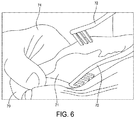
- step 52 an incision is performed proximal to and along the joint of the patient.
- FIG. 6 illustrates step 52 for a MTP joint fusion.
- a dorsal longitudinal or dorsal medial incision can be used as a surgical approach.
- the toe 70 to be operated upon can be grabbed by a hand 74 of a medical professional during the surgery.
- Tools such as retractors 72 also may be used.
- the incision can be made along a metatarsal bone.
- the incision can be made proximal to the interphalangeal joint, and extended over the dorsum of the MTP joint medial to the extensor hallucis longus (EHL) tendon.
- the incision may end on the medial aspect of the metatarsal, 2-3 cm proximal to the joint.
- FIG. 7 illustrates an exemplary MTP joint at step 54.
- Collateral ligaments in the joint capsule 71 can be incised and released to expose the base of the proximal phalanx and the metatarsal head.
- the phalanx plantarly can be also displaced before exposing the metatarsal head 78.
- Suitable tools such as retractors 76 can be used to expose the head 78.
- a K-wire (Kirschner wire) 80 is placed proximally through the center of the metatarsal head 78.
- a Cannulated AO Quick Connect can be attached to the power driver and connect a female reamer 82.
- Reamer 82 is placed over K-Wire 80 and gently ream the metatarsal head until bleeding subchondral bone becomes visible on the joint surface.
- K-wires used in the present disclosure may not be the same K-wire in each step.
- Reamer 82 is used to prepare the intramedullary canal for the nub of the implant.
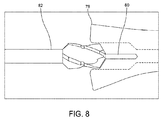
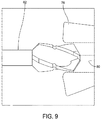
- the head 78 of the first bone 68 and the base 79 of the second bone 69 are reamed to prepare two intramedullary canals, including a first canal in the first bone 68 and the second canal in the second bone 69.
- FIGS. 8-9 illustrate step 56 during a MTP joint fusion. Bones 84 are from other toes of the same foot where the toe 70 of operation is located. Reaming of the phalanx (second bone 69) is performed in a similar fashion to the metatarsal head. To properly expose the articular surface of the phalanx 69, the phalanx 69 is elevated dorsally and distally away from the metatarsal head 78. A curved retractor can be used.
- a K-Wire 80 is again placed in the center of the articular cartilage and directed through diaphysis. Care can be taken not to remove too much bone or damage the metatarsal head 78.
- reamers for both the metatarsal and phalangeal side may have the same diameter. Either of male and female spherical reamers may be used for preparation of the MTP joint surfaces.
- implant 10 is implanted between the head of the first bone 68 and the base of the second bone 69.
- FIG. 10 illustrates the foot implanted with exemplary implant 10.
- implant 10 comprises body 11 having a cylindrical portion 12 extending from a first end 12-1 to a second end 12-2, a first nub 14 extending from the first end 12-1 of cylindrical portion 12, and a second nub 16 extending from the second end 12-2 of cylindrical portion 12. As shown in FIG.
- implant 10 is inserted between the first bone 68 and the second bone 69 so that the two nubs 14, 16 of implant 10 are inserted into the two intramedullary canals, and two end surfaces of cylindrical portion 12 on the first end 12-1 and the second end 12-2 are disposed on cortical rims of the first bone 68 and the second bone 69.
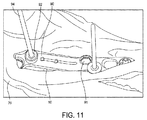
- implant 10 is fixed using a set of fusion plates 90 and screws 92 in some embodiments.
- FIG. 11 illustrates the structure after step 60. Step 60 is performed during or after step 58.
- Ancillary fixation 94 can be also used to temporarily hold the plate 90 in place through the holes 91 in the plate 90.
- a drill can be used to drill holes through the cortices of the bones.
- Fusion plate 90 can be optionally secured with one or more screws 92 in some embodiments.
- a wire for example, k-wire
- Step 62 may be optional, and may be performed during step 58 of implanting the implant 10. All K-wires are removed when plate 90 is securely fixed. Surgical closure is then performed in the normal fashion.
- FIG. 12-13 illustrate fluoroscopic images of implant 10 with plate 90 implanted in a human foot.
- FIG. 12 is a top-down view while FIG. 13 is a side view.
- the implant described herein advantageously is the optimal shape and size for the MTP joint such that the implant provides better alignment with bones, and also provides better biocompatibility.
- the implant allows bone growth from one end of the implant to the other end without interference of any soft tissue.
- the porous structure and/or rough surface described above promote bone ingrowth and fixation while the solid structure and smooth surface described above prevent tissue ingrowth.
- nubs 14, 16 of implant 10 are inserted into intramedullary canals in the metatarsal bone 68 and the base of the proximal phalange 69, and the surfaces of both ends of the middle body rests on the cortical rim of each bone.
- Solid inner layer 18 allows for easy insertion of a k-wire during the surgery and also enhances strength of the MTP implant.
- Solid outer layer of the body also prevents possible growth of soft tissue thereon.
- a set of plates and screws are used for fusion of the MTP joint in some embodiments. Fusion of this joint is most often performed for treatment of end-stage hallux rigidus, severe Hallux Valgus, rheumatoid and post-traumatic arthritis, and for revision of nonunions.
- the combination of plates and screws provides for a very stiff and stable construct, and ensures that the hallux is fused in proper anatomic alignment.
- Exemplary method 50 provides rapid fusion of the joint without excessive shortening of the toe or removal of structural bone, and correct orientation of the MTP joint for natural gait biomechanics and footwear comfort. Exemplary method 50 also enables a high fusion rate and early return to function by creating a very stable fusion construct.
Landscapes
- Health & Medical Sciences (AREA)
- Orthopedic Medicine & Surgery (AREA)
- Engineering & Computer Science (AREA)
- Heart & Thoracic Surgery (AREA)
- Life Sciences & Earth Sciences (AREA)
- Veterinary Medicine (AREA)
- Cardiology (AREA)
- Oral & Maxillofacial Surgery (AREA)
- Transplantation (AREA)
- Biomedical Technology (AREA)
- Public Health (AREA)
- Vascular Medicine (AREA)
- General Health & Medical Sciences (AREA)
- Animal Behavior & Ethology (AREA)
- Physics & Mathematics (AREA)
- Optics & Photonics (AREA)
- Manufacturing & Machinery (AREA)
- Plasma & Fusion (AREA)
- Mechanical Engineering (AREA)
- Geometry (AREA)
- Prostheses (AREA)
- Surgical Instruments (AREA)
Applications Claiming Priority (1)
| Application Number | Priority Date | Filing Date | Title |
|---|---|---|---|
| US14/828,817 US20170049576A1 (en) | 2015-08-18 | 2015-08-18 | Joint implant, method of making and surgical procedure for implanting the same |
Publications (1)
| Publication Number | Publication Date |
|---|---|
| EP3141221A1 true EP3141221A1 (fr) | 2017-03-15 |
Family
ID=56137235
Family Applications (1)
| Application Number | Title | Priority Date | Filing Date |
|---|---|---|---|
| EP16175197.9A Withdrawn EP3141221A1 (fr) | 2015-08-18 | 2016-06-20 | Implant et procédé de fabrication d'un tel implant |
Country Status (7)
| Country | Link |
|---|---|
| US (1) | US20170049576A1 (fr) |
| EP (1) | EP3141221A1 (fr) |
| JP (1) | JP2017038918A (fr) |
| CN (1) | CN106466204A (fr) |
| AU (1) | AU2016204218A1 (fr) |
| BR (1) | BR102016014943A2 (fr) |
| CA (1) | CA2933090A1 (fr) |
Families Citing this family (8)
| Publication number | Priority date | Publication date | Assignee | Title |
|---|---|---|---|---|
| US10376268B2 (en) | 2015-02-19 | 2019-08-13 | First Ray, LLC | Indexed tri-planar osteotomy guide and method |
| US11364128B2 (en) * | 2017-06-12 | 2022-06-21 | Medline Industries, Lp | Arthritis plate |
| US11407034B2 (en) | 2017-07-06 | 2022-08-09 | OmniTek Technology Ltda. | Selective laser melting system and method of using same |
| US20210145596A1 (en) * | 2018-12-04 | 2021-05-20 | Beijing Chunlizhengda Medical Instruments Co., Ltd | Toe joint prosthesis and manufacturing method therefor |
| US11058546B2 (en) * | 2019-07-26 | 2021-07-13 | Crossroads Extremity Systems, Llc | Bone repositioning guide system and procedure |
| US12402915B2 (en) | 2019-08-07 | 2025-09-02 | Crossroads Extremity Systems, Llc | Bunion correction system and method |
| JP7639014B2 (ja) | 2020-02-19 | 2025-03-04 | クロスローズ エクストリミティ システムズ リミテッド ライアビリティ カンパニー | ラピダスバニオン修復法のためのシステム及び方法 |
| US12521157B1 (en) * | 2024-07-12 | 2026-01-13 | Forma Medical, Inc. | System for joint fixation of extremity bone and related methods |
Citations (3)
| Publication number | Priority date | Publication date | Assignee | Title |
|---|---|---|---|---|
| EP0454645A1 (fr) * | 1990-04-23 | 1991-10-30 | Medevelop Ab | Mécanisme d'articulation artificielle |
| US20020169066A1 (en) * | 2001-04-16 | 2002-11-14 | Cerabio, L.L.C. | Dense porous structures for use as bone substitutes |
| US20050123672A1 (en) * | 2003-12-03 | 2005-06-09 | Justin Daniel F. | Laser based metal deposition of implant structures |
Family Cites Families (5)
| Publication number | Priority date | Publication date | Assignee | Title |
|---|---|---|---|---|
| EP0057597B1 (fr) * | 1981-01-30 | 1985-06-26 | Oec Europe Limited | Prothèse d'articulation |
| US5491882A (en) * | 1993-12-28 | 1996-02-20 | Walston; D. Kenneth | Method of making joint prosthesis having PTFE cushion |
| US20060241763A1 (en) * | 1998-08-03 | 2006-10-26 | Synthes (Usa) | Multipiece bone implant |
| WO2014124453A2 (fr) * | 2013-02-11 | 2014-08-14 | Brian Burkinshaw | Implant de disque vertébral unitaire |
| CN204293313U (zh) * | 2014-11-19 | 2015-04-29 | 重庆德固科技有限公司 | 一种人造骨头 |
-
2015
- 2015-08-18 US US14/828,817 patent/US20170049576A1/en not_active Abandoned
-
2016
- 2016-06-14 CA CA2933090A patent/CA2933090A1/fr not_active Abandoned
- 2016-06-17 CN CN201610440447.XA patent/CN106466204A/zh active Pending
- 2016-06-20 EP EP16175197.9A patent/EP3141221A1/fr not_active Withdrawn
- 2016-06-21 AU AU2016204218A patent/AU2016204218A1/en not_active Abandoned
- 2016-06-21 JP JP2016122459A patent/JP2017038918A/ja active Pending
- 2016-06-24 BR BR102016014943A patent/BR102016014943A2/pt not_active Application Discontinuation
Patent Citations (3)
| Publication number | Priority date | Publication date | Assignee | Title |
|---|---|---|---|---|
| EP0454645A1 (fr) * | 1990-04-23 | 1991-10-30 | Medevelop Ab | Mécanisme d'articulation artificielle |
| US20020169066A1 (en) * | 2001-04-16 | 2002-11-14 | Cerabio, L.L.C. | Dense porous structures for use as bone substitutes |
| US20050123672A1 (en) * | 2003-12-03 | 2005-06-09 | Justin Daniel F. | Laser based metal deposition of implant structures |
Non-Patent Citations (1)
| Title |
|---|
| FDA'S GUIDANCE: ''GUIDANCE DOCUMENT FOR TESTING ORTHOPEDIC IMPLANTS WITH MODIFIED METALLIC SURFACES APPOSING BONE OR BONE CEMENTS, 1994 |
Also Published As
| Publication number | Publication date |
|---|---|
| AU2016204218A1 (en) | 2017-03-09 |
| JP2017038918A (ja) | 2017-02-23 |
| BR102016014943A2 (pt) | 2017-02-21 |
| US20170049576A1 (en) | 2017-02-23 |
| CA2933090A1 (fr) | 2017-02-18 |
| CN106466204A (zh) | 2017-03-01 |
Similar Documents
| Publication | Publication Date | Title |
|---|---|---|
| EP3141221A1 (fr) | Implant et procédé de fabrication d'un tel implant | |
| JP6916290B2 (ja) | モジュール式増強コンポーネント | |
| EP2772230B1 (fr) | Prothèse de fusion pour l'axis | |
| US20180263782A1 (en) | Methods and Devices Related to Patient-Adapted Hip Joint Implants | |
| US20150250597A1 (en) | Methods and devices related to patient-adapted hip joint implants | |
| US20160256279A1 (en) | Patient-Specific Implant for Bone Defects and Methods for Designing and Fabricating Such Implants | |
| WO2013131493A1 (fr) | Prothèse artificielle du sacrum | |
| CN105263446A (zh) | 与适用于患者的髋关节植入物相关的系统、方法和装置 | |
| CN110312479B (zh) | 用于骨折固定的阶梯钉 | |
| CN102429747A (zh) | 寰椎融合假体 | |
| US20170056190A1 (en) | Subtalar biofoam wedge | |
| JP2004261568A (ja) | 調節可能な整形外科用器具 | |
| CA3192039A1 (fr) | Implant pour defauts astragaliens focaux et methode | |
| US10285816B2 (en) | Implant including cartilage plug and porous metal | |
| CN107174325A (zh) | 脊柱固定组件 | |
| CN107510521A (zh) | 骶髂关节融合器 | |
| RU2622608C1 (ru) | Способ пластики костных дефектов при эндопротезировании тазобедренного и коленного суставов | |
| KR102276963B1 (ko) | 다중 다공성 구조를 가지는 임플란트 및 그 제작방법 | |
| US20250339282A1 (en) | Porous-based talus reconstruction prosthesis and associated method | |
| RU191493U1 (ru) | Аугмент для замещения краевых костных дефектов коленного сустава | |
| CN107468382A (zh) | 足踝关节融合器 | |
| US20160262898A1 (en) | Tibial implant for use in knee arthroplasty |
Legal Events
| Date | Code | Title | Description |
|---|---|---|---|
| PUAI | Public reference made under article 153(3) epc to a published international application that has entered the european phase |
Free format text: ORIGINAL CODE: 0009012 |
|
| 17P | Request for examination filed |
Effective date: 20160620 |
|
| AK | Designated contracting states |
Kind code of ref document: A1 Designated state(s): AL AT BE BG CH CY CZ DE DK EE ES FI FR GB GR HR HU IE IS IT LI LT LU LV MC MK MT NL NO PL PT RO RS SE SI SK SM TR |
|
| AX | Request for extension of the european patent |
Extension state: BA ME |
|
| STAA | Information on the status of an ep patent application or granted ep patent |
Free format text: STATUS: THE APPLICATION IS DEEMED TO BE WITHDRAWN |
|
| 18D | Application deemed to be withdrawn |
Effective date: 20170916 |