EP3141262B1 - Reduktion der in-vitro-genotoxizität von pollenextrakten durch entfernung von flavonoiden - Google Patents
Reduktion der in-vitro-genotoxizität von pollenextrakten durch entfernung von flavonoiden Download PDFInfo
- Publication number
- EP3141262B1 EP3141262B1 EP16184996.3A EP16184996A EP3141262B1 EP 3141262 B1 EP3141262 B1 EP 3141262B1 EP 16184996 A EP16184996 A EP 16184996A EP 3141262 B1 EP3141262 B1 EP 3141262B1
- Authority
- EP
- European Patent Office
- Prior art keywords
- pollen
- grass
- extract
- flavonoid
- quercetin
- Prior art date
- Legal status (The legal status is an assumption and is not a legal conclusion. Google has not performed a legal analysis and makes no representation as to the accuracy of the status listed.)
- Active
Links
Images

Classifications
-
- A—HUMAN NECESSITIES
- A61—MEDICAL OR VETERINARY SCIENCE; HYGIENE
- A61K—PREPARATIONS FOR MEDICAL, DENTAL OR TOILETRY PURPOSES
- A61K39/00—Medicinal preparations containing antigens or antibodies
- A61K39/35—Allergens
- A61K39/36—Allergens from pollen
-
- A—HUMAN NECESSITIES
- A61—MEDICAL OR VETERINARY SCIENCE; HYGIENE
- A61K—PREPARATIONS FOR MEDICAL, DENTAL OR TOILETRY PURPOSES
- A61K36/00—Medicinal preparations of undetermined constitution containing material from algae, lichens, fungi or plants, or derivatives thereof, e.g. traditional herbal medicines
-
- A—HUMAN NECESSITIES
- A61—MEDICAL OR VETERINARY SCIENCE; HYGIENE
- A61P—SPECIFIC THERAPEUTIC ACTIVITY OF CHEMICAL COMPOUNDS OR MEDICINAL PREPARATIONS
- A61P37/00—Drugs for immunological or allergic disorders
- A61P37/02—Immunomodulators
Definitions
- the invention relates to grass pollen extracts containing reduced amount of flavonoid glycosides in order to minimize the risks of genotoxicity of the grass pollen extracts.
- the application also describes a method of preparing grass pollen extracts containing reduced amount of flavonoid glycosides by ultrafiltration. Flavonoid glycosides are naturally present in grass pollen extracts and they have been identified as being the sources of flavonoid aglycones, which are genotoxic in vitro, under the influence of enzymes contained in the grass pollen extracts.
- freeze-dried pollen extracts exhibited no genotoxicity in vivo in two different assays, to preclude any putative risk, the causative agent for the in vitro genotoxicity was sought.
- flavonoids were detected in the grass pollens, in the form of flavonoid glycosides.
- the latter are not known to be genotoxic in vitro but flavonoid aglycones are.
- Flavonoids have been previously reported to be tightly adsorbed to protein by physical and chemical interactions within tree, grass, herbaceous and flowering plant pollen extracts.
- the patent US 5,770,698 described removal of non-allergenic undesirable compounds from aqueous pollen extracts by means of disrupting electrostatic forces, hydrophobic or other physical forces, in particular by using acid or alkaline materials, salts and electric currents (electrophoresis). Removal of flavonoids and/or glycosides was more specifically contemplated as these compounds were described as likely to modulate the normal biological response of mast cells, basophils, polymorphonuclear leucocytes and neutrophils. In particular, the flavonoids which are firmly adsorbed to proteins were described to resist simple dialysis or ultrafiltration at neutral pH through membrane of 10 kDa nominal cut-off.
- the amount of flavonoids administered with a 300-IR tablet/day made of grass pollen extracts obtained using the optimized ultrafitration step would lead to a theoretical daily intake below 0.15 ⁇ g of pollen-derived flavonoids (as expressed in flavonol diglucoside).
- the daily intake of flavonoids through common diet is of 20 mg to 1 g ( Middleton E Jr, Kandaswami C, Theoharides TC. Pharmacol. Rev. 2000; 52: 673-751 ).
- allergens include pollen allergens (such as tree, herb, weed, and grass pollen allergens), insect allergens (such as saliva and venom allergens, e.g., cockroach and midges allergens, hymenopthera venom allergens), mite allergens, animal allergens (from e.g. dog, cat, horse, rat, mouse etc.), and food allergens.
- pollen allergens such as tree, herb, weed, and grass pollen allergens
- insect allergens such as saliva and venom allergens, e.g., cockroach and midges allergens, hymenopthera venom allergens
- mite allergens e.g. dog, cat, horse, rat, mouse etc.
- food allergens from e.g. dog, cat, horse, rat, mouse etc.
- Important pollen allergens are such allergen of the genus Ambrosia ; allergen of the genus Lolium ; allergen of the genus Cryptomeria ; allergen of the genus Alternaria ; allergen of the genus Alder ; allergen of the genus Betula ; allergen of the genus Quercus ; allergen of the genus Olea ; allergen of the genus Artemisia ; allergen of the genus Plantago ; allergen of the genus Parietaria ; allergen of the genus Cupressus ; allergen of the genus Thuya ; allergen of the genus Chamaecyparis ; allergen of the genus Periplaneta ; allergen of the genus Agropyron ; allergen of the genus Secale ; allergen of the genus Triticum ; allergen of the genus Cynorhodon ; allergen of
- Examples of various known pollen allergens derived from some of the above-identified genus include : Cynorhodon Cyn d 1; Ambrosia ( artemisiifolia ) Amb a 1; Amb a 2; Amb a 3; Amb a 4; Lolium ( perenne ) Lol p 1; Lol p 2; Lol p 3; Lol p 4; Lol p 5; Lol p 9; Cryptomeria ( japonica ) Cry j 1; Cry j 2; Cry j 3; Juniperus ( sabinoides ou virginiana ) Jun s 1; Jun v 1; Juniperus ( ashei ) Jun a 1; Jun a 2; Dactylis ( glomerata ) Dac g 1; Dac g 5; Poa ( pratensis ) Poa p 1; Poa p 5; Phleum ( pratense ) Phl p 1; Phl
- Preferred allergens include : Blomia tropicalis Blo t 1; Blo t 3; Blo t 5; Blo t 12; Dermatophagoides ( pteronyssinus or farinae ) Der p 1; Der p 2; Der p 3; Der p 5; Der p 7; Der f 1; Der f 2; Der f 3; Der f 5; Der f 7; Felis ( domesticus ) Fel d 1; Canis (familiaris) Can f 1; Can f 2; Blattella ( germanica ) Bla g 1; Bla g 2.
- to treat means reversing, alleviating, or inhibiting the course of a pathological reaction of the immune system or one or more symptoms thereof.
- to prevent means the onset of a pathological reaction of the immune system or one or more symptoms thereof.
- Pollen raw materials, and pollen extracts were found to be genotoxic in vitro in a MLA/TK test when using a continuous 24-h treatment without metabolic activation ("S9-").
- Flavonoids were identified by the inventors as the agents responsible for this genotoxic activity in vitro.
- the application thus describes a method of reducing in vitro genotoxicity of a pollen extract which comprises the step consisting of reducing the amount of a flavonoid in the pollen extract.
- the flavonoid may be at least one flavonoid aglycone or at least one flavonoid glycoside, preferably at least one flavonoid glycoside.
- the flavonoid glycoside may be in particular a glycosylated form of flavone, rhamnetin, isorhamnetin, kaempferol, or quercetin.
- the method of reducing in vitro genotoxicity comprises reducing the amount of isorhamnetin-diglucoside, quercetin-diglucoside and kaempferol-diglucoside in the pollen extract.
- the method of reducing in vitro genotoxicity comprises reducing the amount of isorhamnetin-glucoside, quercetin-glucoside, kaempferol-glucoside, isorhamnetin-malonuyl-glucoside, quercetin-malonuyl-glucoside, and kaempferol-malonuyl-glucoside.
- reducing the amount of a flavonoid in the pollen extract is meant for a detectable reduction of the quantity of at least one flavonoid in the pollen extract, e.g. by at least 2-fold, preferably 10-fold, 20-fold, 50-fold, 100-fold, 200-fold or 300-fold.
- flavonoids are completely removed from the pollen extract, i.e. they are removed to an extent such that their quantity or concentration is below the detection limits.
- the amount of each flavonoid in the pollen extract is below 0.002%, preferably 0.001%, expressed in weight of flavonoid on the weight of pollen derived fraction (i.e. 0.002 g, preferably 0.001 g, of flavonoid per 100 g of pollen derived fraction), the amount of flavonoid being expressed in aglycone equivalent.
- the pollen may be a mixture of tree pollens, or a mixture of grass pollens, or a mixture of herb pollens, or a mixture of weed pollens, or a mixture of tree and/or grass and/or herb and/or weed pollens.
- the pollen extract may then be an extract of these pollen mixtures.
- a pollen extract contains pollen allergens.
- the pollen extract is an extract of a mixture consisting of, or comprising, cocksfoot, meadow-grass, rye-grass, sweet vernal-grass and timothy grass pollens.
- Preferably removal of flavonoids is performed by ultrafiltration of pollen extract(s) with water, preferably containing ammonium bicarbonate.
- the above method of reducing in vitro genotoxicity of a pollen extract advantageously leads to pollen extracts having a amount of each flavonoid below 0.002%, expressed in weight of flavonoid on the weight of pollen derived fraction (i.e. below 0.002 g of flavonoid per 100 g of pollen derived fraction), the amount of flavonoid being expressed in flavonoid equivalents.
- each flavonoid is contained in amount which is less than 0.002 g per 100 g of pollen derived fraction, as expressed in aglycone equivalent
- each flavonoid is contained in amount which is less than 0.001 g per 100 g of pollen derived fraction, as expressed in aglycone equivalent.
- the purified pollen extract is essentially devoid of flavonoids and, as a consequence, does no longer exhibit in vitro genotoxicity in the MLA/TK test.
- the purified pollen extract according to the invention may be formulated in the form of a pharmaceutical composition, together with a pharmaceutically acceptable carrier.
- Such purified pollen extract optionally provided in the form of a pharmaceutical composition, may advantageously be used for treating and/or preventing pollen allergy, by desensitisation, while minimising the risk of induced genotoxicity in the patient receiving the treatment.
- the application thus describes a purified pollen extract wherein each flavonoid is contained in amount which is less than 0.002 g, preferably less than 0.001 g, per 100 g of pollen derived fraction, as expressed in aglycone equivalent, for use for treating and/or preventing a pollen allergy, in particular for pollen allergy desensitisation.
- This pollen allergy treatment or prevention is associated with reduced risk of genotoxicity.
- the application also describes to a method of treating and/or preventing a pollen allergy, in particular a method of pollen allergy desensitisation, which method comprises repeatedly administering a patient in need thereof with a purified pollen extract wherein each flavonoid is contained in amount which is less than 0.002 g preferably less than 0.001 g, per 100 g of pollen derived fraction, as expressed in aglycone equivalents.
- Administration of the pollen extract or pharmaceutical composition may be maintained for instance for a period of less than 6 weeks to more than 3 years.
- the pollen allergy may be a tree pollen allergy, a grass pollen allergy, a herb pollen allergy, a weed pollen allergy, or combined allergies.
- a tree pollen extract is used to treat a tree pollen allergy
- a grass pollen extract is used to treat a grass pollen allergy
- a weed pollen extract is used to treat a weed pollen allergy
- an herb pollen extract is used to treat an herb pollen allergy.
- Purified allergen extracts in particular purified pollen extracts and mite extracts, have been previously prepared by extracting the allergens from pollen or house dust mite raw material with an aqueous solution, followed by separation, clarification by filtration, concentration and ultrafiltration on a 1-kDa membrane with washing with 2.5 volumes of purified water.
- the optimized ultrafiltration method enables to remove flavonoid below detectable limits.
- the same method was applied to purify mite allergens, in particular house dust mite allergens, and enabled to increase the level of purity of the allergen preparation.
- the optimized ultrafiltration method should find general application in the purification of any allergen extracts, i.e. pollen (tree-, grass-, herb-, weed-), insect, venom allergens, mite, animal, and food allergens, venom allergens.
- allergen extracts i.e. pollen (tree-, grass-, herb-, weed-), insect, venom allergens, mite, animal, and food allergens, venom allergens.
- the method of preparing purified allergen extract may comprise a step of ultrafiltration of an aqueous allergen extract on a 1-10 kDa membrane with at least 5 volumes of purified water.
- the application describes a method of preparing purified allergen extract, which method comprises a step of ultrafiltration of an aqueous allergen extract on a 1-10 kDa membrane with at least 5 volumes of an aqueous solution selected from the group consisting of purified water and a buffered solution, such as an ammonium bicarbonate solution and a phosphate buffered solution.
- said ultrafiltration may be performed on a 2-10 kDa, preferably 5-10 kDa membrane, with at least 10 volumes of said aqueous solution.
- at most 30 volumes of aqueous solution may be used.
- the number of volumes of aqueous solution used for ultrafiltration is expressed by reference to the volume of aqueous allergen extract loaded on the membrane.
- the ultrafiltration step is performed with a 2-10 kDa membrane, preferably a 5-10 kDa membrane, still preferably with a 5 kDa membrane.
- aqueous solution is purified water
- aqueous solution is ammonium bicarbonate solution or another buffered solution such as phosphate buffered solution
- up to 30 volumes of solution may be used without detrimental effect on the allergenicity of the preparation. Higher volumes could be used, but without significant gain in term of extent of purification. Therefore, it is preferred that 10 to 30 volumes, preferably 10 to 20, still preferably 10 to 15 volumes, most preferably 11, 12, 13, 14 or 15 volumes of ammonium bicarbonate solution be used for ultrafiltration.
- ultrafiltration of said aqueous allergen extract is performed on a 5 kDa membrane with 15 volumes of a 0.56 g/L ammonium bicarbonate solution.
- the allergen extract is preferably a mixture of pollen extracts consisting of, or comprising, cocksfoot, meadow grass, rye-grass, sweet vernal-grass and timothy grass extracts.
- the method of preparing purified allergen extract may further comprise a step of filtration on a 0.22 ⁇ m filter.
- the method of preparing purified allergen extract may also further comprise a step of formulating said purified pollen extract into a pharmaceutical composition.
- the application further discloses a purified allergen extract which is obtainable by the method of preparing purified allergen extract.
- composition comprising a purified allergen extract, which pharmaceutical composition is obtainable by the method of preparing purified allergen extract and formulating said purified pollen extract into a pharmaceutical composition.
- the pharmaceutical composition is a tablet for use for sublingual allergy desensitisation.
- pharmaceutically acceptable carrier includes any and all solvents, dispersion media, coatings, antibacterial and antifungal agents, isotonic and absorption delaying agents and the like. The use of such media and agents for pharmaceutical active substances is well known in the art.
- the pharmaceutical compositions can include any conventional vaccination adjuvant, including heat-labile enterotoxin (LT), cholera-toxin (CT), cholera toxin B subunit (CTB), polymerised liposomes, mutant toxins.
- LT heat-labile enterotoxin
- CT cholera-toxin
- CTB cholera toxin B subunit
- polymerised liposomes mutant toxins.
- the adjuvants may preferably be a Bifidobacterium, a lactic acid bacterium (either in the form of a cell suspension, freeze-dried cells, a lysate, purified sub-components, or purified molecules), or a combination of a corticosteroid with vitamin D3 or any metabolite or analog of the latter.
- the cross-linked polysaccharide may be derived from any saccharide monomers, preferably glucose.
- the polysaccharides preferably have a molecular weight between 2,000 to 100,000 daltons, and most preferably 3,000 to 10,000 daltons.
- Preferred polysaccharides are starch (glucose alpha 1-4 polymers) and dextran (glucose alpha 1-6 polymers derived from bacteria), or hydrolysates thereof such as dextrins or maltodextrins.
- Ionic groups i.e. anionic (e.g. sulfate or carboxylate) or cationic groups (e.g. quaternary ammonium ions, and primary, secondary, or tertiary amines) are optionally grafted to the core of cross-linked polysaccharide (preferably 0 to 3 milliequivalents, more preferably 0 to 2 milliequivalents, of ionic charge per gram).
- the diameter of the particle may be comprised between 10 nm and 5 ⁇ m and preferably between 20 and 200 nm.
- the pharmaceutical composition is to be administered by the mucosal route, more preferably by the oromucosal route, and most preferably by the sublingual route.
- the pharmaceutical composition and the medicament are preferably formulated in a way adapted for such administration routes.
- Mucosal administration denotes any administration method, wherein the formulation in part or in full comes into contact with a mucosa.
- Mucosa refers to the epithelial tissue that lines the internal cavities of the body.
- the mucosal surface may be selected from the group consisting of a nasal, buccal, oral, vaginal, ocular, auditory, pulmonary tract, urethral, digestive tract, and rectal surface.
- Oromucosal administration comprises any administration method, wherein the formulation in part or in full comes into contact with the mucosa of the oral cavity and/or the pharynx of the patient. It includes in particular sublingual, perlingual (i.e. through the tongue mucosa) and oral administrations.
- the pharmaceutical composition is formulated in the form of a tablet for sublingual administration.
- the pharmaceutical composition comprises an extract of a mixture of pollens consisting of, or comprising, cocksfoot, meadow-grass, rye-grass, sweet vernal-grass and timothy grass pollens.
- Example 1 Raw materials and initial process (i.e. non modified process) of preparing pollen extract
- Raw materials consisted of defatted pollen of cocksfoot, meadow grass, rye-grass, sweet vernal-grass and timothy grass.
- the process of purification used to prepare purified pollen extract, or purified mixture of pollen extracts typically comprise the steps of:
- the purified pollen extract is then typically freeze-dried and formulated into an appropriate pharmaceutical composition, e.g. a tablet.
- grass pollen raw materials and extracts must be explained by grass pollen intrinsic substance(s) only.
- flavonoids Two forms of flavonoids can be distinguished:
- grass pollen raw materials or extracts were processed using organic solvents (hexane, methanol%) and were allowed to migrate into a silica gel in a solvent mixture specific for the coumpound to be tested.
- flavonoids bands were observed in every single grass pollen species using a protocol aimed at detecting flavonoid glycosides. Conversely, flavonoid aglycones could not be found in grass pollen using the appropriate protocol.
- flavonoids found in grass pollens were flavonoid glycosides only, as no flavonoid aglycones could be detected. This is consistent with published data since the most common flavonoids isolated from pollen are flavonoid glycosides whereas aglycones do not occur naturally in pollen ( Mo Y, Nagel C, Taylor LP. Proc. Natl. Acad. Sci. USA. 1992; 89: 7213-7217 ; Campos MG, Webby RF, Markham KR. Z. Naturforsch. [C]. 2002; 57: 944-946 ).
- HCl-hydrolysis prior to reverse phase HPLC analysis was also used since hydrolysis of flavonoid glycosides leads to deglycosylation. HPLC analysis of the deglycosylated molecules then allows identifying their aglycone moieties.
- flavonoids of a grass pollen crude extract were first purified on Amberlite XAD-2, a resin currently used for flavonoid isolation ( Gil MI, Ferreres F, Francisco A. Tottle-Barberán FA. J. Agric. Food Chem. 1998; 46: 2007-2012 ; D'Arcy BR.
- Antioxidants in Australian floral honeys Identification of health-enhancing nutrient components: a report for the Rural Industries Research and Development Corporation.
- Flavonoid aglycone and flavonoid glycoside stantards were purchased from Extrasynthese (Genay, France).
- Reverse phase HPLC indicated that an extract of 5 grass pollens contain: 1. a majority of highly polar flavonoids, appearing as peaks n°1 and n°22. small amounts of moderately polar flavonoids, appearing as peaks n°3, 4 and 53. no detectable flavonoid aglycones. Retention times were as follows : peak n°1 14.975, peak n°2 15.151, peak n°3 15.449, peak n°4 16.022, peak n°5 16.365, peak n°6 17.117 (absorbance at 354 nm).
- peaks n°1 and n°2 represent more than 90% of the overall detected flavonoids within grass pollen. As a consequence identification was focused on the components of peaks n°1 and 2.
- the main flavonoids of grass pollen extract (peaks n°1 and n°2) were probably flavonoid diglycosides.
- the observed RT did not correspond to any of the flavonoid standards we tested (flavone, rhamnetin, isorhamnetin, kaempferol, quercetin, quercetin-4'-O-glucoside, isorhamnetin-3-O-glucoside, kaempferol-3-O-glucoside, quercetin-3-O-galactoside, quercetin-3-O-glucoside, kaempferol-3-O-glucorhamnoside, quercetin-3-O-glucorhamnoside, kaempferol-3-O-robinoside-7-O-rhamnoside), the main flavonoids of grass pollen extracts could not be identified at this stage.
- a deglycosylation was performed by HCl-hydrolysis of flavonoids purified from a grass pollen crude extract.
- HCl-hydrolysis released quercetin, kaempferol and isorhamnetin.
- the flavonoids of grass pollen extracts were glycosylated forms of quercetin, kaempferol and isorhamnetin.
- the flavonoid aglycones produced by HCl-hydrolysis of a grass pollen extract are composed of 18% quercetin, 5% kaempferol and 77% isorhamnetin.
- flavonoid glycosides According to data obtained from commercially available standards, mass spectra of flavonoid glycosides are easily interpretable: electrospray fragmentation leads mainly to the loss of part or all of their glycoside moiety(ies).
- all tested flavonoid glucosides (kaempferol-3-O-glucoside, quercetin-3-O-glucoside, isorhamnetin-3-O-glucoside, quercetin-3-O-glucorhamnoside, and kaempferol- 3-O-robinoside-7 -O-rhamnoside) loose a 120-Dalton part of the glucose or the whole 163-Dalton glucose moiety during fragmentation.
- Kaempferol-3, 4'-diglucoside has already been described in pollen, namely in pollen of Trillium species ( Yoshitama K, Tominaga T, Kanemaru Y, Yahara S. XVI Internationl Botanical Congress, Abstract n°2539 ). Quercetin-3, 4'-diglucoside has also been described in plants, namely in onion ( Bonaccorsi P, Caristi C, Gargiulli C, Leuzzi U. J. Agric. Food Chem. 2005; 53: 2733-2740 ; Mullen W, Crozier A. J. Oil Palm Res. 2006; Special Issue (April): 65-80 ). However, to our knowledge this is the first time quercetin-3, 4'-diglucoside is described in pollens.
- the 464-Da molecule might be quercetin-monoglycoside. This is confirmed by the fragment ion at m / z 301, corresponding to quercetin.
- the presence of quercetin-monoglycoside in peak n°1 is surprising, as standard quercetin-monoglycosides display longer retention. Quercetin-monoglycoside of peak n°1 might be complexed to other components of this peak, thus sharing the same retention time. It might also be produced by alteration of peak n°1's quercetin-diglucoside during the purification steps. Anyhow, according to the mass spectrum this component of peak n°1 is quantitatively less important than quercetin- and kaempferol-diglucoside.
- HPLC-DAD Quantification of isorhamnetin, quercetin and kaempferol obtained after HCl-hydrolysis was performed by HPLC-DAD.
- the flavonoid aglycones are separated by HPLC and detection is performed using a diode-array detector (or DAD). This allows recording the absorption spectrum in the ultraviolet range.
- DAD diode-array detector
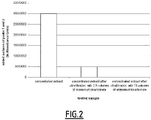
- freeze-dried extracts of 5 grass pollens obtained using the non-optimized ultrafiltration step contain 0.36% (w/w) of flavonoid diglucosides.
- the short term and long term protocols of the MLA/TK test involves incubation for 3 h at 37°C and incubation for 24 h at 37°C, respectively.
- a crude extract of grass pollen was placed at 37°C and then sampled after 3 h and 24 h incubations. Samples were kept frozen until analyzed for their contents in flavonoid glycosides and flavonoid aglycones.
- grass pollen flavonoids were separated from grass pollen proteins by purification on Amberlite XAD-2 resin ( Gil MI, Ferreres F, Francisco A. Tottle-Barberán FA. J. Agric. Food Chem. 1998 ; 46: 2007-2012 ; D'Arcy BR. D'Arcy BR, Barton, A.C.T. : rural Industries Research and Development Corporation, 2005, 84 p ) and then analyzed before and after a 24-h incubation at 37°C.
- a 16.4-min RT corresponds to quercetin monoglucoside and a 17.1-min RT corresponds to both kaempferol- and isorhamnetin-monoglucosides. Therefore, the increase of the two peaks is most likely a consequence of a partial deglycosylation of flavonoid-diglucosides into flavonoid-monoglucosides.
- the decrease in flavonoid diglucosides after a 24-h incubation at 37°C was in the order of -40%. Since about half of the quercetin-diglucoside was transformed into quercetin aglycone, this means that -20% of quercetin-diglucoside was transformed into quercetin (aglycone) under the conditions of the 24 h-long term protocol of the MLA/TK test.
- the induction ratio y is of 1 for a quercetin concentration x of 0.
- flavonoids were accurately quantified in three batches of sieved freeze-dried extract obtained using the optimized ultrafiltration step. Quantification was performed by HPLC-DAD after HCl-hydrolysis.
Landscapes
- Health & Medical Sciences (AREA)
- Life Sciences & Earth Sciences (AREA)
- Public Health (AREA)
- General Health & Medical Sciences (AREA)
- Chemical & Material Sciences (AREA)
- Veterinary Medicine (AREA)
- Medicinal Chemistry (AREA)
- Pharmacology & Pharmacy (AREA)
- Animal Behavior & Ethology (AREA)
- Microbiology (AREA)
- Epidemiology (AREA)
- Mycology (AREA)
- Immunology (AREA)
- Engineering & Computer Science (AREA)
- Medical Informatics (AREA)
- Botany (AREA)
- Biotechnology (AREA)
- Alternative & Traditional Medicine (AREA)
- Natural Medicines & Medicinal Plants (AREA)
- Organic Chemistry (AREA)
- General Chemical & Material Sciences (AREA)
- Bioinformatics & Cheminformatics (AREA)
- Nuclear Medicine, Radiotherapy & Molecular Imaging (AREA)
- Chemical Kinetics & Catalysis (AREA)
- Medicines Containing Antibodies Or Antigens For Use As Internal Diagnostic Agents (AREA)
- Medicines Containing Plant Substances (AREA)
- Medicines That Contain Protein Lipid Enzymes And Other Medicines (AREA)
- Jellies, Jams, And Syrups (AREA)
- Pharmaceuticals Containing Other Organic And Inorganic Compounds (AREA)
- Saccharide Compounds (AREA)
Claims (5)
- Ein gereinigter Pollenextrakt, enthaltend Pollenallergene, wobei jedes Flavonoid in einer Menge enthalten ist, die weniger als 0,001 g pro 100 g von der getrockneten Pollen stammenden Fraktion beträgt, wie in Aglycon-Äquivalent angegeben, wobei der gereinigte Pollenallergenextrakt durch ein Verfahren erhältlich ist, das einen Ultrafiltrationsschritt eines wässrigen Pollenallergenextrakts auf einer 1-10 kDa-Membran mit mindestens 5 Volumen einer Ammoniumbicarbonatlösung und einen Sterilfiltrationsschritt auf einem 0,22 µm Filter umfasst.
- Der gereinigte Pollenextrakt gemäß Anspruch 1, wobei der Pollenextrakt eine Mischung ist, bestehend aus oder umfassend Hahnenfuß-, Wiesengras-, Roggengras-, gewöhnliches Ruchgras- und Wiesen-Lieschgrasextrakt.
- Ein gereinigter Pollenallergenextrakt gemäß Anspruch 1 oder 2, wobei die Ultrafiltration des Pollenallergenextrakts in dem Verfahren des Herstellens des gereinigten Pollenallergenextrakts auf einer 5-10 kDa-Membran mit 10 bis 30 Volumen einer 0,4 g/L bis 0,8 g/L Ammoniumbicarbonatlösung durchgeführt wird.
- Eine pharmazeutische Zusammensetzung, die einen gereinigten Pollenextrakt gemäß einem der Ansprüche 1 bis 3 umfasst.
- Ein gereinigter Pollenextrakt gemäß einem der Ansprüche 1 bis 3 zur Verwendung in der Pollenallergiebehandlung und/oder Prävention, wobei die Pollenallergiebehandlung und/oder Prävention mit einem reduzierten Genotoxizitätsrisiko assoziiert ist.
Priority Applications (3)
| Application Number | Priority Date | Filing Date | Title |
|---|---|---|---|
| SI201031882T SI3141262T1 (sl) | 2009-06-05 | 2010-06-07 | Zmanjšanje genotoksičnosti in vitro pelodnih ekstraktov z odstranitvijo flavonoidov |
| PL16184996T PL3141262T3 (pl) | 2009-06-05 | 2010-06-07 | Zmniejszenie genotoksyczności in vitro ekstraktów z pyłków przez usunięcie flawonoidów |
| HRP20190736TT HRP20190736T1 (hr) | 2009-06-05 | 2019-04-17 | Smanjenje in vitro genotoksičnosti ekstrakata peludi pomoću uklanjanja flavonoida |
Applications Claiming Priority (4)
| Application Number | Priority Date | Filing Date | Title |
|---|---|---|---|
| EP09305517 | 2009-06-05 | ||
| EP09174479A EP2258391A1 (de) | 2009-06-05 | 2009-10-29 | Reduktion der In-vitro-Genotoxizität von Pollenextrakten durch Entfernen von Flavonoiden |
| EP10724799.1A EP2459217B1 (de) | 2009-06-05 | 2010-06-07 | Reduktion der in-vitro-genotoxizität von pollenextrakten durch entfernen von flavonoiden |
| PCT/EP2010/057935 WO2010139809A1 (en) | 2009-06-05 | 2010-06-07 | Reduction of in vitro genotoxicity of pollen extracts by removal of flavonoids |
Related Parent Applications (2)
| Application Number | Title | Priority Date | Filing Date |
|---|---|---|---|
| EP10724799.1A Division EP2459217B1 (de) | 2009-06-05 | 2010-06-07 | Reduktion der in-vitro-genotoxizität von pollenextrakten durch entfernen von flavonoiden |
| EP10724799.1A Division-Into EP2459217B1 (de) | 2009-06-05 | 2010-06-07 | Reduktion der in-vitro-genotoxizität von pollenextrakten durch entfernen von flavonoiden |
Publications (2)
| Publication Number | Publication Date |
|---|---|
| EP3141262A1 EP3141262A1 (de) | 2017-03-15 |
| EP3141262B1 true EP3141262B1 (de) | 2019-01-23 |
Family
ID=41396404
Family Applications (3)
| Application Number | Title | Priority Date | Filing Date |
|---|---|---|---|
| EP09174479A Withdrawn EP2258391A1 (de) | 2009-06-05 | 2009-10-29 | Reduktion der In-vitro-Genotoxizität von Pollenextrakten durch Entfernen von Flavonoiden |
| EP10724799.1A Active EP2459217B1 (de) | 2009-06-05 | 2010-06-07 | Reduktion der in-vitro-genotoxizität von pollenextrakten durch entfernen von flavonoiden |
| EP16184996.3A Active EP3141262B1 (de) | 2009-06-05 | 2010-06-07 | Reduktion der in-vitro-genotoxizität von pollenextrakten durch entfernung von flavonoiden |
Family Applications Before (2)
| Application Number | Title | Priority Date | Filing Date |
|---|---|---|---|
| EP09174479A Withdrawn EP2258391A1 (de) | 2009-06-05 | 2009-10-29 | Reduktion der In-vitro-Genotoxizität von Pollenextrakten durch Entfernen von Flavonoiden |
| EP10724799.1A Active EP2459217B1 (de) | 2009-06-05 | 2010-06-07 | Reduktion der in-vitro-genotoxizität von pollenextrakten durch entfernen von flavonoiden |
Country Status (14)
| Country | Link |
|---|---|
| US (2) | US9795644B2 (de) |
| EP (3) | EP2258391A1 (de) |
| CA (1) | CA2764406C (de) |
| CY (1) | CY1120484T1 (de) |
| DK (2) | DK2459217T3 (de) |
| ES (2) | ES2625977T3 (de) |
| HR (2) | HRP20170799T1 (de) |
| HU (2) | HUE033871T2 (de) |
| LT (2) | LT3141262T (de) |
| PL (2) | PL2459217T3 (de) |
| PT (2) | PT3141262T (de) |
| SI (2) | SI3141262T1 (de) |
| SM (1) | SMT201700343T1 (de) |
| WO (1) | WO2010139809A1 (de) |
Families Citing this family (4)
| Publication number | Priority date | Publication date | Assignee | Title |
|---|---|---|---|---|
| EP2692732A1 (de) | 2012-08-03 | 2014-02-05 | Stallergenes S.A. | Neues Allergen aus Kreuzkrautpollen und Verwendung davon |
| CN107884480A (zh) * | 2016-09-30 | 2018-04-06 | 九芝堂股份有限公司 | 一种结肠宁制剂的检测方法 |
| FR3059429B1 (fr) * | 2016-11-30 | 2020-09-04 | Laboratoires Arkopharma | Procede permettant d'imputer une reponse non negative obtenue dans un test de mutation reverse sur bacteries, realise a partir d'une preparation pharmaceutique, cosmetique ou nutritionnelle, a au moins un constituant identifie comme mutagene in vitro |
| US11617789B2 (en) * | 2018-11-09 | 2023-04-04 | Jubilant HollisterStier LLC | Process for the preparation of allergenic extracts |
Family Cites Families (7)
| Publication number | Priority date | Publication date | Assignee | Title |
|---|---|---|---|---|
| US4234569A (en) * | 1978-10-04 | 1980-11-18 | The Johns Hopkins University | Production of aldehyde-treated allergen-containing substances |
| US6297426B1 (en) * | 1990-06-12 | 2001-10-02 | Pioneer Hi-Bred International, Inc. | Methods of mediating female fertility in plants |
| AU675629B2 (en) | 1992-09-21 | 1997-02-13 | Laboratorios Leti S.A. | A process for the purification of aqueous extracts containing allergenically active proteins, extracts obtainable according to this process as well as their use |
| US20030077265A1 (en) * | 2001-07-06 | 2003-04-24 | Rod Ausich | Isolation and purification of proteinase inhibitor ll |
| CN1468859A (zh) * | 2002-07-19 | 2004-01-21 | �Ϻ���ͨ��ѧ | 蒲黄总黄酮提取物及其制备工艺和用途 |
| DK1834648T3 (da) * | 2006-03-14 | 2013-11-04 | Alk Abello As | Fremgangsmåde til fremstilling af et allergenekstrakt |
| US7887821B2 (en) * | 2007-12-20 | 2011-02-15 | Alk-Abello A/S | Process for producing an allergen extract |
-
2009
- 2009-10-29 EP EP09174479A patent/EP2258391A1/de not_active Withdrawn
-
2010
- 2010-06-07 HR HRP20170799TT patent/HRP20170799T1/hr unknown
- 2010-06-07 CA CA2764406A patent/CA2764406C/en not_active Expired - Fee Related
- 2010-06-07 US US13/376,238 patent/US9795644B2/en active Active
- 2010-06-07 SM SM20170343T patent/SMT201700343T1/it unknown
- 2010-06-07 ES ES10724799.1T patent/ES2625977T3/es active Active
- 2010-06-07 EP EP10724799.1A patent/EP2459217B1/de active Active
- 2010-06-07 HU HUE10724799A patent/HUE033871T2/en unknown
- 2010-06-07 HU HUE16184996A patent/HUE044107T2/hu unknown
- 2010-06-07 PL PL10724799T patent/PL2459217T3/pl unknown
- 2010-06-07 PL PL16184996T patent/PL3141262T3/pl unknown
- 2010-06-07 DK DK10724799.1T patent/DK2459217T3/en active
- 2010-06-07 DK DK16184996.3T patent/DK3141262T3/en active
- 2010-06-07 ES ES16184996T patent/ES2721752T3/es active Active
- 2010-06-07 SI SI201031882T patent/SI3141262T1/sl unknown
- 2010-06-07 SI SI201031484A patent/SI2459217T1/sl unknown
- 2010-06-07 LT LTEP16184996.3T patent/LT3141262T/lt unknown
- 2010-06-07 LT LTEP10724799.1T patent/LT2459217T/lt unknown
- 2010-06-07 WO PCT/EP2010/057935 patent/WO2010139809A1/en not_active Ceased
- 2010-06-07 PT PT16184996T patent/PT3141262T/pt unknown
- 2010-06-07 EP EP16184996.3A patent/EP3141262B1/de active Active
- 2010-06-07 PT PT107247991T patent/PT2459217T/pt unknown
-
2017
- 2017-01-26 US US15/416,195 patent/US11027010B2/en active Active
- 2017-06-08 CY CY20171100600T patent/CY1120484T1/el unknown
-
2019
- 2019-04-17 HR HRP20190736TT patent/HRP20190736T1/hr unknown
Non-Patent Citations (2)
| Title |
|---|
| DATABASE EMEA 20 November 2008 (2008-11-20), ANONYMOUS: "Guideline on allergen products: production and quality issues" * |
| J. SERRA BONVEHÍ ET AL: "Evaluation of Polyphenolic and Flavonoid Compounds in Honeybee-Collected Pollen Produced in Spain", JOURNAL OF AGRICULTURAL AND FOOD CHEMISTRY, vol. 49, no. 4, 1 April 2001 (2001-04-01), pages 1848 - 1853, XP055437365, ISSN: 0021-8561, DOI: 10.1021/jf0012300 * |
Also Published As
| Publication number | Publication date |
|---|---|
| US20170224810A1 (en) | 2017-08-10 |
| WO2010139809A1 (en) | 2010-12-09 |
| LT2459217T (lt) | 2017-06-26 |
| ES2625977T3 (es) | 2017-07-21 |
| AU2010255639A1 (en) | 2012-01-12 |
| CY1120484T1 (el) | 2019-07-10 |
| US20120148626A1 (en) | 2012-06-14 |
| EP2258391A1 (de) | 2010-12-08 |
| LT3141262T (lt) | 2019-06-25 |
| PT2459217T (pt) | 2017-07-14 |
| DK3141262T3 (en) | 2019-04-29 |
| CA2764406C (en) | 2019-04-23 |
| PL2459217T3 (pl) | 2017-09-29 |
| PL3141262T3 (pl) | 2019-09-30 |
| EP2459217B1 (de) | 2017-04-12 |
| SI2459217T1 (sl) | 2017-07-31 |
| EP2459217A1 (de) | 2012-06-06 |
| SMT201700343T1 (it) | 2017-09-07 |
| CA2764406A1 (en) | 2010-12-09 |
| DK2459217T3 (en) | 2017-05-22 |
| HUE033871T2 (en) | 2018-01-29 |
| US11027010B2 (en) | 2021-06-08 |
| HRP20170799T1 (hr) | 2017-08-11 |
| SI3141262T1 (sl) | 2019-05-31 |
| EP3141262A1 (de) | 2017-03-15 |
| PT3141262T (pt) | 2019-05-21 |
| ES2721752T3 (es) | 2019-08-05 |
| US9795644B2 (en) | 2017-10-24 |
| HUE044107T2 (hu) | 2019-09-30 |
| HRP20190736T1 (hr) | 2019-06-28 |
Similar Documents
| Publication | Publication Date | Title |
|---|---|---|
| US11027010B2 (en) | Reduction of in vitro genotoxicity of pollen extracts by removal of flavonoids | |
| EP2043684B1 (de) | Verfahren zur herstellung von hydrolysiertem allergen | |
| EP2384120B1 (de) | Hilfszusammensetzungen und verfahren zu ihrer verwendung | |
| AU2014234316B2 (en) | Allergen preparation | |
| JP2007511497A (ja) | 方法 | |
| EP3151844B1 (de) | Allergen zur vorbeugenden behandlung von allergien | |
| US8501186B2 (en) | Adjuvant composition for vaccine | |
| WO2007081287A1 (en) | Immunogenic substances comprising a polyinosinic acid - polycytidilic acid based adjuvant | |
| Rossi et al. | A pilot study of feasibility of ultra-rush (20–25 minutes) sublingual-swallow immunotherapy in 679 patients (699 sessions) with allergic rhinitis and/or asthma | |
| US6312711B1 (en) | Pharmaceutical or food composition for treating pathologies related to graft versus host, allergic or autoimmune reaction | |
| EP2838556B1 (de) | Pflanzenprofilinpolypeptide zur verwendung in nichtspezifischen allergieimmuntherapien | |
| AU2010255639B2 (en) | Reduction of in vitro genotoxicity of pollen extracts by removal of flavonoids | |
| Attallah et al. | Isolation of haptenic material from ragweed pollen | |
| EP1793853B1 (de) | Flüssige allergie-impfstoffformulierung zur oromukosalen verabreichung | |
| US20100086569A1 (en) | Use of a first house dust mite group 2 allergen for treating allergy to a second house dust mite group 2 allergen | |
| EP3067065B1 (de) | Zusammensetzungen und behandlung von atemwegsallergien | |
| TW202346316A (zh) | 花生過敏原組成物 | |
| WO2021158990A1 (en) | Therapeutic fractions and proteins from asthma-protective farm dust | |
| US20220110983A1 (en) | Methods of purifying an allergen extract | |
| WO2007005144A2 (en) | Improved allergen-specific immunotherapy | |
| US20230026406A1 (en) | Therapeutic fractions and proteins from asthma-protective farm dust | |
| HK1139155A (en) | Use of a first house dust mite group 2 allergen for treating allergy to a second house dust mite group 2 allergen | |
| Class et al. | Patent application title: PLANT PROFILIN POLYPEPTIDES FOR USE IN NON-SPECIFIC ALLERGY IMMUNOTHERAPY Inventors: Kaare Lund (Virum, DK) Jens Brimnes (Herlev, DK) Helene Henmar (Kokkedal, DK) Hans-Henrik Ipsen (Hillerod, DK) Lise Lund Maerkedahl (Fredensborg, DK) Gitte Nordskov Hansen (Fredensborg, DK) Rafael Ignacio Monsalve Clemente (Madrid, ES) | |
| Babusikova et al. | Milos Jesenak1, Miriam Ciljakova1, Zuzana Rennerova2 | |
| HK1110773A1 (en) | Use of a liquid allergy vaccine formulation for oromucosal administration |
Legal Events
| Date | Code | Title | Description |
|---|---|---|---|
| PUAI | Public reference made under article 153(3) epc to a published international application that has entered the european phase |
Free format text: ORIGINAL CODE: 0009012 |
|
| STAA | Information on the status of an ep patent application or granted ep patent |
Free format text: STATUS: REQUEST FOR EXAMINATION WAS MADE |
|
| 17P | Request for examination filed |
Effective date: 20160819 |
|
| AC | Divisional application: reference to earlier application |
Ref document number: 2459217 Country of ref document: EP Kind code of ref document: P |
|
| AK | Designated contracting states |
Kind code of ref document: A1 Designated state(s): AL AT BE BG CH CY CZ DE DK EE ES FI FR GB GR HR HU IE IS IT LI LT LU LV MC MK MT NL NO PL PT RO SE SI SK SM TR |
|
| GRAP | Despatch of communication of intention to grant a patent |
Free format text: ORIGINAL CODE: EPIDOSNIGR1 |
|
| STAA | Information on the status of an ep patent application or granted ep patent |
Free format text: STATUS: GRANT OF PATENT IS INTENDED |
|
| INTG | Intention to grant announced |
Effective date: 20180809 |
|
| GRAS | Grant fee paid |
Free format text: ORIGINAL CODE: EPIDOSNIGR3 |
|
| GRAA | (expected) grant |
Free format text: ORIGINAL CODE: 0009210 |
|
| STAA | Information on the status of an ep patent application or granted ep patent |
Free format text: STATUS: THE PATENT HAS BEEN GRANTED |
|
| AC | Divisional application: reference to earlier application |
Ref document number: 2459217 Country of ref document: EP Kind code of ref document: P |
|
| AK | Designated contracting states |
Kind code of ref document: B1 Designated state(s): AL AT BE BG CH CY CZ DE DK EE ES FI FR GB GR HR HU IE IS IT LI LT LU LV MC MK MT NL NO PL PT RO SE SI SK SM TR |
|
| REG | Reference to a national code |
Ref country code: GB Ref legal event code: FG4D |
|
| REG | Reference to a national code |
Ref country code: CH Ref legal event code: EP |
|
| REG | Reference to a national code |
Ref country code: AT Ref legal event code: REF Ref document number: 1090918 Country of ref document: AT Kind code of ref document: T Effective date: 20190215 |
|
| REG | Reference to a national code |
Ref country code: IE Ref legal event code: FG4D |
|
| REG | Reference to a national code |
Ref country code: DE Ref legal event code: R096 Ref document number: 602010056821 Country of ref document: DE |
|
| REG | Reference to a national code |
Ref country code: RO Ref legal event code: EPE |
|
| REG | Reference to a national code |
Ref country code: HR Ref legal event code: TUEP Ref document number: P20190736 Country of ref document: HR |
|
| REG | Reference to a national code |
Ref country code: DK Ref legal event code: T3 Effective date: 20190423 |
|
| REG | Reference to a national code |
Ref country code: CH Ref legal event code: NV Representative=s name: ARNOLD AND SIEDSMA AG, CH |
|
| REG | Reference to a national code |
Ref country code: SE Ref legal event code: TRGR |
|
| REG | Reference to a national code |
Ref country code: NL Ref legal event code: FP |
|
| REG | Reference to a national code |
Ref country code: PT Ref legal event code: SC4A Ref document number: 3141262 Country of ref document: PT Date of ref document: 20190521 Kind code of ref document: T Free format text: AVAILABILITY OF NATIONAL TRANSLATION Effective date: 20190422 |
|
| REG | Reference to a national code |
Ref country code: HR Ref legal event code: ODRP Ref document number: P20190736 Country of ref document: HR Payment date: 20190521 Year of fee payment: 10 |
|
| REG | Reference to a national code |
Ref country code: EE Ref legal event code: FG4A Ref document number: E017248 Country of ref document: EE Effective date: 20190417 |
|
| REG | Reference to a national code |
Ref country code: HR Ref legal event code: T1PR Ref document number: P20190736 Country of ref document: HR |
|
| REG | Reference to a national code |
Ref country code: NO Ref legal event code: T2 Effective date: 20190123 |
|
| REG | Reference to a national code |
Ref country code: SK Ref legal event code: T3 Ref document number: E 30771 Country of ref document: SK Ref country code: ES Ref legal event code: FG2A Ref document number: 2721752 Country of ref document: ES Kind code of ref document: T3 Effective date: 20190805 |
|
| PG25 | Lapsed in a contracting state [announced via postgrant information from national office to epo] |
Ref country code: GR Free format text: LAPSE BECAUSE OF FAILURE TO SUBMIT A TRANSLATION OF THE DESCRIPTION OR TO PAY THE FEE WITHIN THE PRESCRIBED TIME-LIMIT Effective date: 20190424 Ref country code: IS Free format text: LAPSE BECAUSE OF FAILURE TO SUBMIT A TRANSLATION OF THE DESCRIPTION OR TO PAY THE FEE WITHIN THE PRESCRIBED TIME-LIMIT Effective date: 20190523 |
|
| REG | Reference to a national code |
Ref country code: HU Ref legal event code: AG4A Ref document number: E044107 Country of ref document: HU |
|
| REG | Reference to a national code |
Ref country code: DE Ref legal event code: R097 Ref document number: 602010056821 Country of ref document: DE |
|
| PG25 | Lapsed in a contracting state [announced via postgrant information from national office to epo] |
Ref country code: AL Free format text: LAPSE BECAUSE OF FAILURE TO SUBMIT A TRANSLATION OF THE DESCRIPTION OR TO PAY THE FEE WITHIN THE PRESCRIBED TIME-LIMIT Effective date: 20190123 |
|
| PG25 | Lapsed in a contracting state [announced via postgrant information from national office to epo] |
Ref country code: SM Free format text: LAPSE BECAUSE OF FAILURE TO SUBMIT A TRANSLATION OF THE DESCRIPTION OR TO PAY THE FEE WITHIN THE PRESCRIBED TIME-LIMIT Effective date: 20190123 |
|
| PLBE | No opposition filed within time limit |
Free format text: ORIGINAL CODE: 0009261 |
|
| STAA | Information on the status of an ep patent application or granted ep patent |
Free format text: STATUS: NO OPPOSITION FILED WITHIN TIME LIMIT |
|
| 26N | No opposition filed |
Effective date: 20191024 |
|
| REG | Reference to a national code |
Ref country code: HR Ref legal event code: ODRP Ref document number: P20190736 Country of ref document: HR Payment date: 20200518 Year of fee payment: 11 |
|
| REG | Reference to a national code |
Ref country code: AT Ref legal event code: UEP Ref document number: 1090918 Country of ref document: AT Kind code of ref document: T Effective date: 20190123 |
|
| PG25 | Lapsed in a contracting state [announced via postgrant information from national office to epo] |
Ref country code: CY Free format text: LAPSE BECAUSE OF FAILURE TO SUBMIT A TRANSLATION OF THE DESCRIPTION OR TO PAY THE FEE WITHIN THE PRESCRIBED TIME-LIMIT Effective date: 20190123 |
|
| REG | Reference to a national code |
Ref country code: HR Ref legal event code: ODRP Ref document number: P20190736 Country of ref document: HR Payment date: 20210520 Year of fee payment: 12 |
|
| PG25 | Lapsed in a contracting state [announced via postgrant information from national office to epo] |
Ref country code: MT Free format text: LAPSE BECAUSE OF FAILURE TO SUBMIT A TRANSLATION OF THE DESCRIPTION OR TO PAY THE FEE WITHIN THE PRESCRIBED TIME-LIMIT Effective date: 20190123 |
|
| REG | Reference to a national code |
Ref country code: HR Ref legal event code: ODRP Ref document number: P20190736 Country of ref document: HR Payment date: 20220603 Year of fee payment: 13 |
|
| REG | Reference to a national code |
Ref country code: HR Ref legal event code: ODRP Ref document number: P20190736 Country of ref document: HR Payment date: 20230517 Year of fee payment: 14 |
|
| P01 | Opt-out of the competence of the unified patent court (upc) registered |
Effective date: 20230502 |
|
| REG | Reference to a national code |
Ref country code: HR Ref legal event code: ODRP Ref document number: P20190736 Country of ref document: HR Payment date: 20240521 Year of fee payment: 15 |
|
| PGFP | Annual fee paid to national office [announced via postgrant information from national office to epo] |
Ref country code: NL Payment date: 20250528 Year of fee payment: 16 |
|
| REG | Reference to a national code |
Ref country code: HR Ref legal event code: ODRP Ref document number: P20190736 Country of ref document: HR Payment date: 20250527 Year of fee payment: 16 |
|
| PGFP | Annual fee paid to national office [announced via postgrant information from national office to epo] |
Ref country code: MC Payment date: 20250527 Year of fee payment: 16 |
|
| PGFP | Annual fee paid to national office [announced via postgrant information from national office to epo] |
Ref country code: FI Payment date: 20250522 Year of fee payment: 16 |
|
| PGFP | Annual fee paid to national office [announced via postgrant information from national office to epo] |
Ref country code: PL Payment date: 20250526 Year of fee payment: 16 Ref country code: DE Payment date: 20250617 Year of fee payment: 16 |
|
| PGFP | Annual fee paid to national office [announced via postgrant information from national office to epo] |
Ref country code: GB Payment date: 20250625 Year of fee payment: 16 Ref country code: DK Payment date: 20250527 Year of fee payment: 16 |
|
| PGFP | Annual fee paid to national office [announced via postgrant information from national office to epo] |
Ref country code: LT Payment date: 20250523 Year of fee payment: 16 |
|
| PGFP | Annual fee paid to national office [announced via postgrant information from national office to epo] |
Ref country code: NO Payment date: 20250530 Year of fee payment: 16 |
|
| PGFP | Annual fee paid to national office [announced via postgrant information from national office to epo] |
Ref country code: LU Payment date: 20250528 Year of fee payment: 16 Ref country code: BE Payment date: 20250625 Year of fee payment: 16 |
|
| PGFP | Annual fee paid to national office [announced via postgrant information from national office to epo] |
Ref country code: HR Payment date: 20250527 Year of fee payment: 16 |
|
| PGFP | Annual fee paid to national office [announced via postgrant information from national office to epo] |
Ref country code: PT Payment date: 20250523 Year of fee payment: 16 Ref country code: LV Payment date: 20250523 Year of fee payment: 16 |
|
| PGFP | Annual fee paid to national office [announced via postgrant information from national office to epo] |
Ref country code: EE Payment date: 20250527 Year of fee payment: 16 Ref country code: HU Payment date: 20250530 Year of fee payment: 16 Ref country code: FR Payment date: 20250513 Year of fee payment: 16 |
|
| PGFP | Annual fee paid to national office [announced via postgrant information from national office to epo] |
Ref country code: BG Payment date: 20250523 Year of fee payment: 16 |
|
| PGFP | Annual fee paid to national office [announced via postgrant information from national office to epo] |
Ref country code: RO Payment date: 20250603 Year of fee payment: 16 Ref country code: AT Payment date: 20250522 Year of fee payment: 16 |
|
| PGFP | Annual fee paid to national office [announced via postgrant information from national office to epo] |
Ref country code: TR Payment date: 20250529 Year of fee payment: 16 Ref country code: SK Payment date: 20250523 Year of fee payment: 16 |
|
| PGFP | Annual fee paid to national office [announced via postgrant information from national office to epo] |
Ref country code: CZ Payment date: 20250603 Year of fee payment: 16 |
|
| PGFP | Annual fee paid to national office [announced via postgrant information from national office to epo] |
Ref country code: IE Payment date: 20250521 Year of fee payment: 16 |
|
| PGFP | Annual fee paid to national office [announced via postgrant information from national office to epo] |
Ref country code: SI Payment date: 20250527 Year of fee payment: 16 Ref country code: SE Payment date: 20250619 Year of fee payment: 16 |
|
| PGFP | Annual fee paid to national office [announced via postgrant information from national office to epo] |
Ref country code: ES Payment date: 20250710 Year of fee payment: 16 |
|
| PGFP | Annual fee paid to national office [announced via postgrant information from national office to epo] |
Ref country code: IT Payment date: 20250609 Year of fee payment: 16 |
|
| PGFP | Annual fee paid to national office [announced via postgrant information from national office to epo] |
Ref country code: CH Payment date: 20250701 Year of fee payment: 16 |
|
| PGFP | Annual fee paid to national office [announced via postgrant information from national office to epo] |
Ref country code: MK Payment date: 20250522 Year of fee payment: 16 |